DIAGRAM FOR 1983 0114
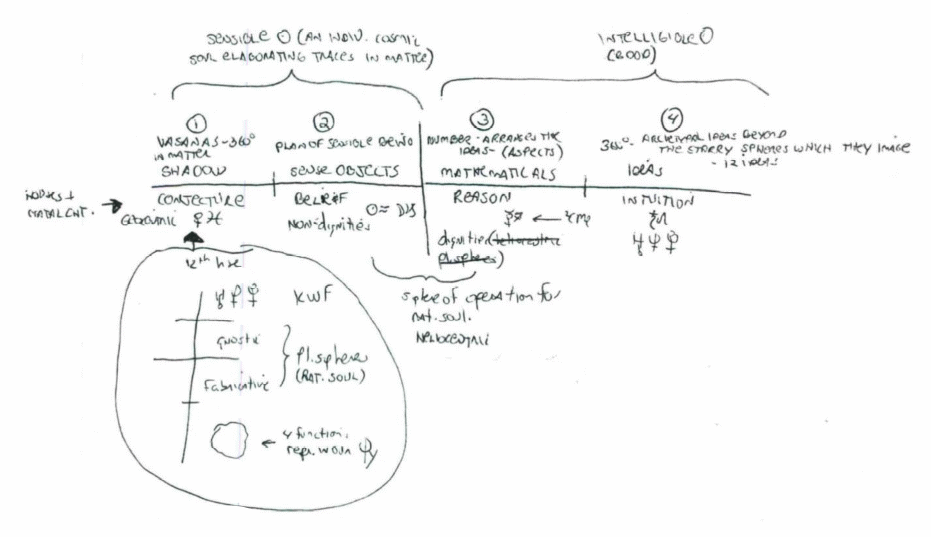
Class
Friday, January 14th, 1983
Verbatim, unedited transcriptCLASS at Wisdom's Goldenrod, Hector, NY
with Anthony Damiani (AD)
January 14, 1983
PLOTINUS; QUESTIONS
TOPIC: Plotinus
SUBJECT: Questions
SUBSUBJECTS: Reason, Reasoning Soul, Theory of Knowledge (V.9.7), Soul and Intellectual-Principle, Divided Line, Serpent's Path
CONTENTS:
Reading and discussing Plotinus, I.3.5, 6, on Dialectic
Reason-principles, universals in themselves and as represented in imagination
Reason orders and relates the manifold into a unity
Categories of sameness, difference, etc., presupposed in thinking, couldn't speak/think without them; can only be pointed to in reasoning
Intelligible is in the sensible
Reason-principles are always operative, only thing that makes life possible
First step: distinguish reasonable experience from sheer imagery appearing
Contemporary mind unable to see that in sensory realm there are distinctions within knowledge, tries to reduce all knowledge to one level
Don't have to accept symbolic reality, can experience what symbol stands for
Nyingmapa and Vedanta say no need to shut down sensory functioning to get to reality
Multiple states of being present right with the primal image
All thinking goes on within ultimate reality
Why does Buddhism say no one experiences Nirvana?
Double standpoint; as long as there's absolute Mind, there will be universal manifestation
Both standpoints available to Sage
V.S. Iyer: importance of reason; have to go through reason to get to reality
More student discussion on reason vs. belief
Mentalism in Plotinian terms
Reading and discussing Plotinus, V.9.7, in terms of the divided line
Conjecture: reasoning soul submerged in an organized body conjecturing on bodily modifications, stimuli, appearances
Body is reflecting apparatus in which you have knowledge of other parts of the world
Discussion of belief/opinion level of divided line
Discussion of top two levels of divided line
V.9.7 takes you from top to bottom and shows you how the instantiation of the Idea as an image takes place
Spontaneity of undivided mind = highly ordered sequence
Ideas per se never have any contact with sensible world
Intellectual object is known by gnostic part of reasoning soul; fabricative part of reasoning soul takes that Idea and builds imitative objects in sublunary realm
Soul is a unity, runs through whole divided line
Idea of Man doesn't become sensible man but sensible man is a manifestation of Idea of Man
Distinguishing true knowledge in itself (top level) and the way it is present to reasoning soul
Sensitive soul
Serpent's Path
Reading Plotinus V.9.13, AD comments
PB meditation on Sun trying to get you to experience each Idea
Ultramystical meditations based on metaphysical principles
Pure presentation upon first instant of awakening
BOOKS READ FROM OR REFERENCED:
Plotinus, The Enneads (MacKenna translation, 4th ed.)
Immanuel Kant, Critique of Pure Reason
V. Subrahmanya Iyer, The Philosophy of Truth, or, Tatvagnana
Paul Brunton, The Hidden Teaching
Paul Brunton, The Wisdom of the Overself
PLOTINUS QUOTES READ OR REFERENCED: I.1.9, I.3.5, I. 3.6, V.3.8, V.9.7, V.9.13
DIAGRAM appended to this transcript:
- FIGURE 1983 0114-1-AB. Divided Line.
This diagram is not from this class but is used as a stand-in to help follow along. Other diagrams also referred to are not with this transcript version. [Transcriber note: [diagram] means the speaker is referencing a diagram as he or she is speaking. If someone is drawing or writing, with audible sounds of chalk on a blackboard, I indicate this by [drawing] or [writing].]
TRANSCRIBED Verbatim by IT prior to 2018 (V11a). In 2006 jf did a partial transcript of the second part of this class using the (correctly dated) audio cassette tape (the first was missing at that time). This is V12a (2023) and has: updated prefatory matter, footer, and audio file name; Book List and TOC completed; Plotinus quotes section added; typos corrected and new notes within transcript; divided line diagram appended and reference within transcript to this diagram; new formatting to accord with new conventions. Archival verbatim transcript – V12a.
AUDIO FILES: 1983 0114a, 1983 0114b (formerly 1983 0125a). [Note 1: "Tape" and "Side" refer to original audio cassette tapes that were later digitized into .MP3 Audio Files. Note 2: It seems we are missing the first few minutes or more of the class, as the first file starts rather abruptly. It also cuts off a few minutes early so some portion of the class is lost there as well and there is not a smooth transition to the second file.]
| NEW FILE NAME | OLD FILE NAME |
| 1983 0114a | 1983 0114a |
| 1983 0114b | 1983 0125a |
1983 01/14 at Wisdom's Goldenrod
Plotinus; Questions
[Audio File 1983 0114a Begins]
S: --really.
MB (very faint): [couple words inaudible]
RG: I.3.5.
S (faint): Excuse me, do that again.
S (faint): I.3.5.
RG (simultaneously): I.3.5.
S (faint): Yeah.
[12¾ second pause, paper noises]
Plotinus [I.3.5, RG reading]: "5. But whence does this science [RG: the science of dialectic] derive its own initial laws?
"The Intellectual-Principle furnishes standards, the most certain for any soul that is able to apply them. What else is necessary Dialectic puts together for itself, combining and dividing, until it has reached perfect Intellection. 'For', we read, 'it is the purest (perfection) of Intellection and Contemplative-Wisdom.' And, being the noblest method and science that we have, it must needs deal with Authentic-Existence, The Highest there is: as Contemplative-Wisdom (or true-knowing) it deals with Being, as Intellection with what transcends Being.
"What, then, is Philosophy?
"Philosophy is the supremely precious.
"Is Dialectic, then, the same as Philosophy?
"It is the precious part of Philosophy. We must not think of it as the mere tool of the metaphysician: Dialectic does not consist of bare theories and rules: it deals with verities; Existences are, as it were, Matter to it, or at least it proceeds methodically towards Existences, and possesses itself, at the one step, of the notions and of the realities.
"Untruth and sophism it knows, not directly, not of its own nature, but merely as something produced outside itself, something which it recognizes to be foreign to the verities laid up in itself; in the falsity presented to it, it perceives a clash with its own canon of truth. Dialectic, that is to say, has no knowledge of propositions--collections of words--but it knows the truth and, in that knowledge, knows what the schools call their propositions: it knows above all the operation of the Soul, and, by virtue of this knowing, it knows, too, what is affirmed and what is denied, whether the denial is of what was asserted or of something else, and whether propositions agree or differ; all that is submitted to it, it attacks with the directness of sense-perception and it leaves petty precisions of process to what other science may care for such exercises."
[short pause]
PD: I don't see how that is directed to the question though. That's-- I mean that's a statement of what Dialectic is. [RG: Well the--] But how you as an individual functioning through egoistic knowledge have-- [RG simultaneously: Hm.] have any-- any glimpse at all of what the [S simultaneously: Who cares?] ontology's about, I mean I [RG simultaneously: Dialectic--] think that was Andrew's question.
RG: No, and I think this is the answer to it.
PD: Your knowledge is this dialectical knowledge that the philosopher has?
LR: I think he start-- I think he starts by saying you start right where you are, [students assent, faint] and in that you capture some train of thought you begin where you are and it leads you to true Existences.
VM: I don't see where he says that exactly. I tend to [LR simultaneously: No he--] agree with Paul, this seems like a very elevated notion of Dialectic which is a goal to be worked towards but, you know, for those of us starting in the imagination all tangled up with out own psychology and so on, it seems very hard to realize that.
RG (simultaneously): If you hold to the view that all we do here is hole up in our imagination, then there is no answer. There's no answer to Andrew's question, he's right, then you have to become a Zen Buddhist and just meditate. It's pretty clear-- I mean I think it's pretty clear that you could either hold that thinking-- and I think here he includes thinking, I mean when you're really philosophizing and you're thinking, you're participating in this Dialectic and you can know of ontology, you can know of Being, not that you're directly one with Being, but you can in thought, as Paul pointed out, because there's not the [VM simultaneously: A hiatus, yes.] utter distinct hiatus [VM: Ok I--] between Being and Knowing, or thinking about it, in Dialectic you can reason about ontic Being. I mean--
PD: I follow what you're saying Dickie, but I don't see it coming from there at all. [RG simultaneously: Well, it made sense for me.] I mean that's the-- the way the philosopher knows.
RG: And insofar that we're thinking reasonably we are participating in philosophy. In those moments we are philosophizing.
PD: I-- I can't accept that, I think we're dealing in symbols.
AD: Yeah but, let's see if we-- from what Dickie's saying-- I think what you're saying, Dickie, is these things may be represented in the imagination, alright, and they are the contents of the imagination. But that doesn't mean that we can't understand the principles that are ordering the content [AS assents] of the imagination and that we want to deal directly with those principles if we could, but if we can't, well then we certainly could deal with them as they are represented in the imagination.
PD: I think that's been my point, is that we're dealing with the etchings, in the imagination, of true knowledge.
AH: Yes but, and that's my-- that's really my-- my question.
AD (simultaneously): What is the difference between those principles, [student assents] alright, like sameness, identity, difference, alright, as they exist in Being itself, and the way they exist in the imagination?
PD: Only an imaginative difference.
S (faint): Helps me.
[short pause]
AH: What one difference cer--
BS (simultaneously): You mean there's no difference?
AH: One way that they would be different is in the imagination they're known in an objective way, they're known outside of themselves as it were. And that-- I think that's the symbolic reference that Paul made here, there's this per-- there's this objectification of a symbol in the image-making faculty of the mind.
RG: But he says here too--
Plotinus [I.3.6, RG reading]: "Our reasoning faculties employ the data of Dialectic almost as their proper possession…"
AH: Almost as a notion of-- I think he-- I think he qualifies with words like 'almost' and--
RG: "Almost as their proper possession," meaning that reasoning can ascend to the content of Dialectic and almost be it, even when in our-- in-- in our-- in a lower faculty that isn't let's say pure intuitive rea-- reasoning, but the reasoning that we participate and process can participate in that dialectical procedure.
AH: That-- I think the notion of 'almost' in that statement-- later in the passage he uses a notion of, I think he refers to the-- to the last vestiges of imagery in (a minor). And insofar as there is that image, it is almost like it, it's al-- it's an almost perfect analogue of those principles in themselves. But it's not a-- it's not those principles because there is a separation.
LR: Yeah. [AH simultaneously: And that separation--] That you start with those notions.
AD: Well suppose you wipe out those principles.
AH: Then you wipe out thought.
AD: No, you won't wipe out thought.
VM: Imagination.
AD: You-- if these principles did not exist or have representations in the imagination, just imagine trying to live this in this world.
AH: Yes. But see I'm defining thought as the objectifying tendency of the mind. And insofar as the mind objectifies anything--
AD: How does the mind objectify difference?
AS: Hm.
[student assents, very faint]
AD: What is the difference between this pole [AD hits poles] and this pole? Show me how difference is objectified.
AH: See, it's a double-bind, Anthony, because you're asking me to show how the principle of difference--
AD: Is objectified by the mind, go ahead.
AH: It's in the-- it's an analogue of the principle of difference, and it has to do with the way the mind functions.
AD: You show me that, I'm asking you the question. [AH: Times--] Show me the principle of difference as an analogue.
AH: That pole is different from that pole.
AD: Yeah. For such and such reasons, right?
AH: Yeah.
AD: Now, is difference an entity that's other than the two poles?
[short pause]
AH: Insofar as the question must be responded to from the point of view of the thinking mind, it's a-- it's a symbol of an entity.
AD: Show it to me!
AH: I just did, I asked the pole how it's different than that one.
AD: You're trying to tell me that the difference between two poles is a third entity, and I'm denying you! I'm s-- I'm saying there's no such thing.
AH: Yeah, that's what I'm saying.
AD: No.
AH: Thought. You can't find a principle of difference to make--
AD: But it's operative. I can state that these two poles are different from one another.
AH: I agree, there's two poles.
AD: Well show me the difference.
AH: One's a little longer than the other one.
AD: So the difference between the two poles would be the six inches missing?
AH: It's got that. (laughter, student words) May-- maybe I'm not following your-- your logic, Anthony.
AD: You speak about difference as though it is something that you could point to. In other words you say in my imagination I have a symbol that could represent the difference between these two objects A and B.
AH: No. I don't think-- I don't think there's any entity in the imagination, I think the functioning of the imagination itself has the prerequisite necessity of projecting, objectifying difference. I mean we-- the world that-- the world that is known through the imagination is one of many many different things.
AD: Alright, the world that is known in the imagination. Let me put it this way then. Can you show me in that world the principle of identity, sameness, difference?
AH: No.
AD: And yet it governs, orders the knowledge which is within the imagination?
AH: See, I can't say that. Apparently some of you can.
AD: What do you mean you can't say that? [AH simultaneously: I--] Is there a difference between one pole and another? (AD laughs a bit)
AH: Yes.
AD: Go ahead (Ricky/Richie).
RG: But, you know--
PD (simultaneously): [one/two words inaudible] I'm sorry.
RG: But how-- you know, you-- you can't admit that it is, but how-- what faculty in you admits that it isn't?
AH: That it isn't what?
RG: The discussion you just went through you used certain faculties to come to those conclusions. And I'd like to know what you think those are independent of this faculty of reasoning we're talking about. The understanding that the image can't bear reason, the understanding that.
AH: It can't.
RG: No but what faculty-- you see, to me your argument-- if you really believed your argument, you couldn't speak. [AH simultaneously: Ok.] Because you're using the very faculty you're critiquing in order to prove your point.
AH: Ok Dickie, I think I see your point. And whether I say it is or whether I say it isn't, I have not yet jumped over my own shoulders to step outside of that image.
RG: And what faculty do-- did you just use to understand this point?
AH: I s-- it's a faculty that doesn't yet pull itself up from its bootstraps.
RG (simultaneously): No but what is it? Let's first understand what it is before it doesn't pull itself up from its bootstraps.
[student assents, faint]
AH: Discrimination?
AD: How about reason, the good old-fashioned reason?
AH: Yeah.
AD: Well then it does order and relate the manifold for you.
AH (simultaneously): Yes, of course.
AD: But yet it's not in the manifold.
AH: See, I'm not able to say that. I'm not able--
AD (simultaneously): Well I-- if you can say-- if you can show me something in the manifold which is self-identical with itself, please do so. [short pause] What in the sensible world, alright, is self-identical with itself?
AH: Nothing.
AD: And yet you speak about identity, don't you? You can't show me the principle of difference, you can explain to me what the conditions are necessary in order for a thing to be self-identical with itself, alright.
AH: But see Anthony--
AD: In other words-- wait. In other words, you use or presuppose the very categories that you must employ to understand and then you tell me that they don't exist!
AH: And you're presupposing a notion of identity--
AD (intensely): I'm presupposing reason when I speak to you!
AH: You're presupposing a notion of identity or difference that is a presupposition of the mind that is presupposed as being outside the mind.
AD (intensely): I'm presupposing reason as the categories by which the mind projects thought and understands what it projects.
AH: Yes. Well--
AD (simultaneously, intensely): And I'm not going outside the mind. [PD: But you are--] Let's not get into that now, huh?
PD: You are when you say that they're separate from the images. When you say that, well, what--
AD (simultaneously, intensely): I said they order and relate the manifold into a unity.
PD: But see the point is, [AH simultaneously: That's what's outside.] Andrew is saying that you cannot separate them from the imaginal world and you seem--
AD (simultaneously, intensely): Well if I can't then you point them out to me in the imaginal world!
PD: That meaning-relationship which one pole is different from another is part of the perceptual situation.
AD: The-- the difference?
PD: That is part of the (presentation).
AD (simultaneously): Show me!!
PD: Why do I have to show you, meaning is never showable. Perceptual--
AD (simultaneously, intensely): In terms of reason, show me. [PD simultaneously: Conceptual difference--] I'm not asking you in terms of images, I'm asking you in terms of reason show me this entity of difference that you're talking about!
PD (simultaneously): You're calling it an entity, I'm not. I'm saying it's the relationship established in the image.
AD (intensely): Relationship is another way of saying the same thing. If you say two things are related, you're going to bring in the fact that you have A and you have B. You're speaking about entity-ship.
S (very faint): Yeah.
PD: No, we're speaking about relationships.
AD (intensely): Yes, but relationship means that you're relating-- relating A to B!! [AD hits board] A is an entity, B is an entity!
PD (simultaneously): No, (relationship) is a-- is a continuum of relationships.
AD: Huh?
PD: There's no need to go into the-- the ontological situation that you want to characterize the image by.
AD (simultaneously, intensely): No, no, no, no, I'm not going into any ontological, I'm just talking ordinary talk. If I'm going to relate anything they got to be some thing that I'm talking about.
AH: Something outside the mind's functioning.
AD: No, [RG simultaneously: No.] not outside the mind's functioning!
PD (simultaneously): Ok, the images.
AH (simultaneously): Some ontological principle, [AD simultaneously: Oh no.] some-- some verity.
S: [couple words inaudible]
RG (simultaneously): The mind is more than its [AD simultaneously: No.] images, first (of all/off).
DB: No I think, I think-- now, stop me if I'm wrong [one/two inaudible AH words simultaneous with DB] Anthony, but I think what you're saying is that as far as our experience is concerned, these categories of difference, sameness, so on and so forth, go into the very structure and unfoldment and understanding of our experience.
AD (simultaneously) I didn't say goes into, I said it is presupposed [DB simultaneously: Yes, right.] by our thinking.
DB: Right, our th-- our-- and what-- so that just--
AD (intensely): I don't know how difference could get into something but I do know that my thinking about something presupposes this category.
DB: Right. So the very fact of our thinking, the very fact of our thinking presupposes this category. The fact that we can think at all, one thought after another, presupposes this category, [AD: Yeah.] ok, I mean that every motion of mental activity, bringing in another one, presupposes that these-- these categories, ok. I mean insofar as we have an individual mind and it's working in any form shape or manner, these categories are intrinsically, not even bound up with it, they-- it seems that you're saying that they constitute it in some way.
AH: And I'm saying that thinking can't presuppose anything.
AD: There are a priori constitutive principles that make it possible for you to think without which you can't utter a word except maybe bark. (laughter)
AH: Then how shall I state them--
RG (simultaneously): But-- but Andrew--
AH (simultaneously): How should I state them within thought?
RG: Andrew, you just said thinking cannot presuppose anything. That is a statement that you believe to be true. You're asserting a truth. What-- if everything was only the panorama of change that you so-- so tenaciously want to hold to, you could not assert its truth or its falsity as change or as identity or anything else about it. You inherently are believing in reason as revealing truth. I don't care if you say it or not. You wouldn't assert anything if you didn't believe reason worked. And your claim that it's just imaginal is denied by your vehement assertion of the reasons you're presenting.
AH: Let me-- let me state it again. Thinking can't presuppose something outside itself within itself. [S: Right.] I mean if you're going to define thought as the objectifying necessity of the mind, how shall thought presuppose an entity-ness outside itself from the perspective of thought? I mean, I know it sounds good, and I know that it seems so, but I simply won't and can't accept that in my thinking mind.
RG (simultaneously): You are accepting it but you're not admitting that you're accepting it. Reason, the faculty you just [one word inaudible] to go through your argument, is the very faculty that stands outside.
PD: You're saying that.
RG: No, I'm trying to-- I'm-- yes, I know I'm saying it.
PD: Maybe in his opinion it's not reason that stands outside the mind.
RG (simultaneously): What's-- what's speaking to us then in his mind, what's speaking out of his voice?
PD: Words.
RG: Just words?
PD: Absolutely.
RG (simultaneously): Do they have any meaning?
PD: As much as any other form of presentation does.
S: [couple/three words inaudible]
AD (simultaneously): It's not outside the mind, it's just a different layer of the mind that you have to bring into focus to understand but it's not outside the mind. Well we have to state these things correctly if we want to understand what we're talking about. I'm not stepping outside the mind no matter what I do. Alright?
PD: Sounds good.
AD: Now, we went through that Wednesday? Let's leave-- let's leave it there. I nailed it down. I bolted it down and I poured a hundred pounds of concrete on it. Leave it there. I'm not going to be outside the mind when I'm talking to you. [intensely] All I'm saying is that my thinking presupposes these categories in order for us to carry on conversations and not be like barking dogs.
AH: Anthony, thinking presupposes these categories. Can those categories be-- be usurped by thinking?
AD: I don't know what you mean.
AH: Can those categories that thinking has presupposed, can they be touched by thinking?
AD: I really don't know what you're talking about.
AH: Can thinking grasp those categories?
AD: No.
AH: Why? The question [one/two words inaudible]
AD (simultaneously): Because they're presupposed, they're a priori. There are constitute-- they are constituted of the possibility of thinking.
AH: Ok. Then how shall thinking posit them? If it can't touch--
AD (simultaneously): Thinking doesn't posit them, I just said they're a priori. They're prior to your thinking mind.
PD: But you're speaking in circles! You-- so you can't know anything about them and now you're going to posit them as being prior to the mind! You're speaking in tautologies!
AD (simultaneously): They're not prior to the mind. I mean they're prior to my thinking.
AH: And if they are s-- if they are that, if they are [RG: Right.] prior to your thinking, within thinking, I mean is David's original question I think, how shall-- how shall thought do metaphysics?
RG: By observing its effects. By reasoning from what they-- wh-- the production back to the cause.
PD: Now you're going back to the point that was made earlier, you're following the tracings of these principles in the imagination. You're not dealing with these verities.
DB: See there's a-- [RG/S(?) simultaneously: But--] I think there's--
AD (simultaneously): What are the tracings, Paul?
S: Yeah, what is--
PD: Images. Presentations.
AD: What image is there between two poles, alright, the difference of the principle, what difference is there between two poles, what is this image?
PD: Well see the very word 'principle' is a conceptual meaning that has-- that you're saying is outside, separate from the whole imaginal--
AD (simultaneously, intensely): No, I said presupposed. Let's take an example.
PD: Let's say there's nothing presupposed. [VM simultaneously: That's a presupposition.] Because our presupposition is different.
RG (simultaneously): That's a presupposition.
VM: I mean that's a presupposition. It sounds like we're doing Madhyamika tonight.
PD (simultaneously): I grant it. But it's better-- it's better than-- than saying we start with your presupposition and make it universal.
AD (simultaneously, intensely): In other words, in other words, the floor isn't a presupposition for your walking?
AH: Yes but-- but--
PD (simultaneously): No, maybe not.
AH: But how is that an example, (bit of laughter) how is that an example--
PD (simultaneously): I might walk on--
S: Don't be--
AD: Let me give you an example again, alright? Let's take an example that we use before. Imagine right now that you have ten thoughts in your mind all simultaneously presented to you. Each thought, alright, is different from another thought. Right? There's a difference between one thought and another. Each thought is self-identical with itself. Alright? Each thought is identical with the whole of the presentation and the same with itself. [student assents, faint] Is your head getting heavy? Now you tell me, the difference between one thought and another, is it another thought?
S (faint): Uh-hm.
AD: No.
S (simultaneously): Uh-hm.
AH: The thought of difference between one thought and another--
AD: Uh, that's a different matter.
AH: Now that's-- but Anthony, I appreciate your compliment sir but I don't experience anything but my thoughts.
S: Excuse me?
AH: I mean, there's nothing in my experience that's other than those images.
AS: No but-- but Andrew--
AH: I have thoughts about difference but--
BS: Do those images think?
AH: I mean--
AS: Yeah, see--
AH: But-- but don't you see--
AS: [few words inaudible]
AD (simultaneously): When you see a square box, Andrew--
AH: What?
AD: When you see a square box, you don't see the form of the square, do you? You see a square box.
AH: Yes. Yes.
AD: Is the square different from the box? The squareness, is it different from the box?
AH: See, any abstraction from the box of squareness is within thought Anthony.
AD (intensely): I'm not discussing that right now. I know everything is taking place within thought. I'm just trying to show that within thought are these a priori presuppositions will make it-- which make it possible for us to be able to have a thought! Because inherent in the thought which is already a manifold is included all these categories which you can't point to! Except in your reasoning, except in your understanding!
AH: Can I s-- Listen, we can go on if you'd like but, I don't see how-- I don't see how those presupposed, well, char-- characteristics of thought can ever be touched by thought.
DB: See, Andrew, let me-- [LR simultaneously: 'Cause they're--] let me just say one thing, there's a-- there's a--
AH: And you'll-- you'll agree to that. You'll say yes that's true, thought can't touch them. But then the very next breath you'll--
AD: But I don't know what you mean by touch because that's another image you're trying to use.
RG: So I would say in your language thought does touch them, they're not identical, could never be identical with them but thought does touch them. [DB: Let me--] Thought--
AH (simultaneously): That's like asking me-- that's like asking me to s--
VM (simultaneously): They don't fully grasp them but they-- they're getting a certain--
RG: They have an image of them in their [VM assents, faint] functioning. And the purer the reasoning, the closer they get. [AH simultaneously: It's like asking--] And when reasoning-- I mean I-- What?
AH: It's like asking me to see my face before I was born, yeah.
DB: But it seems like--
AD (simultaneously, intensely): No, no, we're just asking you to see that reason is present every time you think. We're not asking you the impossible. The Buddhists may like to put it in this-- in this kind of framework. But what we're saying is exactly the opposite, that the intelligible is right in the sensible! [student assents, faint] I'm not going to look elsewhere for it!
PD: Only sleeping Buddhas don't see it.
DB: See, the--
LR (simultaneously): No but the example [AD simultaneously: What did he say?] of the square [S to AD, simultaneously: Sleeping Buddhas don't see it.] in a box is worthy. Can you answer the question about the [AH simultaneously: Sure, sure, let's take a look at--] square in a box because I think that's what-- that was right--
AH (simultaneously): Let's do that one, let's do that one.
LR: He said, can you see the form of it, do you apprehend the form of the square other than in the box or as the box? And you said--
AH (simultaneously): I understand-- I understand that there's a principle--
LR (simultaneously): Wait, but did you-- did you say no?
AH: The principle of squareness as distinct from a particular box, is that the issue?
LR: No.
AH: Ok, try-- do it again Linda, I'm sorry.
LR (simultaneously): Do you apprehend the form of the square anywhere else than as the box?
AH: That square?
LR: Yeah, square box. You're looking at the box.
AH (simultaneously): No, it-- it's right there in the box.
LR: And that's his point. It has to be right there. It structures it, it's the actual structuring of those in there, I mean, you say that that apprehension of that square box is an image in your mind, right?
AH: And I say that the apprehension of the form of square is an image in the mind.
S: Uh-hm.
LR: Right, [AH simultaneously: You wouldn't deny that.] it is, because it's not outside, that-- it's n-- it's not outside. It has to be present with every image that you have.
AS: No, that [few words inaudible]
RG (simultaneously): Yeah but Linda, his answer is that [S simultaneously: No.] that understanding only proves his point, which is that [LR simultaneously: I don't--] there's no-- there's-- you don't have to resort to any other-- any-- any genera.
LR: No, but I'm just directing this at one thing which is you start right with the images you have, you don't have to go outside of that.
RG: Ok. [LR simultaneously: See that--] I think Andrew would agree with that.
AH: Sure, I would go that far.
RG: Now you have to take it to the next step.
LR: Ok, that's just the beg-- I mean that's just the--
AS (simultaneously): Yeah.
LR: I think-- yeah, [RG simultaneously: Ok.] that's the beginning point. And once you admit that those principles are right there with the images--
RG: No, but [S simultaneously, faint: What?] you see, [AS simultaneously: He's (couple/few words inaudible) there.] he's going to argue with your language. He's going to say that your-- that to say principles are right there is already an abstraction and that the square box is what it is and you-- and you abstract squareness as an image in your mind and you don't need to resort to principles to understand the immanence of square in box, that that's a mental imagination and doesn't deal with truth.
AH: Yeah, that's-- that's exactly right.
LR (simultaneously): No, I'm not saying that deals with the truth, I'm saying you start with the experience of that. [AH simultaneously: But see the point--] And I think Plotinus is saying that, that you begin right with the thing.
AH: You're going to the box with a presupposition of squareness, that--
LR (simultaneously): That the intelligible's right with the sensible.
AD: No, we're not going there with the presupposition of squareness, we're saying that the immaterial knowledge is right there, what you're speaking about. That squareness does not exist in the perceptible as per se.
AH: And I would agree totally that the immaterial knowledge is there, yes. But that immaterial knowledge--
AD: Then how could it be touched by the box?
AH: How could it be-- how could it be not touched by thought? The immaterial knowledge is thought. Now--
AD (simultaneously): Immaterial knowledge is thought, yes.
AH (simultaneously): Yes, now if you're going to call it immaterial knowledge, that principle, the structuring basis of thought, and the only way it can be known is by thought, my point still holds that you have presupposed something outside of thought that really is within thought.
AD: Well, I don't see, I don't see that there's any meaning to outside or inside thought right now, because [AH simultaneously: Ok.] I don't even know-- I don't even know what we're talking about when we speak about outside thought.
AH: Well, we spoke about that in Wednesday night's class.
AD (simultaneously): All that-- all that we're-- we're putting forth here is that the very nature of the thought processes, experience itself, presupposes the existence of these categories in order for us to have an understanding of what we referring to as an object of experience. Now you could say that these principles or these categories are in the thing, which I don't know what you would be talking about when you say "in the thing". And you can say they're outside the thing. Again, I don't know what you're talking about. I can understand when you say it's prior to the thing or it's connascent or simultaneously with the thing.
AH: Anthony could-- could we--
AD: We're speaking about buddhi, you know that, what [AH assents] they call buddhi. [AH assents] We're speaking about reason-principles which make it possible, alright, for people to communicate. We're speaking about universals which are embedded in the very structure of thought.
AH: I would say it sure-- they certainly are embedded in the very structure of thought.
AD: Ok.
AH: You know, like thought does not have to work in a totally haphazard irrational way. It's possible for thought to work in this methodical reasonable way.
RG: And if reason is understood as the linking of thoughts in a sequential manner that makes understanding, the reason you just spoke of has to not be in the thought. Because it links the st-- the organization of that reasoning process. So if you let r-- if you accept that and then reason can be allowed to be one category that performs, that is this criteria that's outs-- that organizes thought and therefore is not principially within it, then we can allow other categories. But if we could stick with reason if that's--
AH: See I can allow the-- I could allow the category as an issue of faith, Dickie.
RG: No, no, no, [AD simultaneously: An issue of faith?] I don't want it to be faith.
AH: Yeah. I mean I would--
RG (simultaneously): It's got to be rational.
AH: Yeah, the reason will take me to the point where a leap of faith and I'm willing to allow it.
RG: No, no, don't go-- I don't-- no, that's not good enough.
AH: Well that's the best I can do for now.
RG: But when you just said-- no it isn't. When you said reason-- you said you think thinking could become rational, what did you mean by that?
AH: Well I've noticed, I've noticed that the difference between a haphazard thought process and a rational one.
RG: Ok.
AH: So you say, ok, now the rational one is very different. And because that's so, reason is able to take itself to its own limits, so to speak. [RG: Yeah, ok.] Reason is able to turn upon itself and take itself to the precipice of its own function. And at that point the-- the tendency is of the reasoning mind is to-- is to posit on a basis of faith some ordering principle.
[student assents]
RG: No but what organized your thinking to make it reasonable, what would you say? You'd say that a haphazard collocation of events that happens, "Hey, this makes sense"?
AH: No, I would say there is a principle. My only point is that that principle can't be touched by the reasoning process itself.
RG (simultaneously): But it could be understood rat-- it could be understood to be there, it doesn't have to be the-- you can-- can't you allow that it could be understood without being directly intuitively apprehended, at first anyway?
AH: Understood. [student assents] In the same way that the consequences of that principle are understood?
RG: Well, now the word 'understand' I mean, I mean, you could stand under the principle and receive it in that way.
AH: Ok. I think we're getting closer to that ability. You could stand under it and receive it. But, that standing under it and receiving it is a very good example of this symbolic analogous way that we must approach that-- those verities.
DB: See Andrew, I think that-- that perhaps the-- the problem is that we're in the-- in the process of thought examining itself, and it seems that among other things these categories are necessarily revealed, I mean that when thought examines its own functioning, these-- these categories have no choice but to appear in the mind, you know.
AH (simultaneously): As thoughts.
DB: As thoughts, [AH: Ok.] right. But I mean, (there/their)-- what appears in the understanding is a representation of them, but it seems like insofar as they go to constitute the functioning of reasoning and the very process of rational thought that we have-- there's an inevitable necessity that it's not so much that they're presupposed as being, you know, well this is a possibility, but just the very reality of functioning of our minds insists on it. Something like that. So that-- so that-- that it's not so much that there's this tremendous cleavage between the functioning of our mind and the foundation of our minds but that-- that the-- the very functioning of our minds presupposes those structuring principles within its foundation. Now the-- [S: Yeah.] Do you see what I mean?
AH: No, I understand. And I guess where I'm-- I guess what I'm debating is that-- is I feel a necessity to-- to-- to very clearly define how those principles are manifest in our lives. You know, I feel that necessity and I'm just not able to kind of gloss over that issue, that these principles are here [PD simultaneously: You--] and they're fundamental to my thinking.
PD: You can't speak with certitude about them?
AH: No I can't. I certainly would like to or-- But I just can't do it.
PD: Well in a few years.
AD: Then you'd have trouble adding 1 and 1, wouldn't you? [short pause] (If I could) sympathize with you.
[short pause]
AH: Now if we-- if we really are-- are really strict about--
AD (simultaneously): The only thing that makes life possible is the very fact that these reason-principles are always operative and you could always depend on them. Otherwise it would really be a quagmire.
[student assents] (RG laughs)
S (amidst laughter): What did he-- what did he--
AH: See Anthony, I'm not-- I'm not debating that-- [RG (simultaneously): Pretty good-- pretty good appearance, are they?] I'm not debating what you just said, but I'm not able to accept or to let the notion of-- I want to define thinking clearly.
AD (simultaneously): You want to what?
AH: I want a definition for thought that's-- that's a precise one.
AD: I'd have to take you outside of thought.
S: Yeah.
PD: Andrew said he wouldn't complain. (bit of laughter)
AH: You'd have to take me to those principles.
AS: But I-- I think that there-- that it would be sufficient just at this point to open up a gap. I mean, one of the problems, it seems that you want to put all of experience on one level and you say the reason is imaginal and you equate the perception of the square with perception of white or blue or just an unintelligible per se. Now I think it would at least be a start to see that within experience there isn't just-- it's not homogenous. If you want to say well everything is thought, my reasoning is thought, my perception of the pole is thought and so on. [AH assents] I think the first thing even before you can jump out of thought is to see that even within that experience there's a very sharp distinction. Try not-- maybe try not homogenizing it all as say thought but try and make within the experience, see that there really is a gap. Even though you could say it's all your experience, that doesn't mean it's all homogenous. There's a very clear distinction you yourself pointed out between reasonable experience and chaos. [AH assents] And that reasonableness is a different order-- you could even say a different-- on a different order of reality, but it's certainly a different level within your experience.
AH: Yes.
AS: And once you've opened up a gap that there is a distinction between just imagery going on and then reasonable imagery, you have to understand that this principle of reasonableness is something other than just imagery. Right? I mean that-- now I'm not-- not going outside of thought. [AH simultaneously: Good point.] I'm not say-- you're not jumping out anywhere. In my experience there certainly is a distinction. Your first thing is you seem to want to lump-- you know, homogenize all of it. And it's actually not homogenous. I mean an animal might have just this kind of imagery appearing but certainly at times you can do 1+1, you can do other reasonable acts. And it's-- it seems like it would be more incorrect to lump that kind of thing with imagery than to distinguish them. It seems more proper from where we are within thought even to distinguish reasonable-type experience from unreasonable, from just sheer imagery appearing.
AH: Yes.
AS: And that reasonableness is what's pointing at-- the reasoning itself, I think what Dickie was trying to point out, it's not that reason is-- not even the objective [one/two words inaudible] reason but the reasoning itself is pointing to the principles which are ordering your experience. [AH assents, faint] And you have to say that an ordered experience is certainly qualitatively different from just chaotic imagery. And that's all within experience, already you've opened a gap.
AH: Yes [one/two words inaudible]
AS (simultaneously): Already there's some kind of, you know, and--
AH: That's a very good point Avery and-- but I thought that-- [AS simultaneously: Hiatus.] I thought that--
AS (simultaneously): A real hiatus.
AH: I thought we were talking at the level of the imagination functioning. And that is homogenous. I mean there are distinctions within it but it-- like from the point of view of perception or apperception. And there there is the hiatus.
AS: Well [few words inaudible]
RG (simultaneously): But he just pointed out the hiatus within the imagination, there's reason-- imaginative reasoning and imaginative chaos.
AS: But I would leave-- ok. [student assents] But even leave-- leaving out within imag-- just within-- I want to-- within experience. Well-- I mean I--
RG: But yeah, either way.
AS: But, just what you-- what you just said, you know. You do experience that distinction. You do experience a hiatus. [AH assents] You certainly do, I mean you-- even the fact that-- as Dickie was saying, even the fact that you're reasoning now, but any other-- any other kinds of reasonable acts point out a tremendous hiatus, a qualitative difference between imagery appearing and reasonable imagery and reasoning. You know, that must be pointing at something. [student assents, faint] Because if it were just all of one quality, you'd never be able to bring in that reason. If there weren't these principles ordering the experience, then you wouldn't be able to reason and why is-- why wouldn't it just be unordered chaos. But obviously you're not-- life is not just unordered chaos. You couldn't even say that if it wasn't 'cause to deny it itself would be bringing in that principle, which in itself is bringing in a hiatus within your experience.
AH: Yes. The on-- the only thing that would be homogenous would be fact that if there is experience, it is that image-making faculty of the mind working. That is a homogenous qualitative somewhere--
AD (simultaneously): Yeah, now you're speaking of the imagination as substance.
AH: Yeah. So from that point of view you would see the-- the qualitative sameness.
AD: You wouldn't be able to see that either.
AS/S(?): Huh.
S (very faint): Right.
AS: It's a lot (to bring/different).
RG/S(?) (faint): Yeah [one/two words inaudible] deny it.
[short pause]
AD: You just don't know what you're asking for when you're trying to put all knowledge on the same level.
AS: I mean this is [three/few words inaudible]
AD: And because of this it's possible to have a metaphysics. Because we can do this, we can have metaphysics. And we can discuss certain principles which are, so to speak, inherent in any discussion of cosmology, epistemology, or anything else.
S (faint): Yeah.
AS: That-- I think it's im-- that gap is important. As soon as you admit and you-- it's very hard not to admit, as soon as you admit that there are distinctions of qua-- a quali-- as soon as you admit that there are qualitative distinctions within your experience, boom, you have to allow things like this.
AD: But you see Avery, I think that this is one of the problems that the modern or contemporary mind has, [AS simultaneously: Can't (take it) away.] that they cannot distinguish that within the sensory realm [one/two inaudible AS words simultaneous with AD] you have these distinctions of knowledge, alright. And [one inaudible AS word simultaneous with AD] the box or let's say the perceptual image which is in front of them, alright, and then the knowledge of that box, let's say that it's square, they cannot make the primary distinction of separating the-- they can't see that the mind is already making these distinctions which employ the categories in order to be able to deal with what their experience is about.
PD: But I think Andrew [three inaudible AS words simultaneous with PD] accepted the qualitative distinctions within experience but he's making the simple and fundamental fact that our knowledge of these principles are symbols and images. They are not the principles themselves.
AD (simultaneously): No, no, no, no.
AS (simultaneously with PD and AD): But Paul, but Paul, I think (his/this) next step--
PD (simultaneously, intensely): If you tell me that the words you [AS simultaneously: No, no. No, not the words.] use, 'intelligible', 'the One' [AS simultaneously: Not-- not words.] or 'the Good', (bit of laughter) that [AS simultaneously: No, no, the experience!] whole system of discourse [AS simultaneously: Is more--] has anything of the real in it, Avery--
AS: Yes, I am saying that. I'm saying there's more of the real.
PD (simultaneously, intensely): Oh, the real is in the One and in these [AS simultaneously: No listen Paul.] conceptual diagrams [AS simultaneously: No!] you put on the board? (someone claps)
AS: Paul!
PD (intensely): Show it to me! [AS simultaneously: I will.] Show me the real, Avery, [AS simultaneously: Paul--] come on!!
AS: Paul, I thought--
PD (intensely): Show it [AS simultaneously: I--] to me then!!
AS: I will if you'd be quiet then. (bit of laughter) I really will.
PD: I've listened for many weeks. I haven't heard it yet.
AS (simultaneously): No, no, it's not the concept. No, I think you're getting confused again, you're saying that the concept is the thing. Now we just made a point that he's distinguishing-- if he can distinguish in his experience between the imagery and the reasoning, that distinguishing itself is pointing to something that's more real. I'm not talking about the concept. I'm not talking about a concept of difference. I'm talking about the actual experience, he experiences the difference. Now, he says well I don't see the difference objectively. True, but then again we're saying there's more in experience than just what is either perceived as imagery or the concept. [AH simultaneously: Well, in my experience--] There's something actually there in the experience which is not the concept, I mean [AH simultaneously: Well--] you--
(Side 1 of original cassette tape digitized as 1983 0114a Ends; Side 2 Begins)
AS: --pretty carefully you'll see that that image is not the only thing that's real. You're-- again, you're homogenizing all your experience and saying it's all just image.
PD: Well you asked me about the reality of it.
AS: The reality of it can't [PD simultaneously: Is what you asked me about.] be image because image is the unreality of it. What's the reality of it? It's not the concept or the image.
PD (simultaneously): There is no experience of reality.
AH: If there's someone there to experience it it's an image.
AS (simultaneously): You mean you're unreal?
PD: Yes.
AS: Well, ok, well-- (AS laughs, some laughter)
BS: Don't take yourself [AS simultaneously: Then there--] so serious. (laughter, student words)
PD (amidst laughter): I'm not. (more laughter, student talking)
AH (amidst student words): Avery, I'd like-- I'd like to--
BS: I'm sorry, (it's just--)
[few more seconds of laughter, student talking as AD begins to speak]
AD: Well, if I-- if I can be permitted to add to this, alright.
S: No problem.
S: Please.
AD: What Paul is saying is that we experience a symbol. Now, as you pointed out, if he's referring to the concept that's true, yes, we do experience the concept. But, concept can be a symbol or otherwise. But it is possible to experience not the symbol but the presence of what that symbol stands for. [AH simultaneously: As an image?] You do not have to accept just the symbol, symbolic reality.
AS: Right.
AH: Do you experience it as an image?
AS: No, that's the point, not as a-- an a reality, that's what I was saying to Paul, there's more in experience than just image.
AH (simultaneously): Is it-- is it dualistically experienced, is there someone there to see it?
PD: Who's experiencing the presence, Tony?
AH: Yeah. What's the-- what's--
PD (simultaneously): What's experiencing that presence?
AS: You are all the time, otherwise there's [AD simultaneously: Now--] no reality.
PD (simultaneously): Avery, I'm not asking you.
AD (simultaneously): I'm not jumping-- I'm not jumping [AS simultaneously: Oh, sorry.] to the ultimate reality.
AS: Excuse me.
AD: Alright, [AS simultaneously: But you can (get) all you want.] because that won't require any discussion. What I'm pointing out here [one/two inaudible AS words simultaneous with AD] is something like this, if you-- if you try to search for a-- a more practical example. [12 second pause] In-- in for instance let's say in the relationship of love, you love someone, alright, you can experience the reality, so to speak, I mean you can s-- you can experience the love symbolically in a person, you know, your son, your daughter, whatever, and then you could subtract the image to which this dominant, so to speak, is associated with, and experience the love without the need of that image. So that you're getting directly to the reality of love and not the intermediary which is symbolizing it for you. It's not a very good example but-- Another way to-- another example we probably could use very well is that you're having an aspect and a person could be speaking conceptually about what he's experiencing or will experience. Then when he has the aspect, he goes through-- through the actual psychical, let's say, identification or is that psychical transformation. And there he experiences more of the reality and less of the concept. And it could reach such a point that the symbol is completely ignored and the reality-- and I'm not speaking about ultimate reality remember, that the reality for which it stands is more directly experienced.
Alright, now, in the same way, here we're s-- we're looking at one thing, one level. Here's this image. And by image I mean that which-- that-- that which makes our experience possible. And within it, alright, and within it is not, you know, a spatial, but within that very image there are these various dimensions of reality. And we're not going to talk about the ultimate reality, we only want to point-- talk about the fact that, like in the-- in the divided line you can experience the image. Then you can experience the sensible object for which that image can be correlated. Then you can experience the psychical reality which constitutes that belief which you're holding onto. And then you can go beyond that. So that in one and the same image, the primal image from which all our experience flows, there are all these distinctions within it, alright, and then of course you can posit the whole thing as having for its ultimate reality Mind per se. But we're not going to talk about Mind per se because there wouldn't be any need to talk about Mind per se. We're talking about what flows from Mind once it starts functioning, and the various levels that will be found within it. And it isn't like an accordion that you're going to pull it out. They're all there. Think of it more like a two-dimensional surface. [S simultaneously: See Anthony--] Right? You know, the image right on-- on the screen. And right in the screen is everything that you want.
LDS: Anthony, could I respond?
PD (simultaneously): You know, when-- in trying to unders-- understand the nature of an experience apart from the imagination, the only thing I go back to is meditation. And I can't shut the mind down for two seconds. And it's very hard--
AD (simultaneously): But you know yourself-- but you know yourself that there are schools of thought that would point out that sensory function will not interfere with or getting to that reality. Like you quoted to me the Nying-ma-pas. And I would quote to you the Jnana tradition of Vedanta. Because if you have to close your eyes to get to reality, you're still a long way from it.
PD: That's the dilemma! Because--
AD: It's not a dilemma.
PD (simultaneously): --to reality [AS simultaneously: Right.] it is always aware of reality. To-- and a center of consciousness located within the imaginal realm, where is reality?
AD: I'm sorry, I missed your point.
S: Yeah.
AS/S(?): Yeah.
AH: Say it again Paul because that's the issue.
PD: To-- to that pure light of consciousness, it is always aware of reality. To a s-- a being centered in imagination, what is the nexus to that consciousness?
AD: A being centered in the imagination. No, the imagination is something which is projected from that ultimate reality. If you take the ultimate reality as your prime, your-- your-- you know, your first postulate, and then from it evolve all the lesser grades of reality, they're all within that. So the example we can take from Wednesday was that you have vaishvanara or wakeful consciousness and you're aware of wakeful objects, objects in your wakeful experience. But all of this is taking place within the Mind. The Mind doesn't disappear, it's still the background, the backdrop for all of this. Then you're not awake anymore, you're s-- you're dreaming. Now you have dream objects. There's still the Mind as the ultimate reality or the background in which all of this is taking place. And then you have deep sleep and again Mind is still there as the ultimate reality. Now these three levels you can draw them out as an accordion, alright, and see that the ultimate reality is behind all these three states. But the point is that even a Sage, although he would be directly concerned with the ultimate reality which underlies let's say the experience of an object here, that doesn't mean he's unaware of the step behind it which let's say is what the sensible object is in itself without the interference of our natal dispositions, and that doesn't mean that he's not aware of the psychical reason-principles that constitute that psychical-- that sensible object, and that doesn't mean that he's not aware of the ultimate consciousness which is the ground of that object.
PD: Now in the levels you just now went through, it's only the last level that is outside this activity of thinking.
AD: Well, yes you could put it that way, I would prefer to put it this way, that all that thinking is going on within that ultimate reality. Now, within and without is a meaningless metaphor. But basically it's within that ultimate reality. It's not something outside. So when we say that appearance has for its ground the ultimate reality, you can't separate them, you've got to leave them together. If you do that, then you're a materialist, you're going to be believing in the existence of something outside of Mind. If you leave everything in Mind, alright, and differentiate that their-- Mind can have these various levels and project them forth, then you could see that all these stages, alright, are all so to speak immanent in that very imaginal experience, [AH: But--] in the very experiencing that you saying is taking place in your imagination. It's all there!
AH: But Anthony, if-- if I--
PD (simultaneously): There-- there in terms of--
AD: Here and now, here and now.
AH: Any reference to that ultimate reality as an object is materialism.
AD: Is what?
AH: Is a form of materialism.
AD: Any reference to--
AH: Any referent to the ultimate reality that turns it into an objective mode is a form of subtle materialism, those--
AD (simultaneously): Look, that-- that's not so because it would depend upon the context in which you're using it, alright. You could-- you could think of reality as ultimately nothing but objective or you could think of it as ultimately nothing but subjective or you can avoid either or you can combine both. [AH simultaneously: I'm talk--] I mean it depends on the context.
AH: I'm speaking to the constraint within imaging, within thinking, to portray that ultimate reality as an image, as an object. [S simultaneously: Of course.] And insofar as that's true, [S, faint: Of course.] it can't be that--
AD (simultaneously): I'll show you passages where in Plotinus he speaks about the One as the-- as the object. [students assent, faint] And in terms of the context in which he's talking [couple inaudible student words] it's perfectly legitimate. You cannot attach dogmatic meanings to words but only in the context in which they are used. So, I mean, right now that's not important. [AH simultaneously: Do you think--] Let's go back to the important thing.
AH: Do you think his reference to object is (objective/object as) in thought?
AD: I'm sorry?
S (simultaneously, faint): (Objective/Object as) intellection.
S (simultaneously): [couple/three words inaudible]
S (simultaneously): It's alright.
AH: Do you think Plotin-- Plotinus' reference to object in the quote--
AD (simultaneously): He speaks about the Absolute Mind as object.
AH: As an object for thought?
S: No.
S (faint): In other words [couple words inaudible]
AD (simultaneously): No, as object.
AH: Oh, we'll that's a completely different level of discussion, [AD simultaneously: Go--] that's not answering my question.
AD: I mean, you're trying to-- you're trying to stigmatize a word, alright, which is like well, what I-- what I yell at Richard for. [one/two inaudible AH words simultaneous with AD] I refuse, I refuse to be bound like that to the meaning of any word. What does it mean when I say to you that last knight was riding-- the knight was riding on a horse? Does it mean darkness? Or isn't it the sentence that gave it the meaning that you want? Now, let's stop the semantic nonsense, let's get back to the point we're making. So now here we are, in this very world, alright, with this primal image from which our experience flows. And you tell me I can't experience reality, I can only experience the symbol of reality. Now this is the exact criticism that PB made of Jung.
AH: See Anthony, it's-- what-- it's really what you mean by experience, you know, like, if it-- if you're going to talk about experience as we're familiar with as-- you know, as individual entities experiencing a world as other than myself, I can't-- I can't buy that. But if you want to redefine experience as mystical insight or--
S (faint): No, no.
AD (simultaneously): Experience [S simultaneously, faint: No.] runs the gamut. Experience runs the gamut.
AH: Admittedly it runs the gamut. But it seems that most-- most discussion is restricted to a very specific level of experience which is the level of individual mind's functioning where there's an entity that experiences a world as other than itself, [MB simultaneously: Do you mean--] the necessity for objectification.
MB: Do you mean that a lot of the Buddhist texts restrict experience at that level?
AH: I'm sorry Myra, I didn't hear--
MB: Who restricts experience to that?
AH: It seems that any--
MB (simultaneously): You or the Buddhist, who?
AS: Yeah. Even us.
AH (simultaneously): I'm not talking about anything-- anyone personally do, I think-- I'm just talking about the constraint of philosophical discourse. The constraint of the mind's functioning is to portray images as objective or as other than the thinking subject.
MB: But what's wrong with suggesting that it's-- the mind is capable of another level of experience?
AH: There's nothing wrong with suggesting that. It's just that ninety-nine and nine tenths point whatever of our experience [one/two inaudible student words simultaneous with AH] is not other than that.
AS: No but that [student assents] was the-- [BS simultaneously: Why should that matter?] I thought that was the point before though, Andrew. And again, staying within the experience there-- you already-- if you already admit the distinction between these levels of the ex-- in the experience, then I don't see why it's unreasonable to posit that there is something in the experience that is more than just the symbol or a concept. [MB simultaneously: No, I think--] Why can't something of it-- why can't there be something of the reality there, like, again, when I think hard enough about some mathematical theorem or a square it's not just a concept. You don't feel that there may be some reality in it or the example Anthony gave with love, you don't feel that there may be some reality in it that's more than just a concept? I mean just a concept would be like I say I got a hundred dollars in my pocket and there's absolutely nothing to back it up. There's quite a difference between that and a concept which does have something behind it. You have to admit that. And as soon as you could admit that there is a distinction, even between a concept with nothing at all to back it up and a concept which really does pack a punch, then you have to say there's something qualitatively different about what's behind the concept. And you have to admit it's in your experience, you [AH assents] experience-- See that's the problem. You experience more than just the sensible image. You experience something which is not just that, in your experience. If that weren't so, if I just experience concepts and images, again, I'd say the concept of a hundred dollars would be as good as some other concept which packs a punch like the atom bomb say, I mean to use that extreme example. [AH simultaneously: Well (there's/then) certainly Avery--] Or I fall in love, I mean I-- there-- you're going to say well that's just a concept, love. No, it's [AH simultaneously: No, no, no.] not just a concept.
LD (simultaneously): Andrew, in my experience, when I analyze my experience and I see that there's relativity universal-- universally applying to everything, [AH assents] that presupposes that the principle of relativity is operating before that experience but yet the concept is derived from the experience and so that posits that as later than the experience. So right there, right there within my analyzing of my experience there's three levels.
AH: See it's a tricky business Louis because it's not about a cause and effect relationship. You're put in a context of this is the effect so therefore the cause must be. And you remember the example the people spit on their hands and they thought that brought the Sun up in the morning but I-- If we put this in the context of like because there's relativity, the cause of that relativity must be this principle. Like we really have no way of being certain about that principle that we're referring to. Like it certainly seems to be the case and it makes us feel more comfortable with our lives and--
LD: Yeah but reason dictates it, you reasonably show me that it's not operating. [AH simultaneously: Every time--] Because otherwise you're talking about your belief. My reason is leading me to posit a universal principle of relativity and until you reasonably show me that it's not so, then seemingly and what you believe is besides the point, we're not talking about your belief.
AH: Yes but-- Here, let me use this example. I'm absolutely convinced on a reasonable level that my spitting on my hands and rubbing them together brings that Sun up every morning.
LD: Well show me the reason.
AD (simultaneously): That's not [S simultaneously: That's the reason, that's not-- that's belief. Uh-uh.] reason, that's belief because reason would reject that.
AH: And I'm saying that the way you people are using reason tonight is belief.
S: Well--
AD: That's how you're using reason! (bit of laughter) [S: Wow.] I never use it that way.
AH: You're taking a leap of faith.
LD: You show me [AS simultaneously, faint: (That's) 1+1.] reasonably that relativity is not operating. And if it is operating in your experience that indicates that it's prior to your experience.
AH: I don't-- I'm not able to presuppose anything prior to my [VM simultaneously: But look, I--] experience, nothing.
VM: Andrew, [EC simultaneously: They don't want you to.] I'm sorry, I have to say something that's already been said tonight but, when you make that kind of assertion, you are standing in a certain principle. If you don't want to use that word let's use another word. When you say reality can't be captured in the imagination, that to me is an assertion that you do experience or know something about this reality that you're denying to the imaginal experience. Otherwise your sentence would make no-- I mean it just wouldn't have any sense. I mean it was like Dickie started earlier saying the very logic that you're using to carry on your discussion points to something superior to the actual images. Granted they're immanent in the images but they're not exhausted by the images, they're not-- that's not its proper locus, these x's, whatever you want to call them.
AH: See, the context of this-- of this general conversation, this general discourse, has its principle of Mi-- pure Mind's functioning, ok. Now, at some point we talk about mind's function that provides an individual with an ex-- an experience.
BS: Andrew what do you mean by pure Mind, I don't follow.
AH: This-- the reality that--
BS: I don't understand you.
S (simultaneously, faint): Why not?
AH: Well, we've talked about as the backdrop or the principle that-- we can't ever deny that.
BS: And nothing comes out of it?
AH: Everything comes out of it.
BS: Oh.
AH: Ok. Everything comes out of it. But it--
BS: In it I mean.
AH: Yeah, now, you talk about experiencing that. Because that's reality, I mean that's the context of this discussion, that is the-- the fundamental reality. And I just want to know what it means to talk about experiencing that because we've already been through this discussion where there's objectifying image-making faculty of the mind--
AD (simultaneously): What does it mean to say you experience reality?
AH: It can't-- it's not going to be through an image, it's not going to be through-- I mean [S simultaneously, faint: Not the image.] the wh-- Strictly speaking there could be no experience of it.
AD: Strictly speaking why?
AH: Because you'd have to have an object that was experienced by the subject and it's already sundering that--
AD (simultaneously): Well, let me put it this way because I've heard that enough times to think it's about time to debunk it, ok. There is no experience of Nirvikalpa samadhi, right? It's not possible because no one goes into it.
VM: No threefold experience.
AH (simultaneously): I didn't say-- I didn't say no one [student assent] goes into it.
AD: Well you said no one can possibly experience it!
AH: There's the event of Nirvikalpa samadhi and there's the occurrence of Nirvikalpa samadhi. [student assents, faint] The occurrence--
AD (simultaneously): Is it you that goes into it or is it someone else?
AH: There's a "you" that goes into it from the point of view of time and space, it's possible to speak about it that way. But the "experience", quote unquote, itself is not to be characterized in the terms of--
AD: Well in the-- in the use of the term 'experience', alright, now let's-- let's be really down to Earth.
AH: Yes.
AD: I go into Nirvikalpa samadhi, I come out, and I say I've had the experience. That's incorrect?
AH: Not incorrect, as long as you say--
AD (simultaneously): Well then what do the Buddhists mean when they say that there is no one that experiences Nirvana?
AH: They're talking from the point of view of the event of Nirvana, where time and space--
AD (simultaneously): No, I thought we were talking from the point of view of Nirvana itself.
AH: Insofar as you speak, you're not talking about Nirvana itself. That's-- that's a contradiction. One word--
AD: Is it-- it is the experience of the Buddha that he went into Nirvikalpa and not Joe Blow?
AH: There was a man--
AD: Is it his experience or was it Joe Blow's experience?
AH: There was a man that we refer to as the Buddha who lived in time and space and at some point in that nexus of time and space something happened to him. Point of view of images and objective making it's all--
AD (simultaneously): No, just from the simple double standard point of view that you've (laughter) got to work with all the time, if you let go of-- If you don't have a double standard you're always going to get into this kind of-- There's no one that's experiencing Nirvikalpa, fine, ok. [one/two inaudible student words simultaneous with AD] Then what are we wasting our time trying to achieve it for?
AH (simultaneously): There is a way of understanding why it's necessary to say that.
AD: Yes, as I told you, because you have to have two standards, you have to have two frameworks simultaneously that you speak about. [intensely] You've got to have the absolutely Absolute knowledge and you've got to have the absolutely relative knowledge together all the time.
AH: But Anthony I think-- I think tonight what we're trying to do is find some way of bringing those two standards to an axis of connection. And I just don't see how. I don't see where those two axes-- I mean imagine one is a horizontal one and one is a vertical one. I don't see where they intersect.
AD: Well imagine it this way. As long as there's the one absolute Mind, there will always be universal manifestation. That you're not going to have one without the other. Ok?
AH (simultaneously): Yes.
AD (intensely): So there you have the absolute absolutely knowledge and then you have the absolute relative knowledge always concomitant with each other. And that I'll always need two standpoints to understand something.
AH: We need two standpoints to understand [AD simultaneously: Uh-huh.] some thing.
AD: And that's not saying that truth is double.
AH: So how shall we speak of truth from the relative standpoint 'cause that's where we're restricted. I mean we are-- we are restricted to the relative standpoint because we're doing it by thinking about it, you know.
S (faint): No.
AH: Or would you-- or would you disagree, that we're somehow not restricted to the relative standpoint?
[short pause]
AD: How can we speak about truth in the relative standpoint?
AH: So you said both standpoints are necessary but I don't see how both standpoints are available. I only see the relative standpoint as being available.
AD: Well for us, yes, but if we take the-- or assume the position of a Sage both standpoints are available.
AH: Ok so, it's agreed then--
AD (simultaneously): He need to tell you that the experience for instance of Nirvikalpa is timeless and that he experienced it in 1963, August 14th, 2 p.m.
AH: Ok so-- (laughter)
S: Yes.
AS (amidst laughter): Write it down, June.
CDA: Where's June?
S (faint): Let's [couple inaudible student words simultaneous with S] make the chart out.
S: Uh-hm.
AH: My mouth runneth over, I don't want to talk anymore.
AD: No, we have to go into this here because I think it's important that we understand the enormous complexity of experience and the immanence of many principles that are involved in formulating and making it possible for us. It [AH simultaneously: It has--] took Kant for instance twenty years of hard thinking to write the Critique and show this.
AH: So from the relative standpoint which you've agreed that we're limited to, we're going to with some degree of confidence posit these universal principles.
AD (intensely): Absolutely. Absolutely. I have no doubt. I don't care what anyone tells me. [RC simultaneously: Did you accept what he said, do you accept it?] That there is an absolutely relative knowledge which is based on reason. Now the reason may turn on itself and say "You can't get to the reality no matter how much you exercise your ingenuity. But in your domain, you are king." [short pause] Otherwise we might as well spit in our hand, [AD claps hands] clap and let the Sun rise! (bit of laughter) Ifs-- if a couple of hundred years of science hasn't finally brought you to awakening to the fact of man's position in the universe, I don't know what else can do it. It took science to wake you up, to realize that reason is a deadly weapon. It's the king! [short pause] Did you buy that book that John ordered, The Philosophy of Truth? You ought to read Subrahmanya Iyer. [Note: V. Subrahmanya Iyer, The Philosophy of Truth, or, Tatvagnana.] I know he's a fanatic. But he drives home one point relentlessly, how important reason is. You're never going to get to the reality without going through reason first. And when you sit down and read a text, if you don't have reason and a nice discriminating transparent clarity, you're not going to understand what those texts about. None of them. And so I go through PB's notebooks and I see how he's correcting all the philologists, all the mystics, you know, they interpret a word a certain way, he says "No. That's the mystic point of view, that's not the rational." Try Subrahmanya Iyer. But if that doesn't convince you then you could look around at three hundred years of science.
RC: Anthony what-- the last question Andrew asked, he said you've accepted that we're absolutely confined to this realm of absolute relativity. Did-- did you accept that?
AD: Provisionally, so that I can go on discussing with him.
RC: I mean it seemed that if that-- if that point were really accepted, a person would have to say of course it's silly for me to talk about categories of Being.
VM: But science doesn't even accept that, I mean-- You know, granted, you know, we went through this before about Einstein's relativity and so on but the formulation, the precise formulation of it itself transcends the realm that it describes. Otherwise the very laws themselves would be completely fluid and relative to whoever's trying to use them or understand them.
AH: See I was using relativity as the domain of thought. Now you wouldn't think those laws themselves transcend thought.
S (very faint): Oh I see.
RC: They structure thought. All thought is permeated by those laws. [students assent, faint] And they're not separated.
AH: See I just don't know where you stand, where do you put your feet to make that statement. Like--
RC (simultaneously): You don't put your feet. I mean your feet are--
AH (simultaneously): Where do you-- where do you--
RC (simultaneously): Your feet are contained within-- you're an outcome of that statement. (some laughter)
AH: You can't--
RC: Because of that statement you can have feet. (bit of laughter)
AS: And you know Andrew, [AH simultaneously: I don't--] the other possibility is that you could turn around and say that because he can make that statement he must be rooted all the way up (now/there). I mean you're using it the other way and saying well he can't make that statement because there's nothing in him stands outside. The way to turn around and say well because he does make the statement there must be something that goes all the way. I don't see why you say can't.
AH: How's the making of the statement positing a place to put your feet?
AS: The very making of the statement is the putting of the feet where it is outside, is the l-- is the link to what's outside. [few words inaudible]
AH: (simultaneously) See, there's no outside though Avery.
AS (simultaneously): No, but outside relatively. [AH simultaneously: Avery, listen, forgive me.] Look-- You know you (have/had) the thing with the malunga on the hands.
AH (simultaneously): For me there's no outside.
S: Yeah, uh-hm.
AS: But on the thing with the hands, you know you made it a point before, you say well, this guy believes that, you know, if he does this then the Sun rises. Now you don't think that's right, right? You correct that.
AH: Yes.
AS: But what corrects that? Now if he's inside that experience, he's not going to correct it. But then you come along, and you know, he says oh, all my experience is limited, I can't get out of it, this is what makes the Sun rise. Now you come along and you point out with your reason, hey, that doesn't make the Sun rise. Science [AD simultaneously: You keep them up.] comes along and it's-- and it's investigated for a long time about it and he realizes and you come along and you don't believe that baloney because you know something more. Now from-- imagining yourself from the point of view of that guy inside bounded by his beliefs, that reason is out-- quote "outside". It's another kind of knowledge, it comes from another plane altogether. You come and try and tell the guy that and he'll say to you, "What are you talking about? This malunga makes the Sun rise." And you'd say the guy is nuts. But you're just a person the same as he is and you realize there's an access to this reason and you can correct that belief from a higher level, I mean you have to say it's a higher level-- ok, I'll say it, is a higher level of reality than his belief in the malunga making the Sun rise, I mean it's a-- it's a reasonable point of view. Now where did that point of view come from? [AH: But we are talking--] If it came from within the false experience, that in itself would have to be false, but if it's true, then doesn't it point out that he has access to something which can correct and therefore is of another level.
AH: But we are talking about a reality outside of thought tonight and both-- [AS: No we're not.] [student assents] both levels of the [AS simultaneously: No.] example are within thought.
AS: Beyond but-- beyond is rela-- I mean I'm not trying to use the beyond as beyond thought, I was just using the example to show that even within the realms of thought, again that there is-- there are levels. And there's-- and there is-- there is a some-- a higher court of appeal. You don't say, once you know more, you don't say that the malunga theory is better than the reasonable theory. And what's that court of appeal that you use to reason and compare the two theories themselves? It must be something if we compare the two, there must be something that has another-- a point of view that can see both of them as it were. And you have that point of view too. That alone is quite an amazing recognition. [AH simultaneously: Gee, that argument--] And it seems to point beyond the actual sense datum and the sense experience and the-- even the beliefs.
AH: Your explanation is very good and I follow it and I agree except when you get to the-- to the fundamental issue of positing this third point of view that is somehow outside of thought that's structuring thought, that thought has access to but really doesn't. I-- and you see-- [AS: (couple words inaudible) as an example.] It's just a logical issue for me. I don't know where you stand to stay that logically. [AS simultaneously: But, logically--] It seems like a contradiction (in my mind).
AS (simultaneously): Ok, but there it is, the-- it may be a contradiction but here it is. The guy defi-- you definitely had access to something, didn't you, 'cause you corrected the belief in the malunga theory.
AH: I sublated a belief [AS: Didn't--] with another belief.
VM: No wait a minute, wait. That's ok but--
AS (simultaneously): Oh no, not quite, it-- beliefs don't sublate beliefs I think.
VM (simultaneously): It can be better than that. Could be better than that.
AS (simultaneously): Yeah, yeah, Vic can--
VM: Let me try it from this realm that I know a little about. You know you say-- some people will say "Well science, yes, they-- today they have the Newtonian physics, tomorrow it's relativity but you could see it's a-- it's all always completely changing and in flux and therefore there's no real place to put your feet down, there's no real truth going to be revealed." In some ways that's a real perversion of the issue. Because you take Newtonian physics, had a great hundred fifty year heyday. And then relativity comes along, you say well that shows science is truly a very ephemeral and therefore not truth in the real sense. But I think it's much more accurate to say, let's say a later, a better theory is better insofar as it points out the limitations or the restricted realm within which that particular truth may hold. Newtonian physics is extremely adequate for certain conditions, small velocities, some relatively weak gravitational fields and so on, in that realm it's superb, the space race is all built on it. The possible destruction of the planet with ballistic missiles and so on is still all built on it. On the other hand, there's a wider realm of experience and you can cordon off and you could say this particular realm of experience, this is adequately described by Newtonian physics, if you want to deal with other realms of experience you have to include other laws and so on. It's not that the previous theories have been wiped out by any means. In some sense you have a deeper understanding of just how they apply, where they apply, what their limits are and so on. So to me this is a continuous expansion of true knowledge. I mean this sounds like a real sales pitch for science. [sounds like student assents] But it's ok, I-- [AS: Raise the flag.] I get paid for it.
AS (simultaneously): Raise the flag.
VM: But-- but I'm trying to point out that reason is not just completely revolutionary and turns itself upside down and you always end up with a-- with something that's very shaky and is going to disappear in another few years or a new theory comes along. But there was a real-- [student assents] a real growth and this growth was-- was perceived, you know, by Kant and-- and Cassirer and those people, that they said look, there's a-- a genuine steady progress made there. [student assents] Can we understand how this is done and thereby apply it to the realm of philosophy.
JB: But still that makes a case for linear development, it just replaces one malunga with another, I mean [student assents] now we've got a malunga [AS simultaneously: Oh.] where we're [DB simultaneously: Of course but--] limited in relativity, the next one comes and I think that Andrew's objection is that the--
VM (simultaneously): No I don't think so, [AS simultaneously: No.] I think that's a specious argument. [S simultaneously: Of course.] You da-- knock the malunga thing out--
AD (simultaneously): You will never-- you will never cause the Sun to rise by sitting on-- spitting on your palm.
VM (simultaneously): Yeah, you're not going to go back to that.
AH: I do it every day.
VM: You're not going to go back to that.
[couple students at once, few words inaudible as AS and JB talk]
AS: No but-- [S: No.] Vic I want-- I want-- I--
JB (simultaneously): No wait, I don't understand that objection to [couple words inaudible]
AS (simultaneously): Well let me finish, let-- I think Vic said there's one more--
AD (simultaneously): Well I-- I think the discussion ought to end now, [students assent] we ought to go back to Plotinus because if we have to prove the value of reason in 1982, we should be [S simultaneously: Agree.] swinging clubs.
AH: I don't think I-- I hope I haven't given the impression that I devalue reason. (laughter) I-- [couple inaudible student words] [AD simultaneously: No.] I think-- I think it's the finest possibility of the-- of the human species, reason. I'm not devaluing it in any sense whatsoever.
LD: Well you still [MB simultaneously: So then these (statements) (one/two words inaudible)] find it totally reasonable to spit on your hands and then-- That's what you're reasoning?
VM (simultaneously): You're not a super-malungist like we are. (laughter)
AH: Oh no, I'm not devaluing the reasoning mind's functions.
S: I think it is [couple words inaudible]
AH: I--
MB (simultaneously): So then what's all [AD simultaneously: Well--] this about spitting on the hands? (bit of laughter) Come on.
AH: Well, that was-- that was [one/two words inaudible]
PD (simultaneously): It's just keeping a certain [MB simultaneously: Not really.] amount of reserve and doubt about our propositions about reality.
S: Hm.
MB: About how close reason can get.
VM (simultaneously): Well that's healthy. That's healthy.
S (faint): Alright?
S (simultaneously): Yeah.
MB: Alright.
LD: There's a difference between doubt and denial.
PD: There's no denial of reality by Andrew.
AH: To-- to be-- to be-- to quote someone and say I'm not absolutely sure that philosophical questions are in the service of philosophical answers.
MB: What?
AH: I doubt that a little.
AS: What?
MB: What?
LD: Well I don't [S simultaneously: (Say again?)] see where it's not a denial in saying we're totally cut off because you can't posit any reality then.
PD: He didn't (say that).
LD (simultaneously): And that's what he's saying, he's totally cut off. He might, you know, I don't see what-- what all this is about then.
AH: I feel totally cut off, that's true.
LD: Well we're not talking about your feelings. (some laughter)
AS: In theory he's [one/two words inaudible]
S (simultaneously): Or [one word inaudible]
AH (simultaneously): Rationally I know that I'm [MB simultaneously: Hey shhh.] totally [VM simultaneously: Yeah.] cut off. (laughter)
AS: It's a relative valuation of those [AH simultaneously: From reality.] [couple words inaudible] outside, what would he say, that this one--
AD: Well, let's see, do you have any questions on Plotinus?
JA: Yes.
S: Yeah.
AD: Go ahead.
JA: I wonder how you would express the-- the central meaning of mentalism in Plotinus' language.
[short pause]
VM: Can you be a little more specific Jeanne or just say it in slightly different words or something?
JA: Well, you've read a lot of Plotinus and I'm wondering what quotes you would use and what, you know, your understanding of Plotinus, about how you would express-- how would you find, [S: Support?] you know, the me-- the essential meaning of mentalism. Would you find that in Plotinus' language and would it-- would you have to change it around quite a bit. [JfL: Oh Jeanne--] And would it-- and could you find it in terms of the reasoned analysis that PB goes through, [AS simultaneously: (Uh-hm), right.] [S, very faint: What do you mean?] and in terms of the results of-- of [couple words inaudible]
AD (simultaneously): She wants a book Avery, you got the quotes ready?
S: Uh-hm.
VM: I thought [few inaudible AS words simultaneous with VM] Avery laid out a whole series of quotes on epistemology, now they're not strung out in quite the nice orderly fashion that PB would take one through the Hidden Teaching.
JA (simultaneously): Well I-- I know, we've talked about it [student assents] before, I'm just saying, since we're talking about mentalism now, we've, you know-- there were just-- you know, maybe (just/there's)--
AD (simultaneously): Well how-- how would we go about it?
DB: Problems of the Soul, very first [one word inaudible]
AD: Wouldn't you go about it by positing first the existence of Absolute Mind? And wouldn't Absolute Mind radiate or emanate from itself the Intellectual-Principle? [student assents] And wouldn't the Idea of Man be included as one of the Ideas in the Intellectual-Principle? And wouldn't soul embody and manifest that Idea of Man? And wouldn't that be all mentalism from the very beginning? [student assents] And that ultimately you as an individual, alright, are-- is manifesting this Mind? So even in terms of a chart if you take the 360 degrees going around, alright, they're the first postulate. The soul is within that realm. So what's being manifested all the time are just the 360 ideas. Nothing but ideas. Everything that you experience, any possible functioning of the soul, all this is in terms of Mind. How else could he be anything but a mentalist?
MB: But he [one/two inaudible student words simultaneous with MB] starts at the top rather than-- like the PB approach is to start with the epistemology but Plotinus lays it out--
AS: It's just an approach.
MB: What?
JA (simultaneously): That's what-- that's--
AS (simultaneously): But it's just an approach.
MB: Yeah, I'm just--
AS: I mean that's-- [MB simultaneously: Yeah.] The result is the same.
JA: I know the results--
AS (simultaneously): Predilection--
JA: What I was looking for was the reverse approach. I mean I just wonder if that is in Plotinus.
MB: You mean--
AS: Oh you mean-- by reverse approach you mean the [AD simultaneously: Starting from the bottom up.] reverse approach [couple inaudible student words simultaneous with AD] to the one that Plotinus uses.
JA: Yeah.
AS: But-- (AS laughs)
S: Don't get smart.
AS: But the reverse [PD simultaneously: (To--/Two.)] approach to the one Plotinus uses is the other-- [three inaudible student words] is the one that he actually doesn't use. (laughter)
S (amidst laughter): But I thought--
S (amidst laughter): Uh-hm.
PD: May I [S simultaneously: What?] try to interpret Jeanne's question? She's--
AS: Sure.
PD: If I-- if I'm wrong Jeanne say so but-- There's-- Plotinus attempt to treat-- to give forth his principles to a non-believer and present them rationally and evolve this vision he works with or is it a vision that you have to swallow to see--
VM: Its truth of--
PD: I mean like PB attempts to take-- take a person from skepticism into mentalism.
VM: Yeah.
PD: And yet-- [S: That was--] Am I following what your-- kind of what your point is there, Jeanne?
JA: In other words, I mean PB starts, [student assents, faint] you know, with a materialist and then convinces him, you know, that-- that it's a wrong notion. And--
AS: He has a lot of passages where he argues against various people, all kind of places. I don't think he just uses-- [JA simultaneously: Well what are they?] I don't think he just is--
JA: What are they? I mean--
AS: Oh, for ex-- well I'll give you example, I was going to just-- Like the ones where he says-- talks about the functioning of the mind as not being passive, you know, he refutes all kinds of theories. He refutes the Gnostics, he [JA assents] refutes the people of his time, the materialists, he completely corrects your view of what matter is, you know, he completely corrects all the false views of what Soul is, Ideas, he's constantly within there correcting other views, you know, he says some people say this and he refutes them. I was just thinking in particular the one about the opera-- the functioning of the mind, he says it's not passive. It's not like the mind is passive but it actually is a power, like the power of perception. It's not a passive thing but it actually perceives a thing where it lies and it goes out there and, you know-- I mean it actually in place projects the object and is not passive. I mean, I think there are a lot of places where he does that. [one/two words inaudible]
AD (simultaneously): But insofar that you can only know qualities, all you could know is Mind. Qualities are ideas. And ideas can get instantiated or manifested. That's all you could know. [JA: Well I--] Implicit all the time is the fact that he's a mentalist.
JA: I know it's implicit. I was looking for explicit (JA laughs a bit) quotes in Plotinus that you could-- that you could actually make a (good) correlation with the way PB presented or whether-- It doesn't really matter. That you're going to have to make some adjustments in language or point of view.
[short pause]
AS: Well, I don't know. I mean there are certain specific problems that PB brings up that he doesn't, like physio-- physiologist's gap and things but-- the corr--
JfL: Well, actually, [AS simultaneously: I'm not sure what--] some of the times that I've come across when he talks about the Idea of Man, I get a little confused with that and mentalism, I actually thought that mentalism started around the level of the Idea of Man, actually I didn't know why it was really the Idea of Man per se.
S: [one/two words inaudible]
AD (simultaneously): But what would the Intellectual-Principle be? Isn't the Intelle-- Intellectual-Principle the totality of all the Ideas in the Divine Mind? [JfL simultaneously: But we don't have all those--] On the one hand you have-- you have the Intellective Act, on the other hand you have the Intelligible Object. What are we talking about except Mind, things that are going on in that-- in Mind?
JfL: But doesn't our process of mentalism start with the reception of the soul of the Ideas that it-- it has to work with from the Intellectual-Principle?
AD: That [S simultaneously: No.] the Soul manifests these Ideas?
JfL: The ones that is has to manifest.
AD: Yes, but you're thinking of Soul now as what, as something different from Mind rather than the activity of Mind?
JfL: Well, I think it has its substance prior to that and then--
AD: Substance prior to what?
JfL: Substance prior to its determination by the Intellectual-Principle but that very determination I thought was more like the mentalist--
AD (simultaneously): Well doesn't-- doesn't he put the mental first, he says Mind gives rise to the third Hypostasis, Life, which is an outpouring of the Mind itself? In other words, it is an activity of this Mind. Without Soul, alright, there wouldn't be the actual embodiment of Mind, and the activity of Mind. So Soul is really the activity of Mind itself. Now if you think of Soul as qualitatively distinct from Mind in the sense that it's a different thing altogether--
LR: No.
[Audio File 1983 0114a Ends]
[Audio File 1983 0114b (formerly 1983 0125a) Begins]
Plotinus [V.9.7, LD reading]: "[7. Knowledge in the reasoning soul is on the one side concerned with objects of sense, though indeed this can scarcely be called knowledge and is better] indicated as opinion or surface-knowing; it is of [LD adds: a] later origin than the objects since it is a reflection from them: but on the other hand there is the knowledge handling the intellectual objects and this is the authentic knowledge; it enters the reasoning soul from the Intellectual-Principle and has no dealing with anything in sense."
LD: So, there he does seem to state--
AD: Now we got-- now we got a legitimate question. Anna, Avery, what do you think?
AS (faint): Sure.
AD: Do you think he's asking a question, Louis, [one/two inaudible student words simultaneous with AD] on explaining the text?
JB/S(?): Yeah. (laughter)
AS: V.9.7 is that?
LD: That's V.9.7.
AD: Alright, you got a problem now. If you got-- you got a question on the reading of the text, (then/and) we would have to try to explain it. I don't want you people to think I'm so naïve that I don't know what you're doing.
S (faint): Nothing.
AD: I want questions. If you don't have questions then call the class off. You're reading Plotinus for years. You understand it well enough? Fine, then we stop Plotinus, we go on to something else. But if you don't have questions on Plotinus, there's something wrong…with me. [short pause, flipping of pages] Let's reread the passage and let's see if we can make sense out of this passage. And this is what I call a question. What does he mean here?
[student assents, very faint]
Plotinus [V.9.7, LD reading]: "7. Knowledge in the reasoning soul is on the one side concerned with objects of sense, though indeed this can scarcely be called knowledge and is better indicated as opinion or surface-knowing; it is of later origin than the objects since it is a reflection from them: but on the other hand there is the knowledge handling the intellectual objects and this is the authentic knowledge; it enters the reasoning soul from the Intellectual-Principle and has no dealing with anything in sense. Being true knowledge it actually is everything of which it takes cognizance; it carries as…"
AD: I'm sorry, read that again?
LD: The whole thing?
AD: Oh the-- that's my underlining you're reading! (laughter)
LD: Well--
VM: Good question.
LD: I could ask questions you have written through your book.
AD (simultaneously): Alright, no. (laughter) You can't read them.
S (faint): Go ahead. (bit of laughter)
LD: But you have the whole thing underlined. (laughter)
AD (amidst laughter): Not yet.
VM/S(?): What's the question?
AD (simultaneously): Alright, let's try it, Avery. Let's put up A, B, C on the board.
AS: A, B, C.
AD: Yeah, just--
VM (simultaneously): The divided line.
AS (simultaneously): (Symbol/Simple).
S (very faint): Yeah, uh-hm.
AS: You mean the three parts of the soul?
VM: No, I want the divided line [couple/three words inaudible]
AD (simultaneously): Alright, he wants the divided line, Vic wants the divided line. (laughter)
S: [one/two words inaudible]
VM (simultaneously): No, I think I could understand this in the context of the divided line to make any-- make any sense.
PD (simultaneously): No, but it's see-- couldn't this be interpreted in the context of what you were questioning too, Vic?
VM: Yeah, I think so. Same-- it's the same issue at least.
PD (simultaneously): That the reading of the impressions off the animate [VM simultaneously: Sure.] seems to be this surface-knowing that--
VM: Exactly, exactly. And, I think there's a reference to all four levels of the divided line in this one quote.
AD (simultaneously): Yeah.
VM (in background): Oh. I'd be honored to plug it in.
AD: Alright Avery, why don't we put up the divided line for (Vic and--/Vickie.)
AS: Oh, sure. I could do [couple words inaudible] (bit of laughter)
[short pause after laughter subsides]
AD: You see, when you read a quote like that [AS drawing/writing] it's almost like implicit in-- in that quote, either you understand Plotinus or you don't. It's thrown right-- it's not a multiple choice, you know, it isn't true or false. It-- it's like if you went into a lecture room where Plotinus was speaking and you'd speak-- yous talk like that, it's like he assumed you understood the doctrine. If you didn't understand the doctrine that'll all be Greek, I mean-- (laughter, student words) It just wouldn't be-- mean anything.
S: Correct.
AD: So the [S simultaneously: Yes.] assumption immediately is that you have a grasp of the doctrine and anything he talks about you s-- you're going to see the way he applies the whole doctrine.
[10 second pause while AS draws]
[Note: See FIGURE 1983 0114-1-AB, Divided Line, appended to this transcript for the following.]
VM: Can I attempt this quote with the aid of the divided line?
AD: Oh sure, you--
AS: (Go ahead.)
VM: Um-- I think one could understand it by ascending the divided line just as you go up right through the quote. When he says--
Plotinus [V.9.7, VM reading]: "7. Knowledge in the reasoning soul is on the one side concerned with objects of sense, though indeed this can scarcely be called knowledge and is better indicated as opinion or surface-knowing [VM reads: surface-knowledge]…"
VM: I contend that he's speaking about the lowest level of the divided line, call it whatever you like.
AD: No, you tell us what you're referring to because--
VM: Well I would say phantasy, images--
AD: Yeah, in conjecture, ok.
VM (simultaneously): Phantasy images.
AD: Anything you want [AS simultaneously: Vic?] but let's call it something or 1, 2, 3, 4.
VM (simultaneously): Yeah, alright, conjecture, that's fine, that's fine, but see, sometimes we use opinion and conjecture and so on but let's say this is the lowest level of the divided line where conjecture is as good as any word.
ME: Can I interrupt?
VM: Then he s--
ME: Can I just ask you why you think that that-- why does it-- why is it conjecture?
VM: Well if I can do the whole [ME simultaneously: Ok, go ahead.] thing I think--
AD: The same thing like I mentioned before, a bodily modification, a stimulus takes place, alright, there's a patch of light, alright. The Moon, alright.
VM: (Now--)
AD: That's conjecture. In [AS(?) simultaneously: Vic?] other words, you don't know what it is, you're going to conjecture as to what it is. [AS drawing] An exaggerated example will be imagine that you inhabit let's say the body of an insect or a rabbit and you get these bodily modification, patches of light, sound, alright. And you'll say "What is it?" That's conjecture.
ME: But-- I guess the-- when you say conjecture in that, you're saying the reasoning soul has the conjecture or you're saying like the ego--
AD: Well, the reasoning soul (as/has) submerged in the body, which is organized by the cosmic soul for it to inhabit. Now it enters into that body, alright, and this may be an incorrect mode but as long as it gets the point, and then the knowing faculties of the soul inserted in that physical body sees all kinds of modifications, sees patches of light, hears buzzing sounds, alright, and says "What is this?" [VM assents, faint] That's conjecture!
VM (faint): Yeah.
ME: Ok, so in other words like the reasoning soul is actually let's say--
AD: Under.
ME: It's unable to use its, let say, reasoning--
AD (simultaneously): If we separate it from the reason, alright, we can't say that that patch of orange is the Moon. Soon as you say that's the Moon, you're bringing in a higher phase of the soul.
S (faint): Right.
ME: Right, I understand that, ok.
AD: So if we isolate them, and you remember, again, this is abstraction because you won't find an entity that has conjecture separated from, let's say, belief, separated from reasoning. All those things are operating in that realm of conjecture.
ME: Alright. So when he calls that surface-knowledge, it's surface-knowledge to the soul, it's surface-knowledge to--
AD: Yeah, it's a knowledge of the appearances.
AS: Yeah, I-- actually I think he's-- I think he's actually coming out with the line in Plato. When he discusses the divided line, he speaks about images in [VM simultaneously: Oh right, right, shiny bodies and so on, yeah.] surfaces, in body surfaces, I mean the way we spoke about that as interpreting it as the con-- all the [one/two words inaudible] surface.
ME (simultaneously): It-- but if it's not real knowledge to soul, I mean is that-- that's my con-- in other words, what-- that knowledge does not have an ont-- an ontological status in a sense? I mean it seems like it does. But I just want to know what--
AD: Ultimately you'll trace back the modifications that are taking place in the bodily organism to reasons that are beyond it. But if we locate ourselves in the conjectural or phantastical phase of the soul where it is completely submerged in a body, alright, and it doesn't have the higher faculties and it just sees, alright, these modifications of the si-- stimuluses that are going on and the body responding to them, alright, this is the lowest phase of the soul's knowledge--an awareness of sensible appearances.
AH: That's-- that's what you're going to call opinion and conjecture.
AD: No! Opinion-- opinion in many cases takes the whole three bottom parts of the divided line.
AH: Well, [VM/S(?) simultaneously, faint: Well, two.] in the embodiment of the rea--
AD: Let's use the words we put up there. [AS simultaneously: (True/Two), I don't know what--] When they use opinion, some of the [AS simultaneously: I--] Platonists refer [someone drawing] to the two bottom sections [diagram], [AS simultaneously: I think most would be--] some of them to the three bottom sections [diagram]. So let's use the words that are there.
AH: Ok, so, I guess one further question and then I'll-- (bit of laughter) You say if you compare the reasoning phase of the soul as embodied and as unembodied, that's not really a parallel comparison. Because when it's embodied you have to speak of it as being conjecture or opinion.
AD: No, when it's embodied it's in a body. It could reason very accurately or not, depending upon the soul that we're talking upon. [student assents, very faint] [S, faint: Alright.] A very bright, rational being, alright, could understand the-- let's say the causes of the conjecture, of the phantasy images that appear. But, let's do it this way.
AH: But would you still speak of that reasoning as being embodied in the case of a very bright [S: Yeah.] soul.
AD: Well if I'm speaking about somebody, John Doe, reasoning about something, I could speak about it as being embodied. I'm not going to speak about the rational soul.
AH: Ok.
VM: I suggest that we go through the whole thing one shot--
AD (simultaneously): That's what I want to do, I want to go through-- no, you won't be able to do it in one shot.
VM: Well, you don't know how badly I'm going to do it so-- (some laughter) [AD simultaneously: With this man--] Well, I don't-- what I mean by one shot is to get an overview.
AD (simultaneously): With this man you have to work with a unit of meaning.
VM: Yeah, ok. Well-- Anyway, the first reference--
AD (simultaneously): Alright, let's start.
VM: Surface-knowledge is to the realm of conjecture or phantastical images. And then he says--
Plotinus [V.9.7, VM reading]: "…scarcely [be] called knowledge and is better indicated as [opinion or] surface-knowing; it is of [VM adds: a] later origin than the objects since it is a reflection from them…"
VM: Now, I'm saying that these object could be understood as the realm of belief. Oh, in fact you have object up there [diagram].
AD: Uh-hm.
VM: It's a reflection, it's a-- it's being given off in some sense by those-- by those objects. If it's not, then you're really hallucinating, which is ok too but I'm-- you know, generally-- generally our knowledge is connected to objects and they would be in that level.
Plotinus [V.9.7, VM reading]: "…but on the other hand there is the knowledge handling the intellectual objects and this is the authentic knowledge; it enters the reasoning soul from the Intellectual-Principle and has no dealing with anything in sense."
VM: Now I think that he's speaking about the third level here, reason, taking the-- the Ideas which it receives from the Intellectual-- from the realm prior to s-- to any sensation, and then he goes on to speak about these-- this type of knowledge a little more. I'm-- I'm doing it very superficially just to get a quick overview.
LD: Yeah, are you relating the first one you said to like an abstractionist theory? Is that what you're calling the surface-knowledge?
VM: No I don't-- I don't-- I don't know where abstraction comes in right now but let me just finish off--
AD: The surface-knowledge.
VM: Yeah right there, that's all. Um--
TS (very faint): Fingertip philosophy.
VM: Fingertip-- oh yeah. This "it" or knowledge let's say, this truer knowledge--
Plotinus [V.9.7, VM reading]: "…enters the reasoning soul from the Intellectual-Principle and has no dealing with anything in sense. Being true knowledge it [actually] is…"
VM: I'm sorry I can't read it, I think--
Plotinus [V.9.7, VM reading]: "Being true knowledge it actually is everything of which it takes cognizance; it carries as its own content the intellectual act and the intellectual object since it carries the Intellectual-Principle which actually is the primals and is always self-present and is in its nature an Act, never by any want forced to seek, never acquiring or traversing the remote…"
VM: And so on. I-- and I think he's referring to the type of knowledge you have up here [diagram] where let's say Knowledge and Being really are unified there, the-- the knowledge is in possession of the object, there's no seeking, there's no going outside itself, it's a unified-- a unified knowledge in the true sense of the word. So he's really making reference to the principle of intellection or Nous, what we use here intellection, ok, grasping the Ideas. And we've also speak-- spoken about reason as being able to work towards the higher end of the divided line and also towards the lower, we-- a lot of times we've dealt with reason, we've spoken about reason as grasping the Ideas, in other words, looking upward, and also reasoning as working with images, which is the same sort of theme we've been working with tonight again. Archimedes grasping these unembodied principles--that would be looking upward. Archimedes explaining to his students and dragging their heads through it would be trying to paint pictures in the sand, both the physical sand and the sand of the student's imagination.
AD/S(?): Yeah.
VM: Well anyway, that's--
MB: And I think what kind of-- what--
VM: --thumbnail sketch.
MB: What [one/two words inaudible]
AD: Alright, now let's try for more detail, huh Avery? Let's try for more detail.
S: (Did you--)
MB: I was just going to say, it seems like you're blowing the distinction on the upper side of the divided line. I'm not sure whether that's the kind of detail we want to get into but--
VM (simultaneously): Well, my-- to tell you the truth my intention was to get it all out quick before we fell apart with a lot of little questions but there definitely is more to be done.
MB: Well, it just sounds like maybe this quote doesn't necessarily differentiate the two sides of the upper half of the line, you know, the upper two quarters.
VM (simultaneously): Yeah, I agree, there wasn't a lot of distinction there for me anyway.
S (faint): Right.
AS: Right. I think we ought to go back and-- I thought I could [three/few words inaudible]
AD (simultaneously): Let me read it, Avery, you comment.
AS: I was just going to say yes, I could read it.
Plotinus [V.9.7, AD reading (simultaneously with AS above)]: "7. Knowledge in the reasoning soul is on the one side concerned with objects of sense…"
AS: Ok. Well-- This-- I think this is where I would say that in particular you have this sense of-- the way you spoke about reading off the animate, the soul as immersed in the body or operating through the body and there's an objective sense. And on the-- and as long as this soul's attention is focused there, then it is concerned on that end with the objective sense. This objective sense can scarcely be called knowledge.
[12 second pause]
Plotinus [V.9.7, AD reading]: "…though indeed this can scarcely be called knowledge and is better indicated [AD reads: termed] as opinion or surface-knowing…"
AS: Yeah. Well-- I-- I mean I again-- I would-- I would take that as calling that-- equating that with conjecture, the way you said, just the object appears. Now I-- I'm not sure but, would you say, to use an example, when you gave the example of the Moon appearing, now that Moon just appears through the trees. Now you could scarcely call that knowledge. I mean you see the Moon, but I mean without even a judgment that it's the Moon or that it is the right side, just exactly the way it appears, it appears to be this small between the branches of the trees. In some way you could call that knowledge, I mean he's-- let me just put it this way, in some way you could call it experience but it's hardly knowledge. To say-- to see the Moon sensibly sitting between these two branches of a tree is hardly any kind of knowledge at all. [SD: But how is that--] It's just sheerly surface opinion, [SD simultaneously: How is that--] it's just sheerly an appearance.
SD: How is that an experience of the rational soul though, 'cause he starts off saying that the rational soul--
AD (simultaneously): Because the rational soul is experiencing [one/two inaudible AS words simultaneous with AD] the tropism or the functioning of [AS simultaneously: Of the-- of the body.] the internal organs and functioning of the body.
AS: If the-- [SD simultaneously: Yeah the (witnessing).] if the rational soul wasn't there, you would have no experience at all, [VM simultaneously: You can't.] that's what I meant to say. In that experience, you'd call it experience because you know it. But to call it knowledge is kind of really hazing as to what kind of knowledge it is. It's false knowledge, I mean, in other traditions they would say it's wrong knowledge, you see the Moon between these two branches of the tree. Now you see it, the very fact that it's an experience means the soul is there, because without the soul there wouldn't be anything. But what is the soul knowing, all it's knowing is modifications-- what did we call it, the irritability of the bodily organ. Now that's just a pure appearance. And I think-- well the next line, we'll wait for the next line.
SD: Is the soul their gnostically or fabricatively or both?
AS: [couple faint inaudible words]
SD: You know, is it that--
AD (simultaneously): I don't see what that has to do with this.
SD: Well, is it the soul-- is it that the soul has fabricated this experience--
AD: But we're just talking about the [AS simultaneously: Yeah, you know.] soul's understanding of what [AS simultaneously: You know.] it is experiencing and we're speaking about the soul's immersion in the body and the first level of experience or understanding is going to be this blooming booming confusion.
VM/S(?): Yeah. [possibly another student: It--]
AS: It knows, I-- you would have to say (that) this in awareness.
AD (simultaneously): Try to imagine yourself, Severin, in the body let's say of a [AS simultaneously: It's a bodily experiencer.] little mouse. (bit of laughter, student words) Now all the modifications that are going to go on in the body of that little mouse, alright, (some laughter) you're going to experience. And [S simultaneously: Who's gonna?] you're going to say "What the hell is it?!?!" (some laughter)
AS: Oh I seen that before, that's-- No but-- see the thing is, there is experience and in-- well he says, the guy is there, the soul's there, he's-- he's caught up in the bodily modification so there's awareness of these modifications. But there's no-- but it's like just cut off from any of the other-- just-- it's just a bare experience. It's a bodily experiencer. Now bodily experiencer has bodily experiences, they're crazy, you know, it's this-- you could see trees and the Sun. I mean if you were a mouse you'd see it totally differently.
AD: Now he goes on and he says--
Plotinus [V.9.7, AD reading]: "…it [AD reads: this knowing] is of later origin than the objects since it is a reflection from [AD reads: of] them…"
AS: Now I got-- now I would say, here-- now I-- I'm just using the diagram but, if you say that this is the actual object [diagram] [AD simultaneously: Uh-hm.] the way Nature has created it-- it may be-- it may be the subtle object, but whatever, it's the object, the vast object, but here is a reflection from it [diagram], the way we said that your particular bodily organism channelizes and cuts off a tiny little piece of what this object is and takes that as, you know, as a thing, like here [diagram]. This over here [diagram] you would say, well look, here's really the Moon, the Moon is really in this room, it's the real object. But as a reflection from that [AS drawing] you have what you see, the Moon seen through the trees because I happen to be 30 feet from the tree and therefore at this distance the Moon happens to look like that. That's all a reflection in my bodily imagination of this actual object, the Moon. The actual object, the Moon, may be nothing at all like that.
AH: But Avery, isn't the [AD simultaneously: Now--] body and its senses an actual object as well?
AS: Yes.
VM: Yes, that too.
AS: True.
AD: Now just-- as he goes along he says now this-- the knowledge, this surface knowledge, "is of later origin than the objects". [student assents] So in other words, the object, in this case the body, is the reflecting apparatus in which you have knowledge of other parts of the world, it's like [AS assents] a [chalk on board sounds] part of the world cuts itself off or divides itself [AS simultaneously: And here's a body too.] from another part, so one part of the world sees another part of the world.
[student assents, faint]
AS: Yeah Andrew your que-- the body-- you would put the body too as one of those objects as well as the Moon here [diagram]. But even when I experience my body I don't experience it back here [diagram] normally, [S(?), faint: No.] I experience it as a reflected image.
S (faint): Well--
AH (simultaneously): The-- I guess the question. [AS simultaneously: It's limited (couple/three words inaudible)] You can't blame the body for-- for the fact that it's not ex-- the Moon is not experienced as a real object. You have to blame something--
AD: No, no, there's no blaming [AS simultaneously: No, this--] the body here.
SC/S(?): Yeah.
AS: Not the body's fault but the fact that you take the po-- well only insofar though as you've take the-- taken the position of this particular body located in relative position to this Moon and so on, you function through it, but there's no blame.
LD: So why isn't the concept square I have from looking at the pillow there, that's where it's derived from and not, as we've said before, dianoia, but [S simultaneously, faint: No.] maybe [AS simultaneously: No.] I'm jumping the gun.
PD (simultaneously): No, not--
VM (simultaneously with LD and S): I would say in some [one/two inaudible student words simultaneous with VM] sense it is [one word inaudible]
AD (simultaneously): But wait a minute. When you say 'blue', [AS simultaneously: Louie didn't say--] when you say 'square', you're bringing in knowledge!
LD: Yeah but [AS simultaneously: (couple words inaudible) Louis is--] it's derived from the object.
AS: No but Louis-- but Louis, this body [diagram] itself is organized [VM simultaneously: Structured, that's right.] by the previous [students assents] realm [diagram]. So, we're going to have to make a further distinction between this actual object and the reason-principles or mathematicals that are organizing it. In other words, if we got back to this level [diagram], we'd have all-- you know, everything prior would be in it too and we'd still be able to, you know, keep distinguishing back further. So--
PD (simultaneously): Could you say like if your knowledge-- your knowledge of let's say blue was of a superficial nature and you-- that one hadn't gotten knowledge in depth of what colors are and what they pertain too, then one's knowledge of the color blue is [AS: Conjecture.] in the conjectural nature. But if one really pursues an understanding of the presentational colors, then one's leaning towards the essences of color or the reason-principle.
AS: Or the actual--
AD: Yeah.
AS: Well-- in the example too where we said if you recognize the blue and the seeing of the blue as together, then that would be at this level of the actual blue rather than the conjectural.
PD (simultaneously): Uh-hm.
LD: But insofar as that's [AS simultaneously: Quality (one word inaudible)] derived from the-- the sensible blue object, that is still of a later origin than the sensible object.
AS (simultaneously): No. Paul's saying that the senses--
PD (simultaneously): Only to the extent-- if you can't understand the square apart from a square pillow or a square [one word inaudible]
AD (simultaneously): Cement block.
PD: If your knowledge is still tied to the imaginal pictures, and that you-- and you-- you haven't contemplated the essence or the meaning apart from presentation, then you're working purely off the surface and conjectural knowledge. But if you've grasped that meaning within your own inner contemplation, then you're-- you're turning reason back in-- you know, you're-- you're turning towards the dianoia and you're grasping something of the essence of the meaning.
LD(?): So in one sense instead of--
PD: There's not a-- there's not a physical change when you change levels of knowledge.
LD: So in one sense instead of deriving the concept from the sensible object it's more in a sense-- maybe we could say using the sensible object as more of a stepping stone into or of its--
PD: It seems so, yeah.
AD: He also says that this surface-knowledge is later than the object.
AS: Uh-hm.
AD: Vic?
S: What do you mean by bodily modification?
VM (simultaneously): It's almost like the psychology-- Sorry.
S: The bodily modification.
AS: What do you mean by the bodily mo-- Where? You mean--
S: I mean that term gets used all the time but I don't-- [AS: Oh.] I don't really understand it.
VM: Let's say the enervation of the senses.
S: [one/two very faint inaudible words]
S: I don't understand that.
VM: Well, I mean the [S simultaneously: Yes.] physical [S, faint: The stimulus.] psychosomatic organism is stimulated. If you have something wrong with the senses then your images get changed.
MB: Well, you mean--
JB (simultaneously): Like the retina or the eardrum, they are responding to the sound. That's a change in your organism that stimulates your sense.
VM: You put glasses on and the actual image impinging on the eye is focused.
S: That's what you mean?
VM(?) (simultaneously): You get a different picture.
DB: Or you could look upon it as the body being modified by the movement of the planets.
S (faint): Uh-hm.
S: Is that all in conjecture?
[short pause]
AH: No, I would say it's-- it-- it's also at the level of object. [student assents, faint] But, a consequence of that modification results in conjecture.
[student assents, faint]
S: What do you mean, object?
AH: The body is as real as the Moon at the level of a real object, as presented from something prior.
S: Yeah, that's why I had-- that's why I was asking what bodily modification--
AH: Well, that modification is-- has the same validity as any other real object in Nature. [student assents, faint] But the consequence of that modification is something that we talk about as opinion or conjecture. I think. So we have the biological functioning of the body, if you speak of that as its modification, that has much validity as-- as any other biological function in material life of objects.
MB: Maybe-- maybe at the level of objects you can talk about the relationship between objects, like you can say that-- this is sort of-- well, anyway. You can say that the tree has a certain relationship spatially, there's a spatial organization in terms of you and the Moon so that the tree is between you and the Moon and that's on a level of the object. But on the lower level, there's a resulting reflective knowledge that is the result of that relationship. You know, it's a further product of that relationship so that you simply get an appearing image of the Moon the size of a quarter behind the branches of a tree. So that there's a more sort of a graded reality, there's more real status to your knowledge if you know that it's the product of those relationships. And then those relationships on a higher level maybe can get you to understand more about the reasons behind those objects and those relationships.
AH: Myr-- Myra I think--
S (simultaneously): Yeah, ok
AH: I think I'm making a distinction a little differently. The appearance of the Moon in its bare presentation as an appearance to the eyes, [MB simultaneously: In its bare presen--] and-- and the fact-- and the fact that it's the size of a quarter or the size of an orange or it looks like something other than that bare presentation is the distinction between object and conjecture.
MB: Well, we don't really have bare presentation in this scheme yet.
AH: Of course you do. I mean that's all we are-- that's all we have, [S, faint, possibly part of background: Wait, wait.] ever.
S: At the level of belief.
MB: At the level of belief? Ok.
AS (simultaneously): You could put it at the [students assent, very faint] level of belief, the way-- the way we spoke about that realm as a presentation.
VM: Uh-hm.
S (simultaneously): Uh-hm.
AS: I think that would be reasonable but, they wouldn't call it a presentation to the eyes.
MB (faint): Yeah, that would (make sense).
S: [one/two words inaudible]
AS (simultaneously): When you said eyes, [MB simultaneously: Yeah but I didn't (know)(--/.)] that's where I don't understand.
AH (simultaneously): Yeah that's-- that was-- that was misspoken.
AS: Right, that was-- I--
AD: Alright then, [AS simultaneously: But--] he goes on and he says--
Plotinus [V.9.7, AD reading]: "…but on the other hand there is the knowledge handling the intellectual objects and this is the authentic knowledge; it enters [AD adds: into] the reasoning soul from the Intellectual-Principle and has no dealing with anything in sense."
AD: But we start out, he says "there is the knowledge handling the intellectual object".
[student assents, very faint]
VM: Well--
AD: Now the intellectual object would have to be the realm of [AS drawing] the Ideas, alright.
VM (simultaneously): The Ideas, right, uh-hm.
AS (simultaneously): But I would say it's here [diagram].
AD: So let's put [S simultaneously: Where?] the Moon-- let's put the Moon there, alright, [VM assents] that's an intellectual object.
VM: But I wouldn't put the Moon there, I would put let's say those [AS simultaneously: Yeah.] reason-- or let's say those Ideas on the Moon.
AD (simultaneously): Now put the Moon there.
VM: But [one/two words inaudible] they combine those Ideas are more--
AS: No but the real--
S (faint): Right.
PD: The real Moon Vic.
VM (simultaneously): The Moon seems too [one/two inaudible AS words simultaneous with VM] particular.
S: The Moon.
AS: (Moon.)
AH: The ideal Moon.
S (simultaneously): Actually, I mean I-I--
AS: It--
VM (faint): Come on.
AS: And also-- no in this quote where he says--
VM: Are you going to tell me the Moon is an eternal principle?
AS: Sure. Aren't you?
VM: No.
AS: Doesn't the Moon have as much right-- What?!?
VM: No, the Moon's no eternal principle.
AS: No you, but aren't you an eternal principle?
VM: Well-- the best part of me, yes.
AS: Well then the Moon too must have a best part of it.
S: Uh-hm.
VM (simultaneously): Fine, fine, the best part of the Moon you want to put there, that's fine, [AS simultaneously: But that is the Moon.] I don't want the Moon right there.
AD: That's the intellectual Idea of the object.
VM (simultaneously): Intellectual [AS simultaneously: That's--] Moon. Alright. (VM laughs)
AS: Like he says, the intellectual Earth.
AD (simultaneously): What-- what the Moon-- what-- [VM simultaneously: What the Moon genuinely is you'd say.] what the Moon is in the Intellectual Realm.
VM: Ok, fine, yeah but, fine. That's all, I'm not even up here.
S: [one/two words inaudible]
AS (simultaneously): Oh yeah but--
AD: And he says, [AS, faint: That's important.] he says, "on the other hand there is the knowledge handling the intellectual object". We don't know--
AS (simultaneously): Well I think that has to be this one [diagram].
VM/S(?): Yeah.
S: Yeah.
AS (simultaneously): Intellection, because that's the only one that [one word inaudible]
Plotinus [V.9.7, AD reading]: "…and this is the authentic knowledge…"
AD: This is real knowledge.
VM: Ok.
Plotinus [V.9.7, AD reading]: "…it enters the reasoning soul…"
[AS drawing]
AS: See--
AD: That means the next phase down, it-- that intellectual object enters into the reasoning soul.
VM: Uh-hm.
Plotinus [V.9.7, AD reading]: "…from the Intellectual-Principle and [AD adds: this] has no dealing with anything in sense [AD reads: in the sense realm]."
[student assents]
S (faint): (And--) go on.
DB: Anthony, does what enters the reasoning soul here the knowledge handling the intellectual object or the intellectual object? There's an "it" in the sentence and I'm not sure which part of the previous portion of that it refers to.
AD: He's saying-- he says here--
Plotinus [V.9.7, AD reading]: "…this is the authentic knowledge; it enters the reasoning soul…"
DB: Alright. So this authentic knowledge, that is the knowledge handling the-- the intellectual object, enters the reasoning soul.
S (faint): Yeah.
AD: Yeah.
DB: Ok. Now--
AD: So, if we took an example, you would imagine there that the inerratic sphere, the Ideas in the inerratic sphere enter into the reasoning soul. [DB, faint: Alright, ok.] That would be, you know, the gnostic aspect of the planets.
S (faint): Go ahead.
DB: There's-- there's a real-- there's a tremendously fundamental difference between these-- between the two halves of this [AS drawing] discussion because the knowledge that we're talking about at the-- that enters the reasoning phase of the soul from above is identical with its object whereas the other one down there [diagram] is posterior (into--)
AD (simultaneously): "The other one down there", I don't know what you mean.
DB: Oh the first one, the-- the knowledge that i-- that's read off the-- the [AD simultaneously: Yeah.] object.
AD: Yeah.
DB: He makes a distinction between the objects and the knowledge.
AD (simultaneously): Yeah that's-- that's what we hope to show as we read this passage, that he's going to show the transition of the intellectual object through the intermediary [AS simultaneously: Through the--] of the reasoning soul which the (other) [one word inaudible] of the reasoning soul then fabricates as an imaginal image. That's what we're trying to do, [student assents, faint] that's what this passage is all about. In other words, he's taking you from the top to the bottom and showing you how the instantiation of the Idea as an image takes place.
AD/S(?): (Again--)
AS: Can I ask (you/him) about when he uses reasoning soul there, we could say that both-- as you said, both halves of these being equal in that divided line [diagram] represent this reasoning soul receiving the intellection at one end and then as you say fabricating on the other end.
AD: Yeah, and that's why-- that's why that division, the division we made between fabricative and gnostic for me stands. The soul on the one hand receives the Ideas from the inerratic sphere and on the other hand with its own powers fabricates in the sublunary realm essences or let's say the imagined-- the imagined object. So that on the one hand in the-- the right [diagram], you have an extreme-- let's say an extreme example, absolutely immaterial knowledge, a sheer presence. And on the other hand all the way to the left [diagram] [AS drawing] you have a representation of that in the realm of becoming or the sensible world. And the intermediate realm [diagram], alright, is what does that. So you have the reasoning soul in which the intellectual object is let's say immersed, alright, and then this-- that same soul has powers by which to duplicate that in the imaginal world.
LR: That's where you would put time also, right at that division, right, that fabrication is the unfoldment of the idea of time.
AD: Go ahead, Avery.
AS: Yeah I-- I thought David's question which he didn't-- also which didn't quite get the answer that (it--) I think, when he said, what does the "it" refer to when he says if [S simultaneously: It's both.] the knowledge enters into the reason. But the point-- I think [S simultaneously: It's both, yeah.] the answer to that would be that the intellection is never separate from its object there. So if you say intellection is entering, he's going to say it must include its object because it forms an inseparable [DB simultaneously: Yes, right.] identity in duality with it.
DB: Right, and the reason I brought that up--
AS (simultaneously): Except intellection comes in, in some way it must bring in the Idea with it.
DB: Right, so that the knowledge-- the knowledge that the reasoning soul has doesn't-- at this level doesn't seem to be like an image of the knowledge that's come into it. In a s-- in a sense there's a-- there's-- I-- I don't know how to speak of it this way but it almost seems that for the reasoning soul to have this knowledge it has to cancel out its subjectivity or that process of-- of-- you know, I mean this is just foolish but it's almost as if there isn't a subjective knowing factor at this level of the reasoning soul knowing something else but the knowledge that it has, its knowing, is identical with its object, and its object, I mean according to this, is the knowledge that's given to it by the-- [students assent, faint] by the-- of the Idea.
AS: Yeah but, I-- maybe this is wrong but it seems that by the time it's in the second level, you may still have intellection entering but now it's also the reasoning phase of the soul that's taken that over.
AD: You are not to think [AS simultaneously, faint: This-- the function of reason-- the function of reason (will operate).] in any physical way. There's no physical imputation here [DB simultaneously: No.] taking place.
DB: No I--
AD (simultaneously): If we-- if we think of the Idea as being present in the soul, alright. 'Present' here is the word I want to underline, its presence in the soul, the reasoning soul as a vital phase. And that vital phase is what understands and which creates for itself the necessary or corresponding forms to, let's say, correlate with that object, with the intellectual object. [student assents] You're not to think that the intellectual Idea inserts itself into the reasoning soul. Now the reasoning soul has the intellectual object within it. The Idea always remains abiding within itself, doesn't leave itself, but its presence in the soul is what the soul converts into its knowledge. This they're going to speak about and over and over again in all doctrines they're going to speak about this as absolute mind, they'll have all kinds of names for it. They'll speak about this as the spontaneous mind, [VM simultaneously: This presence you're speaking of?] the undivided mind. [AS, faint: Yeah, the intellection.] What I'm-- [AS: Yeah.] that middle phase.
VM: The middle phase.
AD: Yeah, that middle phase.
S: An-- Anthony?
AD: And that-- that operates purely spontaneously. For us it's spontaneous. [VM: It's--] From its point of view it may not be [AS writing/drawing] at all spontaneous, may be a very well ordered sequence.
LG: When he says it has no dealing with anything in sense--
AD: What has no dealing with anything?
LG (simultaneously): The-- the answer--
AS: No, be careful.
S: But--
LG (simultaneously): Yes well, it's--
AS (simultaneously): Which one do you think though?
AD (simultaneously): (But/Well) what has no dealing with sense? Without--
LG (simultaneously): This-- [S simultaneously: Yeah I think--] this (sentence) [one word inaudible]
AD: Hm?
Plotinus [V.9.7, LG reading]: "…but on the other hand there is the knowledge handling the intellectual objects and this is the authentic knowledge; it enters the reasoning soul from the Intellectual-Principle and has no dealing with anything in sense."
AD: Again I ask you, what has no dealing with sense?
S (faint): Yeah.
AS: It's--
LG: That rational s-- the-- they're just--
AS (simultaneously): (No), that's not-- [S simultaneously: The Ideas (one/two words inaudible)] [few inaudible student words simultaneous with AS] Are you thinking of Ideas?
S: Mm.
S (simultaneously): [one/two words inaudible]
S (simultaneously): The authentic knowledge.
LG: Ok but if-- if you said that the only thing that divides the sensible is the time factor, all of this is present in the soul.
AD (simultaneously): Well, well, alright. Let-- leave that alone, we got a quotation now, [AS simultaneously: Lauren, that--] I'll go into it later on, what time means. [LG: Well--] [couple inaudible AS words simultaneous with AD] Because I use the word inappropriately, now we think we know what I'm talking about. (bit of laughter)
LG: It's not [couple words inaudible]
AS (simultaneously): [couple/three words inaudible]
AD (simultaneously): The time is a real problem. You're speaking about the principle of manifestation. Let's leave that out. The "it" refers to here, this is an-- an important point, Lauren. The "it" is the Ideas, and what he's saying is that these never have any contact with the sensible world.
LG: Ok, I don't understand that.
AS: But that's--
LG: Because those are contained within the Intellectual Realm, there's no-- you can't separate the sense from-- the sensible may have a particular relationship to the rational soul as reflection but it's still contained [couple words inaudible]
AD (simultaneously): But look at-- look at what we said. Look at what we said. We said that the intellectual object is known by the reasoning soul, alright.
LG: Alright.
AD: That's the gnostic part of the soul. The fabricative part of the soul takes that Idea or that knowledge and builds in the sublunary realm objects which imitate that.
LR: Alright.
AD: The object that we see in the sublunary realm is not the Idea [LG: Is there any--] but a manifestation of that Idea.
LG: I think I-- I think I follow that. Isn't there a cont-- isn't there a continuation throughout those realms, those--
AD (simultaneously): Yes, but notice the way the continuation is working. If-- if we go back to what we said, the lower part of the divided line is what the sensible Sun fabricates the objects, alright, [LG assents] and the organs by which the objects can be seen, and the light necessary for the organ to perceive the object. That's the lower half of the (sense/sensible) [diagram].
LG: Ok.
AD: Plato was very, very explicit, alright. Then he says the upper half represents the Intellectual Realm where Being and Truth are imparted to the Intellectual-Principle by the Good itself. Now you see how complicated it is?
S: Yeah.
LG: I guess I-- well, I--
AS: Yeah.
AD: Now look, now look, the important point here is, the soul itself is one, it's a unity, it's a continuity. [LG: Yes.] It runs right through those two realms. On the one hand, it's in the Intellectual Realm, on the other hand, it's down into the sensible, so far down that it could submerge itself into a body and experience the bodily tropisms that are activating the protoplasm(,) making it experience that body.
LG: Yeah.
AD: Then later on of course you're going to attach labels to those modifications and call it knowledge.
[students assent, faint]
LG (faint): Well, (that's/it's) not as difficult.
AD: Alright, again, continuing then. So then you have one and the same soul in these two realms, [LG: (No.)] alright. But on the one hand, on the right [diagram] you have the Intellectual-Principle or we could speak of the Universal Soul as laying down the pattern or a sketch of the universe-to-be and then on the other hand you have the sensible soul or the individual cosmic soul elaborating that and making the sensible world. So here's one and the same soul living in the Intellectual Realm and in the sensible, alright, experiencing the body and experience the highest.
LG: It seems it has a specific relationship on the higher, it doesn't seem as if it has no dealings with the sense because you just said that there was this continuation throughout. Certainly there's a specific relationship but not no dealing. I mean I-- I'm-- [AS: No.] I just wanted to understand the--
AS: But Lauren, the quote--
AD (simultaneously): He's saying the Ideas, [LG: Alright.] the Ideas.
LG: Ok, I'll just have to think about it 'cause I (don't--)
AS (simultaneously): But look, he's-- see-- there's a-- there is a--
AD (simultaneously): Yeah, put the Idea of Man there [diagram].
AS: There is a communion here [diagram], but if you look at the diagram it's obviously through this intermediate [diagram], that's why they call [one/two inaudible student words] it intermediates. And that doesn't mean it's cut off. It-- [student assents, faint] the sense isn't cut off but the-- the dealing is in-- is indirect. (AD chuckles)
LC: But it says it has no dealing with anything in sense and I know what she-- see that's--
AS (simultaneously): Exactly. What has none?
LC: The Ideas [AS simultaneously: Right.] have no dealing with anything in sense.
AS (simultaneously): Right, only the reasoning soul does.
LR (simultaneously): In itself. That's not [LC simultaneously: Ok.] their job.
AS: Only the reasoning soul does.
LR (simultaneously): The reasoning soul's job is to do that.
AS: Has a dealing with what's in sense. (bit of laughter)
AD: Through the intermediate [AS simultaneously: Jonathan might.] reasoning soul, alright, the manifestation of the Idea of Man could take place, you have the sensible man. But the [AS drawing/writing] Idea of Man as an Idea in the Intellectual-Principle is not in sense; doesn't deal with sense.
LC: Doesn't deal with sense but that Idea of Man is in sense.
AD (simultaneously): If you want to say that the sensible man is a manifestation of the Idea of Man, sure, nothing wrong with that.
LC: Yeah. I do want to say (that).
SD (simultaneously): (What goes in with-- and on the other.)
AD (simultaneously): The Idea of Man doesn't deal with sense man.
LC: I don't see the difference with saying that man is a representation of the Idea of Man but--
AD: Because then you'd get into all the problems that Proclus made. You remember? If the Idea of Man is this man, alright, then that means that this man is also the same Idea of Man. And that means that the Idea of Man is plural. Or, the Idea of Man is a concept. Or the Idea of Man could be corporealized. It exists here and it exists there.
LC (simultaneously): Ok. But it can't change, the point is that it can't change, the Idea of Man is not in the world of ch-- realm of change or--
[students assent, faint]
AD: The Idea of Man is the eternal, immutable, universal substance which [LC simultaneously: Ok.] pre-subsists in its own self…and doesn't become the sensible man.
LC: There is no becoming there, yeah.
AD: Let's finish the paragraph.
[short pause]
Plotinus [V.9.7, AD reading]: "Being true knowledge it actually is everything of which it takes cognizance; it carries as its own content the intellectual act and the intellectual object since it carries the Intellectual-Principle which actually is the primals and is always self-present and is in its nature an Act, never by any want forced to seek, never acquiring or traversing the remote…"
[short pause]
AD (faint): Now I gotta read my handwriting. (You have any--) You see why I call it a question?
Plotinus [V.9.7, LD reading]: "Being true knowledge it actually is everything of which it takes cognizance…"
AD: What-- explain that please, Avery. "Being true knowledge…"
AS: Now I-- I take this that this is the knowledge that handles the intellectual objects, the authentic knowledge that he says enters or is present to the soul. Now I think he's referring just to the very highest one.
MB: And so, are we distinguishing then between that knowledge in itself which is at one with its Ideas and then after that knowledge enters the reasoning soul, the reasoning soul at the third level has access to it but it's not present in the same way?
AS: Ok well--
MB: What's the difference [couple words inaudible]
AS (simultaneously): Yes, you're questioning, what's the difference between the way the intellectual knowledge is in itself and the way that the intellectual knowledge is present--
MB: In the reasoning soul.
AS: To the reasoning--
MB: Yeah.
(Side 1 of original cassette tape digitized as 1983 0114b (formerly 1983 0125a) Ends; Side 2 Begins)
AS/S(?): Try (again).
MB (simultaneously): Yeah, he says, [AS writing] that authentic knowledge itself enters the reasoning soul, then it's the same thing, you know, how does it--
AS: Well, the rea--
MB: How could it change levels if it can go into the reasoning soul?
AS (simultaneously): Because it's all-pervasive. It's not that it has to go anywhere. It seems to more like say that it's present, you know, like it glows.
VM(?): (Really) significant.
MB (simultaneously): Well what is-- what is the reasoning soul let's say--
VM: Let's say the reasoning soul is a function.
MB (simultaneously): What does the reasoning-- [AS simultaneously with VM and MB: Here--] what does the reasoning soul do to it? It-- (bit of laughter) it spreads it out in motion, is that what it does?
VM: I would say it's in motion in some sense.
AS (simultaneously): That's what it's going to do here [diagram]. But, I think so.
MB (simultaneously): But it does that here [diagram], then what does it do to it over there [diagram]?
AS: Well, [S simultaneously: Doesn't (one word inaudible)] over here [diagram] [S: I know.] it's trying to understand it in some kind of sequence. Here [diagram] you could imagine the I-- the knowledge is completely eternal.
[student assents, very faint]
MB: Uh-hm.
VM/S(?): [couple/three words inaudible]
AS (simultaneously): Vic-- no, really you're asking the question of what is the distinction between the knowledge the way it is in itself and the knowl-- that inseparable knowledge the way it is present to the reasoning soul. And the way that the reasoning soul can grasp it is not quite the way it is absolutely in itself, ok?
S (faint): Got it.
AS: Ok? Otherwise it would have to become that intellection itself.
MB: But that's why I'm saying--
AS: But that doesn't mean that this knowledge ever changes. Now that's the funny thing, I mean I don't think you would ever s-- [S, faint: Ok.] the knowledge itself of the Idea of Man would remain just what it is. It's because of the reasoning soul's own motion that some change takes places, it can't-- it's almost like saying, even here [diagram], even this phase of reason can't handle the Idea the way it is in itself. [students assent, faint] It has to break it up.
MB (simultaneously): Well that's where I'm saying the word 'knowledge' here is almost used to refer [students assents, faint] to both. Because when he said [AS simultaneously: Yeah.] the knowledge enters the [student assents] reasoning soul, he doesn't necessarily distinguish between the knowledge in itself and [AS simultaneously: I agree.] the knowledge once it's in the reasoning soul.
AS: Well, there is a distinction I think, that these are both [diagram]-- I think in the divided line--
MB (simultaneously): But he doesn't spread it out in this paragraph, that's (why--/right.)
AS (simultaneously): Well these are both knowledge [diagram] and these are both opinion [diagram]. But, as Anthony was saying, sometimes they would extend opinion all the way up to the reason soul and say, no, this [diagram] is the only absolutely true knowledge. You'd even have to stop reasoning. When he says authentic knowledge, he has to be speaking of just the pure intellection. Because as soon as there's even reasoning, in some sense, it's not the absolute authentic knowledge anymore.
VM (simultaneously): See, I mean the reasoning must be a partial expression. [student assents] It can't be-- it can't be [AS assents] the totality that it's grasping [DB simultaneously: You see, but the-- but the problem is that--] in all its unity on the right [diagram].
DB: Does the-- does the rational soul then form some form of image of that authentic knowledge?
AD (simultaneously): Not an image. If we [S simultaneously: (No to--)] think of what principle-- [AS simultaneously: Try--] when you say soul, if you think of the principle that you're calling into operation, [AS: Life.] alright, then you're re-- you have to refer to what that soul knows, refer it to its principle, what is its hyparxis, what is the root meaning of soul. That's how it can have knowledge of the Intellectual-Principle. It cannot, like it was just pointed out, contain the immutable Ideas.
AS: That's where you would bring in Life and say now it's a living Idea in the soul. I mean in some-- in some sense(--/.)
AD (simultaneously): So you can refer to the Ideas as Being, they're abiding, alright, you can think of Life, so to speak, as flowing forth, alright. And it contains the presence or the imprint of the Intellectual-Principle, the object in its vital essence.
AS: In fact-- yeah.
AD: But these are quite mystical statements, I mean--
[student assents, very faint]
AS: He-- he even has that statement and in the other place, in V.3, that it's the light of the Nous shining into soul that makes it intellective. [Note: See Plotinus, V.3.8, sixth para.] But still it's the soul which gives (life/light)--
AD (simultaneously): Remember that we tried to explain that last week. [Note: See WG Class 1983 0107.] If you think of your-- if you think of your soul as an infinite awareness or consciousness, and the Intellectual-Principle shines a light within it, a germ, alright, that's the presence of the Intellectual-Principle in the soul, and the powers of the soul evolve that germinal light, the Hiranyagarbha, alright, and expound the Ideas in it in terms of its own essence, not in terms of intellectual essence.
VM: When you're speaking of the powers of the soul in that way, aren't you referring primarily to this intermediate reasoning [AS assents] soul taking those Ideas and unfolding [AD simultaneously: Yeah.] them let's say in the sense realm?
S: Yeah.
VM: It doesn't have to go that far but it's a--
ME: Avery, when you say sensitive, when he-- or you refer to the sensitive soul, at which level on this line would you put that, is that the-- that seems to be an exegesis of the rational soul. Would you include the sensible soul in that realm or would you use a different diagram to diagram it?
S: Where are you thinking?
AS (simultaneously): No. When-- I-- he doesn't use the word 'sensible soul' [ME simultaneously: No, (come on).] on here but before--
VM (simultaneously): Sensitive soul it was.
ME: Right, sensitive soul.
AS: Well I would put it-- say that's the one the presence right in that very last one [diagram]. Like when we said, even in the case of there being not even belief, like the mouse or something just has these [couple inaudible student words simultaneous with AS] images appearing, there's a sensitivity to that, there is some kind of experience of it. So there's got to be a sensitive soul there. The soul is ei-- even con-- the light of the soul like is all the way immersed right in that bodily experience. So you could call it bodily experience or the sensitive soul. But you'd have to imagine it as completely cut off from any of belief, reason, or intellection.
ME: Ok, let me just-- now, [S simultaneously: Alright.] you're going to call that sensitive soul let's say the Mercury phase?
AD: No, the [AS simultaneously: No, no, it's this--] soul that's immersed in the-- in the-- or incarnated is the sensitive soul, [ME simultaneously: Ok.] the soul as associated with mineral, plant, animal.
ME: Ok, alright, that's not let's say the Mercury phase of soul or [one word inaudible]
S (simultaneously): [one word inaudible]
AD (simultaneously): Well that's-- yeah that [AS simultaneously: That's (right).] would be included within the [AS simultaneously: It's included there but--] Mercurial phase of soul.
S (faint): Yeah.
AS: But the whole thing here is-- well--
AD: 'Cause we're-- we're restricting our discussion to the twelfth house.
ME(?): Right.
AS: Yeah.
AD: That's a Mercurial phase of the soul. [student assents, faint] If you [one/two inaudible AS words simultaneous with AS] put down-- if you put down at the left-hand side [diagram] the sublunary realm, the two intermediates put down the heliocentric [diagram], alright, and the last one the inerratic or the tele-- teleological [diagram], alright.
ME: Oh, so you're going to include all those in the Mercury phase.
AS: Yeah, it-- remember we have two frameworks. In this framework, the one we would usually use anyway, all of this in being in the twelfth house would be the presence in the Mercury phase that we're speaking of, [student assents] alright, and that Mercury phase is quite big, I mean that's-- that's quite a large thing but-- I think sensitive soul the way you're using it is like animal soul. It's-- until-- until the level of belief operates, all of that is the sensitive soul [diagram]. And he also speaks about the images, in I.1.9, of sense and all of the lower faculties are vested in that embodied animal body whereas [S simultaneously: Avery--] even belief is-- in some way has some-- knows some what-ness. You know, there's some-- there's some kind of-- you know, it knows that it-- that-- no that-- knows that it is something. [students assent, faint] Start using language, things like that.
LD (simultaneously): Is sensitive soul more akin to vegetative soul-- vegetative soul instead [couple inaudible student words simultaneous with LD] of animal?
AS (simultaneously): And also animal [S simultaneously, faint: No, right.] I think. This animal has senses and imagery.
AD: Everything associated with the reproductive and nutritional, all those things are referred to as the vegetative soul or the sensitive soul.
S: Alright.
AD: Well anyway--
Plotinus [V.9.7, AD reading]: "Being true knowledge it actually is everything of which it takes cognizance…"
S (faint): Right.
[short pause]
AD: Uh-- Sunday I'm going to discuss the exercise in PB's Wisdom, Serpent's Path. [Note 1: See Paul Brunton, The Wisdom of the Overself, Chap. 14, "The Yoga of the Discerning Mind," A Meditation on the Serpent's Path. Note 2: See WG Classes 1983 0116 and 1983 0206.] I'm going to try to lay it out in detail, alright. [S, faint: Great.] This background is going to be an absolute prerequisite. And I'm going to do that with a few exercises on some of the different meditations. If you want to try one, if you don't know what you're doing you'll just be wasting your time. But, hopefully I can give you a detail account of what it is your understanding should have, (I'm/and)-- a detailed, you know, background of what we're talking about when he's telling you now you-- Like he says you have to lengthen the interval between two thoughts. Now what is he referring to, and you have to be very precise here. Is he referring to a modification of the bodily apparatus or is he referring to the rational soul projecting the universe from itself instant-by-instant? You have to know precisely what he's talking about or the exercise would be a waste of time. Alright. This is what I mean by a question. If you can't read the text that way, then what are you reading? In other words what I'm saying now is, after-- after this number of years of studying Plotinus, when you approach a tractate, if you don't have in the back of your mind a sort of complete schemata, I don't mean every detail full but a kind of schemata of what he's working with, his overall framework, those passages are going to remain meaningless, period, there's nothing you can do with it. [short pause] And there's no sense buying the book and carrying it and putting it on a shelf. It's all a waste of time! [intensely] The easiest thing to do is to buy the book. (bit of laughter)
S: Yeah.
VM: Yeah.
AD: Alright, we'll continue tomorrow, we'll have some fun tomorrow. Is that too much, (Tim)?
[few seconds of background student talking and shuffling about; continues for a bit as class continues]
Plotinus [V.9.13, LD reading]: "Thus, if by the content of the sense-world we mean simply the visible objects, then the Supreme contains not only what is in the realm of sense but more: if in the content of the Cosmos we mean to include Soul and the Soul-things, then all is here that is There."
LD: So, that line--
AD (simultaneously): On the one hand, on the one hand he's saying everything is within the Intellectual-Principle. The sensible world as well as-- as well as the Intellectual World are all one. On the other hand he's trying to say that everything that's in the Intellectual-- in the Intellectual Realm is represented in the sensible realm (actually). There-- these people are not dualists. They don't have an Intellectual World and a sensible world and in between no-man's land.
S (faint): Well I think that's what she means by [one/two words inaudible]
S (faint, possibly part of background): No, that's like--
AD: Is-- is what? What was she trying to say?
LD: That--
AD: You gotta stop imagining I'm a teacher in college.
LD: Is that there--
AD: She was talking about the authentic knowledge has no contact with the sensible realm.
LD: Yeah.
AD: And she was trying to say it does. And we pointed out that the intermediary pre-- prevents that. The intermediary is what actualizes the contents of the Intellectual-Principle and produces imitation being.
LD: But, just by the use of word-- of the word 'imitation' then you can't say that-- that all is here that is There. Not if it's imitation.
AD (faint): Well yes.
LD: Do I make any sense?
S: Uh-hm.
AD: Alright.
LD (simultaneously): Understandable?
AD: Let me-- let me try this example. Take a melodic line, alright, a long line, ten bars, twenty bars. Is it or is it not present in every note as you whistle it? Can it be present physically? [S, very faint: No.] Out of the question. [student assents, faint] But it's present somehow. How is it present?
VM: Each note is meaningless outside the context of that whole--
AD: Yeah.
VM: --that whole melody, it's invested in each and every note, otherwise the notes have no significance.
AD: In the same way, how is the One present in you and present in him and him, alright, and yet remain (One/one)? Now, there's underlinings if you look them up, (laughter) alright, come next week with more questions. (more laughter) Try to come with some questions. [VM: Ok.] Don't-- don't run around a merry-go-around, take one thing and then keep going around that, I want quite a few questions. If you read some of these passages, alright, you--
VM (simultaneously): You're going to do questions next week too Anthony, is that what you want to do for a while?
AD (simultaneously): I think, I think, I think it's about time you show me what you understand. You've been listening to us, now let me listen to you.
LD: Well, bring your coffee and cigarettes. (laughter)
S: Yeah.
S: Yeah, and a lot of [one word inaudible] (bit of laughter)
AD: Well, let me try-- let me try and put it this way. If I start speaking about certain exercises and I want to use some of PB's exercises-- alright, like for instance even the-- the simple one which sounds simple, like the one on the Sun where you have to do the exercise for a whole year, a whole solar year, alright. You realize what he's doing? Do you realize he's trying to get you to experience each Idea?
S (very faint): Yeah.
TS: Hm.
S: [one/two words inaudible]
S: Oh.
S (faint): Oh.
AD: All those exercises are based on metaphysical principles. When he says that within your self you have to make the interval big enough so that you can get to the consciousness, alright, if you think of yourself in the sensible realm all the way down to the left [diagram], alright, as ego, alright, and then the intermediate realm (is/as) surrounding that whole thing [diagram], alright, the sublunary, alright, and if you think of that as the undivided mind and you put yourself in the left-hand side where you are the split mind, the divided mind, alright, then you can see that you are not going to let any of that intermediate realm come into you-- by that-- by "you" I mean your ego. It'll do everything to prevent that. So when I'm talking to him and say "Well, don't you see, don't you see that this is an act of the apperceiving or the undivided mind when it recognizes that the-- the object seen and the"I" that sees it are two ends of the same stick, don't you see that that forces you right back into that rational soul." But right away we go right back into the empirical subject because we feel uncomfortable over there.
VM: Yeah, right, I heard that a thousand times, (bit of laughter) I still keep coming back with the same stuff.
AD: I try-- we tried with the example, the first instant upon [AD snaps fingers] awakening there's a pure presentation, there is no subject-object division. There's the world given to you, alright. Right there and then, in that one instant, it's very brief, admitted, alright, but the ego didn't get into the act yet. A second later the ego comes in and says, "Uh-uh. Window's open." So if we understand these things then you'll see well what exactly can you-- you can work with when you meditate and you say "I'm going to do this exercise." And you stick to it because you understand everything that has to be done, then you could bring some creativity into the meditation instead of going to sleep. But I would be bored too if I sat down and didn't know what the hell I was supposed to be doing! [short pause] Alright, we'll-- we'll fight this out tomorrow. And then maybe we'll have a real [one word inaudible] (night(s)). Your partner isn't here.
[Audio File 1983 0114b (formerly 1983 0125a) Ends]
1983 01/14 V12a: CLASS: Plotinus; Questions. Copyright 2023 Wisdom's Goldenrod p. iii