APPENDIX: AB CLASS NOTES FOR 1983 0219
[Classnotes AB 1983 0219 Begin]
2/19/83 Aspects
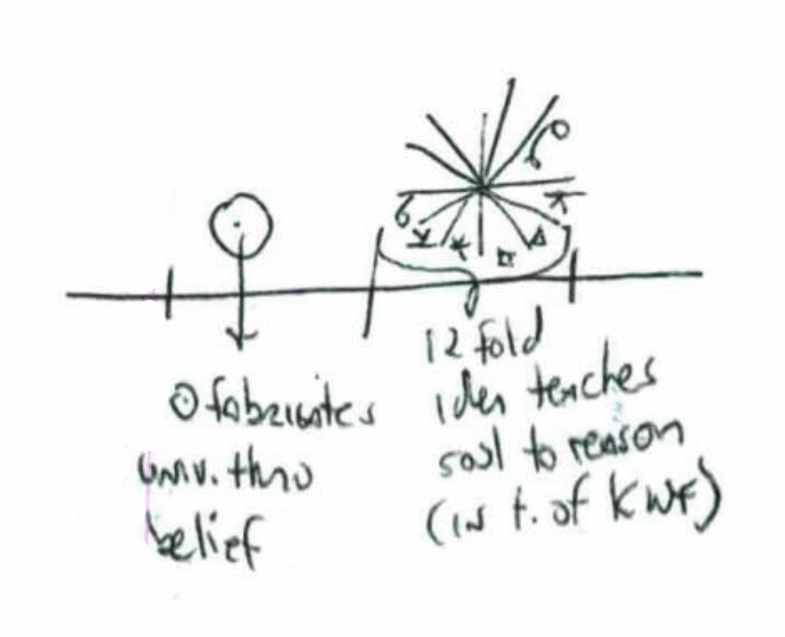
[FIGURE 1983 0219-1-AB. Divided Line (Middle Portion). Univ. = Universe; In t. of KWF = In terms of Knowing Willing Feeling. Facsimile scan from AB class notes.]
How does the reason come into the soul. How does the soul reason?
The seven planetary functions are subsumed under belief.
The trans-Saturnians are the soul in us which knows (Knowing Willing Feeling) -- they transmit the world-image in time.
Number is the activity of Being (Intellectual-Principle) or the power to know its own content. How is this assimilated by the soul.
Shaktis are concerned with building up the vehicles or providing the conditions but they don't deliver the knowledge.
Matrix of aspects (natal x transit x progressed x Chaldean x trans-Saturnian)
6 = Chaldean x Chaldean (natal, transit, progressed)
6 = Trans-Saturnianx Trans-Saturnian (natal, transit, progressed)
9 = Trans-Saturnianx Chaldean (natal, transit, progressed)
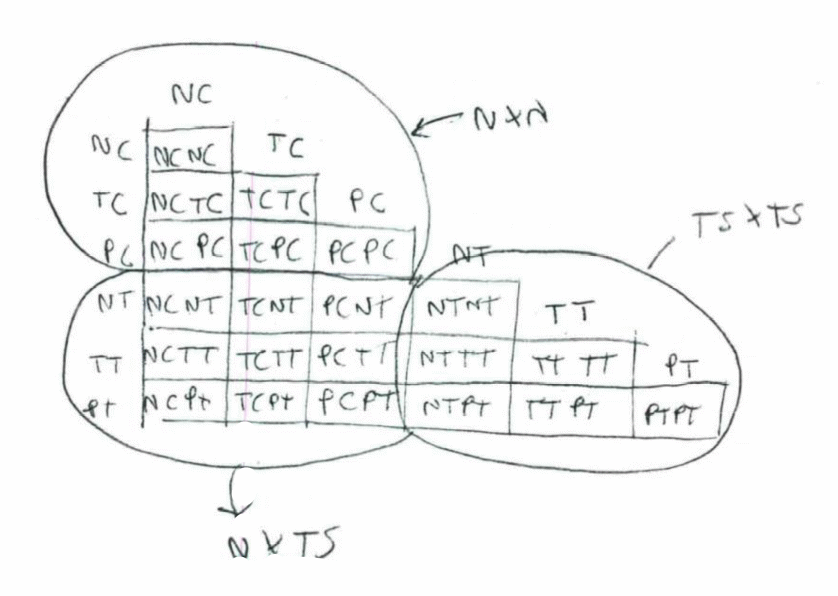
[FIGURE 1983 0219-3-AB. Matrix of Aspects. N = Natal; TS = Trans-Saturnian; NC = Natal Chaldean; TC = Transiting Chaldean; PC = Progressed Chaldean; NT = Natal Trans-Saturnian; TT = Transiting Trans-Saturnian; PT = Progressed Trans-Saturnian. Facsimile scan from AB class notes.]
The three trans-Saturnian degrees provide the background of the soul or its supra-reflective consciousness -- the dominating idea guiding the life -- what is available to it of the World-Idea.
If two trans-Saturnians are in aspect they always operate as a unit or entity -- the aspect is a number or unique entity.
Three trans-Saturnians = the spirit of an age, shared by a lot of people.
[Classnotes AB 1983 0219 End]
DIAGRAMS FOR 1983 0219

Class
Saturday, February 19th, 1983
Verbatim, unedited transcriptClick the series name to view more
CLASS at Wisdom's Goldenrod, Hector, NY
with Anthony Damiani (AD)
February 19, 1983
ASTROLOGY; THEORY; DIVIDED LINE
with Appendix: Classnotes AB 1983 0219.
TOPIC: Astrology
SUBJECT: Theory
SUBSUBJECTS: Divided Line, Aspects, Number, Reasoning, Trans-Saturnians, Degrees, Shaktis
CONTENTS:
AB class notes:
How does the soul reason?
The seven planetary functions are subsumed under belief
The trans-Saturnians are the soul in us which knows (Knowing Willing Feeling); they transmit world-image in time
Number is the activity of Being (Intellectual-Principle) or the power to know its own content
Shaktis are concerned with building up vehicles or providing the conditions, don't deliver the knowledge
Matrix of aspects
Verbatim transcript:
Thinking feeling willing as soul's reasoning which grasps mathematical order inherent in Power to Know
Natal trans-Saturnians show dominant motive in a generation, spirit of the age; but also related to natal Chaldeans
Two trans-Saturnians in aspect produce a third entity which is different from both, and this is what operates on a situation
Natal trans-Saturnians: soul's knowledge of its role in manifesting World-Idea
Trans-Saturnians as super-reflective consciousness getting particularized; Einstein example
Mentalism: all we ever know is mind and its ideas
Number is a force (Plotinus, VI.6.9)
Human soul's understanding at level of Power to Know may not filter down; soul's reasoning may or may not correct beliefs
Often an idea arises in many minds simultaneously–calculus, theory of evolution, etc.
AD suggests reading Newsweek article on brain ("How the Brain Works" by Sharon Begley, John Carey, Ray Sawhill)
Brief review of top two levels of divided line
Aspect theory
Aspects always indicate the relationship between Ideas
Twelve-fold at level of Power to Know represents World-Idea; certain Ideas in aspect emphasize certain contents of the World-Idea
Aspect theory continued
Eternity includes the fixed order of temporality
Seven polygons apply at level of undivided mind (Sun through Saturn), show aspects being made between transiting planets; dynamic actualization of fixed World-Idea
Nested levels of divided line; World-Idea has to be transmitted down to where we are
AD looking for formula that can account for any movement or change; lowest level of divided line already pre-contained in highest
Seven shaktis as powers of cosmic soul which translate World-Idea into sensible world
AD: quintiles and septiles apply to cosmic soul, not convinced yet of their application to individual
Thinking as an organ of perception; AD has to see idea with his mental eyes to be convinced
BOOKS / MAGAZINES READ FROM OR REFERENCED:
Sharon Begley, John Carey, Ray Sawhill, Newsweek, 1983 February 7, "How the Brain Works"
Marc Edmund Jones, The Astrology of Concepts
PLOTINUS QUOTES READ OR REFERENCED: VI.6.9
DIAGRAMS appended to this transcript:
FIGURE 1983 0219-1-AB. Divided Line (Middle Portion).
FIGURE 1983 0219-2-AB. Aspects and Divided Line.
FIGURE 1983 0219-3-AB. Matrix of Aspects.
FIGURE 1983 0219-4-AB. Seven Polygons.
FIGURE C002 IMG_2587 fix. Divided Line.
Other diagrams also referred to are not with this transcript version. [Transcriber note: [diagram] means the speaker is referencing a diagram as he or she is speaking. If someone is drawing or writing, with audible sounds of chalk on a blackboard, I indicate this by [drawing] or [writing].]
NOTES:
This class continues the discussion in WG Class 1983 0218 Physics; Twelfth House on the Divided Line and Aspects.
AB class notes have been appended because they contain diagrams that AD refers to and also because we are missing the first audio file for this class. They thus help round out the class. Retyped from Classnotes AB 1983 0206 to 1983 0228.PDF. All spelling, capitalization, and punctuation corrected, all abbreviations and some numbers spelled out in AB Classnotes.
TRANSCRIBED Verbatim by IT 2022 (V12a) on the basis of V11a done in 2017 which was misdated 1/1/83. V12a has had two more passes, with listening errors corrected, notes and diagram references added; has updated Topic, Subject, Subsubjects; TOC and Book List completed; Plotinus quotes section added; AB class notes with diagrams appended; Seven Polygons and Divided Line diagrams appended. Archival verbatim transcript – V12a.
AUDIO FILES: 1983 0219b. [Note 1: "Tape" and "Side" refer to original audio cassette tapes that were later digitized into .MP3 Audio Files. Note 2: We are missing the first audio file for this class.]
1983 02/19 at Wisdom's Goldenrod
Astrology; Theory; Divided Line
[Audio File 1983 0219b Begins]
VM: --aspects through that construction related to the twelve-fold construction above the line [diagram]. [Note: See FIGURES 1983 0219-1-AB, Divided Line (Middle Portion), and C002 IMG_2587 fix, Divided Line, appended to this transcript for the following.]
S (faint): (Uh-huh.)
VM: And it seems like we've dropped off to slightly different problem now.
RG (simultaneously): But Anthony was even questioning that, he wasn't even ready to go with that (as) [couple words inaudible]
TS: And he-- and I thought that was dropped or [RG simultaneously: Yeah, it was, yeah.] [VM simultaneously with TS and RG: Oh, that was dropped.] rejected as a possibility. Or [couple words inaudible]
PD (simultaneously): Well it seemed [RG simultaneously: It wasn't rejected, it just wasn't accepted.] like a lower order, like-- [TS: Well--] almost like the order of fabrication, you know, the seven powers or something, it seems like at-- at that level, not at this level.
S: Right.
TS: I'm saying that the content is-- that number here is number in the Intellectual-Principle and (using an) act of the soul between this Neptune and Pluto.
VM (simultaneously): I'm sorry Tim, I couldn't hear you, just do it again.
TS: I thought he was saying that this number, whether it's a number or set of aspects up here [diagram], is some order within the Intellectual-Principle and the reasoning act of the soul participates in or recognizes a-- a part of that order up there in its own reasoning mode, that there's no--
AD (simultaneously): And then this becomes the very-- the very reasoning in the soul: willing, feeling, and knowing.
TS: And-- Now--
AD: Let's-- le-- for a moment, Tim? Let's see if we could elaborate that a little bit? You know, in an empirical way? If let's say you have the trans-Saturnians aspecting one another, alright, and--
VM (simultaneously): Natally you mean?
AD: Yeah natally, and also they would be aspecting, let's say, the Chaldeans. But, if we think of them just aspecting themselves in that realm, alright, can we say that the Idea which is being manifested-- in other words the relationship between Pluto and Uranus let's say is a square, that-- that square which is being manifested between these two Ideas, is that the dominant idea in the person's life? Is that-- is that what's guiding that person?
RG: I don't think so. I think it's guiding him culturally and collec-- otherwise we're all guided by the same idea pretty much.
VM: Well we [CDA simultaneously: No.] aren't born at the same time, Dickie.
RG: No, no, yeah but that's so-- but that's not-- when you speak of a guiding daemon you mean much-- don't you mean much more [VM simultaneously: Like the Head?] particular to the individual than a [TS simultaneously: Well you see, two degrees--] collective group orientation?
VM: Why not the Head?
TS: You take [S simultaneously: No.] the-- if you take the three degrees that Uranus, Neptune, and Pluto were on, that would minimize the number of-- [HE, faint: Similarity.] similarity.
RG: Yeah.
TS: There still would be some but there [RG assents] would be very few.
RG: Yeah.
CDA: Are you saying degrees as opposed to aspects are--
TS: Degrees [S simultaneously: Yeah.] as opposed to signs. If you just took all the people with Uranus in Cancer and Pluto in Leo and Neptune in Libra, it would be a large body of nu-- number of people but if you took specific degrees-- You're saying that-- [VM simultaneously, faint: I don't (think they're) specific.] that there may be some kind of guiding idea in those three degrees that are-- there's some kind of synthesis. You took those three degree meanings in a chart--
AD (simultaneously): The way he said, that would be a dominant motive in that generation.
RG: Right.
AD: Ok?
TS: Yeah.
AD: But then we also have to say that that's related to their Chaldean planets.
RG: Yes, and I think if you look at their Chaldeans then you'll see the dominant way. When you-- when you look at that structure, then you could see the particular orientation of the individual particularly.
AD: And then [S simultaneously, very faint: Well, right.] these both exist simultaneously.
RG: Right, right.
LR: But wouldn't you also say that when you just take say the three degrees that Uranus, Neptune, and Pluto sit on, there's an inherent meaning in yours-- your degrees but, I want-- I tend to think that-- don't know how to say this but the synthesis or the particular way in which those three are related is like a fourth element, that you have to-- that relationship almost breeds a new idea [AD simultaneously: No, no.] born out of the connection of those three, like those three are related in a peculiar--
AD: No, no, I s-- I said it a little differently, I think-- I think we're saying the same thing. If let's say you have Uranus on 1 degree Cancer and Pluto 1 degree Libra, alright, you got a square between two Ideas. It's two Ideas that are in square. [LR assents, very faint] Now, the square should manifest, alright, a meaning of this relationship. [LR assents, faint] So, on the one hand it's the two Ideas, [LR: Oh.] alright, manifested, alright, which means that it's an entity other than either one of them.
LR (simultaneously): Oh yes-- yeah, that's what I was trying--
AD: Yeah.
LR (very faint): I wasn't very (clear).
S (faint): No.
TS: So, if we took somebody like George Patton or Emerson and you try to look at the three degrees in their charts, you're saying that if you look at the three degrees those planets are on that there's a certain part of the World-Idea that is-- that is guiding or determining their life in some way?
AD: Yeah, let's say something that their soul knows. [short pause] That will have to be translated, you know, all the-- into the actual percep-- the perceptible world. But if we stop right there we would say then that's-- that's the soul of Patton knew its destiny, knew the role it had to play in terms of manifesting the World-Idea.
DH: Soon as you say that that kind of sets the background of possibilities that-- or the manifestation that's going on.
S: Yeah.
DH: Number.
S: Determines a particular.
S (faint): Yeah.
DH (simultaneously): It's like a space (that opens).
AD (simultaneously): Yeah, that's-- that's like the background, the dominating idea or ideas which are in the background, alright, and which I refer to as the super-reflective consciousness of the person. Now, when we say super-reflective consciousness we always think of it in terms of a universal. [student assents] But I'm being-- I'm being a little picky in here when I say, that's meaningless to me. The universal consciousness the way it manifests itself in the life of an individual gets modalized. If this is a universal consciousness, alright, and this ego got that, this ego, so to speak, is only going to be illuminated by that universal consciousness. But once the ego, so to speak, gets illuminated, it's like that universal consciousness is now modalized or particularized. It's no longer universal. If we took the example like in the case of Einstein when the universal idea came into him, alright. On the one hand, you have-- you have Einstein as a universal knower, you know, when he had the septile. But as soon as it got particularized and modalized by his ego, alright, that universal consciousness now had achieved the particularization. [Note: See WG Class 1982 0823 Astrology; Horoscope-Einstein.]
S: Seems like the degrees particularize what the aspects are that power to-- the power for the knowledge, the power for the knowledge to occur. But the degrees themselves are the contents is what you're saying.
AD: Yes, I'm always working with the notion, like all good mentalists, that all we ever know is the mind and its ideas, there isn't anything else.
S: Ok.
AD: So, if you put that circle of Ideas all around, alright, everything within that circle is going to be a manifestation of Idea(s). All that you ever know is Ideas, all that you ever experience, all that is always a kind of mentalism going on. So that means that I take all that for granted.
S: I just want to know the difference between a degree here and the-- and the aspect. We're trying to understand the difference of the Ur-- trans-Saturnian one--
AD (simultaneously): Well again, each degree is an Idea in itself, alright. But if you have two-- if you have two different Ideas, alright, let's say they're unrelated-- You have a planet, you know, trans-Saturnian sitting on each one and they're unrelated, then I can understand these Ideas getting modalized, let's say they're aspecting the Chaldeans, alright, and you have a modalization of a universal feeling conscious and a modalization of a universal knowing consciousness. But, when they are in aspect, I suspect that the product of that aspect, which is now a thing other than either of the two, is what's getting modalized.
S (faint): Oh.
S (very faint): Uh-hm.
RG: [couple/three words inaudible]
S: Cou--
S: Yeah.
LR (faint): I expected some of us [few words inaudible]
AD: Well, the way-- [LR simultaneously: It's a living form, number.] but, the way Plotinus-- yeah, you-- [LR simultaneously, faint: A living form in the soul.] he says-- he says number is a force, it's a power. [Note: See Plotinus, VI.6.9.]
S: I don't understand the other-- what you mean when you say it's a third-- another entity, I mean a third--
LR: Well that was my line (Pat), I--
S: Oh but he said it was a-- what does it-- what do you mean?
LR: Well, that-- that the relation-- and you can see-- you can make correlations on a lower level and I think you would see that, if you have two entities and then you relate them in a particular way, that relation itself is like a living form.
AD: It's a third entity.
S: Yeah.
LR: It's a thir-- I mean, it's neither-- you know, you--
S: But I thought you were saying that the aspect is the power to-- for the-- the real effect.
LR (simultaneously): But that is the third. The aspect is the number which relates those two.
S: Right.
LR: And that is like a third thing.
S: Oh-- well, ok.
LR: Because-- In any relationship, you know, from the highest to the lowest, you know, if you look-- you can extract the relationship from either one of its-- [S, faint: Right.] not totally extract it but you can see that there's a third thing born--
AD (simultaneously): Let's put it this way, if you have an aspect between Neptune and Pluto or Uranus and Neptune, whatever, let's say you have a trine or a square, you will not be operating with the Idea of Neptune or Pluto independently, you will always be operating with the combination that these two bring into manifestation. It isn't that you'll-- your Neptune is operating on a situation and your Uranus which is aspecting it is also operating it, but the two of them combine and producing a third, it's that third which is operating on the situation.
S: Ok, and they're always these--
AD: Now, that doesn't exclude the other possibility that the Neptune is aspecting only one thing and the Uranus is aspecting another thing and that there you have no third thing but the Idea that Uranus is sitting on operating directly on the Venus, alright, and the Pluto operating on another one.
LR: So like in-- for 25 years there's a Neptune Pluto sextile. [student assents] It would-- it's very difficult to think of either one of those planets apart from the sextile relationship which-- which is a kind of living or dynamic--
AD: Motive in the culture of those people or that generation. But you see if you do that, you're working partially because, if you-- if there is for a whole generation Neptune squaring Pluto, alright, for a whole generation that's a dominant motive. But, you have to remember that insofar that that Neptune Pluto square is aspecting every individual Chaldean [LR simultaneously: In different ways.] chart different, [LR: Yeah.] you're not going to have that uniformity.
LR: No, right. No, I'm not saying it's uni-- I'm just saying there's a way in which it is and there's another way in which (it's not).
AD: You could say and I think it has been said that that seems to represent the spirit of an age, [RG: That's right.] you know. Like you people with, let's say, Neptune in Libra, it's a certain spirit of the age which is operative.
RG: Ok but that spirit of the age seemed to-- (now) I'm getting real confused here. I always have this confusion when-- Because it brings up the problem that Uranus, Neptune, and Pluto have this dual role it seems. They seem to be harbingers of the World-Idea and how it manifests almost for the cosmic soul. And it also represents the higher part of our-- our individual knowing, willing, and feeling.
S (faint): Say they (transport) now?
LR (simultaneously): You know-- (bit of laughter)
AD: Well look, wouldn't-- isn't the relationship that you're talking about Dickie is something like this? That over here if you superimpose this here on top of here [diagram], alright, [RG: Yeah.] and you're saying that the World-Soul, alright, is transposing that Idea or the result of this combination is including it in its manifestation. [Note: See FIGURES 1983 0219-1-AB, Divided Line (Middle Portion), and C002 IMG_2587 fix, Divided Line, appended to this transcript.]
RG: Right.
AD: Alright, down here [diagram]. But on this-- at the same time the individual soul understanding that, let's say that relationship [AD indicates on diagram], alright, then that's in-- that becomes its reasoning, its way of understanding [RG assents] what this content is. This may or may not filter down. [RG: Right.] Over here [diagram] there's no two ways about it.
RG: Has to filter down.
AD: It has to.
RG: Right.
AD: Because the cosmic soul or the World-Soul will [AD hits board for emphasis] [RG assents] interpret that Idea [RG simultaneously: So (does it--)] and manifest it.
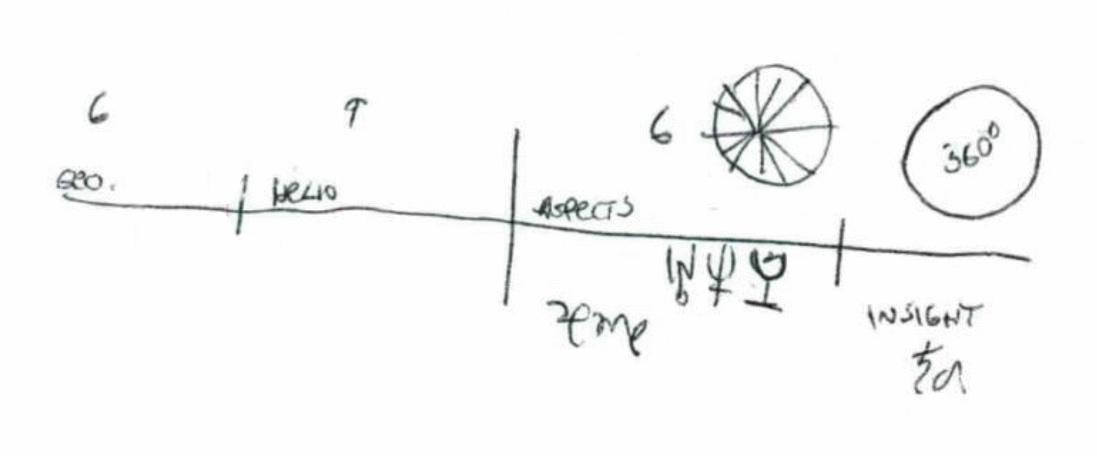
RG (simultaneously): Right. So there's Uranus, Neptune, and Pluto above the line and below it [diagram]. [Note: See FIGURES 1983 0219-2-AB, Aspects and Divided Line, and C002 IMG_2587 fix, Divided Line, appended to this transcript.] I mean above it it seems to unfold the spirit of the age so that-- in terms of its transits.
AD: Uh-hm.
RG: But below it seems to unfold powers of the individual reason.
AD: Yeah. So over here [diagram], let's say the rea-- the reasoning part of the soul might correct the beliefs or might not. [RG assents] But I think this is going to be our cue into it, Tim. [student assents, very faint] This is going to-- because the interrelationship that are-- [S simultaneously: So--] you know, something that requires a computer reader.
AD/S(?) (faint): Excuse me.
MW: Tim, [S: What--] I was just--
S: Oh.
MW: --ped--
TS (simultaneously, faint): You know-- I'm sorry Michael, go ahead.
MW: Uh--
AD/S(?): Well-- yeah.
MW: Have you looked-- I was just-- I haven't been here for the-- the astrology classes but I was wondering if, say, we have two planets in square. Now could you take one of the degrees as being the unity and looking at the other degree being the fourth and the square trying to see how that's manife-- you know, there's a fourfold manifestation [S, faint: Uh-huh.] of-- of the first degree taken as the unity. And then maybe you have to reverse it and then try and take the other degree as a unity and the second degree as manifesting a fourfold--
TS: Well then it would be at the tenth house.
MW: Well, maybe, ok, and--
TS (simultaneously): No if you take-- take like a sub-- you take 1 Aries to 1 Cancer.
MW (simultaneously): But I mean how do you know which one is square which?
TS (simultaneously): Right, I'm telling you. Take 1 Aries and 1 Cancer, they're in a square, ok.
MW: Yeah.
TS: They're in a fixed relationship, now if you put 1 Aries on the ascendant, then 1 Cancer's going to be at the nadir. [MW: Uh-hm.] If you put 1 Cancer on the ascendant, 1 Aries is going to be on the midheaven [one/two words inaudible]
MW (simultaneously): Ok.
TS: So it's if you're Cancer rising your midheaven [MW assents] is Aries. So, the relationship of-- among the Ideas from Cancer to Aries is 1 to 10, it's-- A relationship of Aries to Cancer is 1 to 4. Now, we've-- I've tried in a couple of places to bring out, you know, there's one aspect which is the really-- which is some power of the soul or some living form in the soul, and there's two relationships of the Ideas, A to B and B and A, which are [MW assents] both involved in the meaning of that configuration, you know. And I've worked-- we tried to do that or sneak that in in a few-- few examples [MW simultaneously: We did, yeah.] but we haven't worked it out in any detail because it's obviously-- one of the first things that rises up is this difference between the aspects as images or living forms in the soul or relationships of powers of the soul and aspects as relationships of Ideas. And it [MW assents] seems like, you know, that--
MW (simultaneously): Yeah, I was trying to get to the relation between Ideas since [TS simultaneously: Yeah, that's--] our diagram seems to be taking the aspect as explaining how the Idea is self-gnostic or is distinguishing and manifesting itself. So that I would think that when you were trying to look at an-- let's say the aspects with the trans-Saturnians you would be trying to see what Idea is being manifest in what particular phase of its manifestation, the phase being pointed out by the number or the aspect.
TS: Uh-hm.
MW: It seemed like that would be something you could try to look at in an empiric way, you know, this--
TS: Got a couple of evenings?
EC: Tim?
MW: Yeah, why not. (bit of laughter)
[students assent, faint]
TS (faint): (It's obviously not.)
EC (simultaneously): I had thought about-- well just take Einstein, he had a particular aspect and this great idea was born through him, the theory of relativity. Then it would seem that those collective aspects that we have are there so that we can, all of us to our degree, assimilate that great idea that was born through this one man. Because we're not able to get it directly, that collective aspect is going to help us in whatever degree. It's like it's in the air then [TS assents] once that individual [TS or another student assents] brings it actually here in a concrete fashion.
DH: Yeah. Also that would help to explain why there was a lot of-- that went before Einstein. There were a lot of other people involved in thinking up the same thing.
EC: Right, [AD simultaneously: What was that (noise)?] but it wasn't available in terms of collective [student assents, faint] [TS simultaneously: Or the same-- yeah.] very much, I'm talking this way, you know, not it-- particular individuals.
TS: And there are many times when an inve-- invention or a theory is-- [student assents, faint] arises spontaneously in different minds, you know. Like [student assents] calculus is one [EC assents] of them and Dar-- the theory of evolution that Darwin claimed. That it came up in different people's understanding at about the same time, we-- that were working independently so it would seem like both on an individual level people might be particularly sensitive to that.
S (faint): Ok.
S: Saying the "I" is not extended, not limited by this particular body.
LR (simultaneously): Right. In the same week we start doing mentalism and Newsweek [student assenting] came out with the article on how the brain knows something [student assents] the same week. [Note: See Newsweek magazine, 1983 February 7, pp. 40-47, "How the Brain Works" by Sharon Begley, John Carey, Ray Sawhill.]
S: Right.
AD: And that's really numinous, you ought to read it.
LR: I have it. I mean it-- that, yeah, doesn't belong to anyone.
LC: Yeah. Common sensorium is what--
[short pause]
AD: Well we can't go South. Let's go West. (bit of laughter)
VM: You want to go to the right, is that what you mean by West?
AD: To the left.
VM: Oh.
AD: Where we said that the Sun [VM, chuckling: I'm backwards.] and the Moon and the seven powers superimposed on that [diagram], alright. [Note: See FIGURE C002 IMG_2587 fix, Divided Line, appended to this transcript.]
TS: Well it seems like, you know I-- I don't understand what happened to the shaktis yet but I--
VM: Can we just, before we go to the West--
AD: There they are, right there.
LR (faint): It's all in the seventh house.
VM (simultaneously): The shaktis come in now. But can we just summarize sort of what you got. [S simultaneously: Yes, yeah.] Can you do that?
AD (faint): Go ahead.
VM: No, no, I don't-- can't do it, I want you to do it or somebody to do it. Just--
TS (simultaneously): What we got?
VM: What-- well what we-- what we understand now in this-- in this intermediate realm.
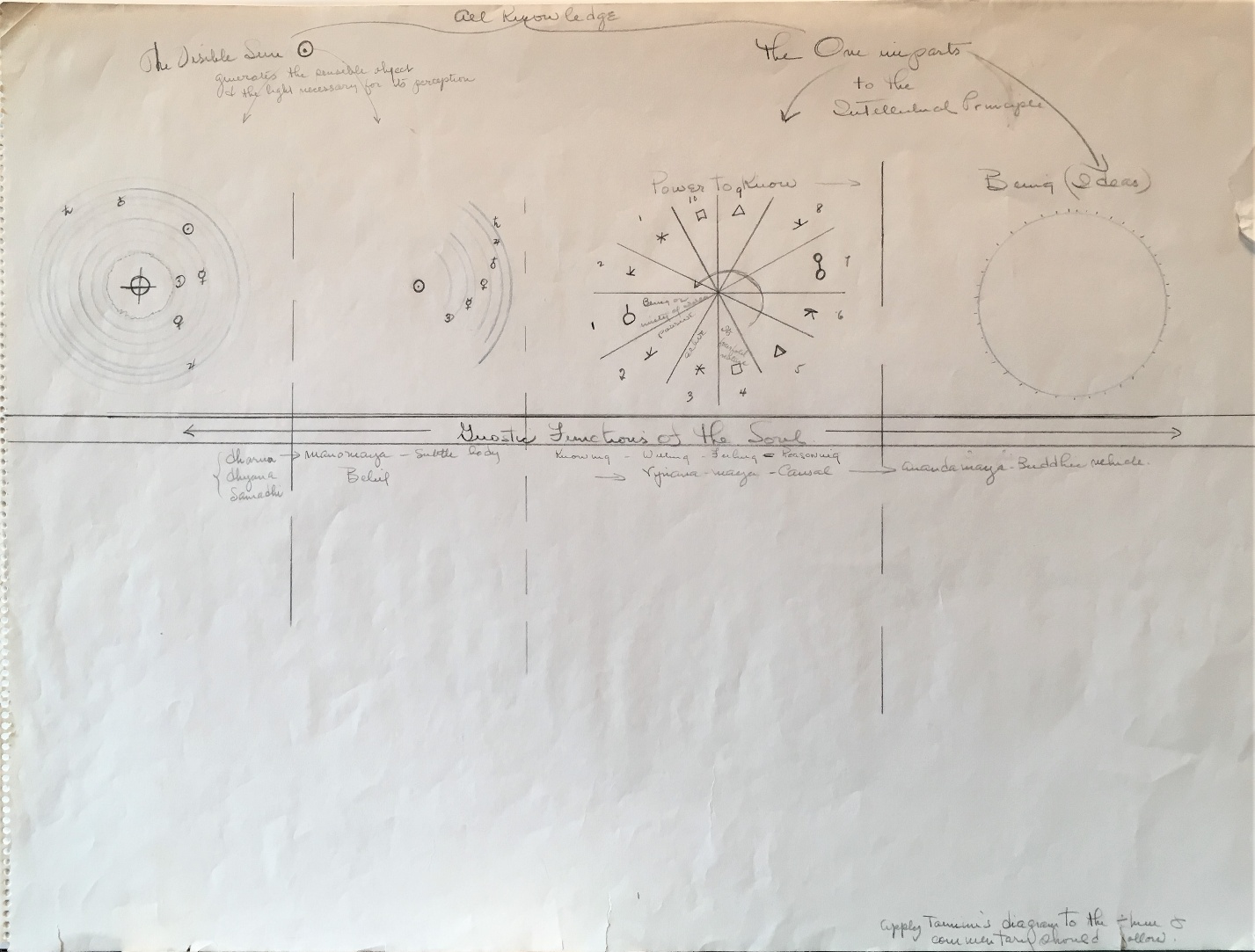
TS: Well I thought that what we've said is that you have some kind of unity up here, [VM assents, faint] (inside), that it's a monad of Ideas [diagram]. [Note: See FIGURE C002 IMG_2587 fix, Divided Line, appended to this transcript for the following.]
VM: Right.
S: Yeah.
TS: Here there's a differentiation of Ideas [diagram], [drawing/writing] which differentiation-- or through some implicit order of number.
VM: Ok.
TS: And that number is involved in the unfolding of any Idea. If you talk about the unity of an Idea, [drawing/writing] then that unity of the Idea as its unfolded will require these superior--
VM (simultaneously): Remember last night for example Tim, when we were discussing, we were saying what's the difference between the planetary's-- [TS drawing/writing] not the planetary, the inerratic and the unity, we said well the ideas in the-- in the inerratic are separated out, they're distinguished. [Note: See WG Class 1983 0218 Physics; Twelfth House.] And now we're being a little more specific, we're saying they're distinguished through these twelve different ways.
TS: Yeah.
VM: Is that right?
TS: Yeah.
VM: Ok. Alright, please, [TS simultaneously: Yeah.] I didn't mean to get you [TS simultaneously: So--] (completely off), I just wanted to hear a summary.
TS: And then we said that [drawing/writing] the soul has three modes of reasoning [VM assents] in itself, those mea-- modes of reasoning being some kind of knowing, feeling, and willing, which modes of reasoning know some parts of these Ideas, ok. [VM assents] Ok now this knowing may or may not be transferred anywhere else as far as the soul is concerned. Now there seems to be two points here because if you say that-- [drawing/writing] if you take Uranus and take these aspects, ok. They're not going to-- the way in which the soul knows an Idea or a degree here is going to be a participation in some subset of this relationship of one Idea to its [VM simultaneously: Sure.] parts. [VM: Sure.] So that in other words, to-- to put those three aspects down I have [drawing/writing] Uranus in the first, [VM: Ok.] ok, Pluto in the second, and that gives me this relationship [diagram] of the I-- if the I-- the way in which Uranus and Pluto know the Ideas that they're on. And if I put Neptune in the fourth, ok, then I have the relationship of the Idea that Uranus is on and the Idea that Neptune is reasoning towards [diagram]. But then if I want to put this last aspect down, the Pluto sextile Neptune, it's not this relationship here [diagram]. That's the difference. It's this relationship [drawing/diagram]. 'Cause it's still from the unity of the Idea to the third house of-- of that Idea. Right?
S: Yeah.
S (simultaneously, faint): (Seriously, Tim.)
S: Uh-hm.
AD: I-- I don't think so, Tim.
S (faint): Go on Myra, say something.
MB (faint): Hm?
S (faint): This is where you [three words inaudible]
AD: It's always-- the way I look at it, it's always aspects indicate the relationship between the Ideas. Now, the safest thing to do I think will be to say that then that whole twelve-fold picture represents the World-Idea and that certain Ideas, if they are in relationship to each other, are emphasizing or making mo-- more pronounced certain as-- you know, certain contents of the World-Idea rather than other contents. That's the World-Idea, ok?
TS: Uh-hm.
AD: And the relationsh-- and that World-Idea is, so to speak, all these Ideas. [TS assents] Included in the World-Idea are all these Ideas that are necessary to make that World-Idea what it is. And the aspects between trans-Saturnians or non-aspects is simply the manifestation and the emphasizing of certain contents rather than others.
TS: Now, insofar as it is a manifestation of certain of those contents, the way in which those contents are innately related to each other is-- is that not following a paradigm of these aspects?
AD: Yeah.
TS: So then if I talked about the innate relationship between the Idea of the-- that is the content that Uranus is knowing and the content that Pluto is knowing, I have to talk about the relationship of 1 to 2 [diagram].
S (very faint): Uh-hm.
AD (very faint): Relationship of 1--
TS: 'Cause that's semi-sextile, there's a relationship of a unity of a thing to its vasanas or his-- (its/his) focusing.
AD: Yeah.
TS: And it doesn't matter whether Uranus is in Gemini and [drawing/writing] Pluto's in Cancer, or Uranus is in Leo and Pluto's in Virgo, you know, and--
AD: Uh-huh.
TS: It's still a relationship of 1 to 2, of the first-- the unity of an Idea to its focus.
AD: Yeah, alright.
TS: Ok. And then if I put-- so then if-- and if I put Neptune in the fourth place, here [diagram]-- ok, so I have Uranus to Neptune is a square, that's still in terms of the content that Neptune is manifesting together with the content that Uranus is manifesting together, if they're in a relationship, then it's this relationship of (the) unity of something to its development in a fourfold way, to its manifestation.
VM (simultaneously): But it could be the other square too though, right?
DH: Right. 1 to 10 also.
VM: I mean [TS simultaneously: Yeah it could be, yeah.] it could be the other square depending on which order they're in in [TS: Right.] the zodiac.
TS: Yeah I'm just--
VM: You're just using one, yeah.
TS: Yeah, for the moment, 'cause then-- yeah, it could be the other one just--
DH: But I mean if you're looking-- if you're just looking at the relationship between Uranus and Neptune then there's-- there's a symmetry there, I mean it's-- you know, you can-- you can put either one in the first place. If you're looking at what it is of the relationship it's got to be both.
TS: Right. So in other words when you put Uranus-- you're saying that I not only have to put Uranus in the-- in the first house as the unity of which is being manifested in a fourfold way by Neptune, I have to put Neptune [VM, faint: (Totally right about it.)] as being some-- some kind of unity which is being put into matter [drawing/writing] by Uranus [diagram]. And then to-- to follow it out then, [drawing/writing] you always have Uranus, Neptune, and Pluto in the first house as it were. And you have Uranus to Pluto here, you-- Pluto to Uranus here, Neptune to Uranus there, Neptune to [S, very faint: Pluto.] Pluto here [diagram].
DH: But empirically [few inaudible student words simultaneous with DH] does it make sense to look at these relationships always from the point of view of one or the other, or do they come as a package?
S (faint): Uh-hm.
TS (simultaneously): Well see this-- I'm just trying to work out two different ways of trying to figure them out, ok. And I thought that, I mean-- [short pause] And this is the two different ideas of the aspects. One way of doing the aspects is saying you've got [drawing/writing] Uranus at some point, Pluto at some point, and Neptune at some point. And if I draw these chords, I establish what is the relationship among them. Ok but now these chords are implicit in some geometric form, some geometric polygon [diagram]. [Note: See WG Classes 1983 0212 and 1983 0218 for more on the polygons. See also FIGURE 1983 0219-4-AB, Seven Polygons.] Ok, the other way is to say, no, whenever you talk about an aspect you're talking about a relationship of something to its unity, some part of an Idea to its unity, in which case I'm going to have to start by putting Uranus, Neptune, and Pluto all as in some way knowing the unity of their own content, not [PD simultaneously: Why?] all the same content but of their own content.
PD: Empirically, why?
S (very faint): [couple inaudible words]
TS: Well, you say Uranus is on a degree. It's not trine that degree, it's conjunct that degree.
PD: But if that degree is in Cancer--
TS: Then it knows the unity of Cancer. Each Idea-- if each Idea is a unique and special version of the whole, then each Idea is going to have its unity, its power, its limits, its fourfold nature, the fourfold nature of Cancer-- sixteen-fold, I know, that-- you know, that there's the-- there's always the thing when it knows something it knows it first by identity or by unity.
PD: But the mode of knowing that we've attributed to Uranus is-- is knowledge, not feeling or willing, right?
TS: Yeah.
PD: So we're not speaking of insight here, we're not speaking [TS simultaneously: Right.] of the insight into the World-Idea in to-- in a totally [one/two words inaudible]
TS (simultaneously): It's just (halfway). So it's only knowing the unity of one Idea or one content, a part of, you know, the degree it happens to be on. But it's knowing it in a unified way first.
PD: See that I don't see, I don't know. Are those-- [TS simultaneously: Well I could now--] why do you say that the trans-Saturnians know the unity of the World-Idea, I mean that--
TS: No, no, no u-- knows the unity of a part of the World-Idea, not of the whole of the World-Idea. But it knows a part that it's conjunct, I mean Uranus is on a degree, it's identified with it, there's a unification between the meaning of that degree, you know, whether it's birds in the-- feathering their nests [Note: Marc Edmund Jones, The Astrology of Concepts, Cancer 6.] or whatever the degree happens to be in Cancer. Could be [one/two words inaudible] [S, faint: Birds.] It's first of all identified with that degree, so all of these will be first related to the degree they're on by conjunction. But then if I want to relate them to the other degrees they're on, then I take this same set as being [drawing/writing] semi-sextile or sextile in the fourth, ok. All it seems to be that the implications of what has been said is that, ok, if I'm going to do that, let's say Uranus is semi-sextile Pluto, then Pluto is semi-sextile to Uranus here [diagram]. And Uranus is square Neptune. So Uranus is square Neptune and that shows that coming in [diagram]. But that's not enough because Pluto Neptune is also on its own degree and identified with that degree. So from the point of view of Neptune, [drawing/writing] Uranus is square it up here, Pluto would sextile it here [diagram]. [S, very faint: Oh.] And from the point of view of Pluto, I-- I know-- Uranus is semi-sextiling here and Neptune is sextile it here [diagram]. So that in that one-- just by taking these three points, I've really got quite a complicated picture just in terms of the relationship of the Ideas to the Ideas through the paradigm of this pattern here rather than through some geometric relationship of drawing chords within a circle or taking, you know, the chord which is part of a regular polygon in a circle.
CDA: Could I--
JA: Try it again. You said that (you'll) see it right, you know, we'll see what you're saying. I thought we were saying that when a trans-Saturnian is on a degree, it modalized directly the Idea. [TS assents, faint] And when you bring them into relationships of semi-sextile, then the emphasis changed-- changes to a definition.
TS: Uh-hm.
JA (faint): Say. And so that you're speaking of something but you're still speaking of an Idea, but in terms of a relationship between the two Ideas represented by degrees that the trans-Saturnians are on. That was (an Idea) but-- I mean is that what-- I mean is that what you were describing there or--
TS: Well I-- what I was trying to describe [JA simultaneously, faint: Was that just simply what--] is I'm saying that you-- When you say-- over here [diagram] (are we) saying there's a reasoning in the soul which is knowing part of the World-Idea. [Note: See FIGURES 1983 0219-1-AB, Divided Line (Middle Portion), 1983 0219-2-AB, Aspects and Divided Line, and C002 IMG_2587 fix, Divided Line, appended to this transcript for the following.]
S (very faint): (Ok.)
TS: So far so good. Now each of these is on some degree. So you don't need [one word inaudible] So Uranus is in some degree in Cancer, Neptune is in some degree in Libra, Pluto is in some degree in Leo. Right? Now, those are three contents which each of these are reasoning on in a knowing way or a feeling way and a willing way. Now, if I want to talk about the relation of those three contents or the three Ideas that these three guys are on, then I'm applying the paradigm of a unity of a thing to its parts to each of those contents.
AD: I'm sorry.
S (faint): Yeah.
AD: You're applying the aspects?
S (faint): Uh-hm.
TS: I'm applying this set of aspects [diagram] to these-- the relationship of ea-- each of these contents to the other.
LR: It's like putting one of the Idea-- the degrees that it's on in the first house with the other-- the way you would do with any Idea. That's what he's saying (there).
TS: I can draw three little pictures.
JA (simultaneously): But aren't you just really transforming the aspects back into another realm still using the original twelve-fold.
TS: Let's see. Let me see if I can do this. [drawing/writing] If Uranus is on some degree in Cancer, so Uranus is in Cancer, so it's conjunct that degree, right? Now, Neptune is say on some degree in Libra. Right?
VM: Tim I'm sorry, conjunction to me doesn't mean anything [AD simultaneously: Vasanas, yeah.] if you speak about just one planet.
TS: Well--
LR (simultaneously): Well, that-- leave that.
TS: But-- I'll read you your-- the-- the degrees that are quintile your Sun degree. You'll find out soon. Avery did that once before and I don't-- Uranus is here, Neptune is here [diagram].
AD: Yeah.
TS: For Nep-- now I'm just talking about this knowing and the way in which that knowing relates to the other contents that the reasoning soul is going-- is assimilating. Uranus is here, Neptune is square that, so it's according to this paradigm 'cause Libra is the fourth sign away from Cancer [diagram]. And then Pluto is in Leo.
AD: Well, just work with two Tim, I-- (some laughter) keep it simple for me.
TS: Ok.
AD: Yeah.
TS: Now, I--
AD (simultaneously): So you got the square aspect between these two.
S (very faint): Ok.
TS (simultaneously): [drawing/writing] But that's just from the point of view of Neptune-- Uranus. From the point of view of Neptune, Neptune is conjunct its Idea in Libra [TS points out on diagram].
AD: I don't follow you.
RC: He's using the same [S simultaneously, very faint: Yeah.] principle as if we were doing parts for the planets and saying that each one can properly be placed on the ascendant and its relationships can be extended into the zodiac.
TS: Well--
LR (simultaneously): Maybe that's what he's doing is parts. (LR laughs a bit)
TS: No, I'm trying to do-- we talked about--
VM (simultaneously): No but it's the same paradigm.
TS: The paradigm I thought was when you talked-- we-- way way back, we talked about the Idea of Man, and we unfolded the Idea of Man.
AD: Alright but, we're going to say that that's the World-Idea, so that we don't get caught up into any of the particularities. If we say that's the World-Idea and Uranus is in the first house and Neptune's in the fourth, alright, and there's a square aspect between them, ok, it's the square that we're un-- that we're working with to understand what Idea is being manifested, that's going to be the content of that square. Or the square will be identical with that manifested content, that knowing.
TS: Yes, now, but this was David's point, which is that if you talk about the square from Uranus to the Neptune, it's not the same square as from the Neptune to the Uranus. The relationship of these two Ideas is in a fixed order.
AD: Yeah.
TS: So the order, if you're always moving forward in the zodiac, then if you talk about the-- the ordering or the relationship between two Ideas, that it's going to imply two different [RG assents] relationships, depending upon which one you call the unity. If I say that the degree that Neptune is on--
AD: But the unity, the unity is the World-Idea. The whole 360 degrees is the World-Idea. [MW assents] And if we have two planets aspecting each other, alright, what is being manifested is some aspect of that World-Idea. I don't see why you're bringing in all the other things.
MW: Ok. I think the confusion was that when we had two-- two planets on two different degrees we were trying to take the Idea that was being manifested as one of those degrees say, instead of saying the Idea is the whole World-Idea and each one of these degrees is only a part of that Idea to begin with. I think--
AD: You're saying each degree is the whole?
TS: No. Each [MW simultaneously: Well--] Idea is a part of the World-Idea. And if you talk about an individual chart, then you're saying that there's specific degrees that those planets are on, Uranus, Neptune, and Pluto, which show the way in which that individual is participating in part of that whole.
[short pause]
DH: See but what I was trying to say in that, I think it's what Anthony was just bringing up now is that he can only talk about this in the way that you (will ever talk), not in the way you would [one word inaudible]
S (faint): Right.
TS: Here [diagram].
DH: Yeah.
TS: Yeah well that goes-- but then that's the argument for that set of aspects. See this set of aspects [diagram] doesn't refer things back to unities. It's--
S (faint): Yes.
PD: Let's say you're-- then it refers it back to the 360. That's the unified ground for those three planets, [S simultaneously: Yeah, the three hundred.] three hundred and-- the World-I-- Let's put it this way, the World-Idea is the unified ground for those three functions.
DH: But those relationships are part of the World-Idea. I mean it's not just the 360 [students assent] degrees but it's the relationships among the 360 degrees. Right.
[students assent, very faint]
[20 second pause]
TS: Well the difference between these two is saying that in this case [diagram/drawing] the order in the zodiac doesn't matter. That this set here [diagram], this chaos here is saying the order in the zodiac does matter.
VM: But you know, insofar as you're up here in the atemporal realm, that's-- can't be completely atemporal 'cause we're talking about the degree is 1 degree Aries one year, the next year it's 2 degree Aries so it's not completely out of time but nonetheless there's an emphasis on atemporality up here. So perhaps the idea, thinking about the horoscope as one degree coming before another, is not really quite appropriate at this level. [TS simultaneously: Well (one/two words inaudible)] That's what Anthony seems to be trying to imply.
TS: But you-- we do talk about the [drawing/writing] metaphysical chart starting with unity and not with the twelfth house. And the order seem-- there is at once a simultaneity and also an order.
S: Yeah.
TS: I mean you can't deny order. There's some order there whether it's atemporal or not. We're not-- we're not, I mean, worrying about the temporal part of it now.
DH: Tim, let me ask you, I have a question, if-- it's an empirical question, it seems to me it's-- When Uranus is a-- you know, square Neptune as you have up there, when you look at that, do you see that as a-- you know, as Uranus Neptune square or do you see that as Uranus just square Neptune? You see the distinction?
TS (simultaneously): I've been trying to [S simultaneously: Yeah.] see it as both, [VM: He wants to see both ends.] as-- I'm trying to say that when Uranus is square Neptune, [drawing/writing] these two modes of that-- of operating in the soul are joined by the living form of square. But if I want to talk about the contents that are being related through this living form, then I find I have to use both of these [diagram]. If I want to talk about the degree, you know, whatever the Sabian symbols or the meaning, [student assents] and the way in which those two are being related, then it's either this degree manifesting this degree or this degree getting changed by that one [diagram].
LR (faint): If we're going to continue in this vein, I think we should bring in an example among the charts we've done. 'Cause I don't think it's going to be any clearer if you--
BS: Well first, what's not going to get clearer? (laughter) I'm serious, I--
LR: Well that's the point, that's what I'm trying to say, it's--
BS: You've compounded--
S (simultaneously): You got it Bert, you got it. (more laughter)
MW/S(?): Bert, that was very precise.
S: Yes.
S: Well--
S: That's it, Bert.
BS: It wasn't supposed to be humorous, I-I-- (some laughter)
[short pause]
MW: Bert if we could answer your question, we wouldn't have to. (MW laughs)
S (faint): Yes.
[short pause]
BS: You saying you can't see-- you can't conceive when you think of things atemporally, you can't conceive of any order of any aspect within the Intellectual one, is that what you meant Vic? [short pause] The 360 degrees are sort of homogenous there?
VM: (I'm going to) like say I think there's [one word inaudible] that--
AD (simultaneously): Well both points, both points of view are available in that [VM simultaneously: Yeah. In that realm both are available.] realm because-- because eternity does include the fixed order of temporality.
BS: Uh-huh.
AD: So we don't have to worry about that.
VM (simultaneously): Yeah. Well, no problem, let me just make-- just to clear something up for myself [one/two words inaudible] on the other hand you talk about the 360 Ideas as a unity. There you can't speak about 2 coming after 1 and so on.
S (very faint): Uh-hm.
AD: Yeah.
VM: There they're really undifferentiated in the-- in the structure of that whole realm.
AD (simultaneously): But then when we speak about, when we speak about the unfoldment of the World-Idea [VM simultaneously: Then you have--] which is going to be take-- which is going to happen in time, that whole order can be included in the fixity of the Idea.
VM (simultaneously): Right. Right, fine.
AD: So if we say that that's the World-Idea there and then the relationship between any of the trans-Saturnians is going to simply show aspects of that World-Idea or certain Ideas, aspects of that whole World-Idea, certain aspects of it are going to be manifested rather than other aspects because we're proceeding in temporality, we're trying to understand the unfoldment [VM: Ok.] temporally.
VM: Just to get back to what Tim was doing here the last time. He was saying look, planet A squares planets B. In order to understand that relationship you also want to understand how planet B squares planets A, in other words the-- sort of a symmetric relationship. Why choose one and put that in the first house, why not the other? You have to do both.
TS: If the order-- if you're saying that you're working with this kind of fixed order where 2 follows 1 and 3 follows [AD: Yeah.] 2, then it seems that there is an-- a reason to say-- ask the question why pick planet A and not planet B, [S: Yes.] or why not look at how-- This is the-- the situation where if you're looking at it you get two different expressions or manifestations [VM simultaneously: The same-- same relation.] of that fixed order. [student assents, faint] Whereas here [diagram], as a geometric form, as part of a square inscribed in a circle--
AD: Well, then, let me-- let me ask you this. If I say that A is related to C, that relationship is B, ok? Now what do we mean by relationship? We mean every possible way of understanding the connection of these two to each other. [VM assents, faint] And that would mean, that would mean that all the-- all the connections that could be made with it, not just partial connections but all connections. This is what you mean by relationship.
VM: Ok.
TS: Ok.
VM: So B does include bl-- I mean, includes all possibilities.
AD: Yes, as soon as I say the relationship between Saturn and Ur-- Pluto and Uranus, alright, is a square, that relationship includes all of them. Any [VM assents, faint] possible relationship you can think of.
VM (simultaneously, very faint): Right. Well--
TS: So I'm just factoring out what (all) the [one word inaudible]
AD (simultaneously): Yeah, you're factoring out the different things that go into that relationship.
S: Yeah.
TS: So, if you took these two together [diagram], you would have the relationship of Uranus, Neptune, and Pluto in those three signs. This is a factoring out of it. [AD: Yeah.] One way what you're factoring out is solely say the-- the-- the polygons that are involved in it, ok, and that would be one set, which may not be needed at all. [Note: See FIGURE 1983 0219-4-AB, Seven Polygons, appended to this transcript.] And the other set is all the different--
(Side 1 of original cassette tape digitized as 1983 0219b Ends; Side 2 Begins)
AD: --with its seven powers or shaktis, and superimpose it--
TS: On this.
AD: On that, alright.
TS (simultaneously): Yeah.
AD: Do you come up with any picture of anything?
S (very faint): (Not really.)
LR: Yeah. (LR laughs a bit)
[short pause]
TS: Well that's--
AD: Let's-- let's do it, make a picture for ourselves even though--
TS (simultaneously): Well-- One of the pictures you'll get is the-- all the dignities. Sorry.
AD: No. [Note: See FIGURE C002 IMG_2587 fix, Divided Line, appended to this transcript for the following.] We're taking that third quad-- Tim, this is the 360 degrees, and let's say we got a [drawing/writing] relationship or we got something going on over here, ok, these three are already there [diagram], alright. But all this realm is unmanifested. It's in the Intelligible so we can't see anything there. Let's say that-- let-- let's imagine it as a space, just an empty vast space, alright. Now the Sun which is the elaborating soul comes into this realm, alright, so we put the Sun here, alright, and we put all the planets here going around [diagram]. So that we would have Saturn, Jupiter, Mars, alright, whatever relationship we want to conceive of. [TS assents, faint] That's being superimposed on this. Ok? Can we see anything from this?
TS: Well it seems to me that the-- that what is seen there, first possibility is that the regular motion of the planets as each of them having their own participation in manifesting time would be a perpetual image of what's fixed over here [diagram]. In other words the planet always goes from the conjunction to the semi-sextile and so forth. So it's [drawing/writing] going to go around the Sun in a regular fashion and there's going to be a-- what is it, a motion, a s-- a motion of sameness that always goes along there, that it's going to-- in each-- within-- within each planet to itself of-- or to the Sun, it'll be repeating that same fixed order. If you then take together with that-- well let's leave that for--
AD: Yeah. So you're saying these here, let's say from Saturn to the Sun, [drawing/writing] alright, they're constantly rotating, alright, and there's an infinity of aspects that are always being rel-- [student assents, faint] worked out in relationship to themselves.
TS: Well first I thought there would be two sets of aspects. One set of aspects would be the relationships of those planets to the Ideas or the 360.
AD: Yeah, yeah, I'm just working with one. First I'm taking the Sun, alright, with the seven powers around it, and [drawing/writing] they're constantly rotating, alright. So that means there's constantly aspects being formed every, what was it, 16 seconds an aspect is being formed between the-- the interrelationship of the seven planets. But notice, there's superimposed on this vacuum, this space, let's say space which has forces or directionalized tendencies, is superimposed on that. And you're saying that's-- that this [diagram] is also going to relate to this here [diagram] now.
S: Yeah.
TS: So in itself it seems like that's where those regular polygons show up, [Note: See FIGURE 1983 0219-4-AB, Seven Polygons, appended to this transcript.] that the-- if you just are drawing lines from one planet to-- one planetary body to another--
AD: In other words you're saying [drawing] oppositions would come like for instance the two planets [TS: Yeah.] are in opposition, alright--
TS: Right, that's going to cut that sphere--
AD (simultaneously): And a trine is going to come let's say three planets are--
TS: Right, or two out of three are going to be--
AD: So then, to get back to your polygons, you're taking this circle here [diagram], alright, the Saturn circle, [AD indicating on diagram as he speaks] with the Sun in the middle, and the aspects that are being made you can see as the trine and then-- what was the other one, the star?
TS: Yeah, the Star of David.
AD: Star of David.
TS: Well, the five-pointed star (is going--)
AD (simultaneously): And you can go around like that?
TS (simultaneously): Yeah. Those would be all subdivisions which would actually be, let's see-- oh, how many of them would be Platonic solids? Uh--
AD: Well, basically then, [TS simultaneously: Just going around.] basically the circle is being divided into an order of polygons, seven different kinds of polygon, alright. [Note: See FIGURE 1983 0219-4-AB, Seven Polygons, appended to this transcript.] And you're super-imposing that on this here, larger circle [diagram].
TS: And the-- yeah, on that larger circle which they're getting superimposed on has this other perpetual order of each thing to itself. Saturn moving around its own circle--
AD (simultaneously): Now-- now, now then let's see if you're saying this here. [drawing/writing] When you're doing this here [diagram], alright-- when you're doing this here, alright, you're dividing the circle up, you're really dividing up this circle here [diagram].
TS (simultaneously): Yeah. It's over here, not down there [diagram].
S: Right.
S (faint): Yeah.
TS: Yeah.
AD: And so you're superimposing that on-- What will be the result of that? Can you--
TS (simultaneously): Well the result of it would be that there would be in most cases-- one of the results, not the result, but one of the result(s) would be that in many cases the order that was implicit in the World-Idea in a fixed fashion here [diagram] would be dynamically actualized over here [diagram].
AD: Over here [diagram].
TS: So that if you took the square, for example, the relationship of Aries, Cancer, Libra, and Capricorn or 1, 4, 7, and 10 of the (monad/moment) [AD simultaneously: Yeah.] of the World-Idea [student assents] is being now imaged in time so that-- Well for example when Mr. Einstein got his idea the first time he cou-- he got his first dream of the paper, there was a Neptune Uranus opposition in the sky, ok. And that happened to be making a square to his own chart.
AD (simultaneously): Well then-- yeah. So then I think, [VM simultaneously, faint: Is that right?] I think in terms of this here [diagram], Tim, right, if we think of this as [drawing/writing] belonging to the Sun or we think of this-- the-- well--
TS: Yeah.
AD: The five-- [drawing/writing] or I'll put--
VM: Yeah we get it.
TS: Yeah.
AD: Yeah [VM simultaneously: You got it.] you got the idea, alright. Then these five as-- these seven aspects or the circle divided into seven really belong then to the Sun.
LR: Yeah.
VM: Anthony, does it [TS simultaneously: Uh-hm.] belong to the Sun or not? Because you know what bothers me a little bit, when we talk about aspects we're really talking about it from the point of view of the Earth.
S: Right.
AD: Well wait, wait, we'll get [LR simultaneously: They're not bringing that in yet.] there, we'll get there.
TS: [couple words inaudible] s'il vous plaît.
LR (simultaneously): The heliocentric point of view is as close to--
AD (simultaneously): We-- we then have to take this here [diagram] and put the Earth in there [LR assents] and see everything in terms of the Earth.
VM: Ok.
AD: In other words what I'm trying to do, what I'm trying to do, this here on this here [diagram], this here on this here [diagram], and this here on this here [diagram], and then go back and forth so-- We have to superimpose this on this [diagram]-- well we work one way or another or superimpose this on this [diagram] and go all the way down. The World-Idea has to be transmitted all the way down to where we are.
VM: Ok.
AD: Alright?
VM: Fine. I don't mean to steer you off [AD simultaneously: No.] course but, [AD simultaneously: No it's--] usually when you-- when we speak about aspects it's always from the point of view of the Earth.
AD: Yeah. I'm-- this is thing that [drawing/writing] bothers me [diagram], thi-- I think this is the whole key to everything, if we could organize the way they relate to each other.
TS: Well--
VM: What do you mean by organize the way they relate?
TS: I have Viveka-- I have five events in Vivekananda's life worked out from this. Every single one of them is nice, where the-- couple of his samadhis and stuff like that, I worked out in detail and tried to break it down in some fashion. If you want to work out an example--
AD: Tim--we're going to be busy for hundreds of years! (AD laughing)
CDA: Yeah.
VM (simultaneously): Yeah, thanks.
TS: And we have to get this done before they find more planets, I assume. (laughter)
AD: That's alright, I already got that figured out. That don't bother me.
TS: Oh.
AD: What I'm saying here is-- (laughter) what I'm saying here is that there must be some formula, or we can conceive of the interrelationship of all these here with each other [diagram], if we can find some formula which can account for any movement or change. I can't, I can't conceive of it but that's-- but I give myself that abstraction so that I can try to see that the interrelationship of everything to everything else is already precontained or predetermined in an overall formula. There's not going to be anything here [drawing/writing] in the World-Idea-- let's say-- no let me put it this way. Anything that we see, not-- our imaged world is already pre-contained here [diagram].
S (faint): Good.
MW (faint): Yeah, just-- (some laughter)
TS: Sun, Moon, Mercury, Venus, Mars, Jupiter, Saturn.
S: Oh louder.
S (simultaneously, faint): (What'd you say?)
S (very faint): So what?
S (faint): See--
AD: Well anyway, Tim, (some laughter, student words) this part here [diagram], this part here then, the division of the circle into the seven polygons, [Note: See FIGURE 1983 0219-4-AB, Seven Polygons, appended to this transcript.] alright, then we're speaking about, let's say, the interrelationship of the way the powers of the soul, whether fabricative or gnostic, is interpreting these World-Ideas.
TS: Yes, now--
AD: Is manifesting, let's say, [drawing] the Ideas in the World-Mind.
TS: I-- I was trying to think at one point, and I tried to make some correlation even but, I was wondering if those living forms, each of those polygons there, are truly images of what are the shaktis in the previous in-- over here [diagram]. These six shaktis each uniquely image themselves as a certain cycle of-- life cycle or-- or living form. I mean, you know, if you go back to-- I-- well one correlation I have noticed is that there are-- there are different forms of geometry in the chakras. If you look at the different-- the traditional thing that's given to those seven chakras, there's a certain number of petals and a certain geometry attributed to each one of them. Now I was thinking that that might be a very dim and distant image of some sense of process that is in-- originally in these six shaktis but in an undifferentiated or unembodied way and as here they've given form as a relationship between bodies.
AD: Wait a minute, I'm lost. Are you saying like for instance we got the seven stars, alright, the seven planets, each one is a certain shakti.
TS: No, I was saying--
AD: And the relationship [drawing] of each shakti to another produces certain living forms, certain-- [TS simultaneously: Yes.] produces certain form.
TS: Yeah, right, yes. Yeah, these-- there's life-- different life forms that are being created by this.
AD: Alright, if we-- if we leave that aside for now, ok, just-- just temporarily, then when you had down here, for instance, when you put these-- the-- the division of the circle into these seven polygons, alright, we're saying put it up here now [diagram]. If we put it up here, then that division of the circle into seven polygons superimposed on this here [diagram], it is this-- these seven polygons or the division of the circle into the seven, alright, is manifesting what's here. So that the aspects [drawing] that are going on will be manifesting-- will be manifesting the Idea.
TS: So these are-- these seven polygons are certain life forms which are manifesting those Ideas, the Ideas are being known by the reasoning [AD simultaneously: Uh-hm.] half of the soul, the life forms are known by the powers of the soul or are--
AD (simultaneously): Yeah, yeah.
TS: --believed in by the powers of the soul.
AD (simultaneously): Yeah, so if we take-- [drawing/writing] if we take these as the seven powers here of the soul, alright, the jnanashakti, parashakti, alright, when they say parashakti they mean electricity and magnetism, all the great forces, that would have to belong to this [diagram], wouldn't it?
TS: It would seem so, I just, you know-- I don't understand what we mean.
AD (simultaneously): So, jnanashakti over here would be like let's say the [drawing/writing] cosmic soul must have a knowledge of its own by which it can translate these Ideas and their relationship to one another into the sensibly manifested world over here [diagram]. [Note: See FIGURE C002 IMG_2587 fix, Divided Line, appended to this transcript.] Are we getting any of that, Tim?
VM/S(?) (very faint): Uh-hm.
S (very faint): Almost.
TS: That-- that much makes sense. Um, I don't know.
AD: See now, now your tri-quintile and your bi-quintile could be meaningful for me. But in terms, in terms of an individual chart, you know, a bi-quintile or a tri-quintile don't mean anything. In [TS simultaneously: Why not?] my individual chart it don't mean anything.
VM: Where does it mean something? (bit of laughter)
LR (faint): To the cosmic soul.
AD (simultaneously): The [one inaudible VM word simultaneous with AD] relationship of the cosmic soul [VM: Yeah.] to the unmanifested World-Idea.
VM: Yes.
TS: Well, we're not done yet, I won't give up yet.
AD (simultaneously): No, no, we're not done, uh-huh. (bit of laughter)
LR (faint): Only [couple words inaudible]
TS (simultaneously): Just because it doesn't mean anything doesn't mean it's not there.
AD: Hey it's 12:30, it's lunchtime.
VM (faint): Yeah, it's lunchtime. [short pause] Well Tim I have to say you used more chalk (than all of them).
AD (simultaneously): I think you're-- I think you'll see the enormity of the problem that we're working at.
VM: Yeah. You're looking for the unified field theory. (bit of laughter)
MW/S(?): Yeah. Uh-hm.
VM: I'm not joking, you want to see the principles from the top all the way through the bottom.
AD (simultaneously): Yeah, yeah. I-- I'd want to see it with my eyes and maybe that-- you know, [LR simultaneously: Don't see it with your eyes, Anthony.] that's part of the way I'm made. I got to-- (some laughter) I got to actually see it! A pencil mark or a chalk mark is just, you know, a mantic device. But unless, unless an idea can be out there where I can see it I don't believe myself.
LR: What? You can't see it with your eyes out there.
VM: No, no, he's using the seeing as the idea unless I can [LR simultaneously: What is this (stuff), Anthony on mentalism.] thoroughly objectify the idea. Come on. (bit of laughter)
AD: The thing I see is a thought and it's the thought I'm analyzing.
LR: Where do you feel it?
AD: I see it with my eyes, my mental eyes. (bit of laughter) Thinking is an organ of perception just like your eyes is an organ of vision.
S: Right.
LR: Right on.
S: Right. (bit of laughter, student words)
LR (faint): It's ok, I'll get it down [possibly one/two words inaudible]
[short pause]
AD: Well we still haven't figured out the relationship of the trans-Saturnians to that.
VM: (Well let's just) say they're on a degree, that doesn't do it. (laughter)
LR: Sounds oppressed. I'll buy of this. (LR laughing, bit of laughter)
S: Yeah.
VM (simultaneously): But we're weak enough now, we'll take it. (laughter)
LR (faint): I'm happy with [few words inaudible]
AD: I'll go home and listen to Superman.
[Audio File 1983 0219b Ends]
1983 02/19 V12a: CLASS: Astrology; Theory; Divided Line. Copyright 2022 Wisdom's Goldenrod p. iv