DIAGRAM FOR 1983 0316
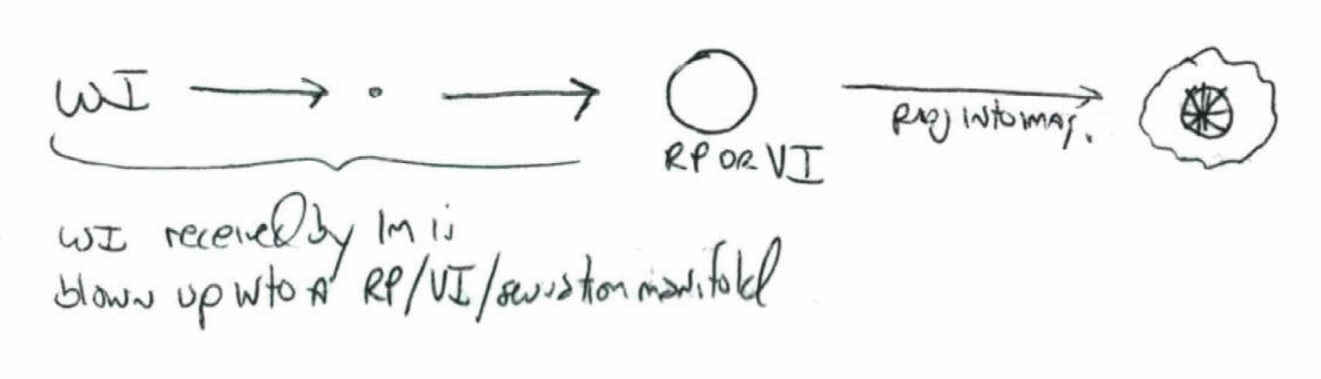
Class
Wednesday, March 16th, 1983
Verbatim, unedited transcriptClick the series name to view more
CLASS at Wisdom's Goldenrod, Hector, NY
with Anthony Damiani (AD)
March 16, 1983
PB PARAS; MENTALISM
TOPIC: PB Paras
SUBJECT: Mentalism
SUBSUBJECTS: Epistemology, World-Idea, Sensations, Faculty of Understanding, Tropes, Dragon, Categories of Imagination, Chaldean Planets, Causality, Non-Causality
CONTENTS:
IF THE WORLD IS AN IDEA IN MY MIND, WHAT DOES "MY MIND" REALLY REFER TO?
ONLY SOMEONE WHOSE STATE OF BEING IS IN IDENTITY WITH THE INTELLECTUAL-PRINCIPLE IS JUSTIFIED IN SAYING "THE WORLD IS JUST MY IDEA"
A STEP-BY-STEP EXPLANATION OF HOW YOUR EMPIRICAL CONSCIOUSNESS ARISES, FROM THE STIMULUS THE INDIVIDUAL MIND RECEIVES TO THE WORLD YOU KNOW
IN ORDER FOR US TO BECOME REFLECTIVELY AWARE OF AN OBJECTIVE WORLD, THE CATEGORIES OF THE IMAGINATION SUPERIMPOSE ON THE WORLD CERTAIN UNIVERSAL CHARACTERISTICS, OR NAMES, WHICH MAKE IT INTO A PHENOMENAL OBJECT, AND THERE ARISES SIMULTANEOUSLY AN EMPIRICAL SUBJECTIVITY
THERE'S NO DISTORTION WHEN THE MIND MAKES A VIVID IMAGE FOR ITSELF OF THE WORLD-IDEA, THE DISTORTION COMES WHEN THE TROPES IN THE BODY (INDICATED BY THE NATAL CHART) FUNCTION
IF YOU DON'T EXPERIENCE YOURSELF AS THE INTELLECTUAL-PRINCIPLE, THEN YOU CANNOT SAY "THE WORLD IS MY IDEA"
PB KNOWS THE IDEA DIRECTLY AND SEES THE WAY THAT IDEA IS TRANSFORMED AND INSTANTIATED BY THE MIND AND BECOMES THE OBJECT HE EXPERIENCES EMPIRICALLY
PB ANECDOTE: "THERE IS NO PERFECT MAN"
PB ANECDOTE: DOES THE SAGE WHO KNOWS ONLY BRAHMAN SEE THE WORLD?
THERE IS NO DISTINCTION FOR THE WORLD-MIND BETWEEN ITS IMAGINATION AND ITS IDEATION
THE TOTALITY OF ALL INDIVIDUAL MINDS AND EVERYTHING THAT'S GOING TO BE MANIFESTED IN THEM IS ONE IDEA IN THE WORLD-MIND
WHAT ARE YOU DOING WITH THE POWER OF THINKING?
WE DRAW BREATH, EXIST, AND THINK WITH AWARENESS ONLY BECAUSE OF OUR RELATIONSHIP TO GOD
PB NOTES ON CAUSALITY/NON-CAUSALITY
BEHIND THE SOUL OF THIS WORLD LIES THE POWER OF THE OVERSELF
THE INDIVIDUAL MIND TRANSFORMS ITSELF INTO A SUCCESSION OF "STILLS," BUT WE BELIEVE THAT ONE STILL IS CAUSING THE NEXT ONE
HOW CAN THE INTELLECTUAL-PRINCIPLE CONTAIN THE WORLD-IDEA IN AN ALL-TIMED FIXITY AND ALSO THE ORDER IN WHICH IT'S GOING TO UNFOLD?
IS THE ORDERING IN THE INTELLECTUAL-PRINCIPLE SUFFICIENT GROUNDS TO SAY THAT WITHIN IT YOU WILL FIND CAUSE AND EFFECT?
BOOKS / NOTES READ FROM OR REFERENCED:
Paul Brunton, Notebooks
Arthur Schopenhauer, The World as Will and Representation
Paul Brunton, The Wisdom of the Overself
The Heart Sutra
Fung Yu-Lan, A History of Chinese Philosophy, Volume 2, "Fa-tsang's Essay on the Gold Lion"
Mario Bunge, Causality and Modern Science
Tim Smith Notes from PB Visit 1980
PLOTINUS QUOTES READ OR REFERENCED: VI.7.2
DIAGRAM appended to this transcript:
- FIGURE 1983 0316-1-AB. Mentalism: From World-Idea to Dragon.
[Transcriber note: [diagram] means the speaker is referencing a diagram as he or she is speaking. If someone is drawing or writing, with audible sounds of chalk on a blackboard, I indicate this by [drawing] or [writing].]
NOTE: Older transcript version (Scan File 1983 0316C1-08R03.PDF) exists.
TRANSCRIBED Verbatim by IT 2018. Reformatted from V11a version by JRM & JF 2019-2020, with Subheads and Table of Contents added by JRM. In 2023, IT reformats again to accord with new conventions, fixes prefatory matter and footer, updates audio file name, fixes typos and minor errors, fixes/completes Book List, adds Plotinus quotes section, adds new notes within transcript, diagram from AB notes appended and reference within transcript to this diagram, note from JRM/JF at changeover from audio file a to b removed, not accurate. In 2025, MW expands Subsubjects and alters Subheads to make more accurate. Archival verbatim transcript – V14.1a.
AUDIO FILES: 1983 0316a, 1983 0316b. [Note: "Tape" and "Side" refer to original audio cassette tapes later digitized into .MP3 Audio Files.]
1983 03/16 at Wisdom's Goldenrod
PB Paras; Mentalism
Archival verbatim transcript
[Audio File 1983 0316a Begins]
S (faint): Yeah, see--
S: Uh-hm.
S: Can't hear you.
[17¾ seconds of background student talking and shuffling about]
LG: Could you repeat that please?
DB: Right. The question of rerunning the last five or ten minutes of last week's class which had to do with the nature of the stimulus which is given to the individual mind which the individual mind then blows up, magnifies, and constructs its world, the question had to do with what is the nature of that and can it be spoken of as an image. [S: Yes.] If so, why, if not, why not, [student assents, faint] [S simultaneously, very faint: Yeah, I agree.] so on and so forth.
[students assent, faint]
RG: May-- it was a good class, I mean, that was at the end of class [one word inaudible]
DB (simultaneously): Right.
IF THE WORLD IS AN IDEA IN MY MIND, WHAT DOES "MY MIND" REALLY REFER TO?
RG: Maybe-- I mean there-- it seemed (there was a) quite a bit of controversy over the first part of the class too, I don't know. (I mean--) I mean maybe we should go in [S simultaneously: Well--] order of the class, [AD simultaneously: But we could do that.] I don't know. 'Cause then your question would arise [students assent, faint] anyway, [DB: Right.] again. But ev-- everybody's clear on the first-- on the first part of the class and agrees wholeheartedly with it.
S (simultaneously): Read your paper. (bit of laughter, students assents, very faint)
MB: Why don't you refresh our memories?
S (very faint): Yeah.
HS(?): Would you talk up a bit, Dickie?
S (very faint): Yeah.
RG: (Sure) [one/two words inaudible] (bit of laughter)
S: What?
RG: Well, we remember Randy-- Randy's paper? [Note: Reference is to paper by Paul R. Cash read at the beginning of WG Class 1983 0309a, for which we are missing audio. It has been retyped as 1983 0309b V09P. PB Paras - Mentalism.] Don't-- doesn't everybody remember that? How do you-- you can't forget, I mean-- [students assents] (bit of laughter) The-- you know, the vision of the "my mind" school, the-- the "one mind, my mind, everything arises, sets, and falls within it" school. (laughter) No, no, [S simultaneously: This is an objective (one word inaudible)] it's a-- it's a good school. (laughter)
PD: You're on the verge of poetry Dickie, keep it up.
RG (simultaneously): What?
RC: Oh, a new (poem/poet).
PD (simultaneously): You're on the verge of poetry, keep it up. (some laughter)
RG: Yeah, Randy's version of (a/the)--
BS (simultaneously): It's a super-individual in the mundane world.
AB: We all agree, it must be true.
S: Really?
RG: Well, nobody cares then. (bit of laughter) All-- all along all I heard was all this controversy about this point, nobody ever talks about it.
LD: Well why don't you get to your point?
RG: No, I don't have one.
LD: Oh, I-- (bit of laughter) I thought you were building up.
RG (faint): I don't care, (it's your life).
LDS (simultaneously): I thought the point was that there were-- there weren't two minds in the paper, [students assent] this-- the individual mind is only a mode of the universal mind or-- [student assents, very faint] I don't know.
RG: Uh-hm, and that all you could ever speak of are cont-- are-- of what you know is your individual mind. No, I think that was the other class that we--
RC: No, your mind.
S (simultaneously): Yeah.
RG: Your mind.
RC: Your mind.
S (simultaneously): Could I--
RG: My mind.
RC: Yeah.
S (faint): My mind [one/two words inaudible] (bit of laughter)
RG: Put it on the board, "my mind".
RC: Yeah, "(your/you're) my mind". (laughter)
S: I felt that the-- the last half of the class was almost, not a contradiction, but I couldn't fit the two together because if we spoke of the individual mind as being, you know, the cosmic mind, [student assents, faint] you know, that they were all one mind, how could you speak of a stimulus being given to an individual mind which would then take it and manufacture it into a world? Because it seemed somehow to make that individual mind distinct then from a cosmic mind which was giving it a stimulus.
RG: Uh-hm.
DB: I thought-- I-- I don't want to speak out of turn but I thought that part of the import of the paper that Randy had written was to the effect that the individual(--/,) we have a kind of habit of substantializing conceptually anything we're talking about and one of the things we do that with is mind. And I think that this paper seemed to try to undercut that-- that tendency to the extent that you really couldn't speak of a separate individual mind which was being given something to it from another substantial entity which was universal. And, let me see, there was one other point there. It was right on the tip of my ego and now it's disappeared. (laughter) Oh yes, right, it had to do with the fact that Randy, instead of speaking about individual and universal mind, was speaking about mind as individual and mind as universal which I thought was a very important distinction.
LH: And in that respect, if I understood thrust of the paper, he didn't want to reduce--
LR: We can't hear anything in the back of the room.
LH (simultaneously): Well, in-- in the respect to what he just said, if any-- the thrust of the paper was that you don't want to reduce individual mind to universal mind. They are both mind in two different aspects.
[students assent, faint]
AH: Also there-- a word that's been getting some use around here lately, notion of complementarity. I thought that was part of the thrust of your paper. That there's a complementary sort of arrangement between mind as universal and mind as individual.
RC: Yeah, I don't know if-- if I know what you mean by-- by that word but--
AH: You can't have one without the other, you know.
RC: Ok. And I guess the only other point was that insofar as the truth of the con-- of the two conceptions, we have a concept "individual mind," and we have a concept "universal mind".
VM: Hey could you [RC simultaneously: From--] speak up please?
RC: Yeah. When you--
AS (simultaneously): We had a microphone around?
VM (simultaneously): The cookie's too loud, I'm sorry. (laughter)
S (amidst laughter): What did he say?
S (amidst laughter): The cookie's too loud.
S (simultaneously): The cookie's too loud! (S laughing, laughter, student words)
LR: Yeah, [S simultaneously: Something, you know.] [one/two words inaudible] is back there, I don't--
CDA: No, now we're supposed to concentrate after that [few words inaudible]
VM (simultaneously): I'm sorry, I just feel like it's louder than Randy.
S (faint): Yeah.
S: Listen. (bit of laughter)
RG: It must be the ego appearing as cookie.
VM (simultaneously): You never hear your cookie. (some laughter)
S (amidst laughter): Thanks a lot.
S (amidst laughter): He didn't want a cookie.
RC: We have the concept "individual mind"--
LR (simultaneously): What's going on back there?
S: [one/two words inaudible]
AS (simultaneously): There is a lot of noise back there.
LR/S(?) (simultaneously): Be quiet!
RG: Well shut them up.
AS (simultaneously): This--
VM (simultaneously): Party.
LR: They're eating. (laughter, student words)
AS: I don't see [one/two words inaudible] Vic's cookie.
S: Was somebody back there?
[couple seconds of background student talking, laughter]
TS: Take names Bill, I mean-- (some laughter, student words)
S: Alright.
S: Uh-oh.
[few seconds of background student talking, laughter]
AD (amidst student talking): Where's the loudspeaker?
[couple seconds of background student talking]
LG: Alright.
S: There's the loud--
[students assent, faint, bit of laughter]
[few seconds of background student talking]
RC: We have the concept "individual mind" and we have the concept "universal mind". And, I think we'd all agree that at this point we could say those two concepts are present within what each of us now calls "my mind". And I just wanted to stress that this very same thing, this very same entity, that each of us now calls "my mind" is the very mind in which the truth of both of those concepts would have to prove itself; that that one mind which is now spoken of by each of us as "my mind" has to be capable of being in identity with the truth of both perspectives. Otherwise, it has to content itself with words.
[short pause]
PD: I wasn't here last week so I don't really know the context of your paper, but it just seems kind of confusing to me to s-- to use this word "my mind" as explaining anything. To think in any fashion whatsoever that there's a possessive relationship between [VM simultaneously in background: Someone else broke it though.] ego and mind is a abomination. (VM laughs) [RC simultaneously: I think it becomes an abomination.] I mean just to think of possessiveness towards the universal mind is just-- I don't know what that means, just personally now. To s-- to think that the ego can possess the universal mind in any fashion whatsoever just--
RC: Yeah, where I started from was-- let me just recapitulate a little bit. There are a number of things that I've read in PB's notes which were very very difficult for me to swallow. And, in many places, if you just read it cold, if I gave you a number of passages cold and didn't tell you where it was from, you'd look at these slips of paper and you'd say, "This guy is a solipsist, he blew it, he didn't understand"; in places where he uses specifically "my mind" that he's talking about. And the one that I started the paper from was a quote in which he says, for most people, we can get so far as to realize that-- the best we could hope for is to realize that the world is an idea. But the Sage is able to take the next further step and he's able to say, "The world is my idea." And then there were other quotes where he says like, "When I say that I am my own mental existence, I imply at the same time that I am the whole universe, that Nature exists within me, and that the whole universe is but a immense thought in my mind."
PD: I can follow that, but you're still not speaking of universal mind as being possessed, you're speaking of a thought.
RC: Yes, but we're speaking of that thought as being in my mind. And there's actually one that I didn't mention that-- one line of things that I didn't mention last week that I had even a harder time with and there are some statements where PB comes right out and he says, right out in the open where anybody could accuse him of solipsism, "All of my fellow creatures are but ideas in my mind." And--
PD: I follow everything you're saying but you're [RC simultaneously: Ok.] still not speaking of the relationship of the universal mind and individual mind in this con-- conversation.
RC: No, I wasn't trying to either.
RG: He doesn't want to speak of it, that's the point.
RC (simultaneously): I don't want to-- I didn't want to speak of it as a relation of two separate minds, of minds that are factually separate, but only verbally distinguished as part of a-- a process of learning. And that-- I thought that-- the reason that I did the paper was I have felt in my own understanding, and I thought it was also true in most of the discussions that I've heard, that when we introduce universal mind into our mentalism, that we lose a lot of the ground that we gain in understanding the elementary tenets of mentalism in that, in the elementary tenets, we at least intellectually have come to the point where we realize that honest thinking cannot speak of the existence of any object apart from its own consciousness, that there's nothing that I can speak of, a possible knowable, except that it is presented in and by my mind to itself. It seems to me that we get that far with our elementary level of mentalism. We start to get tight about it, we might be intellectually sympathetic to a certain point, but nonetheless a big part of us is still holding back, we haven't gone through a psychological transformation where we actually experience the world that way. So when we introduce the term 'universal mind', they go "Whew!" Now 'universal mind' means everything 'matter' used to mean and that same polarity in experience which we had before continues to operate. We may change our labels in abstraction, but we don't change the level of our being.
And-- so what I wrote the paper for was to really drive home as much as I could the fact that, if PB was able to make statements of this nature, then what would I have to mean by "my mind" if I were going to make a statement of that and have it be true, if I were going to say that "Nature is but my idea," or "The universe is my idea," or "All my fellow creatures are but ideas in my mind". What would I have to mean by "my mind"? And really inquire into that I'm giving these powers, I'm intellectually assigning these powers to my mind, but I haven't appropriated them or integrated them to the factual being of my existence until I understand the relationship of the "my" part to it. And I-- I think that's where the transformation at a level of being comes in, is realizing that I don't know my own mind. And that in knowing my very own mind, not some other mind, is where that transformation takes place. And Anthony made the remark like, the Greeks didn't say "Know the World-Mind". They said "Know Thyself".
PD: And I follow what you're saying, it's just the word 'my' for me [students assent] doesn't carry any connotation at all. [RG: Right.] It's-- see, it doesn't have any-- any actuality at all, it can't do a goddamn thing. So it can't be the mind that's creating the world. I mean, that's my own experience, the 'my'-- the 'my' is purely a blockage in cognition.
RC: Ok. Would you go so far as to--
AB (simultaneously): What if you said "individual mind"?
[student assents, very faint]
RC: Would you go along with me and say that the only mind that you know is doing everything that you know?
PD: That's-- that's very, you know-- That's-- my-- my import was on the word 'my', [AS(?) simultaneously: 'My', not (mind), m-y, not m-i-n.] that's all. Since I wasn't here for the whole context, I don't think you should, you know, [RC assents] go into it Randy.
RC: Ok.
PD: Just 'my' has a very very small connotation philosophically.
[student assents, very faint]
ONLY SOMEONE WHOSE STATE OF BEING IS IN IDENTITY WITH THE INTELLECTUAL-PRINCIPLE IS JUSTIFIED IN SAYING "THE WORLD IS JUST MY IDEA"
AD: Well let's change the context, Paul. In Western philosophy you have a man like O-- Arthur Schopenhauer who says "The world is my idea." And in the East you have a man like Yajnavalkya who says "The world is just my idea." [students assent] Now, among-- between those two, who would you say was justified in making that statement?
PD: I couldn't-- I don't--
AD: Well try, try.
PD (simultaneously): --don't believe it so, I mean--
AD: Yajnavalkya, who instructed his wife Maitreya on the non-duality of the knower, or Schopenhauer, who got mad at his landlady and threw her down the stairs? (much laughter, student words)
VM: I think his landlady was the one.
S (amidst laughter): I was the landlady, right?
DB (simultaneously): I wa-- Paul, I was a kid. (laughter)
RC: Well there must have [couple words inaudible] [S simultaneously: Settled.] (it if) [couple words inaudible] Schopenhauer. (laughter)
AD: No Paul, now if you-- (bit of laughter) if you were just to try to answer as best as you know.
S: Well take a guess Paul! (laughter)
S (amidst laughter): Don't know, yeah.
PD (amidst laughter): I don't know! (some laughter, student words)
S: Just a guess!
S: [few words inaudible]
VM (simultaneously): Ignorance is no excuse for sto-- (bit of laughter) for being silent.
PD: And what's your point though?
AD: Well the point here is that a man like Arthur Schopenhauer, for instance, who wrote The W-- The World as Will and Representation or "The world is just my idea," cannot claim to have been identified with the Intellectual-Principle or the World-Mind, and insofar that he lacked that identity and was not what we call the higher knower, his assertion that the world was just an idea for him would be false, wouldn't be true. On the other hand, Yajnavalkya, for whom the identity between him and the World-Mind was an experienced fact, and it was a state of consciousness he always lived in, the world was just his idea and he was justified in saying so. Do you see the difference there?
PD: In terms of a exposition of philosophy, no. I mean, you could-- there's a difference in terms of their state of being.
AD: That's exactly the point. That's exactly the point. The difference is in the state of being. The state of being of Schopenhauer was not that he inhabited or was a resident of or a denizen of the fourth state of consciousness, whereas in the case of Yajnavalkya it was so. So the state of being of Yajnavalkya was identical with that of what you might call the Intellectual-Principle or the World-Mind. Therefore, he was universally pervasive. As Being he was everywhere and anything that exists must exist within that Being. So he could say "The world is my idea." But a person who experiences the reverse, who doesn't experience himself as Universal Being, alright, capable of being in Bombay because he decided to think about it, alright, for him the world is not his idea. The world is just an idea, yes, but not his idea. [short pause] Ok? But that wasn't the point of last week's discussion.
[student assents, faint]
A STEP-BY-STEP EXPLANATION OF HOW YOUR EMPIRICAL CONSCIOUSNESS ARISES, FROM THE STIMULUS THE INDIVIDUAL MIND RECEIVES TO THE WORLD YOU KNOW
LR: No, I thought we wanted to know what the nature of the World-Idea was.
S: Yeah.
LR: We were supposed to stay up all week and not get any sleep--
AD (simultaneously): You stayed up all week trying to figure it out?
LR: Yeah.
AD: Well, why don't you let me hear your results? (laughter, student assents)
LR: I didn't say I stayed up (late). (student assents, laughter, student words)
AD: Yeah, go ahead.
LR (simultaneously): I think it's wave function.
VM: Hey, there you go. (laughter)
AD: I want-- I want the explanation all the way, from the stimulus that the individual mind receives all the way to the world that you know. I want that straight forward. Well-- well, David might oblige us.
DB: Yes, well, I cheated because I looked it up in the book. (laughter)
AD (amidst laughter): Well--
DB: There's-- there is a section in the Wisdom where he speaks about the primary characteristic of the World-Mind as being imagination, and that its out-flowing is as, in one sense, an image. Now, the problem comes in because it's not an image the way we normally think of images, it's not sensible qualities that are limited to our form of cognition but it seems like it has to be in some respect a representation of the Ideas which the World-Mind contains eternally, which it's unfolding in time. Now, I got as far as that.
AD: Well, even that's not too good because what you're doing is putting the sensible world in the Intellectual-Principle.
DB: No, no, because--
AD: Well, you said that it had to have the sensible qualities.
DB (simultaneously): No, I-- I didn't, I guess I didn't-- too bad you couldn't hear me. The image which the World-Mind is unfolding from within Itself is not an image in a sense that we would understand an image to be, like a picture.
AD (simultaneously): Well then how would you understand it?
DB: As in some sense a representation or an image of-- [AD: Good] a representation--
AD: You did change the word from 'image' to 'representation'.
DB: Yes. It's a re-- it's-- I would-- I think of it as a intellectual or an intelligible representation of the eternal Ideas which the World-Mind contains, that it's a-- it's not those Ideas but it's-- insofar as it's an unfoldment of them, it would have to be considered as an image, an image being a reflection, a-- in some sense a step down from the-- the principle. I mean that's what any kind of an image is. But it's not an image the way we ordinarily think of images on a camera, it's not a sensible representation. [students assent, faint] Because it would seem to have to include the possibility for cognition by any particular center of consciousness regardless of what state of development that center of consciousness was operating on. So-- I have one other thought about it too but I don't know if it's appropriate. Now, is what I said anywhere's near the mark…or what?
AD: Well go on (there), Dave.
DB: Well--
AD: Don't worry about the mark.
DB: Well, I don't want to be just running my mouth unnecessarily here. But it seemed to me that there's a certain-- insofar as we speak of-- or PB speaks of one World-Idea which is being unfolded and then this multiplicity of contents-- no, I'm sorry, the multiplicity of-- of minds as uni-- as individual within it, that from the point of view of the mind to which the stimulus is given, there is something specific-- specifically excluded. Because if that weren't the case it would seem that everyone would have the same knowledge of the world, and that what is e-- excluded from say for example my-- what is excluded from what is given to my mind would precisely be the manner in which my mind is going to unfold it. That is, that would never be given to it as an object. Now that's-- that's as far as I've been able to get with it, beyond that I don't know what to do. Except that, in some sense, depending on the level of development of the individual mind in con-- in question is functioning, he is following the same basic law of projection or imagination that the World-Mind has, he's going to make a duplicate of that-- not a duplicate, a-- a representation for itself which is the world that we live in.
[22¾ second pause]
AD: That's kind of general, Dave, I mean-- I think practically all the important in-between steps which we find so confusing has been left out.
DB: Well, you see, the rea--
AD (simultaneously): And, what I'm asking for is a detail-- detail description that goes step-by-step from the Idea, the World-Idea, alright, to its transference all the way down in your empirical consciousness. Now if you cannot do this for yourself, I don't think you will-- will really grasp the doctrine of mentalism, and that most of-- you know, most of our loyalty is going to be lip service. But we really do have to try to do this step-by-step. If you're willing to take out ten minutes, we could do it.
VM: Only ten minutes?
AD: Well, that's because I won't repeat and I won't argue.
RC: We've got until 9:30 or 10:00 to get those ten minutes in.
AD: No, I-- [S simultaneously: Let's get them in there.] I can't argue. Alright, we said that the-- we said that the individual mind receives the World-Idea. Now the nature, the nature of the stimulus is such that if we consider it as an image of any kind, a representation of any kind, we're going to be caught in a double bind. We'll be speaking about an endless duplication of images. So let's-- let's start off by saying that the World-Idea is an Idea, is a Force in the World-Mind, it's not a picture, it's not an image. Now this World-Idea is the stimulus to the individual mind. The individual mind, we know, makes representations of that Idea, that is, it has sensations. These sensations is the reflexive-- the passive reflection, or the passive reflexive-- a passive reflexive of the mind. That is, the mind passively reflects the World-Idea in terms of sensations. It has sensations. [short pause] So we know that the mind which has the two forms of space and time reflectively and passively records the World-Idea and then has a sensation of it. Now, the next step will be that the sensations are many and varied. That is, there's a multiplicity of sensations all within one instant let's say, within one instantiation of the mind, one still of the mind. And all these sensations, the multiplicity of all these sensations, have to be organized into a manifold, or better still, into a unity that is a manifold. [13½ second pause]
The mind has a further faculty, a faculty which Kant called the faculty of understanding and which I call the faculty of belief--[16½ second pause]--that wishes, um-- [15 second pause] Now let me see. I said that the mind has sensations, and that these sensations are organized by the faculty of understanding or the faculty of belief. The organization of these into a manifold-- The next step that is required is to think of this as wanting to-- Well, in this state it is unreflective, it doesn't know the self, you could say in this state that the mind is an unreflective state. So in order to become aware of its contents, it must take these and project them, or inseminate or, let's say project them into the imagination. Now, the imagination we said was the atmospheric belt or the Dragon or the tropes in matter. So that what we're saying is something like this, that the mind now has to project these organized-- this-- this manifold of sensation which has been organized, project it into the imagination. The-- the next thing we're saying is that the imagination is this Dragon or the tropes in matter, and it organizes these tropes in matter as a medium. That is, it's a medium in the sense that the organization of these tropes in matter will be able to reflect back to the mind [12½ second pause] the knowledge that it wishes to have. [S: (Ok.)]
To go back. The reflection of this manifold of sensations which the faculty of understanding or belief has organized into the imagination means that these tropes have to be organized as mediums through which the prior faculty of the understanding which has organized-- I'm getting these all confused. [students assent] [short pause] I'm trying to say it as simply without-- [11½ second pause]
Alright, very simply, I'll just repeat for my own sake. The mind receives the Idea, and it makes sensations out of these Ideas. These sensations are varied and many so they have to be organized into a manifold unity. Then this manifold unity has to be projected into the realm of the imagination. And we said that this realm of the imagination is the totality of all the memories left behind on the Earth, and this we refer to as the Dragon, alright. All these images that are left behind in the memory of the world, these are the images wherein the sense-manifold gets projected into the imagination. This is the imagination it gets projected into. This constitutes the empirical personality. But not yet, he's not empirical yet, because what has to happen is that this projection of the sense-manifold into the imagination-- The imagination itself is unreflective, but it reveals, it re-- the unreflective imagination, through the powers that it has, that is, what you regard as, you know, your Chaldean planets, it manifests the content of that World-Idea to itself in terms of what we refer to as the ego and the world-idea. Yeah, that's it. I'll have to go over it now. [16½ second pause]
You got the order straight, Tim? [student assents, very faint] You think so? [student assents, faint] Does that sound straight to you, the order? The mind receives the World-Idea, makes rep-- a sensation out of it, the sensation is organized into a unity by the faculty of the understanding. This is a spread out in the imagination which is really the memory of the-- the memory of the Earth's consciousness. This constitutes the organization of the ego, alright, and the world-idea that accompanies that ac-- ego. And then of course, in the very organization of the ego structure or the Chaldean planets which surround the Sun-centered personality, the contents of that which went into making or-- you know, the reason-principle which went into making that imaginal creature, reveals itself through the functioning of the ego with all its powers. That's pretty straightforward, isn't it?
AS: I just want to comment. In the beginning-- [AD/S(?) simultaneously: Well--] when you said the original, when the-- the individual mind say receives the World-Idea and makes sensation, wouldn't you say that reception is the sensation. In other words, the energizing of the individual mind.
AD: No, that's not the sensation, the reception is not the sensation.
AS: The way that it receives-- In other words, when--
AD (simultaneously): When it re-- when it receives the World-Idea, it makes a sensation for itself. In other words, the World-Idea does produce a vivid image in the mind.
AS: Yeah, that's what I meant. [AD simultaneously: Yeah.] That energizing of the mind is the sensation.
AD: Yeah, that's the sensation. Now, if you-- if you keep in mind that the mind has these two ultimate modes of being, you know, temporal-- what they call the or-- the form of sensibility and the form of space, if we keep-- keep that in the background and we say that the mind has these two forms, the form of space and the reception of sensations, alright, sensibility, form of sensibility, and if we say the mind receives the World-Idea then we-- we're also saying that it has to make sensation for itself of the World-Idea. It makes itself this, let's say this variegated image which is not the empirical or optical image that you see. It makes for itself this sensation, these many sensations which it organizes into a manifold by belief, and then this is what gets, so to speak, spread out in the imaginal essence which is the belt surrounding the world, and this constitutes the natal chart of the individual. Now, the-- this natal chart of the individual therefore has as its presuppositions all that we just said but also now as this natal chart functions, there will be levels of distortion within that functioning. So between the World-Idea, the Idea, so to speak, of the world, and ultimately the way we perceive it in our empirical consciousness, you have all these layers of interference, if I could use that term, but also of transmission.
VM: Anthony, can you maybe expand on the role of the aspects and so on in the later stages of this development? You made a couple of references to the aspects and--
S (simultaneously): Yeah.
AD: I avoided any technical jargon.
VM (simultaneously): Oh you don't want-- don't want--
AD: I avoided technical jargon because I wanted it to be straightforward.
LR: I got lost--
AD: No. Go ahead.
LR: Oh. When you said, when you got to the point and you said that the faculty of belief organizes these sensations into a manifold.
AD: Uh-hm.
S (faint): Right.
IN ORDER FOR US TO BECOME REFLECTIVELY AWARE OF AN OBJECTIVE WORLD, THE CATEGORIES OF THE IMAGINATION SUPERIMPOSE ON THE WORLD CERTAIN UNIVERSAL CHARACTERISTICS, OR NAMES, WHICH MAKE IT INTO A PHENOMENAL OBJECT, AND THERE ARISES SIMULTANEOUSLY AN EMPIRICAL SUBJECTIVITY
LR: And then you said in this state the mind is still unreflective.
AD: Yeah.
LR: In order to become aware of its contents it projects them into the imagination.
AD: Yeah.
LR: And you described the imagination as the tropes or the Dragon. Then you described the imagination as the seven Chaldean planets.
AD: Well within, within that realm, alright--
LR: Within--
AD: --when you-- Within the imagination, these tropes, the memory of the world-content, the content of the world, or the memory content of the world, alright, that's the realm of the imagination. And what we're saying that within that realm, alright, we're saying that this Idea is going to organize the ego and the world it lives in. [LR simultaneously: The Idea--] Now they're no longer, let's say-- now we could call them categories within the imagination, ok? And if you think of the Sun in your chart, that would be let's say the powers, the powers that it's working to, to become self-reflectively aware of an objective world. Now how does it become self-objectively aware of an objective world is by imposing on the image, alright, certain universal characteristics.
LR: Ok. But you didn't want to equate the imagination, the larger imagination, with what you say is the wor--
AD (simultaneously): Don't confuse what I'm saying with anything else. Just try--
LR (simultaneously): Anthony, I'm just trying to get it from what you said.
AD (simultaneously): Larger imagination?
LR: First you said that these sensations which are formed into a manifold by this faculty of belief are then projected into the imagination [AD: Yeah.] or Dragon.
AD: Yeah.
LR: Now, you don't mean-- do you mean to make that imagination the same as what you're calling the seven planets organizing the ego?
AD: Now, within that--
LR: That's why I say, "larger imagination".
AD: Within the realm of memory, which is the world's memory, alright--
LR (simultaneously): Ok, the world's memory, the world--
AD (simultaneously): Yeah, alright, we're calling that the imaginal essence.
LR: Imaginal essence.
AD: In other words, that's the memory content of our world.
LR: Right.
AD: Alright? So that's in its imagination.
LR: Ok.
AD: And we're saying that that imagination is going to be-- or parts of that imagination [LR simultaneously: Are going to be crystallized.] is going to be organized in such a way [LR simultaneously: That the ego--] that your ego will be in there, alright, and that the categories of the imagination would be the various planetary powers around, and these are going to manifest, so to speak, the content. Now, when the im-- when the content is manifested, it superimposes, and this is important too, it superimposes on the objective world certain universal characteristics or marks. It says, "This is an object. Why? Because-- well, I know it's a house because it's temporal, it has such and such shape." All these are universal characteristics which [AD tapping on something for emphasis as he speaks] superimpose on that image, makes it now a phenomenal object. Once the phenomenal object is created, then simultaneously there's appearance of a "subjectivity", quote unquote, an empirical subjectivity which is as-- about as real as the objectivity, alright, is reflected by that. You follow that?
S: No.
S: Yeah.
AD: I wasn't talking to you.
[student assents]
LR: I think you're saying that the Force which gets-- which is received and made-- and sensations made of it, actually then organizes the stuff of the world into a particular form which we call ego and world.
AD: Yeah, good. Now, [LR simultaneously: Now the ego we can--] you have to continue, yeah.
LR: The ego we can speak of as being these seven categories.
AD: Of the imagination, yeah.
LR: And the world, that was the last thing you said, the world has certain universal marks which then makes it possible--
AD (simultaneously): No. The world is there, you see, but until the ego superimposes on it certain characteristics, it doesn't become a phenomenal world [LR simultaneously: Ok.] for you. [LR simultaneously: So the (couple words inaudible)] So the very functioning of the ego, alright, in-- insofar that-- insofar that it superimposes on this image which is not yet clarified, unless it superimposes certain marks on it, alright, what we could say, universals, or names, we [AD bangs on something for emphasis as he speaks] don't have a phenomenal object. But as soon as we do that, now the phenomenal object comes into being. Now when you say, "Now there's a chair, there's a tree," alright, the reflex of that is the building up of your own empirical consciousness. The two of them are as phony or as real as a three dollar bill. (MB laughs) But as far as we're concerned, they're real enough.
VM: Yeah.
AS: But, by unclarified image, you mean the projection of the whole ego and his world before a particular part of it is split off as being--
AD: Objective.
AS (simultaneously): --the empirical subject--
AD: Yeah.
AS: --and a particular part is split off as--
AD: Ok.
AS: --object. So, the prior step for this empirical or phenomenal object [AD assents] and subject is this undifferentiated, that is, unsplit into subject-object including, say, his chart with the world. Ok, we think of his--
AD: Uh-hm.
AS: --his ego or his personality in the world [one/two words inaudible]
AD (simultaneously): In other words, just prior to this subjective [AS assents] functioning.
AS: Prior to this subjective functioning--
AD (simultaneously): The whole, yeah.
AS: --you've got this whole.
AD (simultaneously): Once you have the subjective functioning, which means you superimpose characteristics on the image, you now have a phenomenal object and a phenomenal subject.
VM (simultaneously): Right.
AS: Right, just prior to this total image, you're saying, is the energization of that mind. The energization is stimulated by the World-Idea.
AD: Yeah.
AS: So the World-Idea stimulates this energization of the mind [AD assents] to produce--
AD: Sensations.
AS (simultaneously): --a for-- a sensation, which it organizes into an entire world-image, [AD assents] as it were. And that image underlies all our experience. That's the one that directly underlies--
AD (simultaneously): But now, now that's the one that's going to organize the [AS: Yeah.] im-- imagination.
AS: But that's the-- that image is the one that directly underlies our phenomenalization. In other words, the-- that unclarified image which includes the ego, his chart, and the whole world but unsplit up into an empirical [AD simultaneously: Alright.] subject and object.
AD: Yeah, but now, now, the point here is--
AS: And then within that--
AD: --that is what creates in the imaginal essence the ego and its world.
AS: Yes.
VM (simultaneously): The-- [LR: Yeah.] the primordial image you're saying.
LR: The primordial.
AS: "That".
AD (simultaneously): Well, I don't [VM simultaneously: Oh you don't want to use that word.] want to lose anybody, I don't want to confuse anyone.
AS (simultaneously): When you said "that", [S: Yeah, "that".] the unclarified image which includes--
AD: Well the unclarified ina-- image is what we said the mind's sensations of the World-Idea--
AS: --are organizing--
AD: --are organizing that imaginal essence.
AS: Right.
S (faint): Right.
AD: Ok.
AS: Uh-hm. Now the next step is that that imaginal essence that you're speaking of, or that unclarified image--
AD (simultaneously): As organized.
AS: As organized, that's-- it seems to me, that's the basis of the whole of the phenomenal world, both the subject and the [student assents] object. Like, if you-- if you didn't make that split of identifying, the force of the identification of attention with the particular subject and the overlaying of all these concepts and the universals on the object, he--
(Side 1 of original cassette tape digitized as 1983 0316a Ends; Side 2 Begins)
AD: The world that would prese-- be presented, and it still would be an image world that is being presented, would be a very vivid one. If you try to go beyond that, then you wouldn't have a vivid world, a-- [AS: No, then you--] an image of a vivid world, you'd only have the force or the power of the World-Idea.
AS (simultaneously): The energy. That's what I [AD simultaneously: Yeah.] was saying, the energy as it's primordially energizing the mind. So you have like this sequence. You have the World-Idea energizes the mind which makes this image, total image.
AD: Uh-hm.
AS: And within that then, that because that image-- it seems that it-- that because that image already contains all the tropes and propensities of the individual, [student assents] that they automatically function as-- well, maybe not-- [AD simultaneously: (Now-- uh-hm.)] they don't have to automatically.
AD: Now, insofar that the mind has made an image for itself of the World-Idea [AS assents] which is now organized, it is this which is the presiding idea over the imaginal essence and organizes it into a body and mind and the objective world.
AS: Right, and what I'm saying is what you s-- You've got an extra step in there, right? [student assents, very faint] That's what the thing is, you've got an extra step.
AD: The important step here is to recognize that when the mind organizes the World-Idea into an image, [AS: Yeah.] that this image has to be spread into the imagination.
[student assents, faint]
AS: Yeah.
AD: The imagination here being the imaginal essence surrounding the world.
AS: Uh-hm.
THERE'S NO DISTORTION WHEN THE MIND MAKES A VIVID IMAGE FOR ITSELF OF THE WORLD-IDEA, THE DISTORTION COMES WHEN THE TROPES IN THE BODY (INDICATED BY THE NATAL CHART) FUNCTION
AD: Now that is what we're going to call the chart, the native's chart, the natal chart. Now if you pick it up from there there's still more complications insofar that the functioning of that chart will show inherent in the tropes which are in the body or in the ego, body, alright, that there you have a set of tropes-- tropes which, in a sense, further distort and deflect the manifestation of the World-Idea, and interfering. I'm sorry, that's the way it is. [student assents] It's a long difficult under-- undertaking.
MB: Anthony?
S (faint): (That's right.)
[student assents, very faint]
AB: That's right.
MB: Anthony? Is it possible for error to enter into this transmission process even prior to those tropes? In other words--
AD: Well, I don't know what you mean by error.
MB: Well when you say that the World-- the World-Mind energizes the individual mind and the individual mind picks up this energization--
AD: Not the World-Mind, we said the World-Idea(./--)
MB: The World-Idea. And the-- and the individual--
AD (simultaneously): Energizes the individual mind.
MB: Which receives it in the form of these sensations. And you spoke of that as a passive reception.
AD: Well the mind passively reflect-- re-- receives and represents that as sensations.
MB: As sensations. Is it-- when-- when you say passive, you know, it brings to mind the image of sort of a clear reception. But is it possible for there to be error even at that level of reception which is far prior to the Chaldean planets?
AD: What kind of error are you talking about?
[student assents, very faint]
MB: Oh, you know, a distortion of some sort.
AD: No.
MB: An individualization--
AD (simultaneously): No.
MB: --based on--
AD (simultaneously): No.
MB: --karma--
AD: No.
MB (simultaneously): --or something like that. So the error--
AD (simultaneously): No.
MB: --of a karmic-- Let's say if there is any--
AD: No!
MB: --difference--
AD: No! you stop now, don't go on because you get complicated. The mind at this stage is no mind that you understand. It's the penultimate stage of mind, it's receiving the World-Idea.
MB: Ok, now what about at the next stage down where you spoke of the faculty of belief which organizes those sensations into a manifold? Is it possible for that faculty to be off?
AD (simultaneously): No mistake there either.
[student assents]
MB: Ok. So then--
AD (simultaneously): Even if you come out with-- as a retard.
VM: So contingency comes in--
MB: --later on at the stage where the Chaldean planets--
AD: When it organizes the imaginal essence, that's where the error starts coming in. [VM: But that--] But even then it wouldn't be error because it knows what it's doing.
[student assents]
AS: Now--
MB: It does it in-- I don't mean it in the sense of a mistake, I mean it in the sense that it does it in its own peculiar way.
AD: Well, I don't know what you mean "in its own peculiar way". Well--
MB: Well it--
AD: It does it in its way, yeah.
S: Ok. Anthony?
JA: Myra, are you trying to say that particularization in itself is an error?
MB: Well, let's say I was perhaps falsely calling it an error, but what I meant was particularization, that there is a particular way that that image comes out. It may have come out in a different way if the tropes had been organized differently, and that particularization is not, so to speak, planned for in the original reception of those sensations.
AB: If PB says each individual perceives a World-Idea or adjusts the World-Idea according to the form of his own intellect--
AD (simultaneously): Now look, if you're going to start elaborating what I said you're going to forget everything I said and you're going to have this for the next ten years and I'm not going to repeat myself so if you got it straight and if you wrote it down, go home and you memorize it and next time I'll talk to you about it.
S: Yeah.
S (simultaneously): I have a question [S: Yeah.] about what she said (actually).
AD(?): You could ask it.
S: You've mentioned the Dragon and you said all the images left behind in the world. I don't understand that.
AD: Well, that's our peculiar jargon, but-- The way we understand that is that surrounding the Earth, alright, throughout the countless eons of its evolution, every form of life that has ever appeared here, on Earth, is retained by the Earth's memory. [student assents, faint] Now, this is the content of its memory and this, so to speak, are images in its imagination, if I could use the word, although images here are nothing optical. Now it is these images in the Earth's memory that the reason-principle which we call the I-- the World-Idea which came in, and organizes these contents to make a vehicle for itself through which and by which it can reflect back to itself. But, if these tropes which are organized into a medium through which it can reflect itself, if these tropes already contain the seeds of misfortune, so to speak, then the distortion to that extent is going to be distorted. Yeah?
S: By the history before, by--
AD (simultaneously): Yeah, by the history of that peculiar body, alright, and the distortions that occurred within it. Now this is taking it from the top all the way to the bottom. The World-Idea is received by an individual mind and it's got to go all the way down into the body, create the body, manifest through the body, and when the body manifests, let's say, that Idea, the Idea is still not clear enough until the individual mind phenomenalizes the object by superimposing on the object a concept, a mark, saying, "Ah, this is brown, square, etc--it's a box," alright. And unless the mind does that you won't recognize it as a phenomenal object, it'll just be, so to speak, a vague, indistinct appearance. [students assent, faint] And this will combine for you, I think, Plotinus, Kant, PB, all that you want.
PC: Anthony? I don't understand distinction between, you're saying it would be a vague, undifferentiated kind of image before you've turned it into a phenomenal object. But before you said it was a very vivid image?
AD: The vivid image is when the mind first receives the World-Idea, that's the vivid image.
VM: How is that distinguished from the sensation though Anthony? Or is it this?
AD: Well, if you're speaking about-- if you're speaking about the sensation that the mind, the mind has a sensation of the World-Idea--
VM: Yes, that one.
AD: That is the same as the vivid image.
VM: That's the vivid image.
AD: A sensation there and a vivid-- vivid image is the same thing. Image here is not something that you could point to; it's not optical. Alright, so the mind makes a sensation of that Idea. That sensation of that Idea is very very vivid.
LR: But you said that there weren't any discrete sensations from it, the mind first had to take the multiple of sensations to make it--
AD (simultaneously): The mind makes sensations of the Idea and then has to organize these many sensations, alright, into a manifold unity.
LR: Right, so it wouldn't be like one of those sensations would be a vivid world picture.
AD: The whole image is going to be very very vivid.
AS: Uh-hm. Now that--
VM: That's what's broken up by the categories of the imagination?
AD: I'm sorry?
S: Yeah.
VM: I'm sorry, I hate to break in but, that is what's broken up-- that vivid image which is the--
AD: The categories of the imagination are not even here yet.
S: Oh yeah?
S: Yeah.
VM: Ok, well I'm missing some steps in here.
AD: You can't.
AS (simultaneously): No, Vic, I think he's saying that--
VM (simultaneously): I'm making a--
AD: Well let's--
AS (simultaneously): --that [VM simultaneously: I'll make an effort (couple/three words inaudible)] the man-- the manifold-- the manifold is organized by belief. All those sensations that the mind makes of the World-Idea are organized into a manifold by belief.
VM: Yeah, I understand.
AS: Now that's-- that is what organizes what we would normally call the imagination, the tropes, the ego and its--
VM (simultaneously): That bright image.
AS: That-- [couple inaudible student words simultaneous with AS] well yeah, it's bright, but I think he's saying that-- [student assents, very faint] Yeah. [student assents] Let me try again. The mind ha-- makes you these sensations of that World-Idea, and they're very bright, it's bright at that point. It's organized by-- into a manifold by belief, right?
S: Think so.
LR: That'd [S simultaneously, faint: (That's right.)] be the undivided mind.
S: I've got it.
[Note: See FIGURE 1983 0316-1-AB, Mentalism: From World-Idea to Dragon, appended to this transcript for the following.]
AD: Well, sit here, it's alright. We're going to try this very simple world, alright. [drawing] This is the World-Idea. It's coming into an individual mind, alright? That's [AD hits board with chalk] an individual mind. (some laughter) Ok? [LR simultaneously: It's having (one/two words inaudible)] It makes sensations of it for itself. Now all of a sudden you got all kinds of-- all these sensations are that individual mind, alright, which has made a representation of itself-- for itself of this World-Idea. [student assents, faint] Alright. Now this here [diagram] is going to organize [drawing] what we're calling the imaginal essence, alright, that which is around the Earth, organize it so that you get this here [diagram]. Ok? Now, after you get this here, apply everything that we learned in astrology, ok, and you will see that everything now that the empirical un-- subject is working with is derived from here [diagram].
VM: Are you saying that the individual empirical chart occurs within that last set of circles on the left [diagram]?
AD: Yeah. [student assents] Yeah.
VM: Ok, I'm just trying to--
AD: What's the shape, what's the shape of the mind? [drawing] Formless, right?
S: Yeah.
VM: Well relatively, yeah.
AD: Not relatively, boy. (some laughter)
VM: Ok, not relatively.
AD (simultaneously): It's utterly shapeless, [VM simultaneously: Ok.] no figure can be assigned to it. Think of it. If you subtract all the-- all the contents of the mind, alright, one thing you cannot abstract away is this notion of extension from the mind. And what is that shape? Formless, ok? What's the other characteristic? Well, you got space here, ok. [drawing] What's the other characteristic?
S: [one/two words inaudible]
VM: Well I would put time right in close to it.
AD: [drawing/writing] And by that you mean that from instant to instant, alright.
VM (simultaneously): A re-creation, yeah.
AD: Ok? So these are two-- the two forms of the mind--[AD hits board] space and time. So every time, if this is considered as a se-- as a series of stills, [drawing] ok, one after the other, the mind is constantly being instantiated and transformed. The instantiation and transformation that's taking place here is that the mind is making sensations for itself [VM assents, faint] of this World-Idea. Then these are organized by the faculty of understanding, if you use Kant's terminology, faculty of belief if you use Plato's terminology. Ok. And, this is the [drawing] reason-principle that is going to organize-- let's say this is the Earth [diagram], ok, and surrounding the Earth is this ima-- imaginal-- the memory of the Earth, it's gonna organize all the tropes in here, [student assents] alright, into this fellow's little organized destiny. Now this functions, alright. Because it has a planet sitting on a certain degree, a subjective functioning which has its outer manifestation, brings about what we call the object [VM assents] and the subject, the [VM assents] division within this, ok? Add to that the fact that there's distortions in the tropes that go to constitute this empirical personality, alright, and you can see how dim and vague this [diagram] is going to be in comparison to this [diagram]. Because this'll [diagram] be very clear. The image here is very very bright. Perhaps if you think of an example like, you ever listen to music and-- or look at a work of art, picture, let's say a picture you love a great deal. You can't think of the name of the picture, the author. You enjoy it tremendously. Then soon as you remember who the author was, this whole bag of memory comes in and spoils everything for you. You ever have that experience?
VM: Yeah, sure.
S (simultaneously): Uh-hm.
AD: You listen to the great piece of music, you're enjoying it tremendously. [student assents, faint] Then you say, "Oh, that's Tchaikovsky's 1812, how disgusting!" (laughter, student words) You brought in that whole bag of (memory/memories). But just prior to that it was like you were approaching that really vivid image of what the object is.
PD: Could you say that the-- the Earth and the tropes that you put around it can be spoken of as the body-thought and its aura, in PB's term?
AD (simultaneously): The body-thought, the thought [PD simultaneously: In PB's term.] of the body?
PD: Yes, in PB's [AD simultaneously: Yeah.] term, the body-thought and the aura?
AD: Yeah. This is the thought of the body [AD tapping on board]. And [BS simultaneously: At--] you can see it would have a certain-- it-- certain tendencies will be included with it. In other words, this body-thought which is composed of certain tropes, alright, already has certain ways of functioning which are not absolutely subjected to the reason-principle which is organizing them and so (that) brings about distortion. I don't want to make this a class in mentalism, I just said I'm going to spend ten [S simultaneously: We know.] minutes and I want yous to talk about PB's mentalism, not mine.
[student assents]
AH: That was the [S simultaneously: What brought you (there)?] question I was going to ask. Would the exp-- would the exp-- would the experi--
AD (simultaneously): Did I stop you?
AH: Would the experience of mentalism be the experience of that vivid world?
AD: No, it has to go beyond that although that is-- that's quite-- I mean, you get that close to it, you get the feeling of how mental everything is.
CDA: Is that the level of a visionary experience or-- the level that you described--
AD: Well, it depends on what you mean, "visionary experience". Are you speaking of something within the imagination?
CDA: Well that's my question.
AD (simultaneously): If it's within the imagination it would have to be within the tropes.
CDA: We s-- we've spoken--
AD (simultaneously): If it's in the mind, then it's outside the imagination.
CDA: Um--
AD: Don't ask questions, understand the thing that I'm trying to point out.
CDA: But we have in the past made a distinction between the reproductive ima--
AD: Can't you drop the bag!? [student assents, very faint] [S simultaneously: Uh-hm, that's right, yeah.] Just this here, what I'm talking about now. Make out you're clean like a newborn babe.
S (faint): (Newborn babe.)
[few seconds of background student talking]
S: Does this happen with everything besides human beings? [S, faint: What?] The Earth--
AD (simultaneously): You mean with all ki-- any kind of creature?
S: Yes.
AD: Well anything that refers to itself as a being.
S (faint): Is that really a being?
S: As a being. [student assents] That refers to itself being.
AD (simultaneously): Itself as a being.
AS: You're saying-- you're saying if it has an experience, it has to have a mind that's going to present its experience to it.
S (simultaneously): But what about the Earth, would the-- would the Earth, (bit of laughter) rocks--
AS: Oh, that's-- (AS laughs a bit)
S: Well I'm just wondering. (some laughter)
AD: But-- but don't you see, you're asking for information about, "What kind of consciousness does-- do the minerals have?" Don't-- I mean, what [couple inaudible student words simultaneous with AD] good is it gonna do you? (laughter, student words) You're interested in your experience, [S simultaneously: Yeah, I already know.] not the experience that mineral have or vegetables have. What is human experience like? So, again, that's why I didn't want to get into questions, I wasn't going to discuss this. I was just going to say, "Take it or leave it. Goodbye." Let's go on now with mentalism. [few faint background student words, bit of laughter] Hey, after twelve years I got a right to say, "I don't want to do it."
VM: You can say anything you like.
AD: Ok. [short pause] Alright, let's--
[students assent]
IF YOU DON'T EXPERIENCE YOURSELF AS THE INTELLECTUAL-PRINCIPLE, THEN YOU CANNOT SAY "THE WORLD IS MY IDEA"
RC: Anthony, is everything that you--
AD (simultaneously): We pointed out that unless a person can understand what the nature of that stimulus is and how [student assents] it's converted, and the steps that lead to its, so to speak, trans-- transformation into the primal image, and then that image is that from which all our experience-- unless you could do this step by step and understand what you're talking about, your talk about mentalism is sheer propaganda. It's a cliché. It's worthless.
[student assents]
MB: So then why can't we ask more questions?
AD (simultaneously): You gotta find it and do it for yourself. And getting angry will not do it. [short pause] And getting upset with my dictatorial attitude won't do it either. I gave it to you. [S: Yeah.] Study it. [short pause] Now, one other point and that's to-- You see, where-- where you have the Idea coming into the mind, if you think of that mind as a point and if you say that that's a point within World-Mind, alright, [student assents] then you could discuss mind as individual or cosmic. I prefer the distinctions because none of us are at that level that when I say "mind," I could mean either one, [student assents] or both. [student assents] PB could say "my mind" because his mind and the World-Mind, alright, he's identified with the knower, alright, he is not identified with the ego, he does not even consider that as the knower. The knower is the Intellectual- Principle which knows the World-Idea. If you say that that's what you are, in your being, then you could say "The world is my idea." As long as you cannot say that, that is, as far as your being, you don't experience yourself as the Intellectual-Principle, then you cannot say "The world is my idea," you can only say "The world is an idea." [RG assents] And if you can't see the difference between these propositions, it's like I told you a long time ago, propositions usually give you away. Oh, no, [student assents] prepositions, I'm sorry.
RG: Yeah.
S (simultaneously, faint): (Yes./Pres--)
S: Preceptions or--
RG (simultaneously): And propositions.
LR (faint): Pres--
S (simultaneously): Yeah.
S: You mean perceptions?
VM (simultaneously): Presuppositions you mean?
AD: No, no, no, prepositions!
LR (simultaneously): No, (preposite), 'a' or 'my'.
RG: Right, prepositions.
S (simultaneously, faint): Right.
VM: Oh, prepositions.
S (simultaneously): 'The' or 'my'.
S (faint): Preposition.
LR: Like 'in', 'on'-- (some laughter, student words)
AD: How you use them, how you use.
RC: Yeah, my only-- my only point in doing that was that to me, if we're going to talk about mentalism in a meaningful way, that to conceive anything, including another mind, as existing apart from my mind, is to forsake our first (job).
RG: And I disagree with that wholeheartedly. (coughing in background)
AD: I can't hear anything. (laughter)
RG: I don't think that'll-- [AD simultaneously: He's trying (that). (AD laughing)] [S simultaneously with AD, faint: No. (bit of laughter)] I mean--
AD: (AD still laughing a bit) Try again, would you?
RC: The only point that I-- I really would like to hold on to, and the only reason that I wanted to drop the dis-- not abolish but diminish the--
AD (simultaneously): Well Randy, like I told you, when yous-- when you get an insight like that, it's worth writing up and accepting it, it's your insight, it's valid. I didn't object to it, if you remember, I didn't say anything about it. (laughter) Because sometimes a person does get an intuition and he sees something and he recognizes that there's an identity between his mind and the cosmic mind and that the distinctions within it are really false. I mean, that intuition is legitimate, alright. It's very legitimate. But, like I tried to point out, I don't do that here for the simple reason that I don't think we're out of the class of neophytes yet; we still have to work with those distinctions for a while, [student assents, faint] alright. But when you're, you know, like with-- with the big boys, alright, they say "my mind," (laughter) "the mind". [S simultaneously: Same thing.] What's the difference? It doesn't matter to them.
RC: Yeah, I just don't s-- I just don't see how we can remain in a framework of meaningful mentalism [student assents] and not say that whatever we're talking about has to be something that, at least intellectually, we recognize that we're talking about an activity of the only mind we know.
AD: Yeah.
RG: And I would say it exactly the opposite. Experientially it may be within your mind but intellectually it points to that which isn't.
AD: It points to?
RG: It poi-- intellectually, it-- you're pointing to that which isn't part of the individual mind.
AD: Yeah, but you see, you're saying that by, let's say, even a vigorous deduction.
RG: Yeah.
AD: Ok?
RG: That's right.
AD: And he's-- he doesn't want to go that far yet. It's alright.
RG: But that-- to me that completely merges the di-- it only gives you one-- one pramana, one form of knowledge, and that's perception.
AD (simultaneously): Exactly.
RG: Well--
AD: Exactly. Direct knowledge. Exactly.
RG: Right.
AD: Yeah, yeah.
RG: But inso--
AD: So you can understand why some schools have one form, you know, one kind of knowledge or two kinds, direct and indirect, and etc. You can [RG assents] understand the validity of each point of view from-- or each school and accept them as they talk and try to explain [RG assents] their position.
RG: But if all we're going to allow is direct perception, then we sh-- then all-- then we just do it. I mean, all-- all the kind of [S: Exactly.] intellectuality that goes on is exactly--
AD (simultaneously): Well let's--
RG: You know what I mean?
AD: Yeah, but I'm getting a little confused, Dickie, because, well, the kind of conversations that, let's say, are carried on in-- even in a-- at an intellectual level, let's say when we're discussing Intellectual Being or anything like that, is from the level of inference, never--
RG: That's what I mean, right, right.
AD: Yeah, but--
RG (simultaneously): But we do it and we're meaningful about it. We try to be meaning--
AD (simultaneously): Yeah, but I think the point here is that what Randy was aiming at was to show that the most immediate and direct experience we have is fundamentally that of our own mind.
RG: If-- Right, and if--
AD (simultaneously): If that isn't taken for granted first, then the inference that something is organizing the contents [RG assents] within our mind cannot be made.
RG: Granted, alright, [student assents] granted, and I have no problem with that.
AD (simultaneously): It's only a question of emphasis, there's not really [RG assents] disagreement. I said the last time, it's empha-- it's the way a person is orientated, you know, inwardly. [RG assents] Alright, let's get to something more enjoyable now--PB's notes?
[short pause]
RG: But, you know, I don't-- well, for me it still brings up the whole question of knowledge. I mean, if you're going to say and be strict in Randy's mental-- in Randy's view of it, that-- then knowledge as inference or anything else other than direct perception is fairly meaningless.
AD: No, I think the aim of Randy's essay was to say that all experience primarily flows out of our own mind. I think that was the emphasis. And that this would have to be first given.
S (faint, possibly part of background): Oh I see.
PB KNOWS THE IDEA DIRECTLY AND SEES THE WAY THAT IDEA IS TRANSFORMED AND INSTANTIATED BY THE MIND AND BECOMES THE OBJECT HE EXPERIENCES EMPIRICALLY
TS: I think another thing that I caught the flavor of that I think Randy said at the beginning of his paper was something that in his-- is that I experienced when PB was discussing mentalism, and that is that he spoke from what was direct knowledge, not from what was inference, [RG assents] and that there's a s--
AD: Alright. What does that mean?
S (very faint): I don't know, what?
AD: Direct knowledge, PB's direct knowledge, what would that be?
TS: Well--
AD: Even if you use the diagram Tim, how would you conceive of it?
TS: How would I-- would I conceive of it?
AD: Uh-huh.
TS: I would conceive of it as a-- an undisturbed coincidence of this-- this individual mind and that World-Idea.
AD: Undisturbed? You mean the mind not being transformed?
TS: Yes.
AD: That would be the direct knowledge of the World-Idea?
TS: Yes.
AD: Yeah. That's the position he took. That's the position he was in.
TS: Yeah so--
AD (simultaneously): That's what they mean when they say the knowledge of the Saint or the Sage.
TS: And there were a few times when he spoke about mentalism that it-- it was clear that he was speaking of Mind. Well back in one place he spelled it out, M-I-N-D, and he said the Mind perceives.
S (faint): Right.
AD: That--
TS: When he s-- there's one incident where-- well Randy wanted me to find this anecdote where-- Well, I guess I could just read.
S (faint, possibly part of background): Can't answer you.
S (very faint): Tim, you want to speak louder?
TS: Yeah. This was-- [shuffling papers]
S (possibly part of background): Yes.
S: Tim, you have to speak louder.
TS/S(?): Ok.
AD: See, he would have the advantage, if he is that kind of Mind prior to its transformation and instantiation, alright, by sensation, alright, he would have the advantage of knowing the Idea directly and then seeing it instantiated ultimately. So he would be able to tell you the particular meaning a thing has.
BS: What do [student assents] you mean by "instantiated ultimately"?
AD: The way you see it now. The way you see it in this state that you're in now.
BS: Oh that's-- Oh. [S: Yeah.] You mean pheno--
MB: Phenomenal appearance.
LR: So ultimately [BS simultaneously: (Follow it.)] (follow it) to the furthest that it could go [BS: Ok.] (maybe) [one word inaudible]
AD (simultaneously): He sees the World-Idea, alright, directly perceives the World-Idea, and then he sees how that Idea is instantiated in the consciousness that you are working with now. So that if, let's say, an apple is presented to him, alright, he sees the Idea of the apple, alright, and he sees the way that Idea is transformed and instantiated by the mind and becomes the object which he bites with his teeth. [students assent] Now this is a very specific and detailed knowledge that the Sage has.
VM(?): Uh-hm.
AD: Alright, we-- can we go back to your quote?
TS: Yeah. There are two or three little quotes here that Randy asked me to pull out.
AD: Ok, go ahead.
TS (simultaneously): Uh--
[9¾ second pause]
PB ANECDOTE: "THERE IS NO PERFECT MAN"
TS: Let's see here. "There is no…" This is-- I don't know if I can do the effect.
LR: Tim, can you speak louder?
TS: Ok, I'll try.
BS: Do it.
TS: One day we were walking down the street and, as was my wont I was reciting the Heart Sutra to myself, and PB said, "There is no perfect man." (some laughter) I-- I wasn't saying it out loud, mind you, I wasn't-- (TS laughs, some laughter)
S: That's what you thought. (S laughs bit)
LR: No, what you thought. (bit of laughter)
TS: And that's what went before this, there wasn't any questions, he just started speaking.
[Transcriber note: I do not have access to these notes, quotes need to be checked.]
TS Notes from 1980 PB Visit [TS reading]: "There is no perfect man. To be a perfect man, one has to be perfect in body, mind, and soul. You can't say a man's perfect who walks with difficulty and has twelve diseases. Aurobindo and Mrs. Eddy thought that there was such a thing. Aurobindo said he was bringing down the Divine Force. But one day when he was 77, he was in the bathroom and he slipped and fell. Two weeks later he died. Mary Baker Eddy thought she was going to live forever. Then, two years later she died. You see, they don't understand mentalism. Nothing is perfect, not an atom or a world. Only Mind, M-I-N-D, is perfect, undying, and they can't get hold of that."
AD: And they--
TS Notes from 1980 PB Visit [TS reading]: "…they can't get hold of that."
AD: Uh-hm.
TS Notes from 1980 PB Visit [TS reading]: "Everything else comes to an end."
[short pause]
TS: And he has-- I have two more quotes.
RC: PB.
[student assents, very faint]
S (possibly part of background): [one word inaudible]
[student assents, very faint]
[25¼ second pause]
TS: I'm just clearing-- [short pause] Here it is. Ok, I'll try-- this one is very long so I'm just going to jump in the middle. Um--
[9¾ second pause, flipping of pages]
PB ANECDOTE: DOES THE SAGE WHO KNOWS ONLY BRAHMAN SEE THE WORLD?
TS Notes from 1980 PB Visit [TS reading]: "He makes the statement,"The world is illusory." What is required to deny it? Well, it's all relative. If everything is Brahman, which they teach, it's all there, but as Brahman. As Brahman, there's no illusion. If they're able to see that the world is Brahman, that is, if they realize it and are aware of it, then there is no illusion. But if they have no actual knowledge of it but only have a theory, then it's not the same thing. They are dealing with the world as if it were real to them and then they are merely uttering words which are not their experience. So it's real to them. So it's relative to their own level, and the Sage who is supposed to know only Brahman and no illusion they say sees no world, he sees only Brahman. Then you have to ask them what they mean by "see". Is he seeing it, Brahman, with the physical body? Then what's he seeing is also Brahman according to him. Everything. It obviously doesn't stop him from seeing the world around him or he would stop functioning, so he is seeing something. The seer, seeing, and seen is all Brahman. In that case, he has no need to deny sight or the objects of sight and all the experience is experience of Brahman. So the refusal to admit that he's seeing the world is a waste of time. But Plotinus says more or less the same thing. As you ascend to higher levels nearer the One, your range of experience and knowledge is different, that is, what you experience and what you see. Plotinus is saying, more or less, as you ascend to higher levels, to levels nearer the One, the range of experience is different and the experiencer himself becomes different. I say it is the same thing as the Brahman believers say, and if there are believers and knowers, it is all the One. So that is mentalism too. In mentalism you don't look upon things as being other than thoughts and you go to it from a higher level. The thoughts are seen to be nothing but Mind, that is, unmixed Consciousness, objectless Consciousness, unindividuated Consciousness. So ultimately, this is mentalism reached by stages as you get deeper understanding, until understanding becomes experience which stays. When it stays, it is experience. And since there is nobody else at that level of the One, there is no religious problem or different religions or different Gods. It is all the same God and the same Worshipper. So that is that."
AD: Well thanks for saying the Heart Sutra.
S: Right.
S (faint): Again Tim.
[student assents, faint]
LR(?) (very faint): Yeah Tim.
S (faint): Uh-hm.
S: Can you read the last part of that again (for some people) here?
S (whisper): "That is that."
TS: "That is that." (bit of laughter)
AD: You followed what he was doing?
S (faint): Yeah.
MB/S(?) (very faint): Not at all. No.
TS: I thought--
AD (simultaneously): He was correcting the Heart Sutra. "Form is emptiness, [TS assents] emptiness is form," he's saying "No, that's not so!" From the point of view-- if you took it very [TS assents] simply, alright, there's an ocean and it has waves. From the point of view of the ocean, everything is water, alright, but from the point of view of the wave, it is not all the water. [student assents, faint] You can't have it both ways. So it's one thing to say that the water recognizes itself as water in the waves but it's another thing to say that the spray and the foam and the waves recognizes itself as the ocean. And that's obviously a lie. When someone says "Everything is one," he's lying, unless he's a Sage. [TS: Yes.] Or a fool. One or the other, he's got-- he's got to fall in one of those two classes. (some laughter, student words)
TS: It seems here also he was saying that mentalism is finally understood as the One knowing Itself.
AD: Well-- That would be the ultimate, yeah. But there again, we understood that there can't be no kind of knowing in the One, right? By definition, unity would preclude knowledge, unless by knowledge you mean a kind of super-Intellection [student assents] or a [TS assents] Turiya state, yeah.
TS: Well it just seemed to me that in-- that in the-- part of the intent of what Randy was getting at last week was that, when PB speaks of mentalism, implied in the meaning or association with mentalism is not only the beginning of philosophy but also its end. And sometimes I think when we were studying the epistemological side of mentalism we dissociate that metaphysical part of it. I think that's what you-- [RC simultaneously: Hm, yeah.] what-- what you were trying to get at.
RC (simultaneously): That was the-- the main point. Primarily because earlier quotes that we had gone through he-- he said he didn't come up with mentalism, that he had these experiences first and then he tried to formulate the truth(s) of his experiences into an intellectual doctrine. And, that seamlessness of his doctrine is something that I wanted to really emphasize, not to say that I could make the statement or that Tim could make the statement, but that when we study his mentalism, we have to understand it in a framework that makes that statement logically tenable.
[short pause]
AD: Now, part of the reason why I enjoy the reading of these things, you know, as individual aphoristic notes, you know, it's just like when someone gives you an inkblot, alright, and you project all of your understanding on that inkblot. Now the same thing here, when you read one note, one aphorism, I get an opportunity to observe your-- the way, you know, that [students assent] whole projection takes place, and not only your understanding but your misunderstanding is thrown out at the same time. There's nothing wrong with that, that's a very good way to work at it. Then the thing is to try to recognize where you misunderstand and start aiming, you know, to correct it. If we-- if we couldn't do that we'd never be able to correct our self. So don't be-- you know, don't be con-- unconcerned-- I mean, don't be concerned that you talk or you try to bring out your understanding of it. It's the same thing like in Plotinus, imagine walking into one of his lectures. It's like he assumed that you understood the whole doctrine, you know, and he'd pick up an-- a point, any point, you know, and you had to bring all this understanding to bear on that one point or you wouldn't know what he was talking [student assents] about. And you're doing the same thing here. So, let's have some more aphorisms.
RG: The-- the correction to the Heart Sutra I didn't get.
AD: Huh?
RG: I didn't get the correction to the (whole--)
AD (simultaneously): Well go read the Heart Sutra. You remember it, don't you?
RG (simultaneously): Yeah.
AD: And it said that form was emptiness [RG simultaneously: (Empty/Uh-hm).] and emptiness was form.
RG: Right.
AD: And this is very simply a confusion of frameworks. What is possible in terms of the One, alright-- It's the same thing like the Fa-tsang school. Over here, the in-- the barn is not the rafter and the rafter is not the barn. No matter how you twist and turn, that's the way it is here in the sensible world. Now, in the Intelligible World, it's a different story. No matter how you-- how you arrange and rearrange the Ideas, alright, it won't matter. In the [RG assents] Intelligible World, alright, you can say form is emptiness and emptiness is form, but you can't do that here. [Note: See "Fa-tsang's Essay on the Gold Lion" in A History of Chinese Philosophy, Volume 2 by Fung Yu-Lan, Princeton University Press, Princeton, 1953.]
RG: Well isn't that what-- so-- but you don't think that's where they're speaking from in the Heart Sutra to say it?
AD: I think in the Heart Sutra they're saying that it is so, [RG simultaneously: In-- yeah.] alright, like when Fa-tsang who gives that example of the barn, you know, is made of rafters, alright, and in the Heart Sutra they say the same thing. It's like you can take those principles and apply them to the sensible world, and I would say this is a confusion of frameworks. In other words, the same thing like when Arthur Schopenhauer says "The world is my idea." No, it's not your idea! (bit of laughter)
RG: It isn't?
AD: No.
DB: It's not his idea.
RG: Why not?
DB: Idea but--
AD (simultaneously, passionately): It's an idea, but not his idea. In order for him to say that it's his idea, he has to be totally identified as the Universal Void. Then he could say it's his idea! But as long as he's identified with the ego, how could he say it's his idea? The ego doesn't produce the world.
DB: Anthony--
RG (possibly part of background): You [few words inaudible]
AD (simultaneously): It's madness for Schopenhauer to say "The world is my idea"! It's utter madness! I mean I would-- I would lock the man up at Willard! (some laughter)
S (very faint): So would he. (bit more laughter, student words)
AD: But if I say, and when I say "I" I'm the Universal Consciousness, I say "The world is my idea," then you have to take me out of Willard.
RG: But a madman-- (laughter) a mad-- [student assents] [amidst laughter] a madman could-- a madman could speak the truth and still be mad.
S: How can that be?
RG: He could speak it, he doesn't have to be it.
AD (simultaneously): Doesn't work-- it doesn't work like that. [RG simultaneously: He-- he could--] Then you're-- then you're not speaking, you're lying even though you're speaking the truth. (some laughter)
VM: You have to be the truth to speak the truth Dickie.
RG: Good.
[AD gets up and opens a door]
S: [few words inaudible]
AD (simultaneously): You got a class going on back here? (some laughter)
RC: That's ok, we better go home.
AS: You rather be the truth or know the truth?
RC(?): I'd rather be [one/two words inaudible]
TS(?) (simultaneously): Know (the truth).
S: But know that you were the truth.
S: Yeah.
AS: But-- [S simultaneously, faint: I think that's the point.] but I think the point there that when Schopenhauer says the world is his idea, the "he", as we-- you know, we have a kind of sliding scale of the soul, the "he"-- the "we"-- the "he" is the empirical man so [students assent] it's a false statement.
RG: Right, but that [couple/three words inaudible]
AS (simultaneously): The same words can be false or could be true [RG simultaneously: Right, right.] as spoken--
RG: Right, it depends what Schopenhauer meant by the "his"-- by the "my", [AS: But--] "The world is my idea."
AS: But since he w-- yeah, but since he was that empirical man, he can't truthfully-- how can he truthfully make that statement?
RG: But insofar as any of us can truthfully say anything that it-- that-- about philosophy, we can't then. I mean I'm-- I mean I-- you know, then we shouldn't say anything.
AS: No, but he could say, he could say--
AD (simultaneously): I wish-- I wish you meant that. (laughter, student words)
TS (amidst laughter): I'll try to practice that.
AD: That would really make my job easy.
TS: Ok. (student assents, bit more laughter)
AS: He cou-- he could have said that the world is his Overself's idea.
[couple seconds of background student talking]
[student assents, faint, possibly part of background]
RG: Yeah.
AS: I mean [three/few words inaudible]
AD (simultaneously): Alright, let's have-- let's have the aphorisms now. Otherwise I'll go home, I'm s-- you know, I'm happy.
[students assent]
S: You-- you had one more [one word inaudible]
S (faint): Do you have one more?
TS (very faint): Yeah, but give me those aphorisms [one/two words inaudible]
S (faint, possibly part of background): Yeah.
RG (possibly part of background): I think we'll put the--
RC: Well this is where we stopped last week, uh--
[short pause]
THERE IS NO DISTINCTION FOR THE WORLD-MIND BETWEEN ITS IMAGINATION AND ITS IDEATION
PB [V13, 21:3.63, RC reading]: "It is the power of imaginative thought, both human and deific, which produces the world-appearance for us."
[short pause]
S: One more time please.
PB [V13, 21:3.63, RC reading]: "It is the power of imaginative thought, both human and deific, which produces the world-appearance for us."
DB: In that statement, which-- I-- I think I can follow from what's been said concerning the contribution of the human imaginative thought, but what about the other side of it?
[9¾ second pause]
AB: Doesn't the World-Mind have to think the World-Idea?
DB: Well, once again it hinges upon that question of image. He speaks of it as imaginative thought rather than intellective thought or some other form of thought, and it's the nature of that specifically that I-- that I'm trying to understand. Undoubtedly it's thought but what does it-- what does it mean to speak of that thought as imaginative?
AH: As deific and as the--
DB (simultaneously): Yeah, as deific imaginative thought.
RG: Right. I mean I don't-- I mean he also-- I don't know why we're-- this idea of image, I mean PB says the imagination is the first characteristic of the World-Mind and its product would be an image at any level. So I don't-- I don't know why we're having such a pro-- I mean there are obviously many levels of images, from the highest to the lowest, and you can think of the World-Mind's products as its images, I don't-- I don't understand why [one word inaudible] calling a thought.
DB (simultaneously): No, I'm-- It's not, it's not necessarily a problem but we've made distinctions, you know [one word inaudible]
AD: What would be the distinction between the World-Mind's imagination and the World-Mind's ideation?
RG: Depending what you-- you meant by those words, nothing or something.
AD (simultaneously): What would be the distinction for it?
RG: I don't know-- yet know what you-- nothing.
AD: Nothing.
RG: There is none.
AD: There is none.
RG: Right.
PD: Unless you distinguish the twin functions of ideation and karma as being conjoined in the imagi-- the-- the imagination. When PB speaks of those twin functions of mind to-- But that's, you know, just completely hypothetical.
AD: Well, karma would be the power.
RG: Right. And wouldn't ideation be on the side of imagination as [AD simultaneously: Yeah.] inherent to it?
PD: I don't know alec--
[Audio File 1983 0316a Ends]
[Audio File 1983 0316b Begins]
AD: Next one.
THE TOTALITY OF ALL INDIVIDUAL MINDS AND EVERYTHING THAT'S GOING TO BE MANIFESTED IN THEM IS ONE IDEA IN THE WORLD-MIND
PB [V13, 21:3.74, RC reading]: "If each object of human experience is but an idea in the human mind, all the objects, including all the human beings themselves, constitute but a single idea in the divine Mind--the World-Idea."
S: You want to repeat it (please)?
PB [V13, 21:3.74, RC reading]: "If each object of human experience is but an idea in the human mind, all the objects, including all the human beings themselves, constitute but a single idea in the divine Mind--the World-Idea."
[short pause]
AD: You follow?
LR: So then isn't one of the implications of that that the Idea of Man is not inclusive of all the Ideas? The Idea of Man is one Idea in the World-Mind?
AD: Yeah, but I think if you took that diagram there, the middle circle [diagram], you know, the circle that we represent as the individual mind, and if you imagine a string of those circles around that World-Idea, alright, each one has its own world so that when I look at you, you know, you're a dream for me and I'm a dream for you. So you have your individual mind making its sensorial representation of the World-Idea and I have mine. But the totality of all individuals, in their totality these are included as one idea in the World-Mind.
AH: Do each-- each of those still includes everything as one?
AD: No, not the stills but each one of the individual minds. Your mind is your mind, my mind is my mind, alright. [AH assents] Your mind makes your world for you which includes me in it, right? And then my mind makes the world for me which includes you here.
AH: Yes.
AD: You remember that nice thing from Lewis Carroll about Alice complaining, and he says, "Well, you know, this-- you're only a dream. You're only a dream in my consciousness." And she says, "But no, it's for real. You see me crying?" And he says, "What makes you think your tears are real?" Remember that?
AH: Yes. I was asking about at the level of-- of one idea, where everything is included in one idea.
AD: No, not one idea. Every individual mind, alright--
AH (simultaneously): Anthony, I'm asking about the quote.
AD: I'm sorry?
AH: I'm asking something about the quote.
AD: Yeah, that's what I'm talking about, [RG assents] the quote.
AH: Where he said it's all included as one idea for the World-Mind.
AD: Yeah.
AH: And I was asking if that-- if that one idea that includes your tears or mine as well, [AD: Yeah.] if that one idea is to be thought as those stills of the vivid world.
AD: No, not the stills, leave that out now. Leave that out.
AH: That's not-- that's not consecutive, that one idea, it doesn't-- it doesn't repeat itself.
AD: No, it doesn't repeat itself, it includes all those individual minds and everything that they're ever going to instantiate.
AH: But on your diagram you have "series stills" at the far right of the board.
AD: Yeah.
AH: And I thought that's what we're talking about, World-Idea.
AD: Yeah. But isn't it simpler to think of all individual minds, regardless of what gets manifested within them, the totality of these individual minds and everything that's going to get manifested in each individual mind, this total is one idea in the World-Mind.
AH: Yes, yes.
AD: It's easier that way, sure. You always have to try to keep it easy.
AH: Is that one idea continuous, never changes? Is that a continuous idea?
AD: Well we-- we wouldn't be able to understand it because it's contained in an all-timed fixity in the Intellectual-Principle or the World-Mind.
AH: But it's in no way to be thought of as consecutive or--
AD: Only when we try to take it into ourselves.
AH (faint): I see.
AD: Yeah. Let's try another.
WHAT ARE YOU DOING WITH THE POWER OF THINKING?
PB [V16, 26:4.72 and Perspectives, Chapter 26: World-Idea, #46, RC reading]: "Though it seems entirely our own faculty, this thought-making power is derived from a hidden one, the Universal Mind, in which all other men's minds lie embedded. What he does with this power is a man's own concern, for better or [RC adds: for] worse, yielding him more knowledge or more ignorance."
[17½ second pause]
AD: That's so fundamental that if you don't understand it you shouldn't even be here.
[short pause]
[student assents]
LR(?): Could we hear it again?
S: Yeah. (bit of laughter)
S (very faint): Yeah.
S (very faint): A little more.
AD: Read.
S: Read. (S laughs, some laughter)
S (very faint): I'll read it.
AD: The keys to power lie in your hands.
S (very faint, part of background): What?
PB [V16, 26:4.72 and Perspectives, Chapter 26: World-Idea, #46, RC reading]: "Though it seems entirely our own faculty, this thought-making power is derived from a hidden one, the Universal Mind, in which all other men's minds lie embedded. What he does with this power is a man's own concern, for better or worse, yielding him more knowledge or more ignorance."
[16½ second pause]
RC: I think that's what I was-- that was one of the-- the basic quotes that got me into wanting to put it in terms of saying I have to see this as the activity of my own mind, for better or for worse.
[10 second pause]
PC: Do you mind reading it one more time, Randy?
PB [V16, 26:4.72 and Perspectives, Chapter 26: World-Idea, #46, RC reading]: "Though it seems entirely our own faculty, this thought-making power is derived from a hidden one, the Universal Mind, in which all other men's minds lie embedded. What he does with this power is a man's own concern, for better or worse, yielding him more knowledge or more ignorance."
[9¾ second pause]
AH: Is it to say that, although it seems that this is totally a individual function, it's somehow linked with power [student assents, very faint] that's not individual? [S whisper: Exactly.] And we have a choice in that regard. That's why meditation on the future works, for instance. [short pause] Creative aspect of-- or the mind that transcends any personal reference.
DB: Well--
BS: I thought maybe the choice was how to use the power, [students assent] not that the power could be used.
RC: Yeah, he says what he does with this power is a man's own concern.
[student assents, faint]
RC: It almost doesn't seem like you have a choice whether or nor to use it either.
[students assent, faint]
S (faint): That's true.
BS: No, how you use it.
[student(s) assenting, faint]
AB: Yeah, as he thinks so he becomes.
[student assents, faint]
EM: What do you mean whether or not you use it? I mean in-- in other words we're compelled to make our own experience, make our own [student assents] world. But there's some choice in how we do it, how we view it or what we do with the information that we're given.
AD: Not the information you're given. What you do with the power of thinking-- what are you doing with the power of thinking? [short pause] You answer me please?
EM: What am I doing with the power of thinking? Well--
AD: That's the answer, right?
EM (simultaneously): It's an embarrassing question.
S: Yeah. (some laughter)
EM: Once in a while, I try to stop it. And [AD simultaneously: Yes.] once in a while I try to purify it.
AD: Don't you also try, for instance, not to be negative, alright, [EM simultaneously: Yeah, well, that's what I mean by purifying it, once in a while I try that.] to try well-- well this-- this is the power of thought. Yeah, to [one/two words inaudible] (laughter) It's the fundamental power.
EM: Yeah.
AD: As a man thinketh, so be it with him. [short pause] You think immortal thoughts, alright, and you try to think according to the highest principles that you can, well, instead of, you know, thinking about the Katzenjammer twins, evidently the re-- the results are going to be quite different. [short pause with background student whispering] Ok.
S (faint): Yeah.
EM: So then--
[short pause]
WE DRAW BREATH, EXIST, AND THINK WITH AWARENESS ONLY BECAUSE OF OUR RELATIONSHIP TO GOD
PB [V16, 25:1.6, RC reading]: "The innermost being of man and the cosmos is ever at rest, and single. The incarnate being of both is ever in movement, and dual. The inner is the Real, Changeless; the other [RC reads: outer] is the Appearance, and subject to the play of two opposed but interpenetrating active forces. Because it is the quintessence of consciousness and intelligence, I call the first Mind. It is without shape, infinite and untouchable by man, but because it is, universes are able to appear, expand, disintegrate, and reincarnate. This activity is directly due to the agency of the first entity to appear, which I call World-Mind. From the latter flows ceaselessly the energy which is at the heart of every atom, the life-force which is at the heart of every man. World-Mind and Mind are for us the twin sides--a crude but simple, understandable metaphor--of God. The human being draws breath, exists, and thinks with awareness only because of this relationship. If he declares himself an atheist, sees himself only as an animal, rejects any divine basis to his mind, he testifies thereby to a failure on his own part: he has failed to seek and find, or because of prejudice--that is, of prejudgment--he has sought wrongly. Jesus gave two helps in this matter: [RC adds: first] seek the kingdom of heaven first, [RC adds: then] and seek it within. It is open to anyone to test this truth that he is related to God. But if he does not bring certain qualities into the work, such as [RC reads: like] patience and humility, the going may be too hard, the result disappointing."
[1 minute 50 second pause]
S: Are you waiting for a question?
RC (faint): Because I was waiting to see if Anthony was going to--
[short pause]
PB [V16, 25:1.20, RC reading]: "Thus the World-Mind originates our experience for us but we ourselves mold it. It supplies the karmic-forces [RC reads: karmic-force] material and we as individuals supply the space-time shape which this material takes. [Thus] there is a union of the individual with the universal."
[15¾ second pause]
LR: So do we-- are we at a point yet where we can understand better the nature of the World-Idea? Just the part which is given to the mind I'm talking about, not the one that the mind--
RC: Well I'm not prepared with quotes to do that, I was doing the stuff on mentalism. If we want to do the World-Idea we'll have to bring that.
LR: Oh, I didn't think they were separate. I thought a lot of your quotes had to do with that Randy. [short pause] So your answer would be "No".
RC: Yeah, for me like to discuss the nature of the World-Idea in-- in the di-- in the schema that PB's working with, that's a different section.
LR: Ok.
RC: Um--
[short pause]
LC: But don't these quotes need to be elucidating the diagram that Anthony just [student assents, very faint] did before?
S (faint): Yeah, uh-hm.
LC: It seems, for me anyhow, because of the picture he drew, these quotes--
RC (simultaneously): Yeah, but they're not telling me much about the World-Idea. I mean they're telling me that it is, that it's the stimulus, but it-- they're not telling me much about the nature of the World-Idea itself. Everything I've got here is in terms of trying to understand what I would have to mean by "mind" in order to be able to say that all my experience is mental. [15¾ second pause] Do you want to work on the World-Idea? I mean, just pick up where we left off with that discussion?
LC: No, no, I just thought that these were following that, I mean I thought it was a good follow through. [student assents, very faint] (Let's/Just) keep reading these quotes.
AD: Did June give you a couple pages on [RC: Causality?] causality?
RC: Yeah.
AD: Do you have that now? (Would/Could) you read that?
S: What about that quote about the stream of life?
[students assent]
AD (faint): I don't know where that quote is.
LR: Tim wrote it.
[students assent]
RC: I have it.
[40½ second pause]
S (possibly part of background): Yeah.
RC: Want this long-- what is it, three, four--
AD: Yeah, it might put a strain on us, but, let's try it.
[simultaneously] [students assent]
PB NOTES ON CAUSALITY/NON-CAUSALITY
RC (simultaneously): Ok. "All our thinking…" He talked about we're supplying the space-time form. We're getting the stimulus, and then we're supplying the space-time form of our experience.
PB [V13, 19:4.75 and Perspectives, Chapter 19: The Reign of Relativity, #9, RC reading]: "Notes on Causality/Non-causality:
"All our thinking is shaped into the mold of causality and this [RC adds: is] not by our own choice but by Nature's.
"Nothing can enter experience which is not thrown by the mind into a causal form. The mind being capable only of experiencing in this way is incapable of grasping the essentially real in experience.
"All that we know of Nature is our own mental experience of it; and all that we know of the causality in Nature is likewise only the way in which that mental experience arranges itself.
"The causal habit, like that of time and space, is one of the cardinal habits of thinking and one of the fixed forms of awareness. It is our lack of comprehension of the way in which the mind works, the relation between consciousness, ego, and mind, which makes it inevitable for us to fall victim to [RC reads: into] these three great illusions of the race.
"The bias towards belief in causality is so universally ingrained in mankind that religious teachers had to explain the world in causal terms first. But the Vedantists used such causal explanations as steps to mount up towards non-causality. They taught that the world is a creation and [RC adds: that] its creator the pure spirit Brahman, and then led the pupil to enquire into the nature of Brahman, gradually showing him that Brahman is one, indivisible and partless. Such a partless being cannot change or produce change, therefore there can be no creation, that is, [RC reads: i.e.] the truth of non-causality. In this way the pupil was led from religion to philosophy.
"Creation as an act is different [RC reads: indifferent] from creation as a fact. Advaita challenges the reality of the first but admits the second in the sense that it does not deny the existence of the world. But the question"How did God create the world?" does not admit of a simple accurate answer. In the first place it is oversimple and therefore inadequate; secondly it is mis-stated and omits at least two other questions the answers to which are prerequisite to an answer to the question in its present form. The infinite [RC reads: finite] principle of Mind does not will or create the Universe, but within its seeming darkness there arises a point of light which becomes the centre of a potential universe. A first beginning of the Universe has never happened, because the Universe is a manifestation of Mind, the reality which, existing in timeless duration as it does, has never [RC adds: itself] had a beginning.
"Causality functions in the ordinary world. To doubt that would be to doubt all human experience. But when we enquire into its ultimate abstraction we find causality contradicts itself, it is relative and an appearance. At the same time we see that the causal thought-form must be added to the percepts of space and time to bring experience into ordered relationship during the manifestation of the universe, and lapse when the mind sinks again into consciousness.
"Even so supreme a teacher as the Buddha had to confess,"Unknowable is the beginning of beings.""
S: Where was that from Randy?
[student assents, faint]
RC: The Buddha.
S: No, no, which--
RC: He doesn't say.
AD: I figure that way you'll look through all the books to find this quotation and you might get them all read that way. (bit of laughter)
PB [V13, 19:4.75 and Perspectives, Chapter 19: The Reign of Relativity, #9, Notes on Causality/Non-causality, cont., RC reading]: "What it is in Mind that impels it to make these myriad appearances as ideas we do not and cannot know. The questions itself is based on belief in causation, which is another idea, and is therefore invalid because it is without meaning to Mind.
"One valid application of the tenet of non-causality is this--when water is converted into steam we cannot say [RC adds: that] steam is a new creation, for it is [still] nothing but water albeit its expression has changed.
"The world being but an expression of the Overself is not a new creation, for fundamentally no new thing has come into being. The world is but a changed expression of Overself, and as cause implies effect, that is, [RC reads: i.e.] duality, and as there is no duality, so there is no causal relation behind the universe. From the empiric standpoint--that is, disregarding fundamentals and looking at secondary elements only--within the universe causality clearly reigns. …
"If causality were not a practical working truth we should plant grass seed in the hope of getting grapefruit.
"We must get our minds quite clear about this position. It is all a matter of standpoint. From a practical standpoint the world is composed of many entities affecting and inter-reacting with each other [RC reads: one another] in a causal manner. From the ultimate standpoint the world is Mind-essence, and this being the only existence cannot change its nature and come into a second birth; it cannot fall into the duality of cause and effect. But the Mind's finite productions, ideas, can do so.
"Therefore it is admitted that causality fully reigns in the realm of ordinary experience. But when we seek to understand Mind in itself we seek to transcend ordinary experience. Mind in itself is not subject to causality.
'The question of causality depends, like the question of the universe, on the particular point of view which we take up. It is real when considered as pertaining to two things, just as a dream table and chairs [RC reads: chair] are real when considered by the dreamer himself. It is fictitious when we look not at the multiplicity of things but at the essence wherefrom they are derived, just as the dream table and chairs are fictitious when looked at from the broader point of view of the man who has awakened with the dawn.
"Whereas experience presupposes the relation of causality, reality itself stands out of all relations. Causality is a condition of knowing and thus confines us to the familiar world. The category of causality is inapplicable to Brahman. [10 second pause, flipping of pages]
"If there is one rigid law in nature it would seem to be none other than the law of causality, for how can the chain of causation ever be broken?
"The reticence of the Buddha in discussing problems concerning the First Cause is made explicable by his knowledge of non-causality. …
"Sub-atomic physics reveals that the ultramicroscopic electrons and protons are disobedient to the law which science took as the best established of all laws--that of cause and effect. This revealment may even bring the theoretical search for reality into a cul-de-sac. What was once a philosophical tenet may become a scientific one too. What was once the consequence of man's keenest reflection may become the consequence of his ascertainment of facts.
"Scholars often use the words cause and effect with less warrant than truth demands. The phrase is profusely sprinkled over lecture and book until we accept their statement as unquestioningly as we accept today's sunrise. But it behooves the few who would root up the reason for all things to look a little closer into this usage. When we do this, those smooth and finished doctrines which have held us captive for so long may be compelled to open their doors and set us free. We may discover, as did David Hume, that whether in the behaviour of matter or of mind, much that we accept as causal is nothing of the kind, it [RC reads: but] is merely consecutive.
"Hume said that a thing or self was only a bundle of relations, being nothing in itself. [14½ second pause]
"It is very easy to fall into what may be called the fallacy of the single cause, as when Hitler--conveniently overlooking himself and those like him--asserted that the Jews were the cause of Germany's worst troubles. The truth is that most problems are many sided, and [RC adds: that] behind the simplest effects [RC reads: effect] there lie usually a combination of causes."
[10 second pause]
RC: That's as far as that one goes. [9½ second pause] There's one section here though that maybe we should add what came next.
PB [V13, 19:4.75 and Perspectives, Chapter 19: The Reign of Relativity, #9, Notes on Causality/Non-causality: cont., RC reading]: "Causality is a misapprehension from the philosophical standpoint, but quite correct from the physical and practical.
"In the last reckoning life is really a process whereby the individual becomes conscious of his own true identity. The spiritual nature of man does not exist potentially, but actually. The discovery of his own identity is simply man's destruction of the hypnotic illusions of Ego, Time, Space, Matter, and Cause--his moment of release from untruth."
[10¾ second pause; flipping of pages]
RC: This is very interesting also.
PB [V13, 19:4.75 and Perspectives, Chapter 19: The Reign of Relativity, #9, Notes on Causality/Non-causality: cont., RC reading]: "The Overself is not subject to causality, but the ideas which appear to arise in [RC reads: within] it are. This is where students become confused.
"We must not ascribe activity to the Overself. This does not mean that it is rapt in everlasting slumber. The possibility of all activity is derived from it. It is the life behind the Cosmic Mind's own life."
[short pause, noises]
LR: Meaning the Overself?
RC: I'll read [student assents] it again.
LR: He does--
BEHIND THE SOUL OF THIS WORLD LIES THE POWER OF THE OVERSELF
PB [V13, 19:4.75 and Perspectives, Chapter 19: The Reign of Relativity, #9, Notes on Causality/Non-causality: cont., RC re-reading]: "We must not ascribe activity to the Overself. This does not mean that it is rapt in everlasting slumber. The possibility of all activity is derived from it. It is the life behind the Cosmic Mind's own life."
[11½ second pause]
LR: What is cos-- what's meant by Cosmic Mind?
[short pause]
AD: Take a guess.
S: Circuit?
LR: I wouldn't say he meant World-Mind there obviously. I-- I would imagine that that could be-- you know, that possibly has to do with the World-Soul.
AD: The World-Soul, Soul of this world, yeah. Behind it lies the power of the Overself. As a matter of fact in most of the Hindu literature when they refer to Brahman, alright, they're talking about your Solar Logos. [student assents, very faint] I mean Brahma, and Brahman is the Overself.
S: (Alright.)
[quick tape break]
LR (very faint): I don't--
AD: You don't get it. Well just stop and think for a minute. Brahma, you know, refers to the Soul, let's say, of the Sun or your Overself, both one and the same, alright. Now, that Overself is behind, is the power behind, the sensible Sun as well as the power behind the individual soul. Now they usually-- usually in Hindu literature the-- the term Brahman [transcriber note: seems AD means Brahma] refers to what we would call the cosmic soul. And Brahman refers usually to the Overself. Now you could-- you could multiply that, you could say well, alright, cosmic soul, well if I think of all cosmic souls, alright, then you would end up with Universal Soul. So, it's enough-- it's enough just to take this very small example. But where's that note? Do you have that note with you-- Who had that note? Lauren!?
LG: Yeah.
AD: You got that little note? Would you--
AS (very faint): It's my note.
AD: Oh your note? Oh. Would you read that?
S (very faint): It's not my note.
PB [V16, 26:1.72, AS reading]: "The pattern of the whole universe is repeated in the pattern of the solar system, and that again in the atom's structure. There is no place and no being where the World-Idea does not reincarnate itself."
AD: So you could think of like a greater whole within which a lesser whole is placed. You could think of the Soul of our Sun, alright, as a lesser whole within a greater whole. But I think what we should do, we got 10, 15 minutes, go over that, and let me hear your explanations.
S: [couple words inaudible]
AD: No?
S (very faint): Yeah, uh-hm.
AH: On the discussion of causality?
AD (simultaneously): Why not, why not, why should you be afraid?
AH: You're asking about causality?
AD: Yeah, we could-- [couple inaudible student words] Because this is very important, you know, Vedanta, they hammer away, non-causality, there's no such thing as cause. Ultimately, there is no such thing as cause, alright. So it's a very important category. And of course, you know, if you read Gaudapada and Shankara they go into that over and over again. So why not-- you know, why [student assents] not discuss it?
PD: But the last quote that we read he seems to bring out an-- at l-- at least I found he brings out where causality is applicable in terms of the realm of Nature or karma and ideas that are unfoldings in the soul, but it doesn't pertain to the soul, ca-- or causation is not conditioning soul or the realm of pure principles. It's applicable only in Nature or the-- the world of ideas is-- or manifestation.
AD: Yeah, I think you-- you'll find that in the whole text too, I think you'll see that spread out. That's why, if we start, we read one paragraph and we just discuss it. Don't-- don't be afraid. Come on, you gotta make this your own.
S (very faint): Is this PB?
PB [V13, 19:4.75 and Perspectives, Chapter 19: The Reign of Relativity, #9, Notes on Causality/Non-causality, TS reading]: "All our…"
AD: Tim, would you mind reading [TS simultaneously: Yeah.] a paragraph and then let them talk a little bit?
S (very faint): Yeah.
TS (very faint): Ok.
AD: Go ahead.
THE INDIVIDUAL MIND TRANSFORMS ITSELF INTO A SUCCESSION OF "STILLS," BUT WE BELIEVE THAT ONE STILL IS CAUSING THE NEXT ONE
PB [V13, 19:4.75 and Perspectives, Chapter 19: The Reign of Relativity, #9, Notes on Causality/Non-causality, TS reading]: "All our thinking is shaped into the mold of causality and this [TS adds: is] not by our own choice but by Nature's. [9¼ second pause]
"Nothing can [TS adds: ever] enter experience which is not thrown by the mind into a causal form. The mind being capable only of experiencing in this way is incapable of grasping the essentially real in experience."
PD: So on the one hand, in order for the mind to have experience, it needs the form of causality to have experience. But that same form is what prevents it from understanding pure reality [student assents, very faint] or after-- or pure essence.
AH: Which is non-causal.
AD: So, if we say that the World-Idea is constantly from moment-to-moment, alright, working in this direction, alright, that's what I think's there. [drawing] We say this is the individual mind [diagram], alright, and this is the World-Idea [diagram] working in this direction and this [diagram] is being transformed from moment-to-moment, alright, so you have product A then product B then product C going along, alright. [couple inaudible student words simultaneous with AD] Now, the first still is A, the next still is B, the next still is C. We're going to say this, alright, causes this, this causes that, whereas actually what's really happening is that the mind is throwing it first into this form, then into this form, then into that form [AD indicates on diagram].
AB: Anthony, isn't where we say A causes B causes C in the imagination, one over in your--
AD: How about an eclipse?
S (very faint): I don't know.
S: Hm.
LG(?): How about Tim's--
AB: Well--
PD: Well, insofar as [AB simultaneously: The causal expla--] he says it comes from Nature, [student assents, very faint] that's-- I would think you want to put it there.
AB (simultaneously): But, is Nature--
AD: You think the scientists are thinking-- are thinking that the laws of causality they're talking about is something that applies to the imagination?
AB: No, what I mean is that Nature is obviously a superior principle which constrains us to think in a certain way. The question is what level [S, faint: Right.] [AS: I think--] we place it on the schema.
AS: But there is-- the question is, do-- are there real causal laws that refer to the working of that individual mind?
RG: Right.
AS: And you have [AB assents] to say yes, even from that point of view there is a law of causality, in fact, it seems that's the highest or first point where you would talk about-- where he talks about causality in that quote. Beyond that, that you'd even have-- seems like you'd even have to take a point of view beyond the individual mind [AB simultaneously: But, like if--] to see through the laws of causality 'cause they'd operate right there, in fact that would be-- seems that would be the source of the laws of causality.
AB: If you say that the individual mind has certain laws which it must operate by and, say, experi--
AD (simultaneously): Well the law here was--
AB (simultaneously): Is causality.
AD: Huh?
AB: (Go ahead.)
AD (simultaneously): Yeah, the law would be-- well if we said it simpler, [AS, very faint: Space-time.] was that the mind would have to take [AS simultaneously: Spatialize everything.] on one idea or one still, then another, then another. [S simultaneously, faint: Yeah. (one/two words inaudible)] It can't help but do so.
AB: Right.
AD: Ok.
AS(?) (simultaneously): [couple words inaudible]
AB (simultaneously): So it isn't only that the individual mind must project the image according to causality but in itself has to operate according to causality.
HOW CAN THE INTELLECTUAL-PRINCIPLE CONTAIN THE WORLD-IDEA IN AN ALL-TIMED FIXITY AND ALSO THE ORDER IN WHICH IT'S GOING TO UNFOLD?
AD (simultaneously): [possible aside] Take (a break). Now, what about the-- let's say the stimulus that's coming into it? Is its nature in that temporal form?
RG: It may not be [AB simultaneously: According to the quote it does, yeah.] in a temporal form but it [students assent, very faint] has to be in a causal form.
AD: What would that--
TS (faint): You mean--
RC(?): Yeah.
AB(?): Didn't he say (that's--)
RG (simultaneously): It has to be organized in a certain way to produce the-- to produce the variety of productions that are produced 'cause otherwise you'd have chaos.
AS: Wait, you know what, some place in that-- in the "Birth of the Universe" he says, that although this sequence may be in a particular order for the individual mind, it may-- it-- it may-- it may not be that way for the World-Idea itself. In other words, if it's in an all-timed fixity, what kind of a causality is it? I mean if it's a static view from-- from the other side of that [RG assents] space and time, it's a view of simultaneity.
RG: I don't think causality and simultaneity-- simultaneity-- --taneity are necessarily distinct understanding.
VM: Distinct?
AS: Well I guess what I mean is--
RG: I mean, it's concept-- [AS simultaneously: Well--] I mean I think you could have an understanding of causality from a simultaneous position. [AS simultaneously: But it's a funny--] It would be the order-- [TS simultaneously, faint: Oh, yeah.] the order of all that's to follow.
AS: But it's a-- [S, faint: Yeah.] it's a funny view to say the im-- say that the Ideas which are outside of space and time is going to cause the mind to take on a certain form.
RG: Why? Why is this--
AD (simultaneously): I think, I think what Dickie is saying is something like this, that if the World-Idea is unfolding, alright, and that it is, let's say, "evolving," which, you know, put quotations, then there seems to be some order inherent in that principle itself.
RG: Uh-hm. [AS simultaneously: Oh yeah.] [students assent] Uh-hm, sure.
AD: Ok?
AS: It's not-- it's [S simultaneously: But--] not unorderly, [RG simultaneously: But I-- well--] I mean obviously there's a higher degree of order.
RG: And isn't that what we really mean by causality?
AD (simultaneously): But, would that now-- no, the next step would be now, would that mean therefore that in the-- in the World-Idea or the Intellectual-Principle it is that way?
RG: Which is that way?
VM (very faint): The (unfolding/unfoldment).
AD: The unfoldment of the evolutionary Idea of the World, [RG assents] alright, the causal sequence of this unfoldment, alright, is that way in the Intellectual-Principle.
BS: Well if it isn't, then the stills would be produced right in the individual mind or the reason-principles themselves are evolving, would be producing the stills. The stills would not come from outside of that. In other words, the Idea within the Intellectual-Principle would be, so to speak, singular or a single light, to use that analogy. But to evolve-- (but--)
AD (simultaneously): Now, let's use this analogy. I'm a poet, ok? I sit down and I concentrate very intently and let's say I'm a gifted and inspired poet. And suddenly I get an inspiration and I sit down and I write the poem. And it has a certain order and sequence. Is this the way the poem is in the inspiration?
TS: No.
S (simultaneously): Well, no.
BS: Well that's-- that's the question.
VM (simultaneously): You know, can we say something like this, that--
AD (passionately): Yeah, that's the question because the question here is, is the causality with which the mind is operating, alright, does that guarantee a causality in the Intellectual-Principle?
[few inaudible student words]
LR (simultaneously): No, but you have to say that.
DB (simultaneously): Well if the-- if the-- if the causality is a consequence or a part and parcel of a space-time form that the individual mind is going to be forced to work with, if that's what-- if that's how he has defined causality here, you would have to say no. If causality is that which can be considered as applying to conste-- consecutive temporal unfoldment, if that's the realm within which we're forced to speak of causality, and we're-- and we're constrained to speak of it that way because the individual mind is going to function in that fashion, to transpose that to the level of the-- of the World-Idea--
(Side 1 of original cassette tape digitized as 1983 0316b Ends; Side 2 Begins)
RG: --(in/and) time all forms of the understanding, and not ascribe them to-- to anything outside of the individual mind, an ordering principle that could order the various unfoldments of all the individual (minds).
AD (simultaneously): I know but we're back at the same argument Dickie. You're saying that insofar that the mind must take in the sequence of impulses which are being transmitted to it, therefore this sequence of transmission is the same way in the Intellectual-Principle.
RG (simultaneously): No, no, no, no. I'm not saying because the individual mind takes it in that way. I'm not making that the criteria of the causality of the prior.
AD (simultaneously): Well, the point, the point I think he's trying to make here is, is there such an ordering in the Intellectual-Principle as to say that within it you will find cause and effect?
RG: If you o-- if you didn't have an ordering of A from B from C prior to the--
AD (simultaneously): In other words, if the impulses which reach the individual mind weren't predetermined in the Intellectual-Principle, they won't be in the individual mind. Then you're saying that the Intellectual-Principle is ordered according to the law of causality.
RG: In some sense, yeah.
AD: Yeah.
RG: Uh-hm.
PD: And [S simultaneously: (No.)] PB's disagreeing with that.
RG: No, but I think PB agrees with that in many other places, he may not in this quote.
AD: Well, then how could we reconcile that? We would have to try [RG simultaneously: What you said sounds correct.] to see or try to understand, how can the Intellectual-Principle contain an all-timed fixity, a completely comprehensive simultaneous point of view of the World-Idea, and also the order in which it's going to unfold.
RG: Got-- it has to (matter), has to.
IS THE ORDERING IN THE INTELLECTUAL-PRINCIPLE SUFFICIENT GROUNDS TO SAY THAT WITHIN IT YOU WILL FIND CAUSE AND EFFECT?
AD (simultaneously): Well then, well then if these two points of view can exist simultaneously in the Intellectual-Principle, then the law of causality doesn't apply to it.
RG: Why?
LR: Wouldn't it have--
AD: The law of causality does not apply to the Intellectual-Principle if it could do that!
RG: Oh, if it could contain both?
[student assents]
AD (simultaneously): If it-- if both points of view are available to it, in other words, the eternal-- the eternal simultaneity of perpetuity [RG assents] and eternity, [RG: Ok.] then you can't say, alright, that cause and effect exist in that realm.
RG: You can't even say they exist as principles, as eternal principles? I don't--
AD: Well, as principles, yes, but as principles they can't be cause and effect.
BS: Oh, nice. Yeah ok.
RG: Wait, I mean, we just quoted a-- a line where PB's-- the-- karma is a twin function to the World-Mind's ideation.
PD: But that's at a lower level Dickie, that's at the [RG simultaneously: Which is at a lower level?] level of Nature that-- I think it's-- I think-- definitely think it is, it's at this level of Nature. It's not at the level of the Intellectual-Principle.
RG/S(?): Well--
AD: Well, [S simultaneously, faint: Right.] even if you wanted to take it up there, alright, karma, alright, what does karma mean there? What does karma mean?
LR/S(?) (faint): The Idea of Justice.
RG (simultaneously): You tell me.
AD: Karma's the twin function to that of ideation. What does that mean?
VM (simultaneously): Power, force.
DB: Wait, isn't-- isn't it just the very facticity of the totality of the World-Mind's knowledge?
AD: I'm sorry?
S (faint): Right.
DB: Isn't-- I mean-- wouldn't karma be the totality of the-- well I don't know if this makes any-- the totality of the facticity of the World-Mind's knowledge? I mean it-- that for-- from our point of view--
AD: Yeah, you could say that, sure. You could also say karma is the principle of number…to me.
LR (simultaneously): But-- but wouldn't the point [S simultaneously: Yeah.] be there that if there's (not--)
AD: Do you-- you want a footnote to that too? (bit of laughter)
LR: If there's--
RG (simultaneously): And if it's the principle of number, isn't it a principle of order?
AD: It's the principle [LR simultaneously: But--] of order, yes.
RG: And if it's the principle--
AD: But is the principle of order, again, the same as the law of cause and effect?
RG: I would say the law of cause and-- it depends on--
AD (simultaneously): What is the law of cause and effect?
RG: It depends on what level you're speaking.
AD: Any level.
RG: At that level, at the level of the Intellectual-Principle they're ide-- yes, I would say they merge. Then tha-- that is the law of cause and effect at that level. You call it the principle of order, it orders all possible unfoldment, and therefore it is the law (in) cause and effect as [AS assents] at that level.
S (faint): Yeah, in the Intellectual-Principle.
DB (simultaneously): Yeah but don't-- but don't-- I mean when you-- when you speak of it from the point of view of-- of that, aren't you then bringing in the notion of duality there? I don't see how that can be avoided.
RG: We're not in an-- we're not in the non-dual there.
AS (simultaneously): Right. Yeah.
LR: But to say that the Intellectual-Principle or the laws in the-- the Ideas in the Intellectual-Principle have order attached to them doesn't necessarily-- it doesn't necessarily follow that the specific form of its unfoldment is specified.
AD: Or that it [LR simultaneously: In other words, the p--] is cause and effect.
PD: Or that put it in a cause-effect relationship to phenomena.
LR (simultaneously): Right. In other words, the order [AS simultaneously: Yeah.] may be there and there may be many possibilities for the way that particular Idea will unfold.
[door slams; seems like AD leaves for a minute]
BS: You mean such as according to the Idea of Man is one possibility?
LR: I don't know (if that/I thought)-- maybe that's what I meant. So, you know, I'm-- I think-- I would s-- I would think of it that there's a certain implicitness-- that the causality is not explicit in the Intellectual-Principle, [student assents] you know, that there's implicit order but not explicit causality.
AS: Well, [BS simultaneously: But-- Dickie agrees with that.] the question then is, does order equal causality?
LR: Does order-- yeah, and I would say no. I would say [RG simultaneously: And Samkhya would say yes.] it's larger than causality.
AB: Well--
LR: And you would say order is the s--
AS (simultaneously): But Samkhya only deals with the realm of becoming in terms of causality because they don't put any causality in Purusha. And if we equate Purusha with the Intellectual-Principle, then they would be saying also that there's no causality in [S simultaneously: Ok.] Purusha and therefore they would-- then they would agree.
RG: Well I wouldn't do that.
AS: Well you have to equate the Purusha with-- with what's beyond manifestation in Samkhya.
LR: Dickie, what would you do with that?
AS: Because-- because Buddhi is the first form of manifestation, it's all becoming. Buddhi is becoming too. Can't equate Buddhi with what he means by the Nous.
RG: Let's talk about each Overself, let's not talk about the-- the Intellectual, I mean--
AS: Take each Overself [door slams; AD back (if he left before)] as the-- as the Intellectual phase of the soul though.
RG: Yeah. Does that contain within it all the possible-- it-- all the unfoldment of its--
AD: Well Dickie, if you want to use the terminology like that, that's alright, if you want to say the eternal simultaneity of the supernals in the Intellectual-Principle is an enlarged version of cause and effect, I'm not going to argue with you.
RG: No but I--
S (very faint): Yeah Dickie. (bit of laughter)
RG: Ok, so take it down one level then.
S: That's correct.
S: That's right.
RG (simultaneously): I mean, where do you then-- where do you want to speak properly of the law of cause and effect then?
AS: Right, isn't it this-- that whole business of the soul's operation in manifesting? [RG assents] I mean it seems to come-- to really come in with time, when he says time is that manifesting power of the soul. [AD or student assents, very faint] It's right there that the cause and effect really seems to operate. Because prior to that to-- to speak about a cause-- I mean he do-- in one sense, like even in Plotinus he says that it's cau-- the Idea is the cause in the truest sense. [Note: See Plotinus, VI.7.2.] But cause there-- I mean if everything is contained in a simultaneous way, [RG assents] and even also perpet-- perpetually then that-- there's no-- there's no notion of change there.
RG: Well, I agree.
AD (simultaneously): I didn't mean to downgrade you, Dickie, I hope you didn't misunderstand when I said that you can accept [RG simultaneously: I--] that, you can say that that's cause, I would agree, yes. [RG assents] But in this very peculiar way. Ordinarily when we say cause we mean A, alright, the cause, and B an effect, alright. [RG assents] And a number of effects could be the cause of another effect, alright, and you go down. That's the way we usually speak of causality. [RG assents] [S simultaneously, faint: That's not--] We don't speak of causality in this, you know, very elevated and dignified way that you have the supernals eternally ordered and everything is predetermined and prearranged, alright. You usually don't speak about that as causality.
RG (simultaneously): But you taught us that it's folly to think of A following B following C as cause-- as any real understanding of causality, that that's an absurdity.
AD: Well I'm afraid that's what they work with.
LR: Billiard ball causality.
RG: Yeah right.
LR: That's what PB's speaking of as causality in here?
[student assents]
AS (simultaneously): I think it's higher than billiard board-- [S simultaneously, very faint: I really think so.] just billiard ball causality. I mean the working-- if the functioning of the mind--
AD (simultaneously): If the cause is different from the effect, if the cause if different from the effect, then you're speaking about causality, you have A and then [student assents] you have B. [student assents] You've got to have the differentia.
AS (faint): Uh-hm, right, but--
JC: Didn't he distinguish though between the supernals in the Divine Mind and the sensations organized in what you're calling belief, and say that the-- when thinking begins with soul, that that is going to be a stimulus that sensations will be based upon and that thinking process or-- must be, you know, a certain-- involve a revelation of certain aspects of the supernals.
AD: But all you have to do is bring in the plurality of individual minds that are functioning each and all at various grades and level. How are you going to conceive [JC assents] of that as a causality in any way that we understand?
JC: To consider all the individual minds?
AD: Yeah, and every type.
RG: But isn't exactly that is what we have to understand as real causality.
AD (makes exasperated sound): Real causality, sure.
RG (simultaneously): I mean--
AD: Now, you tell me what physicist would accept the Divine Mind as real causality.
RG: I don't care about physicists.
AD: Well, [student assents] that's what you're asking for. That's why I said, I did-- I wasn't putting down what you said [RG simultaneously: Yeah, I know.] when you believe that that was real causality. I agreed with that, I agree with that. But that's not what we generally mean and I think a good example of that is just read Mario Bunge's causality, all the different types he has and you'll still come out with no divine causality. [Note: See Mario Bunge, Causality and Modern Science.]
LR: Who?
EM (faint): He's probably famous.
AD: A book on different interpretations of causality.
LR: Yeah, but what-- who was the author, [LG simultaneously: Mario.] Mario Bunges?
VM (simultaneously): Bunge, B-u-n-g-e. One of the most boring books [one/two words inaudible]
AD (simultaneously): I don't know how to-- (laughter) [DB simultaneously: Isn't he related to bungee cord?] Bunge's good, B-u-n-g-e or bunk or whatever. (laughter)
AS(?) (amidst laughter): Bunk.
S (amidst laughter): (Mario Bunk.)
VM: It's deadly.
PD (simultaneously): Vic's got a little comment for us.
VM: Book is deadly, Anthony.
RG: But--
AD: What'd you say, Vic?
RG (simultaneously): But it's almost the difference bet--
VM (simultaneously): That book is deadly.
RG: But it's almost the difference between this wave function view, you know, in some sense, and a particle view.
AD: Well, we'll leave that to Dickie's domain, I mean [RG simultaneously: Vic.] Vickie's domain. (laughter, student words) I don't want him to have any ammunition from these classes. [RG: Right.] But there's one thing I like to ask you, class is over. On a Wednesday, I like you to keep that back room quiet. I--
[Audio File 1983 0316b Ends]
1983 03/16 V14.1a: CLASS: PB Paras; Mentalism. Copyright 2023 Wisdom's Goldenrod p. iii