DIAGRAMS FOR 1983 0318a

Class
Friday, March 18th, 1983
Verbatim, unedited transcriptClick the series name to view more
CLASS at Wisdom's Goldenrod, Hector, NY
with Anthony Damiani (AD)
March 18a, 1983
PLOTINUS; ONE
TOPIC: Plotinus
SUBJECT: One
SUBSUBJECTS: Astronoesis Working Draft (Invocatory Prelude, Numbers 1-6, The One: Exposition)
CONTENTS:
Reading Astronoesis draft of Invocatory Prelude on philosophy and astrology
Hydra-headed beast
The dragon and the body
Reading of Divine Numbers 1 through 6
#1: discussion of zero and void, positive theology, need to understand what Plotinus meant by #1, oneness
#5: One includes 'ones'–total perfectibility of any being or principle, Plotinus says only two things–the One, the One and Others
#6: Relation of 2 and 6, 5 and 6
Reading of beginning of One chapter, One-Only, which alternates with discussion
Two truths
Grasping the "jugular vein" of Plotinus's doctrine
AD on the writing of Astronoesis
One-Only
Speaking of "the infinite," aspects of the infinite, example of Infinite Life
Source of all principles is the One
Plotinus knew what he was saying
The understanding of our understanding of the One
"A certain rough fitness in speaking of the Unity" or the Sage may use silence
Level of understanding required, inner receptivity
AD on use of his Number Outline to structure writing of the One chapter
BOOKS / MAGAZINES READ FROM OR REFERENCED:
Anthony Damiani, Astronoesis: Philosophy's Empirical Context; Astrology's Transcendental Ground (published 2000)
Plato, Timaeus
Plato, Benjamin Jowett (tr.), The Republic
A.J. Penny, Studies in Jacob Böhme
T. Lake Harris, Arcana of Christianity, Vol. 1, Part 1
T. Subba Row, A Collection of Esoteric Writings, "The Twelve Signs of the Zodiac"
Immanuel Kant, Critique of Pure Reason
Plotinus, The Enneads (MacKenna translation, 4th ed.)
I.C. Sharma, "The Plotinian One and the Concept of Parampurusha" (in Neoplatonism and Indian Thought, R. Baine Harris, ed.)
Vyasa, Bhagavad Gita
The Shrine of Wisdom, "Symbols: Number," iv, no. 16
John N. Deck, Nature, Contemplation, and the One: A Study in the Philosophy of Plotinus
Rene Guenon, The Reign of Quantity and the Signs of the Times
Rene Guenon, The Multiple States of Being
PLOTINUS QUOTES READ OR REFERENCED: V.4.1, V.4.2, V.5.4, V.5.5, VI.8.16, VI.9.5, VI.9.6
DIAGRAMS appended to this transcript:
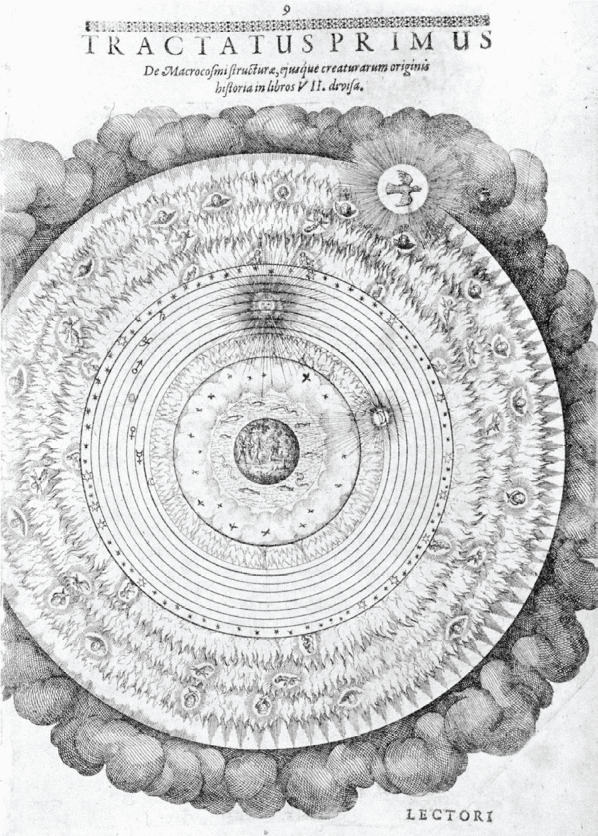
FIGURE 1983 0318a-1. Robert Fludd's Geocentric World-View.
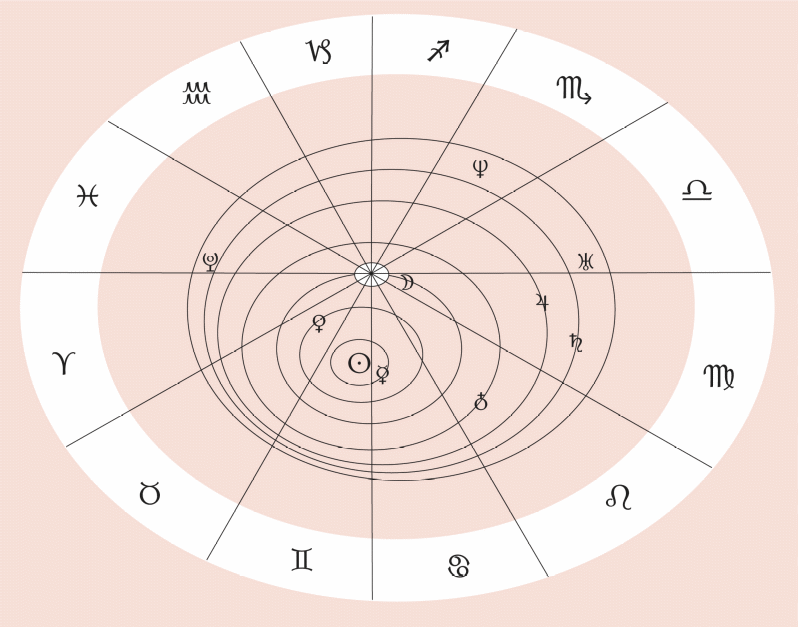
FIGURE 1983 0318a-2. Heliocentric and Geocentric Views.
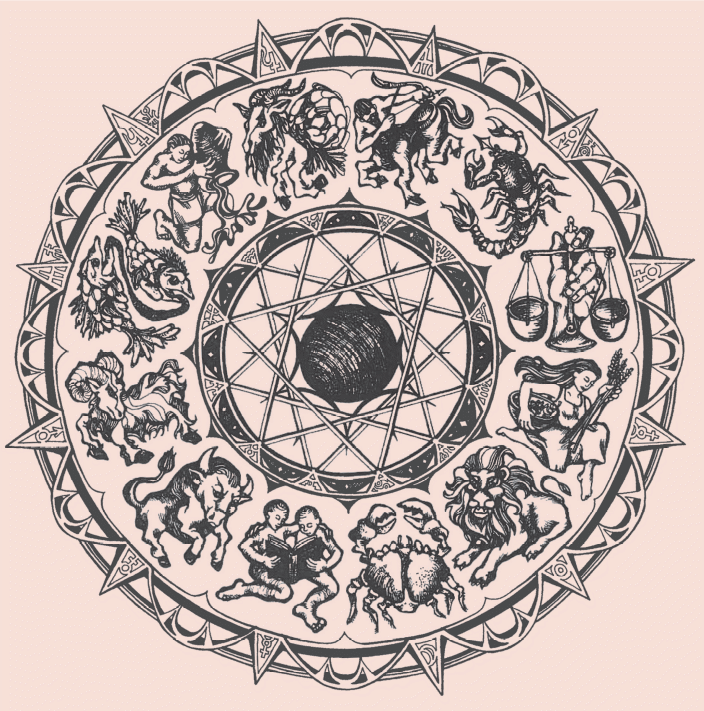
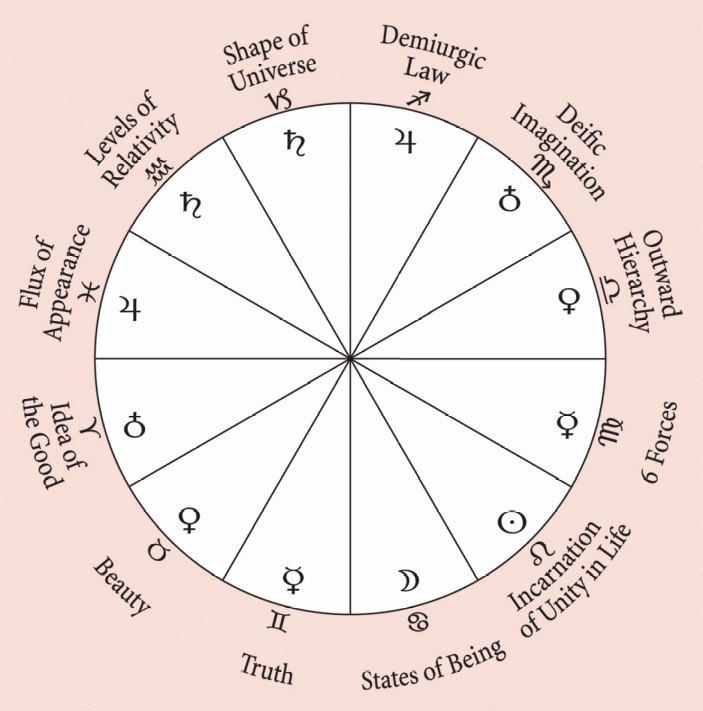
FIGURE 1983 0318a-3. Zodiac.
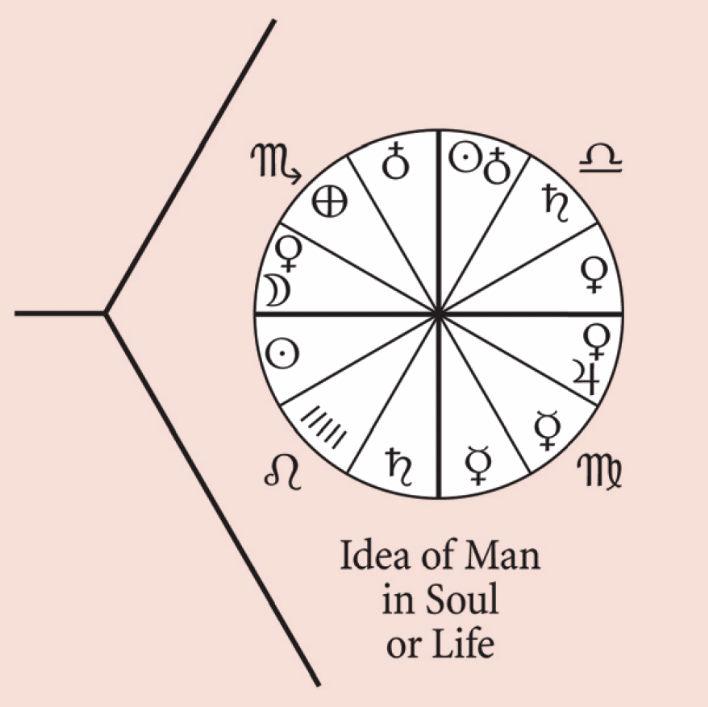
FIGURE 1983 0318a-4. Idea of Man in Soul.
FIGURE 1983 0318a-5. Intellectual-Principle.
FIGURE 1983 0318a-6. Triad and Numbers.
AD PAPERS read in class:
- Astronoesis Working Draft, Invocatory Prelude and section on the One. The portions of the Working Draft read in this class appear in Astronoesis in Invocatory Prelude (pp. 9-16), The Ten Divine Numbers (pp. 86-91), and The One: Exposition (pp. 23-29). What AD refers to in this class as a "Table of Contents" used to guide him in his writing of the chapter on the One later became the section on Ten Divine Numbers in Astronoesis. What is read in this class has also been retyped as three separate papers, 1983 0318b V09MP. Astronoesis - Introduction, and 1983 0318c, d V09MP. Astronoesis - One.
NOTES:
This is 1983 03/18a, Plotinus; One Class, and the first entry associated with this date. 1983 03/18b = Invocatory Prelude Paper. 1983 03/18c= The Divine Numbers 1-6 Paper. 1983 03/18d = The One: Exposition Paper.
Previously printed, distributed 2003 as part of a set.
This class series on the One was held on Fridays.
TRANSCRIBED by jf 2002 from audio cassette tapes; reformatted by jf 2018. In 2024, IT does two more passes, corrects listening errors and makes verbatim, updates prefatory matter and footer, expands Subsubjects, completes Book List, adds Plotinus quotes section, fixes errors/typos, adds new notes within transcript, adds six diagrams and references within transcript to these diagrams, reformats to accord with new conventions. Archival verbatim transcript with AD Papers – V12ap.
AUDIO FILES: 1983 0318a, 1983 0318b. [Note: "Tape" and "Side" refer to original audio cassette tapes that were later digitized into .MP3 Audio Files.]
1983 03/18a at Wisdom's Goldenrod
Plotinus; One
[Audio File 1983 0318a Begins]
[Transcriber note: The portions of the Working Draft read in this class appear in Astronoesis in Invocatory Prelude (pp. 9-16), The Ten Divine Numbers (pp. 86-91), and The One: Exposition (pp. 23-29). What AD refers to in this class as a "Table of Contents" used to guide him in his writing of the chapter on the One later became the section on Ten Divine Numbers in Astronoesis. The following has also been retyped as three separate papers, 1983 0318b V09MP. Astronoesis - Introduction, and 1983 0318c, d V09MP. Astronoesis - One. I transcribe the paper as AS reads it, including any alterations made during rereading.]
Anthony Damiani [Astronoesis draft, AS reading]: "[Much of the Platonic opus] remains a closed book to anyone who insists upon ignoring evidence that indicates that Plato had a thorough comprehension of astrological first principles. His reference to the sensible appearance of the heavens themselves as the model on which our learning is based is a direct reference to astrology, and we intend to demonstrate that the cosmic soul in the Timaeus and the"divided line" for example, cannot be thoroughly appreciated without explicit recognition of the type of astrology that will be explored in the course of this exposition.
"The perennially-living philosophy of the Neo-Platonists has a vital meaning for us: it can be unfolded and made to apply to the contemporary situation. These teachings are not merely relics from the past, fit only for respectable entombment in libraries; they are the sculptured breath of living Wisdom. They teach us how to live life, here and now--whether as a clerk, a secretary, a farmer; or whatever. While we should not let the past mesmerize us, we should not hesitate to go forward with its findings. We should amplify the meanings in the writings of those whom the earth and heavens have made wise before us, and we should put our understanding of their teachings to the test of living and understanding life itself.
"For the moment we will present a very brief sketch and overall view of this ancient cosmology, with its inherent presupposition of metaphysical principles.
"There is a realm beyond the constellations that the ancients spoke of as the World of Ideas. These Ideas or universal substances are not [AS emphasizes following word] in any place, and they were mythologically represented by the constellations. To help us with our pictorialization, we can imagine the stars as statues of the gods, or [the] Ideas, that radiate throughout boundless space a guiding influence. This energy of intelligence laid down the basic pattern within which our world, among others, would follow. The idea of the cosmos, the World-Idea, and its inhabitants, evolving and manifesting, can be traced ultimately to this circle of Ideas. The world or cosmos that evolves with the creatures in it is therefore a manifestation of this Nous in the heavens.
"Our sensible Sun took its place within this order and with its powers, the cosmocrators, articulated and manifested the predetermined order contained in this incomprehensible intelligence. This intelligence was symbolized by the various animals. Our Sun, which is an individual soul in its own right, comprehends the nature of these intelligences with its intellect and proceeds to unfold the prodigality of this intelligence or Nous. In that process it articulates and manifests our sensible world, its own becoming, [AS: That is, the sun's own becoming.] with its rational powers. And included within the functioning of this rational soul of the Sun we locate our Mother Earth. Each part--that is, each planet or rational power, is part of the whole [and] may be considered in its own right, or it may be considered as part of the whole. We consider each of the cosmocrators as functioning power of the rational soul of the sensible Sun.
"The Earth is included within this panorama. The geocentric view comes into being when we localize or identify consciousness within one or all of the creatures inhabiting this planet. For the Earth itself is also a recipient of the Ideas, and through the intermediary of the rational powers of the Sun there is gradually organized and manifested a variety of species on the Earth which will partially and imperfectly reflect these Ideas or animal intelligences.
"And so all the traces of life left behind by these creatures is retained by the soul of our Earth, and is the content of its memory, which is often referred to in the literature of the ancients as the"Dragon," that is, the end product as of now of all the life lived on the Earth, the Earth's memory of all that prior living."
AS: And, there's a quote from Harris.
[10½ second pause]
S: What does he speak?
AH: Yes.
AS (mostly faint): [few words inaudible] Now--
Anthony Damiani [Astronoesis draft, AS reading]: "This notion [AS adds: this idea] of the Dragon must be kept distinct from the Celestial Dragon, so called, or the constellations which we previously referred to as the encircling Ideas represented by the stars. We might also add that the Earth's memory is the storehouse of all the images and the intelligence behind the functioning of animal bodies.
"The organization of these tropes into animal bodies is our inherited mode of functioning, and is what the degree symbolism of the chart refers to. The instant an individual is born, the distribution of planets in signs and houses shows a selection from within the Earth's memory of the previous tendencies most closely identified with. This predetermination on the part of the soul as to which elements will constitute its psychosomatic organism will constitute the postnatal history of the individual, or its karma. For in essence it will be the vasanas or memory traces which will blossom forth as his life. Now the psychologists refer to this as the subconscious, an intelligence so vast that it would dwarf the conscious mind. Consequently, these inherited modes of functioning constitute a system of beliefs for the soul which inhabits that body. We conceive of this as the psyche of the individual and as the basic presuppositions or attitudes that organize his perceptions and understanding of the world that he lives in. [AS: And there's just a quote from Studies in Böhme that's very good.] The incarnation of these tropes into an organized psychosomatic organism is the vehicle through which the soul lives and learns, or transcends and liberates itself from."
AD (faint): Yeah.
AS: And, remember the diagram we had. Oh. I think that's a Harris quote.
VM: What's this Harris book, Avery?
AS: Yeah, let me read the Harris (book). Um, and then-- I'm sorry, I didn't realize [couple words inaudible] This is-- this is in reference to this Earthly Dragon, so to speak, the memory content left behind in the Earth. He says--
A.J. Penny [Studies in Jacob Böhme, p. 162, AS reading]: ""Every sun has a solar spirit." [AS: S-o-l-a-r.] . . . "Every planetary orb of the terrestrial sort a terrestrial spirit. The spirit of every orb is diffused into, and lives throughout, its mineral, vegetable, animal, and human kingdoms, and is an immortal entity, a living, indivisible, and instinctively conscious existence, but [AS adds: it] is without human personality, and so [AS adds: is] abstractly conscious of pleasure or pain, but [AS adds: is] without power to determine its own sensations. Insphered in every solar, aromal, or terrestrial planetary world, is an appropriate World-Soul, living in the life of all its distinct creations, and permeating alike its atmospheres, its waters, its material crust, and its electro-igneous centre. These World-Souls comprise the first family of God, and their number is as that of the stars." . . . "They are absorptive organs for the Divine Spirit; and pervading each its own world, and living in all its parts, they distribute throughout matter the Divine vitality."" [T. Lake Harris, Arcana of Christianity, Part I, Vol. 1, pp. 100, 101]
[14¼ second pause]
AS: Um-- And the diagram is simply the diagram of the heliocentric universe with the Earth especially-- you know, with the Earth as one of the planets. [Note: See FIGURE 1983 0318a-2, Heliocentric and Geocentric Views, appended to this transcript. This diagram is from Astronoesis, p. 15.] Also the Fludd diagram. [Note: See FIGURE 1983 0318a-1, Robert Fludd's Geocentric World-View, appended to this transcript. This diagram is from Astronoesis, p. 5.] Ok. So-- so, um-- [10¼ second pause] (Wait) that's-- that-- that tends to reference to this-- to the Earthly Dragon.
Anthony Damiani [Astronoesis draft, AS reading]: "One of the most original contributions made into the meaning of the Zodiacal signs was done by T. Subba Row in a small, obscure essay included in a book called Esoteric Writings. We strongly recommend to our readers an acquaintance with this essay. Some indication as to the meaning of the mythological zodiac is expounded. He makes an attempt therein to interpret the underlying idea behind each of the signs. Through a semantic analysis of their names and a sort of prescribed kabbalistic procedure into these old Arian myths, he intuited the meaning of the Idea which each zodiacal sign embodied. Of course, the presupposition would be that the mystical experiences of certain exalted beings were deposited in these myths. That the universe is an Idea within the Self, and various portions of that Idea were explored and described by these ancient seers, who then associated these specific types of primal intelligence with the zodiacal signs. This intelligence was pictorialized as an animal--intelligence personified--which would ultimately be traced back to an Idea.
"So that in a sense the stars are a theophany of radiating intelligence, distributing their presence or informing the universe through patterns of intellectual energy. Each and every one of these intelligences is a universal substance correlated to a sign, and these reason-principles--the signs--are the paradigms of all living forms or species symbolized by the archetypal zodiac or the inerratic sphere, which in turn represents the immutability of the Ideas. So that the stars, which are the bodies of the Gods, sensibly represent Ideas which are being transmitted from the Universal Soul to the cosmos.
"It is not possible for the profane mind of man to acquiesce to these truths, but knowledge and devotion may bring him to that realization wherein the rising and setting of worlds is a terrestrial incident in eternal consciousness."
[short pause]
AS: Then um-- And there's-- there's a quote from the Republic. [short pause] [one word inaudible]
Plato, Benjamin Jowett (tr.) [The Republic, Book IX, 588b, AS reading]: "Let us make an image of the soul… [AS: From Book IX.] … An ideal image of the soul, like the composite creations of ancient mythology, such as the Chimera or [AS adds: the] Scylla or Cerberus, and there are many others in which two or more different natures are said to grow into one. // There are said to have been such unions. // Then do you now model the form of a multitudinous, many-headed monster, having a ring of heads of all manner of beasts, tame and wild, which he is able to generate and metamorphose at will." (some student giggling)
AD: I told you they can listen to fairy tales.
AS: He answers--
Plato, Benjamin Jowett (tr.) [The Republic, Book IX, 588b, AS reading]: "You suppose marvelous powers in the artist; but, as language is more pliable than wax or any similar substance, let there be such a model as you propose. // Suppose now that you make a second form as of a lion, and a third [AS adds: form] of a man, the second smaller than the first, and the third smaller than the second. // That, he said, is an easier task; and I have made them as you say. // [And] now join them, and let the three grow into one. // That has been accomplished. // Next fashion the outside of them into a single image, as of a man, so that he who is not able to look within, and sees only the outer hull, may believe the beast [AS reads: believe that man and beast] to be a single human creature."
[16¾ second pause]
AD: Of course, these-- the quotes don't belong there, they belong where there's a star [asterisk].
AS: There's no star! There's just [one word inaudible]
AD: That's my secretary.
AS: (Has) at the end of the para-- it's the end of the page. I know it didn't quite belong there but-- but, there's no [few words inaudible]
AD: Alright, that's enough of that fairy tale. You see how quiet they are, they listen to fairy tales. No questions.
AS: Yeah. Ok and, following in this place too there's a diagram of the-- Well, following the quote on-- following the quote on T. Subba Row there's a picture of the Circle of Ideas, the 12 Ideas. Or there should be. [Note: See FIGURE 1983 0318a-3, Zodiac, appended to this transcript. This diagram is from Astronoesis, p. 13.]
[few seconds of background student talking]
VM: Perhaps that essay should be an appendix to the book. It's certainly asking a lot of the reader to track it down.
RG: It's in print.
AS: What?
VM: Is it in print? Oh yeah, [AS simultaneously: Yeah.] the Theosophical Society put that out.
AS: What-- where are (you going)?
RG: [couple words inaudible]
VM (simultaneously): Theosophical Society put that out, no?
S (simultaneously): No.
AS: Oh I know what you mean, the-- the T. Subba Row.
S (simultaneously): [one word inaudible]
VM: Yeah is that--
AD: Yeah they also put out the Esoteric Writings of T. Subba Row.
VM: Oh they have the whole thing out now?
AD: They have the whole (thing) out now and he (couldn't) put it out. [few seconds of background student talking] That article was published in 1888, on the Zodiac.
[students assent, faint]
S (faint): And none of them could show up.
AS: Ok. September 14th, he had-- he had a date on it too. It was in a letter he wrote to somebody. It's got an actual date.
S (faint): Uh-hm.
VM: You mean it was a letter initially?
AS: Well, I think it was part of-- or, he wrote it in a letter to somebody that [one/two words inaudible]
RG: When he got the idea or when he just--
AS: No, no, well--
RG: Hm. Who knows?
AS: I don't know but the letter is dated, September 14th. [students assent, very faint] Ok. Let me just--
S (faint): Yeah, go ahead now.
Anthony Damiani [Astronoesis draft, AS reading]: "So we repeat, there is a need for a thorough exposition and understanding of the fundamental metaphysical principles that underlie a spiritual knowledge of astrology. That astrology can be redirected or reoriented to its spiritual significance is a prerequisite to its transvaluation."
RG: Hm? Read that again.
AS: Yeah.
Anthony Damiani [Astronoesis draft, AS reading]: "That astrology can be redirected or reoriented to its spiritual significance is a prerequisite to its transvaluation."
RG: Its trans-value-- I don't-- I don't--
AD: I got that [S simultaneously: Right, change it (back).] from Nietzsche, I liked it so I used it. (AD laughs, laughter)
AS: Transformation of its values. [RG assents] Re-evaluation. Trans-re-evaluation.
S (simultaneously): (It's/Its) valuation of his point.
Anthony Damiani [Astronoesis draft, AS reading]: "All this groundwork is however only a preliminary way by which man can know himself and will result in the perception that man's being or rather his manifestation is rooted in the justice of the cosmos. [AS: That might (one word inaudible)]
"From the point of view of the ancient, philosophically oriented cosmologist, the chart is a wisdom-example of the intellectual imagination--or a symbolic reflex portraying how the Gods or Principles are involved in the fabrication of the vehicles that the individual Soul employs for its manifestation. The mandala is accepted as exemplifying and embodying knowledge of superior beings capable of functioning with intuition and transmitting their knowledge of how these fundamental principles are operative in, and can be understood by, the individual from his natal chart."
AS: Should I read that sentence again? Yeah.
[students assent]
Anthony Damiani [Astronoesis draft, AS reading]: "The mandala is accepted as exemplifying and embodying knowledge of superior beings who are capable of functioning with intuition and transmitting their knowledge of how these fundamental principles are operative in, and can be understood by, the individual, from his very natal chart."
RG: That's-- [couple inaudible student words simultaneous with RG] I'm sorry, I don't get [AS: Yeah.] the whole thing.
Anthony Damiani [Astronoesis draft, AS reading]: "The mandala exemplifies…"
RG: It's a long-- it's the long sentence.
Anthony Damiani [Astronoesis draft, AS reading]: "The mandala exemplifies [AD simultaneously: I'm just (couple words inaudible)] and embodies the knowledge of these superior beings."
S: Boy, that [one word inaudible]
RG: Period.
S: Yeah. (RG laughs)
AS: Superior beings, period.
S (simultaneously, faint): Sure.
S (faint, possibly part of background): You say what?
Anthony Damiani [Astronoesis draft, AS reading]: "These beings were capable of functioning with intuition and they were capable of transmitting their knowledge…"
RG: These beings meaning?
S: Yeah.
AS (simultaneously): These superior beings.
S: Yeah but who, Anthony? I mean not [one word inaudible]
AD: Well they weren't shepherds.
AS: The seers. The great seers of the past. The ones we mentioned before.
RG: Don't get me--
VM (simultaneously): Well, it's not clear 'cause it sounded like--
AS: No, no.
RG: It sounded like the-- like [VM simultaneously: That they (one/two words inaudible)] you were referring to the [student assents] principle [VM: Yeah right.] as the [AS simultaneously: Ok, well--] vehicle for the intuition.
VM (simultaneously): I think that's what's confusing.
BS: I know.
AS: I think it is referring to the seers.
VM: So why don't you say the ancient seer.
S (simultaneously): Oh, yeah, right.
AS: Ok, well I be glad. "These seers…"
Anthony Damiani [Astronoesis draft, AS reading]: "These seers were capable of functioning with intuition by transmitting their knowledge of how the fundamental principles are operative in, and can be understood by, the individual from his natal chart."
VM: Oh.
RG: Good.
VM: Much more clear. So--
Anthony Damiani [Astronoesis draft, AS reading]: "In the following quotes we will try to itemize these principles which Plotinus is speaking of…"
AS: And of course, Plotinus is amazing. Yeah.
Anthony Damiani [Astronoesis draft, AS reading]: "In the following quotes we will itemize these principles which Plotinus is speaking of [and] put them into a diagrammatic form. In other words, instead of applying these principles to an individual chart, we will apply them to the One."
[12¾ second pause, flipping of pages]
AS: Ok. Now-- [13 second pause] Now, I think that the next-- there's a couple of pages-- [one/two words inaudible] Oh yeah.
AD: They're probably around somewhere.
AS: Well I don't--
S: Uh-hm.
AS: Ok. And you-- this-- now it starts in with these numbers.
S: Uh-hm.
AD: Oh well that's just-- that's just a Table of Contents for me to work off of.
AS: No, no, that's what's gone.
AD: That's what's gone?
AS: Yeah but now there's this whole-- this series of numbers with-- you know, somewhat detailed, one, a couple of pages on one, two.
AD: Yeah.
AS: You want to go through those?
AD: Yeah. But before they go through that maybe [AS: Yeah.] they wants--
AS: I thought that Table of Contents might've-- you don't want to--
AD (simultaneously): That's it now.
AS: Ok but that little Table of Contents is gone though.
AD: Oh.
AS: Are there any questions so--
AD: On the fairy tale?
RG: You can't question a fairy tale.
AD: It's better to write fairy tale(s).
RG: You can't question a fairy tale.
AD/S(?): No?
AB: You want to go to sleep after that (though).
S (simultaneously): [few words inaudible]
S: Right.
RG: Loses the fairy tale of it I think.
S (faint): Somewhere [one word inaudible]
AS (simultaneously): Oh I (see).
JfL (simultaneously): Did they live happily [one word inaudible]
AS: I get it.
AD: I could turn that fairy tale into Kant's Critique of Pure Reason. (bit of laughter)
S: That's a very--
AD: Oh Kant's Critique of Pure Reason was his way of saying what these people are saying.
DB: Please don't do that. (laughter) Somewhat dreary. Um--
S: Well you could.
S: Yeah. [couple/few words inaudible]
S: Go ahead.
DB: Yeah, the-- the-- the quote from the Republic about the lion and (that--)
AD: How to make a man?
DB: Yeah, right. Do-- do you g-- do you go into that in any-- later, I mean, in more depth or--
AD: Yeah later on.
DB: Oh, ok.
S (simultaneously): Yeah.
AD: Well right now it's just a fairy tale [DB: Right, ok.] that, you know-- They leave all these fairy tales unexplored, [DB assents] unexplained.
DB: So-- there was a-- there was just a hint from I-- you know, it went by real-- pretty quick, about the first part of that. You know, there's three parts to the image: there's the lion, the man, and there's this circle of all these different animals, wild and tame I think was the way they were described, and this was all put together. And it just seemed to me that that somehow had something to do with the-- the whole process of incarnation, that the, you know-- like that the-- that first part was-- Is it an obscure reference to the zodiac itself, constellation?
AD: Yeah, it's a reference to the zodiac, sure.
DB: Ok. Then what--
AD: What's indicated in the previous part of the fairy tale, when he speaks about that person who knows himself, alright, can explore the various parts of the universe, and that in his exploration of these parts of the universe, you know, he becomes aware of certain intelligences. Which the only way he can communicate to us would be to symbolize them, you know, draw pictures of animals. The same thing like the Egyptians did. A principles-- a principle was depicted as an animal. You know, maybe [one word inaudible] of neter or whatever.
[short pause]
DB: So would the-- would the Sun in this-- in this particular example that's referred to-- I mean the lion, would that refer to the Sun here or-- or would that be, you know, the-- the animal nature associated with the Earth?
RG: Uh-hm.
[short pause]
AD: What would the lion nature arouse in your understanding?
DB: Well, I mean it's a-- it's a solar animal, it's--
AD: Yes.
DB: Alright, I mean, so on the-- I mean it's always-- I think it's sym-- traditionally cultures think of it as a symbol of courage and so forth. On the other hand, I could-- I could see it from a slightly less complimentary point of view. And, that's the problem I'm having because it seems like you could go either way with it and I didn't know, you know, what the context-- you know, I mean-- If it's going to be-- Well, it's either one the-- one of the twelve signs, I mean Leo, or-- or it's just, you know, the animal-- animal instincts. I can see it both ways and I don't really know what perspective you'd be coming from.
[22¾ second pause]
AD: Well you have to remember Dave, it's only a fairy tale.
DB: But-- I know, Anthony, but the problem-- I mean-- [short pause] the-- If it's a fairy tale--
AD (simultaneously): You want to throw out an explanation of how the lion signifies Cognitive Isness now?
DB: Yes well, see that's exactly the point, right. I thought it might be something like that.
S (faint): Yeah.
RG/S(?): Right.
AD: Well, that takes a long time to work out.
DB: Ok. [short pause] It's all--
[short pause]
S: He had it in there all that time! (bit of laughter)
DB/S(?): The Aquarius-Leo thing?
DB: That's outrageous. Boy, was he sneaky.
AD: Yeah, he had the whole thing right there. Three quarters of the fixed cross.
S (faint): Because--
AD: [three words inaudible]
RG (simultaneously): Yeah why only three quarters?
AD: Well he didn't put in old Taurus. (laughter, joking) He didn't put in Taurus. (laughter)
S: You don't have-- it's not part of the Idea of Man. (more laughter)
AD: The Idea of Man excludes Taurean. (AD laughing a bit, laughter, joking) I always thought there was some peculiar logic too. (laughter) Yes, you'll see the Idea of Man, that's what he's-- that's what he's doing. [short pause] Because Draco the-- the hydra-headed beast starts from Cancer and goes all the way past Scorpio, ends in Scorpio.
DB: Uh-hm.
AD: So all those constellations are included in the nature of Man.
DB: That would be the whole second tetrad of that twelvefold [S simultaneously: That's the grid.] (thing), right, I mean, from the--
S (very faint): Cancer through Scorpio.
AD: It would [DB simultaneously: I don't know if that's how it would-- yeah.] be, it really is the-- the Idea of Man in Life. Or the Soul. [Note: See FIGURE 1983 0318a-4, Idea of Man in Soul, appended to this transcript. This diagram is from Astronoesis, p. 328.]
LR: It includes Cancer?
S: Cancer and the Sun.
AD (simultaneously): Yeah, (uh-hm).
LR: Cancer, Leo, Virgo--
AD (simultaneously): Virgo, yeah.
LR: Libra, Scorpio.
AD (simultaneously): Uh-hm, Scorpio. That's the Celestial Dragon, alright, the Earthly Dragon is different.
RG: (It is.) But those also rep-- could represent three levels of the soul [AD: The--] there? Those three?
AD: You mean the three signs? [student assents, very faint] In a sense, yes. [short pause] Alright, let's read the-- let's go on a little bit more.
LR: Yeah, the quote about-- the quote on the Dragon. There was another quote on the Dragon that you had about how its life is the life of--
AD: The individual?
LR: The individual.
AD: Well that's there, that's in that quote.
LR: Isn't that different?
AD: Yeah, [LR simultaneously: But--] it's in that quote. (Everything's/I think it's)--
LR (faint): What do you see?
AD: Well when you speak about your subconscious, you're speaking about that entity. I mean you don't digest your food. You don't take care of the circulatory system, these are all things done by that tremendous wisdom which is inherent in the Dragon and which lives in each and every one of us. Don't you see-- don't you remember? Huh? Huh? Huh? Here it is. [12½ second pause] Just think of the difficulty you'd be in if you had to repair yours-- just, you know, if you cut yourself if you had to repair it. (bit of laughter)
LR (laughing): That will be even quite embarrassing.
S: Oh yes.
AD: If you had to attend to your digestion, you know, see that everything got properly digested. If you had to attend to putting sand in your eyes when you fell asleep at night. (laughter) You'd go mad if you had to do all these things. Yet that subconscious thinking does everything (to/for) each and every one of us. It lives its entire life through each and every one of us.
[students assent, very faint]
S: Yeah.
[short pause]
LR: Sandman too.
RG: Uh-huh.
S: Yeah.
LR: Yeah I wonder who Sandman (was) [one word inaudible]
S (faint): Right. Now you know.
[short pause]
AD: Alright Avery, let's continue.
AS: Ok. One. Topic One.
LR: So this discussion of Number's (gonna s--)
AS/S(?): Like this.
LR (faint): But--
AD: It's not really a discussion of numbers.
RG: No.
S (faint): [couple words inaudible]
AS: You'll see what (it is).
[9¼ second pause]
Anthony Damiani [Astronoesis draft, AS reading]: "The Absolute Mind, or meta-ontological infinity, the One, is complete perfection itself. When Plotinus presents us with a self-sufficient Unity, the transcendent Simplex, the One-Only, we have the paradigm for the meaning of the Number 1. One cannot be thought of in a quantitative way as the first in a series, or in relation to others, for it is from the One that all the others will arise. [AS The quote.]"The One does not bear to be numbered in with anything else, with a one or a two or any such quantity; it refuses to take number because it is measure and not the measured; it is no peer of other entities to be found [AS reads: bound] among them…" [AS: It's V.5.4.] The Oneness is not quantitative or a point, as we will remark, for it is infinite, and "…The First [AS reads: The One] remains intact even when other entities spring from it. In the case of numbers the unit remains intact while something else [AS adds: the Dyad] produces, and thus number arises in dependence on the unit: much more then does the unit, The One, remain intact in the principle which is before all beings…" [AS: V.5.5.]
"In illustrating the identity of the Absolute mathematically, the choice has been with the symbol 1, and not the 0, for that second symbol, Zero, was not available when the Greeks were discussing these Ideas. The Absolute, the One, is conceived as a fullness, and each number will have from the One a unique intact aseity, that is, will be some one thing. The meaning of 1 as used by the Neo-Platonists is really equivalent to that which the Easterners assign to Zero. In the case of the one we have an affirmative theology whereas the other provides us with a negative theology. But both would insist that all things arise from the One or in the other case from the Zero, and both would insist that if you take fullness from the full, the full would remain. Plotinus's remarks are very much to this point when he says that the many arises from the One but the One remains intact. And similarly, the Easterners would say that everything arises from the Void (0) and is Void. Now Plotinus would consider this a confusion of the levels of Reality--that is, that which arises from the Void is not the void. Within universal relativity, only a fool--or a Sage--could make that remark."
RG: Could you go over that, Avery?
AS/S(?) (faint): Yeah.
Anthony Damiani [Astronoesis draft, AS reading]: "And, similarly, the Easterners would say that everything arises from the Void (0) and is Void."
AS: And that's the issue. Everything arises from the Void and is Void.
Anthony Damiani [Astronoesis draft, AS reading]: "Plotinus would consider this to be a confusion of levels of Reality because that which arises from the Void is [AS emphasizes following word] not the void. Within universal relativity, only a fool--or a Sage--could make that remark."
RG: Hm. So you're acknowledging the truth of the remark when spoken by somebody who knows it. Right? I mean is that the first-- But then it isn't a confusion of level if the-- if the Hindus who spoke it knew what they were saying.
[23 second pause]
JfL: I thought the confusion in levels of Reality were the subsequent [S: Right.] levels being associated with Zero, rather than with lesser grades of Realty.
RG: The way I understood it, Jeff, is that the sentence that was in question was, do the-- are the things that arise out of the Void also can be considered the Void, Void. And that, from the point of view of universal relativity, you can't say that because they are different from the point of relativity. From the point of non-relativity, they're not different. But it's only appropriate for somebody who knows it to speak it that way. I mean, maybe I missed the point.
AH: Dickie, is that-- what you're saying, that-- you're interpreting the passages, those things that arise from the Void are-- may be considered Void by a fool or a Sage. But for anyone else, those things have to be considered as emanation from the One [RG: No.] in terms of a positive theology?
AS: It's distinct from the Void.
RG: Or, distinct from it, but yeah, I'm not-- I just-- Yeah. I mean it seems like two things are being said there and I'm not quite sure what they are.
AD: Go ahead, Dickie, go ahead.
RG: I mean either the thing's true or it isn't, and the speaking of it's to the level of the person that speaks it, but it doesn't take away its truth or not.
[10¾ second pause]
JL: That's like to speak of anything arising, I mean, you'd have to consider it as a positive entity (just by--) [students assent, faint] I mean if-- if it doesn't--
AH: I was following this passage in connection with an earlier passage of a positive and negative theology. Ok? It said the Easterner would speak of the Void in the same way that others would speak of the One. So at one level they're equatable terms. But from the point of view of relative Reality, they-- to speak of the Void is to mix the levels in a confusing way. Is that what-- is that what's being talked about?
S (faint): Uh-hm.
AD: Well, it's kind of difficult to speak about anything arising from the Void if you say that it's void.
S (faint): Yeah.
AH: You could say it's void in terms of its ultimate nature. That doesn't-- that--
AD (simultaneously): Then why speak about anything arising?
S (faint): Yeah.
AH: Well it appears, I mean, no one could--
AD: Why speak about anything appearing?
AH: Well we do-- we don't-- we don't deny the appearance.
AD: But if you say that everything is void, and what arises from it is void, are you making sense?
AH: See Anthony, this is-- this is an issue that we've talked about before. (laughter)
RG: Yes, you can assert the identity of substance and allow for the diversity of appearance, yes. You can make sense that way. That isn't--
AD (simultaneously): Yeah, what you're saying is that the substratum of the appearance is the Void or Pure Intelligence or Pure Consciousness. Alright? That is the substratum, ok? So actually what you're saying is something to the effect--that through insight one could see that the substratum of the appearance is Pure Consciousness. Correct, fine. Does that dissolve the appearance?
RG: No. Look--
AD: Well then wouldn't it be only--
(Side 1 of original cassette tape digitized as 1983 0318a Ends; Side 2 Begins)
AD: --right now of an appearance within it. From the point of view of the Void you could say that it is void. In other words from the point of view of the ocean, everything is water. [RG assents] But you can't reverse that.
RG: Right. Ok.
S (faint): Uh-hm.
AD: So--
RG: Ok. Ok, that's fine, but-- then I don't-- then I don't think you'd want to say that it is necessarily a confusion of level if they're speaking from that point of view. And, if it's philosophically true that the appearance in essence and substance is the-- is-- is the-- is the source from which it appears, that's-- that's true. Right? Now, so, where's the confusion of level? I don't get that part yet.
SD: Is it because it's a partial truth or one aspect of the truth? And that only a Sage who sees that aspect knows it to be that aspect?
AD: I think that would be part of it. [AH simultaneously: Is it--] Perhaps that's not well written. So why don't you put a little cross next to it, Avery.
AH: Anthony--
AS (simultaneously): Yeah, I also-- I mean-- I also found the wording quite-- you know, a little bit hard to just be exactly-- I mean, it's a tricky point.
AD (simultaneously): But that's the point we want to-- yeah.
AS: And, [RG assents] you know, in that sense it should be made clearer.
S (faint): I agree.
AH: Anthony, I thought the point of that passage was to find a way of speaking positively about the appearance, is that so?
AD: Yeah, that's-- that's true.
AH: In terms of earlier notion of a positive theology.
AD: Uh-huh.
AH: To verify the appearance in a way that doesn't make it void. And it's from that point of view that you want to maintain distinct levels. But verify the appearance at its level in an existential way. Is that the point of that passage?
AD: Yeah, at what-- at whatever level, yes. That within the universal relativity there are all these distinct levels, and is that was much more so over here. [AH simultaneously: So--] At the empirical level it's very obvious that my ego is not absolute.
AH: So to take the point of view--
AD (simultaneously): My ego is not void. [AH: Yes.] Not (for/to) me. [AH: So to (take--)] It may be to a Sage.
AH: Yes. So to take the point of view of the Easterner and call it such is to confuse those levels.
AD: Yeah, it's part of the reductive tendency that they operate with.
S (faint): Ok.
PD: Isn't it really-- aren't you really trying to distinguish between voidness as a descriptive insight into experience and its misinterpretation as to experience being meaningless, or non-being or emptiness. [student assents, faint] I mean that's what you're-- seem to be really trying to get at with your continual criticism of that approach is that that characterization lends towards the assumption of the meaninglessness of experience.
AD: Yeah.
PD: And that the voidness as an insight into the nature of being of appearance is one thing, but the fact that there's an appearance with an inherent structure and order is not negated with that insight.
AD: Uh-huh, yeah.
RG (faint): Uh-hm.
AD: Exactly.
SD: I have a question about something earlier in that section. Were you meaning to imply when you read that the symbol 1 was chosen rather than 0 because 0 was not available, that a choice would have been made differently if it had been? I mean it sounded that way, but I don't think you meant to say that.
AS: Well, no, that-- You're right, there's no-- there was no choice 'cause there was no symbol 0 available. But for example the Easterners would have a symbol of 0 available and use that instead. But they used it supposedly to mean a similar thing, even though the symbol they used was different. [student assents, faint] I don't think the implication is that Plotinus or (one of) the Platonists would have used 0 instead of 1 had they had a notion of 0.
SD: It does sound that way though, I mean maybe it didn't sound that way to anybody else.
JA: Yeah, no, I thought it sounded that way.
RG (simultaneously): Yeah.
S (simultaneously with JA): Uh-hm.
AS: Yes, that's all.
Anthony Damiani [Astronoesis draft, AS reading]: "But that was not available when the Greeks were discussing these ideas."
LCG: What-- what do you mean it wasn't available?
RG: The number 0.
LCG (simultaneously): They didn't have the concept of 0?
DB: It was still a presumption.
S (simultaneously): They have no [one word inaudible] 500 years later.
LCG: Great.
AS: They didn't have a notion of 0.
S (faint): Yeah.
LCG: It's hard to believe.
AS: A numer-- a numerical.
BS (simultaneously): [couple/three words inaudible]
AS: You know, a--
LCG: Yeah.
AS: As a numerical symbol, they didn't have the space for that 0.
S: Really?
AD: Yes. (bit of laughter)
AS: Well there you go.
S: They had 1 minus 1.
AS: Alright. I mean tell-- [BS simultaneously: Only went up to 9?] what would it symbolize to them? [students assent] [background student talking simultaneous with AS] Since there was no-- I mean, if the whole world is full of gods, there's no-- there's-- there's no such thing as absolute 0.
S (faint): Probably true.
LR: And the distinction is--
DB (simultaneously): [couple/three words inaudible] is backwards.
BS: Only count up to 9?
AS (simultaneously): I don't know, besides. What? They used Roman numerals.
BS (simultaneously): They only counted up to 9?
AD: Use Roman numerals!
AS (simultaneously): They had Roman numerals. [few inaudible student words simultaneous with AS] They didn't need 0. (laughter)
[few seconds of background student talking]
AD: Well, going to have to find out the way (Hindus) is new.
LR: (Where, I) saw it right here?
AD: If we look at (false) (some laughter) behind us.
S: We ought to call some [one word inaudible]
DB: Well there (is a/isn't)-- I mean if the-- [S: You do.] if the Greeks were [AS simultaneously: Well--] essentially geometric there isn't any zeros in geometry, is there?
AS (simultaneously): No but--
AD: I'm sorry?
DB: Well, the Indians came up with algebra but the Greeks were primarily geometrical in their mathematical thinking and there isn't any 0 in geometry.
AD: Well, I thought it was an Arabic invention, the 0.
AS (simultaneously): Yeah. It was.
S (simultaneously): No I though it was Hindus.
SD: No, it's Hindu and [S simultaneously: It was Hindu.] then the Arabs [few words inaudible]
AD: As far as I know it was an [one word inaudible] [AS simultaneously: I thought it was the Arabs that came up with it and (three words inaudible)] it was brought over to India, and when the Buddhists came across it they started worshipping it. (laughter)
AS: (Remember the cartoon) and nothing is sacred. But I thought-- I thought the point about the 1 and the 0 was that they would've chosen it anyway because the implication is that is that the 1 in this doctrine is conceived as a fullness. Whereas in some others, in negative theology, the absolute might be conceived as empty, may-- empty meaning empty of all determinate characteristics; full meaning containing the infinity of everything. Both ultimately giving you the same result.
AD: I think so.
AS: But the approach being slightly different. So-- (anyway--)
SD (simultaneously): I-- I mean I realize that's what you're trying to say, I just [AS simultaneously: Yeah.] think the wording there gave a-- an impression that was not what you wanted.
S (faint): Right.
AD: When you understand the meaning of 1 the way Plotinus uses it and the way 1-- 0 is used by the Buddhists, I think you'll see it's the same thing. But if-- you know, if you start bringing your associations to the One, you're going to have a lot of difficulty in understanding how Plotinus used it. And a good example of that was in this article by Sharma that I think I quoted from you. He starts speaking about the-- the Parabrahman as "beyond One". [Note: See I.C. Sharma, "The Plotinian One and the Concept of Parampurusha" in Neoplatonism and Indian Thought, edited by R. Baine Harris.] Now, I don't know what "One" he's referring to but the article is on Plotinus. And if he thinks that that's the way Plotinus was explaining the One, then he had no idea what Plotinus was talking about. And I mean that, that's a-- that-- that's to me a real criticism, not to understand what-- how Plotinus meant the One to be understood. Why write an article on Plotinus, and try to compare it with the Hindu system?
S (faint): Right.
VM (faint, possibly part of background): Pictures [couple words inaudible]
AD: But anyway, this is only a-- this is only an outline, Table of Contents.
LR: But then it all can't be a Table (of Contents).
RG (simultaneously): Because of (Tim). Yeah-- yeah, right. (RG laughs)
AD: Well that's [S simultaneously: You think that--] all that is, it's a Table of Contents.
AS: Oh this is before the actual--
RG: Oh this is--
LR (simultaneously): He says everything's a Table of Contents in this book.
VM (simultaneously): Maybe you should get that quote from Guenon, (some laughter) "We'll unfold this [couple words inaudible] from the editor."
AD (simultaneously): No, before that, before that was a-- [AS simultaneously: That was a preface.] was-- that was a preface.
LR (simultaneously): [few words inaudible]
AS: Oh yeah. (some laughter)
AD: It was a preface, a fairy tale.
BS (simultaneously): Table of Contents.
[few people at once, few words mostly inaudible, laughing]
AD: What I want to do, what I want to do is run through the twelve numbers which I didn't do, and each number signifying a certain Idea, alright, and why it signifies that Idea. In other words, 2 comes out of the 1, 3 comes out of the 1, 4 comes out of the 1, alright, [RG: Yeah.] and each one of these numbers has to also be correlated with a formless Idea or a formless Unity which is found as an indivisible aspect of the One.
LR: And after you read the Table of Contents-- (LR laughing)
RG: Right.
AD: And they throw the book away. (laughter)
RG: We'll have nine pages to the book. (some laughter)
S (amidst laughter, faint): Right, right.
AD: Go ahead, Avery, don't-- don't pay attention to them. (some laughter) I told you, they just like fairy tales.
AS: Well then, think of this as a fairy tale.
RG: I do. (RG laughs)
[few seconds of background student talking]
BS: Call it an introduction to the--
AS: No this is a Table (of Contents).
AD: You know, I'm going to tell you something, you're responsible for it too.
S: Yeah I know.
AD: Continue, Avery.
Anthony Damiani [Astronoesis draft, AS reading]: "So we have the 1, which is, strictly speaking, the principle of oneness, in that it is a necessary prerequisite that for anything to be at all, it must first be a one. The principle of the number 1 will bear the same connotations or, at least, reflect the same remarks that will be made about the One-Only. The individuality and uniqueness of the self-sufficient transcendent, the infinite unity and simplex, these are all synonyms for the meaning of 1. The One can be correlated with the view-- This meaning correlates with the view of the One as the first house, and in the Triad sequence, is correlated with the Mars in Aries [as] the principle of oneness."
SD: Avery, is this meant to precede any mention of those?
RG: Well-- (laughter)
S: (Fair.) Severin, you would notice that.
RG: Yeah, yeah, right.
CdA: He said is this meant to precede any explanation [AS simultaneously: Is this--] of the Triad.
AS (simultaneously): Yeah.
S: Uh-uh.
RG: No?
CdA: Yes. (student laughs)
S: Well, no, I mean--
CdA: No?
AD: Go on with the (form).
AS (simultaneously): This is just to get-- get you enthusiastic about the problem.
LR (simultaneously): But-- (bit of laughter)
Anthony Damiani [Astronoesis draft, AS reading]: "Two. In its widest application the two represents all the remarks that we will make about the Double Act of the One (and have made in the past). [AS: Well that's--] Characterized by infinite Power, which exhibits two aspects--active and passive perfection, or substance and function, the One reveals something of itself through its paradoxical nature. But, it itself remains inscrutable. Also, the interrelationship of this power [AS emphasizes following word] with the One, a completing completed power, is included in its total perfection. So 2 represents the infinite indeterminate Power, inseparable from the One, and also exhibiting the One's inner nature, through the dual modes of repose and act. The power of the One, the 2 is also the symmetrical relation of the One as remaining intact, and the One as exhibiting in its completeness-- the One exhibited in its completeness as the source of all, or in other words the Triad. Each of the indivisible unities, and ultimately all being, will participate in this power, or in some imitation of it. The Dyad is thus the paradigm for the complementarity of the powers of substance and function, or yin and yang, which are revealed in the levels of reality from the Triad down to the sensible world. [AS: And in his quote V.4.1--]"If the First is perfect, utterly perfect above all, and is the beginning of all power, then it must be the most powerful of all that is, and all other powers must act in some partial imitation of it."
"To complete this short discussion of the indeterminate Dyad, we could list many ways of seeing the power of the Dyad, all of which represent the double act which is so simply put by mathematicians as 1 + 1 = 2, or 2 = 1 + 1. The 2 is the One plus its infinite power. Or the 2 is the repose and act remaining in the One as identical with it. Or the 2 is the repose and act or infinity and bound exhibited as Houses 2 and 3. Or the 2 is the indeterminacy and symmetry of the One as transcendent and [as] immanent. [18 second pause] Another one: the 2 as a distinction between the sevenfold of function and the fourfold of substance, the complementarity of them."
LR: That one again please?
Anthony Damiani [Astronoesis draft, AS reading]: "The 2 as the complementarity of the sevenfold function and fourfold substance. In terms of the unities the 2 would be correlated with the second Unity, the Venus in Taurus."
[9¾ second pause]
AS: Three. Just now.
Anthony Damiani [Astronoesis draft, AS reading]: "The number 3 reflects the description of the One as the Triad. Here we see the One, not as the Intact simplex, but as the source of all, the total of indeterminate aspects or Universal Being which prefigures in itself in an unmanifest and undifferenced way all of the principles. Here we have the internal completion in the One, symbolized as the interaction of the One and the Dyad. Neither the One nor the Dyad is strictly a Number principle, for, as we have said, the One is measureless and without relation and the 2 is indefinite. The 3, though, is the principle of bound and determination and suggests the super-essential principle of Universal Mind, and this correlates with the Mercury in Gemini, in our sequential ordering. The 3 is also the stable and unchanging product of the One and the Dyad, and it is inclusive of the two priors and non-different from them. The perfection in the One can be conceived of as having indescribable indivisible aspects which are only illusorily divided. Each of these indivisible aspects or quotients may be conceived of as the One in its entirety in a certain mode, and each and every mode will be a transcendent paradigm for the unities that exist in Being, in Soul, and so on. These considerations result then in the notion or concept of the Triad."
AS: You know, these indivisible aspects of the One.
[10¼ second pause, flipping of pages]
Anthony Damiani [Astronoesis draft, AS reading]: "The Number 4 is prefigured in the Absolute, and suggests that, in its own mysterious manner, the One includes the superior version…"
AS: No.
Anthony Damiani [Astronoesis draft, AS rereading]: "The 4 is prefigured in the Absolute, and it suggests that in its own mysterious manner, it includes the superior version of the One as a quaternity in its utter perfection…"
VM: What's the "it" refer to?
AS: Yeah that's-- I--
VM: I missed it.
AS: I think it just has to read, "the One includes the superior version of the quaternity in its utter perfection."
VM: Ok, that makes sense.
[short pause]
Anthony Damiani [Astronoesis draft, AS reading]: "…quaternity here referring to the three Hypostases and their immanence in the Soul or System of Nature. And of course all of this fourfold would then be duplicated within the sensible world. [13¾ second pause]
"Also the 4 represents the total synthesis of what we understand as the separative states of consciousness, which here is referred to as the 4th State or Turiya. Incidentally, it serves as a model for any 'one' which will extend through all the levels of Reality, so that we would be allowed to speak of a 'one' as having a Unity, Being, Soul, and Body. Within the Triad the 4 can be seen as the passive aspect of the Double Act, that is, the Substantial aspect which is the ground or passive perfection of the Double Act."
AS: Remember there's when you consider the Triad as ha-- as representing both substance, fourfold, function, the 4 refers to the substantial aspect of the Triad. There are some other notes here (let go). [short pause] About-- this is just an outline. Ok. Included in the actual unfolding of 4, the-- the part of the chapter that goes with 4 is "an excursus into the Gita's conception of the 4-fold as compared with Plotinus's." [cf. Astronoesis, pp. 42, 71]
[short pause]
Anthony Damiani [Astronoesis draft, AS reading]: "Five."The Pentad is the Number of Divine Incarnation, of the infinite monad [or one] manifesting in the Finitude of the Tetrad." [Shrine of Wisdom, "Symbols: Number," iv, no. 16, p. 122] This is according to the Editors of the Shrine of Wisdom. We endorse and fully accept this at the level of Being, for if our understanding of it is correct, then they are referring to the presence of the One in the Intellectual-Principle or Being, and even further, its presence in any idea within Being. In other words, the One is immutably present in each Idea. However, our interest is in pointing out that this principle is already prefigured in the One itself when we say "indivisible aspects" of the One. At this level we would have to try and say that the One is present in any "aspect" of itself, and it is its presence in all its aspects of itself that gives rise to the notion of the Divine Pentad. Thus we can refer to each aspect of the One as a pure indistinguishable one. Therefore each aspect of the One, or each Unity, is a unique formless form. We are in effect tracing the principle of the Divine Pentad to its source. The perfection of any 'one' is ultimately due to this transcendent principle."
LR: Can you go over a little of that Avery, I couldn't follow that.
AS: Yeah. Well, you can see how this quote--
Anthony Damiani [Astronoesis draft, AS reading]: ""The Pentad is the Number of Divine Incarnation, of the infinite monad…in the Finite of the Tetrad" [Shrine of Wisdom, "Symbols: Number," see above] could be interpreted at the level of Being. [student assents] For if our understanding is correct, they are referring to the presence of the One in the Intellectual-Principle or Being…"
VM: Oh that's easy.
AS: Ok? That-- that's a little--
RG: Right.
AS: Right. In other words, also--
Anthony Damiani [Astronoesis draft, AS reading]: "…and even further, the presence of the One in any [one or] Idea within Being. In other words, the One is present in each Idea or in any fourfold Being. However our interest is in pointing out that this principle is already prefigured in the One itself, and there we would have to point to the indivisible aspects of the One. We are saying that the One is present in any of these aspects of itself. And it is its presence in [AS emphasizes following word] all of the aspects of itself, all the unities, or all of these divine unities, that gives rise to the notion of the [AS emphasizes following word] Divine Pentad."
LR: Oh, ok.
AS: Ok?
LR: Yeah.
AS: (Sure), ok.
LR: But, it was that one comment that any one principle is perfected by virtue of this Pentad?
AS: Oh, ok.
Anthony Damiani [Astronoesis draft, AS reading]: "So that each aspect is a unique formless form. We are in effect tracing the principle of the Divine Pentad to its source. The perfection of any 'one' is due to this transcendent principle."
LR: Yeah. That's the ahamkara.
AS (simultaneously): Any one, any thing which is a one.
LR: Is due to the principle of the 5?
AS: Yes, the fact-- the fact that the One is present [RG: Uh-hm. In any other.] in any-- in any one, the One is present in any one, is-- will ultimately be the source of its perfection. Without that principle, you couldn't talk about the perfectibility of anything.
LR: Uh-huh.
S (simultaneously): Uh-hm.
AS: So it'd have no link to the One.
AD (simultaneously): [few words inaudible] all the way down. [students assent] Its presence guarantees any-- any 'one', anything that you can call a 'one', its presence in an idea guarantees the ultimate perfection of the contents or the complexity of that one. And also, you might say, it's what provides the indivisible oneness. [RG assents] Look, this is-- all this is really-- you know, like I'm trying to establish a certain level, and then as I write to try to keep that level in mind because, [RG assents] it's very difficult, you're always slipping down into describing these things in terms of Being, [student assents, faint] not in terms of Formless Being.
LdS: But Anthony, how's the Pentad or the Five again related to its perfectibility? You're saying the One grants the-- the aseity or the-- the oneness of any thing beneath it.
AD: Well, start from the notion that, if you-- if you speak of all the ten parts of the Triad, each as an indivisible aspect of the One itself, alright, [LdS: Yeah.] then what you're taking as a presupposition is that the One can be totally present in each and every aspect of itself. That means that all of them are indistinguishable one from another.
LR: The incarnation of the One in each of its (aspects. That what I thought.)
S (very faint): [couple words inaudible]
S (very faint): Yeah.
LR: Just what-- just what Avery just said, that--
LdS: The incarnation of the One in each of its aspects has to do with this 5.
AD: No, no, not the incarnation because that word would take us a-- The [LdS: The presence.] total presence. Now remember, total presence. If you have an experience of the One, you experience it totally, not a little piece of it, not a part of it. You experience it either totally or not at all. That's prefigured when you say that the Triad has indivisible aspects. [LdS: Yes, ok.] That's where it starts. If it wasn't so there, then there could not be the possibility here.
LdS: Ok, I follow that.
AD: Ultimately for Plotinus there's only two things--the One, the One and Others. [short pause] I won't-- I won't go as far as the Hindus and say there's only the One. He'll say there's the One, and there's the One and Others.
LdS: I still-- I don't follow the Pentad, I don't [couple words inaudible]
S (simultaneously, faint): [one/two words inaudible]
AD: Well that's the [LdS simultaneously: Is that--] meaning of the number 5.
RG: Uh-hm.
LdS (faint): Oh the (5).
S: Don't-- don't look [LdS simultaneously: All we--] for (his set).
LdS: Ok.
AS: That whole-- that whole thing is the meaning of Pentad, [S simultaneously: Alright (then).] don't-- don't look for 5--
LdS: I was looking for another [couple words inaudible] Ok, ok.
RG: That unity is present in any multiplicity is the-- is the [LdS simultaneously: Is the--] idea.
S (simultaneously): Is part of 5, ok.
[short pause]
AD: And strangely enough, of course, in the chart of Being, it's the fifth house. [Note: See FIGURE 1983 0318a-5, Intellectual-Principle, appended to this transcript. This diagram is from Astronoesis, p. 103.]] It's the Lion, that noble specimen of the Solar Logos. Alright, Six. I don't think I did that. Go ahead, just leave it at that level, I don't care how lousy the English is.
AS: There's not too much on the Six. In terms of--
AD (simultaneously): Six is a koan.
AS: In terms of the-- There's just a little bit. And in terms of the line of the Triad, the 6 is correlated with the Head. [Note: See FIGURE 1983 0318a-6, Triad and Numbers, appended to this transcript. This diagram is from Astronoesis, p. 84.] So, we know this is going to be hard.
Anthony Damiani [Astronoesis draft, AS reading]: "The Divine Hexad refers to the totality of all the permutations and combinations of possibilities by the power inherent in them, that is it refers to the fact that there is no finality, or infinitude."
LR: No infinitude?
AD: There's no finality [AS simultaneously: There is no fi-- finality.] or infi-- or infinitude.
AS: Or in other words, there's infinitude.
Anthony Damiani [Astronoesis draft, AS reading]: "This infinitude or non-finality of the combinations of unities is symbolized by the number 6. This principle is also then the very essence or eternal schemata of the Intellectual, [AS: Ok.] as the paradigm for the fact that Number within Pure Being is the very substance and force of activity that is found within Being."
[short pause]
AD/S(?): Alright.
AS: I think this re-- [short pause] Well, I mean I--
S: What?
AS: I thought the point, I don't-- I mean I [one/two words inaudible] here, you want to-- I thought part of the point was that with the number 5 you could speak about each of the Unities being the One in-- each of the unities or each of the aspects of the One having the One in it in its totality. But that with the 6 you could now talk about the interrelationship of all of these unities. But the 5 doesn't speak to that. Similarly to the-- on the lower level you could say the 5 refers to the presence of the Unity or One within any Idea, and the 6 represents the num-- the principle of Number or Ordering of all the Ideas. Similarly, in the One, the notion of 5 refers to the fact that each unity is an indivisible unity, is the One entire in some way, but the 6 refers to their-- the possibility of the infinite or potential combination or recombination of all of the unities, one with each other and all together. That was the meaning of 6, why they say it had no finality.
AD (simultaneously): That's in the-- that's in the ch-- that's in the text. That's in the text.
AS: Yeah.
AD: And even an example is used.
SD: Avery, the 5 and the 6, I think the distinction's pretty strong there but, I lose somewhat the distinction let's say-- the 6 sounds a lot like 2.
AS: Oh, no but-- The s-- the 6 already presupposes indivisible unities in 5. There is also a sequential relation. The 2 is absolutely indeterminate, it's just a sheer power.
DB: But wouldn't--
SD: So that infinitude that you're speaking of in 6, if you get (them) [couple words inaudible]
AS (simultaneously): But that'd be-- Yeah, if you put together the infinitude of power in 2 with the Triad, you'll get the infinite possibility of all the orderings of any possib-- potential combination of unities.
DB: So, I mean, could you-- could you say something like--
AS: There's no ordering in the 2. It's just sheer power.
DB (simultaneously): What-- what kind of power is in 2 to the 1, the-- the-- this combination of all these various possibilities--
AS: 6 is to 5.
DB: 6 is to 5, I mean it's the same relation of Unity to Power but-- but it would be like the presence of the One in its-- in the multiplicity of Ideas which is represented by 5, that presence in terms of the Power would make possible that combination and infinitude of interaction or whatever. Something like that?
AS: Uh-hm. [short pause] Ok here's-- [LR simultaneously: Now when you say that--] Now let me read this also. There's a little-- there is a little more. I found more. Go on.
LR: When you say this correlates with the Head.
AS: Yeah well--
LR: You were-- are you going Mars, Venus, Mercury, Sun, Moon--
AS (simultaneously): 1-2-3-4-5-6. [Note: See FIGURE 1983 0318a-6, Triad and Numbers, appended to this transcript.]
LR: Um-- So then the Moon would correlate with 5?
AS: Yeah.
S (faint): Ok.
[couple seconds of faint background student talking]
LR: Yeah well-- That's a whole other discussion.
AS: Right, I mean that's not mentioned right here, so-- The easier ones are right-- But, let me just read the-- I missed some, there's a little more discussion of this in here so I'll read it. Maybe it'd help [one word inaudible]
Anthony Damiani [Astronoesis draft, AS reading]: "Within the first quadrant itself there is already exhibited the unmultiplied and evenly distributed power of the One. This may be expressed by the view that the addition of the One, Infinity, and Bound speaks to us of the One's unlimited function."
AS: In other words, 6 = 1 + 2 + 3, and all the possible combinations.
Anthony Damiani [Astronoesis draft, AS reading]: "When we speak of the intact perfection of the One we are referring to the completed and lawful order of the One's power evenly distributed throughout the totality of actualized possibilities that it contains, and which we must consider as non-final or endless. This could be conceived as the transcendent Principle of Number, the number 6 within the One, which is of course reflected in the eternal ordering of the Supernals in Being."
AS: Ok. This principle of Order is reflected in the ordering of the Supernals within Being. [short pause] Ok, well--
[short pause]
AD: Avery, that's enough of the Table of Contents. (AS laughs a bit)
AS: Should we-- should we go on from the Table of Contents? Ok. So you want to do the "Outline" next? (laughter) There's one here that says "Outline".
S: Start with that.
AD: No not that outline.
S (very faint): Just flow with it.
RG: Right.
AS: Ok. Let's get to--
LR: Chapter One?
AD: Uh-hm.
S (faint): I got it.
RG: Chapter One, really?
S: Chapter.
AS: Ok.
LR: Have we actually read this before (today)?
AS (simultaneously): I get it. I see where it is.
AD: Yeah, sure, you've read it. Sure.
LR (faint): Yeah. Just the one about the--
AD: Alright, just read a couple of pages from there.
LR (simultaneously): [couple words inaudible]
AS: Ok.
AD: If you don't have a guide-- a guideline with an outline, you're not going to follow these chapters. I mean you've been-- [LR simultaneously: Have to buy really the (workbook).] we've been together years and you're not going to follow them. I'm just trying to put a sort of guideline here, this is what One is going to be about and then we'll talk about it, this is what Two is about and then we'll talk about it.
S (faint): Uh-hm.
[few seconds of background student talking]
AS: Ok so the beginning of this then is going to be about the One. But anyway this starts-- I think this starts the actual-- that-- [few seconds of background talking] Back to fairy tales?
Anthony Damiani [Astronoesis draft, AS reading]: "Arranging the series of quotes recited in the course of this discussion in a specific sequence is meant to accomplish a dual purpose. On the one hand it should reveal something about the mysterious and infinite complexity of the One, and simultaneously it should organize and order for our understanding the formless grades within the unshaped, the unfigured, which we will refer to as its indivisible aspects. The inquiry aims to reveal both the meta-ontological source of Plotinus' revelations, which is a Soul rooted in the One [Scan File reads: the Soul which is rooted in the One], and the reasoning that is based on and flows from the Soul as an Authentic Existent in the Intellectual-Principle, i.e., we are speaking of an inspired Truth [Scan File reads: i.e., this is inspired Truth]. The first priority is to arrive at some understanding of the complete perfection of the One itself. Secondarily and concomitantly will be the discovery of a paradigmatic thought-model that will indicate how any"one"--whether Idea, God, Number, or Being--is necessarily constituted. This developing insight may then become a key that will unlock some of the mysteries in Plotinus' teachings and disclose for the spiritual aspirant the inner significance of the theory of participation.
"It is important to continually bear in mind that our thought must always keep the One intact while we develop our understanding of it as a paradigm for other referents or principles. Thus, though we necessarily employ an incorrect mode of thinking in the effort to glimpse realities that are beyond thinking [Scan File reads: thought], we will never fragment the unity of the One. When we speak, for example, of the"partless aspects" of the indivisible unity, we cannot help but recognize and try to account for the fact that we are employing and addressing an intellect that operates in dualities. We cannot do otherwise. But this [very] problem, strangely enough, precisely indicates that we are not to abolish the plurality of frameworks that are available to us and which are applicable to the universal relativity that is both suspended from the One and included within it. We must explain how universal relativity is included in the One in a special way. This interpretation will attempt to portray and to account for that possibility and will permit us to expound the two views of truth--the practical and the ultimate. These two views are the ultimate truth that is both the substratum of the appearance and the truths within the appearance--that is, [AS adds: two] truths that are not reduced to nor resolved into that Ultimate."
[short pause]
LR: Not resolved in the Ultimate?
Anthony Damiani [Astronoesis draft, AS reading]: "…that are not reduced to nor resolved into that Ultimate."
AS: In other words, the two-- those two views are not resolved into the one ultimate truth. [short pause] Unless you want to say that the ultimate truth is that there are these two views of truth.
AD: Ok, that way too. [LR: Yeah.] But the point here is I'm going to hold onto the two throughout.
AS (simultaneously): Two of them, yeah.
LR: Uh-huh.
AS: Yeah. Just saying that the two diff-- are not going to be resolved into one or the other (also).
AD (simultaneously): I'm not going to resolve any-- and everything back into the One, I'm not going to do that.
AS: That--
Anthony Damiani [Astronoesis draft, AS reading]: "The Philosopher-Sage enunciates the Logos (the Word), and the knowledge he communicates is primarily Wisdom. He is required to be precise within the given structures, the cultural mores, and the needs of his era, yet his stance is also outside of and beyond these forms. Hence it is only natural that first in the order of importance should be his statements about the existence of God, the One-Only--for, following upon this certitude that is the very core of all that he will say, he also transmits for our benefit a wisdom-knowledge or prima philosophia conascent with the foundations of our world and our being.
"The One is absolute positivity: pure universal existence inbound with the totality of possibilities and infinity of power. Perhaps it might be more meaningful and provocative to say that it is Intelligence--or, better still, Pure Intelligence. Sufficient and complete in itself, the Only Perfection is without peer and is beyond any limitation, dependence, need, or multiplicity of any kind. This affirmation of its transcendence does not imply that the One is a blank homogeneity or a zero, but, rather, that it is unlimited fullness. To aim the understanding"beyond being" does not mean that it must at some point fall into an abyss of nothingness. On the contrary, whatever aseity characterizes any principle or idea is removed and the infinity of the transcendent is then conceptually available. We hope to be able to unfold the peculiar way in which the transcendent One is inclusive of all and the cause of all and everything that is, explaining as we proceed, how and why it is properly described as a non-dual fullness rather than as a nothingness.
"In several tractates of the Enneads, Plotinus describes the essential characteristics of the One-Only. Our ensuing statements will try to explicate them in detail, yet we must follow his example and take great care in discussing these characteristics, for it is misleading and incorrect to speak of such"attributes" except in a most precise way, albeit a somewhat strange and mysterious way.
"In [AS adds: the] tractate [AS adds: in] V.4.2, Plotinus refers to that which is above the Intellectual-Principle as"self-distinguishing throughout…that self-intellection which, stemming from an inner consciousness, takes place…in a mode other than that of the Intellectual-Principle." [Deck trans.] [AS adds: And] Again, in VI.8.16 (Deck trans.), [AS reads: in the translation of Deck] he calls it an eternal "wakefulness" (or a consciousness) that cannot be separated from the totality of its indeterminate contents--contents that are not other than or different from the container."
[Audio File 1983 0318a Ends]
[Audio File 1983 0318b Begins]
[Astronoesis draft cut off from tape: "On page 19 of Nature, Contemplation, and the One, John Deck asserts that"the One is called an eternal super-knowledge." He is referring to his translation of tractate VI.8.16, 31-36: "If, now, its (the One's) act does not become but is always, and is a kind of wakefulness which is not other than the one who is awake, being a wakefulness and an eternal super-knowledge, it will be in the way it is awake. The wakefulness is beyond being and Nous and intelligent life; the wakefulness is itself."]
Anthony Damiani [Astronoesis draft, AS reading]: "Deck asks, is this"a wakefulness which is a super-knowledge, or a wakefulness which is above knowledge?" Bearing in mind that there are other interpretations, Mr. Deck, a sincere and discriminating devotee of the Sage, tends to identify the One's wakefulness with its super-knowledge. "Plotinus goes on to say," he says, "that the One is not, so to speak, imperceptive, but everything of it is in it and with it [i.e., it is entirely self-contained]; it is entirely self-discerning; life is in it and all things are in it; and its self-knowledge is itself, a self-knowledge by a kind of synesthesis being in eternal stasis and in a knowledge otherwise than knowledge according to the Nous." [V.4.2, 16-20, Deck translation, square brackets in quote are Deck's]
"[AS adds: And]"Thus knowledge," Deck concludes, "which appears in a way in nature, more fully in soul, perfectly in the Nous, is not absent from the highest 'nature,' the One: the continuity of knowledge is not abruptly broken in the ascent from the Nous to the One.""
[9 second pause]
AD: A little more, little.
Anthony Damiani [Astronoesis draft, AS reading]: "Deck's concentration here is intensely and sharply focused on the true meaning of the One. His is a magnificent exposition in positive terms of the master's teaching on the One. He has seized the jugular vein of the doctrine when, a few lines later [(page 21)], he states further that"the self-identical synesthesis of the One can be a super-knowledge in a positive sense."
"The statement that the One"will be in the way it is awake" is a particularly emphatic assertion of the identity of wakefulness (consciousness) with existence. Now we are not discussing the identity of Being and Knowledge, such as is found in the Intellectual-Principle, but the true identity and intact perfection of the One. As our discussion develops, we will perceive how all the so-called contents of this super-intelligence are--as it (the One). But first we must fully encounter the uniqueness of this conception of the Absolute: our minds should be brought to a halt by what we are being asked to consider. Pure unconditioned being in all its universality is being conceived here as identity with intrinsically appropriate super-intelligence: eternal stasis reigns. We are presented with a Supreme Intelligence that does not loosen, dwindle, or divide itself, nor is it modified or spread out among the lower orders of reality. This is the initial premise. Appreciating this intact perfection is a necessary and absolute prerequisite so to arrive at a proper understanding of emanation.
"A pause is required here so that we may intently examine this nugget of gold, for it is a capital point, and we must insistently push our minds in this direction. First, what is the nature of the utter simplicity and complete perfection of the One? Only after we have firmly grasped this nature can the second question arise: how can this unique and unknowable Absolute be brought into relationship with anything else? The question may become meaningless if there isn't anything else, that is, if there are only illusory modifications of itself. But assuming that there are other principles--not necessarily outside the One--the question will naturally arise as to the nature of the relationship between the One and the others, and it is to this issue that we will direct our attention."
AS: After the first-- after the first--
AD: Ok we'll stop.
DB: Um--
AS: Gonna get a question back there.
DB: Yeah this is a really minor point but, it's that one line where reference is made to the almo-- the-- well the totality of Plotinus's grasping of this doctrine. It's just a little disconcerting. [S, faint: I think it's--] It's just my own personal opinion but, the jugular vein of the doctrine's--
AS: Oh, you didn't [S simultaneously: (one/two words inaudible) that.] like that? (bit of laughter) I mean that's--
DB: Well--
S: Deck's grasp, not Plotinus's but it's Deck.
S (simultaneously): But it's Deck's-- yeah.
DB: Who? Oh that's what Deck's-- that's Deck's?
AS (simultaneously): No. No, no, no.
DB: I don't-- you know, I mean it doesn't [S simultaneously: No.] [one word inaudible]
ME: He grasps [AS simultaneously: That's not.] the doctrine by the jugular vein, it does--
S (simultaneously): It's Deck's grasp, it's not Plotinus's grasp.
VM: Yes.
Anthony Damiani [Astronoesis draft, AS reading]: "Deck's concentration here is intensely and sharply focused on the true meaning of the One. His is a magnificent exposition in positive terms of the master's teaching on the One."
DB: Right, yeah, yeah. Yeah it was Deck.
S (faint): Try to merge [few words inaudible] (bit of laughter)
Anthony Damiani [Astronoesis draft, AS reading]: "He has seized the jugular vein of the doctrine…"
S (faint): Yeah, yeah, yeah.
AS: That is really--
DB: But when you-- [three inaudible AS words simultaneous with DB] well, ordinarily when you're in a position of doing that, I mean, [S: Trying to--] analogically here, seizing somebody's jugular vein is for a different purpose than trying to understand it. (laughter) That's all, it's-- I'm sorry, it's really (sat), you know.
[few seconds of background student talking]
AS: Any other questions (or comments)? (bit of laughter)
S (very faint): Think this is really hard.
S (faint): (I don't) think when I think of [one/two words inaudible]
LR (simultaneously): I think this is very hard.
S (very faint): Yeah.
AS: What?
S: Sure is.
AD: What the hell do you think it's taken eight years for? You've been studying Plotinus, what--six, seven years, eight years? What did PB tell Devon, Tim?
S: [few words inaudible]
S (simultaneously): Here we go. (laughter)
S (amidst laughter): Tim's not here, he'll tell you. Where is he?
S: Tim.
AS: Tim's not here but Devon-- Devon--
AD: Devon is here.
RG (simultaneously): Tim's not here?
AS: Devon, what did Tim tell Anthony (laughter) that PB told you? (laughter)
RC: No did Tim tell you what Anthony told you to tell him. (laughter)
S (amidst laughter): [couple words inaudible]
JL: Yes. (JL laughs)
AD: If you don't study mentalism you might as well go to church on Sundays. (bit of laughter)
S: Oh.
DC: Something like that, wasn't quite like that.
AS: Yeah that (would've been--)
AD: Well that's the point, wasn't it?
S: That's what he said.
S (simultaneously, faint): What'd he say? (laughter)
AD: Now look, I don't want to start any trouble between you two but--
LR: Start. (laughter)
AS: Start away.
DC: What?
S (faint): [three words inaudible] Tim.
DC: It's all the time.
AS (simultaneously): Was it something like?
AD: Look, PB [DC simultaneously: Yeah, it was something like that Avery.] made a remark about this book, he says this is the book. Now if you-- if this is like an almost complete exposition of the doctrine in one book, I mean, you're not going to have a picnic with it no how. You know that [LR simultaneously: This is a hard book.] yourself how many times we had to struggle over passages, go inside and eat and come out and try again. Of course it's difficult.
LR: Well I-- that was just to-- that wasn't--
AS: A criticism.
LR: Yeah, that was no criticism. That was meant to ask for more, you know, going over [few words inaudible]
AD: Well I don't expect to sell any copies of this book, do we Avery? (laughter) I mean Larson may but-- but we don't.
LR: Well I'll buy a copy. (laughter)
RC/S(?): We'll sell about 100 copies.
S: Yeah, right.
S (faint): Right.
S: Yeah.
RG: Yeah, sure, hundred copies.
S: Right. (laughter)
RG: It's the 101st that'll be difficult.
AD (simultaneously): In that case, in that case, I would get very suspicious Avery, and I think it would be wise for us to leave. (AD laughs)
AS: And seventeen for the Nobel prize winning scientists. [referring to letter by Carl Sagan debunking astrology signed by Nobel prize winners]
S: Right, one each.
RG: Right, right.
S: It'll look good on a shelf.
AS: They all buy them though.
AD: Well I thought this part was pretty straightforward.
CdA (simultaneously): Complimentary copies.
RG: Yeah I think it's very clear.
S: There's-- there's parts--
AD (simultaneously): I didn't see no difficulty here.
RG: Yeah.
AS: It's much-- this is much clearer than the [one/two words inaudible]
AD (simultaneously): I mean [LR simultaneously: Oh you didn't a-- No, no, no, no.] forget about the Table of Contents because that's for me to work off of.
LR: No, this is really lucid, I'm not complaining about that either, I think it's very good. [couple words inaudible] over there [one word inaudible]
AS: Yeah.
AD: And I like to use terms like that once in a while, grab you by the jugular vein.
AS: I think that sentence grabs you by the jugular vein. (bit of laughter)
AD: Because that's exactly what I wanted to do there was to point out that Deck did grasp the way I understand the meaning of the One, and the way I think a few of us do, alright. This is what the One means and nothing else!
LR: Yeah I [AH simultaneously: I want to read it.] mean just to make a statement like the One is beyond Being. I mean right there, what--
AS: No this is try-- But that's the point, I think this is trying to-- these paragraphs seem to lay out more precisely than just saying the One is beyond Being. [RG: Right.] 'Cause that-- that could have many different meanings, right, I mean it could mean, for example, that the One is other than Being and that Being remains. It could mean--
AD (simultaneously): Or that the One is Non-Being.
AS: The One is Non-Being. But I think this tries to make very clear in fact what those-- what vague statements like that mean, it may not. And it doesn't make them clear then that--
LR: No I was just-- complicated.
RG (simultaneously): I think it makes it as clear as it could possibly be made clear with words. I mean I don't--
AD: It's true, I'm no [S: Right.] craftsman with words but I do know when I'm lying. I do know when I'm not saying what I'm trying to say and there's many times I know I-- well you can ask her. Well, I'm trying to say s-- I see something and I-- I wonder why I can't put it in words. And I just can't. So seeing is not writing, so I'm finding out. Well, read a little bit more, see if it doesn't make sense to you. I thought it [AS simultaneously: Well--] was pretty lucid up to this point, clear, straightforward.
RG (simultaneously): Yeah, I thought it was very-- very lucid, so--
DB: Anthony, it's-- I would agree with what you just said. I'm just wondering if it might not be helpful for our purposes if Avery could xerox off a couple of copies of what's available.
AD (simultaneously): Oh he'd be crazy, by the time you got the xerox it'd be [RG simultaneously: Yeah.] changed again.
S (simultaneously): Changed.
RG: Totally changed.
DB: Well that would be alright, (bit of laughter) I mean, that'd be fine.
RG: Did I-- so this day--
AD (simultaneously): Every day I got different transits! (laughter)
DB: Well xerox them too.
S (simultaneously): You're not the same person anymore.
S (laughing): Xerox (them).
RG: But actually this part stayed the same.
AD: Yeah this-- this stays pretty much the same.
LR: It's the only [AD simultaneously: Well--] book you'll ever buy that has a different-- every time-- every day when you open it, [RG simultaneously: Right, right, it has a new--] it says something different. (laughter)
AD: That would be an ideal way to write.
RG: That's right.
S (simultaneously): (It would.)
AS: Put it in a list, [few inaudible student words simultaneous with AS] you gotta put it out in loose-leaf.
RG: Need more than that. (RG laughs)
AS: It's gotta come out in a loose-left form so that you can--
S (faint): Oh, Vic's gone, yes.
S (faint): Like the [couple words inaudible]
S: [few words inaudible] there's all sorts of version.
RG (simultaneously): Like depending on the transits you read a certain interpretation of it.
[few seconds of background talking as AS talks]
AS: Well, Dickie'll have his own version of it all his own. (bit of laughter)
S: I don't know.
S: But enough to get you out the kitchen.
AS (simultaneously): Print up a special edition.
LR: Isn't there a chapter at the end of this book?
AD: I guess a footnote.
S: A footnote? Well-- (some laughter)
AS: Ok. Oh, "It is to this…" Ok, the-- the last paragraph we read was these two issues. Ok, first, what is the nature of the utter simplicity and perfection of the One. (And as) second, once this is grasped, what could be the possible relationship between this unknowable absolute and anything else.
Anthony Damiani [Astronoesis draft, AS reading]: "Plotinus clearly states that the One's simplicity is not that of a spatial point or a quantitative unit to be enumerated with others,"nor is its impartibility that of extreme minuteness; on the contrary, it is great beyond anything, great not in extension but in power…" [VI.9.6] In a preliminary fashion he dismisses the elementary associations that the word 'One' may have. We will find, as we go along, more and more of what he does mean by the One, and then we can compose the meaning of the word according to his statements about it. We are not to bring our definition of the One, and the psychological associations it may have for us, to this term. Now this very positive description of the Unity's power as beyond any determination or limitation means that unlimited power should be understood as an indivisible aspect that is identical with Unity. In this sense, it is beyond God, Divine Mind, or Being. Such a total affirmation is not only beyond any combination of the possibilities or determinations in the Intellectual-Principle, which includes the totality of all essences and Ideas, but points beyond to an ultimateless Ultimate "utterly a self-existent, with no concomitant whatever. This self-sufficing is the essence of its unity…supremely adequate, autonomous, all-transcending, most utterly without need."" [VI.9.6]
AH: Without what?
AS: Need.
Anthony Damiani [Astronoesis draft, AS reading]: "It is the Alone. This One is not, therefore, an abstraction from other principles. On the contrary, all other principles are literally divine outflowings from the superabundance of its Perfection. The later principles are all dependent on It; but the One depends on none. For any principle or being to be at all, it must first be a unity: the first principle of all principles is Unity itself, the principle of all principles. A similar definition of this simplex is provided by Rene Guenon in The Reign of Quantity [(p. 95)]:"If true unity is also to be described as "simple," that word must be understood in quite a different sense, so that it conveys only the essential indivisibility of true unity, and so as to exclude the idea that unity is in any way "composite," and this implies that it cannot rightly be conceived as made up of parts of any kind. … On the other hand, although the principial unity is absolutely indivisible, it can nevertheless be said to be of an extreme complexity…""
BS: I have a question.
AS: Yeah.
BS: Just for my own clarification, are these secondaries or emanations from-- from the One, is this-- are we considering-- considering this as other than the power of the One? [short pause] You probably are and I always--
AS: Well when you say--
AD (simultaneously): [couple words inaudible] your question.
BS: Excuse me?
AD: Your question?
BS: Are these others or secondaries that emanate from the One, is this something other than the power of the One within this framework?
AD: Well that's what we have to go into and explain. We're not into that yet, Bert. That the One-- that the-- what we're discussing now is the intact identity, sovereignty, perfection of the One, alright, we're only discussing that.
BS: Yeah.
AD: Alright, when we get to Two, then we'll be discussing power which is identical with the One, and a power which, so to speak, is an efflux from the One. Now when Plato says for instance that the One imparts being and essence, he doesn't say to whom it is imparted. What's your guess?
BS: Well I would have to say to itself.
AD: Yeah.
BS: Or in itself, however you want to put it.
AD (simultaneously): No, no, to itself.
BS: Yeah.
AD: There's a power within it and there's a power that radiates out, alright, and then he says that it imparts being and essence and the power to know but he doesn't say to whom it imparts it. Well there isn't anyone there to impart it to anyone, if we're speaking about eternal generations of [BS assents] these Hypostases, alright. But that comes later. Right now there's only one point and I'm sticking to one point, the-- the definition or the understanding of what it means to speak about the One, alright, as an integral unity and yet of tremendous complexity. And that has to-- that has to be held first, this is the capital point that we have to understand.
BS: Fine, it's just that there were many references to power within that--
AD: No, not yet, not till we get to number 2. So that the references here are really very very scanty and meager, they're not-- In no way am I interested in talking about its power right now. And the quotation from Guenon shows that. Is there another quote?
AS: Yeah, I didn't get to second [one/two words inaudible] Let me just read the second one and then let's-- then we'll go over it. The second quote from Guenon also is from The Multiple States of Being on the same point. Says--
Rene Guenon [The Multiple States of Being, p. 33, AS reading]: "[Thus], when we say that universal Possibility is infinite or unlimited, it must be understood that we speak of nothing less than the Infinite itself, envisaged under a certain aspect, yet only in so far as one may say that there are aspects to the Infinite. For the Infinite is truly"without parts," and there can thus be no question of a multiplicity of aspects existing "distinctively" within it. It is we who do, so to speak…"
AS (quietly to himself): "It is we who do so…"
JA (faint): "Do, so to speak."
AS: Oh, thanks.
Rene Guenon [The Multiple States of Being, p. 33, AS reading]: "It is we who do, so to speak, conceive of the Infinite under this aspect or that, since we can do no other."
AS: Should have commas in there. [student assents] This "so to speak" should have-- [short pause] David?
DB: Yeah, all I was going to ask about was from just a little bit before that I guess where it seemed that there's something about the whole specific notion of the perfection of the One which is a-- which is expressive of the complex nature of its simplicity. I don't-- Do-- do you see what I mean?
BS: Yeah.
AS: Say it again?
DB: Well--
BS (simultaneously): It's the issue of its parts.
DB: Speaking of its perfection, you know, the-- just that phrase there, I can't-- I don't know where it was in what you just read but, was in there, and it just occurred to me that that's a very-- it seemed like a very fitting way for-- you know, to bring out the point that its simplicity is not of a homogeneous vacuity, but that this perfection which the One has is a--
[10¼ second pause]
S (faint): How do you say that?
BS: I would disagree-- I may be wrong but I would disagree with what you're saying. Why not consider it a homogeneous simplicity?
DB: Well, because there's a tremendous, I mean, if-- if we speak-- I mean if we're speaking about a super-knowledge that the One has, I mean, and Plotinus has spoken like that previously, and if everything-- the whole--
BS: I know I'm going to have to qualify what I said.
RC: Now, what David said was homogeneous vacuity I think.
DB: Right.
BS: Homogenous what?
DB: Homogeneous vacuity.
BS: Vacuity. Very (good).
DB (simultaneously): Which is-- which is kind of the way we, you know-- I mean, it might be thought of that way. And the point I-- it just seemed to me that this-- this notion of its perfection was a very-- very appropriate one for undermining that-- that notion. I mean it wasn't so much a question as a comment.
BS: Oh.
[27¾ second pause]
LD: Could you maybe read that last quote again, [AS: Sure.] 'cause I didn't follow it.
AS: Ok well let me-- let me go back up a little bit 'cause we kind of broke in the middle of (a page). It's more better if it's a-- [one word inaudible] kind of continuity. Well, there's a pri-- If we go back a little further, there are these two points he made. Right? There are two capital points.
Anthony Damiani [Astronoesis draft, AS reading]: "First, what is the nature of the utter simplicity and complete perfection of the One?"
AS: Now that's the question we're dealing with. Only after that can we deal with the question: "How can this unique, unknowable Absolute be brought into relationship?" Ok? So the first point is on the nature of this so-called simplicity. It's not to be conceived of as a point but as more this infinite, ok, and completion. He says--
Anthony Damiani [Astronoesis draft, AS reading]: "…all other principles are literally divine outflowings from the super-abundance of its Perfection. The latter depend on It, but It depends on none. For any principle or being to be at all, it must first be a unity: so the first principle of all principles is Unity itself…"
AS: So Guenon has these two quotes which speak to that point. First--
Rene Guenon [The Reign of Quantity, pp. 94-95, AS reading]: "If true unity is also to be described as"simple," that [AS reads: the] word [AS adds: 'simple'] must be understood in quite a different sense, so that [AS reads: understood in a different sense than normal, because] it conveys only the essential indivisibility of [true] unity, [and so as] to exclude the idea that unity is [in any way] "composite"…[AS adds: or] made up of parts… … [AS adds: But] On the other hand, although the principial unity is absolutely indivisible, it can nevertheless be said to be of an extreme complexity…"
AS: That's the first quote I'll read and the second quote from Guenon, he says--
Rene Guenon [The Multiple States of Being, p. 33, AS reading]: "[Thus], when we say that universal Possibility is infinite or unlimited, [AS: 'cause on the other hand] it must be understood that we speak [AS reads: we are speaking] of nothing less than the Infinite itself, envisaged under a certain aspect, [AS adds: and] yet only in so far as one may say that there are aspects to the Infinite. For the Infinite is truly"without parts," and there can thus be no [AS reads: and there cannot be any] question of a multiplicity of aspects existing "distinctively" within it. It is we who [do], so to speak, conceive of the Infinite under this aspect or that, since we can do no other."
AD: Do you understand that you can't do otherwise? That if you speak of infinity, alright, it doesn't mean anything, but you have to think of infinite what? Well, Infinite Being, Infinite Life, Infinite Intelligence. You'll always conceive of it in some-- or, under one of its aspects, you cannot conceive of it except that way. Now if you don't understand your thinking processes, you got to go back and examine them. Because the greatest enemy to (ideals) is language itself, and the struggle is with saying things in such a word, in such a way, that you cancel out the dualistic implications that are always inherent in language.
LD: Yeah, I think I follow.
AD: Now the only comments I appreciate here are not necessarily sympathetic, they could be negative as you want. But I want them to be about the points! I want your philosophic acumen out. I don't want judgment about my literature, there isn't any there. Go ahead.
DB: Anthony, the point you just made, alright-- the point you just made--
AD: Speak up, David.
DB: I'm sorry. Is it possible that-- that the point you just made could be incorporated into this because I think it's fundamental in terms of--
AD: Oh, for heavens sakes, he says that! What do you want, everything spelled out, A, B, C, D, E, F? He just said that in the quote!
[short pause]
DB: And he yelled it?
AD (simultaneously): That's all in the-- that's all there in the quote.
AS (faint): Yeah [one word inaudible]
S (faint): There it is.
DB: Read it again, please.
AS: Read it again? It's from Multiple States of Being. Soon available at (airport). (bit of laughter)
VM: Book of the month.
S: [few words inaudible]
AD (simultaneously): (Throw them) out.
Rene Guenon [The Multiple States of Being, p. 33, AS reading]: "[Thus], when we say that universal Possibility is infinite or unlimited, it must be understood that we speak of nothing less than the Infinite itself, envisaged under a certain aspect, [AS adds: and] yet only in so far as one may say that there are aspects to the Infinite."
AS: In other words we got to be careful when we speak about aspects of the infinite. Because--
Rene Guenon [The Multiple States of Being, p. 33, AS reading]: "…the Infinite is truly"without parts," [and] there can thus be no question of a multiplicity of aspects existing "distinctively" within it. [AS: "Distinctively" in quotes.] It is we who do, so to speak, conceive of the Infinite under this aspect or that, since we can do no other."
AS: We speak of the-- it would be nice to speak of the Infinite, but as Anthony pointed out, you have to conceive of the Infinite as having infinite aspects, rather than just saying "the Infinite". Out of breath [couple words inaudible]
AD: 'Cause if you say "the Infinite," you will see that unconsciously you have a presupposition. You're thinking of Infinite Being, Infinite Life, or Infinite Intellect, you're always unconsciously thinking of it in that way. You cannot totally encompass Infinite, alright, and by that I mean that you're saying it is Infinite Being, Infinite Life, Infinite Intellectual, Infinite Knowledge, Infinite Ideas, you can't do that. So when you say "the Infinite," alright, even though you're using the words, alright, I know that you're coming at it from a certain aspect. Anyone who does any thinking knows that.
LD: But isn't the goal not to just look at a single aspect but to balance a few aspects into a-- a few paradoxical aspects, to balance them simultaneously and not fall [one/two words inaudible]
AD (simultaneously): That's what I'm going to try to do. To show that each of these individual aspects, alright, is the One in its totality and therefore all these aspects are indistinguishable one from another which leaves you with nothing but the Infinite. That's exactly what I'm going to do. And that's what we've been aiming at for a long time.
LR: But it'll be by developing each one of those [AD simultaneously: Yes.] rather than taking them away.
AD: Yeah, by developing them. Exactly. So if you take-- if you take the idea of Being, for instance, which is characterized, in the sense that you're speaking about Isness as the peculiar aseity that you're assigning, alright, and you extend, or let me put it this way, that you subtract or cancel out that characteristic, then you're left with Infinite Being. If you do that with Life, you always think of Life as determinate Life. Take away what determines Life, what characterizes Life as this determinate Life and you're left with Infinite Life. You do that with each one of these aspects and you're going to come up with a total incorrect conception. (bit of laughter) But it's going to be a total conception that you're going to realize, alright, and understand that this is what you-- how you're thinking. We've discussed these things. Just because they're being said in words now? I'm not going to elaborate endlessly. Avery and I have gone through this a few times, we chop out words here, we chop-- I really like to shorten the text as much as possible. I'm not writing a primer.
AH: Anthony? We use the word 'infinite,' and that-- you know, you defined that in a way that puts it outside or it's unspeakable except in terms of qualities. And we use 'Infinite Life' or 'Infinite Being,' are-- do you intend for the definition of Infinite to be parallel? Like Infinite without associating it with Being or Life. Do you intend for those two words to mean the same thing?
AD: I don't think I understood you but--
AH: Well, you use 'infinite' twice. You use it in itself, you know, and you-- and then-- then you associate it with qualities or aspects. Is it the same?
AD: No, I-- what I was doing was to take one idea, alright, Life. And Life has a certain root or hyparxis or a certain way that we can recognize it. [AH: Yeah.] You remove that characterization or that mark by which you can recognize it, and one of two things happens: it either becomes infinite, alright, or formless, or the concept is denied. But since I am trying to follow up the lead in a positive way, I would assume the person would know enough to say well, if I remove the characteristic mark that makes this thing to-- this idea to be what it is and not another, then once I remove this, I've removed any way of characterizing it as an idea in the way-- in the realm of universal relativity. So it has to extend infinitely. It isn't that-- it isn't that Beyond-Being, alright, can be approached-- if I want to approach it positively, it's by denying, let's say, Life, but rather extending it infinitely. [AH: Anthony, I--] It isn't-- I have to do that with each one of them.
AH: I-- let me ask just from the other end. Let's take the case of Life, you're going to-- you're going to take away all those aspects of Life that make it distinguishable, and it's going to become Infinite Life. But if you take away all the aspects, why would you want to retain the notion of Life? [LR simultaneously: 'Cause that negates (couple words inaudible)] It-- I mean if it has no-- if it has no quality to describe it as Life, why call it-- why call it Life at all, why not call it Infinite?
LR: It wouldn't have no quality, it would have no determination.
AH: Well, to me it's the same thing, determinations and qualities are the same thing. I just don't understand the logic of the way this is being expressed but, perhaps it's not the time or place to get into that. You know, like the question could be asked two ways: the first way I asked, does 'infinite' retain its meaning when it's associated with Infinite Life, or if you take away all those determinate qualities from Life, that you still associate it with-- with infinite.
AD: Within the One, the Life cannot be characterized in any way, we cannot speak of it in any characterizable way. And that's why I refer to it as a formless form. I have to try to make the leap from the realm of ontology to the realm of meta-ontology, and the only way I could do so and still keep some positive significance to the words, alright, is by canceling out what in let's say Being characterizes Life. Now what characterizes Life in Being is that it is self-motive. I have to take that away, alright, and still retain the idea of this Motion which is motionless in the One.
AH: See, this is the logic whereby you are-- you will posit--
AD (simultaneously): This is not logic.
AH: Well this-- these are words [AD simultaneously: Yeah.] that you use whereby you're able to posit aspects of the One.
AD: Yeah.
AH: But, it doesn't make-- I don't follow it, you know, I don't follow it logically and-- and maybe-- maybe that-- maybe I'm not supposed to try. But I just don't-- I don't follow the logic. It seems that--
JA: Well, Andrew, could you logically limit Life? I mean I'll ask you that. How would you do that? I mean, I wouldn't follow your logic if you did that.
AH: I don't understand, Jeanne, what you're driving at.
JA: Well, we have different logics. (bit of laughter) What do you mean that-- you know, that you have to [one word inaudible]
AH (simultaneously): I just wonder about the meaning of the words that are being used, not-- I--
JA (simultaneously): I'm asking you about--
AS (simultaneously): Which one (of that declined)? [couple words inaudible]
JA (simultaneously): I'm asking you about your meaning.
AD: The question is very simple, I mean it's not really that difficult. Ultimately if you want to trace the origin or the genesis of the prin-- of Life itself, where would you look for its principle?
S: Right.
[short pause]
AH: Life without determinate qualities.
AD: Don't change around what I'm saying, I'm trying to make it very straightforward, simple, and direct, alright? If you wanted to trace the origin of Life itself, where would its principle be?
AH: In Life.
AD: In Life. Life as you know it?
AH: No, certainly not.
AD: Well where would you trace it to? In Life, alright, then I would trace all Being to Being. Right? I would trace all Power to Power.
AH: Yes.
AD: Alright? Now if I do that, alright, and I trace them ultimately to their source, I would say well all Power comes from Power, alright, all Beings come from Being, all Lifes come from Life. Now what is that Life, that Being, that Power that you're talking about?
AH: You want to call it the One.
AD: Yeah!
S: That's that--
AH: But you've defined One in a way that precludes its association with the many.
AD: With the many.
S: Yeah.
AS: That's the-- that's that koan though, Andrew. Remember the koan, if the many return to the One, to what does the One return?
AH: Yes, I remember.
AS: That's the--
AH: That's my question.
AS (simultaneously): The many like-- [AD simultaneously: You just--] just what you were saying.
AD: Yeah you just answered a question and then you run away from the answer!
AH: Well--
AD: Now you got a right to disagree, I-- I won't--
AH (simultaneously): No, no, we're not disagreeing [one/two words inaudible]
AD: I'm just saying you just answered your question and then you turn your back on it.
AH: I just wonder if I'm retarded that I don't understand this. It does-- you know, I don't unders--
AD: You don't have to be retarded not to understand this.
AH: I don't understand what's being said, I don't know what the meanings are here.
AD (simultaneously): Well that would-- That's no criteria. (bit of laughter)
AH: I mean I hear the words and I've heard them for ten years.
AD (simultaneously): That's very possible! Let's hear those words again.
AS: Maybe-- I--
AD (simultaneously): Going on from Guenon, going on from Guenon.
AS (simultaneously): I think the-- maybe I should read the next paragraph because actually--
AD (simultaneously): Go ahead, read the next paragraph.
AS: The next paragraph actually talks about everything we just discussed.
Anthony Damiani [Astronoesis draft, AS reading]: "Now similarly, the Plotinian affirmation and commentaries on the nature of the One do not preclude the possibility that the unity of every principle, every principle such as Number, Being, Life, Intellect, is paradigmatically included in the One's super-knowledge. The precise way in which these beings or unities are unoriginatedly and indivisibly actual within the One is the thread theme that we hope to develop as we proceed."
AS: So, I mean, they-- It's this--
RC (simultaneously): Would you just read that last sentence again, A?
AS: Yeah. Yeah.
Anthony Damiani [Astronoesis draft, AS reading]: "The precise way in which these beings or unities are unoriginatedly and indivisibly actual within the One is the thread theme that we hope to develop as we proceed."
AS: It's all springing from that question, this point about the One, when you say 'One'. It's really all kind of, what do mean by One, do you mean just some simplex point? And part of this is to develop that the complexity of what you mean by One is so overwhelming that you got to throw out everything you thought you knew about One, what One could mean. Like, you know, can you exclude anything from the Absolute? Well, I mean that's--
Anthony Damiani [Astronoesis draft, AS reading]: "However, let us continue [AS adds: now] into the nature of this"wakefulness which is not other than the one who is awake"; pure Being-Consciousness. "Obviously, no symbol is adequate to this Absolute."
AS: I think maybe just finish what you're saying.
AD: Let me assure you, you're not going to be able to read this while you're sailing. [said to AH who was into his sailboat]
AS: Except sailing in the Intellectual Realm. We can start-- you want to stop here?
AD (simultaneously): Plotinus knew what he was saying and knew it in a very precise way and formulated very accurately what he was saying. We're the dunces that we don't understand him. [student assents] And it doesn't mean nothing if I read something ten times and I don't understand it. As far as Plotinus is concerned now, it's me that's retarded, I'm the one that's going to have to bend and try to figure out what he's saying. And it won't necessarily come while I'm reading it. It'll come while I'm, you know, taking a shower.
LR (simultaneously): Sailing. (laughter)
AH: You know, Anthony--
AD: (Anything ever work?)
AH: This issue of-- you know, of the One, Many, or Being and Becoming, is like a real traditional issue in philosophy, and like I always--
AD: Well I'll tell you this much, Randy, Avery-- (lots of laughter, some inaudible comments)
S: [couple words inaudible] they're all one.
S: The words and ideas are getting further apart. (more laughter)
AD: I've never come across, in all the literature that I've gone through, an explanation of the One, a kind of descriptive definition.
AH: Yes.
AD: Period. I haven't come across it, nowhere. And I've even asked PB if he could show me or direct me to some.
AH: Uh-huh.
AD: No.
PD: That's a relief. (some laughter)
AD: Well, let's try again, let's read it again.
AS: You want to do that paragraph?
AD: Yeah let's-- let's do that paragraph again.
S (simultaneously, faint): Who said that?
S: Paul.
AS: Ok.
Anthony Damiani [Astronoesis draft, AS reading]: "Obviously no symbol is adequate to this Absolute. But we are preoccupied with an understanding of our understanding of it…"
AD: Now that's not a [AS simultaneously: That's (that) (one word inaudible)] double-- that's not a double negative. I'm trying to understand my understanding of the One. [student assents] I'm not trying to understand the One!
LR: It's impossible.
S: Yeah.
RG (simultaneously): Uh-hm.
AH: But-- but Anthony, the first part of the sentence denies the One's connection with understanding. The second clause in the sentence connects the understanding with the understanding of the One. But if you-- could you do the sentence again? (AD laughs a bit)
Anthony Damiani [Astronoesis draft, AS reading]: "We are preoccupied with an understanding…"
AH (simultaneously): Well the first-- the first-- I guess there's two sentences.
AS (simultaneously): Oh. No, no. But--
Anthony Damiani [Astronoesis draft, AS reading]: "Obviously no symbol…"
AS: He's going to go into that.
Anthony Damiani [Astronoesis draft, AS reading]: "…no symbol is adequate to this Absolute."
AS: By "adequate" he means totally adequate.
AH: Ok.
Anthony Damiani [Astronoesis draft, AS reading]: "But [AS adds: since] we are preoccupied with an understanding of our understanding of it, and Plotinus assures us that"there is a certain rough fitness in designating it as unity."" [VI.9.5]
AD: Rough?
AS: "A rough fitness in"-- that's a quote-- "there is a certain rough fitness in designating it as unity".
S (faint): What'd he say?
BS: Meaning this-- that designation is not quite--
S: It's ok.
Anthony Damiani [Astronoesis draft, AS reading]: "We are preoccupied with an understanding of our understanding of the One, and Plotinus assures us that"there is a certain rough fitness in designating it as unity.""
RG: Uh-hm.
S (faint): Yeah.
AH: So that's--
AS (simultaneously): (Already) has recognized already that, you know, to have some-- to have knowledge of it straightway is out of the question but there is some fitness in talking about it or trying to understand it.
AH: I see, ok. So--
Anthony Damiani [Astronoesis draft, AS reading]: "We are articulating in words and symbols our conceptions…"
(Side 1 of original cassette tape digitized as 1983 0318b Ends; Side 2 Begins)
[Astronoesis draft cut off from tape: "…of it, but must keep in mind that, although we are trying to make sense or meaning of his remarks, nonetheless, we are still confined within the sensible and should not assume this understanding to be an intimate acquaintance with the Reality that is beyond it. There are many who assume that…"]
Anthony Damiani [Astronoesis draft, AS reading]: "…the correctness of conceptual schematas within their imagination is a certification and domination by the reality, and there are even others who go further and insist that imagination [AS emphasizes following word] is that reality. In confronting such obstacles, the Sage may more easily dissolve the difficulties with pregnant silence than with words."
AD: In other words, don't answer them.
Anthony Damiani [Astronoesis draft, AS reading]: "And this el[oquent]…"
AD (simultaneously): Because if you're at that level of understanding, there's no use talking about it. [short pause] If you can't see right away from the first two pages what level is being asked-- you know, what level of understanding you've got to work with, if you don't see that right away then go back and start again. Because right away the first few pages are going to tell you, you've got to work at this level of understanding or don't bother.
AH: Could-- could you describe--
AD: Don't make-- don't make assumptions that I'm making assumptions.
AH: Could you describe the level, Anthony? What level is it, it's--
AD: You ever listen to music? And let's say there's a very inspired phrase flowing by, do you stop it to analyze it? You don't, because if you do that you destroy it.
AH: Yeah.
AD: In the same way, you've got to allow a certain, let's say, inner receptivity to answer and say "Ah, I've got to locate myself at this level, then I know what this man is talking about." If I don't locate myself there, I won't, I'll just be reading words.
AH: Ok. So it's not a conceptual level.
AD: Well it's the only way I can communicate with you is conceptually.
AH: But the recepti--
AD (simultaneously): And at the same time, you know, like I pointed out in Wednesday's class, [Note: See WG Class 1983 0316.] these concepts or organized beliefs about the impulses or the stimuluses that are coming into the mind, and the attempt, alright, to grasp what is beyond that is always going to be difficult. It can be done if you're careful. I think we struggle a great deal over the words and the very careful usage. Except for the outline, because I'm working with that right now. In other words I put that outline there so that as I go along and start speaking about the One as in-- you know, as a Simplex, I got to keep a certain level. Then I (put/took) Two, I got to keep that level going all the way through the whole first chapter. And every time I deviate, I know it because I go back, it's not there. [short pause] We don't want to put out a cookbook. And you're all implicated in this book. (bit of laughter)
S: Sounds like a footnote.
AD: Alright, go on a little bit more, or-- Oh, it's time. Union guru. Ok, finish. (bit of laughter) [few seconds of background student talking] Alright Vic, your turn tomorrow. Nice, Avery.
[Audio File 1983 0318b Ends]
1983 03/18a V12ap: CLASS: Plotinus; One. Copyright 2024 Wisdom's Goldenrod p. iv