DIAGRAMS AND CHARTS FOR 1983 0402
Class
Saturday, April 2nd, 1983
Verbatim, unedited transcriptCLASS at Wisdom's Goldenrod, Hector, NY
with Anthony Damiani (AD)
April 2, 1983
ASTROLOGY; THEORY
TOPIC: Astrology
SUBJECT: Theory
SUBSUBJECTS: Natal Chart Principles, Undivided and Divided Mind, Samkhya and Yoga, Epistemology, Kant, Cosmology, Sheaths, Physics, Imagination, Aspects (regular, quintile, septile), Chaldeans and Trans-Saturnians
CONTENTS:
Review of heliocentric/geocentric diagram
Review of epistemology, from reception of World-Idea by undivided mind to subject-object split within Dragon
Mapping sheaths onto heliocentric/geocentric diagram
Five buddhi vrittis
Antahkarana, four psychological functions, and divided mind
More discussion of buddhi vrittis, differentiating them from categories of imagination
Seven conscious and unconscious modes of willing
Yoga and Samkhya on vrittis and bhavas
What is prototype of four psychological functions in undivided mind?
Putting together 360 degrees, undivided mind, divided mind; why it took Kant twelve years to write Critique
More discussion of conative and cognitive in divided and undivided mind
What we understand of the undivided mind is from the divided mind
Gunas and Ideas
More discussion of five buddhi vrittis
360 degrees in realm of desire and desirelessness
Undivided mind makes space and time, reproduced in divided mind
Strange mixture of realism and idealism in psychosomatic organism
More discussion of five buddhi vrittis; buddhi vrittis belong to Witness-I
Philosophic wisdom vs. mysticism
Demarcating three levels of aspects
Twelve-fold aspect series within Dragon: the way tropes are organized into a psychosomatic organism; DNA, spermatic reason-principles
AD feels even twelve-fold aspect series not enough to give picture of psychosomatic organism
Importance of psychosomatic and twelve-fold aspect series
Are septiles and quintiles meaningful within natal chart? Needs investigation
Transiting/natal quintile; quintile and pentagon
Sunlike body and forces of Nature
Wave/Particle
Planetary scheme as wave function, collapses every instant; world-image/ego renewed moment-to-moment; general and individual relativity
More discussion of natal quintile and natal/transit relation
AD: access to undivided mind is through transits, not through any level of natal aspects; ego remains ego, even if enlarged by transits
What relates undivided mind and ego in terms of astrological symbolism?
Discussion of this point, various possibilities considered
Vijnanamaya coordinates relationship between transiting Chaldeans and natal chart; represented by trans-Saturnians
Trans-Saturnians regulate threefold process of transformation of vritti from undivided to divided mind; can also be correlated with threefold samyama process
Septile irrational, can't be constructed; can insert itself into the quintile
Is the idea in the transiting planet or in the ego?
Always look for an idea that's fertile and productive
Trans-Saturnians as our Sun's interpretation of universe
PB's symbol for World-Mind, seven different epistemologies
BOOKS / ARTICLES READ FROM OR REFERENCED:
Patanjali, Yoga-Sutras (with the exposition of Vyasa)
Krishnachandra Bhattacharyya, Studies in Philosophy, Vol. 1, "Studies in Yoga Philosophy"
Plato, Meno
Immanuel Kant, Critique of Pure Reason
D.E. Harding, On Having No Head: Zen and the Rediscovery of the Obvious
Abner Shimony, "Role of the Observer in Quantum Theory" in American Journal of Physics 31, 755 (1963)
DIAGRAMS and CHARTS appended to this transcript:
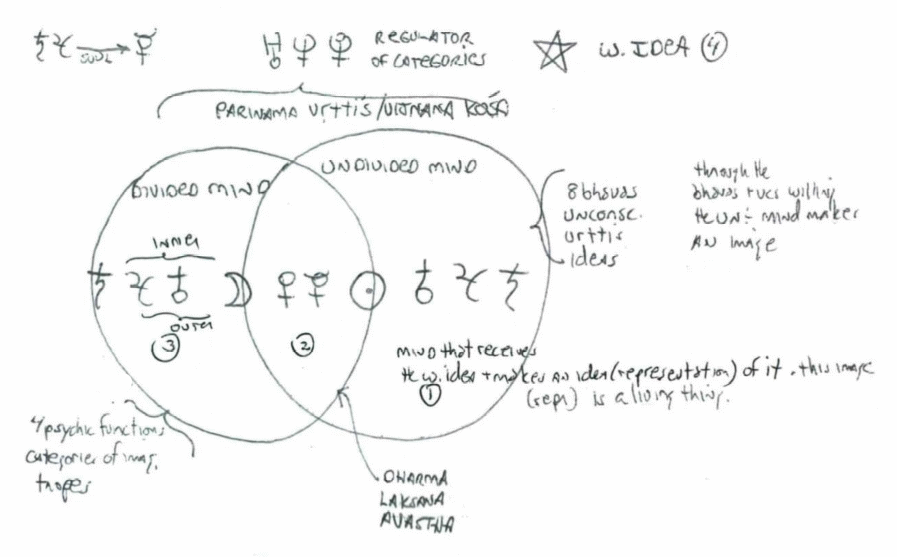
FIGURE 1983 0402-1-AB. Tripartite Soul, Trans-Saturnians, and Heliocentric/Geocentric Views.
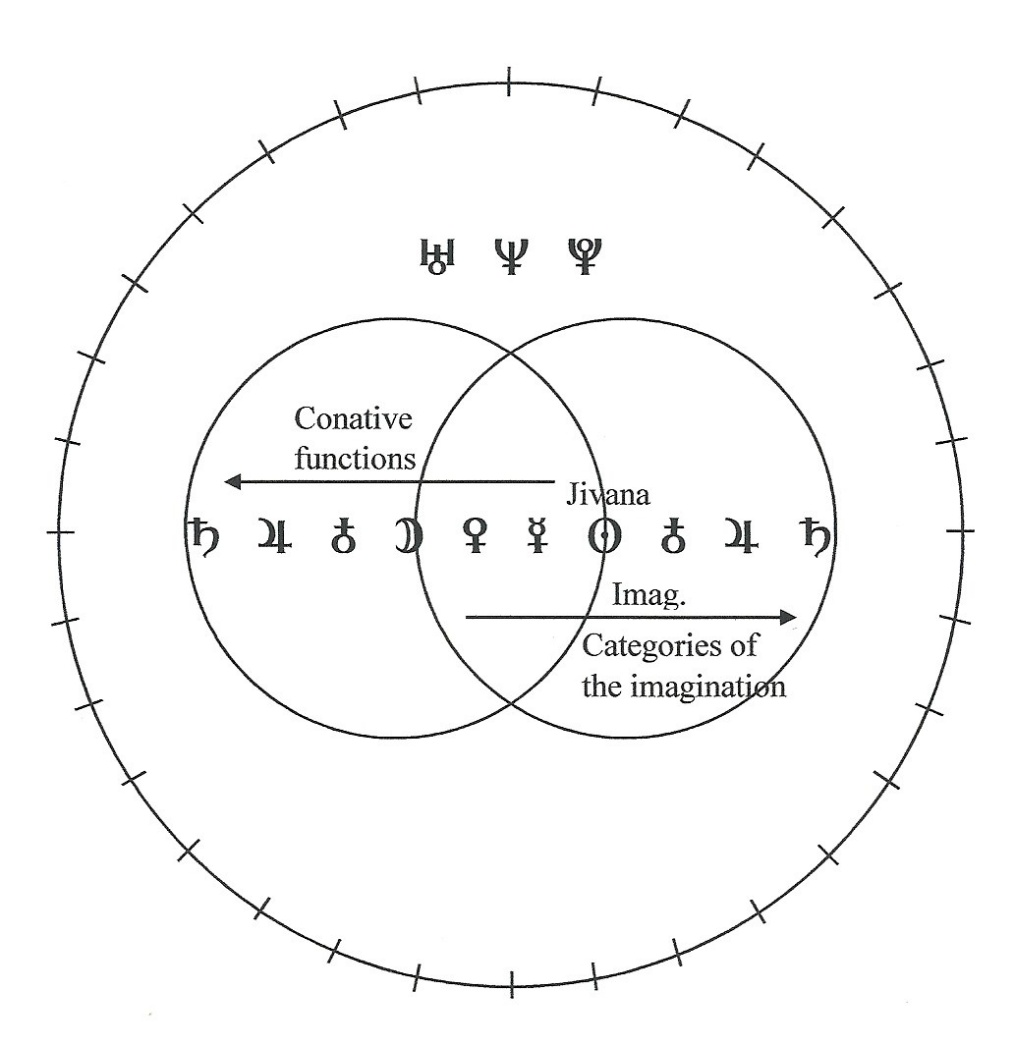
FIGURE 1983 0402-2. Trans-Saturnians and Heliocentric/Geocentric Views.
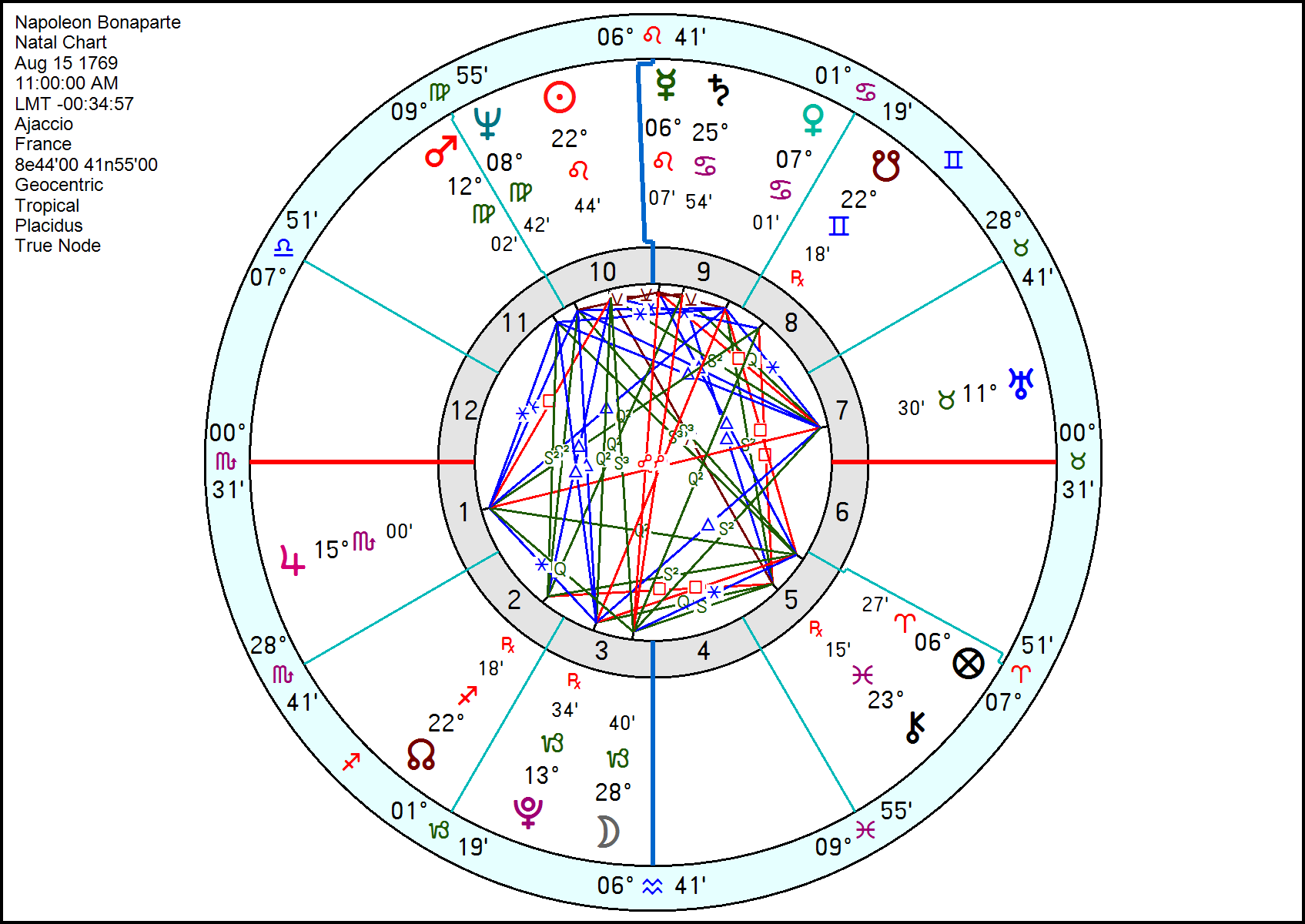
FIGURE 1983 0402-3. Napoleon Natal Chart (astro.com).
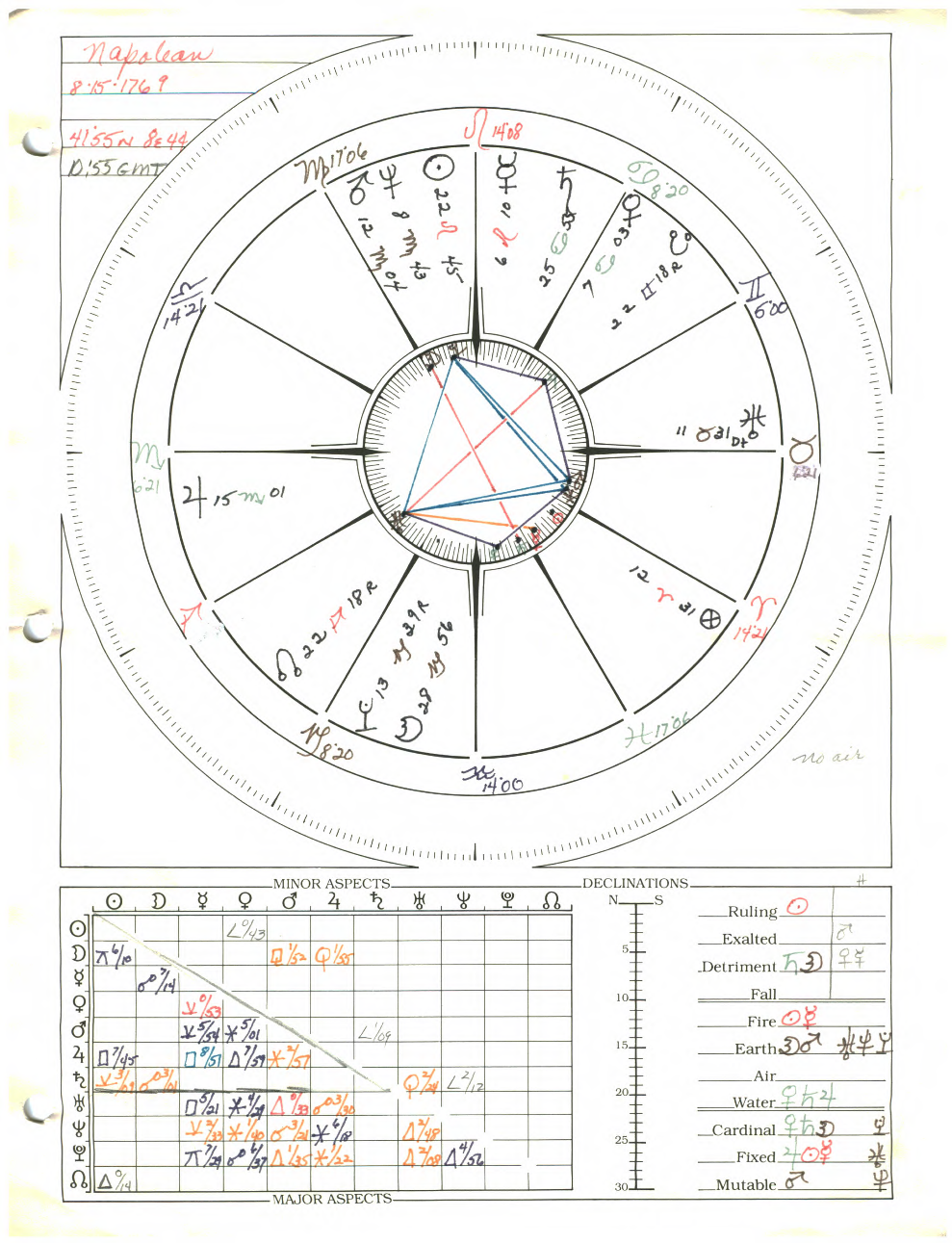
FIGURE 1983 0402-4. Napoleon Natal Chart (WG version).
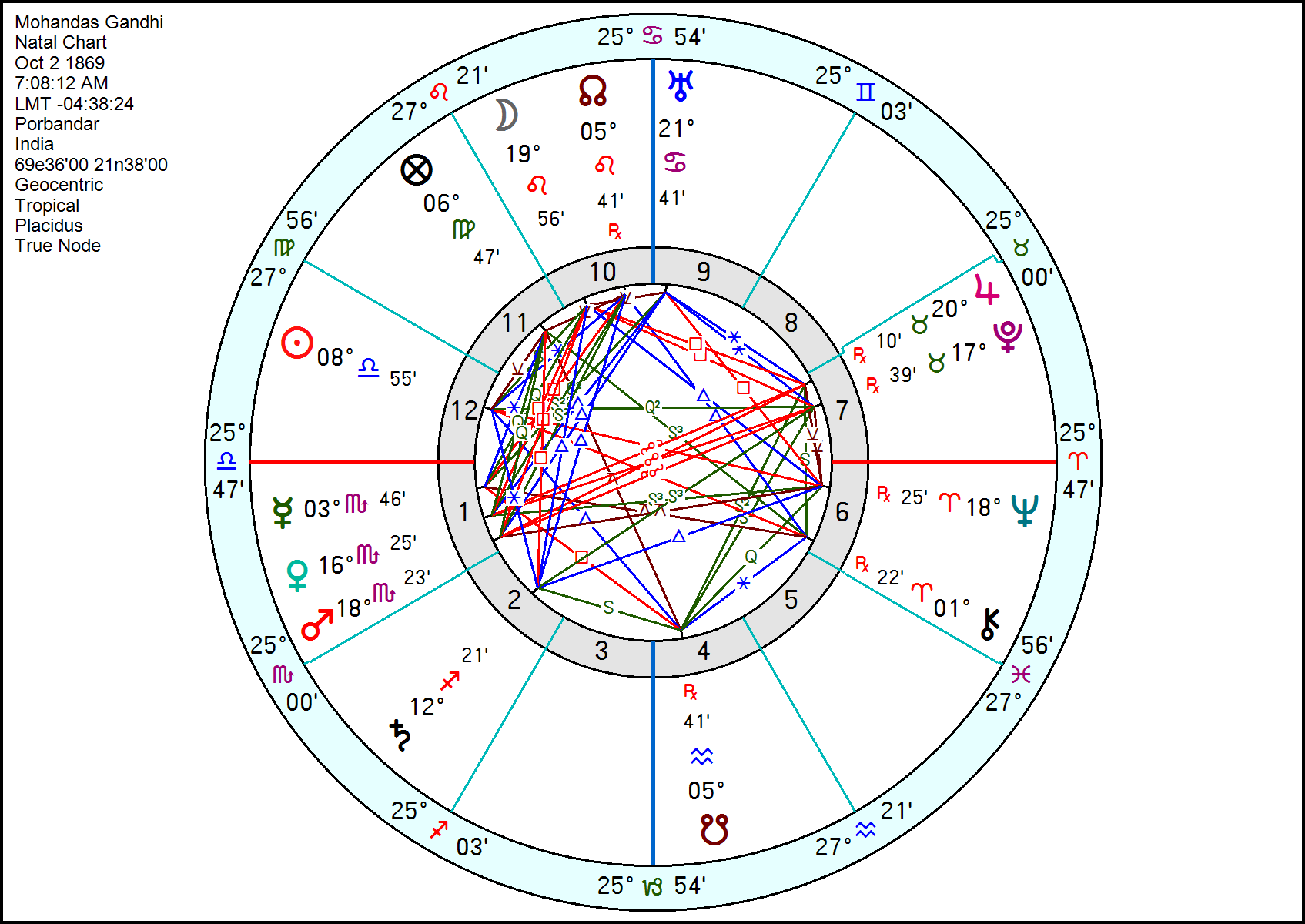
FIGURE 1983 0402-5. Gandhi Natal Chart (astro.com).
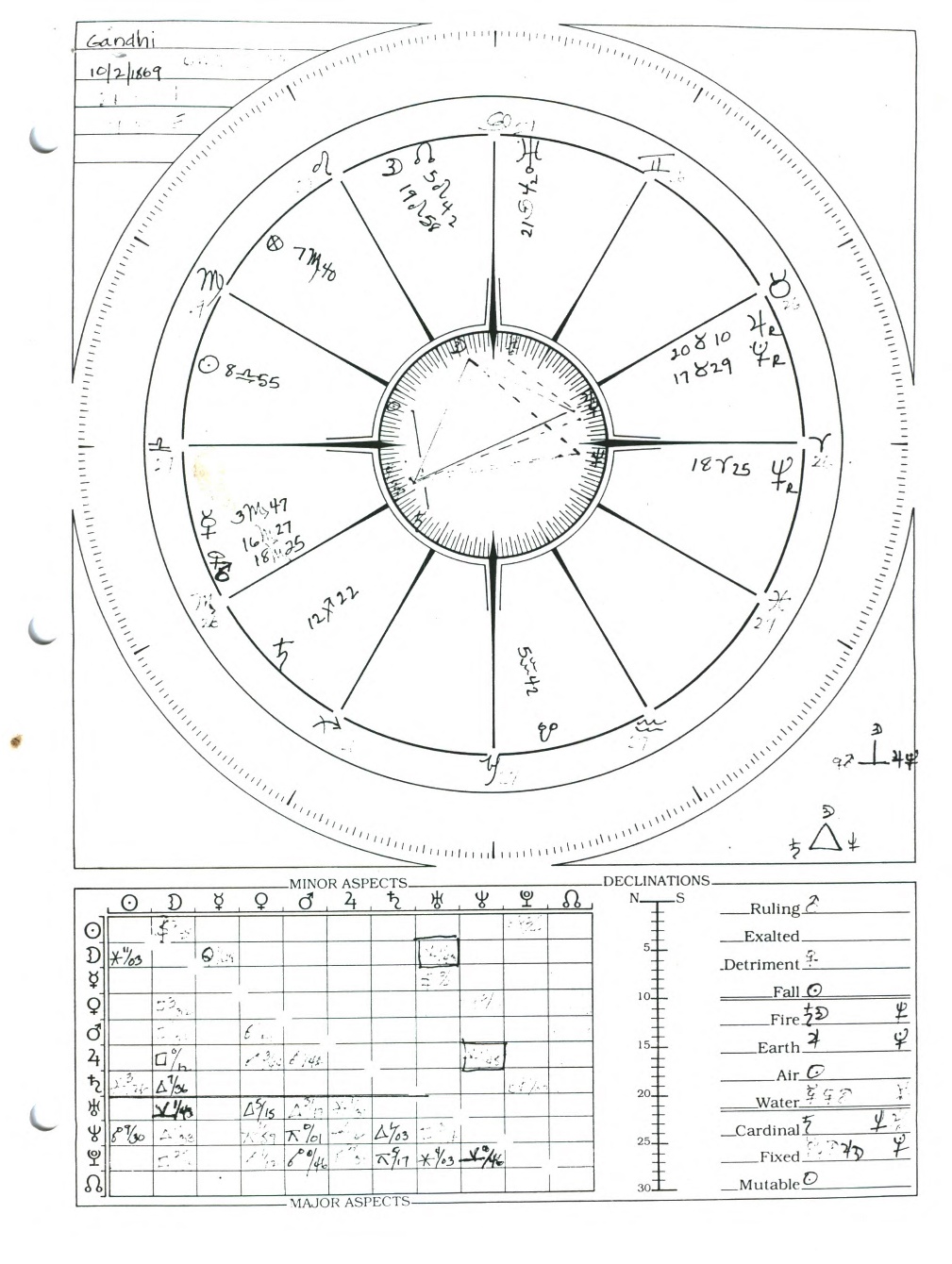
FIGURE 1983 0402-6. Gandhi Natal Chart (WG version).
First two diagrams are not from this class but are used as stand-ins to help follow along. Other diagrams also referred to are not with this transcript version. [Transcriber note: [diagram] means the speaker is referencing a diagram as he or she is speaking. If someone is drawing or writing, with audible sounds of chalk on a blackboard, I indicate this by [drawing] or [writing].]
NOTES:
For readability's sake, the following substitutions/edits made in Verbatim Transcript: cuz = because; gonna = going to; gotta = got to; yeah = yes.
This is a Saturday AM class.
TRANSCRIBED Verbatim by IT prior to 2018 (V11a). This is V12a (2023) and has: updated prefatory matter, footer, and audio file name; Book List and TOC completed, Subsubjects expanded; new notes within transcript; two diagrams appended and references in transcript to these diagrams; natal charts section redone with new charts and references in transcript to these charts; minor errors/typos fixed; new formatting to accord with new conventions. Archival verbatim transcript – V12a.
AUDIO FILES: 1983 0402a, 1983 0402b. [Note: "Tape" and "Side" refer to original audio cassette tapes that were later digitized into .MP3 Audio Files.]
1983 04/02 at Wisdom's Goldenrod
Astrology; Theory
[Audio File 1983 0402a Begins]
S (faint): --if you want to do (stuff like that).
S (very faint): Yes.
S (very faint): Yes we do.
AD: Where we're bogged down.
S: (Nothing.)
TS: So like work to manifestation. [drawing/writing]
VM: Everybody can talk.
S: Uh-uh.
S: Uh-uh.
[11½ second pause while TS draws]
[Note: See FIGURES 1983 0402-1-AB, Tripartite Soul, Trans-Saturnians, and Heliocentric/Geocentric Views, and 1983 0402-2, Trans-Saturnians and Heliocentric/Geocentric Views, appended to this transcript for the following.]
TS: Now this is an easy way for me to try to picture that diagram here. Um-- [30¾ second pause while drawing] Well, we've taken some of the di-- this is a-- a heliocentric point of view where the Sun is in the center [diagram], and then a geocentric point of view where the Moon-Earth is in the center [diagram]. And so from a geocentric point of view you have an order of Moon, Venus, Mercury, Sun, Mars, Jupiter, Saturn, ok, and from the heliocentric point of view you get Sun through Saturn that way, ok. Now, I mean that-- we've drawn it the other way where you take [drawing] the Sun in the center and then draw it about the Earth and the Moon, put the Dragon around the-- the Earth [diagram], ok. I just drew it a little differently because-- We were talking about how the undivided mind of the individual, which would be-- probably would be a heliocentric perspective on-- or the Solar system, makes-- takes the World-Idea and makes sensations out of it, alright. And we talked about these seven functions or vrittis of buddhi, seven activities of-- of the undivided mind, which we roughly and readily associated with-- with these seven planets as powers of that undivided mind which it has to employ in order to accomplish that, ok. Should I put those up as--
AD: Yes, alright I think-- on the other board--
TS: Um-- [15 second pause] This is from Yoga. I believe this is-- right.
[short pause while TS draws/writes]
AD: I'm not sure about the correlations but, just tentative, we're-- [TS: Yes.] just tentative.
TS: [drawing/writing] This is called jivana [diagram], you might say is a kind of life energy. Samskara [diagram], ok. It's habit, whatever you want to call it. Parinama, transformation [diagram]. Chesta [diagram]. And what was a good word for-- what do they have for chesta?
VM: Motion probably.
AD (simultaneously): Movement. Movement.
TS (simultaneously): Motion?
AD: Yes.
AS (faint): [couple words inaudible]
TS (simultaneously): I think there's a thing where he says the motion which causes the senses to perceive the object.
AD: Yes, or you can say the mind--
AS (simultaneously): Leads the sen-- ok.
AD: You know, the mind grasping the object, the motion of the mind to grasp the object or the World-Idea.
LC: Where are these coming from, what page? Particular text?
TS: This is from Yoga-Sutra 3.18 or something like that, Yoga-Sutra-Bhasya, (I don't know).
AS: 3.15.
TS: [drawing/writing] Shakti, power [diagram]. Dharma, which is merit or religious urge [diagram]. Merit, we'll leave that. And nirodha, which equals stoppage or limitation [diagram]. [short pause while drawing/writing] I think nirodha has three meanings, stoppage, containment, and-- Nope, there's two of them, I'll try to remember the two.
AD: Inhibition?
TS: Inhibition, is that right?
S: Hm?
[TS writing/drawing]
AD: Anyway what we're saying is that these are seven powers by which the mind grasps the World-Idea and turns it into sensation.
[VM assents, faint]
TS: So, if we just took these guys-- [21¼ second pause while TS draws/writes] And think of this-- these are the powers that would formulate that sensation. Then from the point of view of the divided mind, ok, the polarized mind that's within the Dragon, ok, then these would take on a different set of meanings and those would be those categories of the imagination we've talked about, you know, assimilation-- [drawing/writing]
AD: Put a Dragon around the Moon.
TS: Here [diagram]?
AD: Yes. Alright now inside that, alright, we have the categories of the imagination. And that's pretty straightforward. What we're saying is that any psychosomatic organism within that is constituted or composed of the memory of the Earth, the [VM assents, faint] Earth's memory. [VM, faint: That's what I thought(--/.)] That's the imaginal essence.
VM: If I do that, I don't understand Tim's diagram at all then.
TS: See, what I was thinking Anthony was that if you stand in the Moon and look back at the same Solar system as it were through the Dragon, then these-- these same functions will appear as, you know, feeling, thinking--
AD (simultaneously): Yes, yes.
TS: Ok. And so that what is here [diagram] as life is the-- the life which vitalizes the undivided mind, when viewed from-- from within samskara, that is going to appear as imagination [student assents] or purpose, ok. So, just [student assents] taking a point of view of one-- you know, one reference point and seeing how the others appear with re-- relative to this form of samskara or the Dragon. Ok? So it's loo-- it's nothing, because I guess the reason I drew it this way was to try to say that there's not two-- two entire separate planets, ok. It's whether you're seeing those functions through the Dragon as they're imaged in the Dragon or [VM simultaneously: It sounds like--] as they are in themselves.
VM: It's obviously reminiscent of the vesica but it's still different though. [student assents] Now maybe it's not different, I don't know. Would you say the circle on the right's the 12th house? Not really.
TS: Well, this whole thing's 12th house [diagram].
VM: Well, ok. If we're doing [TS simultaneously: 360 degrees.] 12th house we've had lots of vesicas. I'm sorry, maybe I shouldn't go back to ancient history [few words inaudible]
TS (simultaneously): I mean I just was trying to draw it to get us [couple/three words inaudible] of-- Because, you remember, it's just another way of drawing [drawing] this old diagram.
VM: Still, yes, I understand what you're doing.
TS: [drawing] Yes. Well [couple/three words inaudible] Now, the interesting thing that we're-- so, if this-- this one over here then is geocentric [diagram], ok, because it's Earth-- the Earth center. And this-- the one on the right is heliocentric [diagram].
S (faint): Thought it was the other way around.
LDS: I thought it was the opposite.
RG (simultaneously): I thought it was the other way around.
S (simultaneously with LDS and RG, faint): No it's [one/two words inaudible]
TS (simultaneously): Well usually the heli--
S: Usually Sun is the head.
RG (simultaneously): Tim, didn't you put the helio on the right?
AD (faint): Yes.
S: No, no you're going to--
RG (simultaneously): No-- no?
MW: No but those--
LDS: Yes but you got the circle.
MW: But the circle that starts with the Sun at the center and goes to the left--
TS: (Doesn't) matter.
PD (simultaneously): On the right side of the Sun you should [AS simultaneously: That--] have Mercury, Venus [couple words inaudible] (some laughter)
S (simultaneously, faint): That's ok.
S (simultaneously): Wow! (S laughs) (Cállate.)
S (faint): Wait a minute.
BS (simultaneously): Yes, explain it again now.
TS: This is a fairy tale. (some laughter)
MW: It's got to be consistent. (some laughter)
TS: Well, heliocentric [AS simultaneously, faint: No it don't.] means the Si-- Sun's in the center.
S: Why?
MW (simultaneously): Yes. What's at the center?
TS: [couple words inaudible]
S (simultaneously): So that I--
S (faint): It's inside of the right-hand side, right?
[student assents, faint]
VM: You know, the people are disturbed by this diagram.
LDS (simultaneously): Oh. I see, I see.
VM: Because right next to the Sun you have Mars, you see.
TS: Well I-- (laughter)
S: Well, you know--
VM: It's a little [one/two words inaudible] space-time.
AD: No, that is one of the way that the Greeks arranged it, the progression of the planets.
S: (Which?)
AD: The Mar-- the Sun would be between Mars and Venus.
VM: Yes, that-- that makes sense if you're standing on the Earth.
S: If this thing goes out [few words inaudible] watch the--
AS (simultaneously): In fact even in Plato too, he says in the 4th circle the Sun-- the Sun is enkindled in the 4th circle out.
AD (simultaneously): 4th circle out.
S: Yes.
VM: No, but I said that makes sense if you're standing on the Earth because you take that point of view. But anyway I-- I don't want to struggle with the diagram. Because I think there's something underneath it that's worth struggling for.
TS: Yes, if you think this is confusing, wait till you hear the next [one/two words inaudible]
RG (simultaneously): But Tim, the meanings of the seven powers you have now as [student assents] centered in the Moon [TS simultaneously: No.] as the center, didn't you mean to put those in the Sun center?
TS (simultaneously): No, no, no, they're sitting inside.
LC/S(?): Yes.
AS (faint): Yes, [RG simultaneously: But--] see.
TS: The Sun [LC simultaneously: So that's Dickie in--] [one/two words inaudible] out at all these planets.
RG: Oh ok.
[students assent, faint]
S: And the Moon--
TS (simultaneously): And the Moon stands here [diagram] [RG: Ok.] in the center of itself and its-- has its own world [student assents] and it also looks at the-- at the Solar system.
[student assents, faint]
RG: But isn't that [AS simultaneously: (Why?)] the same thing, standing-- looking at the Solar system from the center of itself?
AS (faint): No. I--
RG: No? I don't know, [BS simultaneously: Oh I see, oh I see.] I don't know, I'm asking.
AS: Tim [couple/few words inaudible] Tim! (Alright) Tim!
BS (simultaneously): No, no, why'd you-- what did you do that for!!? I'm just getting it. (some laughter)
VM: It's gone.
AS: That's why he erased it! (AS laughing)
[TS drawing/writing]
BS: It was making sense Tim. But be flexible, go ahead.
VM (very faint): That's why he erased it.
AS: That's why he--
RG: Tim, I like the diagram.
BS: It's pulling up. (BS laughing)
RC (simultaneously): [couple words inaudible] and understand it, (geez). (bit of laughter)
AD: Boy.
TS: [drawing] You like this one?
AS: No, Mars [RG simultaneously: Tim--] is left out. (laughter)
AD (amidst laughter): I don't blame him. (laughter, couple AS words)
[TS drawing/writing]
RG: I like the other one.
[short pause while TS draws; faint background student talking]
TS: Ok?
AS: Yes. See now you can--
TS: [drawing/writing] Etc. Ok? So you get the undivided mind. This is heliocentric because on account of the Sun's in the center [diagram]. (laughter)
S (faint): "Because on account…" (S laughing)
LDS (simultaneously): "Because on account…" (LDS laughing)
TS: Gee.
AD: Now erase it and put back the other one. (AD laughing)
RG: Yes. (laughter)
TS: You sure you want us to start at 9:30 today?
VM: Earlier.
AD: 8 o'clock, when they're still numb.
S (simultaneously): You could all sleep here, you could just--
TS: Alright. [drawing/writing] However you want to figure out what's inside of these two things, one of them is heli-- geocentric and the other is heliocentric, alright? That's all I need.
RG: Good.
TS: Ok. Now, the only thing we were talking about that seemed to be-- Well, the problem that was raised was we were looking at the aspects.
AD: No, but see-- see if-- if we can just repeat this again because it's really worthwhile. I think it's a very pictorial way of understanding let's say someone as abstract as Kant, you know, because he speaks about two kinds of imagination, one is transcendental and one is empirical. And the transcendental imagination is that which makes a representation for itself of the World-Idea, he says "object", alright. And this pictorial representation or s-- the sensations which then get organized by the faculty of the understanding, alright, he says then this here is what organizes the productive imagination and becomes operative through the productive imagination. Now what I thought was nice that we take those seven powers and we-- [TS drawing/writing] we ascribe them, let's say, to the Solar system, you know, the real thing out there, whatever it is. And they have these powers, these various powers, right. They organize the World-Idea, they make a sensation of it, that is--and don't think of a sensation the way we think of it in the reproductive imagination. And then this organized World-Idea is implemented by the very material which we speak of as the substance of the Dragon. That means that this psychosomatic organism is built up and built according to certain, you know, degrees or vasanas. And then it has to operate through that, alright, which means that now comes in the faculty of reproductive imagination. That is, when we take the natal chart and we know we have the seven categories of the imagination within that, [TS drawing/writing] alright, then that undivi-- undivided mind has to operate through that. And in the very process of operating through that, alright, it sets up a subject-object relationship. That is, as it goes through that, there is a split between the subjective, the planet sitting on a degree and being the subjective functions, and their outward manifestation, alright, bringing about the-- the so-called outer world for that individual. And all the distortion of that reality--in other words, the undivided mind world-image--is going to take place within the categories of [VM assents, faint] the imagination, alright, so all the shortcomings we have in the perception, alright. Now, also in terms of a Buddhist framework we would say like the undivided mind is what has the pure sensation.
VM: Uh-hm.
AD: Ok?
S: Uh-hm.
AD: Inside the categories of the imagination you have ideality or the pictorialization or the faculty of building the image, alright. The intellect builds an image of what is given to it and now you have these two mixed in together, so to speak.
VM: Uh-hm.
AD: And that would be another nice way.
[student assents, faint]
[TS drawing/writing while AD speaks]
AD: And, we're taking these very abstract theories and trying to see if they really do apply. Of course the premise here that most people dislike is they say "Well, gee, you're equating my mind with the Solar system." Well, if you think of the many examples, for instance, Africanus or Jung or any one that you're familiar, where the person realized-- you know like when in the case of Jung where he saw himself thousands of miles away from the Earth. Would-- wasn't he in his mind? Did he-- was he seeing it from some-- alright. Or Africanus. Any of these people who had these experiences, alright, it's obvious that they were in the undivided mind or let's say the witnessing "I" or let's say the transcendental ego looking at what was going on below. So that-- that's the real difficult assumption. But I don't think it's so difficult as you start piling up or especially if you get a little bit of a(n) experience of what the Witness-I is, which takes you out of that, say, the functioning of the Dragon, even temporarily. Alright, so I thought-- I thought that that was worth repeating to understand the picture a little better.
TS: Yes, the way I understand-- I actually would want to put the Dragon here [drawing/writing], if I understand the diagram. That is, that-- it's like if this is the undivided mind [diagram], that within it seven Chaldean planets are the pow-- or the six Chaldean planets and-- are powers of the Sun which it requires in order to fabricate a-- and organize the sensations into some kind of unified manifold which then is imaged, taken in through the Dragon of-- or through the-- through the lower mind or the embodied mind and projected out as some kind of coherent image. So I was thinking, you know, just-- so it's as it were that within this-- this field here is the natal chart and the senses functioning as part of the categories of the imagination [diagram]. But right underneath it, as it were, is the transits or the cosmos as the undivided mind of the individual or the Witness-I that is constantly activating this imaginative continuum [diagram].
AD: What do you think, Avery, if we say the-- that the left-hand side [diagram] corresponds to the Moonlike body, right, the right-hand side [diagram] to the Sunlike body, in the Vedantic equivalents?
AS: Oh, yes, well I thought that-- that-- [few faint inaudible AD words simultaneous with AS] same thing, heliocentric, so--
AD: Annomaya kosha, Manomaya, [AS assents] alright. The next one was Vijnanamaya, now that's interesting. 'Vijnana' means what?
VM: Two.
AS/S(?): (True) knowledge?
AD (simultaneously): Huh?
TS: Fivefold-- bifurcated knowledge.
AD: Isn't that those two realms [diagram]?
TS: Together you mean?
AD: Yes.
TS: Hm.
[TS drawing/writing]
CDA: What does-- what does the vesica part of that diagram refer to? I mean is that significant?
AD: And the next part-- no, not right [CDA simultaneously, faint: No?] now. Then the next part would've been the Anandamaya [diagram]. [RG assents] Or again, the Moonlike, Sunlike, Noe-- Noeron, and Augoeides.
TS: [drawing] So let's see, this is geocentric [diagram] would be like--
RG: Annomaya.
TS: Annomaya?
AD: Yes.
RG: (Pranomaya.)
AD: Yes, Annomaya-Pranomaya combination.
[short pause while TS drawing/writing]
TS (faint): This was Manas.
AD: Manomaya? Yes. Vijnanamaya would be the combination of those two.
TS: [drawing] And then Anandamaya [AD simultaneously: Anandamaya.] would be the 360 degrees [diagram]. Hm. This looks awfully familiar.
AD: It should.
TS: Cosmic mind [one/two words inaudible]
AD (simultaneously): Alright, and then the other thing we did was we had the five cognitive aspects of those seven planets, right?
TS: Yes. I sort of wrote these-- let me--
AD: Well you could put them down the bottom (there), Tim.
TS: Um--
[10 second pause; TS drawing/writing]
JC: Anthony? While he's doing that I'd like to ask something. When you're giving this scenario of how the sen-- the World-Mind or the world-image is-- the World-Idea is grasped by the seven planets and then organizes these sensations and then projected, the sen-- you're saying the sensations as organized by these planets, those will then be portrayed in an image form prior to the apperceptive grasp, which would occur only after then the consciousness associated with these planets enters into the image which has been presented.
AD: And then you say apperception takes place.
JC: Right.
AD: Ok.
JC: So, there is a distinction (I'm just/I was) trying to understand between what you're calling sensations as organized by the planets and the actual, say, patch of blue that's referred to prior to apperception.
AD (simultaneously): Yes. And so-- so the first one would be like the Sun would represent there the transcendental imagination, and by "transcendental" we simply mean it's not available to you. You can't grasp.
JC (simultaneously): Yes, but it's in a form that can't be portrayed and--
AD (simultaneously): Whereas, whereas the empirical imagination will be the one that you're operating with within [JC: Right.], right here and now, within the Dragon. Yes. Yes that-- that's the way I kind of [one word inaudible]
JC (simultaneously): And you're trying to say that possibly that's the quantum level where it's not determined how it's going to appear as a wave or a particle or--
AD (simultaneously): Well, that's-- that's where I want [JC simultaneously, faint: That's (right/fine).] him to jump in and see if we can see that position. But, if we start enough-- if we start off initially with premises, alright, that are, you know, great enough, I think we'll be able to work the problem out. But if we start off with the assumption, and it is an assumption, that I am the body, we're in for a lot of trouble.
JC: But, you know, the-- the-- the heavenly spheres have been described as a body of light and that could be analogously the way they speak of the electromagnetic and all these various energies, which are then transformed, like the E=MC2, that if they're transformed into--
AD (simultaneously): Alright, why don't you wait, why don't you wait? Yes.
JC: Alright, but--
AD: Why don't you wait? Yes. Those are the things I'd like to see brought in now, but I just wanted to establish the background. Hold on to it Jeff. Don't let it go, hold on. Alright Tim. So those were the five or seven kinds of knowledge [diagram], it doesn't--
TS: Yes, there's different kinds. They call them levels of activities of buddhi or five levels of buddhi vritti, you know. And it seems like in one sense all seven of these can function in any one of these five ways or any-- any set of-- subset of these seven can function in any one of these five ways. Now, I understand wrong knowledge-- right knowledge is pramana, the ability to recognize truth in some fashion. Wrong knowledge I think doesn't just mean the fabrication of ignorance, though I-- I think that's probably one of its meanings, but I think it also means the capacity to recognize ignorance, like when you know something is wrong.
VM: Why isn't that right knowledge?
LDS: Yes, why wouldn't that be under right knowledge?
TS: Well, don't you have sometimes an experience when you know you're on the wrong track but you don't know what the right track is?
VM: And that's a piece of real right knowledge.
TS: No, it's wrong knowledge--you know when you're wrong. (AD laughing)
AD: Alright, alright, let's--
VM: I don't care.
TS: Well--
S: It's just the absence of right.
TS: And then imagination, which is neither right nor wrong. That-- pretty useful.
AD: See that, I think-- I think we can call that the transcendental imagination. What do you think Tim? No, [TS simultaneously: You mean--] let's back it off, let's back off, wait. Let's-- let's back off. Go ahead. Memory.
TS: Well, memory, according to those little guys, memory is the capacity for the mind to hold something-- an image for itself. Memory repeated twice is thinking, memory repeated thee-- three times is concentration.
AD: You hear that? (AD laughing)
S: It's that simple.
VM: Only three times.
LDS: Three times.
PD: In a row.
TS: The same thing, without comments. (TS laughs) So that's-- that's the way they use the function of memory.
S (faint): Can you say that again?
S (faint): Memory is--
TS: I forget. (laughter)
S (amidst laughter): Say it two more times. Say it two more times.
TS: Memory is--
VM: Twice is thinking, three times is [TS assents] concentration. [S simultaneously: That's (couple words inaudible)] Four times is samadhi.
TS: Yes. Ok, yes. (some laughter) And sleep we discussed at length on Wednesday, (bit of laughter) the capacity for something to become unconscious. The word for sleep is 'nidra' which I think is connected to 'nirodha' but I'm not sure.
VM: Go-to-sleep yoga.
S (faint): Would be nice.
VM: Tim, I don't really understand-- let me just try and get clear exactly which one of these is cognitive and which one is fabricative or maybe that's the wrong set of labels to try and patch on that.
AS (simultaneously): No, that's right. [student assents, faint] I think that's the similar--
VM: I know, we tried that.
AS: No, that's the same thing.
RG (simultaneously): No, that is the-- that is [AS simultaneously: That's their labels.] the textual meaning.
VM: Hm?
AS: It's their label.
VM: Their labels. Alright, good.
TS: But you know one thing that-- I don't know if this (has/as) a variant approach. I think that-- one way I've thought about those vrittis as activities are-- we talk about the way in which sensation is made and I was thinking that those vrittis are also the way in which knowledge is made almost, the different way-- If you say that a percept is fabricated through the function of the seven vrittis, I wonder if those seven-- the five below, the five cognitive ones, have to do with the particular kind of concept or meaning that is provided together with that sensation.
AS: Or-- I like that other way you said first, the way that the concept is put together. I don't think those are the particular co--
TS: Yes.
AS (simultaneously): They're the ways that concepts are put together, just as the previous are the ones the way sensation--
TS: So they're different [AS assents] from a sub-- they're not the bhavas, they're not--
AS: No.
TS: Yes. I think there's three different things that are active here.
VM: I guess what I'm saying, I don't see any kind of real knowing or intellection in [AS simultaneously: Oh, no.] either of these lists unless I just missed it.
S: Except right knowledge.
AS (simultaneously): No but that's not-- that's not what they mean by "cognitive" though. Real knowledge is what they call Cit-Sakti, the power of the-- the power of intellection of the soul and it's not--
VM (simultaneously): Yes, I agree, it's not there.
AS: Yes but that doesn't mean that you can't call it knowledge. Call it empirical knowledge or call it relative knowledge. See--
AD: I think, [LDS simultaneously: Could you--] I think we're leaving out one thing there, alright, and that is you're going to have the 360 degrees. Now they're 360 Ideas that you're talking about--the way they're going to be combined, alright, the relationship among themselves.
VM: Ok.
AD: Then I think you'll be able to pull in the content whereas just-- those are just the abstract categories.
S: Yes.
AS: That's what I mean, those are the way that-- those are the forms by which the Ideas are combined--
TS: Yes, in other words (like forms of soul), yes.
AS (simultaneously): --(here) or presented. Actually, actually in Bhattacharyya he says those are-- those are the different ways that knowledge can be presented, not that they are the content of knowledge. [Note: See Krishnachandra Bhattacharyya, Studies in Philosophy, Vol. 1, "Studies in Yoga Philosophy".]
AD: Yes.
TS: Yes.
AS: In other words, they refer to the-- the way that the thing is presented.
AD: You get this point, [AS assents] which is very important.
LDS: I'd like to ask Avery--
AD: Those are abstract categories, alright, of knowledge, above [diagram] is the very fabrication of the vehicles by which, you know, life can be operative, alright, and those two together now have to relate to the Ideas which are being manifested by those two together, the 360 degrees, so to speak.
LDS: Ok.
AS: Now that comes [LDS simultaneously: Ca--] out from the diagram [AD simultaneously: So--] also, I mean--
AD: Go ahead.
S: I'm sorry.
AS: [one/two words inaudible]
AD: Go ahead now.
LDS: Ok. Could we say that these five below the cognitive modes [diagram], can we relate those to the aspects of the antahkarana, to-- in other words to help locate them? Or, when you say these in an abstract way, these categories here, they are presentations of knowledge to any of the faculties or psychic functions of the antahkarana.
AD: Well, Louis--
LDS (simultaneously): Am I making any s--
AD: Louis, we have to work our way into that problem now.
LDS: Well I'm trying to get some kind of [AD simultaneously: No--] locus for where this is [one word inaudible]
AD (simultaneously): We have to work our way into this problem you just stated.
LDS: In other words, who's the self.
AD (simultaneously): And that is, if we took-- if we took those as two aspects of the undivided mind, alright, which organizes the categories of the imagination, alright, now you conceive of a natal chart, alright, and that natal chart indicates the presence or the organization of a psychosomatic organism, alright, and the planets indicate the degrees or the ideas that they're sitting on and the relationship with each other. Now they have to work their way through the categories of the imagination.
LDS: Yes.
AD: That's what we have to try to understand. Now if you state your problem again--
LDS: Are-- are we-- ok, following that up. Are we going to see-- do you suspect we're going to see some kind of sliding scale for subjectivity or for--
AD (simultaneously): Say it the way you said it before.
LDS: Ok, what I asked before was, do these five-- I'm speaking now about the cognitive, but I guess the others too. Do these apply to the different levels or organs of the antahkarana?
AD: Well now, what do you mean by the antahkarana? Do you mean--
LDS (simultaneously): I mean buddhi, manas-- [student assents] The antahkarana is made up of the buddhi, manas, and on down, right?
JC: There's two ways of doing it. One is within the lower manas and one is the whole-- spans the gamut, it's the--
AD (simultaneously): In other words, [LDS simultaneously: See--] does the antahkarana within the lower manas, [JC: Right.] alright, [LDS simultaneously: There's still a--] is that a reflection of the cognitive outside of it?
LDS: Right. See--
AD (simultaneously): Alright.
LDS: I'm trying to find a locus for where these apply to, and-- I mean I can't-- I'm not really--
AS: Well in the picture-- [TS: Yes well--] I think the idea was that in the picture they apply to Tim's right side [diagram], the heliocentric.
LDS: The heliocentric. So that would be the whole--
AS (simultaneously): They-- both of those together are the operation-- [TS drawing/writing] that-- that undivided mind has two-- two distinct functions you could say. One is to take the Idea and portray it as sensations and organize, you know, the sensational manifold.
LDS: Yes.
S: [one word inaudible]
AS (simultaneously): And the other thing is, its other function is to provide the concepts that go along with that. But both of these things seem to be provided to the imagination, are going to be portrayed in the imagination or work through the imagination.
S: So--
LDS (simultaneously): To the psychosomatic organism.
AD: Now you have an organized psychosomatic organism, now you could speak within the psychosomatic organism of the imaginary antahkarana.
LDS: Oh ok.
AS: Yes [one/two words inaudible]
LDS (simultaneously): The reflection of the anta-- [AD simultaneously: Yes.] ok.
RG: I don't know the--
AD (simultaneously): Just like the psychological functions that Jung talks about are within the imagination.
LDS: Right, right.
RG: What does it-- well--
AD (simultaneously): I-- I think.
RG: What does it mean to talk about wrong knowledge and sleep and imagination as part of the undivided mind as co-- I don't understand that, vikalpa and nidra as part of that undivided mind.
AS/S(?) (simultaneously): Like how do you get from wrong knowledge?
[simultaneously] [student assents]
AS: I s-- I don't think they're part-- I think that's the way that the undivided mind presents ideas to the divided mind.
RG: I don't see why then-- why-- I don't see why you would include them then in the undivided mind, why you wouldn't say that it's the way the divided mind receives what's presented by the undivided mind, not--
TS (simultaneously): Well, they talk about them as buddhi vrittis, as modification of buddhi, and--
RG (simultaneously): That's right, but which buddhi?
TS: Well I'm-- and-- I would say they-- when they're speaking, they're speaking here of buddhi tattva as the principle of buddhi in itself. And, if you [couple words inaudible]
RG (simultaneously): Ok.
TS: I think of these as-- we talk about the 360 degrees [drawing/diagram] [S, faint: Right here.] as each one being modified or so-- a set of them being activated by these planets in motion. But then there seems to be ways in which these degrees can be joined each to each other. And it seems to me that these five-- or one possible meaning of-- for these five are different ways in which these degrees can be produ-- can be activated to produce a specific form of cognition, or a-- another way to say it is that ways in which they are going to be inserted into the individual.
AS: Yes. Well that touches [TS simultaneously: So--] on Louis' question, right Tim, [student assents] I mean which-- in which mind do those vrittis occur?
TS: But it seems to me--
AS (simultaneously): If you say they just occur in the lowest mind--
AD (simultaneously): Maybe, maybe if we put it this way Dickie, if we say that they're really the prototype. The only way we can represent what we mean by the cognitive aspect of the undivided mind, alright, let's say it's those five, but those are really the prototype. What that really means is like for instance the imagination as one of the cognitive ways, it's really the way the imagination in the s-- in the-- within the Dragon is structuralized; [student assents, faint] not the imagination, so to speak, in the undivided mind.
RG: Yes but you know the-- the meaning of that word for imagination doesn't, in the context I've understood it, doesn't have as wide a meaning as what we normally understand by imagination.
AD (simultaneously): Imagi-- uh-huh.
RG: Vikalpa is a very particular kind of imagination where you're take-- where-- that has to do with taking a meaning and not with creative and-- the kind of creative imagination that we'd say produces the world.
AD: Well [S simultaneously: Isn't it cosmic (couple words inaudible)] isn't it true though that on the one hand within us--
RG (simultaneously, faint): It's not a cosmic kosha, in other words, ok.
AD: Isn't-- isn't it true that within us, on the one hand, we have this transcendental imagination, alright, and then we also have the faculty of, let's say, re-presenting to ourselves what the imagination previously, let's say, constructed.
RG: Yes.
AD: So that you have these two things both coming from that term "the imagination".
RG: Ok.
AD: I have to have the ability or the faculty to be able to imagine something and then also the ability that once I've imagined something that I can tether together a few or a series of these images.
RG: Uh-hm.
AD: If I can't do that, I can't possibly have knowledge of an object for--
RC: How does the second differ from memory?
AD: Huh?
RC: How does the second differ from memory?
RG: Yes, because in-- well, it's--
TS: Well, you know, let me-- let me see if I can make a suggestion, is it--
AD (simultaneously): Is it different from memory?
RC: The second one, yes.
AD: Yes, I was thinking on the one hand as the imagination as productive and on the other hand as creative. It can produce an image, and then it can create by manipulating images. So I call one transcendental imagination, alright, and the other reproductive imagination.
[student assents, very faint]
RG: Uh-hm.
[student assents, very faint]
VM: I thought Dickie was contending that vikalpa was reproductive [RG simultaneously: It-- yes.] imagination.
AD: Yes.
TS: But, I-- I think we could see them all though as being ways in which this individual mind or undivided mind inserts itself in-- in the psychosomatic organism, and that-- and-- Well, for example, that through the imagination that a certain meaning is created by blending functions and degrees up here [diagram] and that meaning is then inserted into the imaginal world or the creative process within the categories of the imagination. It's perhaps functions as a creative or artistic or psychological [RG assents] perception. And I could see memory-- I was thinking about this the other night, that the way in which they talk about memory might have a lot to do with that idea of reminiscence, that here, in other words, that you might-- it-- that right knowledge is a-- maybe a new, if you-- if you will, act of knowledge which is inserted into the individual mind. But if you have understood something at some previous time and as it were rediscover it, that there's a certain recognition or rediscovery of-- or remembrance of some knowledge previously acquired and not consciously available; that this in-- undivided mind might function as in the dialogue of Plato [Note: See Plato, Meno.] where he draws the theorem out of the, you know, the young boy, that there's ano-- a way in which the-- this psychosomatic organism could be stimulated to recall knowledge that it's previously had but is latent, [RG assents] latent samskaras rather than patent ones. [RG: Right.] And I could understand all of these vrittis as functioning in that way to sort of insert meaning into the psychosomatic.
[student assents, very faint]
RG: Right, and it's this insertion of meaning that I wonder about. I mean I would-- [one inaudible student word simultaneous with RG] I-- I would say-- I mean I think-- it could also be understood that the-- that the divided mind or the-- has within it these categories, that there are other kinds of categories of the imagination which present and represent the knowledge from the undivided mind and that grasping of it are those categories rather than those categories insert from the [TS simultaneously: Well would--] undivided mind into the divided mind, I do-- I don't get that step.
TS: Well, then why can't you have both Richard, I mean--
RG: Well, I just don't understand--
TS (simultaneously): Doesn't it seem as though-- that they're-- I mean we're going to say that there are functions within the undivi-- [RG: Right.] within the divided mind where there's activities within-- within which, you know, the-- this-- the functions of the psyche try to process what it-- what it projects. You know, you project meaning out into perception, you try to bring it back in and we--we've talked about, you know, perhaps a certain kind of aspect pattern which is fixed in the individual chart or something like that. So this is certainly-- I mean-- To say that this has a way of processing what is being injected in it [RG: Right.] certainly would seem to be a-- you know, there's no-- I don't see any reason to argue with that. But I don't see why one wouldn't also say that there are activities within the undivided mind which it's using to present it's, you know, activity.
RG (simultaneously): Oh, oh, I-- right, I believe there are. I'm not arguing that they're not. I'm saying you have seven of them on top [diagram] which can be understood that way, the seven buddhi vrittis, in one sense, and it just [couple faint inaudible TS words simultaneous with RG] seems to me just from the meaning I understand of those five others, that they're more akin to the divided mind's categories.
TS: But that's a [AS assents] mis-- you know.
RG: No, you can [AS simultaneously: See--] raise them to the level of the undivided mind and I'll be happy.
AS (simultaneously): Ok. Two things. Those first seven, I don't believe they're called vritti. They're not called vritti, [RG: Yes.] whatever they mean by vritti, [RG: Ok.] but those seven are not vrittis.
RG: Or whatever they are.
AS: They're-- in fact, they are-- I don't know, we got to get-- they're [RG: Yes.] unconscious-- the mind has three-- has willing feeling and knowing aspect.
RG: Uh-hm.
AS: The willing-- any one of these has an unconscious and a conscious functioning.
RG: Uh-hm.
AS: These they claim are the seven unconscious [RG simultaneously: Unconscious, right, right.] modes of the will, and they give rise to conscious modes. In other words, those are in the undivided, in the divided you have your actual bodily mo-- you know, [RG: Yes.] all the apparent stuff. These are what give rise to (those/them). And I think the question is, is there a s-- is there a similar correlation on-- for cognitive?
RG (simultaneously): Cognition, right, [AS simultaneously: Right.] and I would arg-- right.
AS (simultaneously): In other words, is there-- are there patent or manifest cognitive modes and then are there modes that go with the undivided mind [RG: Right.] and if there are this-- if there is a distinction in the cognitive too, on which side are these?
RG: Right.
AS: In other words, we made a sh-- a kind of distinction. These are-- the top ones, the conative ones [diagram], go with the undivided mind. [RG: Right.] In the divided mind we wouldn't talk about those, we'd talk about, say, categories of the imagination [RG: Right.] or we'd talk about-- instead of shakti we'd talk about, you know, empirical willing. Instead of chesta we'd talk about feeling or [RG assents] instead of parinama we'd talk about communication or something. [RG assents] Now, there should-- I think you're saying, and it seems right, there should be a similar correlation of cognitive ones within cognitive--
AD (simultaneously): Transposed into the empirical, [AS: Yes.] yes.
AS: There should be similar terms for the cognitive. And supposing that there are, are the-- do these-- are these five, the ones they describe, in the undivided or are they in the divided.
RG (simultaneously): Right, or the divided. Now [AS assents] I-- right. And I think from a Yoga point of view when you're coming at it, it's going to be much harder to find the ones in the undivided mind for [AS assents] knowing because willing is their primary principle. [AS assents] So those seven are much more consistent to Yoga [AS simultaneously: In Yoga. I know.] than the cognitive ones.
AD: Uh-hm.
AS: In fact, you--
RG (simultaneously): But if you went to Samkhya you'd find the opposite.
AS: In fact, the interesting thing is, Richard-- I think that's right. Those-- in Samkhya you'd have to find the bhava functions would be the presuppositions of those.
RG (simultaneously): Right, right, uh-hm.
AS: And it's interesting, I-- I just noticed the other day that in Yoga, the-- the-- how does it go-- the vrittis-- well you could try it-- they-- they have a-- they switch the vrittis and bhavas.
RG: Right.
AS: They switch the cognitive and conative ones, the way that they go. And in-- In other words in Yoga, those five forms are vrittis and those [diagram] are--
S: Uh-hm.
LDS: Would they call them vrittis of buddhi--
RG: Uh-hm.
LDS: --the five vrittis?
AS (simultaneously): Well, they're cit-- well-- Yes, they're vrittis of citta.
LDS: Ok, that's wide open then.
AS: Yes, it is wide open. Now if you think of--
RG (simultaneously): But those five also function in manas too, don't they say, at every level Tim, don't they?
AS (faint): I think they do. Well the point-- the point they seem to make is that those five are never con-- they-- they don't seem to conceive of them as unconscious, they are the con-- they are conscious aspects or conscious modes [RG: Right.] of the mind. They're conscious cognitive modes. The other ones are unconscious conative modes.
RG (simultaneously): Conative modes, right.
AS: So we need se-- we have seven conscious conative modes, right, the ones in the divided (one).
AD: Uh-hm, uh-huh.
AS (simultaneously): I'm just-- for now, [RG simultaneously: Good, good.] I'm just equating unconscious with undivided [RG assents] mind and conscious with divided because I think that, you know, they would call the undivided [RG assents] one so-called "unconscious".
RG: Uh-hm.
AS: Now then what we need is unconscious cognitive modes. And I don't know if 'unconscious' isn't the word but we want-- you said we want ones in the undivided mind, and that would seem-- suggestion that we look to Samkhya for the bhava(s). The bhavas of buddhi would [RG assents] be the ones that organize the knowledge that appears in these five modes in the imagination. And I agree, they-- those five would seem to be [one/few words inaudible]
AD (simultaneously): Would-- maybe-- maybe if we think of it this way. Within the empirical psychology, alright, you have the antahkarana or the four psychological functions. What would be the prototype in the undivided mind?
RG (faint): Of the four functions?
[short pause]
AD: And then, if we can figure that out, then the next thing would be well, the combination of these two and the Ideas, then we got it. [RG assents, faint] He can understand why it took Kant 12 years to write out the Critique.
AS: "These two" meaning the psychological functions and their predecessor together with the willing [AD simultaneously: Yes.] functions and their predecessors.
AD (simultaneously): Uh-hm.
AS: Well, you know, (in one) [one word inaudible]
AD (simultaneously): Now, you combine those two, alright, and you set them on the degrees.
RG: Uh-hm.
AS: Wait, well let me ask a question. You know, maybe you don't want to use this terminology but in the-- when we did the Samkhya they have these four, the alocana [AD: Uh-hm.], the vikalpa or samkalpa, you know, abhimana and--
RG: And niscaya.
AS: Yes, certitude, appropriation, [RG assents, faint] putting together, and sense and--
S (faint): Sense [one word inaudible]
AD: Sense perception, [couple inaudible AS words simultaneous with AD] yes.
RG (simultaneously, faint): Yes, uh-hm.
AS (simultaneously): Sense perception. Now, those seem relevant to the-- tho-- they do s-- Samkhya says that those are the mo-- the knowing functions. [RG: Right.] They say those are the functions--
AD: Within our empirical psychology.
AS: Within-- [RG and another student assent] well they say in the aham-- antahkarana.
RG: Yes, within the antahkarana.
TS (simultaneously): But then (when/where) they speak of that antahkarana [AS simultaneously: (one/two words inaudible) yes.] which is functioning where it's trying to go out of itself to contact a real o-- an-- an o-- how do they say it, well, an-- an object--
RG: Uh-hm.
TS: They talk about the otherness of the object is true and its reachability is false and that's their whole strange way of doing viveka. But they do talk about those four functions as functioning in a dualistic situation where the antahkarana is an internal organ reaching to some form or object as outside of itself. [RG: Right.] Now they do their funny thing where they claim that the prakriti and purusha are ultimately dual. [S: Right.] So the-- the duality they insist on maintaining and the knowability they insist on claiming is false. But, it would seem that the-- that those four functions that-- that-- their definition of antahkarana, which includes the indreyas and includes the need to contact something which is polarized as other than the subject, would fall within the divided mind.
AD: Yes, so then [RG: Yes.] that would give us, that would give us on the one hand, the somatic entity, [RG assents] right, those seven, and the psycho [RG assents] part of that psychosomatic essence. That would give us, let's say, the-- [AD snaps fingers] the antahkarana. [RG: Right.] The combination of these two, alright-- [RG: Right.] If we keep in mind that we can superimpose them on the Ideas, [student assents] whatever the 360 Ideas are, now the functioning of the psychosomatic organism is a manifestation of these Ideas.
RG: Right.
AD: The aspects will tell us he's got correct knowledge, incorrect knowledge, he's just having (fantasy/fancy) or whatever.
RG: [possible aside: Too bad.] And it's-- if you go one step further and look for what is that organization in Samkhya, they will-- you could-- you-- they will say, well, within prakriti itself is organized in a certain way and the buddhi is inherent right there and you have an organization of-- of buddhi in a certain way that produces this fourfold distinction.
TS: Yes.
AS: But you-- the--
RG (very faint): And you have to look at it.
AS: But it seems that-- I would-- I mean just to continue that one step further, I think those four functions [TS drawing/writing] though that they speak of, alocana, abhimana and so on, go-- are direct correlate from the same level as jivana, samskara, and so forth. I see [RG simultaneously: Those are cognitive power.] [couple words inaudible] with the undivided mind.
AD: Well, [AS simultaneously: In other words, they're the ways that the--] if we say, if we say, if we say-- Let's put it this way. Let's equate the antahkarana with the psychological functions, alright. And then let's also say that the antahkarana has a prototype or a higher [AS simultaneously: Right, yes.] version of itself in the undivided mind.
AS: And--
RG: Uh-hm.
AS: And a third ver-- and even a highest version of itself would be prefigured in buddhi, which we can leave out for now.
AD (faint): Alright.
(Side 1 of original cassette tape digitized as 1983 0402a Ends; Side 2 Begins)
AD: [one word inaudible] is wrong knowledge(./?)
RG: No. I don't believe so.
AS (simultaneously): No, I think it's the reverse. See I agree with Richard or I-- I don't know if Richard's saying this but I would make a case for saying that those five are the ones that are the image and that the prototype is rather the ver-- the functions of that undivided mind to apprehend the Idea. I mean you're saying these are the ways that the-- the seven ways that the mind, the undivided mind, functions to apprehend an Idea and make sensation. This should also be correlated to that four ways, prototypal ways, in which the mind can present knowledge of those Ideas.
RG (simultaneously): Yes. And then Samkhya would say that's the pure bhavas of buddhi--you have four ways.
AS (simultaneously): Well, that's a problem. Yes.
AD: There's four ways of the pure bhavas of buddhi.
RG: Right.
S: Yes.
AD: Alright now-- Then if we take that bottom [diagram] Tim, and put the four bhavas of buddhi there.
AS (simultaneously, faint): Bhavas of buddhi, right.
AD: Let's try, just out of-- We're not going to get anywhere unless we're willing to experiment a little bit.
[simultaneously] [student assents]
AS: No but I--
RG: I mean that would be one way.
TS: [drawing/writing] Well, do you want [AS simultaneously: Tim--] them in English?
RG: Yes.
S: Yes.
AS: Yes, of course, but we're back--
AD: English helps.
TS: Well, the only problem is that the word alo--
AD (simultaneously): And put the equivalent alongside if you wish.
TS: What? Just to-- because the associations are--
AD: You're going to see, we're going to lean towards those four, alright, we're going to lean towards those four because those are the four dignities.
AS: Yes. What you got back again is the four dignities with the seven planets--
AD: Uh-huh. (bit of laughter, student words)
AS: --in the-- in the-- in the undivided mind.
TS: But then these are five different flavors of aspects that those can have.
RG: Ok.
AS: Yes I--
VM: Alright.
RG: But I-- well--
AD: What are you [one/two words inaudible] what do you mean "five flavors"?
RG (simultaneously): But I think if you talk about them as five aspects, then I think you're precipitating them out [S(?) simultaneously: Me too.] of the [student assents] undivided mind to the divided mind, if you [TS simultaneously: Oh boy.] talk about the aspects there, in that language.
AS: I think-- I just think there's a case for that.
RG (simultaneously): I don't see-- I don't see how you could have wrong knowledge in the undivided-- I mean what that means, or vikalpa the way they talk about it.
AD: Oh, like I think what they would mean by that would be something to the effect that even the ignorance you-- you're going to operate with is ordered.
RG: Uh-hm.
AD: In other words, the kind of stupidity that we operate with or have, (laughter, student words) alright, is preordained.
LDS: It's called [one/two words inaudible]
AD: It's-- you-- we're not even original there.
AS: Sure.
RG: Uh-hm.
RC: If we go [one/two words inaudible]
AD (simultaneously): Does that surprise you, Michael?
MW(?) (faint): No, it's just that--
AD (simultaneously): Don't you see the same stupid mistakes repeated by all of us?
RC: Avery, could you just recapitulate for a minute exactly where we are now? Because I got lost a while ago.
AS: They're just saying [couple words inaudible] (belongs) to the mind.
AD (simultaneously): Is everyone else lost?
S: Yes.
S: No.
[couple faint inaudible student words]
AD: Alright, we'll recapitulate, we'll go slower and go over it again. Go ahead.
MW: [couple/three words inaudible]
AS: Do you want to go back?
AD: Yes, go over it again for--
AS: Yes. It's-- it was just you have these two aspects of the mind, the undivided mind and then its-- the portrayal in the imagination. Now the undivided mind has these two different-- has conative aspect that can transform these Ideas into certain sensations, so on, and then it has the cognitive aspect whereby it can organize the knowledge or the concepts or the knowledge that go along with that. And then both of those are going to be portrayed in the divided mind in terms of the categories of the imagination and in terms of the appearance of knowledge within imagination.
RC: Do we just take it [AD simultaneously: Yes.] as an assumption at this point that those are two different things of the undivided mind?
AS: That-- Well, it just seems that those seven which we seem to fit very well in the undivided mind don't talk about the way the knowledge is organized, in either Samkhya or Yoga.
RC: How about the way the empirical subject's knowledge--
AS: No, no, no.
RG (simultaneously): No, the undivided mind [one word inaudible]
AS: The way that the undivided mind takes the cogni-- there's a cognitive aspect as well as a conative aspect.
AD: I think I could also say this much. What we're understanding of the undivided mind is from the divided mind.
S: Yes, ok.
AD: Ok? So all these assumptions that we're making are within the empirical psychology we're working. It itself doesn't have that. It's undivided, it's whole, [AS simultaneously: Yes, that's it.] it's an organized living reality which has an eternal Wisdom. It's our way of understanding that spontaneity of that undivided mind. It's also what I would say-- the remark that was made previously when we were sitting, that there's a wisdom-knowledge that we want, alright, which has got nothing to do on being without one's head. (bit of laughter) That's for the mystic, he wants to be without any thoughts. I want to understand. [Note: Reference is to D.E. Harding, On Having No Head: Zen and the Rediscovery of the Obvious.]
HS: The undivided mind, you're using the term, is the planetary spheres and--
AD: Yes.
HS: --and the reason-principles or just the planets?
AD: Yes.
HS: Which now, the whole of them?
AD: Yes, the undivided mind, alright, are those reason-principles or seven functions and those four cognitive ways of knowing. But, remember, that's from our point of view. From its point of view, there is none of this division.
HS (faint): It's undivided.
AS: Now, the next step you're saying, those-- those four and seven are portrayed in the imagination as the functioning of the categories of the imagination.
AD: Yes.
AS: And those four are portrayed supposedly as-- well, in Samkhya--
AD (simultaneously): The psychological functions.
AS: Yes, in Samkhya they have sensing--
AD (simultaneously): And-- yes.
AS: Um--
AD: Al-- alocana, abhimana, etc.
AS (simultaneously): Sensing, vikalpa, appropriation, [AD simultaneously: Ok.] and certitude [one word inaudible]
AD: Now, one other thing we have to always keep in mind now. What is the content that they're working with?
AS (simultaneously): The Idea. Oh, the I-- they-- they leave that out.
AD (simultaneously): The Ideas. That's very important, we can never leave that out, ok.
AS (simultaneously): But, I know, I know but they--
AD: Alright, so those two and the Ideas together, alright, make [AS assents] the psychosomatic organism.
AS: They have to present something.
S: But-- yes.
AS: Now--
AD (simultaneously): In other words, those are not physical reason-principles, they're actually mental reason-principles. They're [AS assents] organizing the categories of the imagination.
RC: So you're taking the divided mind itself as an effect of an operation within the undivided mind.
AD: I'm sorry, the-- an effect?
RC: Do you take--
AD: No. I'm saying that the categories are the effect. The psychosomatic organism is the effect.
AS: Yes.
RG (faint): Yes [couple words inaudible]
AS (faint): That's this [diagram].
AD: And by the psychosomatic organism we mean also the world that he sees.
AS: Yes, that's this [possibly one very faint inaudible word]
RG: Uh-hm.
AS: Now I-- I kind of want to continue one step the other way. Now I-- I know this-- this sounds-- well, it may not even help us. But in those-- in the Samkhya and Yoga-- Well, you know-- I just think of this crazy idea that what they mean by the gunas is the Ideas, you know, that (what--)
AD (simultaneously): Well that's not so [RG simultaneously: Sure, yes they have to, they--] crazy, I think, I think we've en-- I think we've entertained that idea when we said that the [AS simultaneously, faint: The-- the illumined space.] five elements, alright, combine with the 72 powers to give us 360 degrees.
AS (simultaneously): Yes. Like the illumined s-- the illumined [AD simultaneously: Yes, yes.] matter, in other words, that we just won't even talk about.
AD: Or another time that the Samkhyas speak about this matter, not matter the way we understand it, alright, but the-- in a feeling way they speak about the three gunas, you know, like it's [AS assents] perceptual stuff.
RG: Yes, and I mean-- you know, Bhattacharyya goes into this whole rap about how, you know, there are four ways in which the gunas combine [AS simultaneously: There's three combined.] to give you the 12-fold. Yes, that means something.
AD: Ok? Do you have it now?
BC (faint): What happened to five?
TS: Um--
AS (very faint): [few words inaudible]
BC (faint): I said what happened to five.
AD (simultaneously): Tim?
HS: What happened to the five modes?
BC (simultaneously): We've got the seven, we got [TS assents] the four, what happened to five.
AD (simultaneously): Well you see, [TS: Well--] what we're doing, what we're doing, instead of those five modes, what-- what we're saying is that the undivided mind, we factor out its constituents, it has those seven operational unconscious willing, alright, and the four ways of knowing or the four cognitive modes, alright, and that these combined with the Ideas produces the psychosomatic organism. Now within the psychosomatic organism there's going to be a reproduction, a reflective awareness, of that unconscious as-- those unconscious assumptions.
[students assent, very faint]
VM: That's--
TS: I think where that-- those five come in is in that very act of combination. In other words, you said that you have these four cognitive modes and these seven conative powers. But how are-- how it is those powers actually combine themselves with the degrees, I mean, how did it-- how then do they-- does that combination be perceived by the divided mind?
RG: Uh-hm.
TS: I went back and found the original quotes from the-- in the Yoga-Sutras on those five guys, the-- the right knowledge, wrong knowledge. And he does talk about two classes of them.
AD: Well, before you quote them, I would take a chance, I'm-- I may be inclining too much towards Dickie's point of view but--
RG: Heaven forbid. (laughter, student words)
AD: Heaven forbid. I think, I think the point Dickie made was is right knowledge, wrong knowledge, imagination, memory, sleep, alright, I think that that is something which is found within the psychosomatic organism, [VM assents] alright, and that there it would be meaningful.
TS: Well, that's probably true. That's not what the yogins say but that's-- you know, we can disagree with them, they-- they-- I went and read-- see, this is the yoga sutra itself and the original commentary on it and they say that-- that these function both in the pure citta, consciousness, and in manas. And that their sleep, for example, is the quiescent state of citta, and memory is the return of samskaras or the modifications to that citta consciousness.
S (faint): What?
AS: (That's alright), I think I see [S simultaneously: Well your--] what the-- the point of view is there too. I think-- maybe-- maybe this is where it's coming from. You know, we have this whole thing, this-- keep forgetting about the samadhis. Then he says, what is a samadhi? It takes a vritti and you make it felt-- you know, you-- you stabilize [AD simultaneously: Yes.] it. Well, that's what they're talking about. Any one of these five-- Now I don't know, it's strange to talk about a samadhi of wrong--
RG: Wrong knowledge.
AS: --wrong [TS simultaneously: I've seen that.] knowledge, but if it is a vritti--
AD (simultaneously): Oh no, no, no, no. (AD laughs)
AS: But if it is a vritti--
AD (simultaneously): No.
AS: I think what Tim is saying is if these are vrittis, let's suppose the way they-- they're described there, they're in the last-- in the imagination, [RG assents] to stabilize any one of those [RG assents] should take you to the undivided mind. I mean there's no-- I mean, if they really are vrittis, then you should be able to stabilize any one of those kinds and get like a higher-- you know, the se-- what he calls that, you know, citta knowledge. Instead of in the manas [couple words inaudible]
AD (simultaneously): Don't be surprised that you can stabilize wrong knowledge and that it-- the consequences could be quite catastrophic, don't make that mistake. You can have a samadhi [S simultaneously: But we can have (one/two words inaudible)] on a wrong-- you can have a samadhi on a wrong thing which would give you a lot of trouble for a long time.
AS: That-- like that guy that did mantram "Coca-cola" and got a headache. (bit of laughter) That's one of the siddhis if you concentrate on Coca-cola. (bit of laughter)
VM: It's Hatha-yoga.
AS (simultaneously): There was a guy out in-- the guy in California. [S, faint: It's dangerous.] He-- he concentrated on that and he got a-- got very, really-- really messed up.
LDS: But Avery, what you were saying about the yogic process of stabilizing the vritti and then jumping a level, then you're holding that these five categories could still be of the undivided mind in that sense or somehow they bridge both the undivided and the divided mind, there's some kind of-- they have their foot in both camps.
AS: Yes well a vritti is pretty-- I mean it just means a mo-- a mental modification. And even in the undivided mind you have mental modifications, it's not stable. It's just change, you know, it's just the mind is always changing, [S simultaneously: Yes I see. What can you--] it's presenting itself in a certain form. [TS simultaneously: You got (couple words inaudible)] So even there it could present itself in those [RG assents] different forms.
[student assents, faint]
TS: Supposing you had like you take a planet as one of these funct-- these [RG assents] conative acts, like so you just take this one as shakti [diagram], and you have a degree [drawing] that-- that that is trying to manifest or taking-- and make a sensation now. This is a degree which is a guna or however you want to call it, it's an-- an Idea, and it's-- this-- part of this activity of the mind is going to try to make some kind of sensation of this meaning, which then the sensation is going to be projected as some kind of image, alright. Now you say that this power has some subjective-- some bhava functioning associated with it, is what you're saying.
RG: Uh-hm, yes.
TS (simultaneously): But-- Yes? Is that right so far?
AD (faint): Yes.
AS (faint): Uh-hm.
RG: Yes, sure.
VM (simultaneously): Except you got seven and five, I don't see-- some are left out.
RG (simultaneously): No right, it has some bhava function.
TS (simultaneously): Well-- no, no, seven and four.
RG: Right, seven and four, it could function in any one of the bhavas.
VM: Ok.
TS: Yes you got four bhavas, each one of these things [diagram] can function-- in other words, this shakti can apply itself to empowering the will, empowering the [VM simultaneously: Oh yes, sure, sure.] knowledge, empowering the feeling(s), ok.
VM (simultaneously): Dignities.
RG: Right.
TS: Yes, the dignities. So you got a dignity and you've got the power itself. Now, what about this way in which it takes that meaning in? What about the very way in which it makes a sensation for itself? Could that be those five cognitive vrittis? And then again, the way in which this divided mind takes that image into itself, could that-- because-- could that be that same set? Because they talk about two forms of them, those which are within-- It's the same thing as the bhavas as being [one/two words inaudible]
RG (simultaneously): [few words inaudible]
AD (simultaneously): Two forms of what, Tim?
TS: These five.
AD: Yes.
TS: The-- when-- in the sutra it says there are those which are in desire and those which are desireless. And the way he-- the commentator, Gaudapada, says is that in desi-- the desireless ones are the functioning, the modifications of citta. And the other one--
AD: Alright, I think the way that that could be translated will be something like this, if we put it in our own jargon, alright. When we think of the Sun, alright, in the heliocentric system as organizing the sensations, alright, and then with the faculty of understanding it creates and employs concepts, I would think that tho-- that is the-- the degrees would represent the concepts with which it is working to organize the sensations. There in that realm they're without desire.
TS: Yes.
AD: Ok. When they are instantiated [TS simultaneously: In the Dragon.] as the organism, alright, then you have desire.
TS: Yes, that's wha-- ok, so that's-- that's-- well I was suggesting then [drawing] was that when they're in the-- when they're in the tropes there's a certain desire-laden quality to them [AD simultaneously: Uh-huh.] whether positive or negative but-- whereas up here [diagram] in the relationship between the-- the undivided mind and the Ideas, it's pure, it's untrammeled [one/two words inaudible]
AD (simultaneously): Yes. So then, so then this is interesting because in a sense the degrees, alright, are on the one hand the very material, you know, the meaningful content that the Sun works with, reason-principles that the Sun works with in fabricating, alright, but on the other hand when they're instantiated in the animal organism, alright, they become transformed or they're-- they become superimposed by the desire nature which is within the-- let's say the-- the matter of the psychosomatic organism. Right? [RG assents, faint] Now, that's very strange because that corresponds exactly with Kant's notion of the imagination as transcendental and as empirical.
TS: So this is the transcendental imagination here [diagram]--
AD (simultaneously): Yes.
TS: --and empirical imagination [diagram].
AD (simultaneously): Yes. Now you can see in the empirical ima-- imagination, the thing-- the a-- the meaning that the Sun is working with has to be reflected in the-- in the entity which is composed of the categories of the imagination. But their reflection gets distorted by the desire nature which is, let's say, infested in that very stuff.
AS: So that's the-- we-- we used to talk about that a lot--
AD: Yes.
AS: --the compulsion of that Dragon.
AD: Uh-huh.
AS: And that prevents correct knowledge in some-- I mean it prevents the Ideas from coming through clearly too.
AD: Ok now? Is it any clearer?
NR: Are the categories of space and time somehow involved in the undivided mind or do they arise with-- with the introduction of the psychosomatic?
AS: They're in the undivided mind.
VM (faint): Yes that's right. Psychosomatic [couple/three very faint AS words simultaneous with VM] organism and the categories of space and time is beyond the board.
AD (simultaneously): I think it makes [AS assents with VM] the space and time.
VM: It--
NR: Which makes the space and time?
VM (simultaneously): --does it, the divided--
AD: The undivided mind makes the space and time. Every time it has a representation, [AS simultaneously, faint: (It's got to) function.] alright, and instantiates that, alright, you're making space and you're making time. It is making space and making time.
NR: But space and time can't really be talked about as-- as being involved until-- until you talk about the divided mind.
AD: Well that's where we become aware of it. But when the [couple/few inaudible AS words simultaneous with AD] mind makes a representation, when the undivided mind makes a representation for itself, alright, that's not space as we know it, alright, but it is the mind-- it is the mi-- the imagination transformed into an image, alright, so you got to have space there, but we don't know that. [VM simultaneously: That's not (fair).] We only know it at is-- as it is reproduced in the categories.
S (very faint): [couple words inaudible]
VM: But also this (business--)
AS (simultaneously): But then-- but Samkhya would say that that's real space and time, the form of combina-- I think that's what they mean by the form of combination and change, [VM assents, faint] the production of that un-- the undivided mind's activity is giving rise to space and time every instant, in other words the point-instants that the Buddhists speak of, sensation, the pure sensation. You're alr-- you have to posit that activity [S simultaneously: So is my--] is giving rise to space and time but then it's portrayed in the imagination as the apparent space and time which Samkhya would say is really no space-time at all.
S (simultaneously): So they would say it's a pure space and time and that it-- it [couple words inaudible]
AD: You know, it's a strange mixture, isn't it, of realism and idealism. On the one hand you have the reality and on the other hand you have the ideality and the combination of these two is always, so to speak, right there in the psychosomatic organism.
[student assents, very faint]
LDS: Anthony are--
RG: The reality being the degrees and the ide-- the ideality being forms of the--
AD (simultaneously): Well let's say, yes, let's say that the reality being that which is prior to it being represented.
RG: Yes, yes.
S (very faint): [few words inaudible]
AD: Now, again, the words could be [AS simultaneously: Reversed.] changed around, you could reverse and say ideality and reality. [RG assents] You could say those are the ideas and this is the rea-- So the-- you know, it's the meaning that you're going to work with. Ok now?
LDS: Ok. So that you said the Sun is taking these means, degrees, and inserting them or fabricating the psychosomatic situation, environment. Now is it working with both the seven, the conative, and the five to do that?
AD (simultaneously): Yes, uh-hm.
TS (simultaneously): Four.
LDS: Or four.
AD (simultaneously): With four.
LDS: What happened to five? (some laughter)
AD (simultaneously): In other words, in other words--
AS: No, the five is a result I think. I'm sorry, I think--
LDS (simultaneously): You th-- ok, you're holding that the five is the result.
AD: Yes, that's the same as Dickie, Dickie's thinking that the--
AS (simultaneously): No. No, no I'm-- [HS simultaneously: That there's a--] I'm not-- no, I'm saying wi-- within [couple inaudible HS words simultaneous with AS] the undivided mind, you have the functioning of the seven conative [LDS: Yes.] and the four as the cognitive.
AD: Yes.
AS: So they're taking an Idea and right there they-- they are producing a manifold unity.
LDS: Yes.
AS: That manifold unity right there, that vritti there can take one of those five forms.
RG (simultaneously): Uh-hm.
LDS: Ok, within that production.
AS (simultaneously): And then-- yes within the undivided mind I think, to [RG assents] compromise the two positions, right there the resu-- it's like there's an end result right there also. Something-- some manifold unity is produced right there. The unified system of belief could take one of those five forms [RG: Right.] as prototypes, and then when [RG assents] it's imposed on the imagination, could you say there's the appearance of those-- one of those five forms, you have a right knowledge [LDS: Or a wrong knowledge.] [RG: Right.] and you have feeling, willing, so on, and you have certain forms of knowledge, sensate, sensed or appropriated and so on.
AD (simultaneously): Go over this again, [RG assents] go over this again-- [LDS simultaneously: Let's--] wait a minute-- [RG assents, faint] go over this again.
AS: Ok. We start with the Ideas outside.
LDS: Right.
AS: Now the undivided mind has this dual power of conation [AD simultaneously: Yes co--] and [AD simultaneously: Yes.] cognition.
S: Right.
AD (simultaneously): Ok.
AS: With those dual powers it's going to present to itself a manifold unity of sensation and concepts and so on. In other words it's going to present-- it transforms itself into a vritti. The vritti it transforms itself into is of one of those five forms, one of those five prototypal forms.
RG: Uh-hm.
LDS: Ok.
AS: Now, there right knowledge, wrong knowledge, and so on means something different from what we know. Now it takes that-- now that vritti doesn't stop there. It transforms itself into a vritti which then is projected and organizes the imagination.
LDS: Yes.
AS: Now within the imagination you have an image of right knowledge and wrong knowledge.
AD (simultaneously): I see-- I see what you're saying. Then you're saying that right knowledge, wrong knowledge, imagination, memory, sleep, this belongs to the Witness-I.
AS: Yes I'm saying pri-- the prototypal thing. [RG: Right.] What we know as right knowledge, wrong knowledge is an image of that. What we know as sensing, appropriation, certitude is an image of the cog-- conation, and what we know as, you know, life activity or memory or [RG simultaneously: Yes (couple/few words inaudible)] feeling and so on is the image of the conate. [RG assents] But basically I'm saying when you talked about the undivided mind producing a manifold unity, that is primarily the vritti that is of one of those five forms, [AD simultaneously: I-- yes, yes.] sleep, memory, imagination.
LDS: And then [AD simultaneously: Yes.] within the vritti you'll have reproduction.
AD (simultaneously): In other words, the way to understand those five is to take that as belonging to the Witness-I or the undivided mind.
AS: Primarily.
AD (simultaneously): That's the way it sees the-- [AS: The Ideas.] the way the Idea has been instantiated.
AS: Ok, yes.
CDA (faint): Wait.
AS: [few words inaudible]
HS (simultaneously): And it's different than its-- than its power and its con-- conative [AD: Yes.] and its cognitive [AS simultaneously: Yes.] modes.
AD: Yes. [few inaudible AS words simultaneous with AD] In other words, let's say, let's say I'm the undivided mind, alright, and I make for myself a little copy, you know, of Anthony and I-- on Earth, ok. And I look at it from the point of view of the Witness-I, I either did the right thing or the wrong thing, alright. In other words, all these five, right knowledge, wrong knowledge, imagination, memory, sleep, are objective to the Witness-I.
LDS: You could say that like a malefic aspect would be let's say some form or some version of wrong knowledge, just for an example. Now, you're saying that the Sun or-- that the undivided mind or the Witness-I working with this malefic aspect is doing something, let's say, worthwhile for that psychosomatic [student assents, faint] organism. I mean there's some--
AD (simultaneously): It's doing what it's supposed to do.
AS: Yes, [LDS simultaneously: Ok.] even the-- the whole--
LDS (simultaneously): There's an appropriateness [student assents] to-- to the malefic.
AS (simultaneously): To the wrong knowledge.
AD: Yes, even [LDS simultaneously: Yes.] the wrong knowledge, [AS simultaneously: And--] it's doing what it's supposed to.
AS: And moreover, since it has to work with this ego, it's projecting the ego, it-- some of the knowledge will be wrong because what it's projecting has to be projected within the context of that given ego structure. So it's inevitable that some of the knowledge, vrittis it projects have to be in terms of-- [AD simultaneously: So--] have to be [one/two words inaudible] wrong.
LDS (simultaneously): By the very condition, by the very condition.
AD (simultaneously): So then-- so then in a very [three/few inaudible AS words simultaneous with AD] stro-- straightforward way what we're saying is everything on that board rel-- relates to the undivided mind or the Witness-I, the greater I, the cosmic being, alright, and it's doing something and knowing something, alright, in the sense of instantiating an entity. And then it could have knowledge of what it did, right, wrong, imagination, memory, sleep. So that sleep becomes objective to it, memory is objective to it, it sees that it functions in the imagination--that's objective to it.
VM: Ok.
AS: Yes. Each of those vrittis, that's-- You know they say about the vritti when it's projected had a-- has a subject-object end to it. But it-- from the Witness' point of view, there's the subject-object and they're both objective, [AD simultaneously: Yes.] the whole vritti is objective.
LDS: Right.
AD: And of course, what's interesting here is we had brought up Wei-Wu, you see, and he's taking a point of view like, "There is no knowledge there", alright. [Note: Terence James Stannus Gray aka Wei Wu Wei.] That's-- that's a suspension of all understanding to him. Whereas in penetrating what it means, alright, we're going to get some idea of philosophic wisdom.
TS: So he would have done--
AD: He would've stopped, once the subject-object relationship has been cancelled, alright, and you arrive at a state of no-thought, he would have stopped and [TS assents] says "This is it."
TS: I was saying that-- suggesting that perhaps it's almost like that modification, sleep, functioning.
RG: Uh-hm.
TS: In other words that there's a cessation of psychosomatic form of the vritti. But there's also no-- there's neither right knowledge nor wrong knowledge about the undivided mind, it's just a-- a lapsing into its quiescent being.
AD: Alright, and I think that when for instance the Vedantist or anybody else uses the argument that in sleep you do know that you have slept [RG assents] upon awakening, alright, [VM simultaneously: It's that.] you're [AS simultaneously: That's (one/two words inaudible)] coming from there. Because that's who you really are.
RG (faint): Yes, you have to be coming from there. Ok.
TS: Yes, that's who wakes up or who, you know, I see-- wakes you up.
VM (simultaneously): Starts projecting [couple/few words inaudible]
AD (simultaneously): Good. Let's see if we can move on to the next step now.
TS (faint): Ooh.
AD: Go ahead (Tim).
TS: Well it's-- [short pause] You want to do this? [drawing]
[short pause, faint background student words]
AD: You can do it, you're a big boy, go ahead.
TS: Ok.
AD: First--
TS: Well, that takes care of that. And then after-- (laughter)
AD: Well, the 12 aspects first, ok. In other words, inside that Dragon you're going to have a natal chart that has 12 aspects.
TS: If I can try to get all this in here.
AD: You know, they say Kant spent 12 years pondering over the Critique of Pure Reason, then wrote it up in 11 months.
TS (very faint): [drawing] Small (being).
AS (faint): [few words inaudible]
VM (simultaneously, faint): Was he the one who obsessed [couple words inaudible] coffee?
AD (simultaneously): So you fellas haven't done too bad, huh? We've only been at it for about 12 years.
VM: Was it Beethoven or Kant who used to measure out coffee beans with great precision?
AD (simultaneously): Beethoven.
S (very faint): Beethoven, yes.
VM/S(?) (simultaneously): Beethoven.
BS: It was Beethoven [couple words inaudible]
AD: And Randy I think duplicated the experiment and found that 60 beans doesn't make a very strong cup of coffee.
CDA: It's only one scoop.
VM (simultaneously): Oh, is that right?
BC (faint): You take one scoop [couple words inaudible]
AD: It's only one scoop! (AD laughs, laughter)
VM: Well, coffee was more expensive in those days.
RC: I guess he put it in [couple words inaudible]
AS (simultaneously): [three/few words inaudible]
S (simultaneously with RC and AS): Did he have scoops? (bit of laughter)
AS: No, Beethoven's mind was a lot, [VM simultaneously: Clearer.] you know, more sattvic, [VM assents] he didn't need that much. (AS laughing)
VM: A few beans go a long way with him.
AS: We got to drink all.
TS: He ate them. Let's see here, you got the [drawing/writing] geocentric-- I don't know if I can put everything in here.
AD/S(?) (faint): Try.
TS: You have [drawing/writing] the categories of the imagination. And now we have the four functions of the antahkarana. [9¼ second pause while TS draws/writes] No. The four functions of the antahkarana are intuition, certitude, possessiveness, the abhimana, the--
VM (simultaneously): (Well these) experiences [one/two words inaudible]
TS (simultaneously): The ego [couple words inaudible]
AS (simultaneously): Appropriation.
TS: Appropriation, the ego says "That's my car," you know. [student assents, faint] The intuition is, "Not for long," you know. (TS laughs, some laughter) Putting together from Marvin does [few words inaudible] (some laughter)
AS: Certitude--"That's definitely my car." (bit of laughter)
TS: Right. So that's antahkarana and those are the four functions of the antahkarana. Now--
S: Um--
AD: What'd you put down?
AS (faint): Then you get the 12 aspects.
TS: Ok, then you want to--
AS: No-- Well, why don't-- why doesn't Tim do that first and then I'll [AD: The 12?] (help him).
S (very faint): (Help him?)
[short pause while TS draws/writes]
TS: There's-- ok, I think there's going to be a whole bunch of fairy tales starting right about now, pay atten-- There goes vikalpa. (bit of laughter) We talked about this is the Dragon. [drawing] And it seems like one way we could talk about the aspects, the way in which these categories of the imagination can be combined to form various experiences, subjective or objective experiences, would seem to me to have to do with the linking of the different tropes they're on according to the 12-fold aspect pattern, which is [writing] semisextile, sextile-- sorry-- conjunction, semisextile, sextile, square, so forth and so on. Now that-- you know, this far I believe, insofar as that you could say that-- that you actually have in the Dragon these-- these groups of vasanas or tropes which are associated with each of the signs as forms of animal life which have been manifested in the Earth. So like we talk what could be the body of the animals of the belt or the zodiac is-- is different life forms which, then if you take the kind of generic relationship of one of these types of life forms to another, you form one of the major aspects or one of this set of aspects. Such as if you take, [drawing] you know, something in Aries and something in Cancer, it's a square, ok, it's a relationship of two different--
AS: Go on, whenever you finish. [TS simultaneously, faint: So far--] Going to add-- just wanted to add something.
S: Where are we up to?
AS: Also we added I think about the nidana chain, [TS drawing/writing] that if you take it sequentially almost, it could represent the unfolding of something within the imagination. [student assents, faint] You know, if you put the unity of something in the imagination in the [TS assents] 1st house, and that whole alchemical, what-- the whole nidana process is the way that that's being manifested, [TS assents] all the different, you know-- the-- the whole instantiation of that thing in the imagination, that whole process is being described by those sequence of aspects (so--)
TS: In other words, once you start-- start in [AS simultaneously: Start--] with the-- the manifesting of vritti, if you will, then as-- if you-- once one of these-- these vrittis is inserted in the imagination, there's a rigorous necessity that it unfold itself in this way, that it-- first it's identified with in the ego, then it's-- the compulsion to live it out arises, then it floods the conscious mind, you're saying something like that?
AS (faint): Yes, that's one way.
TS: Yes, that-- I mean finally that he--
VM (simultaneously): But how are you associating those with the aspects though?
AD: Well basically, basically those aspects you're saying, if I followed, Tim, is the way that the tropical zodiac, the 12 signs, tropical zodiac, [TS: Yes.] is arranged.
TS: Yes, the different life forms and the order within the-- the order and organization of the vrittis according to the residual forms of life in the tropical zodiac.
[student assents, faint]
VM (faint): Yes, ok.
TS (simultaneously): And it--
AS (simultaneously): And all of those aspects are based on the relationship of the elements or the tropes in the elements.
TS: Yes.
AS: In other words, all those 12 can be gotten from the four elements divided up three-fold.
AD: So we're saying then that these regular aspects that we know, the 12 regular aspects we know, alright, have to do with the relationship of the tropes in the Dragon.
TS: Right. And [one/two inaudible student words simultaneous with TS] it would seem that this is the level at which, you know, a trine is considered good and so forth and so on, that there's a kind of-- because that would be fire to fire, there's a harmony between element(s), ok, [student assents] so there's a certain kind of subjective or objective experience of harmony that-- but this is within the psychosomatic organism. Ok, whether or not that meaning is-- is any clearer than when it's in square or sextile I don't think is relevant but--
AD (simultaneously): But-- yes, but basically, basically, those aspects are the way the tropes are organized into a psychosomatic organism, ok. Any-- any-- anything else we can add to that?
AS: Yes, I'd like you to add just a little more, there's something-- Let me try and-- You-- you have an image of those seven unconscious powers [AD: Uh-hm.] as the seven [AD: Yes.] categories, and you have an image of the co-- cognitive modes, either sensing or appropriation [AD: Yes.] and certitude and so on.
AD: As the psychological.
AS: Yes. And they're-- they are imaged as psychological, ok, and-- What-- what are-- what-- can you-- I mean I see what you're saying, this-- the aspects there represent the way that the psychosomatic organism is organized. I mean on the one hand you're saying they connect the categories with the modes of knowing. That's one thing that would be [AD simultaneously: Uh-hm.] example. But there seems to be something more. Are they an image of those-- of those vrittis? I mean, like--
AD: But, an image-- yes, [AS simultaneously, faint: I just don't (one/two words inaudible)] an image in the imaginal essence of those vrittis.
AS: Yes I'm-- I guess I'm-- yes, I'm trying to isolate what the aspects themselves are representing.
AD: Again, I think they represent is the way the tropes in the Dragon are related to one another.
AS: Yes.
[student assents, faint]
RC: Does that mean like intrinsically?
AD: Huh?
RC: Does that mean like intrinsically, like the way that Jung thought the (anima/animal(s)) related to one another or--
AD: The various animal functions, alright-- in other words, if you speak about digestion, assimilation, all the animal functions you could think of, alright, they are part of the animal body. It's the animal functioning, ok. Now, what we're say-- I think what I'm saying is that the aspects represent how they're related to each other to constitute an-- let's say, a hylomorphic organism.
RC: When you say related, do you mean how they're combined by another agency or how they're intrinsically--
AD (simultaneously): Yes, the vritti, the vritti is the plan about how they're going to be combined.
AS: Right, ok, that's what I-- that was what I was asking.
S: Yes.
RC: So it's not like an intrinsic relation in the sense of like [AD simultaneously: No, no.] the way two musical notes would be [AS: But--] related whether [one/two words inaudible]
AD (simultaneously): You got to have the freedom over there to be able to create any kind of body.
AS: But-- but once-- but once the body or the animate is created, then they're intrinsic, say, to that body.
RC: Ok.
AD: Yes.
AS: I think that-- that you could say because they have to have some kind of fixity in the left side [diagram].
TS: Yes.
RC (faint): Ok--
AS: So--
AD (simultaneously): No two people have the same kind of [AS assents] organ and the same kind of functioning. That's one of the, I think, of the most amazing things about medical science, they've realized no two people have twins, let's say, a heart, you know, we got the same heart, we have the same liver. Everyone else-- everyone's is different, no matter how small, but it's a difference there, enough, alright, to give you a unique body. Alright now, what we're saying is the aspects are dealing with that, the regular aspects.
AS: It's almost like you're saying-- I guess what I-- I'm getting at or I hear you getting at is almost like-- You know, biologists speak about the structure of the DNA. It's almost like those aspect pattern in your chart is the very spermatic reason, the structure [AD simultaneously: Yes, uh-huh (possibly one word inaudible)] of that spermatic reason-principle.
AD: Yes, that's what the Greeks, and I think the Stoics, would call the physical spermatic reason-principles, [AS simultaneously: Yes (couple words inaudible)] what we today have the name DNA.
AS (faint): DNA, yes.
RG: Uh-hm.
AS: And that's [couple words inaudible]
JC (simultaneously): I don't see why you can't say that those aspects are just as much organizing the sensations prior to the projection, or organizing the-- the fixed stars by the trans-Saturnians. I mean I don't-- I don't understand the limitation. I only-- It's two things you seem to be saying. One is that it-- they're limited to the tropes and that you're also seem to be emphasizing a fabricative side to their functioning rather than a gnostic side. But, [S: We have them.] I don't-- I just don't-- I just can't get it in theory that you could limit it that way just to the organization of the tropes, that those aspects are only concerned with the organization of the tropes and not, you know, not go all the way up.
AD: Go all the way up, what (does he mean)?
JC (simultaneously): Yes, I mean I don't know where you want to stop, the-- the organization of Ideas in the World-Mind, I mean you also put those in an order. But--
TS (simultaneously): No, I think all he's saying Jeffrey is that-- that--
JC (simultaneously): [few words inaudible]
TS: No, no, but he's just saying that when you look at the aspects, when you look at the psychosomatic organism, there's a certain organization of the planets there which would be a set of aspects. It's not that this is definitive, even as we have the planets functioning in the psychosomatic and also in the undivided mind.
JC: Right.
TS: Ok, we have-- we're just starting down here with one set of aspects. And I don't think that it-- the claim is being made that it-- that this is definitively all the meaning of all the aspects. In fact, we got some pretty wild fairytales to--
JC: You mean that they only work there.
TS: Yes. That but--
JC (simultaneously): So you're saying they work other places.
TS: Yes, but this is the way these guys work, is-- [AS simultaneously: I think Tim--] in other words, there is a set of aspects which works-- which is an organization of the tropes or the life energies in the body.
JC: You mean because in this one, you're not using the way of dividing the circle by numbers.
TS: Right, here-- well, that's one reason, I mean--
JC (simultaneously): Is that one? Well, what else?
TS: That's the one I thought of.
AD (simultaneously): But-- but then too, the other thing that you have to consider is, this is no little thing.
JC: Right, I mean, I bow down to Nature.
AD (simultaneously): I mean this is a tremendous Wisdom that's being displayed.
JC: But-- just-- that doesn't--
AS (simultaneously): Yes and also Jeff point right now--
JC: But still that-- I mean I appreciate what you're saying but I don't hold that as a reason to limit the aspects to the tropes.
AD: Well-- well that's because we want to-- we want to try to demarcate the different kinds of aspects.
JC: Yes I understand that. Quintile and septile are going to have something [AD simultaneously: Yes.] very peculiar to themselves. But I don't know that to get to the meaning of those you've got to restrict all these 12 to the tropes in order to see how those somehow are transmitters of knowledge more than some other type of physical manifestating-- manifestation process.
TS: You know, I don't know if this is a fair interjection but, I think that the difference to me is that these aspects here are aspects from one whole sign to another. Like if you have Mars in Aries and Jupiter in Cancer that they are square by the very life forms that they're trying to manifest. [JC assents] Now you also would have a square which is z-- you know, from the 0th degree to the 90th degree, and you also have a square from the first Idea to his f-- the-- you know, the 4th Idea if you will.
[AS assents, faint]
S: (So) I don't--
JC (simultaneously): In fact the Hindus use sign aspects not degree aspects, for instance.
TS (simultaneously): Yes. So I-- I think of these-- this set here myself as the aspect primarily by sign. In other words, you're taking a 12-fold perce-- you're saying that there's 12 qualitative modalities of life habit within this-- within the Dragon. And if you try to combine those, you're going to get certain forms of animal energy which are going to be available to the specific organism. Now they may be a-- contain within them many residual forms of all kind of squares like from 15 Aries to 15 Cancer, 15 Aries to 16 Cancer, 15 Aries-- you know. If you take all the orbs and so forth that that-- that order of-- of aspects-- In other words, the same set of aspects, like squares, conjunctions, I don't think have to be exclusively here either, I mean maybe I'm wrong but I see them here as just beginning as that qualitative organization of substance and life energy, ok. So I mean we've got some-- Is that making any sense?
JC (simultaneously): Yes but we [one word inaudible]
AD (simultaneously): Yes, I think we could en-- broaden that something like this. The very vehicle that's being built, the psychosomatic organism that's being built, alright, even though you may feel that this is an undue restriction and I could agree, you know, we may work it and find out it is so, but when-- when we consider that the very psychosomatic organism which is being built has got to be a vehicle or-- or a tool by which the Witness-I and-- by which the Witness-I can operate through that. So like for instance if you bring me an orange and I taste it with my tongue, the Witness-I could say "That's bitter, don't-- don't take it." I mean, the-- the building of this organism is of such tremendous intermediary value exper-- you know, expediency, that I-- I don't feel that even those aspects are capable of giving us a picture of his psychosomatic organism.
IF: I tend to agree with Jeff. It seems that those four bhavas should apply not only to the-- carry the tropes, not only through the aspects, but it should be looked at the house positions and the bo-- you know, divisions of the signs, that all those principles will be carried through the-- all what appears in the zodiac.
AD: Well, let me ask you this. When you get an aspect, let's say a Jupiter square your Sun, what is the primary experience you have?
[short pause]
JC: Compulsion.
AD: No. I mean actual, very specific.
TS: You mean--
AD: Timothy, how would you interpret that?
TS (faint): Well I--
AS: Which one, Jupiter square the Sun?
TS: Jupiter square the Sun.
AD (simultaneously): Jupiter square Sun, Jupiter opposite [TS simultaneously: Better one.] Sun, what do I care?
TS: Well, there's a certain confrontation between the instincts and the life energy [couple/few words inaudible]
AD (simultaneously): And what happens?
TS: Well, depending upon your own training, you'll either go live out your compulsions or--
AD: Would you say that [AS simultaneously: (couple words inaudible) lost vitality.] the first thing you experience is a devitalization?
AS: Lost vitality. You might probably get sick.
AD: Huh?
TS: Well, yes, either you have one way or the other.
AD (simultaneously): A weakening.
TS: Get either dissipation or a devitalization.
AD: I would-- [RG simultaneously: Yes, yes, I would say yes.] I would say it's the fir-- Now that-- we're not talking about knowledge. This is the first thing I'm going to experience with the aspect. Now, if I experience that, now talk about knowledge. Our concentration is interrupted with a sneeze. [short pause with faint background student talking] So, where you going to first start, with knowledge or with the psychosomatic vehicle? Isn't this knowledge?
JC: Well, I mean in the psychosomatic vehicle the-- but the main kind of knowledge is probably sense and based on sensation, it's not (re--)
AD (simultaneously): The main kind of knowledge, [JC simultaneously: It's not reason.] alright, [AS simultaneously: Is the organ of the body.] is that structural organization of the body [JC assents] and its functioning!
JC: Yes well that's what I mean, the sensation, the experience of the body.
AS (simultaneously, faint): Psychosomatic organism.
JC: Experience of the body and the forces working in it is primarily what you experience in Nature. Nature's not rational per se and that-- that has-- the-- the influx of reason has to be through some other means than--
AD: Yes, that's the way I've been thinking.
AS: But-- but you know, if the way-- to be consistent with the way we're doing it, included in that realm of those 12 aspects and included in the psychosomatic are a) an image of all of those functions as the categories, and b) an image of those four ways of knowing so [AD, faint: Uh-hm.] you do have a kind of knowing in the imagination, you have the antahkarana's knowing.
AD: Yes.
AS: You have the sense, you have appropriation--
AD (simultaneously): But what is it-- what is it knowing?
AS: [few words inaudible]
AD (simultaneously): Well what is it knowing?
AS: It's knowing the bodily modifications.
AD: Exactly.
AS: But I'm-- I'm just [RG simultaneously: And you're saying-- yes.] pointing out-- all I'm saying is that, to the objection that there's no knowledge, I'll say yes it definitely is accompanied by knowledge, it's a conco-- concomitant of the sense, appropriation, certitude, that goes with the-- the imagination.
RG: Right, and you also have let's say the impure bhavas of buddhi now, [AS: The impure--] where-- so in a Jupiter square Sun you could speak about impeded willing [AS: Sure.] where you don't-- you know, you've dissipated and you don't feel that you [AS: Yes.] will anything.
AS (simultaneously): And it's-- in fact, almost everything in your experience is included. There's very-- there's-- there's very little that can't be fit into. (Just/This) one maybe [couple words inaudible]
AD: But I don't think it's going to be that simple, Jeff. When we say that we're going to take this set of the regular aspects, alright, and just demarcate or try to demarcate their functioning, and then try to demarcate or try to itemize the functioning that brings in a higher knowledge, and then a third that brings-- and all of that is going to mix-- be mixed up in that one chart. In other words what I'm-- what I'm getting at is we're going to have to try to understand not only those aspects in the natal chart but the meaning of quintiles, septiles, alright. Is a septile appi-- applicable when you have certain transits or is it unapplicable? In other words, can-- if I say that I have a septile between Jupiter and Mars, is that meaningful? Now I personally don't know and I don't know anyone who does know!
RG: You mean in transits or in natal?
AD: Yes.
VM: Natally he's saying it doesn't have any meaning.
AD (simultaneously): No, tr-- natally, you're born, you got a Jupiter septiling your Mars. Does it mean something?
RG: Yep.
AD: What?
RG: Tim, what does it mean? (laughter, student words)
AD: In other-- in other words what we're saying, a septile within the categories of--
[Audio File 1983 0402a Ends]
[Audio File 1983 0402b Begins]
AD: --these aspects are meaningless within the categories of the imagination, alright, and demarcate what various aspects mean. Let's say these refer to the organization of the body, body's functioning, and the knowledge of that body's functioning. Then we get another set of aspects to understand how the higher knowledge, the knowledge which is from the undivided mind is coming through that, alright, and then even a higher, alright; demarcate them, then see how they're interrelation-- how they're interrelated. You may end up with sixty-three boxes which will put him in ecstasy. (some laughter)
LDS: Anthony, let me-- let me see if I followed. You're saying to say septiles or quintiles, it doesn't make sense to you to say that they structure the psychosomatic organism.
AD: Yes.
AS: Right.
LDS: Ok.
AS: For the-- for some the degree, I mean-- just taking the model of how a relationship within the psychosomatic organism goes, the model--
LDS (simultaneously): Take the 12 that we just--
AS: --taking the relation between some of the 12 or tropes within various of those 12 signs.
RG (simultaneously): But why do-- why are you-- where did you come to that, [RC simultaneously: Ok, the reason--] I mean using that as a model of the 12 rather than a division of a circle?
TS: Well, this here [diagram]?
RC (simultaneously): (The way this thing, the way this thing fits in.)
AD (simultaneously): We're not [RG to TS, simultaneously: Yes.] sure, we're not sure, look--
RG (simultaneously): Yes--
S: [couple/few words inaudible]
AS (simultaneously): I--
RG: But where'd you-- where'd you come up with it?
AS (simultaneously): I think-- I think the answer to that, but I don't-- I mean--
TS: Fairytale that I said--
AS: I think that's going to be another set.
TS: I mean, this one makes sense to me because there is-- if you talk about the tropical zodiac as tropes, as organizations of life forms, you know, that it seems to me that there is a whole division of the signs which is a, you know-- that carries each of these life forms in relation to the others or that-- or you could even see it as-- as-- Avery was suggesting this, the nidana chain, that once a vritti is-- is like-- is accepted into the divided mind, there's a cycle that's got to be lived out, you know, once it-- I could see that going all the way through that-- that entire sequence, that it has to start within the subjective consciousness, be projected, you know, incinerated and let go of. And I can see that as coming out of this set of 12 which is a whole relation of whole numbers.
RG: Right but if-- if you don't include within that manifestation the possibility of a link back to the-- to the non-imaginative categories, which is a real gap there--
AD (simultaneously): That's what we want to do.
AS (faint): Right, the next--
RG: Well, but that's why I would say--
AD (simultaneously): That what we want to do.
RG: Right, I mean that's why I would allow for a Mercury Venus quintile or something. I mean it's certainly meaningful.
TS (simultaneously): Well, it may be that-- that the natal chart includes more than the psychosomatic organism.
RG (simultaneously): Right, that's one set of aspects.
TS: This is just one-- yes.
RG (simultaneously): Right, ok.
TS (simultaneously): We don't--
RC: Is the reason that you're saying this that because these aspects don't reflect any intrinsic relation between the-- the life energies that they're not operative on the level of the life energy? Is that-- is that what's being said?
AD: No, these aspects do not reflect the influences or let's say the functioning of the undivided mind. And that it might-- the undivided mind-- undivided mind's knowledge may find entrance into that, let's say, when certain transits are going, and let's say you have a quintile, a transiting planet is quintiling your Sun--[AD snaps fingers] something might come in from the undivided mind.
AS: Right.
S: Ok.
RG: Ok, but if you on-- if you use the model of the undivided mind as the transits, then you're saying you're not going to understand the quintile within the cate-- within--
AD (simultaneously): Within the categories of the imagination.
RG (simultaneously): --a natal chart and only in the transits? Well I don't--
AD: I don't mean that you don't understand it. What I mean is that I don't understand what it means.
RG: Ok, I don't understand why you couldn't say that within the natal ch-- within that 12-fold, the undivided mind presents itself directly, not through transits, but the capacity for it through the-- that kind of aspect, say. I mean in a quintile let's say we understand it as a certain kind of genius between the two planets. Wouldn't that be within the natal chart, the acc-- some access to the undivided mind without needing to resort to a indicating of transits?
AD (simultaneously): That's possible, that's possible, yes.
TS: The only problem with-- I mean that's-- it's-- it seems to be possible if you speak of it as a latent or [LDS simultaneously: Yes, and then it could be integrated.] potential. But if you say that if a person has six quintiles they inevitably are identified with the undivided mind, experience would seem to differ with that.
AS: Yes.
RG: (Well/No)--
AS (simultaneously): Except I think Richard's argument would be, well, there are people who don't have to wait for a transiting quintile.
RG: Right.
AS: And maybe--
TS: I understand that.
AS: --the guy may have access to that level and therefore those quintiles become operative and the chart indicates something which is beyond the level of the imagination. In that case [few words inaudible]
RG (simultaneously): And I would say-- right, and I would say if your chart is ripe and those two circles fuse--
AD (simultaneously): Yes but-- but you see, my difficulty would be if you have a quintile between categories of the imagination, I can't see how their functioning could give you any contact, let's say, [RG assents] with the undivided mind. I can understand it producing from within the divided mind, within the psychological [RG assents] entity, alright, a relationship, let's say, between Mercury and Venus, a quintile, [RG assents] or any two planets, alright, that there is a kind of artistic creativity within that category, within [RG assents] the-- the category of the imagination or the [RG assents] psychosomatic organism, but it's not going to be relating itself to the transit-- to the transits.
RG (simultaneously): Right. I-- I understand that, but if we're going-- we-- I mean, we've had this discussion before. I would say that the natal chart has to allow for rat-- for reason, for the undivided mind inherent in the natal chart, that somebody could operate-- you have to allow for the potential that within the natal chart somebody could operate rationally, not only irrationally.
AS: I think Richard's saying even more. You s-- your supposition of what you're saying Richard seems to be that the natal chart indicates something of the undivided mind.
RG: Yes.
AS (simultaneously): That's the consequence if you follow what you said.
RG: Yes, and I--
AS: If there's a quintile in that natal chart you're saying, "Ok, I agree, it doesn't apply to the imagination, it refers to something in the undivided mind." The consequence is you're saying that the natal chart indicates that undivided mind.
RG: Right, I-- and we've had this discussion before where I would say you don't have to only understand the imposition of the undivided mind on the divided mind through transits. [AS assents] That inherent in the natal chart there has to be an un-- an-- an embedded understanding of the undivided mind as well.
LDS (simultaneously): Why-- Richard, why couldn't say that the transits are inherent in the-- in the natal chart? In other words, given a natal chart, the transits are guaranteed for that and that may be the way--
RG (simultaneously): Right, that would only add to my position that [one word inaudible] implicit or explicit.
LDS (simultaneously): Well, yes, well that might be the way-- [RG simultaneously: But I--] that would be the way to justify your position.
RG: I-- because I think those functions are-- they're the same principles, one is operating through the categories of the imagination and one isn't, and I don't--
TS (simultaneously): Well it's like-- yes. I mean, I don't think that that's being disagreed with. In other words, you-- for example, if you talk about perhaps these quintiles as representing some-- one of these five cognitive vrittis or something, in that they wou-- the way he talks about them as being in desire or desireless, or the way in which we talk about Mars, I mean the planet Mars seems to be within the categories of the imagination functioning as the shadow or the sense of free will or some such thing whereas the transiting Mar-- the Mars as functioning as a power of the undivided mind is some kind of-- I don't know which one of those we're all going to settle on, but chesta or shakti or something [student assents] within the mind. Now--
AD (simultaneously): Well could-- yes, could we do this then, just for the sake not of [S, faint: Talking.] saying that we've answered anything but for the sake of method, could we try working out this idea and see if it collapses?
RG: Um-hm.
TS: (So/Some)--
AS: Yes, go to the next one [few words inaudible, possibly another student]
AD (simultaneously): If it collapses, fine.
AS: I have a-- I have an [couple/few words inaudible] [short pause] Kind of a model. Partic-- could you use in-- if we go to that next one, the quintile, [TS drawing/writing] can something of the meaning of that, you know, that golden ratio that comes out of that, be something like the notion of-- be self-knowledge, the lower self-knower? In other words, if in the-- in the regular aspects the concern is with the imagination, the body, psychosomatic, in the quintile the way that the knowledge comes through (with) a form of self-knowing. In other words, I'm trying to understand the notion, the form of that undivided mind's knowledge coming through the ego. In other words, there's some kind of-- it's a self-reference. The regular aspects are a reference to the imagination, but the quintile is like a reference to the-- well, you could say to the Witness or you could say it's the [AD simultaneously: Ok.] reference to the-- to it's self-awareness.
AD (simultaneously): Alright, let's say it's-- let's say it's a reference to the Witness.
TS: When you do the vesica, Avery, why do you use 72 degrees?
AS: What?
TS: Why is the span-- why is this arc 72 degrees?
AS: It's not.
TS: Well, isn't it one of the vesicas? When we originally started working on it, that is one of the vesicas we used.
AS: Yes but, it's circular reasoning. Pardon the-- (AS chuckles) It's--
TS: That's fine, I don't (mind/like) that.
AS (simultaneously): It's 72 degrees if you start with the pentagon.
TS: But I thought there was a particular reason in the Euclid that he uses that [AS simultaneously: I know that, yes.] [one word inaudible] I mean you can make vesicas of any number of degrees.
AS: No but he does-- this-- he-- he uses the one that's just the reg-- you know, the one where the-- the regular vesica.
S (simultaneously, very faint): 120 degree, right?
TS: 120 degrees.
AS (simultaneously): The regular vesica's 120, that's where the cen-- that's the one you have there [TS assents] where the center of the circle goes through the-- the other one. The circle goes through the center of the other circle.
S (simultaneously): Yes.
TS: I just wondered because I remember when we first were doing the vesica we used the 72 degree one.
AS: Yes, that was to try and get the 144.
HS: Yes but that-- it had validity then, no?
AS (simultaneously): But it-- but, there's not a-- there's not a natural vesica that arises and then you notice that it's 72, that vesica was gotten [TS simultaneously: By drawing the pentagon.] by drawing-- starting with the pentagon.
TS: But then when you do that, what we-- didn't-- what we take as the-- the 72 I-- powers of God and take them as embodying themselves in the 5 elements to get the 360 degrees?
AS: Yes.
TS: Yes. So I was wondering if that, you know, that might be another--
AS: Another way to think--
TS: --another way of thinking about the functioning [AS assents] of this quintile. In other words, that [drawing] if that undivided mind uses the pentagon, uses that fivefold subdi-- form within itself to organize the Ideas to manifest it within the 360 degrees, but the 360 degrees as tropes, not as Ideas.
RG (faint): Right.
TS: Yes.
AS: Yes, you're saying it's the quinti-- the pentagon relates to the way that the Ideas are instantiated in the divided mind from the undivided.
TS: Yes.
AS: It's like that golden ratio is-- is talking about the way that you translate from the Ideas one realm to their-- you know, they have-- they keep the same form and yet there's a transition of level, [TS assents] you know, from the golden-- the section, the ratio remains the same as it's instantiated down into the divided mind. And that's-- that's what-- so it's like-- again, it is that transmission of the Ideas rather than an organization of the tropes. You're speaking about more the way the tropes are going to instantiate an Idea. Or again the five, you know, the instantiation of the monad in the tetrad, the meaning of five comes up again, the instantiation of the undivided mind's Ideas into the fourfold of the psychological.
TS (simultaneously): Psychosomatic. So you have the [couple/three faint inaudible AS words simultaneous with TS] divided-- [drawing] in other words one way you could do it is to say that if you want to make a divided line and talk about this as the Intelligible side of it and this is the sensible side of it [diagram], the way in which you're going to have to create that ratio is to introduce the pentagon [AS simultaneously: The five.] to get five.
[simultaneously] [student assents, faint]
AS: Yes that's what I was-- that's what-- That seems to be the meaning of that five, or one meaning.
S (very faint): Tim--
S: Yes.
JC: I mean I think that the talent is that-- when they speak of talent, that the fo-- that you can embody the form more appropriately than in (another) type of aspect let's say. You know, that the form can be transmitted into a different medium and be mirrored in that medium most appropriately. Your imagination's suited if you have a lot of quintiles, let's say, translate forms into this next level.
AS: I think also along-- maybe along with it, the subjective side is-- empirically I don't know, can you-- is it also that you can take a different viewpoint? Instead of taking a viewpoint within-- completely within the imagination, being able to take a viewpoint say outside of the imagination.
JC: If [student assents] conversely to perceive forms, to perceive the forms that are being instantiated, quintiles would be helpful.
AS: Yes I mean like the way we were describing those five from the five vrittis. From the point of view of the undivided mind, any one of those could be seen as objective. Is that-- is that [JC assents] part of what the quintile does also?
TS (simultaneously): That seems to me-- to me is what that-- that [couple words inaudible]
AS (simultaneously): Instead of identifying with one end of it, you can see the-- you can see it as objective.
TS: Yes, that there's some capacity of the-- of the-- that there's-- well even a preference or predilection within the-- within the undivided mind. If the individual is capable of functioning with sufficient rationality and intensity to be aware of himself as that undivided mind, that it would be a particular predilection to operate with one of these particular kinds of vrittis, one of these five forms of knowledge. So that if he has a quintile, that if they-- if sufficient intensity is reached, he either functions say with, I don't know, the ones I would have picked is wrong knowledge or vikalpa, and [couple inaudible AS words simultaneous with TS] that-- Or the other two as well and if you-- You know in other words, [drawing/writing] I've been thinking about them as this way as: right knowledge is a conjunction, vikalpa or imagination is a quintile, and wrong knowledge is a quintile, and then sleep and memory is the bi-quintiles. But--
AS: Yes, Tim, if you look at it obversely, [one/two inaudible TS words simultaneous with AD] Tim, if you look at it the obverse way too, in the regular aspects the idea or the reason-principle must be portrayed in terms of the imagination. But in the-- in the quintile aspect, it's like you can get to the pure form of the reason-principle freed from the imagination.
TS: Freed from the elements?
AS: Yes fr-- and these three--
TS (simultaneously): Free from the substance of the imagination?
AS (simultaneously): (Ok), ok, freed from the elements.
TS: Because this you're outside of that-- you're able to abstract the continuum is the-- that's in the ether as it were?
AS: Yes.
JC: Freed from the distortion of the medium. I mean the four-- the four is like the medium, the five is ordered.
AS: Now, yes, I'm just going the other way, I was thinking almost like the alchemical example again, you know, he-- he's able to extract the quintessence of what's-- the quintessence of meaning that's within his experience.
TS: So you're saying that over here in the-- in the imagination [drawing/writing] there's the fourfold embodiment with four elements or something like that.
AS: You're on a psychological (function).
TS: Or the psychological functions. [drawing] And then if he's able to use a quintile or employ that functioning, that there's a-- an ability to get to the essence that is embedded in that or projected into the psychol-- the psyche.
BS: Well isn't it-- isn't it more a combination of, let's see, the idea that's embedded and what it's embedded in? It's hard for me to describe. The essence of that isn't exactly a freedom from the elements, is it? It doesn't seem like it could be a freedom from the elements except in one sense. In a sense of a quintile, wouldn't it-- Well it would apply to those five categories, like right knowledge, wrong knowledge. It's always about in relation to the initial idea, it's-- It's knowledge about the instantiation.
TS: Yes.
AS: Yes.
[student assents, faint]
TS: Well we're saying that, too, the suggestion that I think Avery was making is that if you [drawing] sort of take the circumference of the imagination and imagine--
AS: Tim, you know, it also-- maybe you could say in the regular aspects, although you have some knowledge pictured or imaged or any perception is imaged in the elements, you don't know the vritti as one of those five. Let's say, you know [student assents] the vritti but you don't know it as [TS simultaneously: Right.] right knowledge [BS: Yes.] or [TS simultaneously: Right.] as wrong knowledge. Maybe the quintile is actually apprehending that very form of the knowledge or [TS assents] that's tied in with that. [TS simultaneously: It's even more--] In other words, you have an-- you know, you may have one of those but you don't know it as what it is, it's just-- it's presented as some part of the sense manifold or presented as the bodily modification, whereas in the quintile you know it. Knowing it objectively means you also know it as one of those. You know it as imagination or as right knowledge or as--
TS: In other words, you know it free-- You might have a square, there's a knowledge or a knowing that is accompanying that-- the functioning of the vi-- life processes that the square presents, but insofar as that the-- the particular organization of the tropes that is operative is manifesting itself in the psyche, you c-- it's much more difficult to extricate the essence as apa-- as free from that distortion and coloration by the tropes. Whereas with the quintiles, one of the quintiles family then you would have some kind of way of extricating it.
AD: Let's try the other road.
TS: The other road?
S (simultaneously, faint): I can't remember.
S (faint): What?
AD: What I told you to hold off.
JC: Oh.
TS: Then it's no good.
AS: No the id-- Jeff's--
JC: Right.
TS: Oh but--
AS: No, Jeff's--
VM (faint): I'm not sure exactly what it is, what road this is.
JC (simultaneously): Let's-- well, what brought that--
AS (simultaneously with VM and JC): You mean Jeff's-- Jeff's suggestion?
AD (simultaneously): Jeff's idea about the Sunlike body, alright.
JC: The Sunlike body is a body of light [AD: Uh-huh.] which could be equated with what we've discussed as these various electromagnetic, gravity, (forced) energy forces, they're not imaged, [student assents] they're not imaged in the left side we've been putting up here [diagram].
AD: (And/Would) you equate that with the Witness-I?
JC: Yes, yes that's that-- that's that mind--
AD (simultaneously): The Sunlike body, uh-huh.
JC: The mind as will, especially. The Witness-I, the creative mind that's going to project the imaged world. It organizes the sensations.
AD: So in this-- in this light, let's say this mind of light, alright, let's say that we're including those, alright. In other words, [JC simultaneously: Fine.] this mind of light includes those seven.
JC: Oh, the seven, yes.
AD: Unconscious willing, alright, and the four knowledges. And, when you say that it includes that, you're talking about all these fields of force, [student assents, faint] electromagnetic, etc., ok.
JC: That's the-- yes, the way we grasp it through the physical world in--
AD: And we're saying that that's represented by that five-pointed star.
JC: Yes, the-- that would be the quintessential-- quintessences represent the ether.
AD (simultaneously): And out of that has to be precipitated, for example, four psychological function.
JC: Yes, that's right.
AD: Go ahead, go ahead.
JC: Well, you're doing fine. (laughter) Right, the fourfold comes out of it.
AD: In other words you're saying you have a wave that collapses into a particle.
JC (simultaneously): Into a particle, or-- yes, right.
AD: Come on, Vic.
VM: Well, I-- you know, I could go on with--
AD: Well go on!
AS: What-- [VM, faint: --with this.] what's collapsing it, is it the quintile aspect or is it those other-- the regular aspects that are collapsing it? If something collapses that wave function of that mind of light into-- into an-- into a imagination--
VM (simultaneously): I'm going to say it's the intrusion of some sort of mind, some subjectivity. And I don't know if you're going to get that out of the 12 regular aspects. See, just to pick up on this because maybe you want to go in this direction but-- I would say in the heliocentric view, in the-- in the Sunlike body, I'm trying to understand the whole unfolding of the wave function in that. I don't remember whether I called it type one or type two, I can't remember now. Nobody else can either so we'll start from the beginning and that is, this kind of closed system where the wave function evolves deterministically, where it evolves according to say the Schrödinger equation, and you have the wave function there in its unperturbed form, its uncollapsed form. And then the mysterious part for physicists is when you actually have to make a measurement, there's some intrusion of subjectivity that appears to come in, and that is what seems to precipitate out a particular experience, a particular measurement, a concrete event. And so, what I'm trying to think is something like, let's say the-- the functioning of the cosmic soul can be [one word inaudible] seen as this deterministic evolution. It's deterministic but not in a Newtonian sense because what's evolving is a matrix of possibilities, ok, so it's not complete, [AD simultaneously: Uh-hm.] rigid kind of determinism but this matrix of possibilities is continuously evolving in a deterministic fashion according to mathematical laws. And then this arbitrariness or the contingency or whatever, let's say that the real stochastic or probabilistic-- probabilistic events occur when this matrix of possibilities is concretized into this event and not that one, although both were, let's say, equally present and equally likely. But one occurs rather than the other, even though they both had equal probability. And, I don't know, I think maybe that ties in with the quintile, I don't know, but it-- I was trying to work with the supposition that somehow an element of mind or-- or awareness had to come in and make that concretization or effect that transformation. That may be [RG simultaneously: You might look at--] in right angles to what you're trying to do, I don't know.
RG (simultaneously): You might look at it this way, I mean if every-- I mean every planetary motion at every moment in time [VM assents, faint] precipitates out a particular event as it contacts each natal chart or gives birth to a new natal chart.
VM: Ok.
[student assents, faint]
RG: And it seems any aspect and any-- all those relations are precipitations of the wave function when it-- when it manifests. And maybe the quintile in this view-- I mean as Avery-- the other aspects on the left-hand side [diagram], you act them out, you precipitate within the imagination various ways of-- ways of knowing, ways of thinking, ways of acting. The quintile maybe gives you access to the potential [VM assents, faint] in the di-- in the undivided mind prior to its precipitation.
AS/S(?) (very faint): Yes, maybe.
VM (simultaneously): To the potential, Dickie, or--
RG: The potential to get back to some aspect of the undivided mind.
AS: In other words, the quintile doesn't precipitate out a particular state. I mean in-- in your general description Vic you seem to be-- I-- you're saying-- what you're talking about as the wave function or the continuous transformation is what we call the undivided mind, [VM assents] and it's collapsed every instant, for [VM assents] one thing, into a divided mind, instant by instant. And as Dickie's saying the differential of the planets' movement every instant is giving you a new world-image [few words inaudible]
AD (simultaneously): It's (the way) it collapse.
VM (simultaneously): Yes that-- yes that's fine, that's fine.
AS (simultaneously): A new wave collapse function.
VM (simultaneously): But--
AS: And that wave collapse will be based upon-- for each individual, it will be based upon the structure of his natal ego which is included within that.
VM (simultaneously): That's right, that's right. His set of vasanas will collapse in a particular way.
AS: Yes, [RG assents] will collapse in a particular way now.
VM: His set of tropes, I mean.
AS (simultaneously): I think, I think what you're getting at is it seems that in this example it's that ego which is determining how the wave function collapses, his natal chart determines [VM assents, faint] how the wave function of the cosmos is going to collapse for him, and you're saying what quantum mechanics seems to be coming up with is something almost the reverse. They're saying that it's the consciousness coming in to the phenomenal situation that's collapsing the probabilistic-- [RG simultaneously: Yes, yes, but (one/two words inaudible) right.] I thought that was your--
VM: Well--
RG (simultaneously): That's-- right, but in his view of consciousness, isn't that our meaning of the natal structure?
AS: But that's what I-- that's what I was going to say.
RG (simultaneously): I mean it would seem to be.
VM (simultaneously): Well, no, I would say--
AS: He was not [VM simultaneously: Maybe, maybe.] sayi-- he was saying--
VM: I was saying something like--
AS: --suggesting the reverse.
VM: I was saying something like-- I don't know, I just mumbled about in that--
AD (simultaneously): Mumble, mumble, go ahead.
VM (simultaneously): Mumble, alright.
AD: Mumble.
VM: Let's say you take the cosmic soul, not my soul, not the Witness-I, but the cosmic soul. Cosmic soul is what's-- (or) continuously transforming, rolling around heaven all day, [RG assents] ok? And it's the intrusion of the Witness-I's consciousness into that which precipitates out your experience.
RG: But that's the-- right, that's truly [one/two words inaudible]
VM (simultaneously): Now-- hang on-- what-- what-- [AS simultaneously: (one/two words inaudible) something else.] why your experience is the way [RG simultaneously: Yes, right.] yours is and it's not the way Avery's is, is that you come with a different set of apparatus if you like, you come [student assents] with a particular set of tropes that are organized by these 12 aspects perhaps, [RG assents] and it's the conjunction of those with the-- with the motion of the cosmic soul. But without the intrusion of the light of the Witness, you have nothing. You have no possibility of even instinctual experience.
S: Hm.
AS: The on--
VM: So I guess I've got three elements in there: let's say the cosmic soul, the individual horoscope, organization [AS simultaneously: And the Witness.] of tropes, and some light that has to come in [AS: Now--] and make that transition. Now that may be a hokey schema.
AS: No but Vic, to continue, do your thing. In your-- in your-- in your analysis there, that's the problem I guess is that-- is that Witness going to be spoken of as different from that undivided mind which is itself [VM simultaneously: No Avery, oh no.] the cosmic operation. That's a-- that's the hard thing in this as (an/this) example.
VM (simultaneously): I-- I guess I always have trouble-- well, not just in physics, I always [RG/S(?) simultaneously: Little trouble.] despair dis-- discriminating between Witness-I and cosmic soul or between-- whenever you get above the ego, how you distinguish between that and the cosmic soul has always been a difficulty for me and the--
AD: Well they're hardly distinguishable.
VM: Maybe that's the [AS assents] point, that's why they're hard to distinguish because-- So it's--
RG (simultaneously): But from this point of view you would say the undivided mind is alwa-- is lighting-- is always lighting up [AS assents] the-- the experience.
AS (simultaneously): It's-- it's self-collapsing almost.
RG (simultaneously): Yes.
AS: And that article [VM simultaneously: Self-actuating, huh?] almost suggested that. Because rem-- remember in the article Vic where he had [VM simultaneously: Shimony book?] the third-- yes, even in the Shimony, the third set of things that you had to bring in, the third set of vectors is the individual. Shimony [Note: See "Role of the Observer in Quantum Theory" by Abner Shimony in American Journal of Physics 31, 755 (1963).] You have the object, the apparatus, but there's also the individual. And he said the peculiar thing about the individual was [VM simultaneously: Is it had its own--] that it had its pow-- [VM: Yes.] power of introspection, its own--
VM: Intrinsic ability to introspect.
AS: And therefore its own intrinsic ability to collapse the wave function for itself almost. [VM assents] And in fact he almost was suggesting that that was the only thing that had the capability of collapsing the wave function.
VM (simultaneously): That's right, consciousness somehow seems invested in that.
AS: So that would-- that seems to-- that would get around the problem in saying that the very wave, you know, phenomena, the undivided wave phenomena itself has the power itself of collapsing.
VM (simultaneously): Right.
RG: Right.
VM: That's what you mean by the immanence of the Witness in the empirical in some sense.
RG: Sure.
AS: Maybe you got-- maybe then [RG simultaneously: Right.] you wouldn't need a-- an outside agency--
VM (simultaneously): Agency, yes, yes, come and kick it off.
AS: --to come and-- yes, to come and collapse.
JC: Is it the double act applied to this level?
VM (faint): Oh wow.
JC: I mean, you know, isn't it the same thing?
BS: We say-- but--
AD (simultaneously): Well, [JC simultaneously: (It's either that) or--] could we make-- could we make an even more general statement? Let's see if I-- I want to see if I could s-- Can we think of the entire planetary scheme, alright, as wave function.
VM: Yes, that's fine.
AD: And that every instant, alright, it's collapsing. Consequently at every instant the world-image is being renewed. [student assents, faint] That would be a--
VM (simultaneously): Renewed or degenerated, whichever [RG assents] you like, yes.
AD (simultaneously): Yes. Alright, so that will be the very first instance of wave collapsing into particle.
VM: Yes.
[students assent, faint]
AD: Now, within that framework, alright, we have to set what you just said. That is within that framework, alright, you think of the planetary scheme every instant collapsing and producing [VM assents] the World-Idea for every individual. And every individual, his ego structure, alright, is also being renewed incessantly.
[student assents, faint]
VM: Well the world, I mean-- when I say that the wave function is collapsing, I understand it to mean that it's collapsing into-- the word 'collapsing' comes out of physics, we could say 'precipitating' [AD: Yes.], it's precipitating into "Oh, here I am in the world, in opposition to the world," you know, I mean an empirical ego in apparent opposition to a world, and that precipitation brings about both of them. I mean it brings out the whole sense manifold including our sense of the body and our attachment to the ego and so on.
AS: It seems like you have in one case you have like general relativity, [AD: Yes.] you have the general [AD: Yes.] collapse, and within that you have individual relativity, if you want to put it that way. [VM: Ok.] Within that general collapse of the wave, my particular-- this is going to complicate it but, within that general collapse, my individual view of that collapse is relativized to my particular [RG assents] ego.
VM: Yes, well, that can be--
RG (simultaneously): So you got a cosmic collapse and an individual collapse. (RG laughing a bit)
VM (simultaneously): Actually I take the-- I take just the--
RG/S(?): [one word inaudible]
AD: Yes, when you say [S simultaneously: Collapse.] a cosmic, you're referring to the cosmic soul, alright, [VM assents] instant by instant [RG assents] renewing the World-Idea, alright. [AS simultaneously: The individual.] When you speak about the individual which is conjoined to that [RG assents] World-Idea, alright, you have the same thing (with that chart).
RG (simultaneously): That contact with a natal chart will give the [AS assents, faint] individual collapse.
VM: And do you see these [AS simultaneously: And--] on two different levels or the same [one/two words inaudible]
AD (simultaneously): No, no, they're going to come down to [AS simultaneously: Into one level.] one level.
AS: But you know what's interest-- then you'd have one further thing, the relation between them would [RG assents] be when you have a transiting aspect to your natal [RG assents] chart and then the individual collapse is in conformity with the cosmic mind's collapse.
AD: Repeat.
AS: If you now talk about the relation between the-- they're kind of concomitant [AD: Yes.] and simultaneous, but the individual's collapse of his individual (funk) within the general cosmic one can be out of sync or in sync. When you have a transit, [VM simultaneously, faint: Oh yes, go ahead, (go ahead, yes).] a transit of-- a tran-- a transit to your natal chart might indicate the harmonious collapse of the cosmic wave function with the individual.
RG: Or inharmonious.
AS: Or inharmonious, depending on the aspect. [RG simultaneously: So--] But I'm-- but I'm talking about there [RG assents] you'd have a link [RG simultaneously: A relation.] between the cosmic collapse of the wave function and the individual. [VM: Oh my.] In other words, your individual collapsing of that function would [RG assents] be somehow in sync or--
RG: Now if we take this view of the quintile though as the second level, then a natal quintile could mean you have access, so-- some kind of potential access to that inherence of the cosmic in the individual. You have a special faculty for that, for that awareness.
AD: I can't-- I can't follow that.
AS: Which?
AD: What he just said, (look/no). [RG/S(?) simultaneously: Prior to the individual (one word inaudible)] I can't see how a quintile [AS/S(?) simultaneously: Yes.] within the categories [AS simultaneously: He wants to keep--] is going-- are going to provide you access to what's beyond it.
RG (simultaneously): Because An-- because those categories [AS simultaneously: Richard--] are not only just categories, they're also princ-- they're also pure functioning. Now if-- now you have-- within the-- within the principle of Saturn say, don't you have a-- don't you have the potential for-- for accessing Saturn in a variety of ways in your-- in your being?
AD (simultaneously): Access to-- access to Saturn in a variety of ways?
RG (simultaneously): Yes, I mean, Saturn could either mean nirodha or stoppage or an authority figure or you could have some access to reason, to some reason within you. I mean does that have to be dependent on a transit, I mean-- Once let's say you have Ura-- or some transit and you get an experience, isn't there a retention in the-- in the natal chart of something? Otherwise we're just-- all our (emotions/motions) are purely functions of the transits and there's no retention or development within-- within the planets to get out of the categories of the imagination.
S: Yes.
[short pause]
AS: Well the other point of view is that that real position of the Witness can never happen to the ego or the ego could never have that.
RG: Well I know, so then the nat--
AS: It's only the-- it's a--
RG: Yes but why think of the natal chart as only the ego? It's such a limiting understanding.
AS (simultaneously): Oh because that's it. No, I got-- that's-- that's really what you keep trying to ask, I know.
RG (simultaneously): Yes, I mean I--
AS: That would be a better--
VM (simultaneously): I don't think they are doing [AS simultaneously: But I don't think--] that Dickie, I think you're trying to isolate an aspect of the [AS assents] natal chart which can be ascribed mostly to the psychosomatic organism.
RG (simultaneously): All-- yes well, they're saying [AS simultaneously: (You have to.)] something stronger than that, they're saying all the Chaldean planets in the natal chart are purely that, the categories in the imagination [TS simultaneously: No.] and there's no way in the natal chart to get access out of it, [TS: No.] seems.
AS (simultaneously): I don't think it said that.
VM (simultaneously): I didn't think they were that strong, maybe they are, I don't know, we'll have to ask them.
AS (simultaneously): If that were so, then when you looked at a transit, you look at the natal degree.
RG (simultaneously): Well (you're only) say it's transit, by transit.
AS (simultaneously): But I'm just saying there. But s--
RG: Right, that's right.
AS: If there were no link at all, then when you looked at the transit, [VM simultaneously: Then wouldn't know what transits are what.] you would not look at the natal degree.
RG: Well then let's-- then bring out the im-- the implication of that inherence. [few inaudible RC words simultaneous with RG] I think we bump over it all the time.
RC: I think they're saying the natal degrees are like the fixity of the ego, but the validity of the Witness is like very present with the transit.
RG: And I-- and I don't understand that at all.
RC: And that the perspectives are different(,/.) lock into the particular tropes that the ego is based on.
RG: And I'm saying through the natal degree there's also access, if you can get it, to certain reason-principles and you don't have to just think of it through the ego.
AS: Oh but I see, but Vic-- but I'll take Vic's-- I'll put words in Vic's mouth. Vic-- the scientist might say that natal configuration is a collapsed wave function, it ha-- you can't reconstruct the-- you can't push that-- once it's collapsed, you can't [VM simultaneously: It's irreversible.] push it back. It's an irreversible phenomena. You can't push that collapsed wave-- that collapsed function back into a wave. You'll never do that. It's like that-- this view would say that natal ego structure is already collapsed. Now every time-- every instant when the wave function collapses, that-- that ego represents a certain apparatus of the way the thing is going to collapse, you--
VM (simultaneously): Yes, yes. That fixed structure is continuously interacting with that evolving [AS assents] [few words inaudible]
RG (simultaneously): But luckily we all-- right, luckily we're [S simultaneously: That's what Paul said.] not just the transits and we also have an understanding that those principles--
VM (simultaneously): Well I don't know if you'd say "luckily".
RG: That those-- (laughter)
VM: Lucky your case [couple words inaudible]
RG (simultaneously): That those-- that those very principles are not just collapse of various possibilities but they're actual ontol-- principles that are inhering in our being and we can ascend through those principles to a variety of levels of-- of our being.
TS (simultaneously): And therefore you're really saying is that if you hit the Witness-I that the ego dissolves.
RG: I didn't say that either, you can hold them simultaneously.
TS (simultaneously): That's what you're claiming is the reason-principles--
S (faint): No you(--/.)
RG: But--
TS (simultaneously): No, you're saying that if the fixed structure of the ego, as soon as you are functioning as it were-- we're waving around and not, you know-- and there's an excitation of the individual mind, that then the ego structure no longer functions as the ego structure but now is miraculously functioning as reason-principles, and there's a dissolution of it as a [one/two words inaudible]
RG (simultaneously): I didn't say dissolution.
AS (simultaneously): Well-- but wait--
RG: Now you-- that's words in my mouth. No [few inaudible AS words simultaneous with RG] [couple words inaudible]
TS (simultaneously): No, that's the-- that's a necessary--
S (faint): What do you mean by that?
RG: No it isn't. It's not either-or.
AS: No(--/.)
TS: It's not either--
RG (simultaneously): It's not an either-or logic to it.
VM: The people [one/two words inaudible]
TS (simultaneously): You're saying [S simultaneously: Yes.] that [RG: Yes.] the fixed structure of the ego is not fixed. Right? You're saying--
RG: No, I'm saying the fixed structure of the ego is fixed but inherent in that relationship there are other principles other than the ego that you can have access to.
TS: But-- but you're saying that those--
AD (simultaneously): No, but isn't that the point we're making?
RG: We're making it in a very different way, right.
AD (simultaneously): Uh-huh, that relationship, alright-- What we're saying is within the ego structure, alright, there has to be-- there has to be some way that it can have access to the undivided mind.
RG: Yes.
AD: And, what we're saying for speculative purpose is that it isn't within the categories of the imagination, alright, but that access to the undivided mind can be available to us by transits.
RG: I know that's what-- I know. Right, I know, that's your position.
AD: The transits could be Chaldeans or the trans-Saturnians.
RG (simultaneously): Right. Now when you have a transit and you have access to this undivided mind, when the transit leaves do you then-- have you lost it all? What if you have Saturn on the Sun and there's some access to the undivided mind say.
AD: Uh-huh.
RG: Saturn leaves the transit for the Sun. Is the Sun completely bereft of what Saturn gave it?
AD: No, I would say that there the faculty of the imagination, insofar that it could reproduce a sensation, alright, can retain that in its memory as traces of its experience. But I wouldn't say that it's a continuing access.
RG: Is it possible?
AD: It was-- you had access to it, alright, at that time of the transit. But then when the transit was over, alright, now all you can do is reduplicate it in your memory and probably reorientate your attention.
RG: And there's no-- Well, I disagree. That's what I said, I don't-- I don't-- I don't--
AD (simultaneously): I know-- I know we disagree. (AD laughing a bit)
RG: No, no, I don't believe that the principle of the Sun in the natal chart is limited to a category in the imagination, that you can develop it into an aspect of a level greater than the ego.
TS: But then, how can--
BS (simultaneously): No, you refine the ego.
AD (simultaneously): Yes but-- but that's because it has aspects to the [RG simultaneously: No, even-- no, you have Uranus--] Chaldeans and the trans-Saturnians. (AS laughs)
RG: No-- yes right, yes, ok, but, I'm saying even when you-- you have Uranus on the Sun say, ok, and you have an-- an experience of what the real Sun is about, you're saying-- I mean just because the transit leaves doesn't necessarily mean that you-- that you're going to lose it and descend completely back into the category of the imagination. What if you could retain it, the exper-- what if you could really retain it, if you had a-- if you had a-- a-- a direct experience of the Solar consciousness? Would you then immediately be flipped back into the category of the imagination?
AD (simultaneously): No, I would say-- I would tentatively-- sure, there would be a transformation of the ego, it's en-- broadened, you know, enlarged or any of these things, [AS simultaneously: But it's still the ego.] alright, but-- but it's still-- yes, it's still the ego.
TS: There was-- there was--
AS (simultaneously): No matter what you-- you know he has like no matter what you do to work on the ego, transform it, it's still the ego. (bit of laughter)
S: [three/few words inaudible]
TS (simultaneously): No, if PB was discussing the idea of the glimpse and the idea of being what he called "established," one of the points that he made, that-- well, one of the points I understood him to make, to be more fair, [VM: That's good.] that the way I operate-- remember from rereading our notes on that was that he spoke of being established in a glimpse not as the capacity to remain in that other mind free from the ego but the ability of the ego to retain a link in reminiscence or-- he didn't describe in detail the meaning of that link but he said it's not-- it's not like when you stand in the higher consciousness that-- that you stay there altogether and there is no connection to the ego, but that a link is-- is established between the two. And it seems to me that that's the same perspective that is being discussed here, that, you know, when-- when a-- certain transits come by there may be a-- a revelation of the undivided mind, there may be a stimulation of it and even a recognition of it, but when it passes, that may be retained to a greater or lesser intensity. But what retains it has got to be the-- this-- this ego it seems to me.
AD: Let me shift gears on you [RG assents, faint] Dickie, alright.
RG: Sure.
AD: Suppose-- suppose you tentatively grant a-- grant that there has to be established a relationship somehow with the undivided mind and the ego, alright.
RG (faint): Uh-hm.
AD: Where would you look for that? I mean, what will relate these two? Where would you look for that? What concept would you look for?
RG: Identity.
AD: Huh?
RG: I'd employ the concept of identity.
VM: Oh! (bit of laughter) Come on, [RG simultaneously: I mean--] if you're starting out with them separate, Dickie, that doesn't help.
RG (simultaneously): You're not though. [three inaudible TS words simultaneous with RG] This diagram sh-- they're not separate, that's the fallacy.
VM (simultaneously): Alright, in my experience they are.
RG: That's the fallacy, they're not separate.
VM (simultaneously): How about in my experience?
RG: You [S simultaneously: But you don't have in the experience.] want to look for a link, you don't start with our ex-- you look for the iden-- you look for the unifying concept. The conce-- I mean--
AD: In the astrological symbolism, [couple inaudible student words] [RG: Yes, right.] [AS simultaneously: (Is there/Or) a transit would do that.] in astro-- I'm asking you, what would you look for [RG: Yes.] to link our ego [RG simultaneously: With--] with the undivided mind? [VM, faint: Transits.] Within the chart, what would you look for?
RG: Um--
AD: I don't know, I'm asking.
VM: Stop thinking of a trap.
RG (simultaneously): You-- we're going to exempt Uranus, Neptune, and Pluto from the discussion?
AD: No, you could bring them in. Anything that you think.
RG: In a-- in a-- in a way of process, I agree, the transits have a lot to do with it. I m-- I don't mean to not agree with that point of view either.
AD: No, Dickie, I'm asking you to be creative, I'm asking you, think!, what possible concept could we employ to relate the ego to the undivided mind? I don't care what you come up with but try to come up with an astrological concept that we could play around with. It doesn't have to be the quintile.
RG: Why wouldn't it?
CDA: Any aspect.
AD: Anything!
RG: Well, I'd probably start--
CDA (simultaneously): How about any aspect?
RG: I mean I'd probably start with the natal Uranus, Neptune, and Pluto as a link.
AD (simultaneously): Well, go ahead, go ahead. Go on, (go).
VM (simultaneously): Their asp-- their aspects [possibly one word inaudible] Dickie or--
RG (simultaneously): Yes, the relationship of the-- of the natal Uranus, Neptune, and Pluto to the other seven planets gives you a link--
VM (simultaneously): Natal positions?
RG: Yes. Gives you a link inherent in the given structure between your undivided mind, your higher knower, and the lower knower. I would-- I would look right in the natal chart first. And until I couldn't find it in the--
AD: In other words, in other words you're saying, we'll take a look at the trans-Saturnians, [RG assents] and we take a look at how they're related to the Chaldeans [RG assents], the natal Chaldeans, [RG assents] and there you think you'll find the link, the ego with the Chaldean(s).
RG: Uh-hm.
AD: Alright.
RG: That's one way.
S (faint): That's a good way.
AD (simultaneously): Yes, ok.
VM (simultaneously): If the guy has no aspects then what-- what do we do?
RG: Then maybe-- well that's-- that's a-- there's no such thing, I've never seen-- very rare, and then you have to interpret the exception.
S: Well you could--
RG: You know, that's a problem of interpretation, not a problem of [one/two words inaudible]
AS (faint): Yes. [student assents, faint] It's facts, variables.
RG: Yes.
AD: The other thing we mentioned too, and I-- I'm only bringing this in to amplify, enlarge the scope, alright. Remember before when we spoke about the Vijnanamaya kosha as the sort of combination between the Pranomaya and the Manomaya. [student assents] We said that the Vijnana-- Vijnanamaya seems to bring those two into relationship.
RG: Uh-hm.
AD: Is there-- could we say that that would be like the relationships of the Chaldeans to the natals?
RG: You mean the transiting planets?
TS (simultaneously): Trans-Saturnians.
AD: Transiting Chaldeans to the natals.
RG: Yes, I could understand it that way.
AD: Is that-- I mean is that feasible?
VM (faint): Well, we sort of did that.
S: Sure.
TS: Saying the Vijnana-- not the undivided mind but the-- the transiting Chaldeans is the Vijnanamaya kosha?
AS: No, I think [BS simultaneously: No, both.] he's saying that Vijnanamaya coordinates the transiting Chaldeans to the natal.
AD: Yes.
TS: Coordinates.
AS: What-- what are you going to call-- what symbol will you use for the Vijnanamaya?
AD (simultaneously): Yes, what-- what would the symbol be there?
AS: Well we used the Uranus, Neptune, and Pluto. You may not like that, I mean--
AD: We-- we use the trans-Saturnian?
AS: Yes, the trans-Saturnian.
AD: Well, why not explore that possibility then?
TS: (And) the steps that followed from-- Their almost-- their almost identical position in the Solar system from both the heliocentric and geocentric point of view [VM: Yes.] would seem to give some clue that they might-- might have to do with the regulation of the connection between those two things, those two ways of operating. And that-- and it seems that the way in which we've used them in terms of meanings, what regulates the regulators or what--
AD: Yes. Sounds like an old problem.
TS: That there's both a transformation of the organization into vrittis and the unfoldment of them within the imagination.
[short pause]
RG: And I think I would look to one other thing. I mean when we talk about--
(Side 1 of original cassette tape digitized as 1983 0402b Ends; Side 2 Begins)
RG: --I mean starting with the manifest entity and working through its life and unfolding its meaning and growth, you could also look-- I mean I think you'd also have to look to the progressions to show that unfoldment and the-- and the soul's evolution now.
AS: Or-- or when you ask the question of how does this experience get retained, [RG and TS assent] you would look to the progressions.
RG (simultaneously): Right, to the progressions. Sure, sure.
TS (simultaneously): Yes.
AS (simultaneously): Say well there's some trace (that/of) that, you know, experience [RG assents] of the transits in this-- in this growth, [RG assents] you could look to [RG assents] the progression.
RG: So say somebody has a progressed Sun on Ven-- or progressed Sun Venus conjunction, say, that there's a real initiation of the soul going on, I mean we've often spoken about that the individual soul through those progressions has access to its own higher-- higher-- higher level.
AS: Can I make a suggestion? I wanted to follow up what you said about the Uranus, Neptune, and Pluto. I thought that was following the way we were going with those samadhis but there's also some-- another little picture. They seem to speak about-- if you speak about the translation from the undivided mind to the divided mind, I think you can show that there are three different processes that have to go on. They speak about them as a change of state or vasta, a change of the instant, kshana, and a change of characteristic or dharma. And I think that those, Uranus, Neptune, and Pluto, regulate those three different facets or-- or aspects of the transformation of a vritti from the undivided to the divided mind.
TS: Well that's what [few words inaudible]
AS (simultaneously): And I think I can--
AD: Go ahead. If you [AS simultaneously: I think I can--] think you can do it, do it.
AS: Well I-- I can only get two out of the three of them, I can't-- [TS simultaneously: No.] I can't quite get all three.
TS: Well this would help.
AS (simultaneously): No, no, I mean in terms-- Well--
HS: Can you just bring out the concept a little more?
AS: Yes, well I'm trying.
VM: (Yes.)
AD: You look weary Herbie.
HS: No. (bit of laughter)
AD (intensely): This is a tinker factory.
VM/S(?) (faint): (You have to dig a tink.) (bit of laughter)
TS: You say you can only get two out of the three?
AS: No, I-- I-- I have a picture for two out of the three and the third one I'm not sure of the picture of.
AD: You want to read that? That might help all of them.
VM (faint): Read what?
[short pause]
TS (faint): Well it's easier if I read.
AS (faint): Well, just-- you have to interpret it anyway.
TS: Yes. Um--
AD: It's very obvious Dickie that I don't buy anything, alright. I don't care what they say, they say quintile, septile, I don't know what none of this stuff means until I think it out. To me it's all bunk. [short pause] Not only do I have to think it out, I have to forget it and then see if I could think it out again the same way.
VM: Yes, repeatability of the experiment. (bit of laughter, student words)
AD: But, think it out once and then memorize I consider, you know, being a flunky. You know, like you want to pass your test so you write down what the teacher told you and you pass your test. [AS simultaneously: See, the one (one/two words inaudible) though--] In this case you're the teacher.
AS: La-- the wor-- the one, lakshana, refers to kshana or instant, [AD simultaneously: Yes.] the instant, it's the-- that's the instantaneous, you know, like from one instant [drawing] to the next instant, next instant.
AD (simultaneously): Ok. Yes.
AS: Abasta is a change of state [AD simultaneously: Good.] and that's like going from the state of unmanifest to manifest or one of [AD simultaneously: Uh-hm, uh-hm.] those in between.
RG: What's the third one?
AS: And the third one is dharma, dharma parinama, that's a change of characteristic. Now, these are-- those are characteristics, those things, jivana, samskara, parinama. [AD simultaneously: Yes.] Those-- those are characteristics.
RG: Uh-hm.
AS: In fact that's the primary one, I did them in reverse order. The primary change is a change of characteristic. So in the continual manifestation from the undivided to the divided mind, you have three kinds of changes that go on. One is kind of a qualita-- well, they're all qualitative, but qualitative-- one is qualitative in the sense that you could be operating with different ones of those, [AD: Uh-huh.] different characteristics of the mind.
AD: Yes, the power could be changed, [AS simultaneously: Yes.] the-- the samskaras could be changed.
AS: Yes, all those could be ch-- or one-- from one to the other. The second kind of change is going from one state to another and the third is the change that goes on like one instant to the next instant to the next [AD simultaneously: Uh-hm.] instant. And those three kinds of change are like the-- the-- the way that the undivided mind transforms itself into the divided mind. And I-- I think you could relate those three trans-Saturnians, each one would deal with a different one illuminating or-- I don't-- I don't know, regulating one of those three.
AD (simultaneously): So, we're back to the same thing, that the trans-Saturnians represent the inhibition, [AS simultaneously: Yes, those seem to go with those.] change of state, alright. [AS assents] We're back to the same thing.
TS: Anthony?
AS: Yes, [S simultaneously: Same thing.] and in-- but I was-- I guess-- yes, I-- I would correlate too those three processes of samadhi work on-- correlate with working on one of those three kinds of-- three aspects of the transformation of undivided mind into divided mind.
TS: Of course it could also be that all three are needed to--
RG: Right, to do any one of them.
AS: (To do any.)
TS (simultaneously): To do any one because what you've said is that-- and that's-- they say-- in the sutra they introduce those three functions, the three, nirodha, parinama, sama-- ekagrata, the three trans-Saturnians, and they say by these three, those things that he mentioned, the property, so forth, are transformed into sense-perception. That's the su-- that's the sutra that the commentary is based on and it seems to me that what you're saying, Avery, is that it's by this activity of these three that the-- those powers of the mind become the psychological categories of the imagination, that the-- and that's like the dharma, the function, the transformation of dharma. The transformation of asvata or the states is a transla-- transformation of the dignities into the four ps-- psychological functions, and the-- I lost the other one, the-- there's three things that need to be-- oh, the vrittis, that the-- [AS assents] the transformation of these kinds of knowledge into psychological forms of knowledge has to take place and that would be-- I thought that would be lakshana, if I got it right.
[student assents]
AS: Yes, that's something like-- that's [few words inaudible]
TS: I don't see why the-- you wouldn't have to have all three, in other words you'd have to s-- have to have [AS simultaneously: You do.] the cessation of the functioning of the undivided mind, the concentration of its activity sort of into a particle, and then the samadhi in the sense of unfolding that as the psychosomatic organism where-- or that what was a seed-thought is now polarized into a state of mind and a content which is taken as other than that state of mind.
AD: Now, if you [AS simultaneously: Yes.] take-- if you take the [few faint inaudible AS words simultaneous with AD] septile, relate it to the quintile, and relate it to the regular aspects.
AS: That would be the same [few words inaudible]
AD (simultaneously): Is that saying the same thing?
TS: Well, there's-- yes, that's one possibility is that-- to put it back up here [diagram] and say that, you know, if you have-- [drawing/writing] with the Vijnana you have the Uranus, Neptune, and Pluto, that because of the irrational quality of the septile, that-- that-that--
AD: What do you mean by the irrational quality of the septile?
TS: That it's not a--
AD: Can't be constructed.
TS: It can't be constructed. It's not-- it's untouchable.
AS: (No but I--)
RG (simultaneously): What do you mean it can't be constructed?
TS: Well, you know, if you-- if you take a circle and you want to just-- you want to draw-- [RG assents] if I give you a s-- a-- a compass and a straight-edge and ask you to draw a quintile, [RG simultaneously: Yes.] for example, [RG simultaneously: You can do it.] it's easy enough to do it. [drawing] You bisect [RG assents] it and you bisect it again [RG assents] and all that-- this line here [diagram] becomes the one you need [RG assents] in order to draw-- create a quintile, [RG assents] ok.
AD: Now try to do that with a septile.
TS: And Avery says that you-- that it's been proven that you cannot draw it.
JC: The angle betw--
RG (simultaneously): You may not be able to draw it (but--)
JC (simultaneously): The angle between any two spokes [TS drawing] on the star is not a whole number.
S: Oh yes?
RG: Right, it's 51 degrees.
JC (simultaneously): It's a [half/one word inaudible] it's divided to infinity.
AD: Now, the interesting thing is therefore that the septile could insert itself in the quintile.
AS: Yes, between the gaps as it were. You know, [S simultaneously: Then it (couple/few words inaudible)] if you bring in a meaning of septile, the seven, as what you said the outward hypostasis, the seven represents the Ideas, the way the Ideas can infiltrate or externalize themselves into this whole mind, divided mind-undivided mind thing, [RG assents] or intrude. I mean I don't know if you wa-- whatever you want to [one/two words inaudible, possibly another student]
AD (simultaneously): See if you can get this concept: the septile can intrude or inject or instantiate itself, [RG simultaneously: Get in a level.] get into the quintile, alright--
RG: Into the level of the quintile you mean. And what do you mean into the quintile? Into that level?
CDA: Into the undivided mind.
RG: Right, into the undivided mind.
AD (simultaneously): Into the undivided mind.
RG: Ok.
AD: Because there's always an incongruity between them.
RG: Uh-hm.
VM: What do you mean by incongruity, Anthony?
S (simultaneously): Well I don't know.
RG: Uh-hm.
TS (faint): That's why I put it [AD simultaneously: Uh--] [couple words inaudible]
S (simultaneously, faint): (What) is it?
AD: If you took two regular polygons, there'll come a time when they both coincide, [student assents] or so much of them coincide that no-- they can't in-- one can't get into the other. But if you take one surface, alright, one polygon which is not made of whole numbers, alright, which always has, what could we say, irregular intervals and--
AS (simultaneously): It's not-- it's incommensurate is the word.
S: [one/two words inaudible]
AD (simultaneously): Alright, incommensurate. You say it then!
AS: No, no, I-- [RG: Right.] I--
AD: Go ahead, you say it!
AS: No, I--
LDS (simultaneously): Yes, say it Avery.
S: [couple words inaudible]
RG (simultaneously): Well you know, may--
HS: Ok, so someone say it. [AS simultaneously: That just is a good word.] What are you saying? (laughter)
S (amidst laughter): [couple/three words inaudible] saying(./?)
RG: Could you use this analogy, that in PB's language say, that the divided mind acting on the undivided mind after the quintiles, like each moment the world appears and the flashes of the moments.
TS: Yes.
RG: But since the septile doesn't work in that kind of way, it's grounded somehow beneath it and [AS assents] can flash through it.
S: There you go.
TS: Yes.
RG: Flash through those moments.
VM (simultaneously): How-- how about-- how about in this language, Dickie? We could say the 12-- 12 major aspects are like for unreflective consciousness, and I'm including thinking willing and feeling [RG assents] in there, and then the quintiles would be reflective. There's a certain rationality in the quintiles, it displays itself in the fact that you can construct them with commensurate numbers or rational numbers, you can lay them off, ratio [RG assents] and so on. But now super-reflective consciousness which is superior to rationality is symbolized by the quintile, [AS simultaneously: Sep-- by the septile, right.] which doesn't-- septile, sorry, [AS: Yes.] which doesn't have that commensurability, it doesn't [AS simultaneously: It's not a rational--] have that sense of ratio, [RG assents] those nice neat rational ordering. Now I don't know, it just--
RG (simultaneously): Yes.
AD: Yes.
RG: Yes.
AS: No, no, that's-- I think that's what we're saying.
RG (simultaneously): So in this view the septile though apply-- would apply to Uranus, Neptune, and Pluto too and any-- to another planet?
AS: Well they don't-- well that's-- I mean, you'd have to--
VM: It's--
RG: Is that how you're understanding it?
AS (simultaneously): Big conjecture, let's say.
TS (simultaneously): 63 boxes.
RG: Tim, is that [AS simultaneously: No, but the--] how you're understanding it or not?
AS: The conjecture would be that the-- [TS: Yes.] the septile-- I would say from the diagram, the septile can only be applied in relation of trans-Saturnians to Chaldeans.
RG: Yes, that's what I just--
AS: Yes, yes, [RG simultaneously: Right, right.] just what you said and quintile--
RG (simultaneously): But as natal or transiting or--
TS (faint): Oh well then, [few faint inaudible VM words simultaneous with TS] let's go back [AS simultaneously, faint: That's still (possibly one word inaudible)] to natal.
HS: You're describing the mode of how the higher mind is given access into the lower mind, is that what you're talking about?
RG (simultaneously): Not even the higher mind to the lower mind, the Ideas [HS simultaneously: Huh?] to the higher-- to the higher mind, the third level.
HS: Are being permitted entry into the divided [student assents] mind?
RG: Yes, either [TS simultaneously: Into the undivided or--] to the undivided or to the divided.
VM: Maybe you have [RG simultaneously: Well--] to-- to really get a super intuition you have to have a trans-Saturnian making some kind of quintile or septile rather with a-- [TS simultaneously: Sort of like Uranus transit.] with a transit. There has to be-- there has to be a transiting [TS: Septile.] septile between the [TS simultaneously: Trans-Saturnians.] trans-Saturnians and one of the Chaldeans.
AD: Yes.
VM: That has to somehow aspect [S simultaneously, faint: Aspect your chart.] your natal chart, [TS: Right.] then you get opened up to [one/two words inaudible]
AD (simultaneously): Remember what happened to Einstein?
VM: Yes, [student assents] he had his head blown off one morning.
AD (simultaneously): The septile and-- and he gets the general theory of--
VM: Right! (VM laughs) Go home, look in the horoscope now. (laughter)
RC: Does this mean [couple/three words inaudible]
TS (simultaneously): You figure out that the only one you had was six years ago. (laughter, student words)
VM (amidst laughter): Nice! Yes I'm afraid you might be right.
AS (simultaneously): See, maybe the thing is that-- that un-- even the undivided mind when it perceives that Idea is transforming itself immediately [students assent] into a sensation. [RG assents] Whereas with the septile it seems that somehow the Idea can slip in without-- or before [RG assents] the mind transforms itself into a picture of that, a sensation of it. [RC: Does this--] And then the quintile thing [RG assents] would work the same way.
RG: But then I would say it can't work through a transit either, I mean, that the understanding of the level it works at, the transit's already within the motion and the natal chart's already fixed so I wo-- you can allow it at either one. [S simultaneously: I don't follow you.] You don't-- An understanding of a septile through a transit denies the understanding of the meaning of the septile in this understanding.
AS (simultaneously): Why? Because--
RG: Because the transits are the divided mind-- [student assents, faint] the undivided mind tra-- transmitting itself to the divided mind.
AS (simultaneously): Except if we bring in Uranus, Neptune, and Pluto transits.
RG (simultaneously): No, I would say the transits even of them are within this staccato-like movement, that [AS simultaneously: Well they're--] it's as well understood natally, [AS: Well--] and better understood natally.
AS: But there we have a problem because if we-- Well, you may be right and it may be just that the I-- it's-- you don't bring in Uranus, Neptune, and Pluto at all, it's the Ideas which are-- you have to look at in the septile.
TS: Or it's that you need the concomitance of both, [RG: Right.] the [AS assents] transit and natal [RG: Right.] for that to really penetrate.
RG: Because if you looked at a-- I think if you looked at a natal septile between a trans-Saturnian and a Chaldean, there's a lot going on there.
AS: Yes, see that-- you remember we had that problem, [TS assents] the old problem with Einstein, where does-- is the Idea in the transiting planet or is it in [RG assents] the ego? It seems that what this is saying, in the septile, if you have a septile transit of Uranus, the Idea's coming in from the Uranus, [RG assents] whereas in one of the other aspects, let's say the regular aspect, it's the idea in the ego which is being brought out by the Uranus.
RG: Uh-hm.
TS: (No is--)
AS (simultaneously): Would that-- would that make any--
AD: Yes, that makes-- yes.
AS (simultaneously): --any sense? And say that's-- so the focus is more on the Idea [student assents] coming in with the septile, [RG assents] but for a quintile is more on the planetary function itself [RG assents] whereas the regular aspects are off-- it focuses on the imagination.
TS: You remember in [AS simultaneously: The Ideas, planets and--] Napoleon's chart where he had a Sun, Moon, and Saturn that weren't aspected by the trans-Saturnians? [Note: See FIGURES 1983 0402-3, 4, Napoleon Natal Charts, appended to this transcript.]
RG: Uh-hm.
TS: They are aspected by exact quintiles and septiles.
RG: Uh-hm, yes.
S: To what?
VM: Transits [one/two words inaudible]
TS (simultaneously): To a--
RG: Natally.
TS: Sun and [S simultaneously: Natally.] Moon to-- natally.
RG: Natal.
AD (simultaneously): Natally.
TS: So they're linked to the-- [RG assents] that higher mind. I would have to dig it out but they're-- they're like--
AD: Well anyway, do you regard this as a fertile possible approach that maybe if we approach now [student assents] this way that [RG assents] it would be a real, you know, breakthrough in the sense of [RG assents] trying to integrate the chart, the whole chart?
RG: Right.
AD: Well then maybe next Saturday we'll pick it up from here.
RG: Uh-hm.
S: I see.
AD: There's-- [aside: Hm? No, it's alright.] What do you think? You want to follow this through?
AS: I was just suggesting--
AD (simultaneously): You see, we always have to look for an idea that's fertile, [RG assents] that's productive, not one that takes us to a dead end. It could be absolutely 100% true but it brings you to a [one/two inaudible student words simultaneous with AD] stop sign, you [RG assents] can't go any further, you got to back off and keep doing it until you find an idea which is really productive, fertile.
AS: That-- I would kind of like at this point see a couple of exam-- could we do-- try and [AD simultaneously: Well, if--] find some example to do?
AD: That guy's [AS simultaneously: Yes, I mean, you know, I--] overworked now.
AS: Yes, I know. Well somebody else maybe--
TS (simultaneously): Well, we can work on Gandhi. We could pick [AS simultaneously: No maybe somebody else.] up a few-- [Note: See FIGURES 1983 0402-5, 6, Gandhi Natal Charts, appended to this transcript.]
AS: Because that would--
TS: Gandhi has that Mercury, unaspected Mercury, natally. That might be a real clear example.
RG (simultaneously): What was it, quintile or septile?
TS: What? Good.
RG (simultaneously): What does it have, a septile or--
TS: It has a septile.
IF: Quintile, uh-hm.
[simultaneously] [student assents, faint]
RG: Quintile to where?
IF: To Moon.
TS: To Moon? Natally. So, I mean, we have-- I think he would be a use-- an easy example. I mean, Napoleon and Gandhi are both people who have un-- have a couple of Chaldeans that don't have the 12-fold set of aspects touching them so they might get a-- a clearer sense of them.
AD: I think any place we get-- you know, any examples we can get, maybe we could just try understanding.
TS: Well, do you want to--
AD: You know, like the incident Monday night with Gandhi's chart, where he had the quintile, [TS assents] the septiles going on. You know, you remember, the night [TS assents] he considered the most creative night of his life and was thrown off the train or he had to get off and he had all these aspects, quintiles and septiles going on. [RG assents] I thought that was really productive of a lot of ideas if we can start working on these examples. [S simultaneously: How about the 7-fold?] That's what we want, we-- we want a-- we want an idea that is fertile, that spreads out and begins to bring in all the other things and again more relationships are made. So if we get lost, what's the difference? But at least we'll know what we're talking about when we say quintile and septile instead of getting-- or, you know, walking away and saying, "I got a septile!" Yes, so what?
TS: Wait till we hit the sesqui-quadrates. (bit of laughter)
AD: No, this might be also-- might be a good way, you know, of understanding ourselves, you know, much more deeply. If we want to use the chart spiritually we'll have to do this.
[student assents, very faint]
CDA (faint): Anthony, [S, faint: Anthony--] you brought up before that a septi-- that septile beyond-- be regarded more of a principial Idea or, you know, regarded more-- Then how can you even speak of transit(s)?
[TS drawing/writing in background]
AD: Bring it--
CDA: If you-- if principially it's beyond the undivided mind, then--
AD: Well yes, that's--
CDA: --how can you speak of the transit?
AD: That brings in the question really of when we speak about the trans-Saturnians, we are really referring to the cosmic soul's higher willing, knowing, and feeling. In other words, it's the-- our Sun's interpretation of the universe. So it's not [AS simultaneously, faint: The Ideas per se.] beyond, it's not beyond, [RG assents] alright.
CDA: Ok.
AD: That would be the premises we'd have to work from, [RG assents] otherwise [CDA simultaneously: Otherwise--] then there would be a hiatus we can't--
RG (simultaneously): Right, but I would [CDA assents] go-- I would bring that up to say that you could easily understand it in that context embedded in the natal chart [TS: Yes.] because of that understanding.
TS: Now see, I was thinking of this picture [diagram] where-- where you have the Chal-- you have the heliocentric which is the transiting [RG: Yes.] chart, transiting Chaldean. [RG: Yes.] You have the geocentric which is the natal chart [RG assents] and the vesica which is produced between them is the-- is the progressions. [RG assents] And if you put the Vijnanamaya kosha as [S simultaneously, faint: I see.] above that and [RG assents] organizing it, then it manifests in terms of transits, [RG assents] it manifests in terms of the-- a certain subsection of those [RG assents] progressions, [students assent, faint] and it manifests in terms of the natal.
RG: That's cute.
AS: That's good. (laughter, student words, clapping) That's really nice.
AD: Thanks a lot, Tim.
AS: And Tim, you notice you got seven different regions.
RG: Right.
S (faint, possibly part of background): How many [few words inaudible]
TS: No.
AS: Yes.
[students assent]
RG: Yes.
S: Yes.
TS: Wow.
S (simultaneously): [couple words inaudible]
AD: Tim, what was that symbol you saw in one of PB's writing, seven circles divided in four, seven concentric circles--
TS: Seven concentric circles divided into four--
AD: Quadrants.
TS: Four quadrants.
AD: And what was it he said about that?
TS (faint): I have it written but not [one word inaudible] with me.
S: That was a symbol--
AD (simultaneously): That was a symbol of eternity?
TS: Yes. It was a symbol of World-Mind I think he said.
AD (simultaneously): World-Mind?
RG: Hm.
AS: Hm.
RG: Hm.
TS: Yes, it was-- [drawing/writing] Hang on. What did he say about seven different kinds of epistemology?
AD: Yes.
RG: Yes right. (AD laughs a bit)
TS: So now we got three--
AD (simultaneously): Let's not get into that! (AD laughing) One kind is enough to--
VM: Can't get one straight. We need to have a really--
AS: 63.
TS: You see, if it takes us 12 years to get one, then we-- (AD laughs)
[students getting up to leave, talking]
AD: Look, you don't have [TS simultaneously: It's going to be 84 years hence.] to worry about the other six.
[students getting up to leave, background talking continues for couple minutes; some inaudible background AD talking]
[Audio File 1983 0402b Ends]
1983 04/02 V12a: CLASS: Astrology; Theory. Copyright 2023 Wisdom's Goldenrod p. iv