DIAGRAMS FOR 1983 0511
Class
Wednesday, May 11th, 1983
Verbatim, unedited transcriptClick the series name to view more
CLASS at Wisdom's Goldenrod, Hector, NY
with Anthony Damiani (AD)
May 11, 1983
PB PARAS; OVERSELF
TOPIC: PB Paras
SUBJECT: Overself
SUBSUBJECTS: Overself, Asmita, Mercurial Phase, Saturn-Jupiter, Awareness-Principle, Who and What Am I, World-Idea, Sage
CONTENTS:
NEWS ABOUT LARSON PUBLISHING PB NOTEBOOKS
"HE IS UNITED WITH, BUT NOT ABSORBED BY, THE INFINITE OVERSELF"
WHILE STILL EMBODIED, THE SAGE IS IDENTIFIED WITH HIS/HER INDIVIDUAL AWARENESS, THE I AM, BUT HAS NOT BECOME THE UNDIFFERENTIATED CONSCIOUSNESS
SUPREME IDENTITY WITH THE HIGHER SELF, WITH THE SOUL, MEANS THE CESSATION OF ALL MANIFESTATION
SAHAJA IS THE NATURAL STATE OF PEACE THAT COMES FROM BEING DETACHED FROM ANY COMPULSIVE ACTIVITY, WHEREAS NIRVIKALPA IS THE COMPLETE CESSATION OF ALL MANIFESTATION OF THOUGHT
WHEN THE ASMITA OF A SAGE IS NOT MANIFESTING A UNIVERSE, IT'S IN IDENTITY WITH THE PURE SOUL, BUT IT DOES HAVE TO RESUME ITS ACTIVITY SINCE IT'S THE VERY NATURE OF THE ASMITA PRINCIPLE TO MANIFEST THE UNIVERSE
UNTIL SAGEHOOD IS ACHIEVED, THE WORLD-IDEA WILL INSIST UPON THE INCARNATION OF THE ENTITY, BUT THE SAGE IS GIVEN A CHOICE OF THE TYPE OF BODY THEY WILL INCARNATE IN
THE SAGE IS THE I AM, WHICH PERSISTS THROUGH ALL THE VARIOUS SO-CALLED STATES OF CONSCIOUSNESS—SLEEP, DREAM, WAKEFULNESS
THE UNITY OF THE WORLD REFERS TO THE ASMITA PRINCIPLE, AND THE WORLD-IDEA REFERS TO THE PLURALITY, AND THE ILLUMINATE IS POISED AT THE JUNCTION OF THESE TWO
IF YOU UNDERSTAND AND PENETRATE MENTALISM, YOUR WORLD MUST BE MANIFESTED BY YOUR SOUL, NOT MINE, FOR YOU, NOT FOR ME
THE SAMADHI ON ASMITA, THE CONTEMPLATION OF THE PURE I AM, IS NOT PART OF THE WORLD-IDEA
YOU CAN BREAK OFF THE ASMITA PRINCIPLE'S ASSOCIATION WITH MANIFESTING A UNIVERSE, BUT YOU CAN'T BREAK OFF THE ASMITA PRINCIPLE FROM THE OVERSELF
THE MERCURIAL PHASE OF THE SOUL INCLUDES THE RATIONAL POWERS OF THE SOUL, WHICH CAN BE BROUGHT OUT BY THE COSMIC CIRCUIT
THE "WHAT" REFERS TO THE MULTIPLICITY OF THE CONTENTS OF THE WORLD-IDEA, AND THE "WHO" REFERS TO THE UNITY OF CONSCIOUSNESS
SOUL IS A UNITY AND A PLURALITY—THE "WHAT" AND THE "WHO"—SO IF YOU FOLLOW BOTH, YOU'LL GET A FULL PARADOXICAL STATEMENT OF WHAT THE SOUL IS
THE MOST WE CAN EVER KNOW OF GOD IS THROUGH THAT AWARENESS IN US THAT CONTEMPLATES THE OVERSELF
A FEW EXTRAORDINARY PEOPLE CAN RECEIVE A REVELATION AS TO THE NATURE OF THE ONE AND THE NATURE OF THE INTELLECTUAL-PRINCIPLE
THE WORLD-IDEA IS A CONTENT OF THE SOUL AND MUST BE TRACED TO THE SOUL; THERE IS NO WORLD-IDEA IN THE NOUS
SATURN-JUPITER (IN 2ND QUADRANT) IS THE OVERSELF, NOT MY OVERSELF, AND IS THE SAME AS THE NOUS
YOU CAN ALSO SAY THAT THE SOUL, INTELLECTUAL-PRINCIPLE, AND ONE ARE THE ABSOLUTE—ALL THREE ARE VOID
ANTHONY'S MOTTO: "I DISTINGUISH IN ORDER TO UNITE"
THE LANGUAGE WE USE BELONGS TO THE DRAGON, YET WITH THAT LANGUAGE WE HAVE TO TRY TO UNDERSTAND METAPHYSICS
THE PRINCIPLE OF "I", THE AWARENESS PRINCIPLE, THE ASMITA PRINCIPLE, IS AN ETERNAL GENERATION
THE EXPERIENCE OF THE WITNESS-I IS LIKE AN IDENTIFICATION WITH THAT MERCURIAL PRINCIPLE AND THEN THE WORLD IS EXPERIENCED AS WITHIN IT
THE UNIVERSALLY UNDIFFERENTIATED CONSCIOUSNESS IS QUITE MEANINGLESS AS A COGNIZER; IT'S NOT A PRINCIPLE THAT'S INVOLVED WITH MANIFESTATION
BOOKS READ FROM OR REFERENCED:
Paul Brunton, Notebooks
Paul Brunton, The Wisdom of the Overself
Plotinus, The Enneads (MacKenna translation, 4th ed.)
Haritayana, Swami Ramanananda Saraswathi (tr.), Tripura Rahasya
Bible, John (8:58)
Vyasa, Bhagavad Gita
PLOTINUS QUOTES READ OR REFERENCED: III.2.16, IV.8.1, V.3.4
DIAGRAMS appended to this transcript:
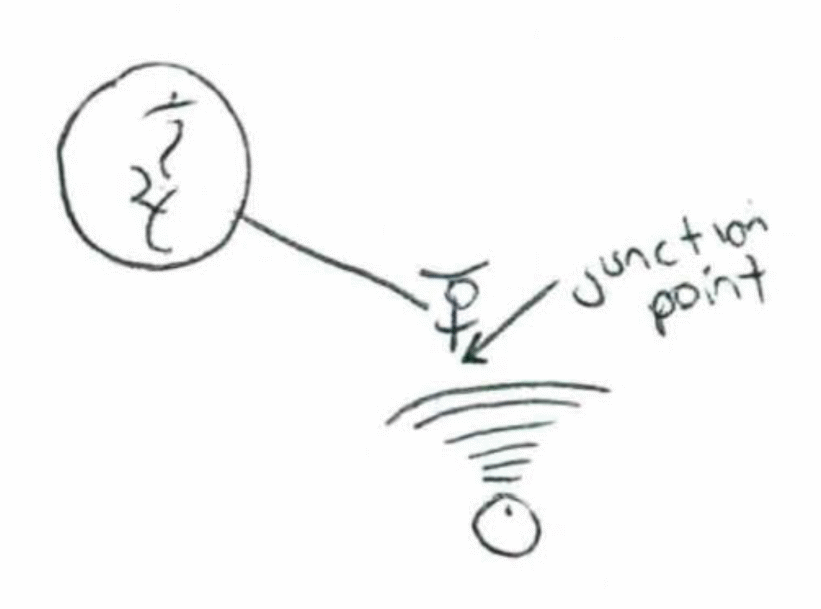
FIGURE 1983 0511-1-AB. Junction Point.
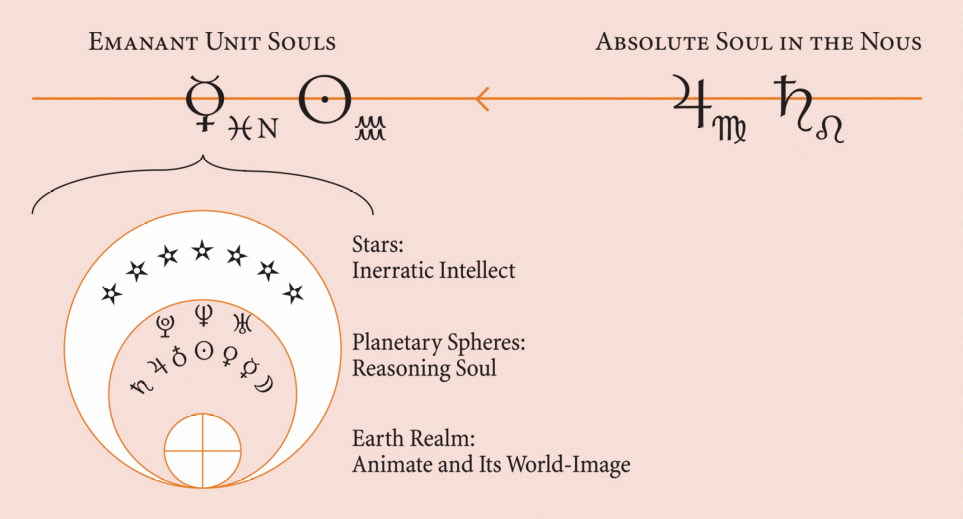
FIGURE 1983 0511-2. Tripartite Soul and Levels of Cosmos.
Second diagram is from Astronoesis, p. 203. [Transcriber note: [diagram] means the speaker is referencing a diagram as he or she is speaking.]
TRANSCRIBED Verbatim by IT 2018. Reformatted from V11a version by JRM & JF 2019-2020, with Subheads and Table of Contents added by JRM. In 2023, IT fixes prefatory matter and footer, updates audio file name, fixes/completes Book List, adds Plotinus quotes section, adds new notes within transcript, fixes minor errors, adds two diagrams and references within transcript to these diagrams. In 2025, MW expands Subsubjects and alters Subheads to make more accurate. Archival verbatim transcript – V14.1a.
AUDIO FILES: 1983 0511a, 1983 0511b. [Note: "Tape" and "Side" refer to original audio cassette tapes that were later digitized into .MP3 Audio Files.]
1983 05/11 at Wisdom's Goldenrod
PB Paras; Overself
Archival verbatim transcript
[Audio File 1983 0511a Begins]
NEWS ABOUT LARSON PUBLISHING PB NOTEBOOKS
RC: And, I guess there are three major categories completely done. [student assents] And, we'll be putting out a first volume of PB's notes to be a survey of certain number of pages and selections from the Notes on each of the 28 categories that we've been looking at as a single volume, that'll be the first volume here.
LR: Paper or hard?
RC: It would be in hard cover. And that will be available a little over a year from now, [S, faint: Oh my (word).] we hope. And, then after that we'll start-- we'll start doing a complete set, which will also be hardcover. And, it's real hard to tell at this point how many volumes that will be. I originally was thinking in terms of around 3,000 total pages. It actually wouldn't surprise me if it turned out to be more than that. But, it's a basic parameter of 3000 pages. And, depending on how well things are going at that time it would either come out as a set to be bought at once or it'll come out staggered like one volume at a time maybe every couple of months until the set's complete. And, Kenneth basically-- I'm-- I'm pretty sure Kenneth's going to start writing a biography. I don't know anything about when that'll be available. But, for the first time he seemed actually a little more than receptive to the idea of doing it. And in fact he-- he's going to India and he's going to look up some people while he's there, like Shankaracharya, Mahadevan, a few others, to ask them if there's anything that they would like to contribute by way of a spiritual biography of PB, things that they think would be important. [short pause] I guess that's about it.
S: Is the format going to be as the notes are now? I mean, you know--
RC: Individually?
S: Yeah.
RC: Yeah, yeah. They'll be arranged by categories.
S: Just little clips of categories.
RC (simultaneously): Yeah, they'll be independent, won't let there be a--
AD (simultaneously): [couple/three words inaudible] clips. [student assents] Did you ever come across a little clip? (bit of laughter)
S (very faint): [few words inaudible]
S: For who?
S: Well [three/few words inaudible]
AD (simultaneously): I'd like to-- I'd like to add a sentence to what you just said. Those of you who may get involved in this work, consider the Wednesday class very important. Because if you don't understand, then it just duplicates and triplicates the work. Going to do any editing and all that, [S, faint: Yeah.] it will be hard. Some of these notes are very difficult, especially the short ones, the clips. (bit of laughter)
[students assent, faint]
S (very faint): [few words inaudible]
LD: Don't work for me.
S (simultaneously, faint): [couple words inaudible]
S (faint): Yeah.
RC: Kenneth also said one thing that I-- I thought was interesting in that he-- he wasn't aware of it and I thought well maybe if he wasn't aware of it, maybe some other people aren't either. But he's been getting some communication from India from some of the well-known teachers there. And he's been really surprised at the esteem in which they hold PB. In fact, he was told that they consider him one of their own.
S (faint): Yeah.
S (very faint): Uh-hm.
S (faint): Yeah, told you.
RC: So Anthony asked him what-- what do they mean by "their"?
S: Yeah [couple/three words inaudible]
DB (very faint): Yeah, what do they mean [one/two words inaudible]
[short pause]
S (very faint, possibly part of background): [three/few words inaudible]
S: (Don't want to miss.)
S: So the gist is that Larson will be publishing the texts.
S (faint): Uh-hm.
RC: We will be doing the hardcover in North America. Rider has since not been able to make it on their own, they've become part of a group called the Hutchinson Publishing Group [student assents] in England. They'll be doing hardcover in Great Britain and market the (Indonesian) cover. It's a-- it's pretty large. And Weiser will be doing paperback in this country as far I guess as he chooses to go and see how far he goes. But there'll be a delay between the paperback publication-- between the hardcover and the paperback.
S: [couple/three words inaudible]
RC: Yeah, the hardcover will come out first and the paperback will come not less--
S: Not less?
RC: Yeah, not less than six months later.
S: Hm. Yeah.
RC: And the paperback will fall apart anyway so you might as well get the hardcover. (laughter)
S (amidst laughter, faint): In my case.
S (faint): Yeah.
S (very faint): Uh-hm.
S (very faint): [one/two words inaudible]
S (very faint): [one/two words inaudible]
RG: Right. (some laughter) This is-- here are a thousand pieces. (some laughter)
S: It's true.
S (possibly same S as above): True.
S: (Yeah.) (laughter)
RG: It's true. (You know, it's) nice and truth (and today you should come there). (laughter)
RC (amidst laughter): It's called marketing. (laughter)
S (faint): No it isn't.
S (faint): No it isn't.
S (very faint): What (does he mean)?
S (very faint): Yeah, that's right.
S (faint): Yeah.
S (very faint): Yeah.
[short pause]
S: Hey Randy, there's going to be any book in another language like in Spanish or--
RC: I think that especially the-- definitely the first book will be translated into all the languages that PB's books are in now. Oh another-- another good thing about these things coming out is that, at least what we're told, that both Rider and Weiser have agreed to make all the changes in the earlier books that PB wanted to make, at least the-- the important ones. 'Cause since there's new material coming out then they figure well they'll make some money on it and they can afford the carryover. [student assents, faint] So that's good, that's another good thing.
[short pause]
DB: What about distribution? Anybody directly or do you know (who's/what's) there?
S: Avery probably would know.
S (faint): Bring more [one word inaudible] (laughter)
RG (faint): It would be sold (as) a retail, David.
DB (faint): Ok, yeah.
S (simultaneously): Uh-hm.
S: Yeah.
DB: Coming from you I struggle.
VM (faint): [one/two words inaudible] wait a second, what do you really mean that's-- (some laughter)
S: Randy? Is the first book going to be based on what's to follow or is it going to be separate?
RC: Well I'd like to have it do two things basically. I think certain of the categories will have to be much more heavily weighted than others in the sense that want to make more obvious the perspective that PB's coming from so I think we have to weight some of the sections like-- oh the section on the Sage that we went through in class, some of the things about the Overself, things like that you just don't see in other volumes. But there'll be selections from each of the categories so that it should be able to stand independently for someone that has never read any of the material that could serve as a-- as an introduction. I'd like to have it so that if-- if somebody never bought any other book they'd have enough to think about for the rest of their life anyway. And it's interesting that(--) PB told me about one woman who read two of his books and did exactly what it said to do in the books and she got enlightened. (some laughter)
S: Which one(s)?
RG: Can you tell us which two?
VM: I don't think it matters exactly.
S (faint): That's right.
RG (faint): Yeah right. (RG laughing)
VM: That's the hard part.
S (faint): Two books and [one/two words inaudible]
AD: You mean enlightened or an enlightenment?
[short pause]
RC: Think it was enlightened.
RC/S(?): No, I'm not sure [one/two words inaudible]
AB: Later it was a few (months) all the way.
AD: Might as well read them all over again. (AD laughs a bit, laughter, student words)
RC: But then of course the other thing that he said we would have to do is that, the problem with his earlier books was that it made it seem too easy and you have to look at obviously that's not the case. [students assent, faint] He said he had people writing to him from all over the world would-- would basically say "I read a couple of your books and I'm not enlightened. What did I do wrong?"
S (faint): Did he (write) back to [one/two words inaudible]
S (simultaneously): Right, right, yeah.
RG: Right.
DB: Maybe somebody could like contribute some biographical material. (laughter)
S (amidst laughter): [one/two words inaudible] not being (enlightened).
MB (very faint): Some [couple words inaudible]
S: Put a picture in (it/there). (students assent, bit more laughter)
S (laughing): Where is that? (laughter)
[short pause with faint background student talking, laughter]
VM (faint): [couple words inaudible] would be seen as helping.
S: [couple words inaudible] (bit of laughter)
VM (faint): Look at him now. (bit of laughter)
S (very faint): He's on an extremely [one/two words inaudible] (laughter)
DB: Randy, (that was) the question I asked about the distribution of-- I'm not really concerned personally but I am curious as to who's going to handle all that.
RC: Well right now most-- Weiser of course will distribute his own books.
DB: Right, uh-hm.
RC: I think the arrangements that we've made for Larson may turn out to be better than what Weiser could do, and they're definitely cheaper. [DB: Uh-hm.] So, I think that's pretty well taken care of. But as far as this group goes, distribution wouldn't be a problem either.
[short pause]
PC: Randy is that material on the first volume going to be then re-included in the other volumes?
RC: Yeah. I'd like the idea of the set to be that, and why it's hard to tell at this point exactly how big it's going to be, I'd like to be able to present the set as saying that if you own this set you have basically everything essential and important in the Notebook. We might have to include-- the first time I go through I think I'm going to use about half the material, then when I go through the second time the percentage goes up a little bit. And as I go through the third time and see if I can cut it down I end up adding more. Anthony seems to think that it should all be presented. But we'll just have to see how much we can do. [short pause] But I was amazed especially in the section on Mentalism, when I-- when I went through that the first time I-- I didn't think there was anything new there. Then the second time a few things started to show up. By the time we were doing class (the--) it was almost all I can (think about).
[students assent, very faint]
[short pause]
AD: You might get to look like this, huh? (bit of laughter)
S (very faint): What do you mean?
S: Yeah.
S (faint): Yeah.
RC: That would be fairly quick.
S: Um-- (laughter)
S (amidst laughter): Yeah.
RC: You could help us (that) much on energy. Your honor, your honor, he's a-- he's a British citizen.
VM: That's right.
RC: And, because he's a British citizen we don't have to manufacture the books in the United States to have copyright protection. So, we might manufacture them in Sweden and that set is just a set of dummies that Robert made up.
VM: Is there a--
S: British though.
S: [one word inaudible] yeah.
RG (simultaneously): (You're) already blocked right here (then)? (RG laughs a bit)
S: Of course.
S (faint): Of course I can.
VM: That's the Void emission?
RG: Right. (laughter, student words)
RC: I thought I might call it one time [one word inaudible]
AD: It's also nine volumes, the Enneads.
S: Oh.
S (faint): Yeah.
DB (faint): That's right.
RC: Yeah, if we get it in nine volumes there'll be a lot (to) [one/two words inaudible]
S (simultaneously, faint): Good reason. (laughter)
S: Doesn't make them [couple words inaudible]
S (faint): [one/two words inaudible] that's right.
S (simultaneously, faint): Yeah.
S (very faint): You can't even read them.
RC: That's the other thing, we don't want to make the print too small.
S: No we don't.
RC: A lot of us would be blind by (then). (some laughter, student words)
RC/S(?): Ok.
[11¼ second pause with faint background student talking]
RC: I don't remember this one but--
[short pause]
"HE IS UNITED WITH, BUT NOT ABSORBED BY, THE INFINITE OVERSELF"
PB [V16, 25:2.199, RC reading]: "He is united with, but not absorbed by, the infinite Overself. He is a part of it, but only individually so. This is his highest condition while still in the flesh."
[short pause]
AH(?) (very faint): I'd like to have it again.
S: Go ahead.
S: Uh-hm.
PB [V16, 25:2.199, RC rereading]: "He is united with, but not absorbed by, the infinite Overself. He is a part of it, but only individually so. This is his highest condition while still in the flesh."
[12¾ second pause]
RC: So how would you relate that to the picture we've been working with?
S (very faint): I don't know.
JC: Something like the person he's referring to there is conscious of the Jupiter-Saturn phase [diagram] but not fully absorbed in that phase, he's still working through the Mercury consciousness [diagram] of the projected, you know, mental phenomenon produced by that mind, by that Mercury. [Note: See FIGURE 1983 0511-2, Tripartite Soul and Levels of Cosmos, appended to this transcript. This diagram is from Astronoesis, p. 203.]
S (very faint): Ok.
[short pause]
DB: So that-- excuse me but does-- does the individua-- individuality then-- I mean what precisely does that do with the body though?
LR: (Yet--) I can't hear either Jeff or you.
DB (simultaneously): What does the relationship of the individuality have to do with the body? That quote was (a) part--
VM: How are you using body Dave, maybe that's the important issue.
DB (simultaneously): Whichever one you've got.
S (simultaneously, faint): Yeah.
S (faint): Right.
S (simultaneously, faint): Uh-hm.
S (very faint): Yeah.
S: Which one? Corporeal?
DB: Well, I assume that was-- (what does he) mean, I might be wrong.
JC: You couldn't be conscious of the body unless you were working through the Mercury phase. That's the individuality aspect of the Overself.
RG/S(?): Ok.
[short pause]
DR: So Jeff is he-- do you think he's saying that-- that you are that-- I mean in your description of the Saturn, Jupiter and Mercury, that you are the Mercury? And he says you're part of the Overself but only individually so? Is that how you take him?
JC: Um--
DR: I mean is it that distinction again, that the Saturn-Jupiter is the all-comprehensive Overself? And Mercury really is part of that, but as an individual? That-- and [JC simultaneously: Yeah.] I know that doesn't explain it and it just rephrases it a little.
[short pause]
BS: Please read it once more.
S (very faint): Yeah.
PB [V16, 25:2.199, RC rereading]: "He is united with, but not absorbed by, the infinite Overself. He is a part of it, but only individually so. This is his highest condition while still in the flesh."
[short pause]
DB: So I mean the-- it would almost seem as if that (to be) united with it but only individually so then would somehow change after being associated with the flesh to the higher state somehow. And I-- I guess I don't really understand that. I mean because it's-- I mean on the one hand you could look that that is the Mercury being disassociated from the-- from the body, from the projected world and so forth, and that that Mercury is enjoying some different status than it had previously or this Mercury lasted, (remember) when we talked about the Saturn and Jupiter. So-- and I don't know.
AB: But that-- the quote might not necessarily find a corollary. In other words, if you're not in the flesh, then you are the infinite Overself.
RG: Isn't that (what) kind of does it [one word inaudible]
S: It doesn't.
AB: I don't think it necessarily does. I think it's just what Jeff was saying that, if you are in the body or functioning through the body then by definition the Mercury state is individualized. The Overself is individualized (for/through) you.
AH: It may be significant to con-- consider association with the body as different from attachment or bondage to the body. Like I would-- I understood this quote as like you could-- could be absolutely-- absolutely detached from the body but still-- still required to live out its karma, that individual association with a particular physically entity as a karmic fulfillment. And insofar as that body is still here, physically present, that individual remains.
S (faint): But that [one/two words inaudible]
RG: I mean, to me it does imply that there is a condition different than that and not in the flesh.
VM: Dickie, on that argument they had in Vedanta about is it possible to fully liberate in bo-- in the body. Some schools say yes, others say no. Total liberation only occurs after-- [RG: Wait a minute.] till after death. [RG simultaneously: And I-- right.] And it seems that PB's simply taking that point of view.
JC/S(?): That's (ok though).
AB (simultaneously): When you die you-- when you [RG simultaneously: (But the--)] die (and leave) from the (fleshly/fleshy) body you don't become liberated.
RG: I know.
VM: No, no but-- I'm not saying that, I'm not trying to imply that, but you know there's (a/just) schools of thought [AB: Right.] that say no, the highest form of liberation is not possible while associated with the body, it requires cessation of that-- that level of existence. Jivanmukti state is not the full complete liberation.
RG: But we've always argued against that and [VM simultaneously: I know, I know.] use-- and our-- and it stems from our understanding of PB, have always [one/two words inaudible] have understood it not to be that way.
VM (simultaneously): That's-- that's why this is a very-- that's why I wanted to hear it again (after) I first heard it.
RG: And I don't understand the--
TS (simultaneously): He doesn't say-- but he doesn't say it's the highest condition, he just says it's the highest condition while in the flesh.
VM: Yes [one/two words inaudible]
S (simultaneously): [couple/three words inaudible]
TS (simultaneously): (And) on that flesh, does that-- does that mean necessarily while alive or simply while attending to the physical body?
VM: Well, when we speak of alive Tim, we usually mean association with the physi-- physical body, I mean [one/two words inaudible]
TS (simultaneously): That's why the converse isn't necessarily true.
VM: No, the principle of life is more than its fleshy manifestation, I certainly would agree with that. But usually when you say alive you usually mean-- (laughter)
TS (amidst laughter): No, no but you--
VM: Let me-- No, that's (uh/not)--
S (faint): Randy can't read.
TS: In the quote he said that it's while still-- while in the flesh.
RG: Right.
S (faint): [couple/three words inaudible]
TS (simultaneously): And I could see that as-- I mean the way I understood that was that when the mind is attending to the individual and the body then the highest condition it can maintain is that of being individually linked to the infinite Overself. When the mind is otherwi-- when the mind is in itself or is part of that unconditioned Overself then it no longer can be in the flesh. But in the flesh means simply attending to or aware of the body, not necessarily the body as existence.
S (faint): Ok.
RG: Right, and I don't-- I don't see why that should [VM, faint: Be a lesser state.] be a lesser state.
BS(?): But when that mind [one word inaudible]
RG: It seems you're denying, you're-- you're saying that Sahaja isn't Sahaja I think.
S (simultaneously, faint): Yeah.
S: Yeah.
AH/S(?) (simultaneously): That is true.
RG (simultaneously): It's only when you're not in the flesh that you have the highest state [student assents] possible.
AH: But when that mind does not attend to flesh, does that mean you die?
TS: No, that's what I [S simultaneously: (No/Yeah).] was [VM simultaneously: No, that's Tim's point.] suggesting that it doesn't mean.
AH: You go into trance.
TS: Yeah.
AB: [couple/three words inaudible]
AH (simultaneously): But then you come back-- and you come back to the flesh.
TS: Yes.
AB: [couple/three words inaudible] Nirvikalpa (is) the highest.
AH (simultaneously): So it's an either or situation, you can have the higher state and then we don't have it.
S (simultaneously, faint): Is that what's happening?
S: Yeah.
AB: You're talking about Nirvikalpa, not Sahaja. This-- the problem is, doesn't Turiya or Sahaja awareness include awareness of the body?
TS: Yeah, that would be true.
AB: Whereas--
PD (simultaneously): Well isn't-- isn't the point that once you rel-- relate to a locus in the physical world within the body-thought or the world-thought, then you have to be functioning through the individual phase of the Overself. [student assents, faint] When you're not relating to the world-thought, then you don't necessitate that re-- that individual aspect of the Overself.
RG: But doesn't it [BS simultaneously: Yes.] seem that a part-- that that part of the Overself always retains that, if you're-- if you n-- if you-- if you-- if you're aware of the Overself? That just because you're relating to the flesh doesn't deny the awareness of that other part of the Overself, [PD: But you--] if you have realization.
PD (simultaneously): I don't see-- I don't see how you can be, you know-- [one/two inaudible student words] No, you're right, this is really a theoretical attempt to understand something that's super-mystical but-- It seems to be saying that if you're aware of the body-thought, you're not aware of the infinite amplitude of mind. And-- not the im-- maybe he retains the essence, the Sahaja state persists through both and he's aware of the-- the essence of consciousness. But in terms of the-- the fact that you-- you localize yourself within the world-thought to take up the body perspective is some type of individual perspective.
RG: Right but-- It is some type of individual perspective but it doesn't seem to be a necessary limitation to the realization of the Overself. That's-- that's the problem I have with this.
PD: Well I don't-- I don't think it is. I don't think he's saying that but he's saying that this-- there's a higher state available or possible. Let's say contemplating the Nous.
RG: If you can't do it while you're in the flesh, I mean I thought, I mean-- I thought that was the whole point, I mean you could do it. You have the world can appear and you could be in a completely realized state, I mean I don't-- I don't get it.
PD/S(?): But you wouldn't [couple words inaudible]
WHILE STILL EMBODIED, THE SAGE IS IDENTIFIED WITH HIS/HER INDIVIDUAL AWARENESS, THE I AM, BUT HAS NOT BECOME THE UNDIFFERENTIATED CONSCIOUSNESS
AD (simultaneously): Well let's read it. Let's read it again.
PB [V16, 25:2.199, RC reading]: "He is united with, but not absorbed by, the infinite Overself."
AD: So he's united with but not absorbed. So?
RC: The Mercury phase is still (working).
RG (simultaneously): He said he retains some sense--
AD (simultaneously): So then a Sage is identified with his I AM?
RG: Yes.
S (faint): Yeah.
AD: Which is united with the infinite Overself.
RG: Right. But he doesn't get absorbed completely by it.
RC: Uh-hm. So you're saying his I AM is the asmita principle. You're saying that his I AM is the asmita principle.
AD (simultaneously): Yeah. Yeah that's the asmita, sure.
RC: He remains--
AD: That's the awareness in him. He's identified with that.
JC: Is that the two percent that we've heard-- that two percent number we hear some time of--
AD: Finish the quote first before we go into how much of the ego is left.
PB [V16, 25:2.199 cont., RC reading]: "He is united with, but not absorbed by, the infinite Overself. He is a part of it, but only individually so."
AD: How could he-- how could he possibly mean there he's part of it yet [RC simultaneously: I think--] only individually so?
RC: --he remain-- I think he remains conscious of his own identity and of his own relation to the Overself. [AD: Uh-hm.] But, that doesn't put him in-- in a state of universal identity with all creatures automatically.
AD: He doesn't become the undifferentiated consciousness, [RC assents, faint] universal consciousness. Not yet, that always--
RC (simultaneously): The very act of re-- the very act of retaining his own identity limits his consciousness to that extent.
RG: I don't see why.
RC: And I would say that limits his consciousness.
LR: Dickie, I wouldn't call that a lesser experience.
RG: Well he does call it-- you're not-- you don't have a--
LR (simultaneously): He says this is his highest condition while still in the flesh.
RG: Right, doesn't [LR simultaneously: It seems to me--] that mean to you there is a higher condition not in the flesh?
AD: Well the highest condition is--
LR (simultaneously): That wouldn't be-- not for an individual.
AD: The highest condition would mean that this is as far as you can go while you're embodied, [RG: Right.] that is, identified with the "I" in you. That's as far as you can go.
RG: Right, but once you're not in--
AD (simultaneously): But, to go beyond that would mean you'd have to be free of any association or identification with any vehicle. [student assents, very faint] You have to be free of all of that. In other words the asmita principle in itself would not be differentiated from the Overself.
AH: Anthony, is that freedom death, trance or either?
S (faint): It'd probably be either.
S (simultaneously, very faint): Uh-hm.
AD: Well, if you're not in the flesh you're in trance alright. (bit of laughter)
RG: I'm sorry, I don't really-- I have no idea what that means, what you just said.
AD: Speak up Dickie, I (don't/can't)--
RG (simultaneously): I have no idea what you-- what that mean-- what-- what that implies, what that imports, I mean, that idea.
AD: What idea?
RG: The one you just said. Seems to be-- are you saying that in the flesh you're identified with this asmita principle which is not really the undifferentiated consciousness of the Overself and it's only when you get out of the body or after death that you can have that state?
AD: Exactly. Very good.
RG (simultaneously): I don't understand it.
AD: Very good.
RG: No I don't-- I mean I said-- I can, you know, parrot the words but I don't-- I don't understand what that means.
S: Well in the body you are-- you can have--
AD (simultaneously): Well if the soul associated with projecting a universe then what could-- what could the asmita principle be but any-- what could it become besides the undifferenced consciousness?
RG: I don't see why the asmita principle can't keep projecting a world and one's consciousness is identified with (your/my) soul.
AD (simultaneously): Well it can keep projecting a world and does. But in between, alright, between let's say states of rest or states of active manifestation, [RG: Right.] the Sage could be identified completely with the Overself. And that would be called videha [AD pronounces: vidi] mukti, right? [RG: Yes but--] Liberation after death.
RG: But I thought we made the point hundreds of times that that-- that that kind of understanding doesn't allow-- that-- I don't know, that that wasn't really the case, I mean I--
S (faint): That's what he said.
AD: I--
RG (simultaneously): That in fact the realization of that has to be available while you're in the body because the--
AD: Yeah but, available in the body could only be a temporary period, very short time. You know, like we spoke about, that would be a trance state. But if we're speaking about a person who is going to go into an unmanifest state, you know, he's going to stop projecting the universe from within himself, then all that remains let's say is this pure "I" that he is. This can hardly be distinguished from the undifferentiated consciousness. What differentiates it from the undifferentiated consciousness is the fact that it's associated with manifestation. But if that association with any kind of manifestation ceases, then he must fall back into the principle itself.
S (faint): Ok.
RG: So, let me just state my misunderstanding of it.
AD: Well, why don't you tell me your understanding of it.
RG: I'm going to give you my misunderstanding.
AD: No, tell me your understanding of it.
S (faint): Tell him.
AS(?) (faint): Tell him [one word inaudible]
VM (simultaneously, very faint): [one/two words inaudible]
S (very faint): What?
S: [one/two words inaudible]
RG: It seems to me that the whole point, that one of the purposes of-- of this practice and the study of mentalism and philosophy was that despite the appearance of the world-- one didn't need the cessation of the world appearance in order to have the-- the full realization that in fact the experience of the world appearance as not other than consciousness is available.
AD: No, it is other than consciousness because if you have an appearance you got something which is other than consciousness. And even if in the appearance you perceive that the substratum is consciousness, you still have an appearance going on.
RG: Ok but for the person's subjective realization, it doesn't seem that there has to be any difference.
AD: For the--
RG: The person's subjective realization, if he really knew that, I mean if he really was that, and in identity with the Overself, the world could keep appearing and it-- and it wouldn't affect his realization, inwardly.
SUPREME IDENTITY WITH THE HIGHER SELF, WITH THE SOUL, MEANS THE CESSATION OF ALL MANIFESTATION
AD: Yeah but I think he's speaking about the ultimate realization is the i-- supreme identity with that Higher Self, with that Soul. [RG: Right and I--] And that means the cessation of all manifestation.
RC: Well say that you can be united with it but not be absorbed by it, I mean how would you understand the difference in this (instance)?
RG: Well I thought you never really get absorbed by it. I mean I thought you-- you always retain this individuality.
AD (simultaneously): Well let me put it this way, I think maybe this way would be clearer Dickie. A Jivanmukti who passes away [RG: Right.] would inhabit-- would inhabit what realm? The Nous.
RG: Yeah.
AD: Alright? What manifestation is there? There wouldn't be a sensible world manifested.
RG (simultaneously): Right.
AD: Ok.
SAHAJA IS THE NATURAL STATE OF PEACE THAT COMES FROM BEING DETACHED FROM ANY COMPULSIVE ACTIVITY, WHEREAS NIRVIKALPA IS THE COMPLETE CESSATION OF ALL MANIFESTATION OF THOUGHT
RG: But would his realization be different just because his physical body died? I mean that's what I don't understand. Doesn't he have access to the Nous right here and now?
AD: Yes but it's intermittent, isn't it? [RG simultaneously: I thought--] It can be interrupted. And it can at times even be destroyed like when he sends Jeff down the block to saw a piece of wood.
RG: How could that be?
AD: And even the Buddha made the point that, you know, the five senses (some laughter) are ultimately the deterrents of this continuous peace.
RG: I don't (understand that). I thought-- well, I'm sorry.
AD: In other words, even the Sage is subject to the functioning of the senses and their constant interruption of that peace.
S: Right.
RG (faint): I don't get it.
VM: So it's a fragile sort of realization while in the body. Is there--
AD (simultaneously): It's not fragile.
VM: Well but you say it can be intermit-- it's--
AD: It can-- it is intermittent, it can be interrupted.
VM: I--
RG (faint): I'm sorry but--
S: But--
VM (simultaneously): So is that true of Sahaja? I'm sorry Dickie, I'm all--
RG (simultaneously): Go ahead, no, go ahead, you're doing (good).
VM (simultaneously): I'm going to stir, boy this is (mud/muddy). (bit of laughter) Is this true of the so-called Sahaja state [one/two words inaudible]
AD (simultaneously): Sahaja is peace. That's not necessarily [VM simultaneously: Continuous.] the realization that consciousness is the substratum of universal manifestation for the individual soul.
RG: Would you say that that is the realization in Nirvikalpa, that realization?
AD: There is no realization in Nirvikalpa.
RG: When you come out of Nirvikalpa, is that the realization?
AD: I'm sorry?
RG: When you come out of Nirvikalpa, is that the realization?
AD: Is what the realization?
RG: What you just said, that consciousness is the underlying substratum of universal manifestation.
AD: Yeah.
RG: And I thought that the Sage makes permanent the realization of that Nirvikalpa while in the body.
AD: But that would be to say that he had no-- he has no thoughts. And if he has no thoughts then how could he possibly walk around a chair? He's going to trip over it.
RG (simultaneously): He has vehicles. Well, he has vehicles. He's got sen--
AD (simultaneously): Huh?
RG: His vehicles function. But his consciousness-- I mean--
AD: Isn't that-- isn't Nirvikalpa the cessation of all thought?
VM (faint): Yeah. Including the vehicles that [one/two words inaudible]
AD (simultaneously): All thought!
S: Yeah.
PD (simultaneously): Including the world-thought.
AD: Yeah.
RG: But I still-- I don't see yet-- that's the definition, but I don't-- still don't get that that realization of the inner consciousness, even once the world appears, if you re-- if you can retain that realization what difference to-- to your inner subjective realization would the world appearance make if you really could retain--
AD: Well ask Jeff then why he was sent down the block to cut a piece of wood with a saw.
JC: Well, the noise bothered him. I didn't realize it but-- I thought it bothered a neighbor and after [RG(?): Me.] I was running around trying to be quiet it finally struck me it bothered PB.
VM/S(?): Yeah, sure. Just a little drop of water bothers you.
AH: But--
S: Yeah.
S: Hm.
S (very faint): (I think.)
RG: I mean if a-- I-- you know.
AH/S(?): Wait a minute, slow down. (some laughter)
RC: But there's--
PD (simultaneously): I don't know how it bothers you.
RC: If you were-- and it's [three words inaudible] you'd be united-- [S simultaneously: It's in the world.] united with the infinite or absorbed by it. It seems that if he were absorbed by the infinite, I don't see how there could be any finite experiences if you were actually absorbed.
S: It's a different [one word inaudible]
RG (simultaneously): Why-- why should the world--
S (simultaneously, faint): [one/two words inaudible]
RG: Yeah, I mean the World-Idea could appear whether the inner realization-- I mean the vehicles still are the organs by which the world appearance appears. I don't see why he can't be absorbed and the world appearance goes on in front of those-- through his sense-organs, I don't-- I don't see any problem with that.
RC(?): 'Cause it's still (his emanation).
PD (simultaneously): But if the world is a projection of his own soul, I mean, it can't go on.
RG: Part of it-- it's not the highest, I mean, part of his soul.
PD: But if his soul isn't projecting the world-thought, there is no experience of the world for him.
RG: The world may be going on and he doesn't-- [PD simultaneously: We're speaking--] I don't think he has to have experience of it.
PD (simultaneously): We're speaking mentalism Dickie, that world-- when his soul stops projecting [RG simultaneously: We're trying to speak mentalism.] there's no world for him.
BS: Solipsism on both ends, for the individual and (the Nous).
RG: I don't believe that the projection of the world is a-- is a-- is-- that one's identity with that appearance is a necessary correlate of the projection.
PD: The associa-- we're not saying identity, we're saying association.
RG: And if you're not identified with it and you're identified with your inner consciousness there's no need to hold that there's a change of internal state when the world appears or doesn't appear.
AB: Wait, isn't [S simultaneously: Uh-hm.] there a difference between being aware of the Mercury [S: Yeah.] phase of the Overself within you and you could still have manifestation. But that doesn't mean the Mercury is merged into or aware of its Saturn-Jupiter, the infinite Ov-- you know, Overself. So that you could have the aware-- awareness all the time while in the body but it's not the same as merging the Mercury back in.
S (simultaneously, faint): Yeah.
LR: Dickie, you can't claim that some kind of contact with the World-Idea is the same as no contact with the World-Idea.
RG (simultaneously): I--
S: Yeah.
RG (simultaneously): For who? I would ask for who.
LR: For the Sage.
S: For the Mercury.
DB(?) (simultaneously): Yes but--
RG: For his participation [LR simultaneously: Then you're giving--] in the world's karma, maybe, I would say for his inner realization I don't see why there is. Manifestation or non-manifestation as a content, I don't see why there's any essential difference in his consciousness.
PD (intensely): 'Cause that's the basis of mentalism! That World-Idea is for him or it's not his-- it's not mentalism, Richard.
RG: No, I disagree.
PD: I know you do!
RG: I mean I'm not--
PD (simultaneously): I mean that world is projected by his own soul or it's not projected at all!
RG: That doesn't deny what I-- you still haven't answered my question.
PD (simultaneously, intensely): Yes it does 'cause you're maintaining he's having perceptions but he's not interested in them. (laughter, student words)
RG (amidst laughter): Yeah just-- that's exactly right. That's exactly right.
PD: But then what's perc-- what's putting forth the perceptions? [RG simultaneously: Oh his--] The World Mind's perceiving for him?
RG (simultaneously): He's putting-- his vehicles, his rational soul, his various koshas, his sense-organs.
PD: But then we're going right back to materialism, there's an object apart from his projecting consciousness.
RG (simultaneously): Who said [one word inaudible] That's not what I'm saying at all.
PD (intensely): I'm saying it is what you're saying, Dickie!
RG: You're saying it so that I make it that.
AD (simultaneously): I think Dickie where you're coming from is the feeling that there's a homogeneity [S, faint: Here we go again.] [S: Uh-hm.] [one/two inaudible RG words simultaneous with AD] in the World-Idea, let's say the substratum of consciousness which underlies-- underlies the World-Idea. What I'm trying to point out that it's even a canonical saying among the Buddhists that it's a Buddha who himself said that the senses interrupt his peace.
RG: Well, I could--
LD (simultaneously): Yeah but then if you take a book like the Tripura Rahasya they say the opposite, that full realization must be attained with the eyes open. And-- and before we maintained that--
AD (simultaneously): Yes Louis, I know. And so, and so you-- the Gelugpa sect say that realization must be attained with the full functioning of all the sense organs. And I'm trying to point out and if you take the trouble to listen very carefully, ok, it is still, so to speak, an interruption of that realization.
LD: But, if I can ask, then you're maintaining that Nirvikalpa is a higher state than Sahaja, and many many times before we've said Sahaja is the highest state. [AD simultaneously: Sahaja is--] But you're making Nirvikalpa the highest now.
AD: Sahaja is the state of peace that comes from being detached from any, let's say, compulsive activity within the cosmic circuit, so that the person is in a natural state of peace. That's Sahaja. Nirvikalpa is the complete cessation of all manifestation of thought.
LD: So, in that you're maintaining that Nirvikalpa is a higher state now. Or not?
AD (simultaneously): I'm not maintaining higher or lower, I'm just explaining.
LD: And I'm just asking.
RC (simultaneously): Let's (just) fold back in on the quote here.
AD: Nirvikalpa would be equivalent to when the I AM is absorbed in the undifferentiated consciousness or universal consciousness which is the Overself. Now you draw your consequences. But you cannot have the asmita principle manifesting the universe and not reciprocally being affected by it to some extent, however insignificant that extent is. But there's no such possibility when this principle, asmita principle, is now let's say detached or has ceased any manifestation. Now you cannot distinguish it from the undifferenced consciousness. Because the only thing-- the only way that you can distinguish the I AM or the asmita principle from the Overself is because it's always associated with manifesting a universe for itself.
WHEN THE ASMITA OF A SAGE IS NOT MANIFESTING A UNIVERSE, IT'S IN IDENTITY WITH THE PURE SOUL, BUT IT DOES HAVE TO RESUME ITS ACTIVITY SINCE IT'S THE VERY NATURE OF THE ASMITA PRINCIPLE TO MANIFEST THE UNIVERSE
LD: Then what is the whole idea of a Sage that keeps reincarnating or the idea of a Buddha that reincarnates for the welfare of the world and not so much for himself? What about the quote where PB talks about everyone, including a Sage, must constantly reincarnate, must constantly come back? It don't seem like it's so much for the welfare of themself that they're manifesting the world. They're manifesting that world for the welfare--
AD: I think you only accepted that part of the quotation which you find useful. The other part would be that he has to go on reincarnating, [LD: So you're saying he has--] whether for the welfare of others or not. But he has to go on reincarnating. It's the very nature of the principle of asmita to manifest the universe.
VM: So Anthony, if-- I hope I'm not interrupting you.
AD (simultaneously): Now if you drive that, you know, for all it's worth, then why not do it for the welfare of others?
S (very faint): We can.
VM: If you say, Anthony-- I just-- maybe I'm really confused, that's probably the case, but if you say that full-- full-- fullest realization requires a full detachment of consciousness from the body. Now, that can either happen in one of two ways, one simple way we can all do when we get around to it is Nirvikalpa samadhi. The other way is, let's say if you're liberated in the fullest sense of the term, when you die that occurs too. But insofar as you had to reincarnate, if I understood your last statement, that means that no matter what stage you're in in development, that realization can never be permanent in the full sense of the word because you're forced back [AD simultaneously: Uh-hm.] into reincarnation, you're associated again with manifestation and therefore that realization has to be intermittent at least while the incarnation is that--
AD (simultaneously): The highest, that highest form of realization has to be intermittent, of course! I mean, you can only [VM simultaneously: (I don't see) (three words inaudible)] for certain periods-- Again. During those periods when this principle is not manifesting or projecting a universe out of itself, in the case of the Sage it can-- we can speak about it as being identic-- in identity with the pure Soul, with the Overself, alright. But, this may last a hundred years or a thousand years. The point is it does resume, it does resume, it does come back, it does manifest a world again, alright. At that pe-- at that time when it does manifest the world then it has to receive into itself this vibratory activity which is the World-Idea. [TS assents, faint] Now even at that basis you can see that there's going to be something less than the full realization of identity with the Absolute Overself. I don't see why you're making this into an issue [S, faint: But--] if you understood what had gone before.
PD: But in either condition the Sage remains the Sage.
AD: He's a Sage, yes, he's not less a Sage.
PD (simultaneously): And not-- That seems to be the con-- the confusion, they're taking one aspect as being the Sage and not let's say the facility in both.
DB: Well what-- what is the distinction between the state of consciousness which the Sage enjoys while he's in the normal manifesting waking state as opposed to, you know, the mystic who on his way there goes into Nirvikalpa for a half an hour one day and then two hours the next or whatever, and, I mean, what-- what is fundamentally the distinction there because I-- I just got it all wrong.
UNTIL SAGEHOOD IS ACHIEVED, THE WORLD-IDEA WILL INSIST UPON THE INCARNATION OF THE ENTITY, BUT THE SAGE IS GIVEN A CHOICE OF THE TYPE OF BODY THEY WILL INCARNATE IN
RC: Well I asked PB actually [TS simultaneously: (Now you know--)] and specifically about this particular question because I couldn't understand how as Jivanmukti is defined, I didn't understand how he could say that he had dedicated himself to a life through constant service, that how does someone who's a Jivanmukti, who's not making any more karma, how does he come back again. He said usually they don't. We talked some more, he said there's-- there-- there's association with some kind of body, but not this kind of body usually, and that to come back to this type of body he has to actually exert (moral) will. And if he doesn't do that, he won't come back. [TS: Yeah.] And I think that's what he means by "flesh" here, this type of-- this type of body.
DB: Right, yeah, [VM simultaneously: Oh sure.] that's what I was understanding.
RC (simultaneously): And that by being in this type of body, susceptible as it is to old age and death, imposes certain forms of unpleasantness on his consciousness that [S: He can't be free of.] he can't be free of.
DB: Right. And I'm-- [VM: That's too bad.] I'm not-- my problem is that, again I still don't see the distinction then between-- I mean on the-- on the one hand you speak of a-- of a Jivanmukti who has the facility to go in and out of a trance state, you know, into Nirvikalpa samadhi where he can be completely absorbed in the Overself and yet participate in the world. Now what in his participation in the world is different from a mystic who has not attained--
RC: Well I think what he's saying here is that, when he's absorbed, he's not active in the world.
DB: I-- Randy, I understand that, granted, I mean, that has been my assumption for some time. That's-- my problem is I don't understand when he's not absorbed, when he is involved in the world, when he is participating in the various activities that go on, what is the distinction between that state of consciousness he enjoys then or has then as opposed to the mystic who has the ability to go in and out of Nirvikalpa samadhi but doesn't retain an awareness af-- after he comes out of-- out of trance.
LR: [few words inaudible] that far.
AS (simultaneously): That's it. I think you just said it. No, he just said it, that is the difference.
DB: Well I know, I know but I mean what did I say, I mean what-- I--
AS (simultaneously): No David, I think you were right. What-- just what you said, in the case of the mystic he goes into Nirvikalpa, he comes out and he still has a compulsion-- compulsive attachment. In the case of the Sage he may go into Nirvikalpa too and in terms of Nirvikalpa there's no distinction. But in terms of when he comes out of the Nirvikalpa and he's in the waking state he doesn't have the compulsive attachments, so his state of consciousness is always one of peace. Although when he's in the world and the world is appearing, he's not in the state of Nirvikalpa. [DB: But what--] Whereas the mystic when he comes out, he's also not in the state of Nirvi--
(Side 1 of original cassette tape digitized as 1983 0511a Ends; Side 2 Begins)
S (very faint): --that's--
AS: (Well/Right), I think the point was in terms of the other end, the Nirvikalpa end, Nirvikalpa's Nirvikalpa, I mean, whether you're [DB simultaneously: But--] a Sage or a mystic or--
DB: No, in order--
PC (simultaneously): Wasn't the question though in terms of this [one/two words inaudible]
AD (simultaneously): Well let me go back to the question that Randy brought up. PB said that the Sage had to will himself back into a body of flesh and blood. Right? You say he said that.
RC (very faint): Uh-hm.
AD: Now you remember in the quotation we read we figured out that this principle of "I" was a principle that evolved with the World-Idea and is-- was ultimately guaranteed by the World-Idea. [RC assents, faint] So--
RC (simultaneously): Yeah. Maybe we could say not this type of body.
LR: So?
AD: Yeah but the point I'm trying to get at, un-- until that-- until that Sagehood is reached, alright, then there's the guarantee that the World-Idea will insist upon the incarnation of this entity until he achieves liberation. [RC assents, very faint] Then he's given a choice whether he-- he-- that is he can incarnate in a body of flesh and blood or he has to hover about these bodies of flesh and blood for instance like in the astral realm and there take guidance and direction-- give guidance and direction. [RC simultaneously: Uh-hm. (couple words inaudible) that he can do.] But that he is involved in the World-Idea and must go along with it was something that that quotation made very clear. There was no getting away from that quotation.
TS: Yeah but I-- the way I understood that, and a-- or a similar one was that-- [short pause] that it would always be a physical incarnation but it might not be on this-- or this-- It could come as being on another physical location.
AD: It could what?
TS: It could come to be on a star. It could be a physical body on a physical star.
AD: It doesn't matter where. [TS simultaneously: But it would still be a physical body.] He-- he has to take an embodiment somewhere along the line.
TS: And he also says that in the definition of the category, it's called the "Enlightenment Which Stays", that it is intermittent, that it is the capacity to say maintain a link to the [AD: Uh-hm.] uncon-- the Nirvikalpa state and it is that capacity to maintain a link that is the enlightenment which stays. And not that-- as long as there is the physical body, it must be intermittent.
AD: Yeah but that capacity to maintain that link, alright, then presupposes his constant identification with the I AM.
TS: Yes.
S (faint): Uh-hm, yeah.
S (faint): Maybe that's where--
TS: Well--
THE SAGE IS THE I AM, WHICH PERSISTS THROUGH ALL THE VARIOUS SO-CALLED STATES OF CONSCIOUSNESS—SLEEP, DREAM, WAKEFULNESS
RG: But, I'm still-- I mean I follow what you're saying and I (just/could) accept it, I mean I-- you know, I have no reason not to, I mean, if you-- if you say it's true. (RG laughs a bit) But it does to me, I mean with some of the writing that PB does in the end of the Wisdom, this seems to be very contradictory to that and I don't know how to put it together. So I could either give that up or just, I mean, (we/I) could try to understand how the-- how the two views merge 'cause to me they seem extre-- you know, on opposite ends of the spectrum.
AS: But, Richard, I don't know.
RG: Well I mean it's just--
AS (simultaneously): Maybe this is-- well, this--
LR (simultaneously, faint): Well, why don't you read the quote [couple/three words inaudible]
AS: Ok. But--
LR: He refers to this [one/two words inaudible]
AS: I still don't know where this is but--
RG: In "The Mystical--" [AS simultaneously: Sorry, but--] in "The Mystical Phenomena of Meditation" where he says-- This is from first--
[Transcriber note: I am using The Wisdom of the Overself by Paul Brunton, Rider and Company, London, 1943.]
PB [The Wisdom of the Overself, "The Mystical Phenomena of Meditation," pp. 259, 260, RG reading]: "He disciplines his consciousness to hold the body-thought without identifying itself with it, to function through the five senses without ceasing to function in the infinite Mind. [RG: Capital N-- M.] … Unless it is effortless and natural and continuous, it is not the final and most revelatory degree. The moment there is the slightest strain towards being or knowing, that [RG reads: the] moment there is a descent from the true insight, a degradation of the true existence. Such a state of effortlessness can of course arise only after a long novitiate. The enduring transcendental awareness can come only through unremitting mental toil throughout the day to keep the Real ever in focus. It is the long-ripened, slowly-grown fruit of vigilant watching over the attention as an unbroken process of harmonizing the Unmanifest Mind with its ever-appearing ideas. Thus the proficient is not only able to get a true glimpse of reality but, because he gets it with intelligent understanding, he is also able to stretch out these glimpses more and more into his ordinary worldly life. Finally they are stretched at full length into all the twenty-four hours of the day and night. Thus they are stabilized and made permanent and henceforth he dwells in unfettered unity. With this attainment the ultramystical training of the philosophic path completes itself."
S: Yeah but the difference there, you know, is just-- What you are reading he is talking about the various stages and states of a person living in this flesh and body. In the quotation there is-- that you read, he's not-- he's not talking about different state. He's talking about that so long as you are in this flesh and body, you cannot get rid of the ego-self or lower self. And it is that lower self which gets the realization, identification, knowledge of that Higher Self. [RG/S(?) simultaneously, faint: Uh-hm (one/two words inaudible)] The real Overself you-- only you become when you get rid of this body.
RG: Yeah. Ok, let me just finish, ok?
S: Ok, go ahead.
PB [The Wisdom of the Overself, "The Mystical Phenomena of Meditation," p. 260, RG reading]: "Thus the ultimate aim is not to suppress thinking and sit in prolonged [solitary] trances. It is not even to keep the mind free from thoughts but from their tyranny, to bring it to understand the true significance of their characteristic manifestations as"I" and the world, and to make the man effortlessly over-conscious [RG reads: ever-conscious] of his own innermost essence alongside of his personal existence. Once he thoroughly enters into the fourth state the sage is never able to escape from it again. Whether awake or asleep, in repose or at labour, he is held abidingly by its enigmatic transcendence. The fourth state if fully attained is continuous throughout the other three. It does not vanish with the oncoming of either bodily sleep or bodily wakefulness. It is effortlessly retained in the sense that a man in the wakeful state effortlessly retains his personal identity."
S: Yes, except that was part of that quotation.
AD (simultaneously): And what's (wrong) with what he said?
RG: Well I think it just [S simultaneously: Yeah.] put it together, I'll be happy to listen [one/two words inaudible]
PD: But that seems-- that--
AS: Well I think we're only-- well-- when even the words he uses like the essence is identical, now, wouldn't you say that when we spoke before about the principle of awareness versus awareness, we said that the Mercurial phase was the awareness which goes through all possible manifest states, waking, dreaming, sleep. And he's saying that in essence, you now have realized this identity in essence with the Overself, meaning that he is that awareness.
S: [couple/three words inaudible]
RG (simultaneously): Except I think in an essence though, he says he retains it throughout [AD simultaneously: Yeah.] all the other states and that [couple words inaudible]
AS (simultaneously): But what does he retain? He retains that awareness, the awareness of the consciousness principle, the Mercury, the light of the soul. [student assents, faint] Isn't that what goes through and lights up all the other states, all possible states of manifestation.
RG: So you're saying he's not aware of his Overself.
TS: No, he's saying that--
AS (simultaneously): He is because I'm saying, I think-- well maybe [couple words inaudible]
S (simultaneously): Maybe that's part of the quote.
AS: But I think he's saying--
AD (simultaneously): Again, again, the discussion here is to remember that when you say Overself you're speaking about it [AS simultaneously: Both phases.] in these two different ways.
AS: Yeah.
RG: So, and--
AS (simultaneously): So he is aware of his Overself as the consciousness.
RG (simultaneously): But only the lower phase of it.
AS: But when you-- now--
AD (simultaneously): That's not a lower phase!!
S (simultaneously): No, it's not a lower phase.
RG: You said it was.
AS: But Richard, now when he-- I think what the problem, when he's not [RG simultaneously: If it's not a lower--] identified with it then you'd say there are two phases. But when he is identified with what you previously called the so-called lower phase, if-- if the Sage realizes the identity and essence of that (light/life) or consciousness with the principle of consciousness or the Overself, [RG: Yeah.] then he recognizes that it is in fact the Overself.
RG: Oh, well then there's no higher condition. Then there's no next highest condition if he has that realization.
AS (simultaneously): Except that-- except that as he says, there's simultaneous awareness if the light is pointing towards the manifestation.
DB: Right but I--
AS: Well he-- you know-- [S simultaneously: You could put like--] Yeah I could pull out-- there are lots of quotes in Plotinus where he says that too. He can re-- he can attain identity even with the One but he can't stay there.
RG: But he's saying you can stay in this state.
AS: That's right and that's why I [LR simultaneously: And there's still a ("who") (one word inaudible)] think-- so according to the interpretation, when it says you can stay in that state, it means the state of [S: I see.] the consciousness functioning towards manifestation, not in the state of no manifestation whatsoever.
RC: Yeah [one word inaudible]
DB/S(?): [few words inaudible]
RG (simultaneously): But when there's-- he says if-- it's retained whether the body is in full wakefulness-- wakefulness or sleep. [student assents] It has the same awareness.
PD (simultaneously): Yes, but the body's there in all [student assents] three states, sleep, [DB simultaneously: Yes but the bo--] wakefulness, dream.
RC/S(?): No [couple/three words inaudible]
DB (simultaneously): But isn't the body recognized as being--
AD: That's what-- that's what it means to s-- to say that the Sage is aware or is the I AM, persists through all the various so-called states of consciousness--dream, sleep, wakefulness--the immanence of being in that state. It's just that-- it's just that you'll undervalue the-- this asmita principle.
RG/S(?) (faint): I won't.
RG: If you say that after he dies that he then has this attainment of this, you know, wider or whatever realization, that he's in consciousness of the Overself without manifestation attached to it, there are other vehicles when-- I mean when he dies, why-- why aren't they classed in the same [one word inaudible]
AD (simultaneously): He doesn't have to wait to die.
RG: That's right.
VM (faint): Body dies.
AD: He doesn't have to wait to die to know about those other vehicles and inhabit them and live in them.
RG: Right. [student assents, very faint] So--
AD (simultaneously): When we're saying-- when we say he dies that's why I changed the wording, [S: Yeah.] because-- to be [S simultaneously: That's more--] more-- The function of manifesting is stopped. [AS simultaneously: That--] And that means that even if-- even if he inhabited an Augoeides body, which he does while here-- Don't think that he's got to go up to a star to inhabit it.
RG (simultaneously): Ok, let's say while he's here.
AD: If he's-- if the function of manifestness ceases, alright, then we could speak about him as being this pure I AM which cannot be distinguished from the Overself. It's only a verbal distinction when you say that that ray of the Overself which entitles us to claim ourselves as individual is distinguishable from the principle itself but not separate, it's united with it always.
RC: That seems to be important that he's saying it's united with it always.
AD: Yeah.
RC: It's just not absorbed by it.
AD: It doesn't have to be absorbed. Why does it have to be absorbed if it's always a part of it?
RG: I would say it never has to-- it never is absorbed because that ray is always-- he's in an [S simultaneously: No.] eternal-- he's eternally manifesting [AD simultaneously: So what--] one body or another.
AD: Yeah.
TS (simultaneously, faint): [couple words inaudible] Nirvikalpa.
RG: Well so then-- I thought [one/two words inaudible]
AS (simultaneously): No I hope I wait and see, can never be absorbed anything, can never have Nirvikalpa.
RG: I know but [one/two words inaudible]
AS (simultaneously): I don't think that's right.
RG: I'm saying--
AS: Never destroyed maybe but it can be absorbed temporarily.
AD (simultaneously): Well absorbed-- absorbed here would be misleading but I think you know what we mean.
RC (faint): Uh-hm.
AS: I'm just saying that it can cease its functioning. Absorbed in the sense that that function can cease for a while and go just Nirvikalpa.
RC: Well that famous passage that we've read so many times from Plotinus that starts out with "Many times it has happened: Lifted out of my body into myself…" [Note: See Plotinus, IV.8.1, first para.] [S, very faint: Yeah.] Continues from there and then when he comes back the question is not how my soul came into this body but how Soul came into my body, and capital S Soul.
S (faint): Yeah.
AD: And then he explains it, right?
RC (faint): Uh-hm.
AD: Alright, let's go on to another quote.
RC: I think this one will actually help to bring out some of the points (that are) important.
THE UNITY OF THE WORLD REFERS TO THE ASMITA PRINCIPLE, AND THE WORLD-IDEA REFERS TO THE PLURALITY, AND THE ILLUMINATE IS POISED AT THE JUNCTION OF THESE TWO
PB [V16, 25:2.115, TS reading]: "The illuminate is conscious both of the ultimate unity and immediate multiplicity of the world. This is a paradox. But his permanent resting place while he is dealing with others is at the junction-point of duality and unity so that he is ready at any moment to absorb his attention in either phase."
JC (faint): Can you reread?
TS: I think I better read that again.
S: Uh-hm.
TS: There ain't no-- there's no comma after "unity".
S (very faint): (There is no comma.)
PB [V16, 25:2.115, TS rereading]: "The illuminate is conscious both of the ultimate unity and immediate multiplicity of the world. This is a paradox. But his permanent resting place while he is dealing with others is at the junction-point of duality and unity so that he is ready at any moment to absorb his attention in either phase."
[short pause]
S: Go ahead.
JC(?): I don't know.
RC: Well if he's at the junction point of duality and unity, and he's ready at any moment to absorb his attention in either phase, then it would seem that if he absorbs it in duality, he'll remain united with the Overself, his attention is absorbed in the World-Idea, the multiplicity of the universe. If he goes the other way and he absorbs his attention in the ultimate unity, then he-- his principle of manifesting would not be operative, the multiplicity of the world would not be presented to him. And for-- I don't know if you could measure it by time but, for as long as that goes on, you'd say he is attaching, is absorbed in the infinite Overself.
AB: Randy? Illumination is not being conscious of both at once.
S: Well--
AB: But the capacity to direct one's consciousness in either direction.
AH: I think perhaps illumination is the position of poise.
RC: Well he said that his permanent dwelling place while dealing with others is [student assents] this junction. And we've spoken of the way he uses Overself as being precisely that which unites this-- this apparent duality. And this sort of brings out the pole for me or more of that apparent duality, that one of the poles of the apparent duality is unity and the other pole is duality.
LR: What is the ultimate unity of the world in that sense?
S (very faint): Uh-hm.
AD: Unity of the world?
S (faint): Yeah.
LR: Doesn't he say ultimate unity and immediate multiplicity of the world?
S: Uh-hm.
S (faint): Uh-hm, but you see that--
LR (simultaneously): Well that-- wouldn't the ultimate unity be of the world also?
AS: Uh-uh.
LR: Or would that be--
DB (simultaneously): Well it'd be the World-Idea, wouldn't it?
LR: Pardon me?
DB: I mean wouldn't that be the difference between the World-Idea and its complete unfoldment?
LR: And its appearance.
DB: Yeah.
LR: Ok.
AD: Unity [AS simultaneously: Don't they--] usually refers to the asmita principle.
LR: I [one word inaudible] that.
AD: And the World-Idea to the plurality. [student assents, faint] And that he's poised at the junction of these two. We can, so to speak, of-- speak of his identity with Beingness or I AM. Or he can throw his attention into the world of multiplicity.
JfL: No I thought he was saying the ultimate unity was the Nous, the identification-- I thought the-- I thought what Randy was saying was that the permanent resting place was the Mercury and that he has a choice in either looking higher, contemplating the Nous, or lower by participating the World-Idea in multiplicity.
AD: Try reading it again then.
[short pause]
PB [V16, 25:2.115, RC rereading]: "The illuminate is conscious both of the ultimate unity and immediate multiplicity of the world. This is a paradox."
AD (simultaneously): Yeah, stop. I would ask you-- I would stop now. What is this unity that he's referring to?
AH: Ultimate unity of the world.
RC: Well I don't think that the ultimate unity of the world is the Overself. And I'm going to read a quote that I--
AD: Well wait. What do you mean by Overself here? [S: Yeah.] The [S simultaneously: Yeah.] I-ness or the pure principle itself. What do you--
RC (simultaneously): I actually mean both. I mean, so far as the train [couple/three words inaudible]
AD (simultaneously): Now look, now look, if we s-- if I speak about the world for me, alright, and there can only be a world for me, I can't speak about your world. The world that's manifesting in my consciousness has my consciousness as its unity. There is no other unity to the world that I perceive except in my consciousness.
RC: Well, I could see the World-Idea as the unity of the world.
AD: Ok.
RC: I mean, why couldn't I see the World-Idea as the unity of the world?
VM: Isn't the World-Idea more on the content side? And the consciousness which suffuses it or lights it up more the unity? I mean I think that's what Anthony is trying to formulate.
RC: I guess if you-- if you say that it's the Mercury, yes, ok. If you-- if you restrict it to the Mercury, then definitely that Mercury would be the ultimate unity of the world.
S: Uh-hm. Definitely, definitely.
RC (simultaneously): I cannot conceive of that Mercury not being in association with the World-Idea.
S (very faint): Yeah.
LR: I mean--
[students assent, very faint]
VM: No I don't think that's the issue though.
S (very faint): What does that mean?
LR: Yeah, no.
VM: I mean [S simultaneously: (It wouldn't) be (one word inaudible) attention part?] granted, granted if there-- if there is this Mercury principle that-- this asmita, the world is along with it. But I don't think anybody('s) just, you know, contending that issue. I thought the issue was what is it that is the ultimate unity of the world. And rather than put it on the side of the content, that which comes and goes and changes, it's on the side of the Overself principle in the sense of having--
LR (simultaneously): No but Randy's saying that it wouldn't be an "or", it wouldn't be an "or", he was--
VM: "Or" what?
LR: He is-- well, he's conscious both of the ultimate unity and the immediate multiplicity of the world, ok? Now if you make the ultimate unity of the world the asmita I AM, ok, then you're saying that that's not associated with the World-Idea?
VM: No, I never said that. I'm just saying that this-- the unity would come from that side, if it's true.
LR (simultaneously): In either case there'd be an association with the World-Idea.
VM: Fine, uh-hm.
LR (simultaneously): Anthony's saying he could be attentative to either the I AM or the World-Idea.
AS/S(?) (faint): Uh-hm, then that would be it.
AS (faint): Makes sense.
VM (simultaneously): That's fine. [three/few inaudible RG words simultaneous with VM] I didn't think that was the-- that was the [one/two faint inaudible student words simultaneous with VM] issue we were struggling with.
LR: It's the "or" I was talking [student assents, faint] about.
AS: Seems like a real "or". I mean he could be attentative to the consciousness or to the--
LR (simultaneously): And then he said that if it's conscious of the-- if the Mercury phase is the I AM, then he said he can imagine the Mercury phase being disassociated from the world.
AD: Then in other words there cannot be samadhi on asmita. There cannot be concentration or contemplation [S simultaneously, faint: No but--] of the pure I AM.
LR (faint): Yes there can.
[students assent, very faint]
S: Well--
LR: [couple/three words inaudible]
AS (simultaneously): In other words it could get self-absorbed to such a degree that there is no manifestation of a World-Idea for it and yet it's still not the, you know, eternal Nous.
LR: [one/two words inaudible]
S: Do you mean that--
AS: [few words inaudible] state. The first realization is [one word inaudible] to the second that he meant to be different.
IF YOU UNDERSTAND AND PENETRATE MENTALISM, YOUR WORLD MUST BE MANIFESTED BY YOUR SOUL, NOT MINE, FOR YOU, NOT FOR ME
DB: But-- excuse me but doesn't-- I mean we had-- we had spoken at one point of-- of the World-Idea including within it the entire individual-- all these different states of consciousness, wake, dream and so on and so forth. And I guess at this point I'm a little bit confused as to what it would mean that (I'm into state(s)).
AD: It's all going to be [AS simultaneously: It's (one word inaudible) that.] manifested through that unitary consciousness.
DB: Right. But, I guess-- what I-- what I'm asking is that an individual's like development at the level of the samadhi on asmita whatever, that's not part of the World-Idea anymore?
AD: No.
DB: Ok.
AD: Again, I'm repeating. [S: Right.] It is all going to be manifested by the unitary consciousness which is referred to as your I AM, alright, or the asmita or Being that you are. All these are various terms. If you understand mentalism and you penetrate mentalism, it must be manifested by your soul and not mine, for you and not for me.
DB: Granted.
RC (very faint): Uh-hm.
AD: So that means that the World-Idea which is going to be manifested or projected out from this unitary consciousness, alright, will include all the necessary sheaths, vehicles, levels of consciousness, etc, that you can conceive of.
THE SAMADHI ON ASMITA, THE CONTEMPLATION OF THE PURE I AM, IS NOT PART OF THE WORLD-IDEA
DB: Ok. So-- [S: Yeah.] so that-- so that even from an individual's-- individual's point of view, I mean any-- any given state of consciousness that he's going to have would be--
AD: Short of the Overself consciousness.
DB: Ok. But in-- so not to include this samadhi on asmita? I mean, that--
AD: That's what I just said, yes.
DB (simultaneously): Ok.
RC: That samadhi on asmita, the "I"-- the "I" that's there declaring I AM, isn't that "I" itself part of the World-Idea?
AD: No.
RC: It isn't.
AD: No.
LR: Remember that quote Randy you read before?
AD: That's the Mercurial principle. [students assent] Look, if Jung got confused for all his life, don't be upset that we're confused.
S (very faint): Uh-hm.
LR: Remember you read a quote that said something like-- and you'll remember it better than I do, the World-Idea includes everything but an individual's life?
RC (faint): Uh-hm.
LR: Isn't there a quote like that?
S (simultaneously, very faint): (Yeah.)
RC (faint): Uh-hm, uh-hm.
LR: In that-- I mean, this might very well be the point, that the actual principle of (maybe/namely) the duality is just that-- it's that beyond that.
AD: See, that's the bedrock of mentalism, [S, faint: Right.] the asmita principle, that's the bedrock. The whole of the Intelligible World is going to be picked up by this principle and transformed into a manifestation for itself.
RC: Well can I ask you a different-- a slightly different question? I was having a lot of trouble seeing why a World-Mind was needed at all, I mean, it really seemed to me that everything that had to be explained in terms of knowledge could be explained in terms of individual mind.
AD: You're right.
RC: So I would-- I was really pressing PB to say well-- to talk about the relation of this individual mind and the World-Mind. And, the only thing that he said-- He was quiet and he-- then he just said, "Well, you are because you are part of the World-Mind."
AD: And didn't you also read another quote where he pointed out or equated the totality of individual soul with the World-Mind?
RC: I don't know. They both [couple words inaudible]
AD: I mean, [PD simultaneously: (Is that the one with) the World-Mind?] instead of saying Intellectual-Principle, he use(d) the term 'Soul'. But I don't remember the quote either. It's kind of vague.
RC/S(?): Yeah.
PD: The World-Mind broke itself up into different Overselves?
AD: Yeah.
S: So-- so you're-- you're interpreting the World-Mind in your [one word inaudible] as Nous and not as (causing to--)
AD (simultaneously): But, the World-Mind is the totality of reason-principles, which are the same as soul.
CDA: May I ask a question about this quote you were reading when you-- you d-- when you're done Randy?
AD (simultaneously): Why not, (members are there). Of course. (bit of laughter)
CDA: Well--
LR: You got it.
CDA: Thank you.
S (faint): Uh-hm.
S: Yeah, uh-hm.
LR (simultaneously, faint): I don't have a (choice).
CDA: It seems the quote is pointing to this junction point, that the Sage is conscious both of the pure principle of "I" and the manifestation of the world.
AD: Uh-hm.
CDA: So the I-principle is manifesting the World-Idea. Sage is conscious both of this unity and (its/this) multiplicity. Would you please explain that?
AD: I just did.
[short pause]
AH: Can't.
CDA (simultaneously): Do you-- you experience--
AD (simultaneously): Awareness-- awareness could be aware of itself, and this is incorrect usage, or of a content that is being manifest.
CDA: But I thought you were-- you gave the example that if there were not this pure unity of consciousness there could be no such thing as ananda or asmita. And that's what I was asking about.
AD: Uh-hm. Yes.
CDA (simultaneously): Ok, it's (deafening/definitely) that there is some pure unitary consciousness. My understanding of the samadhis, of-- (here's/is) something what we're speaking of now, on this samadhi there is a--
AD: It was ju-- it would be equivalent to saying that the "I" is self-contemplative or self-intent or self-absorbed. And consequently [CDA simultaneously: But-- yeah.] there couldn't be any awareness of multiplicity under those conditions.
CDA: Right, right, right. So this is not sama-- this is not a state of samadhi then. I didn't say anything.
S (very faint): Uh-hm.
S: Oh.
LR: Which isn't?
AS: If [couple/three words inaudible]
CDA (simultaneously): He said samadhi is (a/just) state of absorption and you're not aware of the multiplicity.
AS: No that samadhi, that particular samadhi is one in which you're self-absorbed in the life principle.
CDA (simultaneously): Right, right.
AD: Yeah but what-- what's the point?
CDA (simultaneously): So it's getting used as an example to explain this state of the Sage where who-- where he is simultaneously, paradoxically aware of the unity and multiplicity. It's not a state of samadhi.
AD: (Well/What--) PB says he's at the juncture point of these two.
CDA (simultaneously): At the junction point of these two. Well I just wondered if this junction point could be pointed to in any other way besides calling it a paradox. That's more what I was asking.
AD/S(?) (faint): Go ahead.
S (very faint): Go ahead.
AD: Well it's represented always, didn't he (say/use) that? One could be self-absorbed, self-contemplative or he could be absorbed with what-- [student assents] with the contents of what's going on.
CDA: No, he's saying both, I thought, simultaneously.
S: Yeah.
S: [one/two words inaudible] he doesn't say simultaneously.
S (simultaneously): No, he doesn't say simultaneously.
S: Uh-hm.
S (faint): (Where?)
S: Uh-hm.
S: Maybe--
AH (simultaneously): There's no simultaneity.
AD (simultaneously): Says [one/two words inaudible] [PD simultaneously: Please read the quote Tim.] that point between.
CDA: Oh ok.
BS (faint): And is that the intermittent stage you're referring to down (here/there)?
CDA: Ok, I see, I underst-- misunderstood the quote.
AD: Show me what you're referring to Bert, the intimate [one word inaudible]
BS: Well when we were discussing the difference between Sahaja and Nirvikalpa.
AD: Oh that's the stage where let's say a loud buzzing sound could draw you out of self-contemplation too. You can be drawn out of that.
S: Uh-hm.
AD: You could be at the level of contemplating on asmita or self-absorption [S: Right.] and you can be drawn out of that. Why do you find that, you know, difficult? I mean why do you think Sages go and pick out nice quiet places? (bit of laughter)
JfL: If you're self-absorbed in the Mercury principle, what is the difference between that, if you're not identified with your individuality, and the higher? Why is it that it-- I-- I-- I still don't understand why that's not being differentiated from the higher.
AD: Because it's your principle, not mine.
LR (very faint): Yeah [couple/few words inaudible]
AS (simultaneously): That's the prin-- that is the principle [JfL simultaneously: But--] of individuality. [student assents] That is the--
S (faint): Uh-hm, yeah.
JfL (simultaneously): I thought he-- I thought he was saying that it wasn't your-- that you weren't identified with the-- with that [few words inaudible]
LR (simultaneously): Well to say you're not-- to say you're not identified with the World-Idea doesn't mean you still don't have a principle of individuality at the same time. Now-- and it seems like that was the point, that the higher, the Saturn-Jupiter was like identity with the Nous. It's not an individual soul.
JfL: So the-- this first one, the ultimate unity, is that self-absorption on the Self, and it's not-- And there-- then he's saying that this Mercury principle you could be conscious of is that principle and have not manifestation and not even be identified with that individual aspect and not be absorbed into the [LR: Yeah.] Spirit.
LR: That seems to be--
AD: Yes, you could contemplate the Self or the asmita, the I AM can be self-contemplated, absorbed in itself, alright, and either be one or the other. That is, not become in the Nous and not be identified with the multiplicity of the World-Idea.
JfL: And this is-- is this still an individual or not individual?
AD: It's still an individual.
JfL: Oh it's still an individual.
AD: He's the one who's practicing it! Do you-- do you think the-- do you think the Overself is contemplating itself?
S (very faint): (No.)
[10 second pause]
AD: Alright Randy, pick on some more (bums).
[Note: See FIGURES 1983 0511-1-AB, Junction Point, and 1983 0511-2, Tripartite Soul and Levels of Cosmos, appended to this transcript for the following.]
YOU CAN BREAK OFF THE ASMITA PRINCIPLE'S ASSOCIATION WITH MANIFESTING A UNIVERSE, BUT YOU CAN'T BREAK OFF THE ASMITA PRINCIPLE FROM THE OVERSELF
RC: This diagram we've been working with, the Saturn-Jupiter, the Mercury, and then the system that the Mercury's in conjunction with, [S: Yeah.] you're saying at this point of junction that he's talking about is the point of junction of the Mercury with the evolution in time and space?
AD: Yeah, but I would bracket all of that under Mercury, you know.
RC: Yeah.
AD: From the inerratic sphere all the way down, [RC: But--] alright, that would be under the brackets of Mercury [diagram].
RC: But very definitely a junction here [diagram] and not some junction up here [diagram].
AD: No, there [diagram] there wouldn't be any junction.
[students assent, faint]
RC: Ok.
AD: In other words, in other words, there is a point, there is a point where you can say that the asmita principle does manifest a universe. But there is no such point in speaking about the asmita principle which is an eternal emanation from the Overself, you can't speak of such a point.
S (faint): Ok.
[short pause]
S (faint): Definitely.
RG: Ok, I don't know what you're talking about.
S: I didn't hear how the--
LR: There is a point where the asmita can be spoken of as manifesting the world. And the second part?
AD: There is no such point.
LR: As--
AD: As there is in the-- in the first (instance/instant).
LR: Yeah, I didn't get what this second point.
AD: You could break off the association with manifesting a universe or functioning as a principle of manifesting. But you can't break off the asmita principle from the Overself.
LR: Oh (ok/alright).
AD: Well, don't I speak English?
LR/S(?) (faint): No.
AD: No?
S (faint): Uh-hm.
S: Uh-hm.
S (very faint): Not recently.
THE MERCURIAL PHASE OF THE SOUL INCLUDES THE RATIONAL POWERS OF THE SOUL, WHICH CAN BE BROUGHT OUT BY THE COSMIC CIRCUIT
JC: Anthony? Could you say that in Plotinus that put-- this asmita principle would be equivalent to what he calls the rational soul? And the soul in the Nous as in the Nous would be what we're calling the universal phase of the Overself. And in that sense they're-- they're one in essence and there's no disjunction there because it is the same soul. But the rational soul is the intermediate principle which manifests or, you know, could be-- look downward into the world or look upwards and realize its conjunction with the Nous. [short pause] That-- in other words, I don't think the Mercury phase is what we call-- it's not-- it's the principle of the animate but it's not the animate. There is-- it's not the animal life of the body, it doesn't be-- it projects that from itself but in itself is that free intermediate principle which could be spoken of as one of the double knowers we've s-- that quote in Plotinus, that there's the knower that knows itself as in the Nous or knows itself in-- as the Nous knowing within it. And there's that phase where it knows itself by that principle of Nous, we call that that awareness phase. [AD, faint: Uh-hm.] And that's a more-- that's a-- the rational or slightly disjunct or reflective kind of knowing, it's not completely self-absorbed as the-- as the knowing of the Nous in the soul. [Note: See Plotinus, V.3.4.]
AD: So then, or I think what you're saying Jeff is that you can include within the Mercurial phase of the soul the-- what-- rational soul or the rational powers of the soul.
JC: Yeah.
AD: Yeah, sure.
JC (faint): Uh-hm.
AD: They may-- they may have to be brought out by the cosmic circuit, alright, [JC: Right.] and (they) may be in potentia there but they will be brought out.
JC: By its involvement with Nature, [AD: Uh-hm.] I would say, which is a lower principle and it can be dis-- it can be disconnected from Nature.
AD: Yeah but you-- you know, you can keep in mind that Nature is also (uh/a) God.
JC: Yeah. But I mean in reference to the point at which this--
AD (simultaneously): The last of the intelligibles, so it's like God.
JC: Yeah.
AD: The development of the soul powers in that phase of the soul is the bringing of what's potential, you know, out into the open. So that if we think of a soul that's incarnated in a psychosomatic organism, the recognition that the Ideas are left behind as traces of matter, alright, the recognition that these Ideas-- that these are Ideas is coming from the soul, alright, it's potentially in the soul, alright, even though the reason-principles may be embodied let's say in the memories of the Earth or the tropes, alright, and as such must remain there. But they will bring about reminiscence. And the soul will recall, the rational soul will recall that-- those higher phases.
[short pause]
THE "WHAT" REFERS TO THE MULTIPLICITY OF THE CONTENTS OF THE WORLD-IDEA, AND THE "WHO" REFERS TO THE UNITY OF CONSCIOUSNESS
PB [V14, 22:3.304, RC reading]: "We found it necessary, in the interests of greater precision and better exposition, to restrict the term"Overself" to represent the ultimate reality of man, and to introduce the term "World-Mind" to represent the ultimate reality of the universe."
[short pause]
PC (faint): Once more please.
PB [V14, 22:3.304, RC rereading]: "We found it necessary, in the interests of greater precision and better exposition, to restrict the term"Overself" to represent the ultimate reality of man, and to introduce the term "World-Mind" to represent the ultimate reality of the universe."
[12¼ second pause]
AD (faint): Read, yeah.
PC: Do you think he's implying an ultimate non-distinction between [one word inaudible] let's say?
S (very faint): (No.)
S (faint): Not sure.
PC: An ultimate non-distinction, that he makes the distinction [one word inaudible] the-- the base of exposition.
S (faint): Right.
RC: And greater precision.
PC: But-- that at their own level there's no distinction between the Overself and the World-Mind, or that--
S (simultaneously): Definitely can't hear you.
PC: Uh--
RC (faint): That distinction in process is, I mean [couple words inaudible] realization of that unity.
S: Nobody can hear either one of you.
RG/S(?) (simultaneously): Talk a little loud please.
S: I can barely hear you.
VM: Dickie's very sharp Friday. (bit of laughter)
PC: If he (says/said) that he introduced those terms for the sake of precision, greater precision and exposition--
VM: Oh I see. You're saying they don't really exist, just for the purpose of exposition.
PC (simultaneously): Well he said it. He said for those purposes he restricted the term 'Overself'.
VM (simultaneously): Oh I see what you're-- I see.
PC: So therefore would he be implying that you could use the term 'Overself' to include the ultimate reality of both the world and the individual.
RG: Oh but really the-- that's a precision, precision in describing ontic differences that it is a distinction.
AB: Which he himself has experienced.
RG: And, I don't know-- [S simultaneously: But that--] I don't see how you would imply the thing-- the non-distinction just 'cause he-- I mean he's making it more precise. You'd [CDA simultaneously: It's normally a distinction.] have no way to discuss the thought the precision refers to (in) that distinction.
PD: It's a distinction from the point of view of manifestation, but not from the point of view of principle.
PC: Right, that's what I meant.
RG (faint): I don't see how you distinguish them.
PD: It's not a graded principle.
PC (simultaneously): Well at-- at that level would they appear as two distinct things?
S (very faint): Yeah.
S (faint): At the [S simultaneously: Oh.] Intellect.
PC: At the level of the Nous. Well insofar [S simultaneously: Well--] as level of the Overself--
RC: (You know--/Yeah.)
S: Right.
RC (simultaneously): At the unmanifested level.
PC: Yeah.
AD: Remember the way he points out, in some places he said, look at this fellow, he's asking "Who am I?" alright. And then he said now look at that fellow, he's asking "What am I?"
S: Yeah.
RC(?): Uh-hm.
S (very faint): Alright.
S (faint): Overself is unity (of) [couple words inaudible]
RG: Uh-hm.
S (simultaneously, very faint): Uh-hm.
AD: You tell them, don't tell me.
S (faint): Just asking if the Overself is [one word inaudible] [RG assents] World-Mind within.
S: The Sage would be identified with the World-Mind? Would he?
S (very faint): (Yeah.)
JfL: But I think the Sage would have both of those, would--
S: Would have both but would be-- we talk about it being identified with the Nous.
[students assent, faint]
LR/S(?) (faint): [couple words inaudible]
AS (simultaneously): Oh but-- but then we gotta do it--
LR (simultaneously): But then higher or [one word inaudible] World-Mind [one/two words inaudible]
S (simultaneously, faint): Yeah.
AS: You know, that's strange. You know there's this Plotinus quote where he says that the Logos is not a dependent of the pure soul alone nor of the Nous alone but he says in some way it is an emanation from both. It's in some way is connected with both of them. [Note: See Plotinus, III.2.16, sixth para.] Now if the Logos principle is this Mercury phase, then who does-- that in some way you can ask yourself-- you can trace yourself back to the Overself or the "who". But in some way also it makes sense to trace back the-- the "what". That this Mer-- this Mercury phase being the principle of manifestation is in some ways always connected with a World-Idea and therefore it definitely seems to [one/two words inaudible] the-- the World-Mind.
AD: (Remember) [one/two inaudible AS words simultaneous with AD] that was part of PB's problem when he was in India, they kept saying "Who am I?" And he kept saying, "But what about the"what"?"
AS: What.
AD: And he refused to stay with just what he would consider half the answer.
S (very faint): Yeah.
AH: You have like two ontic perspectives. One produces a world and the other accounts for an individual in it?
AD: Or the world in the individual.
[students assent]
AH: The world within the individual.
AD: Yeah.
AH: You have to account for that.
AD: Yeah.
AH: And precisely so by introducing the notion of World-Mind. Because Overself is inadequate in some sense.
AD: Well, I didn't say inadequate, I would say that the way [AH simultaneously: I mean in terms of explan--] (you're/we're) speaking about it is inadequate.
AH: Yeah I-- that's what I meant Anthony, in terms of speaking about it precisely that-- that the way Overself is used would be inadequate to account for that world within.
DB: Well-- well then there's a (few different) (for/or) this "I". When the question begins to be asked "What am I?" as opposed to "Who am I?", what's being asked is what is the relationship between that principle and the World-Idea which is going to unfold into the presented appearance. Is that-- is that the case?
JfL: Yeah, I think it's that-- the fact that the ego is associated with the World-Idea. [DB, faint: (I understand.)] And if you only have the one, the "Who am I?", I think it's been mentioned you would have just the mystical path.
DB: Yeah, I know, I'm trying to get from our diagram now precisely, are we discussing the transition between the Mercury, right, and-- and the Saturn-Jupiter, or are we discussing the tran-- you know, the relation between the Mercury and something else? Or the Saturn-Jupiter [S simultaneously: And the World-Mind.] and the rest of the Nous or what?
[10¼ second pause]
JfL: Well maybe it's that before the individual is completely identified with that Mercury principle the--
VM (simultaneously): I didn't see-- I can't understand how you could make any distinction between the Saturn-Jupiter principle, this universal Overself as pure soul, and the World-Mind, I--
JfL: To me that--
CDA: But, but--
VM (simultaneously): I just can't understand how you'd make a difference, a distinction.
JfL: Wait, wait, let me [CDA simultaneously: But--] finish the first point. If you-- if you-- if you're following a mystical path and the-- like the way we were talking about it earlier with the-- with the Mercury, and the mystic comes out of let's say the Nirvikalpa or whatever but he hasn't quite have the power or the strength to hold onto that perspective, then the-- they would fall right back into the dual places here, they wouldn't see the complete mental-- or they wouldn't have a-- they wouldn't be able to hold both of those simultaneously and it seems to be a feat would be to-- to really have the Mercury at your disposal, and that would be the link. Why not?
RG: No I wasn't (ignoring) [one word inaudible]
JfL: Or you're not?
CDA(?) (simultaneously): Can I--
RG: No I wasn't disregarding you.
CDA(?) (simultaneously): Pardon?
JfL: I--
RG: No, I think--
S (faint): As long as he (does) a better answer.
[students assent, very faint]
JfL: Well David does that-- is that answering what you were asking?
DB: Well, you see I-- I think I understand the distinction roughly in between the-- the difference between the mystical perspective and the mystics' preoccupation with his own self and the philosopher's where that consideration is extended to the entirety of the-- the manifested world. But what I'm asking is at this point, if-- if we speak of the "Who am I?" as being something of the-- that is posed, you know, say with respect to this Mercury, when it begins to ask "What am I?", I mean, where is it, you know-- what's going on? I mean I can see generally speaking where I-- when you ask "What am I?" you'd be getting to-- to consider that point of view.
AD (simultaneously): You're referring-- you're referring to the multiplicity, right?
DB: Right, that's what--
AD: And when you-- and when you ask "Who am I?" you're referring to what?
DB: Your self, your unity.
AD: Unity.
DB: Right. Now the thing that I-- I guess I haven't been able to quite follow is that that multiplicity is something which is given to the unity of consciousness to unfold as its world. Is-- is that so?
AD: Yes, you can say that that "what" is an eternal emanation from the Intellectual-Principle.
DB: Ok.
AD: And what would you say of the "who" then?
DB: Well, I would speak of the "who" being a--
AD (simultaneously): But that's an eternal emanation from the Soul, right?
DB: Right.
AD: But we're not interested in that. What we're interested in is distinguishing the "who" from the "what" and try to understand what it means to speak about myself as a "who" or a "what".
DB: Right.
AD: Right.
DB: Exactly. And the question I had asked was, is-- is that question "What am I?" the-- the relationship between this individual center of consciousness and the world that's given to it.
[Audio File 1983 0511a Ends]
[Audio File 1983 0511b Begins]
DB: --force my understanding that-- that when you reflect upon the nature of the "who" there's a penetration into one's own consciousness and into one's own interior mental being. And that the problem came after that state was over that one still had to deal with the fact of this multiplicity of the world and the undertaking of the question "What am I?" was an attempt to resolve that multiplicity back into the unity of mindfulness of the world.
AD (simultaneously): But why resolve it back?
DB: Well, resolve it back, see it as being unfolded, as not distinguished but whatever, I mean so that it isn't a problem. (bit of laughter)
AH: It seems that that problem is presented--
AD: It's no problem the way we stated it. The "what" is referring to the multiplicity of the contents of the World-Idea. The "who" is referring to the unity of consciousness. So you could at one and the same-- in the same breath say "I am all this. All this is I."
DB: Ok. But--
AD: Now why but?
DB: Well-- Go ahead Andrew.
AH: Even to sit down and to meditate, there's a perfect analogy at the level of experience, you say well, all that-- if you want to ask about the objects you have to ask "what". You know, if your meditation is directed towards some object, you'd say "What am I?" If you want to direct meditation inward, you ask about the "who". It's like an analogy at the level of subject and object (of/that) psychological experience. And that-- that thing could be looked at-- perhaps not even analogy, maybe it's an example of the "who" and the "what".
S: Yeah.
S: But isn't-- isn't this [AS simultaneously: But there seems to be one more--] Sahaja state that example? That Sahaja state where there would be like a unity of-- of consciousness that the Sage has and yet the Sage can experience the multiplicity without being drawn into the compulsion of the circuit, it would still be there, there would be a distinction, but it wouldn't be-- you know, it wouldn't have the same kind of a hold as if you're-- you weren't in that unity of consciousness.
PC/S(?): What?
S (very faint): Uh-hm. Yeah.
CDA: But he also has that the multiplicity is within his--
S: Yeah. But just that experience of the Sage would encompass both aspects.
[short pause]
AS: But, there seems to be though also one other aspect of that quote (you/we) read there which is some kind of analogy too though that just as the reality of the "who" is the Overself, right, I mean you say the reality of the "what" is the World-Mind. Is that the quote?
S (very faint): Uh-hm.
S: Is that the ultimate reality?
S (simultaneously): Yeah, ultimate reality.
AS: The ultimate.
RC: Yeah, the ultimate reality of man, the ultimate reality of the universe.
TS/S(?) (faint): Yeah.
RC: Read-- read the whole thing.
S (simultaneously, faint): The quote [couple words inaudible] (about Anthony).
SOUL IS A UNITY AND A PLURALITY—THE "WHAT" AND THE "WHO"—SO IF YOU FOLLOW BOTH, YOU'LL GET A FULL PARADOXICAL STATEMENT OF WHAT THE SOUL IS
PB [V14, 22:3.304, RC rereading]: "We found it necessary, in the interests of greater precision and better exposition, to restrict the term"Overself" to represent the ultimate reality of man, and to introduce the term "World-Mind" to represent the ultimate reality of the universe."
AS: Yeah. See it's interesting, the-- we've been speaking mostly just here, last couple of minutes, to the rela-- the distinctions of the "who" from the "what" within manifestation or of the consciousness from the manifestation, the consciousness being the "who" and the content or the World-Idea manifested in the "what", and not-- not at all to that-- to what he calls the ultimate reality of each, there just need to be some analogy. I don't know if I'm saying it right, that he-- the ultimate reality of man is the Overself. Ok, that we've been speaking to a lot. Quotes on the-- as (repeating) to the other part. The ultimate reality of the world is the World-Mind.
[9 second pause]
VM: So Avery I still don't understand how you would really hold a distinction between the universal level of the Overself and the World-Mind.
AS: I wasn't, I just asked him what do you think-- what would we-- what would you call World-Mind there. I mean we-- I understood it at the lower level, the distinction between the contents and the I-principle.
VM/S(?): Yeah.
AS: Ok now, he says, the principle, the ultimate reality of that I-principle he's calling Overself. And the ultimate reality of the world (calling to) World-Mind.
VM: I think--
RC: The World-Mind would [few words inaudible] plurality of reason-principles in the universe, whereas the-- the Overself as the ultimate reality of man would be specifically the Idea, the Idea of Man.
AS: Or could be [couple/three words inaudible]
S (simultaneously): [few words inaudible] "I".
S (faint): Right.
AS: Or specifically accounting to the "I" or awareness but--
RC: Possibly even the tendency to associate with the I AM. (I mean) we spoke about that a little bit last week. Some creatures might not, (I mean, even) goal. That other species might not follow this path of individuation or identifying with the asmita principle and so on. They might not experience themselves that way.
S (very faint): Yeah.
S: Right.
S: You got--
RC: I guess that's-- that seems to be to me the main way that I'm seeing the distinction between Overself as something that leads to experience of individuality, i.e. unites this duality in a-- in an asmita principle where universal consciousness can associate itself with a specific portion of the World-Idea.
LD: Well how would you like draw that distinction further insofar as we say each Idea is a unique version of all the other Ideas? And so that distinction you're trying to draw, insofar as we say that, is obliterated for me. Am I making myself clear?
VM (simultaneously): Yes. Let me just say it in slightly different words. [S, very faint: Uh-hm.] If you take the Idea of Man, that's a unique and special version of all the other Ideas. Ok, as a concrete expre-- I mean example of what you're saying? From that point of view how can you distinguish let's say the Idea of Man from the-- from the totality.
RG: The Overself isn't one or the other in thought.
LD (simultaneously): Yeah. Yeah that's-- that's what I thought, that--
RG (simultaneously): And number two, that if you trace objects-- if you look at the world and trace objects to their source, you come up with first reason-principle-- or first tropes, then reason-principles, then the-- then the source of reason-principles as Ideas in the Nous and that's how you trace the world to the World-Mind and you trace the Overself back through first your subjective center, from the ego, your individual mind, to your Overself. I mean it seems pretty simple.
LD: Wait, say that again Dickie. I-- [RG: I'm just--] I didn't follow you.
RG: You trace the object back-- back to its source. What is the reality of the world? Well in-- the reality of the world is not your own subjectivity in fact. I mean the form of the world may be an appearance within your subjectivity. But in fact the reality of it is traced back to tropes, to reason-principles and eventually to prior reason-principles or the Ideas in the Nous. You trace the reality of the world to Nous.
LD: So the Nous is the Ideas you say.
RG: Yeah, the totality of the Ideas that we're calling World-Mind, Intellectual-Principle, Nous.
S: (Yeah.)
LD (simultaneously): But then what's it mean to say Overself and World-Mind are substantially the same?
RG: Well, being that [couple words inaudible]
LD (simultaneously): There's a subjectivity to World-Mind.
RG: Well, at that level there's a-- you know, I mean, at that level--
LR: He just said its substantiality is the same.
RG (simultaneously): Substantially they are the same, they talk-- [LD: So--] but functionally is how you differentiate them in terms of object and subject.
LR (simultaneously): See PB also said that--
RG: And also the O-- he says the Overself is an eternal image of the World-Mind and could never attain to the World-Mind's scope although it participates in its essence.
[short pause]
AS: Alright, but he doesn't elab-- [one/two words inaudible] on Overself and not World-Mind and he doesn't elaborate here [one word inaudible]
JA: I'd-- I'd like to ask you more about the distinction between the "who" and the "what" though because it seems that if you were saying "What am I?" it would be a question of the ego, the ego would ask the "What am I?" and it's a content of the World-Idea and can be traced ultimately to its source as the World-Mind, you know. So then where would the question "Who am I?" come from? And what-- where would you trace it?
RG: I think I said it.
AS (simultaneously): I think what Dickie said, the consciousness.
RG: You trace it from the e-- I think if the ego asks the question ("Who Am I?"/in my mind) you trace it subjectively instead of from the World-Idea's point, I mean the ego and the World-Idea are simultaneous, right? So the "Who am I?" traces the ego back through its own subjective centers. And the "What am I?" traces the World-Idea up to its source.
JA: But, to make a distinction, you know, of ego as a content (of/or) the World-Idea--
RG: Well, I mean-- I thought-- I thought they're distinct as given. The ego and the World-Idea rise together. I thought that was the difference.
JA (faint): (I don't understand.) I'm sorry.
AH (simultaneously): If you meditate-- if you meditate with your eyes open, you try to ask both questions at once I think.
[short pause]
RC/S(?): [couple words inaudible]
AS (simultaneously): I think I see what Jeanne was getting at though somehow. Jeanne I'm not sure-- I'm not sure I can say it but I-- It seems that-- if you trace the "who" it seems like you're tracing back through the subjective series to that awareness, [JA assents, faint] when you were speaking of the awareness or the consciousness or the asmita. And that would be the principle of the ("Who am I?"), [JA: Yeah.] principle of individuality.
JA: "I".
AS: The "I", ok. And then of course then that would lead to the Overself. If you trace back the "what" series, you would be tracing the vehicles, you'd be tracing the series of vehicles from the densest or grossest. Say the first (what/one) I am is the body and then what I am is the mental vehicle and then what I am is going to be every-- every "what" I am is going to be the next higher level of identification. And the question is, will those two par-- really, will those two inquiries really lead (to/two) different places.
AD: Doesn't-- isn't and hasn't it been said that the soul is a unity and a plurality.
AS: Yeah that's-- I think what I'm-- I think what I was saying is that-- that actually the in-- both inquiries must have-- must be valid and they must lead to a recognition, a fuller-- taking both of them together must lead to a fuller definition of who, what I am. Instead of who I am as separate from what I am-- Here it's-- it seems that down here there i-- you can separate who from what I am. And it seems like it'll never be reconciled but the question seems to be, see, who, what I am.
AD (simultaneously): So-- so we're back-- so we're back to the same-- we're back to the same situation. If you follow the "who", you'll get only one side of the question answered.
AS: Yeah.
AD: And if you follow "what" you'll only get one. If you follow both you'll get a full paradoxical statement of what the soul is.
AS: Right. And you're saying that the "what" refers to the multiplicity of reason-principle, the contents, and the "who" to the awareness.
AD: Yeah.
S: Right.
AS: Now, I still-- I guess I still kind of have this question in PB's language, not in the other language but in his terminology he says the ultimate reality of that "who" or the subject is called Overself. (Now/And) the ultimate reality of the "what" or the content or the world he calls the World-Mind. Now I follow from this-- the diagram what we're calling the wor-- the Overself. Now, do you-- do you think that he means by World-Mind what we call the Nous or does he mean something different?
AD (simultaneously): No, doesn't mean that, no.
AS: That's what-- that-- I'm saying that what he means by the ultimate reality of the world then for him would be more like the World-Soul or in fact--
[student assents, very faint]
AS/S (faint): (I don't know.)
BS: You mean the cosmic "me"?
AS: Well, [S simultaneously: Or what?] I think-- I think he means like the reason-principle of the universe.
S (very faint): Ok.
JC: Or could it possi--
AS (simultaneously): I don't know, maybe it's not proper just to say that it needs to take control 'cause it's--
LR: But his answer (is) close enough.
AD (simultaneously): If-- [AS simultaneously, faint: Same thing.] now, again, ask the question. If you ask "What am I?", ultimately what are you going to be led to?
TS (faint): Why?
DB: I do.
S (faint): The "what".
S (faint): Yeah.
RG: The Nous.
AS: And I trace back this--
AD: No, [AS simultaneously: No. Could I trace back--] not the Nous. You will be-- you will be able to go as far back as the reason-principles [AS simultaneously: Reason-principle.] in the soul and no further.
JC: Why?
AS: Because that's the reason-principle of [JC simultaneously: Why?] the universe in the soul. Then what I'm saying is, what I'm trying to get at is that in fact ultimate-- when he says the ultimate reality of both, I think in many places he says you can't go beyond the Overself. So I think he's saying that both of these ultimate realities are really aspects or complementary--complementary functions or complementary aspects of what he calls the Overself. And in fact in that sense World-Mind and Overself are these complementary thing-- you-- it's not like there's some greater thing called World-Mind with Overself [one word inaudible] it or something. He's tracing the "who" and the "what" back to the Overself.
S (faint): Uh-hm.
S (faint): Ok.
LD: Doesn't this also go back to the subjective and objective soul series that you worked on for a long time, isn't this what we're talking about here more a relation to that [AD simultaneously: Yeah.] than the distinction between Overself and World-Mind?
RG: And what does it mean that the Overself is an image of the World-Mind? I mean, then we lose all those distinctions as having [one word inaudible] to say that.
AS: Maybe you do but--
RG: Well, I mean this is, you know--
AS: It's different, I mean-- that's fine, I mean-- [S: The ego.] Maybe those distinctions are (different/difference).
THE MOST WE CAN EVER KNOW OF GOD IS THROUGH THAT AWARENESS IN US THAT CONTEMPLATES THE OVERSELF
RC: Well this seems to be one that kind of puts them together in one way. We read last week, "The Overself is our--" he's got the "our" underlined.
PB [V14, 22:3.312, RC reading]: "The Overself is our knowledge, experience, or sight of the World-Mind, of God, and is the only one we shall ever get while we are [RC reads: whilst we're] still in the flesh."
AD: Once more, Randy.
PB [V14, 22:3.312, RC rereading]: "The Overself is our knowledge, experience, or sight of the World-Mind, of God, and is the only one we shall ever get while [RC reads: whilst] we are still in the flesh."
S (faint): Uh-hm.
AD: And how would-- how would you interpret that?
RC: Well that regardless of what we call it, whether we call, I mean-- regardless of what we call anything, regardless of how high or how low on the scale of the spiritual hierarchy, if we know about it, it's the Overself. We can call it the World-Mind or call it Mind or call it anything else but if we know about it, it's our own Higher Self that we're knowing and he's going to call that Higher Self Overself.
BS: Or in that case, if that is so, why isn't the "what" more inclusive than the "who"?
AD: Wait a minute, could we hold on to this and let's go over this again?
BS: Ok.
[short pause]
AD: Randy, would you mind rereading?
PB [V14, 22:3.312, RC rereading]: "The Overself is our knowledge, [RG: The"our" is underlined. "…our knowledge] experience, or sight of the World-Mind, of God, and is the only one we shall ever get while [RC reads: whilst] we are still in the flesh."
AD: Now, when he says "our Overself", what is he referring to here?
S: Mercury.
S (simultaneously, faint): [one/two words inaudible]
AH: Yeah, individual rat--
AD: If we-- if we use that kind of a transliteration, would that be correct?
AH: I think it makes sense if you-- if my Overself is individual because it--
AD: That the only thing that we'll ever know of God is what our I-ness knows.
AH: Yes. It's always in reference to that individual mind stream, however-- however subtle that is.
AD: I don't think that's a stream.
AH: Well it's individual.
AD: Yeah, but it's not a stream. [AH: That's--] Because a stream would suggest a discontinuity, [AH: Yes.] you know, the way they speak about it. Whereas this is not discontinuous. And I think what he's saying here is that the most that we can ever know of God, alright, is through that awareness in us which contemplates the Overself.
AH: Yes. And this quote again refers to this notion of the body of the flesh. And that-- It's like a reference to an individual, a "my" defined by body, in the same way that the other quote is--
A FEW EXTRAORDINARY PEOPLE CAN RECEIVE A REVELATION AS TO THE NATURE OF THE ONE AND THE NATURE OF THE INTELLECTUAL-PRINCIPLE
AD (simultaneously): No, I think over here, I think-- I think PB is perhaps speaking in a very general way. Because in the mystical tradition it is understood that the person who's reached the asmita principle and-- and then gone on to the supreme identity with the Overself--
AH: His or the?
AD: The Overself.
AH: Ok.
AD: --can then be given revelation as to the nature of the One and the nature of the Intellectual-Principle, which is not to be confused with the World-Idea.
AH: So this comment about the flesh—
AD: Is, I think, for general-- general populace. For the extraordinary people like Plotinus or PB or the Buddha, I would say that they can achieve that revelation. And it is given to them. But for the ordinary, for the run, alright, you and I, the most that we could ever know about God is what our I-principle knows in contemplating its higher parent.
AH/S(?) (faint): Ok.
S (very faint): Yeah.
RC: Yeah, this one draws it out even more.
AS (simultaneously): Yeah I thought that's what like-- I thought about the original thing that-- that comment that Tim made when he says in the flesh, like you're saying-- where he goes through the mystical death in that sense he is not in the flesh--
AD: Yeah.
AS: --while he's having the experience.
AD (simultaneously): Yeah, that's true.
AS: So, you wouldn't have to say he's dead, you could say that he's mys-- you know, the mystical death rather than the physical death. He's not in the flesh. And the--
AH (simultaneously): But we were speaking-- we're speaking of that as a very rare occurrence.
AS: Oh.
AH: Yes. And then this quote makes sense in regards to the general-- general me--
[short pause]
AD: I don't know if it was Tim or Randy but correct me 'cause this is just a, you know, a fugitive remembrance. Did he at one time say to either of you, "But how could you explain that?" In other words, the revelation of the One to the Overself.
RC: Yeah.
AD: Was it you Randy?
RC: Yeah. He said-- he said of course it's easy to express these ideas to someone who has had the experience, but what do you do with a person who has had no such experience, how can you possibly talk about it to them?
AD: That was worth your whole six months there, wasn't it?
RC: Yes. So that's where I told him well-- He said "What does Anthony do?" (laughter)
AD: Puts a shoe on his head and walks out.
S (faint): Yeah.
S: Yeah. (bit of laughter)
RC: That's-- that's when I told him that business about how up till a certain point we were talking in terms of one's humanity being imposed on (us). But then-- but seven or eight years previous to that he'd really gotten into talking about the Idea of Man and going-- making the ascent through the Idea of Man. And that's what he was so delighted with. [S, faint: Yes.] He said "When did he become-- when did he make that change?" Told him as best I could and he just sat back and he just looked so happy and he said "Well you can tell him that he's not only older, he's also wiser."
AD: Older, yes.
RC: But that seemed to be part of what he's doing here is (bit of laughter) wanting to use the Overself-- at least that's what I'm thinking, wanting to use the Overself for the ultimate reality of man, that he's really stressing that-- that same thing.
AD: Tim, you ever get the feeling when you're reading these notes, there's almost some of them that you feel that your key isn't there, that there's something in your understanding missing in order to really understand. And that's what he's forcing out. He's forcing that out in us by constantly trying to understand those missing parts of our understanding and force-- force them out into the open, that potential has to be made actual. You can call that the quickening or the Logos principle becoming active. But it finally does become active. And then all of a sudden you got answers to questions that before were absolute blanks, you just drew blank.
RC (very faint): Uh-hm.
LR: Well I just drew a blank on that last discourse. [student assents] I missed the point.
AS (simultaneously): Linda? You got to draw it out from--
LR: Yeah, I was about to draw it out.
AS (very faint): Oh, from where?
LR/S(?): From where?
AD: (No/Oh), these are very subtle doctrine(s).
LR: That whole last interchange between you and Randy I didn't get.
AD (simultaneously): Well that's alright, we'll go onto another quotation.
S (faint): Yeah. (bit of laughter)
AD: You mean about it was worth for him to stay there six months to hear that.
LR: Well I know that wasn't explained, that was already explained.
S (faint): (He/We) got lucky, yeah.
LR: The change he made between humanity, I didn't get it.
AD: Well, that that's-- that's alright, that's personal, let's go on to the quotes.
PB [V16, 25:1.119, RC reading]: "This higher self is what the successful mystics of all religions have really achieved union with, despite the widely different names from"God" downwards, which they have given it."
[10 second pause]
AD: Patience, once more Randy?
RC: This is just reiterating the same thing.
PB [V16, 25:1.119, RC rereading]: "This higher self is what the successful mystics of all religions have really achieved union with, despite the widely different names from"God" downwards, which they have given it."
AD: Ah, yes.
S (very faint): Uh-hm.
S (very faint): Uh-hm.
AD: You see how immense that principle is, the asmita principle? But they'll call it anything from the Absolute, alright, depending upon the training, the understanding, the practical understanding and discipline. But the experience of these things is so overwhelming that you're going to come out saying "I-- I personally can vouch that I was with the Absolute actually." [students assent, faint] You have no doubt in your mind…until-- until some of the ideas of the world start correcting you.
LR: Can I just read a little bit (of--)
AD: What did you say, [VM simultaneously: Who messed up?] get easier ones?
S (faint): No.
CDA: No, she didn't say that.
AD: Oh.
RG: She has to-- to be herself.
VM: Yeah, good stuff.
THE WORLD-IDEA IS A CONTENT OF THE SOUL AND MUST BE TRACED TO THE SOUL; THERE IS NO WORLD-IDEA IN THE NOUS
LR: I mean I'm just going to ask something which I think is not strictly personal problem here, which is why aren't there other ways of interpreting that quote?
RG/S(?): There are, they're all over. (laughter, student words)
S (amidst laughter, faint): Which quote?
S (amidst laughter): Which quote, this one?
LR: [one/two words inaudible]
AD: Which quote?
LR: The one about the ultimate principle of-- of you and the ultimate principle of [AS: The world.] the world.
RC: [few words inaudible]
LR: Yeah, I'm not quite-- I mean I know you want to speak of that in terms of the asmita principle and the World-Idea but I don't see-- I have to be shown why that can't al-- also (rule) Saturn-Jupiter in the Nous. I don't see why that can't be a possible application of that quote. Because if you say, if PB says that the way we experience the ultimate or God is through-- is through our Overself, that we never get to it in itself but only through our Overself, then that also seems to be talking about Saturn-Jupiter as that very highest principle of Soul in Nous, in substance the same as Nous but still we call it Overself. And if you were to trace the "what" back far enough to the Ideas, you'd be speaking about the ultimate and use the word 'ultimate'(--/.)
AD (simultaneously): Well you can interpret it that way, Linda.
RG (simultaneously): (It--) but--
S (very faint): Yes Linda.
S (faint): [one/two words inaudible]
AD: You certainly can.
LR: But--
AD: And it-- it's not a question that, you know, I'm being a Libran.
S (faint): Yeah.
[short pause]
LR: But--
VM: It's just--
AD (simultaneously): But, I'm being tolerant. (laughter)
VM: Anthony, could-- in the years--
LR (simultaneously): No but I'd like to be shown where-- where that's not the way you're seeing it, I really-- you say well that's not the way I see it, I see it as the World-Idea and asmita. But I don't see why you see it that way and not the other way, I don't understand--
AD: Which is the other way?
VM(?) (faint): Here's what I think.
LR: Saturn-Jupiter in the Nous. I don't see where you changed, where you switched your position, I don't get it, I don't see if I were to read it why I should read it one way and not the other. I mean I believe that you're seeing something, you know, but I don't know what it is you're seeing to distinguish that. Because I've always been led to think that the ultimate principle of the world is the Ideas in the Nous.
AD: Yes, I'm not-- I'm not disagreeing with that but you're talking about Plotinus now.
LR: And you're saying PB's ultimate principle of the world is not World-Mind-- which he calls World-Mind is what we mean by World-Soul.
AD: When-- when Plotinus is speaking about the Nous, alright, (as/is) the ultimate Ideas, the archetypal Ideas, [LR, faint: Yeah.] for the world, alright, he's speaking about something that is, let's say, taking place behind the scenes, [LR: Right.] alright. He is more or less concerned with that content, alright, which is going to be manifested by the reason-principles that the soul possesses. What you know and what you can experience is the way the soul manifests this to itself. This is the ultimate that you can go with the I-- World-Idea. [short pause] There is no World-Idea behind that.
LR: Behind it.
AD: Behind [LR simultaneously: The soul's version.] what your-- what your "I" is manifesting.
LR: Right. But isn't--
AD: It wouldn't be the World-Idea.
S (faint): I see.
S: [few words inaudible]
AD: There it wouldn't be the World-Idea, there you would-- you would be speaking about Being.
RG: Right.
LR: Where there?
AD: Behind the scenes, that which formulated the Idea of the World, alright, is a content of the soul. The-- the formulation of the Idea of the World is a content of the soul. That which formulated that content is not a content. [student assents, very faint] So you don't trace it back to that, you can only trace it as far as your soul take-- as far as you can go into the soul.
LR: And isn't the Saturn-Jupiter my soul? Isn't that Overself per se?
AD: Yes. But that Saturn and Jupiter is the same as the Nous. What we're trying to do here is establish such precise distinctions, alright, that the explanations that we are seeking for here are available to us. And the only way you could do that is by understanding this principle of I-ness which manifests the content, its own content, and projects that out, alright. That's the bedrock of mentalism. With that you have absolute assurance that when I can speak about my experience and you can speak about your experience, alright, and that they're both truthful is because we're basing ourselves on this here. You can't base yourself on Being.
[15 second pause]
VM: Excuse me, Anthony, I-- Can [S simultaneously: Yeah.] I break in, Linda, or are you still [one/two words inaudible]
LR (faint): I'm completely perplexed [one/two words inaudible]
VM: Ok, good. So am I then.
AD (simultaneously): Would-- let me ask you this way.
LR: Go on, ask.
AD: Contrary. Would the World-Idea be in the Nous?
LR: Ultimately?
AD (with emphasis): Would the World-Idea be in the Nous?
LR: Ultimately? Where else would it be?
VM: No, no, no, no.
AD: It can't be in the Nous.
RG: Not as World-Idea.
VM: The principles which structure the World-Idea might be from the Nous but not the World-Idea.
S (faint): Right.
RG: But then you have to trace-- I mean (you're going to have to).
AD: But when you trace back what do you think you're going to find, the World-Idea?
VM (simultaneously): You trace back--
S (faint): No.
RG (simultaneously): No, you're going [VM simultaneously: You trace back--] to find the principles which constitute it which you just said were the principles in Being.
S (faint): Yeah.
RG: The ground of it.
AD (simultaneously): Yes, those are principles of Being.
RG: That's right.
AD: But they're not the World-Idea!
RG: Right, we agree on that.
S: But--
AD: So then how far can you trace back the World-Idea!?
RG: To its source.
AD: Which is what?
LR (simultaneously): The World-Mind.
RG: Which is Being.
AS: No, no, no, no.
AD (simultaneously): No, which is your soul!!
S (faint): Soul.
RG: So-- wait-- two ways. If the w-- if the ground of the World-Idea are the principles of Being you certainly can trace it there through those principles, I mean it doesn't make sense that you can't trace it there. You could also trace it to that which unfolds it and that which forms it as the Overself, I think you could trace it to both.
PD: But if I'm following Tony--
RG (simultaneously): I don't see why you truncate one and not the o-- you know, [PD simultaneously: Those--] why you truncate one way of tracing it.
PD: You're aware of those principles only insofar as they're within your soul.
S (faint): Yeah.
S (simultaneously, very faint): Uh-hm.
PD: I think that's what Tony said.
VM (simultaneously): But the origin of those principles [CDA simultaneously: Yeah they said--] are the World-Mi-- are the World-Soul. Not the World-Soul, yours.
CDA (simultaneously): But the point was that only-- I thought the point was that it's only revea-- when there's a-- when there's a union with the universal Overself that there's a revelation. There's no tracing in that-- in this sense. There's no--
RG: To talk about tracing, you know, in that sense--
PD (simultaneously): Yeah but I think Carol's onto something there 'cause that higher knowledge is a revelation, that's not something that the soul traces back, going back to what Tony was saying before.
VM: What-- what does tracing mean though? (some laughter) It's not like--
S (very faint): That's (a) good [one/two words inaudible] (student laughs)
RG/S(?): Yeah.
SATURN-JUPITER (IN 2ND QUADRANT) IS THE OVERSELF, NOT MY OVERSELF, AND IS THE SAME AS THE NOUS
VM: Anthony, did I hear you just say before when we were talk-- you were talking about trying to make precise distinctions, that the Saturn-Jupiter is the Nous?
LR: Yeah.
S: Yeah.
VM: I thought we were talking about it as the universal Overself. Or is this--
AD (simultaneously): Same thing.
LR: Then there is no Nous.
VM (simultaneously): Ok, alright.
AD: Same thing.
VM: So, the point is that--
AD: You can't-- you can't say "my Overself".
VM: Ok. It's universal.
AD (simultaneously): You want to say "the Overself".
VM: Alright. The universal Overself is indistinguishable from the Nous when we're speaking this way.
AD (simultaneously): Yeah, no-- no difference.
RG: But it's not the entirety of the Nous, right?
VM: Oh but he said it's not distinguishable, how can you say it's less than--
RG (simultaneously): Well that's what I'm asking, I mean you've always distinguished the-- that Overself from the entirety of the Nous.
VM: But you got us early. (laughter)
RG: Well yeah I'm--
YOU CAN ALSO SAY THAT THE SOUL, INTELLECTUAL-PRINCIPLE, AND ONE ARE THE ABSOLUTE—ALL THREE ARE VOID
AD: Again there, Dickie, when we're referring to the Overself in that way, we're coming from the side of asmita. And we're-- we're making claims on it. [RG: Wait, wait.] But if you speak of the Overself as a principle, [RG: Yeah.] if you speak of Soul generically, [RG: Yeah.] you can't, so to speak, say it's different from the Intellectual-Principle. They're one and the same thing. And further, further, you can also say that the Soul, Intellectual-Principle, and One are the Absolute.
RG: Yes, in that-- yes. Ok.
VM (simultaneously): Oh but-- Anthony, in my archaeological [one word inaudible]
AD (simultaneously): They're all three are Void!
S: (Yeah.)
RG (simultaneously): But then-- [S: Yeah.] then what are-- then we make certain disti-- I mean-- well, I don't know.
VM/S(?): Hang on, let me (just) [one word inaudible] (laughter)
VM (amidst laughter): But Anthony, we used to--
AD (amidst laughter): It depends on how deep you want to go!
ANTHONY'S MOTTO: "I DISTINGUISH IN ORDER TO UNITE"
VM: We used to spend [RG simultaneously: It doesn't matter.] hours and hours distinguishing between the universal principle of Soul, the Intellectual-Principle, and the One. Now--
AD (simultaneously): Now can you-- can you spend five minutes and see also [RG simultaneously: All three of them.] that they are the Absolute!
AS (faint): Yeah, those distinctions are [one word inaudible]
VM: That just seems to negate all that effort.
AD: No, [CDA simultaneously: No.] it doesn't negate it!
S: Anyway.
PD: It brings it together.
[couple seconds of background student whispering, bit of laughter]
S (possibly part of background): Yeah.
VM: No, not the--
AD (simultaneously): Can't you s-- can't you see that for instance in Plotinus he draws these very careful distinctions within it, alright, and then refers to One, refers to the Intellectual-Principle, and refers to the Soul, alright. And then he speaks about them also as Absolute. There's no-- there's no contradiction here.
VM (simultaneously): Oh-- I agree but I thought that was just the point that we used to get so-- you at least used to get sort of critical of Vedantists.
AD (simultaneously): But I distinguish, like I told you, and it [VM simultaneously: No, I understand (possibly one/two words inaudible)] should be written on the board, it's my motto, in order to unite!
VM: Ok, good, let's go on uniting.
AD (simultaneously): Do you believe that, that I distinguish in order to unite? I cannot unite unless I first distinguish.
VM: I guess I believe that, yeah.
AH: Anthony, what did you mean all three of them--
AD: And then I could use both!
VM: Ok.
AD: Then I could use a fact, alright, that the Absolute are these three principles considered in a, you know, like they homologize one another, and I can also speak of them as distinct. Why do you people insist on this Virgonian Aristotelian (pattern/panic)? (much laughter)
RG/S(?) (laughing hysterically): Us!?!? Us!?!?
MB (amidst laughter): Imagine why [possibly couple/few words inaudible]
VM (amidst laughter): Anthony, [RG laughing hysterically: Us!?!?] whatever side of the fence you're on-- whatever side of [RG simultaneously, laughing: That's ridiculous!] the fence we're on you're on the other side.
AD (simultaneously): No, I s-- I meant that because I'm the one who employs it, insists that you learn it, but I'm saying now why do you want to hold on to that to the extent of not holding onto the other?
S (faint): Right. (some laughter)
S: But Tim--
S (very faint): Right.
S (very faint): (Look at.) (bit of laughter)
AD: After all you got two sides to the brain. (bit of laughter, student words)
VM: Not my [one word inaudible]
S (simultaneously, faint): Right, I know.
S (very faint): Vedantist(s).
VM: Ok.
S (simultaneously): [couple words inaudible] everyone.
AD: What's the matter, you weakening Louis?
VM/S(?): He's got to go work, pound salt. (bit of laughter)
LD: I got to go to sleep, you gave me a headache.
[35 seconds of laughter, background student talking]
AS: Next quote?
[few seconds of laughter, background student talking]
RG: Different paragraph. Then just keep reading.
AS: No, maybe just keep reading quotes [one/two words inaudible] it gets frustrating. (AS laughs) Quotes are [one/two words inaudible] If you just-- but if you just read the quotes and you don't discuss it everybody understands it [RG simultaneously: That's (great/right).] in their own distinct way.
[students assent, laughter]
S (amidst laughter): So protest.
VM: Just a Rorschach test without discussion. Hey look at that, we all got (had/heads). (laughter)
RC: Let's do another one. [couple seconds of background student talking, some laughter] So then that was the first. (It/This) seems to be in the direction we've been kind of going and--
PB [V14, 22:3.35, RC reading]: "Perhaps the most wonderful thing which the illuminate discovers is that his independence from the infinite life power never really existed and was only illusory, that his separation from the Overself was only an idea of the imagination and not a fact of being. Even the desire to unite with the Overself was only a dream, and consequently all lesser desires of the ego were merely dreams within a dream."
S (faint): Again please? [S, faint: Yeah.] I'm sorry.
PB [V14, 22:3.35, RC rereading]: "Perhaps the most wonderful thing which the illuminate discovers is that his independence from the infinite life power never really existed and was only illusory, that his separation from the Overself was only an idea of the imagination and not a fact of being. Even the desire to unite with the Overself was only a dream, and consequently all lesser desires of the ego were merely dreams within a dream."
[short pause]
BS (faint): Ok. (This is--) it doesn't help the others.
S (very faint): Uh-hm.
DB: Actually though it-- it might have something to say about the-- the question "What am I?" part of (that).
RC/S(?) (faint): Yeah so (you/he)--
THE LANGUAGE WE USE BELONGS TO THE DRAGON, YET WITH THAT LANGUAGE WE HAVE TO TRY TO UNDERSTAND METAPHYSICS
AD (simultaneously): Could you-- could you read that once more for me Randy, [RC assents, faint] I was out.
PB [V14, 22:3.35, RC rereading]: "Perhaps the most wonderful thing which the illuminate discovers is that his independence from the infinite life power never really existed and was only illusory, that his separation from the Overself was only an idea of the imagination and not a fact of being. Even the desire to unite with the Overself was only a dream, and consequently all lesser desires of the ego were merely dreams within a dream."
[short pause]
AD: Now, you can see how obvious he's pointing out there the difficulty-- difficulty we have. We're caught, so to speak, within the circle of the Dragon. The language we use belongs to the Dragon. Alright, all the associations, nuances, shades of meaning, all this is part of the language of the Dragon and we're trying to understand objective reality, true Being, located within that. So, don't be upset if there's a little confusion and the mist arises. (AD laughing) But just, you know, what we spoke about if you keep it in mind, alright, we're caught within the tropes, the way they function, the functioning that they have which brings about certain appearances. Then you construct a language based on that, alright. And all this shows that like, you know, we're biting our own tail or trying to catch our own tail. And we're within-- we're within that magic circle. And everything that we speak about, alright, is a lie, is a deceit, a phantom. And yet with that language we have to try to get to understand metaphysics. And it's easy enough why-- to see, you know, the position like for instance Nagarjuna would take. He would say "Oh, let's cut all this out, none of this is possible, we could never know what's beyond this reality, alright, and I'll show you that everything within it is-- is wrong." It's a much harder task to show how ultimately all those Ideas which are embedded in the trope are the very way out of the tropes.
[short pause]
DB: Anthony? If-- would-- would the investigation of what has become embedded in these tropes and how that shows us the way out of the-- of-- of the circle of the Dragon's breath or whatever, is that the-- would that be the "What am I?" portion of this activi-- activity?
AD: Yes, that would be included under the section of the "What am I?"
DB: Ok, now, does this-- you know, I was-- I remember once trying to think about this distinction and it seemed that the question of "Who am I?" was something that almost took place within the individual mind prior to its mental activity, I mean that it would get expressed in-- in his mental activity, you would say like "Who am I?", ask people and discuss and so on and so forth but the actual dilemma was not something which was part of the mental activity of the individual as opposed to the "What am I?" question which almost seemed to be the mental activity within an individual mind questioning itself as to what it was. Is that a-- like a valid distinction?
AD (simultaneously): Yeah. Yeah sure. Yeah.
S (faint): Go ahead.
BS: Can I ask a personal question now? Not necessarily [AD simultaneously: Go ahead Bert.] about the quote but about the asmita or I AM principle. In a particular incarnation, does principle-- does this principle bring with it any sort of individual traces or predisposition? Because--
AD: No, you can't say it brings with it these things.
BS: Yeah, that's what I'm asking.
AD (simultaneously): No. The question is much more complex than that. I'd rather avoid it because that would take a couple of hours. That's really involved because what we're [one word inaudible] alright, is the continuity of the World-Idea and the activity that takes place within that World-Idea leaves residual, the effects behind, [BS assents] alright, and the soul that incarnates has to pick them up. So we'd be getting into something else. But there was an interesting comment, someone this afternoon quoted from the Bible and said "Before Abraham was…" Well I forgot.
S (simultaneously, faint): I AM.
S (faint): I AM.
S: Yeah.
AS (faint): I AM.
AD: I AM.
S (very faint): Yeah.
S (faint): Yeah.
THE PRINCIPLE OF "I", THE AWARENESS PRINCIPLE, THE ASMITA PRINCIPLE, IS AN ETERNAL GENERATION
AD: "Before Abraham was, I AM" [Note: Bible, John, 8:58.] and I pointed out that the I AM is referring to this asmita principle, this "I", this awareness in us. And that exists before the patriarch Abraham existed, because that's of eternal generation. [short pause] See what-- when we begin to understand the paradoxical nature of the soul, this dual aspect that you always have to deal with, I think then your understanding like PB says becomes more precise, much more. And when a person says "I've seen God", alright, you can question that, you can, you know, consider the kind of man he is, what he's done and all that, how much training he has, and it could be an authentic glimpse of, you know, the asmita principle and be miscalled God. From a technical point of view let's say he was discussing with Plotinus, Plotinus might have corrected that and told, you know, what actually occurred, or PB or something. But from the point of view of ordinary understanding, the man would not be able to see the difference.
LR: Well, from what you've said tonight--
(Side 1 of original cassette tape digitized as 1983 0511b Ends; Side 2 Begins)
AD: I don't think I followed you, you can distinguish between what two experiences?
LR: Between experience of the asmita principle in itself as the principle of that individuality and the absorption into something higher where there'd be no individual awareness until--
AD (simultaneously): I'm trying to tell you, I'm trying to tell you that unless you had a lot of training and you got a real Master, you're not going to be able to tell. Just forget it.
[short pause with faint background student talking]
LR: So if any of us were to have those experiences we'd never know.
AD: Well, it's good enough to feel that you've glimpsed God. That would be good enough, good enough.
LR (simultaneously): Yeah, yeah, I'm not denying (that). (bit of laughter)
AD: There's no harm in being deluded that way, that's a good delusion.
LR: It's just that you say all this training is so that if such a thing ever happened we'll know what-- you know, what it was that happened.
VM (simultaneously): Yeah. But the truth is it's impossible.
RG/S(?): Right. (VM laughs)
AD: Yeah, you don't [VM(?) simultaneously: What he said (couple/three words inaudible)] know, you don't know what's around the corner, let alone what your destiny is. (bit of laughter)
LR: Right.
S (faint): Do you?
[couple seconds of background student talking, bit of laughter]
BS: Well you-- you did say it was an eternal state of generation, did I hear you right?
AD: Yeah. The asmita principle is an eternal gen-- state of generation. In other [BS simultaneously, faint: (An/In) eternal (one word inaudible)] words when you speak about the origin of the asmita you say it has an eternal origin. It has no beginning in time.
BS: An eternal becoming.
AD: Well, I wouldn't say becoming. Eternal generation is the classical way that the Greeks pointed out that the soul is born, alright. But when they say born, they don't mean in the sense that it was born at a certain time, that it-- but it is forever in the process. Eternal generation is like the same as emanation. In Greek philosophy they would be synonymous, eternal generation and emanation.
RC: So when he says specifically in some of these quotes that we've read here the Overself is emanated from the World-Mind, it's eternally generated.
AD: Yeah. And you can say that also of that principle of "I", the awareness principle, the asmita principle, that that's an eternal generation. It always Is. So you say well, what do you mean then eternal generation? You're simply speaking of the root principle from which it derives, so to speak, its truth and actuality. [RC assents, faint] In other words, you're speaking about (it), an eternal act of the Soul. Any act of the Soul would be eternal, of the Overself would be an eternal act, alright, just like when we say for instance any authentic being has an outward-facing hypostasis. Well if it's an authentic being and it has an eternal out-- it has an exter-- outward-facing hypostasis, well then that [VM, faint: That too.] has to participate in the eternality of the principle which-- of which it is an outward-facing hypostasis.
BS: So asmita would be the outward-facing hypostasis of the Overself.
AD (simultaneously): --stasis of the Overself.
[students assent, very faint]
BS: In that sense you mean emanation.
AD: In that sense, [S simultaneously: It's power.] yeah, in that sense I mean it's eternally generated. [BS simultaneously, faint: The power (couple words inaudible)] It forever is. And it also has the same qualities, for instance infin-- infinity.
[students assent, very faint]
RC: So in terms of-- there was a quote that we did in the mentalism section where he's-- he was saying it's wrong to think the thought "I have a mind" but it's more appropriate to say that the ego and the world are suspended in mind.
AD: Yeah.
RC: I mean the mind being spoken of there was this Mercury that you're [AD: Yeah.] talking about?
AD: Uh-hm. Maybe the term Mercury, you know, could mislead us because we're giving it a common, you know, appellation there. [RC assents, faint] We've seen the way it's been used by others. But, we're only using it for meaning's sake. We could refer to it as an eternal offspring, the twin, the eternal twin.
RC: Now in other-- other quotes from that same section it said-- he talked about the importance of distinguishing the "I" and the "me", that the "I" is not the "me".
AD: Uh-hm.
RC: It seems from what you're saying that the-- the tendency to utter "I" is in the Mercury and the tendency to utter "me" is at a lower level.
AD: You mean that I-- I would generally refer to myself as "me". But the true "I" in us is that Mercury principle. And when I say that there is consciousness which is available for immediate perceptual usage, I'm referring to that.
BS (faint): Yeah. But, ok. (bit of laughter) Yeah, you always speak of it that way, I could see the notion of asmita referring to the multiplicity (retained/attained) within the World-Idea. Because if it-- if it itself is eternal and one in some sense the way I AM-- everyone--
AD: Every I AM is.
BS: Is-- [AD: Yeah.] is singular in a sense, and there's no distinction between one I AM and another although you could speak of it, you know. Then it's from the point of view of deception that the distinction seems to-- or one of the points of view would be like of deception where one-- where distinctions within the World-Idea or contents of the one-- of the World-Idea seem to emanate from. I was just thinking of that nichro-- the glowing wire, that idea. It's like the power of the Overself.
AD: Yeah except that the thing I think I was trying to emphasize here is that when we think of unity, that would be the asmita principle, ok. Then when we think of the plurality, that would be the reason-principles and the reasoning powers of the soul which are engaged, alright, in translating, let's say, the World-Idea into the variety that it must have. So that on the-- at both at the same time, alright, that asmita principle is indivisibly and uniquely one, alright, but also has a content, these reason-principles and powers which have brought the World-Idea into it, alright, and which is manifesting it. And even more so is the recognition for instance at, you know, let's say the level where one experience himself as the Witness-I, where the entire content of the manifested world, alright, is distinguished from the "I" but not separated and could-- and is thought of that all that is me.
THE EXPERIENCE OF THE WITNESS-I IS LIKE AN IDENTIFICATION WITH THAT MERCURIAL PRINCIPLE AND THEN THE WORLD IS EXPERIENCED AS WITHIN IT
RC: Ok. (And/Now) where would you place that [BS simultaneously: That is me.] in the schema we're working with?
AD: Hm?
RC: That specific experience there that you just spoke of, where would you place that in this schema that we're working with?
AD: The experience of the Witness-I?
RC: Yeah.
AD: Well, it would vary but basically let's say if we're situating ourselves here, alright, the-- the-- the "I" is experiencing all the content as within. It's like you're turned inside out, the world is within you and you're around the world, a circumference around the world, alright. Whereas the way we feel now is that the world is around us and we're within it, alright. [RC assents, faint] It's almost reversed.
RC: Well, that-- [BS simultaneously, faint: (one/two words inaudible) your own imagination.] that experience of being around the world was what I was previously thinking of as the Mercury there, but it seemed that that's not appropriate.
AD: Yeah, that's the Mercury, that's the Mercury principle, around the world.
RC: Ok. And I've also been thinking that if--
AD: In other words we're saying that that experience of the Witness-I, alright, is like an identification with that Mercurial principle and then the world is experienced within it, [RC assents] alright. And our problem is that we constantly experience it around us, above us, you know, and we within it. And that has to be reversed.
RC: Uh-hm. And you're saying that the-- the experience of the pure asmita principle is-- is something different than that.
AD: Yeah, it goes even beyond that. That's not the pure asmita principle, the Wi-- these-- the mystical phase of being the Witness-I. [S: Would that--] See that's not a pure asmita principle because you still have manifest-- manifestation. [RC and another student assent] The asmita principle is the unique indivisible awareness per se. The way they put it in the-- in one of the books we read was it has the function of manifestness but without any standing being.
JfL: If I could put it in my words from what you said before, you're saying that the Mercury is without any vehicles.
RC: Without any what?
JfL: Vehicles at that point. Is that right?
AD (simultaneously): Yeah, yeah. You can put it that way, sure.
JfL: I assume it's past the Augoeides [couple/three words inaudible] But it's [AD simultaneously: Uh-huh.] still not-- it's self-absorbed but it's not absorbed in [one word inaudible]
AD (simultaneously): Well, you could-- you could put it that way, sure.
JfL (simultaneously): I'm just arguing [one word inaudible] but I don't--
AD (simultaneously): No, no, you could put it that way. (laughter) No identification-- no identification with any vehicles. (some more laughter, student words)
PC: At the-- at the Witness level though, is the-- the content at the Witness level is the content of manifestation is the planetary spheres [couple/three words inaudible]
AD (simultaneously): It could vary, it doesn't have to be that. I mean it could be the experience like Jung had where he felt the world within his mind or it could be the experience of some people who experience that the world they're living in is within them, the whole thing is within them. [PC simultaneously: Well--] It's just like for instance when you wake up you realize that the dream was within you. You weren't in the dream, the dream was within you. So the experience is similar but like I say it has-- it could run the gamut of meaning. It could be-- I described to you an experience I think of a person who first felt himself as the Witness-I as-- to the horizons, alright, and then after a few weeks started contracting, felt less and less and less and less and finally back, everything was back the way it was before, the world was out there and he was within it.
PC: So any of those levels of manifestation that we'd talk about from the-- from the Augoeides down to the ego could be the content of that.
AD: Yeah.
PC/S(?): Ok.
AD: And that's why I say it's-- it varies, you know. And sometimes you read the experience that various mystics have and you say it's confusing. Well sure. I mean, you don't come into the world with a book on-- of rules as to what's what.
RC: So it seems that quote we read then about there-- the illuminate has his permanent dwelling place at this junction point, that these two alternatives are both within the Mercury, of absorbing his attention in the multiplicity. If he did that it would be a Witness position.
AD: It would be--
RC: The Witness position.
AD: Yeah.
RC: That given that he's an illuminate and he's going to [AD simultaneously: Yeah.] experience it as within. Or absorbing his consciousness in-- in the I-thought itself.
AD: That's not the I-thought.
RC: Well--
S (faint): It's the I AM.
S: Yeah, ok.
RC: Ok.
AD: I'm sorry I'm bucking you, you know why.
RC (simultaneously): Yeah. No I-- yeah.
AD: This is the I-principle.
RC: Ok. And both-- both are within the Mercury.
S: Uh-hm.
AD: So you begin [RC simultaneously: Now--] to get a-- a feeling of the quality and the grandeur of this principle.
RC: Yeah, I-- I think I follow that-- that. I have trouble-- maybe I shouldn't even try to do it but, when I think of some of the other passages where he was like defining the Overself, where we had to think in terms of the Saturn-Jupiter phase being one phase and the Mercury being another, I guess we should go through some of those next week.
AD: Yeah.
RC: See the difference between these two levels of (consciousness).
THE UNIVERSALLY UNDIFFERENTIATED CONSCIOUSNESS IS QUITE MEANINGLESS AS A COGNIZER; IT'S NOT A PRINCIPLE THAT'S INVOLVED WITH MANIFESTATION
AD (simultaneously): Yeah. You know what's going to happen? As you go through these quotes, alright, and he'll use the term Overself, the content of your understanding will more or less dictate what you understand, whether it's the asmita principle or the pure principle itself. [RC assents] And that's why they're going to force out into the open this understanding that you have and whether it needs correction or not. So don't be frightened by it, just plunge in, [RC, faint: Ok.] and say well by Overself here he means the asmita principle, by Overself here he means that universally undifferentiated consciousness.
RC: I guess where I'm having the most trouble of following you right now is that I don't think I really appreciate the difference between what you're calling the asmita principle which is not an I-thought and the pure whatever it is that you're going to call it.
AD: Well, if I put it to you this way. In the definition of the term for instance that he just used, consciousness is immediately available for perceptual usage. Would that be the universal undifferentiated consciousness or the indivisible and unique individual awareness?
AH: The second case.
S (simultaneously, faint): The Mercury.
RG: Um--
AD: No, I mean, answer it for yourself and see if you could-- if you're satisfied with it.
RG: I'm not. If you're referring to awareness I could see it as either. If you're referring to the "I" that goes along with the awareness that's one thing. But if you say it's the con-- the aw-- capable of immediate perceptual usage and you refer to it as awareness, as an awareness, I don't see-- I don't particularly see the difference.
AD: Well the difference will be basically, number one, alright, is that the universally undifferentiated consciousness will be quite meaningless as a cognizer.
RG(?) (faint): Uh-hm, yeah, yeah.
AD: And secondly, it's a principle of unmanifestation. In no wise, in no wise, is it available.
RG: In no way is it available.
AD: In no wise. Is that-- isn't that bigger? (laughter)
RG: I don't know what that means but--
VM: I don't know what that word is.
RG: But whatever.
AD: No matter how you exercise your ingenuity you're not going to draw it in because it's not a principle that's involved with and in manifestation.
RG: That-- but that's a-- I mean-- ok, I accept that. (Right) [one word inaudible]
AD (simultaneously): This is a quote right from the Bhagavad-Gita.
RG: But it's not-- wait, but when they-- but they say it is available.
AD: Then they're not speaking about that principle.
RG: (Well/But) what do you mean it's not available?
AD: The same thing like in the Bhagavad-Gita when it points out that the soul has two aspects, [one inaudible student word simultaneous with AD] one-- one which is eternally what it is, alright, incapable of being manifested or involved in manifestation, and the other principle which is involved in manifestation.
RG: Are you saying it's incapable of being experienced, period?
AD: No, no.
RG: So, I don't know what you mean by available then. And when you say available I mean experience(d) but-- When you say it's not available--
LR (simultaneously): Available for perceptual usage.
AD (simultaneously): Well alright, alright, now that I-- now that I know what you mean, yeah. Yeah, it's available for experiencing the world. It is the knower in us, alright. Good.
PC: Anthony, why have we used the term 'cognitive-isness' then to refer to that Saturn in Leo?
AD: Well that's just a termino-- terminology, there was no-- I mean, we like the term we use it. (laughter)
PC: But it-- but ok, but you're say--
AD: It would be the same like saying undifferentiated-- undifferentiated consciousness. (some laughter) Cognitive-isness. Just pure consciousness. (some more laughter)
PC: But you just said it was not cognitive.
S: Well it's the principle [CDA simultaneously: I--] of (consciousness).
AD (faint): No [one/two words inaudible]
PC (simultaneously): It's not cognitive.
AD: You-- you s-- you still don't see the point.
VM: Nope.
PC: No.
RG: No wise.
AD (simultaneously): Well, the [S simultaneously, faint: No wise.] principle-- [RG: No wise (couple words inaudible) (some laughter)] the principle of awareness is what we refer to as-- as Universal Soul, alright. Any ray emanating from it is not a principle any longer.
VM: Not a pure principle.
AD: Not that pure principle.
RG: Yeah.
AD: That's the distinction.
PC: But only the ray would be cognitive, the principle itself [AD simultaneously: Yes.] would not be.
AD: The ray would be cognitive.
PC: And the principle itself would not be.
AD: Is universal cogni- cognitive-isness. That's the same as saying it's undifferenced. It can't cognize any thing.
PC: Now when you have it--
AD (with emphasis): What could it cognize?
S: It cognizes differently than--
AD (with emphasis): What could it know?
PC: The Nous.
AD: But how could it know the Nous if it's universal consciousness!?
PC: By being the Nous.
AD: Sure. Ok. (bit of laughter)
PC: Ok, I-- I know this might-- (laughter)
AD: You're speaking about the identity of Being and Knowing.
RG: Right.
PC: Now in this meditation on asmita, the content of the awareness at that point is the awareness itself?
AD: No.
PC: No.
S (faint, possibly part of background): Ok.
AD: You just said it wasn't.
PC: No I-- I'm talking about the meditation on asmita, not the--
AD: Yeah.
PC: Ok. What's the content of the awareness at that point?
AD: There is no content.
PC: There's no content. But still it's not the same--
AD: It is itself.
PC: But that's not the same as the pure undifferenced consciousness being itself.
AD (simultaneously): No, it isn't.
PC: How is it different?
AD (simultaneously): No, it isn't.
PC: How is it different.
AD (simultaneously): Go try.
PC: What?
AD: Go try. (bit of laughter) When you become self-absorbed in the asmita principle, believe me, I'll probably still be drinking coffee. (laughter) If it was my asmita principle I would be right there with you. [LR simultaneously: There's a quote--] I think, I think you people have trouble understanding that. Last week the same thing came up. It is the-- it is the way to understand the Vedantists, alright, when they say, when they say well if I'm liberated everybody else is liberated. Why can't that be? Because of the asmita principle.
VM (faint): They never say that, do they?
PC (simultaneously): Ok but if my asmita were to merge with the undifferenced consciousness of the Overself, yours wouldn't have.
AD: I'm sorry?
PC: If my asmita principle merged with the undifferenced [AD simultaneously: Yeah. It had that (afterward), yeah.] consciousness yours-- yours would not have done that.
AD: Yeah, true.
PC: Ok, so there's--
AD (simultaneously): So then that would mean that you had the experience or the identity and I don't.
PC: Ok. So that's--
AD: So then that's your consciousness, not mine.
PC: Right. But then you can't use that as an explanation for why there's a difference between the asmita contemplating itself and-- ok. In order to explain what the difference between asmita contemplating itself and-- and--
AD: We're not explaining it, we're trying to describe something.
PC: Ok.
AD: We can't explain-- you can't explain awareness or attention that's self-absorbed. Because it's not an object to itself.
RG: No co-- but no consciousness is an object to itself.
PC (simultaneously): But what it's absorbed [AD simultaneously: Yeah.] in, what it's absorbed in is its own individual awareness rather than the universal awareness.
AD: I'm sorry? Yeah, it's absorbed in its own individual awareness. It is this that leads to the supreme identity where it becomes merged or you might say identical with the Overself principle. But if it stays there for a year or for a kalpa, it will resume again.
PC: But like within that state of being--
AD: If it resumed again, alright, would its past content be available to it, would there be a continuity to it? Well then it's certainly not mine, it would be yours!
PC (simultaneously): No I-- that-- I wasn't arguing with that.
AD: Yeah.
S: Yeah.
S (whisper): Yeah.
PC: Ok. But within that state of being absorbed in itself, it would become aware of a higher--
AD: It won't become aware of anything.
PC: No. But there's a connection between that state and the--
AD: Then we'll-- we'll speak about that as revelation.
PC: Ok.
AD: And I'm-- I'm not referring to the Bible. Because there revelation in the Bible is concerned with the recognition of the subtle, you know, physiology. Thank you [one word inaudible]
S (very faint): [couple/three words inaudible]
S (faint): Well you too, thank you.
S (simultaneously, faint): Yeah.
AD: Be patient, it's very difficult but it's-- this is the cream, you know?
[Audio File 1983 0511b Ends]
1983 05/11 V14.1a: CLASS: PB Paras; Overself. Copyright 2023 Wisdom's Goldenrod p. iii