APPENDIX: AB CLASS NOTES FOR 1983 0606
[Classnotes AB 1983 0606 Begin]
6/6/83 Oppenheimer
Used physics as a way of studying philosophy.
The Sun degree (electrical storm) [Taurus 2, "A brilliant electrical display illuminates the heavens and the forests beneath."] was setting him up for a conflict, or spiritual crisis. The life he led brought him into a spiritual conflict between what is and what should be. He saw the problem of good and evil on a global scale -- through a personal crisis.
His intellect got ahead of his heart (precocious, arrogant) and this brought a crisis.
Saturn, 9th house -- dove with a message [Aquarius 20, "A large white dove circles about and about overhead and then descends and proves to be a carrier with a message."] -- complete faith in his intellect. His intellect was grounded in a deeper wisdom of cosmic scope. Confidence in the higher levels of intelligence.
People do not really know their values until there is a crisis -- after the bomb he felt he had sinned and he worked for world peace.
Certitude of the ego in having a divine guidance -- he should not have taken for granted what his ego thought but should have questioned it.
Jupiter, 13 Aries, an unexploded bomb [Aries 13, "A bomb that has failed to explode is now safely hidden from discovery."] A man could commit and actualize an evil and be excused from it -- survival of good through evil intention -- i.e., he was an instrument of the World-Idea and was used to commit an evil -- which simultaneously brought about a moral crisis for him personally.
At that time there was no choice -- the bomb brought about the end of mankind's adolescence.
Venus, 12 Aries, geese overhead [Aries 12, "A flock of white geese is seen in flight overhead."] -- capacity to be released from the narrow immediate view and see the big view -- came out as psychical insensitivity -- an attachment to idealism, could see the overview. He may have been an idealist but philosophically he was naïve -- i.e., trying to share our secrets with the rest of the world -- he was naïve about humanity.
Churchill wanted to let the Nazis and Russians kill each other, because he knew what the Russians were up to -- Oppenheimer was naïve.
The correct procedure would have been for the United States to lay down the conditions for peace and enforce it. We had the power but couldn't live up to the responsibility.
His trial was purificatory -- he saw how naïve his idealism was. Venus -- he could see the big picture.
Mars, 12 Taurus -- capacity to visualize possibilities and concentrate on them -- window shoppers [Taurus 12, "A quite youthful young couple is walking down a busy street, stopping to peer into every window with joyful glee."]
His support of the Spanish Civil War -- the feudal element was overthrown with the republic, which was enlightened. The Communists supported the republic and obscured our view of Communism -- it was seen as Communism vs. Fascism. The republic was enlightened.
Mercury, 22 Taurus, homing pigeon [Taurus 22, "A white homing pigeon flies straight and fearlessly over a broad body of troubled water."] -- skillful reconciliation of difficulties -- it zeros in and gives the essence. His understanding was unrestricted and free. His ability to master a language or any other subject -- it went right to the point.
The crisis was brought home to his intellect with Neptune Uranus Pluto all aspecting Mercury. His personal conflict (his personal solution) was projected on the world (as a world conflict). (Oppenheimer was a very complex personality.)
In order for it to become known to you, you have to project it -- he didn't know that he had a spiritual crisis and he projected it.
Pluto, 20 Gemini, a self-service restaurant [Gemini 20, "A self-service restaurant, the cafeteria such as originated in Los Angeles, displays its inviting steam tables."] -- ability to unify others (or ideas) in a common task.
Neptune, 4 Cancer, cat arguing with a mouse [Cancer 4, "In an imaginative tableau a hungry cat is seen arguing earnestly with a mouse who is to be her victim."] He looked for support in social sanction and acceptance. Need to rationalize his actions and justify them. It took a lot of rhetoric to convince him that his identity had to incorporate a greater set of values -- there was a need for the transformation of his personality. The spiritual crisis required a transformation of identity through incorporation of a higher feeling value.
He came out on top but it cost him all his belief -- in the kind of ego he had, he saw the ego as an enemy -- his self-confidence in his ego was broken down. He realized that we can learn only by experience. Ideals are not enough.
End of movie, asked about solution -- "It's 20 years too late."
Uranus, 30 Sagittarius, the Pope [Sagittarius 30, "A picture of regal and sacerdotal pomp and glory reveals itself; the Pope is holding audience in his palace."] Made him think he could give political advice, and acted pontifical with people. It operated more in terms of social and interpersonal areas than the scientific.
[Classnotes AB 1983 0606 End]
CHART FOR 1983 0606
Class
Monday, June 6th, 1983
Verbatim, unedited transcriptClick the series name to view more
CLASS at Wisdom's Goldenrod, Hector, NY
with Anthony Damiani (AD)
June 6, 1983
ASTROLOGY; HOROSCOPE-OPPENHEIMER
with Appendix: Classnotes AB 1983 0606.
TOPIC: Astrology
SUBJECT: Horoscope-Oppenheimer
SUBSUBJECTS: Oppenheimer natal chart and degrees, progressions/life
CONTENTS:
AB class notes:
Oppenheimer used physics as a way to study philosophy
Oppenheimer's natal chart
Sun (Taurus 2): setting him up for a spiritual crisis; intellect got ahead of heart
Saturn (Aquarius 20, ninth house): confidence in higher levels of intelligence; intellect grounded in deeper wisdom; certitude in divine guidance
Jupiter (Aries 13): used as an instrument by World-Idea; brought about personal crisis
Verbatim transcript:
Venus (Aries 12): naïve idealism; naïve about humanity; capacity to be released from exigencies of immediate application, could see big picture
Churchill was a realist, wanted to let Nazis and Russians kill each other
United States (1945) had the power to lay down conditions of peace throughout world; lacked responsibility
Jupiter Venus conjunction: idealism
Mars (Taurus 12): capacity to visualize possibilities and concentrate on them
AD remarks on Spanish Civil War and Second Spanish Republic
Mercury (Taurus 22): intellect went right to the point; free untrammeled intelligence; ability to master many languages, poetry, etc.
Oppenheimer was a very complex personality
Trans-Saturnian aspects to natal Mercury when he spoke out against hydrogen bomb; crisis brought home to intellect
Oppenheimer's spiritual crisis was projected onto the world
Astrology can help you deal with psychic contents before they become projected
Pluto (Gemini 20): ability to unify others (or ideas) in a common task
Neptune (Cancer 4, first house): identity he worked with had to assimilate a greater set of feeling values than what he came in with; a need for transformation of his personality
Oppenheimer's confidence in the ego was broken down; realized that ultimately only experience is going to teach us, ideals not enough
Uranus (Sagittarius 30, seventh house): made him think he could give political advice; pontifical behavior in one-to-one relationships; not concerned with science per se
Uranus Neptune opposition: the spiritual crisis
BOOKS READ FROM OR REFERENCED:
Marc Edmund Jones, The Astrology of Concepts
Marc Edmund Jones, The Sabian Symbols in Astrology
George Orwell, Homage to Catalonia
SABIAN SYMBOLS: Aries 12, 13, Taurus 2, 12, 22, 23, Gemini 20, Cancer 4, Libra 12, Scorpio 12, Sagittarius 20, 30, Aquarius 20
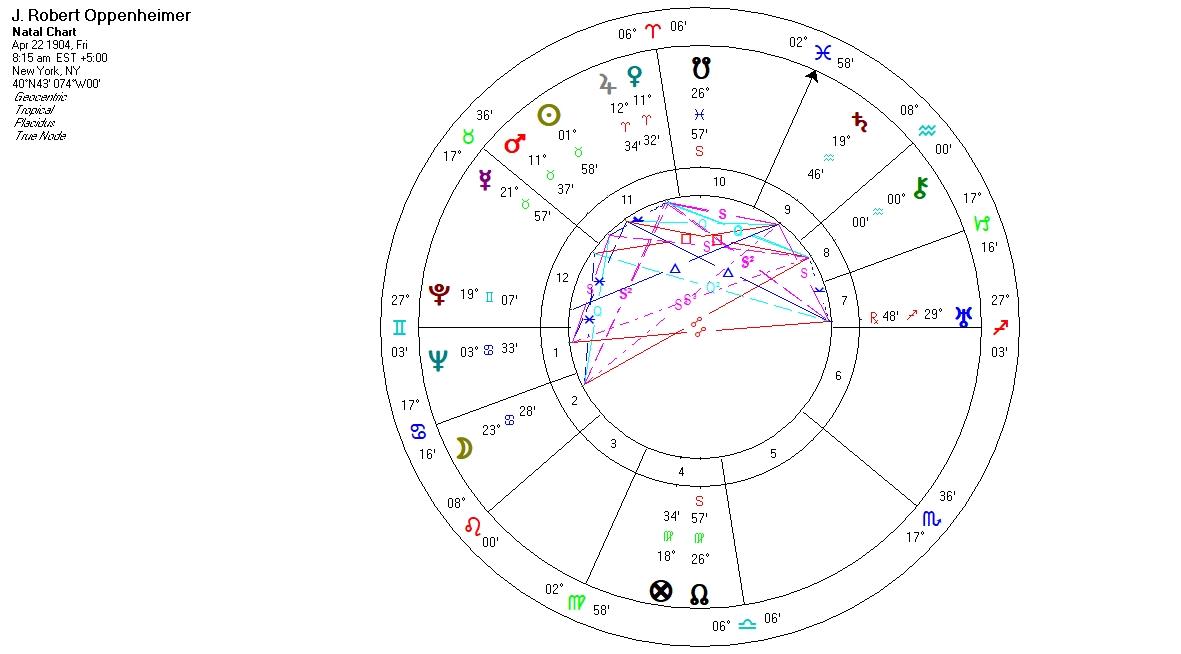
CHART appended to this transcript:
- FIGURE 1983 0606-1. J. Robert Oppenheimer Natal Chart.
NOTES:
- AB Classnotes have been appended because they contain information that the verbatim transcript does not have (because we are missing the first audio file) and thus help round out the class. Retyped from Classnotes AB 1983 0429 to 1983 0606.PDF. All spelling, capitalization, and punctuation corrected, all abbreviations and astrological glyphs spelled out in AB Classnotes.
TRANSCRIBED Verbatim by IT 2021. Archival verbatim transcript – V11a.
AUDIO FILES: 1983 0606a. [Note 1: "Tape" and "Side" refer to original audio cassette tapes that were later digitized into .MP3 Audio Files. Note 2: We only have the second audio file for this class, we are missing the first.]
1983 06/06 at Wisdom's Goldenrod
Astrology; Horoscope-Oppenheimer
[Audio File 1983 0606a Begins]
[Note: See FIGURE 1983 0606-1 (Oppenheimer Natal Chart) for all references to Oppenheimer's chart throughout.]
Marc Edmund Jones [The Sabian Symbols in Astrology, Aries 12, LR reading]: "[A flock of wild geese. This is a symbol of the irresistible aspiration and indomitable desire for freedom which represent the real core of personality, and which in everyday affairs are often the sole manifestation of an individual's immortal potential. Here there are vagaries of] immediate caprice to the point of irresponsibility, but through them is the undeviating course characteristic of the migratory fowl and so a promise of obligations to be met and ideals to be realized. [S: Huh.] [S, faint: Huh.] [The] keyword is INSOUCIANCE. When positive, the degree is a completely naïve independence or an ever-immediate capacity for rising above any given involvement in [LR reads: involved with] experience, [and] when negative, thoughtless disinterest in anything of real value to the self."
S (very faint): Uh-hm.
S (very faint): (Intrigue.)
TS: [one/two words inaudible]
AD: He may have been an idealist but philosophically he was naïve.
S: Careful Paul.
S (faint): Uh-huh.
S: Vagaries.
AS: You mean like "vagaries of immediate caprice to the point of irresponsibility"? [short pause] And naïve innocence.
S (very faint): Uh-hm.
AD: Just imagine trying to share your secrets with the rest of the world [S: Yeah.] in the condition that mankind is in.
LR: He was totally naïve about it.
AD: No?
LR: Yeah, no I'm agreeing with you. I think it--
AD (simultaneously): You know why Churchill didn't want a second front open?
LR: Because he had [couple words inaudible] (laughter)
S (amidst laughter): No.
S (laughing): Yeah.
VM: Because [S simultaneously: So I--] he didn't want to give the Russians a chance.
AD: He said let them kill each other.
S (faint): Yeah.
AD: He had enough information to know what was going on in Russia for the-- for the past twenty years. And he knew what the Russians were about and doing.
S: Yeah.
AD: So he would have preferred to put the second front off in-- for the distance so that the Nazis and the Russians could fight it out among themselves and then the Allies would come in when they were both exhausted. (bit of laughter) He wouldn't have been-- he-- Churchill here you can see I think was a realist.
VM: Well he was considerably more worldly.
AD (simultaneously): Alright. Maybe not an idealist but he certainly would have-- was a realist, he knew what the conditions were. Oppenheimer had no idea what was going on.
TS: It seemed to me that this degree showed--
AD: He even took the trouble, Stalin, to liquidate his whole high command.
VM: Yeah. (AD, VM laugh a bit) He cut it down.
AD: Well, all I simply mean here is that, sure, the idealism was good on the part of Oppenheimer. But, it was immature.
S: That's right.
AD: It was [student assents] immature in the sense [student assents] that you can't-- you can't bring that about. The correct procedure from the point of view of myself for instance, alright--now this is of course me, ok, my opinion--would be for United States of 1945 to lay down the conditions for peace throughout the world. That-- that was my opinion. We were the most powerful nation in the world, we could actualize that peace, we could tell a country what to do and no two ways about it. We had the power. We lacked the sense of responsibility that went with that power.
VM: Yeah, people weren't so--
AD: That's the way I would look at it, ok?
S (faint): Yeah. Ok so--
AD: I wouldn't say give them the bomb.
S (very faint): Uh-hm.
RC: Yeah, actually PB (had/said) one comment.
AD: Hm?
RC: PB made that comment, he said that one of the things that he was the most critical of was that the people who initially developed the bomb allowed others to get it. That the proliferation was very bad. And it's interesting because, in the context of this chart I'm getting a sense of like what esoteric knowledge means and why a person has to go through a character purification and development before certain knowledge can be given.
S: (Shortly) right, yeah.
S (faint whisper): Yeah.
S (very faint): Uh-hm.
RC: We seem to have a certain naiveté about what it means to have knowledge.
AD: Yeah, that's why he was put through that trial. That was [AS simultaneously: See--] a-- that was a purificatory trial in the sense that a lot of the ways he saw things were being altered for him. He saw what his idealism was. He saw how immature it was, that it couldn't go on like that. But the-- As a matter of fact he lived, what, till '67, right?
VM: Something like that.
S: Right.
AD: Well he had a good idea of what the world was like by that time. By that time we went through what, Vietnam, Korea, the Cold War, the Russian concentration camps which just a continuation with enlarged-- Russia walking into Hungary, Baltic States, Czechoslovakia, Romania, Bulgaria. You name it, Russia went there. Yeah he got a chance to see-- got a chance to look at-- As a matter of fact many-- many of us got a chance to see that. [9¾ second pause] Remember when we were talking about Patton, Patton had the same hunch.
S (faint): Uh-hm.
S (faint): Yeah.
RG/S(?): Yeah.
AD: Don't stop now. Quite a few people felt that way about it. But you remember Patton got into a lot of trouble because he said something wrong about the Russians or he was misquoted or whatever. But boy it got him into all kinds of trouble. [short pause] So what do you think the Venus means?
TS: I think it means an attachment to idealism, that his feelings were--
AD: Well it goes without saying you got a Jupiter Venus conjunction, you're an idealist. [S: Right.] Probably a stupid one but you're an idealist.
TS: Well--
S: Ooh.
TS: I mean-- (laughter, student words) Of course this is serious, uh-- (TS laughs, laughter) But, I thought that this particular degree, a flock of white geese, that he saw the ideals, like the principles would come into some wis-- presented or for that matter, the abstract theories from which an experiment came. And I could see the Venus functioning for him scientifically in the sense that he would have some-- the ability he had to sort of get to the-- get the point, like he'd go into a meeting and-- and pick up on what was essential point. I think in terms of theory or abstractions he was able to be very-- be very intuitive because of that Venus 'cause he tended to go for the kind of essential abstract points. But I think that, you know-- so--
VM: And geese fly very high. They get the big perspective perhaps. [TS: Yeah.] But they don't-- [TS: Yeah.] they're not close to the ground.
TS: Right, they're not close to it, they're not related to it at all in fact. And so-- I mean, the opposite degree being miners emerging from a mine is like coming totally from, you know--
VM (laughing): Yeah, right.
TS: --the--
VM: The opposite is [TS assents] really opposite.
TS: Really o-- and I thought that-- that in this case that in so-- most areas of his life that he would, you know-- When dealing with a theoretical which was truly theoretical, he would get right to the point, grab it and see, "Yeah this is the overview". And he'd need that in order to do something like Los Alamos where he could see what was the-- the kind of pattern of the different essences of the different projects 'cause there was what, four or five different departments that were actually-- yeah.
VM (simultaneously): But to-- but to point out-- to underscore what you're saying, when he was actually in the lab as an undergraduate in Harvard, he had six (bumps).
RG/S(?): Right, he couldn't do anything, yeah.
VM (simultaneously): He was hopeless.
TS: Oh there's a great story where the guy-- where he wrecked his car twice driving across the desert 'cause he was writing out the-- he had an intuition and he was-- he didn't have anything to write on so he was writing on the windshield (and everything). (some laughter) And he completely overwrote the windshield and drove up the steps of the courthouse and crashed his car. (laughter)
S: Right.
LR (simultaneously): And then he arrived to his new job all wrecked [RG assents] and his arm was in a splint.
TS (simultaneously): And he had an arm in a sling and he was-- he's unshaven, disheveled, he has broken arm, he had these pieces of paper and the-- the new-- his new boss is "Oh, you must be Oppenheimer, come here." He didn't even bother or anything. (TS laughing, bit of laughter)
LR: There was another one, Tim, that's equally as good, he took some woman out on a date and then drove her up into the mountains. And he stopped the car and went off apparently to take a leak or something. That he got involved in something he was thinking and he walked all the way back to the lab. And the woman (said/sat)-- (laughter)
VM (amidst laughter): I missed that in biographies [one/two words inaudible] that's good.
LR (amidst laughter, faint): Oh that's in the one we're watching. (more laughter)
VM: Well, [S simultaneously: He didn't have (one/two words inaudible)] you know, sometimes you're a silly goose.
S (faint): And therefore(--/?)
[short pause with faint background student talking]
BS: Make a living legend out of him.
AD (simultaneously): That's Venus though?
TS: Well, I thought that was pretty [one/two words inaudible]
S: He didn't know that though.
LR (simultaneously): [one word inaudible] (well) the Mars is also. We have to read the Mars 'cause the Mars is also a-- a degree-- degree of intense imagination. I don't think we can do it just with the Venus.
TS: No, they're semi-- they're exactly semi-sextile, [LR simultaneously: Yeah, the Mars--] the Mars and Venus.
LR: Why don't we read the Mars?
S: Uh-hm.
LR: Mars is--
Marc Edmund Jones [The Astrology of Concepts, Taurus 12, LR reading]: "A quite youthful young couple is walking down a busy street, stopping to peer into every window with joyful glee [LR reads: joyful eye].
LR: The opposite--
Marc Edmund Jones [The Astrology of Concepts, Scorpio 12, LR reading]: "A brilliant assembly of dignitaries is seen on a highly polished dance floor; it is an important embassy ball."
Marc Edmund Jones [The Sabian Symbols in Astrology, Taurus 12, LR reading]: "This is a symbol of human imagination as the real corrective for man's experience, enabling each individual to know in advance whether the choices he will make are in line with his desires. Implicit in the passive symbolism is the continual demand that action follow each tentative examination of life's possibilities, and that some latent phase of self-awareness be quickened in consciousness as a result. The keyword is VISUALIZATION. When positive, the degree is high ability in presenting the immediate potentialities of human achievement and the consequent self-realizations, [and] when negative, self-depreciation and a dismissal of all really desirable things as beyond actual acquisition."
[short pause]
VM: That certainly sounds like that skill of sensing the essentials of a scientific [couple inaudible student words simultaneous with VM] discussion and then unfolding it for people to rally behind it and so on.
AB: Or knowing just how to plow ahead, like when you gave the example, they wanted to back off and not do the bomb 'cause of (igniting) the atmosphere and he just said to keep going.
VM: Actually what's the-- that wasn't the way I understood that in fact but I don't want to get into it. I don't think it's essential.
AD: Well and you were saying then that Venus would represent the capacity to be released from the immediate environment. Is that right? And Mars would be that creative capacity to re-- visualize(,) being freed from that, you know--
LR (simultaneously): Yeah.
AD: Then the Mars was the-- the effort at v-- or visualization and concentration?
S: Yeah.
VM (simultaneously): Anthony, perhaps that freedom that the wild geese give is in some sense that impersonality or lack of appreciation of the human dimension.
AD: Uh-huh.
VM: That, you know, he was so cruel at times [AD simultaneously: Yeah.] it was absolutely withering. But in some ways that-- you could see in a scientific (at the logical/ecological) debate and so on, he would be relatively freed of his psychology let's say. I don't know if that's actually true, I could just spin the other side of the story out in a minute but, let's say he were relatively removed from the feeling level of-- of the debate and could go to the heart of the technical matter. On the other hand, people always had the feeling that-- that they were-- their contributions were appreciated as individual contributions and they were really made to feel a part of the team. So in some sense he was a master at-- at harmonizing and synthesizing all these powerful egos. Well, I don't know, I-- I'm ambivalent about this point.
AD (simultaneously): But you-- Yeah I can understand that but would that be coming from the Venus or the Mars?
LR: Pluto.
VM: Which?
AD: See I can understand the Venus releasing him [VM simultaneously: From the--] from the exigencies [student assents] of immediate application [VM assents] and freeing him. [VM assents] I can understand the Saturn giving him, you know, this conviction, this confidence in the higher levels of intelligence, whether he used it wisely or not depends on the incidences, you know, a-- But, that part I don't see that you're referring to, that [LR simultaneously: Wait till you get to Uranus.] he was capable of harmonizing--
VM: He really could, that was the thing that, for example--
AD: He could, but I don't see it in those degrees.
VM (simultaneously): Oh in those degrees. [RG: Right.] No, no, somewhere we'll have to see it.
LR: You will. Yeah.
VM (simultaneously): Because-- one of the big things so many of these authors make, the big points they make, and it was made in the film too, said but you have to realize the tremendous convergence of powerful intellects, all very touchy about their own contribution and so on and so forth, and through his own personal power, both of an intellectual nature and perhaps of some subtle psychological way, he was able to bring these divergent forces into a harmonious--
AD: Let me make one remark because I thought this might be worthwhile, in regard to the Spanish Civil War at that time. I don't know if you remember, the Spanish government was pretty medieval. It was almost [VM: Still is.] straight from Spain. And the Church had a tremendous hold on the whole political set-up in Spain. And, when the decision came, and it did come, to throw out all these things, alright, and elect-- have a republic, I think the Republic itself, in the Congress of the Republic they had maybe twenty or twenty-five really great men in there like Unamuno, you know, some of their most literary men, philosophic men, were all members [VM simultaneously, faint: The government (one/two words inaudible)] of their-- the Congress. And at that time there was-- something was going on which-- it was-- there was this Republic elected and there was the Fascists who were, so to speak, out to, you know, despoil it. And it seemed that the Communists sided with the Republic. And so there was a confusion at this time between Communist and the Republic of Spain against the Nazis.
But some of us, I think, saw through that, and despite the fact that the Communists were fighting the Nazis and the Fascists, you know, 'cause the Nazis and the Italians were supplying them with a lot of military equipment, as a matter of fact the Germans were trying out their super-bombers in Spain. The fact is a lot of people at that time, and I myself was one of them, felt that the issue got clouded, you know. Insofar that the Communists fought against the Fascists, alright, it got cloudy as though it was a fight between Communists and Nazis and that was not the issue. But many people saw it like that and it was dubbed that way. So if you believed in the-- the democracy that the Spani-- Spanish people had set up, you were dubbed a Communist, alright, and if you believed the other side of course you were a Fascist. (laughter) Either way, either way you got it. It didn't matter. But the strange thing was, I might mention that, that that Congress of Spain had twenty to thirty great re-- the greatest men of Spain were part of that. And the-- one of the first things they did, you know, really stupid, disband the army. "Get rid of the army, we're not going to war anybody."
S: (Right.)
S (very faint): Yeah.
AD: But, that's just a side issue as far as that Spanish thing was concerned and-- Sure, many people-- there was all kinds of rumors going on, the way hospitals and, you know, [student assents] (none of these), and all-- the usual stuff, a lot of the [couple words inaudible]
LR: Anthony, did Santayana write about any of this or--
AD: I don't think so.
VM: I can't remember.
AD: I don't-- I don't remember anything-- I haven't read all of Santayana but I don't remember him writing anything about the Spanish Civil War.
EC: George Orwell wrote a very fine book called Homage to Catalonia.
AD: Oh yeah.
EC: And it's very fine.
S (faint): Right.
JC: Read his book [one word inaudible]
AD (simultaneously): I think even-- well you know, Koestler for instance went there and fought on the side of the Republic and [VM: Yeah.] [S: Oh yeah.] was a member of the international brigade, and there was, (oh), quite a few people at that time joined. The funny part about it is when the in-- when the war was over this international brigade was brought to France, or they escaped to France and the French government planned and put them in concentration camps. When the Germans came in, alright, then the French government turned them over to the Germans. Ah the-- the mess was unbelievable. Koestler was one who got out so he was able to talk about it and write about it.
VM: Is this Arthur Koestler, the one who wrote about Kepler?
AD: Yeah. (bit of laughter)
[short pause]
S: What's that?
AD (simultaneously): Well let's try the Mercury, alright?
S (very faint): Yeah.
AD: Because we got to get that feeling of where this ability came to him to relate so many groups to one another and make them work as a whole and so on.
LR (simultaneously): My-- my personal feeling on that is that you'll see it in the trans-Saturnians [S simultaneously: (couple words inaudible) yeah.] more than anywhere else. Which is intere-- I mean 'cause that was his mission, what you're talking about.
S (simultaneously): Yeah, yeah.
LR: And I don't think you're going to get it from these Chaldeans.
Marc Edmund Jones [The Astrology of Concepts, Taurus 22, LR reading]: "A white homing pigeon flies straight and fearlessly over a broad body of troubled water."
S (faint): Do once more?
LR: This is--
S (faint): Yeah.
Marc Edmund Jones [The Astrology of Concepts, Taurus 22, LR reading]: "A white homing pigeon flies straight and fearlessly…"
LR: Or faultlessly. [couple words inaudible] just not spelled right.
Marc Edmund Jones [The Astrology of Concepts, Taurus 22, LR reading]: "…over a broad body of troubled water."
Marc Edmund Jones [The Sabian Symbols in Astrology, Taurus 22, LR reading]: "This is a symbol of the clear direction or absolute orientation which comes to man from birth as a consequence of his indwelling spirit or divine heritage, whether or not there is any conscious co-operation with it on his part. Here willy-nilly is freedom of understanding, and the strength which the possession of a real mission or a genuine reason for being will give to any individual. There is [LR reads: There's] also a wholly practical protection to the precise extent it is accepted."
RG: To what?
S: What was that last one?
S: Practical protection.
Marc Edmund Jones [The Sabian Symbols in Astrology, Taurus 22, LR reading]: "There is also a wholly practical prot…"
LR: Wholly, w-h--
RG (simultaneously): Yeah.
Marc Edmund Jones [The Sabian Symbols in Astrology, Taurus 22, LR reading]: "…practical protection to the precise extent it [LR reads: this mission] is accepted. [S: Right.] The keyword is GUIDANCE. When positive, the degree is [a] skillful reconciliation of difficulties in the light of over-all potentials [LR reads: potentialities], and when negative, an ineffectiveness of mind through habitual woolgathering."
AD: Vic, I would be inclined to say that that's the di-- that's the [RG: I agree, yeah.] one that zeroes in and can give you the fundamental meaning of a two hour lecture in a couple of minutes.
RG (simultaneously): Yeah, ok.
AD: It's that Mercury.
VM: Yeah, this is (an/a) uncanny [one word inaudible]
AD (simultaneously): It was, you know, an untrammeled-- untrammeled, unbounded, unrestricted, it didn't have inhibitions, it was a free understanding that he worked with.
S: Yeah.
VM: I would say that's his ability, Anthony, to grasp a situation. But there's still something (he's/you're) speaking about which so many of these people [one word inaudible] included in the film and so on make such a point of, and that was not only that he was able to grasp the point intellectually. Other people could do that too. But he had this ability to harmonize these people and get them to work together, a real social power.
S (faint): Right.
LR: Is that Uran--
VM (simultaneously): Would you see that in that degree too Anthony or--
AD (simultaneously): No, no.
VM: Ok.
LR: He's got Uranus on the degree of the Pope and his people in the same [VM/S(?) simultaneously: Pope?] (half). I mean, you'll see it.
RG: Right, it's not in there.
VM (simultaneously): He was the Pope. Pope of Los Alamos.
AD (simultaneously): I think that Mercury represented for instance his ability to take in a half a dozen languages, you know?
VM: Yeah.
AD: Or to master a poet and read him right through and accept him completely. I mean, it was-- it was an untrammeled intelligence. Went right to the point.
LR: This is another degree by the way, which if he had any other chart would not be that degree. If you had the other later chart the degree is the next one over.
AD: Would you read the next one then? The one that it would be?
LR: Oh.
Marc Edmund Jones [The Sabian Symbols in Astrology, Taurus 23, LR reading]: "A jewelry shop."
[short pause]
AD: You can see this man was very complex.
Marc Edmund Jones [The Astrology of Concepts, Taurus 23, LR reading]: "A magnificent jewelry shop is revealed, containing every conceivable article of value or beauty."
Marc Edmund Jones [The Sabian Symbols in Astrology, Taurus 23, LR reading]: "This is a symbol of the practical values of everyday living, and…"
AD (simultaneously): Alright, that's enough. (bit of laughter)
VM: Wait a minute, just warming up. (some laughter) Good enough for him. (VM laughs)
S (faint): Think about that.
S: [couple//three words inaudible]
AD (simultaneously): His mind wasn't capable of that.
S: Yeah.
TS: Practical.
S: Practical [S simultaneously: It's clear.] (evaluation).
S: It's easy.
TS (simultaneously): It's not like the first thing to be thought of every day.
S: That's ok.
AD: That was the last thing that was going to be brought home to him through the spiritual crisis. That his philosophy had to become practical.
VM: Were you saying he was-- I guess (one/going) back, were you saying he's more complex or a complex person?
AD (simultaneously): Well I'm just saying he was a very complex personality.
VM: Yeah, you notice how much easier it was to do Fermi, that was just like falling through the air.
AD (simultaneously): That was almost straightforward compared to this here.
VM (simultaneously): Right, right, much [student assents, faint] harder.
S: Right.
AD: Yeah I'll buy this Mercury degree [RG assents] that he's got, [student assents, faint] yeah.
RG: Clear.
TS: Seemed like he always approached things with his ideas, that sense of having a clear direction [AD: Yeah.] was always there.
VM: Except on the hydrogen bomb.
TS: Well, from a technical point of view he said--
VM (simultaneously): Oh technically there's no question it was a nice thing to do.
TS: And he-- I mean he seemed to understand it there, I mean it wasn't-- it wasn't in terms of the scientific issues, I mean--
VM (simultaneously): (No/Oh) but there were conflict, maybe the spiritual crisis had now pulled everything into its orbit.
AD (simultaneously): I think-- I-- I think you have to pull out the transits for them.
LR: See, this mission [S simultaneously: What was it?] that the Mercury set him out to do is terminated [RG: Right.] af-- is terminated by Uranus Neptune and Pluto.
VM: Terminated? What do you mean by that?
LR: The transits.
VM (simultaneously): Took the Mercury out of his chart?
LR: If Mercury is-- well, if Mercury is the mission he had to perform, it really gets changed around.
AD (simultaneously): Do you-- do you remember what year it was when he decided-- when he spoke against the hydrogen bomb?
VM: No, but I'm-- that speech at MIT I think is a critical one and we ha-- I'll find that out.
AD: Could-- you have any idea what year?
RG (simultaneously): Yeah. If-- well he started-- yeah.
VM (simultaneously): Oh, I don't know, I would say a couple years right after the war.
RG (simultaneously): Fi-- [TS simultaneously: (one word inaudible) one?] '51.
AD: '51?
S: Is it '51?
RG: He started-- yeah.
AD (simultaneously): Just out of curiosity, what were the trans-Saturnians doing [S: That we could do.] to his Mercury?
LR: Oh. The 50-- 50--
TS: '51, yeah.
LR: '53 [VM simultaneously: Are you sure it's '51 (couple/three words inaudible) even assuming that.] they're all aspecting Mercury.
AD: Huh?
LR: In fi-- by '53 Uranus Neptune and Pluto are all crunching that Mercury.
S (faint): 1953?
LR: And they go [AD simultaneously: The crisis--] back and forth for a couple years.
AD: The crisis is brought home to his intellect.
LR: And I'm not sure it was in--
S (simultaneously, faint): [couple words inaudible]
S (faint): Well Uranus would be sextile.
TS: See, in November of '52 he had-- that's the one that started really as far as the transits go.
LR: Of Uranus Neptune and Pluto?
TS: Yeah. He had Pluto square Mercury-- I'm sorry, no, September '52, Pluto square Mercury, Neptune quincunx Mercury, Uranus was approaching the sextile to Mercury, and Saturn was quincunx Mercury, and (that) Jupiter was on Mercury. So, Jupiter Saturn Uranus Neptune and Pluto. Other than that [few words inaudible] (some laughter)
VM (simultaneously): Nothing was going on with Mercury. (VM laughs a bit)
LR: And that went on, Tim, for like two years, didn't it?
TS: Yeah. Yeah, that didn't finish up till--
VM: Ok. So that makes sense why his-- the clarity of his vision and his precision of his mission and so on--
AD (simultaneously): Yeah, and the certainty of the guidance. Yeah.
VM: --was completely, let's say, muddled.
AD: Because, now what was a personal conflict was getting projected onto the world. And he thought that this was going to be the way to solve the problem that the world was going to be faced with.
TS: Hm. You see, all those years, from '52 through '55, '54, late '54, he had that going on. So for a number of years that Mercury was just really--
S (simultaneously): [one word inaudible] time, it's amazing.
TS: And then-- then '54 is when he was taken out. It's in June '54. So I mean they took his clearance out. And after that he didn't work on nuclear physics anymore [couple/three words inaudible]
VM: No he never had a security clearance after that.
TS: And didn't he just shut down his interest in that or his activities [S simultaneously: Well--] there, didn't he go into a-- [S simultaneously: (So pretty.)] a (collective) stars?
VM: He stayed at Princeton.
S: (Uh-hm.)
TS: I thought he went back to working on collapsing stars and stuff.
LR: Also it's not-- it's aspecting the Moon at the same time as it's aspecting--
VM (simultaneously, faint): I don't think he got out of nuclear physics, no.
AD: I think you get the (crutch/crux) here, because that Mercury is afflicted once he's got those planets squaring it and quincunx. The approaching sextile from Uranus, how far away was it?
TS: Well, you see, that was a-- that didn't-- that-- that was the last one in, that didn't really start until late '53 and early '54. The other guys were there first, the Neptune-- The Pluto square was the longest one, and the Neptune quincunx. Uranus-- Uranus was se-- sextile exactly-- well-- once in September of '53, once in summer of '54 and then it [couple words inaudible]
RG: Uh-hm.
S: [few words inaudible]
TS: Pluto square? No. I mean it's at 23, [student assents, faint] so-- Saturn's at 19 and change. It really wasn't--
RG: (You see it on--) seems it started earlier in '49 it seems, October of '49 he started speaking out against it.
S: (Yeah.)
DH: [three words inaudible] in '51 he was speaking solidly for it.
RG: No, no, no, [couple inaudible DH words simultaneous with RG] there isn't any quote. There's no letters [couple words inaudible]
LR (simultaneously): Speaking for what, David?
S: Maybe.
DH (simultaneously): Tim, (how do you spell) [one word inaudible] bomb? That's when he said sweet-- sweet, lovely, and beautiful.
RG: [three/few words inaudible]
DH (simultaneously): He's describing it [couple words inaudible]
RG (simultaneously): Well then he changed 'cause in 4-- [LR simultaneously: No.] he-- there are a lot of letters against it in '49.
LR (simultaneously): Yeah, it's real--
AD: But isn't that just the w-- the way the aspects were?
S (faint): Yeah.
TS: Ambiguous.
LR (simultaneously): Back and forth.
AS (simultaneously): Maybe [AD simultaneously: Ambiguous, yeah. Ambiguous.] Pluto was back-- Pluto was also opposite [LR simultaneously: Back and forth.] the Saturn back and forth earlier, '49, '50.
S (simultaneously): Yeah and Uranus was at [one word inaudible]
LR: Every book gives you a different story. It's so nutty when you start reading this period of his history what a-- to try and figure out what was actually going on is virtually-- One thing will say well this was his stand and another thing will say no, this was his stand, it was neutral, and the other guy will say he was absolutely adamantly against the hydro-- you know, it's-- [students assent, faint] it's real crazy.
AB: Are we saying that his naïve solution to the world problem was coming from the Mercury? 'Cause in a way we're attributing that to the Venus.
LR: No, Anthony was saying his-- the conflict that came onto that Mercury at that time--
AB: Was through the trans-Saturnians.
LR: Was what he projected as a world solution or a problem that the world was going through but it was really his own [AB: Right.] thinking.
AB: But it [TS simultaneously: (Right.)] seems that his naïve ideas about the world [LR simultaneously: His idealism--] solution was from the Venus.
LR: The Venus and Jupiter.
AB: And the Mercury which normally gave him the big picture and the ability to penetrate to the heart of the [LR simultaneously: Was being blocked.] problem was afflicted and was [LR assents, faint] being blocked.
TS: In '52, his Mercury was p-- his progressed Mercury progressed backwards. I mean [LR simultaneously: Uh-huh.] it retrograded, turned around and-- turned around around about Los Alamos and returned to its natal position in '53 when he saw sort of-- when his-- when all these Pluto-- when the transiting trans-Saturnians were chewing it over, Mercury was back home again. So maybe, who knows.
LR: It started out retrograde?
TS: No. [S simultaneously: (It did-- it) didn't turn around.] No it didn't go retrograde until he was-- I can't do this math in my head.
S: What year?
S (faint): Uh-hm.
TS: It was-- well it went retrograde on the third of May. So seven-- he was nine years old, ten years old when it went retrograde. And it turned around when he was twenty-six-- when he was thirty it turned around.
RC: Do you know what degree it was on then?
TS: Yeah, 18, the swords and torches, the good and evil. [Note: Swords and torches is Taurus 17.] [student assents] It was on that degree from the time he was-- six twenty-eight-- from the time he was twenty-eight to the time he was thirty-four.
AS (faint): Wasn't swords(--) wasn't 17?
TS: Yeah, isn't that 18?
S: 17.
S: 17.
TS: Well, sorry, 18 degrees.
S (faint): [few words inaudible]
TS: Well, whatever, 17 and change it was in Taurus.
S (faint): Uh-hm.
TS: It was (at) seven years.
S (faint whisper): [one word inaudible] was twenty-eight long?
S (faint): But what do you think?
TS: 1932?
LR: Twenty-eight.
S (very faint): Yeah, uh-hm.
S: [couple words inaudible] to go through.
TS: So where was he at nineteen and thirty-three?
S: Prior to that it was stationary?
S (faint): Yeah.
TS: Yeah. Any of them. It seemed interesting to me that I just wanted to see where-- what Mercury develops to in the meantime and the trans-Saturnian-- at the time the transiting trans-Saturnians were making their aspects to the Mercury in the early fifties, Mercury is also back I think upon that degree.
AD (simultaneously, faint): On-- yeah, yeah, yeah.
LR: Well that means, Tim, that the Uranus was aspecting the progressed Mercury even if it wasn't totally into the-- [TS: Yeah.] natal yet, right?
TS: Yes.
JA: Anthony? What are-- what do we mean when you say that this-- the crisis was projected? Well, is that inevitable or was that peculiar thing that happened with him?
S (very faint): [few words inaudible]
AD: Was it inevitable?
JA: I mean, is that an inevitable consequence, the projection of crisis in-- into its-- one's circumstances or onto the world?
AD: Well it's a-- it's inevitable in the sense that, in order for it to be made known to you, you have to project it. And in that way you become aware of it. If we took a very clumsy example, man may not know that he has an anima until he meets a pretty girl that he likes and then he realizes that he has such a thing. Through this process of projection, alright, he becomes aware of an inner content. In a similar way, he did not know that he had this spiritual crisis that was latent in his soul and the circumstances afforded a hook on which it could be projected. And then there's this confusion or this intermingling of what the actual objective situation is and what the subjective realities are that are projected onto that. Well this is something everybody does all the time. [student assents] The astrological basis of the chart is very significant for us because if you can understand the way that peculiar organ is functioning and the degree, you know, that it's on, you can really get some knowledge about what, you know, the contents of your psyche are and deal with it before it gets manifested and becomes a problem. Most of us of course have to go through the pe-- the thing getting manifested and dealing with it at the physical level. But it can be dealt with on the mental level too. [student assents, faint] [short pause] Let's go through the trans-Saturnians quickly just for--
LR (simultaneously): Are you interested in doing the Moon or is it too [S simultaneously: Yeah.] confusing to try to do it (now)?
AD (simultaneously): Let's leave the Moon. Let's leave the Moon a little bit longer.
LR: Uranus symbol. Alright.
S (faint): Yeah.
LR: (Does) it matter which--
AD: Give me the Pluto symbol first.
S (simultaneously): Yeah, Pluto.
S (very faint): Yeah.
[short pause]
Marc Edmund Jones [The Astrology of Concepts, Gemini 20, LR reading]: "[A] self-service restaurant, the cafeteria such as originated in Los Angeles, displays its inviting steam tables."
[short pause]
S: Uh-hm.
TS: Could you read that "a cafeteria such as originated in Los Alamos"? (bit of laughter)
[short pause]
Marc Edmund Jones [The Sabian Symbols in Astrology, Gemini 20, TS reading]: "[This is] a symbol of the facility with which men organize their own [special] experience for the benefit of the community at large."
RG: Hm?
S: Yeah.
RG: Say that again please.
S (very faint): Yeah.
Marc Edmund Jones [The Sabian Symbols in Astrology, Gemini 20, TS reading]: "…[TS adds: it's] the facility with which men organize their own special experience for the benefit of the community at large. The divisions of labor which constitute a civilization are refined to the point where each individual has the largest possible part in the total reality, and the resultant ease of function provides a continual reassurance of the self's competence. Here a prodigality of resources in general becomes a very immediate realization. [The] keyword is SUPPLY. When positive, [TS reads: Positively] the degree is a fullness of contribution and an effectiveness of requisition in all personal relationships, [and when] negative, a chronic inability to make decisions or a hopelessly [TS reads: hopeless] dilettante spirit."
S (faint): Uh-hm.
VM (simultaneously, faint): Yeah. [S simultaneously, faint: (one/two words inaudible) of him.] That certainly seems to speak to the-- to the ability to orchestrate.
TS (simultaneously): Oh look at this. That's exactly trine the Saturn.
AB: Yeah and it's semi-sextile the Mercury. Like, that just put those two to work.
VM: He could take a cafeteria meal and make it into a gourmet occasion. And these disparate entities could be brought into a whole.
LR: Well just-- it wasn't just the--
AS (simultaneously): (Well that's just) in the opposite too, the men cutting through ice.
Marc Edmund Jones [The Sabian Symbols in Astrology, Sagittarius 20, AS reading]: "This is a [AS reads: The] symbol of [the] facility [AS reads: faculty] [with] which men organize the processes [AS reads: process] of nature for the benefit of the community at large."
AS: Certainly able to drive them to perform different tasks, the [one word inaudible]
S (simultaneously): Is-- or also not just with other people 'cause as he talked about any-- his being able to go into any one of those sections of Los Alamos, whether it was from the theoretical point of the electronics that-- you know, all the various parts, was like his own cafeteria, not just speaking to the fact that he could pull together all these various people, but in his own psyche it seemed like he had this cafeteria going on, you know?
AD: That's always first.
S: Yeah.
AD: The other thing is second.
S: Yeah.
AD: Because you could do that in your own psyche, you could do that outside.
S (very faint): Uh-hm.
S (faint): Yeah.
AD: Let's hear the Neptune now.
LR: Wow, this one's great.
[short pause, flipping of pages]
Marc Edmund Jones [The Astrology of Concepts, Cancer 4, LR reading]: "In an imaginative tableau a hungry cat is seen arguing earnestly with the mouse who is to be her victim."
S (faint): Yeah.
S: Uh-hm.
S: Yeah.
S (faint): Right.
S: Yeah.
S: What degree [one/two words inaudible]
Marc Edmund Jones [The Sabian Symbols in Astrology, Cancer 4, LR reading]: "This is a symbol of man's necessary establishment of a set in mind or realization as a preliminary to any entrance into personal experience, and of his tendency to enjoy the preparatory more than the consummatory phases of his participation in reality. Here also is the…"
LR: That's almost tells you right there what's gonna--
Marc Edmund Jones [The Sabian Symbols in Astrology, Cancer 4, LR reading]: "Here also is the eternal effort of human nature to get outer acceptance or social sanction for its inborn desires, as well as inner or intelligent and practical confirmations for the values it has made its own. The keyword is JUSTIFICATION. When positive, the degree is a gift for persuading others to accept the motives of self and to co-operate with its ends, and when negative, interminable quarreling with the nature of things."
S (faint): Hm.
S (faint): Yeah.
RG: Hm.
S (faint): Hm.
S: You know how they spoke about the enthusiasm of-- that happened there, that they were-- even after--
S: Go on.
S: That the whole idea was worked on and that the ends were sort of not even--
LR: Considered.
S: Yeah, that they weren't considered. And that just the fact of the enthusiasm [couple/three words inaudible]
LR (simultaneously): The momentum.
S: Yeah.
[short pause]
S: But this little--
RG: I don't get it.
LR (simultaneously): He (would/wouldn't) say-- I don't get it, I'm not sure I get the Nep--
RG (simultaneously): I don't get the symbol.
LR: --the quality of the Neptune and what it was actually-- how it was actually affecting him. It's in the first house, a little--
AB (simultaneously): Trine the Sun.
TS: I know the story says--
Marc Edmund Jones [The Sabian Symbols in Astrology, Cancer 4, TS reading]: "Here also is the eternal effort of human nature to get outer acceptance or social sanction for its inborn desires [TS reads: desire], as well as [TS adds: the] inner or intelligent [and] practical confirmations for the values it has made its own."
TS: That he didn't--
LR (simultaneously): Yeah, it suggest-- Go on.
TS (simultaneously): What?
S (faint): Go ahead.
LR: No I do-- I'm wondering.
TS (faint): Well then--
S: Oh, go ahead.
TS: That-- would you say the Neptune is a kind of a-- a higher, deeper kind of feeling function he would operate with, that the way in which he would be inclined to-- where he would be inclined to look for that support of his ego structure would be in terms of social sanction, in terms of social pressures or in terms of some kind of outer acceptance of himself. And that that would be-- I see, I mean-- sneaking ahead a little and since I-- I see this as being the opposition-- in opposition to the Uranus kind of trusting to an inner intuition.
LR: Yeah, it's like the Neptune-- that symbol of the cat and the mouse, he has this vast intelligence, he has this incredible imagination, concentration, all these things, that it really can't be activated, for this purpose anyway, without the aid of all those other people until he-- he had to work.
TS: I-- I saw that and then--
VM (simultaneously): See I don't see it as a great [AS simultaneously: No, no, no.] social thing. I know he says that but, you know, [S simultaneously, faint: Yeah, the rationalization.] he's explained-- the guy's got to explain to the cat or the mouse [AS simultaneously: Yeah.] why he's going to eat it.
AS: Yeah, he's got to rationalize his activ--
VM (simultaneously): So he's got to have an intellectual vision first and only then can he actualize it or-or-- [AS simultaneously: (Justification.)] maybe vision is too strong a word.
LR (simultaneously): Or it's the struggle between [AS simultaneously: Justification is good.] the ethical-- you know, it sure points out the conflict of it.
AS: Yeah, it does-- it does seem to go along with this conflict [LR assents] business, because he really-- before he can take action, he has to justify.
VM (simultaneously): He has to understand intellectually, justify logically for himself.
AS (simultaneously): Just the keyword seems to be very good there.
S: Yeah.
S (simultaneously): Yeah.
AS: I mean he doesn't have to.
TS (simultaneously): (You don't) see him as being the cat [one/two words inaudible] So he would feel overwhelmed by-- in other words, he didn't argue adequately av-- in-- for his point of view in the congressional hearings and so forth. You could see that-- in this degree a tendency to feel overwhelmed by social-- by a wi-- a collective point of view.
LR: But you know, it's almost like Nept--
TS (simultaneously): And although he would argue against it, he would still feel like he was going to eventually have to succumb to it, because some of-- at least the way-- one impression I got was that he-- it was from his feeling function that his-- he produced inconsistencies and (bought it/bothered)-- and loopholes and gaps in his arguments such that other people began to not trust him and his point of view.
VM: It's funny 'cause it's so-- the guy's so complex because, you know, I just happened to be thumbing through this now and I found there's an incident in 1949 where he was brought in front of the House Un-American Activities Committee and HUAC people were real witch hunters, you know, and they were tough-- tough birds. And there were six of these guys in this committee and they brought him up because they wanted to talk to him about this thing with Chevalier.
TS: Yeah.
VM: Well, that day he was able to turn on the Oppenheimer charm. And, it looked like he was going to be fried by these guys, you know, who sat up in these high chairs towering over him and they were going to really do him in and so on. Well, precisely how he did it I-- I didn't get a chance to read but, by the time this trial was over, all six of these guys came down to shake his hand they were so turned on by him and so on.
LR: No, I think in this--
VM (simultaneously): So, he do--
LR: The Neptune's almost like the World-Idea.
VM: I don't know.
LR: Can you see it that way now?
BS: What do you mean?
VM: You're saying it had to be--
LR (simultaneously): It's like he's going to be used for a certain purpose. Isn't how they speak about Neptune as being kind of the collective, the wor-- some kind of larger idea than the individual? Um--
VM: I'm going to have to understand the World-Idea before I assimilate it?
LR (simultaneously): He's going to get eaten up!
TS: Yeah.
VM: No, no, the World-I--
LR (simultaneously): The personal's going to get eaten up by the--
VM (simultaneously): Mouse gets eaten up, not the cat.
S (simultaneously): Uh-hm.
S (faint): Uh-hm.
LR: That's right, [S simultaneously: (Yeah.)] and the cat is more powerful. The World-Idea is-- is more powerful [few inaudible TS words simultaneous with LR] than any individual [students assent] enactment of it, you know.
VM: Oh well--
LR: So it's going to-- it's going to eat him up but it-- you know, there's this dialogue going on repre--
RG (simultaneously): But he's both parts, he's not just the mouse.
VM: Yeah I (go--)
LR: Well insofar-- yeah I know, but I'm just saying Neptune sometimes does represent that. In other words, [RG simultaneously: Right, but I don't think--] I can see in the symbol the conflict in him between [student assents] the [S simultaneously: Yeah.] dharma, the destiny that he had to perform, and the personal--
AD: Are you trying to say it took a lot of rhetoric [AD mispronounces "rhetoric"] to convince him that his i-- identity had to assimilate a greater value?
LR: (Yeah.) Something like that.
RG: Hm.
AD: Rhetoric?
RG: Rhetoric. (AS laughs)
AD (amidst laughter): Will you stop correcting me?
CDA (simultaneously): She just asked me what and I do-- I wasn't correcting you.
VM (simultaneously): Some-- try-- we're not trying to correct you, we're just-- she's just trying to [couple words inaudible]
RG (simultaneously): We're just trying to understand you. (bit of laughter)
AD: She wants to correct my pronunciation. You take away all my uniqueness and individuality that way. (laughter)
S (amidst laughter): No I don't. It'll never happen.
CDA: It all-- [RG simultaneously, faint: Right.] it all lies in the [one/two words inaudible]
RG (simultaneously): It was only in the word, Carol. (CDA and RG laugh)
AD: Now you got me all confused, "rhetoric"!
S: [couple/three words inaudible]
AB (simultaneously): Wasn't that part of his conflict was that he had to in himself ali-- provide sufficient justification for his actions? That was like the spiritual task that was imposed on him.
AD (simultaneously): No, I'm saying it was the other way, Alan.
AB (simultaneously): That he had--
AD: I'm saying the identity he worked with, alright, had to assimilate a greater set of values than what he came in with. [AB assents] And the Neptune was imposing those values on him.
S (simultaneously): Yeah.
AB/S(?): Uh-hm.
RC: So that through the feeling nature there was a-- a slow and maybe somewhat unnatural development of getting him to accept his own basic nature [couple/three words inaudible]
S (faint): Yeah.
AD: Yeah. That he-- [S: Yeah.] that there was a need for a transformation of his personality.
RC: Yeah.
AD: It doesn't matter how-- you know, how-- how often he might have charmed these people. I think the struggle that was going on with him was the recognition of the ethical crisis or spiritual crisis he had entered into. And that the fundamental conversion of the kind of identity that he was working with was required. If he kept the spiritual crisis at the level he was born into, it would have never been solved but if he-- if he allowed for a higher feeling value, let's say, to get incorporated into his identity, alright, then the spiritual crisis (would happen) [one word inaudible]
RC: If you were to relate that to the Sun degree would you-- would you think that maybe--
AD (simultaneously): That's exactly what I'm doing.
RC: Yeah. Maybe once that was accepted in the deeper feeling nature that that terror of-- that the terror would cause (problem) with the mouse.
AD: With the what?
RC: With the mouse.
LR: The lower, the ego terror.
AD (simultaneously): With the mouse? Uh-hm.
RC: Yeah.
LR: In other words, the te-- the degree says there's a terror and a loss of aplomb when you-- smaller has to confront the universal forces.
AD: Uh-hm.
S (faint): Uh-hm.
S (faint): Uh-hm.
AD: Yeah. Ok.
LR (simultaneously): But are you get--
AD: Yeah that-- that's saying a little differently the way I said that he has to convince himself through rhetoric, alright, as to a higher feeling value.
RC: Right.
LR: Anthony, is there any clue as to how that came out?
(Side 1 of original cassette tape digitized as 1983 0606a Ends; Side 2 Begins)
AD: The ego was really an enemy.
LR: Yeah that's the way I would wo-- was reading the statement that PB made about him. He was no longer this reliable rock of a leader. His self-confidence was broken down. But I had the sense that to make--
AD (simultaneously): Not his self-confidence. [LR simultaneously: Yeah his self--] His confidence in the ego was broken down.
LR: Well that's what I mean. That's what I mean. I'm not talking about self-confidence with a large "S". That-- that he-- something cracked and he could no longer use that ego force, that tour de force that he-- he was [student assents, faint] formerly to advise people because advising people of anything is a pretty tricky business in the first place, you know. And something in him seemed to have realized that he couldn't-- people would come to him and he couldn't send them on their way with a clear direction in any-- any way.
AD (simultaneously): Yes, yes, because the recognition is there that un-- you know, like the same thing that, unless a person has been bitten by the Dragon all the talk in the world, alright, is not going to tell him. I mean he has to have the experience, he must work out that experience himself. And I think he came to the recognition that only ex-- the experiences in life were the-- what were what fundamentally guides the person in his directions.
RC: That last-- I think it was the last interview in that movie when he was so slow to respond to the questions. [S: Uh-hm.] But, he ended up saying it's too late. And it seemed like he was really saying that he had given up on the possibility of working out a solution, that people were just going to have to learn it from seeing the consequences.
AD: Yeah, when he said it's twenty years too late.
RC: Yeah.
S: Yeah.
AD (simultaneously): Uh-hm. Yeah, the realization that ultimately only experience is going to teach us. But that would-- that could only take place, you know, through that assimilation of that value Neptune was bringing in.
RC: Because there was certainly no vacillation when he was talking then, I mean, he seemed to be-- the only question was whether or not to say it, but once he decided to say it, seemed to be pretty convinced. That was his perspective anyway.
AD: Give us the Uranus before we clo-- close down.
Marc Edmund Jones [The Astrology of Concepts, Sagittarius 30, LR reading]: "[A] picture of regal and sacerdotal pomp and glory reveals itself; the Pope is holding audience in his palace."
S (faint): Yeah.
Marc Edmund Jones [The Sabian Symbols in Astrology, Sagittarius 30, LR reading]: "This is a symbol of human excellence on the side of the special values exalted in the various social and political hierarchies of modern civilization, and of man's ambition as entirely inadequate except as he is able to meet some exceptional need of everyday experience and so proceed to dramatize whatever abilities he may have developed in climbing to the position in which he finds himself. A person is strengthened within himself by the appreciation he succeeds in winning from his fellows. The keyword is SANCTITY. When positive, the degree is an effective…"
AD (simultaneously): That's what made him think he could give political advice.
Marc Edmund Jones [The Sabian Symbols in Astrology, Sagittarius 30, LR reading]: "When positive, the degree is an effective and spectacular sacrifice of self in some enduring service to the race at large, and when negative, inordinate love of self-display and surrender to a lust for power."
TS (faint): (Boy, that's) [one/two words inaudible]
RG: Yeah.
TS: That he either a masochistic exhibitionist or an (exhibition).
S (faint): (Maybe you shouldn't--)
TS: Masochist, yeah.
LR: It's also what made him able to wield that power in Los Alamos.
AD: Yeah, yeah.
LR (simultaneously): I mean he could really take that on as a role and--
AD: Well, to some extent when you guide a community of five, six thousand people into a common objective, you got to have some political acumen. But when-- when you try to spread that over a world--
RG: But this opposition though of Uranus and Neptune, I mean, really broke him apart too, I mean, in some sense it seems. I mean he did have a vision of himself as a-- as having to speak out and yet he came in conflict with the collective in time and couldn't resolve it it seems.
LR: Or the collec-- [RG simultaneously: Or the collective overwhelmed him.] or the higher values of himself.
RG: Right.
S: Sure thing.
VM/S(?): [couple words inaudible]
LR (simultaneously): [one/two words inaudible] Something [few words inaudible]
RC (simultaneously): How do you see that degree with the end experience of the higher knower in himself or-- I mean--
AD: I'm sorry, repeat?
RC: That degree I-- how would you see that in terms of the way that he would be experiencing the way the higher knower in himself operated like-- Do you think-- I mean it sounded like you spoke-- it was spoken of as something that had been assimilated-- appropriated by the ego. But--
VM: Maybe he learned at the end of his life the imperiousness of the higher knower in a certain sense or-- Well I mean that's just speculation 'cause I don't know his inner life and what (his/this)--
RC (simultaneously): Well you talked about like the faith that he had. When you were talking about the Saturn you were talking about the faith that he had in the intellect but, [S: Yeah.] I wonder to what extent it was the faith in the Uranus that-- that was leading him through his relationships, putting him in all these one-to-one relationships with geniuses, and somehow giving him the authority to be the figurehead for a whole movement that was going on. [9½ second pause] Because when-- when that was taken away from him, like his brother spoke about how that-- when that position was taken away he said that it really broke him spiritually, how it seems like when he was no longer able to operate in that Church that it almost didn't operate anymore.
S (very faint): Yeah.
RG: You mean after Los Alamos? Or af-- You see, that really isn't-- I don't think that's really what-- (ok), I mean, it wasn't just after Los Alamos, it just wasn't a one-shot deal and then he lost his power. I mean for five years--
RC (simultaneously): No I didn't--
RG: What?
RC (simultaneously): I didn't mean-- I mean after he lost his standing, [RG: Right.] his security clearance [RG simultaneously: Yeah.] and-- When he's no longer Pope.
RG: Yeah.
LR: But, the symbol isn't just a symbol of being the Pope, I mean, the symbol is [S simultaneously, faint: No.] to be-- the ability to recognize human excellence in special values of civilization. [short pause] You know what I mean? I mean [student assents, faint] it had more of a scope than simply the archetypal role that I think he played, you know.
RC (simultaneously): But they spoke of him like, you know-- in the film they spoke of him "and all of us realized that he was intellectually superior to us". And it seemed like what the people [LR simultaneously: I don't think that's the Uranus.] were bowing to and taking him as a leader was that-- that intellect, I mean that was--
LR: But why are you taking that intellect to be the Uranus? 'Cause I thought that intellect was the Mercury.
RG/S(?) (simultaneously): Was Mercury.
S (faint): (Mercury.)
RC: Well, I was seeing it functioning in terms of a plurality of one-on-one relationships with-- with the world, with individual people, individual geniuses, individual generals. That part of his mysteriousness may have been that how each individual contacted as much of that knower in him as it needed to get them to cooperate together.
[12¾ second pause]
VM: I think we have to go over some transits for this chart.
S (very faint): Uh-hm.
LR: You know, I'm still on the Uranus.
RG: Yeah, it is hard to see as the higher knower, how the higher knower is operative.
VM (simultaneously): Yeah.
S: Uh-hm.
VM: All the [RG simultaneously: (Uh-hm.)] discussion so far doesn't speak about him that way in some ways, you know?
S: What is that?
AD: Don't you think he was acting kind of pontifical when he told Professor Frank that this question is fundamentally without meaning?
RG: Yeah, right, (I mean--)
AD: Don't you think that that kind of behavior would exhibited-- he exhibited any time he was in a one-to-one relationship with anyone?
RG: But that's a very negative [one word inaudible] principle interpretation.
AD (simultaneously): Well I'm-- I'm just pointing out that there's the Uranus functioning, I mean I'm sure that we could find positive aspects to it.
RG: Yeah, I ag-- yeah, that's the negative side of the pole.
LR: That's the lo-- [RG simultaneously: Yeah.] that's-- that's the negative interpretation of the symbol.
RG: Uh-hm.
AD: What?
LR: Certain self-- "love of self-display and surrender to a lust for power".
S: Yeah.
S (simultaneously, faint): Uh-hm.
AD: I'm sure we could find positive aspects but that certainly would show something about the way the higher knower is operative in him. And we'd have to, you know, put up some transits for that Uranus, see-- But the point is we'd have to find what specific works he did where [S: Yeah.] that was operative. You know, it's one thing-- I think it's one thing to say that this man had a grasp, a remarkable grasp of some fundamental, you know, scientific theories. It's another thing to say that he was creative or brought something into physics, a new theory or a new--
RG: He did.
TS: Yeah.
AD (simultaneously): Yeah.
VM: No he didn't.
TS: Does the (tunnel effect), does he-- [AD: Hm?] it-- I mean--
VM (simultaneously): That was his thing.
TS: Like was that-- did that actually endure or was that just a--
VM: Oh yeah, I still-- I still find it-- teaching it this fall.
TS: Oh yeah?
S: [couple words inaudible]
TS: Ok, I'm wondering because that was 'cause-- It didn't seem like he'd had that many innovation.
VM (simultaneously): No, he didn't.
TS: But it was--
VM (simultaneously): I tried to make that point early on in his-- the discussion tonight, he-- because of this desire for universality or-- you know, you could probably say it that way, he never really did go very deeply into any one particular area in physics so that people like Fermi who in some ways you might say had maybe perhaps a lesser intellect, nonetheless they pushed deeper in.
TS: Uh-hm.
AS: Maybe that was the cafeteria Pluto, I mean the sense that he was interested in all this vast area of everything that was going on. Maybe that's one thing that made it possible for him to do that Los Alamos thing.
VM/S(?) (faint): Uh-hm.
AD: Wouldn't you say-- I mean if you-- what we know of his life so far, that that Uranus seemed to operate in-- less in the realm of science and more in the realm of let's say politics and [student assents, faint] [S simultaneously: People, uh-hm.] social history [RG: It's in the seventh house.] where he tried to make pronouncements about something?
S (faint): Yeah.
S: Yeah.
S: Yeah.
RG: I'm just trying to fit it to [one/two words inaudible]
VM (simultaneously): I'm trying to see it anywhere in him.
RG (simultaneously): Yeah I-- yeah.
JA (simultaneously): Well, you--
VM: That's the part that I can't see in him.
JA: That-- you know, he certainly did make a creative use of the power conferred, I mean, it was the conferred power that he had, and you-- and, what Vic was trying to find, the source of his ability to harmonize all those geniuses to work on a project. You know, he--
AD: Well then it would seem to be a combination of that Uranus and the other one that speaks about the way-- [student assents, faint] I forgot which degree it was.
S: Pluto?
S: Café.
AS (simultaneously): Cafeteria?
AD: Caf-- cafeteria.
AS (simultaneously): Cafeteria is the Pluto.
S (faint): Yeah.
RG: Yeah.
AD: But I think the Uranus acting as the greater knower was really concerned with other issues than science.
RG/S(?): Sure, yeah.
TS: Almost seemed like the-- if-- if we could say that-- you know, that-- utter speculation, that-- that he would have to come possibly to see finally that the ultimate power lay in that higher knower, that the el-- that in the inner being or the spiritual knowledge is what-- where the real power lay.
VM: Yeah, that's what I was trying to say before, that life would teach him the imperiousness of the higher knower in the sense that one of the things that Popes can do, especially let's say the old day Popes who had a lot of power, is whatever they said went.
TS: Yeah.
VM: There was no appeal to anyone else, you know. So in [TS simultaneously: Yeah, there's no further--] some ways maybe the crushing experience of life taught him those imperiousness or absolute rule or the-- of the higher knower.
TS/S(?) (faint): Yeah.
S: Yeah but then--
BS (simultaneously): But how would that make it spiritual?
AB: Yeah, it seems the opposite happened.
VM (simultaneously): Well it's a humiliation of the ego in a-- in a-- [S simultaneously: But I thought that (few words inaudible)] that the life teaches you bitter lessons and there's no remorse or some-- I don't know. I'm going off the deep end.
TS (simultaneously): Well I just think that he-- that, you know, he kept looking for some kind of-- well--
BS: Well, my question would be, Tim, you know, I-- possibly (for) [couple/three words inaudible] (but) can the higher knower be obscured?
RG: Wait. (laughter)
S (amidst laughter): Yeah we're all walking-- we're all walking examples of that!
AS (simultaneously): Can it be revealed! (laughter)
S (amidst laughter): Can it be revealed, (nice/right).
AD: Bert's questioning is more to the point, how is that a spiritual problem?
BS: Well, that's what I mean.
RG: Right.
S (very faint): Yeah.
AD: How is it a spiritual problem. How would you have a spiritual problem for instance if in your relationships with others you're as-- you know, categorical, pontifical, demanding and all that, and on the other hand in opposition to that, alright, there's the realization that unless a person's values are his own, alright, they're useless. How is that a spiritual crisis?
LR: Well that's obviously a spiritual crisis.
AD: Isn't that the spiritual crisis?
LR: But that's just interpreting the negative of Uranus [couple inaudible student words simultaneous with LR] against the positive of Neptune.
AB: Yeah but isn't what happened is that the Sun which is in aspect to both, the Sun incorporated the Uranus so that the-- the-- his self-purpose had this arrogance instead of the Sun, you know, obeying or bowing to the Uranus.
RG: You know, he really didn't play the Pope, that's what's funny, I mean he'd-- I mean in [AB simultaneously: No but he always--] some sense he-- but he wasn't overbearing [LR simultaneously: Behind this--] and imperious, it was funny, I mean--
AS (simultaneously): Oh, (I think--)
S: But--
S (simultaneously): He wasn't [couple/three words inaudible]
AD (simultaneously): He wasn't?
RG: Not in--
LR (simultaneously): Not in Los Alamos, they didn't speak of him that way.
RG: No, not rea-- not at-- nobody else spoke of him--
LR (simultaneously): Say he would [one word inaudible] have all these meetings and if he would sit in [RG simultaneously: Nobody else talks about him that way.] the back they'd feel like their purpose was--
VM: That's true, on the other hand he would make people tremble when he walked in a room.
RG: Well, both were there.
S (very faint): Yeah.
S: [couple/three words inaudible]
TS (simultaneously): You ought to see him in the AEC or interviews with him even in, you know-- He-- they would say "Well, did you contact so and so in the month of December?" and he'd say "Absolutely not," you know, they'd say "Well what about this letter?" and he said "Oh well I--" you know. He would be absolutely sure of what he was-- what his perspective was, what his actions have been, you know. And yet it would turn out that no, he had totally forgotten and just two days before he had written a guy letter or something. He did-- and he had a sense of--
S: Papal infallibility.
TS: Yeah.
AS: Always wrong-- often wrong but never in doubt.
TS: Yeah, often wrong but never-- (laughter)
S (simultaneously, faint): Right.
RG: Right.
AB: Oh yeah, so wasn't the Sun appropriating the Uranus instead of this-- you know, the Sun conforming to the Uranus?
[short pause]
AS: The Sun appropriates it(?/.)
AB: In other words, someone said that the spiritual meaning of that would be that the ego had to con-- see the higher knower as the--
TS (simultaneously): Yes. I see what you mean.
AB: But instead the ego incorporated [TS simultaneously: Oh yes.] that superiority that [JA simultaneously: Well--] the higher knower operates into itself.
TS: Well that would be the negative.
JA (simultaneously): But he could come to the recognition, you know, that the higher knower would-- had the real intelligibility and not the ego.
AB (simultaneously): Right. But it seems like most of his life psychologically he operated by incorporating that higher certitude into his ego and so it came out as this arrogance in other words.
TS: Yeah, we-- well that would be the neg-- the negative functioning of it and it was different from-- [bell rung] Ok, I'll [couple words inaudible]
S: Yeah.
S (faint): Yeah. [one/two words inaudible]
AD: Alright, we'll continue next week.
[short pause with faint background student talking]
AB: Hey Linda? When we did Mars, you know, the ability to imagine, the window shoppers, [students getting up to leave, talking in background] I never saw how that was Mars, self-drive.
LR (amidst talking): [one/two words inaudible] and that's a kind of a [one/two words inaudible] I thought he had the energy. Mars is usually the quality of the energy that goes out of a person. It's the energy you see--
[Audio File 1983 0606a Ends]
1983 06/06 V11a: CLASS: Astrology; Horoscope-Oppenheimer. Copyright 2021 Wisdom's Goldenrod p. iii