DIAGRAMS FOR 1983 0617a
Class
Friday, June 17th, 1983
Verbatim, unedited transcriptClick the series name to view more
CLASS at Wisdom's Goldenrod, Hector, NY
with Anthony Damiani (AD)
June 17a, 1983
PLOTINUS; SOUL; THEORY OF KNOWLEDGE
TOPIC: Plotinus
SUBJECT: Soul
SUBSUBJECTS: Theory of Knowledge, Epistemology, Cosmology, Asmita, Mercurius, Happiness, Sage
CONTENTS:
Reading Plotinus 1.4.4, 7, 8, 9, 10
Reading AD paper, "Epistemology of Soul"
Reading J.N. Findlay quote to show a modern scholar's view of astral theology
Continuing to read AD paper, "Epistemology of Soul"
Reading/discussing Plotinus, III.4.6
Sage can operate with inerratic, rational, sublunary simultaneously
Reading Plotinus, I.1.8
Distinguishing Intellectual-Principle and Intellectual in asmita
Absolute Soul and Intellectual-Principle equivalent
Mystical death; unbridgeable gap between asmita and Absolute Soul
Each star is an Ishvara; each Ishvara represents an Idea; totality of stars represented in asmita represent the Nous
AD: Correlation of theory of knowledge with astral theology the important point in paper
Sage can grasp Intelligible Ideas directly–this constitutes his Happiness
Your asmita can't know Absolute Soul of an Ishvara
AD summarizes Plotinus' theory of knowledge, compares it to modern theory
Reading Plotinus, I.4.10, Armstrong translation
Your asmita is a boundless universal consciousness
AD reviews Plotinus' theory of knowledge and the three levels of cosmology within asmita
The Sage as a universal presence is pervasive
Necessity of calmness; kleshas
World-Idea produced by combined functioning of Universal and cosmic souls, given to asmita from within
Plato: the only real knowledge comes from the stars
Sage doesn't have to wait for transits to grasp an Idea, has direct knowledge
Theory of Relativity
Ego gradually evolves to recognition that it is the higher knower
More discussion of AD paper
AD comments on Plotinus commentators
Cosmological perspective seems to be lacking in Eastern and Western texts
Buddhist and Hindu points of view both accounted for in this philosophy
Mentalism grounded in asmita principle
Theosophical triad: Atma Buddhi Manas
Epistemology defined
Divided Line
Kant's thing-in-itself as the Intelligible
Plotinus, PB have enunciated doctrine thoroughly; one must be trained to do this
Astrology that's being worked out demonstrates presence of Universal Being here and now
BOOKS READ FROM OR REFERENCED:
Plotinus, The Enneads (MacKenna translation, 4th ed.)
R. Baine Harris (ed.), J.N. Findlay, The Structure of Being: A Neoplatonic Approach, "The Logical Peculiarities of Neoplatonism"
Paul Brunton, Notebooks
Plotinus, Porphyry, Paul Henry, A. H. Armstrong (tr.), Plotinus: In Seven Volumes, Volume I
PLOTINUS QUOTES READ OR REFERENCED: I.1.7, I.1.8, I.4.4, I.4.7, I.4.8, I.4.9, I.4.10, III.4.6, III.8.6, IV.3.7, IV.4.23
DIAGRAMS appended to this transcript:
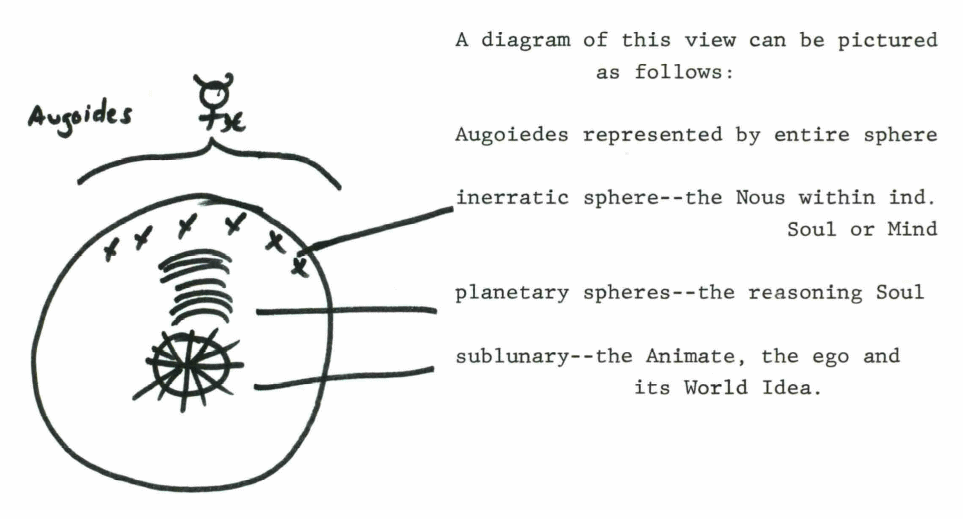
FIGURE 1983 0617a-1. Mercurius as containing Inerratic, Planetary, Sublunary.
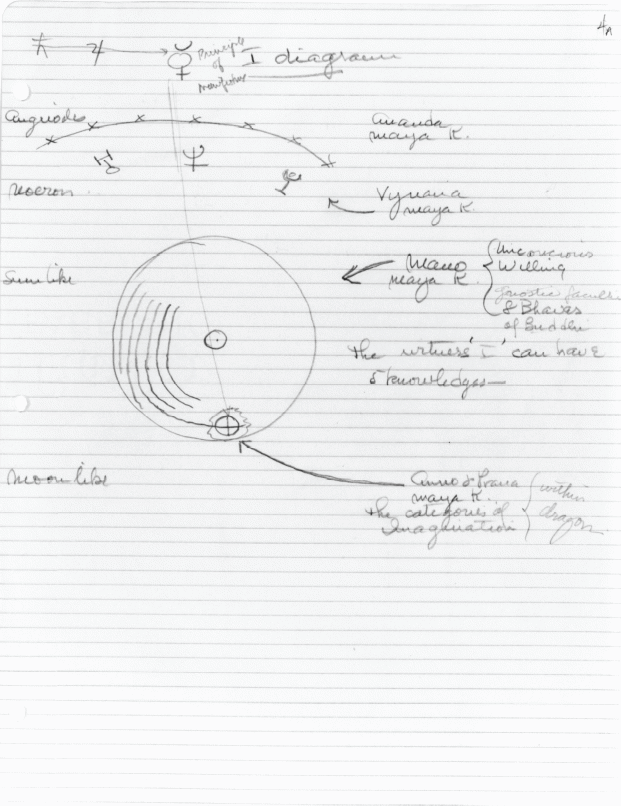
FIGURE 1983 0617a-2-AD. Tripartite Soul, Levels of Cosmos, and Sheaths.
The second diagram is from Astronoesis, p. 254. [Transcriber note: [diagram] means the speaker is referencing a diagram as he or she is speaking. If someone is drawing or writing, with audible sounds of chalk on a blackboard, I indicate this by [drawing] or [writing].]
AD PAPER read in class:
- "Epistemology of Soul". Retyped as 1983 0617b V09MP. Astronoesis - Soul. A few paragraphs from this paper are reproduced in Astronoesis (p. 220, p. 255, pp. 280-81, and fragments elsewhere). Most of it remains unpublished. This paper, with notes, was formatted and presented Aug. 2015 by the Astronoesis class as a special event.
NOTES:
This is 1983 06/17a, Plotinus; Soul; Theory of Knowledge Class, and the first entry associated with this date. 1983 06/17b = Epistemology of Soul Paper.
Multiple earlier partial transcripts exist.
TRANSCRIBED Verbatim by IT prior to 2018 (V11a). This is V12ap (2023) and has: updated prefatory matter, footer, and audio file name; Book List and TOC completed; Plotinus quotes section added; new notes within transcript; two diagrams appended and references within transcript to these diagrams; minor errors/typos fixed; new formatting to accord with new conventions. Archival verbatim transcript with AD Paper – V12ap.
AUDIO FILES: 1983 0617a, 1983 0617b. [Note: "Tape" and "Side" refer to original audio cassette tapes that were later digitized into .MP3 Audio Files.]
1983 06/17a at Wisdom's Goldenrod
Plotinus; Soul; Theory of Knowledge
[Audio File 1983 0617a Begins]
RG: I've read it too many times to have any illusions about that.
S (simultaneously): [couple/three words inaudible]
S (simultaneously): Yeah. (bit of laughter)
TS: Don't [three/three words inaudible] (bit of laughter)
AD: It's alright.
S: Yeah.
AD: That would be, you know, I.4. The ones we concentrated on were I.4.4, [short pause with shuffling about] I.4.10-- Maybe I should read the important passages, uh--
S: Yes.
VM: That would certainly help.
AD: Alright. In I.4.4. he says--
Plotinus [I.4.4, AD reading]: "4. If, then, the perfect life is within human reach, the man attaining [it] attains happiness: if not, happiness must be made over to the gods, for the perfect life is for them alone.
"But since we hold that happiness is for human beings too, we must consider what this perfect life is. The matter may be stated thus:
"It is beyond doubt that man when he commands not merely the life of sensation but also Reason and Authentic Intellection, has realized the perfect life.
"[But] are we to picture this kind of life as something foreign imported into his nature?
"No: there exists no single human being that does not possess this thing either potentially or effectively; to possess it effectively is what we mean by happiness.
"But are we to think of man as including this form of life, the perfect, after the manner of a partial constituent of his entire nature?
"We say, rather, that while in some men it is present as a mere portion of their total being--in those, namely, that have it potentially--there is, too, the man, already in possession of true felicity, who is this perfection realized, who has passed over into actual identification with it. All else is now mere clothing about the man, not to be called part of him since it lies about him unsought, not his because not appropriated to himself by any act of the will.
"To the man in this state, what is the good?
"He himself by what he has and is."
[student assents, very faint]
AD: Then we'll move over to-- [23¾ second pause, flipping pages looking for quote] Well, for instance, from 7, he says--
Plotinus [I.4.7, AD reading]: "If the Proficient thinks all fortunate events, however momentous, to be no great matter--kingdom and the rule over cities and peoples, colonizations [AD reads: colonization] and the founding of states, even though all be his own handiwork--how can he take any great account of the vacillations of power or the ruin of his fatherland? Certainly if he thought any such event a great disaster, or any disaster at all, he must be of a very strange way of thinking. One that sets great store by wood and stones, or, Zeus! by mortality among mortals cannot yet be the Proficient, whose estimate of death, we hold, must be that it is better than life in the body.
"But suppose that he himself is offered a victim in sacrifice?
"Can he think it an evil to die beside [AD reads: besides] the altars?
"But if he go unburied?
"Wheresoever it lie, under earth or over earth, his body will always rot. (some laughter, student assents)
"But if he has been hidden away, not with costly ceremony but in an unnamed grave, not counted worthy of a towering monument?
"The littleness of it!"
AD: So he goes on like that. Then in 8 he says--
Plotinus [I.4.8, AD reading]: "[Besides] we must remember that the Proficient sees things very differently from the average man; neither ordinary experiences nor pains and sorrows, whether touching himself or others, pierce to the inner hold."
[short pause, flipping pages]
AD: Then in 9--
[short pause]
Plotinus [I.4.9, AD reading]: "Now, this argument might have weight if prudence, wisdom, were something fetched in from outside: but this is not so: wisdom is, in its essential nature, an Authentic-Existence, or rather is The Authentic-Existent--and this Existent does not perish in one asleep or, to take the particular case presented to us, in the man out of his mind: the Act of this Existent is continuous within [AD reads: with] him; and is a sleepless activity: the Proficient, therefore, even unconscious, is still the Proficient in Act.
"This activity is screened not from the man entire but merely from one part of him: we have here a parallel to what happens in the activity of the physical or vegetative life…"
AD: Alright, and then we move to 10.
Plotinus [I.4.10, AD reading]: "10. Perhaps the reason this continuous activity remains unperceived is that it has no touch whatever with things of sense. No doubt action upon material things, or action dictated by them, must proceed through the sensitive faculty which exists for that use: but why should there not be an immediate activity of the Intellectual-Principle and of the soul that attends it, the soul that antedates sensation or any perception? For, if Intellection and Authentic-Existence are identical, this 'Earlier-than-perception' must be a thing having Act.
"Let us explain the conditions under which we become conscious of this Intellective-Act:
"The thought-object is deflected and the Intellectual-Principle which is active in the life of the Soul (i.e., (AD reads: in) the Rational Principle) is, so to speak, thrust back, as an image might be reflected in the smooth and shining and untroubled surface of a mirror; in this illustration, when the mirror is in place the image appears but, though the mirror be absent or out of gear, all that would have acted and produced an image still exists; so in the case of the Soul; when there is peace in that within us which is capable of reflecting the images of the Rational and Intellectual-Principles these images appear. Then, side by side with the primal knowledge of the activity of the Rational and Intellectual-Principles, we have also as it were a sense-perception of their operation.
"When, on the contrary, the mirror within is shattered through some disturbance of the harmony of the body, Reason and the Intellectual-Principle act unpictured: intellection is unattended by imagination.
"In sum we may safely gather that while the Intellective-Act may be attended by the Imagining Principle, it is not to be confounded with it. …
"So that it would even seem that consciousness tends to blunt the activities upon which it is exercised, and that in the degree in which these pass unobserved they are purer and have more effect, more vitality, and that, consequently, the Proficient arrived at this state has the truer fullness of life, life not spilled out in sensation but gathered closely within itself."
[short pause]
AD: Those were the main things he worked with. [14¼ second pause] There was one passage there that was very difficult, we went through another rendition by Armstrong. But I know-- I know some people are going to object, I threw both renditions out and gave it my rendition. I'll try to justify it but-- As we go along, Randy-- I mean Avery and I will discuss it, ok, so-- I brought the other rendition.
[12½ second pause, very faint background student words]
LDS: Anthony? Your text uses the word 'Proficient' all through. 'Sage' would be equivalent.
AD: Yeah, Sage.
[12 second pause]
AS: Well what about in III.4.6, that paragraph?
AD: III.4.6?
AS: Yeah, do you want it?
S: Well what's--
S: Like (the) [one word inaudible]
S (faint): It's like a [half/one word inaudible] it's like a paper.
AD: It's-- it's hacked out of (the piece after I wrote) the paper. Well--
S: Yeah Vic(./?)
[short pause, shuffling of papers]
[Transcriber & jf note: A few paragraphs from the following paper are reproduced in Astronoesis (p. 220, p. 255, pp. 280-81, and fragments elsewhere). Most of it remains unpublished. It has also been retyped as 1983 0617b V09MP. Astronoesis - Soul. I transcribe the paper just as it is read, including any alterations made during re-readings.]
AD ["Epistemology of Soul," AS reading]: "In III.4.6 is described the immense scope Plotinus ascribes to the individual Soul or Mind. This tractate is again one of such magnitude that we can hardly envisage its implications, and if grasped will reverse drastically the understanding we have of who and what we are. Even as a concept it is too vast to be assimilated by the modern mentality and incorporated into a theory of knowledge.
"There is a luciferian perversity and arrogant pride of the intellect with which the ego operates that prevents many modern commentators from an inquiry into the fundamental nature of Soul as Plotinus describes it. If anything can assure us of their lack of experience and irreverence towards the teachings, one or two quotes would be more than sufficient." (bit of laughter)
S (very faint): [couple words inaudible]
AS (very faint): What was (Tim just) reading?
S (very faint): Yeah.
AD: You want me to read one of them?
RG: Ok. (RG laughs, bit of laughter) [possibly another student: Sure Anthony.]
[short pause]
[Transcriber note: I am using The Structure of Being: A Neoplatonic Approach, International Society for Neoplatonic Studies, edited by R. Baine Harris, State University of New York Press, Albany, 1982. The quote is from the essay by J.N. Findlay, "The Logical Peculiarities of Neoplatonism".]
R. Baine Harris (ed.), J.N. Findlay [The Structure of Being: A Neoplatonic Approach, "The Logical Peculiarities of Neoplatonism," p. 9, AD reading]: "I wish to conclude…"
AD: This is a paper written by Findlay called "The Logical Peculiar-- Peculiarities of Neoplatonism". (bit of laughter)
R. Baine Harris (ed.), J.N. Findlay [The Structure of Being: A Neoplatonic Approach, "The Logical Peculiarities of Neoplatonism," p. 9, AD reading]: "I wish to conclude this paper on what you will think an unexpected note. I am unable to believe in the World Soul of Neoplatonism because Copernicus and his successors, as well as the recent results of planetary exploration, have undermined the foundations of any astral theology. The starry heavens are very far from declaring the glory of God…"
AD: This a modern.
S: Mm.
S: Yeah.
R. Baine Harris (ed.), J.N. Findlay [The Structure of Being: A Neoplatonic Approach, "The Logical Peculiarities of Neoplatonism," p. 9, AD reading]: "…and if we desire evidences [AD reads: evidence] of his presence, I fear we must seek them in the moral law within, [RG assents] or in the aesthetic and intellectual laws that are likewise within. I believe, however, in the Holy Spirit or blessed [AD emphasis] otherworldly Soul, which is beyond personal difference, and which carries within itself as transcendental regulators both the Noetic Order and the Unity beyond it, and which, while active in space and time, brings the One and the Nous to bear upon everything."
AD: I wanted to quote his belief too besides [RG assents] his disbelief.
RG: Oh.
AS(?) (faint): Spiritual.
RG: [one/two words inaudible]
AD (simultaneously): I don't see how space exploration has suddenly made the handiwork of God inconspicuous and, you know, irrelevant.
RG (simultaneously): Pretty thin. 'Cause then he affirms it and, you know--
S: Yeah.
RG: And he actually does believe it. I mean it's nice.
AD (faint): Yeah.
S (faint): Do you understand that?
AD: There was another one I couldn't find, it's one by Dodds. I-- I mentioned this to you before where he said, "You have to sympathize with us because our science is the study of nothing." (some laughter)
VM: Who's the "us" refer to?
RG (simultaneously): And you think he meant "nothing" and not "no-thing"?
VM: [one word inaudible]
AD: "Nothing" in the sense that these things have no value in our contemporary world.
S (faint): Yeah.
RG: Yeah.
S (simultaneously): Yeah.
RC (very faint): It's [one word inaudible] in the sense world.
S: Hm?
AD: Alright, those are the two quotes I wanted to bring in but--
VM (faint): No big shadow (battle).
AS (simultaneously): Ok, so the first [one word inaudible] (or) the quote in III.4.6.
AD ["Epistemology of Soul," AS reading]: ""We must understand that, while our souls do contain an Intellectual Cosmos, they also contain a subordination of various forms like that of the Cosmic [AS adds: or World] Soul. The World Soul is distributed so as to produce the fixed sphere and the planetary circuits corresponding to its graded powers: so with our souls; they must have their provinces according to their different powers, parallel to those of the World Soul…" (Plotinus, III.4.6) [short pause, flipping of pages]
"This conception of Soul or Mind may be likened to a transparent crystalline sphere of life-radiating consciousness, which is a reflex or emanation from the Absolute Soul. The vision of the pure Soul in the Nous is held within the boundless consciousness, and this is represented by the inerratic sphere. The planetary spheres represent our rational Soul, the discursive form of the abiding wisdom of Soul in the Nous. And finally, the individual mind contains within it the sublunary realm, the medium in which the two priors are expressed and which provides the means that the Soul may come to know the reason principles through its experience of the sensible world.
"And a diagram of this could be pictured as follows: Augoeides represents the entire sphere [AS: which is equivalent to the Mercury principle]; the inerratic sphere--representing the Nous within the individual Soul or Mind; planetary spheres--the reasoning Soul; and the sublunary--as the Animate, or the ego and its World Idea. [Note: See FIGURE 1983 0617a-1, Mercurius as containing Inerratic, Planetary, Sublunary, appended to this transcript.]
"Any of these three phases [AS: That is, the three phases within the mind, the intellectual, rational, or sublunary.] can be the dominant principle in the Life; it is the uniqueness of the Sage [S simultaneously: What--] that he operates with all three simultaneously if he so desires, that there is no hiatus in his experience between the intellectual and the sensible. Because the Sage has a complete and direct understanding of the nature of man he can delineate the necessary factors involved in knowledge. In I.4.10 with considerable kindness Plotinus takes us through a step-by-step description of how the sensible arises."
[short pause]
AS: The quote again (to figure out).
AD ["Epistemology of Soul," AS reading]: ""Let us explain the conditions under which we become conscious of this [AS reads: the] Intellective-Act: [AS, flipping pages: And so on.]
""The thought-object is deflected and the Intellectual-Principle which is active in the life of the Soul (i.e., the Rational Principle) is, so to speak, thrust back, as an image might be reflected in the smooth and shining and untroubled surface of a mirror; in this illustration, when the mirror is in place the image appears but, though the mirror be absent or out of gear, all that would have acted and produced an image still exists; so in the case of the Soul; when there is peace in that within us which is capable of reflecting the images of the Rational and Intellectual-Principles these images appear. Then, side by side with the primal knowledge of the activity of [the] Rational and [the] Intellectual-Principles, we have also as it were a sense-perception of their operation." (Plotinus, I.4.10) [short pause]
"We must take as our example not the"ordinary man who drinks and dances, but the mystic who thinks and then trances"…"
VM: Oh no. (laughter)
S (amidst laughter, faint): Oh God [couple/few words inaudible]
S (amidst laughter): Oh, and trances.
AD: It's a quote, it's a quote. (laughter) [Note: See Paul Brunton, Notebooks, V2, 1:5.67, "The man of the world drinks and dances; the mystic thinks and trances."]
S (very faint): Oh boy.
AS: That's in quotes.
EC: PB?
S (very faint): Very (corny).
VM: Who quotes it?
RG (faint): Who quotes [one/two words inaudible]
AD ["Epistemology of Soul," AS reading]: "…that is, the Sage who is present at inception of knowledge as well as at its end result.
"For knowledge has its inception at the highest level of the Augoeides, where this universal consciousness, through its absolute knowing, willing, and feeling, formulates its World Idea. This is the indivisible whole that must ultimately become reflected as and in the sensible world (an image). But it is the reasoning phase of the Soul that transmits this, moment by moment, and spreads it out in the realm of the earth's memories. These three phases of the Soul's Act are required in order for knowledge to arise. The Sage has in actuality all three at his disposal--this constitutes his happiness, which cannot be taken from him by the"blows of fortune" or the "nursery terrors". The natural man has knowledge only of the sense world with an intermittent mild infusion of rationality. To him, the level of knowledge available depends upon the dominant phase of the Soul which is operative, though each man has all three in potential. [short pause]
"Although this is beyond the powers of our apprehension, nonetheless, regardless of our limitations, we must proceed and try to understand Plotinus' definition of happiness and what it entails. And to begin with it is truly a royal 'We'--the Divine Mind operating through Plotinus that is explaining the nature of true happiness. [short pause]
"Plotinus' theory of knowledge is based on Self-realization--of who and what we are. Let us make clear to ourselves his initial premises regarding the indivisible whole of knowledge and the Soul's relation to Intellectual-Principle. Here he is not referring (as in I.1.8, the first two paragraphs) to what we have stated just now as the knowledge of the inerratic sphere within the emanant of Soul or the emanant Soul, but rather to the Divine Mind itself. [Note: Plotinus, A. H. Armstrong (tr.), Plotinus: In Seven Volumes, Volume I.] This, he says, we possess as common to all, even though it is transcendent to the lower phase of the Soul that emanates from it. We possess it, the Nous, in common insofar as the Source of the Second Soul is the Intellectual-Principle itself--One Entire. And we possess it particularly as the inerratic sphere (the Ideas) within each individual emanant Soul -- [AS: And here he says--]"in the Soul as it were unrolled and separate" -- that is, the whole of the firmament representing the Ideas. In the Nous the Ideas are experienced as unified, the sheer presence of mighty powers indistinguishable one from another. [9½ second pause]
"Following these implications of the above remarks a twofold order in knowledge is presented. The highest is the primary identity of Being and Knowledge in the Nous. The second order of knowledge has to now be considered distinguished from this. The Nous as unfolded in the Soul we just said was represented by the inerratic, that is, the eternal and immutable Ideas as symbolized by the stars. [AS: And] More precisely, it was explained elsewhere that the immaterial body which is given to the various Souls as their seat in the firmament each are illumined by an individual Cosmic Soul, each an Intellectual-Principle in its own right. So the entirety of the firmament is an unfolding of the Ideas, a revelation of the Nous in the heavens. This is all manifested within the infinity of the Asmita principle and makes possible the two-fold division of knowledge which is properly knowledge of the Nous."
LG: Within the what of the asmita principle?
S: Yeah.
S (faint): (Infinity.)
AD: The infinity.
AS: The infinity.
LG: Ok.
[short pause]
AS: Maybe we could refer it to that III.4.6 quote then, where he says--
Plotinus [III.4.6, AS reading]: "The World Soul is distributed so as to produce the fixed sphere and the planetary circuits corresponding to its graded powers: so with our souls [AS paraphrasing: and so the-- too, the individual soul]…"
AD ["Epistemology of Soul," AS reading]: "At this point we re-introduce the symbolism of the chart in order to explain the more spiritual part of our nature, represented by the trans-Saturnian planets -- Uranus, Neptune, and Pluto -- which are particularizing the World Idea for an individual I AM. The trans-Saturnians, in the process of evolving the World Idea which includes the ego, gradually deposit traces of spiritual meaning in that image the Soul has made for itself. This was the application we made in regard to the meaning of the astrological chart. We must now add to this from our understanding of the previous quotes the meaning of Uranus, Neptune, and Pluto have for Plotinus' theory of knowledge. This is the Soul's intellection which, taking place at the highest phase of the Asmita principle, is equivalent to the Soul's direct apprehension of the intelligibles, or the Ideal-Forms. This, Plotinus says, is possessed potentially by each personality, but effectively possessed by the Sage in this realm of Authentic Intellection. And he says that"to possess it effectively is what we mean by happiness… … the man, already in possession of true felicity, who is this perfection realized, who has passed over into actual identification with it." [AS: That's a quote.] [one/two inaudible student words] [9 second pause]
"It is made transparently clear by this master of introversion that the Sage sees differently than the ordinary man; that the experience of the Nous within us is not a psychological state and it will not be discovered through the analysis of thought by more thought. This is the state"earlier-than-perception" not to be found in the ordinary mind. Then follows his description of the reasoning activity which is still prior to the empirical awareness of the personality. When authentic intellection is to be reflected ((AS adds: and) not all intellection is made sensible) the reasoning Soul organizes the images into a sensible world that will reflect the prior intellection. [11½ second pause]
"We have previously discussed the conception of the ancients, the ancient cosmologists concerning the earthly life of all living creatures being a participation in the one life of the Dragon. To amplify this view we continue in III.4.6 where Plotinus speaks of that phase of the Soul divisible among bodies as that faculty where the Soul's desire for earthly life resides. This is the light referred to in I.1.7 that the Asmita phase of the Soul gives forth from itself to the organized body and which we may refer to as the reproductive power of Soul. When this enters the earth's sphere, and is conjoined with a body thereof, and the desire of the individual human Soul to be divisible among bodies is conjoined to the same faculty which we find in the Dragon--two instances of the same power which brings…the latent tendencies, dispositions, and so on, that it is the bearer of [AS reads: that it is the mirror to]."
[short pause, very faint background student words]
AS: Oh, I'm sorry, I didn't (finish reading that).
LR (simultaneously): Would you read that again, that sentence (please)?
AS: Well, I didn't read the whole sentence so I think that's fine.
AD ["Epistemology of Soul," AS reading]: "When entering the earth's sphere, and conjoined with a body thereof, the desire of the individual human Soul to be divisible among bodies is conjoined to the same faculty which we find in the Dragon--two instances of the same power which brings with it in its entrance into body the latent tendencies, dispositions, and so on, that it is the bearer of [AS reads: that it is the mirror thereof]."
RC (very faint): How do you spell it [one/two words inaudible]
S: Bearer.
LD: Thereto?
S: Bearer, B.
AS: Bearer, oh yes, that makes much more sense.
LD: Will you do it again, so we have--
AS (simultaneously): Yeah.
S (faint): [couple words inaudible]
AS: (I'll have) to ask Richard. [student assents, very faint] He got in trouble, I didn't follow it either.
AD ["Epistemology of Soul," AS reading]: "When entering the earth's sphere, and conjoined with a body thereof, the desire of the individual human Soul to be divisible among bodies is conjoined to the same faculty which we find in the Dragon--these are two instances of the same power, this power brings with it in its entrance into body the latent tendencies, dispositions, and so on, that it is the bearer of."
VM (faint): Yeah. It makes more sense. Ok.
AD ["Epistemology of Soul," AS reading]: "We have referred to this Dragonic life--the traces of the functioning of the Ideas left behind in the imaginal essence--as the 360 degrees of the zodiac. The desire of a Soul to participate in earthly life is represented by its selection and organization of a certain number of these degrees determined by the position of the planets at birth. This is the Animate of which Plotinus speaks in I.1.7: the ego as representative of the Soul in the Dragon, in which is"vested Sense-Perception and all the other experiences that are found to belong to the Animate." [short pause]
"And again in this I.1.7, Plotinus makes a distinction between the organized body which he terms"the 'ours'"--and in which is vested sense perception, and the 'We''--the authentic human principle, the rational Soul that perceives and passes judgment upon the Animate. The planetary spheres or the rational Soul is in constant interaction with its representative or representation, the ego, revealing itself in the empirical subject as discursive reasoning and intellection. He states that"the faculty of perception cannot act by the immediate grasping of sensible objects…" and it is to amplify this point that we will for the moment proceed to another tractate."
AD (faint): Read a little bit more.
AD ["Epistemology of Soul," AS reading]: "For to understand this point in Plotinus' theory of knowledge a pivotal issue must be dealt with which we will find expounded in IV.4.23. Beginning with the perception of a sense object, he says that first the pure form is seized, i.e., the object as intelligible without discerned parts. This first, albeit unknown and unconscious step in the process of knowledge, is a direct intuition by the Soul of the World Idea--so-called Thing-In-Itself--an apprehension of that within itself. [AS: Within the Soul.] In the end though, he says, this Thing-In-Itself will exhibit all the details of the sensible object--[AS: You know, it, the Soul, will exhibit all the details of the sensible object.] and it is the problem of the intermediary steps involved in this transition from Idea to sense object that we shall now try to articulate.
"Plotinus rules out in the beginning of the tractate that Soul could assimilate itself directly to the sensible object but instead offers the alternative that the Soul must"enter into relation with something that has been so assimilated." That is, in order to experience the Ideas as sensible it must first create for itself a vehicle through which it can operate, and the medium in which the immaterial reason principles can be represented. What, we must enquire, is this intermediary? What is this "one elemental Stuff" he speaks of, that which is the link of the two extremes? It is the imaginal essence -- the Dragonic belt of the Mother Goddess' [AS rereads: "…the Dragonic belt of the Mother-- Mother Goddess'] memories. This is the medium or essence within which the Soul makes an image of itself, within which a psycho-somatic organism can be formed. This representation--the Animate--contains the functioning image of Soul's powers which become the categories of the imagination and the immaterial reason principles as the degrees which are organized to provide for the multitudinous variety of experiences, circumstances, and events which represent the basic tendencies latent in the lower Soul."
RC: Could you do that one again please?
AS (faint): Ok.
AD ["Epistemology of Soul," AS reading]: "What is this"one elemental Stuff" which is the link of the extremes? It is the imaginal essence -- the Dragonic belt of the Mother Goddess' memories. This is the medium or essence within which the Soul makes an image of itself and within which a psycho-somatic organism can be formed. This representation--this Animate--contains the functioning image of Soul's powers which become the categories of the imagination and the immaterial reason principles as the degrees which are organized to provide for the multitudinous variety of experiences, circumstances, and events which represent the basic tendencies latent in the lower Soul. This imaginal essence is of such plasticity that when the world image is projected -- i.e. the organized body and the World Idea, appears to this knower…"
S (faint, possibly part of background): Yeah.
RC/S(?) (faint): [few words inaudible]
[short pause, door shuts in background]
AD ["Epistemology of Soul," AS reading]: "This imaginal essence is of such plasticity that when the world image is projected -- i.e. the organized body and the World Idea, appears to this knower -- the I Am (is/as) identified with the functioning of the rational Soul."
[student assents, faint]
VM: Who's "this knower" refer to in that sentence?
AS: Well I have to read the [one word inaudible] example [one word inaudible]
VM (faint): Ok, I'm sorry.
VM/S(?) (very faint): You haven't read it?
S: Again.
AS: I'll read it.
S: [couple words inaudible]
AS: Alright, but--
AD ["Epistemology of Soul," AS reading]: "This imaginal essence is of such plasticity that when the world image is projected -- i.e. the organized body and the World Idea, it appears to this knower -- the I Am identified with the functioning of the rational Soul."
AS: [couple words inaudible] that's good. Should I read [couple words inaudible] There's an [one/two words inaudible] Let me try.
AD ["Epistemology of Soul," AS reading]: "This imaginal essence is of such plasticity that when the world image is projected -- [AS: This world image.] i.e. the organized body and the World Idea, it appears to this knower -- [AS: This knower is] the I Am identified with the functioning of the rational Soul. [short pause] It is now possible to conceive the situation as follows.
"First, the subject-object relationship as a totality is the object of this impersonal consciousness. [AS: What we spoke of as the I Am.] Secondly, this knower takes itself to be the empirical subject within the sensible world. These two points are operative simultaneously -- you are at one and the same time this impersonal consciousness and the empirical person perceiving the sense object.
"The rational mind organizes the earth's memories, and this inner knowledge is quasi-intelligible -- as organized by the reason principles in Soul. The outer impression, that representation which is perceived as other to the ego, is a mere phantom. The reason form received within is projected outward as the world to which this person seems separate. But the 'I Am' working through the ego has a perception of the ideal form of the object, the meaning and reason which accompanies the sense picture as well as the perception of the sensation. The ideal form or reason essence of the sensible thing is perceived by the rational mind working through the Animate, and its perception is closer to the intelligibles. As for example when we see a circle in a jar top--the inner form of the circle is available to the reason, but only the sense form is available to the animal.
"By means of the Ideal Forms--[AS: he goes on to say] the reason principles in the Soul that is--the 'I Am' has lordship over the ego. The higher principle brings the discursive reason, the understanding of sense and the intellection. For the lower man there is compulsion and suffering which only the light of understanding can overcome. From the moment of the operation of the rational phase or Sunlike vehicle there is the authentic We--the psycho-somatic is an ours, because it is a possession, it is a mine but not I."
[15¾ second pause]
AS: Who needs [one/two words inaudible]
RG/S(?): That's it?
AS: Yeah, temporary.
AD: Not finished, Avery.
AS: Temporary end.
AD: It's not finished.
AS: No.
VM (faint): There's a lot (of idea) in there.
S (faint): Footnotes.
AS: There was a lot-- there's a lot of (questions now), um--
LR: Avery, could you just read the last two sentences, when it leaves off (with that)?
AS: The last two sentences?
LR: Yeah. Before you go back please.
AD ["Epistemology of Soul," AS reading]: "The higher principle brings the discursive reason, understanding of sense and intellection. For the lower man there is compulsion and suffering which only the light of understanding can overcome. From the moment of the operation of the rational phase or Sunlike vehicle there is the authentic We--the psycho-somatic is an ours, because it is a possession, it is mine but not I."
[1 min 2¾ second pause, shuffling about]
VM (faint): It seems like [one word inaudible] (what do you want him to do?)
AD (very faint): Yeah Avery.
S: Well [couple words inaudible] (never) keeps going.
AB: Yeah, we could go through [one/two words inaudible]
VM (simultaneously): I-- I would almost like to go like page by page or something [AB assents] like that, it just seems a lot of-- covered a lot of ground there.
AB: Right.
TS (faint): Or a lot of space.
VM: Or a lot of space actually.
S (faint): Yeah.
[short pause]
AS: Well, you want to start with this quote, the III.4.6 quote? [student assents, faint] Go back to the beginning of it?
TS: Let's go back to the beginning.
[student assents, very faint]
[short pause, faint background student words, shuffling about]
AS: I think that's the first one.
Plotinus [III.4.6, AS reading]: "We must understand that, while our souls do contain an Intellectual Cosmos, they also contain a subordination of various forms like that of the Cosmic [AS adds: or World] Soul. The World Soul is distributed so as to produce the fixed sphere [and] the planetary circuits [AS reads: spheres] [AS: and so on] corresponding to its graded powers: [AS adds: and] so with our souls…"
(Side 1 of original cassette tape digitized as 1983 0617a Ends; Side 2 Begins)
[41 second pause while AS draws]
[Note: See FIGURE 1983 0617a-2-AD, Tripartite Soul, Levels of Cosmos, and Sheaths, appended to this transcript for the following. This diagram is from Astronoesis, p. 254.]
AS: Now this first one-- well-- [short pause] Now I think we mentioned at some point also somewhere along the way [drawing] that those two higher principles of soul are reflected within the third principle and that's what gives rise to what he calls an image, produces the fixed sphere corresponding and the planetary circuits corresponding to its graded powers, and as we mentioned here somewhere, the vision of the pure soul in Nous [Saturn in Leo] is represented in the inerratic sphere and the planetary spheres represent our rational soul, Jupiter [in Virgo] [diagram]. "And finally, the individual mind [9 second pause while drawing] contains within it…" Yeah.
S (faint): So you're saying it's below [diagram].
S (very faint): Right.
AS: The whole thing's individual mind.
S (simultaneously): Oh.
AD ["Epistemology of Soul," AS reading]: "…the individual mind contains within it the sublunary realm, [student assents] the medium in which the two priors are expressed and which provides the means that the Soul needs to come-- needs in order to know the reason principles [student assents] through its experience of the sensible world."
AS: So-- [drawing] And this one I'm equating as-- or the ego, or the natal chart, if you want to do it that way. [student assents] [short pause while drawing] Well, I guess I could-- This first sentence--
Plotinus [III.4.6, AS reading]: "We must understand that, while our souls do contain an Intellectual Cosmos, they [also] contain a [AS emphasizes following word] subordination of various forms like that of the Cosmic Soul."
AS: I guess I could read that two ways. I mean I could see it as the-- "Our souls contain an Intellectual Cosmos". If he means this [diagram] is the Intellectual Cosmos that our souls contain, then here [diagram] there's a subordination of all those forms. Or-- then here's the [drawing] Intellectual Cosmos that our soul contains, the inerratic, and then there's a subordination of forms would be in the rational and the sublunary [diagram]. I-- and I'm not sure which one, and the next sentence doesn't seem to precisely say which of those. I think that both-- you know, both of those are so but I don't--
Plotinus [III.4.6, AS reading]: "The World Soul is distributed [so as] to produce the fixed sphere and the planetary circuits…"
SC: [few words inaudible]
AS (simultaneously): Maybe both senses are true, I don't know which to-- which sense the passage refers to.
SC: Well when he says that the World Soul is distributed so as to produce fixed sphere, etc, doesn't-- I get the implication that the Intellectual Cosmos is beyond that, and that the individual soul matches those aspects of the World Soul, the inerratic, etc, but starts beyond that.
AS: Yeah, well I--
SC: Yeah. [student assents] And I don't see the other one in there.
AS: Because in the first--
Plotinus [III.4.6, AS reading]: "We must understand that, while our souls do contain an Intellectual Cosmos, they also contain a subordination of various forms like that of the Cosmic Soul."
SC: Yeah, doesn't that seem to place that Intellectual Cosmos beyond cosmic soul right there? You don't [one/two words inaudible] see it--
AS (simultaneously): No, the whole clause could be referred to the cosmic soul. [SC: Mm.] Just as the cosmic soul contains an Intellectual Cosmos and the very-- and a subordination of forms, so does our soul.
SC: Ok, (good).
AS (simultaneously): I--
AB: So you're b--
AS: I think they're both there but--
AB (simultaneously): --they're both individual souls, the cosmic soul and our soul.
AS: Well, yeah, that wasn't-- well I guess the-- that's-- well, it wasn't the point (of view here).
LR (simultaneously): Avery, I don't see where it would give enough information to say which way [couple words inaudible]
AS: I was-- I wasn't claiming it was either, I was just pointing out that [LR simultaneously: It could--] there were two ways [LR: Right.] you could read it and I think both there make sense [RG(?): Like essence.] just in the way we've just read it all. But, it-- I think the paper was getting to it-- I-- to interpret it as this [diagram]. This was the-- this is the Intellectual Co-- the inerratic is the Intellectual Cosmos within [LR assents] the soul. That he's talking about soul here as the third phase of soul, and that it contains within it this inerra-- the-- this Intellectual Cosmos and also a subordination of the forms that are in that Intellectual Cosmos. That, you know-- that's all he's pointing.
S: You skipped a detail.
AS (simultaneously): But I could be (off).
S (very faint): Yeah.
S: He did the detail but I don't understand what's after the Mercury.
AS: (Wait), the whole thing is a detail of what's in the paper.
S: I know.
JC: Mercury in [S simultaneously: Just leave it.] Nature, it's an enigma.
S: Nature?
AS: Where does it say that? Nature. Oh, that's an (N).
S: I'm sorry, forgot.
AS: No, that's ok. This is-- that's that Mercury. That's the third phase. (That/Then it) explains the [couple words inaudible] [drawing] This whole thing is within that [diagram]. Again, I think the interpretation is that the two prior principles are represented within that asmita principle, and there-- and are imaged in the cosmos as the inerratic and the planetary. And that finally those two are expressed sensibly through the medium of the imagination or the animate.
S: (Within that.)
[12¼ second pause]
AS: He says--
AD ["Epistemology of Soul," AS reading]: "Any of these three phases can be the dominant principle in the Life…"
AS: When any of those three are working.
AD ["Epistemology of Soul," AS reading]: "…it is the uniqueness of the Sage that he operates with all three simultaneously if he so desires, that there is no hiatus in his experience between the intellectual and the sensible. Because the Sage has a complete and direct understanding of the nature of man he can delineate the necessary factors involved in knowledge."
[short pause]
LDS: Avery, what would you say the three are again that the Sage works with?
AS: Uh--
LDS: The Augoeides down or--
AS: The inerratic, the rational, and the sublunary. Or the intellectual, the rea-- the rational, and the sensible.
JC: Could-- do you see any difference between those two?
AS: Between which two?
JC: Saying something is applying to the three levels within the Mercury and saying that those are the three levels as opposed to just saying the intellectual, the rational, and the sensible, that-- which might imply something outside of, you know, prior to the Mercury phase itself.
AS: What? There is a tremendous-- there-- I mean, the-- the next point or so is going to be that there is a great distinction between speaking of the Intellectual in itself [AD, faint: Uh-hm.] and the Intellectual the way it's figured in the asmita principle. [JC simultaneously: I mean, I don't know if it--] So I think there is a distinction.
AD: Good.
AS: There's-- that obviously there was a big point made to make a distinction between these two.
AD: Yeah, we left out that whole section.
AS: What?
CDA (faint): You left out a quote [one word inaudible]
[short pause]
AD: You mean that whole--
AS (simultaneously): Now--
AD: We le-- I left out that whole quote.
S: I.1.8.
AD: I.1.8.
AS: Yeah.
CDA: What are you doing?
AS: No, that's la-- yeah, well it's later but it en-- encompasses it.
AD (simultaneously): No, but I included that, you know. He says--
[student assents]
AS: Uh-huh.
[short pause]
Plotinus [I.1.8, AD reading]: "8. [And] towards the Intellectual-Principle what is our relation?"
AD: And this-- this was the part that I think you'll find reconciles these two points that you've brought up.
Plotinus [I.1.8, AD reading]: "By this [AS assents] I mean, not that faculty in the soul which is one of the emanations from the Intellectual-Principle, but The Intellectual-Principle itself (Divine-Mind)."
AS: Yeah.
AD: He's asking here, what is our relation to the Intellectual-Principle itself, [AS, faint: Yeah.] and not to that faculty in our soul, alright, in the emanation, in the emanated soul. And he goes on, he says--
Plotinus [I.1.8, AD reading]: "This [also] we possess as the summit of our being. [AD: Alright?] [And] we have It either [as] common to all or as our own immediate possession: or again we may possess It in both degrees, that is in common, since It is indivisible--one, everywhere and always Its entire self--and severally in that each personality possesses It entire in the First-Soul…"
AS: Wouldn't it be in the second soul?
AD: No. The way I explained this, even though it's not there--
AS: Wouldn't that be in the second soul, the second one, when he says each personality contains it?
S: Yeah.
PC: (That/What) personality(--/?)
AS: "…in that each personality possesses It entire…" Oh, I'm sorry.
AD: Yeah.
AS: Ok.
AD: Yeah, and I'm saying no, that can't be. The text is-- is not the way I-- I would interpret it. The personality does not possess the Intellectual-Principle. [AS: Right.] That's out of the question.
AS: That's what I was asking, it seems like it should say "…severally in that each personality possesses It separately in the second soul."
AD: Yes.
AS (simultaneously): He's already discu-- he already mentioned in two ways. In the first way, "since it is common…" [short pause] Ok.
AD: Alright, and then he goes on and he says--
Plotinus [I.1.8, AD reading]: "Hence we possess the Ideal-Forms [AD: or the Ideas] after two modes [AD reads: in two different ways]: in the Soul, as it were unrolled and separate…"
AD: That would be that [diagram].
AS: In here [diagram].
AD: Yeah, in the Mercurius principle.
Plotinus [I.1.8, AD reading]: "…in the Intellectual-Principle, concentrated, unified."
AD: That would be above [diagram]. [student assents, very faint] I stopped there, I didn't go on with that, but these two points of view have to be understood. [student assents, very faint] On the one hand, the Intellect-- the soul that emanates contains the Intellectual Cosmos within itself, alright, as represented by the inerratic sphere, the stars and all that. And there each soul has its own. On the other hand, insofar that the Saturn in Leo is the transcendent source of every soul, there in that transcendent source we'd all have it in common. But I cannot understand that any personality can possess that Intellectual-Princ-- In other words, I can't understand the asmita principle possessing the Nous. [students assent, very faint] I don't know what it means.
DR: So what do you mean we'd have it in common?
AD: Hm?
DR: What do you mean to have it in common?
AS: Insofar [couple inaudible student words simultaneous with AS] as you're Absolute Soul you have it. But every soul has it there.
LR: The one Overself. The one Overself.
AS: In the Saturn-- in the Saturn in Leo principle in the Nous.
AD: It's the origin and the source of every individual asmita soul. [AS assents, faint] It wouldn't seem logical to reverse it [DR simultaneously: Yeah, so then (one/two words inaudible)] and say that the individual soul has the Absolute Soul. [DR simultaneously: So there wouldn't--] Just like the remark the other night that was made, when we say "God am I" and "I am God" it's a reversion of the hierarchy that you're working with.
DR: So there wouldn't be a sense in which you'd say that that Intellectual-Principle is a possession of the individual soul. There'd be no way that you would say that.
AD (simultaneously): No way that I could see that. At any rate, we left that out. (AD laughs a bit)
RC: At what stage does 360--
DR (simultaneously): On the other hand, though, excuse me Randy-- On the other hand, do-- don't you usually-- I mean once, once you speak of the Overself as a-- as, let's say, joined to that Saturn in Leo, that notion of the Overself, and you talk about the Infinite Mind of the asmita, in what sense is (it)-- [short pause] You talk about the first soul. In what sense is that distinct and separated from the Intellectual-Principle?
S (very faint): Yeah.
AD: What do you mean by first soul, the Absolute Soul?
DR: Yeah.
AD: It's not. They're the same.
DR: So do you think that there's--
AD: When you say Absolute Soul you're speaking about the Soul in the Intellectual-Principle are one and the same thing. Absolute Soul and Intellectual-Principle are one and the same thing.
HS: Really?
DR: So then there's-- there is some sense in which-- I mean, I know you wouldn't talk about it as the personality, but there's some sense in which that soul is really joined to that first Intellectual-Principle.
AS: In which the first soul is conjoined [DR assents] to the Intellectual-Principle. (Ok.)
AD (simultaneously): Remember the quotation when PB said that between the ego and his "I am" there's the possibility of the alignment, but there is an unbridgeable gap between his "I am" and the Intellectual-Principle? [Note: Possibly a reference to Paul Brunton, Notebooks, V14, 22:3.308. See WG Class 1983 0615 where this quote is discussed.] [DR and AS assent] Now, Plotinus is putting them in a different way but basically the same-- same amount of connotations, that your "I am" can have a representation of the Nous in itself, and that would be the intellection that can go on within the soul of that Sage. But you can't say that it possesses the Intellectual-Principle. It can appropriate it and use it but it can't possess it, it can't own it.
[short pause]
DR: I get-- I get so lost thinking in the-- I mean maybe I should just lo-- drop it but-- You know, you're so far beyond the realms of spatial distinctions and separations, [AD simultaneously: Uh-hm.] you know, nothing's separate anymore.
AD: Uh-hm.
DR: I mean even if you're talking about the realm of the asmita principle, you don't have anymore those realms of separations like, you know, you do here where it's clear, one thing is one thing and one is another.
AD (simultaneously): No, no, but there still is-- there's still a distinction. Even though that the mystical death does refer to the fact that the asmita is temporarily absorbed in the Absolute Soul and then sent forth again, alright, but there is this distinction which you're never going to get away from. An emanation, the soul-- the soul that is emanated is a distinct from the Absolute Soul. [students assent, faint] You cannot reverse that order. One is a Hypostasis, alright, that is an immaterial pure knowledge, the other is a reflex of that knowledge. I don't want to use the word 'image' because someone might see pictures there. But it's still nonetheless a reflex. It's an offspring. You never confuse the son with the father, do you?
[9 second pause]
AS: So in this-- so in your paragraph here, "Any of these three phases can be the dominant principle" is referring to the three as within the asmita. And "the uniqueness of the Sage that operates with all three simultaneously if he desires" would still be the three as any-- any or all are operative since he's identified with the asmita principle and not with any part of that mind within it.
AD: Uh-huh.
AS: But it still is a reference to this-- this-- the distinction of intellect, rational, and sublunary, but within [AD assents, faint] the asmita.
AD (faint): Asmita.
AS: Not to the No-- not to the Intellectual-Principle as the Hypostasis or Divine Mind Itself. [student assents] [couple words inaudible] especially in the context where you're speaking of delineating the necessary factors involved in knowledge.
[short pause]
JC: I really wonder that though because, if-- if they-- if by saying the Sage is aware of all three, he-- that would I guess be from the asmita poise because we-- as we've pointed out on Wednesday class, it's only the asmita principle that can be the-- it's like the median point-- median point between the sensible and the Intellectual above it but-- I don't know that I would want to limit the Sage's knowledge to what is contained within the World-Idea. Even though I know it's vast, just kind of saying that I would think that the meaning that he could be aware of, the Augoeides, or let's the intellect [one word inaudible] over here, the inerratic, would mean that he has access to the Nous itself, that-- and the inerratic might be a reflex [student assents, very faint] of his knowledge of the Nous.
[student assents, faint]
S (possibly part of background): Is--
JC: But, it doesn't--
AD (simultaneously): I still don't see the point you're making.
JC: Well, Avery's saying the scope of the Sage is only within the-- he's speaking of these three levels as within the Mercurial principle. But, [student assents] in the distinction we were just prior-- previously making, I would think that the scope of the Sage is in from Saturn Jupiter [diagram] on down to what is within the Mercury principle.
S: Wow.
[10 second pause]
AS: I got to qualify what I said [couple words inaudible]
AD: You can go on further, I mean you could elaborate what you're saying. [short pause] Another thing we left out in the paper. (AD chuckles a bit, bit of laughter) Each of the stars represents, like we pointed out in our discussions, each star is a soul, ok. Each star insofar that it is an individual Ishvara is in a certain sense an Intellectuality of its own. Now insofar that each of these Ishvaras is an Idea, the totality of all the stars which are represented in the asmita principle represents these eternal and immutable Ideas which are in the heaven. Now if you want something more than that Jeff, you show me how.
S (faint): Yeah.
AS: [few words inaudible]
AD (simultaneously): Go over this in your mind now, what I'm saying. Each star is an Ishvara. (Each/This) Ishvara is a principle of Intellectuality in its own right representing a certain Idea. [AS assents] The totality of all the Ishvaras, in other words, all the stars in the heaven, symbolizes, alright, the-the Ideas which are in the transcendent Nous. You want more than that?
JC: No, but-- (bit of laughter) Let me try a little different. You say (that--)
AD (simultaneously): Well, yeah, you try different.
JC: The Ishvara you're speaking of, let's just take one, forget all of them, contains you're saying an Idea, and I would assume the-- it has a version of the Divine Mind Itself but [AD assents] primarily according to what it-- the Idea it represents.
AD (simultaneously): Its own Intellectuality, yeah, no problem.
JC (simultaneously): Now, we would say its inerratic-- the inerratic sphere of that star, its body, is the--
AD (simultaneously): I'm sorry, the [one word inaudible]
JC (simultaneously): The inerratic, the starry body itself, whatever that may be beyond the image that we have of it sensibly, that the starry body itself is the body, the image within the Mercury phase of that Ishvara. Now there's also the rational part which we might say is the Mercury or Jupiter part of that star and there's the Saturn part. So the Sage would know-- could-- could know the star--
AD: It would-- it wouldn't be enough that he knows the Mercurial part of that Ishvara?
S: (Right.)
AD: I mean, what are-- [student assents] [JC simultaneously: Ok, I don't think--] what are you talking about? (AD laughs a bit)
S: No.
JC: Ok, well, I mean [one word inaudible] into it.
AD: And besides, [JC simultaneously: We made a--] in the-- in the Absolute Soul, you're speaking of a state-- a state of Nirvikalpa.
JC: You-- you had made a point about a-- the distinction between the rational level of operating and the mystical death where you give up the individuality, so I assume that--
AD: Well that was just to show that there was something unbridgeable between the asmita principle, alright, and the Absolute Soul. [JC simultaneously: Yeah, ok.] There's no way you're going to cross that bridge. There could be a temporary absorption, like in Nirvikalpa [JC assents] or in the mystical death. But that's it, then--
JC (simultaneously): Right, right, then you're back.
AD: Yeah, then you're back.
JC: Ok, well--
AD: But wasn't the important point in the paper here the correlation of his theory of knowledge with his astral theology, which of course nobody will buy?
JC: Yes, certainly.
AD: Wouldn't that be the more important point in the paper, [JC: Ok.] and that the S-- the Sage's felicity consists in the fact that he can grasp directly the Intelligible Ideas without any intermediary? Wouldn't that be the important point?
JC: Yes, sure.
AD: After that, from there on, I mean, we don't have to think anymore. So we left out more than we want, I mean we left--
AS: That's in the other paper.
S (simultaneously, faint, possibly part of background): Yes, [AD simultaneously: Ok.] it is back there.
AS: The thing about the Ishvara and the stars is in the paper on the star soul.
AD: Huh?
AS: What you just mentioned about the Ishvara and the star souls is in the paper on IV.3.7, the star soul.
AD (simultaneously): Yeah, yeah, we're still working on that.
AS: That's in the other one. And the one, the other one before that--
AD (simultaneously): But I have to bring it in here, [AS simultaneously: I--] I have to bring it in here to [AS assents] explain what we mean when we say that there's a representation of the Intellectual Cosmos in each individual asmita.
AS: But what you just mentioned also on I.1.8 is here. [S simultaneously, faint: Where's the paper (though)?] I mean, we did it read it.
AD: Well, alright, read it.
AS: Yeah, just further-- it's a little further on. I mean we--
LR (simultaneously): It's just not quoted.
AS: Oh, yeah, the I.1.8 isn't quoted, right. But it says, "quote…"-- it says in parentheses "quote I.1.8."
S (whispering): Go ahead, David go ahead.
DB/S(?) (faint): Go ahead.
AD: Go ahead, David.
DB: I was just wondering if it wasn't possible that what Jeffrey was referring to was-- was not-- not specifically in relation to the Sage but where he speaks about how the W-- the-- the World Soul in governing the cosmos never loses its contact with the Intelle-- with the Nous itself, like it-- it is continually contemplative of the Nous and at the same time governing the-- its-- its world; if that was-- if that was more along the lines of what Jeffrey was asking about.
[short pause]
AD: I don't know, was that in the paper?
DB: No, but it-- I just remembered it as being-- I don't remember of course the number, but there was a passage I think where he speaks of-- of the distinction between like an individual soul like ours and our relation to the cosmos as opposed to I think the World Soul's--
AD (simultaneously): Cosmic soul's relation to its body. I think that was in the other paper, [DB simultaneously: Oh, ok.] yeah, it wasn't in this one. That it im-- imputes no baseness to the higher soul whereas the individual body does impute or contaminate the soul in some way. That-- that was [couple words inaudible]
S: Wait a minute.
RC: Anthony, could-- could you go back for a minute to when you're speaking about how no-- no Mercury phase could in any way include the entirety of the Intellectual-Principle? You meaning to-- to be saying at the same time that taking-- if you take that Mercury as the total evolution of any unit of life, that no matter how long it evolved, certain parts of the Nous just are not going to be available to it ever?
AD: I-- I think I-- I think the way we tried to show that the-- how the Nous is available to the asmita principle, alright, is that in the asmita principle each one of the starry-- each one of the stars, each one of the Ishvaras, which is an Intellectual-Principle in its own right, (has) a representative in the firmament or in the heavens, has a representative, and that would be its asmita principle. What our "I am" could know about that can only come through that asmita principle of that individual star. It cannot possibly know the Absolute Soul of that individual Ishvara.
[short pause]
LR: Didn't you also say-- didn't you also say that the Mercury principle has-- is made of-- that there's a Logos principle within the Mercury which is its particular vision of the Nous, and then there's also the inerratic sphere which represents the totality of the Nous? So that that's the distinction which-- If you're talking about the Logos principle which defines or, so to say, constitutes the "I am," you're talking about a unique version of the Nous. But if you're talking about all the Ideas, they're-- they actually are all imaged in the inerratic sphere which is manifested by the Idea.
AS: I don't follow.
S (very faint): Me neither.
AS: Isn't each one of those stars itself a Logos? If you speak about each star soul as having a unique--
AD (simultaneously): That's why-- that's why I can't understand why they even conceive of anything beyond that.
AS: --has a unique-- it-- it is a unique Intellectuality, that is that-- [student assents, very faint] that Logos principle [one/two words inaudible]
S (simultaneously): Who's they?
LR: No wait.
VM: I missed a part.
AS (simultaneously): Why not?
LR: I didn't understand what you said before,
AS: Well, they-- No-- I-- What-- before, when we speak about this-- the ti-- each star soul itself of course has its inner principle, but each star soul, each one of those stars, they represent one facet of the Intellectual-Principle and the totality of them would be like the total Intellectual-Principle [LR assents] represented in the asmita. But when you just spoke about an individual Logos of a star soul, see--
LR (simultaneously): No, no, of our soul.
AS: Oh, ok, I was trying to-- I was trying [LR simultaneously: The individual soul.] to say that each one of those stars is like a Logos itself, that when [LR assents] you speak about its unique indi-- unique Intellectuality, that would almost be what you speak of its Logos, but the entirety would [LR simultaneously: Right. I was--] be the reason principle of the whole [one word inaudible]
LR (simultaneously): Right, I agree, I was saying that for an individual soul, an individual soul, that is, a Mer-- the Mercury principle of any individual which is the individual soul, has both a Logos principle which is its unique version of the Nous and also images forth or manifests the totality of the firmament.
[short pause]
AD: Also has what?
LR: Images forth or manifests for itself the entirety of the firmament.
AD: Uh-hm. Well, I don't about the entirety. [short pause] That's pretty big.
[student assents]
JA: It may be (risky) to make a distinction between knowing and being. [S: But, you know--] If you were to speak of the asmita principle in terms of being, you would s-- wouldn't you say that its being-- you wouldn't say that it has less scope than its principle.
AD: Less scope than its principle?
JA: Intellectual-Principle. I mean if-- you could speak of its scope of knowledge, or you could speak about a gap, but I don't think you could speak about a difference in being. The personality would possess entire the Being of Intellectual-Principle (without) knowledge. And I don't see how you could divide being per se.
LDS (simultaneously): How could you divide being from knowledge there, you know?
JA: Well--
AD: I mean before-- Let me ask you this, before you go into specifics, alright, what is the general tenor of what is being said here, could I have that from you first? I mean, like in a couple of sentences, what was being said in the paper?
LDS: Isn't this a theory of knowledge according to-- I think you mentioned it earlier, that according to this astral theology, there's an elaboration or articulation of what his theory of knowledge is according to these principles that we're talking about.
AD: Alright, his theory of knowledge is based on understanding something about Man, what a Man is. [student assents, faint] And according to this theory of knowledge, alright, Man is an emanation from the Absolute Soul--the way it was put there, a radiating sphere of pure consciousness, boundless consciousness, and that within that there was manifested these three levels, alright, an Intellectual Cosmos, the rational soul, through sublunary realm. And that in the case of the Sage, he had authentic intellection, that is, he knew directly what the Ideas meant, which mean that he had immediate apprehension of the Ideas which the inerratic sphere(s) were working out. [student assents, faint] And the planetary soul or the powers of the planetary soul were, so to speak, translating and transmitting that Idea, organizing the earth's memories into sensible objects. And that consequently a Sage had this authentic intellection that was going on at the top level, alright, and which guaranteed his inner happiness, nothing could ever take that away from him, and then he also saw the sensible world insofar that he used a body as a medium through which he can see sensible objects. And that these three grades were available to him, alright, these three grades, intellection, rational discourse, and sensible perception, ok, and that this is what his theory of knowledge is on-- based on, right? [student assents, very faint] What is the present day theory of knowledge like?
LDS: Absolute inversion of that. It's worst than an inversion.
AD (simultaneously): I-- I mean, i-- [students assent] it's like, you know, the atoms of this object imprint themselves on the eye and go over and etc, then they jiggle the nerve and we see the pole, right?
LDS: They try to explain knowledge from the phenomenal.
AD (simultaneously): But, now from that point of view, alright, just from what we just said, can you see how gigantic, how flabbergasting his theory of knowledge is? [S: What?] Wouldn't this be the first point to pick up, instead of worrying about what the knowledge is in the Absolute Nous? This is the main thrust of the paper; everything else is incidental. [student assents, faint] Now, can you--
JC (simultaneously): But every stage in the presentation and the summary you just gave, was a-- you know, full of questions. Where do you begin?
AD: I'm sorry?
JC: Every stage in the summary you just gave is full of questions, at least for those that don't understand. And, where do you pick up the thread?
AD (simultaneously): Well then, let's do this, let's do this. Let's turn back to the tractate, alright, and explain the tractate your way.
JC: Oh no, I'm not saying that.
AD (simultaneously): Any way, any way you want.
JC: Oh, I just want to follow the paper.
S (simultaneously): (Right, right.)
AD: I'd rather you read the tractate now. [JC simultaneously: Ok.] Let's open to the tractate and discuss the tractate.
VM (simultaneously): Can we read the-- [few inaudible AS words simultaneous with VM] can we read the next tractate that's right-- comes right at this place in the paper, 1-- from I.4.10? Is that right, I.4.10?
AD (simultaneously): Which one? Read.
VM (simultaneously): Yeah, I.4.10.
AS (simultaneously): Yeah, that I.4.10 [one word inaudible]
[student assents]
VM: The thought object is (deflected/reflected) (quote).
AD: That's pretty bad.
VM: That's a hard one, yeah, that's why I want to--
AD (simultaneously): No, that's badly translated.
VM: Oh.
AD: Maybe you could find it in here.
VM: Ok. It is confusing here, I don't quite know what's good and--
AD (simultaneously): Well, of course it's confusing because he doesn't know what he's saying.
S (faint): Yeah, right.
VM: His confusion and my confusion is quite a mess.
LR: That's all it is [one/two words inaudible]
AD (simultaneously): You have to remember, a translator, there's always implicit, when a translator is working, there's always implicit [VM simultaneously: Coloration.] his understanding of reason-- what he thinks Plotinus is saying. And if he doesn't understand what Plotinus is saying, it's going to show up.
S: (Better.)
AD: Read that and see if you like that better.
LR: This is I.4.10 from Armstrong.
S: Hm.
[Transcriber note: I am using Plotinus: In Seven Volumes, Volume I, with an English translation by A. H. Armstrong, Cambridge, Massachusetts, Harvard University Press, 1989, Loeb Classical Library No. 440.]
Plotinus, A. H. Armstrong (tr.) [Plotinus, Vol. 1, I.4.10, pp. 199-201, LR reading] "10. Perhaps we do not notice it because it is not concerned with any object of sense; for our minds, by means of sense-perception--which is a kind of intermediary when dealing with sensible things--do appear to work on the level of sense and think about sense-objects. But why should not intellect itself be active [without perception], and also its attendant soul, which comes before sense-perception and any sort of awareness? There must be an activity prior to awareness if"thinking and being are the same." [LR: That's from Parmenides.] It seems as if awareness exists and is produced when intellectual activity is reflexive and when that in the life of the soul which is active in thinking is in a way projected back, as happens with a mirror-reflection when there is a smooth, bright, untroubled surface. In these circumstances when the mirror is there the mirror-image is produced, but when it is not there or is not in the right state the object of which the image would have been is [all the same] actually there. In the same way as regards the soul, when that kind of thing in us which mirrors the images of thought and intellect is undisturbed, we see them and know them in a way parallel to sense-perception, along with the prior knowledge that it is intellect and thought that are active. But when this is broken because the harmony of the body is upset, thought and intellect operate without image, and then intellectual activity takes place without a mind-picture. So one might come to this sort of conclusion, that intellectual activity is [normally] accompanied by a mind-picture but is not a mind-picture."
LR: Should I read the next one?
AD: No, there's no need. Now, the way we've put it in the paper was, you know, to leave all that out because if you read that very carefully [couple inaudible VM words simultaneous with AD] you'll get just as confused.
S (very faint): There's no main point (here).
AD: You want to read that again maybe?
S (faint): Yeah.
AS (faint): [couple words inaudible]
VM: The whole-- the hard part for me anyway is this-- exactly what is it that's reflecting these Ideas and what is this--
AD: Well, alright, now, let's go back to what we said. Forget the paper. We spoke about the formation of the World-Idea which is taking place within the universal consciousness of an individual asmita principle.
VM (faint): What (framework)?
AD: Huh?
AS: Uh-hm.
VM: You just juxtaposed two terms, Anthony, that I normally keep separate. (AD laughs)
AD: Why!?
VM: I'm sorry.
S (very faint): That was (Vic)?
AS/S(?): No.
VM: You talk about Universal Overself, the Saturn and Jupiter, we've lumped them together as that.
AD (simultaneously): No, no, no, it's not the Saturn and Jupiter.
VM: Yeah I know it's not, but--
AS (simultaneously): He said universal consciousness.
VM: But--
AD: Your asmita is a universal consciousness, [VM: Ok.] not-- it's not the Absolute Soul, [VM: I know, I know, I don't want--] it's a universal consciousness.
VM: But just-- I'm sorry, you know, when you're ignorant, Anthony, you have to cling to a few adjectives, and you've always [AS simultaneously: Oh, univer--] used uni--
AD (simultaneously): But let go!!!
VM: Oh, let go, [AS simultaneously: (one/two words inaudible) universal--] I'll fall into an abyss of darkness. (laughter, student words) Please, I'm sorry. (laughter) Continue.
AD: Go ahead.
VM: No, no, I don't want to go ahead, why should I confuse anybody else? I'll stay in (my own) confusion. (bit of laughter)
AD (simultaneously): Well, [S: Really.] I think-- I think the-- it's-- it always comes down to this, the understanding of this "I am" principle, [students assent] alright. I didn't want to say it was infinite, you know, like I said well it doesn't have the entirety of the firmament. I don't know what it has. (bit of laughter) I do know that there's been varying reports by different Sages, the extent of the grasp of their consciousness would be a much larger firmament than anything we perceive. So I'm not going to go into that. [VM: Ok.] What I am going to go into is that this individual asmita consciousness is individual, yes, it's your consciousness. But it's a boundless consciousness, it has no circumference that [student assents, faint] we could refer to.
VM: And that's the way you're using universal.
AD (simultaneously): In that sense it is universal for us, it's not the Absolute Soul. Alright.
VM: Ok.
AD: Now, that's-- that's what-- let's say within that there manifests the starry heavens.
VM: Yes.
AD: Those-- those-- there-- a certain selection of those stars are required in order for this individual asmita principle to form the World-Idea for itself. Now at that level, there is no sensible world, there's [VM(?) simultaneously, faint: Of course not.] only this-- the sheer presence of these Ideas, alright, [VM assents, faint] the combination of Ideas necessary, alright, that's going to produce the sensible world much later down. Now in between the sensible world later, you know, [VM(?): (Above.)] and the inerratic sphere, we have the planetary soul [LR assents] powers which are, so to speak, taking that Idea, transmitting it, first organizing it, transmitting it, and then making a representation of that in terms of the memories which are on the earth.
[simultaneously] [LR assents, faint]
S: Right.
VM: Ok.
AD: So, we have these three levels which we might refer to as intellection, rational discursive thinking, and sensible experience or sense-perception.
VM/S(?): Good.
AD: Now, ignoring for-- for the moment the extent, the size of the asmita principle, alright, we can see that's-- that what's going on is this universal consciousness, this seems to be getting narrower and narrower until it focuses into a physical body, alright, and assumes that it is that body. If the main-- if the dominant function of a man is sense-perception, the sensible world is the only world he's going to believe in, and if you tell him that there are a priori processes before that sensible world comes into existence, of course he's going to call you an idealist, a mystic, or a crank. But, if he's serious, if he really investigates, then he begins to re-- recognize the fact that all he can know is only what's in his own mind, so he's got to take the route, like Kant did, and show that there was certain a priori categories which formulated the sense world that we experience. So you get involved into these-- into the realm of the rational mind [VM assents] and you begin to see that that's what makes possible the sensible experience and then that principle which makes it possible identifies with what it made, alright, [three/few inaudible VM words simultaneous with AD] and you have this-- these two, so to speak, in one and the same entity. At one (and/at) the same time a person can, let's say, experience the sense world, have sense perception, alright, and at the same time could be the impersonal witness of that. [students assent, faint] Alright, we spoke about that over and over again. The impersonal Witness consciousness and the empirical consciousness. I forgot, what was the point?
VM: Well, we took off on that quote that we didn't get much out of, and [AS: The mirror.] [AD simultaneously: Oh yes, ok.] started from that business of [AD simultaneously: Thank you, ok.] what's reflected.
AD: Alright, so now, instead of-- instead of taking the quote and just, you know, paraphrasing it, I took the example, alright, and says, now, there could be intellection going on, for the Sage there is a knowledge going on in the inerratic sphere. The Ideas are there, I mean, s-- some are in-- involved in the process of the forming the world for the individual, some are not. In other words, not every intellection has to be sensibly represented. [students assent] But those that do have to be sensibly rep-- represented have to be reflected back. So, when there is intellection at the highest level, and there has to be a reflection of that, then this process has to go through. It has to go through the discursive reasoning phase and then a sensible representation or organization of that schemata has to be made, and then the individual identi-- I mean the asmita consciousness, identifies with that body, [VM assents] must operate through that body to perceive the sense world. [VM assents, faint] Now, he points out, he points out, and we didn't put this in either, he says there's two ways: either it assimilates itself to the sensible or it assimilates itself to-- where was the passage-- assimilates--
MW: To the medium that (is/it) assimilated.
AD: To a medium that-- Huh?
MW: To the medium that assimilated itself to the sense.
AD: To the sensible, alright. Now the first alternative is out, [VM: Right.] so that means the second one. Now, wh-- how could it be the second one? A medium--
[Audio File 1983 0617a Ends]
[Audio File 1983 0617b Begins]
AD: --reason principles that at one time were, so to speak, reason principles and now have been contaminated or left behind in the matter, and this very matter can be used to create a body through which it can function because it ha-- it can work through those reason principles that have been left behind.
S (very faint): Uh-hm [one/two words inaudible]
AD: Alright, so if we start now, if we go back and we say to our self, well, what he is saying is something like this then. Intellection takes place at the highest level, alright, and the thinking about that intellection at the next level. At the lowest level where we have the body which is organized by that intellection, that organization of the earth's memories into a sensible image-- Can you finish it?
VM: Is what we call experience.
AD: Yeah, but it's also the representation of that intelligible.
VM (simultaneously): It's the representation of that intelligible and it's [couple words inaudible]
AD: Alright, now, if something happens to that, if something happens to that [VM assents, faint] functional image, like for instance you get sick or you die, then that isn't there anymore, the image cannot be reflected. [student assents] But that doesn't stop the intellection and the discursive reasoning from going on. That can go on without it, and he even points, he says, do not confound the act of intellection with the imagination. [VM assents] They're two different things. It can be imagined or not, that's secondary. Now, in the case of the Sage, he operates with intellection and discursive reasoning, if at all with discursive reasoning. So that means there's always intellection going on in his soul. The sheer presence of these Ideas is always something that he can bear witness to. Ok? But the other part, whether he's rich or poor, or whether the body is there or not, is quite secondary. If his happiness depended upon that there could never be such a thing as happiness. And like he says, it's a nursery of-- what'd he call it, [LR/S(?) simultaneously: Nursery of (one word inaudible)] a nursery of terrors?
S (faint): Nursery [S simultaneously: Oh.] terror.
LR: Nurse--
VM(?) (faint): Just-- just so you know.
S: Very good.
AD: Alright, now, instead of-- instead of paraphrasing that, I explained-- I explained it this way.
VM: Good. Good.
[student assents, faint]
AD: Anybody could paraphrase. The thing is to come up with a creative way of looking at a thing that a person can see what you're talking about. If two translators, and I can assure you, the third translator's going to do just as bad, [student assents] alright. If they come up with these kind of remarks it shows you that the grasp isn't there for them. Again, the point where he says, "We will now explain." Now ordinarily when we-- you know, when we write we say "We," alright, and we refer to that as royal We. Well that's a phony royal We. But when he says "We", or like when PB says "We," that's the real royal We. The Intellectual and the person that's speaking to you.
S: [one word inaudible]
AD: I think we left out-- maybe we sh--
S: Anthony, that was in [S simultaneously: All--] there too. Every--
AD (simultaneously): Yeah, that was there?
S: --everything you've said [S simultaneously: Yeah.] that's been left out is in-- is in there though.
AD (simultaneously): It didn't sound like (it). (laughter)
RC: When that-- when that mirror is not-- [S: Able to function.] function, can we-- let's say, just to make it simple, let's say that the person has died, and the intellection and the ratiocination goes on. Is that still something that's unique to him or is that simply what's going on?
AD: If you think of the Sage, in other words, like I think of PB, alright, his body is no longer here, but I think of PB as a universal presence. I mean he's pervasive.
RC: Uh-hm.
AD: He doesn't stop being just because his body is gone. [students assent, faint] I didn't say that when he was dead but [couple inaudible student words] I can say it now. In other words, his being is universally pervasive. [short pause] And there could-- it could be experienced, or at least its presence could be experienced, by an individual.
[student assents, very faint]
RC: So that-- that Logos which is his "I am" [students assent, faint] still a distinct Logos different from the Sun, different from another Sage.
AD: He's a real authentic living existent reality. Maybe I shouldn't use the word 'he'. You remember the experience PB had when Ramana appeared to him and then finally there came a time when Raman-- Ramana says, "No more will I appear. Now you have to grasp me in my universality." In other words, "I'm identified with Being. This is how you have to grasp me," and he stopped seeing him from then on. But the intimation or the presence of Ramana was something that PB very often experienced.
EC: Anthony, I have a question about that. When PB returns, reincarnates in a-- with another personality, and those that still remember the soul of PB, is that-- that pervasiveness still there, and it's still a part of that person-- the new personality he--
[short pause]
AD: I-- I don't follow your question.
EC: Yeah.
AD: You don't have to worry because when he incarnates, the call goes out and everybody else follows, don't worry about it. (laughter)
EM: Yeah but-- but it is our selling our houses. (laughter)
AD: Huh?
S: Should we put our houses on the market or what? (laughter)
AD: No that's-- that's a fact. If the teacher was a Bodhisattva, you know, was of that level of being, when he gets ready to reincarnate the others follow. Don't worry.
[few seconds of background student talking]
JC: Anthony, one thing I was wondering that this quote said was that, that which-- that within us which can be disturbed is the imaginative faculty by the compulsions operating in the ego. And then when that process has taken over, when the asmita principle's caught up in that process, the communication of the knowledge aspect of what is being projected does not filter down to the image in that so that the ego could, you know, be pervaded by the knowledge aspect of that as well. The image will form of the sensible object but not-- there's no image of the-- there's no intuition, let's say, available to the ego of what-- of what the meaning of that experience is.
AD: Yeah, that's why it's a necessity to calm the mind, keep it calm. I think somewhere he points out-- no, I was thinking about it-- that if there are hidden complexes in the person's ordinary mind, ok, it will prevent the intuition of the meaning of the reason principles that is in a certain situation (and I thought) whatever, ok. So that that underground agitation is going on all the time. And like if you look in a-- you know, if you look at an image in the water, when that water is in motion, that image isn't distinct, transparent and clear, alright, there's a kind of ambiguity about it. Well similarly, the ordinary mind that we work with, when there's an-- an obsession, a complex of some nature, the person simply cannot read the reason principles that are operative because of that agitation. And that's why the whole notion of the philosophy of the kleshas, you know, that until they're-- until all these hidden complexes are put in their place or worked out or understood and whatever methods and means are, alright, meditation won't get anywhere. For a person to sit down and try to meditate, you know, and get abstract while, let's say, he has on his mind that he's going bankrupt or something, it's out of the question. [short pause] So, you have to reach that stage, at least a preliminary stage where there, you know, is a reduction of the anxiety that the mind always is permeated with.
[student assents, faint]
LR: You should practice anyway though, right? (bit of laughter)
AD: Well the difficulty there is I-- I l-- I left it out, I didn't want to bring that in because I thought I'd bring that in somewhere else, the notion [S simultaneously, very faint: Habit.] of the reproductive soul.
S (very faint): Habit.
[student assents, very faint]
AD: No I didn't (bring it in).
[short pause]
JfL: Anthony, the intellection of the inerratic sphere-- If you don't want to do this or this is a tangent, I'm-- I don't mind.
AD (simultaneously): Go ahead, Jeffrey.
JfL: I'm trying to imagine it as both for this individual somehow participating in the Idea after the cosmic-- I mean each one is a representation of a soul, right, it's an Idea, ok, when you said it was an Ishvara, it's already just-- as we spoke about it last week where the Idea's already warmed up in a sense, ready for us-- for an individual soul to come and pick some to use. Right? Then in the-- the rational-- the rational spheres, are those already set? And I'm trying to-- I'm trying to get the background that this Mercury principle's going to be working in. Is the-- is the whole universal manifestation implicit?
AD: It is a prior which is given to it. Like for instance, you perceive the sensible world and you know that it is something in your mind and can't be anywhere else. It's got to be your experience, your mind, that is giving you this world that you're looking at, alright. Then if you inquire further, you say well that idea is given to my mind by a greater mind, alright, so that there's a sort of transmission from the higher mind to the lower mind and the lower mind takes that and turns it into a reality for itself. Now in a similar way, what we're saying is that the asmita principle has as its prior the asmita principle of the co-- the cosmic soul. That has for its prior the Universal Soul which has laid down the reason principles of the ground plan of the universe. The cosmic soul comes in there and works at a certain portion, and your soul is manifesting a certain portion of the workings of these two principles. So they're prior. They're completely unavailable to us.
JfL: So those are not the Ideas then of the inerratic. Each one of those is not representative of a cosmic soul's production.
AD: Each-- each what?
JfL: Each star in the inerratic is not-- is not the consequence of that cosmic soul's production in sort of separative in--
AD (simultaneously): No, but through an individual cosmic soul of which you are an inhabitant, you can climb to that, you can ascend to that star. It must be through the individual Ishvara that you're operating in. It provides you for a means to reach that.
JfL: So then this whole thing is happening within the one Ishvara.
AD: The whole--
JfL: This whole Mercurius--
AD: No!! It's all within the one Mercury!
JfL: The individual's is in the cosmic's.
AD: The cosmic is in the individual. The Universal is in the cosmic and the cosmic, both of them are in the in-- It's your individual asmita that manifests those two for itself. Don't put the individual asmita within the cosmic soul.
JfL: Well I didn't originally, I thought you said it the other way.
AD (possible aside): [three/four words inaudible]
JfL: Then, why aren't the inerratic-- why isn't the inerratic reflective of all those particular Ideas?
AD: But they are! [short pause] They are, precisely. And that's why we s-- we mentioned before, Jeff and I were talking, that to speak of a knowledge beyond this is inconceivable, that to the asmita principle there's available the knowledge, or some of the knowledge which is in the inerratic sphere, the Ideas that are there. And even Plato speaks about it. He says the only real knowledge comes from the stars.
JfL: When you were saying that the cosmic is within the individual, is that the same as the inerratic sphere, the intellective nature of the individual soul?
AD: Is that the what?
JfL: Same as the intellective nature of the ind-- of the individual soul as presented by the inerratic sphere?
AD: Yeah.
JfL: It is?
S (very faint): Right.
JfL: So that's why last week's paper, it was necessary to leave the 12th house for the formulation of those Ideas through the [one word inaudible]
AD (simultaneously): I forgot last week's paper.
JfL: The-- it was the paper on how the Sun has its intellective phase, reasoning phase, and ultimately Merc-- Mercurius phase all sort of available to itself constantly.
AD: I can't hear you.
JfL: How the-- how our-- how the Sun has-- has its individ-- its intellective, reasoning, and Mercury [AD simultaneously: Yes.] phase all-- all transcendent and available to itself for the-- for the availability and the use for the individual.
AD: Well, I think what I was trying to say in that was that the higher phase, the higher two phases of every cosmic soul and in specific our Sun, alright, are in the Nous but that there was no real interval or distinction between them as far as we're concerned. And that it manifested itself through its own asmita principle, and the manifestation through its own asmita principle was what our asmita principle trans-- transposes or projects as within its own world. But, let's ignore last week's paper until we've been-- Avery and I have ironed and (we're/we) still got many irons.
[13 second pause]
AS: There are two simil--
AD (faint): See?
AS: [couple words inaudible] There are two other quotes that are similar to that one that speak about how the soul is always contemplative but only when-- only when it reaches down to the senses are we aware of [one/two words inaudible]
S (faint): [few words inaudible]
AS: And he says that in several places [few faint words inaudible]
[11¾ second pause]
DH: There's also that book that we've read several times and it talks about why the soul cannot proceed directly, and that it cannot-- [AS simultaneously: Yeah, that'll--] it's not in direct contact with the Ideas, it must go through [couple words inaudible] circuit. [Note: See Plotinus, III.8.6, first para.]
AS (simultaneously): Yeah, it must take the circuit, the circuit. [S simultaneously, faint: Ok.] And I was wondering-- I was wondering about that as the-- well, that's-- that's a side issue-- In fact that question that came up again when you-- when I was reading this about the trans-Saturnians versus the-- the aspects, the hierarchy of aspects versus the trans-Saturnian [couple words inaudible]
AD (simultaneously): Well I didn't go into those details Avery because they're still not resolved yet.
AS: No, I mean just the thing-- I was wondering if there was some relation to the two different ways in which the Intellectual-Principle can be known. In other words, the Sage can directly know the Intellectual within him. But, the other way though is that that Intellectual must be known as permeating and being represented in the sensible. And I-- I thought that if-- if he was identified with the trans-Saturnian, you seem to be saying, he would directly apprehend the Intellectual within him, those intellectual powers, the formative powers of knowing, willing, and feeling, but if he were identified with the ego it would require that Intellect to be represented within the sensible and that would be through the aspect(s). [VM assents, very faint] In other words, for example, in a septile aspect the Intellectuality get-- is actually going to get represented within the ego. Or, when he says the Intellectuality and the Intellectual vision has to reach all the way own to the sensible.
AD: Yeah.
[student assents]
AS: Whereas, if he's identified with that Nous within him or with that-- the higher knower within him, doesn't have to wait for that aspect. He would be identified with the [few words inaudible]
AD (simultaneously): Yeah, if it was a Sage he wouldn't have to wait till he had the septile, like Einstein had to wait, [AS assents] alright. The-- the direct seizure, you know, of the Ideas in the Intellectual realm would be an accomplished fact. And that's why, for instance, there's many expressions of the theory of relativity in the philosophical doctrine. And anyone who understands any-- any philosophy can-- it's-- I mean if you understand your asmita principle is your asmita principle and mine is mine, then the doctrine of standpoints, the doctrine of relativity, is ipso facto, I mean, it-- it's an absolute must.
VM: In defense of relativity though, Anthony, there's much more to it than that. I-- I mean-- you know, I'm sorry I got-- I shouldn't [one word inaudible] (this way).
AD: Well, I would agree with that but I think there's much more to the theory of relativity than even the relativists of today know.
VM (simultaneously): For certain, for certain.
AD: I'm quite sure that, you know, there's a knowledge that we can't even conceive let alone, you know, ponder about. I'm just working off the assumption that at the time that Einstein got the idea, alright, there was a very specific case where the knower, the higher knower, was right there, alright, and the idea was being worked out. Then the rational discursive part of the soul came into work and started elaborating all this here. Then it had to be scientifically and empirically verified in the sensible world, so that all these three levels-- you know, we have examples of all these three levels when we were speaking about this particular instant, you know, with the chart of Einstein but I'm quite sure you could do that with almost any chart of any great idea that has come into civilization. But that's secondary, the-- the primary point to recognize is that when this happened to Einstein, alright, in other words, this big idea worked itself into the ego structure of this man, now it leaves certain traces behind. And if you imagine this to be an ongoing process, then that ego gets built up as a represent-- as a representative of that higher knower. It has to eventually in the process of the World-Idea evolving and the ego must evolve with it. So if there are instances after instances, life after life, where the-- the higher intellection leaves traces of its functioning in the structure of thought that we call the ego, then eventually that ego reaches a level or a stage where it starts recognizing that it is the higher knower. So this is an al-- this is an ongoing process, I mean don't think of it just, you know, [AD snaps fingers] happening for an instance and it's over. Because any man who gets a great idea, I think you'll see that it's something that's like drenched into him, he's got to work it down and out, every specific detail. It permeates the flesh and blood of his being, so that it becomes something-- He's so continuously preoccupied when he thinks about it for 50 years, alright, this becomes part of that matrix of thought which we call the ego, alright. Imagine this going on a few instances, over and over, another great idea, another great idea. What's going-- that ego eventually has to evolve into a kind of vehicle that the higher knower could use. And this seems a very natural way to go. How else is the ego ever going to get there? Certainly not under its own steam. [9¾ second pause] Why don't you try reading a page now, see if you understand.
VM: Page of which, Anthony?
AD: Well, the paper. See if you could tear it apart.
AS (faint): (Do you have a page?)
AD: Any page, it doesn't matter.
VM (faint): I want to follow the quote we just read.
AS: You want me to follow with the [couple/three words inaudible]
AD (simultaneously): Yeah, don't read the quotes.
AS: Ok, this is following I.4.10.
AD ["Epistemology of Soul," AS reading]: "Knowledge has its inception at the highest level of the Augoeides, where this universal consciousness, through its absolute knowing, willing and feeling, formulates its World Idea. This is the indivisible whole that must ultimately become reflected as and in the sensible world."
AS: "…as in…"
JfL: Could you start that again, Avery?
AD ["Epistemology of Soul," AS reading]: "Knowledge has its inception at the highest level of the Augoeides, where this universal consciousness formulates its World Idea through its absolute knowing, willing, and feeling"
LD: But I thought when we bring in willing, knowing, and feeling, you're bringing it to the level of the Noeron, and there you state and you put those three functions at the highest level of the Augoei-- Augoeides, and previously you brought those three functions in at the-- at the level of the Noeron or if you call it the-- the-- where the individual has knowledge of its function within the universal or within manifestation.
AD: See, I avoided the use of the terms Noeron, Sunny Body and all that, and I spoke of it only in three ways, intellection, rational, and sensible. I left out the-- the description of the bodies, I left it out.
[11½ second pause]
JfL: So it's here at the highest level that the individual's going to choose or it's at this level that the individual is going to take the piece of the World-Idea that it is going to manifest. It's right there that it's-- that it's going to happen.
[short pause]
AD: And that's the first instantiation, so to speak, of the-- the Nous principle within him. [short pause] Let me ask you this, those of you who've read any commentaries on Plotinus, any, Jeff? Anybody, you? Did they ever tell you when you were reading these commentaries about what his idea of Man is, [S: No.] his theory of knowledge? You ever remember reading anything about it? I mean I've gone through about ten books on, you know, Plotinus. I've never come across this.
JC: Either in-- either not at all or in just in such little pieces that you can't put it together.
LD: Well, I'm not finished with it but (Ames) seems to state that he-- he did represent the-- the flower of Platonism and he did--
AD: I'm not asking that. I'm asking, does anyone give you the specifics? When Plotinus is saying, "You are soul." Yeah, fine, good, what do you mean? That your consciousness is boundless and within it, alright, there is-- all the stars represent your Intellect and the functioning of the planetary system represents your rational mind. You come across that anywhere? Now, either I am absolutely insane (bit of laughter) and so is Avery and a few others who think this way, or these people are deliberately, alright, avoiding this discussion; one, because they don't know, two, because they may feel it's not proper, you know--"In an age of scientific advancement to come up with these kind of fantasy ideas would make our studies look ridiculous, so let's not mention it." [AD hits something] You tell me. Is this man nuts, crazy?
DB: Avery?
S: Which man? (laughter, student words)
AD (amidst laughter): Plotinus, is he crazy saying these things or should-- let me put it this way, is our interpretation of Plotinus, us that's crazy and him, you know, a secondary source?
VM: Well, can't ask the same people in the same cell with you, "Are we crazy here?" (some laughter)
AD: Well, you decide.
S (whispering): I don't think the same cell.
AD: I think you should decide because if it is crazy you shouldn't go on with it.
VM: Anthony, we voted with our feet.
AD: Yeah, go ahead David.
DB: Well, I-- I mean, as long as you're asking. (laughter) No I-- it just-- it just seems that-- that most of the epistemological discussions you see really do take place in a vacuum and there's no real continuity between where the individual finds himself in the world and the rest of the world and the source of both. Right? I mean, I don't remember having gone into that prior to this. I mean this-- this-- I mean this seems to address itself to that problem, that-- I mean that the epistemological situation is infinitely bound up with [student assents] the entirety of cosmology, and they're both unfoldments of the intellection of-- of the Nous. And, I mean it seems like the implication of what you're saying is that fundamentally any analysis of-- of either epistemology or cosmology that doesn't take both of them into consideration is woefully inadequate.
AD: Well, that's my opinion. And that's being polite.
VM: Anthony, [one inaudible AD word simultaneous with VM] it seems that two problems seem to work against the modern translators or commentators. [AD, very faint: Yeah.] The first is they don't have the-- they're disdainful of astrology. It seems that, certainly the way you're attacking it and-- and it's obvious if you even read the book causally there's so many references to it that it's impossible I would think to really understand what he's saying without an appreciation of astrological or if you'd like to call it the astro-- [AD: Theology.] astronomical, [AS simultaneously: (Astronoe--)] it doesn't matter--
AS: Astronoetical.
VM: Astronoetical, it's ok. It seems that that's very-- that's a real stumbling block for these people first of all. And, in some ways, I mean I understand, you know, astrology's got a bad name and largely deserved in my mind, you know, the stuff that's out in the streets. And the other thing is I think it requires a mystical intuition which few of these people have, I mean maybe very-- maybe none of them, I don't know. And so I think those-- at least in my mind, those are two reasons why they can't come to grips with the way you're attacking it too.
S: Yeah.
AB: Also they have histo-- historical evolutionary conception of knowledge, [S: Oh.] that we know more than the guy that went before us, so--
VM: Some of them do, but that--
S (very faint): Well--
AD: Well yes, I'll buy that, they have basically been orientated by a skeptical evolutionary mode of thought, that they lack mystical experience, alright, [VM: Yeah.] etc, and all that, but the-- the fact does remain that when you read these texts, I mean, it's pretty hard to avoid a confrontation with the kind of cosmology this man's working with. And you have to either deliberately try to deceive yourself and others or just poo-poo it away. Because it's-- the-- the tractates are too huge. They're too big, they occupy too much of the book.
VM: I agree, I agree.
S (faint): Yeah.
[short pause]
AD: Well, let me ask you this here. How much of it do you find, let's say, in the Eastern literature? [short pause] If you [VM simultaneously: That--] were to pick up a text on epistemology in the Vedanta--
VM: I always found it [AS simultaneously: The mind goes out.] surprising that we spent so much time on it but we have so few things that we can rely on for help.
AD: Fall back on, yeah.
VM: Yeah, I mean we-- obviously we beat our brains out about the Vedantic cosmology too. Well at least for me, it didn't do much good. It's because I'm fairly dense but, you know, the mind goes out and takes the form of the object. Well that's ok, but that doesn't have a lot of substance to that one. Is Red coming?
AS: Yeah, Red must be coming soon.
S: Huh, yeah.
AS (simultaneously): Mind goes out and takes the form of the object (Vic)! (AS and AD laughing, laughter, student words) Needs a pencil.
VM: Why is that Anthony, (then) I'll ask the question to you, why is it that this epistemology which in PB's-- in PB's point of view and clearly yours is so fundamental to a genuine philosophic understanding, why does it get such minimal treatment? I mean if you-- (if you go outside--)
PD (simultaneously): But I think it is the fundamental issue in almost all the oriental approaches is the epistemology. They tend to poo-poo the rest of the framework because they're so em-- emphatic in epistemology.
VM: Yeah but Paul, let's take a l-- you know the Buddhist texts better than I do but--
PD (simultaneously): Take the Buddhist and the-- the [S simultaneously: Who(--/?)] Buddhist-Hindu dialectic that went on for a thousand years on [one/two inaudible student words simultaneous with PD] the difference in knowledge.
JC: Their cosmology's weak.
VM (simultaneously): I just--
PD: The cosmology is weak in my [students assent] estimation.
TS: That's right.
AB: Doesn't seem to have the br-- a broader picture that-- that we're talking about here, I mean, they have a lot of details.
LR: Well what we're saying here is that you can't do epistemology without a notion of cosmology. Doesn't make sense to isolate it.
LR/S(?): Now we're--
PD (simultaneously): Yeah, we're com-- we're coming to a unified theory--the cosmology and epistemology.
LR (simultaneously): I mean that's-- that's the whole point. It's not that they don't try to explain epistemology, it's that you can't isolate it from a cosmological point of view because if you don't take the point of view that man is related internally to a cosmos then you got to do it all [three/few words inaudible]
VM (simultaneously): I guess what I'm saying is that I'm never satisfied by the Buddhist or the Hindu treatment of the epistemology.
[9¼ second pause]
DB: I think--
VM (simultaneously): Though I do like point-instants [one/two words inaudible]
[quick tape break]
AD: Well they would be there, wouldn't they, they'd be included there.
VM (simultaneously): Who, the point-instants?
AD: Point-instants.
VM: Sure.
AD: The functioning of the planetary spheres.
VM: Right in between here [diagram] is where you get [AD simultaneously: Yeah.] the point-instants. [Note: See FIGURES 1983 0617a-1, Mercurius as containing Inerratic, Planetary, Sublunary, and 1983 0617a-2-AD, Tripartite Soul, Levels of Cosmos, and Sheaths.]
AD: And at the same time, that would give you the continuity that the Buddhists are speaking about, thought, you know, stream of thought.
VM: Of continuous motion.
AD: And on the other hand, the "I am" principle would give you the identity that's required in order to have a persistent subject. [VM assents] And it would give you both in the sense that, on the one hand, when the Buddhists say that the empirical subject is just moment, you know, a fleeting moment following by a mu-- another moment, alright, of consciousness, and a third and a fourth, that would be, you know, speaking in terms of the sensible realm where there-- there's a constant reorientation of the world-image going on moment-by-moment, alright. And on the other hand it would give you the impersonal Witness-I which the Vedantists insists is what is necessary in order to be-- in order for consc-- in order for there to be consciousness of change, consciousness itself cannot change. So both are there, the identity that you need and the so-called moment-by-moment or continuous stream of thought. Well-- Go ahead, Dave.
DB: Anthony, I'm-- I'm just curious, I mean it seems as if everything that was said about the-- the commentators on-- on Plotinus and so forth is true but doesn't it seem as if like the key to the whole issue here is an attempt to understand the implications of the-- of mentalism? Like--
AD: Well yeah, of course.
DB (simultaneously): I mean, that-- but the fam-- but the familiarity with this doctrine is like presu-- presupposed--
AD (simultaneously): I-- I would think that the term mentalism would come from that asmita principle. That's the basic fundamental notion, that everything is a manifestation of your mind. And if you think of the asmita principle as mind, alright, then I think you would easily grasp what the A-- the Theosophists mean when they refer to the Jupiter as Buddhi and the Saturn in Leo as Atma, and they call this the-- the triad, the eternal triad, the Atma, Buddhi, Manas. Now the Atma and Buddhi, like we pointed out, always remain in the Nous, they're part of the Absolute Soul. The Manas is an emanation from that. That Manas is eternal and immortal. Within that Manas there is the world being manifested for that individual "I am," alright, and so mentalism takes its stance there really.
AS: Yeah.
S: Anthony, would you say that Theosophists have had access to the-- these doctrines in the way that--
AD: Blavatsky did. I don't know about the Theosophists, they still go around thinking that there's various bodies, whereas we're lumping up all the bodies right down into the-- right here, into the categories of the imagination. Those are all the different bodies right here, different aspects of looking at one and the same thing, whereas they keep thinking of bodies, you know, as in different levels or realms of existence. I think Randy made the remark to me that PB said that the six realms that the Buddhists speak about are really six different states of one and the same being. Wa-- wasn't it something like that?
RC (faint): They were the psychological states of [couple words inaudible]
AD: They're psychological states, huh? Yeah.
RC (simultaneously): Right here. I have a question on specifically about-- I always lose the handle in these discussions of what epistemology itself is about. Is one-- in-- in one commentator, you asked me about a commentary he had, who-- he took the position, he-- Plotinus' position, (that) there isn't any knowledge within what he called the self-bifurcated knower of consciousness, there isn't any (knowledge); that it's in Plotinus' way of presenting knowledge is to say that there's a level of the true "I" of each individual that corresponds with the varying levels of intelligibility in the cosmos. And that the moments of true knowledge come when the individual rises to that level of his own "I" that is in direct and intimate relation within that particular Idea.
AD: But he's restricting the meaning of knowledge now to authentic intellection. [RC simultaneously: Yes. And that's my--] And that's-- I don't think that's Plotinus.
RC: Ok, now that's my confusion about what is meant by epistemology, because--
AD (simultaneously): Well, we could say very simply, alright, the most ordinary words from the five-and-ten cent store, alright, how do I know what I know. This is what epistemology is, alright, without getting lost in verbiage.
RC: Ok, does that mean how is it that appearance arises or does it mean how is it that I come to have unsublatable knowledge about it [couple words inaudible]
AD (simultaneously): No, it means all that. How do I know what I know, and that could include delusive knowledge as well as authentic knowledge.
RC: Ok.
S (faint): (Error.)
AD (simultaneously): And if you remember, Plato made this very clear a long time ago. Plato said if we take the position of Parmenides, the only knowledge is that in the Nous. If we take the position of Heraclitus, the only knowledge is that of a barking dog. You remember, there's only sensation, so how could we speak about knowledge. He says now both these men are right, but what about that middle domain in between where you have union-- human opinion, you know, the knowledge of the sensible world, the reasons that are necessary for that knowledge to be what it is, and then the higher Ideas which formulate and determine the reason principles into a sensible object and then etc down the line. So for-- for Plato there was this line, he divide into four, and he said now there's these four levels of knowledge. So knowledge here has a very broad term. When the-- when the Hindus use knowledge, they only mean Divine Knowledge. So then everything else becomes ignorance. Sure, that's great. But what about that day after Trinity?
VM: Yeah, what about it.
AD: That-- that was delusive? So, unless-- unless we keep or-- in-- organized in our mind the-- the scope of the meaning of the word 'knowledge' and apply to it what is proper-- You have sensation, that's an undeniable fact. That may be not authentic knowledge but that is some kind of knowing is going on, alright. You don't go put your finger on the hot stove because your senses will immediately withdraw it. Alright, that's knowledge. Very primitive, but it's there, alright. Then you have an opinion as to why that stove is hot. [VM: Yeah, right.] It's knowledge too. You know if you take out the wood it'll get cold! It's not ultimate intellection, it's not pure consciousness, but that's another grade of knowledge. So, as human being, and this is-- this is the amazing thing when Plotinus says, this is what the felicity of the Sage consists of--intellection, rational discursion, sensible perception, all three. Now, he-- the-- insofar that the Sage has a pure perception, that is, he seizes the intelligible directly and he can do without the functioning of the robot, fine, he doesn't need it. He has that and that's always the inner state of his being, the way he says, the Sage is or-- always orientated inwardly, always, he never loses that, alright. Now he could add to that sensible knowledge or not, what-- you know, as suits the occasion. But you yourself gave me an example where PB couldn't tell if the fruit was good for him till he tasted it. And that shows that he had to have it right on his tongue and then he knew, alright, "That sensible thing is no good, get it out of here." So that's a kind of knowledge. [student assents, very faint] [RC: And they're (one word inaudible)] He couldn't taste the Idea. (some laughter, student words) So, for the sake of sanity, if we keep this kind of broad perspective, you know, what knowledge means at all these different levels, we'll be able to communicate with one another.
RC: Well that seemed to be a good-- a really good example of how the soul had to come into relation with something that could assimilate itself to the sensible.
AD (simultaneously): Itself, yeah.
RC: The tongue.
AD: Right, yeah.
S: [couple words inaudible]
RC: But-- [short pause] You've mentioned it in the paper and-- and this commentator mentioned the same thing that, even though we speak of the "I am" as containing everything that-- that will be known by an individual, to what extent can that individual honestly say that he is or knows that if it is not in his consciousness at the moment. [short pause] [S: (Yep.)] Is that specifically the realm of epistemology, is how these things come into the consciousness, the reflective consciousness of the individual at a specific moment?
AD: Yes, that would be included too.
SD(?): But it wouldn't restrict it to that.
AD: I wouldn't restrict it to that, no. Because there-- the knowledge of the Sage is not only a knowledge of the moment where that knowledge is valid and true but he has knowledge of the things that are always valid, always true. So you can't restrict that to the moment. But the general notion I'm trying to convey here is that theory of knowledge is basically concerned with how we know what we do know. And it's really-- it's really very straightforward and if we don't understand that, alright, then that's why PB quoted Kant as saying, if you don't understand that, then why talk about the Intellectual realm and intellection, you know, what angels are doing. If you don't understand this here, then to talk about those things is really speculation. The mistake-- This is the interesting thing. Kant himself intuited that there was a thing-in-itself which was beyond the rational and discursive faculties and he calls it a thing-in-itself because he doesn't know how to deal with that thing. But it's obviously the intelligible that he's referring to. And to make it into a blank, you know, kind of phenomenalism is besides the point, I don't think-- I think Kant had that intuition when he coined the term, 'the thing-in-itself'. Well, alright.
S (very faint): Alright.
VM (faint): Great job everybody.
AD: I've got to learn to write the thing before class. (AD laughs a bit) I mean like the day before and not just a few minutes before. Try to get it all together then write it down. Get to it eventually. But I like the idea of a deadline, it makes me get it done. (bit of laughter) Bad, good, indifferent, but get it done.
VM (faint): Yeah.
[couple students at once, few words inaudible, bit of laughter]
PC: Anthony, have there been other places in history where the complete doctrine has been available? You know, it just seems like we isolate (Plotinus).
AD: I'll mention this here, that for a long time before I decided to go to Plotinus, I searched and looked and searched again. And I always came up, there's only one man--Plotinus. No one else has completely enunciated the doctrine so thoroughly with the exception I would say now of PB, alright, but up to the time in all the literature that I'm acquainted with, no.
PC: And even though that--
AD (simultaneously): As a matter of a fact, he made the remark, he told me that PB had said after he was finished with the book, or about the time he was reading Plotin--
(Side 1 of original cassette tape digitized as 1983 0617b Ends; Side 2 Begins)
AD: --have access to this knowledge, it's all available to them.
PC: It just wasn't written down, right?
AD (simultaneously): The difficulty is, yeah, first of all, it's not written down, secondly, it's the point that PB made over and over again, that it takes a rare kind of person to be able to put all this stuff down. He himself has to be trained to do it. He must have a-- a very varied background and experience to be able to communicate these things. If-- if we think about, you know, well, if we think about it-- if you-- if you take PB as an example, alright, and you see for 40, 50 years the way this man was constantly studying, going here, going there, and knew where to go, I mean he wasn't a tourist like you and I who go to India and plop in the middle of Madras and say, "Now, where's that yogi?" (laughter) He knew where to go, alright, even in spite of all these, you know, insights and inner guidance that he had precisely who to go see, interview them, and he always had that notebook (writing it down). All this-- if you just look at the-- you know, the mass of work, you say, now this man will be qualified to be able to enunciate the doctrine not only thoroughly and completely but any aspect of it and to anyone. Whereas if you take, let's say, a Fiji Islander who suddenly gets an illu-- illumination and enlightenment, he'll go around "Ahhhhh!!", you know, "I did it!!" (laughter) He can't communicate anything. (laughter, student words)
RC: What-- what PB said about [VM simultaneously: You got to be there.] [one/two words inaudible] He asked me, he said, "How many other writers do you know of who can make you aware that the Intelligible World is right here?" [student assents] And, I said I didn't know of any, and he said he didn't know of any either.
AD: And that was one of the reasons why I thought that the work we were doing in astrology was so important. I know that there's people that disagree with me and I'm tolerant, you know. Why not, why shouldn't you disagree with me? But I've seen too many instances where those aspects are going on and the man gets inundated with a knowledge that he can't even deal with. And I'm speaking about the Sages too! I mean they get the Uranus on a Venus, a few aspects, and they're enlightened. These things don't happen haphazardly. There's a destiny involved. And we saw that, you know, with people like-- You remember the-- the time that Emerson, for instance, had Uranus on his Venus? And he says, "The eye of the eye has been opened."
LR: On the Sun.
AD: Huh?
LR: On the Sun.
AD: On the Sun. What do you want, a letter!? So here we are, we're taking this very thing here that PB says, how many books do you know make available to you the fact that the Intelligible is right here and now. So when you read something like this about Emerson or Einstein, isn't it right here and now, isn't Universal Being present in this man as he wakes up and says, "I know it!!" You want better examples!? So we're working it out in our own way. But, in order for us to work it out we had to have all that information as a prior. And I don't see how astrology could be meaningful to anyone unless he goes into these presuppositions of what it's all about. Anything else is just, you know, five-and-ten cents astrology. Now I'm sorry to bore you for the night. That's enough.
S (faint): [few words inaudible]
S: Yeah but--(laughter)
VM/S(?): [couple words inaudible] next week?
AD: You need this, uh--
[Audio File 1983 0617b Ends]
1983 06/17a V12ap: CLASS: Plotinus; Soul; Theory of Knowledge. Copyright 2023 Wisdom's Goldenrod p. iv