DIAGRAMS FOR 1983 0701a
Class
Friday, July 1st, 1983
Verbatim, unedited transcriptClick the series name to view more
CLASS at Wisdom's Goldenrod, Hector, NY
with Anthony Damiani (AD)
July 1a, 1983
PLOTINUS; SOUL; DOUBLE KNOWER
TOPIC: Plotinus
SUBJECT: Soul
SUBSUBJECTS: "Soul as Double Knower" (AD paper), V.3.4, Asmita, Overself, Inerratic Sphere, Ishvara, Cosmology, Epistemology, Reasoning
CONTENTS:
Reading of V.3.2, 3, 4
Reading of AD paper on Double Knower & Third Phase of Soul
Lowest phase of Star Souls in manifestation & overview & cosmology
Because of how Ishvara organizes solar system all sense knowledge false
Scientist can possibly see further into organization of matter
Anthropomorphism
Our Sun participating in portion of Nous
Immovable spectacles of senses
Different solar systems
What we know outside of solar system through our Ishvara
Understanding this cosmology prerequisite
Ishvara's world not illusory
Provides ladder of ascent
Ishvara evolving
Boundary of my World-Idea
Sense, reason, intellection
Intellection in second Soul
Reasoning in this world is objective
Cosmic Souls in tripartite scheme & cosmic scheme
Double knower: reasoning external & I AM essence
Selfhood of I AM in the Intellectual Cosmos it's manifesting
How many knowers?
Two aspects to I AM
Double within "this" realm
Sense-perception, reasoning phase
Number
Our Ishvara part of whole system
The 'We' what we all share in common
I AM & IP
Threefold within sense-perception
AD's definition of inerratic
Idea of Man in inerratic
Ideas in the cosmos you're manifesting
Sensible body vs. rational
The a priori & the fabrication of the world by the gods
Ideation of the Sun
Inerratic
Whole of Intellectual Cosmos engraved upon your Soul
Ideas in inerratic
Soul possesses a representation of Divine Mind
Who & What
World-Mind or IP in Soul?
I AM universal & impassive
Witness-I
Absolute Individual Self
I AM & emanant
Absolute Individual
Soul, Knowledge, I AM
Within I AM is astrology
Plotinus' revelation in his I AM
Our Sun, no difference between its inerratic & vision of Nous
Difference between Sun & Individual Soul/phases
Cosmological = vertical Divided Line
Evola's book on Absolute Individual vs. Plotinus
I AM phase is God
Similarity but no identity
Intellectuality of the Sun
The external not outside the I AM principle
Knowing something vs. knowing knowing
Higher knower vs. lower
Time & eternity
Sage knows both
Knowing own knowing not in time
Knowing inerratic as containing time
Insight & I AM
'I' is universal
Individuation is one's vision of Nous, is eternal
Each partial intellectual has a Soul phase, which emanates many Souls
Absolute Individual
Jesus on the I AM
I AM as Being
Buddhi knowledge of universal individual
When that lapses, know I AM
Two phases of higher knower
Our contact with Absolute
Plotinus' revelations through World-Knower
Plotinus' union, One & sage
One of Soul vs. Absolute One
VI.7.35
Stick to the point
"No longer man"
Inerratic partial intellectuality of Nous
Idea of Man in Nous vs. down here
Individual vs. Absolute Soul
Tracing Soul back
Soul & Soul divisible among bodies
When divisible, indivisible
Third/lowest phase
Reproductive Soul
Eternal pilgrimage
Intellectual Reality & omnipresent
For us is inerratic
Asmita & experience of world
Read "Omnipresence" passages
Write a paper on this
When you're 60
BOOKS READ FROM OR REFERENCED:
Plotinus, The Enneads (MacKenna translation, 4th ed.)
Paul Brunton, The Hidden Teaching Beyond Yoga
Paul Brunton, Notebooks
Julius Evola, Theory of the Absolute Individual
Bible, John (8:58, 14:6)
Krishnachandra Bhattacharyya, Studies in Philosophy, Vol. 1, "Studies in Samkhya Philosophy"
PLOTINUS QUOTES READ OR REFERENCED: IV.3.5, IV.3.6, IV.8.4, V.3.2, V.3.3, V.3.4, VI.4, VI.5, VI.7.35, VI.8, VI.9
DIAGRAMS appended to this transcript:
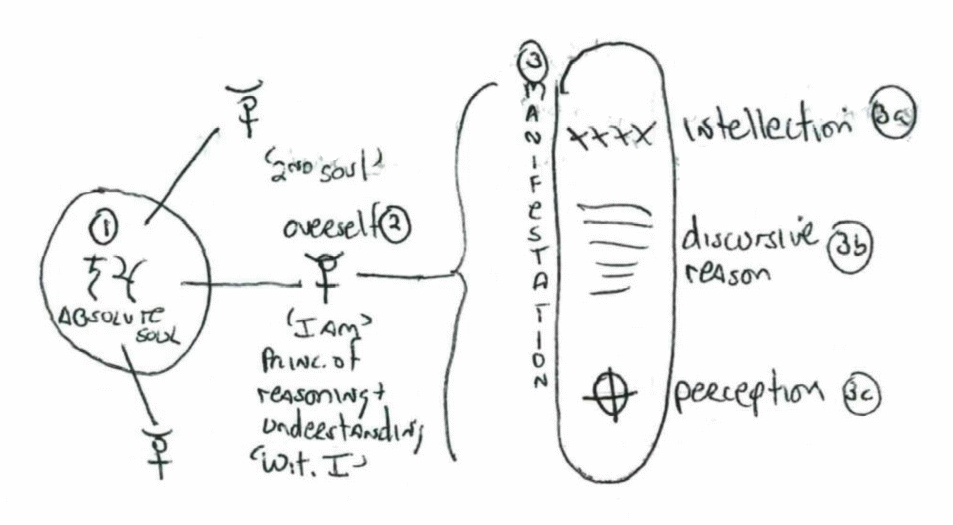
FIGURE 1983 0701a-1-AB. Double Knower Scheme.
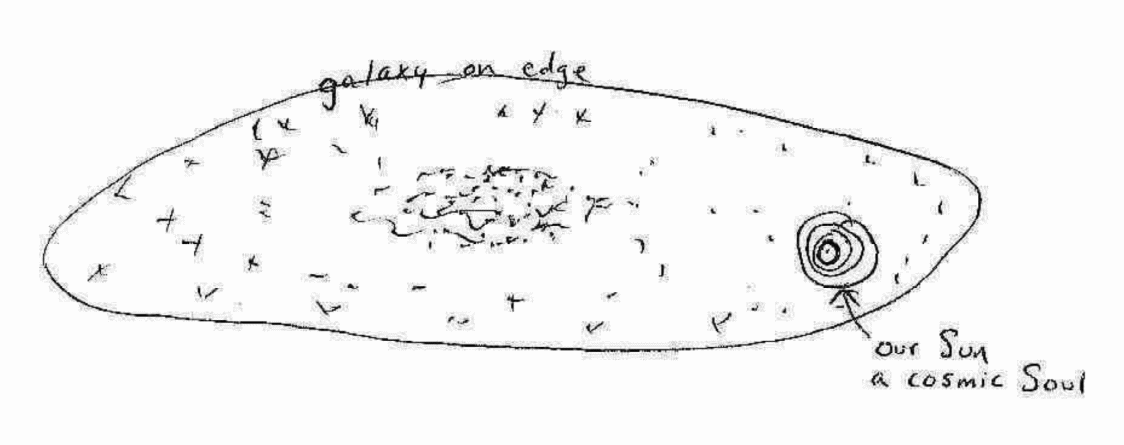
FIGURE 1983 0701a-2. Our Sun, a Cosmic Soul.
[Transcriber note: If someone is drawing or writing, with audible sounds of chalk on a blackboard, I indicate this by [drawing] or [writing].]
AD PAPER read in class:
- "Soul as Double Knower". Retyped as 1983 0701b V09MP. Astronoesis - Soul. This paper is not published in Astronoesis except for one paragraph, although the ideas are there.
NOTES:
This is 1983 07/01a, Plotinus; Soul Class, and the first entry associated with this date. 1983 07/01b = Soul as Double Knower Paper.
JF comment: "Reversal of thought" in this class seems to have bothered some students. That "an image of the Intellectual-Principle is in the I AM, that is its Selfhood," and this image is the inerratic.
Previously printed, distributed 2007 as part of a set.
This class is on a Friday.
Summer 1983 Plotinus; Soul classes/seminars thematically related.
TRANSCRIBED by jf 2006 from Audio Cassette tapes; reformatted by jf 2018. In 2024, IT does two more passes, corrects listening errors and makes verbatim, updates prefatory matter and footer, replaces tape markers with audio file markers, expands Subsubjects, completes Book List, adds Plotinus quotes section, corrects errors/typos, adds new notes within transcript, replaces first diagram with corresponding diagram from AB's class notes for this date, reformats to accord with new conventions. Archival verbatim transcript with AD Paper – V12ap.
AUDIO FILES: 1983 0701a, 1983 0701b. [Note: "Tape" and "Side" refer to original audio cassette tapes that were later digitized into .MP3 Audio Files.]
1983 07/01a at Wisdom's Goldenrod
Plotinus; Soul; Double Knower
[Audio File 1983 0701a Begins]
AD: --he'll finish paper of sorts, but it's still the same topic, we're not going to let go. Avery--good luck. (laughter, student comments)
AS: Alright, well this is the-- this is the order of things we're going to do. First we're going to read a few sections from [Plotinus Ennead] V.3. Just so we read a few of the passages before the paper so, that's what the paper takes off on. And then we're going to read the paper.
AD: You're right.
AS: And then we'll go back and take questions and so on. As An-- as Anthony said, there's-- there's probably more to be said than is in the paper. There's more to be said on the passages than is in the paper. But the paper makes the points just as-- that could be elaborated. But I think it's probably worthwhile to read some of the passages first, just-- I'm going to skip around, I'll tell you which ones I'm reading. I don't want to read every single one of them. But on [page] 383, V.3-- sorry, 382, V.3.2, read the first couple of paragraphs of that, and then we'll read couple paragraphs in 4. Ok.
[Note: In the reading of Plotinus quotes throughout this class, [added phrases], <omitted phrases>.]
Plotinus, V.3.2 (AS reading): "<2.> We begin with the Soul, [we ask] <asking> whether it <is to> be allowed self-knowledge and what the knowing principle in it would be and how operating.
"The sense-principle in it, we may at once decide [AS reads: decide at once], takes cognizance only of the external . . ."
AS: Ok. Next paragraph.
Plotinus, V.3.2 cont. (AS reading): "The reasoning-principle in the Soul acts upon the representations standing before it as the result of sense-perception; these it judges, combining, distinguishing: or it may also observe the impressions, so to speak, rising from the Intellectual-Principle, and has the same power of handling these; and reasoning will develop to wisdom where it recognizes the new and late-coming impressions (those of sense) and adapts them, so to speak, to those it holds from long before--the act which may be described as <the> Soul's Reminiscence.
"So far as this, the efficacy of the Intellectual-Principle in the Soul certainly reaches; but is there also introversion and self-cognition or is that power to be reserved strictly for the Divine Mind?"
AS: Then he has paragraphs of discussion: Can it be said that this phase of the Soul has its self-knowing, or will it then be an Intellectual-Principle, or if they do both have self-knowing, what's a distinction between the two kinds of self-knowing? And then again if we allot self-knowing to the reasoning Soul or the reasoning phase of Soul, then why do we call it Soul and not Intellectual-Principle unalloyed?
[context for above, not on tape, Plotinus V.3.2: "If we accord self-knowing to this phase of the Soul we make it an Intellectual-Principle and will have to show what distinguishes it from its prior; if we refuse it self-knowing, all our thought brings us step by step to some principle which has this power, and we must discover what such self-knowing consists in. If, again, we do allow self-knowledge in the lower we must examine the question of degree; for if there is no difference of degree, then the reasoning principle in Soul is the Intellectual-Principle unalloyed."]
Plotinus, V.3.2 cont. (AS reading): "[So] We ask, then, whether the understanding principle in the Soul has equally the power of turning inwards upon itself or whether it has no more than that of comprehending the impressions, superior and inferior, which it receives."
AS: Ok. Then on the next page-- [9¼ second pause] After another discussion he says, "Our reasoning . . ." The last paragraph in 3 near the bottom of 382.
Plotinus, V.3.3, 4 (AS reading): "No: our reasoning is our own; we ourselves think the thoughts that occupy the understanding--for this is actually the We--but the operation of the Intellectual-Principle enters from above us as that of the sensitive faculty from below; the We is the Soul at its highest, the mid-point between two powers, between the sensitive principle, inferior <to us>, and the intellectual principle superior. We think of the perceptive act as integral to ourselves because our sense-perception is uninterrupted; we hesitate as to the Intellectual-Principle both because we are not always occupied with it and because it exists apart, not a principle inclining to us but one to which we incline when we choose to look upwards.
"The sensitive principle is our scout; the Intellectual-Principle our King.
"<4.> But we, too, are king when we are moulded to the Intellectual-Principle.
"That correspondence may be brought about in two ways: either through laws of conduct engraved upon our souls as tablets or else by our being, as it were, filled full of the Divine Mind, which again may have become to us a thing seen and felt as a presence.
"Hence our self-knowing ensues because it is in virtue of this thing present that we know all other things; or because we know the faculty which discerns this principle of knowledge by means of the faculty itself; or because we become actually identical with the principle.
"Thus the self-knower is a double person: there is the one that takes cognizance of the principle in virtue of which understanding occurs in the Soul or mind; and there is the higher, knowing himself by the Intellectual-Principle with which he becomes identical: this latter knows the self as no longer man but as a being that has become something other through and through: he has thrown himself as one thing over into the superior order, taking with him only that better part of the Soul which alone is winged for the Intellectual Act and gives the man, once established There, the power to appropriate what he has seen."
AS: And then finish this last paragraph.
Plotinus, V.3.4 cont. (AS reading): "We can scarcely suppose this understanding faculty to be unaware that it has understanding; that it takes cognizance of things external; that in its judgements it decides by the rules and standards within itself held directly from the Intellectual-Principle; that there is something higher than itself, something which, moreover, it has no need to seek but fully possesses. Can knowledge of its own essence elude a principle which admittedly knows the place it holds and the work it has to do? It affirms that it springs from Intellectual-Principle whose second and image it is, that it holds all within itself, the universe of things, engraved, so to say, upon it as all is held There by the eternal engraver. Aware so far of itself, can it be supposed to halt at that? Are we to suppose that all we can do is to apply a distinct power of our nature and come thus to awareness of that Intellectual-Principle as aware of itself? Or may we not appropriate that principle--which belongs to us as we to it--and thus attain to awareness, at once, of it and of ourselves? Yes: this is the necessary way if we are to experience the self-knowledge vested in the Intellectual-Principle. And a man becomes Intellectual-Principle when, ignoring all other phases of his being, he sees through that only and sees only that and so knows himself by means of the self--in other words attains the self-knowledge which the Intellectual-Principle possesses."
AS: Ok. Ok, so rather than discussing that-- Ok. [drawing; see FIGURE 1983 0701a-1-AB, Double Knower Scheme, appended to this transcript. Explanation of figure: The three phases of Soul are Saturn in Leo and Jupiter in Virgo {together considered as Absolute Soul, Soul in the Nous}, and the third or lower phase of Soul, the Mercury Pisces Nature {a.k.a. Unit Soul, Individual Soul, Overself, I AM, in which the material cosmos is imaged; there are MANY unit Souls-- they include human Souls as well as star/sun/cosmic Souls.}] Is that [one word inaudible]
S: No it's ok.
[10½ second pause while AS draws]
AS: Anyway--
S (faint): Now it's--
AS: Try to show-- [25¼ second pause while drawing] Ok well--
S: What's that you wrote underneath Overself?
AS: I AM.
S (simultaneously): I AM.
S: Oh. Ok.
AS: I'll put (someone else) down, and then the diagrams and-- We'll talk about that. Ok. So now I'll read-- I'll read-- read your paper. How shall we do it? Read through the whole thing?
AD: Ok.
AS: It's not all that long, I'll read through the whole thing, then I can go back. I'll read through the whole paper, then we go back to the paper, and then we could go back if there are other questions, go back to the passages. [S, faint: What?] Oh, ok. "Once we have understood that--"
AD Paper, "Soul as Double Knower" (AS reading): "Once we have understood the Soul as being of a two-fold nature or of a tripartite division, we can attempt to explain to ourselves what Plotinus means by referring to the self-knower as a double person. The highest phase of Soul in the Nous--and the same as the Nous--is illuminated by the Intellectual-Principle which Plotinus refers to"our King." This is Soul as Absolute. Then follows the engendered essence, a sequent emanated from it, a self-identical, undivided individual mind without beginning or end. This is what is referred to as the "lower" Soul. However, although this Godlike entity is similar in nature to the Absolute Soul, it is not identical with it. Nonetheless it is an intellectual reality integrally omnipresent in everything that it will manifest. It may be called the lower phase of the Soul but it is our highest individuality, and for the unphilosophic mystic it is even thought of as God. It imparts something of itself to that which it manifests, so that it may also be considered as divisible among that which it manifests.
"This principle, which he refers to as"Reasoning Soul," he says cannot be conceived as being unaware of its own understanding and of recognizing that it bears within itself the Intellectual Cosmos as the imprint of the Intellectual-Principle.
"This lower phase of Soul, this principle has two aspects: it is the faculty of understanding, that is, it can reason upon that which is manifested within it, and also it is aware that its own selfhood is derived from a higher source. He refers to this intellectual reality as a double person. We must explain to ourselves very clearly the implications thereof."
AS: Put a couple of different--
[43 second pause while AS draws]
S: Sensation you're identifying with the right? The faculty of sense?
AS: Is that where you're saying sensation is, yeah?
S: Well no but I mean just along the lines of whether other people put would be down in--
[short pause while AS draws/writes]
AS: Sense.
AD Paper, "Soul as Double Knower," cont. (AS reading): "The Saturn and Jupiter, on the left [of FIGURE 1983 0701a-1-AB], refers to the Soul as Absolute, and again, this is the same as Intellectual-Principle. This is God or the Void. From this principle emanates the many Souls (Mercury) [AS: All these (one word inaudible).] each an intellectual reality, boundless, timeless and eternal in its immutability. Nonetheless, he refers to this as the [AS emphasizes next word] lower phase of the Soul, the principle of reasoning and understanding. This is not to be identified with a personality but more closely resembles the Vedantic notion of the Witness, or, let us say, an impersonal consciousness. It manifests the World-Idea which includes the starry host, the planetary spheres, and the sublunary realm."
AS: Well maybe we should write this a bit clearer. So I think-- [15¼ second pause while drawing] There's this other [couple words inaudible] here.
[24 second pause while AS draws; some student comments, mostly inaudible]
AD Paper, "Soul as Double Knower," cont. (AS reading): "We have to explain more fully the meaning of the starry host, at the top [of the figure, on its right]. Each star represents the lower phase of a Cosmic Soul. The highest phase is a principle of intellectuality which is manifested by its lowest phase, that which is divisible among bodies. For the Cosmic Souls, the distinctions between its phases is more verbal than actual. [12¾ second pause] The lowest phase of its Soul, of the Cosmic Soul, is transmitting and radiating this intellectuality within the Cosmos, through its body, the actual star."
AS: [drawing] Alright, this is supposed to be-- ok, these stars here too are the emanations of these I AMs, of all these Cosmic Souls.
VM: Avery, are you trying to distinguish between the Cosmic Soul and the individual Soul by drawing the Cosmic Soul through these arcs and the individual down there?
AS: No, [drawing] actually those would all be the same, these are all the same kind of idea. You have-- [students assent, faint] Yeah.
AD Paper, "Soul as Double Knower," cont. (AS reading): "For the Cosmic Souls, [AS: Sorry.] the lowest phase of its Soul is transmitting and radiating this intellectuality within the Cosmos, through its body, the actual star. The totality of these stars or Souls constitutes a representation of the Nous as the inerratic sphere. And this is included within the confines of the manifested universe of every individual Soul or mind."
AS: That was very very precisely and well said, (I want/I'm going) to read it again.
AD Paper, "Soul as Double Knower," repeat, then continuing (AS reading): "The totality of these stars or Souls constitutes a representation of the Nous as the inerratic sphere, and is included within the confines of the manifested universe of every individual Soul or mind.
"Thus our God or Ishvara is one of those stars, an Intellectual-Principle in its own right, its highest phase in the Nous. And the lower phase, of this our God or Ishvara, is a principle of manifestation immediately transmitting the will of its higher phase and producing and articulating its World-Idea. Individual human Souls are situated within that Cosmic Soul's manifested World-Idea and what they will know of the entirety will be according to the way this Cosmic Soul elaborated its World-Idea. We must remember that this is an elaboration of the inner realms of Being, that will be manifested by each Individual Soul for itself, it is not a discussion yet of the appearance of the sensible world."
AS: And if we altered this a little bit, I mean we put along with these Cosmic Souls [drawing] would be all the individual I AMs that go with each one of them. And all of ours would be going along with the I AM of our Sun, conjoined with it.
AD Paper, "Soul as Double Knower," cont. (AS reading): "To continue, within the World-Idea elaborated by a Cosmic Soul there is a representation of its reasoning phase by the planetary spheres. This, properly speaking, is the rational aspect of that Soul and its functioning is two-fold. As an agent it symbolizes the reasoning in the higher phase that unfolds the intellectuality of the higher phase, but as a medium it provides the Reason-forms that will organize the elements into material species which are in fact the bodies that the individual Souls will inhabit. Through that body-- [AS: (We're going to) get into that. (drawing)] And through that body will appear a World.
"Now we can now speak of the lowest phase of the reasoning Soul of an [AS emphasizes next word] individual human Soul, that is, its faculty of perception is imparted to the body and perceiving through the immovable spectacles of the body an apparent world with the planetary and inerratic spheres surrounding the sublunary realm."
S (faint, possibly part of background): Ok. And I'm going to need you.
S: Whew!!
[short pause while AS draws]
AD Paper, "Soul as Double Knower," cont. (AS reading) {Orig. Astronoesis Soul pp. 92-93, only the first paragraph is published}: "Again, we repeat, in this way: The vision proceeds to describe this cluster of stars we call the Milky Way; situated within that galaxy is our Sun. Surrounding our Sun are the planetary spheres which represent its rational understanding. The Sun's intellectuality is indicated by its relationship to the universe as a whole, [AS: To the whole inerratic.] whereas the rational powers are concerned with the relationship of all the parts [AS emphasizes next word] within the solar system to one another and as a whole.
"It is at this level that individual human Souls are conjoined to their"elder sister Soul." These powers of the Sun are evolving and unfolding the reason-principles that result in the organization of living organisms that will be inhabited by individual human Souls and through which they will gain experience of that world. So long as Souls are conjoined with the Rational phase all is well, Plotinus says, but if they descend further and inhabit body their preoccupation will be with that body and no longer with the whole. [Note: See Plotinus, IV.8.4.]
"The highest phase of this second Soul or lower Soul--the Augoeides or Star-like body--retains its Absoluteness, its intellectual reality as a unique undivided mind. Nonetheless it sends forth from itself that phase which is divisible about bodies. It is this principle which evolves through the experiences and finally succeeds in surrendering itself to its Source.
"In this preface we have included all the necessary ingredients to understand Plotinus' statement that"the self knower is a double person."
"In the quote, V.3.2, Plotinus points out that the sense-principle in the Soul perceives the external which obviously includes the body and its modifications, that is, an appearance. This faculty perceives the presentation which has been organized by its prior, [AS emphasizes next word] but it is the reasoning phase of the Soul which takes [AS emphasizes next word] cognizance of this appearance."
BS: Would you read that again?
AD Paper, "Soul as Double Knower," repeat, then continuing (AS reading): ". . . the sense-principle in the Soul perceives the external which obviously includes the body and its modifications, that is, an appearance. This faculty of sense perception perceives the presentation which has been organized by its prior, but it is the reasoning phase of the Soul which takes [AS emphasizes next word] cognizance of these appearances. If we identify the reasoning Soul in our diagram with the planetary spheres, that is, the actual transits, it is this principle which will pass judgment upon the perceptions of the sense faculty, that is, on the organized pictures that constitute the sense world. Only insofar as the reasoning Soul has gained experience and become filled with reason (and this is the evolution of the ego), it has now gained a [AS emphasizes next word] rationalized individual nature, and it can ascend and develop that wisdom. [AS: Namely the wisdom of the Ideas.]
"Plotinus goes on to say that the reasoning Soul will develop to wisdom when it correlates the reasoning to the prototype or archetypal Ideas that it holds within itself."
AS: So I think it's obvious where he's coming(,) through these three faculties, from the sense to the reasoning, and to the prototype or archetypal Ideas. Well, let's not get--
AD Paper, "Soul as Double Knower," cont. (AS reading): "This leads to the recognition of the presence of the Ideas or the Nous within itself. Repetitive and constant identification with these Ideas culminates in the appropriation and use of the Intellectual-Principle within itself. This is its true Selfhood, i.e., that the I AM principle is an intellectual reality or a Logos. And this entails the necessary knowledge of its Source. It must be made clear that the similarity is not identity. This is the mystery of man made in the image of God, with its own unity, intellectuality, and Soul."
AS: We'll put this all down. [drawing] [few words inaudible] [19¾ second pause while drawing] Yeah.
S (faint, in background): Excuse me.
[10¾ second pause]
AB: Would you re-read one part of it?
AD: Can I do one little diagram because this diagram won't show-- And maybe Vic could help me. Vic, when we take a look at the galaxy, I think it looks something like this. [drawing; see FIGURE 1983 0701a-2, Our Sun, a Cosmic Soul, appended to this transcript]
VM: Yeah. [couple/three words inaudible]
AD: Under it, yeah. And that these are [drawing] millions of stars, all-- all around, right? [VM assents] Our Sun is one of these stars. I don't know, it takes a 100,000 light years to go around.
VM: What about those, yeah.
AD: [drawing] Alright? This is our Sun, that's its star, ok, and there's many other stars. [VM assents] Each one of these stars we're saying is a Cosmic Soul. And each one of these, insofar that they're a Cosmic Soul, it's the lowest phase, because that's the part that's in manifestation; the highest phase is always in the Nous, alright. So then if each one of these represents an Idea, then this is representative of the Nous, ok. Now, if we take this, our star, our Sun-star, ok, and we imagine it, so to speak, speeding along here, and we'll put the Sun here, ok, and then we put the planets around it, alright, and we could think of this moving along and (yep--) Yeah. So this would be, on the one hand, its relationship to everything else, its position in that universe, alright, is an expression of its intellectuality; it knows its place in the whole, ok. But on the other hand, the working of the planetary powers around it, alright, is an expression of its rationality, alright. In other words, everything that's going on within this unit -- and I think that more than anything else these [star-planetary systems] have an integrity that-- [VM: That's right.] more so than anything in the solar system, I mean, in the universe. So that this part is the rational part which organizes every-- all the content within that, alright, and it does so from its own store of reason-principles. And then insofar that the Cosmocrators [planets], which they call the Gods of the Gods, also elaborate the material entities on any one of the planets, alright, create certain material species which then Souls are going to inhabit.
Now if you look from within the-- a Soul that's on one of these planets, alright, then from within this Ishvara will it relate to everything outside of it. So only the way-- and this is important-- the way this Ishvara has organized that solar system, has organized the bodies which, you know, requires a tremendous efficiency and wisdom, and to perceive its contents according to the way it organized the body, now to that extent all sense-knowledge is false. I don't care how many-- you know-- what do you call it [half word inaudible]scopes and setrascopes [sic; spectroscopes] and telescopes, it doesn't matter, because they're all basing themselves on the functioning of this material body, which is, we said, organized in (terms) by the reason-principles within the Soul. It isn't the universe the way it is but only the way it appears when a Soul is inhabiting the body. [student assents, faint] Ok. You got that. Then you can see that within this here, alright, this here is the same as this diagram here. [Note: Right hand side of FIGURE 1983 0701a-1-AB and solar system in FIGURE 1983 0701a-2.]
VM: Anthony, this is always a point that-- that to me mystifies me [one/two words inaudible] so, can I just try and elaborate on it a little bit? If I understand what you're saying, you're saying this Solar Logos, our Sun, is within this enormous galaxy and its motion is uniform and it has a proper place and so on. But now locally, from this galactic scale, we talk about the solar system as elaboration of the reason-principles within that Sun. And that all the unfolding of the planetary spheres is a playing out of that and it organizes the bodies in that solar system for individual Souls to inhabit. Now any view they have of the surroundings of that solar system is by necessity always through the kind of particular kind of bodily vehicles that they use, that they inhabit.
AD: That was organized by that--
VM (simultaneously): Right.
AD: Yeah.
VM: So consequently their view of that galaxy is going to be extremely limited.
AD: Determined by--
VM: Determined and limited, it's like when you make like a very simple-minded analogy. For example, like the electromagnetic spectrum stretches from very long wavelength radio waves all the way up to gamma rays, but the human eye is only sensitive to a very very tiny fraction of that entire spectrum. So the world we see visua-- you know, with the naked eye-- the world you see with the naked eye is extremely determined by that particular ability you have just to see in that short small window of electromagnetic radiation. So if you multiply that example by all the sense functioning and all the various vehicles that individual Soul works with, can you get some sort of hint about the limitations or the determination of its perception let's say of the rest of the universe?
AD: Will that give you an--
VM: Yeah, I mean, I'm just--
AD: Well--
VM: I'm just trying to see if that theory is right.
AD (simultaneously): Yeah, I would think that-- I would think right then and there that it would show that sense-knowledge is used as a basis for knowledge, alright, it will always be biased by that. Now, it is true when the scientist investigates the nature of, you know, the surrounding world, and then gets involved in the forms that the Sun used to produce the entities within it, and then goes even further and gets involved in the nature of matter, that means it has to go right to the Universal Soul and the way it organized the matter through its reason-principles, is penetrating into an opposite direction.
VM: But it's still always elaborating the Ideas in that solar system and then the-- in that order. So when a cosmologist, or let's say a modern astronomer-cosmologist claims that all other suns have a similar composition to our own and so on, and the laws of physics here in our solar system are the same as the laws of physics elsewhere you'd--
AD (simultaneously): I say that's an anthropomorphism.
VM: Fine. On the other hand-- (bit of laughter)
S: Very very smooth.
VM: There's a certain nice inner consistency to that anthropomorphic view.
AD (simultaneously): Well anthropomorphism from the point of view of our solar system.
VM: Yeah.
AD: That's the-- the standard then [VM assents] that's guiding his understanding, ok. Alright. That was the point I wanted to make. Just to see that when we were discussing here now, this would be the same as this diagram here [right hand side of FIGURE 1983 0701a-1-AB and solar system in FIGURE 1983 0701a-2]. [VM assents] In other words within this star, alright, we're going to see these realms within that star, alright? Now there's another way, you know, I want to get a point across and maybe do it this way, maybe this might help, this diagram might be good. Because some people have trouble understanding the point we're making: the inerratic sphere, planetary sphere, and the sublunary. [drawing; cf. fig. 91 in Astronoesis for example] Don't go outside that.
S (faint): Uh-hm.
S: But you didn't-- (bit of laughter)
AS: And I-- and I wanted to make one further point, which may or may not be correct, I don't know. But, I think one other further point which could be made is that, (with/if) all the Ideas in the Intellectual Cosmos are here in an undetermined and undifferentiated form, that these starry hosts actually represent the presence of the Ideas in the cosmos. And if you took the totality of those lower phases of those Souls, they would be expressing, let's say, as much of the Nous as could be expressed in the manifested cosmos. And, suppose in some way that our Sun would only be participating in some portion of that intellectuality.
VM: Avery, can we expand-- you know, PB always says--
AD: This point has to be understood [VM simultaneously: Yeah, I want to (understand).] because you won't understand what the Selfhood, you know, is of the I AM principle. So this must be grasped.
VM: You know how PB always says that you-- your perception is always through the immovable spectacle of the senses. [Note: See Paul Brunton, The Hidden Teaching Beyond Yoga, pp. 257-258, Dutton 1969 hardcover edition.] Now it seems to me that you're expanding that idea to say that your perception is through the immovable structure, I don't know about immovable, but through the inexorable structures that we call the reason-principles of our Solar Logos.
AD: Yeah, which has organized that body, yeah.
VM: Right. So it's just an expansion of that idea of how your sensations are limited by the particular sense-organs that a human functions (with). You want to go one deeper and say, the very reason-principles that constitute the entire solar system are the immovable spectacles in a grand sense.
AD: In terms to-- in terms of its relationship to anything outside of it.
VM: Exactly.
SD: So to follow up on what you were saying earlier, if that cosmologist went-- managed somehow to get to another solar system, and say [few inaudible VM words simultaneously with SD] hey look are the laws-- the laws are the same here, he'd be still coming up, he's still carrying his sense equipment with him.
VM: Yes, yes. Or I was going to say it the other way, if he ever gets to another solar system, that he's not a cosmologist any more as we know him. You know, you have to enter into a consciousness of a different Solar Logos and use different set of vehicles, different-- I mean unimaginable conditions.
AD: It's also a tradition, for instance, in India, that whatever we know of the outside-- of outside our solar system would be through the Ishvara. It determines what will be admitted into that solar system that will relate it to the outside. Now, one other thing. I'm saying that all this is a prerequisite in other-- in order to understand those passages that Avery read. If this is not understood, I can't understand how you understand this, these passages, that the Soul-- that the Knower is a double person. Ok?
S: Uh-huh.
JB: Yeah, is it important to understand why this view is wrong and illusory, or only that it's limited? I'm perplexed that--
AD (simultaneously): No it's only important to understand.
S: Yeah.
AD: That's all that's important. I don't think it's wrong.
VM (simultaneously): [few words inaudible] wrong.
AD: I don't think it's wrong and I don't think it's illusory.
VM/S(?): Ok.
AD: I mean anything that has been organized by the-- you know, the Ishvara of our World and with such efficiency that it could actually provide the experience by which a Soul can get experience of its-- the world of Ishvara, I'm not going to call that illusory.
JB: Well that's exactly my question, I wonder--
AD: I'm going to say it's not the ultimate reality but it's not illusory.
S (faint): (Fine.)
JB: Because I don't think of the Solar Logos as shoddy, you know, I mean that what it gives us to understand is good, it should be good enough.
AD: Yeah.
JB: And yet I get the impression that--
AD: Well, it does provide the ladder of ascent.
AS: To [one/two words inaudible] But you can't manifest the entirety of reality, and therefore it's in that sense that it's incomplete, it's finite. It's objective, it's finite, it's an appearance. And insofar it is appearance it's incomplete.
JB: So the word 'appearance' but not illusion. That's where-- maybe where I went wrong.
AS (simultaneously): Yeah, yeah, yeah. I think 'appearance' would be a proper word for the manifest cosmos, but not that it's an illusory appearance. It is an appearance, I mean saying that's an-- that it's an appearance already contains within it that it's not--
JB: The whole thing.
AS: The whole or the [one word inaudible] reality.
JB (simultaneously): Ok because I'm reading the wrong negative connotation, I mean it's not inferior by virtue of being incomplete.
[students assent]
AS: Yeah. Except that I think Vic's point was even that even considering the entirety of the stars, what we can even know of those other stars is only going to be through our-- filtered through our Ishvara's reason-principles [couple words inaudible] [student assents, faint] Good point. And is evolving.
VM: It's almost like saying--
AS (simultaneously): It's evolving too, so in that sense it's not absolute.
S: Metaphor.
JB: Is it evolving too, do you mean that the Ishvara is evolving and not just we're getting to it?
S (faint): Uh-hm.
AS: Yeah. I would say that it--
S (simultaneously): [few words inaudible] galaxy.
AS (simultaneously): Or-- or is evolving too, it's like a catcher as it goes around taking in--
VM: It's picking up influence.
AS: Taking in influences as it evolves, let's say.
JB (simultaneously): So in the same way that everything that moves, everything that moves is evolving. So that this [AS: Why not?] Milky Way-- the-- so the whole galaxy is also evolving. Do you mean to suggest--
AS (simultaneously): Why not?
JB: I mean I'm getting ridiculous here but--
AS: Why not?
JB: Relative to other galaxies?
AS: Sure, why not?
JB: Ok.
AS: Yeah.
CdA: But when you-- well I-- I need to ask about this now. If you say it's evolving, that that-- that Ishvara's evolving, what aspect of it is evolving?
AS: The only aspect of it that can evolve, its lower phase.
AD: Manifesting [phase].
CdA (simultaneously): Well, within its lower pha-- We're saying that-- ok-- its reasoning phase.
AS: Its-- yeah. Its lower phase.
CdA (simultaneously): That that-- Ok. But its own Logos principle would not evolve.
AS: Well, we have to talk about this Logo-- its Logos principle. I'm not sure what you mean, Carol.
AD (simultaneously): Let's stop there, let's stop there. Huh? Let's stop.
AS: If you want to bring that in I think you ought to wait a little bit.
CdA: Ok, sorry.
AS: Because that'll just be another kettle (of) fish. There's a couple of them.
AB: When-- if the total content of this Solar Logos, which is this universe which [one/two words inaudible] that would be the World-Idea for me. Right? I mean that would be what we call the World-Idea. And that would guarantee my evolution because it is evolving because it's part of this lower phase of that Cosmic Soul.
AS: What?
VM: We're going along for the ride.
S: Right.
AS: We do go along when it--
S: Yeah.
S: Yeah.
AB: Or that-- (when that--)
AS (simultaneously): As it's going along, we're going with it.
AB (simultaneously): Right. Would it be correct to say that what its total content is would be the World-Idea for [AS: I--] all of us within it.
AS: I would say that, that would be-- seem-- I mean, 'cause I think he also makes the point in the paper that, up to the point of just speaking of the Cosmic Soul, you can't think of this as the sensibly manifested world the way we know it as an appearance but is-- he says--
AD Paper, "Soul as Double Knower" (AS rereading): "Individual Souls are situated within that Cosmic Soul's manifested World-Idea and they will know of the entirety-- what they know of the entirety will be according to the way this Cosmic Soul elaborated its World-Idea."
AS: This solar system is its World-Idea, [drawing] and we're participating in it. Or here, this-- this whole thing is its manifested World-Idea.
AB: But I actually agree that since I don't manifest the whole of this Idea, that my World-Idea is even more circumscribed.
AS (simultaneously): Is a part, yeah. Is-- but is a participation in its World-Idea.
S (faint): Uh-hm.
AB: It can't go beyond the bounds of it. The outer limit of my World-Idea is its boundaries.
JB: The speed of light is an example of the boundary in that World-Idea. You can't really get--
SD: I may have misunderstood but I got the impression that the only part of that manifested world that we really directly touch as individuals is through the actual lowest part, through the physical sense perceptions. And that, I mean-- maybe I misunderstood, it sounded like the only part that-- the only way we can contact that intellective or reasoning phase of the World-Idea is by working on what the body represents through sensation.
S: Yeah.
AS: No, I didn't get that feeling, I mean he says in the passages that the reasoning phase of our Soul can contact the lower, the sense-perception, or it can work with the reason, or it can even receive impressions from the Intellectuality.
S: Or we--
AS: That's-- yeah.
SD (simultaneously): So I don't-- yeah I thought it was within itself or back to this--
AS: No I mean I understand that that lower phase of our Soul [drawing] can contact the cosmos at any of those three levels. It doesn't have to just experience the Cosmic Soul's cosmos through the body, it can experience it in terms of reason, or as he says even receives impressions arising from the intellection there.
SD: You're referring there to the Plotinus quote or to the (paper)?
AS (simultaneously): Either quote. The Plotinus quote or the paper. [student assents] Anyway, in answer to your question, basically no, it doesn't have to just proceed through the body. It also has a reasoning. It could participate in the Cosmic Soul's reasoning.
AD (faint): Ok.
AS: And it even men-- there was a mention of the transits, the way we speak of these transiting planets. And I think that was in reference to for an individual. [student assents] I think. The actual transits, where you can identify the reasoning with this-- the actual transits.
AD Paper, "Soul as Double Knower" (AS rereading): "This principle will pass judgment on the perceptions."
AS: He's talking about for an individual Soul.
(Side 1 of original cassette tape digitized as 1983 0701a Ends; Side 2 Begins)
AS: (--product), this is manifestation.
JC: Would you say that's an image of its own moving from the cosmos to the Nous? Would you-- would it represent that on the diagram as sort of-- you know, some-- something with relationship to the vehicles.
AD: Jeff, louder.
JC: I'm sorry.
AS: Well I think the Soul would be like [one/two words inaudible]
JC: But, I'm saying, as the Soul, the second Soul, not only reasons about the universe, but as it begins to turn and receive the impressions from the Nous, then that's represented in the cosmos by say a person who now we say operates in the rational consciously.
AD (simultaneously): It doesn't receive the impressions from the Nous in the Absolute, it receives them from the inerratic sphere.
JC: It rec-- it receives them from the Cosmic Souls.
AS: Yeah. There's no corresponding [JC simultaneously: Wait, if--] [drawing] movement this way [S simultaneously: Ok.] when there's a movement this way. At least that's the claim. In other words, this I AM or this light of our Soul is identified with some part within here. [JC assents] And, it can exercise these powers from within itself, powers of perception or reason or even of intellection.
JC: And you don't say that's something going on in the second Soul itself.
AS: Yes, it is going on in the second Soul.
S: Uh-huh.
JC: But--
AS: But it's not going on in the Nous or from the Nous.
JC: You don't think it's intellection of--
AS: Per se, no.
JC: It's intellection-- it's receiving impressions from the Nous, and when you say the reasoning Soul turns and receives impressions from the Nous, you don't think that's represented in terms of the second Soul's receiving impressions from the intellectual phase of the Cosmic Soul?
AS: Yes.
S: Yeah.
JC: But that's--
AS: Oh wait, (wait no), no, higher.
JC (simultaneously): No, I'm saying internally. I'm saying up from the left side of the diagram now.
AS: The Absolute Soul. No I--
JC: You're only talking about the body on the right.
AS: No. I-- no I-- This gets complicated. But I think that the second Soul of an individual doesn't receive impressions from the intellectual phase, the pure intellectuality [AS indicates on diagram] of the Cosmic Soul. It's rooted itself in the Absolute Soul. But this discussion isn't even talking about that. This discussion is talking about our I AM principle or our second Soul as becoming divisible in the cosmos and what it's apprehending there.
VM: I still don't understand [JC simultaneously: Yeah.] your question, Jeff.
JC: Well--
VM: Are you saying-- Go ahead, just repeat it.
JC (simultaneously): I'll try the statement again. That if the Soul is identified with sense knowledge, it's only going to know the body part and that's going to be the lowest aspect there.
AS: Right here. [AS indicates on diagram]
JC: But when it starts to reason, let's say it becomes a reasoning being primarily, now we say it lives in the rational planetary realm, but I'm saying its ra-- its reasoning, the reasoning that it's doing is something in the second Soul itself. [AS assents] Put it in the middle.
AS: In fact even the sense-perception that it had here was due to a power in that second Soul itself.
JC: Yeah its-- its ability to perceive.
AS: Yeah.
JC: Ok.
AS (simultaneously): And down here still it can have reasoning because of that--
JC: Rational power that's in it.
AS: Yeah, and when it-- and when it-- and when it can then rise to apprehend something of the Ideas, well, in the cosmos or [JC: Yeah, but I--] in the inerratic, [BS simultaneously: In the cosmos.] it still is using that intellectual power that's within itself, the second Soul.
JC (simultaneously): Yes. The intellectual power that's within the second Soul but, I would say only in--
AS (simultaneously): Not the intellectual power.
JC: No, I agree. [AS: Ok.] But, I would say you're only analogously pointing to the right side of the board. [AS simultaneously: Well, no (couple words inaudible)] That the knowledge it's receiving is something that is a incorporeal-- It may be represented in terms of the body like the relationship of the trans-Saturnians [AS simultaneously: Ok.] to the stars, [AS simultaneously: My--] and you're pointing to those planets.
AS: In my view which may be wrong, this-- my worldview says, this isn't-- this is everything which is objective. Now in this sense even when I reason, I reason about something. Even when I have intuition I have intuition of. As long as I say "of" or "about," [JC: Yes.] then I'm talking about a content, some content that is manifested on one of these three levels. [noise like something fell] I'm only talking about being within the manifestation of that Cosmic Soul, [JC: Yeah. But I--] not just-- [JC simultaneously: No.] not just at the level of [JC simultaneously: Yeah.] the sensible body.
JC: But when you say reasoning about, I think that you're saying I'm still in the second Soul, because the [AS simultaneously: That's right.] second Soul always deals with--
AS: That's right. And-- that's right.
AD (simultaneously, intensely): That's what we're saying, you'll never be anywhere else.
AS: Right. And if I (gain/get an) intuition "of"-- soon as I say "of"-- [JC simultaneously: "Of," right.] --which it is an intuition of-- I'm talking about an intuition "of" these Ideas which the intellectuality (or) the Cosmic Soul is delivering.
JC: Ok but, the only thing I'm saying is that those stars represent [AS simultaneously: The third phase.] the-- the highest phase of the Cosmic Soul.
AS: No, the third phase. They represent the highest of the second Soul of the Cosmic Soul. I got to make that very clear, I think that's what he's saying. These stars represent either the highest aspect of their lowest phase. [JC simultaneously: Or--] Or, the lowest-- or the lowest aspect of their higher, their I AM. In other words, each of these [Cosmic] Souls has an I AM too. Each of these Souls is rooted in [JC assents] Absolute Soul, let's forget about that. [JC assents] Each of these Cosmic Souls has an I AM principle. That I AM principle is what's manifesting [drawing] for it its whole cosmos, [JC assents] within which is a representation of the inerratic, [JC assents] the Ideas there; the rationality, which is this planetary sphere; and all of the actual sublunary bodies. All of that threefold we just mentioned is within the second Soul of that star. We're talking about the [JC simultaneously: Ok.] intellectuality of that second Soul [JC: Uh-hm.] as something altogether different. Maybe it would be better-- see we used intellection here. Maybe it would be better to call this intuition, even though it's a wrong word and it refers usually to something else, just so we have a different word from [JC simultaneously: Right.] calling this [JC: Right.] intellectual being.
JC (simultaneously): Yeah. Let me try to follow this through.
AS: I-- that was fine.
JC: I would say the star represents the Cosmic Soul's presence in the Nous as Intellect.
AS: Yes, it represents it.
JC (simultaneously): And it-- it's an outflow from it, it's not even conscious of its body, it's rooted in the Nous, and I think that's a quote from Plotinus, it's rooted in the Nous, [AS simultaneously: Yeah, it's (one word inaudible) the rainbow.] the body, the second Soul goes out and there was the manifestation as a star. Ok?
AS (simultaneously): Yeah, right (here). Here's its-- here are the second Souls [drawing] of all these suns, [JC: Ok.] and they're all rooted [JC: But--] in the Nous.
JC: That represents the Intellect of the Cosmic Soul.
AS: Its real Intellect.
JC: Its real Intellect.
AS: So the Intellect-- the [JC assents] undivided, [JC simultaneously: Undivided, absolute, right, right.] absolute [one word inaudible] of all those Cosmic Souls. [JC assents] In fact this is Absolute Soul [JC simultaneously: Ok.] for all of them. [JC simultaneously: Alright.] And now within the cosmos you're saying there's going to be a representation of that Intellect.
JC: Yeah, the star.
AS: The representation is going to be the Ideas in the inerratic. [JC: N--] And there's going to be a representation of its reasoning [JC: Alright.] would be here.
JC: You mean the reasoning-- the reason-principles that go to form that starry body [AS drawing] are an image of the intellectual phase of that Soul.
AS (simultaneously): Yeah because here we'd say these-- these intellectuality here is dete-- is in some way is determined. It's not absolutely indeterminate like the pure Ideas, you know, eternal, immutable, absolutely universal, they're only semi-immutable, because they go under-- undergo some kind of change. And they're more particular, spread out, differentiated.
JC: Well, I mean I don't disagree that the body of the star is made of some corporeal substance however refined, and that there's certain material reason-principles may be held by Nature that goes to form that star. But the-- the Idea that's represented by that star is in the Nous.
AS: Yeah, ok.
AD: Yes but that's not what you're going to get to know.
AS: Yeah, and it--
AD: The whole point is this here. That if the Soul is a double knower, alright, the person is a double knower, there's one phase of the Soul which is the reasoning phase of the Soul, alright, and that reasons on externals. Now when you ask what is the essence of that I AM, what will you turn to, where will you look?
JC: Of the individual Soul? Well in either case to the Mercury phase.
AD: What would be the essence of that individual Soul? What would be its Selfhood?
JC: In the Nous ultimately.
AD: No! That's the point we're making.
LdS: In the inerratic (sphere).
AD: Its Selfhood is right there in the Intellectual Cosmos that it is manifesting.
S: Yeah.
JC: You're saying the Selfhood of the I AM principle is in the cosmos that it's manifesting?
S: Uh-hm.
S (faint): Yeah.
S: Whew!
LR: Just do it.
S: Get with it.
JC: I mean I'm repeating it but I don't understand it.
AD: Well try again. The Selfhood, the Essence of the I AM, is right there in that inerratic sphere.
JC: Well, I would agree it's present to it.
AD: Well--
JC: But I wouldn't say that the Ideas of the inerratic sphere compose [AD simultaneously: Is the Knower.] my Soul as a self-motive principle.
AD (simultaneously, intensely): Is the Knower. The Ideas in the inerratic sphere is the Knower.
[short pause]
JC: Is it the Logos in my Soul is the Knower of the cosmos that it manifests?
AD (intensely): Is the Knower. Stop. Is the Selfhood. Is the Essence of your I AM.
[short pause]
S (faint): [couple words inaudible]
S: Yeah.
AD: Yeah.
S: We can talk past it.
LdS: So--
AS: Take a walk now. (laughter)
LdS: Anthony? So what-- what you're saying is this double knower-- the-- he speaks of the two knowers.
AD: Yeah now you can open your text, go ahead.
LdS: ". . . there is <the> one that takes cognizance"--
AD: I'll come out here while Avery went out.
Plotinus, V.3.4 (LdS reading): "<Thus> the self-knower is a double person: there is <the> one that takes . . ."
AD (simultaneously): How many know-- how-- how many are there?
LdS: How many knowers?
AD: How many are there?
LdS: Two.
AD: Self-knower is a double person. How many are there?
LdS: There's a double person. That means this--
AD (simultaneously): You mean there's two I AMs?
LdS: No, there's two-- but there's two stages or two stances [one/two words inaudible]
AD: There's two aspects of one thing.
LdS: Yes.
AD: Are you sure?
LdS: Yeah it has to be.
AD (simultaneously): Ok. There's two aspects to the I AM, yes.
LdS: Yes.
Plotinus, V.3.4 (LdS reading): ". . . there is <the> one that takes cognizance of the principle in virtue of which understanding occurs in the Soul or mind . . ."
LdS: And I would say that's the reasoning phase or that would be-- that would correspond to the planetary spheres within the cosmos.
AD: Ok.
LdS: And then he says-- and later--
Plotinus, V.3.4 (LdS reading): ". . . and there is the higher, knowing himself by the Intellectual-Principle with which he becomes identical . . ."
LdS: And that would have to be the inerratic sphere. That would be the highest form of self-knowing which would be the Intellectual-Principle.
AD (simultaneously): That's in-- yeah.
[short pause]
LC: But you said it wasn't in the Intellectual-Principle. That Absolute Soul and Intellectual-Principle are (the same).
AD (simultaneously): The Intellectual-Principle is in the I AM. An image of the Intellectual-Principle is in the I AM, that is its Selfhood.
S (faint): Right.
LdS: And that's the inerratic sphere you're saying here.
LC: And that you're putting on that diagram-- when you put the Sun up there, said our-- the Sun of our--
[short pause]
DH: Diagram over on the right.
LdS: Yeah.
AD: Look, if you look--
LC (simultaneously): Right [one/two words inaudible]
LdS (simultaneously): On the right.
AD (simultaneously): If you look [S simultaneously: Yeah.] at even [LC simultaneously: Then you put it in diagramming.] this diagram here, if you look at even this diagram and each one is a star, that includes our Sun, that's a star. Then within that Sun is going to be this planetary system and the sublunary is all going to be there. [Note: Most likely a reference to FIGURE 1983 0701a-2 but applies to both diagrams appended to this transcript.]
LC: So you're saying the double knowing is all taking place in there.
AD: All within this realm. There's one, there's one aspect-- there's two aspects to the I AM, one aspect is concerned with reasoning on the external, [LC: Right.] alright, everything that it's manifesting. There's another aspect which he refers to as its true Self. [LC: Right.] That's this here realm.
DH: Yeah. When we contemplate something like the-- the principle of Number or the Idea of Number, then what you're saying is that it's our-- the image or our understanding of that is through the particular bodies that are in this particular solar realm where we-- So that the-- I mean, presumably like the principle of Number comes into all of these stars and all of the-- the universes, these stars, but we must have our-- a particular vantage point of it. Is that--
AD: I'm sorry but I still don't follow you.
VM (faint): (I) understand what you're saying.
DH: I mean--
AD: Try again.
DH (simultaneously): If we take something like the principle-- principle idea of Number, numbers, that presumab-- we have-- we have some kind of-- we build up some insights, images, understandings of this. These understandings and insights must be from within the context of the particular Solar Logos that-- where we are.
[Note: See FIGURE 1983 0701a-1-AB, Double Knower Scheme, appended to this transcript for the following.]
AD: Yeah, so over here, let's say-- let's say over here we have [drawing] the sen-- the sense given. [DH assents] We perceive the sensible here, alright. [DH assents] We judge it from here. [DH assents] It's the reasoning phase of the Soul that judges the sense-perception, [DH assents] or the faculty of sense-perception, alright. And it becomes more accurate when it can correlate the archetype to what this represents. [DH: Right.] So the reasoning phase of our Soul, alright, would be located over here. It-- it looks upon the sense-perceived, alright, and it judges according to the knowledge within itself. But its judgment would be even more accurate if it correlated it with the archetypal Ideas which are in the Nous.
S (faint): Yeah. [couple/three words inaudible]
DH: But-- but now--
AD: So in other words, all scientific knowledge [drawing] would reside here.
DH: But in that-- that correlation with these-- these Ideas that are up in the inerratic sphere, it's still through-- from the particular vantage point from our particular Sun.
AD: Yeah, within a--
DH: And so that--
AD: Yeah, within this realm.
DH: So that these other stars would have like other views of the Idea of Number.
AD: That could be, that could be.
DH (simultaneously): Other approaches to it of understanding.
AD: But, we also have to remember that these also [drawing] are related to this here. So if you think of this as a star, our Sun is a star, and you have all these other stars, there is a relationship. This-- our Sun is taking in, so to speak, these Ideas too in the formation of its World-Idea. [DH assents] Otherwise the zodiac will be meaningless, why call Aries the head and Pisces the tail. That whole realm of stars, I don't know, 1100 or so, that they refer to as immutable Ideas, they're all taken in by the Ishvara in its formation of the World-Idea that it's dealing with.
S: But we're very (stupid).
VM: I'm just going to vaguely talk about. Maybe just as the scientific ideas of the universe are in some sense known through the local spectacles, the reason-principles in our Solar Logos, so too the mathematical ideas. [DH assents] Isn't that what your question established in a sense?
DH (simultaneously): Yeah.
JB: That they might be different in other systems.
VM: When you penetrate into [LR simultaneously: Yeah.] the Idea of Number, it's only a local view of it.
DH: Yeah but-- but the-- I mean the-- the Principle-- I-- all I'm trying to say is that the-- the Idea or the Principle behind that has to be something that-- I mean it goes back to the Intellectual-Principle and it's-- it's the Idea side.
AD (simultaneously): They'll all-- it'll all be in here.
DH: Yeah.
AD: When you get to the root meaning of what Number is, you're going to have to go into the inerratic sphere, and not only the way the Ishvara, alright, provides the organs by which, you know, you could function, but also what Ishvara has brought into itself in order to create anything over here. It isn't that Ishvara operates in a vacuum, it's part of this whole galaxy system. [DH: Yeah.] So it's always taking in, it's always receiving. In other words, it itself is radiated by the intellectuality of all the other stars, as well as it in turn contributing to the radiation to other stars. So this whole realm is the realm of the inerratic sphere, the inne-- the immutable and eternal Ideas. Now, the point that he's trying to make here is, he's saying this imprint of the Intellectual Cosmos within the Soul is the Higher Knower. (bird song; several people talking at once) Now, why don't we do this here, ok? Turn to the text. Read the text. Now my turn.
S: Your turn?
AD: Turn to the text and read it, [AS simultaneously: Did someone turn the lights off?] and see what interpretation you can come up with.
S: Brownout.
VM: Is that what it is, really?
AD: See what I really would like to do is have you give me your interpretation before I give you mine. That's what I really like to do.
LR: Well you know what our interpretation is, [S simultaneously: Use it. Last week's.] what you taught us within the last five years. (laughter, student words)
S: Yes.
AD: Why don't you read some of the text, Avery, go ahead. Why don't you start with the text.
AS: Well, would you like to start from where I started before?
AD Yeah.
AS: Or start from the double self-knower right off the bat?
AD: Right off the bat, go ahead.
AS: That's what I thought.
AD: Because this is the same problem that came up Wednesday night. If this concept of the I AM isn't grasped, all those notes in PB will be, you know, not given the full weight that they deserve.
RC: Anthony, I see one-- I mean, in terms of my being able to follow now anywhere you go from here--
AD: I'm sorry?
RC: In terms of my being able to follow anywhere you go from here, whether it's another text or whatever, it's become obvious to me that I have no understanding whatsoever of what you mean of those two realms above the sense-perception in the box on the right [of FIGURE 1983 0701a-1-AB]. I just don't know what you mean when you say that, the way you just said that. And like I've been understanding the analogy from before.
[students talking in background]
AD: Oh ok. Alright. I think the wisest thing is to read the text and--
LR(?): All theory.
AD: That's the only way. Let's read the text.
S: Backwards.
S (faint): Backwards.
JfL: In V.3.4 where it starts, "But we, too, are king when we are moulded to the Intellectual-Principle."
AS: And that's where we're starting, yeah.
JfL: In the second paragraph--
AD: Vic, read it!
JfL: Does that correspond-- what--
AD: And read it loud!
S (simultaneously): Loud.
LR: Where are you?
JfL: Well everybody's talking.
VM: Yeah.
AD: Loud! That's why I'm telling you to read loud. (AD laughs a bit)
S (simultaneously): [few words inaudible]
JfL: Do they have like a (bulb away), Ella May?
LR: It's a brownout.
AD (simultaneously): Yeah, we got a brownout, we can't do nothing. The fan (doesn't work). Brownout. I don't know how it'll pick our brain, let's try.
AS: Probably affect the tape recorder too. Anything with a motor.
[few people talking at once, inaudible]
S: Change the television.
AD: Nice range.
AS: Does the recorder have a (compass)?
VM (faint): No. We--
AS: Oh.
JC: (Our/Hard) representation.
AD: Alright Jeff? Read.
CdA: Let's go.
Plotinus, V.3.4 (JfL reading): <(not read on tape, see JfL quote above): "4. But we, too, are king when we are moulded to the Intellectual Principle.>
"That correspondence may be brought about in two ways: either through laws of conduct engraved upon our souls as tablets or else by our being, as it were, filled full of the Divine Mind, which again may have become to us a thing seen and felt as a presence."
JfL: And if this is the double knower, then you're saying this is the rational, and the Divine Mind is going to be the inerratic. Is that what you're--
AD: Well you have to read it, you have to read a little bit from the text.
JfL: Ok.Plotinus, V.3.4 cont. (JfL reading): "Hence our self-knowing ensues because it is in virtue of this thing present that we know all other things; or because we know the faculty which discerns this principle of knowledge by means of the faculty itself; or because we become actually identical with the principle.
"Thus the self-knower is a double person: there is the one that takes cognizance of the principle in virtue of which understanding occurs in the Soul or mind; and there is the higher, knowing himself by the Intellectual-Principle with which he becomes identical: this latter knows the self as no longer man but as <a being> [something] that has become something other through and through: he has . . ."
AD: You want to stop there? [students assent] Ok.
LR: So then in your interpretation, Anthony, Man is restricted to the planetary spheres. The definition of Man is restricted to the-- to the planetary spheres and that would be something like Manas, the Manas principle.
AD: No, I don't want to work that. I don't want to answer it that way.
LR: Well, how would you like to answer it?
AD: I-- I first want to work in explaining the passage.
LR: Well that's what I'm trying to do. When he says--
Plotinus, V.3.4 (LR rereading): ". . . this latter knows the self as no longer man but as a being . . . [of a] superior order . . ."
LR: Now if you're saying the superior order is those-- is the inerratic sphere, that's the second knower, then man, no longer man, man must be restricted to the planetary sphere. That would follow from what you said.
AD: That would be the 'We,' wouldn't it.
S (faint): Uh-hm.
LR: Man?
AD: Yeah, that would be the 'We'. That's what we all share in common.
LR: Well he says 'We' is the reasoning Soul.
AD: Uh-hm.
LR: That it's hard to think of what he might mean by knowing the self as no longer man.
S: As Idea.
LH: It seems like when you ask [one word inaudible] it would understand that double Soul as either two aspects of one I AM or it's two-- two Souls, two persons. That-- I'm thinking that you have to really understand it both ways.
AD: Understand what in both ways?
LH: You have to understand the double knower as-- as both--
AD: That the selfhood of the I AM is the Intellectual-Principle?
S: No.
LH: Is-- is a-- no, that it's the Solar Logos, that it is a Soul in its own right.
S: Yeah but what is--
AD: I don't see where that's taking you.
LR: The Soul [one word inaudible] of the [LH simultaneously: Well--] I AM can't-- you're saying can't be the Intellectual-Principle.
AD (simultaneously): No, it can't.
LR (simultaneously): It has to be the Soul's version of the Intellectual-Principle, [AD assents] that's what's going to plan things out for you.
AD: Uh-huh.
LR: I--
S (faint): I see.
AD: [one/two words inaudible] understand that?
JC: That's its presence in the Nous.
AD (simultaneously): You really got that then.
S (faint): [one/two words inaudible]
S: Yeah.
JC: Then--
AD: Because that's what you can't bridge, you can't cross over that.
[students assent]
LR: Or else you give up that i-- you give up that Selfhood to be in s-- in [one word inaudible]
AD (simultaneously): You can't give it up, it's forever!
S: Where?
LR: Well, in trance state. If you were to go into--
AD: Well, you're speaking about a mystic identity [LR simultaneously: That's what I'm saying.] or trance, ok.
LR: But then your-- you would not be that individual, [AD assents] and you would return to that individuality, and insofar as you could have conscious self-knowledge, it has to be your version of the Intellectual-Principle.
AD: Yeah. The imprint that the Intellectual-Principle has given the I AM.
S (faint): (Well that's--)
S: Could I try again (maybe)?
EC: (Maybe) put insight here. [few words inaudible] that?
AS (simultaneously): [few words inaudible]
AD: One thing at a time, we'll come to that. We got this point though?
S: No, I did not get that.
S (simultaneously): No. [couple words inaudible] Intellectual-Principle [couple words inaudible]
AD (simultaneously): That's why I wanted to stop.
RC/S(?): I don't think I--
S: [couple/three words inaudible]
RC: Followed the words but don't have any meaning for me.
AD: Well, in that case, let's reverse it. You give me your interpretation.
RC: No, I don't want to give any interpretation [one/two words inaudible]
AD (simultaneously): Well, the way you understand these passages.
RC: Well the-- the problem I'm having is that understanding the way that you're using the three realms on the right [of FIGURE 1983 0701a-1-AB]. Like before, that analogy had always been used to say that we have here in the sensible universe a sensible representation of the ordering to be found within the Intelligible World. And we were saying that the planetary spheres, or as we see the planets in motion, is an image in the sensible universe of the discursive reason.
AD: Yeah and that it was a symbol pointing out the transcendent reality, sure.
RC (simultaneously): Well we're saying the sensibly perceived stars that appear to be fixed within the course of a human lifetime at least are a sensible representation of the Intellect, [AD assents] the Ideas, that go to constitute the universe. It seems now that you've taken all three of those levels of that analogy and shoved it down into sense-perception.
AD: No. I'm starting off with sense-perception, and within sense-perception I'm making this threefold division within sense-perception. It isn't that there's three realms in sense-perception. The stars that I see are as much a part of the sensible world as the tree I'm looking at!
RC: Ok. Am I to understand that when you speak of the inerratic sphere you mean the actual like atomic and subatomic structure of the physical star?
AD (faint): (Not here.)
RC: I didn't think so. So basically what I'm saying is that when you say--
AD (simultaneously): If we say inerratic we mean immutable Ideas. If I say the stars that you see, you're talking about the way their appearance in the sensible world takes place.
RC: Ok. But, you're not talking, I mean-- I can't tell if you're talking about a corporeal physical body star made up of [AS: No.] whatever the material is as being the inerratic sphere. Or whether that you're saying that that's just a sensible representation of what you mean by the inerratic sphere.
LR (simultaneously): That's the way it would look from down in the sense.
AS (simultaneously): Randy, if I could a-- but I explained that on the diagram. See, this-- I think this-- when I drew this, this is not meant to just be the sensible representation. The sensible representation you see will only be as functioning through this sensible body here.
RC: Yes.
AS: Now if you rise, still within cosmic manifestation, to the level of the planetary spheres, you're no longer going to perceive the cosmos in the same way, you're going to perceive it in a rational way. And if you rise to the level of the inerratic sphere, you will-- you would be perceiving the intellectuality of the cosmos. Now, it's manifest but not sensibly manifest. It's not-- the-- the in-- the-- [drawing] the inerratic sphere that he's talking about is the intellectuality of the cosmos.
RC: Ok, would it be possible--
AS: Now you see that-- when you're here, within the Dragon, and you see the stars, you're seeing the body of the stars. Just as you have a body I mean I think you would say these stars also have a body that you can [RC simultaneously: Ok.] sensibly perceive.
RC: Ok.
S: So you're just going up again.
LdS: Yeah.
RC: Like this-- going up to the next one, like say if you-- if you contemplate the mathematics of the orbit of the planetary system, [AS drawing] and you see the-- the truth in a certain formula, that this actually does-- it is predictable, it does work, this will tell me where that body will be, this is a symbol of the intelligence of that motion. You're saying this is tying in to a manifestation of the rational level?
AD: That would be a manifestation of the intelligence of that Soul, [RC: Ok.] when you could measure its motion.
AS (simultaneously): Soul.
RC: Ok. And then--
AS: And then if you had a-- you know, a real intuition of some Ideas, that would be the intellectuality of--
RC: Ok now I have-- maybe the next one would be something that you could give any kind of example for, that I could get some feeling for what you mean by inerratic sphere.
AD: The totalities-- the totality of the Ideas which pervade the universe and are formative forces that are producing that-- the order in the universe.
RC: Ok.
LR: As-- as manifested for a Soul.
AD: Well as-- as manifested all the way down, even down to the individual material species. [RC simultaneously: Ok now--] The Idea of Man that exists here is found-- the prototype, the intellectual archetype of that is found in the inerratic sphere, [RC: Ok.] not in the body of the star, [RC simultaneously: Ok, so for (an--)] but the influence that they radiate.
RC: So then for any individual human being, that would be basically tying into the knowledge that our Sun has of its own World-Idea that it's going to be evolving.
AD: You could leave out, for the sake of a easier exposition, leave out our solar system, and say that you're exposed, alright, to the irradiation of all the Ideas that are in the cosmic-- in the cosmos that you are manifesting, that your I AM is manifesting. [student assents] And it is this which is the true knower in you.
RC: Ok. Ok. So the Nous then that's operational in me is inserted into my vehicles by the Sun.
AD: It's-- I'm-- I'm sorry, I lost you.
RC: The Nous that's operational in me is inserted into me by the Sun.
AD: Inserted into you?
RC: Well, insofar as it's what goes on (to be--)
AD (simultaneously): Insofar that your body has been organized by the reason-forms which are in the Cosmic Soul, and then the individual Soul must function through that body, the appearance of the stars as stars, as sensible stars, has been organized by the Cosmic Soul. But what interprets the appearance which is taking place through the body is going to be the functioning of the rational Soul. You look at a box, alright, and that's just a blotch, so to speak, of sensations. When you pronounce it's a square, that's the rational Soul talking.
RC: Ok. And it sounds like--
AD (simultaneously): It pierces right through the appearances and says that's a square.
RC: And it got that piece of information from the Sun.
AD: It got that piece of information insofar as your Soul is conjoined with the rational powers of the Sun.
RC: Ok.
AD: That's why I said, what we're discussing are the inner dimensions of Being, not the external. [student assents] We're discussing the a priori of what makes your I AM when it manifests a world, what gives it [RC: Ok.] that content.
RC: Ok. So ontological structure of the second Soul.
AD: The ontological structure of the a priori functioning of your I AM. In other words, we're saying that this whole Idea is organized by the gods and given as the World-Idea to the individual Soul.
RC: Ok.
AD: That's something that's never discussed.
RC: Ok. So [couple words inaudible]
AD (simultaneously): If you say, if you say that as a mentalist I believe that everything must be projected from my Soul or manifested within my Soul, and then someone says well, you know that there's a World-Idea which is imposing itself, or let's say fascinates the Soul so that it must take it in, then you have to go back further and explain how that was formed. [RC: Ok.] And that's what they mean about the fabrication of the world by the gods.
RC: So as long as-- as long as any individual Soul is in any universe, then the extent of the Nous that it can manifest to itself is directly in keeping with what the Sun of its system is doing at that precise moment.
[9 second pause]
AD: Well I can't answer it that accurately, I mean when you say that, I can't-- I can't answer that.
RC: Well it seems like I can't know anything if the Sun isn't knowing.
AD: Yeah.
RC: Isn't manifesting that.
AD: Yeah.
RC: Ok.
LR: The limits of your knowledge would be contained by--
RC: Ok so if I think of the individual Sun's ideation as a sequential thing (or) the certain Idea develops its logical structure, inherent structure, is followed by another Idea which unfolds its inherent structure, that this is-- this is the potential revelation of the Nous that can be unfolded within my I AM.
AD: Within my--
RC: Ok.
JfL: We can go back to the beginning of the section here.
AD: Alright, let's-- let's try, Jeff.
JfL: Well, what I was thinking is that "That correspondence . . ."
JB: Louder.
AD: Well where are you at?
S: Second paragraph.
JfL (simultaneously): (I'm in) the first [one word inaudible]
AD: "Thus the self-knower . . ."?
JfL: No.
AD: Go ahead, read me.
JfL (simultaneously): Starting before that, the second paragraph, the bottom of the page on the left.
Plotinus, V.3.4 (JfL reading): "[Where] That correspondence may be brought about in two ways: either through laws of conduct engraved upon our souls as tablets or else by our being, as it were, filled full of the Divine Mind . . ."
JfL: Now I was-- I was thinking of this (Soul--)
Plotinus, V.3.4 cont. (AD reading): ". . . which again may have become to us a thing seen and felt as <a> presence."
AD: That's the inerratic sphere. That's the totality of the Ideas coming from the inerratic sphere. It is experienced as the World-Mind, the Idea of the World in you.
AS: Yeah.
AB: And that's the essence of my Soul, [VM, faint: It's like you said.] what you're saying.
JfL: I mean what I was--
LdS (simultaneously, faint in background): That's the double knower in the center?
JfL: What I was-- what I think came to was that this-- the laws of conduct engraved upon our Souls as tablets seems to me to be the whole Mercury principle and the laws of conduct engraved, the guide would be the Ishvara and the whole intellectual inerratic realm and everything that's going to be experienced. "Filled full of the Divine Mind," I guess I'm receiving, "or else by our being"-- it seems in one sense it's-- Mercury is-- our Souls are engraved with this World-Idea organized by the-- the Sun. Or, if it's felt as a presence, I'm thinking that this was the Divine Mind itself.
AD: What Divine Mind?
JfL: The Absolute.
AD (simultaneously): Absolute?
JfL: That this is in fact felt as a presence, it's not-- it's not the individual, you know, sensing it or knowing it which would be always in the first-- first part of it, and I thought that the rest of this self-knowing is all through the laws of conduct engraved upon our Soul. And that by being as it were filled full this would be the true insight. The Sage has [couple words inaudible] And then he says--
Plotinus, V.3.4 (JfL reading): "Hence our self-knowing ensues because it is in virtue of this thing present . . ."
[chalk on board sounds]
JfL: So these levels here that he's-- he's now beginning to break apart what's engraved upon the Soul by the-- by our Sun, that can be done either-- either externally, you know, seen as a sense object, subject-object, or it could be seen as the reasoning aspect or finally identical with the inerratic sphere.
AD: Well, wouldn't that final be the first thing? Isn't what's engraved upon the Soul is the inerratic sphere, the totality of the cosmos, the whole Intellectual Cosmos? You begin with that. That's what's engraved upon the Soul by the Eternal Engraver. And it's engraved upon the Soul. So it's that insofar that it is engraved upon the Soul, that is what is your Selfhood, [JfL simultaneously: But how could that be?] the Selfhood or the higher knower in the Soul.
S (faint): Right.
AD: Well let's get to-- let's get to the serious business of translating these things into our understanding. Suppose Avery and I talk, huh? Ok?
RC: Talk to us though.
AD: Alright?
RC: Yeah. But it would be-- be nice if you would talk to us.
AD: Well-- If you would see him.
AS: I know, so--
S (faint): Ok.
S (faint): The camera. (bit of laughter)
RG: Exactly.
AD: You got a camera?
S: Yes.
TS: I could use the eyes of Soul.
AD (simultaneously): It's not because eyeglasses.
VM: Yeah, you have to use siddhis. [Note: Because of brownout or no electricity.]
[few seconds of background student talking]
AD: No, stay there, it's the darkness, I'll find a place. Alright.
Plotinus, V.3.4 (AD reading): "Thus the self-knower is a double person: there is the one that takes cognizance of the principle in virtue of which understanding occurs in the <Soul or> mind; and there is the higher, knowing himself by the Intellectual-Principle with which he <becomes> [has become] identical: this latter knows the self as no longer man but as a being that has become something other through and through: he has thrown himself as one thing over into the superior order, taking with him only <that> [the] better part of the Soul which alone is winged for the Intellectual Act and gives the man, once established There, the power to appropriate what he has seen."
AD: Avery, can we talk about that?
AS: Sure! That seems pretty clear.
LdS (faint): Yeah.
S: Yeah. (student laughs)
AS: The--
RC (simultaneously): [couple words inaudible] it is to me.
AS: No, you start with the higher. Doesn't matter. [see few paragraphs down for AS on this interpretation] The understanding principle is what he was speaking about: "the principle in virtue of which understanding occurs." Now I claim that this reasoning Soul here, the reasoning is aware that it's reasoning.
S (very faint): So there [few words inaudible]
AS: Oh.
S (faint): [couple words inaudible]
AS: The rea-- We can't assume that this reasoning is unaware, or the understanding or the reas-- the understanding, we can't assume that it's unaware that it has understanding. And so this lower one "takes cognizance of the principle in virtue of which understanding occurs." Ok now I would say there, in this interpretation, I'd have to say the principle in virtue of which understanding occurs is those Ideas. [student assents] And the first-- even when he's the rational here, [AS points out on diagram] he still can take cognizance of that principle of the intellection, of that Intellectual-Principle, of the Ideas, in virtue of which the understanding occurs. But then "there is the higher, knowing himself by the Intellectual-Principle with which he has become identical." So now he's talking about his Soul has now actually identified with the inerratic. It's like you're talking about these levels. He's in the sense-world. If he identifies with the rational, he eventually evolves to that point where his Soul or I AM is situated there, that it has understanding, and it also has a kind of self-knowing, a lower kind of self-knowing. It has self-knowing, you're saying, because it is aware of its Self now, it is aware of the Ideas but is not identical with the Ideas. And the higher self-knower is when the Soul actually raise-- reach-- when this I AM now becomes identical with the Intellectual-Principle, that is, when he becomes situated in the inerratic. I-- there's ano-- I can interpret it another way too but--
JB: That's still the lower also?
AS: No. Then he is the higher self-knower.
RC: Ok. So when-- when he double--
S (simultaneously): What does it mean to (sit--)
DH: So the--
S: The (lower), the--
S: Yeah.
DH: So could we say that the lower self-knower knows the-- I mean, has knowledge of the Ideas through the reason, but-- whereas the higher self-knower knows these Ideas as itself.
AS: No. Yeah, no I misinterpreted that, let me try again. No I wouldn't say that. I'll try again. Different way. "The one that takes cognizance of the principle in virtue of which understanding occurs" is talking about the actual power of the understanding itself. When the understanding-- when we know, we know that we know. Try it that way. [S, faint: Ok.] Ok, we know that we know, we're aware that we're knowing. So even in the understanding, there is a cognition that it is understanding.
S: But when it's [one/two words inaudible] now (knowing).
AS (simultaneously): Knows that it's knowing. Whether-- whether it's-- whether it is witnessing [drawing] what's going on here, or whether it's receiving impressions from above, it knows that it is aware, or that it is knowing. [student assents] Or it's cognizant of the fact that it is understanding. [student assents] Ok? So it's aware of the principle, "the principle in virtue of which understanding occurs"-- "the principle in virtue of which understanding occurs" is itself, the understanding Soul or the I AM's power.
Now there's the higher self-knower-- And that can be said to be a kind of self-knowing. It's aware of the self, it's aware of-- he's aware of his awareness in a way, but he isn't that-- he isn't the very selfness of that or the essence of it. [student assents] Now there is the higher. Now again we could speak about the I AM actually becoming identical with the-- or identifying with these Ideas. Knowing-- the I AM "knowing itself by means of the Intellectual-Principle with which it becomes identical." Now it's like the Ideas are knowing themselves through this I AM, these Ideas being the irradiation from the real Intellectual-Principle, or, as he says, a light shining within the Soul is what makes it intellective. So these Ideas in the inerratic are like a light shining within the Soul and making it intellective. And when those Ideas are shining within his-- within his Soul, shine out, they know themselves through him. Or, as he says, "the latter knows himself as no longer man but as a being that has become something other through and through: he has thrown himself as one thing over into the superior order, . . . [and the] better part of the Soul which is winged for the Intellectual Act, gives him, once established There, the power to appropriate what he has seen." So like now he knows the essence there of those Ideas. Before all he was cognizant of was this knowing power.
[Audio File 1983 0701a Ends]
[Audio File 1983 0701b Begins]
AS: --you too. The line, the middle line, "because you know the faculty which discerns the principle of knowledge by means of the faculty itself" is referring to the faculty of understanding. Or because we become actually identical with the principle before we become identified with the inerratic. When the I AM identi-- is identified with its highest essence, with the intellectual essence in the inerratic. The first line then must mean, "our self-knowing ensues because it is in virtue of this thing present that we know all other things". Well, what do you think?
JfL: Well--
VM (simultaneously): [few words inaudible]
JfL: I was thinking that that would be like presence of the Divine Mind by the Augoeides itself.
S: To which, Jeff?
JfL: The first one, as Avery said, this is-- this is the breakdown then. I think that in the-- in that second paragraph he's got two levels, and he doesn't really discuss the second level or the higher level. And that here he starts to-- in the third paragraph he's now breaking it down and will continue to break down the self-knower in the Mercury alone, which I can see consistently until-- and then, you know, in that next paragraph where he says "it is alone is winged for the Intellectual Act".
AS: No. Oh yeah.
JfL: Which you would say is the rational, right?
AS: I would say the first one, "Hence our self-knowing ensues because it's in virtue of this thing present that we know," that's actually even lower, that's the lowest. I could see that.
JfL: Ok, you'd say that's this.
AS (simultaneously): That's saying even-- even when we're here [drawing] in the sensible, we know that we're knowing. It's in virtue of the presence of the I AM that we can know all other things. [S: Ok.] But we don't know it. And second, because we know that faculty which discerns it by means of the faculty itself, now we have become that understanding and we have a real-- you know, in the understanding we have a real knowledge of that principle of understanding (here). And then third, or because we become actually identical with the principle, the principle being the principle of intellection or the Ideas in the inerratic.
S: Yeah.
S: Yeah.
LR: And-- Can I just add something here?
AS: Yeah.
LR: That if there were-- the reason this makes sense to me this interpretation is that it always keeps in mind that it's that I AM principle which is reflecting all of this within it. In other words, the previous interpretation we had where the second self-knower was the Saturn Jupiter, it would be tantamount to saying Soul became Soul-- Nous. It was no longer Soul. This interpretation seems to make self-knowledge-- actually allow self-knowledge to be maintained with Soul and now with the Nous within Soul. And-- and doesn't break the law, so to speak, of, you know, [JB: (Stop it.)] that a person could actually give up being a Soul, which that very--
PD (simultaneously): [few words inaudible] too.
LdS (simultaneously): But don't you make two self-knowers in that way?
S: What?
LR: Excuse me?
LdS: Linda, in what you just said, don't you make two self-knowers rather than one now?
LR: Why do you say that?
LdS: Because you said that the Nous in the S-- in your interpretation is in no way the Soul, but rather that the Soul itself is a kind of self-knower, and not because there's presence of the Nous within it. Is that what you-- That's what I heard you saying.
AS (simultaneously): [three/few words inaudible] that.
S: Yeah.
LR: No.
S (simultaneously): [one/two words inaudible]
LdS: Say it again.
LR: No I mean--
LdS: Ok, let me ask you this, would you say there's one self-knower but there's two aspects or two modes that that self-knowing can operate with?
LR: I thought we had the Overself there, the I AM in the middle of that diagram [FIGURE 1983 0701a-1-AB]. I mean, that's the part I want to maintain, that I AM from within itself is projecting the entire world and all those planes, all those dimensions, right? So that there's a sense-faculty within the I AM. There's a rational faculty within the I AM. And there's the intelligence within the I AM. Right Louis?
S: Uh-hm.
AD (simultaneously): Yeah look, just read that passage.
LR (simultaneously): Then he--
AD: Just let me read the passage, huh? The paragraph, the last paragraph of III.5.4 [sic; V.3.4], I'm sorry.
Plotinus, V.3.4 (AD reading): "We can scarcely suppose this understanding faculty to be unaware that it has understanding; that it takes cognizance of things external; that in its judgements it decides by the rules and standards within itself held directly from the Intellectual-Principle; that there is something higher than itself, something which, moreover, it has no need to seek but fully possesses."
AD: It's very strange to think that this Soul possesses the Divine Mind. A representation of the Divine Mind, yes, but that it possesses the Divine Mind, you're getting inflated.
PD: What's wrong with that?
AD: Well I had enough dealings with that so I better not go on doing it.
Plotinus, V.3.4 cont. (AD reading): "Can knowledge of its own essence elude a principle which admittedly knows the place it holds and the [AD emphasizes next word] work [AD: Alright, that's I AM, the work] it has to do?"
AD: It's a Logos.
Plotinus, V.3.4 cont. (AD reading): "It affirms that it springs [AD emphasizes 'springs'] from Intellectual-Principle whose second [AD emphasizes 'second'] and image it is, that it holds all [AD emphasizes 'holds all'] within itself, the universe of things, engraved, [AD emphasizes 'engraved'] so to say, upon it as all is held There [AD emphasizes 'There'] by the eternal engraver. Aware so far of itself, can it be supposed to halt at that? Are we to suppose that all we can do is to apply a distinct power of our nature and come thus to awareness of that Intellectual-Principle as aware of itself? Or may we not appropriate that principle--which belongs to us as we to it--and thus attain to awareness, at once, of it and of ourselves? <Yes:> [Yet] this is the necessary way if we are to experience the self-knowledge vested in the Intellectual-Principle. And a man becomes Intellectual-Principle when, ignoring all other phases of <his> [this] being, he sees through that only and sees only that and so knows himself by means of the self--in other words attains the self-knowledge which the Intellectual-Principle possesses."
SD: Anthony, you're saying that that attainment of the self-knowledge that the Intellectual-Principle itself possesses is attained in the inerratic. But when he uses Intellectual-Principle right there in that last sentence, that the Intellectual-Principle possesses--he says the self-knowledge which the Intellectual-Principle possesses--is that usage of Intellectual-Principle itself the inerratic or is that referring back to the-- the Nous itself?
AD: Well, follow through. Follow through. If you think it implies the use of the Divine Mind, follow through the consequences of that kind of thinking.
AS: But, if we start at the beginning of this thing. But, could we go through this?
AD: You start anywhere you want, any place you want.
AS: Well I just thought if we-- if we went through the paragraph again and just marked out everything he was saying.
[short pause]
Plotinus, V.3.4 repeat (AS reading): "We can scarcely suppose this understanding faculty to be unaware that it has understanding; <that> it takes cognizance of things external; . . ."
AS: All these different things. So we're speaking of the rational understanding. And this understanding faculty belongs to that I AM also.
[short pause]
Plotinus, V.3.4 repeat, cont. (AS reading): "Can knowledge of its own essence elude a principle which admittedly knows the place [that] it holds and the work it has to do?"
AS: He's saying the I AM knows its own place, it knows what it needs to do.
Plotinus, V.3.4 cont. (AS reading): "It [can] affirm<s> that it springs from Intellectual-Principle . . . [that it is an] image [of the Intellectual-Principle], that it holds <all>[the whole universe] within itself . . ."
S: Which Intellectual-Principle?
AS: No, that it-- that it springs from the real Intellectual-Principle [student assents] "whose second and image it is, it holds all within itself, the universe of things" and so on. And I think here he seemed to be-- again I-- maybe I'm wrong but I tried to interpret it as saying he-- this is like knowing the 'Who,' knowing the I AM as a 'Who'. He knows Who he is in a sense. He knows that the I AM is this knowing principle. But he doesn't yet know the essence of that as being the Intellectual-Principle. That can only come about as it were when he knows What he is, and What he is is this Intellectual-Principle we're talking about the inerratic sphere. So in a sense he must find out Who he is. Who he is he can recognize first, because in a sense that is this very power of understanding that he is. But to understand What he is requires a further identification. Because the furtherness that it requires is that he actually, as he says, makes himself identical with the inerratic, with the Ideas, and then he comes to know What he is. Because only these-- only the Ideas are self-knowing in a way. Soul is not the principle of self-knowing. [few words inaudible]
AD (simultaneously): In other words, it is the World-Mind in the Soul.
AS: The World-Mind in the Soul is self-knowing.
AD: Yeah, Intellectual-Principle in the Soul.
AS: Which is-- which is the self-knowing and making the Soul a real self-knower. [student assents] In other words, the Ideas are knowing themselves through the Soul, and in that the Soul knows itself. But only insofar as the Ideas are knowing themselves through him. Prior to that it can know Who it is because it's intimately-- it intimately is that power of understanding or the power of awareness. But it's a further step to actually take hold of the fact that the Ideas in it are what are knowing themselves.
S: When we--
PD: But it doesn't seem that the upper self-knowledge is possible though until there's transcendence of that I AM, until somehow the knowing principle becomes universal and impersonal.
AD: That is universal and impersonal.
AS (faint): The I AM is.
S: No.
AD: The I AM is both those things.
LR: Therefore you think--
PD: It seems, it seems to me the quintessence of personal, the I AM, if it contains the World-Idea for its world of experience.
AS (faint): No.
AD: That seems personal?
PD: The-- the fun--
AD (simultaneously): You mean the individual.
PD: Ok, well--
AD: But not personal.
PD: It's not an impersonal universal consciousness. [one/two words inaudible] it's a specifi--
AD (simultaneously): It isn't personal, that's exactly what you mean when you say Witness-I, it's an impersonal consciousness.
PD: No, I mean it's witnessing a specific worldview, and therefore it's not impersonal. [S, faint: No.] It's individual.
AD: It's individual, yes, [PD simultaneously: But it's not-- it's not the impersonal--] it's individual, but it-- but it's not personal because soon as you say personal you're bringing in the ego.
PD (simultaneously): Well maybe I'm not-- that's what I mean by universal, it's an individual worldview but it's not u--
AD (simultaneously): It's an individual universal, exactly!
PD: No, it's not universal though.
AS: Paul, can I try?
PD: Why-- you're using contradictory words that [one/two words inaudible]
AD (simultaneously, intensely): I am not using it! This is what is known as the Absolute Individual Self! That's the name that it is given!
AS: Paul, can I try?
PD: If it's absolute, it's not individual.
AD (simultaneously): The Self (that's/as) absolute!
AS (faint): Ok, I won't talk.
PD: If it's absolute, it's not individual. [AS simultaneously: Paul, can I ask--] Otherwise you're not-- you can't communicate your concepts.
AS: Paul, can I-- can I make a stab at that? Oh, ok. (some snickering from students)
BS: So by Absolute Individual you mean that it's capable of appropriating what's in the Nous?
AS (faint): Bow out. I bow out.
AD: More than that. It's eternal, immutable, irrefutable, boundless, universal, alright, and it doesn't contradict or stand in contradiction to the universal consciousness of the Divine Mind.
PD: But how come it has to get remade in the image of the Divine Mind?
AD (simultaneously): It's not re-made. The point--
PD (simultaneously): Well, that's what Plotinus is saying here.
AD (simultaneously): The point-- No, no, he doesn't say that, he says something else, which I didn't bring in because I didn't want to complicate it. He does point out that this individual I AM, alright, that when he speaks about the Absolute Self as the individual I AM it's one thing, and that always remains what it is. But it sends from itself a principle which is divisible about body. This is what we refer to as the Reproductive Soul, and it is this principle which goes on, so to speak, incarnating. Now the Buddhists call that the gandhaharva [sic; gandharva]. They're call-- he's calling it the engendering principle. It is that aspect of the Soul which becomes divisible about bodies and is the principle that reincarnates from body to body and that carries the traces of its experiences. I didn't bring that in because that's going to be enough confusion just to understand the double knower. And to deny that I can use the word that this is the Absolute Individual, which, I mean, is a literary advice-- exercise used by almost every writer on Oriental and Western metaphysics-- this is the Absolute Individual. Again a good example would be--turn to the tractate if you want to, not-- not now, alright, but when you go home tonight, turn to the tractate "On the Omnipresent of the--"
AS: "The Integral Omnipresence of the Authentic Existents". (Plotinus, VI.4, VI.5)
AD (simultaneously): Yeah. You read it and tell me what he's talking about there, if that isn't the Absolute Individual. First of all, read it, see if you could understand it. And I think you'll find it a closed book, unless you have this concept to work with.
LR: Well I think in what you were saying about nee-- needing to make it transcendent to that I AM. And then wouldn't be any Who.
PD: Pardon me?
LR: You want-- you said-- you talked the need to make it transcendent to even that principle of I AM.
PD: Yes.
LR: Then you couldn't locate any Who, any individual Soul if you did.
PD: Ultimately I would take that position.
LR: So then you would say the Who became Intellectual-Principle?
PD: Ultimately there is no Who.
LR: Ultimately there is no Who. Ok then you wouldn't-- you wouldn't affirm that there was Soul all the way to the [couple/few words inaudible]
PD: Then you wouldn't call it a Who.
LR: What would you call Soul then? Life? [one/two words inaudible]
PD (simultaneously): Non-differentiability from the Absolute Mind.
LR: Not differentiated?
PD: Yeah.
LR: Undifferentiated?
PD: There's no you versus me.
LR (simultaneously): So you would take the principle of Who only to--
PD: The individual.
LR: Yeah but I'm trying to understand what you mean by an individual.
PD: This I AM that he's speaking of.
LR: But-- so you would say there's self-knowledge beyond the I AM? I mean, in what you just [PD simultaneously: The higher knower is--] said that would make no sense.
PD: The higher knower.
LR: But why-- but he's talking about self-knowledge.
PD: Yeah, coming from the Intellectual-Principle.
LR: Self-knowledge of what self?
PD: Being. Not Soul.
LR (simultaneously): Just-- You're talking about the Intellectual-Principle knowing itself.
PD: Knowing through Soul. Not Soul knowing--
LR (simultaneously): No but you've already gone beyond [CdA simultaneously: You've eliminated, you've eliminated it.] Soul, you just said you've eliminated.
PD (simultaneously with LR and CdA): That's right.
LR: So then what is there?
PD (simultaneously): Soul offers no obstruction to Pure Being.
LR: But then it wouldn't be talking about self-knower, you'd be talking about the Intellectual-Principle knowing itself.
CdA: That's an eternal state of this-- the Soul [three/few words inaudible]
LR (simultaneously): I mean that's the reason I could never see the-- the higher self-knower as Intellectual-Principle because what do you mean by self-knower there. You only have Intellectual-Principle there.
PD: The only Self.
LR: You're saying Intellectual-Principle is the real Self?
PD: The only Self.
S: Yeah.
LR: But he's talking about Soul in this passage.
PD: It's remade to a higher knower.
LR: Soul changes from being Soul (here).
PD: Soul's higher knowledge is Nous knowing through it.
LR: Knowing through it, so then that-- doesn't that mean that that has to be something which is within [couple words inaudible]
PD (simultaneously): Yeah, Soul offers the obstruction.
LR: Pardon?
PD: Soul is the obstruction. It's a vehicle of knowledge. Go on.
S: Yeah.
S: How sensitive.
LR: It just doesn't make sense (that we already said that).
AS: Randy?
RC: Yeah, you said before that there was one point that you had to make like really clear, that it was very important. And I realized I didn't-- I didn't get it, maybe you could go through it again. [AS simultaneously: Which one?] When you-- when you were drawing those arcs, you said you wanted to make it very clear that these stars that you're putting in in the inerratic sphere are not to be equated--
AD: If you could grasp that concept, it'll blow your head off.
RC: I would like to.
AD: That manifested within your I AM is the Asmita principle of all the intellectuality which is in the Nous, as present in your. If you could grasp that, to talk about anything else as a higher knower is--
RC: Ok. Well what I--
AD (simultaneously): I mean I just can't e-- I can't even think any further. [RC simultaneously: Yeah (couple/three words inaudible)] I can't even make distinctions beyond that.
RC: I guess what--
AS (simultaneously): He said thinking.
VM: Come on.
AS: He said that. (bit of laughter)
S: You don't mean that.
AD (simultaneously): Everything-- Yes, I mean that, because everything that we know above that, everything that we know above that is this radiation which is coming out from the aura of the so-called Absolute God.
VM (simultaneously): Ok, ok. And that would only be a consistent position you could take given everything you've said.
AD: Of course. [VM simultaneously: On the other hand--] Everything that we know is going to be through that means.
VM: Ok. On the other hand, we have spent many hours elaborating in as much detail as we could distinctions within the first quadrant so, when you say you can't make distinctions above--
AD: But there again, [VM simultaneously: But that's playing out of the individual.] I didn't make the dis-- I didn't make the [VM simultaneously: I'm sorry.] distinctions. I didn't make the distinctions. I said they were revealed to Plotinus. Now the revelation can only take place in his I AM.
VM: So, Plotinus too, Plotinus too is revealing the-- his vision of let's say the transcendent principle, but through the I AM.
AD: But I've said that enough times: [VM: Ok.] Vision.
VM: Alright.
RC: Can I ask the question I was trying to [AD: Go ahead.] ask again? In the way that you're using the inerratic sphere now, as being different, I mean, this is-- you say there's something different than the true intellectual phase of this star or this Sun, could you say something about how they differ?
AD: What is the difference between, let's say, what we call the lowest phase of the Sun, our sensible Sun, and its higher Intellectual-Principle? What is this--
RC (simultaneously): Yeah, I was making it more specific, what is-- what is the difference between what you're calling the inerratic sphere level, or the lowest sphere of our sensible Sun, and its true Intellect?
AD: Yeah, which is in the Nous.
RC: Yeah.
AD: What would be difference?
RC: I don't see any yet.
AD: There isn't any.
VM: You mean like we collect [couple words inaudible]
AD (simultaneously): There isn't any. The pure intellectuality which is in the Nous, alright, and the representation of the Nous as one of the starry star-- stars, alright, there is no hiatus between these three phases of the Soul, of a Cosmic Soul. We're making verbal distinctions here. It is not possible.
VM: Must be true. (laughter)
S: Huh?
S: [couple words inaudible] the important point, Randy. (laughter)
AD (simultaneously): It's not possible to think of the Cosmic Soul, alright, having phases which are distinct from one another except as within its Unity, its Intellectuality.
RC: Very good. Then--
AD: How about a human being? [few inaudible RC words simultaneous with AD] Or there's big gaps, isn't there?
RC: Yeah.
AD: Big gaps.
RC: So now when we talk about a human being ascending (through/in) this box on the right [of FIGURE 1983 0701a-1-AB], when that human being reaches the stage that you're calling the inerratic here, he's no place other than the true Intellect of the Sun. And that really isn't-- doesn't seem to me to be any place other than what you're really calling the Nous. Ok.
AD: [one/two words inaudible]
RC: Ok. But because it took place in becoming--
AD: Also what's interesting, if you notice, that's the Divided Line right there. Instead of making it horizontal, make it vertical.
RC: But because this is something that you're speaking about is actually happening at some time to some one in some place, it's appropriate to put it in the Mercury rather than-- Ok.
AD: I told you, this is going to be the most difficult of all the concepts to understand. Many years ago when I was your age, I was reading in Italian Evola's book on the Absolute Individual. [Note: Julius Evola, Teoria dell'individuo assoluto [Theory of the Absolute Individual] (Turin: Fratelli Bocca, 1927); cf. the companion Fenomenologia dell'individuo assoluto.] I gave up. I couldn't understand it. Not till after I read Plotinus. This is the concept which is of all concepts the most difficult to grasp. And you remember PB makes the remark that when you reach that, people have called that God. [RC: Ok. But this--] The I AM phase is called God. And in the early Christian church he pointed out that that was officially the doctrine, that is God.
RC: Ok. Now it seems that when you said it's [one word inaudible] the same thing as to say that the Mercury phase of the Soul is contemplating the Saturn-Jupiter phase, that it-- it has internalized its attention.
AD: Well the contemplation is of its own content.
[students assent, faint]
RC: And it's not outside, I mean--
AD: It's not-- it's not looking up to the Intellectual-Principle because that's Void. That's the absolute Void.
AS: And he does say, we said again, but I don't think the [couple words inaudible]
S: Well you-- (student laughs)
AS: Randy was saying by inter-- Randy meant by 'internal' that it was looking to the Saturn-Jupiter, and he-- you just answered him that by internal you meant looking to the Idea within itself here, and not the Saturn-Jupiter.
RC: Well, again, if they differ, I would like to know how.
S: (The specific) object.
AS: But if they're the same, then we're saying that the-- that God is within your Soul, which is not proper. So they may not differ but they're not the same. I mean it may--
AD: There's similarity if you remember.
AS: It could be separate but they're not the same.
AD (simultaneously): The way PB said. [RC simultaneously: But what--] There's similarity but no identity here.
AS: These-- these aren't-- this isn't the Absolute Nous. I mean this isn't the Ideas in the Intellectual-Principle.
RC: And I still want to know how they differ. And that was the first question.
JfL: Didn't you answer it, Randy, when you started?
AS (faint): I didn't understand what [few words inaudible]
JfL (simultaneously): Didn't you say that it was-- that everything that the individual can experience is going to be within that Mercury there with the individual, isn't that where you started?
RC: Yeah but we--
AD: I'll answer it this way. From our point of view, there is no difference.
RC: But, you did say-- I want to make sure that you meant it or that I understood it right.
AD: Yeah.
RC: You did say that this inerratic sphere, when-- when we talk about that inerratic sphere, that that is nothing different than the true Intellect of the Sun.
AD: It is non-different from the pure intellectuality.
RC: Of the Sun.
AD: Well then why would we make distinctions?
S (very faint): I don't know though.
AD: Why should we make these distinctions?
AS (simultaneously): And-- and by pure intellectuality of the Sun, you would mean [drawing] this Saturn-Jupiter here.
RC: I mean the Sun's Saturn-Jupiter.
AD (simultaneously): But if-- if by definition you speak about the Divine Mind as unmanifest, [RC: To Soul.] it doesn't appear, it's not in motion, none of these things can be described of the Divine Mind, then certainly there's going to be a difference between these two.
RC: I understand there being a difference when the Soul's attention is outward-turned and it's contemplating Ideas as external. I guess what I don't understand is how it differs when the Soul's attention is inward-turned and it's contemplating Ideas as its own essence.
AD: I'm sorry, try again.
RC: I understand that there would be a noticeable difference when the Soul is contemplating Ideas as external.
AD: They're not external.
RC: So they--
AD: They're not external. When he says that it reasons upon the external, don't put it outside the I AM principle.
RC: No but it's experienced as outside, I mean--
PD: As a content to its knowing.
RC: Yeah, as a content to its knowing which is other than its own essence.
AD (simultaneously): Yes, when he says that it reasons upon the external, alright, the external is not to be placed outside of the I AM principle.
RC: No, right.
AD (simultaneously): I'm repeating this.
RC: Yeah.
AD: Ok? Now that means that he's referring to reason as requiring this kind of relationship that it's something that you reason about. [RC assents] You know something about something else, alright, that's the external reason, alright.
RC (simultaneously): Reasoning seems to demand that it's dealt with as if it were external.
AD: Yeah.
RC: Ok. So I can understand that being very different and Ideas appearing in the context of seeming external would be very different than the Nous.
AD: Well, what would be the difference?
RC: Externality.
AD: Could you give me more elaboration?
RC: That for example--
AD (simultaneously): Like when-- when for instance you know that you're knowing, you're speaking about reasoning.
RC: Yes.
AD: When you-- when you speak about knowing something, you're speaking about reasoning. But when you speak about knowing knowing itself, then you don't have to go outside of itself.
RC: Right.
AD: Then that would be its essence.
RC: Ok.
AD: That would be the intellectuality within it.
RC: Ok. Now that, that second one that you just talked about, that I don't understand how that is different than what the Ideas really are.
AD: That is not different [RC simultaneously: Ok.] from what the Ideas are.
RC: Ok.
AD: That's what the Ideas are: self-knowing, self-identical, they have no need to reason about anything outside of themselves. So, if we use the phrase "when knowing knows itself," then you're speaking about the essence of knowing. [RC, faint: Ok.] When knowing-- when knowing takes place in the sense that it knows about something, then it's reasoning.
RC: Uh-huh. Ok. So--
AD (simultaneously): Now, now, wait a minute! Now can these two phases be conceived of as two aspects of one and the same entity?
RC: I think so.
AD [snaps fingers] Then you got it. [13 second pause] You also got the notion of what the Absolute Individual is. [11¼ second pause] When knowing knows itself, then you refer to it as a Higher Knower. When knowing knows something else, it's the Lower Knower.
SD: And you're placing both of those on the right-hand side of that diagram.
AD: Exactly.
S (very faint): Uh-hm.
S (faint): Yeah, ok.
RC: But the top end of the right-hand side doesn't really differ from the left-hand side, but it--
AD: Oh yes it does. (laughter)
AS (amidst laughter): Yes it does!
RC: How does it differ?
AD: Here look, even Plato points out, even Plato points out that the difference between those two: one item would be Time. Alright? Over there is Eternity, over here is Time, even (from the) [one word inaudible] Time's on the right, Eternity's on the left.
RC: When-- when it's spoken of a person seeing the events in time, under their aspect of eternity, is the double knower in operation, both phases simultaneously?
AD: You're speaking about the Sage.
RC: Yeah.
AD: Exactly.
RC: Ok. Now the-- (the-- under the--) is the Mercury. Or under the aspect would be the Mercury and of eternity would be the true-- the true Nous.
AD: Well, I'm not going to stop you anymore.
RC: Well I don't-- I-- I don't know if I'm following you or not following you. Because I think I am at one moment and then something else gets said to make me think I'm not. If they differ I-- I would like to get elaborated how they differ.
AD: Well I gave you an example, they differ in terms of time. One's in time, the other is not. They differ in the sense that the Divine Mind, the Intellectual-Principle, is never in manifestation. It's not manifested, it's not something that in any way could be seen, known, or any of [one/two words inaudible]
RC: When one speaks of the experience of the universal consciousness, the Absolute Individual, the universal, unbounded--
AD: The I AM, ok.
RC: That experience, you're saying that even-- even in that experience while it is going on, that the Nous is not being manifested?
AD: He knows of the Nous. That-- [couple inaudible RC words] that Intellectual Reality that you are knows its prior, knows its source, knows its parent.
RC: I have trouble understanding that.
AD (simultaneously): But is not the parent.
RC: Ok. That I get. But what I have trouble understanding is how that experience itself is said to be in time.
AD: No, that experience is not in time. When it knows its own knowing, it's not time.
RC: Ok so at that level then, time is not one way [couple words inaudible] different.
AD: No, soon as you say-- as soon as you mention time, you're speaking about manifestation. You're speaking about planets in orbit, stars gyrating, rotating around their own axis or-- and around each other. But as soon as you speak about the Knowing Principle introverting into itself, knowing itself, you're out of time.
RC: Ok, I thought so.
AD: And you don't have to go into the Absolute for that.
RC: Ok. Now, right at that stage can you characterize how that differs from the Nous itself?
AD: You are not in identity with the Nous. You are still that individual Soul.
RC: But that individual Soul you spoke of as containing the whole of the inerratic sphere within itself.
AD (simultaneously): Yeah, containing all of time.
RC: And we spoke of--
AD: What you're getting at here is that this is the point of Insight. [RC: Ok.] Insight that recognizes that the substratum of the manifested world, alright, is the reality, and what is manifested is a superimposition upon that reality. And that Insight works the other way too, it knows itself to be the aura emanating from that Void. But you notice I'm still holding on to the distinction, I'm not going to drop it. The I AM remains a unique and Absolute Individual, [RC: Ok.] all the time.
RC: Very good. Now is it because the I AM is both universal and central, and the Nous is never central, I mean is that the difference?
AD: No, no.
RC: But we spoke of the Overself as being at once universal and central, as the [couple words inaudible] experiencing.
AD (simultaneously): PB spoke about it that way, yeah. [Note: See Paul Brunton, Notebooks, V14, Category 22, Chapter 3.]
RC: He spoke of this experience of the Overself as being conscious of itself as a distinct existence within the universal existence. [Note: See Paul Brunton, Notebooks, V16, 28:2.142 & Persp., Ch. 28, #31.] [short pause] And, is it possible that when you speak of the Nous, that that consciousness of being a distinct existence is not present?
[short pause]
AD: Consciousness of the Nous, it would have to--
RC: I'm trying to see how these differ. Again I'm still on the same wheel.
SD: I don't know. I think-- if I understand correctly, like we-- we're now saying that that Saturn and Jupiter is in no way an individual Soul. And at that point it's really the cen-- the point for-- from which all individuals are born but it itself is not individual, it's-- it's an Absolute Soul. And when-- when we talked about how individual Souls even at their highest point of individuality differ from each other, we've brought in that each has a unique vision of the Ideas. That unique vision of the Ideas is what you're talking about in that inerratic realm now. So that's-- that's the knower within it, that's the What that the Soul is.
AD: That's the Knower.
S (very faint): Yeah.
LR: And that's also why it differs from the Intellectual-Principle itself there.
SD (simultaneously): Right, exactly, yeah.
LR: There's no (clue--) there isn't any (clue there), I mean you wouldn't be able to carry Soul's vision there.
S: Yeah I understand (I think).
RC: Except, I was reading one of the essays today where PB was talking about part of the Advaitic realizations [S, faint: Soul.] is that the person realizes that what he formerly had taken as 'I' was universal.
[short pause]
AD: I keep telling you, the 'I' is universal!
RC: Like, I'm wondering if that appropriation of it as 'I' is what you've been talking about as Asmita as distinct from the Saturn-Jupiter phase.
AD: Yeah.
AS: No, the Saturn-Jupiter phase is not the 'I'.
RC: Right, that's-- that's what he's saying.
AS: Yeah. Ok.
RC: But the labeling of the Saturn-Jupiter as 'I' would be the Mercury. That label wouldn't be in the Saturn-Jupiter.
AS: I'm not sure what you mean by label. I don't think it's a label, that 'I'. I think it is the 'I'. It is his 'I'. That universal principle, that Mercury, is-- [student assents] is his 'I' (in a sense).
S: Yeah right.
RC: Yeah but I just-- I think I'm [AS simultaneously: I think, I don't--] beginning to understand that the Nous-- the Nous is the That, like when he says "That am I" or "God am I" or whatever, that the experience of the Ideas as 'I' is very different than the Ideas in themselves.
AS: Yeah, there's this little one in-- this-- it's a little passage in IV.3.5 that makes a lot of sense about the-- Anthony, (want--)
AD (faint): I don't know.
[24 second pause, flipping of pages, some faint background student talking]
S (faint): What page are you on?
AD: What page?
AS: Well I-- we've read this a lot of times, it's page 264. But-- He has--
Plotinus, IV.3.5 (AS reading): "By their succession they are linked to the several Intellectual-Principles, for they are the expressions, the Logoi, of the Intellectual-Principles, of which they are the unfolding; . . ."
AS: Then each Soul then is unfolding a certain Intellectual-Principle through his vision.
Plotinus, IV.3.5 cont. (AS reading): ". . . brevity has opened out to multiplicity; by that point of their being which least belongs to the partial order, they <are> attached each to its own Intellectual original: they have already chosen the way of division; but to the extreme they cannot go; <thus they> [they thus] keep, at once, identification and difference; each soul is permanently a unity (a self) <and> yet all are, in their total, one being.
"[And] Thus the gist of the matter <is established>: one soul the source of all; [AS: Which we would call that Absolute Soul.] the many founded in that one, on the analogy of the Intellectual-Principle; those many are at once divided and undivided; that Soul which abides in the Supreme is the one expression or Logos of the Intellectual-Principle, [AS: So that would be the Absolute Soul.] <and> [but] from it spring other Reason-Principles, partial but immaterial, exactly as in the differentiation of the Supreme."
AS: Then he goes on to say [IV.3.6] that the All-Soul and the individual have a similar status, as springing from that Universal Soul. But he seems to say several things here: each is permanently a unity or self, each of those individuals as it were; each is a Logos, an emanated intellectuality. They're attached each to their own intellectual original. I suppose that would be the vision you were speaking of or the Logos principle.
AB: And what individuates each one, its vision of the Intellectual?
AS: I think since both eternal, you couldn't speak of one doing the other or one. In other words, since that Unit Soul is an eternal principle and its intellectual vision is eternal, and-- doesn't seem you could say that either one is responsible for that individuation.
JfL: Could be where he says "partial but immaterial".
AS: Yeah.
JfL: Why-- why would it be partial?
AS: Because it's not the Intellectual-Principle entire.
JfL: But isn't it-- isn't it complete in the sense that it is identical with-- since it's identical with the Idea, not that it's Intellectual-Principle complete but partial. You're saying you could put it--
AD: (No) every, every-- every Intellectual-Principle within the Intellectual per se is partial intellectuality. Each one of these partial intellectuals, alright, has a Soul, alright, a Soul phase. This Soul phase is going to be the Logos of that intellectuality. That-- that Soul, alright, is going to emanate from it many Souls. Each is going to be a partial and immaterial reason-principle or Soul. That's about as straightforward as you can get. And it will be partial. It can't be Absolute Soul, it can't be Absolute Intellect.
DH: I think partial just means that it is individual.
AD: Individual, yeah.
S: Yeah.
AD: I think this is the most difficult of all the concepts to deal with. Absolute Individual. All the principles that you're going to [one/two words inaudible] [11½ second pause] As a matter of fact, it was pretty much kept in the background because it was one of the mystery teachings. But there was enough hints for instance when-- remember the quotes I gave you from Jesus, he says: "Before Abraham was, I AM." [Note: Bible, John, 8:58.] Right there. Or when Jesus says "I AM the Way, the Truth, and the Life"--that's the I AM he's talking about. [Note: Bible, John, 14:6.] Now there must be some sort of psychological perversion on your part, in your thinking, if you want to go beyond that.
PD: The I AM has often been interpreted as principle of Being itself in different traditions.
AD (simultaneously): It is, it is Being!
PD: Then it's not Soul.
AD: This Soul that we're speaking about, this I AM, is also referred to as Intellectual Reality.
PD: I can't keep up with your words here.
AD (simultaneously): The distinction at that level between Soul and the Idea that it's manifesting are verbal!
PD: Well then if they're verbal for us cut 'em out. Because they're not elucidating anything but confusing things.
AD: No, they're clean. They're quite clean and straightforward. [9½ second pause] Well for the past two months I've been hammering away at this. I promise you after tonight I won't do it anymore. So, it's your headache. [short pause] Ok.
AS: Can I ask how one further-- It's still tonight, it's not after 10. (laughter)
S (laughing): Yeah right. Get that last fix.
AS: And, I don't know, I thought this might help Paul but he (know--) he probably won't listen anyway so-- but, just for my own elucidation. This is from a different tradition, but-- and one that-- I don't know if it applies.
S: Ok fine.
AS: You know in the Bhattacharya article, he has this notion of the purusha-samanya, I think I mentioned that before, in that Samkhya essay, where he says within Buddhi, he says that it's-- it's a funny concept, it's almost like you're speaking of a universal individual. It's like the Idea is known as any individual could know it. It's almost like he's saying, you're not knowing the Idea per se. But knowing the Idea here in the I AM is knowing the Idea as any I AM would know it. And then he speaks about a community of knowledge. [Note: See Krishnachandra Bhattacharyya, Studies in Philosophy, Vol. 1, "Studies in Samkhya Philosophy".]
PD: Yeah I follow that Avery, what's-- what's the analogy you're making?
AS: I'm saying that I think that he's saying that that is the high-- that would be like this notion of a Universal Individual, or the notion of--
PD: Or the type of knowledge that the Universal Individual has.
AS: Yes, yeah.
PD: Ok.
AS: The kind of knowledge--
PD (simultaneously): But that is still not the Absolute Mind or the transcendent knower.
AS (simultaneously): Exactly. Yeah, it's not the Absolute Mind.
AD (simultaneously with PD and AS): But, when that lapses, when that lapses, then you know the I AM. You know the Augoeides, star-like body, the Purusha, whatever you want to call it.
AS: When that lapses. (some laughter) Yes. When Buddhi lapses, you know the Purusha they say. And-- you mean by Purusha the I AM.
AD: The I AM.
AS: But now then you're saying that this higher self-knower, the intellectuality within Soul, has to be even above Buddhi though.
AD: Above, below I think is besides the point here.
AS: Other than.
AD: Yeah.
AS: Then-- See--
PD: Can I-- that's where I'm-- yes I'm confused, if that higher knower, I do not see how you can localize it into this specific structure that that I AM consciousness is functioning through. That I AM consciousness contains the structuring elements, the Ideas as present within it, which are determining its vision. That vision I cannot confuse or I can't make equatable to the Absolute Mind, and I cannot close the door and say there is no contact with the Absolute Mind.
AS: How about saying that that is your contact with the Absolute Mind. That's what he's-- I mean-- if I follow your distinction, it made sense. But then he's saying that there is-- that is your contact with the Absolute Mind.
AD: That's your only contact.
PD (simultaneously): I think for all practical purposes that's true but I'm--
(Side 1 of original cassette tape digitized as 1983 0701b Ends; Side 2 Begins)
SD: --the sense that-- the sense that you're saying that that both is and is not identical with the Intellectual-Principle per se is that it's your vision and so therefore [AD: Yeah.] it's different. But it is a true vision and therefore it's the same.
RC: When the higher vision-- I think you're saying too that when the-- the higher is both.
AD (simultaneously): By-- by saying, by saying that the Idea lapses in order for you to recognize the I AM is not to say that the World-- the World-Idea present within you, alright, is lower than the I AM. I'm not saying that. I'm just distinguishing.
AS: Now is that the higher self-knower or the lower self-knower, Anthony? When you just spoke about the Idea within it lapsing, and just the I AM showing, now are you saying-- which-- which of the two self-knowers in that quote?
AD: Well they're both the higher knowers.
AS: But now if the-- Say that again though, the Idea--
AD (simultaneously): They're both higher knowers. [AS: No, no, not--] I'm making a distinction [AS: No, the pre--] in the higher knower, two phases of it.
AS: And you're saying one is just the I AM, and the other one is the Idea knowing itself through the I AM?
AD: No, the Ideas are self-knowing.
AS: Self-knowing.
AD: Yeah.
AS: They are self-knowing within the I AM.
LR: That would be like the Logos within-- in the [AD simultaneously: Yeah.] consciousness that is (on--)
AD: Yeah, the Logos within the I AM. And what we're-- what I'm essentially saying is, the I AM and the Ideas within it are referred to as the Higher Knower. The lower knower is simply the reasoning phase of that Soul.
AS: What was that?
AD: Well, don't get into that point right now. The point, the point that we want to stick to is the one he just made. Now he says that that's a cut-off from the Absolute. You pointed out that that's our contact. You remember the quotation from PB? He says the most that we'll know about the Absolute is the aura that emanates from it. [Note: See Paul Brunton, Notebooks, V16, 28:2.79 & Persp., Ch. 28, #26.]
AS: Yeah.
AD: That we cannot know anything about the Absolute.
AS: I know, we read several quotes where he says we cannot know the Absolute in itself, only the aura. And he says in other places that this World-Mind's emissary is the highest that we can know of the Absolute and [AD: Yeah.] on and on and on.
AD (simultaneously): And so, and so the revelations that were given to Plotinus-- Are you around, Vic? The revelations that were given to Plotinus was through the World-Knower that was present in his I AM.
AS: Oh yeah, then can I ask one further question? All the passages in Plotinus that speak of a union with the One, that seem to indicate that his Soul gets obliterated for awhile, whatever we want to call it. And he says he has-- we can call it a non-experience of the One or we can call it whatever we want-- then, you have to have one of two conclusions. Either that a) that means that this is-- that that experience is something above, totally outside of what we're calling the I AM and he has to leave even the I AM, or that b) this isn't-- it isn't really an experience of the Absolute One but is only an experience of the Absolute One through his-- that there can only be an experience of the Absolute One through his I AM.
AD (simultaneously): Is it possible for the One to become present to the Intellectual Reality that you are? [12¼ second pause] I'm sure you can dig up a quote on that.
AS: I can dig up quotes that go both ways. (snickers) I mean I would-- I now will have a lot of trouble interpreting those quotes as to whether there can be experience of the Absolute One, or only the One of the Soul. I mean I'll--
AD/S(?): You'll have a trouble.
S (simultaneously): [couple words inaudible] individual Soul.
AS: And-- I mean I'll have a lot of trouble denying that he says that he can experience the Absolute One, and then I will have to understand how that experience is possible within the context of what we've just spoken about.
AD: Well, if-- if we say, if we say that the Sage does know about the Absolute One, would it be hearsay?
AS: I would say he doesn't know about it, that he has had some experience of it.
AD (simultaneously): Indication or-- of its presence?
AS: Well, I would've said previously that not an indication of its presence, but an actual-- but the actual experience of the One. Now, in this case, you seem to be saying only an indication of the One and not the One itself. And, I'll have to go back and reread those quotes, right.
DH (simultaneously): Yeah but we also talk about up at the upper level there that the-- a reflection and it's a--
AS: On the other hand, if he can't--
DH: There's not a gap there.
AS: I know but on the other hand if we say he can't experience the Divine Mind in itself, then he certainly can't experience the Absolute One as it is in itself. I mean I-- All of that's just to say things like that I would have to know and then--
AB (simultaneously): No, how could he?
AS: He knows of the One, but not-- doesn't know the One--
JfL: Could it be resolved by saying [one/two words inaudible]
AS: Yeah, I'd like to resolve it. No, I don't want to resolve it, I want to leave it open.
JfL (simultaneously): Well, this maybe an (early indication) but I would say that to know IT, to know-- know about it, you're automatically talking within the Mercury, anything like that you have to be knowing of those or of experience or whatever.
AD: No, we're not talking about that. He's talking about something else (now).
JfL: I know he is and then you're not talking about it.
AD: Is there an actual contact between the One of the Soul and the Absolute One?
AS: VI.7.42 or it's not 42, 35. I'll just read-- this just one, one short one that I found, no [couple words inaudible] where he talks about a knowing-- even a knowing the Intellectual-Principle within himself. Now I-- I had assumed before that he is talking about the One but-- "In this seeing of the Supreme . . ." Um-- ". . . reason . . ."
Plotinus, VI.7.35, 36 (AS reading): ". . . [the] Intellectual-Principle has [an] unbroken knowledge and <has>, moreover, an Act unattended by knowing . . . In this seeing of the Supreme it becomes pregnant and at once knows what has come to be within it; its knowledge of its content is what is designated by its Intellection; its knowing of the Supreme is the virtue of that power within it by which, in a later <(lower)> stage, it is to [AS emphasizes next word] become 'Intellective'.
"As for soul, it attains that vision by--so to speak--confounding and annulling the Intellectual-Principle within it; or rather that Principle immanent in soul sees first and thence the vision penetrates to soul and the two visions become one. . . .
"The soul now knows no movement since the Supreme knows none; it is now not even soul since the Supreme is not in life but above life; it is no longer Intellectual-Principle, for the Supreme has not Intellection and the likeness must be perfect; this grasping is not even by Intellection, for the Supreme is not known intellectively.
"[36.] We need not carry this matter further . . ."
AS: That-- you know, the only way I can get around it is to say all these quotes like where PB even says that this is the highest knowledge or experience and so on, is to say that that straight out just isn't an experience. I mean I al-- I always had the view that the Soul ha-- Since it's an eternal it can't get obliterated but that he was now no longer Soul, as he said, I guess that's the best way you could put. There's some way in which-- and I don't even know what he means by 'he' now because there's just-- there is no longer Soul, so how could there any longer be 'he'? And yet he speaks of an experience of the One. So that's completely baffling, I mean, you know, I-- It's right-- it's right [student assents] out of it and I don't-- I-- And yet he says it and I don't-- and I really don't think he means an image of the One. I really don't think so. I can't-- 'Cause otherwise-- you know, otherwise I don't think the (writing are with) PB, it doesn't seem like it would have that power, that force of the actual experience that would be there on the [couple words inaudible]
LD: Doesn't he say in one place that the experience [AS: What does it mean?] is of it 'entire' (now)?
AS: Well, he says var-- he says things in a lot of places Louis, true but, that one was-- I mean that one was about as clear as he says it in any place.
Plotinus, VI.7.35 (AS reading): ". . . it is now not even soul . . . [not even] Intellectual-Principle . . . Supreme is not known intellectively."
AS: Why-- let alone-- I mean-- so, I guess, you know, when he has those passages on the self-knowers for example, knowing of the One isn't a knowing of his-- the Self or the essence of the Soul. But-- I didn't really get--
LR: Which passage did you just read?
AS: VI.7.35. But there's ones in VI.9, VI.8, where-- [short pause] I guess that's what you'd say, that that's not relevant. That mystery will have to be solved when we get to the-- to that essence of our Soul. I mean only from there that we could speak of that leap. You know, you speak about a leap. [short pause] And--
AD (simultaneously): Well, he does speak about-- he does speak about the One as present everywhere because it is nowhere.
AS: Yeah. So it is available from--
AD: Yeah.
AS: I mean I would-- I would say that but--
AD: Yeah but that's not what we were discussing here.
AS: I know. I know it's not.
AD: You have to be-- we have-- you have to be fully armed and prepared when you're going to try to talk about a certain point, I mean all the quotes have to be available right then and there. And I don't like to do it haphazard.
AS: I know, I'm sorry, but just--
AD: I like to stick to one point, the point that we're working on, because this was the point I wanted understood. So that when PB speaks about the Overself, our understanding will be right there on the mark, not somewhere else.
LD: Can I-- can I ask one more small question about the one we've been reading that-- where he says, he no longer knows himself as Man. I think Linda touched upon this before. By Man in this you're referring to the rational part, [AD simultaneously: Rational (part).] the planetary spheres? Because, I don't know if you recall that quote from PB where he says, he's talking about the second phase of the Overself, that once that is transcended, humanity or--
AD: You've gone beyond humanity.
LD: You've gone beyond humanity. [Note: See Paul Brunton, Notebooks, V14, 22:3.390 & Persp., Ch. 22, #11.] And you're saying that PB's saying the same thing, what he's talking about humanity.
AD: Well, if you look at the fact of the-- what we just spoke about, [LD: Yes, I (think) (one word inaudible)] if we look at-- if we look at the inerratic sphere, and we say that what is represented here is the Intellectuality, even if it's partial, a parti-- the partial Intellectuality of the Nous. And to enter into that sphere, and to still think of yourself as human, is to still not grasp the idea that is being thrown at you when we're saying that all those stars, all those Ideas, alright, those are Ideas from the Intellectual-Principle, contain much more than the Idea of Man. They don't exclude the Idea of Man, but they certainly go way beyond the Idea of Man.
LD: Yeah but doesn't the Idea of Man per se contain all those other Ideas and that is exactly what the Idea of Man means, it-- each and every Idea contains all the other Ideas, we-- and I think he states that. So--
AD: No, again, you're using the Idea of Man as it is in the Intellectual-Principle, alright, there as a permanent possibility in the Nous, you're using-- you're using it down here in the same way. The Idea of Man is a-- the way he refers to the Idea of Man as a rational discursive being. That's the Idea of Man at the level that we're speaking about. If you go beyond, if let's say you penetrate into the World-Idea, alright, you've gone beyond your rational discursive tendencies or characteristics, the characteristics of a man. You can't possibly enter into that World-Order, that World-Idea, and still refer to yourself as 'man'.
LD: Ok. So getting back to what PB said in that quote that, transcend-- going into the higher phase of the Overself, you're taking him to mean that higher phase of the Overself what you're calling the inerratic here, [AD simultaneously: Yeah, the World-Idea within him, the World--] and not-- and not the Nous per se.
AD: The World-Idea within your I AM includes conceptions that you can't even envisage! You have to completely go beyond what man knows and understands.
LD: So-- so the two phases of the Overself he speaks of are in that box [FIGURE 1983 0701a-1-AB, right side]. (laughter)
S: No.
[10¾ second pause]
AD: I think the fundamental thing that you people are always wanting to do is to identify the lower phase of the Soul with the higher, the Absolute Soul. I think that you insist on going around that, like you know the Indians that used to go around the wagon trains, and just won't let go of that position. And I'm asking you let it go for a little while and see what happens, see what kind of conception arises.
LD: Well I-- I'm just trying to make clear what this is-- I mean I don't know either one.
AB: I think the difficulty in letting go is that at least I had always thought of the higher phase of the Soul as also having an individual aspect, and now we're saying that the Absolute Soul is completely universal, and I can't trace my Soul back.
AS: Well that one you definitely [couple words inaudible]
AD (simultaneously): We're not saying you can't trace your Soul back.
AB: No and still preserve its separateness as it were. I can trace my Soul back but only by merging into it.
AD: You can have a merger, you can have a mystic identity with that.
AB: Right, but my Soul doesn't exist there as distinct from another Soul. I had always interpreted Plotinus as saying that even within the Intellectual-Principle or Nous, there were Souls plural, and now I have to give that up I think.
S: Don't give it up, it's interesting.
S (faint): Don't worry (about that).
S (faint): Ok.
AD: They're Souls in the plural there when he speaks about for instance Soul as the nature that tends towards secession.
AB: Right.
AD: Yeah.
AB: When he speaks of Souls plural within the Nous, you know, as a Authentic Existent.
AD: Alright.
AB: Now within--
AD: How about the definition that Soul is one and many?
AB: Well we said that Soul is an infinite Life which, you know, pluralizes itself into this many.
AD: Well, let's take it at the lower phase, alright. We have one Soul, alright, an individual Soul. And then we say that this Soul has an essence which is divisible among bodies.
AB: Right.
AD: Alright. So now you have one Soul but it's a whole of parts, it has parts within it. This part within it which, so to speak, is divisible among body now gives you two Souls, isn't that so?
AB: Right.
AD: No!
AB: Well--
AD: It does not!
AB: Not two separate Souls, two aspects of Soul which can be distinguished. But, if you speak of a--
AD: No, now elaborate that a little bit. What does that mean?
AB: There's an aspect of Soul which is divisible about body. So that would be--
AD: And there's an aspect which is not divisible about body.
AB (simultaneously): Right. The divisible about--
AD: Now how could this be one Soul?
AB: Because it's a continuum. I mean there's not a space of separation between--
AS: Yeah but-- both of those, divisible and indivisible, are the lower Soul.
S: Right.
AB: Ok well that's new to me too.
S (simultaneously): So (does this).
AS: No but I thought we did--
AB (simultaneously): I mean, I--
AS (faint): We did that-- you were [one word inaudible] last week.
AB: Well I-- I know but I'm not caught up yet. And I'm a month behind, I mean--
AS (simultaneously): A week-- a week ago, come on, Alan.
S: It was a week ago.
S: Uh-oh. (S laughs a bit)
AB: No the Soul-- the Soul which is divisible about body is clearly coextensive with manifestation, it has these four levels, the highest which is the inerratic.
AS: And even when it's divisible about body, it remains indivisible.
AB: Right. You said it's present in every--
AD (simultaneously, intensely): You say right [AS simultaneously: Well it's right.] but do you-- do you follow the implications of that!? Even while it's divisible about bodies, it remains indivisible.
AB: Right, it's not-- it's completely pervasive of all those bodies at every point so it's not divided up.
AS: And not only that, it's even not pervasive.
AB: Ok the point I'm stuck on--
AS (simultaneously): It's completely outside of (it).
AB: The problem I have is that I thought the indivisible part which was never divided up was over there in the Absolute Soul. And now we're saying that it's really all-pervasive and coextensive with the whole manifestation and there's the second Soul that's indivisible about bodies.
AD: And there's even a third phase which he refers to as the lowest phase.
AB: Right, within the sense-perception.
AD: Yeah. And there's one even below that, right--the Reproductive Soul [AB simultaneously: I want to--] which can perpetuate itself forever.
AB: However, I cannot take any definition of my Soul as an Absolute Individual and take it into the Absolute Soul. That's the-- what I got out of tonight.
AD (simultaneously): Yeah. You can't-- you can't conjoin it, you can't identify it with it. Now I think one of the points that was made, a very important point, is this never will happen. [S: What (will)?] You're on an eternal pilgrimage, whether you like it or not.
AB: Right, I can't get out of the box.
AD: There's no beginning, there's no end. Now if you got an inclination to submerge yourself in that Absolute Soul, you're going to end with something.
AB: But I still don't understand how-- when Plotinus says that within the Authentic Existence exist Souls, how we can completely subsume that on the right [of FIGURE 1983 0701a-1-AB].
AS: But he said that that is an intellectual essence, that second Soul is an [AB assents] intellective essence.
AB: Right, and that inerratic is the intellective within me. But that isn't what I thought he said, I thought--
AD: No what he-- when he says that that's an intellectual reality, that second Soul is an intellectual reality, he also says that it's omnipresent.
AB: Because everything within-- everything that's manifestation is subsumed within it. But it's still not the Intellectual-Principle per se.
AD (simultaneously): Yeah. Well, what's to stop me from calling it an intellectual reality?
AB: Nothing.
AD (simultaneously): A Being, a universally pervasive Being.
AB: Nothing could stop you.
AD: No.
AB: But it's not the Intellectual-Principle.
AD: It's not the Intellectual, no.
AB: And I thought that Plotinus was willing to [one word inaudible]
AD (simultaneously): Is it your Intellectual-Principle?
AB: That inerratic is the Intellectual-Principle for me.
AD: Yeah.
AB: It's all that I could know of the Intellectual-Principle. [AD assents] But I still thought-- I don't know. I'm not supposed to think what I used to think, that's [student assents] how--
RC: It's not [couple words inaudible] like really--
AD (simultaneously): It's not a question that you're not supposed to think what you used to think.
AB: I'd like to understand--
AD (simultaneously): Think about what you used to think.
AB: Right. (laughter, student words)
RC: Maybe rearranging the words a little bit might-- might make it clearer and not (you're supposed) to mean. Instead-- instead of saying that's the Intellectual-Principle for me, could you say that's the Intellectual-Principle as me?
[short pause]
AD: Could we say well, wouldn't it be both. 'For me' and 'as me'?
RC: One would be what we'd call the Asmita and the other would be called the experience of the world.
AD: Use it that way, you could also say-- when you say 'for me,' it's the basis of my reasoning or the discursive Soul, 'as me' when I'm That. When I am the Knowing and not the Known. There's no way around the complexity of the ideas that I think we're going to have to deal with and confront that over and over again. That's why I suggest you look at the Omnipresence--the-- What was that, IV?
AB: "Integral Omnipresence of the Authentic Existents".
AD: Try reading that. Go home tonight, [AS simultaneously: VI.4.] read two paragraphs. Go home and read two paragraphs, alright, just as an experiment, instead of arguing with me. See if you can understand those two tractates without what we have been working on. There'll be absolutely a blank. They'll draw a blank. Go ahead, (Juan), turn to it. Turn to it.
S: Try reading it too.
AD: People are feeble. They're supposed to be sacred, aren't they. (laughter, couple student comments)
PD: You're the bearer of a sacred presence now, Tom.
[student talking, class breaking up, joking around--1 minute 6 seconds]
AD: Who would like to present a paper on it? (bit of laughter)
AB: On what?
AD: No volunteers?
AB: No, what's the topic?
AD: I've never even [S simultaneously: Paper.] [couple words inaudible] on that. "On the Presence of the Authentic Existents".
S: Three months?
AD: Huh? (laughter, student words)
S: Could (we) have some help?
AD: You have forever.
S (faint): Have forever.
S (laughing): Yeah.
S: (laughing): Yeah.
[19¾ seconds of background talking]
PD: As long as there's no date that it has to be done by. (bit of laughter)
AD: When you're about 60, you start looking at dates.
S: Uh-hm.
PD: Ok. That sounds reasonable.
S (faint): Uh-hm.
AD: Your immortal youth is over.
PD: I must agree. If I ever had any.
AD: Well, most young people think they're immortal. Right, Richard?
PD: Don't like working.
S: I don't think whether we like working--
S: Well--
[short pause with faint background talking]
AB: Anthony?
LR: Still class or is this after class?
S (simultaneously, faint): Still class.
LR: This is after class? (laughter)
AD: You've been reading charts. [9 second pause] Why don't yous go home? Go read "The Presence of the--"
LR: Omni.
S: That's right. (bit of laughter)
AD: Go ahead, "The Omnipresence of the Integral--"
LR: You mean "The Inte--"
[Audio File 1983 0701b Ends]
1983 07/01a V12ap: CLASS: Plotinus; Soul. Copyright 2024 Wisdom's Goldenrod p. vi