Seminar
Wednesday, July 6th, 1983
Verbatim, unedited transcriptSEMINAR at Wisdom's Goldenrod, Hector, NY
with Anthony Damiani (AD)
July 6b, 1983
WESTERN TRADITION; COOMARASWAMY;
TIME & ETERNITY
TOPIC: Western Tradition
SUBJECT: Coomaraswamy
SUBSUBJECTS: Time and Eternity, Soul, Planetary Spheres, Parmenides Hypothesis 2A
CONTENTS:
Reading of Coomaraswamy quotes from Time and Eternity, introductory chapter
Time & continuum vs. eternity, duration
Two (mistaken) views of eternity
The Now
You're living in eternal always, but you chop it up
Removing conceptual framework
Real time
What was God doing before He made the world?
No temporal experience of eternity because you're within picture
Distinction between presentation & conceptualization
Stop thinking, no sense of time
Soul includes Principle of Time
Conceptualizing & Now as point between past/future
Eternity as Real Being
Eternity vs. Duration
Graded experiences of time, Principle of Time, Eternity, Timelessness beyond Eternity
Back to Coomaraswamy, quote on Parmenides
One Being & becoming, eternity & instant, transition, point instant & line
Present point
Consciousness & Now (present) in some way conjoined
Always living in eternity
Thoughts & image, connection to past/future
Planets and motion/time
Movement of a planet
The "instant" & Hypothesis 2A
Undivided Mind & planets
Planetary motion
Transiting planets recreating World-Idea instant-by-instant
Organizes World-Idea into wholes, pictures
Stars as holes in sky
I AM of the Cosmic Soul vs. manifestation
Soul manifesting world it grasps
Becoming
Entirety of world instant-by-instant
Planets & motion
Motion of planet as Announcing
2A from Nous to manifestation
Differential of the moment
I AM divides & unites
Kant vs. Plotinus, bottom vs. top, time, eternity
Need both
Fixed stars, eternality for us
Moving of planet, one point to another
Cinema & stills example
Flashing World-Idea is announcing, symbol
Soul trying to grasp World-Idea like Intellectual-Principle trying to grasp the One
Each still permeated by light of Soul
What part of the Soul is awareness–World-Idea in Soul vs. Soul proper
Need both
Living is knowing
Knowing and Life, Intellectual-Principle vs. Soul
Each I AM is an Intellectual-Principle
BOOKS READ FROM OR REFERENCED:
Ananda K. Coomaraswamy, Time and Eternity
Buddha, Dhammapada
Plato, Timaeus, Parmenides
John Francis Callahan, Four Views of Time in Ancient Philosophy
Plotinus, The Enneads (MacKenna translation, 4th ed.)
Immanuel Kant, Critique of Pure Reason
Aristotle, Physics
PLOTINUS QUOTES READ OR REFERENCED: III.7.11-12, IV.3.5, V.3.11, VI.4.6
DIAGRAM embedded in this transcript:
- FIGURE 1983 0706b-1. Instant, Sensible World, Now (Eternity).
Other diagrams also referred to are not with this transcript version. [Transcriber note: If someone is drawing or writing, with audible sounds of chalk on a blackboard, I indicate this by [drawing] or [writing].]
NOTES:
This is 1983 07/06b, Western Tradition; Coomaraswamy; Time & Eternity Seminar, and the second entry associated with this date. 1983 07/06a = PB Paras; Philosophy Evening Class.
JF Notes used to fill in for a couple minutes of missing audio on Side 2 of first audio file.
Previously printed, distributed 2007 as part of a set.
Summer 1983 Plotinus; Soul classes/seminars thematically related.
For more on Time and Eternity, see WG Seminars 1981 0821, 1983 0706b (Coomaraswamy), among others.
TRANSCRIBED by jf 2006 from Audio Cassette tapes; reformatted by jf 2018. In 2024, IT does two more passes, corrects listening errors and makes verbatim, updates prefatory matter and footer, replaces tape markers with audio file markers, expands Subsubjects, completes Book List, adds Plotinus quotes section, corrects errors/typos, adds new notes within transcript, reformats to accord with new conventions. In 2025, IT updates audio file markers to match new REP audio. Archival verbatim transcript – V12a.
AUDIO FILES: 1983 0706a, 1983 0706b. [Note 1: "Tape" and "Side" refer to original audio cassette tapes that were later digitized into .MP3 Audio Files. Note 2: Seminar very noisy, hard to hear in places: chairs scraping on floor, lunch being prepared, etc. Note 3: In 2025, REP Studio cuts dead air from file a.]
1983 07/06b SEMINAR at Wisdom's Goldenrod
Western Tradition; Coomaraswamy; Time & Eternity
[Audio File 1983 0706a Begins]
AS: Um--
S: Ready?
AS: But I didn't really try and think it out or read the book.
S (faint): What book?
S: Yeah.
AS: He had that notion of the instantaneous-- missed it-- this notion of instantaneous, the instant by instant, the manifestation of the universe.
AD: Start reading.
AS: How does that make time as a continuum?
AD: Linda's gonna call you to ask irrelevant questions. (bit of laughter)
AS: "Time . . ." So it's page 2.
[Note: Coomaraswamy quotes from Ananda K. Coomaraswamy, Time and Eternity, Artibus Asiae Publishers, Ascona, Switzerland, 1947.]
Coomaraswamy, p. 2 (AS reading): ""Time" is either all or any part of the continuum of past and future duration; or that present point of time . . . that always distinguishes the two durations from one another. Eternity is either, from our temporal point of view a duration without beginning or end or, as it is in itself, that unextended point of time which is Now . . ."
[short pause]
AS: Read that again?
AD: Sure.
Coomaraswamy, p. 2 (AS reading): ""Time" is either all or any part of the continuum of past and future duration, or that present point of time . . . that always distinguishes the two durations from one another. Eternity is either, from our temporal point of view a duration without beginning or end or, as it is in itself, that unextended point of time which is Now . . ."
AS: Capital 'N'.
[11 second pause]
AD: Don't expect any remarks yet, don't--
AS: Um-- [short pause] Just-- let's just go on to the quote then?
Coomaraswamy, p. 2 (AS reading): ". . ."What was God [the Eternal] [square brackets in published book, this is St. Augustine's question] doing before he made the world?" the answer being, of course, that inasmuch as time and the world presuppose each other and in terms of "creation" are [AS adds: co- or] "concreated", the word "before" in such a question has no meaning whatever."
CdA: [couple words inaudible] do?
S: Yeah.
CdA: Neither does doing. (CdA laughs)
AD: Well you know what my answer is.
CdA: What?
AD: He's getting Hell ready for you. (bit of laughter) If you're stupid enough to ask that question. (laughter)
S: He definitely (set us up).
AS: Uh--
S: But you answered.
Coomaraswamy, p. 2 (AS reading): "Hence it is commonly argued . . . that [AS adds: this] . . . in principio, [AS adds: in the beginning] does not [AS reads: doesn't] imply a"beginning in time" but an origin in the First Principle; . . ."
AD: I thought it says in the beginning was the Word.
[short pause]
Coomaraswamy, pp. 2-3, cont. (AS reading): ". . . from this the logical deduction follows that God [the Eternal] is creating the world now, as much as he ever was."
AD: How do you like that, Linda?
LR: Maybe I'm prejudiced. (laughter, student words)
AD: Sounds like a Gnostic.
S: Who?
Coomaraswamy, p. 3 (AS reading): "The metaphysical doctrine simply contrasts time as a continuum with the eternity that is not in time and so cannot properly be called everlasting, but coincides with the real present or now of which temporal experience is impossible. Here confusion only arises because for any consciousness functioning in terms of time and space,"now" succeeds "now" without interruption, and there seems to be an endless series of nows, collectively adding up to "time". This confusion can be eliminated if we realise that none of these nows has any duration and that, as measures, all alike are zeros, of which a "sum" is unthinkable. It is a matter of relativity; it is "we" who move, while the Now is unmoved, and only seems to move,--much as the sun only seems to rise and set because the earth revolves."
[short pause]
S (very faint): Read it again.
S (faint): Uh-hm.
S (simultaneously, faint): Anyone (can play)? (laughter)
AD: More coffee.
S (faint): Nice. I like yours better.
AD: I like yours better too. (laughter) But Vic--
S: He wants a better [one/two words inaudible]
AD (faint): What do you think he's doing?
AS: Footnote? Yeah, we'll just read a footnote.
Coomaraswamy, footnote, p. 3 (AS reading): "The words"real" and "thing" . . ."
AS: Well, he says--
Coomaraswamy text, p. 3, cont. (AS reading): "The problem that arises is that of the locus of"reality" . . . whether reality or being can be predicated of any "thing" 3 that exists in [the] flux . . ."
Coomaraswamy, footnote, pp. 3-4 (AS reading): [He says] "The words [AS reads: word]"real" and "thing" have an interest of their own. "Real" is connected with Lat. [AS reads: with the Latin] res, and probably reor, "think", "estimate"; and "thing" with "think", denken. This would imply that appearances are endowed with reality and a quasi-permanence to the extent that we name them; [and] this has an intimate bearing on the nature of language itself, of which the primary application is always to concrete things, so that we must resort to negative terms . . . when we have to speak of an ultimate reality that is not any thing. That a "thing" is an appearance to which a name is given is precisely what is implied by the Sanskrit and Pali expression nama-rupa (name, or idea, and phenomenon, or body) of which the reference is to all dimensioned objects . . . "Name and appearance [AS adds: nama-rupa] in combination with consciousness are to be found only where there are birth and age and death, or falling away and uprising, only where there is signification, interpretation, and cognition, only where there is motion involving a cognizability as such or such" (Dhammapada 2.63).
"The Vedantic position is that all differentiation (. . . or qualification) is a matter of terminology . . .; [and] in the same way for Plato, [AS: Then he says for example]"the same [AS reads: an] account must be given of the nature that assumes all bodies; one cannot say of the modifications that they are, "for they change even while we speak of them", but only that they are "such and such", if even to say that much is permissible (Timaeus 50 A, B)."
[39¾ second pause]
S (very faint): Uh-hm, yeah.
AS (faint): [few words inaudible]
AD (faint): Yes, please.
S: Pay attention.
S: (Time may turn.)
AD/S(?): Now, see, that's a great--
AS: [few words inaudible] about the thing?
S (faint): Yeah.
[short pause]
AS: Ok, which are the ones did you think-- which of his expositions looked best? We've gotta know.
S: Well at that (realm--)
AD/S(?): [few words inaudible]
RW: Uh-hm. I concentrated on the Anthony Damiani exposition [few words inaudible] all of them.
AD (faint): Well, [S: Yeah.] there are many ideas.
[35¼ second pause]
AS: Do you want to discuss the-- the paragraph that he has back there? I mean--
S (faint): Which one, Avery?
AS: The one-- the one we just read, not the footnote on the real and the thing, I think that was fairly clear.
LR (faint): I disagree [one word inaudible] only-- and I-- I don't really understand what they mean.
AD: That they [few words inaudible]
LR: I didn't understand one-- anything you just read.
AD: She's not that quick.
LR: Well, if I say yes, that means yes, [S simultaneously: (one/two words inaudible) what?] if I say no, that's (the--)
S (simultaneously): That's that.
S (faint): Yeah.
BS (faint): Alright, she wants a (chance).
LR: Well I don't know, does everyone understand the passage?
S: No I didn't understand it.
LR: Ok.
S: I mean I-- [LR simultaneously: I don't know why--] I-- I could guess, where's the limits, I don't know.
AD: Oh no, Oracles don't guess. I'm gonna repeat that question.
S: [couple words inaudible]
AS: No offense?
S (faint): Yeah.
AD: You better start again.
AS: Yeah?
Coomaraswamy, p. 2 (AS reading): ""Time" is either all or any part of the continuum of past and future duration . . ."
AD: Ok, Linda?
LR: No.
AS: No?
S (faint): Why not?
LR: I mean, from what we said last night this is a direct contradiction. [Note: See WG Class 1983 0705a.] How could time be the part of a continuum? What does he mean? I don't know.
AS: [couple words inaudible]
AD (simultaneously): Will you explain to her?
S: It's going to be a continuum in our time.
S (faint): That [few words inaudible]
LR: ""Time" is all or any part of the continuum of past and future duration," is that what he said?
S: Or that present point in time that always distinguishes the two durations from one another.
LR: So this is not the principle of time that [couple words inaudible] This is an instant within that continuum there.
AD: He's talking about us being in the world, right?
LR: Any instant in the-- in the [one word inaudible]
AD: Time is any part of the continuum of the past present and future. [short pause] That's what he said.
S: Exactly.
[short pause]
RW: In the next sentence he says--
Coomaraswamy, p. 2 (RW reading): "Eternity is either, from our temporal point of view a duration without beginning or end or, as it is in itself, that unextended point of time which is Now . . ."
S (faint): Yeah.
S (faint): Yeah the point.
AD: That part.
LR: Uh-hm.
VM: Actually it just seems somewhat incompatible from the first part of the sentence to the second. Just to stretch out the continuum arbitrarily long does not seem to be an eternity. Somehow I have the sense that eternity is qualitatively different, transcendent to the ego.
LR (simultaneously): Well that's why he says from which point of view.
S: Yeah.
RW: Qualified though as a temporal phenomenology.
LR: Yeah, like if you're in time you think of eternity as time stretched out forever.
AD: Now he's saying that's time.
S: That's time but--
LR (simultaneously): No, he's saying duration without end is a temporal way of looking at eternity.
BS: But I don't-- I don't-- I don't think he means by duration here unless we do. By duration here he doesn't mean an endless continuum. I would think he means that in which the continuum is in. Which is duration. It gives duration to what is moving in time.
LR: [couple/three words inaudible] in time duration too.
BS: See I think--
LR: Well, forget how-- (somebody giggling in background)
S: Sorry Linda.
AD: Again.
AS: ""Time . . ." (laughter)
S (amidst laughter): No, just--
S (laughing): Plus it's a rainy day.
VM: It's nice that you can entertain him, I won't-- (laughter) We can't please him with our irritation anymore. (laughter) We could make the man chuckle.
AS (simultaneously): And we can make our ignorance interesting enough, [few inaudible student words simultaneous with AS] that would be almost equivalent, gets him laughing. Creative ignorance, you know.
AD (laughing): Let's try once more.
AS: ""Time . . ." Ok, well, let me-- (laughter) I could read pretty good, huh?
RW: You're a great reader!
AS (simultaneously): I should have read the previous sentence.
Coomaraswamy, p. 2 (AS reading): "Both terms [he says] are ambiguous."
AS: Time and eternity. And he gives two de-- he gives two possibilities for each, so maybe that helps clarify.
Coomaraswamy, p. 2 (AS reading): ""Time" is either all or any part of the continuum of past and future duration; or . . ."
AD: Three tenses.
AS: The three tenses.
Coomaraswamy, p. 2, cont. (AS reading): ". . . or . . ."
AS: And I don't mean-- think he means inclusive, but there's a possibility and--
Coomaraswamy, p. 2, cont. (AS reading): ". . . or that present point of time . . . that always distinguishes the two durations from one another."
AD: This moment.
S: Uh-hm.
AS: Present moment.
AD: The (eternity too). No not the (eternity) but see-- Hold on, finish-- the present moment.
AS (simultaneously): Yeah, the instant, present and-- rather than the duration of a past and future.
Coomaraswamy, p. 2 cont. (AS reading): "Eternity [AS: Also could be articulated.] is either, from our temporal point of view a duration without beginning or end . . ."
AS: That is, I think he means there like the simultaneity of all poss-- of all these moments, one possible definition, if we conceive of the totality of all of time from beginning to end [AD simultaneously: Everything (one word inaudible)] all simultaneous. However, that's only from one point of view within time.
Coomaraswamy, p. 2 cont. (AS reading): ". . . or, as it is in itself, that [AS emphasizes next word] unextended point of time which is Now . . ."
AS: Capital 'N'.
AD: So it's [one word inaudible] separate?
AS: Which is always Now. You can't-- has no-- it doesn't become anything, past and future.
AD (simultaneously): Well, you see, if I-- if I-- if I've been living, and will go on living forever, I mean all that would be eternity? The first definition?
AS: That's mainly the first definition of it.
AD: His second definition?
AS: Perpetual duration. The second definition you don't become anything else.
AD: Well, so [one/two words inaudible]
AS (simultaneously): Now (in) [one word inaudible] it's in the Now. I think it means there that's eternity in itself. Or, saying you're--
AD: The Now, which is the same as eternity, would-- would be--
AS: Would be within the Soul, would be the pure-- the-- the Intellectual-Principle, Soul. Yeah.
AD: Or all three of them?
S (faint): Uh-hm.
AD: Without attempting to seize it with any-- with any concepts. That would be the present, the moment, the Now, the "sudden".
AS: Uh-hm. You mean it's unconditioned by past [AD simultaneously: It's unconditioned by-- yeah.] memories or future expectations or anything.
RW (simultaneously): It's unconditioned by an-- yeah.
AD: And that would be the instant, the Eternal Now.
AS: Yeah.
[short pause]
RW: Can I ask-- [S, faint: I think there's a new (one word inaudible)] ask that question about placing that on the chart? Ok, stay right there.
AD: We have enough trouble understanding this abstractly. And I want you to understand it abstractly. You're living in-- in the Eternal always. But we stop recognizing this because you're thinking. And so you chop up the eternity into the past present and future. But if you remove-- if you remove the framework that your mind operates with then you're in the Now.
AS: And is there two ways to remove that framework. One is to conceive of from within it, conceiving of it as total extension of all time, and that gets rid of the reference of past present future because if you're simultaneous you're having them all. The other way to get rid of the reference to past present and future is to get rid of that which presents that picture. And that which presents it is the flow of the thoughts, which gives you a sense of past present future time. You can live in the [one word inaudible]
AD (simultaneously): (Duration.)
AS: Ok but that would be-- that Now would be the way to speaking of Eternity itself.
[10½ second pause]
AD: If you want to make a picture for yourself, think of when the mind seizes the thing-in-itself and converts it into a picture, and you have that process continuously going on, you have the three tenses, past present and future. If you prevent the mind from doing that, then you're in the Now, in eternity.
AS: Now that mind grasping the Idea and translating it, that's what Plotinus calls real time. That's what he calls the actual-- the tow-- the function of time. He says that's a function of the Soul taking what it contemplates and manifesting it.
[short pause]
AD: Alright, let's read.
S: Ok.
S (faint): You want me to read?
S (faint): Yeah, yeah.
S (faint): The conscious-- our consciousness [one/two words inaudible] but the vehicles can't, the vehicle has to be put in time, right, the body. Body can't transcend that. It's the consciousness that can transcend that. Is that better?
AD: Consciousness transcends the picture-making activity.
S (simultaneously): Yeah, that we-- that we do when we turn over, but not our vehicles [few words inaudible]
AD (very faint): (No.)
[11 second pause with background talking]
S (faint): That was [one/two words inaudible]
AS: Hang on?
AD: Yeah.
AS: Well actually--
Coomaraswamy, p. 2 (AS reading): ""What was God . . . doing before he made the world?" . . . [AS: Here--] time and the world . . . are "concreated", the word "before" in such a question has no meaning whatever. . . . [AS adds: and] in principio, does not imply a "beginning in time" but an origin in the First Principle . . ."
[short pause]
AD (faint): We don't have the First Principle.
[11¾ second pause]
AS: Not in the One, [AD simultaneously, very faint: Yeah (couple words inaudible)] yeah, that wouldn't be time. Well--
S: What's [three/few words inaudible]
AS: I'm sorry, what?
S: When he--
AS: Where he says this create?
S (faint): [few words inaudible]
AS: Yeah, the world, this world.
S (faint): Ok.
Coomaraswamy, p. 2 (AS reading): ""What was God . . . doing before he made the [AS reads: this] world?" . . . inasmuch as time and the world presuppose each other and in terms of "creation" are "concreated" . . ."
AS: I think he means the manifested world.
AD: In other words, if you ask yourself what was the Sun doing before it manifested the universe, the 'before' here is meaningless. Because 'before' and the world, these are terms that go together.
AS: And before or after would only imply within the world, you know, within the world are before and after. Why, did you think it was some other world here?
Coomaraswamy, p. 3 (AS reading): "The metaphysical doctrine simply contrasts time as a continuum with the eternity that is not in time and so cannot properly be called everlasting, but [AS adds: it] coincides with the real present or now of which temporal experience is impossible."
AD: You can't have temporal experience of eternity, right? [student assents] Because temporality means that your mind is seizing the thing-in-itself and translating it into a picture, and you're within that picture, therefore you cannot experience eternity in that picture. So you have to seize the moment before the mind makes the picture.
AS: Yeah. Yeah I follow that, you can't grasp the eternal with the temporal, but you could have a simultaneous view of the temporal and the eternal. I mean I-- if I understand what he's saying here. You can't--
[10½ second pause]
Coomaraswamy, p. 3 (AS reading): ". . . the real present or now of which temporal experience is impossible."
AS: But if you say the person is in Sahaja, he's not going all over for it but say that he's in the Now but yet experiencing the sensible manifestation, and he would have to have-- both remain in the Now and also experience time.
AD: I don't think he's speaking of the Sage here.
AS: No, I know he's not, and that's what I'm saying, he says-- I was commenting on the part where he's-- The-- eternity really "coincides with the real present or now of which temporal experience is impossible." So that you can't experience the Now on a temporal-- in a temporal mode, but you could experience the Now and the temporal mode as simultan-- as both simultaneously happening.
AD: (That's fine), but it still doesn't deny the statement [AS simultaneously: No.] that you cannot experience it through the temporal mode.
AS: Yeah, I know.
VM: But-- but if the mind is-- but if you're able to stop the mind and its conceptualization and its grasping [one word inaudible] and so forth and thereby, say, realize in some fashion the Eternal Now, it's not exactly a-- I'm just asking, I'm not making a statement-- it's not that the mind gets frozen, that there is no experience. Isn't there still some movement?
AS: I mean, if it's really the eternal, then the mind has stopped its movement, it has stopped thinking.
LR (faint): [few words inaudible]
AD (faint): Uh-hm. Well, I don't know.
VM: I'm just asking.
AD: Well but, basically you're asking, can the mind cease, you know, and not conceptualize.
VM: But let's say a mind ceases to conceptualize, isn't there still a flow of some form of experience? I mean--
LR (simultaneously): As pure presentation?
VM: Well, pure presentation but I-- am I supposed to think of the experience as a solid-- like a snapshot and then nothing changes in it? It's hard for me to conceive of that, I still think while the Soul is embodied there's still-- the Sun sets and rises, things go on around you. [AD: Uh-hm.] So it's not exactly like everything is frozen motionless in (it).
LR: Depends on how you--
VM: Or is it? I mean I don't know, I'm asking, I don't have any experience I think.
LR (simultaneously): See last night it was--
AD (simultaneously): No but the disti-- the distinction between presentation and conceptualization is enormous.
VM: Ok, so--
AD: To stop the mind from conceptualizing, alright, doesn't really stop the presentation [VM: The presentation will--] but all judgments about it, put you right into the Now.
VM: Let me just-- I'll just roll back. So the presentation still has a kinetic nature, but the conceptualization has to be frozen and stopped.
S (faint): That would be [one/two words inaudible]
[14¾ second pause]
VM: So in that sense there's a [one word inaudible] of [one/two words inaudible] but the presentation still moves in some sense.
AD: Yeah [few words inaudible]
VM (simultaneously): You can understand that-- that there is a certain flow of events and therefore time is embedded in that. Yet, insofar as conceptualization is stopped, the eternal is also present you would say.
AD: If you stop thinking, you won't be able to tell how much time--
VM: Yeah.
S: Uh-hm.
AD (faint): [few words inaudible] I-- and I'm-- I'm sorry.
VM (simultaneously): Worry would be irrelevant.
CdA (faint): [few words inaudible] from-- as last night you were talking like the experience of that [one word inaudible] Life within [one word inaudible] that you mutually want to stop thinking, and include that time [one word inaudible]
AD: The experience of the Principle of Time, yeah.
CdA: The experience of the Principle of Time. And it-- and, it seems like now you're equating that with the Now of Eternity. And now I thought that there-- there was quite a-- that there was quite a difference between the experience of the Soul as it's-- as it is quiescent within manifestation, and then the actual Eternity beyond the Asmita. (Question Vic?)
[19½ second pause]
AD (faint): Well, (Avery), why don't you try to answer her?
CdA: And-- I-- I mean-- from what I can gather there was quite a distinction between-- I-- and I thought that you had brought it out 'cause PB made-- made distinctions between the Now and--
AS: Uh-hm, the Now, three--
CdA (simultaneously, faint): Yes, yes, yes.
AS: Three meanings of Now.
CdA: Yeah, the present, the Now, past, present, and future within time, and it seems that that's what you're talking about. When you can stop the mind from conceptualizing, the Now is still within time, within this principle of manifesting, within the Asmita. Whereas the Now as Eternity, past present and future are simultaneous there. It's a different level of the analogy.
AD: Well, does the definition of Soul include the Principle of Time?
CdA: Yes.
AD: And does that definition of Soul say that it's immortal and eternal?
CdA: [one/two words inaudible]
AD: Then, if you experience this duration, this Principle of Time, you would be experiencing Eternity? So [one/two words inaudible]
CdA: Well, that's-- that's my question. (chuckles) I don't know. It seems as though-- but it seems as there are two levels here.
AD (simultaneously): Now, you don't know, no. Let's start again. If you give me as the definition of Soul that it includes this principle of divisibility or this principle which we're referring to as Time, the Principle of Time now, something in the world and that which creates the world, and you say that that's the definition of Soul, Soul is an immortal principle. And in the experience of this Time principle within the Soul, would you be experiencing the Eternity of the Soul? [9¼ second pause] Obviously.
[short pause]
CdA: But is that-- is that just the same-- is that the same as saying that the Now within past present and future is the same as the Now as-- as it exists in the Intellectual-Principle?
AS: Then-- then that in the lowest one, the Now within past present and future is what he spoke of as the first one, that present point in time. Yeah but that's different from--
CdA: That's-- that's what I mean--
AS: From the high-- from the Now which you're speaking of in the second paragraph, which cannot be grasped in a temporal experience.
CdA: But anyway--
AS: But which is nevertheless the mind (let's say/as a) unconditioned.
CdA: And yet--
AS: If that's the I AM, if that's the Principle of Time, and we spoke about that as the I AM, then it's beyond time and it's also eternal. So, that's--
CdA (simultaneously): Yeah, ok. But then-- then what you're speaking about, stopping the mind from conceptualizing, and now experiences of the Now at that level is what he's pointing to as the lowest level, sensible experience.
AS: No I think above the-- No, we always-- we are-- right now we're experiencing that Now as this point. That's the way we're experiencing the Now right now. The lowest one is the way we're experiencing it, [CdA, faint: Ok.] as between the past and future. And that's bound up with conceptions 'cause we're conditioned by the past and we think-- you know, we have the future-- We're-- right now we're living in a-- in a point between future and past, so that's the lowest.
CdA (simultaneously): Ok, see I-- I was-- ok, so I was mistaken in thinking that that low point, that experience of time was still more-- more of a [couple words inaudible]
AS: I'm just going by his first-- you know, the first definition. It's "either all or any part of the continuum," or it's "that present point that distinguishes the two durations" one from the other. And that's a different now because completely conditioned by, you know, the past memories and the future expectation.
CdA: So-- so what you're saying, that if you succeed in stopping the mind from conceptualizing, you do experience Eternity. And there's no variation between-- between-- I mean there's not-- there's no stratifications of levels, levels of eternity, that you can [one/two words inaudible] It's-- then why--
AS (simultaneously): No, why-- why aren't there levels, no.
CdA: Well the--
AD: Let's wait.
[short pause]
AS: But anyway, [S: Yeah.] I think some-- some of that I-- I mean-- I think what you're saying at this point is that the-- he's not making-- he's just making a very basic distinction at a certain point, he's saying, if we go beyond our experience of time, we get to what he's going to call Eternity here. He's not making distinctions within what's beyond temporal experience. He's just saying if you get to that Now, then you're outside of the conditioned mind, or you-- you have stopped the conditioned mind from conditioning your experience and you get what unconditional experience (is like). So he's not-- he's not talking about, you know, whether you're in the Intellectual-Principle or whether you're-- wherever you want, you're-- you're outside of the conditioned mind. And that's what he's calling [one word inaudible]
[short pause]
LR (faint): What would you do about [couple words inaudible] is [few words inaudible]
S (very faint): (Linda), repeat it.
S (very faint): Again.
LR: I mean--
AD: Think of that conditioned mind as the functioning in the trope(s).
S (faint): I know.
S (faint): Yeah.
S (faint): And that was--
AS: I think what he-- I-- maybe that's why he mentioned the thing about names. [student assents, faint] He's saying, this conditioned mind is what fixes this Now in a certain position, like fixes an object, table, chair. When you name something and it becomes fixed just by definition, (oh and) the functioning [few word inaudible] Ok.
[short pause]
LR: And this eternity that (give--) or the experience when the mind shuts down from thinking thoughts, that's no-- is that to be thought of as a stasis, an actual state, or is it-- is it something-- and this is where I couldn't understand following Plotinus too, is it something in itself, is it an existent or is it like an adjective, I mean is it-- you know, Plotinus says it's the nature of some principle to be eternal. Is eternity itself its own-- Yeah, does it have its own essence or is it describing-- is the thing-in-itself eternity?
AS: [few words inaudible] Yeah but there's a commentary in the Callahan book, says it-- he says it has a substantial existence. It's not an abstraction but an actual power or a characteristic. [Note: See John Francis Callahan, Four Views of Time in Ancient Philosophy.]
AD: You see, Linda, how [LR: Yeah.] we give [LR: Yeah.] substantial existence to the sensible and abstract existence to the reality?
S (simultaneously): Strong man.
AD: We're that [one word inaudible]
S (very faint): [few words inaudible]
LR: No, it was more like-- it wasn't that, it was tripping-- I was tripping-- you know, I was thinking all the Ideas in the Intellectual are eternal Ideas. I was thinking of it as not as describing the nature of the Authentic Existents and not as thinking of it as a substantial existence itself, but [one word inaudible] (of it). Or, you know, that's what I'm talking of.
AD: You remember he speaks about Eternity as an irradiation coming forth from Intellectual-Principle. And he speaks about it as that aura which emanates from the Intellectual-Principle or the Absolute Soul, you know. And that's-- that's Real Substance, that's Real Being. This is what they refer or they speak about as Eternity. [14 second pause] Now the fact that he doesn't make the distinctions that we are going to employ [one word inaudible] with the experiencing of eternity in the present moment, the experience of eternity when the mind ceases to operate inside the tropes. And I spoke about that as the experience of Duration in the Soul or Principle of Time.
LR (simultaneously): Yeah. I thought he--
AD: At that state there's no Intellectual knowledge at all. The next state above it is where the Ideas or the knowledge of the Intellectual becomes available to him. [LR: Well it seem like what he--] But he's not going to go into that.
LR: What he's calling that Eternity is what you were calling the Principle of Time. You were making more a distinction from that (Principle of Time).
AD: He's going to refer to it as, you know, Principle of Time. Whereas the experience of Eternity is more than that.
LR: In other words, when the mind stops and you see the whole-- you experience the life-current or the whole-- Last night Anthony was calling that the Principle of Time [student assents] but I think here he's saying that's experience of Eternity.
S: Uh-hm.
AD: Well, as I told you the Principle--
LR: So, and I'm not so sure if your--
AD (simultaneously): Yeah but, Linda, again, if you define the Soul as including among its attributes the Principle of Time, alright, [three words inaudible] it is not in time.
LR (faint): Yeah I agree. Then you're--
AD: Then the definition of Soul is that it includes this eternal principle. And if you experience that eternal principle in the Soul and this, you know, conceptualization ceases in the experience of Duration, then the conceptualization takes place, this is-- this is, you know-- But, the distinction that I will draw later on is that this is not the experiencing of Eternity as it is the substratum of the Intellectual-Principle.
LR: Yeah, yeah, ok.
AD: Which is a whole 'nother step.
LR: Yeah.
VM: So the lower octave of this higher eternality is this Principle of Time then. [student assents, faint] We're all trying to make that distinction here?
AD (simultaneously): Well, yeah. If you were to say-- if you were to say it's a lower octave or if you want to say that there are experiences, graded experiences of time, let's say sensible time, then the Principle of Time, [VM: Pure time.] and then Eternity you could say, and then Timelessness itself, which is even beyond Eternity.
S: So what you were just-- what you said a few months ago, that, well, when you-- I'm not sure I caught this correctly but, there was this experience of Duration where there was no activity. And then the point above that was where true Intellection took place? Is that-- is that what you're saying? It seems that there you're pointing to the undivided mind, that [AD simultaneously: Where, where?] state of Duration. Is that within, you know-- (you're putting) that within the I AM principle, that state of Duration is pointing to the undivided mind, and then beyond that, Intellectual-Principle, but--
S (very faint): Yeah.
[short pause]
AS: Which one would you like to do of these?
AD: Huh?
AS: Which one of these would be worth doing?
AD: Well, I think the Greeks was good.
AS (simultaneously, faint): You want to do the Greeks?
AD: Because we're with the Greeks.
S: Uh-huh.
S: Euripides?
S (faint): Yeah.
AD: Where's my coffee?
[42¾ second pause]
AD: Buddhists didn't have it. But the Greeks--
AS (simultaneously): Yeah, but, I don't know. [couple inaudible AD words simultaneous with AS] Can we just even hear them? Does he just do each one separately [AD simultaneously: Yeah, yeah.] in here or does he make any attempts to try and-- [AD simultaneously: Well I--] does he make any attempt to try and [AD: No.] reconcile these different--
AD: No but he [few words inaudible] He feels that-- he feel as soon as you know them you'll see them through.
AS: See how they put together.
AD: They put together, [AS: Yeah.] that they have a doctrine in time.
AS: Oh that's [one/two words inaudible] [short pause] Ok, Coomaraswamy, Time and Eternity.
AD (simultaneously, faint): He's a fancy man.
[short pause]
AS: Ok, so this is the chapter on the Greeks. [10¾ second pause] [couple words inaudible] ordering supposedly about atoms.
S (faint):Uh-hm.
[9¼ second pause]
AD: Well you want to start up, go ahead.
[short pause]
S: What page are you on?
AS: 63. You want (a) second?
AD (faint): Yeah, start.
S (faint): Read it, sure. Go ahead.
Coomaraswamy, p. 63 (AS reading): "Before Aristotle, Parmenides [(Diels fr. 8 preserved by Simplicus)] had set forth in the clearest possible terms the doctrine that"that which is", and being Now, is other than the things that only seem to be and since they come into being and pass away, cannot be said to be. This indivisible, omnipresent and altogether present One [AS: Capital O.] is unoriginated and indestructible; "it is complete, immovable, and endless. Nor was it ever, nor will it be for Now it is, all at once, a continuous One . . . [this ellipses in original--jf] It is all alike . . . [this ellipses in original also] without beginning or end, since coming into being and passing away are excluded and far away from it, and true belief rejects them". When he goes on to say that "it cannot be called 'infinite', because it is in need of nothing", this sounds strange to us, but only means that it is not a void or chaos but a plenum, only "finite" in the sense that it is self-contained. And if he also calls the One a "sphere, equally poised from the centre in every direction; for it cannot be greater or smaller in one place than another", this implication of a bounding circumference . . . is no more inconsistent with the concept of an immaterial essence than is St. Bonaventura's thought of God as a circle of which the centre is everywhere and the circumference nowhere [(Itin. mentis 5)]." [JF note: Here's the source of Anthony's original Bonaventure reference for the Number 9.]
[Note: Section from here until JF notes is very poor quality because of broken tape recorder, sounds like "chipmunks".]
AS: [couple words inaudible]
AD (faint): [couple words inaudible] Parmenides [few words inaudible]
AS (faint): I know.
AD: He's not speaking of Plato's dialogue, he's speaking of the teacher now.
AS: Being is homogeneous, Being is one universal (Soul), and everything else is not, there's no-- [S: You're right.] there's no middle (ground/realm). You have Being and the One, it's homogeneous, eternal, and so on. And we have becoming which is not [few words inaudible]
S (very faint): [few words inaudible]
S: Yeah.
AS: Think it's-- I guess he's saying here that for him that which is, is the Now. You can refer to the Now as referring to the homogeneous and indivisible (omnipresence). And that, well-- [10¾ second pause] I guess--
S (very faint): [few words inaudible]
S: [few words inaudible]
S (faint): [few words inaudible]
S: Oh the principle of manifestation?
AS: No, Parmenides. Parmenides [few words inaudible]
S (faint): Ok.
S: Yeah.
(Side 1 of original cassette tape digitized as 1983 0706a Ends; Side 2 Begins)
AS: Anthony, the only way you could perceive (inaudible, then possibly part of Coomaraswamy quote above reread; then long silence on tape, apparently it was realized that the tape recorder was broken. Side 2 resumes below at 0:47:59, speed and sound quality much better.)
[Note: What follows, until Side 2 resumes, is from JF's notes only to fill in hiatus, comments (probably mostly) by Anthony, jf's add-ins in square brackets.]
[JF Notes Begin]
AD: [A] similarity between Parmenides and the Vedantists. Parmenides refers to the mystical experiences of Being as a sphere. The graded experience of Being is a totally homogeneous, totally present sphere. ([In contrast, for the] Catholics, eternity is a physical reality.)
He's attributing time or natural creativity to the Demiurgic production; Nature [is] the organ of rest and time (motion).
The copy is the actual sensible world, includes the heavens as "the noblest portion of the sensible universe."
Parmenides had the experience of Being, not of the One, but Plato wrote the dialogue to bring in the notion of the One. The 2A Hypothesis is very difficult to grasp: there is an instant between eternity and the Soul's productivity, where it can become. [This is] like the Vedantic notion, or conceiving the instant between the waves and the water. [This] inconceivable, instantaneously infinite instantaneous instant, [is] not in time, the transition between [the] instant and eternity, he would say it's a no place. [Note: See WG Classes 1983 0902b, 0909b, and 0916 for a discussion of all eight hypotheses as applied to Unit Soul.]
The sensible moment is an atomic now, is sensible.
The definition of point is no part, no size. [This in-between instant] is part of the empirical world, and on the other hand it's outside.
Each moment is identical, but put in juxtaposition, one is later than another, can only be different in relation to the sensible movement.
Insofar as a line connects endpoints, can say it's the beginning of another time.
The atomic now is a point which has no dimensions. Which end is the point, is the beginning of another time. The point is part and (as a point) not part of a line, [at] every part of the line.
But time is always in the beginning (or time is always beginning) and like movement everlasting (goes on forever, the Eternal Now).
As the indivisible function (double function) divides past and future, it allows for eternity to be in time.
And so [as] dividers points are always different parts of the line; as (united) one point is the same as every other point. [cf. Coomaraswamy, p. 75]
The point is that which traces the undivided line is the same throughout, i.e., Nous is all the same, but different by times which with they are associated.
The movement of a planet (as a point), is from one instant to another [jf notes indicates picture, not in notes: the 3rd Hypothesis of the Parmenides], that instant being is translated into becoming.
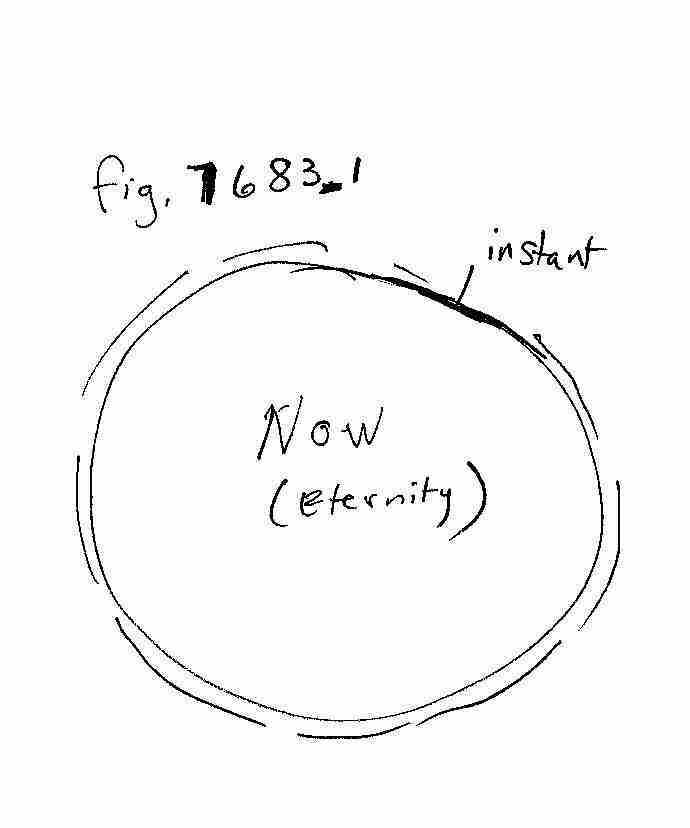
FIGURE 1983 0706b-1. Instant, Sensible World, Now (Eternity) (7683_1). Facsimile scan of hand-drawn image from jf's class notes.
When it manifests the Now it's the sensible moment, between one thought and another.
If you superimpose the thoughts on the Now, there is no longer the Now.
The point belongs to no dimension; the line has 1 dimension; the point seems to connect the no-dimension to the one-dimension.
The awareness is always present.
[JF Notes End]
[Audio File 1983 0706a, Side 2 picks up again at 0:47:59]
AS: --presence of awareness is always the Now.
AD: Yeah [one word inaudible]
AS (simultaneously): It only functions in the Now even when we seem to have a remembrance of the past.
AD: Yeah.
AS: Still it's now because it's the awareness which can only function Now. And now he's saying that Now which is always a present is apparently differentiated because within this thought that is lighting up is the memory of "oh this is past, or this happened yesterday, or this is going to happen tomorrow, or it's 1983, it's breakfast time," whatever. And all of that is putting a boundary or a limit and a di-- really, he means apparently different, and by really he doesn't mean real, he means the-- the existence, the [one word inaudible] within the thought are giving rise to a sense of different nows. But if you really examine your experience, every instant [AD simultaneously: It's always in the present.] the awareness is always the present, and that presentness is identical in every instant. There's no-- there's no distinction between this present and a previous present or the present 10 years from now.
VM: Insofar as it's present. So you distinguish--
AS (simultaneously): And insofar as it's a present awareness, it's indistinguishable. [VM simultaneously: Indistinguishable. Sure.] I remember back what my awareness was like 10 years ago and it's still-- it's that awareness, there's no difference in that in terms of the Now, the presentness of it.
S: Avery?
LR (simultaneously): Yeah but the reason that that (come up--)
AS: What?
LR: You know [few words inaudible] in that conversation about the consciousness of the I AM versus the [one word inaudible] faculty which has to get fo-- which one gets focused. Saying that aware-- [AS simultaneously: Oh.] that a consciousness is always consciousness. It's this-- the thing [AS simultaneously: It's always inherent.] that you're always working with is that [couple words inaudible] (of) mind, uh-hm.
VM: Or just to get into your theoretical analogy, if you focus on just the notion of point exclusive of any reference to other geometrical figures or the lines or planes, then that notion of point is completely atomic, indivisible, indistinguishable from any other notion of point. It's only when in the context of a line that you can differentiate one point from another and say this is the beginning of a line, this is the end of the line. So it's only in relationship to that point. Although it may-- in this case, the geometrical case, the two-dimensional-- or the one-dimensional figure of the line, they're the s-- the-- let's say the epistemological and the psychological can't. It's only in relationship to a stream of thought that you can differentiate one instant from another. But within themselves they're indivisible.
HE: Avery? To go back to what you were saying, would the-- the awareness is always Now, would the content always be that-- a past or future? Because they were saying that the becoming is always the past or future, is not Now in the becoming. And he's saying that the line, that you-- the point might distinguish between the beginning and the end of the line but you never can find the point itself. You know, you can say that--
VM: Not without reference to the rest of the line.
HE: Right. But in terms of the content of the awareness it seems like they were saying you couldn't have a Now content, the content is always going to be [AS assents] a thought in that.
AS: No but actually, previously, one-- much earlier when he said, in terms of time the present moment would be a di-- would be a reference to past or future, that would be the present content.
HE: The present content.
AS: That you could speak about. The awareness is present, there's a present content, but there's a reference within that content to the past or the future. On the content side, it's within time, but on the presentness of the awareness side, it's not in time. Or maybe you could say that, that within every present moment there's the present awareness and there's also the present content. Within the content there's a reference, future, past and so on.
AD (simultaneously): Past and future. But to the consciousness, [AS simultaneously: To the (consciousness spirit).] there's only a reference to the Now.
AS: Only the Now.
AD (faint): Yeah.
AS: And in that sense--
AD (simultaneously): So these two are conjoined.
AS: Yeah. And insofar as that awareness is conscious of this present thought, it seems to be in time. It seems to be getting a temporal position. But insofar as it's not really in time because it's always a Now, it's not in time. The awareness is not in time and yet it seems that-- and yet in some way it is in time, because of the present content.
S: Uh-hm.
AD: You feel closer to it?
S: If you say so.
S: No.
AD: So you're always living in Eternity.
S: Makes you feel real close to that.
VM: Yes.
S: The real.
S: Uh-hm.
AS (simultaneously): See what you have to do in your experience is, as you're saying, focus on the attention or consciousness side of it and not on the content side of it, and you will find that that presentness is the quality of eternity. Because the presentness is always the same. [couple words inaudible]
LR (simultaneously): On the other hand, if you want to focus, it's not the--
S (very faint): Right.
S (faint): Right.
AS: No, you just focus on it. I think--
AD: Well he's only using the word 'focus' here metaphorically, [AS simultaneously: Unfocus.] now don't turn it into an attitude.
LR: No, that's very--
AS: Unfocus.
LR: In fact, that was very very appropriate. Because that very thing you're calling the thought is what has to get focused on the awareness rather than on the content. I mean that is what's being worked with.
AD: What's-- what's easier?
LR (simultaneously): It's not the awareness per se that's being worked.
AS: You're saying it's the thought that gives the illusion that you're not in eternity. [student assents] It's the content that gives you the illusion. And how does it give you that illusion, by referring to a past and a future that makes you think that you're in a-- in some distinguishable moment and in relation.
LR (simultaneously): Right, now suppose it doesn't refer in that way.
AS: The only way it could probably not is if we stop doing anything. (AS laughs a bit)
AD: Well, we'll try. I think you will notice that every time an image arises, it will have a reference either to the past or future [one/two words inaudible] And so that's always putting you in sensible time. Whereas if no image arises, then you won't be either in the past or the future and you will be living in the Now.
VM: But can you say that to focus means precisely to-- [LR: Go away from--] to remove or to ignore these references, either to-- to the forward-moving direction or anticipations of the future or your--
AD (simultaneously): Yeah, I think he means by focus may-- you could refer to as 'choiceless'.
VM: Yeah, ignore [AD: Yeah.] present anticipations of future [one word inaudible]
AD (simultaneously): Consciousness without any choices or preferences would always be in the present. But if some thought is illuminated, then the preference is being expressed and you would be living within the framework of the image. And since most of our thoughts are coming from the ego, and the ego is preoccupied either with its past pleasures or its anticipated future, pleasures or fears, then it would be living either in the past or in the future and never in the Now. But still-- still leaves a problem of the planets. We'll try and connect it.
VM: You might be-- sorry if I'm-- maybe this is completely off the mark but, when we speak about the motion of the planets, or it seems to me if you speak about any kind of motion, it would presuppose-- presupposing a kind of space in which this motion can occur. And when I think of space I'd certainly think of the idea of matter or the principle of difference or--
AD: I don't have that problem, Vic.
VM: Ok.
AD: Because, if you think of-- if you think of a planet, you've already said it all.
VM: You mean, through the planet--
AD (simultaneously): It's a thought, it's a thought.
AS: So many are manifested but see--
AD: And if it's a thought, alright, how could you think of matter? And how could you place one thought inside another thought?
VM (simultaneously): [couple words inaudible] presupposing matter, I'm thinking--
AD: No, well, what I'm saying is you're projecting all the-- all the very things that I'm trying to eliminate. When I say I think of the motion of a planet, I'm thinking of-- in other words, I'm thinking thoughts. [VM: Ok.] I'm not thinking of matter.
VM: Yeah, of course.
AD: Ok. So then I'm thinking of thoughts, alright, but I translate it as saying no, I'm thinking of a planet and it's moving from one position to another, alright, it's making a spatial motion, what we call a spatial motion in relation to itself, it's here, then it's here. And, just that motion, and no other, is the instant. [VM, faint: Ok.] Now I was trying to think of this in terms of the Parmenides [Hypothesis] 2A, that it is just that motion which takes a thing which is a undi-- in the undivided mind and puts it into existence. [Addition from JF Notes: "and puts it into the divided mind."]
AS: Anthony, (we're go--) I'm sorry to bring this up again but I think it is relevant to the problem of where the thoughts are coming from because for the individual, you're saying-- you're bringing-- you're ma-- you're putting in a cosmic level and you're saying the undivided mind is making what is Intelligible or the Idea and putting it into manifestation. Unless I'm misunderstanding it. Ok and you're saying that that's happening through this instant, the instantaneous motion of the planets, they symbolize the ma--
AD (simultaneously): Yeah, the thing-- the thing comes into existence.
AS: Comes into existence. Now that-- what is coming into existence is the content. It's not the Now, it's not the-- the awareness isn't coming into existence. If I'm mistaken-- But it's the content you're saying that is coming into existence, through that instant. [AD: Uh-hm.] So it is relevant to me I think of how--you know-- in other words if I take that planetary motion of the bodies as a symbol really of the acti-- it's an-- it's the effect of the activity of the Soul. I think I'm getting off the point, but we--
AD: Well may-- let me try a little further. If we speak of the undivided mind, alright, on the one hand as representative of the consciousness, [AS assents] and if we speak of the planets as a thought, then the-- the consciousness which is the undivided mind is focused at the planet, and the planet in position A is this thought A, [AS assents] alright, then the planet moves to the next position B. The consciousness, or the un-- the consciousness of the undivided mind has for its content first off the planet in position A, then has for its content the planet in position B, and so on. [AS assents] Now what I was trying to understand here was, if this is so, then the content or the object of that consciousness which belongs with the un-- to the undivided mind is changing from instant to instant. [AS: Right.] And that change from A to B, alright, is the instantaneous becoming of the world. [students assent] And that-- that may be a reference that Plato had when he was speaking about it can go into existence. Remember? It can move in one way or the other. It can come into existence or out of existence. I don't think out of existence means going back into the undivided mind. I think going out of existence simply means the planet has changed position from A to B, and then from B to C, and when it changes from B to C, it's gone out of existence.
LR: In the change-- in that instant.
AD: At that instant.
S: You mean the (pri--)
AD: And the next instant it goes D, alright, then something new has come into existence while [loud noise, couple/few words inaudible] out of existence. And this process continues. And this, I think, will correspond to the theory of instantaneous becoming or, you know, the kinetic reality of the world. I wasn't thinking of it the way you can--
AS: Right.
PD: You know, this might be off the point but, Kant has a very interesting analysis which seems to be along this line, (it) may be wrong. But he speaks of first moment is incomprehensible, first moment of intuition, and that the mind must run through that moment and distinguish the distinctions of various representations, which then get reproduced in the imagination or synthesized. And through-- through the understanding that's inherent in the imagination, a knowledge of the object results. Now, if I transpose that in a-- in a cosmic way, which is what you're trying to speak here, you could say that the planets are the powers of the Solar Logos, and in apprehending the Intellectual, each motion of the planets is a regrasping of that undivided knowledge and putting it forth into solar manifestation.
AD: Not of that undivided knowledge, let's say of that-- of the World-Idea. And each moment is doing that, go ahead.
PD: Well the various cosmocrators in-- in their spheres of activity then are like the various powers of the mind that are making the distinctions in that undivided knowledge.
AD: Let me see if I-- I think we're saying the same thing.
LR (simultaneously): [few words inaudible]
AS: Oh wait, I agree, but that's exactly what I was just saying.
AD: Yeah but what-- what we're-- what we're trying to do now, I think we moved away from the object, but we're trying to apply this in a very practical way.
AS: Yeah. Yeah I agree.
AD (simultaneously): We're just trying to apply it very (appropriately). So we say we have the World-Idea coming in, alright-- We did this differently (before). [drawing] I discovered [couple words inaudible]
LR: One of those, Anthony, will be [few words inaudible]
AD (simultaneously, faint): Well [few words inaudible]
VM: We did everything before.
AS: No.
S: Ok.
AD: Well, we're trying to apply these ideas now to what we've done before. I can't remember now, I think we said something like this. We think of the Sun as, let's say, transmitting the World-Idea, and that [drawing] you have various positions of the planets. [short pause] The various-- the ongoing instantiation of the planets moment-by-moment, alright, is grasping the Idea and translating it into the images. So that as the planets are altering position every second in time or every instant of time, alright, the World-Idea which is being transmitted is being re-presented constantly instant from instant. So that each second of time or each moment or change of position of the planets is the reorganization of that World-Idea which is constantly going on. That-- we said something like that.
PD: Could you call the planetary spheres almost like the Sun's separative intellect?
AD: Well, I'd like to say it's like the powers of its mind to organize-- to organize the World-Idea or the thing-in-itself into an idea. And then that idea organizes the Earth's memories or the images into wholes, or pictures, images. We see?
[30 second pause]
VM: This may be way out in left field but the-- (this wisdom--) You know, you sometimes speak about the stars as like holes in the sky where the solar light is actually coming through. Maybe we could stretch it a little bit and say that these points of light in the sky are actually where the World-Thought is coming through, and the positions of the planets serve to, well, partially obscure and partially manifest that relationship as it impinges on the Earth. So in other words, the motion of the planets blocks some parts of that-- that radiation inward as well for a-- the-- this eternal World-Image to be converted into time because it manifests various facets or aspects of that eternal Image.
S: Uh-hm.
PD: I don't know, Vic.
AS: The body's-- the bodily position though is the manifestation of time, it is the image.
VM: Well it certainly [one word inaudible] yes.
AS (simultaneously): Right? I mean the bodily position-- bodily position of those bodies that we see is already the image. Now, if it's an image it's representing to us, as we said before, it's representing to us the motion of the Soul. And that's the Soul's motion that we're talking about as the real fabricating energy, the rational energy I was talking about. And the differential-- I thought that the differential that you actually would see is an image, that differential of its movement, if you traced back what that is, that's the Soul's activity. And that in between that Soul's activity you have the manifestation. So the Soul's activity gives rise to this instant, gives rise to position A of the whole cosmos. And that's an in-- and then that's gone, and the Soul's activity gives rise to position B of the cosmos. [short pause] The Soul's activity is the rational motion translating the Idea into a sensible form.
VM: Well, I certainly can agree with that but it doesn't help me connect to the sensible image of planetary system, stars and so on. I mean I don't disagree with that in any way.
AS: Yeah.
S: Avery, is what you're saying is that [AS: Yeah.] the Eternal Now or the timelessness of the Intellectual-Principle doesn't exist side by side with the sensible manifestation but there has to be that pure Duration of the Soul, the pure Duration now imbibes the timelessness, but yet the pure Duration itself is that successive instant upon instant following one another. And that imbibes and (evoke). And it has to be that principle to actually make the translation from eternal Now to sequential manifestation. And it's the motion of the planets which is the representation of the motion of that Soul which-- which makes that translation.
[17 second pause]
AD: Avery, let me ask you this. Is the I AM of a cosmic soul what you see?
AS: We went through this before about a month ago and I-- and I say no.
AD: We don't see that, right?
VM: No, of course not.
AD: The I AM is-- of a cosmic soul you don't see.
AS: I can't know anybody else's I AM as objective. It's never objective.
AD (simultaneously): Alright so, if we say that the I AM of the cosmic soul we don't see but what we do see is what it brings into manifestation--
AS: Sensible, what we sensibly--
AD: --what we sensibly perceive, then we first have to posit, alright, the I AM of the cosmic soul and (as/has) a principle which illuminates and brings about-- in other words, (its/this) light which contains the images or the World-Idea to be, and only after the production of the manifested world can we speak about seeing the bodies in motion.
AS: Right. That that I AM not only as a light by which it's seen but also, according to what we've been saying, has this productive power which we called time, but which is bringing that world into manifestation.
AD: Now, this productive power which belongs to the Soul and which we said is moving the planets, alright--
AS: Or-- yeah, and I'm looking at 'moving' in a funny way now.
AD: Yeah, that's what I want to know.
AS: I'm saying that it's di-- I'm trying to say that there is no-- there is no such thing as change, I'm trying to say that it's-- it's not-- it's not like one thing changes into another because that would be taking the causality A to B to C. Each of those instants-- but I understood the instantaneous position and then another instantaneous position as referring to the fact that from the point of view of the sensible manifestation, that instant between them was referring to the fact that it was the Soul's manifesting, that's not seen. Exactly that I AM's function is not seen and that's why the-- you s-- there's a gap-- that's why the manifestation isn't a continuous movement. There seem to be gaps, from the side of the sensible manifestation there seem to be these gaps. That gap is a s-- is an image of the fact that it's the Soul that's doing the manifesting and not the fact that this planet is moving along. [student assents] The planet doesn't move from A to B. It's manifested at position A, and then it's manifested at position B, and then it's manifested at position C. And the gap is-- is an image of the fact that it's not doing the manifesting but that the Soul or the I AM or whatever is doing the manifesting.
LR: And you have now becoming [few words inaudible]
AS: You have knowing about that-- what 'becoming' means.
LR (simultaneously): Knowing means.
AS: No. No, becoming means the instantaneous re-manifestation of the universe.
LR: Of Being.
CdA: And it's [AS simultaneously: Not of Being, no.] only from-- it's only-- And that only from within the thought, from taking-- from identifying with the content that you would-- you would even superimpose any kind of causality, past present and future. That's--
AS: Yeah. And in other words also, I don't think that from within the manifestation you can really grasp that differential of the planets' movement. In other words, I don't think that's a really-- I don't think that's experienceable from within manifestation, from within the sensible. Maybe I got it all wrong.
CdA (simultaneously): Then you've got thought.
AD: Alright.
AS: Maybe I got it wrong.
AD: No, no. Alright. [21¼ second pause] When we say that there's a kinetic image-- a kinetic manifestation that's taking place instant by instant, alright, and we say that the planet is in position A, then in position B, then in position C, we do not mean that the planet A-- planet moved from A to B to C, and we're not saying, if I follow what you're saying-- we're not saying that planet at position A is the same planet which is at position B. What we are saying is that insofar that we're speaking about a re-presenta-- a re-presentation of the world by instant-- instant by instant, we mean the entirety is being re-manifested instant-by-instant.
CdA (simultaneously): Uh-hm.
AS: By the cosmic soul. I don't see how else to explain that. I don't see how else to understand the sensible manifestation [AD simultaneously: Yeah.] unless you say-- Like the example you always give with the arrow, he says well, it's not the arrow, the whole thing is new at each instant, that's why they can't understand the arrow moving.
AD (simultaneously): Ok, right. Now, let's-- let's take that for granted.
AS: Yeah.
AD: Ok? Let's take it for granted. Am I justified taking the position that the planet has moved from A to B? Can I say that within that position?
VM: No, no not within that position.
AD: Why not?
VM: Because that position is from the point of view of one-- one planetary position. And I don't see how you could talk about the transition.
AD: Why can't I say [AS simultaneously: You could say it's moved.] it from the point of view of cognition?
AS: Yeah, you could say it's moved, I don't deny-- I don't deny that.
AD: That doesn't mean that I--
AS: No, no.
AD: When I say it has moved from [AS simultaneously: Sure it's moved.] A to B, it doesn't exclude the fact that I too have moved from A to B.
AS (simultaneously): Right. No it's moved. I would say yeah, [VM simultaneously: Through that, yeah.] sure. And then there is a sense in which you say it is the same planet, we understand what we mean by that, we're not Buddhists, in other words-- in other words, even though it's an instantaneous re-manifestation, it still is that planet, it's not-- it's not a leap to the--
AD (simultaneously): It's not another.
AS: It's not another planet. It is that planet. And we can say that it has moved. (Unless) [few words inaudible]
AD (simultaneously): Then why can't I go one step more and say that that change from position A to B and B to C is announcing something.
AS: I-- and I say what it's announcing-- yes, it is, I agree, that's what I'm saying.
AD: What is it announcing?
AS: That change is in-- what we see as that change is announcing the energy of the Soul, it's announcing the--
AD (simultaneously): Well, even more so, couldn't you say that it's announcing [AS simultaneously: Presence of the I AM.] that the Soul's productivity is constantly re-making the world-image.
AS: Yeah.
AD: Well, what was wrong--
PD (simultaneously): But can you-- couldn't you say it's an announcing its vision of the starry heaven or the Nous. Or the Solar Logos is constantly putting forth a version, a vision [AS assents] of the Nous, which is [AS simultaneously: Through its (activity).] symbolized by--
AD (simultaneously): Oh well then, then we don't disagree.
PD: --by the [AS simultaneously: No.] [one/two words inaudible]
S (simultaneously): There's no disagreement at all.
AD: So next time, Oracle, think.
[short pause]
AS: In that case I have the feeling I missed something you were trying to say because-- (laughter)
VM: Yeah, right.
S: That was crazy.
AS (simultaneously): I mean, I--
AD: No I had to back off to, you know, make clear that [AS simultaneously: Make (few words inaudible)] our assumptions we're the same, alright.
S: Yeah.
AD: So we [few inaudible AS words simultaneous with AD] agree our assumptions are the same, I'm not-- I'm not disagreeing with that. Now I forgot what the point was. I'm sorry, I got--
VM (simultaneously): Yeah I was just going to ask you to reduplicate it or--
AS: [few words inaudible]
AD (simultaneously): Let's ask Linda.
AB: [one word inaudible] didn't have a Now. (laughter)
S (laughing): Yeah, right, the only way is to bake some brownies.
AS: You want to know how (this/these) Now is related to that [one word inaudible] on one big planetary [possibly one word inaudible]
AD (simultaneously): Sure, but-- yes we do. And we'll talk on-- I was just thinking of this, is this the 2A hypothesis that Plato [in Parmenides dialogue] was talking about.
LR: It is(,) you're trying to describe that, the manifestation, trying to describe the actual event. [AS: But--] That passage of--
[short pause]
AD (quietly): He's speaking about the movement into existence and out of existence. I'm quite sure he's talking about our world, the world we live in now.
AS: Like those quotes we had in Plotinus where he says the Soul contemplates and then it produces the universe of matter. It contemplates in eternity and it manifests in time. Now that transition-- there's only-- there's only one real transition, it's from Being to becoming or from Eternity to time.
AD: Yeah.
AS: You're saying he's trying to describe that-- that transition, that instantaneous transition?
AD (simultaneously): Yeah, I'm trying to say that the [AS simultaneously: (Is) symbol.] change of position on the part of the planets [AS simultaneously: He--] is announcing.
AS: Is a symbol of that, exactly, I agree, that that's announcing that instantaneous transition from the Nous or from contemplation to manifestation. Or from timelessness to time. And that is what he's call-- that is the Now. Because it's-- I think it's the Now but-- the point-- Oh, you know, maybe that's that point, maybe I could see that example with the line thing. See on the one hand you have eternity, all (fixes). On the other hand you have the appearance of a conti-- of a continuous manifestation. What relates those two is the notion of a point. If we could see that-- and we could use that example, if we could see how the point is what relates what's outside of time and space, eternal and so on, to what's in manifestation.
S: But just like--
AD (simultaneously): Ok, now, now, if we say, if we say that the "I" of a-- of a cosmic soul, alright, is eternal because it's of an intellectual nature, it is intellectual reality, alright, then the planetary systems, you know, within the star system, alright, is what's translating that eternity into time for us.
AS: Yeah. And that that--
AD (simultaneously): So that the I AM is the substratum of the eternity, [AS assents] alright, the eternal substratum, the motion of the planets within it is translating that instant. Instant by instant it's translating or reproducing, sensibly announcing and representing them.
AS: Uh-hm. But it's not the positions of the planets so much as the gap-- the position of the planet is already-- I'm just trying to say is already the appearance of the planet. It's the gap or differential of the movement that's announcing that activity which we can't really know directly. If we knew that directly we'd be in the Now.
AD: Yeah but if we-- if--
AS: If we're here, all we see it is the differential of this movement.
AD: Yeah but that differential now is much more complicated, isn't it? Because that differential brings in the-- all-- the entire play of all the aspects.
AS: Yeah. It bring in all the aspects, (the--)
VM (simultaneously): [couple words inaudible] all differentials.
AD: Yeah.
AS: Well it brings in-- that differential brings in the activity of the Soul, brings in the rational activity which is doing the translating.
PD: And also, can't you bring in the pure reason-principles or the pure 360 degrees of the solar sphere and not the tropes that surround the Earth. So you have both factors getting brought in too.
AS: Yeah. By "bring in" I meant that that-- it brings in the rational Soul which itself is what's bringing in [PD: Ok.] all the things that you're saying. [few words inaudible]
[students assents, very faint]
AD: Now, we go back to this here, we (got lost in here).
8.8-[pause]
Coomaraswamy, p. 74 (AD reading): "By [AD reads: For] the"now that is not a part of time" is meant, of course, the "atomic now" . . . that marks the beginning or the end of any period of time, which end is also the beginning of another period of time, "for time is always in the beginning" . . ., and like movement, everlasting; or that, in other words, divides the past from the future. So the indivisible Now has the double function of dividing and uniting . . ., and in these two functions is altogether like the undimensioned Point . . ." [quotes from Aristotle's Physics]
AD: Now, if we say something like this. So the indivisible I AM has the double functions of dividing and uniting, and in these two functions is altogether like the undimensioned Point that simultaneously-- the undimensioned Point here would be the I AM-- that simultaneously divides and unites the parts of a line.
AS: Parts would be divides eternity. It divides the real Being from the becoming. And also it unites them.
AD: Yeah.
AS: And that is the transition between them.
AD: Uh-hm. So the whole discussion of time is really much more complicated.
RW: (Yeah.)
VM: Something that goes straight to the heart.
AD: Huh?
VM: It goes to the heart of a lot of issues we've been struggling with it seems.
AS: But I-- I'm not downplaying but I think it's im-- it is implied in that notion of time that Plotinus was dealing with when he said-- when he puts it between the sensible-- he says it is that power which is manifesting the sensible from the intelligible. [Note: See Plotinus, III.7.11, 12.] It's not-- he doesn't draw out any--
AD: Yeah, yeah. But in our terminology then, that power which does that would be the planetary [AS simultaneously: The I AM.] spheres.
AS: Right, planets.
AD (simultaneously): A power which belongs to the I AM. Yeah.
AS: Yeah I agree. I just-- I guess maybe part of my thing is I always get-- I just have such this-- this thing about, you know, saying it's the bo-- the--
AD: Oh no that--
AS: --the body that [couple words inaudible]
AD (simultaneously): Yeah, it could easily be misinterpreted, but I assume that Buddhists assume for me what I get to speak of.
CdA: (Oh yeah.) You could--
AD: Go over it?
CdA: Yeah. (RW laughs) I want--
AD: Why don't you be like Red and--
CdA: Be quiet?
AD: Take it.
[short pause]
AS: See, I know what bothered, it was-- you-- the one thing, the--
AD: You were supposed to be writing all this down.
S (very faint): [few words inaudible]
AD: Yeah. [short pause] I don't-- I don't think any of the great thinkers really disagreed with each other, I think that it's the question that they emphasize certain aspects rather than other. On the case of Kant he was limited by his rationalism and the lack of mystical experience and he was honest and went as truthfully as he can go and stopped there, whereas a man like Plotinus who had mystical experience can go beyond. But the remarks that Kant made I think were very-- very much to what we're speaking about, but the lower end of the higher. In other words, he was speaking of the rational powers of the Soul downward whereas Plotinus start all the way up on the top and go all the way down. So Kant would be emphasizing the lower aspect, Plotinus would include that in the whole thing. Because there has to be some way of us understanding how the I AM which is an absolute intellectual reality, and an eternal reality, translates its eternal status, alright, and allows or permits itself to get modalized as this individual that I refer to as myself so that it can experience time also. Both of these has to be included in the nature of the human being, that it has the experience of eternity and of time at the same-- at the same-- same-- within the same reference framework.
[10 second pause]
EC: Do the fixed stars represent the eternality?
AD: Represent what?
EC: The eternality? Do the fixed stars represent the eternality?
AD: The eternal? Yeah, for us they do, not for the astronomers. For the astronomers 10 billion years is like the flash of a-- [VM: Yeah, see (few words inaudible)] I would say also the Buddhists, for the Buddhists too. And there's a legitimacy in that, you know. After all, the reference here is to the fact that a star, you know, that lives 10 billion-- 10 billion years is a momentary incident in the eternal consciousness. So the Buddhists and the astronomers are really very wise but they don't know it.
VM (faint): Unless you're going to say (something).
AD: Well, do you know of any astronomer who believes his consciousness could be eternal?
S: No, I don't.
AD: I don't think so either, I think you'll find problems and yet they speak about 10 billion years as though it was a flash in the pan. And for-- [student assents] you know, in some ways it could be considered like a whole Manvantara. That's not exactly a trifle.
[short pause]
CdA: Can I-- could I try [couple words inaudible]
AD (simultaneously): Sure.
CdA: If you-- coming from the point of view of manifestation, ok, there's an instant of the World-Idea, and all-- and insofar as the-- the rational activity of the Soul presenting as the degrees, the aspects, everything is involved (and manifested). I didn't grasp how you were referring to the-- the aspects in that-- in that reference.
AD (simultaneously): I was just including that the differentia or the position or change of position of a planet from position A to position B alters the entire interconnectedness or relationship of the parts to one another, and that happens every instant of time. That's all I said.
CdA: That was all, ok.
AD: You can't have a planet move from A to B without altering completely [CdA: Right.] the relationship of all the planets to one another.
[from jf's notes: not tape, AD continues]: . . . and that happens every instant--not just one planet, but ten planets, so the alteration is constant.
[Audio File 1983 0706a Ends]
[Audio File 1983 0706b Begins]
AS: Now, from the point of view of the manifestation, we use that as a symbol, for example, to measure the movements of-- to measure intervals of time by the planetary positions and so on. Now we're speaking about each instant, this total universe as manifested. And the next instant there's a movement, there's a change. Now I guess-- I still don't see, is-- is that instant-- not speaking about as the Now-instant but as the relative position, the change of position, is that only from the side of the manifestation? Or, it is actually that the Soul's life-energy is in this-- is this instantaneous motion. And I had assumed the latter previously, that-- that this-- the fact that--
S: Well maybe I [few words inaudible]
CdA: I know.
AS: Is that the very essential nature of this life-energy of the Soul, not its internal-- internal vision but the externalizing power or the life-energy must operate that way?
[short pause]
AD: I think so but could you say it again? If we imagine like the whole manifested world is like-- you know, (we drew a) picture of the cinema, ok, [AS assents] and you have one still going after another. [AS assents] And this still A is different from this still B, and which is different from this still C, alright. [AS: Yeah.] And you're saying that this is a manifestation of the life-principle inside the Soul.
AS: Yeah.
AD: What else are you saying?
AS: Ok. In the example of the stills, in the normal, the projector example, there are distinct stills, ok, and there's the light. Now it seems that it's the stills which are distinct, but that the light somehow is--
AD: Same.
AS: The same. However there's another view which says--
AD (simultaneously): But--
AS: Yeah.
AD: But is that right, that analogy?
AS: No, I'm saying, that's what I'm trying to say, that no, that the other view is, which I would more want to take, is that the Light itself that is doing the manifesting is doing that.
AD (simultaneously): Is the still. Is the still.
AS: Is the still and in fact is-- I don't want to say discontinuous but is flashing [AD assents] as it were. It is the very life-energy of the Soul that is this way.
AD: Yeah. That's the way I think of it.
AS: Yeah. And that what we see, and then the manifestation, you know, once the thing is manifested, it's manifested as this--
AD: And that's why we could say that that's announcing or is symbolic of the life which is within the Soul.
AS (simultaneously): In the Soul, right. And I'm saying the Soul's life itself is this discontinuous energy.
AD (simultaneously): Uh-huh.
AS: If you could [CdA assents] put it that way.
PD: Yeah but-- [CdA: Yeah.] yeah but couldn't say that [AD simultaneously: If the basic--] the Soul's life is discontinuous and that it's the regrasping [AS assents] by the mind that is giving a discontinuity to it.
AS: Ok and I'm saying that that re-grasping is the power of the Soul continually trying to grasp the intelligible, it can't grasp it, 'cause it can't-- the Soul is not of a power to grasp the eternity all at once of the Intellectual-Principle, and so it has the power, (ev--)
S: It has--
AS: The motion that we see of the cosmos is the Soul's continuous trying to grasp the Ideas, that's what I-- and maybe we could put it that way, Paul. That's what that instantaneous thing is. That's why it's instantaneous and that's what is the instantaneous or discontinuity is that the Soul can't grasp the Ideas entire, and so it's continually trying to re-grasp the Ideas. Just like the analogy we had of the Intellectual-Principle with the One. The Intellectual-Principle tries to grasp the One and so to speak gives rise to successive impressions. [Note: See Plotinus, V.3.11.] The Soul tries to grasp the Intellect but can't, fails of that, and so it's continuously throwing forth an image of its grasp. [snaps fingers] And that is like the instant. And I think that's the same thing, [PD assents] I don't think it's any different from what you were saying.
PD (simultaneously): I-- in terms of the life of the Soul.
AD (simultaneously): How about-- how about-- now how would you tie in-- if you say that the Soul is constantly projecting its inner life, externalizing its inner life as those stills, alright, and leaving aside for the moment now that another part of the Soul is re-grasping that, how would you tie that in, for instance, with the definition of Soul that it is a Principle of In-- of Divisibility? In other words, is each one of these stills, alright, illustrating [AS simultaneously: The Principle.] the Principle of Divisibility [student assents] which is inherent in the Soul?
S: Well yes.
AD: So that each still, alright, is permeated by vitality and the animation which is of the Soul itself.
AS: And that what you just said is the indivisibility aspect. That fact that each is-- that it's distinct-- could be thought of as distinct is the divisibility, that the Soul could keep projecting. But then the other point he makes, that each Now is not different from another one, that's the indivisibility aspect.
AD (simultaneously): (Yeah), ok.
S: Yeah.
AS: The awareness is the same in all the stills. The life-energy in some sense really is the same, each present of the still you can't distinguish them.
AD (simultaneously): Well then let me ask you, let me-- let me go just now one more step. Is that Awareness which is identical, or, you know, we spoke about it as the Nows which add up to zero, is that Soul or is that the Principle of Intellectuality in the Soul?
S (faint): No it's Soul.
AH: Principle of Intellectuality within the Self.
CdA: The Soul as Principle of Manifestness.
AD: Huh?
CdA: The Soul as the Principle of Manifestness.
AS (simultaneously): Oh, that's a hard problem. No it's even moving (prior).
CdA (simultaneously): You can't separate it.
AS: No, well, it's moving (prior).
PD (simultaneously): The-- well coming from that tractate "On the Integral Omnipresence of Any Authentic Existent," you would have to say it's the Soul. [Note: See Plotinus, VI.4, VI.5.]
AD: What part of the Soul?
AS: [one/two words inaudible] part.
PD (simultaneously): (Following) that tractate, it's a part of the Soul.
AD (simultaneously): Is it Soul, is it Soul proper? Or would you call it the Intellectual Reality which is Soul?
CdA: Yeah, but--
PD (simultaneously): He even says in that tractate that the judging principle in perception itself is not subject to [CdA: Oh, I know.] any phase of the becoming process and is not individuated. [Note: See Plotinus, VI.4.6] But, I mean that's-- that's-- that's (your idea).
AD (simultaneously): But the question, [CdA simultaneously: The I AM.] the question I'm essentially asking is this here: Is it the World-Idea in the Soul which is the knowledge, the awareness, or is it the Soul which is the awareness?
CdA: The World-Idea, um-- If you're--
AS: No, that's what Carol said [couple words inaudible]
AD (simultaneously): Avery's here, lunch time! Lunch time.
S (simultaneously): Yeah but somehow it's early.
CdA: If you-- if you-- if-- if you asked the question and that-- that there is a-- there is a conscious-- that there is an awareness of the eternal, do you have to say that it is Being?
AD (simultaneously): I wasn't speaking about an awareness of the eternal, I was speaking what is the principle of awareness if you speak about the Soul. Is it Soul proper, or is it the World-Idea or the World-Mind in the Soul, which is that principle? [CdA simultaneously: You'd have--] If you say, if you say it's Soul, alright, then you're including in the definition of Soul Logos [CdA assents] or the World-Idea.
CdA: It would have to be, ok.
AS: Then you have to sep-- separate them.
AD (simultaneously): On the other hand, if you don't have Soul, the World-Idea cannot express itself, because [CdA assents] it can only do so [CdA: You'd have to say both.] in Life. Alright, so what is the principle?
AS: But what about-- but then are you--
AD: Well you've got to have both, (divisible--)
AS (simultaneously): But then are you-- but then are you equating the indivisibility aspect of Soul with the Nous--I would say no, the Soul itself has an indivisibility aspect.
AD (simultaneously): No, no, no, Avery, I'm not doing that.
AS: Yeah, that's what I'm saying, no. The in-- the Soul itself has an indivisibility aspect. Now we know, we just discussed the divisibility aspect as its instantaneous re-projection. But now [AD simultaneously: Its--] what about its indivisibility aspect? Why isn't that symbolized or experienced as the fact that each moment-- I don't mean the knowledge of each moment, but just that each moment is a present. If you say each moment is a present then in that sense it's indistinguishable from every other moment, that my experience is always in the present. It seems that could refer to the indivisibility aspect of Soul and not to the Intellectual-Principle per se.
AD: But would an indivisibility aspect of Soul, or would the unity of Soul be what guarantees our awareness of the stills or the production that the Soul is consummating?
AS: Ok, if you want to say that's-- I'm sorry.
AD: Why not take both?
AS: Yeah. But I'm try-- well can you differentiate.
AD (simultaneously): They're indissolubly united.
AS: Yeah but couldn't-- It seems you could distinguish and say that as the very moment is a present, the knowledge, the knowing that's going on is due to the Nous. But the fact that that life-presence is the same in all of them would be the indivisibility of Soul.
AD (simultaneously): Alright, fine, true.
AS: And you-- I mean, they're all-- they're never thought.
AD (simultaneously): Now-- now-- now you got-- now you got a complete answer.
AS (simultaneously): But the knowing is also a living.
AD: Yeah.
AS: And--
AD: The living is knowing and that the--
AS (simultaneously): And then on the other side, there's the divisibility of Soul as the instantaneousness of it, that's [AD: Yeah.] becoming divisible.
AD (simultaneously): That I-- that I think is-- that's one of the most pivotal points in the whole definition of Soul. Leave out that principle of divisibility, alright, and the Buddhists cannot have their instantaneous [AS assents] or kinetic reality. Alright, good. Now--
AS: Can the divisibility-- I just want-- the divisibility for Soul we just talked about, now the divisibility of the knowledge, as it were, is the distinctive content of the World-I-- of the Idea as it's manifested. [AD assents] The funny thing is that for Intellect, he says the divisibility part is not connected to the indivisibility part. For Soul, the indivis-- the divisibility, the instantaneous manifestation, and the indivisibility, the undivided life, are united. But for Intellect, it's like the-- the eternal knowing is on one side and the becoming or content gets almost sundered from it some way, I mean-- The Soul (already--)
AD (simultaneously): Yeah, would that correspond to this-- those two aspects, again, of the I AM?
AS: Yeah they correspond but they correspond on the-- the Intellectual side rather than the Life side.
AD: So if we refer to the I AM as an Intellectual-Principle, [Note: See Plotinus, IV.3.5.] we're speaking about it as subsisting in its own right, and we speak about the reasoning phase of it, we're speaking about what it knows that's going on within it and what it's manifesting within itself. Very good. See, Red, you don't have to (worry). [few inaudible RW words simultaneous with AD] It's just a restatement. He's considered a profound thinker, by the way, Red. [17¼ second pause] Now do you think all those little footnotes and translations from Greek to English and Sanskrit into-- you think they get to the heart of the matter? [9½ second pause] Alright, lunch time!
[noises, background student talking till end]
[Audio File 1983 0706b Ends]
1983 07/06b V12a: SEMINAR: Western Tradition; Coomaraswamy. Copyright 2024 Wisdom's Goldenrod p. v