DIAGRAM FOR 1983 0727
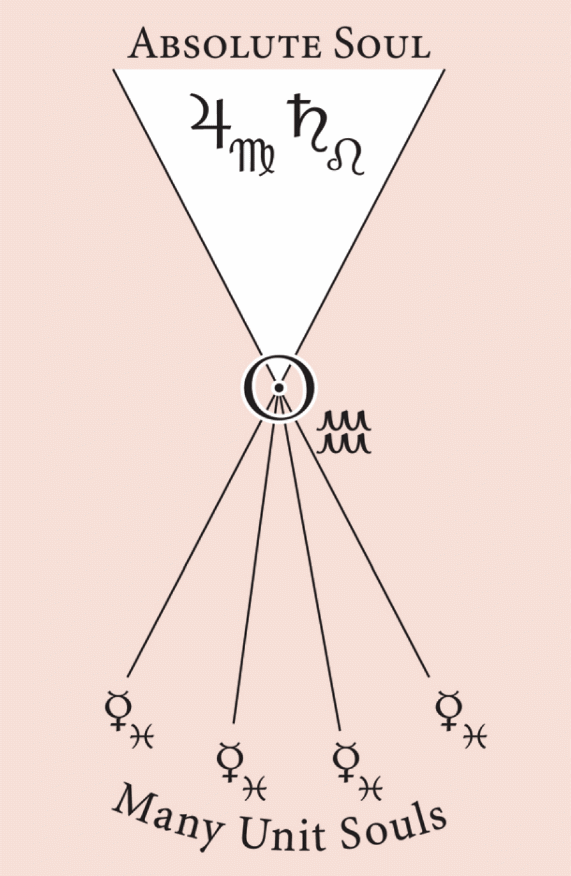
Class
Wednesday, July 27th, 1983
Verbatim, unedited transcriptClick the series name to view more
CLASS at Wisdom's Goldenrod, Hector, NY
with Anthony Damiani (AD)
July 27, 1983
PB PARAS; PHILOSOPHY; MEDITATION
TOPIC: PB Paras
SUBJECT: Philosophy
SUBSUBJECTS: Mysticism, Meditation, Insight, Overself, Void, Ego, Stillness, Ultra-mystic Exercises
CONTENTS:
**** Philosophy Portion of Class ****
THE HIDDEN TEACHING GOES BEYOND YOGA
MAINTAINING MENTAL STILLNESS IN ADVANCED CONTEMPLATION
THE NEED TO CREATE A NEW INTELLECTUAL WORLD-VIEW THAT IS SPIRITUAL IN THE TRUEST SENSE
THE PSYCHE MUST BE FULLY DEVELOPED IN ORDER TO RECEIVE TRUTH RIGHTLY
THE DIFFERENCE BETWEEN A WOULD-BE MYSTIC AND A WOULD-BE PHILOSOPHER
THE WAY TO DISENGAGE HUMAN AGENCY FROM THE DIVINE MESSAGE THAT MANIFESTS THROUGH IT
THE INTEGRALITY OF THE SAGE'S ATTAINMENT CONTRASTED WITH THE LIMITATIONS OF THE MYSTIC AND THE METAPHYSICIAN
**** Void/Insight Portion of Class ****
DISCUSSION OF THE PHRASE "'NOTHING' IS MERELY AN APPEARANCE" IN PB PARA ON ABSOLUTE MIND
EACH INDIVIDUAL OVERSELF HAS THE FACULTY OF INSIGHT, WHICH IS INSIGHT INTO ITS OWN NATURE AND INSIGHT INTO THE INTELLECTUAL-PRINCIPLE
THE RECOGNITION THAT THERE'S ONLY MIND-ESSENCE IS PURE KNOWLEDGE, THE HIGHEST KIND OF KNOWLEDGE AVAILABLE TO THE HUMAN SOUL
**** Meditation Portion of Class ****
MAKE MIND THE OBJECT OF YOUR ATTENTION
DON'T ALLOW CONSTANT FAILURE IN MEDITATION (E.G., FALLING ASLEEP) OR THAT TENDENCY WILL BECOME INSUPERABLE
THE GREAT BATTLE WITH THE EGO, THE DESIRE TO LIVE THE EMBODIED LIFE, TAKES PLACE IN THE STILLNESS
PRACTICING ULTRA-MYSTIC EXERCISES
BOOKS READ FROM OR REFERENCED:
Paul Brunton, Notebooks. 16 vols; Vol. 1 entitled Perspectives [Persp.], published 1984-1988. Some Paul Brunton Notebook paras are, as of 2020, unpublished, and are noted as such.
Heart Sutra
Paul Brunton, The Wisdom of the Overself
Plotinus, The Enneads (MacKenna translation, 4th ed.)
PLOTINUS QUOTES READ OR REFERENCED: V.3.4
DIAGRAM appended to this transcript:
- FIGURE 1983 0727-1. Absolute Soul and Unit Souls.
This diagram is from Astronoesis, p. 185. [Transcriber note: [diagram] means the speaker is referencing a diagram as he or she is speaking.]
NOTES:
JF created Three Topic subdivisions: Philosophy - Void/Insight - Meditation
This class was kind of a transition; thus includes several topics. The first third is mostly on philosophy (but not used for the Living Wisdom book) with a few quotes on meditation; the second third is on the Void and Insight; the last third is on meditation.
In April-May-June 1983 Anthony was doing Overself, then spent three weeks in July on Philosophy–Fallacy of Divine Identity. Then he traveled with Paul D. to Sweden for three weeks, and when he returned (late summer and autumn 1983) the new Topic Series was Meditation.
Pat Campbell partial transcript from 1983 exists (and has mistakes), as well as version done in 1993 for the Living Wisdom book, but not used. Some Pat C. transcript used to fill in missing portions of audio.
Unpublished PB paras, even if sourced, should be proofread.
TRANSCRIBED Verbatim by IT 2019. Reformatted by JRM & JF 2019-2020, with Subheads and Table of Contents added by JRM; Topical subheads added by JF. In 2023, IT fixes prefatory matter and footer, updates audio file name, completes Book List, adds Plotinus quotes section, adds new notes within transcript, fixes minor errors/typos, adds a diagram and reference within transcript to this diagram. In 2025, MW expands Subsubjects and alters Subheads to make more accurate. Archival verbatim transcript – V14.1a.
AUDIO FILES: 1983 0727a, 1983 0727b. [Note 1: "Tape" and "Side" refer to original audio cassette tapes that were later digitized into .MP3 Audio Files. Note 2: In 2024, REP Studio improves the sound quality of file a, parts still hard to hear.]
1983 07/27 at Wisdom's Goldenrod
PB Paras; Philosophy; Meditation
Archival verbatim transcript
**** Philosophy Portion of Class ****
[Audio File 1983 0727a Begins]
RC: --this point, uh, we'll go to the point first and then start to develop details in terms of material we'll cover tonight.
[short pause with faint background student talking]
PB [20v/253/30, unpublished, RC reading]: "He will be able to pierce all the better that barrier of egoism which bars mankind from the path to the highest goal. When he comes to view this goal itself, even from afar off, he will know what it cannot be. He will have eliminated its illusory counterfeits and imaginary substitutes."
RC: So, if anybody wonders why we're reading these things we're reading tonight, that's why.
PB [20v/253/30, unpublished, RC rereads]: "He will be able to pierce all the better that barrier of egoism which bars mankind from the path to the highest goal. When he comes to view this goal itself, even from afar off, he will know what it cannot be. He will have eliminated its illusory counterfeits and imaginary substitutes."
[30¼ second pause]
THE HIDDEN TEACHING GOES BEYOND YOGA
PB [V13, 20:1.12, RC reading]: "Yoga is primarily the method and result of meditation. Philosophy accepts and uses this method and incorporates its results. But it does not stop there. It adds two further practices, metaphysical reasoning and wise action, and one further effort--the mystical insight into, and distinction of, the ego. Therefore we are justified in saying that the hidden teaching does go beyond yoga."
PC/S(?) (very faint): Once more Randy.
PB [V13, 20:1.12, RC rereads]: "Yoga is primarily the method and result of meditation. Philosophy accepts and uses this method and incorporates its results. But it does not stop there. It adds two further practices, metaphysical reasoning and wise action, and one further effort--the mystical insight into, and distinction of, the ego. Therefore we are justified in saying that the hidden teaching does go beyond yoga."
[15¾ second pause]
PB [V11, 16:2.249, RC reading]: "Students must be warned [however] that yoga exercise cannot of itself suffice to yield the ultimate realization of the All but only the realization of the inner self, the"soul," rare and advanced though such an attainment be."
[16 second pause]
MAINTAINING MENTAL STILLNESS IN ADVANCED CONTEMPLATION
PB [V15, 23:8.117 & Persp., Ch. 23 #45, RC reading]: "The adverse force present in his ego will continually try to draw him away from positive concentration on pure being into negative consideration of lower topics. Each time he must become aware of what is happening, of the change in [RC adds: the] trend, and resist it at once. Out of this wearying conflict will eventually be born fresh inner strength if he succeeds, but only more mental weakness if he fails. For meditation is potently creative."
AH (very faint): Randy? [couple words inaudible] pure being or [few words inaudible]
RC: Yes.
CDA: Where did (you) get this quote?
AH (very faint): (When) I bring this-- when I [few words inaudible]
PB [V15, 23:8.117 & Persp., Ch. 23 #45, RC rereads]: "The adverse force present in his ego will continually try to draw him away from positive concentration on pure being into negative consideration of lower topics. Each time he must become aware of what is happening, of the change in trend, and resist it at once. Out of this wearying conflict will eventually be born fresh inner strength if he succeeds, but only more mental weakness if he fails. For meditation is potently creative."
[13 second pause]
AH (faint): [inaudible] This seems to-- a very advanced exercise.
RC (faint): Definitely.
[9 second pause]
S (very faint): What is [few words inaudible]
S (faint): Right.
AH (faint): But that's just speculation. But in terms of [few words inaudible]
[short pause]
RC: But we talked about it, at least on Sunday night, several times we've talked about the Serpent's Path exercise, which would seem to be one example where, wherever you're sitting down and deciding that you're not going to have any thoughts, that whatever success you have in actually disengaging those thoughts and not paying attention to them, there is going to be a build up of the pressure. If you let that go out into the thoughts whatever they might be, then I think he's saying that that will actually bring you into a-- to a state of being less able to control your thoughts at all.
[9¼ second pause]
PB [V15, 23:8.117 & Persp., Ch. 23 #45, RC rereads]: "The adverse force present in his ego will continually try to draw him away from positive concentration on pure being into negative consideration of lower topics. Each time he must become aware of what is happening, of the change in trend, and resist it at once. Out of this wearying conflict will eventually be born fresh inner strength if he succeeds, but only more mental weakness if he fails. For meditation is potently creative."
S (very faint): [couple words inaudible] the last [one word inaudible] potently creative or created?
RC: I-v-e. [10 second pause] We've read this one before but it seems related I guess if you're doing the kind of exercise that last one was talking about.
PB [V15, 23:8.153 & Persp., Ch. 23 #80, RC reading]: "Everything that intrudes upon the mental stillness in this highly critical stage must be rejected, no matter how virtuous or how"spiritual" a face it puts on. Only by the lapse of all thought, by the loss of all thinking capacity can he maintain this rigid stillness as it should be maintained. It is here alone that the last great battle will be fought and that the first great fulfilment will be achieved. That battle will be the one which will give the final deathblow to the ego; that fulfilment will be the union with his Overself after the ego's death. Both the battle and the fulfilment must take place within the stillness; they must not be a merely intellectual matter of thought alone nor a merely emotional matter of feeling alone. Here in the stillness both thought and emotion must die and the ego will then lose their powerful support. Therefore here alone is it possible to tackle the ego with any possibility of victory."
[16 second pause]
S (faint): Again.
S (very faint): Maybe (turn it off) [couple words inaudible]
S (very faint): Maybe-- maybe if you could turn it off just a little (bit).
CDA: You have to talk louder.
S (faint): Yeah, yeah.
AD: Or put the conditioner off. That's a good idea, let's put the air conditioner off.
RG: No.
S (very faint): No.
S: No.
S (very faint): [few words inaudible]
AD (simultaneously): Then talk up!
[9 second pause]
RC: I think maybe I jumped in a little too quickly and maybe we should come back to those last two or three little later on for a second pass.
[short pause]
THE NEED TO CREATE A NEW INTELLECTUAL WORLD-VIEW THAT IS SPIRITUAL IN THE TRUEST SENSE
PB [V13, 20:2.118, RC reading]: "Philosophy is for those who feel this [RC reads: the] desire to understand spiritual processes…"
S (very faint): Slowly.
PB [V13, 20:2.118, RC reading]: "Philosophy is for those who feel this [RC reads: the] desire to understand spiritual processes and find the study quite interesting."
[9¼ second pause]
PB [V13, 20:1.479, RC reading]: "The comparative study of religion, mysticism, and metaphysics, as they have appeared in different centuries and in different parts of the world, will have a liberating effect on those who approach it in a thoroughly scientific independent and prejudice-free spirit. A comparative view of all the different spiritual cultures leads to a broader understanding of each particular one."
[short pause]
PB [V13, 20:2.61, RC reading]: "We have to create an intellectual world-view which can be adequate enough to meet criticism or defend itself against all the other intellectual world-views of our time. But whereas [RC reads: where] the philosophic one is spiritual in the truest sense, these others are either frankly materialistic or superstitiously mystical. Those adherents of religio-mystic doctrines who have failed to appreciate the importance of such work, as well as those who have even sharply criticized it, reveal by their attitude a narrowness which is surely not the mark of authentic spirituality."
[13 second pause]
AH (very faint): Was that all one quote?
RC: No, those were two.
S (very faint): Read them again.
RC: The last one or--
AD/S(?): Both, both.
RC: The first one says--
PB [V13, 20:1.479, RC rereads]: "The comparative study of religion, mysticism, and metaphysics, as they have appeared in different centuries and in different parts of the world, will have a liberating effect on those who approach it in a thoroughly scientific independent and prejudice-free spirit. A comparative view of all the different spiritual cultures leads to a broader understanding of each particular one."
RC: That's the end of it. [short pause] Second--
PB [V13, 20:2.61, RC rereads]: "We have to create an intellectual world-view which can be adequate enough to meet criticism or defend itself against all the other intellectual world-views of our time. But whereas [RC reads: where] the philosophic one is spiritual in the truest sense, these others are either frankly materialistic or superstitiously mystical. Those [RC reads: The] adherents of religio-mystic doctrines who have failed to appreciate the importance of such work, as well as those who have even sharply criticized it, reveal by their attitude a narrowness which is surely not the mark of authentic spirituality."
[21¾ second pause]
AH (faint): What do you suppose is meant by a religio-mystic doctrine? What would be an example of that?
RC: Well I would think that any teaching that, on the one hand, is an organized religion and it includes within itself some sort of mystical practices and has a-- a leadership of people who claim to have had or even have had some sort of transcendental experience which can't be explained.
S (very faint): [three/few words inaudible]
RC: Through these things somehow you get to know something but can't explain it. [short pause] It doesn't incorporate-- it doesn't engage the rationality of this person as part of the spiritual path.
[20½ second pause]
THE PSYCHE MUST BE FULLY DEVELOPED IN ORDER TO RECEIVE TRUTH RIGHTLY
PB [V13, 20:3.197, RC reading]: "It is not enough to clear the egoistic, passional, and emotional colourings from the psyche. If he sees the truth from a very limited point of view, he will still fail to receive or transmit it rightly. Therefore the psyche's different sides must be fully developed: his thinking capacity, intuitional receptivity, emotional sensitivity, and active will must themselves be brought to an adequate degree [RC adds: of development] before his view of truth will be adequate [enough]."
S (very faint): [one/two words inaudible] again.
PB [V13, 20:3.197, RC rereading]: "It is not enough to clear the egoistic, passional, and emotional colourings from the psyche."
RC: A lot of people say it is. Clear out these blockages, the light shines of its own accord.
PB [V13, 20:3.197 cont., RC rereading]: "If he sees the truth from a very limited point of view, he will still fail to receive or transmit it rightly. Therefore the psyche's different sides must be fully developed: his thinking capacity, intuitional receptivity, emotional sensitivity, and active will must themselves be brought to an adequate degree [RC adds: of development] before his view of truth will be adequate enough."
[10 second pause]
NH (very faint): I wonder if you can somehow relate this to the first quote.
S (faint): You (can't/can).
LR: Can't hear anything back here.
NH: I'm wondering if some-- if-- if this can somehow be related to the first quote or how it does relate to the first quote, when it talks about the barrier of egoism being broken down as-- of let's-- of the goal, and I wonder what he's talking about there--is it a glimpse or is it intellectual understanding? Because it seems that if you're going to expect (the view--) revealing it so far, that there are going to be the-- the tendencies, the ego, whatever, still interfering.
RC: But I don't think he's really talking in that first quote about a glimpse itself. Read it again first though.
PB [20v/253/30, unpublished, RC rereads]: "He will be able to pierce all the better that barrier of egoism which bars mankind from the path to the highest goal. When he comes to view this goal itself, even from afar off, he will know what it cannot be. He will have eliminated its illusory counterfeits and imaginary substitutes."
RC: And I think that he's saying two things there but-- Whether or not person has a glimpse as a technical term, if by getting some understanding in the ego and some philosophic perspective, then you'll come to know what the goal can't be, doesn't-- couldn't be the way some people present it to you. Well-- Then if you do actually get some sort of glimpse, you'll be less likely to misinterpret it.
NH: So this quote pertaining as very-- is saying just-- it's just talking about getting a sense of a [couple/three words inaudible]
RC: Well I think--
NH (simultaneously): And, you know, I don't-- I don't see how you could-- why he's talking about the barrier of egoism.
RC: Because that's what this quote's really about. This quote is really pointing to-- it's not talking about the goal so much as talking about trying to see through the egoism, that that's a necessary thing to do, that in the process of seeing through the egoism, then whatever-- however you formulate or represent the goal to yourself it will be less likely to distort it.
[16½ second pause]
NH (faint): I know, we keep talking about the ego as being so intangible as-- as it being impossible to pierce, and yet he's talking about piercing that barrier and getting an idea of what-- (what the goal is) [few words inaudible]
RC: Right, yeah. It says it will be better rated.
NH (faint): Yeah.
LDS (faint): Sounded to me that quote like he was [one word inaudible] some kind of intellectual understanding or appreciation of what the goal is. Once that's [one word inaudible] once a proper formulation has been conveyed of-- of what reality would be, definitions of reality such as [couple words inaudible] that formulation of what the goal in philosophy is, even if it's only an intellectual formulation, if it is correct, proper, that in itself will pierce let's say some of the obstruction in people's minds.
RC: The things that we've talked about the last couple or three weeks in terms of the union is a union with your soul. Coming to understand that better, you're less likely to interpret it as "I'm God" or "I had a direct experience of the Absolute as someone". Those seem to be things that we're working towards.
NH: Yeah so-- and then the last quote that we just read is more specific in terms of working out details later on, what's this concept of the goal to establish and [few words inaudible]
S (very faint): Yeah.
RC: Which one are you referring to?
NH: Very last one we just read.
RC: About piercing the barrier?
NH: No.
RC: Yeah I have to find out what you mean.
AB: Clearing the ego isn't limited [NH: Right.] to the (elements). Right?
[53 second pause]
PB [V13, 20:3.197, RC rereads]: "It is not enough to clear the egoistic, passional, and emotional colourings from the psyche. If he sees the truth from a very limited point of view, he will still fail to receive or transmit it rightly. Therefore the psyche's different sides must be fully developed: his thinking capacity, intuitional receptivity, emotional sensitivity, and active will must themselves be brought to an adequate degree [RC adds: of development] before his view of truth will be adequate enough."
RC: So yeah that seems to be saying that-- that--
NH (very faint): [few words inaudible]
RC: Exactly. I think that's a big part of the difference between, I don't know, what you might call a Saint and a Sage or a philosopher.
HE: Randy? Does developing those qualities, the thinking capacity, the (intuition), etc-- well maybe not the intuition but the thinking and feeling, come under refinement of the ego or are we to say that's-- in this case or is that something outside the ego? 'Cause that sounds like the ego, thinking, feeling and willing could come under refinement of ego we talk about.
RC: Yeah I would put that--
HE: Just the intuition has to be out-- outside.
S: Intuition, put it within the ego. (S laughs a bit)
BS/S(?) (very faint): I think so.
S (very faint): Well I can see that.
HE: Yeah.
[short pause]
MB (faint): He keeps using the term 'psyche' for (the soul).
HE (faint): That's true. That's very good.
S: Uh-hm.
MB (simultaneously, faint): It's like the capacity (to slow down).
[9 second pause]
THE DIFFERENCE BETWEEN A WOULD-BE MYSTIC AND A WOULD-BE PHILOSOPHER
RC: Another one?
PB [V13, 20:4.5, RC reading]: "There is this [important] difference of approach between the would-be mystic and the would-be philosopher. The first is often actuated by emotional conflicts or frustrations for which he seeks some kind of compensation. The second is motivated by a deep love of truth for its own sake."
[9 second pause]
AH/BS(?) (faint): I don't understand it, can someone explain?
RC: Let me just read it again.
PB [V13, 20:4.5, RC rereads]: "There is this important difference of approach between the would-be mystic and the would-be philosopher. The first [RC: The would-be mystic.] is often actuated by emotional conflicts or frustrations for which he seeks some kind of compensation. The second [RC: Would-be philosopher.] is motivated by a deep love of truth for its own sake."
DB (faint): But if you said that the would-be mystic is looking for some kind of way out here and the philosopher is basically trying to understand his work [one word inaudible] how sometimes [few words inaudible]
S (very faint): Yeah but [three/few words inaudible]
S (faint): Is it-- is it-- is it--
DB: Could it be said that the philosophic perspective [three/few words inaudible] limitations of the mystical one?
LR: David, we can't hear you.
S: Really?
DB: Oh gosh, I'm trying.
LR: I know but you're talking low.
S (very faint): [couple words inaudible]
[short pause]
DB: All I was asking was does the philosophic-- would-be philosopher follows upon having been a would-be mystic and finding out (its worth), that's all I said.
RC: Yeah I don't know if it would have to be a (huge light), um--
[short pause]
AH: What's the phrase, of compensations (for) emotional conflicts?
S (very faint): I think so.
AH (faint): One expects to dissolve in terms of compensation for it (and) trying to deal with [couple words inaudible] (bit of laughter)
S: Well doesn't PB often talk about how people take a mystical experience as-- as-- in a very self-gratifying, and that in that way they don't look for anything higher because they were satisfied with those experiences. So they're not really searching for truth [AH simultaneously: And so what?] in that regard.
LR: I thought he was talking, Andrew, to why people go on the Quest.
AH: Let us hear it again.
LR: That the would-be [S simultaneously, faint: (It's a long path.)] mystic would go on the Quest more to compensate for all of his emotional conflict whereas the other guy was more because he had this deep love of truth. That's the only way I can (see).
S: Like one is looking for peace in himself and the other is looking for truth. (Same) [one word inaudible]
AH (very faint): Would you read it once more?
PB [V13, 20:4.5, RC rereads]: "There is this important difference of approach between the would-be mystic and the would-be philosopher. The first is often [RC: He says often, he doesn't say always."The first is often] actuated by emotional conflicts or frustrations for which he seeks some kind of compensation. The second is motivated by a deep love of truth for its own sake."
S (very faint): [couple words inaudible] devotion [inaudible] get away from that-- get away from that and get away from [inaudible]
[10 second pause]
DD (faint): It's like always the ego is a reference point, the other is just totally enlightened.
S (faint): That's right.
[short pause]
S (faint): What was that again Dennis?
DD (faint): It sounds like one is ego-centered, his ego is a reference point, and the other (thereby) finds truth alone.
[21 second pause]
PD: But I don't see the-- you really can't say that the latter is the distinction between the two. You can't say that the would-be philosopher is using truth as a reference point.
RG (faint): But both would be [one word inaudible]
S (faint): Yeah. (some laughter)
AB: Well, it's a desire for truth, not the (perception/reception) of it.
S (very faint): Right.
PD(?): (Believe me.)
S (faint): The thought of it would be false.
AH (faint): Can you say perhaps the-- in the first case the process takes place within the confines of the individual.
RG: Louder, louder Andrew.
AH: In the-- in the first case constant conflict, what comes out of [one/two words inaudible] discipline takes place within the ego structure, person, but in the second case [couple/three words inaudible] is that the focus is truth.
RG (simultaneously): I don't really-- I don't really know what that means. Then-- then I would have to ask who is the would-be philosopher that (processes the ego with). I mean isn't he already the philosopher and not the would-be one.
AH (faint): Well I'm just trying to understand here. Psychological experience [couple words inaudible] but the expectation--
RG: Louder.
AH: The expectation that was put forth by a person who got to do something better, [S, faint: Why?] unless he was--
RG: Yeah but the would-be mystic would also-- I mean, I don't think he would look at--
AH: That's what I'm talking about, would-be mystic, yeah. They have an emotional conflict or some sort of difficulty in life and then a decision (holds) the rewards (of) (compensation/conversation). And that certainly was (miraculously overwhelming). That is juxtaposed here with the philosophic (way/view) where those issues are not really [one word inaudible] Truth is the object. Is that--
S: (What?)
AB: I think the mystic wants to experience bliss so that he doesn't have to be in pain, whereas the would-be philosopher wants to have understanding, [S simultaneously, faint: So he doesn't (couple words inaudible) yeah.] to understand the power of the world. (laughter) Right, so that's all I'm saying. (laughter) You have--
S: Yeah but--
PD: No I-- I disagree, I think that the-- the mystic accepts a limited condition, a condition of release. That's what seems to be implied. And the acceptance of a limited experience, a limited condition is the distinction. A philosopher shares experiences of bliss, we all sure hope so, I mean, you can't say that. The fact that a mystic accepted a state with a limited condition is what distinguishes him from the philosopher.
RG: Yeah but he's not talking about the attained status, he's talking about the would-be one or the would-be the other. Right, so what do you think in that light?
PD (simultaneously): I think it's the acceptance of a limited (release/relief).
VM: I thought the point was he's talking about what is the primary motivation, the mystic on one hand or the philosopher on the other hand. It seems very simple. The mystic wants to feel good, he's in torture, he (puts) himself through all kinds of changes. And he actually weaves that into a spiritual discipline saying this is [few words inaudible] summer today-- today, I'm going to be in bliss tomorrow. The philosopher has a more impersonal desire for truth, not that he's attained it. That's his primary motivation.
S (faint): Yeah. But you also consider the peace, he just has to [VM/S simultaneously: Yeah.] be able to accept [one word inaudible]
VM (simultaneously): Yeah but I would say the peace, let's-- or let's say, exalted feeling is its highest goal.
S: Yeah. I'm saying he wants [VM simultaneously: (What?) Yeah.] to go [couple/few words inaudible] to the ones that break, says that'll be nicer.
DB (faint): Wasn't it (more around) something like the mystic wants to escape from--
RG (simultaneously): Louder David. (bit of laughter)
DB: But isn't it more (along) something like, the mystic wants to escape from what (is/his) life and the philosopher is trying to understand it and live it.
S: To fulfill his life.
S (faint): That's the whole [one word inaudible]
AH: What's the higher understanding implied of the philosopher? If you say well, perhaps a philosopher doesn't expect anything more of life. Like he doesn't expect any final [one word inaudible] (or) the psychologist, (like he knew himself walking) the street. I'm just trying to approach this understanding [couple words inaudible] Like the philosophic view would accept the fact that the ego doesn't [one word inaudible] a personal point of view.
RC (faint): What do you mean by no residues?
AH (faint): Problem of truth, existential problem, (where) a philosophic acceptance of that, that cannot be resolved except impersonally.
NH: Yeah I think that to use the word 'philosopher' here you have to think of PB's terminology for the word 'philosophy' because he's talking about here I think like a world-view and life-view whereas-- you know, as opposed to a philosopher who may say he's a philosopher and have one stupid thought give you his whole outlook and that he's not really a philosopher, although he might be building up his ego to believe that he is a philosopher. So I mean if there-- there are probably a lot of would-be philosophers who are e-- who are egotistically oriented without (knowing) truth or another way satisfying (ego). So I think maybe to use this word 'philosopher' we have to remember PB's way of applying that, otherwise we have others bring it up.
[15½ seconds of inaudible student talking]
BS: That too. (bit of laughter)
S (faint): Ok Bert.
BS: That was a good one.
S (faint): Are you satisfied?
THE WAY TO DISENGAGE HUMAN AGENCY FROM THE DIVINE MESSAGE THAT MANIFESTS THROUGH IT
PB [V13, 20:3.83, RC reading]: "All human knowledge is conditioned by the fact of human relativity. Human nature, human intellect, and human egoism impose their limitations not only in material experience but also in mystical experience. Statements of divine truth made by mortal men should be read in the light of the fact that they are subject to such relativity. None is [RC reads: are] infallible, none [RC adds: are] eternally authoritative. Such seems to be the unhopeful situation. Is there then no way of disengaging the human agency from the divine message which manifests through it? The answer is that this way does exist and that its method is an intellectual as well as emotional purification, a moral and practical discipline, an intuitional and mystical preparation, and above all an elimination of the personal reference carried on incessantly through a long period."
[short pause]
S: That was good.
AH: I'd like to hear it again.
RC: Yeah I think this contains all the answers to what we were talking about before.
PB [V13, 20:3.83, RC rereads]: "All human knowledge is conditioned by the fact of human relativity. Human nature, human intellect, and human egoism impose their limitations not only in material experience but also in mystical experience. Statements of divine truth made by mortal men should be read in the light of the fact that they are subject to such relativity. None is [RC reads: are] infallible, none [RC adds: are] eternally authoritative. Such seems to be the unhopeful situation. Is there then no way of disengaging the human agency from the divine message which manifests through it? The answer is that this way does exist and that its method is an intellectual as well as emotional purification, a moral and practical discipline, an intuitional and mystical preparation, and above all an elimination of the personal reference carried on incessantly through a long period."
[11 second pause]
LC: Seems to be saying in the first part that you can't get away from the subject. That would be [couple/three words inaudible] In the second part is he actually saying there is some way to get to this [one word inaudible]
RC: What do you mean by subject?
LC: Subjectivity(,) as long as it's subjectivity, anyth-- any-- [S: Yes.] any embodied person, anything always experiencing their own subjectivity, whenever you experience anything [couple words inaudible] you have this problem.
RC: But if subjectivity you mean-- if by subjectivity you mean the-- the personal reference--
S (Uh-hm.)
S: I am. I am.
LC: (We) said subjectivity can be very-- at different levels.
VM: Well let's say personality.
LC: What? I mean--
VM (simultaneously): I-- (you) mean personality.
LC: I cannot(--/.)
VM: See the trouble with the word 'subjectivity' is that it doesn't have any limits in a sense [few words inaudible] In the first part he keeps talking about human understanding, human experience and so forth.
LC (simultaneously): Right. Yeah and he al-- always has the human reference.
VM: Right.
LC: Always (have/has)--
VM: Yeah but he does offer the possibility of transcending that. And if sufficient development along the philosophic quest has taken place and especially this lack of emphasis on the personal which he said has to be carried on for a sustained period of time, this transcendence of ego in a sense-- well, maybe transcendence isn't quite the right word, death of the ego, I don't know.
LC: And he even says so. (Didn't) Plotinus (say so)?
PD: But isn't the point whether the human agency can be a vehicle or not? That's the point of that quote. And that through [LC simultaneously: And see if I did--] philosophical discipline-- [LC, faint: Yeah and--] through the philosophical discipline the agency can allow a message to come through.
S (faint): Right, that's what Leslie was saying.
VM (simultaneously): Without distortion.
PD: Without distortion.
S (faint): That's what Leslie was--
[short pause]
AH (faint): So Randy how did the Sage approach [few words inaudible]
RC: Well I think that one thing for sure is that the mystical experience does require some sort of place for the personal reference. That insofar as you're talking about taking a mystical path, that for me it's some-- for me the word implies subtler, more glorious personal experiences. That I have to be there in order for it to be some sort of exaltation or sense of "I" one way or another.
AH (faint): Like my experience. Like you're [couple/few words inaudible]
RC: My soul. Uh-- Whereas I'm getting the impressions with some of these quotes about philosophy that you'd almost be saying I want to know how it would be whether I could see it or not, I just want to know how it would be (this--) [AH, very faint: Be without that.] regardless of how my self-interest at any level might want a stake in it.
AH (faint): Whether or not there's any compensation at that level [couple words inaudible] level.
RC: Yeah. I mean even if it's horrible, I want to know that.
S: [couple words inaudible]
RC: But he does say it's deep (thought/though).
S (faint): That's what (I'm saying).
S (faint): Yes it is.
S (faint): Right.
[12 second pause]
RC: But I guess there's some sort of willingness to at least theoretically withdraw your expectations of what reality should be.
[9¾ second pause]
DD: I think that this points to [VM, very faint: Yeah, this is part of yoga.] some personal desires for liberation that might act as subtle traps. Is there any way that a desire for liberation can be wrong so that way it's--
S (simultaneously, faint): Yeah, sure is.
[short pause]
AH (faint): But if it's withdrawn, I mean that-- that decision has limited perspective. (But) I really didn't hear [few words inaudible] "Who are you?" Let's just start--
S (very faint): [couple words inaudible]
S: Well we can't do nothing if you're--
AH: But, it seems there's another point of view being expressed, philosophical point of view, where the emphasis is not for any spiritual or a personal role.
(Side 1 of original cassette tape digitized as 1983 0727a Ends; Side 2 Begins)
RC: It holds the type. [student assents, faint] There is one where he addresses, he says the fundamental problem with many of these would-be questers, he said they seek liberation of the ego instead of from the ego.
S (faint): I didn't hear you.
RC: See there's a quote, and I'm not getting it word for word but I'm not distorting it either. He says the fundamental problem with many of these would-be questers is that they seek liberation of the ego instead of liberation from the ego.
RG: Yeah but that's not what-- what he means by desire for liberation.
RC: Well that's--
S: Can't hear you, Richard.
RC: Well that's how I would try to deal with what Dennis was saying was, what is the desire for liberation in the particular case, I mean is the person really trying-- is the soul really trying to become liberated or, you know-- or is the ego trying to liberate itself from [short pause] [S: Randy--] other people's bliss.
S (faint): Yeah.
RG: I don't understand what that means.
AB: Even if the soul was sincerely desirous for liberation, wouldn't it at a certain point maybe towards the end that desire itself stand in the way of that truth?
RG: Yeah but [one word inaudible]
AB: At that time that would have to be dropped.
S (faint): Richard's [couple words inaudible]
S: Yeah Richard I thought--
S (very faint): Richard [few words inaudible]
NH (faint): Go ahead, I think maybe the idea of liberation isn't--
S (simultaneously): Louder.
NH: Maybe the idea of liberation as an idea, in other words, concept that (a) person has of liberation might be (very low).
PA (faint): I would like to know how one would be-- how one (were to) keep going [three/few words inaudible] liberation (for itself).
S (faint): Yeah.
S: I can't hear a thing back here.
PA: I said that I would like to know how one could do the quest at all if the ego weren't involved in looking for some kind of liberation for itself.
RC: I think that fundamentally, I mean, and I'm not the right person to say this, but I think that fundamentally that's what determines whether it's a spiritual quest or not is the soul's perspective on [couple/three words inaudible] That insofar as the ego is still dominant, trying to take power for itself or take any kind of special treatment for itself, it's still ego and it's still materialistic. But that if-- if the person really is-- like whether the ego knows about it or not, if the person really is mature enough, is old enough to (read/leave) behind the scenes and kind of say (that he/they) actually doing some of these things (or) reducing [short pause] some of the grip of-- then I think it's (coming). But the ego's going to fight, I mean-- It seems you'll always bounce back and forth.
PA: Yeah but the ego also has [three/few words inaudible] I mean it's a-- you know, it's a very fine line you tread here because it-- what we're sitting on it seems is the ideal. The ideal is that we would know our soul or it's what level of the quest (he's/it's) desiring but that's not always the case. And so when we don't know you have (to be) able to judge that and see "Well there they are." (Well it) seems impossible after.
RC: It's funny though I think that for a long time when you first start on doing these things, actually reading the things and doing some of the practices, the ego really doesn't know what's going on. Like some kind of Grace has been granted, so [couple words inaudible] but at least you're saying-- And then at some point along the way the ego starts to (hate/eat) you.
S (faint): Right.
AD/S(?) (very faint): That's a good bottom line.
S (very faint): I could get out of this.
RC: Yeah that's where the virtue starts, it's like now it seems that your sense of subjectivity is passed forth-- passed back and forth, it's between identifying with the ego which knows it might be a couple, you know-- [couple faint inaudible student words] should be back and having some respect (for it). But it seems that the very fact of starting, doing it at all wasn't initiated by (you).
[short pause]
PC: You know, in terms of that desire for liberation that Andrew asked about, I don't think you would ever lose that [one/two words inaudible] I think it would just become the soul's desire for its own true being rather than anything on the ego's part. I think you have to have that right up to the death of the ego.
RC: Yeah that's supposedly the last desire.
RG (simultaneously): The last [one word inaudible] desire. And I'm-- no I'm going to-- I don't see how in any condition it just-- I mean, I hope we're playing on words but the desire for liberation, you know, would-- I'll just stay on those words a minute, (I don't care) if there's a doctrine how that ever [one word inaudible]
PD (simultaneously): It's a contradiction.
RG: It's a-- yeah it's a contradiction not to-- not to think it's a great thing and that every other desire pales by comparison, how could it ever be bad [couple words inaudible]
PD: No I mean a desire for [S simultaneously: But--] liberation is a contradiction.
RG: In what?
PD: How can desire and liberation go together?
RG: Very well. (bit of laughter)
PD: I don't see how. (bit more laughter)
PC: But the soul desires its own being more than (it's a manifestation) of the ego.
S: Yeah.
PD: Its desiring act is not liberation, [RG simultaneously: Yeah but--] it's a contradiction in terms.
RG (simultaneously): And if you don't-- and if you don't want it you'll never get it.
PD: I don't know, if you want it you'll never get it either so-- (laughter, student words)
CDA: But Paul, you're taking a really ultimate standpoint that's not applicable at all to the level of which this discussion is.
PD: Well I'm s-- no, no, I'm speaking [CDA simultaneously: You are (too/so).] very psychologically. Beg to disagree.
RG: (simultaneously): No you're not. 'Cause all the psychologies that don't want it at all never get it.
PD: Any desiring is going to exclude it also.
S: I don't think so, Paul.
S (simultaneously): And once you get it Paul you're not going to want it anymore?
CDA (simultaneously): Then how are you going to get there if you don't want it?
AH: Very slowly.
CDA: I mean from this po-- from this ego-- from our point of view how else would you get there?
PD (simultaneously): Apparently-- apparently something-- something else has to come to operation.
CDA: Huh?
S (faint): Not quite there Paul, [S simultaneously, faint: Paul--] what you were thinking of.
S: [couple/three words inaudible]
CDA (simultaneously): There has to be maybe-- [RG: That's absurd.] I think necessary.
S (simultaneously, faint): [few words inaudible]
RG: Yeah, it's really absurd.
DH (simultaneously): Randy? Randy? [S, faint: Sing that to me.] Seems to me that we've gotten way off-- off the quote unless I (student laughs) mis-remembered what a quote was. Could you read the last part of the quote again [RC simultaneously: Sure.] because it seems to me that everything that is being talked about now is personal reference.
RC: Yeah. Ok.
DH (simultaneously): And-- and PB's saying something else.
RC: "Is there then…" This is the second half.
PB [V13, 20:3.83, RC rereads a part of]: "Is there then no way of disengaging the human agency from the divine message which manifests through it? The answer is that this way does exist and that its method is an intellectual as well as emotional purification, a moral and practical discipline, an intuitional and mystical preparation, and above all an elimination of the personal reference carried on incessantly through a long period."
PD: Now let me ask you Randy a question. When he says "elimination of the personal referent," in your most immediate psychological fashion what's that going to eliminate?
S (very faint): What was that?
S: Huh?
VM(?): Desire.
RC: What I-- what I want--
PD (simultaneously): What was that Vic, I didn't hear you.
S: I couldn't hear anything.
PD: What'd you say Vic?
VM: Desire. No I-- I know where you're coming from and I-- probably there is some truth to that. On the other hand, prematurely giving up the desire for liberation is a dangerous game. (laughter)
S (amidst laughter): Why?
PD: I understood this-- he says that you have to eliminate the personal reference on this path, this philosophical discipline. And what's the intimate characteristic of the personal?
VM: Well as I said I understand what you're saying and I agree, I'm just saying that it-- it's not always clear exactly when it has to be given up, it's a very paradoxical situation. The very thing which you're striving for is also blocking you and so on and on. Not thing but your effort towards it is also blocking you and I don't know how to sort that out.
PD: But even the case of a simple exercise--
VM (simultaneously): But, you know, because the kind of nature I have I just keep plugging ahead.
PD: You exercise the reason in living your life and not coming from the point of view of desire. And you have-- you're distinguishing those two.
MB: There is a higher level of desire that may not be related with any low emotions below.
PD (simultaneously): You show me one Myra.
S: Linda--
MB: Excuse me.
PC (simultaneously): Paul what is going to motivate you to exercise the reason like that?
MB: One at a time may hold the floor. (laughter, clapping) [few words inaudible] Let them go one at a time, it'll be much easier. (bit more laughter)
PD: But actually all [couple words inaudible] one at a time, Myra.
MB (simultaneously): There must-- must be a higher aspect of desire that comes in which might be the soul's desire [PD simultaneously: Why?] for the Good or the soul's desire for an impersonal viewpoint, which is not like personal desire [PD simultaneously: I don't know.] (of/from) the ego. But even on an egotistic level you can use one desire to get rid of the other desire. (You've/We've) used it (many times).
PD: That's like pouring gasoline on a fire.
RC: Would you say [S simultaneously: Oh.] that that--
S (simultaneously): Oh Paul.
S (simultaneously): [couple words inaudible]
DH: Randy? (bit of laughter, student words) I think there's still some-- there's something else that PB is saying in this quote that--
AH (simultaneously, faint): And I was thinking about-- I was thinking about [couple words inaudible] I'm just thinking about [couple/few words inaudible]
RG (simultaneously): Da-- wait, wait, David-- David's got the floor.
DH (simultaneously): I mean there's something else that PB's saying in this quote that's-- Yeah I mean, he started there talking about knowledge. I mean at the start of the quote he's talking about knowledge and that-- that all knowledge is coming through the human agency and is tainted by the-- the human agency. And-- and the last part of the quote is asking how can we separate the true knowledge, you know, from the human agency that's distorting it. [student assents, faint] And, he-- he's not-- I mean the quote's not really talking about--
S: Ultimate--
VM (simultaneously): Positions.
S: Yeah.
DH/S(?) (faint): Enlightenment [couple words inaudible]
PD (simultaneously): Well, I'm trying to direct what the personal means though. What does the personal mean to you Dave?
DH (simultaneously): Yeah, right, well, one of the things that I think that he's-- we used to point out there is that-- that this knowledge that's coming through the human agency, the personal reference to that knowledge is to not talk about it as being my knowledge, something that, you know-- that I know or I discovered or I intuit or whatever. That's-- I mean, that's-- that was in it in his book. 'Cause that's the context in which this quote is about the knowledge coming through human agency.
S: Yeah.
PD (simultaneously): And I'm just trying to explore what that personal mineness or "I", that mineness that is entering the higher coming through.
RG: Yeah Paul, in this theoretical position about you have to reason all the time, do you think one would ever get there if they didn't have a desire to get there?
PD: Richard, I think the conflict of reason with emotion [couple words inaudible] (life) that you're living.
RG: But do you-- you don't think that you have to want to really desire very strongly to live at the level of reason prior to living at the level of reason?
PD: No I think you may have to want to die.
RG: Well, isn't that a desire?
PD: No, no, it's a virtue.
RG: In this context I think it is.
PD (simultaneously): I-- I would say that-- that that isn't a desire. The will to live is your basic desire.
RG: Well then you're defining desire in a very different context.
S: Why don't you help us Richard?
VM (faint): Loving the truth for its own sake.
RC (very faint): Well that-- that must take a lot of desire.
HS: Oh, you tell the truth for its own sake.
S: He did.
RC: I don't know that that's really the same as the desire.
DH: It's also not the same as the personal reference.
VM: It can't be the soul's desire because, even though I understand if it isn't, as the truth reveals itself it's got to throw a lot of cold water on those ego desires. So it can't be the same, it can't be thrown in the same camp as this desire. [PD: See so then--] So there really is something different. He's talking about two different motivating forces. [student assents, faint] It's almost like going back to the quote on the motivation where you were speaking of motivation of the philosopher. But, to return to what I think David wanted to return to and I agree, what-- what let's say discipline has to be employed in order to allow for pure reception of this divine message. And, as much as seem to be dragged into a-- a special [one word inaudible] I think that's the way.
PD: Well I'm trying to understand the very last part of that sentence and I'm-- that what is this personal element that keeps getting in the way.
VM: Funny but [couple/three inaudible student words simultaneous with VM] we talk about it as the ego for weeks on end.
S (very faint): Right.
RC: I think for a tangent we have a-- well, the experience-- I tend to call it like-- There's a tendency to think that something is so because I think it. There's a tendency to think that-- to feel that something is so because I feel it. There's a tendency to confuse either of those with authentic intuition. And I think that the personal reference is necessary-- That I can get at with this disposition and this assumption because I think it's-- because it appears such and such to me and so by saying that maybe that's not where you should stay, maybe you should develop some other faculties that might demonstrate to you that often your self-interest makes things appear so they're not so [one word inaudible] and (I) could use those faculties without the need for a personal referent.
PD: So for a while in development--I'm just speculating--for a [student assents] while in development, Randy, you're saying that you may have to go right against your self-interest. [S: Yeah.] Anything that you want to do you may have to do the opposite for a certain period of development.
RC: Yeah that seems to be like one of the standard bodhi practices. Anything that you like, stop.
S: Ok. (bit of laughter)
S (faint): Oh God.
S (faint): God.
S: But that's going to kill it.
S: Yeah.
PD: I'm just trying to understand what this means.
BS: It's what it sou-- it sounds very dramatic, I mean you could-- [S, faint: I (one/two words inaudible)] I almost forgot the quote also. (bit of laughter, student words) But, we were talking about liberation and absolutes in that sense, but it could be the truth of any situation, like you try to find out the truth of, you know, what an aspect or two symbols in the astrology discussions. There's a certain truth that seems to transcend the "human agency" or the ego-centered point of view or bring it down to the true you. I don't see any reason why you can't have-- for instance why you can't use a desire for truth as-- as a pointer the direction you're going. Once the desire for truth's been maintained--this is theoretical of course--you drop the desire and go for the truth. That wouldn't be a personal point of view.
DB: Is it conceivable that the desire for truth is never personal to begin with? And it's appropriate at a first level [couple/three words inaudible]
BS (simultaneously): Well that's--
DB: And-- and that's the-- that's what needs to be given up.
S: I mean, that doesn't [one/two words inaudible]
DB: And it would seem like it would cover (your pen) in spite of our own-- in spite of ourselves, in spite of [three/few words inaudible]
RG: Louder Dave, I mean--
DB: I was-- I was just going to say that it would seem as if desire for truth was something that was impersonal to begin with which ego along with its-- everything else that it's appropriated, has appropriated and at a certain point that has to be given up. I mean--
HS (simultaneously): The appropriation.
DB: The appropriation of that. I mean PB speaks about the very interest in these matters is a-- is a-- a question of Grace. And that's certainly not to be construed as a personal desire. But the ego's going to appropriate that, take credit for it just like everything else it does. It would seem to me that that's what's given up.
PD: Well wouldn't you say David to the point that you were enabled to distinguish within yourself the (appropriated) egoistic act, you know, something that was intuitively felt as given to you, you'd have to follow through and in your reason actualize that distinction and fulfill it in your life.
DB: Yes, right.
PD: And so more and more distinguish between those-- that higher intuitive sensitiveness and the egoistic appropriatedness all the time.
DB: Yes.
PD: And that will be living out this distinction.
DB: Right. I mean that's the-- that's the dis-- distinguishing of this personal reference. I mean you got to be able to see it.
PD: But you don't have to negate the-- the other.
DB: No.
AH: I-- I think also that quote was pointing toward fundamental issues, study about truth or [couple words inaudible] of this-- you know, we spoke about as unific and whole and undivided, empty. Just like if you're speaking, to understand what's been said about that truth seems to contrast that with the notion of the ego life or my experience. There's inherent contradiction, what's separate and what isn't. An inherent contradiction of the personal pole or to truth, just the way it's spoken of. But that-- that contradiction has to-- has to be given up. Can't approach truth from the point of view of contradiction. How do you approach the truth by that which is not truth? Like in the [three/few words inaudible] What vehicle shall you use to go toward that-- like that whole truth, the separate or the discriminating fragmented ego? Well at some point in the study that-- that conclusion becomes abundantly clear. Now that may not be the-- for a couple of [couple words inaudible] you can see the path.
S: What was that again?
AH: That there's an inherent contradiction between truth and me. Logically speaking, or experientially.
BS: There's no truth to you?
PD (simultaneously): I think that has to be discovered, wouldn't you say Andrew, you can't start out with that assumption, that's-- that's a postulate you're working with in your own mind.
AH: You discover that. But once it's discovered then it's possible to give up mysticism or-- or philosophies.
S: Give up the whole thing?
AH: Compensation, the rewards.
[11 second pause]
THE INTEGRALITY OF THE SAGE'S ATTAINMENT CONTRASTED WITH THE LIMITATIONS OF THE MYSTIC AND THE METAPHYSICIAN
RC: Tim's got a few.
TS (faint): There's a couple on this question of mysticism and philosophy.
PB [V13, 20:4.23 & Persp., Ch. 20 #8, TS reading]: "To view the inferior mystical experiences [TS reads: experience] or the ratiocinative metaphysical findings otherwise than as passing phases, to set them up as finally representative of reality in the one case or of truth in the other, is to place them on a level to which they do not properly belong. Those who fall into the second [TS reads: into this] error do so because [TS adds: in the former case] they ascribe excessive importance to the thinking faculty. The mystic is too attached to one faculty [TS reads: to the one], as the metaphysician is to the other, and neither can conduct a human being beyond the bounds of his enchained ego to that region where Being alone reigns. It is not that the mystic does not enter into contact with the Overself. He does. But his experience of the Overself is limited to glimpses which are partial, because he finds the Overself only within himself, not in the world outside. It is temporary because he has to take it when it comes at its own sweet will or when he can find it in meditation. It is a glimpse because it tells him about his own"I" but not about the "Not-I." On the other hand, the sage finds reality in the world without as his own self, at all times and not at special occasions, and wholly rather than in glimpses. The mystic's light comes in glimpses, but the sage's is perennial. [TS adds: And] Whereas the first is like a flickering unsteady and uneven flame, the second is like a lamp that never goes out. [TS adds: For] Whereas the mystic comes into awareness of the Overself through feeling alone, the sage comes into it through knowledge plus feeling. Hence, the superiority of his realization.
"The average mystic is devoid of sufficient critical sense. He delights in preventing his intellect from being active in such a definite direction. He has yet to learn that philosophical discipline has a steadying influence on the vagaries of mystical emotion, opinion, fancy, and experience. He refuses to judge the goal he has set up as to whether it be indeed man's ultimate goal. Consequently he is unable to apply correct standards whereby his own achievements or his own aspirations may be measured. Having shut himself up in a little heaven of his own, he does not attempt to distinguish it from other heavens or to discover if it be heaven indeed. He clings as stubbornly to his self-righteousness as does the religionist whom he criticizes for clinging to his [TS adds: own] dogma. He does not comprehend that he has transferred to himself that narrowness of outlook which he condemns in the materialistic. His position would be preposterous were it not so perilous.
"Mysticism must not rest so smugly satisfied with its own obscurity that it refuses even to make the effort to come out into the light of critical self-examination, clear self-determination, and rational self-understanding. To complain helplessly that it cannot explain itself, to sit admiringly before its own self-proclaimed impalpability, or to stand aristocratically in the rarefied air of its own indefinability--as it usually does--is to fall into a kind of subtle quackery. Magnificent eulogy is no substitute for needed explanation."
PB [V13, 20:4.148 & Persp., Ch. 20 #55, TS reading]: "Life is not a matter of meditation methods exclusively. Their study and practice is necessary, but let them be put in their proper place. Both mystical union and metaphysical understanding are necessary steps on this quest, because it is only from them that the student can mount to the still higher grade of universal being represented by the sage. For we not only need psychological exercises to train the inner being, but also psychological exercises to train the point of view. But the student must not stay in mysticism as he must not stay in metaphysics. In both cases he should take all that they have to give him but struggle through and come out [on] the other side. For the mysticism of emotion is not the shrine where Isis dwells but only the vestibule to the shrine, and the metaphysician who can only see in reason the supreme faculty of man has not reflected enough. Let him go farther and he shall find that its own supreme achievement is to point beyond itself to that principle or [TS reads: of] Mind whence it takes its rise. Mysticism needs the check of philosophic discipline. Metaphysics needs the vivification of mystical meditation. Both must bear fruit in inspired action or they are but half-born. In no other way than through acts can they rise to the lofty status of facts.
"The realization of what man is here for is the realization of a fused and unified life wherein all the elements of action, feeling, and thought are vigorously present. It is not, contrary to the belief of mystics, a condition of profound entrancement alone, nor, contrary to the reasonings of metaphysicians, a condition of intellectual clarity alone, and still less, contrary to the opinions of theologians, a condition of complete faith in God alone. We are here to live, which means to think, feel, and act also. We have not only to curb thought in meditation, but also to whip it in reflection. We have not only to control emotion in self-discipline, but also to release it in laughter, relaxation, affection, and pleasure. We have not only to perceive the transiency and illusion of material existence, but also to work, serve, strive, and move strenuously, and thus justify physical existence. We have to learn that when we look at what we really are we stand alone in the awed solitude of the Overself, but when we look at where we now are [TS reads: are now] we see [TS reads: we are not] not isolated individuals but members of a thronging human community. The hallmark of a living man, therefore, ought to be an integral and inseparable activity of heart, head, and hand, itself occurring within the mysterious stillness and silence of its inspirer, the Overself.
"The mistake of the lower mystic is when he would set up a final goal in meditation itself, when he would stop at the"letting-go" of the external world which is quite properly an essential process of mysticism, and when he would let his reasoning faculty fall into a permanent stupor merely because it is right to do so during the moments of mental quiet. When, however, he learns to understand that the antinomy of meditation and action belongs only to an intermediate stage of this quest, when he comes later to the comprehension that detachment from the world is only to be sought to enable him to move with perfect freedom amid the things of the world and not to flee [TS adds: from] them, and when he perceives at long last that the reason itself is God-given to safeguard his journey and later to bring his realization into self-consciousness--then he shall have travelled from the second to the third degree in [TS reads: of] this freemasonry of ultimate wisdom. For that which had earlier hindered his advance now helps it; such is the paradox which he must unravel if he would elevate himself from the satisfactions of mysticism to the perceptions of philosophy. If his meditations once estranged him from the world, now they bring him closer to it! If formerly he could find God only within himself, now he can find nothing else that is not God! He has advanced from the chrysalis-state of X to the butterfly state of Y.
"If there be any worth in this teaching, such lies in its equal appeal to experience and to reason. For that inward beatitude which it finally brings is superior to any other that mundane man has felt and, bereft of all violent emotion itself though it be, paradoxically casts all violent emotions of joy in the shade. [TS adds: And] When we comprehend that this teaching establishes as fact what [TS reads: that] the subtlest reasoning points to in theory, reveals in man's own life the presence of that Overself which reflection discovers as from a remote distance, we know that here at long last is something fit for a modern man. The agitations of the heart and the troublings of the head take their dying breaths."
S: Randy?
[short pause]
PC: Would you mind revealing [S simultaneously: Yeah.] the source of that quotation?
TS: I have no idea, I had [couple words inaudible] pick this one. (And) it's on page 9 of something. (bit of laughter)
[48 second pause]
S (faint): [couple/three words inaudible]
S (faint): Bring it back.
VM: Is it warm back there?
AD (simultaneously, very faint, part of background): Please [one word inaudible] (bring/put) that down.
RC (very faint): Jonathan should get it.
AH: It's locked.
[13 second pause]
S: Are we being [one word inaudible] also?
S: Well it just seems like this tremendous overwhelming revelation.
[9½ second pause]
S: Well maybe if you could kind of (list--)
S (very faint): [couple words inaudible]
TS (very faint, possibly part of background): Yes [few words inaudible] thank you. This is right here. (Stop with) page 12 and if it starts with page 5.
RG: Randy, where is that quote?
RC: I'd have to look.
[11¼ second pause]
JfL: Tim are you going to read sections of [couple words inaudible]
[13¼ second pause]
RC: It's red vinyl-- the red volume 5, number 20. It's on the fifth page. Beginning is also missing. [17¼ second pause] Something came before it. He's marked here the beginning of this paragraph (91) and--
PB [unpublished, RC reading]: "[one/two words inaudible] minds are magnificent but bring joy. Emotional intense [one word inaudible] its universe complete [one word inaudible]"
RC: And then he goes on with another (quote/para).
PB [V13, 20:4.23 & Persp., Ch. 20 #8, RC rereads a part of]: "To view the inferior mystical experiences or the ratiocinative metaphysical findings otherwise than as passing phases, to set them up as finally representative of reality in the one case or of truth in the other, is to place them on a level to which they do not properly belong."
[11¾ second pause]
S: So would you say there that things mentally formulated by(--) isn't ultimate truth, you know, would you say (there is--)
[16½ second pause]
RC: Yeah.
TS (very faint): I was thinking, (to introduce in the house) or have this discussion on-- discussion on-- on the difference between a mystic and a philosopher, what was in some ways [few words inaudible]
RG(?): I can't hear you.
TS (mostly very faint): Richard I just tried to read and I thought reading this might be a summary of the discussion [one word inaudible] about how the discussions and mysticism and philosophy. I thought if I (chose to do this) here I'll [few words inaudible]
RC: Even if that one was (red/read), this one was marked up and I wrote it down.
S (faint): Read quote.
LR: (There's/Does) the air conditioners [couple words inaudible]
CDA (faint): You should be able to hear.
LR (simultaneously): We should be able [RC simultaneously: Yeah.] to hear you if you--
BS (faint): Well thank you so (much).
S: Definitely. (bit of laughter)
LR: And it says-- remember the air conditioner went off, (everybody) got quiet.
**** Void/Insight Portion of Class ****
DISCUSSION OF THE PHRASE "'NOTHING' IS MERELY AN APPEARANCE" IN PB PARA ON ABSOLUTE MIND
PB [V16, 28:1.115 & Persp., Ch. 28 #15, RC reading]: "There is here no form to be perceived, no image born of the senses to be worshipped, no oracular utterance to be listened for, and no emotional ecstasy to be revelled in. Hence the Chinese sage, Lao Tzu, said:"In eternal non-existence I look for the spirituality of things!" The philosopher perceives that there is no such thing as creation out of nothing for the simple reason that Mind is eternally and universally present. "Nothing" is merely an appearance. Here indeed there is neither time nor space. It is like a great silent boundless circle wherein no life seems to stir, no consciousness seems to be at work, and no activity is in sway. Yet the seer will know by a pure insight which will grip his consciousness as it has never been gripped before, that here indeed is the root of all life, all consciousness, and all activity. But how it is so is as inexplicable intellectually as what its nature is. With [the] Mind the last word of human comprehension is uttered. With [the] Mind the last word of possible being is explored. But whereas the utterance is comprehensible by his consciousness, the speaker is not. It is a Silence which speaks but what it says is only that it IS; more than that none can hear."
[21½ second pause]
S (very faint): This is which passage?
RC: Page 123 of-- well actually-- I can't give you the right page number of this one. It's 123 off the volume but-- but the section's not (right/marked). This is the book. It'll be back in the library. It's a green page and-- and, it's 23 pages after the green one. One that comes after that says--
AD (very faint): How about that one? What does he mean by ""Nothing" there is an appearance," I don't understand that.
S (very faint): That nothing is merely--
RC: But "nothing" is in quotes. And, my understanding would be that to call it nothing would be an interpretation provided by [short pause] the faculty's inability to grasp it.
S (faint): (Oh yeah.)
DH(?): He's just simply saying that-- that there's-- I think that there's always Mind.
AD (faint): Randy, what (do these) sentence say?
RC: ""Nothing" is merely an appearance."
[short pause]
AD (faint): Read the sentence before.
RC: "The philo…"
AD (simultaneously, faint): Wait, wait, wait, wait.
PD: Read the con-- the whole thing again.
PB [V16, 28:1.115 & Persp., Ch. 28 #15, RC rereads]: "There is here no form to be perceived, no image born of the senses to be worshipped, no oracular utterance to be listened for, and no emotional ecstasy to be revelled in. Hence the Chinese sage, Lao Tzu, said:"In eternal non-existence I look for the spirituality of things!" The philosopher perceives that there is no such thing as creation out of nothing for the simple reason that Mind is eternally and universally present. "Nothing" is merely an appearance. Here indeed there is neither time nor space. It is like a great silent boundless circle wherein no life seems to stir, no consciousness seems to be at work, and no activity is in sway. Yet [RC adds: here] the seer will know by a pure insight which will grip his consciousness as it has never been gripped before, that here indeed is the root of all life, all consciousness, and all activity. But how it is so is as inexplicable intellectually as what its nature is. With [the] Mind the last word of human comprehension is uttered. With [the] Mind the last world of possible being is explored. But whereas the utterance is comprehensible by his consciousness, the speaker is not. It is a Silence which speaks but what it says is only that it IS; more than that none can hear."
[short pause]
AD (very faint): Ok. [short pause] I don't understand (this). I don't understand this.
RG: It didn't sound--
PD: Isn't he negating that phrase "creation out of nothing"? That the characterizing that infinite Mind as nothing, and-- and creation occurring out of that nothing, what's being negated is the nothing that-- that that phrase is referring to is itself another-- an appearance within the Mind.
AH (faint): But the phrase was ""Nothing" is merely an appearance."
S (very faint): An appearance of what?
PD: But (if you--) that's specifically related to that creation out of nothing phrase.
[short pause]
LR: Or are you supposed to take the idea that way, or nothing is merely an appearance meaning there--
AD (simultaneously): How could nothing be an appearance, what are we talking about?
LR(?): Be here?
NH: I think he means it appears to be nothing.
CDA: I do too.
AD (simultaneously): Well he would have said that!
RG: No he does, that's exactly its emphasis.
NH (simultaneously): But he put it in quotes, ""Nothing" is an appearance," it appears to be nothing.
S: Oh.
S (faint): Yeah but that's--
LR: Can I finish [S simultaneously: Very good.] the sentence?
NH: Yeah.
AD (simultaneously, faint): Sure this--
LR: That the-- the second-- and another possible way of interpreting that is that No Thing is just an appearance.
AD (faint): What thing?
LR: That everything is based in Mind.
AD (simultaneously, intensely): I don't understand what you mean when you say No Thing is just an appearance.
LR: No Thing is just another appearance.
RG: Nothing is the way you (talk about it).
LR: No-- nothing that you perceive.
RG: Yeah but that--
AH: Everything is an appearance within Mind.
[short pause]
RG: There you go.
AD: How could nothing be an appearance?
RG/S(?): That's right.
PD: Well, you have to take that nothing as part of the previous quote, so the-- the phrase "creation out of nothing" is the traditional Christian dogma, Western dogma. And that's what's being criticized.
AD: Yeah, alright, I'll accept right there. I still can't make that out. I don't know what he's talking about.
PC: I think what he's saying is that Mind appears to our finite perspective as nothing, because there's--
AD: How could you say it appears then!?
HS: Don't say it appears, just does not-- It's a--
AD: Now we get a different sentence. (laughter)
HS: And therefore when you say it does not appear you assume it's nothing.
AD: Huh?
HS: And therefore as it does not appear you assume it's nothing.
AD: Come on, just read the sentence, what does it mean?
HS: "'Nothing" is merely an appearance."
AD: "'Nothing" is merely an appearance." If I told you that while I was walking down Main Street, what would you say to me?
HS: Far out. (laughter)
S (amidst laughter): He would too.
S (amidst laughter): Oh. (more laughter)
HS: But I don't understand why you can't say-- why that interpretation of the faculty's inability to grasp the real which underlies appearance.
AD: Do you have a faculty to grasp nothing?
HS: No, you have no faculty to grasp nothing.
S: But then it can't [student assents] appear [couple words inaudible]
AD: [couple/three words inaudible] or--
RG (simultaneously): Well then it should read ""Nothing" is no appearance," why should it--
AD (simultaneously): Go ahead Dickie, once more please, [RG: Then the (sentence--)] sentence before it and sentence after it.
RG: Is that--
HS (simultaneously): Is that the nothing in the sentence [S simultaneously: Sentence before.] is no appearance, so you don't have to say nothing is no appearance, because nothing is no appearance.
RG: But he--
PC/S(?) (faint): Yes [couple/three words inaudible]
AD (simultaneously): But he says there it's [S simultaneously: He said they appear!] an appearance!
RG: There is an appearance! (student laughs) It is merely an appearance.
HS: So what--
AD (simultaneously, intensely): ""Nothing" is merely an appearance."
RG: That's what he says.
AD (intensely): And I say what does that mean!!
RG: I know, I--
PB [V16, 28:1.115 & Persp., Ch. 28 #15, RG rereads a part of]: "The philosopher perceives that there is no such thing as creation out of nothing…"
AD: Yeah, we follow that, creation is based on Mind, fine.
RG: Right.
PB [V16, 28:1.115 & Persp., Ch. 28 #15, RG rereads a part of]: ""Nothing" is merely an appearance. Here indeed there is neither [time nor space]."
[Audio File 1983 0727a Ends]
[Audio File 1983 0727b Begins]
HS (faint): Mind.
DB: Sufficient to define Mind as No Thing.
AD: I'm not asking-- I'm not asking for an elaboration, I'm just trying to understand that sentence and I don't understand it. Now, I failed my grammar in English when I was in high school so I'll expect you people to understand it and I'll just go to bed. (laughter, student words) I don't understand it.
S (faint): Oh but--
DB (simultaneously): Well-- but--
RG: Wait a minute, yeah, you can't change the sentence. I mean, nothing--
S (simultaneously): Give it time, Richard, give it time. (bit of laughter)
RG: ""Nothing" is merely an appearance." How could nothing which-- No Thing [RC: Wait.] merely be-- is merely an appearance?
AB: Why is it in quotes? I think that's important.
RG: Why Alan, why is it in quotes? (bit of laughter)
AB: He's referring to something which someone else believes to be [HS simultaneously: Is nothing.] and calls nothing. [S, faint: Right.] But it might not really be nothing. In other words, the Christian doctrine that the world comes out of nothing is false. The world comes out of something. [S simultaneously, faint: Well--] There's something that it [couple inaudible RC words simultaneous with AB] comes out of. (bit of laughter)
S (faint): Isn't that--
S (faint): [three/few words inaudible]
RG (simultaneously): So then how-- in that light how do you explain ""Nothing" is merely an appearance" then? No--
AD (simultaneously): Might it be "something"?
RG: What?
AD: Could it be that the word is wrong there?
AB: But it's in quotes.
AH (simultaneously): [couple words inaudible]
S (faint): Oh no.
NH: To perceive nothing.
AD: It's in quotes.
VM: [one word inaudible]
S (faint): Yeah.
RG: It doesn't make any sense.
AD/S(?): Yeah.
DB: But that-- but isn't No Thing a-- a conception? I mean isn't it thought? And insofar as it's a thought, isn't it just as much [RG simultaneously: No.] an appearance as anything else?
RG (simultaneously): No, no, because in fact the next sentence--
PB [V16, 28:1.115 & Persp., Ch. 28 #15, RG rereads a part of]: ""Nothing" is merely an appearance. Here indeed there is neither time nor space."
RG: So that negates the idea that the nothing is a thought or that it's even an appearance. There's no time and space, [DB simultaneously: Yeah but you--] so there's no-- there's no appearance.
DB: Right but that "here"--
RG (simultaneously): So what is this No Thing?
DB: That "here" is the Mind.
RG: Right.
DB: Ok.
S (faint): [couple words inaudible]
RG (simultaneously): So what's the No Thing that's an appearance?
DB: The conception that the-- that the people who say something comes out of nothing. I mean the something is a conception, so is the nothing that it comes out of. I mean the-- the reality that Mind is, is not to be limited either as a Some Thing or as a No Thing.
NH: But you say that this person--
RG (simultaneously): But it's very funny 'cause we you do-- we do use the word--
AD (simultaneously): Is that in quotations?
RG: Excuse me?
VM (simultaneously): It's just like that.
S (simultaneously): No.
RG: Yeah, that's ok. It's very funny because we--
AD: That's all, just that one word?
S: Yeah.
S: Yeah.
RG: We do use the word No Thing technically, and it could be--
AD (simultaneously): This is not No Thing, this is nothing.
RG: Nothing.
S (very faint): Yeah.
S (faint): That's right.
S (simultaneously, faint): Has to be [one word inaudible]
PD (simultaneously): The mind that interprets nothing in comparison to creation has made a distinction, and now attributes that distinction to the nature of this pure universal Mind. So if you have creation you have something, and it exists in contradistinction to the universal Mind. That interpretation is an appearance, and that is not the nature of the-- the Mind that is not characterized by being or non-being. So the interpretation of-- of that-- of Mind as nothing in contradistinction to something, [RG: Is purely an appearance.] it is an appearance within the understanding or the visionary mind.
AS (faint): Uh-hm.
RG: And that's why it's merely an appearance 'cause that nothing has no reality.
PD: Well it has a limited-- I mean that may be a certain stage on the inward-- inwardization but it's--
RG: But by saying "merely an appearance" he seems to be divorcing it from any connection to any reality. It's merely an appearance.
PC: No, from our side it appears to us as nothing.
RG: But I tend to [PC simultaneously: So--] agree with that, I mean that here the-- The only way I can make sense of it is that the nothing refers to the Chri-- the nothing in the Christian doctrine [student assents, faint] of the previous sentence, [student assents, faint] and that's an appea-- that's purely illusory.
VM: Yes, I think you can support that by talking about Lao Tzu in here too.
DH: Right.
RG: Go ahead.
VM: Be-- Well let me just start from the beginning.
PB [V16, 28:1.115 & Persp., Ch. 28 #15, VM rereading a part of]: "There is here…"
VM: And I'm taking here to be let's say the realm of pure Being. Whenever he use--
AD (simultaneously): Yeah it's the Void, it's [VM simultaneously: Right, right, when--] the Void. He's talking about the Void, Lao Tzu.
VM: Right. Whenever he uses the word 'here' it's clearly the Void or pure Being or universal Being.
PB [V16, 28:1.115 & Persp., Ch. 28 #15 cont., VM rereading a part of]: "There is here no form to be perceived, no image born of the senses to be worshipped, no oracular utterance [VM reads: utterances] to be listened for, and no emotional ecstasy to be revelled in. [VM: Fine.] Hence the Chinese sage, Lao Tzu, said [VM reads: says]:"In eternal non-existence I look for the spirituality of things!""
S (faint): Right.
VM: Now--
AD (simultaneously): In other words in Being he looks for the spi-- [VM simultaneously: Right, in--] spirituality, go on.
VM: In pure Being he looks for the roots of all things.
AD (simultaneously): Yeah. Uh-hm.
VM: Now--
PB [V16, 28:1.115 & Persp., Ch. 28 #15 cont., VM rereading a part of]: "The philosopher perceives that there is no such thing as creation out of nothing for the s…"
AD (simultaneously): Period?
VM: I'm sorry Anthony.
AD: Is that period now?
VM: No not yet.
S (simultaneously): Yeah.
PB [V16, 28:1.115 & Persp., Ch. 28 #15 cont., VM rereading a part of]: "The philosopher perceives that there is no such thing as creation out of nothing for the simple reason that Mind [VM: with a capital M] is eternally and universally present."
AD: Yes, yes, all that [VM simultaneously: Ok.] Lao Tzu said.
VM: Right.
PB [V16, 28:1.115 & Persp., Ch. 28 #15 cont., VM rereading a part of]: ""Nothing" is merely an appearance."
AD: Yeah, I break down.
VM: I know, it is a tough transition for me.
AD (simultaneously): I break down.
S: No I--
VM (simultaneously): And the only-- the only sense I can make out of it is in contrast to this false view.
AD (simultaneously): The only-- the only way I can understand that is if I join your understanding. So [VM simultaneously: You wouldn't want to do that.] let's go on to the next quote.
PC: Well wait a minute. (bit of laughter) I think-- I think it's very clear because Lao Tzu is referring to Mind as eternal non-existence. And PB is saying it's not non-existence, it's not nothing.
LDS: Oh no, he's agreeing with Lao Tzu.
RG (simultaneously): He's not criticizing Lao Tzu [couple words inaudible]
LDS (simultaneously): He's not criticizing Lao Tzu.
VM (simultaneously): No he's not criticizing Lao Tzu.
RG (simultaneously): (He's) criticizing the doctrine of creation ex nihilo.
AB: Yeah. He's saying that the nothing which they say the world comes out of is really an appearance of Mind because Mind is eternally omniscient. So it's not a nothing, it's a something. It's a manifestation of Mind. When the world isn't there in pralaya or whatever Mind is still there, it's not nothing.
DB: Well is it the-- I mean the nature of--
AB: Does that make sense Anthony?
AS (faint): Let's play with that.
RC: Well how about concrete--
AD (simultaneously): No I want to go on to the next one.
RG: Right, go on to the next (one).
AD (simultaneously): I fail this one.
HS: Could-- could you go to the end of this one, [S simultaneously, very faint: No, he wants to move on.] forget this-- this "nothing" part? Where he's-- he makes the shift and he says it announces itself as it IS. That-- that part of the sentence.
PB [V16, 28:1.115 & Persp., Ch. 28 #15, RC rereads a part of]: "It is a Silence which speaks but what it says is only that it IS; more than that none can hear."
PD: They can't say something IS, huh?
AD: Believe me, it's not speech either.
HS: Now would you-- is there a distinction, say in the past the-- we spoke of the I AM. Is this a kind of different announcement, an inner announcement would you say?
AD: Well I-- I don't know why you're bringing that in now because he's not speaking about that, he's speaking about Mind or Void as the substratum of ev-- all reality, all appearances. [S, very faint: Exactly.] And I can't-- I just can't understand this. I mean I-- I know what he's saying but I can't understand this sentence structure at all.
RC: Well given a choice say on a-- the first encounter with the formless, that the mind tries to represent that experience to itself somehow, and--
AD (simultaneously): No, no, none of that takes place there, Randy.
RC: No. I know.
AD: He's speaking about what's going on There, in the Void.
RC: Ok. Now, give-- the lower mind, given a choice between calling it Something and calling it Nothing could easily have the inclination to call it Nothing rather than Something.
[short pause]
RG: But that--
AD (simultaneously): You trying-- you're trying to say that the mystic's perception of the Void is that it is nothing.
RS: It seems to me this sentence here should be ""Nothing" refers to merely an appearance." That source from which the whole creation comes up, that which we call nothing, nothing only refers to there's no appearance in that, no sense perception to that. And in fact it seems like this sentence is taken more or less from the Heart Sutra where (he) says--
AD (simultaneously): From the what?
LR: From the Heart Sutra.
RS (simultaneously): From the Heart Sutra, where (it/he) says in that--
AD: That's got a very low status with me, [HS simultaneously: That's why there's (life), yeah.] you better quote something else. (bit of laughter)
RS: No difference. In the Heart Sutra where he says in the emptiness there's no form, feeling, perception, impulsivity.
AD (simultaneously): Yeah and-- yeah. "Form is emptiness, emptiness is form," I know.
RS: No, no I'm not referring to that first sentence.
AD: Yeah but I'm telling you the Heart Sutra don't carry no water for me.
RS: Oh, but and there also I see at least three levels of emptiness they talk about.
AD: I don't see any levels. I don't even know why they wrote it! (some laughter)
S (faint): Whoa.
S (faint): Wow.
AH: Yeah.
LR: Can we go on to the next quote?
S (simultaneously): Let's try it. (laughter)
AH: And inso-- insofar as that word is in quotes--
AD: Excuse me. (Do) you follow what I just said Ram--"I don't even know why they wrote it"? I wasn't being, you know, facetious. I mean I-- I was being dead earnest.
RS: Well, but at least one section of that I see exactly the s-- the same quotation there.
AD: Well it must-- it must be my upbringing.
RS (simultaneously): I'm not saying the first two sentences.
AD (simultaneously): I was brought up on the East Side and I learned to use English different.
RS (simultaneously): I'm not saying the first two sentences. First two sentences are-- Obviously the first one is a very low level of-- individual level. But when it goes further down it says "Therefore in the emptiness there's no form, feeling, perception, impulses, consciousness, no sight organ elements, no mind-consciousness elements."
AD: But there is nothing.
RS: Well, [S simultaneously: But Ram, what--] that's only emptiness. [AD: Yeah no--] Here he's calling nothing and nothing there--
AD (simultaneously): Nothing is an-- is merely an appearance of this emptiness. [RS simultaneously: Very good.] In other words, you're going back to the same thing, that the mystic's perception in the Void is that of nothing, and nothing is merely an appearance; the mystic shouldn't say that. I know what you're talking about. Follow your points.
AS: Hm.
AH: One possible explanation: the phrase ""Nothing" is merely an appearance" may be another way of speaking to the fact that the thinking function or any thought cannot be equivalent to Mind-in-Itself. So when we think that we are grasping the no-thing-ness of Mind-in-Itself that's really an appearance within--
AD: I deny that. Let's go on to the next one.
RG: Ok. Well you better move on.
EACH INDIVIDUAL OVERSELF HAS THE FACULTY OF INSIGHT, WHICH IS INSIGHT INTO ITS OWN NATURE AND INSIGHT INTO THE INTELLECTUAL-PRINCIPLE
PB [V15, 23:8.8 & Persp., Ch. 23 #66, RC reading]: "We must move from consciousness to its hidden reality, the mind-essence which is alone true consciousness because it shines by its own and not by a borrowed light. When we cease to consider Mind as this or that particular mind but as all-Mind; when we cease to consider Thought as this thought or that but as the common power which makes thinking possible; and when we cease to consider this or that idea as such but [RC adds: rather] as pure Idea, we apprehend the [RC reads: appreciate this] absolute existence through profound insight. Insight, at this stage, has no particular object to be conscious of. In this sense it is a Void. When the personal mind is stripped of [RC adds: all] its memories and anticipations, when all [RC reads: when the] sense-impressions and thoughts entirely drop away from it, then it enters the realm of empty unnameable Nothingness. It is really a kind of self-contemplation. But this self is not finite and individual, it is cosmic and infinite."
[24½ second pause]
RC: I get the sense from that that if by calling it "nothing" you mean there's-- there's nothing about it that can be characterized as finite or individual in any way, if that's what you mean then that's ok. But if you mean that it isn't or if you mean that it is absence of any kind, then that wouldn't be correct. That maybe 'formlessness' would be a better word than 'nothing'.
[19½ second pause]
AD: Try it again.
RC: I guess just to make it easier to read, when it's a capital letter I'll just hold my hand up. (bit of laughter)
VM (faint): Yes.
PB [V15, 23:8.8 & Persp., Ch. 23 #66, RC rereads]: "We must move from consciousness to its hidden reality, the mind-essence which is alone true consciousness because it shines by its own and not by a borrowed light. When we cease to consider Mind as this or that particular mind but as all-Mind; when we cease to consider Thought as this thought or that but as the common power which makes thinking possible; and when we [cease to] consider this or that idea as such [RC rereads:"…when we consider thinking this or that idea as such] but as pure Idea, we apprehend [RC reads: comprehend] the absolute existence through profound insight [RC rereads: "…we comprehend the absolute existence through profound insight]. Insight, at this stage, has no particular object to be conscious of. In this sense it is a Void. When the personal mind is stripped of [RC adds: all] its memories and anticipations, when all [RC adds: the] sense-impressions and thoughts entirely drop away from it, then it enters the realm of empty unnameable Nothingness. It is really a kind of self-contemplation. But this self is not finite and individual, it is cosmic and infinite."
[14¼ second pause]
AD: And this mind-essence that he's referring to is an individual mind-essence? [S, faint: Uh-hm.] Or can we say the essence of Mind, Intellectual-Principle?
S (faint): He takes after me.
AH: As long as-- as long as you consider that individual essence as being cosmic and universal, according to this quote. According to the last phrase.
[short pause]
AD: What do you think, Dickie? [10¼ second pause] Anyone thinking around here? (bit of laughter)
PD: No I can't see how that could be individual in any sense of-- of-- Insight at that level seems to be Mind contemplating its own nature, whatever that would mean. [student assents, very faint] So, whatever is operative--
AD (simultaneously): Well, the question I ask: would that be Mind as understood in the sense of your individual I AM or would that be Mind as understood in the sense of the Intellectual-Principle?
LR: So you're asking is he talking about soul or Intellectual-Principle, [AD simultaneously: Yeah.] which are distinct.
S (faint): The soul.
DB: I would say soul. He speaks of it as a self-contemplation it seems. Doesn't he? [students assent, faint] But one that's universal and-- [RG: It's cosmic.] oh infinite and cosmic.
RG (simultaneously): Cosmic and infinite.
S (faint): Right.
DB: I mean that would seem to [RG simultaneously: But I think--] be considered as-- in terms of that I AM.
[student assents, faint]
[short pause]
AD: Well, what did (he/you) say?
CDA: It sounded the way we spoke of insight into the-- into the Intellectual-Principle. But I'd have to hear it again if that's--
LR: But he's trace-- isn't he tracing it from individual thought? [DB simultaneously: Well he takes it--] Isn't there a certain derivation? He starts with talking [RG simultaneously: Yeah.] about particular thoughts and particular--
DB: Ideas--
LR: Ideas.
DB (simultaneously): --and particular minds.
LR: And he goes back to the essence of that.
DB: Right. But he says that when the-- when the mind-- when the individual or personal mind is stripped of all its memories and anticipations--
LR: So he has to be talking about soul you're saying.
DB: That's what I would-- I mean I would-- I would see that it would--
LR (simultaneously): It seems like there's a logical thread to that, towards that.
DB: Yes, I mean, the-- one of the second to the final line or maybe it's the final line, he speaks of it as a self-contemplation.
RG: Yeah and it's really a kind of self-contemplation.
AH: Would you mind reading it again please?
PB [V15, 23:8.8 & Persp., Ch. 23 #66, RG rereads a part of]: "We must move from consciousness to its hidden reality, the mind-essence which is alone true consciousness because it shines by its own and not by a borrowed light."
PD: Could we stop right there, Richard? Right there he's distinguishing between the mind essence and the principle of consciousness. He's saying on the one hand you have consciousness, and you have this universal mind-essence. And I see those two principles as the soul and Intellect.
RG: Yeah but I think in this sense consciousness means the forms of mind, space-time [VM simultaneously: Space-time consciousness.] consciousness, which is the way he had always used it.
PD (simultaneously): Any of the creative forms that consciousness is going to employ in its operation.
RG: No but he usually differentiates between consciousness as the forms of consciousness and Mind as their root and their source, I don't think they're two distinct principles. I think consciousness is an emanant of the Mind here. See with--
RC (simultaneously): In fact he says this mind-essence is [AD simultaneously: Alright then--] alone true consciousness.
RG (simultaneously): Is alone true consciousness.
AD: Then go on from there.
PB [V15, 23:8.8 & Persp., Ch. 23 #66, RG rereading]: "We must move from consciousness to its hidden reality, the mind-essence which is alone true consciousness because it shines by its own and not by a borrowed light.
RG: The corollary is that consciousness is shining by the borrowed light of mind-essence.
PD (simultaneously): Fine. So now that distinction that-- the borrowed light, [RG: Yeah.] that's the functioning of soul. (So) that which doesn't--
RG (simultaneously): And that soul does not have a borrowed light, it's its own hypostasis, has its own principle, doesn't need to (borrow).
PD: So it's self-gnostic, soul. It's a-- it's-- functions with Nous all the time. [AS/RG(?) simultaneously: It is Nous.] In other words, it is Nous.
RG: It is Nous.
AD (simultaneously): Well, well, Dickie, if I followed you, you said that the Mind is the essence of our consciousness, alright. Could you go on from there?
RG (faint): Right. Reading you mean?
AD: Yeah, go on reading.
PB [V15, 23:8.8 & Persp., Ch. 23 #66 cont., RG rereads a part of]: "…the mind-essence which is alone true consciousness because it shines by its own and not by a borrowed light. When we cease to consider Mind as this or that particular mind but as all-Mind…"
S: Well (there you go).
RG: When we cease to consider each individual mind or embodied consciousness but consider it as the I AM conjoined to the I AM of the cosmic soul, I mean, the All-Mind--
PB [V15, 23:8.8 & Persp., Ch. 23 #66 cont., RG rereading]: "…when we cease to consider Thought as this thought or that but as the common power which makes thinking possible…"
RG: Which is your own-- our own-- our own mind, our own-- the deepest part of our mind, our own Overself-consciousness, the I AM.
AD: Go on.
PB [V15, 23:8.8 & Persp., Ch. 23 #66 cont., RG rereading]: "…and when we cease to consider this or that idea as such but as pure Idea…"
CDA: That's where I think--
RG (simultaneously): Well--
AD: Go on a litt-- just a little bit more.
S (simultaneously, faint): (Finish it off.)
PB [V15, 23:8.8 & Persp., Ch. 23 #66 cont., RG rereading]: "…we apprehend the absolute existence through profound insight."
RG: Well a pure I-- yes well, you have to also understand that all objects are revelations of the [couple/three inaudible VM words simultaneous with RG] Intellectual phase of the soul.
CDA: But--
PD: The absolute existence, Richard?
AD: Yeah, just read that quote again because that's it, that's where-- that's where it all is.
PB [V15, 23:8.8 & Persp., Ch. 23 #66 cont., RG rereading]: "…when we cease to consider this or that idea as such but as pure Idea, we apprehend the absolute existence through profound insight."
AD: Uh-hm. But insight is a faculty of what?
RG: Of the soul. Of the individ-- [AD simultaneously: Yeah.] of--
AD: And the insight would be about what?
RG: His I AM, his own--
CDA (faint): No. No.
S (simultaneously, faint): Oh no, the Absolute.
RG (simultaneously, faint): His Overself.
S: No.
CDA: Insight is the [one word inaudible]
AD (simultaneously): It certainly won't exclude that.
RG: Right, well, his Overself.
AD: But won't-- won't it al-- also include the Absolute Soul?
S (faint): Yeah.
RG: The Abs-- the Overself.
AD: Yeah.
S: Yeah.
CDA: No, I think-- but Dickie, you're-- how are you interpreting Overself? As the I AM or--
RG: I don't care. No, they're both connected together.
AD (simultaneously): You should care.
RG: I'm not ready to care.
PC/RG(?): But they--
CDA: But that's the pivotal point right [RG simultaneously, faint: I don't think so.] there is how you interpret-- how you interpret that.
RG: Well say Overself.
CDA: Is what?
RG: [few words inaudible]
AD (simultaneously): Yes but the point is, what does insight have access to?
LR: The Nous.
S (faint): [one/two words inaudible]
PD: Impersonal Mind.
AD: Yes, itself and its-- its principle.
RG/S(?): (Uh-hm.)
RG: Its principle being?
AD: The Absolute Soul or Intellectual-Principle, I don't care what you call it. Or what he might call the World-Mind.
S (faint): Well that's true.
[short pause]
PC: Anthony I thought we said last week-- (laughter)
AD: Oh no. (more laughter, student words) Please, don't start with that kind of a preface. (laughter, student words)
S (faint): Jump right in, Peter.
RG (simultaneously): I disagree.
S: Uh--
AD: I know you disagree, just read it over again.
RG: Well--
PB [V15, 23:8.8 & Persp., Ch. 23 #66 cont., RG rereading]: "Insight, at this stage, has no particular object to be conscious of. In this sense it is a Void."
RG: And you always speak about the--
AD (intensely): Well then, won't it be conscious of both itself and its principle?
RG: Yes but you always-- you've interp-- well, yeah, but you could interpret that as conscious of the I AM and the Overself principle, you don't have to interpret it as being conscious of the Overself per se and the Intelle-- the Intellectual-Principle as its principle.
AD: How could-- how could the I AM be self-cognitive and not recognize its prior?
RG: But doesn't it recognize it as within it?
AD: No.
RG: No.
AD: Then it wouldn't be its prior.
RG: Why?
S: Hm.
RG: Alright.
DB: Yeah but [one word inaudible]
RG: Well I always liked that view better anyway.
S: Good. Can--
DB (simultaneously): But I thought, I thought that insight was not a faculty of the Intellectual phase of the soul or of the Overself but it was a faculty within man. And that it was-- and, that what we were talking about was the relationship of the-- the-- the personal individual consciousness to its source.
PD: No insight is a function of the Overself, Dickie, we've--
DB: Well last week the quote said that insight was a latent faculty within man.
RG: Well is that different [CDA simultaneously: No.] than within soul?
DB: I don't know.
RG: Do we-- did we still divorce man from soul that now he's something else?
AH: But what is it-- [DB simultaneously: Well (but--)] what is the insight to you?
PD (simultaneously): Let's stick with the quote, I think [RG simultaneously: Yeah.] we're getting all over the place.
RG: Listen.
PB [V15, 23:8.8 & Persp., Ch. 23 #66 cont., RG rereading]: "When the personal mind is stripped of its memories and anticipations, [DB: That's what we're talking about.] when all sense-impressions and thoughts entirely drop away from it, then it enters the realm of empty unnameable Nothingness. It is really a kind of self-contemplation. But this self is not finite and individual, it is cosmic and infinite."
[short pause]
RG: He doesn't say it's Absolute, (your mind).
AD: Yes [S simultaneously: Who said that?] but he does point out that it recognizes the Absolute Existence. And the Absolute Existence wouldn't be that I AM principle in itself. It would have to fall-- it would have to be the prior, the Intellectual.
RG: But-- ok. But when you say Intellectual Anthony-- Anthony, do you mean as Overself residing in Intellectual?
AD: Yeah.
LR: He's talking about the Saturn Jupiter as the Nous [diagram]. [Note: See FIGURE 1983 0727-1, Absolute Soul and Unit Souls, appended to this transcript. This diagram is from Astronoesis, p. 185.]
RG (simultaneously): Yeah fine. Ok fine but you--
S (very faint): Exactly.
RG: Right. But you mean the-- the Intellectual aspect of soul, right?
AD: Yeah.
RG: Ok.
AD: Which is the same as Intellectual.
RG: Ok, (fine/alright). Fine.
AD: So insight, insight, you'd be-- you'd be correct in saying it's both into the self-cognitive nature of the soul itself and the recognition of its prior. All of that takes place in insight, if it's insight.
RG: Ok. And that's be-- and because the soul is an Intellectual-Principle it can have that. [S, faint: Yeah.] I mean its insight into its own nature as its own Intellectual-Principle.
AD: You remember we spoke about the highest phase of the I AM principle as this self-cognitiveness, this truth of its own identity between being and knowing. That was insight. Or if you wanted to speak about it as Mind knowing Itself, or more accurately knowing knowing, alright. When you get that level, the knowing knowing applies either direction, because there-- there's only Absolute Existence now.
LDS: Anthony, that's similar to the Plotinus section on the two persons? There's a mode of self-cognition within the soul and a mode of self-cognition that soul has access to. [Note: See Plotinus, V.3.4.]
AD (simultaneously): Is in the higher.
LDS: In the higher.
AD: His higher knower would be equivalent to what PB refers to as the function of the Overself as insight. That is higher knowing; although no thing is known.
PC: So can you have that insight and still not recognize how it is that the world arises out of that?
AD: You're still on last week, huh?
PC: Yeah because I can't correlate what you just said with the way I understand it.
AD: The way the-- the cog-- the-- the reasoning and the understanding of the way worlds arise, appear and disappear, is the function of the reasoning part of the soul. Insight will not present you with any processes, will not have any appearances. There won't be any objects. So how can you get a cosmogony out of insight?
RG (faint): Uh-hm.
S (very faint): Yeah.
PC: So even though insight is into the Nous itself, you don't have that understanding?
VM/S(?) (faint): Uh-uh.
AD: You complaining? (laughter, student words)
DB: Dickie, in that quote, could you please just distinguish between the part of it which is referring to the-- the-- the Intellectual-Principle as opposed to the part which was referring to the soul? I mean if there are two things there that they're talking about though--
RG (simultaneously): No but what Anthony-- Anthony defended I think was that-- You were talking about the highest aspect of the soul, which because it is resident in the Nous that's what you're talking about. You're not talking about the soul distinct from the Intellect or the Nous.
DB: Oh, right, absolutely.
RG (simultaneously): Right. I don't--
AD (simultaneously): No I am, I am, Dickie.
RG (simultaneously): You are? Go on.
AD: I am speaking--
RG (simultaneously): But are you--
AD: I'm speaking about the soul as distinct from the Absolute Soul, your individual Overself as distinct from the Absolute Soul. When it has self-cognition, it has insight.
RG: Right but, it still--
AD (simultaneously): If it has insight, alright, then it would be aware, if I could use the word, alright, of Absolute Existence.
RG: But it's still soul, right?
AD: Yeah, it's still soul.
RG: Is it ever-- and when it's aware of the Intellectual-Principle as such, isn't it-- it's aware of it as within its Absolute Soul, or as Absolute Soul, right?
[short pause]
AD: You see, again, you're trying to-- you're trying to throw-- and I'm not-- I'm not criticizing (here/you), you're trying to throw the function of insight onto the Absolute Soul or the Soul in the Nous. I'm not saying that's wrong, that's true. What I am saying is that each individual Overself, yours for instance, [RG: Uh-hm.] has the faculty of insight. [RG: Right.] This insight at one and the same time, alright, insofar that it is insight into its own nature, must at the same time have insight into the Intellectual-Principle.
S (faint): Ok.
CDA: Well it's al--
AD (simultaneously): You can't div-- you can't divide that, [RG simultaneously: I-- I agree.] see, you can't divide that function.
RG: I agree. But when you say-- let me just-- I'm-- when you say "insight into the Intellectual-Principle," you mean its own Absolute-- you mean Absolute Soul, right? [S, very faint: I (disagree).] Is that right or--
AD: Yeah.
RG: Ok.
AD: Uh-hm.
RG: You don't mean the total of Intellectual-Principle other than how-- than its relation to Absolute Soul.
AD: Yeah but wouldn't I also mea-- mean individual soul?
RG: Yes, yes, that too.
AD (simultaneously): That's the point I'm trying to get to.
RG (simultaneously): Ok. That's it. So insight has both capacities, has both within it, the I AM and the pure Ab-- and the Absolute Soul.
AD: Yeah, knowing knowing. Or Mind perceiving itself and drop out the triple relationship.
RG/RC(?) (very faint): Ok.
[short pause]
VM/S(?) (faint): Well ok.
AD: Let's pick another one. Come on, let's go to another one now.
THE RECOGNITION THAT THERE'S ONLY MIND-ESSENCE IS PURE KNOWLEDGE, THE HIGHEST KIND OF KNOWLEDGE AVAILABLE TO THE HUMAN SOUL
JfL: Isn't this higher than the double knower, than-- than the higher knower the way we descri-- discuss it, I mean-- This is-- because you're saying it transcends the willing, the absolute willing (and--)
AD (simultaneously): No, if you understand the double knower in Plotinus, that's-- that's insight, that's what he's talking about, the higher knower. That's the same thing.
JfL: But we emphatically try to keep that (distinct).
AD: No, don't say we emphatically, you emphatically. Very clearly he points out the-- the different kinds of knowledge that could arise. And he points out that true self-knowledge is self-cognizing, alright. The other kind is reasoning, which is a lesser kind or a lesser faculty. He makes that very clear, Plotinus.
S (faint): [one/two words inaudible]
JfL: Is the chart problem in there?
AD: No chart problem. I don't need a chart to communicate.
JfL (simultaneously): It's not your chart problem, it's my chart problem. (bit of laughter)
HS: You say insight ha-- is-- you could have insight into your own I AM, you could have insight into the Intellectual nature--
AD: At the same time? Absolutely.
HS: Are these-- these are both forms of-- if you could speak this way, forms of knowledge?
AD: They're not forms, it's formless, absolutely formless.
HS: Isn't-- and that-- and, is the knowledge then-- or subsequent to the insight, if it doesn't last--
AD: No, that is considered knowledge.
HS: That is considered knowledge though.
AD (simultaneously): Yeah, that is considered knowledge. The recognition that there's only mind-essence is considered pure knowledge, the highest kind of knowledge that's available or accessible to the human soul. [12¾ second pause] Let's try another one.
RC: Try this one. It's real short but--
AD: Don't let that fool-- don't let that fool you. (AD laughing a bit)
RC: Yeah.
PB [V13, 20:5.46, RC reading]: "The trained philosophic mind can quickly discern whether a statement of doctrine originates from the personal intellect, the personal emotions, or the spiritual Overself."
S (faint): Yeah.
[12¾ second pause]
CDA: Randy, I'm sorry, that was too short, it just went right by me. (CDA laughing, laughter)
AD: The trained philosophic mind could tell if the statement is authentic or phony.
CDA: Right, uh-hm.
[short pause]
AD: Let's try another one.
[short pause]
**** Meditation Portion of Class ****
MAKE MIND THE OBJECT OF YOUR ATTENTION
[Note: Final part of this transcript originally intended for use with Meditation.]
PB [V15, 23:7.10 & Persp., Ch. 23 #68, RC reading]: "Now an extraordinary and helpful fact is that by making Mind the object of our attention, not only does the serenity which is its nature begin to well up of its own accord but its steady unchanging character itself helps spontaneously to repel all disturbing thoughts."
AD: Let's not have any comment on this, but let me recommend it as one of the finest mantrams that you could use for meditation. Just memorize that and go over it in your mind when you meditate.
LrD: Randy I--
LrD/S(?): Read it again. (laughter)
RG/S(?) (amidst laughter, faint): Read it again.
S: Slowly.
RC: "N-o-w space (laughter) [S, faint: What'd he say?] a-n space--" (bit of laughter)
PD: Where is it from Randy?
RC: It's-- see if I can read-- after the green page.
AD (simultaneously): Uh-- Randy, why don't you read it to them and those who want to write it could write it down, it's really worth profound meditation on.
PC: Read it slowly.
S: Just read it slow.
PB [V15, 23:7.10 & Persp., Ch. 23 #68, RC rereads very slowly]: "Now an extraordinary and helpful fact is that by making Mind the object of our attention, not only does the serenity which is its nature begin to well up of its own accord but its steady unchanging character itself helps spontaneously to repel all disturbing thoughts."
[short pause]
AH: Anthony may I ask a-- a question in regards to the meditation of this? How could Mind be made into an object of attention?
S (faint): Uh-hm.
AD: Keep saying the word to yourself, "mind, mind," you know? Say it enough times that you even get angry and you pinch yourself--what the hell is it? you know, things like that.
RC: Like in this sentence you could say something--just as easily couldn't you--"by making Mind the subject of our attention"?
AD: Yeah Mi-- You know, keep asking yourself the word, keep repeating the word to yourself and see if you could taste the flavor of it. It's like when I tell you to be at attention, you know.
AH: We should have a thought of what Mind is and make that the object of our attention.
AD: Well, I keep telling you like in the Hua T'ou to make attention your goal, alright. And I don't-- You know, no object or anything, just make attention--pure attention itself--the goal. So that means that on the one hand you have no object of consciousness but at the same time you have to be attentative. It's a similar thing [student assents, faint] where you're trying to feel or grasp or grip this thing within you which you call a consci-- which you call consciousness, and then as you grip it and keep it from moving, after a while it kind of tries to retract and draw you into itself. And that's when it starts getting absorbed back into the Mind. It can be experienced; I think it's easier to do it than to talk about it.
S (faint): What'd he say?
AH: (Here/You know) I've been trying to do it for fifteen years and I still don't know how to do that exercise. [student assents, faint] Forgive my personal comment but, I just don't know what-- what you mean when you talk about making Mind the object of attention, it just doesn't make sense to me. I don't see how it's possible to do that. [short pause] I know that, you know, you've described and-- and admonished us to do it but I simply don't know how to do it, I just don't know what that means. It's a meaningless sentence to me, [student assents, faint] "make Mind the object of--"
AD (simultaneously): You remember the story about that fellow who was told to paint the dragon? And he told the Master, "But I never saw a dragon." And he says, "Well you keep looking till you see one (bit of laughter) and then paint it." And the guy kept looking, he could never see anything, he kept looking and looking and looking. And then he went to-- he went into a kind of blank stare and all of a sudden this frightening dragon just jumped at him! Try it. [Note: See also end of WG Class 1973 0907 where this story is told.]
AH: Keep trying.
S: Yeah.
AD: Yeah.
S: Uh-hm.
S: Yeah.
NH (faint): Randy, would you read (once more please)?
AD: I don't see how you could possibly do that for fifteen years and not get your head blown off.
AH: Well I haven't been doing it, I've been trying to do that.
AD: Same difference.
RC: So, Nancy asked to read it through and just to-- so she can check, see if she got it all.
PB [V15, 23:7.10 & Persp., Ch. 23 #68, RC rereads]: "Now an extraordinary and helpful fact is that by making Mind the object of our attention, not only does the serenity which is its nature begin to well up of its own accord but its steady unchanging character itself helps spontaneously to repel all disturbing thoughts."
[9¾ second pause]
AD (faint): Yeah, you read.
PB [V15, 23:6.21, RC reading]: "Successful results from these meditation exercises can be got much more quickly and much more easily if he begins their practice after he has thoroughly convinced himself of mentalism's truth and after having kept this conviction alive by constantly gravitating back to it during reflective moments."
[15¾ second pause]
AD: That helps a little, huh?
S (faint): Oh yeah.
AD: You have to constantly deal with the subject of mentalism, you've got to keep thinking about it. [AH simultaneously: Go through--] You've got to reflect on thinking and then thinking has to think about itself.
AH: You go through the analysis of mentalism.
AD: Sure, you could start that way, you could go talk to yourself, say "Now what is Mind, what is thinking? Who the hell am I, what is this all about?" alright. "And I know I can't get out of my thoughts, I'm always within them" and-- and you can get yourself-- you can get yourself in a state where the mind is just paralyzed and can't move--no thoughts. But you can start out with everything that you understand about the Mind in a discursive way. Stick rigidly to it. I mean if you sit down and you're going to start thinking of Mind, make sure you don't bring in, you know, anything else. And you're just to have a discursive meditation on Mind in yourself and you just keep elaborating it until you exhaust every possible association or-- or meaning or intellectual idea or-- anything that you might-- Until that's completely exhausted, you-- you won't get the flavor or the taste of what you're doing. But it's a very straightforward discursive exercise.
S (faint): Oh yeah.
AH: I think-- I think I was speaking about the difficulty of doing that exercise really, like it requires a tremendous amount of energy and vitality to-- to do that exercise.
AD: Takes a lot of energy and vitality to build a log cabin, doesn't it?
AH: Yeah.
AD: And a boat? Sure. Anything worthwhile takes vitality. It depends, you know, on what you think is important. [short pause] But it is true, the more you understand about these doctrines, the more available a statement like that previous one becomes, and more meaningful. It'll paralyze your thinking, don't worry, you just try it. Let's have another one.
PB [V15, 23:6.9 & Persp., Ch. 23 #39, RC reading]: "Being based on the mentalist principles of the hidden teaching, they were traditionally regarded as being beyond yoga. Hence these exercises have been handed down by word of mouth only for thousands of years and, in their totality, have not, so far as our knowledge extends, been published before, whether in [any] ancient Oriental language like Sanskrit or in any modern language like English. They are not yoga exercises in the technical sense of that term and they cannot be practised by anyone who has never before practised yoga."
[15½ second pause]
LR: The "they" refers to what?
RC: These exercises.
LR: Which?
AD: Which exercise?
RC (simultaneously): Some of the ones that we've been touching on tonight and some of the others that we haven't touched on yet.
AD: The ultra-mystic exercises. I think there's more on-- on the ultra-mystic exercises there.
RC (simultaneously): Uh-hm.
[9 second pause]
PB [V15, 23:7.153, RC reading]: "This exercise in emptying the mind of its thoughts begins as a negative one but must end as a positive one. For when all thoughts are gone, it will then be possible to affirm the pure principle of Thought itself."
[short pause]
PB [V15, 23:7.98, RC reading]: "When consciousness is stripped of its contents [and stands in naked simplicity so that it can be seen as it really is, a tremendous quietude falls upon us. All strivings cease of their own accord.]"
(Side 1 of original cassette tape digitized as 1983 0727b Ends; Side 2 Begins)
DON'T ALLOW CONSTANT FAILURE IN MEDITATION (E.G., FALLING ASLEEP) OR THAT TENDENCY WILL BECOME INSUPERABLE
AD: [Pat C. partial transcript addition: I might mention now, in one of the first quotes] which you read, there was something important in there. When he-- when he speaks about the exercise has to be done and if it's not done properly it'll weaken you, you remember that? (PB, V15, 23:8.117 & Persp., Ch. 23 #45)
LR: Yeah.
AS: Yeah.
AD: I think you know what that means, and that is this here: that when you sit down to meditate, and you've chosen your topic, whether it's a discursive meditation or a mantram--whatever it is--and you permit or allow the constant failure to take over, you are creating a situation which is going to be insuperable. It is better you don't sit if you're going to do it that way. Because these failures will get exaggerated, and the very potential creativity of the meditation itself will exaggerate the failure. In the same way, if you succeed, alright, then they-- that will be a help. You know-- you know the old saying, "nothing succeeds like success". So if-- if you could-- if you do practice meditation-- and let's try to be honest: you know if you're practicing meditation or not; you know if you're sitting down, you know if you're sleeping, you know if you're in a state of-- in the s-- you know, the womb state. You know these things, I don't have to tell you. So, you go back, if you are practicing meditation, you take a theme, let's say a discursive theme, and you coherently and logically discursively reason about it and on it, under it and over it and never leave the theme, alright, that would add, that would make you stronger in your meditation. The next day, again you'll grip that and you'll fight with it. So that if you get a few successes then there's a tendency for the creativity in the meditation to encourage you even more. But, the other is true too. If you sit down and you fall asleep, the net result is going to be that sooner or later it's going to be almost insuperable to overcome the habit. And, I'm only bringing that out because of this particular point. I'm sorry. Alright? Would you continue?
LrD: That's very depressing. No really because--
AD: Why is it depressing?
LrD: It is depressing because--
AD: Isn't it good to know where you stand?
LrD: Yes. I didn't mean it that way, I just meant that, you know, there's this constant battle to-- just seems like--
AD: Well Laurie if you-- if you constantly think evil thoughts, eventually you have to commit evil. If you constantly think about something, it must-- it must come to pass. Now if you constantly permit yourself to fail when you sit down, it's inevitable, the consequences are-- I mean you're only applying the laws that you know about, karma and compensation and-- or let's say the habits that the mind operates with, you're only applying what you know. You can't sit down like a dodo bird when you-- when you meditate. You got to really be serious about it and perhaps maybe you're waiting for an encounter with your mortality or maybe with, you know, a ship-- an experience with disillusionment, but sooner or later you're going to have to wake up to the fact that you're doing something very important and something very serious.
NH: So if you sit down to meditate and you find that your mind keeps slipping away from you constantly--
AD (intensely): Don't give me that, please, don't give me that. Huh? I get that all the time. You think I'm any different? I find my mind running too, it's like a mad bull. I get a hold of it and bring him back. After 150 times I get tired too.
NH: I know but--
AD: But there's no exceptions to this.
NH: I thought you were saying it would be better to stop [AD(?) simultaneously: No.] that meditation than to-- (AS laughs)
S: No it's--
S (very faint): Uh-hm.
S (faint): You got her.
AD: I got her? She deserved it.
AS (faint): If you're going to do that, just don't (start).
AD (simultaneously): Stop, right? You'll never resume. Because there'll never be a day when you sit down and it's going to just happen.
NH (simultaneously): I know, that's-- that's what I don't understand. [few words inaudible]
AD (simultaneously): You don't understand? I thought you understood that perfectly. So when you sit down you say "This is it. Now or never." (Everyone/Every one) has to be like that. [student assents, faint] Alright, you know there's some teachers who go around saying "Well don't mind me when I fall asleep, I'm in yoga nidra." Don't believe that bunk. (some laughter) [S simultaneously: (Who said that?)] He's sleeping.
RG: In that context could you differentiate the-- I mean, the constant demand to bring back wandering thoughts and this other thing you talked about, you would differentiate those two states, wouldn't you?
AD: The constant demand to bring?
RG: To-- to struggle with your thoughts, to bring them back to the subject of your meditation. It's-- it almost sounded as if that's what you were describing [AD simultaneously: No.] in your first part of your [LR: No.] discussion.
S (very faint): No.
S: Right.
LR (simultaneously): He was just saying that if you don't constantly try to bring them back. I mean I didn't think he was saying the success was if you-- you only succeeded if you quieted the mind every time.
S (faint): Right.
RG: Well, that's what it sounded like.
[few students at once, few words inaudible]
S: No.
CDA: No.
AB: The distinction seemed to be a distinction between--
LR: The thing is if the mind wandered [AS simultaneously: If that's the case then--] and you don't care about it any more.
S (very faint): Yeah.
AD: Well you--
AB (simultaneously): A passivity versus an active employment of the will.
AD: Well, yes, you have to employ the will, of course, I mean-- Otherwise go to bed and go to sleep, I mean you get proper sleep that way. (bit of laughter)
S: Right.
NH: So the danger is not in letting the mind slip, the danger is in not bringing it back.
AD: You people know very well what the danger is. (bit of laughter) I think I'm elaborating the obvious.
LR: Yeah.
DB: Well if you say, I think the o-- like if you sit down, you go to sleep instead of meditating, and you do that a lot, well then that's what your meditation will become--you sit down, you go to sleep. I mean, that's not desirable. [S simultaneously: (You) sit down David.] But the whole question is you sit down and you fight for an hour or whatever.
AD: But anyway, you could keep that in mind, the remark, that remark of what he said there, because it is like that. If you succeed a few times then you begin to see that only with the effort of the will. Now I'm not saying you employ the will for instance when the pull starts, then you drop willing and (all that/hold back). But when you're sitting down--and we're not talking about someone who's being pulled in-- into the heart center--then you have to work. I don't know any other way.
RG: Right. But the con-- but it sounded as if, if you de-- even if you're trying to work and like you're not succeeding, you're-- you know, then--
AD: As long as you're trying.
RG: Right.
[short pause]
AD: You're not defeated until you say so.
THE GREAT BATTLE WITH THE EGO, THE DESIRE TO LIVE THE EMBODIED LIFE, TAKES PLACE IN THE STILLNESS
PB [V15, 23:8.152 & Persp., Ch. 23 #79, RC reading]: "When all thoughts are extinguished; when even the thought of the quest itself vanishes; when even the final thought of seeking to control thoughts also subsides, then the great battle with the ego can take place."
AH: Then the battle can take place?
AD: Yeah. (AD laughs, laughter) You got it Andrew, you've got it exactly!
PB [V15, 23:8.152 & Persp., Ch. 23 #79 cont., RC reading]: "But the [RC reads: this] last scene of this invisible drama is always played by the Overself. For only when its Grace shoots forth and strikes down this final thought, does success come."
S: Could you reread that please?
PB [V15, 23:8.152 & Persp., Ch. 23 #79, RC rereads a part of]: "When all thoughts are extinguished; when even the thought of the quest itself vanishes; when even the final thought of seeking to control thoughts also subsides, then the great battle with the ego can take place."
AD: See so, you kill the Buddha, it's at this stage. The talk about "killing the Buddha" is at this stage. After this stage, then the battle takes place in the stillness.
AH: Anthony, is the battle-- [VM simultaneously, faint: It has to be very quiet (one word inaudible)] the battle after this killing of the Buddha, is that-- is that like an organic kind of struggle?
AD: No, no, you're perfectly, perfectly, perfectly still. There's nothing, nothing, nothing.
S (very faint): Yeah.
S (faint): [one/two words inaudible]
S (faint): No.
VM: What kind of a battle can occur when things are so--
AD (simultaneously): The most frightening you'll ever go through.
AH: It's pardon?
AD: The most frightening you'll go through.
S (faint): Uh-hm.
AH: I guess that's what I was driving at, that at that stage there's-- there's a struggle that's transpersonal really in the way that we normally think of ourselves, a primordial struggle.
AD: We spoke about it at another time as the desire to live the embodied life. And that has to be struck down. Usually the individual cannot do it, it requires help from the Higher. But nonetheless you are brought into confrontation with that. And I refer to it as the mystical death. Now someone told me that I had said--and I better catch it now--that I had referred to the mystical death as the merger of the soul to the Absolute Soul. If I said that of course it's obvious I'm wrong. How could the individual soul die? So he was-- so I was referring to the fact, this faculty of the soul that we call the desire to be embodied is what has to die. And it's experienced in the sense that you can feel that you're faced with personal annihilation. And that's-- that's what he's talking about there, that's the battle. And there in the stillness, I mean the ego can't hide. There's nothing there, it can't hide, there's no way it could hide. Usually it could hide behind your thoughts or behind your feelings or one thing or another. But in the stillness there's no place it can hide and it's-- it has to be confronted. And one either does go ahead, or retreats. And I can assure you, we retreat, unless a Higher Power comes in. But it's an absolute stillness, I mean, you won't have convolutions [Note: Pat C. partial transcript says "convulsions". JF note: AD refers in other classes to "convolutions of the brain".] in the pit of your stomach or anything like that. It's really on the mental plane. I mean you won't get up feeling nausea, you know. [student assents, faint] You'll get up feeling terror maybe, but not nausea. It wo-- it won't be organic, it may affect the person organically after, but not in the actual scene. Let's have another one, while they're so quiet.
RC: The one immediately after that is--
PB [V15, 23:8.153 & Persp., Ch. 23 #80, RC reading]: "Everything that intrudes upon the mental stillness in this highly critical stage must be rejected, no matter how virtuous or how"spiritual" a face it puts on. Only by the lapse of all thought, by the loss of all thinking capacity can he maintain this rigid stillness as it should be maintained. It is here alone that the last great battle will be fought and that the first great fulfilment will be achieved. That battle…"
AD (simultaneously): In other words the first stage, right?
PB [V15, 23:8.153 & Persp., Ch. 23 #80 cont., RC reading]: "That battle [will be the one which will give the final deathblow to the ego; that fulfilment] will be the union with his Overself after the ego's death. Both the battle and the fulfilment must take place within the stillness; they must not be a merely intellectual matter of thought alone nor a merely emotional matter of feeling alone. Here in the stillness both thought and emotion must die and the ego will then lose their powerful support. Therefore here alone is it possible to tackle the ego with any possibility of victory."
S (very faint): Yeah.
MB: With any possibility of what?
RC: Victory.
[short pause]
AH: Is victory possible because, as you said a minute ago I guess that the ego no longer has the support of thought or feeling to maintain its autonomy?
AD: Well, that would be one thing, Andrew, I really can't answer it because I think it's always the Higher Power that ultimately decides that but that doesn't exclude the fact that you've got to bring to it a tremendous concentrative ability so that you could stay there. Not only do you have the battle but you've got to be strong enough, and in a contemplative state, which means that in a sense you've achieved the ability to concentrate and stay in that concentrated state for a few minutes, otherwise the battle can't even take place. So, those are like prerequisites before you start talking about fighting, you know-- fighting the ego.
HS: Would you say you're concentrating and you're maintaining an awareness and the-- and then-- and the ego's trying to intrude upon that awareness?
AD: Yes, then it'll come up and try to break it off. But all that you said in the very beginning, Herbie, you're concentrated or you're aware, all these things are really synonymous, because in a sense you're in a s-- you're in a state of ex-- extreme self-absorption. And it will try to break that. Now it can't come in with thought because you're self-absorbed. And it can't come in with emotional supports, you know. But it will come in of its own. Its own nature will be revealed there, isolated from these.
HS: And it will be isolated so to say in front of the concentrated awareness?
AD: Yes, you'll know it's there--intuitively you'll know it's there.
HS: And in that knowing it is like a capacity to divest it of its power?
AD: Well, let's-- let's leave this censored, huh?
HS: The-- excuse me?
LR: Censored.
AD (simultaneously): Censored.
HS: Ok. Could I ask you a serious question? When you talk in this mode, from this side, will Herbert die?
AD: I'm sorry?
HS: When you talk in this mode about the death of the ego, from this side, will Herbert die?
AD: Yeah.
HS: That's what you're talking about?
AD: Yeah. [13 second pause] Then you'll come back and you'll have your breakfast of course, but [couple inaudible HS words simultaneous with AD] Herbert will be dead.
S (faint): Wait.
PRACTICING ULTRA-MYSTIC EXERCISES
LR: Anthony, are there any more novel exercises he speaks of?
AD: Yeah, but we're not going to get to them till I come back. [Note: From Sweden.]
LR: You like discussing these kinds of exercises that are-- I mean these are very advanced exercises.
AD: Oh they're-- they're marvelous. (bit of laughter)
S (faint): (Herbie.)
S: You have to do it.
VM (faint): That is involved, you're right.
S (very faint): Uh-hm.
S (very faint): Yeah.
AD: That's why I can't understand, you know, like why you don't try to train yourself to sit for an hour comfortably without moving. You even try to increase it, because you're going to have to increase it more and more, little by little. But hopefully, you know, when I come back, we'll try some discussion on some of the exercises and maybe-- When you do ultra-mystic exercises, you're going to pick your own, I'm not going to tell you what to do. You're going to pick something that's meaningful for you. No one can come over and tell you what's-- what that may be.
LR: Can you define what you mean by ultra-mystic?
AD: He has seven of them in the Wisdom.
LR: That's what you mean by ultra-mystic.
AD: Yeah. [S, faint, possibly part of background: Thank you.] Also, the application of your metaphysical and philosophical understanding to any experiences that you get. Also the quotes that he was reading about the need to possess anal-- analytical reason, to apply analytical reason, not to let the mystics talk you out of the fact, you know, that reasoning is a very important aspect of the philosophic quest. All those quotes he read in the very beginning. You remember, I think Vic or Andrew, a long time ago you were telling me about this Zen monk who wanted to sit with God and stand with God and I told him you ought to try thinking with God. That ought to be a treat. But what I really meant by that was that the philosophic mystic, if he practices the exercises and he watches his mind and he sees thoughts arise and he dissolves thoughts back--not into their primal essence, he dissolves them in his own-- in terms of understanding that these thoughts are manifestation of mind-essence, so that he collates these two things. On the one hand he has insight, he understands--and understanding is the wrong word--he has insight that the substratum of his being is consciousness, and of anything that he perceives. This is real insight, I mean, it's not an intellectual thing, alright. But nonetheless thoughts arise, alright. And of course Peter would like the whole world to arise, but if thoughts arise that-- that'll be enough. And he recognizes that these thoughts are non-different from that substratum. And this is like the philosophic path, where you have to take the two--the abs-- you know, the absolutely pure knowledge and the absolutely relative knowledge and bring them together in your understanding and this is ultra-mystic exercise.
MB: Anthony, the exercise that was just described about the-- the death of the ego, is that before the levels of the ultra-mystic exercises?
AD: No that-- that's a topic all by itself, Myra.
S (faint): Yeah.
MB: But wouldn't [AD simultaneously: Uh-huh.] that be included--
AD: That could be brought about by ultra-mystic exercises, it could be brought about by any exercise. It could be brought about by a stroke. (bit of laughter) Could be brought about under almost any condition.
MB: I guess what I'm asking is, isn't that one of the exercises that the typical mystic, if there is such, would aspire to? In other words, that's the--
AD: No, the typical mystic prefers nothing better than to sit back and enjoy his ecstasy and his raptures. That's a typical mystic, you know. The philosophic mystic would go beyond and want to understand what these are all about. So he has to leave that.
LR: Does he have to get it first?
AD: No, you don't have to get it, I mean, it's true that they're quite beautiful and, you know, enjoyable. But the point is that if you're philosophically trained, you know that you-- you're not to stay there. You're to go on. But first get there and then we'll worry about going on. (some laughter)
LR: That's what I was-- that's-- [few seconds of faint background student talking] Just because I know it has to go on and that would be good.
VM (faint): Oh.
AH: Doesn't PB speak about cases where the whole path is traversed without any of that?
VM: Oh.
S (very faint): Oh no.
AD: You get me the quote. I want to study it. (bit of laughter)
AH: I think it's from the Wisdom where he talks about these experiences are not (general), you know, there are people that don't have them.
AD: Well it's-- it's possible but I'm quite sure at some time or another you've gone through it. It's inevitable in your development. You may not remember them but you've probably have tasted something about what they're like. [short pause] My motto is: no expectations. Next one.
PB [V13, 20:4.62 & Persp., Ch. 20 #42, RC reading]: "It is not enough to negate thinking; this may yield a mental blank without content. We have also to transcend it. The first is the way of ordinary yoga; the second [is] the way of philosophic yoga. In the second way, therefore, we seek strenuously to carry thought to its most abstract and rarefied point, to a critical culminating whereby its whole character changes and it merges of its own accord in the higher source whence it arises. If successful, this produces a pleasant, sometimes ecstatic state--but the ecstasy is not our aim, as with [RC adds: the] ordinary mysticism. With us the reflection must keep loyally to a loftier aim, that of dissolving the ego in its divine source. The metaphysical thinking must work its way, first upwards to a more and more abstract concept and second inwards to a more and more complete absorption from the external world. The consequence is that when illumination results, whether it comes [RC reads: come] in the form of a mystical trance, ecstasy, or intuition, its character will be unquestionably different and immeasurably superior to that which comes from the mere sterilization of the thinking process [RC reads: of thinking] which is the method of ordinary yoga [RC rereads:"…the mere sterilization of the thinking process which is the ordinary method of yoga]."
TS: Stop.
VM: What's that mean?
RG/AB(?) (simultaneously): Sterilization.
LR (simultaneously, faint): [one/two words inaudible]
S: Sterilization.
S (faint): (Sterilization.)
VM (simultaneously): Like you sterilize a--
S: Yeah.
S (faint): Sterile.
AD: See the demands philos-- philosophy will make on you. And he's-- he's spelling them all out. That's a very good one. I used to be amazed just reading some of the texts of PB, you know--I think I gave an example--and he's correcting sacred texts.
S (very faint whisper): Richard--
RG (faint): Yeah.
S (faint): (Uh-hm/I think). (AD laughs a bit)
[10½ second pause]
AD: Well, it's pretty late, I'm sorry to keep you overtime.
[AD rings bell]
S (faint): I think we were doing it next week.
S (very faint): I don't even want to do it.
AD: You'll go waste the rest of the time anyway, why worry.
S (faint): That means it's time [S simultaneously: (What time is it?)] to get moving.
[Audio File 1983 0727b Ends]
1983 07/27 V14.1a: CLASS: PB Paras; Philosophy; Meditation. Copyright 2023 Wisdom's Goldenrod p. iii