CHARTS FOR 1983 0829b
Seminar
Monday, August 29th, 1983
Verbatim, unedited transcriptSEMINAR at Wisdom's Goldenrod, Hector, NY
with Anthony Damiani (AD)
August 29b, 1983
ASTROLOGY; HOROSCOPE-WAGNER
TOPIC: Astrology
SUBJECT: Horoscope-Wagner
SUBSUBJECTS: Dragon, Reason-Principles (embodied and unembodied), Wagner natal chart (quintiles, septiles)
CONTENTS:
Reading and discussing "Astrology Outline", section on Dragon
Only knowledge will lead to enlightenment, virtue and mystical glimpses not enough
Phylo and ontogenetic development of entity guided by World-Idea
Reading and discussing AD introduction to "Reading a Chart" paper; AD comments that what is read needs correction but the ideas are there
No need to get caught up (like Jung) in understanding imagery produced by psychosomatic, can use thinking feeling willing to penetrate directly to unembodied reason-principles
Pause, don't react, reaction adds to the dragonic life; silence allows intuition to operate
Hua T'ou exercise
Transiting aspects tend to trigger organized reactions
360 degrees constitutive of apparent world are embodied; true subject has unembodied reason-principles at its disposal
Higher knower can respond directly to a given situation from unembodied reason-principles
Student discussion of Wagner's Sun Venus bi-septile Moon
Student discussion of Wagner's Sun Venus quintile North Node
Review of Sun Venus bi-septile Moon with AD present
More discussion of Sun Venus quintile North Node with AD present
Beginning of discussion of Wagner's Uranus Saturn septile
BOOKS READ FROM OR REFERENCED:
Marc Edmund Jones, The Astrology of Concepts
Marc Edmund Jones, The Sabian Symbols in Astrology
SABIAN SYMBOLS: Taurus 30, Gemini 1, Leo 14, Scorpio 26, Aquarius 14, 17
CHARTS appended to this transcript:
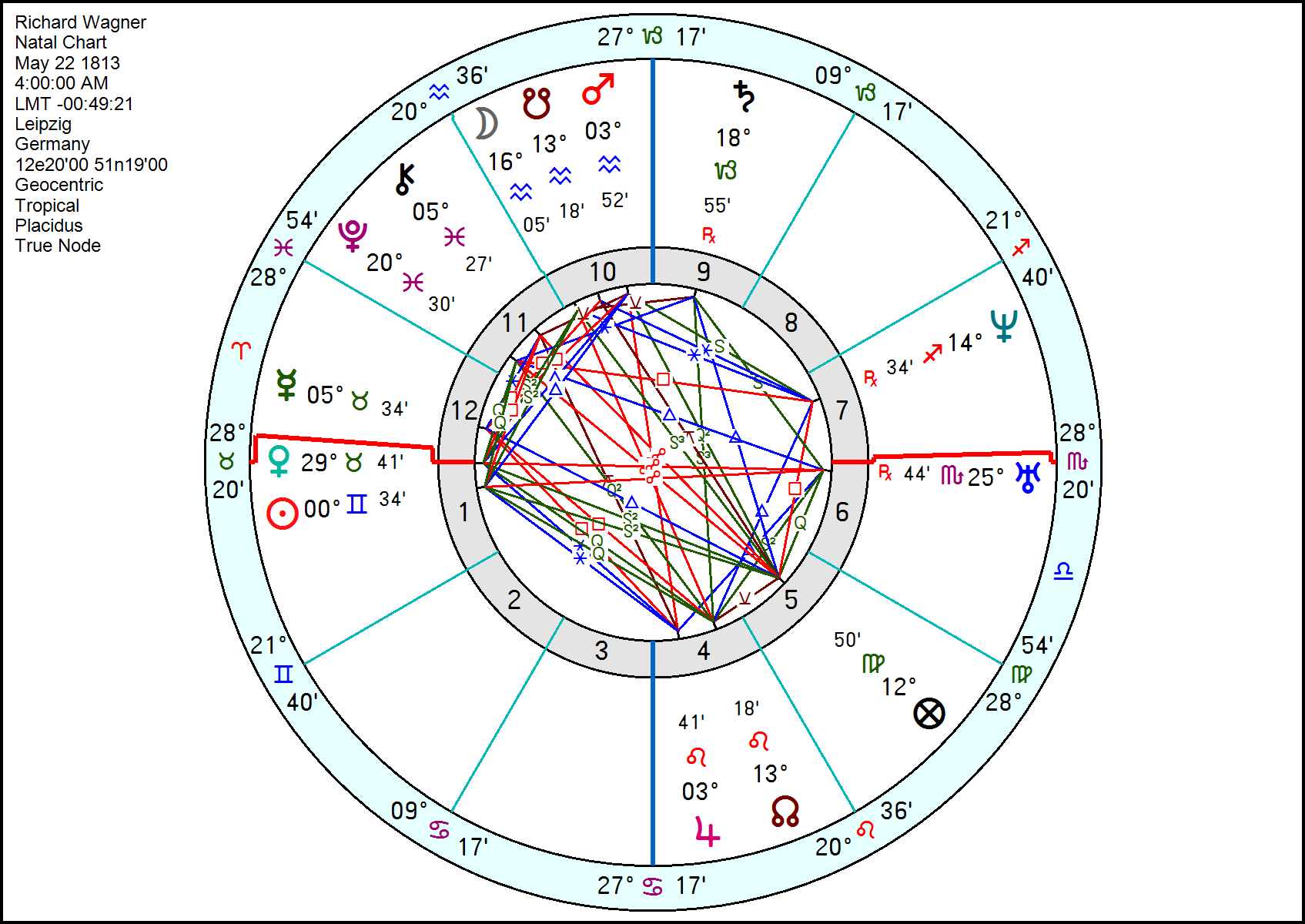
FIGURE 1983 0829b-1. Richard Wagner Natal Chart (astro.com).
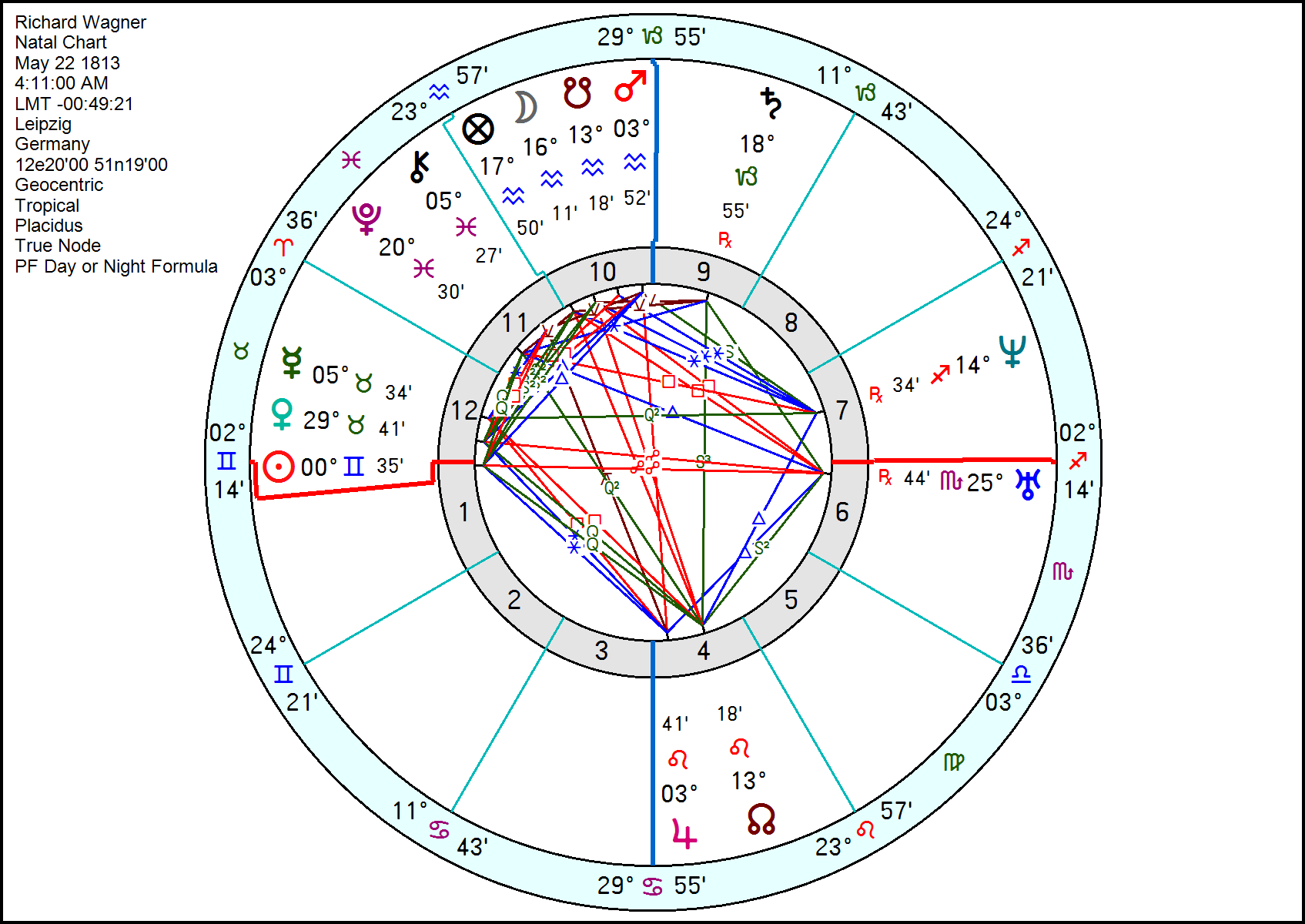
FIGURE 1983 0829b-2. Richard Wagner Natal Chart with 3 Gemini Ascendant (alternate version).
Other diagrams also referred to are not with this transcript version. [Transcriber note: [diagram] means the speaker is referencing a diagram as he or she is speaking. If someone is drawing or writing, with audible sounds of chalk on a blackboard, I indicate this by [drawing] or [writing].]
AD PAPERS read in class:
"Astrology Outline". Retyped as ASL Astrology - Theory - Outline V09P from Scan File ASL theory outline astrology N 9p.PDF.
"Reading a Chart". Retyped as ASL Astrology - Theory - Reading a Chart V09MP from Scan File ASL Reading a Chart P 25p.PDF. A version of this paper is in Astronoesis in "Astrology: The Topography of the Subtle World". This paper used to go by the name "Jung Paper" and was written for a presentation by TS at an astrology conference connected with the Digicomp DR-70 Astrology Minicomputer.
NOTES:
This is 1983 08/29b, Astrology; Horoscope-Wagner AM Seminar, and the second entry associated with this date. 1983 08/29a = Astrology; Horoscope-Wagner Evening Class, for which we have no audio, just JF notes.
This is a Monday.
TRANSCRIBED Verbatim by IT prior to 2018 (V11a). This is V12ap (2023) and has: updated prefatory matter, footer, and audio file name; Book List and TOC completed; new notes within transcript; new Wagner charts; new formatting to accord with new conventions. Archival verbatim transcript with AD Papers – V12ap.
AUDIO FILES: 1983 0829a. [Note 1: "Tape" and "Side" refer to original audio cassette tapes that were later digitized into .MP3 Audio Files. Note 2: We are missing the second audio file for this seminar and all audio files for the regular evening class.]
1983 08/29b SEMINAR at Wisdom's Goldenrod
Astrology; Horoscope-Wagner
[Audio File 1983 0829a Begins]
[IT/JF note: LR is reading from section I. E. of "Astrology Outline" (simply "OUTLINE" as originally typed by JF). This is retyped from the carbon copy of a paper typed by JF, possibly per the request of TS, in 1982. It itself was retyped from an earlier draft of an Astrology Outline, generated in a work session ~1982 (per JF's recollection). LR and TS were involved in writing it.]
AD ["Astrology Outline," LR reading]: "…[3. as reflection of] the ideas in Earth Consciousness; [4.] the vestiges of all life lived within the Earth memory; [5.] dragon as the organized system of instincts, the embodied ideas…"
AD: The ideas as embodied, yeah.
AD ["Astrology Outline," LR reading]: "…[6.] the way that the instinctual life of man is part of the dragon…"
AD: Uh-hm, or the subconscious.
AD ["Astrology Outline," LR reading]: "…and constitutes the psycho-somatic organism, making up the substance of both dream and wakeful consciousness; [7.] the phylo-genetic development of mentality using the Sautrantikas and Jung as example."
[9½ second pause]
AD: That's why I like private jargon. (bit of laughter) At least, you know, to make it coherent and leading one thing into the other so that it's a meaningful [one word inaudible] I'm not interested so much in being scientific as in organizing a vision, a way of seeing, alright, and presenting the possibility to a person that, look, there's another way of looking at things than the way you're ordinarily [couple/three words inaudible] This may be mythological or a fairytale but if you read it carefully then see what you think.
LR: Now--
TS: Hm. And we said last week-- yesterday, the 360 degrees as Ideas are only worked out through the psychosomatic organism. And here we mean not the Ideas but as these mnemonic traces [AD: Yeah.] are worked out through-- So it's not-- you're not looking at it--
AD: In other words, now we're thinking about, how does this Dragon, this entity, experiences it-- experiences itself through these various creatures.
TS: Mm.
AD: It's the only explanation for instance of such a-- a concept as the-- what do they call it, the swamp consciousness, (bit of laughter), you know, where animals eat one another, alright, and devour each other. Alright, that's a level of consciousness which is inherent in the Dragon just like the highest level, you know, where a man would sacrifice his life for a-- all these have to be found in the Dragon. Because, you have to remember, virtue will not-- virtue and illumination will not enlighten you.
S: But virtue [TS simultaneously: What?] and illumination will not enlighten [couple words inaudible]
AD (simultaneously): Only knowledge will do that.
S (very faint): Ok.
AD: You can be the most virtuous man in the world, without knowledge you're not going to be enlightened, not be, you know, a-- a wise man.
TS: And the other [one word inaudible]
EC: Oh, so what does illumination mean, doesn't that mean knowledge too?
AD: Yeah, but in a sense of glimpse it's not--
EC: Oh.
AD: Oh, it's-- but, you know, illumination is like temporary thing. But if you speak about a wise man, alright, he has knowledge. And that's what makes a man permanently enlightened whereas the other things come and go. But this kind of understanding is a permanent possession. Alright, if we continue.
LR: That was it for the degrees. You know--
TS (simultaneously): (For/Or) the phylo [one/two words inaudible] We had a thing here, phylo-ontogenetic development of the organism, [LR: I see.] a difference between the primitive animal and human perception in the sense that the primitive animal, they-- there's been just an expansion of the idea that through the efforts of Nature the facility with which the individual is able to form images out of his percepts has been enhanced and then also something about the way in which that in an individual's own development, his childhood condition and so forth, would adhere to his image-making faculty, activity.
AD: Yeah.
TS (simultaneously): You're really talking right down in the collective unconscious.
AD: You're speaking about the phylo and ontogenetic development of any individual. That has to be considered, even just glimpsed at. If you take a living creature at a much lower level, his prehension of the world, alright, brings about certain reactions, these reactions are stored, so to speak, in the organism itself. This is the way it'll react given a certain situation, alright. Then this is constantly built up. This ultimately ends in the way your bodily modifications now are seeing what it calls the world.
TS: Uh-hm, that I understand.
AD (simultaneously): Yeah, now-- now you have to understand at the same time that this whole process is under a plan.
TS: Ah, but now that's where I get all--
AD: Well what-- you think evolution is just happe-- happening haphazardly?
TS: No, but that's why I have such difficulty when you call the Dragon just the memories. Because I always think of it as an intelligent plotting uh--
AD: That's a metaphor to help a person understand that the ideas that are constitutive of him are of a mental nature. Actually, the right term would be that that's the Earth's Soul. But when you say memories, that you're constituted of memories, just like for instance when you conjure up a statement or you-- you make an image in your mind, alright, this is an image based on a previous experience that you have, the memory of those images that you have, alright, you bring them together and you make an image of something. And in doing that you s-- you know that this is all mental. So when we say that these are Earth's memories, it's like really emphasizing the mentalistic nature of the cluster of sensations which organize, constitute what we call our body. Then it becomes almost impossible not to look at yourself in any other way except mental. If you say "That's all I am?" you know, if you look at your body and you think of it only as the memories of the Earth then you have to go to the next step and say but this is just an idea! Because if it's a memory it can only be an idea. That's why I don't like to even bring in the word "elements". Because then they're going to think of them as some sort of real stuff. [10¾ second pause] What else [LR simultaneously: I--] do you have under that topic?
S (very faint): That's it.
TS: That's it for degrees.
AD: That's it for the de-- the degree. You've got a lot of research to do little girl. [short pause] You too.
LR: You know Anthony, you wrote this introduction to the paper that Tim gave on Jung.
S: I don't remember it.
AD: I don't remember it.
LR: Well I have it, I think you should look at it.
AD: Read it. Read a couple of lines, maybe I'll (recall).
S: It's quite good. [student assents] It's nice and (wide).
LR/S(?) (very faint): [one word inaudible] it's just it [one word inaudible] a lot for me.
RG: But read it Linda.
AD (simultaneously): Read a couple of verses, (would you)?
S (simultaneously): Read it. Is this one of the best ones?
S (possibly part of background): [couple/three words inaudible]
TS: Forget the first page, that's me.
LR: Oh I see.
[Transcriber note: LR is reading from a paper titled "Reading a Chart," which has been retyped as ASL Astrology - Theory - Reading a Chart V09MP from Scan File ASL Reading a Chart P 25p.PDF. A version of this paper is in Astronoesis in "Astrology: The Topography of the Subtle World". This paper used to go by the name "Jung Paper" and was written for a presentation by TS at an astrology conference connected with the Digicomp DR-70 Astrology Minicomputer.]
AD ["Reading a Chart," LR reading]: "It is our belief that the astrological mandala is a fragment of an archaic wisdom, and was devised by the profoundly wise sages of the past. This mandala of the signs and planets is a rare instance of--and product of--the archetypal imagination; it presents [LR reads: represents] the topography of the subtle world through the forms available in sensible becoming. This root symbol of astrology represents a formulation by reason principles of a symbolic method through which those very reason principles are being manifested. Reason principles are those living meanings or categories of thought that are the substantial aspect [(forms)] of the soul. Here we are stating that the totality of these categories of thought, or reason principles, are being arranged and combined in an indefinite variety of ways by the intermediary powers of the soul according to…"
LR: Something I can't read.
AD: Alright, it needs correction. (bit of laughter) But the ideas are there, the ideas [RG assents] are there.
AD ["Reading a Chart," LR reading]: "The astrological chart therefore attempts to join the processes going on in the subtle world with the experiences going on in the sensible world. These experiences have a compulsive nature which cannot be avoided and that forces [LR reads: force] the individual's attention towards understanding them. Through this process the individual soul powers are developed and refined until a full understanding is attained. This implies that along with the manifestation of the individual, the world idea as represented [LR reads: presented] by these categories of thought is being manifested and known through this progressive, and individual unfoldment. Otherwise the commonality of experiences can't [LR reads: cannot] be explained. Here [at this level is] the instance of identity of knowing and being; that is, of those reason-principles which are becoming the sensible being, which in turn is assimilating those reason-principles [LR reads: them].
"This then is a bare outline of the meaning of soul-making and its expression in the symbolic…"
AD (simultaneously): It would need correction, but the ideas are there.
LR: Well--
AD: There has to be a little more precision on the-- those [one word inaudible]
LR (simultaneously): Yes but I-- the reason I'm reading that, you know, when you say things like--
AD ["Reading a Chart," LR reading]: "The origin of these presuppositions is in the higher soul's vision of the intelligible world, or what [LR adds: the] Greeks call the Divine Mind; the horoscope is a reflection of that, and is part of the working out of that vision."
LR: I don't see anything wrong with saying that.
[short pause]
AD: No, I don't either because I-- (it's likely to be) [one word inaudible] [student assents] But we have in the Dragonic belt, the life traces that are left behind in, alright, the Dragonic belt, is the working out of these vast universal Ideas. I agree. That's very true. But to start speaking about universal substances to people, you know, in a, you know--
LR: No more than this. I mean I'm not talking about a metaphysical book but I mean I think these things can be mentioned, I think you did it right here and I don't think it's at all threatening the way you put it. Just we must keep in mind that-- that what we're looking abo-- looking at is a re-- you know, you say it very well here. That it's a vision of universal truth.
AD (simultaneously): You know, well, I'll-- like I said, I will speak about that but in a guarded way because I really like to leave the punch line to Tim's explanation of septiles, transiting septiles, the way the idea's coming in. And when you start taking an example like the Einstein chart where you see a big idea come in, but it's gotta come in and use the med-- the material at its disposal, that is, the psychosomatic organism's images, alright, and the rational (soul's/soul is) understanding, to grasp that huge idea and bring it down and apply it within the Dragonic belt, you know, alright, that's-- that's like a knock-out blow. For a person to understand that is--
TS: Well isn't it also that, you know, if I'm trying to figure out what you're doing starting this way and it seems to me that by beginning with confronting the issue of mentalism in terms of embodied perceived experience is-- I mean you're trying to-- and one way thi-- starting this way is to ground the perspective of the interpretation of the chart in a-- in-- in mentalistic framework right from the-- the most empirical--
AD: Level.
TS: --perspective, and not bring it in as a kind of a-- a descent from some idealism to some kind of sense-- sense realism. And that this is-- I mean this is a lot harder to do it this way where you're not protected from-- by-- you know, where you have to be careful to articulate a fully mentalistic understanding of sense perception. But if you're going to say that astrology of the natal horoscope begins with the birth of the body, or the fully functioning of the body, if that body-- that event isn't-- can't be formulated as within a mentalistic framework, there's going to be a hiatus between the theory and the practice somewhere. So I could see that, you know-- And that's why I see as going on and to start right with-- within the Dragon and you're trying to talk about the collective unconscious and sense perception but keeping it as within the individual mind or the in-- the in-- confluence of the individual mind and the Earth consciousness, the Earth mem-- the Earth Soul, that's not easy, that needs-- You know, certainly once-- o-- if that's accepted then the rest of it's going to have to follow, you know, you have to accept the rest, that there is such a, you know-- that this is the embodiment of reason-principles outside of the Dragon, the soul. Those guys [TS indicates on diagram].
[10¾ second pause]
AD: Alright, at least I know what I have to write up, so-- Whether I include what you want into it now, I mean I-- I got a general idea of what I want to write. Now the second part, what are you going to do tonight?
LR: That's what I was just going to ask.
[student assents]
TS: What do we have to do tonight?
AD: It's only a few hours away.
TS: Well Richard?
AD: What were we doing last week?
LR: We had-- we were going to do Gandhi's and Wagner's septiles.
TS: And quintiles.
AD: Quintile.
AS (faint): David--
S: Wagner-- yeah, I thought we had just started Wagner. [student assents] You suggested starting with Wagner.
TS: Yeah. Turns [LR simultaneously: I started--] out that three of them are to the Head so I don't really want to (explore the order) where to put them. He's got--
S (faint): There might be others.
TS: Yeah, he's got four others.
AD: He's got seven quintiles?
TS: Yeah but I think-- I think it's six or seven.
AD: Six or seven.
TS: And I know three of them are to the Head.
AD: Ok. And then how many septiles?
TS: Four or five.
AD: Four or five?
TS: Of that chart, yeah.
AD: Well, let's get it out, let's--
TS: Sure. (bit of laughter) [few words inaudible]
[32 second pause]
AD (faint): You know, there's an interesting quote in one of PB's notebooks where he speaks about-- he mentions the way the perceptual world is built up from prior material, the development of, you know, the individual organisms, this eon-long development, and its reactions are stored and built up and [one word inaudible] (in mind) and elaborate, you know, the perception of an object [student assents] through this, you know, this (mixed/fixed) material. But then he goes on to say but we don't have to worry about that, we can cut right through all of that [one word inaudible] So, like even though the mind has gone through this long process of building up all the reactions, you know, accruing all those reactions, accumulating them, and then being able to respond with an image to a given situation, whatever, you know, it would be like beyond the sensible appearance, whatever that it is, alright, he says then the psyche (would) respond with an image to that. He says now we can get caught up in trying to understand the nature of the image, you know, like what Jung does. He says but when all is said and done you got to go directly to the idea, pierce through all that symbolism, through all that imagery, and get to the idea that's there. I'm sorry I don't remember where the dickens I read that but-- You see he goes there to the fact of the ontogenetic and phylogenetic development of the individual mind's ability to respond with an image to any circumstance or situation that's given. And you can get caught up in that image when-- or he said like you can cut right through it, pierce right through it. And that reminds me of like, you know, the trans-Saturnians, yeah. You can either get stuck in the morass of the psychosomatic organism and think that you're go-- you're going to find an understanding or an explanation there; or you can fall back on the willing, thinking, and feeling and use those functions to penetrate into the field, the body as a field of activity.
CdA: Wait, I didn't follow what-- what's been going on but-- As opposed to getting stuck in the morass of the imagery, [AD simultaneously: Of the imagery, yeah.] you use the knowing, willing, and feeling [AD simultaneously: Feeling, (feeling/willing).] to see the body as a field, see--
AD (simultaneously): Well, that the body is a field in which all this activity is taking place, all these images are taking place. But through the use of reason--willing, feeling, and knowing, alright--you can penetrate directly and find out what the idea is, [CdA: Ok.] instead of going through that. That's one of the criticisms [one/two words inaudible] throws at Jung. He points out sooner or later you're going to have to get to the ideas so why-- why use this process, you know, this long intermediary process of trying to find out what the damn images mean, how-- what the symbols mean in terms of the images.
S: Why do you say ideas are [few words inaudible] the degrees?
AD (simultaneously): Yeah, yeah, the intellectual level of the idea.
S (faint): Yeah.
[9 second pause]
CdA: But why-- when you refer to it as the field, you're again-- you're again referring to the body and the World-Idea as having all three levels simultaneous within it, right, and so--
AD (simultaneously): Yes, they would have all three levels and so would [CdA assents] the subject have all three.
CdA: So-- ok.
AD: But the important thing is that the subject, alright, the true-- you know, the subject in the true sense, not the psychosomatic [CdA assents] organism but the subject as reasoning, has at his disposal the ideas. It can directly deal with the ideas. So when they speak about the body as the field in which the combat takes place, that means all these instincts which are organized as the psychosomatic organism is where there's a conflict taking place and it's like penetrating through the i-- with the ideas and piercing, you know, just cutting off the images and what's this-- what does this mean for me. You don't need the images anymore. [short pause] Well--
LR: Can you read them off Tim, what you have, in order of orb?
TS: In order of orb?
KD: Yeah don't-- don't we have to experience with images?
TS: I don't have them in order.
KD (simultaneously): It's the same quote, [S simultaneously, possibly part of background: Yeah, yeah.] he said-- he said try not to-- when you have an experience, don't make a mental image of it. He said (there's no planets that go) [one word inaudible] You know, it won't leave any trace and it won't leave traces on you-- you know, for that karma [couple words inaudible]
AD (simultaneously): Because soon as-- soon as you react [one/two words inaudible] way, alright, that gets stored away as a possible response to a given situation.
KD: And that adds to the Dragon [few words inaudible]
AD (simultaneously): Yeah. That adds to the-- to that Dragonic life. Whereas if you stay-- if you pause for that moment and allow silence to reign then the higher faculties, willing thinking and feeling come into play, or intuition. Because all three of them would be referred to as forms of intuition.
KD: And then, and then, if that happens, if you don't react with an image [one/two words inaudible] would allow that image to-- to-- if you don't allow that to become assimilated then, like you said, well, the higher knowing willing and feeling makes avail-- does the image then prevent that from happening, is that what stands in the way? So that-- that's like the activity of knowing (the field).
AD (simultaneously): Yeah, yeah. Because the-- the image is the psychosomatic organism's response to that.
KD: Ok.
AD: Whereas--
KD: And that's what blocks the light, that's what blocks the light, yeah.
AD (simultaneously): Yeah, and that blocks the functioning of the higher. So the intuition can't function. Or if it is you can't-- it's not going to be noticed.
KD: So, so, if our body is made of these 360 degrees, these images fabricate our body, and this is a process that continues and-- continues and all the aspects that go on, [S; Pluto?] then if you could-- if you could practice that, not making those images, then there could be that-- you-- there is that possibility of the-- of the-- of the idea that stands above and behind those Earth's memories that are constantly [one word inaudible] and you raise that possibility then that there could be-- [AD simultaneously: That your mind gets them directly.] that your mind would be available and [AD simultaneously: (Alright/Uh-hm).] it would be directly apprehended.
AD: Well, that's the whole purpose in responding to any given situation with a pause. That pause allows intuition to arise. If there's an image it'll be-- the intuition won't be heard, seen, smelled, tasted, ok, you won't even be aware of it because the image has such a predominance. So silence is usually the best response the first moment something happens. So some--
KD (simultaneously): That's why meditation, I mean--
AD: Yeah.
KD: The practice of that gives it space between the--
AD (simultaneously): And also the Hua T'ou is one of the way, you know, where he cut off any image that arises in the mind. Then in the ordinary life this is a practice that you can apply. Whenever a situation arises you immediately cut off any reaction that the organism is going to have and allow or permit for the higher mind to come in and say something. But we don't listen, we listen to the (silence of the) [one word inaudible] we listen to the ego which is in the body throwing up all these suggestions.
KD: So, when a-- when an aspect comes, let's say, you know, Mars Sun or whatever, there is available then that higher idea if there's no reactions, if there's not a reaction on our [one word inaudible]
AD (simultaneously): Yes, yeah. But my theory is that even if there is [couple/three words inaudible]
KD: That-- all that because-- because the 360 degrees are totally available. You're not--
AD (simultaneously): As a matter of fact an aspect tends [KD simultaneously: Yeah?] to bring in an organized reaction.
KD: Be-- be-- because it refers back to the natal structure before-- because it refers back to your particularization of that. [AD/S(?) assents, very faint] So, wasn't the point before about the 360 degrees being universal, like the commonality that they provide, wasn't the point of that that our bodies, there's a-- is fabricated, it is [one/two words inaudible] before that, what you call the light of the soul [one word inaudible] with that, and that's why the 360 degrees are total of [couple words] all the Earth's memories weren't the-- the [one word inaudible] combination made our body and that's why they're totally available, I mean it is an entire field, it is kind of experience of the World-Mind.
AD: Well let's put it this way, let's put it this way. The 360 degrees that are constitutive of the appear-- apparent world, alright, are embodied. The subject on the other hand, the true subject has available at his-- has at his disposal these reason-principles in their purity.
KD (faint): That makes sense.
S (possibly part of background): Linda--
AD: That he could respond-- in other words, the higher knower in us could respond directly from the reason-principles that are within him to a given situation or appearance.
KD: But-- but that's-- I mean because we have that higher knower, ok, we have the higher knower on our-- on our side because of the [couple words inaudible] but it's still-- it's still that the-- the ideas that are-- that are acquired come from-- come from the Earth, that it's the ideas behind-- that's like the ideas that are embodied in those Earth's memories that are available, I mean the ideas aren't coming from-- [AD simultaneously: Yeah but the point--] aren't coming from the-- from the--
AD (simultaneously): Yeah but the point is this here. The ideas that are embodied in the sensible appearance [KD: Yeah.] are not in their pure form, right, [KD: Right.] they're embodied. [KD assents] So it's like you have to pierce through or penetrate underneath the sensible appearance to get to those ideas as they are in themselves.
KD: Yeah.
AD: And what I'm saying is the higher knower in us has direct access to those ideas.
KD: All the time, (he's lucky).
AD (simultaneously): All the time.
KD: Yeah, and so it's the reaction of that-- of that-- of our-- of-- of that-- of ourselves, it's our mental reaction of creating an image that blocks that.
AD: Blocks that--
KD: That blocks--
AD: Yeah.
KD: And it keeps-- keeps us from--
AD: Who keeps silent when they're faced with a situation, alright? Immediately the reaction is there before situation is even finished.
KD: Yeah.
AS: Did you ever notice that? (bit of laughter)
AD: She take my coffee?
LR: No sir.
AS (simultaneously): No.
CdA: No, I would not.
AS: She tried.
AD: She tried.
AS: Carol protected it.
RG: Carol's protecting it, right.
AS: [three/few words inaudible]
S: Somebody [three words inaudible]
AD (simultaneously): Ok, now--
CdA: I'm the chicken in the barnyard.
AD: You got that degree, chicken in the barnyard? (bit of laughter) [Note: Cancer 18, "On all sides is the bustle of the barnyard, and in its old-fashioned and natural life a hen clucks among her chicks."]
TS: You can hear her cluck.
RG: Is that your Neptune?
S: It's my Saturn [one word inaudible]
AD: Go break one of his crackers. (laughter)
S: Who was unimpressed?
CdA: I didn't even hear him [one word inaudible] (RG laughs) very good, [one inaudible AS word] I just-- [AD simultaneously: Very good.] I didn't even hear what he said.
AS (simultaneously): Now-- that's the worst insult of all! (laughter)
CdA: I heard it [one/two words inaudible]
RG: Immediately-- immediately came back to him.
AS: Imme-- (RG laughs)
[short pause]
AD: Well, tell me-- tell me, I'm listening.
RG: [one/two words inaudible]
S (simultaneously): Let's hear them then.
TS: Once upon a time there was a poor starving artist named Richard Wagner.
LR: Read 'em!
TS: Read 'em. Read 'em what?
S (very faint): [one word inaudible] show them this.
TS: Ok. One degree aspects. Wait. Do you want to spread them across like we did last time?
S: Yeah.
TS: Ok, the regular-- the regular aspect [someone writing on board] he has a Sun Venus conjunction at one degree and a Mars Jupiter opposition, one degree, ok. Quintiles-- the only quintile he has at one degree is Sun quintile the Head. Now, we have to decide if that means anything. And septiles, he's got the Moon bi-septile Venus, and Uranus bi-septile the Head, again. Two degrees: He's got Moon sextile Neptune, Mars square Mercury, Mars square Jupiter.
RG: Mars can't be square Jupiter if it's opposite Jupiter.
LR: It's exactly opposite Jupiter.
RG/S(?): I'm sorry.
TS (simultaneously): Mer-- Jupiter square [AS simultaneously: It's unusual chart.] Mercury, Mercury-- Yeah, he really had a problem, this is one.
RG: Yeah right! (RG laughs, student words) The square and the opposition in a chart, forget it!
S: No wonder he was so screwed up. (RG laughing)
LR (simultaneously): Mars opposite Jupiter and then [S simultaneously: Yeah (couple words inaudible)] Mercury square Mars and Jupiter.
TS: Right. And Pluto sextile Saturn, yeah.
LR (simultaneously): Why don't you put the opposition down?
TS (simultaneously): Pluto-- Saturn sextile Pluto.
AS/S(?): I did, look.
LR: Oh up there.
TS: Saturn sextile Pluto.
AS/S(?): Yeah.
TS: Quintiles he's got Sun quintile Pluto and-- now that-- he's got Venus quintile the Head and Pluto quintile the Head. Ok. Septiles, he's got the Sun bi-septile the Moon, Saturn septile Uranus, and Saturn tri-septile the Head. Three degrees: Moon conjunct Tail. That's it. Moon conjunct Tail. Mercury bi-quintile Neptune and Mars septile Neptune. [short pause] That's it. [short pause] Unless he was Richard. (Told him.) [short pause] Uh-hm.
[short pause]
LR: So it seems like the first one we have to understand is the Moon bi-septile Venus.
[short pause]
TS: It's a secret.
LR: Well-- We don't get into the ones to the Head right now.
TS: What do you think, you think there's anything to those that might be involving the Head?
AD: There might be. I mean the Head and Tail has always been considered very significant and if we don't know what it means, it doesn't mean that it doesn't mean anything.
S (faint): Yeah.
[short pause]
S: Go ahead.
TS: Ok.
LR: So you think we should do all those to the Head?
AD: Well, yeah.
LR: Take a look at it?
AD: I think you'll--
RG: Well the Sun to the Head might be a pretty important--
TS: Yeah, that's the one I thought might be [RG: Yeah, one degree.] accessible, I mean that's--
LR: Except-- well--
TS: What?
LR: It's just easier for me to look at the septiles first because [RG simultaneously: You get the idea.] quintiles seem to be working off-- working out some of that stuff.
TS: Ok, well let's [RG simultaneously: Right.] look at the Moon bi-septile Venus.
LR: Yeah.
TS: Sabian book is where?
LR: I can read them, I have them written down.
TS (simultaneously): Yeah? Go ahead.
Marc Edmund Jones [The Astrology of Concepts, Aquarius 17, LR reading]: "The master is sleeping in the little hut near his [LR reads: a] newly-discovered gold mine [TS: Which is that?] with his faithful dog on guard."
LR: That's the Moon.
Marc Edmund Jones [The Sabian Symbols in Astrology, Aquarius 17, LR reading]: "When positive [LR reads: Positively], [the degree is] unswerving faithfulness to ideals and a real determination to achieve them, [and] when negative [LR reads: negatively], unfriendly instincts and groundless suspicion."
[10¼ second pause]
TS: Let's make it our wild day today. (bit of laughter)
[14½ second pause]
LR: And Venus was--
S: Peacock.
TS: 30, the peacock.
Marc Edmund Jones [The Astrology of Concepts, Taurus 30, LR reading]: "A [LR reads: The] peacock parades its splendor on the quiet lawn of an old palace garden in dignified solitude."
Marc Edmund Jones [The Sabian Symbols in Astrology, Taurus 30, LR reading]: "…special flair for dramatizing the heritage of the race or [for] capitalizing on the lessons of history…"
TS: And we have to look at the-- I think, of the first part of the degree interpretation for this gentleman.
S (faint): I bet.
LR: Read it.
TS: No. The Moon is--
Marc Edmund Jones [The Sabian Symbols in Astrology, Aquarius 17, TS reading]: "[This is a] symbol of the inviolability of experience as dramatized for each individual through the social sanctions and legal rights on which he may count in his own personal affairs."
TS: Ah.
RG: Hm?
TS: That doesn't take much. I see. You put that degree, if you take the Moon, his-- his immediate sense of self-identity, and you put it on a degree of this "inviolability of experience as dramatized for each individual through social sanctions and legal rights" and you put that together with the peacock as his Venus, this, you know-- he had this pretty fixed idea [student assents] that the world owed him a living. (AD laughs)
RG: Whatever he wanted.
TS: Yeah. He deserved all-- he deserved the best, absolutely, you know. He real--
RG (simultaneously): And (then/that) whatever he needed to express was legitimized, should be legitimized.
TS: Well whatever he need-- no, whatever environment he needed to make for himself he was totally-totally justified.
RG: Uh-hm.
[short pause]
TS: Strange.
AD (simultaneously): That's the-- which one is that?
RG: Moon Venus.
AD: Moon Venus?
RG: Bi-septile.
TS: It's strange, you know. You know, if he had actually gotten a ten percent royalty on all the performances during his life, he would've been able to pay for everything that he [RG: Really?] didn't pay for. He had [RG simultaneously: Hm. That's (strange). (RG laughing)] made out with a lot. Because at that time they didn't-- they just bought the manuscripts and the performance royalties went to the publishers, not the author.
RG (simultaneously): Right.
S: 30 [one word inaudible] an hour.
[21¼ second pause]
Marc Edmund Jones [The Sabian Symbols in Astrology, Taurus 30, TS reading]: "…dramatizing the heritage of the race…"
[short pause]
TS: Also it says here, keyword-- the Moon is an "unswerving faithfulness to ideals," and Venus is "special flair for dramatizing the heritage of the race". Now, it would seem to me that, I mean, you know-- [short pause] Wasn't it one of Wagner's preoccupations to make-- to establish a German music, the German theater, the German opera?
AD: Oh yeah.
TS: That-- that he had gone--
AD/S(?) (simultaneously): [three/few words inaudible]
TS: --saw that as something he wanted to see done no matter what. Could you see that in these two degrees?
AD: I think so.
S: [couple words inaudible]
S (faint): (I do.)
AD/S(?) (faint): Yeah.
RG(?): [couple/few words inaudible]
TS: Well, I was thinking if you take this thing like the Moon says, "an unswerving faithfulness to ideals," and the Venus is-- the values are "a special flair for dramatizing the heritage of the race," [RG simultaneously: Right, the German(--/.)] that the-- there's this preoccupation with dramatizing the ideals of the German race.
RG (simultaneously): Oh, right.
[short pause]
TS: Musically.
RG: Right.
TS: Dealing with--
LR: Not to mention dramatizing the [short pause] blowing up, so to say, and specifically elaborating on the instinctual drives of man. [short pause] Idealizing-- dramatizing the idealized instinctual consciousness of man represented by the Moon. In other words, whatever Venus is, whatever that Venus is aspecting, it will make a pageant of.
TS: Well didn't he make a pageant of himself, his own ego?
LR: Well I'm talking about the Moon.
TS: Yeah, but I was--
LR: Well, instead of saying his own ego I'm saying instinctual consciousness in general, or subjective--
TS: I don't understand that Moon degree, I don't see how that's [couple words inaudible]
LR: Well I think just the degree means that you idealize the-- say the instinctual nature. Just the Moon degree I think means that.
TS: I just don't see how you--
LR: Well he says "unswerving faithfulness to ideals".
TS: Yeah? And how is that-- I don't translate that into instincts somehow.
LR: No, I'm talking about the Moon. I'm talking about the subjective or lunar function. I mean what would be idealized there to have that degree for the Moon? How would you see that degree?
[short pause]
RG: Your own self-image.
TS: Yeah.
RG: Tenth house, Moon in the tenth house, your own self-image would be idealized.
TS: He'd be idealizing his ego or his sense of self. His sense of self or his pride in himself would take claim, ownership of his talents, his-- (what was) inspire. [18¼ second pause with flipping of pages] Oh let's see.
RG: I think you have to contemplate it. You know, the Sun Venus is a one degree conjunction, it's like all those three planets together are the septile. I don't see how we'd get it without the [couple/three words inaudible]
TS: We should [S simultaneously: What's that?] be able to distinguish [student assents] them.
RG: It's so close.
[short pause]
LR: Right, well, we get Moon Venus and the Moon Sun.
RG: Right, 'cause there's a Sun Venus one degree conjunction.
[27 second pause]
LR: So, what would you say about the--
AS (faint): What do you mean?
RG: I mean--
[short pause]
RG: What does he say for 1 degree Gemini?
S (faint): (Gemini?)
RG (very faint): And that's where I would look.
Marc Edmund Jones [The Astrology of Concepts, Gemini 1, LR reading]: "[A] glass-bottomed boat drifts silently and easily over a constantly shifting panorama of marine wonders."
Marc Edmund Jones [The Sabian Symbols in Astrology, Gemini 1, LR reading]: "…competence in the estimation of life's potentialities [LR reads: potentiality]…"
S (faint): Well--
S (very faint): Reread.
LR: But I didn't get the Moon Venus one yet.
TS (simultaneously): Yeah, I don't get the Moon Venus.
[short pause]
RG: I thought the first thing you said was pretty good Tim.
LR: Well I need-- that needs elaboration. [short pause] I mean you said it was idea-- it was one of his ideals to dramatize the racial consciousness, Germanic-- (yes/right)? Germanic--
TS: Well I-- two things, yeah, that one of his ideals-- he saw that-- he saw himself as being the vehicle through which German music would be created.
LR: But we're talking about a septile.
TS: Yes?
LR: So talking about a belief in objective truth?
TS: Yes.
LR: Ok. I don't see it.
TS: I don't see why what I said is not acceptable.
LR: Well just explain it. [short pause] Can you?
[short pause]
TS: Say the-- a septile is a fixed belief, he had a fixed belief that it was his place to establish a German opera, to take the best out of the ideals. And he saw himself as co--
LR (simultaneously): See when you say he saw himself as, like as in [TS simultaneously: That's the Moon.] the role, I'd see that as a quintile, [student assents] what we said-- from what we said last week as--
TS: But-- ok.
LR: So, I don't-- that's why I can't follow.
[17¼ second pause]
TS: Then how do you see it?
LR: I don't know, I don't know, I'm trying to [one word inaudible]
[33¾ second pause]
Marc Edmund Jones [The Sabian Symbols in Astrology, Aquarius 17, LR reading]: "Community integrity requires the strengthening of each separate participant in its common functions…"
[26¾ second pause]
LR: See I would say just for the Moon that he had this faith in his subjectivity as being a cooperative activity between the animal and the man, the beast and the man. Just from the Moon. And that the Venus would be the-- what [short pause] would be displaying that in a way. [student assents] That the Moon would be a belief that the-- that what man is is a cooperation of those two le-- those two. Well I'm just reading the sym-- the interpretation (in/and) the symbol. The man is sleeping next to the gold mine and the dog is on guard. And he says--
TS: I mean that doesn't sound like a cooperation though.
Marc Edmund Jones [The Sabian Symbols in Astrology, Aquarius 17, LR reading]: "Effective living is a co-operative activity such as will stimulate the highest response from all."
[35¾ second pause]
RG: It's almost like there was an inbuilt belief that his devotion to his own self-expression was absolute. And that was--
LR: Or deliver the truth in some way.
RG (simultaneously): Yeah, yeah.
LR (simultaneously): That one's-- by dramatizing the-- by dramatizing the actual expression of the subjectivity you could get to the racial-- what was-- what lay at the root of the racial unconscious or something like that?
RG (simultaneously): You mean from the Venus?
LR: Yeah, I'm trying to combine them.
RG: Yeah, I don't-- yeah, from the-- yeah, or just-- I mean just take Venus, the peacock, your own-- I mean the manifestation of his own va-- feelings in a--
LR: Which is the one that said racial wisdom, the Venus?
S: Yeah.
(Side 1 of original cassette tape digitized as 1983 0829a Ends; Side 2 Begins)
TS: Yeah, that's the way I understand that, that he-- I mean I think that with the Moon degree that the pre-- predilection to claim his inspiration or talent or musical ability as part of his personality, part-- it was almost a worth of his personality, and that he felt totally justified in displaying it, [student assents] that there was no-- [RG assents] no holds barred in terms of asserting the worth of, you know-- it's like-- then convincing von Bülow don't shoot him, you know, he can't shoot, you know, Sir Richard, [RG assents] you know. I mean, he was going to duel him for Cosima, [student assents, faint] you know.
[short pause]
RG: Well would--
LR (simultaneously): So, instead of saying racial heritage, couldn't you say like through the display of his own subjective mode he believed that-- that was also part of the whole racial or the whole, say, collective, his collective--
RG: Uh-hm.
LR: That he was connected to that in some way?
RG: Yeah. Yeah I understand you.
S: Good.
RG: Yeah I guess the Mars-- I mean Venus on the ascendant is so per-- like I could-- you know, I get it. I could add his interpretation of that(--/.)
LR: It's more like a stylized mode than a necessarily Germanic mode but--
RG: I mean with Venus on that peacock degree it certainly doesn't--
S: (Well he's--)
TS (simultaneously): [one/two words inaudible] create German opera.
RG: True, then maybe-- you know, you think it's from this degree?
TS (simultaneously): He knew that he-- he knew that he had to do it and he did it.
LR: But wouldn't that be more the nature of a quintile, [TS simultaneously: No!, no.] the fact that it was German, I mean a septile wouldn't say "I believe in Germany."
TS: No, but it would (RG laughs) say I believe in a nation, it would be a fixed attitude of nationalism.
LR: Right, so I'm trying to kind of generalize that--
TS: But I don't see why it wouldn't have-- couldn't be that-- that nationalism, the streak of surrendering one's self-identity to a national focus.
RG: Yeah, the Venus could be. The Venus gave him [one/two words inaudible]
TS: I mean you're getting [RG simultaneously: But the--] at his music, I mean he didn't-- he didn't want to create-- create--
LR (simultaneously): Well that's-- yeah, that's closer I think.
TS: --you know, the German-- a new German armory [S simultaneously, faint: Especially--] and a new German thought, you know.
S: [couple words inaudible]
LR: Display--
TS: You know. I mean I think it was a definitely-- You know, and that was something that was certainly a preoccupation of his for an awful long time.
RG: Yeah. Yeah, yeah.
TS: You know, I don't see-- yeah.
RG: I just-- I'm just-- I'm just [TS simultaneously: You say (couple words inaudible)] a little wary at fir-- I'm just a little wary to put it on the Venus before I do see-- like you'll see the other symbols right away but--
LR: How about something like the self-worth was to be achieved through the display of one's subjectivity in terms of beauty?
RG: Yeah.
AS (very faint): Yeah.
TS: You're driving me to drink here.
AS: What?
LR: I mean how about that, if you don't like the racial thing.
RG: Yeah, I just think it should be more personal [S: Why?] or--
LR: One's subjectivity is what was being expressed and taken to be the beautiful.
RG: Uh-hm. Yeah. And whatever form he needed to meet that the world through the Moon he was utterly devoted, he had an inbuilt belief that whatever-- that he was utterly devoted to the-- to the valuation of a musical consciousness that he embodied and whatever he had to do he did to achieve it. And there was a total lack of concern for anything else but.
LR: Yeah, but an inborn belief in the-- in the devotion to the i--
TS (simultaneously): A faith in his own musical genius.
RG: Yeah, yeah.
LR: Yeah, to the ideal, to the--
RG: Yeah, of course.
LR (simultaneously): --you know, regardless of whether-- of what the--
RG: Collective thought or what anyone else thought.
S: Ay-ay-ay.
RG: I mean you're putting the Moon and Venus in septile, right?
S (faint): Yeah.
LR: Yeah.
RG: I mean it's a-- I mean [few inaudible student words simultaneous with RG] another way you could say there was a-- it was an inbuilt belief that-- I mean his anima was his reality also, that those two brought up the septile.
TS: He was self-taught musician. And, he went inside himself to do that work, he didn't try to pull, you know--
RG: Uh-hm.
TS: --synthesize. I can see your objection to the Germanic thing in that it's not a trans-Saturnian more than I can see the--
RG (simultaneously): Right, yeah. Yeah, I'd look at it in a Neptune or Pluto maybe but--
S: Right.
AS: I think the world-- it seems like it's saying the world in his everyday experience is going to provide everything he needs. [student(s) assenting] That's the Moon. It provide everything-- he sees-- this is his view of the world, view is that the world provides everything that he needs almost in order to express himself with beauty.
[students assent]
AS: The problem-- you know, I mean he was capable of it.
RG: Right.
AS: But the Moon degree seems to me just [student assents] his--
Marc Edmund Jones [The Sabian Symbols in Astrology, Aquarius 17, AS reading]: "…experience as dramatized for each individual through the social sanctions and legal rights…"
AS: What's the other thing, "faithfulness to ideas", and you also see that.
LR (possibly part of background): (Hm?)
AS: That's all.
TS: It's-- it means the opposite of communion. I--
LR: What's it mean Tim?
TS: I don't know.
LR: I-- I always look that up and I always forget what it means.
RG: What, (but--)
LR: Probity.
RG: Probity. Depth.
S (simultaneously): It's something legal.
LR: To probe?
RG (simultaneously): Depth.
S: Depth?
RG: To probe, depth.
LR: Oh, it's not [one word inaudible]
RG (simultaneously): Looking with depth, with deep eyes.
S: It's the verb of (depth/death)?
LR: No it's a noun.
TS (simultaneously): Why don't (you/we) look?
S: Probity is a noun?
RG: Yeah.
LR: Probus.
RG: Probity.
S: Probity, yeah.
TS (simultaneously): He's going to write it out.
RG: What's this-- wait, which degree is (this/it)?
S (faint): 17, yeah.
TS (simultaneously): 17.
LR: There's something I'm not getting [few inaudible student words simultaneous with LR] from the Moon degree which is stopping us, you know.
RG (simultaneously): I never get that Moon degree really. I can never get that.
LR (simultaneously): I feel like there's more in that degree than we're getting.
TS: Well it's a dog [S simultaneously: Rerea-- reread it.] standing guard on the gold mine.
RG: Right.
LR: Right, the [TS simultaneously: (couple words inaudible) the man.] guy has discovered the gold though.
RG: Right, and now his faithful dog is (guarding/guarded)(--/.)
LR (simultaneously): He's discovered gold [TS simultaneously: His animal is guarding it.] and now he's got [RG simultaneously: Right.] faith in the animal and he can go to sleep.
RG (simultaneously): To guard [TS simultaneously: To guard him.] him and protect him, right.
TS: Or he went to sleep in--
RG: In its new-- his newly discovered gold mine.
LR: He's called a master too.
Marc Edmund Jones [The Astrology of Concepts, Aquarius 17, LR reading]: "The master is sleeping in the [LR reads: a] little hut [TS simultaneously: Oh, the master.] near his newly-discovered gold mine with his faithful…"
LR: I mean he's master of the dog.
RG: Dog, right.
LR: Yeah, I don't mean (like/that--) (RG laughing) an adept. You have to [RG simultaneously: Right.] keep these classes [RG: That's right.] separate. Um--
[short pause]
RG: Right, I mean his instincts are g-- well that's where you got the-- maybe where you get instincts from, I mean he does let the instincts protect his home.
LR (simultaneously): The dog, yeah. Yeah I was reading the symbolism.
RG: Yeah. Yeah it's true.
LR: Like he has a certain faith that the animal is going to protect his claim.
TS: Or that there's a tremendous-- he puts all his value in the animal, ok.
LR: Well I would say faith. I don't know why you say value.
AS (simultaneously): Well he trusts the animal.
LR: He trusts it, yeah.
RG (simultaneously): But in a service of protecting his-- his--
AS: Higher ideals.
LR: His interests.
RG: Yeah.
TS: And if you found a pile of gold, would you let your dog sit on top of it or would you sit on top of it? I--
LR: Ok, no but that's [AS(?) simultaneously: (First of all--)] good, that the instincts--
RG (simultaneously): I wouldn't-- I wouldn't sit on it! (RG laughing)
AS (amidst laughter, simultaneously): First of all I wouldn't let the dog sit on top.
RG: I-- (RG laughing)
LR: You said the instincts were protecting the inner-- the higher of the self.
RG (simultaneously): I think we're going to the bullion market [three word inaudible] right. (RG laughing)
TS: Exactly. You know.
AS (simultaneously): And that way he doesn't have to be concerned. (RG laughing)
TS: That's-- it would be pretty dumb to have a [RG simultaneously: Right.] (bullion market).
AS (simultaneously): [couple/few words inaudible] you know, he doesn't have to be concerned with the everyday circumstances.
RG: That's right.
LR: The instincts will see to the needs of the self.
CdA: It certainly was [couple inaudible TS words simultaneous with CdA] his lifestyle from [few inaudible student words simultaneous with CdA] what I recall. I mean he didn't-- he wasn't [LR in background: Well leave it out. You don't know.] very-- very responsible in terms of the [LR in background: I have to write it out.] everyday affairs.
AS: Like I think it's close to what Tim said. The world will provide-- he's-- he has faith that the world will provide everything he needs or will be taken care of in order that he can express his own [RG: Right.] sense of beauty.
RG: And therefore he takes it. I mean--
AS (simultaneously): And he takes it, yeah.
RG: I mean he can take it because he has this inte--
LR: Take it.
AS: He can take what the world brings (to him).
RG (simultaneously): Take it from the from world, in other words he can-- he can be outrageous and totally not live by the collective morality [AS assents] because he has this view of reality that he-- as Tim said, he deserves it. [AS assents] And he's going to get it.
AS: As long as it's for the purpose of expressing (his/its) own higher sense of beauty.
LR: Which is the gold. In other words--
AS (simultaneously): Yeah, that is his own higher sense of beauty is the gold.
LR (simultaneously): Right. There's a faith that the instincts will take care of the needs of the self to express the beauty that he needs to express.
RG (simultaneously): Right, but the gold mine seems to be the Venus too.
AS: Yeah. That's not-- and it's also the Sun.
RG (simultaneously): That's the gold he really-- Yeah, the Venus Sun [couple/three inaudible TS words simultaneous with RG] conjunction.
AS (simultaneously): Ok, I think the Sun gives the form to that beauty, I mean in that glass-bottom [TS assents] boat, in that-- [RG simultaneously: Yeah, that is the content.] that gives you the forms of those ideas.
TS: Yeah.
LR (simultaneously): I think the Sun gives the particular pose, like that glass-bottom boat gives him this kind of detached view of the whole thing so he doesn't feel directly [AS assents] involved in--
AS (simultaneously): And through that direct view he sees the whole-- and he sees all-- like [TS assents] forms of [one word inaudible]
RG (simultaneously): Yeah, the glass-bottom [couple/three inaudible student words simultaneous with RG] boat he's looking at the [S simultaneously: Uh-hm. Mythic form(s).] manifestations of the mythological--
LR: Right, but it's [TS simultaneously: The unconscious.] still from--
RG: Right he's-- yeah he's viewing it from--
LR (simultaneously): It's an overview.
RG: Uh-hm.
LR: Right.
RG: Yeah, he's not in the water, he's looking through the--
LR: And he doesn't see himself as being s-- needing to succumb to the same-- the human-- I mean he really did divinize himself in a lot of ways [RG assents] by it, he didn't see himself as being a part of the same collective that everyone else was. [RG assents] He could take or leave whatever he wanted of it. Just like the glass-bottom boat just skids over the surface of the water and doesn't, you know-- [RG assents] not skin diving, you're not down there.
RG: Right. So from the Moon Venus he was to-- he was devoted to the expression of his sense of beauty but from the Moon Sun he was devoted to the expression of his mythological vision of the unconscious that he had. And those two together would give you a treme--
LR: Say that again?
RG: That with the M-- the Moon Sun he was devoted to the unfoldment of the [LR: Nous.] mythological consciousness that he was seeing from the Sun in the glass-bottom boat but from Venus he was devoted to expression of his own sense of beauty. And if you put all those three together there was an, you know, inimitable--
LR: I'm not sure I caught that Moon Sun one, devotion to the mythological--
RG: To the-- to what the Sun degree is on.
LR: See, I c-- well--
RG: What?
LR: The whole thing of quintile versus septile, I-- I could so easily see these as quintiles, that he could express, that he could be the artist to express these things, you know. If these were quintiles I would have no problem.
TS: But look, for example, let me just see if I can sell this idea.
LR (simultaneously): Although-- although, no, I see that was a septile.
TS (simultaneously): See, he-- for example when he was writing Rienzi, alright, he was going to write Rienzi, and to do it he rented this incredible place wherever he was at the time, I think he was in Russia when he started writing Rienzi. And he ha-- he said, "In order for me to do this opera, I'm going to have to get myself in this totally wonderful environment." And he rented this place and he furnished it and he didn't do a damn thing. He didn't write. He didn't actually write it till they threw him in the poor house. And for him to pay the money on his debt to get out of the poor house, that's when he did his writing. Like he said, "I have to get inspired, I have to build--" and he had the room specially designed for himself later on to get the inspiration to write the-- to do the-- [LR simultaneously, in background: Dave, I like that.] the-- well how are you going to call them, the-- the Ring Cycle. But he didn't get the inspiration there. Where he got the inspiration was-- was when he was sick and dying in this-- in the-- in the Swiss house. See, he had this--
LR (simultaneously): Oh, so it was more a belief in the--
TS: It wasn't a skill, he wasn't-- because he had the-- it wasn't a skill by which by doing this he created the art. He had this i--
LR (simultaneously): It's almost a-- a belief that by ela-- by elaborating or decorating the instincts [TS simultaneously: That that would--] once could express beauty.
TS: Right. And it was a belief because it was a fixed attitude that he had his whole life but it wasn't his skill, you know--
LR: Dressing up the instinctual nature and the Venus was--
S (faint): Yeah.
TS: And displaying it.
LR: Displaying, you know-- I mean the peacock is really a stupid chicken is what it is in a lot of ways. But it's all dressed up and colorful, you know, so it looks good. (LR laughs)
AS: Chickens on parade.
LR: I mean that's [JF simultaneously, faint: They are dumb.] really kind of--
RG: But-- but look, I mean look--
LR: No June?
JF: Yeah, they're really dumb.
LR: Yeah, they're really stupid.
S (faint): And noisy.
RG: Right but--
LR: And noi-- yeah, they're--
JF: Noisy [TS: Noisy.] and obnoxious and [S, faint: Pretty.] pretty.
S: [one/two words inaudible] (bit of laughter)
LR (simultaneously): I mean they're like chickens except they're much prettier.
AD/S(?): Yeah, (sure).
S (simultaneously): And it's only what, that the male or-- there's a thing around the head (that forms--) the other [LR simultaneously: The male.] ones [TS simultaneously: Male.] (don't) realize it.
LR: Male.
S: Ok, the females realize [one word inaudible]
LR: Well no, she's prettier than a chicken. (LR and S laughing) She's still prettier than a chicken. But--
TS: She's quiet.
LR: Well I don't know.
[few background student words, laughter]
RG: But look, I mean the same-- the same Sun Venus has a quintile to the Head, which is why I would-- I do think it (means/needs) [one/two words inaudible] [LR simultaneously: Yeah. But I'm s--] 'cause that is where he's expressing the Sun Venus.
LR: It's true.
RG: These were just his inbuilt beliefs about himself and hi-- and what [LR simultaneously: What--] the reality of his experience was.
LR (simultaneously): What reality was, right. Reality of the experience is based on the dressing up of the chicken. (LR and another student laugh)
RG: Yeah, the devotion, the utter devotion to his own-- to his own vision and self-expression. That was his inbuilt view of reality, that Wagner could do no-- that Wagner could do no wrong.
LR: The reality--
EC: Yeah, he knew how to express all those images. Right?
RG: I mean he couldn't have acted the way he-- that-- did if he didn't have that inbuilt vision. [student assents] (He/It) was too outrageous.
TS: (He/It) really was outrageous. And he-- he-- it was repeated, he maintained that through his whole life, you know.
RG: You would think he would've learned, I mean if it was something in a regular, in a-- it was something that had to be corrected, you would say he wa-- he might have learned, you would have seen some growth there. But he-- this was-- he was full [EC simultaneously: Stayed like that.] (of loneliness) the whole life.
TS: Like even when he was on trial he--
EC (simultaneously): Did it hurt him at the end of his life, I mean did it--
RG (simultaneously): Did it what?
EC: --did he-- did-- did it-- Sometimes if you don't learn, pay big prices in your old age. Did he pay a big price for having that-- I mean--
TS: Bayreuth went down.
AS (simultaneously): He did seem to be really [EC simultaneously: What?] exempt from some kind of responsibility almost.
TS (simultaneously): Bayreuth went down (and/it) was-- that made [EC simultaneously: Yeah.] [couple/few words inaudible]
RG: Right.
S: [three/few words inaudible]
TS (simultaneously): On his children, yeah.
RG: But he had the sense of being exempt.
AS (simultaneously): [few words inaudible]
LR (simultaneously): Well he was protected, that's [RG simultaneously: Yeah, from the Moon.] the Moon, there was [AS simultaneously: I know, I'm-- I-- that's what I'm saying.] a certain protection given to that, you know.
TS: Yeah.
AS: That's right, he was-- [S simultaneously: And the aspect he had--] this attitude he had with-- the attitude that he-- that inherent belief that the attitude the peacock had was under protection.
TS: Yeah.
AS: He was definitely protected, and by society even.
TS: And the amazing thing is that he did get away with it, I mean he-- he [LR assents] was thrown out [one/two inaudible student words simultaneous with TS] and banned from every country in Europe. Every last one of them wouldn't let him in 'cause he owed too much money to every place he had been and they-- and yet he never didn't have a place to work 'cause he always--
S (simultaneously): (Then/That) he had a pot of gold, or gold mine.
AS: Yeah. (some laughter)
S: Gold mine.
S: Well that was [one word inaudible]
AS: Yeah, it may also be [TS simultaneously: Yeah] the inherent belief that the unique individual [few inaudible student and RG words simultaneous with AS] in society is going to be protected by society [RG simultaneously: That's right.] and has a place there--
TS: By being himself.
AS: --as an [RG simultaneously: Right.] outsta-- by being himself an outstanding [one word inaudible] society.
RG (simultaneously): Luckily he had the Moon on that degree now, right.
AS: Yeah, that's the whole-- the whole [one word inaudible]
RG (simultaneously): The Moon on a different degree, (RG laughing) he couldn't have had that feeling.
TS: You mean by totally devoting himself to the best part of himself, he was able to free himself from--
RG: [one word inaudible] (of the subject).
TS (simultaneously): (Protection/Protected).
RG: Now--
AS: Yeah.
S: Looking at a septile you're abstracting in your account the Moon in the tenth house.
RG: No we don't.
S (simultaneously): This is the whole notion that (because he's last) are you including it [couple words inaudible]
RG (simultaneously): We're including the Moon in the tenth house in the description, that it's in his objective manifestation [one/two words inaudible] that the Moon is operating and the Venus on the ascendant is-- is his total identification with the Sun Venus conjunction, I mean he couldn't-- I don't think he could've had that-- the power of the-- that expression probably if the Sun Venus wasn't on the ascendant.
S (faint): I think he knew that [three/few words inaudible]
TS: I mean you think of Wagner, you think of, you know, unending self-indulgence, [RG/S(?) assents] you know, of-- but of a-- of a refined kind, you know, it wasn't-- [RG simultaneously: Yeah, he didn't just--] he wasn't like Baudelaire, he [RG assents] didn't go into s-- for the [RG assents] sensualism to a point of depravity. He just-- he-- but he maintained a certain level of royal excellence about-- around his personality irregardless of--
RG: Of what he can afford. (RG laughing)
TS: Right.
RG: Or who-- or what--
TS: Yeah. Or what anybody else thought of him, [RG assents] you know.
RG: Or how he had to get it. Now if you take that same Sun Venus and put it to the North Node--
LR: Wait. Did we bring in the Sun? Let's bring in the Sun more.
RG (simultaneously): Ok.
LR: I think I'm starting to see the Moon Venus. (LR laughing) One by one they drop away. (LR laughing)
RG: Yeah. (RG laughing)
EC: Well, she didn't realize that you're going to have a class tonight on-- based on this.
RG: Oh right, she doesn't certainly need it twice.
EC (simultaneously): And I said that to Judy too, you know, and what--
RG (simultaneously): They should leave, right.
S (simultaneously): Right.
EC: Reading PB [few words inaudible]
LR (simultaneously): Better off reading PB notes in any case.
EC: Well--
TS: Yeah.
EC: --but she didn't know.
LR (simultaneously): Class or no class. (LR laughing) [short pause] Um-- just say more about the Sun, (well/or) how the Sun comes into it. The Sun--
Marc Edmund Jones [The Astrology of Concepts, Gemini 1, RG reading]: "A glass-bottomed boat drifts silently and easily over a constantly shifting panorama of marine wonders."
RG: There's this line in here--
Marc Edmund Jones [The Sabian Symbols in Astrology, Gemini 1, RG reading]: "This is a symbol of the essential variety of all real expression or of the constant touch with the underlying basis of all being."
RG: I mean so from the Sun degree his whole imagination was structured to see mythologically, to see the mythological form(s).
LR (simultaneously): Where do you get the mythological forms, yeah, that's right.
RG (simultaneously): From the panorama of marine wonders. He's looking in the water at the-- [LR simultaneously: Oh the water.] all the forms in there.
TS (simultaneously): These are the-- yeah. At the world [one/two words inaudible]
RG: No, he's [AS simultaneously: What?] looking in the collective [S simultaneously: Here we go.] unconscious, he's--
AS (simultaneously): What did I hear? I don't hear that [one/two words inaudible]
S: Just say it.
RG: He's im-- his imagination [S simultaneously: Just say it.] is involved in looking at the products and the contents of the collective unconscious in the ocean. Right?
S: That's right, yeah.
RG: All the fish, the watery element, the musical, you know, the mythological motifs. [S, faint: I don't know.] He lived in that kind of imagination.
TS: I was thinking what Anthony said about him a long time ago, great capacity--
RG (simultaneously): He had the greatest [one word inaudible] for imagination.
TS: For standing in the mythic consciousness and just being able to sustain, to establish that plane and bring it actually incarnate in his music.
AS (very faint): Say more.
RG: He once said to me he had the great--
LR (simultaneously): So we had the Sun-- the central purpose was to gain an overview of the mythological--
RG: Or to unfold it.
LR: Well, well--
RG: Right, you know--
TS: To experience it.
LR (simultaneously): Well the Venus is displaying--
RG (simultaneously): The Venus is the displaying it and the Sun is-is--
TS: [one word inaudible] (becoming to an experiencing).
RG: Right, an experience of that realm of being.
TS: Yeah, he could live in that realm of being.
RG: Anthony once said he had the greatest imagination of anyone he ever-- he could ever [one/two words inaudible]
TS: The Sun is the imagination, this is an imagination which is capable of looking straight into the collective unconscious.
RG: Yeah.
S: Right.
TS: There are no-- [short pause] [couple/three words inaudible]
LR (simultaneously): And then the Venus-- so, ok, so then the Venus he displayed there.
RG: Right.
LR: And the Moon provides a certain protection to his normal living so he can do that.
RG (simultaneously): Right, so he can do it, because in order to do that, in order to free up his-- his mind from a circumstance in order to have such an imagination in a taijasa consciousness, so he couldn't be concerned with concrete manifestation, couldn't put his attention there.
LR: Now the septile part.
RG: The septile gave him an utter belief in--
LR (simultaneously): A belief in that is the way to reality?
RG (simultaneously): Yes, that he didn't have to, that he had-- he didn't have to pay attention to the world, to-- to bo-- to his bodily experience in that(--/.) He was totally devoted from the Moon to unfolding this vision of the mytholo-- of the mythic consciousness (with) music.
S: Uh-hm.
TS: And he totally structured his daily life [RG assents] around that purpose of maintaining that experience of the mythic.
RG: Uh-hm.
EC: And that really didn't have that [couple/three words inaudible] what he wrote. He said he was just a b-a-s-t-a-r-d.
RG: That's right.
EC: And we can't say that because he's [couple words inaudible] I mean--
RG (simultaneously): That's right. About his-- you can say it about the elements about him that were like that.
EC (simultaneously): --that narrow mind-- the personality, but how-- you know, you don't get to complain because he left-- (EC laughing a bit) [RG simultaneously: (You don't/No)?] left a legacy.
RG: Well, ok.
LR: Yeah, I could see that as a view of reality.
RG: Yeah.
LR: If I devote myself-- I mean, certainly we see it a lot, [RG simultaneously: That's right.] you know, where I-- you know, if I devote myself to what I take to be my ideals of, you know-- then I don't have to worry about my day to day [RG: That's right.] personality.
TS (simultaneously): There's a truth to that septile. I mean we have to try to see, [RG simultaneously: There's a truth to the septile.] it's a one degree septile, so, you know--
LR (simultaneously): Well truth, but like Anthony said this would be a fixed idea about reality, whether or not it was correct is not an issue. I mean it-- the actual moral correctness or, you know, [TS simultaneously: Well--] of it is not--
TS: Yes.
RG: But it's-- so look at the--
TS (simultaneously): It's a-- it's a-- it's a-- [LR: It has--] but it's a genuine attitude.
LR: Right, right.
TS: Whether or not [RG assents] it's ethical or not is another question.
LR (simultaneously): Right, right Tim. The ethical--
RG (simultaneously): I mean I-- and it is involving two luminaries and be-- I mean the three planets that are involved are the three-- they are three of the most intimate-- you know, it's going to structure his whole being just from the planetary aspect, let alone it's the septile.
[22 second pause]
LR: Ok. I think that's enough--
RG: Alright, now let's go to the qui--
LR (simultaneously): --for now.
RG: Let's go to the quintiles, the same degrees.
LR: Uranus Head?
RG: No, I think let's [LR simultaneously: Oh the quintile that's--] do the Sun Venus and the Head now that we got the Sun-- let's contrast it for the s--
TS (simultaneously): Well (let's do) to the--
LR: Why not the Uranus Head and then the Sun Head and then there's a Sun Uranus?
RG: Well, oh.
LR: See how that works?
RG: Yeah.
TS: Sun Uranus?
LR: It's all Sun Uranus Head.
TS: Sun Uranus--
RG: No, where's the Sun Uranus?
LR: Sun Uranus is the ne-- is at two degrees a septile, isn't it?
S: No.
LR: Oh, I wrote it down wrong?
RG (simultaneously): Is it Tim, should it be?
LR: I thought you said that.
RG (simultaneously): That there's a Sun Head-- no.
TS: Sun Moon.
S (simultaneously): You've got to put Uranus opposition.
LR (simultaneously): Oh Saturn Uranus.
RG: Saturn. Yeah.
LR (simultaneously): Saturn Uranus, I got it wrong.
RG: But I think--
TS (simultaneously): Yeah.
RG: Well--
EC: I won't ask.
RG: We got the idea of the Sun Venus, I think we should try to see if we could see it-- unfold it. You wanted to see it expressing [LR simultaneously: Sun Head?] itself through the quintile of the Head, Sun Venus Head, quintile.
LR (simultaneously): Oh right, Sun Venus Head.
RG: But look at the Head degree.
LR: Yeah?
Marc Edmund Jones [The Astrology of Concepts, Leo 14, RG reading]: "Seen in the form of a cherub, whispering soft coaxing words into every receptive ear, a human soul seeks expression."
AS (faint): That's the degree in all (his--)
S: Oh my goodness!
AS (faint): Yeah.
IF: Like Jupiter.
S: That's Uranus right now.
S (faint): Yeah.
AS: Finally [couple words inaudible]
LR: No it's not.
RG: No it's not.
S: Che-- it's the cherub, right, the [couple words inaudible] cherub?
LR (simultaneously): No it's the Leo degree.
RG (simultaneously with LR and S): No that's not, that's 14 Leo.
S: 14 Leo.
S: Oh ok.
S (simultaneously): This is 14 Leo.
TS: You want the cupid.
LR: You're talking [S simultaneously: Yeah.] about the other--
TS: No, that's the other one.
S (simultaneously): That's his Uranus, is that [S simultaneously: That-- yeah.] the Uranus?
S: That--
RG: Yeah--
LR: No, it's his Head.
RG (simultaneously): No, this is his Head.
S (simultaneously): That's his Head.
RG: So he got-- well--
LR: His Leo, (Dan).
S: Well he did whisper pretty things.
RG: (You're right.) (RG laughs a bit)
TS: Götterdämmerung.
RG: Got-- his keyword here is introduction.
LR: ingeniousness.
S (faint): Right, ingenious.
LR: There is a certain naïve quality to that symbol.
RG: Hm.
LR: Actually, it's ingenuousness, not ingeniousness.
RG (simultaneously): Oh.
AS: Hm.
LR: ingenuousness.
RG (simultaneously): And that's naïve-- naïveté.
AS: Ingenuously, yeah.
LR: Which is that innocent--
Marc Edmund Jones [The Sabian Symbols in Astrology, Leo 14, AS reading]: "…totally unconditioned potential of self at its point of entrance into each new complex of activity…"
RG: Then he says--
Marc Edmund Jones [The Astrology of Concepts, Leo 14, RG reading]: "…the willingness of all creation to try, to suffer and to grow."
AS: Then--
Marc Edmund Jones [The Sabian Symbols in Astrology, Leo 14, AS reading]: "…any or every refinement of immediate value, and his skills and talents are given a special sensitiveness to the momentary nuances of his individual aspiration."
TS: What's the opposite?
AS (faint): (Let me just find my place.)
S: Read Tail again.
S (faint, possibly part of background): Alright.
LR: Yes.
S (faint, possibly part of background): And a lot of [one word inaudible]
S: Barley. [student assents] From what I heard.
S (faint): You could try (promotion too).
S: Leave it out? She does?
S: I thought we were saying she did.
S: And that's the rest or [few words inaudible]
LR (simultaneously): This is not pertinent to this discussion.
S (simultaneously, faint): Sure.
RG: Ok.
S (faint): Yes [couple/few words inaudible] (discussions).
AS (faint, possibly part of background): [few words inaudible]
[14 second pause]
TS: If you read that Tail symbol it's only (there/then) he-- how can you find that Tail symbol in Mr. Wagner?
RG: Hm.
Marc Edmund Jones [The Sabian Symbols in Astrology, Aquarius 14, TS reading]: "…basic generosity of human personality…"
LR (simultaneously): courtesy.
RG: And the [S simultaneously: Yeah.] Part of Fortune. Is it really, I mean--
TS: No, it's not the Part of Fortune.
RG: It's not the Part of Fortune.
TS: Part of Fortune is 11. It's wrong here.
AS (simultaneously): Well that's 'cause the train entering a tunnel. You don't [RG/S(?) simultaneously: Well it was a joke.] see-- you don't see this one. (bit of laughter)
LR: No, the whole symbolism, isn't it going up a steady climb?
TS: Yeah, the train whips through a tunnel before it gets to the [RG assents] extreme shortcut.
Marc Edmund Jones [The Astrology of Concepts, Aquarius 14, RG reading (simultaneously with TS above)]: "…a tunnel offers a shortcut to the other side."
AS (simultaneously): Well in-- he's a [one/two words inaudible]
[short pause]
[AD returns; not clear how long he was gone from the room]
AD: I hear a lot of laughing but-- (RG laughs)
RG: Not much thinking, huh?
AS: Well, "normal…"
TS (simultaneously): We fi-- we figured why break the pattern of the morning, you know.
Marc Edmund Jones [The Sabian Symbols in Astrology, Aquarius 14, AS reading]: "…normal expectation in the performance of community services [AS reads: service]…"
TS: I don't see that Tail at all, I mean the Head is--
Marc Edmund Jones [The Sabian Symbols in Astrology, Aquarius 14, AS reading]: "…basic generosity of human personality…"
TS: If you look at the Head, and it's almost like that Sun-- that quintile--
LR (simultaneously): We're sure this is the right one, right? This was a computerized chart that we read from last night?
TS (simultaneously): Yes, this is a computerized chart. That the Head is more obvious in this chart than-- in his life than it seems to be in many, [RG assents] you know. Maybe it does that-- the septile and the quintile--
AS (simultaneously): Maybe one of those aspects is to the Head.
TS: He's got three quintiles [RG simultaneously: Yeah.] to it and a septile, a coup-- two septiles to it.
RG (simultaneously): Two septiles and three quintiles. That's pretty amazing.
TS (simultaneously): (Three/To me), you know(--/,) the Head symbol--
AS (simultaneously): [few words inaudible]
TS: Yeah.
RG: That's pretty amazing.
TS: Well he-- if he has a quintile to the Head we'll-- he'll have a bi-quintile to the Tail already.
AS: No.
TS: No, he won't have that.
CdA (simultaneously): No.
AS: That's the funny-- that's the one [TS simultaneously: Oh that's right.] funny thing about those Head and Tail business. The only other one is if you have an aspected Head you must have one to the Tail. And the quintile [couple words inaudible]
TS: Yeah he got--
LR: It's uneven, it's not--
AS (simultaneously): --carried from one to the Head.
RG (simultaneously): Yeah right.
AS: But to have six-- have five of them to the Head is really unusual.
RG (simultaneously): Right, none to the planet. Well, obv-- yeah.
AS (simultaneously): Seems pretty unusual.
S: Right.
TS: Of course I didn't calculate them to, you know--
AS: Of course you didn't calculate them? (AS laughs) But then--
TS: [couple/three words inaudible]
AS: Oh that's right.
TS: Oh no.
RG: Hm.
AS: That's right, the computer won't. It might-- so he might actually have (them/those).
LR: I--
TS: I can figure it out backwards.
LR (simultaneously): I would--
RG: You don't what? You don't want to do that? That's all that's [couple inaudible AS words simultaneous with RG] left, you know, there's only a Sun Pluto quintile, all the other quintiles [one/two words inaudible] pretty much to that.
LR: Well, [S, faint: Sure.] maybe we could save the things to the Head for last, [RG: (Ok.)] see if we could [TS simultaneously: Well--] understand the ones to the planets or no?
RG: Whatever you want.
TS: [couple/three words inaudible]
LR (simultaneously): You can see that one?
RG: Yeah!
LR: Ok.
TS: I thought it made sense.
RG: Yeah, doesn't it make sense that it's--
LR: Yeah, it's just that it's not a function, it's not a ea-- there has to be something different about the way we see it because it's not--
AS (faint): I mean there's definitely--
RG (simultaneously): Yeah, there's something different.
LR (simultaneously): It's not a [one/two words inaudible]
RG: But being that it is--
LR: Let's just take it to be the ultimate achievement of one's life.
RG: Yeah.
LR: So it ha-- a quintile there or a septile there has to do with the belief in what that ultimate life achievement would be.
RG: Ok.
LR: And a quintile [RG simultaneously: Would be the ex-- life achievement.] there would be identification of a subject with that?
RG: Well, an expression of it, yeah, where those two planets become the ultimate expression of his life purpose.
LR (simultaneously): Or a belief that the central purpose is--
RG: That expression.
LR (simultaneously): Or that the-- the core of the imagination is [RG simultaneously: Right.] the goal.
RG: I mean it made great sense for Wagner [couple/three words inaudible]
LR (simultaneously): Expression of that Sun degree is expression of the achievement-- crowning achievement of his life or something. Or an identification with that(--/.)
[13¾ second pause]
RG: Well should-- should we review the Sun-- we-- should we review the Sun Moon Venus septile complex?
TS: [one word inaudible]
RG: Why? I mean that's what we did for-- now we were trying to see that complex to the Head 'cause if the Sun-- there's a Moon septile Venus and a Sun septile Moon and a-- You want to sit there? And they all-- wait-- and Sun--
AS: Sun Venus Moon septile.
RG (simultaneously): Sun Venus conjunction septile the Moon. Right. That one degree Sun Venus conjunction septile the Moon. And the Sun degree, the glass-bottom boat looking at marine wonders.
AD: Yeah.
RG: And the Venus is the peacock and the Moon is the dog guarding the gold mine [AD assents] for the master. So we thought that in that septile was an inbuilt view of reality that led Wagner to believe that--
LR: Devotion to--
RG: Devotion to his own--
LR: The displaying--
RG: --display of-- of-- of a-- of the mythological consciousness was what was real and that was his reality.
LR: And that in expressing that, he would be protected from responsibility to the instinctual life.
AD (faint): Responsibility to the instinctual life?
LR: Yeah. He puts his-- the dog is on guard and everything's taken care of and the master goes to sleep. That's the Moon symbol. That everything will be provided for-- there's a certain faith that that will just take care of itself and he could devote himself to the central purpose [AD or student assents] and the expression of that Sun Venus. In other words, the Sun Venus we were taking to be the gold mine that was being protected.
[short pause]
AD (faint): Yeah I think I see what you're trying to do now.
RG: And it was from this view of reality that he could let all the-- he could let the-- the t-- the practical world just go because he had this view that it would be taken care of.
[short pause]
S: Uh-hm.
AD: Yeah I think I see it.
LR: Ok, so that's the Sun Venus Moon complex. Now I guess we're trying to see the Sun Head--
RG (simultaneously): Venus. Sun Venus quintiling the Head. [short pause] Now the Head degree's interesting.
Marc Edmund Jones [The Astrology of Concepts, Leo 14, RG reading]: "Seen in the form of a cherub, whispering soft coaxing words into every receptive ear, a human soul seeks expression."
RG: And I thought it was too obvious, I mean and his Sun Venus is quintiling that.
[12 second pause]
AD: You said the Sun on Venus--
RG (simultaneously): Sun Venus quintiling the Head.
AD (faint): Quintile.
RG: So if we take the Head as, what, the ultimate life achievement or something [one word inaudible]
LR: (Your goal life.)
RG: The goal of the life. It's almost as if the development of the imaginative and expressive faculties were-- were crea-- were constantly trying to be ex-- imaginatively expressed from that quintile, and that that was the go-- that was what he was always being prodded to do and develop his own sty-- his own style of imagination or his own sty-- yet you could really see the development of his own style of music from a-- maybe the quintile to the Head.
LR: Say again, Dickie? Oh! You know, I-- oh, maybe you [RG simultaneously: Go ahead. What?] said it, it just hit me, I didn't hear (it before/what you said). He absolutely insisted on originality and st-- is that what you just said?
RG (simultaneously): Yeah. Yeah.
LR: Like they'd give him stuff to study and, (you know--)
RG: Right, it had to be from within-- within his own imagination, in his own Sun Venus.
LR (simultaneously): So the Head is the expression of an original style, insisting [RG simultaneously: Right, an o-- an original style.] on an expression of original style.
RG: Uh-hm.
LR: And the Sun Venus in that? Identification with the value of doing that?
RG: That is-- [LR: Or the--] that is what provoked him or that was the content of the style but the ex-- expressing the mythological forms musically. [short pause] That make any sense?
[16¾ second pause]
S: Yeah.
[13¾ second pause]
LR: I've seen that, there-- that 14 Leo, I've seen that degree. There really is a completely ingenuous kind of original expression that just doesn't have anything to do with where anybody else is [RG assents] located. It [RG simultaneously: Hm.] has to-- it comes out as a very innocent-- [18 second pause] What do you think of that Tim?
[11¼ second pause]
TS: I was wondering if it might be from that Sun Head quintile that he was able to-- not at the beginning of his life perhaps but by the end of his life try to see through his kind of emotional ecstasy to some kind of spiritual inspiration to make that imagination a vehicle for religious or spiritual inspiration.
[short pause]
LR: Where was this-- where is the spiritual Uranu-- the spiritual inspiration coming from, the Head?
Marc Edmund Jones [The Sabian Symbols in Astrology, Leo 14, TS reading]: "[The] human soul awaiting opportunity for expression."
[18 second pause]
RG: You're (looking) at the-- the Head as bringing up a more spiritual-wise development than a planet.
TS: Well, in-- that in this-- I'm looking at the Head as being some kind of focus of the chart but in-- not necessarily explicitly spiritual but it seemed to me in this particular case (if) you say that-- trying to think of the-- we say that a quintile is some kind of skill or modality of the subject which allows him to transform his basic ego structure, I think that he has this-- say that with the Sun Venus conjunction there's a capacity to constantly display mythic consciousness and refine and evolve it, you know, the racial-- there's like a transparency to the racial unconscious. But, there's-- you know-- just-- and I'm holding in my mind the evolution, you know, you go from Rienzi and Tannhäuser to Parsifal [RG assents] and the innocent fool, Parsifal means the innocent fool. [RG assents] That's the-- [RG assents] it was almost like the image of Parsifal is the Head.
RG: Is the Head, right.
TS: Yeah.
RG: Uh-hm.
TS: It's neither [RG assents] caught in the kind of Teutonic fanaticism of religion nor [RG assents] in the sensualism, you know, of that century but there's a certain innocence that protects him from [RG assents] either extreme and becomes [RG assents] some kind of abstract inspiration.
RG: So from the quintile to the Head there was a real evolution in the functions that brought him to higher and higher meanings but in that-- of the Head degree. So unfolding Parsifal, un-- unfolded as Parsifal.
TS (simultaneously): Yeah. And through-- like he kept looking for mythic forms which got closer to that [RG assents] impersonal inspiration.
RG: Uh-hm. Yeah, that makes sense.
TS (faint): Does that make any sense?
RG (simultaneously): Yeah, uh-hm. [short pause] Anthony, Tim just said-- I mean it's almost like that-- his Head degree is like Parsifal, like the innocent fool, I mean, in that the evolution of the Sun Venus conjunction or the power of his imagination and development of his values were brought along by that quintile to the Head and constantly refining and developing his ima-- imaginative faculties.
[short pause]
LR: So you could also say it this way, that there'd be an innate ability to do that, to subjectively orient those forms to the expression of the self.
RG: Uh-hm, yeah.
[27¼ second pause]
TS: You know, he-- he knew before he wrote Tristan or the Ring that he-- that Parsifal would be the last thing he would do. Somebody said, "Well why don't you write it next," says "Oh I can't do that yet." He knew that that was-- that that myth was going to be something he had to work on. He was-- you know, way back when he was writing the Wesendonck Lieder that's when he got the idea that-- he knew then that that would be the last thing he'd write, you know. And it seems like that theme of freeing oneself from the senses and so forth is a problem that-- actually you might (show up) his music like [RG assents] Tannhäuser and some other stuff. [RG assents] Does that make any sense, Anthony?
[9½ second pause]
AD: You don't have to make sense, you drink coffee.
LR: I think I want to go home.
TS: Yeah, that's true. (bit of laughter)
LR: We either keep talking or--
TS (simultaneously): Um, that makes sense.
RG (simultaneously): Or if you call it makes sense. (some laughter)
TS: Calvin Coolidge was right. It's better to be thought a fool and remain silent than to open your mouth and remove all doubt, I mean-- (bit of laughter)
RG: Smartest thing he ever said.
TS: Hm. It was the [one word inaudible] thing he ever said.
RG: Right. [short pause] I think it's real interesting to have the Sun and Moon both in septile and quintile like that, that it could give him a real freedom in his luminaries from the concrete world, both in his view of reality and his own-- and his expression.
LR: Hm? The Sun and Moon?
RG (simultaneously): The Sun and Moon are both in septile and a quintile. The Moon isn't.
LR (simultaneously): The Moon isn't in a quintile.
RG (simultaneously): Oh the Sun-- right, the Moon isn't but the Sun is in both septile and quintile.
S: (That was true.)
S: Yeah.
LR: Undoubtedly. (LR laughs)
TS: Yeah right. I got four aces, unfortunately two of them are Jacks. (TS laughs a bit)
RG: Alright. (RG chuckles) Well-- [one/two words inaudible] You know what's in-- don't-- Jung has a Sun Pluto quintile, right, and a Mercury Neptune quintile.
LR: Sun Pluto quintile.
RG (simultaneously): Quintile and Mercury Neptune septile or quintile?
LR (simultaneously): And Mercury Neptune [RG simultaneously: Neptune.] septile-- uh--
RG: Quintile.
LR: Mercury Pluto--
RG: Mercury Pluto.
LR (simultaneously): Mercury Pluto septile. [short pause] And Mercury Neptune quintile?
RG: Right. And Sun Pluto quintile. Same as (here/him).
LR: Well Jung was--
S: No.
S (simultaneously, faint): (Right.)
RG: (I think so.)
TS (simultaneously): Lenny started working on [one/two words inaudible] progressed Sun on the Head.
RG: Hm. Yeah. Ok, well that makes a lot of sense, yeah. Makes a lot of sense. Well you see how the quintile of the Sun Venus to the Head, I mean the power of his imagination was just--
TS: Almost like [couple/three words inaudible]
RG: --tremendous. [LR or another student assents] And his whole mission in life was to tr-- was to de-- was to almost refine his imagination.
LR: Yeah.
RG: And that quintile gave him the artistic capability to do it.
[short pause]
S: Yeah.
TS (very faint): Yeah, he has [one/two words inaudible] '77, how old was he?
LR: Let's try another one. Unless Anthony wants to stop us tonight too.
AD: No, no, continue.
LR: Ok.
TS (faint): Yeah.
LR: Let's try the Uranus septile the Head. [short pause] We've got Uranus s-- we've got--
RG: The Saturn [TS simultaneously: Do you need (one/two words inaudible)] Uran-- we had a Saturn Uranus Head situation.
LR: We've got-- right. Uranus septile the Head, Saturn septile Uranus.
RG (simultaneously): [one word inaudible] septile Uranus and Saturn septile [LR assents] the Head.
S (very faint): What's the Saturn degree, Scorpio?
[short pause]
[student assents, very faint]
RG (faint): 26 Scorpio.
TS (simultaneously): Hm. Saturn degree.
Marc Edmund Jones [The Astrology of Concepts, Scorpio 26, LR and RG reading]: "[A group of] American Indians are making [LR adds: home] camp; as if by magic the teepees are erected and home comfort established."
S: What's that?
RG: Uranus.
LR (simultaneously): That's his Uranus.
S (very faint): That's my North Node.
RG: That's your what?
S (very faint): That's my Head.
RG: Oh. Your Tail is my Sun degree.
S: (You bet/Yeah), that's right.
S: So what?
TS (very faint): Nice.
LR (faint): Yeah.
RG: I'm married to a past [couple words inaudible]
TS: Or a future one.
RG: Right. (RG chuckles)
[short pause with flipping of pages]
TS (faint): Oh well I [one word inaudible]
[9 second pause]
TS (faint): extemporization.
RG: Hm.
TS (very faint): Gee, I have Mr. Kramer.
[10 second pause]
RG/S(?): Well--
[short pause]
TS (very faint): Do you know what he did [inaudible]
LR: Hm.
TS (very faint): Why are we [possibly one/two words inaudible]
LR: Hm.
RG: Let's do Saturn Uranus first.
TS: (alertness.)
LR: You want to do Saturn Uranus?
RG (simultaneously): [couple/three words inaudible] I don't think we can do that Uranus to the Head until we get a [possibly another student: (one word inaudible) ok?]
TS: How about just Uranus?
RG: Yeah well, I've got--
LR (simultaneously): No let's figure out the Uranus degree.
RG: Ok honey, Uranus. What does Jones say about it?
Marc Edmund Jones [The Sabian Symbols in Astrology, Scorpio 26, TS reading]: "[This is] a symbol of man's inexhaustible capacity for self-establishment and for finding everything he needs immediately at hand, as here given emphasis on the practical side. Reality is the result of each individual's choices and rejections in his everyday dealings with the world at large, and the wide range of possible experience provides him with every facility he may need for the moment. [His] alertness to the potentialities of his being becomes the [secret of his true self-fulfillment]."
[Audio File 1983 0829a Ends. We are missing the second audio file for this seminar.]
1983 08/29b V12ap: SEMINAR: Astrology; Horoscope-Wagner. Copyright 2023 Wisdom's Goldenrod p. iii