DIAGRAM FOR 1983 0902b
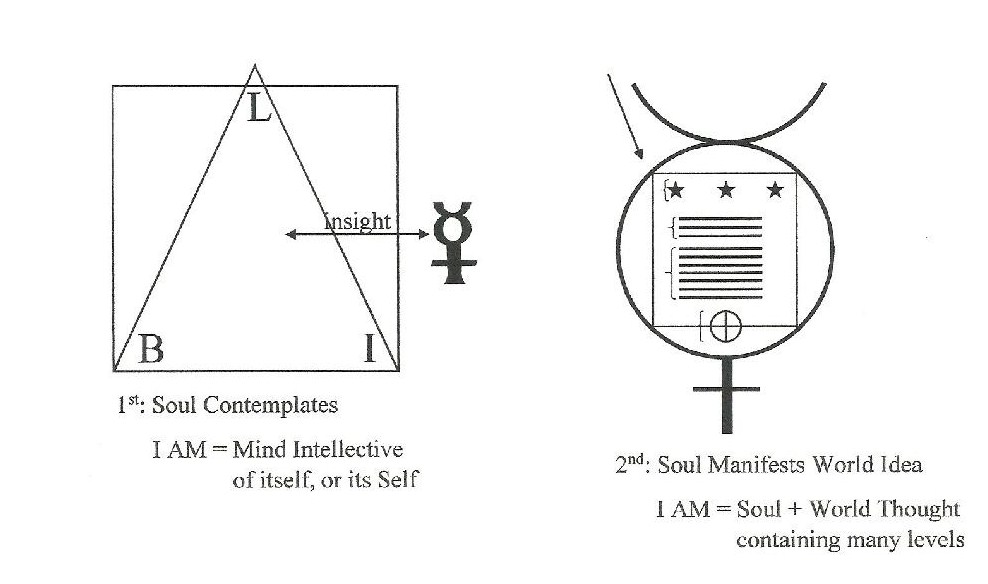
APPENDIX: EIGHT HYPOTHESES (Cornford trans.)
HYPOTHESIS I
2. The One (having no parts) is without limits.
3. The One (being without parts) has no extension or shape.
4. The One (being without parts or extension) is nowhere, neither in itself nor in another.
5. The One (not being a physical body in space) is neither in motion nor at rest.
6. The One (lacking the above qualifications) is not the same as, or different from, itself or another.
7. The One is not like, or unlike, itself or another.
8. The One is not equal, or unequal, to itself or to another.
9. The One cannot be, or become, older or younger than, or of the same age as, itself or another, or be in time at all.
10. Since it is not in time, the One in no sense 'is', and it cannot even be named or in any way known.
HYPOTHESIS II
2. A 'One Entity' is a whole of parts (both one and many).
3. A One Entity (having parts) is indefinitely numerous and also limited.
4. A One Entity (being limited) can have extension and shape [AD handwrites 'schema' above 'extension and shape'].
5. A One Entity (being an extended magnitude) can be both in itself and in another.
6. A One Entity (being a physical body in space) can have motion and rest [AD handwrites 'Power + being' above 'motion and rest'].
7. A One Entity (as above qualified) is the same as, and different from, itself and the Others.
8. A One Entity (as above qualified) is like and unlike itself and Others.
9. A One Entity (as above qualified) has, and has not, contact with itself and with the Others.
10. A One Entity (as continuous quantity or magnitude) is equal and unequal both to itself and to the Others.
11. A One Entity (as discrete quantity or number) is equal and unequal both to itself and to the Others.
12. A One Entity (as above qualified) exists in Time, and is and is becoming, and is not and is not becoming, older and younger than itself and the Others.
13. A One Entity (being in Time) has existence and becomes. It can be the object of cognition and the subject of discourse.
HYPOTHESIS IIA
COROLLARY ON BECOMING IN TIME
2. The transition in becoming and change is instantaneous.
HYPOTHESIS III
2. When the element of unity is abstracted from any one whole or one part, what remains is an element of unlimited multitude.
3. The combination of the unlimited element with limit or unity yields the plurality of other ones.
4. The Others, so defined, have all the contrary characters proved to belong to the One Entity of Hyp. II.
HYPOTHESIS IV
2. The Others, having no unity, cannot possess any of the contrary characters.
HYPOTHESIS V
2. A Non-existent Entity, being knowable and distinguishable from other things, can have many characters.
3. A Non-existent Entity has unlikeness to the Others and likeness to itself.
4. A Non-existent Entity (being a quantity) has inequality to the Others, and has greatness and smallness and equality.
5. A Non-existent Entity has being in a certain sense.
6. A Non-existent Entity can pass from the state of non-existence to the state of existence, but cannot change or move in any other way.
HYPOTHESIS VI
2. A Nonentity cannot begin or cease to exist or change in any way.
3. A Nonentity cannot have any character.
4. A Nonentity cannot be specified as distinct from other things, or stand in any relation to them, or exist at any time, or be the object of any cognition or the subject of discourse.
HYPOTHESIS VII
2. The Others will differ from each other as masses unlimited in multitude.
3. Such masses will present an appearance of unity and number.
4. There will be an appearance of greatness, smallness, and equality.
5. There will be an appearance of limitedness and unlimitedness.
6. There will be an appearance of likeness and of unlikeness and of all the other contraries.
HYPOTHESIS VIII
2. The Others cannot even appear one or many, or as having any character. There is nothing that has any being whatsoever.
Class
Friday, September 2nd, 1983
Verbatim, unedited transcriptClick the series name to view more
CLASS at Wisdom's Goldenrod, Hector, NY
with Anthony Damiani (AD)
September 2b, 1983
PLATO; PARMENIDES;
Eight Hypotheses, Hyp. 1-2A
with Appendix: Eight Hypotheses (Cornford translation).
TOPIC: Plato
SUBJECT: Parmenides
SUBSUBJECTS: Eight Hypotheses Hyp. 1-2A, Soul, Double Knower, Insight, Astrology
CONTENTS:
Reading AD/AS paper, "Parmenides and the Authentic Existents," Hypotheses 1-2A
First hypothesis: Nirvikalpa, I AM in itself, Mind Is
Second hypothesis: inerratic sphere within you
First apply eight hypotheses to soul; then can apply to One
Continuing to read AD/AS paper, "Parmenides and the Authentic Existents"
Soul manifests World-Idea; World-Idea makes soul exist
Second hypothesis: soul and Ideas welded into a whole of parts
Reading Plotinus, V.3.7
Continuing to read AD/AS paper, "Parmenides and the Authentic Existents"
Hypothesis 2A: instantaneous transition
Double knower
Reading Plotinus, VI.7.6
Three grades of knowledge at each of three cosmological levels; all knowledge simultaneously present to soul
Reading/discussing Brumbaugh, second hypothesis
Mercurius/World-Idea a whole of parts
Unity of soul and the Ideas are not the same
If one has being, then number must be there
Mind present to all its ideas is a many
Soul/World-Idea is determinate and unlimited in multiplicity
Reading/discussing Brumbaugh, Hypothesis 2A
Hypothesis 2A: World-Idea is being radiated into soul moment-to-moment; slippage of eternity into time
The "sudden" is neither eternity nor time
In Nirvikalpa you become one; out of Nirvikalpa, you become many
Soul is greater than the World-Idea when it manifests it, less than the World-Idea when it is itself
World-Idea is trying to glorify the soul, develop the faculty of understanding
Insight
Appendix: Eight Hypotheses (Cornford translation)
BOOKS READ FROM OR REFERENCED:
Plotinus, The Enneads (MacKenna translation, 4th ed.)
Plato, Parmenides, translated by, and found in Robert S. Brumbaugh, Plato on the One: The Hypotheses in the Parmenides
F.M. Cornford, Plato and Parmenides: Parmenides' Way of Truth and Plato's Parmenides
PLOTINUS QUOTES READ OR REFERENCED: I.4.10, III.5.10, IV.1.1, IV.4.2, V.1.3, V.3.7, VI.2.6, VI.4.2, VI.4.8, VI.5.3, VI.5.7, VI.7.6, VI.7.11-12, VI.7.17
DIAGRAM appended to this transcript:
- FIGURE 1983 0902b-1. Soul's Double Act. Originally found in AD/AS paper "Parmenides and the Authentic Existents".
Other diagrams also referred to are not with this transcript version. [Transcriber note: [diagram] means the speaker is referencing a diagram as he or she is speaking. If someone is drawing or writing, with audible sounds of chalk on a blackboard, I indicate this by [drawing] or [writing].]
AD PAPER read in class:
- "Parmenides and the Authentic Existents" (co-authored by AD and AS). Retyped as PLA Parmenides & the Authentic Existents - AD Supp 1034-1053 (Ver. 1) - V09MP.
NOTES:
Plato's Parmenides Hyp. 3-4 discussed in WG CLASS 1983 09/09b; Plato's Parmenides Hyp. 5-8 discussed in WG CLASS 1983 09/16.
This is 1983 0902b, Plato; Parmenides; 8 Hypotheses Hyp. 1-2A. Beginning of this transcript (first 8+ pages) is discussion of PB quote (p. 348 Perspectives); cf. Wed. night class of 1983 08/31 PB Paras: Meditation. IT IS FILED SEPARATELY AS 1983 0902a.
The paper read in this class was originally written by AS. There are multiple versions of this paper at different stages of revision. The latest version of the paper has AD's class commentary incorporated into it and can be found in AD Supplementary Material, pp. 1034-1053.
The Eight Hypotheses, as translated by F.M. Cornford in Plato and Parmenides, is appended. It was typed out and used in WG Eight Hypotheses classes. AD made some handwritten edits and these are noted accordingly.
Partial transcript for 9/2, 9/9, and 9/16/83 exists (Scan File 1983 0902 0909 0916-8hyp P1 TO 150.PDF). Pp. 10-51 covers this portion of the class.
TRANSCRIBED Verbatim by IT 2021. In 2025, IT updates audio file markers to match new REP audio. Archival verbatim transcript with AD Paper – V12ap.
AUDIO FILES: 1983 0902a(2), 1983 0902b. [Note 1: "Tape" and "Side" refer to original audio cassette tapes that were later digitized into .MP3 Audio Files. Note 2: In 2024, REP Studio splits Audio File 1983 0902a into a(1) and a(2).]
1983 09/02b at Wisdom's Goldenrod
Plato; Parmenides; 8 Hypotheses Hyp. 1-2A
[Audio File 1983 0902a(2) Begins]
AD: Alright, now, we're going to try something. Avery, I got a rough draft of the-- what we were doing last week and we're going to try again. But, in order-- in order to understand the application of these Eight Hypotheses, you must very clearly understand the nature of the soul as a unity, alright, as a unity in its own right. If that isn't understood then it will be very difficult to understand how the Eight Hypotheses will be applied to it, ok? So Avery, you want to read? It's a rough draft but it's-- it's enough to get us going and take us to the Third or Fourth Hypothesis, I don't know what--
AS: Ok, I just-- Anthony, since this is roughly based on what we did last week, if you don't see any relation it's (AS laughs) [S simultaneously: Gonna be review.] because it's completely-- (bit of laughter)
AB (faint): 'Cause you didn't understand what we did last week.
S (faint): Oh good.
AS (faint): There may be some improvements. [few words inaudible]
S (faint): Yeah.
[Transcriber note: The following paper is titled "Parmenides and the Authentic Existents" and was originally written by AS. There are multiple versions of this paper at different stages of revision. The latest version of the paper has AD's class commentary incorporated into it and can be found in AD Supplementary Material, pp. 1034-1053. It has also been retyped as PLA Parmenides & the Authentic Existents - AD Supp 1034-1053 (Ver. 1) - V09MP. I transcribe the paper exactly as AS reads it, including any alterations made during re-reading.]
AD/AS Paper ["Parmenides and the Authentic Existents," AS reading]: "In the presentation of the omnipresence of our Soul or Mind as an Authentic Existence, we find one of the finest examples of an application of the Eight Hypotheses and this theory or logic of Unity [AS reads: theory of logic or Unity]. These Eight Hypotheses give a careful summary of the factuality of the indivisible and the multiple in any Authentic Existent in such a way that oneness doesn't get cancelled out by multiplicity. In order to fully appreciate this, we will have to consistently keep to our interpretation of tractates such as VI.4 and VI.5 as pertaining to our Mind or unit Soul as an Authentic Self or a One, and its relation to the Cosmic Thought or World-Idea."
[short pause]
S (very faint): [few words inaudible]
AS: No.
S (faint): Uh-hm.
AD/AS Paper ["Parmenides and the Authentic Existents," AS reading]: "How can a unific essence, such as the Soul, accord with a multiplicity of reason principles and contents? The empirical mind's attempts to come to grips with this problem through the logic of sense appearance leaves us with the same unresolved paradoxes as in the first half of the Parmenides dialogue. When we finally attempt to penetrate beyond the appearances for our explanation, and to find the true relation of multiplicity of reason principles and the intact identity in the Mind essence itself, and try to understand the simultaneous presence of the Mind entire, then we are forced to use this dialectic of unity rather than empirical logic.
"As Plotinus himself tells us early in VI.5, the proper reasoning is"a reasoning, surely, founded on the thing itself and on its essential nature." (VI.5.3) There omnipresence becomes a law internal to every level of the Mind. The unity of Mind or Soul subsists entire, participated by all. We will see that participation is the obverse side of what he speaks of as omnipresence. The presence of the one Life principle grants life and unity to all the various facets of the World Idea that is expressed, and conversely the intrinsic nature of this Idea, this multiplicity, will define or characterize the infinite power of Soul.
"The first two Hypotheses are critical because they set the context for all the eight. We're attempting here to apply all of the eight to the essence of our Mind or the I AM, unit soul. This will involve us in a discussion of the World-Idea which is inseparably united to the soul, and an understanding of their relationship as well.
"So in the First Hypothesis we referred to the unific, void-essence of the I AM, an infinite Life, Intelligence, and Awareness. In other words, the Unity of the I AM is without any determination or multiplicity. It's simply the one essence of Soul which Plotinus calls an Authentic Existent. Or more simply even, the First Hypothesis simply says"Mind is." [AS: There's no qualification here yet.]
"To be an authentic existent, as we pointed out before, means to be a one--self-sufficient, intact, no additions or qualifications, and never becoming anything else. The first principle then, that the I AM is fundamentally indivisible and unpredicable, will stand through all the further discussion. You cannot break Life or Mind into parts, nor can you be aware of awareness having any distinctions. In itself it is purely itself, inaccessible to discursive reasoning or any duality, and any attribution to it would move outside of it.
"So for example, in some of the tractates we've read, Plotinus tell us:"If this principle is the Authentic Existent and holds unchanging identity, does not go forth from itself, [is] untouched by any process of becoming…always self-gathered, never in separation…" (VI.5.3) And further, on 525, "…that unity remains true to itself, remains itself, and so long as it remains itself [AS adds: it] cannot fail within its own scope…" (VI.4.8) [drawing/writing]
"Inward turned, the Pure Soul or Mind is contemplating itself and it is the quiescent reality that it knows, he says knowing by being, or we spoke of it as insight. In this void state, there is no manifest content whatever: no definition or divisibility, no characteristics, manyness, and so on, could be attributed to this unific [AS reads: unique] unmanifestable nature. Here the Mind or Soul is the Non-Dual, Turiya Consciousness, which is really no-state. Our Mind, as this Authentic Existent, participates directly in the Absolute Soul. In knowing itself, the Soul is aware of the presence of its Prior--the Nous--as well, for there is nothing to separate the I AM or Soul from its Prior. The Void essence of Soul and the Void Nature of the Intellectual-Principle are co-present in a way, because the Soul is an Intellectual Essence. [AS: And--]
"So, in this First Hypothesis he speaks of this pure awareness, Soul in its authentic primal Nature."
AS: (And he has two), there are many of these quotes.
AD (faint): No just read the paper, don't worry [AS assents] about the quotes now, [AS simultaneously: For example IV.4.2.] just-- we'll discuss (again). We'll discuss them.
AS (simultaneously): Ok. For example IV.4.2 [couple words inaudible]
AD/AS Paper ["Parmenides and the Authentic Existents," AS reading]: "While the later Hypotheses allow for the multiplicity, this first will still leave the essence of Soul intact. We conclude that the omnipresence of the I AM to the cosmos, to space, time, division, partiality, does not make the Soul temporal, spatial, of magnitude or having any of the other attributes which it supports.
"In the Second Hypothesis, we have moved from the position of the pure essence of Soul, to see that this I AM we are considering is, or has Being."
AS: Or better here Ideas. Now, [S, faint: (Repeat that.)] at this point-- There's a little confusion because when he says in the Second Hypothesis "if the One is" or (if this) One has being, in order to clear up the confusion that the soul already is real Being in the First Hypothesis, the real Being, so we're going to have use a different word here than being. And since we're talking about it as the Ideas, I'll just use the Ideas. I'll read it again.
AD/AS Paper ["Parmenides and the Authentic Existents," AS reading]: "In the Second Hypothesis, we have moved from the position of the pure essence of Soul…"
AS: In other words, just soul is, period.
AD/AS Paper ["Parmenides and the Authentic Existents," AS reading]: "…to now to see that the I AM is, or has Ideas."
AS: Or an Ideational content, a defining characteristic.
AD: In other words, the World-Idea.
VM (simultaneously): Is there any motion here now?
AD: The World-Idea arises within you.
VM: Soul in motion now.
AS (faint): Well--
S (faint): Uh-hm.
AD (simultaneously): Yeah, you could put it that way. The emphasis here is on the appearance of the World Dream [student assents, faint] within the soul. So like the First Hypothesis would be like a state of Nirvikalpa, no thought. The Second, thought is injected into it. And, if you remember PB speaks about that mysterious emanation or radiation which comes from the World-Mind and reaches to individual soul and this becomes the World-Idea in the soul. Now instead of using the word that the one has being, he's going to use the word that the one has the Ideas, the Ideas come into it. And, a very simple idea [someone drawing] would simply imagine the inerratic sphere within [diagram], ok? Now the one has the Ideas, ok. Instead of saying the one has being, the one has--
VM (faint): The unit soul or the mind? I don't think you changed the way you're using it.
AD: No. This is the one [AD indicates on diagram]. This is the one. The unity of your soul. But soul is Being. So if I say being has being, it's going to confuse us. So what he's doing, he's going to call this unity of our soul which is Being, alright, and what comes into it is the Ideas rather than saying being because then our terminology is just-- We're going to get lost in our words, alright? So by using the word 'Ideas', alright-- And one of these Ideas like we said is going to be our solar system. [VM assents, very faint] Ok?
[someone drawing]
S (faint): Go ahead.
AD (faint): Yeah, go ahead.
SD: Is this change of terms here necessary because we're talking about a unity of the soul rather than the One?
AD: Yeah. But that's not why. We're talking about unity of the soul, it must be Being. We're in no way, in no way talking about the One, alright, because when we do that, I won't be here, Avery will be here, I won't be here to do that. (some laughter)
AS: Right [couple/three words inaudible]
AD (simultaneously): But if you can understand this then you could do it with the One. You can see how the One has Being, alright, and you can apply it. But, this is simpler.
AH: Anthony? I don't understand that, you-- the importance of distinction between the One and unity of soul.
AS: Well, is he doing the-- oh I'm sorry.
AH: It's an important distinction for sake of semantics so we don't get our words--
AD (simultaneously): Yeah, semantics, semantics, exactly. I don't want to argue about the words. The one is. Which one? Unity of our soul. That is. Fine, good. Now, the one has Idea(s). Fine. [S, faint: Well--] See? No confusion.
S (faint): [couple/three words inaudible]
SC: So when we speak of the First Hypothesis are we saying that the-- those first three Hypostases are all found there in that unity of the soul?
AS: No, no, the unity of the soul is found there in the first three Hypostases I think would be more proper.
SC: Yeah.
AD: But why do you want to bring in the three Hypostases?
SC: Well we started with that, it was on my mind.
AD (simultaneously): No we did not, we did not. (laughter)
SC: We didn't?
S: Is that opinion?
VM (faint): That was a different class. (some laughter)
S: That class is over.
AD (simultaneously): You have two classes, you have two classes tonight, that's right.
S (faint): Ok.
S: Yeah.
AS (faint): Wait, that's presupposed. Now you could put it in.
S (faint): Yeah.
SC: Everything-- ok then--
AS (simultaneously): Wipe out--
SC: Let me put it a different way then.
AS (simultaneously): If you wipe out everything [S simultaneously: Can I--] that's in here [diagram]--
SC: Everything below the First Hypothesis deals with the World-Idea and what's unfolded out of the World-Idea.
AS: And its relation to soul.
SC: And its relation to soul, but not to-- nothing deals with what--
AD (simultaneously): Not the soul, not the soul.
SC: Right but the First Hyposesis-- Hypothesis deals with pure soul or what was it-- [AD: U-- yeah.] unity and [AS simultaneously: And all--] everything else deals with the world that comes out of it.
AD: That's going to come into that.
SC (faint): That's going to come into it.
AD: Yeah, let him read, let him read.
BS: Well what do you mean by come into it?
AD: Let him read it!
S: That's right. (laughter)
S: It would come into you.
AD: You really take--
AS (simultaneously): We're trying-- (yeah) I was just trying to express-- explain that somewhat although just doesn't succeed but-- Ok.
AD/AS Paper ["Parmenides and the Authentic Existents," AS reading]: "The I AM in this Hypothesis is considered as a welding of two distinct aspects which Plato calls Unity and Being and here we're calling Soul and its Ideas. The unity of Soul's essence--which is Life and intelligence--is conjoined with the World Idea or this emanation of the Nous, which is, in the Hypotheses, the"Being" of that One, and we are investigating the contribution that each of these makes to the other in forming this I AM. In the second postulate the pure essence of the I AM is given some kind of determinate existence, that is, the Ideas."
AS: No I got-- can't say that.
AD/AS Paper ["Parmenides and the Authentic Existents," AS reading]: "…the pure essence of the I AM is given Being by its participation in the Ideas. That is, the Universal Reason Principle, which is perpetually emanated and flowing from the Nous, is participated in by the Individual Souls and is elaborated as their own world thought. This outpouring of course does not take away in any fraction of the inexhaustibly infinite essence of the Divine Mind but it is the determining factor of an Individual Soul whenever that Soul joins its reasoning activity to that pulsating aura of the Intelligible. The Soul, he says somewhere, is matter to the Intellectual-Principle, [VM assents, faint] and gets determined by it. The Soul and its defining Logos [AS: Which is what we're speaking of.] make a whole, a one-being, of which the unity or oneness is the Soul and the Logos or Being is the Reason Principle, [student assents] the World Idea. Thus the Soul is a One and an All. [AS: Quote, he says--]"…Soul which, taken as one all, is Aphrodite, while in it may be distinguished the Reason-Principles…produced by the downflow of Nectar of the over realm." (III.5.10) The downflow of Nectar we're speaking of as the aura of the Divine Ideas, present now in the Soul as a multiple Reason Principle. While the Soul is a pure essence in Contemplation, in the First Hypothesis, it yet has a nature which seeks to grasp its intellective nature in a determinate manner, and as a result it is manifesting the World Idea within itself. In other words, we have to conceive of the concomitance of the Soul's manifesting activity and the Intellectual Cosmos' own outward-facing Hypostasis or aura."
VM: So Avery, are you saying something like, even in the Intellectual-Principle or let's say even when you consider the unity of the soul, you still have to say that there is a tendency towards manifestation or divisibility and that this tendency conjoined in some way to this [one inaudible student word simultaneous with VM] Nectar from the over world or the Ideas (forming) the Intellectual-Principle, and that combination gives rise to this-- the Ideas [AS assents] within soul.
AS: Yeah, he'll say that somewhere else, that the reason has become active in virtue of this contemplation. [student assents] The reason within soul becomes actualized. In other words, this manifesting activity within it. Well here was another quote. "A single Existent…" This follows the other one.
AD/AS Paper ["Parmenides and the Authentic Existents," AS reading]: ""A single Existent, it [AS reads: soul] makes itself many by what we may call its motion: it is one entire, but by [its] striving, so to speak, to contemplate itself, it is a plurality…its purpose is the Act of the Intellect…" (VI.2.6) [AD, very faint: Uh-hm.] [S, faint: Yeah.] … [AS, faint: Well--]
"Thus the I AM possesses the multiple reason principles as"unrolled and separate" in the form of what we have termed the inerratic sphere. For these Ideas are wedded to and form a whole with the Soul or Life essence that is manifesting them within it. Now then we are viewing the I AM in its second aspect…"
AS: Well, not second to what we started with Hypothesis but as opposed to the first.
AD/AS Paper ["Parmenides and the Authentic Existents," AS reading]: "…that is as a one-being or Human Soul, the unique version of the World Idea or 360 degrees conjoined with the Life essence of Soul that is actively involved in manifestation. The Soul's own power of manifestness translates the pure unmanifest Thought [AS: capital T] into the manifest World Idea, and therefore this World Idea participates in that Soul essence. And so Plato expresses this in a Hypothesis as"the One (Soul) gives unity to the Being which is one."" [Note: Exact wording of Plato quote not found.]
AS: So we're saying soul gives this unific essence to the Ideas, the World-Idea.
AD/AS Paper ["Parmenides and the Authentic Existents," AS reading]: "In turn, the indeterminate Life of Soul is given a determined existence or definition through its participation in the Reason Form of the cosmos, so Plato says there that"Being (or the Ideas) gives existence to the One which has being."" [Note: Exact wording of Plato quote not found.]
S (faint): Do you think you could read that-- [AS simultaneously: Yeah that's tough.] those last two sentence all over?
AS (simultaneously): Yeah. Plato has this line, he-- we're showing the contribution that the one and the being side make to each other, one (representing) this soul essence, being is the Ideas. Plato says, "the one gives unity to the being which is one" and "being gives existence to the one which has being". So we're reading this, soul, the one, is giving the unity of its Life essence entire to the Ideas, the World-Idea. Or the soul's own power of manifestness translating the unmanifest pure Thought into the manifest World-Idea.
(Side 1 of original cassette tape digitized as 1983 0902a(2) Ends; Side 2 Begins)
AS: --through its participation in the World-Idea or the Reason-Principle of the cosmos, so there's this mutual interaction that Plato describes. We're interpreting it as the relation between the soul essence and the World-Idea.
AD: This was the difficulty last week too. On the one hand the soul is what manifests the World-Idea, but on the other hand, concomitantly with it, the World-Idea makes the soul exist. And they're not contradictory, they're complementary. And you're going to see that that kind of logic is always going to be required. You remember the quote that Avery put. He said that-- and that's a very important quote. Plotinus says that we will argue this according to the logic of the thing, the definition of the thing, not according to the logic which is derived from the sensible world. And that's-- that's very important. So Pl-- Plotinus is coming over with some-- something like this, he said look, you don't know anything about the soul so let me tell you something about it, alright, and this is the kind of logic that's going to follow if you understand this. That's why he's so destructive of Aristotle's categories. Alright, excuse me, [student assents, faint] (I'll be reading) [one word inaudible]
AS (simultaneously): Yeah, ok, ok.
AD: We'll try to go to the [Hypothesis] 2A. Try to get to 2A and then we'll discuss this whole thing further. [AS simultaneously: I'll go through the--] You see it's an extremely beautiful thing, I mean besides being truthful, it's beautiful.
AD/AS Paper ["Parmenides and the Authentic Existents," AS reading]: "Based on this fundamental distinction, which Plato calls the One and Being and we're describing as Soul and Ideal Forms, the Second Hypothesis will reveal many contrary characteristics which are attributable to this I AM but do not contradict it. The multiple nature of the World Idea is bringing out the indefinite and multiple nature of the Soul essence itself, its many powers that will be needed to comprehend this Idea, and which would remain inactive without it. The consciousness of this I AM, of Soul, ranging through all the levels of reason principles which comprise the World Idea, is what is called the second knower as well. We must accept that the Soul is of such a nature--both indivisible and divisible, that its unific nature is also receptive to the multiple reason principle or thoughts. The multiple qualities of the World Idea help to define the unity of the I AM, but they do not make that unity. In the Second Hypothesis, then, the Soul and the Ideas are welded in a whole of parts, without destroying the indivisible aseity of the Soul essence. In the wholeness we find an intrinsic multiplicity, which will be examined later as what he calls the others, the many Ideas that are present. But right here he is content with juxtaposing the I AM as defined whole wedded to its guiding Idea, and the I AM as a pure essence which [AD simultaneously: And it's juxtaposing.] bears only the title of Infinite Life."
AD: Juxtaposing these two, the Mercury, alright, and everything within it. [Note: See diagram appended to this transcript, FIGURE 1983 0902b-1, Soul's Double Act.] That's the one [AD indicates on diagram as he speaks], alright, this is the Idea, the two of them together he calls a whole of parts.
S (faint): Yeah, uh-hm.
[short pause]
AD/AS Paper ["Parmenides and the Authentic Existents," AS reading]: "We may [AS: or may not] aid our understanding of these first two critical Hypotheses by using analogies from elsewhere."
AD: Well we've been doing that, go on.
AS: I don't-- um--
S (faint): Yeah.
AS: Ok.
AD/AS Paper ["Parmenides and the Authentic Existents," AS reading]: "The first analogy, perhaps the Double Act of the One could be a model for this double nature of the I AM. In the First Hypothesis Mind or Soul is stillness, [for] in Soul's [AS reads: its] inward contemplation, power is inseparable from its unmanifestable essence. In the Second Hypothesis, the same power is active in manifesting the World Idea. In this activity, the divisible nature is distinguished from the indivisible, while in the prior state of contemplation they are indistinguishable as the unified essence of Soul.
"In another place, again, in VI.7.17, Plotinus describes the principle of life as at first purely indeterminate. It looks or contemplates, and then it is determined, so to speak, by its object of contemplation into a multiplicity of Intellectual Principles. If we use this analogy then we could say Soul's pure awareness is beyond any distinctions, remaining as an indeterminate seeing into its own essence and its prior. Accompanying this contemplation is the determination of Soul by the reason forms that are flowing within it from its prior. The determination is of the Soul's own being, but occurs in virtue of its contemplation."
AS: We'll leave that one (out).
AD/S(?): Yeah.
CDA: What does-- what does it mean that it-- what does that last sentence mean?
AS: Well, we'll go over it.
CDA (simultaneously): Can you explain that?
HS: You're going to go over the whole thing?
AD: Yeah we'll go over the-- whatever sections are difficult, we'll go over them, and we'll even take one of the Hypotheses and try to show it, you know, how it works out.
AS: Yeah. Let me just find--
CDA (faint): Is that meant to frighten us away?
AS: Ok.
AD: No, he come back to it.
AS (simultaneously): To summarize these two, he has this quote, which I just-- I thought was to the point there. The quote is page 388 on the bottom, where he says--
Plotinus [V.3.7, AS reading]: "…Soul has the [AS reads: a] double phase, one inner, intent upon [the] Intellectual-Principle, the other outside it and facing [to] the external; by the one it holds [the] likeness to its source; by the other, even in its unlikeness, it still comes to likeness in this sphere, [too], by virtue of action and production…[with] the result [AS adds: is] that all its creations are representations of the divine Intellection and of the divine Intellect, moulded upon the archetype, of which all are emanations and images, the nearer more true, the very latest preserving some faint likeness of the source."
S (faint): Uh-hm.
AS: That's in V-- V.3.7.
AD (simultaneously): You notice the language he operates with? We'd never figure it out.
S (very faint): No, probably not.
VM (faint): Probably not.
AS: V.3.7, (yeah).
AD: That's why I think PB's justified when he says, well don't worry, you know, it's never been written up.
S (faint): Yeah. (bit of laughter)
S (very faint): Yeah, (uh-hm).
AS: Anyway, I took that to describe when he speaks about on the one hand you have these emanations or images, the nearer the more true, he's speaking about various levels of this World-Idea. The nearest, [drawing] the most true is the inerratic. But as opposed to that or juxtaposed to that we have what he calls just the pure inner nature of the soul intent upon the Intellectual-Principle. And then he's talking about is the I AM knowing itself. [Note: See diagram appended to this transcript, FIGURE 1983 0902b-1, Soul's Double Act.]
HS: Can you see that?
AD (simultaneously): And the most remote would be where that Sun is, put the Earth there, alright, and on that Earth put a human being who's composed of memories of the Earth [diagram], and inside (of) that-- alright? Now that's what you call being a spiritual moron, right, how much lower can you get? (AD laughing, laughter)
AS (faint): Little beings of other beings to sit on them and bite them. (bit of laughter) [few words inaudible]
AD (simultaneously): So the images like which are in our mind, empirical mind, alright, are the remotest, alright. [VM assents, faint] And all the way up to the inerratic sphere they're the closest.
AS: Ok.
S (faint): Ok.
AS: We're almost-- almost done. So, we emphasi-- we're em-- we want to--
AD/AS Paper ["Parmenides and the Authentic Existents," AS reading]: "We [AS reads: I] emphasize here that the 1st remains intact even when we posit the Soul's activity. [AS: That is, even when we posit the entire cosmos is present side by side with the Soul, its own essence remains intact.] He says:"Thus it is [that], entering this realm, it [AS reads: the Soul] possesses still the vision inherent to [AS reads: in] that superior phase in virtue of which it unchangingly [AS reads: unchangeably] maintains its integral nature." (IV.1.1) [AS: Ok, now this--] And he says elsewhere the Authentic Existent remains intact even when the cosmos appears side by side with it. [Note: Plotinus, VI.4.2, "Side by side exist the Authentic All and its counterpart, the visible universe."] And this leads us to a consideration of the 2A Hypothesis, namely this transition between those two states in 1 and 2.
"This principle in 2A of instantaneous transition allows us to sometimes declare that both of two contrary predicates apply to the I AM, sometimes that neither apply. There is a paradoxical shift based on two simultaneous ways that the I AM must be viewed. The only change which is possible for an authentic existent as Soul is between the state of stillness or unmanifestable and eternal contemplation, and on the other hand, the activity of reason, receiving and manifesting a cosmos through time. This transition from unmanifest and eternal to manifesting activity is not itself in time but is instantaneous. Probably we could say more simply, when the World Idea comes into Soul, Soul becomes unlike itself. When this Idea is expelled or not taken in, Soul becomes like itself again. At Rest one instant it is itself, the next instant it goes from a one to a many by manifesting the multiple World Idea. The Ideas seem to come in and go out of the Mind instantaneously, and as they do so the Mind is said to both have, and not have, instant by instant a determination by the Ideas, or not."
BS: But didn't you-- wasn't it said prior to this that the soul gets determined by its prior?
AS: Yes. And this is instant-- and the-- the point here seems to be that that determination is like in some ways an instantaneous reception.
BS: And what-- May I ask this question then? Which soul gets determined by its prior?
VM (faint): A unit soul.
BS: Unit soul.
AD: There's only one soul we're talking about, your soul.
AS (faint): Almost done. Got one more [S simultaneously, faint: Go on.] [S, faint: Yeah.] (to go).
S: (Uh-hm/Ok).
S: Yeah.
AD: Well finish it, let us finish it and then-- [AS simultaneously: Two lines.] and then we'll [AS simultaneously: Yeah, I'm sorry.] pick up each-- each question.
AS: Ok. I'll just finish it just to the 2A, [S, faint: Right.] (one second). So this-- one other point here on this Hypothesis is that--
AD/AS Paper ["Parmenides and the Authentic Existents," AS reading]: "This non-dual [AS reads: dual] nature or instantaneous transition is also a basis for a discussion of the two knowers. And in I.4.10 [AS misreads: IV.4.10] he says:"Side by side with authentic Intellection there is its image." By stationing himself in this position, or the double nature of the I AM principle, the Philosopher can and does hold a simultaneous view of the temporal and the atemporal…"
LR: The two knowers would be the soul?
AD (simultaneously): Also you could add to that the simultaneity of knowledge at all three levels and each level having three versions. You got a quote for that too I'm [AS simultaneously: Yeah.] sure. It's what I like about Avery, he's got a quote for everything I say. (AD laughs)
AS: But that's-- that's my ascendant.
S: Yeah sure.
S: Yeah.
S (faint): Yeah.
AS: Points to passages in an open book. [Note: Taurus 21.] [S, faint: Yeah.] You ask me anything I just-- (bit of laughter) anything-- Well anyway-- Ok, that's it, good enough. Then it's up to 2A.
LR: Then the two knowers would be the soul contemplating the Nous and that would be the first knower, [AS simultaneously: Yeah, (that--)] and the second would be the soul seeing the Ideas as the World-Idea within itself.
AS: Yeah, basically yes. [S simultaneously: And it-- if it--] And seeing the Nous means that it's a-- it knows itself. You know he has those famous lines, he says in knowing itself we can't suppose that it's also ignorant of its prior.
AD: In other words, insight would take recognition of the fact that it's descended from Soul, Absolute Soul. It can't be otherwise, can it?
LR: So the second, the knower contemplating the World-Idea now within itself which it's going to manifest, the Ideas which it's going to manifest from itself, can you characterize-- I mean you would say in some way that's soul knowing and the other it's Divine Mind's knowing.
AD: Yeah, we could say one is divine, sure.
LR: But, how-- how would you qualify the knowledge which is soul now from the knowledge which is Nous? I mean I understand the levels that you're speaking of.
AD (simultaneously): Well one is-- one can think of as insight, alright?
LR: Yeah.
AD: Mind knowing knowing, alright, knowing knowing, you could put it that way.
LR (faint): Ok.
AD: And the other is that the soul has a faculty of understanding. Now this faculty of understanding includes these three levels where you speak about the soul's intuition, alright, soul is constantly intuiting. And all the way down to the sensible level. Now e--
LR (simultaneously): So you say intuition, reason, and sensible.
AD (simultaneously): And sensible knowledge, yeah, those would be included under the faculty of understanding that the soul has. Now, at each one of these, and this is important for our work in astrology too, alright, at each one of these levels, at the inerratic sphere, at the rational sphere and at the sensible sphere there are three kinds of knowing. Avery, would you get that passage and explain?
AS: Ok. In--
AD (simultaneously): Now listen to this because this jives in with what we're doing perfectly now.
AS: This is nice. Yeah this is VI.7.6. Page 564 if you have this one. And he's been talking about these three men. And he says-- I'll start from here, he says--
Plotinus [VI.7.6, AS reading]: "This is how the secondary Man, copy of Man in the Intellectual, contains the Reason-Principles in copy; and Man in the Intellectual-Principle [AS reads: Intellectual] contained the Man that existed before any man. The diviner shines out upon [AS reads: shines on] the secondary and the secondary upon the tertiary; [and] even the latest possesses them all--not in the sense of identifying itself with them all but as standing in under-parallel to them. Some of us act by this [AS reads: the] lowest; in another rank there is a double activity, a trace of the next higher being included; in yet another there is a blending of the third (i.e. highest) grade with the others: each is that Man by which he acts while each too contains all the grades, though in some sense not so."
AD: So, when we're working in our as-- in the astrology chart, alright, we're saying that intellection or the septiles is a vestige of intellection, the quintiles are vestige of rationality, ok, and of course the sensible. And there you have the three grades of knowledge within the natal chart, [AS simultaneously: The lower. Lower, yeah.] we're not going outside of it. Just like you'll have them going outside too.
AS: So he says the-- even the lowest contains them all, but then he adds in some sense not so. Because you can't say that the intellection the lowest man has is identical with the intellection that the highest has, but from his own point of view it is intellection and there are three grades. But there's like an image of the three grades.
LD: The-- the tertiary there is the [AS simultaneously: The lowest.] conjoint? What?
AS: Yeah, the lowest.
[short pause]
AD: Go ahead, David.
DH (simultaneously): Avery? I guess I'm wondering if-- I don't understand here about what the three grades are at the highest level.
CDA: Yeah.
S: No.
CDA: Yeah.
AD: What would the sensible be like at the highest level?
DH: Exactly.
S: Yeah.
S (simultaneously): Yes.
DH: I mean what sensible at the highest level?
AS: Well, you know, it's a funny thing, some place he says--
DH (simultaneously): That's above-- that's above time.
AS: Some place he says that the Earth here-- even the Earth here is an image of the Earth that's in the Intellectual. [Note: Plotinus, VI.7.11-12.]
S: Yeah.
S: Uh-hm.
CDA (simultaneously): But does that mean sensible, I [AS simultaneously: Just this--] mean does that mean a-- a form of--
AS (simultaneously): No, he says it's not sensible. [CDA simultaneously: Well, I know but--] Earth there is not sensible.
DH: But what is it, (I mean--) But we're talking about a sensible grade at the highest level.
LR: But couldn't that be an intuition into all the reason principles that operate in the sensible? In other words, not what they are in themselves but you could actually be view-- like a Sage could actually be viewing the sensible world but know all the components and inter-working of the reas-- of all the Ideas that are there. [AD simultaneously: But--] But it would still be a higher kind of knowledge but it would be-- would-- it would be geared to the sensible realm. [VM simultaneously, faint: Got to be something like the principle of the sensible world.] He wouldn't be in a drea-- he wouldn't be in a trance state for instance, he would actually see-- you know, like they say the Sage looks at you and sees all the workings.
DH: He (wouldn't) have to be viewing from outside the cosmos.
AS: Well--
LD (simultaneously): You mean the Ideas that the sensible participates in, that the sensible thing participates in.
LR (simultaneously): And that the sensible's actually working out in some way.
RC: I don't know. That's the intelligence. The highest level of sensible has to be sensible.
VM: Why can't it be the principle of sensibility, something like that, like you have the principle [LR simultaneously: Yeah, that's what I mean.] of perception. At the highest level of soul you say perception is intrinsic to the soul in the Intellect, in sensible perception you got the sensible (working through) the realm of sense. [LR assents, faint] Now, this may not be appropriate but why-- why isn't it appropriate to speak about the principle of sensibility let's say in this higher realm which is-- which manifests as sense object let's say in the lower?
AS: Well, you know there is one-- if we're going to [VM simultaneously: I don't know what that means.] discuss the quote at all we should establish one thing. The lower two men are quite clear that he means the man-- the man of birth, you know, within the Dragon as it were in the imagination, the next lev-- also represented by the natal chart. The next level up obviously rep-- is represented by the transiting planets, [LR, faint: Right.] ok, and the rational soul. [DH: Right.] But the highest grade is not clear if we're going to interpret that as the inerratic within the soul or whether we're going to interpret that as the Intelligible Man, that is, the Idea, let's say, the soul in the first-- in its contemplation per se, the soul in the Nous. [DH: Would you say--] Anthony, that would have to be [DH simultaneously: (Well--)] established before we could discuss [DH simultaneously: Well, is that--] the three grades that are in this [one/two words inaudible]
DH (simultaneously): Is that in fact maybe the distinction that we're-- we're talking about here at the-- at that level? I mean these three grades that-- I'm-- we're supposed to-- the principle-- I mean there is-- seems to me that there is a manifestation that-- and that there's actually a manifestation but above time. But, I don't know what you mean by (it/that).
AS (simultaneously): Then it's not manifestation.
VM: It's not manifestation.
DH: By manifestation do you mean something that's already in time and space? Motion, with motion?
AS: May-- even if we mean the inerratic sphere, [drawing] that's within manifestation. In fact, let me [student assents] just work-- I mean just on this idea, within--
AD: Yes but within manifestation there, Avery, doesn't necessarily mean that it's within time and space.
AS: Ok. But not time--
AD: Space is something-- time and space is--
AS (simultaneously): It's not space.
AD: Yeah.
AS: Yeah.
AD: It's only a special--
AS: But then I would say that we were interpreting the passage at the lowest level you'd have the septiles, the quintiles, and the regular aspects in his natal chart. And that's the three grades within the lowest man. At the next step you could talk about the transits. I would say one of the Chaldean planets making a septile, quintile. But we don't want to get into this argument.
CDA: No, no [one word inaudible] uh-hm.
AS (simultaneously): Well then don't bother.
S: Jupiter is--
AD (simultaneously): No, no, I-- I don't want to get--
AS: You don't want to get into it. I didn't think so.
LDS: Avery, why--
AD (simultaneously): It's enough-- if-- it's enough for now to just keep [AS simultaneously: To mention.] in mind that there are three grades of knowledge, alright, and each grade of knowledge has three subdivisions within it. And also to keep in mind that the soul is simultaneously capable of handling all those various grades of knowledge, alright, so that its states of being are multiple from our point of view. [AS simultaneously: But from its they're not.] That's the important thing to keep in mind now.
AS: And that-- then this quote is referring to the intuition, reason, and sensibility within the manifested-- what we call the manifested side of the I AM.
AD: Yeah.
AS: Those are the three grades of man. [AD: Uh-hm.] In each of those grades of the inerratic, the planetary, the sublunary, there are actually three kinds of knowledge as it were, three multiple divisions within each of the three divisions. You get like a--
AD (simultaneously): Now like-- It would also follow, since the soul, alright, is present everywhere, to use an incorrect mode, [AS assents] therefore that knowledge is present to it.
AS: Simultaneously.
AD: Simultaneously.
AS: Yeah. Well that's what he said.
LDS: What would be wrong, Anthony, with saying that for the highest knower where we have three divisions too, the unique thing about--
AD (simultaneously): That's not the highest knower then.
LDS: Well we said there's three knowers, there's three levels.
AD: Of knowing.
LDS: Of knowing.
AS: Of the second knower.
AD (simultaneously): Yeah.
S: Of the second.
LDS: Of the second--
AS (simultaneously): Of the second knower.
LDS: Oh, of the second knower, right, ok.
AS: And that does--
LDS (simultaneously): Why couldn't the highest of that second knower, the highest level of that second knower's knowing, why wouldn't it have access to the three levels in their actuality? In other words, the sensible for the hi--
AD (simultaneously): I said it does.
LDS: Ok.
AD: All knowledge is present to it simultaneously.
LDS: So it's not as if you've got to speak of a non-temporal, non-spatial sensible representation within the highest of the second knower, but rather that that knower below the sensible--
AD (simultaneously) No, no, no, now, now you're talking about something else.
LDS: That's right, I-- ok, I just want to [one/two words inaudible]
AD (simultaneously): Now you're talking about something else, you're speaking about the World-Idea coming in, alright, and now you're speaking about the soul no longer as a knowing-- I'm sorry, as eternally knowing itself, alright, which is atemporal, but now knowing temporally.
LDS: Ok. And knowing temporally is a level of knowing and it's-- there's a-- it entails a grade of reality about it. That's why I'm trying to say that it's not necessary to think of this sensible level as having to be raised up for that highest of the second knowers.
AD: No.
LDS: In other words, it can know the appropriate--
AD: No, the fact remains that at the highest level, the third level, the-- the level of the Ideas, there the archetype of the sensible is perceived by the Sage. The archetype of the sensible is perceived by the Sage.
LDS: Now when you say that you're saying that if-- in knowing the archetype, he's not knowing the manifestation but the archetype-- archetype of that manifestation.
AD (simultaneously): No, I didn't say that. I said the Sage can know the archetype of the sensible. If he has direct access and through the intellection that's taking place at that level, alright, he has direct access to the archetype of the sensible as well as the sensible. There's fire here and there's fire there and he knows both. The one that we call sensible fire and the paradigm or the archetype of the fire here, he knows that too. But I don't want to get into that discussion.
LDS: I don't either.
AD: Alright, good.
LDS: What I--
AD: Let's leave it.
LDS: You don't want to go over this?
AD: No, I don't want to go over this.
S (faint): Yeah.
AD: It's a whole [LDS simultaneously: I don't think I was saying what you just--] special topic by itself.
LDS: I wasn't saying what you just said.
AS: Yeah but that's the point is the I-- he says the Idea contains from the beginning everything that could possibly be manifested of it. In other words, once you posit these reason-principles [chalk on board sounds] in the inerratic, that's going to pervade all the way down to the sensible representation. In some way the whole thing is just an unfolding of those Ideas. [student assents, faint] Once you posit the Ideas that are within the soul, once you posit a perception of the World-Idea, the soul can then manifest everything all the way down to the sensible and it'll just be an unfoldment of those Ideas.
LDS (simultaneously): And you're saying-- you're saying the Sage can know, [AS simultaneously: If the Sage (one/two words inaudible)] at the level of the Ideas he can know what the sensible archetype is of that Idea.
AS (simultaneously): It must be included, because it must be included.
LDS: Well I follow that. Ok, I don't want to get into (this).
DH/S(?): But that sounds like a type of intellection.
AS: It is.
AD: It is intellection. The perception of the Earth as celestial is intellection.
AS: That's why he said it's not proper [couple words inaudible]
AD (simultaneously): But can we put aside this discussion now? We're not ready for it, we've got to do work before we tackle something like that. Alright, now, let's take one of the Hypotheses and apply it and see if this makes sense before we go on, you know, to the Third, Fourth, or Fifth Hypothesis.
S (faint): Pick that.
[couple seconds of background student talking]
VM: Let's pick number 2.
S (simultaneously, faint): Yeah.
AD: Number 2 he said. Number 2, ok. We got a number 2, huh? Sure. Avery, let me borrow your crutches.
AS (faint): Borrow my what?
AD: Oh here it is. Here you are sir, number 2, here we are.
VM (simultaneously): Oh, good, let me read it, let me-- [AD simultaneously: Well sure.] I'm honored.
AD: You can--
VM: I'll read it, you explain it.
AD: No, Avery will explain it. (bit of laughter)
VM: Oh ok.
AS: Wait I'll read it. (laughter)
VM (amidst laughter): Ok, you read it, he'll explain it. (VM laughs)
[Transcriber note: I am using Plato's Parmenides, translated by and found in Robert S. Brumbaugh, Plato on the One: The Hypotheses in the Parmenides, New Haven, Yale University Press, 1961.]
Plato (Brumbaugh tr.) [Parmenides, 142b1, p. 88, VM reading]: "[Do] you wish to examine the hypothesis again…"
S (very faint): Perhaps.
S (very faint): Uh-hm. (laughter)
Plato (Brumbaugh tr.) [Parmenides, 142b1, p. 88, VM reading]: "…[to] see…"
VM/S(?): Sure.
Plato (Brumbaugh tr.) [Parmenides, 142b1, p. 88, VM reading]: "…to see whether the result is different?"
S (faint): How's that? (bit of laughter)
Plato (Brumbaugh tr.) [Parmenides, 142b3, 142c5, pp. 88, 90, VM reading]: "(142b3) Now if the one is, we must agree what consequences follow if we assert this, must we not? …
"(142c5) Then to say that [VM reads: the]"one is" will be a brief way of saying that the one partakes of existence?"
VM: So here, to change their words around a little bit. I just want to state it if I can.
AS (simultaneously): Do it, yeah, yeah.
VM: You'd like to change the words a little bit to say that the unity of the soul takes on the-- I don't know if it takes on, let's say partakes of the Ideas.
AD: And insofar that it does then it exists.
VM (simultaneously): It does. Insofar that it does, it takes on the notion of existence, it's in preparation for manifesting a world let's say. Ok.
Plato (Brumbaugh tr.) [Parmenides, 142d1, p. 90, VM reading]: "…if we predicate existence of the one that exists, and unity of the being that is one, unity and existence are not the same."
AH: Is that anything?
VM: Well let me try that one, that's hard. "If we predicate existence of the one that exists…" If we predicate that the Ideas are invested in the unity of the soul, fine, and the "unity of the being that is one," are we saying that the unity of the soul invests the-- that collection of Ideas with a certain unity?
AS: Yeah. Ok [three words inaudible]
VM (simultaneously): So it's this interaction that you spoke of in the paper, right?
AD: Yeah, in other words--
VM (simultaneously): In any case, in any case, these two principles are not the same.
AD (simultaneously): In other words, the World-Idea to be the World-Idea, [VM simultaneously, faint: This is fun now.] you have to grant that the soul is manifesting it as a unity, alright, so that the whole (World-Idea/world) [VM simultaneously: Ok.] is manifested. [VM, very faint: Ok.] Ok. But to go on, [VM: Ok.] there's the--
Plato (Brumbaugh tr.) [Parmenides, 142d1, p. 90, VM reading]: "So the former, which was postulated by us, an existent one, is necessarily a whole, as itself one being, of which the parts are both unity and being."
AD: So the parts of this whole is what?
VM: I thought we were talking about the parts of the whole as being symbolized by the-- the inerratic sphere, the [CDA: No.] planetary sphere and so on.
AS: Yeah.
CDA: No.
AB: Of the Ideas [AS simultaneously: And?] in the soul.
AD: Read it again.
Plato (Brumbaugh tr.) [Parmenides, 142d1, p. 90, VM reading]: "So the former, which was postulated by us, an existent one, is necessarily a whole, as itself one being, of which the parts are both unity and being."
AD: Now--
CDA: The parts are unity and being, and that unity together with being is a whole but the unity is not a whole.
AS: The unity is the soul essence.
AD (simultaneously): The unity refers to the soul, alright, [VM simultaneously: Unit soul.] and the being refers to the Idea.
VM: Ok.
AD: So the two together is now a whole of parts. The one-being is now a whole of parts, the unity, the Mercurius, and the World-Idea. That's the whole of parts.
VM (simultaneously): (Seems-- this is really) [one/two words inaudible] Ok. (CDA laughs a bit)
Plato (Brumbaugh tr.) [Parmenides, 142d8, p. 91, VM reading]: "And therefore everything which is one is a whole, and has parts."
VM: Ok.
AD: Every soul, insofar that it is a soul, alright, is a whole. I mean just generalize this now. He's saying this is true of every soul. Insofar that it is a unity, it'll have being or the Ideas and it'll be a whole of parts. And just generalize that statement now. Go ahead.
Plato (Brumbaugh tr.) [Parmenides, 143a1, p. 92, VM reading]: "And [so] a one that is will always be infinite in multiplicity?"
VM: So he's giving the other side, the flip.
Plato (Brumbaugh tr.) [Parmenides, 143b3, p. 94, VM reading]: "Now if existence is one thing, the one another, it is neither as one that the one is other than existence, nor as being existence that existence is other than the one, but [it] is by otherness and difference that they are other than one another."
VM: I have to read that again, I could barely understand it. (laughter)
AS: Vic, leave out the-- when it says "as being existence", leave out the being.
VM (simultaneously): Maybe you should read it Avery, you'd have a more--
AS: No I'm just-- when he says "as being existence", [S simultaneously: Ok.] leave out the being. Just say "as existence that existence is other than the one".
VM: Ok, I'll try.
AS (simultaneously, faint): Otherwise--
Plato (Brumbaugh tr.) [Parmenides, 143b3, p. 94, VM reading]: "Now if existence is one thing, the one another, it is neither as one that the one is other than existence, nor as [being] existence that existence is other than the one, but [it] is by otherness and difference that they are other than one another."
S (faint): Uh-hm.
AH (simultaneously): It is by otherness and difference?
AS: Yeah, it is.
VM (simultaneously): Well it says--
Plato (Brumbaugh tr.) [Parmenides, 143b3, p. 94, VM reading]: "…but [it] is by otherness and difference that they are other than one another." (bit of laughter)
AB: Isn't it saying that--
DR: So is he saying that inherently that the soul essence isn't diametrically opposed to the Idea that exists, say the soul as Idea isn't diametrically opposed to soul as essence. But it's by some other thing that you would think of them as being different at all.
VM: You think he's slipping in the principle of difference here? [students assent, faint] It certainly says it in some way, right? [S: Ok but--] [S: Where--] Is he ascribing this apparent antipathy to the principle of difference or something?
S: [couple words inaudible]
AH (simultaneously): It seems there's a definition of otherness and difference that is a most unusual one. It's not one that follows logically from what he's precluded as being possible in the first two conditions. It's like a way of defining otherness and difference--
S (faint): Carol?
CDA (faint): He's doing it just (for) you.
DH: He's saying that it's not because the soul is soul that soul's different from existence, [students assent, faint] or that [AS: Right.] existence is existence that it constitutes-- it's [one/two words inaudible] soul.
AS (simultaneously): That it's other than soul.
DH: But-- but that it's because the principle of difference, [S: Right.] [DB simultaneously with DH and S: I thought it was because--] because of the principle in--
AH (simultaneously): So it's not in relation to an-- not in relation to soul or to One. Difference is not to be applied to any of those--
AD: And David, this principle of difference, could you point to it?
VM: Well, I tried that years ago.
DB (simultaneously, faint): Yeah.
AD: Yeah, you-- go ahead and do so.
DB: I always try to do that, you know, it's something that can't be done but--
VM: Now he's going to turn on that light.
DB (simultaneously): If-- I think, if I remember correctly what Vic just read it was that, he said if the soul is one thing and the Ideas are another-- are one other thing, I mean isn't that the way the paper was read?
VM (simultaneously): Yeah, let me read it, it's only one l-- one sentence.
DB: Ok, yeah.
VM: Even if it is a bit of a tongue-twister.
S: Yeah.
Plato (Brumbaugh tr.) [Parmenides, 143b3, p. 94, VM reading]: "Now if existence is one thing, the one another, it is neither as one that the one is other than existence, nor as [being] existence that existence is other than the one…"
AH: So it-- now--
VM (simultaneously): Ok, so let me just see if I could say it from there. You have on one hand the unity of the soul and on the other hand you have the soul invested with Ideas. It's not that the first principle is really in opposition to the second because it's a unity, nor is it that the second principle, the one invested with Ideas, is in opposition to the unity because it has Ideas--
Plato (Brumbaugh tr.) [Parmenides, 143b3, p. 94, VM reading]: "…but [it] is by otherness and difference that they are other than one another."
VM: So what sunders them I guess is this principle of difference or [AH simultaneously, faint: Of course.] what maybe appears to sunder them is this principle of difference.
S (simultaneously): And is that an Idea? Is that--
VM (simultaneously): Pardon?
S: Is that an Idea [couple/three words inaudible]
VM: Is the-- is the principle of difference an Idea? I don't know, it's a generic being but I don't know if I'd call it an Idea.
AH (simultaneously): What-- what are these-- what is otherness and difference being applied to specifically?
S: Yeah.
DB: The unity of the soul and the Ideas within that soul.
VM (simultaneously): It's-- it's given--
AH: But that-- the first phrase precludes that.
AD: Well let's simply put it this way. Unity of soul and the Ideas are not the same.
[students assent, faint]
S (faint): Which--
AB (simultaneously): But in order to say that you need (two things).
AD (simultaneously): Why? Because they're not the same.
AH: But they're not [VM simultaneously: Oh (couple words inaudible)] different-- (laughter, student words) but they're not different because they're not the same.
AD: Instead of using the principle of difference. (AD laughs a bit)
AS: And he says [VM simultaneously: No but I thought that was important.] also the only thing that separates them is the fact that they're not the same. (AS laughs) [Note: Plotinus, V.1.3, "…nothing separates them but the fact that they are not one and the same…"]
VM: Oh no but wait. I [LR simultaneously: Ok.] thought he was really trying to introduce an important principle which is allowing us to really draw a clear distinction between these two principles.
AD: But in essence isn't he saying, isn't he saying that these two things are not the same. The unity of soul, alright, the one, and the Ideas, they're not the same.
VM (simultaneously): Ok. Ok good I'm-- I'm happy to leave it there, I'm--
AD: Yeah, leave it there.
VM: --easy to get along with, you know that.
DB: Do I have to?
S: No.
S (simultaneously, faint): No, no.
S (very faint): Of course you have to.
Plato (Brumbaugh tr.) [Parmenides, 144a4, p. 99, VM reading]: "Therefore if one is, number also is necessarily."
CDA: Now how does that follow?
S (faint): Necessarily.
DB (simultaneously): Because--
AD: If one has being, then number must be there.
S (faint): Well, ok.
S (faint): Yeah.
[short pause with faint background student talking]
Plato (Brumbaugh tr.) [Parmenides, 144e3, 144e5, pp. 101-102, VM reading]: "(144e3) Therefore the one itself is cut up by existence and is both many and infinite in multiplicity. …
"(144e5) Thus not only the one as an existent thing is many, but even the one itself, distributed by being, is necessarily many."
S (faint): Read it over.
VM: I have to read that again.
Plato (Brumbaugh tr.) [Parmenides, 144e5, p. 102, VM reading]: "Thus not only the…"
AD: That's redundant, yeah, but it's to the point.
VM (simultaneously): Is that what it is? Ok, I thought it was something different but--
Plato (Brumbaugh tr.) [Parmenides, 144e5, p. 102, VM reading]: "Thus not only the one as an existent thing is many…"
VM: I think I understand that. The one invested-- or the soul invested with Ideas, there's many Ideas, there's a certain diversity there.
AD: Just like the mind present to all its ideas [VM: Good.] is many.
VM: Good.
Plato (Brumbaugh tr.) [Parmenides, 144e5, p. 102, VM reading]: "…but [even] the one itself…"
VM: Oh.
Plato (Brumbaugh tr.) [Parmenides, 144e5, p. 102, VM reading]: "…but [even] the one itself, distributed by being, [VM: Or the one itself involved with the Ideas.] is necessarily many."
AD: Many, yeah.
VM: Oh ok.
S: How is that different from the first part?
S: [three/few words inaudible]
VM (simultaneously): I don't think it's-- 'cause he said it's redundant.
S (faint): Yeah.
VM: See Andrew should've caught it.
AD: Now the other part is going to be-- the other part is going to be where he says it's not many. [VM: Ok.] And this is going to upset everybody but go ahead.
VM: Not me. (bit of laughter)
Plato (Brumbaugh tr.) [Parmenides, 145a2, p. 103, VM reading]: "The one that is, therefore…"
HS (simultaneously): I'm upset that you could actually state that the one is many.
S (faint): [one/two words inaudible]
AD (simultaneously): I'm sorry Herbie?
HS: I get upset when you state that the one is many.
AD: Well Herbie, you have to follow the discussion that we're carrying through. You can't get up and walk out [HS simultaneously: I was following the discussion sir.] and follow this discussion. Because I don't think there's anyone who has that much brains.
HS: Yes.
AD: No one has that much brain.
HS: Yeah, I was following the discussion.
AD: (Ok.) It's got to follow from what we're saying, [drawing] [HS, very faint: Ok.] alright. There's just the one here. Then we bring the Ideas in, each is an Idea [diagram], [HS: Ok.] ok. The peculiar nature of soul as being integrally present to each and every Idea, that's its very definition, alright, is each one of these Ideas now. The mind is present to every thought it has, if you could think of the mind having ten thoughts at one time, the mind is now present in each one of those thoughts. The mind is now a many.
AH: Without losing-- without losing its--
AD: No, no, no, no, don't bring that in, don't bring that in, he's not-- we'll get to that, that will be the Fourth Hypothesis. When he says the one is many here, later on he's going to say that the one is not many.
HS: But when you say the mind is now a many--
AD (simultaneously): And you've got to have the two ideas together.
S (very faint): Yeah.
HS: When you say the mind is now a many at that point, you're saying the unity of mind is the many or the fact that the [couple words inaudible]
AD (simultaneously): Is the mind present to each and every one of these Ideas?
HS (simultaneously): This is so, yeah.
AD: If it is, then that unity [drawing] is now a many.
[short pause]
AH: That's true.
[students assent, very faint]
AD: Just like for instance, higher up you speak about the Intellectual Ideas, all the Ideas are present to the Intellectual-Principle. The Intellectual-Principle is one and many.
HS: So you're saying that the unity then is now a many, you're not disturbing the intrinsic unity of the unity.
AD: But that's another (point/one).
HS (simultaneously): Ok, no, ok I just want to see how close you're saying.
AD (simultaneously): Yeah that'll come later, you see. See what he's going to do, on the one hand he's going to show you that the one is many and on the other hand he's going to show you that the many is one and that these two are necessary in order to have a proper understanding of what we're talking about. You can't work with only part of it, you can't say that the soul is a many. And you can't work with, so to speak, the many is a one. The two of them are necessary.
HS: But what is the many when you say the one is now many, is the unity of soul is many.
AD: It's present to each Idea. Integrally, remember, that's the important part, but if mind is integrally present to each and every one of the Ideas that it is entertaining simultaneously.
HS: Integrally meaning the whole of the mind.
AD: The whole of the mind. [student assents, very faint] If you don't hold onto that definition that he worked out for you then you might get lost. Just like if I were able to think of the Tower of London, a little pinhead, a cockroach, city of Shambhala, ok, if I were able to think of all of them simultaneously, the whole of my mind would have to be integrally present to each and every one of them. [HS simultaneously: Well--] Isn't that the definition of soul that you worked out with Avery?
HS (faint): [one/two words inaudible] authentic existence is by definition [one/two words inaudible]
AD (simultaneously): Yeah, the presence of the-- the i--
HS: Integral omnipresence of the authentic existent.
AD: Alright, but look, this is only one Hypothesis, then he takes the opposite Hypothesis, and by only combining the two Hypotheses will you get some idea of what he's talking about. It's like the yin-yang symbol. You can't have the yin-yang symbol without the two of them, you got to have the two of them. One of them doesn't mean anything. [student assents, faint] And understanding the nature of soul you've got to have these two, these two complementary views.
HS: So you-- in other words, you wouldn't be able to say the one is many unless he was also able at the same time, (which) you can't really do, to say--
AD (simultaneously): To say the converse.
HS: To say the converse.
AS: The [S simultaneously: And--] one is many, the many is one, and then the one is not many, and the many is not the one.
AD: Yeah.
AS: All four.
HS (simultaneously): Ok, but, let me-- let me ask. I have a little problem. This thing in question you're talking about now is the universe with its-- with its intrin-- with its principle?
AS: That's [couple words inaudible]
AD (simultaneously): The World-Idea in the soul.
S (faint): Yeah.
AD: And I'm talking about your soul, [HS simultaneously, faint: My soul.] not mine.
HS: Ok, that's the thing now we're talking about, we're saying the logic is based on the thing itself.
AD: The logic is based on the nature of the definition that you have--I assume you have--understood of what the soul is. If you don't understand that definition of soul that Plotinus gives you, you cannot follow this argument.
HS: And that definition of the soul if understood is an actual picture of what the soul is, if understood.
AD: Yeah, if it's understood [HS simultaneously: No, I don't know the thing you're talking about.] it gives you an idea-- it gives you an idea of what it means to be an Authentic Being. [short pause] This is one-- this is one thing, Plato's Eight Hypotheses, you can't do by taking a break every few minutes. I mean this. I've experienced it myself. Unless you sit down till you reach a saturation point, your breaking point, don't do it. You've got to stick with it until the-- their-- a glimpse comes into you. Some more.
Plato (Brumbaugh tr.) [Parmenides, 145a2, 145b1, 145b4, pp. 103, 104, VM reading]: "(145a2) The one that is, therefore, is both one and many, and whole and parts, determinate and unlimited in multiplicity. …
"(145b1) And a beginning, I think, and a middle, and an end will belong to the one. …
"(145b4) And so, as I think, it will partake of some schema, the one being of this sort, either of straight or round or of some mixture of both."
AD: Alright, what you just read, the first part you read, give it to Avery. Avery, will you try, use the diagram.
VM: "I think a middle and end," is that what you want?
AS/S(?) (very faint): Yeah, uh-hm.
AD (simultaneously): No, the very first (one).
VM: Oh, "The one is therefore…"
AD: Uh-hm.
Plato (Brumbaugh tr.) [Parmenides, 145a2, p. 103, VM reading]: "The one that is, therefore, is both one and many, and whole and parts, determinate and unlimited in multiplicity."
AS: Un-un-- it's unlimited in multiplicity, it needs an infinite number of-- totality of all lives, Ideas, reason-principles, all of manifestation, for example.
AD: Good. Give him just a little bit at a time, a little bit at a time, (uh-hm/ok).
VM (simultaneously): Ok, just a small piece at a time, ok. Yeah it's too b-- too many pieces at once.
S: Right.
Plato (Brumbaugh tr.) [Parmenides, 145a2, p. 103, VM reading]: "The one that is…"
VM: Nope, sorry. This one.
S (faint): The what?
S (faint): Yeah.
VM: 'Cause it's this one, right?
Plato (Brumbaugh tr.) [Parmenides, 145a2, p. 103, VM reading]: "The one that is, therefore, is both one and many…"
AS: Well that's--
VM: Ok, keep--
AS (simultaneously): Here's the one that is [diagram].
VM: Alright.
AS: I got that one.
VM: Alright.
AS: The one that's-- [drawing] here's the manyness [diagram], and here's the oneness [diagram].
VM: Ok good.
Plato (Brumbaugh tr.) [Parmenides, 145a2, p. 103, VM reading]: "…and whole and parts…"
S (very faint): Uh-hm.
AS: (That the/As a) whole and the parts [drawing] are the one and the many. Or the parts are the manyness.
VM: Or the individual parts within it, yeah.
AS: Both.
VM: Ok.
AS (faint): Both.
Plato (Brumbaugh tr.) [Parmenides, 145a2, p. 103, VM reading]: "…determinate and unlimited in multiplicity."
AS: Did-- did you say determinate?
Plato (Brumbaugh tr.) [Parmenides, 145a2, p. 103, VM reading]: "…determinate and unlimited [student assents] in multiplicity."
AS: Well I think the [drawing] determinate must be that the Ideas are determining that unlimited essence of soul. [VM simultaneously: Yeah, it's not just anything.] But it's also unlimited in multiplicity. That would actually be the soul's own nature too of being an unlimited or an infinite Life, he says infinite to the core continually outpouring its powers. [VM simultaneously: Unlimited--] These Ideas-- it's that funny thing, the Ideas delimit soul but they don't-- they define soul but they don't really limit it. They can't limit its power even when they define it.
AD: As a matter of fact he refers to its core as infinite vitality.
AS: Infinite to the core.
VM: So is it something like you have a-- say a series of notes that determines a certain scale but there's an unlimited number of melodies and musical expressions that can occur within that.
AS: Or it-- yeah.
VM (simultaneously): So can you say these Ideas in some ways are a determination but there's still-- the vitality of the soul still has an infinite ways [S simultaneously: The World-Idea.] of expressing itself?
AS: Yeah. The Ideas are determining that soul essence but they're not making it finite in the sense that there's an infinite energy that [VM assents] could continually pour through that. Or, you know, this maybe is a good example. If you think of a line, in some way that's infinite and indeterminate. But if you think of a circle, the circle is bounded in some way but without really having any boundary, it's-- Can you say it, there's a word [couple words inaudible]
VM (simultaneously): Unending.
AS: It's infinite, it's [VM simultaneously: Unending.] unending but it still is in some way bounded.
VM (simultaneously): Bounded, yes, yes.
DB: Couldn't-- well, couldn't you say something like that regardless of what determination the presence of the Ideas are going to make within the soul, that they never alter the fact that this power [AS: Is a--] is anything other than that power, I mean-- You-- do you see what I'm saying? I mean you couldn't get a-- any variety-- a-- a combination of Ideas which would alter the fact that you're dealing with an unlimited supply of power or could that supply of power be turned into something other than what it was even though it's being determined by this Idea and that Idea and so forth.
AS: Sure, like mind.
S: Wait, could you read it again please, I didn't (get/hear) it.
AS (simultaneously): The thought, any thought in it determines it [students assent, faint] but there's an unlimited number of thoughts that could [couple/three words inaudible]
S (simultaneously): Right. I think--
LDS (simultaneously): Why would you call the [one inaudible AS word simultaneous with LDS] power unlimited though or, I mean, multiplicity? Like why do you attribute multiplicity to power?
AD: Just take a look at one of those inerratic s--
[Audio File 1983 0902a(2) Ends]
[Audio File 1983 0902b Begins]
AS: In [couple words inaudible]
LDS (simultaneously): It has to be (an/in) association [S simultaneously, faint: It is.] (for) these people.
AS: That's the point, it is, this Hypothesis is talking about that light in association with the Ideas.
LDS (simultaneously): In association, not pure (essence).
AS: If you talk about it in itself it won't be a multiplicity at all.
VM (faint): (That's the Sun.)
LDS: Ok, that's not--
S (very faint): Uh-hm.
LR: That's why it says [AS simultaneously: You're talking about--] determinate and unlimited.
AS: Yeah, it's the [LDS simultaneously: Yeah.] very same thing that's determinate and unlimited.
LDS (simultaneously): And multiplicity.
S: Avery--
JfL: Yeah, unlimited doesn't ne-- Does unlimited refer to multiplicity?
LDS: Unlimited and multiplicity.
AS: Yeah.
JfL: I think it refers to the World-Idea being limitless and it's inexhaustible rather than thinking it--
AS: But it's both, you know--
S: I don't [LDS simultaneously: I have--] see both.
AS: He's referring limited and unlimited multiplicity to this wholeness. [S simultaneously: Yeah right.] Now it's limited in the sense that this wholeness is defined by these Ideas. And we're speaking about it not (indistinct) with the soul, just separated from soul, and speaking of it as unlimited multiplicity in con-- the Ideas in conjunction with this infinite power.
LDS: Yeah, I mean--
AS (faint): The infinite Life.
AH: Also the analogy of the whole of the mind being present in every idea sort of description works there as well. Say the whole of the mind is present, unlimited multiplicity. The i-- you know, an individual idea being a multiple.
AS: Yeah. I just think he means that manifestation could go on forever and the soul will be there to support it. It's unlimited and a multiplic-- it's multiple. Power is unexhaustible.
CDA/S(?): Would you read it again?
S (very faint): (Go ahead.)
S (very faint): Yes.
Plato (Brumbaugh tr.) [Parmenides, 145a2, p. 103, VM reading]: "The one that is, therefore, is both one and many, and [VM adds: a] whole and parts, determinate and unlimited in multiplicity."
VM: Want to go on?
AD: Yeah let's go to 2A now.
S (faint): Yeah.
Plato (Brumbaugh tr.) [Parmenides, 155e3, p. 146, VM reading]: "Again let us say it, for the third time. The one, if it is as we have analyzed it, is it not itself necessarily, being one and many and neither one nor many and partaking of time, since it is one at one time it then partakes of existence, but since it is not, at some other time it then does not partake of existence?"
VM: That was a question. I didn't read it--
LR: "Is it."
VM: Yes. I'd rather quote it, let me try it again.
LR: Try "is it".
Plato (Brumbaugh tr.) [Parmenides, 155e3, p. 146, VM reading]: "The one, if it is as we have analyzed it, is [it] not itself…"
LR (simultaneously): "Is it." Just say "is it".
S (faint): (Ok.)
AB (simultaneously): "Is it not itself."
S (faint): Want to talk about reading, go slow.
S (faint): Yeah, right.
S (faint): [few words inaudible] just not the right--
AH (simultaneously): Would you start again please? (bit of laughter)
AS: Creative reading.
VM: Creative reading, I have to do it. This (isn't in) question, it's a long question and I sort of-- hard to keep reading the right tone. All of us do but--
S: Yeah.
Plato (Brumbaugh tr.) [Parmenides, 155e3, p. 146, VM reading]: "The one, if it is as we have analyzed it, is [it] not itself necessarily, being one and many and neither one nor many and partaking of time, since it is one at one time it then partakes of existence, but since it is not, at some other time it then does not partake of existence?"
CDA: When was it neither view, I don't--
S (very faint): Ok.
S: Ok.
AD: Now what's the-- what kind of presupposition is required in order to understand this? I mean this 2A requires that we understand that the World-Idea is being radiated or being projected into the soul unity, right?
[students assent, very faint]
S (faint): Yeah that's easy.
AD: Is that required in order for us to understand this postulate? You have to think of this--
HS (simultaneously): Yeah that's required and also that it's some kind of energy.
S (very faint): Yeah, uh-hm.
AD: Well we have to think of the World-Idea as entering into the individual soul, alright, and this World-Idea we say is a succession of intervals, one after the other, instant after instant the World-Idea is entering into the individual soul and the individual soul is going to manifest it, alright. And insofar that it manifests, now individual soul partakes in the existence of these Ideas which it's manifested. Alright, so that has to be understood first before we can deal with this presupposition. Is that so or isn't it so? Then if you can understand that, the instant when the World-Idea is not in the unity of the soul, the one is itself, alright, the instant when the World-Idea is in the soul, alright, then you have a combination of the one as having being or a whole of parts. So on the one hand you have the World-- I mean the individual soul receiving the Idea, the next instant there's no Idea there, the next instant the World-Idea's there, and on and on it goes, alright. So there will be times when the unity of soul is per se unity. There will be times when the soul receiving the World-Idea is one-being or one that is.
RC: Same as when PB says there's a gap between [AD: Yeah.] the thoughts.
S (faint): Oh.
S: Is this when in the paper you were talking about the difference between pure Thought and the World-Idea, is this when-- when it's unity and not [three/few words inaudible]
AD (simultaneously): Well the pure Thought would be the World-Idea as in the Intellectual-Principle. The radiation of that would be in terms of succession and interval.
S (faint): Ok.
S (very faint): Yeah.
CDA: Now when-- when it is manifesting the World-Idea, does it cease to be one?
AD: Well now you answer that.
CDA: I don't understand that it can. I don't see a way.
AD (simultaneously): Is-- does it cease to be one, isn't it now one-being?
LR (faint): And then one-being.
S (simultaneously, very faint): [couple words inaudible] pure Thought.
CDA: So it's one-being.
LR: That's it seems where he calls it one-many. When he calls it one-many does that mean that it's in existence [CDA simultaneously: But is--] and it's manifesting, when he calls it one, then it-- that's when Avery says that it's not-- so at no time does it partake of existence?
S (very faint): Maybe that would.
CDA: That I followed but before that sentence means the one and many and neither one nor many, and he starts taking it apart. But neither-- the neither part I-- I just-- I still have trouble with it, neither one-- [student assents, faint] No, it can't-- If it's in existence, it's not one, if it's not in existence it's not many. Is that what you mean?
AD (simultaneously): No, no, we have to do it this way. Now, if we say that the World-Idea is in the soul, alright, what will we say there?
CDA: That it is one-being, that's [one/two words inaudible]
AD (simultaneously): That is one-being? Alright. Now, if the World-Idea is not in the unity of soul, then is the one is--
CDA: The one--
VM/S(?): (Careful) when he says it. (laughter, student words)
CDA: The one does not exist. One is not--
AD: Yeah. Because the First Hypothesis soul in itself doesn't exist.
S (very faint): Uh-hm, not the one.
CDA (simultaneously): Ok. Ok, I follow that. I follow that.
S: Uh-hm.
CDA (faint): Ok.
AD: Now read the whole line. Read it right through without stopping.
CDA: Which? I don't know.
AD: The whole line that we [student assents, very faint] just read.
S (faint): The whole line?
LR: One--
Plato (Brumbaugh tr.) [Parmenides, 155e3, p. 146, VM reading]: "…being one and many and neither one nor many and partaking of time, since it is one at one time it then partakes of existence, but since it is not, at some other time it then does not partake of existence?"
S (very faint): Uh-hm, yeah.
CDA (simultaneously): Ok.
AD: It's a real tongue-twister, huh?
S (faint): Yeah. (bit of laughter)
AD: And better still it's a brain-twister.
S: Well--
LR: Doesn't he-- and instead of mind, being not one and many? And sometimes being one and many and-- and another plan being not one and many?
AD: I don't know, I think Grote-- Cornford is like that.
LR: And when he says, "being one and many and neither one and many and partaking of time".
S (faint): And a one-many.
JB: No, not one alone or many alone.
LR (simultaneously): Well no, I'm saying the "nor" I think refers to the one and many.
S (faint): Right.
S (very faint): Right.
S (faint): Eventually.
S (very faint): Very good.
LR (faint): You see what I mean?
Plato (Brumbaugh tr.) [Parmenides, 156a7, p. 147, AD reading]: "Then the one, as I think, taking on and giving up existence is becoming and ceasing to be."
VM (very faint): Uh-hm.
AD: You explain it.
AB: It seemed that we started out with these two Hypotheses, the mind in itself and the mind with thoughts. But now we're saying those two are the same thing, it's the same soul, they're instantaneous or simultaneous. In other words, it isn't two separate things in these two Hypotheses but it's one soul--
AD: No, I [S simultaneously, faint: No.] got to disagree with that.
AB: Ok.
AS: Just--
AB: Alright.
AD (simultaneously): I'd have to disagree with that. Because the soul is receptive of the World-Idea.
AB: Right.
AD: And the World-Idea is not the soul. We may find that to be so in the Intellectual-Principle but not here.
AB: No, I wasn't saying that the soul and the World-Idea are the same. I was saying that the soul with or without the World-Idea is the same soul.
AD: Yeah.
AB: Not a different [AD simultaneously: Yeah.] soul. Therefore the transition or relation, it's not a good word, between [AD simultaneously: Go ahead.] the two states of the soul is a simultaneity-- simultaneity or instantaneousness. That's what the second one is trying to say. Because, for instance, if you take the ontological version of the Hypotheses which we criticized, you know, that going down or something was changing its state of existence, this would criticize that and say that they're both there next to each other.
S (faint): Uh-hm.
LR: I don't know why you say it's simultaneous, Alan.
AS (simultaneously): I don't know if that's the point [three/few words inaudible]
S (faint): Naturally (is/it's) my question.
LR: Can the soul both be taking on the World-Idea and giving it up simultaneously? I mean, if they call it "the sudden" because [AB simultaneously: It's out of time.] the transition is instantaneous but [AB assents] it's not that it's both instant-- both simultaneously.
AB: But--
LR: Is it?
AB: It's not in time either.
AS (simultaneously): Why not?
S (faint): I don't see it.
AB: It's not [one/two inaudible student words simultaneous with AB] like it's one and then later on it's the other and then it's back.
VM: Yes. How about if we interpret it this way or say--
Plato (Brumbaugh tr.) [Parmenides, 156a7, p. 147, VM reading]: "…the one, as I think, taking on and giving up existence…"
VM: Ok that we could say, the World-Idea comes into it and then departs. When it comes in, it's be-- it's coming in to being, becoming.
AD: The one is becoming, [VM simultaneously: The one is becoming.] the unity of soul is becoming.
VM (simultaneously): That's right, and simultaneously it's ceasing to be a pure unity.
JB: Ah.
VM: In that sense it's ceasing to be one, one alone. So at the same time we could speak about it as having a sort of two-way street, it's becoming and ceasing to be one. I'm not sure that's exact--
S (simultaneously): [few words inaudible]
VM: Pardon?
S (faint): Are those all that you got?
VM: Well, I wasn't thinking of it quite that way but maybe the-- (bit of laughter) That's ok. But, I don't know, I'm just trying to see two of these processes going on at once. I'm not sure if that's [AS: Yeah but--] a way of looking.
SD (simultaneously): Vic you're talking about the simultaneity of the process of becoming and ceasing to be. But what Alan was talking about was a simultaneity [VM simultaneously: And that was different.] of being one and being many-- [VM, faint: Yeah that--] many, [VM simultaneously: Ok.] and that I don't think is being talked about there.
VM: I agree, I wasn't talking about this [one word inaudible]
SD (simultaneously): I want to talk about an alternation between the two rather than a simultaneity. The simultaneity may be true but I don't think that's the way that you try.
S: (No.)
AB (simultaneously): Which-- which isn't being talked about here, what I was trying to say?
SD: Yeah.
S: Uh-hm.
VM (simultaneously): I understand.
AD: Go ahead.
S (very faint): As I experienced it.
LDS/AH(?): Vic, did you leave (a/your) reference [S simultaneously, faint: I'm sorry, not mine.] to knowing and (you/then) went back to it? (bit of laughter)
RC (faint): 'Cause I talked (to--)
VM (simultaneously): And that's the first part.
DB (simultaneously): We're both talking about it and not talking about it.
S (very faint): Victor--
[few seconds of faint background student talking, some laughter]
LR: But becoming one and many will not necessarily [couple/three words inaudible] Taking on and giving that distinction is becoming and ceasing to be?
S: Yeah.
S (simultaneity, faint): I think (direct like--)
S: [few words inaudible]
S (simultaneously): Well it ceases to be when it's a unity.
DH: It says at one time it then partakes of the unity. At some other time, it then does not partake.
[students assent]
RC: Well, you could say that in a certain time this soul is manifested in the world and at other times it's not, [S: Yeah.] you know.
AH: There was a--
VM (simultaneously): I mean I-- I could take it either way.
S (faint): (Believe) that.
AH (simultaneously): There was an idea earlier that [AS simultaneously: I mean like in 1840 (couple/three words inaudible)] this-- the World-Idea is included within--
VM (simultaneously): Hang on, hang on. [S: Uh-hm.] There's two conversations at once.
S: Yeah real quiet.
VM: Yeah, maybe you couldn't appreciate that because it was a quiet one.
MW: Uh-huh.
AH: Yeah, they are quiet for sure. There--
S: Neither of them.
AH: There was an idea earlier that the soul is included in the World-Idea and is also the receiver of the World-Idea?
S (very faint): Repeat, Andrew?
AH: Insofar as this passage seems to equate existence with time--
AD: Insofar that the soul receives the World-Idea, alright, and manifests the World-Idea, now it participates in the existence, in existence.
AH: And existence equals time in this Hypothesis.
AS: Equals in five(--/.)
S: Yeah.
AH: It's like-- it's only possible to speak of time if the-- if the soul is interpreting the World-Idea. In fact it is included as a way of speaking of duration, as--
AD: No the-- basically over here he's speaking about the-- the slippage of eternity into time, [AH: Yes.] the trans-- the transposition that must take place. When the World-Idea is received and manifested by the soul, alright, you have time, alright. At the moment that it has-- it is not receiving the World-Idea you have eternity.
BS: So some other time refers to transits.
AD: Some other time?
S (very faint): Yes. (bit of laughter, student words)
AS: Some other-- (laughter) it's another form of time, yeah, prior form of time.
BS: That's what I meant.
DB (faint): So when you--
AD: I'm sorry Bert, I thought you were trying to make a joke. (laughter)
S (amidst laughter): It needs to be a political joke.
VM (amidst laughter, faint): (There might) be some jokes if they're good but (you) never know.
S (simultaneously, faint): What's the-- is it easier now--
DB (simultaneously, faint): Is it-- it is possible--
AD: Those are good jokes, that's alright Bert, I approve those (jokes). (bit of laughter, student words)
DB: Is it--
S: Vic, what's ceasing to be, what part-- I mean you--
VM (simultaneously): I understand that [S simultaneously: The one-many.] you have two interpretations.
S (faint): Ok.
VM: Ceasing to be is when the soul is not-- one way [S: Alright.] is when the soul is not manifesting the World-Idea, then it's ceasing to exist in the sense that the World-Idea--
AD (simultaneously): It is not one-being now.
VM: Right, unity [S simultaneously, faint: Ok] of soul is not involved in the Ideas, it's not in existence, ceases to be in that sense. I was trying another one which may be slightly off the wall and that is when the soul exists, [S, faint: Uh-hm.] [AD: But you see--] then its pure unity is no longer, now the unity is bound with the Ideas.
AD (simultaneously): Yeah but they don't-- he doesn't speak about that as existence.
S: Yeah.
AD: You see? [VM simultaneously: Yes, ok, ok, I got that. Ok so that's--] The First Hypothesis makes very clear that the soul in no way exists. [S, faint: Ok.] [student assents, faint] Because basically the soul being a principle, alright, of Being, it is never in the realm of manifestation. [S, faint: The Ideas?] It can't-- you can never speak of it as existing.
VM: So unity never can be said to exist.
AD: Yeah.
S (faint): The Ideas exist.
VM (simultaneously): That was the famous quote on [one/two words inaudible] [S simultaneously: (one word inaudible) come and go.] ruins about to be-- to be is not to be one.
DB: Is it-- is it possible--
AD: That's archaeology. (bit of laughter)
VM: Yes, I don't know for archaeology.
S: [couple words inaudible]
AD (simultaneously): Yeah go ahead, Dave.
DB: Is it possible that we're speaking of this sudden or the instant or the transition between the unity of the soul and manifested appearance of the world and so forth, it seems that this sudden is neither one nor the other, it's the transition--
AD (simultaneously): Exactly, yeah.
DB: Ok. Now is this that thing which we spoke of earlier that was that the many is not different from the one because it-- of its manyness and that the one is not--
AD: No.
DB: Is not.
AD: Yeah.
DB: Ok.
AD: I think you hit the nail here when you say-- when you recognize that "the sudden" is neither eternity nor time.
DB: Ok.
S (very faint): Yeah.
S (very faint): Ok?
S (very faint): Ok.
LDS: So, Anthony, you could say that--
AD: And those are the only two directions that it can have.
AH: Eternity and time.
AD: Yeah.
DB: And it-- but it also--
AD: It's either manifesting the World-Idea, which means time, or it's not, which means eternity. There's [S simultaneously: So--] no in-between.
[students assent, very faint]
S (faint): But it took off.
DB: But--
AD: No in-between.
RC: And the way you refer--
LDS (simultaneously): But can you really--
DB: Go over it (Larry).
S (simultaneously, faint): You're already [couple words inaudible]
AD (simultaneously): What do you mean wait a minute? Wait a minute is an in-between! (laughter, student words)
S (simultaneously): (Is) in-between! (S laughing)
S (amidst laughter, faint): [three/few words inaudible]
S: And that--
S: It's between two thought moments.
S (very faint): [three words inaudible]
S: What did [couple words inaudible]
AD (simultaneously): Between two thought moments you have what?
DB: Mind.
VM (simultaneously): Unity of soul.
DB: Mercurius.
CDA: But wait, wait. I just wanted to ask you, you-- I thought you said the sudden is neither eternity or time. What does-- what does sudden mean, what does this mean?
AD: The Now.
AS (faint): Yeah.
CDA: The Now.
AD: Now watch, she's going to ask me what does that mean.
LDS: The Tao.
S (simultaneously, faint): It's a long story.
AS: [couple words inaudible]
CDA: The Now. The Now is different than eternity.
AD: Now is both, the present, alright, [CDA simultaneously: (Alright, that--)] and the specious present.
AS (very faint): Right.
CDA (very faint): Uh-hm.
S (faint): They had to be.
AS: They have to be--
AD: Is that the right way of saying it?
S (simultaneously, very faint): Uh-hm.
S (faint): Uh-hm.
S (faint): It's perfect, yeah.
VM: It's good for him.
AS (simultaneously): But when you say that those two views, they-- that are-- that-- that's the instant or the sudden is the transition, but they have to be able to be simultaneous as well. 'Cause otherwise it would be impossible to be in atemporal and temporal at the same time. To station yourself in that Anthony, wouldn't that-- that would be--
AD: Say it again, Avery, please.
AS: To station yourself in that position would be to have them both simultaneously as it were, in other words, the manifestation can go on even while he's in the eternal.
S (faint): Right.
S (faint): What do you mean?
AS: Or is that not a proper [one word inaudible]
AD: No, no, fine, yeah, uh-hm.
S (simultaneously): Ok.
S: I had an appointment.
AD: That's what I mean when I said that the Now is both the Now and the specious present.
AS: That's what I thought you said. You said temporal now and the atemporal Now is the first one. (I just put it in.) (bit of laughter)
AH: Is there a third-- is there a third one that enjoys that--
AD: No.
VM (faint): They're not specious at all.
S (simultaneously, faint): Third one.
AH: We keep speaking about this one who enjoys the simultaneity of the eternity and the present.
AD (simultaneously): Huh?
RG: Do you?
AD: I'm sorry?
AS (simultaneously, faint): [one word inaudible] it.
AH: We keep speaking about this one person or one entity or Sage that enjoys the simultaneity of the eternal and the-- and the present and--
AD: What would be the third?
AH: There's no third thing.
AD: What would be the third between the World-Idea and the individual soul?
AH: There isn't any.
AS: You can't.
AD: And what would-- what would be between two thoughts, what kind of time would exist between two thoughts? In other words, the World-Idea flowing in.
S (very faint): No posterior time.
AD: No time?
CDA: Well no, but I-- I thought that's what you meant by the Now, what you just said the sudden is not in one or the other.
AD (simultaneously): No I was just curious if there was some kind-- if there was something between two world thoughts, if there was [AS simultaneously: Yeah, million--] a third kind of time that we don't (want/know) (yet). (laughter, student words) Let's read a little more from 2A.
VM: Ok. There's a bunch of questions which now follow. [S: Hm.] [S simultaneously, faint: Yeah, go for it.] And they run like this.
Plato (Brumbaugh tr.) [Parmenides, 156b3, p. 147, VM reading]: "But becoming one and many, will it not necessarily separate and combine?"
AD: Stop. Stop and--
VM: Ok.
Plato (Brumbaugh tr.) [Parmenides, 156b3, p. 147, VM reading]: "But becoming one and many, will it not necessarily separate and combine?"
VM: I guess he's saying when you speak of the Ideas being invested in the one and manifestation taking place, there's separation and combination, there's transits taking place, [S: Right.] so on.
AS: Why not say (except for--/the separ--)
AB (simultaneously): Is that separation and combination of the Ideas--
AD (simultaneously): No, when there's combination there--
AB (simultaneously): Yeah wait. Is the combination of the Ideas within the soul or is there combination of the soul with the Ideas but then the soul isn't with the Ideas?
AS (faint): [couple words inaudible]
VM (simultaneously): Oh ok. They separate and combine in the sense of separate from the Ideas and combine with the Ideas. [one/two inaudible student words] I was going to have two but I [one/two words inaudible]
AD (simultaneously): So when-- when it's combined with the Ideas you have the many, when it's separate from the Ideas you have the one.
VM (simultaneously): Right, then you just have the unity.
S (faint): [few words inaudible]
S (simultaneously): No, but that's [AS simultaneously: Yeah.] just part of it.
AD: Read it again.
Plato (Brumbaugh tr.) [Parmenides, 156b3, p. 147, VM reading]: "But becoming one and many…"
S: Right, but now it passed the point.
VM (simultaneously): It can't become one.
S (faint): No but then [few words inaudible]
AS (simultaneously): Yes it can become one [couple inaudible student words simultaneous with AS] when it gives up the many.
VM (simultaneously): Oh when it stops being many. Ok.
AS: When it stops being many, it separates from the many, it's one. [VM simultaneously: Ok.] When it takes on or combines then it's many.
S (very faint): Uh-huh, right.
VM: I usually [S simultaneously: Where does (couple words inaudible)] think of becoming [BS simultaneously, faint: He said it.] many, not becoming one.
AS: When it separates from the Ideas then it's becoming one, itself. When it combines with the Ideas in the next instant as it were, it now becomes many.
S: But--
AD: In other words, in Nirvikalpa you become one. [student assents, faint] Nirvikalpa's over, you become many.
S (very faint): Yeah.
S: But aren't they specifically the Ideas because the beginning of the sentence says when it is, when it's in existence.
VM: No, no, the sentence is simply this.
AS (faint): Oh, is this [couple/three words inaudible]
Plato (Brumbaugh tr.) [Parmenides, 156b3, p. 147, VM reading (simultaneously with AS above)]: "But becoming one and many, will it not necessarily separate and combine?"
VM: Separate goes with becoming one, combine, that is the soul combining with the Ideas, is when it becomes many.
LR: But then why would it [S simultaneously: Oh yeah.] say "but becoming one" and "one and many"?
AS: No.
S: Get ready.
VM (simultaneously): No, because the many is the whole of parts.
AS: No, that really makes sense, even the thing about [few inaudible student words simultaneous with AS] separating, what this-- his method of becoming that is to separate yourself from everything that's foreign.
VM: Uh-hm.
RC (faint): Right.
AD: That's exactly what Nirvikalpa means. [AS simultaneously, faint: Nirvikalpa.] You become the one again. [AS, faint: The Overself.] You become the unit soul!
S: I know.
S (faint): What is he talking about?
AD: The world dream arises, now you become the unit soul plus the many.
VM: Uh-hm.
S (very faint): I'm sorry, I didn't get that.
S (faint): Yeah.
DR (faint): What is it now?
AS: Anthony, that's interesting, that word Nirvikalpa, doesn't that mean no-- no imagery or-- or [AD simultaneously: Yeah.] thinking of any kind? 'Cause that goes with his dictum, "to know without images is to be." [Note: Plotinus, VI.5.7, first para.]
CDA: Yeah.
S: Yeah but he says "know without images is to be", so it would be very-- (S laughs a bit)
AD: What?
AS: No, no, but we interpret it to be.
S (simultaneously): (Aren't we) just kidding. (S laughing)
AD: Huh?
S (faint): To be.
S (simultaneously): Huh?
S: To [S simultaneously: No but--] be is the essence of soul.
AS (simultaneously): But remember at the beginning we made the point that to be-- we got to be careful, you-- we're not using Being there in the sense of the Second Hypothesis if you wanted it--
S (simultaneously, faint): Ok. Ok, well I--
AS: To be means the very essence of soul.
S (very faint): (Oh) yeah.
S (faint): Ok.
S: Yeah.
AS: Another way.
AD: So all these people came to his lecture, you know, and they were expecting to hear about how they can get rich or have more pleasure and-- (bit of laughter)
VM: Was that all his lectures?
AD: Yeah, and they all went dis-- they all left disappointed.
VM: They didn't see this one, buy high, sell low.
S: That's ok. (laughter)
VM: Or is it buy low, sell high Avery? [couple inaudible student words simultaneous with VM] You're gonna buy Parmenides or--
S (simultaneously, faint): Tell Carol about [S simultaneously: Yeah.] that.
AD: Read it again. (AD laughs a bit)
VM: Ok, the next one--
Plato (Brumbaugh tr.) [Parmenides, 156b5, p. 147, VM reading]: "And [also] when it becomes like and unlike, it will become assimilated and dissimilated?"
AD: Alright, now try it.
VM: This is just like the previous one.
Plato (Brumbaugh tr.) [Parmenides, 156b5, p. 147, VM reading]: "And [also] when it becomes like [VM adds: itself] and unlike [VM adds: itself], [VM: That is, many.] it will become assimilated [VM: Assimilated to the Ideas. That's when it becomes many.] and dissimilated?"
VM: That's when it becomes like itself or unity. Ok, I'll read it again.
Plato (Brumbaugh tr.) [Parmenides, 156b5, p. 147, VM reading]: "And also when it becomes like and unlike, it will become assimilated and dissimilated?"
AB: Yeah, so when it's like the Ideas it's assimilated or welded with the Ideas and when it's unlike the Ideas it's in itself or separated, dissimilated from the Ideas.
LR: Or the other way, the other way.
VM (simultaneously): I was doing it the other way around, why [one word inaudible] we'll do it.
AD: Well you got the idea though, you got the idea, ok? (laughter)
AB: No, that's assimilated, I--
AD: That's alright, you got the idea. [few inaudible student words simultaneous with AD] I'm not going to worry about the words. You know, like the good fishermen say, you caught the fish, now throw the hook away and eat the fish.
VM: I'm a vegetarian.
S: Oh yeah [one/two words inaudible]
AD: It's a vegetarian fish.
VM: It's a soy fish. (VM laughing, laughter)
AD: Made out of tofu. (AD laughing)
S: Seaweed. (more laughter, student words)
S: Raw.
VM: You could see the shmata yogin comes right out [few words inaudible] No that-- we have another one.
Plato (Brumbaugh tr.) [Parmenides, 156b7, p. 147, VM reading]: "And when greater and less and equal, it will be increasing, decreasing, and coming to be equal?"
VM: Oh that was a question. Sorry I didn't read it that way. (bit of laughter)
AD: (No), go on.
Plato (Brumbaugh tr.) [Parmenides, 156b7, p. 147, VM reading (simultaneously with AD above)]: "And when greater and less and equal, it will be increasing, decreasing, and coming to be equal?" (laughter)
AD: You can see why we're all disappointed. (more laughter)
S: Now, what does he mean?
VM: Ok. (bit more laughter) Well, how about like this. (some laughter)
RP: You could point to the logic.
S: That's true.
VM (simultaneously): Ok. No I think we could do it again, this-- the way of doing it with the soul is really-- seems the way to go.
AD: Oh no, no, no! No. (laughter) [S: Oh God!] The way to go is the One.
VM: Well you're just warming us up, I understand [AD simultaneously: Yeah.] that, but I like the warm-up though is what I'm saying.
AD: Because if you think of the One as the First Hypothesis, the Intellectual-Principle as the Second Hypothesis, the 2A Hypothesis is the radiation from the One, ok? (laughter, student words, noises) This is just warming you up, Avery is going to do it!
VM: No, no, Avery's going to do it, I hope he's-- he's feeling strong. (laughter, student words)
S (faint): Hopefully he stays.
JfL: Are you doing it now, Avery? (laughter)
AS/S(?) (very faint): I'm [couple/three words inaudible]
VM: Ok. Let's repeat it, see if we can make us see it.
AD (simultaneously): You know, Avery's very shrewd. Last week he presented this thing to me the wrong way. (bit of laughter, student words) But I'm smarter than he was. I figured he's doing this on purpose so that I have to do it. So he grumbled for a week and this morning came up with the right interpretation, see, alright. That qualifies him to do it with the One. (some laughter, student words)
AS: The wrong interpretation of course is based on previous interpretations [S simultaneously: Yeah.] [one/two words inaudible] (AS laughs)
S (simultaneously): Like we know. (laughter)
AS: And the right interpretation is--
VM (simultaneously): But that was intentional so that you would get the wrong in-- (laughter)
AS (simultaneously): Right. Which was intentional so that I would later come up with the right [VM assents] wrong interpretation, (AS laughing) which is a really-- that's-- (laughter, student words) And that 2A applies. (laughter)
VM: I think we ought to be serious about this now.
AS: All [few words inaudible]
Plato (Brumbaugh tr.) [Parmenides, 156b7, p. 147, VM reading (simultaneously with AS above)]: "And when greater and less and equal…"
VM: Greater and less and equal.
S: When--
S (very faint): Do it again.
Plato (Brumbaugh tr.) [Parmenides, 156b7, p. 147, VM reading]: "And when greater and less and equal, it will be increasing, decreasing, and coming to be equal?"
JB: Isn't this asking whether there is some continuous function there instead of just-- the question whether it is either like and unlike, assimilated or dissimilated, separate or combined, becoming or ceasing, there is also some continuity in the cha-- it's like asking whether there is continuity [couple words inaudible]
S (faint): Uh-hm.
LR: Well, and also doesn't it mean when it's in relation at all it has to be in becoming? [student assents, very faint] In other words, when it's greater, less, and equal less [one word inaudible]
AD (simultaneously): Well, when it's greater-- when is the soul greater than the World-Idea?
AB: Yeah but--
AD: When it manifests it, alright. [student assents, very faint] When is it less than the World-Idea?
LR/S(?): What do you mean?
DB: When it's identified with it.
AS: No, when it's itself.
DB (simultaneously): Or within that.
S (very faint): No, no, [S simultaneously: No.] no.
S (simultaneously): No.
AS (simultaneously): You could say-- you could even say in some ways it's greater than itself when it takes on the manifestation of the World-Idea.
AB: Yeah. You could do it either way.
AS: Seems to be greater.
S: Yeah.
SD: And it's less than itself that it just was when (rips) it off.
S: Right.
S: Oh.
S: No.
VM: I think the Sage is the [S simultaneously: Usually--] opposite. [three inaudible student words simultaneous with VM] If that-- if the soul is lesser than itself when it takes on multiplicity.
S: Uh-hm.
S: That's right.
AB: You could do either way. [S: Huh?] It depends what you mean by greater and lesser.
S (very faint): Right.
AS: Read it-- read the line again there, what--
Plato (Brumbaugh tr.) [Parmenides, 156b7, p. 147, VM reading]: "And when greater and less and equal, [AD: Yeah.] it will be increasing, decreasing, and coming to be equal?"
S: Of course it would.
AD: Now, [AS simultaneously: What (term--)] when is it greater?
VM: Well, there are at least two interpretations. [AS simultaneously: Wait, provide--] It's greater than-- it's greater than-- it's greatest-- greatest let me say when it's completely free of any associations with manifestation.
AD (simultaneously): Oh, but then that shows that your metaphysics means that the World-Idea--
VM: Is false.
AS: Yeah.
AD: Is false.
VM (simultaneously): Yes. Ok, now that's--
AS (simultaneously): No that [couple/three words inaudible]
AD (simultaneously): And you think that would be Plato's [VM simultaneously: Not--] or Plotinus?
VM (simultaneously): No, that was-- that was an Eastern (some laughter) interpretation.
AD: Yeah, that was an Eastern interpretation.
VM: Slipped in. (laughter)
AS: He doesn't-- he explains when it takes on the World-Idea it doesn't cease to also be its own essence.
VM (simultaneously): Ok, so, [S simultaneously: (one/two words inaudible) or--] how about this, we could s-- [AS: Supreme.] the soul [S simultaneously, faint: Yeah.] is glorified, it's magnified [AS simultaneously: Yeah!] when it takes on the World-Idea. That's [AS/S(?) simultaneously, faint: Exactly.] when it becomes greater, and it's increasing, to go with that part.
AD: You remember, that's-- for PB that's what makes you a philosopher, not when you deny the World-Idea but when you understand it and as being manifested by the soul, so you're taking a double position. [student assents, faint] The value of the World-Idea, alright, and the soul, the philosopher recognizes both and doesn't deny either one. The mystic is going to deny the World-Idea to make the soul great. And that wouldn't be the philosopher.
S (faint): Yeah.
S: But I don't understand the increase of the soul.
S (faint): Yeah.
S (very faint): Yeah.
S: The Idea(s).
S (faint): I don't think so.
AD: Ontologically the stature of soul is, like someone said, glorified. The World-Idea is trying to glorify the soul, bring it up to its status of self-recognition so that it has not only insight but also has developed the faculty of understanding. [student assents, faint] Without the World-Idea present in the soul, the-- the soul itself will not develop the faculty of understanding.
S: Yeah.
AS: It-- you know, it's-- you know, it's a funny argument that these people make, it's like if you conceive of this whole World-Idea, the universal Idea as the Body of God, I mean if God itself or the One has a body aspect, why should that detract from a puny little individual soul to have this manifested aspect? On the other hand also if the Universal Soul is eternally manifesting the World-Idea and evolving it, why does the individual think that he's ever going to be free from it if the Universal Soul itself is not free from it. I mean it just doesn't make any sense.
LR: Well what does [S simultaneously, faint: Yeah.] this sentence (then)? What does this sentence mean?
AS (simultaneously): Oh that-- that (sentence). I don't want to talk about (it).
AB: Yeah, we got the greater.
VM (simultaneously): Which sentence? Ok.
Plato (Brumbaugh tr.) [Parmenides, 156b7, p. 147, VM reading]: "And when greater and less and equal, it will be increasing, decreasing, and coming to be equal?"
VM: Ok, the greater, it goes with the increasing. The soul has been magnified, glorified, whatever terms you like when it's in association with the World-Idea, fine.
LR (simultaneously): 'Cause that's the Logos, right?
VM: Ok, yes.
AD (simultaneously): Yeah, yeah, that's the Logos.
VM: Unless those were decreasing, let's say it's ceasing to manifest the World-Idea and in that way it decreases. Now coming to be equal, I would [S simultaneously: Yeah.] guess that maybe there's a-- [AS simultaneously: Oh Vic, maybe (couple words inaudible)] a fusion of the World-Idea and the soul and there's a certain equality, you say that the mind is invested in each of the thoughts, [AS simultaneously: Equanimity.] the soul is invested in each of the aspects of the World-Idea.
AS (simultaneously): I think-- yeah, it's like equanimity. Now even when the world arises it doesn't bother him, he knows the-- he knows the reality underlying the world to be--
VM (simultaneously): He knows that the soul is in each of the Ideas.
S (very faint): Something like that.
S: [few words inaudible]
AB (simultaneously): Or isn't it like (the--)
S (simultaneously): Or within equanimity.
AB: Isn't it like the two are equal, the greater and the lesser are equal?
AS: Yeah, [S simultaneously, faint: I don't see--] soul without thoughts.
AB (simultaneously): He's [couple/three words inaudible] And with thoughts.
AS (simultaneously): And soul with thoughts.
AB: Right, yeah.
AS (simultaneously): Are equal to each other. Whether thinking or not thinking, he still remains in the [student assents, faint] same state. And so it's equal to him.
DB: I don't see how it-- it makes any sense whatsoever to speak about the unity of soul becoming greater than itself or less than itself or greater than the World-Idea or less than the World-Idea. I mean as far as I can see that this has to do-- has to have-- to do with a relation between Logos and the power of the unit soul, I don't see how it could-- what does it mean that unity-- unity of a soul can be greater than itself.
AB: It's not saying-- [VM simultaneously: No.] it's not saying--
DB (simultaneously): Or greater than anything else, I mean--
AB: It's not saying that the soul is greater or lesser than the World-Idea.
DB: Even than itself.
AB: But it's saying that there's more there when it's conjoined with the World-Idea than when it wasn't. It isn't making a pejorative statement but it--
VM: [one/two words inaudible] of soul though. There are certain lines which are magnified and glorified by education. Not only is education in the sense of you go to college but let's say your assimilation of the World-Idea.
AB: Right.
VM: And in that sense the soul truly becomes greater.
S: Yeah.
DB: But now aren't we talking about-- aren't we talking about not the unity of the soul but the-- but the-- but the powers of the soul?
DH: Yeah, we're talking about truth [DB assents] (through) that.
DB (simultaneously): But that's what I'm saying, it seems like this whole thing is-- this whole question is a reference to the existence of the being of the soul and not to its unity. I mean if we want to bring that in that's fine but I-- I don't understand it yet.
S (faint): True.
S (very faint): Yes but--
S (very faint): Yeah.
AD: Well that's a legitimate mystical statement.
DB: I'm sorry, repeat again?
AD: That's a legitimate statement coming from a mystical point of view.
DB (faint): A legitimate, (again)?
AD: Statement coming from a mystical point of view. [student assents] That's exactly what the mystic would say.
AS: Yeah. Very good.
S (very faint): Yeah.
AD: And Plato wouldn't agree with that, he would be of the opinion that the soul is exalted by the World-Idea and that is one of the reasons that the World-Idea is-- As a matter of fact you remember the quote he read, Avery, when he spoke about this ambrosia, this nectar which flows down to the soul and now you can call the soul Aphrodite. That ambrosia is the World-Idea.
DB: Right, ok.
AS/S(?): It's the reason-principle for him.
S: And the two are equivalent?
S (very faint): No.
S: I thought that the two were just--
AD (simultaneously): No, not that they're equivalent. Here-- [AS: No.] here the soul is being made great.
S: Right, but the third statement is--
S: [one/two words inaudible]
AD (simultaneously): Where are they equal we haven't answered yet.
S (faint): Right.
S (faint): In public statements.
S (faint): Yeah.
AD (simultaneously): In what sense would they be equal?
[couple students, few faint inaudible words]
SD (simultaneously): Anthony, (in the sense) you said the soul [AS simultaneously: Soul's (couple words inaudible)] is becoming greater or becoming less than itself and becoming equal to itself. And in the sense that the soul truly is that combination in this context of the unity and the Ideas, then as it realizes the Ideas it's becoming equal to itself or (through/to) here.
VM: So equality means self-realization, right.
AD: Are you-- are you trying to say that the soul recognizes, or should I use the word that the mind recognizes mind?
S (faint): Uh-hm.
S (very faint): Yeah.
AS (faint): He hadn't started to say anything.
SD (faint): It recognizes that the essence of intellection itself.
AD: Yeah. So mind recognizes the mentalness of the World-Idea. It recognizes that that's mind too. The soul here is-- soul what can be spoken of as greater, lesser, and equal. Very good, very good.
[bell rung]
S (faint): No.
S (very faint): Yeah it's early.
AD: It's early? Oh. Alright, it's-- You know, I'm a union guru. I want you people [S simultaneously: Wait.] to understand this. And after my last mishap when I went away, I understand you people did very well. So this [VM simultaneously: A mistake (couple words inaudible)] union guru is going to be doing that more often. He's going to be disappearing for a few days at a time. (bit of laughter) Yeah Dave.
S (faint): Votes.
DB: Well, actually I have three questions but--
AD: Three!?
S: Yeah. (AD laughs, student words)
S (faint): Help him out, they're all granted.
VM: (Granted.)
AS (simultaneously): Alright, last--
VM: [couple words inaudible]
AD: You see? (laughter)
AB/S(?): Right.
DB: The first one is that the-- this-- with reference to the last discussion we were-- were speaking totally within the context of the soul, it's not going outside of that. Even to speak of the World-Mind's presence in it, we're speaking about a greater-- the greater than the-- the soul is greater than it was without the World-Idea. It's not that soul is greater than some other principle or-- That-- I mean it-- [S: Right.] The comparisons are all with itself or with various stages of itself, right?
AD: No.
DB: No, ok, good, then--
AD: Comparison-- comparison is with something other than itself.
DB: Ok, so now the soul, when it-- I understood, I-- if-- I understood it being said that the soul was greater or glorified when the presence of the World-Idea was within it than it had been prior to the presence of the World-Idea.
AD: Now if you took a look at each one of those stars, alright, as representing the asmita principle of let's say a soul, whether a planetary soul or a star soul, and the presence of all these Ideas in the soul, and the soul is manifesting it, and it's a glor-- it's a glory that is being given to you. The World-Idea is coming from the Divine Mind.
DB: Yes. Right. So-- But I mean so we're not saying that the soul is greater than the World-Mind or less than the World-Mind or the World-Idea, right?
AD: No, we're saying that the World-Idea is greater.
DB: The World-Idea is [AD simultaneously: Sure.] greater than the soul. Ok. And so, then when-- so that's speaking of the soul as being less, alright. Now when do we speak of it as being greater, is that from the perspective where--
AD: When it takes on the Ideas we speak about it as being greater.
DB: Ok, alright. So what we're speaking about there is the-- the development of this unity of the soul and the various stages that it's going through have to do with this greater, lesser [one word inaudible]
AD (simultaneously): I think also ontically speaking you could conceive of the great soul acting as the World-Idea, engraved in a way in the soul.
LR: But-- but Anthony, when it's contemplating the Nous it has the Ideas also.
AD (faint): Yes.
LR: So, what's the comparison?
AD (faint): I don't follow.
LR: Well in a sense it's never without the Ideas. When it's in contemplation of its absoluteness--
AD: But, what do you mean it's never without the Ideas when before we spoke about the fact that it can repel the Ideas?
LR: In what way does it repel?
AD: Nirvikalpa is a re-- you repel the World-Idea.
LR: Well I thought what you repelled was the manifestation part.
AD: No, no, no, re-- Nirvikalpa means all the way, you go all the way to the top.
LR: Right. But when it's contemplating itself, in some way it's the Nous knowing itself.
AD: When it's contemplating itself, it is the Nous knowing itself. Now you're no longer speaking about unit soul, right? You're speaking about the soul in-- in the Intellectual-Principle.
LR: But the First Hypothesis referred to that, to the contemplation of the I AM-- contemplation by the I AM--
AD: Contemplation means here self-cognition. Insight.
LR (simultaneously): Well-- Insight, right. And there it's the do-- the first knower.
AD: Uh-hm.
LR: Ok. Now that first knower is the Nous knowing itself with insight.
AD: Now you put it in the Intellectual-Principle.
S (very faint): Uh-hm.
LR: The way we did the First Hypothesis tonight, I believe, [S: Right.] I noticed that, we watched it, [student assents, faint] that-- that soul contemplating the absolute Mercury and Saturn [diagram].
AD: Contemplating itself.
LR: Yeah.
AD: And that [LR simultaneously: The (income--)] would be self-cognition, yeah.
LR: Ok. So it's not-- there it has access to the Divine Mind.
AD: No. You can be aware of awareness without being the Intellectual-Principle.
LR: But you're still soul. You're still soul.
AD: You're still soul.
LR: Yeah. Well then I misunderstood everything you said about the First Hypothesis 'cause--
AD: Shall we resume, go back and start all over again?
LR No, you don't have to do that now. But, I thought we were speaking about the soul contemplating itself--
AD: Yeah, well it depends on--
LR (simultaneously): --what you mean by insight.
AD: It depends on what you understand by the term self-contemplation, insight, self-cognition. It depends on what you understand by that.
LR: But when you say soul there in the First Hypothesis is Intellectual Essence--
AD: Yeah.
LR: I believe you said that.
AD: Yeah, yeah.
LR: Ok. Then that Intellectual Essence is other than the Divine Mind?
S (very faint): It is.
AD: It's distinct from the o-- the Divine Mind. [LR simultaneously: But it's in--] It's not other than the Divine Mind.
LR (simultaneously): Right, ok, it's in conformity with?
AD: Huh?
LR: In conformity with?
AD: Whatever that might mean (for/to) you, sure. (bit of laughter)
S (amidst laughter, faint): Yeah, that's good.
LR: Well, I--
VM: Are you saying something--
AD: The whole discussion that we're having here is to understand that the First Hypothesis is the Intellectual Essence bereft of the World-Idea. The Second Hypothesis brings the World-Idea into it. The 2A Hypothesis speaks about the interrelationship or the interaction between these two, alright? Very simply.
JfL: Avery, could you read the last [AD simultaneously: And--] part [one word inaudible] the one?
AS (faint): [one/two words inaudible]
CDA (simultaneously, faint): Yeah but wait, wait [S simultaneously, faint: By extension.] [couple/three words inaudible]
S (simultaneously): Wait.
LR: Wait, when you were saying [S simultaneously, faint: Avery what--] Intellectual Essence, I was confused by that. When you were saying Intellectual Essence, I thought there it has the Ideas in a unific kind of undivided, undiscriminated way.
AD: No, because then we wouldn't be speaking about the emanant, what PB calls the Overself.
LR: And you want to stay strictly within the I AM (principle).
AD (simultaneously): We're back to last week. Yes, the First Hypothesis [LR simultaneously: Ok.] is strictly the I AM, [student assents, faint] without the World-Idea.
S (faint): Yeah.
LR: And without any part of Nous.
AD: Without any part of Nous, [LR simultaneously: Ok.] if by Nous you mean the World-Idea.
LR: No.
AD: Then what do you mean by Nous!?
LR: Not not the World-Idea but the World-Idea as unmanifested, the Ideas as unmanifested.
AD: As unmanifested then you're speaking about the Intellectual-Principle.
LR: Yes.
S: Yeah.
LR: Yes.
AD: Is that the I AM?
S (very faint): Yes.
S: No.
[short pause with faint background student words]
S: I think this goes along with what you were talking about (from before).
LR (simultaneously): I'm sorry, when you-- just one-- when you said Tur-- used the words Turiya and-and [AS simultaneously: Well, those are my words, so--] Mind as Intellectual Essence, I took that to be referring to that Saturn Jupiter [diagram], I'm sorry.
AS: No, but Turiya means-- I mean in here [diagram] you have waking then dream and then the Prajna. If you go beyond even the Prajna or the inerratic sphere [one/two words inaudible] come up with Turiya is directly through soul. Now that, I mean-- you know, we're not going to go into this thing if this is the Turiya of Vaishvanara.
DB/S(?) (simultaneously): Right, right. Confusing.
AS (simultaneously): I mean then we're going to-- [S: Confuse.] But it is Turiya!
LR (simultaneously): (He/You) even said it's aware of me.
S (very faint): Yeah.
AS: The point-- I think the point I tried to make in there is--
LR (simultaneously): I mean I'm sorry to rely on the [S simultaneously, faint: Yeah.] words you use but--
AD (simultaneously): No, you're using the term insight with implications it doesn't have. Insight is not an awareness of Nous. "Of" is wrong here. Insight isn't aware of anything. Insight is awareness. [S, very faint: Awareness.] Now you can bring in the Logos. Insight or awareness of what? Of the World-Idea. You have to remember, this is theoretical because never are they separated. You don't have a Logos without a soul and you don't have a soul without a Logos. But this is an exercise in your understanding of the principles that are involved.
AS: Right. But wait-- but it's not just theoretical in the sense that the soul can have Nirvikalpa, in which case there won't be-- there won't be the presence of the World-Idea there.
AD: Yeah, but you didn't say anything, you know, that [AS simultaneously: No.] was really different. (AD laughs a bit)
AS: That's where we can fit in here. (AD laughs)
AD: Alright, l-- [bell rung] that's it.
S: I think they're all gone.
AD: That's for real. If you get a chance read the Eight Hypotheses, we'll try to do-- Avery will try to do 3, 4, and 5 next week.
S: Is there a number to them or--
AD: Well they're in the Plato, in the Parmenides, they're just typed out, that's all. Any-- any version of the Parmenides has that. [10 seconds of background student chatting, milling around, continues till the end] The One is [one/two words inaudible] One is really the [one word inaudible] Because it requires an understanding of the [one word inaudible]
[Audio File 1983 0902b Ends]
1983 09/02b V12ap: CLASS: Plato: Parmenides, Hyp. 1-2A. Copyright 2021 Wisdom's Goldenrod p. iii