DIAGRAMS FOR 1983 0914
Class
Wednesday, September 14th, 1983
Verbatim, unedited transcriptClick the series name to view more
CLASS at Wisdom's Goldenrod, Hector, NY
with Anthony Damiani (AD)
September 14, 1983
PB PARAS; MEDITATION;
SURANGAMA SUTRA
TOPIC: PB Paras
SUBJECT: Meditation
SUBSUBJECTS: Surangama Sutra, Dragon, Earth Mind, 360 Degrees, Contemplation, Three Levels of Subjectivity, Bodhi Mind, Nirvana, I-thought, Astrology, Sahaja, Nirvikalpa
CONTENTS:
THE SURANGAMA SUTRA ON DISENGAGING BODILY HEARING FROM OUTWARD SOUND
WHEN YOU DISENGAGE ATTENTION FROM THE EAR AND THE SOUND, YOU PLUNGE ATTENTION INTO ITSELF, WHICH IS THE VOID ASPECT
THE VOID STATE IS EQUIVALENT TO THE 360 DEGREES OR 360 GODS, OR THE 360 FORMS IN THE SOUL OF THE EARTH—THE BODHI MIND
LISTENING TO MUSIC IS A BETTER WAY TO PRACTICE THIS EXERCISE
THE HIGHER SOUL WOULD REPRESENT THE INFINITE MIND OF THE EARTH, WHICH IS IDENTICAL WITH THE POWERS OF THE SOLAR LOGOS, THE SEVEN PLANETS
THE DEVELOPMENT OF THE VOID MIND DEPENDS UPON EITHER YOUR HIGHER SOUL DIRECTING YOU, OR A MASTER DIRECTING YOU
THE REPRODUCTIVE PHASE OF THE SOUL ASSUMES AS ITS FIRST THOUGHT THE TOTALITY OF THE 360 DEGREES, THE I-THOUGHT
THE DESIRE FOR EARTHLY EMBODIMENT HAS NO SUBSTANCE; IT ACQUIRES SUBSTANCE WHEN IT EMBRACES THE 360 DEGREES—AND IT REFERS TO THIS AS ITS "I"
MEDITATION ON A UNIVERSAL ATTRIBUTE OF THE OVERSELF AUTOMATICALLY RELEASES YOU FROM BEING CONCERNED WITH THE EGO
"THE END MUST NOT BE A SPECIAL AND LIMITED EXPERIENCE, BRIEFLY FELT, OF HIS INNERMOST BEING"
IN SAHAJA THE EGO IS ROOTED OUT ONCE AND FOR ALL
IN THE FIRST SUFI STATION, THE EGO IS DEAD; IN THE SECOND, THE SPIRIT IS BEING TRAINED; THE THIRD IS ESTABLISHMENT, OR SAHAJA
CONTEMPLATION TAKES PLACE AT THE HIGHEST LEVEL OF THE DRAGON
NIRVIKALPA AMOUNTS TO DETACHMENT FROM THE WORLD-IDEA; YOU THEN HAVE TO APPLY THAT IN YOUR EVERYDAY LIFE, WHICH WILL TURN IT INTO SAHAJA
THE METAPHYSICIAN HAS TO BECOME A MYSTIC, AND THE MYSTIC HAS TO BECOME A METAPHYSICIAN
BOOKS READ FROM OR REFERENCED:
Paul Brunton, Notebooks. 16 vols; Vol. 1 entitled Perspectives, published 1984-1988. Some Paul Brunton Notebook paras are, as of 2018, unpublished, and are noted as such.
Charles Luk (tr.), The Surangama Sutra
Paul Brunton, The Quest of the Overself
DIAGRAMS appended to this transcript:
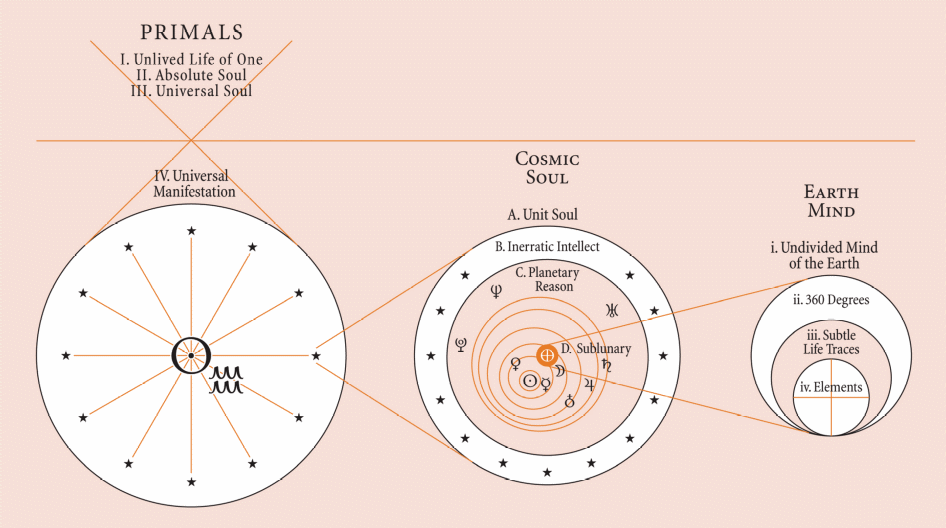
FIGURE 1983 0914-1. Nested Levels.
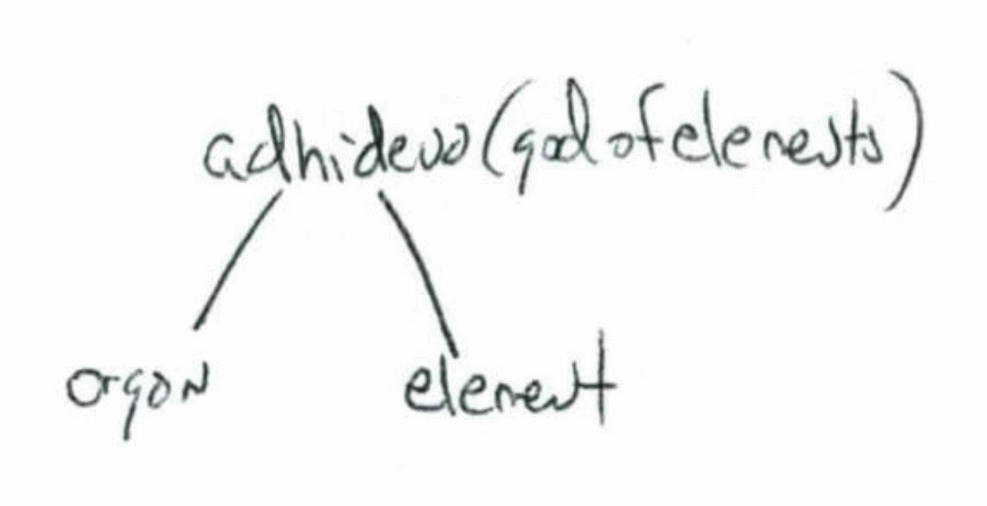
FIGURE 1983 0914-2-AB. God, Organ, Element.
The first diagram is from Astronoesis, p. 250. [Transcriber note: [diagram] means the speaker is referencing a diagram as he or she is speaking.]
NOTES:
Pat Campbell transcript from 1983 exists; other, earlier transcript versions exist, including one done in 1993 from audio cassette tapes by hp, jf, et al.
Unpublished PB paras, even if sourced, should be proofread.
An excerpt from this transcript appears in Astronoesis in "Editor's Epilogue," p. 289.
TRANSCRIBED Verbatim by IT 2018 using 1993 partial transcript as a basis. Reformatted from V11a version by JRM & JF 2019-2020, with Subheads and Table of Contents added by JRM. In 2023, IT fixes prefatory matter and footer, updates audio file name, completes Book List, fixes minor errors/typos, adds two diagrams and references within transcript to these diagrams, reformats to accord with new conventions. In 2025, MW expands Subsubjects and alters Subheads to make more accurate. Archival verbatim transcript – V14.1a.
AUDIO FILES: 1983 0914a, 1983 0914b. [Note: "Tape" and "Side" refer to original audio cassette tapes later digitized into .MP3 Audio Files.]
1983 09/14 at Wisdom's Goldenrod
PB Paras; Meditation
Archival verbatim transcript
[Audio File 1983 0914a Begins]
RC: We could talk about from that quote last week. I'll read the quote again.
THE SURANGAMA SUTRA ON DISENGAGING BODILY HEARING FROM OUTWARD SOUND
PB [V15, 23:8.110, RC reading]: "The Surangama Sutra chooses, as the best meditation method for the present historic cycle, the one used by Avalokitesvara. It disengages bodily hearing from outward sound, then penetrates still deeper into the void beyond this duality, then beyond [RC adds: the] ego and its object, until all opposites and dualities vanish, leaving absoluteness. Nirvana follows as a natural consequence. In other words, disengage consciousness from the senses and return to pure Consciousness itself."
[9¼ second pause]
RC: So Paul has the exercise or a passage from the sutra.
PD: The whole-- the whole section on hearing runs, you know, fifteen pages or so. I just tried to pick out some of the mo-- what I think of were the most pertinent passages. I think what Randy had just read is an excellent summary of the section. [short pause] A little background about the text. The-- the Buddha has twenty-five, or something like that, different Bodhisattvas give forth a method for inward realization. And, this method is recommended by Manjusri as being the most appropriate for our age. And I think if-- if we read a little, there's some interesting points in the actual symbolism here too. It is basically a-- a text on mentalism. The whole Surangama Sutra is pretty much a mentalistic point of view.
[short pause]
[Transcriber note: I am using The Surangama Sutra by Leng Yen Ching, with Commentary by Ch'an Master Han Shan, translated by Upasaka Lu K'uan Yü (Charles Luk).]
Charles Luk (tr.) [The Surangama Sutra, pp. 191-192, PD reading]: "Thereupon Avalokitesvara Bodhisattva rose from his seat, prostrated himself with his head at the feet of the Buddha and declared: 'I still remember that long before(,) numbers of aeons countless as [the] sand grains [PD reads: grains of sand] in the Ganges, a Buddha called Avalokitesvara appeared in the world. When I was with Him, I developed the Bodhi Mind and, for my entry into Samadhi, I was instructed by Him to practise meditation by means of the organ [PD reads: power] of hearing.
"'At first by directing the organ of hearing into the stream of meditation, this organ was detached from its object, and by wiping out (the concept of) both sound and stream-entry, both disturbance and stillness became clearly non-existent. Thus advancing step by step both hearing and its object ceased completely, but I did not stop where they ended. When the awareness of this state and this state itself were realized as non-existent, both subject and object merged into the void, the awareness of which became all-embracing. With further elimination of the void and its object both creation and annihilation vanished giving way to the state of Nirvana which then manifested.
"'Suddenly I leaped over both the mundane and supramundane, thereby realizing an all-embracing brightness pervading the ten directions, and acquired two unsurpassed [PD reads: unsurpassable] (merits). The first was in accord with the fundamental Profound Enlightened Mind of all [the] Buddhas [high up in the ten directions] and possessed the same merciful power as the Tathagata. The second was in sympathy with all living beings in the six realms of existence [here below in the ten directions] and shared with them the same plea for compassion.
"'World Honoured One, as I (followed and) made offerings to the Tathagata Avalokitesvara, He taught me to use my illusory hearing and [PD adds: to] sublimate it to realize the [Diamond] (Vajra) Samadhi which gave me the same power of mercy of all Buddhas and enabled me to transform myself into [PD adds: the] thirty-two bodily forms for the purpose of visiting all countries in samsara [(to convert and liberate living beings)].'"
[9¾ second pause]
PD: It's not-- I had a few comments, you know, just from reflecting on it. The thing that struck me as being very interesting is that there's a Bodhisattva and a Buddha Avalokitesvara. And the Bodhisattva is receiving instruction from the Buddha Avalokitesvara. In a sense, I think we would say, at once he's receiving instructions from his own celestial soul, directly from his own soul and not from another. Another interesting thing in the first paragraph, it's the bodhi mind gets developed when those two souls are in communion or conjunction. And, it's presented in the mythological-- mythological fashion where he says "Once upon a time…" That "once upon a time" is of course not in time, it's not in any temporal sequence. [26 second pause] Um-- [short pause] I don't-- I don't know if, you know-- Another point that I thought was very interesting was that in sublimating the actual power of hearing, the Bodhisattva acquires the merit of com-- of mercy, in other words, the higher powers can operate through the Bodhisattva when he sublimates and returns to the unmanifest mind that power as sense power. [28¼ second pause] Another section a little later on--
Charles Luk (tr.) [The Surangama Sutra, p. 200, PD reading]: "1. 'When I first realized the hearing mind which was most profound, the Essence of Mind (i.e. the Tathagata store) disengaged itself from hearing and could no longer be divided by seeing, hearing, feeling and knowing, and so became one pure [and] clean all-pervading precious Bodhi.'"
[20½ second pause]
S: What does that mean, hearing mind?
PD: In the-- in the deeper sense I think it would imply the quiet mind, the mind that has the-- it's absorbed in the stillness. And so it's hearing not directed towards bodily sound.
[short pause]
S: It's the knowing mind.
PD: Pardon?
S: It's knowing mind. Knowing mind.
PD: Yeah. But, you know, they often use that terminology of the quiet mind as-- In a sense hearing is the most inward of your sen-- of the sense-faculties. And it-- the method that they're speaking of here is to-- to disengage that from the sensual world or the bodily world. And if that's done, one steps out of the bodily context of experience.
S: He's got senses at the root, the root of the senses or the most subtle of the senses or--
PD: Most abstract in a way. [33 second pause] He somewhere-- later on they s-- they rate the different sense powers. And hearing they give the highest ratings to, the most merits, because it's all-pervasive and simultaneous in its object, whereas sight is only directional, it only sees a certain radius of its sphere of cognition. And on and on with the other sense powers, they're more limited in their-- in the pervasiveness of their object. [student assents, very faint] And then part of the-- the virtues, the 32 marks of transformation that develop in Avalokitesvara is the ability to enter anywhere because he's-- he's all-pervasive now.
[16½ second pause]
JB: Do you mean that giving up the sense power, relinquishing it gives you the-- gives you that power to another-- at another level? Is that when it becomes all-pervasive like sound?
PD: Well that the object of the sense power appears. [student assents, faint] It's not directional but it's-- but a complete orb. [student assents, faint] We're just speaking at our level of experience. Hearing doesn't-- isn't restricted to hear just what's on the side of his ears. It hears the-- in the whole continuum. Whereas sight is restricted to, let's say, 160 degrees, 150 degrees of the sphere of cognition.
JB: Right. I thought you were making a point that when you relinquish the sense function, then you attain hearing with some super organ as well. But, maybe I misunderstood.
PD: Yeah, that-- Fir-- the first thing you do is disengage that power of hearing from the bodily sphere. [student assents, very faint] You inwardize until the sense of hearing becomes absorbed in the continuum of meditation and is no longer directed outwards through the body.
[student assents, faint]
JB: But once inwardized, you enjoy a different kind of surround. I mean I'm suggesting that--
PD (simultaneously): Well I think at the deeper state, you-- the soul has to relinquish that too. [student assents] And in relinquishing that power as far as belonging to it, he's a developing soul, it then becomes a vehicle for the higher soul to operate through that Bodhisattva.
JB: I thought he says Nirvana-- where he says that Nirvana follows, as it were, [PD simultaneously: Right. That--] automatically.
PD: Ok.
JB: That's after that second relinquishing or-- [PD simultaneously: Yeah.] or right away after the first? Even the second.
PD: The relinquishing of the powers in order to actualize that aspect of Buddhahood, what we call mercy.
JB: Ok. I mistook that it was only after the first inwardizing you maintain a certain grasp of the power. But it's a new way and that presents (to) that person.
PD (simultaneously): No, no. Yeah, let me read the section here.
Charles Luk (tr.) [The Surangama Sutra, p. 191, PD reading]: "'At first by directing the organ [PD reads: power] of hearing into the stream of meditation, this organ [PD reads: power] was detached from its object…'"
PD: So that's kind of first level.
[student assents]
Charles Luk (tr.) [The Surangama Sutra, pp. 191-192, PD reading]: "'…and by wiping out (the concept of) both sound and stream-entry, [both] disturbance and stillness became clearly non-existent.'"
PD: By wiping out any reflective self-consciousness.
[student assents, very faint]
Charles Luk (tr.) [The Surangama Sutra, p. 192, PD reading]: "'Thus advancing step by step both hearing and its object ceased completely, but I did not stop where they ended.'"
PD: So this is a-- the transcendent.
[student assents, very faint]
Charles Luk (tr.) [The Surangama Sutra, p. 192, PD reading]: "'When the awareness of this state and this state itself were realized as non-existent, both subject and object merged into the void, the awareness of which became all-embracing.'"
PD: So that's kind of like another level.
Charles Luk (tr.) [The Surangama Sutra, p. 192, PD reading]: "'With [PD adds: the] further elimination of the void and its object both creation and annihilation vanished giving way to the state of Nirvana which then manifested.'"
PD: So there's like-- I can see-- conjecture that there's four levels there.
[10¼ second pause]
DB: What is the section where the-- the void and its object or-- are-- are eliminated as well as creation and annihilation? Why-- I don't quite know how to understand that. What would be the object to the void? I don't know what that means.
PD: I couldn't help you David. (bit of laughter) I mean I-- the only thing I can grasp out of that sentence is that Nirvana is something other than manifestation, I guess.
DB: That's right.
PD: That's all I can grasp. (bit of laughter)
[17 second pause]
S: I've heard of some y-- a yoga exercise. I don't know if this is what the Buddhists are talking about, but they plug their ears, and then they listen and listen and listen and they just get to higher and higher levels of being. [couple/three words inaudible]
PD: That seems kind of artificial if you have to plug your ears.
S: Maybe.
LR: That's how (Tim does it).
S: Yeah right. (laughter)
S: We can't do it the other way.
S: Like shutting [LDS simultaneously: (Bubba.)] your eyes.
S: Right.
LDS: Paul, is there anything more specific in his description of the exercise, is there any more detail? Like, you know, what the object is initially and how he-- and how he gets deeper and deeper? Or is this pretty much the general description?
PD: I-- That seems to be the most-- [LDS: Detailed.] the general statement, but in reading a sutra you've got to be able to sift through where the mythology begins and the psychological processes begin, [S: Right.] because they're presented, you know, all--
LDS: Uh-hm, yeah.
PD: You know, like they-- the-- I think this section is-- the sentences-- well--
Charles Luk (tr.) [The Surangama Sutra, p. 200, PD reading]: "1. 'When I first realized the hearing mind which was most profound, [the Essence of Mind] (i.e. the Tathagata store) disengaged itself from hearing and could no longer be divided by seeing, hearing, feeling [and] knowing, and so became one pure [and] clean all-pervading precious Bodhi.'"
LDS: How would you put that in English?
[short pause]
PD: Well I'd like to leave it a little symbolic, Lou. But conjecturing, is that in the-- in the deeper stillness, somehow the power of hearing and listening aspect have to be let go of and become the conscious aspect that has divided itself up into these powers.
S: And that's what you're not thinking, hearing into existence. [student assents, faint] (Does that work?)
PD: I don't know Lou.
[9 second pause]
RC: Paul, would you go through that sequence again that includes the void and its object, when you took the para last week?
WHEN YOU DISENGAGE ATTENTION FROM THE EAR AND THE SOUND, YOU PLUNGE ATTENTION INTO ITSELF, WHICH IS THE VOID ASPECT
AD (simultaneously): Well now-- Let me try to explain it this way first, it might be easier. It might not, I don't know, alright. You're listening, let's say, to a piece of music. You're truly listening to-- to it. There emerges-- well I should say they coalesce, momentarily the-- the sound and the hearing are realized to be two ends of one and the same stick. In that moment there's-- there's the possibility of disengaging your attention from those two things, which are really one, the organ of hearing and the sound heard. So your attention disengaged from that, alright. You disengage the attention from the ear and the sound that is heard and you plunge that attention into itself. This is the void aspect. If you persist in that state and deepen it, you go into the next state which he calls samadhi or Nirvana.
THE VOID STATE IS EQUIVALENT TO THE 360 DEGREES OR 360 GODS, OR THE 360 FORMS IN THE SOUL OF THE EARTH—THE BODHI MIND
So you could-- if you wanted to make a correlate, you could do something like this, in terms of the way we've been working, you know, in the understanding of the three levels of bodily subjectivity. The first-- the first two levels of bodily subjectivity, the one that refers to the physical, the perception, and the next one refers to the pranas which make that perception possible, those two are both an object to the third level of bodily subjectivity. You follow that? He calls that the void state, because there you're no longer-- you've disengaged your attention from these two and it is abiding in itself. And the deepening of that takes you into, he calls it the fourth-- according to his analysis it was a fourth level. So, it would be--
Let me see, I think I [couple/few words inaudible] No. No, I could even-- yeah, I could s-- I could square it with what we did-- have done in the past or we-- The bodily subjectivity and the psychical subjectivity are two sides of the epistemological relationship, alright. The organ of hearing, the ear, is one, that-- and that's identified with the bodily subjectivity. The pranas which-- or let's say better the sound, the pranas which activate that organ of hearing is the next level and we refer to that as psychic subjectivity. Now, these two together, as I said, are two ends of one and the same stick. They are both object to that undivided mind or what you might refer to as the spiritual subjectivity. Now if you disengage the attention or the spiritual subjectivity from those two prior, alright, then you're in a void state, that's equivalent like the archetypal level of the degrees. If you go beyond that, you'll go into Nirvana, because you'll be entering then the realm of what we refer to as the powers of the Solar Logoi, the undivided mind. You could put it that way.
RC: It's different than the way PB's talking there in terms of withdrawing the attention from the object, from the outward sound. "Penetrating still deeper-- penetrating still deeper into the void beyond this duality," and that seems to be where you say turning the attention in on itself after having dropped the object.
AD: The object here being the organ and the sound.
RC: Yeah.
S: Why are you doing it that way? Why (do you want--)
AD (simultaneously): None of your business, why am I doing it that way. (Because.) (AD laughing)
S: No but, why is the object the physical organ rather than before, the objective [one/two words inaudible]
AD: Your ear and the sound are two sides of the stick. You're not going to have any sound without an ear. [student assents] Just like you're not going to see the form of the flower without the eye. [student assents] The two of them come together or not at all. These are both objective to the third level.
S: Oh, oh-- I'm sorry, I missed it before, I thought that you had said that the ear and the psychical organ were two sides of the stick.
AD: That's right.
RG: So you've [couple words inaudible] (Let's see what he says.)
[9½ second pause with background student words]
S: Which is it?
S (very faint): Both.
S: Both?
AD: Which is what?
[short pause]
S: Um--
AD: Your ear is part of the physical body or the bodily subjectivity, that the sound that you hear is part of the objective psyche, these two things come together. If you hear anything, alright, you've got to have an ear and the psychical disturbance. [short pause] Just go over it slowly. [RG simultaneously: And by the (one word inaudible)] Do you follow what I'm doing, Dickie?
RG: Yeah.
AD: Hm?
RG: Yeah. From Bhattacharyya.
AD (simultaneously): You see that the third level, what he calls the void, is the ta-- the totality of all the archetypes, [student assents] or we call the forms in the soul? And the fourth level is the samadhi or Nirvana level, his entrance into the Solar Logos' realm.
PD: Would it be-- is it the same thing or is it analogous to that level? [student assents] Because [S simultaneously: Uh-uh.] he's speaking here of awareness and not archetypes.
AD: Well-- They're the same thing Paul because what he calls the bodhi mind is that mind composed of the vast intelligence which comprises the forms in the soul of the Earth.
[short pause]
PD: I-- I hear what you're saying but I disagree with that coming [AD simultaneously: Well that's--] via the text here.
AD: Well that's alright, I mean-- I mean that's why I like PB instead of those texts.
PD: Yeah.
RC: When he took this next step where after-- after the lower two levels become an object to the third level, that this is "then beyond the ego and its object, until all opposites and dualities vanish, leaving absoluteness. Nirvana follows as a natural consequence." Seems to be saying that-- that-- would you say the attachment of the reproductive soul to the third level also lapses?
AD: Yes, you could put it that way, sure. But you can see that the-- the-- that the degree and its opposition both have to be object to something. What is it object to? In other words, if you speak about a subjective functioning and a-- and its outward manifestation, they're both objective to something. Now what are they objective to? Ultimately the bodhi mind. Ok? But I'm not jumping that quick, I'm saying they're both objective, so to speak, to your attention, instead of calling it the bodhi mind right now. If this intro-- if this attention introspects into itself, it loses sight of the object and the subject, the subject-object relationship or the opposition, the 1 degree Aries, 1 degree Libra, you lose sight of it, you're now, so to speak, in the realm of attention, you're abiding there. Now if you introspect into that realm of attention, you're in what they call the bodhi mind, the 360 degrees or 360 Gods, I don't care what you call them, the 360 forms in the soul of the Earth. That's the bodhi mind. The nirvanic mind is when you transcend that. You get into the realm of the soul power(s).
RG: Uh-hm.
S: Anthony, why does he particularly use the [few words inaudible] dualistic mind [couple words inaudible] use the sense of hearing to [one word inaudible]
AD: Because it's the-- it's the easiest one to do it with. [students assent, faint] Especially if you like music. It's one of the easiest ways to get into samadhi.
S: They make it seem so--
AD: I can't hear you. (laughter)
S: It sounds-- I'm surprised to hear you say music because it sounds so [one/two words inaudible] [student assents] There's enough sound in quiet, and--
LISTENING TO MUSIC IS A BETTER WAY TO PRACTICE THIS EXERCISE
AD: Well you're not going to get very concentrated in listening to sounds. But if you listen to music you might get very concentrated. He even has the exercise in the Quest. You're listening to music, you're very intensely involved, almost identified with it, alright, you reach the-- you reach a peak of attention, intense atten-- intense attention. Drop the music. Introspect into the attention. That takes you right in-- right-- right into the void. Or let's say to the doorstep. Why do you think he calls music the most divine of all the arts? [possibly student: Ah], (I want to do) something. (some laughter)
PD: Now, he speaks here of the bodhi mind being developed when there's the meeting of the Bodhisattva with the Buddha.
AD: Yes.
PD: And, that would seem to suggest in my-- to me that the-- that mind develops when there's some type of conjunction with one's higher soul, not with [AD simultaneously: Yeah.] the archetypes.
AD: Yeah that's true. Also it develops if there's some meeting with a Sage. Which would be the same thing. The Sage would stand for your higher soul. And the development of the bodhi mind simply means that you're making yourself at home in the forms or the ideas, what-- what we call the archetypes of the Earth's soul. The intelligence of the Earth, the-- what we spoke about as the forms in the soul of the Earth--that's awesome.
PD: Yeah but, I'm not knocking Mother Earth's boots. (bit of laughter)
AD: You better not [S simultaneously: Right, right.] because she's the one who gives you permission to leave.
PD: I'm-- yes. (bit of laughter) But he's speaking here of the bodhi mind being developed in con-- in conjunction with its-- its own higher soul, now-- so, in the metaphysical schemes that you have, [AD(?) simultaneously: Yeah.] the higher soul is not the Earth consciousness.
THE HIGHER SOUL WOULD REPRESENT THE INFINITE MIND OF THE EARTH, WHICH IS IDENTICAL WITH THE POWERS OF THE SOLAR LOGOS, THE SEVEN PLANETS
AD: No, the higher soul would represent the infinite Mind of the Earth, which is the same as or identical with the powers of the Solar Logos. [short pause] Put up the diagram, would you? [Note: See FIGURE 1983 0914-1, Nested Levels, appended to this transcript for the following. This diagram is from Astronoesis, p. 250.] You know, just a-- just make a couple of circles, put the Earth in one of them [diagram]. [14¾ second pause] Now if you imagine, so to speak, or if you imagine that the-- around the Earth is the, what we call the Dragonic belt which has three levels of meaning, the archetypal level or the level of the forms in the soul, then the prana level, and then what we call the gross level, alright, now any-- anything that occurs there is determined by the functioning of the planetary spheres. Alright? Now try to follow this, it's a little complicated but it's very beautiful. Anything that happens at the sublunary level is a combination of the functioning of the Gods, the archetypes, the degrees, and the two lower levels be-- below it. So, you would have the ideas, the pranas or the soul of the elements, and the element. But what determines how the Gods combine these various things is its infinite Mind which are the seven planets. But its infinite Mind is the same as the powers of the Solar Logos. Do you see that? The infinite Mind of the Earth is the same as the soul powers of the Solar Logos. Now what he is saying is, the two lower levels of those circles, alright, is where hearing and the organ of hear-- hearing are located, alright. If your attention is profound enough, alright, it makes them into an object. In other words, the sound that you hear and the organ that you hear it with both become objective to the higher mind, the third level.
PD: Yes but--
AD: Ok?
PD: Ok.
THE DEVELOPMENT OF THE VOID MIND DEPENDS UPON EITHER YOUR HIGHER SOUL DIRECTING YOU, OR A MASTER DIRECTING YOU
AD: And he calls that, he calls that the void. And, there's no harm in calling that the void because the 360 Gods are void, void in nature. Ok? Now, that's equivalent to the void. Now the development of that void mind depends upon either your higher soul communicating to you through the interior word and directing you, or a Master, a Sage, directs your development. Follow that? When he does, that development takes you out of the void mind of the Earth, alright, and throws you into the Solar Logos, the realm of the Solar Logos. The functioning of the Solar Logos is the same as Nirvana.
[short pause]
PD: The Solar Logos is the same thing as the Overself, is that what you're saying?
AD: Yeah. The functioning of the Solar Logos is the same as the functioning of the Overself, sure.
[short pause]
MB: Anthony, is this ex-- is this procedure any different in principle from the same one based on vision that we've discussed before?
AD: What?
MB: Is this different in principle from the exercise based on vision that we talked about?
AD: Yes this is quite different. Quite different. [MB: But the--] Vision is much harder.
MB: It's harder but is it talking about the same level (of/its) association [couple words inaudible]
AD: Yes, you could do the same thing, if you concentrate intensely enough on the image of a Master, then the image and the eye both form a unity. It has for its subject, this unity has for its subject the void mind, which would be equivalent to you experiencing the presence of this Master. [short pause] That's why they tell you to do the eye-gazing exercise. Because the ultimate result of the eye-gazing exercise, it produces the experience, so to speak, of the void mind or of the presence, the being, of the Sage or the Master that you're contemplating on. But that-- that's really equivalent to saying that you're experiencing this void mind.
[10 second pause]
AS: You know another-- that Vedantic notion seems to make a lot more sense when you say that [one/two words inaudible] the elements is actually these elemental aspects, the [one word inaudible] bhuta, the self or subject as that, (here the Atma), [student assents] and then the-- the Gods-- the-- the God that rules over both of these, [AD: Uh-hm.] the [one word inaudible] [student assents] And you're saying that that was-- that that's the level-- we're just talking about the level of the Earth soul and those Gods are the deities, and they also have them for the antahkarana too. So that 12th house constitutes itself as the Earth's [one/two words inaudible] level-- level-- you know, the level of Gods which (puts-- puts) the elements in its (place/way). [Note: See FIGURE 1983 0914-2-AB, God, Organ, Element, appended to this transcript.]
[short pause with very faint background student words]
AD: Well, that's alright, it's a little subtle but if you think about it, we'll go on for now to (something else). Yes, it's quite a job Paul to pierce through all that mythological talk.
PD: But certain things can't be said in that without losing--
AD: Well unless you're aware in some ways, you know, from within, it's almost impossible to penetrate what they're talking about. I mean like when he speaks about the Buddha Avalokitesvara told him something, PB would translate that very simply and in plain English as saying that your soul through the Interior Word can communicate guidance as to how and what form of meditation you should undertake. And, the mythological interpretation of that, if you put it back into mythological form, that aeons ago I was with the Buddha Avalokitesvara who instructed me, I mean, that's alright to-- alright in the 7th century but, you don't have that much time today, you know, we've got to figure out these things and figure them out quick. You don't have that much time, nobody has. At least I don't. And so, after a while you'll appreciate PB. He makes a wide detour of all this stuff. (AD laughs a bit)
[short pause]
THE REPRODUCTIVE PHASE OF THE SOUL ASSUMES AS ITS FIRST THOUGHT THE TOTALITY OF THE 360 DEGREES, THE I-THOUGHT
RC: Well this one's a crash course. [student assents, very faint] This is the one that you asked me if I had last week but I didn't. Found it.
PB [V13, 19:5.24, RC reading]: "You may get rid of every object of thought and, seemingly, of every thought itself until there is only a void. But even then you will still be thinking the void and consequently holding a"thought." It will not be the true void. The thinking "I" must itself be eliminated. Only when this is done will all activity truly cease and the stillness of the Eternal be truly known. This can be realized by some kind of mystical practice only and not by conceptual effort."
AD: And I think I was speaking to Andrew. If you go through a profound analysis of the external world you come up with the same situation where you have a void. Just like Vic, you know, shoots these things out of the electronic gun and there's nothing there until it goes through the hole. But, when it first comes out there's nothing there. In the same way if you analyze your interior states, you'll come up, again, within nothing there, a void. You combine the two, you still have a void. But it's still a conceptual void. The next thing is to push that out of the way completely. He says that you have to eliminate the thinking "I" to get rid of that conceptual void. That's-- that's what I was talking to Andrew about last week. [short pause] That is a crash program.
TS: Would that thinking "I" be the same level as the bodhi mind or is it prior to the subject? [short pause] Can you hear me?
[13¼ second pause]
AD: Well Tim I thought maybe you'd answer it.
TS: Well, so, the way it sounds is it sounds to me that the bodhi-- like the spiritual subject is the thinking mind.
AD: Yeah. You have to get rid-- you have to eliminate even that. [short pause] Good, we're off to a good start.
AB: Read that again, Randy.
AD: Hm? Yeah, let's read another one.
PB [V13, 19:5.24, RC reading]: "You may get rid of every object of thought and, seemingly, of every thought itself until there is only a void. But even then you will still be thinking the void and consequently holding a"thought." It will not be the true void. The thinking "I" must itself be eliminated. Only when this is done will all activity truly cease and the stillness of the Eternal be truly known. This can be realized by some kind of mystical practice only and not by conceptual effort."
[17 second pause]
AD: You better start off easier, they're all leaving. (bit of laughter)
[few seconds of faint background student talking]
AH: This-- this is a-- this bare I-thought that is equatable to the void--
AD: The what?
AH: You said that this-- in this description of void, there's-- it's-- it's still in some way a-- a thought, it ba-- maneuver the I-thought. It-- Is that a reference to the first of our thoughts or the most fundamental aspect of what makes individual life possible? It's like the bare sense of "I" without any object is itself fundamental thought? Is that the way this is to be understood?
AD: Try again, Andrew.
AH: Well, the equation, you know, where the void is described as a thought, I was trying to understand what that means. Does that mean that the I-thought is the thought that's held or is there an object to that I-thought which can be construed as the void?
[short pause]
AD: Well if you followed what I said previously, the I-thought--
(Side 1 of original cassette tape digitized as 1983 0914a Ends; Side 2 begins)
AD: --which of course is not really you at all.
[short pause]
AH: Is that the void?
AD: Well, it's like a void, it's not-- it's not the-- it's not the voidness of Intellectual Being but it can be thought of as void because like I tried to point out, these 360 ideas are of the nature of voidness. The soul, or the mind, the reproductive phase of the soul which comes into incarnation, assumes as its first thought this totality of 360 degrees as its thought, the I-thought. This is what makes you think that you are an "I" here.
[short pause]
AH: Anthony I--
AD: Now I don't expect you to follow this.
AH: May I ask another question and--
AD: Go ahead. (AD chuckles)
AH: Alright. Could you be a little more specific please in the way that you're using void? Are you using it in the technical scriptural sense or in a colloquial sense as being empty?
AD: I'm using it in the sense that any kind of intellectual essence has no kind of thing-ness about it.
[short pause]
AH: Ok.
[short pause]
THE DESIRE FOR EARTHLY EMBODIMENT HAS NO SUBSTANCE; IT ACQUIRES SUBSTANCE WHEN IT EMBRACES THE 360 DEGREES—AND IT REFERS TO THIS AS ITS "I"
LD: You call the 360 Gods the original thought of "I". But, I thought prior we had called like that original desire for earthly existence would be that-- the first of our thoughts or the sense of "I". And that would seem prior to the--
AD (simultaneously): Yeah that has no-- that has no substance.
LD: No it--
AD: That desire for earthly embodiment has no substance. It acquires this substance when it embraces the 360 degrees. [LD simultaneously: That's what (couple words inaudible)] Then it has-- now it has standing substance or actual being and it refers to this as its "I", calls this "I".
[student assents, very faint]
LD: That's what would-- the desire would be for. So if you--
AD (simultaneously): The desire would be for that, yeah. Those are those entities that entice you to come in. "Come here, I got something good for you." So PB came down, says "Oh! I'm going to get some knowledge over here." [student assents, faint] And then he was--
LD: But the sense of "I", I mean you could speak of a sense of "I" as not having substance and the original sense of "I" would primarily be that desire and not those 360, right?
AD: Yeah now look--
AS: No.
AD: Look again. You can call the "I", and I do call the true "I" is only what we refer to as the I AM, the Overself, this, that and the other thing, ok.
LD: Ok.
AD: But when that "I" incarnates, alright, and it is an immaterial, it's a-- it's mind per se, when it incarnates, in order for this "I" to have some kind of being, by embracing the totality of the 360 Gods, the void nature of these Gods, this becomes the first of its thoughts. [student assents, faint] This is the I-thought.
S: Ok.
LD: And that is the "I" encountered in the stillness [couple/few words inaudible]
AD: That's the "I" that has to be gotten rid of in the stillness.
LD: Yeah, that's what I mean.
AD: Yeah.
MB: So in this quote when he talks about it's not the true void and then you get rid of the thinking "I", would that state then that he calls "the stillness of the Eternal" correspond to the Nirvana of the previous quote?
AD: Well, that would be Nirvana.
S: Yeah.
WY: In this meditation experience where he's the thinking "I", alright, seeing the totality of these Gods, you know, inerratic-- the inerra--
AD: No not Gods of the inerratic.
WY: Oh ok, of the Dragonic.
AD: They're the forms in the soul of the Earth, they're not-- they have-- or let's say they're special interpretations of the Ideas. But nonetheless they also have an immaterial nature.
WY: Ok. So it seem(ed) like this "I" would be a plenum of awareness.
AD: It would what?
WY: Be a plenum of awareness, whereas the specific ideas of the Earth's intellectuality would-- would have a certain definite [one word inaudible] being that that they are in soul (riding on that). That it seems like it wouldn't just be a bare "I" that would seem to be-- (come forth) but rather a fullness.
AD: No, the point here, there's two points to be made. On the one hand, the very nature of these Gods--if you want to call them archetypes, they're forms in the soul--their very nature is voidness in the sense that they are not composed of any material thing, of any of the elements or the soul of the elements. So they're completely out of that realm, they are immaterial. The second point, I'm just-- the em-- when you embrace that with the "I", alright, you were saying that this would lead to what, a plenum (of/or)--
WY: I-- I said that I would think this would be an experience of a plenum of awareness rather than bare identity, seen through the meditator-- meditator that it would be [couple words inaudible]
AD (simultaneously): And in a way, in a way you are. When the "I" identifies with all those thoughts, alright, in what we referring to as the archetypal degree, think somewhere PB says that, when you refer to this "I", alright, this-- it has a fullness that the "I" here, the empirical personality here, is like very diminished and dwarfed understanding of the mental being that you are. [student assents] [short pause] He says-- remember he says the first of our thoughts is "I". And if it stayed with that everything would be fine because there it experiences intellectuality, alright. But it doesn't stay with that, it immediately identifies with a body, alright. Now what happened to that plenum [AD pronounces: plenium] in your consciousness? [couple inaudible WY words simultaneous with AD] It's gone, right. [short pause] It's like the person identifying with his thumb. He's saying "That's me." [student assents, faint] Alright, that's a hard way to start the class.
MEDITATION ON A UNIVERSAL ATTRIBUTE OF THE OVERSELF AUTOMATICALLY RELEASES YOU FROM BEING CONCERNED WITH THE EGO
PB [V4, Part 1, 4:4.3, RC reading]: "The topic selected for practice may be quite personal to begin with, provided that it is suitable to help bring about self-improvement of a positive kind such as removing faults and cultivating virtues. But this is only preparatory, since it is still concerned with the ego and designed to improve concentration. When experience and regular practice have reached a sufficient development, then the topic should be one which makes him [RC reads: you] feel highly reverential and should be directed to the OVERSELF not to the ego, not even for the ego's improvement spiritually."
[18¼ second pause]
PB [V15, 23:7.311, RC reading]: "He who has reached this stage of his meditation may well pray:"O Lord, grant [RC adds: me] the capacity to go deeper into Thy presence and to stay longer in it."
[short pause]
AH: Randy, could you go back to the first quote in the beginning, [student assents] the-- the earlier one that you just read.
RC: Uh-hm.
PB [V4, Part 1, 4:4.3, RC reading]: "The topic selected for practice may be quite personal to begin with, provided that it is suitable to help bring about self-improvement of a positive kind such as removing faults and cultivating virtues. But this is only preparatory, since it is still concerned with the ego and designed to improve concentration. When experience and regular practice have reached a sufficient development, then the topic should be one which makes him feel highly reverential and should be directed to the OVERSELF not to the ego, not even for the ego's improvement spiritually."
S (faint): Uh-hm.
AH: Would that be a way of speaking about the I-thought that we just discussed as the first part of that para? The I-thought and everything with tha-- with that, or everything that follows it, is the first stage of practice. But, since the Overself or second part of the practice would be an attempt to touch that bodhi mind or would be the relinquishment of the I-thought. You think that that's a parallel structure between those two quotes? [students assent, very faint] Like the first part of the practice that he's describing, [RC: Yeah.] from the I-thought down. Because it's that I-thought that-- the central theme for the ego. But the second practice is an effort to give up that I-thought.
[short pause]
RC: To get outside this little merry go-around, yeah. Definitely shifting the focus of the attention away from it.
AH: Because it is like-- it's within the ego and the I-thought that the notion of purification and improvement and character development occur(s). [short pause] And that's like preparatory, according to this quote, to-- for another kind of practice.
S: Well, the second part's a little-- sounds to me like the ideas level, because it's still taking in [few words inaudible] but you're reacting to the Overself. It's [AH simultaneously: Lauren--] not an issue that borders-- [couple words inaudible] that borders that "I", that--
PD: But if I'm following Andrew I think it's all they mean, (we're gonna) say the Overself inwardly is what the-- is the negation of the egot-- ego.
S: Right.
PD: That's how-- how else can you psychologically define the Overself to yourself but as what-- as what the ego isn't?
LR: I disagree with you.
MB (simultaneously): Can I just--
S: Uh-hm.
AH: Well the As-If [LR simultaneously: I disagree.] exercise Lauren, if I could comment, if you're referring to it specifically as this exercise that he recommends, it has a level of character development and-- like that, that's the first one. It's as if we were the Overself. It's like you play pretend that you are and hope for becoming a better person.
S: Uh-hm.
LR: Isn't he saying there that if after you've gotten to some degree of concentration, if you have any thoughts of-- you also contact a certain amount of power. And if you entertain any thoughts of the ego at that point you'll be directing the power towards the ego and are drawn back to that. And so you'd better direct all the attention towards the Overself.
AH: I was picking up on the notion of-- of purification and character development that the first part of the quote refers to. And that-- that seems to be in some sense a concession to the ego insofar as it improves concentration and refines the character. But it seems quite clear that there's a-- a distinction between that level of practice and the second level that he mentioned in this quote, where the only requirement is a reverential feeling. And Linda, I was wondering if that wasn't a way of speaking about where that-- what Anthony described as the voidness of the I-thought, that that has to be given up. I think that's the second exer-- the second level of the practice is an attempt to give up that I-thought.
PD: The voiding out of the I-thought.
AH: Yeah. The cancellation of it or the negation of it.
LR: I didn't think it necessarily had to be that high, Andrew.
S (faint): Uh-hm. Yeah Andrew.
AH: Well, [LR simultaneously: I didn't think that that-- do it--] we all have our own opinions [one/two words inaudible]
LR: Well he says highly reverential and directed to the Overself and you're saying that's level of the void above?
AH: I'm saying there's a transition in the practice, and it seems it's qui-- quite a clear one in regards to this last quote. Maybe we can hear the quote again.
S: Maybe you could--
AD (simultaneously): In the first part he's speaking about the development of concentration, which means you're concentrating on some characteristic fault that you have. So if you say for instance the mantram "Lord Jesus, have mercy on me, a poor sinner," you're developing the quality of humility, right, because you recognize the inbred and built-in arrogance that the ego naturally possesses. But assuming that you've developed concentration now, you are no longer concerned with the arrogance that the ego works with, you have to meditate-- the second level will be the meditation on some universal attribute that the Overself has--its love, its wisdom, any of these things. And that would automatically release you from thinking about or being concerned with the ego. That's all he's saying.
RC: I think probably if you said the "me-thought", that then they wouldn't disagree at all.
AH: But to meditate on-- on some aspect of the Overself, if you were successful, let's say that the meditation was a successful one and you attained an experience of the Overself. Does that not necessitate the cancellation of the I-thought?
AD: Well, it depends on what you mean by the I-thought here.
AH: That one that's void.
AD: No, that would be the next level. If you were successful in your meditation, you would get to that I-thought which we called the embracing of the Intellectual realm.
AH: Boy I'm real-- I'm really getting confused, I thought-- I thought--
AD (simultaneously): Well that's-- that's true, you will get confused here.
AH: I thought we were-- I thought we were talking about a meditation that was aimed at the Overself.
AD: Yes it is.
AH: Ok. Now, if it's successful--
AD: Yes, you'll end up in a contemplative state.
AH: The void I-thought.
AD: You'll end up in a contemplative state.
AH: Are you calling the void I-thought because--
AD (simultaneously): That would be the void thought, that would be the void I-thought here.
AH: That's the Overself.
AD: Not yet.
AH: Ok now I'm more confused. I--
AD (simultaneously): Why should you be confused? We said [AH simultaneously: Because--] that the Overself would be the fourth level where you're out of the void and into Nirvana.
[short pause]
AH: Is the Overself compatible with these I-thoughts?
AD: I said no, the Overself or the "I"-- that the soul itself which embraces the totality of all these ideas, alright, is not your true being. That's mental being, and it's not even yours.
[student assents]
AH: Could we hear the quote again please? That was the same [one word inaudible]
AD: You have to practice that exercise on hearing to hear the quote. But let's hear it. (laughter)
PB [V4, Part 1, 4:4.3, RC reading]: "The topic selected for practice may be quite personal to begin with, provided that it is suitable to help bring about self-improvement of a positive kind such as removing faults and cultivating virtues. But this is only preparatory, since it is still concerned with the ego and designed to improve concentration. When experience and regular practice have reached [a] sufficient development, then the topic should be one which makes him feel highly reverential and should be directed to the OVERSELF not to the ego, not even for the ego's improvement spiritually."
[short pause]
RC: This is out of context, it reminds me-- think I mentioned this before. PB had a passage in-- Alan remembered it last time-- but a passage in one of the books that says on the two wings of wisdom and compassion he could reach his soul. And, PB said that if he ever got the chance to change it he wanted to change it to reverence, to wisdom and reverence.
[14 second pause]
AH: I would speculate about parallel structure in this quote and the one we did earlier but apparently it's not [three words inaudible]
S (simultaneously): It's just that-- it's just that--
AD: In vain.
TS: Here he starts with concentration as-- the first exercise is more on concentration [one/two words inaudible] long path. [couple/three words inaudible] he thinks you can develop that concentra-- the point of concentration which you can develop. And that would seem more that meditation could be expected to--
AH: I'm sorry Tim, I can't hear you.
TS: There's a-- there's one-- he begins the second half of the quote by saying when the concentration is sufficiently developed, then one picks a topic that made one feel more reverential to the Overself. That would seem to be the beginning of the stage of contemplation which would do that.
S (faint): Ok, right.
TS: And that meditation-- or like meditation. So he's speaking about the first two grades of the meditating process and-- concentration, meditation, and contemplation would be both of them.
[short pause]
RC: I think he's making-- in my mind at least that quote was related to theme, and that this particular quote we read last week is as good an example of as any. He says--
PB [V4, Part 1, 4:2.338 and Perspectives, Chapter 4: Elementary Meditation, #38, RC reading]: "The ego is so taken up with itself that the time of meditation, which ought to be its gradual emptying-out, remains merely another field for its own activity."
RC: And I think the first part of this quote is he's saying that, in the beginning you can take something personal, working on the ego, trying to positively remove a fault or cultivate a virtue. But this is still a field for the ego's own activity. [student assents, faint] And then, the stage is going to have to come when you've reached sufficient development where you want to get outside that little circle. And that the first step outside of that little circle is to pick a topic which would make you feel highly reverential.
AH: I would think the first step outside that little circle is a relinquishment of the I-thought. (bit of laughter)
[students assent, faint]
S (faint): That's impossible.
S (very faint): Yeah, debatable.
LD: Yeah but I thought-- I thought stillness has to be achieved first and then the battle of that I-thought takes place. But that stillness-- stillness that is first achieved seems to be a relinquishment somewhat of the personal sphere of activity. So it's not the relinquishment totally of the ego, but just a certain stillness of mind achieved.
AH: Well he-- he describes it in the other direction, that like this I-thought associates with void qualities of the 360 Gods and gives us our life, our world of experience. Now, if you trace it back from where we are now, you get all the way back to the bare I-thought, the first one.
PD: I thought that was the I-thought though, that's what I would think. The identification is between (the individual).
AD: You see--
AH: Is it possible to trace appar-- what was said tonight, to trace back--
AD: But why do you needlessly encumber yourself with trying to link together what was said previously, which is very difficult to understand, I'm sorry I brought it up, with what is being said now? What is being said now is very straightforward. In the practice of meditation which has, as was explained, three levels, concentration, meditation, and contemplation, the first level, concentration, is where you can devote yourself to the development let's say of certain good qualities, alright. But in the second level where you're meditating now, and that means you're in the realm of the ideas, you don't even have bodily consciousness, now the effort is to be made to concentrate on something of a universal nature. If you concentrate on something of a universal nature, let's say like compassion, alright, then you're not going to be preoccupied with your ego. You're going to be preoccupied with the nature of compassion, a universal attribute. Even Brahms, as I pointed out to you, had enough sense to do that. If he wanted to write a piece of music, the last thing he-- the last thing he would think of would be his-- himself. So he would think about something beautiful, beautiful idea, a universal characteristic, symmetry, harmony, beauty, things like that, and then he would write his music. That inspired him to write music. Certainly if I think about myself I'm not going to be inspired to write music. (laughter) I'll probably write a modern novel.
S (simultaneously): You'll go berserk. (laughter, student words)
AD: Just don't bring in what I said previously because that's very complex what I said previously. It requires that you understand, alright, that the "I", the I AM, the Mercurius principle, the Overself, alright, is to be kept distinct from anything that's within it that could manifest, and that means the crown of glory, the Sun, the Moon, and the stars. That's to be kept distinct from that, alright. Now that I AM seeks to re-embody on-- in the sublunary realm, and in doing so it enters through the sublunary realm and must enter-- enter through that sphere of 360 Gods. The first thing it'll identify itself with is with that void intelligence which belongs to the Earth soul. Now, that's very complex. Don't bring that into the next thing which is-- that's hard enough. This one that he just read is pretty straightforward. You first concentrate on Andrew when you first start concentrating. "Well, let's see, what kind of faults does he got," you make a little list and you keep going over them, "Well, I think I should (write) this one and this one is getting too big" and you do something about it. The second stage, you're not concerned with Andrew at all. If you're concerned with any aspect of cosmogony, Andrew doesn't even come into the picture. And it's such a relief. (some laughter) And that's all he's talking about in that quote.
AH: I thought that the second exercise was directed toward the Overself, that's what I was--
AD: Well, any-- a universal attribute would be something belonging to an Intellectual essence or something like the Overself. Only the Overself knows beauty, knows harmony. These are things that belong to the Overself, so if you concentrate on one of them, you'll be thinking about the Overself. You'll be thinking about the soul. You wouldn't be thinking about Andrew. That's a second stage. The third stage, in contemplation, you don't think at all, you just allow it to take place in you whatever Grace inspires you to think about. And that would mean that one of the Intellectual Gods probably presents itself for your contemplation. But that would be another phase, that's, like I said, something you don't have to be preoccupied with in this quotation.
[short pause]
S: Anthony, when you were talking a minute ago about the I AM being distinct from anything within it, and you said the I AM seeks to embody itself, is that--
AD: The what? The I AM seeks to--
S (simultaneously): You said the I AM seeks to embody itself?
AD: Yeah, there's a phase of the I AM, that part of it which seeks to be embodied and has a desire for earthly life and which we refer to in our talking as a lower phase of the soul or mind.
[student assents]
S: It's proper-- it's proper to speak of that as the I AM though?
AD: No.
S: But a phase of it.
AD: Because the I AM-- when you get to the I AM then that can be withdrawn, that faculty can be withdrawn.
S: Ok.
S (possibly part of background): Go ahead.
[short pause]
AD: Alright, let's proceed.
PB [V4, Part 1, 4:1.157, RC reading]: "To the extent that he can get away from his personal consciousness, to that extent he comes nearer to the Real. In that sense, meditation is simply a device to accomplish this state. But it can do so only temporarily. Its benefit is great but brief."
AD: Benefit is--
RC: Great but brief.
S: Would you read that again?
PB [V4, Part 1, 4:1.157, RC reading]: "To the extent that he can get away from his personal consciousness, to that extent he comes nearer to the Real. In that sense, meditation is simply a device to accomplish this state. But it can do so only temporarily. Its benefit is great but brief."
[17½ second pause]
RC: There's a contrast (here).
AH(?): Is he--
LR (simultaneously): Wait, Randy. In that one, is he pointing to the fact that meditation alone is not enough for the practice, right? Is that the point he's trying to make? Because he says meditation is great for the-- great but brief.
RC (simultaneously): I think in that particular quote that he (strikes out--) [short pause] He's really not saying anything more, he's just saying that he can do it for a short time. [student assents, faint] And-- [students assent, very faint] [short pause] This next quote he says a little more.
PB [V4, Part 1, 4:1.81, RC reading]: "The inwardness through which a human being finds his way in meditation exercises [RC reads: exercise] to the redirection of attention to his soul, his deeper"I," is needed to restore his lost balance. But it is a process, a means to an end. For him the end must not be a special and limited experience, briefly felt, of his innermost being but a settled awareness of its presence throughout his everyday life, and a consequent sharing in that life."
[19¾ second pause]
PB [Perspectives, Chapter 4: Elementary Meditation, #58, RC reading]: "Getting intensely absorbed in a true spiritual idea may, if it penetrates to a sufficient depth, put one into communication with the Universal Mind. This in turn enables him to receive, intuitively, what could not be found intellectually."
[short pause]
"THE END MUST NOT BE A SPECIAL AND LIMITED EXPERIENCE, BRIEFLY FELT, OF HIS INNERMOST BEING"
AD: Let's go back to the previous one. [9½ second pause] You know, it's too early to hibernate, even the animals wait a little longer. (laughter)
S: We haven't come out yet.
RC: The immediately previous one?
AD: Yeah, the immediate previous one, uh--
PB [V4, Part 1, 4:1.81, RC reading]: "The inwardness [AD: Uh-huh.] through which a human being finds his way in meditation exercises to the redirection of attention to his soul, his deeper"I," is needed to restore his lost balance. But it is a process, a means to an end. For him the end must not be a special and limited experience, briefly felt, of his innermost being but a settled awareness of its presence throughout his everyday life, and a consequent sharing in that life."
[student assents]
AD: Randy, maybe you might read the other one where he speaks about the application of what you learned or the bringing of detachment that occurs in Nirvikalpa to everyday life?
RC: Yeah.
AD: Do you have that there?
RC: Yeah.
AD: Read those two together.
S: Randy, take those two and another one.
PB [V15, 24:3.319 and Perspectives, Chapter 24: The Peace within You, #16, RC reading]: "In deepest contemplation, the Nirvikalpa Samadhi of the Indian yogis, both egolessness and blissful peace can be experienced. But it is a temporary state; return to the world must follow, so the quest is not finished. The next step or stage is application, putting into the active everyday life this egoless detachment and this satisfying calmness."
[students assent, faint]
S: That--
PB [V15, 24:3.317, RC reading]: "Sahaja is the final phase and, in striking contrast to the first phase, the Glimpse, lasts as long as corporeal life lasts. In this he brings the light into [RC adds: his] every day's thought, speech, and behaviour. It is [RC reads: This is] the phase of Application. So, little by little, disjointedly and at intervals, he gets established in a calm awareness of his connection with, and relation to, the Overself."
AD: Alright, and that's [S simultaneously: I think--] a nice triad. [student assents, very faint] [short pause] Go ahead, discuss it. The three of them are quite good.
[student assents, very faint]
[short pause]
DB: I just thought of the one that is in the [one word inaudible] of the development of inwardness at the end goes on to say it's not enough to-- it's necessary to balance I guess the normal extroverted tendency of the mind, that first he has to develop this introverted capacity, this direction of inwardness to get to the point where you've, you know, achieved this state of egolessness and bliss. And then the job is to, at the same time that the mind is being extroverted, to bring what has been developed through the power of this inwardni-- inwardizing process to bear. So that at the same time the mind is being extroverted, it's also-- so that-- that introversion and extroversion are going on simultaneously in the sense that when you're awake and conscious and active in the world you're still involved with the-- with the end-result(s) of this inwardizing process. So that those two are harmonized, alright.
BS: How are they harmonizing?
DB: Well, uh--
BS: In what way are they harmonized? What is the relationship between them?
DB (simultaneously): Well, I mean I-- I think that the idea was that in-- when you start out, all you've got is this extroverted process of the mind, it's constantly generating thoughts and your attention is being drawn to objects in the world and so on and so forth. And then through the process of inwardizing, you develop the capacity for the mind to reflect on itself and penetrate to its own essence. I mean that's the sense of the harmonizing, I mean it seemed like he's saying it's unbalanced if the mind is being continually, you know, extroverted all the time. So that when these two are brought to a point of-- I-- I don't know, equality or something, it's at that point that-- that you can begin to harmonize the extroverted state with the introverted state, the introverted state being the egolessness and bliss of Nirvikalpa and extroverted state being one we're familiar with, that these two can be harmonized and brought together so that there's not this dual-- these two worlds that are lived out.
BS: Well I was just wondering can we still call that other state extroverted state.
DB: This one?
BS: You said simultaneously with the infinite state that was realized will be the extroverted state and that they will blend in some kind of-- or they will be standing in some kind of harmony, can we still call it the extroverted state.
DB: Well--
BS: If this question means anything.
DB: Well I mean, insofar as the World-Idea is still being projected through the senses, and, you know, unfolded that way, I mean that's the way I would see it as being extroverted, not-- not psychologically there but epistemologically anyway.
AH: That you're seeing extroversion as-- as any-- any manifestation within that mind.
DB: Yeah, right. I mean and-- and that's what we-- you know, that's what we start out with. And it's-- you know, meditation is the process of developing the-- the will to inwardize in contradistinction to that.
[student assents]
AH: And what-- and how would you see-- how would you see introversion?
DB: Oh I'm not-- I'm not really making a big distinction. I mean the process of introversion is just that you attempt to quiet the mind, you kind of take the attention and detach it from the functioning of the senses and-- you know, to the point where we just were discussing, to get to the silence. But then he says that that's not enough because you've got to-- that's only temporary, he's got to come out of that and deal with the world again. And, to harmonize them I think that he's talking about there is where-- I mean it-- well Sahaja, where-- where the mind is manifesting the world but at peace and egoless-- egolessness of the Nirvikalpa-- Nirvikalpa stage brought into it.
S (faint): Well, uh-hm.
S: What was your [couple words inaudible]
DB: But that was only one quote.
PB [V4, Part 1, 4:1.81, RC reading]: "The inwardness through which a human being finds his way in meditation exercises to the redirection of attention to his soul, his deeper"I," is needed to restore his lost balance. But it is a process, a means to an end. For him the end must not be a special and limited experience, briefly felt, of his innermost being but a settled awareness of its presence throughout his everyday life, and a consequent sharing in that life."
S: So what he seems to be saying is that part of-- as you were saying [one word inaudible] is that the glimpse is really not enough. That we have to take that, what we've experienced in that glimpse, and somehow put it into life. It has to be brought down to some of your life and live it.
RC: Well this one seems to be saying more, a settled awareness of its presence throughout that life is not so much a-- our having to bring it in or my having to be aware. And it's always there anyway.
[students assent, very faint]
PD: Isn't another point in that quote, that-- like a level of meditation? You-- you cannot have the intentionality operating, seeking to contain or control or have a specific experience, but that the meditative process has to be more along the-- like the-- a universal theme that's always taking one away from the personal point of view, you know, personal experience, and flowing more towards a universal intentionality that's not capable of being reified by the ego.
[student assents, very faint]
LR: So you have to bring it into the life through that. That's the [one/two words inaudible]
PD: No, I was bringing out another point I thought in the sentence there, in the-- where he speaks of meditation as a process. [S, very faint: Right.] And that you can't define it within a formula, "This is how meditation is going to go from 4 (or/to) 5 o'clock every day the rest of my life." You know, you can't-- you can't have that type of strong deterministic intentionality about the inward process.
LDS: Well it's hard for me to see what you're saying Paul in that particular section.
PD: Could you read the quote, the section you were reading?
PB [V4, Part 1, 4:1.81, RC reading]: "The inwardness through which a human being finds his way in meditation exercises to the redirection of attention to his soul, his deeper"I," is needed to restore his lost balance. But it is a process, a means to an end. For him the end must not be a special and limited experience, briefly felt, of his innermost being but a settled awareness of its presence throughout his everyday life, and a consequent sharing in that life."
PD: Now I'm not-- I'm-- I didn't deal with the resultant bringing the Overself into life, but that-- in the meditative process, there has to be that openness that the reified ego doesn't ossify meditation.
RC: I agree, I guess what you're picking up on, not to be striving for special and limited material. Um-- [short pause] I think though that in the context of this quote, that he's saying that meditation as a process is going to deliver special and limited experience anyway, and that, the end that he's speaking of, of settled awareness of the presence of your soul in everyday life, is a-- a step beyond the meditation. Like the meditation is just quiet. [student assents, very faint] [PD simultaneously: But if that's the--] In order to bring the attention [couple words inaudible]
PD (simultaneously): If that's your attitude about meditation it'll never even bring you to that goal.
S: Michael.
JA: You know Randy I don't see why you say that, that has this goal as a special and limited.
PD: And if you're meditating with universal theme of the Overself, an attribute of the Overself(--/.)
RC: You want to experience that attribute.
PD: But that tells you right there that you're not contem--
[Audio File 1983 0914a Ends]
[Audio File 1983 0914b Begins]
TS: --had to re-direct his attention to the primordial [one word inaudible] of Nature but had to live, that is, that meditation was understood as adding to that life, (that it had) become a process that you would transfer to the Overself if you brought it to life, whether in the act-- mental act into the inward mind or the outer acts of the mind.
RC: It's like you can personally discover the Overself as you did. If you're going to find it that's where you find it. But then you have to take the step to finding it's also without you. And, if the inwardness-- I think this quote is saying that the inwardness through which you-- you strive to reawaken to your soul is brought about through meditation. And you're granting that. But then we definitely need to develop that in order to redirect attention to the soul to begin with.
AH: It seems that they're quite clearly two-- two things in the stages, a process of introversion, and then he speaks about the development of that or the goal of that. [student assents] And where this constant awareness was brought into the life, that sounds like very exalted state. That sounds like a Sage's experience rather than psychological state.
RC: I would call that philosophy.
LD: Right, but it also sounds like it's sort of the-- you know, if you go from concentration to meditation, the concentration is an inwardization and the goal of that is the single-pointed mind. And the next sort of-- and then we're going to talk about the stage of meditation which that single-pointed mind can be directed towards.
S: I-- I [S simultaneously: Uh-hm.] think that--
AH: Yes, those are both processes, now where-- where's the end Lou, the end of the first.
LD: The end would be, I think he speaks about it more in the last quote he read on Sahaja or from the second stage to the third stage into contemplation, where a constant awareness is there but-- but also that second stage of meditation I think that, you know, it-- that constant presence is felt like in somebody like Brother Lawrence. We spoke about him as maybe, you know, being (at/in) a second degree of this and he felt this constant presence.
S: But I think all three of those degrees of meditation are leading to what he's calling there a special and limited experience, that [couple words inaudible] referring to Nirvikalpa samadhi as a step towards an experience of it.
S: Yes, (but/that) you then have to bring (the third).
LD (simultaneously): But that's not insight which is the last stage of contemplation with-- into it.
S: No.
S: True.
S (simultaneously): I think he's using for the insight, insofar as insight takes place instantaneously and it's not something which remains throughout the remainder of your (empirical/personal) existence. You have it but you're not necessarily established in it, then you have to learn how to bring that into your whole existence.
WY: Right, it seems what he's simply (be) saying that the end in regards to means and end is the end is not the ability for him to sit down and go into trance, you know-- you know, and Nirvikalpa, that's still a means, that's in process, and it's the (experiment still). It's the-- having the confidence to bring that soul awareness throughout daily life which is Sahaja and (then) distinguishing what was (a/the) development and goal.
[student assents]
S: You know, it seems like they're always going to throw something at you or say that, (need) to refer to that ultimate meditation apparently. (It's that type of an issue of experience.)
MB: But, when he says "briefly felt" in this quote, I mean, kind of relative, he's not talking about a glimpse it seems [one/two words inaudible] he's talking about establishing an inner-- an inner "I" and an inner soul which is briefly felt because you're only doing it for an hour while you're meditating, you're not lasting any-- but he's talking about something beyond (stages of being).
S: Yeah.
LD: Bert what-- going back to what-- in going from the second stage to the third stage, we would speak of the annihilation of the ego. And, insofar as that happens, the-- the state is permanent.
S: But I think that's (accounted for in our life), yeah. I don't know if that's the same as what was said. [student assents] But I could be wrong though.
LD: I've been--
BS: Who'd like to-- would you try the quote once more please?
PB [V4, Part 1, 4:1.81, RC reading]: "The inwardness through which a human being finds his way in meditation exercises to the redirection of attention to his soul, his deeper"I," is needed to restore his lost balance. But it is a process, a means to an end. For him the end must not be a special and limited experience, briefly felt, of his innermost being but a settled awareness of its presence throughout his everyday life, and a consequent sharing in that life."
LDS: Randy would you [S simultaneously: Yeah.] say that he's saying there, the end of the meditation process, the ultimate experience of the meditation process would be Nirvikalpa. But that's not enough. Sahaja is the ultimate goal, Sahaja being the last step there where it's the presence is experienced continuously in the life. There's no need for any formal exercises that--
[students assent, faint]
RC: I would agree that the-- the need for formal-- the-- the need for formal exercises has been relaxed, and that most formal exercises have some sense of a-- but they-- they're developed for a specific purpose.
LDS: And the point is the results can only be temporary in that process which is formal meditation, even if you're speaking of Nirvikalpa. Now, I don't know--
RG: I don't even-- I don't even think it would correspond with Nirvikalpa but it's the [one word inaudible] you know, each of the three levels we could see that you have to take the application of the inward meditation and apply it objectively even in that level.
LDS: Yeah, no matter what level you're at.
[student assents]
RG (simultaneously): In other words, you know, as a meditation level, you're trying to connect thoughts, or one following another. Well the application of that level is to know how to think. Either I don't [one/two words inaudible] or I could and that would be the presence of that level penetrating to the daily life. The second level would be the contemplation of the universal essence in meditation, the application of that to that life and the third one would be the, you know, the higher one.
S: But isn't there supposedly a-- a-- when you have an actual glimpse, an actual feeling for the soul, certain links establish that from that point on you can recognize the presence in the life and that's where that other part that was dark and is referring to something I think [few words inaudible]
RG: Right.
RC: I think you [one word inaudible] it a lot better if you go through the ego structure. But, yeah, I think that's the point.
LDS: You have to be careful though because so many quotes he's read about mystics and problems with mystics who have experienced Nirvikalpa or very high levels of trance state but have not had the philosophic training or taken that on, and-- so there's no guarantee that these kinds of corrections and fulfillment will take place just because of very high or exalted states of trance. [student assents] You know, it-- it's something that really has to be attended to in a conscious way.
[student assents]
S: It's like that little cartoon on the [couple words inaudible] [few inaudible background student words] Inner taste and outer obnoxiousness, you know, set in mi-- this discussion reminds me of that.
[students assent]
AH: [couple words inaudible] I think another approach to the quote is that balance, you know, the basic thing is balance, and the kind of balance that-- a philosophic one ultimately. And the whole process of meditation and the end of meditation and the resultant stage of contemplation, like all a way of speaking about a greater and greater kind of balance based on seeking a philosophic harmonic integrated kind of balance to stay with [couple words inaudible] I think you'd follow that theme of balance from beginning to end in this quote. [student assents] That's really very beautiful notion of what constitutes balance. There's no place to stop short of.
HE: Randy? I was interested especially in the second quote when he speaks about application and one has the feeling he has something particular in mind and, I remembered a quote you read, a long one, a long time ago where he spoke about it seemed like a stage in his life when he (could be) very happy and then (he gave them that) and he was trying to go back somewhere else and he would get all ruffled and (it/he) wasn't at all-- And he-- and he said to himself "How can I deal with this," you know, "What am I going to do about this," and he even gives an exercise for when you're in meditation imagining [few words inaudible] I don't know whether that count(s) as application or not but when he says application it doesn't depend on [one/two words inaudible] (Dave) saying that you could try and think of that and I was wondering if he had-- if that kind of emphasized whether a particular exercise can have [one/two words inaudible]
RC: Yeah, definitely. In fact he [couple/three inaudible student words simultaneous with RC] said that in an essay on [one/two words inaudible]
S: Wasn't it someone?
RC: It was quite a while ago, it was just a section from one of his [one word inaudible] who-- and he was discussing the course of illumination and certain stages that he passed through. [short pause] That was just the way Harriet said, that he had to do this exercise with him envisioning himself maintaining his inner equanimity that he knew in meditation that really forced him back to the immediate [few words inaudible]
S: I see.
[short pause]
S: So we need a new quote. There seems to be like a-- an inherent vision that-- that's given to the aspirant. That even though you're not-- even though the aspirant might not be at the high level that what's-- where he would know that it was necessary for balance to go inward and that it would also be a very conscious process of recollection, re-attention towards his Overself, and then also that it would have to know what his real goal was, seems to be at that-- almost a-- a faith-wisdom that-- that is given specifically to the aspirant. [short pause] A very conscious knowing of what you're doing aspiring to this.
[short pause]
RC: So--
S: Speak.
RC: Are you taking the inwardness as a-- how are you taking the inwardness?
S: Well I would think that-- that one would have to have had some experience of the way you're talking about [few words inaudible] to be able to see-- to have-- to have a real awareness and to have experience that'd know that presence as being very real. And always having it as a landmark. But it wouldn't necessarily have to be someone who has experience of Nirvikalpa. But it would be someone I would think who-- a philosophic student who would have some kind of perspective on [couple words inaudible]
[13 second pause]
AB: Could we hear that a second time, Randy?
RC: Second time?
AB: Yeah.
S: Yeah. Quickly.
[short pause with faint background student talking]
PB [V15, 24:3.319 and Perspectives, Chapter 24: The Peace within You, #16, RC reading]: "In deepest contemplation, the Nirvikalpa Samadhi of the Indian yogis, both egolessness and blissful peace can be experienced. But it is a temporary state; return to the world must follow, so the quest is not finished. The next step or stage is application, putting into the active everyday life this egoless detachment and this satisfying calmness."
[11¼ second pause]
PB [V15, 24:3.317, RC reading]: "Sahaja is the final phase and, in striking contrast to the first phase, the Glimpse, lasts as long as corporeal life lasts. In this he brings the light into every day's thought, speech, and behaviour. It is the phase of Application. So, little by little, disjointedly and at intervals, he gets established in a calm awareness of his connection with, and relation to, the Overself."
[short pause]
HS: Well the first quote seems to talk about meditation on an attribute of the Overself.
RC: The first quote?
HS: Yeah.
RC: Nirvikalpa?
HS: No, no, the one before that.
RC: The inwardness?
HS: Yeah, the inwardness. It's if you're meditating on aspects or attributes of-- of the soul. And the second one you talk about Nirvikalpa [couple words inaudible] it's like a contemplative-- contemplation just emerges to the essence.
RC: Deepest contemplation.
HS: And, was there a quote where he talks about the high-- he talks about inward glimpses of light or something like that, glimpses of the light?
RC: Final phase in striking contrast-- contrast to the glimpse.
[short pause]
HS: Would you say a meditative state put you in contact with the Overself?
RC: Say it again Herb?
HS: That the meditation on an-- like an aspect or an attribute of the Overself, does that put you in contact with the-- your light? Is there a value?
[short pause]
RC: It's on a planet.
HS: He may have got [few words inaudible] but he was around. Would you say it's actually getting in contact with the Overself?
RC: The contemplating of one of those universals?
HS: No-- or meditating on one of them.
RC: If the meditation is successful, yeah, I would.
HS: Ok, and then-- and then when so to say you come out of meditation what ha-- what happened to that meditation?
RC: It usually runs to the soup I guess. (laughter)
HS: Ok now that's [RC: Soup.] what I mean.
RC: Usually you push somebody out of the way.
HS: Ok and let's say you were meditating on patience and sharing, something like that.
DB: The soup would be all gone. (laughter)
[few seconds of laughter, background student talking]
HS: [couple words inaudible] you could take the same approach, you(--) think about how to beg 'cause you go around asking [one/two words inaudible] just washing someone's body with a bowl. (bit of laughter)
S: [few words inaudible]
S: [couple words inaudible]
BS (simultaneously): Wouldn't the glimpse-- doesn't the glimpse imply a-- a realization of one degree or another of the universa-- universality of your own soul, your own Overself? Is it possible then that the coming out of that stage of fulfillment in the human life would be a correspondingly-- corresponding universalization of the life you experience.
RC: Well I think the way he defines glimpse though, during the time that the glimpse is going on, you're having precisely this sort of experience he's speaking about and you're aware of the presence of the soul everywhere, and depending on that projective intensity I think-- Anthony was talking about that woman in Sweden who apologized to a chair when she bumped into it [student assents] because she was so saturated with the feeling of reverence for manife-- manifestation.
HS: But you think it-- this is in some sense mechanical, I mean like the more you do it, the more you're able to bring it into your life?
RC: The more you do--
HS: The more you meditate upo-- correctly on a, so to say, reverence, the more reverent you become? [short pause] In your everyday life.
TS: I thought that what he was saying was-- was that-- that if one intended in the meditation to bring it back into one's life, then that might be the case. But that one had to carry that intent into the meditation.
HS: So you make-- like I think someone said before, you make part of the meditation the intention to bring-- to go downward [one/two words inaudible] come back to (the--/this.)
TS: And then [few words inaudible] But if you're not-- if you take the point of view that you're meditating to get out of an ordinary existence, would have a determinate limiting effect when [one/two words inaudible] But to understand that he's coming back [couple/few words inaudible] is to see as well the reason why, perhaps would be anti-- is included in the understanding of the purpose of-- of the meditation practice.
HS: Itself right inside the meditation, like before you sort of leave it.
TS: I thought so.
HS: Ok.
[student assents]
DB: But isn't the context of this-- of the first quote where he's speaking about the inwardizing, you develop this intentionality over however many number of years it takes you to get there, from inwardizing you're developing the will to reach the essence of your own mind. And this is in contradistinction to the extroverting tendency the mind has habitually. It would seem like the implication of the quote is that once you've reached that-- that level of-- then the job is to take that same intentionality and so to speak draw the silence out from that inwardized state into the normal life. And the-- a further implication that-- is being able to operate with this harmony of the extroverting tendency of the mind as well as-- as well as this introverting faculty that's been developed, one is no longer at the behest of given changes of consciousness, that you-- if you need to go to and into a particular state of consciousness, you do. You don't like fall asleep unconsciously, you don't-- you don't lie down and all of a sudden you're dreaming about something that happened a year ago or whatever, but you have developed this control over what is going to happen with your mind when it's in an active state. And it's because of this process of developing this inwardizing that-- that this [one/two words inaudible] process, you know.
AH: Actually that-- that surprised me at the end of the quote, this egoless detachment. I think that's part of the productive [one word inaudible] of-- in this quote that, insofar as the ego is diminished, introversion is possible. Insofar the ego is extinguished, Sahaja is possible. Like the state of bringing that presence into everyday life would be an egoless one. [student assents] It's continuousness, the absence of the ego.
S: Yeah.
RG: There's a quote for that but--
IN SAHAJA THE EGO IS ROOTED OUT ONCE AND FOR ALL
PB [V16, 25:2.139, RG reading]: "What is the difference between the state of deepest contemplation, which the Hindus call nirvikalpa samadhi, and that which they call sahaja samadhi? The first is only a temporary experience, that is it begins and ends but the man actually experiences an uplift of consciousness, he gains a new and higher outlook. But sahaja is continuous unbroken realization that as Overself he always was, is, and shall be. It is not a feeling that something new and higher has been gained. What is the absolute test which distinguishes one condition from the other, since both are awareness of the Overself? In nirvikalpa the ego vanishes but reappears when the ordinary state is resumed; hence it has only been lulled, even though it has been slightly weakened by the process. In sahaja the ego is rooted out once and for all! It not only vanishes, but it cannot reappear."
[short pause]
S: Would you mind reading over the last part of that, not the whole thing?
RG: "What is the absolute test…"?
S: That-- yeah the difference between--
PB [V16, 25:2.139, RG reading]: "What is the absolute test which distinguishes one condition from the other, since both are awareness of the Overself? In nirvikalpa the ego vanishes but reappears when the ordinary state is resumed; hence it has only been lulled, even though it has been slightly weakened by the process. In sahaja the ego is rooted out once and for all! It not only vanishes, but it cannot reappear."
[14¾ second pause]
WY: It's just hard to understand about the-- the ego disappearing in Sahaja. If it said egotism I might be able to understand it better but-- I mean think of the ego as a series of graded vehicles that surrender the I-thought, the very first thought of the soul. As far as the soul, if it is living in the world it needs vehicles to work through.
RG: Well Bill what I think he means here though is the identification of the subject with those vehicles.
LR: I think he did this [few words inaudible]
S (simultaneously): Yeah.
[short pause]
S: Dickie [one/two words inaudible]
RC: Here's another one.
PB [unpublished, 4 b.1 (3g/81/33), RG reading]: "Refuse to think about the multitude of process which ordinarily crowd into and through your mind. Center it again and again until it is held tight."
[short pause]
PB [V4, Part, 1, 4:1.179, RG reading]: "As soon as one thought is suppressed, a new one arises to replace it. The intellect's capacity to keep up its own activity is tremendous. Hence the goal is not best reached by crushing each separate thought but by practising some other and more deeply penetrative method. That is, seek out the very source of thought itself."
[short pause]
IN THE FIRST SUFI STATION, THE EGO IS DEAD; IN THE SECOND, THE SPIRIT IS BEING TRAINED; THE THIRD IS ESTABLISHMENT, OR SAHAJA
MB: Yeah but I have a question about the previous quote though. If you don't want to discuss this it's ok, but in (the previous) I was wondering about was the Sahaja is described in one of his quotes as the final stage. And he talks about the ego being rooted out once and for all. But in some previous quotes he talks about that ego being rooted out once and for all in a more preliminary stage. In other words, the ego must be rooted out before [few words inaudible] [student assents] Now is this-- there's a confusion there now: is this some kind of more ultimate rooting out of the ego than the one that [one word inaudible] the particular ego is dead, pretty ultimate.
S: I just don't know.
RG: I don't know.
S (simultaneously): Yeah but--
MB: But isn't this whole--
SC (simultaneously): In the one case it returns, I think that's the difference. You have to root out the ego to have the experience of the Overself. But once you leave that state the ego returns, in the other state it's permanently rooted out, doesn't grow back.
MB (simultaneously): Well we talked about it as being pretty dead.
S: She's talking about the two stages [couple words inaudible]
S (simultaneously): Yeah. [three/few words inaudible]
MB: Actually I meant the two. (bit of laughter, student words)
S: But aren't you talking about in one the ego being dead in meditation and in Sahaja he's talking about the ego being dead [S: But that's--] throughout the life?
MB: That's what he's referring to but isn't [couple words inaudible]
AD (simultaneously): No [S simultaneously: They refer(red) that--] what you-- what you're referring to Myra is what they call the first station, first stage.
MB: Yeah.
[student assents]
AD: What's the difference between that and this one?
MB: Yeah because this one's the final-- this is the final stage--
AD: Uh-hm.
MB: --of those-- you've reached those [few words inaudible]
AD: If you reach the first station, I forgot what it was, the first station?
MB: Yeah.
AD: The ego is dead. The second station was what?
MB: I (have/had) trouble getting to the first station. (MB laughs, bit of laughter)
AD: No, in terms of those three stations.
PD: The second was living in (your/the) life of the spirit.
[student assents]
AD (simultaneously): Yeah. It was being trained in the life of the spirit. The third station?
MB: Being established in that life?
AD: Yeah.
MB: That third station seems to me in a way to correspond to this Sahaja, that's when you're established in--
AD (simultaneously): Yeah, the third stage would correspond to Sahaja.
MB: And yet, he says that the ego doesn't get rooted out until Sahaja.
AD: Uh-hm. Permanently and forever. But if you notice the first two st-- stations were concerned with the elimination of the ego and the training of the spirit.
MB: Yeah.
AD: Uh-hm.
MB: So--
AD: So there's no contradiction.
MB: Still fail to distinguish.
AD: You can't train the-- you cannot train the spirit while the ego's around. So you first have to eliminate, the way Bill pointed out, the function of egotism. Once that's rooted out then training in the spirit could take place. And the proc-- and the end result of that is the final, the irrevocable annihilation of the function of egotism.
MB: Ok.
[short pause]
AB: Anthony, what's the two percent of an ego that a Sage still has, is that this remnant of a vehicle with no egotism left in relation to it?
AD: I'm sorry uh--
AB: PB made these comments--
AD: Well then why didn't you ask him? (bit of laughter) [short pause] Go ahead. (bit of laughter)
S (very faint): You gotta meditate on it too.
S: You gotta meditate.
S: (Got that (tip/too).)
AD (simultaneously): You could've got it right from the horse's mouth.
AB: Well first it was 3 percent, but anyway. He said the Sage has 2 percent of an ego.
AD: Well he k-- he keeps wavering over that, it was 2 percent, 2½, [AB simultaneously: Yeah. Corrected me, I said--] 2¾, 3 percent, (some laughter) I'm down to-- we're getting--
AB (simultaneously): Anyway, between-- between 2 and 3 percent. So, I'm asking, does that imply that there's a vestige of this vehicle [AD simultaneously: No, there's still--] but he doesn't identify with it.
AD: I'm sorry?
AB: But he's not identified with it in the sense of egotism.
AD (simultaneously): No, no, no, no. There's the ego, there's gotta be the body for him to function.
AB: Right.
AD: So the vestige would be what? Two percent identification with it. (bit of laughter)
AB: He holds it very lightly.
[11½ second pause]
CONTEMPLATION TAKES PLACE AT THE HIGHEST LEVEL OF THE DRAGON
HS: Anthony, would you say it's possible to meditate, so to say, within the Dragon?
AD: Within the Dragon?
HS: Yeah.
AD: Yeah.
HS: Can med-- or would medi-- or is meditation, so to say, necessarily be outside the Dragon I believe?
AD: No, you'd be-- meditation takes place within the Dragon. Even contemplation takes place at the highest level of the Dragon, the ideas in the Dragon.
HS: The ideas in the Dragon?
AD: Yeah.
HS: So the way you were using the I-thought today is just the ideas that--
AD: What do you mean today? (laughter) What are you trying to do, date me? (laughter, student words)
HS: Please try to be nice to me. (laughter) So, previously, a couple minutes ago, (laughter) I heard--
S: Yeah. (bit of laughter)
AD: Yeah, "thus have I heard".
HS: "Thus have I heard." (laughter) That you're speaking the 360 degrees, the-- and the I AM's identification with it, that's called the I-thought, this [one/two words inaudible]
AD (simultaneously): Identification, yeah.
HS: Now, you're saying that too is within the Dragon, the way you view--
AD (simultaneously): Yeah.
RG: Yeah, and in fact [couple words inaudible]
AD (simultaneously): Contemplation is within the Dragon. And out also. I keep trying to point out that the 360 degrees or Gods or archetypes, that this is the Earth's soul interpretation of the Celestial Ideas. But, they're really quite awesome.
HS: Yes, I agree.
AD: Alright, they create everything here, everything in our world is the result of their let's say ideation or thinking. So when you reach that level of contemplation, any one of these ideas might reveal itself and it would be we would say the presence of a God. That would be contemplation. That's why in contemplation you cannot predetermine the theme that you're going to contemplate. It happens spontaneously and of its own accord.
HS: And you're saying it's within the Dragon and without, so you could have like a Sage's [one/two words inaudible]
AD (simultaneously): Well it's like between where we said-- where we spoke about being identified with the void mind. The next-- the next step he pointed out was Nirvana. Now contemplation and-- Meditation has those three levels, right, concentration, meditation, and contemplation. And contemplation is the dwelling on these ideas.
HS: Ok, but I would've taken it to be the ideas as it's in the inerratic so to say outside of the Dragonic. But you're saying no, it's within the Dra--
AD: Well, the Ideas which are outside, in other words you're referring to the Celestial Ideas, [HS assents] alright, are very well reflected, if we use that term, by the Earth's soul.
HS: And that's very well--
AD (simultaneously): They are-- they are objects, universal objects, universal substances worthy of contemplation.
HS: In the Earth soul itself.
AD (simultaneously): Yeah.
HS: You mean to say that stillness is capable there too or stillness would be outside of that?
AD: Well, if by stillness you mean that the ego is excluded--
HS: Yes.
AD: Well, it's a borderline thing, it can be and not nec-- and sometimes is not.
HS: Quote "even in the Earth's soul" unquote, even.
AD: Yeah. At that level, yeah.
AH: Is the experience of the Overself--
AD (simultaneously): It's only-- it's only when it goes to the next stage where you have the assurance that there's no ego because that's the level of egoless Being. That's Nirvana.
HS: And Nirvana there is spoken of as kind of an access so to say outside the Dragon.
AD: Yeah.
HS: But a permanent acc-- I guess a primitive-- permanent access.
S: Yeah Herbie.
AD: Well, I don't know what you mean, that the--
HS: Well the ego doesn't come back from that, [students assent] although the ego can come back [couple words inaudible]
AD: Well that's-- that's the whole process he spoke about. How the ego doesn't come back is once you reach that level then you implement it in daily life constantly.
HS: Ok so-- so when he spoke about Nirvikalpa here, are you talk-- you're talking about this-- transcending the Dragonic consciousness or--
AD: Yes, you could be in Nirvikalpa, that would be the same as Nirvana but, [student assents] that doesn't guarantee that the ego will be annihilated. [HS: But then--] It doesn't guarantee that.
HS: But it is characterized--
NIRVIKALPA AMOUNTS TO DETACHMENT FROM THE WORLD-IDEA; YOU THEN HAVE TO APPLY THAT IN YOUR EVERYDAY LIFE, WHICH WILL TURN IT INTO SAHAJA
AD (simultaneously): He says that in order to-- in order to guarantee that, alright, you have to experience the state of non-duality or Nirvana or this utter detachment, because Nirvikalpa amounts to detachment from the World-Idea. If it's-- if it's a state of no-thought, alright, that means the World-Idea is absent. So, you've learned, at that instant or at those moments, you've learned detachment. Now, you have to bring that and apply it in your everyday life. And this will turn that into Sahaja.
HS: When you say you've learned detachment, the awareness that was present in the Nirvikalpa is the same awareness present in the everyday life. That's for you.
AD (simultaneously): That's-- No, no, not the same as everyday awareness. The awareness that you learn in Nirvikalpa has to be applied to the everyday life.
HS: Is it different so to say kind of awareness, a different knowing altogether?
AD: Yes.
HS: So, then what's the-- what's the vehicle to bring it into the everyday life? How did it get in there?
AD: I just said you have to apply it, you have to implement it, you have to use the will and bring that detachment into your everyday activity. Otherwise you wouldn't learn the lesson, in other words, the detachment isn't being applied.
HS: You're using the will techni-- is that the will technically has to--
AD: Yes, yeah. You have to actually say to yourself, "That object walking in front of me is not other than me." If you think she is other than you, then the lesson isn't applied, the detachment isn't applied and the reality of the universal substratum is being denied. Because if the universal substratum is one and the same consciousness and you think that there's something out there other than that, alright, then you're not applying it.
HS: Nirvikalpa gives you the actual experience of non-duality which you say can then be brought--
AD (simultaneously): Which then has to be lived.
HS: Brought into life.
AD: Yeah. That makes the Sage, that makes the Philosopher-Sage.
PD: But when you say bring that into life, it-- sometimes it would seem more appropriate to say make one's life universal, bring--
AD: I don't think you're saying anything different. Perhaps better said.
RC: It seems that the ego brings in the sense of difference and otherness within the-- the presentation. And, what he's talking about withdrawing is withdrawing the belief in the way the ego structures the appearance, that even while the ego is still presenting it in this ordinary illusory way, to try to remain in the awareness that sees the ego's very way of presenting things as not quite valid, and, not looking back into that state of belief.
PD: I thought what Tony was saying was something different though Randy. The-- from the Nirvikalpa point of view, if I was following Tony, you're actualizing a universal knowledge. You're not reacting either to or from the ego's knowledge. You're not operating at all from that perspective.
RC: I would agree that when-- when the practice of the application is fulfilled that reference to reacting to the way the ego structures things isn't real. But I think that while you're applying it, that's exactly what applying it means, that it continues to come up that way because of the habit of so many eons. And you continue to have this tendency to have egoistic reactions. But (in/if) trying to reside at that level of yourself that knows that's not yourself, then you have to keep shoving it out of the way.
AD: So basically it comes to this then. On the one hand you've realized the essence, the mind or stillness, its inactivity. And on the other hand there's an active world out there that you're living in. And these two have to be brought into a harmonious and symmetrical relationship. You cannot do this if you're located either in one or the other.
[9½ second pause]
AH: It would seem also that it could only be done from the perspective of the reality of that one mind. [short pause] The only-- the only way that it could be done would-- would have to be from a certain knowledge of that one mind. It would seem that would be the only way that you could under-- undermine or devalue the ego's habitual response.
[short pause]
RC: There's one quote that-- I left it at home but, it's in a different section. But it says--
[Transcriber note: I do not know which para RC is reading, quote needs to be checked. JF note: Possibly from 3g (orange volume), or it could be paraphrase.]
PB [unpublished, not found, RC possibly paraphrasing/reading]: "It is not to be thought that this way of living is half in the world and half out of it. Instead it's a way of living that recognizes only one reality--Spirit."
[52¼ second pause]
AD (quietly): Of course you understand these quotes that have-- that deal with the making of the Philosopher, the Philosopher-Sage.
[short pause]
RC: He took me his first time [one/two words inaudible] that Nirvikalpa is the goal of the yogi. And, on this path, we have to do everything that the yogis do. But that after Nirvikalpa, we have to take one more step and that's what distinguishes this path from the other.
[short pause]
AD/S(?) (faint): Yeah.
LR: Randy, how is it possible to go in and out of Nirvikalpa and still have a really strong ego?
AD: Well that's not quite what he said, I don't think he said that. Any--
LR (simultaneously): No he didn't-- he didn't say that.
AD (simultaneously): There's a weakening of the ego if you go into Nirvikalpa.
LR: Right. So-- That's what I'm ask-- I mean there has to be a weakening in the ego, it's too humble for there not to have some effect on the existence to which you really [one/two words inaudible] In other words, what I'm asking is, the (stage) for Nirvikalpa to reach Sahaja, is that the step or-- Is that--
AD (simultaneously): That--
LR: Are they in-- are they not in some way naturally [one word inaudible]
S: No, one of the things then you have to imagine is Nirvi-- Nirvikalpa is a state [one word inaudible] only in the state of meditation or precisely a state of contemplation, not in ordinary wakeful state. While the sense that when you drop-- let into your daily life and wakeful conscious--
(Side 1 of original cassette tape digitized as 1983 0914b Ends; Side 2 begins)
TS: --both cases it feeds directly [one/two words inaudible] the problem-- the difference between conversions of Nirvikalpa to Sahaja is not so much the weakening of the ego as this process and the understanding that [couple/few words inaudible]
[student assents, very faint]
AD: Would you say that again Tim louder?
THE METAPHYSICIAN HAS TO BECOME A MYSTIC, AND THE MYSTIC HAS TO BECOME A METAPHYSICIAN
TS: There's a quote here I wanted to read that like speaks about transition there from Nirvikalpa to Sahaja not so much as having to do with the weakening of the ego alone but the transition from understanding the world as material to understanding the world as mental together with that destruction of the ego. I thought that that was an important--
AD: Do you have the quote Tim?
TS: Yeah.
S (simultaneously): What? (What'd he say?)
PB [V13, 20:4.115 and Perspectives, Chapter 20: What is Philosophy?, #50, TS reading]: "The highest contribution which mysticism can make is to afford its votaries glimpses of that grand substratum of the universe which we may call the Overself. These glimpses reveal It in the pure unmanifest non-physical essence that It ultimately is. They detach It from the things, creatures, and thoughts which make up this world of ours, and show It as It is in the beginning, before the world-dream made its appearance. Thus mysticism at its farthest stretch, which is Nirvikalpa samadhi, enables man to bring about the temporary disappearance of the world-dream and come into comprehension of the Mind within which, and from which, the dream emerges. The mystic in very truth conducts the funeral service of the physical world as he has hitherto known it, which includes his own ego. But this is as far as mysticism can take him. It is an illuminative and rare experience, but it is not the end. For the next task which he must undertake if he is to advance is to relate his experience of this world as real with his experience of the Overself as real. And this he can do only by studying the world's own nature, laying bare its mentalistic character and thus bringing it within the same circle as its source, the Mind. If he succeeds in doing this and in establishing this relation correctly, he will have finished his apprenticeship, ascended to the ultimate truth, and become a philosopher. Thenceforward he will not deny the world but accept it.
"The metaphysician may also perform this task and obtain an intellectual understanding of himself, the world, and the Overself. And he has this advantage over the mystic, that his understanding becomes permanent whereas the mystic's rapt absorption must pass. But if he has not passed through the mystical exercises, it will remain as incomplete as a nut without a kernel. For these exercises, when led to their logical and successful issue in Nirvikalpa samadhi, provide the vivifying principle of experience which alone can make metaphysical tenets real.
"From all this we may perceive why it is quite correct for the mystic to look undistractedly within for his goal, why he must shut out the distractions and attractions of earthly life in order to penetrate the sacred precinct, and why solitude, asceticism, meditation, trance, and emotion play the most important roles in his particular experience. What he is doing is right and proper at his stage but [TS adds: it] is not right and proper as the last stage. For in the end he must turn metaphysician, just as the metaphysician must turn mystic and just as both must turn philosopher--who is alone capable of infusing the thoughts of metaphysics and the feelings of mysticism into the actions of everyday practical life."
[30½ second pause]
S: (Couldn't/Would) he have left something?
TS(?): I believe so [one word inaudible] (some laughter)
S: Ok.
S: Ok. (bit of laughter)
AD: This is Timothy. Well Timothy, what do you want to add to that? (bit of laughter)
S: [few words inaudible]
TS: Not yet.
[13 second pause]
LR: How about the volume number?
S: (Gonna need that.)
S (simultaneously): Nice try.
TS: Pardon?
S: [couple words inaudible] Tim?
TS: (Last/That's) one.
[student assents, faint]
AD: What do you say, Timothy?
TS: I'm not--
AD: What did he say?
TS: What did he say?
AD: Yeah.
TS: Well--
AD: I know you read it. I heard you. And what did he say?
TS: First of all [few words inaudible] something of the nature of Nirvikalpa samadhi and a glimpse of the Overself as the substratum of the world, World-Idea. There's no thing and no creature and no thought. So it seems that he's speaking of what Nirvikalpa samadhi is. And then, seeing that as that [two/three words inaudible] of experience of Mind, then in returning out of samadhi one still is confronted with the experience of the world. And the task of philosophy is-- to become a Philosopher is for that [one/two words inaudible] begin to apply his experience of Mind to his experience of the world, really try to-- through a metaphysical understanding of mentalism he experiences the world as-- as mental, as [AD simultaneously: As idea, uh-hm.] part of Mind. And that that would be what he has to do. [couple words inaudible] (the/a) metaphysician could come through a [one word inaudible] an astute reasoned experience to undeniably and undoubtedly know that the world has to be mental, but not have the inward experience or awakening to the Overself as Mind internally.
AD: You need an experience in the sense of a felt experience.
TS: Right, so the metaphysician would have to undertake those [one/two words inaudible] practices to--
AD: Experience what he has thought out. [TS: I don't--] Experience it in a feeling way. Uh-hm. Go on.
TS: And so if the metaphysician is capable of e-- of-- of bringing his understanding to an inward experience, then he has finished his apprenticeship and would do then this work of the Philosopher. And if the meta-- the mystic can under-- bring his feelings together with an understanding of the world as mental, then he is (progressing)(--/.)
AD: Yeah, that's pretty much, yeah.
PD: Could--
TS: What would you add to it?
AD: No, I think that you said it well. I think you'll see the need for mysticism on the one hand, do I have the actual felt experience that the world is an idea within Mind, it can be retracted. But then its re-emergence or its re-appearance shows you that there's something about it which is other than, you know, your own self. That means that metaphysics or you have to apply reasoning here. That's why he never cares for a non-reasoning mystic. If the mystic lacks critical reasoning or even denies its validity, he's heading for trouble. But on the other hand a metaphysician may have a completely thorough detailed understanding of all of this and still not have any experience of seeing the mind retract its projection or its idea and the feltness that accompanies that, alright, then his is like conceptual, it's not a living experience yet. So he has to become a mystic. And the mystic has to become a metaphysician. You combine these two you might get a Philosopher. Yeah. And this is the demand he's going to constantly make. That either side is incomplete.
TS: He has a very distinct one where he says-- This is a very [couple/three words inaudible]
PB [V11, 16:2.60, TS reading]: "Mysticism is not a couch to sleep on but a step to tread on." (laughter)
DB: It's-- it's actually kind of interesting because in that-- the first quote you read, I mean it's actually a definition of philosophy. If you have on the one hand feeling and the other the intellect, philosophy is-- means the love of wisdom. And, it seems that you have to have combination of the two. Either one by himself is-- is not philosophy.
AD: Well he has a very broad and comprehensive definition of philosophy and it's nothing-- you can't get the quotes and follow it from what I understand.
DB: No, no, they-- they don't speak of it here.
AD: Well, thank you both very much.
[bell rung]
[background student talking and milling around]
[Audio File 1983 0914b Ends]
1983 09/14 V14.1a: CLASS: PB Paras; Meditation. Copyright 2023 Wisdom's Goldenrod p. iii