CHART FOR 1983 1003a
Seminar
Monday, October 3rd, 1983
Verbatim, unedited transcriptClick the series name to view more
SEMINAR at Wisdom's Goldenrod, Hector, NY
with Anthony Damiani (AD)
October 3a, 1983
ASTROLOGY; HOROSCOPE-PUCCINI
TOPIC: Astrology
SUBJECT: Horoscope-Puccini
SUBSUBJECTS: Puccini transits, Aspects (regular, quintile, septile)
CONTENTS:
Discussing aspects for day/month Puccini saw the play Madame Butterfly
Transiting Saturn conjunct natal Sun: idea of Eastern influences comes in; crystallization of self-image as Pinkerton
Transiting Neptune opposite natal Sun: gives the cultural context; conflict with idealized self-image
Transiting Pluto opposite natal Venus: full manifestation of what his anima is like; lays the groundwork for acceptance of a higher level
Transiting Jupiter opposite natal Uranus: unknown aspect of anima coming out into the open
The day he saw the play the conviction came in unconsciously but he couldn't understand it consciously
Very often a sensible presentation is made which is loaded with meaning; may take a long time to see it
Transiting Neptune septile natal Pluto: discontent with the feminine ideal he was working with
Transiting Uranus quintile natal Pluto: transition from one plane to another
That whole day was a set-up for him
Anima function getting escalated in Puccini's chart, working up to Neptune sextile Venus
Have to discuss for quite a while before the atmosphere is evoked from all the aspects
Discussing aspects for month Puccini began composing Madame Butterfly
Transiting Uranus conjunct natal Venus: intensification of the anima; for some might be a liberation
Transiting planets seem to have energized his natal septiles and quintiles
Discussing transiting Saturn on natal Mercury and natal Mercury Saturn septile
Natal Saturn at Leo 12: Puccini as Pinkerton
Transiting Saturn on natal Mercury: Mercury showing Saturn up for what it is
Discussing various circumstances surrounding the composition and performance of Madame Butterfly; more discussion of Saturn on Mercury
The work of the artist is his own best therapy
Transiting Neptune septile natal Pluto: new level of feeling consciousness
There is a difference between Madame Butterfly and what preceded it; makes an attempt to do it in a very original way, much more conscious
Day he saw the play, had deficiency of quintiles, couldn't formulate the idea
Discussing aspects for day Puccini began composing Tosca
New technique has to be evolved as to how to combine ideas
Regular aspects not enough; Germans astrologers tried to make up for the lack; septiles and quintiles alter the whole picture
We are trying to understand the interaction between the natal and transits; three levels of subjectivity involved with no clear demarcation
Where is the subject, where is the idea coming from, natal versus transiting degree
Discussing aspects for day Puccini saw the play Turandot
Transiting Uranus conjunct natal Head at Pisces 2: knew the play was fit for an opera
Natal Tail at Virgo 2: previous unsuccessful life as a religious person; had to live out in this life what he tried to deny in the past
When planet in transit is making an aspect, do you also bring in its natal degree meaning?
Natal Uranus at Gemini 1: introspectiveness into his own processes
Transiting Tail conjunct natal Uranus: recognition of his past; release from certain past allegiances
Transiting Uranus conjunct natal Head at Pisces 2: higher knower cognizant of goal he was working towards–elevation of anima functioning; insight into the creative processes in him
Observation about Tail transiting over any of the natal trans-Saturnians might be worth keeping
Natal chart is geocentric position; can't operate without geocentric position unless you're disembodied; therefore when a planet transits, it's your planet that's transiting
Astrology about quantification of ideas; makes child's play out of Kant's Critique; will take rest of incarnation to figure out
BOOKS READ FROM OR REFERENCED:
Marc Edmund Jones, The Astrology of Concepts
Marc Edmund Jones, The Sabian Symbols in Astrology
Nathan Haskell Dole, Famous Composers (4th edition)
Immanuel Kant, Critique of Pure Reason
SABIAN SYMBOLS: Taurus 6, Gemini 1, 6, 15, 17, 27, 28, 30, Leo 8, 12, Virgo 1, 2, Sagittarius 2, 9, 17, 30, Pisces 2
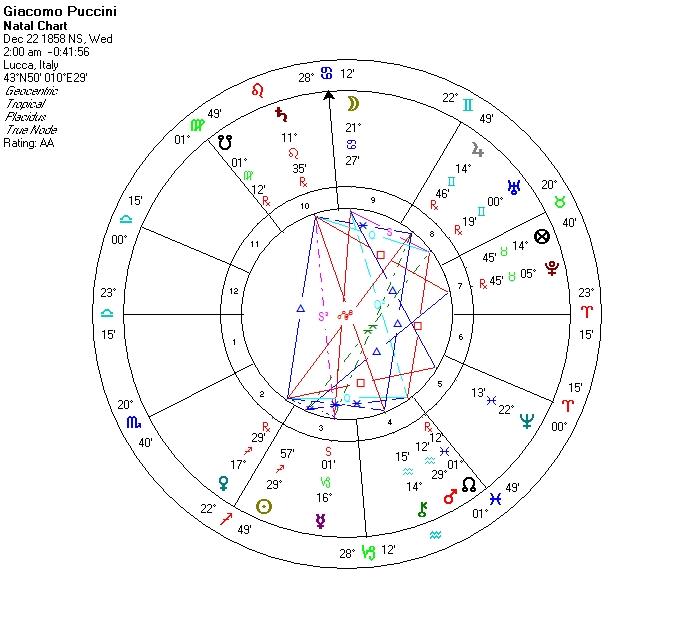
CHART appended to this transcript:
- FIGURE 1983 1003a-1. Puccini Natal Chart.
If someone is drawing or writing, with audible sounds of chalk on a blackboard, I indicate this by [drawing] or [writing].
NOTES:
This is a Monday, of which this is the Seminar Event of the day 1983 1003a; 1983 1003b = the Evening Class. There was also a Sunday class on Puccini 1983 1002. Information per Blue Book and JF's class notes.
Please also see the Puccini astrology events, June 1982.
TRANSCRIBED Verbatim by IT 2021. Archival verbatim transcript – V11a.
AUDIO FILES: 1983 1003a, 1983 1003b. [Note: "Tape" and "Side" refer to original audio cassette tapes that were later digitized into .MP3 Audio Files.]
1983 10/03a SEMINAR at Wisdom's Goldenrod
Astrology; Horoscope-Puccini
[Audio File 1983 1003a Begins]
RG: Well if we just took [one/two words inaudible] from the Saturn conjunction, that's the idea of the Eastern influences coming in, Neptune is-- and the Neptune opposite of it giving the cultural context that's really--
AD (faint): Yeah that's a possibility, definitely.
[12½ second pause]
S (very faint): That would be the--
AD (faint): Then we have this--
RG (faint): I was wondering if he needs the septile here.
AD (faint): You mean the sep-- septile Pluto--
S (very faint): That's right.
LR (very faint): Here is where the Neptune is. [S, very faint: Ok.] [one word inaudible] is the (poor) Neptune. And he had to stick to the [one word inaudible]
[short pause]
S (very faint): That's nice to know but--
JC: Do you think Eastern woman for him might have represented something of-- I mean a whole different type of female, possibly even represent something about his own soul, [student assents, very faint] and some form, feminine [one/two words inaudible] about his own soul, or let's say the Witness in this case, that kind of Witness stance. Because he was so involved with his-- the passion side of his being and that in Butterfly he couldn't-- he left her, you know, he left her to kill herself. In Turandot, he ends up winning the woman, and-- and the-- and the love of his love-- I mean the passionate side of him kills herself and she commits suicide. And he ends up winning the woman he wouldn't accept in Butterfly.
[11¼ second pause]
S (faint): Yeah.
AD (very faint, possibly part of background): I don't know if that was there.
JC: I wonder if that Pluto opposite Venus didn't indicate that now that Venus was going to have to reorient itself to some higher vision of what feminine is. What [TS simultaneously: Something, yeah.] (loving is) or something like that.
TS: It's almost like a full manifestation of what exactly his anima was like, and therefore laying the groundwork for that acceptance of a higher level. [student assents, very faint] It's like, you know, the final fulfillment of what he-- he had been operating with. 'Cause I see-- I see sometimes the opposition as like the fulfillment, the fruit, the final one or something.
JC (simultaneously, faint): I think that's right.
TS: Or the full Moon.
[short pause]
JC: Maybe he got married because he was running away from a-- a vision that came to him or something more, and was holding on.
[16 second pause]
RG: I mean, the other possibility is his wife-- I mean with the conjunction it was-- the idea was just coming in, it may be that [student assents, faint] it wasn't the septiles were in operation particularly. I mean I think we can get it pretty well out of the conjunction and the oppositions from Pluto and Nep-- Pluto and Neptune.
[29½ second pause]
LR: I can certainly see the image of Pinkerton.
RG: In where?
LR: The Sun and Saturn.
RG: Right, right.
LR: That-- that's real clear to me how he could have crystallized his own self-image through Pinkerton as Saturn, and [RG assents] I don't know how close Pinkerton in the play was to opera but-- I mean-- the combination of that regal-- the Pope [RG assents] entertaining the audience [Note: Sagittarius 30, "A picture of regal and sacerdotal pomp and glory reveals itself; the Pope is holding audience in his palace."] and the Japanese lanterns at the garden party [Note: Leo 12, "Japanese lanterns, music from a string ensemble and an animated interweaving of colorful figures mark a garden party."] really-- it's kind of this romanticized version of richness and power and [RG assents] elegance all put into the self-image, I could--
RG: Right and then you bring Neptune opposite that and you get a tremendous conflict with that self-image of himself as that idealized vision, self-image.
[10½ second pause]
LR: Bathing beauties. [RG assents] It's 30 Gemini. [Note: Gemini 30, "A typically American conceit is seen; a parade of bathing beauties before the judges and crowd at a seaside resort."]
RG (faint): Uh-hm.
AD: Well let's move on to another aspect.
RG (very faint): Uh-hm.
LR: Well Jupiter was opposite Uran-- well we have the Saturn on the Sun.
AD: Yeah. Opposite the Neptune. And your Pluto (was--)
LR (simultaneously): Pluto opposite Venus.
AD (faint): Ok. And septile to Neptune Pluto.
S (very faint): Yeah.
LR: Ok. Jupiter-- how about Jupiter opposite Uranus?
AD (faint): Ok, let's do that.
LR: Ok Jupiter-- it's still a degree that baffles me, it's "Two Dutch children in their immaculate…"
Marc Edmund Jones [The Astrology of Concepts, Gemini 15, LR reading]: "Two Dutch children in their immaculate native costumes are studying their lessons together."
AD (faint): Yeah.
LR: That's opposite the glass-bottom boat degree and-- [Note: Gemini 1, "A glass-bottomed boat drifts silently and easily over a constantly shifting panorama of marine wonders."] [12 second pause] I mean the two-- I mean--
AD: How does that-- how does he read it off there?
RG: The Ju-- natal Jupiter?
AD: No the two twin-- well--
LR: Yeah, two Dutch children.
AD (very faint): Dutch children.
[short pause, flipping of pages]
Marc Edmund Jones [The Astrology of Concepts, Gemini 15, RG reading]: "This is a symbol of the intimate converse with the spiritual actualities beneath and behind outer manifestation or the conscious approach to truth. Positively it is a degree of social concourse and open-mindedness; negatively [it is] an unsocial clinging to inward inspiration. [The] keyword is CLARITY."
[short pause]
Marc Edmund Jones [The Sabian Symbols in Astrology, Gemini 15, LR reading]: "…self-confidence of spirit by which man is able to establish himself advantageously at ease in any possible situation…"
AD (faint): This was opposite?
RG (faint): Uh-hm. (Well--)
LR (simultaneously, faint): Uh-hm.
AD (faint): Ask.
S (very faint): Well, go ahead.
LR: He's really being connected to another world that he formerly hadn't-- hadn't had or hadn't expressed. This degree they say is spiritual realities as the other-- the twins, one is the earthling and the other is the spiritual one.
AD (simultaneously, faint): And Uranus was the--
LR: Glass-bottom boat.
AD (faint): Uh-huh.
LR: That's a clear seeing. He's obviously getting connected with something that wasn't in his ken before.
S (very faint): That's not--
TS: And he says here--
Marc Edmund Jones [The Sabian Symbols in Astrology, Gemini 15, TS reading]: "[TS adds: Here] His rehearsal of experience here becomes vicarious and a matter of childlike or unconditioned familiarity with the simple contributions of [the] self to its milieu [at root], thus facilitating a more effective grasp of life on every practical or everyday level. All relationships are reduced to common elements of background [TS reads: backgrounds] and skills. [The] keyword is CLARIFICATION. When positive [TS reads: Positively], the degree is a self-confidence of spirit…negative, extreme provincialism…"
[9¼ second pause]
RG: Avery, where is the [LR simultaneously, faint: (Uh-hm.)] Jupiter degree floating around that music, (it's) [AS: 2.] between--
S: Well--
LR: Quick wind is making sport with the sea? [Note: Sagittarius 2, "A quick wind is making sport with the sea; through sharp mist as far as sight reaches are scurrying whitecaps."]
S (faint): Yeah.
AS: It go-- it stations and turns around (I think).
TS: Yeah.
AS: [one word inaudible] coming out of it, (he is) back at 1 or 2.
LR: It's a quick wind is [RG simultaneously, faint: That's right.] making sport with the sea.
AS: And it's also-- Jupiter is al-- also tri-septile Pluto, aspecting the Pluto also. And then the Sun's there.
LR: It's like a rousing of something of his libidinal energy that's from another place, that's from another culture or another-- Join in?
TS: It's almost like-- I don't know if I-- this makes any sense, [AD, very faint: Yeah.] that he-- by taking that formed culture, that the context of his own sort of ego structure could be individually highlighted whereas he was so embedded in his own kind of-- he was so familiar with the Dragon as it were, his own background and arrogance, that to distinguish out his own individuality was practically impossible. Whereas by throwing this-- by bringing in this foreign culture, this was a prefiguring of his-- of him getting a chance to see his own ego all by itself and not as-- as participating in or, you know, part of the collective. Just like a-- some kind of sense-- I mean I was thinking about the Neptune opposite the Sun in particular, that there was a beginning of some kind of individual awareness that's of a different order and that his-- there's a chance to see what kinds of-- the effects of his relationships really are, of-- of the Pluto opposite Venus, that-- or the consequences of the way in which he's going to-- living out his anima. Whether you look at the opera or the-- [LR, faint: Yeah.] the marriage, you know, we said that following through on something (and so) what are the consequences.
LR: There's something else it's [one word inaudible] which is that Jupiter is both in opposition to Uranus and in septile. So one level, Jupiter we said was the libido, instincts of the person. And, at the level of-- the third level we spoke of it as being inspiration or teacher. And it's coming in at both the septile level and the regular aspect level so that what's being worked on is not only his-- it's like the inspiration that's coming in is really changing around what those biological instinctual patterns are all about, both-- both because of Jupiter-- In other word-- I mean--
TS: Uh-hm.
LR: The native-- the symbol of the natal Jupiter is-- [short pause] that's-- the symbol I'm just suggesting can be interpreted on a biological as well as some kind of inspirational or spiritual and mental level. [short pause] Bringing in something larger than what's his usual biological [S, faint: Of course.] libidinal patterns.
TS (simultaneously): Well if you say transiting Jupiter is dharma, is some sense of rightness or correctness, of what is the right thing to do. Now, when he saw this o-- the play, he knew in a kind of an un-- unreflective way that this was the right thing to pursue, but it took him-- you know, it did take him some time to really accept that, that-- that the-- I could see that as being kind of a biological awareness of, you know, this is what I have to do now, this is the direction I should go in. But, you know, he-- this was during the time where he-- you know, he knew he-- he couldn't drive very well and he insisted on driving and he had this terrible car accident and he had to have his leg rebroken and to reset. [AD: Yeah.] So broke his leg, it set up badly and then they had to take-- smash it again. [RG: Right.] Right. Was wondering-- Certainly seems like that would (make it into resolute) destruction of the instincts, no? (And Andrew's) point of view.
S (very faint): Yeah.
S: I (just/guess)--
LR/S(?) (very faint): [few words inaudible]
AS (simultaneously): I guess I can't-- I haven't yet understood in this discussion-- Do you-- do you feel that this is like-- I mean he-- he's had this tendency for-- for a while, this certain anima that we spoke of as the Venus Mars. Does it seem like this is the goal-- is this bringing that to an end or is this the beginning of a new-- you know, is-- is this some new idea coming in which is going to culminate in this Turandot, is that what you were saying?
AD (simultaneously): Yeah I think it's possible to see that Uranus opposite the [AS simultaneously: That--] Jupiter like a-- that there's an aspect, you know, like there's a common-- an unknown aspect of the anima is coming out [AS assents] into the open.
AS: Uh-hm.
AD (faint): And it's, you know--
AS (very faint): [few words inaudible]
AD: That fascination, you know, with a-- a woman [AS simultaneously: Yeah, a German.] that-- of a different, you know [couple words inaudible] culture. It's--
AS (simultaneously): Yeah, what Jeff said made a lot of sense, [AD simultaneously: Yeah, uh-hm).] that that's the symbol of some other part of the soul that was unknown to him.
AD (simultaneously): Yeah, from the psyche or the anima, part of the anima, you know, which was basically unknown to him and it's facing the other way.
AS: 'Cause Jupiter-- 'cause that Jupiter Uranus Pluto, they're all aspecting, and Jupiter is opposite Uranus, Jupiter is tri-septile Pluto, Pluto is aspecting-- and Uranus is aspecting Pluto.
LR: (And/They) just carry on.
AD: Yeah the whole point [AS simultaneously, faint: They're all--] here is, the whole point here is that looking at all these aspects, I think what you see is a set-up, the atmosphere is being set up, [student assents, very faint] and that the day he saw that play I think the conviction came in, you know, unconsciously but he couldn't really understand it consciously. [AS assents, faint] And that's why he waited for such a long time.
S: Well, it clearly--
AD: But he knew he was going to write this all the time, he knew this. He knew he was going to write this opera. [AS assents, very faint] Oh, what's more fascinating than a fifteen year old Japanese girl for a man like him?
JC (faint): Hm.
S (very faint): (Let's go.)
JC: His only--
S (faint whisper): What'd he (say)?
AD: Yeah.
LR (faint whisper): Ten.
RG (faint): Eight.
S (faint): Now we know how--
S: She was older.
AS/S(?): [few words inaudible]
AD (simultaneously): No, she was fifteen. So was Juliet.
LR (faint): (Oh yeah.)
S (faint whisper): Oh.
S: Yeah. I mean that--
LR (simultaneously, faint): That's right.
RG: (Really?)
LR (faint): [few words inaudible] (LR laughs, AS laughs)
AD: Things have changed a little, don't worry.
AS: Yeah.
TS: Give me that [one word inaudible]
RG: (Doing it for nothing.) (RG laughs a bit)
AS: Anyhow, we should be able to see something of-- when you say it's a set-up, we're talking about the regular aspects.
AD: Yeah.
AS: We should be able to see in the septiles-- I mean there's three septiles coming in.
AD (simultaneously): Yeah, that's why I wasn't able to understand that Pluto-- that Neptune septiling Pluto.
AS: Yeah.
RG: But if it's just a set-up and he doesn't get the idea, maybe [AD simultaneously, faint: Yeah.] they weren't coming in. It's not just [student assents] every septile [couple/few words inaudible]
AS (simultaneously): No that's true but [couple/three words inaudible]
AD (simultaneously with RG and AS): Very-- very often a presentation is being made, you know, a sensible presentation is being made which is loaded with meaning, but it may take a long time before you see it.
LR (simultaneously): To get it conscious.
AS: But-- [S simultaneously, very faint: Yeah.] but you know, you would normally say it but, I mean, he-- the regular aspects he has involve the planets that are septiling, [RG assents] I mean-- There were-- you'd-- you know, you'd want to say well what el-- what more-- [RG simultaneously: I know but I don't think--] what more would you want in a situation for him to--
TS: Well he was going to plays all the time, I think that that-- it was the Neptune Pluto septile was giving him the sense that-- of a dissatisfaction with the way he had been working such that he was looking for something more. Pluto--
AD: Which one?
TS: The Neptune septile Pluto.
AD: Oh, yeah.
TS: I mean I don't think that it gave him an idea about-- it wasn't the idea of Tur-- of Butterfly. But it was an idea that he was-- that he should be looking.
AS (simultaneously): Yeah, (the) looking.
TS: 'Cause sometimes he took it easy for several years, he didn't exactly rush to the next opera every time, you know. But, this one right away he--
AS (simultaneously): Yeah, he was immediately uneasy.
TS: He was uneasy even before he finished Tosca and he was looking, you know, and I could see the Neptune degree was-- the degree I sort of like, the 28, um--
AS: Sure, I mean that's right.
AD (faint): Which [one/two words inaudible]
TS (simultaneously): A man declared bankrupt. [Note: Gemini 28, "A man is leaving a courtroom with mixed feelings of relief and determination; he has just passed through bankruptcy."] You know, if you say that that's the [AS simultaneously: I could see that.] Neptune, that that's the-- his sense of his feelings were that there was a certain bankruptcy and that-- let's say he was ready in that-- that that was part of the environment, he was looking to get a new idea, he had a-- he had an idea that something was over, he was ready to leave a-- a certain stage.
AS: Yeah he was finished with-- yeah, within.
TS: With Tosca, I mean he did--
AD (simultaneously): Yeah he was finished [AS simultaneously: With the Tosca.] with the Italian [one word inaudible] [TS simultaneously: Yeah.] you know.
TS: Yeah he had used them up [couple words inaudible]
AS (simultaneously): And now he needed some foreign [student assents] elements. I mean then he did Girl of the Golden West [couple words inaudible] the America [couple words inaudible]
AD (simultaneously): You girls surprised to hear all this stuff?
S: No.
AD: Oh, ok.
AS (simultaneously): (Then he came) [S simultaneously: Not at all.] (to) America.
AD: Not at all, good.
CDA: [couple/three words inaudible] vasana.
LR (simultaneously): There's a few macho degrees around here, Tim, right? (bit of laughter)
AS: Some of the women may even have them. What happens if a woman gets a macho degree?
S (very faint): Yeah.
RG (very faint): Ok.
S (very faint): They won't (know about it). (bit of laughter)
[short pause]
S: Hm.
CDA: I got one.
AS: Oh. (CDA laughs)
S: Do you have a [couple words inaudible]
CDA: I have not but-- I have the grimy workmen are drilling for oil. [Note: Gemini 6, "In flaring artificial light, amidst ghostly steam escaping through the rigging, grimy workmen are drilling for oil."] (CDA laughs a bit)
AS (faint): That's (good/God).
AD: That's not a macho degree.
S: (Yeah.)
S (simultaneously): Carol--
S (faint whisper): It's not, no.
CDA: So?
AD: That's a procrastinator's degree.
CDA (laughing): That too.
S: (I need it.)
TS: I always thought it was people walking [few words inaudible]
AD: Yeah. Same difference. [CDA simultaneously: I (few words inaudible) (CDA laughing)] You know how they drill-- drill for oil, they [TS assents] take a break every hour for coffee and--
TS: Look in the wrong places first.
AD: First.
AS (simultaneously): Or tomorrow. (CDA laughs a bit)
S (faint): Oh God.
AD: Tomorrow. Oh tomorrow is a holiday, the day after.
CDA/S(?): Very funny Tony.
S (faint): Well ok. (CDA laughs, bit of laughter)
S (faint): Yeah, that's--
S: [one word inaudible]
TS (simultaneously): [couple word inaudible] [S simultaneously: Go ahead.] [couple words inaudible] sometimes difficult but the hell (with it).
AS: I-- I un-- I can understand that Tim.
S (faint): Uh-hm.
AS: I-- I think I see what you're saying. In other words, what's coming in at the level of the septile-- it-- this is-- this-- this-- this [one word inaudible] him with a real-- it's a big idea to come in [one word inaudible]
AD (simultaneously): It's a discontent, dissatisfaction, the feminine ideal he was working with.
LR: That's a septile?
AS: Well, it's a fixed idea.
AD (simultaneously): Tim is-- Tim is making a remark that the septile seems to indicate-- indicate a dissatisfaction with the feminine ideals (bit of laughter) that he's been portraying in the opera.
AS: That's the Neptune degree, it's the transiting Neptune.
AD (simultaneously): Because, what did he before that, Flora-- Flora in Tosca and Mimi in La Boheme and--
TS: Manon Lescaut.
AD: Manon Lescaut.
AS: Oh yeah.
AD: This here very European type of woman all the time. [AS assents] There's not much difference between Manon Lescaut and-- and Flora.
TS: Yeah.
AS: No, he really would have to get angry. Yeah.
AD/S(?) (faint): Yeah. (CDA laughs a bit)
AS (faint): It seems that--
CDA: [couple/three words inaudible]
LR: He didn't want to see them all.
AS: Now, may-- may-- (I don't know--) I don't know if I think--
AD: One was devoted to, who was it, Mario, and the other one was devoted to jewels. (AD laughs a bit)
LR: Boring, boring, boring.
AS: I (didn't/just) think that it goes down.
LR: Just can't accept that as the meaning of the septile.
RG/AS(?): Who is that?
AD: The septile? [S simultaneously, faint: (Yeah.)] Why not?
LR: Well Tim's saying-- bringing it in from the degree, right?
TS: Yeah.
AD: He's bringing it in from--
LR (simultaneously): Bankrupt.
AD: Yeah, and [AS: Yeah.] the-- the Pluto-- [AS simultaneously: That's the idea.] the Pluto degree, you know--
AS: The bridge.
LR (very faint): (I don't know.)
AD: No?
AS: And the Pluto degree is the bridge. [Note: Taurus 6, "A delicate cantilever bridge is in process of construction across a high narrow gorge."]
AD: Yeah.
AS: The natal Pluto degree is-- is that should become-- should be able and made available. I mean--
LR: Everything we've said about trans-Saturnians [S simultaneously: Yeah.] and septiles, does it seem that-- Two trans-Saturnians in septile means you get bored with a woman?
AS: Hey but you know that's-- for him.
TS: Hey, for this guy! (TS laughs)
AS: But for him that's a [few words inaudible]
AD (simultaneously): [few words inaudible] got in.
AS: Yeah. That might be, for somebody else it might not be, but for him, it might be a tremendous--
AD (simultaneously): Listen. With a-- with a woman?
LR: Women.
AS: No, gonna lead him to a whole new--
LR: Culture.
AS: Culture, for one thing.
LR: Yeah, no, I see what you're saying, I'm just--
AS (simultaneously): The Neptune, so?
RG (simultaneously): I don't see why you don't get it for the Pluto opposition. The Venus--
LR (simultaneously): Pluto opposite [AS simultaneously: Or even the Neptune.] Venus is much more like--
RG (simultaneously): They're much more like that.
LR (faint): Well I'm saying--
AS (simultaneously): Or even the Neptune opposition. That's the problem, see, the Neptune is also opposite the Sun, this whole idea of a new culture.
AD: Yeah but what the Pluto opposition, would that set him a certain--
RG: I think so, the Plu-- what, the 17 Gemini, the degree right before this--
Marc Edmund Jones [The Astrology of Concepts, Gemini 17, RG reading]: "The head of a handsome [youthful] athlete slowly changes into a different type of beauty, the mature thinker."
AD: Uh-hm.
RG: That degree would bring about [AS assents] a change, (wouldn't it)? Change [AS simultaneously: What?] of levels of the anima.
LR (simultaneously): 17 Gemini.
AS: Oh, is that the degree where it was? Yeah. (Stood) up.
RG: Right.
TS: Uh-uh.
RG/S(?) (faint): What do you mean [one word inaudible]
AS (simultaneously): Tim thinks it was 18.
RG: It was there, it was at 17 and 18 for six months, [AS simultaneously: Yeah.] it was up and down.
TS: Yeah.
RG: I mean compo-- I mean that--
AS: Yeah.
RG: Before we go to--
LR: Hear, hear Dickie, I'd go with-- I think that that's much more (like/alike) than the Neptune.
AD: Alright, since there's such unanimous agreement about these here, let's go to the next event. (RG laughs)
LR: It is (a joy).
TS: Having clarified this event thoroughly. Well let's try some of them there's actual dates for.
RG (simultaneously): You might as [couple/few words inaudible] every other day.
AS (simultaneously): You're not going to hit that quintile at all?
RG: Hm.
S (faint): (What's wrong?)
AD: Again, wouldn't--
S: Last year.
TS (simultaneously): It's only to a mother [LR simultaneously: Same degree.] with her children, that's all. [Note: Sagittarius 9, "A mother is leading her children up a broad flight of steps; they enjoy the task of lifting little feet."]
AD: What?
TS: Uranus degree is a mother with her children.
LR (faint): The transiting Uranus?
TS: Yeah, transiting Uranus.
RG: Hm.
AS: Yeah.
AD: Making a quintile to--
LR (faint): Pluto [TS simultaneously: Pluto.] I would think.
AS (simultaneously): Hm.
LR (faint): Uh-hm.
AS: And that seems right. That seems almost--
TS: But of course that [couple inaudible AS words simultaneous with TS] means you have to accept the other ones.
RG: (Read it.)
AD: Read off that Uranus again.
RG: What's transiting, degree was what?
LR (simultaneously): Last-- the-- the transiting one?
RG: Where was it at?
LR: Where's the natal?
AS (simultaneously): Oh I'm sorry, may-- maybe-- [RG: 9 was--] maybe we should [LR simultaneously, faint: Sagittarius?] just accept your intuition as to the correct date of the thing and go by that. (AS laughs a bit)
TS: No.
AS: No [couple/three words inaudible]
Marc Edmund Jones [The Astrology of Concepts, Sagittarius 9, RG reading (simultaneously with AS above)]: "A mother is leading her children up a broad flight of steps; they enjoy the task of lifting little feet."
[short pause]
AD: Yeah.
Marc Edmund Jones [The Sabian Symbols in Astrology, Sagittarius 9, TS reading]: "[This is a] symbol of [TS adds: the] extreme alertness to the interests and needs of others…"
RG: Well it's very different here.
Marc Edmund Jones [The Astrology of Concepts, Sagittarius 9, RG reading]: "This is a symbol of the conscious advance of selfhood from plane to plane or the…"
AD (simultaneously): Yeah, yeah.
AS: Yeah, it's more like--
AD: I think that-- I think that whole day was a set-up for him. That period of time was a set-up.
RG: Right, so the quin--
AD (simultaneously): Transition from one plane to another. I mean from Flora to Butterfly. It's an enormous leap. When a man begins to get suspicious that he loves a woman for other and biolo-- biological reasons, it's a transition from one plane to another. [student assents, very faint] [short pause] 'Cause I think one of the things we remarked about his chart was the definition, the anima function getting escalated.
RG: Uh-hm.
LR: Yeah.
[short pause]
AD: After all he's working himself up to a Neptune sextile Venus.
RG: Hm.
[short pause]
AS (very faint): What?
LR: Pluto?
RG (faint): Neptune (square)?
AD (faint): Out of the mouth, you know?
S (faint): Is that (then/in)--
AS/S(?) (simultaneously, faint): Maybe it was close to this time. (bit of laughter)
RG/AS(?): Hm. (bit of laughter)
AD (very faint): No, let's not start.
AS (faint): I didn't [couple/three words inaudible]
RG: Yeah. What are you ta-- [couple inaudible CDA words simultaneous with AD] Yeah but (then) he's there for. (RG laughing, laughter)
S (very faint): Yeah. It just looks like [one/two words inaudible]
S (faint): No that's-- (RG laughs a bit)
S (very faint): It's a watermelon.
S: It's a beet. (bit of laughter)
S: There's two in there.
S: Looks just like a beet.
AS (simultaneously): No, looks like it.
RG (simultaneously): (Does it really matter?)
AS (simultaneously): I think it's a beet.
S: Beet.
AS: It's a beet.
RG: Oh it looks just like tomato.
S (simultaneously, faint): It fell out of that tray [couple words inaudible] just put it there.
AD: Let's take back what I said. [short pause] Let's take the next event.
CDA: The Moon [RG assents, faint] is void of course.
LR (simultaneously): Let's get one that's not--
AD: Huh?
RG (simultaneously): What do you mean?
CDA (faint): Maybe the Moon is void of course.
AD: Maybe the Moon is void of course? (Give me/You mean) [couple/three words inaudible]
TS (simultaneously): I think the Sun is void of course. (bit of laughter)
RG: We're void of course.
TS: Yeah. (bit of laughter) Mercury went [couple words inaudible]
AD (simultaneously): Well, we're not that-- we're not that way. If you notice, you have to discuss this thing for quite a bit a while before the atmosphere is evoked from [RG assents, faint] all these aspects. [RG assents, faint] You're not going to get to it, you know, [TS assents] like most of the astrologers.
RG (faint): Got the machine back.
AD (simultaneously): You're looking at your brain again?
RG (simultaneously): Is that what I said? (AD and RG laugh)
TS: Dusty.
[short pause]
RG: So that's from that event and we have dates for--
LR (simultaneously): Do we have any exact dates?
AD (simultaneously): Let's do the next event. Hopefully it's exact or close. What was the next event, writing? Writing of the opera was two years later?
TS (simultaneously): Yeah. Ok. In 19-- in A-- April of 1901 he began his musical work. I don't have a day in April.
AS (faint): Yeah.
LR: Butterfly.
TS: Yeah.
AS/S(?): Yes.
TS: But that's when he began-- he got permission--
AD: He got permission to do the play, yeah.
S (faint): Uh-hm.
AS: Hm. Oh yeah?
LR (faint): Yeah.
TS: Ok. Um-- Let me just tell you what the dates are and you can see just-- He was really-- it-- Now April 1901 he was-- began trying to do-- do the music. Spring of 1902 he began working on this-- doing his research on Japanese music. February 1903, February 25th 1903 he broke his leg in a car accident. September 15th 1903 he finally completed Act I. So it took him about two years to write Act I. Now we have the actual date of when he finished Act I. I don't have the month he began writing the music. That's all I got for this, the Chinese o--
RG: Yeah.
TS: Then we know when he premiered it. That's the other date I have exact.
RG (simultaneously): Uh-hm.
TS: You want to try April?
RG (simultaneously): I think he started writing in--
AD (simultaneously): Yeah, why-- why not?
RG (simultaneously): April. Yeah.
AD: The day he started writing.
TS (faint): Ok [one/two words inaudible]
AS (simultaneously): This-- the planets are pretty stationary around here.
[Transcriber note: For the next few minutes TS looks up aspects on a machine that makes a lot of noise. This makes the conversation difficult to hear. Note from JF: Digicomp DR-70 Astrology Computer, one of which was at Wisdom's Goldenrod, next to the dining table, where many seminars were held. https://www.computerhistory.org/collections/catalog/102746921.]
TS: Yeah let's hope, let's hope.
AS (faint): You already have Uranus, Saturn [student assents, faint] within a degree (from Uranus Neptune). Why don't you go with that. [couple inaudible student words simultaneous with AS] You can't take up [one/two words inaudible] You can have two [one word inaudible] degrees.
TS (very faint): [few words inaudible]
AS (faint): Pluto's been stationed [few words inaudible]
TS (very faint): But didn't he have [few words inaudible]
AD (faint): Yeah, yeah.
TS (very faint): I wanted some help. [few words inaudible]
AD: He's still alive.
TS: No.
S (faint): (Uh-hm.)
TS (faint): Oh he is?
[short pause]
AS (very faint): [few words inaudible]
TS (faint): Uh-hm, good.
AS (faint): And in fact they're-- they're there.
TS (very faint): Yes but long term.
AD (very faint): Stationary?
AS (faint): Within a degree. Uranus is stationed, is on the same degree in March and April, Saturn for April, May, two thirds [one word inaudible]
LR (simultaneously): Saturn's on the Sun? I'm sorry.
AS (simultaneously, faint): Saturn's at 16 Capricorn. Just about on the--
TS (faint): Yeah, so the Sun is at 25 Aries.
AS (faint): Pluto's right on Jupiter, square the Uranus.
RG (very faint): Ok.
TS (faint): Mercury's 30 Pisces.
JC (very faint): It's 30 Pisces.
TS (faint): So Mercury is--
AS (faint): Well [few words inaudible]
RG: Stationary?
TS (faint): No.
RG (faint): No. (Figured.)
TS: Hey.
S (faint): Come on Richard.
RG (faint): You can.
AS: Yeah.
RG/S(?) (faint): Yeah.
S (faint): Go ahead, go on.
AD (faint): Well go ahead, have him finish.
AS (faint): It's Jupiter seems like-- Jupiter's practically stationary [RG assents, faint] at 12 or 13 again, just the--
S (faint): Uh-hm.
TS (faint): At what, 13? Jupiter's at 13 Capricorn. So here we have (a planet).
RG (faint): That was the--
S (very faint): Uh-huh.
AS (faint): Yeah.
S (faint): Actually twofold.
TS (faint): Saturn is at 16, 17 Capricorn.
AS (faint): Yeah. Better than Jupiter.
S (very faint): Yeah. Go ahead, (Tim).
TS (simultaneously, faint): Uranus is 18, retrograde is 17 Sag.
RG (faint): Saturn on the Sun so, you said a Mercury [few words inaudible]
LR (simultaneously): Wait a minute, Uranus is stationary at what?
AS (faint): 17.
TS (simultaneously, faint): 17 Sag.
LR: Go ahead.
AS (very faint): Which is quintile [couple words inaudible]
TS (faint): And that thing was-- I have 27 Gemini. Pluto is at 27 Gemini. Oops.
AS (faint): Pluto is-- yeah.
TS (faint): 17 Gemini because-- because Uranus--
LR (simultaneously, faint): I thought it was 17.
AS (faint): Uranus Pluto conjunction..
TS (simultaneously): Pluto opposition.
LR: Opposition in the sky.
AS (simultaneously, very faint): Opposition.
TS (faint): And [couple words inaudible] tell me [couple words inaudible]
RG (faint): Hm. Had Uranus on the Moon.
RG/TS(?) (faint): Opposite Neptune? I don't see these.
RG (faint): Saturn on Mercury.
LR (faint): Uranus on Mercury. No Uranus on his-- right.
RG (simultaneously, faint): No, Uranus on the Moon.
AD/S(?) (faint): Alright.
RG (very faint): Pluto was at [few words inaudible]
AD/S(?) (very faint): (Yeah.)
S (very faint): [few words inaudible]
[short pause]
TS (faint): Saturn [one word inaudible]
S (very faint): Uh-hm.
RG (faint): Got the idea [few words inaudible] (Sun was on) the Sun. And then that Saturn on Mercury.
AD (simultaneously, very faint): (That's/It's) good.
AS (faint): It is on the Sun. It is on his Moon.
RG: Yeah Jonathan.
S (very faint): Yeah.
TS: See he only had two septiles, he had Neptune septile Pluto again. (And he had--)
AS: And Saturn bi-septile Saturn?
TS: Yeah.
AS: That's-- that's very interesting. 'Cause that's his natal septile and [couple words inaudible]
TS (simultaneously): It's interesting, he had Uranus aspecting that-- the group of quintiles that formed by the Moon Venus and Mars.
AD (simultaneously): Yeah, yeah.
TS: And that's when he actually got the music.
RG: Uh-hm.
S (faint): Yeah, uh-hm.
AS: And that is-- it is quintile that. 'Cause it's on-- it's quintile and is on the Venus.
TS: Yeah it's-- it's on the Venus quintile Mars and bi-quintile the Moon. If Uranus--
AD/S(?) (faint): That would be difficult.
TS: Actually we don't know but on the 15th of April which is the middle of the month [RG assents] it was at 17 Sag. [someone drawing/writing] And if you want to take the [few words inaudible]
AS (simultaneously): It was-- it was probably coasting slow because according to this it was-- it went stationary some time between March and April. It actually went station--
AD (simultaneously): So, tell me, what do you know of the Uranus Venus conjunct? (bit of laughter)
RG: Yeah. (RG laughs a bit)
TS: Things, dangerous things that I ever had. (TS laughs) It'll set you up for the Pluto Venus opposition.
AD: Huh? (TS laughs a bit)
S (faint): Uh-hm.
TS: And certainly there would be an intensification of the feelings and the-- we (said/say) the higher knower, there's going to be a concentration on the value of the feeling awareness and the-- It's almost like the complete inundation of the feeling function.
AD: An intensification of the anima?
TS: Yes. He-- I suppose you could say that there's a liberation, um-- [student assents, faint] and--
AD: Well, for some it might be a liberation, for most [student assents] of us it would be an intensification.
TS: Yeah.
[short pause]
AS: I just want to see this, but, that's the right degree, it says degree is an Easter sunrise service where the Uranus is, [Note: Sagittarius 17, "An Easter sunrise service is about to begin at the suggestion of dawn; darkness surrenders to the worshippers."] the transiting Uranus.
RG: Yeah.
AS: Keyword is REBIRTH.
S: Hm.
Marc Edmund Jones [The Sabian Symbols in Astrology, Sagittarius 17, AS reading]: "[This is a] symbol of man's achievement on the level of spiritual or eternal [AS reads: of eternal spiritual] fellowship with others, [here] emphasized [objectively] by the enduring values he is able to dramatize for himself in everyday religious terms. … [short pause] [The] keyword is REBIRTH. [When] positive, [the degree is] an unusual realization of immortal resources [and an] ability to employ them wisely…"
AD (simultaneously): That's the Uranus on 17?
AS: That's the transiting Uranus.
Marc Edmund Jones [The Sabian Symbols in Astrology, Sagittarius 17, AS reading]: "…and [when] negative, over-concern with superficial form and ceremony."
[12 second pause]
AS (faint): But that seems involved in quintiles, the actual--
RG (faint): That's right.
AS (very faint): Writing the music.
AD: I imagine it will have triggered off or activated that whole--
RG: Yeah the whole complex.
AS: Yeah, sure.
AD (simultaneously): Yeah, that whole complex. [short pause] Maybe that's why he couldn't possibly experience that as a freeing process.
RG: 'Cause it was tied into that quintile.
AD (simultaneously, faint): It was tied in to the other.
RG/S(?): Uh-hm.
AS (very faint): Yeah.
RG: It automatically ticked off the Mars.
AD: Uh-hm.
RG/S(?) (faint): And Venus.
S (faint) Venus.
AS: That's the sep-- [LR simultaneously: So that's an interesting thing.] That points to an [one word inaudible] just in general, quintiles.
RG (simultaneously): Unless it did bring him to a new level [LR simultaneously: Because--] of feeling, to that level. I mean may-- I mean if we're saying that that music represents a transformation of his anima in some sense, that it did-- it could have elevated him let's say to the qui-- a level above the sensible to the level of the quintile. And there was some psychic recognition in that aspect, in the conjunction and the quintiles, that he--
LR (simultaneously): That it kicks off-- that's-- it's very interesting because there's another case of that too, Saturn is on Mercury.
RG: Right, yeah.
LR (simultaneously): And Mercury Saturn natally have a septile.
RG: Uh-hm. Even that Saturn is septile.
LR (simultaneously): So, we're saying something like, you know, these aspects come by and they kick off these quintiles and septiles in the natal chart which perhaps were not operative.
AD: Yeah or--
LR (simultaneously): But something about the groove being set in the natal [student assents] chart, then when all the planets na-- you know, transiting form an aspect--
RG: Right. Well that just happened to me 'cause Saturn went opposite my Mercury which was my Mercury Saturn Pluto septile, it was-- so it could [couple words inaudible]
LR (simultaneously, faint): Yeah.
RG: It does seem to do that.
LR: (Well it) does seem to work--
AS (simultaneously): Brings some fresh energy into the-- [RG simultaneously: Into the natal, uh-hm.] if there's a groove of some (kind).
LR: Into the natal grooves, the patterns of fixity.
AS (simultaneously): Yeah, it's this propensity to formulate [RG assents, very faint] this experience here. But it seems to be--
LR (simultaneously): Yeah, like we didn't talk about this natal Mercury Saturn septile-- tri-septile but that was exact in his chart.
AD: Well let's hear them.
LR: So now he's got Saturn on Mercury.
AD: Yeah, Saturn on Mercury, 'cause usually a manifestation takes place then. If they're originally aspected [LR simultaneously: Yeah that's--] that closely, the most important aspect will manifest [RG: Right.] what-- what was hidden or unmanifest. Not that the functions weren't operative but [RG simultaneously: (Yeah/Right), they really bring them out.] that-- that (activity) becomes-- it's manifest, it comes out. So, let's read that Mercury, um-- uh--
LR: That's-- ok.
RG (simultaneously): Mercury's 17 Capricorn.
Marc Edmund Jones [The Astrology of Concepts, Capricorn 17, LR reading]: "A mature but long repressed young woman is bathing surreptitiously in the nude and finding a release in spirit."
[short pause]
AD: That was the Mercury, right? Why don't we read a little bit from the Mercury.
[short pause]
Marc Edmund Jones [The Sabian Symbols in Astrology, Capricorn 17, TS reading]: "[This is] a symbol of the irresistible desire of all life to strip back to essentials…"
LR: Oh God.
AD: Don't start undressing please.
TS (simultaneously): Alright. (bit of laughter)
Marc Edmund Jones [The Sabian Symbols in Astrology, Capricorn 17, TS reading]: "…to gain self-renewal by some immediate and close intimacy with the accepted roots of all-being."
TS: Oh boy, this is hard.
RG/S(?) (simultaneously): Explain maybe.
Marc Edmund Jones [The Sabian Symbols in Astrology, Capricorn 17, TS reading]: "Implicit in the symbolism is the spiritual significance of the human body as a temple of the spirit, or as the archetype [TS reads: archetypal] representing [TS adds: of] the total potentiality in a personal existence."
TS: They're all English words. (bit of laughter)
AS: But you put them together to-- ok.
LR (simultaneously): No, that wasn't that bad.
RG: No.
LR: It's real appropriate for him.
Marc Edmund Jones [The Sabian Symbols in Astrology, Capricorn 17, TS reading]: "[Here is] [TS adds: a] successful resort to self-sacrifice or psychological renunciation [TS: He renounces his psychology.] in order to achieve a new dimension of conscious reality."
AS (faint): Hm. I could see how he's interpreting that.
Marc Edmund Jones [The Sabian Symbols in Astrology, Capricorn 17, TS reading]: "[The] keyword is IMMERSION. [When positive, the degree is] highly effective dramatization of the basic characteristics and potentials of self, [and] when negative [TS reads: negatively], furtiveness or eccentricity."
LR: What does that one say [one/two words inaudible]
Marc Edmund Jones [The Astrology of Concepts, Capricorn 17, RG reading]: "[This is a] symbol of the escape from bondage to inhibitions…"
AD: To what?
RG: To inhibitions.
Marc Edmund Jones [The Astrology of Concepts, Capricorn 17, RG reading]: "…or the [TS simultaneously: Oh.] passing phase of sacri…"
JA (simultaneously, faint): From bondage to inhibition.
RG: Yeah.
LR: Oh.
Marc Edmund Jones [The Astrology of Concepts, Capricorn 17, RG reading]: "…or the passing phase…"
AD (faint): Alright.
S (faint): [few words inaudible]
LR: Oh, Jeanne's got--
AS (simultaneously): Yeah. Quite an escape. (AS laughs)
RG: Right.
LR: Escape net.
AS (laughing): Yeah but--
RG: He escaped [AS simultaneously, faint: From (bondage).] from bondage to inhibitions.
AS: No.
S (simultaneously, faint): No.
S: No.
LR: Escaped from the--
AD (simultaneously): Well, from bondage.
JA (faint): From bondage to inhibition.
AS: To. He has [TS simultaneously: Ok, if you say that--] bondage to intuitions and--
LR: Escaped from the bondage of [S: Avery?] the body, it's just--
RG (simultaneously): Escaped from bondage to inhibitions.
LR: Yeah right.
BB (simultaneously): Yes, there you go.
RG: I thought it was a new level the way you read it.
AS: Yeah! (laughter, student words) That's what I thought when you were reading. (AS laughing)
RG: Well it could be. (some laughter) (Right./Well--)
LR: No it's-- doesn't go along with the [one/two words inaudible]
AS (simultaneously): It's some-- some escape though. (laughter)
RG (faint): (You're/Yeah) right, do it again. I don't know what-- (bit of laughter, student words) "This is…"
Marc Edmund Jones [The Astrology of Concepts, Capricorn 17, RG reading]: "This is a symbol of the escape from bondage to inhibitions [S simultaneously, faint: This isn't (an issue/emotional). (bit of laughter)] or the passing phase of sacrifice through which man the better disciplines himself. Positively [it is] a degree of joying in physical potentiality; negatively, a holding of self to exact accounting. [The] keyword is IMMOLATION."
LR: Yeah immersion in the body. Immersion in the essentials, the reality of the body.
RG: But it's a-- a strip-- [LR simultaneously: Finding freedom in that.] find-- is he finding release-- (that's right).
AS (simultaneously): He's strip-- Isn't he-- he's stripping away-- [S, faint: Yeah.] or he's stripping away the illusions about what the body [RG simultaneously: That's right, right, letting a-- right.] is and getting a real nature. I mean like he's-- would you say Anthony, I mean it sounds like he's stripping away the imagery of the body to get to the real immersion in it, because that's going to be the result of that Mercury is to perceive-- see what the body really is like instead of the imagery that it (was) associated with.
AD (simultaneously): And the Saturn was a--
S: Oh it's the Japanese lanterns?
LR (simultaneously): Japanese lanterns.
S (faint): Quite a trip.
LR: Here it is.
Marc Edmund Jones [The Astrology of Concepts, Leo 12, LR reading]: "Japanese lanterns, music from a string ensemble and an animated interweaving of colorful figures mark a garden party."
AD: But, Japanese lanterns and string ensemble, they don't go together.
LR: I know. (AS laughs)
S (very faint): Yeah.
AS: Yeah.
CDA: They do in suburbia.
AS: And isn't that funny, isn't that funny [few inaudible JC words simultaneous with AS] about his Saturn, I mean it would-- there's something in him that is incongruous. I mean-- I mean at a certain point, it seems, he has-- his Saturn has a certain way-- I mean outwardly you know he's a Western person with a wife, you know, and yet he suddenly-- he develops this interest in this Eastern, in a-- in a totally incongruous--
TS: Not to mention girls that go both ways.
AS: Yeah.
TS: I mean he's not exactly coming out of his own life experience.
AS: Yeah, I mean that--
LR: Or Manon going to the desert in Louisiana.
AS: Yeah.
TS: Yes.
AS: There's some-- (bit of laughter)
S (very faint): Right.
LR: She dies on the desert in Louisiana. (bit of laughter)
S (very faint): Right.
S (very faint): Uh-hm.
AD: Well no one has been able to figure out the last act of Manon, don't you try.
AS: Does anybody ever lis-- (if/did) you listen to, I don't think. (AS laughs)
TS: Yeah.
S: (Well--/Right.)
LR (very faint): So many people.
RG: Hm?
LR/S(?) (very faint, possibly part of background): That's very helpful John. [one/two words inaudible]
AS (faint): Hm? Yeah. Tim had a good--
S (faint): I ought to start bringing it.
LR: Yeah.
AS: I know, after the preview, af-- I mean--
LR (faint): I'm almost out of it.
AS: [couple words inaudible] he wants, [student assents] just send them off. Should accept (it).
AD (very faint): Do one more. Let's have [couple words inaudible]
RG (very faint): This Saturn [couple words inaudible] Do one more.
S (faint): What?
TS (very faint): [few words inaudible]
RG (simultaneously, faint): Yeah.
[13¼ second pause]
AS: This short one is all [couple words inaudible]
LR (simultaneously): I-- I have a question about Saturn, [AS simultaneously: Yeah.] the meaning of Saturn. You know how you say Saturn is the way one thinks of himself, the apperceptive sense one has of himself? So, you could say from this degree that he thought of himself kind of as a romantic idealized vers-- you know, a real bandy, a real lively, romantic [AD, faint: Uh-hm.] kind of guy. But my question is, when you say that Saturn is the way one thinks of the ego, is that the way the ego is or is that just the way he thinks of the ego? I mean, to-- when you interpret someone's Saturn, is it a description of the ego proper or the way-- well, my question is, I don't know how to ask it differently. Is it one's imagination of what one is or is it actually a description of the stance of the ego, the poise of the ego? How do you see it, just-- 'Cause those aren't always the same thing to me.
S (very faint): That's it.
AS (faint): Yeah that's a question.
[short pause]
LR: Because I've come up against that a few times, not unders-- in trying to understand Saturn symbols, Saturn degrees. Or is there any difference, I mean-- You know, the ego doesn't really have an existence so the way you think of yourself is in a sense what you're defining as the ego, right? Or maybe it's not even a question.
AD: I think you're looking at Saturn as though everything, all the others are sub-- underneath it, subsumed underneath it. Whereas the way I thought of it was simply the way Saturn functions and does not include the functioning of the others.
AS: So the [RG simultaneously: It's a totality (one word inaudible)] answer would be it's just your view of the ego, it isn't the way the ego is.
RG: Every other planet would have its own view of the ego.
AD (simultaneously): Yeah.
LR (faint): Ok.
RG: Didn't that get-- he had septiling? It's like this is Mercury, that-- that repressed young woman. It's like his conceptualizing mind in order to free itself from-- from accepted values had to draw on foreign elements from this way-- within his reflective consciousness, and that was his predisposi-- predisposed attitude of mind.
LR: Say it again?
AD: Ok.
RG: That his Mercury-- it w-- it's-- it's his conceptualizing mind and Mercury that has to find this release, and that's what's-- and it's using the basis of this Saturn degree of the certain influence of foreign elements to help him strip of-- strip his conceptualization of everyday-- of the-- 'cause of the inhibitions of let's say the country he was in. [10 second pause] So Saturn comes on the Sun and this new i-- this somewhat new idea, the foreign element comes into the Sun. Then it comes on Mercury and kicks off the whole quintile and he's writing the music.
AD: Try again, uh-- He has Saturn on Mercury, right?
LR (simultaneously): There's something but it--
RG: Right. Yeah, natally there's a septile between Saturn and Mercury.
AD (faint): Alright now when Saturn gets on Mercury what do you think happened?
RG: Well, if we say it kicked off that natal septile, which was this inborn-- in-- inbred attitude that his thinking had to be freed from collective values in some sense by relying on foreign influences.
AD: You're saying that the septile originally means--
RG: That there's an attitude of mind in which his conceptual-- his conceptualization is gonna be stripped from its--
(Side 1 of original cassette tape digitized as 1983 1003a Ends; Side 2 Begins)
RG: --in that Mercury, then it kicks it off and makes it conscious and it could start writing the music.
AD (faint): Hm.
S (faint): Hm.
TS: Yeah I'd say that Saturn Mercury was trans-- the fixed thing.
AD: The septile?
TS: The septile [AD simultaneously: Uh-hm.] is that there's like a-- an idea that it's only by incorporating points of view or thought-processes out-- foreign to himself, unusual to himself, that he can get to the essence of his intuitions.
S (very faint): Uh-hm.
S (faint): Uh-hm, yeah I see.
TS: That-- but by foreign here I mean not-- it's like he never wrote librettos, I mean, you know he always-- but it was-- at the same time his librettists had to rewrite the librettos dozens of times, you know, that there was a kind of-- He-- he knew that there was a process of getting to the essence of some idea. But he had to get to that essence through working through other people's minds, through working through other people's thinking processes.
AD: Well how do you see it when it was on the Mercury, when the conjunction took place? How do you see that conjunction?
TS: That-- well I would say here that he accepted the-- that this was the one to go with, that this-- that he-- he still in his mind was-- you know, the notes are saying he was still waffling around until-- but at that time he got the message, alright you can use this play, you know, the play Ma-- Madame Butterfly, he got permission to use the play and that's what got him started writing the music even though-- So I'd say there with the Saturn on Mercury it was like a message, "Ok, you can use this libretto."
AD: Why?
TS: What? Why [AD, faint: Yeah.] can he use this libretto?
AD: Yeah.
TS: Foreign.
AD: Well--
LR (faint): He understood the way [couple words inaudible]
AD (simultaneously): I'm just, you know--
TS: Right. What about him--
AD: What do you think that conjunction really-- I mean, you remember the opera.
TS: I remember it, I [RG simultaneously: Uh-hm.] can't say I understand it.
LR: It's about this bandy who goes across the sea to a foreign--
AD (simultaneously): Yeah don't you get the feeling that that Mercury is really exploding the Saturn, showing it up for what it is?
RG: Yeah.
TS: I could see it that way.
AS: Stripping away [TS: Yeah.] all the superficialities of-- of operation.
AD (simultaneously): Yeah. You know, if you think of-- if you think of Puccini as Pinkerton, [RG: Uh-hm.] [TS: Yeah.] alright, [S simultaneously: And that's-- he--] and that Mercury gets to work on it, it's like it's going to strip him--
TS: Bare, [AS: Yeah.] yeah.
RG: That's a--
AS (simultaneously): I think that's a-- the meaning [couple words inaudible]
AD (simultaneously): This is what you're really like Mr. Giacomo.
S (faint): Yeah.
RG: Well that's a-- ok but that's a little flip of interpreting the transit by saying it's the natal Mercury--
LR: He's been doing that lately.
RG (simultaneously): I know he-- I know he has, that it's the natal Mercury that's [LR simultaneously: That was improper.] transforming the transiting Saturn.
AD: I don't know if it's transforming, I-- the--
RG (simultaneously): Yeah. Or showing it up then.
AD (simultaneously): I said manifesting.
TS (simultaneously): Revealing.
RG: Revealing it to him.
AD: Revealing it.
LR: He did that yesterday [RG simultaneously: I know. Yeah I know.] too, he made the consciousness on the natal planet [RG simultaneously: The natal planet we did, yeah.] and what it's revealing is the transiting planet.
RG: Yeah.
LR: Are you aware that you've been doing that?
AD: No.
RG: Yeah. Yes, for the last two days.
LR (simultaneously): You did that yesterday too. And I-- I don't know if we should talk about that now but, you're seeing [RG simultaneously: Well, keep on doing it.] something different than-- (laughter)
S (amidst laughter): Bring it out in the open.
S (faint): No.
LR: No that's fine and I can [RG assents] see it that way, it just-- it's a switch, that the natal planet is shining on the transiting planet.
S (faint): What do you mean?
AD: Yeah.
AS (faint): Yeah, good.
RG: He conjoined the light of the soul to the natal chart [student assents] and let the cosmic circuit be the transits. (RG laughs a bit) That's ok.
AD: Hm. (laughter) We got problems. (RG laughs)
TS: Yes. That would mean Richard was at least half right. (RG laughs)
S (amidst laughter, very faint): [couple words inaudible]
TS (amidst laughter, very faint): I know.
S: That's impressive.
S: Right.
LR: No it's just an interesting--
RG: Yeah.
S (faint): Right.
S (very faint): Yeah but--
TS (very faint): That's actually been my point (the whole--)
RG: Yeah, makes--
AD (simultaneously): Well let me--
RG: Makes a lot of sense.
S (very faint): (Right.) (RG laughs a bit)
S (faint): Uh-hm.
S (very faint): Uh-hm.
[9½ second pause]
AD: Mercury says--
Marc Edmund Jones [The Sabian Symbols in Astrology, Leo 12, AD reading]: "There are limitless forms of self-expression by which he may come to discover himself as a distinct personality, but what he achieves is meaningless unless there is some definite recognition of its worth from his fellows."
AD: Now this is Saturn, right?
AS: Correct. Oh but-- You know, what's interesting there [one/two words inaudible]
AD (simultaneously): I think I did it the reversed way. I mean Mercury is 17.
AS: But-- but Anthony, there's one other thing. The Saturn is-- Well, is it on the Mercury degree? It isn't on the Mercury, [RG: Yeah.] but it's within a degree of it.
LR: Well that's ok.
AS: But the Saturn [RG simultaneously: (That's right.)] is on the Mercury. It is a conjunction.
RG: Yeah.
AS: So the [S simultaneously: Yeah.] Saturn has access to the meaning of that degree also, whether it's the Saturn [LR assents] itself or [RG simultaneously: Right, and it is--] the quality of wanting to strip away--
RG (simultaneously): It is septiling the Saturn and--
AS: So there is some-- he is being shown or made to reflect on the fact that certain aspects of his view of himself are fallacious.
AD: Would you say he got married at this time? About what time did he get married? Now this is when he was writing--
TS (simultaneously): This is 1901.
AD: Huh? He was writing Act I, he started writing Act I.
TS (simultaneously): April [one word inaudible] He didn't get married until [AS, faint: 1902.] 1904, the first [AS simultaneously, faint: 1904?] woman was 1904.
AD: And, he started writing this in 1902.
AS: 1901.
RG: 1901.
AD (simultaneously): 1901?
TS (simultaneously): 1901 is when he started trying to write the music.
AD: Uh-hm.
TS: It wasn't until some time in 1902 that he began to incorporate the Japanese music into it.
LR: When did he break his leg, do you have the date for that?
TS: Yes, I have the date for that, final date. February 25th, 1902. Driving home from a party.
AD: Well, one thing seems to be obvious with this conjunction, that his own nature was revealed to him, he was shown to be, you know, how he was, whether it was the Saturn, you know, on the [RG/S(?) simultaneously: Uh-hm, and the others.] Mercury or the other way around. But, it certainly seems that from the Saturn degree, "limitless forms of self-expression may come to discover himself as a distinct personality," alright, when that Saturn was on Mercury that certainly took place.
RG: Uh-hm.
AD: 'Cause there-- there was even this unconscious recognition, if he accepted himself, or let's say unconsciously identified with Pinkerton, he was recognizing himself, he-- he was getting to know what he was like.
RG/S(?): Yeah.
TS: Yeah. It took him-- I mean it took him a [RG assents] whole year to accept it.
AD: Yeah.
TS: And he knew, [RG assents, faint] when he saw the play, that this was what he was going to do, but he kept pretending that he [AD simultaneously: Yeah.] still was looking.
LR: (This is) very painful to him almost, [TS simultaneously: Yeah, I'll bet.] it seems it was a painful [one word inaudible]
AD (simultaneously): Well, I mean to see yourself as a man who'd make love to a woman and leave her and desert her and have her commit suicide was-- that's about the size of--
LR (simultaneously): Something must have been startling to him.
AD (faint): Yeah.
AS: Yeah.
AD: And [LR simultaneously: That's how--] they-- you know, (he had) to accept that.
LR: Image of himself?
AD: Image of himself. I mean you don't [LR simultaneously: Maybe--] have to-- the woman doesn't have to commit suicide but--
TS: She could feel bad for a few days at least. (TS laughs a bit)
LR: But-- no but what you're saying al-- the-- it's like the hint of that or the atmosphere of that was present when he saw the play but it was too much for the conscious mind. [AD simultaneously: It was-- yeah.] Conscious mind didn't realize and it couldn't concretize that image at all because (it's) kind of overwhelming.
RG: So in a sense though, if you say Saturn on the Sun when he saw the play you could interpret it too the Sun was lighting up the Saturn in watching the play. And then when Mercury came up it lit it up in the way that [couple words inaudible]
TS (simultaneously): Got down to bare facts.
RG: Right.
AD: Yeah, he got down to bare facts.
RG: It stripped away any illusions he might have had, 'cause the Sun is still on the Pope degree. It would-- it would inflate him with some self-- [TS: Yeah.] self-assertion.
TS: So the first time he'd see things [AS assents, faint] pretty (clearly).
RG: Yeah, right, and then the Mercury would say keep going. I mean this-- you know, and then he could start writing.
TS: You know, it's also interesting that this is the-- I mean, I think related to this aspect. This is the first opera where he took the libretto into himself, it was not being written by someone else, ok. The-- Manon I just checked through.
AD: Yeah.
TS: Tosca was written by somebody else first. La Boheme, two people were writing the same opera. Manon Lescaut, the libretto already existed totally, and--
LR: A lot of people had written operas to that.
TS: You know-- So, this was the first time when he broke away from that and he took an o-- took an idea that was-- wasn't being used by someone else.
LR: It's interesting too because the play was really panned-- the opera was really panned when it first showed, I was just reading about that today.
TS (simultaneously): Yeah.
AD: Yeah but that--
LR (simultaneously): And he said maybe something of my broken leg got into the opera, that was his claim about it. [Note: See bottom of p. 703 in Famous Composers by Nathan Haskell Dole, fourth edition, Books For Libraries Press, Freeport, New York, 1968, ©1964.] [student assents] And then he rewrote the last part of Boheme.
AD (simultaneously): But, what-- yes but was he having trouble with the opera house at that time?
TS: Yes.
AD: Yeah.
TS: It was panned because they went out of their way to do so.
LR: Well, which opera house?
TS: It's La Scala, no?
LR: I don't think so, I think it was [TS simultaneously: Yeah.] somewhere else than the one that you're speaking (about/of).
TS: No, no. It says here-- "Premier in Milan, a disaster. [AD simultaneously: Yeah, Milan, yeah.] Seems that enemies planted agents scattered throughout the audience."
AD (simultaneously): And Milan is a crazy place for operas.
TS: "Performance was destroyed. He really had it in for the Milan super Republic."
AS: Yeah.
TS: It was very bad.
AD: Tim, the-- the Milanese are very very arrogant. They think they're the only ones who know opera.
CDA: That's [TS simultaneously: Unfortunately they're right.] spoken by a Sicilian (man). (CDA laughs)
S: Hm?
S (laughing): Right. Ah yes.
LR: That was a little commercial. (bit of laughter)
S (faint): Yeah right. (bit of laughter)
RG/S(?) (faint): (Yeah.)
S: Right.
S (very faint): Yeah but, I don't--
S: Where's La Scala? Isn't that-- is that Milan or in Rome?
S (simultaneously): (Milan.)
CDA: It's in Rome.
S (simultaneously, faint): In Rome.
S (faint): Isn't it (Rome)?
S (simultaneously, faint): Yes.
TS: 'Cause Verdi wanted it.
S (faint whisper, possibly part of background): Yeah, exactly.
RG/S(?): What do you think the self-image is?
LR: I think personally that it mea-- that his self-image had to do with getting to the very body, I mean physical essences.
RG: But that degree is one of freedom from--
LR (simultaneously): Yeah.
RG: Yeah.
LR: Freedom from conceptuality.
RG: Yeah. 'Cause it's Mercury.
LR: Yeah, I mean I think the actual [RG simultaneously: Right.] thinking processes for him were embedded in being a bo-- I mean, that's not so odd. Sometimes--
TS (simultaneously): He (wasn't) exactly a literati, you know.
S (very faint): Ok.
RG: Uh-hm, yeah.
LR (simultaneously): But, you know, I don't even think it's a negative pejorative statement, sometimes there has to be physical health, physical well-being in order for them-- the thinking [RG simultaneously: Sure.] processes to operate, that's not so hard to understand. [S, very faint: Ok.] And I think this is-- (bit of laughter) this is what, you know, the degree actually had to do with that [RG assents] in some way, that-- that the actual thinking processes operated through the well-being of the bodily [student assents] operations. [student assents] And that that really-- What was that, a (bath)? (bit of laughter)
S: Said it must have been June.
LR (simultaneously): A moo? [student assents, faint] Oh that was June.
S (very faint): What'd you say Bob?
S (simultaneously, faint): (I know.)
S (faint): I know.
LR: That his thinking was really bound up with the physical.
AD/S(?) (faint): Ok.
LR: And that to be playing a dandy and the actual romantic dandy was where his ideas-- his ideas were actually born out of that as self-image as a--
JC: The physical [few words inaudible] the naked degree?
LR: Yeah the release coming from the actual freedom of him-- I mean for some people, the feeling of body doesn't have to be bondage. And I don't think it was for him bondage. I think he felt an actual joy and release of spirit in being a physical person.
TS: I think of him--
LR: Odd as it may sound.
TS: I think that with that Mercury Saturn, that there's this idea of immersing himself in these different self-images like you-- remember he had this little club that they had they called Boheme?
AD: Yeah.
TS: That, you know, he had these roles-- I mean, until this point I saw him seek-- he liked to play out these different roles and he liked to, you know, dress up like a sailor and so forth and I could see that in the colorful interweaving of images that the Saturn degree speaks of, that there is this constant playing out of different aspects of his own ego through-- through these different roles and he could completely immerse it in one-- one or another and, maybe when Saturn hit Mercury he came to a point of, you know, sort of clearer thinking.
AD: Clear thinking, yeah, but I think Uranus had a lot to do with helping him think clearly.
TS: Well Uranus certainly wasn't inactive. I mean Uranus is on Venus.
AD: No, it wasn't, no. Went right into that complex.
RG: Right [couple words inaudible] yeah.
AS: You know also, Uranus is [AD simultaneously: Uh--] semi-sextile the Mercury.
RG: Right.
TS: Yeah.
AD: Sextile Mercury?
RG (simultaneously): Yeah, one--
AS: Semi-sextile one degree.
RG (simultaneously): Semi-sextile Mercury, right. Because there's a [TS simultaneously: Mercury.] Venus Mercury natal semi-sextile.
AS: Yeah. And in fact the degree before the Venus is--
LR (simultaneously): You're just doing it from the other-- you're doing it from (the other side).
AD (simultaneously): Tim, what affair was going on at that time, do you know? [short pause] [TS simultaneously: Well, by the end of it--] See Butterfly he-- he met the English woman, didn't he?
TS (simultaneously): Yeah. He met the English woman, but that was again in 1904, I-- um--
AD: 1904, so that's where-- that's after.
TS: Yeah I mean that-- there was-- as far as I have here--
AD: Before that? [short pause] That's why those letters were so quaint.
RG: Hm.
LR: We'll have to get that book. Do you have any idea what it was called?
AS (faint): Yeah at the library.
AD: What's the name of the publisher? [S, faint: Yeah.] That's alright. What other aspect was going on at that time?
RG (faint): There's somebody at the library.
AD: Huh?
RG: Um--
LR: Tim's not returning.
AD: Who is it?
LR: Tim.
AS: Yeah and?
S (very faint): Can you see that?
AD (simultaneously): Yeah Butterfly-- Butterfly is emerging now.
AS (simultaneously): And too late.
S: Yeah.
AD: She's coming out. So after all, the work of the artist is his own best therapy, huh?
AS: Uh-hm. [S simultaneously, very faint: That's true.] Yeah. He has another aspect to Jupiter also right at the same time. Wasn't it that Jupiter quincunx Saturn, in aspect to Saturn.
AD: And Saturn was quincunx Mercury?
AS (simultaneously): And Saturn quincunx Mercury. [9½ second pause] So-- I mean that figure of the Pinkerton but they're all--
AD (simultaneously): What other big aspect, yeah, besides the quincunx?
LR: They're up there, Anthony. They're on the board, can you see it? If not--
AD (simultaneously): Yeah.
LR: Ooh. [AS simultaneously: I think we did Uranus.] Yay Alan Watts.
S (faint): I--
AS: Didn't we go through Uranus already?
AD (simultaneously): I don't know. What's the matter? Uranus quintile Mars?
AS: Yeah, I think we mentioned that 'cause it's on Venus.
RG (simultaneously): 'Cause it hits [few inaudible student words simultaneous with RG] that co-- that's that whole complex, (the Ve--) Mercury Mars complex.
AD: Yeah.
AS: The only one we didn't mention was the Neptune septile the Pluto which is saying that the hi--
AD (simultaneously): Let's go after. Let's go after.
AS: Isn't that-- [TS simultaneously: That was the 27th July.] didn't he have that on the first one, when he saw the thing also?
RG (simultaneously): Yeah, that's been there both times.
AD: Yeah I agree.
LR (simultaneously): Uh-hm.
S: Yeah.
TS: That was there when he saw it and now it's back again.
RG: Yeah.
AS: But it never went very far off of that. Stationed a couple of degrees and then went back.
RG: You know, it's just that he gotta-- That was the 27th?
TS: Yeah.
AS: In fact, when-- it's-- it went [S, faint: That's right.] to the opposition to the Sun and then went back.
RG: So now it's on the gypsy coming out of the forest degree, that transiting Neptune.
AD: Read that degree, [couple/three inaudible AS words simultaneous with AD] would you [TS simultaneously: Yeah.] read that quote?
S : (Pluto), right?
AS: Yeah, I think it's--
Marc Edmund Jones [The Astrology of Concepts, Gemini 27, RG reading]: "A young gypsy youth comes springing out of the forest, regarding the spreading vista before him with deep interest."
S (faint): Uh-hm.
[9 second pause, food wrapper noises]
AD: Yeah, read it!
TS: "Self-realization…" (laughter, student words)
RG: Can you read [few words inaudible]
AD: Uh-hm. Hm.
TS: Hey.
CDA/S(?) (simultaneously): Do it again, [RG simultaneously: Right.] Richard.
AS: Go ahead.
CDA/S(?) (faint): Go ahead.
S: Read it! (laughter)
AS (faint): The other guy wanted it.
S (very faint): That was interesting.
AD: I wasn't asking you.
RG/S(?): Go ahead. (some laughter)
S (faint): Ok.
S (faint): Go ahead.
Marc Edmund Jones [The Sabian Symbols in Astrology, Gemini 27, TS reading]: "…self-realization [and] dramatized by an irresistible desire for success and recognition in an everyday world."
S (very faint): Sure, that means he always had (a little) [one/two words inaudible]
S: Hm?
S: See--
LR: No.
S: What degree [S simultaneously: (24.)] is that?
AS: 27 [S simultaneously: (Forest.)] [LR, faint: And actually--] Gemini.
AD: That's 27 Gemini, yeah?
Marc Edmund Jones [The Sabian Symbols in Astrology, Gemini 27, TS reading]: "…human enthusiasm [or of] self-consciousness mobilized in a freshness…"
S (faint): Oh I see now.
RG: Very simply.
TS: Well, go on.
Marc Edmund Jones [The Astrology of Concepts, Gemini 27, RG reading]: "…emergence of schooled self-consciousness from its first experience of self-realization or progression of selfhood from inheritance to conquest."
LR (faint): Yeah.
S (very faint): Uh-hm.
S (faint): Yes.
AD: Well, I'll have to go back and listen to La Boheme-- uh, Butterfly.
RG: Hm. Just do it now.
TS (faint): Go ahead.
LR/S(?) (faint): Go ahead.
TS (faint): I never get past the first act but I notice(d) that.
RG: Yeah wait, yeah.
S: Yeah.
AD (simultaneously): Do you notice? There is a difference.
RG: Between?
TS: Yeah.
AD: What preceded Butterfly.
TS/S(?): Oh.
RG (faint): Because Tim.
CDA: But then why do you say that?
AD: Hm?
CDA: Why did you say that you'd have to go back and listen to it again?
AD: I didn't know there was that much difference.
RG: Between Butterfly and a previous one.
AD: Uh-hm.
S (faint): Ok.
AD: In Butterfly he does make an attempt to really do this thing in a very original way.
RG: Right. Huh.
AD: We have to get rid of Eleanor. (bit of laughter)
EC: You've been saying that quite often lately.
AD: Do you notice I haven't [one/two inaudible student words] fired you yet. (AD laughing, bit of laughter)
S: Well--
[short pause]
AD: I don't know about you, I got-- I got Butterfly from these aspects.
RG: Uh-hm. [9 second pause] And it does seem that transiting Neptune degree, whether it was on 27 or 28 was for him he had a new level of [AD simultaneously: Yeah, uh-hm.] feeling consciousness into it.
AD: And also a-- a really-- you know, like a conscious [RG: Yeah.] effort on his part, much more so than when he was writing Tosca, Boheme, Manon-- Manon and the others.
RG: Hm.
AD: Much more conscious.
RG: So, we should compare these to the Tosca aspects and see if we see different ideas (that are/start) coming out.
TS: Yeah. Well I've got when he began composing Tosca.
RG: Oh yeah?
TS: I got the day for that if you want to compare that.
CDA: I've talked to Adam [S, faint: Before.] before.
RG: We should compare it because now we have--
AS (simultaneously): Yeah. Yeah, views that were coming in here.
TS: (You've been better) to do it.
AD: Let's try it.
TS/S(?): Alright.
AD: Let's try Tim.
TS: Here we go. Where am I?
[Transcriber note: For the next few minutes TS looks up aspects on a machine that makes a lot of noise. This makes the conversation difficult to hear. Note from JF: Digicomp DR-70 Astrology Computer. See previous note.]
AS: When is this Tim, when he began the To-- the To--
S (very faint): [couple words inaudible]
TS: 12/20-- no, I'm sorry, that's his own birthday. One second here. Roughly, I mean, exactly August 23rd, 1896. [short pause while TS types] And I'll read off the planets as they come around.
LR: What are we doing now?
TS (faint): Tosca. We compare when he began Tosca.
AD (faint): When he began Tosca. Yes.
S (very faint): Could I ask a question about [one/two words inaudible]
AD: Sure, go ahead.
LR (faint): August 24?
S (very faint): Are we still speaking of quintile-- [LR simultaneously, faint: Uh-hm.] or we've spoken of septiles [TS simultaneously: 96.] as fixed ideas. And, at some point with this we spoke of quintiles as being [few words inaudible] the septile? And then there's the quintiles and those are accessible to, well, the regular aspects, the [one word inaudible]
AS: Squares and--
S (very faint): Yeah. Is it possible then when we talked earlier about when he saw the play, he had Mars [one/two words inaudible] what was it, septile, all these fixed ideas, but only one quintile. And we said he didn't have that [one word inaudible]
AD (simultaneously): A deficiency in his being able to formulate that idea, yeah. Definitely.
S (faint): To connect it, whereas we look here to the music and it's Uranus bi-quintile the Moon (of/or)--
AD: Definitely.
LR: And Mars in--
S (faint): [couple words inaudible] consciousness.
RG (simultaneously): That's right.
AD (simultaneously with S and RG, faint): I think that's what-- I think that's where all his ambiguity came from, the lack of sufficient quintiles to organize that, you know, (august) material.
S (very faint): That's right.
LR: Yeah that's good (Terry/Carol), I think that's right.
[12¾ second pause]
TS (faint): Interesting, everything is direct but everything is stationary.
S (very faint): Uh-hm.
S (very faint): [few words inaudible]
RG (faint): The quintile. This one, the music?
AD: Yeah.
RG (faint): Uranus on Venus quintile that whole thing?
TS (faint): That's it. It wasn't very much. Ok, you want these points.
LR: For Tosca?
TS: Yeah. Sun-- oh, he had (a Venus project). Sun was at 1 Virgo.
RG: You have the day or not?
TS: The one--
AD (simultaneously): Sun was at [RG simultaneously: You have the day?] 1 Virgo and you say he was inspired? (bit of laughter)
AS: Well, August 23rd.
TS: Yeah. August 23rd.
AD (faint): Well then you better learn some astrology.
S (faint): Yeah.
S: Uh-hm.
AD (faint): And--
TS: See what he got out of it?
AS (simultaneously): Next date.
TS: Tosca. (RG laughs) The happiest person dies by jumping off a bridge. (TS laughs a bit) Ok, Sun was trine Sun.
AD: Sun trine Sun.
LR: Square Tim. Oh sorry. Sorry, sorry.
RG (faint): Didn't ask (Linda).
AS: No, no, he read that one off the machine.
TS: Look.
LR: Sorry. No I was looking at the--
TS: A key point--
LR I'm sorry, I'm sorry.
AD (simultaneously): Alright, Sun trine Sun.
RG (very faint): Through the golf course.
S (very faint): Through the golf course?
TS: I'm waiting. Here we go, [LR simultaneously, faint: I think Uranus--] Sun square Uranus.
LR (very faint): Ok.
TS: These are one degree only, it's 'cause we got the (day/date).
AD: Sun square Uranus?
TS (faint): Yeah, this is-- this is the fast machine here. Well-- Come on. Mercury's in it but [few words inaudible] Sun on the Tail.
AD: On the Tail?
RG: It's on Tail?
TS (simultaneously): Oh yeah. Hm. Mercury sextile the Moon. [short pause] Venus septile the Moon. [short pause] Mars quintile Neptune. [short pause] Jupiter quincunx Neptune. [short pause] Uranus trine the Moon. I think that's it.
RG (faint): Uranus trine the Moon?
AD: These were for the day he started Tosca?
S (faint): Yeah.
TS: Yeah.
LR (simultaneously): Started what, the music?
TS: Yes, started the music. Neptune was septile Saturn.
[short pause]
LR (faint): Septile?
TS (faint): Yes. Head was quintile Pluto, I mean he had--
LR: What? Head.
TS (faint): Head quintile Sun. Ok now I got to go after these other characters.
LR: That--
RG (faint): Venus trine the Moon.
LR: Don't forget that we didn't get any of these little guys [RG: Right.] for the other transits, we didn't have the day. It's not like this is a lot more, it's just-- it's the only one here.
[short pause while TS types]
TS (faint): Ok, let's see if there's any more quintiles.
[11 second pause]
AD (very faint): Well I think if anyone wants to (approach) [one word inaudible] you know--
S (very faint): Uh-hm.
S (very faint): Uh-hm.
S (very faint): I think--
CDA/LR(?) (faint): Mercury.
TS: Jupiter is bi-quintile Mercury.
S (very faint): You've [three words inaudible]
[short pause]
AD (very faint): It's available [couple words inaudible] He knew of course (and) [LR assents] (probably couldn't) find the ideas or--
RG (faint): Uh-hm. (RG laughs a bit)
S (very faint): Yeah.
AD (faint): In other words, a new alphabet. You know, the 360 degrees as an alphabet.
RS (faint): Yeah. Uh-hm.
S (faint): (Uh-hm/Yeah).
RG: Uh-hm, yeah. It's crazy.
TS (simultaneously): 3.9 times--
AS: Tim's got the number [few words inaudible] That's why you keep that-- that crazy [one word inaudible]
TS: That's the number of words you can make.
AS (faint): I understand. Only (for) certain words.
RG/S(?): Yeah.
S (very faint): Well [one/two words inaudible]
TS (simultaneously): I thought about that but I won't tell you my--
AS: Yeah.
[13¾ second pause with very faint background student talking]
RG (faint): I was hoping there's no Saturn transit here.
S (faint): Right.
AS (faint): Bi-septile.
RG (faint): You got a-- Saturn's what?
AS: [one/two words inaudible] bi-septile.
RG (simultaneously): (But) no transit of Saturn outside.
TS: Wow. Venus is septile Uranus exact.
AD (very faint): Ah, good old Venus Uranus septile.
RG: Yeah.
AD/S(?): Oh yeah.
TS (simultaneously): Mars is septile the Sun.
JC (very faint): Mars septile what?
TS: Yeah.
AD (faint): Alright, stop. There's no sense going on. (bit of laughter)
S (faint): No.
RG: No but what's interesting there, I mean it's obvious that it-- there's plenty of quintiles and [AD simultaneously: Yeah.] septiles and [AD simultaneously: Yeah.] everything, and, what they all mean, the levels are-- they mean anything. [S, very faint: True.] I mean--
LR (faint): Neptune quintile Saturn?
TS (simultaneously): Yeah, what do you think that they mean by Neptune is tri-septile Mercury?
AS (faint): Neptune is tri-sep-- Oh yeah, 'cause it's septile Saturn.
AD (simultaneously, faint): Well then, a method would have to be devised which helps to-- in other words, how these things could be read.
RG (faint): Yeah, right.
LR: Yeah.
AD (faint): I mean it's not enough just to separate regular, quintiles [RG assents] and I mean, it's a whole new technique that has to be evolved as to how combine the ideas so that they give us a reading or give us some understanding of what's going on. And, I-- I myself am never satisfied with reading just regular aspects 'cause there's been too many occasions where they didn't-- [RG: Sure.] and, they just didn't say anything, you know. And I've noticed the attempt on the part of many of the German astrologers between the two World Wars. Because at that time Germany became obsessed with astrology. There was one on every corner. They were writing up astrology books like mad, you know, but-- And, they were utterly, you know, frustrated over this-- the fact that the regular aspects left too many things unsaid and unexplained. And so they started bringing in all kinds of information. Then they started with the idea, you know, (fifteen) planets and that's when it all started, [RG assents] (fifteen) planets and all kinds of crazy ideas, statistical analysis to try to-- If it wasn't for the Nazis they probably would have had a whole library written up. But they-- they were faced with this basic problem that the regular aspects left too much unexplained. I mean, you're stuck with the meaning of the regular aspect. And as soon as you expand it then beyond a certain point of course you can explain anything but then they lose their definitiveness. [student assents, very faint] So, it was not only Germany but England too started getting into that and they began to realize that regular aspects just-- just don't-- are just not enough. But now on the other hand, you got too many. Once you bring in quintiles and septiles, the whole-- the whole thing is altered.
TS: You know it's interesting here that the [one word inaudible] is septiles and quintiles, um-- There are no quin-- quintiles here by the trans-Saturnians and this-- there's only one-- there's a septile by Neptune to Saturn and Mercury by-- you know. Whereas that when we did these other guys there was a lot more of them. You know, Uranus was bi-quintiling, making all the-- the bi-quintiles and so forth. Here, Jupiter is bi-quintile Mercury, um--
RG/S(?): [few words inaudible]
AS (simultaneously): And also there's no trans-Saturnian trans-Saturnian aspects in your whole-- in the whole list of all of those things that you have.
LR: Whereas the other, that first date we did was all [AS simultaneously: In the other one--] trans-Saturnians [RG assents] to trans-Saturnians.
AS: In the other one there's at least one, two, three--
RG (simultaneously): The Neptune [one word inaudible] yeah.
AS: At least three trans-Saturnian trans-Saturnian septile-- quintiles in the other one, for the Butterfly, and this one there's not a single one.
LR: And it seems clear we're going to have to figure out how to distinguish tri-septiles from bi-septiles [AS simultaneously: And septiles.] and septiles too, and--
AS (simultaneously): Yeah.
LR: 'Cause then--
S (faint): Uh-hm.
S (very faint): That's good.
LR: I can't (even) see. [short pause] I mean that'd be like saying a con-- a square was the same as an opposition.
RG: Yeah.
AS: Yeah. Anyway that's-- within that level there must [student assents] be a tremendous difference between how they're operating.
S (very faint): Uh-hm, yeah.
[10¾ second pause]
AS/S(?) (faint): Yeah.
LR: Ooh.
S (faint): So--
[short pause]
AS: There's even-- and there's even an aspect to the-- [RG: That's right.] the Mercury Saturn septile here.
RG: Right.
AS: The Neptune is aspecting that through septile.
RG (simultaneously): But the way Anthony interpreted before was that the Mercury was lighting up in that Saturn as in a stronger. [AS assents] Now there's nothing to light up-- the transiting Saturn isn't getting lit up anymore. The evolving self-image of the-- or what that was [few words inaudible]
LR: But, you know, maybe a way to deal-- I mean, the reason we're going through this is to try to understand what transits mean.
RG: Right.
LR: Right?
RG: Uh-hm.
LR: So maybe the thing to do is take one of-- one of the dates we have where there aren't that many. In other words, we're not looking for volume necessarily. [RG simultaneously: Right.] [student assents] And try to just see what is the meaning. [AS simultaneously, faint: Less is better.] Like for instance, is it the consciousness of the natal chart shining on the transits?
AD: Oh you like that, huh, huh?
LR (simultaneously): Or is it the transiting [RG simultaneously, faint: Ok.] light that's coming into the natal chart and just try to take a few and pin those down, because-- This is too much. It's not getting us any closer to figuring out what transits mean.
AS: No, yeah. It's-- (it would) be gnostic and--
LR: But if we want to come to [AS simultaneously: Like any (few words inaudible)] some theoretical formulation of what a transit is we should just take a few.
AS: Yeah if we [S simultaneously, faint: Sure.] can find one that has just a few we'll--
AD (simultaneously): Then try to figure out if the natal [LR simultaneously: You think?] chart, [S to LR, faint: No.] I mean the natal planets are part of the World-Idea, and then go-- is nested in the World-Idea, [AS assents] and that it gets affected by transits.
RG: Hm.
AS: Uh-hm.
AD: Sure, then you could have a good time, I'm leaving.
RG: Where?
S (faint): Why?
LR (faint): At home? At home? Nice.
S (faint): That's [one word inaudible]
TS: Do you think it's more important to say that--
AD (simultaneously): Why don't you formulate that problem, we'll go-- [TS simultaneously: Well--] go to it tonight.
TS: I have here, I just found the date that he was-- suggested that he do Tosca and when he wrote to try to get the rights to do it, which was actually ten years before he did it. No, six years. Seven, seven years.
AD (faint): Ok.
TS: Yeah he-- before he did Manon, he would try to do Tosca. A friend of his, Fontana, the librettist, [AD: Uh-hm.] suggested to him that he try to get Tosca. And he wrote to Ricordi requesting the right to do it in 1889, but he didn't get the right to do it till 1896. He had to go through both Manon, La Boheme. I wonder-- I mean that-- would you be-- What is the difference between the aspects or the event of beginning to compose it versus the aspects of beginning-- getting the idea that this is the opera, an opera he wants to do? And which would be a more-- what-- what do we expect to see out of this group of aspects? This is the aspects by which he can-- began to compose it. [short pause] Um-- [short pause] Anyway.
RG: You also wanted to see what the difference is in transiting trans-Saturnians and Chaldeans now.
LR: So, can we pick-- what about that-- was that an exact enough date? Um--
TS (simultaneously): August 23rd.
LR: Well this is too many. Wow.
RG: Or we can read--
TS (simultaneously): It's not (that) too many.
LR: Alright.
AD (simultaneously): [one word inaudible]
LR: The last one had fewer.
TS (simultaneously): We just looked at them.
RG: That's [AS simultaneously: Yeah, fourteen (couple words inaudible)] because we didn't include the planets beyond Jupiter.
LR (simultaneously): That's right. That's right. That's right.
AS: Yeah, it's just [few words inaudible] and have one, two, three trans-Saturnians [TS simultaneously: It's a fire.] and a couple of Jupiters.
RG (simultaneously): As long as we don't have [one word inaudible] to Saturn planets [couple words inaudible] Just go.
LR (faint): Well, I don't know because I think that he wrote [one/two words inaudible]
AS: Sure but, I mean-- might as well just-- why not limit the trans-Saturnians for example and just do it on that, and see if we can see that first [few words inaudible]
LR (simultaneously): There was another date, [RG simultaneously: Yeah, right.] you know the date when he saw Aida and decided to be an opera composer?
TS: Yeah I know that's--
LR (simultaneously): That's an exact date, isn't it?
TS: Yes. I have that here.
AD: And before that he didn't have any notion that he was going to be a (master) composer?
LR: I don't know. They said that's when he-- you know, he [AD simultaneously, faint: (Uh-hm.)] saw Aida and was completely bowled over by it and--
TS: He was 16. [Note: He was 17.]
AD (simultaneously): Well Tim, Tim, maybe-- maybe if we take that date when he decided to be an opera composer or this one here, try to understand the way the question was formulated, we want to see how the transits operate on the natal. And, we formulate the question like that and just try to follow it like that, to try to see [LR simultaneously: Yeah, stating the question, uh-hm.] if we can understand what the interaction is.
AS: And also what are the sub-- in some sense you're bringing up the whole question of which-- what represents the World-Idea, how is it related to the ego, and third, where is the subjectivity identified with, you can put it that way.
AD: Yeah I-- [student assents, faint] and I think you'll see, you know, there'll be a mixture of i-- [AS, faint: I know.] you know-- In other words, three levels of subjectivity will be mixed in and there won't be no--
AS: Uh-hm. But even a mixture between whether it's identified with a natal or with a transit-- there's a-- then you seem to be suggesting sometimes it seems like a natal planet is lighting up or revealing something of the transiting, and sometimes the transiting planet is revealing or lighting something of the natal.
TS: One formulation I [AS simultaneously, faint: Now that--] had was that the natal planet is more lighting up or knowing the-- If you look at a transit from the point of view of the natal planet, natal planet gets to know what is the present condition of the other planet as it has been developed [AS assents] as part of the natal ego structure. If you look at the same transit from the point of view of the transiting planet, you see how more the cosmic qualities is reformulating or energizing or transforming the natal fixed part of the ego. [few inaudible AS words simultaneous with TS] So the same transit is operating in two different ways [AS assents] 'cause, from the point of view like Mercury-- Saturn's on Mercury so the natal Mercury is-- is functioning gnostically to show him what he's doing with his Saturn function. On the other hand, transiting Saturn is trying to-- is as a cosmic process is trying to crystallize the Mercury, [couple inaudible AS words] the natal Mercury.
AS: Yeah we brought that in once--
AD: Well maybe-- maybe that's what we ought to do to get into him.
AS: And-- and that brings up along with that, in one of those relations, looking at it from one side, we look at the natal degree, in another one of those you look at the transiting degree, and which one do you look at 'cause that seems to be related too.
LR (faint): That's also a question that's not clear.
AS: Yeah. Which degree--
LR (simultaneously): Like the transiting degree, is that the World-Idea part and then the natal degree, is that the subjective part or--
AS (simultaneously): Right, it's all-- seems to be related to the-- right in with the same--
AD/S(?) (very faint): Uh-huh, yeah.
LR: So those are--
AD (faint): [couple words inaudible]
[few seconds of faint background student talking]
TS: Well I guess we should do the first opera, that first (one).
AD (simultaneously): Alright. You kids better take a break.
S: Need a ride home?
TS (faint): Yeah [couple words inaudible]
RG: (Yeah/Right).
LR: I just have written down he was 18.
TS (simultaneously): You're going for a walk all the way to Syracuse? Well I have the date. It was March 11th and he was [couple words inaudible]
LR (simultaneously): Great.
AD: How old was he when he made that decision?
LR: 18.
AD: 18?
AS: March 11th, what year Tim?
TS: It said 8-- 1876.
JC: Linda, can you go over again what the questions are, but like where to find--
LR: Where is the subject, i-- about the transits, where is the subjectivity, where is the World-Idea.
AS (simultaneously): Actually he had (one) in Taurus, part of fortune.
LR: How and-- no, no, no, no.
AS: Strong part of fortune.
LR: We think so, we changed the ascendant.
AS: Alright.
LR: How and what is [S simultaneously: Yeah.] being affected.
AS (faint): Pluto 22 Taurus.
LR: I don't know-- I didn't write down everything that we said yesterday.
AS (simultaneously): Sextile the Moon (apparently).
[Transcriber note: For the next few minutes TS looks up aspects on a machine that makes a lot of noise. This makes the conversation more difficult to hear. Note from JF: Digicomp DR-70 Astrology Computer. See previous note.]
LR: Where is the subjectivity, where is the idea coming in, what is the natal degree versus the transiting degree.
JA (very faint): The-- you-- you mentioned yesterday that-- I noticed that you talked about Uranus.
AS (faint): The idea (of) Uranus.
JA (faint): Natal planet as being-- sort of offering up a mirror and [one/two words inaudible]
AS (faint): We're on Uranus.
JA (faint): What-- do you remember what it was?
LR: Well, it's more confused than that because he was doing that with the trans-Saturnian natals. When he was talking about the Tail going over Uranus or the Head going over Uranus.
[couple seconds of faint background student talking]
AS: How to distinguish-- which was very clear to me, between the Tail on [one/two words inaudible] [RG assents] or (who was) on the Tail.
JA (simultaneously, faint): [one word inaudible] that was wrong anyway.
AS: That was very clear, the distinction.
LR: What was wrong?
JA (faint): (What it did.) That wasn't meant to be [few words inaudible]
LR: Well I can't help it, that's what we talked about yesterday.
JA (faint): No but, I'm just thinking that.
LR: That it was also wrong. (LR laughs) That's not surprising.
JA (faint): Well--
[tape break]
AS (faint): --natal planet forming a whole. Now, whichever one is coloring the subjective aspect of it might-- might be either one.
RG (faint): But even within that you could hold that the ideas are coming in from the transit, not the ego part of (this realm).
AS (faint): Except that in some cases the transiting planet is obviously lighting up or bringing out something that's in the natal idea.
RG (faint): Uh-hm.
AS: In which case Tim's-- I think Tim's formulation, that is, that both are happening.
RG (faint): Right.
LR (faint): Yeah.
AS: That [RG simultaneously: Yeah.] you can-- in other words, you can-- within that-- within that relationship--
TS (simultaneously, faint): It's 'cause of the forms in the soul.
AS: Within that relationship you have two positions can be the subject. [RG assents, faint] If the natal is the subject then transiting is the idea as it were. The natal is where you're identified with the subject and the natal is the idea.
LR (simultaneously): Well-- right, remember when we said it depends if you're identified with the rational knower or the--
AS (simultaneously, faint): There might be some--
S (faint): Yeah.
JC: Yeah but why not all at once? I mean the ego's got to assimilate every transit.
LR: I agree.
JC: The higher self's gotta know what's going on in some form.
TS: Yeah I don't think it's alternatively, I just think it's--
AS: Well of the ones, yeah.
JC: (I) see--
TS (simultaneously): Where you have to break them apart to see them, right.
AS: But that's where-- remember when he said well, it's the-- the World-Idea is given to the Witness, at the level of the Witness, and then it automatically like translates it or-- or--
LR: Makes it objective.
AS (faint): Formulates it or projects it through the ego structure immediately. Now in doing that it could stay at that position of the Witness, just project it into the ego in which case he'd be identified with the transits looking at the natal ego structure. Or it would-- (it's as it were) could be identified with the psychosomatic structure experiencing the ideas, be the experiencer as the ego and experience these ideas as the content coming into him. I mean, it's almost like in that transition from the Witness to the psychosomatic (subject) he could-- there could be an emphasis on (the right--)
TS (faint): We even got a theoretical(--) what happens here.
AS (faint): In the actual [one word inaudible] [short pause with faint background student talking] Does that help with the question of which-- whether it's the natal degree or the transiting?
RG: Well the conjunction is real hard to tell.
JA (faint): Yeah, the other thing (RG laughs a bit) is the conjunction.
AS: True, the conjunction is--
RG: Maybe it's in the conjunction the capacity is there for it to evoke that the natal could get rid of to be the reflector of the idea 'cause it is a conjunction.
LR: I've seen that with oppositions though.
JC/S(?) (faint): Well--
JA (faint): The other thing is [AS simultaneously: Yeah.] (though) our transiting planet(s)--
LR (simultaneously): Oh, or--
JA (faint): --is, you know, you're not talking about that as the natal, as the natal structure anymore, you're talking about being the rational contents, (I mean/and)--
LR (simultaneously): But we do talk about it as the natal structure a lot.
JA (simultaneously, faint): I know you do but I'm saying that when you have [AS simultaneously, faint: We--] Saturn transiting, [LR simultaneously: Transiting.] that it's different than-- than the natal-- the natal degree.
RG: Yeah but it's still (Saturn).
AS (simultaneously): But it's [JA/S(?) simultaneously: Can it--] still linked to it. It's still linked.
JA (simultaneously, faint): It's still linked to it but it's [JC simultaneously, faint: No.] operating in a different way.
LR: Well--
AS (simultaneously): Well it may or--
JA (faint): It's freer. Well, wrong. Can you make determination?
LR (simultaneously): Yeah. Yeah it's free from--
AS (simultaneously): Theoretically it's freer.
AD/BB(?) (faint): Alright.
LR (simultaneously): No but-- but it is-- I mean 'cause it's at a different degree anyway it's like not exactly in the same aspect pattern it is in the natal chart when it's transiting.
AS: That's true and--
JA (simultaneously): Not only that it's on--
LR: You're isolating it.
JA (very faint): But, you know, transits.
LR: Right.
S (faint): Planets.
LR (faint): Alright.
AS: But that's what's--
LR: Yeah, so, may-- I wonder--
AS (faint): But what do you do with those, I mean, (fine them)? I mean what do you do with the degree that the transiting planet's on, let's say it's Saturn, the natal degree that Saturn's on? I think that's where, depending on which of the two planets is li-- doing the lighting up that's very confusing.
JA (faint): Well (in/then) the Saturn Mercury [few inaudible student words simultaneous with JA] he had a s-- you know, he worked with such a superficial self-image. And I think we said-- I think we said on the Mercury, we said on the Mercury that lit up-- lit that up and the Mercury meanings were [AS assents, faint] sort of released [AS assents, very faint] from the bondage. It just seems that in that particular-- you know, taking those two degrees to mean a very respectful sort of--
LR: And maybe there's another way, maybe the-- whether-- depends whether it's a natal quintile or septile, so in other words there really [couple inaudible JA words simultaneous with LR] is an objective thing [AS assents, very faint] being lit up with the regular aspect but with the quintile they're both subjec-- you know, like taking--
JA (simultaneously, faint): Aren't they natally septile?
RG (faint): Yes. Mercury Saturn there is a septile.
LR: And then [S simultaneously, faint: Uh-hm.] when the-- yeah. I mean, it could change all the time.
JA (faint): So a fixed idea almost-- what was a fixed idea natally got rationalized, available-- made available to him, yeah. [couple words inaudible]
LR (simultaneously): Quintile level or something. Psychic subject.
JA (simultaneously, faint): Well it's-- was separating those things for (him).
LR: Yikes.
S (very faint): Yes, it's very complicated.
JC (faint): Linda, when a transit is operating it seems to me it's when they work through the Dragon. It's gonna-- if you have anything but the conjunction, let's say regular aspects, you're going to have a situation arise that you're going to have assimilate through your ego structure, and the cosmos is talking to you.
LR (simultaneously): Yeah but the actual cir-- situation that arises, does that-- could [JC simultaneously: That--] you have a glimpse of Witness consciousness?
JC (faint): I'm not so sure with a regular aspect by transit, other than the conjunction. See, now, it might s-- it symbolizes itself in some experience, some situation, that you can assimilate or not. But, [LR simultaneously: See I would say--] to be able to get an intuition let's say of what's going on, or to formulate imaginatively what the experience is, I mean I'm being-- on the relative plane of septiles and quintiles, allow that to-- that con-- you know, conjunction, allow that seeing to occur, a seeing from the Witness.
LR (faint): I don't-- I-- I-- I don't think that's (the point) but--
AD (very faint, possibly part of background): Not having gone through a lot of it.
LR (simultaneously): We-- I think there's a lot of aspects which-- which provide you-- well--
JC (simultaneously, faint): I mean when Saturn squares your Sun, you-- you have a confrontation with your boss or something. You're seeing something about your own authority or it's possible, you know, you assimilate (this) more and more. But, I don't know if an aspect like that-- [student assents, very faint] unless you're-- unless--
[Audio File 1983 1003a Ends]
[Audio File 1983 1003b Begins]
S (faint): Both.
S (very faint): Yeah.
S (faint): Right.
S (very faint, possibly part of background): I don't know.
AD: I don't-- I wouldn't even bother, that was the de-- that was the one.
S (faint): Which one?
AD: That was the one that saw that the play was fit for an opera.
S (faint): Yeah.
AS: And it was definitely there.
AD: Huh?
AS: I mean it was [RG simultaneously: Yeah.] definitely there. It was [RG simultaneously: Right.] stationary there the whole time.
AD (very faint): Ok.
LR/S(?) (very faint): Good.
AD (faint): Yeah.
AS: And the opposite one, the large white cross upraised. [Note: Virgo 2, "A simple but impressively large white cross has been set up in splendid isolation on top of a commanding eminence."]
LR: You know what Anthony said about that?
AS: His Tail.
RG: What?
LR: Remember what he said about that, [RG, very faint: No.] the Tail? He said Puccini had had a previous unsuccessful life as a religious person and [AS: Oh yeah.] it wasn't the appropriate-- [RG: Hm.] you'll have to comment.
AS (simultaneously): Uh-hm.
LR: It was a frustrated existence, [student assents] he had to come live out what he--
AS: Yeah. What he tried to deny in his previous life.
RG/S(?) (very faint): Uh-hm.
JA (faint): Then I don't see why you're saying that's body. (bit of laughter)
LR: Huh?
JA (faint): Those three.
LR: The squirrel? [Note: Pisces 2, "Almost as if possessed with man's intelligence a tiny squirrel remains watchful on a limb hidden from the hunters."]
JA (faint): Yeah.
AS (faint): You'll see.
LR (simultaneously): Well, it's clearly the Witness position. Right? But it's a squirrel.
JA (faint): Yeah, but it's a very intelligence squirrel [few words inaudible]
LR: So, he's an intelligent animal.
AS (simultaneously): But squirrel nonetheless. (AS laughs a bit)
JA: It says is--
LR: Almost as if [JA simultaneously, very faint: Possessed with human intelligence.] with-- possessed with human intelligence.
AS: Almost.
JA: And what do you think the hunters are? [S, faint: Yeah.] I mean what do you think they represent?
S (very faint): Uh-hm.
TS (faint): A strange [one word inaudible] No.
LR: I think they represent (bit of laughter) those that are out to get the squirrel, those that are out--
JA: Oh I know, I mean that's [few words inaudible] what do--
AD: Alright Tim, then, let's examine those. I mean I'm-- I feel it's the Uranus but let's look at the others.
LR: Let's go.
TS (simultaneously): Well, if you think that we should-- can get a closer date then we--
AS (faint): This one.
AD: Oh, Pluto sextile Pluto will [LR simultaneously: Oh.] go on for a while, right?
AS: Yeah. And it's [TS simultaneously: Uh-hm.] zero five [couple words inaudible]
AD (simultaneously): How about the Jupiter quintile Pluto?
RG: The what?
AD: Pluto quintile Jupiter, would that go on?
RG: Yeah.
TS: Yeah, well that'll certainly help.
AD: That's not [one word inaudible]
RG (simultaneously): You'd leave out [AS simultaneously: Jupiter quintile.] Jupiter quintile Pluto.
AS: (His/It's) Jupiter is the transiting one, that may or may--
RG (simultaneously): We don't know about that one.
AS: That may or may not.
LR: Well, it could have been very--
AS (simultaneously): If they're not fast.
LR: It depends.
AS: Yeah well it does depend.
LR (simultaneously): Do we have an ephemeris from 1919? Where's your book?
S: Yeah.
TS: I don't (have one).
LR: Carol? [AS simultaneously: Well the Pluto--] Well, where's your books?
AD (faint): Yeah, go ahead.
AS (simultaneously): The Pluto sextile [LR simultaneously: Go ahead. You don't have an ephemeris?] Pluto and the Pluto bi-septile Neptune [CDA simultaneously: I have the ('15/'50) ephemeris.] was probably for the whole month. [CDA simultaneously, faint: (1950.)] The Pluto's also bi-septile Neptune.
AD: Yeah, and that won't last.
AS: And it's a ver-- [RG simultaneously: Close though.] they're very close. At the middle-- that's right in the middle of the month they're very close so that--
TS: See if it was-- if it was two weeks later-- I don't really know. Depends on how fast Jupiter was moving 'cause Jupiter could have come in conjunction with the Moon.
RG: Uh-hm.
LR: Two Dutch [AS simultaneously, faint: Maybe we should (just--)] children immaculately dressed in--
AS (faint): [one/two words inaudible] I know what we should do.
TS (faint): What is the theme (specific)? The Saturn was the tri-- Japanese lantern. Ok, I don't know [few words inaudible]
S (simultaneously, faint): Jupiter was the two Dutch children.
TS (faint): Don't you guys have a 1900-1913 ephemeris somewhere?
CDA: Um, it's probably in the library.
AS (simultaneously) Hm, yeah. This is right.
AD (simultaneously): 1900 to 1950?
LR (faint): (Well), you go poke around.
AS: Well this is right. Because Uranus and Neptune--
AD: Look in the drawer.
AS (faint): --is [one word inaudible]
S (very faint): Yeah.
TS (faint): See, Venus on Saturn. That would be the last thing he had. Then you have Sun opposite. Transpersonal Venus on Saturn.
LR: Jeanne, I think it lines up the wisdom in the unconscious, what's superior to the wisdom of the conscious mind.
AS: Uranus and Neptune are transiting septile each other, [LR continues talking in background simultaneous with AS] septiling the Jupiter. And that was that first Uranus [one word inaudible] that he had.
S (very faint): That's a Neptune also.
S (faint): The Neptune is also.
AS (faint): What degree is the Neptune?
TS: 8 Leo. Glass-- glass-blowers.
CDA (faint): No that's 9.
RG: It's 9, 8 is [one word inaudible]
AS (simultaneously): The Bolshevik propagandist. [Note: Leo 8, "A man of mean and low appearance, but with the burning fire of a great cause in his eyes, is stirring up discontent."]
LR: That's the angry man stirring up discontent.
TS: Oh.
S (very faint): Uh-hm.
TS (faint): Hm?
AS (faint): Yeah [one word inaudible] [TS simultaneously: Hm.] Neptune [one word inaudible] He could really [one word inaudible]
TS: And that doesn't do a thing.
AS: Yeah.
TS (simultaneously): What is the Neptune doing?
AS: Both the septile Jupiter according to this. [short pause] Along with Uranus.
LR (simultaneously): Wait a minute, that's impossible. Uranus you already said was on 2--
TS: Neptune.
AS: Neptune.
LR: Oh Neptune.
RG (simultaneously): Oh Uranus.
TS (faint): Mars.
AS (simultaneously): Yeah. The Neptune and the Uranus [RG assents] are both septile the [LR: Jupiter.] Jupiter.
LR: And Mars might be on the Jupiter. Right?
[short pause]
AS: I think that would be another one to look, the two Dutch children?
LR (simultaneously): Two Dutch children.
[15 second pause]
AS: Hm. I see.
TS: Alright.
AS: You know, his-- well I just-- they both discovered it, you-- you once expressed the notion that that whole revolutionary notion of a choral-- I mean the whole first movement of that--
LR: Turandot?
AS: The Turandot, just-- just the-- even in terms of his own operas he expressed it's revolutionary. That's why maybe this Neptune is an applicable degree.
Marc Edmund Jones [The Sabian Symbols in Astrology, Leo 8, AS reading]: "…symbol of the indomitable expectation of [the] human spirit as it gathers strength from the innermost… [TS simultaneously: Yeah,"a determination…"] The keyword is LEAVEN."
Marc Edmund Jones [The Sabian Symbols in Astrology, Leo 8, TS reading]: "…a determination to share the soul's vision and to make a permanent impact on history…"
S (faint): Yeah.
AS: Leaven. It's this whole idea of leaven [LR simultaneously: This--] is something is grown out of what-- everything he's done before, this is some kind of a-- a-- well, to me, culmination of--
S (very faint): I don't know.
AS (faint): Ok.
AD: Yeah but we didn't-- remember this is just-- he just had finished.
AS: Yeah.
TS: I mean this isn't so.
AS (simultaneously): But leaven-- but leaven doesn't mean that it's fully [LR: Rising.] grown. It's just something that's risen up, I mean it's just fo-- ferment-- fomenting (or something) I think [one/two words inaudible]
LR: This brings up that other problem, you know. Do you read the natal or do you read the transiting, [S simultaneously: That's right.] or do you combine them, do you try to [AS simultaneously: Yeah I know.] combine the natal degree with where the transiting planet is on?
AS/S(?) (faint): Don't know Tim.
S (faint): Yeah.
AS/S(?) (faint): [couple words inaudible] if you make them all [one word inaudible]
LR: Sometimes we do one, sometimes we do the other.
AS: Uranus seems [one word inaudible] (He thinks) Uranus is he really saw something (there). Uranus on the Head.
[9 second pause]
TS: And the Head was the squirrel?
RG: Uh-hm.
AD: Yeah. And Uranus the glass-bottom boat.
[14 second pause]
TS (faint): And they're square natally I think. They're square natally so that would be a present-- that would be some kind of resolution of-- of something between the-- [RG assents, faint] what it was that he-- that has the samskaras that kind of-- level of samskaras that he focused on when thinking versus what it was that he was working towards. So the Head is some kind of escape from the ego, some kind of-- it's the direction that-- it's a step forward from the-- from the ego. [short pause] Let me put it the wrong way, that because you're functioning with the Head that there's a temporary freedom from the fixed vasanas that the ego is manifesting. And, you know, there's some other (good chance) to see into a deeper level of his own being.
AD/S(?) (very faint): Uh-hm.
JA (faint): Well, what-- what would the natal square be, I mean--
[17¼ second pause]
TS (faint): Well my own fairytale is, you know, it'd be that if we have the Head-- Uranus square the Head and Tail that it'd be relationship to the higher knower is then it goes through some new major turning in your own life, you know, that the way in which it was being used in the past, which was the Tail, and the way in which it's got to be applied to one's present is-- has got-- there's going to be a major struggle and at some point there'll be a crisis. I mean I-- I see the squares to the Head and Tail as operative in the chart. And that that function, that planet is going to have to be-- the way in which its past-- its evolutionary past is going to reach some kind of dead-end, and it would have to be reformulated and redirected according to whatever clue is given by the Head.
S: Ok.
JA (very faint): [few words inaudible]
TS: Well yes, I--
JA (faint): I mean, it would be different function of revealing the outer Tail degree.
TS (faint): Yeah, I said his-- his relationship to the higher knower.
JA/S(?) (faint): Uh-hm.
[9 second pause]
TS: He had the Tail on Uranus as well as Uranus on the Head.
AD: I'm sorry?
TS: He had the Tail was-- during that month, the Tail was on Uranus and Uranus was on the Head. You know, some of us will see he began [one/two words inaudible] here.
AD: What was the Tail symbol?
LR: Cross. Large white cross.
TS: Yeah.
LR: Which Mars happens to be on right now. Big daddy Mars.
Marc Edmund Jones [The Astrology of Concepts, Virgo 2, TS reading]: "A simple but impressively large white cross has been set up in splendid isolation on top of a commanding eminence."
S (faint): Yeah.
Marc Edmund Jones [The Sabian Symbols in Astrology, Virgo 2, TS reading]: "…conscious stewardship through which man sustains his more enduring values, here emphasized by an uncompromising testimony to his deeper allegiances. His moral courage is a dynamic for all transcendental achievement, and his psychological fearlessness is a corrective for the maladjustments of both individual and society. … [TS: Or--] [The] keyword is GLORIFICATION. …utterly selfless enlistment in some dramatic service for the ultimate welfare of humankind…"
[9¾ second pause]
AD: So, you get back to the mundane?
[short pause]
TS: Back to the-- I mean, he never found it. Uh-- (TS laughs a bit)
AD: Uranus on the Head we said was an introspection into the(--) (called it an) awareness of the goal?
TS: Yeah, I would think, you know, in terms of what-- you say that the fifth house is some kind of artistic expression. And there was some kind of intuition as to the kind of artistic goal that he--
AD: So if we said that the Head represented those-- the goal he was working towards, alright, and Uranus conjunct that, that would seem to indicate that it was-- the higher knower was cognizant of the goal that he was working towards. And the goal that he was working towards was the elevation of the anima functioning.
S: Uh-hm.
AD: One of the goals.
LR: How about the perfect witnessing of the irrational forces?
AD: The Head?
S (very faint): Uh-hm.
AD: Ok.
LR: Squirrel--
AD (simultaneously): And Uranus would be a cogni-- cognitive of that.
LR (simultaneously): Cognizing witnessing of. (LR laughs a bit)
S (faint): Uh-hm.
S (faint): Yeah.
TS: Yeah, would you say it was an elevation of the anima function or a freedom from a certain level of its functioning?
AD: Wouldn't that be the Uranus on the Tail?
LR: Tail [couple words inaudible]
AD (simultaneously): I think the Tail was the white cross, right? [couple inaudible TS words simultaneous with AD] Or a release from certain past allegiances. Uranus was on that.
TS: No. The Tail was on that.
RG (simultaneously): Tail was on that, yeah.
TS: [one/two words inaudible]
AD (simultaneously): The Tail was on Uranus.
TS: Yeah.
AD: And then Uranus went on the Head.
[9½ second pause]
LR: You're saying allegiances is the cross.
AD (very faint): Yeah.
[short pause]
TS: He has-- So it was a release from his allegiance to the marine wonders? (TS laughs a bit) To the-- to the--
AD (simultaneously): No, I still interpret it the other way. Would you read the cross again?
AS: Uh-hm.
Marc Edmund Jones [The Sabian Symbols in Astrology, Virgo 2, TS reading]: "[This is] a symbol of the conscious stewardship through which man sustains his more enduring values, here emphasized by an uncompromising testimony to his deeper allegiances. His moral courage is a dynamic for all transcendental achievement, and his psychological fearlessness is a corrective for the maladjustments of both individual and society. … [The] keyword is GLORIFICATION."
[10 second pause]
AD: That was the Tail, right? [S simultaneously, very faint: (That's right.)] And that was on the Uranus.
TS: Uh-hm.
AD: On his natal Uranus.
TS: Yes.
AD: So then the natal Uranus would be a recognition of his past?
TS: Uh-hm.
LR: Oh so maybe [TS simultaneously: Yes.] he saw something [AD/S(?) simultaneously, faint: Uh-hm.] of that in the play?
TS: He saw something of his own past, yeah. That would make sense.
AD: But the Head on the Uranus-- [TS simultaneously: No, Uranus on the Head.] I mean the Head on-- Uranus on the Head-- [17 second pause] Well, what we said before, [TS simultaneously: It's some kind of--] that this would be like an insight (into/in) the creative processes in him.
TS: Yeah. Well-- If you say that the Uranus-- the Tail on Uranus is (erecting) a knowing of his own past, [student assents, faint] then the Uranus on the Head should be some kind of glimpse of his higher knower?
AD (simultaneously): A recognition of what that future-- what he was working towards. Well the-- this is really interesting. If the-- if the Uranus is the natal Uranus, alright, and we think of the natal Uranus as the higher cognitive activity but as embedded in the Dragonic entity, ok, and if you remember we said that that Uranus referred to this introspectiveness into his own processes. [student assents, faint] Now, when the Tail went by, then that natal position, that natal view of reality penetrated into the meaning of his past. In other words, there was some kind of recognition of his past. Now, if the Tail represented the past--
[short pause]
TS: I see that from his past there was some kind of moral courage and-- and so forth, that he--
AD (simultaneously): Which was going to be employed by the Uranus on the Head now, to bring that moral courage in order for him to make the transition and recognize the need to elevate or evaluate-- What do you got heartburn? Have some more coffee. (bit of laughter) [couple inaudible TS words simultaneous with AD] It's good for us. It makes us irritable, you can't stay contented.
S (faint): (Drink it.)
LR/S(?) (faint): As opposed to the usual state.
S (very faint): Uh-huh.
S (very faint): Uh-hm.
S: Thank you.
JA: You know, one time you talked about the degree of the cross I think in conjunction with a-- Einstein's chart as a symbol-- symbol of the embodiment. [Note: See WG Classes 1982 0821, 1982 0823.] And that you were talking about that soul's desire for embodiment as--
AD: I can't hear you.
JA (faint): Soul's desire for embodiment was something that was very present. I thought you-- But maybe it was connected to his past. [short pause] So that the-- you know, the Tail on Uranus was letting go, it's just something that was connected from the past.
[19¾ second pause]
AD: Go on. [10½ second pause] Well, the point I was making here was that this-- that (this/there's) distinction just arose that, you know, what does it mean when Uranus goes over the Head and what does it mean when the Head goes over Uranus and we seem to have a difficulty there. Now in this case it's the Head and Tail but-- It seems that the transiting Tail going over the natal Uranus-- Now if we say that the natal Uranus represented this view or the fixed idea about reality and the Tail is transiting that, well then his past should be something that is available to that fixed view that he has of reality. He'll be able to get a glimpse of what that past was. Now the reverse takes place, Uranus on the Head. It would-- it would perceive what the goal of this incarnation is, the Head let's say represent the image of God in temporal man and what the goal of his life is, that's what the Head indicates that we're working towards in one incarnation. So if we say that Uranus was on the Head now, right now it's a transiting Uranus, Uranus is transiting and it's the knower, that glass bottom boat, which is going to see the goal that this incarnation's working towards. In other words, in other words, we have both here operative, we have on the one hand the Uranus is statically cognitive, alright, in the natal chart, and you have Uranus is dynamically active as a transiting Uranus would be. Statically cognitive, this fixed (ideas) he has of reality is looking at his past because that's a transit, alright, and on the other hand the Head going over the Uran-- I mean, Uranus going over the Head could be a cog-- a cog-- cognitive of what his goal was in this incarnation.
RG: Uh-hm. The only thing with that is you're interpreting the Tail as his past which the Uranus is seeing which (is/was) different than we interpret the other transits usually as. But there's nothing new because it's his Tail you're saying. But-- but is it anything connected with the-- with the transiting nature of the rational soul and as it-- as-- [LR simultaneously: The Tail?] as the Tail-- No, right, I mean you wouldn't interpret it that way, right.
AD (faint): No, say it again, I didn't hear you.
LR: Oh.
RG: That because it's a transit it's not-- it-- we usually interpret transits as bringing something new in from the rational soul, [AD assents] but because it's the Tail, we're not interpreting it that way.
AD: Yeah.
LR: Well--
RG: It's his own Tail.
LR (simultaneously): Unless it's the reason that was--
RG: His own past reason.
TS: His past-- I think the implication [LR simultaneously: The wisdom that was--] was that this is the past not from his own lived-- the past-- a previous period of his life, but past essence of the past experience of the soul.
RG (simultaneously): Of the Earth. Well, yeah.
LR (simultaneously): Right, so the accrued wisdom of something of [RG assents] the past, like we're saying [RG assents] from the transiting planet(s).
AD: So then planets ju-- so then this observation might be worthwhile keeping. A Tail transiting over any of your trans-Saturnians.
S (faint): Uh-hm.
TS (faint): (Yeah) the train station.
LR: And I--
JA (faint): I don't understand.
RG: About what?
BB (simultaneously): You said my Tail is transiting? Is it my Uranus that is transiting?
TS: Yes.
BB: Is it my Sun that is transiting?
RG (simultaneously): Uh-hm.
AD: Bet your life. [short pause] Well you see the transiting Saturn, you know, you look in the ephemeris and it's on your Moon, you can say I'm going to be depressed tomorrow. It's your Head and Tail you're talking [RG simultaneously: Hm?] about, I mean it's your Saturn and Moon you're talking [RG assents] about, [BB simultaneously: And--] not mine.
BB: Right. And if you have-- and if that same Saturn is-- that's transiting is also applicable too, right? In some way(s).
AD (simultaneously): Sure, it can be, let's say it's making an aspect to another-- one of my planets. It would be my Saturn, it wouldn't be your Saturn. [student assents] That's why, that's why we have-- that's why it's so necessary to first understand-- organize our understanding of the natal chart because that's-- In other words, that's the geocentric position. I can't operate without a geocentric position. Nobody, nobody really believes a hundred percent in the heliocentric point of view. That's out of the question. Impossible. You'd have to be disembodied. As long as I got a body I'm going to have a geocentric point of view.
S (faint): Uh-hm.
S (faint): That's right.
[few seconds of faint background student talking]
AD: Hey listen, we passed their lunch, these people must be hungry and starving.
TS: You want lunch?
AD: Why don't we continue this tomorrow?
RG (faint): Ok.
TS (faint): We'll find out quick.
LR: Yeah.
AD: What hour?
RG: Whenever you [one word inaudible] Center.
AD: Well, it's up to you people.
RG: 2.
S (faint): What does that mean?
RG: 1:15? And you'll have a lunch with us too. Ok. 2. 2 o'clock.
S (very faint): Uh-hm.
AD: I don't expect this to be clear. This is going to take a lot of work before even we could see what we're trying to do. [RG simultaneously: Yeah. But we'll see.] I could go-- you know, you can go through Kant's Critique of Pure Reason and he'll tell you that the a priori categories of thought is what's creating or forming the sensible world for us. And you could read that as much as you want, alright. But I always-- I always got away from it feeling very unhappy, he told me nothing. This here very specific, this is about the actual quantification of the ideas and the way they're being manifested, the period of time they're manifested, and how they're affecting us. (I mean that.) This makes child's play out of the Critique. And that little-- that little phrase, the quantification of the ideas, would probably take the rest of our incarnation to figure out. [short pause] You better let these people eat their flax and their [student assents] hummus (after that).
S (faint): Uh-hm.
[Audio File 1983 1003b Ends]
1983 10/03a V11a: SEMINAR: Astrology; Horoscope-Puccini. Copyright 2021 Wisdom's Goldenrod. p. iv