CHART FOR 1983 1003b
Class
Monday, October 3rd, 1983
Verbatim, unedited transcriptClick the series name to view more
CLASS at Wisdom's Goldenrod, Hector, NY
with Anthony Damiani (AD)
October 3b, 1983
ASTROLOGY; HOROSCOPE-PUCCINI
TOPIC: Astrology
SUBJECT: Horoscope-Puccini
SUBSUBJECTS: Puccini chart review and transits, septiles
CONTENTS:
Brief review of part of Puccini's early life
Unless you understand the natal chart, you're not going to understand the transits to the natal chart
Can't have a dilettante attitude when reading a chart; have to penetrate into the core of the ego structure and then relate it to an incomprehensible wisdom; timing of an event is crucial
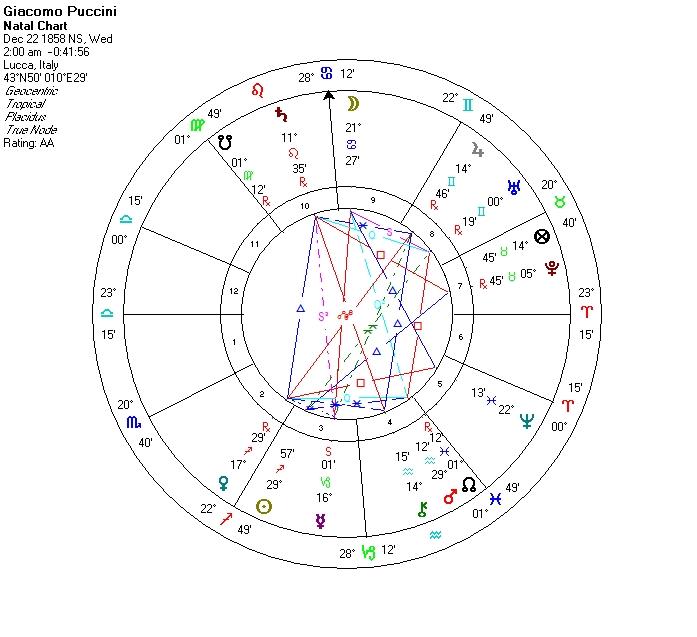
Puccini's natal chart
Sun at Sagittarius 30, third house: powerful, commanding birth which had to be filled with great public display and ritualization; an indulgent enjoyment from a dominant position; regal, rich climate from past incarnation
Mars at Aquarius 30, fifth house: friendliness towards the Dragon
Mars sextile Sun: libido is chained to accomplishing a certain specific purpose
Venus quintile Mars: Dragon always provided him with anima images; vital development of the anima throughout life; quintessence of his eroticism
Moon at Cancer 22: body in a poised state; physically very sensitive
Uranus at Gemini 1: clear in-seeing
Uranus septile Moon: clear in-seeing into the primal reaction of the vasanas; why he was capable of portraying gut-level music
Mercury at Capricorn 17: stripping down to essentials to gain self-renewal
Saturn at Leo 12: saw himself as a romantic reveler, an impresario, a bandy
Saturn septile Mercury: the Mercury always sees through the falsity of the Saturn; this is always enacted in his operas; the self-therapy he was always practising on himself
When transiting Saturn hits natal Mercury (with Madame Butterfly), Pinkerton and Puccini are one and the same and he sees himself for the cad he really is
Jupiter at Gemini 15: reduction of experience to common elements
Tail at Virgo 2: glorification of religiosity brought over from the past; born into a family where he would be a Church musician
Jupiter determines dharma/adharma of your instincts; homeostasis
Two of Puccini's letters read
Discussing aspects for day/month Puccini saw the play Madame Butterfly
Puccini a man of the world, not introspective or studious
What are the preconditions of knowledge? What made him at that moment decide that that was the play/opera?
Transiting Jupiter at Sagittarius 2: quickening of the mind
Natal Pluto at Taurus 6: link between inner and outer
Transiting Jupiter tri-septile natal Pluto: intuition that this is the play that will allow a bridge to be built to an unknown facet of his anima; old level of anima functioning no longer acceptable
Usually some kind of mental agitation precedes new level of anima functioning
Have to include natal degree of transiting planet as well; natal Jupiter recognizes the intuition which is the septile
Transiting Jupiter opposite natal Uranus: the knower in him knew that this was it; the intuition of Jupiter lit up by Uranus
Transiting Saturn conjunct natal Sun: impulse for his own integrity came through; had to write his own libretto; awakened a previously non-operational level of Sun
Transiting Neptune (Gemini 28) opposite natal Sun: entering new path of opportunity (Butterfly) to achieve further refinement of his anima function; full manifestation
All we ever know are the ideas variously combined
Takes a long time just to evoke the atmosphere of this one day, we don't have any precision in our understanding
BOOKS READ FROM OR REFERENCED:
Marc Edmund Jones, The Astrology of Concepts
Marc Edmund Jones, The Sabian Symbols in Astrology
Mosco Carner, Puccini: A Critical Biography
Giacomo Puccini, Giuseppe Adami (ed.), Letters of Giacomo Puccini
Immanuel Kant, Critique of Pure Reason
Shakespeare, Hamlet, Henry VI or Richard III
SABIAN SYMBOLS: Taurus 6, Gemini 1, 15, Cancer 22, Leo 12, Virgo 2, Sagittarius 2, 18, 30, Capricorn 17, Aquarius 30, Pisces 23
CHART appended to this transcript:
- FIGURE 1983 1003b-1. Puccini Natal Chart.
If someone is drawing or writing, with audible sounds of chalk on a blackboard, I indicate this by [drawing] or [writing].
NOTES:
This is a Monday, of which this is the main EVENING CLASS Event of the day 1983 1003b; 1983 1003a = the daytime Seminar held earlier. There was also a Sunday class on Puccini 1983 1002. Information per Blue Book and JF's class notes.
Please also see the Puccini astrology events, June 1982.
TRANSCRIBED Verbatim by IT 2021. Archival verbatim transcript – V11a.
AUDIO FILES: 1983 1003c, 1983 1003d. [Note: "Tape" and "Side" refer to original audio cassette tapes that were later digitized into .MP3 Audio Files.]
1983 10/03b at Wisdom's Goldenrod
Astrology; Horoscope-Puccini
[Audio File 1983 1003c Begins]
LR: --which we're missing on his life, where in the transits can you look for the World-Idea, where in the transits do you look for the identification of the subject. What does the degree mean in the transit. Do you look at the natal degree of the transiting planet or do you look at the transiting degree which a transiting planet is on? Do you look at both? If you look at both is one more objective and one more subjective? What's the difference be-- is there special significance applied-- that should be applied to a transit if those two planets have a natal aspect between them?
S: Yeah.
S: Yeah.
LR: (Put/With) an emphasis on it. What's the special significance of our-- of Uranus, Neptune, and Pluto transiting as opposed to the Chaldeans transiting. [someone drawing/writing on board] And then of course, what's the difference between transits of regular aspects, [S, faint: Ok.] [S, faint: Yes.] both transits of quintiles and septiles. If there was propensity of one over the other what does that mean, if there's only transits of regular aspects, what does that show. I mean you could go on and on.
S: All these will be covered tonight?
LR: But-- no, it's just good that we at least define what we're looking for so we don't get too far off. What idea's coming in and what-- and who this-- who is the subject, I think that's one-- the most basic question to ask.
[14¼ pause with faint background student talking]
JC (faint): I mean, what else did we cover [one word inaudible] you perceive [couple words inaudible]
TS: Was that on Saturday at the beginning?
RG: No.
S (faint): Why?
S (faint): Yeah.
TS: 'Cause--
S (very faint): (You/We) haven't even looked at his early life.
TS: The early life?
AS: Yeah.
[few seconds of faint background student talking]
S: I think you're being dramatic.
S (faint): Uh-hm.
S (faint): Uh-hm.
S (faint): I remember looking at the last day.
S (faint): I don't-- there's nobody we can do.
AS: (Have a light in--)
S (very faint): Yes.
LR: It's super (in there).
S (very faint): Ok.
AS/S(?) (faint): I'll clean that.
TS: This event-- There are many things we'd like to do but, in many cases there is not enough, we had enough documentation of the dates. We've really been hoping to try to do one of the operas.
S (simultaneously): Tim there's a big sign.
TS: Things are very (muddled) as far as when he began something, when he got ideas and so forth. This we know. Although it was young in his life, this is when he got the i-- he-- he did get the sense that he really wanted to do something with opera. And this was 1876 when I guess he was 18. Now by the time-- by 1883, which is what, another seven years, when he was 25? He was 25 when his first opera, Le Villi, came out. And so, um-- hence his career began fairly young. So we're going to see if we can get some clue out of these aspects, you know, and see if we can discriminate something of these septiles. There are very few septiles and quintiles relatively speaking to the regular aspects, I picked them up as-- walked into the opera house. A lot of the-- the Head I kept-- I included them all, I don't know that we'll find that they're all meaningful. I just put them in this-- (we'll/you'll) find out if-- So why don't you take an aspect, well at least I'm trying one. (TS laughs, some laughter)
S: Yeah.
S (very faint): Uh-hm.
S (faint): Yeah.
S: That's right.
TS: We should probably do those three septiles I think.
S (faint): Which three?
BC: Tim, could you describe the event just a little bit more?
TS: Well, my world-renowned accurate memory, uh, [S, faint: Yeah.] [S: You bet.] in an unexaggerated fashion remembers it as uh-- [one/two inaudible student words] that he was a poor starving fellow in a small Italian village and he walked to-- he wanted to hear a Verdi opera so he walked some significant distance with a friend. And that was several miles.
S (faint): 25.
TS: 25 almost, yeah.
S: Wow.
TS: At least. He started at dawn. (some laughter) Arrived at the verge of night. (laughter)
LR: Run over by a [one word inaudible]
TS (simultaneously): Yeah.
S (simultaneously with LR and TS): Yeah. (bit of laughter)
TS: But, once he got there he did-- he did see this Verdi performance, and, I do-- I do believe he went with a friend and they-- they were fairly poor. They got in the opera, and he was very inspired by the-- by what he saw. And although he was a-- he was a sixth generation musician, his family had been musicians in this little town for evidently some time but it was primarily in terms of, you know, performing or-- in the Church, conducting in their choir and so forth, and he was headed down that same path of being part of the same tradition. And, this really gave him a view of-- of a kind of life which was way above what he was prepared to-- to accept for himself. And, he then began to work for getting some kind of-- after this idea that he really wanted to do this, he then went to, I forgot the name of the place but it's in Milan, to go to school as a-- as a student of opera.
BC: Ok, [S simultaneously, faint: (But--)] I mean, [S, faint: Yeah.] I hate to be picky but, during this day he said "Yep, I want to be an opera writer" or did he [TS simultaneously: Yes.] just say to his friend "I think I like opera" or--
TS: No, no, no, no, no.
BC: Or did he really get an intuition that this is what he had to do or--
TS (simultaneously): From what I have here and from what I remember, he had an intuition, he-- "I felt a musical window had opened for me." [Note: See Puccini: A Critical Biography by Mosco Carner. "When I heard Aida at Pisa", he later stated, "I felt that a musical window had opened for me."]
S (very faint): Yeah.
S (faint): [couple/three words inaudible]
DH (simultaneously): You-- you have an actual time so that you can do--
TS (simultaneously): Actual time? Well I have [LR simultaneously: A day.] March 11th, 1876, I got a day, I don't have a time.
DH: So, what (are) the Moon?
TS: Transits to his natal Moon.
S (faint): Oh yeah.
TS: Hopefully his natal Moon doesn't move that [student assents, faint] quickly in a day. (bit of laughter)
S (faint): That's (better).
S (very faint): Right.
S (faint): Right.
TS: Is-- is the-- Professor Salmirs, do you have any more to add about this, I--
BS: No, those are the notes I took so that's exactly as I remember. (laughter) Oh, I'm sorry. (bit of laughter)
TS: There goes our cover. (laughter)
[couple seconds of faint background student talking]
S (faint): How about--
RC: Do it again.
BS: That was Aida, wasn't it?
RG: Yeah.
TS (simultaneously): Yeah do-- Yeah, in 1880 he headed to Milan Conservatory. So four years later he actually-- so he lived very poorly. 1883 he finished his studies. 1886-- You remember that thing about-- It was in 1883 when he actually wrote the opera Le Villi. And the reason he was partly a success because a new publishing house took it up and made a big-- did a good advertising job on it. And it actually got more re-- recognition than the winner of the competition that he had missed, so-- So anyway, that's that. Um--
S (faint): Uh-hm.
TS: There are not a lot of dates here that we have exact days for but this-- this seemed to be one of them. [short pause] I think we should try to do those three septiles because they're-- we (can/can't) get out three of them.
LR: And we should probably as we go along refresh it with the natal degree symbols which--
RG/AS(?): (Uh-hm.)
S (faint whisper): Yeah.
S: Yeah.
TS: [few very faint words inaudible] [short pause] Unless there are requests from the back. Ok.
AD: What do you plan on doing? (some laughter)
LR: We plan on figuring out what transits mean tonight.
AD: Uh-hm.
LR: And, exactly how we identify what idea comes in with a transit and who the subject is, how and what is happening in a transit. What the degrees mean. Do you read the transiting degree or the natal degree.
AD (simultaneously): Good, we'll-- we'll do that all tonight, good, yes. (bit of laughter) Let's start. (AD laughs a bit)
RG (laughing): Yeah.
AS (faint): Ok.
AD: It's going to take a little time to evoke the, you know, atmosphere that those symbols might convey so we better start.
LR: [three/few words inaudible]
AD: Hm?
TS: Oh.
[short pause]
AD: Do you remember the Puccini chart?
TS: What?
AD: Do these people remember Puccini's chart, the dossier?
[short pause]
LR (faint): [couple words inaudible] before I-- before I put it up?
S: Uh-hm.
RG (faint): That's true.
LR: You all remember [RG simultaneously: Therefore--] Puccini's chart, don't you? (LR laughs)
S (faint): I do.
S (faint): I never read it.
S: It's up there. Right?
TS: Well, should we go through it?
LR: Should we read the symbols?
AD: Well, I'm trying to convince people that unless they're really acquainted with the dossier of a natal chart, they're not going to know what's going on in a--
LR: Ok.
AD: So even if we just review the symbol(s).
LD (simultaneously): Yeah but, how do you know when you don't know what they're going to be doing until 7:30, 8 o'clock? [LR simultaneously, faint: (That means) (couple words inaudible)] I mean, I don't look at Puccini's chart every night. (laughter)
S (amidst laughter): Yeah.
AD: You listen to his music every night!
LD: Almost. (laughter)
LR: So your point (is) review dossier.
RG: Right.
LR: It wasn't as manipulated. [S, faint: This--] Um--
S (faint): Who? The dossier?
RG (faint): [few words inaudible]
LR (simultaneously): We can look--
AD (simultaneously with RG and LR): Now make-- and make no mistake about it, if you want to investigate seriously the meaning of astrology, you're going to have to stop having this dilettante attitude that you could read a chart and then put it aside. I mean, you're going to have to be like a dog, you're going to keep biting that bone until you-- you break it.
LD: Look, the only [AD: It's call--] point I mean to make is, [S: Hm?] if last week it would've been really nice, you would have had a week, I mean you can't--
LR: Actually it was announced last weekend.
LD: Real-- Ok, my fault. So--
AD: Well, it isn't so much the announcements as a question that once we do a man, you have to-- you really have to get to analyze, you have to go home and go over it a couple of times, try to memorize in your own fashion the best you can with whatever time you have. Otherwise-- and you investigate, you know, and [LD simultaneously: Yeah.] go into detail. Because then you-- if I make a comment you think I'm coming off left-field or something, you know. And the assumption here is going to be as we study these individual men, alright, that you-- you know something about them. Otherwise you're not going to get anything out of a chart. You're going to have to penetrate into the-- the very core of, you know, the ego structure. And then you're going to try to relate that to an incomprehensible wisdom that has everything timed so perfectly, [student assents, faint] alright, that an event will happen only at that time and if doesn't happen at that time, it's useless. Just like you could do something. If you don't do it at the right time, it's just as well you don't do it. Timing is very important here. So you have to have this information in the back of your mind. You have to be familiar with his life, you have to get familiar with his work. Only after we do these things for about twenty, thirty charts are you going to start feeling at home in this psychical atmosphere. [short pause] So let's-- let's push, let's push.
LR: Um--
AD: Go over his symbols quickly so that they recall them.
RG: Give me Carol DeAn-- can you turn down the-- [CDA simultaneously: The fan?] one-- one of those back there next to Anthony?
[short pause]
Marc Edmund Jones [The Astrology of Concepts, Sagittarius 30, LR reading]: "A picture of regal and sacerdotal pomp and glory reveals itself; the Pope is holding audience in his palace."
S (faint): That's good.
S: What is it?
LR: This is the Sun degree.
S (simultaneously, faint): (What's that?/The Sun.)
S (faint): Thank you.
LR: Sun's in the third house, 30 degrees Sagittarius. We said that--
[Transcriber note: I have no access to the following notes, quote needs to be checked. It's possible they are from a write-up LR did.]
Puccini Notes [LR reading]: "This symbol represents the purpose of life, the vital force given to the embodiment, or the central and guiding myth of consciousness. And it gives us the impression that Puccini's was a powerful and commanding birth [couple words inaudible] one which had to be filled with great public display and ritualization. The Pope is giving audience (is) a public view, clearly giving of himself from a store of wealth and power at his disposal. There's a regal, rich climate from past incarnation, an indulgent enjoyment from a dominant position. That this climate is carried throughout Puccini's musical work, that there's a luscious roundness and richness, a lack of any poverty in the music even if the people in the libretto are starving to death. [S: Yeah.] A real giving and taking of Nature's stores is provided to the embodied individual. There's a certain pomp and glory, [short pause] kind of critical attitude underlying is suggested. There's a certain ex…"
S (faint): (What's this?)
LR: That's the Sun.
S (very faint, possibly part of background): I picked it up this way.
S (faint): Yeah.
LR: Should I go on? Should we just go on? Um-- Closest aspect to the Sun. "A mystic…" Mars is--
Marc Edmund Jones [The Astrology of Concepts, Aquarius 30, LR reading]: "A mystic moon-lit field near the site of a mystic and traditional Babylon has sprung into delicate white bloom."
S (faint): Uh-hm.
S (very faint): Oh yeah.
[short pause]
S (faint): Tim wait.
TS: What?
LR: This is 30 degrees Aquarius. Jones says it's inner poetry of the soul that's being expressed here, is a kind of mystic quality given to that outward drive.
TS: He says--
Marc Edmund Jones [The Sabian Symbols in Astrology, Aquarius 30, TS reading]: "Everyone may count on the inherent friendliness of the universe, and in consequence on the capacity of man's destiny to endow him with fruits of his good rather than his bad works. The individual ultimately must [TS reads: must ultimately] rely on the world in which he finds himself, and so should live in such fashion that a reliance on him in turn is both possible and inviting. [The] keyword is CONTINUITY."
TS: And we said that what was this-- this is his kama rupa, his desire nature which is this-- he finds to be this mystic moon-lit field. And that-- that there's a certain friendliness within himself towards the realm of the Dragon, the realm of the-- the desire. And-- ok? [student assents, very faint] Ok, um-- So, a couple things, I mean this Mars turns out to be pretty strong in the chart. Mars is sextile the Sun exactly so that it will be saying that the libido is chained to accomplishing a certain specific purpose. The Sun represents the purpose of life and the focus of the libido is going to be towards accomplishing that purpose and he won't be diverted into a lot of different, you know, directions in any way. This Mars is also quintile Venus. I think we should probably read that Venus next. The Venus is a--
Marc Edmund Jones [The Astrology of Concepts, Sagittarius 18, LR reading]: "Little children are playing on the sultry beach, but each is protected from the glare by a tiny sunbonnet."
Marc Edmund Jones [The Sabian Symbols in Astrology, Sagittarius 18, TS reading]: "[This is] a symbol of man's very common self-cloistering on the practical side of experience, or of the individual's capacity to give primary [and needed] attention to his own [personal] affairs. Normality is idealized as a corrective for the self-diffusion or frustration which follows from any inadequacy of contact with others. Here is a happy and full participation in everyday living, aided by some suitable and chosen role in [TS reads: of] life. [The] keyword is INNOCENCE."
TS: Now, you take this-- these little guys in the sunbonnets on a sultry beach and you put them in a quintile with the Mars which is this kind of full blossoming of a friendship with the Dragon, ok, one thing that sort of came out the other day was that this Venus in the second house, that there was a kind of natural capacity to find specific embodiments of that relationship with his-- with the-- with the Dragon which his desires would be-- with embodiment, with reincarnation, incarnation let's say.
LR (faint): Show them the Venus (then).
TS: But I (just) did. That's below. Um-- Well I could see it in two ways, that-- he's constantly, by embodying the intensity of his inner feelings through his music and through his relationships, in some way he was protected from getting either o-- you know, dissipated by them or completely swallowed up in that-- in that swamp consciousness. And that I could see that he-- in using that, the constant embodiment in the Venus as his-- there's a sen-- there's a sense of protection by a-- by formulating these-- these energies in a very normal way. And of course we know from his music that excepting for Turandot, most of his operas and-- express very ordinary situations drawn out of his own lifespan. I mean they're not-- they're-- they're a little strained at times like the men almost go dying on the deserts of Louisiana, but uh-- (bit of laughter)
S (faint): Go on.
TS: Putting aside some geographical mistakes, uh-- No, that-- like thinking of La Boheme and so forth, they're not mythic operas like Lohengrin or Tristan and Isolde, you know, and they're very ordinary situations through which he brings out this kind of intensity of feeling. Ok?
LR: Um-- A couple more things we said about the quintile was that if you-- The Venus is the anima, and there's all these little sun-bonneted babes sitting on this sultry beach as the symbol.
TS/S(?) (faint): (Alright.)
LR: And so one of the things we said was that the heroines were continually expressing his own relationship to the Dragon, or put another way that the Dragon is always providing him with anima images, there's a kind of real give and take creativity within the Venus Mars relationship of the quintile.
[short pause]
TS: So you'd say that with-- with the Mars Venus, that the quintile is some kind of vital development. And it was going to be a vital development of-- of the anima throughout life and that this will be embodied or define his purpose, and that the Mars is then sextile the Sun I think, ok, was some kind of experience of his own power will come through this-- this constant process of reformulating the anima and reformulating his relationship to the shadow.
LR (faint): [few words inaudible]
TS (faint): We should do the Moon 'cause-- 'cause it's in there.
LR: Oh. Moon Uranus.
TS: Yeah.
LR: Well, ok. The Moon is--
Marc Edmund Jones [The Astrology of Concepts, Cancer 22, LR reading]: "A young woman, neatly attired in outing clothes, with eyes softened by dreaming, awaits a sailboat headed towards her."
S (faint): Yeah.
LR: This is a real powerful Moon, it's in rulership, it's on the midheaven. And it happens to be in quintile to both Venus-- bi-quintile that is, to both Venus and Mars. So in other words the Venus and Mars are a quintile, and the Moon is bi-quintile both of them as well as being in a septile to Uranus.
TS: And a trine to Neptune.
LR: And a trine-- an exact trine to Neptune, those are all real close aspects.
TS: Ok so, Moon is trine Neptune, Moon is septile Uranus one degree, Moon is bi-quintile both the Mars and Venus so it's fording-- forming sort of a-- I don't know, finger of quintile, some, you know-- It's forming a triangle with the Mars Venus. It's-- yeah. That's enough. When he says here the Moon degree--
Marc Edmund Jones [The Sabian Symbols in Astrology, Cancer 22, TS reading]: "[This is] a symbol of the creative poise and quiet range of perspective which give real power to the human soul, endowing it with its gift for sustained interest in the present situation and its constructive attitude towards each ramifying potentiality of things to be. Here man exalts his destiny as he is aware of the ships that may come in for him, and he learns that it is through the consummation of idea and not the pyramiding of facts that life achieves its more enduring reality. [The] keyword is EQUANAMITY [sic]. When positive [TS reads: Positively], the degree is a sure insight into the meaning of chance events and the current drift of circumstance, [and when] negative, senseless dependence on accidents of fortune."
[short pause]
TS: Pluto sextile (Mars).
S (very faint): (Very good.)
TS: Now, I can see this Moon in a lot of ways in-- in his-- in his nature, um-- [student assents, faint] You'd say that his basic mental outlook was one which was extremely receptive and passive to intuitions, and that these intuitions came in through his feeling awareness. Especially when we have the Neptune degree, there's a constant kind of feeding of feeling states the Neptune Moon is going to give him. And that there's going to be a kind of depth of knowledge that is provided through this kind of a receptivity of intuitions that the Moon Uranus septile will give him. And that these two things I think are going to feed the Mars Venus quintile, you know.
I was thinking of one incident where-- that might-- might illustrate it. He was in the middle of writing an o-- an opera, he began writing an opera called La Lupa, The Wolf, which was fairly violent and negative. And he was on-- on a train going to some health spa. He was arrested as a spy, there was a great deal of hoorah and so forth and he ran into Cosima Wagner who was twelve year old at the time. And she told him that this wasn't such a good idea for him to be writing this kind of an opera. So he dropped it. And then he went on to write La Boheme, and-- and that-- In a sense I-- I was thinking that, you know, I mean here's this guy who's got this investment in-- I mean letting go of an opera must not be the easiest thing in the world, you know, and I think that for him to take the clues from the situation and grasp that this was not a right direction for him to go in, you know, was-- was acute-- this kind of acute receptivity.
And over and over again like the-- and we saw that when he was in a-- He went to a play, they took him to a play in London of Madame Butterfly which was a play and he didn't understand English, but he knew that was it, he knew that was the play, that was the theme, that he eventually was going to write Madame Butterfly. And then he wrestled around with accepting that for a couple of years in his own psychology [few words inaudible] reticence of them. But he had that receptivity and he took it in, he was able to take that stuff in.
LR: Yeah. I think you have to add-- I mean, I think the Moon alone gave him an incredible receptivity to experience as an adventure.
TS: Yeah.
LR: That's-- But, the particular way that that Moon is geared is through those quintiles and the septile to Uranus. And I think a lot of the intu-- the fact [RG simultaneously, faint: That's right, that's right.] that the Moon was--
RG (faint): In a trine to Neptune [LR simultaneously, faint: In a trine (to Neptune).] didn't you say?
LR: But I was thinking specifically of the septile to Uranus because the glass-bottom boat degree is what the Uranus was. [Note: Gemini 1, "A glass-bottomed boat drifts silently and easily over a constantly shifting panorama of marine wonders."] And that seemed to be clear-- real clear channel for whatever was going to draw him in. You all should remember the glass-bottom boat degree 'cause we just saw it in Wagner's chart. That it-- it's a glass-bottom boat viewing marine wonders. Very still. Now if you put that together with this woman standing on the shore watching for a boat to come in, it's kind of interesting. They make up very well.
TS: Oh they're in sex-- septile, so those two degrees are in some-- some kind of [one word inaudible]
LR: We said--
Puccini Notes [LR reading]: "Uranus is the knower penetrating into the value of the samskaras that constituted the body. And yet he believed that if he looked into his own bodily processes, he would find all the material he needed for his opera."
LR: That was a certain fixed com-- fixed belief which gave him a great deal of confidence that through living his life as a physical being, he would have everything he needed at his disposal. Plus, the trine to Neptune which the Neptune is a great big hulk of a woman medium is seen in trance and around her are entities continually forming and dissolving. [Note: Pisces 23, "A huge hulk of a woman medium has gone into trance and around her are entities continually forming and dissolving."] That's a trine, right? And we said [student assents] that that-- that's manifest in the circumstance. So again there's something about a faith or a confidence, an openness to everything life is going to bring him in terms of-- I mean when you read-- even a few letters that I've read from that book, every experience of his life was immediately swallowed up by that Moon in Cancer in a sense that-- His mother died and he said, "I will never have a happy moment in my life again."
TS/S(?): He was right. (bit of laughter)
LR: But he was a-- but he, you know, turned it into melodies all the time, my grief is-- he's constantly talking about how those emotions which are given to you by these circumstances are going to be music. And I just--
S (very faint): Uh-hm [one/two words inaudible]
JA: And I don't understand what you mean when you said that the Moon is the physical being and that Moon can-- used it that way. I mean I heard the word that you said but--
LR: You don't see the Moon as being the most representative of the body?
JA: No.
LR: (Underneath the) [one word inaudible]
S: Yeah.
JA: I mean, I have a certain way of thinking of it. But I don't know if that's what you're talking about.
LR: Well how do you see it?
JA: Well, I would think of it as that the thinking would be tied in with the actual bodily experience but that would include all sorts of [three words inaudible] paying attention to things that you hear, see, taste. It wouldn't mean just-- you seem to be speaking of it as this sort of unconscious physical attitude and I-- I just couldn't-- [student assents] I couldn't--
S (faint): I don't know if it'd be (unconscious).
LR: I was trying to say [AS simultaneously: The body is an organ of perception.] exactly what you're saying.
S: Yeah.
AS: The body is an organ of perception.
JA (simultaneously): The body as an organ of perception, that the brain is processing what comes through the body, and that's what I [student assents, faint] think of the Moon. Now, that may not be what you're speaking of here. And what Tim seemed to be talking about, the encounter with Cosima, you know, that [one word inaudible] and that fact of-- of what he did, you know. I mean I think that-- I think that Tim's seemed to be speaking about something that just, you know-- it's something that happened, you know, it was a-- it was a physical encounter and he used it as a gui-- as guidance, you know. Just automatic. But, it wasn't-- it wasn't just-- it wasn't just sensed, you know, it was like processed many--
LR: Right, and I was-- the only reason I-- Wait, and what I-- what I thought I meant by what I said Jeanne is that the Moon degree is that receptivity towards experience and what experience will bring, that I-- I thought that the septile to Uranus gave him a kind of conscious intuitive sense that he might not have had if the-- I don't like to bring up these ifs. [few inaudible AS words simultaneous with LR] We're not allowed to. But the Moon alone is questionable whether it could have been quite that consciously intuitive. And I was-- I was claiming that the Moon was an openness or receptivity in the actual body, sensed-- sensed experience [AS assents, faint] or-- that connected with the Moon made it very conscious.
AS: (I) don't know, I-- this is the one. The Uranus is what really gives him the clarity and insight into that receptive organ. I mean the Moon in itself would-- seems to just be that receptive organ but when you say he got it, you know, he got an intuition from that receptive organ, that seems to be that Uranus somehow [student assents, very faint] gives him a clarity of insight into the pro-- whatever goes on in that period.
LR: For that.
AS (faint): And (I've seen) [couple/three words inaudible]
JA (simultaneously): That may be, I don't know.
AS: And--
JA (simultaneously): And you're speaking that [one/two words inaudible] was the tremendous thing, [few inaudible AS words simultaneous with JA] the Moon by itself I don't think it was just this unconscious process, I always think of it as a sort of maybe mental processing.
S (faint): (Come with that.)
TS: Well, lately we've been talking about consciousness [AS assents] as being uniquely from the Uranus, Neptune, and Pluto. [AS simultaneously, faint: We try to.] Now in taking the stance temporarily of these, that those are the three planets that provide any kind of cognitive awareness, then the Moon together with all the other planets at least we could I think try to follow that clue up until-- until we [RG assents, faint] smack into a dead end again. But it seems if we look at it from the point of view of taking that stance, that Uranus, Neptune, and Pluto are the cognitive modes of consciousness, willing, knowing, and feeling, then all the Chaldeans are going to be non-cogni-- non-conscious in different ways, ok. They're not going to carry mentation in a-- in any true sense. It seems in what--
JA: Mentation isn't consciousness. I mean that-- Well, never mind.
TS (simultaneously): Well, I'm sorry I used them-- Well, (I'm aware of that). I think just in the sense of the Moon as being this kind of keen receptivity to sensory phenomena, ok. And that with Uranus septile we're saying that there was a knowing of what was being presented through sensory phenomena, both in terms of his own immediate acute awareness. There's two passages here, just quick little things from his [S, very faint: Yeah.] letters which might highlight this-- this Moon and refresh our mi-- our-- our memories of-- of it, um--
AD: Before you read the passage, Tim.
TS: Surely.
AD: That's a septile, Uranus Moon?
TS: Yes.
AD: How do you understand it? How do you understand it, Jeanne?
JA: Well I-- In conjunction with the Uranus, I thought that the way you've been speaking about those three levels before, it would be the possibility--
AD (simultaneously): Well we're speaking now about the natal chart, right, [JA simultaneously: Yeah.] and we're speaking about the septile in the natal chart.
JA: Yeah but I-- I mean I-- I just have a question first. When you're speaking of the septile, are you saying that the Moon function is raised to that third level of readiness into [one/two words inaudible]
AD: No. Not at all. The Moon, I think the way they tried to point that out, is the organization of the vasanas which you operate with and then you call your body. And the Uranus was an in-seeing into the primal reactions of those vasanas before they get covered over.
JA: Yeah.
AD: So the Uranus Moon septile was an in-seeing into the vasana's reaction primally. A primal in-seeing into the vasanas the way they reacted.
JA: Right. The way-- the way I'm understanding, you know, we're given a certain certitude about that, trusting in that vasanas and using them as a guide for this knowing, whereas-- 'Cause I still think that just taken by itself the Moon isn't just physical processes.
AD: Now--
AS: (Now--)
JA: Right.
AD: Why do you use the word 'physical'? I'm [JA simultaneously: Why--] trying to make it very direct [student assents, faint] by pointing out that the Moon represents the totality and the organization of the vasanas which constitutes the psychosomatic complex.
JA: Yeah and it's organized in a certain way and [few words inaudible]
AD (simultaneously): Yeah, and the way it's organized that-- one of the keywords he uses is Equanamity [sic]. So that means that it has a set-- certain poise. [JA assents] And he directly-- because that Uranus is septile to it, he directly penetrates and has an in-seeing into those processes. [JA assents, very faint] Period. Any further elaboration is a waste of time, unless you could get a different point of view and present it.
JA: I was trying to.
AD: Good. Keep trying, keep trying.
JA: I don't think that the description of the-- of the Moon function is accurate. I think it's more than just sort of a-- a mélange of physical processes, I think that it's more organized than that, I mean it-- it's actually like brain function.
AD: Well, and first of all it's not a collection of physical processes, I tried to make this very clear. By calling it an organization of the vasanas I took it out of that physical realm.
JA: Yeah.
AD: Alright, and you're going to deal directly with the way all life has operated, you know, prior to this particular organization. But this particular body is organized in a certain way that it can be-- it can be in a poised state. [JA assents] In other words, when a chance event happens to Puccini, the body was in such a poised way that Uranus had the clear reading [JA: Yeah.] of the reactions that the vasanas were operating with. And that's why in a sense he was capable of portraying that gut level music.
JA: Yeah.
AD: He-- he brings you about as close as anyone can to the gut.
JA: Do you have another word for that?
S (faint): No.
S (very faint): Yeah.
AD: For what?
JA: For gut.
S (faint): That's [one word inaudible] (some laughter)
S (amidst laughter): Feeling.
S (faint): That's fine.
[few seconds of faint background talking]
S: Score of the music.
AD: The primeval urges.
JC: Couldn't you just say the emotionality that-- that attends an experience? He had a-- he had a good-- a clear perception of the-- he had a-- You don't buy?
AS: He took the--
LR: It's not specific.
JC: Moon has something to do with emotionality.
AD: Oh sure. But I think you missed the point that I made then.
JC: You said that his Uranus--
AD: It's too late once the emotions start writing.
S: Hey, one could be--
AS: If anything--
JC (simultaneously): Well--
AS: If anything, you seem to be saying, seems to be, that bodily organ of perception was a very clear mirror almost, that it didn't get-- it didn't get perturbed, it had this equanimity. If it weren't that way, then he wouldn't be able to get such a clear insight into the nature of these [couple words inaudible]
S (very faint): Uh-hm.
LD: Yeah but I don't see exa-- if the body-- He's saying the Uranus read the body. Now if the body didn't get disturbed then there's nothing to read off the body. (bit of laughter)
AD: Actually, actually what it comes down to is that physically, if you wanted to speak about things physically, that he was very sensitive.
AS (faint): Yeah.
LD: Yeah.
S (faint): Yeah.
AD: But I want-- I-- I want to try to explain the septile, which is an in-seeing prior to the sensitivity. Once the sensitivity comes over you got it colored, you got it verbalized, you got it formulated. This man was able to go much deeper than that.
LD: And-- and that seeing is into the Moon's functioning?
AD: Yeah.
LD: Before the sensitivity of the Moon takes place?
AD (simultaneously): Before, before [couple inaudible student words simultaneous with AD] it gets organized, or I should say before it gets verbalized.
LD: Before it gets verbalized. But that's not [AD simultaneously: Formulated.] before sensitivity.
AD: Huh?
LD: That's not before the organism reacts to a certain stimuli.
AD: Well, Louis, it has to react to something.
LD: Yeah.
AD: Alright. Now that reaction is by what? What's reacting?
LD: The body, the vasanas.
AD: More specifically the vasanas, certain modes [LD: Yeah.] of reaction, alright. The-- the Uranus had direct insight into that.
LD: Yeah.
AD: That's the septile you--
LD: I see what you're saying.
JC: You say he saw the modes of reacting before they actually reacted? Is that what you're meaning by before it even-- you know, before it's a gut (thing)?
AD (simultaneously): Oh, let me try this way, let me-- Gotta be literary around here. How about direct perception of the incineration of the vasanas?
S: Mm. (bit of laughter)
S (faint): That's very nice, yeah.
S (faint): So--
S (faint): Well, oh yeah.
S (faint): What?
JC: You mean the way they're being projected?
AD: Oh.
JC: Well, what do you mean incineration? The way they're being burned out by being projected, right?
AD: Yeah, you must have had some experience with that. (bit of laughter)
S (faint): Yeah. My vasanas go to work [few words inaudible]
LR: Yeah.
S: Right.
[few seconds of faint background student talking]
AH: That helps me to understand because it's a way of speaking about the Moon as a lower mind or brain consciousness.
AD: Well I-- I think the formulation is much more prim-- primeval. When you speak about the way the vasanas are organized to constitute your body, body is irrelevant here now because what we're speaking about is these vasanas which are primeval. This is what he had insight into.
AH: Just because you've used the word 'body' does not imply any kind of physicality of that.
AD: No, [S, very faint: Yeah.] no, I'm trying to avoid that.
AH: It's a mental body.
AD: Well, not mental so much.
AH: Well I'm trying to understand the Moon as a lower mind.
AD: Did you-- Why the lower mind?
RG: No but you see, Andrew, it is now at the level of a septile or at the higher level-- at this level of the Moon's functioning it would be the organization of the-- of the vasanas prior to even the unfoldment of the lower mind which might be at another level of the Moon functioning. I think that's what Anthony's trying to do.
S: That too.
RG: So it is almost a reminiscence, I mean that-- to get to that level of the vasanas is to get to a predetermination of your-- of your existence in some sense.
AD: The-- yeah, Dickie, the way you said it, like to get to that level is like to know what all men have felt under those conditions.
S (faint): Uh-hm.
RG (faint): Right.
[short pause]
AD: And that would be a synonym for gut reaction.
S (faint): Yeah.
S (faint): Uh-hm.
RG: Now, on the other side of that septile seems to be that for him this was knowledge. That there was an inbuilt attitude that-- that the revelation of those processes was the content of this-- of his higher knowledge.
AD (simultaneously): Music. I think it was the content of his music, yeah.
S (faint): Yeah.
[short pause]
AD: What do you think, Bert? He went through Boheme enough times, I could speak with you.
BS: Well, I agree. (laughter)
AD: Well one of the interesting insights Linda had was she thought that that Mars Venus quintile was the quintessence of his eroticism. And I quite agree with that. [student assents, very faint] But let's get on.
LR: Should we finish up with the planets?
AD (simultaneously): Yeah, quickly, because we want to move to the transits aspecting those natal planets.
LR: We'll just read through the degrees then. We've gotten most of them, right? Well, no we haven't. (bit of laughter)
S (faint): (We/You) know you haven't.
LR: [one/two words inaudible] His Mercury degree is--
Marc Edmund Jones [The Astrology of Concepts, Capricorn 17, LR reading]: "A mature but long repressed young woman is bathing surreptitiously in the nude and finding a release in spirit."
LR: This is very interesting also because it's in septile to Saturn which we said is the reflective conscious--
S (very faint): Apperceptive self-image.
LR: Apperc--
TS: Self-image.
LR: Self-image. Now the self-image linked with this nude bather finding relief-- release in spirit is-- at 12 Leo, his Saturn, is--
Marc Edmund Jones [The Astrology of Concepts, Leo 12, LR reading]: "Japanese lanterns, music from a string ensemble and an animated interweaving of colorful figures mark a garden party."
LR: And a certain romantic enjoyment (would be/that he) attached to himself as (the experience). Let me try to be somewhat succinct about the way we describe this septile. We said that the Mercury was like a stripping down to essentials, so to s-- as it were, to gain self-renewal, and that it had to do with a certain, again if I can use the word 'body', a certain awareness of himself as a physical being was a great release, that the soul found great release there. And that that was tied up with him-- what he felt about himself, uh--
(Side 1 of original cassette tape digitized as 1983 1003c Ends; Side 2 Begins)
RG: Hm.
[9¾ second pause]
S (very faint): Do it again, (would you)?
S (faint): Do it.
S (very faint): Go over it again, (would you)?
S (very faint): Yeah.
AH/S(?) (very faint): Go over it again.
LR: Um, that his self-image is tied to thinking of himself [short pause] as a romantic reveler and that that(--) (at least/that we) imply-- Sorry. I thought I formulated it better. Try Tim.
TS (simultaneously): How about saying that he was a-- a totally-- he was totally comfortable with the knowledge that he was an impresario, that he came in knowing what an impresario was and had to be.
AH: What's an impresario?
LR (simultaneously): Right.
TS (very faint): Oh boy. (bit of laughter)
AH: I don't know what--
S (very faint): An [one word inaudible]
TS (simultaneously): One [one word inaudible] with style? He-- he came in as-- he was, you know, the rock star of his time, he was, you know, try-- (some laughter)
S: James Brown.
TS: James Brown, yeah, whatever, I mean he was--
S (simultaneously): And he was a (cad).
S: Yeah. (some laughter)
TS: He put on-- he not only was a-- a composer, he didn't sit in the woods somewhere writing his music, you know, he was running around the big cities partying and carrying on and what not and then he got his music across, he established his-- you know, that he produced his own operas, and he lived the life of kind of this showman.
AH: So that seems interesting (from) the Saturn [one word inaudible]
TS: So I'm saying that the Saturn-- I'm seeing here that the Saturn is-- you say the self-image.
Marc Edmund Jones [The Astrology of Concepts, Leo 12, TS reading]: "Japanese lanterns, music from a string ensemble and an animated interweaving of colorful figures mark a garden party."
TS: Hardly a symbol of depth in itself, you know. I mean there's a certain sense of lightness and a kind of colorfulness in that degree. And I take that together with (now) Jeanne, Mercury being an intuition in-- into that instinctual colorfulness, that on one side I should see the Mercury Saturn being an inborn capacity to take on the role of being a very colorful figure in the music world. He knew what he had to do. That was not-- he didn't have to develop a-- a huge ego, he came in with one, you know. And he--
RG/S(?): Where's the Mercury [S simultaneously: What was (the--)] part in that?
AH: Yeah the Mercury part.
TS: Ok well-- I see the Saturn as being just this capacity to have a certain colorfulness, ok, but if you say that the Mercury is a point of view or an in-- a-- a conception or perspective, and that Mercury is some kind of essentialness, getting to the essentials, you know. We see the Mercury functioning in his constantly working of librettos and sometimes he would go to seven librettists just to get someone he wanted out. [student assents, very faint] (Yet) that focus on getting to the essential of something was directed entirely into that Saturn. Ok so the essential nature of the ego structure, the essential nature of egotism as a colorful kind of extroverted vitality, ok, gave this strength.
AS: Yeah (Tim), I'd read-- Could-- could you say that two degrees seem to work very funny in a way that the Saturn seems to-- is a romantic image of himself, he just keeps putting on these roles. On the other hand the Mercury seems to keep shedding off those roles and seeing, you know, that there's some-- [TS simultaneously: He saw right through it.] seeing the essential, [TS simultaneously: He did it (one/two words inaudible)] seeing right through it, yeah. It's like he has an idea that he can put on any of the-- has an idea that he can view himself in any of these roles and yet be always able to get at the essential nature of this-- [S, faint: (Oh great.)] always able I think to strip away the inessential (concept) and get at-- just at the real idea of what it is that he wanted.
TS/S(?) (faint): Yeah.
LR: I think that's right.
TS: Yeah that's how (he seem--)
AS (simultaneously): Somehow these two [TS: Well--] play off each other in some way.
TS: I just ran across a little thing in his letters where he says-- he's writing to a friend of his and saying, "Well you-- it's easy for you, you can write for film, you can write for, you know, these other things," he says, "I knew-- I've known all my life all I can write for is theater," you know, "my life is theater, theater is my life," and I think that I could see that in his Saturn Mercury as well, an intuition into the theatrical.
S: Was there formality in his Saturn symbol as well, when he gets-- you don't think it's a formality?
TS (simultaneously): No. I would see it as a real informality.
S: Really?
TS: Cheap Japanese lanterns [few words inaudible]
S: Well I don't see the cheap Japanese, I get a sort of formal-- that animated interweaving.
S (simultaneously, faint): [few words inaudible]
TS (simultaneously): Yeah I know, you guys! (TS laughs a bit, some laughter)
BS/S(?): Go ahead.
AD: That's tricky.
LR: Wait a minute.
S: No, you don't--
AD (simultaneously): Well see, let's try to understand that septile again. Saturn Mercury, alright. The Saturn represents a kind of bandy, an impresario for you, [TS assents] romantic Gatlin or runabout, ok. And the Mercury?
TS: (Was/With) some function of getting to the bare na-- getting to the essence, an intuition of being able to immerse himself, an understanding of how to immerse himself [few words inaudible]
AD (simultaneously): Alright, now those two were in septile, how-- how could we, you know, combine these two ideas?
LR: Oh, that he must have found (release/relief) to get to the essence of anything.
AD: I'm sorry?
LR: To get to the essence of anything you had to totally emerge yourself in the role, and then strip the role and all that would remain would be the essence. That there'd be a trying on of all the clothes, the color or the glamour. And then there'd also be the other part, the stripping away, and he'd be left with the [one word inaudible] and the essential melody of the thing. [students assent, faint] What do you think?
AD: Let's keep trying, sure, I-- I follow what you said Linda. But let's try for more terse and precise formulation. Unfortunately words aren't like arrows, they don't go to the bulls-eye ever. Come on.
LDS: How about immersion-- immersion in those kind of romantic cir-- circumstances would allow you to-- to see and appreciate the essences that preside over them.
AD: Nah, it's too general for me.
S (simultaneously): Yeah.
S: What is (the--/that?)
AD: Because what's going to be interesting, when you see that Saturn sitting on that Mercury you're going to see it. You're going to see that septile come out fully.
S (very faint): Uh-hm.
S (very faint): Uh-hm.
[9¼ second pause]
AS: Somehow I keep-- still keep seeing that there's a fixed idea that no matter what role he puts on, no matter how he sees himself, he can always strip it away. The Mercury seems to just continually strip away-- well I don't know if it strips-- to continually strip away the--
AD (simultaneously): Yeah, I follow what you're saying, I think essentially it's what Linda is saying too.
AS (simultaneously): Yeah, yeah. No I'm pretty much agreeing with Linda.
AD (simultaneously): But-- Well, let me ask [AS simultaneously: But--] you this. Do you see that as a-- as a form of-- do you see that constantly in his written productions, in his-- in his writing? Do you see him doing that, for instance, in Manon, do you see him doing that in Tosca, do you see him doing that in Boheme?
TS: Getting to the essence of some--
AS (simultaneously): No, I don't know if he [AD simultaneously: Huh?] does it in Bo-- I don't know if he does it [S simultaneously: In a lot of (one word inaudible)] [couple words inaudible]
AH: He saw that-- he saw the themes or the settings as a-- a metaphor of-- of his life, this kind of dilettante's simple non-archetypal sort of theme.
LR: Yeah.
AH: And that within that this Mercury is able to articulate that primal insight the Moon is delivering for him, you know. It's able to articulate it in terms of thought for him.
S (faint): Yeah.
AS: Yeah.
AH: Yeah.
AS: He-- it's the way he's-- maybe he has this idea that he is-- he is always-- his music is always reflecting. Yeah, maybe that-- His music is always reflecting or expressing the--
AH (simultaneously): It's like-- it's like Robert Frost's poetry. [AS simultaneously: Showing up that--] You know, he talks about the cow and the well and tree. But within that there's this profound contact with archetypal theme.
AS: Yeah that wasn't-- Ok, maybe. I was trying to say something a little different, that, yeah, the music itself is showing up-- always showing up what that-- the falsity in that Saturn. But he himself doesn't recognize it until the Saturn hits the Mercury.
AD: Exactly.
AS: See-- It i-- it is always doing it. He doesn't realize it until he gets to the-- to the--
AD (simultaneously): To this Madame Butterfly [AS simultaneously: To the Butterfly.] and he really sees himself for the cad he is.
AS (simultaneously): But-- but it i-- but every opera-- (some laughter) every opera shows up what a cad the [AD simultaneously, faint: And--] Saturn is. The Mercury always delivers it but he just didn't see it until the Saturn actually hit the Mercury. And then [S simultaneously: Well--] he saw it.
S: Hm.
LR: How do you see that as the septile?
AS: It's-- it's a fixed view-- it's a fixed view that-- [couple inaudible TS words simultaneous with AS] it's a fixed view that the Mercury function can always-- can always see through the gallivanting nature of the Saturn and can always express it. It always does express it. He's just not aware that it's always expressing it. I don't know why, maybe 'cause the self-reflec-- the self-apperception of Saturn is so taken up with the outward forms of the thing that it doesn't pay attention to the Mercury. But it comes out in his music, that is the Mercury expresses what a-- yeah-- as it were, what a cad he-- this Saturn is.
AH: But, he doesn't stay there.
AS (simultaneously): I mean anybody else would see it, look, you know, these poor women are driven off the edges of their-- driven to drink or death or off the edge or whatever by this guy but not until the Butterfly is there some recognition on his part that that's him.
S (very faint): Uh-hm.
AS/S(?): Yeah.
S (very faint): Uh-hm.
S (faint): Yeah.
S (very faint): [couple words inaudible]
AS (faint): But I don't think--
TS: In other words, the fulfil-- the actual psychological awareness of this presupposition wasn't brought into him until the Saturn hit the Mercury. But as far as actual evidence in his thinking or his-- his writing and in his life was-- was there all along. He always was that-- that impresario but he didn't see and always thought-- In some way he saw through it in the sense that he moved a-- was capable of moving away from it to do his writing. But--
AS: Yeah I would say Tim more, that even that the writing actually show--
TS: Embodied. Yeah I know.
AS (simultaneously): His music actually showed up that Saturn, showed it up for what it was which is this [one word inaudible]
LR: Well, I don't know--
TS (simultaneously): But he hadn't been in a [one word inaudible]
AS/S(?) (faint): Here we go.
LR: Actually that's-- I mean, that doesn't show up clearly in Boheme or Tosca in terms of, he's not-- it-- it is true in Butterfly that-- that the full exposure of that comes out. [student assents, very faint] But really, in Butterfly the guy's not such a cad and in--
TS (simultaneously): Oh in Butterfly?
LR: I mean [TS simultaneously, faint: Oh in--] Boheme. It's impossible. I mean, not talking about Scarpia of course.
AS (very faint): But yeah, I see.
LR: There's not that same nature as there is in Butterfly.
AD: Well it depends on who you think Puccini is in Tosca. [student assents, very faint] (bit of laughter) Mario or Scarpia.
S (very faint): Right.
S (faint): Uh-hm.
[short pause]
LR: Well, if he thinks he's Scarpia--
AD: I think he's Scarpia, yeah.
LR: (If you think he's) Scarpia, (where) she got him.
S (faint): Uh-hm.
S (faint): What?
AS: That--
LR: That's good. (bit of laughter) That's not, you know-- [S simultaneously: Yeah but he got her also.] The whole thing you're describing I'm just saying is described to its fullest, it's true, in Butterfly.
AS (simultaneously): But-- ok, oh I see. I know the point you're ma-- making in this case is that it's not just one of the characters that expresses him, I mean in the whole-- the whole thing is him. I mean, the-- the heroine is him, they're all parts of his psyche.
LR: Yeah.
S (faint): Yeah.
BS: It's always that way in any story.
AS (simultaneously): And-- and in a sense he's always sh-- it-- it is-- each one of them is showing up the-- the fallacy of his way of operating, I mean, you know, there's something--
LR (faint): Ok, (I don't get it).
AS (simultaneously): He just doesn't see it. I-- I'm just-- you know, I'm just doing--
S (very faint): Well, I don't know (if he's--)
[short pause]
AD: I-- I think that septile is always enacted in his operas. It was really the self-therapy that he was carrying on on himself all the time.
S (very faint): [couple words inaudible]
LR (very faint): Yeah.
AS (faint): Yeah the [couple/three words inaudible]
S (very faint): Uh-hm.
AD: And it becomes most obvious of course when that Saturn is on Mercury, then-- then Pinkerton or Puccini are one and the same.
[short pause with faint background student talking]
AS: Pur-- purgation, that's what it is. It's like these operas are purga-- act as a purgative for him almost eventually. You know, because of this continual-- what they're continually doing is they actually are a ve-- he-- as you say therapy or he's pur-- [student assents] he's purging himself of this phony view of himself.
LR: Or, could you say this, that the Mercury in Capricorn exercises a certain control. I mean, we speak of him in these kind of flippant ways. But really, anybody who wrote even one opera has a certain kind of self-discipline and a mastery that (hardly) aren't [one word inaudible] my conception of-- You know what I'm saying? And that the Mercury was able-- was enough-- had enough control, it was a Capricorn Mercury, to strip down to those essentials, to keep that Saturn, that flamboyant Saturn, enough in check that he could write operas about it, he wasn't just a playboy, we're not talking about Howard Hughes or, you know-- [student assents, faint] can't think of anyone right now-- Casano-- [TS/S(?) simultaneously: Well he's--] You know, I mean, [TS simultaneously: And this is (the plan).] we're not talking about a-- a historical figure who's gone dow-- gone down in history as this-- as Don Juan, but we're talking about someone who wrote these operas. And I think the Mercury really pinned down the Saturn to be able to do that in some way.
TS: Yeah.
LR: So I think it's what you're saying, I'm just-- a little bit different slant now? There was a certain control provided by the Mercury to get the essential kernels stripped out of all that playboy [one word inaudible] that he had?
TS: But it seems it's interesting that it wasn't until after-- wasn't until he came to Butterfly that that control really was totally owned by him. Whereas he constantly tried to control what was already given to him. So like the libretti he-- he was assigned to do were given by his publisher, the topics, the-- till-- till Butterfly. Then the first one he read (the hold on) himself was that this is not, you know, not his. And he was constant-- you know, that control was-- you know, with Manon Lescaut I think he (went through) seven librettists, [student assents, very faint] just 'cause he-- he wasn't able to-- to use that control in a way which (proved) these qualities of his personality that had any respect from the other people. It was a-- just seems like there was some kind of fusion of both the control the Capricorn Mercury had and in-- that came together with kind of a bringing into life or bringing into his own creativity a demand for perfect control the Capricorn Mercury had, that it came together with seeing through that kind of playboy quality of the personality. Or at least seeing that-- perhaps [one word inaudible] clearly seeing and acknowledging, you know, and--
JA (faint): What are you saying then, when the Sat-- when [student assents, faint] Saturn was on Mercury.
TS (faint): Yeah.
JA (faint): Well I'm seeing [couple words inaudible] there was responsibility for himself kind of, you know, that story isn't his own.
TS (simultaneously): [one word inaudible] Yeah.
JA (faint): And not something to pitch [student assents, very faint] in a sense.
TS: Yeah, 'cause before that the authority was partially from without and then he just took these librettos from the other. And then he had to struggle with them. But here he said, this is what I want, you know. Here's the play and here's what I want you to do. And he-- he took that-- that mastery within himself [few words inaudible]
S (very faint): Uh-hm.
S (very faint): Yeah.
TS (faint): So, it makes sense but--
LR/S(?) (very faint): Yeah.
S (very faint): Uh-hm.
TS (very faint): And then there's Jupiter [few words inaudible]
S (simultaneously, very faint): Uh-hm.
S (faint): Ok.
LR: Did we finish the degrees?
S (faint): The Jupiter [couple words inaudible]
S (simultaneously, faint): [few words inaudible] a transit?
TS (simultaneously, faint): Sure, why not.
S (very faint): Then ok.
TS (faint): Saturn and Mercury. Jupiter, (real quick).
LR: Ok. The Jupiter is--
Marc Edmund Jones [The Astrology of Concepts, Gemini 15, LR reading]: "Two Dutch children in their immaculate native costumes are studying their lessons together."
[couple seconds of very faint background student talking]
LR (very faint): Oh, ok.
AS/RG(?) (faint): Yeah does the Jupiter have any quintiles or septiles to it?
LR: I don't think so.
TS: Bi-septile the Head exactly. And it's two degree bi-septile the Mars.
LR: Three degrees.
TS: Three degree bi-septile.
S (simultaneously, faint): Of course.
S (very faint): Do it again.
S (very faint): Do it again.
S (faint): I agree with Linda.
LR (faint): Thought it was a bi-- it's exactly bi-septile the Mars.
S (very faint): Uh-hm, it's unusual.
[short pause]
AS: Can-- can you do that Jupiter, Tim, we-- we've done that degree a number of times and I--
TS: Yeah.
AS: I don't really--
TS: We'll try again.
AS (faint): Yeah.
Marc Edmund Jones [The Astrology of Concepts, Gemini 15, TS reading]: "Two Dutch children in their immaculate native costumes are studying their lessons together."
Marc Edmund Jones [The Sabian Symbols in Astrology, Gemini 15, TS reading]: "[This is] a symbol of the creative interest of man in the broad range of potentialities on which he may draw. His rehearsal of experience here becomes vicarious and a matter of childlike or unconditioned familiarity with the simple contributions of the self to its milieu at root, thus facilitating a more effective grasp of life on every practical or everyday level. All relationships are reduced to common elements of background and skills. [The] keyword is CLARIFICATION. When positive [TS reads: Positively], [the degree is a] self-confidence of spirit by which man is able to establish himself advantageously at ease in any possible situation, [and] when negative [TS reads: negatively], extreme provincialism and inability to communicate ideas of any moment."
TS (faint): I could certainly see that.
[43¼ second pause]
LR: Anyone see it?
S: Well, you went through that degree.
LR: Yes.
S: These-- this is-- you've got them in their traditional garb. So if-- and they're studying, they're consciously looking for truth. And it-- or-- well what-- what they want to find out, they're constant-- they-- they're looking-- and it's the conventional way of looking at things. But then by ways that they're studying together and they're looking for truth. It's interesting that he said that, when he was in London he would go-- he saw the play that was about Madame Butterfly and couldn't understand it. He understood it. I mean, you know, he didn't understand the language but he-- he knew the traditional feelings that went through and beyond language.
TS: Uh-hm. I think he had-- he had a lot of aspects to-- of Jupiter (in) [one word inaudible]
LR: Yeah but there's something in (the) degree, there's always a dialogue going on. Whatever that function is that's being described by that degree it's not a single voice, it's not just the voice of ego, there's always an internal dialogue. That is, some formal language because it said traditional costume. Seems like whatever planet that's attached to that kind of degree had some kind of-- I mean I'm not sure what the dialogue is with. I'm not sure what the-- Not sure I see that as his Jupiter.
AD: You have to repeat, Linda.
LR: That degree, the 15 degrees Gemini.
AD (simultaneously): Yeah.
S (faint): Yeah.
LR: There's a dialogue with the--
AD (simultaneously): What dialogue? What dialogue?
S (very faint): But that's what she said too.
S (very faint): Yeah.
S (faint): No.
LR: I think the symbol describes a kind of internal dialogue that's going on, these two Dutch children.
AD: But it says they were studying their lessons.
LR: Studying their lessons together.
AD: If-- they were talking to each other or studying their lesson?
LR: Well, if they're studying their lessons they're structuralized.
S (very faint): Uh-hm.
S (faint): Yeah, ok.
AD (simultaneously): Uh, [LR simultaneously: This--] suppose-- [LR simultaneously: Go on.] suppose I take you to Watkins Glen and bring you to the school and let you sit in on, let's say, second, third, fourth grade kids. What impression you going to get?
LR: Truthfully what impression I get?
S: (Uh-hm/Yeah).
LR: These poor kids are being made to sit at desks and keep their heads down and be completely contrary to their nature. (bit of laughter) That's my impression of third grade.
S: Yeah.
[couple seconds of faint background student talking]
AD: Well I think your objection to the [LR simultaneously: I'm sorry, that's--] educational system is basically that they're being reduced to common elements that they all share.
S (faint): Yeah.
AD: And I think that this symbol is referring to the reduction. In other words, any situation that Puccini found himself in he always would reduce it to its most common denominator or element. And so any time he had a libretto, he would go through this process of reducing it down to its most fundamental common element. And once he got that he felt that he can con-- communicate with anyone.
S: Yeah.
LR: And this is Jupiter?
AD: I think, I think (so). Is it?
S: Uh-hm.
AD: I think.
LR (simultaneously): No and in his Jupiter you're describing the Jupiterian function?
AD (simultaneously): Yeah, I'm trying to-- I'm trying to see that Jupiter function.
JA: Are you saying there's a limitation there?
AD: No.
JA: Wait a minute.
AD: I'm not saying there's a limitation, I'm saying he has to reduce things down to the tattvas that are common to everybody.
S (faint): Right.
JA (faint): But it does seem there's a limitation of scope, because, I mean, it's not going outside of that. When you speak of Jupiter as the regulator of (his or her) instinctual complex, you know, then-- then Jupiter would be limited in scope.
AD: Ok, fine.
LR: I see what you're saying I think in-- in this case. The common man. That he was able to grasp. But also then dress it up, like these children are dressed up. I mean [AD simultaneously: Yeah.] he was-- he did apply [one word inaudible]
AD (simultaneously): Yeah but I don't think that was the Jupiter.
S (faint): Why?
S: That's true.
LR (simultaneously): But they were-- but they-- part of the symbol is [AD simultaneously: The person take--] "dressed up in their immaculate costumes".
AD: Yeah, I know. 'Cause the-- the presentation, no matter what play it was to Puccini, (it) was able to get to the elements in the play that provided the-- I said common denominator. But over and over again from every play he would pull out what he thought was essential in order for him to write a good opera. And what he pulled out was those elements that were common for any man who had real blood in his veins.
S (very faint): Uh-hm.
S (very faint): Yeah.
AS: And-- and could you say further that what he pulled out as common was exactly what that Mars Venus quintile-- it's really linked in with the Mars Venus quintile 'cause it's septile the Mars and opposite the Moon.
AD: Uh-hm.
AS: So he pull-- the common elements he pulled out of the play were exactly the vehicle that was needed to express that romanticizing of his anima that [student assents, faint] was going on, romanticizing of the Dragon as it were, he was pulling out (the/these)-- And that allowed-- that allowed-- somehow that also seemed to be what allowed (to have) his operas to have such a universal active [AD simultaneously: Appeal, yeah.] appeal to all-- [AD, faint: Yeah.] so many people. He pulled out such a common element that cut right across all (views).
AD: Exactly. Whereas, if you take someone like Wagner, alright, you may-- you may love Tristan and you can't stand Parsifal.
AS: And also a certain-- even a certain point in your life you may find-- or a different-- different people would-- you know, a strong-- people have generally a stronger like-- you know, reactions. But it seems that everybody can kind of understand the message of--
AD: Alright.
AS: --um, human (ideal).
AD: That's the way I would put it, Linda. But, I mean it's my opinion.
S (very faint): Uh-hm, yeah.
AH: Can I ask a question?
AD (simultaneously): The-- the reduction of experience to the most common elements, alright.
LR: And you would say this is actually his libido, I mean, his thrust was the actual wisdom of his unconscious [couple words inaudible] (a) Jupiter. You're saying that his libido actually contained those elemental, but of all men. He wasn't an eccentric in a sense. He actually was composing the very-- what would we call it, his life? [student assents] Conventional [JA simultaneously: The whole notion--] notion of experience?
JA (faint): Conventional notion. It's like really a good one.
LR: In other words he was really a-- an embodiment of that? [AD, faint: Uh-hm.] The way [AD simultaneously: (What?)] he always (relieve--)
AD: I don't know, I-- I just expressed what I thought that degree meant where you have to try and see what it means (for/to) you.
S (faint): (Well--)
LR: I'm trying to put it together-- well, that's fine, that's fine. What you said is fine.
AD: Now I'm just looking at the Jupiter degree by itself.
AH: Anthony? You described the-- that degree as some access to the-- to the archetypal or [students assent] universal modus of the (incidents/incidence).
RG: That is true.
AH: It's like-- like I thought an impersonal [S simultaneously: I don't know what you mean.] [LR/S(?) simultaneously with S, faint: Right.] connection with the instinct. [student assents, very faint] Is that-- is that what you said?
RG (faint): Uh-hm, but do you disagree with him?
AD: Well, I would agree with what you said except I'd leave out impersonal. I don't know.
AH: I was-- I was wondering if that seems very much like the way we described his Moon.
AD: I [S simultaneously, faint: Well no.] can't even see the correlation.
AH: In-- in the sense that--
AD (simultaneously): On the one hand I'm saying over here that this [RG simultaneously, faint: Right, that's true, yeah.] man's-- that the Jupiter [TS simultaneously: You mean--] function is capable of reducing all experience down to its most common elements, alright, and he would base-- he would base himself on the description of those common elements which are to be found in all people, alright. And the Moon we said was the-- the way the vasanas were organized in their totality to constitute a sounding board or an organ of perception and that the Uranus had direct in-seeing into that. But I don't see why you say they're the same thing.
AH: In the sense that in both cases there's access to--
TS: No, it's really quite different in that the Moon is receptivity to what's uniquely appropriate to Puccini. He knew, this is the one I gotta do. That's one he can't do. This girl's for me.
AH: But I thought-- [TS simultaneously: His-- his Jupiter--] I thought we said, I thought we said that if that had happened where that-- that intuition had been colored by his own personal vasana(s), we wouldn't be able to speak of the Uranus having insight into something a priori or something fundamental. That coloring of those vasanas is the personal connection, is that not so?
S (very faint): I don't think that.
S (very faint): I don't know, Andrew.
TS: Well--
AS (simultaneously): Except you-- they were his vas-- I mean, they're the vasanas that constitute his body, [AH: Yes but--] and not somebody else's.
LDS: Yeah but that's not the way we spoke of him, we spoke of him--
AH (simultaneously): But insofar as--
S: (Uh-huh.)
AH: Insofar as he had access of them before they were colored by him--
S: [three words inaudible]
LD: What do you mean, I-- I don't understand-- I didn't understand the speaking of the Moon like that. The certain vasanas went into the construction of this body, the way this body reacted, [AH simultaneously: What would--] Uranus was able to see into.
AH: What would [LD simultaneously: Now--] be the-- what would-- what would be the coloring, that we said that he wasn't--
AD: Well if Uranus didn't have a-- if Uranus wasn't septile that, he wouldn't be introspectively aware of the way his vasanas incinerated or burned.
AH: So, the awareness of his vasanas presupposes a perspective outside of them.
AD: Well that introspective ability was provided by the Uranus direct septiling that Moon.
AH: Ok. And that-- that was the issue that I was--
AD: Yeah but I don't see how that relates to the Jupiter function which is an evaluation of the common elements in experience, extracting them from experience and then basing his music on that.
AH: Well the-- the vasanas that are combusting to provide experience for a person, you know, we take that pretty seriously but isn't that what happens commonly? I mean it's always the same for everybody.
AD: No, I don't think-- I don't think it's common for people to have insight into the incineration of the vasanas.
AH: Ok. But I wasn't speaking of the insight but the fact that best way experience must happen if you speak of it-- I'd like to drop the point because I--
LDS: I think I know what he's referring to, when-- when we first talked about the Moon tonight, you said that it was Puccini's way of-- his reaction to a certain set of circumstances had a certain universality like-- he had access to the proper vasanas that went with that set of circumstances, that he incorporated that into his operas. So that, you know, giving a role-- given a certain circumstance or situation in life, it would be common that these vasanas would come up, these particular vasanas would come up. It was like you were saying he had access to that and he would articulate that in his operas.
TS: But I think the difference is that you say that with the Moon there's an-- an intuition into the intensity of the primeval vasanas within himself that were going-- exploding within its own awareness. Like when he saw Madame Butterfly on the stage, he fell intensely in love with the geisha, I mean it wasn't-- he didn't get a s-- and a fondness for an abstract ideal of an interesting play of Japanese versus some British culture, you know. It was his own immediate emotional awareness or attachment to this involvement with the character. I can see that as the Moon, [AH: Yeah.] his own seeing into it. Now on the other hand, there's another example like in Tosca at the end where the poet's being executed and they-- they wanted him to-- the librettist had written him singing a Latin hymn, and, Puccini says "You gotta be kidding. He's going to be singing a Latin hymn when they're shooting? He's gonna be singing to his love. [student assents] Get rid of that," you know? And he would be able to get to what is the common-- the common response, you know, what is normal, you know, the wisdom of shared kind of reaction to that situation.
AH: And you're seeing that--
AD: And-- [LDS simultaneously: Now you see that as different.] and here's-- here's an example of what I'm talking about, this example he just used. What would be the element to extract from a scene like that which has a universal appeal? What do you think you're going to do if someone tells you you'll get shot tomorrow morning? Your last thoughts are going to be of your wife, the kid, who you love most.
AH: Yeah.
TS: (There's) not going to be a Latin hymn.
S (very faint): Oh no.
LDS: Ok I follow. So you're saying that's the Jupiter that-- that [TS assents] gave him access to that (kind of) [one word inaudible]
AD (simultaneously, intensely): Yeah, he says "Hey, that's the scene, that-- that requires the stars are shining brightly, never mind a Latin hymn." That's the Jupiter function that could pull that out and says "This is the [LDS assents] common denominator that we'll all be able to respond to."
S (very faint): Yeah.
LR: I get it.
AD: Oh (he got it). (bit of laughter)
S (faint): Got it.
LDS: I got-- no I-- I'm [one/two words inaudible]
AD (simultaneously): (Louis), I'm going to go to the opera! (bit of laughter)
LDS: But you spoke [AS simultaneously: (Very/They're) busy.] very similarly of the Moon earlier tonight.
TS: No, yeah.
AD (intensely): No I don't speak similar, I-- I think I'm being very precise in my language.
LR: Yeah.
AH: See it's really-- it's really a-- an issue, you know, that it just-- I understand the examples very well, the example of the Moon and how it was his personal situation and he got wrapped up with this geisha girl and all that. (bit of laughter) But, I don't-- I don't see how his insistence upon the correct song is really any different in regards to the wisdom he had of-- of archetypal situation that people find themselves in, in both--
AD: I really don't know what you said Andrew.
AH: I real-- I guess I'd like to understand the distinction between the Moon function and the Jupiter function in regards to these examples. And I don't understand that yet, I don't see a distinction. Is it on the one hand it's very personal, on the other hand it's more collective? Was that the distinction we're making? The Moon is a personal response? And in the case of Jupiter we're talking about something that is more appropriate in regards to collective values?
AD (simultaneously): Well let's see if I could contrast them. The Moon would reco-- he said it would-- it's a recognition or the organization of a certain number of vasanas, alright, in a peculiar way which distinguishes [student assents] me from any other person. Now, um-- [Transcriber note: The following sentence sounds like an aside.] Now you could go over and sit down. Now among those-- among those memory traces inherent in the very bodily function, alright, the Jupiter was able to pull out or extract those vasanas that had the appeal, the universal appeal that he felt necessary, or that he felt would be best embodied by the kind of art he could deal with. And I think these are two very distinct aspects of this man.
AH: Yes. What was it that Uranus saw into?
S (very faint): The Moon.
AD: (Now--/No.)
AH: And then-- in regards to the Moon?
AD (simultaneously): I'll try again with you.
AH: What was the insight that Uranus provided?
[38 second pause]
TS: He said he came in with the knowledge that his own personal reality stood getting to the absolute bottom of these primeval emotions and primeval vasanas that organized his own chara-- you know-- When Mimi died, when he-- when Mimi died at the end, you know, he's finishing her off in the opera, he says "I'll never have those feelings again," you know, there's a-- a reality and an intensity to his emotional-- his awareness of his own emotional development, whether it was through his personal relationships, his experiences in life, you know, meeting Caruso, breaking off with Toscanini or-- whether it was with his attachment to the-- you know, the processes of, you know, the-- the characters, the women in his-- his operas, you know-- When he wrote the final scene for Liù he died too. [student assents, very faint] That there's-- I see that there's a kind of depth of it, a knowledge of the-- of a depth of his own being in terms of seeing into the vasanas.
AH: That's Uranus.
TS: And that's the Uranus, the depth, I mean it's this glass-bottom boat looking at the marine wonders. He's able to look at them, see the knowing of the-- of the depth that these things have. 'Cause many of us go through emotional experiences and we might not be able to really know the depth of the emotional reality that's-- that's involved in them.
AH (simultaneously): And that-- that's different than describing Jupiter as the wisdom of the instincts.
LR: Well, a reaction pattern.
TS (simultaneously): Yeah in the sense that look, he puts on Tosca or Madame Butterfly, it's a bomb, so he says, "I know what they want, they want an aria here." So he puts it together, he breaks the second act into two, he puts in another aria, it's a success. Why? He says, "Well, this is what appeals to them." He had a-- he was aware of what would have that popular appeal.
S: Ok.
LR (faint): [three words inaudible]
TS (simultaneously): How many of his operas were a failure? None. You know, there was one bomb which was the first opening night of Butterfly.
BS: But anyway, it's some--
JA (simultaneously): It's some sort of avidya, it's more a practical wisdom. I mean really-- I mean the image of the gut, just this, you know, sort of-- there's more confused than the music, you know? (JA laughs)
TS (simultaneously): Yes.
S: Uh-hm.
JA: And conventional, you know, I mean [couple words inaudible]
S (faint): Uh-hm.
AH: Ok.
AD: Uranus seeing into the Moon function will be something like this. (You/We) just-- we just went through a very severe illness. You're coming out of it. And, your wife or your mother or whoever brings you chicken soup or, well, real heavy soup. And, she wants you to eat it because she knows this will help you get well. Is it the food value or the restoration of the instinctual functioning? If you can tell the difference, you got that Uranus function. I can't do better than that. [18 second pause] In other words, if you think it's food value, then you misunderstand that Uranus function. That Uranus knows that it's the restoration of instinct that is what counts. This is in-seeing into the Moon.
S (faint): Uh-hm.
TS: Anthony?
AH: Yes. Thank you.
TS: Would you s-- thinking of the Tail as the glorification or religious instinct, the-- the large white cross, you know, [Note: Virgo 2, "A simple but impressively large white cross has been set up in splendid isolation on top of a commanding eminence."] is there any possibility that the-- in some way this idea was going to be forced into him? You say that Tail was the glorification of a kind of religiousness from the past.
S (faint): What Tail?
S (very faint): I don't know.
AD: Well I had the feeling that it is something like that but I-- I haven't formulated for myself but, yes, definitely. The very fact that he was born into a family where he would be the here-- hereditary musician of a Church, you know, leads one to suspect that [TS simultaneously, faint: That was the first one.] prior to that he was, you know, in that line of development.
TS: So his own kind of breaking-- a forced breaking out of that in a sense of pushing him into life. It'll push him all the way into life.
S (faint): Yeah, yeah.
AD: Alright. Let's try [TS assents] once more.
TS: Well, are we done with this?
S (simultaneously): Yeah.
LDS: No, no.
LD (simultaneously): Could I-- could I just ask one basic question?
TS: What are we doing?
LD: I-- I don't understand or-- you've gone over it but the difference between vasana and instinct. Because it--
TS: Vasana's the [AD simultaneously: I don't think we'll--] first time, instinct is after that. (TS laughs a bit)
LD: What? Is there? Is there a difference?
AD: Well, I don't know, what did you say Tim?
TS: Vasana is the first time, instinct is after that.
AD: I don't know, I tend to regard them as the same.
S (very faint): That's good.
RG: Then he doesn't understand the difference between Jupiter and the Moon.
S: I'd say--
AH (simultaneously): That was really the problem I was after.
LD (simultaneously): That's I think what [RG simultaneously: Yeah.] the-- Andrew was getting at, I--
AH: Yes, if we're using the [AD simultaneously: And then--] terms interchangeably.
AD: Well, tell me what he was getting at.
LD: What's the different-- if we talk about the Moon as the vasanas that go to constitute [AD: Yeah.] a physical organ--
AD (simultaneously): And the Jupiter which judges which one is most appropriate on which to write?
LD: No, I think we're speaking more general as speaking of Jupiter as the wisdom of the instincts, [AD simultaneously: Ok. Well, wouldn't that wisdom--] what's the difference between that and the wisdom of the vasanas that go into--
AD (simultaneously): No, no, the wisdom of the instincts is not the instincts.
[students assent, faint]
LD: Ok.
AD: In other words, in other words, the way-- the organization of the-- your instinctual nature is from the point of view of Jupiter, alright, [S simultaneously: If that's--] Jupiter is determining that organization for better or for worse. That's not the instincts. If-- if you use the Hindu word 'dharma' or 'non-dharma', alright, so Jupiter determines the dharma of your instincts or the non-dharma. You could have instincts conflicting with each other or you could have them organized so that they work for you. Now the Jupiter principle here, the-- the Jupiter in this case I was saying was pulling out those instincts upon which it will-- appropriate for him to try to elaborate into musical terms. [S, very faint: Yeah, sure.] So a good instinct for instance was the way he arouses your jealousy or when he makes Scarpia, you know, fall in love with Flora, and the lust that comes out, he's-- he's saying, "My Jupiter tells me this is an ideal scene to elaborate." It wasn't about the instinct, it-- it was telling him which of these instincts was good to do into an art form. You're getting that-- those-- those two Dutch kids, you're-- you're making a big story out of them. [LD simultaneously: No, but--] [intensely] They're not Dutch. Two children are at school studying books. [student assents] And if you look at two kids studying in the third, fourth, fifth grade, alright, what in the world could they be doing except getting acquainted with the common principles in everyone's life? One plus one is two. [RG/S(?): Yeah, (right).] All men [student assents] have that kind of an organ, all women have that kind of an organ. What do you think they're learning?
S: Yeah. (bit of laughter)
S: Yeah.
S (faint): Yes, don't ask.
S: Yeah.
TS: Speaking of which, that was Freud's Moon.
RG: Right, you know--
S: Uh-huh. (laughter)
TS (amidst laughter): No, hold on.
RG: You know, somehow [S simultaneously: Oh.] immediately it seemed to me-- (laughter)
AD: Oh, Dickie, what's the reading of that symbol in the big book, is it--
RG: Um--
S: You could put this away.
[Audio File 1983 1003c Ends]
[Audio File 1983 1003d Begins]
AD: If you see anything more than just ordinary education here, let me know.
RG: Or (growth/both).
AS: Yeah well, right.
RG: But, you know what I get from this degree too Anthony?
LD (simultaneously): No, it's just a clarification of words I'm asking about here.
RG: It--
AH (faint): He's not really [S simultaneously: Yeah.] supposed to.
S (faint): Uh-hm.
RG: Never mind (then).
S (faint): Yeah.
S (very faint): Go ahead.
RG: It's almost that I see-- even in Jung-- in Jung's (Moon), [Note: RG misspeaks, means Freud's Moon.] it seems whatever planet is on this degree has a tremendous self-certitude about itself. I mean it believes that what it's got to explain is the commonality [AD: Yeah!] of the-- of the-- [AD simultaneously: Yeah.] of experience.
AD: That's why they're all so comfortable with it.
RG: Right. Whether it is or not I don't think is really the point. They believe it to be.
LR: But you know, one other point. Jupiter is the way people react, it's a reaction pattern, and an intrinsic reaction pattern. And Anthony's saying there's a basic wisdom there, I mean reaction pattern that-- he got to the-- to his own reaction pattern--
RG (simultaneously): Right. I'm saying that was the reaction pattern with everybody, he had that face. Just like Freu--
LR (simultaneously): And in fact in this case it worked, so--
RG (simultaneously): Right, he had Jupiter in the eighth house, I mean there was a lot of other factors where that Jupiter [few words inaudible]
LD (simultaneously): Wait a second, that's just what we said about the Moon, it's a reaction to the-- Now, now, [LR: No.] distinguish.
RG (simultaneously): I agree with you, Louis, I agree with you, there's a confusion between the Moon and--
LD (simultaneously): It's just what you just said about the Moon a while back, [AS simultaneously: No, no.] that it's a reaction to a given situation, that it's the vasanas that go to constitute that vehicle that react in a certain way and Uranus reads that.
BS: That was the [TS simultaneously: No there's a difference.] organization, vasanas are reactive.
LR (simultaneously): No, we said that his vasanas were receptive.
LD: His vasanas went [LR simultaneously: To the--] to constitute this certain vehicle. Now, I mean, just what you said about Jupiter, you said the same thing about the Moon.
LR: I thought we said that they're very different symbols.
RG: Yeah but I don't-- I think-- I don't think we've made the distinction functionally between the Moon and Jupiter proper yet. I-- I mean I think it's a valid question.
S (very faint): (Right.)
S (very faint): I do too.
LD: But, from what he said before it was-- it was more the intelligence behind the Jupiter which-- like the vasanas-- I mean-- of course there's intelligence there but they can be a contradictory--
RG: But, let me try this way Louis, in the Moon there seems to be a receptivity to receiving what's coming in from whatever he's pick-- from whatever experiences he's going through. But in the Jupiter there's a certitude of his knowledge about it. There's not a receptivity to picking up. There's a certitude that his instincts are the instincts of everybody and that he can be so certain about it that he could write with a great certainty from that. [LD assents] So I think that-- I think there is a difference in that. One is a tremendous certitude.
LD (simultaneously): Yeah I think that's what he said.
RG: Yeah, and the other is an openness to experience. And that's very different.
LD/S(?): Yeah.
[short pause]
RG: Well you know, it's interesting, I mean, if we-- if Freud's Moon was on this degree he really-- he seemed to take his psychic processes as the whole of everybody's psychic processes too and reduced everything to one psychic process. Now, Jupiter's here so there seems a wider range of instincts or wider range of action that's going on. But there's still the same kind of certitude about the functioning that you find in Freud. Here it's on the-- it's on a-- a level of almost of the anima rather than of the-- the Moon function.
BS/LS(?) (faint): Much more (delivers) a reduction.
RG: Yeah. But it's still that leveling of experience to one-- one level.
LDS: So aside from the degree meanings Richard, what are you saying Jupiter means in general as a function? It's the teacher or the wisdom of the instincts?
JC: How about the wisdom inherent in life, forget the instincts. It may organize the instincts to achieve its goal of development but it's more-- it's a broader intelligence than that, it's not bound to fixed patterns of action and reaction the way instincts are. It organize(d) those instinctual patterns to achieve a goal.
AD: How about one word--homeostasis? For Jupiter?
JC (faint): I don't know what homeostasis--
LDS: Meaning some kind of stability or order? Is that what homeostasis means?
AD: Yeah. It's always trying to restore order.
S (faint whisper): Oh, that's nice.
S (faint): (Go ahead.)
AD: And we haven't even got to the transits yet. [few seconds of faint background student talking] Come on let's go. Let's go to the transits, huh?
TS (simultaneously): This is the [one word inaudible] (train), we make all the stops. (bit of laughter)
AD: Let's go to the transits. (bit of laughter)
TS: Well, maybe so successful at [couple words inaudible] the tran-- Um-- What event, Anthony, do you think would be a good one to try to grasp the nature of the transits from? This one where he's-- he saw sen-- had some sense of his destiny or--
AD: I really don't know. That's such a difficult question.
TS: And that, the question with that one to me is he was only 18 and the sense of, you know, his own mental and psychological maturity was probably not ful-- fulfilled yet.
AD: I mean to try to evoke the atmosphere from the aspects that are going on between the transits and the natal chart, I mean, the most that we can hope to do is to evoke an atmosphere and maybe get a feeling for what that relationship is between the transits and the natal. And I don't know of any shortcut except to do-- go on doing a few until it, you know, comes [TS assents] up. [TS simultaneously: Would you--] But there's-- there's no Sages here and there's no geniuses here.
[short pause]
TS: We do have this-- this book of letters that-- some of which are around his moments of concreting these different things and it might be helpful in terms of pulling up some sense of the atmosphere if you wanted to pull out one of these dates where he has a letter and try to catch the flavor of the subjective processes then. In other words, read the letters, see if that gives us any clue into the feeling state and what not.
LR (faint): Except there may be wading in the mud.
AD: Well when did-- when do those letters start, what year do they start, uh--
LR: But the-- they're mo-- they start with the first opera, Le Villia, Le Villi. That's what they call it?
TS (simultaneously): At Le Villi.
LR (faint): Le Villi.
TS: Start right off.
LR: They're all about the operas. There aren't-- there are very few letters that aren't-- that he has them classified by opera. And they describe the work of the-- in fact most of them are to librettists, describing the work that went into each opera.
AD: Well it's a toss up Tim then. Whichever event you think might be fruitful, let's do that one.
S (faint): Let's do that one.
LR: Yeah I think we should do that one (though/then).
S (simultaneously, very faint): [couple words inaudible]
AD: What's on the board?
LR: That's when he saw Aida.
RG (simultaneously): When he saw Aida.
AD: When he saw Aida?
S (very faint): Yeah.
S (very faint): Yeah.
[10½ second pause]
RG (faint): Let's go with Aida.
AD: It must have been an eventful day in his life.
S (very faint): Oh (yeah).
[12½ second pause with faint background student whispering]
TS (very faint): Yeah, ok.
S (very faint): Yeah. Let's do that one.
AD (faint): Let's do it.
TS: Well they're in the transits, all of them. [13 second pause] We have the Sabian symbols for the transiting planets as well as-- and we'll bring them in. There were three septiles: Pluto to Venus, Saturn to Jupiter, Jupiter to Pluto.
S (very faint): Yeah.
TS: So--
AD (simultaneously): What event is this Tim?
TS: Well this event is when he walked to this-- to Aida.
AD: To see Aida and was convinced he should be a composer.
TS: Yes.
AD: You want to do this one?
TS: Not really but-- (bit of laughter)
[13¼ second pause]
AD: What did we do this afternoon, uh-- [Note: See WG Class 1983 1003a.]
TS: We did-- we did for when he saw the play, roughly the month he saw the play for Butterfly and for when he began composing Butterfly. I was thinking maybe we could go over those again since we had at least made a little headway. Um-- Hm.
AD: Well let's do that then Tim, let's go over them again.
[10 second pause, flipping of pages]
TS: This is simpler and there are fewer exact aspects 'cause we don't know the outer planets. (bit of laughter)
RG: Let's do it. You could take just the outer planets of this one instead of dealing with that one there.
TS (very faint): Um, I know.
AH: What was the (day/date) of this other event?
RG (faint): We don't know.
TS: It was the summer of 1900. Uh-- (bit of laughter)
S (very faint): Uh-hm.
S: (Thank you.)
TS: I can try to (extemporize it).
AH (simultaneously): That's when he first saw the play and so forth?
S: What (he--)
TS: Yeah, he was inland and he saw the play Butterfly. And he knew-- as soon as he saw this-- this geisha he-- he-- that was it, he wanted to make an opera out of it. But, he continued to look for operas-- for librettas-- librettos all the way until April of 1901. Then he finally got the rights to use the play, Madame Butterfly, and began sketching the music. Then in the spring of 1902 he carefully interviewed the ambassador's wife, the Japanese ambassador's wife as to the nature of Japanese music, had an auto accident and finished the opera. Uh, no, but-- He didn't start writing the music until the spring of 1902. So those are the two events we worked over this afternoon. Or we tried to come-- contrast it some with when he began Tosca. We also looked at one. So, um-- Let's do that one.
S (faint): Ok.
JA: Excuse me. I think I missed something. I thought you were going to read some letters.
TS: Well I suggested that. I didn't know that was--
JA: Yeah I was thinking this afternoon with-- sort of, we've done a lot of writers and so, you know, it's always been very useful reading some of those, you know, Tim. But see he writes operas so that-- I have never gotten any feeling for-- for how he expressed himself this-- outside of operas.
TS: (Oh/No). Well, [JA: But--] that one event [couple words inaudible] on this. There's two-- two very violent letters that is, that I-- I thought you-- violent since he-- they're very-- (he expresses) his own feelings.
JA: Yeah.
S (very faint): (Uh-hm.)
S (faint): Uh-hm.
S (faint): We can try to do--
TS (faint): Let's see if I can find them here.
S (faint): (Uh-hm.)
TS: What?
JA: You mean connected with these events or-- I mean I don't know.
LR: Well, from the letters it seems like he saw-- he might have seen the opera Butterfly the summer of 1900. He write-- the first letter after it is November of 1900 and he's going through all the-- he's describing all the subject matters that have been given to him. He denies them all, this one is no good 'cause the heroine already has kids, and this one's no good because I don't like the way she dies and he's just going--
S (simultaneously, faint): Yeah.
S: Yeah.
LR: And then at the end he says "Oh I wish I had Butterfly, I wish they'd give me permission."
JA: Yeah, I'd just like to hear.
S: No but that's something he (fought a lot).
S (very faint): Yeah.
LS: You're connected.
TS: I thought these two just were a contrast in terms of his emotional nature.
[Transcriber note: I am using Letters of Giacomo Puccini by Giacomo Puccini, edited by Giuseppe Adami, New York: Vienna House, 1973.]
Giacomo Puccini [Letters of Giacomo Puccini, p. 109, TS reading]: "I do not receive a letter from you every day, and that is a pity. Are you abandoning me in this mare magnum?
"I am sick of Paris! I am panting for the fragrant woods, for the free movement of my belly in wide trousers and no waistcoat; I pant after the wind that blows free and fragrant from the sea; I savour with wide nostrils its idiotic salty breath and stretch my lungs to breathe it! [S, faint: Great.]
"I hate pavements!
"I hate palaces!
"I hate capitals!
"I hate columns!
"I love the beautiful column of [the] poplar and fir; I love the vault of shady glades; and I love, like a modern druid, to make my temple, my house, my studio therein!" (bit of laughter)
TS: Ok so he goes to the country two weeks later.
Giacomo Puccini [Letters of Giacomo Puccini, p. 123, TS reading]: "Hot! Hot! Hot! You sleep by day and work by night! (laughter) [And] here the night is really black--"I swear it, I swear it!" as Ferrani said.
"I am in a hideous, hateful place, drowned in the middle of [TS adds: the] woods and pine-trees…"
TS: And-- (laughter)
AD: Anything else you want to know about him?
TS (simultaneously): Here's a real stable (fellow) [couple words inaudible] (laughter)
LR/JA(?) (simultaneously, amidst laughter): Thank you. Thank you for that. (more laughter)
S: That's great.
TS: You can tell he's an introvert. (bit of laughter) [student assents, very faint] Alright.
[14½ second pause, TS writing]
LS: These are for summer 1900 that you're writing down?
TS: Yeah. Sometime in July.
AS: July 15th, right, we picked (up) [one word inaudible]
TS (simultaneously): Yeah we picked July. Most of--
AD (simultaneously): Lenny, the-- the play was in English, not in Italian, so he didn't understand a word of it.
LS: But he understood it, what do you mean he didn't understand.
AD: Well he didn't understand the dialogue that was [LS assents] going on but his-- he knew that was the play he was going to write about.
LS: Well it must have been well acted.
AD: Well acted or that Butterfly fitted the image that was coming up.
TS: Yeah. I should put this together because--
[TS writing]
LD: Am I wrong or was that his favorite opera?
AD: Hm?
LD: Was that his favorite opera? Didn't he say that, that-- did he always have--
AD: I don't know, I wouldn't believe him anyway. (laughter, AD laughs)
LD: I thought he had said that-- that he really had a special--
AD (simultaneously): He never-- well, he expressed the most concern for Turandot, he actually was driven out of his mind with Turandot. But I don't know if that was his favorite. But (might be). I thought it was Aida. (laughter, AD laughs)
[TS writing]
LD: It's not mine. (bit of laughter)
CDA: Not anymore. (CDA laughs)
S: Uh-hm. (some laughter)
TS: You didn't like those little dancing guy(s)? (laughter)
[few seconds of faint background student talking, laughter]
S (faint): I-- I just thought they [few words inaudible]
CDA (simultaneously, faint): Really the image of the [couple words inaudible]
S (simultaneously, faint): I never [one/two words inaudible] (laughter)
S (amidst laughter): [couple words inaudible]
LR (faint): [couple words inaudible] (laughter)
RG: (His) [AD simultaneously: Boy.] (description), oh yeah? (bit of laughter)
AD: No he's a man of the world. He liked hunting, he liked boats, he liked cars, alright. He had a villa. He used to go hunting at 5 in the morning, always chasing women, alright.
TS (faint): What do you mean chasing?
LR: When he would hunt women at 5 in the morning. (LR laughs a bit)
AD (simultaneously): I mean, you got to keep that picture in the back of your mind. He wasn't-- he wasn't an educated man, he didn't have a case full of books that he would read, Henry the Third [sic] [Note: AD probably referring to Henry VI or Richard III.] or Hamlet. No, none of that.
LD: Go ahead.
S (very faint): Uh-hm. Go ahead.
AD: Verdi was that kind of man, he did read intensely and seriously, but this man no.
[short pause]
TS: Here we go again guys.
S: Hm.
S: Oh, (right/great).
AD: Get the cigarettes and coffee.
RG: What?
LR (faint): He liked his cigarettes and coffee.
TS (faint): He had a pretty balanced personality.
S: Uh-hm.
AD: Now, this is the situation, alright. What are the preconditions of knowledge? What made him at that moment decide that was the opera, that's the one I want to write? Now that's a precondition of knowledge. I wish it was as easy as Kant's Critique.
TS: Now-- um-- [9 second pause] I guess I see-- Well, today I like to start with these septiles again.
AD: Let's start with the septiles then.
TS: We did the Neptune septile Pluto and we said that the Neptune is-- his Pluto is-- we didn't do the Pluto but the Pluto is this cantilever bridge. [Note: Taurus 6, "A delicate cantilever bridge is in process of construction across a high narrow gorge."]
AD: Well, uh, let's change it. Let's change it.
TS (simultaneously): Sure.
AD: Not the same order.
LR/S(?) (faint): [few words inaudible]
TS (simultaneously): Not the same order?
AD: Not the same order.
LR/S(?) (very faint): [few words inaudible] (laughter)
AS: Tim, Tim? Tim, you know, based on what-- it just-- just seemed to me that based on what we were just saying about the Jupiter, that that Jupiter Pluto septile seems really important.
TS: Ok.
AS: Just in terms of-- I don't know, I'm just (seeing it) just in terms of seeing-- we talk about the Jupiter as seeing, this pro-- a common denominator. [S, very faint: That's a--] I think somehow-- [S, faint: (Uh-hm.)] [TS simultaneously: Yeah.] and the Pluto is that br-- is-- is what provided him very often with that bridge, with an actual embodiment of those two.
AD: Alright, let's try that. [AS simultaneously, faint: Jupiter (one/two words inaudible)] Jupiter Pluto, go ahead.
TS (simultaneously): He had Jupiter opposite Uranus and Jupiter tri-septile Pluto? Yeah, tri-septile Pluto. [AS simultaneously, faint: We know there's also (one/two words inaudible)] We know Jupiter was, I mean-- if it was any time in that month, Jupiter was stationary, right?
AS/S(?): Well, just do it.
RG: Yeah.
S: That's right.
AS (faint): Well-- Yeah, even if it was that month.
S (faint): It was.
S: Before.
RG: No, some time before.
S (simultaneously): [one word inaudible]
AS: (Lenny) got one. Oh yeah.
RG: Yeah.
AS: Yeah you-- Go--
MW (simultaneously): It was this afternoon.
AS (simultaneously): Go with it.
TS: And this afternoon it was.
MW (simultaneously): (This afternoon) it was.
S: Uh-huh. (bit of laughter)
TS: I think it's reasonable and just-- it certainly has a reasonable fairytale as anything else.
S (faint): Go ahead.
S (faint): Ok.
S (faint): Go ahead.
[short pause]
TS: Two degrees Sagittarius.
Marc Edmund Jones [The Astrology of Concepts, Sagittarius 2, TS reading]: "A quick wind is making sport with the sea; through sharp mist as far as sight reaches are scurrying whitecaps."
Marc Edmund Jones [The Sabian Symbols in Astrology, Sagittarius 2, TS reading]: "[This is] a symbol of the unending availability of everything ever needed for life and experience, emphasized subjectively through the tireless anticipations of the human soul. Implicit in the symbolism is the necessity for giving direction to the restlessness of an over-all consciousness in which man's immortal being is cradled, and for channeling this into a manifestation of personal energy."
S (very faint): Uh-hm.
TS: You settle for that?
S: We didn't do that one [S simultaneously, faint: What's this?] this afternoon.
TS: No I know, [S simultaneously: What is that?] I saved it up.
S: Oh, oh.
AS/S(?) (faint): Yeah.
CDA: What degree is that?
LR: 2 Sag.
TS (simultaneously): 2 Sag.
S (very faint): Go ahead.
Marc Edmund Jones [The Sabian Symbols in Astrology, Sagittarius 2, TS reading]: "The individual prospers as he is self-quickened to his own potentialities. [The] keyword is IRREPRESSIBILITY. When positive [TS reads: Positively], [the degree is] an indomitable resourcefulness and a naïve delight in the problems of everyday living, [and when] negative, pointless irritability and nervous self-exhaustion."
TS: And, this was septile the natal Pluto which is--
S (faint): Cantilever bridge.
TS: Cantilever bridge. Um--
[9¼ second pause]
Marc Edmund Jones [The Astrology of Concepts, Taurus 6, TS reading]: "A delicate cantilever bridge is in process of construction across a high narrow gorge."
Marc Edmund Jones [The Sabian Symbols in Astrology, Taurus 6, TS reading]: "[This is] a symbol of the conquest…"
TS: Well we-- We seemed to say that there was an idea in this that through the greater will, there was like a-- a constant drawing to connection of the inner processes that were going on into an active concrete(d) manifestation, and that to make some kind of-- And very often that he would find a relationship, Pluto in the seventh house, in order to create that bridge. Ok. And prima-- it's general--
DH (simultaneously): The canti-- cantilever bridge is always coming from one side.
TS: Oh yeah?
DH (simultaneously): Or anchored on one side.
S (very faint): Yeah.
AH (faint): Nice.
LR: Say it again David?
DH: Cantilever bridge is always anchored on one side going to the other side. It's not [TS simultaneously: So just--] (that it's) anchored on both sides.
TS: Ah. [few words inaudible]
DH (simultaneously): So this one's anchored on one side.
RG: How do you get back?
TS: Why bother?
LR: What do you mean [RG simultaneously: Yeah.] anchored-- [TS simultaneously: Actually--] You can only go-- it's a one-way bridge?
BS: No, it's a bridge. (laughter)
S (amidst laughter): Two-way but [few words inaudible]
AS (amidst laughter): Like stairway. (laughter) You can only go up.
S (amidst laughter): Can only go-- yeah. (S laughing)
TS: Cows on the stairs. (laughter)
LR: So it's just resting on the other side but not anchored you say?
S: Yeah.
DH: I mean that's definition of cantilever but, you know, force is being supported on the (top).
S (simultaneously, faint): Uh-hm.
S: Uh-hm.
S (very faint): Yeah.
AH: Actually there's no such thing. I've never seen one. (bit of laughter)
RG: Well I'm really sorry, I want to start (a new reality).
S (simultaneously, faint): [few words inaudible]
S (simultaneously): See Bert.
TS: Right. (RG laughing)
AH: No I-- the point is it's-- it's a very unusual way of describing a bridge as a cantilever though.
S (simultaneously): Right, yes, right.
S (faint): Uh-hm.
S: Yeah.
LR: What is usually described as cantilever?
AH: The cantilever is a-- was a weight suspended out over a balance point [student assents, very faint] rather than--
LR: Like a diving board.
DH: Yeah.
AH (simultaneously): Precisely.
DH: Right.
AH: Diving board's [AS simultaneously: Right.] cantilever.
S: Right on.
AS: And that's-- that's what the bridge stands (for). But in [couple/few words inaudible]
AH (simultaneously): Well there's-- there's more to (a) [few words inaudible]
RG (simultaneously): It's in the process of construction, they never built it.
AH: There has to be a professional.
AS (simultaneously): But [one/two words inaudible] but-- but wouldn't-- (RG laughs) but isn't the point-- If-- if that's the case, the point of it is sort of that, you know, where you have sort of shifting or whatever, if it's only-- if it's on both sides of a gorge, you know, if there's a movement it means it (break) in half, right, if it were anchored at both ends.
TS: Right.
DH: I've seen [few inaudible AS words simultaneous with DH] bridges that are cantilever from both sides, you know [one word inaudible]
S (faint): Yeah.
S: I don't know, it's interesting.
S (faint): Those are the [couple/few words inaudible]
S (simultaneously): Yeah.
S (simultaneously with previous S): [few words inaudible]
LR (simultaneously): Draw-bridges?
S (very faint): Uh-hm.
AS (simultaneously): What?
S (faint): Yeah.
AH: You know, the--
S (simultaneously, faint): Draw-bridge?
S (faint): Uh-hm.
AH (simultaneously): There's a part that's suspend-- a diving board is not right. We-- you want-- The part that's suspended, there has to be as much support beyond the fulcrum. That's what's-- definition of cantilever. So whatever's sticking out, there's that much on the other side of the fulcrum.
TS: Ok, so--
LR: So now we understand his Pluto.
S: Yeah right.
AH: No it's interesting, it's a-- like something anchored, suspended.
AS/S(?): [few words inaudible]
AD: What do you think that septile means then?
LR/S(?) (simultaneously, faint): Yeah.
S (very faint): Uh-hm.
S (very faint): Uh-hm.
AD: Tim?
[12 second pause]
TS: I would say, I don't know but this-- that his Jupiter was capable of [AH: Poise.] reacting to a certain destiny that he-- that-- in that Ju-- in the degree, the 2 Sagittarius that there's a sense of-- of acquiescing-- acquiescing to his own destiny temporarily. And he saw this was something that was going to be forced on him, he was going to have to do this one. And that through-- through doing this there was going to be a-- a transition made. He knew that there was going to be a transition made in terms of what qualities within himself were going to have to be brought out in order to do this opera, to do it right. I mean there was an intuition when he saw it that a new part of himself was going to be drawn forth in order to accomplish it.
LR: You mean he was going to extend himself further than he ever [TS simultaneously: Yeah right.] had before?
TS: Yeah, he was going to have to really extend himself, go into himself further and extend himself out further in order to accept this-- this kind of objective demand.
[12¼ second pause]
DH: Could you read that Jupiter again?
Marc Edmund Jones [The Astrology of Concepts, Sagittarius 2, TS reading]: "A quick wind is making sport with the sea; through [TS adds: the] sharp mist as far as sight reaches are scurrying whitecaps."
Marc Edmund Jones [The Sabian Symbols in Astrology, Sagittarius 2, TS reading]: "[The] keyword is IRREPRESSIBILITY."
AD: I draw a blank there.
[17 second pause with faint background student talking]
TS: You want I should read another degree for Jupiter?
AD: No but let's-- let's-- [LR, faint: Yeah.] let's stay here.
RG (faint): We'll start [few words inaudible]
AD (simultaneously): Don't be afraid of blanks.
RG (faint): It may not be, uh-hm.
LR (simultaneously): Yeah but Tim's saying-- you know, something of what he's saying is--
TS (faint): May even be true.
S (laughing, faint): Yeah.
LR (simultaneously): He knew that there was-- when he saw Butterfly that there was a new realm for that libido to investigate, that it would be a whole expansion of his-- so far up to that point (receded) of energies, that it would be bridging-- you know, it would be spanning something new.
TS: And stepping into two cultures at once that were completely foreign to his own instincts, his own, [student assents, faint] you know, heritage. And here he is hearing a play in English about Jap-- Japan.
S (simultaneously, faint): Yeah, uh-hm.
AD: Yeah I get the drift.
TS: I mean, you don't see--
AD: Well, what does that symbol arouse in you?
TS: Which?
AD: The one we just read.
TS: Oh.
LR (simultaneously): The transiting Jupiter?
AD: Yeah.
LR (faint): I don't know.
TS: A sense of tremendous impersonal force.
S (very faint): Isn't it.
S (faint): (Uh-hm.)
TS: A combination of mental and vital force which creates a kind of emotional nexus.
AD: The mind getting agitated?
TS: Yeah.
AD: Yeah?
S (faint): Turbulent.
AD: Turbulent, yeah. And septile that to Pluto?
TS: That it's through that kind of agitation that the-- that through that agitation or the deepening of his own-- what he had to anchor in-- himself in within, and what he had to extend himself out to accomplish, there was a first glimpse of that, first opportunity to see that.
LR: It's like a quickening.
AD: Yeah. Yeah that's the way I thought of it, a quickening.
LR: Quickening to some new destiny, to some new exploration of past--
AD: No, no, no, no, don't get carried away, a quickening.
LR (faint): I'm trying to attach it to Pluto.
S (faint): What?
AD: Well, the Pluto [S simultaneously: That--] is the destiny?
S (faint): Well [one/two words inaudible]
TS (simultaneously, faint): Of course not. What--
LR (faint): Of course not.
[short pause]
AD: What's the basic meaning you give that Pluto degree, Tim?
TS: His Pluto degree? The basic meaning? [short pause] Well, so far I've seen it as being a compulsion to-- to actualize or embody his inner processes through his music and his relationships. And he couldn't-- nothing could go-- go-- being going on inside that didn't find an actualization outside of him. And he could try but it would [one word inaudible]
AD (simultaneously): So then the Pluto represented that connection or that link between the outer and the inner.
TS: Yes.
AD: Ok.
TS: That link was going to be made irregardless of his own waffling around about it.
AD: So then if you take that Jupiter, the quickening of the mind, septiling that Pluto which you said represented a link or a connection between the inner and the outer being, what do we come up with?
[13¾ second pause]
TS: A quickening of the mind-- I mean--
AD: I would say [TS simultaneously: This--] the intuition, "This is it."
DH (faint): It-- isn't there (an idea--)
TS (simultaneously): Yeah, I mean--
AD (simultaneously): The intuition, "This is the play."
DH: Isn't there an idea of that in Madame Butterfly?
AD: I'm sorry?
DH: Isn't there an idea of that in Madame Butterfly, the connection between the British which is the outgoing and the Japanese which is that kind of, you know, a--
AD: Wait a minute, he was-- what British?
LR: Bridge.
DH: Bridge.
AD: Oh.
DH: The bridge between the British and the Japanese, that's-- that's in Madame Butterfly. And that-- part of what's in Madame Butterfly.
AD: Yeah well, the way we're translating it now psychologically would be that the bridge that is being built now is between a facet of his own psyche or the anima, alright, of which he is unaware, and the-- the connection that has to be made to that. And the Jupiter seems to be the intuition, "This is the vehicle that will do it."
S (very faint): Yeah.
S (very faint): Uh-hm.
TS: If a bridge (doesn't involve all) the anima.
AD: Yeah.
S (faint): Uh-hm.
TS: Yeah 'cause it-- yeah. Because right away, as soon as he finished Tosca which was in January, it was seven months earlier, he was already dissatisfied. He couldn't go on with that anymore, he was tired of that.
AD: Yeah, he-- he killed Mimi off. I mean it was over, Mimi was over.
AH: The symbol of quickening as-- as we described it--
AD (simultaneously): I mean by that Flora too, you know, in Manon.
AH: That quickening, [TS simultaneously, faint: That one, yeah.] that image is a fresh breeze. It's going to blow the mist out.
AD: What?
AH: It's going to blow the mist away, that quickening symbol, and the fresh breeze is just-- is starting to build, is that--
AD: Well, usually a fresh breeze creates waves. Waves represent turbulence.
AH: Yeah.
AD: Turbulence is your mind is in a state of agitation.
AH: Yes, the-- certainly the quickening but I was seeing an aspect of a freshness about it, there's something literal that means--
AD: Yeah, the freshness may be that this was the-- the new level that he had to understand about his own unconscious psyche. That he was very familiar with the usual run of, you know, Manon and Mimi and all the others. [AH assents, faint] But, he's gotta get a new one now. That-- that level of his anima functioning was no longer acceptable. And I think the Tosca was really decisive in that because he saw, he was unhappy with those kind of herons.
S (faint): But did you mean heron? (bit of laughter)
AD: I mean--
[couple students at once, few words inaudible]
RG (simultaneously, faint): New anima [one/two words inaudible]
CDA (simultaneously): Heroines.
S (simultaneously): Heroines.
AD: Heroines, I'm sorry. (AD laughs a bit)
RG (faint): Yeah, heroine's a good girl but heron is trouble. (bit of laughter) Same root. (RG laughs, bit of laughter)
S (faint): Different word.
S (simultaneously): It's not. (bit of laughter)
S (faint): The meaning is different.
AD (simultaneously): Alright, but we do have [RG/S(?) simultaneously: That's good.] to restrict the meaning here, the septile, the Jupiter and the Pluto is this agitation or quickening of the mind, alright, that was starting to take place. Because, that's usually so when a new version of the anima starts coming out. There's a certain mental agitation that precedes it. And that the septile to the Pluto was a kind of recognition that this was necessary in order for him to bridge between these two levels that he was in between at that-- at that time. So I'm saying that the Jupiter septile Pluto is the intuition that this play would be the vehicle by which that could be manifested.
RG (very faint): Uh-hm.
LR: Now, I have to stop him. What are we going to do with the Jupiter symbol of the natal Jupiter in this instance?
AD: Um-- You mean how-- how we-- how could you include the natal meaning?
LR: Are you including. Are you taking that in-- increase--
AD (simultaneously): Well I don't think you can leave it behind. [LR simultaneously: I see.] I think that has to be included.
LR: You'd have to say that--
AD: We said that that function was organized by that idea that it was on natally. I would-- I would say that you would have to add or superimpose on that intuition again the Jupiter functioning saying, "This is what I'm looking for."
AS (faint): 'Cause now-- yeah.
S (very faint): Ok.
LR: So you do want to include both symbols, you want to include the native-- the natal symbol and the transiting?
AD: I think-- I think so, Linda, because I don't think your natal can be excluded because of the very way it's organized and structured natally.
LR: Ok. But, [AD simultaneously, faint: Uh-hm.] but-- I agree with that. But now when you're reading that degree that the transiting Jupiter is on, you're not describing that as the idea that's coming in.
AS: No. It seems to be an idea that's organizing the Jupiter function for this period of time.
LR: But--
AS: That this-- this nature of agitation or turbulence is-- is not something that that Jupiter normally was dealing with.
LR: But it's different to say that that's the idea that came in. Like when we're-- when we did Einstein we saw that that transiting septile, that was the actual idea that came into him. [Note: See WG Class 1982 0823 for the specific reference to the transiting septile. See WG Classes 1982 0803, 0809, and 0821 for more on Einstein.] [AS, faint: Ok.] But now, that this describing of turbulence of the mind--
AD: Yeah but at one [AS simultaneously: That's what I'm--] and the same time both functions are included or both interpretations. On the one hand, the natal Juper-- Jupiter recognizes the-- the degree it's on as appropriate, alright, for extracting the important elements, alright. And in this case, there was a recognition that his own mental agitation, alright, the natal Jupiter was pointing out that that was significant. So, it's a combination of both-- both ideas.
AS: Yeah but-- but I thought she was--
S (very faint): Go ahead.
AD: Go ahead.
AS: I thought the difference is that in the Einstein example it was Uranus that was transiting and that's why you could say it was that idea.
LR: Oh I see.
AS: But over here it's a Jupiter function.
RG: Right, it's on [one word inaudible] yeah.
AS (simultaneously): The Jupiter is going to get-- in a way because it's a Chaldean it's almost going to get-- the only way you can transmit it is for itself to get organized or energized by that idea. The idea is not going to come through as clearly as it will in the Uranus transit 'cause Uranus is the proper knowing function to transmit an idea. Here it's going to have to come through almost this-- you know, we were saying--
LR: But you're saying, [AS simultaneously: Here it's organizing the Jupiter.] there's a certain agitation or quickening of the Jupiter so that the-- the pat way in which that libido-- libido response operated, there was this-- there was a hint that that was going to be changed around. The hint or the intuition would be the fact that it's the septile.
AS: Yeah.
LR: The quickening would be about-- concerning that very pat, very smug Jupiter functioning which always took in-- you know, which always had up to this point the commonality of experience needed but now there was a dissatisfaction, there had to be something new brought in (from) [one/two words inaudible]
AS: Yeah and I-- I would just want to suggest that the way we use idea it's not just a-- a gnostic aspect to it but it's also a power. [LR: Oh yeah.] It has a certain power. No, no, not that it's a function, (that/but) it has a certain power to organize the Chaldeans. If it can do that as a natal degree, it seems in the transiting degree also it has a power to organize that function. As well as if it were Uranus, Neptune, and Pluto it could be a gnostic experience but here it seems to have a-- a kind of power, an organizational power.
AD: Can't we simply say that the natal Jupiter on that degree, alright, intuits, I mean, recognizes the intuition.
S (very faint): Yeah.
LR: The agi-- ok? I hope you see that.
AD: The natal Jupiter on that degree, alright, which was the two sisters, alright, recognizes the intuition which is the septile.
RG/S(?): Hm?
TS: But I wondered if it would be fair to suggest that what in the play he recognized was those elements which were-- you know, (had/that) those common and was those real parts of it.
AD: But that's already included in what I said.
TS: As a footnote in a bibliography, I'm not going to read it.
S (very faint): Yeah.
AS: Could you-- could you say that again, Anthony, I--
AD: I--
AS: The Jupiter-- you s-- I-- you said that the-- we're saying well the Jupiter recognizes the intuition.
AD (simultaneously): You remember the way we spoke about the natal Jupiter, the [AS assents, faint] recognition that these universal elements and common experience have to be extracted and then he had to judge, "This is good for an opera, this isn't," etc, ok. Go ahead. You remember that? Alright. The natal Jupiter on that degree recognizes the intuition!
AS: Natal Jupiter on the 2 degrees Sagittarius.
AD: Yeah.
AS: Which is-- was--
AD (simultaneously): Which is septile--
AS: Quickening of the mind.
AD: Yeah. Which is septile.
AS: Uh-hm.
AD: Alright? Recognizes the intuition.
AS: That-- ok, that's all I was asking (here).
AD (simultaneously): The natal Jupiter recognizes the Jupiter transiting in septile to Pluto.
AS: Ok, so you're putting it on--
S (faint): [few words inaudible]
S (simultaneously): [couple words inaudible]
AS: The natal re-- the natal Jupiter (is/isn't) the one.
RG (simultaneously): But where does the natal Jupiter recognize, from within the transit?
AD: Now, what did we say the natal Jupiter was about?
RG: The certitude of commonality of the recognition of the wisdom of vasana.
AD: Of-- of certain-- yeah. The universality of certain vasanas as being appropriate to an art form or not.
RG: Right, uh-hm.
TS (simultaneously): Say it in Bhattacharyya. [one/two inaudible student words] It'll sound so much clearer.
RG: Yeah. Right. Now from where is he recognizing this in the transits? There's no aspect to the natal Jupiter here.
AD: No the-- the Jupiter, his Jupiter is on that degree.
RG: Is on 2 Sagittarius.
AD: Yeah.
RG: Right.
AD: Well how is his Jupiter organized?
AS: To recognize that--
AD (simultaneously): To recognize that!
S: Yeah.
AS: He-- To recognize a thing, I agree.
RG: Ok.
AS: So--
JA: Amid the turbulence.
RG: Yeah.
JA: And it recognizes the-- you know?
AS (faint): [few words inaudible]
TS (simultaneously): Once again that these qualities of the-- of the [one word inaudible]
AD: Look, his Jupiter was transiting, came to that degree and says, "Ah, ah, we got something here."
AS: Uh-hm.
RG (faint): Uh-hm.
AS: That's fine.
LR/S(?) (very faint, possibly part of background): [couple words inaudible]
AS: And the--
S (very faint): Wait a second.
AD/S(?) (faint): [couple words inaudible]
JA (simultaneously, faint): Is that a tri-septile or is it exact or [AS simultaneously: Uh-uh.] [few words inaudible]
TS: Hey.
RG: Who knows? We're the middle of a [few words inaudible]
TS (simultaneously): We're shooting fish [S simultaneously: You can't.] in a barrel here, this--
RG: You can't do that.
S (simultaneously, faint): (Right.)
JA: Well, you--
TS (simultaneously): Uh-- It's-- it's within a degree.
JA (simultaneously): (Wouldn't he) be quiet too.
TS: What?
RG (faint): We expect the floor behind you.
TS: Well, we know-- we know that this 2 degrees Sagittarius is--
RG: Oh right, yeah.
TS: --one degree septile-- tri-septile to his Pluto. But-- and we're assuming--
JA: Those-- those two degrees are in the tri-septile relationship.
TS: It is my belief that is the case, however--
JA (simultaneously): Exactly. Well, I mean, forget about-- right, you know, forget about--
TS (simultaneously): Well, we could just add them up, right? 1-- 154, [AS simultaneously: Yeah.] the Mars Pluto.
AS: Sure.
S: Yeah, uh-hm.
TS: Is it?
S (faint): Yeah.
LR (faint): Exactly.
S (faint): Yeah.
AH/S(?): Which part?
[few seconds of faint background student talking]
JA: So underlying the tri-septile here, that would be [TS: A seven?] a relation-- a six relationship.
TS: Oh a six.
JA: Which would be indetermination, sense of incompleteness, straining toward the completeness.
TS: Well, it certainly wouldn't be wrong in terms of the event.
JA: Well, just think in terms of the relationship of those two degrees aside from a-- Cantilever bridge and--
TS (faint): Agitation (occurs to him of course).
S: Yeah.
S (very faint): Yeah.
S (very faint): Yeah.
AS (faint): Uh-hm.
TS/S(?) (very faint): [few words inaudible]
AS/S(?) (faint): Well--
S (faint): He's talking about [one/two words inaudible]
TS (simultaneously, faint): You (better) adjust yourselves.
AS: Now, can-- Anthony, would-- would you also bring in now-- it seems that he-- it's also opposite the Uranus, where the Uranus is also a cle-- some kind of a clear seeing. I-- I mean I don't know, maybe this just adds to.
AD: Fine. What's wrong with that?
AS: I'm saying, I think this just adds to the-- to the perspicuity that he has [student assents] in (this/the) situation. Something in him also knows, [students assent, faint] the higher knower. If-- if the opposition gives you some kind of an objectivity, the utmost of an objective presentation, could you say that the-- that Jupiter-- that the Jupiter is being made objective to the Uranus? In a sense [AD simultaneously: Yeah.] there is this-- gives it-- gives him a certain perspicuity here, yeah, and that that (brings/means)--
AD (simultaneously): Yeah, I think ultimately that would be what is the knower in him and knew what-- that this was it.
S (faint): Yeah.
AS/S(?) (faint): Uh-hm.
S: Oh boy.
LR: Well-- Didn't hear that last part.
AD: Uranus was the knower in him and knew that this was it.
LR: The natal Uranus.
AD: Yeah.
RG: It was the Uranus that knew, not the Jupiter.
AD: Hm?
RG: First we said it was the Jupiter that knew.
AD: I just said ultimately.
AS (faint): Yeah.
AD: Uranus would be ultimate. I mean the Uranus would known-- wouldn't know until that-- that aspect came into being.
RG: Uh-hm.
AS: But, I was just point-- it see-- what keeps coming up is just that the whole-- now you see the whole thing is so timed, I mean-- it's so set up in the sense of all these different factors coincide on this day. I mean you say well what if the Uranus wasn't there or if-- No there's no if, that-- the thing is set up so that all of these things do happen in this certain way, there's this c-- this confluence of all these influences being like that exactly-- exactly then. I mean-- I might be-- [short pause] (Go ahead.)
AD: Ok Tim?
TS: Uh-hm.
AD: Transiting Jupiter on that 2 degrees Sagittarius septile Pluto, and the Jupiter is also opposite the Uranus. Do you think that was what gave him the conviction this was the opera even though he dilly-dallied for a year after? [one/two inaudible LR words simultaneous with AD] From what I remember, there was no doubt in his mind when he saw that, [LR: That's right.] [AS simultaneously with LR: No.] it was the opera.
LR: The letters say-- there was no dilly-da-- the dilly-dally was just to get the permission to write the thing. But he knew right then he wanted to write that opera. [TS simultaneously: He did.] He write-- that's what the letters say.
TS (simultaneously): Yeah. He pretended to dilly-dally and that if you look at some of the later letters in the interim, he says "Well, I'm still not sure." Meanwhile he's pushing two librettists to work day and night, I mean--
AD (simultaneously): Right, yeah.
TS: So, you know-- I mean, I think there was some-- I was wondering if it would be the Jupiter opposite Uranus and that he wasn't quite able to accept that--
AD: Well, I think if we take all these factors together, alright-- Because, you know, what we're doing is basically like separating different things, you-- you know, like into little bits of quanta, you know. So we say-- we're saying here's transiting Jupiter. We have to remember what that transiting Jupiter represented. It gets on 2 degrees Sagittarius, alright, which is septiling Pluto, and now we say well it has an intuition, this-- it has-- it judges, "This is the intuition," alright. At the same time, still (as/is) part of that complex that goes into m-- that would go into making the conviction--
(Side 1 of original cassette tape digitized as 1983 1003d Ends; Side 2 Begins)
LR: --to our observation at one point that the regular aspects creating the circumstance, and the septile is what was understanding from the circumstance?
AD: Uh-hm.
LR: Now that may not still hold, I don't know.
S (faint): Uh-hm.
LR: But, I'd like to understand the particular septile nature and opposition nature of these three planets (now).
AD (simultaneously): Well, Timothy, what did you say before about an opposition?
TS: Well, I would say--
AD (simultaneously): You remember your remark?
TS: A full manifestation of the tendency that's already there. That's one thing I-- I think an opposition represents. It's like a complete differentiation. It can either be a blockage or--
AD (simultaneously): Now, if-- if-- if what he just said doesn't answer your question, gotta go around the block again.
S (simultaneously, very faint): I see.
AS: You say full manifestation [S simultaneously, faint: Yeah, full.] of what's already there. The intuition that the Jupiter had is revealed or lit up by Uranus. [students assent, faint] Fully manifested now.
S (faint): Gotcha.
S (very faint): Uh-hm.
AS: Not now because it's simul-- thing is simultaneous [one/two words inaudible]
TS (simultaneously): It's simultaneous, every time he has one he's got the other.
S (very faint): Is that-- is that right?
S (faint): Uh-hm.
[short pause]
AD: You're weak tonight, Richard?
RG: Yeah.
LR: You told him he had to fast.
RG (simultaneously): And I guess you're not eating. Right. (RG laughs)
AD: Why don't you do the Saturn conjunct Mercury?
TS: 'Cause it's on the Sun.
AD: I'm sorry, uh--
TS: Saturn's on the Sun.
AD: Saturn on the Sun.
TS: Saturn was on Mercury when he wrote.
AD: Yeah.
LR: Saturn on his-- this isn't when he wrote [couple words inaudible]
AS (simultaneously): Yeah.
TS: The name. Get the date.
LR (simultaneously): This is he saw Pinkerton and he recognized [RG simultaneously: What is it?] himself.
TS: What?
LR: The Pope and the-- he saw-- I mean that's--
AS: Yeah, and he got inflated with that idea.
LR: The Pope, the pompous--
S: Yeah.
LR: And the Japanese garden party. And he said, "That's me."
TS (very faint): Saturn on the Sun?
S (faint): Uh-hm.
LR/S(?) (very faint): (I hope.)
RG: Now Saturn on the Sun usually brings in some deeper realization of the 'I'.
LR (faint): Uh-hm.
AS: I-- yeah.
S (faint): Jeanne? Go ahead.
[14 second pause]
AD: Well, could you be-- could you tell me what you mean, Saturn on the Sun he says "That's me"? Who's the "me"?
AS: (Yeah/Him).
AD: "That's [LR simultaneously: He (is).] me," alright. I mean who's that?
[short pause]
LR: I say this in meditation every night, Anthony, I haven't answered it. (LR laughing, bit of laughter) No.
[short pause]
S: Can't hear you.
AD: I think you're right.
S (faint): Which one is right?
AD: It's only a question of who's the that.
LR: There's an identification of two elements.
S (faint): Saturn and Sun.
AD (simultaneously): Yeah. [short pause] But I think on a superficial level you could say "Pinkerton is me".
LR: But that's what I already said.
AS (simultaneously, faint): That's what she said.
LR: But--
AD: Ok.
LR: You know, I was trying to get up on the symbols more. Japanese garden party, ok. Here's this American guy who goes to-- This is a little bit simplistic but-- Two elements of himself, the purpose of his being and the self-image he had, are coming together in this conjunction. We said a conjunction can happen at all three levels of the subjectivity, not just-- Well throughout his being there's this reverberation that he-- you know, this immediate identification with--
AD: So then you're saying that he felt a sense of responsibility, self-responsibility?
AS: Yeah.
AD: That this had to be done?
LR: No, I don't think--
AS: Yeah.
AD: Now--
AS (simultaneously): You know, can I-- can I--
AD: Go ahead.
AS: You know, what-- when you asked that question earlier today, Linda, about whether the Saturn really knows the ego or whether it has an image of it. Well it seems it has an image of it normally. But if you put it on the Sun, [LR: Yeah.] the image of it that it-- the image that it has should be a true image of the ego. Because if the Sun really is a central purpose of the ego, when Saturn comes on the Sun, whatever false-- one of the problems is whatever false images the Saturn has, maybe let's not say false, but whatever images it has, are going to be corrected by what the true purpose is of the ego and that becomes the content of the self-apperception. Now he has-- he's the self the way--
AD (simultaneously): In other words-- in other words you're saying, the Sun is a corrective.
AS: Yeah, the [TS simultaneously: Yeah.] Sun is a corrective for the Saturn and that-- and in-- in this situation it's that this play is going to be a corrective for the false image that the Saturn's perceived himself as up until now. And that gets actualized when the Saturn hits the Mercury, where now he's really--
AD (simultaneously): How do you experience Saturn Sun conjunction Tim?
TS: How do I experience it? It's one of the more happy, um-- the--
RG (faint): It was great.
TS: The-- there is a kind of reckoning of accounts in the sense [AD simultaneously: Yeah, yeah, uh-hm.] that any kind of self-deception that's going on is going to be brought right out, [AD: (Mm.)] and there is--
AD (simultaneously): So it's kind of a depressive state when you get that, huh?
LR: No.
S (simultaneously, faint): Yeah.
AD: No?
RG (simultaneously): No.
S: Well--
AS: Depending on what you thought about yourself.
S: Not at all.
TS: It's an-- it's the affirmation of all your previous depressions. Uh-- (bit of laughter)
RG: Well that-- or it brings you into dee-- a truer level of the Sun, a-- it brings you into a deeper level of the Sun's function.
LR (simultaneously): Yeah, this is who I am about.
RG: This is really the-- the level I should be operating at. [LR simultaneously: And this is what I have.] I mean it depends who you-- what your Saturn is, depends on how you're going to experience it.
AS (simultaneously): Yeah well then it seems to depend on the Saturn a lot.
TS: I mean, this is-- here is this guy, he keeps trying to go after other people's librettos, ok, in the other-- the other three operas--
AD (simultaneously): And wives. (bit of laughter)
AS: Then what?
RG: At least he got the librettos.
TS (simultaneously): Well that he didn't stop, ok?
S: What?
S: Yeah, he's got that.
TS: The librettos are harder to come by. (laughter)
LR: Let them go, it's 10:30, you know.
TS: Alright.
S (faint): Let it go.
TS: That-- you know, with Manon Lescaut, Manon-- Manon Lescaut is being written by-- was written by somebody else already, right. There was an opera [AD simultaneously: Yeah.] called Manon Lescaut. La Boheme was being written by another composer.
AD (simultaneously): Leoncavallo.
TS: The other one.
AD: Tosca also [TS simultaneously: Tosca was--] was being written by others.
TS (simultaneously): Yeah. So and he-- this was the first opera where he took some content which no-- which was not being already re-- worked over by somebody else and he knew was safe territory, and he stuck his neck out, said this I have to do, this is-- And he had a certain recognition of-- You say that-- that the Sun as a psychosomatic function is the imagination or the creative imagination, the sense of vitality within the individual, and that's a Pope, [LR assents] you know. [student assents, faint] This person's in-- his own imagination, his own capacity to recognize and image forth something, he's going to have acknowledge the authority he had within himself, that that own imaginative power. And I think with Saturn on the Sun he'd have to stop flashing around and-- and get down to work, you know. [student assents, faint] Then that he would have to start really asserting himself, because from here on he started directing, I mean he-- he told the librettist what he wanted instead of-- you know, from the very beginning, instead of trying to wrestle with him and make little changes within the librettos. So I think here there was a recog-- why he couldn't accept stuff during all these months was he was looking for something which would be uniquely a characteristic of himself and be a real challenge to his own originality.
S (faint): Yeah.
S (faint): Yeah.
S (faint): You said he had (strict thoughts on) being a composer.
TS: Never mind.
S (faint): Saturn was going on the Sun.
TS: Saturn was on the Sun then?
RG (simultaneously): Good, (we'd) have to look it up though 'cause [one word inaudible]
TS: I have his transits for that. I don't think so.
RG: No?
TS: I could be wrong.
RG: Let's look.
AS: Well, we could (read).
LR: No, they're looking.
RG: No, 1900(s).
LR (simultaneously): It had to get all the way to Saturn when he (would--) when he was [couple words inaudible]
AS (simultaneously): No that'd only be fifteen years earlier.
RG (simultaneously): No this was in 1900. 1872.
AS (simultaneously): That'd only be fifteen years earlier.
RG: It was fourteen [couple words inaudible]
LR: Yeah.
LD (faint): Fourteen.
S (very faint): Yeah.
AS: Fifteen [LR simultaneously: (Obviously.)] years earlier.
S (very faint): Yeah.
S (very faint): Yeah.
S: Not home?
[11¾ second pause, faint background student talking, flipping of pages]
S (faint): Really [one word inaudible] from here.
TS: Saturn was on Jupiter remember the first time.
RG (simultaneously): Yeah. Saturn on Jupiter.
TS: Yeah.
[10¼ second pause]
RG: Well I don't know, I can inter-- I (can/could) see the whole thing from Saturn on the Sun.
S (very faint): That's what I asked (him).
AD/S(?) (very faint): Can't hear you.
RG: I could see the whole thing from Saturn on the Sun, [student assents, faint] from the conjunction.
AD (simultaneously): What, what--
TS: 10:30 and [one/two words inaudible]
AD: You can see the whole thing?
RG: Well yeah, everything-- what we've been saying, that this impulse for his own integrity finally came through, he had to write his own libretto, and that Saturn directly, you know, brought him into a level of the Sun that was not operational in him.
AD: Well I think that's good, I think that's a good formulation, yeah.
AS: Oh but, Richard, you know, it's-- it do-- it does say everything about something. (bit of laughter) But it doesn't-- like for example, it doesn't give the circumstances of the-- that-- you know, it doesn't give you the actual-- puts him-- doesn't put him at the play. [RG simultaneously: Well what do you think put him at the play?] It just makes him psychologically ready, but it doesn't really bring him to an intuition that this is the-- the play, it-- it doesn't bring in some of the other (various things).
AD (simultaneously): Yeah but, what he said, and what was said previously, alright, and what will be said following with all those others, what we're saying is that all these ingredients were necessary at that time [AS, faint: Yeah, yeah, no.] for him to [AS, faint: (Sure/Yeah).] have this awareness of what he wanted to do.
AS: Yeah. No I-- it's just a [AD simultaneously: Yeah.] comment that he said.
S: May I speak?
RG (simultaneously): Yeah I said I could--
AD: No I-- when I--
AS (simultaneously): When he said he could see everything from the Saturn on the Sun, I mean--
AD: Well he's-- he said what he meant by [AS simultaneously: Yeah.] Saturn on the Sun.
MW: Give it up.
S: Uh-hm.
AD: You must have got a breath of fresh air when he said that. Go ahead. (bit of laughter)
S (faint): Uh-hm.
AD: You're still breathing, huh? Ok. (bit of laughter) Let's continue.
S (very faint): Ok. Maybe we could do [one word inaudible]
S (simultaneously): (Mm.)
S (very faint): Until you have [TS simultaneously: Hey.] a solution.
LR: Pluto opposite [few inaudible student words simultaneous with LR] Venus quincunx Mercury.
TS: Well wait a minute, is that what we're doing? Neptune opposite the Sun. Well you did Saturn on the Sun, let's do Neptune opposite.
AD: Yeah.
TS: 'Cause we understood the Sun so well. Is there any value in looking at the degree Neptune was on at the time it went opposite?
AD (simultaneously): Take a look, take a look.
TS: Ok I-- it was at 1 Capricorn, um-- Would you believe, um-- it was at 28 Gemini, Saturn was going up. 28 Gemini, I'm sorry.
[short pause]
S (very faint): [one word inaudible] you could keep it there.
S: Yeah.
[short pause, faint background student talking, flipping of pages]
S: 28. (bit of laughter)
TS: I--
S: Go ahead.
S (faint): Uh-hm.
TS (faint): My number system is different than anything that (you/you've)--
Marc Edmund Jones [The Astrology of Concepts, Gemini 28, TS reading]: "A man is leaving a courtroom with mixed feelings of relief and determination; he has just passed through bankruptcy."
S (very faint): Yeah.
S (faint): Is that--
S (faint): Yeah.
Marc Edmund Jones [The Sabian Symbols in Astrology, Gemini 28, TS reading]: "[This is] a symbol of the eternal individuality of [the] human spirit, able to enter new paths of opportunity [and] thereupon [TS adds: to] achieve a further self-refinement…"
AD: Ok? That was opposite his Sun. A full manifestation was take-- going to take place. [short pause] Sooner or later, you're going to realize that all the time all that we know are the ideas variously combined. That's all we'll ever know.
AS: Anthony, there's a-- a full manifestation of the bankruptcy of his previous feeling, or I mean of his previous--
RG: His suffering.
AD: Yeah. Look at what he says here.
Marc Edmund Jones [The Sabian Symbols in Astrology, Gemini 28, AD reading]: "…eternal individuality of the human spirit…"
AD: Or let's say it's developing individuality
Marc Edmund Jones [The Sabian Symbols in Astrology, Gemini 28, AD reading]: "…able to enter new paths of opportunity…"
AD: Butterfly.
Marc Edmund Jones [The Sabian Symbols in Astrology, Gemini 28, AD reading]: "…achieve a further [self]-refinement…"
AD: Of let's say his anima function.
AS: His feeling, uh-hm.
Marc Edmund Jones [The Sabian Symbols in Astrology, Gemini 28, AD reading]: "…[AD adds: the] particular involvements in everyday affairs…"
AD: See this guy's-- it's always-- those everyday affairs. What the hell else could they be but everyday? Is that good enough for you Tim?
S (very faint): Yeah.
[15¼ second pause]
TS: And the Sun here you're saying is that here is a full-- that through this kind of challenge to-- to self-refinement and moving into a new path of opportunity he was bringing out his real-- that kind of-- the beginning of his own individuality, beginning of his own Apollonic consciousness? He began to see that he had-- that he had the strength within him to do that?
AD: Uh-hm.
TS: Start with (this--)
LR (simultaneously): And his own life purpose.
TS: His own life purpose? Yeah. He didn't have (any--/a need.)
AD: And the-- the opposition from Neptune made that, you know, like a full manifestation.
TS: Yeah when Uranus hit the Sun, that's when he-- he premiered this thing. And that was when it-- you know, it was a disaster. But he didn't stop and he-- he hardly broke his stride.
AD: Was it a disaster for him? [TS, faint: Was it--] Or was it a disaster for the Milanese?
TS: Oh it was a disaster for the Milanese.
AD: Yeah. (AD laughs a bit, bit of laughter)
TS: He has a-- a fairly articulate statement back home. (TS laughs a bit)
AD: You remember, like I tried to point out to you, the Milanese thought they were super intelligences when they were criticizing an opera, and they turned themselves into asses more frequently than you can count. And this was just one of the occasions. As far as Puccini was concerned, he didn't think much of it. He knew his opera was good. He knew it.
TS: But that seemed to be a turnaround from his earlier timidity and-- in a sense. I mean he was very, you know, passive or [AD simultaneously: Uh-huh.] whatever, other people's judgment and it seems like here his own certitude, that he knew what he was doing, you know, hi-- This was a field of the opportunity, this opera, the-- the act of writing this opera was going to give some dawning of that certitude that the Pope certainly had to have within him. And then the Uranus [one word inaudible]
LS (simultaneously): This-- this turnaround was present right from the beginning of the experience.
TS: What?
LS: The turnaround was present right from the beginning of the experience.
TS: Yeah. Yeah, from this-- from his whole way of approaching he-- he's sending off a synopsis of librettos-- librettists instead of taking librettos into himself and re-- trying to write music for them.
AD: Now look, we only did three or four aspects, you see how long it takes to evoke the atmosphere of that one particular day where this man decided to do something which of course was going to have consequences. But just to evoke the atmosphere, we have no precision in our understanding, alright. And like I said these words are not arrows, they can't hit the mark. But still there's enough delineation that's coming out to give you the feeling of what that day must have been in his life like. And I don't know-- He-- he was certainly not a very introspective man because if you read, you know, anything he writes about himself, he's not-- he's not self-aware in that sense.
TS: There's this wonderful letter in here where he's just been stood up by two librettists and the first half of the letter is describing how to cook the-- these beans that he's sending along with the letter. And then he says-- and then on the back it says, "Oh and yes by the way we have this problem. We don't have any librettists for the second half of this opera," you know.
S (very faint): Uh-hm.
S (very faint): Not yet.
TS/S(?) (faint): Yeah that--
AD: Well I don't know if you-- We better call it quits.
S (faint whisper): (Alright.)
[short pause]
[few seconds of faint background student talking]
[Audio File 1983 1003d Ends]
1983 10/03b V11a: CLASS: Astrology; Horoscope-Puccini. Copyright 2021 Wisdom's Goldenrod. p. iii