DIAGRAM FOR 1983 1005
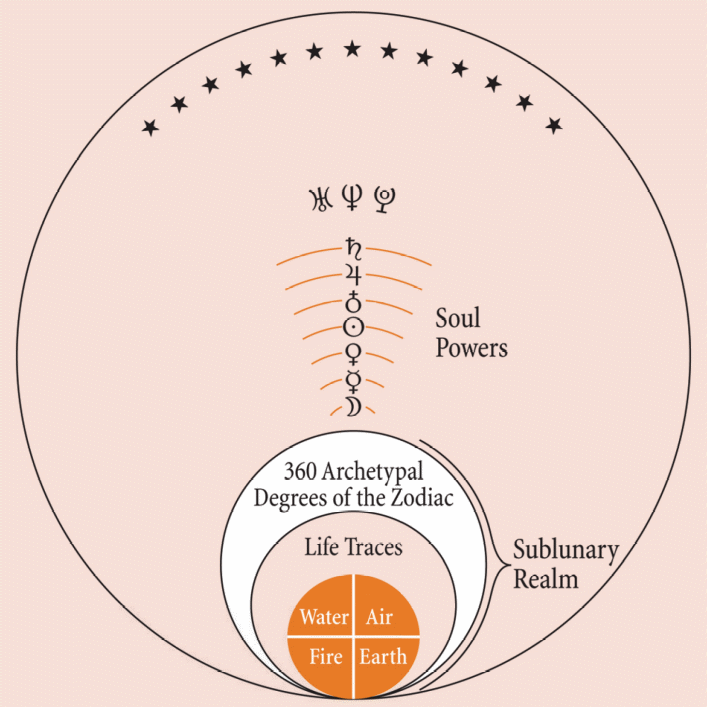
Class
Wednesday, October 5th, 1983
Verbatim, unedited transcriptClick the series name to view more
CLASS at Wisdom's Goldenrod, Hector, NY
with Anthony Damiani (AD)
October 5, 1983
PB PARAS; MEDITATION; INTERIOR WORD
TOPIC: PB Paras
SUBJECT: Meditation
SUBSUBJECTS: Interior Word, Intuition, Contemplation, Dragon, Pure Attention, Ego
CONTENTS:
PB PARAS ON THE INTERIOR WORD
"UNTIL THE INTERNAL WORD SPEAKS IN HIM HE IS REALLY INCAPABLE OF HELPING OTHERS SPIRITUALLY"
HOW TO DISTINGUISH INTUITION FROM THE INTERIOR WORD
HOW CAN MYSTICAL ALTRUISM BECOME ACTIVE PRIOR TO SELF-REALIZATION?
THE INTERIOR WORD CAN TELL YOU VERY SPECIFICALLY WHAT TO TELL OR NOT TO TELL SOMEONE ELSE
IT'S A RARE PERSON WHO CAN (1) RECOGNIZE THEIR PRESUPPOSITIONS, (2) TRANSCEND THEM, AND (3) USE THEM TO THEIR ADVANTAGE
"HE IS ABLE BOTH TO COMMUNICATE WITH THE OVERSELF AND TO COOPERATE WITH IT"
TWO INTERPRETATIONS OF JOHN 1.1, "IN THE BEGINNING WAS THE WORD"
UNLESS YOU SPEAK ABOUT AN INDIVIDUAL MIND IMPARTING INTELLIGENCE AND LIFE TO THE BODY, YOU CAN'T SPEAK ABOUT AN INDIVIDUAL EGO
IN THE INTERIOR WORD, THE IMPRESSION THAT COMES FROM THE UNDIVIDED MIND IS MADE ON THE LEVEL OF THE MENTAL BEING, PURE ATTENTION
THE INTERIOR WORD SOMETIMES PROVIDES MESSAGES FOR OTHER PEOPLE
THE INTERIOR WORD COULD BRING ABOUT VISITATIONS THAT YOU CAN'T CONCEIVE, BUT IT COULD ALSO MAKE YOU AWARE OF THE SIMPLEST THINGS THAT HAVE TO BE DEALT WITH
BOOKS READ FROM OR REFERENCED:
Paul Brunton, Notebooks. 16 vols; Vol. 1 entitled Perspectives [Persp.], published 1984-1988. Some Paul Brunton Notebook paras are, as of 2018, unpublished, and are noted as such.
Paul Brunton, Essays on the Quest, "The Interior Word" (new edition entitled Instructions for Spiritual Living)
Bible, John (1:1), King James Version
Plotinus, The Enneads (MacKenna translation, 4th ed.)
Muhammad, Koran
Vyasa, Bhagavad Gita
Upanishads
PLOTINUS QUOTES READ OR REFERENCED: I.1.7, V.3.2
DIAGRAM appended to this transcript:
- FIGURE 1983 1005-1. Inerratic, Planetary, and Three Levels of Dragon.
This diagram is from Astronoesis, p. 249. [Transcriber note: [diagram] means the speaker is referencing a diagram as he or she is speaking.]
NOTES:
Pat Campbell transcript from 1983 exists; other, earlier transcript versions exist, including one done in 1993 from audio cassette tapes by hp, jf, et al.
Unpublished PB paras should be sourced and proofread.
TRANSCRIBED Verbatim by IT 2019. Reformatted from V11a version by JRM & JF 2019-2020, with Subheads and Table of Contents added by JRM. In 2023, IT fixes prefatory matter and footer, updates audio file name, completes Book List, adds Plotinus quotes section, adds new notes within transcript, fixes minor errors, adds diagram and reference within transcript to this diagram. In 2025, MW expands Subsubjects and alters Subheads to make more accurate. Archival verbatim transcript – V14.1a.
AUDIO FILES: 1983 1005a, 1983 1005b. [Note 1: "Tape" and "Side" refer to original audio cassette tapes that were later digitized into .MP3 Audio Files. Note 2: In 2024-25, REP Studio improves the sound quality of both audio files, cuts dead air.]
1983 10/05 at Wisdom's Goldenrod
PB Paras; Meditation; Interior Word
Archival verbatim transcript
[Audio File 1983 1005a Begins]
RC: --in terms of the Interior Word. And, I think the biggest part of what didn't come across is [short pause] like any kind of real recognition of the mood that he-- he's speaking about in which this transmission takes place. I think that was part of the trouble we had in distinguishing an intuition. Maybe some of the quotes we'll read tonight will get it out. At the end of that-- at the end of that paper that we read, he presented a question with an answer.
PB PARAS ON THE INTERIOR WORD
[Transcriber note: I am using Essays on the Quest by Paul Brunton, Samuel Weiser, Inc., York Beach, Maine, 1985.]
PB [Essays on the Quest, "The Interior Word," p. 97, RC reading]: "[question.] Who can tread a path without feet? Who can see without eyes? Who can hear without ears? Who can speak without words? [answer.] Contemplation can tread without feet; discrimination can see without eyes; attention can hear without ears; [RC adds: and] the self-born can speak without words."
[33 second pause]
PB [V14, 22:2.156, RC reading]: "The experience of the Interior Word brings with it, or is heard in, an intensely concentrated state. With it there is a positive feeling of being the assured master of one's mind, emotions, and body."
[16½ second pause]
PB [V14, 22:2.169, RC reading]: "When he has travelled to this stage of his journey; when he can close the door of his chamber, lie down, and listen to the Interior Voice; when the silence within becomes audible with clearly formulated instructions, then only is he ready to speak to others or write for others, and teach them. Until then he is a deaf mute, unable to hear and untrained to speak the sacred language. Now the Pentecostal power has descended on him and he is able not only to see the truth through the surrounding darkness but also to give it to those among his people who can take it."
[22½ second pause]
PB [V14, 22:2.147, RC reading]: "The ideas which come to his mind through the Interior Word come stamped with the certitude of truth."
[16¼ second pause]
PB [V14, 22:2.133, RC reading]: "The phenomenon of the Interior Word does not ordinarily appear before one [RC reads: he] is able to carry the mind to a certain depth or intensity of concentration, and to hold it there continuously for not less than about a half hour."
[13 second pause]
PB [V14, 22:2.141, RC reading]: "The Interior Word carries an authoritative and commanding tone."
[short pause]
PB [V14, 22:2.142, RC reading]: "The Interior Word is not heard with the reasoning mind, even though its statements may be very reasonable. It is not connected with the intellect at all, as are [all] our ordinary words. It is received in the heart, felt intensively [RC reads: intensely] and deeply."
[27½ second pause]
PB [V14, 22:2.143, RC reading]: "Now that he has developed the capacity to hear, there sounds forth out of the obscure recesses of his being a silent voice, a messenger without name or form. It is the Word."
RC: Capital W.
[16 second pause]
PB [V14, 22:2.134, RC reading]: "In that state of inspired communion when the Interior Word is heard, thoughts keep coming into consciousness from a source deeper than the personal mind. The ego is not directly thinking them but instead experiences them as being impressed upon it or released into it."
[18¼ second pause]
PB [V14, 22:2.144, RC reading]: "The Interior Word is never enigmatic and puzzling but always direct and simple. Only the revelations of occultism are obscure, never the revelations of truth itself."
[23 second pause]
PB [V14, 22:2.135, RC reading]: "The utterance of the Interior Word can be heard only in heaven, only in a state detached from the animality and triviality of the common state."
[27¾ second pause]
PB [V14, 22:2.137, RC reading]: "[Interior Word:] Out of this blankness something will begin to speak to him. It will not be a sound heard with the body's ears. That would be a low psychic manifestation which must be stopped at once, if it happened."
[short pause]
S (very faint): (Again?)
PB [V14, 22:2.137, RC rereads]: "[Interior Word:] Out of this blankness something will begin to speak to him. It will not be a sound heard with the body's ears. That would be a low psychic manifestation which must be stopped at once, if it happened."
[18¾ second pause]
PB [V14, 22:2.163, RC reading]: "To bring others a message which elevates them and a truth which inspires them, the Interior Word will speak through him as him. This is a wonderful phenomenon when it happens."
[short pause]
S (faint): Repeat the quote.
PB [V14, 22:2.163, RC rereads]: "To bring others a message which elevates them and a truth which inspires them, the Interior Word will speak through him as him. This is a wonderful phenomenon when it happens."
[9 second pause]
CDA (faint): He's saying something different but I didn't quite grasp. It sounded like he was saying something different there.
RC: What did you hear?
AD: What do you mean?
CDA: It-- I don't know, it sounded like it was some kind of special or that it could be something, like some special sound that was referring to something (else/other).
AD (faint): Yeah.
CDA (very faint): Well, I don't know.
MB: Well would another part of this just say something about the Interior Word is a silent voice [few words inaudible] In this one it seems to have a specific message for others.
S (faint): Yeah.
MB: It seems to be coming forth from the interior into the exterior, so to speak.
RC: Did it say without messages before?
MB: I thought so, I may be wrong, that was the one that started out, "Now that he has developed the capacity to hear…"
LR: [one/two words inaudible] (one more time).
MB (faint): Yeah, I heard that one too. But it does seem (different). The Interior Word is taking on a certain manifestation in order to help others. And yet that is something that is different than what we've been hearing from Paul.
[13 second pause]
EM: It reminds me that, I think-- I think it was gone through, he talked about the difference between the guru and the spiritual friend, and that there's couple times where something given that's not personal from the teacher but it comes from another place and almost sort of a direct guidance that doesn't go through the teacher's ego and--
S (very faint): Right.
S (very faint): Yeah.
RC: Yeah it's funny, PB often spoke-- well not often but a few times, spoke about how in the process of his writing he would often be getting these messages-- messages. And sometimes he would get a sense of, "This is a message for the general public." But other times he would get a sense that, "Well this is a message for so and so and I (consider(ed) them already)." But sometimes, after he finished writing it down he'd be like, "Oh, that's for PB." (bit of laughter) [short pause] Yeah, the one you were talking about says, "a silent voice, a messenger without name or form."
S (very faint): Oh, (and/then) that's right.
S (very faint): Yeah.
[26 second pause with some faint background student talking]
PB [unpublished, RC reading]: "When the mind can be trained to attend with persistent concentration and listen inwardly, it may hear the Interior Word."
PB [unpublished, RC reading]: "The Chinese wisdom calls the Interior Word"the Voice of Heaven.""
[short pause]
"UNTIL THE INTERNAL WORD SPEAKS IN HIM HE IS REALLY INCAPABLE OF HELPING OTHERS SPIRITUALLY"
PB [V14, 22:2.138, RC reading]: "Until the internal Word speaks in him he is really incapable of helping others spiritually. He may be able to do so intellectually or to comfort them emotionally but that is a different and inferior thing."
[10¼ second pause]
AH: Would you care to speculate about what the difference is?
RC: I think that's part of what Elaine was referring to (in this paragraph). When that communication is-- it's not between the teacher's ego and the student's ego but is-- something is being said that communicates something to a deeper level of his (being here). And (it) may not intellectually even-- may not necessarily intellectually be satisfying or might not be emotionally comforting but would refer to the help or it could be all three. [38 second pause] And also too I think that in this presence that we're speaking of as [short pause] being the atmosphere in which this kind of communication can take place, I think that when the person has the experience of it, the-- the triviality of the discursive intellectual questions and-- and the extent to which the psychological ego is so attached to things that-- on an emotion(al) [one/two words inaudible] that the contrast between the two is really great. And, that unless-- unless a person is actually aware of that contrast, he doesn't know about anything spiritual communicate to the (middle).
AH (faint): It would seem that this quote, the spiritual is somehow defined as a very special--
S (faint): (What sense?)
S (faint): [couple words inaudible]
AH: Unless they have (based/just) off of that. Like, you just described it in regards to the atmosphere (which illustrates it).
RC: I found with PB a lot of the things that he said I've read before. But they just didn't carry the same meaning as when I read them in PB's notes. And there was like something much more being communicated when he communicated. [student assents, very faint] [22½ second pause] I think I mentioned to you that-- that one time that he (did/said)-- he asked me if, um-- "You know how the Zen people say that in the beginning there's mountains and rivers and so on, then you get all confused, and then afterwards it's mountains and rivers again?" I would probably have a hard time counting up how many times I've heard that. But then he just kind of smiled and said, "True." (bit of laughter)
[students assent, very faint]
[short pause]
PC (faint): Randy do you think there's kind of an intermediate level between communicating just on an intellectual or an emotional level and communicating direct words whereby you kind of have an intuition of something that you could say to someone or that you could write down which is of use and it's not really coming from your ego but it's not this type of direct communication either.
RC: Yeah I don't know if that would be called like being a vehicle for the Word, you know, particular situation.
PC: No I wouldn't think it would be, but, seems like it's-- you know, when-- he said you can't help someone spiritually prior to that stage where you receive the Interior Word. Maybe the word 'spiritual' wouldn't be appropriate to that but it's some type of actual help. You know what I mean? [RC assents] It's not just something that your ego is trying to do.
RC: Yeah. But I think he's saying pretty clearly here that until-- until this Word (that was) awakening in your soul, you're aware of it, that you really can't help other people spiritually. Doesn't mean you can't help them at other levels.
PC: In other words, even that type of intuitive awareness of what to say would only be helping them on-- on those lower levels anyway.
RC: I guess depending on how deep it-- it (went/was), you know like what we got going on at the time.
PD: You know, if you ask yourself (your/the) question, do you know what is right for a person in any given set of experiences?
PC: Well that's what I was saying, it wouldn't be something--
PD (simultaneously): You-- let me just talk.
PC: Oh, I'm sorry.
PD: And that question demands that you could penetrate into the depths of his-- of his own being. And that's quite a presumption on anybody's part. But if-- if the Interior Word is the soul speaking any given person or through that person, only that-- in other words, the ultimate ends that a person is heading towards, and only when somebody's operating from that perspective can they really be a true guide for another person.
PC: Don't you think though that there are some occasions when higher self can almost guide you intuitively to say something to someone? That your ego doesn't necessarily know it (depending) but you find yourself saying the right thing or doing the right thing and you realize it's come from a higher level but it's not that you heard a direct Word or (friendly spirit).
PD: Well that may be like he said at the emotional intellectual level you're helping a person.
S (very faint): Yeah.
PC (faint): Yeah but insofar as--
S (very faint): Yeah.
PD: But that's not the spiritual level.
S (faint): Yeah.
S (faint): Yeah.
AH (faint): That is--
PD (simultaneously): To help a person at the spiritual level may contradict all your own presuppositions about experience. You don't know. [S: Yeah.] But if I'm following, I could be all wrong.
TS (very faint): Well it seems to be [couple words inaudible] When you get an intuition it could be followed by your own [few words inaudible] I mean unless it's(--) to make sure it's, I mean [couple words inaudible] whether it's still mind or receiving powers from the-- the Overself. (I mean that's how spiritual) the Overself [one/two words inaudible] speaking to the other person [couple words inaudible] You can have an intuition [couple words inaudible] over and over again. The intuition may be true but [possibly one word inaudible] training, spiritual and otherwise, can color [one/two words inaudible] which are coming through. And maybe you're always disappointed. (That's what I think.)
DB (faint): Well but-- I mean, I think the-- the definitive point in the-- in the discussion is the definition of what it means to help someone spiritually. And, you know, speaking on behalf of my own self, I wouldn't know where to begin with that, you know. I mean the other (part's difficult) too but, I mean, that's not within our province to have anything but conceptions about really. It's only because it's-- it's such a vast topic that, you know, it was like Paul was saying that for one person at one time might be something completely different, for another person it seems to be not having anything to do with that.
JB: But David all the same, isn't there something likeable in Peter's inquiry?
DB: (Peter's/Is it) what?
JB: Some middle ground? I mean isn't there something likeable in Peter's question that you (do--)
DB (simultaneously): Oh sure, I mean we all want to help people but I mean--
JB: No, no, I didn't-- [one/two inaudible student words simultaneous with JB] I-- I didn't mean appealing, I didn't mean appealing that way. I mean something believable, that you somehow have access to the opportunity to help in an unconscious or subconscious way where--
DB (simultaneously): I can barely keep straight my own self, I mean--
JB: That's the-- but that is-- I think that would be the criteria that your own self wouldn't get in the way, I mean that your ego wouldn't get in the way.
DB: Right.
S: [one/two words inaudible]
JB (simultaneously): I think Peter was just asking us to entertain the possibility that you could have a reasonable view where your ego wasn't involved that might help someone spiritually and not just by chance. I agree-- I admit that's a confusing-- [AH simultaneously: That's attract--] and maybe I'm not speaking rightfully.
AH: That's certainly an attractive thought but it's at odds with the quote. That's the top of my original question. It seems that spiritual is being defined in this quote in a very rigorous and exclusive way and I'd like to hear more about what was meant by it.
S: By the word 'spiritual'?
AH: Yes.
S: Ok. How about that Jon?
JB: Now I see why your refinement was so important. If it is this very exclusive thing then all conceivable human advice becomes lower.
AH (simultaneously): Everything else is really--
S: Uh-hm.
AH: Maybe we could hear the quote once more.
S: Uh-hm.
PB [V14, 22:2.138, RC rereads]: "Until the internal Word speaks in him he is really incapable of helping others spiritually. He may be able to do so intellectually or to comfort them emotionally but that is a different and inferior thing."
AH: I think that's what's being described (there/then). You could speak to someone intellectually with-- with absolute clarity, there's no necessity for egotistical motivation to be involved. I mean, you could speak totally objectively from intellectual point of view. No ego motivations whatsoever. That's still not a spiritual motivation.
MB (faint): Can I comment? And I think maybe Peter's trying to get there are times when (you/it) actually can be-- and maybe you can even help somebody spiritually but you wouldn't be a spiritual guide. [student assents, faint] [PC simultaneously: No I wasn't implying--] You might be an instrument. But I think what he's referring to here is actually being a spiritual guide, someone who might actually tell you something [PC: Well--] to do something that might be contrary to the way you might feel emotionally [few words inaudible] Maybe they tell you to do that, you know, stage or activity or something like that and that wouldn't be an emotional (detail). It wasn't something that you could conceive of intellectually. It has nothing to do with somebody telling you-- telling someone [few words inaudible] probably give him that advice (necessarily).
S (very faint): Uh-hm.
DB: I think that-- I think that part of what the-- speculating, you know, that part of what the difference is is that when he talks about helping someone spiritually we're talking about those (transits and) those functions, some kind of transforming quality through whatever is being communicated and, you know, there's a-- there's a certain level of power here that, you know, is completely out of our-- our realm of consideration. And Randy, like what you were saying, when PB repeated the quote about the mountains and rivers and-- and what not. You know, they use-- the-- that-- it's one thing for-- for like when you go to Ramana to keep asking who are you and that might-- the way he said it or the force with which he was able to express that carries power in that, you know, one of ask-- one of us asks, you know, well who are you? Well I don't know. Do you see what I'm getting at, [RC assents, very faint] I mean--
RC: Well I think part of what-- what's being [one word inaudible] with all these quotes is the notes in this-- is you know what it is to receive communication of the soul and you can recognize the soul's voice in (you/me). We could get into a whole different discussion when we talk about the [one word inaudible] people. Like if one-- if one is capable of tuning into the soul and recognizing a message which the soul is trying to give to the ego, and the other one's (a feeling), and, like PB or-- or another person who tuned in could actually speak to you very specifically in English about something that your soul (is now) trying to communicate to you. And that would be spiritually helpful. They're already establishing a-- getting a point across.
And one example I-- I think it's an example, maybe just to bring out the-- like the different levels of helping others, that-- you know that Indian medicine man who's becoming really famous traveling around (that's always coming)? The first story I heard about him, one of the Indians in his tribe had been involved in a car accident. [S, faint: Right.] [couple words inaudible] up (to live/to-- he was) in Bellevue. And Bellevue did what they could and pretty much decided it was just a matter of time before the guy died, they wouldn't put him through anything more. And, then some of the other Indians asked him if-- they said that they would like to take recourse to some of their own methods and could they bring in one of their people to see if he could do it. The doctor said he wouldn't object to consultation but he didn't know exactly (thought of) doing it. So they-- they did the old-fashioned Indian dance, pom-poms and psychic initiation and all that good stuff [one/two words inaudible] The thing is you're supposed to contact the medicine man, he has three days to respond. And, if he's going to do anything he'll let you know within three days. So halfway through the second day they were-- ok, well maybe they didn't see [one/two words inaudible] one of the guys there so he calls him back. (laughter) And he said "Yeah I heard-- I heard your message. But, so far I haven't been called (to the spirit)." He said "What-- it's not always wise to take away a person's suffering. It's possible that he's learning things you just don't understand." Well it turned out that the next day he did come and he did heal the guy. But, it was a very interesting perspective. I mean his first thought wasn't "How do I take this person's suffering away?" What is going to be most valuable in his experience (just then).
AH: Randy? That may be good example but it seems to define the notion of spiritual within the context of the psychical. Will you allow that?
RC: I don't think it has to, at least in terms of-- He was making the decision what to do, I mean, definitely he got the message from the other Indians but-- but in terms of his getting prompted whether or not to do anything or not do anything, I don't think that has to be necessarily psychical.
HOW TO DISTINGUISH INTUITION FROM THE INTERIOR WORD
AB: I still have problems distinguishing intuition from the Interior Word because we said that they're different. [RC assents, faint] And, I could still argue that intuition-- hi-- highly developed intuition could give you valid knowledge which would be helpful to another person even though it might not be as (exciting), or, you know, (telephone) what the Interior Word would (be/give him).
[student assents, very faint]
RC: Yeah I think part of the-- the difference I'm trying to bring out at least is that actual sense of the sacred that accompanies the-- the transmission in the Interior Word. There's-- you may get an intuition that isn't accompanied by that, in fact most of the time it's not. But it seems like-- oh let's say for example that you read somewhere or somebody tells you when you're a kid that the body is a temple of the Holy Spirit. And you might actually recognize that it's true and something in you might say, "Yeah, it's correct." But then it might-- it might happen that like sometimes in a meditation or whatever you might have the actual transformation of the way that you perceive your body. And, those words that you've heard or you almost heard before all of a sudden are charged with incontrovertible-- like this observation that the body is indeed the temple of the Holy Spirit just like comes over you and displaces the ordinary level of (your) [one word inaudible] subjectivity. Whereas that with an intuition, usually the displacing is, I mean, it like (puts a piercing) to get through. But the ego is right there and the ego's been waiting to get your-- the question of, you know, catch it quickly enough or whatever. But I think this phenomena that he's speaking of as the Interior Word follows-- really does carry like the quality of a religious experience, which is a specific piece of information given and received with full recognition at the level that-- for as long as it goes on in terms of when we talk about actually bringing dialogue.
BS: Who would be receiving it, you know?
RC (faint): Well (he/it) doesn't do that.
BS (faint): Well, well, you think so?
RC: Oh yeah. I think when you were talking in terms of actually being able to do without the need of dialogue and want to-- without the need of this whole [short pause] dualistic relationship between the contents of your knowledge and the source of your knowledge, you get a different level than in ordinary life, then you start talking in terms of insight, uh--
BS: Ok, yeah.
RC: But there-- there-- this Interior Word that he's talking about, that's-- the whole process involves not only a communication of information but also a very deep recognition and feeling of sacredness of the ground of-- the ground of this communication. And it does evoke attention, awe and reverence that you wouldn't think of arguing with. You might react to it, [BS, faint: Yes.] or you might-- might say, "Wait a minute though. That was [few words inaudible]" But--
TS (very faint): Yeah, an intuition is almost the temporary [couple words inaudible] that grabs a hold of (what--) glimpse of the Overself [RC assents, faint] where the Interior Word there's an actual conscious identity.
RC: Yeah. I think the--
TS (simultaneously, very faint): The ego can experience the (spirit) without knowing (even from) the Overself.
AH: Tim I-- I can't hear you.
TS (faint): I was suggesting that intuition would be more the ego's temporary glimpsing of the Overself where (he/it) has a glimpse [couple/three words inaudible] and apprehend its source whereas in the Interior Word there's a knowing of that source and then there's-- of the Overself by the ego as a relationship of receptivity in the ego to that Overself consciousness. And I think that-- that insight would be the Overself functioning (through/with) that ego.
RC: Yeah I think too you can get intuitions and-- and really not know it and you act this way, like you don't know the source. And then you realize afterwards, "Oh, yeah, that must have been an intuition." But there's been no change in the [TS assents] level of your being. Whereas this-- this is real-- really a-- a changing in the way that you experience. Changing the way that you experience.
AH: You define intuition then at the intellectual level?
RC: No I-- I would say [one/two words inaudible] seems to be the (two of) the intellect or the will that usually bypasses. Like, even Jung doesn't really call it a rational function. But it seems that he-- if you were going to go through a process of actually cultivating the intuitive faculty and turning your mind inwards and trying to operate with that faculty, that you might eventually, you know, set off this phenomena that he's talking about as the Interior Word.
AH: Make some efforts there to clarify that quote and now if you clarify what we're talking about as intuition. Would you say that it's perhaps possible that you could be of help to another person "spiritually" and intuitively? Would you buy that?
RC: I guess maybe the-- I don't know. Maybe the catch-22 is that-- that you didn't do it. I mean the help happens because you caught on to something that--
[short pause]
AH: See I'm [S simultaneously: But--] really pressing for some kind of an understanding of what is meant in this quote by spiritual. I-- I'd like-- I'd like some other words, you know, but--
DR (faint): Well what about Tim's suggestion that you're distinguishing between helping someone by making them more aware through the Overself consciousness that operates through them as opposed to an intellectual or emotional help which might help the conscious personality. And that's not to say that that's nothing but it certainly isn't the same as having this view of that person that's toward the Overself.
AH: But I thought Tim described contact with the Overself as intuition as well as (the Interior Word).
DR (simultaneously, faint): Well I disagree. I'm not speaking anymore of [one word inaudible] just seems a little unusual.
S (faint): Yeah certainly.
TS (very faint): Yeah you're talking about (intuition).
PC: Well, I've sort of been getting the sense that the help could be coming from the Overself in either case.
TS: Where else could it come from anyway?
PC: Right, of course, 'cause we're saying it's not coming from the ego. But in the case of intuition it could just be operating toward the intellect or the feelings or the will rather than toward his ego [few words inaudible] That make sense?
RC (faint): Seems to me that like the Sage helping a person experience and be, the difference between giving the person a book and teaching him about it. Or the thing of like actually helping the-- the person, the ego, find a way to have communication with-- with his own soul independently of that, or independently, that that would be really to help someone spiritually if you can help them in some way to really even think for themself, it's at that level, or to feel differently about something that would be a more valid way of-- of perceiving the situation or experience. But-- you know, some type of involvement that changes your-- it could change your being (if it's a meaningful--) that changes the balance between the ego's role and the soul's role in your (day to day), that you're actually involved in the inner life of that person [couple words inaudible] Whereas most of the other things just seem to be helping them-- your help is limited to problems that continue to-- to go on in the sense we're talking about them.
PC: Now suppose that-- do you think it would be possible to have an intuition that would help you clear up an intellectual misunderstanding in relation to the Quest, that you could say something to somebody that would clear up something for them intellectually. But then that would be a different thing from actual spiritual help.
RC (faint): Oh definitely, yeah.
PC: And yet it-- you still would have to say that this is helpful to the person in relation to the Quest.
RC: Oh definitely.
PC (faint): Ok.
RC: But in terms of like nourishing the current, if you could put it that way, like nourishing the current between the person's soul and his ego, uh--
CDA: Randy, it's very hard to hear you in the back row.
[short pause]
PC: That was a good way to phrase it, what you just said. Just say it louder.
RC (faint): I can't remember. (RC laughs) I was thinking of it more in terms of like actually nourishing the current going on between the soul and the ego. If you do something that actually enhances-- you're guided to do something that actually enhances that inward relationship, then I think you could say some spiritual help would be right there. I think he's saying you're not even qualified to think about doing that until you've gotten some of this communication from your-- I think one thing you can do is distinguish the difference between what you as a human being would like to do just out of [one word inaudible] of human kindness. Distinguishing that from really being on a different level altogether and seeing the whole situation from a different perspective. [short pause]
We talked one time about astrology. And, we talked several times but this one particular time, I mentioned that I never really knew what to do with the information that came from astrology. That sometimes I would-- I'd get a sense, a pretty clear sense, of a certain event that's likely [couple words inaudible] (soul). But I would never know like, should you tell the person? Are they better off not knowing? Should-- it's going to be a painful experience should you try to help them to act in a certain way so they don't have that painful experience? What if that painful experience is exactly what they need and they're not going to learn otherwise? And, he-- he said yes (they say) you can understand why that type of activity's reserved for Sages. (laughter) Well, but on the other hand he said, an astrologer can help at the level that-- that he can help. [S, faint: Right.] If he knows-- if he knows-- if he stayed within the levels of what he does understand and recognizes where he does (and) doesn't know he can help. But that's different [PC: Yeah.] than I think what we try and call spiritual help [one/two words inaudible] (mystic).
PC: Even though on that level that you're just talking about, the help would be coming from a higher source but it wouldn't be called spiritual help because it's not transforming the person's relationship to their own soul but like dealing with the vehicle(s).
RC (faint): Yeah.
[students assent, very faint]
S: Ok.
S (faint): Uh-hm.
TS (faint): Um, that's--
S (faint): Yeah.
(Side 1 of original cassette tape digitized as 1983 1005a Ends; Side 2 Begins)
S (faint): Let's do both?
TS/S(?) (very faint): [couple words inaudible]
LR/S(?) (faint): (Nineteen hundred?)
TS/S(?) (very faint): There you go. (bit of laughter)
TS (faint): Uh--
LR/S(?) (faint): But I think it's people walking around here (that--)
PB [V11, 16:14.92, TS reading]: "He [TS reads: We] must eliminate all those intellectual ideas which stand between him and the Real, all those emotional states which cloud it. Otherwise his mystical deliverances will merely reproduce those ideas and states interwoven inextricably with real inspirations."
TS (faint): Next one.
PB [V11, 16:15.133, TS reading]: "Personal factors help to mold the revelation not only from the conscious surfaces but also from subconscious depths beyond them. The ego-complex insidiously penetrates it; the emotional nature immediately permeates it. The question arises whether these limitations can be transcended, whether a genuinely [TS adds: and] universal and impersonal condition can be attained in the seer himself, so that the resultant revelation shall be a"pure" one. The answer is that it certainly can, but that it is a rare and exceptional attainment."
S (faint): Yeah.
TS (very faint): They're both certainly [one word inaudible] I think Peter's talking about the [one word inaudible] (There's a quote here that--) that says oh I suppose you don't have it, what do you do in the meanwhile? Ok? Uh--
HOW CAN MYSTICAL ALTRUISM BECOME ACTIVE PRIOR TO SELF-REALIZATION?
PB [V13, 20:4.222 & Persp., Ch. 20 #54, TS reading]: "There is a fundamental difference between mystical escapism and mystical altruism. In the first case, the man is interested only in gaining his own self-realization and will be content to let his endeavours stop there. In the second case, he has the same aim but also the keen aspiration to make his achievement, when it materializes, available for the service of mankind. And because such a profound aspiration cannot be banished into cold-storage to await this materialization, he will even sacrifice part of his time, money, and energy to doing [TS reads: do] what little he can to enlighten others intellectually during the interval. Even if this meant doing nothing more than making philosophical knowledge more easily accessible to ordinary men than it has been in the past, this would be enough. But he can do much more than that. Both types recognize the indispensable need of deliberately withdrawing from society and isolating themselves from its activities to obtain the solitude necessary to achieve intensity of concentration, to practise meditative reflection upon life, and to study mystical and philosophical books. But whereas the first would make the withdrawal a permanent, lifelong one, the second would make it only a temporary and occasional one. And by"temporary" we mean any period from a single day to several years. The first is a resident of the [TS reads: The first are residents of an] ivory tower of escapism, the second merely its visitor. The first can find happiness only in his solitariness and must draw himself out of humanity's disturbing life to attain it. The second seeks a happiness that will hold firm in all places and makes retirement from that life only a means to this [TS reads: that] end. Each is entitled to travel his own path. But at such a time as the present, when the whole world is being convulsed and the human soul agitated as never before, we personally believe that it is better to follow the less selfish and more compassionate one."
S (faint): Do you have the (quote) for that?
TS: 8.7.6.
S: Of?
TS: 21.
S (very faint): Right.
TS: 20 red.
S: Thank you.
[short pause]
PD: Who's the "we" there?
S (faint): (Who carries) the "we"?
S (very faint): Yeah.
S (very faint): Yeah.
AD: You don't recognize a royal partnership?
[short pause]
PD: Then why did he say "we compassionately believe"? (laughter)
DB (faint): Because of this-- the alternative would be to say something like "we categorically insist" and-- (bit of laughter)
AB: I thought the "we" could-- we read the quote, the Interior Word will speak through him as him.
S (faint): That's true Alan. (bit of laughter)
[21¾ second pause]
DB (faint): Hey, Tim, that quote you read there, wasn't it-- didn't you say-- I got lost after he said, you know, just helping someone to get philosophical knowledge more accessible than it has been [students assent, faint] is good but there is much more he can do.
S: Right.
DB (faint): But then didn't go into a discussion of the difference between [one word inaudible]
TS (faint): Correct.
DB (faint): Ok, so-- I-- What-- what do you suspect that means? I'm not sure.
TS (faint): Well I guess that there are various meditations [couple words inaudible] there's much more that could be done [couple words inaudible] distinguishes the two paths [few words inaudible] simply the same. There-- there are things that can be done [S: Right.] [S, very faint: Ok.] which would help.
S (faint): Uh-hm.
[short pause]
JB: This may seem naive but I-- I mean I'm reasonably confident that when I would help [couple/three words inaudible] experience or to try to learn to meditate, come to study philosophy, not [couple words inaudible] you know, I mean there's some things-- (laughter)
S: You already learned that one?
S: I didn't learn the last one, (yeah). (laughter, student words)
S (faint): He's tight.
DB: Yeah, I've got [one/two words inaudible]
PD: But maybe your soul is not supposed to be [one word inaudible] maybe you're supposed to (come/become) [couple words inaudible]
JB: Yes and that's the-- that-- that was where I finally understand the point that you and Andrew brought up before which is that spiritual help has now been very very strictly defined, only the kind of thing a Sage can do. But these other things do seem to help. And they have to be-- there's some credit in them. But then there's another part that takes no credit at all and that has only been touched upon, that Myra mentioned, which is that sometimes you are a-- a vehicle in someone else's real benefit. Do you acknowledge the possibility of that?
LD: I guess I would have to if you really pressed me. (laughter)
JB: Because that could be that special middle case, right, you know. You never know that you did it I guess till-- but I think that's the best-- an example of the middle case where you said something you couldn't have conceived it-- you didn't conspire to do it, you don't know what outcome it will have.
AB: Jonathan? Maybe one way to reconcile this problem is to say that by giving spiritual help means to be a spiritual teacher. And he has stated in other quotes tonight that to be a real teacher you have to be capable of receiving the Interior Word. [JB assents] So certainly people get help in other ways but to be a teacher, to give spiritual help, requires this Interior Word.
JB/S(?) (faint): Uh-hm.
AH: And that should be kept distinct from the whole realm of human ethics and morals and judgments and-- Like everything else is in some way beneath that perspective of the spiritual level.
JB (simultaneously): Yeah. Even the Quest in a way, which is kind of what I was pointing out. [AH assents, faint] I mean there are (sort of) things you can read, that the Quest includes this, this, this, and (this/that). Well--
THE INTERIOR WORD CAN TELL YOU VERY SPECIFICALLY WHAT TO TELL OR NOT TO TELL SOMEONE ELSE
LR (simultaneously): There's a quote in there that I-- that is listed as Interior Word and I think it was decided wasn't spiritually a word, [S: Yeah.] that speaks about help coming from-- if you can't get it from your own Overself sometimes it'll come from somebody else or it'll just directly appear in a circumstantial. So that's just doing it the other way around, Jonathan. But I think, you know, if you put yourself in the place of the person who-- I-- I don't know if it-- In other words, people-- every one of us will get help because-- from our lives hopefully because we can't directly be getting it all the time through that-- through (appearance/a pureness) of the Overself. Now that means that somebody else at some time or another will be pointing out things that perhaps we're not getting from our own Overself but that does not necessarily mean then that that other person is getting the Interior Word, it means that that other person's intuitive, sensitive to you. There's a kind of communication unconsciously or consciously of-- I mean I think we're mixing up [JB assents] two-- two--
JB: Well now-- now you're bringing in [one/two words inaudible] add something else to that. You-- the person being so helped actually only responds only 'cause he only engages in this transformational experience. It is said that they internally have that and can get to that understanding. I mean so that you could be surrounded by vegetarians for fifty years and never get the idea of the, you know-- You know-- you know what I'm adding now to it?
LR: I didn't get it.
JB (simultaneously): There does seem to be another thing now on the other end added on. I'm carrying on too long. But a-- yeah.
LR (simultaneously): But just say it over.
JB: Ok, that we've taken away now from the individual previously called helper any intent or power to know how to help on his own, alright, he's just a-- either directed or not or-- or-- or as far as he's concerned chance or a nice intent, a compassionate interest but the ability to actually transform you isn't-- but he has ego power, (and that that seemed to be) knowledge. But now it occurs to me that [couple words inaudible] the individual helped has to see the truth in the thing. So that his e-- his Overself I guess is employed at that stage also to get it, which co-- which might indicate that the other person is only made a prod or a stimulus. It's just another element in it that-- bringing in the individual's Overself and in every way.
S (very faint): (Right/Yeah).
AH: Jonathan?
JB: Mm, yeah.
AH (simultaneously): Are you suggesting that the notion of spiritual help, if it's to be a completed possibility, requires both Master and student to be functioning at the spiritual level?
JB: Uh-hm, I guess so. At least in the-- in the place where the world is teaching you. Whether a-- whether a Sage can zap you against your will or not I have no idea but--
RC: But I think with respect to the-- the Interior Word though, the quotes that we've read are-- are saying that the man doesn't have to be a Sage for this phenomena to happen. That provided that you can enter into a state of contemplation that the soul can speak directly to him. It may speak directly to you in terms of the-- for you. It may speak directly to you as some situation. Or it may speak directly to you on behalf of what it's been trying to get across to this other guy. [student assents, faint] But--
LR: What does that mean Randy?
AD: A message for someone else.
LR: Yeah, what does that mean, does that mean that-- that the other person's Overself, that you're apprehending directly the other person's Overself, I mean he--
RC: At that level I think [LR simultaneously: But that level is beyond the individual Overself?] it'd be real hard to distinguish between yours and his, it's--
LR: Yeah I understand.
RC: That--
LR: What does it mean to get a message for somebody else?
RC: Well you take the-- for a moment your-- your mind is operating at a universal perspective and speaks from there specifically to the-- the other person's situation.
LR: Right.
RC: It's not that your-- your values tell him how he would act-- how you would act in his situation.
LR: So does that mean that-- that the Interior Word comes from Universal Mind as opposed to a particular or an individual Overself, [PD: You know, just kind of--] directed-- I mean, we have spoken of the-- the Interior Word as being specific guidance [RC assents] to you about your own spiritual life, [RC assents, faint] remember we were speaking about that as [RC assents, faint] the-- Ok. Now this is another instance where there's specific guidance but it's not your spiritual growth that it concerns. So is the source different?
RC: No I think the source is the same.
LR: The source is the same.
RC: I mean we could get into a diffi-- a real difficult--
LR: I have no idea.
RC: I mean, we could get (into/in a) real difficult-- you know, we didn't enter into that whole thing of at what level is it appropriate to say the Overself is one [LR simultaneously: I know, that's the problem.] and when is it-- level is it appropriate to say you got one and I got one. And is it ever appropriate to say that they aren't really--
LR: Well-- but if you say that most of the time the Interior Word concerns your own spiritual development, [RC assents] then that is to say that it doesn't concern everybody else's own spiritual development [one/two words inaudible]
AD (simultaneously): Yes, but you don't have to circumscribe yourself so narrowly.
S: Uh-hm.
LR: But, you don't see the problem or my confusion at all?
AD: No, I don't see the problem. Why my soul can't tell me to tell you to do something.
LR: I know your soul tells me to do-- never mind. (laughter) Let's not bring up that one but-- but if--
S: What else are you talking about?
S (faint): [couple words inaudible]
S (very faint): [couple words inaudible]
AD: You're asking why doesn't your soul tell you directly instead of me?
LR (simultaneously): No, I'm not asking why.
AD: Then what--
LR: That's not--
AD: Then what's your point?
LR: That's quite clear why it can't get through. (bit of laughter) A couple weeks ago you said that most of the time the Interior Word concerns very personally yourself giving specific guidance for your own development.
AD: Uh-hm.
LR: Ok. Now that seems to be advice coming directly from your own-- I mean, if it stopped there I think-- I thought I understood that. But, now if the Word comes to you for-- for somebody else, for one of your students--
AD: Well we took the example of Socrates. Remember?
LR: And Alcibiades.
AD: And Alcibiades, yeah.
LR: No.
AD (simultaneously): Socrates was very clearly and distinctly told not to have any conversation with Alcibiades. And a couple of minutes later that was changed.
LR: Right, but that-- that's not quite the example I wanted to get in. If PB got a message and he said this is for some people (to) [one/two words inaudible] had to send that off in a letter, then that's spiritual guidance for someone other than himself, right?
AD: Uh-hm.
S (very faint): Uh-hm.
LR: Now, the question is does-- doesn't that bring up the issue of one Overself, many Overselves?
AD: No, I don't see why.
LR: Because, from what point of view do you distinguish guidance specific to you and guidance particularly for somebody else?
AD (simultaneously): You see, you're working on the assumption that there's many World-Ideas.
LR: I'm working under the assumption that there's many World-Ideas?
AD: Yeah. There's one World-Idea.
PC (faint): Regardless of what Overself it comes through there's only one World-Idea.
S (faint): Yeah.
PC (faint): So there's guidance for another individual included in that as well as yourself as a vehicle to communicate that (message).
LR: But then, Pete, there's quotes here that say the Interior Word is very specific, very particular.
S: So?
AD: Well unity [S simultaneously, faint: Why can't the specificity tell you?] is really very specific. (bit of laughter)
PC(?): I thought Randy made--
LR (simultaneously): Well who is it that distinguishes (who/what) it's for?
AD (simultaneously): It's very specific in what it tells you, Linda, very specific. [LR, faint: Very specific.] It's a very clearly enunciated message, there can be no mistaking it. There's not mistake about it.
LR: Yes.
AD: That's its specificity, its specificity doesn't mean that it's going to be concerned-- that it cannot be concerned with others that you may know.
S: Yeah.
LR: So you're saying it's divor-- it's coming directly from the World-Idea per se.
AD: No, I'm not saying it's coming from the World-Idea. It's coming from your own higher self and it's very directly related to you, you're going to have a conversation, a dialogue with it the way we spoke about it. And it can deliver you knowledge, can tell you things that are very very specific as to what to tell someone or what not to tell someone, what to do and what not to do. And the specificity has to do with the message and not the restriction that it is only for him, only for his benefit. And besides, it is for his benefit when he is helping others too.
AD/S(?) (faint): (Uh-hm.)
LR (simultaneously): I'm so confused that I can ask no further question(s).
AD: Very good. Let's go back to what Tim read. Tim, would you read that first one?
S (faint): Fair enough.
S (very faint): Yeah.
S (faint): Uh-hm.
S (very faint): What do you mean?
[17¼ second pause]
MB (faint): He wants you to read it.
AD: I can't [couple inaudible student words simultaneous with AD] hear you Tim.
TS: I'm trying to find it. "He…" This one?
PB [V11, 16:14.92, TS rereading a part of]: "He must eliminate all those intellectual ideas…"
AD: Yeah.
PB [V11, 16:14.92 cont., TS rereading a part of]: "…which stand between him and the Real, all those emotional states which cloud it."
AD: No, I'm sorry Tim, the next one?
TS: The long one. Um-- ok.
PB [V11, 16:15.133, TS rereads]: "Personal factors help to mold the revelation…"
AD: Yeah.
TS (faint): This whole book is [one word inaudible] ok.
IT'S A RARE PERSON WHO CAN (1) RECOGNIZE THEIR PRESUPPOSITIONS, (2) TRANSCEND THEM, AND (3) USE THEM TO THEIR ADVANTAGE
PB [V11, 16:15.133, TS rereads]: "Personal factors help to mold the revelation not only from the conscious surfaces but also from [TS adds: the] subconscious depths beyond them. The ego-complex insidiously penetrates it; the emotional nature immediately permeates it. The question arises whether these limitations can be transcended, whether a genuinely universal and impersonal condition can be attained in the seer himself, so that the resultant revelation shall be a"pure" one. The answer is that it certainly can [TS adds: be], but that it is a rare and exceptional attainment."
[11 second pause]
AD: What do you think he's saying, Tim?
TS: That-- [short pause] Well, in my own language--
AD: Yeah, in your own words.
TS: That real revelation only occurs when the individual has actually disassociated himself from his horoscope, from prenatal configuration, and is moving in accordance with the cosmic soul.
AD: But then when he wants to communicate that message wouldn't he have to use those-- those very presuppositions that you say he just transcended?
TS: Yes.
AD: Well--
TS: That's where he says-- there are other quotes in this-- of-- to this issue where he speaks about the nec-- the necessity of philosophic discipline, that the reasoning mind must be developed and the emotions must be purified so that that distortion factor is minimized.
[short pause]
RC: But I think part of-- wouldn't part of the difference be that he actually would be able to use it rather than his being passively molded by it, that he'd actually be able to say ok, given this psychic vocabulary I have to work with, how can I squeeze something out of it that actually does communicate what I'm trying to communicate? What-- what does this little personality know that would actually be useful to communicate to someone?
S (faint): Uh-hm.
[short pause]
S (faint): Go ahead.
CDA: Why is it-- I'm a little--
S: Can we hear it again?
AD: Well what he's saying is that you can use your presuppositions to help state your liberation.
CDA: Yeah I heard that. I was going to say something else. I-- that quote gave me the impression that the way he spoke about the rarity of this experience, it sounded-- as-- juxtaposing that view, how clear and precise and unmistakable certitude that comes (through/with) the Interior Word, that it sounds-- that he could be speaking of a different order of revelation.
AD: I don't think he makes a reference to the Interior Word.
CDA: I didn't-- ok. Then I-- then I'm wondering what level revelation-- you know, the-- the way he says, is it [AD simultaneously: (Um-- uh--)] a philosophical revelation, I mean (will--)
AD (faint): (Well), I never [one/two words inaudible] with the revelation (either).
CDA: Definitely (an indirect) phase of our knowing. [student assents, very faint] I don't know it either.
AD: Never.
MB (simultaneously): We can't hear.
CDA: You said it was a revelation from the Divine Mind as opposed to your individual Overself giving you guidance.
AD: No. No, it's from your individual Overself. All you can know about the Divine Mind is through your individual Overself.
CDA: No I know but-- ok. I'll stop, I think I understand it (better).
AD: No the important point here is to notice how he's pinning down that most of us are caught up in our presuppositions and that is a very rare person who first of all recognizes them and second transcends them and thirdly could even use them to his advantage.
RC: Do you remember that quote in the Writing notebook where he's ac-- there's actually a quote that says, "Become PB again. His warmth and way of being able to communicate with people can be useful in expressing what you have learned." [students assent] Like with-- do you see like the-- the personal warmth is like a content in the way that the personality was warm but that that warmth is actually being used as part of this-- for expression.
TS: No in this quote too the word-- he wrote revelation in the quote.
[14¾ second pause]
AH: Could we return to that notion of spiritual we talked about in the quote [one word inaudible] I think the last few minutes' discussion is how he'd understand what that must mean. But, if it was spiritual help offered, it would have to be absolutely impersonal. It would have to be divested of all these other possible ways of being (contaminated/contaminant). [S, faint: Yeah.] Seems that is what he was reaching toward when he said everything else is below it in that one quote.
S (faint): Yeah.
RC: He has one wonderful one-liner, he just says, "If you would be a bridge between man and God, be sure that your ego doesn't come between them."
S: Mm.
S (faint): Uh-hm.
[15 second pause]
AD: You want to [RC simultaneously: Ok.] read the third one now, Tim, the last one, the big one?
[18 second pause]
PB [V13, 20:4.222 & Persp., Ch. 20 #54, TS rereads a part of]: "There is a fundamental difference between mystical escapism and mystical altruism. In the first case, the man is interested only in gaining his own self-realization and will be content to let his endeavours stop there. In the second case, he has the same aim but also the keen aspiration to make his achievement, when it materializes, available for the service of mankind. And because such a profound aspiration cannot be banished into cold-storage to await this materialization, he will even sacrifice part of his time, money, and energy to doing what little he can to enlighten others intellectually during the interval. Even if this meant doing nothing more than making philosophical knowledge more easily accessible to ordinary men than it has been in the past, this would be enough."
[short pause]
AD: Alright, let's proceed now, let's go on.
[17¼ second pause]
"HE IS ABLE BOTH TO COMMUNICATE WITH THE OVERSELF AND TO COOPERATE WITH IT"
LR/S(?): Go ahead.
[14 second pause]
PB [unpublished, RC reading]: "At this stage he discovers to his growing wonder that he is able both to communicate with the Overself and to cooperate with it."
[student assents, faint]
[short pause]
PB [V14, 22:2.160, RC reading]: "It is a process of inner dialogue, of mental conversation with the other self and of emotional communion with it, flowing under his thoughts to and fro."
[short pause]
AH: Randy that first phrase, "at this stage", what stage is that?
RC: There's about eight of them here that just-- that like got the headline "The Interior Word", and, the last three that I read are part of that grouping 5.1 (there).
S: Uh-hm.
AH (simultaneously): So in regards to a stage you would speak of the stage of contemplation?
RC: I think he would be saying at-- at the stage where this drama that he's calling the Internal Word begins to-- begins to operate would-- of course would presuppose being in a contemplative state, concentrated.
[short pause]
MB (very faint): Could you try to repeat?
PB [unpublished, RC rereads]: "At this stage he discovers to his growing wonder that he is able both to communicate with the Overself and to cooperate with it."
RC: You might have, you know, lived for a long time with the sense that you were on your own here. And all of a sudden that big brother you were looking for and guardian angel actually exists (through back). [short pause] See the prob--
PC/S(?) (simultaneously): Could you read that-- could you read that one one more time?
PB [unpublished, RC rereads]: "At this stage he discovers to his growing wonder that he is able both to communicate with the Overself and to cooperate with it."
HE (faint): That was one quote and then there's other--
AD: You could leave out those first three words, it won't materially affect what he's telling you.
[11¾ second pause]
DB: Randy is the implication that in order to be able to-- is there the implication that in order to be able to cooperate with the Overself that the ego has to be put in a fairly rigid discipline, [S: Shouldn't be--] not eliminated because it's (on like button). It's not going to be-- interfere at all. [student assents, very faint] I mean is that what it means to cooperate?
JB: This is about knowing that you can cooperate, not about cooperating. You may have-- you may cooperate quite unknowingly without being restrained. Is that what you were-- Isn't that so, that the quote is how do you-- You come to know with increasing wonder that you can communicate and cooperate.
S (very faint): Uh-hm.
[short pause]
S: [couple words inaudible]
DR (simultaneously): Well I thought if we-- if we leave those first three words in and it says at this stage means to say that the Interior Word-- I thought that was the stage of contemplation. I thought that meant that the ego was already dead.
RC/S(?) (faint): Uh-hm.
DR: That, you know--
RC (simultaneously): [couple words inaudible] We're getting a little on that last week. I really think, I've said it before, and I think one more quote (is) going to bring it out, that you could intermittently, and perhaps even with some regularity, be able to enter the contemplative state and not have a dead ego. That when this-- when the Sufis talks about annihilation and all that sort of stuff, [short pause] I think that there's a definite transformation that's taken place, so that there's no longer any possibility of-- of the ego interfering with going into and coming out of contemplation. But I think that you can-- you can get into contemplation and [couple words inaudible] for a while, get back (there/here) and-- and blow it again, but that any-- at any time in that development, this phenomenon which he's calling Interior Word can begin to develop, just that the ego just doesn't have to be, you know, dead or alive.
DR: Well see, I don't-- I don't even mean to say it in-- I mean if you take permanent reality that's fine with me. The-- just the stipulation of cooperation in contemplation I think it's hard to imagine that he really means for you to say that there's some kind of cooperation with the Overself is really the ego's making a bargain with the-- with the Overself, it doesn't seem to be appropriate at all. I mean--
S (very faint): I don't know if you'd call it a bargain.
RC/S(?) (very faint): Right.
S: Well if I--
MB (faint): Would you read the rest of it please?
RC: Which format?
MB: Well--
DR (simultaneously): Anthony said that, you know--
MB (faint): No you read-- either you read two before or there was more to the one that you just read. Part of--
RC: There's one about he discovers with growing wonder [MB, faint: "It is a process…"] that he's able both to communicate with the Overself and to cooperate with it.
MB (faint): Didn't he go on to say it was a process?
RC: Yeah, the next one says--
PB [V14, 22:2.160, RC rereads a part of]: "It is a process of inner dialogue, of mental conversation with the other self and of emotional communion with it…"
PC: Yeah.
MB (faint): So that seems to relate to the notion of cooperation. Emotions are tuned to the point where they are willing-- you know, they are accepting. It's not a-- it doesn't sound like it's (simply/something) bargaining. [RC: No I--] It sounded like any time there's a bargaining maybe--
RC: Yeah. No I-- I think [few inaudible MB words simultaneous with RC] it's better representative to really flood this-- really flood this, yeah, intimate companionship or communion of this event, that any kind of-- by keeping your mind in a certain state, by acting a certain way, you actually do begin to participate (of), you know, recognizable messages coming from your soul. Their frequency is directly related to the way that you act on the guidance that's been given.
MB (faint): You know when something-- maybe it was last week [one word inaudible] that a certain blissfulness that accompanies this state?
RC: Yeah, a certain bliss.
MB (simultaneously, faint): So that you wouldn't even want to not do it anymore. It wasn't even-- it wasn't even a question of there was an ego saying no I won't do it. Maybe even the ego [few words inaudible] spirit in a certain way. So a certain gratification but not [couple/three words inaudible] to not have blown up.
JB: Say more.
MB (faint): Just a suggestion.
S (very faint): Uh-hm.
AH: I'm confused because, how shall we approach the quote, like are we going to be liberal in our interpretation by-- per your description of the contemplative state that we've popped in and out of from time to time. Then-- then what do we do with those quotes from last week like about the dangers of the pseudo word? Like, I'm awfully reluctant to take the flavor of the quote rather than its literal meaning [MB and RC assent, faint] because of those possibilities of kidding yourself about these things.
RC (faint): Uh-hm.
MB (faint): I realize you're not happy with this discussion, we can go on to the next quote.
AH: No I'm sorry Myra.
S (simultaneously): [few words inaudible]
MB: It sounds like-- I mean, it sounds like you don't want to have any discussion about this.
AH: No I-- I-- I would like to know if we're going to listen to the quote or-- or speculate about what we think it might mean. Or better perhaps what we want it to mean. (bit of laughter)
DR (faint): I think Andrew's point is valid, I mean you-- you could take [one/two words inaudible] is to know that it's possible to communicate and cooperate with the Overself, just know that it's possible, just forgetting about whether you have a flavor for what that is or not. That's-- that's what it means. That doesn't-- and--
MB (simultaneously): Why-- why are you looking at me (David/Dave)? (laughter)
DR: I'm just sensing some resistance. I mean if Andrew wants to leave it at a high enough level so that there's no possibility we can possibly comprehend it--
MB: Then your point is that you'll speak that.
DR (simultaneously): Then-- but it's still worth hearing.
MB: Well, no, the question that I asked him was if he's saying we shouldn't discuss it and if that's what he's saying then [couple/three words inaudible]
AH (simultaneously): I'm asking if we-- should we insist upon a psychological interpretation? Or shall we do it otherwise?
MB (faint): Why do you-- but-- but why do you (side with him)?
S (faint): Ok.
AH: I'm confused.
AD: Read the rest of them Randy and we can discuss them after you finish.
PB [V14, 22:2.139, RC reading]: "If the Interior Word bids him move in any direction which seems encompassed by difficulties or blocked by obstacles so that he can see no way before him, let him not doubt or fear. A way will be made by the power of the Overself. He need only obey, relax, and trust [RC adds: in] the guidance."
S (faint): Yeah.
S: Can you read that once more?
S (very faint): That's right.
PB [V14, 22:2.139, RC rereads]: "If the Interior Word bids him move in any direction which seems encompassed by difficulties or blocked by obstacles so that he can see no way before him, let him not doubt or fear. A way will be made by the power of the Overself. He need only obey, relax, and trust the guidance."
JB: Well now I have a-- my own view of Andrew's complaint. There is a set of quotes that are sweet and conciliatory, hopeful, optimistic, go and believe and everything will be nice and then there's quotes that say, you don't have anything and you're not going to get anywhere and don't think you've got it and you don't and, you know, be careful and don't be fooled and don't be tricked by the psychological (abyss) and this ego that, or the ego's there or the ego's dead, and those-- I mean that really matters (bit of laughter) if you want to go do something and want to know what you're doing. I guess that-- I mean isn't that-- is-- Andrew, did I touch upon objection?
AH: It-- yes. [JB simultaneously: That--] It's not-- it's not so much a complaint as it is a confusion. (some laughter) I'd like to understand how we're going to approach the quote.
S: What do you mean Andrew? What quote are you talking--
RC (simultaneously): Well it seems like what we're trying to get out of it is-- (bit of laughter) Granted the fact that there are a number of different desires, wishes, alien influences and so on that prompt you to act, and that you want to be sure that you're not listening to one of them, [student assents] but you are indeed [S: (Hearing) mystics?] distinguishing the Interior Word, then what is the Interior Word? It seems we're reading these quotes that characterize it, that tell us something about it, so that hopefully, if it shouldn't-- well-- I think now that you've heard the words if it ever actually happened to you you might realize this is what he's talking about. I think if you can't recognize something in what he's saying here, then it hasn't happened. And, the reason that you can't tell which one it is that he's talking about is because you haven't heard the one he's talking about. But he is telling you something about it that you might be able to recognize it. He's telling you some of the things that are required and you have to be in a state of contemplation.
AH: For thirty minutes.
S: Right.
S (simultaneously): Right.
RC: Sort of (rely/relies) on all the times you've been clear. So you would say it comes up. [S: Or--] I mean it's also possible that you, you know-- you might have at some time gotten (some of this/somebody's) help, and--
[11 second pause]
DR: Could you read two more?
PB [V14, 22:2.140, RC reading]: "When the Inner Word begins to speak to him, he may begin to speak to others--not before. For only then will what he says bear any creative power, spiritual inspiration, enlightenment, or healing in it."
RC: So there seem to be four terms there. That if it's this Interior Word actually operating, there's going to be creative power, there's going to be spiritual inspiration, it's going to carry some enlightenment or have some healing power. [22¾ second pause] But there are other quotes too that we read last week where he says you have to distinguish this pseudo word. If it manifests during the second stage before you've ever reached into the contemplation then it's probably pseudo, the result of mental activity on ego's part mixed with a little reflected light. (But/If) the true Word comes after the third stage, speaks out of the mental stillness of contemplation.
[37¾ second pause]
PB [V14, 22:2.136, RC reading]: "It-- It is as if another voice-- It is as if another being spoke inside me--not with audible voice…"
AD (simultaneously): I-- Are those the two, would you read it again? Another voice, another being? Or is it--
RC: Another being.
AD: Ok.
PB [V14, 22:2.136, RC reading]: "It is as if another being spoke inside me--[not with audible voice but with mental voice--and imposed itself strongly on my own mind]."
[Audio File 1983 1005a Ends]
[Audio File 1983 1005b Begins]
TWO INTERPRETATIONS OF JOHN 1.1, "IN THE BEGINNING WAS THE WORD"
[21¾ second pause]
PB [V14, 22:2.148, RC reading]: "[Internal Word]: In the New Testament, John introduces the idea of the logos, the Word which speaks in every man who comes into the world. Every man is not [RC reads: Not every man is] able to hear it although it is always there, always immanent."
LDS: Randy are you sure that comes out of the Interior Word section?
RC: Yeah it says "Interior Word". (bit of laughter)
HE (faint): Well I know.
S: Hm.
LDS: Anthony, do you have any comments on that?
AD: What are you thinking of?
LDS (simultaneously): That's the one I asked you-- I asked you about last week.
AD: Well, be more specific Lou.
LDS: Last week we talk-- we talked about the-- the-- in principle this Interior Word is always available or always there but not always available depending on the person's preparation and ability to receive it. There was some speculation about whether that's true, whether in principle it is always there, and this quote seems to confirm that it is. But I had asked you about that and you didn't feel that that was-- this Logos that John brings up is not the Interior Word. Or you didn't suspect that it was.
AD: Well the interpretation can be both ways (here). John-- John says "In the beginning was the Word, and the Word was with God, and the Word was God." [Note: Bible, John, 1:1.] It could be interpreted to mean that in the beginning the Intellectual-Principle was-- is the Word of God and it's the same as God. Or you could in-- you could interpret it at the level of the individual Overself where you would have the same thing repeated. At any rate, if you did know that at the higher level the Ideas are with God, you would have to know it through the intermediary of the Overself. And both interpretations would stand up.
LDS: But isn't there something more profound or more inclusive in the notion of the Logos? Even if-- if we're speaking at the level of the Overself, the Logos-- the Logos that the Overself knows or has as its intimate content, wouldn't that be like the grasping of the total World-Idea?
AD: Yes, that's what it means, in the beginning was the Word, the Word was with God, if we interpret-- if you interpret it to be your God, your Overself, and you interpret it that way, in the beginning was the Word and the Word was with the Overself, then naturally you're speaking about in the beginning the World-Idea was with the Overself.
LDS: So you're saying the source, the fundamental source of the Interior Word, or what the Interior Word really is in its entirety is the World-Idea given to the Overself.
AD (simultaneously): Well, I don't think you could say it was Idea. Because the point here is that it's your Overself that communicates to you the knowledge, whatever specific knowledge the World-Idea let's say is expressing at that time. And it is your Overself that will speak to you directly. It isn't the World-Idea but except through the intermediary of your own higher self.
LDS: Ok, I follow what you're saying--
AD (simultaneously): And then (we/he) can go on further and we could say that that Word is always immanent in its expression of the World-Idea. So in that sense it is uninterruptedly and continuously expending all of its might to express that; disregarding whether you're aware of it or not.
LDS: The only thing I-- I probably should know this but I have to ask, what is the limitation-- when you say this Interior Word given to each-- or the individual Overself, what are you implying by limitations?
S (very faint): [couple/three words inaudible]
LDS: No he said it can't be the entire World-Idea (if it's/that's) coming through your Overself.
S (very faint): Yeah.
LDS: Now by saying it's coming through your Overself, there's an implication there that there's some limitation, some specificity that's been placed upon that, that it isn't appropriate for everyone at all times.
RC: Except the limitation isn't on the Overself. Limitation is in terms of what's appropriate (to) your ego now. Like there-- it seems to be different that you'd say on the one hand the World-Idea is always there, whether you know about it or not. And quite another thing to say, ok, now you've reached a point in your development when you can begin to get information about that Idea and perhaps sometimes even to speak on its behalf for others [student assents] to help them find the meaning in their experience. It seems the second is what he's calling this phenomena of the Interior Word where your Overself makes available to your ego in this place, at this time relevant information to your growth, possibly to other people's growth.
LDS: [one/two words inaudible] those thoughts.
RC (simultaneously, faint): Yeah. And it's a very different level than to say if the World-Idea is always there. And that this phenomena you're speaking of is-- is granting that the World-Idea is always there, now let's talk about a certain stage of its getting communicated [LDS simultaneously: Or pieces of it getting communicated.] into the reflective consciousness. Yeah.
LDS: Some portion of it.
RC: Yeah.
LDS: So you're saying there's three terms always included in the notion of the Interior Word, the reception of the Interior Word. There's the ego, there's the Overself, and the World-Idea.
RC: Yeah and-- and consequently the very specific element of the World-Idea relevant to the ego that is being spoken of.
LDS (faint): Yeah.
BS: So it's always tied in, he has to be a certain stage of refinement of the ego?
RC: Oh definitely, yeah.
BS: Or the mental-- or the mental state.
RC: Yeah, too early you can't hear, too late you already know so you don't (need it). (laughter)
BS: And in between, do you get an in-between (there)?
S (very faint): [couple words inaudible]
RC (simultaneously): Well there seems to be the stage that he's talking about where you-- [students assent, faint] you've begun to establish a conscious link between the ego and the soul. But you haven't yet gotten to a stage where if you're gonna talk about what--
S: Ok.
RC: You haven't yet gotten to a stage at which annihilation of the ego is meaningful. That's part of what we get communicated through the Interior Word. At a certain stage-- anybody else tells you that you think they're a creep. Your soul tells you that, you realize, "Maybe." [9 second pause] If you could actually see what it's costing you-- Now you had enough experience, these inner experience, these inner communication(s), seeing the difference between knowing and not knowing, between being guided and not being guided. And that's (enough) to identify them. "Boy, the only thing that's really screwing things up here is that I keep getting into that other perspective." And it might really change the relationship that you have to the-- to the ego. But if somebody told you from outside, you know--
LDS (faint): Could we hear the quote again?
PB [V14, 22:2.148, RC rereads]: "[Internal Word]: In the New Testament, John introduces the idea of the logos, the Word which speaks in every man who comes into the world. Every man is not [RC reads: Not every man is] able to hear it although it is always there, always immanent."
LDS: He says in there, "to every man that comes into the world". That would-- that--
RC (simultaneously): He doesn't say "speaks to".
LDS (faint): I didn't say that.
RC: Yeah, he said "speaks in".
LDS: Speaks in every man who comes into the world.
S (very faint): Uh-hm.
RC: Yeah, you are that.
LDS (simultaneously): In other words, he's speaking there of an ego.
RC: Uh-huh.
LDS: That there's--
S: Hm?
LDS: That the soul has taken body.
RC (faint): Yeah, your flesh-- your flesh is a particular syllable of that Word.
LR: Lou? Couldn't it just be taken that, insofar as there's a human birth, there's the potentiality for receiving the Word, that that's guaranteed in the quote by man?
LDS: Yeah. I'm not-- I would agree with that. That-- but what Randy said to me before was there's three terms involved in this notion of the Interior Word--the ego, the Overself, and a portion of the World-Idea that's spe-- that's spec-- specific for you. And I'm just-- I'm just amplifying that or supporting that what he just told me with the quote because in the quote it says that this Word is spoken in the man coming into the world, being born in other words, taking a psychosomatic organism. But I don't-- you know, I agree with what you said Linda, (I do).
S (very faint): Yeah.
S (faint): Yeah.
[9 second pause]
JB: (This) very different context and I can't see that (very) [one word inaudible]
BS: [couple words inaudible]
JB (simultaneously): It's ok to-- it's ok to say that it's both but I can't-- I mean, and paradoxically both. What I can't say that you've concil-- that, I mean, you may well carry that conciliation but I-- Between the notion of a s-- a syllable of the-- the Word that is God being immanent in creation as a particular man and this other interpretation that all it really means is that the Word-- that birth guarantees that the inner Word could speak to your ego if you've got prepared, those are two--
S: Uh-huh.
LDS (simultaneously): You don't see that guarantee, you don't-- you don't s--
JB: No, I don't object to the second view or the first, I don't see them as found in the same quote, I mean I don't think-- My understanding of-- I mean it's--
LDS: Of John.
JB: It's silly-- yeah, of John is the p-- is the prior. And to try and make it sound like the second is very awkward to me but if it's a--
S: It's not clear?
S (very faint): Uh-hm.
JB: I mean that the Word is the-- is the-- the means of creation is a different idea than the inner Word that can guide me, that--
S (very faint): (I don't get it), say why.
LDS: I don't know why.
JB (simultaneously): Ok, no I'd be glad to see them conciliated.
S (very faint): Yeah.
LDS: I would say part of the conciliation for me has been the fact that we spoke of this-- you don't get the-- the total Word of God. You get your portion of it, what's-- what's specifically meant for you and your development.
JB (faint): Ok.
LDS: You don't get the total creative Word, creative Logos. But that is not to say that the essence of the Word that you do get is not of the same sub-- substance or essence as the Word of God.
JB: I have an inkling of that as a very occult idea I think. Right?
S: Yeah.
JB: Ok. I mean that the Word that is the creation of you, that is immanent in you as a Word breathed by a Creator is related in this-- in this almost trivializing way to a word to give you advice about how to proceed.
AD (quietly): It's not trivial.
JB: Yeah, no that's it, that's what I'm-- I'm grasping was that-- that that Word is of that magnitude, [AD, faint: Uh-hm.] that's what makes the conciliation.
TS/S(?) (very faint): [couple words inaudible]
S (simultaneously): Seems like--
AD (quietly): But, what we were-- what I was discussing with Lou was that there's an interpretation which is metaphysical, in the words of Saint John, there's a metaphysical interpretation of that, you could say in the beginning was the Word and the Word was God. And if you consider Plotinus, alright, you can say in the beginning was the One, in the beginning was the Ideas, and the Ideas were the same as the One, alright. You'd be interpreting at that metaphysical level. You can interpret it at a lower level where the Overself, which is your One, in the beginning the Word was with It, and you would have to ask yourself, well what does he mean by the Word here? It'd have to be the World-Idea which is being projected, manifested by the individual Overself. And the individual Overself is always manifesting that World-Idea. That's all I was referring to, there's many possible ways of interpreting Saint John. And you'll find both have been done throughout, you know, religious history.
RC: Could you-- could you say that-- Like on the one hand, you-- you obviously have to say that the-- that the intelligence co-nascent with the soul is-- is immanent right where you are, whether you know it or not. But it is here. But on the other hand, for that intelligence to become reflectively conscious only involves a certain stage of evolution. And that at this point that he's beginning to speak of, he's talking about the stage in which those two come together.
[10 second pause]
AD (faint): I don't know that he would say that the two come together [one/two words inaudible] [10¼ second pause] The two examples?
RC: In-- yeah. The-- the two in the sense of-- [10 second pause] He talks about the Interior Word as-- as one aspect of the Overself's power. And it seems that in order to express that power, it-- [short pause] it requires that the ego be brought to a point in which the intelligence in the soul can now operate in a-- [short pause] in a self-aware mode.
[20 second pause]
LDS: Randy-- you're trying to handle the problem in the quote where it says that this Word is always there, ok. And you're saying practically speaking, in terms of a person or individual's experience, it isn't always available to them because it doesn't-- but it only becomes available at certain stages [couple words inaudible] And you're trying to speak to that point, like what does it mean to say-- what does that entail, the preparation or the meaning of being able to contact that, what does that include. That seems that what-- that's what a lot of the quotes are about, all the conditions that are necessary.
AH: Seems that was pretty clearly stated last week and this week as well. Fundamental consideration is a state of contemplation.
LDS: That had to be one of them, not here.
UNLESS YOU SPEAK ABOUT AN INDIVIDUAL MIND IMPARTING INTELLIGENCE AND LIFE TO THE BODY, YOU CAN'T SPEAK ABOUT AN INDIVIDUAL EGO
AH: There are states, you know. [student assents, faint] That's quite different than concentration where meditation-- mentation or mental activity was stopped in the second stage and held to a fixed point. Contemplation's a stage beyond that. See, that's the key to understanding the condition for an individual is his ability to enter contemplation. And I don't know how you speak of the ego being present in a state of contemplation, as refined or otherwise.
AD: What do you mean by the ego?
AH: Mental activity, sense [AD simultaneously: Do you--] of personal "I".
AD (simultaneously): You mean-- you mean the body, [AH simultaneously: Psychosomatic.] senses, [AH simultaneously: Psychosomatic organism.] and the memory? Is that-- is that the ego?
AH: What-- what were the list of things, the body, mind--
AD: Yeah. Body, senses, memory.
AH: Parts of the ego I think. It's more extensive than that I think.
AD: You gotta speak up.
AH: Those certainly are parts of the ego.
AD: What else would you bring you in? The body, the senses, and the memory restricts us to the psychosomatic organism. Do you have an ego yet? What's missing?
AH: Sense of "I".
AD: Huh?
AH: The I-ness.
AD: Well-- Tell me more. I don't know which "I" you're talking about.
S (faint): (Thinking.)
AH: Any reference to a personal "I".
AD: You have to bring in the mind, don't you?
AH: Yes.
AD: If you bring in the mind then you're speaking about that entity which is reincarnating. And then you speak about an ego. So you have all these three levels in order to speak about an ego. If you have all these three levels then that means at the contemplative stage the ego's still there. [11 second pause] If you can-- if you can see that point, you've got-- you got the key to the first initiation.
AH: I guess it's hard for me to understand Anthony the extensive way of defining ego to include the mind stream.
[Note: See FIGURE 1983 1005-1, Inerratic, Planetary, and Three Levels of Dragon, appended to this transcript for the following. This diagram is from Astronoesis, p. 249.]
AD: Well, again, we point out that the-- the body, the sense-organ, and the memories are all a product of Nature. They're fabricated by Nature, the body's fabricated by Nature, its functioning. All this is an organized structure and function which is done by Nature. Now, unless you speak about an individual mind, right, pervading that body or imparting intelligence and life to that body, you can't speak about an individual ego. So soon as you say "ego" you have to bring in that. So there's a distinction between, so to speak, those two lower levels of the circle, you know, around the Dragon [diagram], [AH, faint: Yeah.] the two lower levels, and the third level. The third level you're bringing in the mind into the psychosomatic organism. And you shouldn't confuse the mind with the functioning of the psychosomatic organism which gives rise to certain bodily appearances which are not the mind. So when you bring in-- when you say "ego", you're going to bring in these three levels: a mind, a body with its sense-organs and its memory traces, all this together will be the ego. Now when that ego meditates, when you sit down and you meditate, and you reach the contemplative stage, you haven't left the ego behind, it's just that now you've left the psychosomatic organism behind, the body, the senses, and the memories. But you're still within the ego.
IN THE INTERIOR WORD, THE IMPRESSION THAT COMES FROM THE UNDIVIDED MIND IS MADE ON THE LEVEL OF THE MENTAL BEING, PURE ATTENTION
LDS: So the mind that you're speaking of is like the (life/light) that's given off by the soul Anthony? And that-- the source of that mind is the individual soul, where the two lower principles you just spoke of, of the psychosomatic is a product of Nature. And it would be in that (life/light) given off by the soul that the Interior Word would be received.
AD: I'm sorry? It would be by that (light/life)?
LDS: The (light/life) that you just spoke of or the mind--
AD: The mind.
LDS: The level of mind, the highest principle within--
AD (simultaneously): Yes, that's where the impression is made, on the mind.
LDS (simultaneously): That's where the Interior Word is-- is received?
AD (simultaneously): The impression that comes from the-- what's above it, the Undivided Mind, that impression is made on that level of the ego. And that's why there won't be no audible sounds at all if you have conversation with the Interior Word.
LDS: And you're saying that that mind, that-- just as in the quote of the Plotinus on the animate, that mind has its source-- its source is the-- is the individual soul. [Note: See Plotinus, I.1.7.]
AD: Yeah.
LDS: And not the System of Nature.
AD: No.
S (faint): Yeah.
PC (faint): And, when Louis says that mind is the (life/light) given off by the individual soul, is that correct?
AD: When Louis--
PC (simultaneously): That-- he says (so) that that mind is the (life/light) that's projected forth from the individual soul?
AD (simultaneously): Well, that would be a way of putting it, projected, permeates, I mean it could really be difficult to find a word that would adequately say how a person gets embodied and what embodiment is.
LDS: I was trying to say, Peter, that its source was the individual soul, however you want to speak of it coming from that, I'm not sure what would be appropriate but, it seems that Anthony-- I picked up Anthony's implication that it was contributed by, [PC: Yeah.] or linked to, the individual soul somehow, where the other parts, the other elements of the ego are not.
AD: Yeah, if you use a diagram for instance, the Overself consciousness could not be restricted to any portion of the diagram, you know, the seven spheres and the sublunary realm and all that [diagram]. You couldn't restrict the mind of an individual or I should say the soul of an individual to any of that, it is utterly free of all that. But when you speak about an individual soul reincarnating, then it must identify or associate with those three levels, in other words, from the Dragonic belt we speak about the mental level or the-- the level of the Intellectual Gods of the Earth, the mental-- that's what that individual mind, so to speak, is identified with. Now that permeates a body, pervades a body, imparts light to a body. [short pause] Now the reverse process is brought into operation when a person learns to concentrate, meditate, and then contemplate, the process is reversed. Now he frees himself from the body, alright, and then from all the disturbances, memories that the body can give rise to and is now at the third level where he is just mind itself, alright, or let's say just pure attention. And I do mean pure. There isn't any other item in the attention. Now you can receive the Word. Now you can have a conversation with the Word. Now a dialogue could ensue and the ego will be involved.
LDS: You've spoken of that mental level pure, that pure mental level, as being void [AD: Yes.] in its purity. So that--
AD (simultaneously): Yes, what kind of substance does attention have? If you isolate the attention and you intensify it so that you're completely immersed in it and it is your being, what substance could it have, what could it-- what could it be made of? So it's just a trick to say attention, isn't it. But at any rate, the point that was being made here was that the ego extends that far.
DR: Anthony, can I ask, if you speak about just pure attention, where is there room there for any--
AD: Where is there what?
DR: How do you speak of an ego being present there? I mean this is a very rarified ego you're speaking of.
AD: Well again, then you didn't follow what we said.
DR: I guess I didn't.
AD: We said that in order to speak about the ego properly, we would have to examine what its constituent contents are. And they were constituted by the psychosomatic organism--the body, the senses, the memories. Ok? And then something that attaches itself to that body. If you leave out-- if you leave that out, then you have a psychosomatic organism, right, that's functioning, but no one there. It would be simply a product of Nature where universal intelligence is functioning and there would be no individual. But you never met such, I mean generally in our experience you meet individual. So that means that this body is inhabited by an individual soul, an individual soul that re-embodied for the purposes of having experiences on this plane. Now, this individual, alright, we refer to, let's call it a mind, associates with that psychosomatic organism and thinks of itself as that psychosomatic organism. Or, vice versa, the psychosomatic organism could claim that mind for its own, can claim it for itself. But at any rate, it is the combination of these three things that constitutes an ego. Alright?
S (very faint): Ok.
AD: Alright. Now you start the process-- yeah, go ahead.
DR: This-- when you-- when you say that that's an ego, is that now separated from-- is that something different than that individual soul or mind that associates with that body?
AD: It's different and it's the same.
DR: Well--
AD: Are you the same or different from the David Ruth that appears in the dream?
[short pause]
DR (very faint): I guess the only thing I can say is both.
AD: Yes. In one sense, in one sense, you are that body, alright, if you consider your subjectivity primarily as bodily. In another sense you're not if you consider your subjectivity as men-- mainly mental. Alright, but the facts of the situ-- of the situation are that you are these three things together, you're constituted of these three things.
DR: I'm sorry, the three are tho-- those, the senses, the body, and the (memories/memory)?
AD (simultaneously): The psychosomatic organism, remember what we spoke about the elements and the power of the elements, aright. Those things go to constitute the psychosomatic organism and its functioning.
DR: But now, you're calling the ego that unique situation when that-- when that soul is associated or that mind is associated--
AD: With that body.
DR: With that body, now you're going to call it an ego.
AD: Uh-huh.
DR: Now if the body is gone--
AD: Alright, now you're sitting and you're meditating. You forget about the body, you succeed in concentration, you move into meditation. Now there's only the world or the realm of ideas, these-- the manipulation of memory contents. Now that's gone. So there's neither of those two around. Now you're in a-- what we might call a mental condition. You're just a mind, alright, distinguished from-- I'm not saying separated, but distinguished from, that psychosomatic organism.
DR: Now why isn't that the individual soul or something similar to it?
AD: It is. It is.
DR: Because in the beginning we said that it was this mind that associated itself [AD simultaneously: Yeah, it is.] with that body that then makes the ego.
AD: It is the individual soul. Also, it is an individual soul associated with a certain psychosomatic organism.
DR: And so even though that separation is there it's somewhat temporary.
AD: It's temporary because as soon as you come out of contemplation, Nature will reclaim that soul and say "You belong here." Do you notice that in the morning?
[students assent, very faint]
DR (faint): I don't notice anything in the morning. (laughter)
AD: But all trance states are just temporary, as soon as you come out of them the re-identification-- the identification is resumed. But in the stage where you are contemplating or where you are attentative to your attention and only that, you feel that you are just mind itself. It is at this stage that we were saying the interior dialogue could take place.
SD: Anthony? In the three constituents of the ego that you were talking about, is it in any one of those or in their (influences) that we would place the-- the tendencies or vasanas? Would-- is that what still remains when you're in that state of contemplation are those-- the ego is still there because those tendencies haven't been removed and that's why--
AD: I'm sorry Severin, start again.
SD: When one is in a state of-- of contemplation and there's just that pure attention, is the difference that ma-- that makes it still the ego and not just a soul the fact that the tendencies are still there, the vasanas are still potentially existing?
AD: In the soul.
SD: Well, in that individual mind. And that's [one word inaudible]
AD (simultaneously): They're not eradicated just because you go into Nirvikalpa samadhi.
SD: And that's in-- that's in fact why the re-association with the psychosomatic--
AD: Is resumed.
SD: Yeah.
AD: Yeah.
SD: So that it's not-- [AD simultaneously: In that state--] it's not a pure attention it's just that it's just-- that it's the same as the soul.
AD: I'm sorry, (again).
SD (simultaneously): It's not a pure attention.
AD (quietly): It's a pure attention.
SD: Is what makes it pure the fact that those tendencies are momentarily dismembered?
AD: It can't be purer because then it wouldn't be attention. It would be the Overself. [short pause] The level could become so profound, Severin, that you could withdraw all life from the cells of the body. And it could become a-- a very extended meditation. But, we're not discussing that, what we're discussing is that you reach this level of attention, alright, where you consider and you experience yourself as a mental being. And only at this stage can a dialogue take place. You do not have to be a Sage. The dialogue could take place. You can be watching this. It could be intermittent, could be once, could be twice, could be (a hundred) times. But do you get the distinction that I'm making here between the body, the senses, and the memory that belongs to that body? That's a psychosomatic organism, it is not to be confused with the mind which permeates that psychosomatic organism, makes judgments upon whatever appearances the psychosomatic organism offers it. Alright, that's distinct from that. And this is the first-- really first big hurdle you've got to understand.
CDA (faint): Well, say it again. I'm not sure I heard you the last time. You said that this--
PD: Somebody saying something?
CDA: I was just [one/two inaudible student words simultaneous with CDA] asking him to repeat 'cause I didn't hear. That it's this level of the mind, this level of pure attention, and you're sa-- did you say that that's what makes judgments on the psychosomatic?
AD: Yeah, the mind. You don't think the functioning of the psychosomatic organism [couple/three words inaudible]
CDA (simultaneously): No, no, no, no, no, I-- no I don't. [AD simultaneously: Well--] But is this the-- as-- as the same as Plotinus would refer to as the reasoning soul that's passing judgment on the animate? [Note: See Plotinus, V.3.2.]
AD: Yeah.
CDA (faint): It's the same, it is the same?
AD: Uh-hm.
CDA: And you're correlating this to that outer-- the outer-- [AD simultaneously: The outer circle, yes.] the outer circle of the--
AD: Yes.
CDA (faint): Well, I just don't (believe) it.
AD: That's the reasoning soul or the mind.
AH: Anthony, (would/did) you equate contemplation with Nirvikalpa?
AD: Nope.
AH: What trance state would you call it?
AD: I'm sorry?
AH: What trance state would you describe contemplation as?
AD: I wouldn't describe it as any trance.
AH: It's not a trance state.
AD: No, it's not, not at all. [students assent, faint] You certainly can go into trance. But contemplation-- it would be better to think of it as reverie, brown study, deep immersion. Forget the word 'trance'.
[short pause]
CDA: When you said before that-- that this was-- understanding this was the key to the first initiation, [AD: Yeah.] that-- but you-- was-- did you mean that to go beyond this level is the first initiation or how quite did you mean that?
AD: What do I mean, you're asking me.
CDA: Yeah, I just thought I'd try to stay on that one. [couple words inaudible]
AD (simultaneously): Well, I thought I made it obvious to be able to distinguish between the psyche and the body. In other words, what we call the three levels of subjectivity. The highest level of subjectivity remember, [CDA assents, faint] to distinguish that from a-- all the others [CDA simultaneously: Oh.] is the first initiation. You recognize that the mind is other than the psychosomatic organism. [CDA, very faint: Ok.] I mean, it's a very clear insight that can come to you, I mean, you have been put through this enough times. [short pause] I'm sorry, (11:15).
[short pause]
THE INTERIOR WORD SOMETIMES PROVIDES MESSAGES FOR OTHER PEOPLE
PB [V14, 22:2.166, TS reading]: "The Interior Word did not speak to me for myself alone, to prepare, teach, and direct me. It spoke also for others. It required me to write down its messages for them even more than for me."
[short pause]
AD: Tim, did he ever tell you how often he'd write a message and he'd see the person for whom it was being written?
TS (faint): I mean, yes, he made some direct references to that.
AD: Huh?
TS (faint): Yes.
S (faint): What do you mean Anthony if it's not a secret?
TS (faint): Secret.
AD: Just what I said. I didn't [one/two inaudible student words simultaneous with AD] say anything mysterious.
S (faint): No (they challenged him) [AD simultaneously: What?] (in terms of their effort maybe)?
AD: I'm sorry?
S (faint): (Maybe they challenged him in terms of their effort?)
AD: He may or may have not but there was a very distinct image of the person for whom the message was [one word inaudible]
S (simultaneously, faint): Oh ok.
MB (faint): Anthony, is the teachings that the Interior Word relates to, does that include philosophic--
AD: I can't hear you, Myra.
MB (faint): The-- the teaching when he talks about it-- it teaches him, does that-- does that include philosophical teachings, like teaching of--
AD: Yes.
MB (faint): Ok.
THE INTERIOR WORD COULD BRING ABOUT VISITATIONS THAT YOU CAN'T CONCEIVE, BUT IT COULD ALSO MAKE YOU AWARE OF THE SIMPLEST THINGS THAT HAVE TO BE DEALT WITH
AD: It could bring-- it could bring about visitations that you can't even believe or conceive. And it could-- it could make you aware of, you know, the most simple things that have to be dealt with.
MB (faint): But it also includes development of reason (and not just thinking). So--
AD: Once you have that, once you have that, you're on your way. The Interior Word is a very highly regarded phenomena, it's almost like your personal contact with your own Divine Self. That's what the Master tries to get you to reach because once you've reached that, then you're on your own. [short pause] But it's-- I think the point that should be mentioned here, Myra, is that it can include visitation or experiences, states of beatitude that we cannot conceive, and then also be con-- concerned with telling Socrates, "Don't talk to Alcibiades right now." [9½ second pause] Aren't all Bibles-- I think-- didn't he say somewhere in one of the notes?
RC (faint): Uh-hm, yeah, uh-hm, that all sacred scriptures--
AD (faint): (That all) sacred scripture(s).
RC (faint): All inspired bibles are directly produced in their audience.
TS (faint): There's a whole section on writing in the inspired state [few words inaudible] and that it's occasionally referring to actually embodying the scripture [couple words inaudible]
AD: But, you know, when he says that all inspired scriptures, and we're speaking about the Koran and the Bhagavad Gita and the Upanishads and the Bible and whatever, and he's saying they're all the product of the inspired Word, you can see just from that clue alone how much knowledge the inspired Word could deliver. And some of those texts of course include a pure form of Intellectuality.
MB: So-- this is sort of silly but that quote about-- the quote from John, that itself was a revelation of the-- by the Word, of-- about the Word, right? In other words--
AD: Yes.
MB (faint): Ok.
LR: Anthony, does the word 'Logos' apply to third level that you're speaking?
AD: Yeah. The Greeks especially [couple words inaudible] you know. I-- I think you remember Heraclitus' statement about the Logos: you cannot reach its end no matter how far you walk. They had a very profound notion of what the Logos is.
LR: But just hearing that word wouldn't tell you which or its level.
AD (simultaneously): Just hearing the word won't tell you anything. Even a parrot hears the words.
RC (faint): I think that's true and in reference to what Myra said that-- that what would distinguish-- one thing that will distinguish between this Interior Word and a case of mediumship or automatic writing is that in the case of the Interior Word, the-- the personal ego would actually only know it, would actually have a (need) as it was being communicated, and, wouldn't be an unconscious vehicle for something they didn't understand. It might not be-- but when you came out of it you might not be able to, you know, intellectually reformulate it, might not be participating in the same visionary state in which it was transmitted. But, I think to distinguish it from mediumism, that should be said.
AD: You know the easiest way to distinguish it from mediumism? It's really very easy. Mediumism they always be complimenting. "You're the greatest. You're the new Messiah. Your understanding and comprehension is actually equivalent to that of the World-Mind." (laughter) You'll know that you're in mediumism or a psychic realm. It's usually-- it's usually preoccupied-- when you get into that realm you'll see that there's some kind of self-adulation that the ego, so to speak, is concerned with. And if we go back to the diagram that we just used before, it's like the ego is in that second realm, that intermediate realm between the gross and the mental, alright, it's in that realm. And it'll be excessively preoccupied with itself. But you think it's someone else. You think it's speaking about or that whoever is speaking to you is someone else. But it isn't, it's your own ego speaking to you, itself, complimenting itself.
S (faint): He speaks about this.
AD: You remember that statement by PB--"The ego worships only itself." So as soon as you see that, you all need red flags. The general experience is generally like when you come out of a dialogue with the Interior Word, you're quite humble.
ME: Anthony? Along those same lines, you know you just mentioned how there's many different Bibles, inspired word but, even in those documents there are, say, contradictory conflicting statements that seem to often to be ascribed to a Godsend. Do you use that same kind of criteria, um--
RC (simultaneously, faint): Well Tim's got a good quote for that.
ME: Well--
RC (faint): Remember the one you had?
ME(?) (faint): About the one [few words inaudible]
TS (faint): That long one?
RC/S(?) (faint): Uh-huh.
TS (very faint): Yes.
S (very faint): [couple/three words inaudible] go ahead.
PD: I think that's [few words inaudible] (read), you know, and that's why he maintains that position throughout most of his writings there.
TS (faint): That's quite (new).
PD (simultaneously): You can't-- you (take) like all reason.
S (very faint): That's why he's always speaking about (that).
TS (faint): Yeah. This is actually about that. I was digging this other [one word inaudible] but this is a short one.
PB [V11, 16:15.134, TS reading]: "When we understand that it is not possible for any man to free himself totally from personal standpoints, we understand that all mystical communications and religious revelations are afflicted with relativity and are consequently imperfect--all, that is to say, except those where the recipient has sought and sought successfully to transcend his [TS adds: own] humanity. Such an effort is embodied in the philosophic discipline. Such recipients were men like Gautama and Jesus."
[short pause]
S (very faint): Tim, (that's actually good).
S (very faint): Uh-hm, yeah.
S (very faint): Yeah.
TS/S(?) (incredibly faint): Someone [few words inaudible]
[Audio File 1983 1005b Ends]
1983 10/05 V14.1a: CLASS: PB Paras; Meditation; Interior Word. Copyright 2023 Wisdom's Goldenrod p. iii