CHART FOR 1983 1017a
Class
Monday, October 17th, 1983
Verbatim, unedited transcriptClick the series name to view more
CLASS at Wisdom's Goldenrod, Hector, NY
with Anthony Damiani (AD)
October 17a, 1983
ASTROLOGY; HOROSCOPE-OPPENHEIMER
TOPIC: Astrology
SUBJECT: Horoscope-Oppenheimer
SUBSUBJECTS: Oppenheimer natal chart (quintiles, septiles)
CONTENTS:
Oppenheimer's natal chart (quintiles, septiles)
Jupiter (Aries 13): you're acting as an agent, not a doer; World-Idea used Oppenheimer as an agent to accomplish something, he was not held responsible; rightness or wrongness of instinctual actions left aside
Saturn (Aquarius 20): guidance by World-Idea and ordering of lesser things in relationship to that
Uranus (Sagittarius 30): Oppenheimer willing to efface himself
Uranus bi-septile Jupiter: in order for the World-Idea to actualize what was going to come to pass, it needed an agent that was willing to efface itself in the process of doing what had to be done
Bi-septile made it possible for him to know precisely what to do at Los Alamos
Pope as infallibility; Oppenheimer's decisions at Los Alamos taken as final
Gita example: Arjuna used as an agent
Uranus (Sagittarius 30): Oppenheimer prepared himself a special role, went through the problem of learning physics so he could lead men
Septile: fixed idea or view of reality that is a presupposition of the functioning of an entity
Is there a difference between Chaldean and trans-Saturnian septiles?
Natal Chaldeans and natal trans-Saturnians both at level of imagination
No such thing as understanding a natal chart without relationship to transiting planets
Ego (natal Chaldeans and their opposites) is the battleground in which the fixed ideas represented by natal trans-Saturnians are getting worked out
Astrology may be so complex that we're not capable of systematizing it
Transiting Uranus septile natal Jupiter when Oppenheimer met General Groves
Pope as Vicar of Christ
Uranus in seventh house: authority which hasn't been humanized yet
Astrology can be used to be sympathetic with another's point of view; Bodhisattva works with direct perception, doesn't need astrology
When reading a Sabian symbol, important to sense the prepositional relations to get to the underlying matrix of thoughts
Neptune (Cancer 4, first house): identification with the feeling that there are innumerable aspects to any given situation; reality is many-faceted
Mars (Taurus 12): anticipating in imagination the consequences of whatever choices you make; visualizes the many facets
Neptune septile Mars: Oppenheimer could cognize and then visualize all the different aspects to any situation or problem
Astrology will always be an art, but you can learn it
Natal Uranus-Neptune opposition: Oppenheimer was going to be forced to take a stand; beginning of ego crushing
North Node: goal of this lifetime, not the image of God
Jupiter ("unexploded bomb") on North Node when bomb dropped on Hiroshima
North Node (Virgo 27): brought Oppenheimer to maturity; recognition that what you have learned can be passed on to others, could tell others "We have sinned"; ethics have to be practical
Sun (Taurus 2): electrical storm illuminates what's there and also the potentials
Sun bi-quintile North Node: indicated the purpose of Oppenheimer's life and the achievement of it
Philosophers mouthing natal septiles more than anything else
Do orbs apply to septiles and quintiles? Empirical testing required
No geometric form for the number seven, it's indeterminate
BOOKS READ FROM OR REFERENCED:
Marc Edmund Jones, The Astrology of Concepts
Marc Edmund Jones, The Sabian Symbols in Astrology
Isidore Kozminsky, Zodiacal Symbology and its Planetary Power
Vyasa, Bhagavad Gita
J. Robert Oppenheimer, The Open Mind
Nuel Pharr Davis, Lawrence and Oppenheimer
SABIAN SYMBOLS: Aries 13, Taurus 2, 12, Gemini 20, Cancer 4, Virgo 27, Libra 18, Sagittarius 30, Aquarius 20, Pisces 27
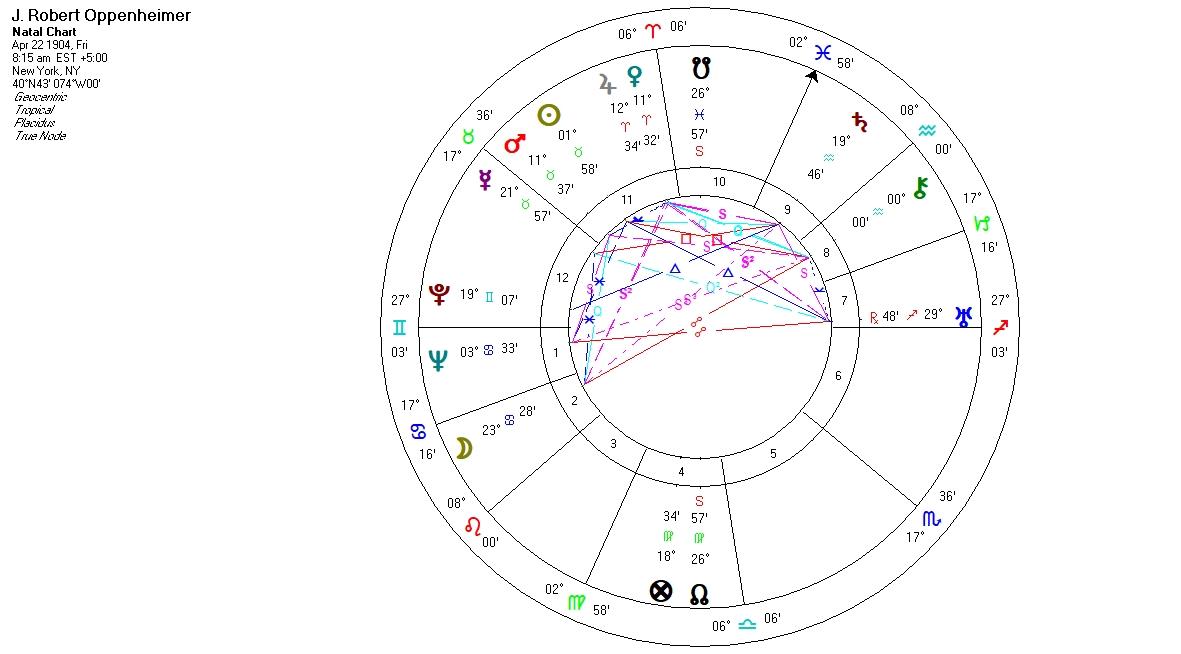
CHART appended to this transcript:
- FIGURE 1983 1017a-1. J. Robert Oppenheimer Natal Chart.
[Transcriber note: If someone is drawing or writing, with audible sounds of chalk on a blackboard, I indicate this by [drawing] or [writing].]
NOTES:
- This is 1983 10/17a, Astrology; Horoscope-Oppenheimer evening class, the first of two entries associated with this date. 1983 10/17b = Astrology seminar from earlier in the day, for which we have no audio or notes — might refer to something misdated.
TRANSCRIBED Verbatim by IT prior to 2018 (V11a). This is V12a (2023) and has: two more passes with various listening errors and typos corrected; updated prefatory matter, footer, and audio file name; Book List and TOC completed; new notes within transcript; new Oppenheimer chart; new formatting to accord with new conventions. Archival verbatim transcript – V12a.
AUDIO FILES: 1983 1017a, 1983 1017b. [Note: "Tape" and "Side" refer to original audio cassette tapes that were later digitized into .MP3 Audio Files.]
1983 10/17a at Wisdom's Goldenrod
Astrology; Horoscope-Oppenheimer
[Audio File 1983 1017a Begins]
[Note: See FIGURE 1983 1017a-1 (Oppenheimer Natal Chart) for all references to Oppenheimer's chart throughout.]
S (very faint): I understand.
S (very faint): (I understand), yeah.
LR: Because--
S: (Right.)
LR: I'm trying to remember why.
RG: Because you were [TS simultaneously: Oh.] exact with--
LR: Because we were looking at transits.
LDS (simultaneously): Last week we were done, I thought it was going to be Fermi [TS simultaneously: No.] this week.
RG: No because he had a [few words inaudible]
S (simultaneously): Yeah right. (laughter)
LR: No but first (if) you want to understand transits, [S simultaneously: Did you bump your head?] [TS simultaneously, faint: Nope, septile.] septiles and quintiles, and then we decided [couple words inaudible]
AD (simultaneously): Then we'll make announcements. I'm telling them they should make announcements.
RC: Right.
S: Uh-hm.
BS: This is the other week.
LR: Because we're looking for Chaldean septiles, we were looking for exact Chaldean quintiles and septiles. Of which he has several. [short pause] But now we're looking (LR laughs a bit) at trans-Saturnian quintiles and (septiles).
TS (simultaneously): Oh the-- this chart's got several septiles which are-- the question comes up or we've been looking at little bit of the difference between septiles which are one-- within one degree of orb which either are or are not on the correct Sabian symbols, that are exactly 51 [degrees] 26 [minutes] apart. And many of the-- and in Fermi's case, there were a few aspects which were in fact exactly septile in terms of orb but not by Sabian symbol. So, to simplifying that is we-- we found this happens to be the chart that we found first where there's several septiles and quintiles which are exact and also on the right Sabian symbols. That's (why/where) we began looking at him so we, you know, eliminate our problems or be able to look at all these first, ok.
S: Oh.
TS: [drawing/writing] So we looked at a few of his septile and the quintiles amongst the Chaldeans and he-- maybe just to-- tonight we should try doing the two that are between the trans-Saturnians and the Chaldeans and then see how that alters what we already conceive of in terms of these regular-- the Chaldean aspects.
LR (faint): Oh, we want to try to do that too. You want to do it today?
TS: Oh we do?
LR (very faint): (Yes.)
TS: Ok.
S (very faint): Yeah, uh-hm.
[short pause]
LR: The whole-- the whole question of what level these quintiles and sep-- septiles operate on was brought up 'cause Uranus. And that's why I want to try and figure them out now. We've never actually gone through Oppenheimer's quintiles and septiles before this. But, there were a lot of questions about at what level of subjectivity these things operate and how-- I'll try to--
S (faint): Let's see, I want to.
LR (faint): Try to give you a little--
TS: So-- He's got a Jupiter Uranus bi-septile, zero degrees and five minutes. So I'm going to try to [one/two words inaudible]
LR (very faint): You decide?
S (faint): Uh-hm.
TS: The Jupiter is--
Marc Edmund Jones [The Astrology of Concepts, Aries 13, LR reading]: "A bomb that has failed to explode is now safely hidden from discovery." (some laughter)
LR: In the Jupiter. The Uranus is--
Marc Edmund Jones [The Astrology of Concepts, Sagittarius 30, LR reading]: "A picture of regal and sacerdotal pomp and glory reveals itself; the Pope is holding audience in his palace."
S (faint): That's [one word inaudible]
S (faint): I see.
S (simultaneously): That's horrible.
RG/S(?): What?
S: (And may) the Pope--
RG: Which house?
S: Yeah.
LR: Oh. Why don't I just read some of the things we said about that Jupiter.
[Transcriber's note: LR is reading notes on the last Oppenheimer class. I don't have a copy of these notes, quotes should be checked.]
[Notes, LR reading]: "This symbol is a symbol of a bomb that doesn't explode." (bit of laughter)
LR: So-- no really.
RG: Yeah it is, I'm listening. Go ahead.
LR: Oh. [short pause] If you remember, the interpretation given was that he was actually protected from the karma that these actions would seem to accrue. That was the way we talked the night before. (If--) Jupiter-- and that was taking Jupiter as representative of dharma in the ego. And--
[16 second pause]
S: Linda, why was that?
LR (very faint): That's why I'm reading the part [couple words inaudible]
Marc Edmund Jones [The Sabian Symbols in Astrology, Aries 13, TS reading]: "This is a symbol of the survival of good through evil intention and effort, and of the infinite capacity of the world to absorb and nullify the destructive acts of man."
TS: That's the first sentence sort of that Jones gives for the Jupiter. Um--
Marc Edmund Jones [The Sabian Symbols in Astrology, Aries 13, TS reading]: "Implicit in the reversed symbolism is not so much the fruitlessness of ill deed as the need for a better instrumentation of the action springing from the deeper sources in [TS reads: of] selfhood. There is here an almost complete exemption from the normal penalties for unsocial results of a hapless initiative. The keyword is IMPETUOUSNESS. When positive, [TS reads: Positively] the degree is a dramatic rejection of any accomplishment falling [at all] short of very deep or hallowed purpose, [and] when negative, [TS reads: negatively] a waste of opportunity and [a] futile expenditure of self through vanity or petulance."
[short pause]
LR: Anthony actually said that he believed this degree was an indication that the World-Idea was using Oppenheimer to commit this act, even though it could be considered an evil deed from some reference point. Yet it still seemed to-- still seemed to be part of the world plan. That all those men were together in Los Alamos the way it all came about.
JA: But does that imply that he had no recognition of the significance here, that he had no recognition of what--
LR (simultaneously): No recognition?
S: Yeah.
LR: I think he had a great deal of recognition.
S (very faint): Uh-hm.
JA: Then how would he be--
LR: Exonerated?
JA: Sort of be free of [one word inaudible]
LR: I don't know, I don't understand what-- how someone-- I don't-- I didn't-- we interpreted the degree as-- as being a real exoneration from, you know?
JA: Yeah but I'm saying that it would seem that the only way it could be is if he really wasn't aware.
LR: Oh I-- I don't agree. I mean I think even if you're not aware of your deeds you still reap the karma, you still have the effects of-- [couple inaudible student words simultaneous with LR] and I don't think unconsciousness is any criteria of, (you know--)
JA: Maybe if you have that degree you--
TS (faint): Ok?
LR: Well maybe we should--
JA (simultaneously): You see my point?
AD: No.
LR: No I didn't, I didn't, I read the previous notes that--
JA: If-- if he were aware of the-- the development of this as-- as a weapon, an evil weapon, how would he be exonerated from it?
[9 second pause]
S (very faint): I don't know, Jeanne.
WY: We're talking about an act here, not the degree. Look at the idea more. [student assents, very faint] Yeah but, it seems like everyone's talking about a single act [couple/three words inaudible]
LR (simultaneously): No that's what the-- [student assents] the idea-- read it again, Tim.
RG: Yeah, read it.
WY: But that comes from the whole life, not this [RG assents] one--
LR: Right, that's where I'm coming, he read it. He read it in the degree [RG assents] meaning, not in this example.
S (faint): Read it again, Tim, yes.
Marc Edmund Jones [The Sabian Symbols in Astrology, Aries 13, TS reading]: "…the [TS reads: a] survival of good through evil intention and effort, and of the infinite capacity of the world to absorb and nullify the destructive acts of man."
S: That's the way he interprets the degree.
WY: Yes, uh-hm. But how can you speak-- see in his life, throughout his life a-- an idea as done, you know, it's not necessarily fixed on this single act.
LR: Ok. Here's-- let me just read you something.
[Notes, LR reading]: "He had an instinct for the good that could be accomplished in any situation and is protected from the social ramification(s). [AD, very faint: Louder.] Like his friendship with Chevalier and putting money into the Spanish relief fund, with Jupiter there there'd be a protection from his own unconscious dalliance with questionable people or events. He was already under surveillance at Los Alamos. Most of the deeds they brought him up for in '54 were already gone when the war started. There were a number of occasions through his life where he was bailed out from having to go through the actual consequences of what he did. It seemed that…"
LR: Well--
JA: Could I-- could I ask it a little differently? Maybe-- you know, it would seem possible that he could be free from the consequences of the deed, but could he be free from the consequences of the unconsciousness?
AD: Yes, you're simply acting as an agent and not as a doer, that's all that means.
JA (simultaneously): Ok, but what about the second part of it?
AD: What about what part? Repeat?
JA: That he-- you know, that there would be consequences of his unconsciousness.
AD: And I don't know what [JA simultaneously, faint: That--] you mean, consequences of his own unconsciousness.
JA (simultaneously): There were no-- let's say there would be no consequences of his unconsciousness.
AD (simultaneously): Now all I-- all I'm trying to understand is the Jupiter, I-- I'm-- I'm not going to get into the ethics of what he did because that's another problem.
S: Well-- but Linda read something, you know, that that interpretation from before was this and that's what I was addressing.
LR: Maybe that was a mistake, maybe we should just interpret it fresh. I don't know.
AD: A person could be used as an agent, and in this case if we say that the World-Idea was using him as an agent to get something accomplished, [student assents, faint] then he was not responsible for the consequences of what he was being used as. But that doesn't mean that he wasn't going to come up with an ethical problem.
RG: Then in fact you could say that he needed to be unconscious of the ramifications, otherwise he-- his constitution might not have allowed him to carry through with certain [one word inaudible]
S (faint): No.
RG: Or--
TS: Or see that it was some-- that-- himself as an agent, conscious of himself as an agent, that seems to be showing up again and again in his life, [RG assents] that he knew that this was something that had to be done, and it wasn't like it was a-- an e-- an experiment in an ivory tower, this was-- it was part of the bomb itself (as a mission).
RG: Right, but I was saying the consciousness of the evil implications of it. That he had to do the bomb he was conscious of but that it would have such [one word inaudible] and evil ramifications.
S: [couple/three words inaudible]
RG: I don't know.
TS: I mean, he's the one that quoted the Gita at the time it went it off, he was quoting the-- the vision of the destruction of the world, and--
LR: And he's also the one that said we have sinned.
TS: Right away that he--
RG: Yeah after that.
LR/S(?): Yeah after that.
TS: Well, when it worked.
AD: Now--
RG: Yeah.
S (faint): Yeah.
AD: Now wait a-- Are we trying to understand Jupiter or we're going to try to understand everything all at once?
LR: Let's understand Jupiter. Let's-- let's pretend like I didn't even read the notes on the last class.
S: How about a--
AD: Let's pretend that we're gonna stick to the problem of Jupiter, alright? Let's work that out.
LR: Ok. Can I read the symbol again?
AD: Uh-hm. [student assents, faint] A bomb fails to explode. I'm going to go light it. (AS and RG laugh)
S: Go on.
[9 second pause]
RG: [couple/three words inaudible] I mean, he--
LR (simultaneously): Ok, one more time.
Marc Edmund Jones [The Sabian Symbols in Astrology, Aries 13, LR reading]: "This is a symbol of the survival of good through evil intention and effort, and of the infinite capacity of the world to absorb and nullify the destructive acts of man. Implicit in the reversed symbolism is not so much the fruitlessness of ill deed as the need for a better instrumentation of the action…"
AD: Leave out the reversed [LR simultaneously: I'm sorry, I'm sorry.] symbolism because it's in-- inappropriate.
LR: I agree, I didn't mean to read that.
Marc Edmund Jones [The Sabian Symbols in Astrology, Aries 13, LR reading]: "There is [LR reads: There's] [here] an almost complete exemption from the normal penalties for unsocial results of a hapless initiative. [The] keyword is IMPETUOUSNESS. When positive, the degree is a dramatic rejection of any accomplishment falling [at all] short of very deep or hallowed purpose…"
[short pause]
LR (very faint): So now what, Anthony?
RG (very faint): Let's do that.
TS: [few words inaudible] (RG laughs, student assents)
RG: We wouldn't change our definition.
AD: Alright, come on, what does it mean? You bought the book. You spent $22. Get your money's worth, what does it mean?
RC: So if you're tying it in with the Jupiter, would you say that the principle that was-- that the intelligence-- the intelligence that was organizing his enthusiasm, channeling his instinctual energy, was operating with the presupposition that he would be forgiven for doing things that were potentially very dangerous? That that was the presupposition underlying his enthusiasm for the project?
[short pause]
AD: I thought we could put it that way. [RC simultaneously: What?] You're-- I think we could also bring in his-- historical associations. Remember, this is 1940.
RG: Yeah, right. Go ahead.
AD: Well just think of the times he was living in. Suppose the Nazis got the A-bomb.
S: Right.
RG (simultaneously): Right. Yeah, right, yeah.
LR: But can you do it in terms of what was said, the wisdom of the instinct? Can you see the wi-- the-- can you do it that way in connection-- connect it to the functioning of Jupiter in that sense?
AD: Yeah but, I don't see it as the wisdom of the instincts, I see it as the rightness or wrongness of instinctual activity.
TS: Which one did you say?
RG: Jupiter [three words inaudible]
[short pause]
AD: Do you remember the Saturn degree, where he felt that there was some kind of cosmic guidance? [student assents, very faint] An overall cosmic view of the world that, you know, he felt was guiding him and that he was sensitive to that World-Idea? And to that extent, alright, he ordered lesser things. [Note: Aquarius 20, "A large white dove circles about and about overhead and then descends and proves to be a carrier with a message."]
LR (faint): Repeat.
AD: He ordered lesser things in relationship to that greater Idea that was in the back of or was the presupposition of that Saturn. Now, given-- given that context, wouldn't you say Jupiter was acting as an agent?
RG: Uh-huh.
AD: That's all.
S (faint): Says you.
AD: Not as a doer, as an agent, and there's a distinction.
RG: Would you say Jupiter ever acts as a doer?
AD: Quite often, sure. Like my Jupiter.
RG: Your Jup--
AD: Yeah. Two men sent to jail. (bit of laughter) [Note: Libra 18, "Two men are placed under arrest and taken away to give an ac-counting for their acts before the tribunal of society."] Of course Jupiter could act that way.
RG: But in this case he was acting as what?
AD (simultaneously): This is very specific, look at the-- where the Jupiter is placed.
RG: Because the degree, the intelligence of that degree is organizing it in that way, right?
JA: I think that it was possible for him to be used as the instrument in the World-Idea because of his scientific amoralism. That doesn't need to come from those degrees.
S: [one/two words inaudible]
RC (simultaneously): But I think what Anthony said about if-- I mean given that there's gonna be that kind of weapon come into the world, then if the people that are more treacherous get it first, that would be an awful lot worse. That if it-- if it's given then it's true.
JA (simultaneously): What does that have to do with Oppenheimer though? [RC simultaneously: I don't think he had to do--] You're saying that because he had this Jupiter degree he could have used it gradually.
RC: Yeah but I don't think you have to be amoral to respond to that. If you're amoral you're gonna work for the Germans if they got more money.
JA (simultaneously): On a personal level, yes, I think so.
RC: Pardon?
JA: On a personal level, yes, I think so but I think he wasn't working on a personal level, I think he was working as a scientist and had that-- that sort of vision, [student assents, faint] that there's an-- look-- look to the implications of personal action.
S: Do you think he could've done it to begin with?
BS: But (as) a perfect agent.
S: Well if he'd been in Germany, yes. Yes.
LR: Certainly.
JA: Alright, I don't think--
LR: Contradicts his whole life, Jeanne.
LDS: But that school he went to in New York I thought was very ethically oriented.
TS: Not to mention then going before the Congress, speaking his mind in terms of-- of (there being) the need for regulation in terms of the atomic development, both regulation and also the--
JA: I thought we were talking about the Jupiter degree still, [TS assents] are you talking about those things in terms of the Jupiter degree?
TS: I was meaning to.
JA: Oh.
TS: (You wanted to do) his Jupiter?
AH (simultaneously): Is it-- is it being argued if he's a moral man or not, is that the issue?
S: Uh-uh.
S (simultaneously, very faint): That's not the issue.
RG: Well we did start one--
TS (faint): Let's start over again.
RG: Let's start again.
LR (very faint): [one/two words inaudible]
TS: Say Jupiter represents some kind of leadership usually, I mean if [RG assents] you say it's an archetype it's the archetype of the guru, it's in eleventh house, so normally there's gonna be some kind of involvement with-- with the public, with the eleventh house [few words inaudible] put the Sun in the eleventh house. He had a huge eleventh house, four planets there, and he really, I mean, just circumstantially say here was a person who was a representative of the whole scientific community, in terms of America at least. And, with Jupiter at this degree, I-- it's interesting, I could see that the keyword Impetuousness, if you start without the Uranus, whatever it is, oh [one word inaudible] that he would tend to be-- would be oriented [student assents, faint] towards accepting some kind of leadership role irregardless of his personal maturity to handle that. I mean maybe he would be, maybe he wouldn't be. But I could see this reflected in like the-- the description of his first years of teaching, you know. When they put him in Caltech at-- the only thing the students could follow was his mannerisms, because he was (bit of laughter) so far over their heads. He said, "Sure, I'll teach these kids," you know, jump right in, alright, and yet he-- out of-- even though he was not quite up to being aware of where they were at, after-- within a couple of years he was and created a--
LR (faint): Quite a following.
TS: Yeah, quite a following of people underneath him by jumping in first and not really knowing, "Well, this is the right thing for me to do now. I should go here and do it," see. And then see-- I could just see that as a simple--
LR: Right. So we could say he had the boldness and the daring that was-- that was necessary at the time to become a leader without having to pay the consequences of what he was doing, he-- he really had the-- the kind of courage and direction. He had the direction implicit in this Jupiter that was necessary, and, the cautiousness is not part of the symbol, so, in some way the-- the consideration of the consequences was not-- was not part of it. He could just grab-- you know, grab hold of the situation and direct it, and was a brilliant leader I think. Lawrence (and Stewart) have described him that way. And the personality is to them, of course-- We speak about leadership personality and you can say the personality had that right kind of facility to be able to really steer things in the right course.
AS: Yeah, this is an interesting degree for-- for that function which can distinguish the rightness or wrongness of the (instinct). I mean, it's almost-- it's-- I can't decide to-- either it seems to be saying what you say, that he's-- can see the good-- the good-- the possible good results of an evil situation that's unavoidable.
TS: Yeah.
AS: I mean, that's what Jones' interpretation seem-- "the survival of good through evil intention and effort".
TS: Yeah, that [AS simultaneously, faint: I wonder if you can (few words inaudible)] seems to be one thing is there's an instinct for knowing which things within the-- it would-- it's important to do--
AS: Even-- yeah, even though they--
TS: Even in spite of their consequences, not by virtue of being unconscious of their consequences.
AS (simultaneously): Yeah. And not even in virtue of them being absolutely good things but just-- it's almost like, I don't know, the lesser of two evils or something, I mean there's a-- there's a mixture implied in the whole thing as it were. [short pause] Or the ability to turn a bad thing to good or--
AD (very faint): Uh-huh.
S (very faint): (Or), much more.
S (faint): Yeah.
AS: The ability to discern good consequences (of) otherwise evil bad (sin).
S (very faint, possibly part of background): [few words inaudible]
S (faint): It's ok.
[short pause]
LR: Let's try to put that together with the Uranus.
[short pause]
Marc Edmund Jones [The Astrology of Concepts, Sagittarius 30, LR reading]: "[A] picture of regal and sacerdotal pomp and glory reveals itself; [the] Pope is holding audience in his palace."
[short pause]
Marc Edmund Jones [The Sabian Symbols in Astrology, Sagittarius 30, LR reading]: "This is a symbol of human excellence on the side of the special values exalted in the various social and political hierarchies of modern civilization, and of man's ambition as entirely inadequate except as he is able to meet some exceptional need of everyday experience and so proceed to dramatize whatever abilities he may have developed in climbing to the position [in] which he finds himself. A person is strengthened within himself by the appreciation he succeeds in winning from his fellows. [The] keyword is SANCTITY. When positive, the degree is an effective and spectacular sacrifice of self in some enduring service to the race at large, [and] when negative, inordinate love of self-display and surrender to a lust for power."
S (faint): Yeah.
S (very faint, possibly part of background): [few words inaudible]
TS (very faint): Gee, why wouldn't I have seen.
S (simultaneously, very faint): Uh-hm.
RG (faint): Yeah, right, and--
TS (simultaneously): Yeah. Well these two degrees are naturally, in whatever (tile/pile) they are, they're naturally septile each other. So these two degrees should be in some way part of some unit idea.
RG: What do you mean they're naturally septile?
TS: Well, uh--
LR (faint): It's the right degree.
TS: It's the right degree.
RG (simultaneously): Oh, oh.
S (very faint): Yeah.
[short pause]
RG (faint): As opposed to not the right degree? (bit of laughter) (Might) if they were on different degrees--
TS: Yes, then--
RG (simultaneously): And so they're exact. Is that what you mean? I know what you mean, (but--) [9¾ second pause] Yes.
S (faint): Go ahead.
TS: If you take those two positives on a-- [RG assents] (and/then) it's the easiest one.
Marc Edmund Jones [The Sabian Symbols in Astrology, Aries 13, TS reading]: "…a dramatic rejection of any accomplishment falling at all short of very deep or hallowed purpose…"
TS: And (the) keyword is Sanctity, you know. There's some kind of intuition into the World-Idea. If you say Uranus represents some kind of knowing, (in/and) the seventh house has some kind of d-- something to do with o-- the "other" or the "what", then big seventh house. You know we were looking at Fermi's chart with that Mars Venus in the seventh house, there'd be a real fascination with investigating the "what", the World-Idea. And here we're saying that there's a kind of a-- a given intuition or knowing of that "what" rather more than the "who" phase from Uranus.
LR (faint): I don't get it.
TS: Why was this guy a scientist? And where do we-- why-- why was he-- you know, we could see in himself, I think, in his chart, with the Neptune Pluto on one side, that there was some interest in, you know, mysticism, you know, humanities, the humanities and so forth. I mean you said he went to that school at some point and he certainly seemed to have this interest through his life, but the par-- main preoccupation was with-- with objective-- with objective truth, and with a-- I don't know how-- I don't know why science yet but I can see the sense of a need to know, he'd know things which are objective.
S (very faint): Uh-hm.
S (faint): I don't follow.
TS: And how do you see it?
LR (faint): See the Neptune?
S (very faint): Uh-hm.
TS (faint): (The Ne--)
AD (very faint): Louder, Tim.
LR: I mean wouldn't you say that there-- there-- there's tremendous power in his intellect, in his will? And that that could (do--)
RG (simultaneously): Speak up, Anthony said speak up. Yeah, but [LR simultaneously: I see--] what does it mean that this idea is organizing his-- his gnostic knowing function, [LR simultaneously, faint: I don't know.] his real knowing? That he knew he was-- he-- I mean maybe from this Uranus he knew that he was a man of-- the man of destiny. And he-- and that from the Jupiter he may have been unconscious but in that septile was a transmission of the knowledge that he had to be the leader into the Jupiter that gave him the exemption from the-- his actions, so to say.
LR: He could-- his higher-- the higher knower, the knowing-- the knowing faculty within him was sanctified in some way? I mean the word is Sanctity, [RG assents] it was the Pope. And as Tim said it was concerned with objective truth.
DH: I thought it had something to do with how he was a scientist, I mean he wasn't a scien-- I mean he was mainly a scientist as a leader.
RG: Uh-hm.
TS: Yes.
DH: And-- [RG assents] you know, and a very, you know, effective one, he wasn't a scientist working alone in a lab.
RG: Uh-hm. Right.
DH: Um--
RG: It's in the seventh house, uh-hm.
DH (simultaneously): I mean he really was like pope of science as opposed to a priest.
TS: Yeah.
DH: Uh-- and [couple words inaudible]
S (faint): Go ahead now.
S: [couple words inaudible]
TS (simultaneously): Couldn't you say that he also seemed-- as opposed to some of the others, took theoretical matters as more-- more significant than the practical end?
DH: Oh I don't know, I mean from what I've (read), I-- I mean he treated everything. I mean he seemed to take a real interest in-- at all levels.
LR: Well they said he couldn't work in the laboratory. 'Cause that's-- that's what I--
TS: Yeah, that's what I [one/two words inaudible]
DH: Oh yeah, that he couldn't actually work in it.
TS (simultaneously): That's what I mean, he--
DH (simultaneously): Oh I see.
TS: --he-- that he had--
LR (simultaneously): That experimental physics work.
DH: Yeah.
S (very faint): Yeah.
TS: I mean he had an interest all-- you know, a-- an encyclopedic interest it seems but as far as his actual ability to-- I mean like Fermi was able to build-- I mean he built the cyclotron, you know, stuff himself. Say "Well, let's try this," and he would machine the parts and it would work. [DH assents] Oppenheimer would walk into a lab and it'd blow up, you know, he was--
DH: Well and Oppen-- I mean the [TS simultaneously: Had a Taurus walk in.] story is he'd walk into a lab in-- in Los [TS simultaneously, faint: Yes, in his (one word inaudible)] Alamos and would be able to, you know-- you know, see something, (a machine, do with that), an idea of how [few words inaudible]
S (simultaneously): Uh-hm.
TS: I thought that was Fermi.
S (simultaneously): [couple words inaudible]
LR: What? (bit of laughter)
DH (very faint): Maybe it wasn't O-- I don't know.
LR: I don't know.
DH: Anyway.
TS: Anyway let's-- [LR assents] It was the other thing you said I thought was-- was-- made sense to me, that the way-- the how he was a scientist was a scientist as a leader and a scientist who-- I mean he certainly just-- I'm just not (getting it).
LR: His knowing was given over to the race at large with this symbol? I mean it [RG assents] says positive it's a sacrifice to the-- of self to some enduring service to the race at large, it's like his-- his knowing was given to the World-Idea almost, was being used as--
TS: For racial concerns.
LR: Evolutionary-- you know, making history, his [student assents, faint] knowledge was serving that end.
S: Uh-hm.
PD: Almost like the daemonical intellect was not to his soul.
LR: For his own sake.
PD: Wasn't for his own control or own development but [student assents] for something else coming out. [student assents, faint] That encyclopedic mind, his vast breadth of mind got utilized by something else. He couldn't-- let's say he couldn't turn it on himself for self-development.
LR: Right, because in fact when we did the-- when we went through all the planets the first time, we saw too that the other-- the Neptune especially, that if there was anything that he reaped from the whole thing, it wasn't coming away as a great Buddha, but as an ethi-- you know, he-- having to put his moral ideas into-- having to come to terms with what he believed to be right and wrong and what his ethics were all about, I mean that's what he was forced to come to in the end. And that he actually-- you know, it wasn't his knowledge that-- his knowledge was not what he was faced with here, he's-- he was faced with the implications of action.
RC: You know it's funny though, maybe it's just me and it's just my background but, I really see that right in the Uranus symbol where I really see the Pope as-- as like the highest moral authority within the faith. That's why he's, you know, granted that sense of infallibility. Not because he has like supreme personal gifts but because he's been able to morally align himself with the spiritual lineage that he's representing.
LR: You'd see that even though the symbol is of pomp and glory and holding audience and all that?
RC (simultaneously): I don't know what the Pope would mean to the woman who, you know, did the symbol. [student assents] But to me the Pope is-- is really a moral authority, as a symbol of it. [student assents, very faint] That's what he should be.
LR: Ok, and how would you see Uranus on that degree?
RC: I think for him the highest moral authority came through the knowing function.
TS: Yeah.
RC: Insofar as it delivered the facts of the World-Idea at this time, that was the highest moral authority [one/two words inaudible]
TS: And there's more [one/two words inaudible] It seems like it's both his strength and his weakness and that he wanted to publicize all of it, he thought that by getting all of the information out to all-- to all scientists, that that would inevitably force a higher morality. And--
RC (simultaneously): Yeah, PB talks about the whole thing that that's why the bomb came in, was that it was to produce a moral crisis, that people [TS assents] had to see there could be no more war.
LR: Well-- And that was their belief. These guys were making something so bad that whenever the world saw it they would just give up. [student assents] That they really [student assents] believed that.
RC: Yeah.
LR: It seems naïve, you know, it seems that the lust for power-- that the lack-- the lack of insight about power and what that was all about was e-- extreme but they actually believed that or at least they said they believed that, all of 'em.
TS/S(?) (faint): What?
TS (faint): Well let's go with that. I think we should just go with thinking of that as the highest moral authority.
LR: What do you think?
AD: What do I think?
LR: Yeah.
AD: Well, in order for the World-Idea to implement or actualize what was going to come to pass, it needed an agent or an instrument that was willing to efface itself in the process of getting this thing done. That's what the septile means to me, Uranus septile Jupiter. On the one hand, you have the Jupiter representing the fact that he is an agent. Not a doer, and there's a very technical difference here, alright. And on the other hand you have the Uranus degree which indicated that he was willing to efface himself, alright, and the septile of these two made it possible for him to know precisely what to do at Los Alamos given the conditions that he had to work with. [RG assents] And I don't think of the Pope as a moral authority although, I mean, I can see that. I think of the Pope as infallibility.
LR: So, whenever he would decide his decisions were in-- were-- that [AD simultaneously: Uh-huh.] was it, that was the bottom line.
AD: Yeah, that was the bottom line.
S (faint): Uh-hm.
RC: I think the only time that's been respected and allowed has been on the basis that there are things that the head just can't know and so the Cardinals do the best they can and elect the person that they think has the most trustworthy heart from the bunch of 'em.
AD: Well it could-- I su-- [few inaudible student words simultaneous with AD] I suppose it could be both moral authority and infallibility, I mean there's-- I'm just trying to understand the septile here, Uranus Jupiter septile which-- I mean I know it's a daring doctrine, and even a dangerous doctrine, to think that a person could be an agent or an instrument by which a certain action gets done and that he's not going to suffer the consequences of what has been done. But, it's not beyond the-- the bounds of conception if you just think about it [student assents, faint] over and over again. Even in the Gita you have a classic example where Arjuna is told by Krishna that he should just do what he has to do and not consider himself as a doer. Of course this is the highest teaching.
[short pause]
LR: And, can we work on the septile part of that again, Anthony?
AD: I'm sorry?
LR: Can we work on the septile part of this, that it was some fixed--
AD (simultaneously): I just gave you the septile.
LR: I know, I didn't hear the fixed belief part of that septile, I didn't understand-- I know-- I heard the process part of it when you went through the planets, but I missed the-- the mindset that was-- that--
AS: I-- I think-- I think they're almost saying that it's-- well maybe I'm wrong. Maybe I'm not using the words right. But it-- it seems like this is something even-- even more than a fixed belief in the way that the Chaldean [KD simultaneously: Chaldean.] septile was. It's not-- it's a little bit beyond the belief, I mean, in the sense that it's not just something that the psychosomatic organism believes. It's something that the psychosomatic organis-- organism it's almost being forced to accept.
RG: Uh-hm.
LR: Or is organized by it.
AS (simultaneously): Whereas with the Uranus, because it's the Uranus there, as you say there's something coming in from the World-Idea. And that's-- that's linked up to the-- to the-- to the ego as an instrument.
AD: Well, [AS: So it's not--] you see the World-Idea I'm not saying is coming from the Uranus. If you read the S-- Saturn degree I think you'll see that it's very clearly coming from there, alright. I'm restricting the septile, the way I understand it, to the Jupiter Uranus septile, [AS assents] alright, I'm restricting it just to that. On the one hand, he's not going to be penalized for acting as an instrument to get something done. But in order for that something to get done, there has to be a self-effacing. He couldn't go around, so to speak, directing Los Alamos without trying to keep himself out of it so that things could get done that had to be done. [student assents, faint] Now, in thinking of him as a-- as the director of Los Alamos is one thing. In thinking of his personal life, it's something e-- something else. But in regard to his work or the Los Alamo-- and even when he was in charge of Advanced Studies at Princeton, he operated in that way. On the one hand he felt he was an instrument being used by the higher powers, alright, [RG assents] and on the other hand he was capable of self-effacing himself so that he could get done what had to be done. And anytime there was interference with that septile you can see that there would be personal problems arising.
TS: You're saying that there's a kind of a-- an instinct for infallible leadership would operate through the Uranus Jupiter septile. He would be capable of functioning-- I mean-- he had a real intuition into what leadership meant in terms of the scientific community. He could function as an agent to-- an impersonal kind of leader without personal investment in the recognition for that leadership?
[12½ second pause]
AD: Try again, Tim, I'm lost.
TS: Well I was just trying to see if I could say-- (say/see) it myself.
[9 second pause]
AS: That's what I was trying to do (to) the Uranus too.
AD: I'm sorry.
AS: I-- well that [few words inaudible] but-- I was trying to see how you could bring that Uranus into the (set), the notion, self-effacement. I see that in the degree, and you're saying-- in the Uranus degree, the Pope. It's-- I-- could you add that-- that if the-- Let's see. (Don't understand it.)
AD: Well, if we read the first part of the degree of the Pope--
Marc Edmund Jones [The Sabian Symbols in Astrology, Sagittarius 30, AD reading]: "…symbol of human excellence on the side of [the] special values exalted in the various social and political hierarchies of modern civilization, and of man's ambition as entirely inadequate except as he is able to meet some exceptional need of everyday experience and so proceed to dramatize…"
AD: Alright, that part there, I'm looking at the fact that he did fulfill this part, alright, he-- he did acquire this special talent to be able to penetrate into the most abstruse problems in physics, alright, and to be able to reduce them to their essentials and deal with that, ok? And then we have that-- that would require that in order to be able to do that he gets out of the way. I mean to be able to penetrate into some of these problems, you can't be, you know, footloose and fancy free, you've got to be capable of [student assents] intense concentration. So, your ego's gotta get out of the way. [students assent, faint] So, there's a certain amount of self-effacement there that's-- that's required.
AS: Right, and you're saying that if the self-- you're saying something like if this-- the self-effacement, then the infallibility of that higher knower will always guide-- will always guide that instrument, the Jupiter, just trying to put it together.
[short pause]
AD: Yeah but--
AS (simultaneously): Yeah the self-effacement part [couple words inaudible]
AD (simultaneously): Yeah, I see what you're saying, I'm just leaving out the words like higher knower, things like that, I'm-- and I'm just trying to get to the meaning of that degree.
LR: Ok, can [student assents] you see this-- let me ask you another way.
AD: Could you see what we just said first of all, that this man prepared himself a very special role. And then after he did that, alright-- Look, he went through all this problem of learning physics and understanding it, alright. Was it so that he could work in physics? No. But how other physics-- phys-- physicists could work together. [students assent] But still he had to go through that whole climb. Now, that's peculiar, isn't it? [student assents] A man who has such, you know, potentialities, such a massive learning and all that, it isn't so that he could work in physics.
RG: Right.
AS: So he could lead men.
AD: So, then-- if you-- [AS assents] if you follow that then you can see what we're saying here, that he worked-- because he had that ability and worked himself up to that ability, alright, it was possible for him now to play the role of administrator or director of Los Alamos.
RG: Uh-hm, yeah.
AS: But I can see some of what you said also in the Jupiter degree. Just that whole thing of going through-- [S: You've got it.] go-- the going through of something but not for the intrinsic nature of the science itself but for say a higher purpose. I mean when he says "a dramatic rejection of any accomplishment falling at all short of a very deep or hallowed purpose" (Aries 13) in the unsuccessful bomb, if all his enthusiasm was a-- at the disposal of learning physics and so on, but it wasn't for the purpose of doing the physics. It was actually for the purpose of this higher-- or a higher or moral or spiritual thing. And I de-- I could almost see that in the Jupiter also. So [S simultaneously: Yeah but what, I mean--] there's two-- the two degrees seem to work together.
JA (simultaneously, faint): What higher moral or spiritual purpose?
AS: He pi-- he-- he worked-- it wasn't the scien-- it-- the unsuccessful bomb explosion is something like-- I mean if I read this positive meaning, is something like going through and doing something, but it's like not for the purpose of what you thought it was doing it, you were doing it, it's not--
[short pause]
JA: Anthony, what-- what self is effaced, I think you said-- I mean, you don't-- I-- I'm just-- I don't see how studying physics actually is an effacement of the ego.
LR: It isn't [JA simultaneously: Can't quite--] studying physics, he said the degree of concentration that came.
JA: Alright. In studying physics, the degree of concentration that came is the self-effacement. So--
LR (simultaneously): No. One had to put the ego out of the way.
JA (simultaneously): Oh, Linda-- I mean-- I understood that he was talking about the concentration that produces [one word inaudible] But I didn't quite understand the point-- I mean, I heard what you said but I didn't understand what it meant in the sense--
AD (simultaneously): Well, you run-- you run a laboratory like Los Alamos, alright. [student assents, very faint] And-- [AD snaps fingers]
(Side 1 of original cassette tape digitized as 1983 1017a Ends; Side 2 Begins)
JA: So he held an office.
AD: No, no. Just try to understand what I say, don't turn it around, try to understand what I'm saying, alright? You're in charge of a company, alright. Now in order for this company to run so-- really efficiently, one thing you have to learn is that if in any way you're trying to aggrandize the ego you will interfere with the efficiency of the functioning of that office or that company. Is that hard to understand? Just think, every time-- if you're the head of a company and every time you make a decision based on egotistical motives, you'll see a catastrophe coming your way.
S (very faint): I don't see it.
AD: No, Dickie?
RG (simultaneously): I don't get it.
TS: I mean, yeah.
RG: I mean--
TS: He worked in let's say the-- probably some of the most high-strung people in their time (in there).
RG (simultaneously): No, in his case I'd say yes.
AD: We're not talking about a company that belongs to you, we're talking about an organization of top men.
RG: Yeah.
TS: Ok [couple words inaudible]
AD (simultaneously): And if you think you're going to go in there and start doing an ego-- ego dance, [RG: Right.] you got another guess coming.
RG: Yeah. Right, true.
AD: Alright, so all we're saying is this-- in this degree the reference here is to the fact that this man worked himself up into a position, he had to get to know all of physics so that he could run, alright, a huge physics laboratory. And I hate to mention how many departments they had in there, alright. Can you imagine his ego getting in the way? "Well I don't like it this way. I don't like it that way." (LDS laughs)
RG: No, they said he had a peculiar ability to walk into the room that a group is working on and just adapt to it and encourage them.
AD (simultaneously): Yeah, and seize the situation for what it is.
RC: He had the sense too that what they were allowing themselves to be administrated by was not a man so much as a knowing function that they would just honor.
AD (simultaneously): Ok, that's a good way of putting it, yeah, [student assents, faint] ok, yeah.
RC (simultaneously): They were just onto it. And then several people have said that they have all considered him so far their intellectual superior, and they were all geniuses talking.
AD: Uh-huh. So, if one genius says that about another genius, you know that this man is really working with the ideas and not concerned about, you know, self-assertion or self-aggrandizement in any way. Now I'm saying this is that Uranus degree he's working with. [student assents, faint] And the Jupiter degree, we pointed out that he was being used as an instrument. Now you try to pick a better leader for the Los Alamos.
S (faint): I can't.
LR: Ok, I-- I don't-- I just didn't follow the septile part. And, our initial premise was to try to set out and distinguish Chaldean septiles from trans-Saturnian ones. So now here's our first ex-- [S, very faint: Did we?] We went through some of the Chaldeans and we saw how they were fixed beliefs about the operation of the psychosomatic. [student assents, very faint] The assumption would be, I thought, that when you brought in the trans-Saturnian into a septile mechanism, it wouldn't be merely concerning the psychosomatic. And I thought that's what Avery started to try to describe, that somehow it would be-- and the organization of everything that came-- that followed, it would have, in other words, a more primal presuppositional nature than the Chaldean one because [RG simultaneously: Yeah, he didn't will it.] the trans-Saturnians don't operate in the same way.
RG (simultaneously): But if-- but it-- it wasn't just the psychic e-- it just-- it wasn't just the psychic event, it was in fact real. He in fact was the focal figure. His higher knower was in fact structured so that he could efface himself to-- to be the leader of a scientific community in a way that a Chaldean wouldn't have that knowledge and might have gotten inflated on that degree, for example.
LR (simultaneously): So you're saying this is the actual organization of the mentality of the person? And then the psychic-- the psychosomatic follows that dictate, [student assents, faint] that this is in some way describing the--
RG: I think he really knew himself to be the Pope from the Uranus, I mean that's-- that what was what his real knowledge was.
TS: Or that that was actually a stance of his being whether he was [RG: Right.] subjectively and reflectively consciousness of that role or not, [RG simultaneously: Now it's easy to--] his-- his individuality was still-- no, was essentially organized to perform this act, this function.
RG: And in the exact septile there is a link of the two degrees, I mean they aren't-- one is a self-- one is a-- they're-- they both have to give up the personal. In the Pope degree he gives it up to the-- the administrative structure of what he had to do. In the Jupiter he had to give hims-- give up the moral or amoral considerations in order that he could carry it out. So it seems there's a giving up of the personal in both and that-- that nature of the septile is embedded in his mind from the day he was born, he-- he had to do-- he had to do what he had to do.
LR: But, that if-- you know, if I-- if I could be more specific, could you say that in terms of what we're trying to see as the-- the level, [RG: Right, but--] that you would say that this is definitely pr-- suppositionally prior to the Chaldean septiles, that this in some way hits a more fundamental level of the mind?
RG (simultaneously): Sure, yeah, I would say that.
LR: So that the Chaldean septiles would be following the dictates of the trans-Saturnian septiles, I mean is that--
RG (simultaneously): I mean from this se-- I mean this one septile you could see the whole chart just from-- in light of this-- this septile.
S (very faint): Uh-hm.
S (very faint): Ok.
TS: It's remarkable, the Head degree which is sort of the exit, is a sym-- he says in the symbol--
Marc Edmund Jones [The Sabian Symbols in Astrology, Virgo 27, TS reading]: "This is a symbol of life's maturity as a threshold of new discovery rather than as any canceling out of personal reality…"
RG: Right.
TS: It's almost like that-- and if you say that the septiles are what he comes in born with, I mean those-- that seems to me to be a reciprocal kind of [one word inaudible] or what's being said about that Jupiter Uranus. Saying here-- he came in with a kind of a knowledge or his individu-- his mindset was given this idea of having to set aside some sense of personal aggrandizement.
LR: Um-- it-- When we did the Chaldean septile, you-- when we speak of septiles as destiny or a fatality of sorts, the Chaldean septiles seem to be fatality insofar as what a man believes so he is, I mean, that they-- [RG assents] they fundamena-- fundamentally orientate your thinking in a certain way such that everything you do or think is going to be a reflection of that. [RG assents] But this one you're interpreting more as an objective destiny. It's not so much what he thought, but that he had to be this-- this instrument.
RG: Right, well let's just say Uranus is gnostic. (In/And) his penetration into the mental being was a more fundamental penetration than the Chaldean, and he was perceiving the nature of the idea. And if it's his Uranus it's the way his self-knowing is organized to be that.
LR: I guess I'm asking, would you say that this is more objective rather than subjective destiny in the sense of, you know, prefiguration (towards something), because [RG simultaneously, faint: I think so.] it's a trans-Saturnian?
RG: Well in his case it certainly seems to be that way, I mean-- from these two degrees that certainly-- you couldn't pick two better degrees for his kind of destiny.
S (very faint): Uh-hm.
AH: I think--
LR (simultaneously): Do you see what I'm asking, Anthony, or--
AH: Linda--
AD: I don't-- I-- I don't s-- I don't think that the fundamental nature of a septile is altered [RG: Right.] in any way becau-- it-- you know, between trans-Saturnians and trans-Saturnians and Chaldeans. [LR: Right.] So--
LR (simultaneously): It should still be a septile but-- but now you're putting in trans-Saturnians instead of Chaldeans so it has to have a different referent in some way.
AD: Well, we said that a septile had reference to the fixed ideas or view of reality that is a presupposition of a-- the functioning of some entity, right?
LR: Yeah.
AD: And I don't-- I don't see why I can't hold on to that definition between Jupiter and Uranus.
RG: Can, but how would you-- you can, I mean we ought to.
LR: Ok and that--
RG: Is there a difference in level between the Chaldean function-- the presupposition of the Chaldean level and at the trans-Saturnian level? In other words, the presupposition that Uranus is working with, is it a more fundamental presupposition, in other words, is it closer to his being, say. Or being in the mental realm is it closer to the idea itself rather than the psychic form of it that would be in a category of the imagination, say, from the Chaldean.
[11½ second pause]
LDS: Could I ask it another way, see if I follow.
AD: Ask it in another way?
LDS: Yeah. Are you asking, Dickie, that, in this spec-- in this specific aspect of septile with Uranus and Jupiter, are you asking, would the Uranus because it's a trans-Saturnian pretty much drive or steer that Jupiter and take precedence? Even though there's a septile and the two ideas somehow have to be wedded together, the wedding-- the peculiar way they are wedded together in this aspect is that the Uranus is going to take some kind of precedence and really be the guide. Where if it was two-- if it was two Chaldeans, it'd be a-- an entirely different kind of wedding of the two ideas.
RG: Yeah.
LDS: One wouldn't take precedence over the other in a way. But here it's as if the Uranus is going to steer that Jupiter. Jupiter is always going to have to bow to that Uranian degree.
RG: Well I'd say they're working together very well but that the Uranus might refer to one level of the being and Jupiter to the other and in that sense the septile is crossing (site/sight)-- the bounds-- the lines of the being in that way.
S (faint): Yeah.
S (very faint): Ok.
RG: But-- [S simultaneously: What-- we--] but maybe we should do another, we've only done one, I mean maybe we should wait to see it formulated before we base it off of one-- a little premature.
S (faint): Uh-hm.
LR: I'm not trying to make a theory, I'm trying to see this as a septile. I mean I [RG assents, faint] don't care if gets generalized or not, I'm trying to see this particular one.
RG: Then don't bring in those differences in order to speak [few words inaudible] a septile. Just see it as a septile. You're in-- you're also [LDS simultaneously: But--] trying to bring in the nature of [one/two words inaudible]
LDS (simultaneously): Yeah but this is a specific [AS simultaneously: Well sure.] septile, that's-- that'll--
S: [few words inaudible]
LR (simultaneously): You have to. This is a Chaldean trans-Saturnian septile. [RG assents] It's gotta have a special nature.
AH: You want to see it in regards to [couple words inaudible]
RG (simultaneously): But focusing on that special nature is taking away-- is not focusing on its septile nature, Anthony said it, he said its septile quality is the same.
AS: Right but, the septile quality is the same but functions bring-- they're like adding to something we're calling [couple words inaudible]
LR: We said that the-- the trans-Saturnians were at the mental level and they were conjoined with the mental being in some-- and that's the level we put them on, right? And that the Chaldeans were at the psychic level. Now if that--
S (simultaneously, faint): I don't know. I'm not so sure about that.
AS (simultaneously): I mean there doesn't-- The thing with levels really getting-- I mean it doesn't seem like everything has to be in terms of the levels.
S (very faint): Right.
S (faint): Yeah.
S (very faint): Uh-hm, yeah.
AD (simultaneously): Well I don't know that I ever said that though. If we say that the natal chart is the signi-- is a signature within the Dragonic life, I don't see what you mean by levels here.
LR: I know, the word has become very distasteful. I'll drop the word and say it a different way.
AD (simultaneously): No, it's not a question of distasteful, it's a-- In other words--
LR (simultaneously): It's part of the being.
AD: Huh?
LR (simultaneously): I-- the Cha-- we said that the Chaldeans function, operate the categories of the imagination. And they deal with the operation of the psychosomatic.
AD: Yeah.
LR: Ok. I think that's what's been said.
AD: Yeah, they represent various in-- instincts, ok.
LR: Ok. Is the--
AD (simultaneously): In-- within the imagination.
LR: Within the imagination.
AD (simultaneously): Yeah. Now--
LR (simultaneously): Now Uranus, Neptune, and Pluto are also in the imagination.
AD: The what?
LR: Uranus, Neptune, and Pluto.
AD: Yeah, they're also within the imagination.
LR (simultaneously): Right. So I don't want to distinguish levels there.
AD (simultaneously): And if we say, if we say-- and, you know, tentatively assume, that they represent willing, feeling, and knowing, it's still within the imagination.
LR (simultaneously): Imagination. But--
AD (simultaneously): Alright? So, if all these things are within the imagination, then there's no level here in terms of their being.
LR: Right. They all have an equal status.
AD: Then what are the distinctions?
LR: Well, you've said the distinctions are namely that the trans-Saturnians are the only cognitive apparatus in the chart.
AD: That the trans-Saturnian, when they're on an idea, are referring to certain fixed ideas that this entity is working with, right?
S: Uh-hm.
LR: No, that's a septile. I thought you said the trans-Saturnians were the only cognitive functions in the chart.
AD: Yeah, that they represented the willing, feeling, and knowing, [LR assents, faint] alright, the fixed ideas that are inherent in this entity. Whereas the planets, the Chaldean planets on the degree, represented the way either the instinct is manifesting the idea or the way the idea is organizing the functioning of the instinct. Now I have my distinctions between the Chaldeans and the trans-Saturnians, but they're all on the same level.
LR: Fine, I'm sorry I brought that in.
AD: No, I-- I think we have to--
LR (simultaneously): No I understand what you're saying, it's all in the imagination, the whole [AD simultaneously: Yeah.] thing is imagi-- the [AD simultaneously: Uh-huh.] imagination. [short pause] But even if it's all an act of the imagination there's reference to different parts of a man's being. Namely Uranus, Neptune, and Pluto are referring to what you're calling knowing, willing, and feeling.
AD: Uh-hm.
LR: And the others are not.
AD: Now, again that has to be qualified. We said that the instincts sitting on a certain degree manifest an idea, alright. Or, the other way around, the idea organizes [LR simultaneously, faint: Organizes.] the way that instinct function. [student assents, very faint] Now if you-- if you have a septile between a planet-- a Chaldean planet and a trans-Saturnian, alright, what would-- what would we be looking for? On the one hand, if you looked at the Jupiter, alright, and you wanted to understand him in terms of his ego structure, you'd look at the Jupiter degree and you'd look at the opposite degree, alright, and you'd do that will all the Chaldeans, you organize these into a dossier, alright. And then you go further and you try to understand what the ideas were that-- you try to understand how the higher willer, knower, and feeler was operating within that psychosomatic organism. [LR assents, faint] All at the same level because they're all within the Dragon. And all of this is all theoretical because none of this is functioning until you bring in transits. This is utterly abstract. There's no such thing as understanding a natal chart without a relationship to transiting planets. You can't talk about it. The assumption is that planets are transiting. You're just isolating out of the context right now the natal chart just to be able to get a glimpse, alright, and you have to keep in mind that that's part of a greater whole. [students assent, very faint] [short pause] Well-- talk-- talk to you later.
LDS: Tony? Back to that septile. They're all within the ima--
AD (simultaneously): No, no, no, we-- we got to go over this because we keep come-- we keep arguing about this, it's just like-- it's [LDS simultaneously: No, uh--] just like a dog biting his own tail.
LDS: I was going to ask in reference to what you just said.
AD: I-- I would just like to repeat this because if we don't understand this, then I think a lot of things that we've been doing would-- would be without a foundation. [short pause] You want to live in the stratosphere, you want to live in the realm of ideas? Well, they're going to be hard to, you know, anchor here and anchor that one there and the other one there and-- when you look there they already started moving around.
S: So say (moving around).
AD (simultaneously): Let's go-- let's go over this. Our preliminary was concerned with showing that a Chaldean planet sitting on a degree, that there was two possible ways of looking at it. [student assents] And that was that it was manifesting an idea or that the idea was organizing the [student assents] instinct to function in a certain way. And that if we wanted a dossier of the ego personality, we would take the seven Chaldean planets and their opposite degrees, alright, and we'd get some idea of the structure of that ego. Then if we wanted to know the basic presuppositions, we'd look to the trans-Saturnians and we try to understand how those were the presuppositions that the ego, you know, was in a way fulfilling, or another way of interpreting was that this was the battleground in which these fixed ideas were getting expressed or worked out.
LR (faint): Wait a minute.
AD: Now is it possible to conceive, for instance, that an instinct, alright, could be organized in a certain way by an idea and that the instinct has a certain-- a certain fixed idea as to how it should operate?
S (very faint): I think so. Yeah, uh-hm.
AD: Look, you've got to-- you got to realize you're dealing with a multivalent, polyvalent, indefinite system of organizing ideas. And that's why I said, let's put aside for now, you know, any kind of Virgo organization because we can't grab-- grasp it. What I mean is, it may be so complex that we haven't been a-- that we're not capable of organizing it into a system. That's what I mean, it's so indefinite, so polyvalent, the interrelationships could be so-- of so many different kinds. So now, if-- if we took this as an assumption, alright, as an assumption, a working assumption, then what would the Uranus Jupiter septile be?
[short pause]
LDS: I would say something like, going over what you just said, that if the Jupiter is being structured, that function of Jupiter is being structured by the degree that it's on, now, because it's in septile relation to Uranus, the Jupiter's gonna be further structured or further ordered and directed by this other idea because it is Uranus, the trans-Saturnian, which indicates a presupposition that the person is working with, is also gonna have to be wedded to that Jupiter function.
AD: Alright, [LDS simultaneously: So--] let me try, let me try this way to elaborate just a little what you're saying. You take the position now that you're neither the subject nor the object but you're looking at this chart as though you were the Witness-I. Because this is what's being required of us. In order to understand this person we've got to stand above it or try to, you know, be in a position where we could look at the whole thing, the trans-Saturnians and the Chaldeans. [student assents, very faint] So, what we have to see therefore, is that we're speaking in terms of there's only this one ontic level of reality. The s-- the trans-Saturnians and the Chaldeans [student assents] have their signature in that plastic malleable stuff that we're calling the life of the Dragon. And that there could be a variety of relationship between the trans-Saturnians and the Chaldeans, regular, quintile, septiles, ok.
Now, we said that a septile is a very fixed relationship in the sense that two ideas were joined together, alright, and they are predeterminative of the person's view of reality. We said this, right? [student assents, faint] Now, if we took that Jupiter Uranus septile, and we have to be specific, that's why I don't like more than one or two sentences, what precisely does it mean? Well the way I interpret it, and, try to remember, I'm just as fallible, I'm not the Pope, I'm fallible. But I'm trying to understand, if the World-Idea is trying to implement itself, actualize, bring something to pass, alright, this person was chosen.
Now on the one hand, we could say well with that Jupiter degree, it seemed that he worked himself into a position where he can act as an instrument, an agent, in which something can be accomplished but of which he will not be responsible for the consequences. Ok? And the Uranus degree represented a kind of super-abundant clarity and organizational ability, alright, and in a-- an ab-- also, the capacity to keep his ego out of the way and let the knowing function do what it has to do. And these two ideas are joined together. So, what do we come up with for the septile? On the one hand we have a Jupiter which is neither in the realm of dharma or adharma. And on the other hand we have a knowing function, a higher knower, so to speak, which in order to implement itself must be joined to the-- to the fact that the rightness or wrongness of instinctual actions has to be left aside. Is this the meaning of that septile?
RG: Yeah. And then he was a pure vehicle of the World-Idea from that transition.
AD: Do you think that the World-Idea has often enough used people to implement, let's say, something that had to be done without making them responsible for it? [student assents, faint] It's not so bold or daring a theory.
RG: No, I agree.
LR: No, I follow everything you say except I don't see what the fixed idea that he operated [one/two words inaudible]
RG (simultaneously): But the fixed idea was that he was predisposed to believe himself to be this person.
LR: Ok.
RG: He knew it, I mean that's what he o-- he--
LR (simultaneously): I mean, if that's the fixed idea, that he knew that he was an instrument--
LDS (simultaneously): Did he [S simultaneously, faint: I don't see (one/two words inaudible)] reflectively know or--
S (simultaneously): What?
TS: I don't [S simultaneously: I don't see why--] think he was reflectively aware of it. He was, he just was.
AD (simultaneously): What do you think he was, a-- an-- [S, faint: Simpleton.] a dummy or something!?
AS (simultaneously, faint): But he-- he knew what he was, there's--
TS (simultaneously): Yeah. But I don't think that the i-- the septiling-- the septilian quality has to do with whether he was conceptually aware of his [few inaudible student words simultaneous with TS] agency, [S simultaneously: No I knew that.] but that he actually was this in his being such that he and others were-- recognize it. And Groves saw him and said, "This is the time," the-- intrinsic to his-- his inner and outer makeup.
S (very faint): Uh-hm.
S: Right.
RG: But so is every aspect [couple words inaudible] [TS simultaneously: No, I wouldn't agree with that.] give the septile first.
TS: That's what-- I would think that's (what) [one/two words inaudible]
LR (simultaneously): You're saying the idea was his being.
RG: We said it was a [S simultaneously, faint: Ok.] view of reality, I don't see the view-- where [TS simultaneously, faint: Yes.] it's a view of reality. What is the view of reality?
S (very faint): Ok.
TS: The view of reality is that one can su-- by subordinating one's personal con-- personal ambition become an agent to accomplish something for the World-Idea.
AD: Or, if we could express it this way, couldn't we say that he would say "I'm the man for the job."
RG: Yes, that's what I said, he knew--
AD (simultaneously): That was his view of reality, right?
RG (simultaneously): That's right, yes, that's it.
AD (simultaneously): And when General Groves [AD pronounces: Graves] came up to him, "Yes sir, I'm your man." (some laughter)
RG: Yeah. Definitely.
S (simultaneously, faint): Yeah, he was very--
RG: He had-- he knew [couple words inaudible]
AD (simultaneously): I mean it's really an elaboration of the obvious, isn't it?
RG: Yeah.
[couple seconds of faint background student talking]
AH: You know also, in order to lead that particular group of people, the only way he could've led them successfully would be with his absolute expertise that in-- they were (demonstrating).
AD: Yeah.
AH (simultaneously): (What--) it wasn't so much-- it was ego effacement in the sense that he led them by his great example and his great expertise rather than by the kind of manipulation of his psychology.
AD: Yeah. [student assents, very faint] Exactly.
AH: Or these guys weren't going to accept any--
AD: Yeah that's why-- that's why, not that I wanted to disagree with Randy, I says yes, he could represent-- the Pope could represent, you know, morality and very often does of course. [student assents, faint] But, if there's any argument you hear about the Pope, it's usually about his infallibility.
S: Yeah.
RC: Well I don't-- I don't think I'll-- actually you're disagreeing at all because for me the-- I got all these associations and the infallibility is always only in terms of application and doctrines of [couple words inaudible]
AD (simultaneously): Yeah, morality, yeah.
RC: Yeah. And, morality in terms of the higher sense, not in terms of the commandments. Like, you know, the priest has this cookbook of this is the-- this is the punishment for such and such a crime but the Pope isn't at that level. The Pope is at the level--
AD: Well you see what he does in the book here, Randy. I mean when you read the original symbol, you have a couple of prepositions that you could work with. But what preposition do you have here, "The Pope"? (bit of laughter) How the hell could I ever get to the subtle idea? One word, "Pope". [Note: Reference is to short and long form of the symbol, in The Sabian Symbols in Astrology and The Astrology of Concepts respectively.]
LR (simultaneously): You know Anthony, the Uranus was septile Jupiter when he met General Groves.
AD: I don't know.
LR: It's not in here. (laughter)
LDS: But was it-- what degree was it?
LR: Uranus was septile Jupiter when he met General Groves.
S (simultaneously): Transiting Uranus.
S (simultaneously): In what house?
LR: Transiting.
AS (simultaneously): I didn't know that.
S (simultaneously): [couple words inaudible]
TS (simultaneously with AS and S): It went from the bi-septile to the septile.
S: Oh, ok.
AS (very faint): And what more do you want.
S (very faint): I see.
AH: You know, the question of infallibility, if you want to interpret the symbol at a-- at a strict level, is the Pope becomes infallible in ways of the Church when he's coronated. [student assents] It doesn't matter-- it doesn't matter if he was moral or not technically speaking, he probably was in order to get to that office. (some laughter, student words) Now the-- according-- according to the doctrine, he becomes infallible because of the office.
AD: Yeah, he's the Vicar of Christ, he's supposed to be a channel, an instrument through which that infallibility or the correctness of the soul's judgment is made.
S: Ok.
RC: And their way out is when he makes mistakes, well he was just a man, he wasn't really the Pope. (bit of laughter) But the office is supposed to carry that.
AS: When he makes mistakes he's not the Pope.
S: Exactly.
S (faint): Yeah.
RG (faint): Right.
AS: He can't.
S: Uh-huh.
AH: He can't make mistakes, [student assents, faint] as long as he's Pope. I mean that's-- but--
AS: But-- but you know, this-- this infallibility, I know we-- we want to stick just to that septile but that Uranus aspects just about every other planet except the Mars also, that septiles a lot of them. So that infallibility seems to permeate a lot of his psyche.
AD: Well I think also [AS simultaneously: And (few words inaudible)] that was a lot of the difficulty he had with relations with others because when you put-- when you have to relate to someone who's got Uranus in the seventh house there's always going to be a kind of an inflation, you know. There's going to be an expression of authority which is-- which hasn't been humanized yet. Watch it, if you got se-- if you got Uranus going through the seventh house you could have a lot of fun. [short pause] Let's try another one. [students assent, faint] Get another tissue here.
[few seconds of background student talking]
LR: What do we got?
AD: But tell me, when PB gives you advice that you have to be sympathetic with a-- a person's view, and identify with that person's view, how are you going to do it?
LR: You're going to read his horoscope.
AD: You-- you're gonna have to do something. (AD laughs)
PD: Going to have to let go of yours.
AD: Let go of yours? That's a good beginning. If you let go of yours then you could see his a little better, you could see his characteristics, yes. And then you could try to identify with these characteris-- characteristics that are peculiar to this person so that you could, so to speak, enjoy his point of view or see things his way. Then you have to get out of that and go back to your own point of view, alright, and look at the two of them and try to be objective. [students assent, very faint] I thought you [S simultaneously: (What are you) talking about?] want to be a Bodhisattva, don't you?
S (very faint): Uh-hm.
CDA: Do I have to become an astrologer to become a Bodhisattva?
AD (simultaneously): No, [CDA simultaneously: Ok.] an astrologer-- (CDA laughs a bit) Bodhisattva works with direct perception.
[short pause with faint background student talking]
LR: How about Mars Neptune?
S (very faint): Yeah.
AD: Sure, why not? That's a good combination.
S: Yeah.
RC: That's interesting, Anthony, just to back up a second.
LR: No.
RC: Suppose-- suppose it's a different ps-- a different psychic looking at that symbol. Do you think she could come up with the Dalai Lama leading a loin ceremony or do you think it's essentially a different idea?
[short pause]
AD: You're speaking about 30 [RC simultaneously: Yeah.] Sagittarius?
RC: I mean like, there's a lot of denigration of the Pope that's well deserved and stuff but trying to get at the idea, is it any different than if-- if you had a-- you know, a Buddha having a ceremony or a [AD simultaneously: Yeah but, I--] Bodhisattva doing--
AD: I see what you're saying but that symbolically could be expressed without even bringing in a Pope or a Bodhisattva. I mean if you take-- if anyone has a-- a book that-- you know, another set of degrees, I think-- I think you'll see that the symbols sometimes are utterly incongruous, you can't even bring two of them together. So if you take 30 Sagittarius in Kozminsky and you take 30 Sagittarius here, I think you get two entirely different images to work with.
RC: Yeah, well obviously the images here come from that woman, I mean she's drawing on her imagination.
AD (simultaneously): Yeah, uh-huh.
RC: But--
AD: What I'm working with is that the idea that 30 degrees Sagittarius represents could be symbolized in a variety of ways, [students assent, faint] a tremendous variety and you could have a dozen books, you know, with the symbols on that-- those degrees and they could be-- each one could be utterly different.
RC: But (if) you think basically that--
AD (simultaneously): But if-- if the image leads you to the subtle idea in one case and if an-- another case the image again leads you to that same subtle idea, alright, because as you-- as you penetrate into the idea the imagery would be left behind, alright, that's forgotten about, and what you make is the connection between--
[short pause]
LS: Do you want to hear Kozminsky's symbol for that degree?
S (very faint): Uh-hm.
AD: Yeah.
S (very faint): Uh-hm.
LS: He has--
[Transcriber's note: I am using Isidore Kozminsky, Zodiacal Symbology and its Planetary Power (London: William Rider and Son, 1917).]
Isidore Kozminsky [Zodiacal Symbology and its Planetary Power, Sagittarius 30, LS reading]: "A shield, with a gorgon's head embossed on it, attached to a column."
S: Uh-hm.
S (very faint): Well good for him.
LS (faint): I don't have to rush it.
AD: Would you like to work it out now?
Isidore Kozminsky [Zodiacal Symbology and its Planetary Power, Sagittarius 30, S reading]: "[S adds: It] Denotes one of active mental power [S reads: powers] who is indispensable to his friends and a thorn to his enemies. He is capable of seeing events far in advance of their materialization and counts the years of human progress in its pendulum-like motion. He has in him a strong spirit of fight and a feeling of naught else but victory. It is a symbol of Supremacy."
S: Yeah.
S (very faint): Yeah.
S (very faint): This is a Pope.
S: The Pope.
AD: Now, psychologically the meanings seem to be similar, right? [students assent] But the symbols are quite different.
S: Yeah.
RG (faint): Right, (explain) the images.
AD: How do you think he got to the meaning, the psychological explanation of those symbols?
RG: Jones?
JA (faint): [couple words inaudible]
AD: Either one.
RG: Right.
S (faint): Uh-hm.
AD: I would say by working with a chart.
RG (faint): Right.
AD: I don't know how else he would get the meanings [S simultaneously: Probably.] of that, ok. Do you think that either of them, or both of them, or neither of them, got to the psychological meaning of the symbol by trying to penetrate into the matrix or the connection of thoughts to one another?
S (very faint): I think that.
[short pause]
AS: [couple words inaudible]
S (simultaneously): No.
LR (faint): I don't know what you mean.
RG (simultaneously): Well I don't know.
S (faint): [couple words inaudible]
LR (simultaneously): I don't know what you mean by it.
AS (simultaneously, faint): Not-- not (solely).
RG: Yeah, what-- what do-- You mean just by [LR simultaneously: You mean the aspect?] contemplating the image.
AD: Well like for instance, if you play a game of chess, alright, and you got a bishop in the middle and you look, alright. And you know that the bishop can only make certain kinds of moves, ok. [student assents, faint] And you also know the rules of the game. So, the bishop could only make certain kinds of moves and knowing the rules of the game you get the-- you have these two together, so to speak, the rules of the game and then the way the bishop could move, alright, and the possible different combinations that could be made. I'm not getting to the point. [student assents] What I'm trying to get at is that the prepositions in the symbol indicate the relationship of the possible moves that the bishop could make. This is basically what the prepositions reveal in a symbol. And, that's the direction I take.
RG: Uh-hm.
AD: So I try to get underneath the imagery, alright, to see the way the thoughts are connected, ideas are connected to one another, this gives me a matrix of thoughts, alright, and then they have an indefinite applicability, use.
S: Ok. (some laughter, students assent, very faint)
AD: But I can interpret-- I can not interpret this-- the degree-- I mean I very seldom, practically never, have come across interpreting the degree the same way for any two people. Because the relationships that a planet makes to another already predetermines at the nexus of connections I've got to make, which are going to be different from another connection.
RG: Uh-hm.
AD: Well I-- all this is besides the point.
S: Yeah. (bit of laughter)
S (faint): Uh-hm.
AD: What were we talking about?
S (very faint): Uh-hm.
AS: We--
LR (simultaneously): We were going to do Mars Neptune.
AD: Yeah, let's do Mars Neptune. And, I mean you could see why I objected to the truncated version of the Pope.
RG: Yeah, I--
AD: That's not a symbol.
RG: Right.
LR: Ok.
Marc Edmund Jones [The Astrology of Concepts, Cancer 4, LR reading]: "In an imaginative tableau a hungry cat is seen arguing earnestly with a [LR reads: the] mouse who is to be her victim."
LR: That's Neptune. [students assent] Mars was--
Marc Edmund Jones [The Astrology of Concepts, Taurus 12, LR reading]: "A quite youthful young couple is walking down a busy street, stopping to peer into every window with joyful glee [LR reads: eye]."
S (faint): It says [S simultaneously: Glee.] glee.
S (very faint): Yeah.
S (very faint): Joyful glee.
LR: Joyful glee?
S (very faint): Uh-hm.
[12¾ second pause]
LR (very faint): (Try) the Neptune.
AD (very faint): [one/two words inaudible]
S (very faint): Uh-hm.
AD (very faint): Neptune Pluto.
RC: You know I think that maybe that pair would be that, given that in his deepest feelings he was able to-- to-- to perceive and reconcile himself to the inevitable, that he was able to enjoy every moment of it.
[21¾ second pause]
LR: I thought it was a detached viewpoint able to survey all the possibilities without necessarily getting affixed to any one of them, that Mars.
[few seconds of very faint background talking, AD involved]
LR: The window shoppers, right?
S: Yeah, but not always. It's true but it's a projection seeing what is [LR simultaneously: Could be.] possible for the man with that cat and mouse ability to focus on [couple words inaudible]
LR (simultaneously): Oh I'm sorry, I was just talking about the Mars.
S: Uh, uh, uh.
S (very faint): Ok.
LR: I'm sorry. Maybe just read it again?
RC: Yeah.
S: Yeah.
JA (simultaneously, faint): Uh-hm.
RC: Like the Mars would be dealing with, you know, the moment-by-moment direction of the energy to this, that, what had to be done next. But it would be in the context of-- what I guess what I was calling it, general feeling awareness that it's all taking place in the context of something which has to be, like foreordained that it has to be. So you might as well enjoy it.
S: Cat and the mouse?
RC: Well the cat and the mouse being like a sense of what's inevitable, what's definitely gonna be. And then the Mars being the willing, doing, the day-by-day doing of it.
S: Hm.
RC: I think he liked it [couple words inaudible]
AD (very faint): Let's finish it up.
[9¾ second pause]
S: I got the feeling that he was able to scan possibilities, decide what he wanted to go for and then have the ability to focus his attention very directly and do that that he had picked out.
AD: It's the reverse here.
S (faint): It's--
LS: He was just window shopping. You don't have to decide when you're window shopping, you just have to enjoy.
LR: Imagine (loosely).
S (simultaneously): But put the cat-- I'm putting it together with the cat and mouse.
LS: The cat and the mouse he just knew it was all unreal. He could enjoy his own being because the world wasn't real.
LR: No I don't think so, Lenny.
S: Yeah.
LR: Yeah, I might've. I thought the Neptune indicated that something in him was really gonna get eaten up. [AD simultaneously: Well--] And it took a lot (within him).
AD: Let's-- [one/two inaudible student words] let's try-- let's read this symbol.
Marc Edmund Jones [The Astrology of Concepts, Cancer 4, AD reading]: "In an imaginative tableau…"
AD: What does that mean?
RG (faint): In an imaginative tableau?
S (faint): Uh-hm.
S (faint): Fantasy.
RG: Fantasy.
AD/S(?) (very faint, possibly part of background): No.
S (very faint): Uh-hm.
S: Yes.
AD: Alright? In the mind-- mind's eye or a picture in the mind or in the imagination would you say.
Marc Edmund Jones [The Astrology of Concepts, Cancer 4, AD reading]: "…a hungry cat…"
S (very faint): Hungry.
AD: A hungry cat, not just any cat that's, you know, wants to tease the mouse. It's a hungry cat.
Marc Edmund Jones [The Astrology of Concepts, Cancer 4, AD reading]: "…is seen arguing earnestly with a mouse who is to be her victim."
AD: Now you can imagine if there's an argument going on between these two, there's an indefinite variety of points of view that could be expressed, you know? (laughter, student words) Right? And all this is in the imagination. [short pause] [S, faint: What?] And that's Neptune, right? [student assents, very faint] Do you get the notion in you that sometimes when you examine a situation, the feeling arises that there are many many aspects to this situation. [student assents, faint] Right? You get that feeling, right? [RG simultaneously: Yeah, I agree.] This is Neptune. And that's in his first house. There's an identity with that feeling, that given any situation there's innumerable aspects concerning it, whether the cat should eat the mouse or whether the mouse should be allowed time to get fatter so that she can enjoy a bigger meal, all that, alright, we'll leave that aside. But, there is this feeling that there's many aspects to any given situation and this is very s-- this is right in his first house. He identifies with that kind of a feeling. And then the next-- the Mars is septile, right? And again--
Marc Edmund Jones [The Sabian Symbols in Astrology, Taurus 12, AD reading]: "[The keyword is] VISUALIZATION. …ability in presenting the immediate potentialities…and consequent self-realizations…"
S (very faint): Uh-hm.
AD: He starts out--
Marc Edmund Jones [The Sabian Symbols in Astrology, Taurus 12, AD reading]: "[This is] a symbol of human imagination as the [real] corrective for [AD reads: of] man's experience, enabling each [AD reads: an] individual to know in advance [AD reads: ahead of time] whether the choices he will make [AD reads: he makes] are in line with his desires."
AD: How would we now organize that? [12¼ second pause] Like you could anticipate in your imagination the consequences of whatever choices you make.
RG: Right. Everything he did had to be based on a pre-- on a-- on a mental perception first.
AD: Now, what would the septile be then? Wouldn't there be a presupposition in the organization of his Dragonic life that reality is many-faceted? Ok? Would that be the septile? Do the next one.
S (faint): Uh-hm.
S (faint): Yeah.
S (very faint): Oh, yeah.
RG (very faint): The next one.
[few seconds of faint background student talking]
AD: Do another one, just [RG assents] keep going, [student assents, faint] let's keep--
S (faint): You have the other way.
[few seconds of faint background student talking]
AB: Do you want to explain where the Mars came into that explanation?
S: Uh-hm.
AS (very faint): Which Mars?
LR (simultaneously): Mars was the visualization of many different possibilities, [RG assents] [AB simultaneously: So Mars was giving--] without getting involved with any of them.
S (very faint): Uh-hm.
[Audio File 1983 1017a Ends]
[Audio File 1983 1017b Begins]
AD: --of the potentiality of the many-faceted realities.
AB: But-- yeah that's that-- [student assents] but, I thought we were also interpreting the Neptune as allowing for that possibility.
AD: Neptune allows for the possibility of reality to be many-faceted.
AB: Right.
AD: Mars insists upon visualizing those many facets.
AB: Ok, that's-- that's a good function.
AD: And that's a fixed view, a presupposition of this man's being.
AB: Yeah. He would always assume that he could cognize and then visualize all these different aspects to any situation or problem.
AD: Yeah.
AB: So these two faculties were working in [one word inaudible]
AD (simultaneously): And I think he could do it too.
S: Uh-hm.
AS: Right, yeah.
AB: Yeah, right, yeah.
S: Ok.
LR: Ta--
AB/S(?) (simultaneously, faint): I could see (she/he) had to be--
AD: Of course, [JA simultaneously: The way--] astrology will always be an art but that doesn't mean you can't learn it.
DH: Right.
AD (faint): You find it?
JA: The way-- the way I was thinking of the Neptune--
AD (simultaneously, faint): (It's not safe) back here, right?
S (faint): Right, sure.
S: Yeah, right.
AD: Stop. (some laughter)
S: [couple/three words inaudible]
AD: [couple words inaudible]
JA: The incongruity is that-- Alright. What the-- what the image is not in the manifest world, you really wouldn't see a cat arguing with a mouse in the manifest world. So that would be-- that would-- if you-- if you took into account the subtle world then you really would multiply the possibilities of-- you know, you think there's the object there to speak of, [students assent, faint] you know, because it's certainly limited in the manifest.
RG: Right. Not [couple/few inaudible JA words simultaneous with RG] if it's a subtle image, yeah.
S (very faint): Uh-hm.
S (very faint): Yeah.
RG: But it's interesting when he says here too that--
Marc Edmund Jones [The Sabian Symbols in Astrology, Cancer 4, RG reading]: "…his [RG reads: the] tendency to enjoy the preparatory more than the consummatory phases of his participation in reality."
RG: And that's certainly true about him, I mean he certainly didn't enjoy the consummation of-- of his preparatory activity. [S, faint: He didn't?] And I mean it haunted him afterward. [student assents, faint] And it seems in both these degrees the mental set that was involved prior to the actualization was the presupposition but when it got actualized he--
AD: But of course, [S simultaneously, very faint: Yes of course, uh-hm.] yeah. So imagine how much the World-Mind enjoys the totality of possibilities compared to actualizing one of them.
RG (faint): Uh-hm.
LR: Do you think there's anything of-- do you think that degree of the Neptune, that because it's Neptune, kind of guarantees that the-- the lower, like the ego is going to be gobbled up?
AD: Is going to be what? I didn't hear the word.
LR: Smashed, gobbled up, because in playing out what that World-Idea was about that is what had to happen to him. And yet, involved in the process was this-- well, I don't know. Involved in the process was this tremendous, you know, rhetoric going on, a lot of dialogue, a lot of it-- there was a kind of inevitability that that-- [RG: Yeah but why--] that was how he would be brought to the greater good or something was through--
RG: But I-- do you think that's in the Neptune degree or in the Uranus Neptune opposition or in that conflict?
LR: Well, I said the Neptune degree because it's two factors, the cat and the mouse, the--
JA: But they're not-- I mean the cat doesn't eat him though.
S (faint): [few words inaudible] but--
RG: I mean it's such a perfect image of imagination prior to experience that you'd never find that in experience. I mean the ideas are laid out and then the thing is done. He lives in that world, his feeling was for the imagination completely.
RC: It's interesting, it's almost like a statement about the imagination in the sense that the-- the natural, well-- natural course of affairs was like suspended momentarily to allow for a dialogue that wouldn't take place in the world of Nature. It's almost like-- [student assents, very faint] I don't know, I'm getting the sense now it's almost like the essence of "if". (bit of laughter)
S (very faint): [couple words inaudible]
LR: It's like what you do about the inevitable.
AS (very faint): No. I--
RC: Well I wonder if--
AS: I thought it was more like--
RC: --if the inevitability is something that we're bringing to it, that maybe in the symbol itself the impact is more on there being a suspension of what's normally expected.
S: Yeah I see.
LR: So is-- [student assents, faint] you're saying in a way, the power of his imagination was able to dispense with what the usual way of operating was and that's what made him such a genius in a sense was that he could bring in totally un-- abnormal possibilities, he could engage in what was not the norm. [RG simultaneously: You know, and then--] Cats don't argue with mice.
RG: But this is Neptune and it's also his sense of his obligation to the world. I mean his connection to the world [LR simultaneously: Well that's why I said what I said.] was where-- where his own imagination tried to imagine co-- the morality he said that he wanted to embody. And it says here--
Marc Edmund Jones [The Sabian Symbols in Astrology, Cancer 4, RG reading]: "Here [also] is the eternal effort of human nature to get outer acceptance [or social sanction] for its inborn desires…"
RG: It's like the pre-- the imaginative act necessitates a culmination in experience. And yet he was blocked from that.
TS: Well I could s-- (I don't know.) There's a suggestion of [one word inaudible] but--
S (faint): Possibly.
TS: And here is the scientist pleading with society that society accept science, and, if anything had already forced the issue, the atom bomb certainly--
RG: Right, and then there--
TS (simultaneously): And he's going to go before-- he's going to say "Well then are you guys-- let's let society deal with these issues." But in fact, I mean the cat is really (being let) out of the bag, you know. [RG: Right.] And that the yearning for social sanction is really secondary. So I don't see that-- I mean in the symbol I can see that-- I think what Randy was saying made some sense, that-- well if you take the Mars as a capacity to act on his ability to select those potentials within the situation which next must be actualized, and at the same time be fully aware of all the potentials in the situation, Neptune alone would give him a full feeling for all the different potentials, but, with the Mars would give him that-- some selectivity to create a hiatus so he could do this even though he knew that later on these are the implications of what's going on. And that--
RG: Uh-hm.
TS: So which-- I mean a-- a realization that I can-- pulling out or actualizing the immediate potentials. Or the best potentials perhaps. And that was one-- like I could-- from my own [one word inaudible] into this [couple words inaudible] he had a vi-- a sense that by maintaining a visionary attitude one could challenge one's fate. [short pause] And I wondered if-- if there was such a thing, another way of interpreting this.
RG: [three words inaudible] (feeling) Mars but I--
TS: Yeah, giving Mars the incentive, the Mars is a kind of an attachment to a visionary outlook.
RG (faint): Yeah.
TS: Sun quintile Nep-- Head? You said you wanted to go on.
AD: Yeah, sure, go on.
TS: Well-- Go on to where? There's--
AD: In answer to your question, it was the beginning, it was the beginning of the ego crushing that was going to take place, Neptune in the first house. If-- if we keep in mind what we said, that that was a symbol of reality being many-faceted, alright, it would be the opposition from Uranus that pointed out, "You're going to have to take a stand."
LR: Yeah.
AD: Ok. [RG assents] But now, you see, you're moving away from the septile [RG assents] and you're considering the opposition. And of course you can move from the Neptune to something else. But as soon as-- as soon as you s-- you bring in a statement, alright, immediately you're somewhere else in the chart. You remember, we said that we're going to try to stick to the quintiles and septiles.
S (faint): Uh-hm.
LR: I'm sorry, I thought it was in the degree itself, I didn't think it was from this. I see it without [one/two words inaudible]
AD (simultaneously): No I-- I think the question is important, it's just that you gotta become fanatics for a little while. Let's go on with the other quintiles and septiles.
TS: Ok, well there's one other quintile (that fits/if it's) the-- well-- There's a bi-quintile between the Sun and the Head. But it's in-- it's-- it's at 0 [degrees] 59 [minutes] and it's not in the same Sabian symbol although it's within one degree.
AD: A bi-septile?
TS: Bi-quintile. [AD simultaneously: Ok.] And there are no more exact bi nothings. We have-- [S, faint: Yes.] Should I write them on the board what we've done and what we've got-- what is in here to look at?
AD (simultaneously): No, let's-- let's do one at a time.
TS: Alright.
AD: Let's do one thing at-- You have no more exact ones now.
TS: No more-- no. There are no more-- no more that are exact both by degree and by Sabian symbol. There is this Sun Head bi-quintile which is exact by degree but not by Sabian symbol.
AD: Exact by degree?
TS: Yes, (we've got--)
AD (simultaneously): Let's read that.
TS: Well--
RG (simultaneously): [three words inaudible] bi-septile, uh-hm.
TS: That's two, 108.
RG (faint): One (book) says 101 and here [couple words inaudible]
TS (simultaneously): Well then it's wrong.
S (very faint): Uh-hm.
LR (simultaneously): I have 101 too.
TS (faint): Uh-hm, uh-hm.
LR: But, [student assents, very faint] that doesn't mean anything.
DH: Which one was it?
TS: [couple words inaudible] one do-- do the Sun Head, we'll figure this out from there. Sun-- the Sun-- I mean it seemed to me that that was real interesting 'cause when you--
S (faint): Then formulate it (clearly).
RG (simultaneously): (Right.)
S (faint): Let's do it.
TS: The Sun degree is the--
Marc Edmund Jones [The Astrology of Concepts, Taurus 2, TS reading]: "A brilliant electrical display illuminates [TS reads: illumines] the heavens and [the] forests beneath."
TS: And that is in a bi-quintile to the North Node. Now that's a flying leap but, you know. A bi-quintile to a Node.
S (faint): [couple words inaudible]
[short pause]
TS (faint): [few words inaudible]
AS: What's that? What are you doing? (laughter) Did you say the [RG simultaneously: The bi-quintile to the Ascendant.] bi-quintile of the Sun to the--
S (faint): Yeah.
S (faint): North Node.
AS: North [S simultaneously: The Head.] Node, oh ok. I had-- I looked up and I saw the part and I thought you were doing a bi-quintile to-- (AS laughing, bit of laughter)
S: Well--
S: (Yeah.)
S (faint): Uh-hm, yeah.
Marc Edmund Jones [The Astrology of Concepts, Virgo 27, LR reading]: "In the luxurious quarters of a home furnished in delicate period style elderly ladies are enjoying afternoon tea."
S (faint): Yeah.
S: But--
S: You too.
CDA (faint): What is that?
LR (very faint): (We didn't) interpret it, I mean--
CDA: Is that-- what's-- what is that?
LR: That's the Head.
RG: Right.
[12½ second pause, faint background student talking]
AD: Never mind the cat and the mouse. (One/Only) in the book. [short pause, flipping of pages] Is it here?
AS (faint): That's from what I understood.
S (very faint): Could be another book.
AD: What symbol did you say?
LR: Virgo.
AS (simultaneously, very faint): [couple words inaudible] (27 Virgo).
CDA (faint): Should be 26.
S: Uh-hm, uh-hm.
S (simultaneously, very faint): [couple words inaudible] degrees.
AD: No wonder I can't figure out these people's charts. I can't read the degrees! (AD laughs, bit of laughter)
[27¾ second pause]
LR: Well if you read the positive of that degree it seems to be-- he says--
Marc Edmund Jones [The Sabian Symbols in Astrology, Virgo 27, LR reading]: "…efficient administration of inheritance or position and [a] full capitalization on the opportunities of common experience…"
LR: Which seems to be exactly the role he played.
LDS: What's the Head mean?
S (faint): That's the Head.
RG: I know.
LR: That was it, Lou.
LDS: No, that's the degree. What is the Head itself?
LR (simultaneously): Oh what is the Head meaning?
LDS: Yeah, what are you talking-- what do you say about the Head?
LR: I thought it symbolized an idea towards which the incarnation is working.
AD: Jung likes to say it's the image of God in man.
LDS (simultaneously): The image of God. Do you like that?
AD: No.
LR (simultaneously): No. (laughter)
S (amidst laughter, very faint): That's right. (AD laughs, laughter)
LDS (amidst laughter): [few words inaudible]
CDA (simultaneously): What do you-- what do you like?
AD: Huh?
CDA: What do you like?
AD: Well I think she expressed it. It's the goal that we're working towards in this lifetime. And if that-- if the goal of what I'm working towards in this lifetime is the image of God in-- in me, (bit of laughter) heaven help me.
S: Well--
S: Just read the quote.
Marc Edmund Jones [The Sabian Symbols in Astrology, Virgo 27, LR reading]: "…efficient administration of inheritance or position and [a] full capitalization on the opportunities of common experience…"
TS: Gave him like first part [one/two words inaudible] where he says, "A symbol…" I mean in light of what we said about the Uranus Saturn-- Uranus Jupiter aspect, it's the first sentence here, he said--
Marc Edmund Jones [The Sabian Symbols in Astrology, Virgo 27, TS reading]: "…life's maturity as a threshold of new discovery rather…"
AD: Alright, well that you can't speak about, you haven't reached maturity. Maybe Lenny, I, or Eleanor but you people have to keep quiet now.
S (faint): That's ok. (laughter, student words)
AD (amidst laughter): Who did I forget?
LR: You forgot Bert.
S: Huh?
AD: Bert-- Bert too, yeah. (some laughter) We've reached a maturity so these people can keep quiet. First of all, could you tell me anything happen on the Head, any important event?
LR: Happen concerning the Head?
AD: Yeah.
LR: When he met Groves Pluto was septile it.
AD: I'm sorry?
RG: Pluto was septile it when he met Groves.
LR: When he tested Trinity, Saturn was quintile it. And when they dropped the bomb in Hiroshima, Jupiter was on it.
AD: Jupiter was on it when they dropped the bomb on Hiroshima?
S (simultaneously, faint): Right on the Head?
S (faint): I know.
RG (faint): Anything we got canceling that condition?
AD: When he died--you have the aspect?
LR (simultaneously): I don't have the aspects of [one word inaudible]
TS: Do you have when he died?
S (faint): (Well--)
[few seconds of background student talking trying to figure out the date]
LR (faint): '67 I think.
RG: '67, right, '67.
AD: What do you think of that, Jeannie? Jupiter was on the Head when they dropped the bomb on Hiroshima [student assents, faint] and 167,000 people were evaporated.
[21 second pause]
S: Nice.
LS: [couple words inaudible] the bomb degree [student assents] in 1967.
RG: Uranus was there in '67?
LS: Sometime during the year Uranus was on that degree.
RG: Probably when he died.
S (very faint): Look at the Sun.
S (very faint): Uh-hm [one/two words inaudible]
TS: [few words inaudible]
LR (simultaneously): You might have the date, wait. Do you have a date?
S (very faint): [few words inaudible]
TS (faint): October it was there, Uranus was on the Sun.
S (faint): Yeah, October.
RG: It's still such a-- in the Head there's so many of these degrees that are impersonal that what did he extract from all of this for himself, you know, what did his soul get from it?
LS: Saturn is on the Tail (obviously).
AD: Dickie, I didn't hear you.
RG: Well, I mean all the degrees in his chart are so impersonal, and we s-- they're so-- they're so vehi-- vehicle oriented, that he was bearing a message, being a vehicle for the World-Idea. But it seems in the Head, we should be able to distill out of all that what did his own soul get for his own development.
PD: When you read this degree though it makes like-- it makes it sound like that his-- his soul didn't take anything from it but gave something to humanity. In other words, it was of service to mankind.
LR: But how-- you think it has to be just one way?
PD: Well I-- I could only speak one way.
RG (faint): I (disagree).
S (very faint): What? (S laughs, bit of laughter)
RG: See it's funny 'cause the [LR simultaneously: (What happened?)] first line-- [DH simultaneously, faint: (Exactly.)] the fir--
PD: I mean why do you always think of the realm of ideas of soul as the soul has to take something? The [LR simultaneously: (Well--)] soul can equally be of service.
LR: Yeah but don't you-- yes, and insofar as you're here don't you re--
PD (simultaneously): And that could be the goal of the life, to be of service.
RG (faint): Uh-hm.
LR: No I agree but doesn't that mean the soul retracts-- I mean retains something as well or no? You're saying no.
PD: The soul gives forth.
LR: Which means it's empty whenever [couple words inaudible] take back.
RG (simultaneously): I mean unless he's a Bodhisattva.
EC: Oh, but his actual [student assents, faint] life though showed an incredible anguish and--
PD: Yes, that's the struggles [EC simultaneously, faint: So--] he went through in-- [EC simultaneously, faint: (What) that's (one/two words inaudible)] what the bomb means for humanity he suffered in his personal life.
EC (simultaneously): But his soul (evolved) that, I mean-- I mean it's objectively working through the ego isn't it?
LR: Whether he took it consciously or not there had to be an effect in his life. Didn't there?
S: [few words inaudible]
RG (simultaneously): Unless-- no, unless he was a pure vehicle and this life did not have a particular meaning for him, he was just being deposited here as a vehicle.
AD: Oh no, I don't believe--
LR (simultaneously): That's--
RG: No I'm not, that would be carrying Paul's point to the final--
AD: But-- but those of us that have reached some maturity, (some laughter) [S: Yeah.] alright-- Eleanor, I think I-- I'm speaking for us, alright, (laughter, student words) after you've lived a certain number of years, you reach the point where you feel, "Well, well, so that's what it was all about."
EC: Yes. I could accept that.
AD: You can accept that?
S: Yeah.
S (faint): Uh-hm, of course.
AD: And it's at that point, alright, where you could start making a proper evaluation of whether it was worth it or, you know, what it-- what was it all for. But until that point you really can't ask that question. You haven't done what was required. Therefore you can't come up with the notion of what was it all for because to be able to answer the question what is it all for you have to go through it! Uh-oh. I'm getting into biography, I better go ahead and take off. (AD laughing)
RG: Alright, so what do you think this Head meant for him?
AD: It brought him to maturity.
RG: By the conseq-- by taking in what he had been a part of.
AD: Yeah.
RG: It's from here that he took in personally the thing(s) that--
TS (simultaneously): Yeah.
RG: Yeah.
TS: That's what I thought it meant.
RG (simultaneously): Yeah.
TS: That here was a chance-- and instead of-- in fact it's the reverse of what you were saying to me, here he did personally [RG: Yeah I agree.] get an idea of seeing what these things meant from the point of view of-- It's like immediately experiencing from his own sensitivities.
RG: Uh-hm.
TS: And--
RG: Yeah I agree.
TS (simultaneously): --take it in and realize the power of the life he had lived.
LR (faint): Uh-hm.
AS: Yeah. Yeah, wasn't that one-- that was one the big things he learned, I mean he didn't learn about science or whatever but the whole experience, the bomb and everything, taught-- taught him a lesson about, you know, what, I mean-- what power is like and so on and he-- he did-- he did gain a certain maturity that brought-- all those degrees he-- those things we said before about how he could take things at an ideal level. I mean I think after this he realized you can't just take things at an ideal [RG assents] level. You do [LR simultaneously: So--] reach a-- you do reach a sense of maturity where you realize the ideas have to be actually fully lived. [student assents] You can't get away from their consequence, even though in this particular case he-- he was fortunate, I mean, [LR simultaneously: Yeah, Tim and I both--] fortune-- fortune like let him-- let him see what the consequences will be without him having to actually [AB simultaneously: (Having gone through it.)] suffer those consequences but it gave him-- because he wa-- he performed this great service it let him develop or mature through that whereas normally he would have had to pay tremendous consequences to learn the lesson.
LDS (simultaneously): But what do you mean by mature, Avery? You mean some kind of ethical-- [AS simultaneously: Well I-- no--] he-- that he had to come to terms with what this thing meant ethically both for himself and for humanity, was that [AS: Partly.] one of the--
AS (simultaneously): I-- well-- Yeah, I was thinking of it in terms of some of the other things we looked at with those septiles where he could take-- he could work with these things at an ideal level prior to, you know, I mean he worked a lot [LDS assents] at this level of ideality, [LDS simultaneously: Where it's safe.] he's not worry-- yeah, where it's safe as it were. Just think, well this is a good thing theoretically, you know, to work with the ideas and theoretically is a good thing so we ought to do it and not worry so much about how it's actually going to apply, you know.
LDS: But the Head brought him to--
AS: Well, I mean that-- you-- I mean and that might have been one of the things that he matured by, 'cause [LR simultaneously: You know, what you're saying makes--] "full capitalization on the opportunities of common experience."
S (faint): Uh-hm.
JA: Could you say it, Avery, more--
AS (faint): Well--
AD: Well, let's read this degree slowly, alright? It says here--
Marc Edmund Jones [The Sabian Symbols in Astrology, Virgo 27, AD reading]: "[This is] a symbol of life's maturity as a threshold of new discovery rather than as any [AD reads: the] canceling out of [AD adds: any] personal reality…"
AD: In other words, when you reach a certain age, let's say, you know, your sixties, alright, there's a kind of maturity. And, a recognition that what you've done in the past hasn't been cancelled out, I mean it still stands for what it-- what it was. But there's a recognition that what you have acquired, what you have learned, alright, can be passed on to others. [RG assents] You know like, usually the elders in a tribe were always looked up to because they can pass on the fruits of their experience to the younger and they would be guided by that, alright.
Marc Edmund Jones [The Sabian Symbols in Astrology, Virgo 27, AD reading]: "Here are the highly concentrated values…"
AD (paraphrasing): Which have been, you know, the acquisition of one-- one's growing selfhood, and this becomes like a reservoir or depository.
Marc Edmund Jones [The Sabian Symbols in Astrology, Virgo 27, AD reading]: "…since [AD reads: and] the traditions of one generation are [always] the [ever-ready] strength of the next. The [AD reads: A] keyword is APLOMB."
AD: A kind of inertia. You reach that point now, now you could rest. You earned your gray hairs, you got a right to social security. (laughter, student words)
Marc Edmund Jones [The Sabian Symbols in Astrology, Virgo 27, AD reading]: "…[AD adds: and] the degree is an efficient administration of inheritance or position and a full capitalization on the [AD reads: capitalization of] opportunities…"
AD: Alright? And again, it seems to imply that having reached this level of inertia, you can capitalize on what you've done in the past, alright? And you get the feeling, I-- at least I get the feeling, that having gone through this personal crisis himself, alright, that he could tell others, "Look, we have sinned."
RG: Uh-hm. Yeah.
LR: (I mean you know the) way PB talks about the reasons somebody begins the quest? He has a lot, a lot of talk about diff-- the various things that bring somebody to que-- quest and one of them is tremendous disillusionment about personal convictions. And, I don't know, Tim and I were talking about this earlier today and we just both had the feeling that the sadness or the-- the great denouement of Oppenheimer's life, when he could no longer get any of his ideas across, really-- I mean, put it this way, he didn't work to acquire any of the skill that he had in his life very hard, it wasn't like his life was lived in order to acquire all those things. It took him three weeks to acquire each one of them, it was kind of very-- almost like they were all there to start out with, it was just a question of remembering them, the educational skills, you know, the intellectual skills, but-- but it-- it seems like this kind of life would really bring a man to turn around 180 degrees and say, that's not--
AD: But isn't it true, isn't it true Linda, that it's only when you do reach sixty that you could properly-- or fifty or forty, it varies, you know, it depe-- maturity is a-- not a question of age. But, it's [couple/three inaudible student words simultaneous with AD] only then that you could properly evaluate, for instance, the passions you went through, see them in the correct perspective. In other words I'm saying, only after the disillusionment set in could he become a mouthpiece, not before. [RG assents] You can't make an evaluation of something until you've gone through it and now you see, "This is what it means, and now I-- now I'll speak my piece."
LR: Yeah.
S (faint): Yeah.
S: Uh-hm.
AD (simultaneously): That's what I think the Head was leading him towards. [LR simultaneously: It's (one word inaudible)] I mean his-- I mean his life was leading him towards that position.
LR: But it also says that that new dis-- that life's maturity is a thre-- threshold for new discovery, and I was trying to see that as now the discovery being self-discovery rather [AD simultaneously: Uh-hm, yeah, alright.] than the acquisition of any more (faculties).
AD (simultaneously): Yeah, but self-discovery in the sense that ethics had to be extremely practical or it wasn't worth a fig.
S (faint): Yeah.
AS: He had to make things concrete.
AD: Yeah.
AS: You know Anthony, there's one other thing. Maybe this is off the point too but-- It seems that it isn't just a reviewing, I mean-- The Head normally would be something that-- an idea you wouldn't get till later on anyway.
AD (simultaneously): Yeah.
AS: But it's-- is it possible that this isn't just a review of this life but is a review of like many lifetimes back too. Because the-- I was looking at the Tail degree, this is what--
Marc Edmund Jones [The Sabian Symbols in Astrology, Pisces 27, AS reading]: "[This is] a [AS reads: the] symbol of life's moments of culmination as the threshold of new achievement rather than [as] any canceling out of experience in the given aspect… … When positive, the degree is self-consummation which is [successful] beyond any possibility of measure…"
AS: Now this is what he came in-- in with, [AD simultaneously: Uh-hm.] it's almost like this life is like a culmination of a whole lot of-- a whole lot of lives from before.
AD: Yeah, but wouldn't you [AS simultaneously: And he's-- now he's able to review--] say that that's also-- it's almost like a guarantee?
AS: Yeah, it's like-- it's like this life is summarizing a lot of lives that went before [AD simultaneously, faint: Uh-hm.] and now he's able to finally review all of those-- all of that-- that past activity.
AD (simultaneously): But who else-- who else is ready for the quest except a person who's a couple [student assents] hundred years-- I mean a couple hundred lives older than those around him?
AS: Yeah, that's a-- I mean it seemed like that he really--
AD: You can't go on the quest until you're really quite old and you had your full of these things. And certainly he came in with that.
S (faint): Uh-hm.
S: How old was he when the bomb went off, when they made the [S simultaneously, faint: 41.] first bomb, how old was he?
AD (simultaneously, faint): I don't know.
RG: 41.
S: 41?
S: Yeah.
S (very faint): Yeah, that's right.
BS: But [few inaudible student words simultaneous with BS] he's also speaking for all of mankind. [student assents, faint] 'Cause when you say he has sinned is actually-- he's actually again a mouthpiece now in a personal level for humanity rather than just the World-Idea. Or-- or you-- or you can't disconnect the both of them. [students assent] Because certainly he happened to be, you know, on a-- on the side that (we're going) to develop the bomb before the Nazi powers develop the bomb. But still, taking the world con-- taking the world condition as it was, it's mankind itself as a whole that has brought itself to that [AD simultaneously: Yeah, yeah.] particular situation.
EC (simultaneously): And the responsibility for that power.
AD (simultaneously): Yeah, I think-- I think-- [BS simultaneously: So he has not personally sinned.] I think that's what it was when he said "We have sinned," I don't think he was saying "We Americans have sinned." [BS simultaneously: Oh I thought-- I thought (couple/three words inaudible)] I think he says it's mankind, we have sinned.
BS: Oh. Oh I thought you said he.
AS (very faint): [couple words inaudible]
AD (simultaneously): Yeah.
S (very faint): Uh-hm.
S (very faint): Yeah.
[short pause]
LR: Oh. Did you read this-- that version (I gave you)?
AD: Well how would you, you know, connect this with the Sun, the bi-septile that he--
S (faint): Yeah.
TS: Bi-quintile.
S (simultaneously, faint): Quintile.
S (simultaneously): Quintile.
AD: Look at how nice that Sun operates, you know, an electrical storm illuminates what's there and also the potentials. Here, imagine this way. The room is dark. I want to get from one end to the other, ok. Alright? There's furniture in the way. I hesitate for a moment, alright, the windows are open. There's a bolt of lightning. For one second, the immediate-- the immediate environment is lit up. I can see how I can get to the place I want to go and I can see where I have to start from. [RG assents] So that electrical display, alright, or that lightning momentarily lights up where you're standing and the potential you have to reach to where you want to get. So if we say that-- that bi-septile seemed to indicate, alright, [RG assents, faint] the-- you know, the purpose of this man's life and also the achievement of it. [RG assents] That sep-- bi-septile, that's why I was curious to find out where that Sun is when he died.
RG: It's a quintile Anthony, bi-quintile.
AD (simultaneously): Quintile.
RG: Bi-quintile.
AD: It was--
RG: A bi-quintile.
S (simultaneously, very faint): Quintile.
AD: When he died?
RG: No. [TS simultaneously: Um-um.] The natal is a bi-quintile.
AD: Yeah, I want to know what-- where the Sun was when he died.
TS: We don't know what year he died.
RG (simultaneously): The progressed Sun you mean?
AD: You don't know what year? Yeah pro--
LR: Someone-- isn't there one in the [one word inaudible]
RG (simultaneously): '67.
AD: Well he was sixty what? 62 when he died?
RG (simultaneously, faint): He was 66, I think, 66.
TS: 66 he died, sixty-- wait a minute.
RG: I think he was sixty s-- oh, 62. When he died in [TS simultaneously: Well--] '67 he was 63 [S simultaneously, faint: C'mon.] years old.
AD: Uh-hm.
TS: You've been sitting next to me too long. (bit of laughter)
AD: He was 62.
LR: Not in my notes.
AD: He was about 62, 63.
LS: Then the Sun [few words inaudible]
S (simultaneously): Yeah, he died after (it).
DH (faint): Sixty [one word inaudible]
LS (simultaneously): Then the Sun was on his Neptune.
S (faint): Uh-hm, right.
S (simultaneously, faint): He was 63.
RG: Right, [student assents, faint] progressed Sun on Neptune.
S: Back off.
S (faint): [one/two words inaudible]
[short pause]
S: (Inactivity.)
S: 23 and 63 minutes.
AD: Now his-- that must have been a realization too.
LS: There was [student assents] also Saturn on his Tail and Uranus on his Head that year.
S: Yeah.
S (faint): [three words inaudible]
S (very faint): (Uh-hm.)
S: That was it, I think.
TS: Only in astrology is it [one word inaudible]
S (faint): You think they pick him?
S (very faint): Uh-hm.
S (faint): Uh-hm.
S (very faint): Uh-hm.
S (faint): Yeah. I think they pick him.
TS: Yes, ok, so Sun was on Neptune. Mars was progressed [S simultaneously: I thought it was on--] exactly square the Head and Tail. [RG: Uh-hm.] And-- Neptune was squ-- was progressed to the s-- to the square of the Head and Tail.
S (very faint): I know.
[few seconds of very faint background student talking]
TS: What?
S (very faint): Uh-hm.
AS: (What do you mean?) Neptune was progressed to the square--
S (very faint): Yeah.
TS: Uranus.
AS: Oh ok.
S (faint): (Uranus.)
TS: This is a--
S (very faint): Yeah.
S: (Only silence.)
S (very faint): Of the Head?
RG: Yeah.
S (very faint): Yeah I thought--
S (simultaneously): Uranus was [couple words inaudible]
S (faint): Michael--
S: Yeah it is.
S (faint): Uh-hm.
S: Uh-hm.
S: This one.
S (faint): Uh-hm.
TS: Well, let's see, where in the hell was three-- We know Nep-- no, we don't know.
S (very faint): Easy.
S (faint): Uh-hm.
AD (simultaneously): But the Sun was on Neptune, Tim?
S: Yeah.
TS: Yes.
RG (simultaneously): Yes, [AD simultaneously: Yeah.] the progressed Sun.
[14¾ second pause]
LS: Interesting to see the year Saturn was sitting there retrograde.
LR (faint): What year was it, Lenny?
AS: And [LS simultaneously, faint: I don't know (one word inaudible)] fourteen years earlier, '52, [RG: Right.] was when the progressed [RG simultaneously: Progressed Sun sep--] Sun was on the Pluto.
S: Another one?
AS: Eleven, [TS simultaneously, faint: Seventeen--] fourteen-- [student assents] Yeah, about fourteen--
RG (simultaneously): Fourteen years before that.
AS: Fourteen before 1966 would've been '52.
S (simultaneously): Geez.
DH: He was dying '66.
S (faint): '67 almost.
AS: (Well now) it's even closer.
S (simultaneously): [couple words inaudible]
S: [one/two words inaudible] it--
TS (simultaneously): Saturn was stationary?
S: It--
TS: [few words inaudible]
AS (simultaneously): It's a little more than [few words inaudible]
TS: Yeah.
S: Tim here.
AS (simultaneously): Tim, [couple inaudible RG words simultaneous with AS] check '52, looks like got some [one/two words inaudible]
S: 41.
LR (faint): '45 [few words inaudible]
S (faint): Yeah.
TS: Yeah, he was 41 years old.
LR (faint): No, 41 [one word inaudible]
S (faint): Yeah, that was [couple words inaudible]
AS: Oh, 1952 he was 48.
S (faint): Ok. (bit of laughter)
AD: The Sun was on Pluto in '52, '51?
AS: I think, I don't know, maybe Tim wanted to check it out.
TS: Alright, what's [couple words inaudible]
AS (simultaneously): Is that about right Tim, when he's 48 years old?
TS: 48 years old.
AS: That would be 1952.
RG: Right.
TS: Ok, 48 is a sixteenth--
RG: Yeah.
AS: 48, that's 48 degrees.
S: Yeah.
TS: Looking for (38).
AS: So, it looks like it hit his Pluto with that trial.
DH: Why--
RG (simultaneously): Oh yeah, when the trial started, right.
S: 48.
AS: Yeah, progressed Sun on--
RG: Yeah, he was 44 [couple/three words inaudible]
S: 47.
TS/S(?): Nah, he's 73.
AS: Seventieth of April?
TS: Seventh of April [one/two words inaudible] (some laughter)
S (faint): Probably Tim was right.
AS (simultaneously): Oh. (some laughter)
TS: Yeah that's right. (more laughter)
S (faint): That's right.
S (faint): [one/two words inaudible]
AS (simultaneously): That was right.
AD (simultaneously): That was when the trial started?
RG: He had progressed Sun on Pluto.
AD: What was that Pluto degree?
LR: Self-service [S simultaneously: Um, 20 Gemini.] restaurant, cafeteria. [Note: Gemini 20, "A self-service restaurant, the cafeteria such as originated in Los Angeles, displays its inviting steam tables."]
AD (simultaneously): Huh?
LR: Self-service cafeteria.
S: [couple words inaudible]
LR (simultaneously): [couple words inaudible]
AS: What about it? (AS laughing)
S: It's like window-shopping.
S (simultaneously): But does this have to do with the Sun bi-quintile the Head?
S: Uh-hm.
TS: No it's--
S (simultaneously, faint): No.
AS: Tough [one/two words inaudible]
S (very faint): Yeah.
S: What?
LR: Serving now Avery, we can go eat. (bit of laughter)
S: What a nasty joke.
S: It was open when (he was alive).
AS: Yeah, this is off the point of the--
S (faint): Yeah.
LS: 1945 would be the year that Saturn was stationary by progression.
RG: Yeah, uh-hm.
S: Hm, yeah.
RG: Uh-hm.
S (very faint): Yeah.
S (very faint): Yeah, close.
TS: He added some [one/two words inaudible]
S (very faint): Uh-hm.
S (very faint): Uh-hm, yeah.
LR/S(?) (faint): Well--
TS: Saturn went up to 21 Aquarius only. Didn't go very far.
S (very faint): It went [one word inaudible]
RG: Turned around.
AS (simultaneously): Oh you know what, Tim? When will it be at 14? That's five years earlier? 19-- just about '45 should be also when the Sun was bi-- with the bi-septile to the Head.
RG: Uh-hm.
AS: And that [student assents] would be [one/two words inaudible]
TS: Ok.
AS: It started out bi-quintile.
RG (simultaneously): That's interesting though that even Saturn was on there.
LR (simultaneously): We're doing [S simultaneously: How--] progressed bi-quintiles now? (laughter)
TS (amidst laughter): Hey, why not, we did everything else [one/two words inaudible]
AS (simultaneously): No, progressed bi-septile. (more laughter)
S (amidst laughter): Yeah.
LR: Progressed bi-septiles. Oh, that's [S simultaneously, faint: No.] much better.
S: Don't go.
TS: 150 plus 76.
S: How can you consider an aspect to a Head by the quintile or a septile when it's an idea that's not a psychological function, it may be tying together in some ordering way or, you know, is the goal of the life but it's an idea that seems to be outs-- you know, not [S simultaneously: Not (moving)?] particularly a psychological function.
S (simultaneously): Not moving [few words inaudible]
S (simultaneously): Yeah, right, right.
LR: Good question.
S: I mean when you talk about a septile as being two-- or a quintile especially like with his Sun, it doesn't seem to-- you-- you've spoken of it as two psychological functions and their ability to formulate or-- [10½ second pause] the ideas coming in. [student assents, very faint] But in the quintile, what-- what are you-- what's being formulated?
[17½ second pause]
PD: I can't really answer your question Lauren but to speculate. Why can't you say that ideas can get manifested in-- why can't you say that ideas can get manifested through other means than that of psychological functions? Why are you limiting the manifestation of ideas only to those psychic functions that a person operates with?
TS (very faint): Basically [couple words inaudible]
S: Well it seems like they're the vehicles through which an idea [students assent] comes to be manifest. And--
PD (simultaneously): Why?
S: To the per-- for the person's reflection.
PD: But you can say like a painter paints a canvas. Then when he's done painting a canvas something gets manifested that's not the painting activity. [short pause] So the life that a man-- that Oppenheimer lived, something get-- a message gets communicated to mankind from that very life but it's not any specific psychological activity that he was doing, but a conscience to mankind. I mean I just, you know--
[short pause]
S: Yeah, yeah. It's peculiar though with the Head 'cause you've got an idea, you have a degree there. So it's the relation of an idea to another planet and an idea with a psychological function there.
[short pause]
AD: Well, let's stop for a minute. Let's hear the other side. Are you getting some feeling for the septiles and quintiles or you think it's all in our imagination?
LS: I got a little feeling for the septile out of what we've been, well-- You're really talking about the actuality of this life, those two planets kind of can come together and in their relationship the actuality of his life shows, the actuality of what he's lived.
AD: Yeah, we call that his presuppositions, alright. And very often I've noticed that when you look at a philosopher's chart, you can see that he's mouthing those septiles more than anything else. The classic example was like Uranus Neptune septile in Jung's chart. [Note: See WG Class 1983 0822 Astrology; Horoscope-Jung.] And you take those two ideas and the man is going to insist that there's no possibility of real philosophy but only a talking about the archetypes. And that wa-- that's so basic you can see that it runs through all his writings, over and over again. You know, you could see it like in a man like Nietzsche who believed in self-transcendence, you go read his septiles you'll see how prominent they are, write forty books. You know, you got-- you got to transcend yourself to write forty books.
LS: Well if you got a-- if you got a septile that's-- that's a two degree orb or a three degree orb--
AD: I don't know, we don't-- we haven't touched them yet. Are they valid? In other words, the question that came up to us was, if you have a septile, we're speaking about the division of the circle by seven. Now, if you got a two degree orb, do you have a division of the circle by seven any more?
LS: I think so, I mean or otherwise you'd have to subject the other aspects to the same question, division of circle by three or four or six.
[short pause]
AD: Well, when you divide the circle, I think-- I think this was part of the argument we had last week(,) about a discussion last week. When you speak about regular aspects, you could speak about for instance a four degree square, alright, and there you're speaking about four degrees as the orb of influence or five degrees, whatever. And, I think it's legitimate and we can do that because we're speaking about the-- [13½ second pause] Well, this has to be corrected and I don't remember how I did it last week. Do you Avery, you remember how we portrayed the regular aspects?
AS: Well, there's two possible uses. I'm not sure which one you (need/mean).
AD: Well roughly, for instance, let's say-- let's say you have a four degree square between two planets, alright. Well, to make it easier like-- let's take Mercury and Saturn or Mercury and Mars or something like that. [24¾ second pause] You have to be patient, I gotta think. [51¾ second pause] Well, maybe if I talk a little bit. Let's say I have a one degree square between Mercury and Saturn or Mars, whatever, ok. I could speak about an unreflective participation in what is being manifested. Two degree, I would say an intense participation.
S (simultaneously): Intense? Intense?
AD: Intense. A three degree square would be like the indication that something is like at the very-- at the very threshold of consciousness, alright, that I'm always stammering to try to articulate it. With a four degree orb, there is the actual manifestation in consciousness of the meaning of that square, alright. Now, I can go on like that up to seven, eight degrees, and try to point out the qualitative intensity that distinguishes a one degree square from a four degree square or six degree square, alright. [student assents] But when I speak about a septile, alright, I'm speaking about an idea or a view that I have of reality which dominates my consciousness and determines the way I perc--
(Side 1 of original cassette tape digitized as 1983 1017b Ends; Side 2 Begins)
[Note: The first (almost) minute on this side is of very poor quality and basically inaudible, it's mostly AS. First becomes faintly audible at 0:47:17.0 and starts becoming better when AD begins to speak.]
AS (very faint): --degree of freedom there which the meaning allows the ideas themselves. It's not because of the ideas themselves but because of the meaning that you have in the degree itself.
[10 seconds of inaudible student talking]
AS (very faint): Or there-- there's two-- before it really seems to (declare) the meaning, the degree, (while carrying the degree of) that meaning, whereas the aspects determine the ideas themselves. And that's the-- I think that's the difference between let's say an exact square and the fact that a square can be (in/an) orb.
S (very faint): There's a meaning there.
AS (very faint): And the same with a quintile, whereas in the septile there is no meaning, it's a direct (function) there and there's no--
S (very faint): [few words inaudible]
JA (very faint): Yes, that's right, (Tim). I mean you're using the mental psychical [one word inaudible] and you're using [one word inaudible] and that's it. [student assents, very faint] And in the psychical I think there is a presentation.
AS: Or a meaning.
JA (faint): Real presentation.
AS (simultaneously): Yeah, just (because) there's meaning--
JA (simultaneously, faint): So-- because of the [one word inaudible]
LS (faint): Could it be possible then the two degree septile there would be a-- it wouldn't be quite so-- say there'd be a possibility of someone to grasp that destiny, grasp that-- some view or so on, steer it? [student assents, faint] Wouldn't he oppose say the way it was in [one word inaudible] See, that's only a theory but I'm just trying to get [AD: Yeah, yeah.] outside of it.
AD (simultaneously): Well-- this-- this is quite a problem we've been working (out. I've got to work) on that problem. See I've been working on the assumption, true or false, I'm not questioning that now, that there's no variation in a septile. The idea in a septile is a fixed idea, period. The only variation that we could bring into it is when we have different planets on that, ok. But the idea itself doesn't vary. [student assents, very faint] Whereas in terms of regular aspects, alright, there there seems to be a qualitative difference. There seems to be interference on the one part, that you have an intermediate the way he was pointing out, that can interfere with the presentation of an idea. In other words it can be obscure or it could be very clear or whatever. But the-- I-- [S, faint: David--] [AS simultaneously: Or like hints--] I'm getting around to formulating, I'm beginning to see what I'm saying but it'll probably take [LR simultaneously, faint: Yeah it is.] a bit of time.
JA (very faint): This may be-- But, you know, when Plotinus talks about Intelligible-- Intelligible matter, there's many places where he speaks, the Intelligible matter holding the forms in their enduring fixity, in their [AD assents, very faint] strict relationships. And then he speak of the lower matter, he speaks of it as weak because it can't hold the forms in their [one word inaudible] relationship(s), so those are not [few words inaudible]
S (very faint): Repeat that, Jeanne.
JA (simultaneously, faint): But, I'm just saying, that's one way of considering the difference.
DH (faint): Yeah, I think the way we-- yeah, maybe Jeanne, that's great. I-- I haven't been able to grasp the septile in a geometric form, whereas all of the other aspects have a geometric form, I mean a square is a square. You have a square (it's) a little bit off it's still a square. And same with the trine, I use a triangle for that. But, I haven't had any-- I don't see any lead to the-- the quintile-- or the septile as a seven-sided figure, if you will. And the seven seems to come in geometrically s-- in other ways, not in (sort of) geometric--
LS (simultaneously): Even when you draw the seven-pointed star?
DH (very faint): I don't know, I don't know.
LS: Can you see the similarity between the seven-pointed star that gives you Shiva dancing?
S: (Could be infinite.)
DH: But what-- I-- I mean but that's not a--
LS: That's the only image I ever had.
DH: Yeah. I mean that's an image but I can't grasp it geometrically, I mean I can grasp it geometrically (in volume).
AD: I-- [AS simultaneously: Well--] see, I don't think there is a geometric form for the seven.
DH: Yeah.
AS: Yeah me either.
S (simultaneously): That's right.
DH: That's why it's the--
AS (simultaneously): [few words inaudible] it's incommensurable.
AD (simultaneously): And it's the-- it's in the very nature of being indeterminate because--
AS (simultaneously): But that's-- that's what it came to, yeah.
S: [few words inaudible]
AD (simultaneously): You know, you could put a planet on one degree, alright, and the septile will be 52 degrees, [student assents, faint] so that would be 22 Taurus, alright. [student assents, faint] But 22 Taurus could also be septile 30 degrees Pisces.
DH: Right.
AD: So, [AS, faint: This--] where is the septile?
AS: I think that's what David's saying.
RG (simultaneously): Right, but that theory should allow for an orb-- for an orb, Anthony. That indeterminacy should allow for the orb [few words inaudible]
AD (simultaneously): Well, that's a discussion I would rather leave to empirical testing. [student assents, faint] [AS simultaneously: (Here) I--] I'm not going to go by theory here. [AS simultaneously: I-- it may be that--] I know, I know that there is an inclination on the part of astrologers and Jones is one who says-- who give the minor aspects three degree orbs, ok.
RG: Well I think empirically two degree septiles work.
AD: Did he work out an example?
RG: We can, we've done a lot of them.
AD (simultaneously): No, I mean did he work out an example?
RG (simultaneously): I don't care, I don't know but he--
AD (simultaneously) Well, no, I do care because on the basis of the fact that when he makes that statement in the notes, he doesn't give me an example so I disregard it and say I gotta think this out, I gotta find out. Is this so?
LR: Well we did it with Jung. We did a two degree septile with Jung. And we were working with some orb variation when we went through Jung's septile(s).
AD: Why don't we go back and do them over again? Because this is a kind of microscopic work you're doing, you know, like you're trying to x-ray into the personality. And if there's a lack of information on our part in understanding, we're-- we're going to justify what we're saying. So we're going to have to go back and do him over again and do a few others and see if a two degree orb works. Maybe it does, I don't know. But I'm not going to assume it does.
TS: (Now/No) I don't know if it would be more or less clear to use Oppenheimer because he has one, two, three, four, five, six two-degree septiles [student assents] or quintile(s).
AD (simultaneously): Well then, well then, let's continue with Oppenheimer. [TS simultaneously: So we've got--] Let's do those two degree septiles.
TS: See we've got quite a few here, I don't-- then (there--)
AD: But I'd like to do them next week so that maybe I'll have a week and I could read a biography, another, on Oppenheimer 'cause I want to be acquainted with the guy I'm talking about. And especially him, he was so eloquent and-- [student assents, very faint] Anybody got a copy of The Open Mind? Oppenheimer? [Note: J. Robert Oppenheimer, The Open Mind (New York: Simon and Schuster, 1955).]
LR: What is it called?
AD: The Open Mind.
LR: Mind?
AD: Mind, M-i-n-d. (bit of laughter)
LR: I'll get it.
AS: As in mind [one/two words inaudible]
AD (simultaneously): Well, Linda, if you can, get me-- get me a decent biography.
LR: Well, I read a couple biographies, one was called Oppenheimer and Lawr-- Lawrence [RG assents, faint] and Oppenheimer. [Note: Nuel Pharr Davis, Lawrence and Oppenheimer (New York: Simon and Schuster, 1968).]
AD: Get the one that you [RG simultaneously, faint: I read that one.] think is worth reading.
LR: You have it?
RG (faint): No I read it.
LR (faint): Yeah, you've read it.
RG (simultaneously, faint): [few words inaudible]
LR: What's-- who wrote The Open Mind?
AD: He did.
LR (very faint): Oh, he did.
AD: I wanted to read something he wrote.
LR: Alright.
S (very faint): Uh-hm.
AD: One or two things he wrote.
JA (faint): When did he write it?
AD: I don't know. [JA simultaneously: Well just like generally what part--] You think I carry publication dates in my head? (bit of laughter)
JA: What part of his life? Was he older?
AD: Well he was mature, yeah. I think-- I think in the '50's, but I don't know why.
S (faint): Well--
S (faint): Uh-hm.
AD: Well, thank you. Thank you.
S (very faint): Thank you.
AD: The fun's just beginning. We're such stuff as dreams are made of. Or nightmares.
S (very faint): [few words inaudible]
[Audio File 1983 1017b Ends]
1983 10/17a V12a: CLASS: Astrology; Horoscope-Oppenheimer. Copyright 2023 Wisdom's Goldenrod p. iii