DIAGRAM FOR 1983 1021
Class
Friday, October 21st, 1983
Verbatim, unedited transcriptClick the series name to view more
CLASS at Wisdom's Goldenrod, Hector, NY
with Anthony Damiani (AD)
October 21, 1983
EPISTEMOLOGY; INTELLECT
TOPIC: Epistemology
SUBJECT: Intellect
SUBSUBJECTS: Symbols, Logical Positivists, Hegelians, Scholastics, Platonists
CONTENTS:
Reading Sheldon, "What is Intellect?", on Logical Positivist view of intellect
Logical Positivist view: you can only manipulate symbols you've made of bodily modifications, can never get directly to what's outside; intellect is analytic
Discussion of this view
Reading Sheldon, "What is Intellect?", on Hegelian view of intellect
Hegelian view: world external to sense-data is a world of absolute reason which informs your thinking; intellect is synthetic and productive, will lead you to fact of World-Idea
More discussion of Positivist and Hegelian views of intellect
Reading Sheldon, "What is Intellect?", on Scholastic view of intellect
Scholastic view: intellect is an x-raying that reveals the essence of the object; sees beyond the given to what is implied by it
Discussion of this view
All the different schools being discussed have some validity, emphasize different sides
Discussion differentiating Hegelian and Scholastic views of intellect
Reading Sheldon, "What is Intellect?", more on Positivist, Hegelian, Scholastic, and Platonic views of intellect
Sensible perception not immediate, senses already set to perceive in a certain way
Positivist view: you can't ultimately verify anything; science has come to same position
Mentalism can ultimately be verified
More discussion of Positivist, Hegelian, Scholastic, and Platonic views of intellect
'Intellect' is being used to refer to different faculties by the different schools
Don't make the mistake of underrating the Scholastics
Try to see these views operating in yourself, get to know your presuppositions
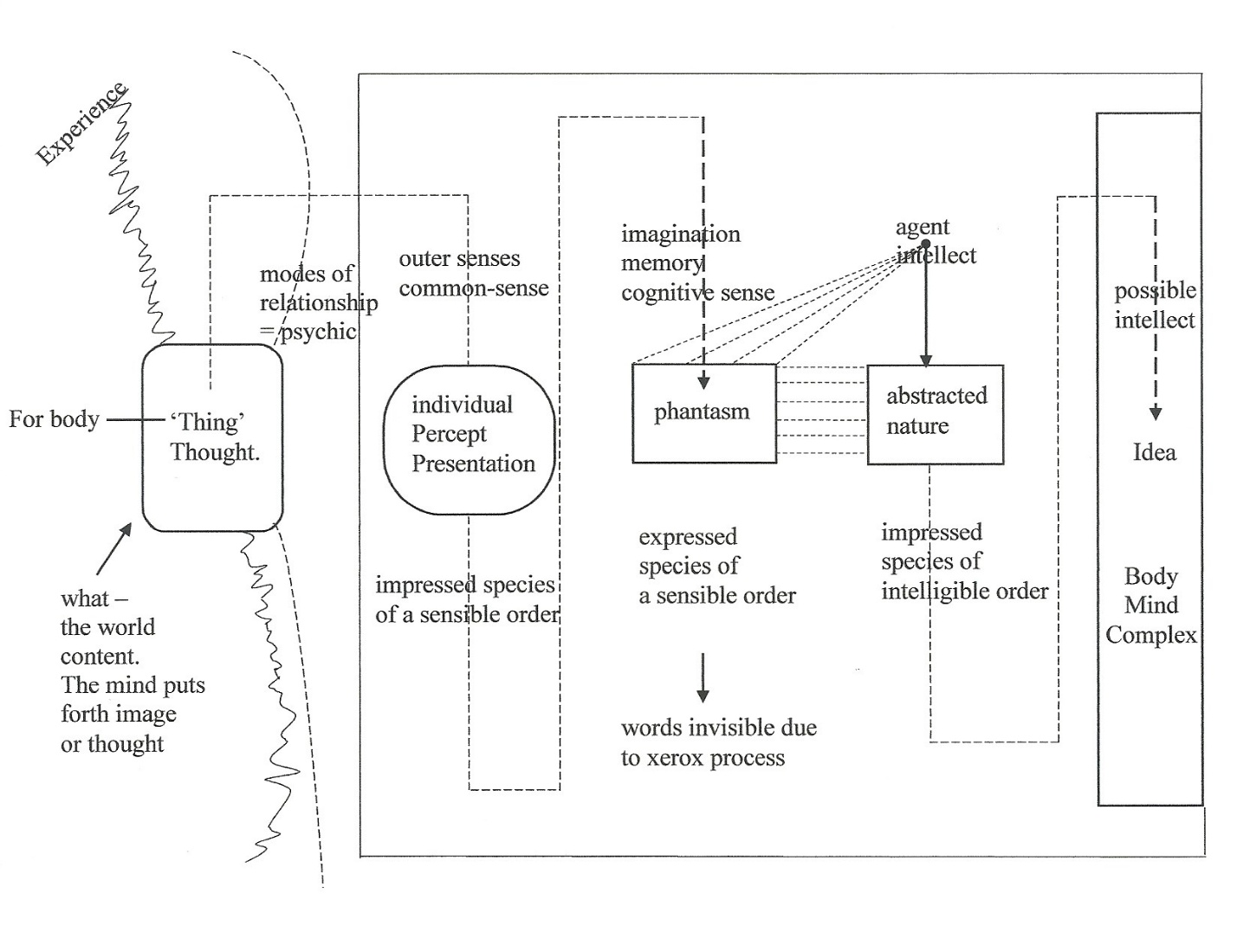
Review of Scholastic epistemology, "jukebox" diagram
Explanation of "eureka" moment by the different schools
Santayana presents a pure Catholic doctrine, not original
More discussion of "jukebox" diagram
Scholastic view: nothing in the mind which is not first in the senses; contemporary consciousness built up by extraction of meaning from experience of external world
Instrumentalist view: thought is for purpose of action
Importance of defining intellect
Understanding grows
BOOKS / ARTICLES READ FROM OR REFERENCED:
Wilmon H. Sheldon, "What is Intellect?", Part One, in Philosophy East and West, Vol. 2, No. 1 (April 1952)
Paul Brunton, The Hidden Teaching Beyond Yoga
Gilbert Ryle, The Concept of Mind
George Santayana, The Realm of Essence: Book First of Realms of Being
Paul Brunton, Notebooks
DIAGRAM appended to this transcript:
- FIGURE AD Supp 107-digital. Scholastic Epistemology ("jukebox" diagram).
[Transcriber note: If someone is drawing or writing, with audible sounds of chalk on a blackboard, I indicate this by [drawing] or [writing].]
NOTES:
We have a partial transcript for this class, Scan File 1983 1021-07R01.PDF. Page 7 of the PDF (reverse of page 6) is hard to read hand-written student notes on intellect.
During the autumn of 1983, beginning with this date and through 1983 12/09, there were a number of classes on Epistemology and Intellect, including those on PB Paras; Intellect.
TRANSCRIBED Verbatim by IT 2021. Archival verbatim transcript – V11a.
AUDIO FILES: 1983 1021a, 1983 1021b. [Note: "Tape" and "Side" refer to original audio cassette tapes that were later digitized into .MP3 Audio Files.]
1983 10/21 at Wisdom's Goldenrod
Epistemology; Intellect
[Audio File 1983 1021a Begins]
S (very faint): --information.
AD (faint): You have to first, you know, perceive realities before you can manipulate [one/two words inaudible]
[short pause with very faint background student whispering]
S (very faint): But I'd assimilate it [one word inaudible]
S (very faint): When did we do it?
LD: Should we all move up closer? (laughter)
VM: Come on Louis.
S (simultaneously, faint): Yeah, (definitely).
VM: Come on up.
AD (simultaneously): I always put you on my lap when you were a kid, you can come right up (here). (laughter, student words)
VM: Tough man. What are you going to say? (laughter)
S (amidst laughter, very faint): That's fine.
S (very faint): Give him that friend?
RC (faint): Right.
S (very faint): Where's Alan?
S (very faint): If you look at the space.
AD: Put one on each (floor). (bit of laughter) [short pause with faint background student talking] John, your question.
JL: If the intellect that we have has such a difficulty in studying and knowing truth, what is it that in the-- in totality of the human being, what is it that is capable of doing that? I mean in-- in terms of rational philosophy.
[short pause]
AD: The intellect is what?
JL: There was a-- there was a small discussion I believe about a week ago relative to the incapacity of the intellect being capable of, you know, doing philosophy of Being, let's say.
[short pause]
AD (faint): Well, I'm not ready to do it, [MW/S(?), faint: No.] but we read this article a couple of years ago and we'll reread.
LR: You have to wait for someone.
AD: Hm?
S: Did you set him up last night so he could (do--)
S: Uh-hm.
S: Yeah.
AD (very faint): No, (didn't/I won't) set him up.
S (faint): Yeah.
S (very faint): Yeah.
[short pause with faint background student talking]
AD (faint): It's a kind of long article of course but-- (laughter) [one/two words inaudible] "What is the Intellect?"
LR: Oh.
VM: Oh, is that the [one inaudible student word simultaneous with VM] one by [S, very faint: Sheldon.] Averroes?
AD: No, (it's/this) done by a fellow called Sheldon.
VM: Oh yeah.
AD (faint): We did this a couple of years ago [VM simultaneously: We did, yeah.] but doesn't matter. Maybe we ought to try again.
VM: I've got a copy of that somewhere stashed away.
LR (simultaneously): Yeah, the xeroxed copy [VM simultaneously: Yeah.] and we got them [one/two words inaudible]
VM: I (wo--) didn't have enough intuition to bring it tonight though.
AS: Yeah. Along with the other whole stack? (some laughter)
S (amidst laughter, faint): That's right.
VM/S(?) (simultaneously, laughing): Right, right.
AD: We're going to have to deal with this subject sooner or later.
S (faint): Yeah.
S (very faint): Well, you have to [S simultaneously, very faint: Yeah.] (include information).
PC/SC(?) (faint): What's his name, Anthony?
AD: Sheldon.
VM: Sheldon.
S (very faint): According to (who), [S simultaneously: Yeah.] (what) we've studied?
AD: Read.
RC/S(?): From it?
AD (faint): Read.
[short pause with faint background student talking]
AD (faint): So, we'll read a paragraph and discuss it. And we probably won't get the answer to your question but, you know, we'll approach (maybe)(--/.) [student assents, faint] (We/You) might have to continue right into next Wednesday.
S (faint): Yeah.
S (very faint): That's good.
[Transcriber note: I am using "What is Intellect?", Part One, by Wilmon H. Sheldon in Philosophy East and West, Vol. 2, No. 1 (April 1952), pp. 4-19, University of Hawai'i Press.]
Wilmon H. Sheldon ["What is Intellect?", p. 4, AD reading]: "[For instance], the [logical] empiricist or positivist of today in the West, [being] a man who lives in the external world with other men, shows by his conduct that he believes in the independent reality of that [AD reads: the] world, [AD reads the rest of this sentence slowly and with emphasis] even if he has decided that none of it can be verified except sense data. He has a metaphysic, probably materialist, but for him it is beyond the pale of intellect. So intellect comes to mean to him not what is occupied with reality, but what deals with pure reasoning, reasoning which alone gives rigid proof as in logic and [AD reads: or] mathematics. He retreats into the inner realm of thinking, [though today], in accordance with the current emphasis on the social, he treats thinking as communication and studies semantics, which is socialized logic or epistemology. [Thus], for him intellect means reasoning, with words or other symbols, about anything you may conceive, but definitely not an insight into reality, [AD adds: it is] a"logic without ontology.""
VM (faint): Uh-hm.
AD: Stop there.
LR: "For him"-- the "him" is-- is referring to--
AD (faint): The-- [AS/S(?) simultaneously, faint: Positivist.] the empiricist [S simultaneously: Right.] or a positivist. The analytical philosopher. [short pause] Now it is true, there is a little confusion here, on the one hand, he speaks about the intellect, and the intellect is restricted or confined to sense-data. But then he brings in the other notion, reasoning about that sense-data. Now, there may be confusion and I think we have to discuss the-- the point of view that-- Let me repeat it quickly again.
Wilmon H. Sheldon ["What is Intellect?", p. 4, AD reading]: "[For instance], the logical empiricist…a man who lives in the external world…shows by his conduct that he believes in the independent reality of that [AD reads: the] world, [AD reads the rest of this sentence with emphasis] even if he has decided that none of it can be verified except sense data. He has a metaphysic, probably materialist, but for him it is beyond the pale of intellect. [So] intellect comes to mean to him not what is occupied with reality, but what deals with pure reasoning, reasoning which alone gives rigid proof as in logic and [AD adds: in] mathematics. He retreats into the inner realm of thinking, [though today], in accordance with [the] current emphasis on the social, he treats thinking as communication [and] studies semantics, which is socialized logic [or epistemology]. Thus, for him intellect means reasoning, with words or other symbols, about anything you may [AD reads: can] conceive, but definitely [AD adds: it is] not an insight into reality, a"logic without ontology.""
AD (faint): Let's try. Talk now. It's on you, John.
JL: What is he saying?
AD: Yeah.
JL: What is he saying?
AD: Yeah.
[short pause]
S (very faint): Yeah (please).
JL: He's defining the limits of intellect to manipulation of symbols and-- and ideas which have their base, so to speak, in the physical world and nothing else. And that the reason itself doesn't touch that world or doesn't touch-- doesn't touch reality of the-- it just sort of works within its-- within its own sphere and manipulates the various relationships of that, say the-- versus perception gives to him.
[short pause]
AD (faint): Anyone wanted to add to that?
S (faint): No.
AH: I didn't understand the reference of probably has a metaphysics based on materialism. How could you--
AD (simultaneously): It's-- His-- his philosophic outlook is a materialistic outlook.
S (very faint): (Right/Yeah).
AH: So, therefore his reality would be materialistic.
AD: Yeah. If you notice, he's-- he really-- he really can't even say anything about that if he's true to his premises. We have to go back to what we-- we said at one time, that if the intellect-- the intellect let's say is that response of the organism to its environment, and that response is constituted by the entirety of all the reactions that he has accumulated in his past and the manipulation of these reactions, reactions which are based on the symbolism, alright, but a symbolism which is, so to speak, trying to understand. So like for instance, if we didn't have any concepts or anything and there was this blue streak of light in front of you or-- and then you look very carefully at it, you know, you went over to it and you touched it and it was wet and you drank some of it and yous "Oh that's-- that's a river," alright. The naming, the conceiving, is a symbol of the sense-data, the modifications of the sense-organs. But the modifications of the sense-organs, whatever they may be in their variety, you attach a certain sign or symbol to it, and then with these symbols you manipulate them, alright, and the semanticist or the positivist would say, "You're not dealing with reality, you can't deal with reality. The only thing you could really deal with is the symbols that you've made of the modifications that took place in the bodily organism and you're manipulating this, but you can't get to what's outside." You remember the way PB put it in the Hidden Teaching. How did he do it? He says, the thing that we have to realize is that we're stuck in the immovable spectacle of senses. I don't remember the exact phrasing.
RG: We never know the external world in itself but only the world figured us through the form of sensation(s). [Note: See Paul Brunton, The Hidden Teaching Beyond Yoga, p. 209, 2015 edition.]
S (faint): Uh-hm.
S (very faint): Yeah.
AD: So, that the most that we know directly or, you know, immediately, are these sensations but then we-- we, let's say, attach certain symbols to various sensations. So then if you manipulate these-- the symbols, it doesn't mean you got any closer to reality. [one/two inaudible student words] You don't know what reality is, you're still stuck with the symbols. So, something like that?
AB: The fact that we would call this blue streak a river would be arbitrary. In fact [possibly one word inaudible] according to this view we could make up any word or name to correspond with this event and that would be why it's a logic without an ontology. In other words, there's only one level of reality, the sense level, and the abstractions that we come up with are not real in themselves, they're just indirect pointers or abstractions. Would that be correct?
AD (faint): Yeah, that certainly would be included. See if you could amplify this notion, because this is the notion that I think shows you how you're, so to speak, inside a cage and you can't get out.
RG: Well even if you have a logic based on ontology you're-- you're still within it [AB/S assents] as long as you're-- as long as you're within thinking.
AD: Good.
RG: You could have-- you could have the greatest ontological logic in the world but it won't-- it won't give you any insight.
S: Right.
JL: Why not Dickie?
RG: 'Cause thinking can't deliver insight.
JL: Why not through the resolution of its contradictions, let's say?
RG: Well, when it stops thinking [AS simultaneously, faint: That's not true.] maybe it can be delivered but while you're thinking it can't. I mean, this is kind of like we said Wednesday night, thinking fulfills itself when it stops. While you're thinking, you can't touch reality 'cause you're in image. You're in-- you're in the imagination. Contradiction.
JL: Yeah but you've-- try that and you've totally negated any possibility of coming to some--
RG: No not that there isn't an image of the real in thinking but we shouldn't confuse it with the real.
JL: Ok, but a correct opinion, you know, resolved through-- through reasoning is better than a confused one.
RG (simultaneously): It's better-- it's better than none but it still we shouldn't-- right, definitely. I'm not saying there's no value to thinking, but that any image could never touch the real is the point I think, not that there aren't better images to have than others.
JL: Does the real-- or does the reasoning deliver that knowledge?
RG: That there-- that it-- that it itself can't touch the real?
JL: Yeah.
RG: Yeah.
AD (faint): Let's leave [JL simultaneously: Well, I-- I don't know that.] out reasoning, let's leave out reasoning now [student assents, faint] because we have to examine what he means by that.
JL: You mean just intellect, Anthony?
AD (simultaneously, faint): But, [RG simultaneously: Yeah, yeah, intellect.] just in terms of intellect (and) what we just said, alright, if we restrict ourselves [S, very faint: Alright.] to the intellect. In other words, if-- if we think of an organism, alright, and we say that the way it responded to its environment, all these reactions and all the input, the sense-data input that's going on, alright, and we say that the intellect is the totality of all the symbols, alright, which he attached to the sense-data and the way he responds to any given situation by manipulating those symbols--let's leave it there. Let's not bring in reason because I think that's a little different than intellect, although I don't know if he makes that distinction but I think for us we can see that. If we're going to say this is what intellect is then we're going to have to stick to it and I think you're going to bring in a-- something else if you're going to say that there is a correct order, alright, how to arrange your symbols, I think you're bringing in something else.
RC (faint): Uh-hm. He seems to be taking this vision of it that this activity of intellect has no intrinsic validity whatsoever and that-- that's why a man would have to call himself an empiricist because he couldn't believe in the intellect itself as having intrinsic revelations of reality. You have to test it against the world, [student assents] see if his thinking had any accurate--
VM: This is (something such that) a scientific point of view or at least a Newtonian point of view, I'd like to make a distinction. But, you know, the materialist ontology, they believe there are objects out there standing there by themselves. On the other hand they would also grant that you can't come in direct contact with these things, everything is representation for you. Your own senses are representation of what's real out there and the intellect is that function in you which manipulates the symbols you have or the concepts you have, which are based on sense-data, and there's no possibility of that delivering the real object to you. And to-- to tie in with what you're saying, you might make a mathematical construction as to what the world is like but you always have to verify according to scientific method by corroborating it with sense-data. Does it really fall at 32 feet per second per second or whatever the case may be, ok, and that will be a continual reliance upon the efficacy of sense and that is in some way the final arbiter.
HS (faint): Do you make a distinction in sensation and thinking about the sensation?
VM: I think so and I think he does in there too. I'm trying to stay close to what [AD simultaneously: Yeah.] Sheldon is doing. I think the way Sheldon is speaking about, he's talking about people like Mach who was a great empiricist positivist who would say that, you know, you-- he's even against atoms, concept of atoms, he says you can't see them, you can't-- you have no operational definition of them in the sense you can't really come in contact with them. You can reason about them but insofar as I can't verify them through sense-perception then they're not real.
HS: So then, in that kind of discussion then what feeds the intellect, so to say, it's got no higher ontology as it were and you're saying it's divorced from its material metaphysical presupposition?
VM: He would say, if I understand him correctly, he would say it's impermissible to bring in metaphysical notions, they can't be reached.
HS (simultaneously): No that's axiomatic (essentially), as-- as Avery pointed out.
VM: Well I would say he probably-- you know, strictly speaking a positivist would say, "Well, matter is a nice concept, it's a nice symbol to use but insofar as it can't be grounded in my sense-world then just an empty place-holder."
HS: And now you got-- they would actually divorce then the sense-world from matter too?
VM: Everything is a representation. You could posit something out there but you're not going to be able to get to it. I think that's what Sheldon is saying.
AD (simultaneously): Yeah, that's the point you have to understand, [HS simultaneously, faint: Yeah I'm trying to get to.] that you can't even prove the existence of an external world [VM simultaneously: No, right.] although the--
VM (laughing): Although they're relying on it being there!
AD (simultaneously, laughing): [couple words inaudible]
HS: That's the metaphysic-- [S simultaneously: Yeah.] that's the metaphysical [S simultaneously: You can't, you can?] presupposition and you're denying yourself access to that.
VM: That's right, it's a real agnostic point of view in a sense like, you know, Andrew's question, "But what kind of metaphysics is it?" Materialism, I think they believe in objects but they can't reach them through sense, and the intellect as they use the term can't bring (it) in either.
AH (faint): They presuppose a material existence. That's a (presupposition).
AD: All that they, all that they really allow themselves is the presupposition of sense-data.
VM: That's it, that's the beat.
AD: Nothing else.
AH: Anthony, in regards to that, you said a symbol was language and symbol and it's referring to something. And are we going to restrain the definition of symbol to sense-data? Like, for instance, let's say that within this philosophy that's being described you have a concept of mind or a concept of soul. That symbol is referring to sense-data?
AD: Well they would point out it doesn't refer to anything now.
VM: That's why they don't allow it as an item in their philosophy.
JL (simultaneously, faint): Yeah.
AD: You're speaking about them as though there's a ghost in the machine.
VM (laughing): Exactly.
AH: But they do form, they do form an image of that to try to work with.
AD: An image of what?
AH: Let's say that in a discussion you find it necessary to have some kind of amorphous image of mind so that you can not go crazy.
AD: But they don't have an amorphous image of mind, they got a very exact image of what they think mind is.
AH: But what does that refer to?
RG/S(?): It's called the brain, isn't it?
AD: This manipulation of these symbols in an indefinite variety of ways, the way the organism responds to any given situation by manipulating those symbols.
AH: That's the mind.
AD: Yeah.
S: Uh-hm.
AD: They're not going to have no ghost running around inside you saying "This is me and the rest is something else."
AH: Are-- are all verbal symbols--
AD: Is all language a symbol?
AH: All language is a symbol.
AD (faint): Yeah.
AH: Sure. [student assents, faint] Do all--
AD (simultaneously): Numbers too.
AH: Do all symbols refer to sense-data?
S (faint): No.
AD: Yeah, to them, yeah. [student assents, very faint] This is News Speak, New Speak.
VM: I don't think they would say that, would they Anthony, all symbols? I mean wouldn't they believe in, let's say, the-- let's say mathematical structure to them would be legitimate objects of thought, they're not-- they're not sensible. On the other hand you could say well they're ultimately-- their efficacy or their value is grounded in their sense-- in the-- in the ability to tie them to sense-objects.
DH (simultaneously, faint): Uh-hm.
AB: Yeah aren't they derived from sense-objects?
DH (simultaneously, faint): I mean, the mathematicians that came out of this school go even further than that. I mean they say that the mathematics, the symbols of mathematics, don't refer to anything at all and, you know, necessarily that they're purely arbitrary creations of the human mind.
RC (faint): And that seems to be the real power--
VM (simultaneously): Yeah, that's what I'm saying but they're legitimate objects, but--
DH (simultaneously): Yeah but it's just a manipulation-- a pure manipulation of the symbol.
S (faint): Right.
RC: That seems [S simultaneously, very faint: (Right.)] to be the real power of that sentence he's got there, calling it a logic without ontology, [student assents, very faint] that they're saying exactly that. Any pure functioning of this intellect doesn't have an ontological reference.
DH (faint): I mean, it's in that school they would-- the people in that school would define mathematics as that manipulation of the symbols that doesn't refer to-- that doesn't refer to sense-data.
VM: Sense-data. Right. But it's a legitimate object of thought for them. Doesn't have to be tied to sense- data.
AH: If it doesn't--
AB (simultaneously): It's not real.
AD: The symbols themselves are ultimately, you know, free from the sense-data and they're manipulated.
VM: Right, right.
AD: But if we ask these mathematicians the derivation of the numbers themselves, I think many of them would say, "Well, through the experience of the empirical world, [VM simultaneously: That's right.] one apple, two apples, [VM simultaneously: Right.] three apples. How many apples fell on Newton's head? One."
DH: Yeah but-- but the formalists that came out of the school would say that that's not mathematics [couple words inaudible] that that--
AD (simultaneously): No but-- but the derivation of numbers.
S (very faint): Right.
S (faint): Uh-hm.
DH (faint): Well they say-- they would put it purely in a formal system. They would say that there are these axioms that we-- that we assume, that our mathematics is derived formally from these axioms, and that all the properties of numbers are expressing--
AD (simultaneously): Give-- give me an example of an axiom.
S (very faint): Uh-hm.
DH (very faint): Um [couple words inaudible]
S (very faint): [couple words inaudible]
S (faint): Yeah.
DH: Um--
AD: And then I'll pop it.
DH (faint): What's one of the-- yeah, what's one of the axioms that--
VM (faint): In real numbers you mean?
S (faint): Yeah.
RG (faint): No, just (trying to--)
S (faint): That was (a/the) name.
[short pause]
DH: Yeah, so-- well one of them is given any-- given any collection, you can always-- there's another collection of points.
S: Can you say that again, I didn't hear.
AD: Is that derived from the sensible world?
S (faint): Yeah, right.
DH (faint): But the point--
VM: No, but Anthony's point--
DH/S(?) (simultaneously): But I would say yes. [VM: Yeah.] I would say yes, it's derived (from there).
VM (simultaneously): It's a distillation of sense-experience is Anthony's point, if I understand him. [students assent] And as much as they think they're being more and more abstract and removed from it, I think Anthony is contending that they can only say that it's a distillation of sense-experience, it's a abstraction away from sense-experience that ultimately it's grounded in. The most primitive notion must come from sense-experience. Now, a different school would say, "No, it's a representation of ideal principles," but that's another issue.
AD (simultaneously): Yeah, but that's-- that's already-- that's already a manipulation of the symbols or the signs, [VM simultaneously: Right, right.] alright, and a further abstraction from [student assents, faint] the experience. [DH, faint: Right.] But, the-- I think the interesting point here is that you have to try to understand what the positivist would-- Most of us would recognize that the sensible world is the origin from which symbolism is derived.
S (very faint): Uh-hm, right.
AD (faint): I think-- I think that's what they're mostly concerned with.
AH: Is that so just the positivists or that's generally so?
AD: Well, for-- let's say for a certain school of thought believes that this is so and that in a sense, we can see some truth in it.
VM: Yes nothing can be in the mind which is not first in the senses.
AD (faint): Senses.
AB: Right.
S (faint): Uh-hm.
AB: Once the symbol system is developed, like you say have-- you have a culture, then in a sense it doesn't have to keep being derived from the sense-datum because the culture feeds you these symbols and teaches you to manipulate them in a certain way, then you have different symbol systems in different cultures and societies that each have their own representation of reality. It seems to take on a kind of self-sufficiency.
AD: Yeah but I don't think you've moved away.
S (very faint): Right.
AB: From--
AD: You haven't moved away from the fundamental position one dot.
AB (faint): Uh-hm.
RC (faint): I think that's what he was calling in the paragraph the study of semantics as a socialized logic. [AB assents] You get those words and terms and manipulate them and play with them but they in themselves are incapable of delivering an insight into reality [AB assents] according to this point of view.
S: Alan (what/that) you're saying is that they don't learn it from sense-data anymore though because it is socialized.
AB: Well, I was trying to say that within the lim-- within the definition of intellect that we're talking about, you can have different symbol systems or concept systems which are completely different, I mean which have a completely different understanding of the world in different cultures for instance, but they're all still just concepts derived from sense-experience.
AD (faint): In other words, you could write "one" in Arabic numerology or Roman numerology. [AB assents] The culture that derived the Roman numeral, culture that derived the Arabic numeral, alright, are different cultures, but basically the same process is involved, the distillation from sense-experience of certain ways of signifying or referring back to that sense-data and these symbols have been developed and there's different symbol systems, you know, in different cultures. But, like we're trying to point out, he hasn't moved one dot away from the original premises, [AB: Yeah.] alright. He said all that man really knows is the fact that the senses perceive the world and perceptions, these perceptions are, let's say, there's a certain symbol attached to them and now you manipulate the symbols and you may think that you're manipulating reality but you haven't even come into contact with reality, the only thing that you're manipulating is let's say the sense-data, alright, in the-- which has been detached from the context, alright, and you're manipulating that. [student assents, faint] And in a sense of-- in the sense one could get that feeling-- One could actually arrive at a feeling that he's enclosed in this world of symbols and that the reality has completely escaped him and he has-- he has no contact with it. And he's-- he really feels as though he's in a terrible bondage to an unreality. All these images and pictures and memories of which he can manipulate, throw around and do a lot of things with and he could make nice pictures or write nice books but no closer to reality.
LH: That-- that recognition is something that the intellect can appreciate itself, forms out of the-- out of the symbol. It forms symbols of its own activity in order to come to a recognition of the fact that it's limited by them.
[students assent, very faint]
AD (faint): Uh-hm.
S (very faint): Uh-hm.
S: Hm.
AD: So how do you like that situation?
S: Uh-hm.
S (faint): It's uncomfortable.
S: [one/two words inaudible]
AD: Yeah, yeah.
DB: Anthony, isn't this whole-- [S simultaneously, faint: No (cocoa) for me.] isn't this whole school of philosophy or whatever it is, just a description of animal faith? I mean, isn't that primarily what it boils down to, that what they're analyzing was process of what Santayana calls animal faith?
AD: I guess you could summarize it that way.
DB: Because it seems like you--
AD (simultaneously): But I think some people would appreciate to know what this animal faith is.
DB: Yeah, well, I was partly [one/two words inaudible]
AD: You're saying that the animal believes in the existence of the external world, right?
DB: Right.
AD: Yeah.
DB: And that-- that this is-- this whole philosophy takes as its basis that presupposition, that-- the existence of the external world, and operates accordingly, and it's-- fundamentally, it's based on belief. I mean the bottom-- the rock bottom presupposition of this school of philosophy is a belief rather than something that's actually been examined because the one thing this school leaves out of its own consideration is the functioning of the mind itself except insofar as the particular symbols that it happens to be using are discussed. But the actual functioning of the mind that's coming up with these answers and suggestions and so forth is something-- seems to be so closely identified with it that there's already discussion of it. It's always-- it's always presupposed.
AD (faint): [one/two words inaudible]
DB (simultaneously): But it's never objectified at all.
AH: Is there [AD/S(?) simultaneously, faint: No, no.] ever a way of objectifying that mind's function in any other philosophy?
AD (simultaneously): But-- but again, I must remind you that with these people there is no such thing as mind.
S (faint): Yeah [one word inaudible]
DB (simultaneously): I know and-- and they'll try to convince me that that's the case and if there isn't anybody there to convince then I suppose it doesn't matter but-- I'm aware of that, I'm just trying to see, you know, where precisely they're coming from. I mean, they-- they do say there is no mind and [one word inaudible]
VM (simultaneously): Practical men. [RC simultaneously: Why not?] Men of the world.
DB: What?
VM: They're very practical men, men of the world, they'd say you're a dreamer.
DB: Yes.
VM: And that I'm-- you know, you want to talk about mind, I can reduce it to biological processes.
DB: Yeah, sure, I-- I'm aware of that. The dirtball theory of intelligence came from the [couple words inaudible]
VM (simultaneously): Yeah, that's right, those guys are in the ascendancy, don't kid yourself.
RC (simultaneously): And some of these people-- some of these people are really sharp too.
VM (laughing): You're darn right they are! Tear you apart.
RC (simultaneously): They'll criti-- they'll criticize a mentalist and they'll criticize (the/a) materialist and they'll say like, "You guys-- one team takes the word 'matter' and the other team takes the word 'mind'. Any attempt to reduce all this differentiated experience with one term becomes [few inaudible student words simultaneous with RC] meaningless to me. [student assents, faint] Call it mind if you want, call it matter if you want, in either case you're not telling me anything."
BS: Yeah but they'll say in either case it's matter, right?
VM: In either case it's outside your experience and that's why it has no reality.
RC (simultaneously): No I think they'd say-- there's no question they'll say the only thing I can verify is that there is sense-data. I can't talk about matter and I can't talk about mind but I can be responsive to the fact that there is sense-data.
DB: Yeah but is that response to sense-data sense-data? I mean what kind of argument is that? I mean obviously.
PD (simultaneously): Who's ever had plain sense-data?
VM: David--
DB: What? (bit of laughter) I [S simultaneously, faint: But--] mean I'm just-- I don't think their argument's so hot, I never did.
AD (simultaneously): Well we just-- we just pointed out that the way they would respond to that is point out that the organism responds to a given situation by simply ma-- you know, manipulating [VM: Yeah.] these various sense-datas, and he would say-- he would say, "You want to call that process of manipulating these symbols mind, go right ahead. But we know what we mean when we say mind."
BS: Well that's what's puzzling. Now, how do they know what they mean? Is it a question of a nucleated structure that got built at one point along the way?
RG/S(?): (Right.)
AD (simultaneously): No, they'll point out that that's what we mean when we say it. They're-- [VM simultaneously: Say it again (for me).] they're very carefully defining that mind to them-- and-- [BS: Yeah.] now listen-- is the response that the organism makes as a-- you know, in regard to any given situation by manipulating the memory contents which is the depository of all the sense-data, the input and exchange, alright, and responding with what it thinks is the appropriate answer to a situation and that is mind to them.
BS: Yes, but there seems--
AD: Wait, first I want you to understand this because it's very crucial.
BS: Yes, I follow this.
AD (simultaneously): It may-- it may very well enter into the definition of what the intellect is. [student assents, faint] And you're-- like you may be coming in from the point of view of reason or the point of view of feeling. But I want you to just keep in mind the way they would answer it. Now ask your question.
BS: Yeah, uh-- They seem to be bringing in some form of knowledge, call it intellect, call it sense-data, call it biological, but there's some form of modified consciousness taking place.
AD: But they don't believe in consciousness, there's no such thing.
BS (simultaneously): I know, now how do they-- how would they answer that is my question.
AD: How would they answer-- Go ahead.
BS: This knowledge they have that all there is is sense-data that is being manipulated, that's-- to me, that's a form of knowledge. Now maybe they-- as you say, they don't look at it that way.
AD (simultaneously): Well that's-- that's how they would-- that's what they would tell you knowledge is.
JL: Yeah. It's association based on sense-data.
BS: Yes but this association implies a-- some kind of nucleated system that has either developed from-- from an unconscious process to something that is conscious or was always conscious and then has developed into sense-data being manipulated.
RG: But they-- they don't deny consciousness, they just would say the source of consciousness is in-- is in the brain [VM: Right.] neurons.
BS: But that [one inaudible VM word simultaneous with BS] would imply a time when there was no consciousness.
VM: Sure.
RG: Yeah, [one/two inaudible student words simultaneous with RG] and they'll-- and they'll say to you show me a time when you're-- when you know mind without the brain functioning. And what would you say? And they'll say every time we poke some place in the brain we can show you how your consciousness changes. And so there's an obvious link between the brain and consciousness and you-- you'll have to show me where it isn't so I can believe you.
BS: But is that a manipulation or a reaction?
RG: Well, they don't care, they wouldn't-- the-- to them it doesn't matter, they're showing the relationship between consciousness and brain functioning in-- in a-- in an interesting way, I mean--
VM: Sure. They'll give you some sort of drug, watch how your consciousness changes. [RG simultaneously: (Right/Wow).] Anything, (and they say--)
RG (simultaneously): Amazing.
VM: It's a very straightforward position and it has a lot of force, I mean-- You-- [one inaudible student word simultaneous with VM] if you try and appeal to some mystical thing or some out of body experience and so on they'll dismiss it, they'll say, "It's not available for me. You can't bring that in."
RG (simultaneously): And not only that they'll say-- and they'll say we already measured it, we have alpha waves and beta waves [VM laughing, simultaneously: Right!] and-- and when a-- when a yogi meditates we can measure it and [VM simultaneously: Sure.] his brain is changing and that's why his consciousness is changing.
VM (simultaneously): Yeah, right.
S (simultaneously, faint): Completely (organic).
BS: But isn't that the point, how do you-- how do they answer the fact of this measuring process?
RG: But, once it's a-- it's an instrument, they don't-- they don't-- that's science.
BS: Well, now, you're not answering for them, you're just stating what they believe.
RG (simultaneously): No, no, that-- I-- you-- you haven't answered against them yet.
VM: They dismiss a lot of your questions.
BS: See why I have them?
RG: No yeah 'cause they don't buy it.
RC (simultaneously): They only deal with sense-data.
S: [one/two words inaudible]
BS (simultaneously): Excuse me?
RC: They measure the sense-data.
BS: With what?
RG: With (instru--)
RC (simultaneously): With the senses [student assents, very faint] or instruments that are extensions of the senses.
PD: But I'm confused. How do they have sense-data?
BS (simultaneously): They see the measuring-- Excuse me?
VM (laughing): Oh, oh! We'll deprive--
PD (simultaneously): What sense-data? (VM laughing)
VM: Go step on his foot. (VM laughs)
S (faint): [one/two words inaudible] (stop--) stop thinking. (some laughter)
JL: Be deprived of sense-data, right?
S: Uh-hm.
PD (simultaneously): I'm confused. Is sense-data something different than concepts? [AD/S(?) simultaneously: See--] Are we talking about anything else but ideas here?
RC: For these people I think, they're assuming that there is a difference.
S: No difference.
PD/S(?): (All that) [couple words inaudible]
BS (simultaneously): Well we know what they're assuming but we want them to defend that assumption.
AD: No I-- I didn't want to get into that now. I want to run through some ideas of what intellect means in various schools.
BS: Ok.
AD: I'm not interested in me criticizing them. I mean [few words inaudible] (to) think. I just want you to see if you get their position.
AH: Could-- could I see if I got that position?
AD (simultaneously, faint): Yeah, go ahead.
AH: It seems to me that the concept and the sense-data are the same.
VM (faint): No, I don't think so.
JL (simultaneously): No.
VM: I don't think so.
AH: Insofar as all symbols are derived from sense-data, every concept will have its derivation in sense-data.
PD: But is the concept and sense-data the same thing, Andrew, or they something different?
S: I--
AH: I see it as the same thing.
VM: No, you're trying to reduce it to mentalism.
PD (simultaneously): They perc-- you perceive [VM: Yeah.] a mathematical formula? [S, very faint: Ideas.] What do you mean?
AB: Yep.
AH: I don't see the necessity of putting the wedge between sense-data and concept for these people, whoever these people are. I don't--
VM: They would say-- there's enormous difference. You can be so misled by your concepts, you go talk to crazy people and just totally out of it and they're not related to the real world. They think they can leap over buildings and so on.
AH: But nonetheless what-- what does that-- whether they can leap over buildings or not, the idea of leaping over a building is the image based on sense-data.
VM: Fine, yes, but there are correct images and there are incorrect images and you decide which is correct and which is isn't by an appeal to sense-experience, by efficacy, in the sense--
PD (simultaneously): By an appeal to what, Vic?
VM: By an appeal to sense-experience, by efficacy in the shared world that we live in.
PD: Is this a multiple choice or is it one-- one of them or three of them that you're [couple words inaudible]
VM (simultaneously): Oh, come on, I don't want to, you know-- I mean, it's fun arguing this position but I don't think it's where Anthony wants to go.
AH: Well, I thought, I thought (the) interesting--
AD: It's pretty hard to manipulate images. But you can manipulate symbols that stand for images.
VM (simultaneously): Sure.
S (very faint): Yeah.
AH: Yes, yes.
AD: I think you have to keep that in mind, that if you reduce the symbol to the sense-data, you would find it extremely difficult to manipulate sense-data. But you can manipulate sense-data if you get something to stand for it which is much more abstract and then you don't have to manipulate the chair in your mind across out of the window and into my cottage, you can just use the word(s), "Bring the chair into my cottage." (bit of laughter)
DB/S(?): Right.
AD: So the-- the symbol seems to be like an abstractive process where you reduce things to their essentials and you make certain signs, you know, alright, black marks on white paper, and you man-- you manipulate those things now instead of the actual image in your mind of a chair.
AH: Can-- can symbols be derived from other symbols?
AD: Yes, but we don't [VM simultaneously: Sure.] want to get into a discussion of that. Sure, the symbols can be derived from any variety of sources and sources-- and you can certainly see that take place in language. Let's go on a little bit but you have to try to grasp that position and you have to really swallow it to appreciate it. And you put yourself-- You have to drink that water to s-- to understand it and appreciate it. Because, you know, like when we're-- when we speak about a computer and we (say that) there's so much information in the computer, and that information could be manipulated. But let's say it was possible to exhaust all the possible ways that that information could be manipulated, [VM assents] you know, combined and recombined, all the in-- infinite ways that it could be done. Then you would say well the machine, alright, has reached its limit, that's a limit, alright, situation, [VM assents] ok, and you'll say there's nothing further that could-- you-- unless you put in more knowledge, alright. And in the case of the human being they'd point out well there's always input going on, tremendous amount of input. In one day you can't even count the amount of input that's taking place and that the human being is constantly learning to respond to that input by manipulating these concepts (which) he makes from (it). But then there's another point of view that says-- This is the-- this is an extreme. He says--
Wilmon H. Sheldon ["What is Intellect?", p. 5, AD reading]: "…the rational idealist [AD reads: idealism] of the Hegelian type, the complete rationalist who declares the real world [AD adds: is] essentially logical, a network of mutual implications. [And] as extremes meet, both would define intellect as reasoning, as logical implication become [AD reads: becomes] explicit to the mind of man. But the Hegelian sees it as productive, synthetic, generative, while the positivist usually sees it as analytic, even tautologous, not delivering novelties beyond the premises, just clearing up their meaning…"
S (very faint): That's true.
VM (faint): Yeah.
RG: Uh-hm.
VM: Anthony, I think it would be helpful if we tried to make the distinction here between logic and reasoning, because if I understand Sheldon, he's attributing more the mind's functioning as logic to the empiricist but the Hegelian perhaps more like reason as we've used those two terms in the past here. Because reason can in some sense examine its own premises and arrive at a deeper understanding than the formal manipulation which was the-- let's say the province of logic.
S: Yeah.
AD: Alright, but in the-- in the-- in the case of the Hegelian, what he is saying is that the real world, the world beyond the sense-data, [VM assents, faint] is a network of mutual implications and relationships. I think that's what he-- [VM assents, very faint] he's implying that the rationalist is saying there.
Wilmon H. Sheldon ["What is Intellect?", p. 5, AD reading]: "…both would define intellect as reasoning, as logical implication become explicit to the mind of man. [But] the Hegelian sees it as productive…"
AD: He sees the intellect as something productive because it synthesizes, (it's/is) productive, it's generative. The positivist says it's "analytic, and even tautologous, not delivering" anything new [VM assents] but the [student assents] premises and only the premises.
S (very faint): Uh-hm.
S (faint): Well, uh--
HS: Positivist says the Hegelian reason is--
VM (simultaneously): No, no. [S simultaneously: No] Intellect for the positivist [RG simultaneously: No.] is deductive.
AD: In other words, for the [RG simultaneously: What do you mean by that?] positivist, alright, to speak about reasoning is really a form of tautology because you're not getting anything out of the data [VM simultaneously: It's already in there.] which is not already in there, [VM assents, very faint] whereas the Hegelian is saying no, you get more out of the data because the intellect not only brings these things together and synthesizes them but produces new results.
HS: But the data now for the Hegelians is not the sense-data-- is it the sense-data that the positivists have?
AD: Yeah.
HS: That's the object?
AD (simultaneously): But the premises-- Now, go back to the premises. The Hegelian is of the opinion that the world which is external to his sense-data, alright, is itself a world where there are implications, interrelationships, among the reals, alright. Now, insofar that that is reflected in sense-data, alright, and the mind of man can manipulate that, he can eventually come up with novelties and new forms of knowledge, new combinations. The positivist says, "Well all that we really know is sense-data. If there is a world external to that we will never be able to find out because we're limited to sense-data. So then when we're thinking about this sense-data, we cannot possibly come up with anything but the sense-data that we started out with. [HS, faint: And--] So there won't be no novelty, there won't be no new production, alright, and you won't be generating any new truths."
HS: (And/Now) if you ascribe a reason to the world outside which you receive through the sense- data you'd say that they would call that simply imaginative?
AD: I'm sorry.
HS: To ascribe a reason to the world that you receive through the sense-data, they would call false or imaginative or--
AD (very faint): Who would call?
HS: The positivists.
AD (very faint): Well I--
S (very faint): [couple words inaudible]
AD: They would say that that is what you're restricted to, [HS simultaneously: The sense-data.] and that you can't go beyond that. And therefore, whatever reasoning goes on [HS: Right.] is within that. The strange thing is they say it's really a form of tautology.
HS: Ok but now with (the people--)
AD (simultaneously): A table is a table, alright. Sense-data is sense-data, no matter how I manipulate it it's going to remain sense- data.
PD: Are you putting those two like extreme ends, the Hegelians on the one side reducing all the experience to ideas and their relationship(s) and the-- the positivists reducing everything to the sense-data, sense-qualities--
AD (simultaneously): Yeah, that's what he does.
(Side 1 of original cassette tape digitized as 1983 1021a Ends; Side 2 Begins)
VM: --say "See that's what we've been telling you all along."
S (faint): Yeah.
RG: Right.
VM: "What do you think we mean by appearances?"
S (faint): That's right.
VM: Only thing you ever arrive at are your sense-experiences, they would love that line about PB saying the only thing you ever get in contact with your [RG simultaneously: Agree.] own sense productions and so on.
S: So they [VM simultaneously: So yeah.] do see it as an internal [VM/RG(?) simultaneously: Oh sure.] [couple words inaudible] production, [student assents, very faint] and [one word inaudible]
AB: But it's all derived from--
AD: Sure.
S: They don't even regard there being an external world that that sense-data comes from.
VM (simultaneously): Well, they'd say you could appeal to the idea of it but insofar as I can't grasp it through my senses, then I can't ascribe any great reality to it. But if it's convenient for your system of logic, then it's ok, you can use it but don't-- don't make too much of it.
S: Ok but that fact to them doesn't point to any mind in which that would have to exist. Mind to them is still derivative of that--
BS: Yeah, (it--)
VM: You guys don't want to give up on mind, I tell you, you come-- come to a great empiricist [couple words inaudible]
S (simultaneously): No I'm just trying to understand the--
AD (simultaneously): They won't accept that.
VM: Uh-uh.
AD: If you want a good example of that, there's a very fine book, Gilbert Ryle. You remember the name of it?
HS: Concept of Mind.
AB (simultaneously): Concept of Mind.
AD: Concept of Mind, yeah.
S: What's the author's name?
S: R-y-l-e.
AD (simultaneously): Ryle, R-y-l-e. He'll-- he'll cure you of that notion of mind. (laughter)
JL: Anthony, I can't see [VM: Poisonous literature.] how his description of Hegelian-- the Hegelian attitude is different from previous. I can't see how his description of the Hegelian attitude towards the intellect is different from positivist.
AD: The-- Hegel would say that it is reason, absolute reason-- the world is absolute reason. The world which is external to our sense-data is a world of absolute reason. The interrelationship, the interconnection of all these reason-principles will come through the sense-data here. So he's coming from entirely o-- [S simultaneously, faint: (True.)] [couple inaudible student words simultaneous with AD] For Hegel, reason is absolute.
S (faint): Uh-hm.
VM: He just completely turned it upside down.
AD (simultaneously): Completely the reverse.
JL: Well, it's-- it's generalized, isn't it, so to speak?
AD: I'm sorry?
JL: I mean it's externalized isn't it?
AD: No, you have to tell me what you mean because part of the discussion here tonight is, you know, that I've been taking for granted that we understand these simple things like intellect.
JL: Well, if instead of-- if instead of simple [AD simultaneously: You know what (couple words inaudible) right?] sense-data that you gain--
AD (faint): Huh?
JL: If instead of just simple sense-data that you gain in the-- in the positivist theory, you're gaining a knowledge through the senses which also includes a logic and a logic of relationships, ok.
AD: That you're [JL simultaneously: At--] learning about the World-Idea through the sense-data which is reflecting those reason principles, yeah.
JL (simultaneously): Ok, ok. So it's really a-- a question of grasping the-- the intrinsic relationships between the various sense-data that-- that are received, and you call this a kind of reasoning.
AD: Well, yeah, Hegel would say by synthesizing the variety of the ideas, bringing them together, they're productive, in the sense they'll-- they will lead you to the fact of the World-Idea or the reason-principles that are actualizing themselves. So it is the opposite of the [student assents, faint] positivist point of view.
AH: I missed the part of how these reason-principles-- They're productive in regards to the symbols, whereas in the positivist view there's no production within symbol. But, for the Hegelian there's a presupposition of reason structure outside of the-- the positivist logic. Is that so? That presupposition of-- of a-- of a principle outside of the logic, how does it work on the logic, like it allows the logic to arrive at something new that's not based on sense-data or not based on symbol?
AD: Yeah.
AH: What would be an example of that so I could understand what you meant?
AD: Well, he-- you know, he generally speaks about the-- he speaks about a thesis, thesis and then there's an antithesis. In other words, there's two points of view that are contradictory to each other. He says and then there takes place a synthesis of these two points of view. [AH, faint: Right.] And that synthesis is something absolutely novel and unava-- not available in the sense-data themselves.
VM: Or either of the two.
AD: Huh?
VM: Or either the thesis or the antithesis.
AD (simultaneously): Or-- yeah. Now of course one sees right away that what he's brining in is intuition because intuition is going to combine the paradoxes or complementary points of view.
AH: It's not-- it's not of any consequence that that third thing has to be expressed symbolically.
AD: Has to be what?
AH: It has to be expressed symbolically.
AD: Oh no, that doesn't matter.
AH: Doesn't matter.
AD (faint): Doesn't matter.
S (faint): Uh-hm.
CS: Anthony? You said to understand the simple thing of intellect. And since you brought it up a couple of weeks ago I'm-- I've thought a lot about it and I don't even understand the difference between the intellect and ego.
AD: Well, I didn't ask you to understand the difference between ego and intellect.
CS: [one/two words inaudible] they become good-- the intellect-- you say the intellect is the child of the ego, and-- I mean could the ego overtake-- I mean could the intellect overtake the ego or be-- I mean to me there's a sense that they're so similar.
AD: No, they're not-- they're not identical. The ego does use the intellect like it uses emotions to have its own way, but, they're quite different. The ego is the thing that keeps going on, [CS: Right.] but the intellect doesn't go on.
CS: Ego does, right?
AD: Even very often when a person goes into trance states the ego is still there but there's no more intellect. So they're quite different.
S (simultaneously, faint): [one/two words inaudible]
AD: They are quite different. The ego is the root from which the intellect springs but I don't want to get into that.
CS: Oh ok, I just didn't, you know--
AD (simultaneously): I want to make an artificial abstraction tonight and just talk of-- more and more about the intellect so that we get a feeling for what it may be. Because if we don't, we're going to be deluded all the way down the line. And that's why I asked yesterday, you know, about does the computer know its author. If the intellect knew the ego, it would be really something.
JL: Anthony, I'm still not clear about the Hegelian versus the positivist.
S (faint): Well--
AD (faint): Well, what is it you're not clear about?
JL: Well, the one, the one posits sensation and then symbols derived from that or abstracted from sensation. The other, the other can say that-- that the knowledge that-- that is had by the-- the given datum is a knowledge of logical relationships.
AD: The other is saying that there's a reality which is organizing not only the input that's taking place but the very means by which that input could take place and it's organizing both of them to deliver the World-Idea to you, [JL simultaneously: So it's--] the absolute reason.
JL: So it's the reason itself that delivers the-- the-- the idea [AD, faint: Yeah.] rather than the-- like the perception.
AD (simultaneously): In other words, behind, behind the random existence of these various bits or pieces of knowledge is a world of reason which is first of all manufacturing them and then is going to organize them to represent the idea in your mentality of the reality which is outside of your mentality. They're quite contradictory (to me).
JL: Would you say that that is strictly a mentalist position?
AD: What, the--
JL: The Hegelian.
AD: Yeah, Hegel was quite a mentalist.
JL: Yeah.
AD: Of course, I would say he limited himself unnecessarily to reason and left [JL assents] out feeling. [JL assents] And, that point, I mean, it's unfortunate but for Hegel the absolute idea is Mind.
JL: Uh-hm, yeah, yeah. (I guess/Yes) it wouldn't be--
AB: The Hegelian point of view would be a logic with an ontology because there's this real which is reason which is organizing your experience and your understanding to conform to itself.
S (faint): Uh-hm.
S (faint): Right, right.
S (very faint): Uh-hm, yeah.
S: But isn't--
BS (faint): [couple/three words inaudible]
AD: That's quite evolved an ontology. Now, there's another point of view, a third, and I think you're familiar with it.
Wilmon H. Sheldon ["What is Intellect?", p. 5, AD reading]: "Quite different from both is the Thomist point of view, which [yet] includes something of each. For this metaphysic, man's intellect is the faculty which penetrates to the essences of things in the external world, seeing them as by [an] X-ray… Thus, intellect sees or discovers, as in physics, that the essential property of a falling body is expressed in the equation v=gt…that the falling of a leaf is essentially the same kind of event as the falling of a stone, the contingent accident of the air's resistance being removed. Intellect deals with being, is naturally objective, a living into the natures, the essential traits, of real things and events. It reaches the substance in the changing sense-data; it is the conceptual faculty, [yet also] more; it is the judging, since it envisages the concept as pertaining to the real object. Thus, intellect is the entering of the mind into reality, into its essence within its existence. Where, then, does logic come in, logic the distinguishing mark of thinking? Here is the second point of Thomist doctrine: the distinction, as they say, between intellectus and ratio. Intellect is not only the penetration into the nature of things, [intellectus]: it is also the deducer, the reasoner, ratio, which sees beyond the given to what is implied by it. For example, the observation of things in nature shows them continually changing, moving from place to place, growing, decaying, and so on--which implies a first and unmoved mover. Never mind whether the inference is correct or not…"
AD: Let's ignore that. [short pause] We got the point of view of the Thomist?
RG: I don't get the difference between him and the [AD simultaneously: Well--] Hegelian too well.
AD: Let's try again.
RG: Seems pretty close.
Wilmon H. Sheldon ["What is Intellect?", p. 5, AD reading]: "…man's intellect is the faculty which penetrates to the essences of things in the external world, seeing them as by an X-ray… [Thus], intellect sees or discovers, as in physics, that the essential property of a falling body is expressed in [the] equation [AD: etc]… Intellect deals with being, is naturally objective, a living into the natures, the essential traits, of real things and events. It reaches [AD reads: teaches] the substance in the changing sense-data; it is the conceptual faculty, yet also more; it is the judging, since it envisages the concept as pertaining to the real object. [Thus], intellect is the entering of [the] mind into reality, into its essence within its existence. Where, then, does logic come in, logic the distinguishing mark of thinking? [Here is] the second point of [AD adds: the] Thomist doctrine: the distinction, as they say, between intellectus and ratio. Intellect is not only the penetration into the nature of things, [intellectus]: it is also the deducer, the reasoner, ratio, which sees beyond the given to what is implied by it. For example…"
AD: Alright. [AH simultaneously: What is the rea--] First-- first let's understand what they're saying before we make a comparison.
AH: For them what is the real? No. Is it reality of--
VM: I'd say being is.
RG (simultaneously): Being, realm of being.
VM (simultaneously): Yeah being.
RG: Ontic-- an ontic nature to-- to the-- a thing, the appearance.
S (very faint): Yeah.
PD: That's--
TS: But that being includes things which are sensible, [RG assents] sensible being.
MW/S(?) (simultaneously): Right.
RG: Yeah.
AD (faint): Yes it would (eventually).
RG (simultaneously): Uh-hm.
TS: No 'cause aren't they saying--
PD (simultaneously): Seems like a couple distinctions are needed-- are being brought out to grasp that. Really you have an existence there and essence and they both seem real.
HS: Ok, so that intellect there penetrates through the existence to the essence? That's one thing he said, And I thought that was nice.
S (very faint): Yeah.
HS: And there's a line here, it teaches by-- repeat?
AD/S(?): Well--
LR (simultaneously): Living into real natures.
AD: He says--
Wilmon H. Sheldon ["What is Intellect?", p. 5, AD reading]: "…man's intellect is the faculty which penetrates to the essences of things in the external world, seeing them as [by] an X-ray…
AD: Well, what would that mean for us?
CDA: How is that different than making a constant-- making a symbol of the person?
VM: Oh no. [few inaudible student words simultaneous with VM] I think that's very different, he's saying that you-- you can-- you can use sense-data, you can manipulate concepts and so on, but the intellect actually has the ability to see past them, perhaps use them as scaffolding or a crutch or whatever but you can actually X-ray into sort of the being which underlies [students assent, faint] the senses.
CDA: As we would say the--
VM: You get to the essence.
CDA (simultaneously): The reality of whatever is there. Ok.
VM: But we try--
CDA (simultaneously): And they're saying the rea-- the reality of the object can be grasped by the intellect. Is that (right)?
VM (simultaneously): We would say through reasoning we can lead ourselves to some appreciation of the reason-principle, alright, but that requires, well, some higher faculty than just simple [CDA assents] symbol manipulation, and I think they would say that the intellect is very useful in terms-- will allow you to make that penetration.
LR: But that-- but isn't there something else implied that-- that makes it different from the-- I don't know.
VM (simultaneously): I can't get the [S simultaneously: Yeah.] distinction [RG simultaneously: I don't get the distinction.] with Hegelian either.
LR (simultaneously): Isn't the intellect [S simultaneously, faint: Right.] to them [VM: Do you?] [few inaudible student words simultaneous with LR] actually of the same stuff as the real nature? [student assents, faint] In other words, the reason [VM simultaneously: I don't know.] the intellect can penetrate is that [HS simultaneously, faint: Substantially the same.] it's actually of the same substance as the essence of thing(s). So--
RG (simultaneously): Right, now Hegel would say the [VM simultaneously: I think--] same thing, if the essence of the sensible appearances is the logical implications of that manifested sensible then the rational understanding of it is of the same stuff also.
S (faint): [few words inaudible]
PD (simultaneously): And that sort of [LR simultaneously: No but--] bring-- brings out the point of the difference between essence and existence in the Thomists, because that is the distinction that you will not find I don't think in the Hegelian [one word inaudible]
VM: Ok, well what is the distinction then Paul?
PD: Well, that's what I'm trying to find out, (the particulars).
LDS (simultaneously): Well, does existence mean its manifest character in Thomist philosophy?
PD: The essence is somehow embodied in substance, in matter.
S (very faint): Uh-hm.
AS/S(?): In Thomist philosophy, ok.
RC (simultaneously): I think in the Hegelian the sense-- the sense-process is a phase in the development of the idea. So that the idea that's produced is a new thing that wasn't there before the process. Whereas the Thomist is saying, it was there. You just saw it. But you really did see it. You really did get into the essence of what's there.
S (very faint): Yeah.
RG: (Yeah.) But that doesn't explain it.
RC (simultaneously): So, it turns out like the positivists would say you would have no intrinsic-- there's no guarantee because of any intrinsic quality of your intellect that what you think about this thing applies to that thing, you have to test it. It seems the Thomist is saying, yes, your intellect does have this ability to see in and you can know, and if you don't have time to (test) well you don't need to. Something about the intellect that says that you can actually perceive what's here. I get a sense with the Hegelian that it's much more of a process thing, that the idea didn't really fully exist in the sensible, that the sensible is a stage in the production of the idea. So that the idea that's being produced by the intellect is actually a new thing.
JL: Well what happened to the rational structures that implicate the sensible in having it--
AD (simultaneously): But I think the basic differences are brought (into/in) the-- and he's-- he expressed one point. There's another point. For Hegel ultimately it's all mind and for the Thomists that's not so, [VM simultaneously: Oh yeah. (There/Think) you have some matter.] (you have) to have matter. But, instead of em-- worrying about that, Dickie, let's try to elaborate more, what does he mean when he says that the intellect is like the X-ray and penetrates into the object and delivers the essence of the object. The essence of the object, the object must be in existence to your-- because essences in themselves are meaningless, only when they're in existence could we deal with them. [student assents, faint] So, if we see an object, an animal let's say, and he's saying that we can actually penetrate into the essence of the object, that means that we could know what makes that object to be what it is and not something else, this would define it. And he said that the intellect can actually do that.
Now, you have to remember, everything that we're reading here, I think you can see that we all have these already within us in some way or another and it seems like one school emphasizing-- emphasizing one part, another school emphasizing another part, and we-- you know, it's like the case of the Libran, "Yeah he's right. Yeah, he's right too, (and) he's right too!" (bit of laughter) (you know/yeah), and you've got to-- you've got to see that all these people are right, there's certain validity (to) what they're saying, but you've got to see their limitations too. [S simultaneously: Clearly.] Now I think in here he's saying something which we'll all agree with, that somehow or another the intellect does seem to penetrate into the object. But then one wonders, you know, is what he's call-- are what they're calling the intellect, is it [CDA simultaneously: The same thing.] the same what the other guy [S simultaneously: Yeah.] is calling the intellect?
VM: Can't--
RG/S(?): No.
AD: You know? But we first have to see what each man means by intellect to see if we can get a common denominator and if we can't then we're going to have to, you know, make deductions from that.
HS: But when you speak of the Thomists, the-- the X-raying of the object, are they talking about the-- the sensible-- sensible [AD simultaneously, faint: Yeah, that's all.] contact with the object gives you [AD simultaneously: Yeah that-- yeah.] information about the being?
S (faint): That's all.
AD: That's all we're going to talk about. That's all we're [S simultaneously, faint: Right.] going to talk about.
S: Wouldn't--
HS: Ok but now they seem to have those second acts and those-- they seem to have like an active side of reasoning or inside the logic, you know, he calls the ratio and the thinking about what you receive of the being. And they seem to-- to there distinguish in the reason-- the reasoning from the contact with the external being.
AD: Yeah. You're saying, if I follow you, you say on the one hand there's the act of the intellect which abstracts the essence from the object, alright, which is in existence, and then the ratio is what orders the-- let's say the relationship between the various essences which have been abstracted in a certain form, in other words, the reason, [S simultaneously, faint: (Yeah) (one word inaudible)] this is the reason. [student assents, very faint] It takes these abstracted essence and reasons upon them and orders them and judges them.
HS: And-- and it seems from the Hegelian [one word inaudible] you're saying that the-- the reason was outside and taken in from the outside (almost), whereas with the Thomists the reasoning is an act of the mind upon taking an essence from the outside, but they seem to be distinguishing between essence and reason almost.
RG: But what does their idea that--
LR (simultaneously): Say that again Herbert.
CDA: Yeah, say it again. [S, very faint: Right.] I didn't quite--
HS: According to my understanding of what was read, the Thomists seem to take in essence from the outside, bring it into the mind, and reason upon what you've taken in from the outside. [LR assents, faint] The Hegelians seem to receive reason, so to say, from the outside, and in what you can understand of what you've received from the outside, you then have reason inside.
AD: No, it's not quite like [LR simultaneously: That is--] that.
S (faint): Yeah.
HS: Well--
AD: The Hegelians will-- (just pointing to--) would say that he's-- the absolute Idea is actualizing (itself/himself), alright, and at any one particular time you don't know what that absolute truth is. Don't worry about the Hegelians now because it's the-- it's the [S simultaneously, faint: Ok.] intellect I'm interested in. Well let's-- [S simultaneously, faint: Yeah, yeah.] let's--
VM/HS(?): Ok. But--
AD (simultaneously): But what you said about the intellect extracts the essences and the ratio is what reasons upon that.
VM: Uh-hm.
HS: That seems to be a wider view or a different-- let's say a different view than the other two.
AD: Yeah.
PD: But is that a reversal? When you say the intellect is what extracts and then the ratio is what reasons on it, it seems like that's a reverse of reason and intellect. That the in-- well before-- normally call reason is what catches the essence of the experience, and the intellect does the manipulating. And then the Thomists they're doing a reversal?
JL/S(?): Uh-hm.
S (very faint): Uh-hm.
S: Yeah.
AD: What do you mean that the reason captures the essence of the object?
S (very faint): Yeah, what do you mean?
PD: (Could I--) Reason is what could explicate the quid of the other situations, not the intellect. The intellect manipulates what's already known.
LD: I thought it was the opposite, the intellect abstracts it and saw that each man had two legs, and then the reason makes judgment upon that abstraction and say-- and produces a law from that. That's-- maybe-- maybe you're right but that's the way I understood it.
PD: And when you say that(--) your first characterization of intellect, is that the same way the Thomist is applying intellect?
AD: I think so.
LD: That it's an abstractive function.
PD: That it grasps the essence in the object.
LD: I mean I don't know what I-- [AD simultaneously: Yes.] I'm not going to say essence, I--
AD: They call that the active intellect.
PD: And that's what I'm-- that's what I'm saying we normally call the process of reason, and I'm-- as the higher faculty. The active intellect in the Thomist is the one we called reason, when they could seize that (with/one).
AD: You're saying now that reason is what abstracts the essence from the object?
PD: In the Thomist-- I'm not saying anything.
AD: Oh.
PD: Um-- It just appeared to be a reversal from the way you presently use intellect and reason.
VM: Well give me the two views Paul, I'm so qui-- confused now with intellect and reason. (bit of laughter) I don't know which school, you know, uses what anymore so maybe just-- No, seriously.
PD: Well it [VM: You know--] seemed to me in their characterization of this term "active intellect" that [VM simultaneously: (Uh-hm.)] grasps the essence in the phenomena or of the objects of experience, [VM: Ok.] that to-- that to me appears like the higher faculty than the secondary ruminations within the possible intellect, ok? That to-- that seems like the-- what we call in the Platonic framework reasoning, that faculty in you which can grasp the essence of a phenomena. And, it just seems to me to be a reversal of terms.
VM: Ok.
S: What do you think they mean by essence, Paul [one/two words inaudible] they're referring to here, is it like a subtle sensation?
PD: No, it's definitely not sensation, it's the form element in experiences, the-- their version of ideas. [10½ second pause] But I-- it's not that important. Don't make an issue of it.
S (very faint): Uh-hm.
S (very faint): I made an issue out of it.
AD: Well I wasn't sure, I wasn't sure that I understood that the Platonists used reason in that way.
HS/S(?): No.
[short pause]
AD: Alright, at any rate.
VM: I thought reason is more productive but--
Wilmon H. Sheldon ["What is Intellect?", pp. 5-6, AD reading]: "At one extreme, the positivist, foregoing his natural interest in the external world because he thinks he cannot prove aught [AD reads: anything] about it beyond [the] sense data, retreats [AD reads: he retires] into the world of possibles, pure mathematics and symbolic logic, and would mold his language so as to convey no assumptions beyond that sphere [AD reads: this point]. Reality recedes, though it never vanishes; it only goes out of the philosopher's study. Intellect becomes reasoning with possibles, with no question raised as to their reality. At the other extreme, the rational idealist, with his metaphysic [AD reads: metaphysics] of mutual implication, sees reality, as it were, reasoning itself into existence. Both treat intellect as the faculty of discerning implication or necessary connection: the one in the unreal, the other in the external reality. [LR simultaneously: Well, see--] On the other hand, the Thomists quite as much concerned with reality as the Hegelian, gives to reality an independence, a certain freedom of being, not a matter of logical necessity."
AD: And of course, this is the doctrine of the creation.
Wilmon H. Sheldon ["What is Intellect?", p. 6, AD reading]: "So, for him, intellect is not merely the reasoner; it is also the vision of being. Ontological it is, both ontic and logical, reality discovered in its essence to a degree by simple direct insight and also to a degree by logical implication from sense experience but not itself constituted only of logical implications [AD reads: implication]. Whereas the Hegelian turns the ontic into the logical, the Thomist distinguishes the two but includes both. [And] we might add the view of the Platonist…intellect penetrating beneath or beyond the vanishing things of this world to the [eternal] Ideas, ultimate being, a penetration which we may attain by the help of precise reasoning--wherefore Plato insisted on a [thorough] training in mathematics."
S (faint): Uh-hm.
S (faint): Just go ahead.
LR: Anthony in that one sentence both treat-- [RC, faint: (Oh, yeah.)] talking about the idealist and the positivist-- [short pause] both treat intellect in the same (line). [short pause] Right before we went back to Thomist(s).
[short pause]
CDA: How about the whole thing and not just one sentence.
AD: I'm sorry?
CDA: I said how about the whole thing and not just one sentence, that was very hard to follow that.
AD: Alright. But you see everybody getting so nervous?
CDA: Yeah. It's very hard to follow the-- the words, you know?
JL: Anthony, is it possible you could schematize these different things with-- Might give a better relationship between them.
LR: It's what we're trying to do.
AD: I think it can be done, but um--
S (faint): (Yeah, yeah.)
S (faint): Yeah.
AD (simultaneously): You know, uh-- Like Louis just come over and told me well, isn't perception direct? (And) how'd you put it?
LD: Isn't my perception of the sensible immediate?
S (faint): That's (right).
LD (faint): Isn't (my/that)--
AD (faint): Go ahead, continue.
LD: And, he just says, what do you mean immediate? I went away for a day and I came back and he said, can't be immediate, it-- my perception of the sensible is seen through my glasses which are composed of memories and associations and which are imposed on every perception of mine and it all comes second hand. And if the perception was immediate that would be the primal image or the moment-by-moment.
AD: The primal image, the subtle world, the thought of the world as it is in the Mind of God. Now, perce-- perception of that is immediate, alright, but people also say the perception of the sensible world is immediate. I don't know what they're talking about. [student assents, faint] If-- if I put the two vases up here, your perception is immediate, right? Tell me, which one is it?
VM: Immediate confusion.
AD: Immediate confusion, yeah. (bit of laughter) Because you can see that even the eyes, let alone the intellect, but even the eyes already are pointing out as to what you can see. In other words, there's a set, the eyes are set to see in a certain way and not in another. And you come over and tell me you have immediate perception. I don't know what you mean.
S (faint): Yeah.
S (very faint): Uh-hm.
S: Ok.
LD: All I mean is that--
AD: Anyone who tells you the senses are passive is kidding, because the senses are not passive. They're-- they're like a pair of claws, they know they got to go out and grab something so they develop these files, alright, where they go out to. [student assents] In other words what I'm saying is that they're active, [S, faint: Ok.] senses are active and they're not passive. They already are part of the predetermination of the con-- of the object that you're going to perceive. So, in the same way when a lot of people talk to me and we have class discussions, you know, I always have to try to understand where they're talking because I know what I mean, I don't know what they mean. I can only object to it when they start expounding. You will be surprised how often, again and again, everything that you tell me, alright-- well he's an example of (it/him) but-- it's already unconscious assumptions you made about epistemology. [students assent, very faint] And you're throwing them at me and you think you're asking me a question and I have to be polite and answer you.
S (faint): Yeah.
S: Uh-hm.
S: Yeah.
S (faint): Right.
AD: But if you could try to understand what the presuppositions are when you use a word like 'intellect', alright, if you understand it you get into yourself, you get into the machine. And you got to do that sooner or later, sooner or later you have to get in, say "I know what I mean by intellect because I got-- I got this formulation now, I got clear perception of what I mean." And then someone along-- then someone else comes along and tells you what he means by intellect, you can see the differences or the divergences of meaning and you could understand why he is, let's say, adding to it or taking away something that you would say, "This is intellect, nothing else is intellect." Because, if we're going to understand each other we have to define our-- our meanings very clearly and this word stands for that and it doesn't stand for a hundred other things. Now, this little history here trying to help us. And it doesn't matter how many times you run to the back, you know. You're going to have to do it sooner or later. (bit of laughter) I think Dickie's already feeling that, huh, in class, it's coming out again? All these presuppositions that are buried in the words that we use? Alright, read it again to them.
S: Uh-hm.
Wilmon H. Sheldon ["What is Intellect?", p. 5, AS reading]: "At one extreme, the positivist, foregoing his natural interest in the external world because he thinks he cannot prove aught [AS reads: anything] about it beyond the sense data, retreats into the world of possibles, pure mathematics and symbolic logic, and [AS adds: he] would mold his language so as to convey no assumptions beyond that sphere. [AS: Beyond the sphere of possibles.] Reality recedes, though it never [AS adds: quite] vanishes; it only goes out [AS reads: outside] of the philosopher's study. Intellect becomes reasoning with possibles, with [AS reads: and] no question [AS adds: is] raised as to their reality."
CDA: What are possibles? I'm sorry, I don't (grasp it).
AS (simultaneously): But these are the manip-- the concepts he manipulates.
CDA: And he knows that there's no-- there's no reality to them and, you know--
AS: No he's not concerned about their reality, [CDA simultaneously: He's not concerned.] he's already decided that the so-called external object can never be gotten at. The only thing he can get at is these concepts, so it's foolish to even question whether they're real or not, it's the only thing he has.
CDA: So it's just a game for any philosophers.
AS: Well--
AD (simultaneously): No, it's not a game.
AS: I don't [one/two words inaudible]
CDA (simultaneously): Well, [AS simultaneously: This is-- there's reality.] if there's no-- if there is no possibility of him getting to reality [AS simultaneously: That's reality.] and he knows that, [S, faint: Yeah.] [S: Yeah.] that's [AS simultaneously, faint: Ok.] reality for (him)?
AS: That's his reality is those-- is-- is what he is manipulating, yeah.
RC: The other half seems to be--
AD (simultaneously): Yeah, the sense world is this reality, there isn't any other.
CDA: But-- but he's-- [S simultaneously, faint: (No.)] I thought he said that.
AS (simultaneously): Sense-data is not the same as object. He's saying-- they're saying that the only thing you can know about the external object is the sense-data.
CDA: Is the sense-data.
AS: And from that is built up this whole world of [student assents] possibilities, possibles, pure mathematics, [CDA assents] logic.
AD (simultaneously): The whole realm of symbolic logic is based on that. I'll bring you a couple examples from Susanne Langer, she's a sym-- symbolist, symbolic logic professor, and I'll show you how--
CDA (simultaneously): Well I'm just trying to grasp this very basic premise.
AD (simultaneously): Wait, [S simultaneously, faint: You can't.] wait, and I'll show you how all that she will do will be manipulate these symbols which are ultimately derived from sense reality and she refuses to go beyond that point.
CDA: But they're still always maintaining that the sense-data is real. Right? They're saying that this is--
AS (simultaneously, faint): Real or not doesn't matter.
AD (simultaneously): That's the only reality.
CDA (simultaneously): --this is the reality and-- [AS simultaneously, faint: (And why not?)] but the manipulation of the concepts about the sense-data they say you can't know-- that these are just possible [few words inaudible]
AD (simultaneously, intensely): In other words, you can't ultimately verify anything, yes.
AS (simultaneously, faint): Right.
S (faint): Uh-hm.
AS: And the sense data and the symbols about (anything--)
AD (simultaneously): Did you like that, Vic?
VM: It sounds right.
AD: Sounds right, huh? You bet.
VM (simultaneously): Sounds right as far as their position goes, [AD simultaneously: Yeah, absolutely.] I mean, I'm not saying it's a comfortable one.
AD (simultaneously): I think the scientists have come to the same position. You can-- there's no ultimate verification, [VM simultaneously: There's no ultimate truth.] it's out of the question.
VM: No.
VM/S(?): I don't think there's been an operation.
AD: You follow what we just said? I would be jumping out of the window if I did.
S: Yeah.
DB: Well if that's true, prove it.
AH (simultaneously): You (can't/can) verify things but you believe-- you can believe in things.
DB: I mean, can they prove it?
AS (simultaneously, faint): No, no, that's their view.
VM: Oh.
DB: I'm just curious.
S: What do you mean prove?
AS (simultaneously): That's their view.
DB: Yeah I know but I mean they're saying you can't prove anything, [S, faint: Yeah.] so, can they prove that?
RC: Well they define the (framework).
VM: The onus [DB simultaneously: Yeah I bet.] is on you my friend.
S: Yeah.
RG: Mm.
VM: They've got a position.
DB (simultaneously): I asked a question.
VM: Well you can ask any question you like but they would say, "Look, I-- I'm clear on where I stand and as far [S simultaneously: What--] as I'm concerned it's chimeras that you keep tossing up, and-- and I have nice empirical data that I can appeal to, I can manipulate these ideas, I can perform brain surgery, biochemical experiments," you know.
AD (simultaneously): For instance, for instance they can perform an experiment, and I think there was experiments performed by Miller who disproved the relativity theory.
VM: What did he do? Which theory?
AD: Disproved the relativity theory.
VM: Well I haven't heard of Mr. Miller but, he's not much [one/two words inaudible]
AD (simultaneously): Well, the point I'm getting here is that you can set up experiments to prove and disprove one and the same hypothesis and you'll see that what it comes to is what these people are saying--there is no ultimate verifiability. Ultimate, ultimate. [VM simultaneously: Well, ultimate (one word inaudible)] Empirical there is.
VM: We have to.
AD: Ultimate no.
VM: Oh ok, yeah. They-- I mean they would say, well rela-- relativity is something which is-- its truth or falsity is grounded in the empirical data.
AD: Uh-hm.
VM (simultaneously): Now if you talk about ultimate verifiability, that's something-- real metaphysical truth, forget that.
AD: Yeah. And you-- if you think about it, it's scary.
VM: Oh yeah, it's a very closed-off world.
SC: Why-- why is that different than the position of mentalism? When you're talking about mentalism, not about the mind that knows things but when you're talking about the mental concepts that are being manipulated and that make up the individual's world, it seems very much the same thing.
S: I think the biggest--
CDA (simultaneously): No one--
AD: There's a difference, the mentalist [CDA: Yeah.] would say that you can go out and prove these ultimately. You can prove the verifiability of mentalism. [student assents, faint] You cannot prove the verifiability of the theory of relativity, ultimately.
RC: There's one-- one of PB's quotes that says you have to understand that mentalism is more than idealism, because mentalism includes the mind that generates the ideas and says that that's accessible to meditative experience.
VM: Yes in fact if you like, mentalism is the highest form of empiricism in a way, that you are the-- you are the ultimate laboratory in which to test these doctrines.
S (very faint): Uh-hm.
S: Uh-hm.
RC: Like idealism would say you just generate these ideas and you got no-- I mean, some kind of relativity among the ideas but you don't have a-- the active ground..
SC: In the Hi-- in the Hidden Teaching before you get to the point of starting to examine the mind that all these ideas are moving around in, when you're just talking about what they are, and this continual stream of thought and experience, (that sentence--) at that point it sounds to me like the positivist position.
LR: Yeah.
S (very faint): Uh-hm.
S (very faint): Uh-hm.
RG: Well, only up to the point where they bring in the projection of the world. I mean, every-- every philosophy it seems shows you that you don't-- you don't see the-- you don't see what you think you see, and that's its first job is to disabuse you of the idea that you perceive the real from-- just by the senses. But right after that when you go through the epistemological process to see what is the principal by which the world is projected, then they start disagreeing totally.
SC: They assume that they're-- [RG simultaneously: That it's a--] it's an objective--
RG: Well even if they don't, even if they're a subjective materialist, I mean, they would say the brain does it, purely. [student assents, very faint] And--
SC: But it-- but in the end it sounds like what they're saying is that you just don't ever know what does it, [RG simultaneously: Well yeah, there's two s-- right.] what you know is what's within--
RG: Your experience.
SC: Within your experience.
AD: Yeah.
RG: Right, that's right.
AD (faint): Right.
VM/S(?) (faint): Uh-hm.
RG: But, [SC simultaneously: They're in--] there are differences. One's based materially, the other's not.
LH: But if-- if you take yourself to be that mental functioning, then you might as well take that positive viewpoint because--
RG (simultaneously): That's not true. If you could take yourself to be the mental functioning and not be the brain, the positives will never-- positivists will never give you that distinction of mind and brain.
S (very faint): Uh-hm.
S (very faint): Uh-hm.
RG: Very (clearly).
AD (simultaneously): Alright let's-- let's avoid that, that's for Tuesday night, let's go on with this.
[few seconds of faint background student and AD talking]
VM: I don't know where you were Anthony, just do it again.
AS: Ok. Well let me read this again and then go on. So, at one extreme you have the positivists. Now he-- he's going to forgo his natural interest in the external world because in his view he can't prove anything about the external world beyond the sense-data. So-- and he does have the sense-data and this is all he can prove about the external world, and therefore he retreats into the world of possibles based on the sense-data into pure logic, symbolic logic, mathematics in this view--
Wilmon H. Sheldon ["What is Intellect?", pp. 5-6, AS reading]: "…and [AS adds: he] would mold his language so as to convey no assumptions beyond that sphere [AS adds: in either direction]. Reality recedes, though it never vanishes; it only goes out [AS reads: outside] of the philosopher's study. Intellect becomes reasoning with possibles [AS reads: possibilities], with no question raised as to their reality. At the other extreme, the rational idealist, with his metaphysic of mutual implication, sees reality, as it were, reasoning itself into existence. [AS rereads:"He sees the reality reasoning itself into existence."] Both [AS adds: of these two views, the logical positivists, Hegelian, they both] treat intellect as the faculty of discerning implication or necessary connection: the one [AS adds: treating intellect as discerning implications] in the unreal, [AS adds: and] the other [AS adds: taking intellect as discerning implications and necessary connections] in the external reality."
S (faint): That's right.
CDA (faint): I didn't follow that.
AS (faint): Me neither.
CDA: I didn't follow that.
S (very faint, possibly part of background): Yeah [three words inaudible]
AS: Yeah, the last part?
Wilmon H. Sheldon ["What is Intellect?", pp. 5-6, AS reading]: "Both treat intellect as the faculty of discerning implication [AS reads: implications] and necessary connection: the one [AS adds: as necessary connections] in the unreal, the other [AS adds: as necessary connections] in the [external] reality."
HS: But you--
AS (simultaneously): Because the-- the positivist says there may be a reality, the object, but all we know about it is these abstractions and that's all we're going to manipulate with the intellect. Intellect just manipulates the unrealities, not the real being itself. Hegelian says no, that intellect is part of reason and reason itself is the unfolding of reality. And therefore for him--
AD (simultaneously): As your sensible experience I would add.
AS (simultaneously): As your experience, and therefore intellect does have something to do with manipulating realities whereas for the other guy intellect doesn't manipulate reality. By reality they're both taking it to be more or less the same thing but the Hegelians I think you know it, that it's reality.
CDA (simultaneously): Right.
AS (faint): They're calling [one/two words inaudible]
AD (simultaneously): Ok uh--
CDA: Well, yeah.
AD: You follow that point?
CDA (simultaneously): No. I'm sorry.
AD: In other words, the empiricist is saying all you're really-- all I'm manipulating is these concepts or [CDA simultaneously: I got that part, yeah, yeah, go ahead.] these symbols, alright, and therefore what I'm manipulating is within the unreal.
[Audio File 1983 1021a Ends]
[Audio File 1983 1021b Begins]
CDA: For the Hegelian there's this-- this link between reason and the intellect that we haven't touched upon yet. We're just holding that and--
AD: No, that was im-- [AS simultaneously: Well (one/two words inaudible) the object.] that was implicated, that was implied as soon as I said that for the Hegelian the world is the un-- unfolding of the absolute reason. Hegelians are mentalists, [CDA assents] not as thorough or as complete because they prefer to refer to themselves as objective, alright, and for mentalism to be objective or subjective is really besides the point. But nonetheless they do point out in a similar way like when we point out, you know, the Universal Soul creates this and then the cosmic soul creates that and then the indi-- planetary soul creates that and then the individual soul, alright, is elaborating all that (has) been created. [CDA simultaneously: So whens--] It's all there. In other words, Mind has unfolded itself to the ultimate which is the organization of your body and senses and everything, so therefore, alright, it's going to be dealing with reality although in this, you know, removed way.
VM (very faint): Uh-hm, uh-hm.
CDA: So how is the removed way still reality, I'm-- I'm not-- how do they--
AS: The reason-principle comes all the way down to produce the world.
CDA: So even-- even if it's a-- if it's a foggy or distorted copy, they're still calling that a real-- still calling that-- calling that to be a-- a reality.
AD: Yeah.
CDA: Ok.
AD (faint): Yeah, yeah.
S (very faint): Yeah.
AS (very faint): Well, should I read?
AD: And, in this case the foggy way was for Hegel to identify the unfoldment of absolute reason as the Prussian state. (laughter) [S: That--] Because that's what he did.
RG/S(?): Uh-hm.
S (faint): Yeah.
AD: And Germanism. [students assent, faint] He thought Germany was the ideal, well, actualization of the absolute reason. [S: Yeah.] And so Santayana (and) [one word inaudible] went-- went further (until we get a) [one/two words inaudible] because he wants a German philosophy. But, I think Santayana missed the point because they also have other things to say besides Prussia being the--
S (faint): Right.
AD: Alright let's-- let's go on.
S (simultaneously, very faint): Yeah.
S (very faint): Alright. (bit of laughter)
AS: Now on the other hand, we have the Thomists. He's--
Wilmon H. Sheldon ["What is Intellect?", p. 6, AS reading]: "…quite as much concerned with reality as the Hegelian [AS adds: is], [AS adds: and he] gives to reality an independence, a certain freedom of being, not a matter of logical necessity. This is seen in his doctrine of free creation… So, for him, intellect is not merely the reasoner; it is also the vision of being. Ontological it is, both ontic and logical, reality discovered in its essence to a degree by simple direct insight and also to a degree by logical implication from sense experience but not itself constituted only of logical implications [AS reads: implication]. Whereas the Hegelian turns the ontic into the logical, the Thomist distinguishes the two [AS reads: distinguishes between the ontic and the logical] but includes both [AS adds: of them]."
AD (faint): Alright, let's try that now.
CDA (simultaneously): Would you explain that now?
PD: Yeah.
AS/S(?) (faint): Yeah, (ok).
AH: The Hegelian [AS simultaneously: But--] sees the reality not as an imaged one or as a removed one but as somehow the same. When the Thomists want to maintain a distinction between logic and reality but he will-- he will connect them.
S (simultaneously, faint): [one/two words inaudible]
AD: Yeah, pretty good.
RG: Uh-hm.
AD: Yeah.
S (very faint): (I get it/Again).
HS: And the ontic for the Hegelian is the reason always trying-- always becoming itself 'cause it sees the phantom implicitly as the world?
AD (simultaneously): No, no. We'll leave that out now but--
HS: But the ontic is the reason?
AD: Repeat please, repeat what you said Andrew, alright?
AH: The Hegelian-- the Hegelian sees the-- the real as the logical. (It was) like you're synchronous or congruent. [student assents, faint] Thomist--
AD (simultaneously): Ok, synchronous, good.
AH: Thomist sees-- sees the two as-- as autonomous principles but the-- he has a way of connecting them.
AD: Yeah, he-- he sort of has these two distinction(s), alright, what you would call the ontological and what you would call the epistemological, alright. Now, how would the Platonists do it? The Platonist also has the real, alright, but the real is imaged.
RG: In--
AH: Imaged, [RG assents] yes.
LR: (Well I) can't get it all the way down, image (does it) stay there.
AD: Yeah but the important point here is that the-- that it's actually imaged. It's imaged in a receptacle. So that they have further divisions, you know, in the sense that if the Absolute tries to unfold itself, more and more division, it's a huge hierarchy, you know, multi-dimensional, whereas the Thomist is making only this distinction, the logical and-- and the ontological. And there's an interconnection between the two. Well, what do you think he means when he says here that intellect is vision? I mean is this-- is this intellect now?
S (very faint): Uh-hm.
RG: It's a higher kind of intellect.
S (simultaneously, faint): Well, that's way easier.
DB: Well, doesn't he mean-- does he mean that intellect as being included in that whole process of unfoldment?
AS: I don't know, the Thomists-- I think that that's in the Hegelian as Andrew's saying. In the Hegelian, the reason is unfolding the real but the Thomist wouldn't say that, he'd say there is [LR simultaneously: He would.] the real. Intellect is something different from that but can penetrate it.
TS: Right.
AS: Somehow the Hegelian takes the one side, the-- (whereas) the other, the first guy, the empiricist takes the other side, but the Thomist wants to keep the duality as it were, there's really a dual-- he's firmly set in a dualism. And the reason does not produce the ontological reality but [DB: No.] the intellect [one word inaudible] can penetrate or make the bridge to the ontological reality.
DB: But that-- but that vision there, that penetration of the ontological reality by the-- by the intellect, I mean that would be the vision, that-- that is the bridge, isn't it, and isn't that a--
AS: Yeah, but in that sense it's more, as he says it's more than just a-- he didn't draw this out but it's more than just the faculty of discerning implications and connections [DB simultaneously: Yes, right.] as the first two look at it as.
DB: No, I mean there's an actual--
AS (simultaneously): For him it acts bigger-- Well, (alright/go on). (Just--)
JA (simultaneously): Avery?
AS (faint): Well David's still--
JA (very faint): Oh ok.
DB: Well just that, I mean that-- the-- for them the-- that process is an actual penetration by that. So it-- I think what he's saying or what I'm understanding him to say is that it's not so much that image is created but that actually that it has a very profound effect made on it.
AS: It's made on what?
DB: The intellect by the-- by the real. So that there's at the same time a distinction but the bridge that connects (them/the) two is the-- the faculty of intellect being able to apprehend, and that that apprehension I thought was what he meant by vision. But--
AD: Well, I think-- I think the point here is he uses the term 'vision', he doesn't use the term 'understanding' or 'apprehension'. [student assents] The Thomist is operating with the notion that the intellect does have a vision of reality.
VM: This is so much more like intuition or--
AS (simultaneously): Direct insight.
S (faint): Yeah.
AD: Yeah.
AS: (He) [one/two words inaudible] (agree).
AD: Now, is this intellect the way the positivists would--
VM (simultaneously): Oh, there's no [AS simultaneously, faint: No.] connection.
AD: Obviously not, because the positivists would say that [VM simultaneously: No possibility of that.] right there where the senses, you know, have a certain modification take place, that's it, that's a brick wall, you don't go beyond that. You hit that and that's all you're going to get and then you have to make a symbol for it and then you-- Or even if you didn't make a symbol, you'd be manipulating all these [student assents] patches of information that you're being-- being given through the-- through the senses, alright, and the intellect is manipulating them. But these people are saying that you're looking at an object, alright, and that it's not opaque, but you actually penetrate into the object and you see what makes that object to be what it is. So now are we talking about intellect the way the positivists (would)?
RG/S(?) (simultaneously, faint): No.
S (simultaneously, faint): [couple words inaudible]
AD: Alright. But then if you begin to understand this, alright, you begin to s-- you'll say to yourself, but these people are not talking about the same thing. (bit of laughter)
S (faint): That's right.
VM (simultaneously): That's right. Don't like that [one/two words inaudible]
AD (simultaneously): It doesn't matter how learned the argument is, the point is that it's the same word but they're two different meanings that they're using. But anyway, maybe we're jumping ahead. Let's read a little more.
AH: Anthony, would-- may I ask a question? In terms of Thomist view of vision, would-- it'd be a way of speaking about intellect without tying it to concepts, is that so?
AD: I think so because I think they would say that the concept would elucidate what that penetration into the essence of a thing is, elaborate it.
S (faint): [one/two words inaudible] thank you.
AD: And then they bring in the ratio or the reasoner on that.
LH: It would-- it would seem that in order to hold the Thomistic view you'd have to have a tremendous faith in that object, in that ont-- ontological--
AD: And who hasn't?
RG: Hm.
AD: I got a tremendous faith that you're there in front of me.
RG: Mm.
S (faint): That's good.
AD (faint): Part of the world right here.
S (very faint): Uh-hm.
AD: Don't ever make the mistake, any of you, of underrating the Thomist(s) because they've been working at this for hundreds of years too. They got-- they've got a very fine shedding, yeah, you know they've brought these things to a point, they know what they're talking about. You may disagree with some of their statements but they have an answer to your disagreement right away. You're talking about some really tremendous minds that did nothing but work with these problems. And, although PB does makes some remarks about them, I don't think PB really got into the Scholastics because a couple of times in our discussions about this, I says "No, no, it's not what they thought." He says, you know, "But somebody thinks they thought." They're not naïve, don't ever make that mistake. The Dominicans were a very learned group. (Go/No).
JA: It's seems like-- Anthony? I get a slightly different impression of the difference in between the Thomists and the Hegelians, (and/in) that it seemed to be saying that the intellect draws out of a highly determined-- alright, with the Hegelians, the intellect draws out highly determined reality, unfolds it, right? You know, it's already ordered, everything's been start-- you know, the ultimate reason has already determined reality, intellect unfolds it, whereas with the Thomists, the distinction is that they-- the vision actually seems to be a determining actually of a being that isn't that determined, and so that intellect actually is adding its own [student assents, faint] determination. And so that the, you know, the-- the sense-- the sense world or the world that the intellect deals with and being would be-- would be distinct.
S (faint): Right.
AS: I almost thought the reverse.
JA: Well--
AS: It's funny.
JA: How would you say?
AS (simultaneously): I saw-- I mean I always saw the Thomists as intellect is just not adding, in a sense it's drawing out what's already there in the reality, not adding to it, whereas the Hegelian view is one of the reason continually unfolding itself, [JL: Constructive.] then in-- reason is constructive and intellect is basically an outcropping of the reason, and therefore in that sense it's partly constructive. And I don't know, I thought-- you may be right but I just thought almost the reverse of what--
AD (faint): It is [LR simultaneously, faint: Yeah.] the reverse.
[students assent, very faint]
LR (faint): (Maybe/May be) a reversal implied [couple words inaudible]
AS (simultaneously): Yeah. No they dis-- I mean in the Thomist they discov-- yeah, discovers the universal, in no way does this-- the tro-- the active intellect actually penetrates and sees into it, pierces the-- sees what-- the reality is there and it just discovers it, it [DB/S simultaneously, faint: Well--] penetrates it and discovers it, doesn't add to it, [student assents, very faint] in a Thomist view as I understand it.
AD: In other words, in other words, if we took the example of Archimedes, you know, the eureka act, alright? The Thomist would say at that moment Archimedes drew the consequences of the displacement of water (in/and) the specific gravity of metals. [student assents] That was the intellect that extracted that universal that's working in-- in the realm. [student assents, faint] And nothing makes a scientist happier than to be able to resolve the problems that he's faced with back into a universal frame and he feels aesthetically pleased. [student assents, very faint] This is what the Thomist(s) would say.
LR: Well, it was all there, it wasn't like his brilliance is going to lead to it. The sensible actually contains those ideas in some way?
AD: Yeah.
LR (simultaneously): (Which mean) he's not separate from the whole--
AD: Yeah but, you have to remember that the Thomists are going to be very concerned about keeping the individuality of the soul.
S (very faint): Yeah.
LR: Well that's true. [one/two words inaudible] want one--
AD (simultaneously): They don't even-- they don't want it to dissolve into a mist or something.
LR: Or that universal includes (waking).
AD: Yeah.
LR (simultaneously): Universal in the thing, universal in me.
AD: Universal in the thing, universal in the subject, and the universal in the language. And so the connections can be made but, if we get back to this point here is they're speaking about the intellect, alright, as capable of seeing these hidden universals in an object. So, that's the way they would explain the Archimedes example, and I think you'll see that many of the great discoveries in science are going to be made that way, that the intellect perceives the universal which is underlying two-- two examples, let's say in the case that one was the gold and the other was the water, which are two absolutely different frameworks or matrices of thought. Like this is in one-- embedded in one kind of matrix of thought and this is buried in a different kind and yet the universal could pull out the universal that's in both. That's how they're defining intellect. [student assents, very faint] Now, the thing to watch is as we're going along and getting all these, alright, keep watching how you operate, if you do these things, you know. Is this what you're doing? That's what you got to try to bring out so that you kn-- you-- your-- your own presuppositions are brought out where you could look at them instead of taking for granted that you know them. [CDA simultaneously: Anthony?] And of course what will happen, little by little we won't be talking to one another. (laughter)
HS: Or [one/two words inaudible] (like going to) heaven.
CDA: I didn't unders-- I just did not follow what you said, the example you used of taking something out of one matrix of thought and something out of another matrix of thought.
AD (simultaneously): Not taking it out but to see how the universal is combining both. In other words, the-- the experiment of-- you know, the eureka act, alright, where there was a displacement of water.
CDA (simultaneously): Yeah, yeah.
AD: And the metal that has a specific gravity, [CDA assents] alright, it was the universal that connected these two utterly different frameworks, [CDA assents, faint] brought them together, and in his-- at that moment he saw what the solution was to a problem. I think this is how they would explain it.
CDA: They would explain that the--
AD (simultaneously): The Thomists, how they would explain, alright, the-- the insight into reality that took place at that time.
CDA (simultaneously): But the insight, the insight for them is taking place from the-- the intellect piercing into the universal?
AD: Which [RG assents] is in both.
CDA (simultaneously): Right, ok. Which-- yeah.
JA: Ok well, but what I was trying to say was that it seems like they would see the intellect as specifying the universal. You know, did-- You know, in other words, a universal wouldn't have the kind of determinations that intellect could bring.
RG: Therefore they're saying inte-- the intellect they're talking about doesn't have the determination [student assents, very faint] so it can experience the universal.
AS: The universal gives the determination to the intellect they would more say than the intellect gives a determination to the universal. I-- I mean that's what happens when he penetrates into [JA simultaneously: Alright.] the essence. The [JA simultaneously: (But) I mean--] essence actually determines that intellect in the way that it, the essence, is.
AD: Is that [S simultaneously: Yeah.] [AS, faint: Isn't it, isn't it?] chart in the back, you remember what we [AS simultaneously, very faint: Right.] used to call it?
VM: Call it jukebox. [Note: See diagram appended to this transcript, FIGURE AD Supp 107-digital, Scholastic Epistemology ("jukebox" diagram), for the following discussion.]
CDA/S(?): Jukebox?
AD: Jukebox?
S (simultaneously, very faint): Yeah, I do remember.
S (very faint): (Uh-hm.)
VM (simultaneously): Yeah, that's [students assent, very faint] got to be around.
AD: We (work/worked)-- we worked this, alright. And, if you remember then the-- the Thomists went on and say, well now, as you extract the universal out of this and out of that, alright, there's this build-up of the possible intellect, alright, and this build-up of the possible intellect is, you know, the equivalent to your consciousness, what-- what you're-- what you know.
LD: Well is that the acquired intellect?
AD (faint): Yeah, you can call it that.
LD: And-- and the one that goes out and grasps, is that the potential intellect?
AD (simultaneously): That's the active intellect.
AS (simultaneously, faint): That's the material.
S (faint): Yeah.
AS (faint): Oh, the [AD simultaneously, faint: Active (intellect).] one that goes inside.
HS/S(?) (faint): Ok four intellects?
AD: Yeah, they speak about four intellects. [students assent, very faint] We don't have to accept any of this, all we have to do is understand it.
VM (simultaneously): We're just shopping, window shopping.
S (simultaneously, faint): (We/You) don't even know what (an) intellect is let alone--
AD (simultaneously): You don't have to buy anything.
JL (simultaneously with S above, faint): Definitely not.
S (simultaneous with S above, faint): You got that from--
VM: Window shopping.
BS (simultaneously): [couple words inaudible]
S (very faint): Yeah.
AD: Yeah, window shopping, that's right, this is window shopping now. Yeah.
JB: Would you put the eureka event in the other two systems also just for completion?
VM: Oh you mean how they would view it?
HS: How would the positivists--
S: Yeah.
JB: And the Platonists (go together).
RC/S(?): How would positivists--
AS (faint): The Hegelians.
AD: Well, I think, I think the positivists would say that you-- it is the intellect itself, this manipulation of the symbols within the mind, alright, it is the intellect itself by its arranging thoughts in a certain way, will come to that solution. And of course they'll bring in the fact that you need certain circumstances or happy coincidences that happen ad hoc which make available to him. So in the case of one man, you know, he may get the big and happy thought after a couple days thought. In the case of some other people, you know, like Loewi, [Note: Otto Loewi, German-born pharmacologist and psychobiologist who in 1920 discovered the role of acetylcholine as an endogenous neurotransmitter.] it took him twenty years before he worked out certain formulas on [couple words inaudible] it was long drawn out affair. But they would say that it's all taking place within that and the way he kept on manipulating he finally came to, you know, what the solution is.
AS (faint): And that's evolution, that's their-- the material (intellect).
VM: Oh it's upside down, you can't look at it that way.
AS: No, no.
AB/S(?) (very faint): I already put it (in writing). (some laughter, student words)
VM: Yes, does it work either way?
AS (faint): No (just) the words on there where he has it.
VM: Oh, I can't see it from here but that's ok, I love that jukebox.
JB: And the [S simultaneously: (Who--)] Platonists, before we get on to that now.
AS: Before?
AD: I think the Platonists would say that they can come from either side. Reason-principles are in the soul and they're also in the world, and it can come from either side but that there would have to be a conjunction of both.
LR: But that's what the Thomists say.
S (faint): Uh-hm.
AD (faint): Well, yeah.
LR: They put universals in the subject and in the object and there's a con-- concomitance. No? I don't see the difference, I don't get it.
AD: Yes but the-- in the case of the Thomist, you remain at the level of the epistemological subject, in the case of the Platonist you're not (your individual soul) and you're part of the Nous. So that the understanding of the truth of an object is because you're operating subjectively from within the Nous. [students assent, very faint] The (Thomist would not--) Thomist would not permit that.
JB: To preserve individuality?
S: Yeah.
AD: Yeah, preserve individuality, of course.
LR/S(?) (faint): Yeah.
S: Mm.
DH: The Thomists always have a duality.
AD/S(?) (faint): Always have [couple words inaudible]
DH (simultaneously): They would never talk about the self-knowing.
AD: They don't have a self-knowing like Platonists have.
S: [few words inaudible] go to.
AD: Yes. As a matter of fact the whole conception that Santayana works with comes from the Christian tradition. I mean in spite of all the yak about his originality, it's a pure Catholic doctrine. It's a Jesuit doctrine, sure, these people have studied these things and they-- It's still-- it's still a-- a tremendous question to us to try to understand the nature of that primal matter within which-- you know, which is the veil of Brahman. And I think the Catholics were preoccupied-- I don't find a disagreement there, I think there all schools of philosophy have been trying-- I mean the really perennial schools of the philosophy have been trying to penetrate that. I think the differences are like when the Christian tradition tries to uphold the immortality of the ego, you know, where it becomes nonsense. But as far as trying to understand the nature of the World-Idea, the divergences among the mentalists and the-- I would say the really good philosophers of the medieval times are not that far apart. They're using different words but they're talking about the same thing. That's been my experience.
LD: Didn't they take a lot off the Platonists too, the--
AD: Of course, it grew up in a [LD simultaneously: Yeah.] Platonist tradition, sure.
S (very faint): (Exactly.)
S (faint): So can you-- you want us to try it again?
AS: Well you can't read (those/them).
S: Perfect.
BS (simultaneously, faint): You can.
S: No, point.
S (faint): Can't you?
VM: Point, put [couple/three words inaudible] the lights go on.
AS (simultaneously): Oh yeah, no I see. Put them right next to it, yeah. [drawing]
S: That's good, Vic.
AS: See where it says the percept?
S (very faint): Yeah. Which chart? (bit of laughter)
AS: The-- the chart-- charts of the various sensation(s).
S (simultaneously, faint): (I don't know that) I can see.
S: We can't read it.
AS: And then this becomes the image, [S simultaneously, faint: (Another image.)] the expressed species of the sensible order, [AD, faint: Yeah.] and this includes cognition, imagination, memory and so on. And out of that the intellect, the active intellect, extracts from that the form or the nature of an abstract idea which is embedded in that, it extracts it from the image, and that eventually-- all those abstracted forms get deposited in the possible intellect or--
S (faint): You have their quote.
AS: --derived from it.
S (faint): Acquired.
TS: Acquired intellect?
AS: Acquired intellect.
RG: Where's the vision on that, Avery? Where would the vision be that he talked about?
AS: In there, oh I think it has to be on-- going across this line.
S: What is that line for me?
AS: Ok, and that-- this-- this is the s-- this side symbolizes the sensible species.
AD: And this the intellectual.
AS (simultaneously): And this the intellectual species.
RG: So--
AS: And that penetration is into the-- because for them, when they say reality they're including to begin with that idea is in the sensible reality, [student assents, faint] and that is the world.
RG (simultaneously): But to say-- to say-- is it like prior to the formation of the concept, is there a moment of identity with the object in which you could talk about a vision?
AS: A moment of penetration into it.
RG: Yeah, which is prior to a conceptualization of it?
AS: Oh I think that has to be prior to the concept [RG assents] being extracted, yeah. The extraction, I mean--
LR (simultaneously): And do the arrows always have to go that way?
AS: Um, I think for them the arrows do always go that way because I don't think that they have a notion that the ob-- the sensible object is project-- there's not this notion the sensible object is projected or produced [VM simultaneously: No. No that's why--] by the mind, it has to be discovered.
LR (simultaneously): No, no, but if you go-- but they say you could actually penetrate into.
AS (simultaneously): Well that's-- oh yeah, that's just this one-- there's only one arrow that goes that way. This-- these-- [LR simultaneously: Ok.] these rays are the penetration by that intellect into the object, [LR assents] but it doesn't produce the object, it finds it.
LR: No, but it does go out.
AS (simultaneously): Yeah. Oh yeah, penetrates it.
AB: But, Avery that's actually not even the object that it penetrates but it's the impression within the sense medium.
AS: Yeah.
VM/S(?): Right.
VM: Yeah the object is way over to the left.
AS (simultaneously): One of those [one word inaudible] that we read it's-- yeah it's penetrating into what the material intellect has already taken the form of.
AB: Right.
HS: But that it-- for them it is a sort of direct contact between that sense and the object? They actually contact the object?
AS: I would say that-- I mean I don't know but I would-- I would think what he's saying is that the penetrating intellect penetrates into the essence [student assents, very faint] of that object.
HS: So [one word inaudible] like an after.
AS (simultaneously): I don't think this-- not its, you know, not its re-- manifestation but into the ess-- you know, essence of the object.
AD (simultaneously): You remember-- you remember the example Santayana has about a moment of beauty [AS simultaneously: Staring out the window.] is [one word inaudible] out of the sunset?
VM: Yeah.
AD: You remember that?
VM: Yeah.
AD: And I [AS simultaneously: Sure.] think that would be an example where the intellect penetrates into the sensible appearance, [VM assents] it extracts from it that moment of significance which it then, you know, absorbs or assimilates, makes it its own. But, you haven't taken anything really, you haven't taken anything really out of the sensible world. You didn't [few inaudible AS words simultaneous with AD] take some thing called beauty, pull it out, and bring it into yourself. This is all in the realm of the intelligible or mental.
VM (simultaneously): Right, that--
S (very faint): Yeah.
VM: Isn't that why they-- the-- [AS simultaneously, faint: The object stays there.] the Thomists need these three levels of the essence? If it were solely in the object, then it would be extremely difficult to imagine how you could [student assents, faint] extract it. On the other hand, if it were solely in the mind, this intermediate principle, [S: Uh-hm.] then it would also [AS simultaneously: (couple/three words inaudible) reality.] be very hard to understand how it could be in being or in the object.
AS (simultaneously): Yeah, the object would have no reality if the only essence were in the mind [one word inaudible]
VM (simultaneously): Right, right.
LR (simultaneously): That's why it sounds like a doctrine of--
VM: I mean that's very close to Santayana's 'cause--
LR (simultaneously): Coincidence. It's like a matter of fitting that u-- you know, finding the right coincidence of universal in the mind, universal in the thing, like you have a match or something, you've got-- there's a-- it's a co-mixture of the-- through the--
AS: I don't know because I'm never sure [S simultaneously: No that--] that they're saying that-- [S simultaneously, faint: (I don't know.)] I think they're saying that the-- it may be in the mind but it's first in that object and that's how the mind gets it. The idea can become in the mind but only after the an-- active intellect grabs it. [AB: Yeah, that--] And then, now you got the idea in the mind. [S: Yeah, you--] It can be there but it's not there originally.
LR: Oh, I didn't know that.
AD: Nothing is in the mind which is not first in the senses.
AB (faint): Yeah that's from them.
AS (faint): That's right.
AD: That's their model. So the building up of the contemporary consciousness will be the result of this continuous experience with an external world and the extraction of meaning from it.
S (very faint): Yeah.
AS: That's that-- you-- you mean like that stuff Santayana he says, spirit is life looking out the window, you're riding-- he has that example, you're riding along in the-- in this carriage or something and suddenly beauty-- For an instant there's this-- the world [VM assents] is transformed and he [students assent, faint] sees the beautiful right in the [student assents, faint] (sensible). [Note: See The Realm of Essence: Book First of Realms of Being by George Santayana, pp. 6-9.]
AD: You've lifted it right out now.
LDS: Anthony, I have a hard time following that model that they use. (bit of laughter) If you also [AD simultaneously: (Follow) (one word inaudible)] include the model that the Scholastics use about there's nothing in the mind that isn't first in the senses, if you also include their definition or their characterization of this intellect as having the power or the ability to vision or perceive directly the real or the essence of an object, what--
LR (simultaneously): I mean it's hard to put it (to use).
LDS: Aren't they saying that, you know, what this-- what they mean by first in the senses really just means that you don't get to the essence except through the sensible image or the sensible manifestation of the senses. Like the essence isn't the sensible manifestation but it's only available through that sensible manifestation.
AS: I think that's right. And (the--)
LDS (simultaneously): And-- so that logically is first but actually it would be a simultan-- simultaneous grasp.
AD (faint): Well, they don't have a theory of reincarnation, they don't think that you come in [AS: Yeah, that--] with a whole set of essences already but that the mind gets built up through the extraction of these essences.
AS: Your intellect is blank to begin with, [LDS: Yeah.] and it has to buil-- get it built up. When they say nothing is in the mind that is not first in the senses they say no thing. It's the intellect that-- it's the intellect you may have but that intellect has no contents in it [LDS: Ok.] until it gets and starts, you know, as a child it's getting-- building them up, taking them out of the sensible, (taking them) out of--
LDS (simultaneously): But to follow their thing about, that the-- that the mind has this-- or an aspect of the mind has this power to s-- to know the essence in itself, in the object, [S, faint: Uh-hm.] in other words, there's that power in the mind to do that, along with or simultaneously with the grasping of the sensible representation of the object. Like, that process must be simultaneous, the both-- both the grasping of the essence and also the sensible form of the object. Would you not--
AD (simultaneously): You notice-- have you noticed that sometimes you get the point five years later? (laughter)
S (faint): That's right.
HS: It came in through the ears and it's working its way through your mind. (bit of laughter)
S (faint): Yeah.
S (very faint): Yeah.
S: People don't--
S (very faint): Yeah.
AD: But even so, you don't have to put this in that temporal sequence that you want to, you know. It could happen dis-- disjunctively.
RC: Did you say-- I don't know if this is on the point or not but it just-- it's interesting to me that PB talks about when you meet a teacher or person who's gonna be your master or whatever, there's this common mythology that you'll get an image in a dream or in a vision and then meet the person later, and he says that's not the case at all. I mean, actually you first meet him in person and then later you realize what happened.
HS: But it's in the sensible.
S (laughing): (Beg) you.
LDS: And what's the upshot of that?
AD: (If--) he's trying to point out that sometimes it takes a little time to get to the essence. [student assents] A day later, a week, a year. It takes time. Sometimes you get it right then and there.
S (very faint): Yeah.
BS (faint): What was--
DB/S(?) (faint): I didn't write on the (chair/chart). Bert--
S (very faint): Goodnight.
BS (faint): Yeah, again.
AD: Alright, you could-- Then there's Dewey's [AS simultaneously, faint: Get talking too.] instrumental [HS/S(?), faint: Yeah.] philosophy.
[couple seconds of background student talking]
AS (simultaneous with background talking): No. He summarizes, he says--
Wilmon H. Sheldon ["What is Intellect?", p. 6, AS reading]: "So have emerged two outstanding notes: [AS: To summarize.] the process…"
AS: Two outstanding notes in this idea of intellect. First, think-- those that think that it's a--
Wilmon H. Sheldon ["What is Intellect?", p. 6, AS reading]: "…process of tracing out implication and [AS adds: then there are the others who think of it as] the more or less instantaneous grasp of the essence of things [AS reads: of the thing]. [AS: He says--]
"[But] is this all? What of [AS reads: about] the instrumentalist view…"
S (very faint): Yeah.
RG: Uh-hm.
AS: And basically he summarizes no-- He doesn't think this is really any different from the-- the implicational view. He doesn't think that the instrumentalist view of Dewey and so on is really-- as a third view besides these two. No I don't know [few words inaudible]
AD (simultaneously): Now, let's ignore the instrumentalists, (that/they're)--
AS (faint): Yeah.
AD: And thought is for the purposes of action.
AS (faint): Of act, yeah, yeah. They know a lot about that.
RG (simultaneously): Right. Knowledge is too.
AD: Alright let's-- let's go on to the next one. [students assent, faint] Let's go on.
Wilmon H. Sheldon ["What is Intellect?", p. 7, AS reading]: "No: there [AS reads: No: there-- there-- anyway-- there] appear to be only [AS adds: the] two views of the nature of intellect, both of which are perennial in [AS adds: the] Western philosophy, which has in the main followed the Greek respect for that faculty: [AS adds: that is] contemplation of the nature of being and beings on the one hand, [AS: He's reversing them now.] [AS adds: and] on the other hand the deduction of implicates from premises either true or imaginary."
AS: Depending on whether you're a Hegelian or sort of logical positivist.
HS: What did it say there, Avery?
AS: The ones he mentioned, he reversed them. The Thomists' view of contemplation of the nature of being and beings on the one hand, and on the other hand the deduction of implicates or implications or connection from the pre-- from some premises. And these premises may either be true or imaginary depending on your view of what was the concept.
HS: Right, in other words your-- And that-- and that's describing the functioning of the intellect, yeah?
AS: Yeah, there are two views that he--
AD (simultaneously): These two views [student assents, very faint] (are implied/of intellect).
HS: Ok.
AS: Then he-- then he says, now what about--
Wilmon H. Sheldon ["What is Intellect?", p. 7, AS reading]: "[But] what of Eastern philosophy?"
AS (faint): You-- you want to go onto that?
AD (faint): I don't think so. I don't know, what would the Easterners-- Nagarjuna think about?
VM: Oh!
S (very faint): Yeah.
VM: You're asking for trouble, right? (VM laughs a bit)
S (faint): He's not here.
S: He's not here.
AD: He's not here?
S (simultaneously): Yeah. Uh-hm.
VM: Nagarjuna's absent tonight.
AD (faint): So, we're just going (to) pick up the argument with the intellect and--
S (very faint): I'd like to do it again.
VM: Anthony, are you going to continue to work through this Sheldon article?
AD: Yeah.
S (very faint): Yeah, uh-hm.
S (faint): Go home and find it Vic.
VM: (If I can/I have to) dig it out.
AD: Oh it's a big article.
VM: Yeah.
AB (faint): [few words inaudible]
AD (simultaneously): I didn't think it was so late [S simultaneously, faint, to AB: Oh yeah.] but-- Even so I think-- I think we got into it enough to begin to see [VM simultaneously, faint: That your--] that you have to decide in your mind what is the meaning of intellect. Because, when we start-- when we read PB, alright, and he uses the word 'intellect' quite often, [students assent] you got to know what he means. [student assents, faint] Otherwise you'll be bringing in all kinds of meaning that he doesn't have it or give.
LR/S(?): But [one word inaudible] doing the same thing.
S (very faint): Yeah.
AD: I'm quite sure it does.
S (faint): I don't know.
S (faint): Yeah.
S (faint): (Uh-hm/Me too).
(very faint): (Yes he does.)
AD: Like for instance he points out-- I don't remember the quote but he says the unfoldment of the intellect leads to human knowledge, the cessation of thinking leads to divine knowledge. [Note: See Paul Brunton, Notebooks, V5, 7:1.70, "Is it not strange that the most intense, the most active pursuit of thought leads to human knowledge, whereas the complete cessation of thought leads to divine knowledge!"] [student assents, faint] So, regardless of how much unfolding of intellectual knowledge would take place, it would never be divine knowledge, it will always be human knowledge, it would-- would always be in terms of the way the (individual's brain's) organized etc. Because suppose you wanted to know about the soul. Well, would you be able to find it according to the positivist notion of what the intellect is? If we took the in-- the positivists as correct, alright, and he says, yes, this is the intellect, but within that definition would it be possible to come up with the notion of soul? Absolutely not, so then they at least are honest when they say "And I know-- I don't know of any such thing as soul. I can't find it anywhere in all the input that I get." So they-- they would be honest. But someone who, for instance, has this-- has his definition of intellect and then tells me he knows something about the soul, I can't believe him. He's lying. So it's things like that that you'll be able to answer for yourself once we know what we mean by intellect, what we mean by intuition, and the fun is going to begin when they start bringing in intuition. I didn't think it would be so late but, there's no sense studying any philosophy unless this is understood.
VM: Yeah. [couple seconds of background student talking] Maybe Sheldon will get better since the last time I read (him/it).
S (faint): Or clearer.
AD: It got clearer?
VM (simultaneously): Or-- [RG/S(?) simultaneously: No.] I said maybe he'd get-- maybe he'll get better.
AD: No but-- [S simultaneously, faint: (That's the truth.)] but [AB simultaneously: No, it always gets better.] that's-- that's the point, isn't it, [VM simultaneously, laughing: That's a good--] [S simultaneously with AD and VM: (That matter?)] that our understanding grows? I mean until it grows, there's something wrong with it.
VM: Or your intellect.
[few seconds of background student talking]
[Audio File 1983 1021b Ends]
1983 10/21 V11a: CLASS: Epistemology; Intellect. Copyright 2021 Wisdom's Goldenrod p. iii