DIAGRAMS FOR 1983 1028
Class
Friday, October 28th, 1983
Verbatim, unedited transcriptClick the series name to view more
CLASS at Wisdom's Goldenrod, Hector, NY
with Anthony Damiani (AD)
October 28, 1983
EPISTEMOLOGY; BUDDHISM
TOPIC: Epistemology
SUBJECT: Buddhism
SUBSUBJECT: Sautrantika, Intellect, Synthesis
CONTENTS:
Reviewing Sautrantika school; two sources of knowledge, senses ("that") and intellect ("what")
Reading/discussing Stcherbatsky, Buddhist Logic, on three stages of intellectual construction
Where does reason fit in?
One part of mind apprehends thing-in-itself, another produces perception
Judging and perceiving are equivalent
Activity of instincts creates the perception
Student discussion of productive and reproductive imagination, instinct
What is meant by pure sensation?
Science and Sautrantika dealing with same epistemological problem: relating world as energy to perception
More discussion of conception/perception
We're trying to understand the meaning of "I think the world into being"
Mind learning to respond to World-Idea within it; organism learning to respond to environment
Thought evolves to point where it explains itself
Instinctual reaction on part of mind to organize incoming data into percept; this is not reason
What is given to individual mind, images or point-instants?
Is the greenness on the leaf of the tree part of what's given to the mind or supplied by me?
Another possibility: individual/planetary minds working together receive point-instants which are translated into primal image; this is further transmitted to heart/brain by individual mind
Students continue to debate this point
Suzuki, Gandavyuha Sutra, description of primal image co-produced by individual and Earth Mind
Mind of Sage free of vasanas, lives completely in primal image
PB: "I do not think"
Unconscious mental processes underlying perception still operative in Sage
Reading Hopkins, Meditation on Emptiness, on valid, innate, non-analytical awareness
Non-analytic conventional intellect is Dragonic functioning, doesn't stop when you become enlightened
Correlating Sautrantika scheme with cosmological scheme
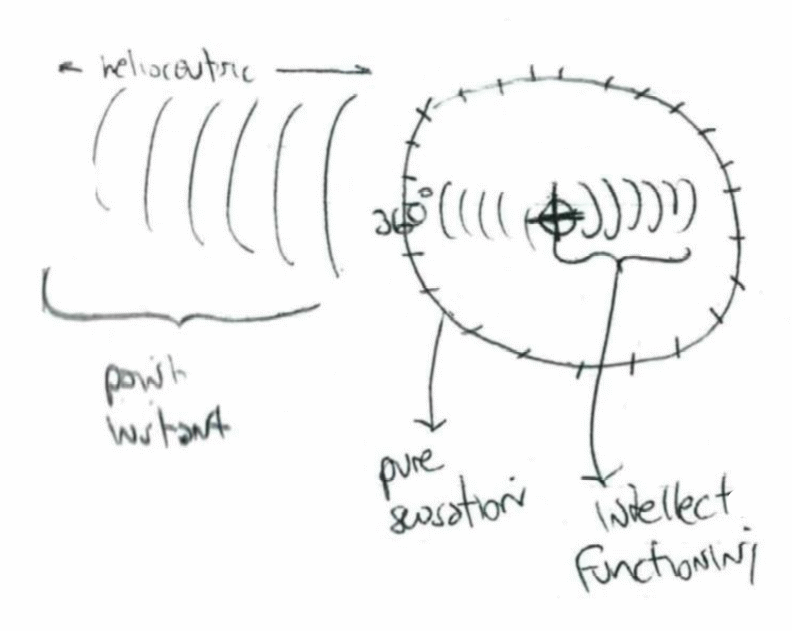
Point-instants correlated with aspects; pure sensation correlated with reception by Earth Intellect/bodhi mind; mental sensation correlated with selecting out of 360 degrees the proper regulative reason-principles that serve as first ground for construction of perception
Soul of Earth operates instinctually; A.E., Candle of Vision
AD and students continue to discuss/clarify correlation of Sautrantika scheme with cosmological scheme
Stop conceptualization, expectancy, memories etc. and primal image is right there
BOOKS / ARTICLES READ FROM OR REFERENCED:
Wilmon H. Sheldon, "What is Intellect?", Part One, in Philosophy East and West, Vol. 2, No. 1 (April 1952)
F. Th. Stcherbatsky, Buddhist Logic, Volume 1
Chhote Lal Tripathi, The Problem of Knowledge in Yogacara Buddhism
Paul Brunton, The Hidden Teaching Beyond Yoga
Dignaga, Masaki Hattori, Dignaga, on Perception: Being the Pratyaksapariccheda of Dignaga's Pramanasamuccaya from the Sanskrit Fragments and the Tibetan Versions
D.T. Suzuki, The Gandavyuha Sutra
D.T. Suzuki, Essays in Zen Buddhism (Third Series)
Herbert V. Guenther, Tibetan Buddhism in Western Perspective, "The Concept of Mind in Buddhist Tantrism"
Jeffrey Hopkins, Meditation on Emptiness
George William Russell (A.E.), The Candle of Vision
DIAGRAMS appended to this transcript:
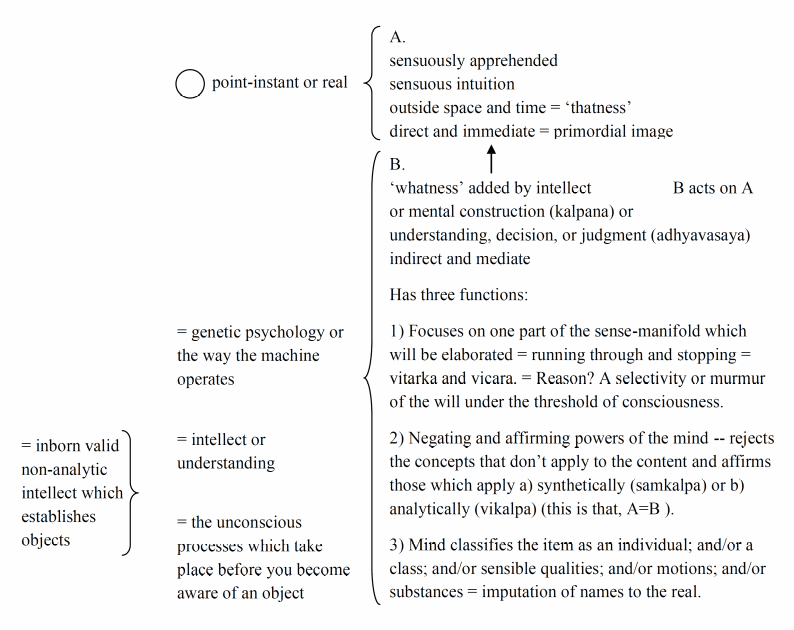
FIGURE 1983 1028-1-AB. Sautrantika Scheme.
FIGURE 1983 1028-2-AB. Sautrantika Scheme Mapped onto Cosmological Scheme.
[Transcriber note: [diagram] means the speaker is referencing a diagram as he or she is speaking. If someone is drawing or writing, with audible sounds of chalk on a blackboard, I indicate this by [drawing] or [writing].]
NOTES:
Epistemology discussion related to those of WG Classes 1983 11/11, 11/18, 11/25a, 12/1, 12/09a, and 12/19a. See also earlier Mentalism series, WG Classes 1983 1/26, 2/2, 2/9, 2/11, 2/16, 2/25, 3/2, 3/9a (and associated paper 3/9b), 3/16, 3/21, 3/23, 3/30, 4/6b, 4/13a.
Scan File 1983 1028 and 29 and 30 COL 09p.PDF, the partial transcript for this class, does not follow the order of the class and has multiple dates within it, which is wrong. The correct date for this class is 10/28/83.
TRANSCRIBED Verbatim by IT 2019; reformatted by JF 2019-20. This is V12a (2023) and has: updated prefatory matter, footer, and audio file name; Book List and TOC completed; Subject and Subsubjects changed; new notes within transcript and some notes corrected; two diagrams appended and references within transcript to these diagrams. Archival verbatim transcript – V12a.
AUDIO FILES: 1983 1028a, 1983 1028b. [Note: "Tape" and "Side" refer to original audio cassette tapes that were later digitized into .MP3 Audio Files.]
1983 10/28 at Wisdom's Goldenrod
Epistemology; Buddhism
[Audio File 1983 1028a Begins]
AD: --will be from every school that we're acquainted with. So it may mean that we'll be going around in circles for a while.
AS: May be here late.
AD: And--
AS: You may be here a long time. (AS laughs a bit)
S (faint): No, let us be.
AD: Well we might as well face this because the only way-- the only way I know how to work is synthesis, you people are good at atena-- analysis but synthesis has got to give us the answer. But still we have to go through analytical part. And that means that we're going to review quite a few number of schools we went through.
S (simultaneously, faint): Uh-hm.
VM: Great.
RG: Weren't we all in this(--/?)
S: (Right.)
AD: As we saw when we were reading the article, one word like 'intellect' and four different schools don't agree as to what it mean. [Note: Reference is to Wilmon H. Sheldon, "What is Intellect?", Part One, in Philosophy East and West, Vol. 2, No. 1 (April 1952). This article was read in WG Class 1983 1021. Please see that class for further discussion of this point.] [short pause] So we may have to get into semantic analysis as well as philosophical analysis. Well then, let's-- let's try.
[short pause]
PC (faint): Ok.
AS: Ok well--
AD: Oh, one other thing Vic.
VM (very faint): Sure.
AD: I got an idea of what Plotinus is talking about-- (laughter)
S (amidst laughter): We're talking about (Plotinus).
VM (faint): (Some of us.)
AD (simultaneously): --in regard to-- [short pause] in regard to knowledge. The conception is too big, I can't work with it. But, this preliminary work might help me get the views I need. [short pause] Let's try, Avery.
AS: Ok, well, we're going to go through any-- a number, as many as we can fit in or as many as are reasonable or until we run out, of various of these views of epistemology and-- and intellect, and the first one-- I-- and-- is the one I worked on the most so that'll be the first one, and it'll be the clearest, is based-- the first one is based on the Sautrantika. [S, faint: (Yeah right.)] And you remember Stcherbatsky and the Sautrantika. And I-- I think it's a little bit more complete than the way we did it last time. I read a couple of more pages on it. (bit of laughter) Found-- found ones in this 500 or a 1000 pages that I hadn't read before. In fact there's a whole section called "Judgment", which is actually a very good description of the intellect I think you'll find. And so I'm going to try and summarize that so maybe you'll let me run through it a little bit and then go back and ask questions on that one and then if we get that one cleared away we'll do another one and so on. So just for a background so that we recall some of their basic suppositions, I'll read this short little thing. We recall, or we don't but, the Sautrantikas sharply distinguish between two sources of cognition, sense and intellect, based-- and this is based on their view of there being two realities, the point-instant and the imaginal construction. And Stcherbatsky says--
[Transcriber note: I am using Buddhist Logic, Volume 1, by F. Th. Stcherbatsky, Dover Publications, Inc., New York, 1962.]
F. Th. Stcherbatsky [Buddhist Logic, Volume 1, pp. 65, 73, AS reading]: "The senses apprehend [AS adds: the point-instant], the intellect constructs. Thus the first moment is always a moment of sensation, it has the capacity of kindling [AS reads: The first moment of perception is sensation and this kindles] the action of intellect which produces a synthesis of moments according to its own laws. … [AS: Ok, and so--] In every cognition there is a sensible core and an image constructed by the intellect… The thing itself is cognized by the senses, [AS reads: The thing itself, the real, is a concrete particular] its relations and characteristics are constructed by [AS adds: the] imagination which is a function of the intellect."
AS: And this fellow Tripathi summarizes this little thing by saying--
[Transcriber note: I am using The Problem of Knowledge in Yogacara Buddhism by Chhote Lal Tripathi, Varanasi: Bharat-Bharati, 1972.]
Chhote Lal Tripathi [The Problem of Knowledge in Yogacara Buddhism, p. 20, AS reading]: "[AS adds: The] Sautrantika holds that every object has double aspects [AS reads: a double aspect] of sensuously apprehended and mentally constructed. In sense-perception we see the vision of an extreme-particular object which is a point-instant [AS adds: and is] beyond the sphere of place, time and nature. … But in imagination where our apprehension is distinct, we come to a perceptual judgment that 'this is that' [AS reads: 'this is such and such'] and on the basis of this judgment we take the [AS reads: an] initiative to do some purposeful action."
[Note: See FIGURE 1983 1028-1-AB, Sautrantika Scheme, appended to this transcript for the following.]
AS: So he has some key words here which I can outline on the board. He says, on the one hand, we have the sensuously apprehended or a sensuous intuition. [writing/drawing] And this in some sense is indeterminate. It's outside of space and time, and basically it can just be characterized as "that". And Stcherbatsky also says it's the function of this sensuous intuition to signal the presence of an object in the ken. Ok, and here this thing is this real or point-instant [diagram]. And for now let's not discuss for the minute what this point-instant might be but first hint that there's something there, that there's some point-instant is delivered to us by the sensuous intuition or sensuously apprehended. And some other synonyms for this are that it's direct, that it's immediate, that it is not determined in any particular way, that it's just a "that". Ok?
Now on the basis of this, on the basis of this sense intuition, the intellect constructs some bit-- some determinate knowledge. And there are many synonyms for the intellect and some of them are judgment, productive imagination, understanding, conceptual knowledge, and so on. The word for productive imagination is a word you probably have heard in Sanskrit, kalpana, [VM, faint: Uh-hm.] which is interesting, and the word for judgment is adhyavasayah. [S, faint: (That's interesting.)] And another word for judgment or intellect or any of these things is a decision. So, on the other hand, [drawing] as distinct from this, but not completely separate from it, this thatness to which will be added by the intellect a whatness. I mean that's about the simplest way I guess we could put it. This whatness will be added by the intellect. So we have these keywords, intellect-- in other words, a mental construction, [short pause while writing] or an understanding, [short pause while writing] and this involves some decision being made. And therefore because it's a decision that's going to be made of some kind to pick out what image to represent this thatness by, they give it a function of cona-- of will. It's all-- it's not just a cognitive function, it's also a will function. So it actually has to make some kind of a decision. And this on this side, this is the-- this is a judgment [diagram]. [drawing/writing] In any perception you need to have both of these, as he says. Without the core of the sensible intuition or the thatness there'd be nothing real in it and without the imagination adding, you won't be able to apprehend anything intelligible about it because it'll just be a "that".
Now, the thing I think we want to key in on is the activity of this side [diagram], not so much this, the direct sensuous, but on what exactly the functions of this intellect are. And, he actually goes into some detail in enumerating three, I guess we could call them sub-stages or subsets of the intellect or the imaginative construction and each of these has parts [drawing/writing] to them.
LR: You called this a reality for them Avery?
AS: Yeah, when-- which? Called which?
LR (simultaneously): I thought you said there were two realities, one is the--
AS (simultaneously): Yes, there are two rea-- [LR simultaneously: And--] two-- one is an absolute reality and the other one is a relative reality.
LR: And this is the relative reality.
AS: This is the [S simultaneously, faint: (Yeah.)] relative one.
LR (simultaneously): Right.
AS: And this can never directly apprehend the point-instant. The only one that's-- this [diagram] is direct and immediate, this [diagram] is indirect and mediated. And in some sense this arrow here is even a little bit misleading in the sense that [S simultaneously, faint: It's not (one word inaudible)] this is really working on this [diagram]. [VM assents, very faint] But, just to-- since we don't know what that is let's-- we'll leave both arrows, that there are these two means of cognition. Now, under this-- under this term then, what he calls judgment or productive imagination, this is the function of the intellect or the understanding or the productive imagination, and he describes in pretty-- pretty great detail or some detail how this kind of thing functions. And he says the first thing, the first thing that happens-- let's see if I can get back-- the first thing that happens is of course-- let me read this in Stcherbatsky.
F. Th. Stcherbatsky [Buddhist Logic, Volume 1, p. 209, AS reading]: "Its business [AS reads: The business of the understanding] is to construct the manifold of the empirical world out of that [AS reads: the] poor pure reality which is presented [AS adds: to] it by the medium of a merely receptive sensibility [AS reads: by the sense]. [AS adds: And] It begins to give [AS adds: a] form to this material."
AS: See? Now, he says that the first thing that happens to this sensible intuition, first thing that happens is that the mind actually runs through and selects from the sensuous intuitional manifold what it's going to focus on. In other words, this is-- this whole sensuous manifold is presented and the mind's first thing that it does is to actually try and run through and decide what of that sensuous manifold it's going to pick out. Let me see if I can get that little quote on the--
S (very faint): [couple/three words inaudible]
S (very faint): Ok.
AS: Yes, that's right, and it's-- the first thing it's going to do is seek to make it determinate.
F. Th. Stcherbatsky [Buddhist Logic, Volume 1, p. 400, AS reading]: "The origin of every judgment and of every conception, as [they are] understood in Buddhist logic, [lies], we have seen, in [AS reads: as we have seen, is] an act of running through a manifold of undetermined [AS reads: indeterminate] intuition and in fastening upon one point of that manifold, a [AS reads: the] point with regard to which the rest will be divided in two, usually unequal parts."
AS: So if we imagine this is something like the primordial image that's apprehended indeterminately. You're not going to represent to yourself the entirety of that say World-Idea that's given. You're going to pick out of that something that you're going to focus on. [student assents] It's almost like the attention is going to focus on something and that's the first beginning. Before you can even form a concept you have to pick out some part of that manifold you're going to form a concept about. [student assents, very faint] Now--
VM: It's not pure simple then. Otherwise there wouldn't be any-- anything to pick out.
AS: Right. No, no, oh this isn't pure simple, this may be loaded, I mean the real is-- I mean it may be too loaded, we-- I mean as you're saying this is an "x", we don't know what it is. The senses just signal the presence in the ken and then the intellect will get to work on that given intuition. And the first thing it has to do is do some running-- he calls it running through and stopping. But actually what it seems to be is to be picking out of this or selecting, a kind of selectivity. Now the words he uses for this, "running through and stopping", [writing] are in Sanskrit vitarka [MB assents, faint] and vichara. [short pause while writing] And you may recognize those words from other places. [VM assents, very faint] They're-- you know, in the nirvitarka, nirvichara, in other schools these are called reasoning about an objective thing and reasoning about a subjective. (AS laughs a bit) In other words this-- thi-- and I think as we'll see, the very first step of deciding what is going-- or selecting from that sensuous intuition is almost going to be the function of reason to figure out what it is that is going to be represented. Now this is still-- this is still unconscious as he says. Ok? So--
F. Th. Stcherbatsky [Buddhist Logic, Volume 1, p. 210, AS reading]: "There is always, previously to the formation of a concept, some running of the mind through the manifold of sensuous intuition. …
These [two] operations are already present in [AS adds: the] sub-consciousness. Under the threshold [of consciousness] they are [AS adds: like] a "murmur" of the will. Emerging [AS reads: When they emerge] above the threshold of consciousness they become understanding."
AS: Now after there's a selectivity-- now the selectivity is still working on the sensuous intuition that's given and selecting out what it's going to try and represent to itself, the second thing that happens, the second group of functions, are called the affirming-- [writing] the negating and the affirming powers of the mind.
LR: I think language.
AS: Now what these do is first of all, after it decides-- it fixates on some particular part of the sensuous manifold, first thing it does is negate everything in its conceptual bank or in its memory bank or the whole of the available concepts that is not going to apply to this particular "that". In other words, it eliminates everything else and it affirms everything that's like. So for example if it has a visual sensation it's dealing with it's going to immediately throw out all auditary-- auditory, gustatory, and so on concepts. And then it's going to begin to delimit and say well what kind of things-- what images are like this bare given thatness that I've focused on, that I give my attention to, and al-- in this affirming there are two aspects of that also. There's a synthetic and an analytic. [writing] Let me just put the words up and I'll try and explain a little bit of my understanding of what these are. This makes three.
So at this stage, after the mind has given its attention to some part of that sensuous intuition or the men-- the primal image if you will or whatever, then it begins to dichotomize, it separates off everything that's not going to apply to the given situation that's it in and it's going to start gathering together all the things that are similar to that point-instant, and then it's actually going to slap those-- that image that does apply onto the sensuous given "that" or "this" and say "This is blue." Now, the negating function is the one that separates everything that doesn't apply. The synthetic function is the one that gathers together all the things that are similar, all the concepts that are similar, and the analytic one is the-- is the one based on the law of identity that says "This is that." The analytic one is the one that's capable of actually synthesizing in the perception two dissimilar things. What are the dissimilar things? The given point-instant, the pure sensation, and whatever concepts the synthetic mind has picked out to slap together. Now, I'll try and--
DH: But Avery--
AS: I try and make that a little clearer.
CDA (faint): Yes.
DH: I assume implicit in what you're saying is that the-- that this negating and affirming doesn't exhaust all. I mean that there will be things that are neither negated nor affirmed.
AS: Uh--
DH: Or is that--
AS: Now, the process of negation is based on the law of non-contradiction. For these guys it's either A or not-A, they believe in the law of the excluded middle. And everything in the universe of concepts [DH: Uh-hm.] is either black or white, it either gets thrown out or it gets included, there's nothing that's in-- (there's/that's) nothing that's in-between. Although I mean I suppose you could make a case if you really-- in some hazy judgments there may be borderline things, you know, like thing-- you may have fuzzy items in your experience. And that may be an aberration (bit of laughter) but they--
MB: Mostly makes sense. (some laughter)
AS (amidst laughter): Yeah, well--
S (simultaneously, faint): That's right. Uh-hm, yeah.
AS: Um--
JfL: In your example of how the, you know, negating would say pick out objects that are not applicable at all and the affirming would say it's colors and then in the third stage the synthetic would say--
S (faint): Uh-hm.
S (faint): Yeah.
AS (simultaneously): "This is blue."
JfL: Right.
LDS (faint): I thought the analytic said that.
JfL: No, the analytic just--
AS (simultaneously): The analytic, yeah, [JfL: Right] the analytic, [JfL simultaneously: Better.] or something like that.
DH: But the negating [JfL simultaneously: Which would give you--] would also say it's not yellow.
AS: Yes, it would say it's not yellow, it's not green, it's not purple, it would have to say it's not everything else.
JfL (simultaneously): Why wouldn't that say it's not color?
AS: It would-- it would say that too if it's-- if it is color. It's not not color. (bit of laughter)
JfL: Well then why has he been taking care of the (analytical)?
AS (simultaneously): Well, let's-- wait, [couple inaudible student words simultaneous with AS] let's hold off. Let me-- let me go through [S: The whole story, yeah.] a little bit of it, at least to the third one and [few inaudible RC words simultaneous with AS] then we'll go back. Ok, and let me just say a little bit about this from what I can get out of this. This is what he says. The Buddhists of course do not maintain that this principle of intellect is an absolute tabula rasa or just some illuminating consciousness. For them it contains these three principle laws. And the negating function of the mind, at this stage, is based on the law of contradiction. The synthetic function of the mind is based on the law of causality. And the analytic function of the mind is based on the law of identity. And-- Ok? And he says here--
F. Th. Stcherbatsky [Buddhist Logic, Volume 1, p. 260, AS reading]: "That [AS reads: This] is to say, [AS adds: that] experience, positive and negative, furnishes to our understanding all the materials for the construction of concepts. But by itself sensible experience is but a chaos of disordered intuition."
AS: Now I think he's talking about this-- the experience, the direct experience [diagram], it's a chaos of disordered intuition.
F. Th. Stcherbatsky [Buddhist Logic, Volume 1, p. 260, AS reading]: "The understanding, besides constructing the concepts, arranges them [AS reads: has to arrange them] so as to give them order and systematical unity [AS reads: a systematic unity]."
AS: The other thing he says about the synthetic unity is that it actually gives the space-- the empirical space-time characteristics to the perception. Synthesizes this, puts it in a time order, an empirical space order for you. This is the constructing activity that the mind is actually going through to act-- prior to the finished percept that you're going to experience.
VM: Can you say how it's based on causality, the synthetic?
AS: Yeah, um, [VM: Maybe the way--] the law of causality. Yeah, I did understand that at-- at one time. It's-- it's something about-- I'll try and get the exact passages here. Let me see. I think it's because it has to-- What this synthetic one does is it actually-- it's not non-- it doesn't relate the point-instant with a concept but it has to relate only similar concepts. And in order to do that it has to say that A implies B implies-- It only relates those things which are logically connected to each other in the relation of causality, that have some causal interrelation. And it doesn't relate things that don't have a causal relation. I'll try and get passages Vic but [few words inaudible]
S (simultaneously): Maybe there's that [one/two words inaudible]
AS: Ok? Now the third thing, the third-- after that goes on, now what's the final thing it has to do, after that then finally the mind dumps this-- the thing it's defining so far into one of five categories. So it classifies-- [writing] it classifies the item in one of five different classes or five different categories. And these five categories are five different categories of name. Individuals or proper names is one and then-- I'll write them here if you (want). In fact let me-- in order to make this a little bit better let me put over here-- So we have negation [writing] and affirmation. And under affirmation we have synthetic and analytic. Oh by the way if you're Sanskrit oriented, these two words, synthe-- these are samkalpa and vikalpa. That's the words for these two functions of the mind which are well-known to be functions of the manas in other schools, the synthetic samkalpa and vikalpa. And after that is done, the intellect places this thing in one of five categories, either as-- it names it as either an individual-- and it may do all of these-- individual or a proper name into a class of items, into-- it names sensible qualities, motions, and substances. Now, for example, name, it names this thing as a cup, puts it into a class, it says oh this is a cup. I know, it's a drinking object. It's an item used for drink. It has certain shapes, it feels kind of hard, it's got red on it and so on, it has a certain function or usefulness and it's made of a certain substance. Now, the non-Buddhists immediately criticize Dignaga and say wait a minute, you don't believe in substances, motions, and so on. Well that's ok, these aren't-- he isn't saying that the thing actually is a su-- has a substance. He's saying this is what the mind imputes to that bare instant in order to get to know something about it. So in that sense these are really just naming. These are all under the realm of concepts, they're not a real-- he doesn't-- it's not a real substance that's apprehended, its substantiality is imputed to it. [S, faint: (Oh boy.)] Now after this is all done--
MB: Avery, you said it classified the object into one of five categories?
AS: Yeah.
MB: Does-- [AS simultaneously: It names it.] I thought it--
S (simultaneously with MB and AS): Or more.
AB (faint): Or more.
MB: What?
AS: It names it.
MB (simultaneously): Or more.
AS: Oh, I meant [MB simultaneously: Oh.] that it may-- it may apply all of these different kinds of classes and name its name, its-- what its class is, just as the example I gave. I mean, several of these can-- it can apply several at once. It's a cup, its use is for drinking and so on and so forth. Now, the result of this whole activity of the intellect is what he calls a perceptual judgment, ok, and this is the actual percept, the result of all this functioning. And, um, I think just before we go back and then take-- and say something about this, one other thing to mention. There's one other step we could add or put into this and that is all of this is a perceptual judgment, there's no reason given. (Well) in this process, when I say this is a cup, I don't normally have with it the reason why it's a cup although at this stage of vitarka probably the mind did have some reason for assigning cup rather than something else, I mean-- or at this stage of negating and affirming it probably was working with a reason, although most of the time it's instinctual perhaps. And if the reason becomes conscious, if as part of this judgment there's a reason, like saying "Oh, this is fire because it's smoke," if the judgment includes with it its own reason, then it's called an inference, then it's called a conscious inference. Now most of the time if I just say "this is cup", the underlying assumptions of why it's a cup don't come up to the conscious foreground. I'm not aware of why my mind put the name cup on the thing. But if I am aware of a reason why, as he says anyway, then it's called an inference. Let me just read this little thing.
F. Th. Stcherbatsky [Buddhist Logic, Volume 1, p. 242, AS reading]: "Although there is no difference between the process of inferring and its result, nor is there [AS adds: really] any difference between the perceptual and the inferential judgments [AS reads: and an inference judgment], since both [AS adds: of these] consist in giving an objective reference to our concepts, [AS: or of combining a concept with a point-instant] nevertheless there is a difference in that [AS reads: the] sense that [the] inference contains [AS adds: with it or within it] the logical justification of such an act of reference. [When], e.g., we unite a given point-instant with the image of [a] fire, which is not perceived directly [AS reads: directly perceived], we are justified to do it [AS reads: and we are justified in doing that], because we perceive smoke. Smoke is the [AS reads: a] [certain] mark of the presence of fire and [AS adds: it] justifies the conclusion.
This justification, or the Reason, is [thus] the distinguishing, [AS adds: or] outstanding feature…"
AS: That distinguishes between inferential judgment and just the normal kind of perceptual judgment. Now I think one of the things we kind of thought about this is that actually this-- this process of, you know, of there being a reason is really even going on at the unconscious level. The mind is somehow, it [VM(?) simultaneously: Searching?] does have an intelligence even when it's searching. It knows kind of what it's looking for and so it's not completely devoid of this. But as far as, you know, the conscious reasoning goes, conscious judgments, that only comes up to the foreground some of the time, usually when we just a-- operate it [student assents] habitually, you know, immediately impute cups and so on or whatever we want, we usually trust that our mind is doing it correctly. I mean unless there's some reason not to, for example you see the brigand and the bush and then there's something pokes in there and say hey wait a second, the mind didn't impute correctly-- didn't place the thing in a category correctly or something like that, and then you have to go into the whole theory of errors and so on and I don't-- that's really not worth it.
AH: Avery?
AS: Yeah.
AH: Could I see if I understood the difference between inferential and perceptual judgment(s)?
AS: Yeah. Just so we could start [couple words inaudible]
AH (simultaneously): Is it-- is it in the case of perceptual judgment the point-instant and this activity is totally synchronously connected to it. In the case of inference, you infer fire from smoke, the point-instant and sensory data doesn't include fire.
AS: Right. Right, that's-- that's ano-- that's a distinction also they're going to make. (At/And) any inference-- In the normal perceptual judgment, you have the point-instant, the "this", and the concept are joined. [students assent, very faint] In an inference they say there are two concepts and a point-instant are joined. The two concepts being smoke and fire joined with just the perception of smoke. You don't have the perception of fire to go with the concept fire so-- [S simultaneously: You see--] but you link them because of some reason in-- 'cause you know that smoke and fire go together and therefore you're justified in putting on the concept "fire" as well, even though you don't see fire or it's not part of the sensual manifold, [AH: And in this--] sense manifold.
AH: In this text inference is equatable with reason?
AS: Well, se-- that's a-- that's-- that's some question of rea-- you know, where the reason comes in here, and maybe that's the one other thing we should point out. Somehow in between the sensible intuition and the operation of the intellect is reason. Reason is really deciding. Reason is-- They don't explicitly state it, but these words for example that they use at this stage even, vitarka and vichara, you know, atma-vichara. Vitarka is a word for logical-- is actually the word for logic, tarka. And chara, vichara, is actually the word for reason, you know, there's both views. So right at the very first instant, before any concepts can be decided or whatever, it seems like it's really reason which has to come into the sensuous sensible intuition manifold and decide what now is going to be investigated, what now is going to be elaborated for this guy's knowledge. [LR simultaneously: What do-- what do you mean by reason?] And then the concepts [S simultaneously, faint: (Oh no.)] are going to get through.
LR: Can you say what you mean by reason here please? You [RG simultaneously: Right.] said that before, I didn't--
AS: Um, by-- by r-- by reason, that which is going to select-- In this example, in this example, what we're talking is very--
LR (simultaneously): You're calling reason the process which selects what to pay attention to?
AS: That's one of the things.
LDS: See that's hard for me.
AS (simultaneously): Something has to bridge the gap.
S: I thought we were saying intellect selects.
AS: Ok well look. Let me-- let me then-- Let me do the following then. Well, I'm not going to say that but-- According to-- according to these guys, their school, there's only the two sides. There's only these two functions, and we're just sticking straight with Dignaga and not bringing in any of the other guys, that there's a sensible intuition and that there's this activity which is going to make judgments. Now, they don't-- they don't mention the word 'reason' per se, they have a notion "inference". But if you really look and see what inference means, this-- this is certainly some kind of intelligent opera-- Well, let's put it this way. Maybe it's not.
S: Ok.
S: It's more automatic than [couple words inaudible]
AS (simultaneously): Yeah, in some sense it's almost completely automatic. [student assents, very faint] And I think we were calling it earlier this afternoon as the genetics-- [drawing/writing] the genetic psychology. I mean this is the way the machine operates.
AH: Avery? In the other schools--
AS: And the whole thing is the operation of the machine.
AH: Inference is given the highest regard in the other schools. I think it's perfectly equatable with our notion of reason.
AS: Yeah. Yeah and I agree.
AH: They speak of it as the key to the door out of [student assents, faint] cyclic existence and all these--
AS (faint): Uh-hm, uh-hm.
AH: It's given a very high regard.
[student assents, very faint]
LDS: See it seems to me Avery that the-- before inference becomes operative, this more primitive situation or this more almost unconscious situation of the automatic operation of the intellect would be in service of the ego. It would be like this process of selecting would be a selection based on the interest, the self-interest of this entity, this ego, this animal organism. But inference would be the beginnings or the mark of something impersonal. You know what-- in the-- in the sense of the way we use reason.
AH: Louie?
LDS: It would--
AS: Not--
LDS: Rather than service--
AS (simultaneously): You see, like consciously you would say that the reasoning will only come about after the intellect is developed to a certain part-- point.
LDS: Yeah.
AS: But, do you think this all goes-- I mean in-- in one sense they're describing completely just this genetic psychology (insofar/and so forth).
LDS: Yeah.
AS: But on the other hand, I mean, there's certainly a great intelligence embedded in the whole functioning. I mean something is actually developing this entity to a certain point. What is it that's controlling the whole business? If we don't say it's arbitrary then we have to put reason on one side or the other. Now I don't see which-- [LDS simultaneously: I agree, it can't be arbitrary.] on which side are you going to put it.
LDS: It can't be arbitrary.
AS (simultaneously): (And if) you can't put it on the side of the sensuous intuition because that says nothing at all. If I understand what they're saying it's something like the function of reason, the mind itself is reasonable and it is guiding the intellection, it is guiding the intellect to develop in a certain way. This whole process of naming and classifying is certainly the intellect. Even the thing of affirming and synthesizing certain concepts with others and so on, even that I would say in a sense is-- is animal adaptation and so on. But the original impulse as it were that-- that decides what this is going to do and is like overriding the whole thing seems to me to be this very level that they are leaving out. And in fact in another place he says, well, you know, we're not really going to ta-- And they don't talk about vitarka, vichara, they talk about these two and three [diagram]. But they don't talk about one [diagram] hardly at all. And they say well this isn't the concern of logic, this isn't the concern of the Logicians. We're only interested in the way that the mind-- the intellect makes syllogisms and so on.
LDS (simultaneously): Uh-hm.
LR: What it [S simultaneously: Uh-hm.] does after it gets (the) [one word inaudible]
AS (simultaneously): Yeah, what it does afterwards. But they're not-- we're not really concerned with-- they call this psychology. We're interested in logic, not psychology. Now we wouldn't exactly call this psychology, it's-- [VM simultaneously: No, it's--] that their meaning of psychology is--
LDS (simultaneously): I'm not sure (about--/of that.) I'm not sure Avery.
AS: Well I'm-- well--
AH: I think one way of discussing [LR simultaneously, faint: I'm not sure.] inference in regards to what Louis said is if you go to perceptual knowledge it's like a closed system so to speak. And the inferential knowledge is a way of having another point of view. There's an aspect of freedom that inference enjoys that perceptual knowledge does not.
AS: Yeah, he [AH simultaneously: Choice.] kind of makes that-- It's two levels abstracted from the [AH simultaneously: Yeah (one/two words inaudible)] point-instant rather than one level abstracted.
AH: Right.
MB: Avery, I'd like to ask a question.
AS: Yeah well, sure, why don't we just, you know, discuss this a little and-- Maybe I should just mention one thing at this point. Sooner or later we're interested in synthesizing this picture [drawing/writing] with something else we've done. Maybe we should wait.
AD: Yeah let's wait, let's wait.
AS (simultaneously): Ok. Let's not do anything, I mean let's [drawing] just try and understand this-- the picture that they're presenting. And maybe the problem of reason is a little bit sticky. Let me see if I can find this-- Oh, here it is. Yeah. Let me read-- let me just read this little line and maybe this'll give some credence or not to what I'm saying and maybe I'm off the wall too. He says, ever-- all of this business is classified under name-- naming or classifying.
MB: All of which?
AS: All of the bo-- at least the bottom two [diagram] are concerned with classifying and naming something and organizing concepts. But he says the following. He says--
F. Th. Stcherbatsky [Buddhist Logic, Volume 1, pp. 214-215, AS reading]: "[However] not every kind of [the] conceiving activity of the mind is taken into account when the two sources of knowledge are characterized as [the] non-conceptive and [the] conceptive. Some of the fundamental varieties of this [AS reads: the] differentiating and uniting activity [AS adds: of the mind] are left alone [AS adds: and not covered by these two]. The original differentiation of [AS adds: the] sensation [into subject and object], [AS adds: or] the initial stage of the synopsis in the chaos of [AS adds: the] manifold impressions, [AS adds: that is] the operation of running through [AS reads footnote: vitarka] these impressions and stopping at some of them [AS reads footnote: vicara] as long as they are not yet stabilized enough in order to be [definitely] fixed by [receiving] a name--have no importance in a system of logic."
S (faint): (Uh-hm), yeah.
LR: But Avery--
VM (faint): I think so.
F. Th. Stcherbatsky [Buddhist Logic, Volume 1, p. 215, AS reading (simultaneously with VM above)]: "That conceiving activity which comes directly into play when a perceptual judgment is formed can be clearly [AS reads: can clearly be] distinguished by its mark; this mark consists in the capacity of being expressed in speech. Conceptions [AS adds: in other words] are utterable, just as sensations are unutterable."
AS: And I take it to mean here that this activity [AS indicates on diagram] is not utterable. [S: Which?] But it isn't-- the vitarka-vichara activity, running through and stopping, is not utterable but it's still not a sensuous [VM(?), very faint: Ok.] intuition. But I may be wrong.
LR (simultaneously): Wouldn't it be like the vasanas that pick out what you're go-- I mean, because of your habits, you know, you pay attention to certain things and you don't pay attention to others and that's not-- it's not conscious. You're not consciously choosing. If you have to-- you'd actually have to teach yourself to begin to pay attention to new aspects of the experience that you didn't usually notice. It seems like it's the operation of the vasanas which grab on or in the Hidden Teaching PB gives it other words, associations or, you know, you know, past experiences.
S (faint): And desires.
LR: But, it wouldn't be reason in [one/two words inaudible] It's a preconscious kind of thing I think.
LDS: And you're saying that's what--
LR (simultaneously): The habits that rule you is usually what force you to pay attention to that sound and not another or that sight, not another. And you're saying that's what they're calling reason?
AS: Well, I don't know if they're-- they're not-- they don't call this reason, ok, [LR simultaneously: Oh.] [few inaudible student words simultaneous with AS] I don't-- they don't really call it anything, I mean he doesn't speak about it [LR simultaneously: Well--] very much at all. The two facts about it that I can understand are that the running through and stopping deals with the sensuous intu-- you have a sensible intuition. The first thing that grabs a hold of it, the first part of the intellect that grabs a hold of it is this running through and stopping activity. Now that running through and stopping activity is not concerned directly with concepts, it's really concerned with the sensible intuition, [LDS: Yeah, it's preconscious.] with picking out of that, [LR: Yeah, so--] it's preconceptual. The con-- the concept(s) need-- need that to pick something out. In other-- in other schools, I mean in Dharmakirti's elaboration, he would call this one I think the next-- and he says at the end of a sensuous or sensible intuition there's one moment of mental sensation. [LDS assents] And maybe in his school he would call it mental sensation, I don't know, it doesn't really matter what he calls it. [LDS assents] But something is kind of deciding there.
LR: So, five people walk out the door and one thi-- one notices a sunset going on, another notices there's a lot of traffic in the road or etc. Right? I mean it's-- [S: Right.] like the attention--
AS (simultaneously): It might be something like that, yeah it's [LR simultaneously: What's given--] definitely aligned to the attention.
LR: What the attention is fixed on [S, faint: Uh-hm.] is not something that you're aware of choosing [AS simultaneously: Uh-huh, right, 'cause you're not.] all the time, in fact it seems like you have to teach yourself to pay attention [AS simultaneously: Right.] to what you decide you want to, [AS: Right.] or should.
AS: And once the-- once these-- [drawing/writing] once step one, once the very first functioning of the intellect has decided "this is what I'm going to fasten on in that manifold," these are almost automatic. Because whatever it focuses on [students assent] provokes these [student assents] almost automatically [LDS: Right.] to negate certain things, affirm others, put the whole business in a category, [LR simultaneously: (Or it has to read--)] name it, present it, and that's it. But once they-- once this gives it the initial premise almost-- It's almost-- I mean it's almost exactly like saying that this gives it the initial premise from which the rest of the business has to go and do-- do its thing. It doesn't have any choice 'cause all it can do is given that initial premise that this is what you're going to focus on it does it. Now, I-- I'm-- honestly I don't know, it's-- I don't know if this is-- I'm not convinced that this is what we mean by reason versus intellect or whether this first one-- the whole business is intellect. The whole business is what they call intellect or understanding.
LR: Yeah, I don't see [S simultaneously, faint: Uh-hm.] any reason there.
S (faint): Yeah.
AS: And, um, I-- I think though that what they're including in intellect I think they're including reason within their intellect.
MB: Avery--
LR (simultaneously, faint): Ok.
S: Yeah, we know.
AS (simultaneously): And I think it's at that stage that's reason.
VM (simultaneously): You know what-- it's how you use the word 'reason' Avery, maybe that would help me if you could just say a little bit. 'Cause we use the word in so many ways I--
AS: Ok. Well, we're-- the question is, is there in this whole process of their intellect operating anything that is other than purely biological adaptation, response and so on, period. [VM assents, faint] Is there anything in there that we can find that is at all conformable to what-- for example what PB says about reason. Now, I can see some similarities for example when he says that reason takes in the whole picture. Yeah, it's almost like that-- what of any of these faculties, if any-- if any, and it may be none, is capable of the first apprehension of that entire sensible intuition or the entire sensible manifold.
S: Yeah.
LR (simultaneously): Avery, wouldn't reason be what would have to be brought to bear on all of that in order to begin to bring some kind of self-consciousness into that machinery so to speak? In other words, you do walk out the door and before you even have self-- self-awareness let's say, your mind has pictures slapped on it. [AS assents, faint] And it seems like reasoning would be what has to be brought to bear so that before that automa-- that automatic machinery works, you actually are self-conscious, you actually are choosing [AS drawing/writing] what you're going to pay attention to and what you're not. But I don't see reason as being implicit there, I-- I see it more as what has to be brought to bear there.
VM: Ok, when you say that Linda, from which of these three levels would you say reason [three/few words inaudible]
LR (simultaneously): No I'm saying, [VM simultaneously: It doesn't seem to be anywhere (couple/three words inaudible)] I would have to bring it in--
AD (simultaneously with LR and VM): Alright, look, let's leave reason out, let's [VM simultaneously: Ok.] go through that process again.
LR/S(?) (simultaneously): Good.
S (simultaneously, faint): (Ok.)
AS: Ok, I'm sorry.
VM (simultaneously): Yeah, good.
AS: That's (wonderful).
LR (simultaneously): And I don't see it there, I see--
LDS (simultaneously, faint): Linda, so maybe [S simultaneously: You know where he's--] he's talking about intellect.
AS (simultaneously): Ok. It's really not-- it's really not rev-- relevant. We'll leave out the inference business too.
AD (simultaneously): Yeah. Leave out the inference business.
AS: Ok.
AH: I'd just like to make the point that in this whole mechanical process which is described in this very mechanical way, there's only one thing that's been mentioned that has any kind of freedom whatsoever, that's the notion of inference.
AS: Ok, that may be.
S: [couple words inaudible]
LDS/S(?) (faint): That's right.
AS: And you're probably right but--
AH: I don't demean what the meaning of inference is in regards to this description.
AS: Right.
AH: Just think what it can do.
AS: No, but it--
AH (simultaneously): It can actually infer [AS simultaneously: You're right.] things that aren't perceptually determined.
AS: Ok but, we're not trying to say that this is-- we're-- there's no claims that this is an entire view of everything. The claim is that this is describing very well-- in fact I think one of the best descriptions I've seen of a certain function that we've been trying to get at, which is namely the intellect or the-- the biological or genetic psychology.
PD: But that would go along with what you said about them emphasizing logic and not the psychology. [AS assents] They're interested in developing the forms of dialectical logic and thought, [AS simultaneously: Which are genetic concepts.] which (is/in) the development of reason they're-- they're reasoning without saying "this is reason".
AS: Yeah, or they're manipulating concepts, classifying and understanding how to relate-- These categories, negating, affirmating-- negating, synthesizing and analyzing are called rela--
(Side 1 of original cassette tape digitized as 1983 1028a Ends; Side 2 Begins)
AS: --pure sensation. The first thing signalizes the presence of this point-instant [DB simultaneously: In the ken.] in the ken.
DB: Right, in the ken.
AS (simultaneously): That. The word 'that' refers to it.
DB: Right, I know. It's just that I-- but what-- what's the ken? What's that like?
AS (simultaneously): (Sensible).
LDS (simultaneously with DB and AS): It's an eternal. It's an eternal.
S: Ok.
AH: [one word inaudible]
AS: Sensible. The indeterminate perception. In your awareness.
DB: That's the-- now that's the objective part of that, (right).
AS (simultaneously): That's what hits you all of sudden, you say "Hey, here I am, bong," you know, and that's-- [DB simultaneously: Yeah.] he says that's the core of the perception, sensible core of the [DB simultaneously: Right. That's what I thought.] perception, and around that are-- [DB simultaneously: Ok, I--] Well, there's not much more you can say about signalizing it in the ken.
DB: I just, you know, [AS simultaneously: I think that would--] would throw that in there (and let it) go by, just wondered if they ever talk about at all what that is.
AS: Well, what do you think it is?
DB: Well, if it doesn't have a bridge to this other part, you know, if it doesn't have a bridge to this mediated situation, I don't-- I don't understand--
AS: It might just be the pure energizing of your mind.
DB: Right.
PD: That might be Stcherbatsky too making real segmented because if you read the-- there's a book up in the library called The Theory of Dignaga's Perception which is not by Stcherbatsky, that author doesn't make it sound as dichotomized as Stcherbatsky does. [Note: Dignaga, on Perception: Being the Pratyaksapariccheda of Dignaga's Pramanasamuccaya from the Sanskrit Fragments and the Tibetan Versions, translated and annotated by Masaaki Hattori, Harvard University Press, Cambridge, MA, 1968. This book is in the WG library.]
JfL: Avery?
AS: Yeah.
JfL (simultaneously): Just in a general sense we have-- they have this-- there's reason of reality, a presented world, and in the sensual intuition, is that presented to the body, the physical body, and that that the intellect works on it? So that to them that-- the "that" is the visual images and, you know, all the sense data? And that's what they're saying is direct and immediate?
PD: The body's a construction of-- [S: Oh.] [VM: Yeah, the body's a conception.] of the intellect. I mean what i-- what's the physical-- there's no such thing as a physical body. That's a-- that's a theoretical construction your consciousness is working with.
[students assent, very faint]
JfL: So essentially after-- what is essential for intuition? [few words inaudible]
AS (simultaneously): Well, you know when PB says-- I would say, well, when PB says it's not that the world is presented to the senses but is presented within the mind. That's that. [JfL simultaneously: Ok. Ok, so that's--] That's a-- that's a direct sensuous-- a direct intuition of the given [AD/S(?), faint: Yeah.] world.
JfL (simultaneously): So it's first presented to the mind.
AS: And then it's constructed. [JfL: And then it's--] That, just as "that", (just/this) pure "that". It's pure energy, if you will. It first ener-- first energizes the mind. And the first-- the first notion that there's anything there is the immediate response of the mind to that energization [JfL simultaneously: Ok so--] or is the first attempt of grasping that energization by the mind.
JfL: So then this whole process is almost an externalizing or presentation, it's not that it-- 'Cause it first sounded as though you were saying that it's a real world and it's presented.
AS (simultaneously): Why, I did say there was a real world. [JfL simultaneously: Presented?] That's right.
JfL: Ok, and that's not the sense world.
AS: That's not, that's right, there's a real world presented but the real world that's presented is not the one that's here. [JfL: It was presented--] It's this world of energy.
JfL: And that's presented to the mind.
AS: Yeah, (uh-hm).
JfL (simultaneously): When it's from the mind that it gets broken down into little pieces and finally classified in terms--
AS (simultaneously): And finally it's presented to you as a perception. It's more-- you know, almost like that dream analogy, there's some stimulus to the mind that makes it produce the dream and then you find yourself in it finally after all the mind's activity has presented this perception.
JfL (simultaneously): That's what I mean, it's the lower mind's activity that is taking away from the-- the original is what you're saying.
AS: Yeah. In a sense you remember, there was a-- I didn't bring the Guenther but Guenther had a really good line, David probably remembers it.
JfL (simultaneously): So it makes sense there's reason where-- reason would make sense somewhere in the middle because it's taking it from the mind and breaking it down into little-- little pieces rather than construct the thing.
AS (simultaneously): Yeah. Ok but, I mean--
AD: Let's go over it again, Avery.
AS: Want to do it over?
AD: Yeah.
AS: Ok.
AD: Read the-- read what quotes you think appropriate and let's start again.
AS: Ok. Shall I-- I don't know if I should ignore--
CDA (simultaneously): Can you say what pages you're reading as you do it?
AS (simultaneously): Yeah, ok. Just-- Ok, let me read this first basic little background thing. To-- they sharply distinguish-- for any given object they sharply distinguish two sources of cognition, sense and intellect. And on page 20 in this Tripathi book, he summarizes that very well by stating--
S (faint): What book?
AS: It's called Problems of Knowledge in Yogacara Buddhism. And he takes-- It's gone, oh well. I heard it. He says--
Chhote Lal Tripathi [The Problem of Knowledge in Yogacara Buddhism, p. 20, AS reading]: "Sautrantika holds that every object has double aspects of sensuously apprehended and mentally constructed. In sense-perception we see the vision of an extreme-particular object which is a point-instant beyond the sphere of place, time and nature."
AS: And I don't-- that is a reality but as such it's not known. It can't be apprehended in this form.
AH: It's out of space and time--
AS: Out of space and time, the original point-instant.
Chhote Lal Tripathi [The Problem of Knowledge in Yogacara Buddhism, p. 20, AS reading]: "But in imagination where our apprehension is distinct, we come to a perceptual judgment that 'this is that' and on the basis of this judgment we [AS adds: can] take [the] initiative to [AS reads: and] do [some] purposeful action."
AS: Or, the way Stcherbatsky puts it--
F. Th. Stcherbatsky [Buddhist Logic, Volume 1, p. 65, AS reading]: "The senses apprehend [AS adds: the point-instant], the intellect constructs. Thus the first moment is always a moment of sensation, it has the capacity of kindling [AS reads: The first moment of perception is sensation, now this kindles] the action of intellect which produces a synthesis of moments according to its [AS: the intellect's] own laws."
CDA: What is-- [couple/three faint inaudible student words simultaneous with CDA] what is that-- this--
AD (simultaneously): So, we-- we'll s-- we'll start off, you have the point-instants which the mind cognizes.
LR/S(?) (faint): Right.
AS: Right.
AD: And then, [AS drawing/writing] if I understand, now the next thing he s-- what it-- what it comes to, he's saying now the intellect judges that, the intellect being that whole lower thing [diagram], alright.
AS (simultaneously): Right, the whole-- this whole business--
AD: Yeah. The intellect is going to judge that, and judgment here means the making of a perception.
AS: Right. It synthesizes everything it has to to put together the concepts, images needed to make a definite perception out of or on the basis of an indefinite sense energization.
S (faint): Uh-hm.
S: Or point-instant.
RG (simultaneously): But in that sentence [AS/S(?) simultaneously: Well Dickie--] Avery he said the senses apprehend the--
AS (simultaneously): Yeah but, they do.
AD (simultaneously): That's the next thing you're going to go to but right now, just for a moment now--
AS (simultaneously): Oh, he-- yeah, he makes it-- he clarifies that a little bit Richard.
RG (simultaneously): Alright, later, go ahead.
AD: Clarifies?
AS: I think he clarifies what he means by apprehend.
AD: Well--
AS: But that's not--
AD: Look, don't hang-- let's not hang on the [AS simultaneously: Ok.] words, let's see if we can get [AS simultaneously: Yeah.] that general picture that [AS assents] we want. He's saying that there's a mind, alright. And one mind is preoccupied or let's say is cognizant of the real, the thing itself. Another part of the mind is concerned with making a perception of that thing. [AS: Right.] So in other words, one part of the mind cognizes the real, another part of the mind makes a perception of what it made a judgment about. So judgment and perception are the same thing to me.
AS (simultaneously): Are equal.
S (faint): Right.
AS: And [one/two words inaudible]
AD (simultaneously, intensely): To say that the mind makes a judgment or to say the mind makes a perception is the same thing.
RG: Uh-hm.
AD: Do you follow? Because when you judge something, [S simultaneously: Yeah.] alright, or when you perceive something, you're doing the same thing. One is abstract, the other is more concrete. [student assents, faint] So then what we're talking about is the way the intellect is going to produce the world-- the world that we know.
[short pause]
AS: Right. And they have their synonyms that may or may not help. The productive imagination, the intellect, the understanding, conception, judgment are all of these on their face--
AD (simultaneously): I think we left out the most important.
AS: Perception.
S: Uh-huh.
AD: I think you left out the most important.
AS: Which?
S (faint): We left it out.
LR: Say them again.
AS: I left it out so I don't know what it is. (AS laughing)
LR (simultaneously): Say them again so we can figure out--
AS: I-- imagina-- productive imagination or kalpana, understanding, intellect, judgment, conception, perception.
LDS: How about selectivity?
AD (simultaneously): Can you-- could you think of one that is really being left out? Instinct.
VM: Instinct?
AD: That whole bottom row [diagram] is instinct.
S (faint): Yeah.
CDA: The bottom row?
S (faint): Yeah.
AD: The bottom--
CDA: Thing, the whole thing, uh-hm.
VM (simultaneously): I forgot the imagination isn't-- is-- Ok, [LDS simultaneously: Motivated by vasanas.] determined by instinct.
[students assent]
MB: Avery--
S: Which part are you calling instinct, Avery? I just--
PD: You're saying the selectivity of the instincts is what organizes let's say the sensuous intuition one is given?
AD: It's the activity of [couple/three faint inaudible student words simultaneous with AD] the instincts that creates the so-called perception.
AS (faint): Yeah, uh-hm.
S (very faint): Yeah.
AS: No, he doesn't mention that so I didn't put it down.
AD: No, he didn't mention it. Because this is-- this has to sound very philosophic.
S (faint): Yeah.
S: (Good.)
S (simultaneously, faint): Thought he said both (though).
S: Uh-uh.
AS: Yeah.
MB: Well Avery?
AS: Yeah.
MB: That definition, they call it the productive imagination, is-- would-- isn't it what we have called before the reproductive imagination?
AS: No. [VM: No that is--] Not necessarily. This is actually producing your perceptions.
VM: Well it depends on which day you mean though Myra, one time I did turn them upside down.
AS (simultaneously): Yeah Myra, I-- we got to-- you got to-- it doesn't matter what we call it. Is it clear what it's doing?
PD: After the image has been synthesized and then you recall it in your memory, that would-- [AS simultaneously: That would--] in general, that's a reproductive imagination.
AS (simultaneously): Reproductive.
S (faint): Yeah.
LDS (faint): Reflective.
PD: But the first synthesis of the generic image is the productive imagination.
LDS: It's preconscious.
AS: It's producing it for you.
MB: But the image that it's producing is not a total image. It's not producing a wholeness, it's producing pieces, it seems to me. It's taking-- it's going from a wholeness and disseminating it into--
AS: Well--
PD: No but--
AS: Let me [LDS simultaneously: Isn't it a whole for you?] just say that for them [PD simultaneously: But a percept is higher Myra.] there's no prior imagination to this. There's no-- there is no prior imaging.
MB (simultaneously): For them there is no prior imagination, right.
AS (simultaneously): This is it, this is the image, this is the imagination.
MB (simultaneously): For them there's no prior imagination.
BS: It's two separate spheres.
AS (simultaneously): Oh I'm sorry, Paul?
PD: But you don't have a partial percept Myra, a percept is whole and present and given or there's no percept.
MB: What's a percept?
PD: That's the result of the functioning of the intellect.
AS: That's what you're experiencing all the time.
PD (simultaneously): That's the production of the-- result of the productive imagination.
[student assents, faint]
AH: It doesn't lack anything.
AS (simultaneously): But PB has a line on it, he says the image is-- now maybe I'm going overboard [S simultaneously: That's right (couple words inaudible)] but I think-- he would say the image is first and then you can have experience.
S (simultaneously): Experience, that's right.
AS: You can't have-- this guy, this ego or whatever is not going to have any experience until this imagination produces an image for it to experience. [MB simultaneously: Now is this a--] 'Cause it can't experience reality directly. It only can experience it through the forms in its own intellect.
MB (simultaneously): You think that this imagination is producing the image or is this imagination taking the image and producing the experience for the individual? Since you brought in that quote.
PD: I would [MB simultaneously: Maybe it's premature--] go with what Avery was saying, that this imagination is what has produced the image from which you, Myra, gain your experience, not [MB/S(?) simultaneously: Oh.] from which I or Vic gain his experience.
AS/S(?) (faint): [couple/three words inaudible]
MB (simultaneously): What does that have to do with it? (MB laughs a bit)
PD: The point is [MB simultaneously: Who's gaining experience. (MB laughs a bit)] produced by your own mind. And it's-- Then [S simultaneously: Paul--] you'll gain experience from the products of your own mind.
AS: I mean it-- in a-- if we follow what Anthony's been-- what Anthony just said--
MB (simultaneously): Because I haven't heard this-- anything that you've said doesn't sound like an image is being produced, it sounds like [AS simultaneously: Oh. That's what this is about.] sensible qualities are being elaborated, it doesn't sound [S simultaneously: Oh.] like any kind of image, [AS simultaneously: Ok, but--] any kind of total percept is going on.
AS (simultaneously): But I think An-- what Anthony's-- oh yes, sam-- synthesis, thi-- this one right here [diagram] synthesizes the whole percept, puts it in-- makes it a wholeness. But see, I think what Anthony said, this is-- there's two parts (of/to) the mind. This [diagram] apprehends their reality directly as it were. And this on top of that [diagram] makes a perceptual image out of it. Call it a percept-- call it perceptual image. [S simultaneously, faint: Of course.] These-- remember these are discrete-- these are-- the point-instants are discrete, momentary and so on. Now something has to fix them so that they're there long enough for you to see it as some whole. [DS: And it also--] And bear all the other things, I know.
DH (simultaneously): It also has to put them in-- has to construct space [AS simultaneously: Space and time.] and time and put them in it.
AS: I think it's very much-- you know, if you look at all the things PB says that the mind has to do unconsciously to those sensations before you can be presented with a finished percept. That's right Richard? I mean look, a lot of these things there, it has to associate all the different memories and so on, you know, it has to provide the particular space and time, puts it through the form of the senses and so on, I mean all of this activity is all down here [diagram]. This is like just the pure sensation when he says that flow of sensation is uninterrupted or something. [student assents] And it's continual. But it's not apprehended as such.
HS: And which part is the instinctual, everything--
AS: The bo-- every-- I think Anthony was saying that everything below--
HS: Below what?
AS: Everything in the intellect, ev-- any-- everything in the bottom box [diagram] is instinctual functioning, biological adaptation.
HS (faint): In what way?
MB (simultaneously): Biolodical-- biological adaptation is capable of producing s-- producing a space-time experience? It isn't just reacting to space-time experience?
AS: Seems to be pretty amazing what the biological adaptation can do for you.
RG: Yeah but rea--
AS: Really I mean if you look at the-- look at the--
JA (simultaneously): Avery, are you equating instinct, biological adaptation here?
AS: No, I was--
JA (simultaneously): Is that-- is that what you mean by it? What happened, I mean, to--
AS: The functioning of your psychosomatic organism.
VM: Well by instinct don't we mean compulsive, habitual kind of activity?
JA: I would say it's much [AS simultaneously: Well what is this?] much broader than that.
AS: Isn't this habitual activity?
VM: Completely.
JA: Yeah but I mean, you're giving it a connotation that's not going to allow for us to appreciate it as, you know-- As long as you give it that negative kind of narrow connotation [few words inaudible]
AS (simultaneously): Which one, the instinctual biological adaptation.
JA (simultaneously): That is compulsive-- that is compulsive and is biological adaptation.
AS: I didn't-- he said compulsive, I just said biological adaptation.
JA (simultaneously): Yeah, I know. And I'm saying that both of you are narrowing it [AS: Oh.] in such a way that [LR simultaneously: Isn't--] if you want to accommodate the kind of intelligence that we're going to have to put here, (in other words), in order to understand [S, faint: Of course.] how these classificatory activities and how these categories that are really quite, you know, I mean [one/two words inaudible]
LR (simultaneously): Isn't genetic psychology--
VM (simultaneously): I'd agree that--
AD (simultaneously with LR): Are [JA simultaneously: (That) (one word inaudible)] we trying to [AS simultaneously: Yeah.] understand the unconscious processes that are taking place before you become aware of an object?
S (faint): Yeah.
AS: Yes.
AD (simultaneously): Is that what we're trying to do?
S (simultaneously): Yes.
S: Uh-hm.
RG/S(?) (simultaneously): Yes, yes.
S (very faint): I don't know.
S (faint): Right.
AD (simultaneously): Then the unconscious processes, the processes that are going on below the threshold of your mind according to Dignaga would be organized in this fashion, that is, if you-- if you read them off, he says the mind has to run through, select certain aspects of the object, [AS: Yeah.] which is not an object, let's call it the thing-in-itself.
AS (simultaneously): Yes, yeah.
AD: The second thing it has to do, Avery I can't see the board--
AS: Well first it runs through and selects certain parts out of that thing-in-itself. Second thing it does is it separates all the concepts that don't apply and it affirms all those that do apply and-- and associates those concepts, images, and so on with the objects and makes a nice whole out of them. And finally it--
AD: And then finally the third thing, [AS simultaneously: And finally the third thing--] it has to give it a name, [AS: Uh-hm.] it has to classify it, impute a substance to it. What were the other two?
LDS: Sensible quality, motion.
AS (simultaneously): Give it certain qualities and certain activities, karmas. I understand the qualities, I'm not sure about the very last one.
S (faint): Substances?
JA: So Avery--
AS (simultaneously): No the one-- the one that-- activities.
S (faint, possibly part of background): [few words inaudible]
JA (simultaneously): Anthony, you think that this is-- I mean is adequately described by-- you know, you're sort of thinking of it as a vast machine-like activity? I mean, is that what you'd like to-- you know, is that the view [couple words inaudible]
AD (simultaneously): Well I first try to get the general idea of what [student assents] the man is trying to work out before I start (working/worrying) about little details like if the "t" was crossed or the "i" was dotted. I've got to first get the general idea, what is this man doing? He's saying that we have a mind. One part of the mind seems to be concerned with apprehending the real, the thing-in-itself, the unknown, alright. Another part of the mind is concerned with articulating that unknown, and it must do so with resources from within its own self. [student assents, faint] Among those resources would be included the mind's ability to penetrate into the object, get to know the object, select certain aspects of the object, alright, then declare that object (is/as) different from all other objects, this cow, alright, is different from all-- every-- everything else. So cow has for its opposite what?
S (very faint): [couple/three words inaudible]
LDS (simultaneously): Everything else.
AD: Non-cow.
AS: Right.
AD: That's its opposite.
LDS (simultaneously): Non-cow would [S simultaneously, faint: Yeah.] be--
AS (simultaneously): Non-cow.
S (simultaneously, faint): Oh yeah.
AD: Ok.
S (faint): Right.
AD: Go ahead Avery.
AS: There's ano-- maybe this other point he makes here helps too. In terms of the classifying which completes this judgment, he makes the point that it's not only through the medium of words. And he gives the-- this one guy could probably give the example of even a baby.
AD: But it's not necessary to go (there/that) because if you have to explain to this class what the implications of naming are, we might as well go home.
AS: [couple/three words inaudible] the objects and [one word inaudible]
AD (simultaneously): I mean, you know even a chicken knows one of my chicks is missing. It-- [AS simultaneously: Well--] it didn't say anything.
AS: Right, I ju-- I just thought it would be worthwhile, you know [three/few words inaudible]
AD (simultaneously): No, it's not a problem, let them think. (bit of laughter)
AS: Yeah, sorry.
S: Yeah.
AD: Naming, if you remember the fairytale about Rumpelstiltskin, [students assent] is magic.
AS (faint): Remember Rumpelstiltskin.
AD: Then it classifies it. [student assents, very faint] It gives it a substance, it imputes a certain substance to it. [short pause] Activity and qualities. [27 second pause] Let me-- let me ask for the sake of discussion, what do you think he means by pure sensation?
[short pause]
PD: Are you trying to provoke a debate or a war?
VM (simultaneously): That's [one word inaudible] (laughter)
AD: Well, I want--
[few seconds of faint background student talking]
PD: It seems to be a theoretical limit to perceptibility that he's working from, the a-- the bare minimum that the-- your understanding could conceive of pure perceptibility or intuition given to the mind. And you call it to the point-- pointless which is the most diminu-- diminished spatial representation, instant the most diminished temporal representation. [VM: Yeah.] But he's leaving it at the extreme limits of-- in space, in time. That's about all he can say of it at that point.
RG: But it's funny that the organ used to apprehend that or-- is what he calls the senses, which are not the most li-- upward-limiting factor in the or-- in the subjective side. I always found that utterly confusing.
PD: But they are if you consider them as being vehicles through which the world's given to you.
RG: But they're-- but they're already defined, they're already defined organs.
PD (simultaneously): Yes, I'll grant it.
RG: No, no, but I mean how did that-- I don't-- I never understood that.
RC (simultaneously): He can't mean (these) [one word inaudible] as the senses.
RG (simultaneously): Even the-- even the subtle senses.
RC (simultaneously): No I (meant) the fleshy orbs objectify your-- your body experience (with).
S (faint): Right.
RG: But I-- we s-- we said before that it was the intellect that did that, not the senses.
RC: Well take away touch. What would be your experience of your body? I mean, that seems to be fairly constant.
S (faint): (But--)
RG: It's still a very defined-- what I know about touch is what I think of it. I don't know anything about touch without-- without im-- imaging it.
VM: Oh Richard [S simultaneously: Right.] he's not saying that [PD simultaneously: Maybe this way Richard.] [couple words inaudible] touch is what gives it the sensation in question. It's got to be a principle of sensation, the mind's receptivity to-- to energization, it can't be a fleshy orb.
AD (simultaneously): Well that's-- that's what Kant would say, [student assents, faint] sure.
VM (simultaneously): Pardon?
AD: That's what Kant would say.
VM: No but I'm-- I mean it seems like it has to be this way because all these constructions we make like this is the sense of sight as opposed to touch, that's got to be later production of the productive imagination.
RG (simultaneously): But then he said-- he should say sense, that there's one sense, not senses.
PD (simultaneously): Well unless-- unless you say those senses are given to you by the world-image or-- in our terminology, [VM: Alright, they're--] then they're part of the given.
VM: Ok, that's alright.
RG: Right.
AH: If they were-- if they were presented as part of the given without that whole lower discriminating faculty, then you could speak of sensation as being pure.
PD: Say that again?
AH: It was the bare givenness of the world and the body in it without that faculty of discrimination and intellect functioning, then you would speak of sensation as being pure.
VM: But why can't you say it's the jnana-indreyas? To use different terminology, [RG(?) simultaneously: I'll tell you why.] maybe-- [AD simultaneously, faint: Richard--] you know, maybe that's not appropriate but what about that as a possibility?
HS: What do you mean by the jnana-indreyas, eyes, ears, nose?
VM: No, not the fleshy eyes.
RG (simultaneously): It's the power of seeing, the power of hearing.
VM (simultaneously): The power of seeing, the power of hearing, the power of touch and so on but prior to their embodiment in what we normally think of as the physical body which as Paul is quick to point out and I hi-- I agree 100% is a construction of the productive imagination, this thing you normally call the physical body.
HS: Who-- but who's calling, Paul's calling?
AD (simultaneously): Look, from your point of view, Vic, right, from a physicist's point of view, the world is nothing but energy.
VM: Ok, that certainly is-- that's--
AD (simultaneously): I-- I mean that's as far as they've gone and it'll disappear after that. They-- they won't follow it any further, right?
VM: I would say the world is possibilities.
LDS: Hm.
S: Yeah.
VM: I'm willing to-- I'm willing to go a little farther than energy because energy (referred) to an objective status.
AD (simultaneously): Well, basically, basically the scientific analysis of the world has reduced it to energy. L--
VM (simultaneously): Well, I could take that point of view but I'll-- ok.
AD: Now, the problem is, on the one hand we have the so-called energy. And on the other hand we have a perception.
VM: Yeah, connect them.
AD: How do you-- how do we connect them, yeah.
S: Watch out.
S: [one/two words inaudible]
AD (simultaneously): I mean, isn't this what the Sautrantikas are saying?
VM (simultaneously): They're trying to do that, yes.
HS: When you say on the one hand you have an energy, on the one hand you have a perception, you know--
AD: You have a world that you perceive.
HS: You have the world that you perceive.
AD: There's this anam-- anomaly which is obvious when you study the Hidden Teaching or any book that analyzes experience. If you follow through with what the scientists are saying, right, [S, faint: Yeah.] we can reduce the world to just points of energy. That's all that you can legitimately say is really there.
HS: Ok, now these--
AD: From another point of view you go on seeing the chair as a chair, you don't see it as energy, points of energy. What happened?
HS: Between the point of energy as point of energy and your perception of chair, [AD: Of a chair.] which we take to be a perception of a point of energy as a chair.
AD: No, no, no, I didn't-- [VM simultaneously: Mrs. Ybor would know.] I just [RG simultaneously: No you--] stopped right there. There's these points of energy, alright, and there's this perception of a chair. What happened?
RC: Well it seems to be the-- the realm that you're talking about here prior to-- prior to and independent of any need of something like the word 'chair'.
AD: I'm sorry Randy, I didn't hear you.
RC: It seems to be that's the process that Avery's trying to describe prior [AD simultaneously: Yeah.] to and independent of any need of the word 'chair', just the construction of an image that there's something you can go over and sit down on.
AD: Well, let's call it a chair.
RC: Ok. But that seems to be like [one/two words inaudible]
AD (simultaneously): It's legitimate, you can call it a chair, [student assents] right, that I'm sitting on, alright. I'm not sitting on points of light and it may be so, (laughter) I mean, [VM/S(?) simultaneously: Alright.] it may be so and if-- if he takes a chair out and starts analyzing you'll show me that it's nothing but energy. [students assent, faint] But, as [few inaudible AS words simultaneous with AD] we look-- as we perceive, we perceive a chair, we have to account for the arisal of this perception, this judgment that the mind has made, "this is a chair". And we've got to trace that whole process. Now, this is I think their attempt to do so.
RC: It seems that the operation of this language, that-- the operation of this intellect conceptualizes in terms of each of the senses, that in making its spatial forms there's one type of its conceptualization, in bringing in its colors it's another type of its conceptualization. However it orders the auditory pattern-- That there are concepts operating at this level that are actually constructing the extended image that later on becomes-- well, at the next step becomes the context for discussion but first of all all those concepts are involved in presenting the image.
[short pause]
AH: Randy, I think I understand what you're saying. Is it so that you need an ear in order to fabricate auditory concepts? Or you actually have to have a physical ear or an eye--
VM (faint): No we don't.
S: No.
VM: I don't think so.
AH: Well, you're going to formulate a concept that's a visual one.
VM: When I go to sleep at night I don't-- I don't think my physical ears or eyes are actually working but I have lots of sense-perception in a dream.
AD (simultaneously, faint in background): Yeah, listen.
AH: No, I didn't mean need in the immediate sense but it's based upon the fact that there was once--
VM: Well principle of--
AH: Conceptual-- [VM: For sure.] that the physical senses are prior.
VM: No, I wanted to say the power of [student assents] sense is what takes up the sensation or [student assents, faint] something like that.
HS: But when you want to cognize the chair you need a physical eye to see the chair.
S: (Uh-hm.)
VM (simultaneously): Generally.
S (faint): Uh-hm.
HS: Would you agree?
VM: Generally, yeah.
HS (simultaneously): Generally? (Well/No) actually. When you sit on a chair--
VM (simultaneously): (It could go) the other way, I mean I could imagine some situations where that wouldn't [AS simultaneously: That's ok.] be the case but those are-- those are abnormal situations.
AS/S(?): Why not.
HS (simultaneously): No, no, regular-- regular life. [VM: Yeah.] (bit of laughter) If I look at a chair, you need your eyes to take it into-- into your apparatus.
VM: Ok, if you want to work that way, yeah.
AS: Well, [S simultaneously: Well--] but then [one word inaudible]
BS: Then [HS simultaneously: That's what I just said.] you can't look at a chair if you need your eyes before you've used your eyes.
S (faint): Yeah.
HS: Call it whatever you want, you-- it was called a specific-- a specific formulated energy pattern, I mean, and then-- and now you see it.
S (faint): That's what he's saying.
S (faint): Uh-hm.
HS: Right?
AS: But Herbert, is that notion of eye you have part of the construction by the [S simultaneously, faint: Yeah.] intellect or is that belong on the side of the direct sensuous apprehension?
HS (simultaneously): From the in-- from the level of the sheer energy, the eyes are a kind of energy, the objects is a kind of energy.
PC/AS(?): Right.
HS: The energy of the object so to say has to get into the energy [VM simultaneously: No.] which you're calling the eye or of the seeing [one word inaudible]
VM (simultaneously): That's-- that's why I--
S (simultaneously): No.
VM: That's why I [AS simultaneously: There are (excuses), yeah.] was hesitating when Anthony was trying to [S simultaneously, faint: I like that.] reduce the world to points of energy because that conception can lead you to think that those points of energy are somehow sitting objectively [LDS simultaneously: Yeah, yeah.] out there in space and time and that that won't work. [S: Yeah but--] I don't care if it's (in this) epistemology or in physics. It just [couple words inaudible]
HS (simultaneously): What are you talking about?
LDS (simultaneously with VM): But Herbie's not suggesting that.
HS (simultaneously): Do it again. You want to look at a chair, you turn your head toward where the chair is [VM: No.] and you see the chair.
VM: That's after the fact.
AS (simultaneously): Oh [S simultaneously: That's after.] (no) [one word inaudible]
LDS (simultaneously with VM, AS, S): That's one level.
HS: After what fact? That is the fact!
AD: No, the point-- he--
HS: But you can't reduce it to mentalism.
AD (simultaneously): Never mind the chair then, you want to see yourself.
HS: Excuse me?
RG: You missed the point incidentally.
AD: Never mind the chair, you.
HS: Me. What about?
AD (intensely): Your body.
HS: Ok. What about it?
AS: You got to [couple words inaudible] yourself.
AD (simultaneously): See, I said chair so now you got to bring in the body and you got to, so to speak, evolve a whole system. Instead of-- instead of using the chair now, you, think of yourself. You're nothing but these points of light or points of energy outside space-time.
AH (faint): Ok.
AS: How do we make that available to yourself?
S (faint): Uh-hm.
HS/S(?) (very faint): How do I--
AS: How do you make your own body available to yourself?
AD: A good example is of course the one in physics, I don't see no difference between the physics we're talking about and epistemology. Not here.
HS: Not here, not-- in-- with the Sautrantika?
AD: Because exactly what the intellect has to handle is the problem that they're faced with in physics, this unknown that's being traced back to an electronic gun when it shoots it out, alright, this unknown packet of energy [student assents, faint] which comes out and then, so to speak, organizes itself-- Am I making any sense?
HS: To me?
AD: No, to myself.
HS: No you-- well--
AD: Do you follow the point I'm getting at?
VM: I think so.
HS: But the point is-- yeah but even in that example the cognition is through the eye organ. You're not looking at it through your mind. I mean--
S (faint): (Try to explain it.)
S (faint): Yeah.
S: (Alright?)
VM: I really feel differently about that but I don't know if it's the place [HS simultaneously: You're looking--] to get into all that.
HS: Well I think that's the [one word inaudible]
AD (simultaneously): What I'm saying is it's the intellect that has to take this invisible energy [VM: That's right.] and organize it so that it becomes a perceptible object for us. Whether the perceptible object is your body or a chair is really quite secondary. We're talking about a perceived world. How does that perceived world come into existence?
HS: But you wouldn't put the intellect's operation prior to the a-- the way they're describing the process, would you?
AS: It is the process.
AD (simultaneously): That's exactly what I'm doing, I'm [AS simultaneously: Yeah (one word inaudible) It is the process.] saying according to these people that whole intellectual operation, alright, is what's required in order for a perceived world to come into being.
AS: That-- the intellect is that process of bringing the world [student assents, faint] into perceptible being.
HS: But-- then what about the part-- the part where the sense energy relates the sense to the object, the x outside. [VM simultaneously: The sense--] Is that intellectual in this discussion?
AS: In this discussion no, that is the prior, that's-- that's what he said, that's the prior function of the mind. The first function of the mind is that direct sensual sensible intuition, the power of the mind to directly apprehend that energy or directly respond to it or directly relate to it.
HS: Was the energy--
AS: Just energy.
HS: Was the energy outside of the mind-- but it-- I'm just trying to figure out what you guys are saying. Was the energy outside of the mind before it entered the mind to be worked on by the intellect?
AS: Yeah, it's given-- in their system that point-instant of energy is given to that sensible intuition, to the power-- the mind's power of sensibly intuiting them.
HS: To the mind's power. So--
AS (simultaneously): The pure energy is given to the mind's power of sensibly intuiting it.
HS: And the sensible intuition is this pure energy yet or is this--
AS: No, the sensible intuition is the faculty of being receptive to that pure energy.
HS: It's the reception of the energy?
AS: Yeah, it's reception of it.
AD (simultaneously): It's rec-- it's receptive. It doesn't matter which way you say it, the mind senses it. It doesn't matter what you say, the point-- the point to be grasped is simply that this-- that there's these point-instances which in their togetherness or the mind apprehends a few of them in their togetherness and constructs a world for us, a perceived world. What wa-- what was it Om?
OG: You asked Herbie to move on from chair to his body. But could-- why couldn't we go one step further and any experience?
AD: I'm sorry.
OG: Like when Herbie was stuck up in the chair--
AD (simultaneously): Well that's-- yeah.
OG: --he moved on-- you said just move on to the body, look--
AD (simultaneously): Well I went-- yeah I went further than the body, I went to perception.
OG: Experience. Not perception, the very experience.
AD (simultaneously): No, no, no, no, no. No, I went to perception, not to experience.
OG: But the experience of the point--
AD (simultaneously): Because if I have any experience it's going to flow from the perceived world.
[short pause]
AS (faint): Alan, you got--
OG: Yeah, but experience--
AD (simultaneously): Perception is comprehensive. [OG: But--] I mean, before I can speak about anything there first has to be something to speak about.
OG: That's right. But experience is one step further than perception then.
AD: In the sense that the mind apprehends the real?
OG: Yeah.
AD: That's not my experience!
PD: Experience is after perception. What you call your world (of experience--)
AD (simultaneously): That's why I said these are unconscious mental processes we're not aware of. Now these people are saying, alright, there's unconscious mental processes that are involved in the fabrication of the perceived world, let's see what happens.
OG: He starts with the thing-in-itself. What is that thing-in-itself then? Is that material, is that the [one/two words inaudible] world?
AD (simultaneously): How-- no, [S simultaneously: Right.] the thing that I was talking to him about. That unknown, invisible energy which is neither in time nor space.
OG: Is that a total fabrication of mind and senses?
VM (simultaneously): No, no.
AS: Well--
OG: Or is that a real?
PD: I don't think we really should concern ourselves with the thing-in-itself now Om.
CDA: Yeah but what--
PD (simultaneously): This-- we're trying to understand--
AS: What the mind does with it.
PD: --what the mind does, how it constructs your experience, and the nature of this activity. Now the nature of the thing-in-itself is another question.
AH: I think that's right.
CDA (simultaneously): Yes, but the point has been brought up that this thing-in-itself is being equated with the energy of the way that physics has reduced the entire perceived world to this energy.
AS (simultaneously): Yeah but that's (after) [one word inaudible]
AD: That's why the Japanese Buddhists [CDA simultaneously: Well--] and the Hindu Buddhists like modern physics so much, because it goes exactly in agreement with their epis-- epistemology.
CDA: Ok. May I ask a question about this?
AD: But, yeah, that's why-- that's what we want, questions.
CDA: Well, this-- what we're calling the intellectual-- what we-- the point-instance is equated with intellectual intuition?
AS: Not exactly equated.
AD (simultaneously): No, not equated.
CDA (simultaneously with AS and AD): Well-- No, ok.
AD (simultaneously): Not equated, there's a part of the mind [couple inaudible AS words simultaneous with AD] which [S simultaneously, faint: Yeah.] relates, receives, grasps, penetrates into the Ideas or [AS simultaneously: Yeah let's say right now.] let's say this energy. Alright?
CDA: That's what I'm curious about, that you're equating the Ideas with this energy. Now--
AD (simultaneously): Well, forget-- leave out the Ideas. [one inaudible student word] [S simultaneously: Ok.] [intensely] There's this pure energy which is out of space and time that the mind is going to translate and make it into an image.
AS: In fact, the words are good 'cause energy and then the mind gets ener-gized. Energized means it gets affected by energy. [student assents, faint] And that's the first thing it does. It--
LR: So we want to know how from these points of energy you see a chair or anything else.
AD (simultaneously): Yeah, and according to the Sautrantikas this is what happens, alright. [S: Ok.] According to them, the mind, alright, has to penetrate, run through whatever that reality may be, [LR: Select--] select certain aspects of it, fix itself on those aspects. Then they say the next thing happens which is distinguish it and differentiate it from everything else, [couple inaudible student words simultaneous with AD] and this according to their law of causality, identity and non-con-- non-contradiction. And then it takes this here-- Now, we have to-- all the time we have to keep this in mind, alright, that they're trying to tell us how the mind works beyond our conscious understanding to produce the world of imagery that we see, which includes our body in it. Because our body also will be subject to that, alright. And then they say that it names the thing, classifies it, gives it certain qualities, a certain activity and etc., alright, and now we have a perceived world, a determinate perceived world.
LR (faint): I didn't get it.
AD: Hm?
LR: I-- I didn't get it. I got the question real good.
AD: You didn't get what?
AS/S(?): The answer.
LR: The answer. I got the question. You got these points of energy that are received from within the mind, given to the mind. Indeterminate points of energy. Indeterminate--
AS (faint): It's the sensation(s).
LR: Yeah. And now you're going to call something a chair. [students assent, faint] And I heard all those words, you know, run through them, select. I even wrote them all down.
AD: But how do you explain to yourself or how do you go on living without being able to understand on the one hand the analysis that has taken place of experience through scientific scrutiny which has been publicly certified a hundred thousand times and your perception of the chair, how do you explain it to yourself? Yeah, David.
DB: I can't but-- [students assent] (bit of laughter, student words) It seems to me that the-- that what we're doing here is dealing with a process of translation.
AD: Is what?
DB: A-- it's a process of translation.
AD: No, it's not a process of translating, you'd have the same trouble if you read Kant.
DB: No, no, no wait Anthony, [LR simultaneously: Oh he didn't mean translation--] I didn't-- I didn't mean it in a semantic sense, I-- I didn't--
AS (simultaneously): Oh he-- he didn't mean translating the Buddhists [one word inaudible] I think he meant--
DB (simultaneously): Yeah, that's not-- I mean you're dealing with an unknown factor, these energies, alright, this immaterial energy. And from that the individual mind has to translate that indeterminacy, some part of that, into something that it can relate to, something that it can say "Oh, well I know this is a chair." So that the process is starting from a-- a-- you know, an indeterminate general presentation and specifying it down into-- to the point where you say "Oh, I can identify this as a chair." And the problem is, at least for me, that once you've gotten past-- once you've gotten past the point where this negation starts taking place, everything is fine, I mean because you can sort of follow the logic [LR simultaneously: Yeah. But that first step is (what/really)--] behind their processes. The-- it's the first step of this running through and stopping at this level of indi-- at this indeterminacy where initially part of it is taken out and said ok, this is the part we're going to concentrate on and figure out. That's the part that-- that seems difficult, and I think the problem is that the-- the faculty of the mind that does that has to be very very specified and very structured because it's that level that's going to give the initial impetus that the rest of the intellect is going to function on.
PD: You know, Kant does a very very similar analysis here and he calls that-- that part of the mind which receives the-- the intuitions of the thing-in-itself your sensibility. [DB: Uh-huh.] And it works and is conditioned by the two fundamental forms of space and time. And then the sense functions fill in the continuum of that intuition, that-- So the sense functions become the matter of the percept. They contribute the matter to the percept.
DB: Ok.
S: (Yeah.)
PD (simultaneously): Whereas the forms of space and time [DB: Uh-hm.] becomes the actual "extension" of the mind.
DB: Well so-- but if he--
PD (simultaneously): The mind going out, if I can use the picture of going out and taking the form of something.
DB: Right.
PD: That's the sensibility aspect of the mind.
DB: Ok.
PD: The mind that shapes itself into a shapeless-- a-- by nature formless intuition that can't be shaped.
DB: So-- so that the specificity comes in--
PD: So it's not the specified part.
DB: Right, but I mean-- yes, but the-- this-- the notion of what level of space and time you're operating with is going to be what determines the nature of your perception, ultimately. I mean, you just--
PD (simultaneously): Yeah, I think like-- and when PB says that the world-thought vibrates as successive sense images. That's in reference to human cognition.
DB: Uh-huh.
PD: In relation to another center of consciousness that might not be necessary.
DB: Ok.
PD: But for human cognition it vibrates in terms of successive sense images was the term he use.
HS: Ok, now the vibration has entered into the-- into the mind of the perceiver and you call that the sense-- the sense intuition? And then what happens?
PD: Well I think Avery-- Avery's schematization there was going the process of the-- in the intellect.
HS: Do-- so that the intellect-- the intellect in this sense is like the raw data is taken up and the world is projected through the mind now of-- of the perceiver who's perc-- who's received the indeterminate sensation?
PD: You lost me, Herb.
HS: The object is received in the mind. It's indeterminate. The function of the intellection is to make it a determinate perception?
S (very faint): Right.
AD: Yes.
HS: (Give it/Given) all the forms it would experience, qualities, space, time, [student assents] etc. The whole process of the intellect though is a learned process as you say before?
AD: Is what?
HS: Learned over eons of time?
S (very faint): Mistake.
HS: Ontogen-- phylogenetic and--
AD (simultaneously): Well then that may be so, that may be so. But the point-- the point here is I think again it was reinforced when he quoted PB said that the world-image is successive. Now, if-- if we drop out the w-- the word 'image' and say that there's these successive pulsations [HS assents] of the World-Idea, the image is something we're going to create.
AS: Yeah. He also says the flow of sensation is uninterrupted.
[student assents, very faint]
RG: So-- so in this sense you'd say this level of sensation is like the level of the World-Idea prior to its actualization in a--
AD: Into [S simultaneously, faint: (Uh-hm.)] an image.
AS: Yeah.
RG: Into an image.
AS (faint): Uh-hm.
RC (faint): Yeah.
AD (simultaneously): Now, actually what we're discussing and I think it's already obvious, we're trying to understand what it means to say "I think the world into being." [intensely] When I say I see a chair, I've said I thought the chair into existence and we're trying to understand what the hell do I mean when I say I think the world into existence. Stop making the problem so abstract. And I'm saying that it's the instinct that does this, instinct in the general term.
RC: Could you use like waking up in the morning as a very dramatic example?
[short pause]
AD: I don't know, [VM/S(?) simultaneously: (Well that's true.)] you have to feed me.
TS (faint): Well the objects--
RC: Well it seems like unless, you know, you're woken up very suddenly, that there's a gradual awareness of--
[Audio File 1983 1028a Ends]
[Audio File 1983 1028b Begins]
RC: --secondly the-- the overlay of, you know, whatever the-- the verbally conceptive mind puts on top of it. But it does seem like you-- you actually are thinking the world into being for yourself when you're making that transition from sleep to waking. When you're asleep it wasn't and when you're fully awake then-- then there it is. [13¾ second pause] It seems like it would be almost especi-- like if you wake up hard, no coffee in the morning or whatever, it's like even more obvious then, there's this world that's being presented by this intellect independent of whether or not you choose to be aware of it or not.
[13½ second pause]
AD: Go on.
OG: Another example might be these dots on TV-- TV screen, another dramatic example. And they're explaining dots, then thought. The thinking process involved in making that picture, the picture out of those dots, to make another example.
AD: Uh-hm.
LR: But-- Randy, were-- were you in the middle of a sentence?
RC (very faint): No.
S: Uh-hm.
RG: No?
LR: Oh. When you said how did the mind think this world into existence. And you answered the question by instinct, by the instinct. That helps and it doesn't help, for me. It helps insofar as I immediately say to myself, oh, well this is something that has been learned from the beginning of time, you know, PB says the world is determined to be 400 million years old or something and that's how long it takes to make a man. So, you know, I think well, ok, the instincts think it into existence and this is a learned process and it started out not seeing a chair, it started out seeing some vague amorphous, you know-- And then through many hundreds of millions of years it learned. You know, so that's-- that's very good, so I'm very [one word inaudible] when you say oh it's the instincts that think it into existence. So that's on the one hand--
AD (simultaneously): But isn't that better than to use the word 'intellect' [LR: Yeah.] with which there's been so much confusion?
LR: Yeah, no, I like it but it leaves-- but if I really examine what I understand of that, I don't understand any more than I did before, it's just that I have a word I'm more comfortable with.
VM: No, no, I think the word is--
AD: [couple words inaudible]
LR (simultaneously): By saying, you know, it's a beginningless process, the instincts aren't something I've learned from this life, I haven't learned how to see the chair, you know, it's-- it's gone on--
VM: That's good. No, no, but it's like--
LR: So that's very comforting, you say "Oh yes," you know. But, I don't understand what the hell that means.
AB: Well aren't you describing the intellect? You get the new name and you--
LR (simultaneously): But, I mean, can-- what I'm asking is is it possible to understand what that means that the instincts think it, is it-- is it poss-- is it possible to insert steps in that to understand exactly what those instincts are enough to understand how you get from sheer indeterminacy to, so to speak, [VM simultaneously: And that's what he's trying to do.] fixed space-time--
LDS (simultaneously): Isn't that what this system (proposes)?
PD: But you could understand [VM simultaneously: No, it's--] it in your own experience if you're reflective.
LR (simultaneously): Well this is just this-- I mean I understand that there are these steps but I don't-- I don't grasp what's happening.
AD (simultaneously): Well, but if you-- the way you spoke about it, it seems that you un-- you understood that this was a slow process, [LR: Yeah, I understand that's slow.] alright, and that the mind which is-- which is what we're talking about, which is learning to respond to its, let's say, the World-Idea which is within it, but we could also say that the organism, alright, is learning to respond to its environment, and that throughout these millions of years these reactions have been built into that organization so that now the mind has habitual ways of responding to certain situation, and these habitual ways are what we're going to say ultimately we can trace those things back to. [LR: Yeah.] That there is the mind which is reacting to a given reality to the-- whatever is coming into it, alright, and it must do it a certain prescribed way in order for a perception of the world to arise within us.
S (very faint): Yeah.
LR: And I would say that--
AD: Now isn't that better than to say, like we usually did ten years ago, I would simply argue with Dickie by telling him you think hardness into existence. Now, isn't this a further refinement of that? And if we keep doing this, you know, like thought upon thought, and eventually thought evolves to the point where it explains itself if we think long enough and hard enough?
LR: So your answer is be patient.
AD: I mean I wouldn't tell you to be patient.
RG: Right, his answer is to think harder.
[students assent, faint]
AD: You got the point.
PD: There is no answer.
AH: I'm sure Linda's-- I'm sure Linda's feeling about the (experiment--)
AD (simultaneously): Impatience? (bit of laughter)
AH: I think-- I think why it's so difficult is because we're trying to talk about this process from the absolute dead-end tail-end of it. Like this is the end of the process and that's the perspective from which we're trying to speak about all of that which is upstream. We're talk-- trying to talk about the way that we got here. And I coincidentally read a little pamphlet the other day on Burmese meditation called "Mindfulness" where they actually do go upstream a little, you know, and-- and become mindful of those impulses [couple words inaudible] initially.
S (faint): There you go.
PD: But you know that's [S simultaneously: (couple words inaudible) so--] interesting way to approach it Andrew is you-- by reflecting on your own mind's operation, it-- you can get insights into what's being spoken of here, the instincts, how they'll immediately take a situation and construct it into a self-fulfilling prophecy. I mean that's the psychological reality of that hits you every day.
LR: Yep. You experience it all the time.
AD: And the advantage of stating it this way is you stop confusing it with reason.
LR: That's--
JA: Yeah.
LR: Yeah, that's real reason.
JA: I mean, if you call it instinct you begin to realize that thinking is kind of like breathing, it's very hard to stop, (JA laughs a bit) you know, [student assents, faint] it seems vital.
S (faint): Yeah.
LR: Vital.
S (faint): Uh-hm.
LDS (simultaneously): Vital, by name.
S: Yeah.
HS: So in this understanding it's instinctual to place objects in space and time to experience them?
AD: I'm sorry Herb.
HS: It's instinctual then to place objects in space and time to experience them.
AD: It seems to be an instinctual reaction on the part of the mind to organize the data that is coming in, alright, into a percept or a judgment. This judgment you're going to refer to as your thinking which by now it should be obvious, alright, in no way is necessarily rational! (bit of laughter)
HS: It's just instinctual (employment) this-- this apparatus that's doing it for--
AD: The apparatus ob-- is mental. All those things that they're talking about are mental.
RC: Yeah, it's interesting too in--
HS (simultaneously): But mental, but subjective though, right, that each one has one, each person has one.
AD (simultaneously): Well, if they're a mind naturally it's subjective.
RC: It's interesting too in a sense that like we sort of assume the correctness of the image that we've constructed. We say well regardless of any thoughts I have about it I know the pole's over there and I know it's brown and I know there's like a certain substrate of facts I can deal with. And it seems one of the things the Sages are trying to point out is that, no the image that you have is very imperfect of what's actually there. And you haven't learned how to really construct a good world-image yet. And in order to do that, you're going to have to teach your instincts a little bit better, [LR simultaneously: To think better.] you're going to have to bring in some higher thinking powers which in themselves are part of the sensing process and so on, that you really don't realize you live in heaven and you do. And it's because you can't construct a proper image of what's being given to the mind in this point-instant.
CDA: Well wouldn't heaven be beyond the image?
AD (simultaneously): Let's-- let's try then this here. [students assent] When we say that the mind is receiving the world-image or the successive world-images, let's ask ourselves: is the mind receiving the image of the world, [short pause] what we call the primal image, what we call the world-thought, or is the mind receiving just these point-instants? You remember the way-- Let's try this way. [RG: Yeah.] We say that the world is given to an individual mind, not to the senses but to an individual mind. Now, when they say that, when PB says it or anyone else, is it an image that is given to an individual mind or is it these point-instants of energy, spaceless timeless point, [S, faint: The whole (thing).] which is given to an individual mind?
S: (Should be both.)
RC (simultaneously): We've been saying basically that the world-image is presented to you from within, and it seems like to talk about it being presented from within we'd have to try to get behind the-- the time-space screen as much as you can to say that somehow there's a transmission taking place that doesn't require extension because it's so intimate, it's prior to your mind operating in extension.
LDS: But the question is, is that image, Randy, that-- that intimate presentation received, is that some kind of image?
VM: No, it can't be.
PD: But [AH, faint: It can't.] could-- could you see--
LDS (simultaneously): [couple/three words inaudible]
BS (simultaneously with PD and LDS): It would seem that the--
AD: When-- when PB says that the World-Idea is given to all individual minds simultaneously, alright, [RG assents] so that we'll all see a mountain there where it is, alright, what is being given to the individual mind? Is it the image of the world or is it this energetic process?
VM: Got to be energetic.
AB (simultaneously): Energetic.
LDS (simultaneously): It's got to be ener--
AD (simultaneously with AB and LDS): If it's an energetic process, then why say that the image of the world is being given to the individual mind?
RG: It depends what you mean by energetic process.
S: Yeah.
VM: Depends on what you (would mean) by image too.
RG (simultaneously): And what you mean by image. I mean, what does it mean these point-instants de-- devoid of content? I--
VM: When you-- when you say world-image I never think of something spatially laid out and presented.
AD: Well I'm thinking of it like that.
VM: You are?
AD: I'm very deliberately thinking of it like [VM simultaneously: But I think that's just s--] that because I want to make-- I want to-- I want to make for confusion.
VM: Ok. You can do that easy.
AD (simultaneously): In other words, in the image of the world, alright, the North Pole is included.
VM: But yes, but not in a (sensible/sensual)--
AD (intensely): Now if I go there I will see it. (bit of laughter)
RG: Yeah.
AD (intensely): Alright. Now what is given to the mind, is it these energetic point-instants or is it an image of the world the way we see it [S, faint: No.] [RG simultaneously: Not--] through [S simultaneously, faint: It's not the way we see it.] the duplicatory process.
RG (simultaneously): Not the way-- not the way we see it.
PC/S(?) (simultaneously): The way we see it you're already there.
S (simultaneously, faint): No.
S (very faint): Yeah.
RG: Not--
AH (simultaneously): It's the point-instants.
RG: Wait. The image isn't certainly the way we see it. But if the mind is receiving it why not-- why isn't-- can't it also be an image to that mind that's receiving it? Or if you're going to--
AD (simultaneously): (It does.) That's what I'm asking. Can it be an image? In other words my individual mind receives the World-Idea. Can that be an image which it receives?
HS: Yes.
PD: From its point of view, no.
S: No.
HS: It's-- it's fact.
RG (simultaneously): I-- it depends what you mean by image.
PD (simultaneously): From a greater mind's point of view I would say yes.
RG: If you mean by image the space-time world that we see, no.
S (very faint): Yeah.
RG: If you mean an-- another kind of image that contains a variety of possibilities of manifestation for that individual mind then you can call it an image.
VM: It's called a non-sensual image.
HS (simultaneously): If you mean by image a space-time world we see I would say yes.
AD (simultaneously, intensely): But then why do I have to perceive the green [AD hitting board with chalk] on the trees?
RG: Because it's present in the idea that's given to the individual mind [HS simultaneously: As an image of green on this tree.] that there is green, [S: Uh-uh.] that there is green coming through that-- through that image.
AD (simultaneously): Alright. Let's ask the question. Is the green which is on the leaf of the tree [S, faint: No.] a greenness given to it by the world-image or is it what I give to it?
LDS: No, you give it to it.
PD: You give it to it.
LDS (simultaneously): You give it to it because another organism would give it another color.
HS: Yeah but how about a human being?
S (simultaneously, faint): It's [one/two words inaudible]
RG: I disagree, it's both. [S simultaneously, faint: It's both. It's both.] It's got to be both. Your organs are structured in a certain way to reveal the green on the tree but if green wasn't also presented, you couldn't possibly see it as green. There has to be a corr-- a-- a relationship between the subjective--
AD (simultaneously): So then you're saying that my individual mind, alright, the senses of the mind, the subtle senses of the mind, receives the world-image.
RG: But not the way-- not the way we see it now. I mean not the externalized image.
AD (simultaneously): Well naturally once-- once the individual mind sees the world-image, alright, [HS, faint: Yeah.] and then has to reduplicate it through the organism, alright, we-- we follow that. The point-- the point I'm getting at here is, the mind which is receiving the real, does that have the green on the leaf?
S: No.
RG (simultaneously): Does it have the green on the leaf?
PC (simultaneously): Mind is the green on the leaf?
S (faint): So--
RG (simultaneously): But in that givenness is greenness.
PD: No, that's the clothing your mind has (made) into its cognition.
RG: Well if it wa--
LR (simultaneously): Yeah but those are instincts that have been learned so-- have been learned.
RG (simultaneously): But that's ridiculous, why don't some people-- why don't you see brownness or redness, the green--
PD (simultaneously): A color blind person would.
[student assents, very faint]
RG: No, but [S simultaneously, faint: Well, (S: Like--) that's not going to be there.] that's only the fitness of the organ, the fact that the chlorophyll is in the leaf that lets you see this green is not a fabrication of your mind. It's given in the objective structure of the world.
LDS: No, but isn't [S simultaneously, faint: Well, no.] it your reaction as an organism to that presentation?
RG: But that has [S simultaneously: No.] nothing to [LDS simultaneously: No, that--] do with the chlorophyll in the thing.
LDS: Well you-- chlorophyll is already a determination that you've made.
AB: Yeah but Dickie's saying that the--
RG (simultaneously): No, hold-- I didn't create [S simultaneously, faint: No.] the chlorophyll!
PD (simultaneously): That's a determination! That's a conceptual determination.
LDS (simultaneously): Yeah but you're des-- describe chlorophyll and you're going to describe it as green, that's your organism's reaction to whatever chlorophyll really is ontologically.
LR (simultaneously): Dickie, then how do you explain--
AD (simultaneously): You see what I mean?
RG: That is a complete (bit of laughter) reductionism of the pres-- of the presented world [LDS: No.] to a solipsistic argument [LDS simultaneously: No.] about the creation of the universe!
LDS (simultaneously): You're-- you're going to tell me that you know something about the ontol-- the ontic object.
S (faint): [couple words inaudible]
S: [one/two words inaudible]
RG (simultaneously): You bet we do, every--
LDS (simultaneously): Something determined.
RG: You bet we do!
LR (simultaneously): But Louis-- but wait.
RG: It's given.
LR (simultaneously): If you said it's instinct--
VM (simultaneously): But Lou, the point-instant isn't (set).
AS (simultaneously): [couple words inaudible]
AB: Yeah, it's one-to-one [LR simultaneously: If--] corr--
VM (simultaneously): What is it? (bit of laughter) Sorry.
LR: If we said it was instincts that are doing this and the instincts are built up through eons of time and getting instructed by this energy, then whatever the instincts are imposing has been learned.
LDS (simultaneously): That could-- that could all be error.
LR (simultaneously): And that--
LDS (intensely): The whole thing would be error!
RG (simultaneously, intensely): You want to create-- you-- it could be but if it was you'd live in a total--
LDS (simultaneously, intensely): The point is it is error!!
RG (intensely): It is not total error!
VM: Oh.
LDS: Sure it (was/is).
RG (simultaneously, intensely): You're creating a total subjective idealism.
AB (simultaneously): Louis, you can make a bomb.
VM: If you say that, yeah.
AB (faint): You can make a bomb.
AH (simultaneously): It's really interesting you chose green for discussion. (laughter)
LDS: The whole point, the whole point of--
AD: I should've chosen red! (laughter)
AH: Like the Na-- the Navajo Indian doesn't have a concept or a word for green and they don't see it.
AD: I'm sorry?
AH: The Navajo. They don't have a concept or a word for green and they don't perceive it.
S (simultaneously): [few words inaudible]
RG (simultaneously): They (won't) too.
S (faint): (They may not) get it.
S (simultaneously): Oh, come on.
RG: They never see green.
VM: It's too [S simultaneously: Yeah.] dark for brown (to) see green.
AH (simultaneously): No [LR simultaneously: They make all the--] they've done some tests. I read-- I read about experiments they've done, they don't perceive green 'cause they don't--
S (simultaneously): 'Cause you don't--
S (simultaneously, faint): Is that a fact?
RG: But--
VM: No, they have a word for (it).
RG (simultaneously): That doesn't mean that green isn't--
PD (simultaneously): Just like we don't see the shades of blue that the--
S (simultaneously, faint): That's [one/two words inaudible]
S: Right.
RG: Right, [S simultaneously: The (one word inaudible) Indians see.] and I would say all those possibilities have to be in the world-image for you-- for us to see any of them.
PD (simultaneously): But that's a bunch of theoretical meaninglessness. If everything is there, then nothing's there!
VM: No, no, no.
S: No.
RG (simultaneously): Not at all.
S: What?
AB: You don't [S simultaneously, faint: No.] arbitrarily construct this mental perception [RG: Come on.] with-- which has no relationship to the sense intuition upon which it's based. There's a one-to-one correspondence or a relationship--
LDS (simultaneously): Oh, you better be careful about one-to-one correspondence.
AB (simultaneously): Wait, wait. Wait, even though you might not be able to describe the sensuous apprehension as green, the fact that you perceive green has something to do with what was sensuously given. [DB simultaneously: I thought (couple words inaudible)] Otherwise there's no [S simultaneously: Yeah.] relationship [LDS simultaneously: What-- what--] at all between the two, it's just wh-- you [one word inaudible] distinct--
MB (simultaneously): But that's if you think it's a one-to-one correspondence.
AH (simultaneously): So--
LDS: What about [MB simultaneously: You could (one/two words inaudible)] the example of the snake and the rope that they use in-- in [one/two words inaudible]
RG (simultaneously): Then everything is illusion Louie!
AB (simultaneously): But even then you see [LDS simultaneously: Well wait a minute, there--] snake, you see snake, you don't see a police car.
S: That's right.
LDS (simultaneously): Is there the possibility-- (laughter) No, no, is there--
RG (simultaneously): And everything is illusion according to your theory.
LDS (simultaneously): Well, how about the process of sublation? [BS, faint: That's (one word inaudible)] If I--
PD (simultaneously): Everything's a mental [RG/S(?) simultaneously, faint: No.] creation.
S (faint): [one/two words inaudible]
S: Anthony, you got your (bet/pet).
LDS (simultaneously): The very possibility (laughter) of sublation [few inaudible student words simultaneous with LDS] has to call into question everything that I determine about my experience.
RG: Yes, it [LDS simultaneously: It has to call it into question now.] calls it into question, it doesn't mean it denies it! You can call it into question--
LDS (simultaneously): I'm not denying that!
PD: (You did) something [few words inaudible] as a presented image.
LDS (simultaneously): I'm not denying the givenness-- Dickie, I'm not denying the givenness of this reality that you want to speak about. But, what I will deny, my characterization or my determinations of it as anything about it.
AB: So you're saying that your [LDS simultaneously: Necessarily.] characterization of it has nothing to do with or no relationship to or is in no way derivative from the given.
PD (simultaneously): He's-- no, he's saying [LDS simultaneously: I'm--] you can't comment on the relation.
RG: And when you call-- and when your-- and when your senses and your mind fabricate a tree, it's entirely your creation. And the e-- nothing of the essence of tree either to your reason or your intellect comes through when you look at that tree? [S simultaneously, faint: I never saw (that).] I can't believe you think that.
LDS (simultaneously): No, ok, I'm not saying that, I'm not going that far.
[students assent, very faint]
S: (No?)
LR: What are you saying?
PD: But I [S simultaneously: You're not?] would say tree is constitutive of the meaning of your own thinking and is not--
RG: And you never [S simultaneously: Well--] contact the-- anything in the-- in the-- in the tree.
PD: But the essences are coming from your own individual mind's functioning.
VM: But they don't have any connection with what's given?
LR (simultaneously): And how would it be possible to get to know the World-Idea any better or more?
S: (That's right.)
S (simultaneously): You know what?
LR (simultaneously): He said you have to think harder, you have to think better.
PD (simultaneously): Well I'm not-- I'm not going that far yet, I'm not interested in what the World-Mind knows yet, she is.
LR: Who's-- I'm not talking about the World-Mind.
PD: Yes you are.
LR: I'm saying--
S: (Adam--)
LR: Before we said it's these instincts and you were commenting I believe on building up those instincts so you saw more of the real.
S (faint): [few words inaudible]
PD (simultaneously): No, I never said that. I said they're-- they're distorting your experience daily.
LDS (simultaneously): You might be seeing less of the real with those instincts, that's the point.
LR: No you talked about bringing awareness in them.
PD: The instincts are distorting cognition every instant in time.
LR (simultaneously): And do in-- and when we talked about changing that, how did you say you had to do that?
PD: By sublating it, just what Louie's speaking.
LDS (simultaneously): Through reason. Through reason, through inference.
LR: Is it sublating it or is it teaching the instincts differently? I mean you're saying there's no possibility of doing anything [LDS simultaneously: Oh ok.] with that instinctual operation because it's never going to have anything to do with perception of the World-Idea ever.
LDS (simultaneously): I'm s-- ok, I'm saying though that only with reason will I begin to question.
S (simultaneously): I think 'distorting' is a bad word, you don't bump into the pole, Paul, that you walk around the pole.
AD (simultaneously with LDS and S): Louis, Louis, let me see if-- let me see if we understand [PD simultaneously: (Bloopers.)] what we're arguing about. (bit of laughter)
VM (faint): Oh why bother.
S (faint): Yeah. (bit of laughter)
AD: The proposition was made something like this, that the world is given to an individual mind, and that Mount Himalayas with the snow caps, you know, s-- very big object, [S, faint: Right.] that that is given to an individual mind. The individual mind does have to think it into existence for itself, otherwise it doesn't exist. But that it is given to an individual mind.
LDS: Right.
AD: On the other hand, we could say that what is given to an individual mind are point-instants. Now if they're point-instants, alright, then it's not the blue, you know, sky and the snow-capped mountain that's being given, right?
LDS: Yeah.
AD: It would be just point-instants. And the mind has to fabricate those point-instants into the perceived world.
VM: Yes.
LDS: Now, let me-- let me go--
PD (simultaneously): Into the world you're going to experience.
HS: Yeah, yeah.
S: Richard (doesn't--)
S (simultaneously, faint): [couple words inaudible]
S: (Maybe not, I know.)
AD (simultaneously): Let me state the problem because it's even more complicated.
VM (faint): Oh ok.
LDS: I want first refusal on the-- on it. (laughter)
RG: I get clo-- closing though. (RG laughs)
AD (simultaneously): I'm not refuse-- I'm not taking sides. I'm not taking sides. Now, there's also another possible way of looking at it, alright, and that will be to say that the individual mind conjoined to the planetary mind receives the World-Idea. This Idea that it receives is point-instants, successive energy, pulsations of energy, and that the World-Mind or the planetary mind with the individual mind constructs the primal image of the world, alright, and then this is going to be given, so to speak, to a lower level of the mind. In other words, now this feeds the image that it got, alright, the successive pulsations of energy that it's got, alright, which it translates into the primal image, the subtle image, which includes its body there. Now that, so to speak, that body is fed by a transmission from its own mind and that transmission through the heart up to the brain, alright, is the reduplication of that primal imaged world. [RG and VM assent] Now you go ahead and answer.
LDS: I would say-- I would say, Anthony, that the-- what you're calling the image that's given to the lower mind, the individual mind, in other words the world-image, rather than call it image-- or the way I would speak about that is that it's-- there's something specific about it. There is a specificity of the moment-to-moment presentation of that Idea, ok. There-- I'll grant there's a specificity to it and that's why there is some kind of relationship or correspondence between what I project onto it or form and determine of it, there is some kind of correspondence. But all I'm saying is, to go beyond characterizing it-- characterizing it as specific in itself is outside the bounds of my abilities. In other words, [RG: Incorrect.] my determination of that presentation of the World-Idea is-- the form of it, the determination of it, a characterization of it is mine. Now, I will grant that there is a specificity to what I'm determining. But for me to comment upon that is really outside the bounds of my powers.
VM: Why take that agnostic view?
LDS: Isn't that exactly what-- what the physicists are saying?
VM: I hope not. I mean--
LDS: You mean the physicists are-- well I don't know if you want to get off on that.
RG: Louis, Louis--
VM (simultaneously, faint): Well let's not get off on physics, they got their own--
LDS (simultaneously): But-- but the thing is--
RG: Louis, why can't your understanding, which if it-- if it has some rationality in it, and the rationality in your own understanding contacts the reason-- the reasoned essences that are in the presented World-Idea, why can't they extract them intellectually for you and give you an idea of them? And that [LDS simultaneously: But don't you--] you contact something more than the sensible presentation of the image that you form.
LDS: But Dickie, aren't you referring to something much more profound or much later in human development, that is, becoming--
RG: I hope we're trying to do it right now.
LDS: But I thought we were speaking of this lower mind, this intellect's functioning that [couple inaudible RG words simultaneous with LDS] does this, that pr-- that provides us with this image. Ok.
RG (simultaneously): But does it-- isn't that-- I think the other point was look, all we use in our meager way is this intellect and we do have some idea that there is a real tree even an-- anterior to the-- to the presented image and that tree has a meaning, it has-- it has some reality independent of our knowing it.
LDS: I think-- ok, you're speaking-- what I'm saying is--
AD: Otherwise when I go to the North Pole I won't find it.
RC: Ok, but could--
LDS (simultaneously): But would--
RC: Could you say that it's just as much--
S (simultaneously, faint): [couple words inaudible]
AH (simultaneously): I never found one, you know.
RC: It seems like what Louis is really saying is that it's just as much of an anthropomorphism for him to say that the wor-- the real world looks like the way his senses [RG: Nobody else.] present it as it is to say that God is a-- a man with a long beard.
RG: But in our-- we never [AB simultaneously: That's not being argued.] say in our anal-- that was never-- that's a straw man, we never said the real world looks like this world.
RC: Well, is the green that I see on a tree the way I see it?
RG: Yeah, and we-- [AB simultaneously: No, no.] and we said no, the-- we reduplicate that primal image through our senses but that ess-- green essence or-- or the green tanmatra or whatever you want to call it is-- is in a-- is in the World-Idea so that we can reduplicate it our way. Otherwise we couldn't even reduplicate anything, there wouldn't be anything to reduplicate.
LDS (simultaneously): But [few words inaudible]
S (simultaneously): [few words inaudible]
S (faint): [couple words inaudible]
PD (simultaneously): If you have a world, a thing-in-itself now--
RG (simultaneously): That's mentalism.
PD: --that you-- I disagree.
RG: That's pure mentalism.
PD (simultaneously): It's (a) copy, that's the whole [RG simultaneously: That is--] representation [three/few words inaudible] knowledge.
RG (simultaneously): I'm not saying there's a sensible green out there that we reduplicate, there's a green--
PD (simultaneously): What-- what words you want to call it?
RG: --essence, it's not a material at all. It's within the World-Idea as idea.
LDS (simultaneously): Is it characterizable though Dickie?
HS: Yeah it's green.
LDS (simultaneously): That's the point is, is it characterizable [S simultaneously: Sure it is.] [RG simultaneously: Yes.] before you determined it.
PD: Before the knower determines it it's uncharacterizable.
VM: But look, if it's so, I'll just use this-- the school here, then there's nothing to come through. I mean, if the point-instant doesn't have in a non-objective, non-sensual, non-material kind of way a certain richness of specificity, then what sense does it make to say you run through and you select certain of those possibilities?
LDS: I think [S simultaneously: Oh.] this school says to us, we-- the most we can do, the most we can characterize it as is a specific thing. The specificity we'll grant because of just what you said. If we notice that selectivity works-- [RG simultaneously: And that's why this--] Because you remember the whole business about efficiency and if the thing--
VM (simultaneously): Yeah, sure.
LDS: Ok. The reason they had to come to the idea that there was a specificity to this ontic or this real thing was because selectivity does work. But, to be-- go beyond and characterize and say anything more definite about that specific real is really--
VM: Yeah, you limit yourself to a completely irrational (world).
LDS (simultaneously): I'm being honest!
AH: No I think if you take--
VM (simultaneously, faint): No but (you're not) [RG simultaneously: No you're not.] (including) any structure or almost anything.
AH (simultaneously): You have to-- you have to unearth the presupposition of-- of the epistemology. Now this particular system posits as a presupposition what is real is the point-instant. They're not positing other metaphysical presuppositions that other epistemologies might by which we could grant these-- these qualities. I think if you want to stick within this system, Louis-- Louis's point is very well taken.
LDS: I think this is very similar to PB's-- at least his epistemological--
PD (simultaneously): I agree with you too Louie, [S simultaneously: Could--] [RG: No.] I think--
DB (simultaneously): Could I-- could I just ask one question here? Is the first image [S simultaneously, faint: (few words inaudible) epistemology.] that is created-- [LDS to S, faint: No epistemology.] is the first image that's-- that's created in response by the individual mind's-- the individual mind to the World-Idea, the thought forces, these energies, is that image an image of that mind?
S (very faint): Uh-hm.
AH: No, this is not a mentalistic presupposition.
DB: Well-- yeah I know but, I mean--
AH (simultaneously): The reality here is not mind, it's point-instant.
DB: I know. And what I'm trying to get at is, is the image that is presented to the mind, aright, the primal image, whatever, is that an image of the status, the development, the history and so on and so forth, of that mind?
AH: No.
DB: And-- well, no wait a minute, because that's-- that's what you get. I mean the mind is preservative of its own state of development. It's affected by the World-Idea. But I'm asking, is the image that comes up, this primal image, is this an image of the World-Idea or is it an image of the mind's response to the World-Idea.
AH: If you want to say the World-Idea you have to go to the Yogacara school.
LR: No, he's using both, he's saying there's point-instant then image [DB: Right.] then--
DB: And I want to know is that image an image of the point-instants or is it an image of the mind's response to those point-instants.
LDS: That's part of what we've been asking or what they're doing.
DB (simultaneously): 'Cause I-- 'cause I can't understand what's going on here.
AS (simultaneously): Or is it the image? [DB simultaneously: Yeah.] 'Cause there's a third view that is the image the response to the point-instants.
S: Uh-hm.
DB (simultaneously): Right, yeah.
RC: Yeah, that seems to--
AS (simultaneously): And that's the same question we've-- that is related to what we started with, those [student assents, faint] various possibilities.
RG (simultaneously): And we've-- you have three levels now, the causal level is the point-instants, which is more-- very undetermined and we can't say anything about it. The middle level is where the indi-- the subtle level the individual mind receives these point-instants and you have the seed-like thought-form that PB talks about where the primal image lies in the heart. And then when it goes to the brain and gets unfolded you get sensible manifestation. [AS assents, faint] Alright.
AS: And that's what these-- I think that's what the-- one of the things-- the one interpretation of the Sautrantika position, that at the-- the first response the mind makes to whatever is given is that sensuous intuition. The manifold of sensuous intuition might be what Richard's calling the re-- the seed-like form in the heart which has to be developed [AS knocks on board] by the intellect. And that intellect would be the process of that thing transforming from the heart to the head that is in his analogy. But it didn't seem like we really answered that. But--
AD (simultaneously): Let's [VM simultaneously, faint: (couple words inaudible) I never knew (three/few words inaudible)] try this way. [S simultaneously, faint: It's a reflection.] You remember-- you remember the essay on the--
VM/S(?) (faint): Golden Lion. (bit of laughter)
S (faint): Yeah.
AD: Suzuki wrote on the s-- one of the sutras, he said something to the effect that the world that is perceived by the Sage has no shadows in it and that the-- it's a world of light where there's interfusion and interpenetration and time and space are practically obliterated, do you remember that quote for sure [students assent, faint] that we read, I think he was trying to ex--
VM: That's the (Gandaharva).
AS (simultaneously): Is that the (Gandaharva)?
VM: Gandaharva [one/two words inaudible]
AD (simultaneously): Yeah, he was trying to explain the Gandaharva sutra, [VM and AS assent] you remember that? [Note: AD means Gandavyuha Sutra, Essays in Zen Buddhism (Third Series) by D.T. Suzuki, Rider and Company, London, 1953. See also D.T. Suzuki, The Gandavyuha Sutra.]
S (faint): Yeah.
AS: I remember the quotations [three/few words inaudible]
AD: Uh--
S (faint): Yes.
AD: Do you think that there he might be referring to the primal image? In other words the way the World-Mind and the individual mind conjoined to that, the first image that is made of the world?
AS: Yes. I mean I-- it--
VM: Perhaps. I don't know where that fits into this scheme though exactly.
AD: Well--
VM: You're not worried about that now.
PD (simultaneously): Could you-- could you say that another way that the-- that description he's giving is the-- how the individual mind per se is extremely open-ended into the infinite or into the Void Mind? And that there's a substantiality and rigidity and tenacity that our world-image and world of experience has-- is thoroughly lacking in the Sage's cognition of the-- of the sensible world but that sensible world is a-- has a tissue-like character which is opened into that infinite background?
AS (simultaneously): Is that equivalent to saying that your mind is conjoined with the cosmic circuit, the Void Mind, the Void-- the Intellect of the cosmic circuit? I mean that seems to be the level that's speaking about this world of light.
AD: If we were thinking about the mind of a Sage, we would say it's a mind that no longer has vasanas. [student assents, very faint] Alright? And that he-- these habit-tendencies or these vasanas is basically what colors that world, that primal image with that murky atmosphere [AS/S(?), faint: Of sensation.] which provides the rigidity of time, space, the shadows and all that. But if we removed all the vasanas that-- all these tendencies were obliterated from a mind and the mind, so to speak, lived in the present, absolutely in the present, no past memories could intrude in its functioning, no expectancy which is really another good word for vasanas, alright, then the way that mind would perceive the world would be like almost a minimum of interference. It would hardly be a reflection anymore. [students assent] It will be like the Sage is living in the primal image.
[students assent]
RC: That's (good).
AS (simultaneously): Yeah, and I think in their-- in their terminology they would say he's functioning in that direct sensuous intuition without hardly the intellect functioning at all. In fact, that--
AD (simultaneously): Well, do you think-- you think that maybe that's what PB meant when he responded to someone, "But you must understand, [AS simultaneously: I don't think.] I do not think."
S: Uh-hm.
AS: And in that-- in that non-thinking, that doesn't mean that there isn't a sensu-- a sensible [AD simultaneously: A given--] manifold presented to his mind. [RG assents, very faint] It is. [RG assents, faint] And-- and if he could-- if Guenther-- I think Guenther had a nice-- that one-- [LDS: Yeah.] the essay "Mind in Tibetan Buddhism", he said at the first moment, you know, there's the pure sensation which however we never-- we don't stay at that. [Note: See Herbert V. Guenther, Tibetan Buddhism in Western Perspective, "The Concept of Mind in Buddhist Tantrism".]
LDS: Yeah we miss that, we miss that.
AS (simultaneously): Vasanas-- we miss that and then [S simultaneously, faint: Oh ok.] the vasanas immediately begin to operate and elaborate that [S: Huang Po.] and so on.
VM: But see--
S (simultaneously): Chuang-Tzu but--
AS: No, no, no, [PC simultaneously: But say--] it was the-- it wasn't that one.
S (very faint): Ok.
S (faint, possibly part of background): [few words inaudible]
PC (simultaneously): Doesn't the Sage have to be able to discriminate objects out of that manifold though?
S: Yeah.
AD: Yes.
S (faint): Yeah Richard.
MB: No--
PC (simultaneously): So doesn't he have to go through that third level of the intellect's constructing the particulars within that primal image?
[student assents, very faint]
DB (faint, possibly part of background): I know.
S: It would s--
LDS: He may have meant--
PC (simultaneously): Doesn't he know that a cup [AS simultaneously, faint: Why not?] is a cup?
AD: Uh-huh.
LDS (simultaneously): Reflective thinking is what maybe he meant when he says he does not think.
BS (simultaneously): He may not have to search and stop.
RC: But it seems there's a real [PC: So--] change in the qualitative side too in the sense that like you could almost translate point-instant into different words to say that the point that he's living in is here, that every place is here. Like the here-there distinction that the body makes is not dominant. Just present to the mind is here, this is the point. Instant is now. There's no past-future that-- that he could(--) (help) make a qualitative transition.
PC: Ok. But he [AS simultaneously: Yeah but I thought--] still goes through that intellectual construction, it's just that he doesn't lose sight of the prior level.
AD: Let me ask you this, when we say that we're thinking, alright, we're thinking the chair, alright, you know, I see the chair, what I mean is I think the chair. Is that what we mean when we say thinking?
LDS (very faint): No.
S (faint): Not at all.
AD: What do we ordinarily or normally mean when we say "I'm thinking"?
VM: The willful [S simultaneously: Pure fantasy.] manipulation of the mind's contents.
SD (simultaneously): Figuring it out.
AD: Huh? [HS simultaneously: The gibberish (couple words inaudible)] Go ahead, the three of you spoke, [LDS simultaneously: He meant--] speak one at a time now.
VM: Willful manipulation of the mind's contents. The sort of automatic response that you're talking about where a sensation-- a sensation like the way they speak of it is transformed into a world, a percep-- perceived world. I don't think we normally use thinking that way. When you say I'm thinking there, you normally conceive of a little (neck--)
AD (simultaneously): Yeah. Well let's stop, when you say, or when I say or she says "I'm thinking," let's stop for a minute. What are we doing when we say "I'm thinking"?
AH (simultaneously): U-- usually we're imagining.
VM (faint): Well, ok.
AD (simultaneously): Now I want a little better than that. Don't give me one-liners, a little more.
VM: That there's a will-- there's a certain--
AD (intensely): Well stop and just-- just go over the thing!!
AS: Let me think about it.
HS: You're listening to the instinctual murmur of the body. (bit of laughter)
AD (intensely): Oh come on Herbie!! Just stop and think for a minute and tell me what-- what happened!
HS: I told (you) [one word inaudible]
LDS (simultaneously): The conscious--
AD: Describe it!!
CDA: There's a--
LDS (simultaneously): The conscious contents, the-- those contents that I am conscious of, those concepts or whatever they are--
AD (simultaneously): What-- what is that?
CDA (simultaneously): Memories, memories.
LDS (simultaneously): That's my thinking. That's what I--
AD (intensely): What is that!?!
S: Words.
LDS: Those are words, those are imaginations, [CDA simultaneously: (Concepts.)] fantasies.
AD: Memories, ok.
LDS (simultaneously): Or memories.
AD: Now what are you doing with that?
CDA: Rearranging.
LDS (simultaneously): I'm manipulating, directing them--
AD (intensely): You're rearranging them.
LDS: I'm classifying.
AD (simultaneously, intensely): According to what?
CDA: According to past habits.
RG (simultaneously): Other memories.
[couple students at once, few words inaudible, bit of laughter]
AD (simultaneously): According to past habits? Isn't it more likely according to present desires?
LDS: Yes!
AH/S(?): According to selfishness.
AD (simultaneously, intensely): In other words the ego is functioning, right, the ego is manipulating all these [LDS: Yeah.] images. Does he do that?
S (faint): No.
AH: Is it that his thinking is this process of the chair--
AD (simultaneously): No, no, no, no, [RG simultaneously: Right.] no. We're just responding now when PB says, "But you must understand I do not think." And he was speaking to someone in the group. And he wasn't going to get into the unconscious presuppositions that are involved in the mind perceiving or the mind making judgments. If I were to tell you I do not think, I do not assume that automatically you're saying "This guy is giving me the unconscious presuppositions involved in order for the mind to form a judgment or a perception." I wouldn't think that, I would [AS simultaneously: That's how we mean it.] say, "I do not think," I'm trying to explain to you that I don't do what you do. What is it that you do when you say you're thinking?
AH: Ingratiate my personal point of view.
LR: No but, if you-- if you really try-- I mean Paul (has) a good description 'cause you-- if you really try to think, I'm not talking about fantasy or just letting the mind (wander), if you really try, you're really trying to direct those memories and put them in a certain order.
AH: That's not--
VM: No, thinking is more than that.
LR (simultaneously): And I thought that was a good description.
HS (simultaneously): (I don't understand.)
VM: It's got to be more than that, I--
AH: It's got to be more than that, I (knew--/know.) [possibly couple/few words inaudible]
VM (simultaneously): It's got to be more than that [few words inaudible]
LDS (simultaneously): But the-- the fact is, what did PB mean?
LR (simultaneously with VM and LDS): I always thought it was the--
AD (intensely): Well what do you mean when you say you're thinking!?
AH: Well, you just explained to me what I must mean. What I must mean is I'm shuffling my memory contents around in a way that keeps you from going crazy. (laughter)
AS: Or-- or the opposite.
AD (simultaneously): Or getting crazy! [student assents, faint] Well--
S (faint): Or committing suicide or (some--)
AD: Certainly that kind of thinking is not going to produce a perceived world.
RG: Right.
LDS: Right.
DB: No.
RG: But we al-- the [VM simultaneously: Well, it's contrary.] middle view of thinking is the--
AD (simultaneously): Well then the-- no, I'm just answering one question, his question, what did he mean when he said, PB said "I don't think." This is what he was referring to.
PC (faint): Ok but--
AD (simultaneously): He was not saying that the intellect or the instinctual basis of his being, alright, is not operating.
PC: Ok. So what we described up there which creates the percept still occurs in the Sage. But then he doesn't manipulate memory contents that follow upon that. Is that what you said?
AD: Well, yeah, but not that abruptly. He does have these memory contents, he can manipulate them if he wishes, but that's not what's going on with him. He's not thinking. In other words he isn't indulging, the way he said, in imaginative fancies, manipulating all kinds of memory images. And you ask yourself what are you doing all day? And soon as I tell someone don't do that, "Hello! Really? [student assents, faint] I can't stop!" Well try! After five, ten years (some laughter) you'll have a little success now and then.
S (faint): Oh yeah?
AH: I can't run, I can't hide, and I can't stop. (AH laughs)
AD: Yeah, "I can't fly," the bird sitting on the fence, "I can't fly." (some laughter)
S (amidst laughter, faint): But it can fly.
HS: Ok, so that kind of thinking is not the kind of thinking that goes into the perception of the world. Is this so?
AD: No, that's not what goes into the perception of the world. So that's why we said, this here, what Avery's been describing, is those processes that are unconscious. What do we mean by unconscious? She pointed out, well, you know, if we understand instinct we'd have to go all the way back to the beginning of the world, imagine this process going on, alright, which has become habitual, this is the way the mind creates for itself a perceive the world.
HS: Ok now, would this be a part of the Sage's perception of the world, would he have these so-called unconscious processes?
AD (simultaneously): Yeah, those processes would be going on, otherwise he won't see the chair. And when you tell him come and have your dinner he won't know where to go and what to do with what you just said.
HS: So, so-- Does a Sage sort of have all of those, like memories, association at the bottom, putting the thing into individual-- you know, classifying sense-qualities, motion, everything is, so to say-- everything is in that-- is in that kind of [one/two words inaudible] right?
AD: I'm sorry Herbie, I lost you.
HS: Well the whole structure that you listed is in the mind of a man who doesn't [AS simultaneously: Of a Sage.] view through this other kind of thinking.
AS: The Sage has this too.
AH: Sure.
AS: You know, if you [LDS simultaneously: That's called survival of the world.] like your-- if you like-- if you like your Madhyamikas, I mean [HS: Andrew--] they call this the--
[Transcriber note: I am using Meditation on Emptiness by Jeffrey Hopkins, assistant editor Elizabeth Napper, Wisdom Publications, London, 1983.]
Jeffrey Hopkins [Meditation on Emptiness, p. 201, AS reading]: "…valid, innate [AS reads: inborn], non-analytical awareness [AS reads: non-analytic intellect] which every being has, from a hell-being to a Buddha [AS reads: every being, from a hell-being to a Buddha, has]."
AD: Read that again. Read that again Avery.
AS (simultaneously): And they say-- and in the face of this--
Jeffrey Hopkins [Meditation on Emptiness, p. 201, AS reading]: "[The] objects that [AS reads: which] are established as existing conventionally by such a consciousness [AS reads: by this non-analytic intellect] are never refuted…"
AH: The Svatantrika view.
AS: Yeah.
S (simultaneously, faint): [few words inaudible]
AS (simultaneously): No, no. [S: See--] Jam-yang-shay-ba. Come on!
HS (simultaneously): It's Jam-yang!
S: [one word inaudible]
AH (simultaneously): Madhyamika-svatantrika.
AS: No, no, Jam-yang-shay-ba is a Prasangika.
AD (simultaneously): Now-- now try to understand--
LDS: Yeah but the point is it's [couple words inaudible]
AD: The point that he's making here is this instinctual being, alright, doesn't stop functioning because all of a sudden you realize that you shouldn't have any memory images floating around. This being goes on functioning.
AS: He-- he says--
AH (simultaneously): So that-- that quote is to validate conventional objects.
LR (simultaneously): Doesn't matter who's school.
AS (simultaneously): Yes, but-- but that-- but all-- he's saying--
Jeffrey Hopkins [Meditation on Emptiness, p. 201, AS reading]: "…'the phenomena that are renowned and well known in the world' [AS reads: 'phenomena which are well-established in the word']…are established [as existing] by an innate non-analytical awareness [AS reads: by a certain inborn non-analytic intellect]."
AS: Now that's-- I think that's what he's-- he's referring this whole thing. Not by a mistaken intellect but by a valid inborn intellect.
Jeffrey Hopkins [Meditation on Emptiness, p. 201, AS reading]: "They exist in the face of [a] valid, innate [AS reads: inborn], non-analytical awareness [AS reads: non-analytic intellect] which every being has, from a hell-being to a Buddha [AS reads: every being, from hell-being to a Buddha, possesses]. The objects that [AS reads: which] are established as existing conventionally [AS reads: conventionally existing] by such a consciousness [AS reads: such an intellect] are never refuted…"
AS: Ev-- even when you realize ultimate truth, this non-analytic conventional intellect is not going to be suddenly refuted.
LDS: Right.
S: Yeah.
AS: He's writ-- he's the-- Tsong-kha-pa and Jam-yang-shay-ba refuse the notion of Nagarjuna and so on that this is a nothing. [student assents, faint] They really strove hard to establish the conventionally existent thing in the face of--
AD (simultaneously): You see, basically we're speaking about what the Dragon does.
S (faint): Uh-hm.
AS (faint): --in the face of--
AD: That's what we're speaking about. [AS assents] We're speaking about what the Dragon does, and when he does something, to deny it is really to-- he'll swallow you up.
VM: So this--
AD: You can deny and he'll go right ahead and swallow you up.
S (faint): Yeah.
RC: The nice thing about that quote is that he too seems to make it clear that that's going to remain on the side of conventional truth and that shouldn't be confused with perception of the point-instant.
AD: Yes. But you see-- you see the point that we got into this for was really to now show the Buddhist conception of the intellect or the instinct. I like the word 'instinct' much more than the word 'intellect' because the intellect for us has associations which are really (plastic) [one word inaudible] Just a couple minutes to present further problems. I-- I think in your reading of PB notes he pointed out, you know, what he did was to introduce mentalism and get you going. But, that doesn't-- he didn't say stop with what I said, keep going, you've got to find out more. But, if we do this here. [12¾ second pause while drawing] [Note: See FIGURE 1983 1028-2-AB, Sautrantika Scheme Mapped onto Cosmological Scheme, appended to this transcript for the following.] You remember the way we looked at this. And then over here you put these spheres. [VM assents, faint] [10¾ pause, drawing] Just out of curiosity, alright, [student assents, faint] this is the receptive mind [diagram].
S (very faint): Uh-hm.
S (faint): Yes.
S (faint): Ok.
AS (faint): Uh-hm. One could say that. [couple words inaudible]
AD (simultaneously): Like the highest level of the degrees.
RG: Uh-hm.
S (faint): Yeah.
VM (faint): Is that the mind that takes the--
AD: Takes the point-instants.
S: Point-instants.
S (very faint): Yeah.
AS: Yeah, that's receptive.
VM (simultaneously): And I've always thought of-- so the motion of the planetary spheres was just to generate that energization of the mind.
AD: But if we also imagine [drawing] that we got degrees in here, ok.
[students assent, faint]
VM: That sticks out.
AD (simultaneously): So that on the one hand you have the mind which is void, alright, but on the other hand you have the reason-principles which are regulative of everything that's going to happen below it. So, leaving out-- leaving out the regulative reason-principles. Let's say that this is the mind that's receiving, alright, the point-instants.
AS: Or even the whole thing. I mean even considering the thing as a-- as a kind of a whole.
AD: Yeah [one word inaudible] ok.
AS (simultaneously): (Well/But) that I could see [one/two words inaudible]
S (very faint): Yeah.
AD: But we would have to say that included in that pure mind, alright, that it has an aspect which looking downward, alright, would be what's going to regulate the intellect's activity.
AS (simultaneously): But, as [S simultaneously: Well (couple/three words inaudible)] soon as you say that, yeah, then you're bringing in the in-- then you're going to bring in [student assents] the notion of the intellect, but when it's looking that way [diagram] you call it pure receptivity [AD: Yeah.] or pure sensation.
S: And these-- these point-instants have no qualities about them?
AD: Now, one other point. Then if that's so, then what Dharmakirti means by mental sensation would be the points in here [diagram]? [AS assents] The i-- the reason-principles in here?
AS: Yeah, and I-- I equated what he means by mental sensation, but I may be wrong, with-- I thought it was-- he says--
(Side 1 of original cassette tape digitized as 1983 1028b Ends; Side 2 Begins)
AS: --if the ideas are going to first correspond or first just pull those out of that whole sensuous [AD simultaneously: Uh-hm, yeah.] manifold of the entire (response).
HS: Do-- does that mind receive, as you-- as the question was posed before, does that receive an image or does that receive point-instants?
AD (simultaneously): No, no, the image comes much later on. You're speaking here about the mind which has all these 360 reason-principles running through the object, what's coming into it, running through and selecting, alright, what it could represent or what it could include [drawing] [HS simultaneously: So that mind receives an e--] within the perception it wants to make.
HS: It receives an-- kind of energa-- energization from the undivided mind?
AD: Sorry.
HS: That-- that mind receives a kind of energization from the mi-- the undivided mind.
AD: I don't know.
AS: Something, x.
AD: I would imagine that the Intellectual part of the Earth Soul would have its own energy.
HS: And you're saying that this is different than the problem of the energization and the image, you know, we're discussing before?
AS: No.
VM (very faint): [couple words inaudible] no.
LDS (simultaneously): No, he's saying this is analogous.
AS: I-- but he's interpreting.
HS (simultaneously): [few words inaudible]
AD (simultaneously with AS and HS): I'm trying to-- I'm trying to-- I'm trying to correlate what they said [HS: Yeah, yeah.] with what we're working with. And if we pointed out that these are where aspects are made. The aspects are out here [diagram], right? And aspects are-- is really about as abstract you can get, geometry, you're talking about geometry. Alright, certain aspects are being made out there. The only things that could understand what those aspects mean are these reason-principles in the mind.
HS: And that's the way we think of what, the deepest level of the Dragon's mind, is that it?
AD: Well, yeah. Now that-- that's why I'm calling this instinct. Because this is the soul of the Earth [diagram], [student assents, faint] it operates instinctually.
HS: Ok, but it's a stupendous intelligence.
[student assents, very faint]
AD: Don't worry. Have no doubt about that. A good example of this like I mentioned to you people, if you read [one/two words inaudible] and Candle of Vision [Note: The Candle of Vision by George William Russell, also known as A.E., Macmillan and Co., Limited, London, 1918.] you get an idea of how this operates. He's quite authentic, A.E.
LR (very faint): He is.
HS: In his vision.
AD: So, one other thing then, alright. This notion of the intellect is what we're really working on, and what we're trying to do is really organize our ideas about it and bring out all the possible-- What we want to do is bring in the Platonic divided line, we want to bring in the Vedantic scheme. Because everybody uses the word 'intellect', I never met anyone who knows what they're talking about. These are words and there's more coming. And you'll see as we start-- You remember PB insists you've got to go through a semantic analysis of what the hell someone is saying. And you can see very often when you read, this man is using the word 'intellect' in a way that's very peculiar, alright. I'm not saying he's wrong, it's just different than the way another person uses it. And you read three schools and you see the word 'intellect' in three schools but they-- each one means something different. And you've got to-- you've got to put yourself in a position where you can defend yourself from having all this stuff come in, you know, and making a big, what do they call it, Irish stew?
MB: Anthony, what you just put up, could I ask you that you go over something again?
AD: Go ahead now, ask.
MB: You said that the receptive mind receives point-- point-instants as--
AD: Receives the aspects.
MB: As sensible intuitions or as mental sensations?
AD: Huh?
MB: As sensible--
S (simultaneously, faint): Look at the aspects [couple words inaudible]
AD (simultaneously): You see where-- and try to be a little imaginative. Make a leap of faith. Ok? What the-- what the planetary spheres are doing is utterly beyond our comprehension because we said that's the same thing as the Overself.
MB: Uh-hm.
[noises]
MB (faint, in background): So it was a chair.
AD: Ok?
MB: Yeah.
AD: Alright so, we really don't know what it's doing. But it seems that the mind at the highest level, what we call the bodhi mind, alright, the pure mind, does include within itself all these reason-principles, and by ha-- insofar that it includes these reason-principles, when it receives an aspect, it knows how to translate that aspect. That tran-- translating that aspect or let's say providing the proper regulative reason-principles that are the very first ground for the ultimate construction of a perception takes place there.
MB: Ok, now can I just ask, there were-- there were two terms that we use, we use the term sensible intuition.
AD: I'm sorry?
MB: We use the term sensible intuition and we talked about a selectivity process upon that sensible intuition. [S simultaneously: Yeah, right.] Is the sensible intuition prior to that receptive mind or is that--
AS (simultaneously): That is (it/that).
RG: That is-- uh-hm.
MB: That is what happens at the level of the receptive mind and then from there there's a selection that goes towards making [AD simultaneously: Yeah.] a mental sensation and whatever follows from that.
AD: That's a mental sensation, the selection, I think when Dharmakirti refers to that as mental-- an intelligible mental sensation, [couple inaudible AS words simultaneous with AD] I think he means that the proper ideas are gotten together to produce the next stage in the process.
AS (faint): Yeah.
MB: But both of those stages aren't at that level though.
AD (simultaneously): If we want, let's try this here, let's take the-- the example of dream, you know. You say what makes my mind rummage-- go rummaging through this dark cellar where there's all kinds of complexes, invisible, intangible, pick out this one and say, "Ah, this is the one I'm going to give him a nightmare with," and then goes ahead and elaborates it, alright, and presents a perception, the perception being the dream. [MB assents] Now within the dream the dream character has experiences of a nightmare. [short pause] Alright. Dickie [one word inaudible]
RG (simultaneously): What do you-- what do you mean the receptive mind receives the aspects?
LR: Yeah.
RG (faint): Receives aspects?
AD: I didn't want to use the term 'instants'.
RG: Instincts?
AD: Instants.
MB (simultaneously): Instants.
RG: Instants, you called them aspects.
AD (simultaneously): Point-instants.
RG: Oh, ok.
PC: So--
AD: Because I don't think point-instants, you know, or aspects, I don't-- I don't think there's much difference between them, I think basically those point-instants are organized, the aspects show that there's a certain organization of these point-instants [AS simultaneously: It's like--] which only the reason-principles can understand. Go ahead Avery.
AS: I think it's like when we once spoke about-- and they speak about this differential, the [LDS: Yeah.] instantaneous relative position of the co-- the whole cosmic circuit [student assents] every instant is forming these aspects. [RG simultaneously: But don't--] And it's like that is the-- I mean when you say that's the-- when you say the point-instant, [AD: Yeah.] the next instant it's moved slightly. [AD: Uh-huh.] But each instant is this very precise mathematical relation.
AD (simultaneously): Each instant we could say there's certainly a different geometrical, [AS: Yeah.] you know, portrait.
RG: But isn't that within the Earth-- in the Intellect of the Earth that that-- that has crystallized pattern?
AS (simultaneously): Well it's in the--
AD: No, [AS simultaneously, faint: Not necessarily.] no, I don't conceive of it that way although there is a way that I could think of it that way but right now the way I'm thinking of it in-- is that that's outside the Dragon belt. The highest level of the Dragon belt, you know, the degrees themselves, in themselves, is what's going to have to interpret those aspects.
[student assents, very faint]
RG: So you're thinking of it more as the--
AD (simultaneously): In other words, the image of the world that we live in arises from its place in the s-- in the total context of our Solar universe.
RG: Right. So you're saying the heliocentric idea is that the aspects of-- I mean-- as outside the Earth [AD simultaneously: Uh-hm.] have aspects of their own and then the Earth Mind that--
AD (simultaneously): Has to retranslate them, yeah.
RG (simultaneously): Into the Earth-centered sphere.
PC: Now the immediate re-- receptivity of those aspects by the Earth's Mind is the primal image before the reason-principles perform any selectivity on them? The immediate recep-- reception of it is the primal image?
AD: No.
RG (faint): No, we said that was the (sensuous) intuition.
AD (simultaneously): No. That's not an image yet.
PC: The immediate reception's not an image yet.
AD: No. The regulative principles that are going to make that image. In other words, those reason-principles that have been-- that are going to translate the Solar Logos' Idea of our world, those reason-principles are involved or are necessary and are regulative of the imaged world that's going to appear.
[student assents, faint]
PC: They're going to create the primal image?
AD: Yeah.
RG: Yeah.
S: Uh-hm.
PC: And then there's a selectivity performed after that.
RG (faint): Right.
AS: No, no. I don't think-- no, I don't think. I mean that-- the selectivity is selecting which ideas are going to go into filling in that primal image, to make [RG assents] up the primal image.
RG: But [MB simultaneously: And in which case (couple words inaudible)] then Peter was saying [AS simultaneously: It's like--] then the-- then the individual has to reduplicate that for himself.
AS: Well, that's the basis of all his perception is those ideas. I mean if we say that all the-- all our experience is of these ideas, then the geometric pattern outside is like the magnetic field. And these ideas are like iron filings that the magnetic field is like-- I don't [PC simultaneously: Ok so--] know even how to say it, [LDS simultaneously: Formulate.] like a force-field and that these ideas are filling that in perhaps. And that's the pri-- and the primal image results from the combinations of certain of these ideas.
PC: Ok. So the sensuous-- [S simultaneously, faint: Yeah.] the sensuous intuition and the primal image are the same thing and that's what the reason-principles create.
RG: But Anthony-- no, I don't think so.
AS (simultaneously): No, it's not quite the same.
PD (simultaneously): But why--
PC: No? I'm not following.
PD: Sensuous is already an interpretation by the individual mind of the cosmic contents.
S (faint): Mm, no.
LDS: No, I don't--
AS (simultaneously): Peter, on the picture--
PD (simultaneously): It's the sens-- sensuousness is a form of human cognition.
PC: But-- but it's part-- I'm talking about what was prior to all of the intellect's--
PD: Someone--
AS: Yeah.
PC: [one/two words inaudible]
PD: The forms of sensibility are specified by the entity cognizing.
S: So what's the word to the [one word inaudible]
RG (simultaneously): I think he was talking about the sensuous intuition, the first sensuous intuition.
AD (simultaneously): What kind of image would arise if you put these ideas together?
RG: Contact.
AD: You don't have any so-called name, you don't have any class, you don't [AS assents] have quantity, you don't have any of these.
PC (simultaneously): This is that shadowless primal image.
AD: No, no.
PC (simultaneously): No?
AD: No.
PC (faint): Ok.
AS (faint): This is [couple words inaudible]
RG (simultaneously): These are the point-instants.
AD: The shadowless primal activity is just prior to the reduplication. If you stop all-- all conceptualization, all expectancy and the functioning of any memories and all that, the primal image is right there. [PC/S(?): Right.] The wor-- that image which-- the image of the world which has been brought together by these reason-principles.
PC: Now is that different from the sensuous intuition?
RG (simultaneously, possibly part of background): Do it.
S: Uh-hm.
S (very faint): Uh-hm, right.
AD: Now is--
PC (simultaneously): So that's different from the sensuous intuition?
AD (simultaneously): No, uh-- now, tell me the whole thing, now-- now is that different, I don't know what you mean.
PC: Is-- ok, the primal image which you just described, which the reason-principles put together and which would be there if we eliminated all our [AD simultaneously: Uh-hm.] conceptual ideas [one/two words inaudible] is that a different thing from what we were calling the sensuous intuition when we first discussed these?
AD: Yeah.
S: Yeah.
PC (simultaneously): It's-- ok, then what is the sensuous intuition?
AD (simultaneously): Not sensuous intuition, what we first discussed that was pure sensation, wasn't it?
S (simultaneously, faint): Pure sensation.
PC: Right.
S (simultaneously): Yeah.
PC: Didn't we--
AD (simultaneously): Yeah, that's not pure sensation.
[students assent, faint]
PC: Ok, so what is pure sensation?
AD: We're back again to what we just said. [students assent, faint] The reception of the aspects that are being made in the Solar system by the planetary mind.
PC: That's the se-- that's the pure sensation.
AS: That's pure sensation.
AD (simultaneously): That's pure sensation.
LDS (faint): Yeah, that's before [one/two words inaudible]
AS (simultaneously): And outside [PC simultaneously: Oh ok, so you're--] of that that is the point-instant.
PC: Oh ok, ok, got it.
AS (simultaneously): There's-- the point-instant is this stuff [diagram], the status, the instantaneous status of the cosmic mind.
PC (simultaneously): Oh ok.
AS: That impinges on this thing, the Dragon, and the first response is the direct sensation.
PC: Ok. So the primal image is--
AS (simultaneously): And then immediately following that is the [LDS simultaneously: Degrees.] selectivity of certain ideas from out of that energization, certain ideas of those 360.
PC: Ok.
AS: And then following that is going to be affirmation and negation, [PC simultaneously: Ok.] and following that is going to be categorization.
PC (simultaneously): So what you were calling mental sensation which follows immediately after pure sensation, [AS simultaneously: Is (here).] that's the primal image.
AD: No!
AS: No, no. (AD laughs)
LDS: No, no, I think--
AS (simultaneously): Peter, [AD simultaneously: That's--] what's follow-- the men-- the mental-- the mental sensation is the very first thing that what we call intellect does. First you got the point-instants of energy, the reality.
PC (simultaneously): Ok, the point-instants, then the [one word inaudible]
AS (simultaneously): That's outside the Dragon.
PC: Right.
AS: The first response of the Dragon is just a pure sensation [PC simultaneously: Ok.] signalizing it's been energized. [student assents, very faint] [PC, faint: Right.] And the third-- third step is, the first activity of the intellect, [S, very faint: Yeah.] which is really the second moment of the Dragon's response is the selectivity, [PC simultaneously: And that's--] that's the mental sensation.
PC: And that's the primal image.
MB (faint): No.
S (simultaneously): No.
AS: Not quite, it's on-- (bit of laughter, student words) only after [AD simultaneously: Why--] that.
HS: Just show him where the primal image is.
LDS: Wait a minute, I don't think Peter's that far off, I--
S (simultaneously): Yeah, show him where the prim-- (bit of laughter)
S (faint): Show him where the primal [couple words inaudible]
HS (simultaneously): Say where it is. Come on guys.
MB: Keep going.
S: Keep going.
LDS (simultaneously): Go ahead, Avery.
S: Keep going (with your guy) or-- (bit of laughter)
LDS: Come on, Avery.
HS: Tell us.
S: [couple/three words inaudible]
PC (simultaneously): The primal image you're talking about--
AS: No. (laughter)
PC: The primal image is-- is what you get after you've done all that stuff (for/with) the intellect, is it?
MB: No.
PC: Is it?
S: Avery's not saying.
AS: [few words inaudible]
LDS (simultaneously): Once those degrees have been sel-- I think what you were going to say, once those degrees have been selected and related together the way they wanted to relate it, that's the primal image.
HS/S(?): Wait, the--
LDS: I think what Peter [LR simultaneously: Resolve this whole (project/process).] said, the mental-- the actual mental sensation is when--
HS (simultaneously): The end product.
AS: What do you by the primal image?
PD: Yeah. (laughter)
LDS: Well what do you mean, you--
AS (simultaneously): [couple words inaudible] word-- I'm conceiving it--
PC (simultaneously): I-- a primal image is what's there when you've eliminated your mental conceptualizing activity.
PD: But if you know [LDS simultaneously: That's what he said.] it then why are you asking Peter? (some laughter)
PC: Because I want to know where it is in this whole scheme [LDS: No he's--] so I can put it all together.
DB: Almost right [one word inaudible]
AH (simultaneously): Actually he's--
S (faint): (It's a) good guess, yeah.
PC (simultaneously): I can't-- I can't connect the two things yet.
LDS: I think it would be the mental sensation.
S (faint): Uh-hm.
S: What do you mean by image though in terms of primal image?
S (faint, possibly part of background): Well I don't know.
S (faint): That's everybody's question.
RC: Because you can't go any deeper with your imagination to a representation of what's [AS simultaneously: What's there.] stimulating the mind.
S: Yeah.
AS: Yeah.
AB: Yeah but--
HS: That's what you mean by the primal part. [student assents, faint] But what do you mean by the image part?
S (faint): I just thought--
RC: Well, it's in the imagination.
AS: Yeah, the Dragon. [HS simultaneously: So is it a picture?] It's in the Dragon.
LDS: Those degrees.
VM (simultaneously): [couple words inaudible]
HS (simultaneously): Just for my edification. [VM simultaneously: Right.] [one/two inaudible student words simultaneous with HS] Is it a picture?
S: Uh-hm.
S: Uh-hm.
RC: Yeah, it's pictorial, sen-- there's all the sense qualities are in it.
HS: It's like a whole thing?
S (very faint, possibly part of background): Avery gets that.
HS: It's like the world (there)?
RC: It's like a momentary fulfillment of imaginative content.
HS: A momentary fulfillment-- In the real world?
S: Yeah.
AS (faint): And in time.
PC: Well, I-- so far it sounds to me like what you're calling the mental sensation and if that's not what it is then explain to me where it is on--
AS: No, I think that's right, the-- the result-- after the mental sensation I think then you can call it an image. You can't call anything an image until the intellect functions.
LDS: Right.
PC: The first [AS simultaneously: Ok?] stage of the intellect's functioning.
AD: No, all stages of the intellect's functioning.
LDS (simultaneously): Oh, the whole thing.
PC (simultaneously): All stages of--
AS (simultaneously): All of it.
RC: Yeah.
AD: Sure. [RC simultaneously: That's (couple words inaudible)] I say this is [AS simultaneously: (couple words inaudible) second, I got to make more images.] a pole, [AD hits pole] I got a name.
LDS: Yeah that's--
PC: Ok, so the primal image has cups in it and poles.
AD (simultaneously): Wait, wait, wait. This is a pole, [AD hits pole as he speaks] I got a name for it, right? I impute substance to it. It has activity, standing still.
PC: Yeah.
AD: Ok? So I've got to have these five categories, [PC: Ok.] alright. Now, I reproduce that in my reflective consciousness. But that doesn't alter the fact that [AD hits pole as he speaks] I got to have these five categories.
PC: Ok. Now the reproduction in the reflective consciousness--
S: Mm.
AD: That's not important.
PC: But that's what you eliminate to get the primal image, is that right? You eliminate that reproduction to get at the primal image?
AD: You elim-- you eliminate the reproductive part. [PC: Ok.] In other words, if you eliminate all conceptual determinations and memory traces and all that and you'll be right there with the primal image, the primal image is right there all the time.
PC: With all those five categories.
HS (simultaneously): Then you just have the pole.
AD: Huh, huh?
PC: With all those five categories in it. The five categories of the intellect that went into constructing particular poles and so forth are right there in the primal image.
AD (simultaneously): Yeah, they would be included, sure.
PC (simultaneously, faint): Ok, ok.
AD: Alright, next week we have to add a little bit more to this Avery, the functioning [AS simultaneously: I thought it was Saturday.] of manas according to the Yogacara school.
LR: Yogacara. [AS: Yeah.] Oh Louis.
AS: We have the-- (bit of laughter)
S: Thank you.
AD: Thanks Avery.
AS (faint): You're welcome.
[background student talking to the end]
[Audio File 1983 1028b Ends]
1983 10/28 V12a: CLASS: Epistemology; Buddhism. Copyright 2023 Wisdom's Goldenrod p. iii