DIAGRAMS FOR 1983 1118
Class
Friday, November 18th, 1983
Verbatim, unedited transcriptClick the series name to view more
CLASS at Wisdom's Goldenrod, Hector, NY
with Anthony Damiani (AD)
November 18, 1983
EPISTEMOLOGY; SYNTHESIS; BUDDHISM
TOPIC: Epistemology
SUBJECT: Synthesis
SUBSUBJECTS: Cosmology, Buddhism (Yogacara), System of Nature Framework
CONTENTS:
The attempt is at a creative synthesis
AS reviews diagram of epistemological/cosmological stages from reception of World-Idea to experience of sensible world, answers student questions
Student discussion of what it means for Witness-I to grow through assimilating reason-principles
More student discussion of diagram
Stages reviewed from the beginning with AD
Step 1: static I AM receives auric vibrations from the Absolute Soul as the World-Idea; conjoining of I AM and World-Idea into One-Being; only known through insight
Step 2: the Sun and its reasoning powers; equivalent to undivided Mind of the Earth
Sun's reasoning powers fabricate subjectivity and objectivity
Yogacara correlated with fabrication of Witness-I subjectivity, Kant with fabrication of objectivity
Reading Suzuki, Asvaghosha's Discourse on the Awakening of Faith in the Mahayana, on five functions of manas
Activity-consciousness: the Overself getting awakened into activity by wisdom of the planetary spheres
Evolving-consciousness: the Overself has to evolve; the descent is the evolution; Overself evolves by acquiring the faculty of understanding
Representation-consciousness: Witness-I in primal condition which can take on any sensible representation
Particularization-consciousness: capacity to discriminate between sensible and intelligible; Witness can look up or down; necessary to be able to extract from experience that which is of permanent value
Succession-consciousness: traces of mind's functioning retained in mind's substance
Mind uses categories of thought to make the object
Does the Witness-I contain all the sciences/theorems in their pure form?
Soul has to complete its vision through the ego which suffers the consequences
BOOKS READ FROM OR REFERENCED:
Plato, Parmenides
Immanuel Kant, Critique of Pure Reason
Sri Venkataramiah (Swami Ramanananda Saraswati), Recorder, Talks with Sri Ramana Maharshi
Plotinus, The Enneads (MacKenna translation, 4th ed.)
Paul Brunton, The Wisdom of the Overself
Paul Brunton, Notebooks
Asvaghosha, D.T. Suzuki (tr.), Asvaghosha's Discourse on the Awakening of Faith in the Mahayana
PLOTINUS QUOTES READ OR REFERENCED: III.8.6, IV.3.30, V.3.2
DIAGRAMS appended to this transcript:
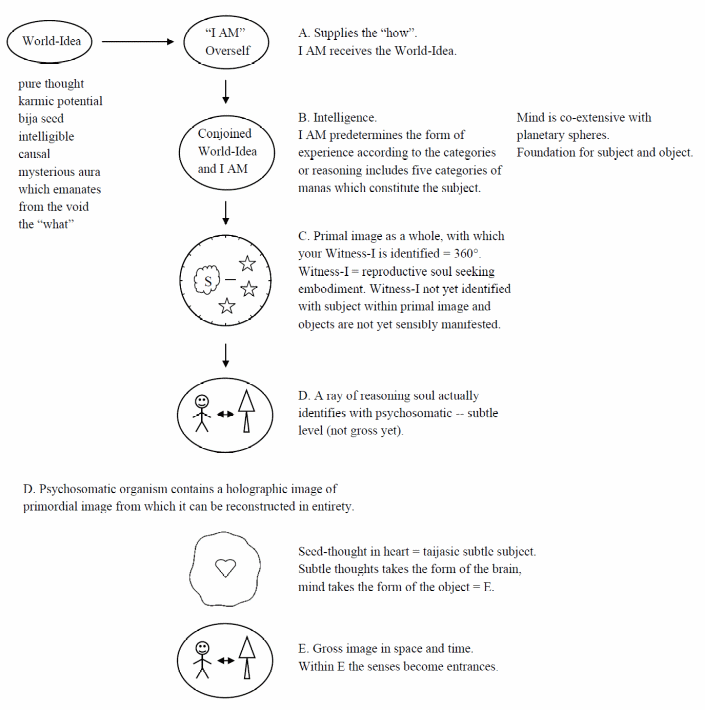
FIGURE 1983 1118-1-AB. Synthesis of Epistemologies.
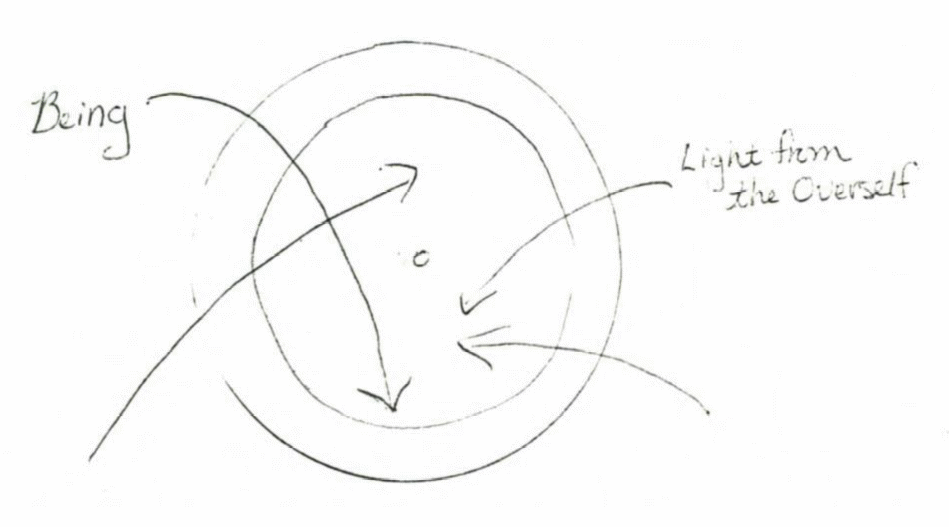
FIGURE 1983 1118-2. Light of Overself in Psychosomatic.
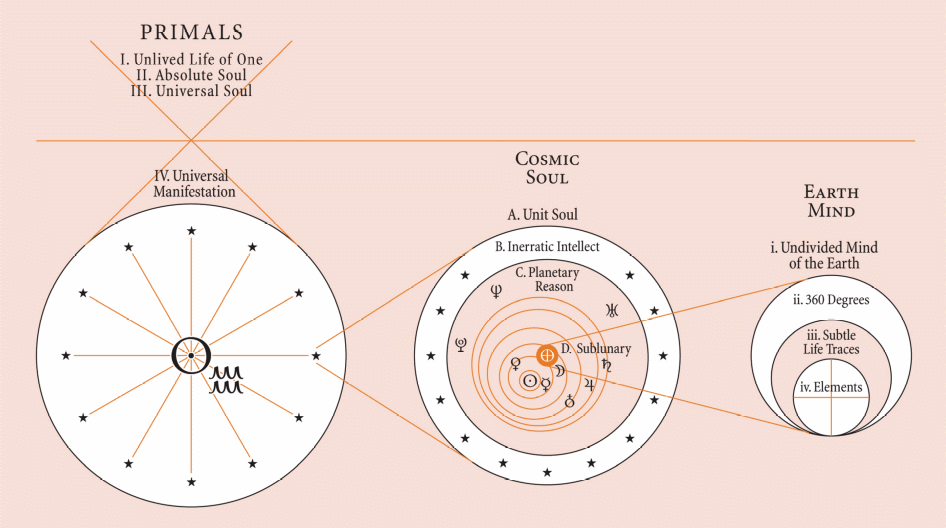
FIGURE 1983 1118-3. Nested Levels.
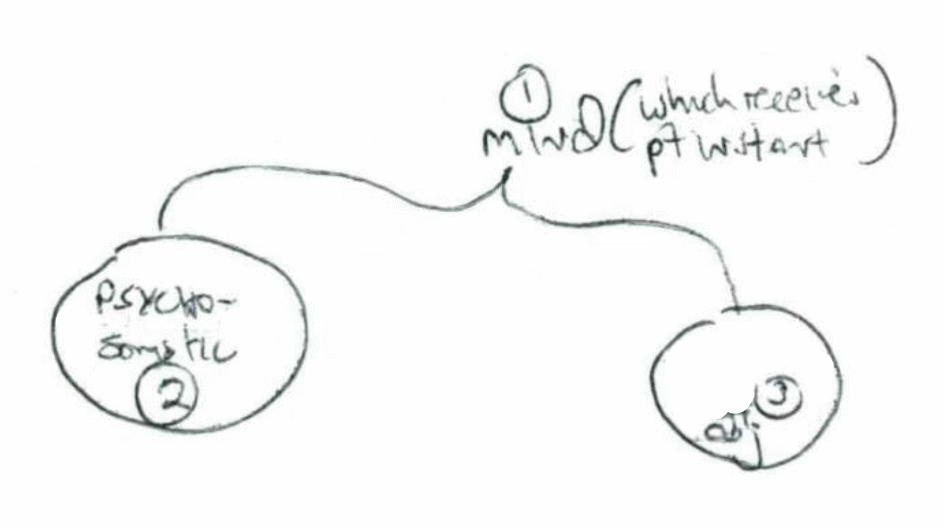
FIGURE 1983 1118-4-AB. Mind, Psychosomatic, and Object.
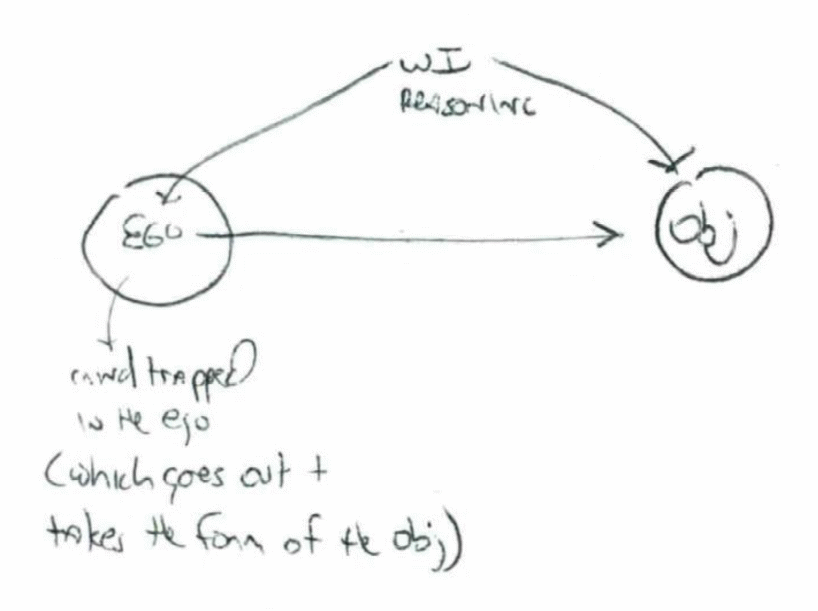
FIGURE 1983 1118-5-AB. Witness-I, Ego, and Object.
The third diagram is from Astronoesis, p. 250. [Transcriber note: [diagram] means the speaker is referencing a diagram as he or she is speaking. If someone is drawing or writing, with audible sounds of chalk on a blackboard, I indicate this by [drawing] or [writing].]
NOTES:
Epistemology discussions related to those of WG Classes 1983 10/28, 11/11, 11/25a, 12/1, 12/09a, and 12/19a. See also earlier Mentalism series, WG Classes 1983 1/26, 2/2, 2/9, 2/11, 2/16, 2/25, 3/2, 3/9a (and associated paper 3/9b), 3/16, 3/21, 3/23, 3/30, 4/6b, 4/13a.
Earlier transcript version also exists.
Friday night class.
TRANSCRIBED Verbatim by IT prior to 2018; reformatted by jf 2018. This is V12a (2023) and has: updated prefatory matter, footer, and audio file name; Book List and TOC completed; Subject and Subsubjects changed; Plotinus quotes section added; new notes within transcript; minor errors/typos corrected; five diagrams appended and references within transcript to these diagrams; new formatting to accord with new conventions. Archival verbatim transcript – V12a.
AUDIO FILES: 1983 1118a, 1983 1118b. [Note: "Tape" and "Side" refer to original audio cassette tapes that were later digitized into .MP3 Audio Files.]
1983 11/18 at Wisdom's Goldenrod
Epistemology; Synthesis; Buddhism
[Audio File 1983 1118a Begins]
AD: --(infinite wisdom)(,) and that was an attempt at creative synthesis. This-- this business of analysis can go on forever and all you come up with is like Vic found out, nothing. (laughter, student words) Come up with nothing.
S: What?
VM: You're right Anthony, all day long I've been finding nothing.
AS: What good eyes you have. (laughter)
S (amidst laughter, faint): It's very interesting.
S (faint): [one word inaudible]
AD: So basically what we're doing is an attempt at creatively synthesizing the variety of points of views and try to put each one in its perspective, the perspective that it's coming from, and then to s-- if possible, to see them all in relation to one another. Alright, and then I think it'd be much more meaningful when you read any one of these people, or any one of these schools, that you would have a-- a framework within which to place their teaching. So if you read one person he'd be coming from the point of view of pure Being, you know, and you have to keep that in mind that he doesn't condescend to come down and start explaining anything. So, maybe-- maybe we'll succeed(--) (go on Tim--) but we should try. The attempt is at a synthesis.
[students assent, very faint]
AS (faint): So-- Twenty major-- [writing/drawing] twenty major epistemologies. (AS laughs a bit)
S (faint): Only twenty?
AS: Well, any-- anything creative in this thing is from Anthony and the synthesis part is mostly from me. So-- If you would-- I guess-- (and) I'll say it, if you would allow me to, I would-- I would like to go through the whole thing first before there are comments, I mean, you know, some of it may be wrong, questionable or whatever, but at least maybe-- just give it-- give me a chance to just-- let me go through the whole thing, and then ask Anthony questions about it. (laughter)
S (amidst laughter): Good.
S (amidst laughter): (Where's) Anthony?
VM (very faint): [few words inaudible]
[student assents, very faint]
[Note: See FIGURE 1983 1118-1-AB, Synthesis of Epistemologies, appended to this transcript for the following.]
AS: No I-- as I said, any-- anything that's correct in here [AD: Anna--] refer to [one/two words inaudible] and anything that's incorrect is my own mix up. Ok, so this is a summary. It's basically in I guess five steps. I think that's (five/right). And (this is/it's a) trying to take it down right from the level of the World-Idea all the way down into the sensible world. So, step A. Where we're starting from is this-- the first-- and with each one there's this little picture [diagram]. These pictures are not necessarily completely separate, some of them overlap or are really just this-- hard to actually separate but at least are distinguishable, so don't hold this against me.
(But/The--) the starting point is the kind of starting point we also speak about when we were doing the Parmenides. [Note: See WG Classes 1983 0902b, 0909b, and 0916.] Step one, that this One, that is [drawing] our I AM or Overself, Overself, receives the World-Idea from the World-Mind [diagram]. Ok? That's-- that is the starting point and remember we spoke about that at one time, that the World-Idea is received by the Overself and the result is that the two of them are then conjoined, [drawing/writing] the World-Idea plus the I AM. Ok? [Transcriber note: Starting here, occasionally it sounds like AS mixes speaking and reading something, possibly his own notes, but it's not clear so I just leave it all as spoken.] And, through the power of Thought then, the Ideas(,/--) that the vast intelligence of your mind or the I AM is going to produce an idea of the World-Mind's Idea which is given to it within. The World-Mind's Idea is termed pure Thought or karmic potential or bija seed in various schools, and this incessant vibratory energy of the World-Idea is received by the I AM and it is known there as intelligible, as entire, causal, indeterminate, immediate, and includes of course everything that could be manifested from it. In this intelligible perception our intelligence is simultaneously or instantaneously present to the entire thought of the world. And, PB speaks about this probably as the mysterious aura which emanates from the Void. [short pause] Ok?
And now, having received this World-Idea or this pure Thought, the mind which is now conjoined with that is now going to try and take that-- and PB also speaks about it as what you're going to experience. And now the mind, the I AM, has the power to determine how it is going to experience this World-Idea. Ok? And-- so in this view this-- this intelligence of your I AM or your soul is not just pure consciousness of Vedanta but it has tremendous power and intelligence to transform the World-Idea into an experience for itself and that transformation (we'll/will) take through the next several steps to eventually become a determinate sensible perception.
But at this step, the first thing I think we have to say is that the World-I-- the-- the power of the soul of reason is going to provide the form, is going to predetermine the form of all experience through both the categories of thought, giving space-time form-- let's not say space-time, giving a preliminary form and setting up the conditions for the experience of the object and also structuring and determining the nature of any subject that's going to appear. Ok? PB says the World-Idea is thought by the individual mind. (In the) process it's inevitably shaped according to its limitations. But the first cause and ultimate source of that Idea cannot be this mind. It must be the World-Mind.
But now, when this mind of ours perceives this World-Idea, through the power of reason it sets up the conditions for the experience of a world according to the primary categories of thought and according to the categories or structures of the subjective side. So Kant speaks about certain categories of thought and this-- this is [drawing/writing] step B [diagram]. The World-Idea has been received by the I AM and now this mind of ours has these powers of reason through which to determine initially the conditions under which we can then later experience a world. So, it organizes the object according to certain categories of thought, [writing/drawing] which includes unity, identity, causality and so on, and also the-- the Yogacaras speak about-- Yogacaras speak about these five activities of the manas which determine the individual center of subjectivity. Ok? So prior to any kind of experience this vast mind has the power to organize the World-Idea in such a way that experience can arise out of it. So, here we have determined how we will experience whereas the World-Mind provides (us or) what we will experience. Our mind sets up the conditions for experience so that it will later on be able to experience a world through the empirical subject. Now, the result of all this determination and-- oh, one other thing. At this-- we could call this-- we can call this pure sensation or the way the Buddhists speak about the point-instant as efficient causality. [couple faint inaudible student words simultaneous with AS] And the r-- [one/two inaudible words simultaneous with AS, possibly AD] in-- right here, B, at B [diagram].
And, the result of this activity of reason and the categories to establish a subject-- the conditions for a subject and object, the result of this-- [drawing/writing] what this is organizing is the entirety of the primal image, let's call it the primal image, step C [diagram]. The result of this is to form or determine the entire primal image with you and everything else that's in the world. Now if we use our other diagrams, at this stage we could say the mind is co-extensive with the planetary spheres [diagram]. And your mind is parti-- these categories of thought and the-- the structures of the subject are functions of those planetary-- of those planetary powers. And what they are organizing is the whole of the primal image, which would correspond to roughly the mental level of what we called the Dragon before. So the entirety-- In other words at this point your mind is now co-extensive with the entire aura of the Earth. Ok? So you could also imagine this (is/as) coming down as it were from the level of the pure soul to the planetary spheres to-- to the Earth aura, where this primal image at this point could be thought of as co-extensive with the entirety of the Dragon. [drawing]
And now, this whole-- every instant-- and this is the reason I would equate this with the activity of these point-instants is that every instant in time the entirety of the Earth's psychosomatic organism is being organized by the activity of the planetary spheres, in other words its own soul functions are continuously organizing and energizing the entire primal image, and your Witness-I [drawing] is identical-- identified with that. So we're just-- I'm just laying it out from an individual point of view. This entire primal image is organized by the activities of reason, the categories which determine any possible object and the conditions which mold (the/a) center of subjectivity which are going to arise within a primal image.
MB: Avery?
AS: Yes. Go back.
MB (simultaneously): So the subject and the object that you put within B, do those go within C really?
AS: Yeah, they're really within C but don't worry about it. These are just the conditions [S simultaneously: (For what?)] for any center of subjectivity and any possible object. And at this point however this primal image is experienced as a whole by the Witness [drawing] and we can call these the 360 degrees [diagram]. Now, a few words about this step 'cause this seems to be pretty critical. The result here is that this primal image, which can be thought of as co-extensive with the whole mental realm of the Earth or the Earth's aura or the 360 degrees, is identified with the Witness-I, which we can call the reproductive soul or that phase of the soul which is seeking to become embodied and eventually grow into a perfect replica of its higher. And so we are tracing here the, as it were, history of this reproductive phase of the soul or the light of the soul in its travels from its origins to its becoming a perfect image of the intelligible. Now, this phase of the soul which seeks embodiment [drawing] ultimately will have to assimilate to itself all of these reason-principles [diagram], or as many of them as are necessary, and therefore it seeks embodiment, it's going to seek to incarnate over and over again in order to assimilate to itself and take into itself the contents of this whole 360 degrees, which are themselves originally the contents of the World-Idea, ok. And they are eventually going-- well we'll-- we'll (take--) ok. So, through innumerable particular lives this phase of the soul which is becoming divisible and is a ray from the pure Overself is going to evolve itself to a point where it can itself become an intelligible and recognize its own divine origin. You know, we-- we went through that a lot. And, so-- not-- it's not yet but at the next step this Witness or this light of the soul is going to have to identify [drawing] itself particularly with a psychosomatic organism which it has itself organized the conditions for. Well let me see, there was one other [possibly one word inaudible] So--
S (faint): (Excuse me), Avery?
AS: Yeah.
S: Where does the planetary spheres fit in this diagram?
AS: (In--) in the-- in the other picture that we've had sometime, I think (he) could say that the functioning of reason as we're saying or the categories of thought which are determining every object and every subject, in other words, determining or organizing the whole primal image, these are powers of the planetary spheres. And then-- and then this would-- in that other diagram, this would be where the mind is now identified with the entirety of the Earth's aura [diagram]. (Now) the next step you can see it's going to further contract itself to identify with a particular organism, a particular psychosomatic organism in that. So at this level we have to conceive of it as co-extensive with the whole of that primal image, the whole Earth's aura, and not with any particular part of it. He's still on the verges of disembodiment as it were, except that the whole thing is almost simultaneous.
Now here's where it gets a little bit complicated, because in order now for this reproductive soul to fully and more powerfully experience the particularity of this World-Idea it has to actually identify itself with a particular psychosomatic organism which is within this. And at this point, this primal image, [drawing] these objects are not completely determined the way they would be when he functions through his organism. They're complete-- they're related but they're not manifested sensibly to him. So, next step, if we follow this one, [S, faint: Yeah right.] the next step is that this reproductive soul becoming divisible about bodies, if we will, or we could say a ray of the reasoning soul now actually identifies itself with this psychosomatic organism.
Now, for two reasons, ok. A ray from this Witness or a ray of reason or the light of the soul seeking embodiment, a fragmented part of awareness, associates itself with this particular psychosomatic organism, which is itself part of the primal image, ok, and this organism is that particular one which your soul has an affinity and which has an affinity for your soul or appropriates it, grabs it, and takes it to be itself. Then this is known as the personality, the ego, the natal chart. So we could imagine that part of this whole-- the world's primal image is your psychosomatic organism that you're going to [drawing] identify with, with all your personal memory traces, your individual chart let's say, your ego. Now when the (light/life) of that soul is no longer impersonally identified with the whole primal image but identifies with that particular psychosomatic organism, just as you do in a dream, as if this were the whole dream and then the observer himself identifies with the dream character.
Now when that happens a couple of things seem to go on with it. Ok? And let me try and say that. When that happens, this (light/life) of reason, since it already has, as it were, a perception of the entire primordial image, we could almost think of this whole primordial image as a hologrammic projection, a hologram, and you take one little piece of that hologram and from that you could reconstruct the whole thing. And so everybody can get a little hologrammic piece of that primal image. In particular, this ray of light which gets trapped in the psychosomatic organism, it also has a hologrammic image of the entire primal image.
AD: Make that the fourth circle [diagram], under the circle [one/two words inaudible]
AS (simultaneously): Yeah, we're going to have to-- we have to do another [AD simultaneously: Below.] circle now. But from this circle-- [S: (What/But)(,) what?] it's kind of hard but this aware-- [drawing] this mind, this Witness-I, has-- is conjoined with the entire primal image so within its awareness is the entire primal image but indeter-- but nothing determined. This could be the whole world, the stars, everything, the whole universe, the whole world [AS indicates on diagram], here, the whole Earth. He can go anywhere, he's not identified with anything. But [one/two faint inaudible student words simultaneous with AS] for that reason also, nothing in particular is picked out of that entire field. It's more of a unified whole. Ok? And up here we could call this a whole of parts, the combined World-Idea with the I AM, but (not until) these categories get to work with it, (then) some kind of an entire matrix, not to be detailed, but the entire matrix of possibilities [one/two words inaudible] to him but no particular determined tree yet. Now, the thing is this. If you imagine the light in the hologram associated with the hologrammic image, if you take off any little piece of that hologram you can reproduce the whole thing by shining a light through it. In any little spot all of the-- all of the--
S: Well, I think Jo-- Jonathan might help us.
AS: But one little piece of it reproduces the whole thing. So you can have an incessant number of reproductions of the entire just by breaking off a fragment of it. In other words, when a fragment of awareness gets trapped within this body so does a fragment of the entire primal image, and that's what PB is going to call that seed-thought in the heart. So, therefore the individual will have a seed-thought or an image of the entire world already within his own subtle organ within his heart. So, the fourth step we need-- we need to put it over here I guess. [drawing] The-- in the fourth step we now have this guy has identified with his psychosomatic organism. The (light/life)-- the light of his soul or the light of reason as we called it before is identified with his heart organ [diagram]. But it's not the physical heart but this is-- this is his va-- this is his body-thought, the heart-thought, which contains all his vasanas. And this fragment or ray of light contains a hologrammic fragment of that entire primordial image, which any individual could participate in. There could be millions of individuals on the Earth who are participating in the primal image.
MB (faint): That doesn't make sense though, (because) (the/then)--
AS (simultaneously): Well, ok, then if doesn't make sense you have to wait but then you'll argue later.
MW: Yeah. (bit of laughter)
VM (very faint): Yeah, hang on.
AS: It may not make sense but-- It's hard to imagine because the participation here isn't in a physical thing. It's in an idea and it's still in an ideational form.
MB: Well, the reason why I thought it didn't make sense is 'cause I thought you were talking about it coming through one individual soul.
AS: That's right, and ev-- but every individual soul will have an image of that image, will have-- An image of an image is not quite right because it's actually the whole thing. He has the whole thing.
MB: But then you're saying that each [AS simultaneously: Like it shrinks down into a little teeny--] primal image is-- You're not saying that within the primal image you have images of the primal image but (that/then) at each primal image is an im-- is a-- like a holographic [AS simultaneously: That too.] of-- of uh--
S: Yeah.
AS: Well let's leave it at one individual, let's not-- Let's say here he is, [drawing] he's identified with the entire primal image, but now he's just within one part of it, he's within this body-thought. He has an affinity for that and besides this body-thought has all the memories and all the vasanas that he needs in order to experience a world according to his own peculiarities. So he's got-- his light of his soul identifies with it, and in identifying with it that light is a form-bearing light. It bears the form of the whole within itself. Even though it's only a fragment, the Witness may stay here [diagram], you don't have to put it anywhere, it can't go anywhere, but that fragment of light (contains/contained) within it the form of the whole. Maybe that's the way to put it. That form of the whole is now this seed-thought within his heart.
Now what the heart is at this level is his psychic organ, the subtle organ, the imaginative substance we spoke about a lot of times, the taijasic or imaginative substance. It's not his manifested heart yet. It's still a thought in this World-Idea, it's part of the World-Idea, and for the-- for the purposes now of this guy [diagram], the [drawing] other karmic entities like you and me and trees which haven't been manifested for him yet are still as it were-- now they're outside of his body as it were. The light-- this fragment of light has gotten caught up in this body, [drawing] and so from this point he's now got to contact them.
Now, from the point of view of the fragment that's caught up in a body he has to, but from the point of view of the Witness which is still there and hasn't gone anywhere, he's already contacted these karmic objects. And that's-- we'll have to go over that a little more. So, the light contains within it a particular hologrammic fragment or form of the entire primordial image, and this is taken into this imaginal essence or the taijasa or the inner organ and here PB speaks about a tiny seed form. Ok? From here, once you speak of this fragment of (light/life) trapped in this body, it now has to experience everything that that body can provide for it.
So from there we could say that the-- Ok, the fragment of the soul or light is trapped in this psychosomatic organism. From there the life current plus a seed-thought, the vasanas, travel up to the brain. Now remember, when he says travels up to the brain, the brain's not manifested yet sensibly. The brain is also part of the World-Idea, but this subtle imaginal essence travels up to the brain and so the next-- now this is almost simultaneous, the whole thing you have to imagine occurring every instant. So, this subtle-- subtle imaginal essence travels up to this part of the thought-form, the brain, and it takes the form of the brain. And when it takes the form of the brain it manifests the brain to the awareness in a determinate way. What does it manifest? It manifests all the thoughts [drawing] and so on, concepts, and impressions which have come to the brain through the light. What light? The light that's part of the whole primordial image, the light which in fact is this connection between the object and his body as a thought-form. And then the taijasic or imaginal essence continues, takes the form of that light, takes the form of the object, and takes the form of the Sun, in fact takes the form of the whole business [diagram]. And now he knows the object.
Now, this-- the light that has come in and his body and the tree, originally they're all here, they're all in this primordial image. They're subtle thought-forms or they're not manifested sensibly. The light makes an impression on his body, that's always going on, but he won't know that if he's asleep, he won't know it until that light of the taijasa and the awareness with it comes and takes the form of his brain. If he wants to get to know what's going on in his brain, he has to make a thought for himself, he has to know it, he has to, as Vedanta says, mind has to go out and take the form of his brain but it also takes the form of the light, takes the form of the object. So it doesn't just go out to the object, it goes out to the brain, the light, the object, the whole business. And now he says you know the object. He knows it [drawing/writing] now in a threefold-- as other and so on. Now, (a/uh) important point here, let me-- let me read this. I haven't gotten this all completely [one/two words inaudible]
[Transcriber note: AS is probably reading his own notes, which I do not have access to.]
AS Notes [AS reading]: "The light travels out, is canalized through the path of the senses, the light, the tree, [AS: The light of the mind.] all of which are part of the primal image but are now known determinately."
AS: Whereas before the Witness lit everything up, the Witness is still lighting up anything that that subtle mind takes the form of. When it takes the form of the brain, then you know thoughts, when it takes the form of light, you know the light, when it takes the form of the tree, you know that determinately. But the Witness, remember-- now this is the-- [drawing] I think the important point, the whole thing is within the Witness-consciousness all along. The Witness doesn't have to go anywhere. And when Vedanta says the mind goes out, it's not this mind [diagram] that goes out. [student assents, faint] It's not the Witness-mind because that can't go anywhere. That illumines whatever forms his subtle organ lights up, and actually they don't say mind, they say the antahkarana or the subtle organ. So, the mind which goes out is the imaginal essence which makes a bridge between the body-awareness and the object-awareness. The physical senses canalize the imaginal essence and the subtle sense powers, which are part of the imaginal essence, gives the qualities to the object but they don't project the actual essence of the object because the essence of that object, as PB says, is a thought-form. It's originally a thought-form in the World-Mind but more immediately it's a thought-form within the Witness and so its essence is given. But it's not ever outside of mind, it's always within his Witness-mind, it's always within his Witness-consciousness.
So this thing about going out is a little bit mysterious because it doesn't go outside of his Witnessing mind. Wherever-- wherever that-- wherever that imaginal essence goes to, his Witness immediately lights it up. And this is what Vedanta seems to mean when they say that perception is immediate. The whole perception, whatever it is, whether it's a perception of the thoughts in his brain or it's a perception of the object, is illumined by the Witness-awareness which is always identified with the whole primal image. Ok? And in the Witness, in this primal image diagram, the whole percept is known immediately [drawing/writing] by his consciousness but is known-- Vedanta has this quaint way of saying (it's/is) known as unknown. And what they seem to mean is that it's not known in a sensibly determinate form. So, let me try-- the last part I think is a little easy. Maybe we needed another step 'cause this is only D. [S simultaneously, very faint: (Uh-hm. Yeah D.)] Maybe I should break D into two [S, very faint: Yeah.] parts.
S (very faint): That'd be fine.
[student(s) assenting, very faint]
LD (simultaneously): Oh, don't erase that.
[sounds like student assenting, very faint]
S (faint): (So clear.)
AS (simultaneously): Yeah, it's messy.
S: And so clear.
AS: Here's D, here's E [diagram]. If we could say that at D [drawing/writing] we just have-- we don't even have to call it the heart, let's call it his psychosomatic organism. From this vast awareness (with/of) the whole primordial image, a fragment of that awareness has contracted itself to this particular psychosomatic organism and is now going to function through that, even though the original consciousness isn't going to go anywhere at all. So fragment of that gets associated with the psychosomatic organism and now he's a person, his (seat/seed) of the ego happened and he's this person [AS indicates on diagram]. Now he's going to function with this subtle organ, with the imagination, and that's where this whole business about [drawing/writing] is it that subtle mind or that taijasic essence goes up to brain and lights up tree. And in fact in this diagram the only things we should really have in it are the particular sense-objects that are now experienced, the brain, and the heart center [AS indicates on diagram]. And all of it is-- all of it is enclosed in this imaginal essence now except-- and he'd be locked in it completely except for one little thing and that is that the Witnessing consciousness already has the whole thing [drawing] really within it but he doesn't know it. [S, very faint: Within that, yeah.] He doesn't really know it. He doesn't really know he's in this situation [diagram] because now he's taken himself to be in this situation [diagram].
Now, I-- one-- one little addition, and I don't know-- there's always this question about the brain, you know, does the scientist see the brain. Well, it seems to me that in your every-- every instant of experiences you are always experiencing the brain. When the mind here comes up and takes the form of the brain, it presents it or manifests it as your thoughts. So everything you feel to be internal to yourself, your thoughts, feelings, and so on, that's the subtle mind taking a form of this thought-form of the brain. 'Cause [drawing] the brain is the concomitant of all these thoughts. When you have a sensation of your body, a feeling of your body, that's your mind coming up and taking a form of your body and that's how it presents that to you, how it manifests your body to you is as these feelings and so on. And when it goes out through the channel of senses and is canalized by them, take the form of the object, then that's manifested to you as the actual sensible object with the sensible qualities on it. The whole thing is completely-- not only is it within this Witness but it has to be completely presented by this imaginal essence. And even this, when the mind takes the form of your heart, then you say "I am," then there's (the/a) conceit of the "I." So within your experience now you say well "I," you make mention of "I," [AS indicates on diagram] the mind has taken the form of the heart, you have certain [AS indicates on diagram] thoughts and feelings, you have a sensation of your own body and you have-- and a-- and a s-- a sensible experience of the object. And all of that is the way that the mind has manifested to you what's in this primordial image.
Now the Witness is a-- has experienced it almost as it were as a whole, but in order for it to really get assimilated it has to experience it in a very stepped-down, channelized way, and that's what all these thought-forms do, the brain and the senses. They kind of focus the attention onto one particular thing and they also give it a certain form, because if these senses were different here, this imaginal essence would-- would be formed differently. Your subtle senses would operate differently if your physical organs channelized the subtle senses differently, if you had a bigger spectrum in your eyeball you would see different color than you do and if your eyes were a different size, you know, you might see things really microscopically, you'd see things really far away or anything else like that. So there certainly is a part played by this thought-form of the brain and the senses. But unless this mind goes and takes their form you won't have any experience of it and you can't even say before your mind takes the form what form they have.
Because this thing that seems to be out here [diagram], from here [diagram] we know it's really a karmic impression and the only thing we ever know about it from this view locked in here [diagram] is what particular forms our sense organs can adapt to. The tree itself may have vastly different sensible qualities as a karmic force, it's just energy. It's really, as Vic would say, I mean this stuff over here [diagram] is energy or probability waves until it gets precipitated into a particular form for this particular individual here. Now, those possibilities, even the very possibility [drawing/writing] of those is going to be set up by the categories of the mind but the actual sensible experience has to go on within the context of this whole Witness. And so, the other thing, the karmic impression doesn't have to go out as it were. It's not-- it isn't out any where. When the mind goes out it doesn't go outside of the mind.
VM: Couldn't we say that "going out" in this context, Avery, means something like, through the functioning of the brain and the senses the notion of empirical space-time gets crystallized.
AS: Sure.
VM: That's what you mean by going [AS simultaneously: Yeah.] out there.
AS: Yeah.
VM: 'Cause there's nothing going out of anywhere, I mean, when you're totally-- if you take the point of view of the whole primal [AS simultaneously: Right.] image, what you could conceive of going out?
AS: Right. But if you take the point of view that [VM simultaneously: From this it makes sense.] you're the body, then there is something going out and there's a light. Now what's light? Light there is the relation-- all of the thought-forms within (the/this) primal image are interrelated and they're related by light for example (as/is) the primary thing because the fact that the Sun is light that in some ways what all these things are made out of. And so when your-- the light of your subtle mind or taijasa goes out through that-- the-- what does he call it, the transparent humor (in/and) the eye and intertwines itself with [drawing] the light of the Sun, and we should have put the Sun in there too [diagram], ok, then what it's doing is it's manifesting the light and the tree and everything else that's there. [students assent, faint] Before that you can't really speak of it as a tree, except in the sense that you could speak of yourself as a psychosomatic organism. But what will you know about it if your mind doesn't manifest it to you? It'll just-- it'll also be a karmic potential. Well I-- I think that's just about-- messed it up pretty well there. Um--
DH: So-- so at level D you're just thinking about the karmic potential, the (effect). And E is when physical space-time comes in.
AS: Yeah-- well I think PB kind of says that there's already a space and time here [diagram]. But at this-- what happens at D is that [drawing/writing] the ray of reason or the light of the mind, the ray of the-- ray of awareness as he puts it or fragment of awareness, identifies with the psychosomatic organism.
VM: You know, you talk about three levels of the heart Avery, I'm not sure if it makes sense to bring it in but you might be able to say that's the-- this-- it's the vital level, the psychic level, and the causal level of the heart.
AS (simultaneously): Yeah. Yeah that's good, I would say that but-- and [drawing] PB says that, although I don't know. You know, he says at this point [diagram] there's already-- they break into space and time. Here's your seed-thought [diagram]. Except there was some confusion I think because the-- well-- Usually though they say the heart center is where there's the prajna consciousness and at the throat there's a dream consciousness. 'Cause, they say when the energies are drawn back into the heart then the guy's asleep and just this-- he just experiences the mass of his vasanas. So here-- you know, all the vasanas are here in the heart [diagram] the way Ramana says and that light gets trapped. [Note: See Talks with Sri Ramana Maharshi, Talk 616.] That light is the same light I think that we spoke of as the light of reason in Wednesday night class--the light of reason or the light of the soul or the reproductive soul becoming divisible in body. [couple words inaudible] [drawing] with all those vasanas. Why it does that, you know, 'cause it wants that kind of experience, it has a-- a-- an affinity for it. And then that kind of dreamy experience, or actually there it's even a sleep experience, becomes a dream experience and then becomes a waking experience. With the hitting of that subtle seed-thought up to the brain, it gets dispersed or magnified or channelized or however you want to put it, according to being imposed on the sense-impressions and everything, goes out, takes the form of an object and-- once it hits the brain then you have waking consciousness.
[student assents, very faint]
AH: (When you/They) speak of the heart, does PB speak of that as a point-instant in space and time?
AS: He says they there break into space-time existence. [VM simultaneously, faint: At D.] When the-- he says-- at D, he says when that-- the seed-- he develops a tiny seed-like thought-form in the heart and there the karmic forces break into a space-time existence.
AH: Well the point is-- the point has no dimension, the time has no duration, [AS simultaneously: Right.] it's-- it's like--
AS: (But I--) I would still put that back here [diagram]. This whole thing really [student assents] is like a point [diagram].
[student assents, very faint]
AH: But I was (in--) [AS simultaneously: But here it's in (few faint words inaudible)] you can say actual intersection is spoken of in the heart (as/is) the point-instant in space and time.
AS: I don't think he says "instant", he says "point". I don't know about "instant".
AH: It's point hyphen instant.
AS: Oh fine. Ok. And that's-- that's where the vibratory activity of this [diagram] is meeting the personality, the individual psychosomatic organism. (And) if this is almost simultaneous, this whole (thing) right here [diagram], if the fir-- this should all continue, this should all be right under that [diagram]. At the same time it ripples through this mind, it's rippling through his own individual mind [diagram]. As we said, that hologrammic image is a reproduction in miniature or is the form of the entire whole.
S (very faint): Yeah.
VM: You know, the nice thing about holograms, it really makes (it particular), that every time you take a piece, you know, if you just-- I don't know, this may be a foreign idea, Jonathan had [AS simultaneously: Yeah, (I know).] some holograms around, there was a big one back there, I don't think it's still there anymore but, if you actually cut a corner out of it, let's say a postage-size piece, you would get the whole image but it would be diminished [couple/few inaudible AS words simultaneous with VM] in resolution in the sense that you wouldn't have same fineness of detail, the same sharpness, but everything would still be (there/left). So in some ways that's nice, you know, you don't-- sure you got the primal image but obviously there's some diminution, you don't have the same resolution, the same-- well, resolution is the best word I (can--)
AS: And I would say if he didn't have that [S simultaneously: Yes (Vic).] primal image within, he couldn't make any sense of his experience without. And it's that image which is going to partly be giving a form to this object here [diagram] but also [drawing] determined by the particular sense-reports and so on.
AB: Isn't that holographic image completely composed of light?
AS/S(?): What?
S (very faint): Yeah.
AS: Some kind of a light. It may-- it's probably--
AB: Light frozen in a medium.
S (very faint): Yeah.
AS: Uh-hm.
VM: (But) all the phase relationships are still there, ok.
AB/S(?) (very faint): Yeah.
LR: Avery, [AS simultaneously, faint: And I wasn't--] weren't you going to do one more? Weren't you going to also-- also explain the coming of that what-- what was meant by the--
S (faint): Yeah.
VM (simultaneously): Entrances and--
S (faint): (Exit(s).)
AS (simultaneously): Well-- yeah I-- I think that's here within this [diagram], when this light actually hits the brain, the reports-- [drawing] the sense-reports in the brain, sense-impressions, ok, that this is-- this is the view that's modern science which leaves-- if you leave out the part about a mind that goes out and just say that the light streams in and the mind only extends as far as the brain, then you have a kind of a modern view which says that the only thing you have is representations in the brain, there's no activity of the mind going out anywhere to project a world, it's just taking the form of the sensations that-- sense-impressions the-- that have hit the brain. Like a scholastic view maybe, where they would say you have the phantasm, the imaginal phantasm, which is stimulated by the sense-reports and the active intellect interprets that(--/.) It seems that this light of reason that gets caught up in the body, that seems to be crucial. That-- even though the-- the entire "I AM" doesn't have (a) kind of-- that kind of historicity, this light of reason itself seems to learn in some way. And so that light of reason, when we said that's what makes connections within his experience, I think that is what is interpreting any experience (of those) [one word inaudible] if there is any interpretation. And it's the whole purpose of making this guy, creating this guy in the first place, is as a vehicle for knowledge, to get-- to gain more of these reason-principles, 'cause every time he assimilates some more of these [drawing] reason-principles through his own body they're really made his own, because that light actually has to take their form or grasp them in some way or assimilate them. Somewhere PB says they have to be taken into the center of his own consciousness and made his own by experience. [Note: See Paul Brunton, The Wisdom of the Overself, p. 45, North Atlantic Books, Berkeley, CA 2015.] [KD: But--] And so that's the main-- so that light of reason is at least thought of as growing now.
S: Avery?
KD (simultaneously): Now, are those reason-principles (of--) you talked about that have to be acquired--
AS (simultaneously): Yes, yeah. [drawing]
KD: Well, are those in--
AS: Yeah.
KD: Are those the reason-principles of each natal chart or-- [AS simultaneously: Well, I--] or is that the whole, I mean that-- [AS simultaneously: That's the whole.] that's the point of the-- [AS simultaneously: I think that--] is that the point of making that i-- (obstructing) the hologram [AS simultaneously: Yeah.] as a hologram?
AS: Yeah, this is like the whole 360 of the Earth [diagram], and then that's reduplicated so that each individual psychosomatic [drawing] organism is organized according to his natal chart but in some way also will have all 360 [diagram].
KD: Because you can't--
AS: Because it's a hologrammic--
KD (simultaneously): No matter which planet you have (either) you get all 360 degrees (or nothing).
AS (simultaneously): Yeah. But I would say that these ones here [diagram] are where he is co-extensive with the whole Earth's 360.
KD: So when, in times past, Tony's statement(,) said the goal of the second soul is to achieve its vision and it acquires-- and it assimilates the meaning of certain of these reason-principles in order to achieve its vision, would it-- is that what that refers to, that thir-- that-- wait, would the-- [AS, faint: (Reason-principle.)] would the-- would the vision refer to those 360 degrees?
AS: I think that this--
LR/S(?): (Well--/What?)
AS: Yeah, I would say that through constantly working through this body which [drawing] itself is going to experience these reason-principles, that this light of reason itself is going to assimilate those reason-principles through this organism and eventually it will grow to be-- to assimilate all of those 360 reason-principles.
KD: So that-- so that vision doesn't have anything to do with the vision that the soul has in the Nous, it's the vision of (the Mind that) the soul has in the Nous. That'd be at a much-- the--
AS (simultaneously): The vision that the soul has of the Nous would have to be here when he speak of this aura emanating from the Nous, would be at this level [diagram], and then it gets translated (at) all the way down into that level [diagram]. Now, I think maybe is, say that in some way the soul doesn't really have it in the way that it wants it here [diagram]. I mean 'cause you say, well look, it's already got the entire World-Idea, why does it-- you know, why does it need to do that? But it doesn't have it in a particular form, and secondly, through this whole thing I think, he says it's going to come to self-knowledge about itself, which it doesn't have originally. Some part of it, that soul becoming divisible, or that reproductive soul, is going to know something about its own divine origin, which it couldn't do unless it had a mirror to look at itself in. And that mirror that it's going to look at itself in is almost this whole build-up of all these 360 degrees (make up) a mirror for the soul to know itself in. I don't mean it as a quaint metaphor. PB used something like that in one of the quotes, I'm not quoting him exactly, when he said what's the purpose of this [LR/S(?): What?] manifestation. He said even for the World-Mind or the Solar Logos it gets to know something about itself that it didn't, but I don't-- I don't think we have to go into the "why". (There's also) the quotes on the ego.
KD: I sort of lose the connection between B and C [AS assents] in the primal image. [AS simultaneously: Yeah, these are really (drawing) close to each other.] I don't understand like (if/it)-- like the--
AS (simultaneously): I'm just trying to picture that these-- here [drawing/diagram] these are the categories or the powers which organize C. So here [diagram] the soul or the I AM receives the World-Idea, then it organizes the imagination or the whole aura of the Earth to portray the World-Idea [diagram]. It's organizing this whole thing, the primal image.
(Side 1 of original cassette tape digitized as 1983 1118a Ends; Side 2 begins)
AS: --determining how you can have any experience, they're the preconditions [drawing] for any subject-object experience here [diagram].
KD: The primal im-- image is the product of the-- of what happened in B or (comes out of these things).
AS (simultaneously): Yeah, in a sense. This is-- this is a [drawing/writing] causality relation in a sense. This is reasoning takes Thought and spreads it out, as it were, for our imagination. The functions of reason, the categories of thought, take the pure Thought, the pure World-Idea, spread it out as it were, so that our imagination, this imaginal essence, can experience it [diagram]. (And/So) we could say it in just one sentence if we, you know, if you-- Plotinus almost does that. The reason takes pure Thought, spreads it out as it were in a mirror for our imagination, this subtle essence, to experience it. [Note: See Plotinus, IV.3.30, second para.]
KD: Yeah. But just looking in this diagram with-- with the 360 degrees--
AS: Yeah. [drawing]
KD: It-- Ok, but--
AS: We can do that [diagram], if that helps. [drawing]
VM/S(?) (faint): Right.
AS: This is D [diagram]. And this is C [diagram]. [S, faint, almost to herself: Is that the planetary--] And we're-- that Earth mind, the mental of the Earth is continually every instant being structured and organized by the planetary position, planetary spheres. It's being determined into a whole primal image. And then within that you have the psychic and somatic. Each individual will have a psychosomatic organism. [drawing/writing] D and E are within that, and each individual has his psychosomatic organism that is continually being energized as well and is within this primal image. The primal image is organized by reason according to the World-Idea that it's continually receiving. And within that primal image or the Earth's mental zone are these 360 Gods [diagram] that your mind also is conjoined with, is extensive with.
AB: Avery, is that primal image the same for each individual or different? I-- because I could argue either point.
AS: Yeah, so could I, I could argue either way too.
AB: I mean it seems that [AS simultaneously: I--] insofar as those reasoning powers are universal soul powers then it would be the same still, but--
AS: Yeah. I kind of think-- tend to think of that more as the same. The difference is as to how much of that is within his-- that individual's conscious awareness. Like for the Sage, it's all available to him, for us it's not but it's present.
VM/S(?) (faint): Yeah.
AB: So it's only in D and E that the individual's idiosyncratic point of view(--) [AS simultaneously: That's what I'm (one word inaudible)] from within that primal image.
AS (simultaneously): Yeah, right, that it-- only from D, once you have this-- he's identified [drawing] with a psychosomatic organism. This of course includes-- (I mean we want to talk--) this whole thing [diagram] includes all the psychosomatic organisms with all of their particular vasanas, and I don't see why you couldn't say that if the Sage was identified at this level he could know your-- the essences that compose you, if it's karmically proper.
[student(s) assenting]
AS: I mean once you wipe out the psychosomatic and he's here [diagram], all of these [drawing] psychosomatics don't have a s-- one may have a special status for him but probably lots of other things are available, he can travel to Bombay with-- you know, focus his attention there (or something). I don't know. Well, (there are/there's) questions now.
S: [one word inaudible]
AH (simultaneously): Concerning the assimilation of the reason-principles, I remem-- I remember once speaking of that, that (sort of/so) you give the reason-principles back as a way of speaking about them being assimilated. Do you remember that?
RC: The quote from Jung you're speaking about here?
S (very faint in background): No, no.
AH/AB(?): Like it [couple inaudible student words simultaneous with AH/AB(?)] would take them back.
AS/S(?): No [one/two words inaudible]
AH (simultaneously): It-- it seems to me [CDA/S(?) simultaneously: (Return--)] that that would be the (inorganic) realm.
AB: (In/To) Nature?
[student assents, very faint in background]
AS (faint): Seems that what?
AH: Sounds like you return them as a way of speaking about assimilating them.
AS: Well-- (keep going).
AH (simultaneously): I mean, it-- it makes sense in this diagram that-- that insofar as there's an individual entity who assimilated reason-principle returns them to the extent that this last step is eliminated.
AS: Ok, in that sense, yeah, the psychosomatic when he dies has to be given up and when he dies as a Sage he gives up the attachment to it. But I would say the essences or reason-principles themselves that this light of reason is acquiring, those he keeps. [AH simultaneously, faint: (What is--)] I think that's-- that seems-- if he didn't keep those, [VM simultaneously, faint: Use your intuition.] I don't see why he would go through the thing in the first place, I mean, and keeping them doesn't mean that they're not there [diagram], I mean ideas are such that you can both have them and that you have your cake and eat it too.
AH: I'm just curious, what is the dynamic of assimilating a reason-principle? How shall you speak of that?
[student assents, faint]
AS: More forms enter his light of reason so the next time he can make more connections. I mean you might see that evolutionarily. It goes to a certain point to where he does make more sense out of them. That's-- you would see the effect of it. But he also begins to have, you know, more of an aspiration for the higher, more instances of, you know, overwhelming feelings of the higher power and so on, or they may manifest as more intelligence. He seems to be more intelligent, you know, makes great discoveries, leaps tall buildings with a-- [S simultaneously: Single bound.] I mean, his light of reason-- the animal can't do that, the psychosomatic can't do any of that, it's this light of reason which is coming in which is going to be able to do that. And it manifests that assimilation of reason-principles by its intelligence.
S (faint): (Fine.)
AH: Avery I was curious because you--
AS (simultaneously): Acquired in--
AH: We described-- you described a process and we're speaking (of/it)-- we must speak of a very end of that process.
AS: Uh-hm.
AH: And from that point of view we talk about assimilating the reason-principle.
AS: Well, ok.
AH: And I just don't understand what that means.
S: Maybe Andrew it's learning a lesson or learning something.
AH: But if the reason-principle (has/as)-- has as its fundamental nature a form in the-- in a mind, and we experience it otherwise, how shall we assimilate it? I just-- I don't know what it means to assimilate a reason. It doesn't-- I don't agree that it's a-- a piling up of meaning.
AS: Well not a piling up. I guess(--) I'm not-- [VM, faint: Right.] Yeah, it's not a piling up in that way. But--
VM: Maybe if you said you were [AS simultaneously: In knowing he becomes it.] building the diamond body, would you like that language better.
BS(?) (simultaneously): Yeah.
AS: In knowing-- in knowing them he becomes them. In knowing them in a very definite way, he becomes them.
AH: And what does that do to that step--
AS (simultaneously): Over here [diagram] he can't become them because he doesn't know them in a definite formed way. Through this whole thing he knows-- they get manifested in a definite way and anything that gets manifested he knows, his light of his soul know, his reproductive soul knows, in knowing it he becomes it.
AH: And in becoming it, what happens to step D?
AS: In becoming it, in becoming it he becomes [AH simultaneously: (Worse than he--)] more intelliv-- more intelligent and more thoughtful. And ultimately he will begin to seek his own source and find his-- and be guided to look to his own divine origin.
KD: Avery, is this-- [AS simultaneously: I--] is this a l--
AS: David? Well, Kathleen, yeah, Dave, I don't know, David.
DH (simultaneously): Ok, well--
AD: That's very hard to answer.
DH (simultaneously): (I mean), when you're saying you're becoming it I mean it depends on where you're looking (to--) There's that one place in Plotinus I keep [AS simultaneously: Yeah, that's what I (couple words inaudible)] just thinking of, I mean, when he says over and over, you know, that you never become something that you-- I mean, what you become you always were and [AS: Yeah.] things like that. (Avery/And one--) what the difference-- the-- (the/but)--
AS (simultaneously): When you-- (the one) you [few words inaudible] can't get directly.
DH: Yeah but it-- yeah what the difference that Plotinus says is that then this assimilation (is/as) knowing as yourself, [AS assents] and it is not that what you're knowing or what you're assimilating was ever separate from you, and that's in his diagram too, that it's never separate.
AS: But it's not [DH/S(?) simultaneously, faint: (It's very--)] known as yourself.
DH: Right, (as--)
AS: He always quote that one too, what he can't get at directly he hopes to come to by the circuit.
DH: Right, yeah.
AS: But that doesn't really-- I mean--
DH: Right.
S: Go Bert.
BS (simultaneously): So the ego assimilates, at least within the primal image, would be that primal image or the Witness-I [AS: Yeah.] itself.
AS: We would call it, I think, that lower phase of the soul, that which is becoming divisible or the reproductive soul. And that itself, or in other cases the light of reason, (we'll just) talk about this light of reason which comes in. I seem to think that it's that thing itself which we can talk about assimilating these reason-principles.
KD: Avery, when we [AS simultaneously: Well I don't know.] had the--
BS (simultaneously with AS): What's the difference?
KD: --we had the-- the--
AS (simultaneously, faint): No difference, same soul.
KD (simultaneously): --the picture last week of the-- that the light of reason referred to-- remember the diagram and we had the light coming into the embodiment, to the psychosomatic organism. And it's either caught in the psychosomatic organism or it can shine through [diagram]. [Note: See FIGURE 1983 1118-2, Light of Overself in Psychosomatic, appended to this transcript.] Is that what you're calling the light of reason here?
AS: Yeah, think so.
KD: I don't-- I don't understand. I thought the point of like Archimedes in his tub, remember, when the light of-- when the light of reason comes in and lights up certain-- certain [AS simultaneously: Yeah.] facts in your experience, the-- the meaning isn't in the psychosomatic organism, it isn't in those images. [AS: Right.] I thought it was-- it was already in the light and I thought that's where the knowledge is. That's where-- so(--/,) now you're saying that it's-- that it's that light that picks up the reason-principles s-- when it's something else(,) like(--) I thought that it was already in the light, I thought that's where the knowledge was, and that that's why when intuition hit that there was an absence of content, an absence of known-- you know, a known content, and that was the experience of identity, [S simultaneously, faint: Oh yeah, yeah.] because you are that light of reason, in other words, you experience those reason-principles as your own thinking processes. So if-- if now the light of reason is what is assimilating reason-principles then you got two-- like, you know, you've got a dualist frame set up here.
[student assents, faint]
AS (simultaneously): Well because, you know, Ju-- Jung had this thing about transformer and transformed but I think this is one level higher, where the reason is both the illuminator or the intelligence which is making this connection within his mind but it's also that which is going to learn from that experience, which is really going to get the essence of that experience so, not only does its--
KD (simultaneously): But that experience isn't there. [AS simultaneously: Well that's ok, I don't see any problem.] But that experience isn't here [diagram], [AS simultaneously: No, no, it is here.] that experience is over there [diagram] [AS simultaneously: Yeah but see, that whole thing--] and that the reason-principles is smashed into one, right--
AS (simultaneously): Yeah but that whole thing is in here [diagram], [KD simultaneously: --is all-- right.] and when you speak about this intuition for a minute there's a little-- there's a little hole. This stuff [diagram] stops for an instant or there's a gap [student assents] in this functioning and this primal image [diagram] may shine through at that point. The aspect of the soul that's originally conjoined with the primal image may come through to him and is then made his own. Now, you know, like they say sometimes he has this intuition and it may rattle around in his mind for ten years before it gets completely assimilated. The-- [S simultaneously, faint: (Or almost.)] I mean, it may take a while, or he may have done the work first and then the thing gets assimilated. But in any case if his mind there isn't ready to assimilate it, he won't, and what's the point there? That the soul seemingly can't just by manifesting the whole primal image, it can't assimilate those ideas that way, [KD simultaneously: Maybe-- maybe--] it has to get them this way.
KD: Maybe by [AD/S(?) simultaneously, faint, possibly part of background talking: Do-- do what you want (one word inaudible)] assimilation-- is assimilation another word for knowing, because in that way he-- I could see it, you know, it's the process--
AS (simultaneously): I wish I had my Plotinus with me. He s-- he somewhere says that those reason-principles have to be made his own. [Note: See Plotinus, III.8.6, seventh para.] It has to make those things-- reason-principles which-- just what Dave was saying, in that same tractate I think [couple words inaudible] what's outside--
KD (simultaneously): In other words, what's-- what's unconscious over there [diagram], [AS simultaneously: Has to be made conscious.] what's an unconscious process over there (had--) ha-- that's why all this process, it has to be objectified and then somehow [S simultaneously: (Nice.)] the experience of identity doesn't occur until all this takes place, until it's projected out and then known, and so what assimilation means here would be that experience of-- of identity, [AS simultaneously: I--] I mean something is really-- when something is known.
AS: I think it's something like that, I-- [S simultaneously, faint: Yes it--] it's pretty mysterious [couple words inaudible] [DH simultaneously: But aren't there-- I mean they're really the--] (I mean) I don't know.
DH: I mean [S simultaneously, faint in background: Well tell me about it (one/two words inaudible)] there's two steps here, there's also another step that needs to get [AS simultaneously: Yeah maybe if you want to--] put in here and I mean that-- the thing gets projected out, I mean there's the-- (there's/that's) the subject-object separation and that-- you know, it's out there [possibly one word inaudible] so you see it as separate from yourself. And then, [S simultaneously, faint: Yeah, that's how you forgot.] after that-- after that there's the tracing of that back to its origin or something, I'm not sure of the right term, could we use-- [AS simultaneously: Yeah.] where it-- you then know it as yourself, [AS: Well, they say--] when you sort of got pull back all the way back up the diagram.
AS: Yeah I-- I left out the one-- what they say is after the mind does all this and he says then the subject knows the object, [student assents, faint] what [DH assents, faint] they say is when the imagination takes the form of the object, it's the Witness which is the background consciousness all the time [DH assents] which shines right through that and lights it up, [DH assents] just as it lights up this end [diagram]. [DH assents] And maybe that's what happens, just by shining right through that determinate form, it (maybe/may be)-- I don't know, maybe the assimilation is by that Witness anyway, I mean everything is going to be assimilated to the Witness (self). Maybe when it shines through that object, it shines through the determinate form of a reason-principle. I don't know.
DH: But still-- [AS drawing/writing] there's still another step though (isn't there), or not yet? The individual soul can know that as itself.
AS: Yeah (and then--)
DH (simultaneously): Because all the time, all the time we're teaching about that but--
KD: Yeah, that experience [DH simultaneously: But--] of identity but there's like a-- [S, faint: (Go ahead.)] that knowledge, that step of knowledge where that reason-principle gets known or assimilated seems to be the point of the whole process. And nothing-- nothing separate or nothing other is being taken in and that's what the confu-- and I think that's part of the confusion 'cause it sounds as though-- it sounds as though the light of reason is going to get something that it doesn't already have or something. But what we were really talking about is knowledge [S simultaneously, faint: (Oh I know it.)] again, in other words, something that's not known is becoming known [student(s) assenting] and experienced as yourself. [AS and DH assent] So you're not taking in something that is foreign or other and then assimilating it so that you're going to become something else, that's I think the whole point of this is [AS simultaneously: Yeah, I agree.] that it's-- it's knowledge.
AS: I-- [S simultaneously: Well it's unknown.] the-- so the step [KD assents, faint] we want to have is where this light of reason actually knows the object, it actually takes in the reason-form of the object or (what) becomes it. I don't-- I don't know.
DH (very faint): Right.
TS: You're saying [S(?) simultaneously, faint: (Don't know.)] that-- you said that this knowledge is of something which is not formed from yourself but your premise in A is that it is in fact formed from yourself, that the I AM or the Overself is conjoined with the World-Idea and there's an identity or non-distinction between that content of the World-Idea and the Overself, and you say that at B those two things are altogether mingled in an indeterminate fashion and it seems as though the character of the World-Idea or the reason-principles as other than "I"(,) that is only known in B. And that it seems like it's a discrimination of the Overself from the World-Idea within it that-- that (isn't--)
KD (simultaneously): Have you discriminated (in) any of those three diagrams (KD laughing) what belongs to the Earth, I mean-- no really, in what-- where the-- where the soul versus the-- [TS simultaneously: Well the (one word inaudible) the light versus the (one word inaudible)] the soul versus the World-Idea versus the Earth-- [student assents, faint] the mind of the Earth [S simultaneously: Wait.] versus the--
[students assent]
TS (simultaneously): No not-- not all those guys but that the World-Mind-- the light of the soul versus the fragment of the world-image or the reason-principles that are inherent in the world seem to be getting differentiated from that light through this process so that in the very knowing of it is-- as in-- in itself is also known as not that light.
AS: Look, I'll-- I mean I-- let me go back to what-- what you were saying [couple words inaudible] At this step [diagram] we said that this reproductive soul is identified with the whole image, right, doesn't know it determinately. [drawing/writing] (And as it--) suppose these are all the reason-principles in here already but it has to-- what does it really mean to say it assimilates. [students assent] And, I think it's doing it in this-- any place in this whole process, because this body-thought that it has with its natal chart, that has the reason-principles in it, right, and the object too originally is part of this, it's composed of reason-principles, the whole darn thing is composed of reason-principles, and the identity happens when that light takes the form of that karmic seed or that thought-form and manifests. [AH, faint: Avery?] In other words, just the fact of the light of reason coming in and identifying with his heart center and then with his brain center, he's going to be continually mani-- that light is going to continually be manifesting those thought-forms, those reason-principles. And every time it does so, it seems there's a chance for it to assimilate those things, but not physically. What it means is when it knows some-- you know, when it sees something or when it knows something, you know, you got it. I mean you even say, "I got it," right? Maybe-- maybe that's what happened.
DH (simultaneously): But that-- but assimilation somehow has to be [AS: You know it.] happening back over here [diagram] 'cause I mean it-- it's not the-- (it's not--) it's not the physical form of the tree that-- you know, [AS simultaneously: Yeah but--] that I assimilate, [AS simultaneously: I know, I know.] it's the reason-principle(s) here.
AS (simultaneously): I'm really trying to emphasize that the background of the-- when this mind goes out, the reason-principle is the very essence of that thing. It isn't somewhere else. [DH assents, faint] That's what I'm trying to emphasize. When he-- when he knows the thing or when he is experiencing here in his mind, the reason-principle isn't somewhere else 'cause it's not in space and time but he's manifesting the form of that reason-principle.
KD: But it's not in a form for you.
DH (simultaneously): It's got a form [one word inaudible] (correct)?
KD/S(?) (simultaneously): It seem--
AS: Yeah, and so--
KD: It's not out there, it's not-- it's not objectified. That's what he's trying to say.
AH: Is it assimilated--
KD (simultaneously): It's not-- [AS simultaneously: Yeah, that's what I'm trying to say.] remember, remember, you don't have to see, experience the tree out there if you really (think you) experience a tree.
AS (simultaneously): Right, exactly.
KD: It's not out there as seen. That-- I think that's what he was trying to say, that it's not-- [AS simultaneously: I don't (one word inaudible) too.] it's not at this point where (it's an) object.
AS (simultaneously): But this [diagram] isn't an "out there" either.
KD: No.
AS (simultaneously): This is not out there either. This is within-- this is completely within his Witness-I and therefore it-- right there, x [diagram], if we trace the reason-principle, it's in the World-Idea [diagram], it's right here in the primal image [diagram], and it should be right here in his experience [diagram].
AH: Is it assimilated by [couple/three inaudible AS words simultaneous with AH] the psychosomatic organism or is it assimilated by the soul?
AS: Well, [AH simultaneously: Which (it/is) (assimilate)?] the sensible form of it is assimilated by the psychosomatic organism and it begins to build up habit pattern. It's a-- it's assimilated by his intellect because he begins to form concepts. And I would just imagine that it's also assimilated by the level of his light of reason because that begins to grow in reasonableness or intelligence [AH simultaneously: (I/You) mean(--) so assimilation--] and it can make more connections, I mean Archimedes' light of his reason must have been very powerful.
AH: You say assimilation is going both directions, it's going more towards manifestation and away from manifestation simultaneously.
VM/RG(?) (simultaneously, very faint): No, no.
AS: No I'm saying that in experience or in manifestation there's an assimilation of the sensible quality of it, there's assimilation of the extraction or assimilation of the-- of a conceptual level, and there's an assimilation of intelligence happening. Now I don't see why all those levels, as it were, don't all happen in the experience.
JA: Avery?
AS: Not in the sensible experience but the sense-- sensible experience is never just sensible, 'cause the whole thing's almost simultaneous. But I agree with you Dave that the re-- when he assimilates a [drawing/writing] reason-principle it's one of these reason-principles [diagram].
S (faint, possibly part of background): [couple/three words inaudible]
DH: Yeah, it's not the form of the reason-principle, (it's the reas--)
AS (simultaneously): Right, it's the reason-principle. But that's possible because the light of his soul is right there in his experience.
DH: But-- but now, in getting back to what Tim said, we-- we just need to go back one more step up to A, you-- [AS simultaneously: Yeah.] you have that diagrammed up there, the separation up there, [AS assents] ok, at A, that conjoined in-- at D. Now-- um--
AS: Yeah. Actually this is kind of-- once we drew B like that [diagram], it's kind of like B is here [diagram]. (That means nothing's going on there.)
[short pause]
S: You know, it seems really misleading to talk about the psychosomatic organism in D. I'm having a lot of trouble with understanding this ray of awareness [AS drawing/writing] that becomes identified with the psychosomatic organism. It seems, if you're going to talk about a ray, that you're already talking about a principle of-- of-- of individuality and then you're talking about identifying with a psychosomatic organism, which really-- you couldn't really talk about a psychosomatic organism until you get down to E. I don't see how-- where it comes in up here.
AS: Because this whole of the Earth's atmosphere is full of psychosomatic organisms. They're all part of that(--/.) In fact that's what all these entities are here [diagram], they're all psychosomatic organisms.
S: You're talking about a unified body-mind complex.
AS: Sure, why not, it's a thought-form.
S (simultaneously): But it really doesn't appear until there's a subject-object.
AS (simultaneously): Doesn't appe-- doesn't appear until then but it's before that is a thought-form just as the tree(--/.)
S (simultaneously): But what is this ray of awareness identified with the psychosomatic organism?
AS: Well--
S: The ray of awareness is the psychosomatic organism.
AS: No. [TS: Uh-uh.] No, [S simultaneously, faint: (No.)] the ray of awareness-- He says--
[Transcriber note: I am using The Wisdom of the Overself by Paul Brunton, North Atlantic Books, Berkeley, CA 2015.]
Paul Brunton [The Wisdom of the Overself, "The Secret of the"I"," p. 116, AS reading]: "…awareness is [itself] a separate principle. Part of it acts upon the body, principally through the heart and [the] brain. … The part which thus acts is the part which is projected into a particular space-time existence [and] which thenceforth imagines itself to be an entirely complete and self-sufficient being. … [It is] this fractional consciousness--and not the mind whence it originates--[that] has its seat in the particular body…"
AS: I'm saying this is the mind [diagram] whence it originates or even this [diagram], so this fractional awareness has its seat in the psychosomatic organism. And--
S (simultaneously): And the entire psychosomatic organism is contained within the heart, the heart center?
AS (almost repeating to himself): The entire psychosomatic organism is contained within the heart center(--/.)
S: Or is the heart center?
VM: See when [AS simultaneously: No (not so much).] you think of the psychosomatic organism (it's/is) a view from down here, [AS: Yeah.] [S: Yeah.] so it's a hard question to [AS: No.] answer in way.
S (simultaneously): Yeah, it's like a very [S simultaneously, faint: Maybe (couple words/few inaudible)] subtlized version of-- of what we talk about as the psychosomatic organism. It's misleading when you say the psychosomatic organism.
[student assents, very faint]
AS: No. I think it's misleading the way we normally think about it. I think you have to think of the psychosomatic organism as firstly being this subtle organism, this subtle imaginal essence.
LR (simultaneously): How-- how about this, how about Nancy if you thought about the soul reincarnating, [students assent] in that there's actually a body [S assents] that's its develop-- that represents its development for millions of [S simultaneously: I know, I know it.] years. And that-- that body isn't like-- what would it look like? Would it look like this incarnation or two hundred incarnations ago? [S assents] I mean, you [S simultaneously: Ok.] can't visualize what that would look like [S simultaneously: Alright, in that way that--] and yet you get a sense of an [S simultaneously: Right.] idea structure which-- which is evolving.
S (simultaneously): That makes sense to me but how is that different from the ray of awareness which I-- I [couple words inaudible]
LR (simultaneously): But that isn't awareness in it per se, the awareness-- [AS simultaneously: No. (That was what) the quote said.] that itself is not aware. [AS simultaneously: That was what the quotes talk(ed) about.] That's say like-- that's like a history of the vehicle, the development of all the vehicles.
S (simultaneously): So is that-- is that ray what you would call the Witness?
AS: Sure.
S: Yeah.
AS: Sure.
S: And the psychosomatic is the ego?
AS: Is the vega-- vehicle, the ego, sure. The ego, the personality, all those things that he calls it. And now once that ray identifies with it, it takes itself to be just the personality. I-- that's the frac-- it's what he-- that's what he calls in the quote that part of it acts on the body and this part is projected into a space-time existence or a fractional consciousness. And that I claim is what's doi-- really undergoing the evolution we really want to talk about, although--
DH: The awareness.
AS: The aware-- that fractional awareness. The body and mind-- the body and the psyche too are growing. That's why I said (there're/they're) really three-- you know, the body is certainly assimilating certain sensations it's continually undergoing, but it's not going to save much of that except we could say that up to a certain point the organism, (which) actual physical organism is evolving because the World-Idea is evolving. [one/two inaudible student words simultaneous with AS] His subtle body is evolving also, his vasanas, and then his intelligence in [S simultaneously: Ok so--] some way--
VM: You want a fuller expression (than/in) A, you know.
S (simultaneously): Before that in C you talk about the 360 degrees--are there no individuals? The Witness-I is a unified whole that has no individual Witness-I, yet something from that breaks off [S simultaneously: Avery--] and then individualized but still not connected to that psychosomatic organism.
AS: I don't see why you can't say that everybody's Witness, now depends on what you want to say, that each individual's Witness is identified with this whole primordial image [S assents] or is co-extensive with it. And that doesn't make mine equal to yours, it just means that we all have the whole primal image, which is our Witness [one/two words inaudible]
S (simultaneously): So that-- that primal image that contains each of the individual. [AS: Contain(s)--] But they're not separate enough to really be distinguished.
LR: Well--
S: [one word inaudible]
AS (simultaneously): Ok. Ok, you mean containing each of the individual thoughts, each-- all the psychosomatic organisms. Well-- well if we start up here [diagram] they're all part of the World-Idea and they're all being manifested here [diagram], so they must all be part of that primal image.
LR: Well, wouldn't you say they're part of the Earth? [AS simultaneously: They're part of the Earth.] What makes up the Dragon. [AS simultaneously: Your--] I mean that-- the Dragon [AS simultaneously: Your--] is made up of such things.
AS: Yeah. [drawing] The Dragon has all the psychosomatic organisms as part of it and when you leave the Dragon you have to leave those behind. They have to keep (staying) there.
S (faint, possibly part of background): [one/two words inaudible]
DH (simultaneously): (Well I-- something) real quick. See in this picture though, right at that point there that-- I mean-- [AS simultaneously, faint: (It's off a little.)] there's the-- there's the Earth that's-- that's evolving and that-- [AS drawing/writing] of which-- that contains the bodies. [one/two words inaudible] and that's-- that's here somewhere evolving and then when-- when individual soul comes into body then at that certain instant, you know, there's this imprint which is the natal chart and [AS simultaneously: Yeah and that's (drawing) happening in here (diagram).] [couple words inaudible] a conjoining of-- of stuff that came from the-- from the Dragon, from the evolution of the Earth of that body [student assents] and the-- and the evolution of this individual soul.
AS: And the actual--
DH: I don't see those two things coming together here right now.
AS: Well, this is-- Well, his Witness is gui-- presiding over this whole thing and so it's involved in the production of any one of these organisms. I think-- think it beco-- I think we should really-- I would use the picture of just speaking about one Witness and the only psychosomatic in-- organism in there is his and everything else there is going to be [drawing/writing] an object to that psychosomatic organism. And we could leave it as his world-idea, and there's trees and there's the thought-forms of other people's bodies but he's not gonna enter into those.
VM: Couldn't you say that the assimilation going on for eons is precisely the aura of the Earth that you're speaking about, it's those accumulation of traces and so forth, and that's the component that we speak about as the-- the Dragon and so on.
DH (faint): Yeah.
[AS drawing/writing as class continues]
VM: So I [one/two inaudible DH words simultaneous with VM] mean those memory traces, they limit or they-- well the-- you could say limit or they determine in part the form of this primal image.
DH: Right, right. But-- but the individual soul also has a-- has an evolution.
AS (faint): Ok, suppose.
DH: But how is the-- where is that here, I don't know.
VM: I thought-- you know, we [one/two words inaudible] speak about this once, Anthony spoke about this a lot, this lower twin is continuously trying to become a more and more complete representation of the higher [DH assents] or the real Overself. [DH assents] And so these assimilation of ideas can be understood let's say as trying to build up a vocabulary or a repertoire or whatever to more fully manifest that Idea of Man which is contained let's say in a more integral form [DH assents] (in) A.
DH: Yeah.
AS: But--
VM (simultaneously): Well, I don't know [few words inaudible] but--
AS (simultaneously): Yeah, but also-- (look), if there's no psychosomatic organism created (from this) between births, [DH assents] I mean you could either-- either think of that part of his soul which is becoming divisible [drawing] as co-extensive here and as retaining its own higher traces [diagram], or sometimes he says that that lower phase of the soul is taken up into the soul between incarnations and retains the higher memories, just the very essence of his experience [DH simultaneously, faint: Ok.] is retained.
DH: Then are you talking about going back up [few words inaudible]
AS (simultaneously): Sure, I don't care, could even withdraw it back up into here [diagram] or up into here itself [diagram] and retain that-- it retains that little part of itself that's gonna become divisible. And then when it's time to incarnate again, [one/two inaudible student words simultaneous with AS] it comes down here [diagram]. [few inaudible DH(?) words simultaneous with AS, faint] Part of it identifies with the whole thing but that part which is becoming divisible gets conjoined with this [DH assents, faint] psychosomatic organism and further then that little line right from that [diagram]-- [DH, faint: Gotcha.] Yeah. See, there's a little thread, that's like that Buddhist thread in that-- the big mandala diagram, you know, when it (leave--) you know, and you could see all the people going up on that little thread. I would say that's the part of the soul that has a tendency to secession, to reproductive-- and identifies with this psychosomatic organism and no other, and for the whole life, unless, you know, you [few words inaudible] it gets conjoined with it and has to experience its states and has to know through it and gets all its experiences because of the modifications going on in that psychosomatic organism.
S: So, does that psychosomatic organism have experiences up in D? Is it-- does it evolve within that sphere?
AS: Yeah, sure it does.
S: Ok, then that--
AS (simultaneously): Because as the World-Idea's evolving, so is the psychosomatic organism.
S: Then what (ab--)
AS: Habits are changing.
S (simultaneously): What is it in the brain center that-- that allows for so much outwardness?
AS: Well, it's a particular thought-form.
S (simultaneously): I mean what is [couple words inaudible] the difference between the experience of D and the experience of E? I just--
AS: This [diagram] is still at the heart, [S simultaneously, possibly part of background: No.] he says this is at a dream-- this can be at a dream level, [S simultaneously: Dream (realm)?] for example, but here [diagram] it's fully waking level. [one/two inaudible student words simultaneous with AS] So it's like through eons of evolution that thought-form of the brain has really been developed to a point where it can experience-- it doesn't experience, where it can receive impression(s).
S (simultaneously, faint): (So), the functioning of-- of that brain center is somehow it's associated with consciousness? Awareness made conscious?
LR/S(?) (very faint): Wakeful conscious(ness).
AS: The awareness will light up any processes, impressions, and so on that are going on in that brain, just as it makes aware to you everything. And that thing that I'm saying lights-- experiences that is that little ray that David was talking about, the becoming divisible aspect of the soul. Anything in modification that goes on in his little world will be experienced [couple inaudible words simultaneous with AS, possibly AD, possibly part of background] by that. And that thing has a link, it's true, to the whole soul and maybe in the intuition we were speaking of that's what happens, the link is made known. Most of the time the guy is trapped inside there but maybe at some particular instances there's a hole in that psychosomatic organism, a link made not that way [diagram] but back to the primal image is what you would want to say, [drawing] and then the reason-principle that's in the primal image is known to him. [couple/three words inaudible]
DH (simultaneously): Maybe we could think of that thread as actually being-- of the awareness as being that thread.
AS: Well-- yeah. Unless, I mean, unless you want to say the awareness is really all-pervasive, it depends how you want to use awareness. It's-- I think that the fragmentary consciousness is this thread but the real-- I mean, the real witnessing consciousness [S simultaneously, very faint, possibly part of background: Is happy.] is all-pervasive and doesn't go anywhere.
DH (faint): Yeah.
AS: Now, we can lay out-- maybe we could try anyway. Do you want to try and lay out some of the different schools we did, Anthony, or you want to go back and correct the whole-- do it correctly or-- (AS laughs a bit)
JC: Avery?
S (faint): [one/two words inaudible]
AD (simultaneously): Well let's start again.
AS (faint): Let's start again, ok.
CDA: Could-- could I just ask once-- (bit of laughter) one brief question befo-- first?
AS: Yeah.
CDA: That thread you drew-- just drew, does that-- I'm not sure I follow what you said, does that thread extend through the three states of consciousness or is it solely taijasa or--
AS: That was just supposed to be here [diagram] when we said that the phase of the soul that has a desire for earthly existence identifies with this particular psychosomatic organism and PB calls it a fraction of awareness (or something).
CDA: I just wondered if-- well, could you answer that? I mean--
AS: I thought I just did. (bit of laughter)
CDA: Is that taijasa? No, [AS simultaneously: Well--] I guess I didn't follow that.
AS: I see, what--
LR (simultaneously): Say it again Carol.
AS: Say it again Carol.
CDA: Is this-- is this-- does the Witness consciousness extend through three states? It seems that that's what you're saying.
AS: Yes. That's what I'm saying, I don't know if it's true.
CDA: But that, from the point of the heart where we spoke about-- where you spoke about the hologrammic primal image at the level of the heart center, and that would be a prajna level. And then going up-- [AS assents] going to the brain would be a taijasa level.
AS: Well, it's gross. [CDA simultaneously: But then--] If we put in the throat level-- going up from the heart somewhere there I guess would be taijasa.
CDA: Ok, the throat would be the taijasa and then--
AS: And the brain would be vaishvanara, [possibly another student: (yeah)]. Should we start again Anthony?
CDA: Ok.
AD: Yeah.
AS: Now, we'll do it correctly.
S: One point for the [one/two words inaudible]
AD: No, let's just go over it again (now).
AS: [faint in background: What? (few words inaudible)] [short pause] Ok so, step one [AD: Yeah.] is that [drawing/writing] the World-Idea or pure Thought is given to your Overself. [short pause] And, I think it-- it wou-- it would be analogous to in the Parmenides when he speaks about the One receives a certain Being.
AD (simultaneously): Being, yeah.
AS: Instantaneously or-- in 2A anyway [couple/three words inaudible] but this Overself or soul is determined by the World-Idea, and then the result is that you get a One-Being that are conjoined. So, these two together will give you this [diagram].
AD: PB says that can only be known through the function of insight, if you remember the note Wednesday, that [student assents] the irra-- irradiation [AS drawing/writing] (of/from) the-- from the Absolute or the Void, the radiation of the World-Idea can only be known through the function of insight. [Note: Paul Brunton, Notebooks, V16, 28:2.79 and Perspectives, Ch. 28, #26. See also WG Class 1983 1116.] [student assents, faint] So that [AS simultaneously: That--] aura of the Absolute Soul is received by the individual soul.
AS: By insight. Yeah, the aura of the World-Mind is received by the individual soul (or over by itself), and if you function at that level it would be insight.
AD: Uh-hm.
CDA/S(?): (Again./In--)
AS: And the result of that going this way [diagram] is you now have soul plus the World-Idea, or in the Parmenides language a One-Being.
AD: Yeah, One-Being.
AS: A one-and-many.
AD: Yeah. [AS drawing/writing] A whole of parts.
AS: A whole of parts. [short pause while AS draws/writes] And it's not just the pure soul anymore, it's soul conjoined with the World-Idea.
AD (simultaneously): Yeah.
KD: In other diagrams we've drawn, we also call that the inerratic or vision of the Nous in the soul? Would that be the same [student assents] [one word inaudible] I mean [one/two words inaudible]
AS: Don't know which inerratic. You mean this first step?
KD: Yeah, the vision (or the--) [AD simultaneously: Yeah.] (or) the Nous in the soul.
AD: Yeah. That would be the presence of the Nous in the soul.
[VM assents, faint]
S: But you can't speak of a body here yet [AD simultaneously: No.] in any kind of way.
AS: I don't-- I don't think you would speak of any body (here).
S: Ok.
S (faint): My body's (it/here).
AS: Now, it seems--
AD: Ig-- ignore-- ignore 2A.
AS: Yeah.
AD: Ignore 2A, go to 3.
AS: Ok, next is-- if we go to the next thing is that each of the others becomes-- each of the others is going to be in its own right a One.
AD: One, uh-hm.
AS: The other is not the One but it partakes some way of the One and so will get all of the conditions-- will be conditioned by like and dislike, it'll be-- say each one will be a One-Being, each of the others will be a One-Being, [AD: So now--] take on all the characteristics of the whole.
AD: So now we put the S-- the Sun there, right?
AS: [drawing/writing] The Sun, and it has its own [AD: Uh-huh.] planetary spheres, which corresponds to its own reasoning powers [diagram]. Each Sun has its own reasoning powers by which it's going to manifest the entirety of that one-many.
AD: But at the same time from, you know, other [AS: Yeah.] [AS drawing/writing] points of view, we know that each of that-- we know that the reasoning powers of the Sun is equivalent to the undivided mind of the Earth, [AS: Right.] alright, or the same as our Overself.
AS: Right. And so in the other-- well, in the other diagram then at this point, this whole undivided mind of the Earth, [drawing/writing] or any other one of the planets, is co-extensive with all these reasoning powers of the Sun, which is co-extensive with our own individual Overself as it were [diagram]. [Note: See FIGURE 1983 1118-3, Nested Levels, appended to this transcript. This diagram is from Astronoesis, p. 250.] So, I mean, in some-- well--
AD: Alright, and right there and then we're trying to-- we're-- we're trying to understand now the-- the functioning powers of the Sun, the soul, ok, as having two aspects, one we divided up with the Yogacara school. Now this is the-- this is a difficult thing because Yogacara school is speaking about the formation of subjectivity. You remember the five things that they refer to as the result of the functioning of manas? Does any good Buddhist remember them? [S, very faint: (Particularizing-consciousness.)] Activity-consciousness, representation-consciousness, [couple very faint inaudible student words simultaneous with AD] memory-consciousness.
AS (simultaneously): Particularizing-consciousness, remembering-consciousness.
AD: Now, [S simultaneously, very faint: Right.] they seem to deal basically with the formation-- now-- now look at how peculiar this is, with the formation of a subjectivity.
VM: I couldn't hear you Anthony, with (a/the) what?
AS: Formation of the subjectivity.
AD (simultaneously): Formation of subjectivity. We would think, well, our subjectivity is that Overself, you know, that pure consciousness, that I AM. But look at what's happening, now that's going to form subjectivity. So subjectivity is even in a sense-- [short pause] well I don't know how to put it, I-- if--
AS: I would say it molds the center of subjective consciousness, (I-- it's) molding all this, I mean-- these functions of manas are molding [one/two words inaudible]
AD (simultaneously): Yeah, I know that but I'm trying to see if I could understand it or express it dramatically enough to kind of emphasize and highlight the fact that what we regard even as our subjectivity is the result of a a priori functioning.
SD: Anthony, you mean empirical subjectivity? You mean like the ego subjectivity or do you mean--
CDA: Individual subject in the sense of individual's center?
AH: Is it-- they speak of the modes-- the modes of subjective awareness in those five ways and they don't speak about a more primal subject than that because if there was one it could never be made the object of philosophic inquiry.
AD: Yeah, and that which cannot be made the object of philosophical inquiry he's saying is the Overself where we're talking about that is truly the miracle of subjectivity. But now we're not speaking about that, we're speaking about the powers of the Sun soul are actually in the process of fabricating on the one hand subjectivity, and on the other hand, objectivity. The objectivity we can take Kant's theories for instance and say well, you need the categories of thought, alright, to make an object to be what it is. On the other hand, we're also saying that there's a certain functioning going on there which is creating a subjectivity. Now, the subjectivity that is being referred to here is what? Certainly not the ego subjectivity, unless [AS simultaneously: Your Witness-I.] ego has got a very extensive-- I'm inclined to think that what [S simultaneously, possibly part of background: Ok.] is being spoken of there is the creation of (a/uh)--
AS (faint): Of the Witness-I.
AD: Yeah.
[students assent, very faint]
AS: Creates the Witness-I.
AD: Uh-hm.
[student assents, very faint in background]
CDA: Wait, wait, wait, wait, wait.
AS (simultaneously): And the [student assents] other-- the objective side is [S simultaneously: No.] dealing with the object.
CDA: Wait. You say it creates-- creates the Witness-I. What do you--
AS (simultaneously): Sets up.
CDA: What do you mean?
AD (simultaneously): Well that's what we gotta try to understand.
CDA: Is this like some-- like you-- you speak about the kanchukas, you know, delimit-- delimiting [AS: Yeah.] the powers and--
AS: A little knower. (I mean), I think they're similar. I mean maybe it's just--
CDA (simultaneously): And somehow they're like-- they're like the a priori categories of the sense functions, of the (sen--)
AD (simultaneously): No, not the a priori [AS simultaneously: It's not of sense.] categories of sense-functioning, the a priori categories of subjectivity.
CDA: No, but what will the (sen--)
AD: Let's-- let's(--) wait.
CDA (very faint): Should I shut-up?
AD: No. It's not a question of shut-up. The point here is we have to go back and try to remember what the Yogacaras say was happening, what is manas doing.
AH: I think one way of beginning the analysis, they-- they posit the mind as real. So for them it--
[Audio File 1983 1118a Ends]
[Audio File 1983 1118b Begins]
AH: The Overself as we speak of it is mind for them. The I-thought or the Witness-I or various other ways of speaking about [one/two words inaudible] But the first (possible) of subjective consciousness is tied to the object within one seed for them. It's against the backdrop of-- of Mind-Only. That's the way I understood their basic--
AD: Well, if anyone could recall what the five-- would you write them up Avery, the five?
AS (simultaneously): Yeah.
AD: And does anyone [one inaudible AS word simultaneous with AD] here--
S: [couple/few words inaudible]
LR (faint, possibly part of background): [few words inaudible]
RC (simultaneously): The kama-manas was the evolving-consciousness?
LR (faint, possibly part of background): [few words inaudible]
[short pause while AS writing]
AS/S(?): I only know four of them.
LDS: Evolving.
LR: Evolving?
[AS writing]
LDS: And representation.
LR (simultaneously): Representation? And memory.
LDS: And then succession.
LR: Oh.
LDS: Or memory.
AS: All the first one does is it activates a certain bija seed within the alaya, activity, supposed to be the one that actually-- that actu-- activ-- activates or actuates, I think, [LDS: Yeah, that's it.] one of those-- one of the bija seeds that was in the alaya-vijnana. It actualizes it. I don't know about evolving. This is-- the particularizing one is the one that's-- tic-- particularly distinguishes off the subject. Do you-- do you still have (a) folder, that actually [couple/three words inaudible]
AD: Ay, but I [LDS simultaneously: I got 'em.] got 'em in the cottage.
[background student talking simultaneous with AH]
AH: Are we-- are we s-- are we thinking of them as subject and object within one bija seed? Is that the view of Yogacara we're dealing with?
AS: Yeah. Yeah, he-- and this-- this is talk-- we'll see if this sounds like it's talking about the subject side. Is the activity-consciousness-- it--
[Transcriber Note: I am using Asvaghosha's Discourse on the Awakening of Faith in the Mahayana, translated by D.T. Suzuki, The Open Court Publishing Company, Chicago, 1900.]
D.T. Suzuki [Asvaghosha's Discourse on the Awakening of Faith in the Mahayana, pp. 76-77, AS reading]: "Five different names are given to the ego (according to its different modes of operation). [AS reads: The manas has five roles.]
"[The] first [name] is activity-consciousness [(Karma-vijnana?)] in the sense that through the agency of ignorance an unenlightened mind begins to be disturbed (or awakened). [AS: Karma-vijnana, maybe.]
"The second name is evolving-consciousness (pravrtti-vijnana, i.e. the subject), in the sense that when the mind is disturbed, there evolves that which sees an external world.
"[The] third name is representation-consciousness, in the sense that it has a clear-- the [ego] (manas) represents (or reflects) an external world. As a clean mirror reflects the images of all description, it is even so with the representation-consciousness. …
"The fourth name is particularisation-consciousness, in the sense that [AS reads: because] it discriminates between different things defiled as well as pure.
"The fifth name is succession-consciousness [(i.e., memory)], in the sense that continuously directed by the awakening consciousness (or (AS adds: the) attention, manaskara) it [(manas)] retains and never loses or suffers the destruction of any karma, good as well as [AS reads: or] evil…and also in the sense that it unconsciously recollects things gone by…"
AD: Now the question-- the question I ask is, is this the formation of the Witness-I? You go over them slowly and you'll-- you have to try to see if that is the formation of the Witness-I. Yeah Louis?
LDS: It seems as if there's (a/uh)-- if you go by this order that he lays them out like in that book, [AD simultaneously: Look, the order--] it's like he's talking about two different levels like--
AD: The order doesn't matter.
LDS: Ok but-- it seems that activity would be primal, like let's say this disturbance, this seed-thought in the mind is-- has to be established first. And then from that these other things can--
AD (simultaneously): Wait, what would that mean to you? Read the first one please, [LDS simultaneously: Ok.] he's going to explain. Read the first part.
D.T. Suzuki [Asvaghosha's Discourse on the Awakening of Faith in the Mahayana, p. 76, AS reading]: "The first name is activity-consciousness…"
AD: And, the [AS simultaneously: That's--] explanation?
D.T. Suzuki [Asvaghosha's Discourse on the Awakening of Faith in the Mahayana, p. 76, AS reading]: "…in the sense that through the agency of ignorance an unenlightened mind begins to be disturbed (or awakened)."
LDS: See, [S: Wait.] uh-- off the cuff, I just took that to mean the seed-thought has been posited in the mind, in the heart.
AD (simultaneously): [one word inaudible] the s-- I'm sorry.
LDS: That the seed-thought has been delivered or given to the heart level, heart center level. And from there, the next step would be the evolving-consciousness.
AD: Well the way I interpreted that is that the Overself is going to get-- is going to be awakened.
LR: To come back?
AD: No, to-- to achieve s-- realization.
LR: Oh.
S (very faint): Yeah.
AH: The Overself is a--
LDS (simultaneously): Wait, could you go over that? (bit of laughter)
LR: The Overself--
AS: Says--
D.T. Suzuki [Asvaghosha's Discourse on the Awakening of Faith in the Mahayana, p. 76, AS reading]: "…through the agency of ignorance an unenlightened mind…"
AD: Through the agency of the working of the planetary spheres. Never mind that ignorance.
LDS: Yeah ok.
AD: That's a synonym that they use in every other word, every other word is ignorance. But through the functioning and the agency of the wisdom that is embodied by the planetary spheres, a particular Overself will be awakened into activity.
LDS: Ok. And it's going to use this vehicle of--
AD: Well wait, that's [couple faint inaudible student words simultaneous with AD] all it's saying, [LDS, faint: Ok.] (that/let)-- [one/two inaudible student words simultaneous with AD] That's the activity-consciousness. That is, in other words, making that consciousness or mind become active. Otherwise it'll remain in Being, always stay there, and never self-realize. [VM simultaneously: Is it--] In other words, realize itself--
LDS (simultaneously): Yeah I see what you're doing, thank you.
VM: Is it that tendency towards division in the Overself Anthony, is that the way the Platonists would speak about it?
AD (simultaneously): It's a division of the Overself, yeah, [VM simultaneously: Tendency towards division that is.] or the-- the [AS simultaneously, faint: The act.] completion of its contemplative activity.
VM: Ok.
AD: But that contemplative activity is going to end all the way [few faint inaudible VM words simultaneous with VM] down here but-- But that's the way I understand activity-consciousness. The next one?
D.T. Suzuki [Asvaghosha's Discourse on the Awakening of Faith in the Mahayana, p. 76, AS reading]: "The second name is evolving-consciousness…in the sense that when the mind is disturbed, [AS: as in A] there evolves that which sees an external world."
AD: How about that Louis, how would you interpret that?
LDS: Ok, so the Overself now is going to have to get involved in embodiment and, you know, choose a psychosomatic vehicle.
AD: Gee, you jump very fast.
AS/S(?) (very faint): I don't think [couple/few words inaudible] (laughter)
LDS: That's too far(?/.)
AD: You wa-- you really want to write finis.
AH: They have a Witness-I first.
CDA (simultaneously): The World-Idea is--
AD (simultaneously): Yeah, that's what I thought [LDS simultaneously: Oh.] that was referring to, the creation of a Witness-I. That's [AH simultaneously: How is (it/that)--] the representation-consciousness?
CDA: No, (no).
Many students at once: No.
LDS (simultaneously): No, that's evolving.
AS: [few words inaudible]
AD (simultaneously): I'm sorry, evolving-consciousness?
LDS: But how would that be the external any way? I mean is that just a metaphor to--
AD: Read it again, Avery.
AS (faint): Yeah um--
D.T. Suzuki [Asvaghosha's Discourse on the Awakening of Faith in the Mahayana, p. 76, AS reading]: "…evolving-consciousness…in the sense that when the mind is disturbed, [AS: that is in A] [AS adds: then] there evolves that which sees an external world."
AS: It probably could be that which will see an external world, or that which witnesses, that which experiences. I mean if the Overself is in Being, it doesn't want to experience anything, so first it has to get it-- pull it out of the [one word inaudible] then it has to-- [LDS: (Have (one word inaudible) to--)] and then it have to-- has to make it into an experiencer.
LDS (simultaneously): Yeah.
SD: But does the Witness see its world as external?
AS: Well, [S: No.] no matter what world there is, it sees it. [one/two inaudible student words simultaneous with AS] Eventually it'll see it as external, like right now.
SD: But only after--
AD (simultaneously): Well isn't he really saying here that this consciousness, your Overself's consciousness, has to evolve?
AS: Uh-hm.
AD: I mean, isn't that what he's saying?
AS: Yeah.
AD: Now, in [S simultaneously: No.] other words, in other words, the descent is its evolution. [short pause] You see with the Buddhists, always like go upside down. (bit of laughter)
VM: If we stand on our heads and listen.
AD: Yeah, [VM simultaneously: Anthony--] go upside down.
VM: I don't understand, if this is really the Overself, I don't understand how the Overself evolves unless you say, like we have in previous Plotinus classes, that there are contents that it has to make its own that it's not aware of in some sense, is that--
AD (simultaneously): Uh-hm.
VM: But even in-- even in the higher realm--
AD (simultaneously): Don't you have the feeling that you have to make the world your own?
VM: That doesn't seem like I'm a good example to use. (bit of laughter)
AS/S(?) (amidst laughter, very faint): No but--
AD: Doesn't every man [AS simultaneously, faint: You should always (couple words inaudible)] have to import Mount Himalaya into himself and make it his own? Doesn't he have to see that the world is nothing but Mind written in a large script? You know, I mean another tradition would say well, it's-- the Overself consciousness is not going to evolve, it's going to devolve.
S (faint): Yeah.
S (very faint in background): (Good for them.)
AD: In other words, it's descending, it's-- ok. But from another point of view, from the point of view of saying well, if the Overself can realize itself let's say in achieving Sagehood, then it has evolved because now it has both, the function of insight, alright, and the faculty of understanding(,) fully developed. This would be evolution, whereas the other way just has insight. It will never and can never understand the World-Idea that way.
LDS: Wouldn't Plotinus speak of this process as a completion of the soul's [one word inaudible]
AD (simultaneously): Yeah, well then-- well he spoke about this as the contemplative activity of the soul, which means that it has to actualize the reason-principle or the World-Idea which is within it. Now, if the soul actualizes the World-Idea which is within it or the reason-principles, it must do so through this whole process that you're going through.
AH: Would it be appropriate to see this process that-- that PB spoke of one Overself [couple words inaudible] about many Overselves.
AD: I'm speaking of many Overselves.
AH: That's the first step in the evolution.
AD: Yeah-- well no. (AD laughs a bit) Whether-- whether-- look, up there [diagram] you could put Overself(,/.) say n+1. You could think of one Overself or you could think of two or many, it doesn't matter, but this is what's going to be involved.
AH: I was trying to get some way of understanding what it means to take this first term and-- and talk about the Overself as having some kind of activity. I-- I could understand the positing of the Witness-I as the second [one/two words inaudible]
AD (simultaneously): Well if you posit the Overself as Being, alright, and here Being, so to speak, the unit soul as static Being, alright, the dynamism is going to come from the World-Idea. In other words, insight is static, it always is what it is, it always receives the emanation or the auric vibrations from the Absolute Soul as the World-Idea and that stays like that all the time. But if-- if you want to-- if you want to-- if the Overself wants to also understand what is included in that World-Idea then it has to evolve the faculty of understanding. So now, it's not enough for it to be just pure Being. It also has to be becoming.
AH: And it is (that--) (that/at that) point that we speak of an individual Overself.
AD: Well I always speak of individual Overselves, I don't follow PB there, I made that point clear many times. If my Overself is, so to speak, my Overself and if my experience of the Overself is my personal God, then to that extent I have a right to speak about my Overself as singular. Now he says I could do that too, if you remember, I think he says that, he says "But it-- it adds a lot of c-- it makes for a lot of confusion." Good, I've been living in it a long time, a little more, a little less won't bother me. But the point here is that, s-- if you remember all those quotes where he dealt with the fallacy of-- what was it?
S (simultaneously): Divine identification.
AB (simultaneously): Divine identity? [Note: See Paul Brunton, Notebooks, V16, Category 25, Chapter 1.]
AD: That divine identification, and he says the highest reach is your own Overself. And once you realize that-- your own Overself then you know that each man also has his own Overself. And insofar that each man also has his own Overself, he'd prefer to use the singular term since they're all Being rather than the plural, which might make you think that there's hierarchy or gradation or differences in Being. But, if we return, Avery how does this strike you? Evolving would mean the involvement of this primary mind in its own actualization.
AS: Uh-hm. Yeah that's that mysterious word also in-- in the Wisdom where he speaks of the activity of the Overself.
AD: Uh-hm.
AS: Yeah. But the Overself's Being, what does it have to do?
AD: It don't-- yeah.
AS (simultaneously): [one/two words inaudible] but this is what it has to do, I mean it has to become self-conscious or whatever we'd want to say.
AD: Yeah.
AS (simultaneously): (Ooh) I like this.
AD: Alright, let's try the third one, [KD simultaneously: We-- could I--] Louis, let's try--
AS (simultaneously): Yeah.
KD: Could I just ask you, let me just ask.
LDS: You go ahead.
KD: Is the vision that the Overself has of-- is the contemplation that occurs (of/in) the Overself is that-- is that of the World-Idea? [student assents, very faint] When you've talked about the-- that the Overself contemplates, is that what the Overself contemplates?
AS: The aura, you know when he says the aura?
KD (simultaneously): The World-Idea?
AS: Yeah, the au-- World-Idea is that aura emanating from the Nous.
KD: But that's a m-- I thought was [couple words inaudible] [few inaudible AS words simultaneous with KD] like a moment-- it's like a m-- the moment-by-moment, you know, sh-- shooting out [couple words inaudible]
AD (simultaneously): No, not-- not that, not that.
KD: That's at a lower [S simultaneously: (No/Well) that's later.] level, that's--
AD: Yeah, that's at a lower level, this is the-- the radiation from the World-Idea, it's not an instant-by-instant thing, there's no way of even speaking about it.
KD: Is the-- is the evolvement of the faculty of understanding that occurs prior to that reception of the World-Idea, is that a result of the contemplation [AS simultaneously: There's no evolvement.] of that World-Idea then?
AD: Well, you're hung up on that. The-- the World-Idea coming into the Overself and then, so to speak, the-- that World-Idea which is coming into the Overself, that's-- that's going to force the Overself to evolve.
[short pause]
KD: Yeah.
AD: In other words, Nature is going to teach the Overself…or the World-Idea is going to teach the Overself, bring it into existence, and in bringing it into existence, evolve it.
KD: Is it also that World-Idea that's responsible for the conjunction of the soul at all those levels with the cosmos?
AD: I don't understand you. Is it also the World-Idea-- repeat it.
KD: Is it-- is it-- is it because of the unfoldment of the World-Idea-- is it the World-Idea that's responsible for the conjunction at all these levels of this diagram with the--
AD: I don't know what you mean by a conjunction of all (these/those).
KD: In other words, we [AS simultaneously, faint: Or responsible.] say like at-- at the second level or the third level we have a-- there's a conjunction of the Overself with the-- with the soul of the Sun.
AD: Yeah, you could say that. You could [AS simultaneously, faint: The World-Idea (couple words inaudible)] say that there's a mystic identity with the soul of the Sun.
KD: And that always is-- is-- without that functioning or without that occurrence of the World-Idea, you-- you would speak of that--
AS (simultaneously): Without the World-Idea there wouldn't be any world there [KD simultaneously: Yes, that's right.] with which it could identify.
KD: And so-- yeah I was trying to [one/two words inaudible]
AS (simultaneously): It'd only be one [couple words inaudible]
KD (simultaneously): Yeah, 'cause we bring in at-- at all these other levels, [AS simultaneously: I would assume primal--] we bring in like the-- you know, the soul of the Sun, the powers of the Earth and I'm just trying to bring that back without-- to the-- in other words, the World-Idea [AS simultaneously: All that's later.] and the functioning and the unfoldment of that that is responsible for that (later).
AS (simultaneously): That's all later.
KD: Yeah, right, no, I realize that that's at a lower level.
AS: And everything-- [KD simultaneously: It's--] everything that's below this first level is a mixture of the World-Idea with the soul [KD simultaneously: With the soul.] in some way or other. So, once you're below this, they're both functioning because once the soul's activity has been awakened here, it's going to be active in devolving or evolving through all the levels of the World-Idea. I agree, yeah.
AD: Ok? Let's go to the next step.
AS: Well, you ready for the third one?
[VM makes noise]
S (faint): Do it [few words inaudible]
LDS (simultaneously): Yeah 'cause the third one's representation?
AS: Yeah. Says--
D.T. Suzuki [Asvaghosha's Discourse on the Awakening of Faith in the Mahayana, p. 76, AS reading]: "As a clean mirror reflects the images of all description, [it] is even so with the representation-consciousness. When it is confronted, for instance [AS reads: for example], with the five objects of sense [AS reads: with sensibles], it represents them at once, instantaneously, and without any effort."
RC (faint): Yeah.
S (very faint, possibly part of background): That seems to be [one/two words inaudible]
LDS: It-- it could be that he suggests or-- I think, following your interpretation Anthony--
AD: Well-- I um-- I'd like to-- I'd like to have him repeat it 'cause I'm-- I'm very slow tonight.
D.T. Suzuki [Asvaghosha's Discourse on the Awakening of Faith in the Mahayana, p. 76, AS reading]: "The third name is representation-consciousness…"
AD: Ok.
AS: And he-- and he doesn't give a Sanskrit (word).
AD (simultaneously): Yeah well, the-- you know, representation-consciousness is one thing and the next is going to be an interpretation, what he thinks that is, and I don't-- I have to pay attention to see what he thinks that is, you know, so I could make out for myself.
AS (simultaneously): Ok. Well this is what he thinks it is.
D.T. Suzuki [Asvaghosha's Discourse on the Awakening of Faith in the Mahayana, p. 76, AS reading]: "As a clean mirror reflects the images of all description, it is even so with the representation-consciousness. When it is co…"
AD (simultaneously): The representation-consciousness then makes a-- an image of everything that's supposed to be.
[student(s) assenting, very faint]
AS: Well that's-- that's what I think, well-- like when you say that the-- the soul is present simultaneously with the entirety of that World-Idea or image, it can represent the whole thing to itself en-- entirely or instantaneously. [student assents, faint] It instantaneously represents for itself(--/.) See I think what you're trying to say is that this subject that it's molding the conditions for is this-- the-- that-- the whole-- [drawing/writing] what you call the Witness within which is going to be the primal image.
AD: Yeah, in other words, the Witness-I is like the mind which could metamorphosize itself into any image.
AS: Uh-hm. It's also the soul or the Overself as co-extensive or limited to the whole [AD simultaneously: Yeah.] of the imagination or the Earth's aura or [couple words inaudible]
AD (simultaneously): Yeah, the Earth's aura, alright. So then the representation-consciousness that he's speaking about would be like mind in a primal condition which takes on any sensible representation.
[students assent, very faint]
VM (simultaneously): How about if we spoke about it as reason as that power to unfold Thought in the imagination, are you thinking of it that way Anthony or is that appropriate?
AD (simultaneously): No, no, you see [AS simultaneously, faint: No I think (one/two words inaudible)] that's-- that's objective.
AS: I think he means pure sensation.
VM (simultaneously): Objective [one word inaudible]
AD (simultaneously): Yeah. That's going to come under the categories that Kant describes.
VM: I guess I don't understand what-- wha-- how yours is subjective then.
AS: I think he's saying like pure sensation or a point-instant can come into that Witness now and like it dro-- it drops in and that clear mind can represent the-- can grasp the whole thing.
AD (simultaneously): It immediately ch-- metamorphosize-- s-- metamorphosizes itself into an image.
AH: If we speak of that as the generic--
AD (simultaneously): Now, [AS simultaneously, faint in background: He's talking about the mind (here/there), of the mind here.] that's got nothing to do with the reason-principles in the sense that what we're saying is that this consciousness must have the characteristic or the attribute of being able to become anything, the blue-- the-- the blue mountaintop, you know, the white cloud, anything.
AS: Yeah, yeah, it's just-- it's just talking about the mind's role in a way, what happens to the mind or what the mind do-- has to do, what its part is. Well in [S simultaneously, faint: Is the-- Avery--] a way, it happens to the mind.
S: That's the formation of the primal image then?
S (faint): Yeah.
AS: Well it's the mind's role in being plastic enough to transform itself into the whole pla-- [possibly one word inaudible] the whole [one/two words inaudible]
AD (simultaneously): Well, into the primal image, yeah.
AS: But it's not yet talking about what's happening inside the primal image just [one/two words inaudible]
AD (simultaneously): See, what they're talking about is that it must have this characteristic. And thi-- this is a l-- a little difficult but it'll clear up. [S simultaneously: Right.] Louis, [AS assents, faint] what do you think?
LDS: I-- it seems to me you've jumped down, like-- you know, if we-- if we spoke of the first level, which was the evolving--
AD (simultaneously): The first was to awaken-- to awa-- awaken a bija seed.
LDS: Ok.
AD: Now of course, that's Greek to me. No, [LDS simultaneously: Can-- ok.] that's Sanskrit. What he means is to awaken an Overself is the only way I can understand it. I don't see how you can awaken a bija seed. (some laughter, student words)
LDS: What do you mean by awaken an Overself? Do you mean when you say that--
AD (simultaneously): The Overself from a static condition [LDS: Right.] of pure Being to that of being, let's say, molded by or dynamized by or energized by the World-Idea.
LDS: Ok, that's what I wanted to ask you.
AD: Well that's what (I'm saying/I said), yeah.
LDS (simultaneously): In other words, the World-Idea has been [AD simultaneously: That's what I s--] presented or--
AD (simultaneously): Yeah, that's what I said, the awakening, alright, the second thing was the evolving, [LDS: Yeah.] that this is going to constitute, it was going to evolve, it was going to descend into manifestation. Now of course I said the point of view is to understand that the Overself in its descent, they're calling this evolution.
LDS: It's exercising its powers in a sense, in-- in terms of that evolving.
AD (simultaneously): Yeah but if-- if (it/he) can exercise its powers to the point where he becomes a Buddha, this is evolution.
LDS: Yeah, this is completion of--
AD: Because then you would have on the one hand the soul has insight, on the other hand it has the faculty of understanding fully developed. That was the evolution, [LDS assents] the third is representation. It must be able to make of itself a representation of anything it wants.
LDS: Now what are the limits, what are the upper limits of that representational consciousness, like where would you place that in the scheme? At what-- at what level of the soul?
AD (simultaneously): What is it that the imagination cannot pictorialize? [LDS simultaneously: I'm just asking you--] Well that's what you're asking me.
LDS: I'm only-- I follow. [AS simultaneously, faint: (one word inaudible) (your consciousness)(./?)] I'm just asking you what level of the diagram would you-- would you put that-- that faculty of imagination at. Like where would you-- It's as if you fell from the beginnings of the soul's exercise of its powers, ok, all the way into a psychosomatic or [student assents, faint] imaginal level.
S: Right [one/two words inaudible]
AS (simultaneously): You know Louis, it's like we seem to be saying (like/what) here-- here is this power of reason, whatever it is, these-- that are going to mold the subject, and it has taken this pure Overself and all five of them are going to actualize it or activate it or whatever so that it can become this kind of a Witness thing instead of being just a pure Being.
LDS: So we're-- you're putting it there and like at the third circle [diagram]. This--
S (simultaneously, very faint): Oh yeah.
S (very faint, possibly part of background): It's very exact (how) [one/two words inaudible]
AD: Let me try this way Louis then. In order for the Overself to actualize itself, alright, then it must be able to put forth imagination. Now, if it can put forth imagination, then it could represent anything it wants in that imagination.
LDS: And that's right-- you would make that-- at the very initial stages of its activity, which is the first characteristic we talked about, that ability to project the imagination would be almost pretty much simultaneous with its activity. That's the beginning, that's--
AD: No, the first was the awakening of the Overself.
LDS (simultaneously): Yeah.
AD: The second was the evolution of the Overself in the sense that it was going to descend, alright, and we could imagine it, so to speak, getting involved in the planetary spheres. The third is that now from it can be projected forth or there can be created an imaginal essence which can represent anything it wants it to.
[students assent, very faint]
AH: Louis, I think we [LDS simultaneously: Yeah.] spoke of this once as generic imagination, is that (right)?
AD: No.
AH (faint): It's not it.
LDS (faint): That was in Sautrantika.
AD: No, this is-- this would be the substratum or the basis or the primary substance required in order for anything to be represented. The representation here would be even life itself, protoplasm, any-- any objective thing later on. But this is the presupposition or the prior substratum in which any image can occur.
LDS: Would you say-- let me ask you one further clarification. Would you say that this representation is-- is [AD simultaneously: No, this is--] immediate, it's immediate on--
AD: This is not representation.
S (faint): What's it called?
LDS: Or [S simultaneously, faint: Ability for image(s).] this abil-- ability to image, [AD: Yeah.] ok, is-- is the Overself's reaction to, so to speak, that World-Idea that's given to it. In other words, it doesn't leave the World-Idea alone when it's given, it doesn't take it per se. It has to immediately do something in the-- in terms of imaging it for itself. Like I'm s-- I'm trying to get-- get down to the very fundamental of what we're saying.
AD: Well, the fundamental that I'm saying is something like this, that the Overself oozes out from within itself an imaginal essence within which anything could be represented.
LDS: Ok and I'm saying, doesn't it do that immediately upon reception of the World-Idea? Does it--
AD (simultaneously): I don't-- I don't know.
LDS: I mean does it leave the World-Idea alone?
AS: For a little while? Oh, it leaves the [LDS simultaneously: It doesn't take it--] World-Idea alone for a while, oozes out imaginal (essence, says) hold on [few words inaudible] (AS laughing)
LDS: I mean it doesn't make sense that it would--
AD: Can't you see I got a myopic vision? I got blinkers on and I'm going to follow one thing and I'm going to disregard everything else.
LDS: I thought I was following, I just wanted, you know, (we're/clear)--
AD (simultaneously): Well, I considered that like irrelevant now. I don't want to divert my concentration. I want to stay with these five things that they're talking about. And if I understand-- if I understand them right, they're speaking about the creation of the subjective entity and with the categories of Kant we'll be-- we'll be able to evolve the reason-principles which are being represented in that imaginal essence, these two combined is going to later on produce the world that we live in. So, let me go one little tiny step at a time. Go ahead, Alan.
AB: The Overself is aroused and then creates this position of the Witness-I. Now isn't the representation-consciousness the ability of the Witness-I to image or receive into itself the World-Idea which is conjoined with the Overself?
AD: You and Louis make a great team. Ok, right, ok. Let's go on.
AB (simultaneously): Well I thought he was saying something different. (AD laughs, bit of laughter, student assents)
TS/S(?): What's that?
AD: Alright. Let me say yeah for now, ok, although I think it-- it needs qualification.
AB (simultaneously): Well-- well we know what that [one/two words inaudible] about that.
LDS: [few words inaudible]
AD (simultaneously): No, no, it's true what you're saying.
AB: But it doesn't help right now.
S (very faint): (He doesn't work like that.)
AD (simultaneously): It-- [S simultaneously: Just there at this point, (possibly another student: yeah).] I'm just working on one problem. [student assents, faint] You have to remember I get intellectually myopia when I'm working on a problem. I can't see all the outer ramifications, I'm only like a horse with blinkers on. I gotta go straight that way. And the other things you say I don't say are unimportant. I'm just saying they're not in my line of fire.
AB: Right, so I don't understand if that's not what the representation-consciousness means directly, I don't understand what it means [AD simultaneously: Well--] directly, if that's what it means directly.
AD (simultaneously): You see, as soon as-- as soon as-- I should put it this way. I have to first try to get to understand for myself that the Overself contains within itself the potentiality to ooze something out from itself, alright, to squeeze it out from itself, you know, like toothpaste out of a tube, out of a--
S: Tube.
LR: Tube.
S (simultaneously): Tube.
AD: Tube, [S: Tube.] ok. And this toothpaste that comes out could become a representation for anything you want to do, a (Batmobile), a mountain, a world-picture, anything, an idea. It's got to be tenuous enough that even ideas could be formed from it. Let me continue. Go ahead.
AH: Anthony, is your my-- is your myopia to the extent that you (will/would) want to see this school from a point of view of subjectivity? You're not going to tie an objective contact with anything.
AD: Yeah, I don't want to tie anything objective to it.
[couple inaudible student words, possibly couple students at once]
AH (simultaneously): You don't want like a World-Idea coming in from another axis (or something).
AD (simultaneously): Yeah, yeah, because what we're doing is following this thread of the Overself's evolution, [S: Ok.] alright, follow-- well she used the term or someone used the term "the kanchukas", alright, the way they limit this immeasurable infinite Being that is our soul, how it gets limited gradually. But the limitation is for the purposes of forming a subjective consciousness ultimately. Let's try the fourth one, Avery.
D.T. Suzuki [Asvaghosha's Discourse on the Awakening of Faith in the Mahayana, p. 76, AS reading]: "The fourth name is particularisation [AS reads: particularizing]-consciousness, in the sense that it discriminates between different things defiled as well as pure."
CDA: Hm.
[short pause]
CDA/S(?): Hm.
AD: Hm, I heard you say "Hm", you got an answer? (AD laughing)
S (faint): Develops judgment, develops--
CDA: Well it's evaluation. There-- a shot in the dark, [AD: Yeah.] that it's able to know which vasanas or which ideas that is going to be it's own in the whole of the World-Idea, there's-- there's, you know-- You know, in some way it's going to know what--
AD: It's going to discriminate between vasanas, good and bad.
CDA/S(?) (faint): Yeah.
AD (very faint): (Uh-hm.)
CDA: Well no, no, no. Which ideas that are particular to its evolution at what time, you know.
AD: Avery, once more?
D.T. Suzuki [Asvaghosha's Discourse on the Awakening of Faith in the Mahayana, p. 76, AS reading]: "…particularisation [AS reads: particularizing]-consciousness, in the sense that it discriminates between different things defiled as well as pure."
[10¾ second pause]
AH: This-- this might be the psychosomatic, in the most extensive way of speaking.
[short pause]
S (faint, possibly part of background): Ok.
AH: The three levels of subjectivity that he spoke of, mental, psychic and--
BS: Is this what's going to pull together a particular psychosomatic organism?
AD: Put together?
BS: Yes, pull it together so to speak, put it together. I don't know what "defiled as well as pure" means.
AD: Well, in usual Buddhist phraseology, the tendency towards manifestation is impure and the tendency towards Nirvana is pure.
S (very faint): Right.
AB: So this pure receptivity of the mind, it could be to manifestation or to the Overself.
[student assents]
[14¾ second pause]
AD: I don't know.
SD: Could it-- could it be that the Witness has to be able-- I mean the third thing, the representation, is that it has to be able to have that power of imagination so that it can give some external representation to the (Idea) it receives. But that fourth one is what allows it to represent each thing individually, that each reason-principle that it's going to manifest is going to be given a particular form.
S (faint): Yeah.
AD: So then-- so then Severin, if I follow you, you're saying that this is the power to distinguish between what is intelligible and what is sensible.
SD: Or to portray the variety of reason-principles into a variety of sensible forms.
AD: Yeah but, what would be the requisite in order to be able to do that?
LH: That primal distinction between the subject and the object.
AD: Or the primal distinction between intelligible and sensible.
LR: I don't understand that(,) the-- you have to say more, that does-- I thought all sensibles were first intelligible. I mean at this level you're speaking of the Overself.
AD: At this level [LR simultaneously: I--] we're-- you're speaking about the Overself's descent, [LR: Yeah.] where it functions. In other words, if we said that now we have the imaginal essence, now this imaginal essence that has to be able to discriminate between something which is sensible and something which is non-sensible.
S: Well I think Linda's saying that it's not in a sensible (realm). I mean it's not that it has objects that (would) have to-- have to discriminate it as comes in. (Maybe) it's still [couple words inaudible]
LR (simultaneously): Are you saying pull out of the objects what is intelligible, is that what you mean by discriminate sensible from intelligible? In other words, get to the idea within the sensible realm? Is that what you mean?
AD: No, I--
AS: I thought (he was saying) you could look up or look down. Be guided by what's above or by what's-- I mean it's a Witness (thing), the Witness can look either way. It can look to the sense world or it can look up to the intelligible which is guiding it.
AD: Yeah.
LR: So it's basically the power of discrimination.
S: Reason.
AS: Well, if it represents things, then it's that middle ground, then it has to be able to look up to what it is representing or it has to be able to look down to what it has just-- what it produced as a representation.
AD: And for instance that was one [couple faint inaudible AS words simultaneous with AD] of the characteristics that was required in order for you to become a follower or to be on the Quest, right, you have to distinguish [couple/few faint inaudible AS words simultaneous with AD] between the eternal and the non-eternal. It calls for the power of discrimination.
JA: You say that that's one of the characteristics required, um-- [short pause] I mean that's-- I mean that's alright. Why is that though a requirement for a subjective consciousness? I'm trying to get--
AD (simultaneously): This evolving consciousness which is going to be lodged in an empirical subject must retain the power to discriminate between, as Avery said, what's above and what's below.
JA: Yeah.
AD: In other words, given a-- an empirical situation, this discriminating consciousness has to be able to say, "This part of the experience is of an intelligible sort, the other part is of an empirical sort. The empirical comes and goes, the other stays."
LH: But at the level of the Witness how is--
JA (simultaneously): So the point-- excuse me(,) s--
AD (simultaneously): Now, now, wait, let me finish. This is necessary in order for the evolving consciousness when it is embodied to be able to extract from its experiences that which is of permanent value from that which is of passing value.
JA (faint): Ok.
BS: So, it's like the--
JA: So that's an enduring [student assents, faint] characteristic (in the) [one word inaudible]
AD (simultaneously): You gotta speak louder Jeannie.
JA: That's a permanent characteristic. I mean in other words that's always present.
AD: Well, he says that's one of the things that has to be evolved or that is evolving, coming out from that Overself consciousness.
JA: Well, wait a minute. You're saying it's evolving but at the same time it al-- it seems to be--
AD: Well(--) let's go back (and) the point was that these are the five things that manas does. One, awakens the consciousness, two, makes that consciousness evolves, three, it produces from it within that-- that consciousness must produce from with itself an imaginal essence, four, that it must be able to retain whatever it represents in that imaginal consciousness that which is of value in that imaginal consciousness even though that will be transitory, what is represented would be transitory. That is the discriminating consciousness, the development of the discriminating consciousness.
S: So that relates to the V.3 quote where he says the reason-- reasoning principle in the soul acts upon the representations standing before it. [Note: See Plotinus, V.3.2, third para.] It's not-- is it in that realm that he's describing this that you're describing?
AD: Yeah, but I wouldn't use the quote right now [student assents] because I'm working with the Yogacara school and I have to understand them in the peculiar way that they're talking.
S: Well, it's Friday night.
AH (simultaneously): It seems that this is the first reference to--
AD: Yeah, but you got to remember the text was written in a Buddhist tradition, they say things a little differently, and I-- I've got to almost change my personality to understand them. Go ahead.
AH: It seems that step four is the first reference to a-- an individual locus or individual center of experience of the world. Insofar as there's discriminating faculty about the world, it's the first reference in this five-part description that refers to individual experience of that world. That's why--
AD (simultaneously): I'm sorry Andrew, you have to try again.
AH: Of-- of the-- of the first three, there's no-- there's no clear reference to individual experience of a world yet. Four seems to bring that in, that's why I said earlier that I thought it was the--
AD: Bring what in?
AH: Individual contact with-- with a world.
AD: No. It may refer to-- to that. But an individual world is not required yet. Because this principle would be present in every incarnation of that same Overself.
AH: It's the capacity for individual experience.
AD: It's the capacity which will be located within an empirical ego to be able to discriminate the eternal from the non-eternal but it itself, alright, it itself, this principle, is a principle per se, so it has to be placed above the empirical world.
AH: Are we looking for other names for this?
AD: No, I'm not looking, I'm not looking for other names, I'm trying to understand what they're saying.
AH: I would-- I would venture--
AD: I never take for granted that when I read words I understand.
AH: You could call it the bodhicitta.
AD: Huh?
AH: You can call it bodhicitta.
AD: No. The bodhicitta would be at the very top. That consciousness which is going to be awakened and evolved a-- through all the stages to become a Buddha. So we'd have to start at the very top for that term.
AH: I-- I don't know what it is.
LH: So, you're saying this here--
AD: Look. Look at how necessary it is. If I'm looking at a square box, I can see that the form squareness is eternal in comparison to the box which I could throw in a fire and burn. That's the discriminating faculty within us which can distinguish the eternal from the non-eternal, alright. It's going to be very important because it's going to establish the sovereignty of ethics.
[short pause]
LH: But here, what it's distinguishing is-- is what's going to be presented in that imaginal essence that it's created for itself and the ideas which are going to be coming from the soul, from itself.
[short pause]
AD: I don't know what you're talking about yet.
LH: It's-- in the step before, the representation, [AD simultaneously: Yeah.] it's created for itself this [AD simultaneously: Yeah.] imaginal essence.
AD: There's no representation there, right?
LH: Right.
AD: Ok. Now-- now what is it going to distinguish there?
LH: Nothing yet but it [AD simultaneously: Nothing yet, exactly.] needs the ability-- but it needs the ability to distinguish there.
AD (simultaneously): You see, you see, here's the point, that what we're establishing or trying to bring into operation or, you know, highlight, is these p-- five subjective prerequisites necessary in order for us to understand the ego. But they themselves are not the ego. They're the principle of that which is going to come later on.
S (faint): Right.
LH: Right.
AD: Do you remember, you remember, what was that quotation, I'm-- I loved it so much-- Randy, do you remember it, at the end of the quote, discrimination-- about discrimination, it had-- what is it? That has no feet and gets to where it wants to go, [students assent, faint] what is it that can see without eyes, and he says discrimination. Remember that quote?
RC (faint): What walks without [possibly another student: feet], sees without eyes [one/two words inaudible]
AD (simultaneously): Yeah, what sees without eyes? And he said discrimination. [short pause, students assent, very faint in background] No? Don't make any sense to you?
AH(?) (faint): Let's do the next (quote).
S (very faint in background): (Can't hear.)
AD: Well, you're going to require discrimination for instance when you are an empirical subject and you're examining the experiences you go through and you're going-- you're going-- you're trying to understand, you're reflecting on your experience, and it's going to require this faculty of discrimination to take the essence of your experience so that you can assimilate it and let go the rest. It isn't this particular girl, alright, it's girlhood. (laughter, student words)
AD: Let's try the next one. We'll go back. Thanks Severin, that-- that did it. Go ahead.
D.T. Suzuki [Asvaghosha's Discourse on the Awakening of Faith in the Mahayana, p. 76, AS reading]: "The fifth name is succession-consciousness…"
(Side 1 of original cassette tape digitized as 1983 1118b Ends; Side 2 begins)
D.T. Suzuki [Asvaghosha's Discourse on the Awakening of Faith in the Mahayana, pp. 76-77, AS reading]: "…as well as agreeable, it never fails to mature, be it in the present or in the future; and also in the sense that it unconsciously recollects things gone by, and in imagination anticipates things to come."
[short pause]
AD: What did he call that?
CDA (faint): Succession.
AB (simultaneously): Succession.
S (faint): Succession.
AD: What would you call it Louis?
LDS: I think he also refers to it as memory.
AD: Yeah, I think-- I think memory's a--
AB: Isn't it the ability of the--
AS (very faint, possibly part of background): (He doesn't even) [one/two words inaudible]
AB: --the [AD simultaneously: Yeah.] ability of the Witness consciousness to be present at different moments of the world-image and provide a continuity? We would call memory.
AD (simultaneously): (Well) if I turn-- if I turn this into a seminar, you have to think, right? [student assents, very faint] Now, [AB: Yeah.] what is memory? [short pause] You remember, we spoke about this before.
VM (simultaneously, faint): Sure. In the context of PB's discussion we've spoken about (memory as the--)
LR (simultaneously): Isn't it a [S simultaneously, very faint: Reminiscence of--] [AB simultaneously with LR and S, faint: Reminiscence.] reformulation of the ideas?
VM: No, it's the power of the mind's very thinking that gives a certain form or-- to the mind which is retained.
AD: The very functioning-- [VM simultaneously, faint: It's the very func-- functioning (one word inaudible)] the-- the mind's functioning is retrained or the traces of that functioning is retrained-- [VM simultaneously, very faint: Right.] is [VM, faint: Retained.] re-- retained [VM, very faint: Ok.] in the mind's substance.
S (very faint in background): That's good.
VM: The activity [one/two words inaudible, possibly another student]
AD (simultaneously): You want to go over that, Alan?
[students assent, very faint]
AB: The ability of the mind to represent within itself also--
AD: No.
AB: Well that was the earlier one.
AD: Think of-- think of the mind's function, the mind functions, alright. That functioning [AB: Is retained.] is retained because of the traces that are left behind in its very substance.
AB: Right, and so the succession-consciousness is the ability of the mind to retain these impressions which will persist in it.
AD: That's the memory-consciousness. [student assents] And that would be required, let's say, by the higher Self, you know, the Witness-I, because it's carried along from incarnation to incarnation.
AB: Right. So-- Well maybe I shouldn't bring this in but, up till now the differentiation we've gone through could've been only in terms of one moment of the world-image or World-Idea. But now this is putting it in a horizontal ability to continue through the different moments and retain.
AD: So, in other words, the Witness-I would require this property. So what we're saying, that these five characteristics were necessary in order for us to posit or make possible the existence of an ego. [student assents, faint] Do-- does it come to that?
AB: It's like [LDS simultaneously: Well could--] a substructure.
AD: Substructure, [LDS simultaneously: Could--] yeah.
LDS: Could you say this memory-- this ability of memory that the ego must have as one of its constituents makes for the buildup of this-- of this organ or this ego that the Overself must work through?
AD (simultaneously): No, makes the-- it makes for the buildup of what?
LDS: The buildup of the very ego itself, the continuity that the memory provides through countless experiences.
AD (simultaneously): You see, again, we're speaking about the prerequisites of the ego's [LDS: Right.] consciousness, alright? [LDS: Right.] And what would be the prerequisites? Would memory be one of them?
LDS: Yeah.
AD: Certainly not the memory of the body, the functioning of the vasanas of the body, but what the soul brings over from one body [LDS simultaneously: Yeah.] to another body.
LDS: It's the build-- isn't it building up that eg-- the memory helps the building up.
AD (simultaneously): That-- no, what is it building up? Unless you say that ego is Witness-I.
SD: Yeah, without that it couldn't learn. It came here to learn something but if [AD simultaneously: Yeah.] it didn't have the succession everything would be lost.
AD (simultaneously): So that the succession is provided by the various bodies. In other words it has experiences with this body, then the next body, alright. Now if the Witness-I did not have a memory of all these experiences then how would it build itself up?
LDS: Well that's what-- ok, that's what I mean.
AD: That's why-- I mean maybe by ego you mean Witness-I, I don't know, but what I'm trying to get here is that this greater self that we are-- that we really are all the time, alright, has for its field of operation this body, all of its experiences, alright, next body, all of its experiences, and these have to-- have to leave traces behind in the mind, the Witness-I. And these traces which are left behind in the Witness-I is the maturity or the ripeness of that soul.
LDS: Yeah, I was just saying that the-- the ego does eventually extend to the Witness-I or (like), let's say a spiritualized or(--) ego that has rapport with the Overself of some kind, [S, faint in background: That's (one word inaudible)] that(--/,) you know, would have to extend to the limits of the Witness-I.
AD: Well Avery, [LDS simultaneously: But--] what do you think, these five would be, so to speak, the prerequisites of what is going to be built down below?
AS: Yeah, but I didn't follow Louis' last comment. These are what organize that Witness-I. When you have this-- when we have the Witness-I conjoined with the primal image, these organize the Witness-I whereas those categories of Kant probably organize the contents of that primal image.
AD: Alright, let's try that. How would the categories organize the, let's say, anything that's an object?
AS: Yeah, any content of that representational image. Any content of the Witness. Well, bring all those-- I-- I don't remember all of them what they were now, I think--
AD: Well I think he had twelve of them.
AS: Unity and diversity. Yeah, they were organized in groups of three. Some of them were unity and diversity, similarity and dissimilarity.
AD: Well then maybe we ought to pick that up next week. We have somebody here who's been reading a lot of Kant. [9¼ second pause with faint student talking in background] You see what we're doing? Now what we just finished was the Yogacara school and they emphasize the subjectivity aspect, alright. And what we want to do is try to identify and see if we can get clear in our mind, for instance, any object that exists, alright, insofar that it is an object, the mind has used the categories of thought which are implicit within it, alright, in order to make that object. So that means that the mind has to embody reason-principles in the imaginal essence. Then we speak about an object. But the object that's made here is going to be of course as part of the primal image and not the secondary because-- we'll work our way through that but right now what we're saying is then therefore that realm there [diagram] seems to, on the one hand, create the subjectivity of the person and the Yogacara school seems to be involved and concerned with only that, whereas the-- the Kantian and the rationalists of the West seem to be concerned more with the structure of the object, alright. And it seems to make a lot of sense that the Westerner would be concerned with the objectification of the reason-principles or the external world and the Easterners would seem to be concerned more with the creation of the subjective consciousness. I think we're going to find that all the time.
S (faint): [few words inaudible]
JL/S(?): Ok.
S (faint): [one/two words inaudible]
AD (simultaneously): And then of course those two have to be joined together, alright, to fabricate the primal image.
AB: Right. I want to just try and tie this to what we did last week. 'Cause last week we had, you know, the triangle diagram [diagram] where you have the-- the Witness-I or reasoning soul receiving the World-Idea and creating the bifurcated subject-object and we understood the Vedanta and the Sautrantika in terms of how that subject-object dualism is created and how knowledge takes place within that. [Note: See FIGURES 1983 1118-4-AB, Mind, Psychosomatic, and Object, and 1983 1118-5-AB, Witness-I, Ego, and Object, appended to this transcript.] All of what we just did now with the Yogacara is prior to that. We're talking about how the Witness-I is constituted which can receive that seed-thought and project the world but we're not at all dealing with how the world is projected, which we did with these other theories last week.
AD: Yeah the-- the other thi-- question that may be brought up is for instance, I was asking Avery was, is this mind, so to speak, already-- does it already contain all the sciences, like for instance, does it contain all of Euclid's geometry, all the theorems?
VM (faint): Which mind Anthony, the one-- the Witness-I you mean?
AD: Yeah. That is needed-- In other words, what that works with are all the theorems, the-- the theorems of Euclid in their pure form but once it fabricates something, alright-- In other words, the shortest distance in the intelligible realm is between two points. Once it creates a sensible world then the shortest distance between two points is not a straight line.
AS: But I would think those would be in the Kantian-- the [AD simultaneously: Kantian?] (Kantian) (category/categories). Yeah, I don't see why they're on the subjective side. They seem to mold the condition of the object, the way it's going to be formed, rather than the way the subject is going to be formed.
AD: Alright, let's pick it up [AS simultaneously, faint: I don't know.] next week. Yeah, I would agree with that. So all the forms are going to be in the soul, alright, and then the soul is going to make these two aspects for itself. Now look at how strange it is, the soul has to go through all this pro-- process of making an ego, alright, which can, so to speak, externalize a world for itself, alright, and the soul has to go through all that, alright, to complete its vision and actualize its vision and experience what it did through the ego that suffers the [S simultaneously: Ok.] consequences.
VM/S(?): [one/two words inaudible]
AD: Well, go home and dream about it. [short pause with some faint inaudible student talking] I think you got enough of a-- an outline, what Avery did, for us to try work a little more detail. Ok? We'll try next week.
[Audio File 1983 1118b Ends]
1983 11/18 V12a: CLASS: Epistemology; Synthesis; Buddhism. Copyright 2023 Wisdom's Goldenrod p. iii