DIAGRAMS FOR 1983 1209a
Class
Friday, December 9th, 1983
Verbatim, unedited transcriptClick the series name to view more
CLASS at Wisdom's Goldenrod, Hector, NY
with Anthony Damiani (AD)
December 9a, 1983
EPISTEMOLOGY; SYNTHESIS; BUDDHISM
TOPIC: Epistemology
SUBJECT: Synthesis
SUBSUBJECTS: Cosmology, Buddhism (Yogacara, Madhyamika), System of Nature Framework
CONTENTS:
AS reviews diagram of epistemological/cosmological stages
Step 1: I AM as coextensive with Infinite Mind of Earth/Soul of Sun receives World-Idea; I AM and World-Idea conjoined as One-Being; known through insight
Step 2: Witness-I and primal image/360 degrees
Step 3: Witness-I contracted to psychosomatic organism
Reading Plotinus V.3.7 on double nature of soul
If soul is to actualize its powers it must produce; soul will produce perpetually and forever
Soul produces bodies through which it can manifest itself or administers universe alongside of cosmic soul
In case of Solar Logos, World-Idea being received from its own higher principle
Soul learns how to reason through assimilating 360 degrees that belong to planetary Mind
Awareness = Overself; awareness of awareness = Witness-I associated with 360 degrees
When reproductive soul reaches point of becoming the impersonal consciousness, then it could be reintegrated back into the Overself willingly
Yogacara's five functions of manas delimit infinite Overself consciousness to Witness-I
Kant's categories involved in organization of primal image
Primal image not fixed, 360 degrees continually being reorganized by transits
Witness-I: mind as spectator of all time and existence; psychosomatic has to be under control so as not to disturb Witness-I
Plotinus, I.4.10: you as impersonal Witness can grasp intelligibles directly and simultaneously witness sensible world
Who is the knower?
No epistemology without cosmology
No subject-object relationship until Witness-I brought in to relate them
Example of hearing tone A: 440 frequency and modification of ear tympanum two ends of same stick–who knows this relationship?
In meditation subtract attention from subject and object and you are the Witness-I
Student discussion of various epistemological issues
Term 'maya' usually brought in to cover up for deficiencies in necessary cosmological background
Reading/discussing AH paper, "Prasangika Madhyamika Analysis of Objects"
All appearances originate in relations
Prasangika analysis is aimed at false notion of inherent existence
Each school has a unique way of talking about emptiness, dependent arising, two truths
Prasangika rejects ontic realities posited by thought without devaluing thought
External things don't exist under their own power but exist in dependence on other things
Known object related to knowing subject, imputed by thought
Inherently existent object not found by analysis
Once object shown to be dependent, then impossible for understanding of emptiness and understanding of appearance to become separated
Madhyamika analysis from standpoint of Witness-I where object of perception is primal image
Madhyamika analysis is not epistemology but sheer phenomenology; or, an ontology is being announced but no investigation of "How do I know?"
Reading/discussing Dalai Lama quote from Kindness, Clarity, and Insight
The factors which in their totality constitute an object are both appearance and emptiness
AD: don't say innate non-analytical false knowledge but innate evolving knowledge; Dragon has not evolved sufficiently to provide you with correct concepts
Reason-principles are immaterial and empty, no kind of thing-ness involved
AH claims AD doing Yogacara not Madhyamika, discussion of this point
As long as there is mind there will be manifestation; this is the very law inherent in mind
Madhyamika analysis presupposes Witness-I, not accurate for them to claim that they have no presuppositions
Historically Yogacara came after Prasangika; they would tell Prasangikas now you have to move to Overself consciousness to get to ultimate truth
What is difference between Madhyamika notion of emptiness and Yogacara notion of mind-only?
AD: to say there is no object with self-inherent existence and to say that subject and object are unreal is to say the same thing
Yogacara is hierarchical, Madhyamika phenomenological
If you keep thinking about the concept of Mind you may experience it
Interpenetration, interrelationship is a commonplace notion in science, not unique to Madhyamika
BOOKS READ FROM OR REFERENCED:
Plotinus, The Enneads (MacKenna translation, 4th ed.)
Paul Brunton, Notebooks
Plato, Parmenides
Immanuel Kant, Critique of Pure Reason
Susanne K. Langer, Philosophy in a New Key: A Study in the Symbolism of Reason, Rite, and Art
D.T. Suzuki, The Gandavyuha Sutra
D.T. Suzuki, Essays in Zen Buddhism (Third Series)
Swami Satprakashananda, Methods of Knowledge, Perceptual, Non-perceptual, and Transcendental according to Advaita Vedanta
His Holiness the 14th Dalai Lama, Jeffery Hopkins (tr., ed.), Elizabeth Napper (ed.), Kindness, Clarity, and Insight
T.R.V. Murti, The Central Philosophy of Buddhism: A Study of the Madhyamika System
PLOTINUS QUOTES READ OR REFERENCED: I.4.10, II.4.5, III.4.6, IV.8.5, V.1.2, V.3.7, V.8
DIAGRAMS appended to this transcript:
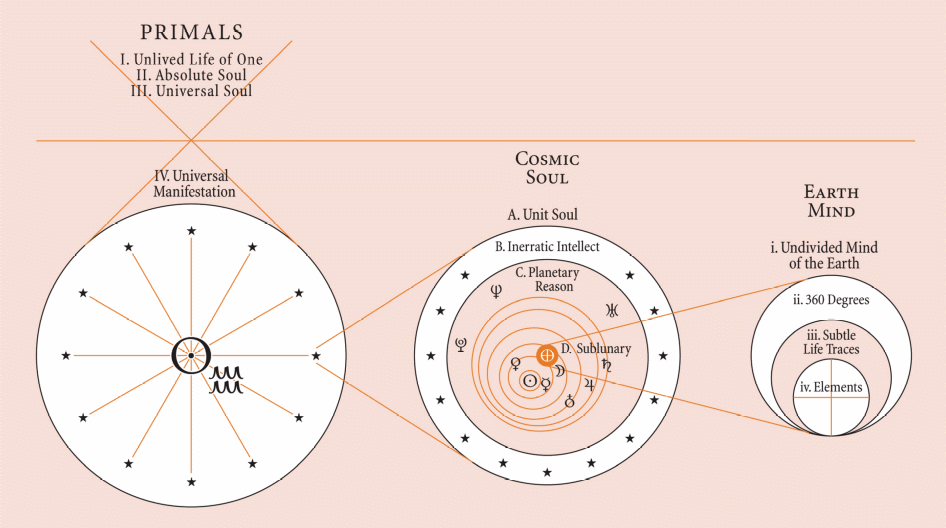
FIGURE 1983 1209a-1. Nested Levels.
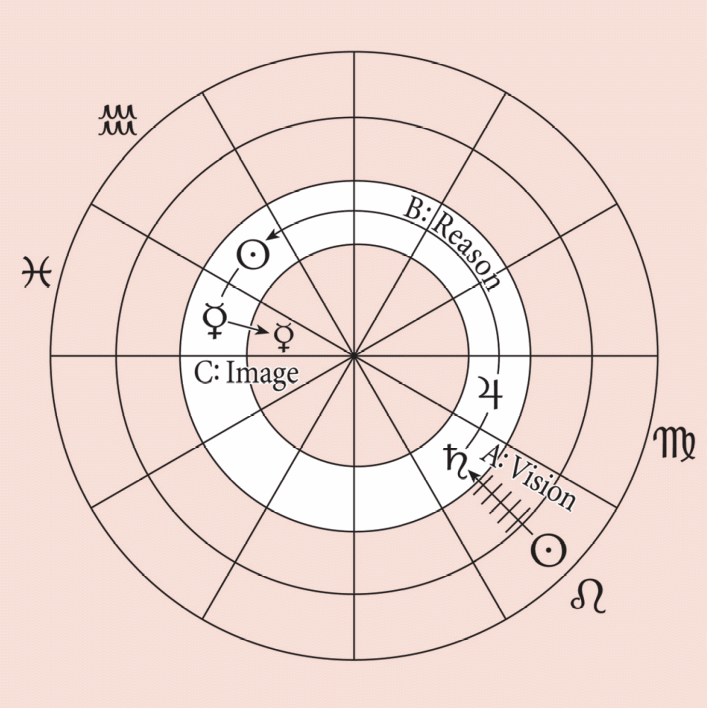
FIGURE 1983 1209a-2. Tripartite Cosmic Soul.
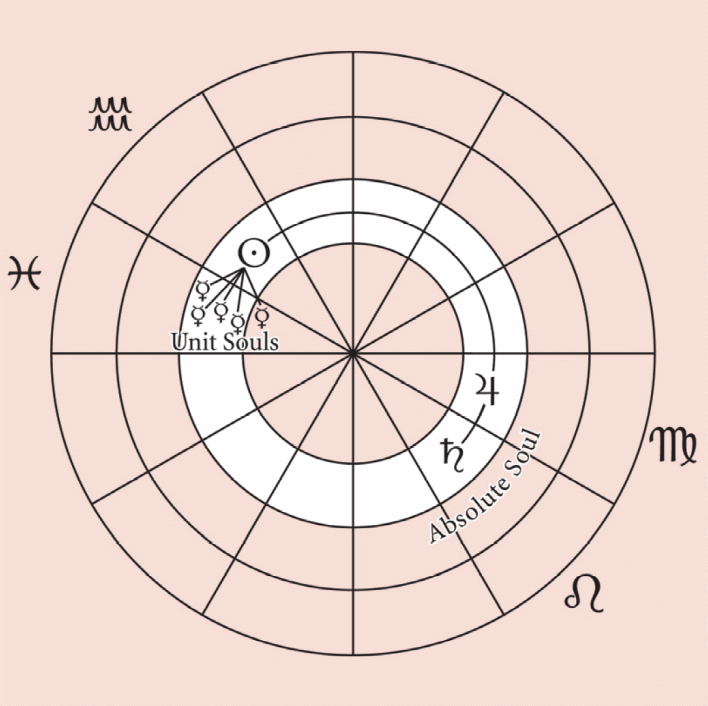
FIGURE 1983 1209a-3. Tripartite Soul in Soul Ring.
These diagrams are from Astronoesis, pp. 250, 202, and 184 respectively. Other diagrams also referred to are not with this transcript. [Transcriber note: [diagram] means the speaker is referencing a diagram as he or she is speaking. If someone is drawing or writing, with audible sounds of chalk on a blackboard, I indicate this by [drawing] or [writing].]
PAPER read in class:
- "Prasangika Madhyamika Analysis of Objects" by Andrew Holmes (AH). Retyped as 1983 1125b V09M. Buddhism - Prasangika Madhyamika.
NOTES:
This is 1983 12/09a, Epistemology; Synthesis Class, and the first entry associated with this date. 1983 12/09b = Epistemology Seminar from earlier in the day, for which we have no audio, just JF notes.
Epistemology discussion related to those of WG Classes 1983 10/28, 11/11, 11/18, 11/25a, 12/1, and 12/19a. See also earlier Mentalism series, WG Classes 1983 1/26, 2/2, 2/9, 2/11, 2/16, 2/25, 3/2, 3/9a (and associated paper 3/9b), 3/16, 3/21, 3/23, 3/30, 4/6b, 4/13a.
Friday night class.
TRANSCRIBED Verbatim by IT prior to 2018; reformatted by jf 2018. This is V12ap (2023) and has: updated prefatory matter, footer, and audio file name; Book List and TOC completed; Plotinus quotes section added; Subject and Subsubjects changed; new notes within transcript; minor errors/typos corrected; three diagrams appended and references within transcript to these diagrams; new formatting to accord with new conventions. In 2025, IT alters beginning note to match new REP audio. Archival verbatim transcript with Paper– V12ap.
AUDIO FILES: 1983 1209a (formerly 1983 1209b), 1983 1209b (formerly 1983 1209a). [Note 1: "Tape" and "Side" refer to original audio cassette tapes that were later digitized into .MP3 Audio Files. Note 2: In 2025, REP Studio cuts dead air from file a and improves it sound quality.]
| NEW FILE NAME | OLD FILE NAME |
| 1983 1209a | 1983 1209b |
| 1983 1209b | 1983 1209a |
1983 12/09a at Wisdom's Goldenrod
Epistemology; Synthesis; Buddhism
[Audio File 1983 1209a (formerly 1983 1209b) Begins]
[Note: Faint background student and AD talking, mostly inaudible; class starts at the 1 minute mark.]
AD: Alright, the familiarity that's called for is with the four schools of Buddhism, the three schools of Vedanta, the Platonists, right, PB's mentalism, Samkhya teachings, the Nyaya Logicians, the Scholastics. Well, we didn't do too much, I never put them through a Scholastic text. They'd hate me.
S: And Orchard Street.
AD: Huh?
S: Orchard Street.
S: See now--
AD: Yeah, the Orchard Street variety, twentieth century contemporary [VM: Right. (VM chuckling)] epistemology. Ok.
[25½ second pause with faint background student talking and AS drawing]
AS: Ok. I just drew-- drew just one-- I have this one diagram and instead of five circles(--) they're all-- they're all in there.
[short pause with faint student talking]
AS/S(?) (possibly part of background): Yes ma'am.
S (possibly part of background): Yeah.
[Note: See FIGURE 1983 1209a-1, Nested Levels, appended to this transcript for the following. This diagram is from Astronoesis, p. 250, and is used as a stand-in to help follow along.]
AS: Read (through/some)-- read some of them. I think that, this afternoon anyway, these three broad levels of distinction seem to be very helpful. So we'll use those as kind of (an 'x'/a hex) instead of the five and the different things, just this broad outline where you have the Overself-- And, as it gets (just like Tim--) this is a good-- maybe a good equation here that's like I feel very helpful, that our Overself is coextensive with the Infinite Mind of the Earth and that's coextensive with the Soul of the Sun [diagram].
And then the second-- this second level here [diagram], where you talk about the contraction or identification of that certain power of the soul which is the power of perception gets concreted out or limited to this Earth and now we could speak of the Witness which is aware of the entire primordial image. And there we speak about perception, a Witness subject, whereas before we speak of just the infinite consciousness of the Overself. And now-- and that [drawing] is coextensive with the 360 degrees that we spoke of as being part of the Earth's mental sphere.
And then at the third step we could imagine that light which is identified with the entirety of that primordial image or-- primordial image is further contracted to an identification with this particular psychosomatic organism [diagram] and takes itself to be that finite personality. And PB spokes-- speaks then of a ray, a fragment of consciousness which maybe you can imagine gets contracted to a point and then through that point flows up again as it were to reproduce the entire universe for itself, but [drawing] through now the subject-object relation being established, the empirical subject with the empirical object.
Ok, and then within this anything that appears, anything, whether it's the object of any-- or the so-called ego subject, you already have the ego and its world. Anything that the guy says he knows is like the guy in the dream saying he knows the tree. It's not-- it's not the dream subject that really knows the tree but it's really this power of perception of this soul or the Witness which is pervading any content, whether it's so-called subject, that is, ego, or so-called object, that is, the world that appears. Whichever end of the stick is emphasized, whatever goes on within there, is known to this witnessing consciousness, but as identified with his ego he says he knows it in here [diagram]. And then of course beyond even that you could speak of this infinite consciousness of the Overself itself, identified with the entirety of the Soul of the Sun and its powers, or the Infinite Mind of the Earth. Maybe-- there's a few-- there's some detail that would be useful.
From this point of view also, maybe one other possible point (of view/to this), I-- I thought this one little place in-- not to get into Plotinus but there was one little passage where he speaks of the soul having a double kind of face. The Intellectual-Principle only has an inner face as it were but the soul has a double face. In the one, it remains its own infinite-- in its own infinite nature, but in the other phase or face, we have this power of understanding; or in the first we speak of just a pure awareness and in the second one he speaks of that second power which is aware of the power of perception, it's aware that it's aware. And that includes [drawing] let's say several levels on down from the level of the Witness down (to/through) any particular sensible content. Ok, so the first one is just aware of itself as con-- kind of Being-Consciousness. And (in) the second aspect, it's aware of various levels of contents, let's say to the entirety of the primal image all the way down or all the way to-- including down to a sensible particular appearance. And he says--
Plotinus [V.3.7, AS reading]: "…even in…[AS adds: even] in this sphere, [too], by virtue of action and production; in its action it still contemplates, and its production produces forms [AS reads: in its production it produces forms]--detached intellections, so to speak--with the result that all its creations are representations of the divine Intellection [and of the] divine Intellect, moulded upon the archetype, of which all are emanations and images, the nearer [AS adds: the] more true, the very latest preserving some faint likeness of the source [AS reads: and even the last of them preserving some kind of a life]."
AS: And he says that in this process it comes to likeness in this sphere.
Plotinus [V.3.7, AS reading]: "…but Soul has the double phase, one inner, intent upon the Intellectual-Principle, the other outside it and facing to the external [AS reads: …even in its other, that the Soul has two faces, the one intent on the Intellectual-Principle, but the other outside and facing the external]; by the one it holds the likeness to its source; [AS adds: but] by the other, even in its unlikeness, it [still] comes to likeness in this sphere."
S: V.3.7?
AS: Yeah. So, that's the-- that's a kind of a broad background for the whole diagram, it's that we have to keep in mind all of the investigations we made into the nature of the I AM or the Overself as an authentic All. (In/And) Plotinus he call it the soul, or he says it's both omnipresent, impartible and prior, and also active or partible or [one/two words inaudible] parti-- partible and having a phase which seems to become divisible or having a phase which we called reproductive soul, which is the phase he just spoke about as coming to a likeness to its divine Parent. Ok?
[Transcriber note: It almost sounds like AS is reading the next few sentences, on and off, possibly from his own notes.] The processes of epistemology and cosmology are rooted together and have their source in the intangible principles which can be known only in the heart, not in the brain. So, the starting point here is the notion of my Overself or unit soul, which is at once a unity and an infinity. And so the authentic essence of soul receives in some mysterious way the emanation of the Nous, which we've called the World-Idea and which Plotinus in several places calls the-- the Reason-Principle of the All. Or PB speaks of the mysterious aura emanating from the Void. [Note: See Paul Brunton, Notebooks, V16, 28:2.79 and Perspectives, Ch. 28, #26.] And this is conjoined to the soul, received by the soul or in some way (is/gets) manifested as a whole to the soul, where he says that the soul is at once omnipresent to the entirety of the World-Idea and yet retains its own essence. Also in the second Parmenides hypothesis where he speaks of the Being and the Unity, that the World-Idea gives some kind of existence to the soul, to this absolute indeterminate essence of soul, and the soul unifies that World-Idea. [Note: See WG Classes 1983 0902b, 0909b, and 0916 for more discussion of this point.] Ok? And that's speaking of the first level, A, where the Overself or the Infinite Mind of the Earth or the Soul of the Sun receives the World-Idea as an entirety, as completely pervasive. [short pause] And, um, I guess, at this level we would split-- speak of, I guess, in terms of the soul, it's-- although we're not aware of it, it's at this level that we would speak of insight, the soul having insight into this aura emanating from the Nous. And this is the only level at which there's not a delimitation of the Overself consciousness. Only a principle emanating from the Nous could possibly tutor the soul. What the soul cannot directly apprehend in contemplation, that is, at this stage of being, it must seek through the circuit. So--
LR: Say that again, what it--
AS (simultaneously): What the s-- what the soul cannot directly apprehend in contemplation, at this stage of its being, it must seek through the circuit, that is, through activity or through--
LR (simultaneously): What-- what does that mean, what it can't comprehend or apprehend by its own contemplation?
AS: I don't know.
S (very faint): Uh-hm.
S: Experience change?
S (very faint): Doubt it.
S: Oh the Intellectual-Principle [few words inaudible]
[short pause]
LR: You mean it wouldn't know (revolution/evolution) of the [one/two words inaudible] [S: I don't know.] in this field?
S (very faint): It has to take it in.
S (faint): Let me see if I get (a lot) with him.
S: I don't know.
[students assent, very faint]
AS: In fact that doesn't, but-- but whatever--
S (simultaneously): [couple/three words inaudible] (go/goes) straight from the (fire).
S: How do you know?
AS (simultaneously): Yeah it is, but I--
VM: [one/two words inaudible] is a mistake.
LR (simultaneously): No I-- I don't think it's wr-- no, don't erase it, I mean-- I just think it's, you know-- on the one-- in the one breath you speak of the absolute [S, very faint: Conjunction.] conjunction of the soul with the light of the Intellectual-Principle there. Its knowledge is (a total/eternal) [one word inaudible] And then in the next moment we say well, what it can't get there it has to in some-- you know, some [one word inaudible] (in/and) some kind of [one word inaudible] I mean-- I mean I think Jeanne's right, there definitely are things like sense-particulars which it's not going to experience there but it just seems a little strange to--
AS: Well, he wants to become self-consciously divine-- aware of his divinity.
S: Yeah.
S (very faint): Yeah.
LR: I know, we've gone over and over it.
AS: You participate in this-- the whole manifestation in order to begu-- in order to come to know itself more precisely or more fully or more determinately.
VM: Can't you even go so far as to say there are certain modes of knowledge or a certain content, speak broadly, that can't be known unless the soul incarnates in a body or goes through the circuit.
AS: Sure.
VM: I mean they're just actually-- maybe this is a heresy but it's perhaps possible even to say there are limitations to the kind of knowledge you can have if the soul remains at A or as the infinite Overself. There's just certain kinds of experiences that can't be obtained there.
PD: So what should we say, that the-- the soul inhabiting a body-- body acquires a limitation and that's the type of experience it's gaining, experience of limitation?
VM: Look, I don't know Paul, I'm [couple words inaudible] (school), I'm just saying--
PD (simultaneously): Yeah, I'm just, you know--
AS(?): Yes.
VM (simultaneously): I would just spec--
PD (simultaneously): I was speculating on your [S simultaneously: Yeah.] speculation Vic!
VM (simultaneously): Oh, that's ignorance on top of ignorance. (VM laughing, bit of laughter) But, just the idea that there are certain experiences that-- or contents, to speak vaguely, loosely, that can't be obtained unless there's the kind of incarnation in this world of intense experience, pain, growing, and so on.
AS: I think it's primarily the power of reason, the understanding phase, that wants to develop here, [VM simultaneously: Ok.] since the contemplation there is sufficient. Now, I think probably you'd have to go back to the very definition of soul and say the Intellectual-Principle is just pure contemplation but the essence of soul is not to be just pure contemplation or remain in itself. It also has this second aspect, that of activity or understanding. And, in the state of motionless contemplation or eternity, it can't exercise its very essence. [VM: Ok.] And since all things are to exercise their essence, the soul would not be able to do that unless [AD simultaneously: What does that really mean?] it actually developed its power of reason.
AD: What does it mean in English Avery?
S: It means [one/two words inaudible]
LR: What he just said?
AD: Yeah.
AS: Sorry.
LR: I thought that was English, I mean--
[students assent]
VM: How about: [AS/S(?) simultaneously: Embodiment?] life requires embodiment.
S (faint): Of course.
AD: Better than that.
S: Uh-hm, yeah.
S (simultaneously): It's embodied [one word inaudible]
AD: Must [AS simultaneously: Embodiment is a side issue.] produce, [LR: Pers--] it must produce. It must produce.
AS: Embodiment is a side issue, it could be embodiment in many levels, but it's that asht of-- that act of understanding or [couple inaudible student words simultaneous with AS] production or activity that's part of its-- its essence. It would not--
LR: The reproductive phase of the soul must produce, is that what you mean?
AD: Yeah. It must produce.
LR: Well let's just then say desire.
AD: No, no, I'm saying it must produce.
S: Ok.
JA: Oh this could be the actual image of Intellectual-Principle (in a sense).
AD (simultaneously): If it's [AS simultaneously: Yeah, could be at that--] to actualize its powers it must produce. Soul always produces, will never stop producing.
LR: Ok. So that's just an ongoing thing that it has to be.
AD (simultaneously): Yeah, yeah. Isn't that-- isn't that so, don't you say of a man, "What did he do?"
LR: Yeah. No, I like that better than saying what it can't apprehend there it must come down here for, I mean that's-- It's not a-- then it's not necessarily a diminution for it to incarnate, it's a-- a fuller-- it's a fuller actualization of what it is.
AD: Actualizes its powers, yes.
[student assents]
AS: And then he says someplace right-- Ok.
S (very faint): I like it.
SC: Avery?
AS: Yeah?
SC: When we say that the soul must produce, are we putting that production down there at the Earth Idea or the-- or would that be the Soul of the Sun [diagram]?
AD: Right here Sam.
S: Hm, yes.
AS (simultaneously): Here is where it must produce.
SC: Don't you have to say--
AS (simultaneously): It's gotta produce there [diagram].
SC: Don't you have to say that the production starts--
AD (simultaneously): What do you do for a living Sam? (bit of laughter)
SC: I'm a quester. (laughter) I go to work every day, I make [AD simultaneously: Yeah.] some dollars. Well what about, what about-- That's very immediate production, I'm familiar with that, but I was thinking of that-- (laughter) of production to ha-- to start up at what he's calling A [diagram]. Because you're s-- you're talking about the Soul of the Sun and that Soul of the Sun has powers and isn't that production there? Isn't that the primary production, that original World-Idea?
AD: But we're not talking about the Soul of the Sun, we're talking about individual soul. As individual soul you must produce, the same way like your Great Father [SC assents] produces, and always produces. And there's no end. You'll never get retired. (bit of laughter)
S (very faint): (Oh my God.)
SC: No, huh? I'm civil service, I [possibly couple words inaudible] (laughter)
HS: You are retired. (laughter, student words)
S: From one who knows.
HS: Right, from one who knows.
S: Right. (S laughs)
AD: There's no Sunday for the Sun.
AS: No (Sun-day). (laughter)
SC: You know what, when you say, when you say for the Sun, doesn't that make the production begin with that entire circle [diagram] as opposed to-- and that (our/now) production--
AD (simultaneously): Well, yeah, but that's an artificial demarcation because there's always greater wholes than the one that you're speaking about.
SC: Greater wholes.
AD: Wholes, w- [AS: W.] h-o-l-e-s.
SC (simultaneously): Yes, I [one/two words inaudible] (laughter, student words)
AD: But why does it astound you? [SC simultaneously: You might get--] Because-- you know, this is the part I have difficulty understanding. Soul must produce.
SC: That doesn't astound-- I mean, it all astounds me but--
AD (simultaneously): Perpetually and forever.
SC: Yeah.
AD: That part, alright, it can't get in-- you know, by contemplating the Nous.
SC: Ok. Now when you talk about the-- that aspect of soul that is contemplating the Nous, is that shown here or is that beyond this chart altogether?
AD: That soul must produce? Oh that'll be shown there.
SC (simultaneously): No, the contemplation of Nous in itself prior to any kind of production at all, is that off this chart, is that not shown here at all?
AD: Well, we could say that(,) if we say that the Overself coincides with the symbolism of the Solar system, alright, and it receives the aura or the World-Idea in an unmanifest form, we-- you can't speak about production there in any way. Alright? There's no production there. [SC simultaneously: Well that's what--] It's receiving. But then, once the Logos is within the soul, alright, then we could speak about, "Well what does the soul do?" alright, and what the soul does is going to be indicated by either being part of the cosmic soul's functioning and administering to the universe or coming down further into the world, alright, producing, so to speak, creatures through which it can manifest itself. [SC: And that sentence--] And then manifesting itself, alright, these ideas are going to be given actualization.
[short pause]
SC: So on the one hand there's a production of the Solar Logos itself, primary production, and then on the other hand there's a production through a particular planet, through a particular-- say through the Earth, that involves finite being.
AD (simultaneously): Through the lower phase it produces, yeah. You could think of it very simply, I think Avery just put it quite briefly and to the point. Soul in the Nous doesn't produce, it contemplates. But soul, so to speak, out or distinct from the Nous, alright, contemplates and produces, and must produce all the time.
AS: Uh-hm, well especially-- I mean that's-- that goes right-- that goes back to its essen-- that it's through its essence or its essential definition.
SC: Yeah. You know, I don't know, maybe I'm thinking improperly. I keep thinking of the point of-- of its contemplation and the point of its production, sort of the-- the line in between the soul as contemplative and the soul as productive and where we s-- where we would see that on this chart. Am I-- Is that just thought of improperly?
AD: Well, I thought he explained that insofar that if you see, alright, from the Nous, the Logos, that's contemplation.
SC: And insofar as it acts on that?
AD (simultaneously): Insofar that it's involved in manifestation, it's production. It's producing.
SC: And that would be the activity of the Solar Logos, insofar as it--
AD (simultaneously): Well, yes, and also of the individual Logos too.
SC: Yeah, and the individual within that.
AD: You know the famous saying of the Vedantist, Atma is Brahman.
[10 second pause]
AS: Um--
SC: So, one-- just one more. So at the point of A there [diagram] where you're talking about the Soul of the Sun, would you say that you see both at that point, you see the emanation of the World-Mind through the Overself, which is the contemplative aspect, and also there's the produc-- the productive, the activity of the Solar Logos which is the beginning of manifestation. At the same point do you see both of those?
AD: Yes. But in this case here of course, if you're speaking about the Solar Logos, the-- the World-Idea is being received from its own higher principle.
[short pause]
SC: Which is the Nous.
AD: No, it's own higher principle [SC simultaneously: It's a little higher.] would be in the Nous. In other words, if we're speaking about the Sun, [SC simultaneously: Yeah.] this particular Sun, we say it has a lower phase, that phase within which manifestation takes place. And we speak about it as the asmita principle. The higher phase, alright, would be in the Nous, the Jupiter-Saturn aspect of our Solar Logos would be in the Nous. [Note: See FIGURE 1983 1209a-2, Tripartite Cosmic Soul, appended to this transcript. This diagram is from Astronoesis, p. 202.] So, the World-Idea is coming to it from its own higher phase. In other words the Sun Soul is a principle of intellectuality in its own right. [short pause] I told you Avery, you can give the same class every week, it won't matter.
AS: He has-- this is a real-- you can look up this one in IV.8.5, it's-- it's very nice, where he says without this act--
Plotinus [IV.8.5, AS reading]: "…by exhibiting those [AS reads: these] activities and productions which, remaining merely potential [in the unembodied], might as well never have been there, if destined never to come into [AS reads: to] actuality…
"The act reveals the power, a power hidden, [and] we might almost say obliterated or non-existent, unless at some moment it became effective: in the world as it is, the richness of the outer stirs us all to the wonder of the inner whose greatness is displayed in acts so splendid."
[short pause]
AS: That's one of those--
AD (simultaneously): Good. Right to the point.
AS: Got the same volume going.
AD: Alright so, I think most of us will accept that, huh? Soul has these two phases, the higher phase and so-called productive phase.
AS: And so on. Now, in order for this productive phase to actually become effective, we need to next think about that infinite awareness which was limit-- which was co-extensive with the entire Infinite Mind of the Earth or the Soul of the Sun as somehow being contracted or secreting out of itself in some way this lower phase, the power of perception, or the reproductive activity of the soul, or the reproductive phase of the soul. This infinite consciousness has to be delimited in some way and also this unmanifest nature of the World-Idea has to be structured or manifested so that there can result eventually a particular space-time experience. Now, once this process of contraction starts, the second function of the soul, not just-- the soul no longer remains as pure Being, but now its second phase or active phase or the power of understanding begins to be actualized. And in order for this to occur, we somehow have to speak again of this contraction of that infinite consciousness to the-- a Witness position, a Witness [one word inaudible] or contracted to the level of the Earth's aura.
LR: So you don't have a place where-- you don't have like a-- Do you have a place before the identification with the Witness where it's identified with the whole spheres?
AS: Yeah.
LR: Is that the--
AS: The I AM. That's-- the whole-- where it's identified with the whole spheres we're calling--
LR: Oh that's-- oh ok.
AS (simultaneously): Here it's identified with the Soul of the Sun or the Infinite Mind of the Earth and there it's the pure I AM [diagram] and we're leaving out-- [drawing] we've left out this-- this Saturn-Jupiter phase [diagram].
LR: Ok.
AS: Remember, because--
LR: I thought-- oh. I thought that was what we said was pure reason, the identification with the spheres. Is that-- is that being altered right now?
AS: I'm sorry.
LR: I thought the rational phase of the soul per se was what we call this identification with the spheres.
AS: Well, I'm kind of calling this entire thing, you could call this whole thing the Mercurial phase of the soul [diagram], [LR assents] a Witness-I or unit soul or a unit Overself. Now, as far what I understood was we said that the I AM itself has two aspects too, an inner contemplative aspect and then an outer activity aspect. Now in its inner aspect it's identical with the inner aspect of the Sun and the Sun Soul, but then outwardly as it were [drawing] it's going to get identified or delimited to just this particular Earth Soul and the activity phase of all these planets and the activity aspect is the Sun and so on.
[short pause]
HS: The "it" you're talking about is the Overself consciousness?
AS: The-- the it we mean is the soul's phase-- the soul's reproductive phase or this power of perception. Because remem-- I think-- or you have to remember that the soul has-- is-- He says at one and the same time it's both undivided and divided and we have to conceive it in this way. So even when it gets delimited to this Witness position, it still remains the Infinite Overself. That phase of it doesn't get destroyed in this process as it were.
HS: Ok, and you've said it's [one word inaudible]
AS: Something emanates from it or gets projected out from it.
HS: This is the beginning of knowledge for a person say, right here?
AS (simultaneously): Yeah, this is the beginning of, I think, of the activity of your mentality, [HS assents] (to/or) the lower kind of knowledge. It's right here you could talk of that split between-- I don't want to use those words maybe but two truths say [couple words inaudible]
HS (simultaneously): Or sheer identification [AS: Yeah.] with his bodhi mind.
AS: Now-- [short pause] Well (I think--)
JfL: Avery, the-- the-- when you said that the soul receives the World-Idea, the Ideas from the Nous, I think I always thought that was from the Jupiter-Saturn and I thought that it was that which propelled it to the manifestation. I thought it was receiving the Idea, the World-Idea, right there where it was concurrent with the cosmic circuit, the powers of the Soul.
AS (simultaneously): Yeah, well why is that different?
JfL: I don't know but--
AS (simultaneously): I would say-- but here-- here it-- [drawing] You imagine this aura of the Nous [diagram]. And you even see an image of that aura of the Nous in the inerratic sphere itself. Each of those star souls itself represents-- or the entirety of those star souls represent that aura or the divine Ideation. But if our Overself is conjoined with the Soul of the Sun, then our Overself is receiving that in-- that unmanifest World-Idea or Intellectual aura, together with the Soul of the Sun.
S: Avery you gotta--
AS: Let this [one/two words inaudible] and then--
S: Right.
VM(?): That's good.
AS: No I mean the-- that question of whether you-- your individual soul receives it from the Sun Soul or whether they both receive it concomitantly in-- Yes, I don't see why you can't say there's a direct link of your soul to the Nous, a direct emanation, aura. And that's the stage, circle 1A [diagram], when you're identified with the whole or concomitant with the whole of the planetary spheres. And then step B [diagram] is that infinite consciousness gets delimited to just the-- an experience of what's going to go on in this Earth plane, ok, in this primal-- whatever is going to go on [drawing] within the three hundred-- within the Earth, within the Dragon.
[students assent, faint]
BS: How did-- how did you handle that--
AS: Huh?
BS: If you don't mind, [AS simultaneously: No.] how did you handle the I AM in its two aspects, one related to the Soul of the Sun which [AS simultaneously: Right.] itself has two aspects? One [AS simultaneously: Yeah.] in the Nous and one as it-- its own Witness? And then the other I AM would be the individual soul within the Solar system let's say, like the Earth, which itself again has two aspects?
AS: Um--
BS: I got-- just got a little confused.
AS: You probably [AD simultaneously: Huh?] couldn't put them all but I'm-- I was only talking--
AD (simultaneously): No, that phase of the soul is directly in the Nous [BS assents] and it stays there and never leaves. It is forever rooted there. [Note: See FIGURE 1983 1209a-3, Tripartite Soul in Soul Ring, appended to this transcript. This diagram is from Astronoesis, p. 184.]
BS: Well that I get, yeah.
AD (simultaneously): There's a phase of the soul or an emanation from it which becomes the individual soul or Overself.
[student assents, faint]
AS: And that's this one [diagram]. Now when he's this--
BS (simultaneously): I was just questioning the reference he made but go on.
AS: But when he-- I mean we-- in one of these others you said every s-- oh yeah, I remember, it was a few months ago. It was something like this. There-- you can speak of an individual soul, of the Sun Soul, of the Universal Soul, but the essence is the same. There's [BS assents] this undivided pure intellectual essence which remains what it is and then there's the other aspect of it which is active here, this emanated soul, this whole phase of the Mercurius [diagram]. Now, within that we're saying that your individual Overself also has these two aspects within that second phase. Now this is the I AM or the individual unit soul or individual Overself. It too is contemplating the World-Idea, this aura emanating from the Nous, and it itself is an emanation of the Nous. But also it's then in its outward aspect, it's active in producing, manifesting, witnessing the manifestation. Now, it can't stay at the level of this contemplation if it's going to exercise its powers and witness the manifestation. So inwardly we could say it's conjoined with the whole Soul of the Sun and outwardly it's active in manifesting the universe, and we could speak of those as two phases of the soul, or two distinct aspects of the I AM, the double knower, any of those quotes, or any of those things that we've spoken about in terms of it's this divine being or the Witness without any content and then it's limited first of all to the entire world-i-- world-image, and then to any levels within that, all the way down to the sense. [S: But--] In facing manifestation [diagram], and here [diagram] it's not facing manifestation, it's just in contemplation.
BS: Ok, so as you have it [one inaudible AS word simultaneous with BS] up there perception only takes place within that lower.
AS (simultaneously): Right here [diagram], yeah. [BS assents] And we're tr-- at this second stage we're trying to talk about the transition from this realm or state of contemplation to the state of exercising understanding or power of perception. Now in order for that to happen, something has to bring that soul which is in pure Being or contemplation and bring it into activity consciousness instead of pure Being consciousness. Now that activity consciousness isn't given to it, in my view. It already has it, I mean it's part of the essence of the soul to be both pure Being or contemplation and reasoning. But something has to evoke it from that state of pure contemplation so that it will witness or experience a world. And, that's the point at which we seem to say that it's the World-Idea which is going to evoke it to do that, although it itself has a tendency to do that on its own. It's always this twofold stream. The soul itself has a tendency towards manifestation, it wants to produce. But it's also the World-Idea which is received that's evoking it to do so. I think, I mean I-- I don't see how you could separate the two of those things.
PD: Do you separate the reasoning power of the soul from the World-Idea?
AS: I'm separating it, yeah, I-- I don't-- maybe I'm wrong in doing that. I don't know if the reasoning power or the reasoning phase, but I think--
AD (simultaneously): Distinguishing, not separating.
AS: Yeah, distinguish. The power of perception, if I were-- have to put it on one side or the other I would say it belongs to the soul. It's the soul's power of reasoning. In fact, it's the soul-- soul's power of reasoning almost more than it's the soul's power of contemplation.
PD: But if the World-Idea is this distillation or composite of reason-principles, then the reasoning of all the individual souls are part and parcel of that integral World-Idea.
AS: I guess I am distinguishing the power of perception or the power or light of reason from the reason-principles.
PD: So then maybe the power of perception has to be distinguished from reason-principles.
AS: That's what I was just doing.
S: Go ahead.
AS: To what?
PD (simultaneously): And then the principle of consciousness could get separated from reason-principles.
AS: Ok, except instead of calling it just a principle of the consciousness, 'cause we-- we meant by consciousness also the whole Overself consciousness, we're saying that the soul has a power of perception, [drawing] and contents of that power of perception as it were are primarily these 360 reason-principles [diagram].
S (very faint): Yeah.
AD: Let's try another way. We're speaking about the consciousness, the universal awareness, the Overself, as a consciousness which is contracted or reduced, the [one word inaudible] or the planetary Mind, alright, or identified with that. And there you find that there's the 360 reason-principles, alright. On the one hand you have the faculty of understanding which the soul had and on the other hand you have the reason-principles which are part and parcel [AS simultaneously: Of the Earth.] of the planetary Mind, alright, and these two conjoined together, the faculty of understanding is going to understand what? The functioning of the planetary Mind's reasoning, and through that it learns how to reason.
S: Anthony--
AS: Or-- or is evoked from itself or actualized its own power of reason.
AD: Alright, yeah.
AS: Um--
S: Avery--
PD: But then that phase of the soul, that understanding phase, always exists within the cosmic spheres. And when it with-- in itself that-- does that understanding belong to it or does it belong to the cosmic spheres?
AS: Yeah. That seems to be the (following) point of view of saying that, if it remains only in itself in contemplation, it's just potential, that power of understanding. But it get actualized. [couple/three words inaudible] actualizes it in conjunction with the planetary spheres or the planetary Mind.
S: Hm.
HS: You're saying the understanding itself could belong to it?
S: Anthony?
S: Uh-hm.
RG: Yeah, you think so?
AD: To the what?
AS: (Well/No) I--
HS (simultaneously): (Well), so that's Paul's question there. [student assents] To-- where does the understanding itself belong or where does the object of the understanding belong?
PD: No, it seems clear that the object of understanding is in-- with regard to the ideas, whether they're the ideas of the Earth's consciousness or whatever frame of reference.
HS: But the understanding itself--
AS (simultaneously): But the point is about the power of the understanding, about the power itself.
PD (simultaneously): That understanding itself that the soul has acquired after a life's experiences.
HS: And are you asking if it belongs to the-- to the Ear-- to the consciousness of the Earth or to the soul itself, is that the question you (ask/asked)?
AS: I don't think that belongs to the Earth. I think that's what the soul takes back with it.
PD: But-- see that's--
AS (simultaneously): It may not take the-- it make not take the content.
PD (simultaneously): But-- see that's-- that seems to be my problem, that we say "take back". Can that understanding get taken anywhere or [AS simultaneously: Yeah.] is it-- does it exist within the whole World-Idea?
AS: Well I-- I think it-- well, go ahead.
S (very faint): Yeah.
PD: And in the same-- in the same vein then the existence of the soul within the World-Idea would be perpetuated also. So as long as there's an understanding there's the existence of the soul within the World-Idea.
AS: What?
LR: Aren't there two memories, Paul, that we spoke of?
AS: Well [one/two words inaudible] memory.
PD (simultaneously): I don't know, I'm asking you, does it--
AS (simultaneously): He says here Paul that--
Plotinus [III.4.6, AS reading]: "Emancipated souls, for the [whole] period of their sojourn [AS reads: journey] above, have transcended the Spirit-nature [AS: and so on] …for they have taken up with them that phase of the Soul's existence in which the desire of earthly life is vested."
S: Uh-hm.
PD: I don't understand, what does that mean in English?
AS: Well, I think he's speaking of this phase of the soul that we're calling the light of understanding or the power of perception or the reproductive aspect, is taken back up into the soul. It's not a part of the Earth, I-- I mean I think that's what it is that the soul actually retains in itself. [PD simultaneously: Well--] And it may go on to higher or other planes of existence that are not in the Earth. I mean when it goes on to another planetary sphere for example, it will have this power of understanding that is developed on the Earth and I don't-- I don't conceive it as staying with the Earth.
PD (simultaneously): Yeah, but it's still existing within the cosmic circuit, now how-- no [AS simultaneously: Well I don't s--] matter what level in that cosmic circuit, the understanding seems to be-- [AS: But--] necessitate an [AS simultaneously: Ok.] involvement in a World-Idea.
AS: But, that does not-- but-- don't forget, I think he would say that there's also a phase of the soul which is continually conjoined with the cosmic circuit.
PD: That's the phase we're speaking about right here.
AS: Right, and that doesn't make that phase-- well see, it's a moot point if something always belongs to the-- if something is always conjoined to the cosmic spheres, the question of whether it belongs to those spheres or the soul-- I would still say it's the soul's power. It's the power-- it-- that very power of the soul that is always conjoined with cosmic activity. But that doesn't make it part of the cosmic activity. But it's separable from it.
PD (simultaneously): But it's somehow subject to the cosmic occurrences.
AS: I would agree. When it's actualized it always is. It never is actualized apart from a cosmos, I think that's what you're saying.
PD: Yeah, I guess that-- yeah.
AS (simultaneously): In other words, when the-- when the soul goes up into the Intellectual Realm he says it doesn't need the power of reasoning anymore, if it's just in pure contemplation. But, as soon as it comes out and it's part of the cosmos again, then it exercises the power of reasoning and conversely it can't exercise that reason unless it's conjoined--
PD: With a given world.
AS: With a world.
AD: The diagram itself I think shows that in a way, you know. If you think of that large circle [diagram] as the Overself consciousness and contract it to the circle around the Earth, alright, where we say there's the 360 degrees or ideas that belong to the Earth. Now that consciousness is identified with those ideas. Now, obviously the Earth's or the planetary's-- the planetary Overmind, which would be these ideas, is going to instruct the soul on how the faculty of understanding should be developed and how it (is/is) developed through the experiences that one goes through. [student assents] Can you s--
(Side 1 of original cassette tape digitized as 1983 1209a (formerly 1983 1209b) Ends; Side 2 Begins)
AD: The-- the point that's being made here is I think you'll see like, PB refers to awareness of awareness. And he says you can get rid of one of those awarenesses and then just remain with pure awareness. The pure awareness would be that larger circle [diagram]. The awareness of awareness would be that circle inside, the smaller circle [diagram], alright, with all the ideas. That's awareness of awareness.
[short pause]
JA: Well, so that-- the pure awareness is [couple/three words inaudible] is still-- still conjoined with the World-Idea it seems.
AD: Honey we're back again. That phase of the soul, alright, which we call the reproductive soul is what's going to identify with that smaller circle [diagram], the Earth's consciousness. [9 second pause] It is that phase of the soul which is going to be educated. [S, very faint: Ok.] When it has completely reached the point of becoming the impersonal consciousness, then it could be reintegrated back into the Overself consciousness…willingly.
LDS: Anthony-- go ahead.
JA: I'm not [LDS: Ok.] quite finished yet. Why don't you finish it off and then--
S: Oh.
JA: Which phase are you speaking of as being the Sun?
[short pause]
AD: The larger circle represents the soul or pure insight.
JA: Not as contemplating the aura.
AD: Same thing.
AS: Yeah.
JA: Same thing.
AS: Con--
AD: Same thing.
JA: And, so then-- you make a distinction then between the first hypothesis and the second hypothesis where you say that the soul has Being or existence once it receives the World-Idea, where are you speaking of that occurring or [couple words inaudible]
S: That's not occurring.
[student assents]
AD: Where is what occurring?
JA: Is soul in itself, when you speak of soul in itself, do you still speak of it as contemplating, (and/I mean) is it the same thing?
S (very faint): Yeah.
S (very faint): Uh-hm.
S: Really?
AS: Yeah.
AD: Soul in itself and what?
JA: Well, when you did the Eight Hypotheses you spoke of-- said the first hypothesis was soul in itself, the second hypothesis soul receives the World-Idea, you know, (and I'm confused now). Well it sounds like you've just sort of conjoined it with this larger circle and I don't, you know-- that-- that may be quite appropriate but if--
AD: Well, it's the same as when we say that the Overself's consciousness can be identified with the Solar Logos. The same thing. You say the Overself's consciousness, and then we say it's identified with the Solar Logos, we're saying that now it has Being. And only-- only Being can inform or instruct or guide the soul to its ultimate development. [12 second pause] But this-- What we're trying to do here is simply review what we have said. I didn't mean it to be a question and answer session. I wanted to get on with the epistemologies that we're doing. So if you let Avery just continue and review the background that you're supposed to know, alright, so that we could do the various epistemologies.
[student assents, faint]
[short pause]
AS: Well, I mean, so-- Ok so, in-- in order for-- well, however way you want to put it, the soul-- infinite consciousness is contracted to the-- to this Earth mental, to this Mind of the Earth. And I think maybe contraction is good, first it's like, you know, here [diagram] and then it's contracted to an identification here [diagram] and now the phase that's going to operate is not the contemplative phase but the understanding phase or the power of perception. And we brought in this school of Yogacara which seems to speak of these five functions of manas that describe that, the way that that infinite vijnana or infinite consciousness is delimited. And there they spoke of the-- you remember, the activity consciousness which awakens the Overself or pure Being into this activity aspect; the evolving consciousness which brings the Overself consciousness or that lower phase of it into a state of evolving a ray or a Witness; and a representation consciousness which allows the Witness to represent the entire primordial image; and particularizing consciousness which could discriminate the real from the image; and a succession consciousness which allows this witnessing phase or power of perception to retain the essences of expe-- of its experience, or memory or higher memory. And it seems that all of these are necessary in order for that Witness to function. And at the same time-- Well let's see.
So, the pure insight of the Overself can remain what it is but at the same time the soul's power of perception is limited to the activi-- no, soul is limited to this activity of the Witness wherein it will develop its power of reason, so on. Now, each Overself is delimited or its second phase is delimited to a locus or contracted to that locus to which it naturally tends. So it's-- it's not an arbitrary contraction to this Earth and then further to this particular body but it's in accordance with the own-- with the nature of the soul's own reproductive phase. So, [TS simultaneously: Wait--] the con-- Yeah.
TS: Well, you'll (roll) it all out, it's alright.
AS: Yeah, yeah.
S (very faint): Uh-hm.
TS: Well go on.
S: Go on.
AS: So, the con-- the-- yeah, the contents of the Witness-I as conjoined with this Earth Mind can be spoken of as the 360 degrees or reason-principles. And these-- when we talked about the two different-- possibly different categories, the limitation, those five which the Yogacaras spoke of as contracting the subjective or Witness consciousness and the twelve, possibly twelve categories of Kant with some others that speak of the organization of that primordial image, that is, the way that the 360 degrees in the Earth Mind are going to be organized in order to portray this unmanifest World-Idea, or the way that they're going to be organized within the Earth Mind to-- or combine to form that primordial image, which is the content of that Witness at this level, it knows say the entirety of that primordial image.
KD(?): The primordial image again--
AS: The prime-- we could speak of the primordial image as that entire image or content of the Earth Mind. The Witness-I conjoined with that knows that entire content. Now as we were speaking of it before, this afternoon, we could speak of that-- it's not a fixed content, it's a continually being energized by this Infinite Mind of the Earth or the Soul of the Sun. It's a continual-- in fact if you look at the continual transiting of these planets, [drawing] these 360 degrees are continually being reorganized and the Witness knows that organization at that level, at the level of reason-principle. Its knowledge is at that level, the level of the 360 reason-principles or ideas.
KD: [few words inaudible] before, I mean, primordial image, [AS simultaneously: Yeah.] if it sounds so static, [AS: No, no, I know.] the bu-- if the knowledge that it has is in continual (flux), yeah.
AS (simultaneously): I'm saying it's a (continuum).
VM: Primordial [one word inaudible]
AS: I thought you meant one as opposed to everybody having their own, that's-- Let's say at this point you could speak of all the Witness-I's as identified with the entire Earth primordial image. Each will be delimited (but/both) with psychosomatic organism. [couple/three words inaudible]
VM (simultaneously): [three/few words inaudible] Kantian categories are concerned with the contraction of the primal image to the world we experience or are concerned with the contraction of the World-Idea to the primal image, or maybe both.
AS: Yeah.
VM: Or neither.
AS: I think they're concerned-- (bit of laughter, student words) they're-- I think they're concerned with the [drawing] organization--
S: Come on now.
AS: Or neither.
BS: Been hanging around with Anne?
VM (simultaneously): I-- I'm (hanging/banging) around for the stupid Buddhists so that don't [one word inaudible]
AS (simultaneously): The latest ones are the-- (some laughter, student words) that those belong to the Earth Mind, that they're what actually organizes these 360 degrees to formulate that image. In other words the Earth-- Earth entity itself is going to produce or manifest an image of that unmanifested World-Idea.
VM: Ok so it's the contraction from the-- essentially the aura of the Nous into the primordial image. That's what those twelve are for, you know what I'm saying? And it's the functioning of the world's-- not the world, the Earth Soul?
AS: Yeah, I understood it as the functioning of the Earth Soul. [short pause] That's very mysterious though. I mean somehow-- somehow those reason-principles are organized to portray that unmanifest World-Idea. I mean almost in an analogous process as that infinite Overself consciousness is delimited to this Earth sphere, that infinite World-Idea [VM assents] is also manifested, energizes somehow all the images within the Earth atmosphere or all of those reason-principles to portray itself. It's like there maybe science has to come in and tell us how that pure force-field or energy gets transformed into some kind of a manifested state of some sort, you know, a continual-- continual precipitation of a manifested state out of just pure energy forces. But I think that's the level at which they would speak of that. Ok, and that's-- that-- at that level that the Witness is conjoined. And I guess we would also speak of that primordial image as choicelessness. If you could remain at that level there would be no priority this-- as it were, you know, you wouldn't-- you wouldn't favor one thing over another. Your body too would be just one content, would be part of the whole content without any pr-- no preferences as it were. And that pi-- you know we'd have to find some way of-- somebody who has that (some laughter) and ask him [PD simultaneously: That's going to be a little rough.] to describe-- to describe the experience of no preference in functioning yet.
S: But Avery--
VM: Gandaharva Sutra.
AS: Gandharva S--
VM: Gandhukaharva Purana?
AS (simultaneously): Yeah the Gan-- Gandahar-- you--
S (simultaneously): Gandavyuha Sutra. [Note: See Essays in Zen Buddhism (Third Series) by D.T. Suzuki, Rider and Company, London, 1953. See also D.T. Suzuki, The Gandavyuha Sutra.]
[few inaudible student words]
VM (simultaneously): That seemed to discuss that primal image point of view.
AS (simultaneously): Yeah, and there's one in-- there's one in here too but I-- it's in V.8 on Intellectual Beauty. I think. Well-- No. Well, yeah, that's a higher--
AD (simultaneously): I would imagine that that's the point of view where Chuang-Tzu speaks about the mind as a spectator of all time and existence.
S: Only one song.
AS: Oh there. Speculum of all creation.
AD: Uh-hm, the mirror (in/of) the mind.
AS: And that's-- Plotinus uses that ima-- that metaphor too, ok, when he says that side by side with Intellection-- if the mirror is unbroken-- maybe that's an appropriate quote where he says if the mirror remains unbroken then side by side with the primal knowledge of the activity of Intellectual-Principle we have also as it were a sense-perception of their operation. [Note: See Plotinus, I.4.10, third para.]
AD: In other words, on the one hand if you're that Witness or that impersonal consciousness, you grasp the intelligibles that are in the larger circles [diagram], and on the other hand insofar that the Witness-I conjoined to your planetary Overmind is fabricating the world-image from instant-to-instant, alright, it could-- it could witness that sensible world.
AS: So, you're s-- we-- you seem to be saying that if you're situated here [diagram] on the one hand you can look up to the Intellection, [AD simultaneously: Uh-hm.] have Intellection, and at the same time if this mirror of the imagination is clear and peaceful, the image of that would be represented within it without distorting the contemplative vision and both can be kind of simultaneous.
AD: Yeah, and they speak about that mind as a mirror.
S (very faint): That's right.
AS: But that's what he said--
LR: Would those two be con-- would those two be part-- those two visions be harmonious?
AD: Harmonious? Yeah, yeah.
LR (simultaneously): In other words, would one understand then how what the Earth Mind was producing was in total harmony with-- with the entire (thing)?
AD: Sure, yeah.
PD: So that would be insight, or--
AD: I think so. But-- [short pause] No, no, insight-- that would be the highest phases of the mind in the sense that we speak about the bodhi mind. Not the-- not the pure awareness but the awareness of awareness.
PD: Uh-huh.
[short pause]
LR: If this--
AS: He says here that "The thought object is…" Uh--
Plotinus [I.4.10, AS reading]: "…[AS adds: just] as an image might be reflected in the smooth and shining and untroubled surface of a mirror; [AS: he says]…so in the case of the Soul; when there is peace in that within us which is capable of reflecting the images [AS reads: image] [of the Rational and Intellectual-Principles] these [AS reads: then the] images appear. …
"When, on the contrary, the mirror within is shattered through some disturbance of the harmony of the body, [AS adds: then the] Reason and [the] Intellectual-Principle act unpictured…"
[student(s) assenting, faint]
CDA: When-- when you say that the-- I'm not-- I'm not grasping this-- The Witness can look up and grasp the intelligibles. At-- when it's a clear-- as a clear mirror, what is it-- [AS drawing] I didn't grasp what it is that it is having knowledge of. The World-Idea as its being re-formulated by the Earth Mind? [students assent] And this re-formulation by the Earth Mind is in-- is those degrees being activated by the transiting planets, [AD simultaneously, faint: Yeah, uh-hm.] by the motion of the spheres?
AD: Uh-hm.
AS: Uh-hm.
CDA: Ok.
AS: And that's what [CDA simultaneously: Now--] we grasp at that level.
CDA: Now, would an individual Witness-- an individual Witness-I at that level be grasping the-- the entirety or would it be specified at that level as-- as an individual or-- or you saying that it's aware of the transformations within the Earth Mind as the Earth Mind is-- is a whole?
AD (simultaneously): You're not-- you're not asking me, you're telling. Go ahead.
CDA (simultaneously): No I'm asking.
AD: Oh it sounded like you were telling.
CDA: No, I'm asking is-- is this--
AD (simultaneously): Yes, to that impersonal consciousness, the constant and uninterrupted re-formulation of the world-image is its object. Again try to remember the way we spoke of it.
CDA: What-- what are you trying to say? What--
AD: Don't try to have an objective relation with the Witness-I.
CDA: No, but I'm just-- no, I'm asking about the content of the knowledge here, is it--
AD (simultaneously): Well-- alright so--
CDA: Is it--
AD: If a person has this or is this impersonal consciousness, this choiceless awareness, the images that are-- we say is the world-image being constantly formulated moment-by-moment, is the object of its perception. And this is where I s-- I said we can bring in that quote, that he is now a spectator of all time and all existence.
CDA: Ok, I see.
AD: Uh-hm.
CDA: So-- so it-- so will you say--
AD: Now remember, the mirror doesn't have to be shattered. It's just enough that the mirror gets disturbed. So that, let's say that there is agitation in the empirical subject, then it has a rippling effect, alright, then that image is gone. You have to remember, we're speaking of a person who's reached a level of evolution or spiritual subjectivity where the functioning of the psychosomatic organism is always under control. It doesn't disturb this Witness-I.
[student assents, very faint]
CDA: So if this-- being the-- it's actually the Witness of the Earth Mind's World-Idea at each instant, it's actually knowing that.
[short pause]
AD: Now, remember the further difficulty, we came down and we said now, when this Witness-I, which we all know most intimately, immediately…and if you bring in any reflection it's gone. And we-- we use the example. You have a dream. You appear in the dream and you look at a table which is square. That means it has four 90-degree angles in it. Now who in the dream KNOWS that? Does the dream subject know it? Answer me.
S: Me (now) [one/two words inaudible]
AD (simultaneously): No? Who knows it? You know it, right? Now, here and now the way we are, who is the knower?
S: Now? I hope it's the Witness.
AD: Yeah. That's--
S (simultaneously): But I don't really know.
AD: You can't know it objectively! If you try to make it an objective understanding or relationship, you've already defeated yourself. As soon as you say "Well, it's that"I" outside of the subject-object relation," now you got another object. Soon as you do that it's gone. You can't relate to it that way. So here you are, you're always the knower, and of course you're denying that you're responsible for your activity, alright, "I didn't do it."
S: Right.
S: Huh, that-- the argument's famous. (S laughing a bit)
AD: Yeah, we had that argument for ten years too. "I didn't do it. It wasn't my fault." [student assents] Are you getting the picture? So that this is a kind of pseudo-subject. When you speak about the empirical subject, you're-- you're speaking about the way Plotinus said, an adorned cadaver. [Note: Reference here is possibly II.4.5, "a dead thing decorated", in reference to Matter, or V.1.2, "dead is viler than dung".]
VM: Oh. (bit of laughter)
[few seconds of faint background student talking]
AD: You don't like that?
S: Yeah I like it.
S: I love it.
[couple seconds of faint background student talking]
S: You see a cadaver for [one/two words inaudible] (bit of laughter)
S: Yeah.
AD: Well it's just a cadaver but insofar that this cadaver knows something, that's the adorning that's taking place, the soul is investing it with knowledge.
S: I thought maybe adorned (with/was) mostly powers [couple words inaudible] to itself, whether [few words inaudible]
AD: Well, yes, you could say that, sure, it adorns itself, yeah, just like a woman puts on makeup and tries to look pretty, so this cadaver goes around saying, "See, I know. (AD hitting something) I know it," and pointing to the bodily subjectivity saying, "That's me." Now it would be very hard for anyone in his correct mind to say that the chemical elements could feel, will, and know. But we do have people like that. (bit of laughter)
S (very faint): (Who says that?)
S (faint): There's lots of them.
AD: Who said that? I read a beautiful quote by a professor of philosophy. Susanne Langer. [Note: See Susanne K. Langer, Philosophy in a New Key: A Study in the Symbolism of Reason, Rite, and Art, Harvard University Press, Cambridge, MA, 2009, originally published 1942, p. 40.]
S (very faint): Why a beautiful quote?
[laughter, few seconds of background student talking]
AS: She's just a generic--
AD: There's plenty of them [one/two words inaudible]
AS (simultaneously): --a generic materialist.
AD: Plenty of them.
AS: There are the generic Sages, she's a generic materialist, she stands for all of them. (AS laughs a bit)
AD: Alright, that's the kind of background we have to have in order-- or framework we have to have or that let's say we're getting from Plotinus which will help us I think place any epistemology in its proper context. Because, over here like he pointed out, cosmology and epistemology are not dis-- they're not separate things, you can't have one without the other. You can't have an epistemology without cosmology, it's meaningless. I don't know what you're talking about. So these things are-- these two things are always together. This is the kind of vision that Plotinus and I think the Platonists were working with. Now, what we're saying is that (we/we'll) take any school of philosophy and we could insert it into that framework, and even, you know, schools like the Nyaya Logician or the Vaibhashikas would fit within that framework, you could see their partial point of view. [sounds like student assenting, faint] And we were going to try that. Now, some of the things-- we did a little bit, we just went over roughly the three schools of Vedanta. Did he do that and Platonist?
AS: Not very recently.
AD: Not very recently? (some laughter)
AS: Yeah. So, we did let's see, the Plat--
S: The Buddhist divisions.
AS (simultaneously): We did a little bit of the-- the one view of the Vedanta and the Platonist view. At the tail end of this, we missed at the very last tail end where this is contracted to the bodily identification at a point and then blows out again to produce this empirical experience with the subject and object. And that's where PB's process of going-- we did describe PB's process where from that point in the heart, that subtle imagination [AD simultaneously: Uh-hm.] went out to-- expanded to reproduce the entire world and subject-object arose. Insofar as one end of that is the apparent subject and the other end is the apparent object, but all of it is immediate perception to that Witness. That was the point you were making, [AD: Right.] that the so-called subjective, empirical subjective end, or the objective world outside is all an immediately-- immediate experience to the non-objectified Witness-consciousness.
AD: Now I-- I don't think it's possible for-- but we could try discussing this for a few minutes. You know when we're working with the chart and trying to understand the chart and we take the planets in the natal chart, we take the planets at a certain degree, and then we see the opposite degree, like the outward manifestation of that internal subjectivity or that internal functioning, and what we want to point out here is that that is the realm within which we speak of epistemology. In other words, it's there that we speak about a threefold relationship, the subject, the object, and the relationship between them. But now notice the peculiar thing. There is a subject, the planet sitting on a degree, functioning, and there is its outward manifestation. But in order to bring in the relationship, you've got to-- you got to surreptitiously pull in that Witness consciousness to connect these two. Pull it out and you only have two ends of the stick. You don't have a triple relationship. You follow that?
S: No [one/two words inaudible]
AD: Go over it then.
AH: What do you mean bring in, bring in as a speculative or conceptual object or bring it in in order to have experience?
S: Right.
AD: You have to bring in the knower. There's-- there's someone over there hitting the A on a piano, [AH: Yes.] 440 frequency. Here is my ear that interprets that as the tone A. These two things, alright, are distinguishable in our understanding. But there's no knowing there. Where is the knowing coming from? Who is it that knows this relationship?
S: The Witness. (bit of laughter)
PD: But wait, when you say that you dis-- you-- you're aware of a tone A, haven't you brought in the knower then right there? And to the extent that you've-- make a definitive [S: Assertion.] experience you--
AD (simultaneously): But of course consciousness is presupposed, I'm not denying that. I'm reasoning this way to show you that in these-- in the-- in the-- in these two-- [short pause] in this example where we have a frequency and the interpretation of that frequency which requires an organ, the ear, alright, that we're not speaking of a knower. We're speaking of a stick with two ends. There are no two things here, it's one thing.
S: Right.
[student assents, faint]
LR: You're saying the Witness is responsible for the bifurcation in some way?
PD: But it's only through consciousness--
LR (simultaneously): Is that what (his point)?
LDS: No, just the opposite Linda.
PD (simultaneously): --somehow since taking [one/two inaudible AS words simultaneous with PD] up a stance within ideation that experience becomes possible.
AD: I'm sorry Paul, try again.
PD: Alway-- it's somehow always through consciousness taking up a stance within ideation does experience become possible, that by taking a stance on a specific idea, then experience precipitates.
S: That's good.
AS: Yeah, just like, until it identifies or chooses to identify with or gets appropriated by one end of that stick as it were, you can't have the apparent relationship between subject and object.
S: Yeah.
AD: Let's go back to the example of the dream, alright. Now, there's dream Paul and there's the dream table, alright, all part of the presentation. The dream table is square, that means it has a definition, four 90-degree angles, etc, certain-- alright, and there's dream Paul. Now, that's the presentation, that's the picture. Pull out, subtract from that your consciousness.
S: Yeah.
[13½ second pause with faint background student talking]
HS: Now the way you speak there, you're saying that's the pa-- that's the-- that's the presupposition of existence for any entity? And therefore it's the presupposition--
AD (simultaneously): Well, the way I'm speaking [AS simultaneously: (No/For now).] now is, [LDS: No.] you know like a picture language like the early people used to use, [student assents] they draw pictures?
S: Video.
HS: Yeah, yeah, yeah.
AD: That's the way I'm speaking now.
LR: So if in meditation you succeed and are identifying with the knower, the world runs away.
AD (simultaneously): If in meditation you succeed in subtracting your attention from object and subject, alright, then you must take the position of that Witness-consciousness or that impersonal knower.
HS: So-- now using-- using picture language here, you're saying that this is the way-- this is the human condition, right, this is the human condition and like an epistemology will come along and say object is out there, subject here inside the body. For that-- even for that position to have-- for there to be knowledge, the presupposition is it's the Witness. Is that-- is that the point you made?
S: It's always the Overself. It's always the--
[short pause]
LDS: But, [AS simultaneously: Well I--] I thought Anthony raised the issue, in some epistemologies, which [S: Yeah.] I think Herbie just mentioned, the realist epistemology of-- where there's a real sp-- an experience of split between subject and object, it's very important as to how you bring in the Witness to account for knowledge. Like, it's very difficult to resolve the epistemological problem if you start with an acceptance of duality, as it seems the Vedantists have. You know like they s-- they give you this thing about that there's a-- a real subject and a real object. There's a real split between the subject and the object. And that knowledge reveals, it doesn't create or construct anything.
S: [one/two words inaudible]
AS: I-- I don't s-- that doesn't seem to be the Vedanta view, or maybe not all the Vedantists see-- I mean their view is that the perception is the immediate-- immediate presence of that Witness, whatever is in(--/.)
LDS: No but don't they usually give you the rap that knowledge is not creative? Knowledge is a revealing of what's there. And they'll start right out-- Methods of Knowledge is what I mean. [Note: Swami Satprakashananda, Methods of Knowledge, Perceptual, Non-perceptual, and Transcendental according to Advaita Vedanta.]
AS: Depends on the school.
LDS: Well, the book Methods of Knowledge he gives a presentation.
AS: I think I follow. You seem to be saying, the question seems to be between, [S: Here we go.] the-- the Witness doesn't create-- the question is, does the Witness create that split or it just illuminates whatever is there and if it happens that the ego and the contents make that split then that's the way the thing will be experienced.
JA: What do you mean if it happens that the ego (split--)
AS: The ego-- it always-- the--
S: The ego wants that.
AS: Yeah, ego and the world are always split and then if they're--
LR (simultaneously, very faint): That's precisely all he's saying.
[student assents, faint]
LR: That's what Avery's saying.
LDS: No, if you s-- if you give a validity to the split, if you say-- which I think some of them do, that there's a real split between subject and object, there's an ac-- you know, my psychosomatic organism does not create the object that I know, there's a-- there's a reciprocal kind of relationship between us.
AS: But how can there be real split between two things which are in fact contents of that which is (contemplating them)?
LDS (simultaneously): I'm saying there's isn't. I agree with what you just said but I don't think the Vedantists do that.
LD: Yeah but, [S: No.] I think from the point of view of the Witness consciousness they say there's not an actual split, only from the point of view of the psychosomatic or the antahkarana, the mind, would there be that split, [VM assents] and that's [AS simultaneously: Yeah, like the guy's experience.] taken as a fact of experience.
VM: That's right, they start from there and they only say when the object is being-- the consciousness underlying the object and the consciousness underlying the subject fuse or what is the word that is used, you know, they're one and [student assents] united somehow, [student assents] you know, the pipeline theory--
LDS: But [couple inaudible student words simultaneous with LDS] where I'm taking off from was [AS simultaneously: Yeah.] Anthony's comment that there-- there seems to be a surreptitious bringing in of the Witness in some ways.
S: Oh.
AS: I think it's not-- it seems-- well maybe-- I see just what you're saying. It seems you're saying it's not--
PD (simultaneously): That, Lou, reconstruction occurs [AS simultaneously: The--] to try to bring the two ends back together [AS simultaneously: Yeah. It's not--] again and you have a whole evolution of recon-- of attempting [AS simultaneously: Yeah.] to conjoin the elements in experience.
LDS: Yeah. Like the Vedantists just say it's a Witness, [student assents] you know.
AS (simultaneously): Well, it's like they're-- you're say-- You have to bring the Witness [AS misspeaks: is], the fallacious thing is bringing it in as a third term.
LDS: Exactly. That's what I'm trying to say here.
AS (simultaneously): That's the problem. [couple inaudible student words simultaneous with AS] It's not that you shouldn't bring it in, it has to be there. The problem is you bring it in ad hoc, because once you're in the situation of a-- an empirical subject and object you bring in the third term as if it were on the same level of those other two and you say "Oh, there are three terms."
LDS: Yeah.
AS: But actually you do need to bring it in but not as an ad hoc thing but as the very presupposition for the knowing at all.
LDS: Exactly.
AS: And that seems to be where-- or what's different.
LR (simultaneously): But you know, the interesting thing is the way that he stated it this time which was like the reverse, coming in from the reverse direction almost, [S, faint: Say it again.] where he said that there aren't two things, subject and object, until-- [student assents] when the Witness identifies with a particular idea only then are the conditions set up for manifestation to occur in a subject-object kind of way.
AS (simultaneously): Yeah, but-- but why is that different from saying there in the analogy--
LR: It's not different, I just thought [AS simultaneously: That--] he was bringing in like a different slant, almost [AS simultaneously: Yeah. Which was?] to say that-- And I-- [LDS(?), faint: I think I--] I think I just lost it.
LDS: Are you saying Linda that he's starting with cognition as a kind of seamless situation, and within that seamless situation you can-- you can list or point out the components, like the subject, the object, and all of the principles and the elements within cognition, but the cognition itself encircles or unites all of those elements that you're going to count now within it. [short pause] In other words, rather than starting from dualism and trying to account for how you know, you start with the-- you start with the presupposition that knowledge or cognition itself is seamless.
AS: I think Linda [LDS simultaneously: Would--] was saying that because there won't be a split of subject-object until that Witness identifies itself or limits itself to the body, or in a dream there won't be a dream subject-object until the dreamer's mind identifies with the dream subject, in that sense, in that peculiar sense you could say the Witness is-- the Witness' attention or focus causes or is responsible for that apparent subject-object relation.
S (faint): Ok.
JA: Well that-- that may be that the peculiar way of talking. It's almost saying is there's no--
AS: Isn't that what's-- isn't that something like what we were getting yesterday?
JA (simultaneously): There's no [few words inaudible] an ego.
LR (simultaneously): I'm starting to--
S: What she's saying here.
S (possibly same S as above, faint): Yeah, what?
LR (simultaneously): I'm s-- I think I'm starting to appreciate what PB meant when he said the Witness is a temporary-- what did he say Tim, at--
KD: Expedient.
RG: Intermediary.
S (simultaneously): Expedient.
LR (simultaneously): Expedient [one/two words inaudible]
S (simultaneously): That's right, expedient.
LR: Yeah, it's like it's not--
[few seconds of faint background student talking]
AD: It's not the ultimate.
LR: It's not the-- it has-- in order to say it is something it has to have a tenuous connection to a body. [student assents] It's like it's not embodied but it's not not embodied either. It stands in a very peculiar place and exactly what position-- well, I'm sorry, [AS simultaneously: (No I--)] I really can't articulate what [one/two words inaudible]
JA (simultaneously): Well, the [AS simultaneously: I don't (know).] very word 'Witness' implies that though (even), you know [couple/three words inaudible]
AD (simultaneously): Yeah you're catching-- you're catching on to the idea now. You can see where all the conflicts in epistemology come from.
S: But in Vedanta, as I understand it, all epistemology is a form of maya.
AD: I'm sorry?
S (simultaneously): Yeah but--
S: Within Vedanta, all of ma-- [S simultaneously: Epistemology.] all epistemology is a [student assents] form of maya, alright. They would say there's only Witness and what the Witness is witnessing, alright, is you'd say three stages, Witness witnessing itself--
S: Right.
S: Alright? And maya, (Witness/witness--) witnessing maya.
PD: Which maya?
S (simultaneously): Then all the separate [couple inaudible AS words simultaneous with S] [one word inaudible] which is all these bodies, all of these infinite [student assents] interconnections.
PD: So what's that mean to you?
S: Ok, in what context, I'm--
PD: What's maya mean to you?
S: It means everything.
PD: So therefore it means nothing.
S: Well no, no, that's not true, I mean now we're just playing with words.
PD: Well that's my point.
S (simultaneously): It seems in every single [one/two words inaudible] (some laughter) the Vedantists mean there's a state beyond every single thing conceivable. Alright?
PD: I'll agree with that, I'll agree.
S (simultaneously): That-- and he says, when he's talking about knowledge, which is what it seems like we're talking about here, (since/says) everything we're discussing as knowledge is what he means as un-knowledge, ignorance. [student assents] And the only mistake beyond all that we know and love, alright, [PD simultaneously: No (couple words inaudible) bigger problem than that.] [one/two words inaudible] itself without distinction.
AS (simultaneously): No but-- but you know, [S simultaneously: It's knowledge.] but then they want to bring-- but they do try and say--
S (simultaneously): And explain everything.
AS: They try [S simultaneously: Explain what?] and explain how that witnessing or that awareness is related to their whole process of a mind going out, taking a certain determinate [S simultaneously: I see.] form. So, I don't--
PD (simultaneously): Four levels to the mind, four levels to the antahkarana. So it's a little more complicated than consciousness and maya.
S: No, I'm agreeing with you, it's just when you-- when you start talking about duality, immediately I would say they take the duality right back to Absolute Godhead and say, as soon, alright, as this awareness has a seam in a way, it's like a seam or ripple, you know, that's exactly what they're talking about, a first movement, a spanda, as soon as that happened, duality had begun. That spanda you might say is the first body.
PD: Yeah you--
S: Your first pimple I would say, "Ah!"
PD (simultaneously): Don't say-- don't say a beginning to duality.
S (simultaneously): Something here as opposed to all of me.
PD: Don't say a beginning to duality, there's no beginning.
S: Again it's a playing with words, [PD simultaneously: No, no, I'm very serious, there's no beginning.] they would say yes, beginning at every moment right now this very same thing is occurring, but all I'm trying to say in relation to your original thing 'cause you were discussing duality, right?
PD: We're trying to understand knowledge.
S (simultaneously): But from the Vedantic point of view, they're all series of dualities, [student assents] alright, all knowledge that you know we're talking about as knowledge is a series of dualities, a series of subtle bodies getting larger and larger and larger.
LDS (simultaneously): But the point is Eric, they've got a-- they're trying to account for the knowledge situation that you and I-- the dualistic experience you have.
S: Right.
LDS: And we're asking, do they really account for and resolve the epistemological dilemma?
S: They say only at this exact last moment, or the first, simultaneous, call it what you like, at the last moment you disappear and it's resolved. (AS laughs)
LDS: Yeah well--
LR: Then we have [few words inaudible]
S (simultaneously): We're looking for an explanation [couple/three words inaudible]
S (simultaneously): I know but that's-- But I'm trying to say that's when-- you talk about Vedanta in a very strange--
PD (simultaneously): To a Vedantist you don't have to disappear.
S (simultaneously): --in a very strange way, I don't think it fits the category [AS simultaneously: Well--] you're discussing.
AS: Well, you know, regardless or not, there's somebody here made a remark about, you know, they'll say that the object-- there are three s-- three or-- [LDS simultaneously: Yeah there are views.] three schools of Vedanta and they all say very-- I-- I mean after we've studied, right Richard, I mean after we've studied them a bit they-- they don't all say the same thing. And not all Vedantists will agree with, you know, what i-- and even maya is one of the most debated things among all Vedantists. Is maya pure illus-- it's quite different in all the schools what maya is.
S: I-- yeah but I think it's fair--
AD (simultaneously): You see, instead of talking about-- instead of talking about maya, we're trying to understand what it is.
S: Oh I understand.
AD: Ok, there-- there's a little difference in this approach because the term maya is always brought in-- usually brought in to cover up the deficiencies in necessary cosmological background that is necessary in order for us to understand these problems. Now, I-- I'm trying to see if I, you know, made us aware of the fact that there is this greater consciousness, this greater awareness, which is what we're referring to as the Witness-I, and also that within the-- and which let's say is the recipient of the world-image. And within that world-image, the image which is given to that Witness-consciousness, it then conjoins or becomes immanent in a body which is part of that primal image and then associates and identifies with that body and now refers itself or refers to itself as an empirical subject. So, what we're doing here is bringing in the complexities of the epistemological problem, alright, and not worry about ultimate solutions right now. If we could-- if we could illuminate, highlight, underline these complexities, we'll understand better what epistemology involves. And that's what-- that's the way I wanted to work out the problem even if there is no ultimate solution. But if we bring in all the factors that are involved without the use of terms that are, you know, [one word inaudible] I think we'll benefit much more. Like, if I ask you if you know a certain thing and you say yes, and now I say "Well, now you say that you know it. Who is this"you" that you are referring to? Is it my kidneys, is it my lungs? Is it the blood system, is it the brain? Who is it that knows this?"
S: Yeah, I-- and by the way I wasn't disagreeing with anything.
AD (simultaneously): For instance-- Yeah. No, we're just-- again, [S simultaneously: Someone was bringing up the idea of the subject and object (few words inaudible)] like I'm trying to say Eric, I'm just trying to-- I'm just trying to highlight the problem. If I was a neurophysiologist I'll come over with an electrode and touch one of the cells in your brain, alright, and you know an image. Who knows the image?
S: That definitely is Witness.
AD: Hm?
S: Certainly not the brain.
AD (simultaneously): I'm-- I'm ir-- I mean to me it's irrelevant that the image is an exact reproduction of something that happened. The question [VM simultaneously: It's not.] still is, which is the one that the neurophysiologist doesn't want to accept, who knows that image? I'm not-- I'm not arguing about the image. I'm asking who is the knower. And again I think you'll be forced to fall back on this notion that there is a-- a principle of awareness which is immanent in the psychosomatic organism and which could claim this kind of double identity. "I am this body. No, I'm more than this," alright. So if-- if this complexity of the situation is grasped, then when we go on to discuss the various schools, we'd be able to see, well, the analysis is being made from the point of view that the subject is the psychosomatic organism or the empirical subject. Or, the analysis is being made that the subject is the Witness-I or some combination of both, alright. So, that's what we're really working our way into. [student assents, faint] At any rate. If--
S (simultaneously): Um, so--
AD: Yeah? If we wanted to proceed now with the Madhyamika school, alright, the Madhyamikas claim that in their analysis of experience, alright-- Well maybe it's better that you say it.
RG(?): Yeah.
S: Yeah Andrew.
AS: It's you up there now. (bit of laughter, student words)
AD: You tell us what the Madhyamikas are saying and we'll try to locate where their analysis is coming from, [couple inaudible student words simultaneous with AD] what they are analyzing--
S: Yeah.
AH: How would you like to do it? What I-- what I thought might be feasible was to go through this introduction again because there's a lot of people that haven't heard the thing.
AD: You know, if we keep reading the introduction we'll be at it for another two thousand years. (some laughter)
AH: How would you like-- how would you like to do it?
AD: You got a resume?
AH: I can provide one by-- (bit of laughter, students words)
AD: Oooh. Now it's your turn to be scolded.
S: Oh.
[Audio File 1983 1209a (formerly 1983 1209b) Ends]
[Audio File 1983 1209b (formerly 1983 1209a) Begins]
S: The two truths.
AH: Yes.
S: Read [one word inaudible] the whole thing, read it.
AH (simultaneously): I would feel comfortable-- I would feel comfortable with [couple inaudible AS words simultaneous with AH] doing it-- I'd like to read the introduction. Then I'd like to define the terms 'dependent arising' and 'emptiness' by way of a very brief summary.
AD: Ok.
AH: And then I'd like to read a good part of the third section (with Avery).
AD: Oh-- alright, go ahead.
AH: Tim-- I don't know how I could present it, I mean, in words. Ok well, we're talking about-- we're going to-- from a point of view of what has been referred to as Madhyamika, and within that the Prasangika, which is a branch of it. So, it's specific. And in this school an epist-- (uh/a)--
[Transcriber note: The following is a paper written by AH and possibly one or two other students. It has also been retyped as 1983 1125b V09M. Buddhism - Prasangika Madhyamika. I do not have access to it so transcription needs to be checked. I transcribe it verbatim as read, including any changes made during re-reading. This paper is also read in WG Class 1983 1125a.]
AH ["Prasangika Madhyamika Analysis of Objects," AH reading]: "[Prasangika] presents an epistemology from a perspective of all that can be said to exist in appearance originates in relations. Various elements of their analysis are established on a phenomenological level and the objective as well as the subjective are given same evidence. This is to dispense with judgments about existence and non-existence, being and not-being. This method of analysis negates a causal nexus between the element in (the/a) relationship except conventional level of appearance. This school emphasizes clearly one of the central issues in Buddhist philosophy: that is, the need to conceive of the path of self-development without prejudging the nature of the self. It is necessary to conceive of the path by analyzing all possible conceptual formulations about the goal. In this system, all conceptual formulations of the self are prejudgments of that self and can only obscure the possibility of actually obtaining insight of it. This they contend is to submit to the error of reducing reality to a concept and in so doing strengthen the already powerful force that presents appearing phenomena as having reality or inherent self-standing existence."
AH: And I think this is really the crux of their-- their view.
AH ["Prasangika Madhyamika Analysis of Objects," AH reading]: "It is at this powerful inborn force that the Prasangika analysis is aimed. In their view, even at the level of direct cognition is the false element to be found. For (there) presented image of self and other is permeated with a false element of inherent existence. [The] system attempts to first identify that fundamental level of direct cognition and then to force the reasoning to act on the error at the level of animal faith, thereby entering the secret cave of the Dragon. If reason can infer a false element there and by way of an incontrovertible direct cognition correct it there, Prasangika speaks of that which is ultimately not found as some thing or other, beyond the reach of the intellect, and is existentially present as the absolute indivisibility of the two truths.
"This epistemology, the familiar Buddhist terms of dependent arising, emptiness, and the two truths are defined and presented in a way that allows for the above-mentioned goal. Each of the four Buddhist schools in the Tibetan tradition define these terms in connection with their respective epistemological formula and each school has a different formulation. This paper will attempt to show how Prasangika uses these three terms in its own unique way. It is especially significant that for Prasangika these three terms are interpenetrative and in many ways changeable. This harmony of use and meaning of the terms dependent arising, emptiness, and two truths clearly reflects the relational aspect of their formulation. It is from this perspective of interpenetrative use of the terms that the Prasangika view can be grasped by way of being compared and contrasted to the other Buddhist schools' use of the same term. The other schools will use these three terms in ways that will allow various causal and productive relationships among the terms, and [one word inaudible] usage clearly establish the ontic presuppositions for their epistemologies.
"Although Prasangika rejects the various ontic realities that human thought is capable of positing, they do not devalue thought in the ways that other systems sometimes do. From a certain point of view, which might be described as existentially spiritual, this view pays thought a high compliment. Prasangika advocates a method whereby thought is not only considered capable of correcting itself but is also able in a certain way to work beyond itself at the fundamental level of its own instinctive presupposition. It may seem upon first encounter this view presents a peculiar enigma and that thought is at once exalted and at the same time stripped of its ontic premise. This view can appear as radical and may even be considered heretical and irreverent if you can believe that thought is only exalted to the extent that it is able to posit ontic realities and mystical truth. Prasangika seems to be addressing a more subtle issue. Perhaps it can be stated as follows. It is not to the question of whether or not there are realities that their analysis is aimed, but rather to the issue of the inborn false element in appearance. It is this false element that deprives thought of the insight needed to make true and certain judgments concerning those realities."
AH: So, (to/they) take the three terms, dependent arising, emptiness, and two truths and see how they're going to define them. Their notion of dependent arising-- [short pause] the logic of it goes something like this. Let's say you look at a tree. Now that tree seems to have an independent self-standing nature. It seems to exist in its own right. Now, if you analyze the tree's relationship to-- to the rest of the world, the rest of the objective world, you're able to see the tree is interrelated or connected to other things. You say it's dependent upon the soil, it's dependent upon the sunlight, etc, etc. Now some of the Buddhist schools will construe dependent arising in that way. They're not interested in that. They're interested in showing a dependence at another level. So their analysis proceeds until they get-- get one to admit that the tree is somehow involved in the mental atmosphere of someone who knows it. Now if you get that far with it and you say that the tree is actually in some way dependent upon thought, then you can follow their conclusions of dependent arising. And, it-- the known tree must be considered as involved with the mental factors of the knower. The tree presents an appearance that does-- the appearance doesn't seem to depend on anything but itself. But, they're going to argue that they're not interested in the appearance. They're interested in discovering the-- an objective mode of existence for the tree, if there is one. And, they go through all sorts of analysis to show there isn't an objective mode. And you force the conclusion that thought is somehow involved, depriving the tree of its objective status.
[9¾ second pause]
AH ["Prasangika Madhyamika Analysis of Objects," AH reading]: "What is at issue here [AH: And we're discussing their notion of dependent arising."What is at issue here] is the fact the tree appears to exist inherently or through its own power as if it did not depend upon imputation of thought. And what is unfindable is this mode of existence. [AH: The mode of existence as if it didn't depend upon thought, that's what you can't find.] The analysis serves as a means of discrimination between existence and inherent existence."
AH: Is that clear?
[short pause]
CDA: No, I didn't-- I-- [S simultaneously: I didn't get the last thing.] I couldn't really-- You're going a little too fast for me.
AH: See-- well if you ask specific questions--
CDA: No, if you would just go over that, I didn't-- I didn't follow last part.
AD: Repeat [AH simultaneously: (Ok/Alright).] what you said, yeah.
S: Yeah.
AH: Vic why don't you try. (VM laughs a bit)
VM: Yeah. I always find this part of the Madhyamika to be strangely like Yogacara. And in the early-- and in the early Madhyamika they don't stress this relationship on the mind. And so I can certainly follow what you're doing but in my own personal thinking you want to say-- You know if you read the purported philosopher Nagarjuna, and (some laughter) Chandrakirti or Candrakirti, depending on which pronunciation you like, they never make this stress on the mind, this must be the peculiarly Prasangika contribution or one of their contributions. That's the point you're stuck on right now I'm saying, right?
S: Uh-hm.
AH (simultaneously): Yes, yes. They're-- the only thing you have to accept, in order to follow the rest of their argument, is that the tree is (archetypal).
VM: Yeah. Well, you know, Andrew is trying to say something like this, if I can-- let's see if I can do it. You say the tree is an objective entity, it's dependent upon all sorts of other things in the environment. The ecologists are very fond of pointing this out, you know, you don't want to look at a tree as an isolated entity, part of a whole large system of relationships and so on, that's relatively easy to see, alright. The next step-- right, right, this is the one I-- as I say it doesn't appear in earlier literature on Madhyamika, is where you then take a stance that the tree that you're discussing is in relationship to some kind of mental functioning. Would you say that?
AH: The tree is always a known tree.
[student assents]
VM (simultaneously): Yeah well, that's where it sounds like mentalism but I think that's--
AH: Well it is, of course [S simultaneously: It is.] in a way, of course, clearly.
HS: Of course what is mentalism?
S: The--
AH: The-- the fact that a tree [HS: Yeah.] depends upon a knower of the tree.
HS: That's mentalism in the sense of--
AH: In the sense that there's not a-- a physical inherently existent objective tree which stands apart from one who knows it.
S: Alright.
AH: Or at least if there is, you're really not able to find it if you analytically look for it.
PD: Maybe if we can use the analogy of what we're speaking of before. You take this 360 ideas. And now any given idea that comes up into consciousness, once you investigate that idea, it's going to involve all-- the rest of the 359 ideas, sooner or later, at one point or another. It's a complete interweaving of ideas with ideas. It's-- the meaning of that one idea standing in relationship to the total meaning-context of the mind.
AH/S(?): Ok.
AH: Now, let's say that you have difficulty accepting or concluding that the tree is dependent on thought. You say well, then you should-- you should look for an objective base of the tree apart from thought. And they give you all these rigorous ways of analyzing to see that there isn't one. And, you could say--
AH ["Prasangika Madhyamika Analysis of Objects," AH reading]: "Once it is accepted that the tree exists but it is not findable as inherently existent, then it can be decided that it doesn't exist by way of its own power but that the tree exists in dependence upon other factors."
PD: So a degree and its opposite exist together or it doesn't exist at all.
AH ["Prasangika Madhyamika Analysis of Objects," AH reading]: "If it is established that the tree is dependent, that is doesn't exist under its own power, and once it is under the influence of other factors it depends on those factors, then it is by reason of the tree being dependent that it is shown to be empty of existing under its own power."
AH: Ok? And this is the quote from the Dalai Lama, and this is unique to the Prasangika view where they equate emptiness with dependent arising. And he (says/said)--
AH ["Prasangika Madhyamika Analysis of Objects," AH reading, quoting H.H. 14th Dalai Lama]: ""Thus, when it is by way of the very reason of dependent arising of the tree that one is establishing or proving the emptiness of inherent existence of tree, it is impossible for the understanding of appearance and the understanding of emptiness to become separated."" [Note: See Kindness, Clarity, and Insight (p. 151) by the 14th Dalai Lama, His Holiness Tenzin Gyatso, Snow Lion Publications, Ithaca, NY, 1984.]
AH: And that's what-- that's where-- that's what they want you to have as a-- a starting point.
PD: You know in another tradition they might say that to see the ideas as precipitating themselves in-- into and as your experience, and to see your experience itself a reflection of ideas is-- is to catch the meaning.
AH: Ok. So I think at this point--
S: So like saying it's you-- that's it's not a [couple words inaudible] [S: No.] (except) in terms of the way we use words. Is that where it's like a-- I mean it's not that-- that there's no existence but this idea of inherent existence or some kind of separateness, [AH simultaneously: Exactly, exactly.] it just seems what it's about and that [one/two words inaudible]
AH: That's-- that's what's being--
S: You keep going till we find a problem [student assents] (S laughing) [couple/three words inaudible] [AH simultaneously: But--] with that. (bit of laughter)
AH: Let me [AD simultaneously: Well--] read-- let me read the quote-- let me read the quote once more and see if we--
AD: Let me try this way Andrew, ok? [AH assents, faint] Now I just want to elaborate what Paul started. You make an analysis of the eternally-- of the external objective world, alright, and you come to the realization of the interrelationship of all things to one another. Alright, let's say that that is the outward manifestation of a subjective function, within the chart, we're staying within the chart. Now, you apply the analysis not to the external objective given world but to the internal world of thought, and you apply the analysis there. And again, you can't have an inherently existing tree because the idea of a tree, for instance, in the concept, depends upon all other con-- concepts. In other words what we're saying is that in order to come up with a notion of an inherently existing idea of a tree, you have to relate it to or re-integrate it back into the whole organization or system of concepts that you're working with. So, in the internal realm you can't find it. [AH assents] If you combine the two of them, now, you combine the analysis that you made to the external objective world and then you-- you take the analysis that you made of the internal subjective world, alright, now if you cannot find it in either, you're not going to find it when you combine the both.
AH: Right.
AD: Now tell me, where is this analysis-- where-- what are the premises, or where is he standing when he makes this analysis, the Prasangika? In other words, is he analyzing from the point of view of the empirical subject? Is he analyzing from the point of view of the Witness-I? Is he analyzing from a point of view of awareness, pure and simple? Where is this analysis, where is he poised when he makes this analysis?
VM: It'd be that the-- in that middle realm, the Witness-I.
AD: The Witness-I--
VM: Yeah because if you're stuck in the empirical, then I-- I don't see how you could ever take this pure relativistic kind of point of view.
[student assents, faint]
AD: Then if he is-- if he is poised in that impersonal consciousness, what is he analyzing? Or let me put it this way. [short pause] If you're poised in the impersonal con-- consciousness, what is the object of perception?
VM: I would say the primal image now.
AD: Now, what did we say about the primal image?
VM: Well we said a lot about the primal image, I'm not sure what you want.
AD (simultaneously): Well, among the things we said was that there's an interrelationship [VM simultaneously: Oh sure.] of all the parts with one another, [VM simultaneously: All was interrelated.] there's no shadows, everything is in the form of light. [students assent, very faint] Yeah and, you know, we've-- so that where they're coming from, where are they coming from?
VM: Well, it always seemed to me like the Madhyamika is coming from this notion of the primal image, that's why I found that essay you suggested by Suzuki on the-- on that unpronounceable Sutra so revealing the way he seems to give you a-- an intuitive feeling within that realm.
AD (simultaneously): Let me ask you now, let me ask you now. Is this epistemology or metaphysics?
VM: Well see, that was Paul's point last weekend, this is a metaphysical position, and I only understood metaphysics as being prior to ontology, so it's hard for me just [one/two words inaudible]
AD (simultaneously): Well no, the same, the same. I'm using them the same, alright.
VM: Using which the same?
AD (simultaneously): Again, again, what does epistemology mean?
VM: How you get to know objects and the--
AD (simultaneously): How we get to know [VM assents] something, alright.
VM: Well this is more cosmology then if you're doing it that way.
AD: Yeah. So their point of-- this is not an epistemological analysis, this is not an analysis of how I know.
VM: No, this is disabusing you from ideas about what you know. Let's-- let's put it that way. It's removing a notion of inherent self-existence in phenomenal objects. So it doesn't tell you how you know anything but it tries to remove some i-- some false ideas you have about what you know, so, I don't [couple words inaudible]
AD (simultaneously): So if you remove, if you remove all these internal ideas that you have, let's say that you've acquired through genetic composition or heredity or, you know, environment. [VM assents] Let's say that it was possible that we could subtract all these ways of thinking about a situation, alright. If we subtract that, what have we got left?
HS: (You're/We're) back to the perception again.
AD: We're back to-- you're back to the Witness-I.
S (simultaneously): Perception (where/the way) the Witness is.
S: What?
[student assents]
AD (simultaneously): You're speaking about the way a Witness-I, an impersonal consciousness, perceives. But what it perceives is the primal image.
[student assents, very faint]
VM: What you're saying is to remove all that you call--
AD: So that what you're left with is a sheer phenomenology. There is no analysis of the knowledge situation.
[short pause with faint background student talking]
S (possibly part of background): What?
AH: Because the knowledge situation is seen or understood as having to analyze itself and-- via error.
[short pause with faint background student talking]
JL: Maybe not so much error as within itself.
AH: Within itself. You set up a dualistic situation and posit a third term that relates the two and--
JL: Yeah but isn't-- isn't that s-- isn't that so though of their own critique? If the tree is known within the mind and there's no independent tree from the mind, they're actually telling you that, you know, it's their own-- it's a seamless whole.
AH: Yeah.
JL: I mean there is a positive-- there is a positive aspect to it but it's-- but it's not-- it's not explicit.
S: No but what [one/two words inaudible]
PD (simultaneously): If we go back to before, like the consciousness (get/getting) involved in the idea bifurcates itself. That moment of consciousness getting involved in the ideas is like where the Yogacara's attempting to deal with. That consciousness then precipitates a determinate situation. And so you have a phenomenal object precipitating out of the continuum of ideas.
DB: Excuse me but the-- I'm a little bit lost here because I thought that we were talking about the resolution of the contents of the productive imagination back to the primal image, which was the perspective that the Madhyamika was having. And-- and-- Now Paul just said that, with regard to the Yogacara, that-- I-- I understood that the bifurcation was the relationship of-- that took place within the productive imagination, that the Yogacara was taking a position there, you know, if you-- if you have a split, the subject and object, 'cause I don't know what kind of split--
PD: I think I was off the point here though David.
DB: Oh ok.
S: Let's assume right there's the Yogacara approach.
ME: When we say-- when you say that this is not analy-- analysis of the knowledge situation, are you using "knowledge situation" as the transmission of the World-Idea to the Overself? Is that what you're calling knowledge situation?
S: How you know a tree.
ME (simultaneously): Right? What?
S: I think, I think [S: But--] [ME simultaneously: You think--] [couple words inaudible] [student assents] very, you know, personally.
S: Right.
ME: No, you're saying--
LR (simultaneously): Then you're calling the triple relation "I see a tree".
ME (simultaneously): You're saying-- you're saying [couple/three words inaudible]
VM: How do you know the tone A if somebody strikes it on a piano?
ME: And why-- and why is a different analysis of the knowledge situation [few words inaudible]
VM (simultaneously): Because I don't think they'd give you any support.
LDS (simultaneously): Because they explode both terms of the knowledge situation.
AH: Yeah but-- but [S simultaneously: What?] later in the paper we get into that. I don't know--
LR: You see, you--
S: I mean, [AH simultaneously: See--] you know we're-- we're leaving something out here, that are saying in essence all of this, because each thing is dependent on something else is finally invalid. And they even say it's a gigantic system, you know, like no thing has any solidity, any real reality as something that can be isolated, like a phenomenon in and of itself. [students assent] But everything is a great shifting matrix, you know, there's another version-- this idea, he finally turns in and just-- and who perceives it as a shifting matrix? The idea behind all of these [three words inaudible] nothing but see that it's just one giant gestalt, you know. Behind that is perception itself, void, and that it is itself reality.
PD (simultaneously): But that system of relations, that system of relationships Eric is very organized and [one/two words inaudible]
S (simultaneously): Yeah but what I'm-- what I-- what I-- I'm trying to make one point (here though), behind all these systems [couple/few words inaudible] each one of these systems using these term(s) is trying to pull itself apart until finally-- I mean I-- if you don't-- we're not talking about Buddhism unless you're talking about method. The method to an [one/two words inaudible]
PD (simultaneously): That-- that system of relationships is subject to the laws of karma.
S (simultaneously): Right, I mean, without exception they're trying to say the investigation of individual phenomena is a waste of time. Without exception.
PD: No, each phenomena is subject to the laws of karma within Buddhism.
S: But I'm saying finally karma is a great shifting maze and there is no beginning [couple words inaudible]
PD (simultaneously): No, that's the law of the maze.
S: And the point is to get out and see it as one whole.
PD: That's the law of the phenomena, karma. And if you don't [S simultaneously: Oh I agree, I agree.] grasp that, you don't grasp Buddhism.
AD: Well--
S (simultaneously): I agree but that's, I mean you-- every one of the philosophers [few words inaudible] at least from Kant--
AD (simultaneously): Well Eric, Eric, what you're saying now-- Eric, you're saying that this entire gestalt, alright, is an object of perception [S simultaneously: Yeah.] to who?
S: And he says finally there is no "who".
LR: The Witness.
S: It's [one/two words inaudible] Witness, but it's Witness in its most gigantic fashion that [few words inaudible]
AD (simultaneously): Well, how about that, how [S simultaneously: There's no "who".] about impersonal consciousness?
S: They say finally that it isn't, they say it is part of dependent origination.
AD: What is part of dependent origination, the impersonal consciousness?
S: I thought you said personal consciousness.
AD: I'm sorry?
LR: Impersonal.
S (simultaneously): I'm sorry, I thought-- I thought you said personal consciousness.
LR (simultaneously): No, impersonal.
AD: Impersonal consciousness is the subject to which this whole phenomenological gestalt [S: Right.] is available.
S: Right.
AD: Now, the point I'm making is this here. Is this an epistemology or is this an ontology that is being announced?
S: An ontology.
AD: They have a view, alright, they have a view in the sense that everything is reducible to this primal image, alright, or we can call it the relativity of all appearances.
S (simultaneously): Yeah [one/two words inaudible] uh-hm.
S: Well--
AD: Does that agree with what you understand?
AH: Yes. See, it's awfully difficult-- [S simultaneously: Yeah.] it's awfully difficult to take one of these isolated comments and not plug it into their whole logic, you know. I think we can get to this point, where we followed the impact of this quote from the Dalai Lama, we could proceed if we thought--
AD: Well, read the quote again.
AH ["Prasangika Madhyamika Analysis of Objects," AH reading, quoting H.H. 14th Dalai Lama]: """Thus, when it is by way of the very reason of dependent arising that one is establishing or proving this emptiness of inherent existence, it is impossible for the understanding of appearance and the understanding of emptiness to become separated.""
AH: [couple words inaudible]
AD (simultaneously): It is possible--
AH ["Prasangika Madhyamika Analysis of Objects," AH reading, quoting H.H. 14th Dalai Lama]: ""…it is impossible for the understanding of appearance and the understanding of emptiness to be separated.""
AH: And the two terms for them, uniquely to them, are equatable. I--
AD (simultaneously): Now, in turn-- in our terminology, could we say that this would be equivalent, the way I've been speaking and Avery, you know, the way we've been trying to-- would we say that this is what we're referring to as that consciousness of the Overself contracted to the point of the Witness and the ideas of the planetary Mind?
S (faint): No.
AH: I--
AD (simultaneously): Just repeat again what you just read. Just repeat that again.
AH ["Prasangika Madhyamika Analysis of Objects," AH reading, quoting H.H. 14th Dalai Lama]: ""Thus, when it is by way of the very reason of dependent arising that one is establishing or proving this emptiness of inherent existence, it is impossible for the understanding of appearance and the understanding of emptiness to become separated.""
AD: Is it possible to separate the Witness consciousness, alright, from its contents, the ideas?
LDS: I think that's giving him a lot. (bit of laughter)
S: [couple words inaudible]
AH (simultaneously): I don't care.
S: Yeah.
LR: No, that's a vision there [AH simultaneously: Anthony--] he's describing.
AD: Look, all I'm trying to do is take it out of the language that they write in, the clichés that have been hammered in-- by 1500 years of their history, alright, and put it in words that are different so that maybe we can understand a little differently, get another angle by which to look at [student assents] what they're saying.
AH: Anthony, [S: Uh-hm.] I would [LDS simultaneously: But--] certainly agree with what you're saying and I would also point out that they're going to eventually in this logic, they're going to connect these two terms to the two truths, which are ultimate and conventional. And I would say that's just precisely what Avery was talking about earlier tonight, the two phases of soul.
AD: Go ahead, go ahead.
AH (simultaneously): So, the face that looks on itself and the face that look(s) toward manifestation, in my understanding, precisely the same description.
S (very faint): Yeah.
S: Except that [couple words inaudible]
AD (simultaneously): Well, I would interpret it a little different.
S: Uh-hm.
AH: Yes.
AD: That phase of awareness, alright-- Read the quote from the Dalai Lama again first, I'm-- I'm hanging onto this and I'm trying to re-- reword it.
AH: Ok. "Thus when it is by…"
AH ["Prasangika Madhyamika Analysis of Objects," AH reading, quoting H.H. 14th Dalai Lama]: ""Thus when it is by way of the very reason of dependent arising that one is establishing or proving this emptiness of inherent existence…""
S: (Yeah, tree.)
AD (simultaneously): Now, if we translated that, how would you do it?
VM: I tried at a lower level than you did Anthony, I-- maybe it'd just be more according to Louie's thoughts, I don't know but, I would say if you start down here in the world of experiences, right down here in the lowest level, the circ-- the innermost circle [diagram], you'd look at the subject, if you look at the object, or if you like you can look at the opposite degree or the s-- the degree the planet's on and the degree of [AD simultaneously: Uh-hm.] the-- its outward manifestation, and you see they're always intimately interrelated, you never can isolate one, look at just one degree in isolation from [AD simultaneously: Yeah.] either one opposite [AD simultaneously: Ok.] and so on. So you establish the lack of inherent existence and self-standing, self-subsistent nature of any [AD simultaneously: Any (one/two words inaudible)] object, whether it's in the inner realm or the outer realm, it doesn't matter.
AD: Go ahead.
VM: Once you've done that, you establish this notion of dependent arising. Then from there you proceed to appreciate and it's synonymous with the notion that all entities are inherently empty, empty as they use it, [student assents] empty of self-standing being if you like. And once one achieves that level of-- as an understanding, you are really standing in that primal image where all the various elements interpenetrate, they all have(--) sort of choiceless awareness which you speak of, this realm of light and so on. I'm just coming I guess from the bottom up [AD simultaneously: Yeah.] and you're taking the top down.
AD: But are you standing in the primal image or are you looking at the primal image?
VM: I'm sorry Anthony, I couldn't hear you, I got coughed out. (some laughter)
AD: Are you standing in the primal image or are you looking at the primal image?
VM: Well, I don't know exactly how you mean it. If you want me to look at the primal image and sort of try and make that yet another object, I think that would be an inappropriate understanding of this primal image.
AD (simultaneously): Yeah we-- we'll make allowances for that so that we could talk, you know.
VM: Ok.
AH: They're looking at it.
VM: So I guess I missed your point then. Give me the question.
AH (simultaneously): They're looking at the primal image.
AD: Yeah, they're looking at the primal image.
LDS: Aren't they calling the primal image empty?
AH: See, they're calling everything empty.
LDS (simultaneously): They're calling it empty.
AD (simultaneously): But [S simultaneously: Right.] look, look. What is the primal image constituted of?
DB: Definitely the capacities of the soul.
LDS: I know what you-- I--
DB (simultaneously): I mean I think there would be ideas.
S (simultaneously): [few words inaudible] yes.
AD: The interrelationship of all the ideas to one another.
[student assents]
LDS: That's a very [AH simultaneously: That's right.] positive way of speaking and I agree, but I don't think that's what they're saying.
AH: Of course that's what they're saying, (that's what I say).
S (simultaneously): But isn't that what they mean by dependent arising?
AH (simultaneously): They're saying dependent arising equals emptiness and emptiness is an ultimate truth. And, from their point of view, the mind that Yogacara posits as ultimately real, they're going to call that empty too. (LDS laughs a bit)
[student assents, faint]
AH: See--
AS (simultaneously): I mean that, I [AH simultaneously: Sorry.] don't know if they're trying--
AD (simultaneously): Go ahead Avery.
AS: That's what that-- I-- may-- you couldn't change my [couple words inaudible] One is by way of very reason of dependent arising. You say dependent arising is the interpenetration of-- the [one word inaudible] organization of those ideas. When that's the way that you prove the emptiness of inherent existence of an object, [student assents] then, if you take that stand, you can no longer separate the appearance [HS: With the emptiness.] from emptiness, which is what you normally do now. But as soon as you understand that this appearance is empty, is not-- is not a completely independent self-existent thing but is really the interpenetration of reason-principles, you-- then you must understand at the same time that you're taking the point of view of emptiness, [VM: That's a point of--] of the--
AH (simultaneously): I had put three terms on the board to describe the subtlety that-- [writing] They have appearance. They have existence. They say things do exist as varieties of dependent arising.
AS: Yeah, in other words they exist as certain combinations of reason-principles.
VM: No but wait though.
AH (simultaneously): No, that's how they exist. They appear otherwise.
VM: That's just--
AS (simultaneously): They appear to be self-- Right, they [VM simultaneously: Yes.] appear [AD simultaneously: Your--] to be-- this appears to be a self-standing book or whatever it is, but upon analysis you can recognize or reduce it back to a certain combination of reason-principles but put it back into the whole.
AD (simultaneously): So instead of saying book, instead of saying a book, take a person, alright, he appears, [AS simultaneously: Person.] alright, he appears to be a self-existent entity. Upon analysis, it is found-- what is found? (bit of laughter)
S (faint): (Nothing.)
VM: They're not going to talk about reason-principles or any higher principles.
AD (simultaneously): No, no, no, no.
S: But they do though.
AD (simultaneously): Let's do it our way for a while.
AH: What is found-- [S: Let's.] what is found upon looking for this self-existent person? You don't find him.
AD: Why don't you find (him/it)?
PD (simultaneously): What-- what [AH simultaneously: Because--] do you find Andy?
AH: You find the necessity for speaking of the appearance of that person as being empty of--
PD: No, no, no, when you analyze me, what do you find?
VM: A whole bunch of [S simultaneously: Habit(s).] nasty complexes [couple words inaudible]
HS (simultaneously): I think-- but wait a minute, I think--
S: Well (where/what) is that sweater?
HS: I-- (laughter)
AD: You fell into that one! (AD laughing)
[few seconds of laughter, background student talking]
VM: No, I know what you're looking for. You look-- like the way you look at a chart for example, very seriously, the way we look at a chart, you see a whole interpenetration of various complexes, energy-fields, compulsive forces. You know, you could talk about the soul powers if you like but, there-- (some laughter)
PD: But just a complex of factors involved.
VM (simultaneously): Yeah, (that's) right.
PD: And that's the same as-- don't get stuck on words, that's a dependent arising!
VM: Yes of course.
AD (simultaneously): Yes, that's dependent arising.
GA (simultaneously): Right [one/two words inaudible]
PD: So when you a-- when you see any given object of perception, that perception is gonna reduce itself to many facets of relationships, ideas, complexes.
AH: Yes.
PD: Leave it at that.
AH: Well you leave it at that you miss the impact of their argument.
AD (simultaneously): But would-- [few inaudible PD words simultaneous with AD] no, he must-- he must go further now.
AH: Yes, fine.
AD: He must go further and point out, alright, that these factors which in their totality constitute this native that I'm-- who's chart I'm looking at, alright, is a com-- is on the one hand emptiness and on the other hand an appearance, [AH: Yes.] alright, so that you would have, so to speak, the two truths.
AH: Now, nor should we forget that there's a false element in appearance and that's what their analysis is aimed at. The [AD simultaneously: Well--] fal-- the false element is this inborn dragonic animal faith that where-- where the presented image is presented in a way that we are compelled to understand it as inherently existent.
S (possibly part of background): Thanks a lot.
S (possibly part of background): [couple/three words inaudible]
AH (simultaneously): On top of that we have a psychological response where-- They use the example, let's say-- let's say you see an object in a store and you walk by and-- and you're (now/not) interested in it. That's a false element, that object is presented, even though you're looking at it peripherally it's presented as inherently existent.
AD (simultaneously): Yeah but you see, rather than using the term innate non-analytical and inborn false knowledge, I would say it's an innate but evolving knowledge.
AH: Yes.
AD: Yeah.
AH: Well I-- I would--
AD: In other words, in other words, what I'm saying is that the Dragon has not evolved sufficiently to provide you with correct concepts yet. Or with a vehicle with which correct concepts can be acquired. I wouldn't say it's innate.
AH: Well they're certainly going-- they're certainly going to--
AD: But anyway, anyway, we see this much, we see that on the one hand we have the reason-principles all interrelated with each other. This is a dependent arising.
AH: Yes.
AD: Ok? At the same time we see that there is the appearance of an entity, [AH: Yes.] right, but this appearance, alright, the way the thing-- that which makes it to be what it is exists differently than the appearance that arises.
AH: It exists as a variety of dependent [AD simultaneously: Arising.] arising. [student assents] It appears otherwise. It appears as having inherent existence. Ok.
LDS: But I want to ask, what is the status of the reason-principles apart from the appearance? What are-- what are you saying about the-- are you calling the reason-principles--
AD (simultaneously): Empty.
S: Empty, yeah.
LDS (simultaneously): And they are empty. And what do you mean by they're empty? Empty of what?
[simultaneously] [few inaudible student words]
AD: There are no kind of thing-ness involved.
VM: Alright.
LDS: There's no kind of thing-ness.
AH: They lack inherent existence.
AS: If you turn this--
LDS: No, I don't think they lack inherent existence.
AH: Well, we used to go over that one [S simultaneously: But--] vigorously.
LDS: I don't think [VM simultaneously: No.] Anthony's saying that. (laughter, student words)
S: No.
VM (simultaneously): It falls under [AS simultaneously: No, no.] eternal existence.
BS: Well there's no kind of thingness involved in the appearances.
S (simultaneously): I think it's the thing-- thing is not the [AD simultaneously: No.] same [one word inaudible]
VM (simultaneously): [few words inaudible] space-time existence.
AD (simultaneously): He's-- what he's asking is what is the nature of ideas? Are they self-existing entities? Well, I would have to say yes and no. They're self-existing entities in one way because each idea is what it is and [LDS assents] not another, alright. But, if you go on there and now start thinking of it as a certain kind of stuff, [LDS: No.] alright, it's wrong, alright. So that these degrees or these Gods are of the very nature of mind-stuff. And how else could it be referred to but as emptiness?
S: As lacking--
AD: What kind of thingness is there in mind-stuff or mind?
LDS: Well you-- ok, you've showed me how you mean emptiness of those (things).
AD: Well that's-- what else-- when they're speaking about emptiness they're certainly not speaking about a vacuum.
[students assent]
LDS: No, they're speaking about emptiness of inherent existence. Now you're saying they mean also when they say that, that the kind of inherent existence is substantial [student assents] that they're attacking.
VM: Yeah, that's right.
LDS: Ok?
S: Yeah.
AS: Phenomenal existence let's say.
LDS: Yeah.
LR: But you know--
LDS (simultaneously): I-- I just wasn't sure that that was the case.
AH (simultaneously): The main-- main-- the [LR simultaneously: Main--] main crux of their whole argument, again and again and again in all the literature that I've been through, they say don't even bother with this system, don't even bother with it until you really have a clear understanding of what it means for something to be inherently existent. Like once you understand what the consequences of positing something as inherently existent are, then this analysis will make sense.
S: Uh-hm, yeah.
LDS (simultaneously): Well let me ask you this [one word inaudible]
AH: If something has inherent existent-- inherent existence, it has its own being.
LDS: It has its own being, it's [LR simultaneously: But--] eternal, [AH simultaneously: It can't change.] it never changes. [LR simultaneously: But Louis, maybe this--] Ok. Those are all [S simultaneously, faint: Right.] ontic categories.
LR: Maybe this-- this particular issue really establishes very particularly the point of view from which they're coming because maybe the ideas at this point of view of the primal image are not-- not seen as unrelated. In other words, at the point of view of the primordial image, the ideas are an interpenetrative system.
LDS: That's true.
LR: So, if you were to go beyond that it might be that then you would see them as completely self-subsistent. But at the point of view of the primal image, they are seen as a matrix of interpenetrating ideas.
LDS: Yes, and because they're standing--
LR (simultaneously): So in that sense, maybe this really does establish them at that level and not either below that level or beyond that level.
HS: Yeah, so they--
[simultaneously] [sounds like student assenting]
LDS: What you're saying is we're ferreting out their presuppositions when we say they're standing at the level of the ideas in and of themselves and they're-- they're looking at the-- the constitution of those ideas in the appearance as--
LR (simultaneously): I'm saying that their description of this emptiness, dependent arising, all that, [LDS: Is in terms of--] is specifically at that level and not below it and not beyond it in order to say those things that--
AS: The middle way.
LR: That are mostly--
LDS (simultaneously): Yeah, ok, I would-- I would--
[few students at once in background, few words inaudible]
AH (simultaneously): They won't allow-- they won't allow you to talk about ideas behind appearance and all that. I mean if you rea-- if you want to get a glimpse of what-- of what this view is, we can't talk about ontic categories for experience and all that.
S: No.
VM: But wait. Well I--
AH (simultaneously): Well you can, certainly you can, but you can at the expense of not understanding what this view speaks (of/about).
VM (simultaneously): Well no, I think in some ways, all due respect to the Madhyamika, but I think what they want is to disabuse you of certain categories of thinking of the phenomenal realm, [student(s) assenting] and that's correct, and-- and then you're-- they're in some ways not doing justice to the more sophisticated philosophers who can take these ideas and use them correctly for non-phenomenal ideas or one(s)-- I mean we all slip into very, you know, concrete-- concretistic kind of language when we speak about reason-principles but it's clear that that's not what is meant.
AH: See--
VM: And so when they say, oh, all the ideas are empty and so on, yes, we can say yes, true, the ideas don't have a concrete space-time or phenomenal existence.
AD (simultaneously): Well we simply say that they're immaterial principles.
VM: Exactly, exactly, I mean--
AD: What's the difference between calling it an immaterial principle and an empty [student assents] principle?
VM: Fine, fine, that's the point. I'm agreeing with that, alright, so--
AH: Because when you call it an immaterial principle, you're able to hold on to a notion of mind as being real. And they're-- and they're not Yogacaras, they're Prasangikas.
AD (simultaneously): Wait a minute, you're presuming.
AH/S(?) (very faint): You're being a Yogacara.
AD: You're presuming now [one/two inaudible AH words simultaneous with AD] what I'm doing.
AH: These ideas have the nature of mind. They don't have any nature in themselves, they really enjoy the nature of [AS simultaneously: And-- well--] mind which is itself--
PD: No we haven't--
S (simultaneously): But--
AS: But what-- but what--
PD (simultaneously): Principle of mind hasn't been brought in yet, Andrew.
AS (simultaneously): Saying it's the nature [S simultaneously, faint: Yeah (couple words inaudible) mind.] of mind Andrew, that doesn't really say anything about it either.
AH: Well you--
AS (simultaneously): What-- because what's the nature of mind?
AH: It gives you-- it gives you a way of not [AS simultaneously: No not really.] [one/two words inaudible] the issue, see.
PD: No, no, [AS simultaneously: Not really. What's the difference between saying it has the nature of mind and saying that--] the point is Andrew, that without an import to ideas, you won't at all appreciate the principle of mind.
AH: Are you people trying to convert me or what?
PD: No. (laughter, student words) We're trying to help you at the language problem.
AD (simultaneously): Convert you to what?!
S: Yeah, to what?
AD: Convert you to what?
CDA: From what to what?
AH (simultaneously): Listen.
AD: From what to what? (AD laughing, laughter, student words)
AH: If you want-- if you want-- if you want to talk about this view, I-- I would be willing to argue its-- its point of view vigorously if you want to. They will allow a backdrop of mind [couple/three words inaudible]
AD (simultaneously): But look, we're not in Tibet, we're in Valois, New York, and we have liberty of speech here. (laughter, student words) We can take words-- we can take words and find synonyms, alright, and not be held down to the clichés that they want to use.
AH: But let's not call Prasangika, Prasa-- let's not call Yogacara, Prasangika. This--
AD: I'm not calling Yogacara Prasangika.
AH: If you're going to posit the mind as real, you are.
S (faint): Yes [couple/few words inaudible]
AS (simultaneously): No, he didn't say the mind was re-- he didn't use those terms.
S (simultaneously): They would say that what you're talking about is perfect though, that you would take these terms and make up other terms and other terms and other terms. I mean in essence they're [student assents] saying finally that it's got to be dealt with (in) knowing and feeling though, they're saying finally there is an observer who's observing an enormous amount-- an enormous amount of flux which you can break down in thousands of different ways and minutely [one word inaudible] [S simultaneously: No. I think that--] and (he) finally that observer, finally with [one/three words inaudible] can't find its own nature. [S simultaneously: Let me see, it's ok but--] He's only shifting about and nothing whatsoever with him, there's simply a point of view and it seems that it is only a point of view. [students assent] So why-- you want to-- I'm getting to a point. You keep talking about certain ideas as if they had some absolute validity. Madhyamika would say they have no absolute validity, they're only ideas [couple/three words inaudible] stepping back and you don't see [one word inaudible]
AD (simultaneously): Alright, the theory-- the law of gravitation is only a theory, huh?
S: No, when-- quite the opposite, [AS simultaneously: Not that it's a theory, it's the law.] he would say it is-- it is something that can be left [S simultaneously, in background: I don't want to wait.] and disappear [one word inaudible]
AD (simultaneously): That can be what?
[students assent in background]
S (simultaneously): I'm the observer, that it can disappear.
VM: It can, huh?
S: Right.
S: Exactly, it can.
AS: Gravity--it's not just a theory. It's the law. (laughter, student words)
S (amidst laughter): Wait a minute, what I'm trying-- what I'm trying to say is what-- how can you discuss this philosophy without trying to take seriously its major precept which is I can leave that law and become oblivious of it.
[students assent, faint]
HS: How do you get that informa--
S (simultaneously): [couple words inaudible] [few inaudible AS words simultaneous with S] further and further out.
AD: It [HS simultaneously: How do you get that information?] might-- it might very well be the other way, alright.
S: Sure, alright.
AD: It might very well be the other way that, [S simultaneously: Well (couple words inaudible) somewhere.] as long as there is mind, there will be manifestation. And that you're not going to have mind without manifestation.
(Side 1 of original cassette tape digitized as 1983 1209b (formerly 1983 1209a) Ends; Side 2 Begins)
S: --is [one word inaudible]
AD (simultaneously): But then he had to come back to it, didn't he?
S: [couple/three words inaudible]
PD: Did he write the [few words inaudible] or [couple words inaudible]
S (simultaneously): Without exception he said coming back he stepped into a dream to teach the [S simultaneously: 100%.] subject, just the way you talk. In-- back into a mind to teach the people he-- it sees.
AD: Yes, but the point, the point that I'm making is that, is this so? Is there ever been mind without manifestation? Can you honestly answer that?
S: Well I can't, no. (some laughter) Has there ever been [couple words inaudible]
AD (simultaneously): Then why give it out as a truth?
S: Huh?
AD: Why give it out as a truth?
S: Because the people you see who do, say they, in other words not being me, they say, "Yes, I have experienced it that way." Just I can't say that.
AD: That they-- no, no, that's not the question now that I answered. The question I answered was that as long as there is mind, there will be manifestation. [intensely] There can be a relapse of manifestation, it can lapse! It can lapse for a day, an hour, a Manvantara, but it will return. That is the very law inherent in mind. And that includes the Buddha!
HS: Yeah but e-- but even in terms of the Madhyamika, the-- their point is that any reasonable man will be able to reason out, reason, you know, from within phenomenal existence, reason themselves to where you could understand. I don't think they-- I don't think you--
AD: And I'm disagreeing with that, Herbie, in the sense that I'm saying that he's not coming from being a reasonable man, he's coming from the point of view of the Witness-self, which--
HS (simultaneously): Yeah, so-- ok, so to take the position now--
AD (simultaneously): This is the poise that they're operating from.
HS: So to take the position then that the reason is accessible to a-- an empirical person--
AD: Let me put it this way Herbie, maybe [HS simultaneously: Ok, sure.] it's more drastic. As long as you are within the belt of the Dragon, operating within the concepts that are derived from dragonic functioning, alright, you will fu-- you will not get liberated. What is required is a reasoning which is above that and beyond that. [HS assents] That means the Witness-I's position. [HS: Right, so for--] Then you could reason your way out of it.
HS: So for them to have that reasoning that could reason out, the-- they're saying the presupposition is what you just said, the-- the consciousness of the--
AD (simultaneously): Yeah, yeah, that's exactly the point I'm making.
HS (simultaneously): Ok.
S: Right.
HS: And you can't have that in the beginning.
AD (simultaneously): So, where do they come off saying that they have no presuppositions?
AH: Oh, I never said that.
HS (simultaneously): Well, wait a minute, they--
AD: Wait, didn't he start the discussion that way, [HS: They will have--] that you must get rid of all judgments, prejudge--
VM (simultaneously): That's propaganda though Anthony, that's the worst primitive form of propaganda. (laughter, student words)
AD: Then why did you tell him before?
VM: Oh I-- I don't want to hurt Andrew's feelings because-- (laughter, student words)
AD (amidst laughter): Well you won't hurt his feelings.
AH: Let's not worry about Andrew's feelings.
HS (simultaneously): But-- yeah, let's ignore them. (laughter, student words)
AH: I--
HS: But wait, when they add your gloss into the Madhyamika premises, then they'll say-- then-- then they-- then you'll be able to say that they'll have presuppositions, but I don't think they'd ever speak-- empty of course.
LR (simultaneously): What'd you say, when they inject laws?
HS: Anthony's gloss.
AS (simultaneously): Gloss, his gloss.
LDS (simultaneously): His gloss.
S: Commentary.
S (simultaneously): Gloss?
LDS: The gloss.
HS (simultaneously): Commentary on the teaching, [S, faint: Gloss.] to the [LDS simultaneously: The creative interpretation.] Madhyamika [one/two words inaudible] right. [students assent] Yeah, see, but I don't think they have anything like reason-principles and Witness-consciousness. They don't have that.
VM (simultaneously): No, but they evoke the notion of prajna for example. They start out by all sorts of things like, you know, Murti in his book he-- he makes a big deal about they don't have any presuppositions. That's crazy talk. [Note: See T.R.V. Murti, The Central Philosophy of Buddhism: A Study of the Madhyamika System.]
HS: Hold on. Do you feel alright today? 'Cause-- 'cause this is going to get more intense. (HS laughing, laughter, student words)
AH: I-- you know, I feel-- [possibly another student: I feel on top of the world today]. (some laughter, student words) See, I don't know whether [S simultaneously: You didn't answer the question.] to say no or yes that's true [HS simultaneously: I got a feeling about this. (HS laughs)] or whether I should actually argue their point of view.
AD: No, you should arg-- you should argue their point of view but that will require that you have to steep yourself in their literature so you could fight back and argue with us.
AH: Well I can but I don't like to [one/two words inaudible]
AD (simultaneously): But how could you, you didn't even get the resume ready! (some laughter)
VM: No, but you know Andrew, what-- if [AH simultaneously: See--] I can just--
AD: And when we called you, we couldn't get you! (laughter, student words)
AH (amidst laughter): This-- this-- this is awfully--
VM (amidst laughter): He was hiding.
S: [one/two words inaudible]
AH (simultaneously): Anthony--
HS: Your house was empty, Andrew. (laughter)
AH: This-- this is a resume of the briefest [AD: I know.] kind. I don't know how to-- I don't know how to reduce it any more. You have to go through the certain steps of the logic or else the whole thing falls apart.
AD: Yeah but you know, Avery made a nice comment, he says now take their position, alright. You're-- from the point of view that you're poised in the Witness consciousness and you're analyzing the unreal world or the world of imagination, alright, [AH: Yeah.] which will be that subject-object relationship which we find within a natal chart. He says, now, historically we know that the Yogacara schools came after. And they would tell the Prasangikas, now you have to move from the Witness-I to the Overself consciousness if you want to get to the ultimate truth.
[students assent, faint student words in background]
AH: That wouldn't be the Dalai Lama's interpretation of the two schools.
PD: The Tibetans' interpretation of the schools.
AH: Yeah.
PD: But the development of Buddhism within India, Madhyamika came first, the critical thought, and then the synthesis which the Yogacara represented in the development of Buddhism came next. [student assents, faint] In Tibet you had that Madhyamika is empty, meaningless, without the Tantra as the synthesis and positive world-view [student assents] which is (the point).
AH: That's right. That's exactly right.
DB: Could I, just on a-- because I don't understand this point very well, ask what is the difference between what they understand as being emptiness as opposed to what the Yogacaras understand as being mind-only.
AH (simultaneously): Precisely-- precisely stated, Yogacara would say ultimate truth is essence for them, but they dis-- they-- but they're going to say emptiness-- it's emptiness of subject and object being different entities. That's Yogacara view.
DB: The Yogacara.
AH: Ok.
DB: Ok.
AH: Prasangika's going to say emptiness of inherent existence.
AD: Would you repeat that again please?
S (faint): Yeah.
AH: Yogacara says emptiness is ultimate truth. But their meaning for emptiness is an emptiness of subject and subject as being different entities.
AD: In other words now, if we pin it down we would have to say, if you go within the natal chart, alright, within the natal chart, [AH: Yes.] there is no subject-object relationship.
AH: They would-- would say there is but they're empty of being different entities.
AD: Yes, but that's what we said, different entity.
AH: Yes.
AD: We said it was two ends of the same stick.
AH: One bija seed provides the subject and object.
AD (simultaneously): Yeah.
AH: Yeah.
AD: And now the Prasangika?
AH: Prasangika says, for them ultimate truth is also emptiness. They define emptiness as emptiness of inherent existence, and then people say (when you) ask question, how about the Yogacara's view of mind, 'cause what they've done actually is posited the mind as real.
AD: But then they haven't-- they haven't said anything different.
AH: Not really.
AD: They're saying the same thing. One says that there is no inherent self-existent object, alright, and the other one says there can't be any self-existent object because [couple/three inaudible AH words simultaneous with AD] they're always two ends of one thing that you're talking about.
AH: Sure, as-- I-- as a matter of fact Anthony, they say that in order to practice the Tantra, Paul's point is taken as a crucial one, the Tantra follows the Sutra training. It's a study of Being or-- They say, in order to practice Tantra, either Yogacara or Madhyamika is an adequate point of view to have. There's really not any difference from the point of view of Tantra, because-- it's just as you just described, they're really saying the same thing in regards to being.
AD: Yes. To say that-- to say that there is no object which has a self-inherent and exis-- existence, and to say there is no object-subject, is to say the same thing.
AH: It-- from the point of view of--
AD: From any point of view.
AH: Well--
HS: Oh.
AH: You see, what--
AD (simultaneously, intensely): From any point of view. Now listen very carefully. To say that there is no object which has a self-inherent existence and to say that subject and object is unreal is to say the same thing.
AH: Yes.
JB: But what about [LDS simultaneously: Yeah.] the two-ended stick? Is it empty of inherent existence?
AD: Well don't you like this way of putting it better?
JB: No, I just wonder if the Yogacara would allow that the subject-object non-duality is itself empty of inherent existence or not. There is that subtle difference at least.
AD: Alright.
LDS: They would say the source of that would be mind, where--
AH (simultaneously): They posit the mind as real.
LDS: See--
JB: Ok, so that's good.
AD (simultaneously): Well, [LDS simultaneously: They give it--] they would posit the source of that would be the klista manas.
LDS: Yeah, but-- so, what's the point?
AD: Not mind yet. Then [LDS simultaneously: No.] after that they go to vijnana, then after that they go to the alaya.
[student assents, very faint]
LDS: Yeah. But the point is they account for it in a positive way, they posit-- they talk about principles that are responsible for this product, this image.
AH: They draw up that implication [LDS simultaneously: Ok.] Louis.
AD (simultaneously): Yeah but, we're not discussing that, we're [LDS simultaneously: I know.] discussing-- we're discussing the consequence, the ultimate effect, or the idea that is ultimately being delivered, the punch that hits you in the belly. [students assent] Alright? One of them says there is no object, alright, which has a self-inherent existence. The other one says there is no self-- there is no subject or object, they're unreal.
S (very faint, possibly part of background): No.
AH: They're saying the same thing [S: Of course they are.] but you could-- it's very easy to compare that and say they're saying the very same thing. Now if you wanted to contrast the two views, there's a way of doing that, is by analyzing the phrase "dependent arising". In the Prasangika view, dependent and arising, those two words, there's no causal nexus, there's no productive relationship between those two terms. In Yogacara, there is a causal or productive relationship between dependent and arising because there's a product. There's a product from mind.
S (very faint): Yeah.
AH: You see? So, there is a distinction between the-- the two views.
LR: I didn't get-- I didn't get that.
VM (simultaneously): Ok, let me try. Let me try and see if I understand what you're [AH simultaneously: Yeah.] saying Andrew. If-- if I understand the way Andrew's trying to characterize the Yogacara, they actually are more concerned with establishing this chain of unfoldment. [student assents] They would like you to understand how the bija seed let's say starts in the alaya and works its way through the various soul powers and unfolds itself as the imaged world. You know how they're very fond of those three levels, I (can remember) those, sort of the--
TS: Parinispanna, paratantra [one/two words inaudible]
LR (simultaneously): Parivijnana [one/two words inaudible]
VM (simultaneously with TS and LR): Right. [one/two inaudible student words simultaneous with VM] You know those three levels of image or-- we could say it that way roughly, [student assents] whereas-- where-- I'm (silly/sorry), I'm sorry, and we have proponents of every view here, we have to be very careful. (bit of laughter) Whereas the Madhyamika or the Prasangika seem to be aimed at staying in the primal image, at maintaining that-- that view of emptiness and appearance being united and [AH assents] not trying to worry about principles above it, which they would say lack any inherent existence so don't try and posit them, [AH assents] or not granting any ultimate inherent self-existence to the appearing objects below, so to speak.
AH (simultaneously): Exactly. In the Prasangika view, all the terms-- all possible terms are at the horizontal [VM assents] relational level. [students assent] In Yogacara, that's not so, perpendicular.
LDS: But the point-- I think Anthony's point is they deliver-- they're both trying to deliver you to the same point.
AH: Of course, of course.
S: [one word inaudible]
LDS (simultaneously): See the methodology's different, but it's still--
PD (simultaneously): Except the Yogacara does offer multiple levels of experience.
LDS: In a positive-- in a positive [AH simultaneously: Yes, yes, but now (one/two words inaudible)] sense. But Madhyamika [S simultaneously: Right.] is going to wipe away exactly the same thing that the Yogacara's done, has done, but they're not going to offer anything [HS: At all.] verbally in terms of a resolution of the problem, they're just going to say, forget that part anyway.
HS (simultaneously): They don't of-- they don't offer anything.
LDS: Right.
AH: The reason they-- the rea-- their motives would be like this, they say the [S simultaneously: Priceless.] reason why we want to divest the student of a notion of mind [S simultaneously: It's a hindrance.] is because-- because it's another hindrance. [student assents] He'll use his-- he'll reduce reality to a concept, it's almost impossible not to. To take a notion of mind, interpret it conceptually, plop it on top of the appearing objects that are already wrong, and make them even more wrong, it'll make it harder for him.
AD: But there-- there's also the obverse statement, that if you keep thinking about the concept of Mind, you may experience it, [VM: Yes, they don't (student assents) say that.] which would [AH simultaneously: (Yeah but--)] be the way I'd recommend. (bit of laughter)
AH: Yes, yes. I think, I think I was trying to say just that. In order to have the [AD simultaneously: Yeah but here, here--] experience of Mind you have to divest yourself of all concepts.
AD (simultaneously): I don't know if we should use the horizontal or vertical but let's say something like this. The Yogacaras are coming from a position of a hierarchy or-- alright?
AH: Exactly.
AD: And the-- the Prasangika, because they situate thesem-- they situate themselves in a pheno-- phenomenological presentation, there cannot be [LDS: Yeah.] a hierarchy.
S: Right, right.
S (simultaneously): Of course, of course.
LDS: Right.
HS: Yeah.
S (simultaneously): That's the point.
DB: Yes but-- [HS simultaneously: Ok (few words inaudible)] I mean on the other hand, excuse me, but I think-- I mean not that they posit and discuss and have a doctrine which unfolds them but I think they use the logic of emptiness and dependent arising to any kind of appearance, to any kind of [someone rings bell] experience.
[student(s) assenting]
AH: Yes.
S: Right.
DB: Right?
AH: You know, could I [S simultaneously: It's--] say one more thing?
AD: Sure.
AH: A lot of people asked me about this paper and we've tried to present it a couple of times. I really don't want to keep-- keep doing it this way. If someone would like a copy of it and read it, I'd be happy to provide one.
S: Just put it in the library.
AH: And then some time after people have read and gone through this, thought about it, if you want to discuss it again we could. Because this-- I don't feel equipped to present the-- the view of this way.
S: [couple/three words inaudible]
VM: Well I want to take the other point of view. I want to say that this is good for all of us to bash it around. I'm sorry to be obstinate but, you know, I can see your point of view, you say well, it's better if you have a full view of the system and then we could discuss it more intelligently. But that's really an assumption.
AH: But the terms-- terms--
PD (simultaneously): But maybe you'll see what we're trying to do Andrew is relegate the authority for you to do more research in this matter and-- (laughter, student words) fruits of your research to us.
VM: We're trying to pick your brains is what he's saying.
S (simultaneously): We do learn (a side) to the topic. (laughter, student words)
S (amidst laughter): Right.
AH: I think the very-- it's a very hard thing for me in the four years that I've been looking into this is to accept and to understand that they really are using these terms in an absolutely independent-- interpenetrative [student assents] way. And it--
LR: I don't see any difficulty with that.
VM: I don't see it.
S: Yeah.
S (faint): Well-- right.
LR (simultaneously): I mean I see it, [AD simultaneously: That's--] it seems quite obvious, [student assents] I don't think that-- I mean--
AH (simultaneously): You see, except that we keep--
VM: You're saying we reduce them to other systems all the time.
AH (simultaneously): We re-- we-- and we refuse to see the terms as interpenetrative and horizontal but immediately set up a hierarchy. And if you do that--
AD (simultaneously): But you know, in our-- in our day and age, you know, where the domination of psychological, I mean scientific knowledge is so powerful, I mean interpenetration, interrelationship is almost a commonplace.
[students assent, very faint]
PD: I think that's the only thing Andrew, that it's-- many of these thoughts are not unique to them and they don't want to accept that fact.
S: Right.
S (faint): That's a good one.
PD: And that's what's got to be understood, that the development of the human intelligence has happened all over the world and it's going through this orderly development. When you study philosophy East or West you see it.
AS: But they-- you're right Paul, but they were isolated for five centuries there.
S: Right.
AH: I think what's unique--
AD: And now they want to export it here.
AS: Yeah. [AH simultaneously: What's unique--] But we already got it.
[few seconds of background student talking, laughter]
AH (simultaneously): What's unique though-- what's unique though about the Buddhist-- about the Buddhist views is that they avoid the extreme of nihilism by emptiness.
PD: No Andrew, (I/I'd) have to disagree, I don't-- I-- I find it hard to find uniqueness of-- in the world of thought anymore.
AH: Yeah but I'm just talking within the four schools in a technical sense.
PD: But, that's what I said before, like within India, the four schools was an integral thing. In Tibet, it's a whole different thing.
AH: I guess I don't really get the impact of your point. We can talk about that some time.
S (simultaneously): Yeah, let's do that.
[Audio File 1983 1209b (formerly 1983 1209a) Ends]
1983 12/09a V12ap: CLASS: Epistemology; Synthesis; Buddhism. Copyright 2023 Wisdom's Goldenrod p. v