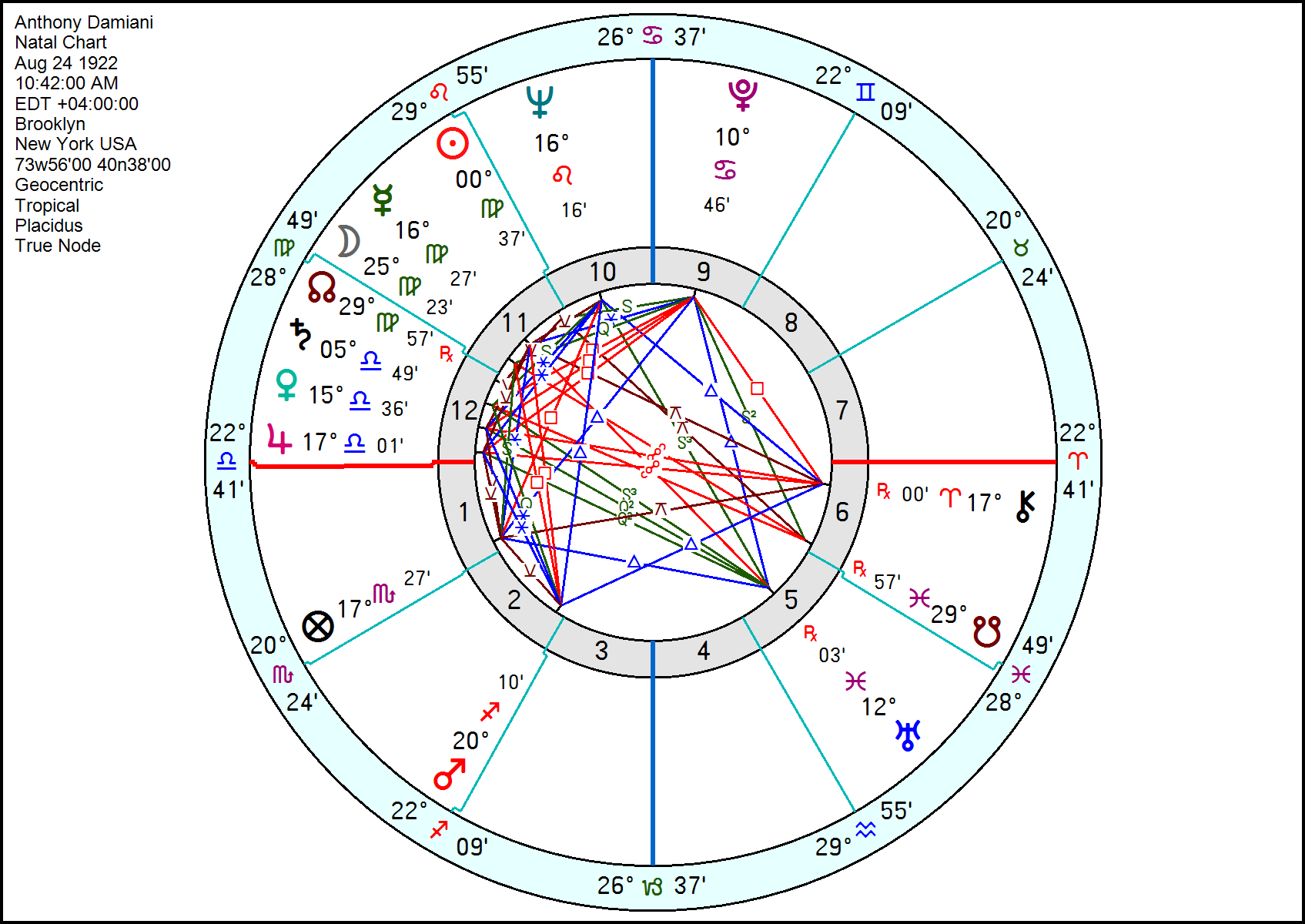
CHART FOR 1983 1219a
Class
Monday, December 19th, 1983
Verbatim, unedited transcriptCLASS at Wisdom's Goldenrod, Hector, NY
with Anthony Damiani (AD)
December 19a, 1983
ASTROLOGY; THEORY; EPISTEMOLOGY
"WHAT DO WE KNOW AND HOW DO WE KNOW IT?"
TOPIC: Astrology
SUBJECT: Theory
SUBSUBJECTS: Epistemology, "What do we know and how do we know it?"
CONTENTS:
Review of astrological theory developed up to this point
What do we know and how do we know it?
Psychosomatic organism (symbolized by planets, aspects, degrees in natal chart) makes available to the light of the mind determinate sensible experience of indeterminate World-Idea
Subjective function and objective manifestation of that function represented by natal planet on degree and its opposite; no triple relationship here
What divides the undivided image?
Idea being manifested by natal planet only available as idea to an impersonal witnessing consciousness (example of AD's Saturn at 6 Libra)
The totality of ideas organized to constitute ego-complex are the means/medium by which consciousness experiences primal image given to it, we don't grasp world directly
These ideas are both content and agent, the how I see and the what I see; you do not have ideas, they have you
What does it mean to impersonalize your consciousness?
Example of hearing note A–both 440 frequency and modification of ear tympanum available as a unit of knowledge to consciousness-knower
Similarly, functioning of seven natal Chaldeans and their opposites available as unit of knowledge to consciousness-knower
No objective relation to knower
If Witness identifies too closely with subjective functioning (natal planets on degrees, etc.), then it thinks it is the empirical subject and subjective functioning is confused with impersonal knowing
To Witness-I, my empirical life is a blossoming forth of ideas; Plotinus refers to this as the soul contemplating the idea
Both positions required: you are both the impersonal witnessing consciousness and the one going through the experience
When AD relates to anyone, he relates to them in terms of the ideas they are manifesting; the more advanced the person, the clearer the idea
Transiting trans-Saturnians as higher knower, willer, feeler; natal trans-Saturnians as fixed attitudes towards ego brought over from the past; these are not the higher knower
Consciousness bifurcates subject and object, natal planet on degree and its opposite
The Witness-I operates with a kind of aesthetic perception
Consciousness both illuminates and bifurcates
Many different grades of Witness experience
Witness consciousness as captured by ego is a partial consciousness and operates within the structure of that ego
Witness knows when the situation in the cosmic circuit is appropriate for it to re-embody and experience again its desire-tendencies
At the appropriate moment, these tendencies are congealed into an entity; this entity reflects back to Witness its own proclivities
Witness possibly symbolized by transiting Chaldean(s)
The five categories that reduce the infinite consciousness of the Overself to a witnessing consciousness are powers of the Solar Logos
Five kinds of knowledge-content properly belong to the Witness-I–imagination, right knowledge, wrong knowledge, memory, sleep
Categories of thought–what are they?; this is a difficult problem still to be gone into
Distinguishing categories of thought (unembodied) and categories of imagination (organization of body)
Infinite Overself consciousness is brought to develop its faculty of understanding by the intrusion of the Solar Logos' World-Idea into it; Overself would never seek this on its own
What is it in us that understands and what does it understand?
Soul is where it loves, no need for daemons to escort it down
Sage wills his embodiment at the proper time, knows when to mount the Dragon; PB on riding the Dragon
Three levels of subjectivity–Infinite Overself consciousness/Undivided Mind of the Earth (symbolized by solar system), Witness-I (symbolized by 360 degrees around Earth), psychosomatic organism
Do certain natal aspects indicate past tendencies or present correction of past tendencies?
No finality in samsara, can't import into chart reading the fact that World-Idea will eventually make us Sages
A question remains to be dealt with–what is the relationship of all the transiting planets to the natal chart?; if transiting Chaldeans are not knowing, willing, and feeling, then what are they?
One possibility: transiting trans-Saturnians represent gnostic power of the cosmic soul, transiting Chaldeans represent productive power of the cosmic soul
Circle with twelve houses represents the indeterminate World-Idea; add planets, degrees, aspects and the World-Idea becomes a determinate image
Any alteration in the medium through which we view the World-Idea will result in the perception of another world
BOOKS READ FROM OR REFERENCED:
Helen Keller, The Story of My Life
Marc Edmund Jones, The Astrology of Concepts
Marc Edmund Jones, The Sabian Symbols in Astrology
William James, The Varieties of Religious Experience: A Study in Human Nature
Paul Brunton, The Wisdom of the Overself
Paul Brunton, The Notebooks
Plotinus, The Enneads (MacKenna translation, 4th ed.)
Desiderius Erasmus, Erasmus' Annotations on the New Testament
PLOTINUS QUOTES READ OR REFERENCED: III.8.6, IV.2, IV.3.13, VI.4.14-15
CHART appended to this transcript:
- FIGURE 1983 1219a-1. Anthony Damiani Natal Chart.
Other diagrams also referred to are not with this transcript version. [Transcriber note: [diagram] means the speaker is referencing a diagram as he or she is speaking. If someone is drawing or writing, with audible sounds of chalk on a blackboard, I indicate this by [drawing] or [writing].]
SABIAN SYMBOLS: Aries 6, Libra 6
NOTES:
This is 1983 12/19a, Astrology; Theory; Epistemology evening class, and the first entry associated with this date. 1983 12/19b = Astrology; Theory seminar from earlier in the day, for which we have no audio, just JF notes.
Dec. 19 is a MONDAY class – usually Astrology.
Transcriber & jf note: Also see the partial transcript dated 1983 12/01 for "seminars" with related (and in some cases apparently excerpting/overlapping content from this class)–it is entitled "Astrology; Theory "What do we know and how do we know it?" (found in AD Supplementary Material (pp. 1103-1109)). However, from Blue Book and other records, 12/01 is NOT the same as 12/19/1983.
During November 1983 through February 1984 Anthony spent a lot of time exploring both Epistemology and the Categories of the Imagination (planets).
TRANSCRIBED Verbatim by IT prior to 2018 (V11a). This is V12a (2023) and has: updated prefatory matter, footer, and audio file name; Book List completed and Plotinus quotes section added; new notes within transcript; new AD natal chart. Archival verbatim transcript – V12a.
AUDIO FILES: 1983 1219a, 1983 1219b. [Note 1: "Tape" and "Side" refer to original audio cassette tapes that were later digitized into .MP3 Audio Files. Note 2: In 2024-2025, REP Studio improves the sound quality of both audio files, cuts dead air.]
1983 12/19a at Wisdom's Goldenrod
Astrology; Theory; Epistemology
[Audio File 1983 1219a Begins]
AD: We were going to discuss theory, as far as we got.
RG: Which theory? Aspect theory?
AD: Huh?
RG: Aspect theory?
AD: No, uh--
AS (faint): No.
[25 second pause with faint background student talking]
AD (faint): [couple/few words inaudible] I got that parrot degree.
S (faint): (Which one?) (AS laughs)
RG: What did he say?
AS: Now you know what it feels like! (AS laughing, some laughter)
RG: What does he have on it?
S: And I happen to agree.
[13¼ second pause]
LR: "What do we know and how do we know it?"
S: [couple words inaudible]
S (faint): (And fantastic.)
[short pause]
S: Couldn't we agree?
S: Yeah.
AD: Avery, you escaped this afternoon, why don't you do it? (some laughter) I'll call out now--
AS (simultaneously): What do we know and how do we know it?
AD: Yeah, we start out by asking what is it we know.
AS (faint): Ok, and--
AD: And the answer is--
LR: The World-Idea.
AD: The World-Idea.
AS: We draw some pictures. Pictures haven't changed in a day and a half (as far as I know). (AS laughing) [drawing] [few words inaudible]
AD (simultaneously): And how do we know this World-Idea? Go ahead Linda, you pick up the refrain.
LR: Oh, we know it with the mind Anthony. (bit of laughter, applause, student words)
AD: And what constitutes the way the mind-- what constitutes the mind?
LR (faint): Well the planets, the aspects, and the degrees constitute the mind.
AD: Yeah. So the totality of those things gives us the psychosomatic organism. [short pause] And, with the functioning of the psychosomatic organism, the World-Idea is concomitant. Now for instance like, if I ask you to subtract one by one each of your senses, the sense of touch, smell, hearing, seeing, ok, there'd be no more any world for you. Right?
LR: Well I've been reading (lot--) the autobiography of Helen Keller so I-- (laughter) I can't-- I can't quite agree but, I know what you mean. [Note: Helen Keller, The Story of My Life.]
AD: Well it's true that you can take these things away and then (you/you'll) live in the world of images but that wouldn't be the sensible world that you experience here and now. So, what we're saying is that the organization of the mind, the way the mind is constituted, was those factors that you mentioned. Now, we pointed out or we said that, on the one hand, the planets that are sitting on a degree represent the subjective portion and the outward manifestation of the functioning of those planets represented the objective portion. Is that right?
S: Yeah.
S (faint): Anthony, I got lost. What was the objective?
AS: The opposite.
AD (simultaneously): The outward manifestation of the subjective functioning. So if you got a planet on one degree Libra, alright, the outward manifestation would be in one degree Aries, ok, or vice versa.
S (very faint): Yeah.
AS: And we said that-- that that degree was both organizing that function and also was a content, or structuring a content of (that/an) experience. So at one and the same time that reason-principle or degree is organizing that psychic function as a subject, an apparent subject, and the opposite is the object and is also the content or the form of that experience. [few words inaudible]
AD: And we went ahead and tried to show that the seven Chaldean planets constitutes the psychosomatic organism in the sense that each one of them represents a certain instinct. So, reflection was indicated by Saturn, the Sun the creative purpose of life, and Venus the anima function, evaluative, what you like in this life, and Mars represented the desires. At any rate those seven Chaldean planets represented the organization of what we refer to as the psychosomatic organism in which the light of the mind is going to be encapsulated and is going to operate through that. And then, the point here that had to be recognized and was important was that these seven planets in their togetherness constitute the psychosomatic organism, was the field for the operation of willing, feeling, and knowing. Now, before we go any further, we could stop for a moment and I'll try to give an example of the-- of how the planets represent the subjective and objective functioning. Now notice, there's no triple relationship here. There's a subject, there's an object, and there's no means to relate these two things together. So you have to bear that in mind, (that if/that-- that) your bifurcation that's going to come between the subject and the object, it's going to be introduced from a different point of view. So if we took an example, if you took an example, and you actually work with an example, you have a planet on a degree. That planet is manifesting that idea. And at the same time you have to-- you have to recognize that that idea which is being manifested can only be objective to an impersonal consciousness. As long as you are identified with that functioning, it won't be objective to you, but if you could impersonalize your consciousness, then the idea that's manifesting through that particular function becomes available. So you could take any-- any one you want, any one of those as an example. [short pause] Any example you want to use?
LR: What about 6 degrees Libra?
AD: 6 degrees what?
LR: Libra.
AD: Ok. If you read those two degrees.
[19¼ second pause]
Marc Edmund Jones [The Astrology of Concepts, Libra 6, LR reading]: "A pilgrim sits on a rustic bench and one by one his ideals in a sort of trance-vision take form before him."
Marc Edmund Jones [The Sabian Symbols in Astrology, Libra 6, LR reading]: "This is a symbol of experience as the practical or everyday substantiation of inner insight and conscious understanding. Idealistic reality is found to be sheer escapism if ever taken by itself or given any authority on its own account, but [LR adds: it] is the sole dynamic for the human spirit whenever any individual actually stands face to face with his opportunity."
LR: (Well then--)
AD (simultaneously): Ok, read the opposite degree.
Marc Edmund Jones [The Astrology of Concepts, Aries 6, LR reading]: "A black square stands firmly, illumined red on one side."
Marc Edmund Jones [The Sabian Symbols in Astrology, Aries 6, LR reading]: "This is a symbol of experience as the over-all sustainment of any personal or conscious being. A materialistic reality is found to be sheer illusion when taken of itself or given any power on its own account…"
AD: Now this is an actual example, this is my Saturn. And, the reflective consciousness that I have to operate with is of such a nature that, well, subjectively I cannot consider the existence of an ideal world without its complementary, a material world. On the other hand, there's no material world unless there's a complementary ideal world. Now these two ideas, together, make one idea, alright, the complementarism is obvious. Now, the point we're trying to get at is this here. If my consciousness wants to experience what this-- the-- the world, the idea of the world, I can-- this consciousness can only experience that world, the world which is given to us, alright, through the medium of this idea. It's like I wear a pair of glasses, they're yellow. If I see the world, it's going to be yellow. And if they're blue, the world is going to be blue. Now in order for me to see the world or relate to that world, that primal image, the world that is given to us, which is what we have to relate to, it must operate through those-- through that idea. In other words, it would be impossible for me to see the world except through some kind of glasses, whether they're brown, yellow, green, but I have to see them through a medium. Now the medium I see them through is this particular idea. It is this idea that qualifies, refracts, is like a prism through which I see the world. I don't grasp the world immediately, directly, without any intervention. I only grasp it through that medium. Now, if you do that with each one of the planets, Chaldean planets, in their totality they are organized to constitute, let's say, the ego-complex, it is through that set of ideas that I apprehend the world. Ok?
CDA: I am--
S (faint): Everybody speak up.
CDA: I have a problem just with the semantics of the word 'medium'. If-- and I'd like to know what you mean by it because the-- as-- as content, the ideas are content, and I always sort of thought of the planetary spheres--
AD (simultaneously): They are content--
CDA: --as being the medium.
AD: I got to qualify that. They're content and agent.
CDA: Could you qualify it further? I mean just--
AD (simultaneously): You mean could I explain further?
CDA: Just like if you-- if you throw the planet in, ok, and--
AS: (Well Carol--) You know, like you have this indeterminate-- the World-Idea is indeterminate and in order for you to know it, your finite mind, this natal chart, actually has to take the form of that Idea and that--
CDA (simultaneously): Oh, ok.
AS: So it's both a functioning and also it's not a tabula rasa, it also contains or is structured according to these different ideas that the planets are sitting on. So it's both a functioning and also a structured kind of event. So when it takes the form of this indeterminate World-Idea in order to present it to you, it almost becomes that World-Idea.
CDA (faint): It does become that World-Idea.
AS (faint): And [couple words inaudible]
AD (simultaneously): It's what I see and how I see.
CDA: So the fact that it's how you see that's another--
[student assents, very faint]
CDA/S(?): Uh-hm.
AD: And it's also what I see. In other words, I see the world in a certain [CDA simultaneously: Ok.] way, alright, that-- Alright, that's what I mean when I say it's an agent and a vehicle. Now, to the extent that you're identified with the vehicle, the ego-complex, to that extent the ideas are unavailable to you. You don't see them objectively. To the extent that you could impersonalize your consciousness, draw back, so to speak, and make the ego and its functioning a content, then you can see that this ego-complex is the manifestation of these ideas. Follow that?
AH: Anthony?
AD: You do not have the ideas--they have you. Yeah?
AH: What is meant by drawing back?
AD: Impersonalizing your consciousness?
AH: Yeah.
AD: Well, it would require-- You know, like if you think of a simple exercise, at night you go to sleep and you review in your mind everything that you did during the day. And you try to impersonally evaluate what you did during the day: "This was correct, this was incorrect, I should have done this, I shouldn't have done this," alright. And you can't, so to speak, be morbid, you know, about it or be bombastic about it. If we assume that you're trying to live a rational life (and/then) rationality is the guiding principle and it is that which is determining, you know, the-- the norm that's used, alright, in terms of the kind of behavior that you'll display, so-- Also, for instance, if you take a scientist, he has to be impersonal. He has to try to observe the phenomena that's going on without introducing any personal subjective element. Any attempt at impersonalizing your consciousness-- Just like, again, like in meditation, you try to remove yourself sufficiently from the ego-complex and, you know, its memories, its reflections, and all its associations and images and pictures, and only when you are at a distance from that can you see yourself objectively and you could make a proper evaluation. That means there's a certain amount of detachment. But, it's common knowledge that to the extent that you depersonalize your life and try to be guided by an impersonal norm, try to see things simply as they are without interfering, to that extent you're impersonalizing. You know like, well I like to smoke but the reason points out, you know, it's not good for me. And there's no way, there's no way that "I like" can overthrow what should be because you-- you know, we're assuming that the person is rational.
AH: Just a few minutes ago you described the absolute inevitability of your Saturn functioning the way it does. Could you give an example--
AD: Sorry?
AH: You just described 6 Libra as--
AD: Yeah.
AH: --the necessity for you to think the way you do. Could you, if you wouldn't mind, could you describe how that process could become impersonal? Like just an example of this impersonalizing process (please).
AD: Well I have to stand back and try to see the way my reflective consciousness is structured and organized, the way, let's say, it must necessarily reflect. [short pause] Reflection, or the instinct of reflection, isn't just reflection, but it's reflection according to a certain mode. What was the mode, if you remember? Well, that there's an ideal world and a material world and that they're complementary to each other, you can't have one without the other, alright. Now, that's the way my reflecti-- my reflective instinct is structured. Now, in order for me to, you know, see that, I have to be a little impersonal. I can't identify with the ego-complex and see that functioning. I have to remove myself, detach myself, a little bit from the ego-complex in order to be able to see that function. [short pause] (Well) I forgot, what was it about? Oh. So we said that--
LR (faint): We do not have the ideas, they have you.
S (faint): Uh-huh.
AD: And-- and the-- the thing here now or-- the thing that we have to bring in is this here, that the-- the subject and the object which is given to us in the chart, the natal chart, [S, faint: Right.] the complementarism of the idea(s). This, as we pointed out-- I think the example we used was something like this. There's a piano over there and someone strikes a key, you know, a note, and the string vibrates at 440. My ear tympanum, alright, receives that. And then someone says, "I know that's the note A." Now, let's imagine the guy's got perfect pitch. Now, the knower is at neither end of that. You follow? The knower knows both the frequency that's being struck on the piano and the ear of the physical organism that is responding to that. These two things together constitute a piece of knowledge which is objective to your consciousness, the knower. You're not gonna have one without the other. So, that means that we have to look at it this way. That means that the seven Chaldean planets functioning in that way, alright, the totality of their togetherness functioning that way, is objective knowledge to this impersonal consciousness. It's an object to the Witness-I, to the knower. Now remember I told you, don't try to relate in an objective way to the knower. Don't try to localize it, don't try to put it in space, time, say it's here or there, or was here or there, because it won't work. There's no objective relationship between you and the Witness-I. Now this Witness-I, this impersonal consciousness, is aware of, we said, the frequency and the response that the organism makes to it and these two things are one piece of knowledge (to/for) it. So that, from the point of view of the Witness-I, the ego and its world is objective to it. But, if the Witness-I throws its weight in or let's say associates or identifies too closely with the subjective functioning, then it thinks it is the empirical subject and it says, "I am the knower," and points to this, says "I am the knower." But we just pointed out and we just saw that the "I" cannot be localized. You can't say "This is the"I"" because, as we just saw, there's no objective relationship to the knower. Now this is a very difficult point, very difficult. It's like you have to take the position in the analogy of a dream. In the dream you have the dream subject and you have the dream object, but you have to take the position, the dream subject has to take the position, that he is the one witnessing the dream. And this same requirement is being asked of you now, to understand that the knower is not this empirical subject and that empirical object, alright, but that Witness-consciousness which sees both of these two sides, alright, as an object of knowledge.
Now, the consequence of this is that to the Witness-I, when the Witness-I is looking at that, he sees that the functioning, let's say, of the ego, Saturn on that degree, he sees that as a manifestation of an idea. So if I'm looking at my ego-complex, I can see that that degree-- I can see that the manifestation of that idea is my empirical life. Follow Linda? Follow so far? And therefore, all those degrees represents the sprouting and the blossoming and the living out, alright, of my life. My life is those ideas--but only to the Witness-I. If I immerse myself into the empirical subject, I can't see that as my life. I only want to taste, so to speak, the chocolate bar and, alright, have the titillation of the senses go on. So, if you keep in mind the point of view I'm coming from, then you could easily see that all these ideas which are represented in your chart by the-- where the planets are s-- sitting on, you can see that these ideas which are manifested as your life is what Plotinus referred to as the soul contemplating the idea. [Note: Plotinus, III.8.6.] If you-- in other words, if you were the Witness-I and you looked at your life objectively like it was out (there/here), you would see that life is a manifestation of these ideas. Just like for instance in a dream, you know, let's say a boa constrictor is wrapped around you, and you can see that that picture is the manifestation of the idea "fear," and that's objective, it's out there. But if you identify with the dream subject, then you're scared. It's no more objective to you. You are experiencing that fright. So both positions are going to be required. On the one hand you can be an impersonal consciousness looking at the whole thing as though it's happening to somebody else. On the other hand you could also be that somebody else who is going through the experience and actually, you know, experiencing it as modifications of (his whole) psychosomatic organism.
Now this is a very important point because, to me, this is what is operative. When I relate to anyone, I relate to him in terms of the ideas he is manifesting. Now the more advanced a person is, the clearer the ideas are. The more neurotic he is, the more unbalanced he is, the more identified he is with that subject, the less clear is the idea. As a matter of fact you'd have difficulty in trying to understand his chart because it's not clear what-- in terms of the way he's living and in terms of the ideas that he's supposed to be manifesting, you can't coordinate them. Now generally, any person who deviates too far from the ideas that he's manifesting is neurotic, unbalanced, and maybe even psychotic. Alright, so, we got this far. The next point we had to bring in was that-- Now try to remember, the seven Chaldean planets represented the organization of the psychosomatic organism, the ego-complex in its totality with all its various aspects, which the Chaldean planets represent. I cannot accept, Jeffrey, the limitations that, you know, Jung works with. I find them not only, you know, kind of s-- how can we say, restricted, you know, but a very important thing is left out and that is this here, that in your natal chart you also have trans-Saturnian planets. These are, the trans-Saturnian planets in my opinion are, that in you which knows, wills, and feels. What it knows, wills, and feels is in terms of, or in the context of, the ego-complex, and the world that arises concomitantly with the functioning of that ego-complex. This is what the trans-Saturnian planets know.
S (faint): Can you just go over that one more time?
AD (simultaneously): But, that's a tr-- that's looking at it from a transiting point of view. From the point of view of the natal chart, the trans-Saturnian planets are fixed, they're stable, in the sense that when you have, let's say, a square from Uranus to Mars, that's a fixed thing. Any of these aspects are fixed in relation to your Chaldean structures. So that means, to me it means, that these represent fixed attitudes. The way you feel, the way you think, and the way you will, these are fixed attitudes which you bring over from the past in relationship to the field within which they are operative. This fixity of attitude, alright-- [15½ second pause] This fixity of attitude doesn't give us really the picture of what we might call the higher knower in us, higher subjectivity, because it's part of the natal chart, it's part of the nat-- natal chart, it represent-- it represents fixed attitudes which are carried over from the past. When a person dies, for instance, he doesn't take the concepts that he worked with, with him. They're left behind. But the aroused associations, the feltness of these things, is what he does take with him. These are part of him and in the next incarnation, if we could speak sequentially which of course is misleading, these former attitudes become embodied, fixed, congealed ways that you operated in the past. So for instance if person has Saturn Venus conjunction, it would seem to indicate that the anima function is under the thumb of, let's say, the Saturn function. It's not free to do what it wants but-- Doesn't have romantic illusions or things of that nature, it's-- it's (much too cold). Let's say marriage would be more on the level of the propagation of the race or fulfilling of racial designs, whatever. Or it may see through the illusory nature of the anima function, the way it always wants to build a relationship to the world, and would curtail that. But regardless, the point that is being made here-- [13½ second pause] The point that is being made-- Yeah, go ahead.
S: What [three/few words inaudible]
AD: Huh?
S: What we bring.
AD: Oh yeah.
S: The essence of these--
AD: Yeah, these three tendencies that you have established, say by a disciplined life or non-disciplined life, is what you carry over. These are indicated in that way. Now, the problem then come-- comes of course in relating the transiting planets, all of them, to the fixed natal chart. And that's another complication here. Most of these here.
[short pause]
LR (faint): [couple/three words inaudible]
S (very faint): What?
LR (faint): Meaning of Saturn?
AD: Oh yeah. Yeah, to me that's pretty important. As we spoke before we said that 6 degrees Libra and 6 degree Aries shows the subject and the object. Now, in terms of epistemology it's impossible to speak about an object and a subject without a relationship existing between them. You got to have a relationship. How do I know something? Well you have A and B, and C relates A and B together. But according to that chart you have-- you have the 6 degrees Libra and you got the 6 degree Aries. And, the feeling should be-- the experience should be that one experiences himself not as divided in half. So something has to come in. Now this is strange because what consciousness does here is to bifurcate, separate, the subjective from the objective. The introduction of consciousness at this point here, let's say, where the planet is on a degree and you experience yourself subjectively, this is the way you function subjectively. [student assents, very faint] Now, if consciousness wasn't there, you would not be able to know that this is the outward manifestation of your subjective functioning. Consciousness has to be brought in and then there is the experience of the outward manifestation of that subjective functioning as other than your subjectivity. So the consciousness that pervades the natal chart, which you'd have to locate inside the planetary spheres which are always in motion, the consciousness which permeates the chart, bifurcates and divides the subject and the object. Now there is a person who has a certain subjective functioning and who regards the manifestation of that functioning as other than himself, or the outward part of himself. Go ahead, Avery.
AS: And by that you seem to mean that-- we spoke before about that-- you say like a sliding scale of identification, that these two ends of the stick are not recognized as an objective idea, and the reason is because that light of the consciousness is identified with a part of it. It's identified with the point at which the planet is sitting say and therefore the other end of the stick seems to be objective. And it seems you're saying it's in that sense that the identification of consciousness is creating this split. So that were that consciousness to cease identifying with the subjective pole, the apparent subject or the ego, the whole of both ends would be objective to it as an idea--
AD: Precisely.
AS: --and (it/there) would no longer be a threefold relationship. But as long as that consciousness identifies with one end or some-- some amount as it were of that split, of that-- of that stick, then one end appears to be the subject and the other end appears to be the object.
AD: Now, again, if we fall back on the use of the dream analogy, we may get a picture of this. You have the dream going on in front of you where there's a subject and an object. If you could abstract-- in your imagination you abstract the awareness or the consciousness of that image, alright, then the dream subject and the dream object-- well, of course they won't be experienced but imagine that they can be experienced, they would not feel as though they're-- Yes Avery.
AS (simultaneously): Feel separate. They wouldn't feel separated as though--
AD: They wouldn't feel separated. It would be one image, alright, with a subject here [diagram] and an object here [diagram]. Here's the table and here's the man and they don't experience themselves-- the-- the dream subject doesn't experience himself as other than the dream table. There would be just one image, one canvas, one picture. But, the dreamer looking at that, the one who's having the dream looking at that, alright, the very looking at that picture automatically divides it, alright, identifies with the dream subject, that makes the table the object. So that's what I mean when I say that consciousness bifurcates the seamless image into an object and a subject.
S (faint): [couple words inaudible] Yeah, go ahead.
CDA: If you just try to use that analogy for how it is that the Witness actually experiences that, if you-- if you are experiencing from the Witness point of view, is it that there is an experience of the essence of the idea or the essence like of the whole moving picture that is that-- the subject and object in the dream? Is it-- does the Witness actually see-- Like if you're identified with the Witness, is the experience of-- of the meaning (in your/that you) experience or is it-- is it also the actual tables and chairs? I mean, I don't know, I'm not asking the question right but-- Is--
AD (simultaneously): The primary-- the primary meaning would be the ideas. The secondary meaning would be derived from your identification with the empirical.
CDA: But say the Witness is not-- no longer identified with the ego.
AD: Then it's the ideas that are seen of primary importance. This is what's being manifested, this idea.
CDA (simultaneously): Oh. So it's like the-- the ego and its world is like this whole field and the ideas as shown in the chart, when-- as they are being lived, the Witness is knowing that the-- I don't know if I'm not saying it right. I'm just trying to get a-- some idea of what-- of what kind of knowledge the Witness has. That I-- it's not anything that, I don't know, the ego has knowledge of, right?
S: Yeah.
AD (very faint): Yeah.
KD (faint): Well I think you're saying that, you know, the experience of-- (are) these ideas experienced as identity with yourself, are they experienced as-- the-- those ideas being-- being-- constituting your very nature, the-- the very-- the process that produces your life, is it the awareness, the perception "This is the nature of thought that produces my life", or is it meaning that's acquired through reflection. In other words, like when you [couple inaudible student words] are seeing something (um/from)-- seen as-- what you're saying is, how-- what kind of knowledge is [one/two words inaudible] be these ideas that (constitute/constituting) your life. It wouldn't be knowledge of a content as we know it, it would seem. I mean some of these ideas are actually constitutive of your life that you are, the thinking that will-- that does become the world and your life. In that sense that knowledge would be very different than what we normally think about.
AH: Kathleen, are you suggesting that it can't be described in the way that we describe subject and object at this level of experience?
KD: Yeah, that is right.
[student assents, very faint]
AH: That the subject--
KD (simultaneously): I don't see how it could be the content as--
AH: It's not--
KD (simultaneously): (Or--) I don't think it could even be a content of the-- [one/two inaudible student words] well she was describing it the Witness and the content of that empirical subject-object relationship, it sounds like it's even [one word inaudible] Because in meditation we had that experience, that week I mean that we were trying to do, we were trying to see in a im-- impersonal consciousness, not what-- just, you know, trying to be aware of what-- you can experience that.
AD: Yeah. The closest I can answer your question Carol is that it's a sort of aesthetic perception.
CDA: Aesthetic?
AD: Aesthetic perception. You approach it sometimes in great art where you-- you can perceive the appreciation or let's say the relationship of the empirical subject to a work of art and these two are fused together and momentarily you have a perception of this. In other words, at the moment, let's say, of the most intense satisfaction, whether you're looking at a picture, reading a poem, or listening to music, alright, at that moment of the most intense satisfaction this is the kind of perception that the Witness-I operates with. That's the closest I think I could get to answering your question.
RG: Anthony?
AD: But it is irrelevant right now.
CDA: It's important.
RG: Can I ask a--
S (simultaneously): Yeah.
AD: Yeah.
RG: Yeah, if this is irrelevant just let me know. But it seems-- If-- if you say the consciousness introduces the tripartite division, then it seems you can't start with two things but you're only starting with one. The subject-object pole isn't split yet so then there's only one idea undifferentiated. And if you say that consciousness, when-- essentially one has to, when it's looking at this idea, that looking breaks it up, then there doesn't seem to be the possibility that consciousness could look at the idea without identifying and breaking up the seamless whole.
AD: What you're saying is, if I could use an analogy, is that for instance in the dream analogy, you cannot be both at the same time, he who is witnessing the dream and he who is experiencing the dream as a dream subject.
[9 second pause]
RG: No, but from what you were saying it seems that when the Witness-- when you're looking at the dream, you automatically identify with the one character in the dream and split the dream into two things.
AD: Uh-hm.
RG: So, there never seem to be a two, there's either the one idea without consciousness present or there's three things, the observer who's split up the relationship into the observed and a relation. So there never seems to be two.
RC: PB's got an interesting (note) [couple words inaudible]
[students assent, very faint]
LR (faint): Maybe it's a conscious--
S: You skipped over [couple words inaudible]
RG (simultaneously): Well, but if, but if-- but what Anthony said was when consciousness is introduced it automatically splits up-- and he did say, then he [student assents] brought in the consciousness though.
AS: It automatically splits up the idea.
AD (simultaneously): When it splits up-- when it splits up the subject from the object, does that bifurcation really exist?
RG: That's why I would say it's not the consciousness that does it.
[short pause]
AD: Well what does it?
S (faint): Yeah.
RG: The ego can-- the ego might do it. Or that which id-- that which identi-- that identification with the body.
AD (simultaneously): But the ego has-- but the ego has no consciousness of its own.
RG: Right, right.
AD: So how could the ego do it? If the ego has its own image-making faculty and produces, you know, the-- the images that are concomitant with its functioning, the bifurcation would not arise. Now, we're speaking very abstractly because without consciousness we'd never be able to observe that.
RG (faint): Right.
S (faint): Right.
AD: But, from-- you know, just from an abstract and analytical point of view: Ego functions. Coordinated with that function would be the arisal of an appearance and what is going to divide or bifurcate that function--
(Side 1 of original cassette tape digitized as 1983 1219a Ends; Side 2 Begins)
RG: The light illuminates whatever's going on.
AD (simultaneously): [one/two words inaudible] Yes, I'm not saying it doesn't.
RG: Ok.
AD: It does illuminate.
RG: Alright.
AD: It also bifurcates.
S: To the ego, is that what you mean to say? To the one who is experiencing this entire phenomena, you mean it bifurcates to that individual?
S (faint, possibly part of background): [one word inaudible]
AD: Insofar that that illuminating light, alright, is enclosed or enveloped or taken possession of by the ego, now that ego considers itself a subject. [student assents, faint] But the light which is illuminating that ego is not (divided/dividing) because the ego has taken, or you know, brought it under its fold. That-- that still remains what it always is, [student assents, faint] undivided and whole. So now that consciousness becomes partial in the psychosomatic organism. And that's why we could say at one and the same time, Dickie, that that illuminating consciousness distinguishes and illuminates the objects [AD aside to student: Go ahead.] and at the same time brings about the existence of an empirical subject or the ego as subject.
RG: Ok. Then if you say that, what's the meaning to saying that prior to the insertion of consciousness, you couldn't even speak of the sub-- of a subject and objective aspect of-- of this [one/two words inaudible]
AD (simultaneously): What is the meaning?
RG: Yeah, how would you speak of it?
AD: You can't, really, that's why I said, we're doing this abstractly because if we subtract consciousness from a dream, alright, a dream picture, dream image, we can't talk about what's there because no one's there to see what's there.
RG: Ok. So-- but in that sense, just, I mean-- When you're speaking about the subjective--
AD (simultaneously): Now, if that's so, then is there any division in that image, that-- you know, that dream image?
S (faint): No.
AD (simultaneously): If the consciousness isn't there, we can't speak of a division. We can't even-- we cannot even properly speak of a seamless whole.
RG: Right.
AD: Exactly. That's why I said, we're doing this theoretically.
RG: But if consciousness is there, you could also speak of a seamless whole if the consciousness didn't identify with the particular body [couple/three words inaudible]
AD (simultaneously): Exactly, yes, yes.
RG: Right.
AD: Yeah. And further, further, you can speak of that seamless whole and still speak of an empirical subject.
S (faint): [one word inaudible] right, yeah.
RG: Right.
AD: So these things are not contradictory although they sound it.
TS: But wouldn't that-- that last thing, that if consciousness is-- is there and aware of the image as a seamless whole, it still can be aware of the-- the apparent subject or the empirical subject, and its object as distinguishable factors or contents within that whole, can't it?
AD: Yes.
TS: And in a way that--
AD (simultaneously): You see what you're discussing now, or what we are discussing now is the various types of experiences that one could have concerning the Witness-I. The experience of the Witness-I isn't, so to speak, one kind of a thing. It could be varied tremendously. It could experience its-- it could experience the presentation of the seamless whole without feeling any identification with the empirical ego. It could experience itself both as a seamless whole and as identified with the ego. We're speaking about grades of that experience, varieties of that experience. The ultimate Witness consciousness, of course, is where there's just a pure presentation and no identification with anything in that presentation.
EC: But to [AS simultaneously: Anthony?] experience that apparent world, the Witness-I has to have that ego subject there, that psychosomatic subject there and not--
AD (simultaneously): To experience the world as sensible, [EC: Right.] it must have that represented.
EC (simultaneously): So that has to be there.
S: (It does.)
RG (simultaneously): But it doesn't have to be identified with it as consciousness.
EC (simultaneously): No, of course not, but if-- he's not go-- he's not going to have a world to experience without--
AD: And very often it takes place in mystical experience, a person is taken out of the body and he's shown that the body is the least important part of himself. And in that experience, alright, he is presiding over the presentation, looking at the presentation, which includes his body, but he as distinct from it. So in the discussing-- if we discuss the-- Well, a good example would be all you have to do is pick up James' Varieties of Religions-- of their Religious Experience, [Note: The Varieties of Religious Experience: A Study in Human Nature by William James] and you would see that the variety of experiences that are presented to you will baffle-- you know, completely baffle you, unless you understand this point.
TS: Well wouldn't even the empirical-- the consciousness that is in the empirical subject still be a grade of that Witness?
AD: Be a what?
TS (simultaneously): Would be-- That the consciousness orli-- ordinarily experienced as the empirical subject and in-- then in a three term relationship, wouldn't that still be the Witness consciousness but now--
KD: No.
TS: --at its lowest grade?
AD: As well as what?
TS: But now at its lowest grade [one word inaudible] (grade).
AD (simultaneously): Yeah but, [KD simultaneously: No.] you see, the point here is that that Witness consciousness as enclosed by the ego is now a partial consciousness and operates within the structure of the ego. It's like if you could think of the light enclosed in a chamber, you know, but that light is coming from outside the chamber, you know, and going through the chamber.
TS: It really can be captured?
AD: You bet your life. As a matter of fact, Plotinus makes a very beautiful statement about that. [Note: Plotinus, VI.4.14-15.]
AS: Tim? I thought-- [one/two inaudible student words] Tim, I thought your point there was just though that no matter where that identification is, it's still the Wit-- it's still that light of consciousness which is witnessing the experience, no matter which end-- no matter which part of it you're identifying with. I mean we could-- you could even have levels below this subject-object split. You're just walking along and you're not even aware of what-- you're hammering or something and you're not even aware of what you're doing, then it's just the objective end of that, as it were, the outward end. And then suddenly, he draws himself up short and he real-- he-- he reflects that he is aware of the hammering and so on, now he's aware of that ego subject and that this-- (uh/the--) he has the split again. But it's still-- it's a distinction within that subject-object relation, right, but what's always aware of it would be the Witness.
AH: To-- to describe that as part of the subject at the empirical level or that which relates subject and object? Seems that there's two quite distinct things that have been said. You describe consciousness as being the base for the subject or you describe consciousness as that which is bifurcated into an experience.
AS: No, I-- I thought he said that con-- conscious-- conscious identification is what bifurcates that subject-object relation.
AH: I thought consciousness bifurcates.
AS: That's what I just said.
S (faint): You're wrong.
TS: Then its consciousness bifurcates the--
DH (simultaneously): It's a question of whether the consciousness does it or whether the identification (does it).
S (faint): Is that better?
AH: Well I'm curious if we're going to describe consciousness as the basis for empirical subjectivity or are we going to describe consciousness as that which is bifurcated into both subject and object.
AS: Both.
S (faint): Both.
AH: You would say both.
RG/S(?): Both.
KD: What was the PB quote?
RC: Well it was-- That was way back.
KD (faint): Oh, fine.
RC: He had one thing that-- he said some people challenge the Remembrance Exercise at a theoretical level, they say it's not possible to be simultaneously aware of the presence of the Higher Self and of the bodily functions, doing what you're supposed to be doing. He said that would be true if they were both thoughts, that you can't-- it's true, you can't have two thoughts present in the mind at the same time. But the awareness of the Higher Self is not to be confused with a thought. And the presence or absence of the thought doesn't have to displace it. [Note: Paul Brunton, V16, 23:6.256 and Perspectives, Ch. 23, #33.]
AH: Randy, would it be important that the awareness of the Higher Self not be construed as awareness of it as object, is that so?
RC: Yeah, like Anthony says you can't have an objective relationship with the Witness, that there's no way that it could be-- Well, that's enough. But he's just saying everything else is a thought and you can have an objective relationship to it.
AS: I was just-- I would, I would-- I guess-- I-- I'm just trying to say in this-- that-- If I put what you said in this picture [diagram] it'd be like if this light is identified all the way with, you know, with this object, he may not even be aware of the empirical subject. I mean he's just doing something, he's walking down the street. Now when the light is, as it were, primarily identified with this subject, [drawing] he experiences the object as other and he's so-- sort of self-consciously aware of himself, but not of-- but as a-- but as a content, as his ego, not as the light. [couple inaudible RC words] So he'd even further have to be-- he'd-- I mean he'd further have to be this [diagram] and then he could, you know, view any part of this subject-object line [S simultaneously: But not (one word inaudible)] as a thought. Yeah, he can view any part of the subject-object line as [RC assents] a thought, as a content, but at the same time be aware of awareness.
RC: Yeah, and--
AH (simultaneously): But how is that-- how is that dualism different than the empirical one?
AS: The difference is that when he's identified here [diagram], his subjectivity being identified with this object, namely the ego, with thought. He can't have the awareness of awareness together with the thought if this entity-- the awareness is identified with the thought, yeah. [one/two inaudible student words simultaneous with AS] If the awareness of aware-- if that awareness isn't distinguished off from the thought then it-- thought is completely pervading that awareness and so he's in the situation of not being able to have two thoughts at the same time as it were.
KD: (Yeah), and also you're just, you're not-- you can't really say that you're conscious, I don't think. But maybe that's my-- You know, if you're identified with that subject-object pole and the empirical subject, that empirical subject doesn't really know anything. You can't stand at the level of that empirical subject and say, "I know that I see a tree," [AS simultaneously: Yeah but-- but Kathleen, but it's always the-- ] I don't think. I don't think there's like an awareness of that-- [AS simultaneously: No but-- but you never un-- but there's never a--] that relationship. Go ahead.
AS: I'm sorry, go on.
KD: No, I just say that-- that there is not an awareness of that-- of that empirical situation, the subject, so-called, you know, "I see a tree," unless you're outside of it. That awareness, you bring-- you bring that awareness.
AS: Yeah, but the other point is that it's always that awareness which is lighting up whatever you do know, whatever goes on.
KD (simultaneously): Exactly, right. Without-- without that awareness to begin with, you wouldn't even be reflectively aware that I saw-- that I-- that I saw a tree.
RG: Yeah, and insofar that you know anything, even in your-- our limited way of knowing, what is it-- what is it-- what is it in you that knows anything?
KD: Yeah. See-- see I would say like that ego, that empirical ego, you know, has borrowed that light of awareness and says-- says reflectively I-- that the empirical ego saw a tree [student assents, faint] but-- that claim the experience as its own whereas [RC simultaneously: Well the presence is--] the awareness belongs, you know [one word inaudible]
RC (simultaneously): It seems important though to distinguish that the presence or absence of reflective consciousness in the empirical subject, both of those states are objective to the Witness. Like a [KD assents] heightened state of reflective consciousness in the empirical subject isn't to be confused with this impersonal consciousness either.
S (faint): Yeah.
KD: Yeah.
RC: Like for me as an empirical subject to become intensely aware reflectively of my subjectivity isn't the same thing.
KD: No.
RC: Because when you say like, "I knew I-- I wasn't even conscious," well that fact of your not being conscious is a content to the impersonal observer, and you recognize the fact that you weren't conscious.
KD: Yeah, so?
RC: Just that.
S (faint): Yeah.
LDS: If I understand Kathleen, I think she's saying there's no ground for realism. There's no kind-- there's no kind of realistic epistemology that'll stand the test of this analysis.
S (faint): Uh-hm. Yeah.
AS (simultaneously): Is that what you're saying (Kathleen)?
LDS: In other words, [KD/S(?): Yeah.] if-- You know, from the du-- from the split, from within the split, there's no resolution, there's no way of explaining in a coherent way the knowledge situation [KD simultaneously: There's no--] without-- without bringing in the Witness.
KD: Yes, there's no triple relation. You can't say that that empir-- that it's that empirical subject that has a knowing relationship with the tree.
LDS: If you grant the split any--
KD (simultaneously): As soon as you bring in awareness you--
LDS: If you grant the split real vali-- you know, a real valid status, an existential status, there's no way you can get it back together again without the Witness, the way I see it.
RG: But Anthony, if I can go back to that point, Anthony, in your description you were saying that we had this twofold relationship first, of Saturn on 6 degrees Libra [AD: Uh-hm.] as the subjective pole and that Saturn on 6 Aries as the objective pole. But I still don't see the two-ness of it 'cause you speak the two-ness--
AD: Well, it's not really two, it's one stick that has [AS assents] two ends.
RG: Right, but the two ends can't even arise until consciousness is inserted.
AD (simultaneously): Yeah, yeah. [student assents, very faint] That's why I said, this is all very abstract and theoretical.
TS: Now is that consciousness at all itself reflected as a principle in the chart?
AD: I'm sorry?
TS: Is that consciousness, that Witnessing consciousness, itself have-- can we-- I mean can we symbolize it in any way?
S: Well, the fact of the chart.
TS (faint): Well that would seem to be the embodied (soul). [few words inaudible]
[10¼ second pause]
AH: We seem to symbolize it [one/two words inaudible]
AD (simultaneously): Wait, wait, wait, one minute. Ask the question again and see if that isn't the answer.
TS (faint): Ok.
S: Sure.
TS: See if what isn't the answer again, the question?
S: Your question about the--
[short pause]
AD: Is that reflective consciousness symbolized in the chart? Are-- isn't the structure of the Chaldeans that reflection?
TS: No.
RG: Tim was asking can you see--
TS (simultaneously): No, [S simultaneously: Wait.] because--
S: Alright, go ahead.
TS: I thought you were just saying that in the Chaldean structure you have the ego structure and its relation to the world or just simply the psychosomatic organism. And then the thing that creates the threefold relationship or even brings that into activity at all is this impersonal but individual consciousness, the Witness consciousness. Seemed like it was the Witness consciousness would in a way illuminate and activate the natal chart. But I thought it was different from the Chaldean structure, or the Chaldean structure would be image that it's in.
S (faint): (Couldn't) be.
S (faint): Well--
S (faint): Maybe.
S (faint): Uh-hm. (RG laughs)
TS (faint): No.
S: Anthony, is that frozen moment of the natal chart, the whole thing, the captured light that we're talking about? Is that maybe what you mean by the captured light?
AD: Partial light, yeah. What about it?
S: Well just like-- the natal chart is like a frozen moment and we talked before about that captured or partial consciousness, is that-- Are those the-- all of the Chaldeans in their-- that fixed and frozen moment of the natal chart?
S: What?
S (faint): Yes, I think that's it.
[short pause]
AD: Yeah but in a-- in this peculiar way, I mean-- Again, now I have to approach diff-- different this, I-- I've got to say it a little different than the way you're putting [one/two words inaudible] Let's say that I was the re-embodying soul, the soul that sought re-embodiment, and that there was certain root tendencies in the soul which were seeking to be re-embodied. Now, the Witness soul or the re-embodying soul would know when the cosmic circuit is in such a-- a situation or that there are such relationships existing between the various ideas that it would satisfy that re-embodying soul that is seeking to experience again its tendency. It would-- it would get embodied at that moment of time because at that moment of time those tendencies were, so to speak, congealed into an entity. Now, to that extent, that entity is reflecting back to the Witnessing consciousness its own proclivities. Wouldn't you say that that's so, Tim?
[student assents, very faint]
TS: Yeah.
AD: Now, to the extent that you make the ideas which are being embodied at that time objective to an impersonal consciousness, then you could see it as a reflection of the inner desire of that embodying soul.
AS: And that's part of the-- that's part of the whole point of this embodiment, [AD(?), faint: Yeah.] is for that Witness to eventually objectify to itself all of those presuppositions which are those ideas in that natal chart, because that is a reflection of its own proclivities. Every time that natal chart functions to reveal an object or take the form of an object, that Witness is getting to know those ideas which means it's getting to know itself because it is an-- a-- as best an image of its own nature that could be portrayed.
AD: And this is the point when Plotinus steps in and says what the soul [couple inaudible AS words simultaneous with AD] cannot accomplish upstairs it must do so [AS: By--] by contemplating those ideas down here. [Note: Plotinus, III.8.6.]
AS: Ok, but now there's two-- I think Tim's question was trying to bring in this-- The contents, as it were, are that natal chart. That's the form of his experience, and in some way that's an image of the propensities in his own soul. But now the very contemplation or the light that is understanding that is different from the ego. In other words, that light of consciousness which forces this split to occur so it can experience things distinctively is also the very light which is understanding this experience or gaining some meaning from it 'cause the ego can't really.
AD: Yeah.
AS: Now I think Tim was asking about what would symbolize that which is doing the understanding or-- or that which is--
AD (simultaneously): The Witness-I?
AS: Yeah, say the Witness-I or its understanding now--
AD (simultaneously): If you use the diagram where you have the [S, faint: I see what you're asking about.] the planet Earth as one of the planets within the Solar scheme, alright, then it would seem that the Witness-I consciousness could be put around the Earth.
S (very faint): Right.
AS: Now would that-- We speculated that that might correspond to the transiting planets (in the past).
AD (faint): Uh-hm.
AS: I mean, if in some way the-- if-- if this was your natal chart here, [drawing] you'd have to put around this-- you'd have to put a bigger circle around this which would be the Witnessing consciousness or the Earth itself. The Witnessing consciousness is identified with the Earth. In other words, when that-- at birth that frozen image does not freeze the ego. I mean when you talk about the coming to birth or you talk about that natal chart as an image of the-- (well/or) an image of those tendencies which are in your soul--
AD: Well I'm sorry, I-- Again, what was the question? Wasn't he asking the question of how that [AS simultaneously: How the Witness--] Witness consciousness could be [AS: Symbolized.] symbolized in the chart?
AS: Yeah.
RG: Or is it.
AS: Or if. And I was just saying-- or I thought one-- well, I was trying to make the point that if that Witness consciousness is identified with the entire Earth entity, or the Earth Mind, which is not limited just to that natal chart, then it would be more identified with the transiting position of the planets, which would represent the continuous activity of the Earth Mind.
PD: But it would seem that would be the case only if the person is, let's say, an illumined man [AS simultaneously: Right.] and then the cosmic mind is working through him.
AS: Yeah.
AD: But how about in the case of a man like Jung, who witnessed the world, alright, as a thought in his mind?
AS: Then it was-- then it is possible. Well, it's possible that when a transit-- I just-- I mean we suggested this before, that when a transit occurs making an aspect to his natal chart, he can take the position of that transiting planet and then he would be in a relative position of objectivity wherein the degree in his natal chart and its opposite could be objective to him or his psychosomatic organism could be objective. If he didn't take the position of the transiting planet, then the light of that transiting planet or the light of the Witness is caught up in his natal, I mean it seems to make sense. The distinction we were making before between the light of consciousness being caught up in the subject-object relation and thereby having to conform to those presuppositions, or the light of consciousness or the Witness being able to view the whole thing objectively seems to correspond to the distinction between he's having a transit and he's identified with his natal chart or he can identify with a transiting planet. If he could identify with the transiting planet, he could situate himself at the position of the Earth Mind in which case he could view his chart objectively or his psychosomatic organism objectively. If not, then he's just subject to those transits, [S simultaneously: How is that you re--] He has to experience (as) through his-- as identified with his psychosomatic organism.
S (faint): That's right.
PD: He had that vision during his death experience, right?
S (faint): Yeah.
PD: So he got actually separated--
AD: Yeah, he was separated from the organism pretty much. That happened to a few people.
AS: Well that-- I mean that doesn't make any sense.
AD: And those astronauts that had that experience consider it almost mystical.
AS: Oh but-- but couldn't you say there that he is identified with one of those transiting planets? Or does that not make any (sense).
AD (simultaneously): I don't know, right, and I don't know.
AS: Or [S simultaneously, faint: Yeah, I get it.] doesn't that make any sense? Because if he didn't, because-- I don't see where you could look to in his natal chart to identify it.
RG: Well why not with the trans-Saturnians?
AD: No, I would agree that it's not the natal chart and that it might be the whole of the functioning of the Chaldeans, you know, all seven, I don't know.
RG: Then what was the trans-Saturnian planets?
AD (simultaneously): But I think-- I think we're [AS simultaneously: That's (one/two words inaudible)] going to ramble on if we keep-- keep going this way. Let's go back to finish up as far as we went, to, you know, have a package deal.
S (very faint): Ok.
AS: Ok, in this-- in this-- this view you're putting forth it's like when you-- when you say-- the other thing you mentioned that the soul in itself (in/is) unembodied can't experience the sensible world. In order to do that it needs this body, and by body you mean here the psychosomatic organism, the natal chart. Unless that takes a form, presents an object according to its own form (or) its own structure, then the soul can't have any experience of that World-Idea as sensible.
AD: As sensible.
AS: It could have an experience of it as Intelligible but not as--
AD: It could also have an experience of that world as image world.
AS (faint): As (images).
S (very faint): Yeah.
AD: Like when you die you'll experience the world but as images.
AS: But not as concrete sense-data.
AD/S(?): Uh-hm.
AD: So, what else did we do Linda, since you're in a state of repose?
LR (faint): [three/few words inaudible]
S (faint): (Uh-hm/Ok).
AD: The thing that we brought in about the five categories [S, faint: (one word inaudible) yeah.] that condition the Overself consciousness and make it into a Witness consciousness. I think we said that those are powers that belong to the Solar Logos itself. In other words, it's the Lo-- Solar Logos that awakens the Overself to proceed with self-realization, and it's the Solar-Logos that presides over reducing it in stature and all the things that we spoke about, those five categories which take that Infinite Consciousness and reduce it to a Witness consciousness. What else? Then that the-- the knowledge that belongs to the Witness consciousness, we pulled that out of, what was it, Samkhya--right knowledge, wrong knowledge, sleep, memory--
TS: [one/two words inaudible]
AD: (What?)
AS: Yeah [one/two words inaudible]
AD: What was the fifth?
S: Right--
AS: Right and wrong--
S: Dream.
AD (simultaneously): Right, wrong, [S simultaneously: (I mean--)] sleep, memory--
LR: Memory, dream, sleep.
AD: Huh?
LR: Memory, dream, sleep.
AD: Memory, dream?
AS: No, imagination.
AD: No, imagination.
S (simultaneously, faint): Yeah [one/two words inaudible]
AS (faint): Imagination [couple words inaudible]
AD: In other words, the knowledge that is properly the content of the Witness-I are those five: imagination, right/wrong knowledge, sleep, and memory. And then the other as-- the other thing that, well, stopped us dead was the object that is perceived, the object in itself, the object that we're speaking about, is brought into manifestation by the functioning of the mind and this functioning are the a priori categories of thought, not of the imagination, but a priori categories of thought. This is how the mind works in order to bring about the existence of an object for our experience. And that's where we stopped. I think we stopped there because that's quite a difficult problem. And Kant thought that he understood what the unconscious mentation was that made possible the arisal of a-- an object of knowledge. In other words, he tried to understand what conditions were necessary in order for this object of knowledge to arise. And he pointed out that it was the way the mind functioned, it functioned with certain categories: unity, plurality, quality, quantity, rel-- relationship, etc, or twelve of them he spoke of. But that's-- that's something we haven't gotten into. We've just read (drawing in) Kant. [students assent, faint] That's (where--) that's as far as we got and I think-- I think there's some validity to the explanation. At any rate, from personal experience on my own part, when I'm observant, I relate not to a person as an entity but very often I find myself relating to certain ideas. That person is like a cluster of ideas and I relate to them and of course it's kind of confusing. (some laughter)
RG (chuckling): To them.
AD (faint): And to me.
S (faint): Yeah.
[short pause]
AD: Well that's as far as I go.
AB: Anthony, I'm not clear on the way the categories of the imagination are being spoken of differently than the categories of thought. Do the categories of thought determine the way-- the manifestation of the object whereas the imagination is how you know the object like through right or wrong knowledge?
AD: No, the categories of thought is what structuralizes and orders the content which is in the imagination. In other words, there's pictures in your imagination. [AB assents, faint] There are certain formative mental processes that organize the imagination so that it has a content. What's within the imagination we're calling those the categories of the imagination. So that the nature of our desires, Mars, and the Sun is creative purpose, etc, that's within the imagination. That which organizes the content of the imagination is outside the imagination. So they're referred to as the categories of thinking, the other one is referred to as categories of the imagination. So the Mars function in a natal chart, in other words, this is the way your desires are organized. That means that already built into the genetic structure, you know, already in the body it's predetermined that it's going to experience these kind of desires and not any kind. So the imagination, of which we are-- we are thoughts, alright, is already predetermined and will image forth those desires that had been previously organized by the categories of thought. So that's outside, the other one's inside.
AB: And then did you say that the categories of the imagination are what conditions the Overself consciousness to make it into a Witness consciousness?
AD: No, heavens.
AB: Well, 'cause I didn't-- couldn't understand that.
RG: There are five other categories that do that.
AS (faint): (There has to be.)
AB (simultaneously): What are we calling those?
S: [three words inaudible]
AD (simultaneously): Those are the powers of the--
S (faint): Solar Logos.
AB (simultaneously): Solar Logos?
AD: Solar Logos. I mean, if you think of the Overself an in-- as an infinite consciousness, we spoke about that in many of the Plotinus classes if you remember, that infinite consciousness or the Overself is an undifferentiated consciousness. It is a principle of Intellectuality, your principle of pure Intellectuality. And we refer to it as the-- the I AM, alright, or the asmita principle, all these things we spoke about. Now that is always what it is, it is never altered, ok. So, what would make it seek to develop its faculty of understanding?
[short pause]
AB: Either it would have to be some kind of narrowing down or focusing.
AD: No, what would have, let's say, the power to be able to enforce that it seeks?
AB: That's what the Solar-- the Solar Logos.
AD: The World-Idea.
AB: But the--
AD: Or Being.
AB: The way in which it developed that understanding would be determined by the categories of the imagination.
AD: Well, that whole scheme is going to be required. The point here to understand is that it can-- consciousness can be brought to develop the faculty of understanding first by the intrusion or the injection of the World-Idea into that all-consciousness and then that all-consciousness embodying itself within that Idea of the World and evolving through all the kingdoms of Nature. So that now, besides being all-consciousness, it also develops the faculty of reason and understanding. And these are the two things that are going to be required. So, outside of the World-Idea, I don't know what else could do that. And the Overself, I don't think now, I don't think that the Overself would, of its own will, do that.
S: No.
RG: Why not?
AD: In other words, in other words, God-- it's God that's saying, "You're going to evolve and develop the soul."
PD: Could you say-- could you maybe symbolize what you're talking of here by saying it's like the Sun is the Solar Logos, the five planetary bodies are these five principles that are restricting the Overself's consciousness and then the Moon is symbolizing the reflective self-consciousness which is going to evolve?
AD (simultaneously): That may be [RG simultaneously: Yeah.] Paul, I haven't worked-- I haven't [one word inaudible] that but that may be. But, one could see that these five powers-- In other words, when you're speaking about what in the world-- what power could possibly make that all-transcending pure principle of Intellectuality, the emanation, that reflex and that emanation from the Absolute Soul, undertake to develop the faculty of understanding, I don't know what else it could be except the World-Idea or Being Itself.
RG: I don't, I don't-- Why wouldn't the Overself do it itself?
AD: [one word inaudible] You never experienced it. (AD laughs a bit)
RG (faint): Haven't.
AD/S(?) (very faint): Yeah.
S: Yeah.
AD: What are you going to do in Nirvikalpa samadhi? You gonna do something?
AS: Yeah but if I--
RG (simultaneously): Yeah, but the Intellectual-Principle isn't going to do anything [AS simultaneously: But I-- yeah.] either, I mean--
AD: I-- As a matter of fact there's a very humorous occasion once when PB said, "Well, we better drink some tea so that we don't remain in Nirvikalpa samadhi and never get anything done." (laughter)
S: Gesundheit.
RG: That doesn't fail but that's not an explanation.
S: Did you drink [one/two words inaudible]
AD (simultaneously): Well that's a humorous application. (laughter)
RG (amidst laughter): [few words inaudible] but the Overself--
AD: You won't move if you're in a-- if you're in that state of Intellectuality, you won't do anything.
RG: Yeah, but the Overself has both aspects as you want to always say.
AD: What aspects, what--
RG: Well the interior one of Nirvikalpa not doing anything and the active one of projecting a world.
AD: No.
AS/S(?) (very faint): What do you mean no?
AD: No, the World-Idea comes into it. The World-Idea-- When we say, when we say that the World-Idea, that a mysterious aura emanates or radiates forth into the-- into the Overself, that's a nice way of saying the World-Idea intrudes itself upon the Overself.
RG: But, I thought (the--)
PD (simultaneously): So you're saying that the-- the Solar Logos is developing that outer aspect of the soul, the--
AD: Yeah, that faculty of understanding. And I think if you remember, Dickie, also the Platonists always said that it is the star which gives birth to the soul. Now what I think they meant by that was that each individual soul as a soul is not given birth because it's an eternal emanation. But what it gives birth to, what the star gives birth to, is the development of the faculty of understanding in each soul, and in that sense we could say that it gives birth to the soul.
S: I don't know.
RG (simultaneously): But-- but I thought the soul was the principle of motion. I mean I [one/two words inaudible] (I mean--)
AD: Yeah, but the principle of motion itself is not in motion.
RG: Right, but by being the principle its emanant certainly will be.
AD (simultaneously): What-- what is even more so, you know, about the soul, you remember the definition the way Plotinus speaks about it? Its unsundered identity regar-- regardless of how many places its-- its attention may be at? [Note: Plotinus, IV.2.]
S (faint): Uh-hm.
AS: Yeah but what about the passages where he speaks of it having a tendency towards secession? I mean where he says that the soul itself has this tendency towards secession and that--
AD (simultaneously): Now what soul is he speaking of there? He's speaking about--
AS (simultaneously): That's the soul in the Intellectual-- [AD simultaneously: Huh?] (You find) one place he speaks of-- [AD: He's--] he says the soul (in the individual) soul there.
AD (simultaneously): He's speaking about the soul in the Nous, isn't he?
AS: He says souls even there have a tendency towards secession.
AD: Uh-hm. Yeah.
AS (simultaneously): And so I would guess that that would speak about how this Absolute Soul has also what we spoke of as this reflex or emanant which we could call the I AM [AD simultaneously: Uh-hm.] or unit soul. But I don't see why that tendence--
AD (simultaneously): Now would you go further, would you go further? [AS simultaneously: Yes, I don't see why-- yes.] Would you say that this reflex has a tendency towards secession?
AS: Yes.
AD: I would say no.
AS: Well, I don't understand why that tendence doesn't also-- the tendence of the unit soul to become a distinct unit soul or I AM or a reflex, doesn't also extend downwards to experiencing or devel-- or-- yeah, towards-- towards what we could say, exercising its own powers or functions of manifesting.
PD: But that seems to be [CDA simultaneously: But where does it (get it)?] the implication is that it's developing those powers to be a conscious principle of manifesting.
AS: Right, and if it didn't have it to begin with, it certainly [RG (simultaneously): Couldn't get it later.] couldn't get it from outside.
PD: Well, that's-- that's a-- [AS simultaneously: No, no, that's a principle.] that's a theoretical stance and any--
AS (simultaneously): Well anything's a theoretical stance, you can't [PD simultaneously: But maybe--] use that as an--
PD (simultaneously): Well, you're saying that like you know. I'm saying that [AS simultaneously: But no I'm not saying it like I know.] maybe the soul is developing those powers to manifest.
AS: I'm saying it like I'm interpreting-- like this is my interpretation of the way they speak of the soul.
PD: You know, well another possibility, [AS simultaneously: That (one/two words inaudible)] like the seven ultra-mystical exercises that PB gives in the Wisdom, you can correlate them with the development of these seven planetary powers, and then the soul has acquired these same principles that the Solar Logos has. And if you-- if you go through them, you see there's an awful close affinity with various notions of the planetary bodies.
AS: That's fine, that-- there's no problem there.
PD (simultaneously): So the soul is-- the outer aspect of the soul is acquiring. [RG/S(?), faint: Yeah (couple words inaudible)] Otherwise you're saying that the-- that the self-development that you're going through in your experience is no development.
TS: I think-- I think you guys are on different trains, ok. (bit of laughter)
S: (He's delighted.)
TS (simultaneously): You-- but you were talking about getting to the-- the way in which the, you know, the higher aspect of the soul becomes the lower aspect of the soul. And I think you're talking about what happens (through) that-- the way in which that lower aspect of the soul becomes an objectification of that higher, is-- becomes an image of that higher or develops in itself and what--
PD (simultaneously): That understanding that we're speaking of.
TS (simultaneously): Right, yeah, and seeing that be--
AD (simultaneously): Why not leave these discussions for the Friday class when we do Plotinus because now we're concerned primarily with trying to understand the background of astrology. And it's irrelevant as far as the astrological discussion is concerned whether the soul has these faculties or whether they're forced into development by the Solar Logos.
KD: Would you say that the faculty of understanding, is that something different from the changes that occur in my being as a result of the transits going on in my natal chart? And my first impulse is to think of the faculty of understanding as some kind of, you know, body or content of knowledge, but can you really say that that's anything different than the changes that occur? In other words, if I get a transit, whatever, you know, Uranus or Pluto on the Sun or whatever, I'm permanently altered, you know, I'm different, I'm-- you know something has come in probably, whether I like it or not. Now, is the faculty of understanding, could you say that that's nothing else than-- than-- than my, you know-- I'm a different person, you know, that my perception has changed, my stance towards-- towards the world, my psychosomatic organism has changed and as a result of that, that will change the-- change the attitudes and the habits that I operate with. Or is the faculty of understanding something-- is something different?
[39¾ second pause]
AD: [couple words inaudible] this is a very difficult problem. What is it in us that understands and what is it that it understands?
KD: Yeah.
[short pause]
S: What is your life like, in other words.
AD (faint): (Much more--) [couple inaudible student or AD words, very faint] I'm trying to be much more specific. [short pause] If I could repeat it: what is it--
[Audio File 1983 1219a Ends]
[Audio File 1983 1219b Begins]
AS (faint): But that natal chart, that doesn't understand it, the ego doesn't understand it, then what is it there? How do you symbolize that understanding or how do you explain it?
[student assents, very faint]
AD (faint): I'm not interested in the symbolization right now, I'm just trying to formulate the question as clearly as I can, you know, for my own purposes. I'll worry later on about how that might be symbolized in the chart. But if someone asks you point blank, "What do you mean when you say you understand something?"
AS (faint): I think by--
CDA: (Yeah/Yes).
AD (faint): That's called a question. Go ahead.
AS: By--
AD: Our familiarity, you know, with the word makes us think that we know what we're talking about.
AH: And what-- (see) I don't know what you're saying.
KD: Wait (Andy/Andrew).
AD: No, it's alright, we're just talking now, because we're talking about the most intimate thing we know of, our life. And it is our life, it is through our life and as our life that we understand something. This is the way I would say 95% of humanity is going to learn is through understanding the experiences that life brings us, alright, it's going to force me as an individual life to understand something.
S: Yeah.
AS: But isn't the organ of that understanding or what u-- what does the understanding what you call the Witness? That Witness is the soul's organ of understanding and what it understands is this life, the living out of these ideas. I mean ultimately it's the soul that knows but not the pure consciousness soul but that mode of understanding or the organ of perception, or he calls it the power of perception or the power of understanding.
[student assents, very faint]
S: What does that mean?
DH: [few words inaudible] (Can you) go back to that quote in Plotinus where he talks about, you know, what one cannot see directly one must go through the (circuit/circuitry) [possibly one word inaudible] [student assents] And in that quote it talks about [S, very faint: Understanding.] understanding I think as itself. [student assents] And, I don't see how you could separate the organ of understanding (as/this)-- or the function of understanding from-- I don't think-- see how you could even separate it out.
AS (faint): (It's the whole.)
S: (Be.)
CDA: This-- (uh-hm).
PD (simultaneously): But is that what Tony is trying to say I think is that the-- the light in you itself that is going to gain an insight into itself.
CDA: So-- so that by becoming, by-- the Witness, by becoming the reason-principle, has some recollection of that World-Idea that is experienced prior to its involvement in the cosmos?
[student assents, faint]
S (faint): Sure.
AD: And we're talking, as we just said, was that the life becomes the reason-principle, alright, and through becoming that reason-principle, living out that reason-principle, then the residue of living out that reason-principle is what it understands because it is that. In other words--
CDA (simultaneously): It's the residue?
AD: In other words if I want to explain to you what anger is, rather than going to the dictionary I'll give you a kick in the shins.
CDA: And I would have to be (Mary in that). (CDA laughs a bit)
AD: But what I'm trying to say there is that the life itself has to become that which it wants to know and after it has gone through that, alright, the residue of that experience is integral to the life itself. This I un-- I think is what I mean when I say "understanding".
AS: But that life itself-- I mean if you ask what that life itself is, that's the life of the soul. So again it comes down or-- you would disagree.
AD: No, go ahead. Go ahead, I think it's good.
AS: Well, I mean, that's all. I mean it-- that it's that very light of the soul which we said before is taking the form of that object, transforming itself into that object, and so actualizing those reason-principles. But I don't see why you can't distinguish them before you unite them. Because if you say-- I mean-- It's okay to say the soul has to become those reason-principles, it's true, but if you say that originally it already is those reason-principles, you lose the whole purpose of it becoming those reason-principles or taking them into itself.
[student assents, very faint]
AD/DH(?): Well no, just--
DH: Well [one/two words inaudible] that it's becoming aware of those reason-principles as itself. [student assents, very faint] [one/two words inaudible] it's (been/made) aware, it's not the-- [students assent, very faint] [S, very faint: It is.] It's the awareness that changes.
S (faint): Yeah.
CDA: Well, Dave, [one word inaudible] it's--
AS: (Pardon me?)
S: Uh-hm.
DH (faint): It's the awareness.
CDA/S(?): That changes?
DH: (But you saw) all the-- all-- all those (lessons).
AD: Yeah, but I'm trying to think of it, David, in a much more fundamental way. You see, awareness of something always seems to imply in our language that that of which it is aware of is external to itself or different than itself. But by saying that life becomes that reason-principle, now that reason-principle is not something outside but it is something that life itself has become. And that the living out of that reason-principle or the actualization of that reason-principle as one's life, alright, makes the-- or let's say, results in the residue of that experience as intrinsic to the life itself. [short pause] I'm trying to-- I-- I'm trying to get a conception of understanding as far as I can go, you know, as deeply as I can go into the matter. An understanding isn't to me like I juxtapose two concepts or two ideas in my mind and I know about them, because this is not knowledge except if you want to say knowledge by acquaintance, ok. It's a-- it's a very superficial knowledge, it's by acquaintance. Whereas if I say that my life becomes the reason-principle, this is not knowledge by acquaintance, this is intimate. This is me myself.
DH: So you're saying ultimately understanding is understanding myself.
AD: Yeah. Now, if I say awareness of something, you know, like it's outside of the life, it's out there. Whereas this way of understanding is quite different. Now if we keep that in mind and we go back to what we said before about the astrological chart. When my life becomes those reason-principles, the ones that are indicated in the chart, when it becomes those reason-principles, lives out those reason-principles, its life is the living out of those reason-principles, and then that life is over, the residue, the-- yeah, the residue (of/or/a) deposit of living out those reason-principle is not something outside of my life, it is included now within my life.
[student assents, very faint]
AH: Is it possible (that--)
S (simultaneously): And that's what you--
KD (simultaneously): Yeah [one/two words inaudible] almost like will create that next vehicle of experience, that next-- what we're calling the natal chart. That residue are the tendencies, the new tendencies and they are different [AD: Yeah.] from what went on before. [AD simultaneously: Yeah.] And that-- those tendencies will bring you a new and hopefully better vehicle.
AD: That's why we need about 500 lives to keep going.
KD (simultaneously): Yeah, 'cause-- 'cause each time-- so you can't say that the faculty of understanding is like this basket of [S, laughing: (Oh God/Ok).] concepts of reason-principles that-- that's available to some kind of understanding, but you'd have to say that that-- that that is, again, it's a-- it's a-- it's a new--it's a new life, it's a-- it's a new vehicle hopefully which will reflect more and more--
AD (simultaneously): Well it's not a new vehicle but it seems to be an ongoing vehicle, a growing vehicle, a continuum.
KD: Yeah.
AS: But that was like one of those kanchukas was the-- [S, faint: Go ahead, (again).] the "evolving".
AD: Yeah.
AS (simultaneously): One of those five activities was the [AD simultaneously: Was the evolving consciousness.] evolving consciousness. They're saying that reproductive phase of the soul is evolving also. It's not static as its parent was, as the Overself, as pure Being.
AD (simultaneously): So in a sense, it would be even better, instead of saying "evolving consciousness" to say "evolving life". Because, you could-- and-- and you probably have met people who have a maturity about them which is the result of a life that's been lived in a sense that, you know, it was lived through many many experiences. And there's a kind of maturation and a ripeness about that life that makes it automatically, let's say, seek to prepare for the higher philosophy. Go ahead.
AS: And it's that which understands. When you said that that chart is giving a form to his experience, the psychosomatic organism provides the form or how he will experience, but what understands it is that-- that life you're saying, the maturity of the life experience that he brings to this appearance (to that) psychosomatic organism.
AD: Alright, so that in the case of a person, like the chart we were doing of Atmananda, and you remember I said, well take the position of his Witness-I, alright, and it looks at all the 360 degrees and says, "Well, I want that one, that one, that one, that one. And I want them in such and such a relationship, ok. Now as soon as they're like that, boom!, I incarnate." [students assent, faint] I said if we took that approach, we get the feeling that the Witness-I or the soul that's embodying will embody according-- according to those tendencies which are dominant in its life, and those very strong tendencies which are dominant will automatically, by reflex, know, "Now, incarnate. Not tomorrow, but right now," because of the affinity, let's say, between the soul, the Witness-I, and the cosmic circuit, there's a sympathy between these two. Plotinus would not bring in the daemons, you know, to escort a soul down from one place to another. Plotinus says the soul is where it loves, right there. It doesn't need anybody else to transport it. You ever notice that? [Note: See Plotinus, IV.3.13. In WG class 1983 0905a, AD attributes this phrase to St. Augustine. Desiderius Erasmus also uses this phrase in his commentary on Romans 6:11. See Erasmus' Annotations on the New Testament, p. 538, edited by Anne Reeve and M.A. Screech, published by E.J. Brill, 1990: "…just as the soul of a lover is not where he lives, fed where he loves…"]
[students assent, very faint]
S: So some of those degrees it may incarnate into could be less suitable than others?
AD: Yeah. You know, that's exactly the point, and in the Atmananda chart or Emerson's chart, when we were looking at the chart of a Sage, I think they-- could we say those ideas shine right through the personality. It's almost like you're looking at a transparent glass.
AS: Maybe that's-- maybe-- maybe right there is that key to why they're so transparent. The Sage chooses the-- he needs all-- they all have to fit. For somebody who-- a soul of lesser experience or lesser maturity, since he's not going to be able to use all those things anyway, most of them are going to be unconscious and he can't use all that experience, they just-- Nature will give him-- Nature is very--
LR: Throw (them) [couple/three words inaudible]
AS (simultaneously): --frugal. Yeah, sh-- like maybe the Sun degree is real important so he has to be born with this Sun degree and maybe one or two of the other planets, but the other ones may not be so important because his soul isn't mature enough to make use of all of those planets. [student assents] And therefore the others don't shine through because the soul isn't really behind them.
AD: Do you remember the quotation from PB where he speaks about the Sage knows when to ride the Dragon, mount the Dragon? [students assent, faint] Well you remember that quote, right?
[student assents]
LR (faint): I don't have it.
AD: Well that shows in a way, I mean, that the Sage knows when the time would be appropriate, if he's going to re-embody, and he has to use his will to re-embody. See, it won't happen naturally. He has to will embodiment. So in the case of the Sage, he would know when to mount the Dragon because this is the kind of body, he has to enter the World-Idea at a certain time and be part of that World-Idea at a particular historical time and not another time. So that he would decide for himself the appropriate kind of vehicle that he needed for the kind of things that he wanted to do. That would be included in the fact that the Sage can and does know how to ride the Dragon. Anybody that's ridden a horse, (some laughter, student words) like me for instance, I wasn't on it very long.
[background student talking, laughter, 25¾ seconds]
S: Avery, are you saying that that's sort of like in Nature, how some things are throw-aways?
AS: Well, like it's-- that-- yeah, and--
S: As a kind of a natural phenomena.
AS: To some degree, I mean-- I mean it-- not-- There are only a limited number of these combinations of the planets that go on in a certain epoch and the soul needs to incarnate somewhere, it can't get exactly what it needs. For the lesser developed soul or the less mature soul, some of the positions may not be so crucial maybe.
RC: Well that's the distinction that the Dalai Lama made when he was here between rebirth and reincarnation. He said that was-- we call it rebirth when the person doesn't have the consciousness that can survive death and he ends up getting put where Nature puts him. But if he's developed a consciousness that he doesn't lose his self-awareness when he passes through death and he can choose where he wants to be born then we call it reincarnation.
AS (faint): That's probably [one word inaudible] many-- many quotes (we read). He's chosen really to come down.
[student assents, very faint]
LR: Do you want to hear that quote Anthony at all or--
S (faint): Yeah, go ahead.
AS (faint): About riding the Dragon?
LR: Do you want to hear that "riding the Dragon" quote?
AD: Yeah, please.
LR: Oh. It's pretty long.
AS: Well, how about the (merry/Mary)-go-dragon, that would be (pretty nice).
S: There goes that.
AS: Yeah, the real one.
PB [V6, 9:3.566 & Persp., Ch. 9 #59, LR reading]: "The sage seeks to do the right thing at the right moment, for automatic adjustment to these varying fortunes. This is called, in the Chinese Mystery School teaching,"mounting…""
S (simultaneously): The what?
S (faint): Ok.
S: I'm sorry.
LR: You can't hear?
VM: In the Chinese teaching they--
AD (simultaneously): (Only you/No you do) hear.
LR: I'm sorry.
PB [V6, 9:3.566 & Persp., Ch. 9 #59, LR reading]: "The sage seeks to do the right thing at the right moment, for automatic adjustment to these varying fortunes. This is called, in the Chinese Mystery School teaching,"mounting the dragon at the proper time and driving through the sky." Hence I have [LR reads: have I] written in The Quest of the Overself that the wise man knows when to resist fate and when to yield to it. Knowing the truth above (of) the ebb and flow of destiny, he acts always in conformity with this inner understanding. Sometimes he will be fiercely active, other times completely quiescent, sometimes fighting tragedy to the utmost, but at the other times resigned and surrendered. Everything has its special time and he does not follow any course of action at the wrong time. He is a free agent, yes, but he must express that freedom rightly, because he must work, as all must work, within the framework of [LR adds: the] cosmic law."
LR (faint): Should I read it again?
PB [V6, 9:3.566 & Persp., Ch. 9 #59, LR reading]: "To initiate the correct change in his activities at the incorrect time and amid wrong environing circumstances would be rash and lead to failure; to start a new and necessary enterprise at the wrong moment and…"
[short pause]
AD: Well we got the drift I think.
[student assents, very faint]
[short pause]
AH: That quote seems also to apply other than to reincarnation, or the mention of it, that even while incarnate the Sage is able to--
AD: Oh yeah. Very much so.
AH: The ideas don't have him, as you spoke earlier, but he can use them in some way.
AD: Yeah, especially is that noticeable in seeing him in operation, in action. Their response will always be adequate to the situation. And the timing is usually very very precise.
AH: The notion that the Sage was able to go with fate or against it, does that suggest that he was able to do-- he would be able to act other than his natal chart?
AD: Oh yes.
AH: He wouldn't be subjugated to transits, so to speak, if he chose not to be.
AD: Well, we have to be careful there because when we say he wouldn't be subject to transits, I'm inclined to think that he is operating exactly with the transits.
AH: I'm sorry.
AD: In other words, he's working with the World-Mind.
AH: But he wouldn't be subjugated to those predispositions.
AD: No. To the tendencies, the root tendencies of his ego dictating to him what he should do or not, he's not subject to them. He's free of them. Well anyway, this is as far as we got with the background. Probably more details will be forthcoming but-- [short pause] The other, the other part of it was perhaps there would be some necessary-- some need to revise the notion of what the three kinds of subjectivity are. What do you think Dickie?
RG (faint): Me?
AD: Yeah. If it may be necessary for us to revise our ideas about the three levels of subjectivity if we use this tentative diagram, you know, as kind of a-- an outline, a back-- background. I don't know, maybe, maybe not.
RG: Well, what would they be?
AD: Well it seems that the highest level of subjectivity would be the Undivided Mind of the Earth, alright. [RG, faint: Ok.] And the next level of subjectivity would seem to be the psychical subjectivity. And the lowest level would be bodily subjectivity. I'd be inclined to identify the psychical level of subjectivity with the Intellectual ideas that go around the Earth, [RG assents] and bodily subjectivity, you know-- Well, I'm just suggesting maybe these would have to be followed through, it would-- it would require-- it would require a little revision. I need to (see that) [one word inaudible] I'm starting to get [one word inaudible] now. [9 second pause] So we'd probably have to go over that to see if we could revise it and fit it in with the scheme(:/.) Is there any other questions that would arise in terms of the scheme that we worked out? Now, to me one of the most important things of a seminar or any kind of thinking about this [S: Yeah.] is to ask the right questions. They're all important. I know a couple of questions that I can't answer right now so I won't mention it.
[student assents]
CDA: You're just saying put the psychic subjectivity with the 360 degrees and [AD, faint: Uh-hm.] we have in the past equated that with the Witness.
AD: Uh-hm.
CDA: Now, do those-- putting that word there, the word 'psychic' there, does that modify in any way that conception of the Witness scheme conjoined with all the [one word inaudible] degrees or-- or is it the actual identification with one of those thoughts, like the body within that--
AD: I'm sorry, didn't follow you.
CDA: Ok, there's the 360 degrees--
AD (simultaneously): Yeah, just the last sentence [couple words inaudible]
CDA (simultaneously): --as the whole World-Idea and then the Witness that identifies with o-- the thought of the body within that whole World-Idea. Now would the identification with the body be the psychic subjectivity, with the thought of the body be the psychic subjectivity in that diagram?
[12 second pause]
AD: Well, I-- I was thinking of psychic subjectivity as the reduced consciousness which we identify with the 360 degrees. I'm not saying that the reduced consciousness is the 360 degrees, I'm saying we've id-- I'm identifying it with that in order to give me some spatial metaphor.
CDA: The-- the reduced consciousness of the Witness--
AD: Of the Overself.
CDA: As the Witness.
AD: As the Witness.
CDA: (Or) as identified with the 360 degrees.
AD (simultaneously): 360 degrees. And that will be the psychical subjectivity.
[student assents, very faint]
RG: And then you'd say the Overself per se--
AD (simultaneously): I'm sorry?
RG: The Overself per se would be the spiritual subjectivity, [AD, faint: Yeah.] yeah, which can't-- which we-- which we don't have a symbol for in our chart.
AD (simultaneously): No. The only way I think we could symbolize that is when we think of the Solar system itself, you know, the totality, the whole of the Solar system as-- let's say that our consciousness could identify with that, we could identify the Overself consciousness with the entirety of the Solar system. Remember, this is a special-- a spatial metaphor [RG assents] because consciousness has no shape, size, form, color, any of that, [RG assents] alright. But it is a fact that e-- this consciousness that we're speaking about, the Overself consciousness-- You know, we spoke about that in a sense that the worlds that could arise and disintegrate within that consciousness are nothing but incidences, instants-- incidents within that consciousness. That consciousness could never be affected by it. So you can't-- you can't identify the Overself consciousness with the Solar system but just think of it as the Solar system representing the immensity of that consciousness, you know, if you could think of it-- think of it spatially.
[short pause]
LR: Anthony? This afternoon you spoke a little bit about the aspects between-- in the natal chart between the trans-Saturnians and the Chaldeans. And I believe you said that when you look at those aspects they will indicate kind of relationship from the past that those functions of knowing, willing, and feeling have for the psychic-- the psychosomatic organism or the functioning [couple/three words inaudible] So you said like if a guy has got Pluto opposite Mars in his chart, that would usually indicate that the desire nature [couple/three words inaudible]
S (faint): Yeah.
AD: Well if that was true, ok, then in that case it seems to be something that he's bringing over from the past, alright.
LR: Yeah, that's not--
AD (simultaneously): In other words, the relationship of the trans-Saturnians indicates those firmly held beliefs, fixed ideas, in regard to the way you were relating to the psychosomatic organism, the ego. Now for instance, we read, let's say, and we understand to the best that we can, you read all of these notes on the ego, you recognize the ego for what it is more or less. We know that this is your enemy, number one, (Avery), and day by day you try to implicate it or, you know, live the kind of life where you-- that awareness is always there. You have the difficult problem on the one hand of evolving the ego, alright, but on the other hand of trying to get rid of egotism. So, that's al-- that's already enough to scare anyone. [student assents] [S, faint: Ok.] You can't kill the ego because then how are you going to evolve, so you got to keep the ego but at the same time you got to get rid of egotism. So you work with this problem for many many years, you put yourself under a discipline and you keep working at it. This becomes an attitude that's fixed, and you keep doing it. The next incarnation you'll continue, you already had that attitude. You know that that has to be undermined, this has to be developed, etc, all these things. And I would-- my inclination is to believe that the trans-Saturnians represent those being carried over from the past. But when I say the past it doesn't have to be the life before. [LR: No, I understand.] It could be a life ten times, you know--
LR: I've had this confusion for a long time and that's why I'm asking the question. Sometimes it seems that the chart will indicate the way a certain nature has to corrected. And other times we speak of it as the way you just did, which is that history, it kind of presents the history of what that nature has been in the past. And sometimes I find that a problem. In other words-- Well you used the example Pluto opposite (Pluto), ok, so if you take that example, there-- there's two way in which I can see that and maybe they're not contradictory, maybe they are. One is that, as you said, there's this past attitude of undermining the desires and so you look at the chart and you see that. It's ingrained in their life, (there's/it's) this opposition or [one word inaudible] will indicate (or) operate according to. But, on the other hand there's a way of looking at it [one word inaudible] that opposition is something that's trying to correct, let's say, a past attitude of that Mars. In other words, the Mars has been flagrantly expressive in the past, and now the World-Idea gives in this chart to say "We're going to try and subvert that attitude or-- of that desire nature," and so it will take the whole lifetime to bring out that aspect or to bring about that correction because there's been a kind of veering off in the past. Now, that's kind of a silly example but I have-- I alternate between those two ways of looking at the chart. One is a history, you know, kind of a blueprint of the past, and the other as a-- a series of lessons that have to now be (defined/refined) and (learned) as a result of the past. It's been a problem for me for a long time.
[short pause]
AD: Well, all I think you are expressing is the inadequacy of human understanding when it comes to trying to unders-- you know, grasp the fact that there is no finality to any experience.
[short pause]
LR (faint): That's what I'm trying to say?
AD (simultaneously): In other words, it could be-- the interpretation depends upon, you know, how-- from what point of view are you coming.
[students assent, faint]
LR: Well, you know, the question arises because you want to see at what point to jump off from when you're looking at the chart. In other words--
[short pause]
AD: Yeah, I think the only way you could work your problem out is to relate it to a very-- to a specific chart. I don't think you could make a general rule about those things.
TS: Wouldn't it be most likely some combination and there wouldn't be-- I thought that was that thing that--
S (very faint): Yeah (Tim).
TS: Yeah. In fact (that the--)
LR (faint): Providence.
TS: Providence and fate, there seems to be a-- an indistinguishable mixture for us. And it seemed that we could discern some elements in some cases but to make that hard and fast way--
AD (simultaneously): I wasn't thinking of it that way although I suppose you can, I was thinking of it in terms that there's no end to experiences.
LR: Well when I look at the chart as the way--
AD (simultaneously): That as long as we have an ego, it will always be possi-- it will always be subject to modification of some kind. There is never any standing still.
TS: But then your comment-- wha-- taking that comment a step along the way, could you say that the natal chart in terms of its degrees that it-- of the natal chart itself indicate that kind of constellation of past tendencies, the progressions and transits as being the way in which to keep your time frame as per-- as peculiar to that natal-- that natal chart is the mode of evolution and correction say-- just say evolution, which might include a correction (of) that individual?
[short pause]
AD: Yeah, but you see, what I'm saying Tim is that there could be experiences that have nothing to do with correction.
TS: That's why I said evolution.
AD (faint): (Yeah.)
[student assents, very faint]
TS (faint): Ok.
[students assent, very faint]
LR: See, if I think of the chart as a seri-- as a-- just a picture of tendencies, past tendencies, then I would tend to think that you'd come in manifesting the degrees. But really, usually it takes at least half the life before you even are enough-- are manifesting enough of those degrees in your chart to even understand [couple words inaudible] I mean it seems like you're growing into them. You know, when you were speaking of playing croquet post to the Gods, the Sage plays (croquet) post to the Gods in the sense that he is those reason-principles.
AD: No, I must go back to your question. And your question really has to do with the nature of samsara. And there is no finality there. There is no book of etiquette that you could turn to. (some laughter)
LR (faint): I do not understand what you're saying my question is.
AD (simultaneously): It's absolutely open-ended. You could go on and on and on getting experiences and you could be driven around the post all the time and never get anything acquired, never get anything done. It's the very nature of samsara to constantly provide you with experiences. The experiences do not have to have a goal. [students assent] In other words, it can be charged to miscellaneous. (laughter)
S (faint): I can't call (him). (bit more laughter)
S: Oh.
RG: But-- but you're also saying Anthony, I mean [half/one word inaudible]
AD: You see, we're importing into the reading [RG assents] of the chart that the World-Idea is going to see that at some time we succeed in becoming Sages, alright, and that may be too far away to consider. [RG assents] So between now and then, we can go through experiences endlessly repeating the same things.
RG: And for-- and for one person what Pluto opposite Mars meant in the past may be entirely different.
AD (simultaneously): Different, yeah.
RG: And it's really hu-- it's really presumptuous to say what it might-- what it means from the past (too). We have enough trouble interpreting what it means in the present.
[students assent, faint]
AD (simultaneously): But the point I was trying to make was to show Linda that from the way I understand what you're saying is that if I place that in this ca-- in this context, alright, I can't answer your question either--is Pluto opposite Mars good or bad?
LR: No, no, I--
AS (faint): Yes. (bit of laughter) No?
S (faint): Ok.
[door slams, AD possibly leaves room]
S (faint): Ok.
LR (very faint): No.
S (faint): (Especially) [couple/few words inaudible]
AS: [few words inaudible]
S (faint): Uh-hm.
LR (faint): Yeah, I think it would be difficult. I mean I understand that it's (important).
S: Yeah.
TS: Yeah.
LR: I see.
LR/S(?) (very faint): Can I ask you a point about the natal chart?
Couple students at once: (No.)
LR (faint): I don't understand why that means that.
AS (faint): (It's gotten so low.)
RC: I mean the subject (of whole--)
AS (simultaneously): That's like the question about the Sage.
RC: [couple words inaudible]
LR (simultaneously): I mean first of all, you have to take that point of view of the natal planets, I mean--
RC (simultaneously): Yeah, but the subject is the guy-- the subject of this whole experience is as-- is as important as anything else. It might be as valuable to the soul-- I mean in terms of correction or whatever it might be meaningless. It might be as valuable to the soul to experience the criminal as being a part of it.
LR: I'm not saying-- so it's not a question of good or bad.
TS: No, but that [S simultaneously: (Sure.)] doesn't answer the question. The question is--
S (simultaneously): The question is correction involved about direction.
TS: Right. Is the-- are the degrees, the natal degrees in a chart, a reflection of the-- a constellation of the past tendencies or are they a free choice of the Witness to compensate or incorporate into itself [LR, faint: Yeah.] a different set of reason-principles in order to correct its past tendencies or in some way develop its past tendency.
AS: There you go. Now if the soul were really developed, [TS simultaneously: Oh no.] it seems, then, then-- If-- if it-- if it were a mature soul, then most of the ones it picked would be ones which exactly mirror his own tendencies. If he were one who is developing, [S, faint: The (couple words inaudible)] maybe then he would pick ones that need to be incorporated and that's why they don't shine out so clearly. That would be another reason. In the developed soul, they shine out clearly because they're very much in accord with his essence. Whereas (the whole--) the lesser developed soul is, the more he has to acquire, the less he has inherent that's clearly developed. And so he needs to-- Maybe he--
TS (simultaneously): You're saying, in other words, for the Sage or for the person who is highly evolved, the past tendencies and their present choice, [couple/three inaudible AS words] there's a continuum or a natural-- an obvious sequence that follows from what is the past knowledge and the next step in that knowledge because it's reasonable, they are a rational soul. The ego structure, the psychosomatic organism, has become a clear image of the rational soul. [student assents, faint] Therefore, the rational evolution of it is more or less perceivable. [student assents, faint] However if the psychosomatic organism is not a good reflection of the rational soul, then although it must be forced to evolve rationally it begins with some type of mélange of rational and irrational.
AS: Yeah, in more or less degree. Yeah, there's a more or less degree here. I mean-- and that was to say why in those Sages [couple words inaudible] those degrees were so clear.
RC: I think Lenny's question is like-- We-- we're first talking about those trans-Saturnians as showing like the soul relationship to the ego. And then the second half of those questions [one/two words inaudible] be, ok, now look, can you tell from the perspective of ego what the ego's relationship to the soul is? Is it going to be something that you can cooperate with this lesson or is it something that you're subjected to? [student assents] In terms of like practical, what you'd say to the ego.
[student assents, faint]
RG: Yeah but I don't understand (let's say) you have Pluto opposite Mars you understand [couple/three words inaudible] question. How does that help you?
TS (faint): (Help?)
RG: Tell a guy what to do to interpret the chart.
LR (faint): Well, I'm not worried about how you [three/few words inaudible]
RG (simultaneously): No but how would that change your perception or understanding of this?
[short pause]
LR (faint): Well I thought Tim said, again (speaking of this), that-- You know, we read the whole chart as a revelation (for Pluto. We did that one.) We'd said the Tail seemed to summarize [one/two words inaudible] all the Chaldean planets, which is to say that the Chaldean planets in the chart are tendencies from the past samskaras. [RG assents] And that's not totally satisfying to me because, again, we repeat, if that were so (then/that) it should be easily discernible. I mean, there's hardly anyone who doesn't operate with his past in the chart that I know (of). So, the chart would be like an (infinite) organ.
S (faint): What happens [one/two words inaudible] perfection.
LR: I'm not talking about perfection.
S (faint): As far as the [couple words inaudible]
[student assents, faint]
LR: Well, what's more apparent in a person's life than his habit? (I mean--)
RG (faint): No, that's [one word inaudible]
DH (simultaneously, faint): Yeah, but the past tendencies (made up/may not)-- I mean you talk about [three/few words inaudible] these past tendencies are something [couple words inaudible] that are necessary coming out clearly in a-- in the physical body (or/they're) in your psychosomatic organism. It's-- these are past tendencies [one/two words inaudible]
AD(?) (faint): What do we got?
DH (faint): (I don't know if you understand this.) Maybe I'm [couple words inaudible] Maybe it's--
S (faint): Past tendencies are coming out?
DH (faint): I mean there's a difference between saying that--
S: Uh-oh.
LR (faint): There's a difference between saying that that is the Earth's tendency or [couple words inaudible] (versus past) [one/two words inaudible] and saying that, well if you've got this degree symbol you can-- this is what you have to go away from, [student assents] what the world-image is tea-- what the World-Idea is teaching you is to become (peaceful and not that).
RG (simultaneously): Right. And that would be reading the chart from the Head.
RC (faint): Yeah but then it would seem like too that you would be asked to grow [couple/three words inaudible] that if you'd have expectations.
LR: Right, so in that way they're not totally contradictory, I mean it's like the [RC simultaneously: That's right.] natural evolution. Right, so that's-- I mean from that point of view, past is not separate from-- it's all the present, the past is the present. [student assents, faint] The future is in (there--) also in there perfectly.
RG: And maybe some lives mirror the past more and some mirror the development more and how--
LR (simultaneously): Well that-- you should be able to see when there's people who have Sun [one/two words inaudible]
RG: No [one word inaudible] (next to that), yeah. But I don't, I don't-- 'Cause you know, I don't really think you can come up with one interpretation that says this chart-- [LR, faint: Yeah.] these degrees are a revelation of this or that, I mean I think-- (yeah--) I don't see how you would know or that each case maybe you would see.
LR (faint): How would I see?
S (simultaneously): I mean Linda, Linda--
RG: But I-- how can you program it? I don't get it.
S: In the case of-- in the case of the correction being wanted, you're saying that the Pluto opposite the Mars (would it) be some balance that would be brought in with the Mars and then (accepted for). From-- wouldn't-- wouldn't that knowledge that change was necessary have to be part of the past before change could be effected?
S (very faint): Yeah.
S: I mean, the-- I can't see how there's really a difference.
LR: So you can't see the contradiction.
S: So I can-- I could see, yeah, that-- that change effected or change continued would have to presuppose both things at the same time [couple words inaudible] And that would have to have been an acquisition at some point.
S: Linda? In a sense that they're habit there's much promise in a habit as there is past. You could take like a character in a novel, 900 pages long. From the point of view of the character in the novel he had to go through all 900 pages. But if you look at the idea, it's realized in an instant. And if you take the idea of that [one/two words inaudible] or the life that that character lived, that's realized in an instant. But not from the point of view of a character in the novel. He lugged through all 900 pages, so to speak. If that makes any sense.
PD (simultaneously): But Dennis, you're saying that both points of view are present simultaneously and symbolized by--
(Side 1 of original cassette tape digitized as 1983 1219b Ends; Side 2 Begins)
LR: Well, uh-huh. I mean, you have-- you have to take the element of time in order to see that.
PD: Well, from a point-- you know, when we say that the Witness consciousness that, you know, in-- conjoined to an aspect of the World-Idea, that's not in time either. [student assents, faint] So the temporal sequence is an unfoldment from one point of view and from another point of view it's all simultaneously there, and since the symbolism is an attempt to indicate multiple levels of experience, you can't pinpoint any given pheno-- any given aspect because it's going to be operating with connections in multiple directions all the time.
[17¾ second pause]
AD: Well, if we could just ask this question. As far as we went, alright, in trying to block out the basic prerequisite understanding in astrology, is there any place like you'd like to ask a question or that seems dubious, you know?
RG: Right, I (don't) understand--
S (simultaneously): We have a lot of them.
RG: I lost Uranus, Neptune, and Pluto with this [one word inaudible]
S (simultaneously): Ditto.
AD: You lost Uranus?
RG: As what they-- as what--
AD (simultaneously): Well, we really didn't get into the discussion of-- because we (neglect--) I-- This is a whole problem, you know, to bring the transits into relationship with that.
RG: Well I don't even [one/two words inaudible]
AD: Because it's not only Uranus, Neptune, and Pluto that you'd have to bring in. You'd have to bring in transiting Saturn, you know, and all the others. What do they mean?
RG (simultaneously): Well I wasn't even-- [LR simultaneously: The meaning.] well I wasn't even talking about transiting, the natal Uranus, Neptune, and Pluto. In other words, as-- if you say (then/there) they represent knowing, willing, and feeling, is it the knowing, willing, and feeling as it de-- as it deals with the World-Idea? Is it the consciousness--
AD (simultaneously): Wait, wait, wait, (what are you asking)? Slow, slow. What's your Moon speed? (bit of laughter)
RG: Slower than yours. Everybody's is slower than yours. (RG laughs a bit)
AD: I think everyone is faster than mine. (AD laughing)
RG: You've got the fastest Moon.
AD: Try again, Dickie.
S (faint): What is--
[few seconds of background student talking]
LR: Do you hear that? You got the fastest Moon speed in the room, Dickie.
RG: Yeah. (bit of laughter)
AD: He's got the fastest--
S (simultaneously): Fastest--
LR (simultaneously): You do.
RG: You do.
S (simultaneously): The fastest gun in the West.
RG: You do.
AD: I have?
RG: Yeah. (some laughter)
AD: You must be out of your (Moon).
RG: You do.
LR: We have to remind by--
AD (simultaneously): It doesn't show up! (AD laughs a bit, bit of laughter)
RG: Maybe our interpretation of Moon [LR simultaneously: The Moon speed is wrong.] speed has to change.
TS: How long does it take for the-- (RG laughs) between Mercury and the acid? (some laughter)
RG: Um-- We said Uranus, Neptune-- natal Uranus, Neptune, and Pluto and their relation to the Chaldean, and we said that they were representative of knowing-- the know-- the real--
AD (simultaneously): Yeah. Knowing, willing, and feeling [RG simultaneously: Feeling.] is what we said.
RG: Now, what now is knowing, willing, and feeling? Are they the way the World-Idea imposes itself on the individual mind? Is it the way the--
AD: In other words, by here you mean the way you've been constructed in the past by experiences?
RG: Ok.
AD (simultaneously): Yeah.
RG: Is it the modalization of consciousness as-- as threefold? So the first modalization of consciousness?
AD (simultaneously): Well isn't that what you're saying? That the World-Idea has modalized your consciousness in these three ways.
RG: Yeah.
AD: Ok.
RG: Right.
AD: You still haven't asked the question yet, go ahead.
RG: What do you mean? But is it (you--)
AD (simultaneously): Or you're answering them for yourself.
RG: Is-- (RG laughs) Well, is it from the side-- are they to be seen from the side of the World-Idea (in what) particular ways, as you just said? Are they also to be seen from the side of the subjective consciousness? And are they to be seen as joined together as both, which seemed to be--
AD (simultaneously): Do you have that degree about a little girl with a big bag?
RG: No, no, no, no, I don't have that degree.
AD (laughing): Do you have that? He must have it too some place.
RG (simultaneously): I don't have it. [S, faint: No.] No, I don't have it anywhere.
AD: Well I think those are questions that you already partially answered. On the one hand you say it's a modalization of that consciousness which is unitary. What modalizes that consciousness which is unitary is the World-Idea, alright, in the sense that the World-Idea enforces itself upon that consciousness through the cosmic circuit. [RG assents] So I think you've already answered that.
RG (faint): Yeah.
AD: I think the real difficult question is something like this: What is the relation of the transiting [AS simultaneously: (Like Saturn.)] planets, all of the them--
AS: Yeah, to the Chal-- [student assents] to the natal system.
AD (simultaneously): Yeah. Because a Saturn, you know, [RG simultaneously: Sure.] any one of the Chaldeans could be very significant, [RG: Yeah.] you know, in terms of the depth of an idea that comes into you when they're transiting.
RG: Uh-hm.
AD: Now, I think we'd have to try to understand, you know, what does that mean? We could understand Sa-- you know, trans-Saturnians concerning with willing, feeling, and knowing. But then what does a transiting Saturn mean? (bit of laughter)
S: If you're speaking of-- (some laughter) if you're speaking of the growth of the life and the growth of understanding in the way-- the way you (would) before, I don't think you'd have only three functions now. I think you'd have to open it up to all of the Chaldeans as well as the-- as creating understanding.
AD: Yeah, but when we spoke about the three functions, we're speaking about them as knowing functions.
S: Yeah, and if you're speaking [one/two words inaudible]
AD (simultaneously): I mean, "knowing" here is cognitive and non-cognitive, [S simultaneously: Right, that--] ok. Knowing, willing, and feeling, alright. Well--
S (simultaneously): But when you spoke about understanding, now I think you're speaking about something else, the way you were speaking of it before, about the experience comes in and creates these residues which get re-incorporated in the life. [student assents] I think now you're speaking of all of the planets, not just knowing, willing and not just the trans-Saturnians.
AD: Well--
S: I mean, there's nothing like a Saturn opposition to incorporate some residue into-- into the organism, for example. (S laughs a bit, bit of laughter)
AD: Well any Chaldean will-- will do that, and that's what we'd like to understand then, what function do transiting Chaldean symbolize? If they're not knowing, willing, and feeling, then what do they symbolize?
AS: You know, if we could import some of that meaning from the Plotinus understanding, that the soul has this power of production, that you seem to be denying [one/two words inaudible] but just assuming that the soul is productive and that's part of the essence of the soul, then it seems maybe that whole distinction of the gnostic or perception first is production would be valid in distinguishing the trans-Saturnian from the Chaldean transits. Soul is productive and it's also gnostic.
AD: Yeah.
PD: So the Chaldean you're saying is the productive aspect?
AS: Yeah, but when you want to speak of the power of perception or the gnostic, you'd bring in Uranus, Neptune, and Pluto. And the soul isn't just gnostic.
S: Uh-hm.
S (faint): Yeah.
RG: But it's hard to see willing as not productive.
AS: Well, again, 'gnostic' isn't the right word.
S (faint): Right.
LDS: Well what do you mean by productive Avery, when you say productive? Like-- Well, Plotinus makes a distinction between cosmic soul and human soul. He seems to make the distinction that it's-- the human soul is not productive and fabricative in the same way that the cosmic soul is.
PD: But that's why the [LDS simultaneously: So--] planets are planets of the-- of the Sun, [LDS: This--] you know, the Chaldean planets, that they are planets of the Solar Logos, and-- [LDS simultaneously: So I can see that--] and you as a sister soul are going to develop from her.
LDS: Ok, and what I see--
PD: And she-- [LDS simultaneously: But you're saying I (one word inaudible)] you're going to-- you're going to develop the powers that she has available and-- to offer to the souls within her domain, let's say.
LDS: Ok. But what you're speaking of is the very distinction I think I just made, that the cosmic soul has to do with the production and elaboration of this World-Idea in terms of the different levels, but the human soul is the-- is that aspect of soul or the soul that knows.
AS: No but-- but Louis, [LDS: And what we're--] at the level of transits, those transits are for the whole Earth, so they-- they are part of-- they are closest to the cosmic activity. I mean that's the point [LDS simultaneously: So who's knowing?] of the Witness level. [LDS simultaneously: Who's knowing?] But that's the point of the Witness level. If you say that the Uranus, Neptune, and Pluto-- In other words, if you say that the World-Idea is modalizing your Witness according to knowing, willing, and feeling, it's also modalizing the productive aspect of that Witness. If you're learning-- you're learning [LDS simultaneously: Ok, all I'm asking--] [one/two words inaudible] you're also learning that production from the cosmic soul. So it's both incorporating-- the planets are both incorporating the ideas and they're also knowing the idea. They're both dealing with ideas.
LDS (simultaneously): But see, I don't know where this-- see, I don't know where knowing-- the Witness is coming from. Is the Witness-- is the Witness part of [someone rings bell] those transiting planets?
S (faint): [few words inaudible]
RG: Reach out.
PD: What is it-- (laughter) what is the Wi-- is the Witness at this point Louis?
S: [couple words inaudible]
LDS (simultaneously): Well--
AS: That was pretty good Carol.
S (very faint): Uh-hm. Did a good job.
S: [couple/three words inaudible]
LDS (simultaneously): It seems like the-- it's a different principle than what we're talking about there as (knowing/willing). The cosmic circuit is what the Witness [couple/three words inaudible] let's say, or it's involved in the cosmic circuit and it knows (something). But is it itself any part of that cosmic circuit? Like is it the transiting planets, is it--
[someone rings bell]
PD: The-- (some laughter about bell ringing)
AS: It identifies with it.
S: Well listen to (it).
PD: The soul is gaining its existence through the cosmic circuit.
LDS: It's gaining its knowledge.
PD: Its existence in the world of becoming it's gaining through the Solar Logos.
LDS: Yeah. But it's different than the Solar Logos.
S (very faint): Ok.
PD: Yes.
S: Uh-hm.
LDS (faint): So are we saying (there must be) [one/two words inaudible] Are we disagreeing?
PD: I don't think so Louis. (some laughter)
S: Well it has to be--
AD (simultaneously): [one word inaudible] (not) disagreeing just to have a dialogue. (AD laughs)
S: Yeah.
LDS: No, I was not following your--
PD/S(?): But-- but what--
TS (simultaneously): I'm sorry.
AD: Anyway, it's time, but perhaps maybe you could formulate some questions by next week. It requires a little thinking, see there's some criticism that could tear the thing up or-- The other-- the other thing is to try to see a-- a way of looking at it that would build it up more. [students assent, very faint] Either way, if you can come up with some ideas of how to elaborate more this scheme or to show its insufficiency, either way. Either way would be constructive.
DH (faint): And the houses we're not even allowed to speak of.
AD: Well, you know, I always draw those twelve houses. Here Tim and I disagree. For me that circle with the twelve houses, just a circle with twelve houses, is the World-Idea. As soon as you put the planets in and the degrees and everything, then that World-Idea becomes an image.
TS: And what do I say? (laughter)
AD: Well, you reverse it, [AS simultaneously: Just the reverse (couple words inaudible)] you say that I'm upside down.
AS: Remember communism?
[students assent, very faint]
S (very faint in background): [couple words inaudible] for communism, the exploitation [three/few words inaudible]
AD (simultaneously): (Yeah), I think of the World-Idea as the circle of houses. Because if you say the first house is your identity, tenth house is your standing in the profession, seventh house is relationship with others, then you're speaking about the world. [students assent, faint] Right? And even, even in the first house where you say that represents your identity, alright, you're still speaking about what you're identified with in the world, so for me the twelve houses represent the World-Idea. And the way that World-Idea is understood is as soon as you put everything in, then you have to operate through that prism to see what that World-Idea is and that's determining of what that World-Idea is. Because you have to understand, from another point of view, if there is any alteration in that prism or the medium through which you grasp the World-Idea, you see a whole different-- you-- a whole-- another world comes in. In other words, there could be creatures right here alongside of us who are looking at their own world, we don't see them and they don't see us or maybe they do see us but-- [S: Right.] (some laughter) If you understand mentalism, I mean that's-- that's an inevitable correlate, alright. Well thanks for your patience but do see if you could come up with some criticism one way or another, pro or con doesn't matter.
TS: You should've had these (today/tonight).
[student assents, very faint]
[Audio File 1983 1219b Ends]
1983 12/19a V12a: CLASS: Astrology; Theory; Epistemology. Copyright 2023 Wisdom's Goldenrod p. v