DIAGRAMS FOR 1983 1223
Class
Friday, December 23rd, 1983
Verbatim, unedited transcriptCLASS at Wisdom's Goldenrod, Hector, NY
with Anthony Damiani (AD)
December 23, 1983
PLOTINUS: INTELLECTUAL-PRINCIPLE & ONE
TOPIC: Plotinus
SUBJECT: Intellectual-Principle & One
SUBSUBJECTS: Emanation, Non-duality, Detached Intellections
CONTENTS:
Overself can become cognizant of three primal Hypostases but in the end must return to being itself
Reading/discussing Plotinus, VI.7.17
Non-duality: any internal differentiation of pure intelligence does not fragment its unity
The differentiation arises spontaneously within pure intelligence and differentiates itself from that intelligence
Non-duality: Mind and its expressions are both one and two
Vedanta wants to make the Mind real and the expressions illusory
Student discussion of Double Act and essential production
Using analogy of Overself and lower self to understand relation between One and Intellectual-Principle
Non-duality = Absolute
Participation
Reading/discussing Plotinus, V.5.8
Plotinus' Enneads the only book in Western literature where there is a discussion of Sagehood (with the exception of Maimonides)
Even though language is insufficient to talk about the Absolute, the Sage can leave behind some trace which will evoke an intuition
These things only understood through paradox; full paradox not yet stated
Dividing line between mysterious Void and Overself
PB restricted amount of information on Void, his primary mission was to point out the soul in man
Time, space, causality–three great illusions that fetter the mind to materiality; can't apply them to Hypostases
Nothing outside the Mind
Real Being arises spontaneously within the context of unitary intelligence
Self-determination, cause, essence, being–all synonymous
Beings contemplate the four (or seven) transcendent paradigms to arise within the One
Cause is a transcendent paradigm within the One
Transcendent paradigms are anthropomorphic ways of trying to understand the One
Intellectual-Principle, in its self-intention, produces itself
Sun sitting on a degree is purposeful life, not infinite life; life circumscribed by an idea
Sun in Aries as Intellectual-Principle looks to itself as Sun in Aries in the One
No matter where you start reading in Plotinus, you're starting in the middle; knowledge of the doctrine presupposed
When reading a PB para, just focus on that para; don't try to organize them
Guthrie uses evolutionary and skeptical mode of thought to explain Plotinus; doesn't work
Sage is subject to detached intellections; a sufficient number of these will constitute an esoteric doctrine
If one sees a contradiction, could be due to the way your concepts are organized
Reading Plotinus, V.3.7
Sage doesn't operate with omniscience of Divine Mind but at times speaks the thoughts of the Divine Mind (detached intellections)
Sage used as a medium by Divine Mind to represent Itself in our world
Can't systematize detached intellections
When certain aspects are made, Sage may find it appropriate to announce what is being thought of in an indivisible way by the undivided mind
Undifferentiated universal consciousness is a wisdom that cannot be fathomed
BOOKS READ FROM OR REFERENCED:
Plotinus, The Enneads (MacKenna translation, 4th ed.)
John N. Deck, Nature, Contemplation, and the One: A Study in the Philosophy of Plotinus
Paul Brunton, Notebooks
R. Baine Harris (ed.), Studies in Neoplatonism: Ancient and Modern (12 volumes)
Plotinos, Kenneth Sylvan Guthrie (tr.), Complete Works
Plato, Parmenides
Upanishads
PLOTINUS QUOTES READ OR REFERENCED: V.3.7, V.4.2, V.5.8, VI.7.16, VI.7.17, VI.9.1
DIAGRAMS appended to this transcript:
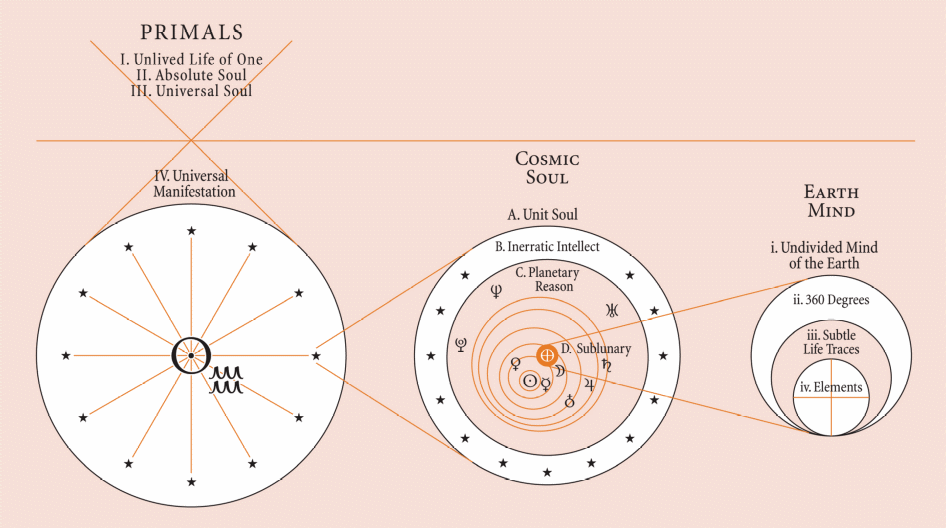
FIGURE 1983 1223-1. Nested Levels.
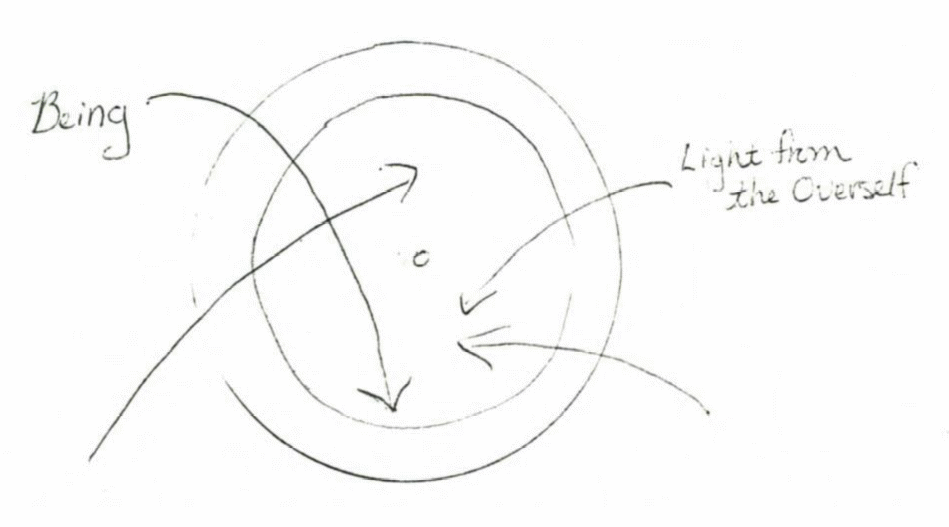
FIGURE 1983 1223-2. Light of Overself in Psychosomatic.
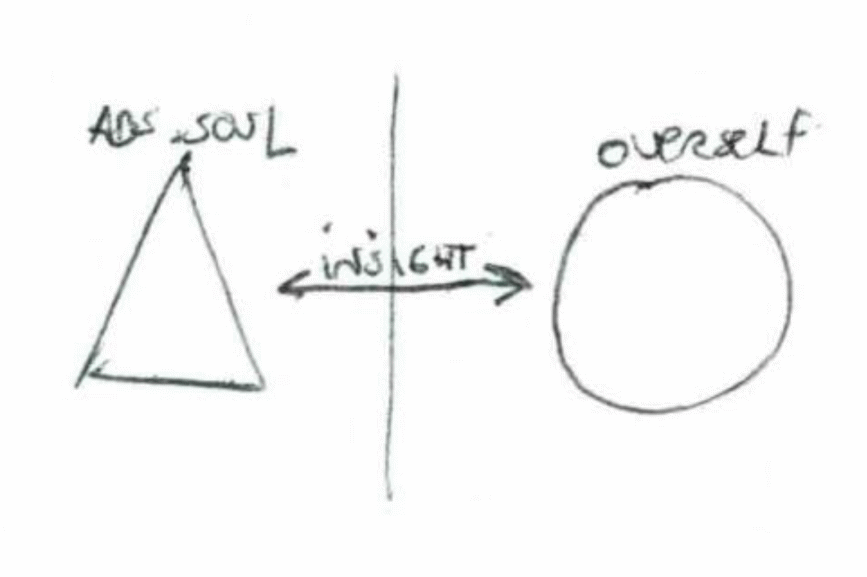
FIGURE 1983 1223-3-AB. Overself and Absolute Soul.
The first diagram is from Astronoesis, p. 250. Other diagrams also referred to are not with this transcript version. [Transcriber note: [diagram] means the speaker is referencing a diagram as he or she is speaking. If someone is drawing or writing, with audible sounds of chalk on a blackboard, I indicate this by [drawing] or [writing].]
TRANSCRIBED Verbatim by IT 2021. Archival verbatim transcript – V11a.
AUDIO FILES: 1983 1223a, 1983 1223b. [Note 1: "Tape" and "Side" refer to original audio cassette tapes that were later digitized into .MP3 Audio Files. Note 2: This class is faint and hard to hear in many places but especially in the beginning and towards the end. AD becomes much more audible around the 35 minute mark but is faint again towards the end. Note 3: In 2024, REP Studio improves the sound quality of both audio files.]
1983 12/23 at Wisdom's Goldenrod
Plotinus: Intellectual-Principle & One
[Audio File 1983 1223a Begins]
DB: (--given), having experience of his own life, has traveled as the-- the realm of the manifest principle of-- of the Solar Logos and its intellectuality and so forth. But sooner or later, he's forced to come back into the world and deal with that.
AD (faint): Sooner or later he's forced to return to being himself, [DB: Yes, um--] that principle of intellectuality which he is. Because this is what has the insight. It's the Overself, principle of Intellectual Being or Consciousness-Being that you are that has insight. That's what has insight. And it can, by penetrating or inwardizing or deepening that insight, you could think of it that way, it become-- it becomes cognizant of the three primal Hypostases or the origin, its own Source. But then it must return and be itself again, that is, be this Consciousness-Being that it always was.
[short pause]
DB (faint): Um, I--
AH (faint): Would it-- would it be appropriate to-- It-- it struck me in regards to last week, [Note: See WG Class 1983 1216a.] notion of principle-- a principle of Life as lived and principle of Life as unlived. Life lived is the-- that soul presentation, the Demiurge. Life as unlived is would you say the Self? I think last Friday you talked about--
AD (very faint): Last week was [two/three words inaudible]
AH: In your paper you said there was (a) [one/two words inaudible] There's a principle of Life that's unlived.
AD (faint): Right.
AH: And then there's Life as lived.
S (very faint whisper): Yeah.
AH: And we speak of Life as lived and we speak of the soul's participation in the world.
S (very faint): Right.
AD (very faint): I think the principle we're studying--
S: Louder.
AH: Excuse me. I was wondering if that (instruction/construction) was connected to the Sage.
S: What?
AD/S(?): You don't know?
AD (mostly very faint): Oh no, no. [one/two words inaudible] to that question, (I go back). I don't see any virtue here and was wondering-- My only way I look at it.
AH/S(?) (faint): Oh I see.
S (faint): Yeah.
AD (very faint): But, if you (try/tried) to go back to that it's very [one/two words inaudible]
S (very faint): That would be dangerous.
S (faint): [three/few words inaudible]
AD (faint): VI.9-- no.
S (very faint): And it's dangerous.
S (very faint): VI.9, uh-hm.
S (very faint): VI.7.17.
AD: VI.7?
S: Uh-hm.
AH: My-- (it's interesting) was that, at what level are we?
AD (faint): Well, it would be interesting to find out what the quote means.
AH: Yeah.
AD (very faint): And, I don't think [couple words inaudible] discussion would--
S (very faint): This(./?)
S (very faint): Yeah.
[34¾ second pause]
AD (very faint): Remember what we were discussing on last Wednesday? That was the Intellectual-Principle.
S (faint): Taking its emanation from the soul [one word inaudible] right. I think we spoke about it as looking back to the One.
[short pause]
Plotinus [VI.7.17, AD reading]: "First there must be an actualized thing; its laters [AD, very faint: Or (rather--)] must be potentially their own priors…"
S (very faint): I remember this.
AD (very faint): Remember we were discussing that?
Plotinus [VI.7.17, AD reading]: "…a first must transcend its derivatives; the giver transcends the given, as a superior. If therefore there is a prior to actuality, that prior transcends Activity and so transcends Life. [AD, faint: And he goes on.] The Intellectual-Principle contains life, and the giver of this [AD reads: that] life is therefore a principle of greater good, of greater worth than Life; in gaining life the Intellectual-Principle had no need to look for it to any giver in possession of Life's variety.
"The Life was a vestige of that Primal, not a life lived by it; Life, then, as it looked towards That [AD, faint: We go on.] was undetermined; having looked it had determination though That had none."
AD (faint): You should try to discuss this because it's quite a difficult passage.
S (very faint): Uh-huh.
AH (faint): We talked a long time ago of a kind of causality that-- [S, very faint: What do you mean?] how these principles based on prior. I didn't understand that at all.
AD (faint): I don't think any of us did. Try. [short pause] Well [couple/few words inaudible] (difficult).
S (very faint): Yeah.
S (faint): Uh-hm, yeah.
AD (simultaneously, very faint): Go ahead.
AH (faint): If-- it seemed that that way of speaking was a way of speaking about the doctrine of emanation that-- at various levels. Now that doesn't help me at all because I've never understood what is meant by emanation. But-- so the One emanates, and then all these lower principles are emanating. It's like--
AD: Well, if we ask ourselves that question. The One emanates, alright. If we do something like this, just to try to make it clear, ok. The One emanates, [drawing] so we imagine things emanating from it, alright. This [diagram] is all, let's say, the Intellectual prison.
S (faint): Prison?
AD: Wisdom.
S: Yeah. (bit of laughter)
S (very faint): [one/two words inaudible]
S (faint): He did say prison.
S (very faint): Go ahead Andrew.
S (faint): Yeah, go ahead Andrew.
S (very faint): No he didn't.
AD (faint): No, prison is good, go ahead, just try a little more.
S (laughing, faint): Really? Yeah.
AD (faint): It seems, it seems that in this analogy, alright, that we have two things. [one/two words inaudible] term.
AH (faint): Isn't that an incorrect way?
AD (faint): Yes, that would be incorrect because on the one hand we're speaking about purely-- pure intelligence, alright, and on the other hand you have to keep in mind that any internal differentiation of this pure intelligence does not in any way fragment (your/pure) unity. Let me see if (I/you) could say it better.
S (very faint): Go ahead.
AD: You have pure intelligence. This is the Absolute One, the One. That's all there is, there-- there's nothing outside of that. And then we say-- speak about the One or this pure intelligence emanates from itself the Intellectual-Principle or-- [S, very faint: Go ahead.] And this Intellectual-Principle, on the other hand, alright, arises spontaneously within the One and is the cause of its own Being.
AH: The One doesn't cause it in any way.
AD: The One doesn't cause it. So, if-- if we try to state it, we would have to say you got something like this. We have pure intelligence, the Unity per se. The internal differentiation which arises within it in no way cancels out the unity. [short pause] The differentiation which arises within this pure intelligence and in no way cancels out the unity arises spontaneously within that intelligence and causes itself to differentiate itself from that pure intelligence. But, this second principle, alright, does not exclude what we have said previously. In other words we're saying the heterogeneity which arises within homogeneity does not cancel out the homogeneity.
S (very faint): Right.
S: Uh-hm.
AB/S(?) (faint): And also that the homogeneity does not cause the heterogeneity. The heterogeneity is self-caused, right?
[short pause]
AD (faint): Go ahead.
DB: But, would it be correct to speak of that-- that heterogeneity or the Being there as causing itself but the specificity within that differentiation was ultimately derived in virtue of that unity itself? That it would be because of the presence of that unity, so to speak, that all of the-- the diversity within that Life was made articulate. But that the being itself of that Life was not something that was caused by anything other than itself.
S: Hm.
AD (faint): It seems that that's what Plotinus is justifying. Somehow within the One itself, alright, there is the superior or transcendent paradigm of all these principles which differentiating itself-- differentiating themselves within the One from the One. [short pause] But, that it's the cause of this differentiation-- I don't know if it made sense to you.
DB: Well I was-- I was trying-- I was trying to put together the-- the-- the two quotes, on the one hand where-- where you speak of this Life as being self-caused and on the other hand that when--
AD (simultaneously, faint): And this Life being self-caused?
DB: Yes, I mean the being-- being (its) self-cause, so to speak, I mean it-- it's a self-actuating [AD simultaneously: (Soul, yeah, soul./Soul, yeah, so?)] (arising/arisal), ok. Trying to put that together with the notion that-- or that other quote where he says that it's in virtue of unity that beings are beings, [Note: Plotinus, VI.9.1, "It is in virtue of unity that beings are beings."] that-- that on the one hand Being itself is self-caused but the determinations within that Being are because of that quote where he speaks of the-- the undetermined Life looking towards the One.
AD (faint): Yeah but when he said that in virtue of unity beings are beings, is he saying that in virtue of unity beings are caused by unity?
DB: No, no. Being-- Being itself is-- and this is-- I mean I might just be making words come out of my mouth without any ideas behind them but the distinction I was trying to understand if-- if it was so was that Being itself-- Being causes itself, alright, then in its contemplation of Unity, within that Being become the differentiated multiplicity of beings.
AD (very faint): You haven't said anything (new/yet), well you haven't said anything.
DB: Probably not, I'm not-- I'm just-- I'm just-- see on the-- you see it's kind of-- on-- Well first of all I'm just asking, it--
AD (faint): Well we're just discussing this (see) to try to see if we could evoke some responses on all these things, we're not arguing here. (AD laughs a bit)
DB: No. No I'm--
S (simultaneously, very faint): Yeah David.
S (very faint): Go ahead.
S (very faint, possibly part of background): You're done with that?
[10¼ second pause with faint background student talking]
CDA: Is somebody saying something?
S: Not yet.
S: Uh-oh. (Something/Nothing).
AS (faint): But what-- but what about these passages where he says-- when (he) say like, "The Supreme may be understood to be the cause at once of essential reality and the knowing of reality." [Note: Plotinus, VI.7.16, "In this way the Supreme may be understood to be the cause at once of essential reality and of the knowing of reality."] And various other things like that. I mean I could-- I can follow the point in which (take these) [couple words inaudible] (pause), but I also see the other point of view in which it's the Unity which in virtue-- and even to follow David to these other quotes where he says it's the One-- the One itself--I don't know if 'confers' is the right word but--confers upon itself as these unities. I mean the unities aren't other than the One. And the One as these-- this-- the One confers-- by its own powers conferring on these unities, as he says, "cause at once of essential reality and the knowing of reality."
AD (faint): Yeah, I think it's the same like the Platonic [AS simultaneously, faint: I think when he's talk--] Ideas that the-- the Good or the-- the One gives Being and the power to know Being. I think you're coming from that angle.
AS: Well, it's just that in-- in this whole pa-- in this-- this is that right before VI.17, it's (the) page before. But, I mean, he says here that the differentiation is not in the One, obviously, but only in the prior-- in the-- in the succeeding principle. In other words, Intellectual-Principle as a distinct principle has this multiplicity which the One doesn't have. And yet in some way-- it must in some way get it from-- from its looking to the One.
S (faint): I don't follow.
S (faint): I don't follow.
AD: Well, they also have in mind, you remember, and the other quote [Note: Plotinus, V.4.2, John Deck translation in Nature, Contemplation, and the One.] that he references he speaks about the One isn't exactly imperceptible, it had some kind of knowing which we can't, you know, really elaborate either. You remember that passage, right? [students assent, faint] But now, on the other hand, alright, we have to consider the-- the One's perfection or the One's unity which is going to make this very hard. Let's hear different--
AS: Well unless the Unity includes from the beginning all the possibilities of multiplicity. I mean that perfection itself includes-- On the one hand the One's perfection includes the possibility of there being a distinct principle, and yet not splitting from it. Yet from their point of view, (they're/their)-- they must be self-caused because the One can't contain any differentiation.
DH (faint): Is it-- but isn't that the point for her, I mean what-- what's the point of view, that it's (sunlike--) From [S simultaneously, faint: Right.] the point of view of the One [few words inaudible] in the One.
AD (simultaneously): Because there isn't anything other than the One.
DH (faint): There isn't anything to cause [one/two words inaudible]
AS (simultaneously): Yes, but that still is a funny way of speaking of cause.
DH (faint): But looking at (it) from another-- from below, I mean, from the-- from the division then there is--
AS: I don't completely agree with that, for the reason that I think that even-- I don't see why the perfection of the One can't in itself allow for a distinction of these principles. Otherwise you're saying that-- otherwise again you're coming back to this view that just the hom-- the homogenous view within the One and not that the One can include all the [one/two words inaudible] (within it). I don't see why the One itself can't include this completeness view. [student assents, very faint] It's not clear. Why can't the completeness of the One allow for these distinct principles, even from its point of view?
S (very faint): I don't get it.
S: Well that's the same--
DH (simultaneously): I mean, you-- are you saying something more than that everything's in the One?
AS (faint): I'm saying something more than that.
DH: Ok.
[short pause]
AS (very faint): [one/two words inaudible]
AS/S(?): Fair point.
[short pause]
VM (faint): You know, the paragraph just before the one that you took this quote out about the cause does in some way support David's point of view, that from the point of view of say the Intellectual-Principle the-- or in that paragraph, looking back to the One, again it's metaphorical language, but that is, what do they call it, cause in-- in the (Greek) sense of all the particularity or-- Maybe that's too strong a word but, all the differentiation within it, the Intellectual-Principle. In that sense it's cause. And Anthony was just [AS/S(?) simultaneously: I see.] saying before in some ways that's no kind of cause, in fact the word may be [one word inaudible] loaded with (physical) notion of causality [couple words inaudible]
AS (simultaneously): [couple/three words inaudible] but I would say, on the other hand--
VM (simultaneously): That's why you get in so much trouble.
AS (faint): I would say I think that's the only causal-- I'm not saying by cause that we mean that-- he says very clearly that the One doesn't have-- he sees that this One doesn't have these distinctions, like saying the sun, cause of sense-things and of being seen, is itself neither the faculty or the object. [Note: Plotinus, VI.7.16, "The sun, cause of the existence of sense-things and of their being seen, is indirectly the cause of sight, without being either the faculty or the object…"] So it's not cause in that way.
VM/S(?) (faint): Yeah.
S (very faint): Uh-hm.
HS: Would you say that the One causes itself the way that you would say that the (Intellectual-Principle) does and (you yourself) are what caused it?
AD (faint): I don't think that's even the point, (Herbert). I think you would conceive that [HS, very faint: I think it's (one word inaudible)] [few inaudible student words simultaneous with AD] the One causes itself.
HS: Yeah you wouldn't-- it doesn't seem like you would have to say that or would say that.
AD (faint): No. Like sometimes when we're discussing the non-dual theory, (keep that in) mind, Mind-- and that Mind and that the expression (within) the world (are real) [one word inaudible] And, the theory of non-duality states something to the effect that the expression must be reducible to Mind itself. In other words, any-- any expression, any thought Mind has is reducible back to Mind, can be resolved into Mind. And in that sense non-duality would mean, alright, that you have one principle, Unity. But, on the other hand, you cannot use that principle to ex-- to-- to deny the existence of an appearance. Alright, even though you say thought is a manifestation of Mind, alright, therefore thought is an illusory appearance of Mind, I could just as easily say no, thought is a manifestation of that reality. It's not an illusory (appearing). Now, if I work that way, then I would have to keep in mind, alright, that non-dualism-- non-dual is understood with an emphasis on the reality of the Mind and insisting on the illusoriness of the appear-- any appearance of that Mind, alright, would make-- would involve us in situations that cannot be resolved. Because the world as an expression or a manifestation of Mind is. And insofar that the world is manifesting something of that reality, that Mind, alright, it simply will not do to say that the world is illusory. So that to-- in order for us to have balanced understanding you would have to keep in mind that non-dualism means that the two are one. But it does insist and say that they are two. Go ahead.
S (very faint): Yeah.
AS: You know, this goes back to the question, even when you say this Life emanating, is this Life other than the Power of the One? Because if this Life is the Intellectual-Principle or just as prior to the determining of Intellectual-Principle is the Power of the One-- And then sometimes-- (I mean) there's a lot of passages like where he says that this eternally achieved engendered eternally [Note: Plotinus, V.1.6, "Again, all that is fully achieved engenders: therefore the eternally achieved engenders eternally an eternal being."] and so on and-- I can follow the view of non-causality, saying that the One doesn't cause (and he's saying) [couple words inaudible] isn't a cause but there seems to be this view also that, you know, what's perfect-- eternally perfect engenders eternally or this notion of essential production and so on. And all these things I think are complementary to the view that on the other hand the Intellectual-Principle causes-- is the cause of itself. I don't think they're contradictory because the Intellectual-Principle itself being an emanation--
S (very faint): [few words inaudible]
[9½ second pause]
AD (very faint): Was it? Well you just stop and (leave). (bit of laughter)
S (faint): Yeah.
S (faint): Avery?
AS (very faint): I guess (the only mistake) was seeing how these two things have to be put together neatly and (clearly).
AD (faint): Well I'm saying, I'm saying it's not that they're put together. I'm saying that in order for us to have a balanced view or to be able to understand properly, we have to keep the two things, that is Mind and its Act, Mind and its expression, we have to keep those two things, alright, but understanding that they are, so to speak, non-dual. [AS, faint: Right.] But we have to keep [AS simultaneously: But I-- but I think that's the--] the two things, and the Vedantic notion is, you know, make one of them illusory and this way you'll have just the One.
AS: Well, I think I'm saying, I think this is what we've spoken of before as this double Act or the dual Power of the One. And instead of calling it dual call it non-dual Power. But later-- later on it's (exhibiting/exhibited), and PB speaks about the Mind is eternally still and yet active. And that's what I meant by complete, to speak of the One as complete seems you have to-- if you take either one of those views, you lose completeness-- the completeness. I mean if you say it's just eternally still and any activity is illusory, then you're leaving something out of it. You're saying well the One can't be great enough to both have stillness and to engender an eternal Being [student assents, faint] [one/two words inaudible] Being. That would be to limit it. While seem-- while seeming to make it greater, it actually is making it less. It seems to me it's greater to say that it's just the Absolute and there can be nothing-- there can be no engendering. But actually it makes it less because it delimits its Power and it can't confer [couple words inaudible] another principle. It can't engender a real Being. That's a lower view of the One. That's a-- I mean that's a-- you know, that's--
PD (simultaneously): But it would seem to me that when you put the One in relationship to engendered beings, you have restricted the One. [student assents, faint] [AS: And I--] If you establish a relationship between the One and an engendered being, then you have-- you have subject the One to a relationship.
AS: I-- it would delimit it if the-- if the One didn't at the same time remain Absolute, [PD simultaneously: Which means it's not related.] and at the same time remain non-related, remain in itself let's say.
PD: So then you see--
AS (simultaneously): See Vedanta wants to say it just remains unrelated, that there's nothing else. Why can't it remain unrelated or remain Absolute and at the same time engender?
S: Right.
PD: But that-- you're-- on the one hand you're saying it remains unrelated, on the other hand you're saying it remains related.
JfL: It remains unrelated I think because it's not other than the One still. To make [AB simultaneously: No but--] the relation it-- you're making it two things.
AS (faint): But [one word inaudible] (has to manifest).
PD: Well it seems like the notion of cause--
AD/S(?) (simultaneously): Are you (ok) [one/two words inaudible]
S (very faint): Yeah.
AD/S(?): I gave you an answer. (bit of laughter)
CDA: It's uncertain I think. (bit of laughter)
S (amidst laughter): (Uncertain.)
AD: Huh? It's uncertain?
CDA (simultaneously): I think still uncertain, yeah.
S (very faint): [few words inaudible]
S (very faint): Right, go ahead.
LDS: I think, if I can follow Avery, Avery [couple words inaudible] it seems like Avery's bringing in the notion of essential production as being-- in no way setting up a kind of relation with lesser principles from the-- from the point of view of the One. Like, the way Plotinus unfolds or speaks of this essential production, it allows for the multiplicity of principles and yet in no way sets up a relation from the point of view of the One to it-- to these other principles. Is that your point, Avery? That-- that the-- the criticism that Paul just brought up I think is a-- is a valid criticism except in-- in the sense that Plotinus seems to handle that criticism by-- by his elaboration of the notion of essential production. That because the One is perfect, it's inevitably or under some kind of-- can't say it's under a necessity but, it's the very fact of its perfection it can't help but flow over, essentially produce.
S (faint): Uh-hm.
AS: I'm saying-- [LDS: Which is (one word inaudible)] And I guess I'm saying even if the Intellectual-Principle establishes itself as a determined Hypostasis, it gets the power to do so from the One. [S: Right.] It's the One which gives it that.
LDS: You're saying the One is the necessary (condition--)
KD (simultaneously): Yet but Avery, it never left being--
AS (simultaneously): One which gives--
KD: Avery? (some laughter)
AS (amidst laughter, faint): I want to say, it's the One which gives the other one.
S: We follow, yeah. (laughter, student words)
KD: But Avery, it never left being the One, that's the point. [S simultaneously, faint: Well, yeah, the--] The Intellectual-Principle is not a second thing and the way you're speaking of it makes [HS simultaneously, faint: (Well/Oh) it is.] it sound [AS simultaneously: I absolutely disagree.] as though the Intellectual-Principle got-- got where it is because of the One. [AS: Right.] If the Intellectual-Principle's what-- it-- it never be-- came out of anything. [AS: Yes.] It never-- you've never left the One. It's still--
AS (simultaneously): Why limit-- but why limit reality to-- why can't-- but--
KD (simultaneously): No but you-- As soon as you--
AS (simultaneously): Why can't the reality be full-blown, why does it need to [one word inaudible]
KD (simultaneously): As soon as you speak of it as engaging in this productive activity as though, you know, as though it's a-- as though it's a cause you're-- you know, that's-- that's a limitation.
S (simultaneously): I think (he's) saying that.
AS: No, I keep seeing it the other way around, it's a limitation to say that the One has to just remain a homogenous block, period, and anything is just a-- an illusory appearance [couple words inaudible] isn't that the limitation to the Absolute.
S (very faint): Uh-hm.
KD: Yeah but speaking of it--
AS (simultaneously): To me that's the limitation, it's more full view to say-- the more complete view is to say that there is also this activity or Power of the One.
KD: Yeah.
AS: And it-- and it-- and it's so powerful that it--
S (very faint): Yeah well I don't know.
KD: Well it--
AS (simultaneously): I don't know. (AS laughs a bit, bit of laughter)
KD: Yeah.
S (very faint): Uh-hm.
AD (faint): No well if you're going to get contact (we're) speaking about something (else).
S (very faint): Right.
AS: All I wanted to say before--
AD (simultaneously, very faint): It's the nature of language to contradict [few words inaudible]
KD (simultaneously, faint): I could see it [couple words inaudible]
AS: Yeah but I was trying--
KD (simultaneously): Too emotional. (KD laughing)
AS: I was trying to say [S simultaneously, faint: Get on Cindy.] that it's not-- it's not dualism because even if you say the Intellectual-Principle is its own cause, it receives the power to cause itself from the One to begin with.
KD: But it never--
S (faint): Right. [S simultaneously: But it's not-- it's--] I would--
LDS: In the field of the One--
AD (simultaneously, faint): Now, now, let's ask ourselves, you say it's receiving the power to become itself from the One. [S: Yeah.] Now the Life which is in the One or as an aspect of the One is a Life that's unlived, whereas the Life of the Intellectual-Principle is a Life that's lived in (theory).
AS: Right. Exactly, so it's not receive-- it's not like there's some determinant-- determination in the One that's given to the Intellectual(s) that-- that's popped out of it as-- I don't know if I said that. The One-- It's like when-- when we talk about the infinite Life or the infinite principle of Life is in the One, but not the determinate Life. To speak of the determinate Life you have to speak of the Intellectual-Principle as a distinct principle. As soon as you return the Intellectual-Principle and say it's the One, now you've lost that determination because within the One there can't be that. Just (conceive of) [three words inaudible] (is/gives it) that determination, is this principle of Life. And he says somewhere, the One confers what itself does not contain. That's a very famous statement. [AH simultaneously, faint: Yeah, I'd say.] The One confers what it itself does not have, [S: Yeah.] as it were.
HS (faint): It's--
KD: But, it doesn't [AS simultaneously: I don't see any problem with that.] have any-- have any attributes--
AD (simultaneously): That-- that would be the One--
KD: It doesn't have any attributes to have.
AS (simultaneously, faint): That's also [couple words inaudible]
AD (simultaneously with KD and AS): The Life of the One, like you just said, is the infinite Life, an unlived Life, but the Life of the Intellectual-Principle is a Life that's lived. [AS, faint: Right.] Now, how could the Intellectual-Principle derive its Life which is a lived Life from the infinite Life?
AS: It doesn't deri-- it doesn't receive it as determined. [student assents] That's what he says, it doesn't receive it as determined.
HS: And it [S simultaneously, very faint: (True.)] doesn't get it--
AS: That's in a sense what it does for-- that's its own self-determination. The sense in which it's self-determined is in the sense of whatever determination it had, in itself. Because the One can't give it determination, the One not having any-- any determination at all to begin with. So only in that sense could it be self-determined.
AD (simultaneously): Yeah, so he points out that the aseity or the characteristic aseity of each of the principles within the Intellectual, by looking towards the One determines the Life which is, so to speak, a universal Life? [one/two words inaudible]
S: Right.
AS (faint): Well, isn't it a self-contained [one word inaudible] I-- if-- There-- I think there are strange analogies on the lower level but they're only removed analogies. I mean, how does-- how does the infinite consciousness of the Overself take itself to be a determined being? Almost by the same way, taking itself to be something distinct becomes determined. And realizing its own infinite nature returns to indeterminate or universality just as he--
AD (faint): Well, on that part I don't understand because I don't understand how the Overself doesn't take itself to be a determined life or an individual life (that had) [couple/three words inaudible]
AS: Right it doesn't, but that's (why/what) I was saying, it's like the same analogy.
AD (simultaneously): Yeah, you know that you did that.
AS: It's its offspring which gains all its-- the arisal of power from the Overself and that offspring is what takes itself, the offspring, to be a distinct principle and thus becomes determined. Now, the Overself hasn't got that determination or has only universality. And yet its offspring takes itself to be a determined principle. Just seems similar here.
S: Yeah but--
AD: Well, why not use that analogy to push, you know, see (if) we could use that to try to understand something about how the Intellectual-Principle has a Life or, you know, lives a Life. The Absolute Soul is its Life, alright, and it is the-- it-- it is in a way contradictory to try to understand how the Intellectual-Principle has Life, the One hasn't Life. [AS, faint: Right.] It's beyond Life.
AS: Nor has it Intellection, [AD: Uh-hm.] nor determination, nor any of those things.
AD (simultaneously): So, maybe if you use the analogy of working with the Overself and the lower self, [AS: That's what I was trying to say.] we could try to understand the One and the Intellectual-Principle.
AS: That was-- that was what I was trying to do, [AD simultaneously: Go ahead.] that the-- that this-- the lower life is an em-- is a-- is a-- a-- a reflex of that Overself, it's an emanation of that Overself. The Overself is universal or infinite consciousness, and yet this reflex or emanation of it can take itself to be a determined or to be a finite life. It takes itself as other than the Overself. And only in that can it become determined and distinguished from its prior.
DH: But it--
PD: So in that analogy, Avery--
DH (simultaneously): It's only-- it's only other than the Overself from its point of view. Seems from the Overself's point of view [few words inaudible]
S (very faint): Uh-hm.
S (very faint): Uh-hm, yeah.
AS: No I'm--
S: (Go ahead.)
DH (simultaneously): (And) [DB: But--] I think isn't it a question of where you look at it (probably)?
S (very faint): Well--
AS: But-- but the--
[Note: See FIGURE 1983 1223-1, Nested Levels, appended to this transcript for the following. This diagram is from Astronoesis, p. 250.]
AD: Maybe we could use that picture we used once before when we put up the-- the whole scheme of the cosmos. And we said this was the Sun, alright, [drawing] and planets going around. And on one of them we're situated, alright, and here's Vic Mansfield [diagram]. And, we said that the undifferentiated universal consciousness is like conjoined to this soul, alright, soul of the Sun. So this would be the individual Overself, an undifferentiated consciousness [diagram]. And then this would be Vic Mansfield [diagram], alright. And like, alright, this consciousness is just, you know, iden-- let's say coincides with the extent of unit-- of solar system, which is limited from the scientific point of view, which is unlimited from a different point of view. [S, very faint: That's true.] Don't think of it centrically. Now, if we locate Vic Mansfield here and this psychosomatic organism, alright, there's these-- this consciousness, alright, some of it gets captured by this psychosomatic organism. Now this consciousness which is captured in here, alright, seems to be like a partial consciousness, a little piece, a fragment from this universal and undifferentiated consciousness. Now over here [diagram] it seems as though, alright, this is like you're conscious of living, alright, so that this entity, this psychosomatic organism has, or seems to have determined that consciousness. Whereas in actuality, in factuality, that consciousness can't be determined in any way. I mean it is what it is and will always be what it is. When a person dies that doesn't mean that the consciousness gets annihilated or dissolved.
AS: Yeah, on the-- on the other hand, the fact of its actually being determined is not in any-- or of its seeming to be determined doesn't in any way bother the infinite consciousness. I mean it can go on being determined all it wants.
S (very faint): Uh-hm.
DB: Yeah but isn't the fact that--
AD (simultaneously): I'm sorry, that can--
AS: It can go-- those entities can go on being determined all they like and it doesn't bother the-- that infinite consciousness.
DB: But-- but [AD simultaneously: (If--)] isn't it like we--
AD: Then we (will/would) say that that infinite(--) infinite consciousness remains unlived?
S (faint): Right.
S (faint): I don't know.
AS: Yes, it remains unlived, even while life goes on.
S: Right.
AS: And the One remains infinite and indeterminate even when everything-- he says the One remains even when everything comes from it, the One remains what it is or seems to [one word inaudible]
AD (simultaneously): So then, then if we read that passage again.
AS: The One remains what it is.
AD: If we read the--
AS (simultaneously): (Yeah) that's-- but-- but I just want to make one point, that One remaining what it is does not cancel out the distinct principles which arise within it or from it. [student assents, very faint] Just as-- I mean I-- maybe-- I guess I'm-- I keep buying the view that says the Absolute is just that. I think if you take-- you have to keep both of the views, the view that the One remains intact what it is and the view that these distinct principles are reali-- are separate existences, distinctive principles.
AD: Yeah, that they arise within it.
AS (faint): And that--
S (very faint): Also you were saying [few words inaudible]
AD: (Go ahead.)
LDS (simultaneously): But why can't you say that the limitation is-- is wholly on the side, or the determination is wholly on the side of the principles after the One or in some way lesser than the One, but that in no way-- and-- and even though all limitation, all determination is strictly speaking from those lesser principles, and that does not preclude the idea that the possibility of the determination comes from being within the field of the One. In other words-- and-- and saying that does not in any way violate the One's integrity or the One's homogeneity. You can say both things, that the principles contain their own determination, the possibility of their own determination, but the necessary condition for that to occur would be that they be in the field of the One and yet you still have not in any way violated the integrity of the One.
AS (faint): Except when you say necessary conditions, there is nowhere else for them to be.
S (very faint): Uh-hm.
LDS: But, no, I think it's important you say the One is a necessary condition for them to exercise their own determination, the determination of themselves. [S simultaneously, faint: I know but that--] That does not call it, that's not saying it's a cause.
AS: Right, but it's not saying [one word inaudible] either because they-- (AS laughs a bit) then where else is it going to be?
LDS (simultaneously): No, if they're going to--
S (simultaneously, faint): He's making [couple words inaudible]
PD: From the point of view [AH simultaneously: Well this--] of the determined eternal Being, they recognize the-- the Absolute as their prerequisite and as their prior, and so in a sense to-- to those eternal beings the Absolute is a-- is their principle.
LDS: Yes.
PD: But, from the point of view of the Absolute, it hasn't done anything.
LDS: No. It hasn't been violated in any way.
PD (simultaneously): Right.
DB: I don't-- I don't--
PD: So the point-- so the point of view of--
AD: Well, if you understand this, then can you understand the way that we have to speak of non-dualism?
DB: Is that-- Anthony, is that in a sense that when one speaks of any kind of determination or specificity or manifested aseity, that that condition of determination or-- or specific nature or whatever, is only derivable from the fact of Unity itself. That insofar as you have a spec-- a s-- like a specific eternal Idea or eternal-- an eternal being, the fact that it can be a specific eternal being is only due to the fact of the power of Unity itself. I mean, were it not for Unity-- I mean it-- were it not for the fact of the One, you would just have a undifferentiated homogeneity.
S (faint): Uh-hm.
S (faint): Yeah.
DB: Yeah. Because it's--
BS (simultaneously): Well of course in the One you'd have undifferentiated homogeneity.
DB: Well, look. Insofar as we're speaking of an emanation or an overflow from the One, the power of the One moving forth, that any-- I think the unity of an eternal Idea, that unity is al-- that eternal Idea being a specific Idea is only possible because of its participation in Unity, its-- I mean, just the-- to be able to speak of-- of a differentiated specific integral whole is only because of its participation in the One. [S simultaneously: Naturally.] The One doesn't-- the One doesn't mean a complete negation of all specificity in terms of manifestation because otherwise I don't think you'd be-- that would be-- that couldn't exhaust the meaning of this complete perfect Intelligence.
PD: I think that's a good point Dave, that the One does not negate the specificity or determination. There is no relationship to begin with. So an appearance does not negate reality. 'Cause if it could, then you've put the two into a l-- into a logical relationship.
DB: Well, maybe I'm doing--
PD: So the s-- so the-- the principles that have self-determinedly arisen are not in contradiction to reality.
DB: No, [AS simultaneously, faint: Right. (That was the essential point.)] no, they're absolutely dependent on it.
S: But-- yeah.
PD (simultaneously): But that dependency is from within the appearance.
AH: You're saying that they're not related. The two principles are not related but they're both true.
S (faint): Yeah, yeah, uh-hm.
AH: It's so that the One is homogenous and it's so that there are distinct things. Now those two true principles are not logically related.
S (faint): Uh-hm.
BS: Well, what does non-duality mean, does it mean there's only one principle?
AD: And that's what I've been trying to avoid.
AS: Right.
BS: I know but it's [few words inaudible]
AS (simultaneously): 'Cause if you say that, then it's--
S (very faint): Right.
(Side 1 of original cassette tape digitized as 1983 1223a Ends; Side 2 Begins)
AS: --not two, a non-separate thing. Instead of saying there's only this one homogenous One and that's it, anything else is-- is nothing or illusory.
S (very faint): Uh-hm.
AD: And if we went a little further I would say it is in the very nature of this paradox that we can understand non-duality.
AS: Right.
AD: If we understand the paradox we understand non-duality. [AS simultaneously: Or (one word inaudible)] But if we insist on reducing one to the other then we have-- we have misunderstood it.
AS: And non-duality is another word for the Absolute I would say.
AD: Uh-hm. Yeah.
AH: This may not be significant but, you say that-- We speak of these two principles. You speak of the One, you speak of its manifestation. And it's almost-- it's almost impossible for me in terms of human understanding to not subliminally posit a third thing in which these two principles are-- reside.
AD: No, if you put it that way, then of course it is inconceivable but if we put it in the sense, and I tried to choose the words very carefully, that there is pure intelligence within which the-- within which differentiation takes place that in no way cancels out the purity of that intelligence.
AH: Yes. Is it necessary to conceive of this non-duality in a way that no higher principle is posited consciously or ontologically.
AD (simultaneously): Well, Andrew, if you can conceive of a principle higher than pure intelligence I'd like to hear it.
AH: But if we speak of two principles in any kind of relation or--
AD: No but look at-- look at the way I put it, we have pure intelligence, alright, which is homogene-- homogenous, and yet within which differentiation can take place that in no way cancels out that homogeneity.
S (faint): Yeah.
AH: I'm trying to understand the impact of us--
AD: Well I tr-- I also try to understand the nature of this non-dualism that they talk about all the time--without canceling out either side.
[9¾ second pause]
AH: Are they--
AD: Otherwise I'll come up with a theory of creation, that the world was made 4004 B.C.
AS (simultaneously, faint): [few words inaudible] That's why they listen to it.
AH (faint): Yes.
AS (faint): That's why it's not in any relational [one/two words inaudible] When you think of a relation you always think of a third.
AH: Yes, Avery, that's-- that's what I was trying to say, yes.
AS (simultaneously): And-- I think that's what Paul's point was that it's a non-relational [one/two words inaudible]
AH (simultaneously): If you think of a relationship they have to be related within some third term.
PD: Or the relationship is from the point of view of the self-arisen principle, not from the Absolute.
AS: And-- the only--
AH: The relationship that resides in the self-arisen principle is not in a third thing or not in the Absolute.
AS: The Absolute is those-- is the non-dual of those. The Absolute isn't one of the terms of those (three), [student assents] otherwise you're back again. [S simultaneously, faint: (Good point.)] The Absolute means the interpenetration or non-canceling of the one view with the other. You can't be one half of the two views, otherwise you-- you're going to again be into a relationship.
AH: It seems to me if you posit the two principles on a horizontal level logically, you've posited a relationship.
S (very faint): Yeah. [couple words inaudible]
PD: But we're not-- we're not at the horizontal logic here, Andrew.
AH: I don't-- I-- admittedly there's some-- there's some insight that has to be gained into the truth of this discussion. But, I'm just trying to get to the impact-- the description of non-duality.
S (very faint): Well, yeah.
MB (faint): Anthony? Does the concept of participation, when we speak of-- when we speak of participation in the Ideas, does that notion of participation apply to the relationship, so to speak, of the Void to the non-dual also or is it a very different sort of phenomena? And I have to use words, think you'd have to use words in order not to-- We u-- like we use the analogy before of-- of our life and the life of the Overself or the life of the soul. And perhaps the notion of participation would work for the unlived Life.
AD: Well, if you took that consciousness which was enclosed by Vic Mansfield, would you say that that consciousness participates in the undifferentiated consciousness?
MB: I would.
AD: Huh?
MB: I would.
AD: Well, that means then it's other than that undifferentiated consciousness.
MB: But I thought that--
VM: (Well/Yeah), I didn't follow that.
S (faint): You mean [three words inaudible]
S (simultaneously, faint): Yeah.
VM: I didn't follow why that-- Maybe just do it again Anthony, same words.
AD: Well if we use a s-- a simple diagram, imagine you got a test tube with water in it, ok. And you imagine light streaming through the test tube and the water, you know, coming out the other side. Would you say the light that's streaming in through the water in the test tube is partic-- the light which is streaming through is participating in light?
LR: No.
VM (simultaneously): (Yeah), I'd say it is light.
S (very faint): Participating.
AD: Well, yes it is that light. So the consciousness which is streaming through, alright, [drawing] and this organism let's say has captured some of it, that's a way of speaking, would we say that this consciousness participates in [LR simultaneously: No.] the Overself? [Note: See FIGURE 1983 1223-2, Light of Overself in Psychosomatic, appended to this transcript.]
AH: No, because that would make it other than that.
AD: Yeah.
MB (faint): But there's [couple words inaudible] like we can-- [AD simultaneously: I--] we can say the-- that the horse participates in the Idea of Horse because the horse and the Idea are not (separate).
AD: That's why I wanted to avoid using words that were loaded with certain connotations that are immediately intro-- be introducing to what we're talking about. I'd rather use three-syllable words and just try to speak this out our own way.
MB: Well I guess what I was asking was whether-- whether when you speak of the-- these analogies, is there a direct correspondence or-- or are they only analogies?
AD: There is (again--) Analogy is simply a way of leaping from the known to the unknown. Help us, you know, get catapulted into-- go further that desire, or that-- you say that unlimited desire for knowledge.
AH (faint): Anthony, I'd like to ask, just trying to understand the impact of something, I-- (how about) this way. You-- is the notion that all things are in me but I am not in them is the way from the Indian tradition? Like, as a way of describing the relationship. Is this the kind of-- is this the-- the kind of image that we should have of-- of these two principles? Like the o-- everything is in the One, but the One is not in things. [short pause] I-- I don't know--
AD: I follow your second example, I-- the first one I'm-- I'm confused about.
AH: Ok. It was a way to speak about Brahman, wasn't it? [AD/S(?), very faint: Uh-hm.] It could also bring me--
AD: But, Brahman is another way of saying Mind.
AH: Yes. And I think all things are in Mind, but Mind (isn't in all) things. Because, if there are things that are true in their own right, in-- [S, faint: Yeah.] I don't know how--
AS: You know, he says a lot-- I mean I-- I think that he says it a lot better than the Vedantists when he says--
Plotinus [V.5.8, AS reading]: "No doubt it is wonderful that The First should thus be present without any coming, and that, while it is nowhere, nowhere is it not: but wonderful though this be in itself, the contrary would be more wonderful…"
AS: I don't-- I think that's more accurate than just that statement that-- that all things are in Brahman but Brahman is not in things.
S (faint): What does he mean it's wonderful?
LDS/S(?) (faint): (Yeah but--)
AD (faint): [one/two words inaudible] what it means.
AS (simultaneously): What-- what do you mean Brahman is not? That too is not real.
S: But if it is--
AH (simultaneously): Would you read it again please?
AS: Well I don't know if it applies, I-- but I just thought he was trying to say that-- that, you know--
Plotinus [V.5.8, AS reading]: "No doubt it is wonderful that The First should thus be present without any coming, [and that], while it is nowhere, nowhere is it not…"
VM: The first sentence is about--
AS: "Without any coming," now-- "while it is nowhere, nowhere is it not". It's like the pictures that Anthony drew with the light, when he says that side by side stands the-- this Authentic and the sensible universe. So the Authentic doesn't have to go anywhere, there's no coming of it. And yet it-- you can't say it's absent from the guy. I mean the light's in the test tube, the test tube-- it's-- it permeates completely the test tube. [student assents] So it's not quite-- to say that it's not in the test tube, well, I follow that but in the same time it's not absent from the test tube either.
LDS (simultaneously): Right, but you can't localize it, that's (maybe--)
AS (simultaneously): Well, if that's what they mean, but I think this was more precise, [student assents] saying you can't loc-- you can't localize consciousness.
AD: Do you know that, as far as I'm aware of, Plotinus is-- the-- the Enneads is the only book where there is a discussion about Sagehood. You know what I'm talking about? I mean in Western literature.
AS/S(?) (faint): Oh in Western world.
AD: Moses Maimonides has a section on it but it's very difficult and very obscure. Well, maybe this is too subtle for a Christmas holiday, [S simultaneously, faint: Right.] I better go down [couple words inaudible]
S: That's right.
S: Yeah.
AH: From the point of view of human intelligence or the kind of intelligence that we all have to operate with, I think we can properly say-- we could properly say that the One is not any thing. Insofar as our experience is restrained or restricted to multiplicity, and not unity, it seems from the point of view of human intelligence that's all that can be said about the One.
S (faint): Yeah.
PD: But, I may be wrong Andrew but, see that's the very point we're trying to deal with is that in our thinking we're dichotomizing. We dichotomize multiplicity and unity and [AH assents] accept them as opposites.
AH: Yes.
PD: And now we're going to attribute that dichotomy to reality. The nature of reality is that it's not subject to that dichotomy. The multiplicity is not other than unity and doesn't negate unity.
AH: And how shall that reality be reduced to any kind of a concept in regards to thinking about it?
PD: I don't catch what you're driving at.
AH: Well, it's just an evolution of your comment that says if there is this real that is dichotomized in thought, we posit--
PD: No I said the reality wasn't dichotomized, our thinking is dichotomized.
S (faint): It's in thought, yeah.
AH (simultaneously): Our thinking is dichotomized. So how shall we posit that reality without reducing it to a concept, thereby dichotomizing?
PD: No. Because you're self-conscious of your thinking process, you attempt not to attribute the dichotomi-- dichotomizing activity within you to it. That's how I do, I mean, I don't--
AH: To find some way of thinking about the One without thinking about the One.
PD: You posit something and negate what you posited.
AS: You-- you're letting the-- the language get too thick instead of making it transparent, you can't keep looking back at the language you're using. You have to use it very transparently to point it. Because then if you start thinking about how the language isn't adequate, you get like more like the centipede which tries to think of how it's walking. Here it is it's doing it and then suddenly you think wait a second, I can't do this because the Absolute can't be put into words and therefore I'm thinking about the Absolute so it's no good and then it all falls to the ground. (AS laughs)
AD (faint): Well, we all understand the insufficiency of-- of language and its inability to, you know, deal with these matters. But I am also of the opinion or believe(d) this opinion even before I read the note by PB where he says-- and he mentioned the fact that it was unfortunate that the Buddha kept silent about certain questions. [Note: See Paul Brunton, Notebooks, V16, 28:2.59 and Perspectives, Ch. 28, #1.] And PB points to the fact, as difficult and ineffable the experience is, he can leave behind some traces, some indications which may evoke intuition in a person and he could direct his attention to that. So I'm taking these two things into consideration, you know, try to-- when we espouse and try to express our understanding of these matters in as a precise form as we can and that's why very often, even though I dislike it, I try to be-- or like precision tool, you know. I'm going to say something in a certain way and if you-- if you're not careful, you just missed a-- you know, the whole point. And that's why I use the analogy that I used when I spoke about the differentiation, the internal differentiation of the homogenous pure intelligence in no way cancels out that Unity.
AH: Yes. It seems-- I wasn't-- I wasn't criticizing the fact that you choose to speak about it, but I was curious about precision that-- the precision of speaking or thinking about it in a way that remains absolutely an enigma. I mean, it seems that the precise expression-- the most precise expression most clearly presents the enigmatic nature.
AD (faint): Most clearly presents the paradoxical nature.
AH: Paradoxical.
AD (faint): It is through paradox that you understand these things. You will not understand them because you arranged a logical sequence.
AH: That's what I'm-- I'm trying--
AD: Yeah. (AD laughs a bit) Your confidence in logic is, you know, overrated.
AH: I'm trying to grasp the impact of-- of (the--) the necessity of the precision of (error/arrow).
S (very faint): Yeah.
S: Interesting.
S (very faint): (Yeah/Uh-hm).
AS: No, the paradox [couple words inaudible] to say that [few words inaudible]
AD (simultaneously): The paradox wasn't completed because that was only one side of the picture. That presented us with a side of-- of a Unity, an intelligence which always remains a unity. The other side that I haven't been able to formulate is that the differentiation of the intelligence, which in no way disturbs or cancels out the unity of the intelligence, these differentiations must arise and do arise spontaneously out of himself. And that's the other part of the paradox I gotta try to put together and give you the two of them at the same time. What I gave you was not a paradox yet.
S: It's only partial.
AD: It's only part of it, it's half the paradox, I gotta find a way of expressing the way the differentiation which occurs within that unitary intelligence is self-generating.
AH: Self-generating.
AD (simultaneously): Or self-causing or spontaneous. Alright, (you deal with) the problem.
S (very faint): Yeah.
AH (simultaneously): One thing (is/that's) for sure, it's not-- it's not caused by the One.
AD: Well, because then you missed [AH simultaneously: Ok.] the whole point of what the One is.
AH (simultaneously): Alright. Ok so you say it's not caused by the One, it's self-caused--
AD: If-- if you think-- if you think of the Intellectual-Principle or Soul as caused by the One, you need to tell me, what do you mean by that.
AH: It would be a-- a relationship of them. But that's obviously not the way you're speaking.
AD/S(?): Yeah.
[Note: See FIGURE 1983 1223-3-AB, Overself and Absolute Soul, appended to this transcript for the following. This diagram is from AB class notes for 1/27/84. It doesn't match exactly but it's close enough to help follow along.]
AD: Because you know we can speak and we do speak of these three principles, this-- the same as saying the Void, the mysterious Void. Or we can speak of these three principles as the Absolute. I mean, we're actually in the stratosphere now. And there's not enough air to breath over (here/there). Now, do you remember I said if you think of those three principles, alright, in Void, One, Intellectual-Principle, and Soul. And then almost like you have to make, and it-- it is difficult, but like you make a dividing line now and then over here you say [drawing] well from there emanates all these individual Overselves [diagram]. We don't understand anything on this side of the line [diagram], alright. Whatever we do understand on this side of the line, and this even PB has mentioned over and over again, when the lower self unites with its Higher Self, the Overself, when we're now that unitary Consciousness-Being, that soul, and within itself it could find the mysterious aura or radiation coming from this-- in other words, the World-Idea coming into it, alright, is-- is one of the things it finds. Another thing it finds that if it penetrates and in-- draws into itself or deepens its consciousness, it finds out something about these things [diagram]. I think in the case of Plotinus he points-- he does say about these three things for instance much more than you will find in PB's notes, because PB has restricted the amount of information concerning these principles. Alright, but that-- it's kind of limited. And he has his reasons for doing that, I'm quite sure, not that he's not aware of these things. But, his primary, I think, project or assignment was to present to the, you know, twentieth century and the twenty-first century mentality a revision of many of these ancients-- ancient truths in a modern acceptable way. So he's not going to pounce on this here [diagram]. Because who-- you know, who's interested in this here? This is the primary interest [diagram], this is everything as far as we are concerned as human being(s).
S (very faint): Yeah.
AS: Probably also because in some sense that left side of the line [diagram] has been stated I mean about as-- about as much as you can state about it.
AD: As much as-- yeah.
AS: Whereas the right side [diagram] is where all the confusion is. [student assents, faint] I mean most [AD simultaneously: Uh-huh.] [one/two words inaudible] (important confusion).
S (faint whisper): Yeah.
S (very faint): It's a lot of people.
AD: Yeah because when-- when we examine the body of knowledge we should say the Sages have left behind, you know, the whole deposit, and when we try to find out about this here [diagram] and it seemed like there's a very restricted amount of this left-hand (side/sign), even if you want to call this an esoteric tradition, leave this behind, alright. It's over here [diagram] where PB is concerned to get the contemporary man or your ordinary man to realize that he has a soul within him, search out that soul and to seek union with it. And I think this is the basic thrust of his assignment. Well-- yeah.
DB: Anthony, this goes back to the previous discussion. Do you want to do that or--
AD: I want to get to the other half of the paradox.
DB: Ok.
S: Well--
DB: Good. The other half being the Nous?
AD: I gave you half, now you give me the other half.
DB (faint): Ok.
HS: Why can't the One be a cause?
S: Oh no.
AD: Just-- just examine the sentence you said, as though the One could be anything.
HS: Why can't the One cause? (AD laughs, some laughter)
DB: There's-- it (would).
HS (simultaneously): Why-- no, if the One is-- I mean the One is infinite say in all directions--
AD: Is the One gonna do something? Cause the birth of the Intellectual-Principle?
HS: In the sense that-- but why can't it-- but why can't in the sense of emanation or the-- or the sense of essential cause, actual-- be the actual cause? I don't understand that.
AD: I'm sorry.
HS: Why can't in the sense of the essential cause-- causation, why can't it be the actual cause of the Intellectual-Principle, in that the mind say causes-- can you-- is it wrong to say that a mind causes a dream?
AD: Well, I-- a very elementary reason for that being, [HS simultaneously: Yeah.] if you understand great illusion that we're all subjected to, you know, time, space, causality, that this is the way the mind functions, this is the way it must operate. And when you realize that these are the three bugger-bears, you know, of-- in human society, these are the-- these are those illusions that fetter the mind to materiality, when you really understand the nature of these illusions that the mind (is starting) to operate, you wouldn't apply them to these principles. You wouldn't use a word 'cause' up here [diagram].
HS: Ok but you would s-- don't-- but you would say that there's an emanation of the One. And you'd speak of it as an unlived Life?
AD: Yeah but, you remember the way I try to qualify that? By pointing out that when we said emanation from the One, what we meant, in order-- In other words, when we use this analogy of, you know, here's-- here's a star and it emanates light, and this light, alright, is distinct from the star, alright, now the analogy breaks down because there's only Absolute Mind, there isn't anything outside of the Mind so if there is anything, so to speak, within the Mind, in other words, if there's an appearance or any other principles, alright, they have to be within the Mind.
HS: Ok, so the emanation is more like you said an internal differentiation.
AD: Yeah, it's an internal differentiation of that pure intelligence which doesn't cancel out that Unity.
HS: It doesn't cancel out the Unity. Ok and, now, is say Being part of that internal differentiation or is Being its own-- Being as Being being its own cause, is it part of the internal differentiation of the One or is it-- or is it because of the internal differentiation that it is its own cause?
AD: Well, let me see (if) something like this you're saying. Are these principles, Being, the Ideas [three/few words inaudible] are they the cause of the differentiation that takes place within that unitary intelligence. Well, that's what he seems to have said, he said that they are the cause of their own being.
HS: Their own being. Yet you want-- yet in order for-- in order for it to be non-dualism, it's an intelligence which is unitary. It contains within it real Beings, so to say, which are of that intelligence?
AD: Well you can't say it contains within itself real Beings, alright. Because it's not a box with-- and you put things in it.
HS: You can't put (Being(s)--) [short pause] You could say there is real Being. Is that-- that's lawful, to say that there is real Being. You can't-- you cannot in any way say that the One is, right, because that would make the One Being.
AD: Well you could say the One is in the sense of understanding that 'is' is being used analogically here.
HS: Any real Being that-- that arises-- that arises, you couldn't say it arises-- could you deny that it-- that it arises within the One without saying that it--
AD: Well, that's what we're saying then, real Being arises spontaneously, alright, and calls forth itself within the context of that unitary intelligence.
HS: When it calls forth-- it calls forth itself from its own-- so to speak [couple word inaudible] its own prior being?
AD: Not its own prior being, alright, that--
HS: Yeah, can't say that. [AS simultaneously: From its own prior (one word inaudible)] And it doesn't call forth-- does it call forth itself from its own prior, so-- the way we speak of it as held in the One? Isn't that, [S: Yeah.] so to say, where it comes from?
AS: From its own paradigm, from (a certain) paradigm.
HS (simultaneously): From its own-- you'd call-- You would-- you would be able to say that, it calls forth itself from its own paradigm, it's the-- which is held within the One.
AH: If you say it calls forth itself, you're saying it doesn't have any prior. But--
LR: No.
RG/S(?) (simultaneously): (Its own/There's no) prior, don't say that.
AH (simultaneously): (If/It's) its own prior(--/.)
HS: But it being its own prior, does it-- it, I mean-- do we posit prior as its own prior, do-- or does it-- we posit as Being as its own prior?
AS: Neither.
PD: Yeah that seems to be the point, that in its self-arising, it arises with the means of self-determining itself. So the notion of arising itself is born then.
HS: It is what Paul?
PD: The notion of arising, of a before and an after is all born in that one act.
AH: That's its sphere of influence, that's its modus.
PD: But prior to that you can't speak of a before or after.
RG/S(?): Or cause.
PD: Right.
RC: Is self-- is self-determining maybe synonymous with cause?
AD: Yes.
JB: At least the first (time).
AD: Self-determining, cause, essence, being, these are all synonymous terms.
RC: So like it seems that the way you've been talking about it that the cause is like an-- like an integral-- an integral element at the level of the multiplicity.
[short pause]
AD: Yes.
RC: In a sense that, if the Intellectual-Principle is all the Ideas then like you could almost say that causality is one of the Ideas.
[9 second pause]
AH: In the same way that time, space, and all the other necessary ideas within it.
AD (faint): Well there's no time and there's no space there.
AH: If you're talking about space then obviously--
AD: In the Void there's no time, no space, you don't have to worry about whether you put food in the refrigerator, forget it. (some laughter)
VM (amidst laughter): I'm not worried (again).
AH (simultaneously): But I thought, I thought we were talking-- that Randy's comment was directed to this level of cause.
AD: Yes but I think [AS simultaneously, faint: (Try not to--)] if you listen to what he's saying--
AH: He said that one of the Ideas in the Intellectual-Principle is the integral Idea of cause.
AS: It's not a thing, it's eternal Being. He's talking-- Randy's talking about eternal Being.
RC: Yeah, especially as-- [AS simultaneously: He's not talking about things and so forth.] as synonymous with self-determination.
AH: Are you talking about the One?
AS (faint): No, he's talking about eternal Being which we talk about, [CDA simultaneously: Randy, could you s--] which is that which is self-determining.
CDA/S(?): Yeah.
DB: So then, this eternal Being--
S (simultaneously, faint): Wait. No that's not--
AS (simultaneously): Right Randy? I mean, isn't that what you--
AD (simultaneously): So then, I--
AS: Speaking of eternal-- of Being as a principle.
AD (simultaneously): If-- if you follow-- if you follow up, Randy, then you're saying something like this, if I think of the One, whether in a fourfold way or a sevenfold way, One, Being, Life, Intellect, Nature, Soul, Body or I-- whether I think of it as simply Being, Life, Intellect, Body, then these are the transcendent paradigms which provide the-- let's say the model within-- or, this provides the model that the Beings within contemplate in order for them to arise within the One or within that pure intelligence.
S: No, that's not to that quote.
KD: Are those paradigms, you're saying that then they-- would you-- if it's in the--
AS (simultaneously): In the One.
KD: It's in the One?
AD (simultaneously): Well, yeah. One of the ways I spoke of the One was you remember I-- we-- you could think of it as undifferentiated pure homogeneity. And then we could think of it as having a fourfold nature, you know, like One, Being, Life, Intellect. That would be another way of looking at it. And if we were to-- if we looked at Universal Being as-- in other words, you can take a look at Universal Being and see it from one angle alone, from the angle of Being, we could say Universal Being, period, alright. But you could move over and now say that that All-Possibility could be looked at from the angle of Life, and Life alone, alright. That's the transcendent paradigm. That's an indivisible aspect of the One, ok. Then you move it over again and instead of thinking of it-- and instead of thinking of All-Possibility from the point of view-- and the point of view obviously applies to us. We're looking at it from the point of view now of Intellect and we could say that All-Possibility is Intellect, alright. So as we look at each-- in other words, we look at the One from any one of these aspects, alright, in the One they're indivisible. That's what you mean by the One, that all these aspects, All-Possibility is indivisible. So the distinctions that we see in it are really arising from ourselves because we can understand, at least conceptually, notions like Being, Life, Intellect, alright, Body, we can understand something of that. So we can say that this total All-Possibility has all these aspects. Now, if we continue with this anthropomorphic view of trying to understand the One, then we would say that the Beings within the One have those indivisible aspects of the One as the transcendent paradigm, they look to that, they contemplate that, and that's why they are continuously and eternally being generated. Now--
KD (simultaneously): Anthony, could I--
AD (faint): Yeah, go ahead, (finish).
KD: No, no finish please.
AD: Well, when you say cause and we say it's synonymous with Being and essence, then look, when we say One, Being, Life, Soul, Nature, Body, etc, alright, notice Being is the pri-- one of the indivisible aspects of All-Possibility. Cause is one of those indivisible aspects. That's what Randy I think was pointing to when he says Cause is one of those Ideas, one of those transce-- we should put it this way. [AS simultaneously: Yeah, now (I) (couple words inaudible)] A transcendent paradigm within the One.
AS: Yeah but, it's one [KD simultaneously: Wait a minute, you--] of those unities, it's not, I mean--
AD: Yeah, it's one of the unities.
AS (simultaneously): The point is it's one of the unities.
KD: Yeah, maybe--
AD (simultaneously): But, you know, we said all this about [KD simultaneously: Yes.] a year and a half ago.
KD: When you use the word 'unities' here, like which he has or whatever the term is used within the One, how do you-- how do you account then for the quote in Plotinus where he says that there-- in an attempt to grasp its prior, the Intellectual-Principle fails. And in the failure of its attempt to grasp the Unity, the One as a whole, it goes forth amassing successive impressions, and then it's in that act that it-- that it determines itself. And what you're saying sounds to me, [AS simultaneously: Ok.] I'm probably misunderstanding, [AS simultaneously: Same thing, yeah.] it sounds a little different, that-- [couple inaudible student words simultaneous with KD] that there's a-- that there's a contemplation occurring of the Intellectual--
AD (simultaneously): No but that-- I would use that quote to support [student assents] what I was just saying.
AS: Kathleen, he was saying that--
KD (simultaneously): Yes. See I never understood that, I mean-- yeah.
AS (simultaneously): But Kathleen, those principles, when he said there's the One, Being and so on, in the One they're indistinguishable is what he said, [KD simultaneously: Right.] they're infinite and indistinguishable. The intellect can't grasp them like that. Nothing that's determined in any way can grasp them like that. Even the Intellectual-Principle itself can't grasp them as in their totality, indeterminate and infinite.
DB (faint): (Right.)
KD: So where would--
AD (simultaneously): That's why I said, [AS simultaneously: And that's why--] they're anthropomorphic.
KD: Right. [AS: And that's--] So when you say that there's a--
AS (simultaneously): And that's the sense in which it's its own cause, it's its own [KD simultaneously: Yes, right.] determinate cause, but it looks to its prior paradigm to find the principles [KD simultaneously: But--] that are going to determine it.
KD: But it's not-- it's not contemplating-- you know, paradigm sounds like there was-- [AS simultaneously: Oh no.] there's an isolated Idea [AS: Right.] that is being contemplated and that-- that vision, that contemplation produces a lower order, [one inaudible student word] which makes it sound as though there's distinguished [AS simultaneously: Right.] Ideas in the One.
AS: But there's not.
KD: But it's a looking-- but if you say that the Intellectual-Principle is a looking-- you know, is a looking, and its inherent activity is to look and the only thing obviously it can look at is the One and it can't do that 'cause it can't bri-- make it an object to itself. So then it becomes itself.
AS (simultaneously): And then even further, that it's that very looking [KD simultaneously: That determines itself.] that determines what is indeterminate in the One.
KD: And it becomes--
AD (simultaneously): Well instead of saying looking, change the word and say in its self-intention it produces itself.
S (faint): Yeah.
S: Uh-hm.
AD: In other words, [AS: Yeah.] one of the Ideas, alright, introspecting in-- into itself, self-intent upon itself, alright, generates itself.
S (very faint): Uh-hm.
AS: In fact, the very-- the-- one of those Ide-- the one that actually is concerned with doing that and making it a distinct Being is that second one, when you went Unity, Being. It's the second principle itself which the Intellectual-Principle is in its self-intention to determine itself out of those indeterminate principles. 'Cause Being is the very principle that's going to determine something as distinct from the One.
AD: And even in the lowest order, right down in your astrological chart, the Sun also represents that. Creative purposeful life. In other words, your life has a purpose, a creative purpose, a central purpose, alright, not because it's infinite, because if it was infinite it wouldn't have a purpose, but because it's specified by one of the ideas. So the Sun sitting on a certain degree, alright, is a purposeful life; purposeful means life governed or circumscribed or directed from within by an idea. But even at the lowest level you see that the Sun operates that way and in the metaphysical chart where the Sun represents Being, essence, it's the same thing as saying it represents cause, its own cause. So, in the One itself it's only an indivisible aspect, it's a superior version, alright, it's the model which-- of Being within the One, and I'm saying 'within' and all this is metaphorical language, alright, looks to that, alright, as paradigm for its own self-intention, bringing itself into being. Don't think of this in time but think of this as eternally going on. [S, faint: Right.] Now "eternally going on" is another contradiction. If it's eternal, it's not going on.
S (faint): Yeah.
KD: Does it see itself or does it project-- I think the reason you're describing it that way is because you-- you can't say that it makes the One an object of contemplation.
AS: It does.
KD: The looking--
AS (faint): He says it does.
KD: Yeah I know, he says that--
AS (simultaneously): No I mean he says it makes-- that the Intellectual-Principle has for its object the One.
KD: Yes, it has for its object but it-- since it can't-- it can't grasp that, right.
AD (simultaneously): Well, you could express it this way, instead of saying it has an object, alright, now, over here it's really again a question of choosing words that'll help you. Instead of saying that it's looking to the One, contemplating to the One, and you get the feeling as though, well, you know, at that level how can we speak about an object outside something, if you think of-- if you reverse the language and say it has self-intention, looks into itself, alright, then you'd get around that language barrier. I mean just because they're written in a book that doesn't mean that you can't try to rephrase it to help yourself.
CDA: I [AS simultaneously: (I can--)] still don't understand this-- the-- even when you say looking into itself, it-- it doesn't help.
AD (simultaneously): Ins-- instead of contemplating the One, say it looks into itself or introspects into itself [CDA simultaneously: But there-- then you're--] or interiorizes--
CDA: I'm-- I'm just, you know-- I'm-- I'm hung up on the words but-- If you're speaking of one of the transcendent paradigms in the One that is indistinguishable within the One, it's only really from the point of view of intellect that we can speak of this paradox, that it seems to me what you're saying, that as it is in the One, that somehow there is this distinction and that it's able to look into itself or contemplate itself or have a self-intention, that Being would be-- somehow have a different self-intention that Life would, or is in some way distinguishable, I just can't follow.
AD: Well, I have the same trouble, I didn't follow you either.
S: Uh-hm.
CDA: Ok.
LR: What you're really saying is-- [S, very faint: Uh-hm.] [S: I think--] what you're really saying in a general way is, it's impossible to conceive of separable-- separability as we know it here if there is no distinction among-- within the paradigm itself.
CDA: Yeah and it seems that he's-- it seems like what you're saying is that the self-intention is-- of say the Sun in Aries or Being, the paradigm of Being in the One, that that uniquely has its own self-intention. [short pause] Are you saying that?
S (very faint): Go ahead.
HS (faint): I don't think so.
[9 second pause]
AD: But, alright, let's change the word. (bit of laughter) Let's say that the Sun in Aries has its own self-quest.
CDA: No, I'm sorry, that doesn't help.
S (faint): Make it easier.
CDA: I don't-- what-- how--
AD: Well, what would it lead it to?
LDS (simultaneously): I think I know what Carol is--
CDA: Huh?
AD: What would it lead to [CDA simultaneously: What--] if it was in quest of itself?
CDA: How could the One be in quest of itself? I mean, I just don't understand--
AD (simultaneously): Well you were speaking about the Sun in Aries as part of the Intellectual-Principle.
CDA: Well that's different. Ok. I see.
AD (simultaneously): No, well that's what I'm referring to. [CDA simultaneously: Ok.] Now if we think of that, alright, think of the Sun in Aries as part of the Intellectual-Principle and it is in quest of itself--self-intention.
CDA: Ok. So you're not-- when you speak of self-intention--
AD (simultaneously): No, no, no, what-- Tell me, what would follow from that?
CDA: Well, you're saying that there is then an eternal generation of itself through that-- through that--
AD: But wouldn't it recognize that its transcendent paradigm is the Sun in Aries as Being, Essence, Cause?
CDA (simultaneously): No I'm sorry, I just don't-- I didn't follow that step you just did.
AD: You forgot the chart already, huh?
LR: Well you know, when they're all--
AS (simultaneously): [three/few words inaudible] the Sun in Aries is part of the Intellectual-Principle realizes itself as part of-- as-- as a unity, [AD simultaneously: Yeah.] as the Sun in Aries as a unity.
S (faint): Are those the same for you?
AS: Sun-- Sun in Aries as Intellectual-Principle looks to itself as Sun in Aries in the One. On the one hand it's looking to itself as the Sun in Aries and Being. On the other hand what it sees is itself as its own paradigm within the One. [CDA simultaneously: Oh.] And that's its self-nature. That's what it sees.
LR: What I think is so interesting that it's over, Anthony, you just put the Sun, is that it's almost like, in its own self-quest for itself, it--
VM: Transcends itself.
AS: No actually it--
S: It emanated.
AS: But that's who it emanates, yeah, that's what I would say.
DB: That's what--
S (simultaneously): Yeah right.
AS: That's what I thought the result [few words inaudible]
DB (simultaneously): That-- but you see that's-- that's all derived from the once original--
S (simultaneously): Well you guys are kidding.
VM: Sorry.
DB: --self-tendance [S simultaneously: Can't believe this.] in the first place.
S: (Epoch.)
AS/S(?): Yeah.
AS (faint): Sorry.
AD: Well I didn't mean for discomfort. Why don't we take a quote from Plotinus. I just wanted to enjoy myself, this was my Christmas present to myself. (some laughter) Let-- let's read some of the quotes from Plotinus.
LR: Wasn't that important.
S (laughing, faint): Yeah, that's what I thought. (some laughter)
CDA/S(?) (faint): Wouldn't be the last (thing/time).
S (faint): What about the quote we started on (today) [one word inaudible]
AD (simultaneously): Fine, yeah, sure.
S (faint): Make it more available. (laughter)
S (amidst laughter): Yeah.
S (faint): Or one would hope.
S (faint): One would.
AD (simultaneously): Yeah, I think, I think that you'll have a-- a better chance with Plotinus than with me. [15¾ second pause with faint background student talking] At any rate I think now you can see how difficult one sentence in Plotinus could be, how much he takes for granted. As a matter of fact I was reading a comment on the Enneads. Now who wrote (this/it)? Oh, the editor of the series of books on Plotinus, of which three or four volumes have come out. Baines, yeah. [Note: R. Baine Harris, Studies in Neoplatonism: Ancient and Modern, 12 volumes. Harris only edited some of the volumes.] Well he said this. He said, Plotinus' Enneads is one of the worst written books in the world. (some laughter) Why? I had to read the next sentence. Usually I throw the book (up) [couple words inaudible] I'm done. (AD laughing, laughter) No, I got to find out why he was saying it. He says this man requires that you already have a complete understanding of his doctrine in order to read it! (laughter)
VM: That's true, and they grasp on--
[Audio File 1983 1223a Ends]
[Audio File 1983 1223b Begins]
LR: There's no place where you can start and follow a logical order and the same with Plotinus, that the order that they chose to put it together in is rather arbitrary in a sense and any part you take it out of is a-- is in-- is going to be in the middle of various--
AD (simultaneously): Almost. It's just like a dream, you always start in the middle.
S (faint): Just like my dream.
S: Just like right here.
AD (simultaneously): And-- and to read-- [S, faint: Yeah.] to read PB-- and I'm not criticizing you, I'm not going to chop your head off, you make me feel like Robespierre, but--
S: What's that? (bit of laughter)
S: Robespierre?
AD: Some of those things you do are good and I think there are some possibilities of presenting some order. But my general understanding is, when I read an aphorism, a statement, a paragraph, the way PB wrote it down, that's it, I don't want anything else around it, I just want to throw everything-- all the understanding on that one paragraph. And I think it would be a massacre to try to organize them, you know, [short pause] outside the obvious possible.
[students assent, very faint]
RC (faint): As a matter of fact I think that the Plotinus (series), the first one in the book is the next to the last [couple words inaudible]
S (very faint): Yeah.
S (very faint): Right.
AD: Which one?
RC: I.1. I think that was the 52nd or the 53rd.
LDS: 53rd. Guthrie-- that's why I was just looking at Guthrie and he did that, I couldn't believe it. That he put like I.1 toward the end of the-- [S, very faint: Yeah.] of the whole (new) book. And I guess it was because it was written [one/two inaudible student words simultaneous with LDS] towards the end of his-- I didn't know that.
S (faint): Uh-hm.
AD: Well I un-- I know from my reading of Guthrie that I found him a little presumptuous. First of all, he took the evolutionary and skeptical mode of thought, you know, of trying to explain Plotinus. That don't work. Because these men are subject to detached intuitions or intellections. And each one can stand on its own feet. Each intuition or detached intellection may be thought of as a complete unit of meaning, self-sufficient, self-validating, self-certifying. [student assents] When we get a sufficient number of these here, we have an esoteric body or doctrine.
LR (simultaneously): And I-- yeah I think it's-- (at least believe), easier to appreciate the seeming contradictions throughout the work of Plotinus since we've been working on PB notes because if we do look at it that way there is really no contradiction. It's only when you're looking for context or syntax and all that that you come up with the idea that there are contradictions.
AD: And also, when a person says for instance that Plotinus has a contradiction or PB has a contradiction, the presupposition that you must immediately try to be aware of is, well, this man is coming from where? [LR, faint: Yeah.] What is his presuppositions that has already organized or systematized all his concepts into a certain, let's say, organic whole, and now coming from that he sees a contradiction in the other person. Do you see what I'm saying? [LR, very faint: Yes.] So naturally you always have to question, well if you say that, you know, there's a contradiction here, it may very well be that it's a contradiction according to the way you have organized and systema-- sym-- systematized your concepts, and so now there's a contradiction there. And, just like Baines had made the remark that he didn't particularly wish to go through with Plotinian studies because he was a follower of Ptolemy. (some laughter) That really struck me, you know. And the other fellow, who was it, Dodds, who insisted that he found the origin of the Plotinian One in the Parmenides of Plato. Whereas I always thought that Plo-- Plotinus found the One in himself.
S (faint): Yeah, yeah.
S (faint): Uh-huh.
S (very faint): Yeah.
AD: So they go on with their games. Let's read one quote and (go--)
VM (faint): (Well, Anthony) I'm not sure I want to go on with Plotinus, I'm a follower of Lao Tzu. (laughter)
S (amidst laughter, very faint): He's a follower of Lao Tzu.
VM (faint): Right.
[short pause with faint background student talking]
AD: Well, Avery, pick out one quote that'll end the year for us.
VM: Come on Avery, it's the last [S simultaneously, faint: Yeah Avery.] quote of the year. (some laughter)
S (faint): Right. (laughter)
[9 second pause with background student and AD talking, some laughter]
AS: You know, he has that one on detached intellections.
AD: Yes.
AS: Do you want to hear that one on detached intellections?
HS (simultaneously): Too bright.
AD: No, that's one I'm least familiar with. (AD laughs, laughter)
VM (faint): Well you're just speaking about them.
AD (simultaneously): I always call them detached intuitions but he would call them intellections.
AS (faint): I didn't understand that quote, I didn't-- I didn't-- hadn't realized before that he was speaking about the Sage.
LR: Where is that that you're referring?
AS: Page 388.
S (very faint): V.3.7.
AS: He says--
Plotinus [V.3.7, AS reading]: "…the Intellectual-Principle is a self-intent activity, but Soul has the [AS reads: a] double phase, one inner, intent upon [AS reads: on] the Intellectual-Principle, [AS adds: but] the other outside it [and] facing [to] the external; by the one [AS reads: the first] it holds [the] likeness to its source; [AS adds: but] by the other, even in its unlikeness, it still comes to likeness in this sphere,[too], by virtue of action and production; in its action it still contemplates, and its production produces forms--detached intellections so to speak--with the result that all its creations are representations of the divine Intellection and of the divine Intellect, moulded upon the archetype, of which…"
AD: Randy, we got the preface to your book. (bit of laughter)
Plotinus [V.3.7, AS reading]: "…of which all are emanations and images, the nearer [AS adds: the] more true, the very latest preserving some faint likeness of the source."
AS (faint): Read the last sentence again. But I didn't realize that that's-- that was speaking of the Sage before you said that.
S (very faint): [few words inaudible]
AD (simultaneously): That's exactly the way the Sage works.
AS (faint): (Right.)
S (faint): What did you do?
S: What page is that?
AS: It's 388, it's IV-- V.3.7.
S (faint): Hm.
AD: That's a nice preface.
S (faint): Yeah. [couple words inaudible]
AD: Instead of saying aphorisms we can call it detached intellection.
AS: Oh and here. [few seconds of background student talking] This one is good. [S, faint: (Go ahead), Avery.] I think this is on the line of what he was speaking of about internal. He says--
Plotinus [V.3.7, AS reading]: "7. The contemplating of God, [we might answer].
"[But] to admit its knowing God is to be compelled to admits its self-knowing. It will know what it holds from God, [AS: Take God to be the One here."It will know what it holds from God] what God has given forth or may; with this knowledge, it knows itself at the stroke, for it is itself one of those given things--in fact is all of them. Knowing God and His power, then, it knows itself, since it comes from Him and carries His power upon it; if, because here the act of vision is identical with the object, it is unable to see God clearly, then all the more, by the equation of seeing and seen, we are driven back upon that self-seeing and self-knowing in which seeing and thing seen are indistinguishably one thing."
AS: A long time before Atmananda. (AS laughs a bit)
S (very faint): (Yeah), right.
S (faint): (Do it.)
S (faint): Uh-hm, go ahead.
AS: Yes, I think it's the Intellectual-Principle.
S: Why not God too?
AS: Anthony, I think this is-- this is a good-- (why don't we) read this one and read the other one.
AD: Let's-- yes, let's discuss this one, (it seems) that--
AS (simultaneously): No this is a-- there's a little before that. This whole point about seeing self-intention. He says--
Plotinus [V.3.7, AS reading]: "[But] to admit its [AS reads: the Intellectual-Principle] knowing God is to be compelled to admits its self-knowing. It will know what it holds from God…"
AS: I mean this could also apply to the soul, so-- But--
Plotinus [V.3.7, AS reading]: "It will know what it holds from God, what God has given forth or may; with this knowledge, it knows itself at the stroke, for it is itself one of those given things--in fact is all of them. Knowing God and His power, then, it knows itself, since it comes from Him and carries His power upon it; if, because here the act of vision is identical with the object, it is unable to see God clearly, then all the more, by the equation of seeing and seen, we are driven back upon that self-seeing and self-knowing in which seeing and thing [seen] are indistinguishably one thing."
AS (mostly faint): Page 388. V.3.7. That's (the quote) [few words inaudible] [student assents, very faint] [21¾ second pause] First one was the bottom of the page. [9½ second pause] That's the bottom part of that, 388.
S (simultaneously): (Paragraph eight.)
S (faint): You know the name?
AS: The same page, the bottom paragraph on the left.
Plotinus [V.3.7, AS reading]: "Once more, then: the Intellectual-Principle is a self-intent activity, but Soul has the [AS reads: a] double phase, one inner, intent upon [AS reads: on] [the] Intellectual-Principle, the other outside it and facing [to] the external; by the one [AS reads: first] it holds [the] likeness to its source; by the other, even in its unlikeness, it still comes to likeness in this sphere, too, in virtue of action and production; in its action it still contemplates, and its production produces forms--detached intellections, so to speak--with the result that all its creations are representations of the divine Intellection [and] of the divine Intellect…"
AS (faint): Well, that's the one you wanted.
S (very faint): Go ahead, Anthony.
S (very faint): Go ahead.
AD (faint): It's-- well certainly the paragraph is very applicable. [student assents, very faint] That happens to be the same with PB and also like (dealing with the) kind of problems that he's-- you know, (one) sentences or one paragraph which are really forms of detached intuitions. In other words, we cannot-- we cannot, you know, in any way speak about even a Sage as operating with the omniscience of the Divine Mind, (that would be) [one word inaudible] (impossible). But we can think of a Sage, insofar that at times he does speak the thoughts of that Divine Mind, we think of these as detached intellections. So these aphorisms or these statement(s) or these notes in PB's writings are these detached intellection. They're like, you know, the World-Mind or the Intellectual-Principle using him as a medium through which He can have a representation of (Himself/Itself) in our world. And that's why it's so difficult in my opinion to try to organize this-- I mean organize his notes, or even for instance when you think of the Upanishads it's impossible to organize those detached intuitions, you know, into any kind of systematic whole. Anyone who's tried has given up hopeless and moved on. Evidently, that kind of logical coherent order which, you know, we've looked to in the sensible world, you know, we find that very important in order for our sanity to be preserved, there's no need of that up there. (AD laughs a bit)
KD: You know what you said the other night, that there [AD simultaneously, faint: No.] was those aphorisms? (some laughter) On Wednesday at class you said that-- which I thought was really-- was really something, that those-- that those aphorisms, you said like Jupiter is, you know, trine-- trine the Moon and four minutes later it's off there and there'll be a different idea. So this-- so in other words like, this is the cosmos which-- and he's in conformity to the unfoldment of--
AD (simultaneously, faint): Yeah, that's what I mean when I say that this is the-- the Overself, alright, the Overself consciousness--this whole thing [diagram]. [Note: See FIGURE 1983 1223-1, Nested Levels, appended to this transcript.] In other words, the entirety of the powers of the Sun, all the spheres. When certain aspects are made, the individual here, let's-- a Sage, may find it appropriate to announce what it is being thought of in an indivisible way, because the thinking that's here [diagram] is indivisible and whole. But its representation in here [diagram], through a Sage, alright, and then the production and the writing down of his statement and all that, is like a reflection and a dim image of this undifferentiated intelligence. We must remember that an undifferentiated universal consciousness is not the consciousness of a stone. I mean don't think of it in the sense that's it immobile and dead and inert and all that, it's not that at all. It's a wisdom that cannot be fathomed. And it is a functioning wisdom insofar that, you know, you think of all these planets here and each one of them a world in itself, and that the whole Idea that's being evolved from the Solar Logos itself is the governing Idea or the master-plan for everything within it, then we begin to get an idea that the-- when we're speaking about the undivided mind of the Earth or the-- you know, its identity with the Solar Logos' soul--I mean these are awesome [three words inaudible] when you start thinking about the meaning of God.
Well-- What's the plan, I don't know about you. (bit of laughter) I wanted to mention that, I think you people have done very well this week at slowing down the seminars and all that because (it) can get intense. There's been a considerable, how could I put it, a deepening of your understanding it. Well it's true that my Uranus has just been hammering at (Dickie's view) [one/two words inaudible] I think it was a real [one/two words inaudible] too. That is something that I hope that soon we intensify meditation and try to arrange or work out some plan that we can do in a-- a week. It may be very difficult but it might be worth it if we could-- I don't want to do it haphazardly, I don't want to do it when people can't be calm or things like-- I'd like to try to-- this is where I have to be democratic but, I'd like to do it at a time when as many as possible can come and we can just persist for a while. Because actually meditation really begins to show up around the fourth day, you begin to feel. When you go out into the world you'll just see things. (some laughter) But you can readjust to that world. (AD laughing a bit) So-- In other words, what I'm trying to say is next year I hope [few words inaudible] but-- Anyway-- Don't forget I know it's likely. (laughter) [10½ second pause] Now, if you want and you look back a couple years and you'll see you've made progress. Don't look back at the last month. But look back a couple years and see if you have.
[short pause]
S (very faint): Up or down Anthony, just [one word inaudible] (bit of laughter)
S (amidst laughter, faint): Yeah, yeah.
S: It's down.
AD (faint): Do you ever watch this now?
[Audio File 1983 1223b Ends]
1983 12/23 V11a: CLASS: Plotinus: Intellectual-Principle & One. Copyright 2021 Wisdom's Goldenrod p. iv