DIAGRAM FOR 1984 0111a
Class
Wednesday, January 11th, 1984
Edited transcriptClick the series name to view more
CLASS at Wisdom's Goldenrod, Hector, NY
with Anthony Damiani (AD)
January 11a, 1984
PB PARAS; PHILOSOPHY
TOPIC: PB Paras
SUBJECT: Philosophy
SUBSUBJECTS: Five-Pointed Star, Integral Doctrine, Mentalism, Non-duality
CONTENTS:
PB PARAS ON PHILOSOPHY
PHILOSOPHY IS BROAD-BASED, AS BIG AS LIFE
FIVE-POINTED STAR AS SYMBOL OF PHILOSOPHIC MAN; MORALS AND MORALITY
PB HAS BEEN CHOSEN TO TRANSMIT THE INTEGRAL DOCTRINE
MORE PB PARAS ON PHILOSOPHY
MENTALISM, NON-DUALITY
BOOKS READ FROM OR REFERENCED:
Paul Brunton, Notebooks. 16 vols; Vol. 1 entitled Perspectives.
Ruth Benedict, Patterns of Culture
Vyasa, Bhagavad Gita
Mandukya Upanishad
DIAGRAM appended to this transcript:
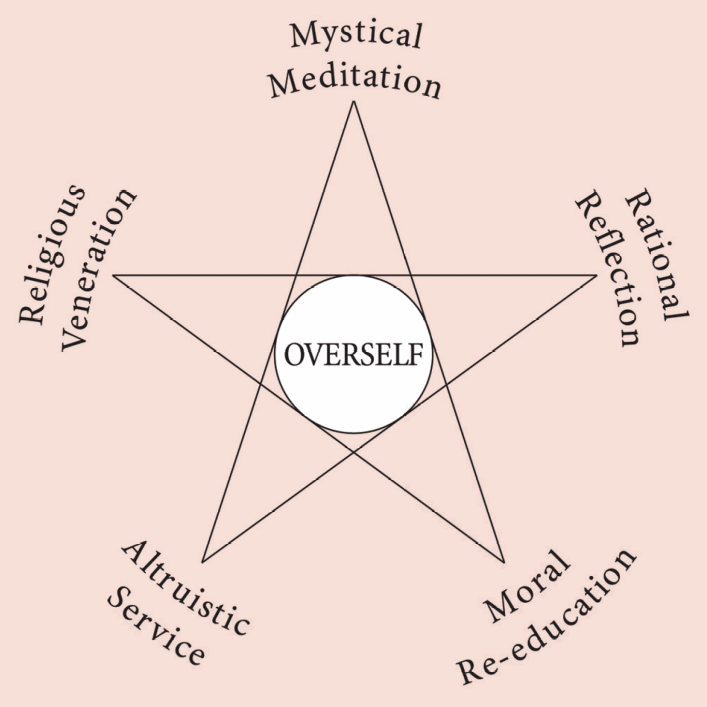
- FIGURE 1984 0111a-1. Philosophic Man.
NOTES:
This is 1984 01/11a, PB Paras; Philosophy Class, and the first entry associated with this date. 1984 01/11b = Plotinus; Soul Seminar, for which we have no audio, just JF notes.
Earlier transcript versions exist.
TRANSCRIBED from Audio Cassette Tapes (and also using the original Pat Campbell 1983 transcript as a basis) by HP, et al. in 1993 as part of the set for Living Wisdom. V11 version 2018. Reformatted from V11 version by JRM & JF 2019-2020, with Subheads and Table of Contents added by JRM. In 2024, IT updates prefatory matter and footer, replaces tape markers with audio file markers, adds Subsubjects, alters Subheads to make more accurate, completes Book List, corrects typos/errors, adds new note within transcript, adds one diagram and reference within transcript to this diagram, reformats to accord with new conventions. Readable edited transcript – V14.1r.
AUDIO FILES: 1984 0111a, 1984 0111b. [Note: "Tape" and "Side" refer to original audio cassette tapes that were later digitized into .MP3 Audio Files.]
1984 01/11a at Wisdom's Goldenrod
PB Paras; Philosophy
Readable Edited Transcript
PB PARAS ON PHILOSOPHY
[Audio File 1984 0111a Begins]
(Tim reads:)
PB: "Philosophy is an explanation of life and a distillation of its highest knowledge. Consequently it includes metaphysics. But it is not identical with metaphysics, being is far greater." (20.1.5)
PB: "It is perhaps the amplitude and symmetry of the philosophic approach which make it so completely satisfying. For this is the only approach which honours reason and appreciates beauty, cultivates intuition and respects mystical experience, fosters reverence and teaches true prayer, enjoins action and promotes morality. It is the spiritual life fully grown." (Perspectives p. 261 and 20.1.22) (reread)
PB: "It provides him with a standpoint wherefrom to measure the correctness or error, truth or falsity, breadth or limitation of the views, theories, and statements presented to him by others. Like a keen cold wind it blows away the mists of superstition and foolishness. The ordinary aspirant is not capable of distinguishing between a sound doctrine and a fallacious one, between a competent teacher and an incompetent one or a self-seeking teacher and a selfless one, between the correct course to pursue in meditation and the incorrect one. The discipline will give him the education which will enable him to make such critical distinctions. It summons all these to the bar of severe scrutiny. It puts thought on its farthest stretch because it starts where science leaves off. It shows up the defects of an improper and unbalanced outlook. It stresses the need of making reason a governing wheel to control emotional adventures. It warns the mystic who would rightly extinguish the tyranny of intellect to develop it at some time or other, because he who would become divine must also fulfil himself as a man. It counsels him to balance the mind-stilling methods used in meditation with the mind-sharpening discipline of metaphysics and science." (20.1.163) (reread)
(David B./Tim/David B./Tim/David B./Myra/David B./Andrew/David B./Tim/David B./Jeff L./David B./Andrew/David B./Johanna/Tim/Laurie/Tim repeats part of previous quote/Laurie/Johanna/Herbie/Tim/ = approx 10 min.)
PB: "Not to escape life, but to articulate it, is philosophy's practical goal. Not to take the aspirant out of circulation, but to give him something worth doing is philosophy's sensible ideal." (Perspectives p. 261 and 20.1.340)
(Paul D./David B./Alan/David B./Herbie/Alan/Herbie/Johanna/Herbie/Johanna/ - Herbie/Andrew/Herbie/Laurie/Alan/Eleanor/Paul/Tim rereads quote (articulate life)/ = approx 5 min.)
PB: "The common misconception that philosophy bears no practical relation to ordinary life is due to ignorance. The proper understanding of philosophy would greatly reduce human sin and suffering, would discipline brutal men and selfish women, would dissolve fanatical strife and creedal conflict, would inspire us to put into concrete shape the loftiest ideals of our imagination, would bring a beautiful solace to offset the disappointments bred in homes, offices, fields, and factories. These are tangible things and refute the allegation that the philosopher shuts his eyes to the harassments and activities of common life. The misconception has arisen, however, because so many misguided theologians and so many fantastic dreamers have passed themselves off as philosophers." (20.1.336)
(Andrew/Tim rereads/Kathy D./Tim/Kathy D./Andrew/Kathy D./Andrew/Dickie/Kathy D./Dickie/Kathy D./Dickie/Tim/Kathy D./Andrew/Dickie/Linda/Dickie/Tim rereads first quote (articulate life)/Dickie/Linda/Dickie/Peter/Jeanne/Dickie/Jeanne/Linda/Jeanne/Linda/Jeanne/Linda/Jeanne/Myra/Jeanne/David R./Kathy D./Jeanne/Kathy D./ = 15 min.)
PB: "It would be a mistake to believe that the philosophic attitude does exclusively seek to enter into the world's life any more than it seeks to escape from that life. It uses and includes each of these movements but it does so only at the right time." (20.1.413) (reread)
(Jonathan/Tim/ = 1-2 min.)
JG: Anthony, could you help us?
HS: He doesn't want to interfere with the world's life.
AD: Thank you, Herbie. (laughter) Let it flow, let it flow. Go ahead.
(Carol D./Kathy/Myra/Carol/Myra/Carol/Anna/Burt/Tim/Kathy/ = 5 min.)
(Side 1 of original cassette tape digitized as 1984 0111a Ends; Side 2 Begins)
(Jonathan/Alan/Jonathan/Tim/Louis D./Andrew/Laurie D./ = 5 min.)
PHILOSOPHY IS BROAD-BASED, AS BIG AS LIFE
(Tim reads:)
PB: "It is perhaps the amplitude and symmetry of the philosophic approach which make it so completely satisfying. For this is the only approach which honours reason and appreciates beauty, cultivates intuition and respects mystical experience, fosters reverence and teaches true prayer, enjoins action and promotes morality. It is the spiritual life fully grown." (Perspectives p. 261 and 20.1.22)
TS: That's the quote to which the question was posed and the question was, what does he mean by amplitude? What is meant by amplitude? It seems to me in the context of that quote, the amplitude is the breadth of topic mentioned, that is beauty, intuition, mystical experience, reverence, prayer, action and morality. Really, speaking otherwise of these three quotes together, I thought, or rather making the question of what was meant by not escaping life but articulating it. I thought those three quotes hung together…
AD: You got assurances about that? That they hung together? You see a hyphen between them?
TS: No.
AD: No.
JG: You could put one in.
AD: You better not. Or we'll have to hang you!
JB: That's why I asked, the symmetry is a balance between the in and the out. How much you are in the world and how much you are out of it. I had a kind of different understanding. The wave nature of symmetry and amplitude…
AD: Wouldn't it be enough to say that all he's saying there is that Philosophy is broad-based, as big as life itself; it finds proper due for all the different aspects in life; it finds their proper evaluation or their proper place. He's not saying anything that you don't understand unless you keep on trying to see something there that isn't there. Let's try another one, Tim. Let's go.
FIVE-POINTED STAR AS SYMBOL OF PHILOSOPHIC MAN; MORALS AND MORALITY
PB: "The esoteric meaning of the star is"Philosophic Man," that is, one who has travelled the complete fivefold path and brought its results into proper balance. This path consists of religious veneration, mystical meditation, rational reflection, moral re-education, and altruistic service. The esoteric meaning of the circle, when situated within the very centre of the star, is the Divine Overself-atom within the human heart." (Perspectives p. 260 and 20.1.23) (reread)
LR: . . . If you talk of moral re-education, most of us are born with some idea of what morals are--and it seems that there's a crucial point on the quest when you realize that assumption--the assumption of morality--is subject to a great deal of fallacy. That morality is not based on something experienced, thought out, that morality is usually something GIVEN in early childhood (inaudible) and a habitual way of thinking (inaudible)--it's not something coming from your soul, but from some kind of training . . .
(Johanna/Linda/David B.)
AD: Why don't you draw a star up there? Draw a five-pointed star and put a circle in the middle. [Note: See FIGURE 1984 0111a-1, Philosophic Man, appended to this transcript. This diagram is from Astronoesis, p. 154.] (sounds like drawing on the blackboard) Each one of those points. He speaks about moral re-education, mystical meditation, religious veneration, (rational reflection, and altruistic service). (last two points inaudible on the tape) One, two, three, four, five. The Overself atom is in the center, right. And this five-fold path is something which is brought to completion by the radiation coming from the Overself. Right? And it's true what you say, Linda: The relativity of morals is something which is obvious; anyone who studies any anthropology. And it's hardly likely that you'll know what religious veneration truly is or mystical meditation, unless the Overself guides you in these things. So if you read that quote again.
PB: "The esoteric meaning of the star is"Philosophic Man," that is . . ."
AD: Alright, the esoteric meaning of the star or philosophic man is symbolized by the five-pointed star. Why? Because under the auspices of the Overself he has been put through a program of moral re-education, rational and critical reflection, religious veneration. Wouldn't you interpret it that way?
AH: Anthony, is the suggestion that none of those things are possible without the Overself's grace?
AD: They're possible to some degree, yes, but certainly not in the completed sense that he's speaking about here: the philosophic man whose morality is derived from within himself, from his heart-center. Certain mystical meditation will not really proceed very far unless there's the blessing or the encouragement from your own higher Self. So very obviously, the philosophic man is one who's been taken under the tutelage by the higher Self and put through this five-fold path. And it has to be brought to completion, and all these things have to be balanced with one another.
JB: The geometry of the symbol speaks to that because only if you circumscribe a five pointed star about a circle or a perfect hexagon, will the points all be equal so that full development of all the sides, facilities is guaranteed by the presence of the circle. This came to mind because the symbol of demonic action is an imperfect pentagram, one where things are developed disproportionately and out of balance, where there is no circumscribed or inscribed circle.
AD: So, you know, you might end up putting that on your coat-of-arms, right? Let's try another one, Tim. Don't read them together, one at a time. And don't answer me with another one. I consider that very unorthodox.
(Johanna requests rereading of quote, Tim rereads previous quote and reads the next one.)
PB: "Unless a man has the requisite mental ability and moral inclination to benefit by philosophical study, it is useless to offer it to him. The masters therefore seek to restrict their personal tuition to those who are fit to embark on a course of philosophy. The mentally immature, the experientially ill-equipped, and the emotionally unfit people will only be bewildered by or rendered antagonistic by such an offering. The standards must be maintained and enforced if philosophy is not to degenerate, as it has so often done in the past, into scholasticism or mysticism." (20.2.243) (reread)
(Randy reads:)
PB: "Whatever were the motives which dictated the exclusive reservation of ultimate wisdom in former centuries and the extraordinary precautions which were taken to keep it from the larger world, we must now reckon on the dominant fact that humanity lives today in a cultural environment which has changed tremendously. The old ideas have lost their weight among educated folk--except for individuals here and there--and this general decay has passed by reflex action among the masses, albeit to a lesser extent. Whether in religion or science, politics or society, economics or ethics, the story of prodigious storm which has shaken the thoughts of men to their foundations is the same. The time indeed is transitional. In this momentous period when the ethical fate of mankind is at stake because the religious sanctions of morality have broken down, it is essential that something should arise to take their place. This is the supreme and significant fact which has forced the hands of those who hold this wisdom in their possession, which has compelled them to begin this historically unique disclosure of it, and which illustrates the saying that the night is darkest just before dawn. This is the dangerous situation which broke down an age-old policy and necessitated a new one whose sublime consequences to future generations we can now but dimly envisage." (Perspectives, p. 260 and 20.2.8) (reread)
DB: When did this breakdown of the religious sanctions of morality occur? Was that after Darwin or during the inquisition or what?
AD: It was over a period of hundreds of years. The breakdown of traditional values has been going on for a long time. You can pick on Darwin in the 1850's or you can pick on Ruth Benedict in Patterns of Culture, she shows the relativity of all morality. The consequence of that kind of thinking is that morality, being so relative, is untrue. And these attacks and jabs that have been going on ever since have destroyed most of our traditional values. It's been a long process, David. It just didn't happen overnight.
DB: That was why I was asking because what in the history of Western society, I remember from high school, it didn't seem as if religious sanctions had much to do with anything in terms of the way people behave.
AD: I'm sorry--?
DB: (inaudible) . . .
AD: Religious sanctions didn't have much to do with anything?
DB: (inaudible) . . . Towards the way men behaved towards one another. We've got the Thirty Years War, the Hundred Years war, the Inquisition, slave trade, and so on and so forth.
PB HAS BEEN CHOSEN TO TRANSMIT THE INTEGRAL DOCTRINE
AD: Yes, but you still had a traditional society with certain norms with which it operated and which were accepted by the majority of men in the Western tradition, just like you had in other traditions. And I think one of the unfortunate things that the Traditionalists don't recognize when they write about "the good old days" is that the fact remains that the World-Idea is changing and bringing about changes which are climactic. And there's no going back any more to what has been. And this new situation has made it imperative that mankind not be deprived completely of some sort of standards, some sort of ethical values, some sort of philosophic truths. The interesting thing, I think, he points out there is that the custodians of this wisdom have decided to release more of this knowledge, and in doing so, first of all, the indication is that there is such a thing as custodians of wisdom or some hierarchy of intelligences that are guiding the earth and its historical cycle; and secondly, that, whether we like it or not, there's no turning back any more to what might have been a couple of hundred years ago. And thirdly, he's saying it--third, he's SAYING IT--which means that he has been chosen to transmit that message.
LDm: What do you mean that message? The giving out of the teachings? Hasn't that been going on concomitantly with the breakdown of morals all along? I mean like certain Oriental Philosophies have been coming out in the last couple of hundred years, haven't they? That never was given to the public before even though it's not given through someone like him (PB).
AD: Yes, but you're speaking about the fact that a patch here and a patch there has been given out: a misrendition of The Song of the Self [Note: Bhagavad Gita] or a misrendition of Mandukya Upanishad has been translated. By who?
LDm: . . .
AD: Who? Answer the question. Who translates these things? People that KNOW? Scholars, right?
LDm: Yes.
AD: Alright. What do they know about the doctrine? So they translate it into English for you. No, the fact remains that even though these things have been translated--and there have been a great deal of these works translated--the fact remains that the doctrine as an integral doctrine has not been available for a couple of hundred years, even more than that. I think the last time that the doctrine was integrally transmitted was with Plotinus, and then again maybe parts of it with Eckhart and St. John, but it was under the cloak of the Christian church; so it wasn't universal. But what he's saying now in all the books that he's written and all these notes, is a clear formulation without no obscuration; there's no words used that you would doubt what they mean.
LDm: I'm agreeing with what you are saying, I'm just thinking about people like Vivekananda and T. Subba Row, people who have given something out--not a whole doctrine.
AD: Yes, but to give you a piece is not the whole doctrine. That's the whole point. A partial truth isn't enough any more. And so an integral presentation of the whole doctrine of metaphysics is being presented through these writings. Vivekananda gave you his version of what he thinks the ultimate doctrine is, and it certainly would be very slanted from the Vedantic point of view. But the fact remains that the world is in a situation where the crisis has occurred--both the East and the West--and if the Vedantic doctrine was so great, well then why didn't it help the Hindus?
LDm: I agree. I understood that even in past history, even that what was given out by people like Vivekananda was not made public. He goes to great lengths to call it and so does PB, the Forest Philosophy, the Hidden Philosophy . . . that even the little bit that they had given out was hidden. It wasn't publicly spoken about, from what I understood.
AH: Vivekananda talks about that a lot--it wasn't spoken about publicly.
AD: Well, he did a good job at the Parliament of World Faiths.
LDm: Yes, up until recently.
AH: It seems that Louis is looking for other examples of how this doctrine emerged. You seem to be suggesting, Anthony, that there are no other examples except PB.
AD: Not in contemporary times.
AH: I'm sorry?
AD: Not in contemporary times there's no example of the doctrine. When I say the doctrine, I mean the integral presentation; I don't mean a piece. I mean the whole thing.
AH: I think the quote referred there to the ultimate truth.
AD: The quote refers to the integral presentation of the doctrine. Not pieces of it, not fragments, but the whole thing. And if you go through PB's notes, if you read those notes carefully, you have there the presentation of the whole doctrine, not a piece of it.
AH: Am I to understand this quote then in regards to the fact that PB is the Master?
AD: You're catching on, aren't you?
AH: He uses the term masters, plural. Maybe we could read it again. I'd just like to understand it because you seem to be interpreting something important that I can't quite grasp. Would you mind reading it again?
(Quote reread.)
AD: Who could make a statement like that, Andrew, except those who know? When he (PB) was here I had mentioned, and I had said in public, in the building here, I referred to him as "world-honored one." Do you think I was talking about the honor WE give him? He certainly could do without that. He was being honored by the world; the world bore witness to what he was doing. Not you or I; we weren't honoring him. So you know what's being said and who's saying it.
I think I even mentioned, there was a note, maybe Randy remembers, where when this assignment was thrust on him, he had preferred that it had been given to a worthier man, but then it became inescapable: He recognized that this was his duty, this was his work, this was what he had to do. You remember that quote, Randy? Andrew, we built the library, I fill it up with books, PB's notebooks, alright, make it comfortable, have a fire going in there, you still have to use it. I'm not picking on you, everybody here.
RC: Do you want that quote?
AD: If you have it, yes.
PB: "I did not seek to become the formulator of such a unique and priceless message to mankind. Indeed knowing myself in weakness as well as strength, I naturally shrink from seeking such an immense responsibility and would rather have helped and served a worthier man to formulate the message. This is not to say that I underrate its value, its dignity, its public prestige. But all my previous attempts to evade the task having ended in failure, I now positively and affirmatively--no longer reluctantly and hesitantly--step forward to its accomplishment. I do so moreover with tranquil joy, for I am utterly convinced in the deepest recess of my heart, no less than in the logical thinking of my brain, that the teaching is so greatly needed in our time by those who have sought in vain for comprehensive elucidation of the problem of their existence, that I feel the help it will give them constitutes the best possible use of my energies, talents, and days in this incarnation." (Perspectives p. 149 and 12.2.60)
RC: Here's a similar one.
PB: ". . . I have indeed undertaken what I believe to be a pioneer work. I cannot give my patronage to any particular system. I can bestow it only on Truth, which is unique and systemless. For enough of the sacred presence is at my side, enough of the disciplinary self-transformation has been achieved, and enough of the mental perception arrived at, to enable me to take up the external task of preparing others for illumination in their turn." (Perspectives p. 148 and 12.4.5)
AD: Then would we be justified in saying that he was among Those who Know? Let's try another one. Let's go on.
MORE PB PARAS ON PHILOSOPHY
PB: "The reader will naturally ask why, if the higher wisdom is of such importance to mankind, it has not been made generally available for the benefit of mankind. I can reply only that this knowledge has been rarely attained and even then more frequently in remote lands than in Europe or America and more frequently in antiquity than during modern times. Whenever it has been alluded to and wherever it has been written about, it has been generally expressed in language which was either cryptic or obscure, or in terminology which was either symbolic or technical. Consequently even those statements of it which have appeared in book, Bible, or palm-leaf text have been largely misunderstood where they were not completely ignored. Moreover, there was always the overt or open antagonism of religious heads who feared for their own influence or power. However, the rapid advances made by science mysticism and philosophy in our own generation betoken possibilities of a brighter welcome for the advent of truth. These advances encourage hope for a wider friendlier reception." (20.2.175)
(Linda/ = 1 min.)
[Audio File 1984 0111a Ends]
[Audio File 1984 0111b Begins]
(Linda/Randy/Linda/Randy/Linda/Dickie/David B./Alan/Myra/Dickie/Randy/- Jonathan/Peter/Jonathan/Peter/Jonathan/Peter/Jonathan/Paul/Harriet/Jonathan/ = discussion on the world situation = approx. 5 + min.)
AB: I get the implication that the World-Idea must fulfill itself. Perhaps if humanity is obtuse enough, it will be harder on us until we get there. But it still must fulfill itself and therefore there's a warranted optimism.
AD: No, I think there is a note where PB says there may be cause for hope with philosophy but not for optimism. (laughter) So don't get carried away.
(Dickie/Randy/Dickie/Randy/Andrew/Jonathan/Johanna/ - Jonathan/Tim/Johanna/Tim/PB: (reread quote) "Whatever were the motives…"/Jonathan/ = 5 min.)
LDm: I agree with you that it does seem to be both ways, one, from the gravity of the situation they're lowering the standards. (lots of laughter) (& inaudible)
AD: No, they're not lowering the standards, Louis, they're just permitting for the doctrine to come in, they're permitting for the revelation of the doctrine (to come in/within our understanding/(inaudible)).
(Louis D./David B./NH/David B./NH/David/NH/P. Aiello/Andrew/Jonathan/Peter/Andrew/Peter/Randy/Avery/Randy/ = 7 min.)
PB: "What critics like Douglas Ainslie call my"commercialization" of Hindu philosophy is really my democratization of it. For I have attempted to bring it down out of the rarified atmosphere of academic circles into the common air of plain men and women, where alone it can help them. I have tried to make easily understandable what the academics and mystics have made ponderously incomprehensible. Moreover, it may be said that those who know well what they are talking about may have the temerity to simplify it, whereas those who do not know find it safer to mystify it! The first can really help truth-seekers, whereas the second can only hamper them. . . . I seek to serve the masses, not the classes, the many and not the few. I seek to make philosophy's message plain to the untutored mind of common people. At the same time, it will automatically be made plainer to the cultured intelligence of better educated people. If therefore my books are popular and those of the academics are not, that is not to be charged to my commercialistic spirit but to my democratic sympathy. . . . The self-conceit from which Douglas Ainslie seems to think I suffer is simply the attempt to give a human feeling and personal value to ideas which have too often been ignored and neglected by non-mystical people because they seemed too inhuman and so impersonal. The deep conviction of my own importance [on] which he comments so sarcastically is his mistaken reading of the deep importance which I attach to the ideas which I have sought to describe intensely and put forward for the benefit of the few real seekers after truth among mystical people. If, in all these ways, I have succeeded in giving actuality to such ideas, if I have brought them to some life, then the results have adequately justified the means." (12.5.89)
(Randy/Louis D./John L./Randy/Linda/Tim reading PB/ = 2 min.)
AD: Are you talking to yourself, Tim? Again?
PB: "The reader will naturally ask why, if the higher wisdom is of such importance to mankind, it has not been made generally available for the benefit of mankind. . . ."
AD: Listen to this, Louis.
PB continued: "I can reply only that this knowledge has been rarely attained . . ."
TS: . . .
AD: Let's go on.
PB: "The number of those who devote themselves to philosophic thought and practice is not a significant one. It is indeed quite a small one. But as life on this earth will get more and more intolerable (as it is doing in this twentieth century), people will get more and more to realize that there is something wrong or lacking in the faith by which they live--be it faith in simple materialism or in orthodox religion. After they have thus started a'questioning some of them will pass to the ultimate stage and go a'questing. In the end they will arrive at philosophy because all other teachings are merely on the approach to it. In the end the number of its votaries will continually increase. But they will not, say within the next thousand years, be in any danger of becoming quite a crowd. They shall have to go on living in loneliness. They will remain a tiny minority, with the satisfaction of being less tiny than it is now. The only choice which is usually presented to us is a vicious and false one. We are asked to choose between materialism and orthodox religion, thus dividing us into the supposition that these are the only possible spiritual views which mankind can adopt. This supposition is an unjustified one. We are moving beyond them. We are no longer limited to such a narrow choice. There is a third road open to us--that of the philosophic view. Out of the clash between two such opposite attitudes, there has been born for independent thinkers a third attitude which is truer than both." (20.2.117) (last part of para reread)
(Linda R./Dickie/Andrew/S/S/ = 5 min.)
PB: "The goal of self-elimination which is held up before us refers only to the animal and lower human selves. . . ." (Perspectives p. 260 and 20.5.5)
LR: Illumination?
TS: Elimination.
AD: Boy, I don't know how…can't call that a Freudian slip. I wonder what to call it. (laughter)
PB continued: "It certainly does not refer to the annihilation of all self-consciousness. The higher individuality always remains. But it is so different from the lower one that it does not make much sense to discuss it in human language. Hence, those who have adequately understood it write or talk little about its higher mysteries. If the end of all existence were only a merger at best or annihilation at worst, it would be a senseless and sorry scheme of things. It would be unworthy of the divine intelligence and discreditable to the divine goodness. The consciousness stripped of thought, which looks less attractive to you than the hazards of life down here, is really a tremendous enlargement of what thought itself tries to do. Spiritual advance is really from a Less to a More. There is nothing to fear in it and nothing to lose by it--except by the standards and values of the ignorant." (Perspectives p. 260 and 20.5.5)
(Kathy D./Andrew/Johanna/Tim rereads/Kathy D./Andrew/Bert/Andrew/Herbie/Louis/Johanna/ = 4 min.)
PB: "The philosophic student will not make the mistake of using the quest as an excuse for inefficiency when attending to duties. There is nothing spiritual in being a muddler. The performance of worldly duties in a dreamy, casual, uninterested, and slovenly manner is often self-excused by the mystically minded because they feel superior to such duties. This arises out of the false opposition which they set up between Matter and Spirit. Such an attitude is not the philosophical one. The mystic is supposed to be apathetic in worldly matters, if he is to be a good mystic. The philosophical student, on the contrary, keeps what is most worthwhile in mysticism and yet manages to keep alert in worldly matters too. If he has understood the teaching and trained himself aright, his practical work will be better done and not worse because he has taken to this quest. He knows it is perfectly possible to balance mystical tendencies with a robust efficiency. He will put as much thought and heart into his work as it demands." (Perspectives p. 261 and 20.1.434)
(Side 1 of original cassette tape digitized as 1984 0111b Ends; Side 2 Begins)
LDm: And yet he still says nothing about it, itself, does he?
AD: You're still trying to figure out how it is to be without one's head, eh?
LDm: I guess it's very puzzling.
(Randy/Louis/Linda/Randy/Anthony=inaudible/Randy/Herbie/Randy/Kathy/Randy/Kathy/Randy/Andrew/Randy)
PB: "Ancient spirituality thought that what was most important was to cultivate individual soul. Modern materialism thinks it should be social betterment. These two goals have usually been placed in opposition. But modern spirituality refuses to accept such a false dilemma. Let us seek both the cultivation of the soul, it declares, and the betterment of social conditions. Why, when we open our eyes to the one need, should we shut them to the other? Humanity's outer need does not justify the neglect of our own inner need, nor this the neglect of the other. No amount of humanitarianism can counterbalance the duty of devoting time and energy to spiritualizing our own self also, but this ought not become so self-centered as to become a total and exclusive devotion." (20.4.215)
(Linda/ = 1 min.)
MENTALISM, NON-DUALITY
AD: Another one, Tim.
PB: "When the mind withdraws from its creations after understanding their mentalness and looks into itself, it discovers the final truth. But when it does this prematurely--that is, before such enquiry into the world's nature--it discovers a half-truth: the nature of the"I."" (20.4.54) (reread)
(David B./Paul/David B./Jonathan/David B./Herbie/Tim rereads: "When the mind withdraws from its creations . . ."/Kathy D./Alan/Herbie/Avery/Tim/PB/ = 5 min.)
AS: But if it hasn't seen the mentalness of the world then it finds the truth of itself, it won't be finding the truth of the world, if the world to it is something OTHER. But if it first realizes the world to be mental also in nature then it finds the source is mentality or mind, it will be finding the source of the world at the same time.
(Herbie/Johanna/David B./Jonathan/David B./ = 2 min.)
AS: Maybe this is slightly different from what I was trying to say. He has this quote where the final truth is where he can remain in the real whether he is thinking or not, or whether the world is appearing or not. If he doesn't realize that the world itself is an emanation of mind, or an experience of mind, then he won't be able to have the final truth, he'll only have half the truth. He'll only have the truth while he's in that void state, while he's within that mystical state or while he's withdrawn into himself. He won't be able to have that truth while he is functioning back in the world and therefore it is only a half truth. And half of the truth is that he can have it while he's in that state, in withdrawal, but he can't have the truth when the world appears because he hasn't realized that the world appearing doesn't contradict the nature of mind, and therefore it's a half truth.
(David B.)
AD: All Avery's saying is right to the point. Nondualism. The truth of non-dualism requires the recognition that both sides of the equation are Mind. If you only recognize one side, you don't come up with the ultimate truth. All he's simply saying in that statement is the truth of non-dualism requires that you recognize that both sides of the equation--"I" and the world--are both mental. Leave one out and you only come up with a partial truth. Why complicate that?
DB: I'm aware of the distinction between mystical experience and Sahaja samadhi.
AD: Leave that all aside. You follow what I just said. That the truth of nondualism recognizes that both sides of the equation are mental.
DB: Yes.
AD: Well, then you understood what he said.
DB: Anthony, the problem for me is that the truth of nondualism, it's just a couple of words there, and we're dealing with such a fundamental revolution within the individual that I'm afraid that I can follow it but I just can see it.
AD: Well, that might be a little different, if you want to see it.
JnL: He's said elsewhere that the realization of the "I" comes first before the revelation of the mentalness of the world. Is that true?
AD: Generally, yes, but the first there's a glimpse.
JnL: But you (can't/can) have an insight into the mentalness of the world without the other? (Q: slight preference for 'can't')
AD: Well, you'd have to tell me what you mean when you say you could have "an insight into the mentalness of the world." Because you use a word like 'insight,' and right away-- In other words, if you took a man like Kant, who reasoned everything out and came to the conclusion in his reasoning process that the world was THOUGHT, would you say that this was also a conviction?
JnL: It wasn't necessarily knowledge.
AD: Well, that's the point I think I was getting at in what you were referring to. The recognition of oneself as Mind makes it much easier to understand or recognize the fact that the world is a thought of mind. But one can come up rationally with the understanding that the world is a thought, but not with the living conviction. That would be a mystical experience. And Kant did not have mystical experience of the mentalness of the world, but he was utterly convinced that it was mental.
JnL: PB also I think indicated in one quote that reality of Mind as a nondual state is also beyond the insight into the mentalness of the I as well as the mentalness of the world itself.
AD: I'm sorry I didn't follow you. PB said what?
JnL: That the insight into the reality of mind in itself is beyond even the conviction that the I as well as the world is mental, is of a mental character--or does it come simultaneously?
AD: I really don't understand what you are saying?
JnL: The realization of the source of the I, of the nature of the I, the realization of the nature of the world as idea, will also deliver you the realization of ultimate mind, mind in itself?
AD: The two of them together; you got Mind as the ultimate.
JnL: Is that a third?
AD: No, that's not a third.
JnL: You have to have that in order to realize the other two, though?
AD: You have to have the what?
JnL: The realization of mind, beyond thought, beyond idea.
AD: If you realize that the "I" is mental, if you realize that the World-Idea is mental, how many do you have?
JnL: One.
AD: Then why did you put me through that? Ok let's ring the bell. It's overtime!
(Rings bell)
[Audio File 1984 0111b Ends]
1984 01/11a V14.1r: CLASS: PB Paras; Philosophy. Copyright 2024 Wisdom's Goldenrod p. ii