DIAGRAM FOR 1984 0321
Class
Wednesday, March 21st, 1984
Edited transcriptClick the series name to view more
CLASS at Wisdom's Goldenrod, Hector, NY
with Anthony Damiani (AD)
March 21, 1984
PB PARAS; PHILOSOPHY; FALLACY OF DIVINE IDENTITY
TOPIC: PB Paras
SUBJECT: Philosophy
SUBSUBJECTS: Fallacy of Divine Identity, Agnostic Mysticism, Mystical Experience, Overself, Absolute Soul, Mystical Death
CONTENTS:
AGNOSTIC MYSTICISM
OVERSELF AS THE INTERSECTION OF GOD AND MAN
THE WORLD-MIND HAS THE ENTIRE PLAN OF EVOLUTION
THE SAGE CAN RECEIVE THE TOUCH OF THE UNTOUCHABLE BUT CAN'T TECHNICALLY KNOW IT; PURIFICATION AND PHILOSOPHIC UNDERSTANDING ARE NECESSARY TO UNDERSTAND MYSTICAL EXPERIENCE PROPERLY
MORE ON AGNOSTIC MYSTICISM
OVERSELF AND ABSOLUTE SOUL/WORLD-MIND; MYSTICAL DEATH
BOOKS READ FROM OR REFERENCED:
Paul Brunton, Notebooks. 16 vols; Vol. 1 entitled Perspectives, published 1984-1988. Some Paul Brunton Notebook paras are, as of 2018, unpublished, and are noted as such.
Paul Brunton, The Wisdom of the Overself
Plotinus, The Enneads (MacKenna translation, 4th ed.)
PLOTINUS QUOTES READ OR REFERENCED: IV.1.1, V.3.4
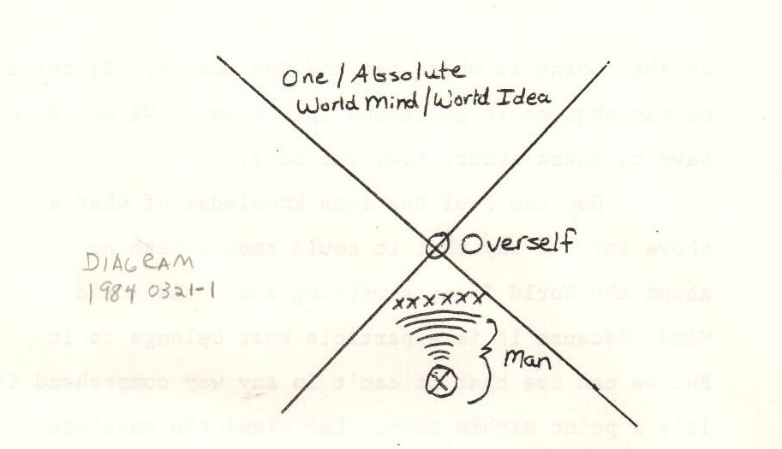
DIAGRAM appended to this transcript:
- FIGURE 1984 0321-1. Overself as Intersection of God and Man.
NOTES:
Unpublished PB paras, even if sourced, should be proofread.
Earlier transcript versions exist, including 1990 complete transcript by Bill White, which also referenced Pat Campbell transcript. This Living Wisdom version does not have all of the student discussion included in apparently lost (as of 2024) Bill White version, but is noted where omitted.
TRANSCRIBED from Audio Cassette Tapes (and also using the original Pat Campbell 1983 transcript as a basis) by HP, JF et al. in 1993 as part of the set for Living Wisdom. V11 version 2018. Reformatted from V11 version by JRM & JF 2019-2020, with Subheads and Table of Contents added by JRM. In 2024, IT updates prefatory matter and footer, replaces tape markers with audio file markers, expands Subsubjects, alters most Subheads to make more accurate, completes Book List, adds Plotinus quotes section, corrects typos/errors, adds new notes within transcript, moves diagram from within transcript to appendix, reformats to accord with new conventions. Readable edited transcript – V14.1r.
AUDIO FILES: 1984 0321a, 1984 0321b. [Note: "Tape" and "Side" refer to original audio cassette tapes that were later digitized into .MP3 Audio Files.]
1984 03/21 at Wisdom's Goldenrod
PB Paras; Philosophy; Fallacy of Divine Identity
Readable Edited Transcript
AGNOSTIC MYSTICISM
[Audio File 1984 0321a Begins]
PB: "There is a type of mysticism calling for criticism. It is uncritically pantheistic and says it is"the conception of God in Man." An instance of this type is Al Bistami's utterance, "Beneath my cloak there is naught else than God." Another is Al Hallaj's words, "I am the Divine Reality." My view of this type, which may be called self-deificatory, coincides with that of Al Ghazzali, who is no pantheist, and who teaches that there is a spark of the Divine in man's soul and that man can know and recognize it. The correct type may be designated as agnostic mysticism. This asserts man's inability to unite with the Absolute, his incapacity to attain the Godhead because it is unknowable." (25.1.76)
(Anthony refers back to David's remarks (below) later in the class. Student discussion = approx. 3 min.)
DB: It strikes me as interesting that agnostic mysticism is a perspective that is made possible through REASON. If the agnostic mystic and the pantheistic mystic have the same experience of the spark of divinity within themselves, it seems like it's the function of reason that makes it possible to point out to the one that there are limitations and that this experience should not be confused with identification with the Absolute. I'm not sure I understand how that's possible.
RG: What's possible?
DB: It would seem that it would be the ultimate task of reason to be able to point that out to a person . . . But it doesn't seem as if he's saying that experience makes this perspective possible. After the experience is over, the person who's had some philosophic training, development of their rational faculties and so forth, is not going to be deluded into appropriating that experience as being an identification with the Absolute . . . Why isn't that experience of that spark of divinity within oneself not understood or realized as such, but immediately assumed to be an absolute identification with the supreme reality?
NH: . . .
DB: . . . The experience has been described as so overwhelming that it's very hard to know what you're about during or just prior (to it). But if the experience is an awareness of that principle, of that spark of divinity of the Overself, why doesn't the individual know that? . . .
(RC/AH/= 3 min. student discussion)
DB: . . . Let's say that two individuals that have this experience: one has not had training in philosophical reasoning and understood some of the ideas that have been made available through the teachings, and the other has . . . So when an individual comes into association with that spark of divinity, is the understanding that has been developed through all the years of study and reflection brought into that experience and it's the presence of that understanding that makes possible the comprehension that the ultimate Godhead is unknowable? Can this happen during the experience? Or is it when it's over that you say, "Well, let's see now," and reason about it? It doesn't seem like that understanding would necessarily be suspended when that experience happens . . .
(3 min. student discussion)
PB: "If it is wiser and humbler to leave some mystery at the bottom of all our intellectual understanding of life than to indulge in self-deceiving finality about it, then it is no less wiser and humbler to acknowledge the ultimate mystery at the heart of all our immediate mystical experience of life. The mystic's claim to know God when he knows only the deepest part of his own self, is his particular kind of vanity. Whatever terminous and transcendental consciousness he may discover there, something ever remains beyond it lost in utter inscrutability. The World-Mind is impenetrable by human power. This agnostic conclusion does not, however, touch the validity of the mystic's more legitimate claim, that the human soul is knowable and that an unshakeable union with it is attainable." (25.1.59)
(student discussion through end of Side 1)
(Side 1 of original cassette tape digitized as 1984 0321a Ends; Side 2 Begins)
(student discussion = 5-6 min.)
PB: "God is never identified with any man, nor incarnated in him. For God alone is uniquely the Unindividuated whereas all men are individualized creatures. Even the highest type of man, the sage-saviour, is a particular light, whereas God is the light itself." (25.1.170)
(student discussion = 12 min.)
DB: . . . There's a feeling in one quote, when he speak of that spark of divinity, that one actually does come in contact with it. There's enough mystery right in there to include the idea that all we're ever going to know is the Soul . . . but that's not a little thing. If it's a spark of divinity, that means that in some sense it shares in the same quality as the World-Mind--that transcends the Soul . . .
RC: . . .
DB: Does the fragment, that spark, when understood and consciously associated with, recognize its own limitations? It could only do so if it had an awareness, even in absentia, of something that was higher than itself. It doesn't exist in a vacuum. It couldn't. It has to be aware of its own divinity within the context of divinity inclusive of more than its individuality.
RC: You can be conscious of your own divinity and at the same time recognize the place of that divinity within the hierarchy of divinity. They don't contradict one another.
DB: Right. The full understanding of that recognition would seem to necessitate that, but that might be something that doesn't happen all at once.
(Student discussion = 9 min.)
PB: "We exist always in utter dependence on the Universal Mind. Man and God may meet and mingle in his periods of supreme exaltation, he may feel the sacred presence within himself to the utmost degree, but he does not thereby abolish all the distinctions between them absolutely. For he arrives at the knowledge of the timeless spaceless divine infinitude after a process of graded personal effort, whereas the World-Mind's knowledge of itself has forever been what it was is and shall be, above all processes and beyond all efforts." (Perspectives p. 342 & 25.1.73)
AS: So he says, "man and God may meet and mingle." Now you can play it as some kind of a thing that says it's still agnosticism, but then still it's not a knowing, so what do you mean by "meeting and mingling"?
PD: What he says in the next sentence, "feeling of a sacred presence." The experience of that sacred presence.
AS: OK, but the presence there he calls God! Or in fact he uses 'World-Mind' here. There is a meeting and mingling with the World-Mind even if there's an agnosticism about it. That seems to fit in with the fact that you never know It the way It knows itself. That's what he means by agnosticism. You never experience the One the way the One "non-experiences" Itself, or whatever you want to say. But even at the level of the Nous, I think that is more what he means by agnosticism. There's always a mystery in the Nous because you don't become it. If you can't become it, you don't know it the way it knows itself, because it knows itself by identity. If it knows itself by identity, and that's the ONLY possible way of knowing itself as it actually absolutely is, and you never become it, then you never know it as it actually and absolutely is. That doesn't mean that you don't mingle with it or gain some kind of experience of it. Agnosticism then is very technical, in the sense that you don't know it as it is. If you don't know it as it is, you don't know it entirely or absolutely.
PD: You know THAT it is.
AS: I think you know more than that it is.
PD: Tell us more. Why doesn't he tell us more?
AS: He leaves it very mysterious, what the experience of the mingling with the World-Mind is. He just makes it clear that you don't BECOME it when you mingle with it.
PD: Or you don't know it?
AD: The quotation about knowledge of the Absolute is unavailable. It is about the Absolute, not the World-Mind. He said, if I remember the quote, that he cannot have knowledge of the Absolute.
PB: ". . . The World-Mind is impenetrable by human power. . . ." (repeat) (25.1.59)
RG: But the first quote is about the Godhead being unknowable.
PB: ". . . This asserts man's inability to unite with the Absolute, his incapacity to attain the Godhead because it is unknowable." (repeat) (25.1.76)
AS: Even the Intellectual-Principle doesn't know the One.
AD: If you say "Absolute," there isn't anything that could know it. Is there something outside, other than the Absolute, that could know it?
AS: All knowing implies a duality.
AD: So how could anyone know the Infinite? Since when can the Infinite be an object of knowledge?
AS: It can't be.
AD: Then, isn't it proper to speak about agnosticism as the final outcome of philosophic mysticism?
(RG/AD question clarification)
RG: . . . When you get to the core of Soul, in the way you just used the word knowable, it seems the core of Soul is also unknowable. You can't make an object of it, you either are it--
AD: It is objective to the Nous.
RG: It's objective to the Nous?
AD: It is objective to the Nous.
RG: What does that mean?
AD: It's the selfhood of the Soul.
RG: The Nous? What does that mean?
AD: The true knowing principle in the Soul is the Nous, Dickie.
OVERSELF AS THE INTERSECTION OF GOD AND MAN
[Note: See FIGURE 1984 0321-1, Overself as Intersection of God and Man, appended to this transcript for the following.]
AD: Would you make a big cross on the board, a big X?
RG: A big X?
AD: A big X, yes. Suppose where that intersection is, you put Overself. And above it you put the World-Mind/World-Idea, and above it put the One, or the Absolute. Below the Overself you put the inerratic sphere, the planetary spheres, and the earth sphere. Now, suppose we bracket those last two, that is, the earth sphere and the planetary sphere, and we say properly that would be man.
Now we can see that man, so to speak, could reach--let's take out the inerratic sphere just temporarily, because the sun itself is one of those stars. Now we can speak about man, which would be a combination of those two, the planetary spheres, you know, the reasoning phase of the Soul and the physical, the physical man. We can say that man CAN reach to the level of the Overself, but he CAN'T go beyond that. Because at that point is where 'man and God mingle.' So there's no man that could go beyond that point. We would have to speak about, now, the Soul.
Now the Soul has some knowledge about what's above it. We say that it could know SOMETHING about the World-Idea, SOMETHING about the World-Mind, because it is a particle that belongs to it. But we can see that it can't in any way comprehend it. It's a point within that. Let alone the Absolute, because to speak about KNOWING the Absolute would be to try to take something outside of the board and say, "I could know all of that." So the Absolute cannot be known. Or if we speak about undifferenced knowledge, there isn't anyone that KNOWS it. You can't speak about knowing in that way. So the Absolute is unknowable, and that would be a true agnosticism.
(AS/(AD/AS question clarification)/)
RG: But would you say that the essence of the Overself can be known? You said it can be known by the World-Mind or the Intellectual-Principle.
AD: There could be UNION with the Overself.
RG: By man?
AD: By man. And then we would speak about philosophic sage, right?
RG: Right, and when he unites with that . . .
(RG/AD question clarification)
RG: . . . isn't there an aspect of that realization which is the pure subjectivity, the non-objective essence of his consciousness, and that too would be unknowable?
AD: Well, let me ask you this: if you went above that position, wouldn't you say that if it's included in the World-Mind then it would be objective to the World-Mind? Now, 'objective' here is not the simple objectivity that we speak about in the triple relationship.
RG: But in the sense that Plotinus says that the Soul is an Intellectual Being, or the Soul is a (member) in the Intellectual Realm, [Note: See Plotinus, IV.1.1.] and then in that sense I could see it as being stationed there. And insofar as it's stationed there, the Intellectual-Principle would be aware of it.
AD: Well, when it's stationed there, then we would say, or I think Plotinus would say also, that it IS the Intellectual. If it's stationed there, abiding, at rest, then it is part and parcel of the Intellectual-Principle. But if we think of it as manifesting or delivering the idea of the universe, it's still the Overself, but now we're speaking about a different phase of that Overself.
So I think we could say something like this: that if we speak about the Overself as that principle which is manifesting the World-Idea, then THAT is knowable by the Intellectual-Principle, which includes that Overself which is an abiding state. And that, of course, can't be known. But if we think of the lower phase, or that phase which is manifesting, that IS objective, then, to that phase of the Soul which is part and parcel of the Nous. I think that could be a way of looking at it.
RG: Now, that part of the Overself that's permanently established, is that aspect of the Overself permanently established in Intellectual-Principle?
AD: Yes, but he doesn't refer to that any longer in the singular. It's like part of the Absolute Soul, and there you can't speak of the Soul as a principle that's manifesting a world.
RG: Right. That way you can't speak of it as the projected aspect of the Overself.
AS: And that aspect of the Self, there is where it IS identical in essence with those three primals . . .
AD: And what "it" are you speaking about now?
AS: I'm now speaking about that aspect of the Overself which is an aspect of the Absolute Soul.
AD: Do you still want to speak about an "it"?
AS: . . .
AD: I'm asking, would you speak about it as "it"?
AS: Not in the singular.
AD: Now, you can't any longer. It's over.
RG: But you can speak of it as a principle. Is it-- Isn't it no longer a Being?
AD: You can't speak about it as A Being.
RG: And yet it's a distinct principle. Even there it's distinguished from Intellectual-Principle.
AD: Yes. That's why the Overself, where the intersection is, is referred to as the emanant.
RG: Well then, at that level, what distinguishes the Overself from the Intellectual-Principle? Nothing. So it's only a distinct hypostasis when it's the principle of emanating its universe?
AD: When we speak about it as an emanant.
(student discussion 1 minute = LR?/RG/LR?/)
RG: Were you saying that the Soul as a distinct hypostasis can only be called distinct as it is an emanant?
AD: Yes.
RG: Or as it is manifesting the universe?
AD: Yes. You can't refer to it as an emanant when you think about it as part of the Nous. You can't even refer to it as an aspect.
LR: But it's still Soul, isn't it? Not A Soul, nor any particular individual, but it's still SOUL.
AD: But then what? Of course, it's still Soul.
LR: Soul as the (might?/light?) of the Intellectual-Principle.
AD: Yes, of course it's still Soul.
LR: So it's still the hypostasis Soul.
AD: But you see, the point is that above that intersection is God.
RC: . . . It seems that if we speak of this Soul that we're speaking of, we necessarily speak of both aspects, and there's no such "when" when we can talk about it being ONLY an abiding--
AD: Well, that may be true, that when you speak about Soul you're referring to both aspects, but I'M not. (laughter)
RC: I can see distinguishing them in order to be able to make both aspects available to knowledge.
AD: Yes.
RG: But in terms of what that is that we're talking about, I can't see separating them in any way, to say that it would be what it is without both those aspects being simultaneously ever-present.
AD: Yes, they would have to simultaneously be ever-present. But we DO distinguish in our understanding that which is the emanant and that which is always part of the World-Mind. And in distinguishing these two, then we've isolated the emanant and actually even CUT it off, so that there could be a greater clarity in understanding this principle of Mind or the Mind that we are, and work with that, isolated, what Guenon might call the "personality."
RC: It seems an artificial question to ask, "When you say that the soul is abiding in the Nous, how do you distinguish it from the Nous?" . . .
AD: It's an artificial question in one way, but in another way (it's not.)
[Audio File 1984 0321a Ends]
[Audio File 1984 0321b Begins]
AD: (from PC transcript only, not on tape) (. . . but in another way) it's a real question for those who are trying to make these distinctions.
RG: . . . able to principially and if you can't then you're holding that contingency and accident are the principial cause of the distinctions of these three eternal hypostases and I can't agree with that at all.
AD: Would you repeat that please?
RG: That if you hold that it's manifestation alone that provides the distinction of the principles that are prior to manifestation, it doesn't make any sense. Reason would demand that the distinctions of principle are on the level of principle and not on the level of manifestation.
RC: The question to me would come down to saying, "Well, the principle of manifestation when there is no manifestation--"
AD: And when would that be?
RC: --is not different from UN-manifestation.
PD: Last night there was no manifestation. (laughter)
(AH/RC/DB/RC/= 2 min.)
AS: I didn't follow one point back there, about this notion of God. I understood what he said, in two different ways, about God--the last thing you said was that--and I thought that in PB's terminology, that God could be conceived as the One, World-Mind, and Absolute Soul and it wouldn't be limited to the One Absolute. In another context, the first time it was explained, he equated God with the Absolute.
AD: In this case, I was referring to the three hypostases as God.
AS: . . .
AD: I don't think I understood your question. (inaudible)
MB: . . .
AS: I was asking about what he was equating with PB's notion of God.
RC: Maybe if we tie it in to the quote.
PB: "God, the World-Mind . . . total knowledge. . . ." (para partially read)
AS: If I understood God or the World-Mind as that part above the Overself--if you want to put it that way--and I understood that the Overself doesn't have a complete total knowledge of that, but I don't see why it doesn't know it in essence.
AD: "Doesn't know IT in essence." Will you tell me what you mean by "it"? What do you mean by it--The Absolute?
AS: Well, if I use the word 'God' for that triple, then it would be for the World-Mind, World-Idea, or the Nous.
AD: Well, what did the quote refer to? Isn't the quote about the Absolute, that the Absolute cannot be known?
S: Which quote?
AD: The quotation that said that the proper attitude is to be an agnostic.
AS: Oh yes, that referred to the Absolute.
AD: That referred to the Absolute. Now this quote here--?
THE WORLD-MIND HAS THE ENTIRE PLAN OF EVOLUTION
AS: I thought this quote was different.
PB: "God, the World-Mind, knows all things in an eternal present at once. No mystic has ever claimed, no mystic has ever dared to claim, such total knowledge. Most mystics have, however, claimed union with God. If this be true, then quite clearly they can have had only a fragmentary, not a full union.
"Philosophy, being more precise in its statements, avers that they have really achieved union not with God, but with something Godlike--the soul." (Perspectives p. 343 & 25.1.74) (also in 3/14/84)
AS: There he uses the term 'God' and 'World-Mind.'
AD: Yes.
AS: And I interpreted that (to mean that) although the World-Mind obviously knows itself the way it is, it's identical with itself and it knows the totality of itself. The only way to have that same knowledge--knowledge of all things--would be to become it. And since the Overself can't become it, it can't have knowledge of the World-Mind the way that the World-Mind is.
AD: Yes.
AS: But that doesn't preclude that it has SOME knowledge of it, and of "it" I mean the World-Mind. Not in the way that the World-Mind knows it but just in the way he says it, some fragment of it. The only point I was trying to make was that in saying it's a fragment the tendency is to limit it, to say it's not reality, or that it's an image in some way, whereas it would seem to me that if the Overself is an emanant, if it has some knowledge of it, that knowledge can be of reality.
RC: I think he's saying that that reality is the Soul.
AS: In this quote, yes, OK.
AD: Now, I think what he's doing here is: the knowledge that he's speaking about that the World-Mind has, is the entire plan of evolution, the entirety of the World-Idea. And the Overself or the Soul can't have that. I think that's what the reference is to here. I don't think he's referring here to the fact that the Overself can't know, in some way, the essence of the World-Mind, but essence of the World-Mind is not what he's speaking about here.
AS: . . . Am I off the point?
AD: No, no, you're on the point.
AS: . . . This question comes up all the time, but I don't think any of the quotes have said that the Soul or Overself does not know the essence of reality. And the fact that it doesn't know the entirety of all the world manifestations does not in any way contradict that fact.
AD: He's not even referring to that fact.
RC: It's not its office to have that knowledge.
AS: Yes, and that doesn't preclude it from knowing reality. And my point is that it's not just that it knows its OWN reality, because if you say that, then you're putting ITS reality as something other than reality. And you're in the dualist point of view. If you just say it knows its OWN reality--it's, the Soul's reality--that's cutting it off from reality.
RC: No, it's not cutting it off. It's saying it can know that reality without knowing the whole of reality.
(AS/RG/)
AD: Don't you see you're going to get into complications if you bring in that question, because he's not addressing himself to that question.
AS: I know he's not addressing that in this quote. I agree and I'll drop it.
AD: So let's wait until we get to the quote where--
AS: There WERE quotes that he did address (inaudible) questions, in particular the very first one.
THE SAGE CAN RECEIVE THE TOUCH OF THE UNTOUCHABLE BUT CAN'T TECHNICALLY KNOW IT; PURIFICATION AND PHILOSOPHIC UNDERSTANDING ARE NECESSARY TO UNDERSTAND MYSTICAL EXPERIENCE PROPERLY
AD: Let's go back to the first one. David made the remark there: How could you be so full of understanding and purification, and then the experience isn't validating?
(AD/LR/AS question clarification)
AD: The philosopher-sage would know that he can only, so to speak, receive the touch of the Untouchable. But he can't know it in any way. And this is available to the philosopher-sage because he went through philosophic understanding and purification. The asking of the question I thought was really redundant. If the philosophic-sage UNDERSTOOD what he had studied, then the experience IS validating. He knows that he can't, so to speak, KNOW the Absolute.
AS: . . .
PD: I don't remember the quote. Could we read it?
PB: "There is a type of mysticism calling for criticism. It is uncritically pantheistic and says it is"the conception of God in Man." An instance of this type is Al Bistami's utterance, "Beneath my cloak there is naught else than God." Another is Al Hallaj's words, "I am the Divine Reality." My view of this type, which may be called self-deificatory, coincides with that of Al Ghazzali, who is no pantheist, and who teaches that there is a spark of the Divine in man's soul and that man can know and recognize it. The correct type may be designated as agnostic mysticism. This asserts man's inability to unite with the Absolute, his incapacity to attain the Godhead because it is unknowable." (25.1.76) (repeat)
AD: Now, one of the things that is very obvious you can see that MAN cannot unite with the Absolute. It's out of the question. Just look at that diagram. [Note: See FIGURE 1984 0321-1, Overself as Intersection of God and Man, appended to this transcript.] Out of the question.
AS: And if we further take the point of view that the One is even unknowable, in that sense of knowing by even the World-Mind, even the Soul can't KNOW the Absolute.
AD: If we use 'knowing' in that sense.
AS: If we use 'knowing' in the dualistic sense.
AD: In other words, when we say "the Infinite" to speak about KNOWING the Infinite, you have to posit dualism; you no longer have the Infinite. Because if you speak about the Infinite and then something knowing it, you're dividing the Infinite in two. You no longer have it. If the Infinite is truly infinite, there's nothing that could know it. So the only proper position is one of agnosticism; it cannot be known. Alright, that part is straightforward.
RG: It isn't, for me, straightforward . . . Those aspects of Soul and Intellectual-Principle, which are its deepest core of reality, don't seem to apply to your definition of knowing either. They too are unknowable in that sense, that there's no dualistic world there in Nirvikalpa Samadhi or whatever other state you would speak about, that the essence of Soul is revealed. I don't see how you could speak about knowing it in that sense either.
MB: But Richard, even if you say that that world is non-dualistic, at least you can speak of knowledge by identity there, whereas you can't speak of knowledge by identity in terms of knowing the One because you can't become one with the One.
RG: I don't understand what that means.
AD: She's saying, if you speak about knowledge by identity, you're still postulating dualism. And the Intellectual-Principle is dualistic. It is a duality-in-unity. So to speak about there as knowing you can still properly speak about some kind of knowing. So why can't you speak about the Nous knowing Soul?
RG: OK.
AS: Or knowing itself, but NOT knowing the One.
AD: Not knowing the One, because now you have to change the language completely. This is the same difficulty you have in Vedanta. They use 'knowledge' in this indiscriminate way. When they speak about knowledge, you have to include both undifferenced knowledge and differentiated knowledge, and they use the one word 'knowledge' to cover both. And that's not proper, because if you mean undifferentiated knowledge, then in English you have to be careful, because 'knowledge' always has the implication that there's SOMETHING KNOWN. And in the so-called knowledge of the One, there is NOTHING KNOWN. You can't speak about it that way. So we have to make these distinctions for ourselves as we go along.
But do you see the point, David, when you were saying the philosophic-sage--that is, the man who has prepared himself through a proper understanding and purification, when he, so to speak--and we're using the word 'experience' now analogically, we have to transpose it to a higher realm--when we speak about the philosophic sage as having the experience or union with the unity of his Soul. He experiences his soul as the unity or the God-like phase of his Soul and he refers to that as "God." You say, "Well, how come in the experience he isn't informed properly?"
(AD/RG/ question clarification)
AD: In other words, why doesn't the experience carry its own credentials and tell him, "What you are experiencing is your Soul, and not the Absolute?" This is what you said, David.
DB: I meant to say that if you take two mystics, one the "bad" kind--?
AD: One the "bad" kind and one the "good" kind.
DB: --and one the "good" kind, and they both have Nirvikalpa Samadhi--
AD: Nirvikalpa Samadhi is not what's in question here.
DB: OK, they have this experience of the unity of their own Soul--
AD: One will say, "This is God." The other one would say, "No, this is my own Soul, the summit of the God-like phase of my Soul."
DB: Now the philosopher, in virtue of his understanding, purification, and so forth--
AD: But do you understand what you mean when you say that: "in virtue of his understanding"?
DB: That's what I was trying to ask about.
AD: Once you say "in virtue of his understanding," and we're assuming that it IS understanding, then the experience gets explained. In other words, the fact that he has experienced unity or union with his Soul IS the result of the understanding and the purification he put himself through. Then he knows that this is his OWN Soul. And not only that, he has to be STABILIZED IN that, so that from there he could know more, something beyond. There we could speak about the touch of the untouchable.
DB: . . . I thought both the pantheistic mystic and the philosophic mystic would be having in some respects the same experience. The pantheistic mystic didn't understand that he had an experience and there was not a fit vehicle there to comprehend it . . . For the poor pantheistic mystic, who doesn't know any better, he has this experience of his own ultimate reality, and I don't understand how he could not understand it or so completely misinterpret it.
AD: Well, it's not that completely misinterpreted. First of all, it is a very authentic experience. But we're back to the same point, and that is that the extent of the illumination depends upon what you bring to it.
DB: That means that the understanding that is developed at this level of our lives is actually taken up WITH us, so to speak, during that experience, and it is that that makes it possible to be comprehended properly? Or is it on the way back?
AD: Both. It's what you bring to it, and also what you will understand after the experience and critically reflect on it.
RG: So there is no intellection in the One.
AD: No intellection. Nothing that we could understand as intellection. Plotinus may understand it, but we would never be able to understand undifferenced knowledge.
RG: And there's no aspect of the Soul that has that kind of undifferenced knowledge? Any aspect of the soul can be spoken of in terms of differenced knowledge? (pause)
AD: I don't think so, Richard.
RG: I don't think that.
AD: I don't think so. By definition, Being--any kind of being, regardless--will always be a formed idea. Infinite Being is utterly unshaped.
(AS/RC/= 1-2 min.)
JA: In the last quote, (when we talk/he talks) about the soul is God-like, what allows you to say the Soul is God-like?
(Student discussion = 2 min, including JA question below)
JA: You say the soul is God-like: what do you mean? To say what is knowable is something that is godlike . . . (very hard to hear)
AD: There's another way of saying that, and that would be to say it's to recognize that the Soul is God-like because it gives life. (pause) Let's try another one. Next week we'll take something easy: the ego, the negatives, the emotions. (laughter)
MORE ON AGNOSTIC MYSTICISM
PB: "It would be sheer arrogance were it not mere ignorance to believe that because we can go beyond the limited ego, therefore we can go beyond the divine soul and encompass the World-Mind itself in all its entirety." (25.1.70)
PB: "How can puny man transform himself into the unconditioned essence? How even expand himself into the unique World-Mind? The pantheist claim is untenable." (18v/24/159, unpublished)
JC: Any man can do it by doing push-ups. (laughter)
AD: (quietly) I wanted to make one more remark about that agnosticism. It is not the agnosticism of the ordinary man. It's the agnosticism of the man who has achieved union with the Soul. It's from the point of view of the Soul, not from the point of view of man. It's the Overself that quote unquote "understands" it CANNOT understand the essence. So that it will make sense to say that agnosticism-- Don't think of the word 'agnosticism' the way the ordinary person uses it when he says, "Well, I'm an agnostic. I don't believe in anything." He's not referring to it in that way. He's referring to it in the sense that the philosopher-sage, the man who's achieved union with his Higher Self, the Overself: that Overself he's contemplating the fundamental mysteries of existence. It's to him, and only to him, that we could properly say he has a right to be an agnostic when you ask him about God. The others, they don't come into this picture. (pause)
Even those who have experienced this experience of the World-Mind, let alone the One, have walked away from it utterly bewildered. Forgetting about the humility. Utterly bewildered.
TS: So you would say that when he speaks of mysticism as agnostic mysticism, he's speaking there of the mystical act of the Overself, not of the man?
AD: Yes. (not on tape which is noisy at this point, but on the PC transcript)
TS: How would you then differentiate that from what he calls philosophic mysticism?
AD: I wouldn't. I would say that agnosticism is the proper result of philosophic mysticism.
(TS/AD question clarification)
TS: . . . When he speaks of philosophic mysticism, is that the mystical evolution?
AD: The man who has achieved union with his Overself. That would be the result of philosophic mysticism.
TS: So that is different, in a sense, from what he's calling "agnostic mysticism."
AD: Well, different-- No, not really. If we say that the philosophic sage is the person who has achieved union with the Overself, then we can say, if we go a little further, that this man has penetrated beyond that position of just union. We could say that he would come to the recognition that the Absolute is utterly incomprehensible. Even if he does go around saying that metaphysical infinity is a combination of the active and the passive. Don't think we've said much when we've said that.
AS: In fact, the ability to state that correctly means that he HAS had an experience of that unknowable One. It's agnostic, but the only reason he KNOWS that it's agnostic is because he's had the experience of that unknowable Absolute.
AD: Yes, but again here we get a little slip on the words we're using, because when you say he had an experience of the Absolute, there was no one there who experienced anything.
AS: We have to say something.
AD: Yes. I'm just saying I just want to carry on a rear-guard action.
TS: It seems as though you can never really say he had an experience of the One, but on the other hand you can say he is writing the truth when he is writing about the One.
AD: You cannot say he has had an experience of the One, because that's contradictory, yes.
TS: But you can say that he is writing the truth and not theory when he is writing about the One.
AD: Yes. "So if it's true, it's false!"? I thought you were going to go on to that statement.
LdS: I thought before we said the World-Mind might guide or teach the Soul about the One. That revelation would come through the World-Mind. Is that along the same lines?
AD: Well, that would all be included, sure. Without the grace of the World-Mind, you're not going to get there. Well, we're all discussing profound mysteries. I think we ought to get on with some easier ones, huh?
OVERSELF AND ABSOLUTE SOUL/WORLD-MIND; MYSTICAL DEATH
RC: . . . I wanted to read this last week.
AD: I (don't?) want them to feel that their brains are fatigued.
PB: "The teaching of a higher individuality needs to be correctly understood. It is not that a separate one exists for each physical body. The consciousness which normally identifies itself with the body--that is, the ego--when looking upward in highest devotion or inward in deepest meditation, comes to the point of contact with universal being, World-Mind. This point is its own higher self, the divine deputy within its own being. But if devotion or meditation is carried still further, to the very utmost possible stretch of consciousness, the point itself merges into its source. At this moment the man is his source. But--"Man shall not see My face and live!" He returns eventually to earth-consciousness, where he must follow out its requirements. Yet the knowledge of what he is in essence remains. The presence of the deputy is always there meanwhile, always felt. It may fittingly be called his higher individuality." (Perspectives p. 341 & 25.1.155)
AD: It does seem in that quote that he's referring to that point of intersection as the higher individuality.
AS: And of merging beyond that.
VM: The interesting fact was that he sad that "No man can see My face and live." I think that's just the point YOU were making, and also that Guenon makes, and that is, the human aspect must in some way lapse if that contact with that intersection is to be really made.
AD: Plotinus also states it very beautifully. He says man throws himself over to the other side and becomes something completely different, and there he becomes the Overself. [Note: See Plotinus, V.3.4.] But he says if you push further, then you merge back into the Source. And there, you see, you can't speak about the higher individuality any longer. You can't speak about a Soul in the Nous. You can speak about SOUL in the Nous, but not A Soul in the Nous.
PB: "The teaching of a higher individuality needs to be correctly understood. It is not that a separate one exists for each physical body. . . ." (repeat) (25.1.155)
AD: There, of course, he's saying you don't need a different Overself for each separate body that you're going to have. It would be the same Overself the next body, the body after, the third, the fourth, the fifth, you know, the thousandth, the millionth: same old stuff.
AH: Does that imply that your Overself and my Overself are the same?
AD: I don't see it in that sentence.
MB: When he said for each physical body, I thought he meant in this room, rather than a succession of incarnations.
AD: Well, what do you think?
LR: I thought he meant separate lives.
AH: . . .
PB: ". . . The consciousness which normally identifies itself with the body--that is, the ego--when looking upward in highest devotion or inward in deepest meditation, comes to the point of contact with universal being, World-Mind. This point is its own higher self, . . ." (repeat) (25.1.155)
AH: When you say "its own Higher Self," it's also universal being.
AD: What's the difference?
AH: It's completely disassociated from any notion of that consciousness which identifies with an ego.
AD: No, your Higher Self IS egoless being.
AH: So, is your Overself and my Overself the same one?
AD: Again, is MY experience of the world YOUR experience of the world? Are MY sensations YOUR sensations?
AH: Looking out they're obviously quite different, but looking in they're alike.
PD: (But think what you're doing./=inaudible) You're looking in with a devotional attitude or a meditational mind. That point of contact with universal being--not universal being--but that POINT OF CONTACT with universal being is the Higher Self.
AH: That helps. So you still have a point of contact with universal being, you still retain some individual--
PD: It seems to be a gray area, a no-man's area where they somehow intermingle.
AH: I was struck with the Higher Self being equated with universal being.
PD: I think that that is the next stage in the inwardization. Maybe I'm misunderstanding it.
AD: No, I think that's right. We speak about that point as the contact with universal being, and if you trace that point to its origin, you will be in universal being.
AH: That's when it's appropriate to say, "You cannot look on My face and live."
AD: Well, I don't know what he means by that.
AH: Well, it could be that no one that can look there. You have to die in order to be that--die to the ego, or to the body, or to any notion of difference.
AD: (Oh, I see. = from PC transcript, inaudible on tape) In other words, then, if you reach that point, you die. Mystically. But he says you come back, he says but you never forget that.
AH: You call that the deputy--you remember the 'higher deputy'?
AD: No, I thought he meant by that, that when you trace the deputy back to its Source, that means that you're IN the World-Mind. You're in Soul, in the World-Mind. Absolute Soul, Intellectual-Principle: one and the same thing. So when-- that point will take you TO the Absolute Soul. Now if we say that the Overself, the point of intersection, is your higher individuality, and then you speak about tracing it to its origin, even that higher individuality will be gone, and all you'll have will be universal being. It's there that you can't see the fact of God, so to speak, without dying. Isn't that what you said?
AH: You come back, and what is retained is a sense of Overself?
AD: What does he say? We could read it.
PB: "The teaching of a higher individuality needs to be correctly understood. It is not that a separate one exists for each physical body. . . ." (repeat of whole para, 25.1.155)
AD: It seems that he's saying that when you come out of that, that you'll always be aware, in some way or another, of your Overself.
(Side 1 of original cassette tape digitized as 1984 0321b Ends; Side 2 Begins)
AD: There'll always be a remembrance of that Source. It's the same distinction we made before. We could speak about the Soul as-- (from PC transcript, not on this version of the tapes)
AD: . . . having two aspects. One of them we call the projecting part; the other is back in the World-Mind, or if you trace it back it will be part of the Absolute Soul, and you cannot speak of "parts" there.
MB: Would you speak of a union there? Or it was never separated, so you don't want to speak of reuniting?
AS: When he says merger, it seems the part that unites is the part that never left there, namely the Absolute Soul. But when he says dying, the part that has to die, or be left behind for a while, is the part that's individual, the projected part. If there's no projected part functioning, there's no individual. Just Absolute Soul merging back in the Source, Absolute Soul within the Nous. When he comes out he finds his individuality because paradoxically that projected part is never destroyed. It's always that projecting power. But that's what he finds again, when he comes out of that.
MB: But it's impossible to speak of the individuality itself merging with the higher, with the Nous.
AS: Maybe that's the way to get out of it. To say what you just said, that the higher individuality doesn't MERGE back. But what merges is that essence of the Overself, namely the Absolute Soul . . .
RG: I don't see why that individuality needs to merge if it already is there . . .
AD: Doesn't he always point out that that is forever? So it's again this contradictory and paradoxical nature. On the one hand, the Overself is forever, but on the other hand, its source and its origin is in the Nous. So at one and the same time, it's part of the Nous and also an emanant from the Nous. Go ahead, David.
DB: I haven't yet grasped why he places the quote "but no man can see My face and live" where he does, because he doesn't speak about that with respect to the merger but with respect to the return to the world.
AD: What do you think he means there? Andrew, you had an opinion on that. Suppose you got that far back.
AH: I think the death refers to everything that I call myself. Like, for instance, instead of saying, "I am God," you say, "I am not."
(PD/AH/PD/)
AH: What is the mystical death, Anthony? It's the death of the ego obviously.
AD: Do you want to say more than that?
(AH/AD question clarification)
AH: I was asking you, sir. You might say something about it.
AD: That would be enough.
AH: It's certainly referred to in every tradition.
AD: Yes.
AH: It obviously is an absolutely necessary step that has to be taken by the aspirant.
AD: Egoism dies.
(3 min. student discussion & para reread)
AS: It's funny that in this quote, and in a couple of others, he says that it requires even more than the merger of the ego into that point of the Overself; it requires the FURTHER merger of even that Overself back into the Nous, to come up with that point of view. Because it seems that the Overself per se as an individual emanant is not inimical to the ego. It's like going beyond that point. It requires that further merger-ing of that Overself back into its Source. We talk about that other thing in the levels of glimpses. Where he speaks about those two stages of deepening insight between the glimpse and the knowledge of the Overself, and the final complete enlightenment of Sagehood. It's only in there that he actually completely does away with the ego.
AH: I just thought of a line in The Wisdom of the Overself that the yogi's first task is to still the individual mind, then he has a further and more difficult task to still the World-Mind. Do you think that's the way he's speaking about the merger of the Soul?
AD: I would say, in reference to what you said before, that it's not an achievement. The achievement of the mystical death takes place when one is merged back in the World-Mind. But the other aspect is that the ego is quite attenuated, thinned out, flattened out, crushed, atomized, evaporated. It has to be in some such condition before we could speak about it being in a condition ready to enter into that state. Entering that merger--or let's say the higher individuality merging back into its source--will be the--what do they call it--coup de grace, the guillotine, whatever you want to call it. You come back; the egoism isn't functioning any longer.
AH: That mystical experience doesn't lead to the kind of inflation that the lower experiences often do?
AD: No, it's quite different. I think he points out somewhere else: it's very, very humiliating. You won't come out inflated.
AS: Whereas the merger of the ego back into ITS source, the individual Overself--
AD: When that comes out--
AS: That's an inflating experience. Eventually, after that, you're talking about this attenuation, and THEN the final BATTLE, as he calls it, only takes place, with the merger of the individual Overself into ITS source. But then, if there's no egoism, it couldn't get inflated, by definition.
AD: One thing is for sure. No man comes out of that experience the same way he went in. Thank you. (rings bell)
[Audio File 1984 0321b Ends]
1984 03/21 V14.1r: CLASS: PB Paras; Philosophy; FDI. Copyright 2024 Wisdom's Goldenrod p. ii