CHART FOR 1984 0402a
Class
Monday, April 2nd, 1984
Verbatim, unedited transcriptClick the series name to view more
CLASS at Wisdom's Goldenrod, Hector, NY
with Anthony Damiani (AD)
April 2a, 1984
ASTROLOGY; HOROSCOPE-KRISHNAMURTI
TOPIC: Astrology
SUBJECT: Horoscope-Krishnamurti
SUBSUBJECTS: Krishnamurti natal chart (Sun Mars septile), Perception, Desire, Witness-I
CONTENTS:
Our life is a living out of ideas; most of us deny these higher possibilities within us
Wang Yang-ming: you learn about the transcendental in the empirical
Krishnamurti's Sun Mars septile
Sun as dual: life and meaning, individual planet and meaning of all the planets
Sun at Taurus 21 in third house: every individual life has a meaning; life is the teacher; concerned with understanding perception, the most fundamental everyday experience; just look–no observer-observed, only observation
Your past experience is an authority, it dominates you
Taurus 21-Scorpio 21: the consequence of an impersonal observation is that it will ostracize you from society
360 degrees are unfathomable, contain treacherous depths
Effort to achieve Witness consciousness is canceled out in the achievement
PB Meditation on Sun–must be done for full year; subtle meanings (360 degrees) come into you and become part of your understanding
AD: "I don't think a good degree book has been written. Or is likely to be written."
Mars at Cancer 12: desire has a divine heritage
Sun septile Mars: look, and you will see that desire has a divine heritage; you seek happiness through continuously producing perceptions but happiness is the very nature of Self
The sheer act of mental creation is blissful because it is wholistic; symbolized by nimbus around child in Cancer 12
Cancer concerned with prodigality of unfoldment
Krishnamurti saw desire down to its roots; no fear without desire; went beyond Jung, went to prajna level of unconscious
Mercury at Taurus 29: naming, creates dualities, splits perception into subject-object
Perception involves ownership
Fear arises when desire is thwarted
All planets contain each other
As long as desire to be persists, you cannot Be without images
Reproductive soul experienced in sexual act
Even Sage not free of desire once incarnated; knows which ones to cultivate
AD recommends reading Paul Dahlke, Buddhism and Science, on nature of desire; desire constantly actualizing the "I"
Be the Witness-I and desire with its many conflicts comes to an end
The known, thought, memory cannot free you, only strengthens the ego
Witness-I does not exclude the subject-object division that takes place in perception
No objective relationship to the Witness-I
Natal Chaldean septile: intellection, a truth psychically embodied, a truth about psychic functioning
Natal trans-Saturnian septile: the truth speaking about something that is true
AD: Look at your own chart, the marvels will astound you.
In Krishnamurti chart, natal trans-Saturnian septile is knowing Sun Mars septile
Krishnamurti renounced role of world teacher and became world teacher anyway
A real teacher has no students
BOOKS READ FROM OR REFERENCED:
Marc Edmund Jones, The Astrology of Concepts
Marc Edmund Jones, The Sabian Symbols in Astrology
Wang Yang-ming, Instructions for Practical Living, and Other Neo-Confucian Writings
J. Krishnamurti, The Kingdom of Happiness
J. Krishnamurti, The Awakening of Intelligence
J. Krishnamurti, Krishnamurti's Journal
J. Krishnamurti, Commentaries on Living, Second Series
Paul Brunton, The Wisdom of the Overself
Paul Dahlke, Buddhism and Science
SABIAN SYMBOLS: Aries 10, Taurus 21, Cancer 12, Scorpio 21
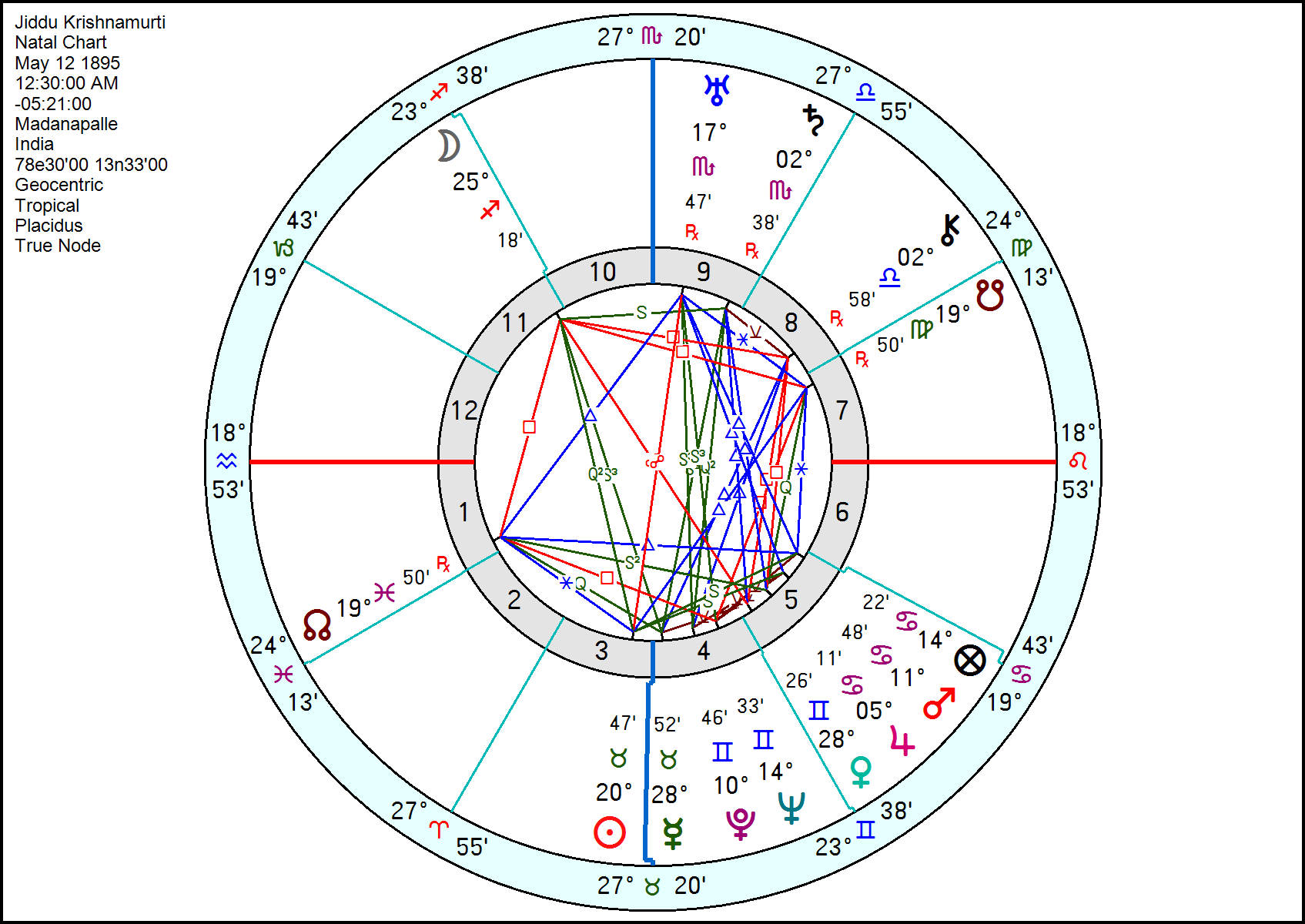
CHART appended to this transcript:
- FIGURE 1984 0402a-1. J. Krishnamurti Natal Chart.
NOTES:
- This is 1984 04/02a, Astrology; Horoscope-Krishnamurti Class, and the first entry associated with this date. 1984 04/02b = Astrology; Horoscope-Krishnamurti Seminar, for which we have no audio, just JF notes.
TRANSCRIBED Verbatim by IT prior to 2018 (V11a). This is V12a (2023) and has: updated prefatory matter, footer, and audio file name; Book List and TOC completed; new notes within transcript; new Krishnamurti chart. Archival verbatim transcript – V12a.
AUDIO FILES: 1984 0402a, 1984 0402b. [Note: "Tape" and "Side" refer to original audio cassette tapes that were later digitized into .MP3 Audio Files.]
1984 04/02a at Wisdom's Goldenrod
Astrology; Horoscope-Krishnamurti
[Audio File 1984 0402a Begins]
TS: --um, and, which was we talked about the Sun Mars septile in his chart. And then we have three options that I can see, we-- we have never looked at the quintiles really and I thought we-- maybe we could look at those natal quintiles. Or we could run through the whole dossier and try to work with that whole. Or we could look at some of those transits, the ones we were working out on Sunday, that in-- insight or other event.
AD: Well they're all, you know, appealing approaches.
S: Uh-uh.
TS: However--
AD: I mean I-- I have no preference.
TS: Well which is the least preferable?
AD: Oh.
S: If you had a preference what would it be?
S (faint): Yeah.
AD: I had a preference?
CDA: If you had a preference what will it be?
S (faint): (Well, alright.) (bit of laughter)
AD: I thought, you know, what we had in mind like, trying to see the personality as a cluster, like the septiles, the Mars Sun and the Mercury, the-- or Saturn Moon, you know, try to see like these clusters of ideas and how they get organized into a personality and-- Because, in a sense, I know some people get upset, [possible aside: excuse me], but-- You know when you read about mythology, they very often repeat the story to you that the people who believe in mythology and live according to the ancient myths are trying to recreate or reproduce an ancient mode or way of being, and that the myths represent basically these ahistorical creative and exemplary modes of being. And so the person looked up to the archetype, you know, to the archetype of the Hero, and tried to live out that life. And so they-- according to a lot of the mythologists of course then, these mythologies claim, these people would claim that there was a time the Gods walked the Earth and people looked up to the Gods and tried to imitate them. But I think that that's all a kind of embellishment, you know? And that basically what they're talking about is that here we have the archetypal degrees, and these degrees do represent (a) creative exemplary paradigms or models of behavior. And that what we're in a sense forced to do when we're working this way is to almost become contemplative in trying to understand the depth and the breadth of these ideas.
I don't know-- I'm sure that most of you when you read the Platonists and they talk about the ideas, you know, the idea of a bed in heaven has to be there first before we could think of a bed here. Well, that's a kind of superficial discussion, because this is really the ideas-- if Plato were alive today and I think if he was in this room he would say yes, this-- these are the ideas that we participate in, this is what our life is, living out these ideas, alright. And so that requires on our part that we stop thinking of astrology in this mundane way and try to understand that these ideas are the basic exemplary models on which our personality is based. And we've noticed this over and over again. Every time we read the chart of a great man, a man whose simplicity, straightforwardness, you know, sincerity of character, is there, these degrees shine through like crystals, like diamonds. And you recognize that that's what's peculiar about this person. Now it's true that you have to take it out of the context, the way it's-- you know, out of the context of that whole life that the person is living, you gotta almost like pull out the thread and say this is the idea that this man is living. Those of you, for instance, who saw Gandhi the film, alright, you remember every time he had a problem he had to sit back and think and get silent. That was his Uranus degree, which taught him to be silent in order to, you know, come up with a solution. You see what I'm saying? So right in the life that we live they're right in there. And in order to perceive them, we have to really develop a sharp-- you know, a sharpness of perception. You have to be able to look at the character, see these things in the character, how the character either lives up to them or denies them. Now most of us deny these possibilities, these higher possibilities that are within us. But there are some, and the people I think we're trying to study are some of these people that exemplify these ideas. Well what's that tirade about anyway? (bit of laughter, student words) I've forgotten.
AS (faint): Divine tirade.
AD: No not divine tirade.
CDA (simultaneously): I think you're trying to help me out. (bit of laughter)
AD: Uh-hm. [short pause, faint background student words, noises] Well you know, one of the most beautiful and illuminating sentences I ever read was one by Wang Yang-ming, where he says to one of his students, "You will learn about the transcendental [AS, very faint: In empir--] in the empirical lessons that life teaches you. There is nowhere else you can learn these things." [Note: Wang Yang-ming, Instructions for Practical Living, and Other Neo-Confucian Writings.] And that-- that struck home, I mean-- I recognized the truth of that. The laws, the metaphysical principles that we try to understand must be grasped in the empirical. If they're not, you don't have them. So-- well we got a good start. And although it may seem that we wasted two hours this afternoon we didn't. That degree was getting almost numinous.
LR: (I/We) never said that, don't [one/two words inaudible]
AD: No I-- I'm not-- I'm not blaming you! (AD laughing, bit of laughter) I just gotta look at someone that I could be in disagreement with because it helps me talk. (laughter) But, I think this afternoon it was getting almost numinous, people were getting excited about that degree that we've been discussing back and forth, agreeing and disagreeing about. And that's an example of what I mean, although it wasn't silent contemplation but the mind was getting focused--what does that degree really mean? You know, the one with the Kwan-Yin-- I mean the Chinese lady nursing a child that had a divine halo and was a incarnation of something, right? Now you can see that there's an idea there that's stupendous. Why do people always have to look so far beyond the empirical to find what's meaningful has always, you know-- It's always been a puzzle to me.
CDA: Can I ask you something?
AD: Sure.
CDA: When you say empirical--
AD: It works.
S (very faint): Not really. (bit of laughter)
CDA: What do you mean by empirical?
AD: (Yep/Yes), that's you! (AD laughs, laughter) That's empirical.
CDA: No, no, but--
AD (simultaneously): The sensible experience.
CDA: Yeah. But, we're penetrating with all of the-- we're-- I thought that the process was to develop an intuitive perception in order to see what ideas are present in that empir-- empirical experience. The intuitive perception-- yes, the empirical experience is the ground-- is the ground, [AD: Uh-hm.] but the intuitive perception is-- is necessary in order to grasp that, um--
AD: To grasp the idea that's embedded, that-- that's [CDA assents] embodied.
CDA: But when the id-- ok.
S (very faint): Yeah.
AD: Yes, that's why empirical experience is so valuable.
CDA: Yeah, ok.
AD (simultaneously): Sure.
CDA: Ok.
[short pause]
AD: So, Tim suppose you work the way (you've/we've) been working, you know.
[student assents, faint]
[short pause]
TS: Well we started with the Sun Mars septile. It's the closest aspect in the chart it happens. Or, sorry, it's the closest aspect to the Sun in the chart. I think the Mercury-- yeah.
S: Upside down?
S: Got that.
S: Faith.
S: (Touched by God, Richard.)
S: And upside down, huh?
S: Hey Richard--
LS: Ancient Chinese expression.
S: Is [S simultaneously: Right.] the [AS simultaneously: Yeah, remember him?] microphone on?
AD (very faint): Uh-hm.
TS (faint): Turn it on.
S (faint): Why don't you turn it on. (bit of laughter)
S: (Right./What?)
S (faint): (Right./What?)
S: You wanted a cord?
TS: That's right, you [S simultaneously: I see.] couldn't hear me. So, the Sun degree.
[short pause, faint background student talking, student moving something]
S: Sorry Red.
[student moving something]
TS: That'll wake Red up. Just drop it now. (laughter, student words)
S: Over here?
LR: Well Dr. Witter, you just missed the best rap on astrology that Anthony's ever given. (laughter, student words)
Marc Edmund Jones [The Astrology of Concepts, Taurus 21, TS reading]: "A moving finger points to the significant passages in a large open book."
Marc Edmund Jones [The Sabian Symbols in Astrology, Taurus 21, TS reading]: "This is a symbol of the rectification of experience on the side of ends and meanings, and of the fine discrimination of which man is capable. There is here a dramatization of the racial wisdom as this becomes incarnate in conscious individuality. Purpose and interest sharpen the attention, which in turn quickens the insight and permits an outreach into events which thereupon are ordered by the self's potentials. The keyword is CONFIRMATION. When positive, the degree is a sensitiveness to the enduring significance of each special complex in human affairs, and when negative, a loss of integrity through blind obedience to others and a tendency to do things by rote."
TS: (I) like talk to people. I don't know, this degree is beginning so-- so obvious, you know, in some ways. If we took the Sun as the central purpose of the individuality, the cen-- just say the central purpose of-- of the life, of the meaning, and you took the degree as this finger pointing to an open book, it seems like one of the basic meanings we were-- we were trying to summarize is that-- that life itself would be that book, it would be like a-- a direct reading of meaning out of life and a kind of immediate perception of what is the significance of life and a looking to life as the teacher. And that his own basic perception or perspective would begin with that sense of seeing things for what they are and not the images of them-- what they are. And trying to use his own menta-- mental processes, it's (a/the) third house Sun, to come to that perception, to developing a discriminative mind. [short pause] I don't see (the Sun).
LR: Well, we said that thi-- or Anthony was talking about the Sun as-- in general as (there/their)-- universal (life/light). And that each degree that--
S: Wait a sec. As what? Sorry.
LR: As universal life. And that each degree-- as the Sun passed each degree it would represent the way in which that universal life gets particularized and embodied in a certain mode. And that then it has the power to manifest the meaning that's in the degree. And it does that through all the other planets as well. And-- I thought also we were saying that it wasn't just that the experience or life was the teacher but that it was-- life wasn't just the teacher but it was also te-- actually telling you the meaning that was in the life experience.
TS: Yeah.
LR: I mean in the living was also the meaning which is, you know-- the meaning was fused there in this degree.
CDA: Is there ever-- but is there any li-- ever-- life is never really without meaning [one/two words inaudible]
LR (simultaneously): No but, it wouldn't--
CDA: So what's particular--
LR: The experiences that are given would not always be presented with the meaning, I mean you might not have that. And I thought the point here was that the actual living of the experiences made available the meaning.
CDA: Ok but that's different than saying that life isn't-- life was never without intelligence. So it's-- it's something peculiar in this degree [student assents] that the [LR assents] meaning-- the intelligence within the life is gonna be available to him. In fact [TS simultaneously: Well, yeah.] that's big stuff.
LR: Yes and I think that's also what the third house meaning is. I mean I think you actually-- that the experience-- that meaning comes through experience or living in a kind of everyday world.
TS: Also it's his personal life that has the meaning. It's his own individual life experience. It's not just an intuition-- or not an intuition into life itself as it were but into his own life, into his own living.
CDA: Well, no, I'm just a-- I'm just wondering when you say that the universal is particul-- you know, that--
LR (simultaneously): Ok, that was a separate--
TS: (And--)
CDA (simultaneously): Well, but, all life--
AD: Every life, ever-- every individual life, alright, has a meaning because it's on one of those degrees, right?
CDA: But there's no life without intelligence.
AD (simultaneously): Yeah. So every individual life has a [CDA assents] meaning. But, this particular degree is specifically saying that.
CDA: It's not specific-- it's not referring to something, I mean, that-- Isn't it saying that the meaning that is inherent in life, that's inherent in all life, in this degree it's going to be available to him in a-- [student assents] in a way that is unique. Meaning's gonna be available then [one/two words inaudible]
S (very faint): Yes it is.
CDA: Because it's not that the meaning-- the meaning is not [AD simultaneously: Well--] available to [AD simultaneously: Yeah, ok.] people that don't have this degree, I mean what's--
AD (simultaneously): Let me try putting it this way, that each individual's life is a meaningful one. This is the specific meaning of this degree.
CDA/S(?) (very faint): Ok.
[student assents, very faint]
TS: Yeah.
[short pause]
AD: It-- it may help us to think of it this way, you know? When we think of the Sun going from 1 degree Aries, 2 degree Aries, you know, and so everyone who's born on a certain day, alright. Now if you think of the Sun not as a sensible Sun traversing the zodiac, but if you think of the soul of the Sun, alright, with who's (light/life) is illuminating, you know, the boundless space, alright, there you can't-- there you can say life is universal. [student assents] Because it's not restricted by any one degree but encompasses all 360 or any combination thereof. But as soon as you speak about the sensible Sun traveling the zodiac it can only do it one degree at a time. So even in a chart I'm inclined to think that the Sun has this dual purpose. On the one hand it's a planet like all the others, on the other hand it's the meaning of the functioning of all the planets. So on one hand it means life, you know, but on the other hand it means the meaning that's infused into that life.
[9 second pause]
TS: And you're saying that this degree is to see-- as almost an-- an intuitive awareness of this-- that each l-- individual's life has a certain meaning in it. It's like that i-- that a person has within themselves the resources to--
AD (simultaneously): Their raison d'etre. [short pause] And then the other thing I think we said was quite to the point, that life itself is the teacher.
TS: That he wouldn't be inclined to look to anything else for his understanding. He wouldn't be inclined to look to a-- another person or a doctrine for a teaching. He would look to life itself. And by following that, it would lead-- in his case it would lead to a certain accomplishment. And--
S: Is that coming from the third house primarily or from the-- from the degree, are you seeing that in the degree reading or the third house?
TS: That he wouldn't look to anything but his own life?
S: Yeah.
TS: I think it's in the degree itself Daniel and I think that in the third house that that life would be one which would be expressed in terms of perceiving the meaning in the everyday, on the one hand, on the second it would be seeing-- trying to penetrate the fundamental form of the lower mind, the embodied mind, and trying to see the meaning of that in, you know-- the way in which that's present or operating in each individual. And that, there's a constant kind of inquiry or dialogue that seems to be part of a third house Sun. And that would seem to be also how that life, that sense of seeing the meaning in life would be he would communicate it, he would be talking about it, (he's been/he'd be) trying to r-- you know, establish it through-- through communication, through dialogue, through reasoning.
LR: It comes out more at the opposite degree too, what we're saying [one/two words inaudible]
[short pause]
TS: Ok. Well let's look at the opposite then.
JC: Tim? Are you-- are you saying this degree-- a person with the Sun on this degree, the meaning of his life is more apparent than the circumstances that he's living? Is that what it-- you seem-- you were saying something about intuition, this and that, I-- [S: Yeah.] Does this person have more access to the meaning of his life by having the Sun on this degree? Because we say-- well the sensible world doesn't come with an explanation, but does it come with an explanation in this guy's case? I kind of [TS simultaneously: It seems to be.] question, I don't know.
TS: Well, that's a--
JC: It might be that the meaning of his life-- that-- that his life as a unique meaning, as a, you know-- [AD: Uh-hm.] as a reason unto itself, might be what's indicated by this degree.
TS: Yes.
JC: You know what I mean? I don't know that it means that he has more of an intuition into the meaning of life's experiences than some other degree. But it could mean that, you know, he doesn't have to go outside of his own life in order to find the meaning, that's one thing you expressed.
TS (simultaneously): Yes. And he would see that that was true for anyone, and that that would come also from the trans-Saturnian grouping, that he would tend to universalize the idea that's in each of the Chaldean planets. But that he wou-- he-- in other words, he's always saying, "Don't look to me, don't follow me, look to yourself, don't read any books, don't come to this lecture," you know, and that to go-- to become fully self-reliant and look to your own experience to verify what he's saying and to find the answers. So it isn't quite like he's saying, from this degree anyway, that he is-- it wouldn't seem to me that it would be that he would have perhaps a specific knowledge of each individual's life purpose but he would know that each individual would have that life purpose and that the only person that could find that for that person would be themselves. And he wouldn't be at all inclined to impose his own sense of life purpose other than this idea of self-reliance or self-dependence on other people. And I think when we bring in the Mars we'll see that there's a psychological acuteness and acumen that enriches this functioning of the Sun, (this/his) discriminative or this perception the Sun has. But he's always saying things like, you know, you don't see the tree or the person, you see an image of the tree or the person, get rid of the image and you'll see the meaning right there, you don't have to go anywhere else, you know. And all these lessons of like harmony and whatever can be found just by observing perception and reasoning or-- or-- not even reasoning but contemplating the authen-- the authentically given perceptions, you know. And I think that would be in the Sun degree. [JC assents, faint] And then he would tend to talk about it, write about it and so forth would tend to be the third house part. But it doesn't seem like he would [short pause] know all of the meanings of life, but only as it app-- this-- it focused on each individual's-- that each individual had to have-- be a lamp unto themselves or to be true to themselves.
JC (simultaneously): Yeah, that seemed to be what he (trying to--) [TS assents] He didn't seem to, at least in the books, discuss the particular meanings of what experiences they were going through but rather to the fact that--
TS: They had to work it out.
LR (simultaneously): But see now I think we're in the opposite degree already. And that--
S: No I don't think so.
LR: No, that's [student assents] not bad, I mean I think that has to happen, you know, that if you-- if you really are discussing the full implications of a degree, you should be ending up in the opposite degree, you know, [student assents] that should happen and I think it is the same.
S (faint): For sure.
LR: 'Cause that's the degree of the soldier running the risk of court-martial, but a lovely miss clings to him. You know, I think that is a consequence of-- consequence of really finding those meaning right in the life, the empirical situation, is that you are-- you are become a lamp unto yourself, in a sense, and that what he expresses as finding his beloved in some way is the only [one/two words inaudible] if you listen for guidance and that does make him sort of a collective pariah, you know. Yeah. You know, that that isn't the collective mode, that isn't what's normally accepted in terms of outward responsibility because you listen first to something that is your own soul speaking. [student assents, faint] And, it seems like that's coming-- I mean I could see-- well, the Sun is on the Taurus degree. So at first he's living a life. [S: Yeah.] And as a consequence that-- that life which he's living which is the meaning, takes him right to the soul or to this-- the soul.
LR/S(?): Well--
AD (faint): (You all) [one/two words inaudible]
JA (simultaneously): I'm finding it a little hard to put together what he was saying. I think the things that you were saying about him initially were true. Some of them I didn't see how they related specifically to the degree. I mean I think they're quite true about him, that he did see the unique individuality in-- in everyone, and that-- and responded to that. I sort of see it in the degree but I didn't know exactly what you were trying to-- We're talking about the third house in terms of the communication and I don't know exactly what you mean when you talk about a planet in a house because we haven't talked about that too much. You're calling it the everyday experience and I-- you know I-- I don't know how that relates to the Sun degree, talking about this conflict that he-- he runs into by living out his Sun degree. Now maybe this is all clear to you because you've discussed it but it just-- it doesn't-- it doesn't come together for me.
TS: I could answer you yes, yes, no, probably. (TS laughs)
JA: Ok.
TS: I see your point and-- uh-- no.
JA (simultaneously): That's very clear.
TS: Um-- (TS laughs a bit)
JA: Ok first of all--
TS: If you just go through them one at a time, right?
JA: Ok first of all, the Sun degree and your-- you know, like sort of what's a concise statement of what you were saying about it?
LR/S(?) (faint): Life is the teacher.
TS: That for each individual their own life is the best teacher.
JA: Ok, and that-- that's in order to-- what, conscious individuality or-- I mean, meaning in the degree or is this just--
TS (simultaneously): Well ok, the Sun degree, the-- what-- the Sun is the function of the individual life, the accomplishment of the individual meaning. Now you put the Sun on this degree, so that the-- it's going to qualify or color this-- the degree meaning somewhat. [JA assents] Ok? So the-- the sense of it being the-- the individualization of life comes from the Sun, not from the degree. Then you put the degree there and it's a finger pointing to this passage or there's a sense of recognizing this-- the-- the significant passages, the significant moments or whatever. Significant moments of what? Of individual life.
JA: Uh-hm.
TS: Ok. Now, that would first apply to himself.
JA: Uh-hm.
TS: Ok. And then we said from work we've done before on his chart that with his Uranus Neptune and Pluto held in a tri-septile, that one of the things that that did is he would tend to universalize or see the universal applicability of the things he came to as an understanding through introspection into his own make-up, [JA assents] into his own nature. So he would carry-- he would have the ability to take this sense of the personal significance, or that the individual's own life is a teacher for that individual, and see in what way that could be applied or communicated, and it's the idea of communication to other people. And the third house meaning would be-- one of the meanings of the third house would be brothers and sisters, roommates, writing your mother, whatever, that it's secretaries, time-management-- What else? Well what? Well those are all third house meanings that I know of. [student assents, faint] [JA simultaneously: Well, yeah.] So it's everyday.
AD: Everyday experience. What's the most fundamental everyday experience?
TS (simultaneously): [one/two words inaudible]
JA: Well, one fundamental everyday experiences is that the Sun moves a degree.
AD: That's the most fundamental everyday experience you have? (laughter, student words)
JA (amidst laughter): Sun-- sunrise to sunset.
AD: I thought it was perception.
JA: Ok. Is that everyday? Is that mundane?
AD (simultaneously): Every moment of the day.
JA: Is that mundane?
AD: Absolutely mundane.
JA: Well--
AS: It's immediate.
AD: Immediate, impossible to get along without it. [JA simultaneously: Yeah, I-- I agree.] There's-- there's nothing more fundamental.
JA: But I think that there's a-- there's a-- a certain connotation which is given to everyday mundane that isn't one [couple words inaudible]
S (faint): Yeah.
AS: Just-- I think that's where that Wang Yang-ming quote fit in.
TS: Yeah.
AS: That's the penetration on the lower, that third house represents the lower experience. And with this degree there through-- it's exactly that, the finger pointing to the fact that in the lower experience, third house, the life, Sun, reveals the higher-- that the ideas are revealed right in your life. If you were to just look--
JA (simultaneously): Ok, and maybe if you were to envision what's-- you know, what other experience do you have besides your lower [AS simultaneously: If--] experience?
AS: Well you've got [TS simultaneously: Relationships, occult, large animal.] [one word inaudible] and you got relationships [couple/three words inaudible] ideas in the ninth, things like that. (students assent, bit of laughter)
S: What--
JA: Ok, you've got-- you've got big ideas and then you've got your lower experience, right?
AS: But the point-- the poin-- I think the point here or the idea was that the so-called lower experience, with this degree he sees that that's where the higher wisdom is revealed right in the so-called lower-- right in the everyday experience the wisdom is revealed to him through his very life, through his living, through his living.
JA (simultaneously): Ok, and how--
AS: I think that's in the degree.
JA (simultaneously): And that's revealed by [AS simultaneously: Well I think that's in the degree.] his perception of--
AS: Well, you know, the fact that-- the fact the he becomes aware that that is a-- is a truth may not fully come out until he gets-- till, you know, the trans-Saturnians or something else really reveals that to him. But that's the way his life is organized, [student assents, faint] [JA: Now--] to continually bring that out.
LR: Well that was one of the points actually, that-- that--
JA (simultaneously): That's why I didn't understand what Linda said about this knowledge, you know, this responding to his experience, to his perception, to his immediate life, makes him a social pariah, I don't understand [one/two words inaudible] that--
TS (simultaneously): No, that's the opposite degree.
JA: That's the opposite degree so what were you saying?
TS (simultaneously): Oh, ok.
AS: Oh [one/two words inaudible]
TS: Ok, well the opposite degree s-- wait a minute. Let's see if I follow your-- your complaint, you're saying--
AD: You know many people who go around analyzing their perception? And if they did, wouldn't they be social pariahs? (AS laughs, bit of laughter)
S: (He throws.)
AD: You know, [JA/S(?) simultaneously, faint: Well, I--] it's the problem I pointed out. People simply think that what is familiar is understood. That is not so! Perception, [AS simultaneously: Is mysterious.] the most fundamental thing in your life, of which you cannot survive a moment without, alright, is what he's faced with, this is his everyday experience. And that Sun degree is concerned with understanding what is perception.
JA: Yes I have Saturn in the third house and I-- you know, I can-- [AD: I'm-- I'm aware that you got Saturn in the third house.] I can sympathize with this, I want to know what your reasons are (AS laughs) for saying that that-- What did you say?
AD: I'm aware that you got Saturn (in the) third house.
JA: So I just-- I know, I wanted to get the reasoning involved.
AD: See you want to reflect about it, alright, and Krishnamurti wants the direct experience, the direct intuitive knowledge of what perception is.
JA (simultaneously): Well he talked a lot [one/two words inaudible]
AD: Huh?
JA: He talked [S simultaneously: Oh.] (all the) time.
S: That was what I thought.
TS (faint): Well that's true.
S: (He didn't) talk--
S (simultaneously): But what--
JA (simultaneously): Oh come on.
S: What does come out in the [JA simultaneously: Gee.] degree, in the Sun degree is-- the Sun degree is basically about the-- I don't know, there's a fancy word that comes to mind, I probably can't pronounce it right. It's about the apodictic or apodeitic. (bit of laughter)
S: Some--
AS (simultaneously): Don't worry, we won't know if you mispronounced it. (laughter)
AD: Right or wrong, [S simultaneously: It's very pretty.] don't worry, go right ahead. (laughter)
S: Can you help me out as far as what-- what that word means?
[students assent]
AS (simultaneously): He knows what it means.
LR: The apoldictic?
TS: Apodictic.
S: Apodictic function. It's-- it's [LR simultaneously: Oh.] the-- it's the pointing out of what is evident in and of itself without further demonstration and without further ex-- [students assent] explication. And that's-- if you look-- the degree does not imply a reading of the book, it implies simply pointing to the self-evident truth of the passage as opposed for example to a degree like, you know, Aries 10 which is--
Marc Edmund Jones [The Astrology of Concepts, Aries 10, S reading]: "A savant is revealed, a man who has created new forms for old symbols that have lost their meanings [S reads: meaning]. … [The] keyword [is] INTERPRETATION."
S: No, it's not about that, it's not about discursively unfolding the particular meaning of any par-- of any particular life, it's about saying "There's meaning here, look!" [student assents] That's what apodictic means simply, "Look!"
AD (simultaneously): There's a heuristic value.
CDA: What's "heuristic" mean? (laughter, student words)
AD: We don't have to know what the words mean, use 'em! (AD laughs, laughter)
JA: Well (I don't know) about using ninth [AS simultaneously: And that's--] house words.
AS: No but that's why he--
AD: Ninth house words?
JA: Ninth house words. [AS simultaneously: No, you criticize his language.] I'd rather get back to the mundane meaning.
AS (simultaneously): But that was-- I thought that was (important/good).
AD (simultaneously): I don't think [JA simultaneously: Oh that was very good, I wasn't-- I wasn't--] (it/he) could be more mundane. I don't think (it/he) could be more mundane than what he just said.
AS/S(?): Yeah. [few words inaudible]
JA: Look. It-- it is, [AS simultaneously, faint: So just-- just look.] yes, I mean I look at scholarly books all day, it's very mundane, alright.
AS (simultaneously): No but that's what he says Jeanne, he says "Just look," that's-- I think [JA simultaneously: Yeah, yeah. Yeah, that--] that's what he's saying, just to look at the experience--
TS (possibly part of background): Yeah I know.
JA: Do you mind if I don't look at that?
AS: No not at that, I'm-- well-- no I wasn't-- (some laughter, student words)
LR: What's going on here?
AS: Sorry Jeanne.
JA: Ok, so he [AS simultaneously: (So--/Soul.)] wants this, you know-- the-- the experiences, immediate experiences, is important to know, so what-- so what do you mean by saying then that he must cling to the beloved?
TS: Ok, well it goes something like this. (bit of laughter) If you're going to constantly get to confront the individ-- the meaning of life by just looking at it, and that that life is not going to have a split into a subjective and an objective pole, [JA assents] which would be part of what would have to happen if you were going to just see the meaning, you wouldn't be allowed to split it into an inner and outer content. [JA assents] Well, it would seem as though the presuppositions that one plasters on inner and outer experiences would have to be wiped away. And it would seem as though the next thing would be that the inner being would spring forth within the person's consciousness in response to that inner emptiness that that lack of vasanas or tendencies within the individual, or not ten-- tendencies but the lack of these projective psychological associations-- If you're always-- if you're going to look at your life directly, it would seem as though the only way you really could accomplish that is from some kind of Witness consciousness or an association to or pursuit of some kind of Witness consciousness. Otherwise, you know, you would sink into the chaos of sensation. And then he's not trying to just deal [student assents] with sensation, he's trying to see the meaning of perception, and that meaning ultimately would have to spring from the witnessing pers-- consciousness, which he would experience at the beginning as that-- as his soul, as his beloved. And then there would be a tende-- then the consequence of seeing the life would be a tendency to pursue that beloved at the cost of any regimentation or [LR simultaneously: Accepted order.] judgment or whatever that would be applied by the collective conditionings of environment, heredity, and education which would be the soldier's, you know, getting court-martial risk. [JA assents] So it seems like the neces-- in other words, if you really were going to accomplish the Sun in this case, you would have to come to the point of view of a pursuit of some point of inner stability that couldn't be in a polar-- not-- in the triple mode because if you did you'd get torn apart, you know.
JA: Ok, it's not in the triple mode, but nevertheless there is a separation from something.
TS: A separation-- yeah. Separation from the con-- from the conditioning, the-- of the-- the psychosomatic organism or education, learned concepts, images, associations, what have you. That seems to be--
JA (simultaneously): Uh-hm. What is that, your immediate environment?
TS: No, it's [one/two words inaudible]
AD (simultaneously): He considered all that [LR simultaneously: Let me try. In Krish--] authority, he considered all that authority.
LR: In Krishnamurti's case--
JA: I-- I don't understand.
AD: You don't understand that?
JA: No, I didn't (hear you).
AD (simultaneously): Your past experience is an authority, it dominates you. [JA assents] That's an authority. You learned something ten years ago. You saw something ten years ago, that's an authority now. Not the guru so much. Not the schools. But that which your mind has memorized and now has converted into knowledge. This becomes authority for you.
JA: So the immediate experience is-- has nothing to do with that, [LR: Well--] that perception.
AS: Not necessarily. Only if you're use-- if you're used to within the immediate experience separating out what the conditioning is from the real essence of it, seems that the result of that, doing that all the time, would be you'd have to separate yourself off from the total [one word inaudible] totality of all that conditioning as any kind of authority and see its superficiality. And so you would keep-- so you'd take this point of view of being fresh, original, [JA assents] and so on, which is a real deviation from-- remember his keyword is "Deviation", to devi--
JA (simultaneously): You're ta-- you're talking about the opposite degree.
AS (simultaneously): The opposite degree, right. I'm saying that the result of the functioning of the Sun degree is-- is this-- seeing the complement of this outward-- this opposite degree.
LR: I mean, look at his outer life, his outer [AS simultaneously: We have to have that quote.] life was such a good example.
AS: There's a nice quote.
LR: Which?
JA (simultaneously): Well, Linda, I mean I know what his life was like but--
AS: We had a nice quote from that too.
LR (simultaneously): Well but that's the point, this degree, I mean-- he was taken as a very young person, and he [JA assents] was put under the control of all these people, now, what he's preaching is look to yourself, don't listen to the others, no one can tell you the way except yourself in the one-- He's constantly denying anything outside of what's right in front of you as being a teacher, right? And how did he get to that? He got to it from being led by all these people, being told what he was, what he should be, what he should do from moment to moment. I mean in other words it was in the actual growing up, day-to-day experiences that he arrived at that with those troops which are-- I'm just using that as an example of this degree and its [JA assents] opposite.
AS: Jeanne, that quote there [couple/few words inaudible]
LR (simultaneously): I mean not everybody has an early life like that, it's--
AS: No you should read that (line/one). 'Cause the other thing [one/two words inaudible]
S (simultaneously): No, it's right here.
[student assents]
LR (simultaneously): Which one is it, Ave?
AS: Just the one we read this afternoon [one/two words inaudible]
TS: Oh yeah.
LR: Oh, the one we had to read [one/two words inaudible]
AS (simultaneously): (Well/Where) "I think…"
TS (simultaneously): Yeah.
AS: From him.
[Transcriber note: I am using The Kingdom of Happiness by Jiddu Krishnamurti, New York, Boni & Liveright, 1927.]
Jiddu Krishnamurti [The Kingdom of Happiness, "The Voice of Intuition", AS reading]: "I think all of you realize that to create, as you must create if you would live, there must be struggle and discontent; and in guiding these to their fruition, you must cultivate your own point of view, your own tendencies, your own abilities; and for this I desire to arouse in each that Voice, that Tyrant, the only true guide that will help you to create. Most of you prefer - it [AS reads: and this] is a much easier way - to copy. Most of you like to follow. Most of you find it much easier not to cultivate your own tendencies, your own qualities, your own natures, but rather to follow blindly."
AS: That-- I think we'd say something that goes-- that those own tendencies are those ideas that he sees in the Sun-- in his life, in the third house, in the Sun degree. I mean those are his-- I mean by tendencies, he means your own ideas, the innate ideas that are inherent in your life that are working themselves out, not the inherited, memorized tendencies but the real tendencies, the real idea(s). [JA assents] So-- so this-- so, if he-- if he followed that, couldn't possibly follow blindly any kind of condit-- or, you know, it would tend to separate him off or isolate him from any kind of conditioning whether it's external or internal, [S simultaneously: And that's--] memorizations and stuff like that, superficial allegiances or, you know [one word inaudible] idea of any kind, socially imposed or imposed by his own memorization, to get to what he is in himself, to what his own degree meanings are, even if you take it at that level.
JA: But do you s-- do you [AS simultaneously: And that's what--] see what-- why [AS simultaneously: That's what he'll cling to.] I was asking for more [AS assents] ex-- explication was because you were-- you were saying both that he looked immediately at his life directly, and then you were also saying that this separated from-- separated him from life, you know, and you weren't making it clear [student assents] what you were talking about in each case.
AS (simultaneously): [couple/three words inaudible]
CDA: Good.
TS: Separated him only from-- well, it says--
AD (simultaneously): The consequence of an impersonal observation [AS: Superficial.] is that it will [AD finishes sentence quietly] ostracize you from society.
EC (very faint): (Is it/Isn't) life(,) society?
[student assents, very faint]
AS: If you have [few words inaudible]
JA (simultaneously): Well, Eleanor just made a good comment, that's not life(,) (that's/but) society [couple words inaudible]
S (simultaneously): [one word inaudible]
AD (simultaneously): I'm sorry?
S: Yeah but-- (bit of laughter)
S: That's a [few words inaudible]
AD (simultaneously): No I-- I think he also made the point very clear. That Sun degree means "Look!" [students assent] Just look! And if you just look, there is no observer that sees anything.
JA: Well he didn't exactly say that, he said apodic-- [AS assents] dictic, and he didn't [AS simultaneously: Well--] say it means just look, you know what I'm saying?
AS: Well it's his way of saying "Look".
JA: Well-- (JA laughs, bit of laughter) I was asking for something a little bit more clear.
AD: True observation like true looking automatically excludes the notion of an observer.
CDA: Which excludes any--
AD: The observed.
CDA: And it also excludes any relationship with any other observer.
AD: Yes but, do you see [CDA simultaneously: Meaning that the ostracization--] the point-- do you see the point here, [CDA: Yeah.] you see the point here, that once you really look at something, you become the impersonal Witness, an impersonal consciousness. And for that consciousness there is no subject-object division. It is only the next instant, alright, that the subject comes into being, [CDA assents] when it says "I just observed." That-- that brings the ego right into activity, you have a subject-object now. So this degree is loaded with potentiality that's, you know, inconceivable. You people think you're familiar with these degrees but I can tell you there's depths to them that are treacherous. You won't fathom them.
CDA: Do you think that all of what he speaks about loneliness versus aloneness is [S simultaneously: Well--] also implicit in this degree meaning? You know, how-- how until you face the loneliness, until you really-- will you come to that place of aloneness which I think is the Witness, which I think is that-- the seeing.
AD: (It/If)-- maybe, I'm-- I'm not sure, I think I follow what you're saying. It is true that the work of looking is a very lonely work (but) because no one could do it but you. And it will tend to isolate you. It'll isolate you more and more the deeper you look in-- into [student assents] yourself. Eventually of course, when one begins to identify with the Witness or the impersonal consciousness, then-- then there is the true existential aloneness. But prior to that (it would be) aloneness in the sense that it separates you off from everyone else. And then it's no-- it gets deeper and more intense when you start separating yourself from your ideas, then you experience a real loneliness. Because you-- you can't even bask in the sunshine, in the warmth of your own thoughts because there you always feel comfortable. "Oh, I had this thought, I had that," and you feel you got company. But if you can get rid of even that, alright--
(Side 1 of original cassette tape digitized as 1984 0402a Ends; Side 2 Begins)
AD: --thought and then sure you're plastered in. And we'll see that when he have his greatest experience, when he realized that the-- what he called the absolute or the ultimate source of all energy, he had those three trans-Saturnians aimed at the Sun.
JA: Well, the reason-- the reason I ask about it is because you were portraying it as-- I don't know, I mean as felt desolation. And he never seemed to speak of being without-- you know, that (sort of) transcending thoughts and memories and so on. You know, as [couple words inaudible]
AD (simultaneously): Because even the effort is cancelled out once it's achieved.
JA: What?
AD: Even the effort is cancelled out once it's achieved.
JA: Well what I'm--
AD: Listen! Listen. Even the effort is cancelled out once you've achieved it. There won't be any need to talk about it. (Are--) what do you think he was gonna-- he's gonna do, turn around and start pouting and reflecting on all the efforts he made, how hard it was? That's forgotten. That's part of the price, you forget even the efforts you make.
[short pause]
AS (faint): [couple/three words inaudible]
AD: Look, I don't-- I don't particularly admire Krishnamurti for his philosophic perspicuity. But I do admire him for the straightforwardness and the almost painful-- the pain he has to go through to keep elaborating the most obvious things in our life. It is actually painful to go through this over and over again, that the person doesn't see that the most significant thing in his life, alright, is himself. He's always paying honor and homage to everything else. And to tell you that perception-- at this stage of the game, to tell you that perception is the most every day fundamental activity, is absurd.
TS: He has a nice little passage in here where I-- I'm hoping we can get the transits for it, it's called "The Art of Seeing". Just a once-- it's two sentences.
AS: What page Tim?
TS: 177.
[Transcriber note: I am using The Awakening of Intelligence by Jiddu Krishnamurti, Penguin Books India, New Delhi, 2000.]
Jiddu Krishnamurti [The Awakening of Intelligence, "The Art of Seeing," pg. 193, TS reading]: "Seeing, observing, listening, these are the greatest acts, because you cannot see if you are looking out from that little corner, you cannot see what is happening in the world, the despair, the anxiety, the aching loneliness [TS reads: loneliness, despair, anxiety]…"
TS: He goes on. So this-- let's see here.
Jiddu Krishnamurti [The Awakening of Intelligence, "The Art of Seeing," pg. 193, TS reading]: "[But] you have to see all this, not emotionally, nor sentimentally, not saying,"Well! I am against war" or, "I am for war", as that sentimentality and emotionalism are the most destructive things--they avoid facts and so avoid what is. So, the seeing is all important. The seeing is the understanding; you cannot understand through the mind, through the intellect, or understand through a fragment. There is understanding only when the mind is completely quiet, which means when there is no image.
"Seeing destroys all barriers. Look, Sirs…"
TS (faint): Uh-hm. Yeah.
S: Yeah.
IF: Can I give a small quote to whatever Carol right now brought up about, you know, and this is the same spirit. That's exactly what [possibly one word inaudible] Tim just said, you know.
[Transcriber note: I am using Krishnamurti's Journal by Jiddu Krishnamurti, Harper & Row, San Francisco, 1982.]
Jiddu Krishnamurti [Krishnamurti's Journal, 12th Entry, IF reading]: "You must be alone with the trees, meadows and streams. You are never alone if you carry the things of thought, its images and problems. The mind must not be filled with the rocks and clouds of the earth. It must be empty as the newly-made vessel. Then you would see something totally, something that has never been. You can't [S reads: cannot] see this if you are there; you must die to see it."
S: Yeah.
[short pause]
AD: You see the passage where he speaks about you seeing from a corner? Maybe the analogy that might help will be something like this. Now it's only an analogy. If you think of the dream, and you're a dream character within the dream, alright, and you're identified with that dream character, and you're looking at the dream from the point of view of the dream character, you are seeing the whole from a corner. If you identify with the Witness, with the one who's having the dream, alright, then you see it as a whole. And you even see the process of perception manufacturing that image that's going on. So, that's what he means by looking, by looking he means you're identifying with the Witness-I, there is no subject-object relationship in that way anymore. And this [TS simultaneously: Well--] is what he means "Look!" Look-- look in this particular way. Now, you can see that from the point of view of the dream character he would be subject to emotions, he will be interpreting the dream-- you know, he would see the snake on the bough of the tree coming towards him, he would be filled with emotion, frightened, all that, and he would be interpreting or mis-interpreting what is there. Because what's there is not a snake…but the mind's function. [short pause] Alright. [TS assents] I think-- I think that Sun degree is pretty loaded and I think if you think about it very carefully you can see how loaded it is, alright, but the S-- that Sun degree is really putting the blinkers on you and say "Just look."
TS: It's-- I don't know if it's-- how significant it may be but this Sun degree would be the first septile to 0 Aries.
S: Ok.
S: Yeah. (bit of laughter)
TS: In other words, it seems as though there's some kind of image of intellection in perception that might be implied in this degree.
CDA: An image of--
AS (simultaneously): Good try but I [couple words inaudible] anymore.
TS (simultaneously): 51 [degrees] 26 [minutes]. What?
AS: Next one.
TS: Next one?
JA: It's good.
RG: 22.
S: [couple words inaudible]
TS (simultaneously): Oh well.
AS: Yeah. Next one but [TS simultaneously: Well I thought it was--] it's a good idea. (AS laughs a bit)
TS: It's a good idea?
AS: Yeah.
S: Well, for 39 minutes or so.
RG: Yeah, sure it was.
AD: (Let's quote.)
[student assents, faint]
S (simultaneously, faint): [few words inaudible]
RG: But it's the 0 Aries point.
TS: That was a 0 Aries point, yeah.
RG: [one/two words inaudible] point.
TS: Oh well.
RG: Where were we?
[student snaps fingers, bit of laughter]
AD: Remember that exercise PB has in the Wisdom, [TS simultaneously: Serpent's Path?] meditation on the Sun? The only-- the exercise is not completed or successful unless you do it for a whole Solar [student assents] year. You ever ask yourself why?
TS: The 360 degrees.
AD: And part of the-- part of the experience of that is that you assimilate these ideas. Now the assimilation is not going to take place as though it's a-- a concept coming into you. But, the assimilation is through a very subtle and underground kind of meaning that comes into you. And these meanings become, so to speak, part of your understanding. And you may not even be able to recognize that some of these meanings are working through and coming out in what you understand of the life around you and the world around you. [short pause] I don't think a good degree book has been written. Or is likely to be written. (bit of laughter) [short pause, TS lets out a sigh of relief] Well, without feeling embarrassed let's go on to the next.
LR: Without feeling embarrassed?
AD: Yeah.
TS: I'm feeling embarrassed.
LR: Do you feel embarrassed?
TS: Not yet. I guess I will soon. (TS laughs a bit)
S: Uh-hm. (laughter)
LR: The Mars?
AD: Sure.
LR: Is that what you mean by go on to the next?
AD: Yeah well, let's do the septile and then the tri-- the three together.
LR: Ok, well-- The reason we're doing the Mars next is that, in trying to discuss what order to look at the planets, we decided a good order would be the closest aspect-- starting with the Sun, then the closest aspect the Sun makes would be an intelligent way to proceed perhaps because there'd be a certain harmonic in the degrees. And that the Mars should be accessible to that relationship to the Sun, that it-- that inheres.
[student assents, faint]
S: Tell Avery.
TS: Of course this methodology is only applicable to his own-- this specific chart.
LR: Well, until--
TS (simultaneously): We have-- we-- but we did see it, I mean it is the closest aspect in that chart and the closest aspect to the Sun as well. [short pause] You want to do it?
Marc Edmund Jones [The Astrology of Concepts, Cancer 12, TS reading]: "A slant-eyed Chinese woman [is] nursing a baby, and about the child is the glorious nimbus of divine incarnation."
Marc Edmund Jones [The Sabian Symbols in Astrology, Cancer 12, TS reading]: "This is a symbol of the wide ramification in experience by which man achieves his greater opportunities, emphasized on the wholly personal side as he is able to include the far-flung capabilities of the race itself in his own individual complex of talents and skills. Life gains significance to the extent that each person embraces the totality of his kind in his own make-up, or seeks to embody universal values in his everyday consciousness. [The] keyword is MATERIALIZATION. When positive, the degree is a [TS reads: the] gift for bringing the more Godlike resources or superior powers of self to a point of real community service, [and] when negative, completely unreasonable demands for recognition."
[13¾ second pause]
TS: If you liked our interpretation of the Sun degree, you'll love-- (TS laughs a bit, bit of laughter, student words) I-- I think in approaching this degree something that was really appro-- came out when we were working on it was that, when we're looking at the Sun degree, the Sun is not in dignity and it seems as though the degree is structuring or organizing the function of the Sun. It seems here when we were trying to understand this degree meaning of 12 Cancer, we have to look at it through the eyes as it were of Mars, that there is a kind of gnostic and embodied functioning that the Mars in Cancer is going to operate with. And, it will be known in terms of or in light of the desire nature, this degree. [short pause] So, and if we-- it seems like it would make a difference, if you talked about this degree structuring the Mars you would say that-- you would expect to see a-- a way in which there's a kind of a-- the desire would be towards achieving this more godlike resource or desire for a widening of experience. But it seems as though another way to speak about it is that the-- is seeing the desires as taken as being a universal element in life, in every individual's life. When he says here-- Oh dear where did it go. Oh.
Marc Edmund Jones [The Sabian Symbols in Astrology, Cancer 12, TS reading]: "…(his/he is) own-- emphasized on the wholly personal side as he is able to include the far-flung capabilities of the race itself in his own individual complex…"
TS: Now, one thing we were saying is that it's almost like seeing that in each person's desire nature, what is kind of the constituents of that desire nature would be these universal and widely ranging energies that are within the race or the biological habits common to all men.
[short pause]
KD: I remember that.
KD/S(?) (possibly part of background): That's enough.
TS: You were bei-- busy drinking soda so how would you know? (bit of laughter)
LR: You said that he was able to recognize the universal nature of desire?
CDA: Yeah.
KD: Ok, so the universals-- soul would be--
LR: In other words, the Mars was primary, [KD simultaneously: (In/And) his desires (per se).] meaning desire per se.
TS: No, the suffering part comes from the Sun.
LR (simultaneously): With this degree-- with this degree, there'd be a recognition not just of his own desires but a-- desire per se as a universal, in its universal nature.
TS: Then you put the Sun on that, that he's going to get to the bottom of that desire and see in what way it affects the individual life. And it would seem as though it was in the putting the two together that we came to an idea that he would see that in the lower life or the life of the lower mind there would inevitably be a suffering. That the desire-filled mind or the agitated mind would have a fundamental suffering there.
LR: Or, to say it the other way, that a-- that life--
TS: All suffering is life? (Ok.)
[short pause]
LR: What did you say again?
TS: That, if you say the Sun is going to get to the bottom of something, it's going to-- it's a-- a discrimination, a demand to understand what is there, and you look at the universal quality of desire or the presence of a kind of universal form of desire in each individual, [LR: I don't like--] then--
LR: The basis of life-- the basis of suffering is desire. In other words, [TS assents] people come to him with their problems, with their sufferings, with their inadequacies, their-- their sense of failure of life and he sees that the root of the failure right in the life is the desiring per se. Just that in-- that the universal nature of desire per se will breed that truth that life is suffering, and he's always pointing to desire as that which leads you away from yourself, that which is based on the past or the future, desire is never what is, desire is never what is in the moment. It was always what-- what's wanted from the future or has been gained from the past. So to fuse these two then, the meaning of life in the lower mind is suffering. [TS and another student assent] Because that's the nature of-- universal nature of desire.
TS: Is to create suffering really, the consequence of desire is to continue--
LR: Duality, [TS simultaneously: Is to continue.] (like) that quote. [short pause] What was the quote that we read?
KD: Oh, um--
LR: Desire leads to dual--
KD (simultaneously): The function of-- the function of desire is to create duality?
LR: Yeah.
[short pause]
KD: That's still-- I know that's what we said, that that was the conclusion but I-- I think there's something else that--
LR: Ok well that's one thing, [KD assents] you know, and then you brought in another way of reading that degree.
KD: Yeah. That-- that in some-- that I think the symbol does structure that Mars, maybe in a way that doesn't make the Mars get highlighted as a normal Mars functioning but I think that degree would tend to make that Mars not function to create that duality, to split the subject and the object, and that's the content or an object with-- with what it is that compels your attention outside itself. And the-- the nimbus of divine incarnation implies that there's something-- there's something within its own functioning or there's something-- there's something self-involved about that degree symbol, and that that object of happiness that we're all looking for, we're all looking for that which will make us happy and normally we go outside ourself and that degree suggests that-- that it's-- that it's within that you're going to find the happiness.
LR: Ok, and I [KD simultaneously: Still a real.] would suggest that that's already taking that with the Sun degree.
TS: Yeah.
S: [one/two words inaudible]
LR (simultaneously): But what you're saying is the septile, that you're-- that the Sun with that would [short pause] be what you're saying, that you're talking about that septile.
KD (simultaneously): The septile and not the--
LR: Not just Mars.
KD: Not just--
LR: I mean in other words [KD simultaneously: Not (whole).] he had this basic perception that the mind doesn't move without inherent desire, that that's what creates duality, opposition, suffering.
AD: Could we try this [KD simultaneously: I--] way, put them together this way, Kathy, on the Sun Mars? I'm trying to make it as terse as possible. What is the meaning of life's desires?
S: You're saying it's the two together?
AD (simultaneously): The two together. What is the meaning of life's desire? "Look," the Sun would say, "keep looking. And you will see that it has a divine heritage."
RG: Yeah.
KD: Yeah.
AD: Do it.
KD: (Yeah.) Yeah, in other words it's its own functioning that it's looking at, the-- it's because his Mars is on that symbol conditioned by that idea, that's-- that's what he's looking at. In-- and that's a libido that is not going out and creating that duality and seeking an object outside of its own functioning, outside of the life itself as-- That degree makes it just a very s-- self-involved--
AD: And that part I [AS simultaneously: Yeah.] still don't follow.
AS: I don't--
S (faint): [one word inaudible]
TS (simultaneously): I don't get that.
S: (Fascinating.)
AS: It seems like the main poi--
LR (simultaneously): Well I think Kathleen's pointing to the self-absorption. I mean the degree is a Chinese woman nursing a baby with a-- [KD simultaneously: Totally self-- s-- I--] with a halo. There's a-- there's a certain-- there's a certain contained-- [KD simultaneously: Containment, right, yeah.] contained quali--
AD (simultaneously): I don't know what that means.
LR: Pardon?
AD: I don't know what that means.
LR: Well, maybe you have-- I don't know.
KD: Gotta be a mother. (KD laughs)
LR: I know what it means! (LR laughs)
KD: I know what it means! (KD laughs, student assents) There's nothing outside of it, it's like a--
LR (simultaneously): There's a certain-- there's-- the-- in that experience, [TS simultaneously: Everything's outside.] I mean I-- just speaking personally--
KD: There's a mutual interchanges.
LR: There's completion in [KD simultaneously: Completion, yeah.] that [one/two words inaudible] there's a-- there's a contained quality of sheer contentment, nothing else is needed in that experience.
AD: I think you've been influenced [couple/three inaudible student words simultaneous with AD] too much by paintings of Raphael on the Madonna and his [student assents] child. (bit of laughter)
LR: Oh I disagree, I think any woman who's ever nursed a baby and had that kind of peace know-- is able to appreciate the painting.
AD: Yes, but does the woman that nursed that baby know that that baby may turn out to be a monster or a divinity?
LR (simultaneously): That's irrelevant. (laughter) Irrelevant.
RG (simultaneously): Is-- well but it isn't irrelevant to this degree, 'cause this degree is a [LR simultaneously: That's--] special kind of baby.
LR: More so, right, that was--
RG (simultaneously): No, but I don't think you can take the normal experiences of motherhood [JA simultaneously: Well--] and apply [CDA assents] them to this degree.
KD/LR(?) (simultaneously): No, it's not the (point).
CDA (simultaneously): Right [possibly one word inaudible]
RG: No, but [LR simultaneously: The point is not (stronger) experiences, (KD assents) I'm just trying--] in fact-- no but Kathleen-- No no but-- wait a minute.
AD: Good, good, you see it's getting numinous, go ahead. (AD laughs a bit, bit of laughter)
RG (simultaneously): But-- no, but on the-- I don't think it's a degree of containment at all because the mother inherently knows that the child isn't her own because it's a divine child. I think it's exactly the opposite.
KD (simultaneously): Yeah but, the whole-- the whole idea of the nimbus of divine incarnation is like it's-- it's a-- it's immediately present, it's like within that situation, it's within the context, it's not--
RG: No, but look at the whole symbol Kathleen, [KD simultaneously: The Mars--] the m-- I mean, it's not just a m-- a mother nursing her baby, it's where the-- the baby is gonna give forth something that the mother really didn't give it. I mean it's something objective because it's something--
KD (simultaneously): It's not giving-- it's a point, it's not giving forth anything.
AS: What isn't?
KD: It is what it is right in there, the libido doesn't have to [RG simultaneously: That doesn't (couple words inaudible)] seek outside itself, the-- [RG: Right.] [AS simultaneously: No but there-- Richard's-- Richard doesn't need--] the whole source of divinity is right there within it.
AS: I-- I think Richard's point was that-- well-- just that it was giving-- it's s-- it's so similar to the Sun too, I mean, that [KD assents] again there's something within where you wouldn't-- where you wouldn't expect it but it's almost incongruous, there's-- something within the ordinary becomes extra-ordinary.
KD: Yeah.
AS: In that-- in that way it's similar to the Sun too, [CDA simultaneously: But, I think that scenario-- right.] something in the ordinary becomes extra-ordinary. [LR: And the birth of (one word inaudible)] And I think the beautiful thing about it seems to be that septile itself, I mean, most of the time who seeks to really get at the root of their desires, I mean most of the time you just live 'em out and this septile is like forcing the attention of that Sun to really penetrate that-- the-- the desire nature, I mean, and see-- and to see that universal-- to see what's non-- to see in that-- what did I just say?
TS: Well, the disembodied state.
AD (simultaneously): The desire is legitimate, the desire for happiness is legitimate because that's the very nature of the Self. And one would never find that, except that in this septile, alright, it's saying "Look, look at the nature of desires, keep looking [AS simultaneously: See what the first basis is, (yeah/right).] until you get to the root of what that desire is."
KD: And the very [AD simultaneously: And--] root of it is that divine incarna-- is that nimbus of--
S: Right.
AS: Something extraordinary in the ordinary.
KD (simultaneously): Something extraordinary.
AS: I don't know.
AD (simultaneously): It's-- it's the n--
KD (simultaneously): Root is not outside.
AD: The root is that it is the very nature [student assents] of the Self to be happy.
KD: Yeah. Doesn't--
AD: Well what's this got to do with being contained?
S (faint, possibly part of background): Oh yeah.
JC: Because it doesn't seek its [S simultaneously: It's not (couple words inaudible)] object outside of itself.
TS: But it is seeking its object outside of itself, I mean I don't see how [JC simultaneously: What? No.] you guys can possibly come up with that. I mean if you talk about the degree where the woman is [LR simultaneously: Try it, Tim.] the father of her own child, [AS: (Oh/No).] that-- here it's the-- the fulfillment is found-- the-- it seems as though the entire consciousness, the entire focus of the being is in the child, not in the relation to the child or in-- in oneself, it's in fact you're totally-- seems the way you're describing it is that the contentment, the containment is found in the other, not in the "I".
S: Even though [one/two words inaudible]
S (simultaneously): I don't-- I don't remember.
KD: The whole s-- the--
JC (simultaneously): Wait a minute. [LR simultaneously: I get it.] What's nursing the baby?
S: [couple words inaudible]
KD (simultaneously): There's a mo-- I mean half of the symbol is the mother, the [TS assents] Chinese-- slant-eyed Chinese woman.
JC (simultaneously): But the Chinese woman represents [students assent] wisdom. [students assent] Wisdom is nursing the baby. Yes, no?
TS (to himself): Wisdom is nursing the baby. Wisdom is nursing the baby.
AD: Well you're saying the Chinese slant-eyed woman is wisdom, Sophia, alright. Someone else will say it's Kwan-Yin, Goddess of Mercy.
JC: Well, a Chinese person might.
AD: Well it's a Chinese woman. (laughter) No, let-- let me try this way.
JC (simultaneously): It's an Oriental woman, [AD simultaneously: Let me try this way because--] something un-- different from our culture, from the East, right, that we don't see a lot of Chinese women running around. Something foreign.
AD: Let-- let me try this, ok. Although this-- this has to bring in the other-- some of the other degrees like Mercury, etc, still it-- it may be helpful. We're looking at this-- the Sun is looking at the Mars, alright. Mars is of the nature of desire. Now, I have mentioned that it is our very-- it is our basic nature to be happy and so we're seeking that happiness all the time. Now how do we seek that happiness? What is it that we're constantly doing to seek that happiness? What are we doing every moment of time?
KD: We're looking out. We're looking at our thoughts and we seek something outside--
AD (simultaneously): No, no, what are you doing? Now-- What are you constantly doing to s-- find that happiness or seek that happiness?
KD: You're-- you're looking away from yourself. (KD laughs a bit) You're looking at what's presented to you. You're saying "I want that, I want that."
AD (simultaneously): You're perceiving, you're-- you're perceiving.
KD: I'm perceiving, right.
AD: Don't you see, it's the nature of the mind that is creating the perception, the very creation of the perception is the way you're seeking happiness!
[student assents, very faint]
CDA: The creation, is that what you said, the creation? Yeah.
AD (simultaneously): Yeah, the creation of perception, your mind is making these images. Why is it making these images? Because it's looking for happiness! But that's not where to look!
[student assents]
[short pause, faint background student words]
JC: I think Kathleen's saying that this Mars degree indicates that that's exactly what he's doing. He's not looking at perception or directing his libido towards perception.
[student assents, faint]
KD: It's self-involved, (isn't it)?
JC: Well don't say [few words inaudible]
KD: I'm sorry. Trying to-- (if/it)--
AS: No but, I don't-- I think you have to bring in the Sun degree and the septile to understand that he's really going to look for the root of that happiness. I don't know that the degree-- the degree, the Mars in itself would indicate that he's gonna find the-- the very basis of that-- of that desire nature, [JC simultaneously: Maybe not in-- in himself.] desire for happiness. I think you have to bring in the septile at least.
JC: To the Sun to get that it's in the Self? Is that what you're saying, that you'll find happiness in yourself?
AS: Well, just--
JC: I mean the Mars degree could just be in something other-- otherworldly.
AS: I mean, it may be in the looking, I mean when we say-- [student assents] when you're bringing in that he's looking at the perception, it may be the looking itself which is the key to finding the happiness. The perceiving function itself is the happiness. Now I don't-- I don't think the degree in itself is gonna show that. It seems you really need to bring in the septile.
S: Could we--
AS: But actually, I mean I don't-- the-- the degree itself, I don't think the degree it's on, the Mars, doesn't seem to [one/two words inaudible] inside or outside [one/two words inaudible]
S: It seems like the only way that one could pull that out of it were if you were looking from a particular point of view, let's say identifying with-- with the mother and assuming that the-- the mother was somehow wholly absorbed in her child. But that's-- the degree isn't emphasizing that aspect of-- of the image. If you look degree of the whole it doesn't--
KD: She's nursing a baby. Can't do much else.
S (simultaneously): It says a slant-eyed Chinese woman is nursing a baby.
KD: What else are you going to do [one/two words inaudible]
S: Ok but [students assent] you-- are you going to interpret that wholly from the standpoint of the mother, wholly from an identification with the mother? How about the child, is the child self-involved?
AS (simultaneously): Oh, I know what it's like. [student assents] You know, it's like that line in Plotinus where he says, birth-- birth--
KD (simultaneously): Look, the mother-- the kid's attached [S simultaneously, faint: I didn't hear.] to the mother [S simultaneously: Let him finish.] and the mother's-- (KD laughs)
S: What?
S: No, Kathleen [couple/three words inaudible]
AD (simultaneously): You got a-- you got a complex going. (laughter)
S: Avery finish.
AS: It seem-- [KD simultaneously: (Any way) I can get away with the mother I figure. (KD laughs)] I think it's-- Kathleen I think--
TS (faint): Oh, ok.
S (faint): [couple/few words inaudible]
S (simultaneously, faint): No, I just wanted--
KD: Go ahead Ave.
AS (simultaneously): Yeah, I will, I will, I'm just (waiting/looking) for (Tim). (bit of laughter) I think it's like that idea that, [S: Ok.] nourishing need not comport giving rise to, it's like-- I ca-- I can't remember the exact line. [few words inaudible]
RG (simultaneously): What!? (RG laughing)
TS (simultaneously with AS): Oh no! (laughter, student words)
AD (amidst laughter): Alright, you think about it, think about it. Kathleen, you want to try once more?
AS: Sorry.
KD: Yeah, I just--
AD: Why do you create perceptions?
KD: To make me happy.
TS (simultaneously): Because we like them.
AD: Yeah well-- no, answer-- answer it according to your interpretation.
KD: Why does the mind create?
TS: Easy.
S (faint): Easy.
TS (faint): Yeah.
KD: I think if I knew that I-- I don't think I'd be here. (KD laughs a bit) No I mean-- no I'm serious, I don't know why the-- why the mind creates perception.
CDA: To make exp-- to get its experience, [KD simultaneously: Yes.] for experience. [student assents, faint] 'Cause it creates experience.
AD: Would you do anything unless it's going to satisfy you or is going to make you happy? C'mon. Make out you're really down at the ground level with me, we're living on Orchard Street and we don't know where our next meal is coming from. Be at that gut level. Why would the mind do anything? Why would you do anything?
KD: Because you don't want to s-- you don't want to suffer pain.
AD: Because you want to be happy.
KD: You want to be happy, yeah.
AD: Yeah. You want to be happy. And so you go to sleep at night and you dream. The mind wants to go on being happy making images and pictures…and loving them.
AS: But again then you're saying that it's the septile to the Sun that's revealing this root nature of desire as happiness or whatever it is. It's not necessarily right there, the degree only says it's--
AD (simultaneously): No that's why I said you'd have [TS assents] to bring in the other three and begin to see how that picture folds up.
S: Yeah.
AS: But I was just thinking in particular that's the septile. 'Cause this one just seems to say that whatever planet were on this degree, you would see in the ordinary meaning of the degree the-- the-- something-- well, just some-- some incarnation of a higher. It's just the idea that the mother who-- who is giving nourishment to the child hasn't given existence to it. It's like that idea that the entrant-- the entrant being--
LS (simultaneously): No but-- but stop there Avery. [AS simultaneously: The entrant--] What-- in the Mars degree, [AS simultaneously: That's what I'm using (one/two words inaudible)] what-- in what way is the vision of the higher going to present itself to the Mars function? We all have desires, we're all the same once. The Mars degree has to say something about how-- how those desires get confronted with intelligibility.
AS: Well, I don't-- I-- may-- I was-- [S simultaneously: Oh.] still I was trying to say something like that, yeah.
AD (simultaneously): It's-- let's try this way, it's only when the desire nature is manifested can you see that what you were seeking is happiness. And, [student assents] I won't say anymore. I can see you people read Krishnamurti but you don't apply it.
[short pause]
JA: Well I don't-- I don't agree with him in a lot of points so I-- (JA laughs a bit) And I-- I think he says some very nice things, you know, I just don't agree with all of his [one word inaudible] Actually there's going to be a certain kind of problem in understanding in our interpretation of his chart.
[short pause]
AD: Fine, give me your interpretation, we'll go with your--
JA (simultaneously): No I-- I haven't have I?
S: If-- if this desire was actually for-- for nursing at the breast of the divine mother, I mean his-- if his desire nature was actually-- it was expressed-- was actually for being in a state of unity with his own-- the source of nourishment, you know, of-- of his own higher Self, that would be a rather elevated sense of direction for a life.
[short pause]
AD: I think I see what you're saying but it may-- it may follow very readily from what I just said. [student assents] If you see, alright, if you see that all manifestation is based on the fact, you know, of this desire, insofar that there's manifestation you can see inherent there's this desire to manifest, alright, hidden in that manifestation is buried this desire for happiness, alright. And you see that it is the-- that the need is to transform that functioning, then of course it gets catapulted. Because once a person sees that this is what his mind is doing all the time, every moment of time the mind's doing that, giving you thoughts, images, pictures, one after the other without interruption, and when you really unders-- when you understand that the mind is doing this because it wants happiness and it's seek-- it's seeking happiness. But then the Sun's saying, keep looking at that and you'll see that that's not the way to happiness.
S: What isn't the way to happiness?
AD: This constant manifestation.
S: But isn't-- I mean-- not to be argumentative but just, I mean isn't there a certain bliss inherent in experience itself? I mean isn't there actually in the experience of perception a certain inherent bliss, that if you-- if you have a quiet moment where there isn't hysteria from the personality, there is intrinsic in perception itself a certain (credible/incredible) bliss. I mean that life itself has something of that nature in it. I mean what is done with it is another matter but the actual [AD simultaneously: The actual functioning--] substance of the [one/two words inaudible]
AD (simultaneously): The actual creation by the mind of manifestation, that actual functioning is bliss. Yes, why?
S (simultaneously): Is blissful. Because this--
AD: It's wholistic.
S: This-- it's actually the substance of the deity-- deities. I mean it's actually that you-- actual-- you know, if you take that view that the senses are actually bodies of-- of deities.
AD (simultaneously): Well, if you take the point of view that the degree or the ideas is the substance or the body of a God, [S: Yes.] a devata, yeah. But, how about this simpler way of looking at it? That if-- it's-- if you see that the mind's functioning which is manifesting desire, if you get into the act of creation itself, that is bliss because it's wholistic. There isn't in that creation of a perception of the image, there isn't yet the subject-object division, I mean the subject-object division, which is going to create conflict. [student assents, faint] Ok? [student assents, very faint] So that's-- that's the divinity or let's say that's the bliss that is inherent in the very functioning of the mind. In other words, the artist's joy in sheer creation. Then you look at what he created but the sheer act of creation is what you're referring to, yeah. Yeah, I wouldn't disagree with that. But you see the point I'm emphasizing here is the nature to understand that the mind does create or bring about perception because it thinks it will find happiness in this.
[short pause]
S: Happiness [S simultaneously: Why--] in what?
S (faint): Uh-hm.
AD: In-- in a perception, in the perception.
S: Well--
AD: Think of it as a wish-fulfillment.
S: This-- but is it actually in the perception or in the psychological overlay on the perception, I mean, we don't-- [AD simultaneously: That--] we don't rest-- [AD simultaneously: Yes but that's--] we don't rest in the perception (and) that's the fantasy.
AD (simultaneously): You see, that's the divine nimbus that's around the child.
S: What's the divine nimbus?
AD: That joy in the act of creation.
[14¼ second pause]
S (very faint): Yeah.
S: [couple words inaudible]
AD: Do you ever remember like if you were a child, you know, you go back to childhood and try to think of the times that you fantasized a lot, ok? Did you look forward-- maybe I'm giving away some of my childhood. (bit of laughter) But did you look forward to when you could sit in a boring class and just enjoy fantasizing? [student assents] You didn't care what you're gonna fantasize about. There you were running to that-- "Ah", you sit in the corner and you fantasize. (laughter) The sheer joy of just fantasizing. It didn't matter what you were fantasizing about. (AD laughs, laughter)
S: No. I mean that's like a psychological-- I-- isn't that the image of-- psychological image, I mean, of-- it's a reflection in the psychology of [AD simultaneously: That act.] what is actual in the soul.
AD (simultaneously): Yeah, the mind's manifestation.
S (simultaneously): Yeah.
S: I mean it's a-- it's a mirror of that.
[student assents, very faint]
AD: Now-- now, do we get a little feeling of something of the value of this Mars degree? Because if we say that Mars is this desire, alright, that we're-- we all have, alright, and that's the degree it's working with, then something about desire, you know, the highest to the lowest it's going to be-- become operative and is going to be-- become available. You see that this is what you're doing all the time.
S: Could-- how would you understand, and maybe this is off the point of-- going off in another direction but the Mars in Cancer?
AD: Mars in?
S: The Mars in Cancer, because it-- it's-- Mars in Cancer it seems is in-- Mars is in detriment, and it's--
S: Fall.
S: Fall.
AD: Well it seems to me anything in Cancer--
S: It's fall.
[student assents, very faint]
AD: Almost anything in Cancer is really concerned with a prodigality of unfoldment.
S: With a prodiga--
S: Mm.
[short pause]
AD: It's a nurturing process. It's a growth. The very meaning of the word 'cancer' itself. You know, if you think of it in terms of the metaphysical notion, you think about it in terms of the four elements, [student assents] or you think of it in terms of one thing, consciousness, has to be shown up in four different ways. One thing, sound, has to be expounded in four different ways. It's like a seed-- a seed-thought or a seed-germ is amplified in this considerable way of giving it four different kinds or ways of being. So if you think of sound or you think of consciousness, there could be a kind of consciousness which is Turiya, the kind which is-- [S: David--] So-- so you can see that like the-- it's fully unfolded and exploited in Cancer.
AS: But see in that example, but I-- like I think what I was trying to say, using that example, could you say that in Cancer means this full unfolding, then this degree means that in that full unfolding you see that thing that runs through all that unfoldment. You see like their base reality that's running through the unfoldment. Like if you say four levels of sound, you could look at the differentiation, it's just like that Vedantic thing, you could look at all the forms of that sound but you could also see that it's all sound. I mean you could look at all the states of consciousness and see the differentiated states, but you could also see the consciousness. And that's the degree--
AD (simultaneously) Now put desire, now do that with desire.
AS (simultaneously): Well I'm saying now you do that with desire, you could see all the variations of unfoldments of desire through any levels you want but you could also see that root meaning of desire running all through them. That's what this degree would do to any function. It would see what runs through, the reality running through all the various forms of appearance. That's what I was trying to say I think.
S (simultaneously): But is it-- is it-- is it seeing it there or is it actually just substantively [AS simultaneously: Ok yeah, it-- yeah it itself--] operative, I mean [RG assents] it isn't-- [AS: Yeah.] I mean (unfold/in full) [AD simultaneously: Yeah the--] but it isn't-- it isn't (reflective/reflected)--
AD (simultaneously): Yeah, [AS simultaneously: Agree.] there we'll have to bring in [AS simultaneously: Agree.] other things. There we'll have to bring in--
AS (simultaneously): Agree it isn't that the--
S: It's not reflected-- [student assents, faint] it's not-- [AS simultaneously: No right, yeah.] I mean it could be reflected on [AS assents] but it intrinsically isn't reflected [one word inaudible]
AS (simultaneously): But since it's manifesting that reality all the time, then if some other function were [S simultaneously: That's right.] operative with it, it could see what the Mars is manifesting.
AD: And the interesting thing about Krishnamurti was he was capable of that insight. He saw desire right down to its very roots. And he-- like when he'd make a remark, there can't be fear without desire, you can see he's penetrated it all the way down. No desire? There won't be any fear. So it's like he had to go even in-- into the levels of the unconscious, what we call the unconscious, and-- well this is an opinion. I think he went beyond anything Jung might have seen too. Because he would go right into the-- almost the prajna level of the unconscious and there see desire there for what it is.
S: The Jupiter Mars conjunction here?
AD: Uh-huh.
TS: Yeah, it's interesting.
CDA (simultaneously): But it-- what do you mean the prajna level of it?
AD: Well, in the prajna level it's like a seed, seed-thought. In taijasa it expands into an idea, [CDA simultaneously: Oh, ok, ok.] a movement, alright, in-- in tai-- in vaishvanara it becomes [S simultaneously: Ok.] sensibly manifest.
CDA: Ok.
KD: When-- when we say that Mars is what creates this duality, and it also invests the object, [AD: Well--] something of--
AD: I wouldn't want to express it that way because when we get to Mercury, we're going to have to emphasize the fact that it's Mercury [S simultaneously: That's (good).] that's always creating the dualities.
TS(?) (faint): Right.
S: Yeah.
KD: But remember, you said something that-- that the Mars is what carries some of your own being in-- invests the object part.
AD (simultaneously): Well, yes, insofar, [student assents] insofar that we're saying that the very nature of the Self, alright, is happiness, when-- when the Mars projects something out from the Self, inherent in that very projection is going to be [JC simultaneously, very faint: (Your Self.)] the happiness which is within you.
KD: That's why you seek it, it's you.
AD (simultaneously): Yeah, so you seek it out there whereas it was in you. But I think you'll see that it's Mercury that's going to make that sharp division, you know, the two, what were they cobblers?
S (faint): [couple words inaudible] [TS assents] yeah.
AD: I think the two cobblers, the two a-- cobblers sitting on an ancient bench, tho-- that's the guy who's going to reveal to Krishnamurti that the functioning of the Mars is to create this division within a perception already made-- in other words, here's the whole dream, now Mercury says "Now you're the subject," alright, points to the dream subject, "and there's the object," the dream girl, alright, it creates that division in the perception. As soon as you name something, you've created a division.
KD: Ok. That's what--
AD (simultaneously): You remember the story about Rumpelstiltskin.
S: Uh-uh.
AD: No? [S: Uh-uh.] Well someday I'll tell you. (bit of laughter, student words)
KD: And it's-- so-- so you-- so you make that distinction that it would be Mars that would invest that object with something of the Self and that's what makes you go-- that's what makes you go to it.
AD: Name it.
KD: First it's split up and that's a very kind of an impersonal activity, like if you're breaking up (pain).
AD (simultaneously): Well no, first the perception.
KD: First-- yeah.
AD: The-- you know, the desire let's say is manifested. So there you have a whole picture.
KD: Yeah.
AD: Then Mars comes and names things in the picture.
KD: (Oh/No) you mean Mercury.
AD: Well Mercury.
KD: Yeah.
AD: Yeah. Once you do that, once you name anything, you discriminate, [KD simultaneously: When you separate it.] the lower mind is active.
KD: Yeah. So you were saying that the-- the desire is primary there, the-- it's the desire that creates that perception.
AD: That perception.
KD: The desire creates the perception.
TS: Mm.
AD: It's [KD simultaneously: So--] really-- it's really-- [KD simultaneously: In other words, you're--] it's really difficult to accept that but you [KD and another student assent] give it some thought and you will see it's the very nature of desire, alright, that inherent in perception is this desire to be happy. That-- and also, also the other--
[Audio File 1984 0402a Ends]
[Audio File 1984 0402b Begins]
AD: "That's my perception!" Ownership is involved.
KD: You're saying that's because of the-- that's because of the M-- the Mars functioning?
AD: Well yeah, [KD: Is that--] manifest. As soon as [AS simultaneously, faint: (couple words inaudible) manifestation.] you manifest something, alright, it's you manifesting yourself, "That's mine!"
KD/S(?): Hm.
KD: I see.
S: Yes, I mean I think that's so.
KD: So the desire is-- the desire is-- is fundamental, that's what impels [AD simultaneously: Oh. It's the first (thing), yeah.] that-- the Self out and is like the-- what impels-- impels your attention outside of (yourself/itself). So that would account for his saying that like-- that fear arises from allowing-- allowing the mind to, you know, the bu-- to lose awareness, you know, maybe like lose yourself in thought [one/two words inaudible]
AD (simultaneously): Well-- how would fear arise?
S (simultaneously): Fear is (a/our) belief, it's-- it's a belief in this-- in the separation, [KD assents] you believe-- I mean fear is actually a-- a-- I mean you believe that there is in fact a separation. It's a-- [KD simultaneously: Well--] it's a faith that you-- you are-- you-- like you're only the Mars, you're only separated from-- [students assent] from the object or yourself or--
KD: But remem--
AD (simultaneously): Well, let's ask you this. If you thought about fear, alright, when does it arise?
KD: When (you/you're) abide in that thought, when you're-- when you've lost it-- when you've--
AD (simultaneously): Wouldn't you say that any time desire-nature is thwarted in any way whatsoever?
KD: No, I wouldn't say that.
AD (simultaneously): No?
KD: No, I think fear arises when you-- when you've lost your w-- you know-- a state of repose, no. I mean like when you're-- when you're so sucked up into the-- into the thoughts, that that's when the anxiety and the-- you know, all that-- you know, the fear is a-- is a product of-- When he read the quote about being-- being caught in a part of that, like a part of that perception-- [AD simultaneously: No--] When you're-- when you're stuck in--
AD (simultaneously): No, never mind Krishnamurti, you and I are discussing, alright. [KD simultaneously: Yeah.] What is the fundamental nature of fear? Just stop, think. What is it? I'm going to lose my job, I'm going to lose my wife, [KD simultaneously: Oh, you're in pain.] I'm going to lose my money. [KD simultaneously: I mean you're (one/two words inaudible)] I'm going to lose my life. What's the fundamental--
CDA (simultaneously): I'm alone.
AD: Huh?
CDA: I'm alone.
KD: Pain. They don't want p-- I don't want to feel pain. (KD laughs a bit)
S: I'm alone.
CDA: I think Devon [one/two words inaudible]
AD (simultaneously): But where's the pain come from!?
KD: Ok, so you're saying from not getting what I want, it's from keeping (me/you) happy, ok.
AD (simultaneously): Yes! yes.
KD: Ok.
AD: Desire!! Desire is thwarted in some way or another, this is when fear arises! Ah, we've got to do some elementary psychology around here.
S (faint): (Yes we do.)
AS (faint): Yes [one/two words inaudible]
[student assents, faint]
TS (very faint): That's true.
CDA: I think-- I think that-- I think what Devon said though, you're saying when the desire is thwarted, you're-- you're s-- you're-- you're-- you're stuck in the subject-- subject mode of-- half of the subject-object relation and suddenly you're cut off from the object of your desire and there's this sense of separation. I mean I think just in terms of the psychological experience of fear, I think that it's also, you know, part of what you're saying. I mean it's not adding or anything on to what you're saying but just part of the experience of it. You're alone, you're separate.
EC: It's kind-- and kind of paradoxical in that-- well for me and my experience is that unknownness, so I hang onto my own pain (it/if)-- for happiness because I know that pain and I'm a-- get afraid sometimes of some-- of letting it go because I don't know what's there underneath that, you know? I don't know if anybody else experiences that but--
LR (simultaneously): That's what Krishnamurti says. He says--
KD/S(?) (simultaneously): It's just, [RG simultaneously: He agrees with that.] it's up to the [one word inaudible]
LR (simultaneously): He agrees, he says all fear is from face-- having to face the unknown. [student assents] Fear arises when the man has to look at the unknown.
EC (simultaneously): That's an actual experience.
[student assents, very faint]
[short pause]
CDA: But s-- but that implies that you're-- the unknown is still-- you're taking-- you take yourself to be just the subject [S: Right.] in reference-- [EC simultaneously: Right, right.] and in reference [student assents] to the--
EC: Talking just as the subject.
CDA (simultaneously): --the ego.
[student assents, very faint]
S: It's-- there seems-- seems to me that after we've been talking about Mars in this connection, aren't we also talking about Saturn as well? And that if you say that perception is active making images and manifesting his-- compo-- comports possession, isn't then the-- the desire that arises to take that back into itself and to repossess the Self that has been projected outward, isn't that the s-- isn't that Saturn there? [short pause] I often have trouble distinguishing Mars and Saturn in this kind of thing too.
TS: Yeah. Careful what you say. (TS laughs a bit, bit of laughter)
[short pause]
S: Oh.
S: Seems to me that self-reflective act that realizes it's fearful, that that's-- that's the moment that Saturn enters the picture, you know, in-- in some-- in conjunct-- in connection with the-- with the Mars.
[15½ second pause]
RG: Yeah, you know, there's something peculiar about Mars in Cancer though, and the conne-- in its fall, and it's almost as if-- I mean Cancer's sort of contradictory to the nature of Mars, I mean Mars wants to establish its own self-identity and Cancer always wants to na-- take the powers of Nature almost and have them flow into the principle, and-- or expand it or evolve the being of it. So it's almost contradictory to the self-definition that Mars wants to establish for its own ego. So it's almost as if Mars on this degree too is demanding a universal as a-- I mean, another way of saying, a universalization of the Mars function. The e-- the ego sees its source in its own divine root.
AD: Yeah I feel something of what you're speaking about, about the self-contradictory nature of the Mars in Cancer, alright, because Mars would insist on a kind of a self-identity which means "Don't grow," [RG assents] you-- you know, just stay the way you are because if you grow you're not going to remain self-identical. And the Cancer's always trying to unfold and bring in, as you said, Nature more and more into that operation. And so there's contradiction between these two things. Yeah I follow that but I don't understand [RG simultaneously: I don't either.] the-- the thing with the Saturn.
TS: See if I can rephrase that, I think I followed what Daniel was saying. Every-- first of all in the metaphysical chart, wherever there's Mars there's Saturn, I think, excepting for Taurus. There's--
RG: Taurus and Scorpio.
TS: Taurus, ok well-- or Scorpio.
RG (simultaneously): [few words inaudible] Tim. (RG laughing)
TS (simultaneously): No we do it tonight, this is great averages. That there's a-- we speak about Saturn as produce-- as a sensitivity of the indi-- of the thing-- of the psyche to otherness. That there's a sense of self or otherness or separateness or a limitation that seems to be the-- the act of Saturn. It seems as though that act as the Saturnine function produces definition or distinction. And then I think Daniel's question is well, what is the difference between that function of separateness or limitation as opposed to what is being called here Mars which is the divulsive-- which polarizes or-- or is the-- the act of desire and the accomplishment of the desire, that when fear arises when the desire is separated from the object of desire, I mean when the subject is separated from the object of desire. And it seems as though there's a separativeness which is somewhat in Mars and it's-- which is-- when applied to Mars is experienced negatively. And it's so-- seems similar to the idea of separativeness which is in Saturn. Is that along the lines of what your question is?
S: Yeah, I think so in that in order for the subject to experience fear, fear arising from its being divided from something that it's been-- that it's put out there and wants, it has to experience itself as divided from that-- that otherness. And so--
TS (simultaneously): And itself experiences Saturn (in itself).
S: Yeah, yeah.
S (very faint): Yeah.
CDA: Doesn't-- I mean isn't that-- it seems to me that you're-- you're just separating one planet's functioning and you-- that-- it's only theoretical, you know, that we're doing this. [student assents] I mean of course Saturn is going to be necessary for that experience to happen, [student assents, faint] I mean the Saturn function's necessary for the Mars to experience itself. I mean they're all go-- necessary to each other for-- for the ego to function as a whole.
S: Sure but there are-- there are particular relations among particular planets and I think there's a special relation between Mars and Saturn in this discu-- and also the fact that he has his-- we were talking great deal about fear and desire and the fact that he's got his Saturn in Scorpio and that's also in the septile to the Mercury I thought might in some way have some bearing on the specifics of what we're talking about with reference to Krishnamurti as well. [short pause] But I think as soon as you're talking about what we were talking about, at least for me that issue of Saturn came up, its role.
[9 second pause]
TS: I don't know, it seems a little-- it seems different in the sense that-- see, when you speak about Mars as the desire, if you say that in Saturn there is a sensitivity and you say there's a sensitivity to others, and especially when we looked at his Saturn as the house-raising, that there was a kind of companionship with-- with others, it would seem as though that would effectively thwart any really irrational desire function. That for a desire to-- if it's a basic or animal or a collective desire na-- nature that's operating, it would-- it would partly be based upon an insensitivity to the rationality of others. And it seems as though the Saturn is really gonna put a-- quite a damper on that. So I think they're quite different functions here. And I think also if you see in the Mars, I mean-- the Mars is welded to the Sun by the septile, it's a one degree septile, so that the desire nature is going to be-- he's going to-- and he says, I was just looking at this thing on-- on the desire nature, on fear, and he says "Just look, that'll stop it. That's all you have to do," you know. And it seems as though when we get to the Saturn, the Saturn Moon and Mercury bring out a different approach to the thinking process and to his need to communicate to other people based upon his sensitivity to the common plight of every individual, these kinds of things. As a re-- Avery?
AS: No, no, finish, finish, go ahead. Go on [one/two words inaudible]
TS: Right.
AS: (The--) just 'cause I raised my hand I didn't want to interrupt you, I just--
TS: Ok well, Anna does. (bit of laughter)
AP: Yeah.
AS: Oh. Well if you're done (laughter) I'm going to say something then.
TS: Well you gots-- I've lost whatever the rest of it was so [AP simultaneously: And--] one of you guys better go ahead.
AP: Isn't it so that the way we speak of Mars in this context is as going after the perceptions or man-- manifesting-- it's manifesting the perception, it's a-- a different level than when we speak of Saturn as self-sensitivity because that is from within the perception. The subject-- when Mercury as-- in the division and there is a subject and the object, that subject become-- has sensitivity to the objects, but in this sense we speak of Mars as manifesting or go-- manifesting your perception or (pulling/putting) out the perception. It's on a different level, isn't it?
[students assents, very faint]
S (very faint): I don't s--
AD: I still don't follow your question, I can't even articulate your question.
[student assents, faint]
RG: Anthony, what's the difference between Mars and Saturn? (Through--)
AD (simultaneously): Well-- In two words?
RG: Yeah.
AD: One is self-sensitivity, the other's desire, [RG assents] the motive-- the [S simultaneously: How--] motive behind perception.
S: How can-- how do you have desire without experience of self?
AD: How do you have desire--
S: Without experience of this-- isn't desiring of the nature of the self's experiencing of its-- of itself? That is--
AS: I think that's where Carol's comments might be relevant, that [student assents] you really don't have any one of these functions. I mean how do you have desire without a central purpose or how do you have desire without [student assents] a communication function?
JC: Yeah but he's saying that so--
AD (simultaneously): Which leads us back to even more basic, you know, we-- each planet must be thought of as having [AS simultaneously: (The/These) seven (one word inaudible)] these seven subdivisions. [S: All of them.] [students assent] Remember we said Mars let's say represents the shadow. Every planet insofar that it functions will have an aspect which we can call the Mars aspect. [student assents] So Sun would have a Mars aspect, the Sun would have a Venus aspect, [student assents] etc, going down the line. So, there will be some kind of confusion here but, they're quite distinctive functions, when you think of the motivation behind manifestation, you think of that as desire, and you think of Saturn as a self-sensitivity, I mean these are two very distinct function.
[student assents, faint]
S: I think it's just that--
AD: That does not mean, alright, that desire can't be sensitive, and that sensitivity can't have desire, that's what I mean when I say the planets will include all the other six.
S: I wasn't thinking of them as-- as conflated. I was trying to-- when you mentioned that perception, ok, the Mars function creates percept--
AD (simultaneously): It's the motivation behind perception.
S: Ok, and then you mentioned that perception brings with it possession or comports possession, right? Which it would be a kind of re-possession. Mars creates perceptions and it wants--
AD (simultaneously): No, no, it wouldn't be a repossession, now you're bringing [S simultaneously: Huh.] in another function.
S: Ok. Ok. [student assents] What-- wh-- it would be a-- then can you say what-- more what you meant about possession there?
AD (simultaneously): If we say, if we say that Mars is the motivation behind perc-- perception, we're not saying that it's also the desire to bring it back.
S: Right, that's what I was saying--
AD (simultaneously): We're not saying that.
S: Right. That's what I--
AD (simultaneously): We're just saying it's the motive that produces the [student assents] perception, alright. [student assents] If there's no motiva-- no motivation, the mind is not going to have the desire or let's say it's not going to manifest a wish.
S (simultaneously): Right, right. I was merely thinking that maybe that desire to possess, that was-- would be more attributable to Saturn.
AD: Alright, I'm mo-- I'd be willing to discuss that or the-- to the three trans-Saturnians.
S: Uh-hm, [RG: Huh.] uh-hm.
S: Yeah.
AD: Go ahead Irena.
IF: Well, in this short statement--
[Transcriber note: I am using Krishnamurti's Journal by Jiddu Krishnamurti, Madras: Krishnamurti Foundation India, 1982.]
Jiddu Krishnamurti [Krishnamurti's Journal, Ojai 42nd Entry 10th April 1975, IF reading]: "In the art [S reads: act] of seeing lies the miracle of transformation, the transformation of"what is". [S adds: That] The "what should be" never is. There's [S reads: There is] vast mystery in [the] act of seeing."
IF: Would you say that in that statement he calls that miracle of transformation this very return of his Mars into is-ness instead of creating the [one/two words inaudible] what should be?
AD: Yes.
RG: Uh-hm.
AD: "What is" is transformed by the act of perception into what it isn't.
[student assents]
IF: Well, that's what I'm saying, it's not your possession but [AD simultaneously: Yeah.] you're just really returning to what is.
AD (simultaneously): There's-- there's the Intelligible World, if I could use that word, ok. [IF assents] And Mars transforms that in the very act of perception into what it is and now you see, alright, something which you have made. This is how intrinsic and how basic desire enters into every manifested-- every manifestation, every perception. So included in the perception is this functioning of the Mars.
IF: So that-- it is (like) in that miracle of transformation [AD simultaneously: Yeah, yeah.] that concerning function of a Mars, that it's always keeps on more and more returning him to that isness of his oin-- own--
AD: Well, there again, you see, I don't know Irena, if that would return him to his own isness. That I don't know.
LR: May I read from--
AS (simultaneously): But-- yeah.
AD (simultaneously): I'm more inclined to think it's going to come from elsewhere.
S: Anthony, [S simultaneously: Yeah well (one/two inaudible words)] what level [AS simultaneously: Well I wanted to address-- could I-- could I address--] are you talking about when you say the Mars (bit of laughter, student words) separates? Anthony, what-- what level are you talking about when you say the Mars is this motivation? (bit of laughter, AS assents)
S: Devon can you speak a little louder? I'm sorry.
S: What-- what level are you talking about when you say the Mars is this motivation?
[10¾ second pause]
AD: How deep do your desires go?
S: Seems like a bottomless [TS simultaneously: Turtles.] pit, I don't--
AD: Well, you answered the question. You see, these people, all these people here want to study philosophy but they don't like abstract philosophy. You know what I mean by abstract philosophy? [student assents] They [one/two inaudible student words simultaneous with AD] like these-- the three primal Hypostases, you know, how intellection operates, alright. No, I'm not picking on you.
S (simultaneously): I'm not making any claims, (right), I'll keep it in mind.
AD (simultaneously): No, no, no, no, no, no, no, no, just try to follow what I'm doing now. In-- here is what I'm asking is, you-- can you take this philosophy and see it operative in life? Can we see this operative in life? Can you see that desire is so deeply rooted in our nature that it makes-- it is the springs, the very motivation--
S: Desire for experience?
AD: Desire to be. [students assent, faint] And as long as that desire is there, we cannot know what we want to know.
S: Desire to persist, to exist?
AD: To-- to really Be. [short pause] Real Being, there's no images. There's no need for images, you remember the way it was expressed? To know without images is to be. And here's this pseudo-effort to be in experience, in perception. We get the feeling, the sense of being. So, again, this-- the depths of desire, how far down do they go? That's the level I'm speaking of.
[22½ second pause]
S: Where is that level? I mean where is that place?
AD: Well we're talking about, you remember we spoke about the reproductive soul, Plotinus--
S (simultaneously): That's there?
AD: Yeah. We have the experience of the reproductive soul even in the sexual act. That's how deep it is.
S: Actually, it's standing outside the princ-- outside your own principle, [AD simultaneously: Yeah.] there's like a expulsion from your own center, there's a--
AD (simultaneously): Yeah well-- you remember when-- when he speaks about that germ, the offspring [AS simultaneously: Desire for separation.] of your I AM, alright, this is projected forth and goes through the System of Nature. That's-- that's how basic we are.
CDA: The implication of that is that you're not going to be free of desire until you become a Sage.
AD: Very true. [students assent, very faint] Very true.
KD: In his (template--)
AD (simultaneously): And even the Sage is not free of desires. [student assents] He just knows which ones to cultivate and which ones not to.
[students assent, faint]
CDA: You mean he's not free of desire once he's on-- incarnated. He's free of desire insofar as he has to will his incarnation.
AD: Yeah.
CDA: But-- but once he's incarnated, he has to--
AD (simultaneously): Then he cultivates certain desires and not others. So when we're talking about desire-- I mean when I say Mars is desire I hope you don't think of it just psychologically. Because if it was-- if it was that simple, most of us could become reformed characters in a relatively short time.
TS: Never happen.
LR (simultaneously): I have a thing here called "The Nature of Desire" by Krishnamurti.
AD: Sure.
LR: You think it'd be relevant to read?
KD: Yeah.
S: No. (bit of laughter)
TS: Before you do, [S simultaneously: I don't have (it, Linda).] Avery would like to-- he's been trying to say something about how--
AD (simultaneously): Look it can't be helped now, if you want to get to a depth of meaning in astrology that makes astrology a significant science, alright, you're going to have to become philosophic, there's no way around it anymore. That's why I don't read astrology books.
S (faint): Why?
AD: I go to my court astrologer.
[students assent, faint]
TS: Your quarter astrologer?
S (faint): Yeah, I think--
S: Come on [one word inaudible]
S (very faint): Could you read it?
AD: Would you read it please?
S: Yeah Linda.
LR (simultaneously): Um-- I think if we-- it's a couple pages, it's a few pages.
AD: Well let's-- make [S simultaneously, faint: That's ok.] some selections from it, Linda.
S (faint): [couple words inaudible]
LR (simultaneously): Um, I think though it's good because it starts out talking about what I think the Mars degree is about and I-- it ends up in one paragraph saying what I think the septile is, both of them, so-- This man comes to him and says he's in conflict.
[Transcriber note: I am using Commentaries on Living, Second Series by Jiddu Krishnamurti, Penguin Books India, New Delhi, 2006.]
Jiddu Krishnamurti [Commentaries on Living, Second Series, "The Nature of Desire", p. 138, LR reading]: "'As far back as I can remember, I have had endless conflict…'"
LR: And he describes the conflict. You know, he's happy but he's miserable, he loves but he hates, etc.
AD: Alright.
LR: Um-- (laughter)
S: Yeah [couple words inaudible]
AD (simultaneously): That he's in conflict, let's go. (AD laughing)
TS (simultaneously): So what's the problem? (TS laughs, some laughter, student words)
AD: I haven't met man that isn't in conflict but go ahead.
LR: So Krishnamurti says to him--
Jiddu Krishnamurti [Commentaries on Living, Second Series, "The Nature of Desire", p. 140, LR reading]: "Instead of trying to do away with conflict, let us see if we can understand this agglomeration of desire. Our problem is to see the nature of desire, and not merely to overcome conflict; for it is desire that causes conflict. Desire is stimulated by association and remembrance; memory is part of desire. The recollection of the pleasant and the unpleasant nourishes desire and breaks it [up] into opposing and conflicting desires. The mind identifies itself with the pleasant as opposed to the unpleasant; through the choice of pain and pleasure the mind separates desire, dividing it into different categories of pursuits and values."
LR: And he goes on talking about the dualism of desire and oppositions of desire.
Jiddu Krishnamurti [Commentaries on Living, Second Series, "The Nature of Desire", pp. 140-141, LR reading]: "It is a fact that all desire is one and the same, and we cannot alter that fact, twist it to suit our convenience and pleasure, or use it as an instrument to free ourselves from the conflicts of desire; but if we see it to be true, then it has the power to set the mind free from breeding illusion. So we must be aware of desire breaking itself up into separate and conflicting parts. We are those opposing and conflicting desires, we are the whole bundle of them, each pulling in a different direction. [LR: And the man says--]
"'Yes, but what can we do about it?'
"Without first catching a glimpse of desire as a single unit, whatever we may or may not do will be of very little significance, for desire only multiplies desire and the mind is trapped in this conflict. There is freedom from conflict only when desire, which makes up the 'I' with its remembrances and recognitions, comes to an end."
LR: Um-- Then he goes into desires being hidden and open and--
[short pause]
AD: Want to read a good book on the nature of desire?
LR: Wait, let me just finish this [S simultaneously, faint: Yeah.] paragraph.
TS (simultaneously): Yes, what?
AD: Paul Dahlke. [Note: Paul Dahlke, Buddhism and Science.]
KD: What?
AD: Paul Dahlke.
LR (simultaneously): Paul Dahlke.
S: Well--
AD: Desire is what's constantly actualizing our "I". And that [S simultaneously: That book is in print?] it's an ongoing incessant process.
LR: The Nature of Buddhis-- what's the name of that book?
LS: Buddhism and Science Studies?
AD (simultaneously): Essays on Buddhism.
LS: Oh Essays, (right).
S (simultaneously): Yes, that's it.
AD: Or Science and Buddhism, I forgot which one.
LR/S(?) (simultaneously): [one/two words inaudible] answer, that's the one, it's (variable) in that--
AD: It's one of the best read-- one of the best written books on the nature of desire. You get nauseous after you finish it. So I know it's a good book.
S: I know, (it was really a) good book.
[student assents, faint]
LR: Ok, so here's-- here's I think the crux.
Jiddu Krishnamurti [Commentaries on Living, Second Series, "The Nature of Desire", p. 142, LR reading]: "If as each desire arises there is an awareness of this truth, then there is freedom from the illusion of the experimenter as a separate entity, unrelated to [LR adds: his] desire. [LR: Ok.] As long as the 'I' exerts itself to be free from desire, it is only strengthening desire in another direction and so perpetuating conflict. If there is an awareness of this fact from moment to moment, the will of the censor ceases; and when the experiencer is the experience, then you will find that desire with its many varying conflicts comes to an end."
CDA: Well is that true?
S (very faint): Well--
LR (simultaneously): I think that's the septile.
KD: That's the (sep--/septile.)
LR: He's saying from moment to moment, if you see what is, desire comes to an end, the nature of desire cannot be.
CDA: But-- but then he's not--
AD: Well, you have to try to understand now what he's saying is. He's saying is, if you really see. Now what he means by that is that the observer and the observed are subsumed under observation. There's only observation now. Let me try this way.
AS (simultaneously): [couple words inaudible] Then there can't be any [one/two words inaudible]
CDA (simultaneously): Well I understand that.
AD (simultaneously): The subject and the object, alright, is subsumed under the Witness-I, there is only [CDA simultaneously: Ok.] pure observation. Now the conflict is resolved.
CDA: For that instant.
AD: Well, [S simultaneously: Right.] then you have to establish [AS simultaneously: (one/two words inaudible) always has it.] yourself there.
S: That's why [CDA simultaneously: Ok then if you--] his mind has to write down all those words continuously. That's why he can't stop writing. (bit of laughter) Because the next moment the desire's back but he's gotta-- you-- you have to keep looking every moment.
CDA: But--
AD: Is it a final solution? Yes. When you get established in that impersonal Witness.
CDA: But I-- ok. If what you said before, that the nat-- that if the desire is rooted in this-- in the reproductive soul, that even for the Sage incarnation is going to imply desire. Now you're saying that from the point of view if you are established in the Witness position, desire ends.
S: No.
S: Uh-hm.
CDA: Now that doesn't-- I don't understand [S, faint: No.] those two points of view.
KD: It's not that desire ends I don't think, it's that-- it's that onsh-- once your being is-- is-- is-- is that looking, is that attention, then the desire can come and go, come and go, but your being isn't-- it-- hasn't attached [CDA simultaneously: You can do it. I got that far.] yourself to that desire and created that [CDA simultaneously: But I--] subject-object split.
S: (Very good.)
AS: Well, I think if we follow that model from before, that thing with the Mars in Cancer, various forms, if this-- the-- if the meaning of this Mars degree is to get to that thread, that underlying reality of the desire, it's ok for him to be established in that soul-- in the soul, in the soul's power of projection, if those forms of the separation aren't functioning. So [CDA simultaneously: If--] the desire, the root of the des-- the de-- [three/few words inaudible] say it, I know what I'm talking about, that-- (AS laughs, some laughter) (that--) [S: That--] Well, I thought the idea from before was that the degree means that-- like in this Cancer you have all this differentiation and unfoldment of all these different forms of desire. But the root of that desire principle is the soul's very nature itself. Now, that won't-- you can't destroy that, that's the soul's nature. But you could keep it from functioning in these particular forms [CDA assents] or its separative forms. So if you mean by the desire nature the very source of it in the soul, no, you won't be able to destroy that, that goes on.
CDA: Ok.
AS: But, if you mean by-- but, when he says this-- the desire is destroyed he means the sep-- all the separative forms that get produced. Or it might be like when PB says the egoism is finally destroyed but the ego itself [CDA assents] or the soul's power, if you say [CDA assents] that's the root of egoism or the root of the ego is the soul's very nature, then that can't be destroyed.
CDA: Yes because-- I guess that's the basis of my question too is that, PB's point of view is a little different because he speaks about the development of the ego. And so it's very necessary for the ego to have experiences of-- of a-- of a very wide variety, you know, in this development, whereas I think Krishnamurti would not-- would not [possibly one word inaudible]
AD (simultaneously): Well, let me try it this way. [S, faint: I don't think so.] [one/two words inaudible] Let me try it thi-- let's take the dream analogy, ok? Now, as long as you are the dream subject and you have the desire, the dream girl, alright, or dream girl, it doesn't-- boy, [CDA simultaneously: It's alright.] alright, [student assents] as long as you're identified with the dream subject [CDA simultaneously: Right, right, right, right, (that's it).] that desire is operative. Now if you identify with the impersonal consciousness that's witnessing that--
CDA: Obviously it's gonna be irrelevant.
AD (simultaneously): It would become meaningless.
CDA: Right, [AD: Yeah.] right.
AD: Ok well-- Because [CDA simultaneously: Well I see that.] there you see the thing (as/is) a whole.
CDA: I see that.
LR: It doesn't mean [AD simultaneously: How you gonna--] [S simultaneously with LR and AD: (one/two words inaudible) Ka--] the obliteration of the desire nature.
S: Right. [students assent] Kathleen made the point. You-- you could have motive without attachment. I mean, desire is a tricky word because it's laden, you know, we nee-- I mean it brings a lot of psychological associations with it, you know, if you don't cleanse it of that but, if you think of Mars, you know, in the-- in its-- I mean, as part-- as a s-- fir-- initially a separation and then as motive, and then later on as desire, I mean if you could think of it in a-- in-- in that-- in that way, you could imagine someone having the motivation but without attachment. So you-- doesn't mean you lose your will or your desire to do something. But you can will yourself to do something without the attachment. I got this image a while [S simultaneously: (Me too), yeah.] back of being at the edge of the little pond, like you're in Switzerland you imagine a little po-- where all the ladies take their children to play with these boats and I imagined someone standing at the side of this pond with this beautiful little wooden boat and a beautiful colored sail, you know. At what point, you know, if you had this little boat and you put it in the pond and you gave it a shove and you watched it go out into the lake and you're looking at the color and the sails and the wind blowing it, and there's just this happiness in watching this thing sail out into the lake and then at some point it gets too far. When does the fear arise that you're gonna lose the boat, you know. When your observation of this object-- when you become aware that you have this attachment to the object and you don't want it to get away from you or--
S: That's right.
AD (simultaneously): But where does this attachment for the object exist?
S: Where does the attachment exist?
AD (simultaneously): For the object exist. In that fragmented part of the consciousness [student assents] which is now that person. [students assent] It doesn't exist in the impersonal consciousness which is a consciousness of the whole and unfragmented. So if we think of the mind as un-- undivided, alright, and then in its very act of creating a perception gets divided in that perception because there's going to be a subject and an object in it, that's where the desire is operative. [short pause] The-- the [S simultaneously: That--] point I was trying to make to her was the--
S (simultaneously): That desire is-- the de-- isn't-- I mean or is the desire that you're talking about there though, that desire comes from memory.
AD: Yes.
S: And is that--
AD: But that would be the fragmented consciousness of the empirical person.
S: The empir-- yes.
AD: Yeah.
S: Ok.
AD: The same thing I was trying to say to her, I don't think I slammed the point home, was that in the dream, alright, the dream subject which is looking and has a lust for the dream object, alright, if he identifies with the impersonal or with the dreamer, alright, that is gone. Why? There can't be a lust for the object anymore.
S: I-- well is that so? I mean is that really so? I mean you read Ramakrishna and you take that example--
AD (simultaneously): Well, do you go back-- when you have the dream--
S: Wait, just let me follow this out 'cause maybe I'm missing your point completely. But, I mean you use the example, the dreamy boy or girl, I mean Ramakrishna said even in the-- even in the Sage there's the experience of desire. But, of course he's not attached to it. So the desire exists in the memories of the body, the cells in the body and so forth, there's a certain organic natural biology that-- that's operative. But, the question of identity is the issue. I--
AD: The question of identity is the issue. In other words you're saying, to what extent is that impersonal consciousness identified with the empirical subject.
S: With the memories and the [AD: Yeah.] associations [AD simultaneously: Yeah.] and the attachment [AD: Uh-hm.] in the-- in the--
AD: To what extent is he attached to that empirical subject, ok. Now in the same way, again, I-- I want to see this point and go home. When you are the impersonal consciousness, what value could you possibly give to the imaged girl, the imaged object that you lust for, what value can you give it?
S: Well only, only the knowledge of its-- only its appropriate-- only the stadia that's fit-- only the appropriate stadia, I mean only the appropriate-- [student assents] you would know that this-- you would recognize it as a biological instinct, if that's what it was, or an aesthetic reaction. It would be known exactly at the level that it was, and then the behavior would follow on that would be a fit-- a appropriate behavior for the circumstance.
AD (simultaneously): But you're talking about the empirical subject, you're not talking [CDA assents] about the impersonal.
CDA: I would [student assents] say that--
S: No, [S simultaneously: No (one/two words inaudible)] I'm (just) [AS simultaneously: Yeah, it's (an appearance).] trying to express the fact that if a person was free, either partially or totally free from his-- from his lower personality, intri-- his knowledge of a situation like that would be-- you would recognize "Ah, this is a biological instinct. Or this is just an aesthetic appreciation." But it's-- it is not-- I am not totally identified with my biology or I'm not totally identified with my aesthetic appreciation such that my-- that, you know, you'll act in an inappropriate way for the circumstance, so you're free from your attachment to the compulsions at any level of your vehicles because (your/you're)-- the understanding is objective enough to recognize what the impulse or the thought or the-- you know, the functioning is. [short pause] I mean it would be known to be what it was, there wouldn't be an illusion about it. You wouldn't be in a dream state. [student assents] You'd be awake, you'd say "Ah, my biology is functioning," or "Oh, my aesthetics are functioning," or "Oh," you know.
S: Or "That person's biology is functioning."
AS (simultaneously): (Yeah/No) but if you look back at the dream--
S: Well whatever.
S: Do you know what I mean?
AD (simultaneously): See, it's not quite like that. [few inaudible AS words] If you know [couple inaudible student words] it's your biology functioning, it's not going to stop you.
S: It's not gonna stop-- it's not gonna stop the biology.
AD: Yeah.
AS: Yeah.
S: But it would-- but you-- but the state of mind of the person would be totally different and his behavior pattern might be different too.
AD: No.
S: It would--
AS: Might or might not.
AD (simultaneously): Again, [students assent] again, I'm saying, I'm saying, if you know that it's your biology which functions this way, this won't stop it. [student assents] This is not a perception from the impersonal.
S: What will [S simultaneously, faint: Yeah, ok.] sto-- I'm sorry I didn't understand (you).
AD (simultaneously): When I say "I know my biology," alright, "therefore I should be able to be free of it," I'm saying this is not so.
S: No, right, I agree with you, it's not so.
AD (simultaneously): Why?
S: Because the biology belonged to the biology.
S: Yeah.
TS: Well that's good.
S: The instincts belong to the physical body.
AD: The knowing that you are-- you-- the knowing of your biology is another thought.
S: But the identity with the Higher Self-- the identity with, I mean-- the understanding of the experience would free you from the compulsion.
RG: That's right.
AD: I'm saying no. [students assent] As a matter of fact, the understanding that I enjoy this--
S (simultaneously): Not-- not from the experience, [couple inaudible student words simultaneous with S] but from the compulsiveness of-- [TS, faint: Interesting.] of acting. [AS simultaneously: Not necessarily.] You would-- if you-- for example, if you wanted to tell somebody a lie, you know, I mean just your-- see, you had the experience, "Oh, I don't want to experience the pain of saying such and such," so you say something that isn't, you know, you want-- there is an instinct to say something that wasn't true.
AD: Try to understand what I'm saying.
S (faint): Yeah, alright.
AD: Alright? I'm saying that the understanding of your functioning, whatever you're referring to, [student assents] cannot release you from that functioning, [S simultaneously: I-- no, I didn't think that.] because that understanding is again a-- simply another thought dealing supposedly with a problem which it cannot deal with.
[10 second pause]
S: The identity, the thought [AD simultaneously: Look.] of your id-- I'm saying, if you i--
AD (simultaneously): Look, if I say "I am going to become a better person," that very wanting to become a better person has added to my greed, has made me a greedier person. Therefore my ego is stronger now, alright, not weaker. So how come my understanding makes my ego greedier, how could that be? [S: What if--] That's because the known, thought, memory, any of that cannot do the trick.
S: Right. But what if the person was--
AD (simultaneously): Now, what can do the trick?
S: --liberated, what if the person was liberated?
AD (simultaneously): Well that's what we're getting to, what can do the trick?
S: Freedom.
AD: What is that?
S (faint): What is that?
CDA (faint): Can I try?
AD: Sure.
CDA: If you're s-- you're saying that at this level of the Witness there's freedom from desire, that at that point it-- the struggle doesn't even arise.
AD: Exactly.
CDA: That-- that there's no dua-- there's no sense of duality.
AD (simultaneously): There's-- there's no sense of duality.
TS: Right, there's no se-- If you have a dream object and a dream subject and the dream--
S (simultaneously): And you just jumped to the level of a Sage, right, didn't you?
S (faint): No [one/two words inaudible]
CDA (simultaneously): No, no, Witness.
AD (simultaneously): No, the Witness-I is good enough. Witness-I is good enough. Impersonal consciousness, [AD hits something for emphasis] pure observation. Observation, pure and simple observation, that that--
S (simultaneously): But now, that does-- (but/that) you-- I think we're not ready for that, I'm not sure.
AD: Well that's alright.
S: Better hit this one.
AS: So this guy is a pure-- he really is a Vijnanavadin 'cause he's saying that the root of the problem is this separation of the subject and object, [student assents] which is what they would say.
S (simultaneously): An instinct for self-survival, I mean even a person at Witness consciousness, if you put your hand on a hot stove you will move the hand. [CDA simultaneously: But there's no--] I mean that's the memory in the biological functioning. I don't know maybe, are we talking [student assents] about two different thing(s)?
AS: Yeah.
CDA: If you're just not [TS simultaneously: Yeah.] putting them together(--/.)
S (simultaneously): Yes?
S: Yes.
AS: You are.
S (very faint): [couple words inaudible]
TS (simultaneously): We are talking about two different things.
AS: Yeah, I think you're talking about something--
TS: That he's saying that if you have a person who's in a dream and the person in the dream has a desire for something which is a dream object, the very taking of the-- taking of the object as other than the Self is what is the fact of it being desirable. The two arise and set together. But as soon as the person takes the point of view of the dreamer, the dream object is already interior-- an interior phenomena to that dreaming mind. Therefore it's not experienced as other. Therefore there's no desire for it can arise because in a sense then the very act of dreaming it is the expression of its-- its desirability as an image of the Self.
S: I see what you're saying, I think I see what you're saying.
CDA (simultaneously): But even more positively too, isn't it in that--
TS (simultaneously): Oh I couldn't say anything positive so--
CDA: No, I know. [few inaudible TS words simultaneous with CDA] No, but just you could state that positively I think-- I'm going to fumble this but, that in that state of the Witness, there's-- there's not only no division but there's an-- there's that bliss [TS simultaneously: I said that.] that was spoken of previously [TS simultaneously: Yeah, that's what I said.] that-- that's all-pervasive unity of life that is beautiful and has--
AD: Now to make it more complicated, [CDA simultaneously, faint: Right.] that is not going to exclude the subject-object division [TS and another student assent] in perception.
S (simultaneously): Say it again Tony please.
AD: To make it more complicated, that does not exclude the subject-object division that takes place in perception.
[students assent, very faint]
S (faint, possibly part of background): I don't see it.
S (very faint, possibly part of background): Don't see it.
S (very faint, possibly part of background): (No?)
S: Would that be--
AS: (If a--) the Witness state of mind, because otherwise you-- you wouldn't be able to be in it and still have the world appearing.
IF: Because he says observer and observed is always there.
AD: Uh-hm. Observation includes the observed and the--
IF: An observer.
AD: The observer. And that's why it's such a tricky thing to understand. That's why I said, you cannot have any objective relationship to it. There's no objective rel-- you can't say "I'm related to that Witness-I," there's no way of understanding it that way, it's not some thing out there. That's why, in a sense, it is inconceivable. In-- precisely the word is correct, "in-conceivable". You can't put it into thought.
AS/S(?) (faint): That includes it.
KD: Uh-hm. Would you say that it's the septile in Krishnamurti's chart, the-- the septile between the Mars and the Sun, that focused the-- this-- this looking on-- that allowed that separation from that desire so that it could be-- could-- that it could be seen? In other words-- in other words, the, um--
(Side 1 of original cassette tape digitized as 1984 0402b Ends; Side 2 Begins)
KD: --and keeps you-- keeps you-- keeps you away-- it keeps you separate, you're ne-- your being isn't going to be pulled into that desire that's gonna-- it's gonna suck your attention into one part of the-- one part of the perception.
AD: Well, could-- couldn't we simply say that that Sun degree means that he has to constantly keep looking at the nature of desire to understand it fundamentally.
KD: So there's-- he has to keep looking at it.
IF: So you mean the se-- [one/two inaudible student words simultaneous with IF] it's a septile to Mars.
[students assent]
AD (simultaneously): Yeah, the septile to Mars. And that's all we've been talking about all night, a septile.
KD: Wouldn't that Sun-- it seems like that Sun was operating all the-- I mean his whole life, his whole (adult--)
AD (simultaneously): All-- all the way through.
KD: All the way through.
AD (simultaneously): All the way through.
KD: So-- I mean that Sun was operating not just in the septile.
AD (simultaneously): Now, just for curiosity, can you see why this is a septile?
S (faint): Yeah, it's elusive.
AD (simultaneously): I mean, it-- doesn't the meaning of a septile really come out: This is intellection.
[students assent, faint]
IF: It allowed [couple words inaudible]
KD (simultaneously): The-- the intellection would be the what, would be--
AD (intensely): This is truth!
KD: And the [S simultaneously, faint: It's truth?] truth of that is that, [S, faint: Yeah.] since his being is--
AD (simultaneously): No, no, no, the truth of that-- no, no. [intensely] This is truth. This septile: This is truth. [short pause] [AD makes loud growling/barking noise] Go home, all of ya. (some laughter) This is gonna be crossing Krishnamurti. (AD laughs a bit)
S: Hm.
RG: Hm.
AD: A septile is [S, faint: Good.] a truth. We spoke about it as an idea, a truth, [student assents] in the relative world, alright. It isn't like when we saw those three planets cornering the Sun and he gets the realization of that absolute source of all energy, the Self, ok, because that's not a particular truth. That's not a truth within many other truths. So you could have many many septiles, many many truths.
AS: Yeah, see I think that-- I think it would've helped if you said this is a truth.
AD: I did say that.
AS: Yeah ok.
AD: This is a truth.
AS: Yeah, now you--
AD: Not [KD simultaneously: You mean--] the truth. [AS assents] [KD simultaneously: You mean (one/two words inaudible)] The truth is something different.
[students assent, faint]
KD: Ok, [AS simultaneously: I think that was-- I-- but-- but that--] wait a minute, wait a minute, wait a minute, the-- the septile-- wait a sec Ave, the septile--
AS (simultaneously): Yeah, well wait a second. (some laughter) See what he's saying Kathleen, he's not saying that this [KD simultaneously: Yeah.] is all of truth, that when we spoke about [student assents] particularizing that intellection, [KD simultaneously, faint: Yeah right Avery, good.] that this was--
KD: I hear you.
AS: Yeah ok just--
KD (simultaneously): Yeah, no I see it, Avery. No, what I mean-- what I'm asking you is if that septile sets up a-- sets up a-- an-- a psychic activity, ok, that's operative all the time and it-- and there's something inherently true about that psychic activity, is that what you're saying?
AD: Yeah, uh-hm.
KD (simultaneously): In other words, the-- the looking, ok, of the Sun--
AD (simultaneously): That's a truth that is psychically [S simultaneously: Is it(--/?)] embodied.
KD: Right, ok. And it's embodied in this particular way in (his/this) chart, that the looking--
AD (simultaneously): In his psychic functioning.
KD: Right. The looking is in a proper relationship to the-- to this content. In other words, the content would be the desire, the true nature of desire and how it goes out. And so that's like always gonna manifest-- it's in-- it's in a proper-- it's in a true relationship so it's like a fact that's exposed in the psyche.
AD: Yeah.
KD: Yeah, ok.
AD: A fa-- a fact that's exposed [KD simultaneously: In fact, in the actual living.] by his actual psychosomatic organism.
KD (simultaneously): Right, in the actual living, [AD simultaneously: Yeah.] a fact or a truth is-- is actually being--
AD (simultaneously): Very-- very good, very--
KD (simultaneously): --is actually being exposed.
AD: Yeah.
RG: Yeah, right.
[student assents]
KD: And then, if the trans-Saturnians get a hold of that, then this--
AD (simultaneously): Well, the trans-Sa-- I-- I think the trans-Saturnians are going to be immense in revealing this-- this [KD simultaneously: And then he--] septile, understanding it and then writing about it.
KD: Right. Then you have another relationship set up between this truth, there's like an observation of that. 'Cause you can be living a truth and not be aware of it or not know it, not be able to, you know, express it, yeah.
AD (simultaneously): Yeah, be able to communicate it, oh yeah.
LR: But one way you put it was, the Chaldean septiles is a truth about the psyche. And--
AD (simultaneously): It's a truth about psychic functioning.
LR: And the [TS simultaneously: I see.] other guys would be a truth about the truth of psychic function.
AD: The other guys-- you [TS simultaneously: Uranus, Neptune, and Pluto.] mean the trans-Saturnians.
LR: Yeah, the truth about the truth of psychic function.
AD: Yeah. Or a judgment about that psychic functioning.
S (possibly part of background): [few words inaudible]
S (possibly part of background, possibly same S as above): Well let's see.
AD: And if they happen to be si-- if they happen to be septiles, if the trans-Saturnians happen to be septiles, then you have the truth, alright, speaking about something that is true.
TS: Or a non-psychic truth within the psychic structure.
AD: I'm sorry?
TS: A non-psychic truth cognized within the psychic structure.
AD (simultaneously): Structure. Oh better, [student assents] that's better, yeah. [students assent, faint] How [S simultaneously: There's no--] far do you think you want to go in the analysis of a chart Tim, this far?
TS: Well-- I-- yeah, um--
AD: All you have to do is look at your own chart, any one of us [TS simultaneously: Oh no.] look at your own chart. And [S simultaneously: Look at your-- yeah.] the marvels are something that'll astound you.
TS: Oh it's astounding alright. (TS laughs, laughter) The marvel part is a little something else. (TS laughs a bit)
[student whispering in background, bit of laughter]
S (possibly part of background): Oh.
S: Would you choose another word perhaps?
TS: Yeah, um--
[short pause]
AD: Well let's go after that thing the next week, ok? [student assents, faint] The triple? The Sun?
LR (simultaneously): Anthony, I would like to try to do the quintile for him [TS simultaneously: Yeah.] as well because I--
AD: Well--
TS: Especially the Moon Sun.
LR (simultaneously): Now that we have a g-- some kind of flavor of what the septile is, you know, it'd be good to try to see--
AD: What quintiles does he have?
TS: Yeah.
AD: I can't see.
LR (simultaneously): Just Moon-- Sun Moon.
TS: Yeah.
AD (simultaneously): Huh?
LR: Sun Moon.
AD: Sun Moon quintile?
TS: Saturn Pluto.
AD: Saturn Pluto, oh that's a lovely one.
TS: And, for what it's worth, Mercury Head.
AD: Well that would be a little bit of a mystery but it'd be worth trying to figure it out.
S: Jupiter Uranus.
AD: Alright, let's do that. Let's do the quintiles next week.
TS: Jupiter Uranus? [student assents, faint] By [S simultaneously: Is it there?] sesquiquadrate.
AD: The nice thing about his chart is, [TS simultaneously: A sesquiquadrate.] you got the trans-Saturnians and they're septile.
TS: Yeah.
AD: What do the trans-Saturnians know? The septile.
TS: Yeah, I mean that's-- that's really a remarkable--
LR: Well that would seem to be the union of the subjective with the objective that you talk about.
TS: You know who else had that was Napoleon.
AD: I'm sorry?
TS: I'm pretty sure Napoleon had that Uranus Neptune and Pluto in an aspect by septile.
S: Want to do Rimsky? [Note: Rimsky-Korsakov.]
TS: Well--
AD (simultaneously): Look it up.
S (faint): Wasn't it trine?
TS/S(?): Yeah.
TS: Part of them were in a trine and part of them were in a septile. Like I see that it's-- well, it wasn't there.
LR: Beethoven had a [AS simultaneously: (That) the--] grand trine between them.
TS: Yeah, yeah, so he-- Napoleon was near the same time but I think they were just far enough to be the bi-septile [student assents, very faint] between these degrees.
EC (simultaneously): Anthony, would you say that Krishnamurti is fulfilling the destiny the World-Mind gave him according to the way his chart [student assents] set up, you know, what-- you know, what planets--
AD (simultaneously): Oh definitely. As a matter of fact I find it humorous that he was set up as a world teacher. He renounced the role and went ahead and become a world (teacher). (laughter, AD laughs, student words)
AS (amidst laughter): Yeah, he became a world teacher.
RG: Well--
[few seconds of laughter, background student talking; background talking continues to the end]
AD: Because he is a man of international stature. I mean, many people have found him very refreshing and original, yeah, you know, to a lot of the-- I mean even, you know, his followers, students of Krishnamurti I found to be much more sincere, much more intense in their search. Students that he doesn't have by the way. He has no students. Has no school, he has no teacher.
S: Right.
EC: Well PB really said that a lot too, didn't he, he said he's only [AD simultaneously: Huh?] a journalist, he kept denying just, I mean, like he did.
AD (simultaneously): Well, the same like Emerson, a person go-- came over and says "I want to be a disciple," he says "I don't have any, you--" (AD laughing) If you understand the teaching you can't have students, you can't have disciples. You can have his inefficient [one word inaudible] (laughter, AD laughs, student words) 'Cause [three words inaudible] (AD laughing, laughter)
[few seconds of laughter, student talking]
AD: Thanks for your patience.
S: Thank you.
S: Thank you Anthony.
[Audio File 1984 0402b Ends]
1984 04/02a V12a: CLASS: Astrology; Horoscope-Krishnamurti. Copyright 2023 Wisdom's Goldenrod p. iv