Paper
Undated paperSoul and the Three Levels of the Idea of Man
by Anthony J. Damiani
Paper V09P
3-LETTER CODE: ASN
TOPIC: Astronoesis
SUBJECT: Idea of Man
SUBSUBJECTS: Idea of Man in Nous, Soul, Sensible; Belt of Animals; The Sage; Double Knower
ORIGINAL LOCATION & FILE NAME (of PDF used for typing): AD SUPPD 1-16.PDF
CONTENTS:
Vast scope of Idea of Man: ordering of civilizations and root races; evolutionary process spanning multiple aeons
Zodiacal Belt of Animals: image of Idea of Man; each animal develops one function to the fullest; these go to constitute body of man; animals seen as parts of Idea of Man rather than ontogenetic precursors
Unfolding of gnostic powers of soul guided by Idea of Man; endless series of archetypal images
Three levels of Idea of Man: in Being, in soul, in cosmos
12-fold chart representation
Idea of Man a self-subsistent and unique form of Intellectual-Principle
Plotinus, VI.8.14; sensible man distinct from Idea of Man which is our essence; every Idea a Cause in the true sense
Plotinus, VI.7.2; Idea already includes sense particulars
Plotinus' three grades of Man (VI.7.4-6): 1) in Intellect; 2) as multitude of reason-principles; 3) empirical man
Each man a unique form of Idea of Man, wedding of Soul and Idea as permanent possibility
Soul seeks to actualize its vision; must possess that which it loves through sending forth an efflux; imitation of God
Plotinus, III.5.9
Attainment of Sagehood; Sage as fully actualized unique version of Idea of Man; has become the Knower
Sagehood correlated with attainment of five wisdom consciousnesses (Buddhism) and Perfect Man (Sufism); Affifi quotes on Perfect Man
Essence of soul always rooted in Nous; Nous in us is true self-knower
Individuality not lost on attainment of Sagehood; intelligible self as archetypal individual
Each soul permanently a unity (IV.3.5); primal phase never descends, is conjoined with vision of Idea of Man
All principles in cosmos first in soul in intelligible form
Soul as eros, in love with Nous
Plotinus, III.8.5; Soul has power to actualize its vision, is a continuous stream of Reason activity, reaches down to manifestation
Plotinus, III.5.7; myth of Penia and Poros; Penia as soul, Poros as World-Idea; Hermetic marriage; every life a form of thought (III.8.8)
Soul's life essence imparted by the One, is determined by Nous
Soul may achieve Unity but must remain soul
Plotinus, I.1.13, on twofold Intellection; verbal distinction between soul as life essence and Intellectual-Principle shining into soul
Reception of World-Idea by life essence of soul is the Mind in us
Soul is the activity of Mind
Plotinus, V.3.4, soul as double knower
Plotinus quotes, III.1.8, III.1.10, on fate
BOOKS QUOTED FROM OR REFERENCED:
Plotinus, The Enneads (MacKenna translation, 4th ed.) [Note: Typed as in manuscript.]
T. Subba Row, The Twelve Signs of the Zodiac [12 idea keywords, esp. 5th – Dhyani Buddhas]
A.E. Affifi, The Mystical Philosophy of Muhyid Din-Ibnul 'Arabi
Paul Brunton, The Notebooks
PLOTINUS QUOTES REFERENCED: I.1.3, III.1.8, III.1.10, III.5.4, III.5.7, III.5.9, III.8.5, III.8.8, IV.3.5, IV.4.2, V.3.4, VI.4.14, VI.7.2, VI.7.4-5-6, VI.8.14
DIAGRAM embedded in this paper:
- FIGURE AD Supp D-11. Leo dignities, with arrow showing connection between Saturn in Leo, Empties, and Sun in Leo.
AD HANDWRITING: Typewriter typed, a few AS and CdA edits
COMPLETENESS: Fragmentary Paper
PUBLISHABILITY: Yes
VERSION OF PAPER IN ASTRONOESIS: A few excerpts, and much similar to Astronoesis.
REFORMATTED AND PROOFREAD from earlier version by JRM 2020; final-formatted by JF 2021. HP proofreads and IT finalizes 2022.
NOTES:
RETYPED AD PAPER (V09P).
Original is typewriter typed, with handwritten edits by AS, CdA (from AD dictation), all incorporated into this retyped version. A few spellings have been corrected. Plotinus quotes fixed to conform to published Enneads. The Affifi quotes in Astronoesis were proofread against the physical book.
The AD Supp page numbers below refer first to the AD Supp D page number, and then to the number/s on the right-top of the facsimile page.
This material, which originally came from Avery Solomon's files, appears to be a collation of various pages on the Idea of Man. A few excerpts of AD Supp D used in Astronoesis pp. 156, 158; an earlier typed version of this paper was distributed with the Idea of Man transcripts set. Cf. Astronoesis for more on Idea of Man, Editors' Extension III "The Fifth Idea," p. 147ff; also see the Idea of Man class transcripts.
Some AD Supp D/Idea of Man material selected in 2022 for possible inclusion in a book of Anthony Damiani inspirational essays (From the Heart), in honor of his 100th birthday.
Soul and the Three Levels of the Idea of Man
[File AD SUPPD 1-16.PDF Begins]
[AD Supp D-1, 80]
In this expression of Reason, even empirically, we can see the vastness of what is involved in the Idea of Man. The reason principles of Man have ordered the totality of all previous civilizations, root races and so on stretching back to the beginnings of our aeon -- and even before this to the beings who laid down the basis of our humanity from previous aeons. Aeons of evolution are the working out of the Reason Principle of Man. This whole huge sea of humanity is but a small fraction of the Idea of Man which the soul is unfolding.
As a second example, there is the Zodiacal Belt of Animals. We can view the animals in the Zodiac as representing in their total an image of the Idea of Man -- each animal developing one particular function to the fullest. The particular organs that these animals as living species have developed are said to go into the physical constitution of man. All these warm-blooded animals are then parts of the Idea of Man, not ontogenetic priors, they are all contained in the Idea of Man. Also, there is the unfolding of the gnostic powers of the soul from sense to the highest intuition guided by the Idea of Man (See example, previous page <missing>), <jf, orig has * here with "See example, previous page" at bottom of page> and there is the almost endless series of archetypal images which are expressing the reason principles in Soul. (The Dragon!) <orig has ** here with "The Dragon!" at bottom of page>
All this is contained in the reason principles of Man in the light or Bodhicitta, and these we trace back to the Idea, which Plotinus said has contained them from the beginning. The Idea of Man is pervasive . . . [AD Supp D-2, 81] of all the participants, down to the sensible manifestation of man. Briefly then, we have the Idea of Man in Being, the Idea of Man in the Intellective Soul, and the Idea of Man as the reason principles in the Bodhicitta or the light of soul activated as our Cosmos. These three levels we can find through applying the 12-fold chart to the Unity of the Idea of Man. Each third consisting of four houses will represent one of the 3 levels. (Beyond this, all merges again into unity, and so three of the four states for the Idea are actualized, the fourth remaining unmanifest with its source.)
The first four houses represent the unity, essence, determination, and existence of the Idea of Man in itself, as a Divine Idea in the Divine Mind. Each of these four aspects can be analyzed as a three-fold, by putting it in a separate quadrant; and spreading out the dignities.
The next 4 houses represent the Idea of Man in Pure Soul, and the third 4 houses the Idea of Man in the Cosmos. The investigation of the last 4 houses and the soul's involvement in the Cosmos necessitates that we deal now with the 4th Plotinian principle -- the System of Nature or Universal Manifestation.
[AD Supp D-3, 35, IM ii]
In its highest phase, and therefore through all its phases, the Idea of Man has peculiar relevance to our human situation. It is this particular Idea to which our Soul's vision and love is directed, as in the III-8-5 quote.
The Idea of Man is self-subsistent, a unique form of the Intellectual-Principle:
(VI-8-14 [Plotinus]): "Everything to which existence may be attributed is either one with its essence or distinct from it. Thus any given man is distinct from essential man though belonging to the order Man: a soul and a soul's essence are the same--that is, in the case of soul pure and unmingled; Man as Form (or Idea) is the same as man's essence; where the thing, man, and the essence are different, the particular man may be considered as accidental; but man, the essence, cannot be so; the Form of Man is self-determined."
(As sensible man, we are distinct from the Idea of Man, which is however our very essence, is the essential man, which we are to realize is in identity with the primal phase of Soul.)
How this pure Idea can be our very essence and cause to our existence here is explained in accord with the theory of participation -- every Idea is a Cause in the true sense: the Idea when unfolded reveals the reason principles that are inherent in it.
(VI-7-2 [Plotinus]): "Take for example the Idea of Man; Man entire is found to contribute to it; he is in that Idea in all his fullness including everything that from the beginning belonged to Man … Man exists from eternity and must therefore be complete; the man born is the derivative."
Thus, even what is to be the sensible particular -- the empirical man or ego is in the Idea to begin with.
[AD Supp D-4, 36]
The Idea of Man is Mind, and is the First Principle of Man, and the determinant of our Soul. (Here, Mind wedded to Soul is the basis of mentalism.) Its participants include both a multiplicity of possible individual men as well as grades of man which will be expressed through the activities of the souls -- rooted in Nous and also serving as a Logos, pouring out the contents of Nous.
Plotinus speaks of 3 grades of Man as correlating with the 3 phases of Soul in VI-7-4, 5, 6, and goes into a discussion of these. They are:
a) Man in the Intellect -- the Intellectual Soul, the presence of the Idea of Man informing the first soul's pure vision.
b) The Idea of Man as a multitude of reason principles, as a copy imaged in the Reasoning Soul and constituted by the Soul's reasoning powers.
c) The sensible manifestation -- the 3rd or empirical man, which contains the priors under parallel.
Man as intellectual Soul is the Unit Soul, the indeterminate Life -- filled with a unique version of the Idea, an eternal image with which it is informed. Just as the Idea of Man is a unique form of the Intellectual-Principle, so is each man a unique form of the Idea of Man, determined by that informing Idea, and structured by what T.S. Row calls the 5 Dhyan Buddhas or Wisdom Consciousnesses. Man in the Intellectual Soul is this wedding of Soul and Idea as a permanent possibility.
The Soul seeks to actualize its vision and assimilate it as its own individuated possession -- that is to fulfill its own potential and become self-consciously divine. It is toward this end that the Soul, even while remaining fixed in the Intellectual-Principle, goes on a journey though the levels of existence and levels of consciousness. It must work out this vision, it must possess that which it loves through the way that Reality has opened for it -- through sending forth an efflux [AD Supp D-5, 37, IM iv] from itself, which will evolve within itself a copy of that original vision. This is the imitation of God that the Platonists refer to.
(III-5-9, "the process" [Plotinus]):
"On this principle we have, here, Soul (successively) dwelling with the divine Intelligence, breaking away from it, and yet again being filled to satiety with Reason-Principles--the beautiful abounding in all plenty, so that every splendour become manifest in it with the images of whatever is lovely--Soul which, taken as one all, is Aphrodite, while in it may be distinguished the Reason-Principles summed under the names of Plenty and Possession, produced by the downflow of the Nectar of the over realm."
[AD Supp D-6, 38, IM v]
Through the very process of manifesting the Idea of Man in generation, the end result will be the attainment of sagehood -- or Buddhahood. The Sage has himself become a fully actualized unique version of the Idea of Man which his Soul has contemplated, or the Idea of Man has actualized itself in the Sage. He is the essential man -- the Intellectual Man, realized of the Nous in him. Through his highest he has access to the infinity of Divine Wisdom.
The means to actualize this wisdom are inherent in the Idea, and in the Soul's essence. This is the true self-knowledge which the Sage has attained -- he becomes the True Knower -- the Nous. In Buddhism, there is reference to the wisdom consciousness which cognizes the Ideas as "the light of Radiant wisdom shining in one's heart" -- and which is characterized as the 5 wisdom consciousnesses of the 5 Dhyani Buddhas. The Sufis speak of the man who has attained this state as a Man-God, or perfect man. (Affifi quotes 74, 80, 82, 84.)
[AD Supp D-7, 39, IM vi, 2-man]
[The following three quotes are from A.E. Affifi, The Mystical Philosophy of Muhyid Din-Ibnul 'Arabi. Lahore, Pakistan: Sh. Muhammad Ashraf, 1964.] <proofread against book>
p. 80, Affifi: Man alone knows God both as the Real (Haqq) <italics in bk> and the Phenomenal (Khalq), <italics in bk> for Man himself (the Perfect Man) is the Real and the Phenomenal, the internal and the external, the eternal and the temporal. The Perfect Man's heart is the seat of the manifestation of the universal Logos (the Reality of Realities or Reality of Mohammed, etc.), and in it alone the activities of this Logos find their fullest expression.
p. 82, Affifi: The essence of the Perfect Man is a mode of the divine Essence. His spirit is a mode of the universal Spirit. His body is a mode of the Universal Body (al 'Arsh). <italics in bk> His knowledge is a copy or a reflection of the divine Knowledge. The heart of the Perfect Man corresponds to the Celestial archetype of al Ka'ba (al Baytu'l Ma'mur). <italics in bk> His spiritual faculties correspond to the Angels: his memory to Saturn: his understanding to Jupiter: his intellect to the Sun and so on and so on.
p. 84, Affifi: "The universe continues to be preserved so long as the Perfect Man is in it." --Ibnul 'Arabi.
[AD Supp D-8, 40, IM vii, 28]
When we ask about man as intellectual Soul, a Sage, we have to consider the following:
1. The soul's substantial existence is in the Nous, identical with the divine in its purity.
2. Even through a series of historical lives which the soul projects forth, it remains entire in its essence.
3. Self knowledge is obtainable only in the state of detachment from the empirical -- the Nous in us is the true self-knower.
4. In the divinization of the soul -- the Sage is the result.
Can we still speak of the individuality of the self or soul at the level of the Nous, or is there individuality only for the empirical man to be lost when the final goal of sagehood is reached? (P.B.'s quote ["What is the Use…"] settles the question definitively for him -- the individuality is retained.) For Plotinus too <crossed out in orig?> we find that it is consistently maintained that the intelligible self is the archetypal individual and the goal of individuals' ethical striving. The intellectual man is the true, the essential man, and in the principle of the hierarchy of man down to the sensible, there is not a complete separation; every being is inseparable from its prior, and the higher phase of soul is virtually present, for "even now we are not apart." [Cf. Plotinus VI-4-14] When the Nous in us is actualized, then the soul acts as Nous, as the essential man, Soul is not annulled (IV-4-2). But even now, by what is highest in us we are linked to the intelligible and are permanently rooted in that higher sphere.
[AD Supp D-9, 26]
The individual soul has its first phase in the Divine Order, established in the Nous. Plotinus contends in this and many passages, that each soul is permanently a unity [IV.3.5], and in contrast to the common view, holds that its primal phase never descends from its continual contemplation of Nous. The highest phase of our soul is its indivisible unity, the intellectual soul. The cognitive life [AD Supp D-10, 27] essence of the soul is filled with a magnificent illuminating vision of the Ideas, it is conjoined with and determined by the forms in Nous which is to be its guiding principle, in our case the Idea of Man. The intelligence referred to as the Idea of Man or the intelligible sun shining into the soul eternally is the true self-knowing principle in the soul. The soul participates in the Intellectual-Principle primarily in terms of its essence. This essence is the intelligible "matter" of the intellectual realm, receiving into itself the ideas in the Nous in a unique form. All the principles which are in the cosmos are first contained in the soul in this intelligible form. The presence of the Nous shining into this phase of the soul will also be the intelligence pervading all the other phases of the soul. The soul is a pure eros, in love with its prior principle, and desirous of actualizing and individualizing its vision, becoming pure Divine Consciousness and Self-knowing.
(III-8-5, Plotinus): "The primal phase of the Soul--inhabitant of the Supreme and, by its participation in the Supreme, filled and illuminated-- remains unchangeably There; but in virtue of that first participation, that of the primal participant, a secondary phase also participates in the Supreme, and this secondary goes forth ceaselessly as Life streaming from Life."
[AD Supp D-11, 28]
The Supreme in the quote is the Nous, and the vision of soul is occupied and filled with the Idea of Man. The soul has also the power to actualize this idea, for our soul is a principle of life and Motion, which is common to all soul essence. This desire to actualize its vision is Soul's "tendency toward manifestation", a continuous stream of Reason activity. This is its own proper functioning which is also rooted in the Nous, but reaches downward toward the realms of manifestation where it can project its World Idea. [note says "insert previous"] We may indicate in our diagram the relation of the highest phase of soul to its guiding Idea, and to the reasoning phases which are unfolded from it.
The highest phase of the soul, its cognitive isness, we place symbolically in the Saturn in Leo, and this is filled with the intelligence of the Sun in Leo -- the Idea of Man -- determined as a unique form of the Intellectual-Principle by the Separative Intellect:
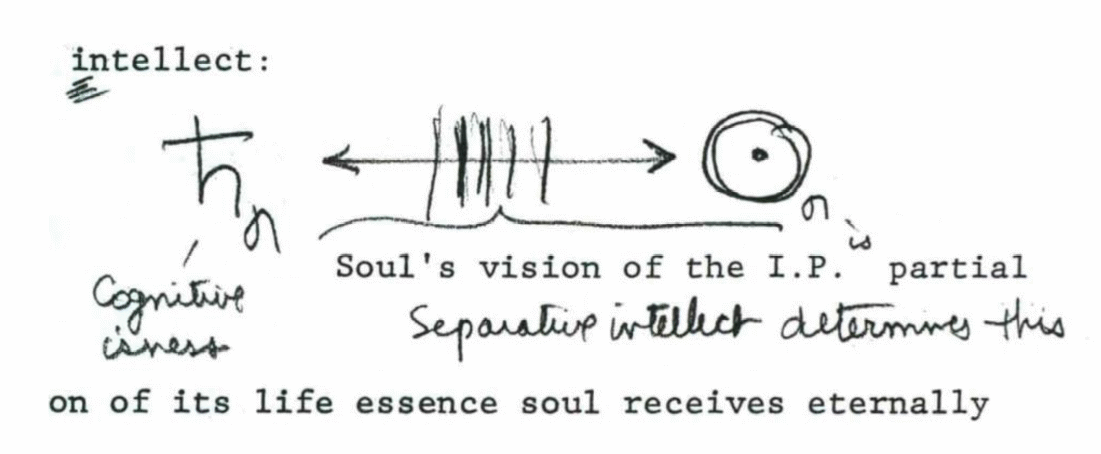
[FIGURE AD Supp D-11. Leo dignities, with arrow showing connection between Saturn in Leo, Empties, and Sun in Leo. Handwriting by AS. Caption typed below. Facsimile scan from AD SUPPD 1-16.PDF, p. 11.]
Saturn in Leo - Five Empties - Sun in Leo
Cognitive Isness [Saturn in Leo] - Separative intellect [Five Empties] - I.P. [Intellectual Principle, Sun in Leo]
Soul's vision of the I.P. is partial -- Separative intellect determines this
The first determination of its life essence soul receives eternally in the Nous. Plotinus relates this to us through the myth of Penia and Poros:
(III-5-7) "Penia (Poverty) had participation in the Intellectual before the lower image of that divine Realm had appeared; she dwelt in that Sphere, but as a mingled being consisting partly of Form but partly also of that indetermination which belongs to the Soul before she attains the Good and when all her knowledge of Reality is a fore-intimation veiled by the indeterminate and unordered."
Also: III-5-4
[AD Supp D-12, 29]
The Form given to the indeterminate life of soul or Penia, is the World Idea. This Nous or the Ideas shining into Soul is the primary knower in Soul. Soul contains in its essence a vision of the intelligible world, through which it has a continual link to the Nous. This light of the Nous in it and its life essence become almost as one, the true Hermetic marriage. The thrill of intelligence runs throughout, carried wherever the soul's life and motion are present, even so far as the sensible. "Every life is some form of thought, but of a dwindling clearness like the degrees of life itself." [III.8.8]
We can see that at its highest, the individual soul, as a unit, is stationed in the Nous. All its determination comes to it from the Nous -- but its life essence, as a ray of the Absolute is imparted to it from the One. We are not separated from that Ultimate Source, and this must also be kept in mind, even though the Soul itself may achieve the Divine Unity with it, but Soul it must remain.
[AD Supp D-13, 30]
In I-1-13, Plotinus says:
"…Intellection in us is twofold: since the Soul is intellective, and Intellection is the highest phase of life, we have Intellection both by the characteristic Act of our Soul and by the Act of the Intellectual-Principle upon us--for this Intellectual-Principle is part of us no less than the Soul, and towards it we are ever rising."
Here we have a verbal distinction between the vision of the soul as life essence -- and the intellection of the Intellectual-Principle itself shining into the Soul-- (which is from the Sun in Leo). The reception of the World Idea by the life essence of Soul is the mind in us. This is your mind -- from which will be emanated the I AM which projects the whole of the intelligible world for us.
Here we have to consider both the act of Nous -- the Ideas in the Soul -- the intellection of the Idea of Man; and, the characteristic act of the essence of Soul -- its receptivity, vision and Love which it derives from the One. Each Idea is an Intellectual Principle in its own right -- and wedded to the Soul -- so in actuality we are saying Soul is the activity of Mind.
[AD Supp D-14, 33]
[Illegible side note, then:] This is the Penultimate.
The Divine Mind is active in the soul -- the Act of the Intellectual-Principle upon us is the higher self knowing principle in the soul, and the soul has its own power which is intent on the Intellectual-Principle. The reciprocal relation of the Nous, and the Intellect of the Soul he gives us in V-3-4:
"[This is the] better part of the Soul which alone is winged for the Intellectual Act and gives the man…the power to appropriate what he has seen [there]. …
"And a man becomes Intellectual-Principle when, ignoring all other phases of his being, he sees through that only and sees only that and so knows himself by means of the self--in other words attains the self-knowledge which the Intellectual-Principle possesses." <Plotinus quotes proofed against MacKenna, not against orig>
When the intellectual act reasserts itself in Soul, then Unit soul returns to the Nous.
In the tractate V-3-4 Plotinus distinguishes clearly these two intellections as the two self-knowers. There is the seeing of the soul, the soul's own power being aware of its rational functioning which is proper to itself, but which cannot know its own selfhood. Then there is the higher self-knower, which is the Nous shining into the highest phase of the Soul. Through the soul giving up its outward activity to let the Nous in it work through it. In this way Soul attains knowledge of its own Selfhood. In other words, the higher knower in soul is the Divine Mind and this is Sagehood.
V-3-4 [Plotinus]: Two Self knowers [whole para] [not typed out in orig]:
"Thus the self-knower is a double person: there is the one that takes cognizance of the principle in virtue of which understanding occurs in the Soul or mind; and there is the higher, knowing himself by the Intellectual-Principle with which he becomes identical: this latter knows the self as no longer man but as a being that has become something other through and through: he has thrown himself as one thing over into the superior order, taking with him only that better part of the Soul which alone is winged for the Intellectual Act and gives the man, once established There, the power to appropriate what he has seen."
[AD Supp D-15, 10A]
III.1.8 last para.
"Now the environment into which this independent principle enters, when it comes to this midpoint, will be largely led by secondary causes (or, by chance-causes): there will therefore be a compromise; the action of the Soul will be in part guided by this environment while in other matters it will be sovereign, leading the way where it will. The nobler Soul will have the greater power; the poorer Soul, the lesser. A soul which defers to the bodily temperament cannot escape desire and rage and is abject in poverty, overbearing in wealth, arbitrary in power. The soul of nobler nature holds good against its surroundings; it is more apt to change them than to be changed, so that often it improves the environment and, where it must make concession, at least keeps its innocence."
[AD Supp D-16, 10B]
III.1.10 second to last para
"In the action of our souls all that is done of their own motion in the light of sound reason is the Soul's work, while what is done where they are hindered from their own action is not so much done as suffered. Unwisdom, then, is not due to the Soul, and, in general--if we mean by Fate a compulsion outside ourselves--an act is fated when it is contrary to wisdom."
[File AD SUPPD 1-16.PDF Ends]
V09P: PAPER: Astronoesis; Idea of Man. Copyright 2022 Wisdom's Goldenrod p. iv