Paper
Undated paperOn the Complementarity of the Buddhist and Vedantic Perspectives
by Anthony J. Damiani
Paper V09P
3-LETTER CODE: ASN
TOPIC: Astronoesis
SUBJECT: Soul & Nature
SUBSUBJECTS: Buddhism, Vedanta, Witness I, Two Streams, Movie Projector Analogy
ORIGINAL LOCATION & FILE NAME: nas-b-v.doc
CONTENTS:
Two streams of intelligence: 1) soul's consciousness (Vedantic); 2) instantiation of Ideas (Buddhist)
Common ground: Buddhist Nirvana = Vedantic Being-Consciousness-Bliss = Plotinus' "Soul in the Nous"
Individual soul: self-identical consciousness that manifests World-Idea moment by moment
Soul becomes confused with ego matrix, creating pseudo-identity (non-Atma)
Movie projector analogy: 1) Buddhist view focuses on changing film frames; 2) Vedantic view focuses on projector light
Synthesis: soul + World-Idea = existence in world; both principles real and necessary
Two complementary viewpoints yield greater truth in unity than separation
BOOKS / TRANSCRIPTS QUOTED FROM OR REFERENCED:
Anthony Damiani, Astronoesis (Astronoesis Master (draft); and published book 2000)
Anthony Damiani, AD visit to Sweden, transcript done in 1988
DIAGRAM embedded in this paper:
- FIGURE B-V-1. Diagram of Two Streams: Soul ring and System of Nature dignities.
NOTES:
RETYPED ASTRONOESIS ENDNOTE (V09P).
Edited endnote unused in Astronoesis. Originally created 5/97; format converted and small amount of cleanup 2023. Reformatted/corrected by IT, MW 2025.
Lead-in and diagram by editors of Astronoesis.
See Astronoesis (pp. 149-50) for a little on the Jivatma as related to the 5 Dhyani Buddhas.
ON THE COMPLEMENTARITY OF THE BUDDHIST AND VEDANTIC PERSPECTIVES
In the layout of the metaphysical chart we have a possibility of seeing the relation of the Vedantic and Buddhist perspectives. Let us assume that both are describing the meaning of our existence. In a simple way, we have two main streams of Intelligence. One stream (the Vedantic position) is represented by the Ring view or Soul's Living Consciousness which is a continuum from Venus in Aries to Mercury in Pisces (Nature). The other stream (the Buddhist position) is Continual Instantiation of Ideas: from the Tentative Illumination of Place by the Demiurgic Void-Intellectual Energy (Thought) to the re-constitution of the World Image in the mind of every individual.
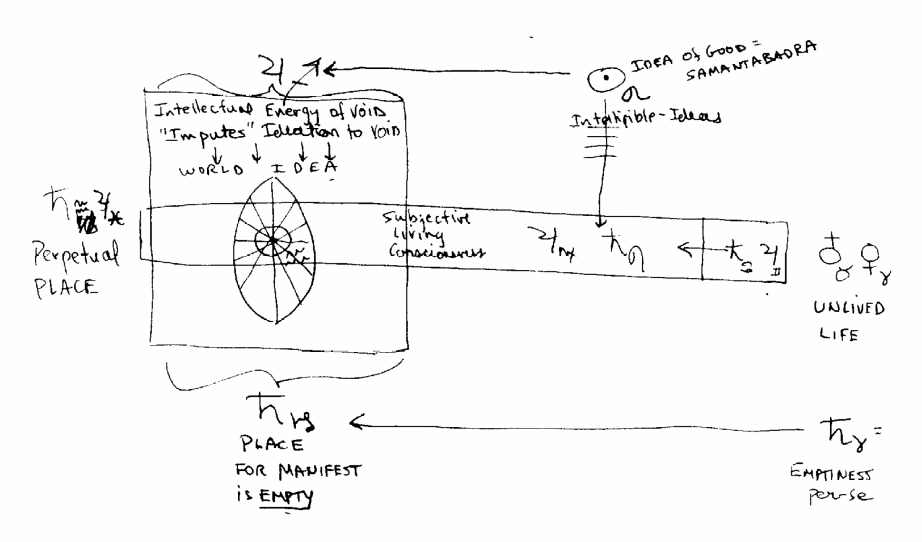
[FIGURE B-V-1. Diagram of Two Streams: Soul ring and System of Nature dignities: Pisces (left) to Aquarius (and Sun in Aquarius), and Capricorn, Soul ring planets to Leo, and Sun in Leo, and right Soul ring planets Cancer, Gemini, Taurus, Aries (unlived life).]
In a paper [S71 Astronoesis draft] and transcript [AD Sweden 1983] on this topic, AD comments:
[S71.Ia] At this point in the discussion we can show that within the cosmological premises of Plotinus exists the possibility of reconciling the crisis that has occurred not only between the two great schools of thought in the East. We have the theory of instantaneous being and non-Atma in Buddhism in opposition to the notion of a permanent self-identical consciousness in Vedanta.
[S71.Ib] It would first have to be agreed upon that the Nirvana of the Buddhists is a negative description of what the Vedantists refer to as Being-Consciousness-Bliss. Both of these are equivalent to Plotinus' description of the Soul in the Nous, an Authentic Essence, the universal and undifferentiated Being. From this source came individual souls. Each individual soul whose quality and grandeur can hardly be appraised, is of a self-identical nature and a modalization or individualization of Universal Consciousness from which it sprung, and will be the basis for the Vedantic conception of the Witness I. We said it was this principle which manifests the world for an individual and it received the World-Idea from the higher priors, that is from the combined functioning of the Universal and Cosmic Souls. This World-Idea is received literally moment by moment as indicated by the planetary motions, and this is the basis for the theory of instantaneous being. At this stage we may say that the individual consciousness or mind has an immediate and direct knowledge of a level of reality beyond the ego's functioning [following phrase marked for deletion in Endnote paper version:] for it does not include the functioning of the psychosomatic organism. That is, by holding in abeyance the formulation of the lower mind's symbolific activity or functioning, the stillness permits the reception of a guiding influence, an intuitive realization of the World-Idea before it is organized and represented by sensations in the imagination. Nonetheless, the activity of reproducing the World-Idea in the imaginal essence continues as this is an ongoing process, a ceaseless flux within which is situated the ego.
[S72.IIa] This individual unit of life or consciousness which can be directly identified with the Vedantic conception of the Witness I, that is, the permanent knower within us that manifests the World-Idea moment by moment, is in theory held distinct from the World-Idea which it is manifesting. The idea that is being manifested contains the ego [S72.IIc] along with its world: [S72.Ib] in other words, this individual consciousness is now confused and suffused with the matrix of thoughts referred to as the ego, [S72.IIb] which by definition cannot have any identity. [S71 bottom] The individual [S72.Ia] consciousness is now within the functioning of the ego, and as we have pointed out elsewhere, this ego is an organization of the earth's memories into an adventitious unity. [This individual consciousness is now divisible among the components that constitute the ego.] [S72.Ic] We have the appearance of a pseudo-identity--non-Atma.
----------------
[from Swed tape 21] The Vedantists speak about the self-identity of the knower (for otherwise we cannot account for the continuity of knowledge of change) while the Buddhists point out that the world is changing instant by instant, and therefore there can be a continuity but no identity of an "I". [Note: One would surmise that these two complementary points of view of the self which are absolutely necessary to each other would yield a greater truth in their unity than in their bifurcation. Soul is life, infinite to the core: impassive and also perpetual in its expressiveness. Our true nature is life eternally full with wisdom. -Eds.]
[Swed 21] Let's use a movie projector as an analogy. On the one hand we have the reel with the film in it which is being projected on the screen, and every instant there's a new still being projected. Now within each picture that's being projected you could take the position of the Buddhists: here is one picture, then the next picture, then the next picture. Within those pictures where are you going to find a self-identical "I"? Because still 'A' is different from still 'B,' still 'B' is different from still 'C'--the World-Idea is changing every moment in time. If you take the premises of the Buddhist that the World-Idea is in a state of high vibratory oscillation, changing from instant to instant, then from that point of view there is no identity and the world is in a state of constant flux.
Now the Vedantist could come along and say, "That picture is being illuminated by the light which is in the projector, and it is this light which is always self-identical with itself and which is the same light regardless how often the picture is being projected." If you take the point of view that you are the light in the projection which is always shining regardless of what film is being played out, then there is an "I" which is continuous with itself. You have a knower which is self-identical with itself.
From one point of view there is a soul which is self-identical with itself, and from an other point of view, there is the World Idea, which is coming into the soul, which is oscillating at a vibratory rate that's incredible, and that these two together make the existence of the soul in the world. So the soul could experience the sensible world only by projecting that light that it has into that sensible body, and now it becomes part of that world which is in constant vibratory activity--identifying with the psycho-somatic organism or a body which the World Idea contains within itself, taking itself to be an "I".
The World-Idea has a reality; it's being projected by the Intellectual-Principle and nobody is going to abolish it. But at the same time the Soul is also real because it's enmeshed in that, it's part of that, it's involved in that World-Idea, and it's learning from it. So these two principles, the Intellectual-Principle and the Soul, come together in the sensible world, and you have a manifestation of the Intellectual cosmos. The sensible world is like an instantiation of the Intellectual Cosmos, and the soul of an individual or the mind of an individual gets enmeshed in the products of that World-Idea.
V09P: PAPER: Astronoesis; Soul & Nature. Buddhist & Vedantic Perspectives. Copyright 2025 Wisdom's Goldenrod p. ii