DIAGRAM FOR "IBN 'ARABI AND PLOTINUS ON UNIVERSAL THEOPHANY"
Paper
Undated paperIbn 'Arabi and Plotinus on Universal Theophany
by the Editors of Astronoesis
Paper V09P
3-LETTER CODE: ASN
TOPIC: Astronoesis
SUBJECT: Nature
SUBSUBJECTS: Divine Names, Ibn 'Arabi, Plotinus, Universal Theophany, Houses 9-12, Universal Man, Kabbalistic Worlds
ORIGINAL LOCATION & FILE NAME: nasarabi.doc
CONTENTS:
Corbin quote on Light as cosmogonic event
World of Mystery equivalent to World of Emanation (9th house); Demiurge as "God called Names"; second epiphany through Divine Name "Light" (Sun in Aquarius)
Corbin quote on reciprocal relationships; theophanic Imagination as absolute; divine Names as individualized determinations
Jupiter in Sagittarius as unity of Universal Manifestation; plurality of Names as revelation of the Named One
Corbin quote on twofold epiphany
Distinction between Divine revelation to itself vs. objective manifestation
Corbin quotes on the Cloud
Cloud as tentative illumination of Matter by Demiurge; World-Idea inseparable from World-Mind; pre-eternal existence of forms
Halevi quote on World of Emanation
Integration with Ibn 'Arabi's formulation: first revelation as World of Emanation/Mystery; World-Mind as point of light from Void
Corbin quote on manifest world epiphany
Corbin quote on the heart
Distinction between universal principles and individual centers
12th house as objective manifestation; individual beings as receptacles according to capacity; stars as radiating universal ideas
Corbin quotes on imaginative creation
Heart/mind as organ of perception and transformation; birth of logos within individual; knowledge of one's eternal hexeity
Eternal idea as individual essence; birth of logos as unveiling of Wisdom of Overself
Individuated universals, wisdom of Prophets, and grades of life/thought
BOOKS QUOTED FROM OR REFERENCED:
Henry Corbin, Creative Imagination in the Sufism of Ibn 'Arabi [for more on Names of God]
Paul Brunton, The Wisdom of the Overself, "The Birth of the Universe"
Plotinus, The Enneads (MacKenna translation, 4th ed.)
Z'ev ben Shimon Halevi, A Kabbalistic Universe
Anthony Damiani, Astronoesis: Philosophy's Empirical Context; Astrology's Transcendental Ground (for metaphysical chart scheme)
PLOTINUS QUOTES REFERENCED: IV.3.1, IV.4.9
DIAGRAM appended to this paper:
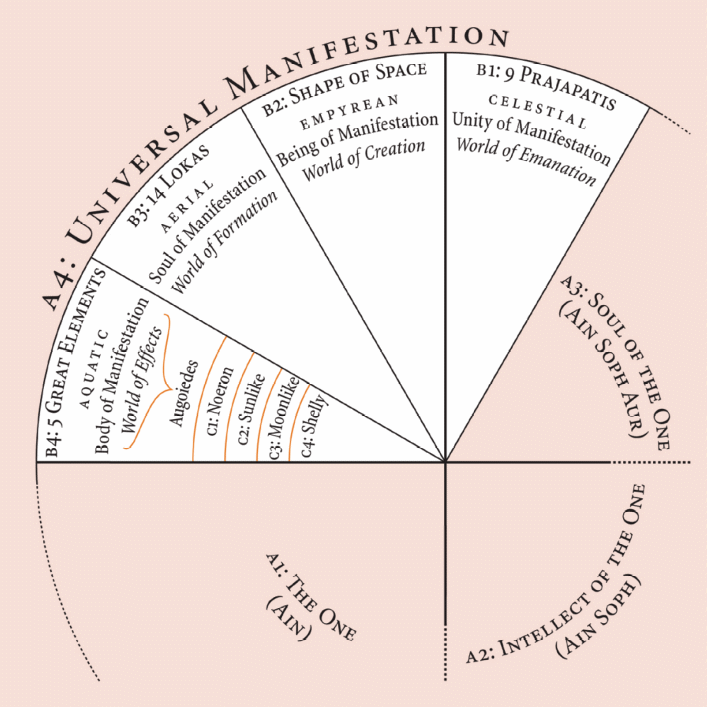
- FIGURE Universal Theophany-1. Three Hypostases and Two Levels of Cosmology Mapped onto Metaphysical Chart.
REFORMATTED/CORRECTED by IT, MW 2025
NOTES:
RETYPED ASTRONOESIS ENDNOTE (V09P).
This version of endnote/paper from 1995-96 written by Editors/AS and subsequently rejected by Randy for use in Astronoesis. File has been converted from old format and updated.
Connect with "Universal Man" endnote (#45) in Astronoesis, 9-12.
See also the "Names of God 9-12" unused Astronoesis endnote.
This endnote/paper has been studied by the Astronoesis class on a number of occasions, when it was reading the System of Nature chapter.
IBN 'ARABI AND PLOTINUS ON UNIVERSAL THEOPHANY
Appended to this paper is a diagram of the Four Worlds and Two Cosmic Levels.
"The function of Light as a cosmogonic event begins in the world of Mystery. It is Light which reveals to the Divine Being the latent determinations and individuations contained in His essence, that is to say, the eternal hexeities which are the contents of the Divine Names. What these archetypes of virtual Creation receive is the shadow, the reflection , of the Divine Essence, projected upon them by the light of the Names. This is the first mirror in which the Divine Being contemplates Himself; He reveals Himself to Himself in the virtualities of His many Names. But the Names aspire to be fully revealed: this epiphany is the function of the Divine Name"Light" whose epiphanic form, to wit, sensuous light, the Sun, opens up the forms that correspond to these Names in the world of visibility. Light is the agent of the cosmogony, because it is the agent of Revelation, that is to say, of knowledge." (Henry Corbin, Creative Imagination in the Sūfism of Ibn 'Arabi, trans. Ralph Manheim [Princeton, NJ: Princeton University Press, 1969], 191; Arabic words in the passage have been omitted)
The world of Mystery in Ibn 'Arabi's thought is equivalent to the World of Emanation of the Kabbalists--symbolized as the 9th house of the metaphysical chart. "Demiurge" is the function of Mind wherein the Divine Being reveals Himself to Himself in the virtualities of His many Names. We may even term the Demiurge the "God called Names," (or in Shaivism shabdabrahman). These Names, equivalent to the 10 sephirothic names, "aspire to be fully revealed." This second epiphany will take place in the sensible manifestation, through the functioning of the Divine Name or Power called Light--principially represented by the Sun in Aquarius.
Within the (sensible) manifestation light opens up "the forms that correspond the Names." These forms are the forms within the heart of the Gnostic, the growth of an organ of perception based upon the forms available in the individual mind-stream or heart.
"This suggests a reciprocal relationship: the relation of the shadow with the Divine Being is the Divine Being inaugurating the manifestation of the world of Mystery as absolute theophanic Imagination; the relation of the Divine Being to the shadow constitutes the individuations and personalizations of the Divine Being as God, who discloses Himself to and by the theophanic Imagination in the unlimited number of his Names. This process has been compared to the coloration of glass receiving light: the light is impregnated with a shadow which is the glass itself. And the twofold implication of the divine Names must also be taken into account. All these Names refer to one and the same Named One. But each one of them refers to an essential determination, different from all the rest; it is by this individualization that each Name refers to the God who reveals himself to and by the theophanic Imagination. To confine oneself to the plurality of the Names is to be with the divine Names and with the Names of the world. To confine oneself to the unity of the Named One is to be with the Divine Being in the aspect of His Self, independent of the world and of the relationships between His Names and the Names of the world. But the two stations are equally necessary; one conditions the other. To reject the first is to forget that that Divine Being reveals Himself to us only in the configurations of the theophanic Imagination, which gives an effective reality to those divine Names whose sadness yearned for concrete beings in whom to invest their activity, whom they have made what they are, beings thanks to whom and for whom these Names have become hypostases,"Lords." But to miss the second of the two stations is to fail to perceive the unity in plurality. To occupy both simultaneously is to be equidistant from polytheism and from monolithic, abstract and unilateral monotheism. . . ." (Creative Imagination, 192-3)
Corbin points out in several places that this imagination is not the imagination inseparable from body, but is the immaterial, separable power of the soul which is Light in its subtle form. As in PB's "Birth of the Universe" chapter in The Wisdom of the Overself, the first characteristic of God (World-Mind) is Theophanic Imagination. PB remarks that it does not matter whether we say the World-Mind is imagining, thinking, manifesting the world--it is all the same to it.
Here we are interpreting the "Divine Being" in his aspect as a unity to be the Demiurge as a unific principle. The unity of the Named One can be referred to as Jupiter in Sagittarius, the unity of Universal Manifestation revealed through the multiplicity of Names. As Corbin says, we need to consider both the unity and multiplicity. The unity of the life of the Soul (or World-Mind) is omnipresent. But what is available to us in our understanding is the plurality of Names--called in Plotinus the reason-principles of the universe (or in PB the World-Idea)--which are the revelation of the Named One. The plurality (thoughts, manifestation) is not absolutely other than the essence (mind), for once the thoughts become transparent rather than opaque, they reveal the essence.
"The initial Epiphany that appeases the sadness of the Divine Being, the"Hidden Treasure" yearning to go forth from his solitude of nonknowledge, is twofold: one epiphany takes place in the world of Mystery, the other in the phenomenal world. The first is the Epiphany of the Divine Being to Himself and for Himself in the archetypal essences, the eternal hexeities of His Names which aspire toward their concrete Manifestation. This is the sacrosanct Effusion in the "Presence of the Names."" (Creative Imagination, 195) [Note: In the margin of the Corbin book AD has annotated: "Phanes and the world: the I.P. [Intellectual-Principle] and Cosmic Soul."]
Here is a clear statement distinguishing the revelation of the Divine to itself, and also to objective manifestation. The Divine Universal Soul reveals the Names to itself, in itself, as its inner vision. This state of Zeus looking inward is discussed in relation to IV.4.9 in Plotinus. There is also a myth of Jupiter swallowing Phanes, the manifestor, in the first state of "manifestation" or epi-phanes. This epiphany can be conceived of as happening in the 9th house: just prior to the realm of nature (or the 4th quadrant), in the realm of "Mystery." Corbin says more about this emanation, referring to the Cloud exhaled by the Divine:
"This Cloud, which the Divine Being exhaled and in which He originally was, receives all forms and at the same time gives beings their forms; it is active and passive, receptive and existentiating; through it is effected the differentiation within the primordial reality of the being that is the Divine Being as such. As such, it is the absolute unconditioned Imagination. The initial theophanic operation by which the Divine Being reveals Himself,"shows Himself" to Himself, by differentiating Himself in his hidden being, that is, by manifesting to Himself the virtualities of His Names with their correlata, the eternal hexeities of beings, their prototypes latent in His essence--this operation is conceived as being the creative Active Imagination, the theophanic Imagination." (Creative Imagination, 185-6)
"Primordial Cloud, absolute or theophanic Imagination, existentiating Compassion are equivalent notions, expressing the same original reality: the Divine Being from whom all things are created--which amounts to saying the"Creator-Creature." For the Cloud is the Creator, since it is the Sigh He exhales and since it is hidden in Him; as such the Cloud is the invisible, the "esoteric" (batin). And it is the manifested creature (zahir). Creator-Creature: this means that the Divine Being is the Hidden and the Revealed, or also that He is the First and the Last." (Creative Imagination, 186)
"Thus in this Cloud are manifested all the forms of being from the highest Archangels, the"Spirits ecstatic with love", to the minerals of inorganic nature; everything that is differentiated from the pure essence of the Divine Being as such, genera, species and individuals, all this is created in the Cloud. "Created," but not produced ex nihilo, since the only conceivable nonbeing is the latent state of beings, and since even in their state of pure potentiality, hidden within the unrevealed essence, beings have had a positive status from pre-eternity." (Creative Imagination, 186)
The cloud is the initial theophanic operation which we could equate with what we called the tentative illumination of Matter by the Demiurge. Zeus is that divine attribute which interfaces the Void with manifestation. The creator-creature idea shows that the World-Idea is inseparable from the World-Mind--i.e., mind in its aspect as emanating the universe is inseparable from the emanated thought form, the "existentiating compassion" through which the power of the mind imagines or gives existence to the universal idea.
He says the manifested forms of all beings from Archangels (10th house) to minerals, have existed in the state of the Void--in the Intellectual-Principle, from pre-eternity, and therefore are not a creation out of nothing. Rather, the universe arises by an instantiation of what is already actual eternal, but void and formless, intelligence.
Halevi's A Kabbalistic Universe says of this transition:
"The perfect and unchanging World that emanates from the First Crown is eternal. While what lies beyond the First Crown is timeless, the World of Emanation is time-full. Here is Existence without end, as long as the Absolute wills it.…(otherwise) the Universe would vanish and the void of Unmanifest Existence be filled and dissolved into All and Nothingness again.
"Tradition calls the World of Emanation the world of Unity.…it is the World of Divine Lights. It is also called the Glory of God, which permeates the lower Worlds of Existence as an unseen radiance.
"According to one formulation, God brought Aziluth into being by ten utterances. These Ten Words came out of the Black Fire of Unmanifest Existence into the White Fire of Aziluth. The sayings, we are told, became the various aspects of Divinity in the archetypal plan of the Sefirotic tree, and they are the Names by which God is called."
As in Ibn 'Arabi's formulation, the first revelation of the Void to itself is the World of Emanation, or Mystery, in which the Names are the first manifested Word or Logos. PB also writes of the World-Mind as a point of light emerging from the Void. This World-Mind is the first state of Universal Manifestation, which we can conceive of first holding within itself its entire intelligible vision, before there emanates from it the entire system of nature, by a natural reflex of its act, or by the power of mind to Imagine.
"The second is the Epiphany in the manifest world, that is, in the beings who are the epiphanic forms or receptacles of the divine Names. This is the holy,"hieratic" and "hierophanic" Effusion which brings to Light those forms which, like mirrors, receive the reflection of the pure divine Essence in proportion to their respective capacities. This twofold Epiphany is typified in the divine Names "the Hidden and the Revealed, the First and the Last," of which Ibn 'Arabi offers experiential verification in his theosophical practice of Prayer." (Creative Imagination, 195)
"But to speak of an Epiphany of the divine Names proportional to the capacity of the forms which receive them and reflect them in the manner of a mirror, implies beings to which these forms disclose themselves as such (that is, beings who know themselves), and whose capacity for vision will in turn condition the proportion of epiphany invested in the world in them and by them. Here then we encounter the notion of the heart, whose importance as the"subtile organ" of theophanic visions will become apparent to us . . . the gnostic's words, it is said to be one of the things to which the Divine Compassion lends existence, because Divine Compassion is the equivalent of existentiation. And yet, vast as is this Compassion which embraces all things, the gnostic's heart is still greater, since it is said: "Neither my Heaven nor my Earth contains me, but the heart of my faithful believer contains me," this is because the heart is a mirror in which the manifested "Form of God" is at each moment reflected on the scale of the microcosm." (Creative Imagination, 195-6) [Note: At this place in the text AD annotated: "the logos incarnated."]
While the first epiphany gives rise to the Divine Names, in the second epiphany each individual being catches the whole manifestation and reflects it within itself. The above passage, taken together with the previous ones, gives us a way to distinguish the universal principles of manifestation laid down in the revelation of the Names to the Divine itself (the first epiphany), and the second epiphany which occurs through individual centers of awareness. Within the 12th house, or objective manifestation (which in its 4 levels reduplicates the scheme of houses 9-12), is the revelation of the World-Idea (from the Cosmic Soul, Sun in Aquarius) within the heart, or mind, of individuals. (These individuals may be cosmic such as star or sun souls, human, etc.) Beings who are the epiphanic forms or receptacles of the divine Names are the individual units of life, receiving the World-Idea according to the capacity of their organ of spiritual perception, which Ibn 'Arabi calls the Heart. In Plotinus: "How souls are described to be receptacles of Divine Beings will need to be examined." (IV.3.1)
On a cosmological level, the second epiphany, or revelation of the Ideas, is the outpouring or radiating intelligence (light) of the star souls, the whole inerratic sphere. Ibn 'Arabi and Plotinus have interrelated perspectives: each star is a radiating universal idea, a Divine Name, a "heart universal." These stars are the multiplicity of Names which name the named one. The light of the Universal Soul is elaborated and manifested through the agency of all the individual sun souls as their own cosmos.
Astronomically, the entire unific space of manifestation for the stars is the illumined space, equivalent to the outpouring life of the Universal Soul inseparable from the light/life of all the stars. Each star soul has a unique representation of that universal vision, according to its own logos or Name--its sidereal zodiac.
"Thus Creation is Epiphany, that is, a passage from the state of occultation or potency to the luminous, manifest, revealed state; as such, it is an act of the divine, primordial Imagination. Correlatively, if there were not within us that same power of Imagination, which is not imagination in the profane sense of"fantasy," but the Active Imagination or Imaginatrix, none of what we show ourselves would be manifest. Here we encounter the link between a recurrent creation, renewed from instant to instant, and an unceasing theophanic Imagination, in other words, the idea of a succession of theophanies which brings about the continuous succession of beings. . . ." (Creative Imagination, 186-7)
"To the initial act of the Creator imagining the world corresponds the creature imagining his world, imagining the worlds, his God, his symbols. . . . Imagination effected in an Imagination, an Imagination which is recurrent just as--and because--the Creation itself is recurrent. The same theophanic Imagination of the Creator who has revealed the worlds, renews the Creation from moment to moment in the human being whom He has revealed as His perfect image and who, in the mirror of this Image is, shows himself Him whose image he is. That is why man's Active Imagination cannot be a vain fiction, since it is this same theophanic Imagination which, in and by the human being, continues to reveal what it showed itself by first imagining it." (Creative Imagination, 188)
Individual souls as the place of the second epiphany, especially the spiritual organ of the heart, is a central theme in Ibn 'Arabi, and brings into focus two important ideas. First, the idea that the heart or mind is an organ of perception--transformer of experience and itself transformed by its understanding and assimilation of that experience. But primarily, what is developing is an organ of spiritual perception, not physical, which Ibn 'Arabi calls the separable imagination, actually the immaterial light of the soul or dianoia, which will culminate in the perception, the birth of the logos within the individual. Correspondingly, what is revealed to the gnostic who has developed (or uncovered) this spiritual organ deep within the mind, is the logos incarnated--the Divine Being is revealed to the heart in the form by which the gnostic is known to the Divine Being. Corbin restates this premise in several ways: the logos or intelligence born in the individual unit of life is not something foreign, nor is it absolute, but it is a revelation of that aspect of Name which eternally (although perhaps potentially) was its own essence. Thus:
"What is disclosed to the gnostic is the form in which he himself is known to Him who evoked his being, that is, his eternal , whose knowledge of him has the same form as his knowledge of it." (Creative Imagination, 198)
Upon the development of an organ of spiritual perception depends the knowledge of divinity--one's eternal idea. The presence in knowledge, the actualization in the individual life of one's idea is the birth of the logos, the unveiling of the Wisdom of the Overself, the eternal image of God. We note that the individual soul requires a place to be made in order for the divinity to be available. For Ibn 'Arabi (reference?), the individuated universals are portrayed as embodied in the Wisdom of the Prophets--the lineage holders of the different divine ideas, which seem to be the differentiation of the Names. This latter theme has to do with the stratification into grades of life or thought of the 11th house; see the endnote titled "The 11th House: The Relationship between Devas and Lokas." It also relates to the lineages of the 5 wisdom consciousnesses; see the Astronoesis Editors' Extension III, p. 147 ff. on the Idea of Man.
V09P: PAPER: Astronoesis; Nature. Ibn 'Arabi - Plotinus - Univ. Theophany. Copyright 2025 Wisdom's Goldenrod p. iii