Paper
Undated paperCommentary on "The Tantra of the Reality of Transcendent Awareness"
by Anthony J. Damiani
Paper V09P
3-LETTER CODE: BUD
TOPIC: Buddhism
SUBJECT: Tantra
SUBSUBJECTS: All-ground, Samsara, Nirvana, Buddhahood, Five Dhyani Buddhas, Sun in Leo, Saturn in Leo, Soul, Soul Ring, World-Constructor, Demiurge, Alaya-Vijnana, Mentality, Generic Mind, Karma, Nidana Chain, Skandhas, Sheaths
ORIGINAL LOCATION & FILE NAME (of PDF used for typing): AD SUPP 245-271.PDF
CONTENTS:
Akanistha as realm of total soul (Saturn in Leo); abode of the absolute individual (Overself); free from errancy; serves as foundation for awakening to Buddhahood
Five Dhyani Buddhas, their consorts, etc., are embodied at a lower level as skandhas, elements, sensory processes; guide absolute individual to Buddhahood
All-ground as indeterminate totality of all possibilities (whole circle); includes supreme transcendent awareness (Sun in Leo); distinguished from alaya-vijnana
Two possible paths for absolute individual souls: 1) Samsaric descent; 2) Nirvanic awakening, beginning of movement towards Sun in Leo
All-ground's capacity to underlie mentality (fourth quadrant) and spirituality (fifth house)
Pure modality of All-ground leading to Nirvana; path from Saturn to Sun in Leo is the transcending awareness
Two ways to interpret: 1) individual soul contemplates pure reality via exaltations and rulerships; 2) mentality of world-constructor as pure reality
On reaching Buddhahood, spiritual voyage truly begins; infinite goals to which individual can reach out
Impure modality as gateway to Samsara; ensues because of soul's identification with various sheaths (karmic substances) fabricated by world-constructor
All-ground viewed under four aspects
Identification of soul with generic mind (eleventh house sheaths) stirred into activity by world-constructor through alaya (tenth house); universe arises
Two ways to interpret continuity of substance of transcending awareness and All-ground, one of them false
Generic mind not affected by objects unless cognitive-isness associated with it; organizing pattern imparted by principles of interpretation is the functioning of the Vajrayana deities
Soul always retains its foothold in fifth house; does not become mental sheaths or empirical consciousness
Intentionality inherent in world-constructor's fabrication of cosmos; works in accordance with karmic laws
Transcending awareness does not become concepts or words; remains open-ended, can receive intentionality of mind or not
Any predication made by generic mind is within the total included by transcending awareness
False view that Samsara and Nirvana are two arises due to empirical mind trying to understand its prior in its own fragmentizing mode
Transcending awareness descends all the way into twelfth house; in this psychologically embodied individual is the possibility of freedom
The All-ground free of self-nature gives rise to sentient beings or Buddhas through nidana chain
Individual soul separates itself out from Total Soul, encounters world-constructor's functioning
Soul ring activated by Jupiter in Gemini arises as "all-ground cognitiveness"; intellect of world-constructor arises simultaneously; dignities of last four houses function to fabricate mental cosmos
Potential intellect in eleventh house receives impressions from alaya, projects primordial image including body into twelfth house; soul operating through body-mind experiences sensible objects
Five Dhyani Buddhas arrange action and reaction patterns according to an organized plan; our "ignorance" a skillful application of their wisdom
No errancy-appearance for those who understand that objects which appear persist in void intellect of world-constructor; yogi rests in contemplation without reification
All-creating king as Demiurge; resides in All-ground in hidden manner; serves as substrate of Samsara (fourth quadrant)
Totality of possibilities in All-ground underlie Demiurge's fabrication of mental world
Light of All-ground doesn't get contaminated with products of mentation; association with discursive mind leads to karmic activity and emotional response
BOOKS QUOTED FROM OR REFERENCED:
Herbert V. Guenther, Tibetan Buddhism in Western Perspective, "Indian Buddhist Thought in Tibetan Perspective"
Tsangnyon Heruka, The Life of Milarepa
F. Th. Stcherbatsky (tr.), Madhyanta-Vibhanga: Discourse on Discrimination Between Middle and Extremes Ascribed to Bodhisattva Maitreya and Commented by Vasubandhu and Sthiramati
PLOTINUS QUOTES REFERENCED: IV.4.10
DIAGRAMS embedded in this paper: All digital diagrams generated by NT.
FIGURE CTRTA-1. Divine Intellect, Demiurge, Vesica of Houses 10-12 (with Skandhas), Dhyani Buddhas, and Total Soul.
FIGURE CTRTA-2. The Circle as All-ground.
FIGURE CTRTA-3. Sun in Aries, Sun in Leo.
FIGURE CTRTA-4. Saturn in Leo and Fourth Quadrant Vesica.
FIGURE CTRTA-5. Saturn in Leo to Sun in Leo.
FIGURE CTRTA-6. Fourth Quadrant as Mentality.
FIGURE CTRTA-7. Fifth House as Spirituality/Paramatma.
FIGURE CTRTA-8. Saturn in Leo and Fourth Quadrant Vesica.
FIGURE CTRTA-9. Soul Ring.
FIGURE CTRTA-10. Soul Ring and Demiurgic Intellect.
FIGURE CTRTA-11. Generic Mind.
FIGURE CTRTA-12. Fourth Quadrant Vesica.
AD HANDWRITING: Typewriter typed, a few AD and student edits
COMPLETENESS: Full Paper
PUBLISHABILITY: Yes
RETYPED, REFORMATTED, AND PROOFREAD by IT, JF, HP 2023
NOTES:
RETYPED AD PAPER (V09P).
This Commentary is from AD Supp/Notes and Papers, pp. 245-271. It is a write-up from classes on Buddhism held at W.G. ~1979-1980 per JF recollection and fragmentary info elsewhere (Anthony using various Guenther books at that time). In 1997 it was typed up and printed as a booklet that was distributed and studied at WG. This document is the booklet version converted to a newer format.
Guenther and Milarepa quotes now conform to published version.
Dhayani Buddhis has been corrected to Dhyani Buddhas.
Text is from "Indian Buddhist Thought in Tibetan Perspective" in H.V. Guenther, Tibetan Buddhism in Western Perspective (Emeryville, CA: Dharma Publishing, 1977). Commentary by Anthony Damiani (AD).
[File AD SUPP 245-271.PDF Begins]
Commentary on "The Tantra of the Reality of Transcendent Awareness"
I
Text:
"Salutation to the potentiality of Buddhahood, victoriously transcendent:
"In the Great Akanistha realm which is the immediate evidence of the field of reality where no errancy obtains, Kun-tu bzang-po who is the cognitive mode that is for ever in the process of awakening to Buddhahood, resides . . ." (Guenther, pp. 115-6)
Comment:
Sukhavati, or the Akanistha heaven, is where Amitabha (the presiding deity of the Akanistha heaven) brought forth Avalokitesvara. It is the abode of gods and goddesses, where the bodhisattva attains omniscience and a Buddha is born. Beyond this heaven is the abode of Mahesvara.
This realm (Akanistha), is the realm of total soul, Saturn in Leo. Within it resides the absolute individual, prior to having lost its wings and descended into generation.
This absolute individual--the Overself, or soul--has access to the realm of pure being, where no possibility of error exists. In that realm, intellect either grasps its object or does not; its grasp is without error. There this "cognitive is-ness"-- which is the absolute individual -- is forever in the process, or can at any time undertake the process, of awakening to Buddhahood.
Text:
". . . in the company of the five spiritual rulers who (on the level of the analytical ratio are known as) the physical, feeling, ideation, motivation, and cognition; of their five consorts (who on a lower level are) the dynamics of solidification, cohesion, temperature, movement, and spatiality; of their (eight) [following text cut off of scan] sons (who otherwise) are immanent and transitive sensory processes; and of their (eight) daughters (who ordinarily are reified as) objects and temporal phases." (Guenther, p. 116)
Comment:
The Vajrayana deities represent sunya and are sunya in essence. They can also be the voluntary manifestations of it, with the three elements of Sunya, Vijnana, and Mahasukha.
The five Dhyani Buddhas and other gods and goddesses of the Vajrayana pantheon are rulers. At a lower level they are embodied as the skandhas, elements, sensory processes, etc. It is through the operation of this celestial hierarchy that the five Dhyani Buddhas guide the absolute individual to Buddhahood.
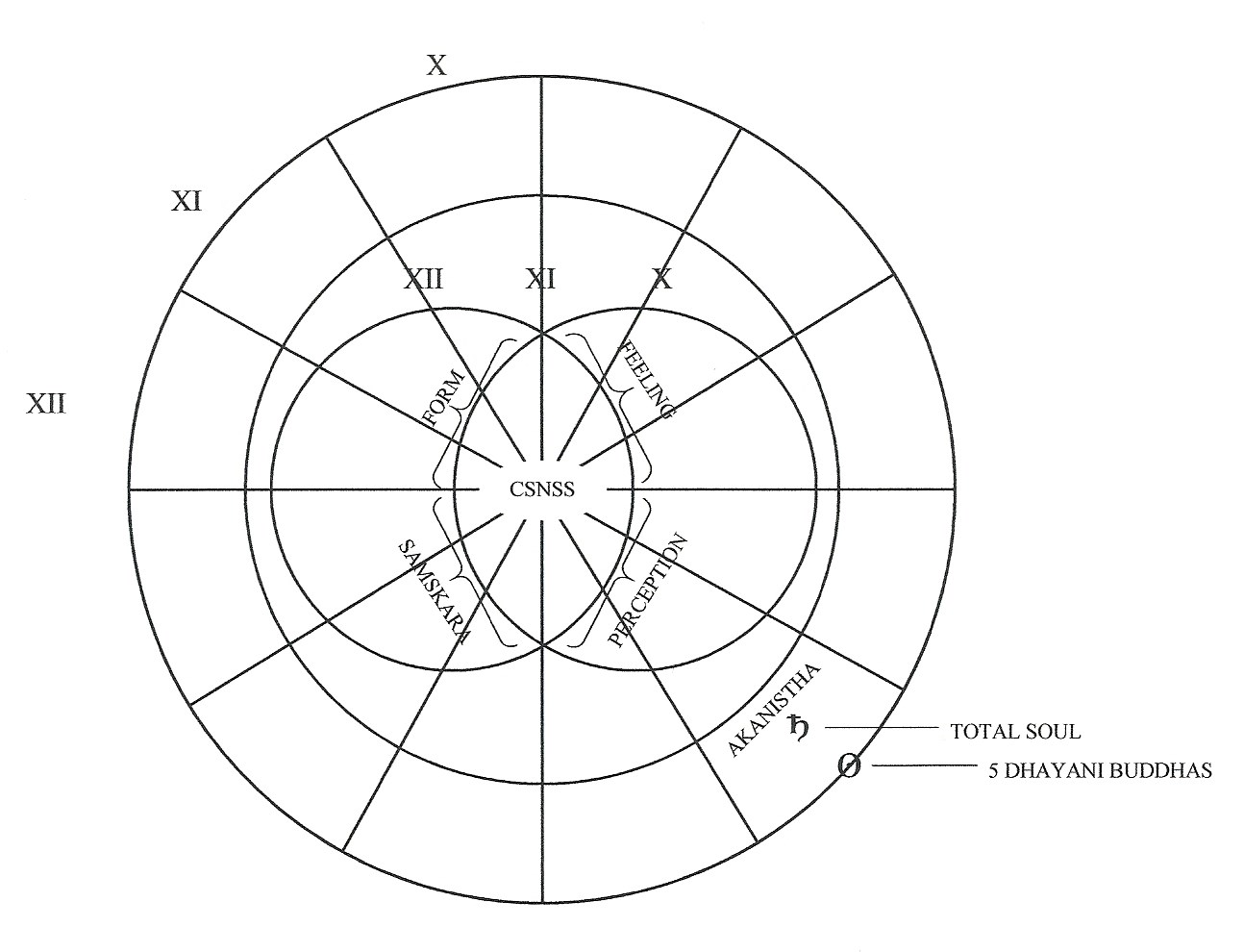
[FIGURE CTRTA-1-digital: Divine Intellect, Demiurge, Vesica of Houses 10-12 (with Skandhas), Dhyani Buddhas, and Total Soul. Csnss = Consciousness. Diagram on p. 246 of the Divine Intellect within which is the Demiurgic Intellect and vesica (as houses 10, 11, 12) with the skandhas; also the 5 Dhyani Buddhas as the Sun in Leo and the Saturn in Leo as the Total Soul/Akanistha. Note: Dhayani = Dhyani.]
Text:
"Then and there the great spiritual being rTog-pa'i rdo-rje rose from his seat and spoke the following words:
"O Teacher, you have repeatedly declared that there occurs a split into the different and mutually opposing entities of Samsara and Nirvana, owing to the specific differences between an all-ground and a supreme transcendent awareness. What are their distinctive characteristics, and of what nature is that which is labeled mentality and spirituality and how is their modality or facticity?
"Kun-tu bzang-po replied:
'"All-ground' is the common comprehensive foundation of both Samsara and Nirvana; . . ." (Guenther, p. 116)
Comment:
The All-ground may be conceived as the indeterminate totality of all possibilities. Included in that totality are the supreme transcendent awareness, the Ideas, the four indeterminate states of consciousness, the three pure principles, etc. All are included in the All-ground, but because of certain specific differences (i.e., each is a one), there arises one set of compossibilities, a bifurcation into what he calls:
(a) The "All-ground"
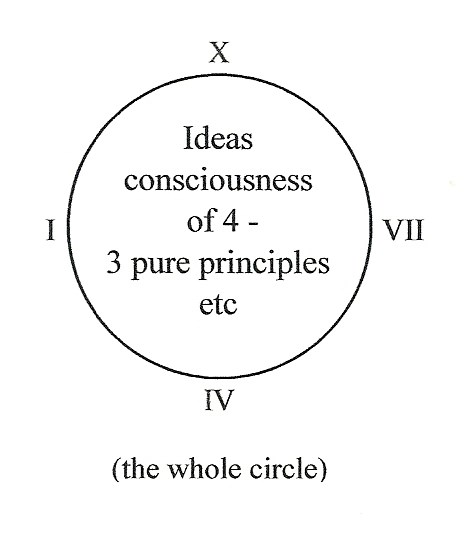
[FIGURE CTRTA-2-digital: The Circle as All-ground. Diagram a) on p. 247 of "the whole circle" with houses I, IV, VII, X noted. Original diagram by Anthony Damiani.]
and (b) The "Supreme Transcendent Awareness", which is the Sun [in] Leo as included in the unity of the Sun (Aries), which itself is the being or intellect of the One.
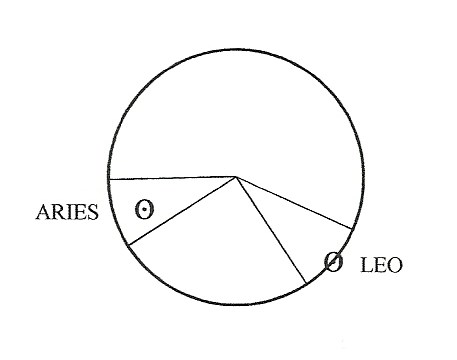
[FIGURE CTRTA-3-digital: Sun in Aries, Sun in Leo. Diagram b) on p. 248 showing Sun in Aries and Sun in Leo.]
It is essential here at the outset that we make clear that the All-ground is not to be restricted to meaning the alaya-vijnana alone. The consequence of making such a restriction in the initial premises would be to regard all manifestations as inherent only in the material universe, i.e., to deny that the distinctions found operating in the material universe are grounded in immaterial principles of a higher order.
Each of the absolute individual souls that descends from the Great Akanistha realm (the second quadrant) has two choices: both of them involve a descent into the material universe (fourth quadrant).
On the one hand, it can descend into the fourth quadrant and remain there, identified with the gross physical body and sensible intellect, forgetting or ignoring the potentiality of Buddhahood within it: this is Samsara.
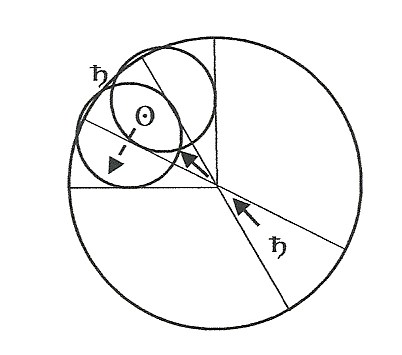
[FIGURE CTRTA-4-digital: Saturn in Leo and Fourth Quadrant Vesica. Diagram on p. 248 showing Saturn in Leo with arrows to Aquarius Sun, and then to 12th house.]
On the other hand, it can descend into and awaken from Samsara to Buddhahood. This awakening marks the beginning of its movement toward the Sun in Leo, its recognition of the non-separateness of Samsara and Nirvana. Now the soul will no longer identify with either the gross physical body or the sensible intellect, but it remains associated with higher vehicles within the material universe. Each stage of its ascent to Buddhahood will have a corresponding objective pole.
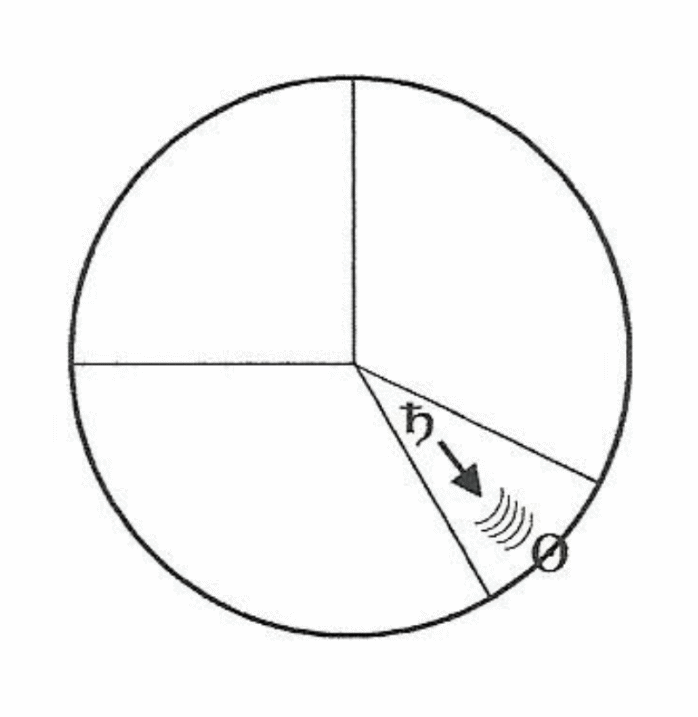
[FIGURE CTRTA-5-digital: Saturn in Leo to Sun in Leo. Diagram on p. 249 of 4th quadrant and 5th house with Saturn in Leo with arrows pointing to the exaltation ring "empties" and Sun in Leo]
"Please listen to me . . ." said Milarepa on concluding his first prolonged meditation under Marpa's tutelage, ". . . This body is the blessed vessel for those fortunate beings who wish for freedom, but it also leads sinners into the lower realms . . . in this body lies the vital choice between enormous profit and loss, relating to eternal happiness or misery . . ." [Note: From The Life of Milarepa by Tsangnyon Heruka. Margin note says, "Omit?".]
Text:
". . . it may be likened to the situation when the senses have not yet waked up to their objects. Its capacity for serving as the requisite for and the use of mentality and spirituality is latently present even in the five unconscious states. In those works which address themselves to people of lesser intellectual acument [sic; typo in book], it is stated to be the very potentiality of Buddhahood, but this is meant only to attract the simpletons who harbor some doubts about the existence of a pure reality." (Guenther, pp. 116-7)
Comment:
The All-ground (as the whole circle) has the capacity for being the underlie of:
(a) mentality, i.e., the whole fourth quadrant
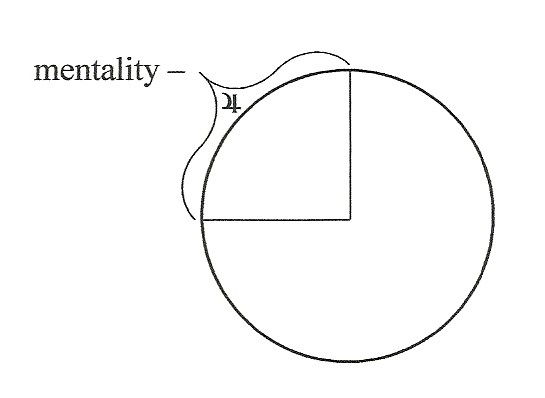
or (b) spirituality, i.e., the fifth house.
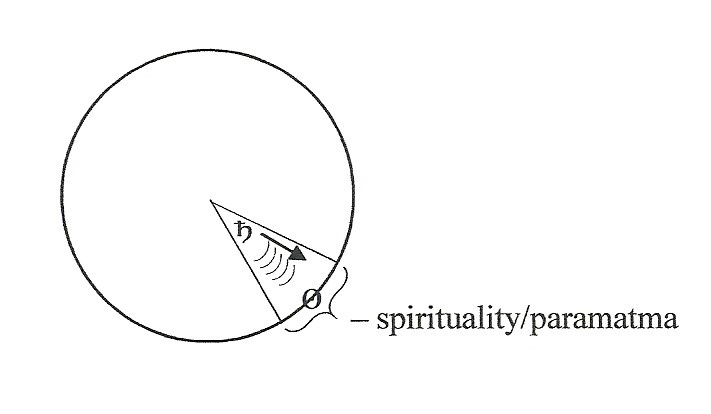
[FIGURE CTRTA-7-digital: Fifth House as Spirituality/Paramatma. Diagram b) on p. 250 showing 5th house, Saturn in Leo with arrows pointing to the exaltation ring "empties" and Sun in Leo.]
This distinction validates our refusal to equate the All-ground with the alaya-vijnana: the spiritual principle (transcending awareness) does not fit into the alaya-scheme.
That the universe is mind is immediate and non-postulational: all else is inference. Mind here equals and is the cosmos (fourth quadrant). But the spiritual principle is evolved from elsewhere.
Text:
"Therefore, since in this all-ground there is present in an intellectually unfathomable, directly unobservable, and dormant manner both a pure modality which is the gateway of transcending awareness and which comprises (i) the path to Nirvana, (ii) the manifestation of pure reality before this awareness, and (iii) the goal-realization which is as vast as the ocean, . . ." (Guenther, p. 117)
Comment:
Soul in and as real existence is the pure modality. Only souls, insofar as they are absolute individual souls--which are part of Total Soul--may traverse the path which is the gateway to Nirvana (the Sun in Leo, which provides pure being). This path from Saturn to the Sun in Leo is the transcending awareness and is available to the individual soul. That is, instead of descending into the eleventh house and becoming associated or identified with a part of generation (or organismic being), the individual soul can move towards its own identity/continuity.
There are two possible ways to interpret what is meant by saying that pure reality is manifested before this awareness. One way is to say that the individual soul, as part of the soul ring, contemplates that which is above it, i.e., it gains a vision of the Idea of the Good (pure reality) via the exaltations and rulerships (nous). A second way of interpreting the passage requires us to conceive that by "pure reality" the mentality of the "world-constructor" (re: Madhyanta Vibhanga Discourse of Maitreya) is meant: this mentality is an intellectual energy that is void of names and forms, and corresponds to the Greek notion of the Demiurgic Intellect of Jupiter. In this second interpretation, the fourth quadrant is taken as a manifestation of the All-ground insofar as it represents a combination of various possibilities in the void intellect of the world-constructor. The objects seen to arise in the fourth quadrant would then be seen to be part of the world-constructor's fabrication, which is mental. We would then be saying that those objects persist in a void intellect, which is to say that they are. But their being is simply being-as-such, and not as our apprehending faculties and interpretive concepts would insist (i.e., not as "this" or "that").
In its looking up to the possibilities above it, the individual soul sees that the goals set before it are illimitable, that spiritual experience does not mean being "swallowed up" by The One or A One. On the contrary, when a person reaches Buddhahood, the spiritual voyage truly begins: the seeker comes out of the ''eggshell" (called Brahmananda by the Hindus). Here we can conceive that the individual, having reached the level of the exaltations, now looks up to the rulerships and sees that their essentializing of the Ideas, as vast as the ocean, is setting forth infinite goals to which the individual can reach out.
Text:
". . . and an impure modality which is the gateway to Samsara and which comprises (i) karmic actions, (ii) emotively toned action and reaction patterns, and (iii) the mass of interpretive constructs and judgments; . . ." (Guenther, p. 117)
Comment:
This impure modality is in fact to be seen as one of the possibilities held out for the individual soul under the heading "goal-realization" above. Samsara is one of the possible goals: the soul has this choice, because the All-ground also includes the gateway to Samsara. If the soul accepts this road to Samsara --i.e., if it associates with or identifies with the fabrications of and in the mental universe--then--and only then -- do karmic actions, emotively toned action and reaction patterns, and the mass of interpretive constructs and judgments ensue. They ensue because of the soul's identification with the various sheaths, which are karmic substances.
These three consequences are all part of and are included in the world-constructor's mental fabrication. The soul in itself is pure Life and Being; it has no mental body, emotional vehicle, kama rupa, etc. It can only obtain those vehicles by partaking in the world-constructor's mental fabrication, for the purpose of functioning therein.
But pure soul as pure soul is not karma-creating. Only in the fourth quadrant and the vehicles evolving within it can it have karma. It is only in identifying with this realm that the individual becomes subject to the three features which comprise the impure modality.
Text:
". . . therefore it is itself ["Pure life or soul" handwritten above line here, not part of text] neither the status of a sentient being nor that of a Buddha, neither the awareness operating during the period of traversing the path of spiritual development nor spirituality itself; but being the vessel for all this or the ground on which all this comes to pass, it is spoken of as the 'all-ground'." (Guenther, p. 117)
Comment:
Here again we can see that the All-ground is too comprehensive to be equated with the alaya-vijnana. The All-ground cannot be restricted to mean any of these things. As the whole circle, it includes all of them, but it cannot be restricted to having the "status" of any one of them.
Text:
["Again soul or life" handwritten above line, not part of text] "It may be viewed under four aspects: as the all-ground of the initial ground of Samsara; as the all-ground providing the link with either Samsara or Nirvana; as the all-ground of our physical existence; and as the all-ground of experientially initiated potentialities of experience." (Guenther, p. 117)
Comment:
The true All-ground may be viewed under four aspects:
(1) As the whole circle underlying the fourth quadrant;
(2) As the whole circle providing the link (substratum) between Samsara and Nirvana; within this entirety, the inclusion of transcending awareness as 'constitutive' of the samsaric entity is provided for;
(3) As the underlie of the twelfth house, the realm of gross objects . . . the sensible-'physical' existence comprised by the mahabhutams;
(4) As the tenth house, or alaya-vijnana. Here we have the objective world as mental with the functional-operational laws that maintain the samskaric possibilities.
Text:
"Their modality is in brief: As a pervasive medium in which the intentionality of a mind does not yet operate, it is like an egg." (Guenther, pp. 117-8)
Comment:
This modality of the All-ground as a pervasive medium serves as a sort of uroboric receptacle which permits the entirety of manifestation and which consequently can be called the initial ground of samsara. This modality will serve as the pervasive medium by means of which the Ideas (houses X, XI, and XII) and their associated states of consciousness can be instantiated. Mind at this stage is embedded in the alaya and not yet operative, i.e., not yet alive.
Text:
"Its dynamic which manifests itself as the reason for or the ground on which the many things come into existence, . . ." (Guenther, p. 118)
Comment:
This dynamic of the All-ground as the ground on which the many things come into existence is the modality which corresponds to the twelfth house, the realm of gross objects.
Text:
". . . is a cognitive mode and termed 'all-ground cognitiveness'." (Guenther, p. 118)
Comment:
This modality corresponds to the whole circle taken as the substratum and link between Samsara and Nirvana.
Text:
"Out of it motility, present in the analytic and synthetic functions of a mind and activated by the traces of positive and negative actions and of the emotively toned patterns of attraction, antipathy, and indifference (all of which have been produced by past experiences and serve as cause-factors producing later experiences), begins to stir; this is the distinct feature of mentality." (Guenther, p. 118)
Comment:
Again, this fourth modality of the All-ground is the alaya, which is the substratum of the samskaras and the medium in which they emerge and function. But the origin of the motility which arises in it is left unexplained: this motility is not inherent in the fourth quadrant, but rather, it inheres in the world-constructor.
Text:
"In this way the activity of the six senses awakening to their objects . . ." (Guenther, p. 118)
Comment:
The 'objects' here are the intelligible impressions in the tenth-house intellect of the world- constructor.
Text:
". . . marks the emergence of the subjective mind operating in the subject-object dichotomy." (Guenther, p. 118)
Comment:
What is here called the subjective mind is in fact an objective sheath of the soul from the fifth house. It is a memorized impression within the eleventh house, and part of the material universe.
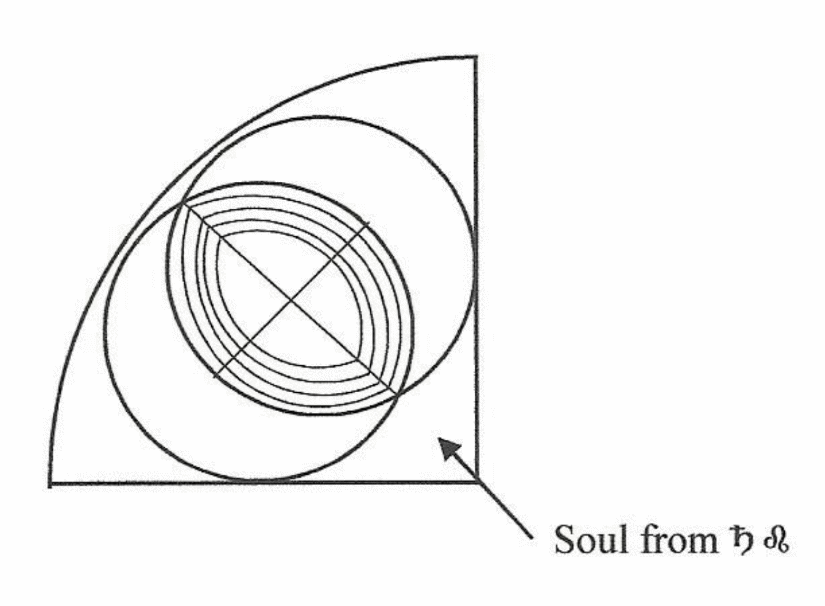
[FIGURE CTRTA-8-digital: Saturn in Leo and Fourth Quadrant Vesica. Diagram on page 255 showing fourth quadrant with intersecting circles and vesica, and arrow "soul from Saturn in Leo" pointing from 5th house to 11th house.]
The identification of the soul (from Saturn in Leo) with generic mind (the four sheaths in the eleventh house) must precede the "awakening" of the six senses. Then, through the alaya (tenth house, void intellect), the world-constructor can stir this generic mind to activity. Then the universe arises, within which the subject-object dichotomy is found.
Text:
"In favoring the emotively toned and constituted aspect of mind, which is the egocentricness of conscious life, it occasions the five basic emotively toned action and reaction patterns, the twenty subsidiary ones, the fifty mental events, and the eighty-four thousand interpretations and judgments, so that everything without exception is set for the origination of Samsara." (Guenther, p. 118)
Comment:
Once the soul has identified with generic mind and the alaya has stirred that mind to activity, the rest follows.
Text:
"Listen, rTog-pa'i rdo-rje! Although the transcending awareness which knows reality as it is in reality, is, in view of its continuity, not a different substance from the pervasive medium of the all-ground, it is said to be a change in its modality. It is like the awakening from deep sleep. But although here the senses wake up to their objects they are not affected by the appearance of these objects (in the sense that the principles of interpretation which we apply to the data of sense perception remain inactivated)." (Guenther, p. 118)
Comment:
The "transcending awareness" here is the Saturn in Leo. Now, there are two ways to interpret its continuity of substance with the All-ground: one of them is false.
If the alaya-vijnana is taken to be the All-ground here, then the soul is made out to be part of and to originate from the objective universe. This postulation would deny any true subjective is-ness to the soul and would make it over into being simply a part of the world-constructor's mentation. It would then be not a different substance of the pervasive medium of the alaya, even if a variety of it: thus it could not truly be Soul, and the statement is false.
The All-ground, again, must be taken as the whole circle. For the soul to know reality as it is in reality, will it not go beyond all mentation and intuit the illimitable possibilities beyond mentality?
The soul can also know the objective universe: when it views the objects which arise through the world-constructor's mental fabrication, it sees them as persisting in a void intellect. [in left margin by this paragraph: "Omit? See p. 7". Earlier text: "There are two possible ways…"]
What is meant by saying here that "the senses wake up to their objects" is that the generic mind (11th house) wakes up. When it is stirred by the alaya, it is not affected by the objects there unless the cognitive is-ness is associated with it. Until that association takes place, the interpretive concepts cannot operate. These principles of interpretation impart an organizing pattern to the soul's experience: that organizing pattern is the functioning of all the Vajrayana deities.
Text:
"This transcending awareness does not fall into either chasm of the two kinds of unknowing, the one co-emergent with mentality and the other the diffusive one of mentality." (Guenther, pp. 118-9)
Comment:
Soul always retains its foothold in the 5th house. The transcending awareness does not become:
(a) part of the mental cosmos produced by the world-constructor (i.e., the mental matter which is being shaped… the functioning of generic mind), or
(b) the empirical consciousness, i.e., the emerging contents of the psychological percipient (which are within the cosmos).
Text:
"Although, in the actuality of the mere absence of any dichotomic activity, mentality and spirituality seem to be alike, mentality retains its intentional character and enters into a specific relation to the mnemic consequences of the apprehended sensum in a non-observable (and hence unanalyzable) manner (which gives the perceptual situation the specific external reference)." (Guenther, p. 119)
Comment:
Neither of the two aspects of mentality (a and b in the comment above) is to be confused with the transcending awareness. Inherent in the world-constructor's fabrication of the cosmos is a certain intentionality of mind, working in accordance with karmic laws: this intentionality is the characteristic mode or being of the mental. Also, this transcending awareness must be distinguished from the empirical consciousness. The light of the transcending awareness shines into the empirical/psychological pseudo-subject immersed in the cosmos which is being fabricated, but it does not have or impart the intentionality of mind which is characteristic of that pseudo-subject's operations.
When we first subtract the subject-object dichotomy from experience, the mental and the spiritual will seem to be the same. However, mentality (generic mind, the sheaths in the 11th house) will go on functioning as part of the objective universe and will relate to the samskaras . . . while the absolute cognitive isness remains simply what it is.
Text:
"Spirituality, however, as far as its facticity is concerned, remains free from any projectibility into words and their inherent externalization; its givenness or actuality is a free unimpeded movement; and its observable quality is an analytic-appreciative capacity that can take in everything. Inasmuch as this capacity cannot be thwarted by reification into external objects and by avidity and listlessness, everything is set for the origination of Nirvana.
"The First Chapter, explaining the Ground and the Gates to Samsara and Nirvana." (Guenther, p. 119)
Comment:
The transcending awareness could never become concepts or words: light does not become the mote which it illuminates. The receptivity of this transcending awareness (prajna) remains open-ended: it can either receive the intentionality of mind or not receive it. It itself cannot be turned into any kind of mentally-fabricated (or 'physical') object. It is always in the situation referred to as "the potentiality of Buddhahood".
This distinction completes the first chapter of the text.
II
Text:
"Again rTog-pa'i rdo-rje asked:
"Is it possible or not to point to an earlier and later phase concerning the split into Samsara and Nirvana and to indicate the exact moment of the occurrence of this split? Further, O teacher Kun-tu bzang-po, does your projected and externalized appearance happen to be in the manner of an apparition to those who are prepared for your vision by good deeds, or are you a concrete, truly existing, entity as are other living beings? Kindly explain this problem.
"Kun-tu bzang-po replied:
"While the predicates of past, future, and present can be applied to the appearance of my manifested existence, my very being is time itself (rather than an event in time) because it is beyond the range of fragmentizing and temporalizing words." (Guenther, pp. 119-20)
Comment:
Insofar as transcending awareness (the intelligible) includes existence or becoming, any predication made by generic mind will be made within the total which transcending awareness includes. There is a correspondence here to the Plotinian scheme, where sensibilia are included in man's essentia, and Soul is the principle of time.
Text:
"To call me the Primordial Lord by assigning a beginning in time to me, is merely to put a convenient label on me. For this reason, the very moment the analytic function of mind, differentiating between and thinking about Samsara and Nirvana, begins to operate, the split into these two aspects has occurred, because on the one ground two ways have opened." (Guenther, p. 120)
Comment:
Soul, operating through the sheaths in the eleventh house, creates as its last production the empirical entity that appears in the twelfth house. The empirical/analytical mind can then attribute a variety of predicates and interpretive concepts to the objects that appear before it: each is postulated as a self-existing, isolated bit or piece of ontological real estate. But the whole production--both the empirical entity and its sense-qualitied panorama--is a production of and is continuous with Soul.
When the empirical mind, stationed within this production, tries to understand its prior according to the laws of objective thinghood that apply in the twelfth house, it can't. The very moment that the empirical mind tries to understand its cause according to its own fragmentizing mode, there appears a split between Samsara and Nirvana. This leads to the false view that Samsara and Nirvana are two.
Text:
"Listen, rTog-pa'i rdo-rje! If you think that that which is labeled that exalted and auspicious Kun-tu bzang-po, the Primordial Lord who embodies the potentiality of all Buddhahood, is some entity apart from the psychological makeup of the sentient beings, which is as vast as the ocean, the very chance of Samsara and Nirvana separating in their togetherness has been eliminated and, since (on such an assumption as yours) the living beings are without the possibility of realizing Buddhahood, all the teaching about the two prerequisites of merits and knowledge, as vast as the ocean, is meaningless." (Guenther, p. 120)
Comment:
If you think that this origin (in Soul) is something other than the being immediately present to you, then it would be impossible to traverse the path to Buddhahood. That is, if you separate the eleventh house from its association and identity with Soul in the fifth house, then you have brought about a cleavage which will make Nirvana impossible: you have "broken up" that which, although two, is not separable.
We have to see that the transcending awareness descends all the way into the twelfth house, to the psychological makeup of the empirical personality: we can't cut the twelfth house off from the eleventh or the eleventh from the fifth. This is not to ascribe immortality to the psychological individual, but rather to emphasize that there is something in him which is immortal.
Text:
"Therefore, since my givenness which is fulfilment and completion, by its very nature comprises both a path of freedom and one of errancy, you must know what the ground is." (Guenther, p. 120)
Comment:
The sentient being is comprised of both a samsaric part (the mental sheaths) and a nirvanic part (the awareness from the fifth house). In this psychologically embodied individual--which is an actualization of Soul--is the possibility of freedom. Here, as in Plotinus' thought, the soul has the option to identify with various levels in the scale or hierarchy of its being.
"Givenness" refers here to the actualization of the potential which is with soul. It is a fulfilment, a completion, which is Buddhism's way of saying that sensibilia are included within the intelligible. The soul actualizing itself in imitation being is an actualization of the powers of the transcending awareness: it is right in this manifested being that the soul can realize itself.
Text:
"When in this way you come to know that, in view of it being free from all impurities or in view of it being sullied by karmic actions and emotively toned action and reaction patterns, that which constitutes Buddhahood, on the one hand, and that which marks the status of a sentient being are self-emergent qualities, you will stop seeing and expecting me, Kun-tu bzang-po, to be a separately existing being or an artificially contrived Buddha who manifests himself like an apparition." (Guenther, p. 120)
[In text, not in scan: "The Second Chapter, explaining the Split into Samsara and Nirvana." (Guenther, p. 120)]
Comment:
When you understand the nature of the All-ground--which itself is free of any kind of self-nature-- then you will see that either a sentient being or a Buddha can arise through the concatenation of causes (the nidana chain) that brings about determinate being. The Buddha himself is then seen to be a product of the functioning of the All-ground.
This point completes the second chapter of the text, which is called: "The Second Chapter, explaining the Split into Samsara and Nirvana."
III
Text:
"Again rTog-pa'i rdo-rje asked:
"How does the differentiation into sensory cognition, mentation, and emotively toned mentation occur?
"The answer was:
"When the noetic capacity by its inherent dynamic has stirred from the all-ground and is about the [sic; typo in book] meet its object, the 'all-ground cognitiveness' has risen; it is as if the (indeterminate) psychological makeup (or the pervasive medium which makes a mind, in the strict sense of the word, possible) has been roused from deep sleep." (Guenther, p. 121)
Comment:
The "noetic capacity" here is the transcending awareness, the soul's inherent light and life (as part of the totality of souls in Saturn in Leo). To say that this capacity has an inherent dynamic is to say that the soul is self-motive.
The absolute individual soul must first be detached from Total Soul in order to become free to associate with the subtle sheaths embedded in the alaya-vijnana. These subtle sheaths constitute a cognitive apparatus which is of the same substance as the alaya (the world-constructor), which is the "pervasive medium which makes a mind, in the strict sense of the word"makes": it actually fabricates the various sheaths that constitute a mind.
When the individual soul separates itself out from Total Soul, it must encounter the world-constructor's functioning, which arises simultaneously. This object which it is "about to meet" is not something fixed, but rather, like electricity, it is something in which there is a constant transformative motion or intellectual energizing. Thus the arising which goes on here is two-fold, a sort of twin functioning:
On the one hand, included within the nature of Soul-entire (the whole Soul ring) are individual souls (within Saturn in Leo). When Soul is referred to as an existent, it is simultaneously both. Along with the activation of the entire Soul ring by the Jupiter in Gemini (the unity of Soul), the absolute individual soul begins to distinguish itself out from both the All-ground and from the Soul ring. In this way, it becomes free to associate with the subtle sheaths embedded in the alaya.
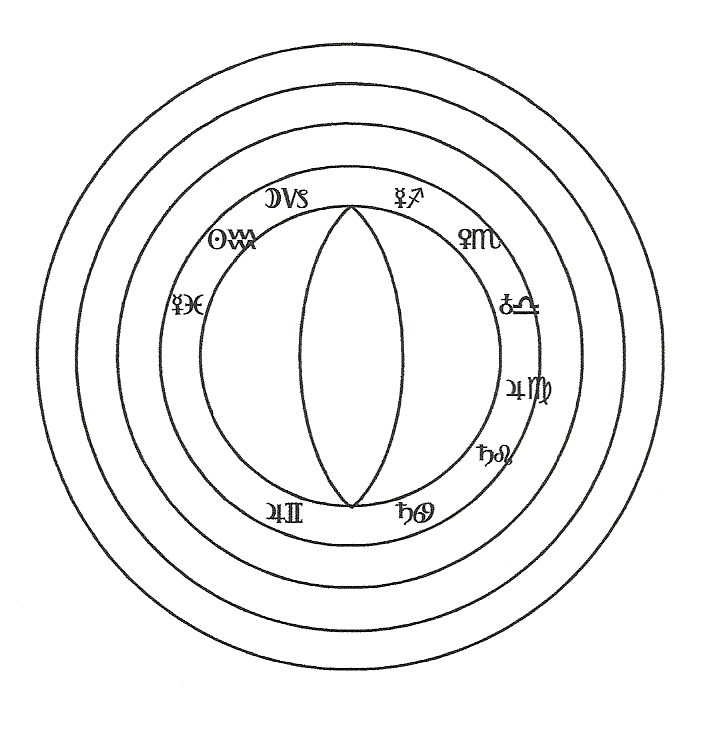
[FIGURE CTRTA-9-digital: Soul Ring. Diagram on p. 263 of the soul ring planets, Jupiter in Gemini through Mercury in Pisces.]
This arisal of the Soul ring--in which the absolute individual soul is included--can be referred to as an "all-ground cognitiveness" (wisdom), which is one pole of the two-fold arisal we are discussing. "Prior" to this arisal (which is not a process in time but is rather the process through which time itself gets formally defined) the All-ground as the whole circle or as all twelve houses cannot be called "cognitive": unity is prior to cognitiveness.
The second pole of the two-fold arisal going on here is the intellect of the world-constructor, the pervasive medium which makes a mind:
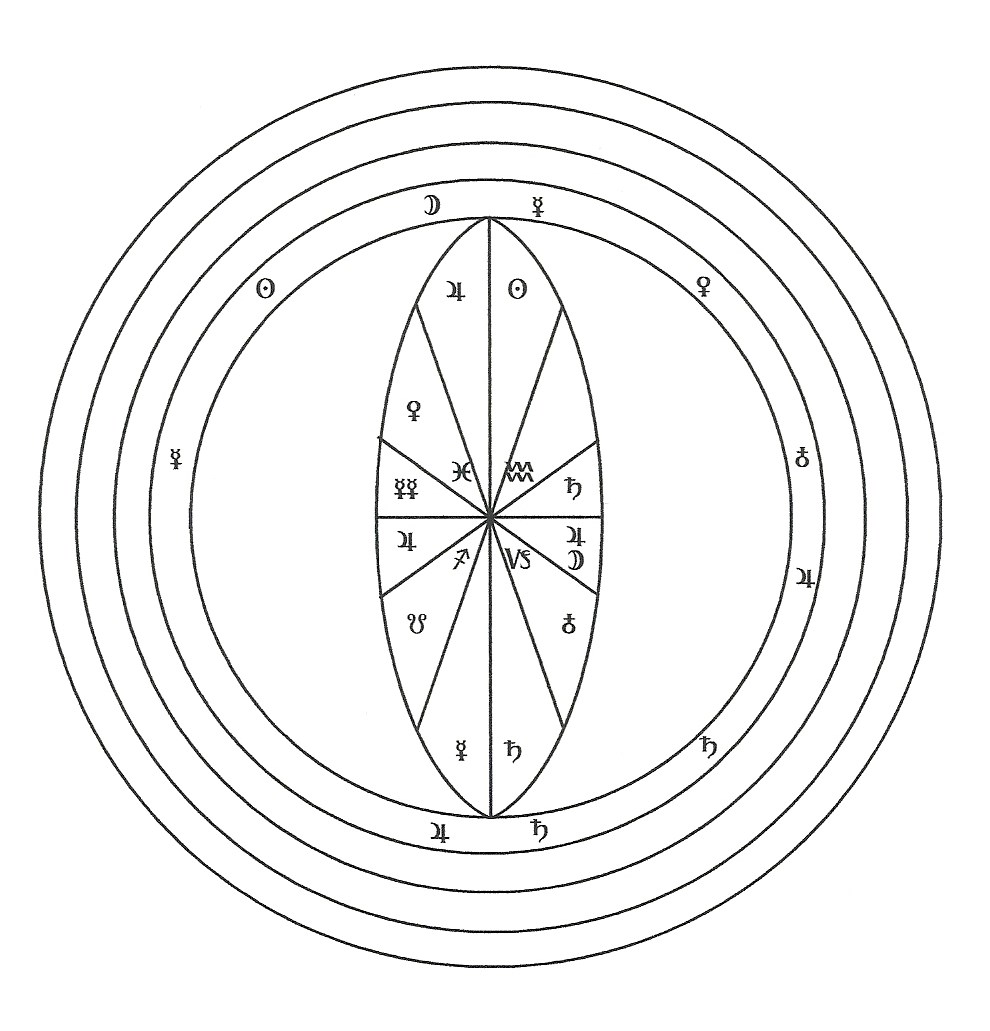
[FIGURE CTRTA-10-digital: Soul Ring and Demiurgic Intellect. Diagram on p. 264 of soul ring planets as above diagram; inside the circle is a 12-fold vesica with the dignities of the last four houses, representing the Demiurgic Intellect.]
This intellect of the world-constructor is the object which the All-ground cognitiveness (the Soul ring as including individual souls) is about to meet. In and through it, the dignities of the last four houses of the metaphysical chart function to fabricate the mental cosmos. All of the sheaths and all of the objects in the cosmos arise within this void intellect, which itself is what the transcending awareness first encounters. [scan says "see next page" which has "generic mind" diagram]
The ring of soul remains an abiding wisdom. What actualizes its Ideas in some sort of order is the world-constructing intellect (cf. Plotinus, IV.4.10). At this level, all souls have the same powers and have access to the same sheaths, etc. The Soul ring is one unchanging Life, including all individual souls. Here they meet the intellectual energy of the world-constructor.
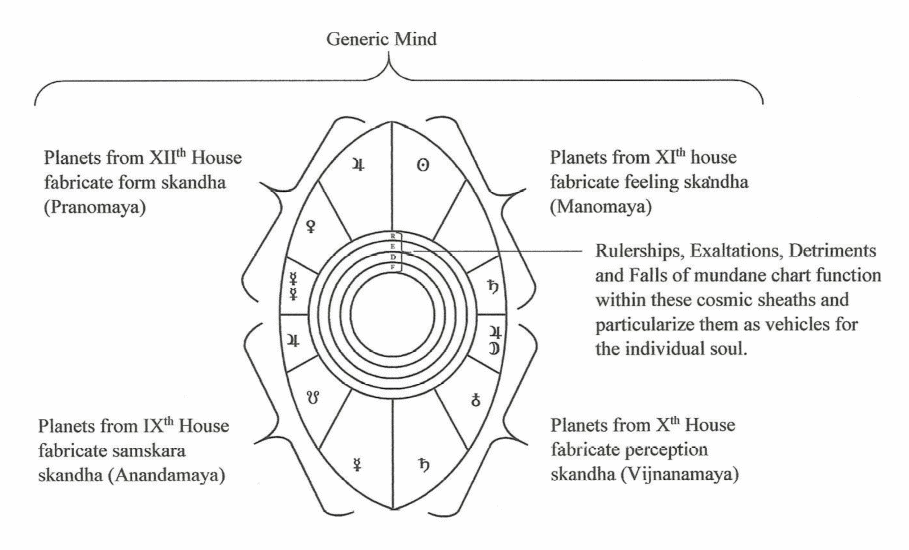
[FIGURE CTRTA-11-digital: Generic Mind. Diagram on p. 265 of the dignities of the last four houses functioning to fabricate the mental cosmos and sheaths.]
Text:
"The concrete objects of the five senses are not yet really present; . . ." (Guenther, p. 121)
Comment:
"Concrete objects of the five senses" here means the actual sense-image, with all the sense-qualities which the individual empirical percipient superimposes and with all the interpretive concepts he provides. While these concrete objects are not yet present, their underlie --the material given shape in the (10th house) mind of the world-constructor-- is. This material shape of the universe is not yet manifested on the gross plane by the individual percipient, but it serves as the underlie for the sensible qualities which the individual percipient will supply.
Text:
". . . but a very subtle cognitive capacity which tends to grasp its objects has risen and makes itself ready in every respect to receive the impressions of the objects of the discursive mind, like a mirror." (Guenther, p. 121)
Comment:
This "subtle cognitive capacity" is the potential intellect of the soul in the eleventh house, ready to receive the impressions of the intelligibles from the tenth house (the alaya). It is not to be equated with the transcending awareness, which comes from the fifth house: this subtle cognitive capacity can encounter objects, but unless the transcending awareness comes into association with it, there can be no cognition whatsoever.
This subtle cognitive capacity (potential intellect) receives the impressions of the intelligibles and then projects them into the twelfth house as a primordial image that includes the body. Then the light of the individual soul (the cognitive is-ness) can inhere in the sensible intellect which will take back the object as sensible . . . i.e., receive the object as the gross sensible object in the twelfth house: it is these gross sensible objects which will be the objects of the discursive mind. Through this process the transcending awareness is made ready to receive, like a mirror, the objects of the discursive mind.
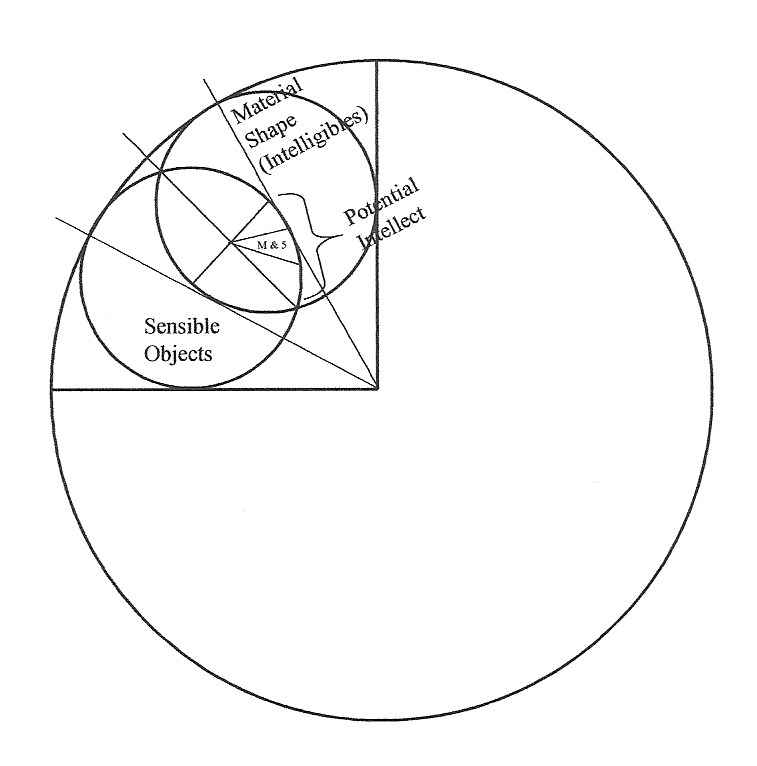
[FIGURE CTRTA-12-digital: Fourth Quadrant Vesica. Diagram on p. 266 of 4th quadrant: 10th house as Material Shape (Intelligibles); 11th house vesica showing potential intellect (with manas and the five senses) as its 2nd quadrant; 12th house as sensible objects.]
Text:
"This receptivity is confronted with the objects by the five senses operating according to their structure and their specific motor activity so that the eyes see color-shapes, the ears hear sounds, the nose smells fragrances, the tongue tastes flavors, and the body sense has kinesthetic sensations." (Guenther, p. 121)
Comment:
The "receptivity" being referred to here is the mirror-like quality of the absolute individual soul. Only after the primordial image including the body has been projected can we receive the impressions of the gross objects, which are the objects of the "discursive mind".
Text:
"Then through emotionality and mentation it arranges the action and reaction patterns of attraction, antipathy, and indifference and so sets up the cause and effect of Samsara in a total manner, the cause being the triad of unknowing, karmic action, and emotive patterns of response." (Guenther, p. 121)
Comment:
There are two ways to interpret this passage. One is to say simply that once the empirical/discursive mind (which is inherent in the body with its five physical senses) responds to the sensum in terms of "I like, I dislike, etc.," it supplies an emotional reaction: the emotional reaction which gets triggered has a certain pattern, which is karmic. Once this reaction has occurred, mentation begins, elaborating the pattern of the karma which was set into motion by the emotional response, rationalizing the response, etc., etc., etc. But a deeper appreciation of the passage can be had by enquiring more carefully into the nature of the "it" that "arranges the action and reaction patterns…" etc.
What really is the "it" that does this arranging? Some sort of mentation or interpretation has to precede the emotional reaction, for the emotional reaction is itself a judgment. Any genuine emotion is the result of the mind's (the potential intellect) interpretation of the experienced world, which includes the emotions to be experienced. Such emotional response is the result of an interpretation in which the five Dhyani Buddhas are involved: any later conceptualization of the emotional reaction is an activity of the egocentric personality. [Note: See BUD Emotion C 15p.PDF (formerly BUD Emotion C 12p.PDF), retyped as 1978 0412b V09N Buddhism - Emotion, for more on AD's view of emotion.]
Functioning through the individual soul as the various deities of the Vajrayana pantheon (dakinis, yidams, wrathful and benign gods and goddesses, etc.), the five Dhyani Buddhas arrange the action and reaction patterns according to a highly organized and successful plan. Correct interpretation of this pattern and of its various stages of transformation is the task of a higher understanding. Our "ignorance" is a skillful application of their wisdom: they set up the cause and effect of Samsara.
Text:
"In brief, one speaks of an 'all-ground cognitiveness' because of its responsiveness; of the 'five senses' because of it looking outward and waking up to the sense objects; of 'emotionality' because of it becoming emotively toned in itself and organizing the emotive patterns of action and reaction; and of 'mentation' because of it differentiating between manifold things. Thus there are eight group-patterns of the mind." (Guenther, p. 121)
Comment:
In this passage, the All-ground is to be understood as the Demiurgic intellect. By "its responsiveness" is meant that the objects in the Demiurgic intellect respond to the activity of the discursive mind.
Text:
"Again rTog-pa'i rdo-rje asked:
"How is it that since the whole field of appearance is errancy, such genuine objects of knowledge as houses and the like appear to sentient beings as houses and so on?
"Kun-tu bzang-po replied:
"Concerning appearance as it exists for those who understand reality, there has never been any errancy-appearance; but for those who do not there is a difference in appearance according to the six forms of life in which these people find themselves, as a rule, so that (what we humans consider to be) water appears for the gods as nectar, for the denizens of hell as glowing embers, and for the spirits as dark blood. This is so because their psychological makeup, the sensory equipment, and their mental operations, all of which are the manifestation of their karmic activity and the shaping of the noetic dynamic of the beings according to their situation and status, participate in the errancy-appearance which is roughly the same (for each group). However, this does not apply to the understanding or non-understanding itself, even if there be such appearance. For instance, for a yogi who rests in the contemplation of reality, rocks, houses, palaces, and the like will continue to appear, but on the part of his cognition there will not occur any reification. It is out of such a situation in which appearance and mentation are of the same nature and value, that such phenomena as rising into the sky like an eagle or floating on the water like a swan or passing straight through rocks will occur, because there is no reification of appearance." (Guenther, pp. 121-2)
Comment:
Those who understand that the object which appears persists in the void intellect of the world-constructor, that it consists of intellectual energy and that it is void of all the qualities that we attribute to it, have no error. But otherwise, the object will appear according to the particular cognitive apparatus that karma has dictated for the percipient to have . . . along with his superimposition of names and forms.
The "noetic dynamic" which is said here to be "shaped" must be distinguished from the transcending awareness. Either the empirical mind or the potential intellect, as parts of the world-constructor's mental fabrication, can be said to get shaped according to the situation and status of the individual percipient. If "noetic dynamic" here were taken to mean the cognitive-isness, then it would be false to say that it could be shaped. In this passage, the transcending awareness is referred to as "the understanding or non-understanding", which is not shaped in any way.
Text:
"Therefore, I, Kun-tu bzang-po, have become a Buddha as the prototype of all Buddhas by not doing any good deed that in any way is connected with emotively toned responses, . . ." (Guenther, p. 122)
Comment:
He is simply saying here that he has no ego-interest in any of the actions that he performs.
Text:
". . . because I know that the existentiality of mind, the all-creating king, resides in the infinitude of the all-ground in an invisible and hidden manner as the substrate of that which is called Samsara and Nirvana; . . ." (Guenther, p. 122)
Comment:
The "all-creating king" here is the Demiurge. It resides in the All-ground--the whole circle--in a hidden and occult manner, and it itself (the Demiurge) serves as the substrate of Samsara --the fourth quadrant. Within this fourth quadrant is also the possibility of finding Nirvana.
Text:
". . . that although it is from this ground that the boundless light of the magnificent appearance of the ground will shine forth, . . ." (Guenther, pp. 122-3)
Comment:
The Demiurge is the ground through which the boundless light of the All-ground will shine. The totality of all the possibilities in the All-ground underlies Jupiter's fabrication of the mental world, i.e., the light of the All-ground underlies the light of the Demiurgis (and both these lights are distinct from the light of the absolute individual in the Saturn in Leo).
Text:
" . . . it will not become mixed up with an object (which is a construction of mentation), but will remain pellucid in its own realm, will not falsify itself by reification, will not be fettered by the reified, and, discarding all formal cognition and the intellectual opacity that goes with it, will become the enlightened realization of the value sphere which is the realm of reality in the highest sense; and that moving away from the ground as formal cognition it is bound to become mentation and, associating with the formidable demon of the subject-object division, will perform its evil working of providing the requisites of karmic activity and emotional responses.
"The Third Chapter, explaining the eight group-patterns of the mind." (Guenther, p. 123)
Comment:
This boundless light of the All-ground does not get contaminated with any of the objects that are products of mentation. Its realm is the All-ground as the whole circle, "the realm of reality in the highest sense". Only when an individual soul associates with/identifies with the activity of the discursive mind (which is a fabrication) does he become subject to the subject-object division and the three consequences of the impure modality.
This point concludes the third chapter of the text.
[File AD SUPP 245-271.PDF Ends]
V09P: PAPER: Buddhism; Tantra; CTRTA. Copyright 2023 Wisdom's Goldenrod p. iv