APPENDIX: EIGHT HYPOTHESES (Cornford trans.)
HYPOTHESIS I
2. The One (having no parts) is without limits.
3. The One (being without parts) has no extension or shape.
4. The One (being without parts or extension) is nowhere, neither in itself nor in another.
5. The One (not being a physical body in space) is neither in motion nor at rest.
6. The One (lacking the above qualifications) is not the same as, or different from, itself or another.
7. The One is not like, or unlike, itself or another.
8. The One is not equal, or unequal, to itself or to another.
9. The One cannot be, or become, older or younger than, or of the same age as, itself or another, or be in time at all.
10. Since it is not in time, the One in no sense 'is', and it cannot even be named or in any way known.
HYPOTHESIS II
2. A 'One Entity' is a whole of parts (both one and many).
3. A One Entity (having parts) is indefinitely numerous and also limited.
4. A One Entity (being limited) can have extension and shape [AD handwrites 'schema' above 'extension and shape'].
5. A One Entity (being an extended magnitude) can be both in itself and in another.
6. A One Entity (being a physical body in space) can have motion and rest [AD handwrites 'Power + being' above 'motion and rest'].
7. A One Entity (as above qualified) is the same as, and different from, itself and the Others.
8. A One Entity (as above qualified) is like and unlike itself and Others.
9. A One Entity (as above qualified) has, and has not, contact with itself and with the Others.
10. A One Entity (as continuous quantity or magnitude) is equal and unequal both to itself and to the Others.
11. A One Entity (as discrete quantity or number) is equal and unequal both to itself and to the Others.
12. A One Entity (as above qualified) exists in Time, and is and is becoming, and is not and is not becoming, older and younger than itself and the Others.
13. A One Entity (being in Time) has existence and becomes. It can be the object of cognition and the subject of discourse.
HYPOTHESIS IIA
COROLLARY ON BECOMING IN TIME
2. The transition in becoming and change is instantaneous.
HYPOTHESIS III
2. When the element of unity is abstracted from any one whole or one part, what remains is an element of unlimited multitude.
3. The combination of the unlimited element with limit or unity yields the plurality of other ones.
4. The Others, so defined, have all the contrary characters proved to belong to the One Entity of Hyp. II.
HYPOTHESIS IV
2. The Others, having no unity, cannot possess any of the contrary characters.
HYPOTHESIS V
2. A Non-existent Entity, being knowable and distinguishable from other things, can have many characters.
3. A Non-existent Entity has unlikeness to the Others and likeness to itself.
4. A Non-existent Entity (being a quantity) has inequality to the Others, and has greatness and smallness and equality.
5. A Non-existent Entity has being in a certain sense.
6. A Non-existent Entity can pass from the state of non-existence to the state of existence, but cannot change or move in any other way.
HYPOTHESIS VI
2. A Nonentity cannot begin or cease to exist or change in any way.
3. A Nonentity cannot have any character.
4. A Nonentity cannot be specified as distinct from other things, or stand in any relation to them, or exist at any time, or be the object of any cognition or the subject of discourse.
HYPOTHESIS VII
2. The Others will differ from each other as masses unlimited in multitude.
3. Such masses will present an appearance of unity and number.
4. There will be an appearance of greatness, smallness, and equality.
5. There will be an appearance of limitedness and unlimitedness.
6. There will be an appearance of likeness and of unlikeness and of all the other contraries.
HYPOTHESIS VIII
2. The Others cannot even appear one or many, or as having any character. There is nothing that has any being whatsoever.
Paper
Undated summary of a published workThe Eight Hypotheses of the Parmenides: An Abridgment of William F. Lynch's An Approach to the Metaphysics of Plato through the Parmenides
(AD Supp, Version 1)
by Anthony J. Damiani
Book Notes V09BN
with Appendix: Eight Hypotheses (Cornford translation).
3-LETTER CODE: PLA
TOPIC: Plato
SUBJECT: Parmenides
SUBSUBJECT: Eight Hypotheses
ORIGINAL LOCATION & FILE NAME (of PDF used for typing): AD SUPP 1247-1270 PLA Hypotheses AD Paper V3 P.PDF
CONTENTS:
Study of the One as first hypostasis as pure metaphysics
Application of Plato's eight hypotheses; analysis of the relationship between indivisible and multiple in every idea/one; applies to every order of being; unity not cancelled by multiplicity
Zeno's dilemma: contradictions in sensible order; same entity containing contraries (like/unlike, one/many)
Socrates' agreement with Zeno's position through early dialogue; Parmenidean criticism showing the dilemma recurs at the level of ideas; problem exists throughout all levels of being
Plato's three initial approaches: 1) theory of participation; 2) theory of imitation; 3) theory of conceptualism; failure of all three approaches to maintain unity and purity of ideas
The eight hypotheses as a new approach: abandonment of efforts to preserve unity; development of "interior metalogic" for all being; analysis of any "one" as mixture of one-many, like-unlike; universal applicability to all orders of being
Revised theory of participation: internal participation within ideas themselves; multiple elements sharing being from principle of oneness; modification of contrariety through absolute vs. relative being; four key aspects of new theory
Problems with prior participation theory: issues with ideas entering into particulars; problems with parts of ideas in particulars; complications with predication of qualities; "third man" argument
Hypothesis I: the One as pure One; study of one precisely as one; indivisible without parts; no predicates or relationships; not knowable in Platonic technical sense; pure self-identity
Hypothesis II: the One that is; one as composition of parts; every entity a complex of one and many; co-presence of contraries in a one; communication between oneness and being; parts of a one are infinite; limited and unlimited as constituting elements; derivation of other contrarieties from this fundamental contrariety
Hypothesis II-A: the instant or sudden; point of transition between contraries; unmeasurable point of change
Hypothesis III: the One and its parts; analysis of the nature and structural contribution of one/many elements; one as dominant principle and source of unity; parts receiving predicates through association with principle of oneness; return to indivisibility through doctrine of participation
Hypothesis IV: the nature of the Others; analysis of the many member parts; infinitely divisible multiplicity; lack of specificity and unity in the unlimited
Hypothesis V: the One in relation to Others; one limited in relation to other ones; presence of otherness/difference creating limitation; one as compound of being and non-being; foundation for series of contrarieties
Hypothesis VI: absolute non-being of the One; no predicates possible; neither contrary can characterize it; different from relative non-being in Hypothesis V
Hypothesis VII: doxastic (non-philosophical) analysis of being; failure to grasp total unity in an entity; focus on separate units composing whole; compromising mode of thought where oneness both exists and doesn't exist; study of opinion and its approach to unity; analysis of common-sense view of multiplicity
Hypothesis VIII: consequences of non-existence of unity; parts also cease to exist; one as source of predicability of parts, being of parts, specificity of parts; rejection of unlimited as separate pre-existing reality; participation as explanation of existence of parts
Unity of eight hypotheses: single climactic hypothesis; progressive analysis; complete metaphysical system
Resolution of problems: antinomies through participation; one-many relation; being-non-being distinction
The unlimited concept: crucial for Plato's metaphysics; three dialectical proofs; universal application
Aristotle's claim that Plato universalized limited/unlimited; distinction from Aristotelian second matter; dual principle in structure of all beings; necessity for solving metaphysical problem of unity
Universal applicability of the philosophy of oneness
Breakdown of all unities into composition of limited and unlimited; any unity as both a whole and a set of parts; fundamental identity and distinction between one as unity of wholeness and as many
BOOKS QUOTED FROM OR REFERENCED:
William F. Lynch, An Approach to the Metaphysics of Plato through the Parmenides
Edith Hamilton, Huntington Cairns (eds.), The Collected Dialogues of Plato
F.M. Cornford, Plato and Parmenides: Parmenides' Way of Truth and Plato's Parmenides
John N. Deck, Nature, Contemplation, and the One
DIAGRAM appended to this paper:
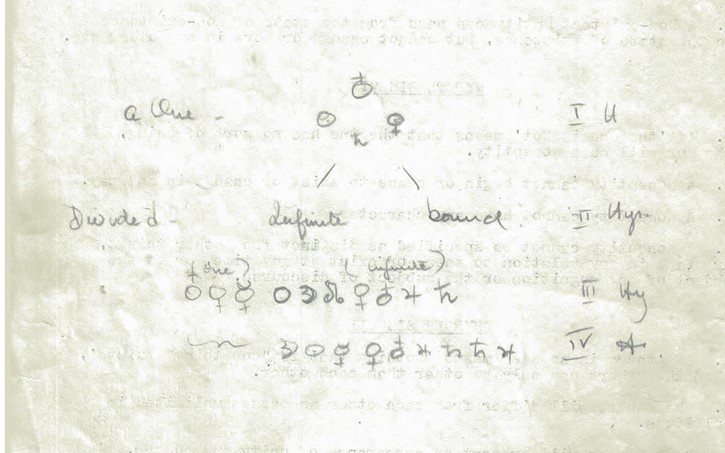
- FIGURE PLA Eight Hypotheses of Plato B-p.4.PDF. Facsimile scan of Anthony Damiani hand-drawn diagram (originally on back of copy of Cornford Eight Hypotheses): Hypotheses I-IV, with 1st Quadrant Dignities (Hyp. I-III) and Rulerships (Hyp. IV). [Note: This diagram is also appended to WG Parmenides Classes 1981 0102 and 1981 0109.]
AD HANDWRITING: Typewriter typed, a few AD edits
COMPLETENESS: Full Paper, abridgment of a portion of a book
PUBLISHABILITY: No, already published
ALTERNATE VERSIONS: PLA EIGHT HYPOTHESES OF PLATO P 24p.PDF, PLA 3 papers_8Hyp_Non-Being_2foldB.PDF; these have slightly different edits than the version in AD Supplementary Material (Version 1)
RETYPED, REFORMATTED, AND PROOFREAD by IT, JF, HP 2023
NOTES:
RETYPED BOOK NOTES (V09BN).
This is am abridgment of a portion of An Approach to the Metaphysics of Plato through the Parmenides, by William F. Lynch. Spelling, punctuation, capitalization, etc., for the most part have not been corrected to conform to the Lynch book. If anything is unclear grammatically or otherwise, please consult the book.
There are a number of versions of this paper, all dating from the later 1970s. They are almost identical but there are some discrepancies in terms of AD and other handwritten revisions/additions. This is the version, however, which Anthony selected to put in his "Notes and Papers" box a.k.a. "AD Supp," AD Supplementary Material, pp. 1247-1270. All handwritten revisions/additions have been incorporated into this text–as best as we can determine.
For completeness' sake, an outline of all Eight Hypotheses that was used in classes at Wisdom's Goldenrod has been appended to this paper. This translation of the Eight Hypotheses is found in Plato and Parmenides: Parmenides' Way of Truth and Plato's Parmenides by F.M. Cornford. AD made some handwritten edits and these are noted accordingly. On the back of one copy of these typed-out Eight Hypotheses (Scan File PLA EIGHT HYPOTHESIS OF PLATO B 4p.PDF), Anthony drew a diagram with levels of Hypotheses I-IV. This is also appended. Also note that one widely circulated photocopy of these Eight Hypotheses had "Brumbaugh" handwritten on it – this was a student note referencing the Eight Hypotheses version from Brumbaugh's Plato on the One that was read in the Sept. 1983 Eight Hypotheses classes.
Plato's dialogue Parmenides was discussed at various times at Wisdom's Goldenrod; many of these classes have audio transcripts.
A paper which discusses these Eight Hypotheses in terms of "Soul as an Authentic Existent," dated 1983-1984, is to be found in Anthony Damiani's Notes and Papers, p. 1034 ff; it was discussed in September 1983 classes at Wisdom's Goldenrod and has been retyped as PLA Parmenides & the Authentic Existents - AD Supp 1034-1053 (Ver. 1) - V09MP.
Contextual lead-in by AS: In her introduction to the dialogue (p. 920), Edith Hamilton observes that: "The best Platonists differ about its meaning. The ordinary person will be hard put to discover any meaning at all. The argument runs on and on in words that appear to make sense and yet convey nothing to the mind." For Anthony, on the contrary, this dialogue provides the key to the nature of Reality. He considered it and Timaeus to be the two most important Platonic dialogues. The last time we presented the dialogue, he said to me "Next time you'll have to do it yourself." We also applied the dialectic to the series of dignities in the chart called henads: for example Saturn as a unity has its being through the henad series in houses 1, 4, 5, 7, 10, 11 of the metaphysical chart.
THE EIGHT HYPOTHESES OF THE PARMENIDES: AN ABRIDGMENT OF WILLIAM F. LYNCH'S AN APPROACH TO THE METAPHYSICS OF PLATO THROUGH THE PARMENIDES
[File AD SUPP 1247-1270 PLA Hypotheses AD Paper V3 P.PDF Begins]
The study of the One as the first hypostasis is metaphysics pure & simple--to which we can apply the 8 hypo[theses] of Plato. [Note: This lead-in paragraph handwritten by AD; it appears in AD Supp but does not exist in most other versions. It is somewhat difficult to read the handwriting on the photocopy.]
The Eight Hypotheses of the Parmenides are pure metaphysics. They give a careful summary of the factuality of the indivisible and the multiple in every idea or every one in any order of being in such a way that oneness isn't cancelled by multiplicity.
We find in Zeno that any kind of principle of multiplicity in being, and certain oppositions or contrarieties, will exist in the same entity. Like will also be unlike. The one will also be a multiplicity. But this, he says, is absurd. Two special qualities of the Zeno difficulties must be carefully noted and distinguished. First, they restrict themselves to the sensible order, and Socrates revealed the opinion up to the very end of his answers that if we restrict ourselves to the empirical no solution to these classical difficulties will be found. Second, the crux of Zeno's argument is that the same one thing does actually but cannot logically contain contraries, for then the like would be unlike, the one, many. The irony of the dialogue is that for a long period of the discussion Socrates is in entire agreement with this position, and every one of his early efforts at solution is in the direction of avoiding the dilemma. The upshot of the Parmenidean criticism of the ideas that follows is to indicate that even on such assumptions everything again terminates in the original dilemma: the idea, the principle of absolute oneness, becomes its first and divided from itself. Thus the one becomes many, and by implication, the like becomes unlike itself. What else does all this amount to but a recrudescence of Zeno's own problem, albeit on the higher level of the Ideas? There is contrariety in the same thing. The very logic of things will finally force us to acknowledge that even in the ideas, in the whole range of being, what is one is itself many, what is like is itself unlike. That is to say, it will be seen that contrariety can and must exist within the same entity.
Plato makes three attempts to keep the one pure and isolated. Through the theory of ideas is a theory (1) of participation, (2) of imitation, and (3) of conceptualism. None of these as stated in the first half of the dialogue succeeds in maintaining the unity and purity of the idea. He therefore abandons the very effort to preserve these qualities and is compelled in the eight hypotheses to work out an interior metalogic of all being according to which any one--idea, definition, number--is a mixture of one-many, like-unlike, but this is a simple dramatic plan. The doctrine of the ideas is proposed by Socrates in such a way as to seem to be an answer to the problem of contrariety raised by Zeno for the sensible world. In other dialogues the theory has been presented for varying reasons: (1) to solve the ethical problems by inserting into the real order a theory of ethical absolutes that will be able against all schools of pure relativism in human action to provide fixed norms for conduct; (2) to solve the epistemological problem so the fixities of human language and knowledge will have some fixed object; (3) to solve a purely ontological problem so that all the phenomenon of motion and becoming will have some stable directional points. Here, however, the introduction of the ideas has as its immediate occasion the problem created by the dilemmas of Zeno.
Socrates feels that only by the separate, self-contained and self-identical ideas (one), does he (Plato) succeed in bringing to pass what cannot occur in the confusing world of becoming. Only in the world of forms can it be shown that a quality of a predicate is not its contrary. And this seems to him to be the all-important necessity of the moment.
About this kind of resolution two things can be said. It is a relatively crude form of the theory of ideas and tries by a sleight of hand to answer the dilemmas proposed. Even if it were true that qualities could be isolated in terms of the world of pure being of the ideas, this would not quite remove the difficulty that they still coexist in the form of contrary pairs in the sensibles. It would still remain true that even though there be a region where oneness is not multiplicity, the sensible one is a many. It would have constructed a world which would have somewhat answered the exigencies of human speech and thought which do isolate a pure self-identity for each quality, but we would not at all have solved the confusing testimony of the senses where the qualities are strangely intermingled. The world of language and thought would have been given fairly satisfactory objects, but the world of logic would still have failed to confront the order of the senses. We would still be no better off than we were after reading the poem of Parmenides itself. In the second half of the dialogue a new theory of participation will be inserted into the ideas themselves. It would be even better to say that participation will appear as a phenomena in the inner structure of all being, not only in that of transcendent ideas.
[(1)] Within the idea the many elements of any one thing participated share, have, being from the principle of oneness or unity in any such idea. There is only one reality that truly is in an idea, that is, its principle of unity. All its multiple elements have and derive from this indivisible oneness. Thus participation becomes a law internal to every level of being, and according to this law the principle of unity in an entity exists absolutely. That of multiplicity receives only a relative being, thus the phenomenon of contrariety is severely modified. We no longer have two absolute contraries opposed to each other. And this point is critically important. (2) Internally structured in such a way as will inwardly explicate its own problem of contrariety, the sensible also participates essentially in the structure of the idea and derives its essential structure of contrariety from that of the idea. (3) Whatever existential form of being the particular has is also derived from the idea. This actual but participating existence is once again a having and a sharing and does not add to the idea in any strict sense. (4) Finally, the whole system of ideas and all its particulars is a one-many that can avoid the impossibilities of contrariety through the same distinction of absolute and relative forms of being. There is never a real duality of principles in any such organism. It is then simply not correct to view the one and the many as a pair of contrary principles that have equal status on the same level of being.
[(1)] The prime quality of an idea is that it is one and the same. The word one is practically synonymous with the idea. And the unity of the form stands over against the multiple presence of the same fact in particulars. But, if in any way it enters into particulars and is participated in by them, then it is separated from itself, becoming multiply present in this participating world; therefore what is one is in reality many. (2) Somewhat the same thing will occur if we propose that the mode of participation is not that the whole of the idea descends into each particular, but a part of it into each, for then the result of it will be not that these transcendent factors are multiplied but that they are divided. We will be forced to admit the existence of some principle of multiplicity, some possibility of division in them. Thus, whatever the alternatives, whether the things that become participate in the whole or in part of the things that really are--the ideas--each of the latter becomes itself, in some sense, a one-many. (3) Nor is the one-many the only form of contrariety that develops from a theory of participation. We can demonstrate that greatness becomes small, or if it is a part of the idea of greatness that descends into particulars by way of making them large, that this part, relative to the whole idea, becomes small. As for sharing in a part of equality, it is impossible that a part of equality will make anything equal and not smaller. And so with any hypothetical participation in a part of smallness. (4) The very foundation [Note: Lynch has 'formulation'] of such entities as ideas and of their participating relation with particulars immediately creates ad infinitum a necessity for finding a factor that itself includes all the reality common to ideas and particulars, for together they constitute a class. Thus there is not one idea of a class, but a second, indeed an infinite number, and we are again in the presence of a multiplied idea. This is the first appearance in the dialogue of the argument of the third man.
So therefore Plato allows these arguments to take their course, and in due time he will add many other less easily manageable antinomies that exist at and in every level of being, and in this way he will be forced to construct a general logic of a one that is always many, and thus equipped with a more refined instrument, he will be able to deal with all the antinomies that seem to proceed from the relation of any one to its many, whether the one in question be an idea, a number, a definition, or a transcendent one. What he needs is a general metaphysics of any one-many able to demonstrate that no matter what the internal divisions in a one, it remains an absolute and indivisible, and no matter what the external dispersion of the one in its particulars, it again remains indivisible and unmultiplied. Plato allows the present dialectic to take its course, for by its insertion of this unity and dispersion into the idea it is at least forcing the discussion.
Again we must remember that these hypotheses must be considered as one total theory or logic of unity. They constitute the fourth and successful effort to solve the problem of contrariety, the first three having been the ideas as objects of participation, the ideas as concept, and then the ideas as models. In the sequence of the eight hypotheses, I must re-emphasize that it is no longer the single department of reality called the "ideas" that is being analyzed. It is a broader concept of being, the results of which will have a universal applicability to all that in any fashion is a one in the order of being.
Whenever a true One is to be found, the total system of the eight hypotheses is meant to be an analysis of such a unity. This interpretation applies to all the hypotheses without exception. Here we must formulate a philosophy of unity for any and every order, as well as for the relation between orders.
In the first hypothesis, we study a one precisely as one and nothing else. Insofar as anything is one, in any order, that is, insofar as it has a principle of unity in it, this one, this principle of unity, is indivisible and without parts. As such, it is a self-identity, and does not enter into equation or relationship with any of its parts or predicates, or with anything outside of it. But though this principle exists, it is as a pure indivisible, not knowable in the Platonic technical sense of knowledge. (See Deck, p. 85)
The first hypothesis, which is fundamental, will serve as the main arch on which will be constructed the elaborate analysis of unity, to be given the remaining seven sections. It seems to end in a complete impasse, which apparently cancels out the total content of the hypothesis. This classical problem must be faced squarely. In this hypothesis we actually begin to study the nature and structure of oneness, as a one of any kind is found in any order of things. As soon as, and whenever we have a one, what is the first important thing we can say of it? This first law of oneness, whatever it is, will be absolutely universal in its applicability. It will hold for a Parmenidean One, for the unity of any Platonic Idea, for any unity (for the suggestion of absoluteness) [Note: last phrase handwritten in margin]. It lays down two basic laws of non-divisibility and non-predicability for anything that is truly a one. It certainly will be necessary to discover other structural principles and laws existent in a one, but these will be the business of subsequent hypotheses and will in no sense cancel the achievement of the first. We will notice that Plato is adopting the principal negatives of the Parmenides but is communicating a complete universality to them. They hold not only for the Parmenidean One. They are true of all ones--of one taken strictly as such, wherever oneness occurs in any order of being.
Our one, a principle of complete indivisibility, is a fact of absolute positivity, a self-identity, which is not to be equated with anything save itself. And even this self-identity must not be so put as to involve any kind of duality. It is purely itself and does not enter into any kind of relationship with anything, whether the other be outside of it or be a member part of itself. Neither oneness nor any other concept of itself bespeaks of any relation. A unity that precludes even knowledge. This is true not only metaphysically ontologically but epistemologically. [Note: 'Metaphysically' handwritten above 'ontologically', not clear if meant to replace it, see original.] We cannot perceive any kind of relation or predication unless there is a first absolute perception of each of the factors involved. "It does not belong to a one to be other than anything." It insists that a one can't be identified with any other predicate or with a contrary of that predicate. Later on, in the second hypothesis, we shall see that a one is seen as a whole of parts, which is both the same as and different from the sum of its parts.
We should note here that he never uses the word eternal to restrict this logic to some kind of mystical, superessential one. We repeat, he never uses any existential adjective that would limit his conclusions to any one existential status for the one. His findings are all in the order of the essential, and are therefore universal.
It requires the philosophic mind to penetrate to the fact of oneness and indivisibility under all the more immediate evidences of the double spatio-temporal division. Plato has always held that any idea is not to be confused with any other idea. It is uniquely, permanently, and purely itself, and is not to be identified with any other reality. All the ideas are independent cosmic factors. No later theory of communion between essences will disturb this foundation stone of his metaphysics. What the good dialectician must do is follow the natural distinctions of nature, discover its limbs, trace its jointings, and so forth.
The one under analysis is a one that may be found in any order of the real, and wherever you have unity the resulting analysis is admissible. It is not therefore in the order of essential and conceptual analysis that one Platonic order differs from another. There is indeed a profound difference between the whole of true being or the ideas and that of becoming. But as a matter of fact, the Timaeus establishes only one difference between ideas and particulars: that between eternity and time. In all other ways they are alike. But this is entirely an existential distinction, and refers rather to two different modes of achieving the same essence. This means that what is permanently immutable, and co-instantaneously accomplished in eternity is achieved through the divisible and growing process of space and time and particulars.
We must remember that no completely indivisible principle or one can be known in terms of scientific knowledge in the Platonic sense. It is clear that it cannot be the object of sensation or opinion. For that matter, neither can being be so known or a pure element, or the unlimited, or non-being.
We shall discover that it is essential, at least in concept, that a one as one be only one and not be confused even with the notion of being. There is no retracing of steps here. The next hypotheses, the second, simply goes on from there, so to speak.
There is an element in every thing truly a thing that is simple and undivided. So true is this that such an element will not share the divisibilities of space and time even when it is located in the order of space and time. Such indivisible factors can and must exist. Therefore, the first hypothesis rightly begins with such a doctrine. A one precisely as one is not known as such by the rational mind, which as we shall see always knows in terms of the one and the multiple. De facto, there can be, and there is, real knowledge of things, and that is the highest Platonic sense of the word.
We refuse to identify a one with any member of three pairs of contraries: same-other, like-unlike, equal-unequal. First of all, the three pairs of contraries have not necessarily been chosen for any purposes special to themselves--they are really symbolic of all possible qualities and their contraries. Further, the concept of other in these passages is also universal. But in general its range falls into two broad divisions. It covers any possible member part of a one, where this one is a whole with such members. But besides these interior others, it may also include any other thing that lies outside of any particular one, and therefore symbolically represents the remainder of the real. Our present task is to see how it is true of any one, whether a pure one or a one that is a whole with members.
Until an entity is seen to be composed of a principle of unity and a sum of parts in the concrete, identical with and different from that principle, it is impossible to say that this entity is identical with or different from itself.
In Hypothesis II we must see that every one is in actuality a whole, composed of principles of unity and multiplicity. It is a one and many, a limited and unlimited. Of the principle of unity in any such entity, we can still say all we have said of it in the hypothesis above. Therefore, the content of the latter remains as a permanent achievement, and not as something to be cancelled out by the second hypothesis. Of the whole we can predicate a long series of qualities and their contraries. This series of contraries is dependent on the fundamental contrariety of oneness and multiplicity, and is derived from them as foundation. One set of predicates derives from oneness of an entity, their contraries from its multiplicity.
In Hypothesis II, he will declare that every entity which is truly an entity, though it does indeed contain an indivisible principle, is in reality a whole compounded of unity and multiplicity. It must be kept in mind that because a one is spread over many component parts does not mean that its indivisibility is destroyed. It is fundamentally important to the logic of the first hypothesis that any one, any principle of indivisible unity, is neither in itself nor in another. This is to limit it for the time being to being a principle of absolute and unrelated positivity which allows for no division whatsoever, even such as would allow us to describe it as identical with itself.
With Plato, knowledge is to be defined in terms of its object. It is equally certain that the different degrees of knowing derive their status from the different degrees of reality in the object.
If we move to Hypothesis II, which stands between the first and the third as between absolute indivisibility and a structured unity, we see that it proceeds to study a one as a composition of parts. Here, whatever the later metaphysical explanations, many things do coexist in whole entities (communication in other words), the indeterminate as foundation for later unity, the limited-unlimited as basis for all other contraries. The simplest way to see the advance of the second over the first, is to say that oneness now emerges, no longer as a pure indivisibility, but as a whole of parts--perhaps members or factors will be a better word. We learn that every such one contains a multiplicity of some kind, whether sensible, numerical, conceptual, etc. Throughout this hypothesis and all those that follow, this multiple element of many factors will be described by the name of "others." With the Platonic conception of otherness we are really discovering the principle that forbids the community of certain elements and makes distinction possible between ones, and within ones.
Here are some of the conclusions from Hypothesis II. Any one thing is really a complex of elements or parts and these constitute a whole, one element of which indivisibility, the other, divisibility, a one-many. (2) Further exploration reveals that the parts to be discovered in a one are infinite. In reality then the constituting elements of a one are the limited and unlimited. This is a fundamental contrariety rooted in all being and is the source for the ascription of all other contrarieties to any unity. (3) From this fundamental contrariety proceed a number of others: in itself-in another, moving-at rest, same-different, like-unlike, equal-unequal. The two basic elements of one-many, indivisible-divisible, limited-unlimited, are then put to special use in solving the antinomies of the space-time continuum. It will be part of our job here to show that there is such a communion between oneness and being.
In the second hypothesis we will be quite satisfied to establish the co-presence of contraries in a one and to leave to the succeeding sections the more subtle explication of the metaphysical relations between such elements as the one and many, or limited and unlimited. For example, we shall see that it is not quite true to say that there is in any one a one and a many, a limited and an unlimited. In Hypothesis III and Hypothesis VIII, the one or principle of unity will emerge as the exclusive source both of predication and existence for its members, and will thus avoid being confronted with a strict division or multiplicity of elements in being.
Everything that is denied of a one in the first hypothesis is affirmed in the second. Here, for instance, the one has being, one is a whole of parts, a one is limited, and so on. Let's put it this way: being helps oneness to be itself, but it is not itself oneness. Oneness will always remain nothing but oneness and being will always be being. Each of them has an absolute separateness and self-identity. This radical distinction between the two is affirmed many times.
The important thing to note is that we are still analyzing a one, of which oneness and being are now components. For the new supposition is that a one is. And this oneness is really being taken in two senses. It is an element, part with being of a whole, and it is also a whole, with these two as structural parts. We are saying accordingly that there are both unity and being in the world. We are saying that one communicates with the other, insofar as both coexist within a whole that is itself again a one. Thus the very initial description of this one whole creates a basic antinomy in every entity--each one is a whole which we know to be an absolute indivisible, and each is a many.
In short, the two factors are in communion because they exist within the common ambit of some total unity. This breakdown into antinomial elements is true of any one, whether a number, a definition, or an idea.
In Hypothesis II-A there is a point of transition in time between any two contraries, such as being and non-being, motion and rest, that cannot be measured by time and cannot be characterized in terms of either of the two contraries or predicates involved. This we call the instant or the sudden. Thus this section deals with a special problem or element or moment in the structure or history of a one, and it is only by understanding which problem is being discussed that we will fathom why the law of predicability is shifted in each hypothesis. For sometimes a hypothesis declares that both of two contrary predicates are applicable to a one, and sometimes that neither of a given pair is applicable. All eight sections keep shifting between this kind of affirmation and negation. Actually, there is always a good reason. The sense of predicability or non-predicability of contraries changes with the problems involved.
It will be Hypothesis III that will shortly have to lend itself to solving the problem of how a one can be many and still remain one in the strict sense. If we show that no matter how many the parts into which any entity in any order is dispersed, it need not lose the quality of oneness or indivisibility, where is the objection to this, Plato would ask. Consequently, the one-many is really a limit-unlimited. There's a profound division of any unity into that of unity or oneness on the one hand, and a definite and limited number of parts on the other. The concept of oneness is about to be transformed into that of limit, the concept of many numerable parts into that of an unlimited.
In Hypothesis III, then, Plato begins the analysis of the nature and structural contribution to the whole of the two elements in any entity: one and many, limited and unlimited. The one is the dominant principle, the source of the unity of a whole, and contributive to its parts of all the specificity and definiteness they may come to possess. In any entity, there is only one one, and but a single source of predicability. If the others, or members of the whole, receive all the predicates of contrariety that the whole itself has received in II, it is not that they are of themselves separate identifiable units, but rather that they participate in the specificity of the one, through association with the principle of oneness in a thing that is.
In the second hypothesis it is recognized that each such unity is a whole composed of multiple elements. In the third, it is necessary --over and against this evidence for multiplicity-- to win our way back in a new way to the rediscovery, through the doctrine of participation, to the original statement of oneness and indivisibility.
In Hypothesis IV, we analyze the nature of the Others, the many member parts, or unlimited in any entity. They are of themselves an infinitely divisible multiplicity which can not be characterized by the specificity and unity of any given pair of contrarieties.
In Hypothesis V, a One is itself limited in relation to the rest of the real, that is, in relation to all other Ones. This is true because of the presence in it of otherness or difference, a form of relative non-being that limits the One and differentiates it from all others. Thus any "one" is a compound of being and non-being, and this contrariety is a foundation for ascribing to it a whole series of other contrarieties.
Hypothesis VI. As the preceding hypothesis was a study of the relative non-being of a one, and of the type of predication that results from such a fusion of being and non-being, so this section is an analysis of what is meant by the absolute non-being of an entity--and what follows for it in the way of predication. Once again, but for a different reason, neither of any two contraries can characterize it.
Hypothesis VII. So far, we have been submitting any one to a careful metaphysical analysis. Now suppose that the non-philosophic or doxastic mind analyzes the structure of a being. Such a mind does not grasp the total unity in an entity, but it tends to keep hold of all the separate units that compose the whole. This is impossible, because the specificity of parts proceeds from the principle of total unity. We are therefore engaged in a compromising mode of thought where the oneness of a thing and the specificity of its parts both exist and do not exist. This hypothesis, therefore, is a study of doxia, and its approach to a one.
Hypothesis VIII. Once again, suppose that the principle of unity does not exist at all in a one, and ask what are the consequences for its parts, that is, for the unlimited. Neither, then, will these exist. Thus it follows that the oneness in a thing, its principle of unity, is the source not only of the predicability and specificity of its parts (III) but also of their very being. In other words, the unlimited makes a contribution to the structure of an entity, but this very contribution is made possible by oneness or unity. It is only the imagination that will conceive the unlimited as an altogether separate and previously existing reality that awaits the gift of specificity and form from oneness.
This summary should make clear the interpretation of the meaning of the two central words or concepts in the hypotheses: the One and the Others. They constitute the two elements composing any entity, whether a sensible, a number, a definition, or an idea. We variously call these elements a one and its parts, a one and its many, the limited and unlimited in a thing. This approach will simplify the meaning of the dialogue, and we should reject for the present all other more complicated interpretations of the meaning of these two words.
In Hypothesis I, the Others represent not only all the possible interior parts or predicates of a one, but also the realities that exist outside of it. Thus a one in this section is not only self-identical, unrelated to any part of itself, but also unrelated to any reality external to it.
In Hypothesis V, there is not only an affirmation of difference or otherness between a one and its parts, but also between a one and any other reality outside of itself.
Plato knows exactly what he wishes to do. He wishes to venture upon a thoroughly systematic philosophy or logic of all unity. This is altogether a new step achieved by the Parmenides. He wishes to formulate a system that will serve as a common key to the essential structure not merely of the pure nature of being and the ideas, but of the inward of all ones, of all beings in every order of the Real. For Plato, these eight hypotheses are really one single, climactic hypothesis.
Different features of unity are analyzed in different hypotheses. Thus, the first dissects the question of a one precisely as it is one and nothing but one. The second discovers that each one is a whole constituted of a one and a many, a limit and an unlimited. The third, much more subtle, discovers that the many --all the single elements of the whole that is-- ultimately derive their definiteness as single factors from the one or limit in a thing. The fourth gives us an account of this unlimited element of manyness: for, apart from the one, the many are indefinite and unlimited. In the fifth we discover that any unity contains an element of relation --to be called non-being or difference or otherness-- by which it is distinguished from all other ones. The study of absolute non-being in hypothesis six helps to sharpen our understanding of the relative non-being of five. So far, then, we have a philosophical analysis of the elements of unity and their relation to each other.
In Hypothesis VII we are given a philosophical study of the doxastic mind (or the non-philosophic view of a one), which always runs into confusion because it does not receive the element of unity present in any complex whole. Eight is climactic: if there is no unity in a being, then nothing in it exists. This proposition is equivalent to saying that not only is the principle of unity the source of definite predication for the parts of the whole, it is also the source of their very being. Strictly speaking, therefore, there is only a one: its parts exist only by participation in the being of this unity. In other words, it will finally be by a more subtle application of the doctrine of participation (and by its application to the internal structure of all unities in all orders) that Plato will resolve many of the antinomies at the heart of being (principal among which are the co-existing phenomena of oneness and manyness). There is in Plato a clear-cut concept of absolute and relative existence in every entity.
The reason for the invention of the notion of the unlimited will only become clear when the Eight Hypotheses have been concluded. Much of the metaphysics of Plato would be impossible without the notion of the indefinite. It holds a crucial position not only in this dialogue, but also in the whole of his work. If, for example, he should hold to the narrower conception of a one as composed of a definite principle of unity and of definitely numerable parts, then he would have created logical and metaphysical problems for himself that are insoluble. How to relate - the nature of the one demands "no limit" to maintain it coherence. [Note: Handwriting in left margin says "45 to end" with a down arrow next to it and another below it pointing to the words '3rd man', both next to a bracket which brackets the last two sentences. See original.]
The proof for the unlimited, the process of establishing the unlimited element in a one, is entirely dialectical. It takes three forms: (1) Both elements already discovered in oneness, one and being, are themselves in turn composed of the same factors, one and being. This division can be extended indefinitely. [Note: Question mark in left margin here.] There is an infinitely divisible principle in oneness. (2) The second proof takes the guise of the generation of an infinite number series. Once again the dialectic depends upon the logic of Hypothesis I. Unity doesn't differ from being insofar as it's unity, nor being from unity, insofar as it's being. The source of the difference lies in otherness, which is a factor not identical with either. Granted so much we can rapidly derive the concepts of one, of two, of three, of twice, of thrice, of twice two, of twice three, and so on. But each of these numbers is an existent. Therefore the concept of being as an original member of the simplest whole from which we took our start is multiplied infinitely within the whole. (3) A similar process of infinite divisibility is executed for the element of oneness.
This infinite division of concepts gives some sense of the infinite divisibility resident in the ontological structure of any unity. An unlimited in every order is there an unlimited, a principle of indeterminacy in every order of being. The only question of present importance is: Was Aristotle right in saying Plato had universalized the fact of limit and unlimited, for ideas, for numbers, sensibles, for all things? If our reading of the meaning of the hypotheses is correct, there is a sense in which he is right. It is probably unnecessary to go beyond the dialogues themselves.
The Parmenides gives us a philosophy of oneness that is universal in its referability. Here it is proposing the breakdown of all unities--whether ideal, numerical or sensible--into composition of limited and unlimited. It seems incorrect to think that the Platonic notion of indeterminacy or unlimited ought to be equated with the Aristotelian idea of second matter. There's a dual principle in the structure of all beings. One reason why he says it, I have suggested before, is that otherwise he can't solve the metaphysical problem of the unity of a being. The irritating necessity of solving this problem holds for every level of being. At any rate, Plato appears to be putting forward a fresh analysis whose relation to the ideal theory he has not worked out. But in the description of the unlimited, we cannot fail to see an anticipation of it. We must suppose that the doctrine of the Philebus was a starting point.
The discussion can be temporarily closed with the remark that if Plato actually intended the projection of his limited-unlimited theory of composition into the ideas, there is no finer or clearer indication of his meaning than in the current passages and other (later) Hypotheses. At any rate the basic truths to be remembered are: Any unity is a whole and a set of parts. This may be further refined into the structure of limit-unlimited. The sum of the parts, the many, is the one. There's a sense therefore in which this sum is both the one and not the one.
The consequences develop from this fundamental identity and distinction between the one as the unity of wholeness and as many. For everything here that ensues depends upon this contrariety.
Hypothesis I has said that there is a problem-field of selfhood and absolute unrelated positivity in things in which all predication and contrariety can validly be denied to a one. This denial was meant not as a set of dilemmas, but as a positive ontological description of a principle.
Hypothesis II now indicates this validity, the predicability of contraries for a one. In any one, its principle of oneness contains and limits all its parts and it is a many as well as a limiting agent. The identical unity in Hypothesis I which could not possibly receive any of these qualifications, now receives them all, with the exception of straight and round. The most important notion here is that a one is both an indivisible whole and a set of parts, and is identical with itself under this new duality. The second is that these two structural principles, whole and sets of parts, are not identical. This lack of complete identity between two things that are both the one gives ground for a failure of identity between a one and itself. This is a new structure compared to the first hypothesis where there was no duality in a one, that is, no duality of one as a whole and as parts. It is this new duality that makes it possible for an entity to be in a place, in motion, and at rest.
As to place, if a one is its parts and is also a whole, and if the parts are in the whole, then a one is in itself. So far no difficulty. The second half of the argument: if (reversing) the whole is not contained within any sum or all of its parts, then a one is not in itself. This can only mean that a one is not in itself as a set of parts. If it is then declared that it is in another, this other can be interpreted as the one under the second of its dual formalities, the whole. This rendering saves us from going outside of a one for an understanding of what 'other' means, and keeps the whole dialectic of the hypothesis flowing between the internal dual structure of an entity.
[File AD SUPP 1247-1270 PLA Hypotheses AD Paper V3 P.PDF Ends]
V09BN: BOOK NOTES: Plato; Parmenides; Eight Hypotheses (AD Supp, Version 1). Copyright 2023 Wisdom's Goldenrod p. iv