APPENDIX: EIGHT HYPOTHESES (Cornford trans.)
HYPOTHESIS I
2. The One (having no parts) is without limits.
3. The One (being without parts) has no extension or shape.
4. The One (being without parts or extension) is nowhere, neither in itself nor in another.
5. The One (not being a physical body in space) is neither in motion nor at rest.
6. The One (lacking the above qualifications) is not the same as, or different from, itself or another.
7. The One is not like, or unlike, itself or another.
8. The One is not equal, or unequal, to itself or to another.
9. The One cannot be, or become, older or younger than, or of the same age as, itself or another, or be in time at all.
10. Since it is not in time, the One in no sense 'is', and it cannot even be named or in any way known.
HYPOTHESIS II
2. A 'One Entity' is a whole of parts (both one and many).
3. A One Entity (having parts) is indefinitely numerous and also limited.
4. A One Entity (being limited) can have extension and shape [AD handwrites 'schema' above 'extension and shape'].
5. A One Entity (being an extended magnitude) can be both in itself and in another.
6. A One Entity (being a physical body in space) can have motion and rest [AD handwrites 'Power + being' above 'motion and rest'].
7. A One Entity (as above qualified) is the same as, and different from, itself and the Others.
8. A One Entity (as above qualified) is like and unlike itself and Others.
9. A One Entity (as above qualified) has, and has not, contact with itself and with the Others.
10. A One Entity (as continuous quantity or magnitude) is equal and unequal both to itself and to the Others.
11. A One Entity (as discrete quantity or number) is equal and unequal both to itself and to the Others.
12. A One Entity (as above qualified) exists in Time, and is and is becoming, and is not and is not becoming, older and younger than itself and the Others.
13. A One Entity (being in Time) has existence and becomes. It can be the object of cognition and the subject of discourse.
HYPOTHESIS IIA
COROLLARY ON BECOMING IN TIME
2. The transition in becoming and change is instantaneous.
HYPOTHESIS III
2. When the element of unity is abstracted from any one whole or one part, what remains is an element of unlimited multitude.
3. The combination of the unlimited element with limit or unity yields the plurality of other ones.
4. The Others, so defined, have all the contrary characters proved to belong to the One Entity of Hyp. II.
HYPOTHESIS IV
2. The Others, having no unity, cannot possess any of the contrary characters.
HYPOTHESIS V
2. A Non-existent Entity, being knowable and distinguishable from other things, can have many characters.
3. A Non-existent Entity has unlikeness to the Others and likeness to itself.
4. A Non-existent Entity (being a quantity) has inequality to the Others, and has greatness and smallness and equality.
5. A Non-existent Entity has being in a certain sense.
6. A Non-existent Entity can pass from the state of non-existence to the state of existence, but cannot change or move in any other way.
HYPOTHESIS VI
2. A Nonentity cannot begin or cease to exist or change in any way.
3. A Nonentity cannot have any character.
4. A Nonentity cannot be specified as distinct from other things, or stand in any relation to them, or exist at any time, or be the object of any cognition or the subject of discourse.
HYPOTHESIS VII
2. The Others will differ from each other as masses unlimited in multitude.
3. Such masses will present an appearance of unity and number.
4. There will be an appearance of greatness, smallness, and equality.
5. There will be an appearance of limitedness and unlimitedness.
6. There will be an appearance of likeness and of unlikeness and of all the other contraries.
HYPOTHESIS VIII
2. The Others cannot even appear one or many, or as having any character. There is nothing that has any being whatsoever.
Paper
Undated paperClick the series name to view more
Parmenides and the Authentic Existents
(AD Supp, Version 1)
by Anthony J. Damiani, Avery Solomon
Paper V09MP
with Appendix: Eight Hypotheses (Cornford translation).
3-LETTER CODE: PLA
TOPIC: Plato
SUBJECT: Parmenides
SUBSUBJECTS: Eight Hypotheses, Soul, World-Idea
ORIGINAL LOCATION & FILE NAME (of PDF used for typing): AD SUPP 1016-1035 ASN Originals.PDF (pp. 1034-1035), AD SUPP 1036-1055 ASN Originals.PDF (pp. 1036-1053)
CONTENTS:
Application of eight hypotheses from Plato's Parmenides to soul or mind as an Authentic Existent
Need for dialectic of unity to understand relationship between unific essence and multiplicity of reason-principles
Participation as obverse side of omnipresence
First hypothesis: unific, void-essence of I AM as infinite Life-Intelligence-Awareness; "Mind is"; indivisible nature of I AM; inward-turned, pure soul or mind contemplating itself; non-dual Turiya consciousness; inseparability of void essence of soul and Nous
Second hypothesis: I AM as welding of unity and being (soul and its ideas); infinite power of soul conjoined to vibrating World-Idea and manifesting it within itself; modalization of indeterminate life essence of soul by multiple nature of World-Idea; second knower
Soul as both divisible and indivisible; double act of One as model; PB quotes on double nature of Mind; diagram illustrating first and second soul; soul remains intact even when cosmos appears within it
Hypothesis 2A (transitional postulate): instantaneous transition from unmanifest essence to manifesting activity; soul becoming unlike/like itself as World-Idea enters/exits; philosopher's double standpoint
Third and fourth hypotheses: reason-principles as "others" that participate in soul's unity; World-Idea partaking in life-intelligence of soul entire; each reason-principle a living whole, a union of life and thought; soul as dominant principle, source of unity; examples: dream characters, natal chart components
Fourth hypothesis: reason-principles participate in soul but are not soul; multiplicity of reason-principles cannot be without unity of soul
Fifth hypothesis: soul as non-being; unmanifest in relation to cosmos; interplay of being and non-being; non-existent principle of soul as principle of manifestation; existence as "other" than essence; presence of non-Being within Being
Sixth hypothesis: soul as absolute non-existence; I AM apart from idea as not any sort of definable being; reduction to pure void or indefinable presence of Reality
Seventh hypothesis: implications of soul's non-existence for the "others"; if the one (soul) is not, the others (cosmos) can exhibit various qualities; infinitely divisible multiplicity delivering opinions and appearances; relative truth of manifestation
Eighth hypothesis: if the soul is not, nothing is; soul as ground of appearances; consciousness can stand without contents, but contents cannot exist without consciousness; soul as source of existence of cosmos
BOOKS QUOTED FROM OR REFERENCED:
Plotinus, The Enneads (MacKenna translation, 4th ed.)
Plotinos, Kenneth Sylvan Guthrie (tr.), Complete Works, Vol. IV
F.M. Cornford, Plato and Parmenides: Parmenides' Way of Truth and Plato's Parmenides
Plato, Parmenides, translated by, and found in Robert S. Brumbaugh, Plato on the One: The Hypotheses in the Parmenides
Edith Hamilton, Huntington Cairns (eds.), The Collected Dialogues of Plato (Parmenides, translated by F.M. Cornford)
Paul Brunton, The Notebooks
Ananda K. Coomaraswamy, Time and Eternity
PLOTINUS QUOTES REFERENCED: I.1.8, I.4.10, III.5.10, IV.1.1, IV.4.2, V.3.7, V.3.15, VI.2.6, VI.4.2, VI.4.8, VI.4.12, VI.5.2, VI.5.3, VI.5.6, VI.5.9, VI.7.17, VI.7.34
DIAGRAMS embedded in and appended to this paper:
FIGURE AD SUPP 1036-1055 ASN Originals-p.1044.PDF. 1st and 2nd Soul (digital recreation by NT of AS hand-drawn diagram). (embedded)
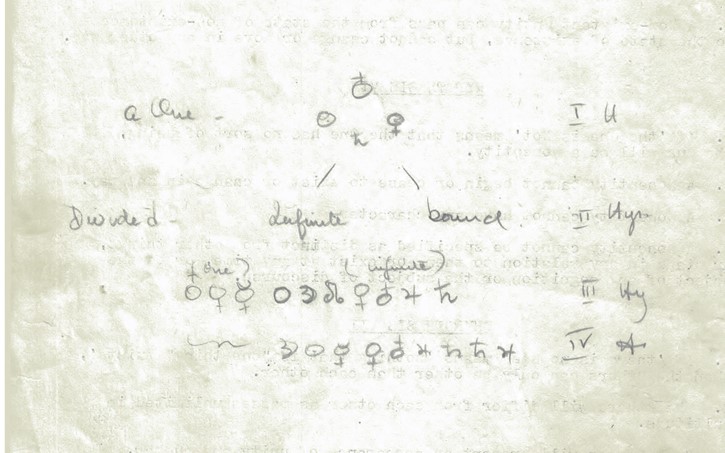
FIGURE PLA Eight Hypotheses of Plato B-p.4.PDF. Facsimile scan of Anthony Damiani hand-drawn diagram (originally on back of copy of Cornford Eight Hypotheses): Hypotheses I-IV, with 1st Quadrant Dignities (Hyp. I-III) and Rulerships (Hyp. IV). (appended) [Note: This diagram is also appended to WG Parmenides Classes 1981 0102 and 1981 0109.]
AD HANDWRITING: Typewriter typed, extensive student edits
COMPLETENESS: Full Paper
PUBLISHABILITY: Yes
ALTERNATE VERSIONS: 1) PLA Parmenides and the Authentic Existents Alt ver. 2 P 21p.PDF, has slightly different edits than the version in AD Supplementary Material (Version 1). 2) Parmenides and the Authentic Existents paper as read in WG Classes 1983 0902b, 0909b, 0916. 3) "Omnipresence of Authentic Existents VI.4 and VI.5" as found in Astronoesis Master draft typed 1988 - V09.DOC (pp. 262-270). This is a "slightly older" alternative version of "Parmenides and Authentic Existents", which was not included in the "canonical" 1988 Astronoesis version. It was originally pp. S26-40 in EMD Soul notebook.
DATES ASSOCIATED WITH THIS PAPER: 1983 0902, 0909, 0916
RETYPED, REFORMATTED, AND PROOFREAD by IT, JF, HP 2023
NOTES:
RETYPED AD PAPER presented in class (V09MP).
About These Papers – By the Editors of Wisdom's Goldenrod
Regarding the origin and authorship of papers/essays found in the Anthony Damiani Archives.
These writings–inspired notes, papers, or essays–arose in several contexts.
Many of the essays that we find in the Anthony Damiani supplementary materials were handwritten by Anthony. They are more like notes he would write when an inspired or inspiring idea came through. Sometimes they were written in response to some questions or issues–his own or students–or a passage that Anthony was thinking about. Sometimes the notes were evoked from discussions in classes or seminars. These notes generally are one paragraph to a couple of pages long, and not revised.
Then there are longer papers–usually around 2-10 pages. Some of them started with a draft of an essay that Anthony wrote, that was then revised or edited by one of the students, and then often revised by Anthony. Some of these essays were originally shorter notes extended to, or used in, longer essays that went through revisions.
Many of the essays came out of seminars in which students discussed topics or were preparing a class presentation. Sometimes one of the students who worked closely with Anthony in seminars would write a draft essay, or write up notes from discussion of the ideas in the seminar.
These notes or essays were often revised by Anthony or someone else, and often read in a class, and then underwent more revision.
Sometimes a draft of a paper was read in a seminar or in class and then after comments and discussion Anthony would revise the essay. Some of these papers, those being prepared for inclusion in the ongoing work on the draft of the Astronoesis book, were more carefully revised and edited. Astronoesis was put into published form by his students after his passing.
There are multiple versions of this paper at different stages of revision (see Alternate Versions above). This version appears to be the latest and was selected by Anthony for inclusion in the AD Supplementary Material (Notes and Papers), pp. 1034-1053.
Included in this paper is a diagram from AD Notes and Papers, p. 1044 (which is intended to accompany Plotinus V.3.7); included here are both a facsimile scan hand-drawn by AS, and a digitally recreated version by NT.
All handwritten revisions/additions (by AS, CdA, JF, and others, in some cases per Anthony's dictation) have been incorporated. Reference numbers are provided for most of the Plotinus, Plato, and PB quotes that were unreferenced. Some references were not found.
This paper was discussed in the Sept. 1983 Parmenides Eight Hypotheses classes.
Plato's dialogue Parmenides was discussed at various times at Wisdom's Goldenrod; many of these classes have audio transcripts.
For completeness' sake, an outline of all Eight Hypotheses that was used in classes at Wisdom's Goldenrod has been appended to this paper. This translation of the Eight Hypotheses is found in Plato and Parmenides: Parmenides' Way of Truth and Plato's Parmenides by F.M. Cornford. AD made some handwritten edits and these are noted accordingly. On the back of one copy of these typed-out Eight Hypotheses (Scan File PLA EIGHT HYPOTHESIS OF PLATO B 4p.PDF), Anthony drew a diagram with levels of Hypotheses I-IV. This is also appended. Also note that one widely circulated photocopy of these Eight Hypotheses had "Brumbaugh" handwritten on it – this was a student note referencing the Eight Hypotheses version from Brumbaugh's Plato on the One that was read in the Sept. 1983 Eight Hypotheses classes.
Parmenides AND THE AUTHENTIC EXISTENTS
[File AD SUPP 1016-1035 ASN Originals.PDF Begins (pp. 1034-1035)]
In the presentation of the omnipresence of our Soul or Mind as Authentic Existent [Note: Part of the word 'Existent' is cut off in scan but alternate scan has Existent. However, read as 'Existence' in September 1983 Parmenides classes.] in Plotinus we find one of the finest examples of the application of the eight hypotheses and the theory or logic of Unity. The eight hypotheses of the Parmenides are pure metaphysics. They give a careful summary of the factuality of the indivisible and the multiple in any Authentic Existent in such a way that oneness isn't cancelled out by multiplicity. In order to fully appreciate this we have to consistently keep to our interpretation of the tractates in VI.4 and VI.5 as pertaining to our Mind as an Authentic self or One, and its relation to the Cosmic Thought or W[orld] Idea.
How can a unific essence be brought into accord with a multiplicity of reason principles? The empirical mind's attempts to come to grips with this problem through the logic of sense appearance leaves us with the same unresolved paradoxes as in the Parmenides. When we attempt to penetrate beyond the appearances for our explanation, and to find the true relation of the multiplicity of the Reason Principles to the intact identity of the mind essence itself, and to understand the simultaneous presence of mind entire, we are forced to use the dialectic of unity.
As Plotinus points out early in VI.5: "In every entity the essential nature is the governing principle and, as we are told, a sound definition brings to light many even of the concomitants: where the essential nature is the entire being, we must be all the more careful to keep to that, to look to that, to refer all to that." (VI.5.2)
The proper reasoning is a [handwritten note: more of Q [quote]--top of page] ". . . reasoning, surely, founded on the thing itself and its essential nature . . ." [VI.5.3] Thus omnipresence becomes a law internal to every level of mind, and the unity of mind or soul subsists entire, participated by all. Participation will be seen to be the obverse side of omnipresence. The presence of the one life principle grants life and unity to all the facets of the World Idea, and conversely the intrinsic nature of this Idea defines or characterizes the infinite power of Soul.
The first two hypotheses are critical in setting the context for all eight. [File AD SUPP 1016-1035 ASN Originals.PDF Ends (pp. 1034-1035); File AD SUPP 1036-1055 ASN Originals.PDF Begins (pp. 1036-1053)] We are attempting to apply the 8 Hypotheses to the essence of our Mind, I AM, which will involve us in a discussion of the World Idea, and an understanding of their relation as well.
In the first hypothesis we refer to the unific, void-essence of the I AM, an infinite Life-Intelligence-Awareness. The Unity of the I AM, in other words, without any determination or multiplicity is simply the one essence of Soul, which is an Authentic Existent. More simply, the first Hypothesis says "Mind is."
To be an authentic existence means to be a one--self-sufficient, intact, with no additions or qualifications, never becoming anything else. This first principle, that the I AM is fundamentally indivisible will stand through all the further discussion. You cannot break Life or Mind into parts, nor can you be aware of awareness having any distinctions. It is purely itself, inaccessible to discursive reasoning or any duality, and any attribution to it moves outside it.
In the tractates, Plotinus tells us: "If this principle is the Authentic Existent and holds unchanging identity, does not go forth from itself, is untouched by any process of becoming . . . always self-gathered, never in separation . . .
"There is a unity, numerically identical, undistributed, an unbroken entire . . ." [VI.5.3]
". . . that unity remains true to itself, remains itself, and so long as it remains itself cannot fail within its own scope . . ." [VI.4.8]
Inward-Turned, Pure Soul or Mind is contemplating itself and is the quiescent reality it knows, a knowing by being or Insight. In this void state, there is no manifested content; no definition or divisibility, no characteristics, manyness, and so on, can be attributed to this unific unmanifestable nature. Here the mind is Non-Dual, Turiya Consciousness, which is no-state. Our mind, as an Authentic Existent, participates directly in the Absolute Soul. In knowing itself, Mind is aware of the presence of its Prior -- Nous -- as well, for there is nothing to separate the I AM from its Priors. The Void essence of Soul and the Void Nature of the Intellectual Presence are inseparable, because the Soul is an intellectual Essence.
The first hypothesis speaks of this pure awareness of Soul in its authentic primal Nature. This state is described in IV.4.2 and VI.7.34.
While the later hypotheses allow for the multiplicity, this first still leaves the essence of Soul intact. We conclude that the omnipresence of the I AM to the cosmos, to space, time, division, partiality, does not make the soul temporal, spatial, of magnitude or have any of the other attributes which it supports.
In the second hypothesis we have moved from the position of the pure essence of Soul, to see that the I AM is, or has ideas. The I AM is a welding of two distinct aspects of Unity and Being -- Soul and its ideas. The unity of soul's essence -- which is Life and Intelligence -- is conjoined with the World Idea or emanation of the Nous, which is the "Being", and we are investigating the contribution that each makes to the other in forming the I AM. In this second postulate the pure essence of the I AM is given being by its participation in the Ideas. The Overself is conjoined to the Universal Reason Principle, which is perpetually emanated from the Nous, and elaborates it as the world thought. This outpouring of the inexhaustibly infinite essence of Divine Mind is the determining factor of Individual Soul when that Soul joins its manifesting power to that pulsating aura of the Intelligible. Soul is matter to the Intellectual Principle. The Soul and its defining idea make a whole, a one-being, of which the unity or oneness is the Soul, and the being is the reason-form. Thus the soul is a One and an All. ". . . Soul which, taken as one all, is Aphrodite, while in it may be distinguished the Reason-Principles . . . produced by the downflow of the Nectar of the over realm." [III.5.10] The downflow of Nectar is the aura of the Divine Ideas, present now in Soul as a multiple Reason Form. While Soul is a pure essence in Contemplation, it has a nature which seeks also to grasp its intellective nature in a determinate manner, and as a result is manifesting the World Idea within itself.
"A single Existent, it makes itself many by what we may call its motion: it is one entire, but by its striving, so to speak, to contemplate itself, it is a plurality . . . its purpose is the Act of the Intellect . . ." [VI.2.6]
[asterisk in margin] In the second hypothesis we are stressing the infinite power of the Soul, conjoined to Idea and manifesting it. The first, to Soul's still ground which is con-substantial with Nous.
Thus the I AM possess[es] the multiple reason principles as "unrolled and separate" [I.1.8] in the form of what is termed the inerratic sphere, which are wedded to and form a whole with the Soul's power or Life essence that is manifesting them. We are now viewing the I AM in its second aspect -- as a one-being or Human Soul, a unique version of the World Idea conjoined with the Life-Power actively involved in manifestation. The Soul's (Mind's) own power of manifestness (thinks) translates the unmanifest Pure Thought into the manifest World Idea, and the latter participates in that Soul essence. Plato expresses this as "the One (Soul) gives unity to the being which is one." [Note: Quote as on AD Supp p. 1041. Reference not found, most likely a paraphrase of Hypotheses II.] In turn, the indeterminate life power of Soul is given a determined existence through its participation in the reason form of the Cosmos, so Plato says that "Being (Ideas) gives existence to the One which has being." [Note: Quote as on AD Supp p. 1041. Reference not found, most likely a paraphrase of Hypotheses II.]
Based on this fundamental distinction of soul and Ideal [Forms, the] [cut off of scan] second hypothesis reveals many contrary characteristics [which] [cut off of scan] are attributable to the I AM but do not contradict it. The multiple nature of the World Idea modalizes the indefinite nature of the Soul essence, its many powers that will be needed to comprehend this Idea, which would remain inactive without it. The consciousness of the I AM ranging through all the levels of Reason principles which comprise the World Idea is the second knower. We must accept that the soul is of such a nature -- both indivisible and divisible, that its unific nature is also a power receptive to the multiple reason principle. The multiple qualities of the World Idea help to define the unity of the I AM, but they do not make that unity. In the 2nd hypothesis, then, the soul and idea are welded in a whole of parts, without destroying the indivisible aseity of the soul. [Note: Earlier draft, PLA Parmenides and the Authentic Existents Alt ver. 2 P 21p.PDF, p. 8, has the following sentence added: "The Soul is now an infinite multiplicity of lives, reason principles and so on."] In the wholeness we find an intrinsic multiplicity, which will be examined later as the others, but in the 1st 2 hypotheses we are content with juxtaposing the I AM as a defined whole wedded to its guiding Idea, and the I AM as a pure essence which bears only the description of Infinite Life-Mind-Consciousness.
We may aid our understanding of the 2 critical hypotheses by using analogies from the prior principles. The Double Act of the One can be a model for the double nature of the I AM. In the first hypothesis Mind is stillness, for in Soul's inward contemplation, power is inseparable from its unmanifestable essence. In the second, the same power is active in manifesting the World Idea within the Soul. In this activity, the divisible nature is distinguished from the indivisible, while in the prior state of contemplation they are indistinguishable as the unified essence of Soul.
In another place (VI.7.17), Plotinus describes the principles life as at first purely indeterminate, looking or contemplating, and is determined by its object of contemplation into the multiplicity of the Intellectual Principle. Analogously, Soul's pure awareness is beyond any distinctions, remaining as an indeterminate seeing into its own essence. Accompanying this contemplation is the determination of Soul by the reason forms flowing within it from its prior. The determination is of Soul but occurs in virtue of its contemplation of and attempt to grasp its prior.
There are some beautiful statements on the double aspect of Mind in the Ideas of PB which could be transposed to focus on the nature of the I AM.
". . . Mind alone knows all things and itself. When it knows them in time, it is World-Mind; when it knows itself alone, it is the unknown to man and unknowable Godhead." (PB Notebooks, V16, 28:1.45 and Perspectives, Chapter 28: The Alone, #18)
"It would, however, be a mistake to consider the World-Mind as one entity and Mind as another separate from it. It would be truer to consider World-Mind as the active function of Mind. Mind cannot be separated from its powers. The two are one. In its quiescent state it is simply Mind. In its active state it is World-Mind. Mind in its inmost transcendent nature is the inscrutable mystery of Mysteries but when expressing itself in act and immanent in the universe, it is the World-Mind. We may find in the attributes of the manifested God -- that is, the World-Mind -- the only indications of the quality, existence, and character of the unmanifest Godhead that it is possible for man to comprehend. All this is a mystery which is and perhaps forever will remain an incomprehensible paradox." (PB Notebooks, V16, 27:3.65 and Perspectives, Chapter 27: World-Mind, #16)
Here we can take Mind as analogically the Pure I AM in its unific intellective essence, and World Mind as the I AM in its cosmic manifesting activity bound up with the World Idea.
In V.3.7 is also a brief summary of the Double Act, or Repose and Act of our Soul, which we can interpret with a picture.
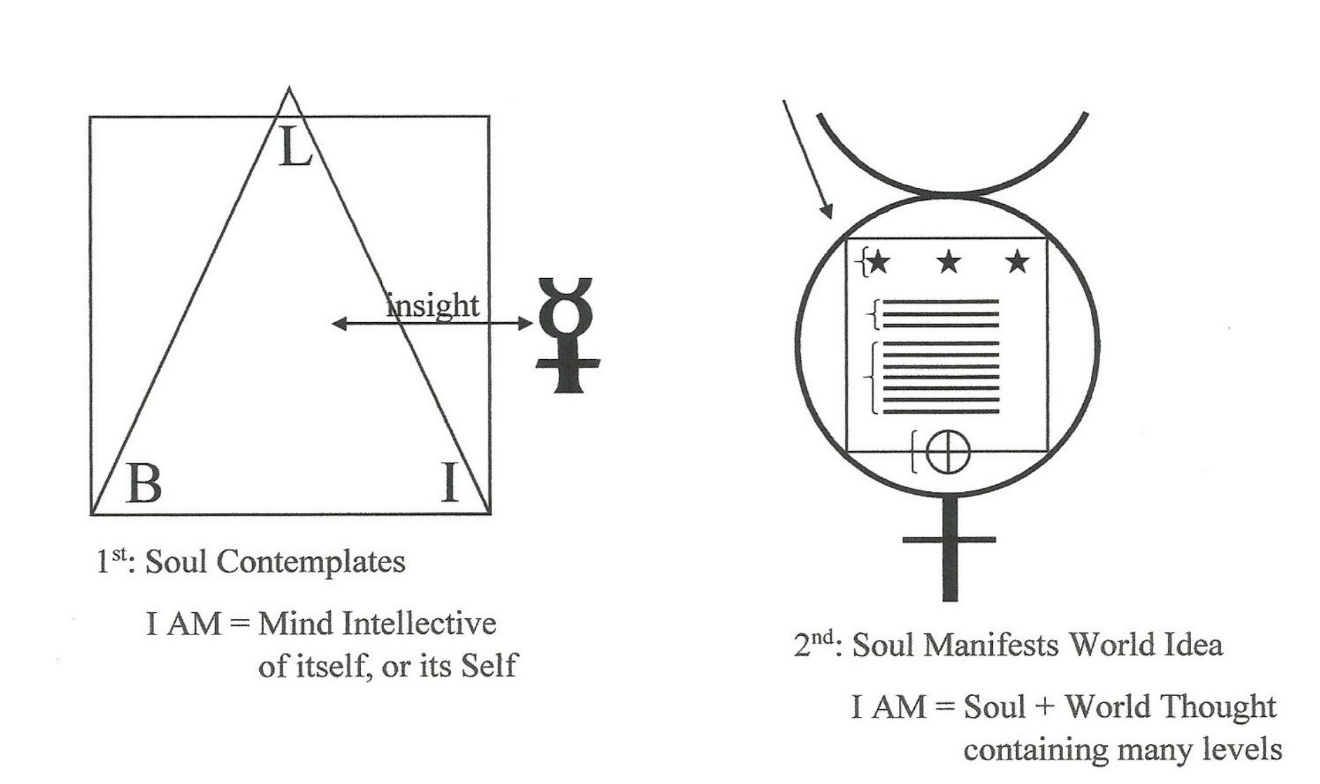
FIGURE AD SUPP 1036-1055 ASN Originals-p.1044.PDF. 1st and 2nd Soul (digital recreation by NT of AS hand-drawn diagram). The right side is the first Soul, Soul in the IP; the left side is the second Soul as the Mercury Pisces Nature, manifests the World-Idea.
We emphasize that the 1st remains intact even when we posit Soul's activity in conjunction with the World Idea -- IV.1.1: "Thus it is that, entering this realm, it possesses still the vision inherent to that superior phase in virtue of which it unchangingly maintains its integral nature." The Authentic Existent remains intact even when the Cosmos appears side by side with it. This leads to the postulate of 2A -- the instantaneous transition.
Intervening between the 2nd and 3rd we find a short but important postulate. This principle allows us to sometimes declare that both of two contrary predicates apply to the I AM, and sometimes neither apply. There is a paradoxical shift based on the two simultaneous ways in which the I AM must be viewed. The only change possible for the authentically existent Soul is between the states of stillness or unmanifestable eternal contemplation, and the activity of Reason, receiving and manifesting a cosmos through time. This transition from unmanifest essence to manifesting activity is not itself in time but is instantaneous. When the World Idea comes into Soul, Soul becomes unlike itself. When the World Idea is expelled, it becomes like itself again. At Rest one instant it is itself, the next instant it goes from a one to many by manifesting the multiple World Idea. The Ideas come in and go out of Mind instantaneously, and as they do so the mind is said to both have, and not have, a determination by the ideas.
(Coomaraswamy -- Discussion of Time and Eternity) [Note: See Ananda K. Coomaraswamy, Time and Eternity.]
This non-dual nature is the basis for the distinction of the two knowers. I.4.10: "Side by side with Intellection is its image." [Note: Plotinus, I.4.10, paraphrase of end of third paragraph. "Then, side by side with the primal knowledge of the activity of the Rational and the Intellectual-Principles, we have also as it were a sense-perception of their operation."] By stationing himself in the now, in the double nature of the I AM principle, the Philosopher can hold simultaneously the view of the temporal, and the atemporal, and there is the possibility of simultaneity of knowledge at all levels -- from intuitive [to] rational cogitation and sensible perception.
Hypotheses 3 and 4 treat in further detail what will be true of the others -- the various reason principles that are parts of the Universal Reason Principle being manifested in Soul if the Soul is a unity. Since these are other than the Soul essence, they are not the unity of Soul, but they are "not wholly destitute of the unity", [Note: Cornford, Plato and Parmenides, p. 206, 157c.] they partake of it in a way. The World Idea partakes in the life intelligence of Soul entire. Each of the many reason principles that comprise the World Idea are participants in the Soul essence entire, and each is itself a wholeness. In the tractate we read that: the Authentic is ". . . similarly entire in each several entity . . ." [VI.4.12] ". . . its nature must be such that it can appear as a whole at every point . . ." [VI.5.9] From the omnipresent I AM each reason principle will participate [in] all the properties which were attributed to the whole of the I AM. Each will have a multiplicity of expression, and also be a whole. We can now conceive of 360° of existence, each a reason principle considered as a living whole in its own right. Each reason principle in the inerratic represents a unique Idea, which will be a defined and limited Form, and also express the unlimited and infinite power of Soul manifested in the I AM. Any Solar System is such a multiple-Unity, (and any particular life lives by Soul entire). Each being included in the All is a whole -- a union of life and thought, and in this sense is part of the world idea while deriving also its unity from Soul.
The I AM as a whole is the dominant principle, the source of the unity of the whole. The many beings or reason principles are not of themselves separate identifiable units, but become so through the participation in the omnipresent unity of the Soul. The "others" than One are parts of the World Idea or Cosmos. They participate in the one as entire -- all the contraries which the whole or all has, they have too.
The dialogue sums this up as follows: (whole quote! p. 949 Hamilton) [Note: The note in parentheses is handwritten.] "As having unity, it [each part] will plainly be other than unity; otherwise it would not have unity, but simply be unity itself . . . But both the whole and the part must have unity. . ." [Hamilton, Cairns (eds.), Collected Dialogues of Plato, Parmenides, 158a, p. 949]
We can use several analogies to help us see how the unity of Soul is what is participated by the many parts of the World Idea. In a dream example, each character is a fully developed character with distinct characteristics, but behind each is the whole of your mind. This can be carried over to waking perception as well. The Soul or mind is all that you know -- each item of perception is unified because it is known to my mind. What I know as true is based on the way my mind provides a unified perception of it.
The natal chart is also a good example, in which each of the organized categories, aspects, and complexes must be based on the unity of the Native, whereupon their defining peculiar character can then have a meaning in the context of the whole of the chart. Each item is not the unity of the Native's Soul, but participates in that unity.
On the other side, Plato makes clear in Hypothesis 4, that although these others or reason principles are participants in Soul, they are not Soul. The others are other than the essence of Soul, and there is no third thing in which they can reside. Soul must, as an unchangeable essence, remain distinct from the multiplicity of forms, and cannot enter -- either entire or as a part -- into any of its manifestations, nor does it become those contents, nor is it subjugated to them.
We can compare the passages in VI.5.3 and in Hypothesis 4 to see the amazing similarity of ideas:
"There is a unity, numerically identical, undistributed, an unbroken entire, which yet stands remote from nothing that exists by its side; but it does not, for that, need to pour itself forth: it is not necessary either that certain portions of it enter into things, or again that, while it remains wholly self-abiding, something produced and projected from it enter at various points into that other order."
And, in Plato: "We cannot admit that what is really and truly one has parts. Therefore the one cannot be in the others as a whole, nor can parts of it be so, if it is separate from the others and also has no parts." [Hamilton, Cairns (eds.), Collected Dialogues of Plato, Parmenides, 159c, p. 950]
There can only be one one in our consideration of a Unit Soul -- there are no true ones within it other than the oneness which is the Soul essence. The parts of the World Idea are in themselves not unities, and cannot appropriate Soul. Therefore, they cannot in themselves have any of the properties of the Authentic or be in any way. If a part cannot be a One, is not unified, it cannot be at all. As Plotinus succinctly points out: "It is not that the Soul is absorbed by the multiplicity, but the multiplicity is absorbed by Soul." [Note: Plotinus, VI.5.6, paraphrase of last paragraph. "This does not mean that Man Absolute, or any Absolute, or the Universe in the sense of a Whole, is absorbed by multiplicity; on the contrary, the multiplicity is absorbed by the Absolute, or rather is bound up with it."] ". . . if its fixed seat were shaken, all the rest would fall with the fall of their foundation and stay . . ." (VI.5.9) There would be no multiplicity of others if there were no mind or Unit Soul -- Awareness as their substratum. Were the universe to vanish, it would be of no concern to Soul.
In brief, because the Mind is omnipresent, the Ideas which define it can participate in this essence. But because the Soul never becomes other, or separates itself, the others or ideal forms never are or become separate self-subsistent principles apart from their grounding in the Authentic I AM, nor do they appropriate that unific essence, otherwise Soul cannot be intuitive, rational, sensible at once. Without the unity of Soul, the multiplicity of reason principles cannot be.
Next, we consider that the Soul is characterized by non-being. In hypothesis 5, it is stated -- if Soul "is not" we are still saying something definite about it. In positing that it is not in existence we are saying that the I AM, as the Principle of Manifestation, is not in manifestation, it always remains unmanifest in relation to the Cosmos or World Idea. This non-existence of the I AM is quite different from the non-existence of some "thing" -- such as a Hare's Horn. The One which is not is the true person, the unmanifestable essence, of which we are still saying something. The non-manifest principle of awareness is still immediately manifesting the existence of the World Idea. It is "known" directly as awareness, but not as object. The thoughts reveal the light of the I AM which they reflect, and which is itself never-existent.
In a complicated interplay of being and non-being Plato shows that both the unmanifest Soul and the manifest Cosmos have an interrelation to the other's mode of being. The Soul essence is not in manifestation, but positively it is the non-existent principle of manifestation. The Cosmos is not the unmanifest, but is a definite existence.
It is the non-existent principle of Soul that can manifest and allow the appearance of the existent Cosmos. Existence means to be other than essence, essence is true isness.
Because it is not existent, and never altered by the forms of existence, the principle of manifestation or I AM can pass from the state of unmanifest essence or Nous to the state of manifesting the Cosmos. Since it is non-manifest, it can be simultaneously present with the whole, without being anywhere in the Cosmos of existence. Thus "side by side stand the Authentic All and the sensible cosmos." [Plotinus, VI.4.2, paraphrase of first sentence. "Side by side exist the Authentic All and its counterpart, the visible universe.] In its relation to existence, the non-manifest Soul will be seen to have various complementary qualities.
Moreover, the presence of "non-Being within Being" [VI.4.2] seems to indicate that each soul is itself a principle of manifestness or tendence to divisional existence. The non-being in the Being of Soul is the source for the manifesting of the Cosmos -- through the tendency or desire for separation soul comes into relation with the manifest cosmos which appears within Soul. The fact of the non-existence of Soul allows the existence of the Cosmos within it to have a relative truth, without which the appearance would be naught, as he shows in Hypotheses 7 and 8.
The 6th Hypothesis continues, by interpreting the non-existence of the Soul as an absolute non-existence -- uncharacterizable by any of the complementary characteristics afforded by the Cosmos. It simply is not any kind of existent. This can mean first that the I AM, considered as apart from any of the ideas it will manifest is not any sort of definable being, is a pure void. The principle of manifestation in itself is always in a void condition; so the 6th hypothesis reduces the I AM to absolute naught. If we remove all qualitative distinctions in the I AM, i.e., any ideal Forms, we are left with an indefinable presence of Reality only, which is no longer distinguishable from the intellectual essence.
Following this, the 7th Hypothesis tells us what will be the result if the Soul essence is not, and we apply the principle of manifestation (non-existence) which is in the Soul to the plurality or others. Here it is again helpful to consider the others as the thought forms of the cosmos which the Mind has manifested within itself. Because the very nature of the mind is never itself in existence (has no being) these others cannot participate in its unity. It allows the appearance of the many levels of the cosmos within its own non-appearance, without detracting from its essence in any way. If the One does not exist, the others cannot be one, for then they will be non-existent as well. The manifested thoughts cannot even be other than the unity of Mind, but only other than each other. They are an infinitely divisible multiplicity, delivering only opinion and appearances -- . The various levels of the cosmos can appear to have all the contrary characteristics; one-many, motion and rest, and so on, and to give a semblance of the reality which only the Mind can truly have. This does allow for relative truth, but we have to remember that while the imagination does convey or portray a semblance of the nature of the Authentic, it obscures and distorts that knowledge more than reveals it. The non-existent one grants a relative unity to every thing in existence.
Finally, though, in Hypothesis 8, the appearances -- of an ego and world -- must not be left to have any true separate existence. In the last hypothesis, if the Mind is not, then nothing is, no things are. The very ground is taken away from the image if its principle is withdrawn, and there can no longer be even an appearance if there is no awareness by which it can appear. There can be consciousness or mind, standing without contents, but there cannot be contents without consciousness, is the conclusion of this postulate. The last hypothesis echoes back to the first -- the unity of the mind is the alone reality of the multiplicity, "if Soul is not, nothing is." [Note: Brumbaugh, Plato on the One, p. 186, 8.12 (166B8), paraphrase of 8th Hypothesis.]
Once again the uncanny juxtaposition of the affirmative and negative interpretations of a principle by Plato, gives us complementary statements in the 7th and 8th, which are applied by Plotinus in the analysis of Soul. Opinion takes its stand in the denial of unity, focusing on the specific differences of parts, and the separateness of many lives and thoughts. Each ego or natal chart is, in fact, uniquely different, and we thenceforth have all kinds of contradictory conjectures about reality, but based upon appearance, or more precisely, on each individual's contradictory vasanas (natal chart). From the view of the 7th Hypothesis, we can interpret Plato's words "If the One is not, the others can exhibit various qualities" [Note: Brumbaugh, Plato on the One, p. 184, 7.24 (165D5), paraphrase of 7th Hypothesis.] as "where the ego and its properties are, the Overself is not". Taking the unific life of soul to "not be" relativizes all of existence to opinion, but this is juxtaposed by the 8th hypothesis to the soul's true essence and knowledge, which is never altered. Only our imagination could conceive of a whole cosmos of thought as altogether separate from Soul, awaiting its enlivening. In the last hypothesis, we find that the Soul is the source of the very existence of the Cosmos. The entity which posits its separateness could not even do this were there not the omnipresent essence of Mind -- "it gives them existence". [Note: Exact reference not found, possibly Guthrie, V.3.15, "Because the One preserves their existence while effecting the individuality of each of them. Is it also because He gives them existence?"]
[File AD SUPP 1036-1055 ASN Originals.PDF Ends (pp. 1036-1053)]
V09MP: PAPER: Plato; Parmenides and the Authentic Existents (AD Supp, Ver. 1). Copyright 2023 Wisdom's Goldenrod p. iv