Paper
Undated paperThe Paradoxical Nature of Reality
by Anthony J. Damiani
Paper V09P
3-LETTER CODE: PLO
TOPIC: Plotinus
SUBJECT: One
SUBSUBJECTS: Number 1, Dyad, Triad, Fourfold
ORIGINAL LOCATION & FILE NAME (of PDF used for typing): PLO ONE F06 AD HAND our approach to reality.PDF
CONTENTS:
Approach to Reality predetermined by paradoxical nature; all conceptions flow from intrinsic dichotomy
The integer one as indivisible whole; equivalent to Absoluteness
Hypostatization: distinguishing aspects to translate into logic
Dual nature: qualitative and quantitative intuition
Three viewpoints of the One; all three operate simultaneously
Three perspectives: Absolute, Dyadic, Triadic views; Triad as synthesis, not new entity
Paradox: halving the One produces three viewpoints
1 × 1 = 1: Divine Mind contains double Act; 1 ÷ 1 = 1: hypostatization maintains unity
Plotinus, VI.7.40: intellection as power/Dyad 'part' of One; perfects potentiality and produces Triad; evenness of unities and super intellective Act
Plato's Philebus: God exhibiting infinite and bound
Triad components: Unity, Being, Life, Intellect
Ring approach: four intelligibles around outer ring; cardinal points (Act) vs. quadrants (Repose); function as primary in hypostatization
Two types of intellection: primary and secondary; rulerships as "copy" of the One; ring of Intellect as separating principle
Fourfold apprehension: Plato and Jung
BOOKS QUOTED FROM OR REFERENCED:
Plotinus, The Enneads (MacKenna translation, 4th ed.)
Plato, Parmenides, Philebus, Republic
Rene Guenon, The Multiple States of Being
P. V. Pistorius, Plotinus and Neoplatonism: An Introductory Study
P.W. Martin, Experiment in Depth
PLOTINUS QUOTES REFERENCED: V.1.6, V.3.11, V.4.2, VI.2.20, VI.7.40
DIAGRAMS embedded in this paper:
FIGURE PLO One F06-1. One or unity in thought: quantitative intuition & qualitative intuition.
FIGURE PLO One F06-2. One, Dyad (active and passive), and Triad.
FIGURE PLO One F06-3. The One times itself, and the One divided by itself.
AD HANDWRITING: Typewriter typed, extensive AD edits
COMPLETENESS: Full paper
PUBLISHABILITY: Yes
ALTERNATE VERSIONS: PLO One dyad N 5p.PDF; does not include the excerpt from P.W. Martin
DATE/S ASSOCIATED WITH THIS PAPER: Probably from the late 1970s
TYPED by JRS 2020; FORMATTED by JF 2021; REFORMATTED/CORRECTED/TOC by IT 2025
NOTES:
RETYPED AD PAPER (V09P).
All spelling, capitalization corrected, planetary glyphs spelled out.
Version (unedited) of this paper considered for inclusion in From the Heart 2022.
the paradoxical nature of reality
Our approach to Reality is already predetermined by its paradoxical nature. As these quotes will sufficiently demonstrate, all our conceptions ultimately flow from this intrinsic dichotomy[,] they are embedded in the very structure of thought and language. Various terms used, for instance Act and Repose, Substance and Function, Quality and Quantity, etc. So let us try to make clear to ourselves at the very outset the peculiar connotations associated with these terms. This would be revealed in our discussion of the integer.
The integer one (or the One) is an indivisible whole and when intuited our thought should separate it from its representation thereof. It is equivalent to Absoluteness. Or as Plotinus has mentioned unity is an absolute prerequisite in order for us to speak of anything. When we speak about the aspects of this 'unknown', (and a unity is unknown), we are engaged in the act of hypostatization. Distinction brings about finitude and the possibility of handling the object in our thought.
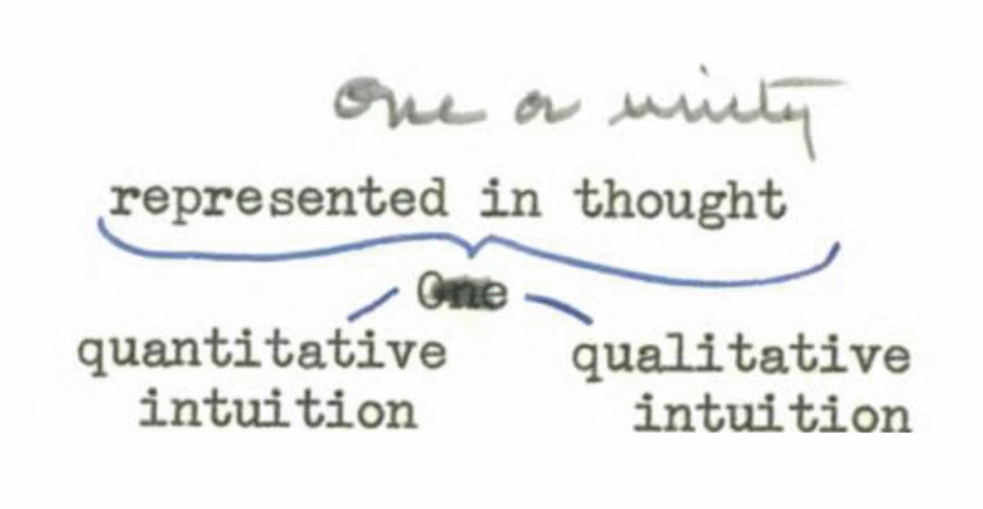
[FIGURE PLO One F06-1. One or unity in thought: quantitative intuition & qualitative intuition. Facsimile scan from PLO ONE F06 AD HAND our approach to reality.PDF with handwriting by AD.]
Only by hypostatizing its aspects can there be any translation into logic. (Later we will try to apply the 8 hypotheses of Plato.)
The Intuitive includes both the qualitative and the quantitative in our thought and will help us understand the distinction or the double Act in the divine Mind spoken of by Plotinus. (This will lead us into an atomistic point of view, an infinite regress[,] or we have slipped into our definition of the quantitative point of view the viewpoint of absoluteness.)
In our analysis of the One, in [sic] the following Plotinus quote requires these three distinctive viewpoints: a) the One as Absolute or Transcendent; b) the One as quantitative; c) the One as qualitative. And these are simultaneous. In order for us to speak of anything, unity is presupposed. But having already spoken 'of' anything, which is already a finite Act, we have grasped a qualitative aspect which has brought in the Absolute point of view at the same time. We are presupposing the continuum in which the aspect of this thing resides. [Note: This paragraph has "rewrite" in margin.]
Through the use of examples we might be able to show that an inherent confusion in our thought and language displays itself. The double Act in the divine Mind we will portray in the first house. This is equivalent to Guenon's metaphysical infinity which is active and passive perfection. All these are from the point of view of the archetype of duality. If we do not distinguish the two views in the first house from each other or from the Absolute One then we have the view of the One as Absolute prior to thought. If we maintain the view of the Dyad along with the view of the One as Absolute then we have the confrontation of the One with the Dyad, which is the view of the Triad (still contained within the first house). The Triad is a synthesis of the three views and not a new thing.
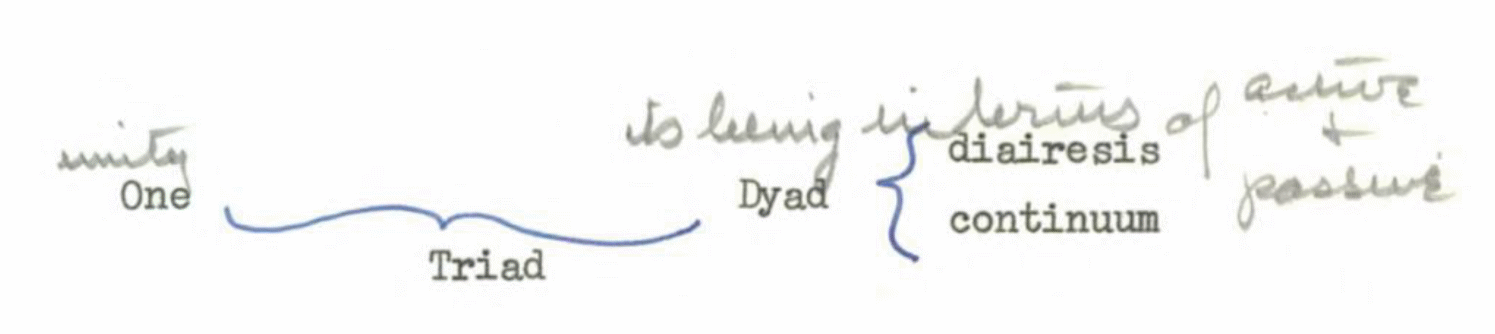
[FIGURE PLO One F06-2. One, Dyad (active and passive), and Triad. Facsimile scan from PLO ONE F06 AD HAND our approach to reality.PDF with handwriting by AD. Diairesis means division.]
Again, what is being presented (and this involves all three intuitions) is that when we halve the One this brings up not two viewpoints but three. (Conceive:) 1) Original intuition – unity which can't be conceived but accompanies or is the substratum of the finitizing process or halving. (This was the original intuition that Pistorius had glimpsed in his book on Neo-Platonism.) [Note: See P. V. Pistorius, Plotinus and Neoplatonism: An Introductory Study.]
The 1 x 1 = 1 would refer to the first house or that the divine Mind contains the double Act. Multiplication contains the three viewpoints of the One, and its double Act which when multiplied still remains the One. If we take the confrontation of the One as Absolute times the One as dyadic (the qualitative and quantitative aspects) we have the first quadrant, also a One. The 1 ÷ 1 = 1 would be the hypostatization of the Dyad as houses two and three or the first quadrant.
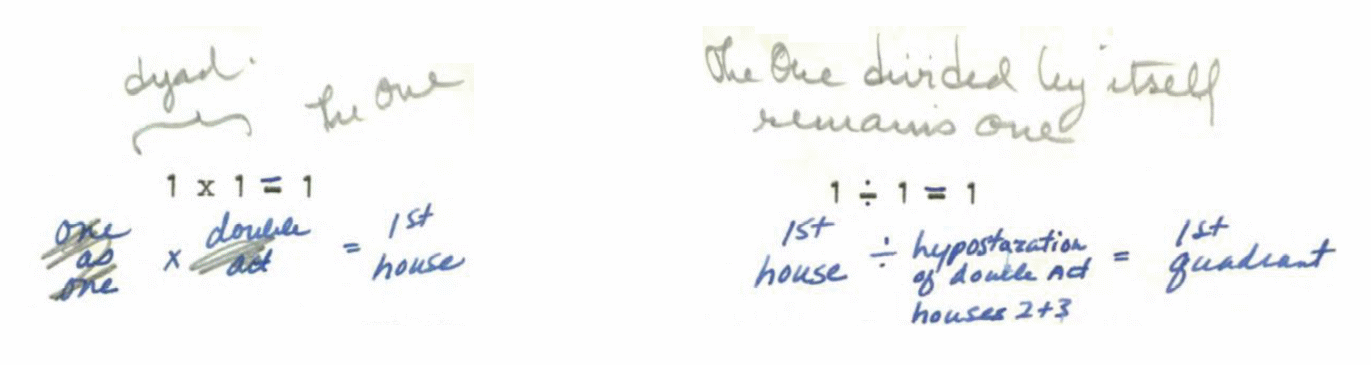
[FIGURE PLO One F06-3. The One times itself, and the One divided by itself. Facsimile scan from PLO ONE F06 AD HAND our approach to reality.PDF; handwriting by AD and possibly TS.]
In the quotation VI.7.40 the intellection referred to here is the power or the Dyad which is 'part' of the One or perfects the potentiality and produces the Triad. This Triad is not something new but the One, as we have previously shown. The Triad (which is not other than the One[;] the 1 ÷ by itself still = 1) consists of the evenness of the unities or undifferenced knowledge, super intellective Act. This can also be spoken of as the author of Being inbound with Being when we consider that in each of the unities will be included the beings suspended from them. (See also quotes V.4.2 and V.3.11.)
In V.1.6 we can see how Plotinus has solved the problem of the derivation of the many from the One. [Note: This sentence bracketed with question mark in margin.]
Here in essence is Plato's version from the Philebus where he speaks of God exhibiting the infinite and the bound.
We have the unity and its power or the Dyad. When we think of the unity as confronting this power we have a Triad. This Triad includes the unity of the One, Being, Life and Intellect.
The ring approach to what we have previously said in Plotinus would require that we put the four intelligibles or functional aspects around the outer ring of the circle. The view of the One as a duality would be the Act (cardinal points: Mars Sun Venus Saturn) and the four quadrants as Repose or Substance equivalent to the Dyad remaining in the first house. To hypostatize these two (continuum and diairesis) we have all the intelligibles around the outer ring of the circle or the One as the first quadrant. Here function would be primary. The 'issuing Act' would give the Rulerships and the Ideas conjoined together.
There is the intellection, Plotinus says, which has the One as its source and substratum. But there is the second intellection which we referred to previously as the Triad. From the Triad, the infinity of active and passive Repose, is the principle referred to as the author of Being. The Rulerships suspended from the Triad are the Intellectual Principle. The being of the Rulerships is a 'copy' of the One. This is almost literally true. The ring of the Rulerships establishes the Intellectual Principle as a whole as the secondary or issuing Act of the Triad. This is the 'Intellect as a whole' in VI.2.20. The ring of the Intellect represents the separating intellect, or that which separates or distinguishes these beings. The particulars exist potentially in the ring of Rulerships but through the exaltations the whole of being can be grasped in a particular form.
Experiment in Depth, by P.W. Martin, p. 21
Plato, in his Republic, long ago observed this fourfold character of our means of apprehension. His various translators experienced considerable difficulty in selecting equivalents for the terms he used. The Spens translation refers to 'four faculties in the soul . . . intelligence . . . demonstration . . . opinion . . . and imagination.' Davies and Vaughan speak of 'four mental states . . . pure reason . . . understanding . . . belief . . . and conjecture.' Jowett has yet another version: 'reason . . . understanding . . . faith for conviction . . . and perception of shadows.'
Jung, coming independently upon the same fourfold division some twenty-three centuries later gave them specific names. The capacity for seeing how things fit together logically ("intelligence," reason, pure reason according to Plato's translators) Jung called the thinking function. The direct perception of phenomena by means of the senses (demonstration and understanding in the Platonic categories) he called the sensation function. The ability to make accurate and coherent value judgments, he termed the feeling function: a not altogether happy choice, but preferable to the 'opinion', 'belief', 'faith for conviction' which was the best that could be drawn from Plato. The capacity for seeing beyond the facts, sensing the intangibles in a situation ('imagination', 'conjecture', and Jowett's inspired 'perception of shadows') he called the intuitive function.
V09P: PAPER: Plotinus; One. Copyright 2025 Wisdom's Goldenrod p. iii