DIAGRAM FOR 1971 0405
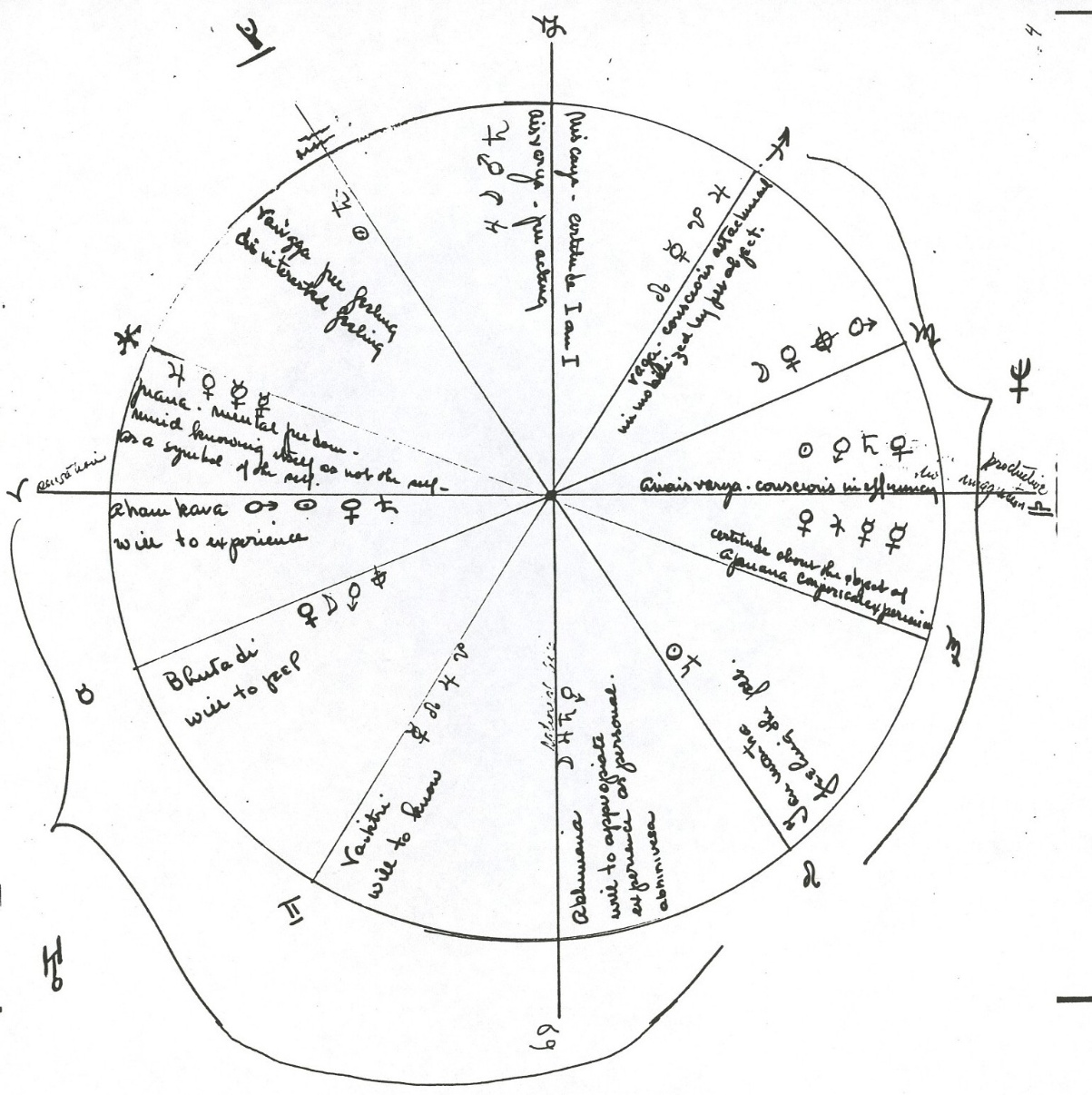
Class
Monday, April 5th, 1971
Verbatim, unedited transcriptCLASS at American Brahman Bookstore, Ithaca, NY
with Anthony Damiani (AD)
April 5, 1971
MYTHOLOGY; MYSTICISM
TOPIC: Mythology
SUBJECT: Mysticism
SUBSUBJECTS: Philosophic View of Mysticism, Ego, Astrology
CONTENTS:
Anna Prim's mystical experience (getting into the fourth house)
Alan Watts quote: we're hypnotized by ego and only way out is through intensifying consciousness and reflection
Reading Eliade on mystical death/rebirth and the role of initiation in traditional societies
In philosophy, you have to relieve yourself of myth-thinking, conscious and subconscious
The highest philosophy expressed in paradox (Zen story)
Dream of a student is discussed; two interpretations, one to the point, the other mythological
Christianity as myth
Example of myth-thinking by an advanced student of mysticism in ancient China (Eliade quote)
Student discussion of what is meant by myth/mythology
Imagining pure experience with no thought processes
Quote from D.T. Suzuki, The Field of Zen, on haiku, satori; haiku tries to reunite subject and object and bring you to instant where experience is a totality; no mythology there; where does mythology come from?
If you have an experience which transcends the ideological contents of your mind, how will you understand it?
If the ego is fully developed and an experience like this comes to you, you will stay there permanently; what does it mean for the ego to be fully developed?
Quote from Eliade on J.H.M. Whiteman's mystical experience of the Archetypal Light
The vastness of our mythology
Plotting the ego on the astrological wheel: biological ego (houses 1-4, ruled by Uranus); socialized ego (houses 5-8, ruled by Neptune); thinking/reflection (houses 9-12, ruled by Pluto); Pythagorean tetrachord
1-4 = individual; 5-8 = World-Mind; 9-12 = manifestation and where our greatest freedom lies
Source of myth traced back to structure of ego, but ego is whole chart, therefore ego is of vast importance
Where in the chart do myths arise from?
Myths are in the chart and get activated by transits
Anna's chart/transits: radical alteration of biological individual had to happen before birth of divine child could take place (in fourth house) and be meaningful
Can chart be used for guidance?
BOOKS READ FROM OR REFERENCED:
Alan Watts, Myth and Ritual in Christianity
Mircea Eliade, Myths, Dreams and Mysteries: The Encounter Between Contemporary Faiths and Archaic Realities
Mircea Eliade, The Quest: History and Meaning in Religion
Mircea Eliade, The Two and the One
J.H.M. Whiteman, The Mystical Life
Paul Brunton, The Hidden Teaching Beyond Yoga
Paul Brunton, A Search in Secret India
Paul Brunton, The Wisdom of the Overself
D.T. Suzuki, The Field of Zen
DIAGRAM appended to this transcript:
- FIGURE AD_G_013. Four Psychological Functions, Samkhya Terms, and Uranus Neptune Pluto mapped onto Twelvefold Chart.
This diagram, though not from this class, serves as a stand-in to help follow along. Other diagrams referred to are not with this transcript version. [Transcriber note: [diagram] means the speaker is referencing a diagram as he or she is speaking.]
NOTE: For readability's sake, the following substitutions/edits made in Verbatim Transcript: cuz = because; gotta = got to; yeah = yes.
TRANSCRIBED Verbatim by IT prior to 2017, reformatted by jf 2017. In 2023, IT updates prefatory matter, footer, and audio file name, alters Topic, Subject, and Subsubjects to make more accurate, completes Book List, fixes errors/typos, adds new note within transcript, adds one diagram and reference within transcript to this diagram, reformats to accord with new conventions. Archival verbatim transcript – V12a.
AUDIO FILES: 1971 0405a, 1971 0405b. [Note: "Tape" refers to original audio cassette tapes that were later digitized into .MP3 Audio Files.]
1971 04/05 at American Brahman Bookstore
Mythology; Mysticism
[Audio File 1971 0405a Begins]
AD: --had a very interesting experience Saturday. And, she's getting down into the fourth house. Would you want to [couple words inaudible] Not too much [couple words inaudible] enough [one/two words inaudible] what was going on.
AP: It was like a-- a breakthrough, you know. I felt (a little bit) tension and then it broke open (and/in) just tremendous force, like-- like an explosion, and I was not in the body and it was-- I feel my body react so much smaller than it was then and it just--
[short pause]
AD: You don't have to go into details Anna, just quickly, you know, and then what? Then you forgot to take the phone off the hook, right?
AP: Yes, the phone line. I don't know how.
AD: And so she was forced back into her body.
AP: And-- and then I was very tired, I think. It took a long time like to leave the room, many hours.
AD: It didn't feel like that. What did it feel like? Can you say anything about that?
AP: Afterwards? Like different-- no, yes, currents flow-- flow through. Electric currents.
AD: Electric currents? They're not electric.
S: Hm.
AP: No, but like-- more like charged currents.
AD: That was Saturday, right? You got a-- you got a '71 ephemeris? Anyone?
S (simultaneously): '71 ephemeris?
AD: Around, no?
S (very faint): [few words inaudible]
AD (simultaneously, very faint): The ephemeris(./?)
[tape break]
AD: --appreciate that I made her a sacrificial lamb right now, I'll never do this again. I'll never take anyone's experience and put-- put it on public.
[short pause followed by tape break]
S (very faint): Yes.
AP: Yes.
S: [couple words inaudible]
AD: About 8 o'clock in the evening? [student assents, possibly AP] [tape muffled, couple inaudible student words] Everything's rough.
[tape break]
S (very faint, possibly part of background): I already saw.
AD: Progressed Moon to (Aquarius/Aquarian), progress--
LS: But that's a rounded degree, right? [student assents] These degrees are rounded off to a-- to the next [student assents] highest degree, right? So that's a degree away already.
[short pause followed by tape break]
AD: You think it was Uranus Sun opposition.
S: Yes. But I think it's come to more than that. But I do think that that's the big transit.
LS: The other thing was this-- this transiting Venus. Now these are hardly moving, alright, and this Venus comes on a--
[tape break]
AD: No. As soon as we come across something like this--
S (very faint): (Acknowledge it.)
[10½ second pause with very faint background student talking]
[tape break]
AD: Well, let's get to the mythology and start talking a little bit. You took a vow to keep quiet today?
S: Yes. (bit of laughter)
AD: I suspect ulterior motives but-- (bit of laughter, student words) Let's start off by this thing that grabbed my attention.
[Transcriber note: I am using Myth and Ritual in Christianity by Alan Watts, New York, Grove Press, Inc., First Evergreen Edition, 1960.]
Alan Watts [Myth and Ritual in Christianity, p. 164, AD reading]: "To put it in another way, the mind does not become free from the illusion of ego by the way of unconsciousness--by any attempted reversion to"nature", or to primitive innocence, and still less by any kind of forgetful inebriation in ecstatic sensations, whether induced by drugs or self-hypnosis. The ego is dissolved only through the way of consciousness, through becoming so conscious of what "I" is that it has no more power to enthrall."
AD: When I read this, I had to give him some credit. This is Alan Watts. That genius came out and just put in a paragraph, you know, roughly what the basic technique I try to operate with. And so today we're going to have some difficulties trying to see, but if we can understand this here, ok, try to understand this little paragraph and you'll see my-- my basic approach to these problems. A long time ago I came to the conclusion, through very painful experience, that we're all hypnotized and fascinated, enchanted, enthralled by our ego. You know like a snake when it grabs its prey and just keeps looking at it and after that the poor bird can't move and we're pretty much in that situation. I realize that the power of the ego is-- is really so utterly inconceivable, it's ramifications are so vast that the only way we could really get-- get some freedom from it, and that is from our compulsive attitudes, our compulsive behavior, is to try to turn the light of consciousness upon it, you know, intensify this light, try to understand why we have these compulsive attitudes through an analysis which can be intensified considerably, you know, you have any success in meditation. Now once a person succeeds and starts achieving some concentration and carries this analysis on constantly, he begins to understand something of what's motivating him and it's not done blindly.
S: Oh.
[19 second pause]
AD: At any rate, do you remember where we left off last week?
S: Two weeks ago you mean.
AD: Two weeks ago.
S: [one/two words inaudible]
AD: Ah, the precision is uncanny.
S (simultaneously): Richard was-- was arguing with reason (bit of laughter) [couple/few words inaudible]
AD: Yes, well you--
S: (Personally) got involved in--
AD (simultaneously): Well, yes, Richard was arguing about that.
S: [few words inaudible]
S (faint): [one/two words inaudible]
[14 second pause followed by tape break]
AD: This is still in relation to the chart. We're going to forget the chart for a few minutes.
[Transcriber note: I am using Myths, Dreams and Mysteries: The Encounter Between Contemporary Faiths and Archaic Realities by Mircea Eliade, New York, Harper & Row, 1967.]
Mircea Eliade [Myths, Dreams and Mysteries: The Encounter Between Contemporary Faiths and Archaic Realities, p. 80, LR reading]: "In studying the symptomatology of the"divine election" we are struck by the pattern of all these pathological experiences; their structure is always the same, and the symbolism is always that of initiation. Too much has been made of the psycho-pathological character of the first symptoms of being "chosen": we are presented, in effect, with a total crisis, very often leading to disintegration of the personality. The "psychic chaos" has its value, within the horizon of archaic spirituality, as a replica of the "pre-cosmogonic chaos", the amorphous and indescribable state which precedes all cosmogony. But we know that, for the archaic and traditional cultures, the symbolic return to chaos is indispensable to any new Creation, upon whatever plane of manifestation it may be: every new sowing and every new reaping is preceded by a collective orgy which symbolizes the re-integration of the "pre-cosmogonic…""
LR: Is that the way you say it?
AD: Cosmogonic, yes.
Mircea Eliade [Myths, Dreams and Mysteries: The Encounter Between Contemporary Faiths and Archaic Realities, pp. 80-81, LR reading]: "…chaos"; every New Year brings with it a number of ceremonies which signify the repetition of the primordial chaos and of the cosmogony. The "return to chaos" is, for a man of the archaic culture, equivalent to the preparation for [LR reads: of] a new "Creation". Now, the same symbolism is discernible in the "madness" of the future shamans, in their "psychic chaos"; it is a sign that the profane man is on the way to dissolution, and that a new personality is about to be born. All the tortures, trances or initiatory rites that accompany and prolong this "return to chaos" represent, as we have seen, stages in a mystical death and resurrection--in the last analysis, the birth of a new personality."
LR: Is that all you want?
AD: Yes, that's alright.
[22 second pause followed by tape break]
AD: --takes from this-- some selections from another book of his.
[Transcriber note: I am using The Quest: History and Meaning in Religion by Mircea Eliade, Chicago, University of Chicago Press, 1969.]
Mircea Eliade [The Quest: History and Meaning in Religion, p. 112, AD reading]: "The term initiation in the most general sense denotes a body of rites and oral teachings whose purpose is to produce a radical modification of the religious and social status of the person to be initiated. In philosophical terms, initiation is equivalent to [AD emphasizes rest of sentence] an ontological mutation of the existential condition."
AD: And-- (some laughter) Alright, they're-- those words are really not so big. Let's repeat them.
Mircea Eliade [The Quest: History and Meaning in Religion, p. 112, AD reading]: "…[AD reads: it produces] a radical modification of the religious and social status of the person to be initiated. …[AD: and this] is equivalent to an ontological mutation of the existential condition."
AD: "Ontological mutation of the existential condition." C'mon, who wants to explain it?
S (very faint): I'm scared. (laughter)
AD: I told you you had an ulterior purpose. (bit more laughter)
RP: [couple words inaudible]
S (simultaneously): It's a change in his being.
AD: Well come on, come on, say it out loud, yes, don't take it--
S (simultaneously): It's a change in his being.
AD: An ontological mutation.
S: Yes.
AD: Uh-huh.
S: Of his existential--
S: Support, yes.
S: Condition.
AD: Condition.
S: Condition. It's like a change in his being which affects the way he lives.
AD: Alright, ok, that's not so big there.
S: [few words inaudible]
AD: Alright.
Mircea Eliade [The Quest: History and Meaning in Religion, p. 112, AD reading]: "The novice emerges from his ordeal a totally different being: he has become another."
AD: Don't believe that, it's not totally different. (bit of laughter)
Mircea Eliade [The Quest: History and Meaning in Religion, p. 112, AD reading]: "Generally speaking, there are three categories, or types, of initiation."
AD: If it was totally different he wouldn't work.
RP (very faint): You remember.
Mircea Eliade [The Quest: History and Meaning in Religion, p. 112, AD reading]: "The first category comprises the collective rituals whose function is to effect the transition from childhood or adolescence to adulthood, and which are obligatory for all members of a particular society."
AD: And these things you could look up in any anthropological literature and get acquainted with. And they've been known as tribal initiation, initiation into an age group, puberty rites, blah, blah, blah, ok?
Mircea Eliade [The Quest: History and Meaning in Religion, p. 113, AD reading]: "The second category includes all types of rites of entering a secret society, a Bund, or a confraternity [AD adds: of some kind or other]. These closed societies are limited [AD adds: usually] to one sex and are extremely jealous of their secrets. Most of them are male, constituting [AD reads: and they constitute] secret fraternities [(Männerbünde)], but there are also [some] female societies."
AD: Alright, let's ignore that second category. Third category of initiation--
Mircea Eliade [The Quest: History and Meaning in Religion, p. 113, AD reading]: "…the type that occurs in connection with a mystical vocation. On the level of [AD adds: the] primitive religions, the vocation would be that of [the] medicine man or shaman. A specific characteristic of this third category is the importance of personal experience. I may add that initiation in secret societies and those of a [AD reads: the] shamanic type have a good deal in common. What distinguishes them in principle is the ecstatic element, which is of the greatest importance in shamanic [AD reads: shamic] initiation. I may add too that there is a sort of common denominator among all these categories of initiation, with the result that, from a certain point of view, all initiations are much alike."
[student assents, very faint]
AD: Now we'll ignore the puberty rites because I don't think you're interested. [LS assents] And besides, most of you are just above it, alright. (some laughter) But, there's parts of it that require some consideration.
Mircea Eliade [The Quest: History and Meaning in Religion, pp. 113-115, AD reading]: "Any age-grading initiation requires a certain number of more or less dramatic tests and trials: separation from the mother, isolation in the bush under the supervision of an instructor, interdiction against eating certain vegetables and [AD reads: or] animal foods, knocking out [of] an incisor, circumcision [AD reads: circumcisions] [(followed in some cases by subincision)] scarification, etc. [sounds like AD reads: or etc, ok?] The sudden revelation of sacred objects [(bull-roarers, images of supernatural beings, etc.)] also constitutes an initiatory test. [AD adds: And] In many cases, the puberty initiation implies a ritual death followed by a"resurrection" or a "rebirth." Already among certain Australian tribes the extraction of the incisor is interpreted as the neophyte's "death," and the same significance is even more evident in the case of circumcision. The novices isolated in the bush are assimilated to ghosts: they cannot use their fingers and must take food directly with their mouths, as the dead are supposed to do. Sometimes they are painted white, a sign that they have become ghosts. The huts in which they are isolated represent the body of a monster or a water animal: the neophytes are considered to have been swallowed by the monster and they remain in its [AD reads: the] belly until they are "reborn" or "resuscitated." For the initiatory death is interpreted either as a descensus ad infernos [AD reads: a descent into hell] or as a regressus ad uterum [AD reads: regression to the uterus], and the "resurrection" is sometimes understood as a "rebirth." In a number of cases, the novices are symbolically buried, or they pretend to have forgotten their past lives, their family relations, their names, and their language, and must learn everything again. … Initiatory death signifies both the end of the "natural," acultural man, and the passage to a new mode of existence, that of a being "born to the spirit," [i.e.], one who does not live exclusively in [an] "immediate" reality. Thus the initiatory "death" and "resurrection" represents a religious process through which the initiate becomes another, patterned on the model revealed by gods or mythical ancestors. In other words, one becomes a real man to the extent that one resembles a superhuman being [AD: that is, the archetype]. [short pause] The interest of initiation for the understanding of the archaic mind centers essentially in the fact that it shows that the real man--the spiritual one--[AD emphasis] is not given, is not the result of a natural process."
AD: I hope you understand that.
S: Read the whole sentence again, would you Tony? Just--
Mircea Eliade [The Quest: History and Meaning in Religion, p. 115, AD reading]: "[Thus] the initiatory"death" and "resurrection" represents a religious process through which the initiate becomes another, patterned on the model revealed by gods or mythical ancestors. In other words, one becomes a real man to the extent that one resembles a superhuman being. The interest of initiation for the understanding of the archaic mind centers essentially in the fact that it shows that the real man--[AD adds: that is] the spiritual one--[AD emphasis] is not given, is not the result of a natural process. He is "made" by the old masters, in accordance with the models revealed by divine beings in mythical times. These old masters form the spiritual elites of archaic societies. Their main role is to transmit to the new generations the deep meaning of existence and to help them to assume the responsibility of "real men," and [hence] to participate actively in the cultural life. But because culture means, for the archaic and traditional societies, the sum of the values received from supernatural beings, the function of initiation may be thus summarized: it reveals to every new generation a world open to the transhuman, a world, one may say, that is "transcendental.""
AD: Now, part of what we're going to start doing and what we're-- we have started doing is-- and I-- I hope nobody throws stones at me. But, part of what we're doing is to demystify and try to come to an understanding of mysticism, and our standpoint is basically a philosophic standpoint. And in the philosophic standpoint there's this very painful process of gradually relieving yourself of a lot of myth-thinking, thinking in terms of myths. Like we-- like the quotation we used from Watts before where through this process of consciousness, through the glaring intensity of our conscious understanding, we dissolve the ego and gain some freedom from it. Now, the philosophic point of view, in a certain sense, the philosophic point of view that I'm interested in, is so high, alright, that it's impossible to really speak about it except in terms of paradox. And yesterday I had quote the Zen disciple who had reached illumination and went to his master and says, "Thank you, for nothing." (some laughter) Now it is that-- it is that difficult to understand our point of view, or this point of view that we're interested in. And part of the reason for going through these mythological-- some of this mythology is to show how in approaching this very high point of view, alright, we'll have to relieve ourselves of the kind of myth that is always sort of subconscious element in our thinking and permeates our thinking, comes up in our thinking, alright, and then reveals itself in sense of a type or a mode of understanding which I call mythological, because it falls back on this kind of thing. Now I'm-- don't misunderstand, I'm not condemning this, alright. Certainly I think some of you are aware when some disciples went to Ramana and they asked for initiation and he says, "What do you want me to do?" alright. Like they expected him to start going through some kind of ceremony and whispering in his ear and maybe biting off his-- part of their ear or something, you know? (bit of laughter) So we'll get back-- we'll get back and we'll try to understand some of the mythology which we find in some of these cultures and which is our inheritance, it's in us. Let's see if I could--
S: Can you give an example of a pattern of mythological thinking that patterns our-- our-- our thinking that it's not obvious?
[short pause, background student words, bit of laughter]
AD: Well, can I use you Ram for an example? (laughter, student words)
S (amidst laughter): You need Ram for that!
AD (amidst laughter): Since you-- (more laughter, student words) Somebody told Ram a dream and told me the dream. Now the same way I'm using this girl here as a sacrificial lamb, I'm using Ram as a sacrificial lamb and myself, so don't--
S: There's no lamb.
S: Uh-hm.
AD: Yes, as a sacrificial lamb, well these things that generally I do not care to speak about. But Ram heard someone say a dream and he interpret the dream as meaning the death of the ego, alright, then she told me the dream and I says, "Your intellect is emaciated and starved for understanding." You could disagree with this, I mean, you don't have to agree.
S (simultaneously): Excuse me, Tony, what was that-- was that word 'emaciated' or 'emancipated'?
S (simultaneously): Emaciated.
AD: Emaciated. (laughter) What are you, a wise guy? (laughter)
S (amidst laughter): It didn't sound like what it was.
AD: If you don't understand [S simultaneously: Yes right.] me by now, you're in trouble. (AD laughs, laughter, student words) At any rate, what Ram did I call mythological thinking. Can you see why? [short pause] Now suppose you get an image of the Christ figure which is emaciated, starving, aghast, looked as though it hasn't been fed, alright, and you interpret-- you-- you come over and you say, "Well this-- this means the death of the ego." Now I know that there-- there is no ego and it can't die, alright. (laughter, student words) But, seriously. (laughter) Seriously, ok? To me, to me, the interpretation is mythological because this can be applied absolutely indiscriminately to everyone and anyone. Alright? Everyone's ego has to die sooner or later if he expects to realize the Self, and so it's no answer to the problem. But it is a perfect specimen of a mythological kind of thinking which, so to speak, has grabbed the center of the field and operates that way. [student assents] Whereas, if the dream is actually looked upon for what it is, you'll see that it's really a revelation, there's a meaning to this dream, a particular and direct instruction what to do. [students assent] You-- you see the difference between-- between these-- these two attitudes?
LR: One's passive and one's active, for one thing.
AD: Well, one's [LR simultaneously: I mean--] passive and one's ac-- Yes but, don't-- that's not important. Don't you [LR simultaneously: Well it is because in--] see, the whole notion, the whole notion, for instance, in archaic-- in religions in all your early primitive societies, they recognize(d) the fact that in order for a man to be reborn, he must first die. This we take for granted, alright? So we say the ego must die. Now don't you see this is archaic, mythological kind of thinking, it is not an answer to the specific problem. It's a good thing you can't talk.
S: Uh-hm. (laughter)
S: Express it.
AD: This is one night I got to win! (AD laughs, laughter) Either that-- Yes--
RP: My ego's starving. (some laughter)
S: How did you come to the conclusion that it was starved intellect?
AD: Well, that's irrelevant, alright, that's irrelevant.
S (simultaneously): Oh, yes, I thought it was in-- inherent in the--
AD: That's irrelevant. You see, a lot of-- a lot of people have the notion that the Christ within us, alright, when you see an image of the Christ within us it necessarily has a religious connotation of a man on a cross. All the time they'll fall back. By the way, the-- Christianity is one of the greatest myths ever-- ever, you know, perpetuated. I'm-- I'm not evaluating it, now don't misunderstand, alright. But anyone who wants to could-- I'm reading this book now which I found extremely interesting, Myth and Ritual in Christianity by Alan Watts, and it's quite a revelation to see the in-- the mixture between Christianity and mythology and the way they evolved, you know.
S: So myths are sort of-- or mythological thinking sort of takes place when you sort of superimpose things on reality instead of like being spontaneous, is that what (it is)?
AD (simultaneously): Well let's stop there. It kind of superimposes on reality, alright, it kind of superimposes. It prevents the possibility of your understanding conforming to the reality that's there in front of you. Now this doesn't necessarily mean that all myths are bad, far from it. Consider, for instance, all the myths you had about studying these doctrines. Go back to the time before you start-- started studying seriously some of these doctrines and just look at the web of lies that you spun, you know, and you see that they were basically all mythological.
[16 second pause followed by tape break]
S (faint): Why is it--
AD: Maybe it would be worthwhile to reread it again.
[16½ second pause]
[Transcriber note: I am using The Two and The One (also published as Mephistopheles and the Androgyne) by Mircea Eliade, London: Harvill Press, 1965.]
Mircea Eliade [The Two and The One, p. 45, AD reading]: ""Those whose hearts are in a state of repose", [writes Chuang Tzu (ch. xxm)], "give forth a divine radiance, by the light of which they see themselves as they are [(the Real Self)]. And only by cultivating such repose can man attain to the constant.""
AD: Now, this is the way I would read it but this is the way the translation is by Eliade.
Mircea Eliade [The Two and The One, p. 45, AD reading]: "Turning to China, we find that there [AD adds: is] also the experience of [the] Light denotes passing beyond worldly consciousness."
AD: I know these points sound kind of insignificant but to me they're vast.
Mircea Eliade [The Two and The One, p. 45, AD reading]: ""Those whose hearts are in a state of repose," writes Chuang-Tzu [(ch. xxm)], "give forth a divine radiance, by the light of which they see themselves [AD emphasis] as they are [AD: in parenthesis] (the Real Self).""
AD: This is mythology. Alright? Go on a little more.
Mircea Eliade [The Two and The One, p. 45, AD reading]: ""And only by cultivating such repose can man attain to the constant" [(transl., Giles)]. A meeting with the Light may be spontaneous or the result of a long discipline. Under the Ming dynasty [(16th century)] a disciple took up his dwelling beside a master who had been meditating for thirty years [AD adds: or so] in a cave. [AD: He had nothing else to do.] One night, when going along a mountain path, the disciple "felt a light circulating inside his body and heard a rumbling of thunder at the top of his head". … This experience lasted "as long as it takes five pinches of incense to burn". Afterwards he felt that he had become an entirely different man and had been purified by his own Light."
AD: Notice the mythology, at a-- in a very advanced student.
Mircea Eliade [The Two and The One, p. 45, AD reading]: "The master explained to him later that he had quite frequently had this experience during his thirty years of meditation, but that he had learned to take no notice of it--he taught his pupil that even this mystic Light must be put aside."
AD: You getting a feeling, a contrast of the highest point of view that we're looking down upon mythology from?
S (very faint, possibly part of background): No [few words inaudible]
AD: No. We'll try another. (bit of laughter)
LS: It puts us in a kind of quandary though. How are we to understand where we are or what's happening to us and so forth or is that an irrelevant kind of question?
AD: Well why would that put you in a quandary though? I mean if you understood-- if you understood that certain things were happening to you and you found it necessary to explain them to yourselves in mythological terms, I think this would clarify it as long as, you know, you remember that you're-- you're using certain terms which are basically mythological. Why would you be in a quandary?
S: Is it--
S: It seems almost like anything that's said is mythological.
AD: Well, ok--anything that is said is mythological, alright, now let's see if we understand what we mean by that then, ok?
S: Sure.
S: Go ahead.
AD: Go-- you want to try? [RP simultaneously: Oh I just wanted to--] Yes, go ahead, take the floor.
RP: No, I just wanted to-- the same-- same sort of story in-- in PB in the chapter "What is God in reality." There he talks about well the highest sort of mystical trance is the absorption in the light, similar-- same-- the experience that he had in Search in Secret India, in his art-- that's the highest we can get and then he goes on a bit more and says but, you know, we have to go even beyond that to go where there's neither darkness nor light. And, I think that illustrates the point that you're saying, there's no-- if you're still in the light then that's your mythology [couple/three words inaudible]
AD: You-- Yes Dave.
DB: Well I-- I just got a thought that-- from what Jenny said it occurred to me that maybe it would be anything that was explained in terms other than itself.
S (faint): Yes Dave, yes.
[short pause]
BS: Other than itself? Or other than itself?
DB (simultaneously): Yes, I mean any experience that is understood from a-- a point of view that, you know, has been developed and is sort of outside that experience just--
LR: Language itself is a myth.
S: You mean pure Being as opposed to conceptualizing?
DB: I don't know what I mean.
S: Is there confusion here between what is expressed and what is perceived?
S (simultaneously): It seems that language is outside of experience, just to start out with.
S (faint): Language is [one/two words inaudible]
S (faint): Yes Lenny.
S: Yes.
AD: Well then, what do you mean when you say language is outside of experience?
LR: Jenny said that one. (laughter)
S: Thanks. (more laughter) Well it's like words never really communicate or describe an experience. You know, like if-- if the description were the experience then just by hearing the description you would know the experience. But that's certainly not true.
AD: Alright.
LR: Experience is gone by the time you put words to it.
S: Yes, that too.
S: Except when Richard [one/two words inaudible]
RP/S(?) (simultaneously): Well, why don't we talk about it?
S (very faint): I didn't think it would [one/two words inaudible]
LR (simultaneously): Language it seems is the closest myth we live but we can't get beyond it because we have to work through it to get anywhere. I mean it seems like a primal myth of communication. It certainly doesn't get at the real because the real is beyond language.
BS: Well, yes, but is the myth the language? You seem to imply that the myth is the language that's being used but cert-- it doesn't seem that what it's trying to express or what it is supposed to be expressing for the experiencer would be a myth.
LR: It's not what-- what is-- what it is trying to express isn't the myth.
BS: Isn't that the language?
S: It's like the [S simultaneously: Yes.] myth--
LR: It's that the words themselves create the myth [S simultaneously: Yes it's--] and can't really--
BS (simultaneously): But does it-- but does it have to create the myth?
LR: Well when we said-- when we said that it's a way of describing experience, it's not the experience that's the myth, it's the way we describe it which is language.
S: It seems that-- that there's a myth which says that you can describe an experience or that you can put words to something. That the trust in words is sort of something exact is a myth itself.
[9¾ second pause]
S: Jenny, are you talking about a belief that if something can't be put in words that [few words inaudible]
S: Say that again?
[tape break]
AD: In the Hidden Teaching we came upon this notion that the subject and the object, although we distinguished them in the analysis of knowledge, in actuality they could never be separated. Remember? We went through that, right? [students assent] And consequently, consequently, these two always arose together and they set together. If you had a subject, you had an object and you had the knowledge situation, alright? Now, let's try to imagine, let's try to imagine the possibility of pure experience, ok. Now we're just going to play with words for a little while. See if it's at all possible in your imagination to conceive of the perception of an external world, so-called external world, with no conceptualization going on at all. Alright? Try to imagine that. In other words, no thought processes occur, alright, in terms of reflex, you know, like you have the pure experience and then the reflection of that pure experience takes place and there's the arisal of this ego function, or what you call this ego function, which starts making comments about it. Alright. But in its primordial-- the primordial datum that is presented to us, alright, is this pure experience where there is no-- where action and reaction are totally equal and nothing spills over, so to speak, to form-- form an ego. Can you imagine something like that of pure experience? Like if you meditate on an object, let's say a vase, and you persistently look at it and you gradually eliminate from the mind, that is, your mind, all thinking about the vase, all reflection upon it, alright, any conceptualization, alright, can you imagine what kind of experience this would be? Yes--
DB: It wouldn't remains as a vase, would it?
AD: Why not?
S: Yes.
DB: Well--
S (faint): How do you know?
DB: I'd-- well you see, the way I've tried to approach this is that if I see an object, if I-- the only way I can name that is by relating that to other objects that are of similar qualities that I've perceived before and I can come up with-- with what it is, see. And [AD: Go on.] if there's nothing-- like if there's no reflection, if there's nothing to relate this object to, if there's none of this going on, I don't know if it would still be a blue or green vase because I wouldn't know it was green or blue or that it was a vase that one put flowers in, because that would all involve reflection based on what I had experienced previously. There would be none of that.
S: Well that would be chaos, wouldn't it?
DB: No, I don't think so. I consider the other chaos.
S (simultaneously): Well it wouldn't--
S (faint): I'm confused.
S (simultaneously): What? Well I mean, it wouldn't-- it wouldn't even be separated from its background or foreground. [S, faint: Yes.] How would you know it was different from the air around it really?
S (faint): You wouldn't see [one/two words inaudible]
DB (simultaneously): Well that would be the idea I would think.
LR: That's what she [S simultaneously: Listen--] means by chaos.
DB: Oh. (some laughter)
S (faint): Yes seriously.
AD: Alright, let's hear Suzuki's version of this.
[Transcriber note: I am using The Field of Zen: Contributions to The Middle Way, the Journal of the Buddhist Society by D.T. Suzuki, London: The Buddhist Society, 1969.]
D.T. Suzuki [The Field of Zen, p. 22, AD reading]: "In Japan there is a seventeen syllable poem called haiku, and one composed by a modern woman-poet reads in literal translation:
Oh, Morning Glory!
Bucket taken captive,
I beg for water."
S: Bucket taken what?
AD: "…taken captive, I beg for water." And this is--
D.T. Suzuki [The Field of Zen, pp. 23-24, AD reading]: "The following was the incident that led her to compose it. One early morning the poet came outdoors to draw water from the well, and saw the morning glory winding round the bamboo pole attached to the bucket. The morning glory in full bloom looks its best in the early morning after a dewy night. It is bright, refreshing, vivifying; it reflects heavenly glory not yet tarnished by things earthly. She was so struck with its untainted beauty that she remained silent for a little while; she was so absorbed in the flower that she lost her power of speech. It took a few seconds at least before she could exclaim:"Oh, Morning Glory!" Physically, the interval was a space of a second or two or perhaps more; but metaphysically, it was eternity as beauty itself is.
"Psychologically, the poet was the unconscious itself in which there was no dichotomisation of any kind. The poet was the morning glory and the morning glory was the poet. There was self-identity of flower and poet. It was only when she became conscious of herself seeing the flower that she cried:"Oh, Morning Glory!" When she said that, consciousness revived in her. But she did not like to disturb the flower, because although it is not difficult to unwind the flower from the bamboo pole she feared that to touch the flower with human hands would be the desecration of the beauty. So she went to a neighbor and asked [AD reads: begged] for water.
"When you analyse that poem you can picture to yourself how she stood before the flower, losing herself. There was then no flower, no human poet; just a"something" which was neither flower nor poet. But when she recovered her consciousness, there was the flower, [AD adds: and] there was herself. There was an object which was designated as morning glory and there was one who spoke--a bifurcation of subject-object [AD reads: and the bifurcation of subject and object came into being]. Before the bifurcation there was nothing to which she could give expression, she herself was non-existent. When she uttered, "Oh, Morning Glory!" the flower was created and along with it herself, but before that bifurcation, [AD adds: and] that dualisation of [AD adds: the] subject and object, there was nothing. And yet there was "something" which could divide itself into subject-object [AD reads: subject and object], and this "something" which had not yet divided itself, not become subject to bifurcation, to discriminative understanding [(i.e. before vijnana asserted itself)]--this is prajna. [AD: "Prajna" of course is the word for wisdom.] [For] prajna is subject and at the same time object; it divides itself into subject-object [AD reads: subject and object] and also stands by itself, but that standing by itself is not to be understood on the level of duality. Standing by itself, being absolute in its complete totality or oneness--that is the moment which the poet realised [AD emphasizes rest of sentence] and that is satori."
LR: Could you read the haiku again?
AD: Why don't you read it? You got a better speaking voice, you got all your teeth. It's down at the bottom of the page. (bit of laughter)
D.T. Suzuki [The Field of Zen, p. 22, LR reading]:
"Oh, Morning Glory!
Bucket taken captive,
I beg for water."
[9¼ second pause]
AD: Most haiku poetry is designed to try to reunite the subject-object relationship. In other words, let me put it this way. Before that bifurcation takes place, alright, that's what it's designed for, to-- to lead you to feel that state where the experience is a totality, where there isn't this cleavage--there's the object and here's the subject, alright--and it's basically designed to give you a perception of that world, that instant, before this bifurcation takes place. That-- that's what satori is. That's why when I made the diagram, you remember, I said this is the mirror [diagram], alright, and here's the subject and here's the object [diagram]. Here's you [diagram] and you're meditating on this [diagram], ok. You remember what we were doing last week, alright? Now, the whole thing is ridiculous, it's all nonsense. This is what the Zen people call Shikantaza Zen. In other words, you can't get enlightened, what are you talking about? You're not outside this framework [diagram], you're not outside the satori experience itself, ever. But-- [erasing] Alright, I hate to repeat that part of the-- the doctrine but we have to-- we have to emphasize this here because from this primordial datum, this primordial experience, before the bifurcation of the subject/object takes place, alright, we want-- we want to emphasize that it's there and there's certainly no mythology there. Right? There's no mythology there. Where does it come from? [short pause] If you have a perception of the world prior to the subject/object division, alright, there is no mythology just like there is no conceptualization and as Suzuki so adequately pointed out, she was even paralyzed, she couldn't even speak, so there it-- it's even before the spoken word. [short pause] Ok? Alright, then where does mythology come from?
[short pause]
LS: It's all from this running commentary on the things we see.
S: Well I think it's given to us so we can better understand.
RP(?) (faint): I don't think I can understand it.
S (simultaneously): Although I can't understand mythology. But [couple words inaudible] there. (laughter, AD laughs, student assents)
AD: Spoken like a Taurus! (AD laughing)
S: Yes.
[short pause with faint background student talking]
S: It seems like there's an analogy--
[tape break]
AD: --thought that meaning was the result of the structure, that you couldn't possibly understand something unless you knew pretty well what the structure was first. [short pause] I might be wrong. What do you think Richard?
RP(?): What was the problem?
AD: Huh?
RP(?): What was the problem?
S (simultaneously): Well can you separate the two?
AD: I said I always felt that meaning was the function of structure and not the other way around. In other words, in order for me to know what something means I have to know the structure of that first, alright, I can't get to s-- to it the other way.
RP (simultaneously): Cosmology.
AD: Yes, I can't get to it the other way.
RP(?): Uh-hm.
[short pause]
RP: But your problem of like where does mythology come from, we've-- I mean you can't answer that, that's the one we've hit amazing millions of times, it's in the nature of ignorance. [student assents, faint] It has no rational explanation. I mean in [AD simultaneously: Well--] the sense you're using mythology, in the bigger sense you can, it's a ridiculous form of ignorance.
AD: Well you're right Richard but I wasn't thinking in an ultimate sense, you know.
RP: You mean individual?
AD: Well individually or collectively as a race.
RP: It-- then it's a question of karma because it grows. [11¼ second pause] Sort of a seed mythology, it grows into a more elaborate one and you call it-- and you use words like 'an individual' or 'race'.
S: Yes. Could you say that it starts off as an attempt to understand then somehow becomes crystallized and-- so that it's the form? This attempt at understanding that's putting [couple words inaudible] understanding comes.
AD/S(?) (whisper): Jeff--
LS: Tony-- Tony, let me-- let me try something like this. [S: Lenny--] We have this structure that we're trying to understand, alright, say it's a-- I don't know, say it's a triangle, alright, and we get a-- we give out a whole list of theorems about triangles, one after another, you know, statements about triangles. And what the triangle is is beyond all of these statements, alright, it never is-- [tape break] it never is understood, comprehended by any one--
[Audio File 1971 0405a Ends]
[Audio File 1971 0405b Begins]
S: Hm.
AD: --chart, ok. When she saw PB she had an exact conjunction, Jupiter and Neptune on the nadir, [RP: Where?] fourth house nadir, ok? And I said the birth of the divine child was going to take place. I should have shut my mouth but I said it, (bit of laughter) ok? Alright? Remember me saying that to you? Alright now, Saturday you had this experience, ok, whatever it is. Alright now, what, for instance, now-- what do you think happened?
S (very faint): [couple words inaudible]
AD (faint): Well, yes.
AP: What? You mean what I thought afterwards what happened?
AD: Yes, what you thought afterwards.
AP: I thought that this-- this that I felt is the spirit or is the mind, I thought. Indeed [one word inaudible] (AP laughs)
AD (faint): Yes, (uh-huh).
AP: And I didn't know, I thought maybe I had samadhi I thought. Well I [tape muffled, 22½ seconds inaudible] It seemed so incredible that I couldn't put that experience into my concept, you know, into my--
AD (simultaneously): You couldn't put it into the-- the framework that you've been living by.
AP: No, because it's so amazing.
AD: It was outside of that framework.
AP: Oh yes. And then I-- then still when I tried to put it together with my-- to make sense of it in my sense of-- you know, (make a regular) sense of, or sense of according to my experience in past and what not. It was like, I don't know.
AD: Suppose I ask one of you people. Suppose you have an experience which transcends the ideological contents of your mind. How are you going to understand it?
S (very faint): [one/two words inaudible]
RP (very faint): Yes, which means you have to--
S: Well, (I'll just ask) [couple words inaudible] we ask you. (laughter, student words)
S (amidst laughter): He's an authority.
S: Yes.
S: [couple words inaudible]
AD (simultaneously): Well, suppose there's no authority around, what do you do?
S (faint): Go (lie down/downtown).
S (very faint): Meditate on it.
AD: No, you (don't).
LR: No, I'd say you [S simultaneously: You come up with a mess.] shouldn't try to understand it but keep working at getting it more.
AD: Keep [S simultaneously: Could be.] getting more of it.
LR: Well I mean-- (laughter, student words) I mean instead of spending all your time trying to put it into words, that's wasteless, that's useless.
S (simultaneously): I don't think you have any choice.
S (simultaneously): [few words inaudible]
LS (simultaneously): Didn't Jung write about some fellow who had a vision and who spent the whole rest of his life [AD, possibly part of background: Yes.] reconverting his vision into a vision of the Trinity?
AD: Yes and had to-- had to--
AP (simultaneously): I think that it was so-- so much and so powerful that that's from fears, I mean I started to look through the books and then I-- then I was back in my ordinary self and I was shaking with fright from, you know-- and I needed to look and find descriptions or find [student assents] words and-- [student assents] for-- because of insecurity, [student assents] you know.
AD(?): [one word inaudible] well--
S: [few words inaudible]
AD: Well, this was the phrase that we used before, there would be a mutation in her ontological condition. (bit of laughter, students assent) [10¼ second pause with very faint background student talking] Well come on, all you budding mystics can't figure out what you're going to do, how you're going to-- Yes.
S: Well it seems like if you can't understand an experience with your present ideology, [few inaudible student words simultaneous with S] you're going to have to change your ideology and since-- in a way that's [couple words inaudible] experience. In other words, this experience is going to reform your whole-- your whole intellectual set-up.
AD: Ok Kurt, now suppose-- suppose you do that, alright. Now you have set up a framework within which you can understand this experience because it's included, alright. In other words, this experience is determining of that framework, alright. And now you get another experience that breaks through that.
S (very faint): Change it.
AD: You change it again.
S: It's like you keep setting up a series of bigger myths.
S: The ego grows bigger and bigger to accommodate the experience.
AD: No he says it's got to die.
S: Well has anyone--
S (simultaneously): An experience that-- if you have an experience that dwarfs the ego into what it really is then-- then in order for the ego to save itself it's got to grow big enough to accommodate the experience after it. (bit of laughter)
[students assent, faint]
LR: Well it turns you on to what the ego really is if it keeps--
S (simultaneously): It's got to say "I am this."
AD: "I am"--
S: "I had this experience." I mean isn't [one/two words inaudible]
S: Yes. There's even a guy with the light going around you.
S (simultaneously): It's got to say "I had illumination" whereas probably in the actual experience this "I" felt totally thin, you know, and, you know-- It's probably what illumination means is that this "I" saw the thinning of [couple words inaudible] That's if the "I" [couple words inaudible] (laughter, student words) (which) just means I had illumination.
S: [couple/few words inaudible]
AD: That makes the ego a kind of a parasite, doesn't it. (bit of laughter)
S (amidst laughter): Well, yes. [S simultaneously: Right.] Yes.
AD: I think there's some truth in that because if you have a mystical experience there is a withdrawal from it, there's a regression from it, alright, you move away from it, you step back like a toreador, you know, [few inaudible student words, faint] alright. Jung called this the regressive formation of the personality so that it could assimilate that experience, bring it into the ego structure now, alright. So the ego structure has to be altered and changed. And so for a few years this change starts operating, starts taking place, the structure is altered, and there is a real profound existential situation here that is, so to speak, quite different from what went before, alright. But now, I go back to the same thing, now, you finally get set in this situation, this framework, this existential situation, and you have another experience, alright, and the ego again is forced to abdicate for a while and then when the experience is over comes back, claims it as its own, it's got to assimilate it, alright. Alright? Now imagine this process going on.
S (very faint): It must be tiring.
S: Well that's sort of what Watts was talking about in a way, wasn't it?
AD: No, no. No, Watts is very good at generalizations, [S: Isn't there (one/two words inaudible)] not at details.
S: Huh?
S: It's a very (detailed) [one word inaudible]
S (simultaneously): Yes.
S: But how could the ego assimilate the experience if it reforms in a regressive way, in a way that's-- in a knowledge of it the level it was [one word inaudible]
S: [few words inaudible]
S: Because it has to give up.
S (simultaneously, very faint): What do you do?
AD: You ever suffer a severe shock?
S (faint): Yes.
AD: The ego abdicates for a while and then comes back, it has to assimilate that, it has to absorb it little by little, otherwise a traumatic condition results. And so you find that you'll be talking about it for a long time. You're trying to assimilate it, trying to make it part of you.
S: Well, but how-- I mean how could you-- you mean just the continual talking about it shows that the ego is regressing?
S: No, it's assimilating it.
S: Doesn't the ego (differ) [one/two words inaudible]
S (simultaneously): What is-- what is the regressive form of which it--
AD: Well you can't stay there. She couldn't say where she was, could she?
S: No.
AD: So evidently what happened? The ego had to get out, right, had to get out of the way.
S (faint): It did.
AD: If she had a-- if she had a fully developed ego for instance, alright, and she was-- she went into that experience, alright, she would never come out of it again. She would stay there, permanently. [students assent, very faint] You don't see that? If you're properly-- if you're properly prepared and conditioned, alright, when the experience comes your way it's no shock. You take it in.
S: Well, but we're talking about an experience where by definition the ego wasn't there, or--
S (very faint): Sometimes that's the problem.
AD: Come on, come on.
S: Ok, there's-- in the-- in the unity of experience--
S (very faint): The ego is not there.
S: --experienced and experiencer, that these-- the-- the subject and object distinctions--
S (very faint): I lost it.
AD: I lost you.
S: Well, the experience we're talking about, that the ego in a sense of a separate subject experiencing an object isn't there. There's a unity in the experience, container and contained.
[short pause]
AD: I'm s-- I'm sorry, I don't follow you.
[tape break]
AD: --Anna, right? She sits down and she meditates and she has a certain experience. Naturally when I say ego I'm referring to a hypothetical entity. Ok?
S: Well, are you saying then that this experience that she had or let's say an experience such as this, there is an ego but it's just experiencing a different, more subtle realm? Like I thought that the-- the satori would be something of the unity of subject and object where the distinction isn't there at the time, and then the ego comes back and there's the separation.
S (very faint): (Go for it.)
BS: I was looking-- wouldn't there be an experien--
AD (simultaneously): Oh you could look at it that way if you want, there's no harm in looking at it that way.
S: There is awareness during-- even during the experience though, and the awareness sees that the ego is just thoughts, isn't an entity.
AD: Go on Larry.
S: See there was never any ego there to begin with. That's why it's wrong-- it's wrong to ask how could the ego s-- how could the ego get enlightened or how could the ego see its own illusoriness. The ego doesn't see anything. The consciousness or the mind or the awareness was always there, and what was superimposed on it was a belief in the form of, you know, patterns of our thought in a separate entity which we call the ego. But when that belief is shattered, when that awareness-- when that mind is functioning in a-- you know, in-- in a more accurate way, it sees that all this is is a series of thoughts, all this is is a belief in it, that there is no separate entity. But the-- but the awareness is there all along, it's there now even while the ego is present and it's there during-- presumably during the experience when the ego isn't present, and the ego never-- the ego never existed. I think there's a tendency to confuse the ego with the awareness that's always there, with the mind or with the consciousness that's always there. Does that make any sense?
AD: Well that wasn't quite what I was trying to do.
TS: Would it be that one would go through this process until the mythology or the ideology was big enough to incorporate the next experience, that it wouldn't be a dropping back down? [short pause] And if one really fully understood that there was no ego and then had that experience or u-- understood intellectually and had that experience, one might be able to stay in it.
AD/S(?) (very faint): Well, (tell me more).
[short pause]
AD: I don't follow Tim, I don't follow.
S (simultaneously): Well may-- aren't you trying to say that when you understand, you will keep going through the same cycle of experiences [tape break] is what you mean(--/.)
AD: Or how about you Richard? Because you were at the an-- you were at the answer before but you got to it too fast.
S (very faint): Uh-huh. (bit of laughter)
RP: I was thinking I-- is you continue to operate [few words inaudible]
S: Is that what you mean? But she wouldn't stay out of the body for goodness sakes.
RP: Why not?
S: Well because it wasn't this time--
RP (simultaneously): [couple/three words inaudible] when was she ever really in the body, you see? It's a question of identification. Your imagination soars all the time but you still imagine, you know-- but yet [S simultaneously: Yes but--] you still think you're in the body.
S: But what-- the experience she's sounded like her etheric body left the physical body.
RP (very faint): The astral body, yes.
S: Wasn't that so?
RP: Well when was it ever in?
S: Well, it has to be to control the--
S (simultaneously): I think your question was mostly good, I'd hate to get way from that.
RP: Huh?
S: What? The question about if the ego is fully developed. And aren't you leaving it now? I think that was the-- that was the question.
RP (simultaneously): No I'd say she'd operate from that-- with that-- with that expansion of consciousness.
S: Oh yes, I realize she'd operate with that expansion but I'm just wondering what would happen to the physical entity.
RP: She's moving around the room.
S: It would-- She's moving around the room?
RP: She's moving around the room and she (needed to) moving around the room. (bit of laughter)
S: Ok, that's all I wanted to know. (bit of laughter)
S: So you say--
AD: Yes, why don't you continue (that/there).
S: So I thought her question was especially what you meant [couple inaudible RP words] when you said that [S simultaneously: No (one/two words inaudible)] if the ego had been fully developed, she would have stayed there.
AD: Yes, why don't you go around with that.
S: Well, just that-- who me? I do--
AD (simultaneously): Yes, the both of you, [S simultaneously: I don't talk much.] sure, go on. (laughter)
S (amidst laughter): [few words inaudible, possibly student and AD at once] you know?
S (faint): Sure.
S (simultaneously): Well it-- it would be an expansion of consciousness, you wouldn't go the-- like PB or [one/two words inaudible]
RP: See the theory is though I can't operate in this way, I can't operate this way. Yes so why can't you operate this way? [couple/three words inaudible]
S (simultaneously): Well that's what I wanted to know. Would she have control of the physical entity, because obviously the etheric body--
RP: But you do anyway.
S: Oh no. You [LR simultaneously: (It's) the same--] know when the etheric body leaves [couple words inaudible]
RP (simultaneously): Well I was talking about body (right now) but you do anyway, you're moving around the room anyway.
S: What?
RP: Your body.
S: To say that the ego would be de-- [S simultaneously: Only if you (did/do)--] fully developed enough, wouldn't that mean that the-- the will was strong enough to direct the consciousness? Because it seems that the only--
AD (simultaneously): Well what would we mean when we say that the ego was sufficiently developed, what would that mean?
S: Well that's what we're trying to understand because it seems like to-- to say that the ego is developed enough would only mean that-- that the will was strong enough to maintain the consciousness without some other thought intruding, like a thought at random or some fear.
SP: Would it be that the ego would no longer be an obstacle, would no longer--
AD: Well when we say that the ego is developed, alright Dave, we say the ego is developed and it could accept this experience, what do we mean?
DB: Doesn't have the strong attachments anymore.
S: [couple words inaudible]
BS: Well it seems right now--
S (simultaneously): Yes Richard.
RP: It's been liberated from collective norm. It's only collective norms that say you got to get back, perform things in a different way. It really freaks you out to realize that now you're at a point where you have-- you have creation in-- of your-- of the world.
S: Well I didn't [student assents] (decide on) [S simultaneously: Just read it.] [RP simultaneously: We've--] people having these experiences and welcoming them so it's not just, you know, fear, not wanting to be there.
RP: Pardon?
S: The ego's--
S: Ego [one/two words inaudible]
RP (simultaneously): It's extremely fearful [one/two words inaudible]
S (simultaneously): To accept and welcome and would hold on but they [S simultaneously: The only way you'll accept that--] can't, so it's not that.
RP (simultaneously): No you don't hold on, if-- you're really pushed against yourself and you really realize then how much of yourself is collectively determined and how you want to get back to being ordinary.
S: Yes.
LR/S(?): I don't think that's what-- that's--
S: But if she would reach the point of understanding, of knowing what everything was all about, whether intellectually or subtly, just by a given insight, then only could she stay there.
S (faint): (Uh-hm, uh-hm/Uh-uh, uh-uh).
[few students at once, few words inaudible]
S (simultaneously): [couple words inaudible] you could always--
DB (simultaneously): Would that-- um--
S: It almost seems like--
AD: Can I inter-- interject? This-- tonight I'm not giving a lecture, I'm getting acquainted with your mythology. [S: Yes but--] Here's an example quoted from White-- Whitman or Whiteman, Professor of Mathematics at Cape town University. And he was familiar with metaphysics and mystical theology of both East and West, evidently he was a student.
Mircea Eliade [The Two and the One, p. 72-73, AD reading]: "[But] he also made a considerable number of personal observations on various para-psychological states. Here is his account of an experience which he had at twenty-eight."
AD: Twenty-eight has been significant, isn't it? (some laughter)
Mircea Eliade [The Two and the One, p. 73-74, AD reading]: "During the night, but not in a dream, he saw himself"separated" from the body and raised very quickly to a great height. "All at once, without any further change, my eyes were opened. Above and in front, yet in me, of me, and around, was the Glory of the Archetypal Light. Nothing can be more truly light, since that Light makes all other light to be light; nor is it a flat material light, but a creative light of life itself, streaming forth in Love and Understanding, and forming all other lives out of its substance." … "Far below, as things can be seen at these times without turning away, there appeared something like the surface of [the] Earth. But this was only for a moment, in a representative vision, to make clear the immense height to which the soul had been raised, and her nearness to the Sun. How can [AD adds: the] Source be described? How its direction? [Though] upwards and forwards, it was not a geometrical direction, more or less so, and in relation to something else; but an absolute direction, exactly so, by its own archetypal nature. Source it was, of Life and Truth, being the source of all Ideas of Life and Truth; yet manifested as in space.""
[students assent, very faint]
AD: I don't think I should go on but you get-- you get kind of ideas, the quality of understanding this man had? [student assents, very faint] He wasn't frightened, he had no attachment to what Richard said, collective norms. You know what collective norms are? That this world is round, alright, got green grass on it, and it's 25,000 miles circumference, 8,000 miles diameter. He doesn't have none-- no such beliefs. He knows them to be simply collective norms, just beliefs. Look at how vast our mythology is.
S: I thought you were going to say that was my-- mythology.
AD: Hm?
S: Yes. (bit of laughter)
RP: Right? Right.
S (simultaneously): I thought you were going to say that was mythology, the way he was--
AD (simultaneously): No, that's not mythology. Did you hear what he said? This light was the source of life and understanding. [short pause] Do you remember what the Bible says in the beginning what God created? You're getting the lights mixed up. This was the archetypal light. Remember the remark PB had made? Well let me read a little more to show you the quality [S simultaneously: Crib notes?] of this man's understanding.
S (simultaneously, faint): [couple words inaudible]
S: Right.
S (very faint): Go ahead.
Mircea Eliade [The Two and the One, p. 74, AD reading]: ""I came to the archetypal idea and name of the Father. But now understanding [and] obedience began to wane, and obscurity of mind insensibly took hold, [AD emphasizes rest of sentence] because of the encroachment of Self. For a moment I seemed to see, at a lower level, a representation of the Idea of Seven; but whether this was objective, or prompted by imagination, [AD emphasizes rest of sentence] could not be distinguished.""
AD: Notice the acute awareness this man has while he's going through this state, alright.
Mircea Eliade [The Two and the One, p. 74, AD reading]: ""Then presently consciousness settled again in the [physical] body.""
AD: This is a quotation from Whiteman, The Mystic Life. [Note: J.H.M. Whiteman, The Mystical Life.] He was a professor of mathematics, not a dropout. (laughter)
BS: It's like he's seeing it from the mirror in your diagram and--
[13¾ second pause]
AD: Well, it is very hard what we're doing tonight. I can understand your silence but I hope your brain's operating a little bit to give you an extent, you know, try to pierce through this web of mythology that surrounds us.
LS: This word 'ego' seems to be the source of a lot of it, you know, the way-- the way the word is used it seems that you have thousands of different meanings toni-- even just tonight. It's gone all the way from non-existent to be-- being the only character in the plot.
AD: Well, basically it is. I told you, I think I mentioned this once, remove the "I" from the scene and there's no plot.
S: Tony, are you saying that the structure of the ego is the mythology or that the structure of the mythology is the ego?
AD: Well, you're getting a little close, you're getting a little close.
[short pause]
S: Then that would be two-- two myths. I mean there would be the basic--
[Note: See FIGURE AD_G_013 for the following. This diagram, though not from this class, serves as a stand-in to help follow along.]
AD: No, there really wouldn't be two myths because over here [diagram] we made a point, we made this chart look like this, right? Houses 1 to 4 [diagram], alright, we call that the biological entity, the alogical, amoral. And then we said from 5 to 9 [diagram] was the socialized entity. In other words, this here [diagram] and this here [diagram], so to speak. This [diagram] by itself is meaningless, ok, and this [diagram] by itself is meaningless, but together they give us some kind of two-dimensional ego, alright. The third dimension of the ego came when we started thinking in terms of the-- houses 9 to 12 [diagram], alright. It seems that-- seems that the whole personality comes out gradually, little by little, in what I'm trying to say. We made this [diagram], remember, the ruler of this here [diagram]. We made this Pluto rule 9 to-- 9 to 12 [diagram], alright? You remember the way we set it up? We made Neptune rule from 5 to 9 [diagram] and we made Uranus rule from 1 to 4 [diagram]. [short pause] Ok? Now, if you take the biological entity and you socialize it, you come up with an ego. [student assents, faint] Alright? This ego is really a socialized concept, there really is no such thing as an ego unless it's in interaction with other egos, other people, a world, ok? There-- by itself it doesn't exist, it's a non-entity, alright? Alright, so if we take this-- these two, bring them together, we come up with this third part, the understanding, the reflection, the thinking. Ok? Alright. Now we come up-- we come up and we got an ego but all these factors are involved in that ego.
S: Well I was saying-- or what o-- occurred to me was that there would be the one myth of the subject and the-- that would be the underlying myth, and then there would be a sort of a sub-myth that would be the relationship between that subject and the object. No?
AD: Let me see if what you're saying is something like this. There's a relationship between the biological entity, alright, and when it's socialized, there's a myth that relates them. Yes, I'll buy that, sure.
[student assents, very faint]
S: Can you call that myth the ego?
AD: You want to call the ego a myth.
S (very faint): [few words inaudible]
S: No, that's a myth too.
AD: Well you'd have to add this part [diagram] too, wouldn't you, the understanding. Like for instance, we say of the eleventh house, to use an expression that we like, the ego refinement process, hopes, wishes, ambitions, ok. And when the activity of the tenth house passes through the eleventh house its get-- it gets refined by those ideals, alright, and then distills itself into the twelfth house, alright, this distillation comprising, so to speak, the result of this interaction and these four houses [diagram] and then the process starts all over again. We-- we're looking upon it as a wheel right now. Ok? Alright now, if after you have certain experiences in the world and they're refined by the ideals of the ego, ok, they come into the twelfth house, alright. Can you see-- can you see what I'm trying to say here is that all of this is the ego, in this sense here, one, two, and three [diagram], these three parts of him.
S: Yes.
AD: Alright now, if we say that for instance Neptune rules houses 5 to 8 [diagram], Jones called it social obligation or obligation that society imposes upon you, and we see Neptune ruling this part here and we see Neptune let's say in the first house or second house, alright. We know that there's some socialized collective norms that are being applied to whatever house we find this Neptune in. And the same-- we reverse that with Uranus if it's here [diagram] and with Pluto if it's here [diagram]. Alright, you follow me? We-- you remember we turned-- some of you weren't here, but we turned this into a tetrachord, Pythagorean tetrachord. We divide it up into three parts, 1, 2, 3, and the whole chart, 4 [diagram]. The 4 represents manifestation, concretization. 1, 2, and 3 never are in manifestation, you know this from any occult laws you read, ok? It's the 4 that is concretized, that's the cube, alright. You know, in Mecca you find the cube, the Kabba? You know what that means? What do you think, it's just a black stone? How about you, you're a Guenon reader.
S (faint): And? (laughter)
AD: Remember the remarks he makes about that?
S: Brahman is [one/two words inaudible]
AD: Why is 4 such an important number in occultism?
LS/S(?): It represents manifestation.
AD: Yes, be-- here's your 4 points, right, cardinal points [diagram].
LS/S(?): You have Christ on (the/a) cross.
AD (simultaneously): Yes. Absolutely, Christ on the cross, yes, that's what it's all about. That-- that's when we start having something. But you can't have this wheel unless you have those four and these four are 1, 2, and 3, ok, together making 4 [diagram]. Alright now, we broke it down and we says these four houses represent the biological entity [diagram], this the socialized entity [diagram], and this the fusion of the-- those two [diagram]. And so your greatest freedom lies in this area which is thinking [diagram], alright. But isn't this precisely what we're trying to understand?
S (very faint): I don't know.
S: You've got me.
AD: Suppose now we go back to the statement you made. You said that the ego is the myth.
S: No, the structure of the ego is the myth.
AD: The structure of the ego is the myth, alright, yes.
S (simultaneously): Or that the structure [S simultaneously: Structure of the myth is the ego.] of the myth is the ego.
AD: Well the structure of the ego is the myth, (laughter) that's alright, that's good enough. How about that, is that big enough for you? Now, do you-- do you s-- do you see the vast importance of the ego? Now you may think that you're going to kill it off and-- with one blow. I figure it's going to take many many kalpas.
S: Isn't thinking a myth? Is that bigger than the ego?
AD: I don't follow you.
S: Isn't thinking the myth?
AD: Isn't thinking a myth?
S (very faint): Thinking is only a conceptualization [couple words inaudible] your experience or the perceptual [one/two words inaudible] by sensation.
AD: But it's much more than that.
S: Isn't that just a part of the ego?
AD: That's only a little part of what we're trying to say here.
S (simultaneously): (This ego?)
AD: That's only a little part of what we're trying to say here.
S: I don't follow.
AD: Well thinking takes place in the third house [diagram], right? It's only a little part of the chart.
S (faint): Is that (part of the chart? You would call it think--) thinking that four is the apparatus that you were trying to (experience through) [couple words inaudible] the thinking or (on) conceptual element to our perceiving?
AD: I'm not floating, alright, I don't know-- I don't get your point.
S: I think let's continue [S simultaneously: Well--] Wendy. (bit of laughter)
AD: Well why don't you say what you mean now, let's--
S: If I may.
S (faint): I'm just-- scheme and symbol, the schematic part of what we're perceiving.
[short pause]
S: No I think that thinking is a big myth for you, that it's sort of almost a numinous word.
AD: It is, for her, yes, but that's not helping us understand what she's trying to say so let's not make it psychological, let's get to the point. [short pause] Well, look at it this way, this is what I'm trying to say is, we've been trying to understand the nature of a myth, you know, and we tracked it down to the ego, alright, and now we're trying to understand the ego in terms of this astrological chart. And the basic reason here is of course is to blow up in your mind that this ego is not something that you're going to dissolve or say "hence," you know, alright. And we analogously tried to show, we pointed it this way in terms of PB's Wisdom, we pointed the first four houses as the individual [diagram], alright, we pointed out the second four houses as the World-Mind [diagram], and the co-operation of these two and the working together of these two produce for us manifestation or this third part of the chart [diagram]. Now this was making the chart philosophical, we're-- we're using it as a coat-hanger to try to hang some philosophical ideas. I know somebody objects but fortunately he can't talk. (laughter) Alright, because we're trying to trace, we're trying to get back, where do these myths arise from, can we understand from the chart where these myths arise from. And we all have our pet solutions. I have my pet here, fourth house, but I got a hundred reasons to disagree with myself. Now maybe some of you have other ideas, you know. You figure maybe you know where the myth is coming from. Maybe it comes from different places at different times, I don't know.
S: Right.
AD: Huh? You nodded? Ok, let's hear, let--
LS (simultaneously): Yes, right, yes, that's right, comes from different places at different times, right.
AD: Yes, well why would you say that?
LR: Oh yes.
AD: Come on.
LS: Well, [few inaudible student words simultaneous with LS] very often it's Uranus that's making the myth and he makes myths in a certain tone of voice, very strident tone of voice that tends to-- you know, that incarnates an archetype into a situation. Now the Sun makes myths in a very different tone of voice, alright, because this-- Uranus isn't particularly interested in controlling the situation, Uranus is interested in incarnating his archetype. But the Sun is interested in controlling the situation, rather commanding, better word. Alright?
LR: The Moon.
LS: Very often from the nadir, the myths that come from the nadir are really-- No. Uranus can make myths from the nadir, the Sun can make myths from the nadir, I do-- I don't know, I've go-- I start to float away now, ok, because--
AD (simultaneously): Alright, float, float, go ahead.
LS (simultaneously): Float?
S (simultaneously): [couple words inaudible]
LS/S(?): Yes. (student laughs)
S: There's [one/two inaudible student words simultaneous with S] no end of where you can make myths [S simultaneously, faint: No end.] in a sense, isn't that what you're talk--
LS: I mean Uranus may make myths that don't have the "me" particularly in them, ok, I mean I make a lot of myths that are-- have to do with very archetypal things and I'm not interested in putting the "me" in there, the "me" is standing outside, you know, being promoted by the speaking, alright, that's not really a nadir sort of myth, it's not a myth about me. It's about something else. You have to take a step backwards to say it's a myth of-- that's a nadir kind of myth.
AD (simultaneously): Could you think-- could you-- could we possibly plot this on a chart, somebody's chart? Can you think of a chart that you can plot it on?
S: Well, [S: Who do you sound like?] when any planet gets activated, you seem--
[tape break]
AD: First of all Terry, if I wanted to, let's say, understand what I-- I want to do now, if I wanted to understand, I'd have to know what myth I had at what time that guided me for a while, ok. We'd have to know, in other words-- Let me go back to when I was, let's say, fifteen years old, alright, and I had a myth, I wanted to be a musician. Now where would that have come from, alright?
S: Well I would look to what was activating your fifth house [S simultaneously: Uranus (couple words inaudible)] and also-- also your third house because it was making it an everyday activity at that time. I mean, the-- I would look to the houses and what planets or what was being activated at the time, whether by progression or by-- probably stronger by progression since it stays there longer than by a transiting [S simultaneously, faint: Very good Terry.] planet. [AD simultaneously: That may--] That may not work though, right?
S (simultaneously): Or what meaning that myth had to him [student assents] [S simultaneously, faint: Of course.] because actually he-- he hasn't given enough information to (do it).
AD (simultaneously): No I haven't, I just made it up [one word inaudible]
S: But I mean it would-- it would depend on the meaning it had to you.
S (simultaneously): Well, [couple inaudible student words simultaneous with S] let me give you an idea of what's going on in my chart right now. Mars is coming on top of Mars in the ninth house. It just passed Venus. All of a sudden I'm cleaning the house, doing all the files, care if the house is cleaned or not ordinarily. Now suddenly I care and so I've got this great drive for work. Why the ninth house I wonder? What else is going on?
AD (simultaneously): Well let me ask you this, was the myth there and it was activated?
S: Yes.
AD: Well in that case we're not finding out where the myth came from.
LS: Right, and that's the problem of that approach of looking what's happening. [S simultaneously: Yes (one/two words inaudible)] What's happening may just activate the myth which may be floating from somewhere else.
S (very faint): Or not.
S (faint): Hm.
S: Yes well, the ninth house is on--
AD: Go ahead, you got a-- you got a suggestion?
DB: Well, I don't know, I-- I was trying to think of the ego for a while in terms of identification, and I just took-- took a quote from one of Ramana's books where he says the ego is the identification of the self with the not-self. So, it seemed to me that the way that I could try to find out what was going on in terms of myth or-- or egoity or whatever would be to find out what I was identified with at the time. Ok, now there are a lot of-- it's a pyramid almost the way these things work, because first there's the body, ok, that's the biggest myth.
AD: But I don't like you to use Ramana's words. I'm going through so much trouble to, you know, not to use that kind of brief pithy wisdom, full of wisdom saying, I want to avoid that! I'm working the other way, I'm working at it as an analytical Westerner [student assents] who's trying to blow the thing up as big as he could make it. And you come over and give me a little sentence like that, everything is abolished, it's all over!
DB: Well no. (bit of laughter) No, wait a minute, I-- I see your point. [AD simultaneously: That's--] But, like if I-- um-- like I can--
[tape break]
AD: --it off, the role of the musician presents itself and now you think you are that musician. We just made-- we just made an important, I think an important discovery, that that archetype is there, that myth is there, it gets activated, let's say, by a conjunction, alright.
DB: Ok.
AD: Now this starts happening, we start playing out the myth, [DB: Right.] ok. [DB: Ok.] Alright, now we-- we're trying to find out, where did this myth come from?
DB: Well, could it be seen in terms of a-- a previous process?
AD: Alright. [DB simultaneously: You see, this is what I'm--] Maybe-- maybe it can be a previous process.
DB: Ok, now--
AD (simultaneously): Alright now, what process do you think that would be or give us--
DB: You mean directly related to Terry [S: Sure.] or--
AD: Well I don't care, Terry, [DB simultaneously: Ok.] me, anybody here. Pick on Lenny, he's-- (bit of laughter)
DB: Well, it seems that if something is done over long enough period of time there's a certain familiarity with it, whether it's a conscious one or an unconscious one, ok. Therefore some people are going to have a myth of being a bricklayer as opposed to a musician, ok. Now, you see all I-- it-- I'm not sure if I'm copping out but it seems like there's something that's gone on before, alright, an activity that is brought up to the surface, or maybe not-- not this activity but the emotional charge that surrounded it--
BS: Predisposition?
DB: Yes, right. And because of its comfortableness or whatever, I'm not sure, is-- it's taken on, it's grabbed a hold of, and is continued until it-- it dies out again.
AD: Alright, now you're saying that this myth came from before.
DB: Well, yes.
S: Then it should be on the ascendant instead of the fourth house.
S: Right.
AD: Well, [S: No I don't--] [few inaudible student words simultaneous with AD and S] we're still where we're at.
S: I think Terry may have had a point.
S (simultaneously): (What is coming in fourth?)
[tape break]
AD: She's got on the cusp of the fourth house Sagittarius. Neptune [S simultaneously: Yes, I was going to say that.] and Jupiter was conjunction, alright.
S (simultaneously): Where the work lies, the myth lies. [S simultaneously: Terry--] Her Neptune was natally in her first house, guided but it was Neptune in there.
[tape break]
AD: --had to be worked over and purified, ok? That this was evaluated properly, alright, her-- with the Venus thing here [diagram]. Now Neptune in the first house, the house of "I am", there certainly was (an/a) tremendous number of illusions that she had concerning herself, alright. Now Neptune transited through Libra, alright, then through an intercepted Scorpio, and then went into Sagittarius. Alright now, what we spoke about before, alright, we spoke about before, Libra, you remember, being in the second part of that chart, the second part of the tetrachord [diagram], alright, Scorpio and Sagittarius, alright. Now like it leaves the realm of collective values and comes now into the house of understanding or what I call the fusion of these two [diagram], alright, down into the fourth house [diagram], down there. Now, it's not this here [diagram] that's being renovated. If you notice, this [diagram] is practically being destroyed. All the a priori conditions in her life, all the conditions that she thinks made her to be what she-- she is, is being destroyed [AD hits board]. Saturn hit that a few times already, just by transiting. Mars in the ninth house always indicates a complete breakage with past thought, past thinking, past tradition, past religious upbringing, ok? Alright so, this is being destroyed [diagram], this is being rebuilt [diagram]. But the only way she can understand this [diagram] is through this ascendant, this brain-consciousness [diagram].
S: You don't think it matters that it's Virgo or whatever.
AD: That wouldn't matter, the ascendant is a brain-consciousness, is a particular type of ac-- mental activity. But Virgo of course is very significant here.
S: Yes. Well so you're coming to the conclusion then that--
AD: I'm not coming to no conclusion yet. I hate conclusions. [S simultaneously: Oh, yes.] I detest them.
S: Well I just said "coming." (laughter, student words)
AD: It's just like asking me for a definition.
[students assent, faint]
LS: You're very tamasic tonight.
AD: Uh-hm, yes. [S, very faint: (Very tamasic.)] Well how about that, is something beginning to show up here of what she's saying? I think she really caught something by the tail, maybe it was a bigger thing than she figured on but she caught it. [short pause] You know, you like Neptune, can't you even write out what you think, like Meher Baba? (laughter) (Give it) [one/two words inaudible]
MB: Tony? [tape break] First you said something about building a larger framework to incorporate an experience we didn't understand, then we said, no, what we have to do is break down the frameworks that the-- that the collective has imposed on us or that we have accepted.
S: (What do you mean?)
MB: Which are we going to do? (laughter)
S (amidst laughter): Yes.
MB: I mean [S simultaneously: You want both?] [few words inaudible] the ascendant which is taking place for brain-consciousness?
AD: You get that feeling, Myra, that this thing [diagram] is being so radically altered and changed to be able to function and work with this here [diagram]. This divine child [diagram] would never come into birth unless this thing [diagram] has really gone through the furnace. [short pause] Do you-- do you understand what I'm saying? [tape break] --understand what happened to you in the past two, three months with the kind of understanding you had let's say a year ago, two years ago, three years ago?
S (very faint): No.
AP: When we had that before the "I" [one/two words inaudible] all identified [couple words inaudible]
AD (simultaneously): It would've been all ego, all ego, right?
AP: It-- still but not as, you know-- I know that I-- that it--
[tape break]
AD: --transformation that she had to go through? About the time that Pluto and Uranus was on her Venus she was breaking off with her husband, all her feelings were go-- were being really put through a sieve, ok? If that didn't happen, this [diagram] couldn't happen, this wouldn't mean anything.
AP: I know.
S: You couldn't--
[tape break]
AD: Did you see anything at all going on tonight? We were reading about mythology, alright? Do you see anything going on in a practical personal chart? [aside] Shut up you. (some laughter)
S: I'll listen to you.
[tape break]
AD: --from, ok, so we'll leave that question unresolved. But in terms of actual life of a person, we seen something very important happen. And here it is, right here, houses 1 to 4 [diagram]. If you notice, she's got more coming, alright. Saturn is going to go through that bowling alley. (laughter)
S: Bowling alley! (S laughing, student words)
S: That was the actual temporal conjunction was that progressed Saturn sextile the progressed Mercury and Sun. I mean--
[tape break]
AD: That Saturn is really overcharged all the time. A conjunction with this here is really terrifying time.
S: Grace.
AD: Now it's a two degree-- two degree opposition, I usually don't give myself two degrees, one degree is all I give myself, alright. But I have to make allowances because the chart's evidently got more to say than I have. Well, I don't know, maybe none of this makes sense to you.
[short pause]
LS: If-- if what we've been saying is correct, though, and the question of what mythology is and what the ego is are more or less homologous, alright, more or less the same question, then we'd expect that-- to be able to approach the entire chart, not just one portion of it, this question of what's this person's mythology.
AD (simultaneously): Yes.
LS: And that we would see, you know, certain parts of it being accented at certain times and have to be guided more or less by intuition to see what it was.
AD: Well, you see, the other thing I think now is that with the birth of the divine child in here [diagram], there's going to be indications in the chart as to what her particular way is to go. You know what I mean? In other words, this is a guiding fiction that'll take her into the interior of her own psyche. Can we pull out of this chart some kind of guidance?
LS: Yes, right. Right, right.
S (simultaneously): Tony, could you make a chart for that--
[tape break]
AD: The Tail and the Moon seem to represent-- the Tail here seems to represent something in her past (though)(--/.)
[Audio File 1971 0405b ends abruptly. We have no more audio files for this class.]
1971 04/05 V12a: CLASS: Mythology; Mysticism. Copyright 2023 Wisdom's Goldenrod p. iii