DIAGRAM FOR 1971 1208
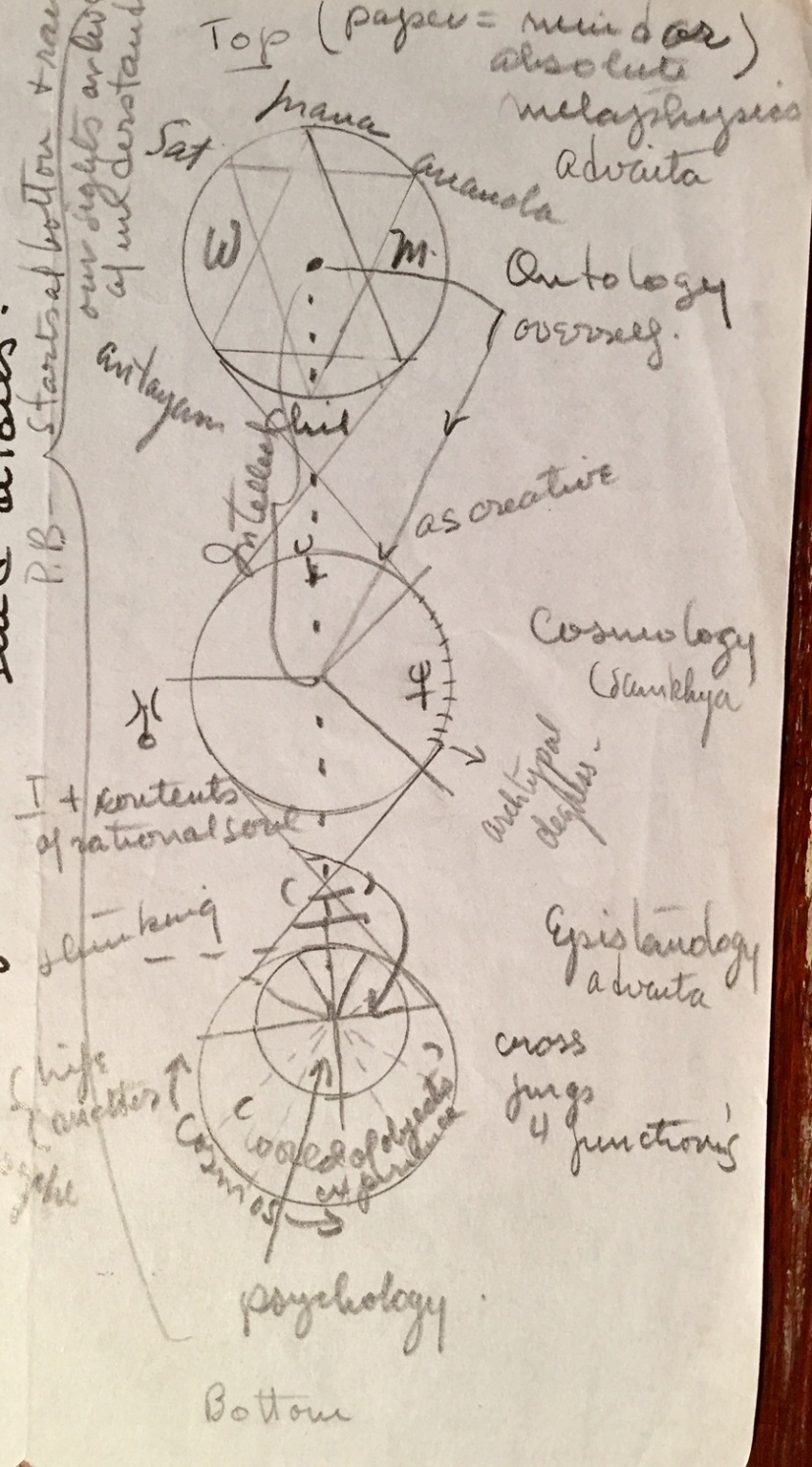
Class
Wednesday, December 8th, 1971
Verbatim, unedited transcriptCLASS at American Brahman Bookstore, Ithaca, NY
with Anthony Damiani (AD)
DECEMBER 8, 1971
PSYCHOLOGY & MYSTICISM; LEVELS OF CONSCIOUSNESS
TOPIC: Psychology & Mysticism
SUBJECT: Levels of Consciousness
SUBSUBJECTS: Ego, Sri Aurobindo, Vedanta, Vasanas
CONTENTS:
Listing components of ego
Reading PB, The Wisdom of the Overself, "The Secret of the I"
Ego as threefold: body, tendencies, Witness-I
Ego as thought-structure, as heap of habits
Primitive unconscious is projected and forces you into relation with the world
No exit from samsara through psychology, new projections will always arise
Society provides souls with the possibility of evolving according to their specific level
Reading Satprem, Sri Aurobindo: or, The Adventure of Consciousness, on levels of mind: ordinary mind, higher mind, illumined mind, intuitive mind, Overmind
All human beings operate through a determinate set of sheaths, certain archetypal ideas guide their evolution; this is one set of samskaras and is fixed for the whole race
Personal karmic tendencies, thoughts, feelings not fixed in the same way, vary from person to person
Reading Mircea Eliade, Yoga: Immortality and Freedom, on vasanas
Personal vasanas can be transmuted, World-Mind's samskaras (sheaths and archetypes) can't be unless you're a Sage
Vasanas explode continuously and without interruption as your consciousness/personality; represented in astrology by ascendant
Do personal vasanas have a common source/content? Discussion.
Zodiac as samskaras of previous universe
No beginning; no thinking, no time
Psychology can be useful in resolving mental/emotional blocks that stand in the way of spiritual progress and philosophic understanding
Multiple levels of reality involved in the statement "I see a tree"
Paradox of the Sage: universal operating as a unique individual; no two alike
Each ego has its own slant on the world-image
Christians believe in creation, beginning in time; in most other traditions, no creation, no beginning, no end
Who is the subject?; depends on level you're identified with
Different functions can be at different stages of development and operating at different levels of mind
Is the quickest way to free a function from the psychological level through metaphysics or psychology? Discussion.
An issue in your early family life is an effect of a deeper cause within your own character
No one approach by itself is sufficient; critical understanding is key
PB quote on threefold path; AD employs this technique in class; theoretical knowledge can infect you if it's not used or if abused
Philosophic principles implicit in astrology need to be made explicit to make astrology useful for philosophic students
Introverted and extroverted intuition
Dasgupta quote on purusha as the unchanging seer of the mind
BOOKS READ FROM OR REFERENCED:
Paul Brunton, The Wisdom of the Overself
Satprem, Sri Aurobindo: or, The Adventure of Consciousness
Plato, Symposium (and all Dialogues)
Mircea Eliade, Yoga: Immortality and Freedom
Julius Evola, The Doctrine of Awakening
Paul Brunton, The Hidden Teaching Beyond Yoga
C.G. Jung, CW 6, Psychological Types
Surendranath Dasgupta, Yoga as Philosophy and Religion
DIAGRAM appended to this transcript:
- FIGURE IMG 3621. Three Circles Diagram: Divine Intellect, Soul, Psyche.
This diagram, though not from this class, serves as a stand-in to help follow along. Other diagrams also referred to are not with this transcript version. [Transcriber note: [diagram] means the speaker is referencing a diagram as he or she is speaking. If someone is drawing or writing, with audible sounds of chalk on a blackboard, I indicate this by [drawing] or [writing].]
TRANSCRIBED Verbatim by IT 2021. In 2025, IT completes TOC, adds one diagram and references within transcript to this diagram, updates audio file markers to match new REP audio. Archival verbatim transcript – V12a.
AUDIO FILES: 1971 1208a. [Note 1: "Tape" and "Side" refer to original audio cassette tapes that were later digitized into .MP3 Audio Files. Note 2: We only have one audio file for this class. It a little over 2 hours and 3 minutes long. It was originally recorded back to front, i.e., Side 2 followed by Side 1; REP Studio fixes in 2024.]
1971 12/08 at American Brahman Bookstore
Psychology & Mysticism; Levels of Consciousness
[Audio File 1971 1208a Begins]
RC: --see, except he's looking at it.
S (very faint): Uh-huh.
[12 second pause while AD draws]
AD: Who's this? Well--
RG: What?
AD: [drawing] Makes you afraid someone else is in here. How about that? You want to get into that?
S: Yeah.
S: Question?
S: Uh-hm.
S (faint): (Well) is it?
AD: Hm?
S (faint): He wants to know the obvious.
LS (simultaneously): (You have/That's) the upside down five-pointed star.
AD: Five-point star.
LS: Upside down.
AD (simultaneously): Ups-- the ego belongs upside down.
LS: Right. (some laughter)
S (faint): God really knew what he was doing [one/two words inaudible] (bit of laughter)
AD: Well, could you pull out some quotations from The Wisdom of the Overself concerning what PB regards [drawing] in a sense. Suppose we start with one in English. Hm?
S (very faint): Uh-hm.
[12¾ second pause]
AD: Well, suppose I start, he re-- he refers to it as a nucleated structure of thought. Personality?
S (very faint): Uh-hm, (right).
[11½ second pause]
AD: Ok.
S: Uh, Tony?
AD: What could we [drawing] put on the ego, body?
BS: Gee.
LS: Self-concept?
AD: Don't get smart. [14 second pause with some laughter, background student talking] Get rid of the whole lecture right away, we s-- we s-- (AD laughs a bit)
LS: How about power-drive?
AD: Power-drive. Alright so, that'll give us [writing] the intellect, emotions. What else?
S: Habits?
AD: Habits? You want to put habits there? [writing followed by pause, 12½ seconds] C'mon, you all have an ego. (AD laughs, bit of laughter)
S (faint): Nobody knows what it is though.
[13¾ second pause]
AD: Thanks.
S (very faint): How about presuppositions?
S (very faint): What was that?
AD: Well would you put the presuppositions there?
S (faint): Uh-uh. They're in the ego though, right?
AD: Well, Jenny brought up an int-- a question, she says would you put the presuppositions in the ego. I don't know what presuppositions she's talking about but--
[10¼ second pause]
S: The kind of presuppositions that you make snap judgments on. You know, you see the guy with long hair and you hate him, [S simultaneously: Could you speak louder Jenny?] you see the hippie and you hate him. (I'm/We're) just try to sort of define what I mean by presuppositions. They're like the kind of thing where you can see a guy and hate him 'cause he's got a crew cut or long hair, either way. Or-- I don't know, even--
S (faint): [three words inaudible]
S (simultaneously, faint): Habit.
S: It'd be more of a habit, wouldn't it?
S (simultaneously, faint): No, no.
S (very faint): The volition, wouldn't it?
S (very faint): But Richard [couple words inaudible]
S (faint): Oh sure. (bit of laughter)
S: No.
S (faint): It's just at one level.
S (faint): How about (relating)?
S (faint): (The point), you have the responsibility on either.
AD: Well look at what PB's got here.
[Transcriber note: I am using The Wisdom of the Overself by Paul Brunton, North Atlantic Books, Berkeley, California, new edition 2015; original 1943, Rider & Co., London.]
PB [The Wisdom of the Overself, "The Secret of the I," p. 125, AD reading]: "[Now] we have learnt that it is useless to look for the whole self in the wakeful state alone and utterly [AD adds: to] ignore the other two beads on its string. For dream and sleep no less pertain to it than waking. It is useless to take only a fragment of experience and then expect a full answer to the question"What am I?" But the advance which we have [now] made in standpoint has advanced the result obtained. Self is thus shown to be a little more complex than it is commonly suspected to be. It reveals itself to be threefold: (a) The physical body; (b) the personal consciousness, consisting [AD reads: which consists] of feelings, thoughts, desires, images [and] karmic tendencies; [AD adds: and] (c) the impersonal observer whose presence is indirectly revealed by the person in the same mysterious way that the presence of magnetism is revealed by [AD adds: the] movements of iron filings. All these three elements combine together to make up the [AD emphasis] total "I". [AD adds: Now] Whoever equates his "I" with only one or confuses it with only two of these factors commits a serious error and does not really know himself. For the physical body makes merely [AD reads: merely makes] mechanical responses to its environment…"
AD: Ok?
PB [The Wisdom of the Overself, "The Secret of the I," p. 125, AD reading]: "The physical body, the personal thoughts and feelings are only contents of the self, not its real character. The sense of awareness accompanies every act, every feeling, and every thought. It is their common factor."
AD: Alright so, he says-- he says something like this, the physical body, a; b, the personal consciousness consisting of feeling, thoughts, desires, images, and karmic tendencies; and c, the impersonal observer whose presence is indirectly revealed by the person in the same mysterious way, ok? Now-- There it is, I mean, where's the ego here? Is it all three or is it two or is-- [11 second pause] And let me read a little further.
S (faint): Which chapter are you (reading)?
S (simultaneously, faint): Yeah.
S (faint): Go ahead.
AD: "Secret of the I".
S: Tony? Last week we put the "I"-- we had the "I", wrote "I", and then that arrow pointing to ego and the world, and in between we put the heart and the antahkarana [diagram]. And, that's where the vasanas arise. And so I question whether habit should go under there. And, I think that might give us some indication where to start looking if we stick to what we did last week.
AD: Well we're sticking to what we did last week only I'm starting at the bottom.
S: Ok. You mean all over again. (S laughs)
AD: Yeah, I'm-- I'm up at the bottom, I figure there we're all comfortable, we know our way. [50½ second pause, flipping of pages] Alright quickly.
PB [The Wisdom of the Overself, "The Secret of the I," p. 109, AD reading]: "…to make the mistake of taking the world as being a form of consciousness--and even to take all other men as such--but to forget to take our own personality in the same way."
AD: This is a pardonable error that we all commit. He says also--
PB [The Wisdom of the Overself, "The Secret of the I," p. 111, AD reading]: "[Next], what about deep sleep? There he has not even any consciousness of"I am," [AD reads: "I am" is in no sense to be found there], no sense of personal identity at all.
"The notion that the characteristics of his own existence as a particular individual (not of course the existence itself) can possibly be held in question strikes an ordinary man as absurd. … [And] from the totality of all three standpoints we have already seen how he is compelled to deduce that the ego's belief in its own complete and final coherence as a person, is refuted by the facts. For we can say that a thing continues as such when it remains identical with itself and when it is fundamentally permanent. [AD adds: And] Both these characteristics are absent from the personality."
AD: And of course, he uses the word "personality" in that way.
PB [The Wisdom of the Overself, "The Secret of the I," p. 111, AD reading]: "But [AD: he says] [of] a self apart from the totality of this series, he is not ordinarily aware. As a person he is, in the end, what other things are--[AD emphasis] a thought."
AD: He goes on and says--
PB [The Wisdom of the Overself, "The Secret of the I," pp. 111-112, AD reading]: "It is through the senses that we become aware of our own bodies, no less than the external world. But it was earlier found that if we seek out the basis of all sense-activity we find that it is our own consciousness and nothing else. The man who has not analysed what happens [AD reads: happened] when he sits in a chair or looks at a tree naively assumes [that] he is experiencing something outside himself. But he is actually experiencing something inside his own sense organs. And the latter [AD reads: sense organs] in their turn can yield their awareness of anything only by virtue of the quality of awareness itself, a quality which is utterly beyond their own capacity. Therefore the senses must themselves constitute part of the mind as much as the"I." But the senses are known to be parts of the physical body. Therefore even the entire human body, as a part of the external world, although the part with which we are uniquely related and most intimately associated, is something seen, experienced, and known and therefore something which is associated with our consciousness as are all other objects as one of its ideas, albeit the most vivid and intimate [of all]."
[short pause]
S (faint): Uh-hm.
AD: Next paragraph he goes on, he says--
PB [The Wisdom of the Overself, "The Secret of the I," pp. 112-113, AD reading]: "He overlooks [AD: That is, the materialist overlooks] that he has to think the body into his consciousness before he can even know of its existence at all. Mind must present the man's body as an idea and then only is there awareness of it. The brain itself is but a mental product in a mentally produced world. It is the mind as the intangible invisible principle of awareness which makes us aware of the brain's existence, so how can the brain be the originator of this function? … [AD: He goes on.]
"The consciousness of sense-impressions is not a property of the body because the latter [AD reads: body] is as much an object to consciousness as any other idea, [for] the body passes in and out of consciousness, as in sleep for example. How much less then must it be a function of the brain, which is merely a part of the body. Consciousness indeed is a property belonging to mind.
"The problem of the relation between the mind and the body disappears when we grasp these great truths, that the body is only an experience of consciousness and that such an experience can be external during wakefulness [or] internal during dream but is actually as much a powerfully held thought in both cases as is the outside space which is set up to contain both the body and the world. The body does not stand for an actuality apart from the consciousness of it. All the long controversies and variable theories of [the] relations existing between the two are empty and misleading. [For] there are not two separate and separable substances--matter and mind--to be studied but only one. His body is as much a man's thought as the world outside it. In the body, mind is conscious of itself as"body". In ideation, feeling, and memory, mind is again conscious of itself but this time as the thinking intellect. … [short pause] If this world extended in space and changing in time is really a thought-structure and if the person is a part of the world, then it logically follows that he is just as much a thought-structure too. When mentalism reduced the world to an idea, it inevitably reduced everything and everyone contained within it to an idea too. The world-idea springs from the same root as the person-idea but both flower in contrasting colours."
AD: And now we're back to the same rigmarole.
PB [The Wisdom of the Overself, "The Secret of the I," p. 113, AD reading]: "The first of our thoughts is"I". All other thoughts follow its arisal [AD reads: arising]. It does not stand alone but instantly associates itself with the thought which next follows. And this is the body-thought. Unfortunately it ends by limiting itself to the body too, which could never have come into existence at all but for its own prior existence. [Thus] this association has degenerated into a bondage of the "I"-thought to the body-thought. The only self man believes in today is his body. Consequently the original "I"-thought becomes converted into "I am the body". After this there arises the world-thought. The "I" unconsciously provides the particular sense-time characteristics through which the world must first pass [AD rereads: through which the world must first pass]…"
AD: I mean nobody stopped me or kicked me in the shins or threw a tomato at me or nothing. "The only self man…"
PB [The Wisdom of the Overself, "The Secret of the I," pp. 113-114, AD reading]: "After this [there] arises the world-thought. The"I" unconsciously provides the particular space-time characteristics through which the world must first pass before it can emerge into consciousness. [Thus] the "I" [veritably] holds as its own thought both the body and then the world outside the body. … [short pause]
"The"I" every man knows is indeed his self but it is not his ultimate self. [AD adds: And] When he discovers that his own personal existence [AD rereads: "When he discovers that his own personal existence] is no less a thought-structure than that of his physical surroundings, that everything including himself has an imagined existence, he comes close, very close, to the gate of initiation into a [AD reads: the] higher world of understanding. He who witnesses the events of a dream, [AD adds: and] he who participates in them, and he who creates them are one and the same entity."
[short pause]
AD: Now, part of the idea of what I want to do tonight so that maybe we could-- the idea I want to work with tonight is to show like for instance if-- [drawing] down here, if we-- if we look at the ego this way, alright, we can see and we can understand a great deal of Jungian psychology, so to speak, as we try to explicate, you know-- as we try to understand psychology, so to speak, we-- we can get a feeling that we're getting closer and closer into the mud, you know? Do you have any idea what I'm saying? And as we try to understand it from this point of view where for instance they call it a psychological heap, you know. A heap. Like you know corn in a bushel, you turn the bushel over and all the corn falls out? You say there's a heap of corn? Well the Buddhists, that's the way they regard the ego, a heap. Not a heap of corn, a-- a heap of habits. (bit of laughter) How about the Vedanta? [drawing] No?
S: Let's see what they got.
AD: [drawing/writing] If we start with-- if we start with the Vedanta.
LS (simultaneously): That's good. It's a good commentary on the Vedanta. (bit of laughter)
AD: Wise guy, huh? I see you're finished with your cold. (LS laughs) [drawing/writing] We refer to-- we refer to the antahkarana with four different sections to it, buddhi-- This is not Samkhya version by the way, don't confuse this with Samkhya cosmology. We referred to citta, field of self-remembrance or self-remembrance, [short pause while drawing/writing] refer to s-- self-consciousness. What was that buddhi, citta, self-consciousness, [S: Doubt.] [S, faint: Yeah.] and doubt, or manas. [short pause while drawing/writing] Self-consciousness and doubt, alright? [short pause while drawing/writing] Up here they put the Self, if you want to, alright, "I".
LS: Where would this description be found then if not in the Samkhya?
AD: Well I'm begi-- I'm making it up. What's the [LS simultaneously: (Alright.)] difference?
LS: No, no, no, no, this-- [AD: Uh--] check out. No difference. (LS laughs)
AD: Good, alright. Over here we left something alone, you know. About this part here I haven't spoken too much, and maybe it's a good idea. You see, when we try to speak about Jung-- the psychology of the ego, for instance, whether it's Jungian or any other, alright, we're going to pull these [drawing] four down into here [diagram], so to speak, and we're going to see them-- we're going to see these four principles, so to speak, operating that way, downstairs. But if we were-- and as we are interested in-- in the spiritual aspect of the ego, if we want to get an idea about the higher aspects of the mind, you know, we have to go up this way [diagram], alright, and there would be maybe four or five different divisions that various-- Well, let me put it this way, if you can imagine the antahkarana this way [diagram], [drawing] alright, and if you could imagine, so to speak, that is has four or five different layers which are really all parts of one, and if you wanted to, you can consider the whole thing in this sense. Is-- is there a copy there, Paul, of The Adventure of Consciousness, Aurobindo?
PD (very faint): Yeah.
AD: May I have it?
S (faint): Ok.
[short pause]
AD: Now we've been getting acquainted in astrology and Jungian psychology, we've been getting acquainted with these rules as they operate here [diagram]. [AD hitting board] In other words, when we were speaking in Jungian psy-- psychology of the notion of-- You-- you remember when we were speaking about projection, identification, compulsion? You-- do you remember?
S: Yeah.
AD: You do?
S: Yeah.
AD: Anybody else remembers?
S (faint): No, we were doing shadow [one word inaudible]
AD (simultaneously): You know, you identify with a drive, ok, and then, so to speak, you get inflated with this drive, alright, and then you're compelled to act out this drive because it's projected onto somebody, alright. So, this-- this projection which relates you to a certain person, alright, forces you to have experience of the world, alright. So at that lower level, psychologically speaking, if you-- if you can follow what I'm saying now, we can see how this part [diagram] is thrown into the world, [drawing] alright, to learn from the world. So let's say you have um-- let's say you have an intense identification, and that you're compelled to project it, and because it is projection, it comes back to you in-- in terms of relationship with another person. And then when you understand why you're related to that person, what that person provides, so to speak, that you should hang your ideas onto him, alright, and then you begin to realize that you never really knew that person, you never really loved that person, you never really were concerned with that person but only your projection, your feelings that you were projecting onto him. Well when you go through this sufficiently, and this is the real long spiritual path, I couldn't think of a longer spiritual path, alright, because like it-- you know, this really puts you in [drawing] Sam and Sara's coffee shop. (laughter) Samsara? You know, yous-- you('ll) stay in there forever, you never get out. If you follow the psychological way you'll never get out. Because as you-- as you get rid of one projection, you know, another one takes its place, and then another one, and so you find out that there's an-- an in-- indefinite possibility of relation-- relating to the world forever, just never ends, alright. But maybe--
S: Excuse me, I-- this-- when you s-- you're talking about a projection, you mean that-- a self-identity, a self-- a self-picture of yourself or-- You're projecting yourself outwards or project-- projecting your understanding?
AD: Yeah, you're projecting an aspect of your psyche--
S (simultaneously): The self-image, in other words, what you--
AD: Never mind the self-image, [S simultaneously: Alright. Alright I don't--] alright, because the whole self-image you can't project. But you-- you project outwardly an aspect of your psyche of which you are unconscious, and you relate to someone through that unconscious projection that's going on. Alright so, like Jesus said, you see the mote in your brother's eye but not in your eye, but the only reason you see it in your brother's eye is because you got one, alright. But when you begin to realize, you've removed the projection from your brother's eye because you know it's in your eye and you got to work on your eye, right, you can get it out of [S simultaneously: Right.] there, alright. But that assumes that there's a primitive unconsciousness about you. It's an a priori state that you're living in. In other words, if you go to a child or you go to an aboriginal native, someone that he--
S (simultaneously): They would have it also.
AD: Huh?
S: They would have it also I assume.
AD (simultaneously): Yes, yes they'd have it more. In other words, if you go to any primitive society, in spite of what the Romanticists say, there's a very primitive psychology you're dealing with. These people cannot stand any disturbance, anything out of the ordinary routine immediately upsets them. And imm-- they project tremendous contents into that. Alright? Alright, this projection in other words-- an extreme example when you--
S (simultaneously): In other words, rather than seeing what's really there you-- you're putting something into it that, you know, [one/two words inaudible] anyway, yeah.
AD (simultaneously): You're putting something of yourself there, sure.
S: I wasn't sure what to make of it.
AD: Alright, but what you have to understand here, and this is very important, is that this more or less shows how primitive your unconscious is. And anything that's unconscious has to be projected. So if there's hostility in you and you don't recognize it, alright, it'll be projected, and then you'll say "He's attacking me!" But you're the guy of course driving right through the red light. Alright? (bit of laughter)
S (very faint): Right.
AD: So you get into let's say some kind of relationship with this guy that you s-- whose car you smacked up. And the law forces you to recognize the fact that it was you that was aggressive, alright. You may not the first time but after a while you see it's a pattern, it's a way of operating, you begin to realize "Yeah, maybe it's me," you know, [S: Right.] although it take a long time to admit. Alright, so there's a kind of primitivity about of o-- of-- about our con-- or unconscious which forces us into relationship with the world. And I try to point out that if you study anthropology, alright, you see always in the history of the world that there are-- there's a hierarchy of societies, different levels of intelligence, alright, always you find that. And even today, even today, you can-- you can find alongside a highly civilized society you can find the most primitive type of society. And it seems that society is meant to provide different souls, you know, with the possibility of evolving according to different levels that they're in. So, all of a sudden in fifteenth century Florence there's a dozen geniuses born all together, so to speak, communicating one another. And also for the same reason there's places like the East side and the West side, you know, the-- Let me put it this way, the environment that's appropriate for your development will always be available, no matter what level you're at. Ok? [short pause]
Ok, so you can see that down here [diagram] you have these [drawing] various cultures that provide for the soul the needed experience so that it could project forth its unconscious, relate to the world, and from tho-- from that experience of the world acquire some kind of understanding of the soul. There comes a point, there comes a point where a person begins to realize that this can go on forever, and he'd like to find a way to get out of it. So he starts meditating or he hears about religious doctrines, he gets involved in religion and after-- after he's had his full of religion then of course he wants to get involved in something more mystical so he gets into a mystical level. Then-- then of course maybe he hears about the possibility of a path that's ultimate, a philosophic path, and now of course he's really-- he's really gone through some growth, considerable growth, and so he recognizes the fact that there's a mind. Now, we've spoken a great deal (some laughter) about this lower part here [diagram]. We spoke a lot about this part here [diagram]. But we've never spoken about the different layers of the-- or higher reaches of the mind, not in PB's term, in general terms. But, if-- in PB's terms the higher reach of consciousness, alright, different levels of consciousness. And the only-- there's very few people who write adequately about it. I do-- I don't know of any. Aurobindo does but I read this twenty years ago. Aurobindo's a young man. In case you were interested, he was a revolutionist too. Remember PB quotes him? Remember the quotation he uses from him? Why do they keep revising books if they only [three words inaudible] (laughter) Let's see, consciousness [few words inaudible] [short pause with faint background student talking] [very faint] Well I can't find it.
Bear with me, I'll find it. [18 second pause, flipping of pages] Oh, yeah. [22¼ second pause, flipping of pages] Ah, here we are. Alright, he divides-- he divides up this-- this whole thing into different levels. He has a) the ordinary mind, that's where we're at, b) the higher mind, c) the illumined mind-- no-- and d) the intuitive mind. Then he speaks about the Overmind, so to speak, as containing all these four. Suppose I read a little bit so that you get the feeling of the various levels that this could operate, you see, because we got the feeling that-- We're always looking down, I've always been forcing you [AD hits board with chalk] to look down, you know. [student assents, very faint] You know what I mean? Like always centering your attention down in the ego, alright. But if we were to start climbing, ok, if we were-- start climbing. For instance, Bhattacharyya uses [chalk on board sounds] six levels, alright. But, if we were to climb up towards the Self there will be an in-- an increasing lightness or-- Light-- light would be the-- the best way to put it because as you approach, it gets more and more light, alright, or let's say there's a decreasing density as you go up. Anyway, just a little-- a few-- a few words from Aurobindo. Patience.
[Transcriber note: I am using Sri Aurobindo: or, The Adventure of Consciousness by Satprem, New York: India Library Society, 1964.]
Satprem [Sri Aurobindo: or, The Adventure of Consciousness, pp. 186-187, AD reading]: "a) The Ordinary Mind
"It is the quality of the light or the quality of vibrations which, essentially, distinguishes [AD reads: distinguish] one plane of consciousness from another. If we start from our own evolutionary level and if we consider consciousness under its aspect of light from which all the others derive, the ordinary mind appears to the eye that sees as a sort of greyness with a number of small dark points or of minute, fairly obscure vibratory knots, like a cloud of flies whirling around the heads of people, which represents their thousand and one thoughts--they come, go, turn, circulate from one [to] another. Then, from time to time, a tiny burst of light descends from above, a tiny joy, a tiny flame of love dancing in this greyness. But this ground of neutrality as [Sri] Aurobindo says, is so thick, so sticky, that it absorbs everything, discolours everything, pulls everything down into its obscure gravitation--we cannot for long contain joy or suffering, cannot [AD adds: for long] bear too much light; it is all too small, spasmodic, quickly extinguished. And all is subject to a thousand conditions."
AD: Now this is the ordinary mind. You can see the kind of grandiose terms that Aurobindo operates with, he's not a Western Virgo, you know. That's enough of that.
S (very faint): Say no more.
S (very faint): (Uh-hm.)
AD: The next level of mind he speaks of-- (laughter) the next level of mind he speaks is-- is the higher mind. Now--
Satprem [Sri Aurobindo: or, The Adventure of Consciousness, p. 187, AD reading]: "This new level appears frequently in philosophers and thinkers; it is already less opaque, more free. The ground is no longer quite grey or the grey [AD adds: at least] verges on blue and the little burstings of light which descend are less quickly engulfed; they are also more intense, more rich, more frequent. [AD adds: And] Joy tends to last longer, love to be wider, and they are less subject to the innumerable conditions of the lower stages--one begins to know what joy is in itself, love in itself, without cause. But it is yet a cold light, a little hard. It is yet a heavy mental substance which catches the light from above and dissolves it in its own substance, covers it up with a thinking layer without even noticing it and does not truly understand the light received until everything is over, when it has been diluted, logicised and fragmented into [AD reads: in] so many pages, words or ideas. Moreover, the pages [or paragraphs] of the higher mind are founded upon a single point of light or a small number of points it has seized…and it takes a lot of trouble to eliminate on the way everything that would be contrary to its conclusion. Certainly it can open to higher planes and receive flashes but this is not its normal altitude; its mental substance is of the kind to decompose the light. [AD adds: And] It begins to understand when it has explained."
AD: That's about the level Aristotle was talking from. Alright, next is a c). He refers to it as the Illumined mind.
Satprem [Sri Aurobindo: or, The Adventure of Consciousness, pp. 187-188, AD reading]: "As the higher mind gradually begins to accept the silence, it wins access to this domain, that is, its substance becomes clear and what came drop by drop comes in a stream: The ground is no longer a general neutrality but [a] pure spiritual ease and happiness upon which the special tones of the aesthetic consciousness come out or from which they arise. [AD adds: And] This is the first fundamental change. The consciousness fills with a flood of light, often golden, infused with varying colours according to the inner state; it is a luminous invasion. And simultaneously comes a state of"enthusiasm", at least as the Greeks understood the word…"
AD: Remember Plato, the Banquet?
Satprem [Sri Aurobindo: or, The Adventure of Consciousness, p. 188, AD reading]: "…a sudden awakening, as if the entire being were on the qui vive, alerted, plunged all at once into a very rapid rhythm and a brand new world, with new values, new reliefs, unexpected correspondences; the world's curtain of smoke is raised, everything is linked in a great joyous vibration; life is vaster, more true, more vivid; small truths kindle everywhere, silently, as if each thing had a secret, a special meaning, a special life. One is in an unutterable state of truth without understanding anything about it--simply, it is. And it is marvellously [AD reads: marvelous]. It is light, it is living, it loves."
AD: Well-- Now I'll just read one more quote from that.
Satprem [Sri Aurobindo: or, The Adventure of Consciousness, p. 188, AD reading]: "I have seen both in myself and others a sudden flowering of capacities in every kind of activity come by the opening of consciousness,--so that one who laboured long without the least success to express himself in rhythm becomes a master of poetic language and cadences [AD reads: cadenzas] in a day."
AD: This by the way doesn't only apply to poetry, now you-- I would like to remark that when he speaks of philosophers in the preceding section he was referring to the academic philosophers. But this can happen also to musicians; it can happen to poets, musicians, artists in general, it doesn't-- could be a novelist, it does not have to be a poet the way he has it down. One-- so--
Satprem [Sri Aurobindo: or, The Adventure of Consciousness, p. 188, AD reading]: "It is a question of the right silence in the mind and the right openness to the Word that is trying to express itself--for the Word is there ready formed in those inner planes where all artistic forms take birth, but it is the transmitting mind that must change and become a perfect channel and not an obstacle."
AD: And this, of course, is obvious. [9½ second pause, flipping of pages] Well-- [short pause] Well since he's quite a poet we'll read his version.
Satprem [Sri Aurobindo: or, The Adventure of Consciousness, pp. 190-191, AD reading]: "Along with its beauty, we find the limits of the illumined mind: illumined poetry translates itself into a flood of images and revelatory words (because often the vision opens at this stage and also one begins to hear), almost an avalanche of images, luxuriant, often disordered, as though the consciousness was hard put to it to contain the luminous wave and this additional intensity--there is too much of it, it overflows. Enthusiasm changes easily into excitement and, if the rest of the being is not sufficiently purified, any lower part whatever may get hold of the light and force which descends to use them for its own ends,--this is a frequent danger. When the lower parts of the being, especially the vital…"
AD: Steiner refers to it as the etheric, you know?
Satprem [Sri Aurobindo: or, The Adventure of Consciousness, p. 191, AD reading]: "…especially the vital, seizes the luminous flood, they harden it, dramatize it, torture it--the power is still there, but hardened--whilst [AD reads: while] the essence of the illumined mind is joy. Here we could cite the names of many poets and creative writers."
AD: Well, I won't go into that, you'll find out for yourself. Now, there's a further development and he calls this the intuitive mind.
S (very faint): Uh-hm.
Satprem [Sri Aurobindo: or, The Adventure of Consciousness, pp. 191-192, AD reading]: "The intuitive mind differs from the illumined mind by its clear transparency--it is rapid, it runs bare-footed from rock to rock; it is no longer clogged like the higher mind by this thinking… Knowledge is a lightning flashed from silence and all is there, not higher or deeper, in truth, but just there, under our very eyes, awaiting our becoming a little clear--it is a matter not so much of raising oneself as of clearing obstructions. … A point, a sound, a drop of light, and a whole world, bursting, crowded, is contained therein--thousands of swift-winging elusive birds in the flash of a second. Intuition repeats at our level the original mystery of a great Gaze--a formidable glance which has seen all, known all, and which plays at seeing bit by bit, slowly, successively, temporally, from a myriad points of view, that which It had englobed alone in a fraction of Eternity.
"An eternal instant is the cause of the years."
AD: I guess that's a quotation from one of his poems.
Satprem [Sri Aurobindo: or, The Adventure of Consciousness, p. 193, AD reading]: "The language of intuition gathers itself into a concise formula, without a word too much, in contrast with the opulent language of the illumined mind; but that also, by its very abundance, brings a luminous rhythm and a truth less clearly outlined perhaps but warmer [AD reads: a warmer one]. When Plotinus gathered the whole cycle of human effort into three terms--"A flight of the Alone to the Alone", he was using a highly intuitive language, as do also the Upanishads. … [For the] Intuition . . . sees things by flashes, point by point, not as a whole. The space unveiled by the flash is capturing, irrefutable, but it is only a space of truth. Besides, the mind lays hold of the intuition and, as Sri Aurobindo observes, [it] makes at once too little and too much of it…"
AD: Alright we'll conclude with the Overmind version now. He goes on and says now--
Satprem [Sri Aurobindo: or, The Adventure of Consciousness, p. 194, AD reading]: "The overmind is the rarely attained summit of human consciousness. It is a cosmic consciousness but without [AD emphasis] the loss of the individual."
S (very faint): Is that the fourth state of consciousness?
AD: This is the fifth, the illumined mind, which so to speak engulfs all of them, alright? Now let me repeat this because this is going to help you understand some of PB's writing too.
Satprem [Sri Aurobindo: or, The Adventure of Consciousness, p. 194, AD reading]: "The overmind is the rarely attained summit of human consciousness. It is a cosmic consciousness but without [AD emphasis] the loss of the individual. Instead of rejecting all to burst forth in mid-air, the seeker has patiently climbed every rung of the being, so well that the bottom one remains linked to the top, without any break of continuity. This is the world of the gods and the source of inspiration of the great founders of religion; it is here that all religions we know have been born; they come from an overmind experience, as one of its thousand facets. For a religion or a revelation, a spiritual experience belongs to a certain plane, it does not spring up from the thunders of God or from nowhere; those who incarnate the revelation have not drawn it out of nothing: the overmind is their plane of origin. [AD adds: And] This is also the birth-place of high artistic creations. But it must be well emphasised that it is yet a plane of the mind, although its summit.
"When the consciousness rises to this plane, it no longer sees"point [AD reads: points] by point", but calmly, in great masses. It is no longer the diffuse light of the illumined mind nor the isolated flashes of the intuitive mind but…"An ocean of stable lightnings." The consciousness is no longer limited to the brief present moment and the narrow space of its visual field, it is 'unshuttered', it sees in a single glance large extensions of space and time."
AD: Well, I won't go anymore because I think we'll get lost.
LR: Was this the first stage where he says it-- it can transcend space and time?
AD: What's that?
LR: Is this the first stage at which he says it can transcend space and time?
S (simultaneously): Yeah.
AD: This is the first stage, yeah, where it transcends space and time in large doses. Large doses. Alright, that's-- that-- all-- that reading was to, of course, make you feel more miserable as you study psychology. (laughter)
S (amidst laughter, faint): It worked.
LR (amidst laughter): Great, wow.
AD: Can I have some chalk up here? Is there any around?
LS: Hey Arty?
S (very faint): Not really.
S (simultaneously): Here.
S: You've changed.
AD: Well, we got two pieces, that's good. [short pause, faint background student talking] You see, when we speak about-- when we-- Hey Arty, you know--
S: Yeah, I'll get you some more (coffee). (laughter)
AD: When we speak about psychology, it doesn't matter what kind, you know, Jungian or any other kind, we're down here in this realm here [FIGURE IMG 3621, bottom circle] and we have to stop kidding ourselves about it. We're down here, alright. This is where all the garbage [drawing/writing] is coming (out/up). If you got a shadow problem, comes out, you know. If you got a power problem, it comes out. No matter what the problem is it comes out down here, ok?
[short pause]
S: Tony, if that's where they come out, (where/what) are the roots of those problems?
AD: Well-- This is what we're trying to do, isn't it? The roots of this problem-- which problem? [S simultaneously: Like--] The stuff coming out here?
S: Yeah, the projections of--
AD: Alright, you remember-- you remember when we spoke about this and maybe we can s-- start bringing some of this stuff together, we spoke about that in the Vedanta they describe the personality as a determinate system of concepts through which we operate. Now you-- you have to remember, I'm speaking very academically and there's something in me which gets nauseous when I speak like this because it's really nothing like this, because if Yoga is anything it's absolute freedom. It's a conscious effort towards absolute freedom. And when we sit down and meditate, if ever one of you should pick up the thread of consciousness, the current of consciousness, and follow it out, there you go, you're on your own, you know, goodbye, good luck. Alright? So, try to understand, there's that other part, the mystical part, which I don't speak about, there's no sense talking about it, and then there's this academic face that we present to the world, you know, like the Vedanta does, alright, the Vedanta presents this very academic-looking systemization of its theories. And you look at it and you study it and you go home and you even feel good, you begin to understand it, you know. So, try to keep that in mind as a preface, alright.
So, in the Vedanta we call this a determinate system of concepts which constitutes in-- in one of the ways the ideas, you know, the archetypal ideas through which life evolves. Alright? [student assents, faint] And we pointed out that as a living-- as a living-- as a living entity we go through these various stages of archetypal development. And we gave an exaggerated example. If you were a little-- or any kind of a little bug, it doesn't matter, you know, and you're walking in the grass, so to speak, and you have a very limited range of perception, ok, and the instincts have to guide your growth, the instinct is like your personal guru, you know, teaching you, you gotta eat this and you gotta avoid that and do this, ok. This is how you mate, this is how you don't mate, alright. And after you've had quite a few experiences that way you evolve, alright. Now you know for instance in your-- in your experience as a mother, you suddenly realize that once you get invaded with that archetype you start operating like a mother, you know, more and more you begin to feel it's absolutely natural. Alright. Let's consider these as archetypal ideas, archetypal ideas in the World-Mind, restricted to our portion, and that we have to develop or let's say the entelechy develops through this determinate system of concepts. Now these are fixed, right? Everybody has this. Any human being that operates, operates through these ideas, alright?
S: You mean those four or the--
AD: Well this here [diagram], the antahkarana, in other words, [student assents, faint] the Witness-I, [drawing] the antahkarana, alright, and the breakdown of the antahkarana down here in the ego structure with the five senses and-- Alright? Now what happens is in a sense something like this. As the personality evolves [drawing] more and more, goes through higher levels of society and begins to realize higher and higher values, and then suddenly breaks off with collective values and wants to find its own, you know, wants to individualate-- individuate, alright. Now it starts going back here this way, it has to, so to speak, turn that eye that Plato speak of, you know that eye that's worth a thousand eyes, turn it inside and look into yourself and try to figure out what's going on. [student assents, faint]
Well anyway, the point that we're trying to get at is that this archetypal structure which is let's say the skeleton, the background, whatever you want to call it, of the human being and how he evolves, this is more or less fixed, ok? Well what's not fixed here? Thanks Arty. Here, I'll put it the way PB put it. [flipping of pages] He says the physical body, ok? That's pretty well fixed. Then he says the personal consciousness consisting of feelings, thoughts, desires, images, and karmic tendencies. [short pause] Do you get the feeling that in a sense these are [drawing] fixed, ok? No matter how many times you're born, you operate through this determinate system of concepts. Every time you're born, alright, you have the antahkarana to deal with. Ok? Do you-- this, which resides in the subtle domain as we pointed out, alright. The body-- the prototype of the body is more less fixed, alright, senses and all that. But, over here [diagram] there seems to be some fluctuation, you start getting certain tendencies. For instance, you start projecting a power-drive onto someone, shadow onto someone, alright. Well-- Would you pick-- would you get the Yoga: Immortality and Freedom and turn to the vasanas? I think it's alongside you, Paul. And now, see if you can really see this in terms of the relationship. A determinate system of concepts which is provided for your development, alright, and there's these formless tendencies which you bring with you. They're vasanas too.
S (faint): What do you mean formless tendencies?
S: You mean--
S (faint): As in these are form-- only substantial?
AD: Well like [S, very faint: Or--] these tendencies here that come up into you, for instance like you get up tomorrow and you go chasing someone with blonde hair, let's say you've been doing that for ten lifetimes, ok?
S (faint): Uh-hm.
S (faint): Uh-hm.
AD: Alright? That's a tendency that's within you, alright. But that's not structured like this here [diagram]. This endures [AD points out on diagram]. Anything that-- any human entelechy that develops has to develop through this-- through this system, alright. But what the personal contents of your own unconscious is, alright, is yours, it's not mine, your tendencies are yours and mine are mine.
S (very faint): Uh-hm.
AD: Well these vasanas, alright-- You got the-- the thing there?
PD (faint): I don't know which one you want.
AD: When he speaks about the vasanas as being the spec-- specification of your individualizing consciousness. [11¾ second pause] You [S simultaneously: Yeah.] see what we're working at here is on-- if I'm trying to get out this idea that I want to use, you know, to (ride) on PB, we have to show the relative position in all these systems, whether it's Jung, you know, Buddhist or PB or Vedanta, the relative position of the ego in each one of these systems.
S (faint): Uh-hm.
AD: Alright? Now for instance, if you read ordinary psychology in-- you know, whether it's Freudian or Maslow or any of these boys, [drawing or indicating on diagram] this is as far as they ever get. They don't even suspect that there could be anything up here, alright. Jung suspects it and doesn't make too much comment about it because he feels that this is where the work has to be. Psychologically people are in such a mess that until they straighten out psychologically they're not going to see any higher spiritual truths. In other words, if I keep on imitating Christ externally, you know, I'm just-- I'm just playing a game with myself, see, whereas once he can get you to see that that projection, alright, is something in you that has to be brought to heel, you know, in other words you have to try to be more conscious of what you're doing, then he ha-- he thinks that he can help you get up into (this) system. Alright? Did you find it Paul?
PD (very faint): I think so.
S (faint): (He did.)
[Transcriber note: I am using Yoga: Immortality and Freedom by Mircea Eliade, Bollingen Series LVI, Princeton University Press, Princeton, New Jersey, 1990.]
Mircea Eliade [Yoga: Immortality and Freedom, p. 42, PD reading]: ""The vasanas have their origin in memory," [Vyasa writes], thus emphasizing their subliminal nature. Life is a continual discharge of vasanas…"
AD: Alright. Life is a continual discharge of vasanas. [AD hits board] Now, if you have a discharge of vasanas taking place here, your personal consciousness that you operate with, like tomorrow morning you get-- you don't get up and go eat grass, right? That incarnation is done and over with. (laughter)
S: (No/Oh) but you may feel like that. (bit of laughter)
AD: Alright, let's say you have certain tendencies, you-- you prefer to eat very simple, you know, foods, alright, in a certain way. It isn't like another person who gets up and has to have maybe pork chops or something, ok? (laughter) You see, these are personal vasanas, they're operating in you, they're part of your past.
S: (Tony?)
S: So it's like through the-- for all people the structure is fixed but the personal vasanas are fluid.
AD: Alright, now [S simultaneously, faint: Well--] you get the feeling [one/two inaudible student words simultaneous with AD] that these vasanas, so to speak, you take with you wherever you go.
S: Yeah. [few words inaudible]
AD (simultaneously): Alright, you take one man, you know, one man like he comes into life and he has very religious attitudes, you know, very highly developed religious attitudes. And you can see by style of life, his gestures, you know, and all that, you begin to see the vasanas that are operating in him bring him to the higher understanding. You take another person who's born in a very primitive society, you know, and his vasanas take him to, well, maybe eat rattlesnake meat, I don't know. But, you see, you see where there the vasanas are more or less relative to the individual, whereas this [AD indicates on diagram] is not.
S: But, in-- just looking at the individual whose personal vasanas aren't fixed, I mean I--
AD: They can be transmuted. They can be transmuted. [S: Yeah.] Your personal vasanas could be-- let's say you like to steal, alright, and after a couple of good attempts you finally stop stealing. Now you start doing good, you start giving, ok. Alright, you can transmute those vasanas. This [diagram] you cannot transmute. You can't change this. If I-- if I were to dramatize it I would say like these are samskaras in the World-Mind. Ok? To-- analogously, these are samskaras in your mind. Samskaras in your mind can be transmuted and they can transform the personality. You cannot-- you cannot transmute these [diagram]. [student assents, faint] Alright? Until of course you become a Sage. You remember when we were-- read Ramana? Ramana pointed out what the Sage does. He can either [AD hits board with chalk] continue operating through the subtle domain or he can destroy it and merge. Alright, would you read that vasanas now, I-- I think we read this quotation three times and now maybe you can put it in its place. Please, Paul?
Mircea Eliade [Yoga: Immortality and Freedom, p. 42, PD reading]: ""The vasanas have their origin in memory," Vyasa writes, thus emphasizing their subliminal nature. Life is a continual discharge of vasanas, which manifest themselves through vrttis. In psy…"
AD (simultaneously): Vritti-- wait a minute-- vritti is the functioning of the mind, a mode of the mind. Any object that you perceive, ok, is the mind. You remember we pointed out, the antahkarana goes out and grasps the object. You remember PB says it differently. He says consciousness could take the form, the size, the shape of anything, whether it's a pinhead or a city. You follow the correlation here? They're different words but, you remember, it's the same meaning. That's what we're after, the meaning, the ideas. Alright, so the mind takes on a vritti, that means it be-- it becomes this thing which it envelops. If it envelops a chair, then the chair is lit up and you have knowledge of the chair. The mind when it's in a state of pleasure or pain, then the mind is that pleasure or is that pain. On the one hand it acts-- goes out to the-- like through the senses, on the other hand it itself is a sense. So the Vedantists regard the mind either as an extra sense or not, it depends on your point of view. And again you'll find that often. Depending on which way you're looking at it the mind could be another sense or not. Ok, read it again.
Mircea Eliade [Yoga: Immortality and Freedom, p. 42, PD reading]: "Life is a continual discharge of vasanas, which manifest themselves through vrttis. In psychological terms, human existence is a continuous actualization of the subconscious through experiences. The vasanas condition the specific character of each individual; and this conditioning is in accordance both with [PD reads: with both] his heredity and with his karmic situation. Indeed, everything that defines the intransmissible specificity of the individual, as well as the structure of human instincts, is produced by the vasanas…"
AD: Would you repeat that last sentence?
S (very faint): Yeah. (laughter)
AD: That's the gist of it, that's the gist of it. If you-- if you catch that, you'll catch the meaning of the ascendant.
Mircea Eliade [Yoga: Immortality and Freedom, p. 42, PD reading]: "Indeed, everything that defines the intransmissible specificity of the individual, as well as the structure of human instincts, is produced by the vasanas, by the subconscious."
[short pause]
AD: Go on, go on.
Mircea Eliade [Yoga: Immortality and Freedom, p. 42, PD reading]: "The subconscious is transmitted either"impersonally," from generation to generation (through language, mores, civilization…) or directly (through karmic transmigration…) A considerable part of human experience is owing to this racial and intellectual heritage, to these forms of action and thought which are created by the play of [the] vasanas. These subconscious forces determine the lives of the majority of men. It is only through Yoga that they can be known, controlled, [PD adds: and] "burned."
"All states of consciousness are"painful" [(klesa)]. This painful modality of the states of consciousness explains their frantic dynamism; one would say that [PD adds: these] states of consciousness attempt, by their sudden, dazzling, polymorphous, and vibrant appearance, to compensate for their "impurity"…their lack of ontological reality… The rapidity with which these "eddies" succeed one another in [the] consciousness of the noninitiate is consoling. The destiny of matter is to be in continual transformation; and if this never-ceasing and never-resting transformation is "painful" [(klesa)], it permits man…to [escape from the cosmic circuit]."
(Side 1 of original cassette tape digitized as 1971 1208a Ends; Side 2 Begins)
AD: There's-- there's this latent thought in your subconscious. And when this latent thought explodes, it manifests consciousness. Now they do so with such rapidity that you cannot keep up with it. I mean, what you call your consciousness is nothing but these thoughts one after another exploding, alright, that's how fast it's working. These sam-- samskaras, these tendencies which, so to speak, are exploding and producing what you call your individuality, let's use PB's term, your personality, the peculiar idiosyncrasies of your personality, alright. Now, these samskaras that are exploding and producing the peculiar idiosyncrasies of your personality, these samskaras, so to speak, have this formlessness, they come up into the conscious, they blow up, so to speak, and you experience what you call your idiosyncrasy, your uniqueness, your I-ness, your mine-ness, whatever you want to call it. And if you watch it very carefully, it's going on day and night without any interruption. You will notice that your taste is dictated to you constantly from the past. That's why in astrology the nice thing is we put it between the twelfth and the first and we called it the ascendant, your past and your present, alright. And the chart here is very beautiful because the first refers to the present, your present incarnation. In other words, when you're born into a certain family, there's a certain heredity that's attached to this family and a certain model is provided to your ego which this ego, so to speak, more or less has to work with. That's probably the origin of many childhood illnesses, because very often the model is not close enough to the ego structure. Alright, at any rate--
S (simultaneously, faint): Is it time-- is that-- are these sam-- samskaras or vasanas that this lower level which-- which is-- i-- which kind of steals the energy and the light of-- of the higher levels when-- like from Aurobindo when he describes that process, you know, if the lower personality isn't sufficiently purified?
AD: Yes. As a matter of fact one time you remember when we were quoting Evola? You remember? Any of you remember the quotation [LS simultaneously: No I'm--] from Evola?
LS: On samsara?
AD: About samsara, this fearful abyss where if you turn around and take a look at these thoughts that are constantly gnawing away in the background. And that if you turn around and look at them they don't want to be seen, they stop operating, like they s-- they stay perfectly still, and then you turn around, you go on and they start working again, ok. [Note: See Julius Evola, The Doctrine of Awakening, p. 140.] [S simultaneously, laughing: Yeah. (That's true.)] And every now and then you turn around and you see the fantasy life always goes on, alright.
LS: It's like that primitive you were talking about, it reacts to fear-- with fear at any attempt to disturb it.
AD: Yeah. Well, this is basically a very parasitic structure and growth, although, you know, from the point of view of philosophic-- from philosophy you can say well that eventually will lead you to your enlightenment. Well, sure, you know, you can rush things a little bit or you can take your time with Nature. But basically that-- that process that's going on in the back, so to speak-- background of your consciousness, which when you meditate you become aware of, you become aware of all the conce-- it goes on forever, you know. Like one fellow was telling me he was meditating, he was trying to get to very-- very peaceful and quiet state and he-- he says he heard such a racket he-- he wouldn't believe it! (some laughter, AD laughs) That was me by the way. (laughter, AD laughs)
Anyway these-- these vasanas, alright, as they explode, alright, and you experience your individuality as a person, are these vasanas. They also provide you with your individuality in the sense that the peculiar things about you. Alright, but you can see that these vasanas you brought from your own past. You see what I'm driving at, alright? So, they will manifest out here [diagram]. In other words, here's the world out here [AD indicates on diagram], they come out here and they manifest, [drawing] they project out onto the world here, alright, whereas these here vasanas or samskaras or this determinate system of concepts [diagram], never, alright. This is-- [S simultaneously, faint: (one/two words inaudible) way.] this is, in other words, highly structured. It's an idea in the World-Mind. You remember when PB in the chapter on "The Birth of the Universe" says that the world-- the-- it manifests according to a certain system of ideas and these ideas are of undying nature?
S (faint): Uh-hm.
[short pause, flipping of pages]
PB [The Wisdom of the Overself, "The Birth of the Universe," pp. 33-34, AD reading]: "His ideas are manifestations of his own mind, not creations out of some extern[al] [stuff]. In the same way the World-Mind manifests something of its own self in the cosmos. And its own self, as will be shown later, being uniquely eternal and undying, it is inevitable that the world-ideas which have arisen within it are eternal and undying, too."
AD: So you get the feeling that this is a kind of archetypal system through which every entelechy that's developing, so to speak, our way of developing, that is, as a human, alright, has to go through this here. Yes.
LR: It seems that there has to be a common content to the vasanas. (Hm.)
AD: Well, tell me a little more what you mean.
LR (simultaneously) In the sense that my vasanas of this incarnation are a result of many of my past, ok. But I take it further than that and it almost seems like-- well an English teacher gives an-- an assignment to write an essay and fifty kids come back with fifty different essays all being very very different from one another.
S (faint): Yeah.
LR: But-- they're all starting from the same source, I mean they're-- the-- they all have the idea in mind of that assignment. And it seems that if we're all living out vasanas, that they had to have a common source or a common content of those vasanas in order to be able to change and to become individualized.
S (very faint): Go ahead.
LR (faint): Do you understand my question?
AD: Well I think I do but I don't see the point you're trying to make Linda. You, Len, you see the point she made?
LR (simultaneously): I guess I want to know the-- whether there is a common content if you trace back the vasa-- I mean each individual is operating through a similar structure in that he's operating through vasanas, and yet he's changed--
S (simultaneously): Could-- could the common content be the ego? Is that what she's trying to [LR: No.] attach to?
S (very faint): I don't know [few words inaudible]
S (simultaneously): Because that's the beginning of all thought.
LR: No I think I'm referring to something--
S (faint): The same for everyone.
S (faint): Yeah.
LR: I mean, in order for everyone to have different vasanas they must have once had the same.
S (very faint): I think-- well, ok.
AD (simultaneously): Well, Lenny showed me this paragraph from the book, The Wisdom.
PB [The Wisdom of the Overself, "The Birth of the Universe," p. 44, AD reading]: "The world and the individuals dwelling in it are not only reincarnations of previously existent forces but they also go on developing themselves and mutually interact. Such interaction occurs in the following manner. Out of the experiences of accumulated existences certain impressions tend to repeat themselves so strongly that they assume a structural character, that is, they become energy complexes."
AD: That help you any? In other words, you trace back this development you can keep going back, back, back, there's no beginning to it.
LR: And yet there has to be somewhere where everyone is operating through the same vasana and that might be the vasana of Manhood.
AD: But that's not a vasana. [AD hits board] That's this here [diagram], that's a determinate system of concepts.
LR: Well is that where the vasanas can be traced back?
AD: Well don't you see in a-- in a large way, don't you see in a large way that, for instance, when we refer to the zodiac we can say that this represents the samskaras of a previous universe, and that the distilled essence of that-- of the wisdom of a previous universe now is left behind, so to speak, the samskaras which we call the zodiac. You-- look at it in a cosmological way, look at it in an individual. This is an individual cosmology [diagram], alright. This is in other words a model of man, alright, as a universe in himself. Now, you take the universe over here [diagram], alright, and that too, so to speak, depends upon energy complexes structured in a certain way and we give the name of "samskara" to it. So that one of the fundamental laws through which the Supreme operates is samskaras. The same way it-- the same way it structures the manifestation of a universe, it structures the manifestation of the individual. Well, I'm-- alright, try again.
LR: Yeah, I follow what you're saying and I'm not-- and I-- I'm not sure I understand it well enough to know if that's the answer to the question or not.
AD: Well then let's [LR: Um--] try getting your question out.
LR: Ok.
S: The samskaras [LR simultaneously: In ord--] are only operative in the ego. They're not operative anywhere else. If you can get beyond them, then you have no more karmic-- karma to fulfill.
AD: Yes, that's true Romaine.
LR: But what is the first cause?
AD: That's true, because once you transcend the ego then you don't have the personal karma to worry about anymore. But then you have the law of karma, alright, [S: Yeah.] and the law of karma, so to speak, is what I was trying to give her an example of, [LR simultaneously, faint: That's what (couple words inaudible)] in other words, that there's a law of karma that operates on the individual plane and also on a cosmic range, alright.
LR: Ok so, take these kids in an English class again, ok, and they each go and write their own essays. They would not have written these essays and been able to write different essays had it not been for the assignment to write an essay.
AD: In the same way, each one of us is forced to live in this-- in a world, alright, which we share in common, [LR: Right, that's--] alright, but I look at my-- my world through my way of looking at it and you look at it through yours.
LR: Ok, but did you and I both start by looking at the same world in the same way? Is that possibility now--
AD (simultaneously): But don't you see what you're asking for? You're asking for a beginning.
LR: I know it.
AD: But there isn't any!
LR: I know it. (bit of laughter)
S (faint): Exactly.
LR: And that's what I should've said in this-- when I started, that I can't reconcile (those/these).
AD: That's a postulate of the thinking. [short pause] In other words, as soon as-- as soon as you postulate thinking, you know, you must have time. So then you say well where does it begin? Well it begins as long as there's thinking, if there's no thinking there's no time.
LR: But-- well--
AD: In other words, you manufactured a time and space and you tell me where does it begin.
LR: I think I'm not asking anything as lofty as that though.
AD: You sure are if you're asking for a beginning.
LR: Well-- In order for you to see a world in a certain way and me to see it in a different way--
AD: Let me see if this might help. You see, down here [FIGURE IMG 3621, bottom circle], over here, where the ego operates in a world, it says there is a beginning. [LR simultaneously, faint: The ego said that.] Alright? Over here. As soon as you understand from here [middle or top circle], you're talking nonsense. It's just like when you have a dream, when did it start, what was the beginning, (why/where)? Soon as it started, that was the beginning. Everybody tells me "But it started in the middle," middle me eye, that's the beginning!
S (faint): But wouldn't the [LR: But--] (bit of laughter) references for-- to the stages of [one/two words inaudible] souls, wouldn't it be that at one time that all souls were at the same point of evolution but they aren't as they are gathered in the society, in the English class, they aren't at the same point of evolution, consequently they are individualized?
AD: Terry, if I understand you, you're trying some way or another to get them all down or all up at a point where we say, [S simultaneously: No, no. No, no.] "Ready, get set, go!" and they all start. (laughter, student words)
S: Oh no, I was just saying that at some place they may have passed a certain point of evolution or gone through that point or coming up on another point, you know-- do you understand what I mean? Just like we all pass the same point on a road at different times of the day.
AD: Oh, but it's much wider than that. This is again where the mystical aspect of the teaching has to come in. I might say for instance that some of us have evolved in different worlds entirely from each other. You haven't come just to one place. There's many other worlds you've visited and worked at and came here, ok? So our-- our evolution is different, for most people they all come from different places. But we're going to be here for a while. (bit of laughter)
S (faint): Right.
S: How do you get out though?
S (faint): [couple words inaudible]
AD (simultaneously): That's what we're trying to figure out. That's exactly what we're trying to figure out, alright. So these tendencies as they explode, alright, they produce what you call your consciousness, on this individual level. So somebody likes his tea with a little sugar and somebody likes it without sugar, you know. Alright? But everybody has to, so to speak, taste the sugar. That's one of the vasanas that are structured, alright--
S (simultaneously, faint): What do you mean everybody has to taste the sugar?
AD: Well you all have taste buds.
S: Oh, oh, ok.
AD: Right?
S: Ok.
AD: You see, that's the distinction I'm trying to make. Here is, so to speak, general man [diagram], the prototype of man, alright, here is the individual man [diagram], here's where he's-- he more or less realizes a kind of uniqueness. Ok?
S (very faint): Tony?
S: And is that sort of the function of not only the study of psychology but the whole realm in which it works to-- to bring out this individuality?
AD: Is that the function of psychology?
S: Not of psychology but of the psychological realm. I think we sort of implied that a while back, that the-- the function--
AD (simultaneously): Well that's one of the implications in psychology that I find to be worthwhile. You know, like somebody come to me and told me he can't s-- he can't read the Hidden Teaching. He's got a Ph.D., a D.D.D., a-- (bit of laughter, student words) you know, a couple other-- And what do you mean you can't read it, you know, who you kidding? He's got an emotional block, alright, so his problem is to-- is to work through psychologically and understand so he can get out of that bag, start going up. The only purpose for-- that I have of psychology is to help you to see that, to see where you're-- you're locked in. Ok?
S (faint): Yeah.
AD: If you [S simultaneously, faint: (But--)] can resolve sometimes a psychological problem you can start moving spiritually much faster. But for some people there's no need for that. Like they've all gone through all that malarkey, you know, they right away go to the source and say, "All I have to do is start cutting out all these-- [drawing] all these thoughts and I don't have no problem down here [diagram]." And you may have-- you may have to do that sooner or later, you know. You may have to stop giving in to the ego every time it comes up with a-- a fantasy or a desire. You may have to say, "Ok, that's enough from you." I mean it's-- it's a very thing.
What we're trying to do, anyway what I'm trying to do-- to do is to get enough of a picture of the structure, metaphysics, you know, cosmology, ontology, so to speak, and down here psychology [FIGURE IMG 3621] and you begin to see where you're relating when you-- Again, if I were to use the example, if you-- if you analyze a sentence like this--[drawing/writing] "I see a tree." Now, that poor guy is spending a lot of time explaining that to students, alright, [writing] "I" "see" "tree". Look at how much is implied--metaphysics, epistemology, huh, [drawing] cosmology.
And this is the peculiar thing of it all--how the universal becomes particular. How does this universal prototype of Man particularize itself and becomes an individual; and then how that individual, so to speak, remaining an individual, alright, succeeds in trans-- you know, reaching up to this level here [top circle] and realizing an identity with the Overmind and at the same time operating as an individual. I think that's one of the things you'll notice about these men, that here they are-- they're so peculiarly unique, whether it's a retired British gentleman living a kind of eccentric life (bit of laughter) or whether it's a revolutionary ascetic out in Bengal, you know, they live their absolutely peculiar unique lives, alright, and yet they realize this general universal quality in them. And it sounds strange to say that the person has to be utterly unique, absolutely fulfilled as a unique individual so that even if you take a general-- a general function like reason, alright, and it comes out perfect in him, isn't that a contradiction that here the flower of intelligence, so to speak, which is realized in the personality, alright, can function so absolutely and meticulously in a universal way. To me it's one of the greatest paradoxes I've ever seen. And I've seen it. [short pause]
Well, anyway, you can see how complicated this is and why people, especially in the academic world, can't get anywhere with this sentence "I see a tree", because there's the different levels of references. And then of course, you know, [drawing] this one here [diagram] is a big thing all by itself. Well, we've attacked both from the top and the bottom. In astrology and psychology we attack from the bottom; we try to understand the functioning, the nature of the ego, alright, the games it plays, try to get back to the vasanas, then understand the nature of what we're really contending with. Because once you start meditating, you got a battle on your hands. Why? Because there's the universal Mind feeding you thoughts all the time. Now before you meditated you used to think that they were your thoughts. Now you're finding out they're not your thoughts. You can't even do a thing about them. They just pour in. Have you found that out? (laughter, students assent, faint) Alright. [short pause] Well anyway, is the scheme beginning to make a little sense to you? I said we're going to start out-- yeah Linda.
LR: Can I go back to-- to my question again?
AD: Sure.
LR: It seems that-- well could you call thinking a vasana? [student assents, very faint] Could you call (thought--)
AD (simultaneously): Thinking? Yes, thinking is a habit like anything else.
LR: But just that thought in itself is a vasana.
AD: Thought--
LR: Well here's as far as I've gotten, in that-- If I see that each individual has his own vasanas to work out, and I have to trace them to something common for some reason, I would trace them to thought. Given that each in-- that in-- given the larger vasana that every individual must participate in thought, then it seems that the range of possibilities which thought can take is the range of possibilities for individual vasana.
AD: I don't know if I follow you, Linda, try again. [short pause] Try again, would you Linda?
LR: Ok. I have this compulsion to try to find a common vasana because I can't see how all of us say sitting in this room have different vasanas to--
AD: Alright, we have one common vasana between the two of us, right? We eat. We have to eat, ok?
LR: Yeah.
AD: Alright. Go on.
LR: Ok, well my question from then-- from there is, you eat your thing and [AD simultaneously: Yeah.] I eat my thing.
AD: Yeah. (some laughter)
LR: And didn't we have to start with a common thing in order for you to choose which thing you wanted and for [AD simultaneously: Alright, yeah.] me to choose which [S simultaneously: Hunger?] thing I wanted. Ok?
AD: Yeah.
LR: It seems that that has to be. Or I'd like you to point out why that doesn't have to be.
AD: Well we-- you mean we both eat a common food? We gotta have food.
LR: It seems that in order for you to have--
S (simultaneously): Wouldn't the common thing be hunger, no?
AD: No, I think she's trying to begi-- I think she's trying to bring in somehow or other that we start off with a common thing, food, we all need food, alright, but that differentiations arise-- [aside: Oh, no more for me.] differentiations arise within our taste buds. I have a peculiar liking let's say for salty food and she has a peculiar liking for food that-- that's sweet, alright.
LR: Well, now that too is a vasana, right?
AD: Which one?
LR: The fact that I need sweet and you need salt.
AD: Those are vasanas, yeah.
LR: Right. So that just-- so then you have to go back a little further.
BS: And we're still below the wire.
AD: Yeah.
LR: Yeah, we're still below the line. I guess I'm trying to get above the line, although vasanas don't exist (yet) above the line.
S (faint): It seem--
AD: You figure what she's saying?
BS: What?
LR: Well the thing I said about think-- my-- where I've gotten to with thinking is, thinking arises at that line, right? [Note: Possibly a reference to FIGURE IMG 3621, dotted line above bottom circle, though transcriber uncertain because doesn't have access to diagrams used in class.] I mean, the ego thinks, participates in thought.
[short pause]
S: Couldn't feeling [LR simultaneously: But--] be a connection, the-- rather than think, to feel? Thoughts are [one/two words inaudible]
AD (simultaneously): That's not getting to her problem, I want to get to her point.
LR (simultaneously): No, I'm guessing everything is more mental.
AD: She's got something she's not clear about.
LR: If--
S (faint): Yeah. (Broken/Broke him) down.
S (very faint): Yeah.
S (very faint): Go ahead.
BS (faint): As soon as we try to explain the few vasanas with the one vasana as its source.
LR: See I guess I'm assuming that-- yeah, that's right.
S: You're asking what is-- what's the difference between people, right, or why-- why is one person different from another one. In the beginning, you know, the-- the-- why did-- why did people take-- what made a person develop along a certain line from the, you know-- You're taking it as-- thinking of a beginning, Linda. Is that--
LR: Well, that's generally it but it's-- understanding that there isn't any beginning.
[short pause]
S: Well, the first time that you have a certain kind of experience, what makes you choose one thing over another?
S: Yeah.
S (very faint): Uh-hm.
AD: If, by definition, you know, up to this point, if we remember by definition that the ego participates in the master-idea of the World-Mind, you will recognize that all the way down the line no matter how far you go, there will always be that prejudicial outlook in him, that slant, the way he sees things, which is different from the way you see things. It'll always be operative. You cannot conceive of a time when there wasn't such a beginning, even the tiniest amoeba.
LR (simultaneously): Well I guess here's my question, don't you have to have the same in order to have difference?
AD: The same what?
LR: Just as categories. In order to have difference you have to have sameness.
AD: But you do have one world-image, don't you?
LR: Yeah.
AD: And you have many visions of that one world-image.
LR: Yeah.
AD: And of-- from the many visions, each one will have his own way of looking at that one world-image. That peculiarity to that partia-- and that partiality is what makes the vasanas his and not someone else's.
[short pause]
S: Yeah.
S: It's where you're going. Or it's the arch-- idea in the World-Mind perhaps that might be [one word inaudible] only each one of us has a different-- a different end. For example, in the angelic realm(s), so it's again [couple words inaudible] up there and somebody might be a [S: Send postcards.] guardian angel and somebody might be Michael, the [student assent, faint] Archangel. Could that be it, that we're all set towards (the stages)?
AD (simultaneously): No, that wouldn't be it because there are no vasanas there to worry about. And there you're in total agreement with the ontological causes of whatever may be operative. You're doing or you're working in cooperation with the World-Mind, so to speak, but this is very peculiarly individual. Now all insects must eat, alright, amoebas, whate-- whatever is living, so to speak, must go through the process of nutrition. But they all develop their peculiarities because of their peculiar situation in time and space.
S: Right, that they have different bodies.
AD: Different what?
S: Bodies.
AD: Well that helps. (bit of laughter) Here, for instance, everyone must operate with the categories of time and space and causality, alright. But that doesn't mean that the contents with which I operate with are the same contents you're operating with.
S: If you tried to hypothesize two people with the same vaca-- vasanas, you wouldn't even have two individuals.
AD: You would have one. [S, faint: Yeah.] That's the principle of indiscernables. There would be no need to have two different people.
S: Can you say that because we live in this manifestation we all have to eat but if we lived in a different manifestation maybe you wouldn't have to eat.
AD: Even in this one you don't have to eat. There's been a few people who haven't eaten many many years. Just like thinking, you don't have to think, that's a vasana, that's a habit.
S: But in this particular manifestation of the universe there are certain things that--
LR: Well those are the categories, right?
S: Yeah. But maybe in a different manifestation there would be different categories and in the same way that there's a kind of karma down here there's a karma up there from different worlds that come together.
S (very faint): Go ahead.
AD: I don't know. (bit of laughter)
S (very faint): (Ok.)
LR: I-- I guess I'll just drop it till I can formulate [S simultaneously: Linda?] it better because--
AD (simultaneously): Why drop it?
LR: Because I [S simultaneously: It's a good question.] can't really formulate what my question is.
AD: Well why don't [S simultaneously, faint: Well--] you keep trying?
S (faint): Well Linda, it seems like what you've noticed is an understanding that there has to be both similarity and difference and-- and here's-- here's all these individual differences, well, it must be that-- that there's similarity too. But the thing is that similarity is the higher level in terms of the principles and in terms of the-- the oneness of the world-image, that the similarity doesn't come out into all the individuals, so if there's a beginning point where you'd say [one word inaudible]
LR (simultaneously): I lost you.
AD: Well look at [few inaudible student words simultaneous with AD] it this way, we have one apple Linda, I bite it and say "Mm, sweet," you bite it, "Mm, sour."
LR: So is the point of simila-- of sameness the world-image?
AD: The world-image is a point of sameness.
LR: And in the world-image-- as a part of the world-image is the possibility for difference?
AD: Precisely.
LR: Um-- [short pause] I guess my question is very much involved-- bound up with the idea of karma which it-- which I always seem to get back to in that we say my vasanas are such and such because of my past karma, ok. But in order to say past karma, you're-- you have to in-- infer that there's a past-- a previous karma to that which has produced that past [AD simultaneously: Uh-hm.] karma, ok. And, if one follows that thinking, he's bound to enmesh himself in the [three/few inaudible student words simultaneous with LR] delusion of--
S (faint): Samskara.
LR: Yeah in-- of-- of a starting point for that-- You know, if-- in order for you to say "past" you're inferring [S simultaneously: Beginning.] a beginning.
AD: I am not. Not at all. I can't stop anywhere along the time. You just try to stop and ask yourself what's before that.
LR: You can't stop long enough.
AD: Where would you stop?! Where would you bring in causality and say "Here's where it started"? I'd ask you, "Well what was before that?" Wouldn't I? I'm aware [student assents] that the Christians think like that. But you have to remember, in the-- in the-- in the Oriental and Asiatic tradition and most traditions in general, you are not created!
LR: Yeah. I'm trying to see it, but I don't [couple words inaudible]
AD (simultaneously, intensely): Well, don't you see implicit here is the assumption that at some point you were created? Whereas this doctrine says you never were created, there's no beginning, there's no end! [short pause] So what comes out of this whole discussion is implicit-- are your assumptions and your presuppositions.
LR (simultaneously): Yeah. Well I'm trying to knock those down, I mean that's really what I'm trying to do.
AD: Well, that's [LR simultaneously: Ok well--] why we have to have it out in the open.
LR: Right, what I started to say was impl-- inherent then in this same world-image is the possibility for different viewpoints of the world-image, ok.
AD (simultaneously): Absolutely, absolutely.
LR: Now what is it which triggers one person off that direction and one person off this direction so that the world-images will differ?
AD: Well, then we'd have to go down here [diagram], wouldn't we? [10 second pause] [few faint inaudible student words simultaneous with AD] That's a question that I don't think could be answered theoretically, [LR: Yeah.] but only on an individual basis. Did you see what came out of that? Did you see the implicit assumptions in the thinking which be-- believe or not, you know, no metaphysical tradition that I know of except the Western tradition thinks that a human or any kind of entity has ever been created. It is-- it is something that they just don't conceive of in the East, you can--
VM (simultaneously): What is the conception, that-- that it always was?
AD (simultaneously): There is no beginning, there is no end.
VM: Just-- just a continual flow?
AD: No, it's not a continual flow.
S (very faint): Uh-hm.
VM (faint): Uh-huh, (I see).
AD: That's a Buddhist point of view.
S (very faint): Uh-hm.
AP: I mean didn't we read about-- about that in the Dialogues, about the particular and the universal?
AD: What Anna?
AP: Didn't we read about Linda's question in the Dialogues?
S: Which dialogue?
AP: I don't remember. (some laughter)
S (faint): Plato's Dialogues?
AP: Yeah, yeah.
S: Oh in Plato, yeah.
AP: About the particular and the universal that Plato ask Socrates.
AD: Alright, let's-- let's drop it now, ok? (bit of laughter)
S (very faint): Let's drop it.
AD: Yeah.
EMK: This antahkarana which is an archetype, is that on a level with the-- is there a hierarchy among the archetypes or is this one that the others come through which the--
AD: Well Ed, you remember the four things I read to you before, that Aurobindo said? And he pointed out, the ordinary mind, the illumined mind, the intuitive mind, then the Overmind, alright? Now if I were to ask you, who is the subject? We're back to that problem, aren't we? [short pause] Who would you say the "I" is now if we're talking? Can you-- can you tell me when, like if I talk to you and ask you who is your-- what's your "I" like?
[short pause]
LR: You mean like you asked in astrology that one time?
AD: Huh?
LR: You mean like you asked in astrology that one time?
AD: Yeah, like we're trying to find out who is the subject. You want to try?
LS: No.
AD: No? (bit of laughter) Well, we read from here. What happened to it?
LS: Aurobindo?
AD: Yeah, Aurobindo. You turn to the part and you read about the ordinary mind so if someone ask you who-- who am I-- I forgot the page, Lenny.
LS: Hm?
[short pause]
S (faint): Well doesn't that depend if we mean the "I" is universal or as limited?
AD: Hm?
S (faint): Wouldn't that depend if you mean if the "I" is universal or is limited? If the "I-- if the"I" is--
AD (simultaneously): Speak louder, Andie.
S: Wouldn't it depend if-- if you meant the "I" as limited like the antahkarana or-- or as universal in a high sense like purusha?
S (faint): He said the subject, right?
S (faint): [few words inaudible]
AD (simultaneously): Alright Andie, alright Andie, suppose I were to ask you that, you know, and you-- you tried to answer me. Where would you answer me from? You're on the right track.
S (very faint): Uh-hm.
S (faint): Where would I answer you from? Well, all levels would be operating. [short pause] It would depend on what-- what level [one/two words inaudible]
AD (simultaneously): Wouldn't you say it would depend on what level you're identified with?
S (very faint): Yeah.
AD: Yeah(./?) Otherwise, of course, theoretically we can say the whole thing is "I". Theoretically everybody goes around, says "I am Brahman", you know. So like Ramana says, this man sits down says "I am Brahman", he says you could say "I am a man", keep repeating it, see what you get out of it.
S (very faint): Uh-hm.
[short pause]
BS: Isn't the level you're identified with, so to speak, always one step below the level of the "I" you're going through the--
AD: Below or above?
BS: The level you're identified though, the "I" is identified with, is always one level below that "I" which you're going to describe it.
AD: I don't know what you mean Bert, try again.
BS: You said-- you said to Andie that you'd have to find the level the person's identified with in order to describe the subject or the "I" in this case.
AD: Uh-hm.
BS: But it seems the level that you're identified with is the level that "I" is identified with, and that "I" would be a level above what it's identified with.
AD: Alright.
BS: So you'd never describe it except in principle.
AD: Ok.
BS: And so you could only describe the level it is identified with and then sort of abstract something which you could say-- well I really don't know what to s-- what you would say but it would never be a description of that "I". It would merely be a turning back to it.
AD: Like looking behind you all the time.
BS: Yeah, this is what I was getting from Linda's question the whole time.
AD: I don't know about Linda's question.
BS: Well, that the-- the common source would be-- you know, if everyone's identified with a certain level like the world, then the common source of that, which is not really a-- is only a common source in a sense of in principle, it can't really be de-- be described in any terms whatsoever, vasanas or the state of identification or the state of consciousness. But anyway, to go back, the original was, how can you describe an "I" which is a level higher than what it's identified with?
AD: Yeah, that's the point. That's-- that's the next point I wanted to pick up, alright. If-- if like we've begun to see that this [diagram] has been divided into four different layers and you have a certain familiarity with the first le-- level, alright, and some may have familiarity with the second level or every now and then they have some familiarity with it, alright, and you can see, so to speak, that [drawing] down here below [diagram] is the psychology, alright. Now, most of you can see that there's parts of you that are stuck down here and there's parts of you that are, so to speak, floating or trying to float up there [diagram]. You see this? Can you see like for instance when we're trying to handle somebody's-- this is a metaphysics that's turning personal tonight but, still it's-- it's the point I'm trying to get at. You can see, for instance, very often where a person can have a psychological problem here [diagram], alright, let's say a-- a relationship in terms of his feelings which he can't [drawing] un-- get rid of, you know, it just holds him back, alright, let's say he has too highly differentiated an intellect but the unconscious, so to speak, co-- the feelings are in the unconscious and until they're released, so to speak, he can't push himself up. So we have to be able to distinguish where the various problems that the personality operates with is. I've complicated everything, haven't I?
LR: No.
AD: No? I-- I like to hear that again. Who said "No"? (laughter)
S (amidst laughter, very faint): I think it was Linda.
AD: Yeah Linda, why?
LR: Well because it seems that when you're bound up with that level, the only way to-- that you can never get out of it from that level itself. And that the-- that the flow of energy has to transcend that-- that murky level in order to be able to see it and to pull oneself out of it.
AD: Well, in your opinion Linda, which way would be the quickest way to get out of it? Do you think it would be through some kind of metaphysical discipline or psychological discipline? Or do you think it's a problem that can't be answered because it's theoretical?
LR: Yeah. I'd say it depended but I mean if you-- if-- if it-- if like you said the subconscious feelings are binding that person to it, I [S simultaneously, faint: No, not really.] don't think through psychology or through that same level you can release those feelings.
AD: Well, ok, let's take a practical example, let's say-- let's say that my feelings are highly undifferentiated, archaic, infantile, alright, and my intellect is overdeveloped, and I try to relate to the world that way and to everything, let's say I sit down and meditate and I try to relate to my meditations that way and I find out that my feelings are dead, ok, that there's no possibility of arousing aspiration, and the harder I try the worse it seems to be, I become drier all the time. Ok? Now, I have to cut this somewhere. Somehow I have to get out of this-- this bind, alright. Now, should I attack-- tack the problem psychologically, should I tackle it metaphysically?
S (very faint): Through the understanding.
AD: You can't understand that Andrea?
S (faint): I say through understanding.
AD: Through understanding. Well what would you do? [short pause, faint background student talking, bit of laughter] Let's say I-- let's say I'm inflated, you know. Ok, let's say I have a psychological inflation going on. Intellectually the ideas, so to speak, are blowing me out of all proportion, alright, and the intellect is very-- very big now. But the feelings, so to speak, are cramped, their style is cramped, they're not living. How would you tackle it? [short pause] Yeah Connie.
S: I would walk into something that was very-- well that would cause me to respond with my feelings rather than my intellect.
LS: Wow. Scare the shit out of yourself if you did that.
S (simultaneously): Like if I were inflated and I-- [S, faint: (Yeah.)] [S, faint: Buddhist.] if I were inflated I would-- I would begin to-- to take apart the inflation and break it down, which would-- would bring out the feelings more because nobody likes to do that (anyway).
AD (simultaneously): You'd take apart the inflation.
LR: From what level?
S: I would start breaking it up, I would-- I would start dissecting the inflation, I mean-- I mean-- Like so, yeah, inflation is fine, it's great, it's-- it's-- it's high, it's swell. But-- but what is it, what can it do? It's not constructive. So I would tear it back down again.
LR: So you'd take it apart with [couple inaudible student words simultaneous with LR] the same intellect that you were inflated with?
LS: Then you'll have a land in a regression. What do you from there?
S (simultaneously): Yeah but the feelings would come in too.
LR: Not if you intellectually took apart the inflated intellect.
S: Maybe you'd get more inflated and say "Look how wonderful I am, I can take apart my inflation." (laughter)
S: Well, another way to accomplish that would be to [VM/S(?): Join the army.] now look on [couple words inaudible] go out and-- and share or experience something with somebody out there. That does work.
S (very faint): Uh-hm.
AD: We're damned if we do and damned if we don't. (bit of laughter)
S: For example, if-- if-- if (I resolve to have) my own little world, and it was real [one/two words inaudible] all day and all that nonsense. And if I went to visit a hospital or something I would have to forget about me if I were to relate to those other people. And that-- that'll require more than my intellect.
S (faint): I really didn't follow you.
S: Don't I say anything?
S: You're asking whether to use like psychology or metaphysics, like would you--
AD (simultaneously): Yeah, how would you work at it?
S: Well, in my mind it would depend on the problem, I mean-- Now suppose the truth lie-- lay in the fact that well you had-- it was a simple matter of, you know, you-- your brother was treated better than you were and beca-- you know, and because of the-- (and/in) the reality was because of this that you have some, you know, problem getting your true self out, you know, you're blocked somehow, and that's the cause. Well, to take away the title "psychology", isn't what you have to do become-- isn't what you-- your job and responsibility, to become aware of what it is that's blocking you and, alright, what it is is the fact that, you know, ok, all through your life, you know, your mother and father, you know, gave your brother all the good stuff and you never got it, right. Now, enlightenment comes when you see that problem and not just see it but you feel it, you know, you understand it to the depth of the fact that it-- that block just clears up and-- Well you can call that process psychology because basically it is and-- I think one-- once-- I would use that process because I think that it works to get to that point of freeing, you know, getting rid of the block and from there of course psychology can't help you as far as I could see. Now I don't know, you know, I'm not too familiar with metaphysics but I think--
AD (simultaneously): Yeah, in other words, in o-- yeah.
S (simultaneously): Up to there I would use psychology.
AD: How about-- yeah, Richard.
RP: But-- but that cause that your brother was treated [S simultaneously: We're assuming that was the cause.] better than you is just as much as an effect as a cause I mean--
S: What caused you to react to that.
RP: No, but what put you into that situation is something even deeper into your character.
S: No, no, no-- well, no the assumption is that that was what did it.
RP (simultaneously): [few words inaudible] the situation which isn't cleared up by going back in-- into your family [one word inaudible]
S (simultaneously): That would be a different case. The case I'm presenting is one where that actually was the problem.
AD (simultaneously): No, listen to what he says now, listen [S simultaneously: Alright.] to what he said.
S: Ok.
AD: Listen to what he said. Go ahead Richard.
S (simultaneously): I'm sorry.
RP: What you call a cause, [S simultaneously: Right.] namely a particular constellation in your early family, is just as much an effect as-- in fact it is an effect, an effect whose cause is deeply within your own character that caused you to be put into a situation where these things are dramatized. And to think that you're going to solve that problem like by tracing it back to a particular time when it was so dramatically dramatized [S, faint: Right.] by a particular family relationship in any sense gets you closer to what's going on--
S: What is going on?
RP: Well-- (laughter) I'm saying what is going on is more the cause and that's the effect and that that's the cause and the other's the effect. One is not bad because of-- of a-- of-- [S simultaneously: I never said bad. I never said good or--] early family relationship. One has a bad family relationship to begin with because you're bad to begin with.
S: No, not bad, not good.
RP (simultaneously): Well, I'm just (presenting) the problem.
AD (simultaneously): In other words, if I could paraphrase what he's [S simultaneously: (Right now.)] saying, I'm not agreeing or disagreeing, we're not interested in that, right?
S: Right.
AD: We're interested in the point you're making, that maybe through critical understanding we can break down this barrier. But I-- if I were to paraphrase him, he would be saying that whole situation that you grew up in [S, faint: Right.] is simply a reflection of what you are within.
S: Ok, right, it wouldn't have affected everybody in the same way. In other words, what would have caused a block in me, had, you know, you been subjected to the same problem, [AD simultaneously: Yeah, and it didn't affect me, ok.] you know, you might have had the understanding already to-- or maybe you were more involved in something else to like get on without it and not cause that (bump).
AD: Ok.
RP (simultaneously): True.
S: Alright, true, you know, I'm not-- I wasn't blaming the parents or anybody for that, I wasn't putting a blame, I was just saying like this is a situation and you, you know, your-- that one unique self being in that situation reacted that way. Right. [couple words inaudible]
AD (simultaneously): No, you're both-- you're both right, you [S simultaneously: And I don't--] know. He's-- you're trying to point out that the critical understanding is the key to the problem, alright. [S simultaneously: That-- if I was--] But he points out at the same time that the key to the problem, the critical understanding is its-- is itself a result, alright, and it's not a priori or a posteriori but is intrinsic to [S simultaneously: Ok.] the situation.
S: In other words, had you-- had you been in full consciousness of yourself that would never affected you that way, had you been like enlightened it wouldn't have-- Like that I can-- that I can understand.
AD (simultaneously): Ah, now we're getting to it, now we're getting-- now we're getting to it. Oh, yeah.
S (simultaneously): But-- Yeah. I comprehend, I'd say [AD simultaneously: So, so--] unfortunately this guy didn't, you know-- it happened to him.
AD (simultaneously): So then maybe this would be a good idea, maybe this might be a worthwhile project to undertake, you know. This is what I have in mind. In other words, metaphysics by itself is not sufficient, psychology by itself is not sufficient. Even a combination of the two is not sufficient unless there's a comparison from different possibilities or different points of view that we can tackle it. A person for instance might understand Aurobindo's way of getting into it, you know, and feel that that's the ultimate path. Another one might feel PB's path is the ultimate path, you know. But all these ways, so to speak, all employ the critical understanding.
S (faint): Can-- can I read a quote from PB?
PB [The Wisdom of the Overself, "Some Fruits of Philosophy," p. 396, S reading]: "[S adds: It's] Because man is a threefold being, a working trinity of thinking, feeling, and doing, it is inevitable that the quest should involve an effort corresponding to his own nature. Consequently the three lines which he must pursue in harmony with the [S reads: this] threefold division [of his own character] are: metaphysics as an exercise of reasoned thinking, mysticism as an exercise of intuitive feeling, and altruistic activity as an exercise of bodily doing. Knowledge, meditation, and self-abnegating work constitute the hole trinity which can lead [him] to enlightenment. These three conceptions of right human endeavour--the intellectual, [the] mystical, and [the] practical--are not [to be kept in fratricidal and dangerous tensions but] are to be brought into a conscious harmony; all [are] to work together at the same time and for the same goal. They must come into [S adds: unity]…"
AD: Well how does that strike you?
PB [The Wisdom of the Overself, "Some Fruits of Philosophy," p. 396, S reading]: "If the aspirant starts his quest of salvation with reverent mystical love of the Overself alone…"
AD: That's enough though, that's enough.
S (faint): Alright.
AD: That's enough. How does that strike you?
S (faint): You don't get the approach.
AD: Well, we've been-- we've been working at it. We've been practicing mediation. Now, one of the reasons why I wanted meditation before the lecture was because I know that there's going to be required some kind of concentration to follow what we're doing, alright. Not that I'm so superior or Richard's so superior or anyone here is so superior but, if you notice that fatigue sets in, like a lot of people here, I'm not going to name names, you know, all of a sudden they're not here, you know, I can see their-- their shadow up on the ceiling. That's their problem, you know. But the point is we start with the mediation to help us pacify and become more concentrated. Then we try to understand, so to speak, the metaphysical principles, psychological, astrological, you know, the whole works together, and then you have to go out and live it out in your life. Alright? Now there's-- only up to a certain point theoretically that you can be helped and after that the rest is up to you. But the theoretical point here is very important, alright, and-- I mentioned this point once before that, (I've been listening) to a lot of so-called students of PB, no one understood the third chapter, "Birth of the Universe", and we worked on it for three or four months before we began to get a glimmer of it. And I spoke to PB about it, he says "Yes, some parts should be revised." I think he mentioned that to you or (Anil)? Well-- well, that's not-- that's not the point, the point is here that there has to be this tremendous critical understanding that's operative, the employment of this critical understanding, alright, otherwise all this is-- is nonsense. It won't help. As a matter of fact, theoretical knowledge can infect you in a very poisonous way if it's not used. And don't dare to abuse it. Let alone, you know, the other way, but don't dare to abuse it. Yes Myra.
MB (faint): Maybe this is too academic but Jung has the four functions, the feeling, intuition, sensation and thinking. Wouldn't they get into the scheme where you have antahkarana splits into four and then goes back into psychology? Can you fit them in there and then when you talk about the study of metaphysics can-- can you relate them to the four functions?
AD (simultaneously): Well Myra we're trying to do that in astrology now, you know, and, I try to-- I-- we're trying to work it out. I don't assume that there is a correlation but I assume that maybe we might possibly be able to work it out. We got up to a certain point Monday but it was so theoretical that I was afraid somebody was going to start saying let's-- let's get on to a chart. But still until and unless we really lay down the philosophical principles that are implicit in astrology I don't think astrology is really going to be useful for us. It can be for the guy out in the street but I'm not interested. In other words, these four functions that Jung speaks about have to be correlated with the elements, alright, and we have to understand how that correlation comes about. But I do know one thing, that for instance [drawing] over here, if you put the four functions here, ok, that this part here [diagram] would have to be very intuitive to grasp that part [diagram]. [short pause] I don't know if I'm making any sense here. [short pause while drawing] Let's say this is the intuitive [diagram], alright. You would have to also investigate if the thinking can get you up into this, if feeling can get you up into that, you know, or sensation, alright. My suspicion is that it's basically intuitive, and that you have to operate with the intuitive mind to get to it. Most of us don't have the intuitive mind, we're not born with it, we gotta work for it, we gotta bring it out into the open, we gotta-- Have you noticed this Richard in your studies? Do you notice your intuition's becoming more and more operative?
RP/S(?) (very faint): Uh-hm.
AD: How about you Lenny?
LS: Yeah.
AD: Yeah? Alright. Maybe we won't have to buy Jung's theories about a crisis developing in life. Because as far as he's concerned, there's no possibility of flipping the functions unless you first come across a crisis, some kind of crisis which regresses the libido down into the unconscious and then forces it-- forces a reversal. I don't know. You gotta remember, I don't know a lot of things, I worked along, as I work along I find out.
S (very faint): Yeah.
S: Well is it-- it-- aren't the four functions that Jung speaks of, wouldn't they all fit into the lowest level of Plato's scheme to where they're all like-- like a-- in the imagination and having less cosmic validity than sensation, I mean than a [couple words inaudible]
AD (simultaneously): May very well be but that [S simultaneously, faint: And so-- and so--] too would be one of the schemes we wanted to bring in.
S: So in that sense what PB talks about as intuition would not be what Jung talks about because PB's sense would-- would be something higher than this-- the corporeal. [S, faint: Right.] [S, faint: Well--] You know, so you couldn't really equate them. If PB-- if what PB talks about as intuition is-- is intuition of something higher, it's more subtle than the corporeal.
AD: Well wait a minute. What does PB refer to when he speaks of intuition?
[short pause]
S: And he describes a whole process of, you know, if you want an intuition you go through all the-- you know, all the systematic work beforehand via, you know, all the, you know, like research and then all the intellectual work and then-- and then you wait and you wait for an answer from the higher mind.
AD: Yes. And doesn't Jung also say that you have to go through great deal of work and expectancy in order for the intuition to arise? See I don't know, I'm just saying Andie. [S simultaneously, faint: I know.] Yeah Rich.
RP: No but Jung uses the term "psychological function" (or) people who operate primarily (of) intuition of playing horses. [student assents, very faint] There's very little work that's going on. [S simultaneously: Well, what I had understood was--] Just get the hunch and live their life and follow it out.
AD: Well wouldn't that be extroverted intuition and what PB was speaking about was introverted intuition?
RP: Well there's probably still could be a crude form of introverted intuition. A completely superstitious person might be a crude form of that.
AD: Yeah, but you see, that would still fall into Jung's definition, in other words--
RP (simultaneously): But I'm saying it's a question of refinement.
S (simultaneously): But wasn't Jung's definition essentially that-- that certain contents were presented without any external influence?
AD: That would be introverted intuition.
S: No-- well no, I mean the example about runni-- running the horses would still--
AD: That would be extroverted to Jung. In other words, there's an objective psyche out there which presents a certain-- a certain pattern which I can't follow but which intuit-- I intuit. You have to study these men before you can start talking about them! He's got three chapters on that.
S (faint): I thought (sensation was in the) Psychological Types, that was-- we could go back to.
AD: One thing you can't do is you can't tackle these men with a-- with a knowledge of their titles. You'd be making-- you'd be doing yourself a great injustice, not them. They couldn't care less. These men just present the work and it's for you to-- for you to follow up. Here look, Richard is studying very hard now, alright, he's got a half a dozen books, alright, he's doing a lot of work with that thinking function, alright. But I'm sure he's picking up a number of intuitions all along the way, and the intuitions are going to light up all that thinking. It doesn't mean I have to accept Jung's definition that you have to operate intuitively. I don't accept it. You know, doesn't have to be that way. [short pause] This is precisely why we're-- I'm interested in working out this real tremendous schematic diagram of these systems, so that we stop getting lost. [short pause] Alright, before we close up now, we have any questions up to here, what we've been doing? [9¾ second pause] Let-- let me read you a little quotation. There's something here I'm leaving unsaid and I'm going to leave it unsaid. I'm not going to say it, you gonna work for it. Ok? And here's a clue. (laughter)
[Transcriber note: I am using Yoga as Philosophy and Religion by Surendranath Dasgupta, London: Kegan Paul, Trench, Trubner & Co., Ltd., New York: E.P. Dutton & Co., 1924.]
Surendranath Dasgupta [Yoga as Philosophy and Religion, p. 19, AD reading]: "…for the grasping of an object, the act of having a percept, is nothing but its own undergoing of different modifications, and thus, since an object sometimes comes within the grasp of the mind and again disappears in the subconscious as a samskara (potency) [AD reads: that is, as a potency] and again comes into the field of understanding as [smrti] (memory), we see that it is parinami or changing. But purusha is the constant seer of the mind when it has an object, as in [AD adds: the] ordinary forms of phenomenal knowledge, or when it has no object as in the state of nirodha or cessation. Purusha is unchanging. It is the light which remains unchanged amidst all the changing modifications of the mind, so that we…"
[Audio File 1971 1208a Ends]
1971 12/08 V12a: CLASS: Psychology & Mysticism; Levels of Consciousness. Copyright 2021 Wisdom's Goldenrod p. i