DIAGRAMS FOR 1972 0322a
Class
Wednesday, March 22nd, 1972
Verbatim, unedited transcriptCLASS at American Brahman Bookstore, Ithaca, NY
with Anthony Damiani (AD)
March 22a, 1972
HINDUISM; SAMKHYA
TOPIC: Hinduism
SUBJECT: Samkhya
SUBSUBJECTS: Prakriti, Purusha, Buddhi, Ahamkara, Tanmatra, Three Gunas, Tattvas, KCB
CONTENTS:
Reading student paper on symbolizing buddhi, ahamkara, tanmatra
Reading S. Dasgupta, Yoga as Philosophy and Religion
Dream analogy
What is relation between purusha and buddhi?
Mystic immanence
Evolutes of prakriti
Ahamkara as source of subject series and object series
Ahamkara as cosmic
Three gunas–tamas, rajas, sattva
What is sattvic portion of mind substance?
Buddhi as first evolute of prakriti
Buddhi as cosmic intelligence
Buddhi as knowing, willing, feeling
Reading I.K. Taimni on the Point
PB on World-Mind as ever-expanding point of light
Circle is the perfect figure
Reading KCB, "Studies in Samkhya Philosophy," Ch. 7, on objective tattvas
The tattvas do not become
BOOKS READ FROM OR REFERENCED:
Surendranath Dasgupta, Yoga as Philosophy and Religion
Paul Brunton, The Wisdom of the Overself
I.K. Taimni, Man, God, and the Universe
Krishnachandra Bhattacharyya, Studies in Philosophy, Vol. 1, "Studies in Samkhya Philosophy"
G.R.S. Mead, Fragments of a Faith Forgotten
DIAGRAMS appended to this transcript:
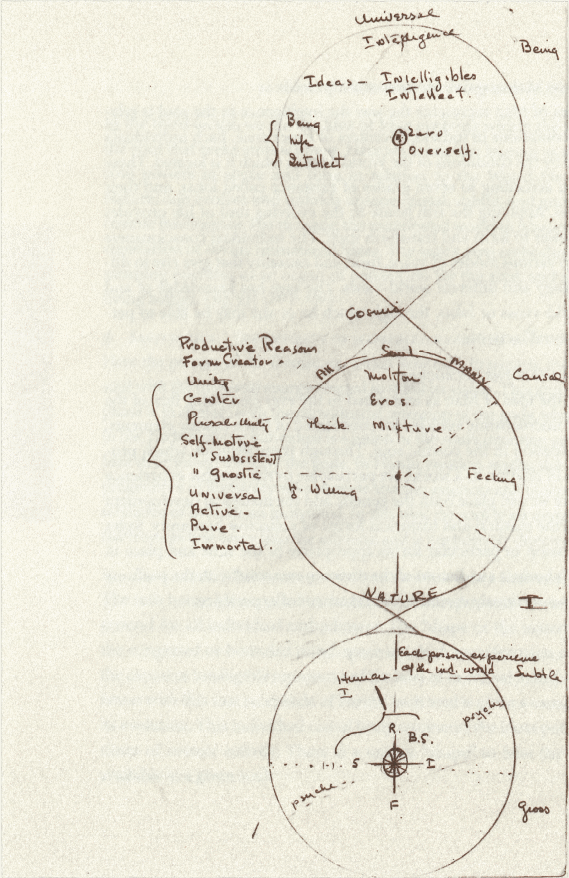
FIGURE AD_G_012. Three Circles Diagram: Divine Intellect, Soul, Psyche.
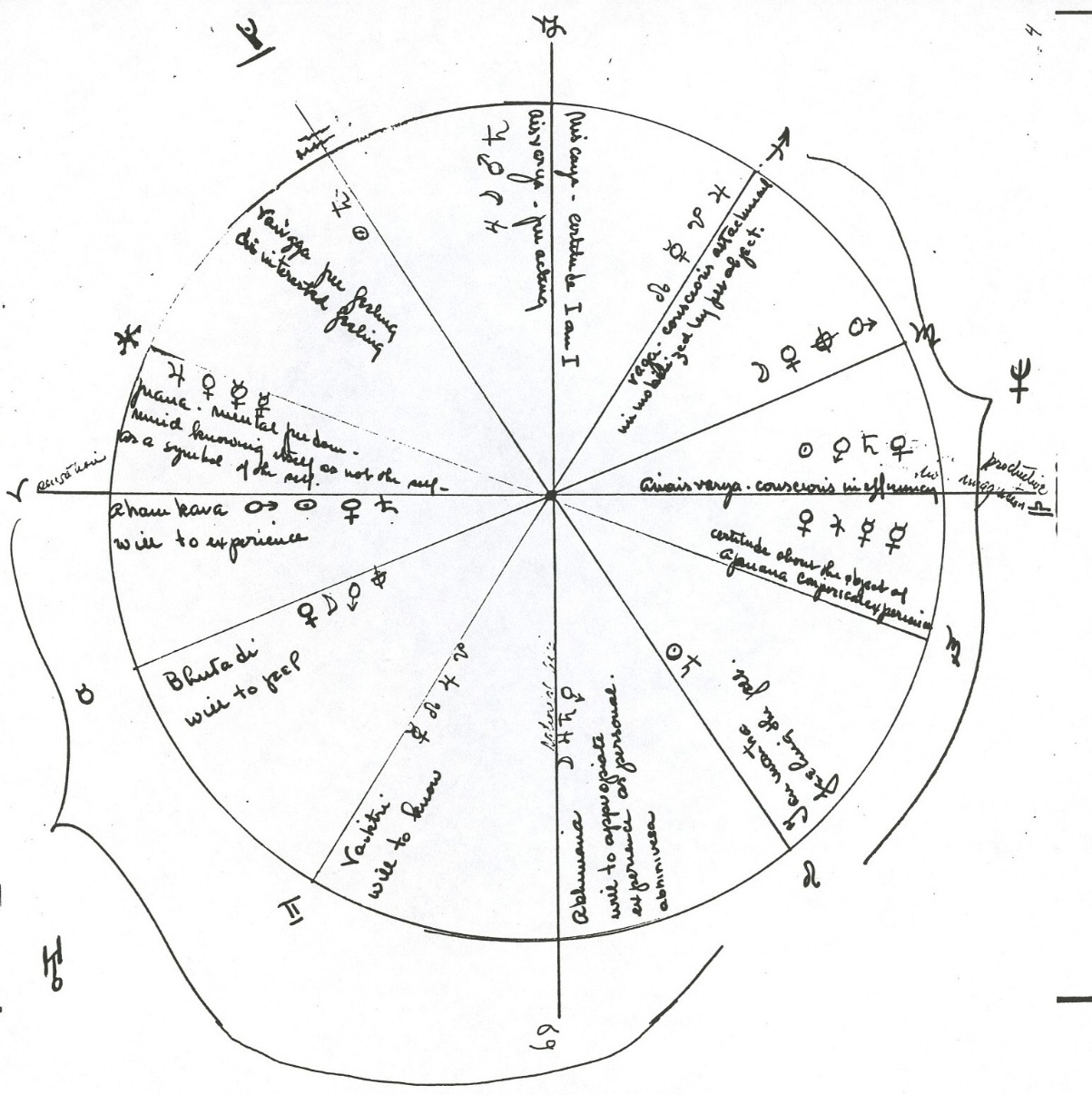
FIGURE AD_G_013. Four Psychological Functions, Samkhya Terms, and Uranus Neptune Pluto mapped onto Twelvefold Chart.
These diagrams are not from this class but are used as stand-ins to help follow along. Other diagrams also referred to are not with this transcript version. [Transcriber note: [diagram] means the speaker is referencing a diagram as he or she is speaking. If someone is drawing or writing, with audible sounds of chalk on a blackboard, I indicate this by [drawing] or [writing].]
PAPER read in class:
- "Symbolizing Samkhya". This paper exists only as read in this class and has been tentatively titled "Symbolizing Samkhya". It appears to be authored by the student who's reading it. Retyped as 1972 0322b V09M. Hinduism - Samkhya - Symbolization.
NOTES:
- This is 1972 03/22a, Hinduism; Samkhya class, and the first entry associated with this date. 1972 03/22b = Samkhya Paper.
TRANSCRIBED Verbatim by IT 2023. In 2025, IT changes the name of one diagram and shortens diagram references within transcript, updates audio file markers to match new REP audio. Archival verbatim transcript with Paper – V11ap.
AUDIO FILES: 1972 0322a, 1972 0322b. [Note 1: "Tape" refers to original audio cassette tapes that were later digitized into .MP3 Audio Files. Note 2: We only have two audio files for this class; if there are others, we don't have them. Note 3: In 2025, REP Studio cuts dead air from file b.]
1972 03/22a at American Brahman Bookstore
Hinduism; Samkhya
[Audio File 1972 0322a Begins]
AD: We can do, I'm off today.
S (simultaneously): Yeah, yeah.
[tape break]
[Transcriber note: The following paper exists only as read in this class and has been tentatively titled "Symbolizing Samkhya". It appears to be written by the student who's reading it. It has also been retyped as 1972 0322b V09M. Hinduism - Samkhya - Symbolization.]
Student Paper ["Symbolizing Samkhya," S reading]: "…in two aspects, a being aspect and a becoming aspect. As they occur in the being aspect, the three functions of buddhi, ahamkara, and tanmatra would be indistinguishable from one another and might best be referred to as simply the internal organ. As the manifestation of the three gunas is revealed as the becoming aspect, however, the gunas become translated into functions, the guna of rajas becoming a function of ahamkara, etc. As for the symbolization of what has just been said, one would symbolize the being aspect of the manifestation of the three gunas by the simple circle, for the being aspect of the function of ahamkara for instance would be identical to the being aspect of the functions of both buddhi and tanmatra."
S: That you can take an issue with.
Student Paper ["Symbolizing Samkhya," S reading]: "Thus the circle would symbolize the internal organ. As far as the becoming aspect however, rather than to symbolize any of the three functions as a point on the circle, one would best symbolize them each as an entire cross. In other words, the ahamkara function in its being aspect would be symbolized by a circle but in its becoming aspect it would be symbolized as the entire cardinal cross comprising the ascendant, descendant, nadir, and midheaven. Each of the points on the cross would in turn be one point of view from which to view the entire function. Thus the ascendant would be the ahamkara as the totality of one's self as subjective experience and might say"I am the totality of my experience." The ahamkara as seen from the descendant might see the totality of one's experience as an object and might say, "I am the negation of all my experiences." From the point of view of the nadir, the ahamkara might be referred to as the very basis or ground of one's being, as the base of a pyramid comprises the totality of the pyramid in its potential aspect, while from the point of view of the midheaven the ahamkara would be the totality of oneself as it becomes concretized and embodied into a representative form, just as the top point of a pyramid represents the totality of the pyramid as the very climactic actualization of all its potentialities. The same procedure (would/will) hold true for the functions of buddhi and tanmatra, that is that tanmatra would be symbolized by the entire fixed cross while the function of buddhi would be symbolized by the entire mutable cross."
AD (faint): Well--
S: Anybody follow it?
AD: Well read the whole thing again.
Student Paper ["Symbolizing Samkhya," S reading]: "Moreover, from this symbolization we can derive a definition of the four astrological elements as the fourfold way in which any function becomes manifest. The ascendant becomes the fire aspect of ahamkara, the midheaven the earth aspect, etc. Thus from two key points we can derive the twelve from the three, that is (1) when the gunas become manifest they acquire a twofold aspect, one of being and the other of becoming; (2) as regards the becoming aspect, this is best symbolized by the cross, that is, that each function of the internal organ is best inferred from its fourfold expression or manifestation."
S (very faint): Yeah.
S (very faint): (You've got everything.)
AD: Well, instead of criticizing, why don't we start all over again? Ok?
S: Yes, yes.
[13 second pause]
[tape break]
AD: --right now at least a little easier. [10¼ second pause, someone writing] The most difficult point of all, and the one that we're not going to try to solve right now.
S: Right.
[short pause while AD draws]
AD: You have a lot of little purushas running around. And one of them is Ishvara [diagram].
[students assent, bit of laughter]
S: Ah.
S: Oh.
JL (faint): That's not acceptable.
S: He's a little purusha.
AD: Then you [drawing] have the level of prakriti.
[20¾ second pause while drawing]
[tape break]
AD: --know what their connection is and any description, any attempt to describe the contact that's established between the purusha and prakriti is kind of vague and very difficult to understand. So we'll start off by reading a few extr-- a few of the Samkhya karikas, ok? I'll just label them as we go.
[Transcriber note: I am using Yoga as Philosophy and Religion by Surendranath Dasgupta, London: Kegan Paul, Trench, Trubner & Co., Ltd., New York: E.P. Dutton & Co., 1924.]
Surendranath Dasgupta [Yoga as Philosophy and Religion, pp. 16-17, AD reading]: "(1) The Ego-sense is the illusory appearance of the identity of the power as perceiver and the power as perceived.
(2) The seer though pure as mere "seeing" yet perceives the forms assumed by the psychosis [(buddhi)]. [AD: That's buddhi.]
(3) It is for the sake of the purusha that the being of the knowable exists.
(4) For the emancipated person the world-phenomena ceases to exist, yet they are not annihilated [AD: That is, the world phenomena are not annihilated.] since they form a common field of experience for other individuals.
(5) The cause of the realisation of the natures of the knowable and purusha in consciousness is their mutual contact."
AD: That's the one I told you we can't understand.
S (faint): Yet.
Surendranath Dasgupta [Yoga as Philosophy and Religion, p. 17, AD reading]: "(6) Cessation is the want of [AD adds: this] mutual contact arising from the destruction of ignorance and this is called the state of oneness.
(7) This state of oneness arises out of the equality in purity of the purusha and buddhi or sattva.
(8) Personal consciousness arises when the purusha, though in its nature unchangeable, is cast into the mould of the psychosis. [AD: Into the mould of buddhi.]
(9) Since the mind-objects exist only for the purusha, experience consists in the non-differentiation of these two which in their natures are absolutely distinct; the knowledge of [AD adds: the] self arises out of concentration on its nature."
AD: Now these are some of the leading karikas.
[9¼ second pause]
Surendranath Dasgupta [Yoga as Philosophy and Religion, p. 18, AD reading]: "The mind suffers changes according to the form of the object of cognition, and thus results a state of conscious cognition in the shape of"I know it," when the mind, having assumed the shape of an object, becomes connected with the constant factor purusha, through the transcendent reflection or identification of purusha in the mind. [AD adds: And] This is what is meant by [AD adds: a] [pratyayanupasya] reperception of the mind-transformations by purusha, whereby the mind which has assumed the shape of any object of consciousness becomes intelligent. Even when the mind is without any objective form, it is always being seen by purusha. The exact nature of this reflection…"
AD: --like we said, is very difficult to comprehend.
Surendranath Dasgupta [Yoga as Philosophy and Religion, p. 18, AD reading]: "The mind suffers changes according to the form of the object of cognition…"
AD: Now, fall back on an analogy to try to help you to understand. Use the dream analogy. And if you think of the dream analogy where a person has a dream and in the dream one of the dream characters perceives a dream object. And this dream character who perceives the dream object says to himself, "I see that dream table." Try to-- try to use that kind of analogy to work with. Now you can see in a sense that when the dream character says "I see the dream table," that we are-- we have here one substance, alright, and that this one substance, so to speak, is divided in a twofold way. On the one hand you have the subject series, the various dream characters, on the other hand you have the object series, the various objects in the dream. And of course the subject feels itself to be utterly distinct from the object, just like you say to yourself "I'm utterly distinct from that chair," alright. Of course if you try to prove it you'd have difficulty. But that's the way your feelings operate, right? Alright, so we go on.
Surendranath Dasgupta [Yoga as Philosophy and Religion, p. 19, AD reading]: "…[for] the grasping of an object, the act of having a percept, is nothing but its own undergoing of different modifications…"
S (faint): Uh-hm.
AD: You imagine this dream character looking at the dream table and his mind, so to speak, or his understanding or his perception of that dream table is nothing but what he calls his mind undergoing this modification that makes possible for him to perceive the dream table.
Surendranath Dasgupta [Yoga as Philosophy and Religion, p. 19, AD reading]: "…and thus, since an object sometimes comes within the grasp of the mind and again disappears in the subconscious as a samskara (potency) and again comes into the field of the understanding as [smrti] (memory), we see that it is [parinami or] changing. But purusha is the constant seer of the mind when it has an object, as in ordinary forms of phenomenal knowledge, or when it has no object as in the state of nirodha or cessation."
AD: That is, when you're not thinking, or when you're sleeping. So, we can-- we can fall back on the analogy and you can perceive in a sense that the dream person looking at the dream object, alright, so to speak, is backed up by this consciousness of the one-- the one person, alright. And whether this dream person, so to speak, sees the dream table or not, let's say he goes to sleep, that one mind is still there. Ok?
S (very faint): Uh-hm.
[short pause]
AD: Now this one mind of the dreamer, the person who's having the dream, or the purusha--
Surendranath Dasgupta [Yoga as Philosophy and Religion, p. 19, AD reading]: "[It] is the light which remains unchanged amidst all the changing modifications of the mind, so that we cannot distinguish purusha separately from the mind. … Its knowing is manifested in our consciousness as the ever-persistent notion of the self, which is always a constant factor in all the phenomena of consciousness. Thus purusha always appears in our consciousness as the knowing agent. [AD adds: But] Truly speaking, [however], [AD: says Samkhya] purusha only sees himself; [AD adds: and] he is not in any way in touch with the mind. He is absolutely free from [all] bondage, absolutely unconnected with prakrti."
AD: And that is irrelevant here. Dasgupta should not have put that in. Do you see that? Because right away he jumped out, so to speak, and went into metaphysics. [short pause] Ok. Let's go on.
Surendranath Dasgupta [Yoga as Philosophy and Religion, pp. 22-23, AD reading]: "[To summarise:] We have seen that something like [AD reads: We see something like this] a union takes place between the mind [AD: The internal organ--ahamkara, buddhi, manas."…a union takes place between the mind] and [AD adds: the] purusha, [i.e.] there is a seeming reflection of purusha in the mind, simultaneously with its being determined conceptually, as a result [whereof] this reflection of purusha in the mind, which is known as the self, becomes united with these conceptual determinations of the mind and the former is said to be the perceiver of all these determinations."
AD: Now let's go slowly over this here and see if you could at least-- [student assents] There-- like we said, there's some kind of a union which cannot be explained between the purusha and the internal organ. Just like for instance, there is some kind of connection between the person who is having the dream and the character in the dream. Do we have a copy of Wisdom here, Paul? Well, it's a kind of difficult connection to establish and even when PB speaks about it, you remember the phrase he uses, that the consciousness or the knower is immanent in the personality? Do you remember that quotation?
S (very faint): Yeah.
AD: Would you find it for me? Alright, so there's this union between the Self, which is immutable, eternal, ubiquitous, alright, and this internal organ, ok. There's this reflection in the internal organ. And while this is being determined, in other words, as this becomes an object which it is going to perceive, alright, he goes on and says--
Surendranath Dasgupta [Yoga as Philosophy and Religion, p. 22, AD reading]: "…there is a seeming reflection of purusha in the mind, simultaneously with its being determined conceptually…"
AD: That is, the mind being determined conceptually.
Surendranath Dasgupta [Yoga as Philosophy and Religion, pp. 22-23, AD reading]: "…as a result [whereof] this reflection of [AD adds: the] purusha in the mind, which is known as the self, becomes united with these conceptual determinations of the mind and the former [AD: That is, the purusha.] is said to be the perceiver of all these determinations."
AD: So you have the situation, so to speak, where the mind is the object which it-- it becomes that object, and in the process of becoming that object that object is lit up, so to speak, by the knowledge that's behind it. So, it's-- it's-- it's a very sticky situation, you know, conceptually. You try to grasp one end and the other end slips away. [short pause] So--
Surendranath Dasgupta [Yoga as Philosophy and Religion, p. 23, AD reading]: "Our conscious personality [or self] is [thus] the seeming unity of the knowable as the mind in the shape of conceptual or judgmental representations [AD reads: shape of conceptual judgment] with the reflections of purusha in the mind. Thus, in the [AD reads: a] single act of cognition, we have the notion of our [own] personality and the particular conceptual [or perceptual] representation with which this ego identifies itself. The true seer, the pure intelligence, the free, [AD adds: and] the eternal, remains all the while beyond any touch of impurity from the mind, though it must be remembered that it is its own seeming reflection in the mind that appears as the ego…"
AD: Did you find that?
LS: Yeah.
AD: Would you read that please?
[Transcriber note: I am using The Wisdom of the Overself by Paul Brunton, North Atlantic Books, Berkeley, California, 2015 edition.]
PB [The Wisdom of the Overself, "The Secret of the I," p. 124, LS reading]: "…why if the person is itself owned and is [LS reads: owned as] not the ultimate owner does it seem to own the self; and, why does it yield the feeling of being substantially our real self? The answer is that the witnessing self is present in hidden association or mystic immanence in the personal self and reflects into that self the feeling of its own real existence."
AD: Alright, that's of course a much more English way of putting the same thing. And it's obvious that some of these conceptions cannot be translated even in analogy, you know, you have difficulty even with an analogy trying to grasp it, this mystic immanence. Just like for instance the dream person, you know, who's seeing that dream table, alright, thinks that he has a consciousness of himself, he says, you know, "I'm I," you know, "what are you talking about?" And yet, looking at it from the point of view of being a witness and looking back at your dream, you say "Why all he did was to participate in the consciousness of that one person." And yet all these ten little people inside the dream, each one saying "I am I," ok. So that mystic immanence is-- is really very difficult to grasp and you just have to try to see it sometimes rather than try to understand it conceptually. But (in either--) at any rate, looking back into that dream you can see that the person who considers himself as an ego separate from another ego, the conceptual determinations of his mind also, and the object that he perceives are nothing but modification, so to speak, of this one-- one being, you know, reflecting within himself. [12 second pause] Well, that's to present you with some of the difficulty that the Samkhya has and also which Vedanta will have.
[11 second pause]
[tape break]
Surendranath Dasgupta [Yoga as Philosophy and Religion, p. 40, AD reading]: "[Thus we see that] from prakrti comes mahat, [AD adds: and] from mahat comes ahamkara, and from ahamkara…the evolution [AD: from ahamkara, the evolution] takes three different courses according to the preponderance of sattva, rajas, and tamas [AD reads: of the gunas] [AD adds: and] originating the cognitive and [AD reads: the] conative senses and manas…on [AD adds: the] one side and the tanmatras on the other. [AD adds: And] These tanmatras again produce the five gross elements. Now when ahamkara produces the tanmatras or the senses, or when the tanmatras produce the five gross elements, or when ahamkara itself is produced from buddhi [or mahat], it is called tattvantara-parinama…"
[15 second pause while AD writing]
[tape break]
AD: --useful later on this terminology. I'll-- I only pick on words that have a very peculiar reason, you know. And what they're saying is that this is a different-- In other words, when buddhi is produced from prakriti or emerges from prakriti or is distinguished from prakriti, and I'm using all these terms in a very important way, and when ahamkara, so to speak, emerges from buddhi, alright, or distinguishes itself from buddhi, you have a different degree of existence. You have an entirely different thing, alright. Although we can say that you can trace back and each one, so to speak, is an em-- an evolute from the preceding one, we must try to remember that when these people refer to this as a degree of existence, this is another degree of existence, alright, they're-- they have to be kept very distinct. And depending upon the aspect of which you discuss one of these degrees of existence, it's going to be all-(determining). Alright, we start again.
LS (simultaneously): Could you read again what the meaning of that tattvantara-parinama is?
AD: Yeah, and I'll reread it. His version is something like this.
Surendranath Dasgupta [Yoga as Philosophy and Religion, pp. 40-41, AD reading]: "…the state of being involved in the tanmatras [AD: for instance] is altogether different from the state of being [of] ahamkara; it is not a mere change of quality [AD: alright] but a change of existence or state of being."
AD: Ok? That's fundamental. Parinama, or change, as they speak of it. Now the only thing that to Samkhya that could evolve, the only thing that could evolve, there's no other evolution, is the so-called 24 tattvas, the tattvas evolve, nothing else.
S (very faint): Ok.
S (very faint): [couple words inaudible] so start reading from [one word inaudible]
[tape break]
AD: --because you have-- read that section where he points out the twin-fold origin, so to speak, of the subjective and objective series takes its rise in ahamkara, alright. He points out, he goes on to say, that the-- the world, so to speak, the subject-object series, has to be traced back to a source. This source, so to speak, is common to them both, alright. Just like for instance if we took-- if we took the instance of the dream, we fall back always on that analogy, and we'll find it very useful. Now, the substance, let's say, if we could use the word "the stuff of the dream," "the mind-stuff of the dream," is all one, ok? But this stuff, so to speak, gets divided up into different series. On the one hand, part of the stuff of the dream becomes the objects, and a different part of the stuff of the dream becomes the subject. Now the part of the drea-- of the mind-stuff that becomes, so to speak, the objects in the dream is-- is from the tamas area, alright, which, when they break this down, the ahamkara, they refer to it in three different ways and the tamas area is referred to as bhutadi [diagram], aright. So that all the objects that evolve or come from the ahamkara, basically the tamasic area, come from ahamkara, and the same with the subject series. Like if you had ten different people in the dream, dream subjects, alright, they would all come from, so to speak, the mind stuff of this one person who's having the dream and that there would be this division, ok? So, you begin to get a feeling that ahamkara's really cosmic, alright, you're dealing with-- Now we pointed out that buddhi for instance represented the sattvic and the rajas and tamas was suppressed. In this area [diagram] rajas comes up into prominence and sattva and tamas is suppressed, ok. So that this would represent more of the energetic or let's say the will aspect. So ahamkara is-- even when we speak on an individual basis ahamkara represents the willing, the energizing. Alright, we'll read that paragraph again.
[tape break]
AD: --tattvantara-parinama would be that--
Surendranath Dasgupta [Yoga as Philosophy and Religion, pp. 40-41, AD reading]: "…state of being involved in the tanmatras is altogether different from the state of being of ahamkara; it is not a mere [AD, aside: Oh, thank you."…it is not a mere] change of quality but a change of existence or state of being. … "Now the evolution that [AD reads: of] the senses and the five gross elements can undergo can never be of this nature, for they are vise…"
AD: How do you say that, v-i-s-e-s-h-a-s?
S: Visesha?
AD: Visesha?
Surendranath Dasgupta [Yoga as Philosophy and Religion, p. 41, AD reading]: "…for they are viseshas [AD reads: visesha], or substances which have been [AD reads: become] too much specialised to allow the evolution of any other substance of a different grade of existence from themselves."
AD: So in a sense what they're saying is that, at this level, at this level here [diagram], this is relatively unspecialized. Over here it becomes more specialized [diagram]. But over here it reaches the limits of specialization [diagram]. There cannot possibly be any more differentiation, ok? So that when you reach the level of the gross bhutas, so to speak, the chemical elements, there is no more possibility of any differentiation. Vic, you see the point? The chemical-- chemical atoms could combine in any kind of combination [VM simultaneously, very faint: They're still (there).] if-- no matter what you do they will always be in the realm, so to speak, of the corporeal senses, you know, the earth, air, fire, water, ok, no matter how you twist and turn that. But up here in the area of the tanmatra [diagram], let's say in the area of the tanmatras where the-- the substance or the stuff of the tan-- of the ahamkara can become either the object or the mind. You see, it's unspecialized over here. Once it goes through this process of specialization, alright, it becomes something entirely different from ahamkara, alright, and now you've got it down here [diagram], it's a degree of existence, so to speak, which is fixed and permanent, and different from ahamkara. You cannot for instance find ahamkara in the gross elements. Ok?
VM (very faint): Well let me just get something straight.
AD: Sure.
[tape break]
AD: --the-- the process of differentiation that's going on, and at the various levels where there is a degree of existence or a state of existence which is different from another, there's-- there is, so to speak, differentiation and integration within that state of existence, then further on there's more differentiation, more integration going on, alright, so that finally when you come down to the bottom, so to speak, you have this whole system. Now remember, this whole thing exists simultaneously, I'm speaking temporally but you have to remember, this is a logical thing, just the way you are now this is with you too.
[short pause]
S (very faint): Hey Tony.
AD: Yes, louder.
S (very faint): Talk(ed) about the [couple words inaudible]
[tape break]
[short pause]
AD/S(?) (very faint): (Alright.)
Surendranath Dasgupta [Yoga as Philosophy and Religion, pp. 48-49, AD reading]: "[Now] in analysing the different states of our mind [AD adds: yogis claim that] we find [that] a particular content of thought is illuminated and then passed over. The ideas rise, are illuminated and pass away. Thus they found that"movement" was one of the principal elements that constituted the substance of our thoughts. Thought as such is always moving. This principle of movement, mutation [or] change, this energy, they called rajas.
"Now apart from this rajas, thought when seen…"
AD: And this-- this will be difficult. Pin your attention down.
Surendranath Dasgupta [Yoga as Philosophy and Religion, p. 49, AD reading]: "…thought when seen as divested of it sensuous contents seems to exhibit one universal mould or form of knowledge which assumes the form of all the sensuous contents that are presented to it. It is the one universal of all our particular concepts or ideas--the basis or substratum of all the different shapes imposed upon itself, the pure and simple. Sattva in which there is no particularity is that element of our thought which, resembling [AD reads: resembles] purusha most, [AD adds: it] can attain its reflection within itself and thus makes the unconscious mental states intelligible. All the contents of our thought are but modes and limitations of this universal form and are thus made intelligible. It is the one principle of intelligibility of all our conscious states.
"Now our intellectual life consists in a series of shining ideas [or] concepts; concepts after concepts shine forth in the light of the pure intelligence and pass away. But each concept is but a limitation of the pure shining universal of our knowledge which underlies all its changing modes or modifications of concepts or judgments."
AD: Now, do you have any feeling of what he just said, you got any idea?
S (very faint): Yes.
S: (We do.)
AD: Yeah, go ahead.
DB (simultaneously): You know that-- it sounded in a way like--
[tape break]
AD: And we said that this dream was composed of the stuff, some kind of mind-stuff. And this mind-stuff, so to speak, broke down and provided us, first of all in the dream we can see that there was the subject-series, that is, a couple of dream subjects saying "I see a dream table." There was objects in the dream, dream table, ok? And there was motion in the dream, ok? Alright, this is pretty obvious so far. We can see the rajas insofar that we have constant movement in the dream itself. We could see the tamas insofar that a form persists as such and remains as a form so that it could be recognized as an object. In other words, it becomes a subject of that energy. But the sattva in this dream. What is that?
S (faint): (Ok.)
[11 second pause]
AD: Certainly we cannot say that the sattva is a principle of awareness because that principle of awareness belongs to the person who's having the dream. So what do we mean when we say the sattvic portion of that mind-substance? Yes, Dave?
S: Wouldn't that be like point of view in the dream?
AD: A point of view? No not really.
S (very faint): Oh no?
AD: But I may-- I may be wrong, maybe you ought to try to say more.
S: Well I'm just trying to think of like, when I dream something and the subject in the dream seems to be-- (table is--)
[tape break]
[short pause]
AD: It's the reflector, the transparent aspect of the mind, so to speak, which makes possible the intelligibility of the dream content. If for instance, and this is only an analogy, if we take the dream and we imagine that in the dream there's a very black room and it's very dark, ok, nothing can be seen or understood, you know. Nothing is being reflected, so to speak, to-- the-- in other words, the principle of awareness is shining but there's nothing it can light up because you got just this tamasic dream, if I could exaggerate it, ok? [S: Yeah.] There has to be a sattvic portion to that mind substance that reflects that light. Is this making any sense?
S: Yeah.
JL: If for example you took the-- the moralistic sense, you know, in the dream itself that tells you that certain things are happening to you, you know, the intelligibility of-- of the sequence of events, and this sort of reflection on the events themselves and the particular meaning content that's involved in-- in this reflectivity, as being more or less the sattvic.
AD: That would be sattvic, yes. That would be sattvic.
JL: Or you might say, even the-- the abstract symbolic sense that's perceived in-- in the contents or reflected on.
S: But that is very different states that (you talk).
AD: That isn't what? [S simultaneously: See one--] So as he speaks of this-- [tape break] --tamas portion of the objective world out there, ok, and the sattvic portion of the world in the brain which the brain, so to speak, reflects the thought, the in-- makes it intelligible, the events, but the principle of awareness absolutely transcends the whole thing, ok. But the scientists makes the mistake of considering that sattvic portion, alright, as the principle of awareness. You remember I gave you that to read, Bob?
S: I didn't understand this difference.
AD: You didn't understand the difference?
S: But then the principle of awareness (is/in) this intelligence is--
S (very faint): Yeah.
AD: Alright, let's try to get more precise.
[tape break]
S (faint): Tom--
AD: Just one or two other lines and then let's try to use the conceptual model of a chart.
[14 second pause]
[tape break]
Surendranath Dasgupta [Yoga as Philosophy and Religion, p. 49, AD reading]: "…contents of our thoughts [AD reads: thought] are but modes and limitations of this universal form and are thus made intelligible. It is the one principle of intelligibility of all our conscious states."
AD: We'll go on to something now that's a little more difficult.
[23 second pause]
[tape break]
Surendranath Dasgupta [Yoga as Philosophy and Religion, pp. 50-51, AD reading]: "…"How an object can ever become a subject, or how a being can ever become an object of representation: this curious change will never be explained by anyone who does not find a point where the objective and subjective are not distinguished at all, but are altogether one. Now such a point is established by, and made the starting point of our system. This point is the Egohood, the Intelligence, Reason, or whatever it may be named [AD reads: you would name it]." … This obscure egohood is known merely as being. This mahat has also been spoken of [by Vijnana Bhikshu] as the manas, or mind, as [AD reads: and] it has the function of assimilation [(niscaya)]. Now what we have [already] said about mahat [AD reads: buddhi] will [AD adds: come], we hope, make it clear that this mahat [AD: or buddhi] is the last limit at which the subject and the object can be considered as one indistinguishable point which is neither the one nor the other, but the source of both.
"[AD adds: And] This buddhi is [thus] variously called mahat, asmitamatra, manas, sattva, buddhi [and] linga, according to the aspects from which this state is observed [AD reads: according to what aspect we're going to speak from it]."
"This [AD reads: The] state is called mahat as it is the most universal thing conceivable and the one common source from which all other things originate.
"Now this phase of sattva or pure shining naturally passes into the other phase, that of the Ego as knower or Ego as subject. The first phase as mahat [or asmitamatra] was the [AD reads: a] state in which the sattva was predominant and the rajas and tamas were [in a] suppressed [condition]. The next moment is that in which the rajas comes uppermost, and thus the ego as the subject of all cognition--the subject I--the knower of all the mental states--is derived. The contentless subject-objectless"I" is the passive sattva aspect of the buddhi catching the reflection of the spirit of purusha."
AD: Ok. So, if we want to we could imagine, so to speak, [drawing] a reflection-- well, alright, we'll-- we'll have to get this out now-- the reflection, so to speak, of the purusha. And this is where there is a complete mergence of the subject and the object where you cannot distinguish one from the other. [short pause] Suppose, suppose we try with the chart, instead of using their terminology. [short pause while erasing, drawing] We tried to some-- in some way to repeat somewhat what we were doing Monday night, or perhaps a little-- Alright, now here's prakriti [diagram], prakriti is unmanifest, right? No manifestation. The first-- the first product of prakriti is buddhi [diagram], alright. [short pause while drawing] Very first product of prakriti is buddhi. And, like if we say prakriti represents let's say the unconscious. Ok? And the very first product of the unconscious would be what?
S: Ego?
S (simultaneously): [three words inaudible]
AD (simultaneously): Ego? How would you know?
S (very faint): [three words inaudible] part of the ego.
S (very faint): [few words inaudible]
AD: How would you know? [short pause] How would you know that the ego was the first product? [short pause] You would have to be conscious of it, wouldn't you?
S: Yes.
AD: You would have to distinguish it from the unconscious, wouldn't you?
S: Yes.
AD: In other words, as a thought is produced in the unconscious, at that instant that the thought is distinguished from the unconscious, it's revealed also.
S: Yes.
AD: Is that so?
S (faint whisper): For sure.
S: Yes.
AD: So then, when we say buddhi, ok, alright, as the first product, the first evolute, alright, we're saying, so to speak, that-- the principle of consciousness. [student assents, very faint] Ok? But this principle of consciousness has an object, or let's say differentiates itself into an object. That is, insofar that it wants to reveal something, alright, or it's going to become something, alright, then we refer to it as ahamkara. And insofar that it-- insofar that it wills to become something, that something that it becomes, alright, would be the tanmatras. Alright, let's-- let's use Bhattacharyya now, let's see how he puts this.
S: Well Tony--
AD: Yeah.
S (simultaneously): --would you-- like, would you say that the first product, well--
AD: Loud, loud.
S (simultaneously): Do-- would you say the first product is the result of this distinguishing and revealing? Would that be buddhi or would that be both buddhi and ahamkara?
AD: Say again, yeah?
S: Um--
AD: Louder.
S (simultaneously): When you-- when you say that the first object is as a result of distinguishing and revealing, would that be both buddhi or-- I mean-- well, you can't separate but, would that be both buddhi and a-- ahamkara or would it be buddhi that distinguishes and reveals?
AD: Buddhi.
S: 'Cause the distinguishing aspect is like ahamkara within buddhi but--
AD: Yeah, buddhi would have to be the first. Hm? What reveals, [S: Right.] you know. In other words, you have prakriti, a state of unmanifest, the undifferentiated, and unsigned, unmarked, there's no way of distinguishing it or knowing anything about it. That's why they call it and give the word 'a-linga'. It has no characteristics, it cannot be characterized in any way. Now, soon as you take off the 'a', if I understand Sanskrit, linga, the first linga is buddhi, alright. The first thing that can be characterized from the unconscious or from the prakriti or from undifferentiated matter is linga, the first thing that can be categ-- characterized. That would be buddhi. Now buddhi in its cosmic aspect would represent the cosmic intelligence where the aug-- where the entirety of all the possibilities that are going to be manifested or played out is organized in a way. But, now we are speaking in temporal terms. But we know that from a metaphysical point of view, the simultaneity of creation, so to speak, is something to be reckoned with, alright? So that as soon as we said buddhi, alright, and we have distinguished it from let's say the prakriti aspect, the prakriti, we have so to speak this cosmic intelligence from which everything is going to be drawn out or evolved. Ok?
S: Yeah.
S: Tony?
AD: Yes? [tape break] --alright, at the same time as a content. And this content is ahamkara. I don't see your point, Crystal, I want you to tell me what your point is.
JL: I got it at the same time. Can you speak of subject and object at the level of-- of buddhi? That's all she's asking. If you-- if you consider the fact that-- that they're indistinguishable there then is there such a thing as talking about them at all at that level?
AD: But I never spoke about them at that level. [JL simultaneously: Well but that's all she's asking.] I just said this is where they merge and disappear, subject and object.
JL: Well then you can't-- you can't speak of subject and object as existing there in any sense.
AD: Why, existence has to be manifest otherwise it isn't?
JL: No, not necessarily.
AD: Well, then what's your point?
JL: Well, the terms become meaningless at that level.
AD: Yes.
JL: Alright, that's all.
AD: Alright, that's buddhi.
JL: And subject and all-- and subject and object are only meaningful as terms below the level of ahamkara and including that.
[short pause]
[tape break]
VM (very faint): Are you reading from Bhattacharyya or--
AD: No, I'm reading from Dasgupta. I'm going to read the first point or the second point that I made which if you didn't hold on to that point you missed the whole-- the whole lecture, everything was wasted. So let me repeat this point.
Surendranath Dasgupta [Yoga as Philosophy and Religion, p. 19, AD reading]: "…the main difference between the mind and purusha is that [the] mind is constantly undergoing modifications, as it grasps its objects one by one; for the grasping of an object, the act of having a percept, is nothing but its own undergoing of different modifications, and thus, since an object sometimes comes within the grasp of the mind and again disappears in the subconscious as a samskara [(potency)] and again comes into the field of the understanding as smrti [(potency)] [AD reads: comes into the field as understanding], we see that it is [AD adds: a] parinami or changing."
AD: Let me repeat this. And I'll change the words a little to help you.
Surendranath Dasgupta [Yoga as Philosophy and Religion, p. 19, AD reading]: "…the main difference between the mind and [AD adds: the] purusha…"
AD: The mind and the purusha, now the mind here refers to buddhi, alright? Let's think of the term 'buddhi', the cosmic principle buddhi, the cosmic intelligence.
Surendranath Dasgupta [Yoga as Philosophy and Religion, p. 19, AD reading]: "…the mind and purusha is that the mind [AD: or the buddhi, alright, the cosmic principle] is constantly undergoing modifications, as it grasps its objects one by one; for the grasping of an object, the act of having a percept, is nothing but its own undergoing of different modifications, and thus, since an object sometimes comes within the grasp of the mind and again disappears in the subconscious as a samskara [(potency)] and again comes into the field of [AD reads: as] the understanding…"
[short pause]
S (faint): So then, there wouldn't be a distinction as it comes out of itself.
AD: If-- if this board, so to speak, alright, represented prakriti, alright, and the cosmic principle of intelligence arises, alright, this here circle [diagram]-- [AD hits board with chalk, then draws] Or let's say this [diagram], ok? And then we add this [diagram], ok? And I put over here, what does it know, (Dan)?
[Audio File 1972 0322a Ends]
[Audio File 1972 0322b Begins]
AD: [one word inaudible] here's one thing, the buddhi, and we're going to speak of it. Now we realize it has different aspects. [student assents, faint] And when we speak of the cosmic intelligence as knowing, alright, this knowing is-- represents a willing, a willing to know, right? To know what? Itself. How does it-- how does it know itself, alright? By willing to know itself it must, so to speak, become an object to its knowing. This will become the tanmatras. Now we got this cosmic intelligence, so to speak, where we can handle it. We know that it has a substance aspect and it has a functioning aspect. [Note: See FIGURE AD_G_012, middle circle. See also FIGURE AD_G_013, the chart as split into thirds, each third ruled by a trans-Saturnian, but also specifically the ninth (knowing/buddhi), first (willing/ahamkara), and fifth (feeling/tanmatra) houses. These diagrams are not from this class but are used as stand-ins to help follow along.]
S (faint): Uh-hm.
S: So these are all aspects of buddhi.
AD: Yeah. Let's go back to the dream, ok? In this dream you have, let's say, as a dream object-- I mean as a dream person you have dream knowledge about a dream object. Does this represent anything but a functioning, on the one hand, of the same substance which is a thing on the other?
S (very faint): Uh-hm.
AD: Where does [S simultaneously: It's all taking place within--] the difference-- where does the difference lie?
S: Hm.
AD: On the one hand we say this is the mind-stuff of the dream, let's say this stuff went into the making of the dream. On the other hand we say this stuff is doing something. What's it doing? It's functioning, right? Alright. Insofar that it functions and knows itself, alright, that knowing of itself stands out as its feeling or being, its standing, its persistence. Yes, Richard?
RG (faint): I didn't understand in that-- in that sentence where he talked about perceiving in succession [one/two words inaudible]
AD: What sentence? I--
RG (very faint): From Dasgupta.
AD: I didn't read that.
RG (faint): Yeah you just read it.
AD: Perceiving in succession?
RG (faint): [one/two words inaudible] one by one.
S (faint): Uh-hm.
S (faint): Talking about the mind.
Surendranath Dasgupta [Yoga as Philosophy and Religion, p. 19, AD reading]: "…for the grasping of an object, the act of having [AD reads: the having of] a percept, is nothing but its own undergoing of different modifications, [and] thus, since an object sometimes comes within the grasp of the mind and again disappears in the subconscious as a samskara [(potency)] and again comes into the field of the understanding…"
AD: Well what's your problem?
RG (faint): I didn't understand.
AD: What's your problem?
RG (faint): I--
S: The other sentence you read.
RG (faint): The other sentence you read. There was something about one by one.
AD: Alright, even without reading it, I don't know what you're referring to, what about it?
RG: Well, were you talking about buddhi as the cosmic principle?
AD: Yeah.
RG: Well then how can you speak of perceiving one by one?
AD: What would one by one stand for? Wouldn't it stand for its own modifications? And we're calling it one by one, right? Now, you're thinking of a nice wax ball and then you're making dents in it? And then you have to perceive each dent, so to speak, in succession? Is that how you're thinking of this?
S (very faint, possibly part of background): What is this?
[short pause]
AD: You see how you're trying to fit these concepts into those-- that terminology which is a terminology that's stuck up in the material world? How can you think of mind, alright, being a substance, modifying itself and knowing itself and yet speaking of one thing? Are we-- are we really understanding what we're talking about here? You're not going to understand this thing, right? All you're going to understand is your understanding about this thing, which is an entirely different story.
[short pause]
AP (faint): Tony?
AD: Yeah.
AP (faint): Is that what we're calling with PB in--
[tape break followed by short pause then another tape break]
AD: (--connect them), has got to be very careful and suspicious of what you read into them. [12 second pause] [tape break] --we said, we're going to try to construct a horoscope chart, and we spoke about, here's this vast blackboard which represents undifferentiated prakriti and within that blackboard this point arises which we refer to as bindu, alright. And PB speaks about that, somewhere he quotes the origin of the world, he says the World-Mind arises like a point of light. [Note: See Paul Brunton, The Wisdom of the Overself, p. 290, 2015 edition.] You-- you know the quotation?
S (faint): Yeah.
S (faint): Yeah.
AD: Ok. And this point is what's-- what we're going to have to s-- try to repeat some of the properties of the point. [student assents, faint] Ok?
[Transcriber note: I am using Man, God, and the Universe by I.K. Taimni, The Theosophical Publishing House, Wheaton, IL, 1974.]
I.K. Taimni [Man, God, and the Universe, p. 287, AD reading]: "(1) The most wonderful property of a point is that it can serve as a [AD reads: the] meeting ground of any number of planes of different dimensions. In fact it is the only mathematical entity which can serve as a sort of common door for entering a number of planes which interpenetrate one another."
AD: Another point he makes too.
I.K. Taimni [Man, God, and the Universe, p. 288, AD reading]: "(2) A point is the basis of space. [A point] moving in any direction [AD adds: it] develops a line. A line moving in any direction, except its own, develops a surface. A surface moving in any direction except its own [plane], develops a solid, and so on [for objects of higher dimensions]. We can thus say tentatively that [AD reads: the] space of any number of dimensions develops out of a point and is really nothing but a derivative of a point. …
"(3) A point is the [AD reads: a] mathematical representation in terms of space of the meeting ground between the manifest and the unmanifest."
AD: Alright? That's pretty close to buddhi, isn't it?
S (very faint): Uh-hm.
AD: Huh? What do you think?
S: Yeah.
I.K. Taimni [Man, God, and the Universe, p. 288, AD reading]: "(3) A point is the mathematical representation in terms of space of the meeting ground between the manifest and the unmanifest. It is at a point that the manifest disappear into the unmanifest, or vice versa, the unmanifest emerges into the manifest. This holds true not only for [the] meeting ground of the Real and the unreal but for every plane. The forces from a higher plane as well as consciousness emerge on the next lower plane at a point and vice versa. In the case of the spiritual vehicles the point or centre is the vehicle itself, but in the case of the [AD reads: a] temporary vehicles the point is hidden at the centre of the vehicle and the forces or consciousness are, as it were, dispersed throughout the vehicle."
S: Uh-hm.
AD: For instance when PB speaks about the mystical meeting point in the heart which he calls the Overself, alright, the heart center. And in various traditions they'll speak of it. Ok.
I.K. Taimni [Man, God, and the Universe, p. 288, AD reading]: "(4) …the nature of a point is that consciousness can penetrate into it ad infinitum without movement of any kind…"
AD: You're going to think here now--without movement of any kind.
I.K. Taimni [Man, God, and the Universe, pp. 288-289, AD reading]: "…and come into contact with deeper and deeper aspects of Reality or worlds of increasing subtlety. The mystery of this penetration of consciousness into itself [is], like all such mysteries [AD reads: mystery], beyond the comprehension of the ordinary human mind, though we can get a glimpse into it when we have understood the nature of a mathematical point. It is because a point is of 0 dimension that it is possible to penetrate [through it] into worlds of any number of dimensions, positive or negative [AD: manifest or unmanifest].
"(5) Another intriguing fact we can infer about the nature of a point is that any number of points can co-exist within [AD reads: with] one another, or to put it in other words a point can contain within it an infinite number of points. As a result of this property it is possible for any number of spiritual entities living in their respective mental [or spiritual] worlds to function from a common centre and to share a common state of consciousness.
"(6) [As] a point can be the only meeting ground between the manifest and the Unmanifest, manifestation always takes place through a point. [AD adds: And] We should always remember that consciousness can function only from a centre [or a mathematical point], both in its passive role of perception and active role of action. On this fact rests the whole occult doctrine of manifestation and cosmogenesis."
AD: And one more point.
I.K. Taimni [Man, God, and the Universe, p. 289, AD reading]: "…the point is the meeting ground or door leading from the world of the unreal to the world of the Real, or from the world of the mind to the world of pure Consciousness. On the one side of the point is the world of Reality or pure Consciousness, [AD adds: and] on the other side the multidimensional worlds of the mind, created by the mind and existing within the mind. He whose consciousness is established in the point is therefore in contact with both worlds."
S (faint whisper): (God.)
S (very faint): Uh-hm, yeah.
AD: Alright, that's enough on the point. How about that, would you buy some of that? Do you think that that point-- we got a big-- big point here, alright. It's a point though, alright. Would you buy that as buddhi?
S: Wow.
AD: Wow, what a deadly silence, wow! Yeah Vic.
VM (very faint): Tony, now this point doesn't have any dimensions and yet (this--)
[tape break]
PB [The Wisdom of the Overself, "The Unveiling of Reality," p. 290, S reading]: "[The beginning of a cycle would then be symbolized by the sun's] rising and its activity by the light of day. (laughter) We may picture to ourself a point of light appearing in this boundless darkness…" (laughter)
AD: You missed the whole point in mentalism, Vic. You're missing the whole point in mentalism.
PB [The Wisdom of the Overself, "The Unveiling of Reality," p. 290, S reading]: "We may picture to ourself a point of light appearing in this boundless darkness and spreading itself out as an ever-expanding circle. There is nothing except our own limitations to stop this process of expansion going on to all infinity and to all eternity in our picture."
AD: But we'll be satisfied with a three foot circle. (laughter)
S: When you draw the circle you stopped at infinite expansion and you pointed at a circumference now, it's not just--
S (very faint): That's right.
AD: Well how could I draw a circle without a circumference!? (AD laughing, laughter) I mean, if you think of intelligence, alright, you want to symbolize it. Alright, I'll make a square, would that help?
S (very faint): No, I don't (think so).
AD: Why does a circle seem to be more appropriate?
S (very faint): Because certain unity in the circle.
AD: It's almost like the perfect figure, isn't it, like the most perfect geometrical figure you can get. That's the first thing a child draws when he's one and half years old. [S, faint: Not my child.] You remember? He draws a circle around, alright. Or, where they have the example of a chimpanzee as they teach him to draw, the first thing he draws is a circle. It's almost-- it's almost like symbolically [drawing] it represents the Self. Only a symbolical representation. You know, I wouldn't go around saying that's my self. (bit of laughter) Just like when I think of the Witness-self can I-- can I conceive of it as a thing or something? No. So if I take away the body and if I take away the mind, this Witness-self which is, so to speak, you-- is the-- let's say the consciousness behind it, then what kind of boundaries do I give it, can I give it any boundaries? I mean, what is it, is consciousness some thing that I can grasp? Alright, so I want to speak about this Witness- self, how will I portray it? Well the circle would be the best thing. Why? It's the most perfect figure I know. Everything, so to speak, is equal distance from the center and this center here is going to represent, so to speak, and define that whole circle. Alright? And, what's the definition of the circle, the--
LS: Yeah, it's a set of points that-- that all have the same relationship to the center.
AD: That all have the same relationship--
LS (simultaneously): The Witness-self (to be) perfect.
AD: You could never define the center, you can define the circumference but you can't define the center.
LS: Well the Witness-self is perfect because it has the same relation to everything in manifestation [one/two words inaudible]
AD (simultaneously): Ok. Alright, if you want to you can go into an archetypal understanding of what-- why the circle has always been picked on, you know, over and over again as really the most perfect figure we can operate with. Who was it, Bonaventure who said God-- he defined God as a circle with its circumference everywhere and its center nowhere? [Note: "By God's power, presence, and essence, God is the One whose center is everywhere and whose circumference is nowhere. God exists uncircumscribed in everything."--Bonaventure]
S: Yeah.
AD: I mean, you can say they're archetypal. Alright, so we have to think archetypally for-- for a while. We'll make Jung happy. But I'll show you later on that Jung's thought is just as archetypal as Samkhya and Vedanta, and that we're forced into these pegs. Ok, so there we have this dot, three feet across, a dot, alright. And this represents, so to speak, the first appearance, [AD hits board] that first evolute from prakriti, and we refer to it as buddhi. Now we said that this buddhi, last week, we said that this buddhi had three ways of functioning, alright. As soon as we said buddhi, [AD hits board with chalk] alright, we also, so to speak, postulated this cosmic self because buddhi is the cosmic intelligence, the intelligence, so to speak, of what? Its contents. The contents and the intelligence of these contents are really, so to speak, the ultimate duplex that we can conceive, alright? But we know that buddhi, so to speak, wants to know. And insofar that it knows that means that there must be a willing activity within it and this is referred to as ahamkara, ok? [AD hits board with chalk] Dave, hold off with your objections.
S (faint): I'm not objecting.
AD: Ok. And insofar that it wills, you know, to become a finite, alright-- although in that willing, so to speak, there is no recognition of its infinite background. Insofar that it wills anything, it must become finite, ok, and consequent-- consequently we can speak of the tanmatra. Now the tanmatra, a feeling for instance is objective, ok, but it's not a boundary thing, it's not a located thing. Just like when we try to understand Neptune. We have a feel for it but as soon as we try to delimit in any way, you know, it's like trying to grasp the fog with your hands. Ok? A feeling, you know. How do you-- how do you-- You know it's there, you know it's objective, ok, but it's a different kind of objectivity than we're ordinarily aware of. So we said that this internal organ or buddhi, cosmic principle, had these aspects--buddhi, ahamkara, and tanmatra [AD indicates on diagram]. [Note: See FIGURE AD_G_012, middle circle, and FIGURE AD_G_013.] Alright, this is as far as got last week somewhat, I mean last Monday. We-- we're reviewing. Alright. Now-- We had a big problem, we had to coalesce in this chart, we had to bring together the cross in the chart-- we had to bring the cross in the chart together with the threefold-- the threefold division which we won't-- we won't consider now.
S (very faint): Uh-hm, uh-hm.
AD: Do you remember how we spoke about it, Dave?
S: Not really, I worked it out and I worked it out afterwards (in) the class and I got--
[tape break]
AD: It's in tanmatra. Alright, let's read that from-- just to-- let's solidify this position first.
S (very faint): Uh-hm.
S: Uh-hm.
AD: From-- from Bhattacharyya.
[13¾ second pause]
[Transcriber note: I am using Studies in Philosophy, Vol. 1, by Krishnachandra Bhattacharyya, "Studies in Samkhya Philosophy," Progressive Publishers, Calcutta, 1956.]
K.C. Bhattacharyya [Studies in Philosophy, "Studies in Samkhya Philosophy," p. 181, stanza 93, AD reading]: "The affective differentiations--pleasurable, painful etc.--are manifest only in the tattvas that do not become…"
AD: Alright? The tattvas, the principles, they do not become.
K.C. Bhattacharyya [Studies in Philosophy, "Studies in Samkhya Philosophy," p. 181, stanza 93, AD reading]: "…but [AD adds: they] are immediately reflected in the bhogya world [AD: that is, the experienced world] that is distinct from them and not distinct in them."
AD: That one sentence will keep you busy. Alright, let's start.
VM (faint): Is that Volume 1 Tony, and if so what page it is?
AD: Gee, I don't-- 181, Chapter-- beginning of Chapter 7, "The Objective Tattvas".
S: Would you read it again?
AD: Let's read the whole paragraph, ok?
K.C. Bhattacharyya [Studies in Philosophy, "Studies in Samkhya Philosophy," p. 181, stanza 93, AD reading]: "Ahamkara and buddhi are taken along with manas as the three internal organs [(karana)]; and along with the tanmatras as prakrti-vikrtis…"
AD (in reference to pronunciation): Is that right? Yeah, doesn't matter.
K.C. Bhattacharyya [Studies in Philosophy, "Studies in Samkhya Philosophy," p. 181, stanza 93, AD reading]: "…and as other than the visesas."
AD: Now, that means the differentiated, the principles that are differentiated.
K.C. Bhattacharyya [Studies in Philosophy, "Studies in Samkhya Philosophy," p. 181, stanza 93, AD reading]: "They are functional tattvas [AD: they are functional principles] that are internal (mental) causal and avisesa [AD reads: undifferentiated]. Avisesa [AD reads: Undifferentiated], as has been shown, is manifest necessarily as mental and causal…"
AD: Let's repeat that.
K.C. Bhattacharyya [Studies in Philosophy, "Studies in Samkhya Philosophy," p. 181, stanza 93, AD reading]: "Avisesa [AD reads: Undifferentiated]…is manifest necessarily as mental and causal, and so [it] will suffice to characterise them as manifest functional avisesas [AD reads: undifferentiated tattvas]."
AD: Did yous follow any of this? No, huh? Alright. You bought the book, now you can go home and study it. (bit of laughter) Let's finish the whole paragraph so we can--
K.C. Bhattacharyya [Studies in Philosophy, "Studies in Samkhya Philosophy," p. 181, stanza 93, AD reading]: "The affective differentiations…"
AD: And this is the question you were asking, Om.
K.C. Bhattacharyya [Studies in Philosophy, "Studies in Samkhya Philosophy," p. 181, stanza 93, AD reading]: "The affective differentiations--[AD: The vasanas.] pleasurable, painful [etc.]--are manifest only in the tattvas that [AD reads: they] do not become but are immediately reflected in the bhogya [AD reads: experienced] world that is distinct from them and not distinct in them. The affectively undifferentiated tattvas [AD reads: principles] are also manifest as absolute in the sense of being causa sui…"
AD: It's self-caused. [short pause] Oh boy, this is Greek.
S (faint): It sure is.
S (simultaneously): Yeah.
AD: Well we'll-- we'll have to say it in our own words, but let me read the sentence that counts. (bit of laughter)
K.C. Bhattacharyya [Studies in Philosophy, "Studies in Samkhya Philosophy," p. 181, stanza 93, AD reading]: "The self-caused is understood in three forms--self-known, self-willed [or] self-felt; knowing, willing and feeling amount to [AD adds: the] self-becoming in the region of the absolute. Buddhi, ahamkara and tanmatra are the absolute mind as corresponding respectively to the illusions of the self objectifying itself--knowing itself, willing itself, and feeling itself--objectifying in each form being really the self-distinguishing causality of the mind. These forms of the absolute mind are really three stages: buddhi as self-knowing becomes ahamkara as self-willing which in its turn becomes tanmatra as self-feeling."
AD: Alright, let's work with that paragraph for a few minutes. You have a book? Some of you have this book? Ok? Why don't we start in? [short pause] [tape break] In a sense that these are very highly, you know, up-up, you know, one, two, and three, and in the scale of principles, alright. As you come down that scale and you come down to the level of the senses, ok, there the differentiation is the farthest it could go. Alright? Now buddhi, so to speak, and ahamkara and tanmatra are general principles, they are slightly differentiated compared to these down here [diagram] which are completely differentiated. Ok, you follow that? You got a copy, haven't you, Lenny?
LS (faint): Yes.
S: (Leo/We do).
AD: Alright? So he's simply saying that these three which are differentiated are different from these which are differentiated [diagram], the difference lies in the amount of the differentiation be-- that exists. Alright, next.
VM (very faint): Tony?
K.C. Bhattacharyya [Studies in Philosophy, "Studies in Samkhya Philosophy," p. 181, stanza 93, AD reading]: "They are functional…"
AD: Yeah, go on.
K.C. Bhattacharyya [Studies in Philosophy, "Studies in Samkhya Philosophy," p. 181, stanza 93, VM reading]: "They are functional tattvas that are internal [VM: or] (mental) causal and avisesa."
AD: Yeah, avisesa, that means undifferentiated, alright? What does that sentence mean? They are functional tattvas. Buddhi is functional. Ok?
VM (very faint): It is the operation (though), they're not static [AD simultaneously: Yeah.] kind of things, they're processes.
AD: They're processes, ok? They are mental.
VM (very faint): Obviously they're not some kind of--
AD: And they are causal.
VM (very faint): Causal in the sense that they involve things, lower evolutes, that's the whole idea?
AD (simultaneously): Yes, ok.
S (faint): Tony?
AD: And undifferentiated. Of course in comparison to those which come much later on, ok? What's so hard about it?
VM (faint): It's good, but actually the trouble, Tony, is that so many words are thrown in that the, you know, Sanskrit, Latin, everything else under the--
AD: Well, alright, so, you know--
VM (faint): You just have to translate it into English, it would make a lot more sense.
AD: Translate it into understanding, it'll be even better.
VM (faint): Oh yeah.
AD: Ok.
S (faint): Uh-hm.
K.C. Bhattacharyya [Studies in Philosophy, "Studies in Samkhya Philosophy," p. 181, stanza 93, AD reading]: "Avisesa [AD reads: The undifferentiated], as has been shown, is manifest necessarily as mental and causal…"
AD: How about that? Look, for instance, when you think of your-- the internal organ, alright, you think of your mind, ok, it's basically undifferentiated in comparison to the black [AD hits board for emphasis] of this board that you could grasp, ok. You turn around and you say, "Ah, but wait a minute, my psychological structures, where are they," ok? They're undifferentiated. And yet you know that these are causal in relation to the possibility of this black being available to my sense-knowledge. Ok? They're causal, mental, this is differentiated, un-- non-causal. Look, at the same time that we're trying to understand this, try to get the feeling for a culture, a way of looking at life, an understanding, that is really quite different than what you've been accustomed to. Maybe the way you know is wrong! You know, it's possible. Maybe these people aren't dummies! You follow me, Kurt? Vedanta isn't the only thing, you know, these people too had something to say. Ok? And what's more important is not to criticize them but first understand them. And this is the thing Anil and I was talking about. All these clucks can all criticize Samkhya. Very few can, with that constructive speculative tendency, really see and pull in what they're saying. Then when you understand what they're saying you can criticize, if you want to. You may not want to.
S: Coffee [one/two words inaudible]
AD: Huh?
S: Coffee.
AD: Thank you. Sorry.
S (very faint): [couple words inaudible]
S: Go ahead.
S: Right.
AD: Alright sirs.
S: Please go ahead.
AD: Next sentence, Vic.
K.C. Bhattacharyya [Studies in Philosophy, "Studies in Samkhya Philosophy," p. 181, stanza 93, VM reading]: "The affective differentiations…"
AD: Alright, in other words, the affective differentiations, emotional-- you know, emotional differentiations, if that word helps you better, ok? The emotional differentiations, go on.
K.C. Bhattacharyya [Studies in Philosophy, "Studies in Samkhya Philosophy," p. 181, stanza 93, VM reading]: "…pleasurable, painful etc.--are manifest [VM reads: manifested] only in the tattvas that do not become…"
AD: Now what doesn't become?
S: The principles.
VM (faint): These principles.
AD: The tattvas, right? The tattvas don't become.
VM (very faint): Right, they're not in manifestation.
AD: Alright. Alright so, [S, very faint: They don't (become).] we have this here.
K.C. Bhattacharyya [Studies in Philosophy, "Studies in Samkhya Philosophy," p. 181, stanza 93, AD reading]: "The affective [AD reads: emotional] differentiations--pleasurable, painful…"
AD: In other words, the conscious emotions, or the gunas, alright, now we're getting closer home.
K.C. Bhattacharyya [Studies in Philosophy, "Studies in Samkhya Philosophy," p. 181, stanza 93, AD reading]: "…are manifest only in the tattvas…"
AD: In these principle, alright, they-- they make an appearance. Go on.
K.C. Bhattacharyya [Studies in Philosophy, "Studies in Samkhya Philosophy," p. 181, stanza 93, VM reading]: "…that [VM reads: they] do not become but are immediately reflected in the bhogya [VM reads: experienced] world that is distinct from them and not distinct in them."
AD: How about that? Isn't that beautiful?
S (faint): Yeah.
AD: It's-- it's not only philosophy, it's art. Just the use of two simple words and he right away straightens out your thinking. (laughter)
VM (very faint): Stretch out my head [three words inaudible] (laughter)
AD: You want to try? Yeah Richard?
RG (faint): [few words inaudible] We feel that there's a-- a-- a distinction [one word inaudible] and-- and-- in our men-- in our mental apparatus and the tattvas, that there's-- that there's subject-object distinction but that-- that's only a felt distinction, it isn't-- it isn't the subject and the object of both in the-- in the-- in the-- in the tattvas, that there is no distinction but-- but in the feltness of it.
AD: Yeah, I get-- I see what you're saying. How-- how about using the dream analogy, ok? To help us understand. This dream character, alright, he has a psychological structure. Let's imagine now he's got these tattvas, alright, this mental body. And then he has this dream physical body, ok? And now he perceives a dream world, an objective dream world, ok. Now, if we look at it this way. These objective tattvas, which is the structure of his personality, make it possible for the manifestation of these vasanas, they come running through, they project themselves out into the world there, they become that object, alright. Now, that-- that perception of the sensed world, alright, is, so to speak, distinct or different from the psychological principles that make it possible. And that distinction is within the subjective unity of the psychological complex. You follow or did I go too fast?
S (very faint): Do that again.
S (very faint): Do that again.
S: How could it be distinct, is it not--
AD (simultaneously): Yeah, we'll do it again. Use the dream analogy because that's the best way to try to follow. Yeah?
S (faint): Do it again.
AD: Do it again? Ok. He says here--
K.C. Bhattacharyya [Studies in Philosophy, "Studies in Samkhya Philosophy," p. 181, stanza 93, AD reading]: "The affective differentiations…are manifest only in the tattvas that do not become…"
AD: Alright, so these affective differentiations, let's say our conscious emotions or any-- any word that will help us. The structures that are-- we're built with, the psychological structures, in other words, the internal organ, alright, buddhi, ahamkara, tanmatra, these do not become. They are, so to speak, your subtle body, your mental body. They do not become, they're always fixed. When a person dies, as a matter of fact, he leaves that, so to speak, the subtle body leaves that physical body, goes and gets another one, you know, keeps going around. Alright. So this subtle body makes possible for you to operate. Now, how do you operate? You make a distinction, he says here--
K.C. Bhattacharyya [Studies in Philosophy, "Studies in Samkhya Philosophy," p. 181, stanza 93, AD reading]: "…are manifest [only] in the tattvas that do not become…"
AD: Alright, we said that the psychological-- psychological structures do not alter or change, they do not evolve. They remain, so to speak, what they are.
K.C. Bhattacharyya [Studies in Philosophy, "Studies in Samkhya Philosophy," p. 181, stanza 93, AD reading]: "…[AD adds: they] are immediately reflected in the bhogya [AD reads: experienced] world…"
AD: That is, these differentiations or let's say these reactions that we have are manifested in the tattvas. They do not bec-- the tattvas do not be-- become, but these reactions that we have are reflected in the experienced world. Now this experienced world is distinct from our reactions and not distinct in them. That is, the world itself is not distinct from the reactions and the reactions are not distinct from the world. So it's something like a mirror effect, if I can look at it this way. If we take this dream person and we know he has a certain psychological structure and we feed through that psychological structures these vasanas, alright, and these vasanas, so to speak, make him react to the world. Now, the psychological structures do not become. They are distinct from the world, they ma-- but they are the presuppositions for that world. The vasanas, which are the differentiations, the reactions to that world, are not that world, are distinct from that world, and yet, so to speak, that world is within them, distinct from them, the conscious reactions that is. In one sentence look at how much he said. Did we follow?
S: Uh-uh.
S (very faint): [few words inaudible]
AD: Yeah, in other words, buddhi, the internal organ, alright, the principle of buddhi, the an-- antahkarana, it doesn't become, it's a principle-- it's the subjective functioning, the unity of your subjective functioning, ok? Or if you want to use like Kant's term, he says the unity of the apperceiving ego. Now this doesn't become. It is always postulated as given and without it there cannot be no experience of the world. Alright, so he's saying here, these tattvas never become. They always are what they are. Ok? Well what is it that becomes then? Read it. What is it that becomes? These emotional differentiations, right?
S (very faint): [couple words inaudible] differentiation.
AD: They're in the process of becoming, they're like the vasanas, they're exploding, they're becoming.
S (very faint): Oh yes, uh-hm.
S (very faint): Yeah.
AD: Yes?
S (very faint): See if I could paraphrase.
AD: Louder Kurt, I can't hear you.
S (very faint): I'm going to attempt to paraphrase.
[tape break]
S (faint): --realm manifested is a non-causal manifestation of the tattvas, but the world as manifested within the emotional differentiations is a causal manifestation of that [one word inaudible]
AD: A causal manifestation of-- of the differentiated emotions?
S (faint): Yes, as being distinct within them.
AD: Being distinct within them, yeah.
S (faint): They're not causal manifestations of tattvas being distinct from them.
AD: Ok. Now you remember what we said? [tape break] --geometrical theorem, ok. How about a geometrical theorem? Can you give me an example?
S: Little bit. The three angles of a triangle will equal--
AD: Yeah, they don't cause it in the way you understand cause, right? It's non-causal. Given three angles of a triangle-- or given three angles you have a triangle, but it doesn't cause the triangle.
[short pause]
LS: The way Richard said it, he said you've got a geometrical theorem from the axioms, then the axioms don't become the theorem.
AD: Yeah.
LS: Don't-- I mean rather they-- (I don't know) what he says.
AD: Yeah, they don't become.
LS (simultaneously): The axioms be-- there's a process of becoming there but it doesn't happen in time, that's what-- that's the way--
AD (simultaneously): It has nothing to do with time.
LS: Yeah.
S: And the theorems don't become either. Right?
S (faint): The axioms?
AD: Alright. This is also pretty close to some of the other ideas that the Orientals have about non-causal and yet one follows upon the other, and yet they-- they would say it doesn't cause the other. "This being," like the Buddha said, "that is". And right away they says, "Oh, his theory of causality," he's not talking about causality. How about the next sentence?
LS: Is that-- that kind of close to the set-up of the tattvas, the way-- the way Richard described it?
AD: Yeah. Yeah, that's a good example. It's [couple words inaudible]
LS (simultaneously): Tattvas become-- become the world but it doesn't happen in time.
AD: Uh-hm. Well time is part of the substance to the Samkhya.
LS (faint): [few words inaudible]
AD: It's-- it's a substantial entity. There's no such thing as a category of time. In their list of 24 tattvas you don't see time anywhere, [LS simultaneously: That's true.] it's down in the sense world, alright, so in other words it's a product. They wouldn't accept Kant's idea that it's an a priori condition in the perception of the world.
S: It's not even in tanmatras?
[tape break]
AD: They're trying to get you to feel, they're trying to get you to feel something like this. This world is a manifestation, so to speak, alright, a spread-outness of these tattvas. This spread-outness is basically in terms of your body. If you change that wording, you'll alter completely the meaning that they're working at. Here's buddhi, here's ahamkara, ok, and here's tanmatras [diagram]. The modifications that take place within it are part of its da-- substance, right? The modification, in other words, the thought-- the thought, and the thing really are one and the same thing, alright, but different aspects. Well what does that give you a feeling of?
S (faint): (Bhutas.)
S (very faint): [couple words inaudible] within it.
AD: I wanted to read you this quotation before so I'll read it now, just as good. Alright.
[Transcriber note: I am using Fragments of a Faith Forgotten by G.R.S. Mead, Theosophical Publishing Society, London and Benares, 1906.]
G.R.S. Mead [Fragments of a Faith Forgotten, p. 223, AD reading, quoting Monoimus] ""Cease to seek after God (as without thee), and the universe, and things similar to these; seek Him from out of thyself, and learn who it is, who once and for all appropriateth all in thee unto Himself, and sayeth: 'My god, my mind, my reason, my soul, my body.' And learn whence is sorrow and joy, and love and hate, and waking though one would not, and sleeping though one would not, and getting angry though one would not, and falling in love though one would not. And if though shouldst closely investigate these things, though wilt find Him in thyself, one and many, just as the atom; thus finding from thyself a way out of thyself.""
[9¼ second pause]
AD: I don't know if that help you, Vic. [S: Uh-hm.] But see if you can see something here. The same way like he says over here--
K.C. Bhattacharyya [Studies in Philosophy, "Studies in Samkhya Philosophy," p. 181, stanza 93, AD reading]: "The affective differentiations [AD reads: These differentiations or reactions, whatever they may be]…are manifest only in the tattvas…"
AD: What tattvas? In other words, these emotional differentiations can only take place and in the in-- in the internal organ, right, buddhi and-- or the antahkarana, [VM assents] ok?
K.C. Bhattacharyya [Studies in Philosophy, "Studies in Samkhya Philosophy," p. 181, stanza 93, AD reading]: "…that do not become [AD: The tattvas do not become.] but are immediately reflected in the bhogya [AD reads: experienced] world…"
AD: So that these conscious differentiations, emotions that are differentiated, are experienced as though they are in the so-called external world, whatever that might mean, a world that is distinct from these conscious reactions but not distinct in these conscious reactions.
S: No.
AD: You change the word there and you're-- you miss-- you miss the beauty of Samkhya.
VM (faint): I think [couple words inaudible] but I understand everything up to the last three or four words.
S: Yeah.
S: Tony?
JL: Uh-uh. He's using the word differently when you-- when he talks about it being distinct from and distinct in. It's on a completely lower level.
AD: Yes.
JL: Because when he says it's distinct in it, he's-- he's talking about a differentiation within its characterization or its characteristics whereas the other is-- is an ontological distinction where it has to do with-- with separateness from the thing as-- as a whole.
AD: Ok.
S: Is that--
AD: I'm trying to find you another quotation to help the--
PD: It's like in an emotional reaction, once you react to an object, that object can-- is no longer distinct from the emotional reaction in your reacting. That's why it's not distinct in the affective differentiations. You know, like if you're mad at somebody you can no longer say it's not that person once you've committed yourself to the act of putting the affective differentiation in the external world.
AD: In other words, there are these distinctions, alright, the concept is distinct from the existence of the thing but yet it resides within that thing. In other words, if we-- if we consider this as the mind, symbolically speaking, alright, the buddhi, the ahamkara, alright, and the tanmatra, and we say this is knowing, willing, and thinking, ok, each one, so to speak, is a different aspect. It's our way of trying to understand this, alright. We make these distinctions within it. But, actually you can see that although these distinctions are within it they're all part of it. Alright, they're embedded in it and yet they're not of it. Just like for instance when PB in-- in one of the points-- in one of the chapters where-- we had this problem about two weeks ago, it came up again in the same way, where we pointed out that the Witness-consciousness is in a way a certain mode of the World-Mind. This mode, you know, so to speak, is distinct from the World-Mind, not identical with it. But if we identify with it then we dissolve the Witness-consciousness and all we have is the World-Mind. So when we speak about it we make this distinction that they're not different in kind but in terms of a mode.
S: Uh-hm.
AD: You remember the discussion we had? And we said now is this mode the part of the world of prakriti? And I deliberately for-- forged that error and made us get deeper into it so we tasted it? And we begin to realize, you know, here's the wave and here's the ocean, and we say this is the wave and this is the ocean, but we're speaking of water all the time. And these distinctions which we have to make are for the purposes of our understanding, [AD hits board] they're not in there, [student assents] you know.
JL: I don't know if your example really explains him though, because this is a little different. Could you read a sen-- that sentence again and--
[tape break]
AD: --not distinct, alright, [JL: Uh-hm.] from our emotional experience of it. There is no possibility of experience without the gunas, [S, faint: Yeah.] and the feeling of pleasure, pain, and indifference.
S: Uh-hm.
AD: That's all he's saying. I don't see why it's so complicated.
S (very faint): I don't understand.
S: I still don't catch it.
RG (simultaneously): I'm really confused on--
AD: You still don't catch it?
S (faint): Still don't catch it.
RG (very faint): Tony?
AD: Yeah?
RG: I'm getting confused on the syntax too. It seems to me that you read that-- the last--
S (simultaneously): Yeah.
AD: Well why not try to follow the idea instead of the language?
RG (faint): But-- 'cause I-- I think they can be two different ideas there, "that-- that is distinct from them and not in them," I think the "them" can refer to tattvas also.
[tape break]
K.C. Bhattacharyya [Studies in Philosophy, "Studies in Samkhya Philosophy," p. 181, stanza 93, AD reading]: "…reflected in the bhogya world [AD: the experienced world]…"
S: Principle.
RG (faint): The principle of manifestation.
AD: Alright. And these diff-- these diff-- dis-- differentiations, so to speak, is distinct from them. What do-- what does that go on to say? Let me read it slowly, Jenny, alright, and I'll see if we-- we could get these four words for you.
K.C. Bhattacharyya [Studies in Philosophy, "Studies in Samkhya Philosophy," p. 181, stanza 93, AD reading]: "The affective differentiations [AD reads: The emotional reactions] [AD: or the reactions of the gunas]…are manifest only in the tattvas that [AD reads: these tattvas] do not become…"
AD: In other words, the unity of app-- the apperceiving ego does not become.
K.C. Bhattacharyya [Studies in Philosophy, "Studies in Samkhya Philosophy," p. 181, stanza 93, AD reading]: "…but are immediately reflected…"
AD: That is, these differentiations are reflected in the experienced world. As you experience the world, these emotional reactions, so to speak, are-- are there to contend with. These of course are distinct-- they are--
K.C. Bhattacharyya [Studies in Philosophy, "Studies in Samkhya Philosophy," p. 181, stanza 93, AD reading]: "…reflected in the [bhogya] world that is distinct from them…"
AD: The world is distinct from these emotional reactions, alright?
S (very faint): Uh-hm.
AD: And not distinct in these emotional reactions. That help you any?
S (very faint): Uh-hm.
S: Almost.
JL: It's not a separate aspect of it. Or it's not a part of that.
AD: Let's try again.
S: Is that like saying that--
AD: Let's try again Jenny, let's try again.
S (simultaneously, faint): That the same reaction involved in a--
AD (simultaneously): No. Try again, alright?
S (faint): Uh-hm.
S (very faint, possibly part of background): (That's crazy.)
K.C. Bhattacharyya [Studies in Philosophy, "Studies in Samkhya Philosophy," p. 181, stanza 93, AD reading]: "The affective [AD reads: emotional] differentiations…are manifest [AD reads: manifested] only in the tattvas that do not become…"
AD: No problem.
K.C. Bhattacharyya [Studies in Philosophy, "Studies in Samkhya Philosophy," p. 181, stanza 93, AD reading]: "…do not become but are immediately reflected in the bhogya [AD reads: experienced] world…"
AD: What's reflected in the experienced world?
S: The emotional differentiations.
AD (simultaneously): Alright. That is this-- [tape break] The experienced world is di-- is distinct from them, ok? And not distinct in them. What's not distinct in what?
S (faint): The experienced world is not distinct from the emotional [one word inaudible]
AD: So what's so complicated?
S: That doesn't mean anything to me.
S: You have an emotional reaction.
AD (simultaneously): Oh that's another story, that's another story, it may not mean anything to you.
S: That's all I've been saying.
AD: Oh. Let's try again, now let's see if maybe some meaning arises.
K.C. Bhattacharyya [Studies in Philosophy, "Studies in Samkhya Philosophy," p. 181, stanza 93, AD reading]: "The affective differentiations [AD reads: These differentiations]…are manifest [only] in the tattvas that do not become but are [immediately] reflected in the bhogya [AD reads: experienced] world that is distinct from them [AD reads: from these emotional reactions] and not distinct [AD emphasizes next two words] in them."
S (very faint whisper): Oh, I see.
[short pause]
[tape break]
AD: Alright? You are distinct from it, ok? That would-- that would correspond to the first part?
S (very faint): Yeah.
AD: The world that is distinct from them, in other words the projection I make onto you, and not distinct in them. You do not become distinct, so to speak, in the anima projection I will project onto you.
[short pause]
[tape break]
AD: (--line) that you experience comes from within you and it's spread out, so to speak, it's spread out and it's-- it's thrown out there, ok? Alright? And you could make a distinction between the projection that's going on outside. And you could see that the projection, so to speak, within it there are distinctions, and the world and that there are distinctions. You can see this in the understanding, but you cannot also have an experience of the world without these reactions or this-- these projections going on at the same time. Now this-- this man makes distinctions that are really needles, you know.
S (faint): I know.
AD: [to student clearing throat] You coughing or grumbling? Yeah Tom.
TM (faint): I don't-- [tape break] (--we) (can/can't) say that the gunas cause differentiations of the tattvas because a causal differentiation has the relationship of distinction within, ok. Is that clear? If not, I'll repeat it.
[tape break]
AD: --presentation of the tanmatras, ok?
S (very faint): [couple words inaudible]
AD: If we take that analogy, and we want to, we can see that the mental representation is distinct, so to speak, is not the tanmatra but it represents the tanmatra. Now we cannot take this representation, so to speak, and put it back in the tanmatra because it's a-- an entirely different degree of existence in state of being. It cannot be returned back to that source.
[tape break]
AD: --turn it into that experience.
[few seconds of very faint background student talking]
[Audio File 1972 0322b Ends. If there are any other audio files for this class, we don't have them.]
1972 03/22a V11ap: CLASS: Hinduism; Samkhya. Copyright 2023 Wisdom's Goldenrod p. i