DIAGRAMS FOR 1972 0329
Class
Wednesday, March 29th, 1972
Verbatim, unedited transcriptCLASS at American Brahman Bookstore, Ithaca, NY
with Anthony Damiani (AD)
March 29, 1972
HINDUISM; SAMKHYA; K.C. BHATTACHARYYA
TOPIC: Hinduism
SUBJECT: Samkhya; K.C. Bhattacharyya
SUBSUBJECTS: Reflection, Yoga, Meditation, Buddhi, Ascendant-Descendant
CONTENTS:
Reading KCB, "Studies in Samkhya," Reflection as a Spiritual Function
Distinguishing mind from Self
Samkhya vs. Yoga approach to reflection
KCB: "Inference in metaphysics is necessarily of the regressive type from the conditioned to the condition and ultimately to the unconditioned condition."
Samadhi as the completion of the self-distinguishing process
Ascendant-Descendant
Karma is self-destructive
Discussion of Buddhi as threefold–knowing, willing, and feeling
BOOKS / MAGAZINES READ FROM OR REFERENCED:
Krishnachandra Bhattacharyya, Studies in Philosophy, Vol. 1, "Studies in Samkhya Philosophy"
Shrine of Wisdom
Paul Brunton, The Hidden Teaching Beyond Yoga
Paul Brunton, The Quest of the Overself
Vyasa, Bhagavad Gita
DIAGRAMS appended to this transcript:
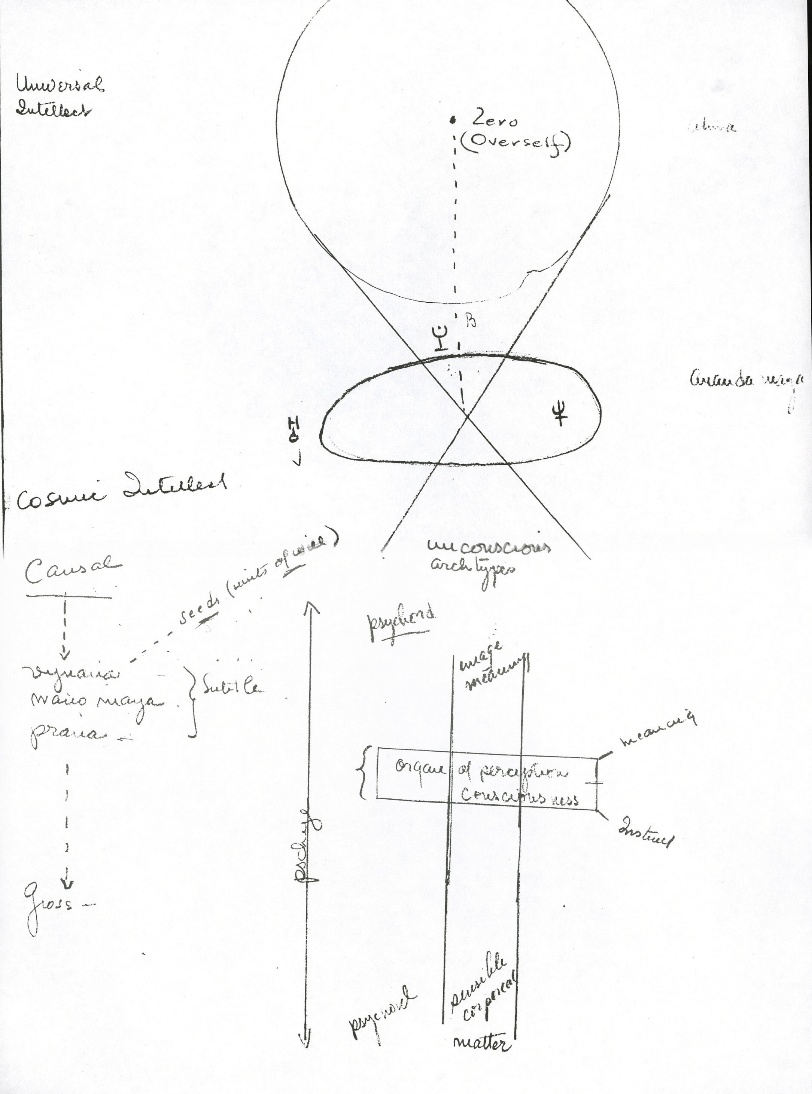
FIGURE AD_G_019 merged. Universal Intellect, Cosmic Intellect, Psyche.
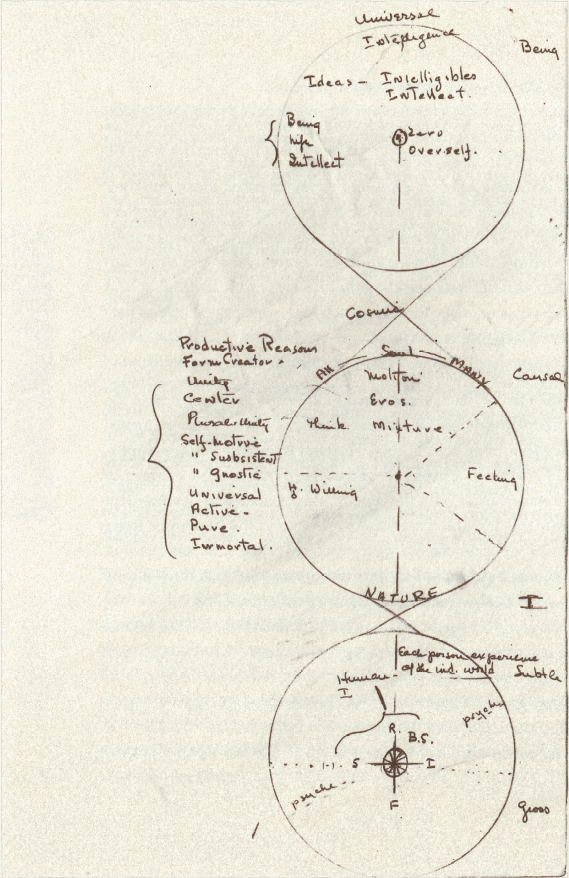
FIGURE AD_G_012. Three Circles Diagram: Divine Intellect, Soul, Psyche.
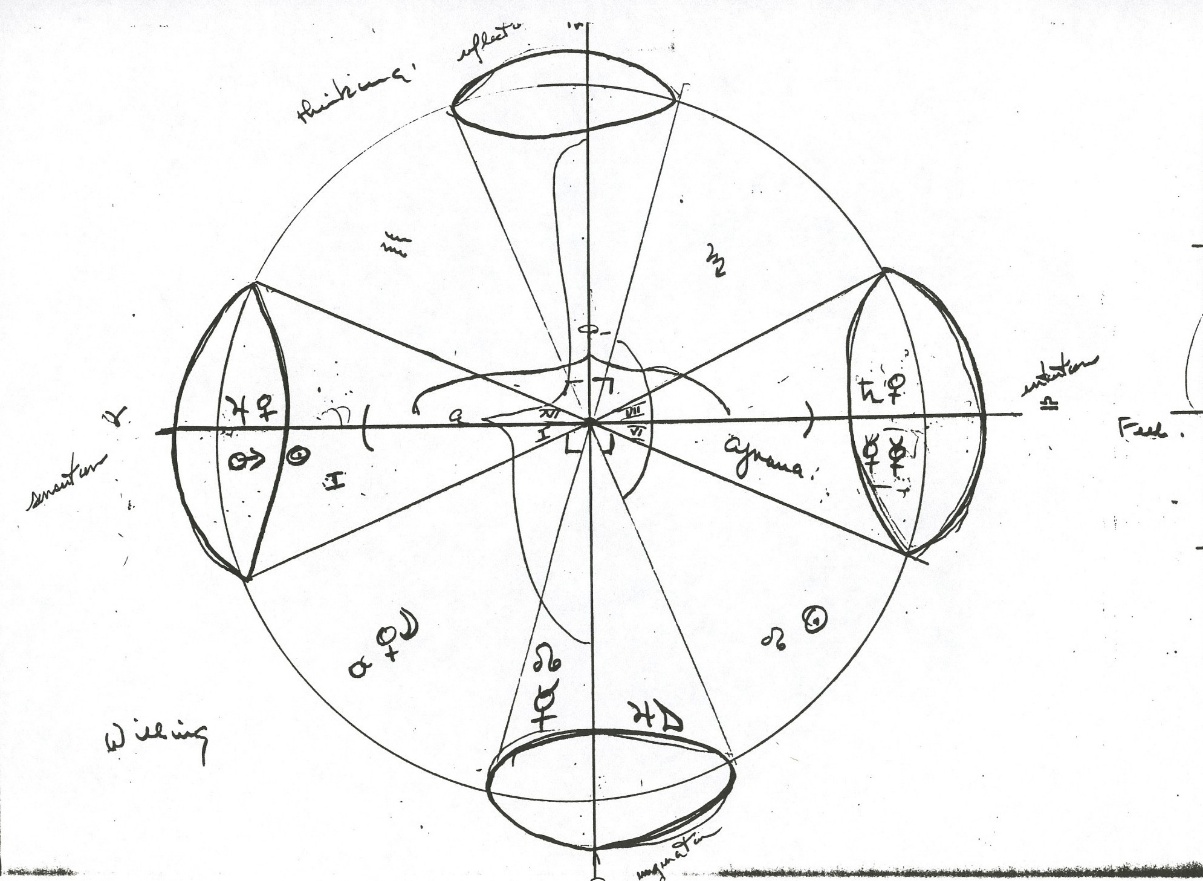
FIGURE AD_G_011. Four Psychological Functions and Thinking Feeling Willing mapped onto Twelvefold Chart; with rulerships and exaltations for houses 12-7.
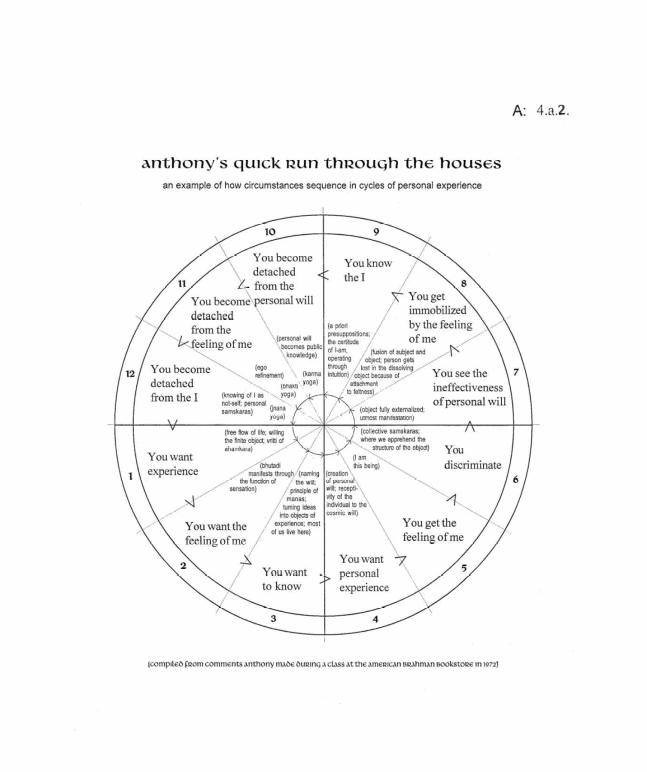
FIGURE 1972 0329-4. Anthony's Quick Run Through the Twelve Astrological Houses.
These diagrams are not from this class but are used as stand-ins to help follow along. Other diagrams also referred to are not with this transcript version. [Transcriber note: [diagram] means the speaker is referencing a diagram as he or she is speaking. If someone is drawing or writing, with audible sounds of chalk on a blackboard, I indicate this by [drawing] or [writing].]
TRANSCRIBED Verbatim by IT 2023. In 2025, IT changes name of one diagram, shortens/changes diagram references within transcript, adds one diagram and references within transcript to this diagram. Archival verbatim transcript – V12a.
AUDIO FILES: 1972 0329a, 1972 0329b. [Note 1: "Tape" refers to original audio cassette tapes that were later digitized into .MP3 Audio Files. Note 2: We only have two audio files for this class, we are missing the rest. The last audio file cuts off as AD is speaking.]
1972 03/29 at American Brahman Bookstore
Hinduism; Samkhya; K.C. Bhattacharyya
[Audio File 1972 0329a Begins]
AD: --what Jung calls the thinking function.
[10¼ second pause followed by tape break]
AD: --"Reflection as a Spiritual Function". He says here--
[Transcriber note: I am using Studies in Philosophy, Vol. 1, by Krishnachandra Bhattacharyya, "Studies in Samkhya Philosophy," Progressive Publishers, Calcutta, 1956.]
K.C. Bhattacharyya [Studies in Philosophy, "Studies in Samkhya Philosophy," pp. 143-144, stanza 17, AD reading]: "[17.] Reflection is at all stages a freeing process, the mind freeing itself from the body or from itself as a subtle body of the self. The process is spiritual in the sense that it is as much conative as intellectual, a detaching activity which may be indifferently called the will to deny will [(will to nivrtti)] or the knowing function. It is in reflection that the self-assertive will [(will to pravrtti)] is known to have been one with the body that is sought to be freed from; and it is in reflection that the given object is negatively willed to be detachedly known. In Samkhya there is really no will to deny will as in Yoga: it is just the knowing process, knowledge as mental being a process [AD rereads: knowledge as mental being a process]. In Samkhya the consummation of this reversion of the will, which is the knowing process, is conceived as viveka which is not eternal quiescent knowledge which would be the self but the mind distinguishing, defining or detaching itself from the self and thereby losing itself in unknown or unmanifest Prakrti, the self consequently standing in its eternally manifest solitariness."
AD: Paragraph seems to be kind of self-explanatory. Any questions on it?
[tape break]
K.C. Bhattacharyya [Studies in Philosophy, "Studies in Samkhya Philosophy," p. 144, stanza 18, AD reading]: "[18.] It is in the regressive movement of reflection towards mukti that the progressive movement of the self towards bhoga [AD: Sense-experience.] is known to have been a fact. The forward process is life, reflection as the backward process being the spiritual function of freeing from natural life and of knowing it as being arrested."
[short pause]
AD: Paragraph 19.
[short pause]
K.C. Bhattacharyya [Studies in Philosophy, "Studies in Samkhya Philosophy," pp. 144-145, stanza 19, AD reading]: "To Yoga as to [AD reads: in] some other [views], there is [AD adds: a] discontinuity between life and reflection and between the so-called natural reflection and spiritual reflection. There is no natural reflection to Yoga, the natural urge towards freedom from pain being to it no conscious or reflective wish as it is to Samkhya. The conscious wish for freedom is not natural but spiritual, and it supervenes on the blind movement of life as inexplicably as the further reflection supervenes on this reflection. To Samkhya, the urge towards freedom from pain is conscious wish and as such at once natural and spiritual; and this wish again is implicitly reflective on itself which of itself becomes explicit. The freeing process of reflection is at once a part of life and a detachment from life. Life starts reflection and viveka comes as a stage in the process that is conditioned by aviveka. Yoga agrees with Samkhya in regarding both [aviveka and viveka] as predicaments of the mind and not of the self but does not admit that viveka [AD reads: discrimination] comes in the natural course of the maturation of aviveka [AD reads: the undiscriminate], holding as it does that the upward movement of the mind towards freedom is utterly distinct from its downward course towards bhoga [AD reads: sense-experience]."
AD: Any questions? Yes Dave.
[tape break]
K.C. Bhattacharyya [Studies in Philosophy, "Studies in Samkhya Philosophy," p. 144, stanza 17, AD reading]: "In Samkhya the consummation of this reversion of the will, which is the knowing process, is conceived as viveka [AD reads: discrimination] which is not eternal quiescent knowledge which would be the self but the mind distinguishing, defining or detaching itself from the self and thereby losing itself in unknown or unmanifest Prakrti, the self consequently standing in its eternally manifest solitariness."
AD: Now, is that the paragraph?
S: Yeah.
AD: And what's your question?
S (faint): What does he mean by the mind losing itself in unmanifest prakriti?
AD: Well, like when you stop thinking, see, no more thoughts, the mind disappears. They s-- they say it lapses back into prakriti. It goes back into the matter that it came from.
S (faint): But it does-- it-- [S, faint: No.] it doesn't just become one with it?
S (very faint): [few words inaudible]
S (very faint): Is there what?
AD: Well, it (depend--)
[tape break]
AD: --just to be free person. You need to find out about this possibility when you're in pain, because if you will, then there must be the possibility of the fulfillment of this will, ok, [DB assents] so that this hidden desire becomes more and more manifest, more and more out into the open, more available to itself. Now it can continue.
DB: I see.
AD: Because there's no necessity that one becomes reflective when he's in pain, he could-- after the pain's over he could stop if he wants. [tape break] Alright--
K.C. Bhattacharyya [Studies in Philosophy, "Studies in Samkhya Philosophy," p. 145, stanza 20, AD reading]: "Self-knowledge is to both [AD: That is, to Yoga and Samkhya.] viveka [AD reads: discrimination], the spiritual discrimination of the mind from the self, which is a mental fact, the terminal stage of the self-attenuating process of the mind called spiritual reflection. Viveka [AD reads: Discrimination] to Samkhya is the residual mind which spontaneously drops off or distinguishes itself from the self. To Yoga, a further effort of the mind--called asamprajnata--is necessary for the mind to terminate itself. The mind has to make an effort to lose itself in prakrti, [AD adds: and] this effort being itself conscious, a conscious transition into unconsciousness. The freeing movement of reflection, accordingly, is in all stages a strain or effort to Yoga, while to Samkhya it is absolute spontaneity continuous with the flow of life."
[short pause]
AD: You all understand that, right?
LS: How do you reconcile a-- an opposition like that, such a difference there.
[tape break]
AD: --ok, in one of your own dreams, and you're involved in a lot of activity and all of a sudden you start questioning what's going on. And so you try to understand who you are. So that means that you have to reduce, so to speak, the mental activity to an absolute minimum, or as minimal as you can possibly handle so that you could try to distinguish yourself from what's going on. And in the proc-- this would be called the residual mind. In other words, as you dump out more and more the thoughts, you know, you get rid of them, alright, [student assents] so you reduce the mind, so to speak, to a situation where it has one thought in it, this would be like the residual mind, ok. And now this one thought is gotten rid of and there's only, so to speak, the effort of the mind to distinguish itself from the self. Alright? [student assents, faint]
So you could see on the one hand that the mind is all these thoughts that it has and also the effort it makes to get rid of these thoughts to see who the self is. Once it succeeds then it disappears. Something like, you know, the burning stick that you use-- they use for an example. And then after you chur-- you stir the fire with it and you keep it burning, alright, and then even the stick that you're stirring the fire with burns. So it's the mind, so to speak, in the activity of getting rid of its own activity and distinguishing the fact that it is different from that which it is discriminating against or-- It's really not that difficult. It's just that you may-- may feel that there's a distinction-- let me put it this way, that there is a distinction between function, you know, and being but, it's not a separation. They're not two different things.
S: Yeah, that's what I don't understand yet.
AD: Well why, don't you see that in the dream? In the dream the mind creates the substance, the table, alright, and the activity that knows that table. What's so hard about it? It's going on all the time. [short pause] Going on all the time. Maybe it's so familiar that you can't recognize it. Or maybe you're too closely identified with it. Yeah? Someone else?
RG: (Needless to) say--
[tape break]
AD: --it's a process that happens spontaneously. To Yoga they say no, there has to be a willing that goes beyond any knowing. Alright, they're-- right now they're-- they seem to be in conflict. Yeah Anil.
AK: [one/two words inaudible]
[tape break]
AD: It's required but that doesn't excuse you from the effort.
[12 second pause]
[tape break]
AD: I'm just picking out the highlights and we'll get to it to work on.
S (simultaneously, very faint): (Yeah.)
S (very faint): Uh-hm.
K.C. Bhattacharyya [Studies in Philosophy, "Studies in Samkhya Philosophy," p. 146, stanza 23, AD reading]: "[23.] [AD adds: The] Samkhya like Vedanta recognises no positive prescription to achieve mukti."
S: Is mukti devotion?
AD: Is mukti negotiable?
S: Devotion. (laughter)
S (amidst laughter): It's not negotiable.
S (amidst laughter, faint): It's not negotiable. (S laughs)
S (amidst laughter, faint): Non-negoti-- (laughter)
S (amidst laughter): Negotiable.
SP (laughing): Yeah. (laughter, student words)
S (amidst laughter, faint): [couple words inaudible] you're so on it before.
[tape break]
K.C. Bhattacharyya [Studies in Philosophy, "Studies in Samkhya Philosophy," p. 146, stanza 23, AD reading]: "[But while] Vedanta holds that the reflective process towards mukti [AD reads: freedom] starts miraculously and is no part of natural life, Samkhya takes it to spring from life [and] to be continuous with the life-process. Reflection is not only no ascetic effort but is nothing foreign to experience, being itself an experience (of the vanishing of experience). To reflect is not only to abstain consciously from willing, to feel the lapse of willing but to feel the lapse of feeling also. Reflective feeling is not a self-abolishing feeling to [AD adds: the] Vedanta as it is to [AD adds: the] Samkhya but only a feeling of the blindness or given-ness of feeling [(bhoga)] being abolished through the lapse of willing. Samkhya conceives it not as [AD adds: a] standing joy as it is to [AD adds: the] Vedanta but a joy in the process of lapsing, joy that is as much objective experience as pain, though not itself a pain as it is to some other views."
AD: Ok? [students assent] Now notice, notice a couple of points. There's no positive precs-- prescription to achieve mukti. And, it should be obvious, you know, because in the Advaita Vedanta your religion is a very personal individual thing. Everybody goes to the temple and everyone does his own thing. Over here we all go to Church and all do the same thing. [short pause] So, the Vedanta would consider that absolutely intolerable that you should all be doing the same thing, how could that possibly be. Alright.
K.C. Bhattacharyya [Studies in Philosophy, "Studies in Samkhya Philosophy," p. 146, stanza 23, AD reading]: "…[AD adds: the] Vedanta holds that the reflective process towards mukti [AD reads: liberation] starts miraculously and is no part of [AD adds: the] natural life…"
AD: I would imagine that the Catholic Church would say the same thing too, they would consider it an act of Grace.
K.C. Bhattacharyya [Studies in Philosophy, "Studies in Samkhya Philosophy," p. 146, stanza 23, AD reading]: "…[AD adds: the] Samkhya takes it to spring from life and to be continuous with the life-process. [AD adds: To them] Reflection is not only no ascetic effort but is nothing foreign to experience, [AD adds: and] being itself an experience (of the vanishing of experience). To reflect is not only to abstain consciously from willing, to feel the lapse of willing but to feel the lapse of feeling also."
AD: And those of you that have engaged in reflection with any serious dimensions involved will know that this happens automatically.
S (very faint): (What does he mean by it?)
S (very faint): Yeah.
AD: Alright, 24.
K.C. Bhattacharyya [Studies in Philosophy, "Studies in Samkhya Philosophy," pp. 146-147, stanza 24, AD reading]: "[24.] To one who has begun to reflect and to realise that the reflection has come naturally, the only prescription of Samkhya, if it is a prescription at all, is not to will, or if willing is already there, to make an object of it, to view it as itself a pain that should not be. In more explicit spiritual reference, the prescription is to avoid ascetic effort or antagonism to nature or life. It is not to push on reflection nor to wonder at it as miraculously there but to let it, as what has naturally come, naturally fulfill itself. To one to whom reflection has not come, the prescription to rouse reflection is meaningless. One to whom it has come but not in full measure can do nothing to deepen it but can only let it complete itself, avoid misdirecting it or scaring it away by attempting to force it. One can indeed will to attend [(bhavana)] to the content of reflection, but such attention cannot of itself deepen the reflection, though reflection by its spontaneous deepening may lead to the fixation or unfolding of its content."
[short pause]
AD: The next paragraph--
K.C. Bhattacharyya [Studies in Philosophy, "Studies in Samkhya Philosophy," p. 147, stanza 25, AD reading]: "[25. Apparently to Samkhya] the process of yoga is a natural self-deepening of reflection that has naturally emerged. In Yoga [philosophy] itself, the yoga process is voluntary attention passing of right into concentrated reflection or intuition. Not that Samkhya takes yoga to be a passive process, for reflection that gets deepened into yoga is a process of active freeing though it is not a voluntary doing. There is accordingly no prescription of yoga in Samkhya though it is admitted as a stage in the spontaneous consummation of reflection. The spiritual process of reflection is from the beginning above ahamkara or the egoistic will. The voluntary striving for yoga would still imply ahamkara. In Yoga philosophy, the will to yoga is not egoistic [AD reads: egotistic] but spiritual, being ultimately the activity of asamprajnata."
AD: How's 25, clear?
RG (faint): Well, that last sentence--
[tape break]
AD: --they're very simp-- they're very simple [S simultaneously, very faint: Is that (true)?] words.
S: Uh-hm.
S (very faint): Yeah.
AD: In Yoga, the function of buddhi is asmita, that is, false identification. And that function is, so to speak, regarded as the chief cause of our bondage. Now in Samkhya willing is a function of the ahamkara, not of buddhi. Thus consequently, when-- when Yoga is concerned, they would consider this, so to speak-- anything has to come from beyond, you know, has to come from the region of purusha. From the point of view of Yoga, alright, it will come basically from buddhi. So the-- the difference in point of view I think would be better understood if you look at one in terms of time. If you look at them in terms of time you can see that Yoga is an effort towards asamprajnata, Samkhya is already an accomplished fact.
S (very faint): Ok.
VM (faint): Would you repeat that please?
AD: In other words, in Samkhya, the reflective attitude, alright, it's-- it already shows the progress that's been made because you're just going to regurgitate that progress. Whereas in Yoga the progress is yet to be made.
[students assent, very faint]
JL: I see. The effort of will then implies that it hasn't (progressed).
AD: Yes. You're on-- you're starting-- [tape break] now you're going to work your way up, alright. So you spend a couple incarnations practicing Yoga, you know, and then finally you get to Samkhya. [students assent, very faint] Evidently it's obvious that this-- this entire reflective attitude is of long-standing duration.
S (faint): Yeah.
AD: If we remember--
S (faint whisper): Nothing. (laughter)
AD: Alright. (bit of laughter) Let's continue a little bit more.
K.C. Bhattacharyya [Studies in Philosophy, "Studies in Samkhya Philosophy," pp. 147-148, stanza 26, AD reading]: "[26.] Samkhya may [thus] be said to present a religion of reflective spontaneity or spiritual naturalness. Its metaphysics springs from this religion, reflection which is the spiritual freeing process being the organ of metaphysical knowledge. Reflection is started by experience [or bhoga], [AD adds: and] unless it is prevented by moha [AD reads: indifference]; [and] it is a freeing from bhoga [AD reads: experience] unless the same moha [AD reads: indifference] misdirects it towards bhoga [AD reads: sense-experience] again. Thinking which is not thus misdirected to the service of sense is real only as the spiritual process of freeing from sense, and it is this spiritual thinking that yields metaphysical knowledge. [S: Yeah.] The freeing from sense is a knowing of the self as what the body, with which is bound up the experienced [or bhogya] world, is progressively detached from. The mind too is a body of the self in some sense and the detachment means a gradual distinguishing of the material body and of the mental body from the self with which they were identified. To distinguish the body from the self, to make the body an object of reflection is on the one hand to know the self better and on the other to see the possibility of its dissolution into impersonal or objective but unexperienceable realities, experience being possible only through the body. The self, which is known only as distinguished from, and these objective non-empirical realities are the metaphysical tattvas [or noumena] of Samkhya philosophy."
AD: You want to stop there? Ok.
S: Yeah.
AD: Ok.
[flipping of pages followed by tape break]
AD: --no constraint imposed on the person. The person, so to speak like, you know the old Chinese saying, when the apple is ripe it falls to the ground by itself, no-- you don't have to shake it, you know, it just naturally-- So when the soul is ripe it turns naturally to these things. So you get the feeling that in Samkhya, you know, they don't have that attitude at all. I knew of one Samkhya philosopher who had two wives; you know, which to us, you know, with our-- with our twisted mind, you know, we'd right away read into it things that the man probably never even, you know, felt or knew about. Our attitude--
JL (simultaneously): That doesn't mean a lack of discipline though.
AD: Yeah, [JL, very faint: That doesn't--] it was very (nice), you know, and just utterly removed from any attachment to either of them.
JL (faint): Uh-hm. (bit of laughter)
AD: They were sisters, so he married the two of them at one time. (bit of laughter)
JL: No I mean the naturalness doesn't-- doesn't imply--
S: Ok.
JL: And the discipline a kind of overcoming.
[tape break]
AD: --assume that knowledge is the basic presupposition of what one wills, ok, then one could be willing knowledge rather than-- well we'll work that out, Paul worked out something interesting here.
S (very faint): Yeah.
AD: In terms of astrology, ok, I think he worked out something [student assents] there. It was-- I mean, too mad when-- when I came home, I was like a bear. Ok.
K.C. Bhattacharyya [Studies in Philosophy, "Studies in Samkhya Philosophy," p. 147, stanza 25, AD reading]: "…the yoga process is voluntary attention passing of right into concentrated reflection or intuition."
AD: Alright now, basically that's the process that underlies yoga, right now it's a difficulty. You sit down and you meditate and you have to struggle, you have to constantly make an effort. After comes a time when the effort is broken, and that'll be an occasion that you'll never forget, but the effort is broken, and there's this steady stream of attention going to what you're thinking about, alright. And it just flows naturally and sometimes it's almost like a steady stream of intuition on that object you're concentrating on. I advise you to keep it to spiritual purposes, don't use it for astrology or chemistry.
S (very faint): When do we get (one)?
S: You mean that concentration?
AD: Yeah. Yeah. I'm reading paragraph 25, about the third line.
K.C. Bhattacharyya [Studies in Philosophy, "Studies in Samkhya Philosophy," p. 147, stanza 25, AD reading]: "…yoga process is voluntary attention passing of right into concentrated reflection or intuition. Not that Samkhya takes yoga to be a passive process, for reflection that gets deepened into yoga is a process of active freeing though it is not a voluntary doing. There is accordingly no prescription of yoga in Samkhya though it is admitted as a stage in the spontaneous consummation of reflection."
AD: This might happen very naturally like-- and I hope to some of you maybe later on it will. You find yourself studying, you know, and your study gets intensified, gets deepened. [student assents, faint] It becomes so intensified that you find yourself rapt, so to speak, or paying attention to these ideas that are coming up and it becomes so deepened, you know, that you're hardly aware of anything and you're meditating, although, you know, some of these Zen people will say you're-- you're wasting your time, you're conceptualizing. And I told you my experience was quite the reverse, that this can actually be experienced, in very profound study you can go-- you can be going into yoga, not even know it. You'll know it maybe by reflection years later. So in Samkhya they say that(--) there may be periods when you have to actively will this to be, you know, but most of the time it happens very spontaneously. And if you look very carefully I think you'll probably-- some of you that are a little older will notice that there have been periods in your life when this could've very well have happened. (Yeah.)
S (very faint): Uh-hm.
S: Tony, can it happen when you're paying attention to something that's not of a spiritual nature?
AD: Well you can get concentrated but you certainly won't get any of this experience. In other words, for instance, you can get concentrated on the image of a naked woman. That would be of course absolutely worthless and in Yoga they tell you that very clearly, there's three types-- there's three obstacles to Yoga, three stages of mind that are quite useless for Yoga. One of them is concentration which occurs because of a momentary passion, that's quite useless. And the only-- the only kind of-- the only kind of concentration that is of use to Yoga is nirodha, you know, where you can stop thinking and when you can become one-pointed. All the other, like a restless mind, it's quite useless.
S (faint): Right.
DB: Tony?
AD: Yeah.
DB: I just-- what does-- what does he mean by the word 'prescription'? He says there is--
K.C. Bhattacharyya [Studies in Philosophy, "Studies in Samkhya Philosophy," p. 147, stanza 25, AD reading]: "There is accordingly [AD reads: according] no prescription of yoga in Samkhya…"
DB (faint): Yeah.
AD: They don't advise it.
DB: Oh I see, ok, alright then.
AD (simultaneously): Ok? They don't-- they don't advise it, no. In other words, if you are a Samkhya philosopher and you're let's say reflecting very intensely, occasionally like you get drawn in very deeply, ok, and you have to follow your own lead.
DB: I see.
AD: I try to point out that sometimes this happens when we listen to music very intently.
DB: Right, ok.
AD: You just feel a very-- a deepening of consciousness. There it's easier to notice because there's an emotional push behind it, you know. But if you can have let's say that emotional intensity when you study some of these ideas you'll have the same thing like when you listen to music, your consciousness gets deepened. You could almost feel the different levels that you're going down into. [student assents] I think a long time ago we read an article from one of the Shriner Magazine [AD means Shrine of Wisdom Magazine] articles where when you start doing this you'll see spots of light, you know, and you'll see the ideas, the light becoming brighter and brighter. Ok? Well, you have that same experience when you meditate, you begin to get these flashes of light coming out, you know. Sometimes the flashes of light could be so overwhelming that you gotta-- you know, you'll automatically reflexively turn your face, not to get blinded.
K.C. Bhattacharyya [Studies in Philosophy, "Studies in Samkhya Philosophy," p. 147, stanza 25, AD reading]: "The spiritual process [AD reads: Now this process] of reflection [AD: he goes on to say] is from the beginning above [ahamkara or] the egoistic will."
AD: You can't will this process. [student assents] You can't will it. You can't say I'm going to sit down now and become of a contemplative attitude, contemplative nature. Because in about two minutes later you'll get up and say I better have a cup of tea first. (laughter) [short pause] Alright, the next--
K.C. Bhattacharyya [Studies in Philosophy, "Studies in Samkhya Philosophy," p. 147, stanza 26, AD reading]: "Its metaphysics springs from this religion, reflection which is the spiritual freeing process being the organ of metaphysical knowledge. Reflection is started by experience [or bhoga], unless it is prevented by moha [AD reads: indifference]…"
AD: Alright, moha. Yeah.
[short pause]
K.C. Bhattacharyya [Studies in Philosophy, "Studies in Samkhya Philosophy," p. 147, stanza 26, AD reading]: "Thinking which is not thus misdirected to the service of sense is real only as the spiritual process of freeing from sense…"
AD: And if you-- if you remember, those of you who studied some Greek philosophy, the Greeks for instance always considered theoretical contemplation the highest form of activity that man could engage in, and the moderns of course spend their time ridiculing that the Greeks were so impractical. They could've spent their time building bridges, alright. But you could see their point of view.
S (very faint): Uh-hm. We can.
K.C. Bhattacharyya [Studies in Philosophy, "Studies in Samkhya Philosophy," p. 147, stanza 26, AD reading]: "…it is this spiritual thinking that yields metaphysical knowledge. The freeing from sense is a knowing of the self as what the body, with which [AD adds: it] is bound up the experienced [or bhogya] world, is progressively detached from. The mind too is a body [of the self] in some sense and the detachment means a gradual distinguishing of the material body and of the mental body from the self with which they were identified."
AD: You can see (how) in a sense that this is really a very profound way of taking the axe, going to the tree, and chopping it right down at the roots, right down at the roots. The whole tree has to come down, and it won't spring up again.
[short pause]
K.C. Bhattacharyya [Studies in Philosophy, "Studies in Samkhya Philosophy," pp. 147-148, stanza 26, AD reading]: "To distinguish the body from the self, to make the body an object of reflection is on the one hand to know the self better and on the other to see the possibility of its dissolution into impersonal [or objective] but unexperienceable realities, experience being possible only through the body. The self, which is known only as distinguished from, and these objective non-empirical realities are the metaphysical tattvas [or noumena] of Samkhya [philosophy]."
S: Could you repeat that last sentence [one/two words inaudible]
S: What's that?
[tape break]
AD: --underestimate the value of studying the first three, four chapters in The Quest of the Overself, to read those chapters where he goes through an analysis of the physical self, the emotional self, remember? And many people like who can't meditate, if they just sit down and read the paragraphs very slowly, chew them over, digest them, reflect on them, it's similar to meditation. Unless, like some analyst I knew who got scared off and says nobody should read PB. It might make you schizoid.
S: Hm. (bit of laughter)
S (very faint): Ok.
S: Tony, can you talk--
[tape break]
AD: I'll avoid paragraph 28, unless you have any personal reasons. Any personal reason to want to do the 27?
S (very faint): Not really.
S: (Uh-hm.)
AD: No?
S (very faint): You're good.
[15¾ second pause, faint background student words, someone drawing]
AD (faint): Well let's--
S (faint): Uh-hm.
[tape break]
K.C. Bhattacharyya [Studies in Philosophy, "Studies in Samkhya Philosophy," p. 148, stanza 27, AD reading]: "Inference in metaphysics is necessarily of the regressive type from the conditioned to the condition and ultimately to the unconditioned condition. Within phenomenal reality, condition and conditioned are in reciprocity, but what is conditioned by a metaphysical condition never conditions it again. Besides, metaphysical condition unlike phenomenal condition is always constitutive of and embodied in the conditioned which yet is distinct from it. Inference of the metaphysical condition is, therefore, always regressive; and the inferred condition is known to be embodied in the conditioned in some immediate way and not by inference again."
AD: Alright, let's see the easiest way to try to explain that whole thing. [9½ second pause] We speak of the five different levels of reality, for instance, we've spoken of that. We pointed out that these five different levels of reality, so to speak, are here now available to us, absolutely and completely, alright. That part you follow, ok? So, in a sense, in a sense when we say that-- we quote PB when he says, about the Chinese Sage who says, "I chop wood and I carry water," or what is it, "I carry wood and I chop water". (bit of laughter) He says, "Oh, how marvelous." (bit of laughter) Ok. So here we have to consider this way. We have to consider that these five different levels, these five different levels of reality or Holy Presence is in this one man, ok. There's the gross physical level, which is obvious and doesn't need any reflection. Now the-- the mental-- the psychological structure of this person you can't see, alright, but you know it's immanent in the physical person in the sense that it's operating him, alright. Ok. Now you go back one step further and we've spoken about the causal condition where the entirety of all the knowledge and the playing out of all the possibilities are-- is contained in a causal level which we equated with sleep consciousness, ok. And then we go beyond that and we say that there's also the transcendental state of consciousness that interpenetrates, if we can use these words, that we can, [S: Yeah.] underlies or is the background for the other three states of consciousness. Alright so, given this one individual, he subsists in these four different levels of reality, in these four different presences, ok. They all simultaneously present within him now in this instant.
Just the same way like when I say "I see a tree," ok? Look at-- look at the enormous complications, you know, that's why they could never answer its-- you know, epistemologically. What does the "I" mean"? What does "seeing" mean, you know, what does "tree" mean, ok? And you begin to see that when we (study/studied) this subject, you began to realize that knowledge was enough to drive al-Ghazali out of the cave screaming, you know, like a madman--[S, faint: Right.] "It's a mystery!" Sure it is. Because, so to speak, the entirety of-- the entirety of these different levels of reality has to be grasped in one understanding. It's only in the reflective understanding we can see the different levels operating and they all, so to speak, condition one another. Ok? It's only in the reflective understanding. But actually you cannot do it. You cannot separate one level of reality from another level. When we speak about astrology, for instance, we speak about the physical phenomena, you know, that's occurring, but also we know that behind it there's a subtler phenomena occurring simultaneously with that physical phenomena. You certainly are aware of that. And then there's a phenomena behi-- which is no loner phenomena but they call it noumena, behind that. These are all operating-- operating simultaneously. Alright, with that-- with that as a prelude--
S: Can I ask a question?
AD: Yeah.
S: Is-- it-- I get the feeling that reflection as it's being discussed here is something very different from what we've considered so far as reflection in a kind of a psychological sense.
AD: Give me the question please.
S: Well I just want to know if that-- if-- if my feeling is-- you know, is going towards something or whether it's, you know, illusory. Like, is-- like-- is what they're getting at as reflection in Samkhya like a deepening of the mind's self-distinguishing so that in a way it goes from level to level and in that like distinguishing keeps stepping back but-- but in levels not-- not in any-- not just like stepping back from a psychological image and seeing the image.
AD (simultaneously): It's not really a question you're asking, is it? It's a comment you're making. Very apropos. Ok, let's go on. Isn't that so? It's a comment. Yes, sure, that's what-- that's what they're talking about.
K.C. Bhattacharyya [Studies in Philosophy, "Studies in Samkhya Philosophy," p. 148, stanza 27, AD reading]: "Inference in metaphysics is necessarily [of] the regressive type from the conditioned to the condition and ultimately to the unconditioned condition."
AD: Alright let's-- let's work with this. In metaphysics, when we try to understand what the meaning is of a person, we find that we have to fall back on presuppositions about his psychology, which at one time of course was i-- you know, was laughed at, especially in the nineteenth century. But today, more or less, we're open-minded about it, we admit that possibility. We admit the possibility that the psychological structures, that there is such a thing immanent in the physical body, operating and expressing itself through that physical body, alright. Now Jung, more or less, and Freud and a few others came to this agreement.
Now, some of the others had to push back further and they began to realize, like Jung pointed out, that beyond this realm, the realm of the psychological archetypes, there seems to be a realm which he called the psychoid realm [FIGURE AD_G_019 merged, unconscious archetypes], ok. And that these archetypes get opera-- activated from that area, they flow up into the psychological area, so to speak, or we-- we make their possibility by actualizing them in concrete personal relationships. And so you become aware that there's a deeper level, alright, and you go beyond that.
So, what he's trying to say is by this effort to get back into yourself and get to these presuppositions, you're necessarily moving from a conditioned state to an absolutely unconditioned. And it has to be regressive, it's backward, ok, in the sense that when you reflect upon yourself you begin to get this feeling of stepping backward into yourself. You have to identify more, let's say, with the psychological structure and then, "Ah, that's the physical out there," ok. Alright? Then it's possible to break completely with the lis-- psychological structure, with the manas principle, alright, and identify with the jiva or the Witness-self and say, "Ah, look at that, that whole psychological structure in the body, wow, you know, that's another thing," alright, that's a presupposition, so to speak. You see what I mean by regressive? And it becomes less and less conditioned as you go backward. Yeah.
JL: You might almost contrast it with the-- the Logicians, the Buddhist, as being progressive. You know, to them it would-- inference would be progressive, that-- the progression towards sensation rather than away from it. Is that--
AD: I don't know what you mean, John. [tape break] --work with this man.
S (very faint): Uh-hm.
DB: I wanted to ask about the sentence, he says--
K.C. Bhattacharyya [Studies in Philosophy, "Studies in Samkhya Philosophy," p. 148, stanza 27, DB reading]: "Within phenomenal reality, condition and conditioned are in reciprocity…"
DB: Now would that include the physical world up to--
AD: Wait, let me--
DB: Ok.
AD (simultaneously): "Within phenomenal…condition…" yeah.
DB: Would that go from the-- from the physical world up to the psychoid realm that Jung speaks of?
AD: No, the psychoid-- the psychoid for Jung is beyond-- beyond the phenomenal. The phenomenal will only be in the subtle and the gross worlds.
DB: Ok.
AD: Anything beyond that it would be nou-- noumena.
S (very faint): Ok.
S: Tony?
MW: (I--) [tape break] When you're here looking back, well at first you're inferring that there's something back there, after you've got back there it's no longer inferred. I think that's all I want to say.
AD: Yeah, he says that in the next paragraph. Well-- Listen to this--
K.C. Bhattacharyya [Studies in Philosophy, "Studies in Samkhya Philosophy," pp. 148-149, stanza 28, AD reading]: "[28.] A metaphysical condition is immediately known to be constitutive of a metaphysical or phenomenal fact in reflection. Such immediate knowledge would be intellectual intuition if it involved no inference or superseded inference."
[tape break]
AD: You'll never admit it.
LS: Yeah, that level of it I caught. That's what I meant [AD simultaneously: Well that's what he's saying.] when I thought it was mischievous but, what is--
AD (simultaneously): It is mischievous, isn't it? Didn't the Buddha say the same thing? "Ah, I know who the robber is." There's a beautiful-- Dattatreya [LS simultaneously: It's-- that's--] has the same--
LS: That's the right level to take it on.
AD: Yeah, that's [LS simultaneously: Ok.] the level to take it at, sure.
LS (faint): Ok.
AD: You will never, so to speak, be misled anymore to saying "I am the body". Never again can you take that position. Isn't that so?
S (faint): Uh-hm, yeah.
S (very faint): Ok.
[Audio File 1972 0329a Ends]
[Audio File 1972 0329b Begins]
S (faint): Uh-hm.
AD: Let's see if we can make some correlations on the chart.
K.C. Bhattacharyya [Studies in Philosophy, "Studies in Samkhya Philosophy," pp. 148-149, stanza 28, AD reading]: "Such immediate knowledge would be intellectual intuition if it involved no inference or superseded inference. [But] in the first instance, [at any rate], it involves inference which is not superseded but reflectively reduced to a view of the conditioned getting distinct from itself as its condition, of a self-distinguishing process in the content as still given, the view therefore amounting to an internal perception though not yet to intellectual intuition."
AD: We had an example of this Monday for instance. We were talking about, what was it, prakrti defining itself from-- in other words, the object defining itself from its own latent state. And like you were a little confused and as soon as we said-- we added the other sentence, we says, well PB speaks of it this way. The karmic seed, so to speak, gets manifested in terms of the activity of the individual and the cosmic mind, that is, the object now gets defined through the process of cognition. Right away [AD snaps fingers] most of you snapped, you saw right away what he was saying. Ok? That's the process. You follow or am I amusing myself? (bit of laughter) Well, speak up, don't be afraid, Saturn Mars conjunction isn't that terrifying. (bit of laughter)
S: Well--
S (faint): It is.
AD: Do you follow it Jim? Go ahead. (bit of laughter)
S: I don't see the unconditioned condition.
AD: Well, show me the sentence, don't-- come on.
S: Where it says--
K.C. Bhattacharyya [Studies in Philosophy, "Studies in Samkhya Philosophy," p. 148, stanza 27, S reading]: "Inference in metaphysics is necessarily of the regressive [S reads: aggressive] type from [the] conditioned to the condition and ultimately to the unconditioned condition."
AD: Alright, let's go over this Jim. The regressive type means like a looking backward.
S (faint): Right.
AD: Ok?
K.C. Bhattacharyya [Studies in Philosophy, "Studies in Samkhya Philosophy," p. 148, stanza 27, AD reading]: "…from the conditioned to the condition…"
AD: Now your body, let's say, is an absolutely conditioned thing, alright? "To the-- to the condition--"
K.C. Bhattacharyya [Studies in Philosophy, "Studies in Samkhya Philosophy," p. 148, stanza 27, AD reading]: "…from the conditioned to the condition…"
AD: Alright. Now what would the condition be?
S: Whatever conditions the body.
AD: Whatever conditions your body, alright, that would include a host of factors. But let's briefly say the psychological factors that conditioned your consciousness as you were a child [drawing] and made you to be the operative thing that you are now, ok. So, you-- let's say you had a very traumatic con-- situation when you were a child, alright, and you were sick by it, and you go to an analyst and he brings you back to that stage in your life and you get released from that condition by simply going back there, to that presupposition, what made possible that warp in your consciousness. Alright? By simply repeating it and going back to it, alright, and looking at it, experiencing it again, boom!, you get freed from it. They call that, they give it a fancy name, 'abreaction'. Alright?
K.C. Bhattacharyya [Studies in Philosophy, "Studies in Samkhya Philosophy," p. 148, stanza 27, AD reading]: "…and ultimately to the unconditioned condition."
AD: Now, let's say that you're not satisfied with that treatment, you say "Well look, alright. I got traumatically exposed to a condition. This could happen again. I don't want it ever to happen again." So the guy says, "Ok, come with me and I'll show you how to get liberated from all of this garbage." So he takes you completely to the unconditioned. [student assents] He brings you back further and further. [student assents, faint] Alright? So finally when you realize you're neither the body nor the psychological apparatus nor the causal vijnanamaya body with the pranamaya, you know, and all that garbage, you know, you say "Wow, I'm free! It never could happen again, I could never get that traumatic condition again." (laughter)
LS: Then you carry wood and chop water.
AD: Yeah, you carry wood and chop water. (some laughter) Chop water!? (laughter)
S (amidst laughter, very faint): (I think) [one/two words inaudible] chop wood, (isn't it)?
S: That's one of the five-- five levels that was happening all the time in the uncondi--
[tape break]
AD: --traumatic condition that you experience, alright.
S: Yeah.
AD: In other words, you know-- you know for a fact now. Let's say that you know this as a fact, that when you're a child and your emotions are raw like wax and you take a hot iron and you put it in there that-- that stamps your wax, so to speak, for good, you have that-- that imprint, ok. And you'll know consequently never to allow your conditi-- your emotions to be that-- in that condition, that raw, that any experience can have that effect.
S (very faint): Uh-hm.
AD: Alright. In other words, you could never be caught that way again. Well the example is clumsy, it's not really quite adequate.
S (very faint): Right.
S (very faint): Well ok.
[short pause]
AD: I don't know if-- some-- somebody here for instance once had a dream, I don't know if he's here. He was goi-- he's going to the Philippines I think. I can't see.
S (simultaneously): Yeah.
AD: Oh there you are. Remember the dream you had about [S simultaneously: No.] your being decapitated, [S simultaneously, faint: Right.] your body there and--
S: I was reading.
AD: No? You remember that dream?
S (simultaneously): Right.
AD: You see what it was telling you?
S: Me? A little bit. It was-- it was-- and I mean it became really a sort of archetypal role?
AD: Yeah, sure.
S (simultaneously, faint): Uh-hm.
AD: And see you were trying to identify yourself with the body. And naturally you would say "How the hell could I be, you know, a person, if my head and body are separated?"
S: How could I get out of here. (bit of laughter)
S: Yeah.
[short pause]
K.C. Bhattacharyya [Studies in Philosophy, "Studies in Samkhya Philosophy," p. 149, stanza 28, AD reading]: "Yoga or samadhi would be this intuition in which the self-distinguishing process is conceived to be completed, so that the dualism in reflection of internal and external perception lapses, the internal perception being but the perception of the lack of completion in the process, which is just lack of perception of the given. That a content should be but is not perceived in the given object is what is known in the internal perception of the content. Reflection that involves such internal perception is transcendental reflection."
AD: Alright, let's go back.
S (faint): (Can't.)
K.C. Bhattacharyya [Studies in Philosophy, "Studies in Samkhya Philosophy," p. 149, stanza 28, AD reading]: "Yoga or samadhi would be this intuition in which the self-distinguishing process is conceived to be completed, so that the dualism…"
AD: Well, let's stop there. We got that? Well it's better you ask me, you know, so--
S (very faint): (Sure.)
[11 second pause]
[tape break]
AD: --it was because Kant, he quotes the saying that every external perception has an internal representation in that perception. And so, if you can keep that in mind I think the meaning of this sentence becomes very clear.
K.C. Bhattacharyya [Studies in Philosophy, "Studies in Samkhya Philosophy," p. 149, stanza 28, AD reading]: "[Yoga or] samadhi would be this intuition in which the self-distinguishing process is conceived to be completed…"
AD: Alright, you follow that?
S: Would that be like [one/two words inaudible] when you reach that level?
AD: Well, in samadhi where the process is completed, what process is he speaking about?
S (very faint): Yeah.
S: Self-distinguishing process, isn't it?
AD: Which amounts [S simultaneously, faint: To what?] to distinguishing the various layers of [S simultaneously, faint: Oh yeah.] being, alright?
S (very faint): Ok.
S: [one/two words inaudible] (or/for) Guenon.
AD: So, in other words, insofar that you're aware of the-- the gross physical, the subtle, the causal, and then beyond that, ok [FIGURES AD_G_019 merged, AD_G_012], you see the process is completed. You've regressed all the way, so to speak, to the bottom of the process regressively.
S: In the bottom.
S: [one/two words inaudible]
AD (simultaneously): You've completed, you've completed your perception of all the layers of reality.
S: (What's) the only process? Is that where you have purusha or is that where you have ahamkara?
AD (simultaneously): Yeah, that would be purusha, that would [student assents, faint] correspond to the Self. And as long as that process is not completed, alright, there will always be a feeling of lack of incompleteness in your knowledge of yourself.
K.C. Bhattacharyya [Studies in Philosophy, "Studies in Samkhya Philosophy," p. 149, stanza 28, AD reading]: "…so that the dualism in [AD reads: of the] reflection of internal and external perception lapses…"
AD: Well naturally once you reach this level, so to speak, neither external nor internal perception is going to amount anymore to anything.
S: Ok, and then that-- would that mean a level just above that or below that which would be the level of buddhi, so it'd be both internal and external perception at that level?
AD (faint): No. Well, we have to say that differently.
DB: Tony?
AD: Uh-hm.
DB: Remember that one time you were talking about meditation, there was a-- a field and that-- a circle with the arrows going out and in meditation it was brought in to the center, then it went down and came out again [diagram]?
AD (simultaneously): Yes, yes, uh-hm.
DB: And, that like on the subtle level you say "Oh, well the physical body, oh, you know, that's not there." [AD, faint: Uh-hm.] And, so what you have to do is disidentify yourself from the internal perception I guess of the subtle body. Is-- is that what he's getting at?
AD (simultaneously): Well that's the process we're talking about, [DB assents] you go regressively down. That's also the way I think of that center in the circle of our chart [FIGURE AD_G_012]. That's what the center is to me in astrology. In other words, that center represents a common denominator through which, let's say, runs through all the envelopes or the koshas that we operate with, alright. And it would be a question of falling from one to another-- from one level down to another, although there's no falling and there's not going anywhere, I mean these are all terms from this level, they don't mean anything there. Just like if I were to ask you when you're dreaming that you're walking to the dream table and you wake up you say "What walking? Who walked, where, what? You know, what are you talking about?" You have that same experience there. [student assents] And when you get to the level where-- of asamprajnata where you don't even have the feeling of willing, ev-- I have to disagree with him here. Yeah Jenny.
S: By internal and external perception does he just mean that the perception of the dualism (between) subject and object?
AD: Well when you have a perception of an object, don't you also have an internal representation of that object going on?
[short pause]
S: You mean in the-- I don't know. I don't know what you mean.
AD: Well you really don't know what that object is, so to speak, until the manas principle, alright, distinguishes it, selects, distinguishes, you know, synthesizes and presents it to you. But you have an image of it, so to speak, externally. You don't know it unless you also have the internal presentation of that same image.
S: Well that's--
S: But are they distinct in any way? I mean you don't-- [short pause] In perceiving just the physical object I'm not aware of that distinction.
AD: The distinction between the internal and the external.
S: Yeah, [AD simultaneously: Yeah.] between just this image and [AD simultaneously: Uh-huh.] all the-- the associations upon [AD simultaneously: Yeah.] the image. Is there actually a distinction there?
AD: Sure there is. There's even layers between that distinction. Because the psychic image can float because it's very dense or be absolutely transparent, in which case you do-- you don't recognize it as being distinct from the object that you're perceiving. In the Hidden Teaching when PB starts talking about the perception of the object, he's talking about that external perception. [student assents] What he's talking about here is the internal and external representation of the object. But, you always have both. As a matter of fact their word ('alocana') means that, the external perception before it's synthesized by the mind and internally represented.
[short pause]
MW: Tony, is this-- (let's/we) say the external perception before it's been synthesized and represented as the internal perception. Now, from another point of view, is that exactly reverse, is-- it's in a sense that you catch the image before you dress it up and project it outwards?
AD: No, no, no.
MW (simultaneously): That's all.
AD (faint): No.
MW: Does that process occur?
AD: No the-- the image of the world is presented to you, you know, like we try to point out in the Hidden Teaching, the image of the world, the total experience-- experienced image of the world is presented to you in immediacy, from which you make an abstraction, alright, and that abstraction is the image that you retain within yourself.
S (very faint): Uh-hm.
AD: That's all from the Hidden Teaching, I suggest you people study that book. About the sixth, seventh time you'll begin to get it.
[short pause]
DB: Is-- is the distinction between the external object and the internal object, would that correspond to-- to like say this object here and my idea of it as an ashtray?
S (very faint): Uh-hm.
AD (faint): Yes.
DB: No, ok.
S (very faint): Uh-hm.
S (very faint): Uh-hm.
AD: We spoke about it Monday when we were put-- when we put the ascendant up and the descendent [diagram].
MW (faint): I guess I'm just wondering why you label one external and the other internal, I mean it would seem--
AD: Well, that's a relative terminology. Don't make it absolute.
MW (simultaneously): Yeah well-- well that's why I was suggesting pushing the terminology [couple words inaudible]
AD: So that you-- we'll be confused, right?
MW (faint): Well, it made more sense the other ones.
S (faint): Yeah.
MW: (I mean--)
AD (simultaneously): Alright, let's not get off on the Hidden Teaching, if you-- if you want, you should ask that-- that question some-- some other time. Yeah, Richard.
RG (faint): (Except for) when he was talking about the internal and external perception as being something given.
[tape break]
K.C. Bhattacharyya [Studies in Philosophy, "Studies in Samkhya Philosophy," p. 149, stanza 28, RG reading]: "[Yoga] or samadhi would be this [RG reads: the] intuition in which the self-distinguishing process is conceived to be completed, so [that] the dualism in reflection of internal and external perception lapses, the internal perception being but the perception of the lack of completion in the process…"
RG: Now, in reflection we can say that let's say an object is a modification of the mind but yet perceive it in an external perception as distinct from the mind, so there's a lack in our-- in our understanding because it's both, you know, in our understanding it's part of the mind but in our experience it's not, so the-- its samadhi would be the-- when those-- (you know), when the dualism is wiped away in this, or (whatever).
AD (simultaneously): Otherwise, as he says--
K.C. Bhattacharyya [Studies in Philosophy, "Studies in Samkhya Philosophy," p. 149, stanza 28, AD reading]: "…the self-distinguishing process is conceived to be completed…"
[short pause]
AD: Alright, why don't we now play around a little with-- see if we can bring some of this stuff to life on the chart. [short pause] Where'd we leave off Monday, what-- what were we after?
S (very faint): Yeah.
S (faint): Right.
DB: Well, we were talking about the descendant.
[tape break]
[9 second pause]
AD: How about you?
S: I wasn't here Monday.
AD: He wasn't here, you got an excuse, right?
S (simultaneously): Yeah. (laughter)
S (very faint): Right. (more laughter, student words)
AD: How about you, (Lin/Lynn)?
S (very faint): Yeah.
S (very faint): Come here.
S (very faint): Got a pretty good understanding of the ascendant but not so much of the descendant [couple words inaudible]
AD: You found that hard, ok. How about the others, anyone else?
S (very faint): [few words inaudible]
AD: Huh?
S (very faint): I'm going to say what Jenny said.
[Note: See FIGURE AD_G_012, cross within little circle within bottom circle, and FIGURES AD_G_011, 1972 0329-4 for the following.]
AD: Alright, so we gotta try to find a way to say it to make that descendant appear very very obvious. We-- [drawing] we kind of cleared up in our mind this part here, [S: Yeah.] the ascendant [diagram]. [student assents, faint] Well-- let-- try to imagine this first of all, ok. You imagine it in a dream because it always gives you the vantage point that you're witnessing it, you know, like you could look at it, alright. So you imagine that you have a dream and there's a dream character, ok. Now this dream character in the dream has a certain very-- a fear of snakes, you know. And because of the samskaras that this dream character has, ok, there's the appearance in the dream, let's say, of a-- a rope, alright. But it's not a snake, it's a rope. Yet, because this fellow has these kind of feelings about it, he sees a snake in the dream, alright. And yet the Witness-self is telling him that's not a snake, that's just-- that's just a rope, alright, so he has this-- these personal vasanas coming in, and yet (as) the person who's having the whole dream who's put a rope there, he didn't put a snake there, alright. So that the individual, the person who is being-- the dream character, alright, plus the person who's having the dream, the two of them together, this dream character experiences that dream world in a very peculiar way, alright. In the same way, similarly, you have certain personal memories, recollections of past history. All this, so to speak, is part of your past. You're born into a world, so to speak, which is tied, you know, in a certain way, cosmically. Alright. Now, you're walking out in the-- in the forest and you see this snake. But there is no snake there, there's a rope because you're walking with your boyfriend, he tells you "That's a rope, what are yous jumping for," alright. And you look intensely and you see it's a rope. But this fear translated itself into a rope, ok. In other words, these vasanas, these tendencies, these latencies manifested themselves, alright, and they, so to speak, projected outwardly, they manifested and became that, alright.
Now if you re-- if you recall, in astrology the twelfth house is Pisces [diagram]. And what's [drawing] interesting about Pisces is that it's an emotional watery sign, ok, and it-- and the common textbook says this means that-- dissolution, alright, things are going to be dissolved. How do they get dissolved? By manifesting, right? I mean, if you have this-- if you have this fear in you, like we were speaking about his traumatic condition, that thing stays with you forever until you actually get it out. How? You get it out and you manifest it. Once it manifests it's dissolved, alright? So that the twelfth house which represents your subconscious tendencies, alright, and the first house which represents, so to speak, the physical body that you're going to inherit [diagram], alright, in other words you walk right into that, ok, plus the childhood conditioning, you know, all your early recollections, the experiences you had for instance with your mother, she's an archetype, your father, he's an archetype, all these, so to speak, together plus your past, the two of them join together where that line is [ascendant-descendant line] and there's this manifested universe, alright. In other words, whatever thoughts come out from within you are going to be colored by those two houses, in other words, squeezing in upon you. Is-- (is/does) that make sense a little?
S: Yeah, uh-hm.
AD: Does that make sense to most of you? How about you, Linda? You don't mind I pick on some of you? Ok? How about you, Dave? You're sitting so quietly there. Did I disturb you? (some laughter, AD laughs a bit)
S (amidst laughter, faint): Yeah, right.
AD: You [S simultaneously, faint: Right.] seem too peaceful.
S (very faint): No [couple words inaudible]
S (faint): Yeah.
AD (simultaneously): Does that make sense to you, Dave?
S (very faint): What?
AD: Does that make sense to you?
S: Yeah.
AD: Yeah, Tom.
TM: I don't quite understand this dissolution by manifestation. I mean looking at it (from/through) another way, say-- say there's this-- well, looking at it from another way say-- say you have certain tendencies and manifesting them could just reinforce them too, couldn't it? I mean it wouldn't necessarily have to dissolve them.
AD: That's true, true.
TM: Well, then-- then how can you say that it dissolves things by manifesting them. Go ahead.
S: Well in one sense it does because when something's manifested, let's say you'll have the actual experience of it, like the snake-rope image-- image. At first the man is walking down and he sees what he thinks is a snake and that determined his behavior. But once, you know, that-- the actual thing is manifested there then he returns and realizes that it's a rope. So that whole thing is going to dissolve.
TM: Ok, but--
AD: Repeat that experience. [student assents, faint] How many times can you get fooled by the snake?
TM: Ok. Ok, that's-- that's when he sees it as the rope though that it-- that it goes away. Now when we're talking about the twelfth house, the first, is it nec-- I mean, is that what happens at the ascendant, you see it as-- as the rope or some-- or maybe you just would see it as a snake, get scared, run away and come back and see it as a snake again too.
S (faint): Yeah.
S (faint): Yeah.
TM: Um, [S, faint: Yeah.] and--
S (simultaneously): It's reincarnation.
TM: It is. (laughter)
AD (amidst laughter): That too could happen.
S (amidst laughter): Yeah, that (too).
AD: That too could happen, right Andrea? [student assents] It goes on and on and on, and there doesn't seem to be an end. Well--
TM (simultaneously): Right, and at the same time you still have to-- if you still have to look at it in that context I don't see, you know--
AD: It-- so what if it takes forty years? Does-- is the principle being denied?
S (very faint, possibly part of background): [one/two words inaudible]
S: Yeah.
S (faint): No.
AD: Even as a sex maniac, how long could it go on?
S: In other words, even the reinforcement is part of the dissolution.
AD: Sure, precisely. How much could you like salami? (laughter)
S (amidst laughter): Baloney. (more laughter)
AD: Just be practical, you know.
S: Well--
AD: Ok but the important thing to remember is that it's the ascendant that I'm talking about, not the twelfth and the first house. I brought them in to kind of help along, alright. Now, we pointed out that this ascendant represented where the--
TM: Wait, wait. Let the-- (laughter) It could go-- it could just go on forever.
AD: Huh?
TM: Could just go on eternally, like say the universe.
AD: Well, well that's your theory and Guenon's theory.
S (faint): Uh-oh.
S (faint): Yeah but Samkhya would say a similar thing.
AD: Samkhya would say sooner or later that's turned into reflection, all experience is.
TM: Then the-- the universe doesn't-- it's macrocosmically speaking, the universe doesn't go on forever and eternally and--
S (very faint): Well [one/two words inaudible]
TM: It'll eventually--
S (very faint): Right. Very much Pisces (and the first).
S (faint): I know.
AD: All? What did you just say? Peanuts? (bit of laughter)
S (faint): Uh-hm.
S (faint): Uh-hm.
AD: I mean, you said "all", all possibilities go on forever, you know. What'd you just say?
TM: I don't know.
AD: You don't know, yeah, that's the point. [short pause] No the-- the samsara is guided, there is-- there is evolution, there is development in spite of what these Traditionalists say. There's also the possibility of you remaining lagging behind in samsara for a considerably longer [period] of time if you wish to. I mean-- but eventually sooner or later you're going to get pushed out. Because how long can you remain in kindergarten, no? You know like Jesus says, "When I was a child I played with childish things, but I grew up I put them away!" [Note: Saint Paul, 1 Corinthians, 13:11.] And you too must-- sooner or later you put them away, these are childish things. How long could you go on being amused with these things? This is of course what they mean that karma is self-destructive.
S (faint): Hm.
AD: Any further objections?
TM: Well, in a-- ok, in the Bhagavad Gita, they say-- I mean is it-- (they're/just) speaking of-- I don't want to really get into the problem of evolution 'cause I think that's way off the topic, so I guess I'll drop it, but I-- I'm not quite sa-- you know, I'm not quite satisfied with it yet. For instance like in the Bhagavad Gita they have the-- (laughter)
AD (amidst laughter): Go ahead Tom, get it out, get it out. (AD laughing)
S (amidst laughter, laughing): Yeah, get it out.
TM: Maybe it'll dissolve.
AD: Yeah, get it out. (laughter)
S (amidst laughter, faint): Yeah, but Willie doesn't mean it.
TM: No, no, like in the Bhag-- Bhagavad Gita like, you know, where they have this-- they have this-- they mention the three gunas and conformity with one of them definitely causes like a downward tendency. Now thi-- now in that case there's a devolution and not an evolution. So, I mean, is-- there's evolution, I--
AD: Well, you may see it as devolution but like we have an example here where we pointed out Mercury went regre-- retrograde and the fellow had to go back up and pick up previous attitudes. Now it's only regressive or seems to be from one point of view, but from the point of view of the whole chart, it is an absolute step forward. I think like-- Guenon may be right and the Traditionalists may be right in pointing out the errors in a lot of evolution theories about what is evolving. But, we can speak of it. You don't have to be scared. Alright then, we made a comment about this here, we call this here [diagram] a degree of existence and we said that-- we quoted from PB where he said that these karmic seeds arise from within one's own center and the combination, the combination of the individual and the World-Mind made possible the manifestation of a degree of existence which we refer to as the corporeal domain or the world we live in, ok. Ok? Remember that part? How about you Linda, you remember that? Does it make any sense to you? In other words, like [AD hits board with chalk] here's one end of the television tube, ok, and over here there's these electrical impulses coming into it. And at the other end over here is the picture, you know. [drawing] Here's the girl or the fellow. Ok? Alright? The impulses come here and the picture is out here, so to speak. In other words, the descendant is the so-called objective world, alright, and the ascendant, so to speak, represents where the input's coming from. Yeah.
VM: May I embellish on your--
AD: Sure, sure, please.
S (simultaneously): Tell it to me.
VM/S(?) (very faint): Ok.
AD: Embellishments are always appreciated.
VM (simultaneously, very faint): (What if I get) a different way, you know, just use an analogy. What is--
AD: Why?
VM (faint): Why, because I'm a-- I'm a materialist.
AD: No, because, because the principles that you find in a telephone, the radio, the television [couple very faint inaudible VM words simultaneous with AD] are also the principles that underlie our make-up.
VM (very faint): [few words inaudible]
AD: Yeah.
VM (very faint): Alright. [couple words inaudible]
S (simultaneously): [few words inaudible]
AD (simultaneously): You would never think of the radio unless it was already there in germ. Go ahead. Oh, did I take you off your point? (laughter) Well, you see, you give a reason which, [few inaudible VM words simultaneous with AD] you know, could be deepened, by reflection it could be deepened. You know, like you know of telepathy, "Wow, there could be transmission without wires." Good, ok.
VM (faint): Well, let's say that the radio waves are really analogous to what has come (forth) to us from the twelfth house as more or less solid karmic seeds. And the body would be equivalent to the receiving set and the kind of picture you're going to get will be dependent upon the body. In other words, if you're going to get a colored picture you got to have a color TV, a particular type of first house.
AD: [drawing] A determinate system of concepts, ok?
VM (simultaneously, faint): [few words inaudible] yeah. All blue [S, faint: Wow.] [one word inaudible] as the case may be. And then it's projected outward and you get a picture which is appropriate to the electrical waves which came through and also the role that the seeds play and apparatus that receive them.
S (faint): Uh-hm.
AD: Alright, ok.
S (faint): I think--
AD: Now, they seem to be separated but you know they're one-- they're two ends of the same stick. Ok? Two ends of the-- you can't get one without the other. What-- what other remarks we made on that before we go on? Yeah?
DB: Oh yeah.
AD: Remember any?
DB: We said it was a field to--
S (faint): Yeah, (that sounds about right).
AD: Yeah Andy? What?
S: I was just telling David that he liked that-- that whole concept of the field (and) after it. (bit of laughter)
AD: I don't want to start any arguments here. Uh-- [tape break] You can see that this would align itself with the scientific reasoning that goes on today. The world is this playing out of this energy, you know, whatever that means. You have to remember though that for the Hindu, the object that is perceived is as it is perceived. Samkhya too.
S: Say that again.
S (very faint): Yeah.
S: Yeah.
AD: What the heck I--
S: Uh-hm.
S: I don't know what it is, ok?
AD (simultaneously): The object is as it is perceived!
MW (faint): The object is as--
AD (simultaneously): Is as it is perceived. Yeah.
AP (faint): In the analogy of the snake and the rope with the descendant, the metaphysical object is the snake, right? [students assent, faint] Or is that--
[tape break]
[Note: See FIGURE AD_G_012, middle circle, for the following.]
AD: --or is to try to grasp an understanding of something which is by nature impossible to understand. In other words, when I say that the mind has-- is a thing and also functions in a certain way, alright, and I want to represent this by a circle, ok, I simply say here's three aspects to what we're talking about, knowing, willing, alright, and feeling. Now if you go and look at this circle and say, [AD hits board] "But I don't see knowing here any place," you missed the whole point! [S, faint: Ok.] The whole point is this is to provide you an abstract conceptual model so that you can manipulate your thinking.
S: Yes.
AD (intensely): Don't look for the metaphysical object here. That's only-- that's only to point out to you what your thinking is like. When you put up the chart, alright, [S: Yeah.] and you know, you-- you look at a chart-- [aside] Oh. (some laughter) If you look at a chart and you can see that chart, so to speak, loaded down, right, with all kinds of aspects and conjunctions, you see squares and you see triangles and-- everything, right? And yet all this is nothing but the internal organ, buddhi, modifying itself in certain ways, functioning and being in one and the same way. That's what we're trying to do with this chart. You look at a chart, a personal-- a person's chart, alright, I mean you don't see the world on one end and say "I want-- I want that," and then on the other hand you say "Ah, there's-- there's the process going on," right here, alright? (some laughter) You see what I'm trying to say? It's only to help you think. Eventually I hope that you stop thinking but first you have to learn to think.
S: Yeah.
AD: Do you follow?
S: Yeah, yeah.
AD: [drawing] When I say, alright, that this triangle is the sum of three angles, do you actually look at the angles in here? And say "Oh yeah, if I add them up I can see that it'll sum up, it'll be this"-- you actually do that? (bit of laughter) They never taught you how to think then.
S (very faint): Well it's a huge question.
LS: Can I be a disagreeable?
AD: Sure. You're going away on vacation. (bit of laughter)
LS: Alright, say we've got this circle which represents buddhi, universal intelligence [diagram]. And we've got the line that appears as a diameter of the circle. Now it appears to me that if I just look at that symbol, ok, I'm not thinking of astrology or anything now, that that represents the object appearing within-- within buddhi.
AD: And the only true object that exists, Lenny, is buddhi. There is no other. [drawing] [students assent, very faint] You know of another? [short pause] How about you, you know of another object?
PD: I don't know of an object, period. (laughter, student words)
AD: How about you Vic, you know of any other object besides buddhi?
VM (very faint): Well we can't, you can't, I mean--
LS: But [AD simultaneously: (Go ahead.)] buddhi's also a-- [few inaudible student words simultaneous with LS] a process, buddhi's also a knowing.
VM (faint): Yeah, it shows itself to itself.
AD: Yeah, ok.
LS: So we represent buddhi in two ways, we represent buddhi as a circle and as a line, as a diameter of that circle.
AD (simultaneously): No, this would represent a modification of that buddhi.
LS: What kind of modification?
AD: Well we're discussing that, aren't we?
LS: That's why I'm asking the question, it isn't (clear).
AD (simultaneously): In other words over here, this modification of the line, so to speak, running through this circle represents one modification [diagram]. On the one hand you have this-- the manifestness of the object, out there you have what makes that manifestness possible. So that one and the same time this mind that's having this dream, alright, is the dream and also making that dream. And yet it's still one mind.
S (faint): Hm.
AD: Now how could we symbolically represent the process, the function, and the object that-- simultaneously? [AD hits board] This is ideal.
S (very faint): Uh-hm.
[15 second pause]
AD: Would you buy that?
LS: I didn't understand it.
AD: Ok, let's try again. Let's say you're having a dream, ok? And in this dream you know that your mind is making that dream. So on the one hand, the mind is the substance of the dream and on the other hand it is the knowing that's taking place in the dream, alright, [LS assents] and it is also that which wills that dream. Now here you have, so to speak, a process going on which is manifesting itself as a dream. How could you represent this schematically to your understanding? What would you use? You can use a square if you want, like the Hindus have square horoscopes. I use a circle.
LS: That's not really what my question was about though, Tony.
AD (simultaneously): (Oh.) Alright then. Let me back off.
LS: See, I see the circle and it's not just a circle but it has a line across it. That seems to be the point at which we're talking about the symbolism now. Alright, in your example you were representing the circle and representing the possibility of cutting it in three, alright, the substance of the dream, and the knowing process, and the willing that brought it into manifestation. Well in this example now we've no longer represented the circle as cut in three but as cut in two by a line.
AD: Well, it-- it is, it i-- it's not cut. There's three marks that say knowing, alright.
LS (simultaneously): Ok, no, I'm not-- that's not the confusion. But we represent the circle in two ways and we're speaking of two different aspects of this buddhi in-- representing it in these two ways, [student assents, very faint] alright. Now I'm not trying to say they're absolutely separate, I'm just-- we separate the symbolism, I'm trying to get at the two aspects that we're speaking of.
AD: Yeah.
LS: Now, in the one hand we're speaking of the production of a manifested content in terms of the willing that makes it possible, that translates the knowing into a substance that's known. Alright, now that's a threefold way of looking at it. On the other hand we cut it by a line. Now, what do we mean when we cut it by a line?
[short pause]
AD: I-- I don't know, I fail to understand the import of your question.
S: The [S simultaneously: Yeah.] line represents the self-distinguishingness of it. Does that help?
S (very faint): Not really. Not really.
AD: If anyone understands what he's trying to say, help me.
S: Well--
S (very faint): Uh-hm.
S: Maybe I can-- but I don't have the same words but another-- it seems like if you put rajas-- you know, the rajas function here [diagram], like you're saying (that's) willing. But then it seems like when you have manifestation over there that seems like a sattvic function, ok, and we put the sattvic up there [diagram]. But that-- aren't that-- that's--
AD: Whoa, whoa, whoa, whoa, whoa, wait a minute, that's in--
S: In o-- in other words--
[tape break]
AD: --this, ok? Knowing, willing, and the feeling. Now, you say that this part here which repres-- is rajasic [diagram], you know, you say this part has to be sattvic [diagram].
S: Well, no, so-- ok, if we're making that the metaphy-- the-- the manifestness--
AD (simultaneously): Metaphysical object?
S: Right. That it would seem to have that kind of quality. It has that--
AD: That it would appear.
S: Right.
AD: And so you want to change this and say this is sattvic [diagram].
S: Well I-- yeah. That's the way it would seem.
AD: Well don't you s-- don't you think that right now that's irrelevant?
S: Well-- well to the under-- I don't see-- if you're trying to understand the circle in other words I didn't quite unders-- to the individual [one word inaudible]
[tape break]
AD: (--freedom) in these relationships.
LS (simultaneously): You're-- you're not trying to-- you're trying to throw my analogies away before you see what I'm doing with them!
AD: Alright, let's try again.
LS: I know those things aren't true!
AD: You know that they're not facts.
LS: But that's irrelevant, I'm trying to get at what the line means.
AD: You grant that they're not facts, before we go on.
LS (simultaneously): Yeah, but I [AD simultaneously: Alright, alright.] know that I'm going to leave-- that I'm going to find my car on the street, will you grant that?
AD: Of course! (laughter)
LS (amidst laughter): Ok, so we can talk about it!
AD (simultaneously, amidst laughter): But that's not a fact!
LS: I don't care whether it's a fact, will you grant it!?
AD (simultaneously): Alright, but this is-- this is-- go on.
LS (simultaneously): You'll never see that in any dream.
AD: You'll never see what in any dream?
LS: If you dream you leave your car on a street it may be an ocean by the time you get back. (laughter)
AD: Yeah.
LS: Alright, so there's a difference between a dream and this world, right, we grant that. PB calls it the continuity and significance of [AD: Uh-hm.] the waking world, ok.
AD (simultaneously): Uh-hm.
LS: Now in that threefold thing of-- that we started with, this continuity and significance of the waking world is not yet present. Now what I'm guessing is that when we draw the line across the circle, that what we're representing is the continuity and significance of the willed content aside-- apart from and aside from its existence as a-- as a known-- as a substantiation of a known thing.
AD: Let's go over that again.
S (very faint): Yeah.
S (very faint): Uh-hm.
[tape break]
PD: --take the-- the person's understanding, which gets finitized into an image, and that's going from the ninth, the finitizing at the ascendant, and the image would be this-- the fifth house [FIGURE 1972 0329-4]. But it lacks--
AD: In the dream?
PD: Yeah. It lacks the horizontal axis because there's no cosmic input which gives it validation by the World-Mind, which gives it a cosmic impulse.
AD: Yeah. Now what's the point?
S (faint): Uh-hm.
S (faint): Uh-hm.
LS: What's the point of that?
AD (faint): Yeah.
S (faint): Yes.
[short pause]
LS: Well to me the point is that-- is to try and clarify the symbolism of a line bisecting that circle alone. See why I wonder is if-- don't we-- isn't that-- that line refer to the metaphysical object or the body.
S (very faint): Uh-hm.
S (very faint): Yeah.
S: Uh-hm.
AD: That line refers to the metaphysical object the body?
LS: Or the body, yeah.
AD: Yeah.
LS: Or is--
[tape break]
AD: Well, it's going to get even worse because when we draw that vertical axis, [S, faint: Yeah.] (AD laughing) what are you going to do then?
LS: Yeah well, look, it's really marvelous, you know, because I could say with this damn three I'm stuck, I just keep going around the circle, you draw two, I'm getting out. (laughter)
AD: Yeah but this two is quite meaningless. (laughter) (Lenny--)
[Audio File 1972 0329b Ends. We are missing any other audio files for this class.]
1972 03/29 V12a: CLASS: Hinduism; Samkhya; K.C. Bhattacharyya. Copyright 2023 Wisdom's Goldenrod p. i