DIAGRAMS FOR 1972 0405
Class
Wednesday, April 5th, 1972
Verbatim, unedited transcriptCLASS at American Brahman Bookstore, Ithaca, NY
with Anthony Damiani (AD)
April 5, 1972
HINDUISM; SAMKHYA
TOPIC: Hinduism
SUBJECT: Samkhya
SUBSUBJECTS: Mentalism, "Studies in Sāṁkhya Philosophy" (K.C. Bhattacharyya), Astrology
CONTENTS:
Gerhard Adler quote read on reflective consciousness as the distinguishing feature of man
The gradual undermining of man's central place in the universe has brought him to a crossroads–either he is a fortuitous conglomeration of atoms colliding aimlessly or he is consciousness-knowledge
Reading/discussing K.C. Bhattacharyya, "Studies in Sāṁkhya Philosophy," stanza 34
Manifesting and unmanifesting of object in relation to the Self
Object is equated with mind as organ of knowledge (buddhi), which is at once substance and function
Dream example: mind is both substance of the dream and function of knowing the dream
Vāsanā that explodes as dream belongs to dreamer; if dream character tries to enter this vāsanā the dream lapses and the dreamer comes to know himself as he is; this is equivalent to zero-consciousness or dropping into the heart
Reading from PB, "Birth of the Universe," on karmic impressions and correlating this with KCB
AD using KCB Sāṁkhya article to arouse a feeling for the concept of mentalism; it's the mental processes that are important in this process, not the specific conclusions
More reading of KCB stanza 34 followed by discussion
Libra is a felt effect, the end result of a process of prakṛti; its feltness in terms of being out there deprives it of any ahaṁkāra causality causing or willing anything
Distinction between illusory and existence
Manifesting of object depends on association with the light of Self; on lapsing of this association, the object returns to its unmanifest condition
The purpose of schematizing this article on the astrological wheel is to demonstrate the concept of mentalism–"Help me, O Lord, to get out from within myself"
Jung has not conceived of the profundity of the midheaven/nadir axis in the chart, Sāṁkhya can help with this
Projection is meaningful in psychology because it is first true metaphysically, the world is projected forth from within oneself (microcosm imitates macrocosm)
Reading KCB, stanza 35
AD wants to read "The Objective Tattvas" chapter, an approach he thinks is more suited to Westerners; work back from this
Until the soul is qualified to receive a certain teaching, it will just be theory
Reading/discussing KCB, stanza 93, on ahaṁkāra, buddhi, and manas as internal organs, and tanmātras
The affective differentiations are manifest only in the subjective unity of the psychological complex and this complex is really intellectual principles that constitute the make-up of man
Reading KCB, stanza 94
Mystery of cross best expresses the mystery of why the Self should incarnate
Ahaṁkāra: finite ego-hood of the mind as willing
Diagram: ahaṁkāra correlated with ascendant, buddhi with 9th house, tanmātra with 5th house (especially Sun in 5th house, feltness)
To Sāṁkhya, ahaṁkāra is the doer, to Yoga buddhi is the doer
Reading KCB, stanza 95
AD uses chart to try to make you see these thoughts
Reading KCB, stanza 96: willing towards bhoga; in order for you to experience the sense-world you have to be an individual
Diagram: at ascendant you know yourself as the mental willing towards experience; the effect of this is in the 5th house, the feltness of one's own body
The unembodied will to experience (ascendant) is not the "I"
Willing towards freedom
Self-willing, self-knowing, self-feeling are self-caused: "But why did this happen to me?" "You wanted it."
Sage wills only what the Self wills, which is not willing
Reading KCB, stanza 97
Willing, knowing, feeling can develop aspects of each other
Diagram: Aries as will, Taurus as will to feel, Gemini as will to know, etc
Essence of willing is abhimāna, self-conceit, "I am this being," essence of knowing is certitude, "I am"
The knower cannot be objectified
Dream character's mind non-different from mind of dreamer
When reading KCB, any immediate reaction on the part of the thinking apparatus is irrelevant
BOOKS READ FROM OR REFERENCED:
Gerhard Adler, Studies in Analytical Psychology
Krishnachandra Bhattacharyya, Studies in Philosophy, Vol. 1, "Studies in Sāṁkhya Philosophy"
Paul Brunton, The Wisdom of the Overself
Paul Brunton, The Hidden Teaching Beyond Yoga
Edward Whitmont, The Symbolic Quest: Basic Concepts of Analytical Psychology
DIAGRAMS appended to this transcript:
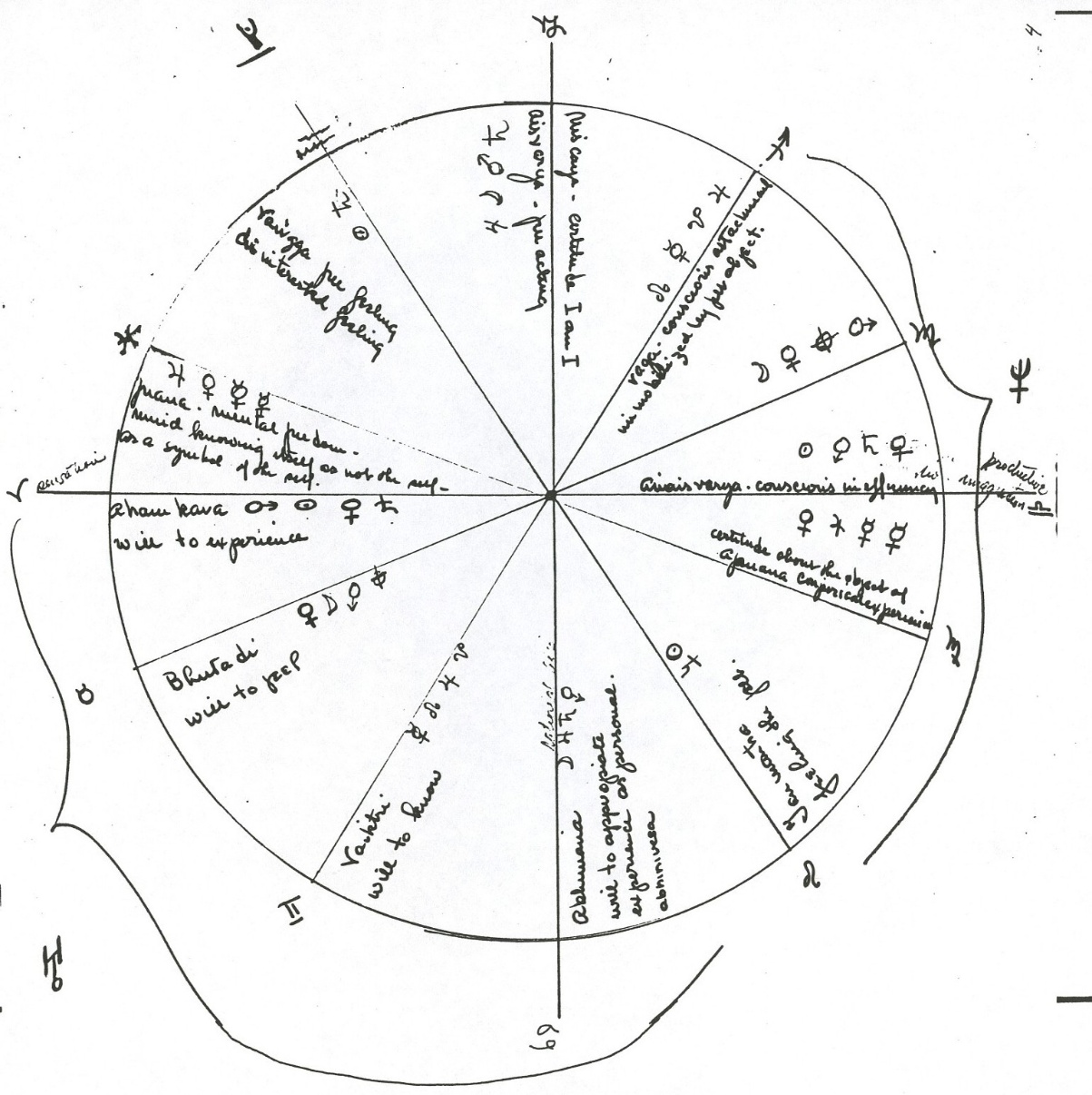
FIGURE AD_G_013. Four Psychological Functions, Samkhya Terms, and Uranus Neptune Pluto mapped onto Twelvefold Chart.
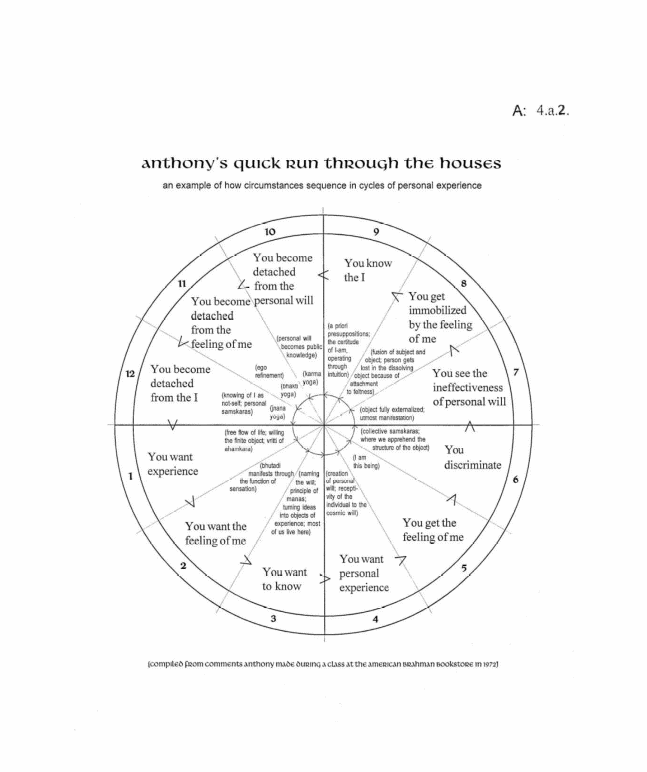
FIGURE 1972 0405-2. Anthony's Quick Run Through the Twelve Astrological Houses.
[Transcriber note: [diagram] means the speaker is referencing a diagram as he or she is speaking. If someone is drawing or writing, with audible sounds of chalk on a blackboard, I indicate this by [drawing] or [writing].]
NOTE: For readability's sake, the following substitutions/edits made in Verbatim Transcript: cuz = because; gotta = got to; yeah = yes.
TRANSCRIBED Verbatim by IT prior to 2017, reformatted by jf 2017. In 2023, IT updates prefatory matter, footer, and audio file name, completes Book List, fixes errors/typos, adds new notes within transcript, removes astrology fragment from another class, adds two diagrams and reference within transcript to these diagrams, reformats to accord with new conventions. Archival verbatim transcript – V12a.
AUDIO FILES: 1972 0405a, 1972 0405b. [Note 1: "Tape" refers to original audio cassette tapes that were later digitized into .MP3 Audio Files, and which were also consulted for this transcript. Note 2: In 2024, REP Studio separates off astrology class fragment from the audio files.]
1972 04/05 at American Brahman Bookstore
Hinduism; Samkhya
[Audio File 1972 0405a Begins]
[few seconds of shuffling about and faint background talking followed by tape break]
AD: --those people. He says--
[Transcriber note: I am using Studies in Analytical Psychology by Gerhard Adler, Routledge, Abingdon-on-Thames, 1999 reprint.]
Gerhard Adler [Studies in Analytical Psychology, p. 179, AD reading]: "The psychological study of every spiritual phenomenon, and particularly that of religious experience, encounters at the outset one fundamental problem which must therefore be discussed first. It is that of consciousness, which is inextricably bound up with any spiritual experience. The fact of"being conscious," [AD adds: that is] the attainment of reflection, is what lifts man out of the blind circle of purely biological life. The emergence of consciousness, and with it of a [AD reads: the] reflective attitude, is the characteristic feature which distinguishes man from [the] animal. One might even go so far as to define man as the living organism with consciousness."
S: Mm.
AD: You remember this book? [short pause] Somewhere here, I don't know where, do you know where Paul? He speaks about the development-- (some laughter) He speaks about the development of consciousness, he points out that man in his infancy believed that the world was stationary and the Sun revolved around it. And, Galileo disproved that. And then man also believed that the object as he perceived it was out there, you know, and it was a simple question of reflection on the object and he would have knowledge of it. And in the West Kant disproved of that, he pointed out possibility of a priori categories. And, then poor little man, Freud came along and says, look, you're not even the master in your own house, you know. Your poor little ego is pushed around by the id. So gradually he was dispossessed of his centrality, you know. Here he was at one time thinking he was the center of the universe and that everything revolved around him and gradually, you know, he was deprived of that.
S: Illusory cen-- centrality?
AD: It's not illusory my dear. If you aren't the center of your experience, there is no experience for you. It's just that he misplaced that centrality. But however what was happening all the time, in my opinion, was not so much that he was being dethroned and brought down to where he actually was but that these consecutive progressive steps were really turning him into a spiritual being although he didn't see how that was happening. And if you consider very carefully where now man, so to speak, recognizes the fact that he's not even the master in his own home, that his ego is only a-- a product, a psychological product, ok, and now the beautiful thing that happens is of course that he's rec-- he's-- he's recognized that he either is the entirety of what he perceives, that is, he is knowledge and he is the functioning of that knowledge, or he is nothing, he's going to be forced into that kind of decision. In other words, you are either a fortuitous concurrence of atoms aimlessly colliding, alright, or you're going to be forced to recognize the mentalistic nature that you basically are, alright, and that you operate with. So that actually, the materialist may be interpreting this to mean well look, now more and more you're being poi-- it's being pointed out to you that you're nothing but this stupid little body and now even that's been taken away from him and he suddenly star-- he's being forced to realize what-- what he really is. And it's really a very spiritual advance but-- however it's not been interpreted that way, you know, by these people, whether they're psychologists or phys-- physiologists or scientists. The truth of the matter is that by forcing you into such an impasse, you know, you have to make a decision one way or another, either in favor of consciousness or against it. So those of us (who) have been driven to the extremes of despair through materialism finally have to stand up and, you know, try to understand what was going on. [short pause] Anyway, if we go back to the chapter on-- by Bhattacharyya, I think we finished it or almost finished it.
[short pause with flipping of pages followed by tape break]
[Transcriber note: I am using Studies in Philosophy, Vol. 1, by Krishnachandra Bhattacharyya, "Studies in Sāṁkhya Philosophy," Progressive Publishers, Calcutta, 1956.]
K.C. Bhattacharyya ["Studies in Sāṁkhya Philosophy," stanza 34, AD reading]: "34. [The] essential character of the object--viz., its manifestness is understood to be at once a being and a process. The object, in fact, is known as getting manifested. To get manifested is for the object to be defined out of its own unmanifest [AD reads: unmanifested] condition, to be in this sense distinct from itself; and to get unmanifested is for this outward distinction to lapse or become retracted into itself. Either process is explicitly for the self and is intelligible only in reference to the self."
[Note: See FIGURES AD_G_013, 1972 0405-2 to help follow along whenever AD makes reference to a diagram.]
AD: Alright? [student assents, very faint] Now suppose we try grounding that. [9½ second pause followed by tape break] --(that's) important to keep in mind. We're speaking about the-- the organ of knowledge, we're speaking about what in Sāṁkhya they regard as the mind. Buddhi is the only true object. Now mind is at once a substance and a function. It is a substance insofar that for instance in a dream you know the characters of the dream, you know the scenario, you see the pictures and all that, we know that this is nothing but the mind being manifested. But we know also that there's someone who knows this, and so we have to recognize the fact that the mind, alright, is this function of knowledge, this organ of knowledge, and knows itself. So we have to conceive, according to the Sāṁkhya, the internal organ as the substance and the function at one and the same time. Ok? And so we try to show this on the chart. In other words, we're going to use this charge-- chart only to sort of help us schematize our understanding. Please don't go out and expect to see the ascendant here [diagram] and the descendent here [diagram], ok?
Now, we had-- Michael had brought up a difficulty last week, he said, "But what about-- how do these karmic impressions operate?" you know, you wanted to know the how, the mo-- modus operandi. And, you remember the example we gave? You're in a dream, right? And this person in the dream, the dream character, that is, looks at a dream table and he knows, let's say through reflection in the dream, he knows that he hasn't created that dream table, although without his presence there he wouldn't s-- the dream table would not be available to this consciousness that's perceiving him, ok? So then you asked and you says "But how does this vāsanā work?" you know, alright? And what was it we pointed out? We said these thoughts or these vāsanās, alright, belong to the person who's having the dream, alright. And if the dream character, if the dream character wants to get back into those vāsanās, alright, that would take him out of the time and space of the dream. In other words, it would force him back into another dimension. He can't go back, he can't get into that little vāsanā and say "Alright, let's go backward now and we'll come out on the other side."
So in the dream, analogously, we can look at it this way. The dream character, so to speak, recognizes that the manifested object, the process of manifestation which is taking place for him to perceive, alright, is the result of a combination or a conjunction of his individual apparatus, alright, and, so to speak, the ideas that are in the dreamer's mind, the person who's having the dream, alright? And that if he wanted to get back to them, in a sense he would have to step out of that dream, get into another dimension, and we regarded that center of consciousness as zero-dimension, you remember? And you have to go through that, alright? Just like when a person wants to become self-aware, he has to go back into the heart, like the mystics say, back into that center. But that's like a zero-consciousness and that will be like dropping down, you know, and coming out on the other side. Alright. You remember the-- the point we made here. If we try to understand this language, he says here--
K.C. Bhattacharyya ["Studies in Sāṁkhya Philosophy," stanza 34, AD reading]: "…is understood to be at once [AD reads: it is to be understood at once as] a being and a process. The object, in fact, is known as getting manifested. To get manifested is for the object to be defined out of its own unmanifest [AD reads: unmanifested] condition…"
AD: Alright now, what would be-- what would be the unmanifested condition of the object?
MW: On the analogy they'd be what the-- what the thoughts of the dreamer would be.
AD: In other words, they would correspond something to the-- to the karmic impressions.
MW: Right.
S: Yes.
[14¼ second pause]
AD: Can we find some-- something in the Wisdom that might help us? For instance, in "Birth of the Universe" he says--
[Transcriber note: I am using The Wisdom of the Overself by Paul Brunton, Rider and Company, London, 1943.]
PB [The Wisdom of the Overself, "The Birth of the Universe," p. 38, AD reading]: "The karmic potentials are out of space-time, whereas the actualized things are of course in the space-time imposed upon them by their observers. Their actualization is necessary only for actualized space-time beings like our [AD reads: ourselves] finite human selves and not for the World-Mind itself. Hence their existence is…"
AD: Alright, let's go on, look for something else. Previous to that he says--
PB [The Wisdom of the Overself, "The Birth of the Universe," p. 37, AD reading]: "To bring the karmic impression [AD reads: impressions] of a thing into actualized being, the mind has to provide it with [AD adds: these] relations [of] extension, size, distance [and] direction, and [thus] make space along with it."
[18 second pause with flipping of pages followed by tape break]
AD: --is that--
PB [The Wisdom of the Overself, "The Birth of the Universe," p. 36, AD reading]: "This [AD reads: The] inner transmission is [constantly] going on and the brain is constantly magnifying the original karmic impressions into physical sense-impressions. Hence the individual's sensations actually arise from within himself. [AD: Ok, and he goes on.] The materialists who discover [AD reads: who have discovered] all sensory activities are correlated with certain brain centres [and who] would therefore make the brain the source of our sense-pictures are not wrong as far as they go, only [AD reads: but] they have not gone far enough. … [short pause] The creative activity which brings the world-experience into being for every individual proceeds ultimately from his own Overself."
AD: Alright, now the Sāṁkhya notion is-- is-- in a way, it has some simi-- similarities. It says--
K.C. Bhattacharyya ["Studies in Sāṁkhya Philosophy," stanza 34, AD reading]: "The object, in fact, is known as getting manifested. To get manifested is for the object to be defined out of its own unmanifest condition, to be in this sense distinct from itself…"
AD: Now what does that mean, to be distinct from itself? Any feeling what that might be?
MW: Well, [S: Yes.] it's distinct from itself insofar as it's--
S: Yes.
[tape break]
AD: --you just saw this beautiful woman, right?
S: Why do you always use that? (laughter)
S (very faint): [few words inaudible]
S: Why do you think?
AD: Alright, you had an indescribable urge to eat a hamburger the night before you go to sleep. (laughter, student words)
S (amidst laughter): Yes. Seems more likely. (S laughing)
AD: I use that, and I use it for good reasons too. Because there's a certain mechanicalness about what many of you people call eroticism. At any rate, here's the problem. There's this indescribable urge which is a buried samskara somewhere in you, alright, which has no actualized existence we would say, that is it's not in time and space. It's not subject to the relationship of knower and known. Alright? If we think of the world-ideas, for instance, in-- and the individual collaborating with the World-Mind and those ideas become manifest as-- as an apparent world out there. [student assents] Ok? What's going on?
S (very faint): [one/two words inaudible]
S: Hm.
K.C. Bhattacharyya ["Studies in Sāṁkhya Philosophy," stanza 34, AD reading]: "To get manifested is for the object to be defined out of its own unmanifest condition, to be in this sense distinct from itself; and to get unmanifested is for this outward distinction to lapse or become retracted into itself. [AD adds: Now] Either process is explicitly for the self and is intelligible only in reference to the self."
AD: You want to try? Come on. Well, don't be-- Yes, go ahead Richard.
RG/S(?): Uh-hm. Is it you have an experience--
[tape break]
AD: --are meaningful only in relationship to a Self. To speak about an object independent of a Self is utter nonsense, they don't know what you're talking about. And this-- this peculiar language that he uses, you-- you know, you can easily correlate with the way PB writes.
[short pause]
K.C. Bhattacharyya ["Studies in Sāṁkhya Philosophy," stanza 34, AD reading]: "To reflection on the object as known, the object appears as what was being manifested and now arrested in manifestation and as, therefore, beginning to be unmanifested [AD reads: unmanifest]."
AD: You like to try that sentence? Yes.
DB: I have a question (or/of) the sentence before that.
AD: Alright.
DB: Ok? He says, talking about the object being defined out of itself, he says this out-- he speaks of it as an outward distinction.
AD: Uh-hm.
DB: Now, I've-- I'm having a little trouble understanding what he means by that.
AD: Outward distinction would only be metaphorical.
DB: Yes.
[tape break]
AD: --because they'll gradually be aroused a feeling for the concept of mentalism. I don't know if you see what way I'm pointing at. You see what I'm trying to say Paul?
PD: Yes, I'm saying that's what he's referring to is the felt outwardness. He's not just a metaphorical--
AD (simultaneously): Alright. To me it's a metaphor.
S (faint): Yes.
S: [couple/three words inaudible] about it? (laughter)
S: Yes I mean, that-- that might [possibly one word inaudible]
[tape break]
K.C. Bhattacharyya ["Studies in Sāṁkhya Philosophy," stanza 34, AD reading]: "To reflection on the object as known, the object appears as what was being manifested and now arrested in manifestation and as, therefore, beginning to be unmanifested. With the arrest of its further manifestation, its present manifestation gets an evanescent character, for nothing merely stands as manifest before reflection. The conscious evanescence of the manifestness of the object means a perception of its reality being independent of or distinct from the self and of the manifestness, therefore, having-- having being…"
AD: No that's-- that's wrong.
S: Uh-hm.
LS: It might be a [students assent] big misprint.
S: Yes, uh-hm.
K.C. Bhattacharyya ["Studies in Sāṁkhya Philosophy," stanza 34, AD reading (simultaneously with S above)]: "…therefore, having [AD emphasis] been conditioned…"
AD: Yes.
K.C. Bhattacharyya ["Studies in Sāṁkhya Philosophy," stanza 34, AD reading]: "…therefore, having…"
AD: Alright, we got to read that sentence over.
K.C. Bhattacharyya ["Studies in Sāṁkhya Philosophy," stanza 34, AD reading]: "The conscious evanescence of the manifestness of the object means a perception of its reality being independent of or distinct from the self and of the manifestness, therefore, having been conditioned by the non-distinction of the object from the self. Thus the manifesting process of the object, which is its defining from itself, implies its non-distinction from the self and the lapsing [AD reads: disappearing] of this definition-- [AD: I'm sorry.] the lapsing of this definition implies a distinguishing of the object from the self. The object defines itself when it does not distinguish itself from the self and it gets undefined in character when it distinguishes itself as an existent from the self."
AD: And with that, I'm leaving. (AD laughs, laughter, student words) Alright, let's try tearing this down. But now, think it over very slowly and carefully, and there's something really worthwhile here going on.
S: Yes.
DR: You mean for pedantic--
MW: Yes, (uh-huh).
[short pause]
AD: Let's take this sentence, let's see if we could dig it.
K.C. Bhattacharyya ["Studies in Sāṁkhya Philosophy," stanza 34, AD reading]: "The conscious evanescence of the manifestness of the object means a perception of its reality being independent of…the self and of the [AD reads: its] manifested, therefore, having been conditioned by the non-distinction of the object from the self."
AD: Now that's a very crucial sentence. It's just like meditating all over again, huh?
S: Yes, uh-hm.
[student(s) assenting, very faint]
S (very faint, possibly part of background): I don't really know.
K.C. Bhattacharyya ["Studies in Sāṁkhya Philosophy," stanza 34, AD reading]: " [The] conscious…"
[tape break]
AD: Let's take the analogy of the dream, alright? Use the dream analogy, go ahead.
[short pause]
S: Yes.
AD: Richard? I'm sorry. [tape break] You got a book? You got one of these here?
RP (simultaneously, very faint): I don't have that book.
AD: Oh. [tape break] --are over here [diagram], the bhutas are over here [diagram]. The gross physical bhutas are not to be confused with the indreyas, they have a manifest reality that is independent of the indreyas although there's no possibility of perceiving them without the indreyas. The tattvas have their reality and he's trying to bring this out. This is Sāṁkhya's version.
RG (faint): Now does he-- does-- does Sāṁkhya say that the bhutas are--
[tape break]
AD: --is absolutely irrelevant, I couldn't possibly give a-- [short pause] You remember the algebra book, the way you used to run to the back and get an answer? Let's go [student assents] over this. It's the mental processes that count here. Ok--
K.C. Bhattacharyya ["Studies in Sāṁkhya Philosophy," stanza 34, AD reading]: "With the arrest of its further manifestation, [AD: That is, the object's manifestation.] its present manifestation gets an evanescent character, for nothing merely stands as manifest before reflection. The conscious evanescence of the manifestness of the object means a perception of its reality being independent of…the self and of the [AD reads: that] manifestness…"
PD: That's referring to the unmanifest condition of the object or the--
AD: I'm sorry?
PD: He's referring there to the unmanifest condition of the object, which is prakṛti in a sense.
K.C. Bhattacharyya ["Studies in Sāṁkhya Philosophy," stanza 34, AD reading]: "…a perception of its reality being independent of…the self and of the manifestness…"
S: That would--
PD: That-- that could be the only o--
AD (simultaneously): You cannot perceive prakṛti under any circumstances. By definition it's unmanifest. [tape break] --(you have a dream), and which is manifested as such.
LS: What do you mean what about it, like--
AD (simultaneously): Well what about it? He says over here--
S: Uh-hm.
K.C. Bhattacharyya ["Studies in Sāṁkhya Philosophy," stanza 34, AD reading]: "The [conscious] evanescence of the manifestness of the object…"
AD: Alright? The evanescence, its disappearance, (it's/its) going, alright?
S (very faint): Uh-hm.
K.C. Bhattacharyya ["Studies in Sāṁkhya Philosophy," stanza 34, AD reading]: "…of the object means a perception of its reality [being] independent of or distinct from the self…"
S: Hm.
[9¼ second pause]
S (very faint): Uh-hm.
AD: It's kind of hard to add any commentary to that. But still it can be understood, this is the point that the Sāṁkhyas are insisting on. Also the Vedantists too, although they give it a fancy name. Let's see if we grasp this. [S: Oh yes.] We have a dream, you're looking at an object in the dream and let's say it's a green table, alright? Now you awake from the dream and you reflect upon the dream. Alright, and he says that--
K.C. Bhattacharyya ["Studies in Sāṁkhya Philosophy," stanza 34, AD reading]: "The conscious evanescence of the manifestness of the object…"
AD: Which is very obvious, the dream is gone, it's evanescent.
K.C. Bhattacharyya ["Studies in Sāṁkhya Philosophy," stanza 34, AD reading]: "…means a perception of its reality [AD: The green table, the perception of the green table, alright.] being independent of…the self…"
PD: And of the manifestness.
AD: And of the manifestness.
S: Yes, that's the tricky--
AD (simultaneously): That doesn't-- that-- that doesn't change anything.
S: Right.
AD: Huh?
PD: But if the object's reality is being perceived and this reality is independent of manifestness, what kind of object can this be?
AD: That's another question.
PD: I mean it can't be-- it can [AD simultaneously: That's another--] be none of the [one/two words inaudible]
AD (simultaneously): Yes, but that-- I'm not interested in that! That's exactly the point! [short pause] That's exactly the point Paul. Because to these people what's ul-- what's real in your world of manifestness is the tattvas. [students assent, very faint] [short pause] Let's tr-- let's try again. It's like meditation all over again, huh?
S: Yes.
S: Uh-hm.
AD: Alright, let's start from the beginning.
K.C. Bhattacharyya ["Studies in Sāṁkhya Philosophy," stanza 34, AD reading]: "To reflection on the object as known, the object appears as what was being manifested and now arrested in manifestation and as, therefore, beginning to be unmanifested. With the arrest of its further manifestation, its present manifestation gets an evanescent character, for nothing merely stands as manifest before reflection. The conscious evanescence of the manifestness of the object means a perception of its reality being independent of or distinct from the self and of the manifestness, therefore, having been conditioned by the non-distinction of the object from the self."
AD: Now, let's go over this again. It's really quite beautiful. Yes, go ahead.
RG (faint): Well, if you take the example of let's say having [couple words inaudible]
[tape break]
AD: For instance, the Librans are incapable of will. But the whole point is that Libra is an effect. It's a felt effect. In other words, it's the end result of the process of prakṛti. Its feltness in terms of it being out there, alright, deprives of-- of any ahaṁkāra causality causing, alright. [AD bangs on board] [intensely] So when you have it on the ascendant you can't will anything! You keep saying, "What the hell's the matter with me?" [student assents, very faint] [short pause followed by tape break] --common saying that, among the mystic, that the world is an illusion, therefore it's unreal. Just like if I were to wake up, alright, and I said, "But the green table that I saw, alright, doesn't exist." Well that's nonsense, it did exist. What am I talking about? It has some kind of reality. And doesn't PB make this point over and over again, he keeps hammering [VM: Yes.] this point home? You remember in the Hidden Teaching? The distinction between illusory and existence, that the table that exists in the dream does have an appearance, does have some existence, you can't say it doesn't exist because it wouldn't have been even for that time it was. Alright, later on this is-- Sāṁkhya's going to push this right up S-- up Vedanta's nose. Alright? (bit of laughter) So you want to know their point of view, alright, because the Vedanta has their answers but you want to know how Sāṁkhya is presenting [student assents] (this/its) problem.
[11 second pause]
K.C. Bhattacharyya ["Studies in Sāṁkhya Philosophy," stanza 34, AD reading]: "[Thus] the manifesting process of the object, which is its defining from itself, implies its non-distinction from the self…"
S: Uh-hm.
AD: Now, if you don't mind the use of the example of the girl that you g-- you know, alright. After all, desires are important. They represent that whole ascendant, you know, ahaṁkāra, willing, alright? If we take that example and we say that--
K.C. Bhattacharyya ["Studies in Sāṁkhya Philosophy," stanza 34, AD reading]: "[Thus] the manifesting process of the object…"
AD: And this object that's going to be manifested is this very beautiful girl in your dreams, ok?
S: Uh-hm.
K.C. Bhattacharyya ["Studies in Sāṁkhya Philosophy," stanza 34, AD reading]: "…which is its defining [from] itself…"
AD: Alright, in the sense that here she is, an intangible idea in your mind, which has become really a desire, it's not even the image of a woman, just an-- an inchaotic desire, alright? Now, in the dream this distinguishes itself from the seed, alright, so that this desire manifests as this form of a woman.
K.C. Bhattacharyya ["Studies in Sāṁkhya Philosophy," stanza 34, AD reading]: "…[AD adds: it] implies its non-distinction from the self…"
AD: Alright? And this would have to be otherwise it couldn't be possible for this image to appear in the consciousness. And insofar that is a-- it appears in the consciousness, alright, it's non-distinct from it in a sense. Alright?
K.C. Bhattacharyya ["Studies in Sāṁkhya Philosophy," stanza 34, AD reading]: "…implies its non-distinction from the self and the lapsing [AD reads: disappearing] of this definition implies a distinguishing of the object from the self."
AD: Now this woman in your-- in your dream world disappears, alright, vanishes, but still there is the subject that perceived it. And so there's a distinguishing being made between the object in the dream and the object that is being perceived in the dream, that is, the center that is perceiving her.
S (very faint): Uh-hm.
K.C. Bhattacharyya ["Studies in Sāṁkhya Philosophy," stanza 34, AD reading]: "The object defines itself when it does not distinguish itself from the self…"
[short pause]
AD: Ok? Now this woman that appears in the dream defines itself as long as she doesn't, so to speak, separate itself. Once it separates itself then she lapses. [short pause] Alright, let's go over this whole paragraph slowly. Yes Randy.
RC: What (do/are) the different states--
[tape break]
AD: --is represented in this chart--your thoughts, your feelings, ok, the events in your life, the situations, the understanding. All is going to be symbolically in this chart, schematically speaking, it's a device to help you understand. And at the same time I'm trying to help you to see if you can get the concept of mentalism, alright? Now imagine that you are nothing but this functioning and substantial mind. Ok? You hit-- you walk here and you hit this thing on your head. You don't say that "I-- my head hit that shelf." You say "One thought collided with another," and you walk away, ok? (some laughter) [S simultaneously, laughing: That's alright.] [passionately] You see the feeling I'm trying to get up? Because all that you are in contact with is always this mind. You're in yourself and no matter what you do it's only parts of yourself that you're relating to. Well, you see what you begin to feel after awhile? You begin to say "Wait a minute. There is this"I" and there's that mind. One of us isn't real!!" (some laughter) The concept of mentalism. That's why I'm using this text. That's why I'm using this diagram.
RC: Would this object [couple words inaudible]
AD (simultaneously): Imagine, imagine you're in a dream now, ok? Now, from the point of view of wakeful consciousness, you look back in the dream and you say, "But what the hell am I talking about? Everything that happened was just mental! It was all in the dream consciousness. There was no real elephant that came over [AD stomping on floor] and trampled me, even though I screamed." (bit of laughter) [students assent, faint] You see, that-- you remember that quotation about "Help me, O Lord, to get out from within myself, I'm locked up in my egocentric predicament"? (bit of laughter)
RC: But this object that is being talked about has the whole of the mind at that moment involved in it, right? It's not like--
AD: Wait, ho-- the whole of that mind what?
RC (simultaneously): This object he's talking about is the whole of the mind.
AD: Yes, that's the metaphysical object.
RC: Right, and that's the mind failing to distinguish itself from the Self.
S (very faint): Mm, yes.
AD: That's only partly true. It's only partly true. But good, very good so far Randy. Nice. Go ahead.
DB: Is-- is the non-distinction of the object from the Self the felt my-ness of the o--
AD: Wait, wait, wait, [DB simultaneously: Ok.] hold on to that, we're playing-- Again. There's this woman that appears in the dream, ok?
DB: Right.
AD: She's very beautiful. She appears, alright, and you embrace her very-- there's-- there's a substan-- sub-- substantiality in her being, alright.
DB: Uh-hm.
AD: And if I can use the word, there's a substantiality in your feeling of her being, [DB assents] alright? If it is distinct from the Self, what happens?
DB: It vanishes.
AD: It vanishes.
DB: Ok, I'll-- Yes, alright.
AD: Non-distinction.
DB: Yes, ok, (alright).
AD: Let's read the paragraph once more, alright? (bit of laughter) We start at 34.
K.C. Bhattacharyya ["Studies in Sāṁkhya Philosophy," stanza 34, AD reading]: "34. The essential character of the object--viz., its manifestness [AD reads: its manifestness, that is] is understood to be at once a being and a process. [AD: Now--] The object, in fact, is known as getting manifested. [AD adds: Now] To get manifested is for the object to be defined out of its own unmanifest [AD reads: unmanifested] condition, to be in this sense distinct from itself; and to get [AD rereads: …to be defined out of its own unmanifested condition, to be in this sense distinct from itself; and to get] unmanifested is for this outward distinction to lapse or become retracted into itself. Either process is explicitly for the self and is intelligible only in reference to the self."
AD: Now of course this deepens considerably your understanding of what Sāṁkhya means when they say that prakṛti is for the pleasure of purusha.
S: Hm.
AD: Try to keep that in mind.
K.C. Bhattacharyya ["Studies in Sāṁkhya Philosophy," stanza 34, AD reading]: "To reflection on the object as known, the object appears as what was being manifested and now arrested in manifestation and as, therefore, beginning to be unmanifested."
AD: Apply this to the notion of the Quest. You're on your way towards distinction, unmanifestness! Alright, never mind. (AD laughs a bit, laughter)
K.C. Bhattacharyya ["Studies in Sāṁkhya Philosophy," stanza 34, AD reading]: "With the arrest of its further manifestation, its present manifestation gets an evanescent character, for nothing merely stands as manifest before reflection. The conscious evanescence of the manifestness of the object means a perception of its reality being independent of [or distinct from] the self and of the manifestness, therefore, having been conditioned by the non-distinction of the object from the self."
AD: And that very simply-- another way of looking at that would be to say that it amounts to whatever reality it has it borrowed from that conditioning of being non-distinct from the Self. Ok.
K.C. Bhattacharyya ["Studies in Sāṁkhya Philosophy," stanza 34, AD reading]: "[Thus] the manifesting process of the object, which is its defining from itself, implies its non-distinction from the self and the lapsing of this definition implies a distinguishing of the object from the self. The object defines itself when it does not distinguish itself from the self and it gets undefined [in character] when it distinguishes itself as an existent from the self."
[student assents, very faint]
AD: Yes.
LR: It seems to me that he's saying that the object, insofar as it--
[tape break]
AD: --was the nature of feeling and reflection. The profundity of this axis [diagram] is something that Jung hasn't even conceived of, but which I think Sāṁkhya could make us much more aware of.
S: Can we try that last sentence again?
AD: Try what?
S: The last sentence in the paragraph?
K.C. Bhattacharyya ["Studies in Sāṁkhya Philosophy," stanza 34, AD reading]: "The object defines itself when it does not distinguish itself from the self and it gets undefined in character when it distinguishes itself as an existent from the self."
AD: She wants help here, would anyone try? The last sentence of that paragraph. [short pause] Look kids, if you find this too rough we can drop it and come back later.
PD: Well, that seems to refer to the-- you were reading Whitmont, [AD: Yes.] it says first there's the identity with a drive, an unstructured drive. [Note: See Edward Whitmont, The Symbolic Quest: Basic Concepts of Analytical Psychology.]
S: Yes.
AD: Uh-hm.
PD: Then the person who's living out this identity, and that's the o-- the object defining itself in his life.
AD: Uh-hm.
PD: Now when the person dis-- when that becomes distinct from the self, then he no longer lives it out and so the o-- the unstructured drive gets undefined in character.
AD: And lapses.
PD: Yes.
AD: And you can see where all psychology has its premises built in. Ok? [student assents] Projection is a meaningful thing in Jungian psychology bes-- because, basically, the world is projected from within oneself; and so there-- projection becomes meaningfully not only ontologically but psychologically. Could the microcosm have any choice but to imitate what the macrocosm is doing?
S: I don't know, how can you say that the object is defining itself when-- when it's identif-- like(,) using the analogy to say that it's identified with that--
AD (simultaneously): Wi-- finish the sentence please.
S: How could you say the object is identifying itself if the un-- personality is identified with a drive?
AD: Finish the sentence the way he has it.
K.C. Bhattacharyya ["Studies in Sāṁkhya Philosophy," stanza 34, S reading]: "…[S adds: and similarly becoming] undefined in character when it distinguishes itself as an existent from the self."
S (possibly part of background): Careful.
AD: Alright, I have to do it over and over again.
S (faint): Ok.
K.C. Bhattacharyya ["Studies in Sāṁkhya Philosophy," stanza 34, AD reading]: "The object defines itself when it does not distinguish [AD reads: distinguishes] itself from the self and it gets undefined in character when it distinguishes itself as an existent from the self."
AD: Do you want to repeat it?
PD: Well, the sentence before he says it much clearer.
[student assents, very faint]
AD: Ok.
K.C. Bhattacharyya ["Studies in Sāṁkhya Philosophy," stanza 34, PD reading]: "Thus the manifesting process of the object, which is its defining from itself, [implies] its non-distinction from the self and the lapsing of this definition [PD adds: or manifestation] implies a distinguishing of the object from the self."
PD: You're confusing your definitions.
AD: You got reservations about that mentally. Do you know what I'm saying? In other words, this is where you have reservations, when he-- when he says here--
K.C. Bhattacharyya ["Studies in Sāṁkhya Philosophy," stanza 34, AD reading]: "…it gets undefined in character when it distinguishes itself as an existent from the self."
AD: You got reservations--
S (simultaneously): Yes, how [student assents] could that make it undefined?
AD (simultaneously): Yes, yes, you have-- you have reservations, that's precisely the point. Now instead of asking the question, ok, why don't you find out why you have those reservations. Find out what the psycholo-- psychology here is.
S: Well it seems like he reversed it.
AD (simultaneously): Look, look!
S: Ok.
S (very faint): Yes, he reversed it.
AD (intensely): If you pause and reflect for a minute then I'll listen to you! But you react with the speed of an (automan/automat). (bit of laughter, students assent) [tape break] When it's not distinct from the Self? [short pause] For instance, when you identify yourself with the body, isn't the object clearly defined now? [9¾ second pause] And suppose you proceed and rupture this identification, do you think your body's going to be a defined object now? You ever see these mystics when they-- they have unembodied consciousness and then they get back and they look at the body and they can't even recognize it, they can't even define it, they (didn't/don't) even know what it is!? (bit of laughter) [short pause] It's so obvious. You're trying too hard. (AD laughs)
LR: That's in a sense saying that content defines the form in a sense.
S: Right, (I know what you're saying).
LR: And that without the content the form cannot be defined.
AD: No, no, I don't want to handle it that way honey.
LR: What-- what-- is there an-- is there error in that?
AD: Look--
K.C. Bhattacharyya ["Studies in Sāṁkhya Philosophy," stanza 34, AD reading]: "The object defines itself when it does not distinguish itself from the self…"
S (faint): Yes.
AD: Now you, the way you are now, alright, are defined so long as you don't distinguish yourself from yourself. If you distinguish--
S (simultaneously): Well, so then--
AD: Start again. Start again.
S: It seems like it should be the other way around.
[students assent, very faint]
AD: Well she says it seems that it should be the other way around. Go ahead Vic.
S: Yes.
VM: Well, maybe-- I'm not sure if this--
[tape break]
AD: --what gives meaning to the ego as you claim it to be is the fact that it's identified with the Self. Deprive it of that identification and it lapses into meaningless. The next pa-- the next sentence for instance, the very beginning sentence.
K.C. Bhattacharyya ["Studies in Sāṁkhya Philosophy," stanza 34, AD reading]: "35. The non-distinction of the object from the self is the fact corresponding to the illusory identification of the self with the object."
AD: And he's telling you right there.
S: Yes I was con-- alright.
K.C. Bhattacharyya ["Studies in Sāṁkhya Philosophy," stanza 34, AD reading]: "[AD adds: And] The self is identified with the object in the consciousness of [AD emphasis] being embodied. The body is itself a real but terminable organisation of the object, the unity of which consists entirely in its not distinguishing itself from the self. Distinguishing, [as] has been indicated, is a contingent but real function of the object itself, implying the termination of the equally real predicament of [AD emphasis] not distinguishing."
S: Uh-hm.
AD: Well, I'm going to give you people headaches tonight, so-- [short pause] [AD sighs] Oh. [tape break] --on what he calls the objective tattvas, alright. If you turn to-- if you turn to paragraph 93-- 93, if we start there and work our way back I think you'll be better off.
S: Yes.
AD: See, I'm going to-- in other words, I want to see if I can follow his thoughts the way a Westerner might be able to understand them better.
S (possibly part of background): Aww.
AD: Yes.
S (simultaneously): Yes-- yesterday-- I mean I was wondering about the notion of prakṛti. Here it seems like they-- they--
[tape break]
AD: --the class is too big. (student laughs)
[short pause]
S: So [few words inaudible] (student laughs, student words)
AD: Yes, do some work. But, let's say, let's say Linda that you do explain it to yourself and you're satisfied, ok, and you think that you understood it. Well you have to accept that. Ok? You have to accept it and live with it, and at the next time, the next opportunity, and at the right time, it'll be shown to you, you-- it's the wrong thing, you don't understand it the right way. Because my assumption is that you will understand what is appropriate for you at the time you understand it and the way you are, you know. Given all things, it's usually quite-- you know that from your astrology. You cannot understand something prematurely. I do not accept the Western notion there at all. Until the soul is qualified to receive a certain teaching, it'll only be absolute theor-- theory. So you-- you do what you can, you know, but I didn't want to point that out [LR simultaneously: Yes ok, I understand.] as much as work, work at it, keep working at it. Alright, we'll start with the objective tattvas because that--
[Audio File 1972 0405a Ends]
[Audio File 1972 0405b Begins]
AD: --he doesn't go-- go into it. [short pause] The important parts here were--
K.C. Bhattacharyya ["Studies in Sāṁkhya Philosophy," stanza 93, AD reading]: "93. Ahaṁkāra and buddhi are taken along with manas as the three internal organs (karaṇa) [AD reads: Ahaṁkāra, buddhi, with the mind is taken as the organ, the internal organ]; and along with the tanmātras as prakṛti-vikṛtis [AD reads: as the effects of prakṛti]…"
S (very faint): Uh-hm, yes. [one word inaudible]
AD: The--
S: More than prakṛtis.
K.C. Bhattacharyya ["Studies in Sāṁkhya Philosophy," stanza 93, AD reading]: "93. Ahaṁkāra and buddhi are taken along with manas as the three internal organs (karaṇa); and along with the tanmātras as prakṛti-vikṛtis [AD reads: as the prakṛti effects] and as [AD emphasis] other than the viśeṣas [AD reads: specialized]."
AD: The viśeṣas are the specialized, in other words the organs of sense for instance are specialized, they cannot be further differentiated. That's the limit.
K.C. Bhattacharyya ["Studies in Sāṁkhya Philosophy," stanza 93, AD reading]: "They are functional tattvas that are internal (mental) causal and aviśeṣa [AD reads: undifferentiated]."
AD: Non-distinct from the self, ok? You want--
S: What's a tattva?
AD: Principles. You could tran-- use the word 'principles', ok, and you'll feel more comfortable. The trouble is that that word 'tattva' in Hinduism is so overwhelming. [10 second pause] Ok.
K.C. Bhattacharyya ["Studies in Sāṁkhya Philosophy," stanza 93, AD reading]: "Aviśeṣa, [as] has been shown, is manifest necessarily as mental and causal, and so [it will] suffice to characterise them as manifest functional aviśeṣas [AD reads: and undifferentiated]."
AD: In other words, buddhi and ahaṁkāra, the mind, alright.
[student assents, very faint]
K.C. Bhattacharyya ["Studies in Sāṁkhya Philosophy," stanza 93, AD reading]: "The affective differentiations--pleasurable, painful [etc.]--are manifest only in the tattvas that do not become but are immediately reflected in the bhogya [AD reads: experienced] world…"
AD: We went through this, what am [student assents] I doing?
[students assent, faint]
S (very faint): Uh-hm. [few words inaudible]
S: Yes.
AD: Shall we go over it again?
S (very faint): Yes, we should.
AD (simultaneously): Ok, let's go over it, ok.
K.C. Bhattacharyya ["Studies in Sāṁkhya Philosophy," stanza 93, AD reading]: "The affective differentiations--[AD: The emotions that you experience for instance.] pleasurable, [AD adds: and] painful [etc.]--are manifest only in the tattvas…"
AD: In other words, the subjective psychological functions, alright, remain so to speak, but what the emotions that you experience are reflected in the tattvas, in other words, in the unity of the apperceiving ego, alright, these differentiations occur within it.
S (very faint): I see.
[students assent, very faint]
K.C. Bhattacharyya ["Studies in Sāṁkhya Philosophy," stanza 93, AD reading]: "…that do not become…"
AD: So for Sāṁkhya, the internal organ never becomes, it doesn't evolve. [someone blows nose in background] Are you razzing them? (bit of laughter, student words) The affective differentiations are manifest only in the s-- subjective unity of the psychological complex, let's say it that way, and this complex, this psychological unity, actually they're really intellectual principles that constitute the make-up of man.
K.C. Bhattacharyya ["Studies in Sāṁkhya Philosophy," stanza 93, AD reading]: "…[AD adds: these] do not become but are immediately reflected in the bhogya [AD reads: experienced] world…"
AD: Now he is saying here that these intellectual principles are reflected in the experienced world. We say that too and we point out how often we can see it but the reflection is upside down.
K.C. Bhattacharyya ["Studies in Sāṁkhya Philosophy," stanza 93, AD reading]: "…[AD adds: they] are [immediately] reflected in the bhogya [AD reads: experienced] world [that] [AD reads: this world] is distinct from them and distinct in them."
AD: We had a big fight over this. Tom you remember it? You want to explain or--
S (very faint): Not really. (AD laughs, bit of laughter)
AD: Who wants to try? Come on. Richard, Kurt, come on.
S (very faint): [three/few words inaudible]
AD (explaining while paraphrasing): The affective differentiations are manifest in the subjective unity of the apperceiving ego which does not become, alright, but are immediately reflected in the experienced world. This world is distinct from them. From what "them" is he referring there?
S: Well-- hm.
LR: Not [one word inaudible]
S (simultaneously): To-- [one/two inaudible student words simultaneous with S] to differentiation.
S: Ok I'll--
S (simultaneously, faint): [few words inaudible]
LR (simultaneously): The emotional states.
[student assents, faint]
K.C. Bhattacharyya ["Studies in Sāṁkhya Philosophy," stanza 93, AD reading]: "…and not distinct [AD emphasis] in them."
AD: Yes Richard.
S: Alright I'm-- well he's using "distinct in them" in like principial way.
[tape break]
AD: --the emotion. If you-- if you-- if you want to exaggerate meanings, go right ahead.
K.C. Bhattacharyya ["Studies in Sāṁkhya Philosophy," stanza 93, AD reading]: "The affectively [AD reads: emotionally] undifferentiated tattvas [AD adds: or intellectual principles] are also manifest as absolute in the sense of being causa sui [AD reads: self-caused], cause (prakṛti) and effect (vikṛti) at [AD reads: are] once and not alternately, or self-caused. [AD adds: Now] The self-caused [AD: Concentrate on this."The self-caused] is understood in three forms--self-known, self-willed [or] self-felt; knowing, willing and feeling amount to self-becoming in the region of the absolute. Buddhi, ahaṁkāra and tanmātra are the absolute mind as corresponding respectively to the illusions of the self objectifying itself--[AD adds: that is] knowing itself, willing itself, [and] feeling itself--objectifying in each form being really the self-distinguishing causality of the mind. These forms of the absolute mind are really three stages: buddhi as self-knowing becomes ahaṁkāra [AD adds: ahaṁkāra-- ahaṁkāra] as self-willing which in its turn becomes tanmātra as self-feeling."
AD: I'm sorry I broke the sentence up that way. Now--
K.C. Bhattacharyya ["Studies in Sāṁkhya Philosophy," stanza 94, AD reading]: "94. Buddhi, ahaṁkāra and tanmātra may be regarded as self-consciousness [AD emphasis] in the objective…"
S (very faint): Yes.
AD: Try to get the feeling for that, "in the objective".
K.C. Bhattacharyya ["Studies in Sāṁkhya Philosophy," stanza 94, AD reading]: "…as the real mental counterparts of the illusion of self-objectification."
AD: Just imagine this beautiful quiet immense quiescent immediate consciousness, alright, enjoying itself peacefully, you know? All of a sudden it takes on the role of "I'm going to identify with this character here," ok, "I'm going to become this certain person." And this is the mystery I try to show in terms of the cross because that is a mystery. [students assent, faint] Why the self should incarnate, so to speak, is-- is best portrayed by the cross. Alright, now, it has to identify and assume the character of this object, so to speak, the consciousness has to become objectified.
[10¾ second pause]
K.C. Bhattacharyya ["Studies in Sāṁkhya Philosophy," stanza 94, AD reading]: "94. Buddhi, ahaṁkāra [and] tanmātra [AD: That is, knowing, willing, feeling.] may be regarded as self-consciousness in the objective, as the real mental counterparts of the illusion of self-objectification."
[student assents, very faint]
S: Well can you say that these-- we speak of-- of a cosmic buddhi and [one word inaudible]
[tape break]
AD: --the Middle Ages, maybe Richard might know, when the microcosm and the macrocosm-- In other words, the Earth was considered as the microcosm and the universe the macrocosm, and it's only I would say during the Middle Ages that they started bringing down the meaning at this level. In other words, now they start thinking of this subjective entity, you know, you and I, as the microcosm. I wonder if that implies anything in-- you know. [students assent, very faint] You think about it.
S (faint): Ok.
[student assents, very faint]
K.C. Bhattacharyya ["Studies in Sāṁkhya Philosophy," stanza 94, AD reading]: "Tanmātra as the counterpart of self-feeling…"
AD: Well he says he explained that, we'll find out.
K.C. Bhattacharyya ["Studies in Sāṁkhya Philosophy," stanza 94, AD reading]: "[AD adds: The] Sāṁkhya-Sūtra [VI-54] says that the agent is ahaṁkāra, not the self. The finite ego-hood of the self (which is in essence an infinite individual) is manifested in willing. The knowing self may be finite but the finiteness is not manifest in the knowing. The feeling self is finite but is manifest as me and not as I or ego. Ahaṁkāra is the finite ego-hood of the mind as willing. Now willing as in the (gross) body and directed towards the external object presupposes willing in the mind towards itself, the mind as active I becoming the standing me. This is the self-willing of the mind which answers to ahaṁkāra."
AD: Now, on that basis of that you can see why I've [drawing] spoken of this as the ascendant [diagram]; over here the 9th house as buddhi [diagram], the ascendant as ahaṁkāra [diagram], the 5th house where the Sun [AD bangs on board], I speak of that as tanmātra [diagram]. Ok? As a matter of fact this whole bit [diagram] I speak of as tanmātra. But the Sun more than anything else really gives us the feeling of feeling. Remember? Let's read this.
[short pause]
K.C. Bhattacharyya ["Studies in Sāṁkhya Philosophy," stanza 94, AD reading]: "The knowing self may be finite-- The feeling self is finite but is manifest as me and not as I or ego. Ahaṁkāra is the finite ego-hood of the mind as willing. Now willing as in the (gross) body [and] directed towards the external object presupposes willing in the mind towards itself, the mind as active I becoming [AD reads: becomes] the standing me. This is the self-willing of the mind which answers to ahaṁkāra."
AD: So you can see why, for instance, on the one hand, to Sāṁkhya, ahaṁkāra would be the agent, the doer, the one who goes around saying "I did this, I do that, and I do the other thing." To Yoga, [AD indicates on diagram] buddhi is the doer. Insofar that he, through the process of asmita, accepted identification with that knowledge, boom!, he's the doer. False identification.
K.C. Bhattacharyya ["Studies in Sāṁkhya Philosophy," stanza 95, AD reading]: "95. The specific function of the mind as ahaṁkāra [AD reads: willing] is said to be abhimāna [AD reads: self-conceit]--[what appears in the gross form as pride of vanity or complacency] and is in essence the conscious identification of the self with a finite being--expressible as 'I am this being (and therefore not other being (AD reads: not any other))'. This finitising function [is], as intellectual, [a bhāva of buddhi], the 'subjective' function of asmitā which is one of the viparyayas, [AD: Effects.] not a causal manifestation of the objective mind. [AD rereads:"…not a causal manifestation of the objective mind."] The function, however, is the transcendental [or anticipatory] form of connation or willing as the causal function of becoming finite."
AD: You want to try now? You see why I have to use the chart, to try to make you see these thoughts? Want to try Paul, give it a try?
PD (simultaneously): Got lost in the Sanskrit.
AD: Hm?
PD: Got lost in the Sanskrit.
AD: Got lost in the Sanskrit?
S: Yes.
S: In the first sentence, what would you translate--
[tape break]
AD: When you say "I do this," what the hell did you ever do? (laughter) I mean if you stop to think of all the causal factors even from a Western point of view, you'd have to give up that notion "I did it". If you're the net result of everything from a point of view of all these in-- intermeniable, you know, indefinite causes all coming together, now you go on saying "I did it," yes that sounds superstitious. (laughter)
S (very faint): Yes. But Tony--
AD: Yet it's this conceit we have to fight. Yes?
RG: (Could--)
AD: Go ahead Richard.
RG: Um, [couple very faint inaudible student words] the fact that--
[tape break]
AD: Say it again, go ahead.
RG: Well, in the book [couple words inaudible] there's no-- I mean there's no subjectivity, it's just objective-- you know, finitising doesn't necessarily imply subjective identification but the subjection-- the subjectivity is imposed on this finitising process to say "I am-- I am this being and not-- not any other being." It's an effect, it's not-- it's not a causal thing.
[student assents, very faint]
AD: An effect of what?
S (faint): I see it.
S (simultaneously, very faint): [few words inaudible]
S (very faint): Yes.
S (very faint, possibly part of background): [couple words inaudible]
[short pause]
AD: At the beginning of the next paragraph, for instance, he says--
K.C. Bhattacharyya ["Studies in Sāṁkhya Philosophy," stanza 96, AD reading]: "96. Ahaṁkāra is the mind as willing. Willing is [AD adds: to be] understood as willing towards bhoga [AD adds: or sense-experience]. Bhoga [AD reads: This experience] is in one's (material) body which is manifestly exclusive of other bodies. Willing towards bhoga [AD reads: sense-experience] too implies exclusiveness, being in fact the mental prototype of the bodily exclusiveness, and it is accordingly the nucleus of what has been called the mental or subtle body."
AD: Why don't we try to understand that and then we can go back? You want to give it a try?
K.C. Bhattacharyya ["Studies in Sāṁkhya Philosophy," stanza 96, AD reading]: "96. [AD adds: The] Ahaṁkāra is the mind as willing. Willing is understood as willing towards bhoga [AD reads: Willing is understood to mean that you will to experience]."
AD: That is, the world, ok?
S (very faint): I see.
[student assents, very faint]
K.C. Bhattacharyya ["Studies in Sāṁkhya Philosophy," stanza 96, AD reading]: "Bhoga [AD reads: This experienced world] is in one's (material) body which is manifestly exclusive of other bodies."
S (very faint): [few words inaudible]
[student assents, faint]
AD: So far clear? [short pause] So far clear? [student assents, very faint] Ok.
[student assents]
K.C. Bhattacharyya ["Studies in Sāṁkhya Philosophy," stanza 96, AD reading]: "Willing towards bhoga [AD reads: the sense-experienced world] [too] implies exclusiveness…"
[student assents, very faint]
AD: In other words, in order for you to experience a sense-world you have to be an individual. If you were the universal intelligence you certainly cannot experience the gross world. Alright.
K.C. Bhattacharyya ["Studies in Sāṁkhya Philosophy," stanza 96, AD reading]: "Willing towards bhoga [too] implies exclusiveness, being in fact the mental prototype of the bodily exclusiveness, and it is accordingly the nucleus of what has been called the mental or subtle body."
[students assent]
AD: Now look, [S, faint, possibly part of background: It's true.] how about this, you want to give me a guess? If I say that this ascendant here [diagram], ok-- Let's say that this represents buddhi [diagram], this represents ahaṁkāra [diagram], ok, would you locate the body here [diagram] Richard?
RG (very faint): No.
[short pause]
AD: In this symbolical representation, and I speak of ascendant or I speak of ahaṁkāra, this is ahaṁkāra [diagram], ok. This is buddhi [diagram]. Alright. Now in this symbolical representation, would you put the body anywhere in here? [very faint background student talking] No?
S (very faint): Ok, uh-hm.
RG: I see, I think that's the [one word inaudible] he's saying the--
AD: In other words, over here [diagram], the only thing that you can say is, "I know myself here at the ascendant as a mental willing towards experience." But this is not the physical body. Alright, just like in the morning you can feel the thrust, well not all but, some people who have a certain type of ascendant, they can feel, they get up and right away, "I'm on the go, I got to go," alright, this desire to experience the world, this willing of experience is very pronounced in them and they can feel like before they get up out of the bed the-- they're already out in the world, you know? Any of you know what I'm talking about? [student assents, faint] No? (bit of laughter)
S: Yes.
S (faint): [one/two words inaudible] relate (to that), couldn't you?
AD: You know what I'm talking about Kurt?
S (very faint): Yes, I know what you're talking about.
AD (simultaneously): Mark? Alright, this is-- this is the mental, so to speak, the mental representation, that internal mental representation of the desire to experience the world. But it is not the body. The body comes over here [diagram] when you have the feltness of it. You begin to say, "Ah, I feel myself," alright. I don't mean this way [diagram].
S: Just in the sense like--
AD (simultaneously): The body has a certain feltness which has to be put out here [AD bangs on board]. It can't be put in here [diagram]. Go ahead Richard.
RG: You're saying this isn't either, this subjective function is almost a copy of the ahaṁkāra as willing tra-- becomes the effect of the feeling of a sep-- of a separateness of one's own felt body.
AD: Ok. Try again, maybe they missed you.
RG: Well, if we do it in the chart, on the-- [AD simultaneously: Go ahead.] on the ascendant, there's this willing to experience but there's no feltness yet to any body, to any-- [AD drawing] to any sub-- subjectiveness almost.
AD: Uh-hm.
RG: And that gets translated to the 5th house where there [AD indicates on diagram] is that feltness as a separate identity which is the copy of what's being done at the ascendant.
AD (simultaneously): In other words, the effect of this willing is experienced as a feltness, alright, and if you close your eyes and you meditate very deeply eventually you have a feeling that you have a body; even though you've lost the physical sensation of the body but the feltness of the body is still lingering on, you're still not free of it. Right Kurt!?
S (very faint): (I don't know) Kurt.
S: Um--
AD: What were we speaking about last week, you said you got up and you felt the "I".
S: Yes, yes, I know, I haven't--
AD: What did you feel?
S: "I have too many thoughts," I thought. (bit of laughter)
AD: Yes, that's the point, you see Kurt. The point here is that there was this men-- mental willing that you feel which you think because it's devoid of a specific content that it's the "I". It's the-- it's this willing to experience that you, so to speak, get up with and say "Ah, is that the"I"?" It certainly is not. That's precisely what is not the "I". [short pause] Alright, so let's see.
K.C. Bhattacharyya ["Studies in Sāṁkhya Philosophy," stanza 96, AD reading]: "Willing towards bhoga [AD reads: the sense-experience] [too] implies exclusiveness, [AD adds: this] being in fact the mental prototype of the bodily exclusiveness, and it is accordingly the nucleus of what has been called the mental or [AD adds: the] subtle body. Willing towards freedom has also been conceived, willing to get rid of the finitising body, of the will towards bhoga [AD reads: sense-experience] which though free in the sense of self-causing--the sense in which all prakṛti-vikṛtis are free--is really self-contracting, being the mind acquiring impotentia [(aśakti or anīsvaratva)]."
AD: Let's try that, let's see if we can-- No problem here, come on.
[student assents, very faint]
MW: What is 'impotentia'?
S (faint): [one word inaudible]
S: Intention.
AD (simultaneously): Impotent.
[couple/three very faint background student words]
[tape break]
K.C. Bhattacharyya ["Studies in Sāṁkhya Philosophy," stanza 96, AD reading]: "…willing to get rid of the finitising body…"
AD: Now that's very obvious, you want to-- like you meditate, you like to try to get rid of your body because you know that the body implies the finitising, alright, principle and consequently involves you in the sense-experienced world. So that's why you sit down and meditate, right, you want to get rid of that body.
[student assents, very faint]
K.C. Bhattacharyya ["Studies in Sāṁkhya Philosophy," stanza 96, AD reading]: "…of the will towards bhoga…"
AD: Now it's even better. It isn't so much the body you want to get rid of but the will towards the body's activity of getting you involved in the world. [11 second pause] The next sentence--
K.C. Bhattacharyya ["Studies in Sāṁkhya Philosophy," stanza 96, AD reading]: "…willing to get rid of the finitising body, of the will towards bhoga which though free…"
AD: You notice what he's saying here? [student assents, very faint] You want to try?
VM: This desire for the experienced world has its own sort of momentum, isn't that what he means by--
AD: More than that.
VM: Well, it's self-generating.
AD: Yes, self-generating. So a little more, go a little-- little more. You want it. [VM simultaneously: Oh no, I (think/believe) that too.] You really want to. Huh?
VM (very faint): You say-- when you say that you want it [few words inaudible] [students assent, bit of laughter] It's what I think [one/two words inaudible]
MB: Can (you/we) do this-- could we do this once more?
S: Uh-hm.
AD: Huh?
MB: It's like the "you" that (has/is) produced [couple words inaudible]
AD (simultaneously): Well, if self-knowing, self-willing, and self-feeling are self-caused, alright, and you come over and you say, "But why did this happen to me?" and I turn around and say, "Because you wanted it." Sometime, somewhere, you wanted this, you caused this, you bring it about. It doesn't happen out of the blue. This is what they mean when they say that all-- all these prakṛti principles are more or less free to operate. Kant also believes the same thing. He says all knowing is a conscious knowing, it's a conscious act. You want it. It's hard to believe, huh? (some laughter)
S (amidst laughter): Yes.
S (amidst laughter): Yes it's pretty hard.
S (simultaneously): Pitiful. (laughter, student words) It's pitiful.
AD: If you believe in karma you have to accept it.
S: I-- well I'll accept it but it's still pitiful. (laughter)
AD: No, it isn't, it isn't. The rewards are commensurate with the misery.
[students assent, very faint]
K.C. Bhattacharyya ["Studies in Sāṁkhya Philosophy," stanza 96, AD reading]: "Willing towards freedom has [also] been con…"
AD: No, the next sentence--
K.C. Bhattacharyya ["Studies in Sāṁkhya Philosophy," stanza 96, AD reading]: "The so-called willing towards freedom is properly free activity, activity that does not wait for the result, being intrinsically unimpeded, though there may be lapses from it. This unimpeded activity of the mind--activity and fruition in one or spiritual efficiency--is called [aiśvarya and is] a function of buddhi. (laughter) It is not willing at all because willing must have for its object what was not and is to emerge. Activity that is necessarily efficient is not willing because it has no object to be accomplished. The activity towards freedom is but the exercise of freedom."
AD: Of course this takes you into the realm of a Sage. He has no willing; he doesn't will anything except what the Self wills, which is not willing. But you have an ego which is always willing, "I want this, I want that," and then when it comes you say "I didn't want it, what does it happen to me for?" Well-- [S simultaneously: Then you have (peace on the ascendant).] You remember what Dante said? He says "Only in the Father's Will is there any peace." I guess you haven't read Dante, he was old-fashioned.
RC: I think-- I don't see where you-- where any sort of willing is discontinuous with that willing. I don't see where the possibility of error enters into it.
S: Error(./?)
MW/S(?): What?
RC: I don't see where you (get/got)--
[tape break]
AD: --isn't involved with that kind of willing, but the next kind of willing is more our level.
K.C. Bhattacharyya ["Studies in Sāṁkhya Philosophy," stanza 97, AD reading]: "97. [As] ahaṁkāra is primarily the mind as willing, though it may develop knowing and feeling aspects [(as vaikṛta and bhūtādi)], so buddhi is primarily the mind as knowing which may take the appearance of willing and feeling."
AD: And in astrology for instance we see that. This for instance represents willing, Aries [diagram], alright? [drawing] Now, [student assents] you will to feel in Taurus [diagram]. And in Gemini you will to know [diagram], alright? And you can see that the whole ahaṁkāra function which I broke up into these four, the first tetrad [diagram], here we have, so to speak, the mind, ahaṁkāra, but now with three aspects, ok? The willing, the knowing, the feeling, and then again the willing here [diagram] to give it a predominance of the rajasic current, alright? Now this is dominated by rajas, this whole tetrad comes under the rulership of Uranus [diagram]. And if Uranus signifies anything, it's willing. Who's got a strong Uranus? They would know that.
S: Me.
S (very faint): Yes.
AD: You remember that, don't you Richard, when it hit your pars fortuna? The willing became effectuated? This is the only way we're going to really get to astrology. You don't remember-- Where was you when it hit your pars fortuna?
S (very faint, possibly part of background): Don't be (funny).
RP: Well, my Uranus [few words inaudible]
S: (Huh?)
AD: 7th house?
RP (faint): [three/few words inaudible]
AD: Where was it, do you remember?
RP (faint): North Node and the Sun.
AD: North Node?
RP (faint): Sun.
AD: What went on it?
RP (faint): Uranus went through my whole Libra planets.
AD: And it hit the North Node?
RP (faint): It had hit the Sun, North Node.
AD: You know what I'm talking about now?
S (very faint, possibly part of background): Look at this.
AD: Don't mind the details, it's [RP simultaneously: Yes, right.] the principle. [RP: Yes.] Did you notice-- did you notice for instance that some-- some part of you, an individual started working, a will started operating that before was like lying dormant waiting for--
RP (faint): Now that you mention it. (laughter)
AD: That (threw--/too.) Alright, and the Hindus of course do that even further, they take this one house and they divide it up into three [diagram]. They got the seconds worked out too in their astrology, I don't know how but, from what I understand or heard. Alright so, here we have a sch-- a schematization of what he's saying over here when he says ahaṁkāra, although primarily known as willing, has these three other aspects, these two other aspects.
K.C. Bhattacharyya ["Studies in Sāṁkhya Philosophy," stanza 97, AD reading]: "The essence of willing [AD: Alright, we went into that.] is abhimāna [AD: Or self-conceit.] while the essence of knowing is niścaya [AD reads: certitude]. [Niścaya means certitude], the formula of which in subjective terms is 'I am I' as distinct from 'I am this being'…"
AD: How do you like that?
K.C. Bhattacharyya ["Studies in Sāṁkhya Philosophy," stanza 97, AD reading]: "…'I am I' as distinct from 'I am this being', [AD adds: which is] the formula of abhimāna [AD reads: self-conceit]. (bit of laughter) The formulation of abhimāna [AD reads: self-conceit] is factitious, for it does not appear as a certitude though it involves certitude which, were it to be expressed as a judgment, would be expressed as 'I am this being'."
AD: Now if you say "I am I," there's no doubt. You say "I am this fat ugly person," you might doubt it. (bit of laughter) I mean there's always room for doubt because tomorrow or the next month you could get skinny. (bit of laughter) But the "I am I" remains. So, you get the feeling of buddhi as this self-certitude, "I am," alright. But "I am this being"--
RG: But what's the certitude involved in that statement, "I am this being"?
AD (simultaneously): It's based on the "I am". In other words, "I am this fat being". "This fat being" is im-- superimposed on the "I am". Ok?
K.C. Bhattacharyya ["Studies in Sāṁkhya Philosophy," stanza 97, AD reading]: "Both the formulas therefore express certitude, certitude with or without reference to willing, or--what is the same thing--certitude about object and certitude about [the] subject, the expression of which is synthetic judgment… Identity, in fact, is the objectivity of what subjectively appears as certitude. Buddhi as object distinct from the self is mind as undifferenced manifestation…"
AD: Now, get your crocodile jaws out and start biting.
K.C. Bhattacharyya ["Studies in Sāṁkhya Philosophy," stanza 97, AD reading]: "Identity, in fact, is the objectivity of what subjectively appears as certitude. Buddhi as object distinct from the self [AD rereads:"Buddhi as object distinct from the self] is mind as undifferenced manifestation…"
AD: How about that? He's-- (AD laughing a bit) it's really too much in one sentence.
K.C. Bhattacharyya ["Studies in Sāṁkhya Philosophy," stanza 97, AD reading]: "…undifferenced either in the sense of not referring to difference at all or in the sense of superseding or anticipating difference."
[student assents, very faint]
AD: Let's-- let's try breaking that down a little bit.
RC(?) (faint): Go ahead.
K.C. Bhattacharyya ["Studies in Sāṁkhya Philosophy," stanza 97, AD reading]: "Identity, in fact, is the objectivity of what subjectively appears as certitude."
AD: How about that Crystal, you want to-- no comment?
S: [couple/three words inaudible]
AD: No comment? [student assents, faint] Yes Bob.
S (faint): It's like a formula A equals A. A-- A is A but then when you-- when you say A equals A you're using a different (context).
AD: It's like an objective way of trying to present that subjective fact which under no circumstances could really be done except metaphorically. You cannot objectify the knower; and yet we do it constantly and we're forced into trying to do something about it. As a matter of fact he speaks of this very eloquently later on when he points out that the "I" is really an unspeakable content which is meaningless. It's a speakable, you can speak it, you can speak of "I", alright. I speak of "I" and I know what it means to me, you speak of "I" and you know what it means to you. When you use the word "I", for instance, ok, I only infer what it might mean to you but I could never possibly tell. Is that so? And yet the word, we both use the same word and language would betray us into thinking that we mean the same thing. But the fact of the matter is that the meaning that I have for "I" and the meaning that you have for "I" is not communicable under any circumstances. And so here we are objectifying-- objectifying a meaning which although is really unspeakable, we do it anyway.
K.C. Bhattacharyya ["Studies in Sāṁkhya Philosophy," stanza 97, AD reading]: "[AD adds: The] Buddhi as object distinct from the self is mind as undifferenced manifestation…"
AD: And of course, that's enough to throw us into a thither. Undifferenced manifestation? Yes.
DB: Undifferenced manifestation, does he mean there that the-- the lack of differentiation or-- I'm sorry, the undifferenced is within the manifestation, so to speak?
AD: Well why don't you try? What does he mean?
DB: Well, he said buddhi as-- as apart from the Self, I don't know if I'm quoting exactly, I can't remember--
AD: Well here--
DB: --is mind.
K.C. Bhattacharyya ["Studies in Sāṁkhya Philosophy," stanza 97, AD reading (simultaneously with DB above)]: "[AD adds: The] Buddhi as object…"
AD: Do you have a book?
DB: Yes I do.
AD: You better bring it if you want to follow. [S, very faint: Use my book.] Memory is useless here.
K.C. Bhattacharyya ["Studies in Sāṁkhya Philosophy," stanza 97, AD reading]: "Buddhi as object distinct from the self is mind as undifferenced manifestation…"
AD: Let's-- let's try. Use the analogy of the dream. Well that-- that's always worthwhile. Imagine you're a little dream character, ok, the way we usually start off with this analogy. Now this little dream character in the dream, alright, has a mind. But this mind that this dream character has is undifferentiated, alright, or let's say non-distinct from the person's consciousness who's having the dream. Undifferenced manifestation. And so you get an idea of what he's saying.
S (very faint, possibly part of background): [couple words inaudible]
S: Hm. That's not the feeling I got. The feeling I got-- I got is that--
AD (simultaneously): Well then let's hear the feeling you had.
S: It was more like the-- the dream character's mind before like any objects are there.
AD: Would there be a dream?
S: Well, buddhi that--
AD: Would there be a dream? [short pause] How can I use the analogy if I don't have the dream?
S: Well see, I can answer that by saying that--
[tape break]
AD: Now your feeling of yourself, alright, is so intimately tied up with your mind that you cannot differentiate it from yourself. Even when you say "I am a Self different from my mind," that saying is identical with your mind, because it's not other than your mind. [10½ second pause, possibly couple inaudible student words] Hm?
S: Um, can you-- can you just say that again?
AD: Sure. The analogy, the dream, what-- what do you want me to say?
S (simultaneously): What-- the last thing you said.
AD: The last thing I said. Right now, the way you are now, alright, you got a body and a mind, you know this. You don't know the Self, except theoretically as an idea.
S: Yes.
AD: Now this Self that you know theoretically as an idea, alright, is only an idea in the mind. Correct? You don't know the Self, so to speak, as [S simultaneously: We don't-- we don't know the Self.] other than your identification with the mind, right?
S: Right.
AD: Ok. In the dream, the same thing. Look back at the dream, alright. The dream character has a mind, ok? The mind that he has, so to speak, is undifferenced from the mind of the dreamer who's having that dream.
S: Yes.
AD: Ok?
S: Ok.
AD: Alright, you improve on that now.
S: Well I wasn't saying that.
AD: Well what were you saying?
S: I was saying that-- [short pause] (Well), I don't know, I-- See, see, what-- what you said is that--
[tape break]
AD: I'll go on (some/Sam)-- I'll go on and finish Sāṁkhya in my own words because I think this is quite a bit of a struggle.
S: Well that's-- that's--
AD: Huh?
S: I don't know.
S: No, but it [S simultaneously: Yes (one word inaudible)] [few words inaudible]
AD (simultaneously): Do you want to continue it?
S: Yes.
S: Yes.
S (simultaneously): Yes.
S (faint): (Sure.)
AD: Well then, alright. Look, let's-- I ha-- I don't like to do this because it sounds like, you know, you're in school. Let's read those two chapters on the objective tattvas. Try anyway. If you can, try to read them. Now I don't expect you to understand them but if you try to read them whatever ideas you can get the second, third, fourth reading they start becoming more obvious, alright. I think by now it should be obvious, any immediate reaction on the part of your thinking apparatus is utterly out of the question, you can't operate that way with this guy. Right Dave?
DB(?): Yes sir.
AD: Yes sir. (laughter)
S: Do people-- (AD laughing, laughter)
S (amidst laughter): Should we read-- should we read the-- well Tony, you just say to read the seventh and then the first?
AD: The objective tattvas, the two chapters. I find it easier, alright, to read with what I'm familiar with and gradually get into the unfamiliar rather than poke into the unfamiliar, you know. I find it easier that way, alright? I'm more familiar for instance with the ahaṁkāra, buddhi functions. I have difficulty understanding the tattvas down at the lower level as effects. So start with what you know and work your way gradually into the unknown.
[students shuffling about and talking in background]
S: Volume 1.
AD: This poor kid.
S (simultaneously): It's in volume--
[Audio File 1972 0405b Ends]
1972 04/05 V12a: CLASS: Hinduism; Samkhya. Copyright 2023 Wisdom's Goldenrod p. iv