DIAGRAMS FOR 1972 1208
Class
Friday, December 8th, 1972
Verbatim, unedited transcriptClick the series name to view more
CLASS at Wisdom's Goldenrod, Hector, NY
with Anthony Damiani (AD)
December 8, 1972
JUNG; EPISTEMOLOGY
TOPIC: Jung
SUBJECT: Epistemology
SUBSUBJECTS: Greek Scheme, Divided Line, Four Psychological Functions, Four Gnostic Faculties, Astral Body, Common Sensorium, Categories of Thought vs. Categories of Imagination, Archetypes, Plotinus, Dialectic, Sensation-Intuition
CONTENTS:
Reading Plotinus I.3, "On Dialectic (The Upward Way)"
Reading Jung on four psychological functions
Divided Line
Distinguishing four psychological functions and four gnostic faculties
G.R.S. Mead on astral body, shadow, common sensorium, aura
Distinguishing sets of archetypes
Defining and diagramming sensation-intuition on the Ascendant-Descendant axis
Reading Al-Junayd
Categories of Thought vs. Categories of Imagination
Grasping reason-principles directly
Distinguishing Jung and the Greeks
Reading Thomas Taylor's footnote to Parmenides
Your psychological functioning is determined by authentic existences, not the other way around
Reading Jung on introversion and extroversion
Jung: philosophy is a product of psychology
No correlation between Jung and the Greeks, four psychological functions subsumed under Human Intellect
Defining intuition
Plato on true science as the science of the soul
Man is the ape of God
Reading Plotinus VI.9.11, flight of the Alone to the Alone
BOOKS READ FROM OR REFERENCED:
Stephen MacKenna (tr.), Plotinus: The Ethical Treatises, Volume 1
C.G. Jung, CW 8, The Structure and Dynamics of the Psyche
Paul Brunton, The Hidden Teaching Beyond Yoga
G.R.S. Mead, The Doctrine of the Subtle Body in the Western Tradition
C.G. Jung, CW 14, Mysterium Coniunctionis
C.G. Jung, CW 11, Psychology and Religion, "Psychological Commentary on The Tibetan Book of the Dead"
Ali Hassan Abdel-Kader (tr. & ed.), The Life, Personality and Writings of Al-Junayd
Thomas Taylor (tr.), The Parmenides: A Dialogue on the Gods (Vol. 3), in The Works of Plato, viz. His Fifty-Five Dialogues, and Twelve Epistles
Edith Hamilton, Huntington Cairns (eds.), The Collected Dialogues of Plato
Plato, Timaeus
C.G. Jung, H. G. Baynes (tr.), Psychological Types: or, The Psychology of Individuation
P.W. Martin, Experiment in Depth: A Study of the Work of Jung, Eliot and Toynbee
PLOTINUS QUOTES READ FROM OR REFERENCED: I.1.2, I.3, IV.3.27, VI.9.7, VI.9.11
DIAGRAMS appended to this transcript:
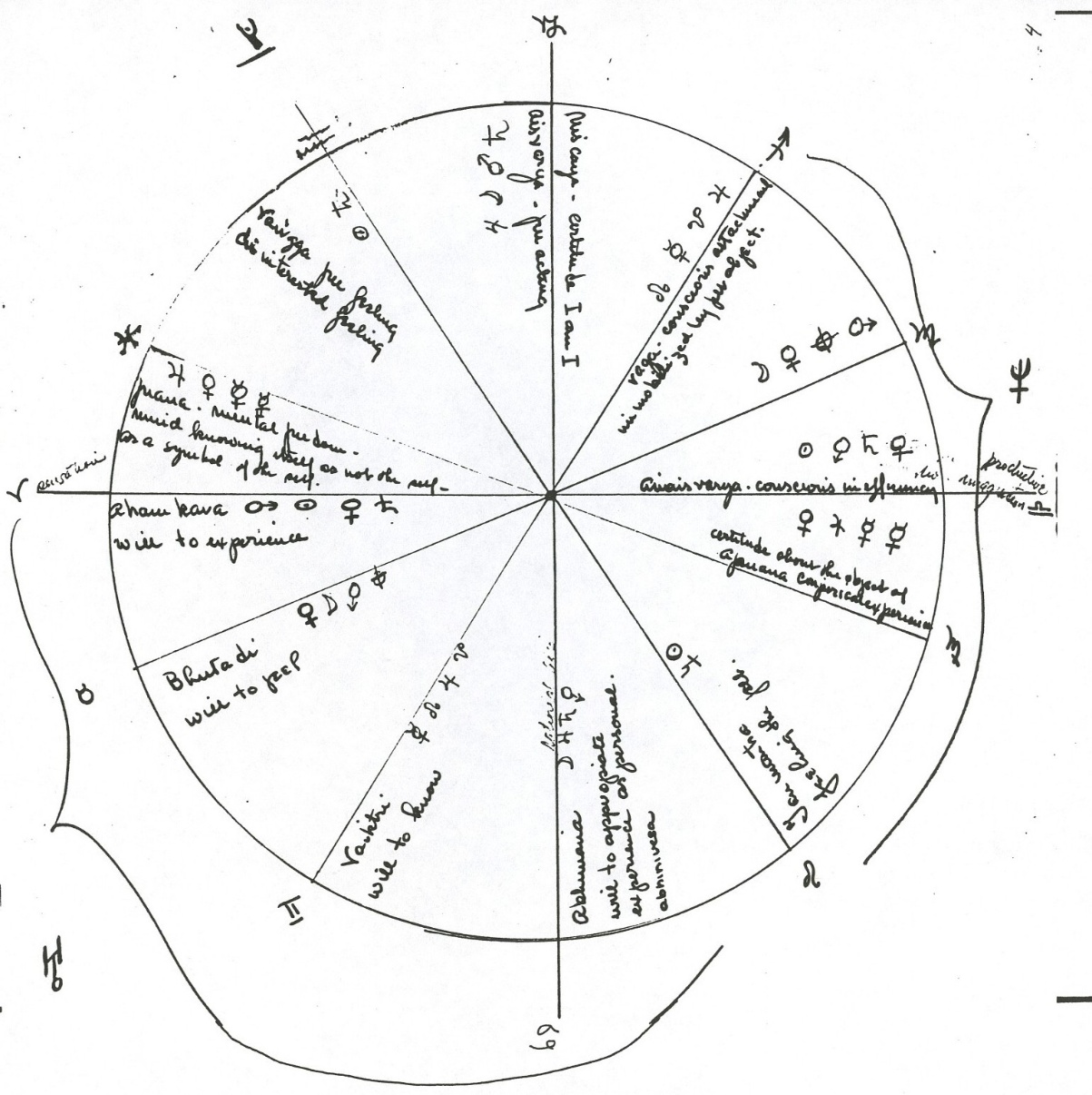
FIGURE AD_G_013. Four Psychological Functions, Samkhya Terms, and Uranus Neptune Pluto mapped onto Twelvefold Chart.
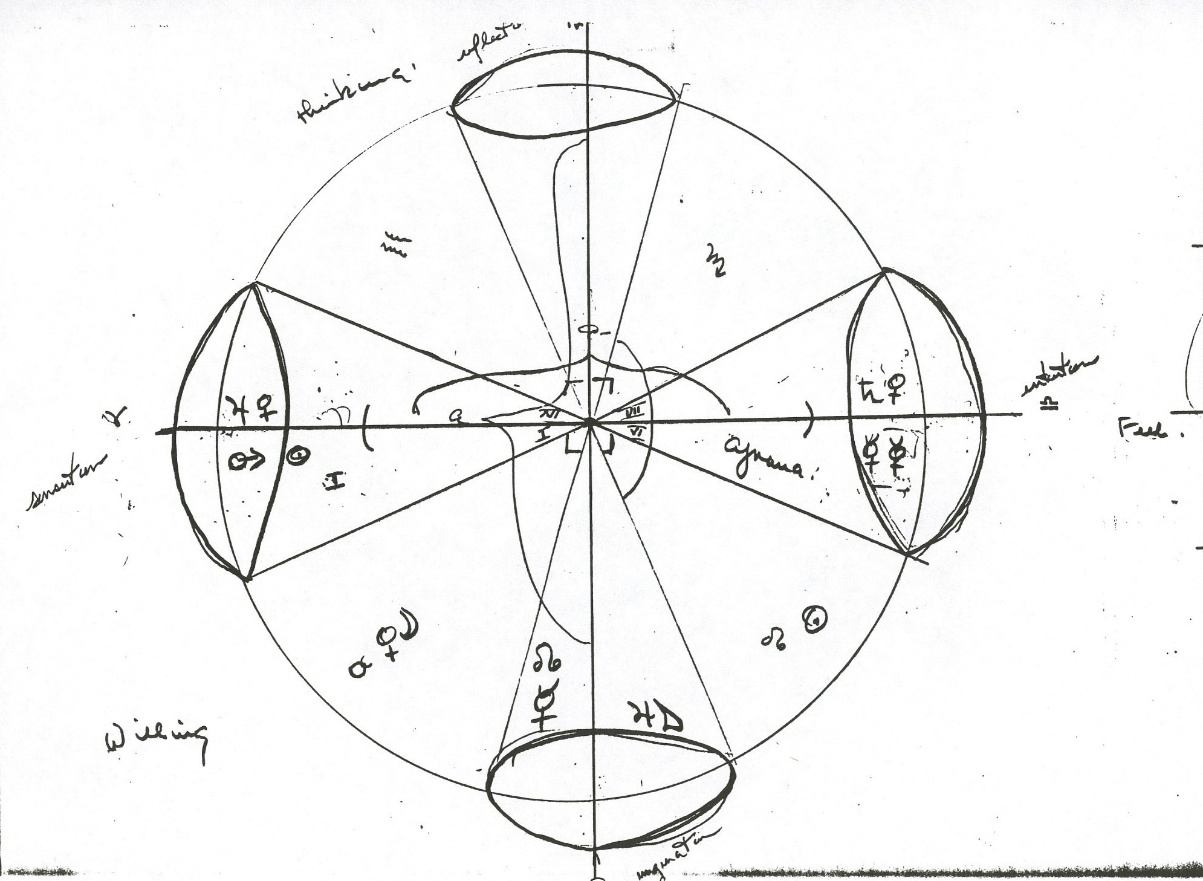
FIGURE AD_G_011. Four Psychological Functions and Thinking Feeling Willing mapped onto Twelvefold Chart; with rulerships and exaltations for houses 12-7.
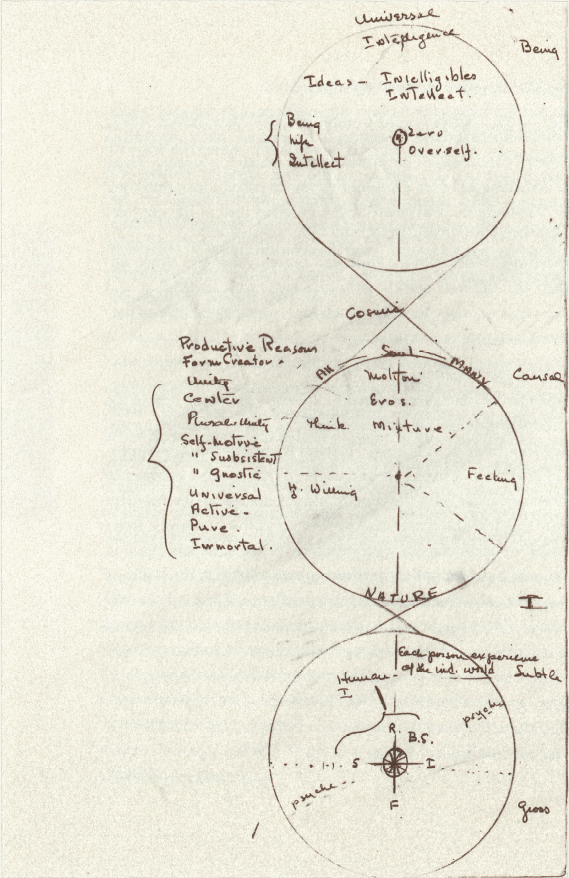
FIGURE AD_G_012. Three Circles Diagram: Divine Intellect, Soul, Psyche.
These diagrams are not from this class and are not exact but are close enough to help follow along. Other diagrams also referred to are not with this transcript version. [Transcriber note: [diagram] means the speaker is referencing a diagram as he or she is speaking. If someone is drawing or writing, with audible sounds of chalk on a blackboard, I indicate this by [drawing] or [writing].]
TRANSCRIBED Verbatim by IT 2023. In 2025, IT updates prefatory matter, changes two diagram names, shortens diagram notes within transcript, updates audio file markers to match new REP audio. Archival verbatim transcript – V12a.
AUDIO FILES: 1972 1208a, 1972 1208b, 1972 1208c, 1972 1208d. [Note: Audio File 1972 1208a originally contained the tail end of WG Class 1972 1201 at its beginning; REP Studio fixes in 2024.]
1972 12/08 at Wisdom's Goldenrod
Jung; Epistemology
[Audio File 1972 1208a Begins]
[few seconds of faint background student talking while AD draws]
AD (faint): And we did something like this I think. [student assents, very faint] [13 second pause while drawing] Let's see, we had the soul. [13¼ second pause while drawing] I don't know if you remember them. Maybe we'll get that thing xeroxed now, I think it's almost ready. [38¾ second pause while drawing] We put the-- I'm-- the-- the approach I'm going to use is-- I'm going to try to use the dialectic, you know, the way the Greeks used it. In that-- [14¼ second pause, flipping of pages] Would you-- you got the reading voice tonight? I'm going to put you through a little ordeal, the section on the Dialectic in Plotinus. Here, while I write this up.
LS: This is called-- this is I.3. It's Plotinus, it's called "On Dialectic (The Upward Way)".
S (faint): I.3?
LS: Can you hear me back there?
S (very faint): Yeah.
[AD drawing/writing]
[Transcriber note: I am using Plotinus: The Ethical Treatises, Volume 1, translated from the Greek by Stephen MacKenna, London and Boston, The Medici Society, Ltd., 1926.]
Plotinus, MacKenna [Plotinus: The Ethical Treatises, Volume 1, "On Dialectic (The Upward Way)," I.3, pp. 50-55, LS reading]: "1. What art is there, what method, what discipline to bring us there where we must go?
"The Term at which we must arrive we may take as agreed: we have established elsewhere, by many considerations, that our journey is to the Good, to the Primal-Principle; and, indeed, the very reasoning which discovered the Term was itself something like an initiation.
"But what order of beings will attain the Term?
"Surely, as we read, those that have already seen all or most things, those who at their first birth have entered into the life-germ from which is to spring a metaphysician, a musician or a born lover, the metaphysician taking to the path by instinct, the musician and the nature peculiarly susceptible to love needing outside guidance.
"But how lies the course? Is it alike for all, or is there a distinct method for each class of temperament?
"For all there are two stages of the path, as they are making upwards or have already gained the upper sphere.
"The first degree is the conversion from the lower life; the second--held by those that have already made their way to the sphere of the Intelligibles, have set as it were a footprint there but must still advance within the realm--lasts until they reach the extreme hold of the place, the Term attained when the topmost peak of the Intellectual realm is won.
"But this highest degree must bide its time: let us first try to speak of the initial process of conversion.
"We must begin by distinguishing the three types. Let us take the musician first and indicate his temperamental equipment for the task.
"The musician we may think of as being exceedingly quick to beauty, drawn in a very rapture to it: somewhat slow to stir of his own impulse, he answers at once to the outer stimulus: as the timid are sensitive to noise so he to tones and the beauty they convey; all that offends against unison or harmony in melodies and rhythms repels him; he longs for measure and shapely pattern.
"This natural tendency must be made the starting-point to such a man; he must be drawn by the tone, rhythm and design in things of sense: he must learn to distinguish the material forms from the Authentic-Existent which is the source of all these [LS reads: those] correspondences and of the entire reasoned scheme in the work of art: he must be led to the Beauty that manifests itself through these forms; he must be shown that what ravished him was no other than the Harmony of the Intellectual world and the Beauty in that sphere, not some one shape of beauty but the All-Beauty, the Absolute Beauty; and the truths of philosophy must be implanted in him to lead him to faith in that which, unknowing it, he possesses within himself. What these truths are we will show later.
"2. The born lover, to whose degree the musician also may attain--and then either come to a stand or pass beyond--has a certain memory of beauty but, severed from it now, he no longer comprehends it: spellbound by visible loveliness he clings amazed about that. His lesson must be to fall down no longer in bewilderment delight before some one embodied form; he must be led, under a system of mental discipline, to beauty everywhere and made to discern the One Principle underlying all, a Principle apart from the material forms, springing from another source, and elsewhere more truly present. The beauty, for example, in a noble course of life and in an admirably organised social system may be pointed out to him--a first training this in the loveliness of the immaterial--he must learn to recognize the beauty in the arts, sciences, virtues; then these severed and particular forms must be brought under the one principle by the explanation of their origin. From the virtues he is to be led to the Intellectual-Principle, to the Authentic-Existent; thence onward, he treads the upward way.
"3. The metaphysician, equipped by that very character, winged already and not like those others, in need of disengagement, stirring of himself towards the supernal but doubting of the way, needs only a guide. He must be shown, then, and instructed, a willing wayfarer by his very temperament, all but self-directed.
"Mathematics, which as a student by nature he will take very easily, will be prescribed to train him to abstract thought and to faith in the unembodied; a moral being by native disposition, he must be led to make his virtue perfect; after the Mathematics he must be put through a course in Dialectic and made an adept in the science.
"4. But this science, this Dialectic essential to all the three classes alike, what, in sum, is it?
"It is the Method, or Discipline, that brings with it the power of pronouncing with final truth upon the nature and relation of things--what each is, how it differs from others, what common quality all have, to what Kind each belongs and in what rank each stands in its Kind and whether its Being is Real-Being, and how many Beings there are, and how many non-Beings to be distinguished from Beings.
"Dialectic treats also of the Good and the not-Good, and of the particulars that fall under each, and [of] what is the Eternal and what the not-Eternal--and of these, it must be understood, not by seeming-knowledge ("sense-knowledge") but with authentic science.
"All this accomplished, it gives up its touring of the realm of sense and settles down in the Intellectual Kosmos and there plies its own peculiar Act: it has abandoned all the realm of deceit and falsity, and pastures the Soul in the"Meadows of Truth": it employs the Platonic division to the discernment of the Ideal-Forms, of the Authentic-Existence and of the First-Kinds (or Categories of Being): it establishes, in the light of Intellection, the unity there is in all that issues from these Firsts, until it has traversed the entire Intellectual Realm: then, resolving the unity into the particulars once more, it returns to the point from which it starts.
"Now it rests: instructed and satisfied as to the Being in that sphere, it is no longer busy about many things: it has arrived at Unity and it contemplates: it leaves to another science all that coil of premisses and conclusions called the art of reasoning, much as it leaves the art of writing: some of the matter of logic, no doubt, it considers necessary--to clear the ground--but it makes itself the judge, here as in everything else; where it sees use, it uses; anything it finds superfluous, it leaves to whatever department of learning or practice may turn that matter to account.
"5. But whence does this science derive its own initial laws?
"The Intellectual-Principle furnishes standards, the most certain for any soul that is able to apply them. What else is necessary, Dialectic puts together for itself, combining and dividing, until it has reached perfect Intellection."For," we read, "it is the purest (perfection) of Intellection and Contemplative-Wisdom." And, being the noblest method and science that exists it must needs deal with Authentic-Existents, The Highest there is: as Contemplative-Wisdom (or true-knowing) it deals with Being, as Intellection with what transcends Being.
"What, then, is Philosophy?
"Philosophy is the supremely precious.
"Is Dialectic, then, the same as Philosophy?
"It is the precious part of Philosophy. We must not think of it as the mere tool of the metaphysician: Dialectic does not consist of bare theories and rules: it deals with verities; Existences are, as it were, Matter to it, or at least it proceeds methodically towards Existences, and possesses itself, at the one step, of the notions and of the realities.
"Untruth and sophism it knows, not directly, not of its own nature, but merely as something produced outside itself, something which it recognizes to be foreign to the verities laid up in itself; in the falsity presented to it, it perceives a clash with its own canon of truth. Dialectic, that is to say, has no knowledge of propositions--collections of words--but it knows the truth and, in that knowledge, knows what the schools call their propositions: it knows above all, the operation of the soul, and, by virtue of this knowing, it knows, too, what is affirmed and what is denied, whether the denial is of what was asserted or of something else, and whether propositions agree or differ; all that is submitted to it, it attacks with the directness of sense-perception and it leaves petty precisions of process to what other science may care for such exercises.
"6. Philosophy has other provinces, but Dialectic is its precious part: in its study of the laws of the universe, Philosophy draws on Dialectic much as other studies and crafts use Arithmetic, though, of course, the alliance between Philosophy and Dialectic is closer.
"And in morals, too, Philosophy uses Dialectic: by Dialectic it comes to contemplation, though it originates of itself the moral state or rather the discipline from which the moral state develops.
"Our reasoning faculties employ the data of Dialectic almost as their proper possession for they are mainly concerned about Matter (whose place and worth Dialectic establishes).
"And while the other virtues bring the reason to bear upon particular experiences and acts, the virtue of Wisdom (i.e., the virtue peculiarly induced by Dialectic) is a certain super-reasoning much closer to the Universal; for it deals with (such abstract ideas as) correspondence and sequence, the choice of time for action and inaction, the adoption of this course, the rejection of that other: Wisdom and Dialectic have the task of presenting all things as Universals and stripped of matter for treatment by the Understanding.
"But can these inferior kinds of virtue exist without Dialectic and philosophy?
"Yes--but imperfectly, inadequately.
"And is it possible to be a Proficient [LS reads: Sage], a Master in Dialectic, without these lower virtues?
"It would not happen: the lower will spring either before or together with the higher. And it is likely that everyone normally possesses the natural virtues from which, when Wisdom steps in, the perfected virtue develops. After the natural virtues, then, Wisdom and, so the perfecting of the moral nature. Once the natural virtues exist, both orders, the natural and the higher, ripen side by side to their final excellence: or as the one advances it carries forward the other towards perfection.
"But, ever, the natural virtue is imperfect in vision and in strength--and to both orders of virtue the essential matter is from what principles we derive them."
[10½ second pause]
AD: I-- I had-- I had that read in full because Richard's a ha-- Richard has a habit of saying well Dialectic will abolish it all and then he went on to something else. And so now we gotta explain what Richard said last week, alright? I'm going to try something and it quite a-- made a comparison here. Now first I want you to notice that in that-- in that section of Plotinus, Plotinus made it very clear that Dialectic deals with verities of existences, (it/he) does not deal with a collection of words or an imaginary phrase in the imagination. I hope you got that. That was extremely important. What this man is saying is we're not going to talk about something which is represented in our imagination, we know these real Beings. Did he say something like that? You read it. Did you-- did you grasp that? They're Real Beings. [student assents, faint] Alright. Well, to try to get to the point tonight as quickly as we can, on one side we got the Platonic conception, and over here we have the Jungian conception [diagram]. The Jungian conception of the four functions, and the Platonic conception or the Neo-Platonic conception which is four, five, three, you know, it's varied indifferently. But-- [short pause] First of all, he's-- well let-- let me read a very brief quote so that you'll see I'm not making this up. He says--
C.G. Jung [CW 8, The Structure and Dynamics of the Psyche, "Psychological Factors in Human Behaviour," p. 123, paragraph 256, AD reading]: "It is well known that [very] many faculties in man can become differentiated. I do not wish to lose myself in the details of [AD adds: the] case…"
AD: But since I'm not a dialectician I'll have to get into details.
C.G. Jung [CW 8, The Structure and Dynamics of the Psyche, "Psychological Factors in Human Behaviour," p. 123, paragraph 256, AD reading]: "…and [AD reads: I] must limit myself to the normal faculties that are always present in consciousness."
AD: This is from these-- Structure and Dynamics. It is--
C.G. Jung [CW 8, The Structure and Dynamics of the Psyche, "Psychological Factors in Human Behaviour," p. 123, paragraph 256, AD reading]: "Consciousness is primarily an organ of orientation in a world of outer and inner facts [AD reads: events]."
AD: Alright, so consciousness, so to speak, is in between these two worlds, the world outside, the objective, and the world inside.
C.G. Jung [CW 8, The Structure and Dynamics of the Psyche, "Psychological Factors in Human Behaviour," p. 123, paragraph 256, AD reading]: "First and foremost, it establishes the fact that something is there. I call this faculty sensation. [drawing] By this I do not mean the specific activity of any one of the senses, but perception in general."
AD: And that begs the whole question.
C.G. Jung [CW 8, The Structure and Dynamics of the Psyche, "Psychological Factors in Human Behaviour," p. 123, paragraph 256, AD reading]: "Another faculty interprets what is perceived; this I call thinking."
AD: And when you-- we'll put it up here [diagram]. [Note: See FIGURES AD_G_013, AD_G_011, midheaven.]
S: Go ahead.
C.G. Jung [CW 8, The Structure and Dynamics of the Psyche, "Psychological Factors in Human Behaviour," p. 123, paragraph 256, AD reading]: "By means of this function, the object perceived is assimilated and its transformation into a psychic content proceeds much further than in mere sensation. A third faculty establishes the value of the object. This function of evaluation I call feeling. The pain-pleasure reaction of feeling marks the highest degree of subjectivation of the object."
AD: That is, bringing the object into oneself.
C.G. Jung [CW 8, The Structure and Dynamics of the Psyche, "Psychological Factors in Human Behaviour," p. 123, paragraph 256, AD reading]: "Feeling brings subject and object into such a close relationship that the subject must choose between acceptance and rejection."
AD: Ok and we put it down here [diagram]. [Note: See FIGURES AD_G_013, AD_G_011, nadir.]
C.G. Jung [CW 8, The Structure and Dynamics of the Psyche, "Psychological Factors in Human Behaviour," p. 123, paragraph 257, AD reading]: "These three functions would be quite sufficient for orientation if the object in question were isolated in space and time. But, in space, every object is in endless connection with a multiplicity of other objects; and, in time, the object represents merely a transition from a former state to a succeeding one. Most of the spatial relationships and temporal changes are unavoidably unconscious at the moment of orientation, and yet, in order to determine the meaning of an object, space-time relationships are necessary. It is the fourth faculty of consciousness, intuition, which makes possible, at least approximately, the determination of space-time relationships. This is a function of perception which includes subliminal factors, that is, the possible relationship [AD reads: relationships] to objects not appearing in the field of vision, and the possible changes, past and future, about which the object gives no clue. [AD adds: Therefore] Intuition is an immediate awareness of relationships that could not be established by the other three functions at the moment of orientation."
AD: This is a brief summary. Alright. One thing that he left out which I think is something you have to try to keep in mind from now on because I don't want-- I think you should really reflect on this, that sensation is never separated from a subject under any conditions, there's no possibility of (talking) sensation, ok?
VM: But Tony you can't say that, you can say the same about all the other functions too, couldn't you? There's no thought without a thinker and so on, so forth?
[short pause]
AD: You can. You can say that. What-- in a very peculiar way, if you wait a while I'll try to show you a difference.
VM (faint): Ok.
AD: So that sensation is established in the sense the way PB says, sensation arises from within the person. [Note: See Paul Brunton, The Hidden Teaching Beyond Yoga.] Remember? Ok? So that is in a certain sense inseparable from the subject. [10½ second pause] Let's see, we wanted to do something. [26 second pause] Suppose-- suppose we speak about this for a moment just quickly to review, I-- most of you have gone through this. Over here again the Greeks, with the Greeks, you have the sense object. You have the sense object over here [diagram]. Now if you have, so to speak, fantasies about the sense object, or let's say if the understanding pulls you down towards fantasies about it, alright, then you'll end up with fantasies, imaginations about the object. To what-- And on the other hand, if you go up towards it, then, by abstracting from the particular-- from the particular object certain things in common you come up with some reason [writing] about the object, you begin to learn something about the laws about it. So that you're dealing with scientific ideas. And then of course you can go up another step where you deal with more universal ideas.
Now, the point I'm trying to get here is that for the Greeks, these-- these levels here are knowledge about objects that exists independently of our sensation about them, so to speak, alright. That, in other words, there are entities, ideas, alright, and reason-principles, productive principles, spermatic reasons, which operate independently of any subject that perceives them. So in other words, up here [diagram] you're dealing with real entities, authentic existences, alright, and over here [diagram], so to speak, when you think about them, they would be clothed in our imagination. Ok? Now, these entities do not depend on our imagination for their existence. Whereas anything, any fantasy that we may have about an object would depend upon our imagination about it. Now this is a-- this is going to be a little tricky and I got someone to-- I got some quotations from Mead's book. [10½ second pause]
As you know, in a great deal of Neo-Platonic philosophy and also of course it's getting popular today, a lot of literature, they speak about different bodies that the soul works through. And you heard the so-called name of like astral body. Astral vehicle, which is supposed to be the lower-- the lower form, and a higher body which the Neo-Platonists refer to as the Augoeides or the star body. At any rate, we're going to make a distinction here between the soul body when it's pure and light and which, so to speak, di-- divested of all matter goes upward or tends to go upward, and the same soul, so to speak, when it's encumbered by activity, desires, and sinks into matter. Now--
[Audio File 1972 1208a Ends]
[Audio File 1972 1208b Begins]
AD: Ok, let's use that word so that we don't confuse it with (form/four). Now-- [short pause] As we said, the soul by itself is utterly incorporeal. So, we have this kind of classification if you remember, we had, in terms of the soul, [writing] a man has this--the vegetative soul, then he had the irrational soul, and the rational soul. Now, man has all three of them of course but, in the plants for instance there's a vegetative soul, in the-- in the animals there's the vegetative soul and the irrational soul, and in the-- that strange creature man, there's the vegetative, the irrational, and the rational soul. So he goes on to say here--
[Transcriber note: I am using The Doctrine of the Subtle Body in the Western Tradition by G.R.S. Mead, London: J.M. Watkins, 1919.]
G.R.S. Mead [The Doctrine of the Subtle Body in the Western Tradition, p. 50, AD reading]: "Man has thus, when incarnate, not three souls, but three grades of soul or life--namely, vegetative, irrational and rational."
AD: And according to these people here--
G.R.S. Mead [The Doctrine of the Subtle Body in the Western Tradition, p. 51, AD reading]: "…we learn that [AD adds: the] spirit [is], as it were…"
AD: Now spirit in the sense that we're speaking of over here [diagram], not spiritual like Saint Paul speaks of.
G.R.S. Mead [The Doctrine of the Subtle Body in the Western Tradition, p. 51, AD reading]: "…we learn that spirit [is], as it were, of the nature of a quintessence or unitary element over against the gross elements of the physical body.
"The"mixture" of the dense body "is a union and a blend of the four elements; [AD: Fire, earth, air, and water.] and from this blend and union…""
AD: Alright. That is, the union of the soul with this body which is made of these four elements.
G.R.S. Mead [The Doctrine of the Subtle Body in the Western Tradition, pp. 51-52, AD reading]: ""…a certain 'vapour' rises which is enveloped by the soul, but circulates within the body."
"It is the medium between the soul and the gross body…"
AD: You may think this has nothing to do with Jung but you'll see that every-- it has everything to do with Jung. Let me repeat this now. They claim that we have a body made of the four elements, fire, earth, air, and water. And that, the mixture of these four elements, a vaporous body arises which they call a subtle body. And the soul gets into contact with that body, that subtle body. Ok? That's its contact, so to speak. This is of course--
G.R.S. Mead [The Doctrine of the Subtle Body in the Western Tradition, p. 52, AD reading]: "…the medium between the soul and the gross body, and so is [AD reads: is so] said to partake of the nature of both."
AD: So this essence or this vapour that arises out of the mixture of these four elements, this body that results from them, is through which the soul comes into contact with the physical body.
G.R.S. Mead [The Doctrine of the Subtle Body in the Western Tradition, p. 52, AD reading]: "Both the spirit and the body, it is to be noted, are in the soul…"
AD: I don't ha-- this of course is obvious, alright? The soul isn't in them. They are in the soul. This even PB tells you. The body's in the mind, not the mind in the body. Ok. Now they go on, and this is from the Hermes Trismegistis literature and the Platonists. Now all things--
G.R.S. Mead [The Doctrine of the Subtle Body in the Western Tradition, p. 53, AD reading]: "…all things in the cosmos are"made quick" by spirit…"
AD: And that's the spirit we're talking about here, that vapour that arises from the four elements.
G.R.S. Mead [The Doctrine of the Subtle Body in the Western Tradition, p. 53, AD reading]: "…and that this unitary spirit, quintessence or 'one thing'…"
AD: And that's going to come up again and again in alchemy.
G.R.S. Mead [The Doctrine of the Subtle Body in the Western Tradition, p. 53, AD reading]: "…is as it were an 'engine'…an organon, [AD reads: organ] subject to the will of God--and therefore in man, to man's will [AD reads: in man it is subject to man]."
AD: Now this very same spirit that we just spoke about, you know, the combination of the four elements and the vapour that arises, the ancients used to refer to this as the common sensorium. This is what Aristotle was talking about.
G.R.S. Mead [The Doctrine of the Subtle Body in the Western Tradition, p. 53, AD reading]: ""The sensible--the spirit--is that which doth discern appearances. It is distributed into the various sense-organs." A portion of it becomes "spirituous sight," or "spirit by means of which we see," and so for the rest of [AD reads: and so the rest for] the senses."
AD: So you see, they're establishing here, these people are establishing here, the notion of this vaporous body which you operate with and which is the common ground for all knowledge in terms of a sense object, also it'll probably be common ground for telepathy, you know, teleportation, telekinesis and all that.
G.R.S. Mead [The Doctrine of the Subtle Body in the Western Tradition, p. 54, AD reading]: "If this spirit, [in the case of man],"is led upwards by the understanding"…"
AD: If this spirit is led upwards by the understanding, then it leads you to discern, so to speak, sense objects. [AD hits board] If it is led downward, it leads you into the fantasies. Ok? Imagination, fantasies. [short pause] Now, this lower spirit or let's say this aspect of the soul, the lower aspect of the soul, and as you can see this would tie in with astrology right away, the soul is attached to this image, let's call it an image. And of course when a person dies this is-- well, you remember from your Greek reading that the person went to Hades? Alright? That's-- that's what happens, the soul was attached to this image and then when the physical body decomposed it was still attached to this image and, so to speak, was in the realm of the invisible. I think the Theosophists refer to that too. Have you-- do you remember coming across that in the Theosophical literature? Huh?
S (very faint): You mean kama loka?
AD: Yeah. Yeah, in other words, the soul, because of its attachment to this image which is inferior to the actual physical body, persists in the (reign), so to speak, of the kama loka where until that image disintegrates, it'll be tied to it. And this is also what most of the Traditionalists refer to as the realm of the psychic inferiors, you know, psychic inferiorisms.
G.R.S. Mead [The Doctrine of the Subtle Body in the Western Tradition, pp. 59-60, AD reading]: "The [AD reads: Now this] image, [or eidolon], is intimately connected with the irrational soul, which is [poetically] said to be the shadow cast by the shining of the rational soul on the body [(i.1.2)]. The irrational soul is also said to be the image of the rational plunged into the obscurity of sensible life [(iv.3.27)]."
S (faint): What's that gotta do (with it)?
S: Do the other one.
S (faint): Uh-hm, yeah.
G.R.S. Mead [The Doctrine of the Subtle Body in the Western Tradition, pp. 59-60, AD reading]: "The [AD reads: This] image, [or eidolon], is intimately connected with the irrational soul…"
AD: And you can see that. Just look at the image you have of yourself and you can see how irrational it is. (laughter)
G.R.S. Mead [The Doctrine of the Subtle Body in the Western Tradition, p. 60, AD reading]: "…which is poetically said to be the shadow cast by the shining of the rational soul on the body [(i.1.2)]."
AD: All you have to do is look at that image through your reasoning faculties and right away you see how absurd it is. Alright? It casts a shadow.
S: Yes it did.
S (very faint): Yes it did.
G.R.S. Mead [The Doctrine of the Subtle Body in the Western Tradition, p. 60, AD reading]: "The irrational soul is also said to be the image of the rational plunged into the obscurity of [AD adds: the] sensible life [(iv.3.27)]."
AD: So naturally the rational faculties when they enter into the physical body or let's say they operate through the physical body, the sure shining pure bright reasoning functioning of the soul thrown into the body, it has to cast a shadow. Where do you think Jung got his notion of the shadow?
S (faint): I don't know.
AD: Huh? You think he invented it?
S (very faint): Well of course he didn't invent it.
AD: Ok, so, we go on.
G.R.S. Mead [The Doctrine of the Subtle Body in the Western Tradition, pp. 61-62, AD reading]: "It is owing to the propensity of the 'partial reason' of the soul towards such and such a body, owing to its habit, or its habitual relationship to a certain body on earth, that a certain form or type of phantasy or imaging [AD reads: imagining] is impressed upon the spirit…"
[short pause]
AD: Did you see Jung's psychology there?
S (faint): No.
AD: No?
S (faint): Want to read it again?
AD: Yeah.
G.R.S. Mead [The Doctrine of the Subtle Body in the Western Tradition, pp. 61-62, AD reading]: "It is owing to the propensity of the 'partial reason'…"
AD: Ok? You remember the definitions here [FIGURE AD_G_012, middle circle]? We had for the definitions and characteristics of the soul, [student assents, very faint] remember?
S (very faint): Yeah.
AD: No, I didn't-- Huh?
S (very faint): [one/two words inaudible]
AD: It's a form creator, reasoning principles. Do you remember? Hm? If you don't remember it then of course it won't make sense to you. But the soul has these characteristics, so to speak, it's eternal, pure, it creates forms, alright, it's the principle, so to speak, that's going to be embodied, it's always active. All these things we said about the soul. Now the soul (if/it) attaches itself to so-called the plunge into the body and attaches itself to the irrational and the image that man creates of himself there, you could see, so to speak, a certain obscurity is going to overcome the functioning of the soul in its purity. So they go on and they say this here.
G.R.S. Mead [The Doctrine of the Subtle Body in the Western Tradition, pp. 61-62, AD reading]: "It is owing to the propensity of the 'partial reason' [AD adds: propensity] of the soul towards such and such a body, owing to its habit, or its habitual relationship to a certain body on earth, that a certain form or type of phantasy or imaging [AD reads: imagining] is impressed upon the spirit [AD reads: that sensory body, that spirit]…"
AD: Now you can see this is what Jung is talking about all the time. The notion of the Mother, for instance. Because of your relationship with the mother so many times, so many lives, there's impressed upon the sensorium, alright, this imagery of the mother. And with it all the habits and attitudes and ideas that go with it. This is bound to be, so to speak, structuralizing the imagination, which will arise given a condition to arise. Do we have the air conditioner on?
S (very faint): I think so.
S: Yeah.
AD: Alright, let me repeat this, and I-- as we go along you'll see it getting clarified because, you know, Jung was a great student of Gnosticism and alchemy so, this is very common knowledge.
G.R.S. Mead [The Doctrine of the Subtle Body in the Western Tradition, pp. 61-62, AD reading]: "[It is] owing to the propensity of the 'partial reason' [AD reads: of the reason] of the soul towards such and such a body, owing to its habit, or its habitual relationship to a certain body on earth, [that] a certain form or type of phantasy or imaging [AD reads: imagining] is impressed upon the [AD reads: that] spirit after death, the spirit itself having no special form [AD reads: the spirit itself of course has no form]."
AD: But, so to speak, these vasanas or these samskaras or these tendencies are inherent in that particular imagery with which this entity operates with. [9½ second pause] Ok so, something like this in terms of a brief summary.
G.R.S. Mead [The Doctrine of the Subtle Body in the Western Tradition, p. 70, AD reading]: "…the spirit-body that is the unitary or common sense-organ [(433, 34)]."
AD: Alright, so the spirit body, so to speak, underlies the functioning of the five senses. And of course the vegetative and irrational soul.
G.R.S. Mead [The Doctrine of the Subtle Body in the Western Tradition, pp. 70-71, AD reading]: ""The first sensory, in which is the sensing power, is the spirit, the substrate [AD reads: substrata] of the irrational soul; for in this the sense has first of all its being.
""Eyes, ears [and] nostrils are sense-organs only, they do not come first, for the feeling soul is not in them. They are the means whereby sensible experience is referred to the spirit."
"And again [(239, 3)], according to Aristotle [AD reads: Again accordingly]:
""The powers of sensation are established in the spirit, for the whole, through the whole of it, both sees and hears and is active in the rest of the senses. And thus all the senses are in it, just as in plants are the vegetative powers. . . . The spirit itself is not organised.""
AD: And this is very obvious from Plotinus, bodily right out of Plotinus. Now the Platonists also go on and say--
G.R.S. Mead [The Doctrine of the Subtle Body in the Western Tradition, p. 71, AD reading, brackets Mead's]: "…that"the apprehension of sensibles does not at all take place through the [physical organs], inasmuch as both in us…the common sense, residing in a single spirit, perceives the objects [AD reads: object] of the five senses, and the irrational soul [in the case of animals] by means of a single spirit apprehends [AD reads: apprehending] all sensibles.""
AD: And I don't think you're going to find any disagreement with what even PB said, alright, because they're basically in alignment.
G.R.S. Mead [The Doctrine of the Subtle Body in the Western Tradition, p. 71, AD reading, quoting Philoponus]: ""The common sense…""
AD: Again, the sensorium, and even the Buddhists refer to it as a sensorium.
G.R.S. Mead [The Doctrine of the Subtle Body in the Western Tradition, p. 71, AD reading, quoting Philoponus]: ""…which in itself is incorporeal, functions in the body which is its ground. This ground is the spirituous body.""
AD: Or what we just calling now the astral body to make it clear.
G.R.S. Mead [The Doctrine of the Subtle Body in the Western Tradition, pp. 71-72, AD reading, brackets Mead's]: ""Thus the various orders of sensible phenomena, though different from one another, occur in the [AD reads: this] spirituous body, now in one portion [AD adds: of it], now in another [of it]. Subsequently the power itself [i.e. the common sense] discriminates the sensible experiences in the spirit [AD reads: astral body, alright]. And so we keep the reason free [from sense], and do not say that different forms occur in that which has no parts [sc. (AD adds: in) the rational soul]…"
"The spirit-body [AD reads: Thus this spirituous body or this astral body] being thus regarded as the true sensory, it was also thought to be the medium for what are [AD reads: is] now called [AD adds: of course] thought-transference…"
AD: And all these so-called occult phenomena. In case those-- some of you are interested in magic they add something like this.
G.R.S. Mead [The Doctrine of the Subtle Body in the Western Tradition, pp. 72-73, AD reading]: "…'inner voices' also [AD adds: are heard there], [both] bad and good [AD reads: good or bad]. …here meaning non-human as well as human discarnate entities…suggesting that the way the lower orders of these invisibles insinuate their [AD reads: insinuate themselves into] temptations into men's souls [AD reads: soul]…
""When a man addresses another from a distance he has to speak more loudly, but if he be close, he can whisper into his ear.
""If, moreover, it were possible for him to come into close contact with the spirit of his soul, [AD: That's the astral body of his soul.] he would need no uttered speech, but all he wanted to say would reach the hearer by a soundless way.""
AD: Alright? Alright, we'll stop with this now so you--
LS: Yeah.
S: Ok.
AD: See what's going on?
S (very faint): Yeah I think so.
AD: No?
VM: I'm confused Tony, it seems like there's two levels of spirit, there's the spirit and then the spirituous body?
AD: Yeah. In other words, let's divide this soul, alright. On the one hand the soul has a luciform light-body. This is the body, so to speak, of light, the robe of glory. That is divested of all matters, left all matter behind, all desire, (or/all) life.
S (simultaneously, faint): That's what we call freedom.
AD: Yeah. No.
S (faint): Oh no.
S (simultaneously, very faint): Then all of a sudden [AD simultaneously: No.] (the system) [one/two words inaudible]
AD: We-- we didn't speak about that body. All we spoke about is the tendency of the soul to go into matter in terms of the physical body. Now, the contact at the low-- that the soul makes when it goes into matter is in terms of this-- let's call it astral body, even if I don't like the word, ok. And this astral body is the result of the blending of the four elements. The blending of the four elements produces this ethereal aerial sort of body, ok, which they refer to as the spirituous body, [VM: It's the shadow.] as the common sensorium. In other words, it's-- it's the substrata through which the soul is going to operate and make contact with the body. Ok? Now this sensorium, so to speak, or this common ground through which the soul is operating, alright, [chalk on board sounds] everyone has that, ok? So, basically you always operate through that astral body or that sensorium. Alright here? I want you to ask questions 'cause this-- this is where Jung-- Jung bases his case for alchemy in, you know, the Mysterium Conjunction and all that, although he doesn't tell it to you. [Note: C.G. Jung, CW 14, Mysterium Coniunctionis.] You got so far that (thing)? Well, if you don't ask questions I can't help. Yeah.
S (faint): It's probably these occultist terms I think, but not in terms that we have been using [few words inaudible] correspond.
AD: Well he just told you, yeah.
S (faint): They're up here [diagram] [one word inaudible]
S (faint): Yeah.
RP (faint): You realize that the word they translate as spirit is pneuma, p-n-e-u-m-a.
AD: Yeah, spell that, p-h--
RP (faint): P-n--
S (faint): No.
RP (faint): P-n--
S (faint): P-n-e-u--
AD: P-n--
RP (faint): Breath.
AD: --e-u-m-a. Yeah.
RP (simultaneously, faint): This is the way [couple words inaudible] part of man.
AD: Yeah.
S (faint): Ok.
AD (very faint): Uh-hm.
RP (faint): [couple words inaudible]
S (very faint): (Anthony, before) [few words inaudible]
S (faint): Didn't we?
AS (faint): PB-- PB like speaks about that, like you have this aura like when you get close to somebody.
AD: You remember he speaks about the body being surrounded or enveloped by an egg which he says is a-- varies according to various people?
AS (simultaneously, faint): Or maybe you see your own or something like that.
AD: You got to remember, PB leaves out details. He's not interested in giving you these details, you work them out, you'll find them out. [student assents, faint] But basically, he does hint at it. So far? Yeah Randy.
RC (very faint): More-- more on this 'cause I just-- this entering into the spirit body (when/like) that occurs, (isn't) it done by a physical proximity or just [few words inaudible]
AD: I'm sorry Randy, I don't follow your question.
RC (very faint): You know where they talk about within a certain physical proximity the auras interpenetrate each other [one word inaudible]
AD: Yeah I think that that's what you're aware of, someone who's very close to you sometimes feel them before you see them or hear them or anything. Probably some kind of unconscious osmosis takes place when, you know, you're with someone for a long time. You stay in their presence like for instance, you know, you probably become aware of that. It's unspoken, unheard of, unseen, but it's there.
RC (very faint): Can I just-- what he's talking about, the-- the voice of the person being picked up not by [one word inaudible] transmission (it's/is) done. There's stuff like in the (quote) that intuition that appears as your own [one word inaudible]
AD (simultaneously): No, it's not an intuition at all, [few inaudible RC words simultaneous with AD] it's not an intuition. This is-- this is plain ordinary low-graded psychic phenomena. (some laughter) And every time you people talk to me about what you see I feel like kicking you in the teeth. Because if there's any point that Plotinus makes is he says exclude all visions. And you can see by definition this must be. It's got to be, anything you see no matter how sublime, exalted, the Virgin Mary herself is besides the point. Because it's an image.
RC (very faint): But like when you're about to say something and somebody anticipates what you're (saying/seeing) [couple words inaudible]
AD: That's where you're working from in almost any-- any-- Again, there's some yogis who think that it's a great power because they could read someone else's thought. We consider it actually going down a step. Because any animal senses that. Alright?
RC (very faint): Well there's a difference between like an articulated thought when you try and sort of pick it up (by/on) myself.
AD: No, no, there-- Randy, let's stick to this here, let's not get off because this is very tricky.
RC (very faint): Well, that's (where/why) I'm confused [couple words inaudible]
AD: Yeah, this is-- this is almost like-- this is almost like a pure jungle. Anybody who ever enters in there will be so frightened because of the forms that appear, depending upon the kind of samskaras he's operating with. If you want to read more about that read the-- no which-- what chapter? This is something quite different. Anyone who goes into this realm and is not prepared could get a fright that's really something. Because any kind of form could appear to you. If you want to read further on it, The Tibetan Book of the Dead. Ok? The commentary. [Note: See C.G. Jung, CW 11, Psychology and Religion, "Psychological Commentary on The Tibetan Book of the Dead".] What we-- what we want to do is stick to a very very important point here so that we can try to clarify Jung's position where he's talking from and where the metaphysicians are talking from. In order to do this we have to understand basically, number one, what he calls knowing, number two, what these people call knowing. Alright? Now for Jung you can see that the man is locked up in his objectivity, I mean in his subjectivity, alright? There's this nice little ego-complex. [drawing] And he cannot conceive, Jung says, consciousness without the ego or ego without a consciousness. Remember that? [Note: See C.G. Jung, CW 8, The Structure and Dynamics of the Psyche, "Spirit and Life," p. 323, paragraph 611.] He cannot conceive it, the condition for consciousness functioning would be an ego and vice versa. [hit board with chalk] Now, if that is so, and this is the-- if you remember, he called this here the ins-- instinctual image of an archetype. You remember? We can see something peculiar here. That what the person experiences as sensation, alright, and the resulting appearance of that sensation and some call it the intu-- intuited world, would be operated under an archetype. Remember coming across any quotation that might help us substantiate that?
[short pause, flipping of pages]
S (very faint): I've seen it.
[short pause]
AD: I think I came across one, if you have a moment's patience. [12¾ second pause while looking for quote] Yeah, here on "Instinct and the Unconscious" in paragraph 270 he says--
C.G. Jung [CW 8, The Structure and Dynamics of the Psyche, "Instinct and the Unconscious," p. 133, paragraph 270, AD reading]: "In this"deeper" stratum we also find the a priori, inborn forms of "intuition," namely the archetypes of perception and apprehension…"
AD: You remember reading that?
S (very faint): Uh-hm.
C.G. Jung [CW 8, The Structure and Dynamics of the Psyche, "Instinct and the Unconscious," p. 133, paragraph 270, AD reading]: "In this"deeper" stratum…"
AD: I'll read the whole-- no, I only read part of--
C.G. Jung [CW 8, The Structure and Dynamics of the Psyche, "Instinct and the Unconscious," p. 133, paragraph 270, AD reading]: "I call the sum of all these contents the"personal unconscious." But, over and above that, we also find in the unconscious qualities that are not individually acquired but are inherited, e.g., instincts as impulses to carry out actions from necessity, without conscious motivation."
AD: And you can see this would apply certainly to sensation.
C.G. Jung [CW 8, The Structure and Dynamics of the Psyche, "Instinct and the Unconscious," pp. 133-134, paragraph 270, AD reading]: "In this"deeper" stratum we also find the a priori, inborn forms of "intuition," namely the archetypes of perception and apprehension, which are the necessary a priori determinants of all psychic processes. Just as his instincts compel man to a specifically human mode of existence, so the archetypes force his ways of perception and apprehension into specifically human patterns. The instincts and the archetypes together form the "collective unconscious.""
AD: You follow what he's saying there? Richard you follow what he's saying there? Hm?
S (faint): Uh-hm.
AD: In other words, the way we sense the world, the way we perceive the world, and the way-- the word he uses here is apprehension. Now apprehension is to regrasp a perception, ok. You follow? Don't be so quiet. No-- no air conditioning?
S (very faint): No.
S (very faint): Every night.
VM/S(?) (faint): [couple words inaudible] that I get.
AD: Hm? No? Oh it's not on? Alright.
S (very faint): (What'd he say?)
LS: Why don't you open the door.
S: Oh, God.
[AD drawing]
S: Hm. [one word inaudible]
LS: Yeah, it'd be good, it'll make it tough.
AD (simultaneously): Well, let me pick on you, Vic, ok? Do you follow this here where he says that--
C.G. Jung [CW 8, The Structure and Dynamics of the Psyche, "Instinct and the Unconscious," p. 133, paragraph 270, AD reading]: "…the [AD reads: these] archetypes of perception and apprehension, which are the necessary a priori determinants of all psychic processes."
AD: Now we do this in astrology, don't we? You have a certain degree on that ascendant. And the way you're going to perceive the external world is already determined from within. And then the way you're going to regrasp that perception, in other words, the way you're going to apprehend it again, is also another archetype. So under these two, so to speak, under this here I label this here an archetype [diagram]. And we also call this the irrational axis, the givenness of the world. [Note: See FIGURES AD_G_013, AD_G_011, ascendant-descendant axis.] So there you have an archetype operating. In other words, your experience of the world is already through certain a priori determinants, alright, made available for you and certain conditions. In other words, somebody's telling you, this is the way you're going to see the world, whether you like it or not.
S (very faint): Yeah.
VM (faint): Tony, this reminds me of that night we spent trying to define the personal myth. Now, I'm not sure that this is exactly the point that Jung's driving at. But when we spoke of a myth as your means of apprehending--
S (simultaneously, very faint): Louder.
VM: Louder huh? When we spoke of [S simultaneously: It's karma.] the personal myth as kind of your subjective mode or means of apprehending reality, it seems somehow to coincide with this idea of archetypally determined perception and intuition.
AD: Yeah, yeah, basically that's-- that's true. And you can see that that's an archetype.
VM: Well (and that/I meant)-- so I just-- an ideational form of archetypes.
AD: Uh-hm. Now you can see on the one hand you have an archetype here [diagram] which seems to be determined for you in terms of cosmic factors, alright, and on the other hand, the archetypes that are going to arise within [diagram], alright, seem to be the carry-over from your own personal existences. [Note: See FIGURES AD_G_013, AD_G_011, probably a reference to midheaven-nadir axis.]
VM: Wait a minute, now you're talking about two levels of archetype here [couple words inaudible]
AD (simultaneously): Yes, there's two levels of archetype [VM simultaneously: Alright.] operate. In other words, you can see that the-- the actual structuralization of your personality is given to you, alright. It's like a thought in the World-Mind. As a body you exist, period, ok. That structuralized in a certain way. [AD hits board] But what I'm trying to say, on the one hand you can see this intrusion. There's a cosmic factor insofar that this is given, it's a determinate system of concepts which is given. And within that determinate system of concepts there's going to arise other concepts or archetypes operating within it. So that you have these various graded levels of archetypes operating. On the one hand, this whole organ of perception is an archetype. On the other hand, coming through it are archetypes.
S (very faint): Uh-hm.
VM: Sort of like divine archetypes and human archetypes if you can make that distinction.
AD (simultaneously): Yeah. Yeah, formed vasanas and formless vasanas.
VM: Sure, like the-- like the five sheaths and that too is an archetype, but an archetype in the World-Mind let's say.
AD (simultaneously): Mind. Which is--
VM (simultaneously): Whereas-- whereas the mother archetype would be of a lower order manifestation within that.
AD (simultaneously): More the personal acquisition. More the personal acquisition and the word-- the word for 'vasanas' is memory. Just remember that. Alright, to read this section once more, [AD hits board] which I think might help us drive a wedge in here.
C.G. Jung [CW 8, The Structure and Dynamics of the Psyche, "Instinct and the Unconscious," p. 133, paragraph 270, AD reading]: "[But], over and above [that], we [also] find in the unconscious qualities that are not individually acquired but are inherited, [e.g.], instincts as impulses to carry out actions from necessity, without conscious motivation. In this"deeper" stratum we also find the a priori, inborn forms of "intuition," namely the archetypes of perception and apprehension, which are the necessary a priori determinants of all psychic processes. [AD adds: And] Just as his instincts compel man to a specifically human mode of existence, so the archetypes force his ways of perception and apprehension into specifically human patterns."
AD: And notice the word he uses here, which is probably you're aware of. Force his ways of perception. Ok? You're being forced to perceive the world in a certain way whether you like it or not. The selectivity of apprehension and perception is not random but very highly determined. Now you can't recognize it because you're always living it, you know, you're so identified with these processes that it never occurs to you to say well wait a minute, this is just a psychic-- a psychic body which I've animated. Why the hell do I keep saying it's me?
C.G. Jung [CW 8, The Structure and Dynamics of the Psyche, "Instinct and the Unconscious," pp. 133-134, paragraph 270, AD reading]: "The instincts and the archetypes together form the"collective unconscious." I call it "collective" because, unlike the personal unconscious, it is not made up of individual and more or less unique contents but of those which are universal and of regular occurrence."
AD: Alright, let's see if we can now push a little bit deeper. Over here, as we said, this sensation here which we spoke about, this sensation is ins-- inseparably connected with the subject [diagram]. [Note: See FIGURES AD_G_013, AD_G_011, ascendant.] You cannot divorce them. If there's a subject there's sensation. Ok? And we begin to get-- get the idea that this sensa-- sensation, that is, as it's forced out, so to speak, and results in apprehension, is determined by a certain archetype. Now, as we pointed out, anything that happens in the sensation, in terms of sensation, is in terms of our own sensorium or, if we prefer, in terms of our own consciousness, in terms of our own imagination. Ok? So that we always have this irrational axis operating. Let's go over here now with the Greeks. They speak of a-- yes.
VM (simultaneously): Well, excuse me, before you leave that, like, you're making a big point that one cannot have subject-- or sensation without a subject. But I thought we-- we spent a certain amount of time establishing that one really can't have sensation without intuition, that that irrational axis is in experience a unity and we're only pulling apart kind of in analysis. You're also--
AD: Well we're not disagreeing. Sure. Here's the subject over here [diagram], ok? [AD hits board with chalk] There's the subject. [VM, faint: Yeah.] Alright? And as you can see, that's a zero-consciousness, [drawing] ok, going here and going up to here [diagram]. [Note: See FIGURE AD_G_012; sounds like a reference to the zero-consciousness of the Overself being traceable from center of bottom circle through center of middle circle to center of top circle.] So this-- the-- the consciousness which is immanent in the ego-complex, this nucleated structure of thought to use PB's terminology, ok, so to speak, this sensation as soon as-- you remember he says that sensations arise within the person? As soon as you have sensation you must have its opposite. You cannot have one without the other, impossible. I don't care what the Buddhists say. Alright?
VM: Well given that then why do you stress the connection of sensation with the subject as opposed to intuition or intuition [one/two words inaudible]
AD (simultaneously): Now wait a minute, now wait a minute. Wait a minute. For instance, thinking is a function. Would you say that an ant thinks?
VM (faint): No.
AD: Ok?
VM: Now you're going to ask me, would you say an ant has sensation. And I would say yes. That--
AD (simultaneously): If it has a world it must.
VM: Yeah and now you're going to say does an ant-- we'll I'm going to say, I don't know if you are, does an ant have intuition. [students assent, very faint] And I think so, but I'm not quite sure [few words inaudible]
AD (simultaneously): Well intuition in the very specific way that we're using this word, intuition like in the Kantian sense that for each subject that has sensation, correlated with that sensation, alright, there is a meaning that corresponds to it. Now the dog sees a world that would correspond to the sensations he has.
VM: Meaning is appropriate to the subject.
AD: Yeah.
VM: So the ant does have intuition but it's not--
AD: It's not your intuition of the world.
VM (simultaneously): The ant's intuition.
AS: It's like-- yeah it's like (he gives/you use) that example of the lizard with a-- with a mosquito that sees the lizard, ok, a mosquito sees the lizard, a mosquito has this sensation of the lizard but attached to that the meaning that this lizard is like fatal to it. But [AD assents, faint] for us we see the lizard as, you know, beneficial and a good thing.
AD: Ok, so, you see what we're driving at here?
VM (faint): Ok.
[Note: See FIGURES AD_G_013, AD_G_011, ascendant-descendant axis, for the following.]
AD: So in other words, this term 'intuition' here is really, so to speak, tied in with sensation. What we're doing is we cannot-- every time we deal with opposites we got this problem, they're not opposites, they're complementary. You can't have one without the other, you can't say day without thinking of night. Impossible. And as soon as the-- as soon as that collapses, so does the opposition and you have no chart. So we have to-- we have to struggle with these oppositions. On the one side you got sensation, on the other side intuition, and I like to think of intuition as multiple meaning which is available to whatever subject is here [diagram] operating through the sense or the sense-organs that he has, ok? That's intuition to me. Intuition doesn't mean I get a hunch on what horse to play.
VM: Ok.
AD: I'm giving it this, you know, very wide definition. [chalk on board sounds]
VM: Well let me persist again, then why are you making this emphasis of the subject being attached to sensation?
AD: Well, it'll take me a little while to.
VM (simultaneously): Ok, ok, (I'll wait).
AS: Yeah.
S (very faint): Uh-hm.
AD: Over here [AD hits board] we said we have an external world, ok, given in terms of sensation [diagram]. And in this world, whether the world-- you're speaking of the world of the ant, a world of the dog, or the world of the human being, there will be meanings that correspond to that entity operating through those sensations. And yet we are faced with the given fact that on this side here [diagram] there is one world that we all share in common, the dog, the ant, the fly, the lizard, and human beings, ok? So that we have to have over here on this side in terms of intuition, you have to have a meaning given to it which is comprehensive enough to include the totality of all the possible archetypes that any centered consciousness would operate through. But if that is so, alright, there has to be behind the object which is out here in the given world, alright, some kind of structure that would correspond with the archetype that's going to apprehend it.
S (faint): Uh-hm.
S (faint): Say that last [VM/S(?) simultaneously: Say--] sentence.
AD: Try it again, [VM/S(?) simultaneously: Say it (differently).] yeah, try it again. I mean, we all live in our own world, true, ok, the dog lives in his world and I live in my world, ok. But when I give the bone a dog-- the dog a bone, he knows it. Ok? Now, there has to be underlying, so to speak, our intuition a common object.
AS: There really is a tree. (laughter)
S (amidst laughter): Bone.
AD: Yeah but what is it [AS/S(?) simultaneously: That's right.] to the dog? (more laughter)
S (amidst laughter, faint): Well obviously you describe it--
MB: A big bone.
VM (simultaneously): [couple words inaudible] and mark.
S: It's a [one/two words inaudible]
MB: A [couple/few words inaudible]
AD (simultaneously): Alright, so then over here the object, so to speak, the object over here [diagram] has to be left-- [AD hits board] left in that fashion, ok? [student assents, faint] Really as unknown and it gets determined, so to speak, by the functioning of the archetype or-- Alright so far? Now, when we were speaking about this, we pointed out that the sixth house represented the forces in Nature [diagram], alright, which are in their subtle form and which would get organized in the seventh house as objects. [Note: See FIGURES AD_G_013, AD_G_011, sixth and seventh houses.] And we pointed out that the organization of the object in terms-- in terms of Mercury which was in rulership and exaltation, we pointed out that the object which was organized here according to the symmetry that reason provided for it was a Mercurial function. And we also pointed out that the exaltation would show the possibility that that (can/could) be separated. In other words, the object that-- the object as defined, the reasons that define it as such can be separated from the actual object. And this is precisely what we're doing now, isn't it? We're applying the Mercurial function in terms of rulership and exaltation. On the one hand it organizes the object, and on the other hand we separate the organization of the object or the form from the reason content. And we can see that the reason, so to speak, will apply or supply the object necessary, so to speak, for the subject that's working from the sensation end. Am I getting too fast or too-- [S, faint: Yeah.] am I moving too fast?
Couple students at once (simultaneously): Too fast.
VM/S(?) (faint): Uh-hm, it's a little speedy.
S (faint): Yeah.
AD: Well--
VM/S(?) (very faint): Stay-- stay away from the coffee.
S: Too much coffee.
AD: No I didn't have any, I only had a cup and a half. Half I spilled, cup and a-- cup and a half. Let's try again. [drawing] This-- this I think is important especially-- especially in the sense that we're going to have to establish, so to speak, up here [diagram] the universally valid Ideas that the Greeks speak about, and the general ideas such as scientific knowledge, cog-- cogitation, that these have a validity and a right in their own, independent of whatever subject is operating through sensation.
VM (faint): The ones on the science level?
AD: Yes. In other words, Nous over here [diagram], alright, [drawing] which contemplates these Ideas, those Ideas are eternal and real. They don't depend on the subject's sensation, those Ideas up there. Isn't that so? So we have to account for the fact that there is, so to speak, objects of knowledge, quote unquote, we can call them Ideas, anything you want, which have an existence which is real and independent of the sensation of any particular subject. Now, a subject could be functioning here having sensations and be completely unaware of this [diagram] and completely unaware of that [diagram]. That doesn't mean they don't exist. One thing that does seem to exist for certainty is the ignorance he's surrounded with. In other words, this auric envelope, this egg, this imagination where every sensation that comes in into his mind gets structuralized according to whatever is functioning here [diagram] into the object that he wants to see. He doesn't see the object per se. But the way Samkhya says, the object gets defined. How? In the process of knowing it gets defined. What the object is in itself of course is-- is the whole point that the Greeks are talking about, that there is an object in itself, there is a world of authentic existences and that's the point Plotinus insisted upon, alright. Let me see, I'll-- I want to emphasize this point because if you don't see the differences I think you-- we're going to get stuck with-- with Jung's notion that--
VM (very faint): [one word inaudible] you're a psychological man.
AD: Yeah. Yeah, I want to-- I want to keep him in place, I want to keep Jung in place.
S: Can you-- can you explain--
AD (simultaneously): Hold on a minute. [10 second pause] Now, this is from the Sufi (in--) Al-Junayd. And, here again you can see the perennial doctrine, so to speak, in the sense that almost all traditions will find themselves at home. And when Al-Junayd who was one of the early Sufi mystics was looking around, the only thing that was available and which made sense to him was Plotinus because there Plotinus was speaking about things that he knew and which he, Junayd, had also experienced. I'm going to quote exactly.
[Transcriber note: I am using The Life, Personality and Writings of Al-Junayd, translated and edited by Ali Hassan Abdel-Kader, Gibb Memorial Trust, 1976.]
Ali Hassan Abdel-Kader [The Life, Personality and Writings of Al-Junayd, p. 107, AD reading]: "The soul, according to Plotinus, cannot return to her origin without becoming light… The seeker has to put behind himself the cravings of the senses, the moods of feeling [AD reads: feelings]…"
AD: Look at what he's doing to Jung's functions.
Ali Hassan Abdel-Kader [The Life, Personality and Writings of Al-Junayd, pp. 107-108, AD reading]: "…the promptings of the will and even the activity of the reason. He has to leave behind [AD emphasizes following three words] even the ideas, making It, God, [AD reads: making It, that is, God, the One] the sole object of his search. (He will perceive the ideas again later after his return"from the secret innermost chamber of the temple.") The seeker will finally lose even his self-consciousness. "He should get empty of feelings--and even of ideas--he shall even ignore himself as being now inside of It and living together with It and having communication with It." [(VI.9.7)]"
AD: These people are not talking about representations in the imagination. Ok? You follow the point we're making here? These people are talking about Real Authentic Existences. And even I think in modern literature, especially among-- well, like when I ask someone if his work was inspired he says "Yes, after I came out." Ok? What did he say here?
Ali Hassan Abdel-Kader [The Life, Personality and Writings of Al-Junayd, p. 108, AD reading]: "(He will perceive the ideas again later [AD emphasis] after his return…)"
AD: Yeah.
S (very faint): [few words inaudible]
AD: Alright, and I'm trying to force this, yeah (Crystal).
S: What gives it the reality?
AD: I'm sorry?
S: What gives it the reality?
AD: How could you give reality?
S (faint): In the sense that you give meaning (to it).
AD: You can't, that would be anthropomorphic. But let me-- let me get back to your original question, how can you give reality? They are real.
S: Yeah. Why?
AD: So you can't give it reality.
S (faint): Well if you're not aware of their (existences) you can.
AD: Uh-hm.
S (faint): (They/You) got to be-- how do they exist?
AD: Well, that will be the question that'll come up in a little while when we start talking about why certain functions have to be obliterated or suppressed, alright. [drawing] Alright, so now-- list-- we're trying to establish very clearly that on the one hand the metaphysicians are talking about Authentic Existences which are actual, real, and on the other hand we speak about Jung. And he tries to point out, Jung points out, he says "Now look, I speak about the categories of the imagination. I am not speaking about the categories of thought." Right Crystal? Now what do you think that means? Oh, you're out there. (laughter) Let's--
S (amidst laughter, very faint, possibly part of background): [few words inaudible]
AD: Let's think about it for a minute, ok, let's think about the imagination or consciousness, whatever words we want to use, ok. And it's very possible you can see that when you try-- let's say you fantasize, you know, you imagine, you daydream, and all kinds of fantasies crop up into your imagination. For instance a good example would be you'll notice that there's-- especially when you're young, when you get older you stop. But when you're young and you do a lot of daydreaming, there's a recurrent pattern in your fantasies. You'll notice there's certain motifs over and over revealing themselves through various, you know, figures or characters. And you start saying to yourself-- and in the imagination of course, which is not subject to the ordeal of a fixed spatial temporal sequence, you know, you can have an entirely different time-series, alright. So, you can imagine let's say, a number of things. But when you do consider very carefully, you go over what you imagine, you begin to see that there's these motifs coming out over and over again. And you begin to realize that your imaginating-- your imagining these various objects is structured in terms of certain motifs, certain tendencies, alright. That would be, so to speak-- if you discover that in the imagination this figure keeps cropping up over and over again and then you begin to realize that let's say it represents an animus figure or anything you want, alright, you begin to realize that so to speak this motive is determining your imagination, alright. That's pretty obvious, ok? Now if we say that the categories of thought, what would that mean? Would that be similar to that? Richard, maybe you could help.
S (very faint): Go ahead, Richard.
RP (very faint): They might have a thought.
AD: Hm?
RP (faint): You have the categories of thought [couple words inaudible]
AD: Yeah. In terms of what, in terms of substance, cause and effect?
RP (simultaneously, very faint): [couple words inaudible] Or-- yeah. All the categories by which you must think.
AD: You follow that, Crystal? In other words, if you must think, you must think in-- on the-- given certain conditions, substance, attribute, causality, ok. [S, faint: But--] You have no choice. Alright? And you can see in the dream world, for instance, a lot of those-- a lot of those a priori categories can sometimes be reduced to a minimum and even abolished. So, in a sense, the a-- the a priori categories of thought determine for you how consciousness could function. Not talking about the contents. Whereas the a priori categories of the imagination are going to determine what those contents are within it. Now, this distinction is very important and if you don't follow it, let's not go on. Yeah.
LR (faint): But Tony, I'm confused about your last point. Seems that when you were talking about categories of the imagination, you were talking on a very different level from when you began talking about categories of thought. One-- one was a very-- had very much to do with the personal mythology or personal archetype that works all the time, and the other is much more ontological. But--
AD (simultaneously): Yes my dear. That's exactly the point.
LR (faint): But aren't-- well but-- but couldn't you have made the comparison also on the same level, that-- that one thought is structured too by-- by personal or (idea).
AD: Your personality cannot in any way influence the a priori categories of thought. Insofar that you think, you must think in time and in space, they are involved in the very process of thinking. You cannot abolish, so to speak, these categories, do what you will.
LR (faint): No, but that's not what I'm-- I'm asking, I'm saying, insofar as your imagination runs free and yet keeps getting-- running along the same grooves over and over you can-- you can perceive whichever patterns you imagine. One can do the same thing with his thought. And, in fact, it seems that the archetype is the same. In other words, I can come to class and--
AD: Talk louder they-- let them hear.
LR (faint): I can come to class and [AD hits board with chalk] something will break in me or open up in me, and I'll see something which-- which say I couldn't see when I was by myself no matter how much I study. And so the point there is that there's a certain-- there's certain grooves or certain patterns to one's thinking that are just as-- that are the same as those certain archetypes structuring one's imagination.
AD (simultaneously): You mean they have-- they have such a strong persistence. Yeah well--
LR (simultaneously, faint): The same as one's imagination. I'm not talking about the a priori categories of thought. Right?
AD: No, you're talking about the a priori categories of the imagination.
LR (faint): (Over/Other)-- which structure one's thought [couple words inaudible]
AD (simultaneously): Your contents, yeah. In other words, the fantasy that you have is going to be structured by these a priori contents, let's say the notion of the shadow, the anima, the mother, the trickster, any of these, alright. These are basically, so to speak, the residue of your experiences in life. And these experiences, this residue, so to speak, ends up as a-- an-- a tendency in your imagination, which given the conditions it'll rise again.
LR (faint): And I'm saying that the structure of this imagini-- this imagining will also structure my thinking.
AD: No then-- then you're missing the point (here).
[Audio File 1972 1208b Ends]
[Audio File 1972 1208c Begins]
RP (faint): --are the universal things which are now prior to them, the actual processes you would go through when you would think something out. (I just don't) have to take place in the imagination. You know like why you might think a particular problem or why you're thinking things out, maybe more effectively [one word inaudible] But if it was (going to) take your bit of thinking and analyze it to think, and then--
LR: 'Cause that's structured by something higher but-- those a priori categories of thought.
RP (simultaneously faint): You see like-- Yeah, right, but-- and I went to this point, uh-- your fantasy life will change as you grow older but the way you think won't.
S (faint): Uh-hm.
S (very faint): That's true.
LR: No.
AD: Try to-- try to listen because he's made the same point and, I think what you're resisting is a misunderstanding. Let's look at it this way. You have a dream and in this dream let's say there's a scene being played out. And, many of the characters that appear in the dream are let's say reflections of-- or aspects of your own psyche, alright. And they get pictorialized. In other words, the dark inferior aspects of your personality get, as he says, pictorialized as your shadow, ok? Now this is a content that appears in the dream. Ok? But the dream itself, the sequence of dreams, the fact that you must have a color on a table, substance-attribute, alright, these are categories of thought that your dream must, so to speak, operate with. It isn't-- it isn't-- try to keep this in mind. Let's say that, the way you put it, one is ontological and the-- and the other is more subjective. It isn't-- it's a lesser grade of reality. It isn't that it doesn't exist, these tendencies in the imagination do exist and will manifest. But insofar that they do manifest they must do so under the laws of thought that structures that imagination. [aside] Oh thank you, this I need.
LR: Yeah, I don't think-- I think--
AD: Make sure you try to understand this because this is a very important point and it's better that you get this confusion out.
LR: I think what I'm saying is not that the thinking stems from the imagination but-- but say you were to put thinking on-- on the board, and these a priori sort of ontological categories of thought above it and the imagination below it, ok. And I'm saying, it's both which seems to feed in to the [one/two words inaudible]
AD (simultaneously): Well they-- they both operate simultaneously.
LR: And that the thinking per se so-- the thinking is structured by these a priori categories but is immersed in the imagine-- that the imagination is immersed in.
AD: Yeah in other words like if you think of a-- a triangle, ok, and the properties of a triangle, ok. Now on the one hand in your imagination which is figured and has interval, to use the quaint terms of the Platonist, alright, there's this image of the triangle in you mind, alright. But the thinking that's being determined and being filled out is independent of that imagination, it almost structures it because if you look at a triangle you see it's gotta have three sides and three angles in it. So that the thinking or let's say the reason which is structuring that triangle, alright, is outside, so to speak, it's in the back and off stage, alright, and everything that comes through must come through your imagination, or what they call the sensorium. Yeah Randy.
RC (faint): So like the imagination then participates in certain you could say finite number of archetypes, (while) the thinking participates in all the ideas.
AD: Well-- [S, very faint: Right.] whoa, whoa, whoa, slow down.
RC (simultaneously, faint): I think what Linda was just asking is like, I function under certain-- my-- my imagination functions under certain archetypes 'cause my thinking also functions under certain ideas, right? Like I function with-- Like in my chart I got these certain structure in my natal chart, these archetypes which are going to [couple words inaudible]
AD: You better speak louder. No one could hear you back there.
RC (faint): Like, in the chart there's a structure and a relationship between certain archetypes and you're going to operate through them.
AD: Louder, Randy. You're a big strong strapping man, come on.
RC: Well I think what Linda was asking--
S: (You/She) already--
RC (faint): Ok. 'Cause you were (asking). No but you're implying. (some laughter)
AD: Go ahead, clarify your own position, sure.
RC/S(?) (very faint): Ok, she said--
AD: Don't understand this and everything that Jung said goes down the drain.
[Note: The following bracketed interchange goes on in background simultaneously with RC talking.]
[S (faint): (Oh wow.)
S (faint): What?
S (faint): 'Cause you don't understand.]
RC (faint): [few words inaudible] you know, I want to straighten it out.
AD: Alright, you want to straighten out Randy, go ahead.
RC: Ok. My imagination functions-- well certain archetypes structure my imagination. So I can say my imagination participates in these archetypes. But my thinking doesn't participate just in a certain limited number of the ideas, it participates in all these ideas.
AD: Well you have to be careful with your choice of words, you want to be a writer. All the ideas?
RC (faint): It would have to.
AD: 'All' is a pretty big word. All the ideas? You think we possibly can come into possession of them? The fragmentary creatures that we are, not even completed wholes yet, on our way towards it? Come on, more precision. Let's ignore what Plotinus said about losing precision because that's alright for him.
RC: Ok well we can talk about-- we can talk about wholeness on the level of the soul.
AD: You can talk about what?
RC: Wholeness, completeness, on the level of the soul. But we can't really talk about that on the personality. Seems like the personality is by nature fragmented. It operates limited to a certain number of archetypes.
AD (simultaneously): Yeah, that's why I wanted you to leave out the word 'all'. [short pause] You don't operate with all the ideas.
RC (faint): Yeah well I would say that my thinking is structured by all (of them). All my-- my thinking--
AD: You must have a very big opinion of thinking. [one/two inaudible RC words simultaneous with AD] You think there-- there might be modes of knowledge that are way beyond thinking. Don't-- [RC simultaneously, very faint: Well (few words inaudible)] don't jump to conclusions, just take the little bit that you can get now. [few inaudible RC words simultaneous with AD] Don't go up to the-- to the goal yet.
RC: So-- then it might [one word inaudible]
AD: This isn't football. (laughter)
RC (faint): I conceive of this thinking as not yet by itself. It's placed within the imagination rather than [couple words inaudible]
AD (simultaneously): Yeah, basically the imagination has to operate with certain archetypes which are internal to the entity that is operating. But the imagination itself seems to be structured by something which is outside of it. You have no choice in terms of experiencing the world except (experiencing) as cause and effect. You have no choice there. Unless you can wipe out your mind. But insofar that you function with a mind, then it must operate these ways.
RC: Ok, if I have a thought, it manifests in time and space appropriately.
AD: I'm sorry?
RC: If I have a thought, it has to manifest with the appropriate time-space conditions (it has) thought.
AD: Say it in a different way.
S (very faint): Say it again Randy.
AD: Yeah. Yeah.
RC: God creates the time and space appro--
AD: What thought is that? That's exactly the point I was getting at. [RC simultaneously, very faint: Ok this--] What thought is that?
RC (faint): And this isn't the level of thinking we're talking about [one word inaudible]
AD: You see you're talking about thought insofar that it's a cosmic factor intruding upon the subject. That may operate under different archetypes.
RC (faint): (Just/This) discursive thinking about it.
AD: Discursive thinking is something else, yes. In other words, when you see a chair, the image that you acquire in your mind of that chair is structuralized in a certain way, alright. We're talking about thinking here at the-- at the level of the human being.
RC (faint): This is the thinking that gives [AD simultaneously: Well--] a person meaning.
S (faint): No.
AD: Yeah, go ahead.
S: Are the categories that-- the a priori categories of the imagination, are they collective or personal?
AD: Well he says collective. I tend to think of it both, personal and collective. I can't-- I cannot think the way he does in that way because I have to also regard the fact that my experience is just as valid. And if I accept the validity of repeated embodiments, then certainly within my own unconscious there has to be this experience that I went through for eons of time, and which become structuralized in me.
S: So that would make it personal.
AD: Sure. [S: Did you--] But, you know, he's speaking to the academic world.
LS: Yeah.
S: If you're having-- like if you're having a fantasy that has like-- has a certain order to it and there's-- it keeps going on the same pattern, and the fact that it might-- it might be some-- something archetypal, like you might be fantasizing something that had to do with the shadow. I don't really understand what that means but, that would make it collective. But, the content that-- that goes in that fantasy would be the personal part.
AD: I would incline to think that way, yeah. I think he probably wouldn't disagree, alright, but I'm inclined to think that way because the experience is personal. The experience of the shadow that you have or the anima is very personal to you, this-- it's not a collective anima you have. There's to me no such visible occurrence possible so--
S (simultaneously): The collective part is that--
AD: That it applies to everyone. Insofar that the soul inhabits the body, then that experience must be go-- gone through. [short pause] Yeah Randy.
RC: So this-- the thinking that I started out asking about that participates in all the ideas, would that be the operations of what we call the human Intellect? Would that-- would that thinking be the operation of what we've been calling the human Intellect before?
AD: In other words, over here where he have subsumed these four functions under the human Intellect, ok. [Note: See FIGURE AD_G_012, "Human I" in bottom circle.] Ok, these four functions operate in the light of this human Intellect. Now when he calls thinking, when Jung speaks about thinking, he's speaking about a psychological function. When these people talk about the human Intellect and the rational aspect of the human Intellect, you can see, what they're saying is that this Intellect [AD hits board] is determining the experience that this entity is going to have in the world. So they're not even speaking the same language even though they use the same word.
RC: So then the thinking inside the circle that we're talking about is like-- it's not me thinking, it's the archetype thinking.
AD: Alright. Although you won't believe that.
RC: I mean like now, right? (bit of laughter)
AD: No, you're right and wrong in a way. In a sense an archetype is structuring your thinking. Your personal private thinking is being structured by an archetype.
RC (faint): It's the same archetype which is structuring my imagination.
AD: Yeah. Alright? I don't know if it's the same one in your case but-- (laughter) But let's see if we understand this, then you have the archetype out here [diagram] which is structuring your experience of the world in terms of your body being in the world.
RC (very faint): I didn't get that (far/part) yet. [few words inaudible]
AD: Alright. We said over here that insofar that you do any thinking or feeling, alright, or sensing, that there's this archetype through which you must operate with [diagram]. Now, in terms of you as a whole, alright, the four functions, in terms of you as an integrated personality experiencing the world, alright, that is superseded by the archetype from here, outside it, the human Intellect [diagram]. Because let's say that that hidden observer is determining for you how you're going to experience-- experience yourself. Whereas within one function alone there could be a certain archetype operating which would be the personal or the subjective [AD indicates on diagram].
RC (faint): Ok now, let's say that I have this big anima projection or something and I see--
AD (simultaneously): Let's stop right there, let's stop right there, I'm-- I don't want to go into details.
RC (faint): But it's-- well-- I think it's a-- a valuable question.
AD: Alright. (bit of laughter) Let's not make--
RC: Well, there's-- there's a real time and space here going on and there's an actual person with a certain physical appearance.
AD: Yeah. [AD hits board]
RC: But I have a projection on her.
AD: Uh-hm.
RC: She becomes beautiful [AD simultaneously: Yeah.] regardless of what she looks like. (bit of laughter) Ok absolutely there's something--
AD: What do you mean regardless of what she looks like? (laughter) Because of what she looks like. (AD laughs, more laughter, student words)
LS: You created what she looks like, (what do you mean)?
RC (faint): Well there's a-- there's a time and space there in experience in my imagination in which she had a certain character [couple/three words inaudible] [AD, faint: Uh-huh.] There's also the real time and space in which her body--
AD: Yeah.
RC: So this-- this thinking function we're also talking about is sort of like-- has a-- a time and space of its own and so forth.
AD: Yeah, now you can see what happens, on the one hand when you project the anima, alright, that objective reality is obliterated for you, or let's say diminished, alright. When there's a withdrawal of that anima then that world appears quite different. Ok? And you can see how the personal factors, so to speak, enter into and-- and your personal psychology spills-- spills out into the world for you and determines your relationship with that world. Yeah. The Greeks are not even interested in that. They said just take the sword and cut the head off. (some laughter) Yeah Larry. Larry, you had something?
LH (faint): Yeah, I'm starting to get the feeling that-- that the confusion here is that you (almost wanted) to bring the content into consciousness whereas--
AD: No sir. Leave that terminology out please. I don't want no Bhattacharyya in here.
LH (very faint): Well we've spoken of that same thing as Jung does.
AD: Just-- state your question Larry.
LH: Well--
AD: Try-- try the question different words. Half-- half a dozen people here will-- will collapse soon as you say content and (reflection). (laughter)
S (amidst laughter, very faint): [few words inaudible]
LS: What was?
S (faint): Yes it was, yeah.
LH (faint): On the one hand we have something that's purely-- there's a personal (type of issue), whether it's a-- an imaginative--
S: Yeah.
AD: And on the other hand you have the real girl out there. There's no confusion here, Larry. There's a mixture here. (bit of laughter) It's not a confusion. Is it? I mean you project onto this girl the anima. Ok, so for you, you relate to the girl in terms of this projection. This is a very subjective thing going on in your imagination and your being, alright. But, ten years later you'll suddenly meet this girl after having broken off nine years ago. Ok? You don't even recognize her. And you cognize her entirely different than you did ten years ago. There's an entire-- there's an entire difference. Now, there's no confusion here. There's a mixture. On the one hand you're subjected to these archetypes operating from within, on the other-- on the other hand, there's-- they're taken away and the objective reality becomes more clear. And Jung's position is is that if you could wipe away all these contents one by one, the anima, the shadow, ok, then little by little you begin to find out you're not that, you're not that, you're not that and, you know, you're going to come up with what you are. But as long as these contents are operating through you, you don't know who you are because they're compelling you to operate in certain ways rather than other ways.
LH (faint): Right, the-- the [one word inaudible]
AD: So what's confusing about it?
S (very faint): Well [couple words inaudible] but I can't think.
LH (faint): That those would be-- whether you think of them as God-images or images like in a dream, they're all, you know, sort of the same stuff whereas the kind of thinking that we're talking about as structuring those would be the more impersonal [one/two words inaudible]
S (very faint): Yeah.
AD: Yeah, which is more objective.
LH (simultaneously, very faint): [few words inaudible] maybe more (conscious).
AD: Alright, so you're not confused. That's enough. Yeah Randy, come on.
RC (very faint): I don't know if (your) thinking comes in (this) imagination with [one word inaudible]
AD: No not you, Andy. That's enough out of you. (laughter, AD laughs) Go ahead Andy. I want somebody else. Yeah Andy.
AH (very faint): Do we have any (progressive) experiences (of) thinking which we're speaking of? I'm entirely confused about thinking and imagination, to me they seem to be the same.
AD: Well you got a good reason but--
LS: Yeah.
S (very faint): Uh-huh, yeah.
AD: Um--
[AD writing]
AH (faint): Do we ever experience the kind of thinking that we're talking about?
AD: How about that, Andrew? How much is that?
AH (faint): 6. Oh no. (laughter)
AD: Ok? You thought the proc-- you thought it out. Alright? [couple inaudible student words simultaneous with AD] Do it in your mind now mentally, alright. You imagine it, right? 2+3+5, ok? (bit of laughter)
AH/S(?) (very faint): Ok.
S (very faint): 17.
AH/S(?) (very faint): I may not [one word inaudible]
AD: You can't distinguish between imagining in your mind, for instance, a triangle and the properties of a triangle which you have to think.
AS/S(?) (faint): Yeah but--
S (very faint): (Anthony?)
AD: Go ahead, Richard.
RP (faint): No but you're always operating also with the imagination.
AD: Yeah even in thinking.
RP (simultaneously, faint): It's a very rare person who o-- who thinks without imagination. And I think they name [few words inaudible]
AD (simultaneously): Well that's Aristotle's theory, that you cannot think without-- without words.
RP (faint): Well [couple words inaudible] (space) sort of, usually like mental process (spaced out) your conception and things like that [couple words inaudible] imagination.
AD: In other words, even like--
RP (simultaneously, faint): They would add schemata into it.
AD: All the time.
RP (faint): Yeah, visual schemata, go ahead.
AD: That's what I think Aristotle basically meant that all thinking must take place with words. In other words, you cannot think without some form.
RP (faint): But that doesn't mean (the/your) thinking itself [S: Right.] is exactly that representation in the mental stages we call imagination. It's only that, a representation, symbolic symbolization. [couple words inaudible] communicate thoughts over a century [one word inaudible] that, whereas that's recreated in your imagination [couple words inaudible] [AD simultaneously, faint: Wait, wait, you--] in itself without a body. Similarly like the content of an i-- when you understand my sentence and grasp the intellectual content, (and) although it was clothed in a sound.
AD: That help, Randy?
AH (very faint): Alright, another example, this is a different kind of [one word inaudible] we used to talk about the snake and the rope business. We think the rope is a snake and then we see it's a rope. Like, ok. Initially the rope is appearing as a snake in imagination.
AD: Uh-hm.
AH (faint): And then when it becomes a rope that's thinking? Is that the difference?
AD: Not when it becomes but when you-- when you s-- when you see that you can cancel it out, in other words, when your reason points out that this is an illusion. Your reason-- your reasoning ability, so to speak, which is represented to you in your imagination cancels out the illusion.
S (very faint): But that-- that wouldn't be a good example, would it, because when you're-- when--
AD: Well, here, for a better example, if-- if you think of the definition of a circle, right? On the one hand, your thinking-- your thinking ability makes you aware of what the meaning of a circle is. But you represent that thinking, so to speak, in your mind, either through words or through a figure.
AS (faint): Are you saying like the thinking process may exist outside of your imagination but for you, all you have is a representation in your imagination of the thinking.
AD: Well it would be very hard to say outside or inside, wouldn't it?
AS (simultaneously): Oh yeah, what would-- yeah that's a bad word but I mean--
AD: Ok, as long as you [AS simultaneously: Yeah.] understand that, you see? That's the difficulty we're involved in.
AS: I know, well that's it, I gotta say-- (well--)
S (faint): You should have thought it through.
AD (simultaneously): If everything-- if-- [few inaudible student words simultaneous with AD] like PB points out, he says our whole world is nothing but our consciousness or our imagination externalized. But this externalization takes place according to certain rules. Those rules are not there where you-- where-- with what you perceive. Alright? And yet, at the same time, they're there! Now you want to grab them, right?
AH (faint): I just hope they're going (to fall), you know? Like sometimes the (bowl) is real in relation to scientific reality and sometimes it's an imagined-- it's an imaginative function where there-- there's no real object there.
AD: No Andrew, look, again. Anything that you think, anything that you can conceive, anything that you so-- You got an analogy? Go ahead, go ahead.
VM: Let's think of objects that are illuminated by light. The individual objects would be the-- would correspond to the workings of imagination or thinking in the psychological sense. The actual physical laws which govern the propagation of light would correspond to the categories of thinking or the Platonic Ideas. In other words, [AH simultaneously, faint: Alright, so that--] the very basic physics that determines how electromagnetic energy flows, how it propagates and so on would correspond to those-- that higher level of structuring, whereas the lower level would be the actual objects that are illuminated to you.
AH (faint): Well then from our point of view we never directly experience with-- with thinking per se. It's always [VM simultaneously: We do in a sense.] a species of imagination.
VM: We do, yeah. Through the imagination I think you can grasp the laws that govern thought itself, like you see that you always have to see in terms of dualities, for example, you know, like Tony says you can't think about day without night. Well that is one of the fundamental laws of how thought manifests.
AD: See you're trying to grasp with your imagination the very thing that is structuring it and that's why you'll be trying to lift yourself up with your-- from your own shoe strings, you can't.
LS: And yet we can be aware of the distinction between our imagined-- our imagined process and the content of it, sure. We could say the same sentence ten times and the eleventh time it means something else and we're aware of that.
AD: I'm sorry, what?
LS (simultaneously): You can say the same sentence ten times and the eleventh time it means something else.
AD: Sure.
LS: And we're aware of that.
AD: Yeah.
LS: And we can say a sentence and the meaning that pops into our mind is totally unrelated to the content in imagination of that sentence.
AD: Yeah. And then you begin to realize, so to speak, that in the imagination, embedded in the imagine its-- imagination itself, there's a kind of structuralizing going on all the time which the Hindus call samskaras. And the example I gave was, you remember the balloon? You blow up this balloon. It gets very big. And you look at it and you see that there's certain defects in the balloon, the way it's made. But when they're blown up you can see them, ok. And then when the balloon is contracted you can't see them no more, alright. So in a sense, in the same way, that when-- when the person thinks very very intensely for a while, he can wipe away the matter or the figured imagination and almost grasp the reasons that are operating. This is the position of the Greeks. This is also the position of the Hindus. The mind must be wiped clean of all samskaras so that what is represented in the imagination is crystal clear. Don't you remember when Burckhardt [Note: Titus Burckhardt.] points out that the moment-- the moment that your imagination has every samskara in it wiped out, at that moment the light of the Intellect is automatically revealed. Just like the top of the ocean, the top of a lake, it has waves, you can't see the bottom. Let that-- let that water settle for one instant, like the top of a mirror, and right away you see down to the bottom. They're simultaneous, alright, but as long as our mind is operating with the imagination, alright, it's always in a state of this agitation.
LH (faint): Can those samskaras come back then?
AD: Huh?
LH (very faint): After that can the samskaras come back?
AD: That's a question [AD hits board] all by itself, there's-- there's eighteen different grades of Sages, each one has his own problem, one has to work on nothing but samskaras, another one is free. Let's not get into that. (laughter) Yes, they can come back, sure. I knew someone who was lit up for six months and lost it. Samskaras came right back. He spent the rest of his life wiping them away. And now he's got samskara 'wiping away'. (laughter) Alright, now, I hate to put you through this but I think you'll find that one of the most rewarding ways of trying to understand these people, and that's through contrast, ok. Because, as great as Jung is, there are certain deficiencies that I really cannot accept. And some of his deficiencies is like for instance when he-- he speaks about the Platonic Ideas as concepts, you know? I mean that's all kind of nonsense, you know. Maybe I ought to pull some quotes out from the fo-- the Psychological Types but before I do that, let me show you the way the Greeks operate and this is fro-- some of the footnotes by Proclus.
S (faint): (Uh-hm/Ok).
S (very faint): Uh-hm.
S (very faint): That's by [one/two words inaudible]
AD: This is from the Parmenides, [S, very faint: Ok.] and this is a-- for instance in one footnote where you get an example of the dialectic as Proclus applies it-- Now, this is offhand, I should've-- I should've quoted this before when he finished reading "The Dialectic"-- "On the Dialectic" but, for instance Plato when he starts speaking--
[Transcriber note: I am using Thomas Taylor (tr.), The Parmenides: A Dialogue on the Gods (Vol. 3), in The Works of Plato, viz. His Fifty-Five Dialogues, and Twelve Epistles, First Edition, London, 1804.]
Thomas Taylor [The Parmenides, footnote 1, p. 101, AD reading]: "…let it be proposed to consider the consequences of admitting or denying the perpetual existence of soul."
AD: And he has a listing here, I don't know if you have this. Some of you have the Parmenides and the footnote on page 101. You have a perfect example of the dialectic, the way Plato uses it. And it's really an exa-- it's exquisite. And by the time you're finished with it you have no mind left. (bit of laughter)
MB/S(?) (faint): Oh yeah, Richard would like.
LS: (Crops.)
AD: Oh boy, it really wipes away all your fantasy life. (bit of laughter) Yeah, here's an example, I'll just read one paragraph.
Thomas Taylor [The Parmenides, footnote 1, p. 101, AD reading]: "If then soul always is, the consequences to itself, with respect to itself, are, the self-motive, the self-vital, and the self-subsistent: but the things which do not follow to itself with respect to itself, are, the destruction of itself, the being perfectly ignorant, and knowing nothing of itself. The consequences which follow and do not follow are the indivisible and the divisible, (for in a certain respect it is divisible, and in a certain respect indivisible), perpetuity and non-perpetuity of being; for so far as it communicates with intellect, it is eternal, but so far as it verges to a corporeal nature, it is mutable."
AD: And you know when you get that Collected Works of Parmenides and the editor at the beginning said we can't make head or tails out of this-- [Note: Reference is to Edith Hamilton, Huntington Cairns (eds.), The Collected Dialogues of Plato, editor introduction to Parmenides, p. 920.]
S: Yeah. (laughter)
AD: You remember the-- (AD laughs)
VM: You know why. (VM laughs)
AD: You have to be a master in dialectic to-- to be able to go through this. Anyway, let's get to the point that I wanted to make with the psychological functions the way the Greeks look at it. [12¾ second pause, flipping of pages] Maybe we can find an easy one. [few words inaudible] I doubt it. [11 second pause] Paul, have you been in my book? (bit of laughter)
S: Yeah.
S (very faint): There's too many (other) papers up here.
S (very faint): Yeah right. (some laughter)
AD: I got these monks running around loose, I never-- I have to go fighting for my books. [18¾ second pause, flipping of pages, some background student talking] Well, we'll have to take a hard one. I'm sorry, it's got to be a hard one.
Thomas Taylor [The Parmenides, footnote 1, p. 87, AD reading]: "Very scientifically, says Proclus…"
AD: Now, do put on your thinking cap. (bit of laughter)
Thomas Taylor [The Parmenides, footnote 1, p. 87, AD reading]: "…does Plato in these words remind us that there are ideas or forms of things. For if dianoetic [AD adds: or the reasoning power] and intellectual are better than sensible knowledge…"
AD (faint): [drawing] Ok?
S: Yeah.
Thomas Taylor [The Parmenides, footnote 1, p. 87, AD reading]: "…it is necessary that the things known by the dianoetic [power], and by intellect should be more divine than those which are known by sense: for as the gnostic powers which are coordinated to beings are to each other, such also is the mutual relation of the things which are known. If, therefore, the dianoetic power and [AD adds: the] intellect speculate separate and immaterial forms, and likewise things universal, and which subsist in themselves, but sense contemplates things partible [AD reads: divisible], and which are inseparable from [AD adds: the] subjects, it is necessary that the spectacles of the dianoetic power [AD: The reasoning power.] and of intellect, should be more divine and more eternal. Universals, therefore, are prior to particulars, and things immaterial to things material. Whence then does the dianoetic power receive these? for they do not always subsist in us according to energy."
AD: That is, actually working.
Thomas Taylor [The Parmenides, footnote 1, p. 87, AD reading]: "It is [however] necessary, that things in energy should precede those in capacity…"
AD: Things that are actually operational in comparison to things that are unseen.
Thomas Taylor [The Parmenides, footnote 1, p. 87, AD reading]: "…both in things intellectual and in essences. Forms, therefore, subsist elsewhere, and prior to us, in divine and separate natures, through whom the forms which we contain derive their perfection."
AD: Now, in just this little part here, without going into (the) footnotes here (in) the book-- Just by what he said there, Proclus, on the one hand he's pointing out, he's saying something like this, he says these are eternal verities that have an existence prior [AD hits board] to anything that we can imagine, and so do these here [diagram], alright. [student assents, faint] And, that the-- the knowledge that we operate with subsists according to the knower himself. In other words, it's a part of his own being. Alright so, if we take-- if we take Jung's position, everything that we know is something within our imagination which is structured according to the way the human being thinks. These people are saying no, it's the other way around, the way you think is already determined by these realities that are conforming you or forcing you to think this way. Now Jung wants to take this position. And let's see if I can get a quote from him so you don't think that I'm making him up. [9½ second pause, flipping of pages] You can join in, if you have any comments now is the time. [10¾ second pause, flipping of pages] This is the old edition, I guess it's been revised and changed somewhat, huh?
S (very faint): Yeah.
VM/S(?) (very faint): [couple/three words inaudible] you have Psychological Types?
AD: Yeah, Psychological Type.
LS: They changed the order (of) chapters too though.
AD: Changed the order of the chapters too? [20½ second pause, flipping of pages] Well they were--
[Audio File 1972 1208c Ends]
[Audio File 1972 1208d Begins]
[short pause]
AD: Well maybe I should just speak ad lib. [18 second pause] Yeah, I'll speak ad lib. [short pause] Over here, for instance, in this area here in terms of the ego-complex [diagram]-- [short pause] Is there any there?
S (faint): (Pam--)
MW: Came prepared, huh?
LS: Yes. [S simultaneously, faint: Yeah, he really did.] I finally got conscious of that. [12¾ second pause] I mopped up enough coffee, huh?
S: Yeah.
S (faint): (Speak) for yourselves.
LS: Speak for myselves, (right/yeah). (LS laughs)
AD: That wasn't coffee, that was water. (bit of laughter)
S (faint): Who's washing the floor?
LS: I washed it, Stevie washed it last night.
S (faint): No.
LS: It's true.
S: Did he really?
LS: Uh-hm.
[15¼ second pause]
AD: Well, let me quote a few random quotes from Psychological Types. He starts off by saying--
[Transcriber note: I am using Psychological Types: or, The Psychology of Individuation by C.G. Jung, translated by H. Godwyn Baynes, New York: Harcourt, Brace & Company, Inc., London: Kegan Paul, Trench, Trubner & Co., Ltd., 1923.]
C.G. Jung [Psychological Types: or, The Psychology of Individuation, p. 9, AD reading]: "When we reflect upon human history, we see how the destinies of one individual are conditioned more by the objects of his interest, while in another [AD adds: individual] they are conditioned more by his own inner self, by his subject. Since, therefore, we all swerve rather more towards one side than the other, we are naturally disposed to understand everything in the sense of our own type."
S: You're talking about the introvert and the extrovert?
AD/LS(?): Huh?
S: Is that the introvert and the extrovert?
AD: What?
S: Is that talking about the introvert and the extrovert?
AD: Yeah the introvert and the extrovert. [15½ second pause] Any of you familiar with this book?
S (very faint): No.
S (very faint): What?
S: Exactly what are you looking for?
AD: Hm?
S (very faint): What are you looking for?
AD: Well I had a few--
S (faint): Not definitions in this book.
AD: No, no, not the definitions, I wanted to show the way he operates in terms of showing how these people take sides, in other words, he would consider for instance Plato de-- basically [couple inaudible student words simultaneous with AD] determined by a sort of extroverted type of thinking, alright. And consequently, any truth that Plato would enunciate would be in terms of the extroversion of that psychological function. On the other hand, Kant, for instance, would be an introverted intuitive type of thinking, therefore any kind of thinking, any kind of objective results-- any kind of results he comes up to, I won't use the word, would be basically determined by the fact that his psychological functioning is orientated in this manner.
LS: So his basic point that you're criticizing seems to be, he seems to say imagining is prior to knowing.
AD: Basically yes, yes. [16 second pause] For instance, these are examples of what I'm talking about.
C.G. Jung [Psychological Types: or, The Psychology of Individuation, p. 431, AD reading]: "Whenever [AD reads: When] the chief value is given to the subjective process, that other kind of thinking arises which stands opposed to extraverted thinking, namely, that purely subjective orientation of thought which I have termed introverted. A thinking arises from this other orientation that is neither determined by objective facts nor directed towards objective data--a thinking, therefore, that proceeds from subjective data and is directed towards subjective ideas or facts of a subjective character. I do not wish to enter more fully into this kind of thinking here; I have merely established its existence for the purpose of giving a necessary complement to the extraverted thinking process [AD reads: processes], whose nature is thus brought to a clearer focus."
AD: Uh--
S (very faint): Would you read that one again (for me one)?
AD: I'm sorry?
S (very faint): Could you read that one again?
AD: It's gone.
S (faint): Where it'd go? [couple/three words inaudible] (some laughter)
S (amidst laughter, faint): (What is it?)
S (very faint): Run the tape over.
VM: Run the tape over.
AD: Alright look. [short pause] Let's erase this and we got-- we can get help right in the group. Right? So we have these four functions, let's see if we can get these functions in order, sensation, intuition, and feeling. Now, he says there's two types of attitude, [drawing] the extraverted and the introverted attitude, ok, can go towards the subject or away from the subject towards the object. That could be of any one of these functions. In other words, you can be an extraverted thinking type or an introverted thinking type, extroverted sensation type or introverted sensation type, so you end up with eight types. Ok.
Now any statement that any person makes is going to be the result of the funct-- of his psycholog-- the psychology of his functioning. Ok? So for instance I go-- I go look at the world out there and to me that Cadillac, that new Cadillac that I've been promised is extremely important because, in terms of my psychological functioning, this is what is of value. Extroverted sensation takes cognizance of that object and is orientated by that object. Now you take someone who is a sannyasin and on his way towards, you know, the hermit cell and all that. And you offer him the Cadillac and he's not interested, alright, he doesn't even care. Let's say he's an introverted thinking type, alright. And Jung would say, now look at the correlation, this person likes this because his most adapted function in terms of consciousness is in terms of the object, ok. And this person here is orientated basically towards his own subjectivity and consequently the object out in the world isn't important, what is important is his thinking about himself.
Now let's apply this-- let's expand this. Now he would say that basically all philosophies would be the result of the way this person functions. Ok? Any kind of philosophy a person has is basically a statement of his psychological functioning. So the scientist who has an extroverted intellect and orientated by the object outside, [drawing] this here gets denied, the feeling aspect of the-- the world he lives in gets denied, totally denied. Whereas the artist tends to emphasize the feeling aspect of what he's doing, denying the intellect as, you know, useless and besides the point.
Now there's some validity in what you say because-- in what he says because you certainly, so to speak, have to apply the intellect when you're working out a problem in geometry. And when you're walking I hope you're looking where you're going, the sensation type, alright. The intuition is always operating as far as I'm concerned. That-- that there's no choice in the matter and, of course the feeling function you can't-- you can't appreciate-- you can't appreciate for instance the delight after a three-day fast of a piece of toast, you know, unless you got a feeling function operating full time.
So, this-- this is the point that he's getting at, that this orientation is in terms of the representations that are taking place in the imagination and consequently every-- any and everything that we talk about will be in terms of those functions. And, later on he added on the notion of the archetypes. But, just handling this one at a time. [short pause] Richard, you spoke about dialectic. What would dialectic do with something like that? Can you see it on the board in terms of his four psychological functions?
RP (faint): I mean the-- he's saying, it would correspond to it more?
AD: Yeah.
RP (simultaneously, faint): (Is that what you're talking--) They're-- they're all-- I don't know, you point out, they're all forms of imagination [couple words inaudible]
AD: So basically that the correlation that they make, for instance, you know like-- who was that book, Martin, Study-- Experiment in Depth, he made a correlation with the Jungian-- I mean with the Greek types. He didn't know what he was talking about. [Note: Percival William Martin, Experiment in Depth: A Study of the Work of Jung, Eliot and Toynbee.] You remember that book, any of you read it? The man made a correlation with the Platonic theory of knowledge and there's no correlation whatsoever. Because all this [drawing] is subsumed as far as the Greeks are concerned under the Intellect. Yeah [one word inaudible]
AS: Well Tony, it seems the point of dialectic is-- as Plato speaks of it, is to get-- is to get yourself closer to this-- these-- the reals, not-- the Ideas, let's say. And, what Jung seems to say is that there is no-- they're practically saying that there is nothing we can get closer to, it's all just a matter of relativity, the way you look at it. And one person looks at something through his imagination, another person looks at it through his imagination, and there is no such thing there where he's getting closer to these Ideas through your imagination at all. I mean there's no way of-- that you can't even speak (of that/about), as far as Jung is-- you know, Jung is speaking of.
AD: Yeah well of course he-- he's aware of the fact that most of us-- Yes.
MS (faint): Is it possible that Jung might've got his-- Jung might take the four functions off of the four elements? Say thinking air, intuition fire, sensation earth and feeling water?
AD: Well the correlation that we usually made in terms of the Easterners is in terms of the sense function, the sense qualities, isn't it?
S (very faint): Uh-hm.
AD: You know what I mean? Like-- like the earth, you know, represents the-- the solid, the tangible, the body that you live in, ok. What are the sense qualities in terms of Samkhya, remember Richard?
S (very faint): I do remember.
AD: There's an equation [S simultaneously, very faint: Earth is smells--] between a sen-- huh?
S (very faint): Earth is smell, water is taste. [couple words inaudible]
AD: Ok? You see what I'm pointing out, Mark? Now as far as I know for instance a person that's intuitive, alright, everybody has earth, air, fire, and water, how come some are intuitive and others aren't? Wouldn't that be the planets? How-- how come one person can think and another one can't? They all have the same elements. You see that's-- that, for instance, is done by Darling, he ha-- they have these very simple explanations of everything. [Note: Possible reference to Harry F. Darling, author of Astropsychiatry, etc.] You know, they figure well there's four elements and there's-- you know, there's four ways we can think, feel according to-- (Whoa/Well), there's a correlation right there and then and everything is absolved. But you can see if you think a little deeper that it doesn't work like that at all. Person with a Jupiter Mercury conjunction let's say comes up intuitively all the time. Bhattacharyya is an example where Saturn squares how many planets? Not that simple the way Jung keeps working at these things. And I think this is the point that we're getting at over here.
LS: But yet, you know, there might be some way to-- still to correlate Jung's functions with the Platonic ones if we don't just look for a simple one-to-one correlation. And like you say intuition's operating all the time, well Nous is operating all the time too.
AD: Alright, what does he say-- how does he say about thinking, what was it that (he said) [one word inaudible]
LS (simultaneously): Well wait a second, what I was saying, going to say, the intuitive type seems to be a person not who operates with the intuition but who inte-- who tends to abstract the consc-- the contents of consciousness away from the other three functions to get at the background of it. So he tends to operate with the other three functions in a state slightly out of focus.
[Note: See FIGURES AD_G_013, AD_G_011 for the following.]
AD: No sir. To me the intuition arises from the simultaneous and harmonious function of the three functions, thinking, willing, and feeling.
LS: Those aren't-- those aren't-- have nothing to do with these functions here. [AD simultaneously: Exactly.] Those three functions have nothing to do with the four functions.
AD (simultaneously): That's exactly the point.
LS: I didn't mean those three functions, I meant thinking, emotion, and sensation the way you're using them here.
AD: Yeah.
LS: Now, come on, don't confuse what I'm saying.
AD: No, I'm not confusing it.
LS: Alright. We've got these four functions that operate, the four gnostic faculties, not the three-- not the three. His three and that four have no correspondence. Alright?
AD: Ok.
LS: The intui-- the intuitive function is operating all the time. Alright? The-- the intuitive type I'd say is a person who tends to operate with his thinking, his emotion, and his sensation slightly out of focus so as to concentrate always on the background, which is the intuition that's operating all the time.
AD: Well--
LS: No thinking, willing, and feeling here.
AD: Let me see-- let me see if I could-- This was one of the remarks that Franz made, alright. I think it was Marie Franz [Note: Marie-Louise von Franz.] who pointed out that the intuitive type operates in terms of getting his mind out of focus. Alright, now that's a psychological interpretation, the metaphysical interpretation would be quite other. It's not a question of throwing out of focus the other three. It's a question of stopping them.
LS: Yeah. Yeah I (would/wouldn't) disagree with that.
AD: Well one [LS simultaneously: But a--] is a metaphysical interpretation, the other is psychological.
LS: That's true, but still Jung's functions don't just come from nowhere. In other words, there's no contradiction with what Jung's doing to say that the intuition's operating all the time. There's no contradiction at all in that. His intuition's operating all the time too. Except if he can-- if he can seize of the intuition operating positively in a psychological way, then he's misconceiving it somehow. It doesn't operate like the other three do.
AD: Why?
[short pause while AD draws]
LS: Because it's in contact with the whole, which is being imagined.
AD: Alright, this whole which is being imagined out here [diagram], [drawing] ok? This whole which is being imagined, ok? That's the intuitive realm. In other words, the entirety of the image which is presented to us with our body in it, ok, that's the intuited realm. Now, we-- we realize that over here for instance you-- you got the subject operating-- Let's see if this might interest you, you got a Mercury-- you got [one/two words inaudible] Mars.
LS (simultaneously): But Tony, you're imposing a threefold schema on it again, it's not going to work.
AD: What threefold schema? (bit of laughter)
LS: You're cutting the thing up into three pieces and then you're not going to corres-- make three pieces correspond with four pieces.
AD: I don't follow you. This part is thinking, [AD indicates on diagram as he speaks] this part is sensation, and this part is feeling, and if those three aren't in harmony there's not going to be no intuition.
LS: But the intuition works all the time. How could there be no intuition?
AD: Well that's why these [drawing] three have to be harmoniously and simultaneously put, so to speak, at zero mark so that an intuition can flow into you. The intuition doesn't come, so to speak, from out, it comes from within.
LS: But are you talking about the intuition that works all the time or the intuition as psychologically perceived? Which one?
AD: I'm talking about either one, you can look at either one.
LS (simultaneously): Well you change-- it depends what you're talking about. The intuition that works all the time, it doesn't matter if the others are at zero mark or not, it works all the time. [AD simultaneously: Yeah but (couple words inaudible)] It includes the others and includes-- Ah, the intuition as psychologically perceived, that's different. Then in it-- then it needs the others at zero mark or needs zero-- near zero mark.
S: (Wait, wait.)
LS: Three plus one isn't four, Tony. That's not in this-- not in this kind of arithmetic, you can't add [AD drawing] one to a-- to an equilateral triangle. There's no place to add it.
AD: Well-- well don't-- (some laughter) You went too fast then. [short pause] I-- I have to understand what you said, I don't know what you said.
LS: This intuition that Jung's talking about as PB's image that precedes our sensations, right, it prec-- it precedes our consciousness.
AD (faint): Yeah.
LS: So it works all the time. You call it a psychological function kind of by abuse of language by talking about how a person operates when he tries to get to the background of what's happening, where he always tries to get his attention to the background.
AD: But I'm-- I need more help there.
LS: It's true, I'm coming from that idea of von Franz so-- of keeping the others out of focus. But I'm not following what she's saying. I mean there's a truth in what she's saying.
AD: Yes, I recognize that.
LS (simultaneously): That one-- one who positively always seeks for the truth of the-- of the external world and the truth for his thinking is always looking for that intuition function. And he's always negating the results of the other three functions [AD simultaneously: But then aren't you saying--] in order to get to that.
AD: But aren't you saying what I'm saying, that this is where it arise from [diagram]. [LS simultaneously: From the sixth and seventh houses.] The validity, the validity of an intuition--
LS (simultaneously): From the sixth and seventh houses, right?
AD: Yeah, the validity of an intuition does not depend on the psychology but on the objective factors that are inherent in the intuition or that space-time continuum that's presented to the individual. Because my orientation is in terms of this is a real world [diagram]. [drawing] This is not real [diagram]. Your psychology is not real, except within the context of this here [AD hitting diagram on board for emphasis].
LS: Ok. No, there's no disagreement there. But also, Jung's thinking isn't what we ordinarily call thinking. If you're careful and look at what he's saying there, his thinking proceeds from the object to the subject and back to the object again. Or from the idea to the subject and back to the idea again. In other words, his thinking involves real things. He wouldn't call it thinking if it was just a fantasy, you know, this conceptualizing activity that we get caught in. He wouldn't call that thinking. He'd say that's fantasy. So his thinking is in a sense related to this cogitation here [diagram], because it always involves real things.
AD: But then wouldn't-- wouldn't he be denying the basis and the ground on which he's-- the suppositions he's working on.
LS: If you follow-- I think if you follow his conceptions and see what's really behind them you do deny the ground he's working on, yeah.
RP (faint): His real-- his real thing is the phenomena or empirical.
LS: But still he would insist that you-- that you really go to the thing, alright? He would insist that you--
AD (simultaneously): Oh yes. All empiricists claim that, they all think--
LS (simultaneously): He would all-- well he would also insist on drawing a line between-- between thinking and conceptualizing. And you're conceptualizing. What he calls thinking is really the function of relating to the object, or to the idea.
RP (faint): The object is one but perceived in the sense organ, (isn't it)?
LS: Yeah, but its ground is real. And we would agree with that too.
AD: Now listen-- listen to this here. Let me see if this might give you an idea of the way I think Jung thinks. In the chapter on synchronicity, he says for instance--
C.G. Jung [CW 8, The Structure and Dynamics of the Psyche, "Synchronicity: An Acausal Connecting Principle," p. 428, paragraph , AD reading]: "Neither philosophical reflection nor experience can provide any evidence for the regular occurrence of these two kinds of connection, in which the same thing is both subject and object."
AD: Didn't he say that of his psyche? Isn't the psyche also what it observes?
S (very faint): Uh-hm.
S (very faint): Uh-hm.
[AD drawing]
LS: Tony, I can't fault you there, you know, any time you point out where-- where Jung speaks of philosophy, it's obvious he's speaking over his head. Any time he tries to take imagination and-- and say what truth is on the basis of imagination, he's obviously over his head. And yet still the four functions do have a basis in-- in something real, and we can see-- we can't just call them nonsense, we can see what he's twisted by looking at this Platonic scheme right next to it.
AD (simultaneously): Well, I-- I don't want you to think I call them nonsense, no they're not nonsense, (sure), yeah.
LS (simultaneously): Well that's all I'm trying to point out, that--
AD: So they're very-- they're very valuable.
LS: I mean Jung's no dope, you could even-- he doesn't give the conception of moksha. But you might be able to formulate it in his system as becoming totally conscious. And if-- and if his system allows of a conception like that it must have an awful lot to it.
AD: Yeah but he kind of drew back from that, didn't he, he got scared after he said it.
LS (simultaneously): Yeah, yeah, he got a little scared of it, yeah.
AD: You-- you know what he's referring to when he-- he says there's a consciousness that's inconceivable, that it could take in all aspects at one. He says but I can't imagine such a thing so let's go on [one word inaudible] (laughter)
S: Yeah.
RP (faint): Well but [few words inaudible] a very simple thing, you read a lot of-- of modern commentators on Plato, take that scheme and they think they're talking about-- they think that Plato is talking about well, the way we do now, and they take that word 'science' and they think that Plato's talking about well astronomy or something like that [few words inaudible]
AD (simultaneously): No sir, this-- [chalk on board sounds]
RP (faint): But it's the same sort of thing. Yet when they go and describe modern thought, you know [couple words inaudible] it does sort of fit the scheme. Because modern thought is sort of a parodying of true thinking.
AD: Yes, you're-- that's exactly the point, Richard, because what you call science here [diagram], alright, he calls a knowledge of the forms [AD hits board] that are operative in the soul.
RP: Yeah I'm saying, but my-- what they find very [one/two words inaudible]
AD (simultaneously): That-- that's exactly it, that's a parody!
RP: No but still [couple words inaudible]
AD (simultaneously): If we can use a Guenonian term, a Luciferian inversion. (laughter, student words)
RP (amidst laughter, faint): Very hard to tell.
AD (amidst laughter): Yeah. Yeah, I'll agree, I'll agree to that.
RP/S(?) (very faint): [few words inaudible]
AD (simultaneously): I'll agree with that. And, I think we're nailing it right down right there because actually, actually, when Plato is speaking, this is the science he's talking about, the science of the soul. There is no other science to him. He calls all-- you remember in the Timaeus, he calls all of the cosmos and all our knowledge of science a likely story. (laughter)
RP (faint): No but you see like [one/two words inaudible] Timaeus is not science even to him. Timaeus, it involves anything to do with matter 'cause it stops with earth science.
AD: Exactly.
RP (simultaneously, faint): That's why it's a likely story. Science isn't a likely story, science is the apprehension of truth, history, knowledge.
AD: Uh-hm.
RP (faint): So Timaeus doesn't rank (unless--) is not science. There's a lot of opinion in it.
AD: In here [diagram].
RP (faint): No in Timaeus, he says his [AD simultaneously: Yeah, yeah.] descriptions a lot of opinions (are in it). Well, it's a likely story, you don't have to believe me.
AD: I don't see-- I don't think I have time to finish this. But it's a-- it's o-- it's obvious now that it's coming out what we're talking about between the different ways that these people are speaking of knowledge, and that the conceptions that these people are operating with is something that I think we've done-- that is our-- our times have done an injustice too. Let me see if I could-- I'm afraid we'll have to continue this next week but-- I think it ought to make a real gap and [AD hits board] distinction between what he's talking about and what these people are talking about. And that, if anything, there would have to be a correspondence here [diagram], you know, even if it's an inverted correspondence of this here [diagram]. [student assents, very faint] Alright? Basically, that's what you're saying, isn't it?
RP (very faint): Well I don't like the word 'inverted'.
AD: Huh? [few inaudible RP words simultaneous with AD] You don't like the way I said it? Well you say it your way.
RP (simultaneously, very faint): No!
S: Yeah.
LS: It's not really inverted.
RP (simultaneously, very faint): [one/two words inaudible] of the human form.
LS: It's not really inverted, it's like his-- it's like 1, 1+2, 1+2+3, 1+2+3+4, he puts them around in a circle.
RP (faint): Man is the ape of God.
AD: What?
RP (faint): Man is the ape of God. (bit of laughter)
AD: Yeah. You're almost getting superior than Guenon. (bit of laughter)
S (laughing): [few words inaudible]
S: (Uh-hm.)
S (faint): Oh my God.
S (very faint): I'll put that on file. (laughter)
LS: Use this wrench.
AD: You're just poorer than me. [faint background talking and laughter, followed by pause, 45½ seconds] You know, for Plotinus, actually it's even above the Nous, you know that. And even for Plato it's above the Nous. [couple/three very faint inaudible student words] Yeah, I can't find the quotation.
[20 second pause, flipping of pages]
LS: You've been saying 3+1 is 4 so I won't [couple/three words inaudible]
AD (simultaneously): Well, of course, the best-- the nicest quotation is "The Vision of the Supreme" at the very end when he says--
Plotinus, MacKenna [Plotinus: The Ethical Treatises, Volume 1, "The Vision of the Supreme," VI.9.11, p. 157, AD reading]: "The Soul restored to Likeness…"
AD: He says--
Plotinus, MacKenna [Plotinus: The Ethical Treatises, Volume 1, "The Vision of the Supreme," VI.9.11, pp. 157-158, AD reading]: "It abandons Being [AD: This is Plotinus."It abandons Being] to become a Beyond-Being when its converse is in the Supreme. He who knows himself to have become such, knows himself now an image of the Supreme; and when the phantasm has returned to the Original, [AD adds: so (AD chuckles a bit)] the journey is achieved. Suppose him to fall again from the Vision, he will call up the virtue within him and, seeing himself all glorious again, he will take up his upward flight once more, through virtue to the Divine Mind, through the Wisdom There to the Supreme. And this is the life of the Gods, and of Godlike men, a life without love of the world, a flight of the Alone to the Alone."
AD: Well we-- we have to call it quits for tonight but, we'll try to finish this up, ok? Go ahead, Randy, (write up a--)
RC (very faint): Just want to see-- want to see if I got this straight. Try and distinguish-- then again in Jung's thinking again, you try and distinguish it (from-- and) distinguish it from a concept, like it seems that a concept would be something that was-- that thinking might not normally-- the-- the (Moon) imagination as a substance. And thinking as he talks about it would examine the relationship between that concept and objective phenomena, matter of the world as a subject, physical matter (as a) subject.
[Audio File 1972 1208d Ends]
1972 12/08 V12a: CLASS: Jung; Epistemology. Copyright 2025 Wisdom's Goldenrod p. i