DIAGRAMS FOR 1972 1215
Class
Friday, December 15th, 1972
Verbatim, unedited transcriptClick the series name to view more
CLASS at Wisdom's Goldenrod, Hector, NY
with Anthony Damiani (AD)
December 15, 1972
BUDDHISM; EPISTEMOLOGY
TOPIC: Buddhism
SUBJECT: Epistemology
SUBSUBJECTS: Buddhist Logicians (Sautrantika), Point-Instants, Psychology, Astrology, Jung (Transcendent Function)
CONTENTS:
Reading/discussing Stcherbatsky, Buddhist Logic, Volume 1
Two types of reality/knowledge: direct (sensation), indirect (concepts referring to sensation); real as particular vs. ideal as universal; two types of logic
Three worlds/planes of existence
Impossibility of grasping sense particular without naming/concept/universal
Image rises in functional dependence on sensation, referring to same point of reality; understanding clothes sensation in subject-object-relation structure
Similarity and dissimilarity is the only basis of knowledge for the Logicians
Jungian archetypes can help bridge sensation (ascendant) and conception (descendant)
Pauli quote on bridging sense-perception and conception through recognition of an objective cosmic order; this split corresponds to 20th century man
Television analogy: electrical impulses come in, pictures seen, what's the relation?
Sensation like energy flowing through the body; can't experience it directly but only as represented in imagination
In meditation, you remove mental traces and subjectivity until only the object remains; you are now closer to the energy that's become the sensation
D. T. Suzuki quote on morning glory satori; example of pure sensation before intellect converts it into dogma
Two worlds, sensible (momentary flashes of energy) and intelligible (concepts); Buddhist and Samkhya theories of motion (staccato vs. legato)
PB: the thought contains the space-time continuum; corresponds to pure flashing energy of the Buddhists
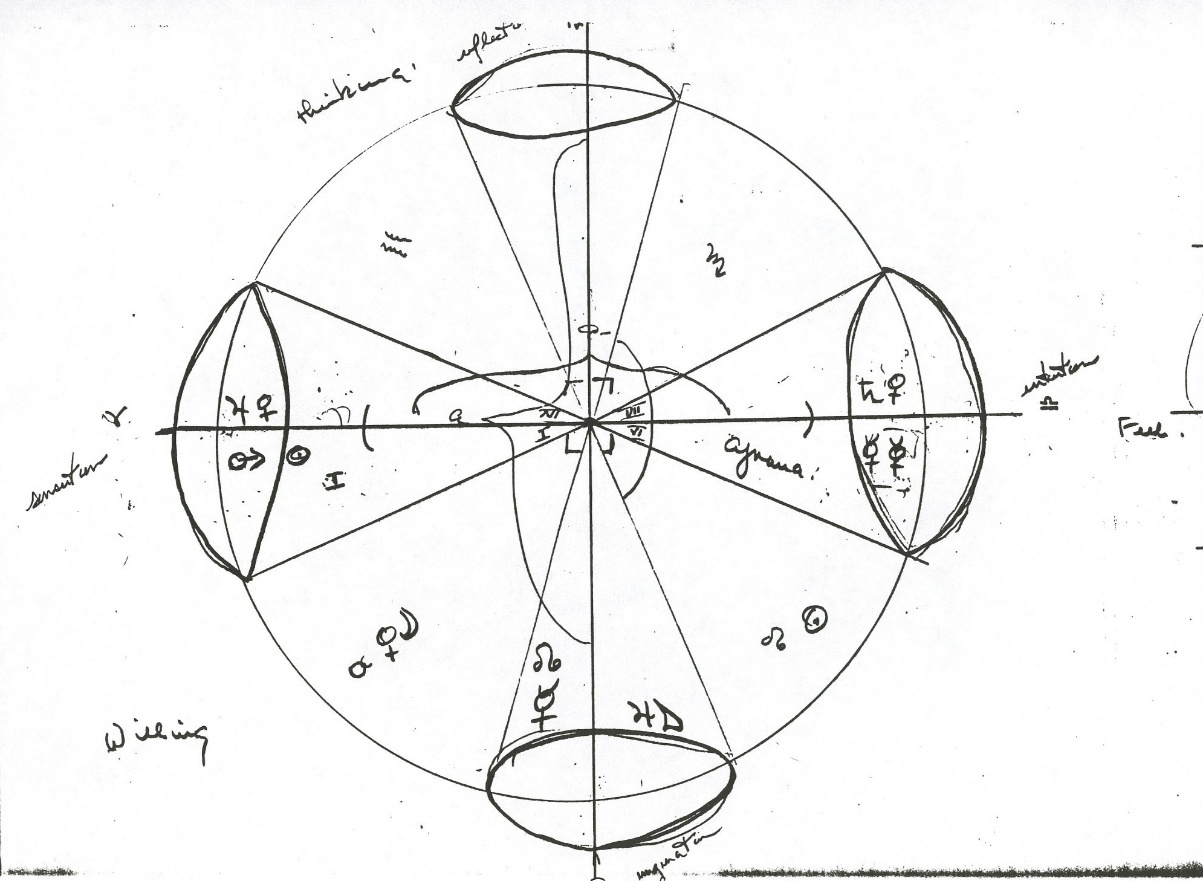
Four functions mapped onto cardinal cross; explanation of midheaven (ruled by Saturn) as reflection
More discussion of sensation/conception; sensation as representation of pure flashing energy; PB: image is first = pure energy; productive imagination turns this into an experience for you
Discussion and critique of Jung's quaternio diagram; AD's alternative interpretation
Zero-consciousness at center of chart, traceable to Overself; structured by planets, houses, aspects; whole chart operative in every moment of living
Can start at either end; realist starts at ascendant (sensation), idealist at descendant (ideas/conception)
Structuralization, ordering, duplication of seed-thoughts is possibly what is meant by metaphysics
Control your thinking, control your world; example of transforming pain into bliss
Reading/discussing Jung, "The Transcendent Function"
Preface: possible dangers of active imagination
Unconscious includes your past life memories, etc., but also ideas that have not yet become available to you
Importance of stable ego
Advantages and disadvantages/dangers of one-sided directed conscious functioning; psyche has a tendency to keep homeostasis, just like the body
Analysis not a permanent cure, life is always changing; can't exhaust contents of the unconscious
Transcendent function makes transition from one attitude to another possible without loss of the unconscious; analyst mediates it for the patient; astrologer does the same
Transference: patient clings to analyst/astrologer for renewal of attitude
Astrological chart acts as corrective to the analysis of dreams; more valid than reliance on dream series
Constructive method evaluates symbol as symbol, not reductively as sign; multiple sources of unconscious material
When unconscious regulation is suppressed, it loses regulating influence and intensifies conscious direction; Jung example of ignoring a warning dream
Knowledge of unconscious regulation makes much bad experience unnecessary; PB: you don't have to make mistakes
Astrological chart as symbol to transform unconscious predispositions and elevate understanding; transcendent function relates sense and inferred worlds through archetypes
BOOKS READ FROM OR REFERENCED:
F. Th. Stcherbatsky, Buddhist Logic, Vol. 1
W.E. Pauli, "The Influence of Archetypal Ideas on the Scientific Theories of Kepler", in The Interpretation of Nature and the Psyche by C.G. Jung and Wolfgang Ernst Pauli
D.T. Suzuki, The Field of Zen
Paul Brunton, The Wisdom of the Overself
Johannes Müller, William Baly (tr.), Elements of Physiology, 2 volumes
Surendranath Dasgupta, Philosophical Essays
C.G. Jung, CW 8, The Structure and Dynamics of the Psyche, "The Transcendent Function"
C.G. Jung, CW 9, Part I, The Archetypes and the Collective Unconscious
DIAGRAMS appended to this transcript:
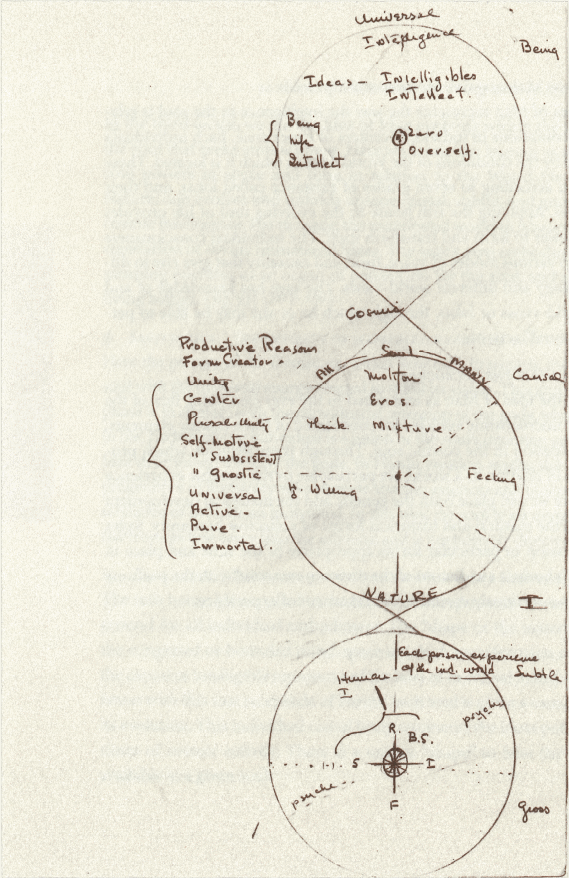
FIGURE AD_G_012. Three Circles Diagram: Divine Intellect, Soul, Psyche.
FIGURE AD_G_011. Four Psychological Functions and Thinking Feeling Willing mapped onto Twelvefold Chart; with rulerships and exaltations for houses 12-7.
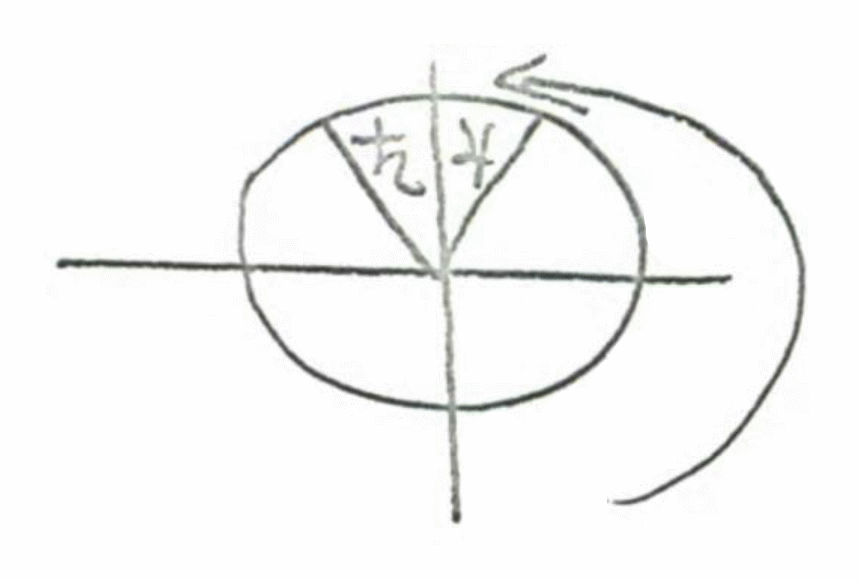
FIGURE 1972 1215-3. Movement from ninth house Jupiter (fixed knowledge) to tenth house Saturn (controlled manifestation).
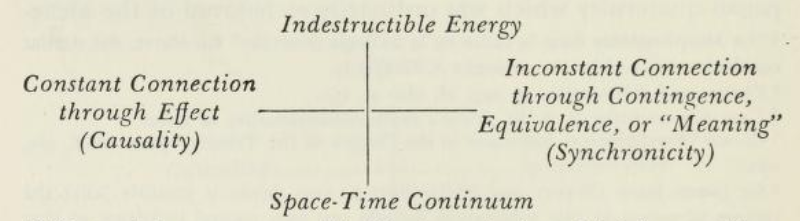
FIGURE 1972 1215-4. Jung's Synchronicity Quaternio.
Other diagrams also referred to are not with this transcript version. [Transcriber note: [diagram] means the speaker is referencing a diagram as he or she is speaking. If someone is drawing or writing, with audible sounds of chalk on a blackboard, I indicate this by [drawing] or [writing].]
NOTE: For readability's sake, the following substitutions/edits made in Verbatim Transcript: cuz = because; gonna = going to; gotta = got to; yeah = yes.
TRANSCRIBED Verbatim by IT prior to 2017, reformatted by jf 2017. In 2023, IT updates prefatory matter, footer, and audio file name, redoes TOC and completes Book List, fixes errors/typos, adds new notes within transcript, adds four diagrams and references within transcript to these diagrams, reformats to accord with new conventions. Archival verbatim transcript – V12a.
AUDIO FILES: 1972 1215a, 1972 1215b, 1972 1215c, 1972 1215d. [Note 1: "Tape" refers to original audio cassette tapes that were later digitized into .MP3 Audio Files. Note 2: We have two tapes for this class, digitized as four audio files. It's possible we are missing a tape in the middle, as the transition between Audio Files b and c is too abrupt.]
1972 12/15 at Wisdom's Goldenrod
Buddhism; Epistemology
[Audio File 1972 1215a Begins; talking starts at 0:00:25.0]
AD: We picked up a very difficult subject that I'd like to pursue because, as you've probably realized, to me there's no difference between Jung, Dignaga, Stcherbatsky, Asanga, Vasubandhu, Shankara, and on and on. And since I'm a Libran I have to entertain you so--
S (very faint in background): That's what we need.
AD: (That's ok.) [28¼ second pause while AD draws; inaudible student talking in background] Or-- [short pause while drawing] Or-- [16 second pause while drawing; student talking in background] Now should I do it this way [diagram]?
S (very faint): Yes.
AD: Yes. I'm going to start by repeating some of the things I've said Wednesday and read some very carefully chosen selections from Dignaga, from the Buddhist Logicians, the Middle School from the 5th to the 11th century, where these people--
EMD: Louder please.
AD: Better use some Ovaltine. (laughter, student words) These people did a very adequate job of splitting the world in two, so-called intelligible mundus and the sensible mundus. They-- they were so successful at it that they could never get these two together again. (some laughter, student words) Now I'd like you to ask questions, please, because I-- I had a very difficult time with these people when I studied them. I don't know of anyone who hasn't had a difficult time. I'll read you a quotation from one of the books written on him. [few inaudible student words, possibly part of background talking] They have such a high opinion, in India-- well, not the Hindus of course, but they have such a high opinion of these people that there's a quotation from the Tibetans that runs like this: "The trio Nagarjuna, Aryadeva, and Asanga, together with the trio Vasubandhu, Dignaga, and Dharmakirti are regarded by the Tibetans as the six ornaments of India." So if you don't understand, ask, ok? The Tibetans are still at it for about fifteen hundred years now. These people lived around the 5th and the 11th century.
S: (That's/That) pretty old.
AD: Hm? And it was a good time to be alive. [short pause] In case you're familiar with this quote which I read to you once before, I'll read it again. Ok? I'll read it again for what it's worth.
[Transcriber note: I am using Buddhist Logic, Volume 1, by F. Th. Stcherbatsky, Dover Publications, Inc., New York, 1962.]
F. Th. Stcherbatsky [Buddhist Logic, Volume 1, pp. 141-142, AD reading]: "[Nay], although the literal translation of the Sanscrit and Pali words which have been framed for its designation cannot be anything else than [AD adds: origination] Dependent Origination, the majority of scholars imagined for it every meaning, possible and impossible, except the meaning of dependent origination. The reason for this partly lies in the circumstances that it seemed highly improbable, too improbable beside sheer logical possibility, that the Indians should have had at so early a date in the history of human thought a doctrine of Causation so entirely modern, the same in principle as the one accepted in the most advanced modern sciences."
AD: So you-- don't think that Jung is ahead of these people, or modern physicists or philosophers because these people have really plumbed depths. I want-- I want to read some very worthwhile extracts and I'll try to schematize it on the board as we go along. For these people there's two kinds of reality, a--
F. Th. Stcherbatsky [Buddhist Logic, Volume 1, p. 506, AD reading]: "Direct reality [is] the reality of sensation, [AD adds: and] indirect is the reality of a concept referred to a [AD reads: that refers to] sensation."
AD: Ok?
S: Uh-hm.
F. Th. Stcherbatsky [Buddhist Logic, Volume 1, p. 506, AD reading]: "There is a pure reality…"
AD: Now we heard this once, we'll hear it again. Yes--
S: (Would/Could) you read that last sentence before that?
AD: There is-- there is sensation and there is a concept that refers to sensation. One's direct, sensation is direct. Indirect is everything else, ok?
S: Sensation's like before--
AD: Sensation is direct, everything else is indirect.
S (faint): By reflection.
AD: There's two kinds of knowledge, direct and indirect.
S: By reflection.
AD: I didn't say by reflection.
S: [one/two words inaudible]
AD: This is not Bhattacharyya, this is the Buddhists.
F. Th. Stcherbatsky [Buddhist Logic, Volume 1, pp. 506-508, AD reading, jumping around]: [p. 506] "There is [a] pure reality, that is the reality of pure sensation, and there is [a] pure ideality, [or] pure reason. Pure ideality is the non-reality of a concept which is not referred to a sensation. The real is [moreover] called particular, and the ideal is called universal. The real is also the thing, and the ideal is the idea, the non-thing. [Absolutely] real is [AD adds: also] the thing as it is"in itself", [it is] [AD reads: a] pure affirmation. Unreal is the thing as it is "in the other"… We thus have [AD reads: We have thus] a [general] dichotomy [of which the one side is called] [AD reads: On the one hand we have] 1) reality, 2) sensation, [AD adds: the] 3) particular, 4) thing "in itself" [or] 5) affirmation; and the other side is respectively called [AD reads: and on the other side we have called also equivalently] [by the five names of] 1) ideality, 2) conception, 3) universal, 4) the thing "in the other", 5) negation. … [short pause, VM assents]
[pp. 507-508] [AD paraphrasing: So, we see that in this logical school (of/or) Reality of the Buddhist there is--] "Real is only the mundus sensitilis [AD: or sensible world]. The concepts have a merely functional reality. In accord with this double character of its subject-matter, logic is also double. There is a logic of consistency and a logic of reality. The first is the logic of interdependence between two concepts, the second is the logic of referring these concepts to reality. The first is the logic embodied in the major premise of the syllogism, the second is the logic embodied in the minor premise or in the perceptual judgment. …
"2. What is External. [AD reads: Now, what does it mean to be external?] To be external means to be beyond. To be external to cognition means to be beyond cognition, [AD: Cognition is knowing, right?] to transcend cognition, to be the object residing outwards from cognition. … The external is real [and] efficient, the internal is ideal and imagined."
VM: Tony, I got lost a while back when he started speaking about logic of sensation.
AD: Uh-hm.
VM: It seems to me that as soon as one starts using logic you've jumped over onto the other side of conceptualization.
[student assents, very faint]
AD: Yes.
VM: So then how can one speak of logic of sensation?
[sounds like student assents in background, very faint]
S: (Or) of reality.
S: (You can do it.)
VM (simultaneously): Or of logic of reality, yes, I mean, I'm using the word 'reality' (as) 'sensation' so--
S (simultaneously): [few words inaudible]
AD: Well for instance you could have an imagined fire, right? And it doesn't cook your food. You have a real fire, it cooks your food.
VM: Fine.
AD: Now there's a coherence in the logic of concepts. In other words, I could imagine a sky in the flower. That's a concept, but there's no reality that I can associate it with. There is a flower in the ground and I don't even have to have the concept to refer to that reality. In other words, that is real in and by itself as far as these people are concerned. So your logic is based on two premises--on the one hand, one that refers to the perception per se, the pure affirmation, the pure sensation, alright, [VM: Right.] and the other one which refers to a world of concepts within which there is coherence but not necessarily in relationship to the sensation.
VM: Ok.
AD: They-- they'll go more deep-- deeply into this.
F. Th. Stcherbatsky [Buddhist Logic, Volume 1, p. 509, AD reading]: "Independently from the path of logic which leads into either a world of things or a world of ideas, there is a path of Mysticism, which leads into [the] metalogical intuition of the Universe as a Whole. There are thus [AD adds: for them] three different worlds, or three different planes of existence, each existing in its own right. There is the ultimate metaphysical plane where the Universe represents a motionless Unity of the One-without-a-Second. There is the logical plane where it represents a pluralistic reality of Matter and Ideas cognized in sensations and conceptions. And there is a third, intermediate plane where there is no Matter at all, there are only Ideas. Matter itself is an idea. … [student assents, very faint] [AD: Alright] If we start with logic, and [AD reads: with] its"law of all laws", the law of Contradiction [AD reads: Non-contradiction, alright], we will arrive into a pluralistic world…"
AD: --where there are things, alright.
VM/S(?) (faint): Ok.
AD: You know what the law of contradiction is, right? A thing is what it is, at-- where it is, and at the time it is, ok. We can't say of it it's somewhere else because that would contradict itself. That's a basic law in logic, alright. A square(,/--) you can't say square circle because that's would be a-- an inherent contradiction.
F. Th. Stcherbatsky [Buddhist Logic, Volume 1, p. 509, AD reading]: "If we start with metalogic and neglect the law of Contradiction, we [will] plunge straight off into Monism. [AD adds: And] If we start with Introspection, which apprehends a double world of things and ideas, and if we cancel the logically superfluous duplicate of the things and admit the objectivity of ideas only, we will be in full Idealism [AD reads: then we're in full-blown Idealism]."
AD: Ok?
[short pause]
S: When they-- when they speak of introspection are they-- they make the-- they say things and then ideas, they're not-- ideas are not things.
AD: No, they're not things. But they tell you, you can get rid of the things, it's superfluous. You never know things, you only know ideas about things.
S: How do you have an introspective thing? What's an introspective thing?
AD: Any idea you look at.
S: But I thought an idea was not a thing.
[Note: See FIGURES AD_G_012 (bottom circle), AD_G_011 for the following.]
AD: It's not a thing in the sense that it's matter, you know, a plurality, some kind of matter out there that has an independent existence. What these people are doing are establishing three-- three worlds. The one world we won't speak about, monism, but the other world they speak of is a world of sensation and a world where inference takes place. Now a sensation occurs here [ascendant] and you have an idea [descendant], a concept that refers to that sensation. Now right there begins two schools of thought--realism and idealism. The idealists say, "Look, all we-- all we need are the ideas, why do you bring in the things?" The realist says, "There's only things, what are you bringing in ideas for?" (some laughter)
DR: On-- on that side [diagram] of his-- would a concept be a whole thing?
AD: This would be in the realm of concepts(,) over here [descendant].
DR: But it's not the way we talked about it with the Greeks, wi-- or, let's say not with the Greeks but [possibly one word inaudible] astrology, where that side [diagram] would be um-- a-- a whole thing, you know, like let's say a chair (stayed) on that side whereas whatever sensation would come out of, you know, you pick up a chair, would be on the other side, (you have a) sensation [diagram]. (It's/I'm) just not-- not clear on what (goes) there.
VM (simultaneously): Are there only sense particulars on the left [diagram], isn't that what you're asking? Are there only sense particulars on the le--
DR (simultaneously): Is it sense particu-- particulars or is it sense objects?
AD: Well look. Might as well get this right out, huh? [drawing/writing] Sense particular, give me an example. (bit of laughter)
[student assents, faint]
VM: Uh-oh.
DR: I can't name (a--)
AD: No, come on, try. Sense particular.
DR (faint): Well I'm--
AD: The blue of the chair?
DR: Ok.
AD: Is that a particular, or a universal?
[few highly inaudible student words in background]
AD: If I say the chair is round, is that a particular or a universal? That's a concept, isn't it? [9¼ second pause] Dave, and this is very important, can you grasp the particular?
DR: No.
AD: Never, except through a naming, a concept, [DR simultaneously: And as soon as you do that, it's no longer the--] a universal, right out there.
VM: Yes, that was--
S (simultaneously): But--
DR: But, I could resume experiencing it.
AD: You-- Repeat.
DR: I could imagine that if-- that I experience a particular but as soon as I name it I'm--
S (very faint): Yes [couple words inaudible]
AD: You experience something which you cannot grasp unless you do, so to speak, impose upon it a name or a concept, alright. It is true that when you touch the fire you experience the heat, alright, but there's no possibility of communicating that as knowledge unless you frame it in a concept. [VM: Uh-hm.] So even the name, so to speak, is always a universal. It isn't-- it is not possible to ever grasp the unique particular instant. This is a-- this is going to be very tricky. Watch what they're doing.
VM: Ok, yes.
S (faint): This-- this sensation-- sensation(s) that they're talking about has nothing to do with any form of knowing that we've spoken of or does it? It doesn't seem to be a-- a kind of knowing.
AD: Yes, it's not a knowing yet. It's not a knowing unless you have the two of them working together. If we isolate them we can't speak of them.
S (faint): The intuition and the sensation?
AD: Yes. Intuition, concept, inference. I think they'll explain this, let's-- let's follow them just a little bit longer.
S: Can I sometime(s) ask that-- still ask (that/the) question, I don't understand the difference between (any) [couple/three words inaudible] between an idea and (then the other) [few words inaudible]
VM (simultaneously): Thing-in-itself?
S (faint): Thing.
AD: Let's read a few fragments. I think they clarify their own position because these people will clarify it. Just try to get the main drift of what they're saying.
F. Th. Stcherbatsky [Buddhist Logic, Volume 1, p. 511, AD reading]: "The problem of the relation between [AD adds: the] external and [AD adds: the] internal has thus shifted [AD reads: shifts] ground and has become [AD reads: becomes] a problem of the relation between sensation and [AD adds: an] image, between sensibility and understanding, between perception and conception, between the particular and the universal. Ontologically a problem of the relation between the particular and the universal, [logically or epistemologically it] is a problem of the relation between the senses and the understanding. Now, those [AD reads: these are] two utterly heterogeneous realms must be"somehow" [AD reads: "somehow" be] connected, the gap must be ["somehow"] bridged over, and it can be bridged only in the following way. The connection is, first of all, causal. The image is "produced" by sensation…"
AD: And they got that word 'produced' in quotation marks if you want to explain it.
F. Th. Stcherbatsky [Buddhist Logic, Volume 1, p. 511, AD reading]: "…that is to say, it arises in functional dependence on a sensation. But that is not enough. There are other causes cooperating in the production of an image."
[14¼ second pause]
AD: Here's-- [drawing] here's a pure sensation, let's say-- let's grasp-- grasp it this way, that there's a particular unique instant here [diagram], alright. And, they say that this sensation, this unique instant--
F. Th. Stcherbatsky [Buddhist Logic, Volume 1, pp. 516-517, AD reading]: "This pure sensation is instantaneous, absolutely unique in itself and in itself quite unintelligible. [AD adds: Now] It can be extended, coordinated and interpreted by the understanding, that is, again by imagination. The understanding discloses that a certain sensation, which is reality itself [and] cannot be doubted, must be interpreted as included in a threefold envelope [(tri-puti)]. The first is the Ego; the second is the object, say a jar and the third is the process of uniting the Ego with the jar. [Thus] the Understanding replaces a pure and real sensation by a threefold construction of a subject, an object and a process. There is not the slightest bit of pure reality in the Ego apart from the object and the process. It is entirely imagination. Neither is there any pure reality in the object jar. It is an interpretation of a simple sensation by the intellect. Still less is there any reality in the process. Cognition as something separate from the subject and object, if it is not the instantaneous sensation, does not exist. There is only one real unit corresponding to the triad of cognizer, [AD adds: the] cognized and cognition, it is [AD reads: and that is] sensation. … One unity, one reality! But the Understanding makes of it a nucleus hidden in a threefold sheath. … …the fact that sensation receives a form. They become logically identical. Sensation and conception are psychologically not identical, they are two different moments, the one [AD adds: is] the cause of the other. But logically they are identical in the sense of the Buddhist law of Identity. They [AD reads: They say] both refer us to one and the same point of reality, they are identical by the identity of objective reference. … …by endowing sensation with an imagined, [AD adds: and] general form. [And] how is it that they are identical? Because sensation represents the thing as it is"in itself", and conformity is the same thing as it is "in the other". We now know that "in the other" means dialectically, by negation of the other. The identity of sensation and conception is negative. That [AD reads: The] same sensation which is pure in itself becomes the image of a jar, by its opposition to [the] non-jars."
AD: Similarity and dissimilarity is the only basis, for these people, of knowledge.
DR (faint): [couple words inaudible] the last sentence [one word inaudible]
VM (simultaneously): Can you say that last sentence?
AD (simultaneously): Yes.
VM: Yes.
F. Th. Stcherbatsky [Buddhist Logic, Volume 1, p. 517, AD reading]: "…by endowing sensation with an imagined, general form."
AD: And all you have to do is think of any sense object, you know, and you see [VM simultaneously: Always (have/had) a form.] immediately, even if you say, "It's just a tactile representation," you've already invested it with a universal concept.
VM: Is this the same idea as saying that two senses always have to op-- be operating at once?
AD: No, it's even more primitive than that. It's even more primitive than that. On the one hand over here you have this energy flow [diagram], ok let's-- [VM: Hm.] you remember PB speaks about these-- this instant that flows in (and) the legato sort of kind of [VM: Sure.] energy, alright. And the energy, so to speak, which we feel in ourselves, as for instance the sensation you have of the body, the sensation of touch, any of the sensations, has attached to it immediately, upon arriving on the threshold, a universal [VM simultaneously: Thought.] name, and now you-- you got a concept. So even if I say 'Linda,' ok, that's a concept, that's a universal concept.
LR: But this is where the question that keeps coming up when you-- when you read this, in my mind, is, I can see how they describe on the one side reality and then he's describing on the other side where none of those things, say the threeness of the way we perceive this, none of those are real, right. But the qu-- so the question that keeps coming up for me is how can you even say there's a relationship, I mean, how-- how can you possibly--
AD: Bring them together.
LR: But how can you? I mean--
AD: Let's wait for that answer.
LR: Well I don't-- my question is (how do you)(./--)
AD (simultaneously): Because there, there I'm goi-- that's--
LR (simultaneously): How can you even speak of there being this dichotomy when one's totally real and one's totally not real?
AD (simultaneously): Well that's-- that's why I'm bringing this up, because this is where I think the Jungian archetypes will help us. Here, let me show you. Do you remember this quotation from Pauli? [short pause] Now he's-- you know, Pauli and who's this other fellow, Weizsacker(?/.)
VM: Oh Wise Acre, yes.
AD: And Wise Acre.
S: Wise Acre, (yes). (some laughter)
AD: (What's the-- was it--) These fellows are from the Planck Institute studying these problems too, they're interested in philosophy, but here's Pauli. He says--
[Transcriber note: I am using The Interpretation of Nature and the Psyche by C.G. Jung and Wolfgang Ernst Pauli, Bollingen Series LI, Pantheon Books, New York, 1955. This is from Pauli's essay "The Influence of Archetypal Ideas on the Scientific Theories of Kepler".]
Wolfgang Pauli ["The Influence of Archetypal Ideas on the Scientific Theories of Kepler," p. 152, AD reading]: "…What is the nature of the bridge between the sense perceptions [AD reads: perception] and the concepts [AD reads: concept]? All logical thinkers have arrived at the conclusion that pure logic is fundamentally incapable of constructing such a link. It seems most satisfactory to introduce at this point the postulate of a cosmic order independent of our choice and distinct from the world of phenomena. Whether one speaks of the"participation of natural things in ideas" or of a "behavior of metaphysical things--those, that is, which are in themselves real," the relation between sense perception and idea remains predicated upon the fact that both the soul of the perceiver and that which is recognized by perception are subject to an order thought to be objective."
AD: Now what is he saying here? He's saying something similar, isn't he? [VM: Yes.] He says on the one hand we have this-- the object that we perceive [diagram], alright, and on the other hand we have the senses that, so to speak, in the perception of the object formulate the-- the object gets formulated in our concepts. But we got a-- we got a split here. Of course, this would correspond to 20th century man. On the one hand, the sense perception, the se-- the sense-- sense perception, on the other hand, the objective concept. How are we going to get them together?
VM: Stick the archetypes in between, huh?
AD: Well, maybe we-- maybe we can do something like that but--
LR: Well you can say that they're never apart too,
VM: (No)(--/.)
LR: I mean that-- but that also escapes the question.
AD: You see the point, the point Linda is if analysis brings you to the fact that you are dealing with two di-separate realms, it's better that you stick to it until you find a solution even if you have to go back to your assumption.
LR: Right. It just seems unclear to me how you can even speak of one emanating from the other, how you can even speak of these concepts, which are totally unreal, coming from the real because I [one word inaudible]
AD (simultaneously): Well, why don't you give me a little pa-- a little patience, we'll try. You know, it's like that television tube, the electrical energy comes into the tube and it explodes and on the screen you see a picture and you say, "What the hell is the relationship between the picture and the electrical energy?" Yet you go around and-- experiencing emotions and great heart throb and-- (some laughter) All pure energy. Let's try. Yes, go ahead Andy.
AH (faint): Tony I-- I really don't know what you mean by sensation, because as soon as we say anything at all it's-- [VM: Yes, it's gone on the other side.] you flip it over on the other side.
[student assents, very faint]
AD: You're-- you're getting the point then.
S: Yes.
S: Uh-hm.
S (faint): Yes but--
AD: You're getting the point, alright. [couple inaudible student words simultaneous with AD] Because a sensation is such a particular, unique, instant happening. It's like the energy pouring through your body. But you never experience pure energy. That's why a lot of times these kids tell me, "Well, all this energy rushing through me," I don't know what the hell they're talking about. I never (couldn't) get to it in that pure form. I always got to see it with a picture in my mind, an image related to it, ok? But the energy per se you don't see.
AH (faint): I don't understand how we can-- how we can even make the split because-- or something (only just being) [one/two words inaudible] pure sensation. Is there an example of-- what would be a pure [one word inaudible]
AD (simultaneously): Well, let's see, among-- among the Buddhists, in the Sautrantika school, they were masters of the trance state, ok. I think-- I think maybe if we read a little extract from the Sautrantikas. [13½ second pause while AD flips through pages; some inaudible student words] You see, that's exactly one of the reasons why these-- these-- these people had so much difficulty, because they say, "Well what you call the thing-in-itself, or the-- the pure point, the instant-point, is only a convention, it's another idea that you're substituting." But these people keep talking about this energy that flows through the body and that we never get to this energy as it is in itself but only as it is represented in our imagination. But it is a fact, isn't it? [short pause] Let me see if I could find this, the trance states, the way these people operate.
[28 second pause while AD looking for quote]
AD (to himself, while searching through book): No, it's not here.
VM: What's the idea Tony, that they s-- in some of the deeper trances then it-- they can in some sense experience this raw sensation?
AD: Well, as you go deeper into trance, of course, you-- I think you remember one of the points that the Yogas make out is that when you first contemplate or let's say concentrate on an object, you first have to remove all mental traces from the object, that means wipe way all [VM simultaneously: (Right), right, right.] conceptualization, and this brings the object closer to you. [VM: Uh-hm.] Then, of course, as you concentrate even more intensely you-- your subjectivity has to be wiped out and only the object per se remains. And in that situation it is very vivid, intense, transparent, very bright and shiny, alright, this is getting much closer to the energy, the-- the energy that's becoming that sensation. The point is that energy gets transformed as it goes through our body, so to speak, into a sensation and it's experienced as a sensation. Up to that point there is no knowledge. Then suddenly it seems that the sensation gets converted into a concept or let's say a concept gets imposed on a sensation, we won't say which is which.
LR: (But) Tony, remember a long time ago when you read about the-- the experience of the morning glory [couple words inaudible] Do you remember where you [couple words inaudible]
AD (simultaneously): You remember where that was?
LR: I was going to ask you the same question [couple words inaudible]
AD (simultaneously): Yes, that's in one of Suzuki's writings, I think it's in the Field of Zen. I think there's a copy up there, would you look for it? I'd like you to-- I like that quotation, it would come in very handy now. [9½ second pause] [aside] They have an index that might help but they very seldom use (it).
[students assent, very faint in background]
[40¼ second pause; some inaudible/audible student/AD talking/whispering]
S: I found a poem.
AD: Well--
S: Do you want me to read the--
AD (simultaneously): If you-- if you found it, yes.
S: [one/two words inaudible] The statement was--
[Transcriber note: I am using The Field of Zen: Contributions to The Middle Way, the Journal of the Buddhist Society by D.T. Suzuki, London: The Buddhist Society, 1969.]
D.T. Suzuki [The Field of Zen, p. 22, S reading]:
"Oh, Morning Glory!
Bucket taken captive,
I beg for water."
S: It says--
D.T. Suzuki [The Field of Zen, p. 23, S reading]: "The following was the incident that led her to compose it. One early morning the poet came outdoors to draw water from the well, and saw the morning glory winding round the bamboo pole attached to the bucket. The morning glory in full bloom looks its best in the early morning after a dewy night. It is bright, refreshing, vivifying; it reflects heavenly glory not yet tarnished by things earthly. She was so struck with its untainted beauty that she remained silent for a little while; she was so absorbed in the flower that she lost the power of speech. It took a few seconds at least before she could exclaim:"Oh, Morning Glory!" Physically, the interval was a space of a second or two or perhaps more; but metaphysically, it was eternity as beauty itself is. Psychologically, the poet was the unconscious itself in which there was no dichotomisation of any kind."
AD: (Now/Yes) would you read the poem again, I prefer that.
D.T. Suzuki [The Field of Zen, p. 22, S reading]:
"Oh, Morning Glory!
Bucket taken captive,
I beg for water."
AD: Of course that's the way the Zen people would do it. [one inaudible student word] In that-- in that instant, so to speak, before the sensation gets converted into conceptual knowledge, there's a realization of a-- a kind of pure substance shining bright and you just-- you realize that that's all that there ever was. And as soon as the machine up here gets to work, it takes that nice beautiful blissful sensation and converts it into some kind of dogma--"It's a morning glory." (AD chuckles, bit of laughter) It's really impossible to believe what words do to us but that's part of the-- the training that the yogis go through(,) to wipe away-- remove all mental traces from whatever object they're meditating on. And even that in itself is an absolutely overwhelming experience, like that poem, because what shows up is really quite extraordinary. Let's poke a little more into these people.
VM: (Yes.)
F. Th. Stcherbatsky [Buddhist Logic, Volume 1, pp. 79-80, AD reading]: "…Dignaga makes the statement that in strict conformity with this double source of knowledge the external world is also double, it is either the particular or the general; the particular is the object corresponding to sensuous cognition, the general, or universal, is the object corresponding to the understanding or the reason. We thus have [AD reads: have thus] a double world, in India just as in Europe, [AD: You know, including Jung.] a sensible one and an intelligible one, a mundus sensibilis and a mundus intelligibilis…
"The sensible world consists of sensibilia which are but momentary flashes of energy. [The perdurable], eternal, pervasive Matter which is imagined as their support or substratum [is a fiction of the Sankhyas and other schools] [AD: for these people is a fiction, it just doesn't exist.] …"This their [AD reads: It has the] character of being instantaneous, of being split in discrete moments, [says Kamalasila], pervades everything. [AD adds: And] By proving this fundamental thesis alone, we could have repudiated at one single stroke the God (of the theists), the eternal Matter (of the Sankhyas) [and all] the wealth of (metaphysical) entities (VM laughing) imagined by our opponents.""
AD: This is the Buddhist approach.
VM: It's a big sword.
RC (faint): Could you read that sentence again [one/two words inaudible] the sense-- the particular (or) the object corresponds to the sense contact with the universal--
F. Th. Stcherbatsky [Buddhist Logic, Volume 1, p. 79, AD reading]: "…the particular is the object corresponding to sensuous cognition, the general, or universal, [AD adds: it] is the object corresponding to the understanding or the reason. We [thus] have a double world, in India [just] as in Europe…"
AD: It seems that we have it everywhere. A sensible and a intelligible.
RC (faint): And by the understanding do they mean the-- the operation of that side over there [diagram]?
[AD indicates on diagram]
S: Yes.
F. Th. Stcherbatsky [Buddhist Logic, Volume 1, p. 79, AD reading]: "The sensible world consists of sensibilia which are but momentary flashes of energy."
AD: Ok? [11 second pause] Alright, and some of the problems, for instance, that this theory brings up--
F. Th. Stcherbatsky [Buddhist Logic, Volume 1, p. 83, AD reading]: "The motion representing the world-process is either a continuous motion or it is a discontinuous, although compact, one. The latter consists of an infinity of discrete moments following one another almost without intervals. In the first case the phenomena are nothing but waves or fluctuations standing out upon a back-ground of an eternal, all-pervading, undifferentiated Matter with which they are identical. [AD adds: And] The Universe represents a legato movement. In the second case [AD: The Buddhist.] there is no matter at all, flashes of energy follow one another and produce the illusion of stabilized phenomena. The Universe is then a staccato movement."
AD: And if you remember PB, he speaks like this.
F. Th. Stcherbatsky [Buddhist Logic, Volume 1, p. 83, AD reading]: "The first view is maintained [AD adds: for instance] in [the] Sankhya [system of philosophy], the second prevails in Buddhism."
[23½ second pause; AD flipping through pages]
AD: Alright, and the quotation for instance here--
F. Th. Stcherbatsky [Buddhist Logic, Volume 1, p. 177, AD reading]: "Sensibility as pure sensibility is by itself absolutely formless."
AD: And this is also Kant, Immanuel Kant is the same way.
F. Th. Stcherbatsky [Buddhist Logic, Volume 1, p. 177, AD reading]: "As to productive imagination (vikalpa) [AD: in Sanskrit], it is in Buddhist logic a term which embraces everything which is not sensibility. [VM: Uh-hm.] It thus includes [AD reads: It includes thus] Kant's productive imagination together with his understanding, judgment, reason, [and] inference. It could not be otherwise for the dichotomizing principle alone, since it divides all that is cognition in a sensible, purely affective consciousness and an intelligible, purely spontaneous and imaginative one. Sensation and imagination, says the Buddhist, have each of them their own object and their own function. The function of the senses is to make the object, the pure object, present, and nothing more. The function of [AD adds: the] imagination is to construct its image. The object of pure sensation is the pure object, the object of [AD adds: the] imagination is its image."
AD: So as you say, Linda, so now we're living in two worlds. And, to be--
PD (simultaneously): I didn't follow that. But how do they speak of the senses as presenting that pure energy, how can they speak that way? How can the-- speaking of the five senses, present pure-- that pure energy to consciousness?
AD: Well, let's give it a try, huh? Let's see if we could do something like this, ok? [student assents, faint] [to himself while erasing] Down for a little while. [short pause] See, we had-- we had a diagram something like this um-- [short pause while AD draws; some student words in background] Ok? (bit of laughter, student words) And we had the ray of consciousness go right down [FIGURE AD_G_012] and--
VM: Uh-hm.
AD: We have this individual subject here [diagram]. We put over here sensation [ascendant], we put over here intuition [descendant], ok. You don't mind I'll-- I'll put this down here for now [nadir] just temporarily and reflection here [midheaven]. This by the way will not disagree with what we've been doing. As a matter of fact it will reaffirm what we've been doing. Now, somewhere in The Wisdom Of the Overself, if you want to you can look for it, maybe you'll find it, chapter-- you know, in the chapter on the birth of the universe where he points out that the world is presented. Each thought, so to speak, contains the space-time continuum and this-- these thoughts come in a sort of staccato series, alright. [VM: Yes.] Now, it's very obvious that could-- that could only be pure energy, right?
VM/S(?): Formless energy.
AD: Hm? Formless energy.
VM: But Tony, insofar as this energy-- it's really in some ways it's not formless because if it has a beginning and an end or a-- you can separate it off distinct from one flash from another, then in some sense it already has a form, it's got a modulation.
LR (simultaneously, faint): Who can, wait, who can?
VM: I don't know who can, they talk about it as separate flashes. Insofar as you can separate it, it has a form.
LR (faint): Yes, but you can't.
AD: In terms of, like it's pulsating.
VM: Yes, a pulse, an individual pulse is different than this pulse over here, alright, it's already got a form.
AD: Yes, alright, now we have the problem here. On the one hand, it has to be pulsating because if it didn't then it would be one continuous image, right?
VM: Yes.
AD: And we know that the world is in constant change so therefore we have to have a pulsating stream of energy flowing all [VM simultaneously: Yes we do.] the time, alright. But this brings up the whole problem of motion, doesn't it? [VM talking simultaneously: It's Zeno's paradox.] Is there anything moving? (VM chuckles)
S: Coffee.
AD: Now, let's--
VM (simultaneously, chuckles): Coffee's moving, yes.
AD: Let's wait. This-- this is more important.
S (faint): Ok.
VM: Yes, how do you get movement in here now, this is confusing. [AD simultaneously: You have a series of discontinuous jerks, huh?] I mean, this reminds me of Zeno's parado-- paradox, yes.
[few inaudible student words in background, bit of laughter]
AD: Yes, you stop and think and you see these people may have something, because certainly modern science will not disagree with them.
VM: No.
AH: If you-- you can say--
AD: Yes Andrew. [aside] Wait a minute.
AH (simultaneously): Don't-- don't these-- don't these individual centers of consciousness provide the jerk?
AD: They're part of the jerk. (laughter)
VM: We are the jerk! (VM laughing, laughter, student words)
AD: Look, try to remember this Andrew, this is the cosmos [FIGURE AD_G_012, bottom circle], ok? Paul, will you find that quotation in the Wisdom [AS simultaneously, faint: (I've/I) got the book. Which one do you want?] where he speak-- You got it? Would you read it?
AS: Which one?
AD: The one where he speaks of the universe as like a series of flash-- flashes.
VM: Machine guns, bullets or something.
AD: You know, the eternal recreation of the universe every moment of time. You think God stopped creating the world?
AS (simultaneously): Yes, I know [one/two words inaudible] this one sounds good.
[Transcriber note: I am using The Wisdom of the Overself by Paul Brunton, Rider and Company, London, 1943.]
PB [The Wisdom of the Overself, "The Birth of the Universe", p. 39, AS reading]: "It is the thought itself that provides us with the particular kind of spaced and timed consciousness with which we are all familiar. Beneath two successive thought-moments there is Mind, the occult link which makes them orderly and [makes] their consciousness possible."
AD: Alright, [AS simultaneously: There's (one word inaudible)] there's a better one too [AS: Yes.] where he speaks of the staccato-like-- it's like a machine gun firing off bullets and not like water coming off a faucet. The-- the notion of a machine gun fire, alright, is like the notion of stills, one after the other, alright, whereas water coming out of a fountain would be a continuous stream. As a matter of fact, you can-- you can't slow up the thought-processes.
MW: Well, it seemed when we were trying to demonstrate that-- that there must be these staccato movements, we said "and obviously everything's in flux," but what if you argued that it's just your imagination that's in flux? I mean, how do you know that everything's in flux? You never-- you've never got to the-- the sensation to know whether that's in flux, you've only got your conceptions and they're-- that's what's in flux.
AD: Uh-hm. Would your sensations be in flux or not, would you have the same sensations constantly? If you did you wouldn't recognize sensation.
MW: But the recognition of it comes through the conception.
AD (simultaneously): Recognition, yes, the recognition of it, sure.
S (very faint): That's how you [one/two words inaudible]
MW: Comes through--
AD: You see, in a sense what they're asking you to do is to try to imagine a universe where you wiped away all conceptualization. [short pause] I think you're going to see something very interesting come out from these people, you're going to see that they can draw upon and they can have an objec-- they could have a realistic theory of knowledge and an idealistic theory of knowledge and they would both be valid under their premises. Let's wait a minute. Paul, will you get my-- my copy of the Wisdom?
S: Yes.
AD: You've got it here?
PD: What?
[about 3 seconds of student talking in background, shuffling around]
AD: Yes--
PB [The Wisdom of the Overself, "The Birth of the Universe", p. 39, AD reading]: "Thoughts, whether they be abstract ones or pictorial images, are emitted from the deeper layer of [AD adds: the] mind not like a flowing stream of continuous water from a tap but like a steady series of separate bullets from a machine gun. [AD adds: The] Consciousness of outside things comes with the coming of thoughts about them and the latter emerge with the regularity of the to-and-fro movements of a steam-engine piston or with the rhythmic chug-chug of an electric locomotive. It is merely a ceaseless flow of such staccato movements of ideation, a succession of moments like lightning-flashes across the night, which makes up our world-knowledge. The process is far too swift for us to note [it], however."
AD: Alright, le-- let's just work with that premise for a while. Yes--
S: It seems like in one sense though, [S simultaneously: Which one?] if you-- if you speak of-- you speak of pure energy, but at the same time like the-- you said the particular space-time consciousness, you know, is contained within-- you know, it seems like that energy has a-- speaking of energy with a form kind of-- you know, that you're speaking of-- speaking of energy and form simultaneously. In other words, you-- you know, (you/you've)--
[student assents, faint]
S (very faint in background): (You can see it.)
AD: Look, why don't you try to give-- grant them their premises first before you disagree. Even scientists will tell you today that everything that you know that exists is a form of energy. Is this so or isn't this so by science? And all they've done is applied reason consistently right down to the nth detail. This is all they're saying, alright, that's all we have to deal with. Now, PB also brings up the problem, he says, "But how come I see a chair there and not energy?" Doesn't he also make the same point? [VM simultaneously: Uh-hm, yes.] (")I don't see energy, pure energy, anywhere. It's a concept.(") Try to understand what they're saying before you criticize these people. They've gone over it quite thoroughly.
VM (whispering): I'll bet.
S: Well it seems like he's-- he--
[Audio File 1972 1215a Ends]
[Audio File 1972 1215b Begins]
AD: This is [few inaudible student words simultaneous with AD] exactly what they're saying. They're saying we can't get to the pure sensation per se. You can't get to it, because as soon as you try to get to it what do you do, you conceptualize. You wouldn't dare sit down and meditate, and wipe away all conceptualization. As a good Western man you'll right away try to grab it with your hands, in other words, with more words. And that's exactly what they're trying to stop you from doing.
S: That's the-- that's what happens when he like talks about the dialectic by negation.
AD: The dialectic what?
S: That come-- the question I wanted to ask [couple/three words inaudible] it, dialectic by negation the sensation gets--
AD: Everything gets polarized, doesn't it?
S: Yes, uh-hm.
AD (simultaneously): Everything, alright. As soon as you speak of what is formed, you must have the formless.
RC: Tony, are they talking about the-- the intellect we're trying to understand this with as being part of that sensation?
AD: No, it's not part of the sensation, it's [S simultaneously, very faint: (one/two words inaudible) no.] precisely not sensation.
RC: Would there be sensation (there)?
S (faint whisper): No.
[11 second pause; banging on board sounds]
RC: (We/You) couldn't take away one half and not the other, (right)?
AD: But how could you have a stick with one end? (some laughter) Isn't that exactly the problem? [RC simultaneously, faint: I mean that--] Some people think that they can experience sensation, pure sensation, right, and you see them go out in the world (try/trying) to grab it. [VM to himself: I tried that.] But always, always their experience is through a concept [couple inaudible student words simultaneous with AD] and so they're like a dog going after own-- their own tail.
VM: Yes.
RC: There's somewhere back when you read that the cognized, the cognizer [couple words inaudible]
AD (simultaneously): The threefold sheath, yes.
RC: And the threefold [S simultaneously: (Could you) talk a little bit (one word inaudible)] sheath. The-- the cognizer, the-- the cognized, and the cognition are the threefold sheath of the sensation. There couldn't be any sensation without all three of them.
VM: No, there couldn't be the three of them without sensation.
AD (very faint): (We'll just) [couple words inaudible]
[student assents, faint]
VM: (No), but that's--
[student assents, very faint]
[short pause]
AD: Alright, let's try this. We speak of this end, so to speak, as the end where sensation occurs [ascendant]. [drawing] We speak of this end where there's the world of intuited possibilities [descendant]. Now, just for the sake-- just for a little fun. We were [VM simultaneously: (Oh nice.)] speaking about this yesterday. I'll put sensation here [diagram], [VM simultaneously: Uh-hm.] alright; put fantasy over here [diagram]; we put the reason over here [diagram] and the intelligible, or the intelligence [diagram], whatever name you wish to call it.
AS (simultaneously): I notice you put all three of those on the same side.
AD: Huh?
AS: I notice you put all three of those on the same side.
AD (simultaneously): Yes, why?
S: Yes, because they're all [few inaudible student words simultaneous with S] inside, obviously.
AS (simultaneously): They're all-- they're all in it.
AD/S(?): Yes.
AS: I think that's probably right what you were doing yesterday, is putting them all on the right side there (on) [few words inaudible]
AD (simultaneously): Sensation is always, so to speak, something outward, right?
AS: Yes.
AD: Ok? But all other knowledge is knowledge inward, it's a psychic fact, it's a psycho-fact, it's inward knowledge, ok. So sensation we put over here [ascendant]. Over here we'll put feeling [nadir] [drawing] but, if-- if we-- if we think of-- if we think of it as an energy, ok. Over here we put intuition [descendant]. Now-- now Dave, I don't think that there's going to be any disagreement because in this 7th house, the world of inference and intuition, ok, we're going to find that the reasons that have to deal with the structuring of our outside world or inner world is dependant upon the reasons, even the way the Greeks use it, ratio. And we're going to see that the intelligence can be applied over here in terms of the reflective consciousness [midheaven] because whatever is transmitted from the 9th house to the 10th, alright, is going to be a controlled manifestation [FIGURE 1972 1215-3]. In other words, only that will be released in the 10th house which is part of that total knowledge which is fixed for all time. This would be a reflective consciousness [midheaven], this will be the energy which comes to us through-- as basically a feeling [nadir], this would be the intuited world [descendant], the world of all possible meanings which is structured according to reason, this would-- this (would/will) be sensation [ascendant] which is the only type of knowledge which is always knowledge of the outer.
S (faint): Could you repeat the-- the midheaven?
AD: I'm sorry?
S: Could you repeat the midheaven?
AD: Yes, the midheaven would be the most difficult to grasp because of this reason here. We spoke of intelligence over here [midheaven], so to speak, as the highest function in man in the term-- in this sense. A person lives a life and this life, so to speak, is a life which is ordered according to whatever the myth, and I mean here, I'm using it in the proper sense, the myth of this person's life, would have to correspond and be, so to speak, integrated in the total knowledge of the universe as, so to speak, it's in the process of becoming. So it would have to coincide with that total knowledge. In other words, you can't go out and do anything you want. You have to do only within that framework of that vast perpetual being that is fixed for all times. That can only take place here [midheaven], because the reflective consciousness can only grow to maturity in the sense that, as it is involved in that total universe, alright, and it is progressing [drawing] from one life to another, and, so to speak, the contents of its evolution are being unfolded, this [AD bangs on board] is where the growth takes place, in that reflective consciousness, and the understanding of these processes. [student assents, faint] Yes it's heavy, I know. [VM: I know.] Try again. Go very slowly here because there's nothing that the chart doesn't have that I haven't seen. The chart'll have it. As soon as I'm in doubt I go to the chart and I know, I'm going to be wrong, that's going to be right. Yes, go ahead [one word inaudible]
RC: Is this-- is this concept of sensation, is this the same thing we spoke of before as the felt me(,) feeling "I" or is this something different?
AD: The felt me? Look, A-- Randy, you're getting all-- you're getting involved into a lot of nonsense. Here, (laughter) I'll put your stove-- I'll put your hand on a stove. What do you experience?
RC: Is the stove on?
AD: Huh? (laughter)
VM: Stove on?
AD: As soon as you say what you've experienced, (you/you've) conceptualized it.
RC: Soon as I say it, yes?
AD (simultaneously): Yes. Soon as [S simultaneously: How about (even before)?] you think it, let me make it even more primordial, you've conceptualized it. It's no longer sensation.
RC (faint): Soon as I think?
S (faint): Wouldn't you move your hand?
AD: Soon as you think it. Yes well, that has to be first. Thinking, whether it's conscious or subconscious.
S (very faint in background): (Oh.)
AD: Wait, let's see-- let me try to get this thing out of his mind once and for all. A pure energy per se, in itself, has no reaction to anything, there's nothing-- there's no cognition there. There's no knowing.
RC: This sensation that is leading me back down and saying that I've just got to get out of, a-- it seems the way we're approaching it is saying again there is such a thing as a thing-in-itself.
AD: There may be, huh? when the object, so to speak, always remains undefined except by the cognitional apparatus you operate with.
RC: And vice versa.
AD: No sir. [short pause] And don't give me quick replies. I could do that, not you. Let's try again Randy. Try again. Imagine, here's a television tube, ok, and the electrical energy goes into this tube, alright, and until it explodes and becomes a picture on the screen, from there to the time that that energy flows through, there is no way of knowing any of its significance. When you see the six-- six-gun drawn on the screen, now you say, "Ah, he's killing somebody." (bit of laughter)
RC (faint): But whatever happened to the TV (set, we/set? We) (get this--) we get these optic nerves and tactful nerves and all these different things that are carrying the energy (in the world) to some central apparatus in my skull.
[student assents, very faint]
AD: Yes, now for instance, the specific energy that is employed by the various senses, is there a distinction or a differentia among them?
VM: Is there any?
AD: Not that I know of. Look up in the theories on energy of the senses. Look up Mu-- I think in the-- one of the physiology books you may find that, a fellow by the name of Müller I think. [Note: The law of specific nerve energies, first proposed by Johannes Peter Müller in 1835. See Elements of Physiology, 2 volumes, by Johannes Müller, M.D., translated from the German by William Baly, M.D.] I forgot, this is physiology. Herbie, behind you I think there's a book, two volume book on the body. Yes, left, left, right at the very end, (the) black--
HS/S(?) (very faint in background): (Lot of anxiety, I see him.)
AD: Look up Müller's theories on sex, I think you'll find that the energies that are employed in all the senses, there's no way of differentiating them. In other words, when we say there's galvanic disturbance in the optic nerve, I mean I don't know what we're saying, there's an energy there but what it is I don't know. Maybe they know. As far as I would say, that it's not specified. [RC simultaneously, faint: But there is a (one/two words inaudible)] In other words, there isn't an energy as it goes through the optic nerve is for seeing, and there isn't an en-- energy that goes [student assents] into the digestive tract for digestion.
RC (simultaneously, faint): But it is-- it is differentiated as to which path--
AD (simultaneously): Huh?
RC: It is differentiated according to which path it travels, like what I feel [few words inaudible]
AD (simultaneously): Well, let's find out, let's find out.
LR: But didn't we-- didn't you a little while ago make a distinction between the two words 'sensation'? I mean, the way we're talking about it, it seems that these-- what we call sensation normally, (you know, here), as-- refers to the chart or psychology where we're talking about actual sense organs which are somehow relaying something. But when we began tonight we're talking about sensation which is beyond that small sensation and is something which that small sensation attempts to convey. But it seems like we're really talking about two words.
S: [few words inaudible]
AD: I didn't think so, Linda, I thought it was always the same-- [student assents, faint] same notion.
LR: Well when we're talking about the sense organs now--
AD (simultaneously): Here let me-- let me give you an example. If you're looking at a blue, alright, this is the example they give here, and you look at the blue, and you know nothing but the blue, alright, there's only blue. Now, you cannot say, when you are "experiencing" that, quote unquote, that there's a blue. Because to define blue means to define it in contradistinction to everything else that's not blue.
LR (faint): Uh-hm.
AD: Alright. This is the se-- pure sensation that they're speaking about.
LR: But-- but when we--
AD: But, but, wait a minute! This is a pure blue that you're seeing, alright. Now, the first concept that has to come into operation in order for you to establish that it's a blue is similarity and dissimilarity--"This is blue, everything else is non-blue." Now if you stop and think and you see that if you saw only one color you wouldn't see anything. So the notion of similarity and dissimilarity has to come into operation. So a concept, so to speak, the whole conceptual world comes in through that chink in the-- in the doorway. [short pause] Go ahead, try another.
[student assents]
LR: Well, my question is when you begin to talk about sense organs here, and you'd ha-- and you were speaking about sense organs after you re-- you read it. Sense organs transmit or--
AD: These specific impulses which--
LR: Ok.
AD: Yes, go on.
LR: It seems like now the sensation which-- which, say, the body receive--
AD: That the body receives? [possibly student: Yes.]
LR: Is on a different level from-- from dichotomy, from the large dichotomy "sensation and intuition".
VM: Right. Can I try and translate?
LR (simultaneously): You come down a step.
AD (simultaneously): Yes, maybe you can, I can't.
VM: Isn't the-- the whole body apparatus, including the sense organs and all that, aren't they an outgrowth of that primordial sensation? I think that's what Linda's saying.
AD: What primordial sensation?
VM: The one over there [diagram].
AD: Over here [diagram]?
VM: Right. Just like when PB says the-- the seed-thought in the heart, as that exfoliates or as that comes out, it [AD: And--] brings the subject, the object, with it, the space-time continuum.
AD (simultaneously): Yes, what brings the subject and the object, so to speak? Wouldn't that be the imposition of the whole conceptual world?
VM: Ok, fine, but then that's I think the distinction that Linda's trying to make. The primordial sensation, that flash of energy, is at least in our understanding, different than the-- than the-- all the apparatus that goes along to try and channel that energy, if you like.
AD: But that's precisely the point, [VM simultaneously: Ok, so--] that's precisely the point. The flash of energy in itself is unknown and always remains as such. Let me [couple inaudible student words simultaneous with AD] see, I want to-- I want to repeat or summarize what they-- what they call these--
[AD flipping pages]
VM: We would say that those-- the sense organs and all that business are a determinate set of concepts which, let's say, channels or is a mode of expression of that primordial flash.
LR: Or the-- that-- that primordial dichotomy.
VM: Ok.
S (in background): [few words inaudible]
PD (faint): I'm getting confused on "primordial". Is there a distinction between the energy and the sensation? I'm beginning to see the sensation as one removed from the primal energy.
VM (very faint): (Yes.)
PD: (And/I mean) I'm wondering now some-- sometimes I hear them put together this primal flash of energy the same as sensation (unless I hear it differently).
AD: Well that's the only way we can get to that primal energy is some sort of sensation in us.
VM: Right.
AD: I mean energy per se, you know--
PD/BS(?) (faint): And that immediately refers to the intuited world, or vice versa.
AD: Well, always it refers you to your understanding and your understanding immediately, like a cookie cutter, imposes on that energy these distinctions, one from the other, and you come up with a name of the object. [11¾ second pause] Here, this is Dharmakirti's experiment, he says something like this.
F. Th. Stcherbatsky [Buddhist Logic, Volume 1, p. 150, AD reading]: "But, is not this single moment of pure sensation, just as its corollary the mathematical point-instant, a mere convention? Although produced by a stimulus coming from an external object, but from an absolutely propertyless pure object, is it indeed a reality? It is supposed to be absolutely stripped [off] of ever-- from every vestige of an imaginative or constructive element."
AD: You know what imaginative or constructive elements are? Space, time, causality, attribute, substance, modality. Otherwise, of course, you're not going to understand. Ok?
F. Th. Stcherbatsky [Buddhist Logic, Volume 1, p. 150, AD reading]: "The answer of the Buddhists is the same as their answer to the question regarding the reality of the mathematical point-instant. A single moment, just as an absolute particular, is not something representable in an image, it cannot"be reached by our knowledge", that is to say, it is not something empirically real. But it is the element which imparts reality to all the others. It is the indispensable condition of all real and consistent knowledge. It is transempirical…"
AD: So, if we take the example of the television, and we see this electric-- these electric impulses being-- you know, shooting into the tube, and then at the other end, so to speak, the picture appears, alright, what they're trying to say is, the only reality that that screen picture has is based on this electrical impulse flowing into it. Now in the same way, the only reality that you really know of a sensation pouring through you, upon which is, so to speak, and superimposed these concepts that immediately impose on them, so to speak, a certain viability. So you have a concept, you immediately get the name of a thing. Instead of seeing flashes of energy exploding, so to speak, you see a horse on a cowboy, a cowboy on a horse. (AD laughs, laughter, student words) Yes, go ahead, go ahead, try.
AS: My question is sort of, where does this leave intelligence for these Buddhists?
AD: But wait a minute, (wait, wait), [S simultaneously, faint: Yes (one word inaudible)] please. Let's try, just get this, hammer this point home.
S (very faint): (Are we missing) [one/two words inaudible]
AS: [three/few words inaudible]
AD (simultaneously): Because they do have, they do have the intelligible intuition, they do know about the Cosmical Body, I mean, let's-- [AS: No--] let's not [AS simultaneously: Ok.] get excited that they're going to be atheist. (some laughter)
AS: No, no, not at all, but I mean-- Here-- you've got on this one hand this thing which is the sole reality and it's a-- it's-- it's just-- it's not a continuous reality either, ok, but staccato reality, it's a point-instant of reality which is going to-- which is going to get imposed on it these concepts and that's the only thing we ever know, we ne-- we-- we can't get back at these-- we can't get to these sensations normally. [students assent, faint] Is that right, [AD simultaneously: Uh-hm.] or is-- is there a way to get back to them or do they even talk about that?
AD (simultaneously): Well like for instance he has-- he has here this experiment which he, like I say, he en-- he enjoins you to try where you [couple/three inaudible student words simultaneous with AD] try to wipe away all-- all conceptualization and get to that sensation.
AS: Right. Ok now, what--
AD (simultaneously): Now try to remember, to these people the sensation is a representation of that pure flashing energy.
AS: Ok.
AD: To us it's a sensation.
VM: Uh-hm.
AS: Right, but if you follow-- if you wipe away all conception of the sensation then this sensation in itself is nothing but this energy.
AD: Ok.
AS: Now what-- Now that-- it seems that everything else that you-- I don't see, in that case, how you can make any kind of distinctions of any-- any other type of knowl-- like all the types of knowledge would have to be essentially the same, like the-- this-- there couldn't be [student assents] any distinctions in all these other kinds of knowings, fantasy, reason, intelligence. What is-- then what are-- what are the distinctions in all these, where are they different?
AD (simultaneously): Alright. Yes, I know, this is bound to come up because it's very disturbing now that you're doing the Greeks. [AS and another student assent] After all, the Greeks have this huge structure of [AS simultaneously: (couple words inaudible)] reason, intelligibility, and all that. But wait a minute. Just like they say it's all Maya, you know, [AS simultaneously: Ok, (yes).] the Hindus say it's all Maya. But this Maya is a Divine construction.
S: Tony, what is Maya? (laughter)
AS: Uh-oh.
S: What--
S (faint): What isn't Maya.
AD: Magic. (laughter, student words)
AS: Ok now-- well aren't-- I'm-- maybe-- ok, forget that question for-- for a second. And then another question is this. If-- you have this sensation now, he-- these Buddhists seem to be doing something very similar to what PB, for example, examines, as far as this di-electrical ener-- these impulses which reach the brain and then somehow all of a sudden, boom! consciousness, and there's that-- there's a gap. Now-- now he's going to-- now PB will resolve that by-- by just saying "No, this whole thing is, you know, just is wrong, it goes the other way somehow."
AD: Yes, [AS simultaneously: Yes.] first you have the image and then you (start with matter).
AS (simultaneously): Ok, first you have the image, then you (start with--) Now these people, they haven't-- they obviously have their answer to that and I don't know what it is.
AD: Well, do you see that much of a distinction between when PB says that first the image comes, alright.
AS (faint): Yes.
AD: Remember?
VM: Yes. But to--
AD (simultaneously): And then you become aware of it.
AS: Yes, I remember.
AD: Now, this image that PB's speaking about, could you tell me what it appears like?
AS: Oh, before it appears it's-- I ca-- I can see where it's very much like the sensation.
AD (simultaneously): It's (a--) it's similar, isn't it?
S (simultaneously): [one word inaudible]
AS: Yes but--
AD: Well then what-- what, so to speak, takes this total image and makes it a world for you?
AS: Ok, what is it that makes that--
S (simultaneously): Yes, yes.
AD: Wouldn't that be productive imagination? [AS simultaneously: (couple/three words inaudible)] Or then you'll think productive imagination is something you can manipulate?
AS: Oh no, no, not at all, but-- but then where's-- where's their link? I can see PB's link between-- well, I mean, I could see-- I could-- (laughter) I conceptualize his link between these-- these staccato-- what he calls these thought-- you know, the thought which contains everything and their sen-- their energy which is the-- the only real, their point-energy, but where is their sort of, I wouldn't call it "link" but something like that?
S: [couple words inaudible]
AD: Alright, [AS simultaneously: I mean-- well maybe I'm just jumping.] look, instead-- instead, let's look at it this way. Can you-- [couple inaudible student words simultaneous with AD] would you find the passage in PB, please?
AS: That one.
AD: No?
S (simultaneously): Which one again?
AD: Because [AS simultaneously: (one/two words inaudible)] what's interesting here, PB uses the word 'thought,' alright, these [VM simultaneously: It's the way they use 'sensation'.] people uses the word 'energy,' 'flashes of energy'.
VM: Same thing.
S: Well--
RC (faint): Can we compare (the thought) between image and concept? That's where my confusion lies.
VM: They're synonymous as far as the Buddhists are concerned.
AD (simultaneously): Yes, as far as the Buddhists are [AS simultaneously, faint: You want the one (about--)] concerned they're synonymous, [RC simultaneously: Yes.] yes.
AS: You want the one I got on machine gun?
AD: No, no, no-- (laughter, student words)
S (amidst laughter): "The thought itself…" or "It's the thought itself that provides us with the space-time continuum."
AS (simultaneously): I just had that.
AD: Yes, that's the one. Now, what is that thought?
VM (simultaneously, possibly part of background): Sure.
AS: You mean-- you mean in PB's terms or--
AD (simultaneously): Do-- do you think because he used the word 'thought' that now you understand what it means?
AS: No, of course, I'm--
AD: Well then, let's, let's--
AS (simultaneously): But you mean-- you mean-- do you mean what is that thought in terms of these Buddhists? What is that (in college) or what is it--
AD (simultaneously): What is that thought in terms of PB?
AS: Or in terms of PB or in terms of my understanding.
AD (simultaneously): Yes, what does (he/it) refer to. Yes, ok, tell me, what is it in terms of PB?
AS (simultaneously, very faint): [couple words inaudible] I don't know.
AD: Dave?
S (faint): (I don't know.)
DB (very faint): I don't know but I've noticed that same problem just-- just in terms of conception, (where) you have in contrast to sensation, there's an element (of) sensational [and then the] understanding side.
S (faint): Hm?
AD: Try again, Dave.
DB (very faint): Ok. Well, we speak of the sensation and then our understanding imposes a form on it (and gives it) [one/two words inaudible] And, they seem to examine those conceptions that they have (that'll) just be parts of an unintelligible nature about them, (the/this) sensation itself.
AD: They are basically very difficult terms to understand. When PB says that a thought contains the space-time continuum which becomes our world, he hasn't made things any simpler. I mean, it sti-- we still have to understand, well this thought which PB refers to as the world, which is going to contain the space-time continuum, alright, what is it?
AS: [few words inaudible] then how can you ever experience the thing when-- when all you ever experience is your imagination of what it is.
AD (simultaneously): About that thought.
AS: Yes, ok, and I can see the-- I see the correlation very well. Well, I don't know, I s-- I conceptually can see the correlation between the two things. But still, in some sense, like, if P-- PB is going to-- PB postu-- ok, that's interesting, (you have a point. Like this energy--) (AD laughs) Ok.
AD: That's as far as [AS simultaneously: I just--] you can get with thought!
AS: I just, I just--
LR/S(?) (faint): Read the whole sentence from the beginning.
AD (simultaneously): Let's-- let's try it this w-- let's try this for a minute. [couple inaudible student words simultaneous with AD] Eraser here?
S (faint, in background): (Yes.)
[Note: See FIGURE 1972 1215-4 to follow along whenever AD references Jung's diagram. This diagram is from The Structure and Dynamics of the Psyche, "Synchronicity: An Acausal Connecting Principle," p. 514.]
AD: Jung has this diagram. [to S] Will you find it in the Pauli book? [drawing] It's an interesting diagram.
S: [few words inaudible]
AS (simultaneously): Well I think I've already [couple words inaudible]
AD: [drawing] Oh no, (remember--/never.)
S (simultaneously, possibly part of background): It's in-- it's in the back.
AS: [couple/few words inaudible] Somewhere they're going to bring in this--
AD: Yes, but you see they-- they force you into a position where you realize that all the talking and all the metaphysics in the world isn't going to get you there.
S: They're--
AD: He's got this in the back somewhere.
S (faint): Yes.
VM: Indestructible energy one?
AD (simultaneously): Yes, indestructible energy up here [diagram]. [drawing] [VM: Uh-hm.] See if I copy it right. [VM: Ok.] Ok, energy up here [diagram]. Over here he's got meaning, contingent meaning [diagram].
VM: Yes.
[short pause]
AD: [drawing] Over here space-time continuum [diagram], and over here it was the effect through the law of causality [diagram].
VM: Constant connection through effect or causality, [student assents, faint] yes.
AD: Does-- does he have an explanation there? Maybe you can read it and I can take a breather for a minute.
VM (simultaneously): Of-- of what? Of causality?
AD: Yes, this diagram.
VM: Oh ok.
AD: See if he has a connection. Now, you can see that my version is different right away. Because what-- the way I did it was this way: energy is down here [nadir]--
S (simultaneously): Well you put the effect on the descendant, didn't you?
AD (simultaneously): Huh?
S: You put the effect on the descendant, didn't you?
AD: No, I did not.
S (simultaneously): (On the way.)
AD: Energy is down here [nadir], the reflective consciousness is up here [midheaven], which would mean the [drawing] space-time continuum, which is a fixed thing. Sensation and intuition [ascendant/descendant]. The energy flow is down here, where you have the 3rd and 4th house, the physical body [Moon in Cancer] and the mind [Mercury in Gemini]. Does he have an explanation there?
S (faint): (Can you read it?)
AD: Let me have some coffee. Stevie, you can get me a cup of coffee?
SD: Go ahead, it's not done yet.
AD: Ok.
S: Do-- do you want that-- a paragraph in-- on the momentary gleams of awareness from PB?
S (faint in background): (Take your time.)
AD: Yes, if you-- if you got that [S simultaneously, faint: Ok.] quotation that's good too, yes.
PB [The Wisdom of the Overself, "The Birth of the Universe", p. 39, S reading]: "The relation between the experiences of each conscious being…"
PD: Speak up!
S: Ok.
PB [The Wisdom of the Overself, "The Birth of the Universe", p. 39, S reading]: "The relation between the experiences of each conscious being and the World-Mind is illustrated by the relation between the pictures which appear on a photographic film and the light which makes these pictures possible. This is the mystery; that which we understand as consciousness itself becomes possible only through the finite mind's magnified projection into time and space of its own percepts. It appears…"
AD (simultaneously): Ok, ok, ok. Know where to cut it off. You find-- does he give some explanation?
VM (simultaneously): Well, they're scattered around (so--/some.)
AD (simultaneously): Alright, just-- He has this concept, this is the concept Jung works with. You got an energy here [diagram] which becomes the space-time continuum [diagram]. He says if we-- if we take these things in terms of a quaternity, we can understand better what we're talking about. So I looked at his quaternity and I got all confused. (some laughter) But anyway… Energy up at this end [diagram], ok, the space-time continuum at this end [diagram]. [VM: Yes.] Now at either end you have, so to speak, the objectively given world which is the result of the law of causality, in other words the law of cause and effect on the physical plane [diagram], [VM: Hm.] and then corresponding to it a meaning, alright, which would correspond to this law of cause and effect, but a meaning which is not necessarily constant [diagram]. In other words, it's a meaning that could be contingent, you-- maybe you're stupid, [AD bangs on board] you'll never see that that meaning ties in with this law of cause and effect. So he postulates here you have a contingent meaning, and this will allow for the possibility of psychic phenomena, [VM simultaneously: Uh-hm.] alright. You have the law of cause and effect here on the physical plane and these two-- and these two, so to speak, they're supposed to give you some kind of diagrammatical schematic sketch of the-- the-- the world, so to speak, as one, alright. More-- [LR simultaneously: I can (understand)--] could you add to anything to that?
LR: Every time you put that up you erase it really quickly [one/two words inaudible]
AD (simultaneously): Well sure, because that's wrong! (laughter)
LR: Well can we talk about why it's wrong because it makes--
VM: [one/two words inaudible]
AD (simultaneously): Well that's-- that's exactly what I want to do right now.
S (faint): That's for sure. (laughter, student words)
AD: In this chapter here there's a chapter on the nature of feelings, [drawing] the complex gunas. This-- this is our version, or my version. [LR simultaneously: Well yes, wait.] I li-- I prefer to say "ours," this way we're all royally implicated in error. (some laughter)
LR/S(?) (amidst laughter): (And this one too.)
LR: See otherwise--
AD (simultaneously): This is the intuited world [diagram]. [student assents, faint] Huh? Go ahead.
[AD drawing]
VM: You have a new [one/two words inaudible]
S (faint): Bring it out.
AD: Inferred. That's the world-- the 7th house world [diagram], ok? [VM assents] [drawing] Over here, sense or the--
PD: I don't see why you're equating that with (this/his) function. That's the (former/formal) cause of (this/his) function.
VM: Which one?
AD (simultaneously): I'm sorry?
PD: You're equating that former axis with the-- his axis of the function. You're putting sensation and intuition, and that's not what that cross is referring to.
VM: Which cross?
PD: The other one, with the energy, space-time continuum. I don't think that's referring to his four psychological functions.
AD (simultaneously): Well, l-- let me [VM simultaneously: (one word inaudible)] put it down, ok, Paul? Let me put it down and then tear it up, ok? Over here we got the 3rd and the 4th house with Mercury over here [diagram] [drawing] and the Moon over here [diagram], ok? [Note: See FIGURE AD_G_011, third and fourth houses.] Moon, let's make a [VM simultaneously: Banana, right.] Moon. [three/few inaudible student words in background] Over here I put down the feeling component [nadir], ok, and up here we put down the reflective energy, or let's say reflective consciousness [midheaven], just-- ok? [student assents] These are the four functions. They will persist in the chart as far as I can see, now-- if you can tear it down, fine. [LR simultaneously: No but--] I won't beat you up till you get home. (some laughter)
PD (simultaneously, faint): That's not the point, that [AD simultaneously: Wait a minute.] [couple/few words inaudible] (chart) of the functions.
AD: Huh?
PD: That other cross doesn't refer to the functions at all.
VM: That's true.
AD: I'm trying to tell you that he did-- he derived that from this, whether he know it or not. Now why don't you listen to me, see if it comes out so, ok? In other words, you're saying that that chart he has there is something he concocted out of pure air.
PD: No I'm not.
LR: No, he's just saying that it's in a different realm from the-- from the [few words inaudible]
AD (simultaneously, intensely): That's what you say! I say no!, that that's just a translation of this here [diagram], whether he knows it or not. I know what you're saying, that it refers to something entirely different. I say no, that's an archetypal manifestation (and) projection of his understanding of this thing here [diagram]. You want to see why?
[student assents, very faint]
VM: Yes.
PD (faint): I want to [AD simultaneously: Ok.] see how that ties in [few words inaudible] (laughter)
AD: I'm sorry Paul.
VM (simultaneously): He's not very well trained, you know that?
PD (simultaneously, faint): I want to see (where/why) that concept of energy or this quaternity of energy is the same as (the/that) quaternity of function.
AD: Ok, that's what I'm going to try to do now.
[short pause]
[Transcriber note: I am using Philosophical Essays by Surendranath Dasgupta, University of Calcutta, Calcutta, 1941.]
Surendranath Dasgupta [Philosophical Essays, p. 187, AD reading]: "It is indeed difficult to understand what the Yoga thinkers understood by calling them feeling-substances. But since feelings are not treated separately from cognitive acts, it appears that the whole of the mind-stuff was regarded more or less in the light of a melted mass of feeling-stuff. We are generally accustomed in these days to think that feelings are mental experiences, whereas substances are things which have a non-mental or physical existence. There is therefore for us some confusion when we are told that the mind in Yoga is regarded as a product of the combination of three types of reals which are in essence but feeling-substances. [But] we should remember that, according to the Yoga-theory, with the exception of a transcendental element of pure consciousness [or pure intelligence], all forms of cognition, volition and feelings are regarded as super-subtle substantive entities or reals. Feelings are regarded as the ultimate forms into which both the cognitive and volitional modes return and out of which they differentiate themselves under certain conditions. If we should think of the mind-substance as apart from cognitive or volitional states, we should call it according to Yoga an indeterminate stuff of feeling-complexes."
AD: Now, I'm just reading this to give you a clue as to what I'm doing. That's down here [nadir]. [drawing] Feeling substances, down here, where the body, so to speak, and the mind have to interact and the function that operates down here, ok?
PD (faint): (They're/You're) speaking about feeling substance there that the mind itself is composed of.
AD: I'm--
PD (simultaneously, faint): [couple/three words inaudible] put that there. That's the gunas he's referring to in that chapter, the three primal gunas--
AD: Yes.
PD (faint): --which even the reflective consciousness is composed of.
AD: The reflective consciousness is composed of the three primal gunas, yes. I don't disagree with that.
VM: Then how did they get down there [diagram]?
PD (simultaneously, faint): [couple words inaudible] (the notion) of gunas.
AD: Huh?
PD (faint): The whole-- that whole chart is [one/two words inaudible]
VM (whispering): Differentiation of the gunas.
PD (simultaneously): Any sort of manifestation is based in those gunas.
AD: Yes.
PD (faint): Why are you locating it there?
AD: Well where would you put the mind and the body? Where would you put, for instance, the function of vi-- vikalpa?
PD (very faint in background): I don't know.
AD: Where would you put that which is generated in Nature?
[10¼ second pause]
PD: I don't [one/two words inaudible]
AD: The implication?
PD (faint): (Of this) [couple/few words inaudible]
AD (simultaneously): In other words, if you wanted-- if you wanted to get to the primordial root of your being in terms of a feeling complex, where would you look?
PD (faint): I wouldn't look to--
VM (whispering): 4th house.
AD: Where would you look, Paul?
PD: I don't know.
AD: I'd look 3rd and 4th house [AD indicates on diagram].
LR: For the pri-- for what Tony, the primordial what?
AD: The primordial differentiation of myself as a feeling mass. Because that's exactly how we define this here--the differentiation of the instinctual elements that we're composed of in terms of the mind and body. That's why the Mercury is next to the Moon [diagram].
VM: That's the instinctual image that Jung speaks about.
AD: Exactly. That's the instinctual image, sure.
VM: But Tony, I mean I'd have to agree with Paul in a sense.
AD (simultaneously): Yes, go ahead.
VM: Now, granted that's the instinctual image, and I think I have some understanding of what that is--
AD: And that would be feeling-toned.
VM: Oh ok, yes, [AD simultaneously: Ok, (ok).] feeling-toned, you know, the whole idea of "me" is-- has a feeling quality to it, but the business that was spoken about in there, the three gunas, I mean that seems to be much more primordial than anything like that, that's structuring the entire chart. I mean that--
AD (simultaneously): I don't disagree with that.
VM: So then I don't-- well then, ok, if you don't disagree with that you're not trying to-- to limit or say that-- that one can locate the-- the three gunas and all the manifestations that flow from those--
AD (simultaneously): No, I'm just trying to say, where would you locate your feeling function?
VM: Ok, yes, fine.
AD: Would you put it down here or not [diagram]?
VM: Sure, but that's then much-- you're not making any connection with what you just read then, are you?
AD: [drawing] Well give me time, it takes a little time. Ok? Over here we'll make the connection, in this sense. This is an inferred world [descendant]. This is a world where the productive imagination, so to speak, superimposes upon the sensations which are occurring here [ascendant], [VM: Uh-hm.] ok?, [drawing] superimposes for you this conceptual world. Whatever world is out there in the 7th house is the result, let's say, of a combination of elements, the reason, alright, the fantasy, all this is, so to speak, out here. So that my world out there is structured, alright, [drawing] in a very peculiar way, according to the-- the diagrams we got up. And we point out that this sensation here [diagram], so to speak, which we can only speak of when we speak of these two [diagram] together, alright? The reflective consciousness is going to be the most difficult of all to understand. But it still will fall in that category which he calls this energy, which Jung calls energy, ok. Alright? I call this the space-time continuum [drawing] because I'm reversing it from his meaning. Why is the space-time continuum located up here [midheaven]?
S: Yes, why isn't it on the descendant?
VM: Because reflective consciousness is-- is within the space-time continuum?
LR: Well all of it's within the space-time continuum.
VM: Yes, sure enough. (laughter)
S: Because it--
S: [few words inaudible]
AD (simultaneously): Well [S simultaneously: (couple words inaudible) sensation.] what function takes place up here, [few inaudible student words simultaneous with AD] if it's a prototype chart? Capricorn, with Jupiter in rulership here [in Sagittarius] [drawing], ok. What function would take place up here?
S: (Hm/Yes).
VM: Well, say the revelation of meaning?
AD: Yes, but if-- [S simultaneously: Yes.] the way we do-- you remember when we spoke of this here, that this is the Intelligible content [Jupiter/ninth house] and this is the Intellect [Saturn/tenth house] and the flow of the Intelligible is controlled, alright, [VM: Uh-hm.] in terms of the Saturn function [FIGURE 1972 1215-3]. So that the reality of the world, and I'm speaking about a real world that's being revealed to you every moment as you live, alright, as that structure flows outward and becomes this 10th house world that you live in, it is through the reflective consciousness which, so to speak, is poised above it(--/.) Now you know that any time a planet pla-- passes your midheaven there's an alteration in your consciousness, especially if it's a big planet. Have you [VM simultaneously: Uh-hm.] noticed that Paul? [few highly inaudible student words in background] Any of you noticed that? No? What are you studying astrology for? Let's try again. [VM simultaneously: Is this that--] This is the Intelligible-- this is your individual chart, ok? [VM simultaneously: Yes, ok.] This is the Intelligible content of the Saturn function [diagram]. [VM: Right.] That means that if we consider-- you remember that [drawing] total knowledge that he spoke about, [VM simultaneously: Yes, yes.] that we spoke about, which is fixed, it's total? Now part of that total knowledge let's say is in here [ninth house], and it's [couple inaudible student words simultaneous with AD] going to be controlled in its manifestation into the 10th house [VM simultaneously: Uh-hm, uh-hm.] from this functioning up here [diagram]. This (has/is) got to be real. [S, faint: So that--] This has got to coincide or be part or integrate, can be integrated with that total knowledge, [sounds like student assents] that fixed world-image. [VM: Yes.] Alright, Saturn rules there. Not anything is going to happen but only precisely what is supposed to happen.
AS: Are you saying this knowledge is being unfolded?
AD (simultaneously): Now, wait, wait, wait, le-- let me finish this here, it's a little complicated. Now that would not be energy, that would be the space-time continuum which would be part of that real world because there is a real world. Right? There's a world-image in the World-Minds that is perpetual, it's real. That is going to be manifested in here [tenth house] through that reflective consciousness controlled by Saturn. Now follow the logic here just for a minute, if it's logic.
LR: Yes, it-- (some laughter, student words)
VM: Got some doubters. (VM laughing, some laughter)
S (amidst laughter): In other words, it-- in other words, it's the order --
AD (simultaneously): I'm surprised at you.
LR: I can't follow what you're saying at all (Tony).
AD: You can't follow?
S (simultaneously): In other words, it's the ordered, measured unfoldment of the total knowledge of the 9th house?
AD: Yes, would you tell it to her?
S: (Ok.)
S: The 10th--
AD (simultaneously): Don't tell me things, tell 'em to them!
S: Well, I'm--
VM: She got to try 'em out. (some laughter)
S: Alright.
AD: It's a regular routine. (some laughter, student word(s)) I'm going to start doing a dance act pretty soon. (laughter)
S (amidst laughter): I thought you were. (more laughter, student words)
S: Then the-- the 10th house is the-- would be an ordered, measured unfoldment, objectively, of what in the 9th house is this total knowledge.
VM (whispering): Inherent in the 9th house.
AD: Yes, which is [few inaudible student words simultaneous with AD] part of the total knowledge from here [ninth house].
LR: Yes, I followed that part about the Jupiter and the Saturn.
AD: Alright, if you follow it, don't believe it yet, just follow it! Just follow it.
LR (simultaneously): No, but your-- but you haven't explained to me why you put space-time continuum there.
S: That's how it gets (embodied).
AD (possible aside): Patience, I'll get it. Would you put energy up here?
LR: Uh-hm.
S (faint): No, I wouldn't. (some laughter)
S (amidst laughter, possibly same S as above): Now I'm afraid.
S: And also at the bottom?
S (faint): I (would).
AD: Wouldn't you put the energy down here?
LR: Uh-uh.
AD: Like the Buddhists say this flashing energy that's--
VM: Why don't you put the energy [S simultaneously, faint: Why don't you put it (in) the left?] at sensation, [S: Yes.] at the--
AD (simultaneously): (Hm?)
VM: If you're going to put energy anywhere I would think you would put it over at the ascendant.
AD: Well why did I start over here [diagram]?
VM: Because that was the feeling [S simultaneously, very faint: That's where (it/you) come(s) out of.] mass of I-ness, if you like, or me-ness.
AD: And why did I talk about this here [diagram]?
VM: Why did you [AD simultaneously: Yes.] talk about it?
AD: The intuited, [VM: Yes.] constructed, [VM simultaneously: Fine.] imagined world, right?
VM (simultaneously): Right.
AD: And now the reflective consciousness [diagram]. And I don't want to talk about this [diagram].
LR: Ok Tony, the reason I-- I say I wouldn't put energy down there where you put it-- I mean now maybe now you'll have to find (the fog) in this way of thinking because I consid-- I think that the way he's using energy here is as the purest-- the closest we can get to the Intelligible, the closest (we)--
AD (simultaneously): But how could you put energy in Capricorn, which is the most determined and concrete, the utmost particularization that could take place? How could you put it in Capricorn?
VM: Hm.
AD (aside): If you don't want it, I'll take it.
S: This is for you.
AD: [aside] You're catching on. (laughter, student words) Shall we try that again? How could you take a pure formless energy that we're speaking about or that Jung's speaking about and put it in the house of Capricorn?
VM: I could put it in Pisces.
LR (simultaneously): Well forget Capricorn a minute! Forget Capricorn.
AD (simultaneously): Well this is the way I got it drawn up now, you want me to turn everything upside down, I'll oblige you.
LR (simultaneously): No I-- Seems like you're trying to squeeze something very large into a whole other scheme and that's-- that's harder.
AD: No, I'm not trying to squeeze anything.
LR (simultaneously): Can't we just see this diagram for what-- It seems like if you're taking the individual in the smallest sense of the word--
AD: That's-- that's all that's here [diagram].
LR: That's down there at the nadir.
AD: That's all that's here is the individual
LR: Alright, alright, alright. In the-- in the form that you're calling the feeling individual, down at the nadir.
AD: You know what I mean by that Linda?
LR: Yes.
AD: Like when you meditate, you can get the experience of the sensation of your body as just energy, not of anything in particular. That's an actual experience. As a matter of fact there's many books, Buddhist texts, written on that. You're nothing but this fluctuating, pulsating energy, which is accompanied by bl--
LR (simultaneously): If I could see that I'd be up at the midheaven is what I'm saying.
AD: You're s-- you'd say it there?
LR: It seems that a revelation of that would be closer to the midheaven than any small self.
AD (simultaneously): There would be no-- there wouldn't be-- there's not knowledge [drawing] of it down here [diagram].
VM: Oooh.
LR (simultaneously): Well see, we're not-- you're talking about sitting down to meditate, ok. The first thing I [one/two words inaudible]
AD (simultaneously): So what do you do? You wipe away all conceptualization, [LR simultaneously: The first thing I would--] right, you wipe out the 10th house. (VM chuckles)
S (very faint): Yes.
AD: Go ahead Linda, keep trying. I'll let you get in edgewise.
LR: Seems that the first thing that I would knock against if I'm, you know, if I'm having an image of myself, is this all-present feeling of being confined in this space-time thought. I mean, that's the-- that's the thing that's most present to my "I". And-- and if I had a feeling of myself as this sort of formless energy flow, I would consider myself closer to the midheaven than the nadir. In other words, the box in which I'm contained I see first as being limited by this space-- the limitations of space and time, which is why I-- I like(d) that diagram that he had. The individual-- He-- when I think of energy, I think of the individual in a less confined--
AD (simultaneously): Alright, then let me show you, let me show you what his diagram is, ok? [erasing] Would you please take-- find the causality for me? Remember [Das]gupta's definition of causality, ok?
VM: Uh-hm.
S: Uh-hm.
AD: [drawing] Pure energy up here [diagram] according to Jung, ok? Contingent meaning over here [diagram]. [VM: Uh-hm.] [student assents, faint] Over here the effects from the law of causality [diagram].
PD (faint): The law of causality (can't be)(--/.)
AD: Huh?
PD (faint): Put the causality on the other end.
AD: You want causality here [diagram]? [drawing] And over here the space-time continuum [diagram]. Now, is this a true quaternity?
PD (faint): If you switch that 90 degrees to the left, that would coincide almost identical with the way we've been speaking of the chart.
AD: Well-- One minute, let me ask you this, (student laughing in background) is-- is this a true quaternity?
S (faint, possibly part of background): Well don't think.
AD: Would you say this is a quaternity? You know, quaternity, two pairs of opposites. Wouldn't you say that the term-- the term 'energy' over here [diagram] is how we speak of causality in Samkhya?
[AD drawing]
PD (very faint in background): Yes.
VM: Yes, I think so.
AD: Huh?
VM: Yes, I think so.
AD: Isn't that causality that he's speaking about?
VM: Sure.
AD (aside): You find it?
JC: Several places. I know he said causality is a self-rele-- self-revelation of an organized whole.
AD (simultaneously): Yes, we'll look at it.
S: Uh-hm.
Surendranath Dasgupta [Philosophical Essays, p. 285, AD reading]: "Every individual history is at once its own self-determination as well as its determination by [the] universal history; it is an [AD reads: the] epitome of [the] universal history."
[10½ second pause while AD searches through book]
Surendranath Dasgupta [Philosophical Essays, p. 292, AD reading]: "[Thus the] true cause is the [AD reads: an] organised whole, and it is from a purely methodological point of view that the separative intellect may introduce [AD reads: produce] different concepts of causation, [AD: Now, different concepts of causation, alright.] which may seem to be conflicting with one another [when the true point of view is not held before the mind]. Thus…cause as production or transformation by which the indefinite makes itself definite, cause as integral maintenance of the whole through inner teleology, cause as manifestation to consciousness of what is already existent, cause as determined in change of directions in a process, cause as determined in mental development of syllogistic nature by deduction or induction…"
AD: In other words, all these meanings flow-- flow out of causality, not out of energy.
S: Right.
AD: You see what I'm talking about Paul, that this is not legitimately a quaternity.
VM: Well, Tony, this q--
PD (simultaneously, faint): I don't see how you've spoken of his quaternity yet though. I mean, you keep criticizing it but you haven't explained it.
AD: Well, he just-- we just spoke about what he means by that quaternity, we have to go through that, too?
VM: But Tony, his use of the word 'causality' has no correspondence to the way Dasgupta and Samkhya people speak about causality. That's much more like the physicists would use the word 'causality' [one word inaudible]
AD (simultaneously): Yes, this is the-- the [VM simultaneously: Yes.] scientific version, alright?
VM (simultaneously): Sure, sure. And he's the first one to admit that that's a very limited view of-- you know, of reality, and that's why he thinks so much of synchronicity. Well, he wants to include synchronicity (in a sense).
AD (simultaneously): But then, then Vic, aren't you telling me what I'm telling you. If you make such a very specific and particular definition of causality, it's inevitable that you can draw anything as-- alongside as an opposite, which is not a true opposite. Actually, actually the way-- the way I look at it, if this-- this would have to be-- if this is energy [diagram] and down here we got a space-time continuum [diagram], we're going to have causality in this kind of sense, we're going to have a causality that means all these things, the way Dasgupta put it. You can't have this kind of causality and a contingent causal-- contingent meaning and come up with a space-time continuum which is filled with indefinite plurality of meanings.
VM: I see, you're saying that these two-- this axis here [diagram] [AD simultaneously: Uh-hm.] is subsumed under the more profound meaning of causality.
AD: Of course!
VM: Yes.
AD: How could you come [VM simultaneously: Well, I would agree.] up with a world, how could you come up with a cosmos with a quaternity where energy is-- is, so to speak, restricted in definition, causality, and [VM: Right.] contingency of meaning?
VM: I-- I don't know if I-- if I sense Paul's point or not.
PD (simultaneously, faint): Yes, but (their/that) concept of causality also excludes the space-time continuum, there's no phenomenal world. There's no [VM simultaneously: Yes.] causation of the phenomena. [VM and another student assent, faint] And therefore there's just causality and [few words inaudible]
AD (simultaneously): Alright, suppose-- suppose I don't say Samkhya causality, suppose I say Platonic causality, which is causal and cognitive. Alright? Same-- the same problem--
PD (simultaneously, faint): [few words inaudible] (no relation).
AD: There's no rela-- it's the same thing.
PD (simultaneously): [few words inaudible]
[Audio File 1972 1215b Ends]
[Original Audio Cassette Tape 2 possibly missing]
[Audio File 1972 1215c Begins]
AD: --the transcendent function. He gives a very significant name, 'transcendent function,' you know, to something which is so common, which we're carrying on all the time in the (Nous).
S (very faint): Introspection.
AD: I'm sorry?
S: Introspection?
VM/S(?) (very faint): (No) [one word inaudible]
[something is going on in the class, which the following few lines are about]
S (faint): They're about to move it. (some laughter)
AD: Calm down. (laughter) Calm down. (laughter, student words)
PD (amidst laughter, faint): That diagram [couple words inaudible] to the left, [AD drawing] shows almost a one-to-one correlation with the way we usually (think/speak) of the cross. (Pure) energy (hasn't any) [one/two words inaudible]
AD (simultaneously): You want to put this pure energy here [diagram]. We're back [VM simultaneously: Yes.] to the old problem, aren't we? [drawing] You want to put the energy here [diagram], and then you want me to put the inferred world here [diagram], right? And you remember the disagreement we had? And I says, "No, the pure energy is here [diagram]. This is sensation [ascendant]."
[AD drawing]
S: [couple/three words inaudible]
VM: Uh-oh. (laughter) Wait a minute Tony. (more laughter) Is this-- now--
AD (simultaneously): Isn't that the problem Paul? (AD laughs) [VM: I'll agree--] I'm off tonight, [S simultaneously: Yes.] we'll have it out.
VM: Is this sensation now the sensation that Linda was trying to distinguish from the pure energy?
AD: Yes look--
VM (simultaneously): If so, then I would agree.
AD: Yes look. In this sense here, over here, if this is the zero-consciousness [diagram]-- [Note: See FIGURE AD_G_012, zero consciousness in center of top circle traced all the way down to center of bottom circle.]
VM: Is that the Buddhist zero-point?
AD: This would be the zero-point [diagram]. This is where to speak so--
VM (simultaneously): Ok, then what's over there [diagram] is sensation as-- as the psychologists talk(ed) about (it).
AD (simultaneously): Yes.
VM: Alright, then why were you putting the zero-point over there before? You were just trying to trip us up, huh?
AD (simultaneously): I will not put it there. I will not put [inaudible student talking simultaneous with AD] zero-point there. I will not put zero-consciousness there.
VM (simultaneously): You did, he did. For the first (½ to) ¾ of the lecture you had it there.
S: That wasn't a zero.
VM: No?
AD: Never, [student assents] never. I cannot conceive of sensation independent [AD indicates on diagram] of the inferred world. There is no, so to speak, there is no possibility of dividing [drawing/writing] what Kant called the understanding [drawing], [VM simultaneously: Uh-hm.] ok, over here [descendant], [VM simultaneously, very faint: And the thing-in-itself.] and the sensation over here [ascendant]. Sensation without concepts is empty. Concepts without sensation are meaningless.
VM: Ok, maybe I was [student assents] just confused the first part of the lecture but, before I thought we were talking about the ascendant as the sense particular, as reality-in-itself, and all that business.
AD: Uh-hm.
VM: And now you're saying, "No, that's not there anymore, that's over here [diagram]."
[AD drawing]
LR: No, he didn't say it like that though.
AD: Sensation, ok [ascendant]? Now the undifferentiated--
VM (simultaneously): Which sensation, is that [AD simultaneously: Hm?] the Buddhist sensation Tony, the-- from Stcherbatsky?
AD (simultaneously): Yes, the Buddhist sensation. [S in background, very faint: Yes, right.] You have to try conceive of the way they speak of sensation. Sensation, so to speak, is this blueness that you see, alright, which you do not [VM simultaneously: (few words inaudible)] cognize as blueness, alright. But there is a pure energy that flows into the person, so to speak, [drawing] which is to be centered here, the zero-point [diagram]. This is the consciousness-in-itself, alright. Now, let's imagine this circle here [diagram]. Inside the circle, alright, inside the circle we have, let's say, mirrors, ok? We have a mirror. Now, this consciousness, the power of this consciousness, comes from here [diagram] [AD bangs on board], that zero-consciousness which we say could trace us right up to the Overself. This consciousness, as soon as it comes out, alright, you know what light is like, it'll [VM assents] be everywhere simultaneously, [VM: Uh-hm.] so that this light will get structured according to the [drawing] planets, the houses, the aspects that you have [diagram]. So on the one and the same hand, so to speak, the sensation would be here [ascendant], the inference of the productive imagination would be here [descendant]. At the same time, the feeling complexes would be here [nadir] and the reflective consciousness would be up there [midheaven]. [short pause] We [VM simultaneously: (Yes.)] always get back to that, don't we Paul?
[simultaneously] [student assents, very faint]
PD (very faint): (I agree) [few words inaudible]
AD (simultaneously): I-- look, I don't blame you because it's the most difficult of all things to understand what the nature of sensation is, [PD/S(?), faint: Before--] because look at this--you can only get to it with your understanding. No matter which way you twist and turn, you can't get to it except with the understanding. But that's the very thing they tell you will deprive you of understanding what sensation is.
S: [one/two words inaudible] (laughter)
S (faint): (Tony--)
AD: Look, try this here--strip from your mind every conceivable thought that you have. Try it! You will have [VM simultaneously: (Ah/I) gave that up a long time ago.] sensations, you will have sensations, but you will not know what they are! (some laughter, students assent)
VM (faint): Sure. Sure, that makes sense.
LR: Tony--
AD: That can only be here [diagram], Paul.
LR: Tony, what are you tr-- what are you explaining? (laughter)
S (very faint): What do you mean you'll have sensations but you (won/t/don't) (know--)
AD (simultaneously): You know, I-- I'm taking tonight off so I can go home and take a bath, [S simultaneously: (Alright.)] and wash out my dirty mouth. (laughter)
LR: No really, I mean you're full guns ahead on something like this and then it-- and-- what are you-- what are you explaining now? (laughter)
PD/S(?) (amidst laughter): [couple/three words inaudible]
VM: I'm with you Linda.
S: [few words inaudible] (observation) of sensation.
[inaudible student talking simultaneously with S]
LR (simultaneously): But somehow I just dropped out, just--
AS: Can you go back and read that Buddhist quote again?
AD: Where'd you drop out?
LR (simultaneously): What is it that you're arguing?
AD: Well I was arguing with Paul a very specific point.
LR: Paul, is he arguing with you?
PD: I was just trying to correlate the [few words inaudible] (some laughter)
LR: If you're talking-- you're talking about when Paul said that the sensation was in the middle [diagram]?
AD: Well he tries to put it there.
LR: Is that what you're arguing now?
AD: Yes that's what we were just discussing.
PD (simultaneously): That was my former position but I-- I don't believe in that anymore. (laughter, student words)
AD: Now, let's go back to the hard part, ok? Let's go back to the hard part, le--
VM: Tony, before we go back to the hard part can I just-- (some laughter)
AD: Go ahead.
VM (simultaneously): --just (already) try and straighten something out? This primal flash of light that the Buddhists talk about, we envision coming from the center of the chart and immediately structuring our world into--
AD: It is structured by that chart, right, by the cognitional apparatus.
VM: (Oh/Alright), is this the sensorial world over here on the left [diagram]?
AD: Well this would be the sub-- the subject, right, what we call the subject [ascendant], this will be the object [descendant].
VM: No, I thought the subject and the object both came out over here [diagram].
AD: Well this is where you know the subject from.
LR(?) (faint): Yes.
S (faint): It's the (means).
VM: Yes, alright.
AD: What-- what positions on the chart do you need to establish the identity of a n-- the native? What two positions you have to take Paul?
VM: Midheaven and the-- [AD drawing] you need the midheaven and the ascendant.
AD: Isn't that strange? It's almost like taking it, the rational and the irrational in combination in order to establish this individual entity that you're talking about. [short pause] May I go on?
MB (very faint): Wait, before you go on, what's-- what's the differentiation between the sensation [couple/three words inaudible] this energy, and this energy?
VM: The primal energy, a [one inaudible student word simultaneous with AD] flash of Buddhist light, the machine gun bullet, all that?
LR: You want to [three/few words inaudible]
AD (simultaneously): Well, [S simultaneously, very faint: I-- I am (couple/few words inaudible)] we'll-- we'll try again Myra. In the-- in the instant where you are sitting and you are meditating on a patch of blue and you wipe away from the perception of the blue all factors that require ideas, alright, you will see that as soon as I say that, you cannot possibly have any knowledge. There will be just a sensation of blue. Beyond that sensation of blue there's this energy, this pure energy, which symbolically is represented in terms of the sensation of blue. Why the sensation of blue? Because you can only perceive it through the senses which are built in a certain way, so that this energy is transformed into, let's say, the property of blueness. But blue-- even-- even the word 'blue' is already a general concept, a universal concept. You can't say 'blue,' that I'm looking at the 'blue,' you've already, so to speak, brought in the whole world [VM simultaneously: Uh-hm.] of the understanding.
MB (very faint): So I still don't understand what the difference is of sensation, which if (you/we) strip it of all this imagination and conceptualization (would) only have a pure sensation (and you) can't say anything about it [one/two words inaudible]
AD: But [VM simultaneously: Uh-hm.] that's precisely the point!
VM: It goes back to the center again. Isn't that right Tony? It retracts into the point.
AD (simultaneously): Yes, that's precisely the point. As soon as you wipe away all conceptualizations, you cannot understand it.
VM: You don't have any chart anymore.
AD: No, the point is that you have sensation and you have the infer-- inference on that sensation. You have the reflective consciousness and the feeling. The whole chart is always operating, always, all at once. Just like when we said, a man imagines a pinhead or he imagines New York City, alright, it's the same thing, the entirety of the mind is involved in each operation. The entirety of the chart is involved in every concept, every idea, every moment of living. So soon as I say, "Well, I'm going to speak about this part of the world, the inferred world, the world where the productive imagination, the categories of the understanding structuralize a world for you," that doesn't mean I'm leaving this [diagram] out. And it doesn't mean that [diagram] is left out.
S: Alright. What (if--)
MB: (Even/Do you mean) if you try to isolate something like (this--)
AD: You can't!
MB: You can't.
AD: You cannot!
MB (faint): You'll end up either talking about the energy or-- or the intuition [few words inaudible]
AD (simultaneously): It's always in reference with the other things. This is exactly what the-- what we mean when we say everything is dialectical. You can't have one idea without corresponding negation of that idea at the same time. You can't say day without implicitly implying night, pain without pleasure, love without hate. The world doesn't mean anything without opposites. We have to keep going over this, don't you believe it? Try it!
[student assents, very faint]
DR: So then the corollary of that would mean that right now we're experiencing sensation.
AD: Your corollary--
DR: I see-- I see a world, I can't just isolate the descendant. The ascendant must be operating also.
AD: The what?
DR: I can't just isolate the inferred world (because) if I say--
AD (simultaneously): Yes, true Dave, you see the whole thing, right? It is only in knowledge, when we are analyzing knowledge, that we make these abstractions. We say, "Now this and this are two different ends of the stick." But we know it's one stick, alright. The same way in knowledge. We make these abstractions, we say "Now this is the world of inferred judgment." And every judgment, you can take any pramana you want, inference, reasoning, deductive, inductive, all that is over here [descendant], alright? And then we say pure sensation, and we know that they have to be hinged to this here [ascendant]. These concepts has to re-- refer to some sensation. At the same time we're reflecting upon that and feeling that, ok? The whole chart is operating. But it so happens to be my nature that when I talk to you I can only speak of one idea at a time. It isn't like I could jump on a horse and go in all directions at once. [VM: Aw.] (some laughter) Right? I mean, I can't be simultaneous in my--
LR: What David's saying is at this very moment we're all seeing a sen-- pure sensation, but we don't know it(--/.)
DR (simultaneously): That's not pure.
AD: But you don't know it because, because you have this-- [LR simultaneously: Because we're all--] this-- this contamination of the conceptual mind working overtime. Now the whole purpose of meditation is to reduce the conceptualization to an absolute minimum and then wipe that out. Isn't that so? You meditate, you have a lot of thoughts. You say, "I'm going to reduce it to one. Ok, this piece of chalk." And then you got to wipe out even the chalk. Ok? The whole-- the whole point here is to wipe out that world, to reduce yourself to the state of pure sensation where there's only this feeling-tone and then to go beyond that.
S (very faint): (What do you mean), there's only this feeling(--/?)
DR: That-- is that a possibility, to experience pure sensation?
AD: Yes, yes.
LR (faint): That's what they're doing (here).
AD: As a matter of fact you get the first traces of it in a very good meditative breathing exercise, you can feel the energy flow. You interpret it in physiological terms but you can actually feel this energy flow arise and all. Take-- take a look at yourself in the afternoon, 2 o'clock. You feel depressed, right? [sounds like student assents] Energy is less. [VM whispering in background, few words inaudible] 5 o'clock you got a lot of energy, you're jumping up, alright. [LR/S(?) simultaneously: That's because you get off of work at 5.] It's interpreted symbolically and physiologically but there's the energy flow coming through all the time. Yes, go ahead uh--
S (very faint): (We thought it was a different) [one word inaudible]
S (simultaneously, faint): (Tony?)
AD: Ah, we were going to do the transcendent function. Go ahead.
VM (quietly): We'll do it.
S: If you could experience the sensation like that, then sensation and conceptualization can't be a correlative pair. We're not allowed to say that they're two ends of the stick but, as you say [couple/few words inaudible] say one could experience the sensation.
AD: I don't follow you, Rich.
S: We've been talking about sensation and conception in two ways. One is about how they're two ends of a correlative pair, ok, a dialectic reality necessary to each other, you can't have one end without the other. And on the other hand we've been talking about how you can experience the sensation, wiping out conceptualization. But that would be impossible, you couldn't wipe out conceptualization and experience sensation if they were correlative.
AD: I'm sorry?
S: If sensations and the conceptualizations were truly a correlative pair you cannot wipe one out and experience the other [three words inaudible]
AD (simultaneously): Why, because they're identical?
[short pause]
S: Pardon?
S: Because they're two ends of the same stick.
AD: For us they are, [VM simultaneously: For the-- for the-- for-- in our knowledge.] for us they are. But from the Buddhist point of view, this inferred world hinges and is attached to the sensation. In other words, the concept that you're going to work up with, alright, has to be attached to some sense quality or some sense object. So if you-- if-- I mean-- You're right, if you take me precisely the way I said it. If these-- if they were two ends of the stick, so to speak, if I wipe one away the other would be wiped away.
S (faint): So they can't be two ends of the stick.
AD: Huh?
VM (simultaneously): In the realm of knowledge they're two-- they're two ends of a stick. But the thing you're talking about is transcending knowledge, that's [AD simultaneously: Yes.] some sort of higher [AD simultaneously: Yes.] perception of reality.
AD: Yes, what you say is-- is so Bert--
S (simultaneously): In other words, it's only in the understanding that it's (caught--) it's a dialectic (thing). Really, conceptualization-- Well, the sensation as you referred to it, the conceptualization depends on it but not the other way.
AD: Not the other way, no.
VM: Ok.
S: Linda--
S (simultaneously): So it's not a-- it's not a-- the dialectic is only in the understanding. It's not in what these things (apparently/inherently) refer to.
AD: Correct. So, for instance, you can experience the fire, right, you can put your hand in a fire, alright, and you will experience that sensation. The interpretation of that sensation is going to be over here [descendant]. It's going to be a concept, you're going to say "It hurts."
S: Aren't you taking-- aren't you taking the-- that-- or more or less, the sensation point of view? It seems to me you could (start) on the other end of the stick and-- and we're contemplating pure blueness, and really what you're doing when-- when you get to that, what you call the pure sensation, is really pulling yourself out of the chart.
[pause]
AD: No, you can, Bob, you can start at this end [diagram]. You can start at that end.
S: So, in a--
AD: In other words, if--
S (simultaneously): --they really are a correlative pair.
AD: In other words-- No, no. In other words, you can start in the realm of epistemology, in the realm of idealism, and through-- through the world of ideas which, let's say, [drawing] symbolically is over here [descendant], come to an understanding of what sensation is. Or let's say you can come at this end here [ascendant], and let's say you practice meditation sufficiently so that you wipe away all conceptualization, and then you come back into this conceptual world and you say, "Boy, it's a magic show," you know, "Who's the King, who's putting up this show?" Alright? So you can start at either end. [drawing] This here, this here end is where the realists start [ascendant]. They start saying the only thing that's real is over here. This is the end where the idealists start [descendant], the only thing that's real are the ideas.
S: Well, I think what you-- what you're talking about is you're taking a seed-thought and there's the sensation component and there's that-- the--
AD: The seed-thought is not in time and space, right?
S (simultaneously): I know, that's what I'm talking about. When you get-- when you're really meditating upon what you're calling sensation, you're really medi-- you're really getting to the seed-thought, which is sort of the point, it's not-- it's not really the sensation of (the seed). I don't think you can pinpoint that at either-- at either end [couple/three words inaudible]
AD (simultaneously): Pinpoint what Bob? Wait a minute.
S: This seed-thought. It seems to me the seed-thought is coming through that central point and breaking into a stick with two ends of it.
AD: Yes, that's the way I try to express it.
S (simultaneously, faint): And that-- and the sensation is one component and--
AD: I express it that way because there has to be a correlation between the world that you perceive, even if it's a productively imaginative world, alright, and the sensations that are associated with it. So over here if you have this-- if you have over here the object [diagram] and over here the sense perception [diagram], these two have to be brought together, alright, to make possible the meaningfulness of experience.
S (faint): Right.
AD: Yes.
VM: Yes.
S: But, you-- you know, that stuff on-- on-- on the other end, the i-- the idealism, that's all contained within that seed-thought too, it's abstracting one or the other, whichever-- whichever approach you're taking. In other words, the Hindus would start at the other end.
AD: Well, I don't know about that now Bob. It's very possible, now I'm just saying it's possible, that the structuralization, the ordering, the consequential duplication of these seed-thoughts may be what we mean by metaphysics.
S (very faint): I don't understand what you're saying.
VM: Uh-hm.
AD: In other words, the seed-thoughts would lie in the realm of the world of the ratio. [VM whispering: World of the ratio.] Me-- metaphysically speaking, the reflective consciousness will be above that. I'm just throwing a question, let's let it stay there, ok?
VM: Hm.
AS: Yes but, but-- there's something [couple/few words inaudible] Um--
AD: Do you know (why I asked you) Avery? Dignaga, Aryadeva, Dharmakirti, Vasubandhu. You know Vasubandhu what he did? He-- he constructed two systems of thought, logically perfect, each one contradicting the other. (laughter)
VM: Lock him up.
AD: Yes, and one cancels the other. But what I'm s-- what I'm trying to say is, I-- I think that I'm there to learn from them, not from-- they're not going to learn from me. So I know that I have to really plug-- plug in before I can see what they're saying, (it makes this here) [one/two words inaudible]
AS: I-- I mean I haven't-- I haven't even read any Buddhists but it just seems-- I can't--
AD (simultaneously): Well I don't recommend it right now. (AD chuckles)
AS: [AS chuckling] No, I can't-- I can't fit in what you read from there, you know, particularly with this idea now(,) with the energy in the middle, I don't quite see that from what you read. And I don't-- like-- like they were talking about the ult-- the pure reality and the thing-in-itself as the sensation. Right? Or is-- or were they talking about the pure reality as it is in itself?
AD (simultaneously): Well, the pure reality is beyond the sensation.
AS: Ok well, could it--
AD (simultaneously): The sensation could never grasp the pure reality of a thing, the thing-in-itself, [AS simultaneously: Yes, I see that.] but it is represented to us in terms of sensation.
AS: You see, that was part of the problem, and the way it sounded, like ma-- maybe that was just like a quote out of-- out of a whole thing maybe but it seemed like there's this pure sensation on one end and then there's the image on the other end and they-- and the concept on the other end, and they somehow-- they're no-- there's no-- there's nothing to tie them together.
AD: Well, that's why-- that's why [AS simultaneously: (I don't--)] I didn't think [drawing] I'd waste all this time, I thought all this was understood two years ago. Because the whole idea here was to work with this notion of the transcendent function, where you have the sensation on the one end and the inferred-- the inferred object on the other hand, [VM: Uh-hm.] and we have to go into-- we're going to have to relate these things and they have to be related through an archetype. Now the archetype can best be played out, so to speak, in terms of what the transcendent function is--how it brings that archetype into operation and the bridge-- its bridge between these two.
LR: Whoa, whoa, whoa.
VM (simultaneously): Ok. Let's keep doing [S simultaneously: Let's talk about it.] that. [student(s) assenting] Let's do that.
AS: Yes.
VM: Let's do that.
AD: Alright.
VM: Even if we don't finish it we could start.
AD (simultaneously): Go home and study them for a while, will you? [VM almost to himself: No--] Look at the Buddhists, they're worth it.
VM (simultaneously): --don't quit, don't quit now Tony. We're just warming up.
AD (simultaneously): Do it on your own, do it on the side.
VM: You're going home.
AD: Huh?
VM: You're going home.
S (very faint in background): I'm not leaving.
AD: No.
VM: Oh, phew. Just had me worked up. It's like a TV commercial, you get me all worked up and plug in a commercial.
AD: No the-- the point I'm trying to make here is that these conceptions that I've worked up, I mean I don't expect to get medals and I know they've been discovered by others before me who've worked them up their own way, you know, but the point I'm trying to get up here, that it requires a lot of serious effort. I don't think Jung understood many of these things he spoke about and I think he was unaware of the fact that in spite of his archetypes he still operates with them. And that very often when he's making these quaternities, they're [VM simultaneously: Expressing that fact.] simple duplications of-- of the astrological wheel turned upside down. I could never use that energy up there and space-time continuum down here on the chart, it's the other way around. I think-- I-- I think if you just consider very carefully the way we've been speaking in terms of the Greeks, alright, and we put sensation here [ascendant] and the Intelligible up there [midheaven] because the only thing that could be Intelligible will be an understanding which is finally and firmly fixed in that total knowledge with which you have to integrate yourself with. That would be the reflective consciousness of the 10th house. [S simultaneously: (couple/few words inaudible)] This [AD bangs on board] is a cosmic mandala, this is not-- this doesn't come out of, you know, one of those comic books. Alright, so-- What you can draw out of that chart is unbelievable.
RC: Tony? If (in a sense--) if you're speaking and I'm listening and there's sensation occurring and I catch on to what you say so that there's meaning communicated. Is this-- is this meaning part of the sensation, or is it the sensation?
AD: Look, I'll try again Randy. As soon as you understand something it's not sensation.
RC: So [S simultaneously, faint: No.] this is something [one/two words inaudible]
AD (simultaneously): That's the only way that it's going to get to you. It's a negative definition.
RC: So the whole thing of trying to put meaning on it is what keeps you from it.
AD: If you have meaning it's not a sensation. You cannot-- you cannot approach sensation through meaning. That means you're going out in the 7th world and you-- you're going to use a concept to grasp it. There's two kinds of knowledge, direct and indirect, to the Buddhist, alright? Direct knowledge you don't need to define, indirect knowledge, why bother? [S, faint: Both (ways)?] You see the way they're operating? [13 second pause; background student whispering/talking] We-- we-- The whole purpose, before we start, the whole purpose in this here was to really split, make the split in your understanding very obvious, alright, that there is an objectively given world which you experience constantly through your sensations and the experience of that objectively world is through concepts that you operate with. Now, there is no way of getting around that so you have, on the one side, you have a world, so to speak, of the senses and on the other a world of the understanding. Now if you haven't experienced this dichotomy, no matter, even if you call yourself a hippie, you're still not living in the 20th century. [the rest of this paragraph is spoken very intensely] Because every 20th century man has felt this ripping right down to his gut!!! Now what the hell's the use of studying philosophy if you can't understand that? Stop and think. Here's your body, you know it's perishable, you know your mind, alright, you don't know anything about that. You got this all the time, this conflict everywhere. You got the intangible and the tangible; the invisible understanding and the visible object. How do you bring them together or don't you!? You never did, right? Why bother? Let sleeping dogs lie. May I have some coffee?
S (simultaneously): [one word inaudible] what's [S simultaneously: Tony--] the difference between the feltness of the objective given world on the descendent and the feeling of "me" in 4th house there?
AD: And the feeling of what?
S: Well, when you say that the "me" in the 4th house there is a feeling substance, I-- I'm confused.
[student assents, faint]
AD (simultaneously): You're confused? Alright, live with it. [S simultaneously: Tony--] Shall we go on to the transcendent function or not?
VM (simultaneously): Yes, let's go on.
[student assents, faint]
AD: Huh?
KF (simultaneously): It sorts of helps me to imagine the symbol for conjunction at the sensation end of the stick and the one for opposition at the other end to sort of qualitatively see how-- how they differ, how they're not just two ends of the stick, they're-- that you can't just flip them around and say, "Well this is one end, this is the other end," and, you know, they're just like-- like a physical stick with two-- two things on it.
AD: If that helps, use it, sure, if you can imagine these two, the ascendant-descendent, as really two aspects of-- and that they're in conjunction, you know, and that you're looking at one aspect all the time, you can never look at more than one aspect. That's the very definition of reason, isn't it? The discursiveness with which you have to operate. You mean you imagine this here part [diagram] conjunct this part [diagram].
KF: Well no, I imagine conjunction as there [diagram], where things are non-- where there's no distinction.
AD: Uh-hm.
KF: And over there is the separation [diagram].
AD: Over here the separation of it [diagram].
[student assents]
KF (simultaneously): Yes. So when we look at the stick, we're looking at (it) from over there [diagram] because we see the separation, [VM simultaneously: Oh (I like--) I like that.] but actually the sensation that underlies the whole process (is this) conjunction.
AD (simultaneously): Ok, sure, and the Buddhists would recommend that too. That underlying this inferred and perceptu-- you know, world of ideas, the sensation underlies both of them. In other words, the sensation would underlie the pain and the pleasure. You know, very often, and you've probably heard of this in some of the ashrams where a person goes through tremendous pain and he's in state of bliss over it. [short pause] Isn't that strange?
[student assents, faint]
AD: Haven't you heard of that? [VM simultaneously: Uh-hm.] That could only be that they can change this conceptual determined world. He's got control over it. So [student assents] the sensation, instead of being-- being interpreted one way, is interpreted another way.
KF: That also helps me see the difficulty of distinguishing the sensation end of the stick from-- from the-- from the middle.
AD: From the middle? Yes, alright.
KF: Because all the distinctions are [VM simultaneously: At the right.] over there [descendant] at the other end anyway.
VM: Uh-hm.
AD: And of course what becomes very important here is you should (ta-- if/take--) you see that there's some-- there's a bridge, so to speak, here that connects the world of sensation with the inferred world, you can see that the-- that the magic lies all over here [descendant]. In other words, insofar that a person can control thinking, then he's got his world under control. Isn't that so?
VM: Uh-hm.
AD: In other words, if the magician inside, alright, decides that you're going to start manipulating your thinking about thinking, and you start bringing control over thinking, the world's yours. You could even live in that domain too. You remember, the Buddhists say there's a world of ideas which is a plane of existence and a reality of its own. There's a sensation world, the world, so to speak, where there's flashing energy, alright. You can live in either one of these three planes. Cosmical Body of Buddha. Yes--
S (faint): Well we've spoken of the descendent as sort of like the intuitive world, (intuitive/intuited) world which (depending on) plurality of meaning. And (you) keep talking about somebody who-- who's experiencing pain but can interpret it one way or another, it's like all those possibilities are-- are engendered on the descendent and sort of like stage-write [few words inaudible] [three/few inaudible student words] Like in-- you can do whatever-- you can-- if you-- if you gain control of it you can extract from that knowledge whatever-- whatever you need.
AD: Well you do that every night when you dream, don't you? You're manipulating the concepts and creating a world. In other words in the dream, there are no sensations to accompany the idea, so the idea has a free play. But in wakeful consciousness where the-- the re-- inferential world is structured and hinged upon a sensation, there you really feel bound down to the earth. Alright, we're going to start this. I'll probably hit this thing-- Oh, by the way-- Yes. I have to read this-- this preface because it's extremely important, the transcendent function. He has a preface to the transcendent function. It's-- now I got more than I can bargain for. Alright. Better for more than less, right? The preface is very important so let me read it out loud and this way I'll feel-- I won't feel so uneasy.
C.G. Jung [CW 8, The Structure and Dynamics of the Psyche, "The Transcendent Function," Prefatory Note, p. 68, AD reading]:"This is the question posed by the philosophy of India, and particularly by Buddhism and Zen. Indirectly, it is the fundamental question, in practice, of all religions and all philosophies. For the unconscious is not this thing or that; it is the Unknown as it immediately affects us.
"The method of"active imagination," [hereinafter] described, is the most important auxiliary for the production of those contents of the unconscious which lie, as it were, immediately below the threshold of consciousness and, when intensified, are the most likely to irrupt spontaneously into the conscious mind. The method, therefore, is not without its dangers and should, if possible, not be employed except under [expert] supervision. One of the lesser dangers is that the procedure may not lead to any positive result, since it easily passes over into the so-called "free association" of Freud, whereupon the patient gets caught up in the [AD reads: a] sterile circle of his own complexes, from which he is in any case unable to escape. A further danger, in [AD reads: is] itself harmless, is that, though authentic contents may be produced, the patient evinces an exclusively aesthetic interest in them and consequently remains stuck in an all-enveloping phantasmagoria [AD reads: fantasy life] so that once more nothing is gained. The meaning and value of these fantasies are revealed only through their integration into the personality as a whole--that is to say, at the moment when one is confronted not only with what they mean but also with their moral demands.
"Finally, a third danger--and this may in certain circumstances be a very serious matter--is that the subliminal contents already possess such a high energy charge that, when afforded an outlet by active imagination, they may overpower the conscious mind and take possession of the personality."
[Audio File 1972 1215c Ends]
[Audio File 1972 1215d Begins]
C.G. Jung [CW 9, Part I, The Archetypes and the Collective Unconscious, "Concerning the Archetypes, With Special Reference to the Anima Concept," p. 66, paragraph 135, AD reading]: "[The fantasy-images outweigh the influence] of sensory stimuli and mould them [AD: That is, the sensory stimuli.] into conformity with a pre-existing psychic image."
S: Hm.
VM(?): Yes.
AD: Now, I made the warning so-- I think many people have already discovered that meditation brings up more problems than you're willing to handle. I hope you see its obvious reference. So, if we start, "The Transcendent Function". He says-- he calls it a transcendent function because it arises, as he says here, from the union of the conscious and the unconscious. And he gives us four points here to keep in mind.
C.G. Jung [CW 8, The Structure and Dynamics of the Psyche, "The Transcendent Function," p. 69, paragraph 132, AD reading]: "(1) Consciousness possesses a threshold intensity which its contents must have attained, so that all elements that are too weak remain in the unconscious."
AD: So in a sense like if you want to, you can imagine like the unconscious something like this [diagram], ok. [drawing] And the perceptual organ of consciousness something like this [diagram]. And as it sinks down, so to speak, deeper, alright, instead of seeing an objective world, it starts seeing a world down here, alright. [student assents] Let's say these are contents of the unconscious [diagram]. Ok? Now the deeper down you sink, so to speak, alright, the more these contents become available. In other words, the contents here-- it's like a submarine diver going down, he begins to see fishes. Then as he goes down further he sees monsters. Then some of them start clawing at him, ok? So this would be the threshold [diagram], this would correspond to the threshold, and what he calls an abas-- abasement of the threshold would mean that, in a sense, you go down into it deeper and deeper. Now you could reverse that and you can say-- [drawing] you could say this is consciousness here [diagram] and that the level of water keeps rising, alright? And as it rises and consciousness is here [diagram], then you start seeing fish floating around [couple words inaudible] (laughter, student words)
S (faint): Feels like that.
AD: Alright, that's the threshold, ok?
C.G. Jung [CW 8, The Structure and Dynamics of the Psyche, "The Transcendent Function," p. 69, paragraph 132, AD reading]: "(2) Consciousness, because of its directed functions, exercises an inhibition…on all incompatible material, with the result that it sinks into the unconscious."
AD: So that's the first thing you meet soon as you start sinking down, you meet stuff that you threw down there. (laughter) It's lying right there, you know. Like these ships when they sail out of harbor, they throw all the garbage overboard.
S: Right. (bit of laughter)
AD: And then when they come in, that's still there. (AD chuckling, some laughter)
C.G. Jung [CW 8, The Structure and Dynamics of the Psyche, "The Transcendent Function," p. 69, paragraph 132, AD reading]: "(3) Consciousness constitutes the momentary process of adaptation, whereas the unconscious contains not only all the forgotten material of the individual's own past…"
AD: And to me this means a lot. That's like the antahkarana, everything of yours is there.
VM: There's no collective unconscious.
C.G. Jung [CW 8, The Structure and Dynamics of the Psyche, "The Transcendent Function," p. 69, paragraph 132, AD reading (simultaneously with VM)]: "…but all the in…"
AD: Huh?
VM: There's no collective unconscious then.
AD: Yes, if you put us all together.
S (simultaneously): Yes, that's it. I think.
AD (faint): Yes.
C.G. Jung [CW 8, The Structure and Dynamics of the Psyche, "The Transcendent Function," p. 69, paragraph 132, AD reading]: "…but all the inherited behaviour traces constituting the structure of the mind.
"[AD adds: And] (4) The unconscious contains all the fantasy combinations which have not yet attained the threshold intensity, but which in the course of time and under suitable conditions will enter [AD adds: into] the light of consciousness."
AD: And if you remember in the chapter "On the Nature of the Psyche," he points out these gems, these little bits of luminosity that--
VM: Here's one. (bit of laughter)
AD: Yes, which expand as you incorporate it. In other words, when we see a major conjunction in your chart, ok, going on and then like an idea enters into your consciousness and gradually, alright, what was unconscious starts filtering into your conscious mind, and after a couple of conjunctions, you start assimilating it. So what was unconscious be-- you make conscious, you assimilate it, alright? So he says--
C.G. Jung [CW 8, The Structure and Dynamics of the Psyche, "The Transcendent Function," p. 69, paragraph 132, AD reading]: "(4) The unconscious contains all the fantasy combinations which have not yet attained the threshold intensity, but which in the course of time and under suitable conditions will enter [AD adds: into] the light of consciousness."
[slight pause, AD turns page]
C.G. Jung [CW 8, The Structure and Dynamics of the Psyche, "The Transcendent Function," p. 70, paragraph 136, AD reading]: "It is therefore understandable…"
AD: He says now-- he says, here we got all this unconscious material, alright, and a little bit on the top of it, a little island, consciousness he says.
C.G. Jung [CW 8, The Structure and Dynamics of the Psyche, "The Transcendent Function," p. 70, paragraph 136, AD reading]: "It is therefore understandable, and even necessary, that in each individual the psychic process should be as stable and definite as possible, since the exigencies of life demand [AD reads: since life demands] it."
AD: Now you--
S (very faint): What does that mean?
AD: You know how we [VM simultaneously: Sure.] keep emphasizing, "Get balanced, balance," balance is [one/two inaudible student words simultaneous with AD] all important.
S: What does that mean, stable and balanced?
AD (simultaneously): You don't know what it means to have a stable ego? [VM simultaneously: Let those contents come out.] You don't know what it means to have a stable ego?
S: I don't think I know what the distinction is, no.
AD: You don't know what a distinction is? You ever watch a child, the first appearance of fright, for instance, the way he's rocked right off his center? But in your case you would hold onto your center, you say "Oh, that's only a little, you know, ghost." (some laughter, student words) You don't know what a stable ego is, huh? It's true that it's [couple/few inaudible student words simultaneous with AD] a relative stability. Like for instance, if you get caught in a crowd where there's a riot going on, you see that your center is gone and you become part of the crowd. But if you have a stable ego, you more or less will direct yourself from within yourself and you just get yourself out of there and don't get contaminated. [students assent] Stable ego, you don't know what a stable ego is? [couple/few inaudible student words simultaneous with AD] Like for instance, if you go to work every day, you eat, you sleep, you do all the normal things that a human being does, it becomes a routine, it structuralizes you, you know. That's a stable ego. Remember PB says, "Get balanced, get balanced, number one."
[student assents, faint]
AD: You look at a child, you see how unstable his ego is, how easily he can be, so to speak, deterred, you know, or frightened or-- You-- you remember the example, for a little child to go into dark room could be a horror, could be a terrible horror. His ego isn't secure enough yet.
LR: But on the other hand there's something admirable about watching that, you know.
AD: About what?
LR: He-- you-- there's such a thing as an overly stable ego too.
[couple students assent, very faint]
AD: Yes but Saturn Sun takes care of that (pretty well). (bit of laughter, student words) The point-- the point here is, Linda, that a person must have a relatively stable ego. [VM: Can't be brittle.] And let's say that in any event, like for instance in meditation, if any experience comes your way and you're weak to begin with, you're going to go right down into a pit, you're just going to be carried off, alright. So that the stability of the ego here that's required is really-- really important. [short pause] Alright. And of course, the point is that, in living life this way, the-- the quality of consciousness takes a certain one-sided direction. And he says this has its advantages and disadvantages, and that's pre-- pretty obvious.
S: Would that be--
C.G. Jung [CW 8, The Structure and Dynamics of the Psyche, "The Transcendent Function," pp. 70, 71, paragraphs 136, 138, AD reading]: "…the quality of directedness makes for the inhibition or exclusion of all those psychic elements which appear to be, or really are, incompatible with it, i.e., likely to bias the intended direction to suit their purpose and so lead to an undesired goal. But how do we know that the concurrent psychic material is"incompatible"? We know it by an act of judgment which determines the direction of the path that is chosen and desired. This judgment is partial and prejudiced, since it chooses one particular possibility at the cost of all [the] others. [student assents] The judgment in its turn is always based on experience, i.e., on what is already known. As a rule it is never based on what is new, what is still unknown, and what under certain conditions might considerably enrich the directed processes. It is evident that it cannot be, for the very reason that the unconscious contents are excluded from consciousness. …
"One-sidedness is an unavoidable and necessary characteristic of the directed process, for direction implies one-sidedness."
AD: So the person who's overly intellectual always approaches life with that one-sided direction and no matter what experience comes to him, he's always going to fit it into that mold, alright? This one-sidedness has its advantages but you find it kind of hard to appreciate, let's say, some of the other aspects of life.
C.G. Jung [CW 8, The Structure and Dynamics of the Psyche, "The Transcendent Function," p. 71, paragraph 139, AD reading]: "Civilized life today demands concentrated, directed conscious functioning, and this entails the risk of considerable disassociation from the unconscious. The further we are able to remove ourselves from the unconscious through directed functioning, the more readily a powerful counter-position can build up in the unconscious, and when this breaks out it may have disagreeable consequences."
AD: I think many of you already experienced this, you go to school, you've been going to school for sixteen years, twenty years, and you've acquired this really magnificent intellect, alright, and you could analyze away anything. But, in the meantime as this one-sided approach to life begins to become more and more differentiated and-- he says at the same time in the unconscious there is building up a counter position to that. In other words, insofar that you're always using the thinking intellect and you're ignoring the feeling aspect, then all of a sudden this thing starts producing down at the depths a position, a counter-position, to regulate that. So what do you do? With more fanaticism you thrust it even down further, you know.
LR (simultaneously): Or else you take a pill.
AD: Huh?
LR: Or else you take a pill.
AD: Or else take a pill, yes. (some laughter) I got one here, I just thought of it, take a pill. Huh, you want one? (AD laughs)
KF: Use electric shock.
AD: Alright, so this he calls this self-regulating activity of the unconscious or this complementary principle, is like the principle of the physical body, right? Homeostasis. The body always wants to-- always has to be kept whole, so that if anything happens, so to speak, there's a tendency for the body to immediately restore homeostasis, bring things back into balance. In the same way, he says, the psyche also has that tendency to restore a sort of wholeness. [VM: Uh-hm.] So the person who becomes too intellectual, he keeps finding that he keeps thrusting his feeling down. Now that's strange because from the instinctual point of view the body won't do this, alright. It'll demand certain readjustments and you'll-- you'll fall in with it. But once you become a conscious human being, alright, and you start thinking that you have free will and you have all these imaginary rights to deal with, you know, (some laughter) so you start thinking now that you only have to develop your thinking and you could rest the-- let the rest go, alright. So this is the danger in the-- this is always (the/a) danger of culture, that once you acquire a certain amount of consciousness, then you start manipulating yourself towards goals that, let's say, you cherish privately. At any rate, I'm sure most of us have experienced that. Now years, after many years of school all of a sudden we go out and go berserk and go out and get drunk or get married or do something that's absolutely-- (some laughter, student words) absolutely in violation of everything we've been doing, you know, it's like-- it's like it's trying to restore balance. It isn't something terrible, it's trying to get you, you know, back to your center. [VM assents, faint] And of course, it's also part of the disease of our technology, we can't help that, that comes with it. At any rate, he goes on and makes this remark which is very interesting, he says, you know, analysis is not a cure for anything, and one should recognize that there is no cure, because life is always making these changes and you have to adapt to these changes as you go along. And if you think that you're adapted once and for all, you're dead! (some laughter) So he says--
C.G. Jung [CW 8, The Structure and Dynamics of the Psyche, "The Transcendent Function," p. 72, paragraph 142, AD reading]: "There is a widespread prejudice that analysis is something like a"cure," to which one submits for a time and is then discharged [AD adds: as] healed."
AD: He says there's no such possibility, you cannot exhaust the contents of the unconscious.
S: They just want to make money.
AD: They just want to make money? Well, alright. And he goes on and--
C.G. Jung [CW 8, The Structure and Dynamics of the Psyche, "The Transcendent Function," pp. 72, 73, paragraphs 142, 143, AD reading]: "There is no change that is unconditionally valid over a long period of time. Life has always to be tackled anew. There are, of course, extremely durable collective attitudes which permit the solution of typical conflicts. … [AD adds: But] Adaptation [AD adds: in general] is never achieved once and for all. One might certainly demand of analysis that it should enable the patient to gain new orientations in later life, too…"
AD: And that generally is true. As a person becomes aware of self-knowledge to some extent, is capable of adaptation later on when, let's say, different problems-- He's learned to be flexible and bring them into himself. At any rate, to get on with what he wants to do.
C.G. Jung [CW 8, The Structure and Dynamics of the Psyche, "The Transcendent Function," p. 73, paragraph 145, AD reading]: "The tendencies of the conscious and the unconscious are the two factors that together make up the transcendent function. It is called"transcendent" because it makes the transition from one attitude to another organically possible, without loss of the unconscious [AD repeats: of the unconscious]."
AD: Now, keep this in mind. So in a sense [chalk on board noises] what's he's saying here, if we use our chart, let's say that you work-- you work with a certain symbolic meaning, let's say with a certain idea or a certain attitude about life and all that, and you have to make a transition, and he-- The transitions that he's speaking about are all in this realm, so to speak, of the 7th house [diagram], ok?
VM: Uh-huh.
C.G. Jung [CW 8, The Structure and Dynamics of the Psyche, "The Transcendent Function," p. 73, paragraph 145, AD reading]: "The tendencies of the conscious and the unconscious are the two factors that together make up the transcendent function. [AD adds: And] It is called"transcendent" because it makes the transition from one attitude to another organically possible, without [AD adds: the] loss of the unconscious."
AD: That is, you know, losing your roots, being related directly to your psychological and physical being. Because many people will make changes, you know, and not ask their stomach or their belly should they or shouldn't they. Because if you ask your belly, sometimes it tells you "Don't do it" and you go ahead and do it and the next day it growls all day long. The next day you got ulcers. (some laughter) The Chinese saying is really a proverbial law, you know, they say "Sleep on it," you know.
C.G. Jung [CW 8, The Structure and Dynamics of the Psyche, "The Transcendent Function," pp. 73-74, paragraph 145, AD reading]: "The constructive or [AD adds: the] synthetic method of treatment presupposes insights which are at least potentially present in the patient and can therefore be made conscious. If the analyst knows nothing of these potentialities he cannot help the patient to develop them either, unless [AD adds: the] analyst and [AD adds: the] patient together devote proper scientific study…"
AD: So, over here he's saying now, the analyst, or whoever you go to, whichever head-shrink-- head-shrinker you go to, he's got to know something about you, he's got to try to realize what these tendencies are that you're working with and also what the potential material is that lies in the unconscious which you have to bring up and associate with the conscious.
C.G. Jung [CW 8, The Structure and Dynamics of the Psyche, "The Transcendent Function," p. 74, paragraph 146, AD reading]: "In actual practice, therefore, the suitably trained analyst mediates the transcendent function for the patient, i.e., helps him to bring [AD adds: to] conscious and [AD adds: the] unconscious together and so [AD adds: to] arrive at a new attitude. In this function of the analyst lies one of the many important meanings of [the] transference. The patient clings by means of the transference to the person who seems to promise him a renewal of attitude; through it [AD reads: though] he seeks this change, which is vital to him, even though he may not be conscious of doing so."
AD: And we have these very simple examples in a chart, right? Somebody comes over, says, "I'm-- you know, I'm dying, I'm dying." So you look at his chart, you know, and you see-- [drawing]
VM: Saturn on the Sun, yes, yes.
AD (simultaneously): Alright? You say, "Yes, sure you're dying, ok, now let me help you understand what's dying in you." Now the person does have this material, this potential in him, alright. You look at the symbol of his Saturn, you know, let's say it's somewhere up in-- over there [diagram], and you look at the symbol of the Sun and you see that something in him has to die, and you have to try to make him avail-- aware of the kind of death that has to take place and the new attitude that has to arise. So you're bringing something which is basically in him but he is not conscious of, you bring it up to his attention. Often, I guess-- you know, often he'll fight you right down, right down to the last moment. [students assent, very faint] And beyond the last moment too.
S (very faint in background): (But that doesn't) [one/two words inaudible] (bit of laughter)
AD: And then you try to make him more and more aware of these contents and so you're in between, so to speak, you know. Let's say the unconscious is over here [diagram], the conscious is here [diagram], and you're in between [diagram], ok? And you try to translate one-- both ways, you know, what's going on.
C.G. Jung [CW 8, The Structure and Dynamics of the Psyche, "The Transcendent Function," p. 74, paragraph 146, AD reading]: "The patient clings by means of the transference to the person who seems to promise him a renewal of attitude; through it [AD reads: though] he seeks this change, which is vital to him, even though he may not be conscious of doing so [AD reads: that he is doing so]."
AD: But of course the analyst is aware that this is what you're doing. Then you start clinging to him, you know, and he accepts, he knows this is inevitable, this is part of the [VM assents] process.
C.G. Jung [CW 8, The Structure and Dynamics of the Psyche, "The Transcendent Function," p. 75, paragraphs 147, 148, AD reading]: "[AD adds: Now the] Constructive treatment of the unconscious, [AD reads: these unconscious material] that is, the question of meaning and purpose, paves the way for the patient's insight into that [AD reads: the] process which I call [AD reads: he calls] the transcendent function.
"It may not be [AD reads: seem] superfluous, [AD: I don't know if I said that right but it doesn't matter.] [at this point], to say a few words about the frequently heard objection that the constructive method is simply"suggestion." The method is based, rather, on evaluating the symbol (i.e., the dream-image or fantasy)…"
AD: And of course with this group I bring in the chart, too, because I find that he-- a kind of (correction/correction) to the analysis of dreams. In other words, very often when I stagger back I can't understand the dream, and I interpret it in my own way, the aspects in the chart correct my-- correct me more than anything else. There's a kind of validity there that's much more valid than this reliance on a series of dreams, a continuing series of dreams, and of course my intuition of or symbolic reading of these dreams. But he goes on and says--
C.G. Jung [CW 8, The Structure and Dynamics of the Psyche, "The Transcendent Function," p. 75, paragraph 148, AD reading]: "The [AD reads: This] method is based, [rather], on evaluating the symbol [(i.e., dream-image or fantasy)] [AD: Whatever the symbol may be, dream, fantasy, music, painting, you know, we got them all. And] not [semiotically], as a sign…"
AD: --he goes on to say, and this is very important.
C.G. Jung [CW 8, The Structure and Dynamics of the Psyche, "The Transcendent Function," p. 75, paragraph 148, AD reading]: "…but symbolically in the true sense, the word"symbol" [AD adds: means, "symbol"] being taken to mean the best possible expression for a [AD adds: very] complex fact not yet clearly apprehended by consciousness. [AD: Alright.] Through reductive analysis of this expression nothing is gained but a clearer view of the elements originally composing it…"
AD: So you could see right away he says "I don't agree with Freud," that's out. Because if you-- if you tear down the symbolic significance, in other words, if you take-- if you take a-- let's say, a symbol like this, alright, with-- with an eye here, [drawing] you know, alright, and then let's say it's got wings, alright. I don't know, it looks like a rat now. (AD laughs, laughter) But you take a triangle, alright, and you break it down in the eye and you say "Well that's all it's composed of." Well the-- the addition of all these elements in the symbol will not give you the meaning that it has for you, particularly for you. So he doesn't appro-- approve of any reductive techniques at all. [short pause] Alright, so he-- he goes ahead and he gives a dream which-- There's one dream here-- I have a few dreams of some of the people in here which I would like to-- maybe three or four instead of just one that, you know, individuals, we don't have to say their name, we could just call them X Y and Z, and I-- I think we can tear down and show how symbolically all these dreams could be read. (Now), you've seen me do that. At any rate he says in paragraph 152--
C.G. Jung [CW 8, The Structure and Dynamics of the Psyche, "The Transcendent Function," p. 77, paragraph 152, AD reading]: "We must [now] make clear what is required to produce the transcendent function. First and foremost, we need the unconscious material. The most readily accessible expression of unconscious processes is undoubtedly dreams. The dream is, so to speak, a pure product of the unconscious. The alterations which the dream undergoes in the process of reaching consciousness, although undeniable, can be considered irrelevant, since they too derive from the unconscious and are not intentional distortions."
AD: So when you tell me, "Well I don't remember all the dream and I forgot this," well the very forgetting is just as important as that which you remembered because the forgetting is, so to speak, part of that dream and has to be included in the interpretation.
C.G. Jung [CW 8, The Structure and Dynamics of the Psyche, "The Transcendent Function," p. 77, paragraph 152, AD reading]: "Since the dream originates in sleep, it bears all the characteristics of an"abaissement [du niveau mental" (Janet) or of] [AD adds: that is] low energy-tension: logical discontinuity, fragmentary character, analogy formations, superficial associations of the verbal, clang, or visual type…"
AD: So he's found-- he's found other material which he finds very good.
C.G. Jung [CW 8, The Structure and Dynamics of the Psyche, "The Transcendent Function," pp. 77-78, paragraphs 154, 155, AD reading]: "We must therefore look to other sources for the unconscious material. There are, for instance, the unconscious interferences in the waking state, ideas [AD adds: that come]"out of the blue," [AD: And you know I'm always asking you, "Well what are you thinking (now/huh/of)?"] slips, deceptions [AD reads: deception] [and] lapses of memory, symptomatic actions, [etc.] This material is generally more useful for the reductive method than the constructive one…
"Another source is spontaneous fantasies. They usually have a more composed and coherent character and often contain much that is obviously significant."
AD: There's nothing as beautiful as your fantasies, although you won't agree with me.
C.G. Jung [CW 8, The Structure and Dynamics of the Psyche, "The Transcendent Function," p. 78, paragraph 155, AD reading]: "Some patients are able to produce fantasies at any time, (laughter) allowing them to rise up freely [VM simultaneously: We can't stop.] simply by el… (laughter) [short pause] … [AD adds: So] The training consists first of all in systematic exercises for eliminating critical attention, [thus] producing a vacuum in consciousness. [AD adds: And] This encourages the emergence of any fantasies that are lying in readiness. A prerequisite, of course, is that [AD adds: the] fantasies with a high libido-charge are actually lying ready. This is naturally not [AD reads: not naturally] always the case."
AD: He goes on and says--
C.G. Jung [CW 8, The Structure and Dynamics of the Psyche, "The Transcendent Function," p. 78, paragraph 155, AD reading]: "[As] we have seen, we need [the] unconscious contents to supplement the conscious attitude. If the conscious [AD reads: unconscious] attitude were only to a slight degree"directed," the unconscious could [AD reads: would] flow in quite of its own accord."
AD: And that's why very often when I speak to you, I like to know what your hobbies are, what you do on the side, things like that. Very often the unconscious expresses itself better that way, you know. Uh-- So of course he says, well, you know, some people are going to say, "Why-- what do you want to handle all this garbage?" you know, and he points out, he says--
C.G. Jung [CW 8, The Structure and Dynamics of the Psyche, "The Transcendent Function," p. 79, paragraph 159, AD reading]: "…why cannot [AD reads: can't] the unconscious be left to its [AD reads: his] own devices? [AD: And he answers--] Those who have not already had a few bad experiences in this respect will naturally see no reason to control the unconscious. But anyone with sufficiently bad experience will eagerly welcome the bare possibility of doing so."
AD: So he goes on. [14½ second pause] He says--
C.G. Jung [CW 8, The Structure and Dynamics of the Psyche, "The Transcendent Function," p. 79, paragraph 160, AD reading]: "[Now] it is a peculiarity of psychic functioning that when the unconscious counteraction is suppressed it loses its regulating influence. It then begins to have an accelerating and intensifying effect on the conscious process."
VM/S(?) (faint): Hm.
AD: I'll try to explain this. Maybe we can even draw some examples.
C.G. Jung [CW 8, The Structure and Dynamics of the Psyche, "The Transcendent Function," pp. 79-80, paragraph 160, AD reading]: "It is as though the counteraction has lost its regulating influence, and hence its energy, altogether, for a condition then [AD reads: that] arises in which not only no inhibiting [AD reads: inhibition] counteraction takes place, but in which its energy seems to add itself to [that of] the conscious direction. To begin with, this naturally facilitates the execution of the conscious intentions, but because they are unchecked, they may easily assert themselves at the cost of the whole. For instance, when someone makes a rather bold assertion and suppresses the counteraction, namely a well-placed doubt, he will insist on it all the more, to his own detriment."
VM (faint): Uh-hm.
AD: Now I think this is an experience most of us (had/have), you know. Like you decide that you're going to do something which, let's say, there's some inner opposition, and so you suppress this little voice saying "No" and you start doing it. And then you find that you have to suppress it more and you do more of it and then you suppress it and you do more and then finally you're really going at it, alright, and that voice doesn't talk no more.
VM: It acts though.
AD: It's acting, yes, it's acting in the conscious way that it's accelerating the intentions of the consciousness.
LR (simultaneously): Or else in the objective psyche.
AD: Huh?
LR: Or else in the objective psyche.
AD: Yes, that too.
LR (simultaneously): (I mean/And) you don't hear it inside, [AD: Yes.] you just come across it out there.
AD: Yes, it'll manifest outwardly, yes. So he says--
C.G. Jung [CW 8, The Structure and Dynamics of the Psyche, "The Transcendent Function," p. 81, paragraph 164, AD reading]: "An acquaintance of mine once told me a dream in which he stepped out into space from the top of a mountain. I explained to him something of the influence of the unconscious and warned him against dangerous mountaineering [expeditions], for which he had a regular passion. But he laughed at such ideas. A few months later while climbing a mountain he actually did step off into space and was killed."
AD: Now, I mean, this is really a perfect example of the unconscious actually talking to you, giving you the experience, telling you "This is precisely what's going to happen." Just imagine that you are in a dream. Now the unconscious doesn't talk to you, alright? It just presents you with this picture, alright. There's the image, you're stepping off into space, you even get that funny feeling in your stomach. Then you wake up and say, "Well what's it all about?" I don't know, you want a letter from God directly? I mean it's a-- you know, a real example of the unconscious trying to correct something that you're doing.
C.G. Jung [CW 8, The Structure and Dynamics of the Psyche, "The Transcendent Function," p. 81, paragraph 165, AD reading]: "Anyone who has seen these things happen over and over again in every conceivable shade of a dramatic intensity is bound to ponder. He becomes aware how easy it is to overlook the regulating influences, [AD: Alright, and we all know this.] and that he should endeavour to pay attention to the unconscious regulation which is so necessary for our mental and physical health. … Knowledge of the regulating influences of the unconscious offers just such a possibility and actually does render much bad experience unnecessary."
AD: Imagine that? It renders a lot of bad experience unnecessary. It's almo-- it almost reminds me like when PB said, "You could make mistakes."
VM: But you don't have to.
AD: You don't have to.
VM: Wow.
S (faint): Hm.
S: You don't have to make all of them.
[noise or inaudible student word]
AD: Yes--
DB (very faint): Will you repeat what you just said, I couldn't hear it.
AD: Louder.
DB (faint): Could you repeat what you just said, I couldn't hear it.
AD: Or--
DB: You said, "It almost reminds me of…" (you know).
VM: "That almost reminds me of PB saying,"You don't have to make [AD simultaneously: Oh.] mistakes.""
AD: He said-- PB said, "You don't have to make mistakes," you know. Because in reference to someone where there was a case of mistaken identity and PB told them, you know, that it was a mistake, he-- And he says, "Well how could the Divine make a mistake?" You'll be surprised. Even if it's a cosmic mistake, it's a mistake.
[student assents, very faint]
AD: Hey, it's 10:15, I didn't know it was that late.
S (very faint): (I think so, yes.)
AD: I think-- [S, very faint: Yes.] We'll go into the transcendent function. The whole idea was something like this here, I'm sorry I didn't get to it. The whole idea was by establishing this dichotomy between the sense and the inferred world, [drawing] to build up an area-- an area out here [diagram] through which a person's learning takes place in terms of the archetypes. Now there's a transition. The symbol, like this chart is a symbol, it's a way of transforming certain unconscious predispositions through an archetype into another attitude which, so to speak, elevates or catapults a person's understanding into a higher archetype [VM: Uh-hm.] and eventually with the hope that he gets into the archetype of meaning where, so to speak, he starts symbolically intuiting, you know, what life experiences mean to him as an individual. So that, the whole point of the transcendent function was to bring in and relate these two worlds [drawing] that seem to be separated, alright, through that function which Jung calls the archetypes. Now, the Buddhists don't speak about the archetypes, nobody speaks about them, but Jung did an extraordinary amount of work and I think that that's where we can really employ him in a very beneficial way to show how those experiences and the archetypes that we operate with have to be brought together into a relationship, you know, and the foundations of personality built on that. So we'll try next week if-- I'll avoid the Buddhists. (bit of laughter) I'll avoid them.
[students beginning to get up and mill around]
S: (But then again--)
S (simultaneously): Well would the archetype be that-- that-- that function according to which the conscious attitude is going to try to direct the person's experience and illuminate the contents from the unconscious which are going to be outside that direction?
AD: [possibly VM in background: Yes], that would be part of it.
S (simultaneously): Like almost like a myth?
AD (faint): That would be part of it.
S (faint): It's your skin.
AD: [couple/three words inaudible]
[a lot of milling about/talking in the background, AD continues to talk to student in background; transcriber does his best to sift the conversation from the background talking]
S (faint): Is there a way-- is there-- is there [inaudible]
AD (faint): Yes, it will be basically-- The-- the-- the most practical way of showing the operation of the archetypes, how they intrude into the conscious mind, you know, and how it's evolving-- (And) that's what Jung does. In other words, when he makes you aware of the contents of your unconscious through analysis of depth psychology [few words inaudible] assimilate them and become a more integrated personality. We-- we do that also in terms of the chart (see), you know, give you an idea of some of the new influences that are beginning to come into operation and gradually they enter into your mind and little by little you begin to accept them, alright, and then look back a couple of years and (you'll/you) see that they changed your life now [couple/three words inaudible] you see, and there was the intrusion, an archetype came in, started taking over, and you'll see your life is quite different now [possibly one/two words inaudible]
S (faint): And-- and I haven't tried fulfilling that. We can-- we can identify with this archetype that is so [couple/few words inaudible]
AD(?) (faint): Yes.
S (faint): We just had it [one word inaudible] ourselves, [possibly another student: without a conjunction, without anything--]
AD (faint): No, no, no, [S simultaneously, faint: Oh good (one/two words inaudible)] you-- you have to-- [S: We have to wait.] you have to use the appropriate times. In other words, there's a time-- there's a season for all things, you have to know, you know, the right time for something, alright, [S: That's what I--] and that's what astrology is as far as I'm concerned, is you-- you (learn) to do the correct (thing right now) and work towards-- towards the new development coming into you. I think astrology is more important than (dream-analysis. You get good at) combining [one/two words inaudible] so that you have an insight into the personal unconscious that this person [one/words inaudible] let's say the unconscious of that person, how you could bring it up into consciousness and work in terms of the cos-- cosmos, you know, the cosmic meaning you (have).
S: Oh yes, yes. [couple/few words inaudible] I keep trying to see what happened at such and such a conjunction.
AD (simultaneously, faint): But that's a dangerous game, yes, you see that's a dangerous game because at the same time if there's any reason that I miss [few words inaudible] the fantasy that's going to be conveyed to you is misrepresented. (You don't want-- and you wouldn't) want to be responsible for that. The reason I--
[Audio File 1972 1215d Ends]
1972 12/15 V12a: CLASS: Buddhism; Epistemology. Copyright 2023 Wisdom's Goldenrod p. iv