DIAGRAMS FOR 1972 1222
Class
Friday, December 22nd, 1972
Verbatim, unedited transcriptClick the series name to view more
CLASS at Wisdom's Goldenrod, Hector, NY
with Anthony Damiani (AD)
December 22, 1972
JUNG; TRANSCENDENT FUNCTION
TOPIC: Jung
SUBJECT: Transcendent Function
SUBSUBJECTS: Psychology, Epistemology
CONTENTS:
AD review of diagram explaining paragraph from PB's Wisdom of the Overself, "Psychologically, all this may be summed up…"
Distinguishing Jung (categories of the imagination) and Kant (categories of the understanding)
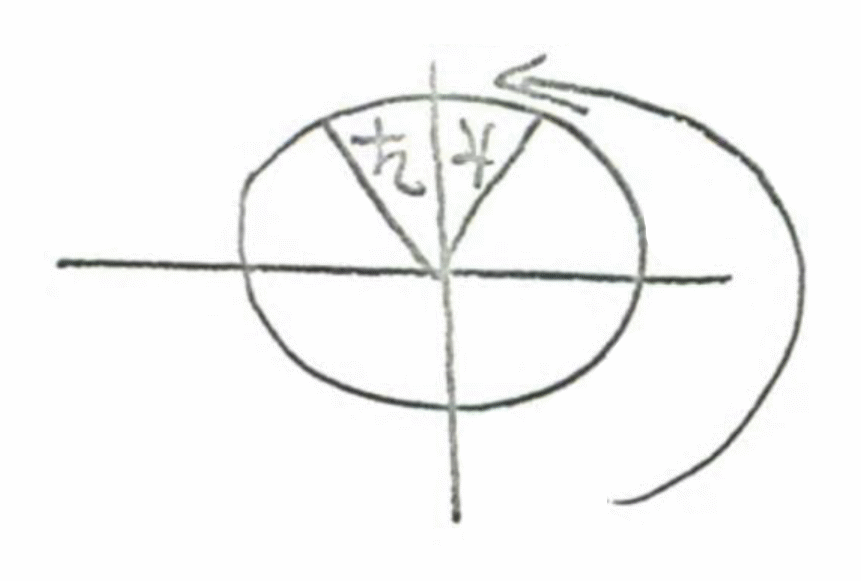
Review of diagram from 12/15/72 with the addition of archetypes connecting ascendant-descendant (sensation-intuition) and midheaven-nadir (thinking-feeling)
Discussion of these axes as irrational and rational and meaning of this
Human intellect beyond the four functions
Is there an objective manifest space-time cosmos without reference to an individual observer/center of consciousness?
Differentiating World-Mind as Nous and World-Mind as cosmic "I"
Reading selections from Plato's dialogues on friendship between student-teacher; correlated with Jung's transcendent function
Reading/discussing Jung, "The Transcendent Function"
Facing your moods/emotions directly and letting them produce fantasies
Creative formulation and intellectual understanding of fantasies
Confronting unconscious counter-position with ego standpoint
Explanation and importance of natural reaction of whole man versus partial predetermined reaction
Transcendent function compared with Kant's/KCB's "Transcendental Method"
Transcendent function as the freeing nature of Consciousness
Various examples of transcendent function, including astrological and metaphysical examples
Distinguishing insight and intuition
No liberation without differentiated ego
BOOKS READ FROM OR REFERENCED:
Paul Brunton, The Wisdom of the Overself
C.G. Jung, CW 11, Psychology and Religion, "Answer to Job"; "Psychological Commentary on The Tibetan Book of the Dead"
Plato, Seventh Epistle, Phaedrus, Apology
C.G. Jung, CW 8, The Structure and Dynamics of the Psyche, "The Transcendent Function"
Paul Brunton, The Hidden Teaching Beyond Yoga
Krishnachandra Bhattacharyya, Studies in Philosophy, Vol. 2, "Studies in Kant"
C.G. Jung, CW 6, Psychological Types
John Milton, The Complete Poems of John Milton, "Il Penseroso"
DIAGRAMS appended to this transcript:
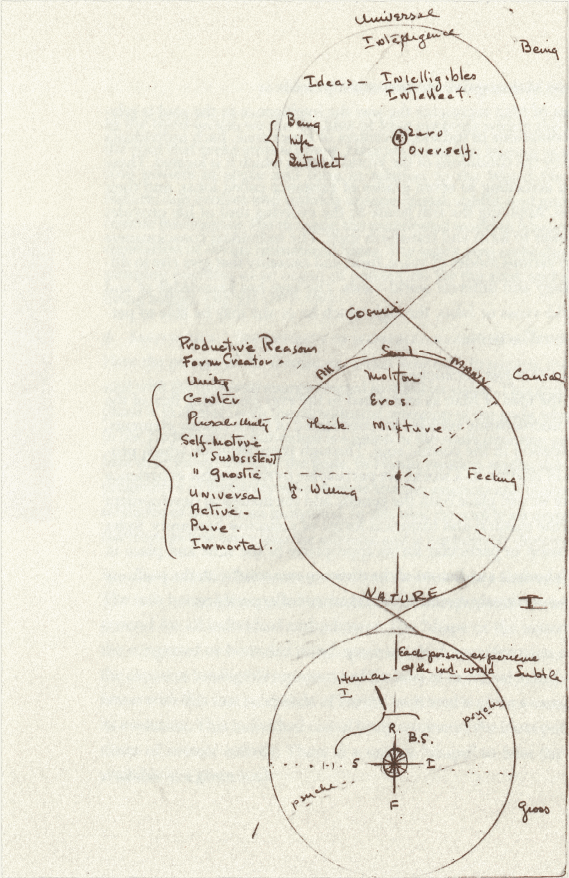
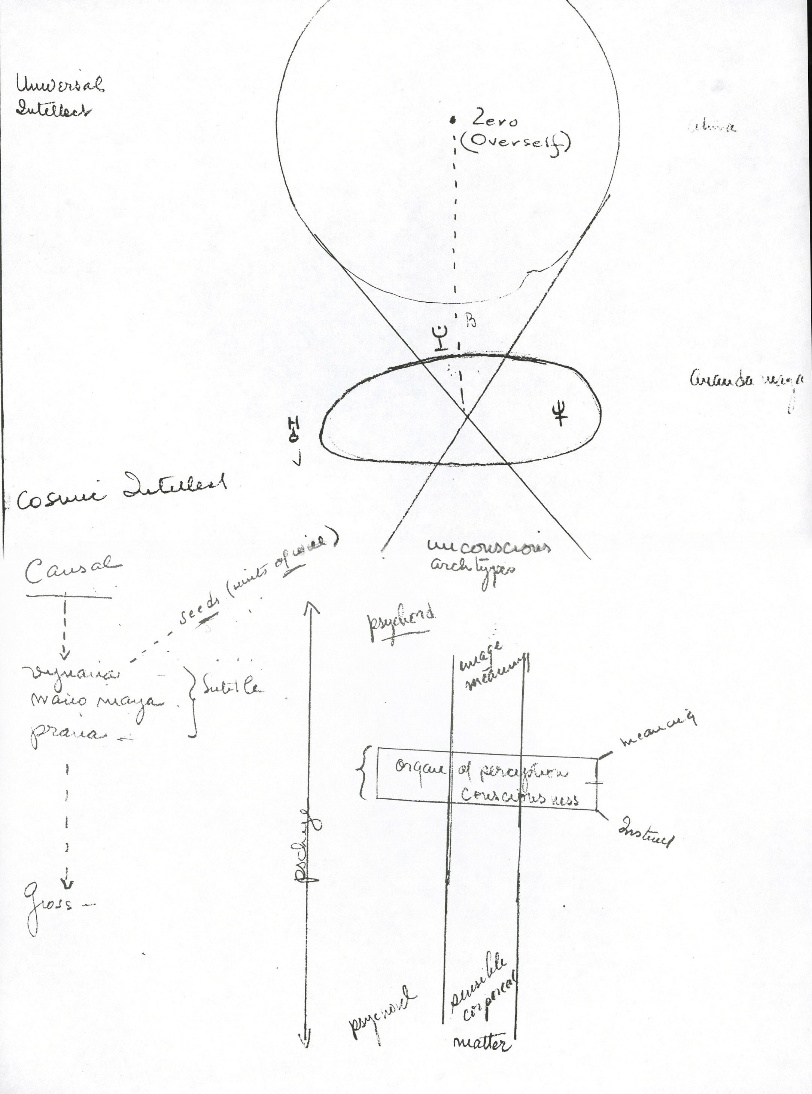
FIGURE AD_G_012. Three Circles Diagram: Divine Intellect, Soul, Psyche.
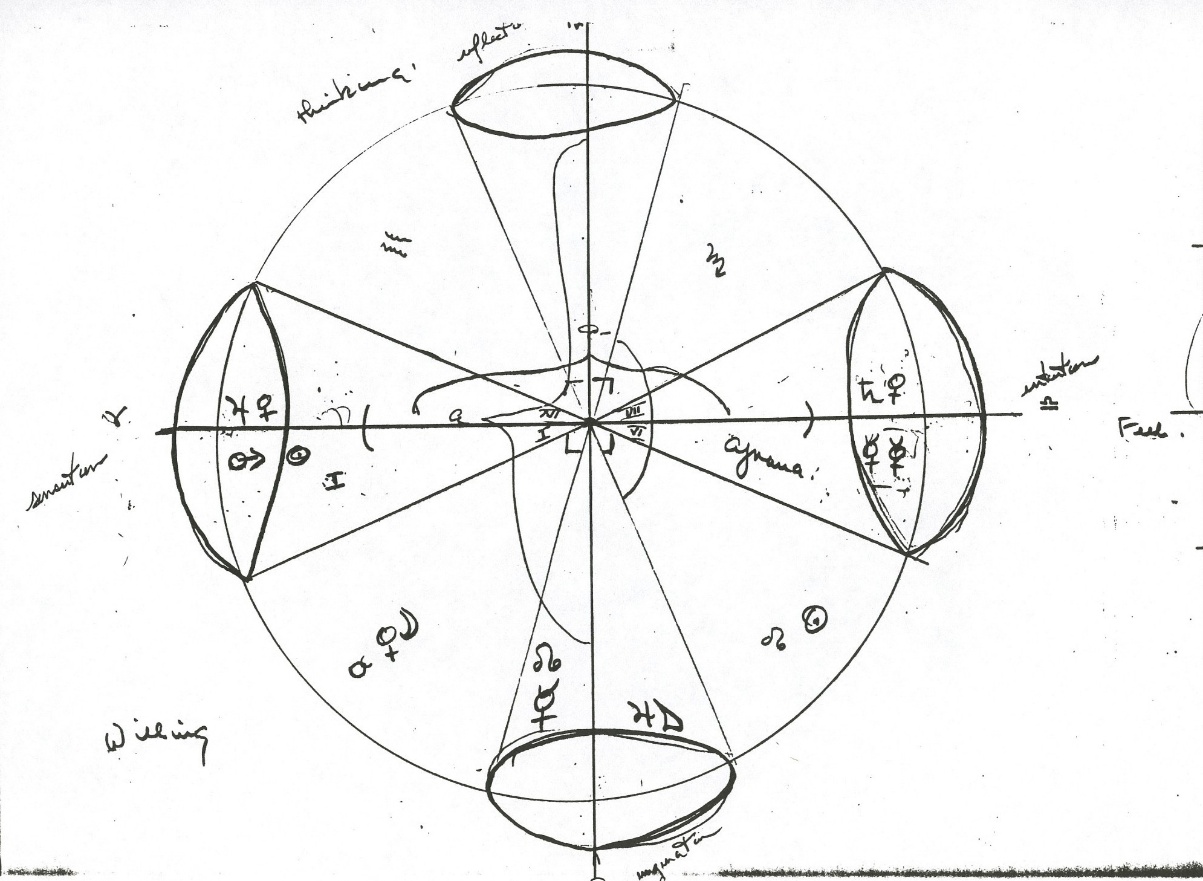
FIGURE AD_G_011. Four Psychological Functions and Thinking Feeling Willing mapped onto Twelvefold Chart; with rulerships and exaltations for houses 12-7.
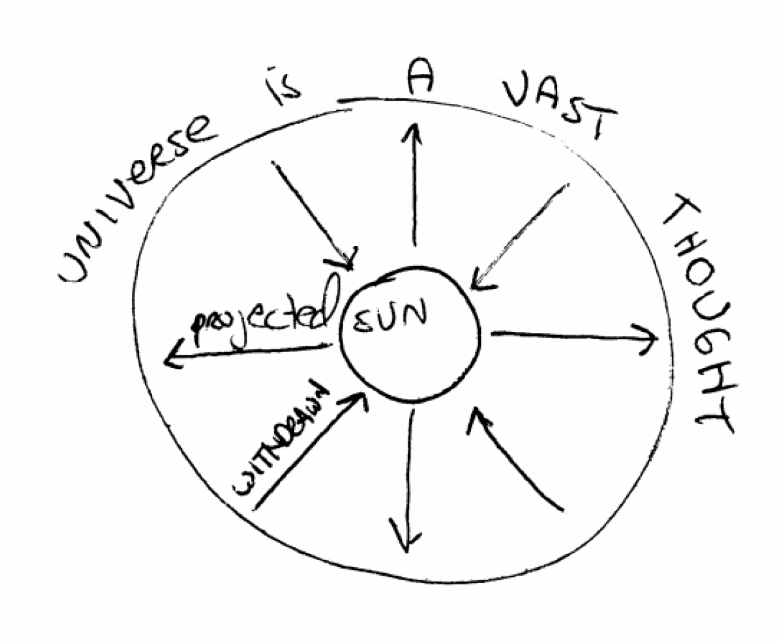
FIGURE 1972 1222-3-AB. Universe as Sun's Vast Thought.
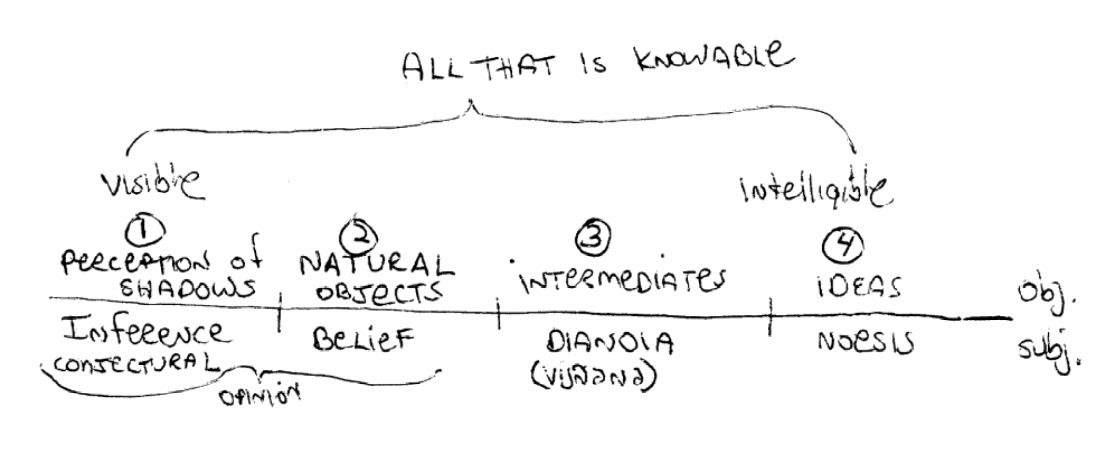
FIGURE 1972 1222-4-AB. Divided Line.
FIGURE 1972 1222-5. Movement from ninth house Jupiter (fixed knowledge) to tenth house Saturn (controlled manifestation).
FIGURE AD_G_019 merged. Universal Intellect, Cosmic Intellect, Psyche.
Other diagrams also referred to are not with this transcript version. [Transcriber note: [diagram] means the speaker is referencing a diagram as he or she is speaking. If someone is drawing or writing, with audible sounds of chalk on a blackboard, I indicate this by [drawing] or [writing].]
NOTE: For readability's sake, the following substitutions/edits made in Verbatim Transcript: gonna = going to; gotta = got to; yeah = yes.
TRANSCRIBED Verbatim by IT prior to 2017, reformatted by jf 2017. In 2023, IT updates prefatory matter, footer, and audio file name, fixes/completes Book List, fixes errors/typos, adds new notes within transcript, adds six diagrams and references within transcript to these diagrams, reformats to accord with new conventions. In 2025, IT updates audio file markers to match new REP audio. Archival verbatim transcript – V12a.
AUDIO FILES: 1972 1222a, 1972 1222b, 1972 1222c. [Note 1: "Tape" refers to original audio cassette tapes that were later digitized into .MP3 Audio Files. Note 2: It seems there was something else on these tapes before and sometimes you can hear it faintly in the far background. Note 3: In 2024, REP Studio cuts dead air from file c.]
1972 12/22 at Wisdom's Goldenrod
Jung; Transcendent Function
[Audio File 1972 1222a Begins]
AD: Before I get off on that-- [aside] no-- I'd like to review this diagram which Myra considers very stale and old. (laughter)
S (in background): Avery [couple words inaudible]
AD: And it may give you a perspective, it may help you a little bit. Paul, above you there's the Wisdom of the Overself.
PD: Ok.
AD: Would you turn to that paragraph where he says, "All this may psychologically be summed up," ok? [AD to himself about his glasses] I can't see without them, but I can't read with them. [30½ second pause] You find it Paul?
PD: Uh-hm.
AD: Would you read that please?
[Transcriber note: I am using The Wisdom of the Overself by Paul Brunton, Rider and Company, London, 1943.]
PB [The Wisdom of the Overself, "The Unveiling of Reality," p. 194, PD reading]: "Psychologically, all this may be summed up as follows: When Mind is active in knowing and distinguishing one thing from another, it is finite consciousness. When it assumes forms and qualities, it is the things themselves. When it is centralized as an individual observer of these presented objects it is the"I". When it is centralized as the observer through the Overself of all the innumerable separate observers, it is the World-Mind. When it is passively at rest, it is itself, Mind."
[Note: See FIGURE AD_G_012 for the following.]
AD: Alright, let's see if we can see this on the diagram, ok? Would you read the first sentence?
PB [The Wisdom of the Overself, "The Unveiling of Reality," p. 194, PD reading]: "…When [PD reads: The] Mind is active in knowing and distinguishing one thing from another, it is finite consciousness."
AD: Do you all follow that sentence?
S (very faint): (I don't think)(--/.)
S: Would that be just in terms of the discursive intellect?
AD: (How are) you using the word 'intellect', like over here [diagram]?
VM: He said 'discursive intellect'.
AD: Yes. That's discursive too [AD indicates on diagram].
S (very faint): Uh-hm, (right/yes).
S: Isn't this (sort of like world)?
AD: Huh?
S: (Just) not that. One thought-- maybe one thought is just, you know--
AD (simultaneously): Ok. The way (you/we) ordinarily use it, ok. Alright, reread that first sentence.
PB [The Wisdom of the Overself, "The Unveiling of Reality," p. 194, PD reading]: "…When Mind is active in knowing and distinguishing one thing from another, it is finite consciousness."
AD: Alright so, over here, if you look at the chart, ok, if you look at this chart here now, here's the person located here, so to speak [little circle within bottom circle]. [drawing] If we take this symbolically representing the world of Ideas [top circle], the creative aspect of the Overself, let's say, in terms of the soul [middle circle], and the manifestation of the creative Ideas through the-- through the Logos becomes this cosmos [bottom circle] and you're in that world [little circle within bottom circle], ok. This is the ego complex over here, alright, now you're in here, [student assents] ok? [S, faint: Ok.] So now he says that when the mind, so to speak, operates in terms of distinguishing one thing from another, you're in here [little circle within bottom circle], alright, you're in this circle, alright. The next thing he says--
PB [The Wisdom of the Overself, "The Unveiling of Reality," p. 194, PD reading]: "When it assumes forms and qualities, it is the things themselves."
AD: Ok, so that when this-- when this entity is operating here [diagram], so to speak, we speak-- at the-- on one hand we speak of the person seeing this objective world here, 5th to 8th house, in this area here, the intuited world [FIGURE AD_G_011]. That's where the world-- And notice, he always stays inside the psychological functions [cross within little circle within bottom circle]. This is the ego complex, ok. Thinking, feeling, sensation, intuition, in-- in the Jungian terms. Go ahead. The third--
PB [The Wisdom of the Overself, "The Unveiling of Reality," p. 194, PD reading]: "When it is centralized as an individual observer of these presented objects it is the"I"."
AD: What do you think he's referring to there Paul?
PD (very faint): Well, I don't know.
AD: Try.
PD: I barely got it [one/two words inaudible]
AD: Alright, read it again.
PB [The Wisdom of the Overself, "The Unveiling of Reality," p. 194, PD reading]: "When it is centralized as an individual observer of these presented objects it is the"I"."
AD: Anybody? Which presented objects?
[short pause]
VM: It must be all of formal manifestation that he-- I think he's referring to soul in that diagram [middle circle]. All the presented objects would be everything in the gross, subtle plane, everything in this bottom circle [diagram], and the observation of it would be from the point of view of the soul.
AD: In other words, [VM simultaneously: Which was the formless manifestation but still.] it is the-- it would be the presupposition [VM simultaneously: (Of that).] of the manifested universe. Read the ne-- the fourth.
PB [The Wisdom of the Overself, "The Unveiling of Reality," p. 194, PD reading]: "When it is centralized as the observer through the Overself of all the innumerable separate observers, it is the World-Mind."
[student assents, faint]
AD: Try that again, that's a little hard.
PB [The Wisdom of the Overself, "The Unveiling of Reality," p. 194, PD reading]: "When it is centralized as the observer through the Overself of all the innumerable separate observers, it is the World-Mind."
AD: Alright, this is where you have to use the-- [drawing] use this diagram, so to speak. That's the ray of the Overself [dotted line coming down the middle], ok? And there's a lot of little Overselves over here [diagram], ok. [Note: The following diagram not available.] Now, the other representation could be like, you could make the circle like this, [drawing] put the Overself here [diagram], make a circle out there [diagram], ok, because that could be put in here [diagram], and you could imagine this ray of the Absolute Consciousness, so to speak, going down [diagram]. And this would be the sense-- the world of objective form [diagram]. And imagine a circle over here, like at right angles to it [diagram], and this would go into-- into that circle [diagram]. Now you-- you can see, in a sense, in a diagram like this from here [diagram], this here centralization would correspond to the World-Mind [diagram]. In other words, the World-Mind would be the center which defines the circle but it itself is never defined. Now you have to-- you have to remember, he says, "All this may be psychologically summed up…" So, he's always telling you, stay here [little circle within bottom circle] where you are, [S: (Yes.)] in terms of your psychology, and try to understand that this is psychologically represent-- being represented to you so that you can understand it. But that doesn't mean that you live there. And that you're-- you're not the Overself, you're not the World-Mind, but psychologically he's got to present it to you.
LR: Could I hear the second sentence Paul?
AD: Let him finish the fifth and then we'll repeat the [LR simultaneously: Oh, sorry.] whole thing, ok? We'll repeat this.
PB [The Wisdom of the Overself, "The Unveiling of Reality," p. 194, PD reading]: "When it is passively at rest, it is itself, Mind."
AD: Ok? Now you've-- now you've seen that you have to take the circle and forget about it [diagram]. In other words, imagine a blank board, alright. That's Mind-in-itself. Then I-- then I put [AD puts it on board]-- put that center there--now you got World-Mind, the center, the zero point [in top circle]. Now I bind it, so to speak, put the limitations all-- on the possibilities that are going to be manifest [diagram], ok. Then I have to draw another circle over here [drawing/diagram] so that I have a world of sense and form. Now all these-- all this, so to speak, (in/and) this here [diagram], is represented in the psychology, the ego complex. It's represented in your imagination. And that's why he says, "All this may be psychologically summed up…"
S: [couple words inaudible]
S: (Quite) possible to say where the binding in that first circle takes place [few words inaudible]
AD (simultaneously): Repeat Dave.
S: Say, you know, when you drew that circle around the point, is it possible to say where that happens and where-- what that corresponds to, instead of princ-- principle of saying cosmos or--
AD: Well don't you remember, PB makes (out/up)-- he makes the point that he says imagine like the sun rising, its rays extending and, so to speak, you know, from this point the rays shoot out in all directions like a circle. And you can imagine this process going on to infinity. And then you could imagine this process contracting and pralaya sets in. Then the point appears, the light shoots out in all directions, the universe is manifest. You can imagine this process going on and off, pulsating in and out [FIGURE 1972 1222-3-AB].
But what's important here is that in terms of the way we've been working and the general background we've been building up, is to remember this here. First of all, Jung says, "I am an empirical-- I am an empiricist, I work in psychology, and what I speak about are the categories of the imagination." So he says here's where we live [bottom circle]. [drawing] That's where we are, the c-- "I am concerned with-- with this problem." And, on the other hand, when-- if you take a person like Immanuel Kant, he's concerned about the categories of thinking, what the presuppositions are that are involved in our thinking. Now the presuppositions of our thinking is space and time and causality and mode and attribute and what not.
Now, on the one hand, you can see that the cosmic "I" over here, the Witness-I over here [middle circle], is the presupposition of thought, alright. Without this here, we can't speak. But, if-- if we think of a world at all and experience is being made possible, in other words, if I say something is true today, with Kant the interest was on-- wasn't on the truth, you see, that was secondary. For Kant, what was really of main importance was, what is it, what knowledge can I have today which, so to speak, underlying it or structuring it, will apply (to/till) tomorrow and the next day and the day following. So he was concerned more about the conditions of thought, what made thought valid, what made experience possible. So he was functioning over here [middle circle], he's-- [drawing] this is what he's concerned about, Kant.
Now, Jung makes it very clear that he is not in that realm. He is operating with the categories of the imagination, all the representations, all the imagery that comes up in a person's mind. Now these are two totally distinct realms. Could you try to remember that please? So that when you criticize him, you don't criticize him for the wrong reason. (If--) if you criticize him do so for the reason (he does).
Now, one other point I'd like to-- I'd like to point out and that's briefly to summarize and bring together in a little-- in a little way-- [drawing] Here you have the Greek scheme, remember, where they divided up the gnostic faculties of the soul [FIGURE 1972 1222-4-AB]. And they-- they divided up, this is the invisible realm [right half] [drawing] and this was the visible realm [left half]. [short pause] And, in a se-- in a way what we're gradually is going-- what we will gradually do, is to integrate that into our conceptions and we'll see where these things operate in-- in a sense something like this, ok. [short pause] The problem or the-- the notion of the reflective consciousness that I was speaking of Wednesday was that this here [diagram] gets represented in the reflective consciousness through the imaginative ca-- categories [diagram], alright, the same way as this here [diagram] gets reflected in-- in here [diagram] through the imaginative categories.
Alright, now, the difficulty here, and it's-- it's a-- it's a-- it's a real difficulty, it's not an imaginary one, and it's one that's going to cause tremendous confusion constantly as you go along, is that the individual is a meeting place where there are, so to speak, in concomitance, various universals operating simultaneously. So on the one hand, you-- we can speak of, so to speak, the categories of the reason [middle circle] which are predetermined by, let's say, the Ideas here [top circle] but, the categories of the reasons which are universal, operate and help in differentiating his thinking. At the same time as you have these general categories, you have the instinct image of the-- the archetypal "I" that's symbolically represented by the chart. So you have these general categories which are predetermining that archetype and you have archetypes operating within the categories of the imagination, so to speak, making available to him the experience that he is acquiring in the world and transforming at the same time the instinctual image or archetype of the "I". You follow?
[Note: See FIGURES AD_G_012, little circle within bottom circle, and AD_G_011 for the following.]
In other words, within here, [drawing] within here, alright, the 1st and the 7th house, we said sensation operates here [ascendant], intuition operates there [descendant], and we know that there has to be a bridge to connect the sensation and the intuition, alright, and we put this intuiti-- We'll do this here [drawing], something like this. And we know that there has to be some sort of archetype that connects the sensation and the intuitions that are operating into some sort of intelligibility, because if this was the chart, let's say, of a dog, the intuited world would be quite different for him in comparison to me, you know. I mean, my intuited world would have to correspond somewhat to the world I operate in and the dog's world would also have to correspond in that sense. A dog would be locked up in there the same way I would but, for instance, for a dog there is no color, alright, so his intuited world is a little different. Now, what combines the intuited world out here [diagram] with the sensations that are pouring through him [diagram] is this archetype which we say is leading him through experiences, you know, these experiences which get distilled into some kind of understanding and eventually force the opening up or the widening of the personality.
VM: (Then) are you speaking of the instinctual image now, Tony, that Jung referred to, that's transformed and is a transformer?
AD: Well, I'm speaking of both. On the one hand, there's this archetypal "I", right, which, let's say, could be represented this way, [S simultaneously: (one/two words inaudible)] from up here [drawing/diagram], ok?
VM: You mean the entire chart [AD simultaneously: Yes] is the archetypal "I".
AD: No, this line here [vertical line/rational axis]. [drawing]
VM: That line(./?)
AD: Yes. And on the other hand, this line here [horizontal line/irrational axis] which would represent or bridge the sensation and the intuitive world, you would have an archetype going down here [diagram]. And I try to point out-- try to point out that these two [diagram], this is the irrational, this is the rational, and it seems that it's a combination of the both that gives us the form of the individual. Just the form, never the individual entity, (we'd/we) never know what that is.
VM: Wait a minute, let me see if I understand, are you saying that this vertical axis [S in background: No.] represents archetype of the individual in-- I'm not sure what that means. But then this irrational axis is the axis where the, let's say, various archetypes, archetypal situations are brought into the life and that vertical line is in some sense transformed through these experiences?
AD: [drawing] Alright, let's try to make that a little bigger, see if you can understand that or clear it up. [more drawing] We spoke about this as sensation [ascendant], we spoke about this as intuition [descendant]. We spoke about this as thinking or the reflective consciousness [midheaven], and this the feeling [nadir]. Now-- [short pause while drawing; one/two inaudible student words] These are not the planets by the way, right? They're just representing certain principles. Now at this end over here [ascendant], I get a certain sensation, right? At the same time that I get a certain sensation, imposed upon that sensta-- sensation is a certain structuring.
VM: Immediately, sure.
AD: Alright. Immediately, when I speak of intuition I'm speaking of sensation and when I speak of sensation I'm speaking of intuition [descendant]. So there's this combination of the world of sense and the world of understanding. Ok? Now you can see in a sense, this is given [diagram] in terms of your activity in the world, ok, this is given. But you have a relative freedom up here [midheaven], so to speak, and down here [nadir], [VM assents, very faint] in the sense that your feelings about it could alter and your thinking about it, over here [midheaven], could alter. Now--
VM (faint): It's relative, right?
AD: Yes, [VM simultaneously, very faint: Ok.] you think it's relevant but the point [VM simultaneously: Relative I (say).] is that there-- the point is that there is room for error here and here [midheaven and nadir]. Ok? In what way? Well, before the person-- remember we spoke about that what-- This was the difficulty I think that we had the other time too, that in order to consider the reflective consciousness in its true and proper meaning here [midheaven], this is the Intelligible [FIGURE 1972 1222-5, Jupiter] and this is the Intellect [FIGURE 1972 1222-5, Saturn], this is a very controlled function, that the manifestation of the whole that's operating in the 9th house coming out through the 10th and controlled by the Saturn complex here [diagram], that in order for this to be truthful and meaningful(,) it would have to correspond to that fixed knowledge [in 9th house] that we spoke about.
VM (faint): It would be the knowing function within that.
AD: Ok. And that gradually as the person acquires the principles of the reflec-- you know, reflections in life and accords more and more, brings his personality in alignment with the total situation that is found here [ninth house], alright, then this would have to align itself, so to speak, with what is Intelligible, the highest reasons that are operative here [ninth house]. So in a sense we could say if a-- let's say a Sage is caught in a situation where he has to perform a certain act and we say that the act or his response is totally adequate to the situation as the cosmos is at that time. That means that functioning from up here [midheaven] his action will be totally appropriate in terms of the fixed knowledge which we find in here [ninth house], whereas [S simultaneously, faint: (one word inaudible)] we would vary and, you know, fumble the ball which, even when we do something right it's more because of an accident. Ok? (some laughter, possibly one/two words inaudible) (Yes.) Alright, so, in a sense there's this combination that I'm trying to work with, where we have the person, you know, the individual in terms of the rational up and down thing [vertical axis], and the irrational [horizontal axis] in this sense and-- (But) it's the best representation we could make of that entity which always remains unknown, because fundamentally we know that the Purusha cannot be known. The only things that we can know are the forms, the forms that he operates through, the world that he perceives, this is all. But the Purusha itself, never. We cannot know the knower under any condition. There's no knowing the knower. It's a pure contradiction. So we always leave him out, thank heavens.
Alright now, this-- this is what's important. We have to place ourselves when we're studying Jung, we have to place ourselves in this psychological realm [AD indicates on diagram, bottom circle]. And when Jung does make excursions and starts talking about this realm, acausal [top circle], you know, then we have to recognize the fact that now he's stepping out of the empirical or trying to infer something above the empirical through the use of psy-- psychological material. [student assents] Now, the other point was that I see an archetype operating here, bridging the sensations and the intuited world [diagram]. Ok? I see an archetype operating here, bridging, so to speak, these two portions, the rational parts [diagram]. This [vertical axis] seems to be closer to the cosmic "I", the cosmic-- the Witness-I.
LR: Which is Tony?
S: Yes Tony.
AD: This-- this up and down axis [diagram].
PD(?): Is that first found in an instinctual image?
AD: I would-- I'm inclined to think so. The instinctual image or the archetypal "I". Ok? Now, I don't know now, we'll-- I had you read this Sunday and I'll read it again now and see if it's more clear. In his "Answer to Job", Jung says--
S (very faint): [one/two words inaudible]
C.G. Jung [CW 11, Psychology and Religion, "Answer to Job," p. 409, paragraph 648, AD reading]: "It is perfectly possible, psychologically, for the unconscious or an archetype to take complete possession of a man and to determine his fate down to the smallest detail. At the same time objective, non-psychic parallel phenomena can occur which also represent the archetype. It not only seems so, it simply is so, that the archetype fulfils itself not only psychically in the individual, but objectively outside the individual."
AD: Ok? Now you see, you have to have these two archetypes operating. On the one hand you can see, so to speak, [VM simultaneously: (Oh yes) (couple/three words inaudible)] the psychic element [vertical axis] and over here the so-called non-psychic operating [horizontal axis].
LR/S(?): So it's like I see things so [couple/few words inaudible]
[sounds like there's a struggle with the microphone for the duration of the AD paragraph below so some of his words are inaudible or very hard to hear]
AD (simultaneously): In my opinion, that [couple words inaudible] because he's forced to (think) different things. There's an archetype structuring his thinking. The (biggest) sense we can use this paragraph too when he says here the archetype or the unconscious, and you can see now he's talking about up here [FIGURE AD_G_019 merged, 'unconscious archetypes' below middle circle]. Because this-- this entity up here is Overself [in top circle] which controls the manifestation of this individual down to the last detail almost. Now, (if I) sound kind of pessimistic, and of course someone like PB would say, "Well, you can make some errors, don't worry, you know, you got a little freedom." [S simultaneously, faint: (Tony), could I-- could I (one word inaudible)] But you could say that, I can't. (Change your tire.) (some laughter)
S (faint): (Tony, then), could you ask one [couple words inaudible]
AD (simultaneously): Yes sure, Crystal, please.
S (faint): On the irrational axis is that middle structuring them, it (leads) the sensations and intuitions, does that structuring-- am I supposed to think of that as-- as an individual structuring? I mean I don't know at that point when I think of that axis-- axis whether to think of that as a reflection of the Intelligible or [couple words inaudible] do with the individual [few words inaudible]
AD: Go ahead, keep trying Crystal, I-- I got to see what you're saying, you know. I hear it but I don't see it yet. Go ahead.
S (faint): Well, just if-- if you just consider that axis of the structuring of the intuited world without thinking and feeling being brought in, do we have-- do we have a-- an intuited world that refers to an individual if we ignore the rational axis? On the [one/two words inaudible], you know, if-- if we-- if we were just speaking of the irrational axis [one/two words inaudible] that structuring, (wouldn't it be--)
AD (simultaneously): But could you have-- could you have this here, you know--
S (simultaneously): No.
S (whispering): That's what I think, too.
AD: [drawing] Can you have this [diagram]? When you set up the chart, don't you have to use these two points [diagram]? I mean, can you set up the chart without the ascendant and the midheaven?
LR: Yes, but aren't you asking whether--
S (faint): No.
AD: Ok?
LR: --whether on that axis there's just the individual's world or the world of, say, the fixed knowledge?
S: Yes [few words inaudible]
LR (simultaneously): Is it the individual's archetype or is it the archetype for a lot of different people?
S: Yes.
S: Yes, right. Maybe that's just [few words inaudible] I can't do that, I can't consider the one axis.
AD: Well, you could do it abstractly, yes, you know, you can separate the stick and say "See I only-- I've got one end" and you give me the other-- the dirty end to answer with. But there's some-- something in what you're saying, Crystal, because in a sense, of course, you get the feeling, if this is irrational [horizontal axis], if this is given, certainly it's coming from this area here [middle circle] because the cosmos [bottom circle] is structured or manifested according to certain principles which are inherent in the definition that we gave of the soul [middle circle], alright. And there would have to be, so to speak, a corresponding gnostic soul [middle circle], so to speak, that operates simultaneously, alright. And if we wipe away the world, let's say, alright, let's say we wipe away the intuitive given world, the gross world, well then there would be a subtle world [in bottom circle] which also would be subject to the same sort of conditions where he's fed certain understanding, certain sensations, you know, and he intuits a certain sort of subtle world, and he ge-- gains a certain understanding from that subtle world. That-- that's very beautifully done in the-- Jung does a good job of that in the preface to The Tibetan Book of the Dead, and he shows you these planes-- three different planes, you know. But, if you can see that, you know, you're tearing one away illegitimately then you see that as you think you have to think, so to speak, on a broad front. It's like an army advancing, you know, there's a whole flank. And the whole flank has to move up always simultaneously. You can't have part of it carry on a rear guard. You got to move along as you move, all your thinking has to cover all the points. But the way we're constituted we can only handle one at a time. So if we talk about one end of the stick [AD indicates on diagram], everybody starts saying "Well what about [AD indicates on diagram] this end, you left it out."
S: (But/If) (the) [AD simultaneously: (one word inaudible)] content (that) wasn't as subtle because it seems to include the midheaven or the thinking, then there are like less limitations or less-- somehow less structured by this-- by this-- well, less structured by the-- the laws that govern the world somehow.
AD: Yes but-- that's very true but there would still be, so to speak, certain structures in the subtle. As a matter of fact, that world is more incomprehensible in some ways than this one. It has a much wider scope. So, as of now, I mean, this should establish, so to speak, some kind of relative references when we're speaking and we're trying to understand what this man is saying. And remember this here: this universal intelligence [top circle] divided up into cosmic [middle circle] and then the human [FIGURE AD_G_012, "Human I" in bottom circle], that this human intellect, so to speak, is the light behind these four functions [cross within little circle in bottom circle] and this is not to be considered, alright, as any function within it. In other words, you operate in terms of thinking, let's use the Jungian terminology, thinking, feeling, sen-- what he calls sensation, sensation type, and the intuitive type. Now, he is not speaking about the (Intellect/intellect) here [AD indicates on diagram]. When he speaks about thinking, he speaks about two kinds of thinking, one which is directed, one which is-- which isn't directed. The kind that isn't directed is like when you have fantasies, they just occur up in your [S simultaneously: (one/two words inaudible)] mind. The directed kind is where you bring in linkage with the various concepts and you direct where and what-- whatever the goal is. But that is not the human intellect. The human intellect is what would light up these functions. And after a while you see these [cross, Jung's 4 functions] are just mechanical pieces, alright. They are not the human intellect [AD indicates on diagram]. Yes--
JL: The chart has a correspondence to the cosmic level too, doesn't it? I mean-- What Crystal was asking, can the-- the cosmic horizontal have-- have an independence apart from the individual [one word inaudible]
AD: Try again.
JL: Well, to the extent that-- that the-- the archetype of the chart exists also in terms of-- of a cosmic soul, wouldn't (they have like--) or a-- a solar system, and not-- and not only in terms of the individual?
AD: I'm sorry, I still don't understand you.
JL: Well, to have a cosmos, you don't have to have individuals (there).
S (very faint): (Say it one more--)
JL: Or [S simultaneously: Can you explain that?] perhaps, or perhaps [VM simultaneously: How can you do this John?] the archetype of the chart exists in the-- in the cosmic soul.
VM: Hey Johnny, go back to that first sentence, will you? How can you have a cosmos without an individual center of consciousness?
[students assent, very faint]
S: [one/two words inaudible]
JL: The cosmos exists just as much as a-- as an object to the-- to the-- to the World-Mind as it does to your-- your consciousness (for you).
VM: Uh--
RG: Does it exist as that object without an individual within it? [couple words inaudible]
JL (simultaneously): What do-- what do you mean by individual?
RG: I mean by--
JL: That you have to posit-- you have to posit a human individual?
RG: [few words inaudible]
VM (simultaneously): Well, not necessarily human.
JL: I mean that's anthropomorphizing it, you know, that's anthropomorphizing [couple/few words inaudible]
VM (simultaneously): Let's just say angels then or I mean there's got to be some center there outside from the World-Mind.
JL: Why can't the World-Mind be that center?
VM: Well that's the Overself.
RG (simultaneously): Then there wouldn't be a cosmic Self. There'd be no need-- there'd be no manifestation.
JL: Why?
RG: It wouldn't be manifested.
JL: Does it have to be manifest [S simultaneously: (few words inaudible)] to a human individual?
RG: No, we're not saying a human individual, [LR simultaneously: But some center of consciousness.] any center of consciousness.
VM (simultaneously): Some center of consciousness, John.
JL: Well that doesn't exempt the World-Mind then.
LR: Well--
LR: No, [VM simultaneously: Call in the referee.] you're throwing it back-- you're making of-- sort of a vicious circle. You're saying the World-Mind [JL simultaneously: Uh-uh.] has-- that the [VM(?) simultaneously: (That the world--)] world is stemming from the World-Mind for the World-Mind.
S: [one/two words inaudible]
JL: No, all [LR simultaneously: (As you--)] I was-- well, perhaps I'm saying that but I'm also implying that-- that the cosmic manifestation does not-- does not demand human individuals.
S (very faint): (Uh-hm.)
VM: I don't think we said human John, I-- I mean at least I didn't. I-- I think it's a question of one really just has to have a center of consciousness and I don't know if you can really talk about the World-Mind as a center, you know, may-- I'm not thinking this is too clear.
LR (simultaneously): Yes, the point--
JL/S(?) (simultaneously): [couple/few words inaudible]
LR: The point is you wouldn't even be able to say that, that [one/two words inaudible]
VM (simultaneously): You're (going to/could then) localize it?
JL: Do you-- do you create the universe?
LR: Wait.
VM: No, I help though.
LR (simultaneously): First your original statement, ok, that-- (laughter)
PD/S(?) (amidst laughter): Yes, (I didn't think so). (more laughter)
LR: --your original statement that-- that the [S simultaneously, very faint: (couple words inaudible)] cosmos can-- can exist without any form of consciousness there, um, [JL simultaneously: Um--] how could you say it?
JL: Human form.
VM: Yes, (I didn't mean to) give up on the human. (some laughter)
LR: Yes, if you want to just limit it to human(s). I don't know. I mean, I wouldn't be in a position to say.
JL: Well [few words inaudible]
LR (simultaneously): Because [VM simultaneously: (couple/few words inaudible)] you're a human saying it. You're a human formulating that question.
JL: Ok. Ok, maybe-- maybe I'm [possibly couple words inaudible] (laughter)
VM/S(?) (amidst laughter): What's your shadow? (more laughter, student words)
LR: [inaudible]
AD: That's selective shadow, don't run after it. One at a time is enough. (laughter)
LR(?) (faint): Well no, say more.
JL: To the extent-- to the extent that the universe has-- has a cosmic objectivity, (alright--) Well, just take the realm of (literal--)
RG (simultaneously): But you wouldn't speak of a world of the World-Mind perceiving cosmic [S simultaneously, very faint: (few words inaudible)] objectivity, you'd have to speak of it through an Overself.
VM(?): Right, (you--)
RG (simultaneously): You wouldn't speak of it as the World-Mind there.
JL: But that Overself [S simultaneously: (one word inaudible)] is not an individual.
VM: Well it's the absolute individual, John, it's the [JL simultaneously: (one/two words inaudible)] first individual.
LR (simultaneously): [one/two words inaudible]
JL (simultaneously): Ok, ok, I wouldn't-- I wouldn't deny that but, um--
VM: Actually let's-- maybe it's a [S simultaneously: (couple words inaudible)] side factor. Why don't you say what you were going to say, I got off on my little (fight).
S: (It's brief.)
S (very faint): (Uh-hm.)
VM: Ok?
[noise or one inaudible student word]
JL: Well, the question-- the question is essentially, what is the origin of the objective universe?
[AD drawing; continues as class continues]
[couple inaudible student words, some laughter]
PD/S(?) (very faint): (Yes.)
LR: Yes I know. You're asking if the cosmos has an objectivity. Now--
JL (simultaneously): Apart from the individual.
LR: --you're-- what you're talking about is the cosmological structure before we get down into the individual structure, (is that right)?
JL: It seems like that the world of plants and minerals and solar systems and that sort of thing, I mean, these certainly don't depend on the human.
VM: But to speak about them John, don't you have to posit an observer, [S simultaneously: An individual.] an individual observer?
[few faint inaudible whispered words, not sure if part of class or not]
JL: To speak about them, certainly to conceptualize them, yes. But, it's also very possible that the World-Mind does conceptualize them in the sa-- well in a-- an ana-- analogous sense.
PD/S(?) (very faint in background): [few words inaudible]
S (faint): But John, don't we define the World-Mind by saying that it doesn't hold its Thought as separate from itself, it at once-- it at once(--) its Thought (is a-- is) itself so, I mean, it couldn't be the center which makes for a manifested universe. You have to go down a level.
JL: How do you mean it (teaches) its (Thought to) itself, what (are/do) you-- what (are your) [S simultaneously: (couple words inaudible)] [few words inaudible]
AD (simultaneously): Do you mind if I interrupt?
S (faint): No.
VM (faint): I don't.
S (very faint in background): (I don't.)
AD (simultaneously): Do you mind if I interrupt? Would you ask the question? Would you formulate the question please?
JL: At what level is cosmic determination-- is cosmic manifestation eternal?
AD: At what level cosmic determination--
JL: --is cosmic manifestation eternal?
AD: You mean this cosmos, this aeon?
JL: Yes. And doesn't that contain also [AD drawing] the same archetypes as the individual, i.e., the chart, or the basic structure(s) [one/two words inaudible]
AD (simultaneously): Well, I'm very simple minded. Give me one question.
JL: (The/My) first one.
AD: Your first one. At what level is this cosmos determined? [short pause] Well, if you tried to answer it according to what PB said, what level would you put it at?
JL: Middle, second [diagram].
[students assent, very faint]
AD: Doesn't he point out somewhere, he says that the World-Mind has a picture of the universe in its totality, absolute, immobile, at rest.
JL: And yet it's not in manifestation.
AD: Manifestation could only occur with individuals. So even that knowing function would have to take place within that total picture that he operates with.
JL: Ok. How would you--
AD: Do you follow what I said John? You follow what I'm saying?
JL: Yes.
AD: Alright.
JL: How would you explain something like the-- (like the status) of a tree?
AD: Then you didn't follow what I said.
JL: And even the tree, it-- it has its individual--
AD: Because what you called the existence of the tree now is a process in time which has to be reintegrated in the total picture of an integrated fixed knowledge that forever is in the World-Mind. You know [JL simultaneously: Yes.] what you're doing? You see, you jump-- hop around. You hop around. You ask for an explanation from here [bottom circle] but you're talking up there [middle circle].
JL: But the tree does have cosmic manifestation.
AD: The tree has cosmic-- What do you mean, tell me what you mean by "cosmic manifestation."
JL: Objective existence.
AD: You mean that this tree that I see here is a tree that actually is.
JL: What do you mean by "actually is"?
AD: That I am perceiving it now in the process of recognizing [one inaudible student word or sigh] a manifested tree. I see a tree.
JL (simultaneously): Yes, but I'm-- but I'm [S simultaneously, faint: (one/two words inaudible)] also--
AD: It's in time.
JL: I'm also [S simultaneously: (couple words inaudible)] asking, to what extent is it independent of your-- of your actual perceiving and how?
AD (simultaneously): What do you mean "independent"? Independent of every and any individual observer? What the status of the tree is then?
JL: You have to qualify that.
AD: In other words, are you asking me to tell you what the tree is independently of a cognizing subject?
JL/S(?): (Uh-hm.)
JL: Yes.
AD: I can't, because it is the cognizing subject that defines the object.
LR(?) (almost to herself): But that's where (things must) go.
S (very faint): Uh-hm.
AD: Ok, now this cognizing [sounds like student assents, very faint] subject does see an actual tree there and it's a process in time but we have to reintegrate that, when we speak about total knowledge, as part of the scene. That's what I was talking about Wednesday. The total picture, the total fixed knowledge is here [middle circle]. And here's a process in time where I perceive the tree [bottom circle]. And I ask you, take the analogy, imagine somebody's there with wireless photography filtering through your sense apparatus, alright, that totally fixed knowledge which you're going to perceive in time [JL simultaneously: Ok, ok.] and space, you see. But you have to take this here [diagram] and reintegrate it back (in/into) that total picture [diagram]. But when you do that, you're up in this realm [middle circle], [JL simultaneously: Yes, I see.] ok? When you talk about the tree perceived in time, you're down in this realm [bottom circle].
JL: Which to that extent relativized by the observer.
AD: Yes. [JL simultaneously: (few words inaudible)] And that's why you have to frame your questions very carefully now, because as soon as you say a question-- You can see for instance, if you put down "I see a tree," that you're running the gamut. Isn't that so? When you say "I see a tree," you've uttered the profundity that is outside your reckoning. But everybody thinks they know what they say, "I see a tree." Well what's so unusual about that? You only took in this realm [AD banging on board to indicate on diagram; bottom circle], this realm [middle circle], that realm [top circle], and the one I don't even have on the board.
JL (very faint): Ok.
AD: That's how profound these questions are, sure. That's why we get a little disturbed. We know we're missing something, (we/you) know we don't understand fully. And even when we have a theoretical understanding we still feel something stuck in our throat like craw. Well, next-- next time. [one/two very faint inaudible student words in background] Alright, try-- try to learn from that experience. Now you see how difficult it is to frame a question, how you're running up and down that-- these levels of references. Yes--
RG: I didn't follow the first thing you said to [couple words inaudible] at what level this fixed knowledge is. (Poetry), if I understand analogy, that this would be even the fixed knowledge of the cosmic "I" [middle circle] and you made that distinction, you tried to understand the difference between eternal and everlasting. And this fixed knowledge is eternal but not-- not everlasting, that the everlasting applies to the empirical, to the-- [tape break] applies to the--
AD: Well, how are you thinking of it now, Richard? There's eternity as the Greeks speak of it(,) where this whole manifested universe from the end of-- let's say the beginning-- the end of pralaya to the beginning of pralaya, and they refer to this as an eternity or an aeon. And then there's eternity in terms of, so to speak, completely out of time, timelessness will be more appropriate. And then there's another timelessness or ever-- everlastingness where this universe is, and then it isn't, and then it is, and then it isn't. So everlasting there would coincide, so to speak, with the appearance and the disappearance. In other words, anything that's in time would be everlasting, you know. I me-- I mean, whatever is-- whatever principles are being manifested in that universe that's manifesting, they would be everlasting because every time a universe in manifestation, they're there too. [RG simultaneously: (one word inaudible)] So you would say they're everlasting.
RG: (Yes), I took that fixed knowledge to be the first way you just spoke of eternity, that fixed etern-- one aeon.
AD: One aeon.
RG: That fixed knowledge, and that-- (that)--
AD (simultaneously): Ok. Now whose knowledge would that be?
RG: It's going to be-- it would be the knowledge of-- of cosmic "I" [middle circle]--
AD (simultaneously): "I", alright.
RG: --it would be fixed knowledge.
AD (simultaneously): Now, now this knowledge here [diagram], so to speak, of the everlasting series of universes--
RG: That would be the World-Mind.
AD: You'd have to go up to that [VM(?) simultaneously, whisper: (Right.)] universal Intelligence [top circle], alright. And you can see, the universal Intelligence is like an image of the One which is out of this diagram.
RG: Now that casket [diagram] would close us in the World-Mind by that-- the World-Mind has a-- you know, in one glance has a whole picture. Now is he-- is that referring to all the un-- the-- [S, whisper: (Right.)] all the universes in between pralaya--
AD: Wasn't that-- wasn't that the definition that they gave, the Greeks, you remember in Orpheus? [student assents] The Many represents the infinite power of the One extended. Alright, so there again, you see, Thrice Great Unknown. Inconceivable! Because this universal Intelligence [top circle], so to speak, which is a reflected image of the One, alright, we're looking at it in that capacity where it knows all the universes. On the other hand, when you speak about this cosmic "I" [middle circle], you're speaking about it in relationship to this particular universe that's manifested. And you remember, Plato pointed out, this is the first-- the first of the generated natures and the last of the eternal natures. So this is that in-between realm that's always going to confuse us, and always depending upon what point of view we're speaking about. Remember, it's the angle from which you're trying to understand something that's going to determine the answer to your question.
RG: Yes but, a couple of weeks ago I tried to put forth the proposition that it was the World-Mind that contained all these universes, all the possible manifestations, and you said "No, that has to be within Mind."
AD: But how did I say that? Now, you have to be fair, your-- You see, if your psychology spills into it, you know, even if it's very subtle-- You have to recognize the fact that there's always a shadow problem, right? And you pick on me to differentiate it. (laughter, student words) No Richard, [RG simultaneously: No (couple words inaudible)] I said it in a particular way. I tried to answer that in a very particular way. If you try to recall in what way I answered it. We spoke about the Plotinian system where you have the One, One-Many, One and Many. And you started speaking that the World-Mind has this universal Intelligence that grasp all these universes. Well that was in a sense speaking of the One as the universal Intelligence. And you would be right, it's the World-Mind in that [S simultaneously: (one/two words inaudible)] capacity. You would be right, I didn't disagree with you, I just wanted you to enlarge the framework that you were operating with. It's an unfortunate thing but that's the way metaphysics is. You can't make a system out of it. If you try to systematize metaphysics, you're in for a big shock. But there's an internal coherence which shows you right away where you've got to broaden out your viewpoint so that you include-- Just like the Soul is probably one of the most difficult things to understand in terms of its characteristics and definitions. It's eternal, it's an eternal nature, and yet it's the first of the generated natures. (Yes.) By the way, I ha-- I have those notes. I'll uh-- Stevie-- I have those notes made up, they're typed. They're extracts from various writers. If you can get them xeroxed, and whatever they have to pay for it, whoever wants to, they can buy them, and as I fill in, you know, as I keep adding to the-- to the notes, then all you have to do is add them on to what you're working. But I'm not finished with it but it's certainly enough to-- to keep you busy for a while.
S (very faint): Ok. We got notes.
S (very faint): Uh-hm.
S (very faint): (We got) notes.
JL: May I pursue something a little further or would (I/that) be [one word inaudible]
AD: Go ahead.
JL: Well, to get back to the idea of tree again. A tree (doesn't know--) undergo a kind of transformation in their-- in their growth. And to that extent they-- they more-- more or less exemplify a type of-- of objective manifestation. And-- and they exist in terms of-- of a temporal or even cyclical kind of-- of creation. Could one ask, even independent of the tree being perceived, where it exists, on what--
[Audio File 1972 1222a Ends]
[Audio File 1972 1222b Begins]
AD: [drawing] --ok. Over here you have the many [VM(?) simultaneously, whisper: (Right, right.)] souls and over here you have the All-Soul [middle circle]. One the one hand, you've got the Demiurgus and over here you got the all souls, alright? And you can consider this [middle circle] as (")the first of our thoughts("). [Note: PB, The Wisdom of the Overself, "The Secret of the I," p. 79, 1943 edition.] It's under the supervision, let's say, of the All-Soul which is looking at this here [top circle] as a paradigm to create this here [bottom circle]. So when he says "the first of our thoughts," it's very obvious it's all these souls [middle circle] that are involved in the manifestation of this universe. So as your soul is creating and making available for you, through your psychology and your ego-complex your world, through the sensations that arise within you, so is it doing likewise for me, alright. Now it is inconceivable to try to tear that question up and say, "Well, what is the world like without this"first of our thoughts," in other [student assents] words this here [middle circle]. And that can't be done because you're trying to use the categories of thinking which apply to this realm [diagram], over here [diagram].
JL: I don't-- (do we) (ask/asking) [couple/few words inaudible]
AD: Well--
JL: I'm just not satisfied with solipsism, that's all.
AD: You're quite mistaken if you think this is solipsism.
S (very faint in background or bleed through): (Well that's--)
JL: Well maybe that's what I'm thinking.
[one/two words highly inaudible, source unknown, possibly JL]
AD: Well, you're quite mistaken if you think this is solipsism. These are real beings [AD indicates on board, many souls in middle circle]. There's nothing solipsistic about that. There's nothing subjective about that. You're talking down here [bottom circle].
JL: Ok, I'm satisfied with-- I'm not satisfied with that down there [diagram].
AD: Yes, but that's because--
JL (simultaneously): Or thinking of it in terms of that (solipsistic conception).
S (very faint): [few words inaudible]
AD: Well, that would require me going back and doing quite a bit of work all [JL simultaneously: No (couple words inaudible)] over again so-- I can give you some of the references we've done and maybe when you get the typed sheet you can see what we've been leading up to. I don't know if others have followed. But it's not solipsism by any means. If anything, if anything, it's uh-- it's closer to objective-- objective idealism than solipsism. Because the real beings are here [middle and top circles], these are the real authentics. [one/two inaudible student words or bleed through] These are the real Existents. Not down here [bottom circle]. [student assents, very faint] Well suppose now we go back to the transcendent function and we-- we were speaking about that, right? And I think we have, relatively speaking, some positioned framework. Would you say so Patty? [S simultaneously: (couple words inaudible)] I mean, if I speak about the Ideas in the Mind of God [top circle], you're not going to put them in here [bottom circle].
S: Right.
AD: Alright? [S, faint: (Right).] But Jung would say, "Well you do have an idea of God, the ima-- image of God." That would be symbolically represented in your imagination, it would be in here [little circle in bottom circle]. And you're not going to say, "Well, that [diagram] is that [diagram]," alright? [student assents, very faint] And if you say, "Well God came and visited me," you know, "he actually threw me, you know, into ecstasy and all that," ok, you would see, this is [student assents, very faint] what you're talking about. Like when PB says, well, you're meditating and you have an ecstatic rapturous experience of Christ, you know. He says, "Alright," he says, "The ecstasy, the rapture, that's authentic. That's the miracle of Grace." He says, "But the vision of Christ, you see, that's all con-- concocted by your psychology. And you have to separate one from the other. That on-- that thing is authentic, this other thing is just the pictures your little machine keeps making." (Ok?) [short pause while flipping pages]
So, on the transcendent function we were somewhere-- [flipping pages] (We--) we left out the dreams, right? We left out the analysis of the dream. I want to leave that out because-- Well, we could use this dream but later on I want to take a half a dozen dreams, and in this group there's plenty of archetypal material available, (some laughter) as a matter of fact I keep running away from it, and we could try to use some of the dreams from the people in the group. So we-- we ignored that for now. Let's see, where were we up to? Page or paragraph 166? About there, wasn't it? (And) see, we were speaking about the transcendent function. Now that's-- that sounds pretty big and important, but one of the things he pointed out is-- is that basically this function is concerned with trying to make material which is unconscious, conscious. And so you're going to need some kind of organizing-- some kind of device to, so to speak, bring the stuff that's underneath, you know, and bring it out and transform it in bringing it out.
Now for instance, somebody has, very practical example, Saturn Sun conjunction, they think they're dying, you know? And so you explain to them that it means a lot of you're a priori assumptions are being separated. You're being separated from them, alright, your basic personality structure is no longer valid, you have to change it. But any change of the ego-complex is always a-- a kind of death experience [couple words inaudible] You know, after all, what are you besides a cluster of habits? Alright? So any change or interference there is very annoying and you interpret it as dying, yes. (some laughter) So somebody comes along and tells you, "Well look, all this means is that a couple of changes have to be made." And you introduce him to astrology and you show him the Sun represents that fixed will and the Saturn the ego-complex [AD claps hands] and they collided, you know, and one of them is going to have to bend. And little by little he begins to say, "Yes, there's some validity in that," you know. And sure enough, it passes and then goes back again and he comes back again, "What do you mean, it's--" [tape break] [couple words inaudible] Then [S simultaneously: (You say--)] you explain retrograde planets, (alright). (laughter)
VM (amidst laughter): And the third time he throws stones at you.
AD (simultaneously): You-- you missed the first time, you really didn't get the lesson the second time. And of course the third time, he comes crawling. (more laughter) So we use astrology in a sense of trying to make material that's unconscious more conscious. And I assume that he would call this a transcendent function, same way like a psychotherapist. Now, there's nothing very peculiar about that, there's a-- in Platonism you have the same thing. And I think I read to some of you people (this already).
VM (very faint, almost to himself): [few words inaudible]
[Transcriber note: The next three quotes are from various Platonic dialogues (Seventh Epistle, Phaedrus, Apology) but I am unable to locate the source AD is using, quotes need to be checked. (Possibly Shrine of Wisdom--jf.)]
[AD reading]: "The relation of a teacher to pupil is founded on friendship. [AD: This is from the Platonic dialogues.] The true teacher selects his students carefully, teaching only those who are fitted to learn, weeding out those who are luxurious and incapable of enduring labor. (laughter) [VM simultaneously: (few words inaudible)] He points out to the pupil what the subject is as a whole and what its character and how many preliminary subjects it entails."
AD: What are you running away for Linda? (laughter)
VM (amidst laughter): (It wasn't) (safe/steak), Linda.
S: [few words inaudible] (more laughter)
S (very faint in background): Not quite (true) [possibly one word inaudible]
[AD reading]: "The relation of a teacher to pupil is founded on friendship. [AD: Alright, and on and on he goes.] … The teacher leaves… The direct contact of teacher with student through persuasion is an exhibition of the universal character of dynamic interrelatedness among actual things. The teacher plants a seed in the soul of the pupil which grows and sustains itself, producing new seeds of its own for new soil [AD reads: for its own soil]. The pupil eventually becomes his own teacher, proceeding on his path unassisted; once mature, he too becomes a teacher of others. Thus, learning is a thing which reproduces itself forever, and sustains itself from generation to generation. Many students are only superficially tinged by beliefs, like men whose bodies are sunburnt on the surface. (AD chuckles) But what has been really learned becomes part of oneself. Memory is more than intellectual retention. There is no fear lest anyone should forget the truth if once he grasped it with his soul."
AD: I hope you-- you see the difference between [VM simultaneously: Oh yes.] soul and ego-complex here. And then he has a little story here, and the deficiencies of the writing become (once apparent).
[AD reading]: "I have heard [AD: says Socrates] that Naucratis of Egypt welcomed one of the ancient gods of the country and his name was Theuth. He invented many things but his greatest invention by far was that of letters. So he came to Thamus, the King of Egypt, with his invention, urging that it be imparted to his subjects. And he said,"This invention will make the Egyptians wiser and will improve their memories." But Thamus replied, "Most ingenious Theuth, you are very resourceful but you are a bad judge of the usefulness of your invention. It will produce less and not greater wisdom. The habit of writing will produce forgetfulness and people will cease using their memory. By trusting writing produced by characters which are no part of themselves, people will learn less. You have invented an elixir not of memory, but of reminding; and you offer your pupils the appearance of wisdom, not wisdom itself, for they will read many things without instruction and will therefore seem to know many things, when they are for the most part ignorant…" … [AD: So Socrates goes on and says] The unexamined life is not worth living. Man is a creature of habit, mirroring the codes and practices of his city. His values are not his own."
AD: You see, he's speaking about collective values. So does Jung. Jung says, "I'm an empiricist," these people say they're philosophers. (some laughter) You'll find most of this in the Epistles and in Meno, if you're interested.
S (very faint in background): [one word inaudible]
S: What's that, the [one word inaudible]
AD (simultaneously): The Epistles (is a--) he's got twelve of them, see.
S: Where is that speech from, the unexamined life is not worth, is that from one--
AD: That's one of the Dialogues. I think, I think it was Meno, I don't know, I don't [student assents] remember them right now. But Socrates was very insistent. And Aristotle said the same thing, you know, he says, "What are you, a vegetable? Don't you want to think?" Most of them--
VM: As little as possible. (laughter)
S: [one/two words inaudible] practically.
AD: I should say the daemonical Ale-- Aristotle. (some laughter)
S (amidst laughter, S laughing): Yes.
S (very faint): Daemonical?
AD: Yes. [S simultaneously: Aristotle's purpose is (one word inaudible)] He had a daemon [AD pronounces: demon] driving him. Huh?
S (very faint): Aristotle's purpose is [one/two words inaudible] (bit of laughter)
AD: Alright so, we go back to the transcendent function which, he gave it a nice fancy beautiful name and it sounds very impressive, alright, but I think you'll-- you'll see that they summarized it very briefly, like Pythagoras, Plato, Aristotle. They called it Friendship.
S (faint): (Like a marriage.)
AD: Huh? [S, very faint: Yes (one word inaudible)] And something that psychoanalysts have to learn. If you don't have a friendship you're in real trouble. Because the only people who are going to tell you off are your friends. Let's see, top of page 82 in volume 8. He says there's many ways to get to the unconscious. One of them is through dreaming and the other one he speaks about is fantasy life.
S (very faint): What is [couple/few words inaudible]
C.G. Jung [CW 8, The Structure and Dynamics of the Psyche, "The Transcendent Function," pp. 81-82, paragraph 166, AD reading]: "The outsider is content if his causal requirements are more or less satisfied; it is sufficient for him to know where the thing comes from; he does not feel the challenge which, for the patient, lies in the depression. [Now] The patient [AD: Beginning, alright--"…the patient] would like to know what it is all for and how to gain relief [AD adds: from this depressing situation that he may be in]. [AD: Especially if (he's) neurotic, alright? (bit of laughter)] [And] In the intensity of the emotional disturbance itself lies the value, the energy which he should have at his disposal in order to remedy the state of reduced adaptation. Nothing is achieved by repressing this state or devaluing it rationally."
AD: So for instance, many of you go to your psychologist in school and you tell him your problem and some of them will tell you, "No such problem exists." (laughter, student words) There's-- there's no meaning, you don't have to worry about that, so he dumps that out. (more laughter) You come back six months later but it's still there! Ok. So, the point, the point that he would make here is in this-- in the emotional intensity, the pain that you feel, that's where the key to the problem lies. And you know how quick we like to get out of that situation(,) when we find ourselves in a state of pain. Instead of staying there and seeing what the pain is, most of us run away from it.
C.G. Jung [CW 8, The Structure and Dynamics of the Psyche, "The Transcendent Function," p. 82, paragraph 167, AD reading]: "In order, therefore, [AD: Paragraph 167,"In order, therefore] to gain possession of that energy that is in the wrong place, he must make the emotional state the basis or the starting point of the [AD reads: this] procedure. [AD: That's why I told you, I like to see you people in pain.] He must make himself as conscious as possible of the mood he is in, [AD: Instead of going to the bar and get drunk. "…he is in] sinking himself in it without reserve [some inaudible student words in far background or bleed through] and noting down on paper all the fantasies and other associations that come up. Fantasy must be allowed the freest possible play, yet not in such a manner that it leaves the orbit of its object, namely the affect [AD reads: the emotions that are involved]…"
S (simultaneously): [couple words inaudible]
AD: Yes Susan?
S: Could you repeat that last sentence?
C.G. Jung [CW 8, The Structure and Dynamics of the Psyche, "The Transcendent Function," p. 82, paragraph 167, AD reading]: "Fantasy must be allowed the freest possible play, yet not in such a manner that it leaves the orbit of its object…"
LR/S(?): Which is that state.
AD: That affect. So you get up in the morning and you're really in a-- you know, like you say "What, another day?!", you know. (laughter, student words) Don't run away. Stay there. You say, "Now, let me see," you pull out the gun, you put one bullet in-- (laughter) "Let me see what this is about," ok. (bit more laughter) Yes, and sometimes you find out, it takes a little guts to turn around and face yourself. Most of us will run downstairs and start an argument with our husband or (wives/wife).
S: Put the coffee pot on the stove.
AD: Put the coffee pot on and start the argument. (AD almost chuckling)
S (very faint): Uh-hm. (bit more laughter)
AD/S(?) (very faint): (Yes.)
AD: But this is going to be lived out one way or another. Now (there are/they're) very subtle variations of these problems, you know.
VM: [few words inaudible] (some laughter, student words)
AD: They're very-- they could be very subtle in the-- In other words, sometimes an animus that's starting to take root and growing could operate very subtly. Very subtle.
S: In other words, the transcendent function that he's talking about is (that-- is) a method of reflecting on the emotional state? Is that (what he says--)
AD (simultaneously): But why don't we wait, we got to read the whole chapter. Why don't you wait? Let's see what else he has to say.
VM (faint): (Thank you.)
AD: Alright, so he goes on.
S (simultaneously, very faint): (Ok.)
C.G. Jung [CW 8, The Structure and Dynamics of the Psyche, "The Transcendent Function," p. 82, paragraph 167, AD reading]: "Out of this preoccupation with the object [AD: That is, the object of your fit. (laughter)] there comes a more or less complete expression of the mood…"
AD: Alright? That's why I say most of you are sissies.
S: Can-- can you-- can you [few words inaudible]
AD (simultaneously): Will you listen to the rest of (it/the thing)? (laughter, student words)
VM (amidst laughter): (That should have been the) [one word inaudible] (more laughter)
AD: I'd better not grasp, go ahead.
S (simultaneously, amidst laughter): I'm trying to face my mood, [S simultaneously: Oh.] ok? (Can you--) (laughter)
VM (amidst laughter): [couple words inaudible]
AD (amidst laughter): That's the wrong mood, that's the wrong mood, that's precisely what I'm telling you. That's the wrong mood. The expression is not the facing of it. It's the confrontation with it.
S (very faint in background): (What if I make it conscious?)
VM(?) (very faint): Yes [few words inaudible]
AD: All you're doing is getting away from your mood, honey. That's all you're doing. Yes, stop and think. Just like very often somebody comes over, he'll-- he'll ask me a question, but what he's really doing is expressing his shadow. He's not facing his mood. He's running away from himself. Now how's the easiest way? Just hang a shadow on Tony, he's good material. You can't hang a shadow on me. I'm a male. (laughter, student words)
VM: (You seem so angry now.)
AD: But you see what I'm talking about? There's the shadow coming out and instead of turning around and (say/saying), "What is this thing all about?" you'll go over and hang a shadow on someone else. Now, he's out of it. He doesn't have a mood to contend with. Now he relates to his shadow, he starts out, he's brought the evil out there. "There it is. It's over there, it's him!!" [S, faint: (Well that's true, true.)] Try to understand Jung. Don't be presumptuous to think that you do understand. I said this about the Buddhists and I'll say this about everyone. These men are worth venerating until you know more than them, then you can kick them aside. But I wouldn't do that till the house is built.
S: Uh-hm.
S: Now, um, what--
AD (simultaneously): Go ahead, go ahead.
S: What I-- (laughter, student words)
AD: Speak loud so they can hear you too.
S: What I was trying to say was that what he's doing is conceptual and if we could follow the line of-- of what he was-- what he's trying to do [couple/three words inaudible] example, maybe I can understand. If we get very very specific about, say, an example of a mood and an object.
AD: I just gave you a very specific [S simultaneously: Ok.] example. I couldn't [couple inaudible student words simultaneous with AD or bleed through] make it more specific without going into details, personal details. I gave a couple examples. How specific you want me to get? They'll be throwing stones in the window. (bit of laughter) [student assents, very faint] And you have to be really mature for me to handle you because you will end up by hating me. And don't have no illusions about that. There was a small group going, I understand, who started fooling around with Whitmont and all of a sudden the psychic atmosphere got thick, didn't it? (some laughter) You're not-- you're playing with dynamite, don't have no illusions about [VM simultaneously: (one word inaudible)] these things, and if you can't stand up to a mood by yourself, you don't know what you're talking about. Everybody's a big hero when they're reading. (laughter) [the next three sentence said with much intensity] But lock yourself up for a couple of weeks and see how long you can take it! Live with yourself for a night! See if you don't get up screaming. Come on, let's stop kidding. This [S simultaneously: (couple/few words inaudible)] man was a psychiatrist and quite a good one. And he-- his confrontation with the unconscious lasted eight, nine years. You got any idea what he's talking about? How long could you stand with your mood? Five minutes? Three, two, one? [couple words inaudible]
VM: Tony--
LR(?) (simultaneously): The only thing that kept him sane was that he had to come down [few words inaudible]
AD: Well he did point out that it was fortunate that he had a business, a job to do, and he was married and he had children, and these responsibilities anchored him to reality otherwise he could have [S simultaneously: (one/two words inaudible)] blown away. Confrontation with any aspect of-- any archetypal image rising from the unconscious is something that I can assure you you'll never forget. Never.
S: Tony?
AD: Yes?
MW: Was-- was your point that-- that expressing the mood(s) isn't necessarily confronting it? Ex-- just expressing it is not necessarily confronting it.
AD (simultaneously): Generally, generally, what I'm saying is something like this. That your thought processes are being determined by your affectivity, alright, and instead of being concerned with that affectivity, alright, you're putting it into thought processes. So you-- let's say you have a worry or let's say you get up in the morning and the anima's really got you by the throat, you know, and that's usually when it has you. As you get up, you get up and you see this huge black cloud, you get up into it, alright. (bit of laughter) Don't start talking about it. Just first get to know it, it's there. Every morning you get up it's there waiting for you, alright. Try to feel it, try to understand in terms of your feeling function. Don't start saying, "Well I got an an-- an anima obsessing me," you know. And that's-- that's getting out of it, alright, that's running away.
S (very faint): [few words inaudible]
AD: So if--
MW (simultaneously): On the other hand, if you put on a piece of music that captures some of it, that wouldn't-- that wouldn't be necessarily be running away, it might--
AD: That would be running away for you. For most of-- most of you it would be running away. Not that it's bad, but it's running away. This is a direct attack. If you got a bad moo-- mood and you listen to music that makes it worse, (laughter) and then more worse, then alright, then you're confronting it. (laughter) Alright, you're going to go right down to the bottom. You say, "Let me dig this hole as deep as it goes," ok, until you can't see no more light. But I can assure you, you won't do it.
S: (Yes.)
S: [few words inaudible]
S (simultaneously): (What's-- so what's) the point of expressing it makes-- like you make it into an object and then the attention's on the object instead of (the state)?
AD (simultaneously): What happens when your affectivity gets expressed in thought, isn't it dissipated? You need a microscope to see that?
S (very faint): (The object.)
AD: Isn't that so?
S (very faint): (Yes.)
RC: What's the distinction between that and getting power over it by knowing its name?
AD: How could you have power over it if it's an affect? What are you talking about?
RC: (Well/Or) if it comes up and you (get rid of it like)--
AD (simultaneously): Well we're-- huh?
RC: If it comes up and you get rid of it by expressing it in thought and then it's gone.
AD: [laughs a bit] It never started to begin with. You don't get rid of an affect that way. (some laughter) You know what an affect is? Can you say to yourself, Randy, right now, "I'm going to be happy," and be happy?
RC: Obviously not (but--)
AD: Well obviously, you don't have nothing to do-- The emotions is like that middle realm. Down here [diagram], it's nice and quiet and peaceful, up here is your head [diagram], you know, where you live most of the time, in between, like Jung says, is this fiery belt [diagram]. Ok? These are the emotions. Now, sometimes they come up, alright, and some of them are heroes, they go right down and see what it is. Now most of us are cowards. We stay up here [bangs on diagram] and we wait till it comes up, right? When it comes up we don't know what to do with it.
S (very faint): [one word inaudible]
S: Does he have an answer?
AD: Huh?
S: Does he have an answer?
AD: Oh yes, he has techniques he works out. This is what he talks about as a transcendent function, I'll try to handle this. Now there's different layers of it. Remember, you can have a big problem, you could have a-- a projection of an archetype that'll overwhelm you and inundate you, maybe for months you won't be able to do anything but, you know, gasp for air. Here you have little minor irritations. (some laughter)
S: But you're not supposed to kick the dog or anything(./?) (laughter)
AD: No, the point here, the point here-- (laughter)
VM: That's right, she understands, see. (laughter, student words) Or your husband.
S: [few words inaudible]
S (simultaneously): Or your kids.
VM: Oh, right.
AD: Today, instead of-- instead of biting your kid, you go take an aspirin, right? Excedrin.
RC: So [couple words inaudible] when PB says, you know, to ask yourself-- when affects come up, to ask yourself "Who does this blank [one word inaudible] (come) to?" I just thought maybe, you know, this probably is not right on the level of intensity you're talking about, but I've been finding when, you know, moods come up, if I can get exactly the right word for what that affect [student assents, very faint] is, then it seems to go away.
S (very faint): [few words inaudible]
RC: [couple words inaudible]
AD (simultaneously): Well alright Randy, I'll grant you something there, that in a sense, that once you try to formulate, you know, what this thing is that's bothering you, it's like he says, by making it more and more conscious, naming what these contents are-- Alright, like for instance, you don't-- you haven't paid your rent and you get up in the morning and you say, "I wonder what the hell I'm worried about," you know. (laughter) The landlord's coming, you know. (more laughter, student words) Then you say, "Oh wait, I didn't pay the rent," you know. So you go out, you-- you pay the rent and now that's gone, ok? That's one way of naming an unconscious content, alright, very superficial. But there's deeper layers, you know, so to speak, where the emotions come in, and there's no naming it. Alright? There's no naming it because these emotions are not at that level where the intellect could grasp them. Let's say it's gone into the personal unconscious [AD indicates on diagram].
RC: No name?
AD: There's no naming it. Some people would have to, so to speak, dance it out, some would have to feel it out, some would have to paint it out. There's various ways that the unconscious, so to speak, actualizes itself through you. But he's trying to get you to understand that there-- that there are processes, there are ways of trying to formulate these contents and learn to live with them. The small ones you can do that with, the big ones, no.
RC: Now would you call that running away, doing that?
AD: Well, look at the context. In the beginning, in--
RC (simultaneously): (Well I'll) only have to do (it) [few words inaudible]
AD (simultaneously): In the beginning-- because as soon as I talk about expressing it, you're going to think you have a solution. But in the beginning, I'm asking you first, and I'm talking deliberately to everyone here, including myself, in the beginning you have to face the affect. Never mind expressing it. First understand this step. Because I know you, you're going to sit down and write it down! "Oh boy, I got material for a plot!", you know, (laughter) "I'm sick," alright. (laughter) But it-- [S simultaneously: (few words inaudible)] we understand each other, right Randy? [S simultaneously: (few words inaudible)] I'm saying, before you start writing, turn around and say, "What is it?"
RC: But it-- it seems that that-- that approach to it is the question, I mean--
AD: Well look at what he says over here, for instance, ok?
RC: I mean I could see (getting--) getting some distance from it but [couple/few words inaudible]
AD (simultaneously): Oh heavens Randy, haven't you been inundated by feelings [VM simultaneously: You got to (one word inaudible) harder than that (one word inaudible)] that could go for three, four, five days, a week, a month, you go out of your mind!? What are you talking about? Haven't you ever been neurotic?!? [S, very faint: (Yes.)] (laughter, student words) I mean, there's been people that have been neurotic for twenty years!! [S, very faint: (Yes, I know.)] You know what anxiety is, a [S simultaneously in background, very faint: (few words inaudible)] compulsive neurosis? You live twenty years and then you get rid of it and you say, "I wasted twenty years of my life," you want to shoot yourself? The whole point he's making over here is that these affects, these emotions that are compulsive, if you think you're so powerful why don't you turn around and tell them to go away? They won't pay attention to you.
RC: You're trying to [couple words inaudible]
AD (simultaneously): Are we talking about the same thing?
RC: Yes, that's what I'm trying to find out. I mean, I'm trying to see what's running away from it and what's dealing with it and-- Ok, you talk about, "Don't do this, that's running away, don't do that, that's running away." You say confront it, but how?
AD: Well that's what we're getting into. Right? That's how we-- that's what we're getting into.
S (simultaneously, faint): (On the side.)
VM (simultaneously): You're an eager ego. (laughter)
AD (amidst laughter): First thing he says here, first thing he says here is to get into it. (laughter continues, student words) Here, for instance, here's one-- one version of it. He says--
C.G. Jung [CW 8, The Structure and Dynamics of the Psyche, "The Transcendent Function," p. 83, paragraph 169, AD reading]: "…we find cases where there is no tangible mood or depression at all, but just a general, dull discontent, a-- (laughter) a feeling of resistance to everything, a sort of boredom or vague disgust, (laughter) an indefinable but excruciating emptiness."
AD: I've lived with this for years. (bit of laughter)
S (faint): [couple words inaudible]
C.G. Jung [CW 8, The Structure and Dynamics of the Psyche, "The Transcendent Function," p. 83, paragraph 169, AD reading]: "In these cases, no definite starting point exists…"
AD: No matter where I went, it was always the same thing and--
S: Here's your answer. (bit of laughter, student words)
AD: That's what happened, I got an answer.
C.G. Jung [CW 8, The Structure and Dynamics of the Psyche, "The Transcendent Function," p. 83, paragraph 169, AD reading]: "Here a special introversion of libido is necessary, supported perhaps by favorable external conditions, such a complete rest, especially at night, when the libido has in any case a tendency to introversion."
AD: And I think many of you know that if you dare to go to sleep when you're not tired and your mind's overactive, you got a problem on your hands. Television's on fourteen channels all at once. (laughter) Another. He says here, he says--
C.G. Jung [CW 8, The Structure and Dynamics of the Psyche, "The Transcendent Function," p. 83, paragraph 170, AD reading]: "Critical attention must be eliminated. [AD: All critical attention must be eliminated to experience this affect. Don't come up with, you know, a system.] Visual types should concentrate on that expectation that an inner image will be produced. As a rule such [a] fantasy-picture [AD reads: fantasy-pictures] will actually appear… Audio-verbal types usually hear inner words, perhaps mere fragments of apparently meaningless sentences to begin with… Others at such times simply hear their"other" voice. There are, indeed, not a few people who are well aware that they possess a sort of inner critic or judge who immediately comments on everything they say or do. (some laughter) [AD: Especially if you got Saturn in Libra, huh?] [S: Uh-hm.] … But normal people too, if their inner life is fairly (laughter) well developed, are able [AD: Now here's an interesting point, he says, they're able] to produce this inaudible voice without difficulty, though as it were notoriously irritating [AD: And you know what you're going to do, you're going to shut him up. (VM: (Oh.)) So he goes on, he says, "…are able to reproduce this inaudible voice without difficulty, though as it is notoriously irritating] and refractory, it is almost always repressed. Such persons have little difficulty in procuring the unconscious material and thus laying the foundation for a transcendent function."
AD: He gives a lot of hints there, how to work. So he goes on, he says, well, once we got this material, what do we do with it? And he says there's two ways to approach it. On the one hand, there's a way of creative formulation, alright, on the other hand, creative understanding. You see? But first he talks to you about getting into it. Whereas what you talk about first is, "How do I use it?"
RC: (I think it's) Capricorn on the midheaven.
AD: I don't care where [S simultaneously: (Yes.)] your Capricorn is. (AD laughs, some laughter) Yes, but you see the point Randy? [RC(?) assents] It's just a question of the steps involved. There first has to be this total turnabout and say, "I'm going to see what this is about." And then, once you see what it is and you-- you really get inundated by an emotional feeling, then you know, "Well now, let me see, how-- what do I do with it, how do I work with it?" But without that material-- and notice, notice the extreme value he's putting on this emotional turbulence, ok. He's giving it a real value. He says, "Look, this is not something--" Like if you go to a Freudian-- a Freudian analyst he's going to adjust you to society come-- by hook or crook. This fellow wants you to go into that feeling which is, so to speak, maladjusting you, and get into it to find out what creative value it might have for you. So this man is constructive in the attitude he says, "This is something in you that if we fully unfold it, it may lead to a more creative person-- personal adjustment, more creative transformation of your personality." Alright, so he says, one is the way of creative formulation, the other is the way of understanding. So in other words, people are split up into two categories. On the one hand, one person will try to formulate. And a person if is a-- let's say a person is a dancer, will try through the gestures in the body, give a formulation to that, aesthetically pleasing and all that. On the other hand, for another person who's orientated towards understanding, he's not interested in expressing himself through the body but understanding what that is. And they both have their pitfalls, you know. The one who paints thinks he's a great misunderstood artist, alright, and the other one is a great misunderstood philosopher. (AD chuckles) So he says--
C.G. Jung [CW 8, The Structure and Dynamics of the Psyche, "The Transcendent Function," p. 84, paragraph 176, AD reading]: "Neither of these tendencies can be brought about by an arbitrary effort of [AD adds: the] will; they are far more the result of the peculiar makeup of the individual personality."
AD: And, I think we've seen those correlations in the chart. Very often a person who has a predominance of planets, let's say, in airy signs, you know, thinking, he's got to work out these things in terms of the understanding. People who have it, let's say, in Capricorn? Yes, they'd have to do it in a very particular way, concrete way. You find that true Nancy?
NR (very faint): (Yes.)
[student assents, very faint]
AD: So there is a value. You have to remember that at one time, practically all meaning came from one total ritualistic act, alright, and dance or drama may have been it and they kept pulling more and more meaning out of these things.
C.G. Jung [CW 8, The Structure and Dynamics of the Psyche, "The Transcendent Function," pp. 84-85, paragraph 176, AD reading]: "The danger of wanting to understand the meaning is overevaluation of the content, which is subject to intellectual analysis and interpretation, so that the essentially symbolic character of the product is lost."
AD: That's one danger.
S: Hm.
AD: Most of us are there, right? We analyze it away.
C.G. Jung [CW 8, The Structure and Dynamics of the Psyche, "The Transcendent Function," p. 85, paragraph 176, AD reading]: "Up to a point, these bypaths must be followed in order to satisfy aesthetic or intellectual requirements, whichever predominates in the individual case. But the danger of both these bypaths is worth stressing, for, after a certain point of psychic development has been reached, the products of the unconscious are greatly overvalued precisely because [AD adds: before] they were boundlessly undervalued [before]. This [AD reads: The] undervaluation is one of the greatest obstacles in formulating the unconscious material. It reveals the collective standards by which anything individual is judged; nothing is considered good or beautiful that does not fit into the collective schema, though it is true that contemporary art is beginning to make [compensatory efforts in this respect] [AD reads: some inroads on that]. What is lacking is not the collective recognition of the individual product but its subjective appreciation, the understanding of its meaning and value for the subject."
[21¾ second pause while flipping pages]
AD: He says--
C.G. Jung [CW 8, The Structure and Dynamics of the Psyche, "The Transcendent Function," p. 85, paragraph 177, AD reading]: "One tendency seems to be the regulating principle of the other; both are bound together in a compensatory relationship. … So far as it is possible at this stage to draw more general conclusions, we could say that aesthetic formulation needs understanding of the meaning, and [AD adds: the] understanding needs aesthetic formulation. The two supplement each other to form the transcendent function."
AD: Now suppose we try, just out of curiosity, to consider this in a-- in the highest light possible and then at the lowest light, a transcendent function. So somebody tells you you have a Self, you know. And you didn't know this before. And it's a pivotal intuition. I mean, you recognize here that there's a meaning, like-- I mean the Self in terms of the Overself or the Atma, something like that. And it's really pivotal now, you know, it's-- it's becoming a complex. So you go around and you spend many many years studying, trying to unfold, alright, what this means. And, before you know it, you're bringing up contents that are deeper, profounder and-- Actually, of course, you're discriminating the not-I from the "I" but, in a sense you can see that the transcendent function-- And what we're doing here is like the transcendent function. You're trying to explicate, make clearer, the understanding of this unconscious material. What's unconscious? Who you are, you don't know who you are. You're unconscious who you are. So you keep trying to pull out this content. And you go to the Buddhists, you get their point of view, the Hindus and the Greeks, and it keeps pouring on. You say, "Where-- when-- where and when does this torrent stop?" Maybe it doesn't. But it does, there comes a point-- And even Ramana says, you have to go through a certain amount of study before you can get liberated. You have to do a lot of shastra reading, you know. That's commentary. And then gradually, meditation. You remember what the Vedantists require? First you have to hear the word, then you have to reflect on the word, and then you have to meditate on the word. And you can see, this is like a freeing process. Ok? So it's like a transcendent function. Now again, I say Jung psychologizes metaphysics over and over again. He brings it down to such an absolutely practical level. Paul, is the Bhattacharyya there(,) behind you? [to a student] You can't read loud enough. Paul, would you read the last page?
S: (Oh/No) I can too. (bit of laughter) I can.
AD: Alright, then read the last page. Mine is underlined. The last page, in volume two. The very last page of the book, you'll see certain sections underlined. (We've/We) read this before but maybe if I bring it to your attention now, ok, you'll see that the [S simultaneously: (couple words inaudible)] Kantian method, alright, or the transcendental analysis is a metaphysical version or let's say the transcendent function is a psychological version of the metaphysical.
S (faint): Tony, (only where I see a line)?
PD (simultaneously): (Ok, you want all the) things read that were marked?
AD: Yes, just-- just some of those things that have been underlined.
[Transcriber note: I am using Studies in Philosophy, Vol. 2, by Krishnachandra Bhattacharyya, "Studies in Kant," Progressive Publishers, Calcutta, 1956.]
K.C. Bhattacharyya ["Studies in Kant," "Transcendental Method," PD reading]: "In objective reasoning, the conclusion is taken as what must be and not as what is, and the subjective operation of passing to it from the data is not understood as constituting the connection between the data and conclusion."
AD: I have more underlined.
K.C. Bhattacharyya ["Studies in Kant," "Transcendental Method," PD reading]: "In the transcendental procedure of Kant, there is an exhibition of data and conclusion; but the conclusion is not merely expected to be realised but is felt to be realised and felt not after the reasoning but in the very consciousness of the reasoning."
AD: You follow that? It's a freeing in the very process of reasoning out, ok? So that's like a transcendent function. [PD assents, very faint] In other words, when you were reading the Hidden Teaching, you know, and let's say that maybe you were that kind of a student that ask yourself, "You know, how come I see a tree?", you know, and you can't answer the question, alright. So you get a complex. You don't thinks you can? I did. I had a complex. I didn't even go to sleep because I couldn't figure out how did I see a tree. Yes, I took up drinking on account of that! (laughter)
RC: So [couple words inaudible] you could see two trees? (laughter)
AD (amidst laughter): You're right, (huh?), you're right, right? Alright, so-- so you have this problem, you're really possessed with this problem and then you-- you pick up The Hidden Teaching and you start following what he's doing, alright. And like, as you're reasoning and you're following his reasoning and he points out to you that(--) after he destroys all the false steps that you understood, everything that you've been taught which is false to begin with, he tries to show you how the mind creates this illusion, is forced to operate this way, and then he points out how, so to speak, you are in the image or the mind, so to speak, the object is within the mind. And this is like a reversal. I had people in here tell me, they walked out, they says, "If-- if I believe that, it would be an earthquake. I can't live with that." All the time they thought that their mind was in their head but now all of a sudden they find out that they're in their mind! Alright? But for me it was a release! Alright? That's a freeing process. "Boy, ah," the problem, you know, like a big stone was taken off and [one/two words inaudible] Then a bigger one came on! (AD laughs, some laughter) Ok? So, whether you read Kant, you get that experience, or whether you read Plato. For many people, the philosophic approach seems to release them from a great deal of psychological tension. For many other people, the psychological approach releases them from a great deal of metaphysical and psychological tension. It all depends on the individual. But, I'm deliberately doing this is to reduce the notion of the transcendent function to proper proportion. I do not think that Jung is the discoverer of the transcendent function, it's as natural as the air we breathe. And it's operating all the time, all the time. That is the very nature of what Consciousness is--to release you from yourself. But, that's the peculiar ability that Jung has. It's really quite a gift. Yes, go ahead Randy.
RC: Would-- would this-- this approach, this operation(,) in a sense that (conscious is being) hinted by the degree at the midheaven? Would that be the archetype you'd be operating through?
AD: Well don't give me that problem now.
RC: I mean, are we still putting it there? So, is this [VM, simultaneously: We're still figuring out what it is.] (the part) that we're talking about [one/two words inaudible] function?
AD: Well suppose it's a feeling complex, where would you put it?
S (faint): Uh-hm.
RC: Would the feeling complex be an [AD simultaneously: (Yes.)] emotion [few words inaudible]
AD (simultaneously): Yes, suppose you were caught down here [diagram].
RC: Suppose--
AD: Suppose you-- suppose you were caught down here. Suppose you have three, four planets down at the 4th house [diagram].
S (very faint): (What do you mean?)
VM: Yes. [couple inaudible student words simultaneous with VM] (I can pre--) presuppose that. I think the point here though, Tony, is that we're-- what you're like hint-- hinting at here is that this transcendent function can be a process that's-- that you go through in terms of either thinking or feeling or I suppose willing as well. (I mean)--
AD (simultaneously): Well isn't that so?
VM: Sure, you can be tremendously wrapped up in moods or feelings and have to turn around, face them and try and articulate them, draw them out of the unconscious, or perhaps you could be obsessed with some idea that just won't leave you, it's not so much a question of [one word inaudible]
AD (simultaneously): Well look at the peculiar situation, why, here's a [VM assents] man, Dvorak. He suffered the loss of his wife and two children, a very beautiful thing, alright, a ve-- a very beautiful relationship. A year later he writes the Stabat Mater, which is absolutely overwhelming. I mean, anyone who's experienced it walks away. And then you get up and you applaud the man.
VM: He was just getting rid of some garbage.
AD: It wasn't garbage when he was going through it.
VM: No, no, but I mean [couple words inaudible]
AD (simultaneously): But his grief which he universalized becomes the very means of therapeutically relieving us, you know. And very often you listen to it and then you-- you let go of a sigh, like all the tears have been absolved and you feel a little freer. So that art, in a sense, is also very therapeutic. So in a feeling way, you know, you begin to get release from a lot of feeling, alright. [VM assents, very faint] And that's why to me there's a very clear cleavage between music that's taking you away from yourself and music that's bringing you down into the garbage can.
S (very faint): (Yes/Hm).
VM: But the thing I was trying to say though, isn't it also possible to be in a process of this transcendental--
AD: Function--
VM: --function through, say, certain thinking, you could be maybe obsessed with certain ideas. Maybe you get into magic or something, I don't know, you know when [one word inaudible]
AD (simultaneously): Yes, every o-- every one of these here [diagram], [VM: Sure.] every one of them could be a releasing factor, alright, except intuition as far as I'm concerned. Because the-- these three will always be expressed in terms of the intuitive perceived whole [diagram]. So any of the psychological functions will build up a certain amount of tension. That would have to be so in order for the very nature of that function to get differentiated. In other words, a person that's emotionally blocked cannot build up his intellect until a certain amount of emotion is rid [VM simultaneously: Till he throws them away.] and then he differentiates some more. Then some more emotions is thrown out, the intellect differentiates some more. So there's this parallel development going on all the time. The differentiation of the functions, I think, basically rests on the fact that there is such a transcendent-- transcendent function operating all the time. But you know, like we said, you remember like, we're all on the path, but at a certain stage you say, [VM simultaneously: (couple words inaudible)] "Ah, I'm on the path." You know, [VM simultaneously: (one/two words inaudible)] the ego's got a name, it's become self-conscious, "I'm on the path." Now it thinks it's created something. That's just the way the intellect is. But these processes are going on in life continuously. Samkhya points out(,) self-reflection starts at a certain time. Vedantists say it's miraculous, we don't know why or when. Samkhya says, "No, after a certain amount of living, boom! it automatically comes into operation." Theirs is more naturalistic. The Christians and the Catholics I think would say it's Grace, whenever it starts into operation. But that metaphysical contemplativeness is basically, so to speak, a self-freeing process. Yes--
JL: Why not intuition?
AD: I just explained that John. That's an [S simultaneously, very faint: (one/two words inaudible)] inferred world, that's a conceptual world. [S, very faint: (couple words inaudible)] It's a product [diagram].
LR: So what you see there is a reflection of everything else.
AD: Yes, one of the functions that gets differentiated will reflect itself in the intuited [S simultaneously, very faint: (Ok.)] world. I'm using the-- I'm using the term (here--)
LR (simultaneously): But this is intuition the way the Bu-- the way we were speaking about (it).
AD: This is the only intuition [VM simultaneously: (couple words inaudible)] I know. [LR simultaneously: Well, ok, wait (one word inaudible)] I don't know-- I don't know what Jung is talking about.
LR: Ok, but his-- you don't--
AD: I don't know what Jung is talking about.
LR: But (here's how he'll have) something different, (that's all I'm) [one word inaudible]
AD (simultaneously): Every time he's talking [AD indicates on diagram], any kind of definition he gives is a conceptualization of the world out there [diagram]. Now I'm sorry, I just can't follow what he's talking about when--
LR (simultaneously): No, no, that's ok, but what I'm saying is what you just said applies to your obser-- what you've brought out as intuition and not necessarily what he's saying about it, right?
AD: Well, you could read his definition if you want to, there's a Psychological Types, why don't you read the definition of intuition there and see if you can grasp out of it anything, because I can't, alright? [S, very faint: Ok.] You have to remember, Jung was quite-- or quite a Kantian.
AB(?) (faint): What does that mean?
S: Uh-hm.
AD: Yes, he was a very good student of Kant. He studied Kant quite thoroughly. [student assents, very faint] I often recommend him. Yes, John, go ahead.
JL: Where PB talks about insight, that's entirely different from these three.
AD: Yes.
JL: I mean, I mean, you can have insight [LR simultaneously: Right.] and thinking or sensation.
AD: Yes, he points out that insight is the result or the fusion of thinking, willing, and feeling. You get these intuitions, these intuitions. Now as these intuitions start coming in a steady stream, then the possibility of insight opens up, see. But if you notice he'll say [AD hitting board] thinking, willing, feeling, the combination of these three make intuition available [diagram]. [S: Yes.] So that, when in the 7th house you see that these functions, so to speak, are here, you know, one here [diagram], one here [diagram], and one here [diagram], and they work harmoniously, ok, then an intuition can present itself out here [7th house].
JL: But intuition is, to a certain extent, an objectification of insight, isn't it?
S (very faint): I don't know.
S (faint): (Oh no.)
S (faint): I don't know.
S (faint): (Uh-hm), yes.
AD: Insight the way he uses it?
JL/S(?) (faint): Yes.
S: [one/two words inaudible]
S: (Yes.)
JL (simultaneously): Or it will come out as [few words inaudible]
AD (simultaneously): Well, if I grant you that, I'm granting you an understanding which I don't know if you have but I'll grant it. Because there is an insight that these people operate with which produces intuitions that's-- you know, that's a nice clean clear Buddhi function. They go straight there, directly there for their humor.
[Audio File 1972 1222b Ends]
[Audio File 1972 1222c Begins]
C.G. Jung [CW 8, The Structure and Dynamics of the Psyche, "The Transcendent Function," p. 86, paragraph 179, AD reading]: "[The ideal case would be if these two] aspects could exist side by side [or] rhythmically succeed [AD reads: succeeding] each other; that is, if there were an alternation of creation and understanding. It hardly seems possible for the one to exist without the other, though it sometimes does happen in practice: the creative urge seizes possession of the object at the cost of its meaning, or the urge to understand overrides the necessity of giving it form. The unconscious contents want first of all to be seen clearly [AD: That is, actualized.]…"
AD: And that's why many people say "I got to express myself," (you know). They're not expressing themselves. (AD laughs, some laughter) (You'll) find out it's the not-self they're expressing.
C.G. Jung [CW 8, The Structure and Dynamics of the Psyche, "The Transcendent Function," p. 86, paragraphs 179, 180, AD reading]: "The unconscious contents want first of all to be seen clearly, which can only be done by giving them shape, and to be judged only when everything they have to say is tangibly present. It was for this reason that Freud got the dream-contents, as it were, to express themselves in the form of"free associations" before he began interpreting them.
"It does not suffice in all cases to elucidate only the conceptual context of a dream content. Often it is necessary to clarify a vague content by giving it a visible form. This can be done by drawing, painting, or modelling. Often the hands know how to solve a riddle with which the intellect has wrestled in vain. By shaping it, one goes on dreaming the dream in greater detail…"
AD: That's-- that's really beautiful.
C.G. Jung [CW 8, The Structure and Dynamics of the Psyche, "The Transcendent Function," pp. 86-87, paragraph 180, AD reading]: "Often the hands know how to solve a riddle with which the intellect has wrestled in vain. By shaping it, one goes on dreaming the dream in greater detail in the waking state, and the initially incomprehensible, isolated event is integrated into the sphere of the total personality, even though it remains at first unconscious to the subject."
AD: And how often, you know, we probably have noticed that. You talk to someone and he's doing precisely what his chart tells him to do or, you know, what the right correct step is, and he doesn't know he's doing it. And it's only much later in retrospect he says, "(Yes), I did the right thing," you know, and gives himself credit too. (laughter)
C.G. Jung [CW 8, The Structure and Dynamics of the Psyche, "The Transcendent Function," p. 87, paragraph 181, AD reading]: "It is evident that such a procedure can legitimately take place only when there is a sufficient motive for it. Equally, the lead can be left to the unconscious only if it already contains the will to lead. This naturally happens only when the conscious mind finds itself in a critical situation."
AD: This is a hundred percent true, alright. Very often you see that you can't go forward, you can't go backwards, or sideways, or up or down, you're-- There you are, you're not moving, (some laughter) alright. Now, the wise procedure, although you don't believe it, is to intensify that, that impasse, that impasse. Don't try to do anything but make it worse than it is, ok. Then the unconscious comes in. I think most creative people have experienced that, they-- [VM simultaneously, whisper: Sure, ok.] let's say they want to paint. And they sit-- they get their [S simultaneously: (one word inaudible)] brush and they say, "I can't paint." Alright, the unconscious hasn't taken the lead yet. But given that creative urge starts manifesting itself, then right away he gets his brushes and paints and starts in, you know. I think most of us have experienced that in one way or another.
S (very faint): Yes.
JL: This is-- this is rather typical of-- of Renaissance artists where people like Da Vinci and Michelangelo would just go off and brood and they would be possessed by melancholia. And then [possible one/two words inaudible] Leonardo, (for instance, would--)
AD (simultaneously): 'Possessed' is-- 'possessed' is the right word too.
JL: Leonardo would, for example, wait until the inspiration hit him and then he would express it, I mean like-- it would be like automatic, you know, and-- It's interesting that this became a fad, you know, everyone be-- started becoming very melancholic. (laughter)
AD: They even have a beautiful painting, you remember, the one by Dürer, Melencolia?
JL: Oh yes.
AD: And Milton [student assents] wrote a beautiful poem. But let me assure you, and the alchemists know this very well, melancholia or melancholy is one thing you want to avoid because that is worse than the blackest night that you can conceive. [JL simultaneously: They equated that with--] That's pathological, melancholia, [JL simultaneously: They equated that with Saturn, you know.] but they turned it into a metaphor. Huh?
JL: That equated that with Saturn in-- you know, (melancholia).
AD: Saturn in Libra, yes. [JL assents, very faint] That's the way Dürer has that painting, you remember, the one that I keep in my room? (laughter)
JL (amidst laughter): But [one/two words inaudible] [VM simultaneously, amidst laughter: You are pathological.] [couple/few words inaudible] (it's beauty) is also-- it's also interpreted in terms of divine frenzy, you know, the kind of [S: (Complete.)] complete, completely (centroverted) state.
AD: That's not melancholia.
JL: Alright, but it has-- it has side effects of melancholia.
AD: Well, as you see, this is a metaphorical and poetical description but the alchemists and most of the philosophers are very careful, [VM assents, faint] you know, to avoid that state. That's a manic-- a manic-depressive state and I can assure you the consequences are very often pathological.
RC (faint): (Yes), but it plays both ends against the middle.
AD: Huh?
RC: It plays both ends against the middle when you say "deepen it, deepen it", but don't let it get to melancholy.
AD: Don't worry, you can't deepen it that much.
S (very faint): (Yes.) (bit of laughter)
JL: But there is analogy between that kind of intensification and also what the melancho-- melancholic gets into. Only the melancholic gets possessed, in a sense, by his unconscious.
S (faint): Hm.
AD: I don't follow you.
JL: Well, the melancholic gets possessed by-- by this mood whereas someone who intensifies an idea actually attempts to, you know, make it completely conscious. It's a different orientation (of our--)
S (very faint): Yes, right.
AD: I'm sorry, I don't [one word inaudible]
JL (simultaneously): Well just-- just in the-- (I don't know) [one word inaudible] (I'm getting frustrated).
AD: Now you have to remember that you're speaking to someone who had a little bit of personal experience with melancholia. It's nothing like that. It's uh-- it's pretty bad.
JL (very faint): (Overwhelming.)
AD: The other thing I think is more poetical, you know, like Milton wrote "On Melancholia". [Note: See John Milton, The Complete Poems of John Milton, "Il Penseroso".] You know, it's a nice poetic-- it's a nice poem. But if it seizes you, and that's the right word you use, it possesses you, believe me, it's quite another story. An emotion seizes you like that and you're going to go through a ringer for a while. But we can all pretend that we're melancholy and reflective and sit down in a comfortable chair in front of a fire. (some laughter) That's not what I'm talking about, ok.
[short pause]
AD: [couple words inaudible] already. Alright, and I think this is kind of interesting.
[short pause]
C.G. Jung [CW 8, The Structure and Dynamics of the Psyche, "The Transcendent Function," pp. 87-89, paragraphs 183, 186, AD reading]: "This standpoint is essential in coming to terms with the unconscious. The position of the ego must be maintained as being of equal value to the counter-position of the unconscious, and vice versa. This amounts to a very necessary warning: [AD: And these are not in red letters, by the way] for just as the conscious mind of civilized man has a restrictive effect on the unconscious, so the rediscovered unconscious often has a really dangerous effect on the ego. In the same way that the ego suppressed the unconscious before, a liberated unconscious can thrust the ego aside and overwhelm it. There is a danger of the ego losing its head, so to speak, that it will not be able to defend itself against the pressure of affective [AD reads: emotional] factors--a situation often encountered at the beginning of schizophrenia. This danger would not exist, or would not be so acute, if the process of having it out with the unconscious could somehow divest the affects of their dynamism. And this is what does in fact happen when the counter-position is aestheticized or intellectualized [AD reads: intellectualized or aestheticized]. [But] the confrontation with the unconscious must be a many-sided one, for the transcendent function is not a partial process running a conditioned course; it is a total and integral event in which all aspects are, or should be, included. The affect must therefore be deployed in its full strength. [AD adds: Of course] Aestheticization and intellectualization are excellent weapons against dangerous affects, but they should be used only when there is a vital threat, and not for the purpose of avoiding a [AD reads: the] necessary task. … [AD: He goes on.]
"The [AD reads: This] way this can be done best is shown by those cases in which the"other" voice is more or less distinctly heard. For such people it is technically very simple to note down the "other" voice in writing and to answer its statements from the standpoint of the ego. It is exactly as if a dialogue were taking place between two human beings with equal rights…"
AD: Even if they do call you crazy, you talk to it. (VM chuckles)
C.G. Jung [CW 8, The Structure and Dynamics of the Psyche, "The Transcendent Function," p. 89, paragraph 186, AD reading]: "…each of whom gives the other credit for a valid argument and considers it worth while to modify the conflicting standpoints by means of thorough comparison and discussion or else to distinguish them clearly from one another [AD reads: one from another]. Since the way to agreement seldom stands open, in most cases a long conflict will have to be borne, demanding sacrifices from both sides. [And] Such a rapprochement could just as well take [AD reads: have taken] place between patient and analyst, the role of the devil's advocate easily falling to the latter."
AD: Now, he's more or less saying something which we all do in embryo in one way without really realizing, and we have these inner discussions with ourselves, you [student assents] know. You're going to do something and this little annoying and irritating voice says, "Don't." [VM(?): Yes.] Now, most of us will say "The hell with you," boom! (laughter) Some of us say, "Oh yes, ok, alright, I won't do it," alright. Either way is an extreme, ok. The thing to do is to turn around and say, "Now let me see. What-- why is this saying"No, don't do it,"" alright? And you turn around and you see that there's-- you know, there's a part of your nature that agrees and another part that disagrees and you have to engage in a very meaningful dialogue as though that entity has a right to be. Now, I cannot emphasize this enough. That entity has a right to be. This feeling comes up and says to you "I feel this way" and you say "No, I don't want you to feel that way," alright. Well the next thought-- (the) day it comes in you're not going to have any choice in the matter. But if you talk to it and you start saying, "Well now, let me see, why do you feel that way," (bit of laughter) ok? And you go through a long extended discussion. Now sometimes it takes a long time, maybe six months, you know? And you got to live with this thing for about six months, it's-- Like somebody told me in a dream he had, he found out that in the room-- in the house he lived there was other people. And I said, "Sure, it's a great discovery to find out you're not the boss in the house, huh? There's other tenants living there." (laughter) Alright. It could be your feelings, it could be your thinking, it could be these various things which you have pushed aside.
Now, he'll point out our education makes such a big ado about the intellectual approach that by the time you're twenty-five your feelings are ready to fly out through any window that they see, alright. (some laughter) And, you really have to turn around and see that this pressure that's been put on you has to be met. To go to the other extreme is just as dangerous. Personal experience, I'm-- ok. (bit of laughter) Go to the other extreme and you see that it's, you know, like two ends of the stick, now the swing goes up this way, then you got to go up, and then goes down that way, alright. (some laughter) So you have to confront-- confront, talk, dialogue, and what's most important, of course, is after that (some student laughing in background) a certain amount of living. [S, faint: Here.] [to student bringing coffee: Thank you.] [slight pause]
He goes on, and this is very true, because like I try to point out to you people, very few of you are capable of really listening. Now this wasn't meant to criticize you. I wasn't criticizing you, you can do that better. [S, very faint: (one word inaudible)] But, for the same reason that you can't listen it's because for the same reason in that inner dialogue you [student assents] can't listen. I mean you force me to listen to you, the way this guy inside forces me to listen to him, I'm always listening, you know. So I've acquired the habit of listening. But he says here--
C.G. Jung [CW 8, The Structure and Dynamics of the Psyche, "The Transcendent Function," p. 89, paragraph 187, AD reading]: "The present day shows with appalling clarity how little able people are to let the other man's argument count, although this capacity is a fundamental and indispensable condition for any human community. Everyone who proposes to come to terms with himself must reckon with this basic problem. For, to the degree that he does not admit the validity of the other person, he denies the"other" within himself the right to exist--and vice versa. The capacity for inner dialogue is a touchstone for [AD adds: objective validity or] outer objectivity."
AD: And I think if you try to keep this in mind, I think you'll be doing yourself a great favor.
C.G. Jung [CW 8, The Structure and Dynamics of the Psyche, "The Transcendent Function," p. 89, paragraph 188, AD reading]: "The more direct [AD: He goes on and says,"The more direct] and natural the answer is, [AD: Now you listen to this. "The more direct and natural the answer is] the more valuable it will be, for directness and naturalness guarantee a more or less total reaction ."
AD: And don't say "Screw it!" That's not a total reaction. (VM laughs) That's as collective as anything else.
S (very faint): [ few words inaudible]
AD (simultaneously): Yes, sure. Somebody tells you something, you say "Screw it!", you use a colloquialism, a four letter word or something, ok? That's not natural.
LR: Wait, can you say that sentence (again)?
AD (simultaneously): Yes. (some laughter) I wish Lenny was here, I'd have him read this paragraph. (AD laughs, laughter)
LR: "The more…"
C.G. Jung [CW 8, The Structure and Dynamics of the Psyche, "The Transcendent Function," p. 89, paragraph 188, AD reading]: "The more direct and natural the answer is, the more valuable it will be, for directness and naturalness guarantee a more or less total reaction. It is not absolutely necessary for the process of confrontation itself to become conscious in every detail. Very often a total reaction does not have at its disposal those theoretical assumptions, views, and concepts which would make clear apprehension possible. [AD: I'll try to explain, (one minute).] In such cases, one must be content with the wordless but suggestive feelings which appear in their stead and are more valuable than clever talk."
AD: So very often let's say you're confronted with a certain situation, let's pick on a direct one where you're facing me, ok. And I ask you something and you got a very well articulated question, I mean answer, all prepared and everything, alright. I can't go by that. Soon as I ask you the question, at that instant I try to take in the total image that you're operating with and your gestures may be more revealing than any word you're going to tell me, alright. And as you know, with a Cancer midheaven I'm going to feel and then consider your words, alright. So that total gesture that you operate with, that total response, very often a person for instance let's say is talking, he's got a habit of flipping his glasses or fumbling a button on his coat. You take the button away, he can't talk no more! (laughter) It's a total reaction that a person manifests. It's the same-- it's based on the same principle when PB says that the image comes first and then our experience of it. In other words, that image is packed with meaning and from that image that's packed with meaning I try to abstract symbolically into an intuitive process.
LR (simultaneously): Yes, but which was the-- this natural thing and then the reaction, which is which in this case? I don't-- I don't see [S simultaneously, very faint: (couple words inaudible)] what each of those terms are.
AD: I'm sorry, Linda. [LR simultaneously: Um--] He says here--
C.G. Jung [CW 8, The Structure and Dynamics of the Psyche, "The Transcendent Function," p. 89, paragraph 188, AD reading]: "The more direct and natural the answer is, the more valuable it will [AD reads: would] be…"
LR (simultaneously): What answer, which answer is this?
AD: In any situation that you're confronting. In other words, whether with the inner being, talking with him, or whether in an outer situation.
LR (simultaneously): Ok, supposing it's the inner voice.
AD: Huh?
LR: Supposing it's the inner voice.
AD: Yes. Let's-- let's say that you're about to do something and this fellow talks, alright? Now, the answer that you're going to give it's-- is already very contrived. In other words, you're going there with a whole set of prior assumptions, ok. So that as soon as you articulate an answer, it's this whole head trip you're making.
LR: Right.
AD: Alright. Now, you can see, if I can exaggerate the example, if Saturn hit your Sun, you wouldn't be able to come with this articulated answer because all your [student assents] prior assumptions would've been destroyed and you'd just be aghast and say [AD makes noise]. (laughter)
S (amidst laughter): Right.
AD: Or, as that inner voice speaks to you, if you can grasp the intuitive response that you're going to make before the head gets in-- [student assents] In other words, before that conceptual world operates, there's that total being which you are, alright, which operates first. And then, post hoc, you come in with all your rationalizations. But this is the-- this is the whole-- the difficulty he's not telling you is that this is symbolical intuition. [LR assents] [S: (Uh-hm./You see--)] So that you underline or you get to the meaning regardless of what that surface thing is operating with. Ok?
S (very faint): I think I see what you're getting (at).
AD (simultaneously): Well this is basically what symbolical intuition is and a lot of-- You know when a person is working with that and when he's not. It's so obvious it's unbelievable. So you get someone, he comes over and tells you what his dream is and you agree. You don't want to get into an argument. But there's a dim feeling that tells you, "That's not right," you know. In other words, the inner being says, "No." [students assent, very faint] Alright. And so that means that your feeling responded to his feeling and read right through all that-- those fancy words and you don't buy. But [S simultaneously: Tony?] politeness also has something to say in these matters.
S: That-- does that-- does that inner being, when it speaks, would it maybe take on different-- [S simultaneously: Louder.] different masks or speak through different internal images you have or would it always be the same as, you know-- like would it speak like, you'd feel like you're addressing your father or-- or some other authority figure in your life or would it always be some distinct entity central to your being, your own being?
AD: You're bringing in the concept of transactional-- transactional analysis?
LR: No. Like sometimes you'll start to do something and you'll hear this voice, [VM: You mother's voice.] but you'll say "This is my mother talking so I don't want to listen to her." (some laughter) Or, you know, or some-- but you'll sort of identify it with different archetypal, almost, voices or--
AD (simultaneously): Let's get this straight, it's not your mother's voice, it's the image of your mother's voice.
LR (simultaneously): That's what I mean.
AS(?): Right, yes.
AD: And that's nothing to ignore.
LR: No but-- but he-- that's what he's saying--
AD (simultaneously): It's your image, isn't it?
LR: --it comes in different-- it comes in different guises is what he's saying. Like the inner voice you'll be able to see sometimes it's that mother image, sometimes it's that [one word inaudible] image, sometimes it's that child image.
S: Yes.
LR: It's not always a direct voice that-- that's very clear, I mean it's got these--
S (faint): Yes.
AD: But that's the who-- that's the interesting problem of people who have not developed any inner life, the indistinctness and the vagueness of the dialogue that goes on within.
VM: Hopefully you don't-- I think it's interesting too that it doesn't necessarily have to come in words. Like for me very often it will be just a kind of a gut feeling and sometimes it's not hard to know after the experience of feeling what-- whether it's a positive or negative or affirmation or denial of the original as well. So I think that that voice, if we can use the voice, can come through any one of those three functions, I guess not through intuition. Well, even-- yes intuition would apply in this case.
AD: I find it to be intuition but it's an intuition that's blurred and muddy, alright, that has the klesas, the samskaras operating. And the whole purpose of differentiation of the functions is to deliver an intuition that has a minimum of that interference. [student assents] So that only comes about, so to speak, in time, as a person develops that inner life the intuition becomes more and more clear.
LR: See, right, I think we're-- I think-- it seems that we've run into-- that there's two things that we're calling that inner voice. One is sort of an-- one might be a very clear statement on what you're about to do [VM simultaneously: One of your-- one of your complexes manifests.] and the other is just sort of a-- a complex or [VM assents] infantile reaction. [student assents, faint] So it's two different things that we're talking about.
VM: Both cases you have to confront them though. I mean you can't just take every intuition, even if you say, "Ah, that's right from the Buddhi, you know, (laughter) straight away."
S: Well--
LR (simultaneously): Well usually what happens to me is that I--
VM (simultaneously): You still have to confront that one too.
LR: Well, but usually what happens to me at least is that I don't know that that was an intuition until afterwards when I say, "Oh, I should've listened to that."
AD: Yes but, you see, that was necessary, those faults and errors and mistakes were necessary to get you to distinguish a true intuition from a [LR and another student assent] wrong one, even though-- PB has a very good chapter on the unfoldment of the intuition, the seven steps, and how step by step. Jung calls it a perception by the unconscious. But as you go through the unconscious mud's going to stick all around you, you know. It's tricky. Yes, John.
JL: Insight, in contrast, is intelligible, isn't it?
AD: Well what do you mean by "intelligible"?
JL: (With/The) (reflection) of the intelligible?
AD: You remember, he uses the term 'insight', he says-- he says, "If you perceive, through insight, the essence of an ant, you perceive, through insight, the essence of the entire universe." You remember that? So therefore there is no form (than/then) you'll be-- can be perceived, there is no object to perceive. [student assents, very faint] And like Ramana points out, when one realizes this Self, there's nothing to see, nothing to touch, nothing to hear. Remember? So that it's a kind of transcendental formless awareness, insight.
JL: But it's a-- it's also a kind of centering on a particular problem though.
AD: That's not insight.
JL: Well--
AD: Insight-- insight has nothing to do with relativities of any kind, no matter how universal. [JL simultaneously: Well if-- if you re--] I think if you read that he defines that.
JL: If you refer back to the idea, the essence of an ant, the perception, or the-- the insight into a-- a particular, that is to say, the universal in the particular--
AD: No, not the universal because the individual is a (concomitant) of many universals. In other words, the uni-- the individual that's operating is the conglomeration of many many many universals all simultaneously operating at that time.
JL (simultaneously): Ok, it's not-- it's not contained within this particular then.
AD (simultaneously): Uh-uh. So that when PB uses the term 'insight', he's saying like for instance, the Absolute perceives Itself. And that's like saying, you know, black circle, [AD corrects himself] square circle. How could the Absolute perceive Itself? Is It other than Itself? That insight he separates from intuition, he says intuition, even the most refined and sublimated, is always in terms of relativities, but insight is of one kind.
JL: But we do say, for example, that something lights up in us. I mean maybe to a-- to a lower standpoint you can say that-- say that the insight has been a sort of perception of the-- the intelligible nature of something. [short pause] But it's still-- it's still a very static kind of thing within the mind itself, so--
VM: Tony, this metaphysical insight [S simultaneously, faint: No.] that we were talking about, isn't that really operating through the intelligible [AD simultaneously: One has to reach--] or gnostic function or perhaps even beyond that in the sense there's no--
AD (simultaneously): One has to reach the height of the reasoning ability, [VM assents] in other words the reasoning of the soul, where there has to be a separation of the soul from the body. As long as there's a conjunction of the soul and the body, the reasoning is always contaminated by its affiliation with the body.
VM: And in fact it's really a non-dual kind of knowing, isn't it, I mean you become one (being).
AD (simultaneously): There's not a knowing there, there's not a knowing, you see.
VM (simultaneously): Alright, fine, alright, uh-hm.
AD (simultaneously): So that actually a person in samadhi goes beyond the body consciousness [VM simultaneously: And that's insight.] and that-- that's an absolute prerequisite, alright, [student assents, faint] and he reaches the summit of the reasoning ability which-- the summit of the soul is the nature of the intelligible. From there, one can contemplate the Absolute. The problem of the Absolute does not arise until you've gone to this level.
JL: Ok. Take the example of Cassirer who pondered over the problem of symbolic form.
AD (simultaneously): That's intuition.
JL: That's intuition?
AD: That's intuition. What do you think I've been doing for six years, John, [JL simultaneously: (I--)] insight!? [JL, faint: Ok.] Or in an intuition?
JL (very faint): Yes, that (clarified)--
AD: Now the size of the intuition you have depends upon the kind of a man you are, you know, what you've gone into, what you've done in the past, all those things. An intuition could be quite big. PB points out, you can have an intuition of which horse is going to win the next race, [student assents] and you could have an intuition, so to speak, of a whole philosophical schemata that you're going to deploy out which might take you the rest of your life. But it's intuition, alright, and it has these various grades. That's why over here in the-- in the realm of reason [descendant] we say that it deals with relatively universal ideas, relatively universal ideas. But once you get beyond that, then you're, so to speak, in the realm of the formless transcendental awareness, alright. PB's pretty precise about defining that insight because for him that was a very fundamental concept. Yes, Anna.
AP: Tony, when you [one word inaudible] when you (are) trying to differentiate your psyche and you talked about defining--
AD: I'm sorry, I can't hear you Anna.
AP: The work we do of trying to differentiate [few words inaudible]
AD (simultaneously): The work that's being done on you. (laughter) Yes?
AP: Trying to differentiate, to put things into words and define [few words inaudible] all that [one word inaudible] is that to thin back the ego as the counter (to the)--
AD (simultaneously): Is that to what?
AP: Is that to-- to thin out the ego as a counter-position to the unconscious (or--) or as a-- as a--
S (faint): Help Anna.
AD: Well that would be [AP: (one word inaudible)] Jung, that would be Jung's definition, yes. That of course would be to me always fundamentally where Jung is in error.
AP: And what's in that?
AD: In the-- in the sense that he-- he doesn't take the Advaitic position that this is a form of consciousness, never Consciousness. Consciousness is per se. You're always dealing with a form, no matter how extensive it becomes. Even if it-- if this form becomes omnipotent, which is the last stage before final emancipation, alright, becomes this whole thing [diagram], alright, it's still a form of Consciousness. It isn't the Consciousness that's pure.
AP: But isn't it-- it's important then that form--
AD: That what?
AP: Really it is important that unconscious contents gets assimilated (in that) [couple words inaudible]
AD (simultaneously): Oh sure, it's important that we grow, sure, sure it's very important because you'd find it very difficult to speak about the concept of liberation to an aborigine.
VM: Yes but Tony I think she's talking about Jung stresses [AP/S(?) simultaneously: But--] this balance that one must keep between ego-consciousness and the unconscious, and any worries are-- he expresses the fact that one has to be certain not to be overwhelmed by contents from the unconscious.
AD: Yes, we've seen examples of that, haven't we?
VM (simultaneously): Is that the point you're making, Anna?
AP (very faint): Yes.
AD (simultaneously): We've seen a lot of examples where people come in and say everything is a divine unity, what the hell are you worried about, [VM simultaneously: It's all one.] yes. It's all one, alright, and there he goes right back into the padded cell. (bit of laughter) Or the other one who comes over, you know, and starts telling you "Sit with God," you know, "Stand up with God."
AP: I mean at some time [few words inaudible]
AD (simultaneously): "Get drunk with God." (laughter, student words) You see that's the point Jung is making--without a differentiated consciousness, do you know what the hell you're doing? And even when you know what you're doing, do you still know what you're doing? (laughter, student words) I mean it's-- it's a humility-- You remember like when PB says, he says, "the peace that passes understanding" but in brackets he's got "intellectual understanding". The peace that passes [AS simultaneously: In what?] intellectual understanding, alright. This is the position that we have to be in, so to speak. We have to have a differentiated ego. We have to have a working tool before we can start talking about liberation. It's pretty hard to speak about liberation for people that are at the Neanderthal stage. (some laughter, student words) But on the other hand, that doesn't give you or I or anyone else the right to say that that person is-- hasn't got, so to speak, in the past, in his background, a richness of experience which now leads him into, let's say, transcendental awareness. We can't say that either. See, either way we're caught. But I imagine Jung says that because there's so many Yoga cults springing up all around. He wants to prevent a mass psychosis. (AD laughs a bit) Well, [S: What?] [AP simultaneously: Sometimes (one/two words inaudible)] I have to bring things to an end.
S (very faint): Oh, ok.
AP (simultaneously): Sometimes I may know (what) somebody's thinking or I react to something they [few words inaudible] but you don't know why or how. Then it takes you [couple/few words inaudible] try to--
AD: Anna, you remember where he says, "Between the doing of a thing and to know that you're doing a thing there's a whole world of difference, even a world of contradiction"? Certainly a person who's in a uroboric stage cannot talk about liberation because there's nothing there to liberate. So there has to be, so to speak-- now, in a general way, and I can't be specific, too specific here, but there has to be a point where a person reached the very acme of frustration, separation, alienation, bitterness, where the ego was so alienated from everything else that the only thing can happen now is a complete, utter, final defeat for it. But how could a person that has no mentality to begin with, no strength of ego, no-- no goals, how could there-- how could he ever be defeated? You've met people that are always happy no matter what you tell them. (laughter) "My aunt died," and he's smiling. (AD laughs, laughter, student words) (If it--) it's kind of hard to imagine these-- these-- this sort of euphemism, you know, as capable of any kind of-- (laughter) I'm sorry, it's Christmas time, you got to allow me some--
S: That's true.
S: [couple words inaudible]
AD: But basically, what we're saying here is that a person has to reach some kind of level of integration, some level of understanding, some growth, and then this person starts seeking, so to speak, something higher. And he likes you to keep that in mind, the sort of development, you know, that's always going on, it's a process of unfolding. You remember the quote--
[Audio File 1972 1222c Ends. There are no more audio files for this class.]
1972 12/22 V12a: CLASS: Jung; Transcendent Function. Copyright 2023 Wisdom's Goldenrod p. iii