DIAGRAMS FOR 1973 0105
Class
Friday, January 5th, 1973
Verbatim, unedited transcriptClick the series name to view more
CLASS at Wisdom's Goldenrod, Hector, NY
with Anthony Damiani (AD)
January 5, 1973
JUNG; ALCHEMY
TOPIC: Jung
SUBJECT: Alchemy
SUBSUBJECTS: Psychology, Astrology
CONTENTS:
AD reviews diagram of World-Mind, Overself, cosmos, human intellect
Distinguishing Kant (categories of thinking/understanding) and Jung (categories of the imagination)
Rumi on self-seeking, seeking the cosmic self
Reading/discussing Jung, "The Psychology of the Transference," on conjunction
Conjunction as fundamental a priori category of the imagination; astrological, psychological, chemical, mystical examples
Jung's definition of projection read and discussed
Projection forces us into relation with larger world outside; it is the first breaking open of the womblike state we live in
Jung's definition of symbol read, discussed
Because symbols formulated at unconscious depths, we resent M.E. Jones' intellectual reworking of them (Libra 2 example)
For Jung, instincts are guiding our development
Instincts can manifest (and be interpreted) concretely as signs or spiritually as symbol-meanings in fantasy life; this makes transference very difficult to understand
Dream read followed by Freudian-reductive and Jungian-synthetic interpretation
Synthetic method points towards future development trying to take place in a person, reductive method points towards physiological base of the instincts
Synthetic method–dream is its own interpretation
Reductive myth dominates our whole culture–"What was the cause?"
The names Freud, Adler, Jung stand for pleasure, power, rebirth respectively
Inductive effect of unconscious contents
Impossibility of emptying contents of unconscious
Driving the unconscious into opposition
Student discussion of projection
Jung: process of unfolding archetypes represented in our imagination
Jungian order of archetypes/gods read
Processes occurring outside imagination represented symbolically within the imagination
In the course of natural living, shadow, anima, etc., get differentiated
Reading Thomas Taylor (tr.), Sallust: On the Gods and the World, on the 6 species of daemons
Jung's scheme is strangely similar–was he as much of an empiricist as he claims?
At the highest level, Ideas are causal and cognitive; at the psychological level, it is we that are affected, our consciousness that is transformed
Jung's Saturn: his reflective process was aligning itself with the rationality taking place in the causal realm
Distinguishing philosophic and psychological paths
If operating at rational level, no need to rely on dreams to guide us
Dreams/fantasy seem to be a reasoning projected into the imagination
Jung possibly forced to relate higher truths in symbolical form to 20th century psychologically-oriented men
Distinguishing knowing and imagining
Purpose of meditation is to break through the imagination
Understanding has to be cultivated, takes time, can't be rushed
Concluding remarks
BOOKS READ FROM OR REFERENCED:
(Unknown source, quotation)
A. Reza Arasteh, Rumi The Persian: Rebirth in Creativity and Love
C.G. Jung, CW 6, Psychological Types
C.G. Jung, CW 8, The Structure and Dynamics of the Psyche, "On the Nature of the Psyche"; "The Transcendent Function"; "On Psychic Energy"
C.G. Jung, CW 11, Psychology and Religion
C.G. Jung, CW 12, Psychology and Alchemy
C.G. Jung, CW 14, Mysterium Coniunctionis
C.G. Jung, CW 16, The Practice of Psychotherapy, "The Psychology of the Transference"
Mary Esther Harding, The I and the Not-I: A Study in the Development of Consciousness
Immanuel Kant, Critique of Pure Reason
Marc Edmund Jones, The Astrology of Concepts
Marc Edmund Jones, The Sabian Symbols in Astrology
Sallustius, Thomas Taylor (tr.), Sallust: On the Gods and the World
Thomas Taylor (tr.), The Parmenides: A Dialogue on the Gods (Vol. 3), in The Works of Plato, viz. His Fifty-Five Dialogues, and Twelve Epistles
Paul Brunton, The Wisdom of the Overself
Julian (Emperor of Rome), Thomas Taylor (tr.), Two Orations of the Emperor Julian; One to the Sovereign Sun, and the Other to the Mother of the Gods
SABIAN SYMBOLS: Scorpio 17 (and Taurus 17 implicitly), Libra 2, Aquarius 25
DIAGRAMS appended to this transcript:
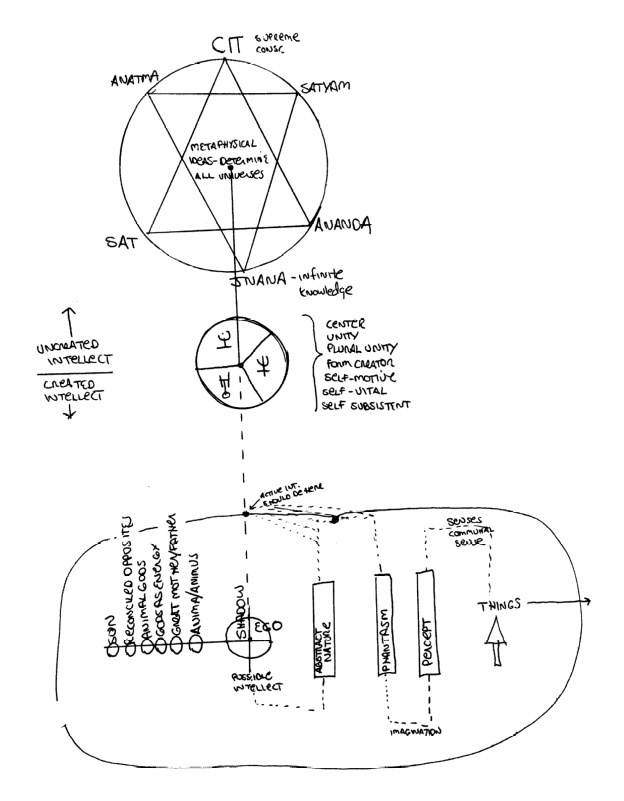
FIGURE AD_G_012. Three Circles Diagram: Divine Intellect, Soul, Psyche.
FIGURE 1973 0105-2. The Shadow.
FIGURE AD_G_019 merged. Universal Intellect, Cosmic Intellect, Psyche.
FIGURE 1973 0105-4. The Archetypal Images.
FIGURE 1973 0105-5-AB. Three Circles Diagram: Divine Intellect, Soul, Psyche.
Other diagrams also referred to are not with this transcript version. [Transcriber note: [diagram] means the speaker is referencing a diagram as he or she is speaking. If someone is drawing or writing, with audible sounds of chalk on a blackboard, I indicate this by [drawing] or [writing].]
NOTE: For readability's sake, the following substitutions/edits made in Verbatim Transcript: gonna = going to; gotta = got to; yeah = yes; yous = you.
TRANSCRIBED Verbatim by IT prior to 2017, reformatted by jf 2017. In 2023, IT updates prefatory matter, footer, and audio file name, fixes/completes Book List, fixes errors/typos, adds new notes within transcript, adds five diagrams and references within transcript to these diagrams, reformats to accord with new conventions. In 2025, IT updates audio file markers to match new REP audio. Archival verbatim transcript – V12a.
AUDIO FILES: 1973 0105a, 1973 0105b, 1973 0105c, 1973 0105d. [Note 1: "Tape" refers to original audio cassette tapes that were later digitized into .MP3 Audio Files. Note 2: In 2024, REP Studio cuts dead air from files b, c.]
1973 01/05 at Wisdom's Goldenrod
Jung; Alchemy
[Audio File 1973 0105a Begins]
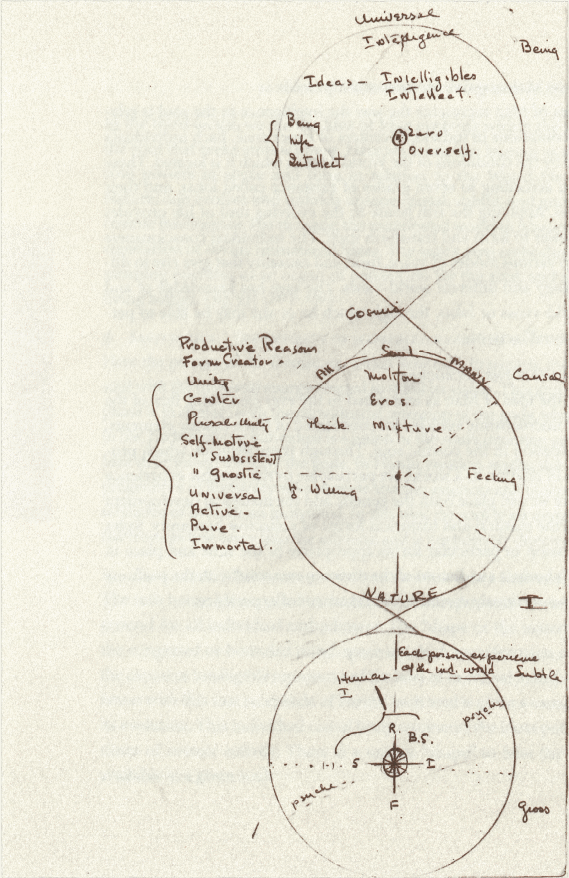
AD: --next week. If you remember, we started off with a little circle. [drawing] And the center defined the circle, so the center-- [13 second pause, background student talking] We started off by defining the circle as from the center. The center represented World-Mind. And the circle going around it, so to speak, when it was standing still, was the World-Mind, this was one [diagram]. And the movement of the circle around the center would have been the souls. [Note: See FIGURE AD_G_012 for the following. This diagram is not from this class but is close enough to help follow along.] Then, we came up with another diagram and [drawing] we did something like that and we still have the center and this represented the ray of the Overself, the Absolute [diagram]. The circle here at right angles [diagram]. And then we went on, and we sort of, like an accordion, [drawing] put the circle-- we put another circle here, connected it this way [diagram]; and another circle here, which sort of pulled it out, and this was the cosmos [bottom circle] and over here the causal realm [middle circle] and there the World-Mind [top circle], ok. And-- [9 second pause while drawing] You can, of course, imagine that-- you can imagine this here [drawing], if you want to, something like this: can-- could imagine the center here, World-Mind here [diagram], alright, and then here [diagram], and then here [diagram], ok. [drawing] Like that [diagram], ok. Now you can keep doing this, alright. Well-- [drawing] And this give you a lot of worlds to play with. [9¾ second pause while drawing] Right? [short pause while drawing] So you can do something like that, right, keep you happy.
S: Hm. (laughter)
AD: But we'll take one world at a time. [drawing] We'll try to.
LS (simultaneously): You could get a slide projector.
[13¼ second pause while AD draws]
AD: And over here we put the human intellect ["Human I" in bottom circle]. [21 second pause while drawing] We got off on a tangent last week and it's the old problem of the categories of the senses and category of the understanding. [17¾ second pause] Andrea bought-- brought a footnote for me to read. And since it was turned-- since there was a marker right on the page, we'll read it. [13½ second pause] You see, what we want to establish is a distinction between Kant, for instance, and Jung. And we want to try to understand that when Kant is speaking, it is never a psychology he is speaking, it is the-- perhaps necessary to make that distinction because we keep forgetting and we think Kant-- Kant is speaking psychology. And so we want to make this distinction very very clear in our understanding.
AD: He says over here--
[Transcriber note: I am unable to find the source of the following quote, quote needs to be checked.]
[AD reading]: "To bring this discussion within the focus of Western thought, we find the same fierce controversy about the distinction of knowledge into indeterminate and determinate and the problems raised by a striking parallelism of thought between the Eastern and Western philosophers. That there is some form of indeterminate knowledge has been granted by Western thinkers under various names. James speaks of pure sensation, Hobhouse of a bare apprehension of the present, Kant expatiates on a pure manifold, and Lossky in his Intuitive Basis of Knowledge elaborates the conception of immediate experience or a consciousness prior to the exercise of any discriminative faculty. [AD:"…any discriminative activity", I'm sorry.] Against this, Hicks and others strongly maintain that "not even the crudest, vaguest consciousness of a content can be accounted for, either psychologically or epistemologically, without calling to our aid in the exposition the notion of a discriminative activity…" According to Bradley also, we have in the sensation of the color blue a "that" which is actually present and a "what" or the peculiar quality by which it is distinguished and in immediate apprehension we are not conscious of the distinction between the two aspects. The Advaitins and the Buddhists agree with Kant in holding the indeterminate state to be a pure manifold. The determinations are extraneous, and the manifold, when schematized, gives only phenomena. [AD: I'll re-read the sentence. "The determinations are extraneous and the manifold, when schematized, gives only phenomena."] If, according to Kant, the manifold of sense arises as a result of the action of the things-in-themselves which are different from the principle of consciousness, to the Advaitins the manifold is a determination in consciousness due to the illusory super-imposition conditioned by maya."
AD: So you see, it's a problem that rages East and West, up and down, vertically and horizontally. There's no getting away from this problem, one has to sooner or later consider it.
S: What's manifold?
AD: Manifold? A many-ness, alright. So that for instance if you throw-- if you throw your sight outwardly, you will see chairs, tables, colors, alright. Any time they use the word like that they mean, in particular, the sense-manifold. And, we got into this discussion as a side issue because we're trying to understand what Jung is talking about and we put Jung in this position here [bottom circle]. And Jung made a very important point which I hope, you know, you try to consider very carefully. He said, "What I speak of is the categories of the imagination." And, the categories of the imagination have to be distinguished from the categories of thinking. In other words, the thinking that takes place up here [middle circle] is the presupposition that makes this manifold existent possible. Without-- without this presupposition here [middle circle], in other words, without the presupposition of thought itself, we'd have a great deal of difficulty understanding here [bottom circle]. But, actually then, what Jung is saying, he says, "I take this more or less for granted, a presupposition of the categories." He says, "I'm working in this area."
Now, if this is the human-- if this is the human being, the subject here [little circle within the bottom circle], we pointed out that he has these functions that he operates with and here's where Jung, for instance, is particularly very useful, he points out that we have these four functions [drawing/writing] which he referred to as psychological functions [cross within little circle in bottom circle]. They can be extraverted or introverted, they could be a playing, so to speak. And usually one of them is almost totally unconscious. [student assents, faint] The others are act. We'll go into these functions more as we go along but let this suffice now, ok? And, if for instance a person has any sort of-- any sort of imagery in the mind, to begin with, insofar that he can perceive any object, this [middle circle] is all taken for granted as a presupposition, alright? [student assents] So, basically he's working in the psychological realm. He's working in an area, so to speak-- he calls himself an empiricist, he's working in this area here [bottom circle]. Way off, you know, from another end of the world, in the mid-East for instance, a fellow like Rumi goes-- goes something like this.
[Transcriber note: I am using Rumi The Persian: Rebirth in Creativity and Love by A. Reza Arasteh, Sh. Muhammad Ashraf, Lahore, 1965.]
A. Reza Arasteh [Rumi The Persian: Rebirth in Creativity and Love, p. 117, AD reading]: "[According to Rumi] the attainment of self-perfection involves first the purification and control of Nafs by reason…"
AD: Nafs of course would correspond to the instinctual soul, you know, the vegetative soul, the irrational part in the Platonic tradition. Alright, so he would say it--
A. Reza Arasteh [Rumi The Persian: Rebirth in Creativity and Love, p. 117, AD reading]: "…involves first the purification and control of Nafs by reason, [AD adds: the] reduction of the conventional self, the transcendence of one's state, and the full realization of the cosmic self."
AD: Now this is Rumi way back, you know, eight hundred years ago.
A. Reza Arasteh [Rumi The Persian: Rebirth in Creativity and Love, p. 117, AD reading]: "In other words, Rumi [AD reads: he] perceives Sufism as a way of making man a universal man instead of a social being. Rumi's way of life emphasizes liberation from instinctive acts, the utilization of reason for practical purposes, and its usefulness for transcendental man to follow his real self. [AD: He goes on and says--] Reason can only help him reach the door of wakefulness. Rumi [AD reads: And he rei-- he] reiterates that this stage is not attained from knowledge gained in books or from listening to others. One must be his own awakener, that is, no one can awaken another by the mere instruction of Sufism [AD adds: or anything else]. He must himself receive the idea of self-seeking, experience it, and hear it within himself. A voice may tell him:"If you are a man come forth and pass on. Whatever else hinders you [(name, fame, or desire)] bypass it. Seek the truth.""
AD: This was Rumi, you know. Again, self-seeking, seeking of the cosmic self. In almost every tradition you'll find this over and over again. [short pause] At any rate, Jung-- Jung starts at this level [bottom circle], he says "This is where we are, and this is where we start from." So I thought instead of, you know, getting lost again in this controversy between Kant, I thought maybe we might try going directly again, you know, return to Jung and try to follow his way for a little while. [short pause] I thought we might start with The Practice of Psychotherapy, where he has an individual example from the Rosarium, and then maybe spread out into Religion and Alchemy and the Mysterious Conjunction. [21¼ second pause] Do you think most of you understand-- I mean have some hints of what we were speaking about last week between imagining and knowledge?
S: Yes.
[short pause]
S: You want to see if we can find it or [couple words inaudible]
AD: Let's wait.
S: Alright.
S (faint): Let's wait then.
AD: I read this little quote once before, before I get started, I read this little quote once before and-- [short pause] Perhaps if I read Jung, I-- I have the quote here.
S: Ok.
AD: Do you remember where it was Paul? [10 second pause] In what volume?
S: [few words inaudible]
AD: Alright. "Psychology of the Transference" is as good a way as any to start. [14½ second pause] Do we have a copy there of the Types too, in case we need definitions as we go along?
S: I don't see it.
S: Uh-hm.
AD: Is there a copy there? [short pause] By the way, you cannot understand Jung's terminology unless you, you know, read his terminology. In other words, when he defines a word, he has a certain amount of precision, he uses it in a certain context, and you can't-- you can't import a meaning from another school of psychology into what he's saying. He's made that very explicit, especially in the back of the book there. [44 second pause] Alright. We'll start off by reading, doing some reading here. Paragraph 354 in "The Psychology of the Transference".
C.G. Jung [CW 16, The Practice of Psychotherapy, "The Psychology of the Transference," p. 169, paragraph 354, AD reading]: "[We find, however, that] alchemy did not merely change into chemistry by gradually discovering how to break away from its mythological premises, but that it also became, or had always been, a kind of mystic philosophy. The idea of the coniunctio [AD reads: conjunction] served on the one hand to shed light on the mystery of the chemical combination, while on the other it became the symbol of the unio mystica, since, as a mythologem, it expresses the archetype of the union of opposites. Now the archetypes do not represent anything external, non-psychic, although they do of course owe the concreteness of their imagery to impressions received from without. [Rather], independently of, and sometimes in direct contrast to, the outward forms they may take, they represent the life and essence of a non-individual psyche. Although this psyche is innate in every individual it can neither be modified nor possessed by him personally. It is the same in the individual as it is in the crowd and ultimately in everybody. It is the precondition of each individual psyche, just as the sea is the carrier of the individual wave."
AD: Let's see, now, maybe we could try amplifying as we go along. Where he says for instance, "The idea of the conjunction served on the one hand to shed light on the mystery of the chemical combination…it expresses the archetype of the union of opposites", well that we already touched on. Anyone who's-- you know, what we started Wednesday, or last Wednesday, about the way the Zo-- Zodiacal degrees have to be understood in terms of opposites functioning. And, when that opposite degree, so to speak, has a planet on it and then reaches its opposite and there's a conjunction, there's a real chemical combination. Well, wouldn't you think so?
S: [few words inaudible]
AD: Let's see if I-- [27½ pause, flipping of pages] Ego, let's try that, alright?
S: One more time.
AD: (We'll) try. [students assent, faint] [47 second pause, flipping of pages] Oh, I love the silence. [17½ second pause, flipping of pages] Now I have to go in this peculiar way and try to amplify what Jung is saying because I think you'll find (him), as you read this, it'll be mostly words.
C.G. Jung [CW 16, The Practice of Psychotherapy, "The Psychology of the Transference," p. 169, paragraph 354, AD reading]: "The idea of the coniunctio [AD reads: conjunction] served on the one hand to shed light on the mystery of chemical combination…it expresses the archetype of the union of [AD adds: the] opposites."
AD: Now if we take for an example for instance a Sun-Moon conjunction, alright, by progression. That's interesting, right? Uh-- [13½ second pause] Alright. From the Mysterious Conjunction, "The Personification of the Opposites," he says for instance--
C.G. Jung [CW 14, Mysterium Coniunctionis, "The Personification of the Opposites," p. 144, paragraph 172, AD reading]: "Psychologically, [AD: Conjunction.] this means that the union of consciousness (Sol) with its feminine counterpart the unconscious (Luna) has undesirable results to begin with: it produces poisonous animals…" (some laughter)
LS: Poisonous animals.
C.G. Jung [CW 14, Mysterium Coniunctionis, "The Personification of the Opposites," pp. 144-145, paragraph 172, AD reading]: "…such as the dragon, [AD adds: the] serpent, [AD adds: the] scorpion, basilisk, [and] toad; [AD adds: and] then the lion, [AD adds: the] bear, [AD adds: the] wolf, [AD adds: the] dog, and finally the [AD reads: an] eagle [student assents, faint] and the raven. The first to appear are the cold-blooded animals, then the warm-blooded predators, and lastly birds of prey or ill-omened scavengers. The first progeny of the matrimonium luminarium are all, therefore, rather unpleasant. But that is only because there is an evil darkness in both parents which comes to light in the children, as indeed often happens in real life."
AD: Now, those of you who may have had for instance a Sun-Moon conjunction by progression will hardly be aware of it, you won't know anything about it. You know, you say "Well what does it mean? What's going on, what's happening?" But he s-- he says very clearly over here what starts happening is a dragon, a serpent, a scorpion [couple words inaudible] (laughter) Any of you who had a Sun-Moon conjunction, the cold-blooded animals coming up? Then the lion, bear, wolf, dog, finally eagle and raven. No? If we say, you know, that the Sun represents the Solar-- Solar consciousness, and the Moon, for a man, the unconsciousness, and there's a conjunction, or if we reverse it, for a woman, you know, some things start appearing in this sort of conjunction. In other words, there starts-- there starts appearing certain affects in the personality. And they refer to these affects in these terms. The cold-blooded animals first, alright, very calculating sort of responses that a woman can give you or a man. Then hot-blooded animals, you know, real anger starts coming out. You got no idea about these things? [S: Yes.] You've been studying astrology a long time. It's going to be a picnic tonight. (some laughter)
RC: I didn't-- I haven't followed what led into that Tony.
AD: You didn't follow what led into that?
RC: No. I didn't understand the first part of what you were reading, from that section.
AD: From "The Psychology of Transference". [RC assents] Alright, we'll re-- re-read that.
C.G. Jung [CW 16, The Practice of Psychotherapy, "The Psychology of the Transference," p. 169, paragraph 354, AD reading]: "The idea of the coniunctio [AD reads: conjunction] served [AD reads: serves] on the one hand to shed light on the mystery of the chemical combination, [while] on the other it became the symbol of the unio mystica…it expresses the archetype of the union of opposites."
AD: Sun and Moon combination, of course, conjunction.
C.G. Jung [CW 16, The Practice of Psychotherapy, "The Psychology of the Transference," p. 169, paragraph 354, AD reading]: "[Now the] archetypes do not represent anything external, non-psychic, although they do of course owe the [AD reads: their] concreteness of their imagery to impressions received from without."
LS: How about some nice mundane opposites though, like night and day. There's a conjunction of night and day, right? Sunrise and sunset, aren't those conjunctions?
AD: No.
LS: Yes but what's a nice mundane opposite so we can talk about their union? Sun-Moon conjunction's a little bit too arcane.
[short pause]
RC: Can you reread just that last sentence before you do that, "they owe their concrete…"-- it ends in "they owe their concreteness to an external thing"?
AD: I'm sorry, Randy.
RC: The sentence that ends in "they owe their con…"-- "while they aren't…"-- something about "they aren't due to any external object but they owe their concreteness to external sti-- stimulation", something like that.
C.G. Jung [CW 16, The Practice of Psychotherapy, "The Psychology of the Transference," p. 169, paragraph 354, AD reading]: "…although they do of course owe the concreteness of their imagery to impressions received from without."
AD: So in other words, under this conjunction, for instance, if-- if they start calling, you know, the basilisk, the toad, they-- the serpent, these are cold-blooded animals. Now, the cold-blooded animal, as you know, this is a very real image which you can employ to describe that kind of emotion. [students assent, faint] And, then when you start speaking about a lion or hot-blooded animals then you start speaking about emotion that's even more, you know, appropriate to your level, that is, hot-blooded passion, anger, all those things, and they-- they'll appropriate-- appropriate imagery from the external world that would correspond to that sort of psychological state. Let's get on, let's-- let's try to first formulate a few whole ideas. [short pause] So, in a sense--
C.G. Jung [CW 16, The Practice of Psychotherapy, "The Psychology of the Transference," p. 169, paragraph 355, AD reading]: "The coniunctio [AD reads: conjunction] is an a priori image that occupies a prominent place [AD reads: which has always occupied an important place] in [the history of] man's mental development."
AD: And, for instance, he gives the idea of the conjunction in the-- in the idea of the Church being the Bride of Christ.
S (very faint): That's good.
[13 second pause]
AD: And for a pagan source he says the hierosgamos is a good example. Now this conjunction, the (bon--)
LS (simultaneously): Is there a mundane example there any place?
AD: Yes, we'll get to one.
LS: How about one now?
AD: [flipping pages] Now, uh-hm. (bit of laughter) You're not that sick then, are you?
S: [one word inaudible] not.
S (faint): Yes. (bit of laughter)
LR (faint): At least you (were) here Wednesday [one word inaudible] (bit of laughter)
[16 second pause, flipping of pages]
AD: Let's save this for him. Very concrete.
LS: Sure. (bit of laughter)
S: Yes.
S: Yes.
[11¼ second pause, flipping of pages]
AD: How about-- [short pause] How about incest? (laughter)
LS: That's-- it's good and concrete. Is that a conjunction?
RP (faint): Oh I see, and it produces a monster here. (laughter)
AD: I'm sorry?
RP: And it produces a monster, it produces a deformed person.
AD: Alright, let's-- let's look at Jung's interpretation.
C.G. Jung [CW 16, The Practice of Psychotherapy, "The Psychology of the Transference," p. 218, paragraph 419, AD reading]: "[AD adds: The] Incest symbolizes union with one's own being, it means individuation or becoming a self, and, because this is so vitally important, it exerts an unholy fascination--not, perhaps, as a crude reality, but certainly as a psychic process controlled by the unconscious, a fact well known to anybody who is familiar with psychopathology. It is for this reason, and not because of occasional cases of human incest, that the first gods were believed to propagate their kind incestuously. Incest is simply the union of like with like, which is the next stage in the development of the primitive idea of self-fertilization."
AD: And we have one of the Sabian symbols about self-fertilization. You remember that one?
LR: By her own inspiration?
AD: Yes. What would the opposite be?
LR (faint): Not by her own inspiration?
[student assents]
S (faint): It's in Sabian symbols?
S (faint): It's in Sabian symbols, isn't it?
S: Yes.
S (faint): Ok, uh-hm.
S: That was (17).
AD: All-- all, for instance, all chemical processes in terms of, like for instance combustion, you know, that would be a-- a conjunction, [LS(?) simultaneously: No, I don't know (what degrees).] when two chemicals get together.
LR: [one word inaudible] what degree is that?
S: 17.
LR: Of what?
S: Uh-hm.
S (simultaneously): Scorpio.
[short pause]
AD: And here's a very practical example, you're probably acquainted with it. Conjunction--
C.G. Jung [CW 16, The Practice of Psychotherapy, "The Psychology of the Transference," p. 171, paragraph 358, AD reading]: "This bond is often of such intensity that we could almost speak of a"combination." When two chemical substances combine, both are altered. This is precisely what happens in the transference. Freud rightly recognized that this bond is of the greatest therapeutic importance in that it gives rise to a mixtum compositum [AD reads: mixed composition] of the doctor's own mental health and the patient's maladjustment. In Freudian technique the doctor tries to ward off the transference as much as possible--which is understandable enough from the human point of view…"
AD: How would that be for a conjunction, two chemicals? Lead oxide and oxygen. [student assents] Any, any-- [S, faint: You know--] It's a very fundamental a priori category of the imagination, you can't work without it mentally. Wouldn't you think so, Vic?
VM: Opposites and their-- and their union seem everywhere. I mean in physics, positive and negative, acids and bases in chemistry, men and women, biology, males, females. (laughter) Isn't that what he's talking about, I mean this is what--
AD: Yes.
S: Right.
[couple seconds of background student talking, laughter]
VM/S(?): Everyone knows about that. (some laughter)
S: Birds and bees.
VM: Birds and bees? No, they're not opposites. (laughter) Male birds and female birds are, right? (some laughter)
S (faint): That's enough Vic.
VM/S(?) (faint): Or--
AD: Alright, he has for instance here--
C.G. Jung [CW 16, The Practice of Psychotherapy, "The Psychology of the Transference," p. 168, paragraph 353, AD reading]: "[Thus] Kekulé's vision of the dancing couples, which first put him on the track of the [students assent] structure of certain carbon compounds, namely the benzene ring, was surely a vision of the coniunctio [AD reads: conjunction], the mating that had preoccupied the minds of the alchemist for seventeen centuries. It was precisely this image that had always lured the mind of the investigator away from the problem of chemistry and back to the ancient myth of the royal [or divine] marriage; [AD: You know, incest.] but in Kekulé's vision it reached its chemical goal in the end, [thus] rendering the greatest imaginable service both to our understanding of organic compounds and to subsequent unprecedented advances in synthetic chemistry. Looking back, we can say that the alchemists had keen noses when they made this arcanum arcanorum, this donum Dei et secretum altissimi [AD reads: inmost secret], [this] inmost mystery of the art of gold-making, the climax of their work."
AD: We're going to have to, you know, circle around the idea of the conjunction, get-- try to get a taste for it little by little, and chemistry, astrology, anywhere we can find it, you know, little by little.
VM: Tony--
AD: Yes?
VM: I missed this point you were making about incest there and you had made another reference to it. I thought that-- that marriage they're speaking about is just between the King and the Queen, what-- what is incestuous there? I mean are the same family or something, what-- as usually happens in royalty?
AD: No, no. There the purpose was to give the opposite of a-- a marriage(,) in conjunction. There's no opposites involved there, in the incest, that's the opposite of a conjunction. Isn't that so?
LS: I don't know, I'm still looking for examples. (bit of laughter)
[student assents, faint]
AD: Well tell me what you're looking for, maybe, you know, somebody can provide you with an example. How about the Sun on Mars, isn't that a good conjunction?
LS: Are they opposites?
AD: Yes.
LS: I thought the Sun and Moon were opposites.
AD: Sun and Moon.
LS (simultaneously): Sun and Mars are opposites too?
AD: Well the example, too bad you weren't here, but example we used was--
LR: Sure is too bad.
AD: Huh? (laughter)
LR (amidst laughter): I mean it sure is too bad.
AD: Example we used for instance [S simultaneously, faint: The shadow (one/two words inaudible)] was, in her case, where she has an exact opposition within one degree. One planet on one and the opposite.
LS: I know, Mercury and the Moon opposites.
AD: Yes. And--
LS: So any two planets are opposites? That's not the usual idea of opposites we have, right? (laughter)
AD (amidst laughter): I don't know (what you mean).
S: [one/two words inaudible] (laughter)
[door shutting, few seconds of background student talking, door shutting again]
VM: Tony, I don't think that's the way Jung is using the term opposites, two planets, I mean they're not really opposites. There's no opposite to the Sun really, is there, I mean--
LS: Well, what about a conjunction of two planets? You're [VM simultaneously: I don't--] thinking of a conjunction of opposites there, aren't you?
VM: I don't know, are you? I don't know.
LS (simultaneously): That's what he's doing.
VM: No, I don't think that's what--
LS (simultaneously): That's what I want to find out. The hell with Jung, what's he doing?
VM: Well, we got to find out one or the other, either Tony or Jung, somehow I don't think they're the same. (laughter, student words) I'm glad you're back Lenny, it was really gettin' out of hand (with/when) you [one/two words inaudible] (laughter, student words)
LR: Well, (poor) [AD simultaneously: Well how about--] Tony, it's all over for him. (laughter)
LS: I mean usually if you take-- if usually if you take the opposite of A is B, then the opposite of B is A, right?
S (faint): I wouldn't say that.
LS: But here you've got something where you got lots of opposites, right, you can play with anything you want and call it the opposite. [S simultaneously: Why not?] Opposite of the Sun is Mars or it's the Moon or-- What's the opposite of the Sun?
AD: No, the opposite degree Lenny. Planets aren't opposite.
VM: Oh, ok, well that's different. You're talking about [one word inaudible]
AD (simultaneously): Well what do you mean "ok"? I mean [VM simultaneously: Well--] what do you think I'm referring to?
VM: You said before--
AD: How could the Sun be the [couple inaudible student words simultaneous with AD] opposite of Mars or Mars the opposite of Venus?
VM (simultaneously): I fully-- I fully agree, then I misunderstood the first [one word inaudible]
LS (simultaneously): Well how could the Sun be the opposite of the Moon then?
AD: Sun and Moon, I think that's pretty obvious.
LS: Are they opposites?
AD: Not opposites, but let's say the Moon is a reflection of the Sun.
LS: Well yes, [one inaudible student word simultaneous with LS] but you were talking about opposites, not reflections.
AD: Well I don't want to get-- I don't want to get into astrology now, but to me the Moon is the opposite of the Sun.
LS: You see, I try and understand this idea of conjunction, ok?
AD: Well, why don't we give ourselves a little time?
VM: Here we go. (laughter) Tony, you're really hard to pin down lately. I don't know what aspects you're having but, seriously--
LS: Come on, there's lots of planets in Capricorn tonight, Tony, we're going to have to put-- pin you down.
S: Ooh. (bit of laughter)
AD: You let me know when you could pin down a Libra. (laughter)
LR: There's nothing better than Libra except Virgo. (laughter, student words)
VM: Why not? It's always completed in Libra, remember?
LR/S(?) (faint): Yes [few words inaudible] (more laughter, student words)
LS: So you're talking about a conjunction, say, of opposite degrees?
[students assent, faint]
AD: Yes.
S: Yes.
LS: Then what would it mean when you say a-- you gave the example before about a conjunction of progressed Sun and Moon? Now where would the opposite degrees come in there?
AD: Well let's look at it this way. In terms of the conjunction as he was speaking in the book, the Sun there would represent Solar consciousness, the Moon would basically represent the unconscious.
S (faint): Ok.
VM: Logos and Eros?
[student assents, faint]
LS: Yes, but now the Sun and Moon are opposites again.
AD (simultaneously): Not-- not necessarily Eros, yes.
S (simultaneously, faint): Not Eros but [couple words inaudible]
AD: Of course you have to reverse that if the ma-- if the sex is reversed.
[11¾ second pause]
LS: So the Sun and Moon are either opposites or they're not opposites? I don't understand what you're doing Tony, really.
AD: Well why don't you be a little patient, let me run a few pages and then we'll start--
LS (simultaneously): I mean the idea of the conjunction seems to be really hard because the idea of opposites isn't what we're used to thinking of. We're not thinking of i-- opposites as a polarity on a line as one usually does. We're thinking of opposites in a different way here, right?
AD: Well, it's very hard for me to, you know, decide what you mean by opposites, go-- maybe Richard could help.
RP: I would say actually any two planets could be conceived as opposites. You take any two planets, I think there's some archetypal opposition could be best symbolized by these two planets. So in that sense any two planets can be conceived as opposite. Like conscious versus unconscious is very well de-- demonstrated by the Sun and Moon. I'm sure like Jupiter and Saturn, there must be, you know, there mu-- I-- I can't throw out examples (off) the top of my head but for any two planets you can find some archetypal opposition that is very-- Mars and Venus, or the opposition of the sexes, that would be very well portrayed by these two planets.
[short pause]
AD: I'll agree with you, Richard, because I think what he's looking for in terms of an opposition is a Virgo classification again. And with each level of being that we operate with, you know, we'd have to always, so to speak, reorientate what we mean by oppositions. So that on one level what could be, so to speak, form and matter, you know, the-- on a higher level that very form becomes matter for what's the form above it. All the time our-- our general descriptions have to vary and alter according to the framework we're operating (with). And I think it's pretty ade-- adequate, you know, not complete, but it's an adequate presentation if I say that in the chart of a woman the Sun would represent her unconscious and the Moon her conscious aspect. And in a male you reverse that. If we want to, we could go a little further and say for instance in the chart of the man the Sun would represent the principle of Logos and he's operating much more on an intellectual level, alright, certainly much more in a head, and in the case of the woman the Moon would represent her consciousness because there she is much more intimately tied in with the physiological functioning of the body. And so therefore that would be more conscious to her and more unconscious to the male. Now these are relative opposites. As far as a complete opposite, well, we'd have to start with Being and non-Being. [short pause] We can also say, for instance, that we know of women where the Solar consciousness operates where there seems to be more of a predominance of the Sun in her chart, alright, and yet that Solar consciousness isn't as bright, you know, it's not really a Solar consciousness. It seems to be-- it seems to be what the alchemists call Sol niger. There's something of a blackness in it.
S: Oh!
S: Wait. (laughter)
S (amidst laughter): Wait a minute. (S laughing)
S: Right.
S: I mean come on.
AD (simultaneously): Now they're all going to get offended, you see what you [S simultaneously: Good.] started? (bit of laughter)
LR: You started it on Wednesday [couple words inaudible]
AD (simultaneously): I started it on-- I didn't start anything on Wednesday.
LR: That's right. (laughter, student words)
AD: You people just get upset because I introduce ano-- [S simultaneously: Let's not be cruel.] a little more material into your astrological reading.
[few seconds of background student whispering, laughter]
LR: This is [couple words inaudible]
AD (simultaneously): But I think the basic opposition in the chart has to be understood in terms of the degrees. I assume that they got some of that once.
S: That's crazy.
S (faint): Yes.
VM: Sol niger.
AD (simultaneously): Let's try reading a little bit more from him because we want to get into the alchemical way of looking at it. [short pause] Anyway, he goes on.
C.G. Jung [CW 16, The Practice of Psychotherapy, "The Psychology of the Transference," pp. 171-172, paragraph 358, AD reading]: "It is inevitable that the doctor [AD reads: analyst] should be influenced to a certain extent and even that his nervous health should suffer. He quite literally"takes over" the sufferings of his patient…"
AD: This sounds like a Guru, not like an analyst.
C.G. Jung [CW 16, The Practice of Psychotherapy, "The Psychology of the Transference," p. 172, paragraph 358, AD reading]: "He quite literally"takes over" the sufferings of his patient and shares them with him. For this reason he runs a risk--and must run it in the nature of things. The [enormous] importance that Freud attached to the transference phenomena became [AD reads: can become] clear to me at our first personal meeting [in 1907]. After a conversation [lasting many hours there came a pause]. [AD adds: He] Suddenly he asked me out of the blue, "And what do you think of the transference?" [AD adds: And] I replied [AD: This is Jung] with the deepest conviction that it was the alpha and [AD adds: the] omega of the analytical method, whereupon he said, "Then you have grasped the main thing.""
AD: I know I'm going about it the wrong way but I-- I prefer going about things the wrong way. (bit of laughter)
S (very faint): (Every time.)
AD: The other way the street is one way, you know.
C.G. Jung [CW 16, The Practice of Psychotherapy, "The Psychology of the Transference," p. 172, paragraph 359, AD reading]: "The great importance of the transference has [often] led to the mistaken idea that it is absolutely indispensable for a cure, [that] it must be demanded from the patient, so to speak. But a thing like that can no more be demanded than faith, which is only valuable when it is spontaneous. Enforced faith is nothing but [AD adds: a] spiritual cramp. (some laughter, student assents) Anyone who thinks that he must"demand" a transference is forgetting that this is only one of the therapeutic factors, and that the very word "transference" is closely akin to "projection"…"
AD: Would you look up 'projection' please? This is a key word in the whole of the Jungian tradition.
C.G. Jung [CW 16, The Practice of Psychotherapy, "The Psychology of the Transference," p. 172, paragraph 359, AD reading]: "…a phenomenon that cannot possibly be demanded."
AD: Let's try to remember that, huh?--"a phenomenon that cannot be demanded." You cannot say, "I am now going to have a projection." [to HS] You-- did you find the definition of projection?
S (simultaneously): No. [one/two words inaudible]
C.G. Jung [CW 6, Psychological Types, Definitions, pp. 457-458, paragraphs 783, 784, HS reading]: "43. PROJECTION means the expulsion of a subjective content into an object; it is the opposite of introjection (q.v.). Accordingly, it is a process of dissimilation (v. Assimilation), by which a subjective content becomes alienated from the subject and is, so to speak, embodied in the object. The subject gets rid of painful, incompatible contents by projecting them, as also of positive values which, for one reason or another--self-depreciation, for instance--are inaccessible to him. Projection results from the archaic identity (q.v.) of subject and object, but is properly so called only when the need to dissolve the identity with the object has already arisen. This need arises when the identity becomes a disturbing factor, i.e., when the absence of the projected content is a hindrance to adaptation and its withdrawal into the subject has become desirable. From this moment, the previous partial identity acquires the [HS reads: a] character of projection. The term projection therefore signifies a state of identity that has become noticeable, an object of criticism, [HS rereads: has become noticeable, an object of criticism] whether it be [the] self-criticism of the subject or the objective criticism of another.
"We may distinguish passive and active projection. The passive form is the customary form of all pathological and many normal projections; they are not intentional and are purely automatic occurrences. The active form is an essential component of the act of empathy (q.v.). Taken as a whole, empathy is a process of introjection, since it brings the object into intimate relation with the subject. In order to establish this relationship, the subject detaches the content--a feeling, for instance--from himself, lodges it in the object, thereby animating it, and in this way draws the object into the sphere of the subject. The active form of projection is, however, also an act of judgment, the aim of which is to separate the subject from the object. Here a subjective judgment is detached from the subject as a valid statement and lodged in the object; by this act the subject distinguishes himself from the object. Projection, accordingly, is a process of introversion (q.v.) since, unlike introjection, it does not lead to ingestion and assimilation but to differentiation and separation of subject from object."
AD: How about that, you want to repeat that sentence?
C.G. Jung [CW 6, Psychological Types, Definitions, p. 458, paragraph 784, HS reading]: "Projection, accordingly, is a process of introversion (q.v.) since, unlike introjection, it does not lead to ingestion and assimilation but to differentiation and separation of subject from object. Hence it plays a prominent role in paranoia, which usually ends in a total isolation of the subject."
S: Hm.
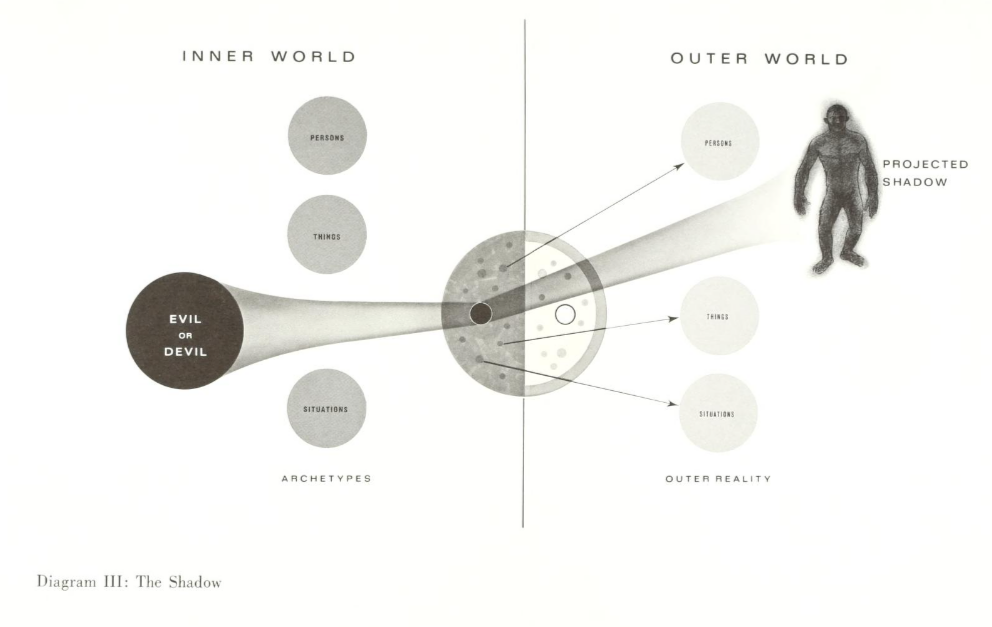
AD: Behind you there's a book called The I and the Not-I and in the back there's a series of pictures and one of them is the projection of the shadow [FIGURE 1973 0105-2].
[Audio File 1973 0105a Ends]
[Audio File 1973 0105b Begins]
[few seconds of background student talking]
AD: Well, you could pass it around and they could look at it as we go on. This-- I think this is one of the fundamental and the key terms in all of Jungian psychology, 'projection'. [VM assents, faint] At any rate, he points out that transference cannot be forced and that when a projection takes place it seems to take place spontaneously. And that, when this transference arises for instance, if you go to an analyst or-- or if you go to a Guru or something, you know, then a process is started, a process, so to speak, of learning, where you are forced to relate to something outside of yourself.
[short pause]
S: Tony can-- can you say what he means by that-- that part about self-depreciation?
AD: You'd have to read it.
S: Herbie, could you read that--
S (faint): (Can't be that difficult.)
S: (Yes.)
RP: Well there's of course, to project positive qualities because you can't admit (it/them) to consciousness because conscious attitude is one of self-depreciation, so, you know, [student assents] a hero must be found outside of him, you can't symbolize that archetype.
S: 'Cause you-- because you'd have to take yourself in--
RP: Right, you're (working) [one/two words inaudible] (laughter)
S: According to what?
VM: (That'd be never.)
S: [couple words inaudible] (more laughter)
[22 seconds of background student talking, few words from AD]
S: Would you say that projections always come from the unconscious?
S (possibly part of background): So when you--
S (possibly part of background): [couple words inaudible] not.
AD: You'd have to speak louder, so, you know--
[students assent]
S (simultaneously): Do projections always come from the unconscious, that's all.
S (very faint): Right.
AD: You remember the story once told about this soldier who was on duty in Africa somewhere and he heard this tree talking to him? So he took out an axe and he threw it at the tree and the case came up because, you know, it was during war time. And that's a case of projection. You're compelled. You're compelled, something from within you compels you to make that projection. But as you can see, it's forcing a person into a relationship [S simultaneously: But why is it--] with the world outside, [student assents] alright. And, to Jung, this is an absolute prerequisite for the learning process to start. In other words, it's a way, it's a breakthrough, it's the beginning of getting out of that womb state that you live in.
[short pause]
S: But, he said though, it was introversion. But that could only be introversion then until it was recognized as a projection. Is that-- is that so? No, it's not.
AD: Well what happens if you do project onto someone? Suppose you have a powerful projection going on. What happens, internally?
S: Well, all kinds of emotions go with it. I usu-- I-- depends on the projections.
AD: We had this once before, didn't we Crystal? You remember this problem, Crystal?
S (faint): Always mine but-- (some laughter)
AD: Well let's see if I could--
AS: Is that trying to say like that when you project this-- this outwards, when it's projected then you're separated from it and therefore you-- that's what causes the introversion, 'cause you see yourself as separate or distinct from the outside content and then you're more into yourself?
AD: Yes, in some way.
BS (simultaneously): It seems like we're setting up-- [S: Right.] It seems like we're setting up, in projection, we set up a relationship with ourselves first. (And then/But) after the projection is withdrawn, then we can relate to what we projected on.
AD: I'm sorry, would you-- would you repeat that?
BS: It seems to me that in a projection, while the projection is on, we're learning to relate with our self.
AD: Yes, that's what he's saying, that's why [BS: Oh.] speaks of it as introversion and what I'm referring to is "On the Nature of the Psyche", Crystal, because you brought this point up.
C.G. Jung [CW 8, The Structure and Dynamics of the Psyche, "On the Nature of the Psyche," p. 161, paragraph 345, AD reading]: "[As] the individual differentiation of consciousness proceeds, the objective validity of [its] views decreases and their subjectivity increases, at least in the eyes of the environment, if not in actual fact. For if a view is to be valid, it must have the acclaim of the greatest…"
AD: You remember that paragraph?
S: Uh-hm.
AD: What happens when a projection takes place? All of a sudden the subject comes into operation, right? Isn't that what happens? I mean, soon as there's a projection, now you're split, whereas before there was a nice psychological wholeness, a womb-type sort of somnambulance. As soon as a projection takes place, like with this soldier, that tree started talking to him, he s-- he had to start relating to something, alright, he threw the axe at it, right. Right away the subject comes into-- starts coming into operation, [VM simultaneously: (couple/three words inaudible) uh-hm.] a process of differentiation starts coming.
S: Well he got a court-martial. (bit of laughter)
LR (faint): Because he killed a tree. (LR laughs a bit)
AD (simultaneously): Huh? You remember the point now?
S: Yes I do.
LS (simultaneously): He got court-martialed for that?
S (faint): Everyone's [one word inaudible] (laughter)
S: (Stupid.)
AD (simultaneously): You remember the court-martial, but you don't remember the rest of the case.
S: What happened? (some laughter, student words)
AD: Alright so, you'll see his usage of these words is very technical. Let's continue and watch him build this up.
[student assents, faint]
C.G. Jung [CW 16, The Practice of Psychotherapy, "The Psychology of the Transference," pp. 173-174, paragraph 361, AD reading]: "A certain [abaissement du niveau mental, i.e., a] weakness in the hierarchical order of the ego, is enough to set instinctive urges and desires in motion and bring about a disassociation of the personality--[in other words], a multiplication of its centres of gravity. … These dynamic components must be regarded as real or symptomatic, vitally decisive or merely syndromal, according to the degree of their predominance. Although the strongest instincts undoubtedly require concrete realization and generally enforce it, they cannot be considered exclusively biological since the course they actually follow is subject to powerful modifications coming from the personality itself. If a man's temperament inclines him to a spiritual attitude, even the concrete activity of the instincts will take on a certain symbolical character. This activity is no longer the mere satisfaction of instinctual impulses, for it is now associated with or complicated by"meanings.""
AD: Don't you find life complicated now by meaning? (bit of laughter, student assents, faint)
C.G. Jung [CW 16, The Practice of Psychotherapy, "The Psychology of the Transference," p. 174, paragraph 361, AD reading]: "In the case of purely syndromal instinctive processes, which do not demand concrete realization to the same extent, the symbolical character of their fulfillment is all the more marked. The most vivid example of these complications are probably to be found in erotic phenomenology. [AD: For instance] Four stages [of eroticism] were known even in the late classical period: [Hawwah] (Eve), Helen [(of Troy)], [the] Virgin Mary, and Sophia. The series is repeated again in Goethe's Faust: [AD: And for those of you who read that, probably you'll recognize this.] in the figures of Gretchen as the personification of a purely instinctual relationship (Eve); [AD adds: then] Helen as an anima figure; [AD adds: then] Mary as the personification of the"heavenly," i.e., [AD adds: the] Christian or religious, relationship; and the "eternal [AD reads: eternally] feminine" as an expression of the alchemical Sapientia [AD: or Wisdom]. As the nomenclature shows, [AD reads: The naming shows that] we are dealing with the heterosexual Eros or anima-figure in four stages, and consequently with four stages of the Eros cult. [The first stage--Hawwah], Eve, earth--is purely biological; woman is equated with the mother and only represents something to be fertilized. (student makes funny laughing sound, followed by group laughter) [AD: No outburst. (AD laughs, laughter, student words)] The second stage is still dominated by [the] sexual Eros, but on an aesthetic and romantic level where woman has already acquired some value as an individual. [AD: Not much, just some. (laughter, student words)] The third stage raises Eros to the heights of religious devotion and thus spiritualizes him… [Finally, the] fourth stage illustrates something which unexpectedly goes beyond the almost unsurpassable third stage: Sapientia [AD reads: Wisdom]. [AD adds: And] How can wisdom transcend the most holy and the most pure?--Presumably only by virtue of the truth that the less sometimes means the more. This stage represents spiritualization of Helen and consequently of Eros as such. That is [AD reads: And that's] why Sapientia [AD reads: Wisdom] was regarded as [a] parallel to the Shulamite in the Song of Songs [AD reads: Song of Solomon]."
AD: You're going to see what this man is doing. It takes a little time but he's-- he's going to draw a bead now.
C.G. Jung [CW 16, The Practice of Psychotherapy, "The Psychology of the Transference," p. 175, paragraph 362, AD reading]: "Not only are there different instincts which cannot forcibly be reduced to one another, [AD: In spite of what Freud says.] there are also different levels on which they move. In view of this far from simple situation, it is [AD adds: a] small wonder that that transference--also an instinctive process, in part--is very difficult to interpret and evaluate [AD reads: classify]. The instincts and their specific fantasy-contents are partly concrete, [AD adds: and] partly symbolical [(i.e.,"unreal")], sometimes one, sometimes the other, and they have the same paradoxical character when they are projected."
AD: And all you have to do is there's some books on alchemy there, and just look at some of those fantasy drawings.
C.G. Jung [CW 16, The Practice of Psychotherapy, "The Psychology of the Transference," p. 175, paragraph 362, AD reading]: "The transference is far from being a simple phenomenon with only one meaning, and we could never make out beforehand what it is all about. The same applies to its specific content, commonly called incest. We know that it is possible to interpret the fantasy-contents of the instincts either as signs, as self-portraits of the instincts, i.e., reductively; or as symbols, as the spiritual meaning of the natural instinct. In the former case the instinctive process is taken to be"real" and in the latter "unreal.""
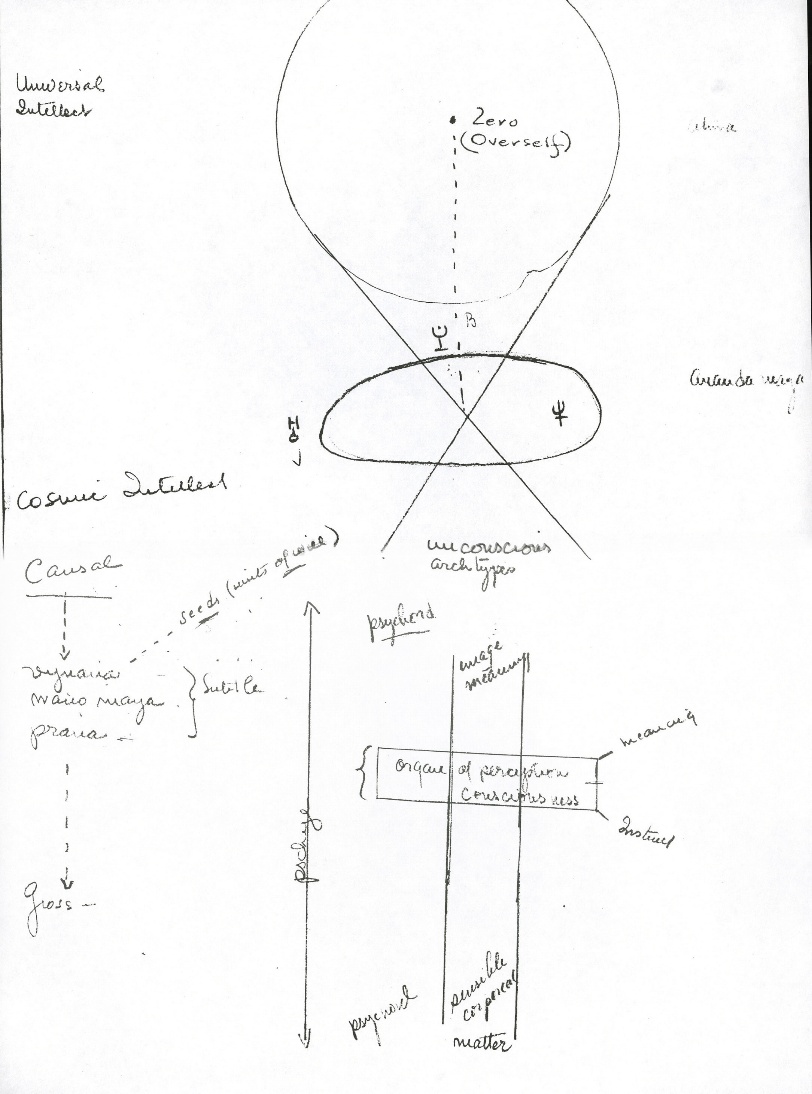
AD: Would you turn to 'symbol' in the dictionary? [short pause while drawing] We'll just use the top. [short pause while drawing] I think we had it drawn something like this where we referred to the organ of consciousness-- Or maybe-- maybe we better stick to the astrological mandala, we're used to that. [short pause] [to HS] Did you find 'symbol-making' there? Would you-- This is kind of important because the way Jung uses 'symbol' it's-- is really probably one of his great contributions to separate it from semiotic or to separate it from a lot of misunderstanding what a symbol really represents. Suppose you try to pick out some of the chief passages 'cause I think it's a long-drawn affair. [22½ second pause while drawing] [Note: See FIGURE AD_G_019 merged for the following.] You remember how we drew this? Did we draw it like this [diagram], the organ of consciousness, when we were talking about the chapter "On the Nature of the Psyche"?
S: You included it with that axis, right.
[9½ second pause]
AD: Herbie, do you want to read some?
HS/S(?): Yes.
C.G. Jung [CW 6, Psychological Types, Definitions, pp. 473-474, paragraph 814, HS reading]: "[51. SYMBOL. The] concept of a symbol should in my view be strictly distinguished from that of a sign. Symbolic and semiotic meanings are entirely different things. In his book on symbolism, Ferrero does not speak of symbols in the strict sense, but of signs. For instance, the old custom of handing over a piece of turf at the sale of a plot of land might be described as"symbolic" in the vulgar sense of the word, but actually it is purely semiotic in character. [The] piece of turf is a sign, or token, standing for the whole estate. The winged wheel worn by railway officials is not a symbol of the railway, but a sign that distinguishes the personnel of the railway system. [A] symbol always presupposes that the chosen expression is the best possible description or formulation of a relatively unknown fact, which is nonetheless known to exist or is postulated as existing. Thus, when the badge of a railway official is explained as a symbol, it amounts to saying that this man has something to do with an unknown system that cannot be differently or better expressed than by a winged wheel." (laughter)
S: Broke (that). (more laughter)
S (very faint): (Anyway.)
VM (faint): (A/Of) sleeping cow.
S: (This is this.)
HS (faint): And he goes on--
C.G. Jung [CW 6, Psychological Types, Definitions, pp. 474-475, paragraphs 815, 816, HS reading]: "Every view which interprets the symbolic expression as an analog or an abbreviated designation for a known thing is semiotic. A view which interprets the symbolic expression as the best possible formulation of a relatively unknown thing, which for that reason cannot be more clearly or characteristically represented, is symbolic. …
"So long as a symbol is a living thing, it is an expression for something that cannot be characterized in any other or better way. The symbol is alive only so long as it is pregnant with meaning. But once its meaning has been born out of it, once that expression is found which formulates the thing sought, expected, or divined even better than the hitherto accepted symbol, then the symbol is dead, i.e., it possesses only a historical significance. We may still go on speaking of it as a symbol, on the tacit assumption that we are speaking of it as it was before the better expression was born out of it. The way in which St. Paul and the earlier speculative mystics speak of the cross shows that for them it was still a living symbol which expressed the inexpressible in unsurpassable form."
AD: So basically then, the symbol, to Jung, is something that's formulated by two points of view, one the unconscious and the other the conscious point of view. And, in-- in prescribing or let's say in getting together a symbol, a certain portion-- a certain portion of it remains unavailable, that is, consciously we don't-- do not understand what it means and we can draw up a lot of associations from it. A good example of course would be the astrological chart, that's a symbol. There's a certain amount of it that we know and there's a certain amount that always remains unknown and we never seem to be able to exhaust fundamentally what the basic meaning of astrology is. But if it was possible, let's say, that for a person that he could completely exhaust the meaning of that, then it would no longer be a symbol, alright, it would be conscious for him. His attitude will be that of full comprehension. It would no longer be esoteric but exoteric. On the other hand, for another person who cannot understand it, then for him it still remains a symbol and basically esoteric. So it's a relative term, ok?
The-- the other thing about the symbol, and we've had a lot of experience with the Sabian symbols for instance, and we resent when Jones takes the liberty of changing those symbols. Because, like Jung just pointed out, if the symbol is a combination of these two points of view, the ego-- egotistical or the conscious point of view and the unconscious point of view, well then it seems that very often when a symbol is thrown out into consciousness, it's been formulated down at the depths and to alter it, to alter that symbol is really very often to prevent the possibility of that meaning to shine through. If you take a look at some of the symbols he's altered for instance in the book. I'm-- I'm thinking of one in particular. And, this might give you an example. Libra 2. You got-- you got the book with you? You got the book? [student assents, very faint] Uh--
S (simultaneously): 29 Pisces, 29 Pisces too.
AD: He messes quite a few of them around but this one is so obvious that--
S (faint): Yes.
AD: Do you-- do you have one of the symbols there, the original symbols?
S (faint, part of background): Hold it.
S (very faint, possibly part of background): Uh-hm.
AD: It's worth tur-- taking your time out to see these differences. Is there a book behind you, Ella May?
S: I got one too.
[short pause]
AD: And you would see, for instance, in the formulation of the symbol where, on the one hand, there's a purely conscious theoretical speculative intellect functioning, refining, polishing, and finally what's left is pure verbiage. [short pause] This is what the original symbol sounds like. Would you read it, 2, Linda?
Marc Edmund Jones [The Astrology of Concepts, Libra 2, LR reading]: "A new symphony is played by the orchestra; the music dramatizes racial progress from aspiration to realization."
AD: Now that was the original intuited symbol. Now he worked it over in the book. You know he's got a septile so he's got a disease.
Marc Edmund Jones [The Sabian Symbols in Astrology, Libra 2, S reading]: "The light of the sixth ray transmuted to the seventh"
AD: Alright, now that's taken bodily out from Theosophical manuals where there's seven races, you know, and they pass the light on to one another, ok? [student assents, faint] Yes. Now in that symbol there for instance, that's in Libra, ok. And if you-- if you reread that symbol you can see that all the elements are there that are necessary. Read it.
Marc Edmund Jones [The Astrology of Concepts, Libra 2, LR reading]: "A new symphony is…"
AD: A new symphony, in Libra, so it would have bring in some sort of feltness.
S: Right.
Marc Edmund Jones [The Astrology of Concepts, Libra 2, LR reading]: "…is played by the orchestra…"
AD: Alright, in Libra there would have to be this harmonious relationship of all the parts to one another. Go on.
Marc Edmund Jones [The Astrology of Concepts, Libra 2, LR reading very slowly]: "…the music dramatizes…" (laughter)
AD: Music what? (more laughter)
S: Dramatizes.
Marc Edmund Jones [The Astrology of Concepts, Libra 2, LR reading]: "…the music dramatizes racial progress from aspiration to realization."
AD: And you can see that that involves, so to speak, a real meaning in Libra. This is a symbol, alright, this is a symbol, the other one is a pure idea that he formulated with his brain. [students assent] So that the symbol, like we spoke about once before, right Vic? The symbol, so to speak, is like a suit of clothing that a person wears and you can see it because without that suit of clothing there's no one there to see. And these words in the Sabian symbols basically-- and these are very beautiful symbols I think (now). They transmit a meaning. Now without the words, no meaning is available to us and so it has to be dressed in some sort of meaning and the words seems to be the most adequate representation or embodiment of that meaning so that when we look at it, "Ah, this is what it means," alright, you get intuitions, you get a feeling for it, and then gradually the meaning unfolds. But if you try to make a symbol with your conscious mind and put together all pieces and add them up, you will not come up with a symbol. There always has to be that suggestion of the unknown, alright. And, of course, this is a very worthwhile contribution that Jung has made. I think if-- if you look into the nature of a symbol and if you look at some of those alchemical texts like we were saying, you'll see that for you they'll all be symbolical and you won't know what's going on. [student assents, faint] [short pause] Um--
At any rate, we pointed out that at one end-- we better use the other one-- at one end, [drawing] over here was the instinctual basis and up here was the meaningful [diagram]-- We pointed-- [student assents] I-- when we were speaking "On the Nature of the Psyche," you remember, down here was the psychoid realm [diagram], there was a lot of disagreement but it doesn't matter too much right now, psychoid realm here. In here [diagram] meaning. And this seemed to be a-- a variable [diagram]. In other words, as we came down, as we come down towards matter and more and more into the physiology of the instincts, the meaning seems to get lost and [one word inaudible] and as we go up, (we) come closer and closer towards the meaning and we-- and we leave the instinctual basis. And this was, you remember, when we were speaking "On the Nature of the Psyche." Now, for Jung, this is extremely important because the instincts are what's practically governing and guiding us in our development.
S: Yes.
VM (faint): Ok.
S: Yes.
AD: So, to repeat--
C.G. Jung [CW 16, The Practice of Psychotherapy, "The Psychology of the Transference," p. 175, paragraph 362, AD reading]: "We know that it is possible [student assents] to interpret the fantasy-contents of the instincts either as signs, that is, self-portraits of the instincts, [i.e.], reductively; or as symbols, as the spiritual meaning of the natural instinct. In the former case, the instinctive process is taken to be"real" and in the latter "unreal.""
AD: So that, if Freud and his school, for instance, every time that there is some fantasy content up in consciousness, if he keeps reducing it always down to the instinctual level, then you'll always come up with the same meaning. Over and over again you'll keep coming up that the meaning of the dream has to do with a wish fulfillment, you know, a sexual game. Jung's theory was that the meaning which is found in a fantasy content up here [drawing] very often will take a person towards the next stage of development, take him away from the instinctual basis in terms of phys-- physiology. He has an example of that which maybe we ought to go into. I'm trying to think of what-- what was I reading from last week, Psychology and Alchemy?
S (faint): (Psychic--)
[student assents, faint]
S: Psychology and Religion?
AD: Huh?
S: Psychology and Religion?
S: You had Zen.
AD: No, where he had the dream-- he had three interpretations of the dream, the same dream, and I said we'd put it off until we had [one word inaudible]
LR (simultaneously): Oh yes.
AD: You remember where that was?
LR (simultaneously): Isn't-- wasn't it from the book where you were reading about the Zen?
MW: "The Transcendent Function"?
VM (faint): That's--
S (simultaneously): No, [AD simultaneously: Huh?] you see (what you--)
MW (simultaneously): (Or) "The Transcendent Function"?
AD: "The Transcendent Function".
[16½ second pause]
AD: Well here's a dream from "The Transcendent Function" and--
[26 second pause, flipping of pages]
C.G. Jung [CW 8, The Structure and Dynamics of the Psyche, "The Transcendent Function," p. 75, paragraph 149, AD reading]: "An unmarried woman patient dreamt that someone gave her a wonderful, [couple inaudible student words simultaneous with AD] richly ornamented, antique sword dug up out of a tumulus."
S: Out of a what?
AD: That's spelled t-u-m-u-l-u-s, I imagine some kind of ritual [one word inaudible] (that manured) ground, you know, with a lot of jewels in it. Let me repeat briefly.
C.G. Jung [CW 8, The Structure and Dynamics of the Psyche, "The Transcendent Function," p. 75, paragraph 149, AD reading]: "…someone gave her a wonderful, richly ornamented, antique sword dug up out of a tumulus."
AD: And here's the interpretation that is given, three different interpretations.
C.G. Jung [CW 8, The Structure and Dynamics of the Psyche, "The Transcendent Function," p. 76, paragraph 149, AD reading]: "Associations: Her father's dagger, which he once flashed in the sun in front of her. It made a great impression on her. Her father was in every respect an energetic, strong-willed [AD reads: strongly-willed] man, with an impetuous temperament, and adventurous in love affairs. A Celtic bronze sword: Patient is proud of her Celtic ancestry. The Celts are full of temperament, impetuous, passionate. The ornamentation has a mysterious look about it, ancient tradition, runes, signs of ancient wisdom, ancient civilization, heritage of mankind, brought to light again out of the grave.
"Analytical Interpretation: Patient has a pronounced father complex and a rich tissue of sexual fantasies about her father, whom she lost early. She always put herself in her mother's place, although with strong resistances towards her father. She has never been able to accept a man like her father and has therefore chosen weakly, neurotic men against her will. Also in the analysis violent resistance towards the physician-father. [AD: That is, the analyst.] The dream digs up her wish for her father's"weapon." [AD: Quote, unquote.] (bit of laughter) The rest is clear. In theory, this would immediately point to a phallic fantasy."
LR: Is this the third interpretation?
AD: No, the second. The-- the first was a series of associations. Now, Jung's interpretation is something like this.
C.G. Jung [CW 8, The Structure and Dynamics of the Psyche, "The Transcendent Function," p. 76, paragraph 149, AD reading]: "Constructive Interpretation: It is as if the patient needed such a weapon. Her father had the weapon. He was energetic, lived accordingly, and also took upon himself the difficulties inherent in the temperament. Therefore, though living a passionate, exciting life he was [AD emphasis] not neurotic. This weapon is a very ancient heritage of mankind, which lay buried in the patient and was brought to light through excavation (analysis) [AD reads: that is, through analysis]. The weapon has to do with insight, with wisdom. [AD: And so has it always been. Just remember one of your Sabian symbols,"A sword (S simultaneously: Battle--) in a museum."] It is a means of attack and defence. Her father's weapon was a passionate, unbending will, with which he made his way through life. Up till now the patient has been the opposite in every respect. She is just on the point of realizing that a person can also will something and need not merely be driven, as she [had] always believed. The will based on a knowledge of life and on insight is an ancient heritage of the human race, which also is in her, but till now lay buried, for in this respect, too, she is her father's daughter. But she had not appreciated this till now, because her character had been that of a perpetually whining, pampered, spoilt child. She was extremely passive and completely given to sexual fantasies."
AD: Now you can see in-- in terms of these two interpretations what's happening. On the one hand, Freud would re-- reduce that fantasy to a desire on her part for some sort of sexual play. On the other-- on the other hand, Jung says, wait, let's wait a minute. This is a sword. If she wanted to go to bed with a man she would drea-- dream of a phallus, not a sword, you know. Let's see-- there's the dream, there's a sword in the dream. Now the dream is its own interpretation. Let's take it-- let's take it from there. And certainly I think that if you take fifty people and they all come up with a sexual dream, and every time they go to an analyst, every time-- and you sit there and you watch each one go in and go out and you keep hearing the same interpretation, that this is a sexual desire, after a while it becomes kind of foolish for a person to spend time going to the analyst 'cause you know beforehand. (laughter) Wouldn't you think so Lenny? Alright, so the-- You can see in a sense that Jung's approach is a more constructive approach insofar he says, look, these fantasies are coming up, they're pointing to something that you have to do, and they can only do it in a symbolic language, a pictorial language, so it presents you with a sword, an ancient sword. And I-- I don't particularly think that enough of the dream was said because certainly accompanying these dreams there are certain vague feelings which, once they're verbalized, become much more meaningful than sometimes even the-- the words themselves that are spoken.
S: Hm. Hm.
AD: Now-- now let's see if-- if this makes sense what he's-- what he's speaking about and the-- this distinction between these schools is very important. He says--
C.G. Jung [CW 16, The Practice of Psychotherapy, "The Psychology of the Transference," p. 175, paragraph 362, AD reading]: "…the fantasy-contents of the instincts either as signs, as [AD reads: that is] self-portraits of the instincts, [i.e.], reductively; or as symbols, as the spiritual meaning of the natural [AD reads: of that] instinct. In the former case, the instinctive process is taken to be"real"…"
AD: Down here this is taken to be real [diagram]. In the-- in the latter, this is taken to be real [diagram], the meaning that's contained in the-- this dream. Again it reminds-- it reminds us of the example that Jung uses when he gives about-- takes someone to church, Notre Dame Cathedral, and he shows this theologist or mineralogist this beautiful church and he says, "What a collection of rocks," [student assents] (some laughter) alright. It's that kind of thing that Jung is basically objecting to because the Notre Dame Cathedral is not a collection of rocks. If it is, that's quite incidental.
S: [one/two words inaudible]
S (faint): What did you say?
AD: Hm?
S (faint): What did you say?
AD: Well Jung gives that example. And you see, that's one of the greatest myths that dominates our whole culture. You turn on the radio and there was a fire, twelve people got killed. "What was the cause?" Well what's that going to do!? What's the difference what's the cause, there's twelve people dead! But they always go back to this mythological fantasy that if we get back to the cause we'll solve everything. That's the reductive way of operating, all the time. Alright? You know, like the example I give you in the philosophy of history. If we can find out the time Kant was born, who his parents was, what he ate for breakfast, we'll understand the Critique of Pure Reason. [students assent] They get disappointed though. (some laughter)
LS: If they notice.
AD: If they notice, yes. Thank you. (These/He's) operates, you know. (bit of laughter)
[student assents]
S: [couple/three words inaudible]
S (faint): I'd have to read up then. (bit of laughter)
LR: Seems like-- well, I don't know how to formulate this but it seems like the way Jung's analysis goes, it's very-- it gives a lot of importance to the now of the dream rather than-- I mean, the time is extremely important to these analyses rather than it-- The time you have a certain dream is extremely important, [AD simultaneously: Extremely.] whereas Freud wouldn't pay any atte-- you know, what's going on in your life really has nothing much to do with your dream. (Right?)
AD (simultaneously): Yes, I-- Of course that's quite true because Jung insists on the supreme value of the present moment, and the mind that's making a dream for you now at this time has a message for you now, it's not a message that concerns your past. And even if you went back to your past you would have to go with what you have now. Yes, so now is very important for him. And also notice the-- he's pointing towards the future, Jung is always pointing towards the future development, whereas Freud always wants to take you back-- backward, you know, in time. And this would be inevitable. You-- I don't know if you remember the associations he makes. He says, Freud stands for pleasure, Adler stands for the eagle, power, you know, and Jung stands for rebirth. And this is actually so in terms of the actual names, Freud, Adler, and Jung.
S (faint): What karma. (bit of laughter)
S: What?
S: Oh.
AD: It's quite an [student assents] example of synchronicity. (bit of laughter)
S: What is-- Oh.
AD: Jung stands for rebirth. Freud, pleasure-principle. That's what it means in the original language.
[simultaneously, in background] [MW: Freud means joy in German. LR: Really? MW: Freud, (joy).]
S (simultaneously, faint): It really means [couple words inaudible]
AD: Yes, it really does.
[few seconds of background student talking]
RP: Tony, what's-- what does Adler actually mean in German?
AD: Eagle.
S: Oh, eagle.
AD: Eagle. [RP, very faint: Power principle.] And that's a predatory animal.
S (very faint): Freud means what? (some laughter)
RP (amidst laughter): Freud means what?
AD: Huh?
MW: Joy.
RP: Freud means joy.
S (simultaneously): Joy?
AD: Joy.
S (faint): And Jung?
AD: And Jung, [S simultaneously: It means (young/Jung).] rebirth.
RP (faint): Yes.
MW: Could just mean young, you know, that's what--
S: (Young/Jung).
S: [few words inaudible]
RP(?) (very faint): [one/two words inaudible]
C.G. Jung [CW 16, The Practice of Psychotherapy, "The Psychology of the Transference," p. 175, paragraph 363, AD reading]: "In any particular case…"
[few seconds of background student talking, laughter]
AD: He goes on and says--
C.G. Jung [CW 16, The Practice of Psychotherapy, "The Psychology of the Transference," pp. 175-176, paragraphs 363, 364, AD reading]: "The burden of these unconscious [and chaotic] contents lies [AD reads: lie] heavy on the patient; for, although they are present in everybody, it is only in him that they have become active, [AD: That is, in the neurotic.] and they isolate him in a spiritual loneliness which neither he nor anybody else can understand and which is bound to be misinterpreted. Unfortunately, if we do not feel our way into the situation and [AD adds: if we] approach it [purely] from the outside, it is only too easy to dismiss it with a light word or to push it in the wrong direction. This is what the patient has long been doing on his own account, giving the doctor every opportunity for misinterpretation. At first the secret seems to lie with his parents, but when this tie has been loosed and the projection withdrawn, the whole weight falls upon the doctor [AD reads: analyst], who is faced with the question:"What are you going to do about the transference?"
"The doctor [AD reads: analyst], by voluntarily and consciously taking over the psychic sufferings of the patient, exposes himself to the overpowering contents of the unconscious and [hence] also to their inductive action. [student assents] The case begins to"fascinate" him. Here again it is easy to explain this in terms of personal likes and dislikes, but one overlooks the fact that this would be an instance of ignotum per ignotius [AD reads: explaining the unknown by the unknown]. In reality these personal feelings, if they exist at all in any decisive degree, are governed by those same unconscious contents which have become activated. An unconscious tie is established and now, in the patient's fantasies, it assumes all the forms and dimensions so profusely described in [the] literature. The patient, by bringing an activated unconscious content to bear upon the doctor [AD reads: analyst], constellates the corresponding unconscious material in him, owing to the inductive effect which always emanates from projections in greater or lesser degree."
S: Could-- Tony, can you possibly explain what he means?
AD (simultaneously): Let me finish with this.
S (simultaneously): Ok.
C.G. Jung [CW 16, The Practice of Psychotherapy, "The Psychology of the Transference," p. 176, paragraph 364, AD reading]: "Doctor and patient thus [AD reads: Thus analyst and patient] find themselves in a relationship founded on a mutual unconsciousness."
AD: Yes.
S: I-- I want to understand exactly what he means by 'inductive' there.
AD: Well you can't exactly understand it unless you experience it. But, [few inaudible student words simultaneous with AD] it's a way of saying like for instance, to give you an example, if you tell someone-- [MW: Maybe you have a (conjecture/conjunction).] You come over and you tell me a dream for instance, alright, and we talk about it and-- The word 'constellation' sounds big but it simply means that there's a-- a re-- a duplication of the tendencies that were operating in you start operating in me, but, let's say, I-- I'm more fortunate and I can give them a name and you can't. And then once we have a name, a ta-- a label on it, then we can bring it out into consciousness and start speaking about it. So that whenever you speak to someone like an analyst and he gets involved with you, you constellate similar tendencies in him and then he becomes aware of it. If he doesn't, then you're both tied up in the same bag.
LR: So you took-- so that process is called induction there.
AD: Yes, it's-- it's a constellation of unconscious contents which is brought about by induction.
VM: Induced, you know.
S: Right.
S (very faint): Induction [one/two words inaudible]
MB: Spreads, it spreads from one person to another.
AD: Yes, it could be infectious too. (bit of laughter)
S: Uh-hm. [one/two words inaudible]
S (simultaneously): Is he saying that that happens to a certain extent in all projection?
AD: Inevitably.
VM (simultaneously): It works the other way around, you know?
AD: It is impossible for there to be established a relationship between you and another-- In other words, if two entities come together, and these two entities are psychic entities, it's impossible in a relationship for them not to mutually contaminate one another, [S simultaneously: A conjunction (couple words inaudible)] alright, and let's say purify one another, contaminate, any-- (some laughter, student words) but there is-- there is a transference of qualities and there-- you know, osmosis goes on and--
LR: They begin to look alike [one/two words inaudible]
AD (simultaneously): Then you tell your husband what he's thinking and he gets mad because you knew.
S: Yes.
AD: (Alright.) He goes on and he points out, he says, "Now look," he says, "it's impossible to empty the contents of the unconscious." Alright? Now this has been an old notion among-- among the Freudians and Adlerians. How does he put it here? He says--
C.G. Jung [CW 16, The Practice of Psychotherapy, "The Psychology of the Transference," p. 177, paragraph 366, AD reading]: "A complete"emptying" of the unconscious is out of the question, if only because its creative powers are continually producing new formations."
AD: Alright, so that's like trying to empty the ocean with a bucket.
C.G. Jung [CW 16, The Practice of Psychotherapy, "The Psychology of the Transference," p. 178, paragraph 366, AD reading]: "Consciousness, no matter how extensive it may be, must always remain the smaller circle within the greater circle of the unconscious, an island surrounded by the sea; and, like the sea itself, the unconscious yields an endless and self-replenishing abundance of living creatures, a wealth beyond our fathoming. [short pause] We may long have known the meaning, effects, and characteristics of unconscious contents without ever having fathomed their depths and potentialities, for they are capable of infinite variation and can never be depotentiated. The only way to get at them in practice is to try to attain a conscious attitude which allows the unconscious to co-operate instead of being driven into opposition."
AD: Now, you're familiar with that, aren't you? Driving the unconscious into opposition? [student assents, faint] Don't you-- don't you remember saying, "I double dare" and it turns against you? (bit of laughter)
S (faint): Like double daring someone.
AD: Yes, you know. Like you dare someone to do something, and then "I double dare you" and wham! you lose. [students assent] That's driving the unconscious into opposition, you know.
[student assents, faint]
AS: That would be like when you say something like, "I haven't been sick for years."
AD: Yes, and then you knock on wood, [AS laughing, simultaneously: And then-- and you knock again.] you knock on wood, you know, you-- see he might change his mind. (laughter, student words)
S: Wow. He's bad.
C.G. Jung [CW 16, The Practice of Psychotherapy, "The Psychology of the Transference," p. 180, paragraph 372, AD reading]: "The remarkable effects produced by unconscious contents [AD: And this is of course in a sense is a continuation of the transcendent function, if I-- if you recognize this."The remarkable effects produced by unconscious contents] allows us to infer something about their energy. All unconscious contents, once they are activated--[i.e.], have made themselves felt--possess as it were a specific energy which enables them to manifest themselves everywhere… But this energy is normally not sufficient to thrust the content into consciousness. For that there must be a certain predisposition on the part of the conscious mind, namely a deficit in the form of loss of energy. The energy so lost raises the psychic potency of certain compensating contents in the unconscious. The abaissement du niveau mental [AD: the lowering of the threshold], the energy lost to consciousness, is a phenomenon which shows itself most drastically in the "loss of [AD adds: the] soul" among primitive peoples [AD reads: people], who also have interesting psychotherapeutic methods of recapturing the soul that has gone astray. … [short pause] The discovery of the real reason is no easy task and generally leads to a somewhat ticklish discussion of things lying in the background. Carelessness of all kinds, neglected duties, tasks postponed, wilful outbursts of defiance, and so on, all these can dam up his vitality to such an extent that [AD adds: a] certain quanta of energy, no longer finding a conscious outlet, stream off into the unconscious, where they activate other, compensating contents, which in [AD adds: their] turn begin to exert a compulsive influence on the conscious mind. (Hence the very common combination of the extreme neglect of duty and a compulsion neurosis.)"
S: Could I ask the question? Do you think, do you think that it's approp-- there are appropriate times within the life for the separation process and also for the integration process which would include the reincorporation of those contents which were projected?
AD: I'm sorry, first part.
S: The part that he seems to be describing is the introversion that comes from projecting the contents and isolating out a subject from the two. And then he compares it with-- with an opposite which would-- or you mentioned assimilating contents of the unconscious. Do you think that these two processes both happen within the individual, perhaps at a-- at a, you know, different times appropriate, or-- or is one-- are we going to evaluate them differently or--
[short pause]
LR: Don't they have to be going on simultaneously?
VM: Sure, every time. I mean didn't he talk about--
LR: I mean just as you're separating and projecting out, you're also assimilating.
S: Well see, I don't-- I don't understand the one about assimilating.
VM: It would have to be projected first. I mean that's the first way an unconscious content comes into consciousness is through projection. After it's seen in projection and really named, differentiated, [LR simultaneously: Then you begin assimilating it.] and so on, then there's a possibility of withdrawal and assimilation.
LR: Yes, I mean you had certain projections five years ago that you don't have now, right?
S: (I don't have them.) And they're assimilated? (laughter)
VM: Might be worse. (laughter)
LR: I mean I would, I would probably think that some kind of assimilation-- I mean if they were very strong projections and suddenly they've just-- For instance we all-- we all go through a stage of really thinking our parents are awful and projecting all the evil in the world on our parents maybe, you know. And then later on you start seeing them as people more and [VM simultaneously: That's right.] more (laughter) and they just become--
S: I know. (laughter)
LR: You know, and you just say, "Well he's only a person, he was allowed to make that mistake." Well it seems at least in-- for me that a lot had to be assimilated in order for that projection to be let off.
[students assent]
BS: But she's asking does it have to.
[someone knocks on something]
LR: Do projections have to be assimilated?
BS: Yes.
LR: Is that what you're asking?
S (simultaneously): [three/few words inaudible]
S: No, I think-- I think I was-- I was seeing what you're saying in terms of being freed from the contents instead of assimilating them. So I think-- I think it probably could be a description of the same thing. Linda--
LR: Sorry.
S: I think I was thinking in terms of those contents which are-- [Audio File 1973 0105b cuts off here but the tape goes on for a bit more] which you're speaking of as assimilated, I was thinking of them as being freed from instead.
LR: What's that mean?
S: You're no longer bothered by it.
LR: What's that mean?
S: They're not there, they don't have any more energy.
LR: So where did they go?
S: They're consc-- well, they're conscious or--
LR: Ok, assimilating it.
S: Alright, different point of view. [inaudible] assimilating them.
AD: Yes, but you see how you can get tied up with words.
S: Yes, but it's a whole different way of thinking.
AD: Well--
[Tape 1, Side 2, Ends]
[Audio File 1973 0105c Begins]
LR: [one word inaudible] not--
AD (simultaneously): --what this-- what the [student assents] implications of this might be.
VM: In fact, the interesting thing is like, it's no mistake that a shadow comes up at a certain time or that a certain sort of projection is aroused because this is what is exactly needed in terms of your development. Like, let's just use a shadow. I don't know, for some reason you may need to be able to utilize those qualities which [one word inaudible]
LS (simultaneously): I can't think of any other way to get at those qualities [VM simultaneously: Well that's--] except by getting at them through a projection.
VM: That's [LR assents] what I said, the only way the unconscious can become conscious is initially through projection. And the interesting point is that the-- the projections don't come up at random. You'll get what-- just what you need [LR simultaneously: At that--] in the future.
S: Right.
S (simultaneously): Uh-hm.
LR: And also, the more-- the more it happens, the more frequently that you-- that that process-- Well, as that process goes on and you become aware of it, you become aware just of the word 'projection', it seems to just change. It seems to become much more specific and particular and you begin to recognize projections much more quickly and, you know, [student assents] the whole nature of it changes, it doesn't-- [S: Hm.] well--
LS: Yes, you can use it as a technique, this-- [student assents] taking on these projections. It's much better than dreaming. (some laughter)
S: What-- I don't understand what you're saying now.
LS: You can use it as a technique. A projection comes up say between you and me, right? So, we develop-- we get a two-sided relationship, one eye to the actual relationship between these two sort of animal beasts, ok, and the other eye to this projection, alright. And neither of them is really allowed to take-- take the full focus, but they're both going on at once. So they both develop and what happens is that just sort of while you're not watching, the stuff that you're looking for gets assimilated.
S (faint): Hm.
AD: Well, why don't you join in, you know--
S (faint): Can you go through it again please?
S (faint): Yes.
S: Yes.
AD: Louder.
S: I would-- I'd like to hear that again.
AD: Would you go through--
LS (simultaneously): Say some sort of projection comes up, right? So you-- you go into the relationship, it demands a relationship with the person that you have the projection on.
S (very faint): [few words inaudible] (some technique).
LS: What does-- what does it matter, one way or another?
VM: You usually have to have a hook to project onto and just, [LS assents] you know.
LS: Yes. But suppose there's no relationship possible. Well that's a different kind of projection and you have to deal with it a different kind of way.
S: Yes.
S: Who was that? (laughter)
[laughter, background student talking, 18¾ seconds]
LS: Well, I don't know, what-- what do you want to know?
S: Why don't you give an example Lenny.
VM: Be more concrete.
S: Yes [couple/two words inaudible] (laughter)
LS (simultaneously): Well, my-- the way I relate to Tony. You've all seen that. [couple/three inaudible student words simultaneous with LS] There's been shadow after shadow that's come up there.
S: Hm.
S (faint): You can (speak) about the relationship between forms but the (conscious form of) the projection. Is that right?
LS: Well that's part of it. And the other part is the relati-- is the relation you form to the person on whom it's projected, on his being or another entity.
S (faint): Ok, but at the same time that you could have a relation to both, both [couple words inaudible] projection and feed the projection.
LS: Yes, but you can kind of work in between ego and the projection, 'cause there's a freedom there 'cause you can-- your regular-- the relationship exists on two levels, and you keep going back and forth between the two levels and one level keeps you free of the other.
S: (Lovely.)
S (faint): 'Cause you're never cleared on those levels [LS: No.] and they're always so mixed up.
LS: No. [someone drawing] But still it gives you a freedom and you really do wind up richer on both-- on both areas. [short pause] It's a lot better than dreaming, because you don't have to bother interpreting anything, life does all the interpreting. And when you're done if somebody says you didn't get anything, so what? You lived through it.
AD: Herbie, would you turn to the back of that book, The I and the Not-I, and his diagram? [Note: See FIGURES 1973 0105-4, 0105-5-AB (bottom circle) for the following.] Vic, good reading shape? Page 125.
VM: Doesn't she mean anything? (Oh I) remember this.
AD: Well, naturally, that's why I had you read it once before so you could-- now that you could read it and the others could listen.
VM: (All in) essence if I can keep them straight. Are you sure it's 125 Tony?
AD: I think the footnote, isn't it, [VM simultaneously: Alright, yes.] 125, 126?
VM: You want this now or--
AD: Now-- Yes, just one minute. Now they started speaking about-- That is, when Jung and his broadway, you know, [student assents] started speaking about psychological treatment and certain contents get projected outwardly and you relate to an analyst, and the Freudians or that school of thought, and not that Freud by the way is illegitimate because many people need that treatment, but if we ignore that school of thought, the Jungian school of thought claims that there is represented in our imagination a process of unfolding archetypes and it's represented, so to speak, in terms of image, imagery. [student assents, faint] Now, the order in which these images unfold, and there's quite an amazing accuracy because after a while you begin to doubt that Jung was as much an empiricist as he claims. There's an emo-- quite an accuracy the way these people describe the-- the description of the unfolding of the process. Herbie, would you read off-- Over here we have the ego complex on one side, the daylight consciousness [diagram], over here we have the night consciousness [diagram]. Over here we have the shadow [diagram] and over here we have the ego and they're separated, divided in half.
HS: (You'd call) that the individual psyche.
AD: And he calls this the individual psyche [diagram]. [drawing/writing] Now, the first-- the first of the gods is the anima I think, after the shadow.
HS (faint): No, no shadow in this book.
S (very faint): Yes.
AD (simultaneously): Huh?
HS: The shadow's in the psyche, the anima--
AD: The shadow [drawing] is in-- in the psyche, in the individual psyche, alright. The next one is the anima. The next is the Mother, the Great Mother, Great Father. The next?
HS: Gods as energy.
AD: The gods as energy. The next?
HS: Animal gods.
AD: Animal gods. [drawing/writing] I wou-- I'd be careful with that word 'animal gods' because that could be the Zodiac. The next?
HS: The reconciliation of opposites.
AD: [drawing/writing] Reconciliation of opposites. And the next one the star.
HS (faint): Star (or something).
AD: We'll leave that off, we don't have [S simultaneously, faint: What?] to worry about that.
HS: Star.
S (faint): (Was) the star--
AD: Ok? Now he says something like this. This is psychological, ok, this is not metaphysical. Let's try to remember that. So, he points out-- if you remember the picture, he says you project this outwardly and all of a sudden there appears out here a huge shadow [FIGURE 1973 0105-2], ok. [drawing] Oh he says, you integrate the shadow, you bring the shadow into yourself, and this [diagram] sort of breaks down, once you integrate the shadow. Now, there's a possibility [drawing] of a di-- direct contact with the anima. And please don't personalize this except if you're strictly Jungian. Then after that there could be a contact with the Great Mother; then after that a contact with the gods as energy, all the way, alright. And Jung is going to say something like this, see. He's going to point out that these [diagram] will be represented symbolically in the imagination. So that a person has a dream, for instance, where he has the reconciliations, a dream where a star appears. A star is in the center and everything gets grouped around it. And he would point out that symbolically and in the imagination it represents this image here, this idea here [diagram], alright. Let's see now. Yes Crystal.
S: The gods as energy, what was an example?
AD: Gods as energy?
S (faint): Yes.
[student assents, very faint]
AD: Well, all the forces of Nature. You know, they get symbolized in our consciousness.
VM: 6th house, Tony?
S (simultaneously): So a dream about thunder or wind or--
AD: Yes, you-- [student assents] you know, like Zeus has a thunderbolt, lightning, thunder. We tend to personify these forces. Now perhaps at one time they really were out there such as they were and now they're all internalized, now they're parts of our psyche.
RC: So Tony, in what Lenny was just saying I'm confused as to [student assents, faint] what extent this can be acted out in a fashion that he's talking about as opposed to making it an image in a dream or falling-- falling into a dream state in meditation or something like that. Like, how far can you go with this on a, you know, relating to people basis and noticing the different projections that come up and that sort of thing?
AD: Well that goes on all the time naturally, the differentiation of the shadow and the anima. In the very course of living you have to learn those things.
RC: Yes, I mean like when you start studying mysticism you start having maybe some kind of predilection (for/or) to have an image of these different things appear but to what extent is that necessary? I mean can it be actually acted out in the fashion Lenny was talking about?
[short pause]
AD: I don't know if I understand you. As far as what he said was, if I understood, that in terms of relationship with every day, everyday living, that you can't help but, you know, act these things out. You can't run away from the fact that the evil that you see in your brother is in you. [RC: Right.] And so in the process of just living every day, you have to differentiate, you know, project outwardly-- In other words, the evil that's in you, you project onto the other, and then you have to relate to that evil and gradually, through the eons and times, you begin to realize that that evil is in you and you start withdrawing it, or let's say the-- you incorporate it, you bring it back into yourself. These are natural processes. What Jung is describing is not some sort of fictitious arrangement that he decided to start instituting. He claims-- he claims that what he is describing is a very natural process that happens psychologically. And that even if you wanted to think in long terms, you know, [student assents] that we will all have to go through this development in the very course of living out collective values, whatever they may be. So I don't see that-- he's-- Lenny's just saying just be conscious of-- of that happening, that's all. I think that's what you're saying.
LS: Sure.
AD: Yes Crystal.
S: How about-- but after the anima and the animus or even the Mother and Father, the divine pair, I thought that the next stage was the divine child, well, you know, that whole thing. Where would that be in that scheme?
AD: You want to put the divine child somewhere?
[student assents]
VM (simultaneously): What happens to the mana [S simultaneously: Yes.] personality too? I mean I'm not sure about that diagram either.
[students assent, very faint]
S: She has a child archetype.
AD (simultaneously): Well, you know, it's like when you put a piece of pie (on) table, you want to eat the whole thing all at once.
S: [couple words inaudible]
AD: They might all be over here [diagram] because the anima is, so to speak, the bridge to the unconscious. It is [VM assents] what makes you aware of all these contents. And the birth of the divine child takes place here, the manna personality takes place here [diagram]. When you're speaking about the Great Mother you're not speaking about anything you know, believe me.
S: Well beyond the pair there.
AD (simultaneously): Yes, you're not speaking about-- That's why I said, wait a while, let's go slowly, [student assents, faint] alright? Would you read that footnote?
VM (faint): This one?
AD: Yes.
S: [couple/three words inaudible]
S: [couple words inaudible]
VM: This is Sallust, S-a-l-l-u-s-t, on the Gods and the World, and it's a Taylor translation. This is a footnote.
[student assents, very faint]
[Transcriber note: I am using Thomas Taylor (tr.), Sallust on the Gods and the World; and the Pythagoric Sentences of Demophilus, translated from the Greek; and Five Hymns By Proclus, in the original Greek, with a poetical version. To which are added, Five Hymns By The Translator, London, 1793.]
Thomas Taylor [Sallust on the Gods and the World, The Hymns of Proclus, p. 125, footnote, VM reading]: "[Ver. 36] According to the most accurate division of the Demoniacal order, there are six species of daemons, [VM re-pronounces: or daemons] as we learn from the excellent Olympiodorus, in his Commentary on the Phaedo of Plato. The first of these species is called divine…"
AD: The first species is called divine.
Thomas Taylor [Sallust on the Gods and the World, The Hymns of Proclus, pp. 125-126, footnote, VM reading]: "…from subsisting according to the one…"
AD: From subsisting according to the One.
Thomas Taylor [Sallust on the Gods and the World, The Hymns of Proclus, p. 126, footnote, VM reading]: "…or that which is super-essential in the mundane gods…"
AD: "Super-essential in the mundane gods", doesn't that sound like the Overself? Super-essential?
VM: What does "mundane gods" mean?
AD: Well the mundane gods would have to do with the fabrication of the world.
VM: Everything in manifestation.
AD: Yes.
VM: Ok. Super-essential, the mundane-- oh that sounds like the Overself as a-- as the creator of the manifestation or the Logos principle.
[student assents]
AD (simultaneously): In other words, it is the principle of the creative aspect of the Logos, [student assents] in order for it to be super-mundane.
S: Mm, uh-hm.
VM: In other words this daemon is the principle of the Overself?
AD: In other words, they're dividing the order of the daemons like they're going to divide everything else. Alright? Now the daemons are one class of beings and they're going to divide them according to the philosophical principles that they work with. And strangely enough, Jung is going to come up with that scheme too.
VM: An archetype is (in effect).
AD: Well it might be, I don't know, let's-- let's investigate.
VM: Alright, I'll just reread that.
Thomas Taylor [Sallust on the Gods and the World, The Hymns of Proclus, pp. 125-126, footnote, VM reading]: "The first of these species is called divine, from subsisting according to the one, or that which is super-essential in the mundane gods; the second is denominated [VM reads: denoted] intellectual, from subsisting according to the intellect of the gods; [student assents, faint] [S, faint: That's a lot.] the third is rational, from subsisting according to the soul with which the mundane gods are connected; [the] fourth is natural, being characterized from the nature which depends on these [VM reads: the] gods; [VM adds: and] the fifth is corporeal, subsisting according to their bodies; and the sixth is material, subsisting according to the matter which depends on these [VM reads: their] divinities."
VM: Shall I continue now?
S (faint): What was the fourth one?
AD: Well, suppose you read those six again and let's put our heads together.
VM (simultaneously): Want me to go through them all again, huh?
AD: Put our heads together. Richard, you want to join me?
Thomas Taylor [Sallust on the Gods and the World, The Hymns of Proclus, pp. 125-126, footnote, VM reading]: "The first of these species is called divine, from subsisting according to the one, or that which is super-essential in the mundane gods; the second is denominated intellectual, from subsisting according to the intellect of the gods; the third is rational, from subsisting according to the soul with which the mundane gods are connected; the fourth is natural, being characterized from the nature which depends on these gods; the fifth is corporeal, subsisting according to their bodies; and the sixth is material, subsisting according to the matter which depends on these divinities. Or we may say, that some of these daemons are celestial, others etherial, and others aërial; that some are aquatic, others terrestrial, and others subterranean."
AD: Sounds familiar, doesn't it? Remember in the division in the Parmenides? Go on uh--
VM: Ok.
Thomas Taylor [Sallust on the Gods and the World, The Hymns of Proclus, p. 126, footnote, VM reading]: "Olympiodorus adds, that irrational daemons commence from the aërial species; in proof of which he cites the following verse from some oracles, (most probably from the Zoroastrian oracles)…"
AD (simultaneously): Maybe we ought to cut off there.
VM: Yes, skip (that).
AD (simultaneously): Cut off there, ok? [VM simultaneously: It's all in Greek though.] Now, does she have an arrangement there of the order of the psychological gods and goddesses? Does she have anything listed there? It-- doesn't it sound peculiar Richard, the ordering?
S (faint): Sure.
S: Yes.
AD: I [one/two inaudible student words simultaneous with AD] would imagine Jung would say something like this, that in our dreams or in our fantasies there will be a representation of this, [drawing] a representata-- you know, in terms of the imagination, this [diagram], each one in turn can be represented in terms of the imagination, like in a dream. Alright, now in a dream for instance you can have a personification of the-- the pair, the divine pair, and that there will be a certain alteration because it's a mythological consciousness, you know, it's the magical dimension, there would be an alteration in terms of the personality taking place. Just like if you have the anima come into that or if you have the gods as energy coming into that, represented symbolically. In other words, in other words the Platonists claim that these Ideas [drawing] up here at this level, you know, if we draw the-- the two circles, that this Idea, ok, if we put these Ideas up at this level [FIGURE 1973 0105-5-AB, top circle], ok, they are causal and cognitive. They cause, alright, and they-- and they announced what they caused and they know what they cause. Over here [bottom circle], we can't say that they're causal and cognitive, it is we that become, so to feet-- so to speak, affected. Now, what Jung is saying is something like that, he's saying, once the-- once a person has, let's say, the-- the representation symbolically of the anima in his consciousness in a dream or the divine pair, alright, then there is an alteration in his consciousness.
You see the difference between the metaphysical interpretation and the Jungian psychological interpretation? This here [diagram] Jung claims will alter your consciousness. These people are talking about up-- Ideas up here [top circle], alright, which bring about that transformation through its representation in the imagination. That's why I wanted to make the distinction very clear between the a priori categories of thinking, alright. And that places these Ideas, which are living numinous entities, above that realm and what Jung is talking about into this realm [bottom circle]. Does-- she doesn't have a listing? Well anyway she has this order, right, the shadow in here, in the ego-complex [diagram], the anima, [students assent] the divine pair, Mother/Father, Great Mother/Father, the gods as-- the gods as energy, then the animal gods, which as I say, the animal gods could represent a very high order. Yes, Richard--
RP: But from the Olympiodorus, all the psychological-- anything that could be imaged would all be under the corporeal daemon. Already the next one up, the rational daemon, that's already what Kant would call the laws of thought. [student assents] From that point then up from there you can forget about it as far as human ideation is concerned.
AD: Yes, it's a cut-off there.
RP: I think you'll may be able to deal with the rational demon, daemon. Psychology is a corporeal view.
S: [couple words inaudible]
AD (simultaneously): Alright. Alright now, for instance, if I can bra-- if I can bring in something that we had spoken about when I was speaking about-- You remember the-- we were working on Jung's chart, and I said that the Saturn-- the symbol the Saturn represented, [Note: Aquarius 25.] the-- the discovery, the utilization, the refinement of the rational. You see what I'm talking about now? I'm not talking about the intellect down in here, you know if we make the chart in here [drawing] and we say this is the thinking function [FIGURES AD_G_012, 1973 0105-5-AB, midheaven (R = Reflection) in little circle in bottom circle]. I wasn't talking about the refinement of that, because that's in the realm of psychology. I was speaking of this thinking process or this reflective process in terms of aligning itself with the rationality that was taking place in the causal realm [middle circle]. You see what I'm referring to now when I speak of the Saturn myth that he was operating with?
S (faint): Yes.
AD: Yes Randy?
RC: I think I can phrase now that question I was trying to ask before a lot more clearly. When you speak of the lower level as, you know, translated as fantasy or opinion, it seems that what Lenny was talking about, those little projections that go on, it's like you form an opinion of someone and insofar as your further experience changes the opinion, that's the furtherance of the projection like on the opinion level. Like, now in dreams, say when we have a-- a dream image of like an anima or a shadow or something like that, then it's like a-- a actual manifested image that you can see, like a fantasy that you look at. Sort of like Lenny was saying, this is better-- better than dreaming. Is that distinction clear, between a--
AD: I didn't follow you, it's better than dreaming?
RC: Right.
AD: When you're working with it consciously?
RC: Right.
AD: Yes.
RC: Like with a consciously formed opinion rather than having to have a-- an [AD simultaneously: Yes.] image that you extract the meaning.
AD: And your question is?
RC: The question would be, to what extent-- well having-- hopefully having gotten across what I mean by opinion, is like, to what extent is it-- is looking at the opinions formed as valuable as like experiencing some dream image and then extracting a meaning of it? Are they like equatable in value [one/two words inaudible]
AD: I'm sorry, I lost you, try again. Just the last part.
RC (simultaneously): Well, I got to go at it a different way I guess, like--
AD: No, you-- just-- just go over it.
RC: They say when you reach a certain point you don't dream anymore, it's not necessary. [student assents, very faint] Now are you watching your projections totally in terms of the opinions formed of the different people that you meet rather than having to have some image arise that you extract some meaning from? [short pause] I'm trying to just distinguish between a dream image and an opinion formed in the mundane social world, an opinion not formed in a dream state of somebody else, as opposed to a dream image that I might have of you and extract some kind of meaning as to what the projection is from that.
S (faint): Yes.
[short pause]
S (faint): [few words inaudible]
IF: Yes, but to really equate projections and the-- and opinion is a little bit (creative). It's not correct. [student assents] Whatever you asking it looks like you're trying to really equate projections and opinions and it's [S simultaneously: No (one/two words inaudible)] not the same kind of work.
RC: Now what-- to what extent can projection be the-- can the-- the fact that projection is operating be revealed through seeing your opinion as opposed to extracting the meaning of say what goes on in a dream?
S: I think it's [one word inaudible] cognition Randy because in a dream is-- a picture is provided, it's one thing. And what Lenny was talking about was a living experience [RC assents] that goes on over a long period of time. [RC: Right.] It's not like these two snapshots if you put them next to each other.
RC: No, it's not a snapshot thing at all. It's like-- so you could appear in a dream and do something in a dream, and maybe from that I realize some kind of projection I have on you that I didn't know about. But I might realize I have an opinion of you, [S: Yes.] but it's not necessarily [one/two words inaudible]
AD (simultaneously): Randy, I think-- I think by-- by paying attention to what we're doing here you'll see what the difference [S simultaneously: Ok.] is. [RC: Ok.] Because the distinction here that we're making is between the philosophic path and the psychological path. And that's the difference between night and day. [students assent] Would you buy that Richard?
RP: Yes, but what he's saying is-- I agree what he's saying, and what he's saying is right. I-- what he's saying is appropriate, in that by-- by doing what Lenny was saying you're just skipping over the stage called interpretation. Interpretation of a dream is translating the imagery into opinion, and if you deal with the opinion as actualized in conscious life, there's no need to go by way of dream.
AD: Well, then why don't you tell us what the difference would be between these two paths?
RP: Paths? Where is that? No, but-- Well-- well, that opinion is capable of being modified by rationality where imagery is not, it's your-- The rational soul touches the opinion, it could work on your opinion, modify and balance them out and things like that.
AD: Well, for instance, if we-- if we operated from, so to speak, that level here [diagram], alright.
RP: Well I don't know-- what's a circle actually?
AD: The middle circle [diagram].
RP: Ok.
AD: If we operated from there, there would be no need for us to rely upon our dreams to-- to tell us what the course of ac-- of our action in life should be.
RP (simultaneously): Oh yes, oh well, that goes with-- I mean-- When his question you dro-- I'm dropping right down and just discussing psychology, this is not-- They're incommensurable to speak of [one word inaudible]
AD: Alright, why don't you-- why don't you expound on that?
RP: Well if you're there, who needs dreams, who needs anything! (laughter)
AD: Well suppose-- we're-- we're not up there right now, ok, we're trying to get up there. Jung puts us down here [bottom circle], alright, and he says-- and any representation, any imagery that flows into our consciousness at night, alright, in the dream, he would claim that this is sym-- you know, it's a representation in our consciousness. There's-- there's a sort of almost reasoning going on projected into--
RP (simultaneously): I see what you mean, ok. But the philosophical [S simultaneously, faint: (Do you?)] path, the lessons can be extracted without having to go through the experience. There'd be no need to project these out into symbolic imagery when you understand what's-- various processes (there). [student assents] You just cut off like-- you circu-- you circumvent the psychological.
AD: Do you follow now?
RC: I half follow, I mean--
RP: You only go through [RC simultaneously: Right.] with the psychological experience if a certain thing is to be (taught/fought).
RC: Oh, now you're always talking about "Don't avoid the experience," you know, experience would fill me and all that.
LR: (Well) you know more [couple words inaudible]
LS (simultaneously): Well yes, vice versa Richard, ok. The experience can gone through without-- can be gone through without [RP simultaneously: Oh certainly.] in this-- without the necessity of a whole lot of ratiocination, you know.
RP: Experience could be gone through(--/.) (Oh), [LS simultaneously: Yes.] that you could extract the [student assents, faint] meaning from experience, oh yes.
LS (simultaneously): Right, directly, without having to go through the-- all this thinking crap.
S (simultaneously): [few words inaudible]
RP (simultaneously): Oh sure, if you're inside of it. (some laughter)
S: Yes but what-- what is meant--
RP: But it's not the same experience. (laughter)
LS: Sure it is, it's the whole-- it's the real experience.
AD: Yes, Crystal.
S: It just seems so easy when I listen to Richard to say, "Well, ok, I'm going to understand the meaning of the anima and the animus in terms of," [VM simultaneously: I'm not going to get married and go through hell. (laughter)] you know. Like I think I can understand it but to really-- to really get the meaning of that, I mean it's something more than just an intellectual, you know, understanding.
RP: No, the meaning I'm speaking about isn't just purely intellectual. [one/two words inaudible] burial--
S (simultaneously): What is it?
RP: Well then, suppose like a-- a person reaches some-- a development, he becomes compassionate and everything like that and becomes a Buddha, and he's a-- assimilated his anima without having to marry and raise children.
AD/S(?) (very faint): Go on.
S: (Hm.)
S (simultaneously): So it's almost-- it certainly is above any intellectual--
RP (simultaneously): That's extreme. Yes, yes, yes.
S (simultaneously): It's almost like an intuition [RP(?): (Psychological/Like logical) now.] brings that whole meaning to you which we otherwise have to gather from long experience.
AD: Well then would you think that perhaps what Jung is doing is something that was forced upon him by necessity or let's say the collectiveness and the mass-minded-- mass-mindedness, the population problems? In other words, the 20th century, alright, and Jung was forced into this position of trying to relate these higher truths in symbolical form through imagery so that people can understand at the level that they're placed in, that because they're not capable of a rational philosophic grasp of the principles, they have to work where they are, which is in their psychology.
S (faint): But Tony--
S: Could I ask, I don't understand is it-- it wouldn't be still in-- in just the reasoning, would it?
AD: I'm sorry?
S: I mean it wouldn't just be a rational-- a rational grasp, but one that went beyond the reason-- the reason.
RP: You're downplaying reason.
S: Yes.
[few students at once, inaudible]
RP (simultaneously): You're making it into a mechanistic-- Reason, if any-- the rational daemon is above the corporeal daemon.
AD: Yes, again, again, you're using--
RP (simultaneously): If you could-- if you could assimilate [one word inaudible] [quick tape break] If you can mingle with the rational daemon, you'd have no need for corporeal [one word inaudible]
[Audio File 1973 0105c Ends]
[Audio File 1973 0105d Begins]
AD: "[That which a man thinks], so he becomes. Rightly thinking himself immortal he attains immortality." [Note: PB, The Wisdom of the Overself, p. 114 in Rider edition, 1943.] Is that the quotation? Yes, now you can see what it's based on. But, you do have to keep in mind Crystal what Richard just pointed-- pointed out. When you were speaking about reason, you were speaking about--
VM: The realm of the imagination.
S: Yes.
AD: Yes. Alright? What he was speaking about was that which orders [S, very faint: Orders.] that representation in the imagination, and that's why last week we were trying to make a distinction between [student assents] knowing and imagining. Now you cannot know without imagining but all imagining is structured according to knowing. And if you can't make the distinction between those two you're in trouble. You're going to flop around in that sea of words that Parmenides was so frightened of. He says that, you know, disentangle oneself and to get out of that could be-- You know, the example he gave, you watch an old war horse who knew what it was to go around that race and so he dreaded starting. Didn't you read the notes to the Parmenides? Oh Richard was-- I thought maybe you might know it. At any rate, over here, [drawing] over here [FIGURES AD_G_012, 1973 0105-5-AB, midheaven in little circle in bottom circle], is what most people call reason, the-- the academic world refers to this as reason, whereas in philosophical parlance it's up here [middle circle] that we're talking about reason. This is the productive principles of the Soul, the a priori which makes possible the manifestation of a universe. In other words, the rationality behind this universe is up here [middle circle], it's not in, so to speak. And even that language is faulty but it's the best I can do right now. Would you agree with that Richard?
S (faint): Yes.
RP: Now just that sequence that Vic was reading for us, that from each of the mundane gods there's this se-- from each one of them there's a sequence of daimons by which the power of that god can be transmitted to [one word inaudible] to people on the material or terrestrial plane. And it's also, you see like, you can take the lowest representative, it is lawful to call him by the name of the god of which he's the representative. Therefore like what Jung does in using mythology to explicate psychology, from this kind of point of view it's lawful.
AD: Yes, and they even make the claim that that could be done. As a matter of fact that was one of the footnotes we read from the Orations of the Emperor Julian where they try to explain these things symbolically over here [bottom circle], alright, and they-- and they tell you, remember now the-- the Ideas that we speaking about here are symbolically represented in our imagination, they have neither the causal efficacy or the cognitive power that they have up here [top circle], alright. So we speak about them down here [bottom circle] and these, of course, are the result of what went on up here [top circle]. Now the reason why we're trying to make this very very clear is so that we know precisely what Jung is talking about and we won't accuse him, you know, of, let's say, downgrading metaphysics. Because he knows precisely what realm he's operating in.
AP (very faint): Tony?
AD: Yes?
AP: I just had a question about the shadow. You made the distinction between differentiating the shadow and-- for example, ok, if it depends if it is differentiated I guess (it/you) can, you know, be-- be [one word inaudible] (service in different) in [one/two words inaudible] thought. But as a confrontation with the shadow, does it still take place within the imagination or does it take place on a higher level?
AD: Well I can't answer your question until we work a little more on the whole problem of refining the prime matter. You people are too anxious to-- to get questions answered. [student assents] The extent of the shadow efficacy depends upon the clarity of the consciousness you work with, and that means, like the alchemists were speaking, we have to refine the prime matter. It's just that, you know, we heard the word 'shadow' and we're all anxious to meet him. (laughter, student assents)
RP: [few words inaudible] And so they tell us the Buddhas have to go into confrontation with forces of evil and so on, psychological [one/two words inaudible] confronting his shadow. But it's at a very higher-- you know, it's an ultimate ont-- ontological level.
AD: Yes, because there he's dealing with cosmic forces and what Jung is speaking about is psychological forces. Now which shadow do you want to confront? Jung, for instance, says you can't confront the archetypal evil. No man can. [AP: Well, I (half/one word inaudible)] Well then you have to be more than man to confront that, you have to be a Buddha. So, you know, let's follow the order I'm trying even if it sounds a little haphazard, there's an order in what I'm doing. There-- there ha-- that's why the alchemists are so interesting because they-- as they experimented with matter they started this process of projecting the contents that were within them, alright, and these contents get projected onto what they were experimenting with and the whole fantasies, all these fantasies that started unfolding indicated a certain psychological process that they had to go through, alright? Ok. So-- The shadow is out. (AD laughs) Yes, go ahead Dave.
S: Well I-- I'm trying to understand exactly where-- where he puts the imagination, I mean-- From what you said it seems like what he was saying that if-- it should be at the midheaven in the sense that the light can reflect on the imagination. Is that a-- is that--
AD: What?
S: I don't-- I don't-- I don't understand exactly at what level you put the-- when he says that he deals with the categories of the imagination rather than the categories of thinking, and you said Kant would--
AD: Did you go home and study what I-- we've spoken about? 'Cause if you don't study these things you're not going to understand them. You're going to have to-- you're going to have to make some effort.
S: I was-- well I did read on-- like "On Psychic Energy" and I--
AD: We had a huge discussion once on the nature of the imagination, how all-- all our knowledge is symbolically represented in our imagination, that we know nothing but imagination. We've quoted even PB saying that the world is nothing but your imagination externalized, alright. Over and over again we've been trying to make the distinction between imagining and knowing and that you can't, so to speak, get outside of that realm, that the whole purpose of meditation is to break through the imagination.
S (faint): Ok.
AD: Alright, we'll have to go-- if-- if they want, there's a group, if we want to go through this again, then we'll have to go through it again, but if you don't understand these differences we're in trouble.
S: Well but, I mean, it's just my question, I know it's not fair because, you know--
AD: Well, it might be the ot-- everybody else's question, I don't know, because they seem to be a little confused tonight.
RC: It seems why we can't really pin down these Jungian archetypes is because--
AD: No, I'll tell you why psychologically you people have trouble, because you're too anxious for answers. [S simultaneously: Well--] You can't work patiently, walk along a garden, you know, and watch the flowers grow. You pluck them up and you say, "What's taking you so long?" (laughter, student words) These things take a lot of cultivation, the understanding has to be cultivated, you have to actually keep looking at "What is the difference between knowledge and imagination?" And you just can't take for granted that you understand that difference. We've seen that over and over again in this-- in this class and among ourselves, that we can't take anything, just because it's familiar, for granted.
Alright, I'm sorry we got to cut it out but-- I'll go through the alchemical thing if you permit me to, and the second part of that is an actual explication of the Rosarium. He actually takes an example from an alchemist. There's a ha-- a dozen pictures or so, and he explained the pictures, and these pictures you have to re-- remember are the fantasy projections of the alchemist's inner unconscious contents, and by projecting them out and relating to them he begins to understand things that he didn't understand before, alright. Then a kind of relationship is set up, a method to understand what's happening, alright, which catapults him always beyond the level of being that he's working with. And it oy-- Jung claims that this happened unconsciously, that they didn't really know what they were doing but they went ahead and did it. Of course some of the others claim that that isn't so, that the alchemists knew what they were doing, alright, and they were working towards it. So, if we-- if we go through the Rosarium and see how they did it, and then we could try to take a modern example of modern individuation and he has a couple of them, and compare the two of them, and I think you begin to get a picture of the psychological processes that he's talking about, and maybe even a respect for them.
But, in the same way that these things are symbolically represented in our imagination here [FIGURE 1973 0105-5-AB, left part of bottom circle], so here [little circle within bottom circle, midheaven] the laws that govern the manifestation of the universe are symbolically represented in our thinking. It can't be otherwise, otherwise the world that's structured, the manifestation of a cosmos, would be haphazard. You know, you step on a concrete floor and you go through it. (bit of laughter, student assents) That's one-- I think that's an important thing about science, huh? [student assents, faint] Alright, we'll try next week with the Rosarium, we'll go right through the Rosarium, it's a short individuation process study.
[students get up to leave, background talking]
[Audio File 1973 0105d Ends]
1973 01/05 V12a: CLASS: Jung; Alchemy. Copyright 2023 Wisdom's Goldenrod p. v