DIAGRAMS FOR 1973 0119
Class
Friday, January 19th, 1973
Verbatim, unedited transcriptClick the series name to view more
CLASS at Wisdom's Goldenrod, Hector, NY
with Anthony Damiani (AD)
January 19, 1973
JUNG; ALCHEMY
TOPIC: Jung
SUBJECT: Alchemy
SUBSUBJECTS: Astrology, Psychology, "The Personification Of The Opposites" (Mysterium Coniunctionis), "The Spirit Mercurius" (Alchemical Studies)
CONTENTS:
Jung, Mysterium Coniunctionis, Chapter 3, "The Personification of the Opposites," "An Alchemical Allegory"–AD reads and comments
Jung, Alchemical Studies, Section IV, "The Spirit Mercurius"
Reading of Part 1, Section 1 with AD comments
Reading of Part 1, Section 2 followed by discussion of the five levels of development of ego-consciousness out of the collective unconscious (process of separating out of the total primal image)
Reading of Part 2, Section 1 with AD comments
Readings of selections from Part 2 on the nature of Mercurius with discussion
Mercurius as Mercury–the revealing/mediating function of thought which reveals itself, reveals myth Sun is operating with, and reveals the function of all other planets in chart
Mercury as father of the six
Mercury as ratio
Mercury as antahkarana–reveals world as well as your own unconscious
Mercury through the signs
Mercury = to think
Mercury as maya
Mercury as non-individual principle which can function individually, cosmologically, etc., hence the unity of Mercury
Mercury as caduceus mediating the relation between Sun and Moon
Mercury as knowledge
Mercurius senex: Mercury's relation to Saturn; maturity of Saturn gives away what Mercury function is doing
Your natal chart = your myth that you are living = individuation process
BOOKS READ FROM OR REFERENCED:
C.G. Jung, CW 9, Part 2, Aion, "The Sign of the Fishes"
C.G. Jung, CW 11, Psychology and Religion, "Foreword to D.T. Suzuki's Introduction to Zen Buddhism"
C.G. Jung, CW 13, Alchemical Studies, "The Spirit Mercurius"
C.G. Jung, CW 14, Mysterium Coniunctionis, "The Personification of the Opposites"
C. G. Jung, CW 16, The Practice of Psychotherapy, "The Psychology of the Transference"
C.G. Jung, Memories, Dreams, Reflections
Titus Burckhardt, Alchemy: Science of the Cosmos, Science of the Soul
Louis Pauwels & Jacques Bergier, The Dawn of Magic
C.A. Burland, The Arts of the Alchemists
Dante Alighieri, The Divine Comedy: Inferno
Paul Brunton, A Hermit in the Himalayas
James Fergusson, Tree and Serpent Worship or Illustrations of Mythology and Art in India in the First and Fourth Centuries after Christ
Hakuin Zenji, The Embossed Tea Kettle; Orate gama and other works of Hakuin Zenji
Paul Brunton, The Hidden Teaching Beyond Yoga
Michael Fordham, New Developments in Analytical Psychology
Michael Fordham, "On the Origins of the Ego in Childhood"
Erich Neumann, The Origins and History of Consciousness
Garma C.C. Chang, The Practice of Zen
Mary Esther Harding, "The Reality of the Psyche" in The Reality of the Psyche: The Proceedings of the Third International Congress for Analytical Psychology (edited by Joseph B. Wheelwright)
Mandukya Upanishad
Vyasa, Bhagavad Gita
Nicholas Cusanus, Of Learned Ignorance
Ernst Cassirer, The Philosophy of Symbolic Forms, 3 volumes
DIAGRAMS appended to this transcript:
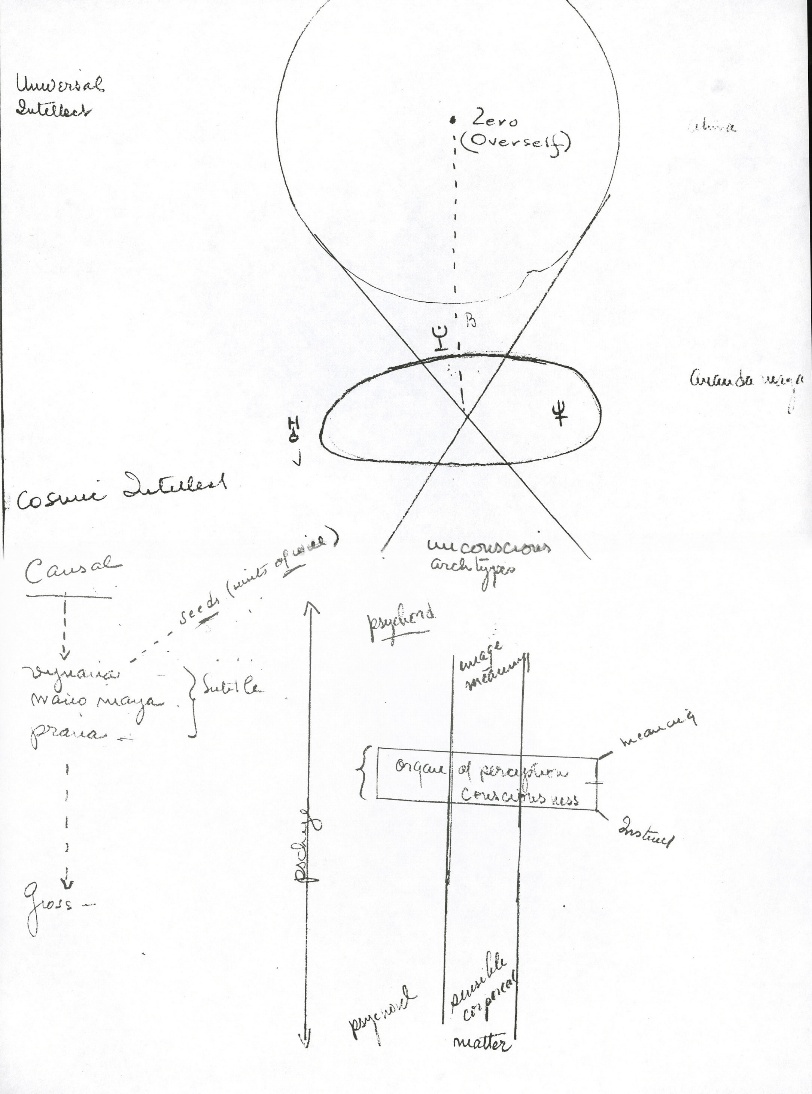
FIGURE AD_G_019 merged. Universal Intellect, Cosmic Intellect, Psyche.
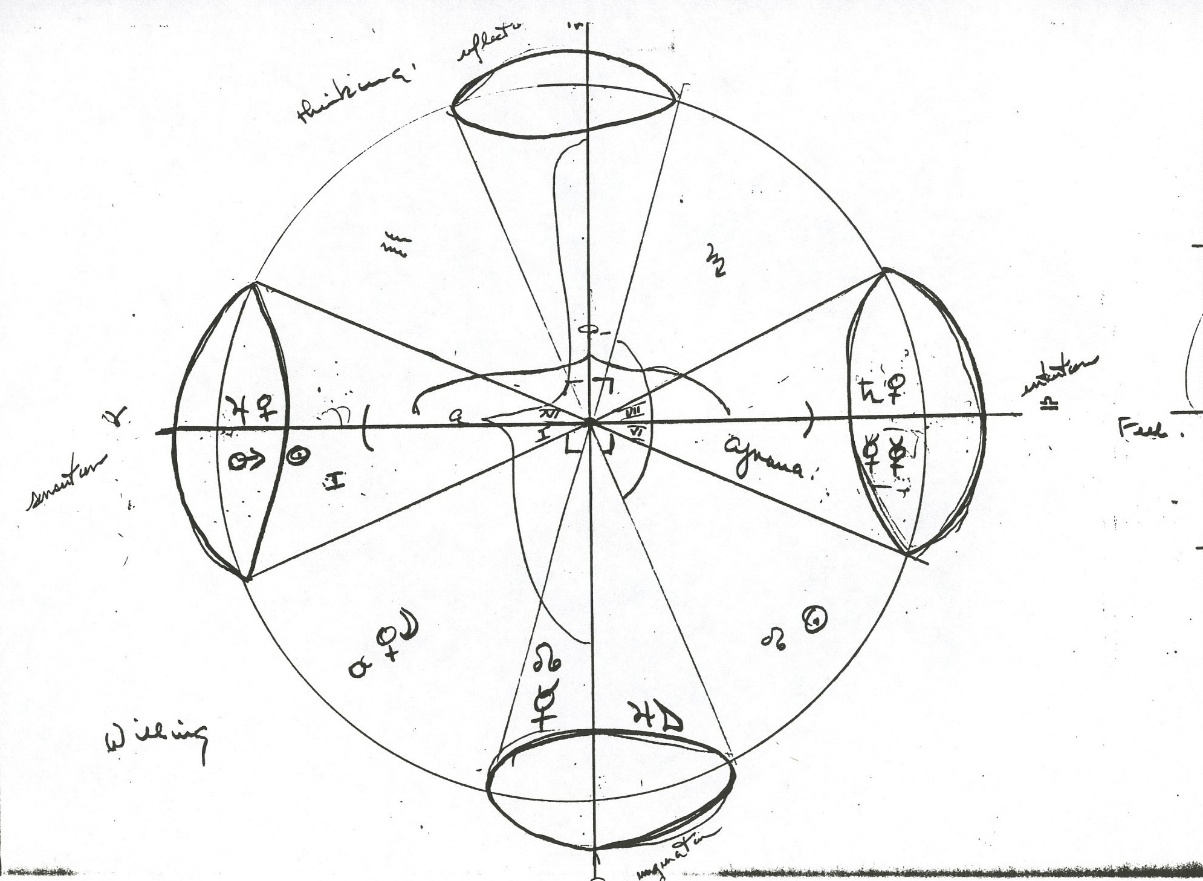
FIGURE AD_G_011. Four Psychological Functions and Thinking Feeling Willing mapped onto Twelvefold Chart; with rulerships and exaltations for houses 12-7.
Other diagrams also referred to are not with this transcript version. [Transcriber note: [diagram] means the speaker is referencing a diagram as he or she is speaking. If someone is drawing or writing, with audible sounds of chalk on a blackboard, I indicate this by [drawing] or [writing].]
NOTE: For readability's sake, the following substitutions/edits made in Verbatim Transcript: cuz = 'cause; gonna = going to; gotta = got to; yeah = yes.
TRANSCRIBED Verbatim by IT prior to 2017, reformatted by jf 2017. In 2023, IT updates prefatory matter, footer, and audio file name, completes Book List, fixes errors/typos, adds new notes within transcript, adds two diagrams and references within transcript to these diagrams, reformats to accord with new conventions. In 2025, IT updates audio file markers to match new REP audio. Archival verbatim transcript – V12a.
AUDIO FILES: 1973 0119a, 1973 0119b, 1973 0119c. [Note 1: "Tape" refers to original audio cassette tapes that were later digitized into .MP3 Audio Files, and which were also consulted for this transcript. Note 2: In 2024, REP Studio cuts dead air from file b.]
1973 01/19 at Wisdom's Goldenrod
Jung; Alchemy
[Audio File 1973 0119a Begins]
[VM laughing]
S (very faint): Uh-hm.
AD: Fox.
VM: You let Lenny scare you? (bit of laughter)
AD: Fox, not chicken. (some laughter)
VM: (Ok.) You're going to stake one around that chicken coop and eat any-- eat every one of those chickens.
AD: No. (laughter) No I thought that we might try something like this. There's a short alchemical al-- allegory in the Mysterium Conjunction which is relatively easy to understand. And, then there's a second part in the Alchemical Studies on the study of Mercurius. Then we go back and we'll do "The Psychology of Transference," the Rosarium. And that should get us pretty deeply into the alchemical work of Jung. And this is relatively simple to understand, it'll give you a clue into the way this man works and won't require too much effort on your part. You can be passive and sit down and listen.
[student makes funny noise]
S (faint): (What/That) happens in thinking of something(?/.)
AD: I thought I heard a chicken. (some laughter)
S (very faint): [few words inaudible] (laughter)
AD (amidst laughter): (I see.) [few seconds of laughter, background student talking] He said, I'm going-- he-- he takes an alchemical text and he's going to analyze this text as though it was a dream or a fantasy. And he has the Latin text on one side and I won't ask you to listen to that, English on the other, we start right off. He says--
C.G. Jung [CW 14, Mysterium Coniunctionis, "The Personification of the Opposites," p. 160, paragraph 189, AD reading]: ""If thou knowest how to moisten this dry earth with its own water, thou wilt loosen the pores of the earth…""
AD: Now he translates this and he analyzes this as though he was, you know, sitting-- having you sit on a couch, you know.
C.G. Jung [CW 14, Mysterium Coniunctionis, "The Personification of the Opposites," pp. 160-161, paragraph 190, AD reading]: "If you will contemplate your lack of fantasy, of inspiration and [AD reads: of] inner aliveness, which you feel as sheer stagnation and a barren wilderness, and impregnate it with the interest born of alarm [S: Of what?] [AD: of"…the interest born of alarm] at your inner death, then something can take shape in you, for your inner emptiness conceals just as great a fullness if only you will allow it to penetrate into you."
[student assents, very faint]
AD: You know, right? Like you [student assents] sit down and you meditate and you say, "Dead, there's nothing there." But you don't want it to penetrate you, you don't want to experience the frustration, the lack of concentration, right? You just get up and get mad, "Why ain't I a successful businessman?"
S (faint): (Well/Wow), (that's something).
S: Right.
S: [one word inaudible]
AD: Alright, [S simultaneously: I know a bit about that.] so he says--
C.G. Jung [CW 14, Mysterium Coniunctionis, "The Personification of the Opposites," p. 161, paragraph 190, AD reading]: "…[your] [AD reads: this] inner emptiness conceals just as great a fullness if only you [will] allow it to penetrate you. If you prove receptive to this"call of the wild," the longing for fulfillment will quicken the sterile wilderness of your soul as rain quickens the dry earth."
AD: The next sentence goes--
C.G. Jung [CW 14, Mysterium Coniunctionis, "The Personification of the Opposites," p. 161, paragraph 190, AD reading]: ""…and this thief from outside will be cast out with [the] workers of wickedness…""
AD: Now, that's the alchemical text, and Jung goes on and he translates it into your language.
C.G. Jung [CW 14, Mysterium Coniunctionis, "The Personification of the Opposites," p. 161, paragraph 191, AD reading]: "You are so sterile because, without your knowledge, something like an evil spirit has stopped up the source of your fantasy, the fountain of your soul. The enemy is your own crude sulphur, which burns you with the hellish fire of desirousness [or concupiscentia]. You would like to make gold because"poverty is the greatest plague, wealth the highest good." You wish to have results that flatter your pride, you expect something useful, but there can be no question of that as you have realized with a shock. Because of this you no longer even want to be fruitful, as it would be only for God's sake but unfortunately not for your own."
S: [three/few words inaudible]
AD: It's making sense to you? [VM: I felt that one.] [student assents] I mean it's getting home? Just like analyzing one of your dreams. Alright, the next alchemical sentence, the track runs--
C.G. Jung [CW 14, Mysterium Coniunctionis, "The Personification of the Opposites," p. 161, paragraphs 191, 192, AD reading]: ""…and the water, by an admixture of the true Sulphur, will be cleansed from the leprous filth and from the superfluous dropsical fluid…"
"Therefore away with your crude and vulgar desirousness, which childishly [and shortsightedly] sees only goals within its own narrow horizon [AD reads: horizons]. Admittedly sulphur is a vital spirit, a"Yetser Ha-ra"…"
AD: And down here the footnote is, [AD paraphrasing footnote] this is-- this means an "instinct for evil".
MB (very faint): Yetser Ha-ra?
VM: Sulphur is an instinct?
AD: Yes, desirousness.
VM: That's what sulphur is, desire?
AD (faint): Desire.
MB: It's Yetser Ha-ra?
S: It is?
AD: Is that how you say it, Yetsi Ha-ra? Yes.
MB: Hebrew?
AD: He says there's a poem, a well known poem in Hebrew, and it means the instinct of evil.
S (very faint): That's [one very faint word inaudible]
AD: Alright.
C.G. Jung [CW 14, Mysterium Coniunctionis, "The Personification of the Opposites," pp. 161-162, paragraph 192, AD reading]: "…an evil spirit of passion, though like this an active element; useful as it is at times, it is an obstacle between you and your goal. The water of your interest is not pure, it is poisoned by the leprosy of desirousness [AD reads: desire] which is the common ill. You too are infected with this collective sickness. Therefore bethink you for once…and consider: What is behind all this desirousness [AD reads: desire]? A thirsting for the eternal, which as you [AD adds: can] see can [AD reads: could] never be satisfied with the best because it is"Hades" in whose honour the desirous [AD reads: desires] "go mad and rave." The more you cling to that which all the world desires, the more you are Everyman, who has not yet discovered himself and stumbles through the world like a blind man leading the blind with somnambulistic certainty into the ditch. Everyman is always a multitude. Cleanse your interest of that collective sulphur which clings to [AD adds: you] all like a leprosy. For desire only burns in order to burn itself out…"
AD: If you remember, this is exactly what the Buddhists call samskara-- samsara.
C.G. Jung [CW 14, Mysterium Coniunctionis, "The Personification of the Opposites," p. 162, paragraph 192, AD reading]: "…and in and from this fire arises the true living spirit which generates life according to its own laws, and is not blinded by the shortsightedness of our [AD reads: your] intentions or the crude presumption of our superstitious belief in the will. … This means burning in your own fire and not being like a comet or a flashing beacon, showing others the right way but not knowing it yourself. … Once the existence of this opposite is accepted, the ego can and should come to terms with its demands. Unless the content given you by the unconscious is acknowledged, its compensatory effect is not only nullified but actually changes into its opposite, as it then tries to realize itself literally and concretely."
AD: The next alchemical sentence is--
C.G. Jung [CW 14, Mysterium Coniunctionis, "The Personification of the Opposites," pp. 162-163, paragraphs 192, 193, AD reading]: ""…[and] thou wilt have in thy power the Fount of the Knight of Treviso, whose waters are rightfully dedicated to the maiden Diana."
"… The ever-flowing fountain expresses a continual flow of interest toward [AD reads: towards] the unconscious, a kind of constant attention or"religio," which might also be called devotion. The crossing of [AD reads: the] unconscious contents into consciousness is thus made considerably easier, and this is bound to benefit the psychic balance in the long run. Diana as the numen and nymph of this spring is an excellent formulation of the figure we know as the anima. [S: Yes.] [AD: Yes.] [S: Uh-hm.] If attention is directed to the unconscious, the unconscious will yield up its contents, and these in turn will fructify the conscious like a fountain of living water. For consciousness is just as arid as the unconscious if the two halves of our psychic life are separated."
AD: The alchemical text--
C.G. Jung [CW 14, Mysterium Coniunctionis, "The Personification of the Opposites," pp. 163-164, paragraphs 193, 194 AD reading]: ""Worthless is this thief, armed with the malignity of arsenic, from whom [AD reads: which] the winged youth fleeth, shuddering."
"It is evidently a difficult thing, this"cleansing from leprous filth"; indeed, d'Espagnet calls it [AD reads: and it's called] a labour of Hercules. That is why the text turns back to the "thief" at this point. The thief, as we saw, personifies a kind of self robbery. He is not easily shaken off, as it comes from a habit of thinking supported by tradition and milieu alike: anything that cannot be exploited in some way is uninteresting--hence the devaluation of the psyche. A further reason is the habitual depreciation of everything one cannot touch with the hands or does not understand. In this respect our conventional system of education--[necessary as it was]--is not entirely free from the blame of having helped to give the empirical psyche a bad name. In recent times this traditional error has been made even worse by an allegedly biological point of view which sees man as being no further [AD reads: farther] advanced than a herd-animal and fails to understand any of his motivations outside the categories of hunger, power, [and] sex. We think in terms of thousands and millions of units, and then naturally there are no questions more important than whom [AD reads: who] the herd belongs to, where it pastures, whether enough calves are born [and] sufficient quantities of milk and meat are produced. In the face of huge numbers every thought of individuality pales, for statistics obliterate everything unique. Contemplating such overwhelming might and misery the individual is embarrassed to exist at all. Yet the real carrier of life is the individual. He alone feels happiness, he alone has virtue and responsibility and any ethics whatever. The masses and the state have nothing of the kind. Only man as an individual human being lives; the state is just a system, a [mere] machine for sorting and tabulating the masses. Anyone, therefore, who thinks in terms of men minus the individual, in huge numbers, atomizes himself and becomes a thief and a robber to himself. He is infected with the leprosy of collective thinking and has become an inmate of the insalubrious stud-farm called the totalitarian State. (laughter) Our time contains and produces more than enough of that "crude sulphur" which [with "arsenical malignity"] prevents man from discovering his true self [AD reads: becoming itself]."
[students assent, faint]
AD: In Ruland's Lexicon, he goes on and says--
C.G. Jung [CW 14, Mysterium Coniunctionis, "The Personification of the Opposites," pp. 164-165, paragraphs 195, 196, 197, AD reading]: "[There] arsenic is defined as an"hermaphrodite, the means whereby Sulphur and Mercury are united. It has communion with both natures and is therefore called Sun and Moon." [Or arsenic is] "Luna, our Venus, Sulphur's companion" and the "soul." Here arsenic is no longer the masculine aspect of the arcane substance but is hermaphroditic [AD reads: hermaphrodite] and even feminine. [AD adds: And] This brings it dangerously close to the moon and the crude sulphur, so that arsenic loses its solar affinity. As "Sulphur's companion" it is poisonous and corrosive. Because the arcane substance always points to the principle unconscious content, its peculiar nature shows in what relation that [content] stands to consciousness. If the conscious mind has accepted it, it has a positive form, if not, a negative one. If on the other hand the arcane substance is split into two figures, this means that the content has been partly accepted [and] partly rejected; it is seen under two different, incompatible aspects and is therefore taken to be two different things.
"[AD adds: And] This is what happened in our text: the thief is contrasted with the winged youth, who represents the other aspect, or personifies the"true sulphur," the spirit of inner truth which measures man not by his relation to the mass but by his relation to the mystery of the psyche. This winged youth [(the spiritual Mercurius)] [AD: That's the spiritual Mercurius of course.] is obviously aware of his own weakness and flees "shuddering" from the crude sulphur. The standpoint of the inner man is the more threatened the more overpowering [that] of the outer man is. Sometimes only his invisibility saves him. He is so small that no one would miss him if he were not the sine qua non of inner peace [and happiness]. In the last resort it is neither the "eighty-million-strong nation" nor the State that feels peace and happiness, but the individual. Nobody can ever get round [AD reads: around] the simple computation that a million noughts in a row do not add up to 1, just as the loudest talk can never abolish the simple psychological fact that the larger the mass the more nugatory is the individual.
"[AD adds: So] This shy and delicate youth stands for everything that is winged in the psyche or that would like to sprout wings. But it dies from the poison of organizational thinking and mass statistics; the individual succumbs to the madness that sooner or later overtakes every mass--the death instinct [AD reads: death-instincts] of the lemmings."
AD: Do you know anything about the lemmings? [students assent] What do you know about them?
S: Well every once in a while they all go into the sea and commit suicide. Almost all.
AD: Almost all of them go to--
S: Into the sea, into water.
AD: And-- and drown themselves.
S: Yes, the individual.
AD: It's amazing, isn't it?
MB (simultaneously): Corresponds to a rise in the population.
S (faint): Isn't it?
AD (simultaneously): Huh?
MB: Corresponds to a rise in the population.
S: Crowd control.
AD: Well, there's about three and half billion now, right?
[student(s) assenting]
S (very faint, possibly part of background): Pretty obvious.
VM: You know, our manner.
AD: Alright so-- Quickly I'll just reread the English text of the alchemy.
C.G. Jung [CW 14, Mysterium Coniunctionis, "The Personification of the Opposites," pp. 160-165, paragraphs 189-197, 198, AD reading]: ""If thou knowest how to moisten this dry earth with its own water, thou wilt loosen the pores of the earth, and this thief from outside will be cast out with the workers of wickedness, and the water, by an admixture of the true Sulphur, will be cleansed from the leprous filth and from the superfluous dropsical fluid, and thou wilt have in thy power the Fount of the Knight of Treviso, whose waters are rightfully dedicated to the maiden Diana. Worthless is this thief, armed with the malignity of arsenic, from whom the winged youth fleeth, shuddering. And though the central Water is his bride, yet dare he not display his most ardent love towards her, because of the snares of the thief, whose machinations are in truth unavoidable."
[paragraph 198] "The goal of this winged youth is a higher one than [the] fulfillment of collective ideals, which are all nothing but makeshifts and conditions for bare existence. Since this is the absolute foundation, nobody will deny their importance, [AD: So--] but collective ideals are not by a long way the breath of life which a man needs in order to live. If his soul does not live nothing can save him from stultification. His life is the soil in which his soul can and must develop. He has only the mystery of his living soul to set against the overwhelming might and brutality of collective convictions."
AD: He's really putting you on your own.
C.G. Jung [CW 14, Mysterium Coniunctionis, "The Personification of the Opposites," p. 166, paragraph 200, AD reading]: "We learn that this winged youth is espoused to the"central Water." [AD adds: And] This is the fountain of the soul or the fountain of wisdom, from which the inner life wells up. The nymph of the spring is in the last analysis Luna, the mother-beloved, from which it follows that the winged youth is Sol, the filius solis… He is the best, the highest, the most precious in potentia [AD reads: in potential]. But he will become real only if he can unite with Luna, [AD adds: that is] the "mother of mortal bodies.""
S: Hm.
S: Hm.
AD: I'm going to skip through here, just go on to the next paragraph.
C.G. Jung [CW 14, Mysterium Coniunctionis, "The Personification of the Opposites," p. 167, paragraph 201, AD reading]: "I can do no more than demonstrate the existence of this image [AD repeats: of this image] and its phenomenology. What the union of opposites really"means" transcends human imagination. Therefore the worldly-wise can dismiss such a "fantasy" without further ado, for it is perfectly clear: [tertium non datur]. But that doesn't help us much, for we are dealing with an eternal image, an archetype, from which man can turn away his mind for a time but never permanently. Whenever this image is obscured [AD reads: obscure] his life loses its proper meaning and consequently its balance. So long as he knows that he is the carrier of life and that it is therefore important for him to live, then the mystery of his soul lives also--no matter whether he is conscious of it or not."
AD: Notice that. See, the process of individuation can go on whether you're conscious of it or not.
C.G. Jung [CW 14, Mysterium Coniunctionis, "The Personification of the Opposites," pp. 167-168, paragraphs 201, 202, 203, AD reading]: "So long as he knows that he is the carrier of life and that it is therefore important for him to live, then the mystery of his soul lives also… But if he no longer sees the meaning of his life in its fulfillment, and no longer believes in man's eternal right to this fulfillment, then he has betrayed and lost his soul, substituting for it a madness which leads to destruction…
"The"machinations of the thief," our text says [AD reads: says our text], are "unavoidable." They are an integral part of the fateful drama of [the] opposites, [AD adds: and] just as the shadow belongs to the light. Reason, however, cannot turn this into a convenient recipe, for inevitability does not diminish the guilt of what is evil anymore than the merit of what is good. Minus remains minus, and guilt, as ever, has to be avenged. "Evil follows after wrong"…a banal truth that is too readily forgotten, and because of this the winged youth cannot lead his bride home as quickly as he would wish. Evil cannot be eradicated once and for all; it is an inevitable component of life and is not to be had without paying for it. The thief whom the police do not catch has, nonetheless, robbed himself, and the murderer is his own executioner.
"The thief in our text is armed with all evil, but in reality it is merely the ego with its shadow where the [abysmal] depths of human nature begin to appear. Increasing psychological insight hinders the projection of the shadow, and this gain in knowledge logically leads to the problem of the union of opposites. One realizes, first of all, that one cannot project one's shadow on to others, and next that there is no advantage in insisting on their guilt, as it is so much more important [AD: Look at the positive value he's giving this."…as it is so much more important] to know and possess one's own, because it is part of one's own self and a necessary factor without which nothing in this sublunary world can be realized."
AD: I want to reread this.
[sounds like student assent, very faint]
C.G. Jung [CW 14, Mysterium Coniunctionis, "The Personification of the Opposites," pp. 167-168, paragraph 203, AD reading]: "The thief in our text is armed with all evil, but in reality it is merely the ego with its shadow where the [abysmal] depths of human nature begin to appear. Increasing psychological insight hinders the projection of the shadow, and this gain in knowledge logically leads to the problem of the union of opposites."
AD: In other words, you reach a certain point where you know this person who you dislike, and on whom you've projected certain qualities, he's got nothing to do with this really, you know it's your problem. A little psychological insight makes it more and more difficult for you to go around just disliking people. That's a kind of painful situation, alright.
[student assents, very faint]
S (very faint): (What's this) [one word inaudible] shadow, I mean, unless I go [one/two words inaudible]
S (very faint): [one word inaudible]
AD: I'll-- I'll have a special-- a side interview with you. (bit of laughter)
S (very faint): [one word inaudible]
[student assents, very faint]
S (very faint): (Ok.)
AD: You're an exception. The shadow could be projected on events or people or situations. Ok, so--
C.G. Jung [CW 14, Mysterium Coniunctionis, "The Personification of the Opposites," p. 168, paragraph 203, AD reading]: "Increasing psychological insight hinders the projection of the shadow, and this gain in knowledge logically leads to the problem of the union of opposites."
AD: It has to do that. You can't deal with that very long.
C.G. Jung [CW 14, Mysterium Coniunctionis, "The Personification of the Opposites," p. 168, paragraph 203, AD reading]: "One realizes, first of all, that one cannot project one's shadow on to others, and next that there is no advantage in insisting on their guilt, as it is so much more important to know and possess one's own guilt, because it is part of one's own self and a necessary factor without which nothing in this sublunary world can be realized. Though it is not said that Luna personifies the dark side, there is as we have seen something very suspicious about the new moon."
AD: And this is very applicable for men, you know, like we say, the moon in your chart really shows you up. But you don't know.
C.G. Jung [CW 14, Mysterium Coniunctionis, "The Personification of the Opposites," p. 168, paragraph 203, AD reading]: "Nevertheless the winged youth loves his moon-bride and hence the darkness to which she belongs…"
AD: Are you following? Just [S simultaneously: Yes.] think of the moon as the unconscious, males.
C.G. Jung [CW 14, Mysterium Coniunctionis, "The Personification of the Opposites," p. 168, paragraph 203, AD reading]: "…for the opposites [AD reads: opposite]…"
AD: I'm not chauvinistic, it just happens that most of the alchemists were males.
C.G. Jung [CW 14, Mysterium Coniunctionis, "The Personification of the Opposites," p. 168, paragraph 203, AD reading]: "Nevertheless the winged youth…"
AD: Not-- there was a few exceptions. (laughter)
S: Maria?
AD: Huh?
S: Maria?
AD: Oh, there's a very beautiful story of Nicholas Flamel and his wife. Did you ever read it?
MB: Yes.
AD: Well, try reading it, it's very beautiful.
VM: Is Maria Prophetissa-- was she an alchemist [one word inaudible] or no?
AD (simultaneously): No, there's no-- there's no information on that.
S (very faint): [one/two words inaudible]
AD: There are a few (women), but one that's written up in detail, I think it's in the back of the book on alchemy by Burckhardt. [Note: Titus Burckhardt, Alchemy: Science of the Cosmos, Science of the Soul.] And the text may be--
MB: Yes, yes, it's right here.
AD: Was it there? [student assents, faint] Somewhere else, two or three alchemy books have the whole text. And since I'm interrupting you, remember, Jung isn't one hundred percent right. Right? Because some people have made gold.
S (very faint): [few words inaudible]
AD: Ok? You can check that. Manly Hall is certainly not a genius, a philosophic genius, but he's a very honest researcher. And The Dawn of Magic there's quotations, [Note: Louis Pauwels & Jacques Bergier, The Dawn of Magic.] and what was the book I showed you, The Arts of the Alchemists, [Note: C.A. Burland, The Arts of the Alchemists.] there's quotations there of people who have made gold as recent as 1945. (student laughing)
[students assent, very faint]
VM (very faint): [couple words inaudible] go into a business.
AD: Huh? You want to go into business?
S: [few words inaudible]
[student assents]
AD: Alright, to-- to return to the psychological interpretation of alchemy according to Jung, ok. I just don't want you to feel too secure.
C.G. Jung [CW 14, Mysterium Coniunctionis, "The Personification of the Opposites," p. 168, paragraph 203, AD reading]: "We all know that evil, especially if it is not scrutinized too closely, can be very attractive, (some laughter) and most of all when it appears in idealistic garb. [S, very faint: (Patriarchs/Patriot).] Ostensibly it is the wicked thief that hinders the youth in his love for the chaste Diana, but in reality the evil is already lurking in the ideal youth and in the darkness of the new moon, and his chief fear is that he might discover himself in the role of the common sulphur. This role is so shocking that the noble-minded youth cannot see himself in it and puts the blame on the wiles of the enemy. It is as if he dared not know himself because he is not adult enough to accept the fact that one must be thankful if one comes across an apple without a worm in it… (AD laughing a bit, student assents, laughter)
"Here may Diana be propitious to thee, who knoweth how to tame wild beasts…""
LS (faint): That's quite an answer.
AD: (And) this is the interesting part Vic.
S (very faint): [few words inaudible] (laughter)
C.G. Jung [CW 14, Mysterium Coniunctionis, "The Personification of the Opposites," pp. 168-169, paragraphs 204, 205, AD reading]: "The darkness which is opposed to the light is the unbridled instinctuality of nature that asserts itself despite all consciousness. Anyone who seeks to unite the opposites certainly needs Diana to be propitious to him, for she is being considered as a bride and it has yet to be seen what she has to present in the way of wild animals. Possibly the thief will appear quite insignificant by comparison. (laughter, student words)
""…and those twin doves will temper the malignity of the air with their wings…"
"The tender pair of doves [AD: Now Jung is explaining."The tender pair of doves] is an obviously harmless aspect of the same instinctuality, though in itself the theriomorphic symbol would be capable of an "interpretation from above downwards." Nonetheless…"
VM: Tony, I got lost in the last few--
AD: Alright, the tender pair of doves. And here's the sentence.
C.G. Jung [CW 14, Mysterium Coniunctionis, "The Personification of the Opposites," p. 168, paragraph 204, AD reading]: ""…and whose [AD reads: those] twin doves…""
AD: Try to remember that-- you remember in his diagram the instinct, the instinctual meaning is dow-- [drawing] the-- the instinct is embedded in matter [diagram] and the meaning of the instinct is up here [diagram], alright, [VM assents] and the consciousness can slide up and down accordingly [FIGURE AD_G_019 merged]. Now he says that the interpretation can take place from the top as well as from the bottom.
VM: Well, what's a dove symbolize again, [AD simultaneously: Alright, I'll read.] the latent anima and the shadow?
LS: No, he doesn't have those any more.
C.G. Jung [CW 14, Mysterium Coniunctionis, "The Personification of the Opposites," pp. 168-169, paragraphs 204, 205, 206, AD reading]: ""…[and] whose [AD reads: those] twin doves will temper the malignity of the air with their wings…"
"The tender pair of doves is an obviously harmless aspect of the same instinctuality, though in itself the theriomorphic symbol would be capable of an"interpretation from above downwards." Nonetheless, it should not be interpreted in this sense because the aspect of untamed animality and evil is represented in the previous quotation by the mad dog and in this one by the thief. In contrast to this, the doves are emblems of innocence and of marital love as well as of the Holy Ghost and Sapientia, of Christ and his Virgin Mother. From this context we can see what the dove is intended to represent: it is the exact counterpart to the malignity of the thief. Together they represent the attack, first from one side and then from the other, of a dualistic being on the more restricted consciousness of man. The purpose or result of this assault is the widening of consciousness which has always, it seems, followed the pattern laid down in Genesis [3:4f.]: "Ye shall not surely die, for God doth know that in the day ye eat thereof, then your eyes shall be opened, and ye shall be as gods, knowing good and evil."
"It is obviously a moment of supreme possibilities both for good and evil. Usually, however, it is the first one and then the other: the good man succumbs to evil, the sinner is converted to good, and that, to an uncritical eye, is the end of the matter. But those endowed with a finer moral sense or deeper insight cannot deny that the seeming one-after-another is in reality a happening of events side-by-side, and perhaps no one has realized this more clearly than St. Paul, who knew that he bore a thorn in the flesh and that the messenger of Satan smote him in the face [AD emphasis] lest he be "exalted above measure.""
[students assent, very faint]
[short pause, flipping of pages]
AD: I'll skip through to the next line.
C.G. Jung [CW 14, Mysterium Coniunctionis, "The Personification of the Opposites," pp. 170-171, paragraphs 206, 207, 208, AD reading]: ""…so that the youth easily entereth [AD reads: entered] in through the pores, and [AD reads: it has] instantly shaketh the foundations of the earth, and raiseth up a dark cloud."
"Once the malignity is tempered, sinfulness and its evil consequences are mitigated too, and that which has wings can embrace the earth. For now we come to the consummation of the hierosgamos, the"earthing" [AD: Quote, unquote.] of the spirit and the spiritualizing of the earth, the union of opposites and [the] reconciliation of the divided [(Ephesians 2:14)], in a word, the longed-for act of redemption whereby the sinfulness of existence, the original disassociation, will be annulled in God. The earthquake is on the one hand an allusion to Christ's descent into the hell and his resurrection, and on the other hand a shaking of the humdrum earthly existence of man, into whose life and soul meaning has at least penetrated, and by which he is at once threatened and uplifted.
"This is always an intuitive experience that is felt as a concrete reality. It is the prefiguration and anticipation of a future condition, a glimmering of an unspoken, half-conscious union of ego and non-ego. Rightly called a union mystica, it is the fundamental experience of all religions that have any life in them and have not yet degenerated into confessionalism; that [AD reads: they] have safeguarded the mystery of which the others know only the rites it produced--empty bags from which the gold has long since vanished."
S (whisper): Your coffee?
LS: Coffee? Yes.
S (very faint): Me too.
AD: Would you read?
LS: Finish it up to here.
AD: To this paragraph and up again.
C.G. Jung [CW 14, Mysterium Coniunctionis, "The Personification of the Opposites," p. 171, paragraph 209, LS reading]: "The earthquake sends up a dark cloud: consciousness, because of the revolution of its former standpoint, is shrouded in darkness, just as the earth was at Christ's death, which was followed by a resurrection. This image tells us that the widening of consciousness is at first upheaval and darkness, [AD assents, faint] then a broadening out of man to the whole man. This"Man," [LS: Capital and in quotes.] being indescribable, is an intuitive or "mystical" experience, and the name "Anthropos" is therefore very apt because it demonstrates the continuity of this idea over the millenia."
LS: More text.
C.G. Jung [CW 14, Mysterium Coniunctionis, "The Personification of the Opposites," p. 171, paragraph 209, LS reading]: ""But thou wilt lead the waters up even to the brightness of the moon…""
LS: Now Jung comments.
C.G. Jung [CW 14, Mysterium Coniunctionis, "The Personification of the Opposites," p. 171, paragraph 210, LS reading]: "As we have seen, water here has the meaning of"fructifying interest," and its leading upwards means that it now turns towards the plenilunium, [AD: Yes.] the gracious and serene complement of the sinister new moon and its perils."
LS: More text.
C.G. Jung [CW 14, Mysterium Coniunctionis, "The Personification of the Opposites," p. 171, paragraph 210, LS reading]: ""…and the darkness that was upon the face of the deep shall be scattered by the spirit moving over the waters. Thus by God's command shall the Light appear.""
LS: Now is Jung's comment.
C.G. Jung [CW 14, Mysterium Coniunctionis, "The Personification of the Opposites," p. 172, paragraph 211, LS reading]: "The eye that hitherto saw only the darkness and danger of evil turns towards the circle of the moon, where the ethereal realm of the immortals begins, and the gloomy deep can be left to its own devices, for the spirit now moves it from within, convulses and transforms it. When consciousness draws near to the unconscious not only does it receive a devastating shock but something of its light penetrates into the darkness of the unconscious. The result is that the unconscious is no longer so remote and strange and terrifying, and this paves the way for an eventual union. Naturally the"illumination" of the unconscious does not mean that from now on the unconscious is less unconscious. Far from it. What happens is that its contents cross over into consciousness more easily than before. The "light" that shines at the end is the lux moderna of the alchemists, the new widening of consciousness, a further step in the realization of the Anthropos, and every one of these steps signifies a rebirth of the [LS reads: a] deity."
S: Ok.
AD: Now I know in terms of alchemical texts they're difficult to understand and follow and you do have to treat them like dreams. That's the only way you could really get to a text in alchemy, you have to try to-- If you understand anything about the way Jungian dream analysis operates, he basically operates in that fashion, he goes to these texts and tries to find archetypal material in them and explicates in that sense. But I think you could see what he's been doing. In his own way he's tried to recover from alchemy a sort of psychology which we speak of in terms of familiarity because-- We speak about the shadow, you know, and we think we know what we're talking about. We speak about the anima, we speak about all these archetypal contents, and we have-- we have a kind of familiarity. But my suspicion is the alchemists went much deeper than that. However, Jung has sort of stratified their meaning. He gives a psychological interpretation. I think it's possible to give, according to the alchemist, a cosmological interpretation. And the reason why last week I started with "The Psychology of Transference," I wanted to-- to give the interpretation as Jung saw it and then a cosmological interpretation alongside of that. But that would mean bringing in a great deal of the Platonic tradition, because some people have difficulty in understanding that there's a point of view which is neither Vedantic nor Platonic or Buddhist; and, that for instance, Parabrahman is not the Absolute but that's the way the subjective entity looks at the Absolute.
But there's the other point of view of the alchemist and the scientist who believes that there's an absolute Matter which is uncreated and uncreatable, and he takes that aspect, and he works that aspect you see. And the Absolute, therefore, would mean something that's above both Parabrahman, the absolute Consciousness, and Matter, the absolute uncreated Matter. Ok. Now, I'm making that standpoint available to a couple of people here who want to follow me. I don't submit to Plotinus, Plato, or any of the traditionalists. You've got to find and see these things in your own understanding. It's got to be your understanding, not Mr. Row. Ok Richard?
The-- we'll-- I think last night, among a small group of us, we begun to find out that the hardest thing to do with any of these people is to see at what level they're working from. And if that isn't established, you're in trouble because then that means you can start walking and find there's about eighteen forks on-- in the road, not two. So this is not a criticism, please don't take it as a criticism, I'm just trying to ex-- you know, bring my point out. That's why for a couple of weeks there's a kind of getting used to Jung.
Now we have an easier one here to work with and this is much more closer to your understanding. It's from the "Spirit Mercurius". I think you'll have practically no trouble following this and getting a hold on Jung's method. Would you read the fable, Lenny? Would you read the fable? Oh Linda's here, I didn't even see you, so small. Just the fable. This is a story now, a legend, an alchemical legend, ok, and a fairy tale. And you know, a fairy tale is like a dream and the psyche, its product is stratified in a certain way.
C.G. Jung [CW 13, Alchemical Studies, "The Spirit Mercurius," p. 193, paragraph 239, LS reading]: ""Once upon a time there was a poor woodcutter. He had an only son, whom he wished to send to a high school."" (bit of laughter)
S (very faint): A high school?
AD: High school was very very high in those days. (laughter)
C.G. Jung [CW 13, Alchemical Studies, "The Spirit Mercurius," pp. 193-194, paragraph 239, LS reading]: ""However, since he could give him only a little money to take with him, it was used up long before the time for the examinations. So the son went home and helped his father with the work in the forest. Once, during the midday rest, he roamed the woods and came to an immense old oak. There he heard a voice calling from the ground,"Let me out, let me out!" He dug down among the roots of the tree and found a well-sealed glass bottle from which, clearly, the voice had come. [AD drawing] He opened it and instantly a spirit rushed out and soon became half as high as the tree. The spirit cried in an awful voice: "I have had my punishment and I will be revenged! I am the great and mighty spirit Mercurius, and now you shall have your reward. Whoso releases me, him I must strangle." (laughter) This made the boy uneasy (laughter) and, quickly thinking up a trick, he said, "First, I must be sure that you are the same spirit that was shut up in that little bottle." To prove this, the spirit crept back into the bottle. Then the boy made haste to seal it and the spirit was caught again. But now the spirit promised to reward him richly if the boy would let him out. So he let him out and received as a reward a small piece of rag. (bit of laughter) [one inaudible AD word] Quoth the spirit: "If you spread one end of this over a wound it will heal, and if you rub steel or iron with the other end it will turn into silver." Thereupon the boy rubbed his damaged axe with the rag, and the axe turned to silver and he was able to sell it for four hundred thaler. Thus father and son were freed from all worries. The young man could return to his studies, and later, thanks to his rag, he became a famous doctor."" (laughter)
S: A real [one word inaudible] success story. (laughter)
S (amidst laughter): He woke up.
S: [few words inaudible]
AD (simultaneously): Well it's pleasant, isn't it? (laughter)
MW: Inspirational.
S (faint): [few words inaudible] (laughter)
LS (amidst laughter): But alchemy which isn't as heavy as some of the others, huh?
S: No.
S (faint): [few words inaudible] (bit of laughter)
AD: Alright, so this is the way he works, Jung.
C.G. Jung [CW 13, Alchemical Studies, "The Spirit Mercurius," p. 194, paragraph 241, AD reading]: "[As at] the beginning of many dreams something is said about the scene of the dream action, [so] the fairytale mentions the forest as the place of [the] magic happening [AD reads: happenings]. The forest, dark and impenetrable to the eye, like deep water and the sea, is the container of the unknown and the mysterious. It is an appropriate synonym for the unconscious."
AD: You remember, the beginning of Dante's voyage to hell, "I found myself in abandoned wooden place." [Note: See Dante Alighieri, The Divine Comedy: Inferno, Canto I.]
C.G. Jung [CW 13, Alchemical Studies, "The Spirit Mercurius," p. 194, paragraph 241, AD reading]: "Among the many trees--the living elements that make up the forest--one tree is especially conspicuous for its great size. Trees, like fishes in the water, represent the living contents of the unconscious. Among these contents one of special significance is characterized as an [AD reads: the]"oak." Trees have individuality. A tree, therefore, is often a symbol of [AD adds: a] personality. Ludwig II of Bavaria is said to have honoured certain particularly impressive trees in his park by having them saluted."
S: Um. (some laughter)
MB: Isn't that the crazy Ludwig (there) who supported [one word inaudible]
AD (simultaneously): Don't you-- don't you feel that, [VM: Oh yes.] when you're in the face of some of them? [student assents, very faint] [S, whisper: I don't.] Do you remember the one that PB sat next to?
S: The deodar. [Note: See Paul Brunton, A Hermit in the Himalayas.]
S (simultaneously, faint): Yes I do.
C.G. Jung [CW 13, Alchemical Studies, "The Spirit Mercurius," p. 194, paragraph 241, AD reading]: "The mighty old oak is proverbially the king of the forest. Hence it represents a central figure among the contents of the unconscious, possessing personality in the most marked degree. It is the prototype of the self…"
AD: And of course, the symbolism of the tree is unbelievably enormous. A good-- a good one would be Fergusson's book on tree-- tree worship in India. If you can get the one with plates. [Note: See James Fergusson, Tree and Serpent Worship or Illustrations of Mythology and Art in India in the First and Fourth Centuries after Christ.]
S (very faint): I'm not sure what (that is).
S (very faint): I'll look again, (but isn't everyone--)
AD: That's very rare. They're reprinting it in India.
C.G. Jung [CW 13, Alchemical Studies, "The Spirit Mercurius," pp. 194-195, paragraph 241, AD reading]: "…a symbol of the source and the goal of the individuation process. [AD: The tree.] [S, faint: Oh.] [AD: Alright.] The oak stands for the still unconscious core of the personality, the plant symbolism indicating a state of deep unconsciousness. From this it may be concluded that the hero of the fairytale is profoundly unconscious of himself. He is one of the"sleepers," the "blind" or "blindfolded," whom [we] encounter in the illustrations of certain alchemical treatises."
AD: You remember, from The Dawn of Magic, I think we were reading how-- was-- was it Gurdjieff? He devised this plan of having an alarm clock to wake you up and then how you incorporate the dream, bring it into your-- I mean the alarm clock, bringing it into your dream, so that when you're dreaming the alarm clock is part of [student assents, very faint] the dream and you don't have to wake up. So then they decided that twenty people should get together and figure out a way to keep-- you know, whoever wakes up wakes up the others. The problem of sleep is-- or unconsciousness is really a problem. Alright, so he goes on, he says--
C.G. Jung [CW 13, Alchemical Studies, "The Spirit Mercurius," p. 195, paragraph 242, AD reading]: "The secret is hidden not in the top but in the roots of the tree; and since it is, or has, a personality it also possesses [the most] striking marks of personality--voice, speech, [and] conscious purpose, and it demands to be set free by the hero. It is caught and imprisoned against its will, down there in the earth among the roots of the tree. The roots extend into the inorganic realm, [AD adds: and] into the mineral kingdom. In psychological terms, this would mean that the self has [its] roots [AD emphasis] in the body, indeed in [AD emphasis] the body's chemical elements."
AD: You remember the way, in "The Psychology of Transference," they spoke of Mercurius ensouling the inorganic realm, the vegetable, the animal, the--
VM: Uh-hm. How do they make this leap to the self though, Tony, is that a little 's' you're talking about there?
AD: I'm sorry?
VM: How do they make this leap to the self? Was that little self he's talking about or-- First you're talking about those trees as a-- as a context, you know, now he made reference to the self.
AD (simultaneously): Well, it symbolizes the self, and his version of the self. It's not the Atma, although he-- [VM simultaneously: No, no. He would claim that but I (don't agree with him).] he will equate-- he will equate it with the Atma and you'll see his grounds for doing so. Alright, so we-- try to keep this in mind so when we go back to "The Psychology of Transference," alright.
[VM assents, very faint]
C.G. Jung [CW 13, Alchemical Studies, "The Spirit Mercurius," p. 195, paragraph 242, AD reading]: "The roots extend into the inorganic realm, into the mineral kingdom. [AD adds: And] In psychological terms, this will mean that the self has [its] roots in the body, indeed in the body's chemical elements. Whatever this remarkable statement of the fairytale may mean in itself, it is no way stranger than the miracle of the living plant [AD emphasis] rooted in the inanimate earth. The alchemists describe their four elements as radices, corresponding to the Empedoclean rhizomata, [AD: Again, the four elements, the chaos.] and in them they saw the constituents of the most significant and central symbol of alchemy, the lapis philosophorum, which represents the goal of the individuation process."
LS: That means the philosopher's stone?
AD: Yes. Think of the stone as the Witness Self, ok, so that you don't get boggled.
C.G. Jung [CW 13, Alchemical Studies, "The Spirit Mercurius," p. 195, paragraph 243, AD reading]: "The secret hidden in the roots is a spirit sealed inside a [AD reads: the] bottle. Naturally it was not hidden away among the roots to start with, but was first confined in a bottle, which was then hidden. Presumably a magician, that is, an alchemist, caught and imprisoned it. As we shall see later, this spirit is something like the numen of the tree…"
AD: Remember when we spoke of the numenun? There's two kinds of lights that Paracelsus speaks of, the natural numenun-- No? It's the natural reason inherent in the constitution of the manifestation of a universe. That natural reason, that's what Paracelsus is speaking about.
C.G. Jung [CW 13, Alchemical Studies, "The Spirit Mercurius," pp. 195-196, paragraph 243, AD reading]: "As we shall see later, this spirit is something like the numen of the tree, its spiritus vegetativus, which is one definition of Mercurius."
AD: Now try to keep this in mind because we want to go back to "The Psychology of the Transference".
C.G. Jung [CW 13, Alchemical Studies, "The Spirit Mercurius," p. 196, paragraph 243, AD reading]: "As the life principle of the tree, it is a sort of spiritual quintessence abstracted from it, and could also be described as the principium individuationis [AD reads: individuation]. The tree would then be the outward and visible sign of the [realization of the self]."
[Audio File 1973 0119a Ends]
[Audio File 1973 0119b Begins]
C.G. Jung [CW 13, Alchemical Studies, "The Spirit Mercurius," p. 196, paragraphs 243, 244, AD reading]: ""…paradise." According to the same source, Christ himself is this tree. … "Behold in the Father the root, in the Son the branch, and in the Spirit the fruit: for the substance in the tree-- three [AD: I'm sorry. Three, you know.] is one." Mercurius, too, is trinus et unus [AD reads: a three and a one].
"So if we translate [it] into psychological language, the fairytale tells us [that] the mercurial essence, the principium individuationis [AD reads: that is, the principle-- the principle of individuation]…"
AD: Which, by the way, if any of you are familiar with Thomistic philosophy, don't confuse it with that.
[student assents, very faint]
C.G. Jung [CW 13, Alchemical Studies, "The Spirit Mercurius," pp. 196-197, paragraph 244, AD reading]: "…would have developed freely under natural conditions, but was robbed of its freedom by deliberate intervention from [AD adds: the] outside, and was artfully confined and banished like an evil spirit. … Supposing the fairytale is right and the spirit was really as wicked as it relates, we would have to conclude that the Master who imprisoned the principium individuationis [AD reads: principle of individuation] had [AD reads: has] a good end in view. But who is this well-intentioned Master who has the power to banish the principle of man's individuation? Such power is given only to the ruler of souls in the spiritual realm. The idea that the principle of individuation is the source of evil is found in Schopenhauer and still more in Buddhism. In Christianity, too, human nature is tainted with original sin and is redeemed from this stain by Christ's self-sacrifice. Man in his"natural" condition is neither good nor pure, and if he should develop in the natural way the result would be a product not essentially different from an animal. Sheer instinctuality and naive unconsciousness untroubled by a sense of guilt would prevail if the Master had not interrupted the free development of the natural being by introducing a distinction between good and evil and outlawing the evil. Since without guilt there is no moral consciousness and without awareness of differences no consciousness at all, we must concede that the strange intervention of the master of souls was absolutely necessary for the development of any kind of consciousness and in this sense was for the good. According to our [AD reads: the] religious beliefs, God himself is this Master--and the alchemist, in his small way, competes with the Creator insofar as he strives to do the work analogous to the work of creation…"
AD: And if you-- those of you who have read the Gita, remember, they speak about the Inner Controller, the Inner Controller, ok. And if you look very carefully into some of those remarks in the Gita, you would see that they're referring to something similar.
I'm-- I-- I just want to add another comment or two here. Previously he said in Christianity, in Schopenhauer and Buddhism the notion that the principle indi-- the principle of individuation is evil-- You notice, he left out Hinduism. You-- do you notice that Lenny? [LS assents] Now offhand we can throw out a remark, basically, just for a moment let's-- In Jungian analysis, especially when it gets to contents from the collective unconscious, there's a tendency for Jung, or I think most of you will realize that, it seems that the process of Jungian analysis is something that is indeterminable and goes on forever, there doesn't seems to be any conclusion to it. Whereas in into-- in Hinduism, they do ascertain the fact and try to point out that there's this long process of development. In other words, from the moment of initial self-recognition to the point of self-realization, there's this huge gap in between, alright. Somewhere along the line you suddenly recognize or say that there is a Self, and you recognize that there is a Self, alright, and then you start speaking about Self-realization. And you might confuse the two. Don't. In between there's a whole long story. Ok?
So in a sense he recognizes that the Hindus do recognize this, they recognize this long drawn-out affair and, in Zen Buddhism, you remember the Introduction to Zen Buddhism where he points out that a breakthrough such as-- as represented by a satori represents this process of the unfolding of consciousness. So that in many of the traditional religions, they do recognize this long drawn-out affair. Remember Hakuin? How many satoris did he have? Eighteen major satoris and two hundred little ones. (bit of laughter) [S, faint: Oh, oh God.] You remember reading Hakuin, The Embossed Tea Kettle?
So, in a sense Jung is very practical, he's trying to point this is a long drawn-out process but, some people theoretically grasp this, like Schopenhauer, and, if you notice he finished-- he wrote his works by the age thirty or thirty-one-- A genius, Schopenhauer. And after that he just didn't exist, he just went on living for the next thirty years without writing another word. He stated his position theoretically and stopped growing. Whereas in Buddhism of course they'll-- they would consider, "Oh, you got the idea? Now let's get to it." You see? Alright so--
C.G. Jung [CW 13, Alchemical Studies, "The Spirit Mercurius," p. 197, paragraph 245, AD reading]: "In our fairytale the natural evil is banished to the"roots," that is, [AD emphasis] to the earth, in other words [AD adds: to] the body. [AD adds: And] This statement agrees with the historical fact that the Christian thought in general has held the body in contempt, without bothering much about the finer doctrinal distinctions."
AD: And if you remember, the-- the horoscope, the chart that he gave for Christ, what was (he/it)? Saturn-Jupiter conjunction [S, very faint: Opposite Mars.] in-- in Pisces opposite Mars in Aries. And Jung makes the remark, if anything ever shows a [S simultaneously: But wait.] cleavage between the instincts (and/in) the natural man, there it is. And that typified the whole Piscean age. Well, don't feel too bad, pretty soon it'll be the Aquarian age.
LR: Mars was in Virgo?
AD: No, Mars was in Aries.
LR (faint): Then it wasn't opposite the Jupiter-Saturn conjunction.
AD (simultaneously): Was it(--/?)
LS: It certainly [S simultaneously, very faint: (couple words inaudible) Pisces.] wasn't opposite anything in Pisces.
AD: Look up Ai-- Aion. It's in Aion (pp. 76-77). Let's check that out. You might be right, maybe Virgo, I don't know.
LR/S(?) (very faint): That's nice.
VM: Saturn-Jupiter conjunction.
S (simultaneously, very faint): We haven't got one here.
LS: Saturn-Jupiter in conjunction, nice.
AD: Saturn-Jupiter was in conjunction in Pisces.
LS (simultaneously): And I think it was opposite Mars but-- [AD: Opposite Mars.] but then Mars couldn't have been in Aries, it should've been (Pisces).
AD (simultaneously): Well you know, I mean what's the difference, Aries, Virgo. [S simultaneously: Semi-sextile maybe.] It was opposite Mars.
LS: Yes, that was all unimportant then.
AD (simultaneously): Anyone have Aion on him? It's in that book. It was about 7 B.C. according to their calculation. Alright, we go on.
C.G. Jung [CW 13, Alchemical Studies, "The Spirit Mercurius," p. 197, paragraph 245, AD reading]: "The bottle [AD: Now the bottle that was planted at the f-- you know, the root of the tree,"The bottle] is an artificial human product and [thus] signifies the intellectual purposefulness and artificiality of the procedure…"
AD: And you're beginning to recognize that, right?
VM: Bottle I'm in. (VM laughs a bit)
C.G. Jung [CW 13, Alchemical Studies, "The Spirit Mercurius," p. 197, paragraph 245, AD reading]: "…whose obvious aim is to isolate the spirit from the surrounding medium."
AD: So you have little Centers, little stores, little ashrams, and you start isolating, alright.
C.G. Jung [CW 13, Alchemical Studies, "The Spirit Mercurius," p. 197, paragraph 245, AD reading]: "…whose obvious aim is to isolate the spirit from the surrounding medium. As the vas Hermeticum of alchemy, it was"hermetically" sealed (i.e., (AD adds: it was) sealed with the sign of Hermes); it had to be made of glass, and had also to be as round as possible, since it was meant to represent the cosmos in which the earth was created. Transparent glass is something like solidified water or air, both of which are synonyms for spirit. The alchemical retort is therefore equivalent to the anima mundi, which according to an [AD reads: the] old alchemical conception surrounds the cosmos."
AD: Ok? And this-- you can see how Platonic this whole process that they're talking about is. [short pause] The next paragraph, 247, we'll-- we'll skip quite a bit.
C.G. Jung [CW 13, Alchemical Studies, "The Spirit Mercurius," p. 199, paragraph 247, AD reading]: "The place where he lies confined is [AD reads: is confined] not just any place but a very essential [AD reads: special] one--namely, under the oak [AD adds: tree], the king of the forest. In psychological terms, this means that the evil spirit is imprisoned in the roots of the self, as the secret hidden in the principle of individuation. He is not identical with the tree, nor with its roots, but has been put there by artificial means. The fairytale gives us no reason to think that the oak, which represents the self, has grown out of the spirit in the bottle; we may rather conjecture that the oak presented a suitable place for concealing a secret. A treasure, for instance, is preferably…"
AD: Well let's ignore all this. Here's the example that we spoke about and I'll repeat it because we find it interesting.
C.G. Jung [CW 13, Alchemical Studies, "The Spirit Mercurius," pp. 199-200, paragraph 247, AD reading]: "[Amaury] Talbot reports one such case from Nigeria, where a native soldier heard an oji tree calling to him, [S, faint: Oh yes.] and tried desperately to break out of the barracks and hasten to the tree. Under cross-examination he [AD reads: the soldier] alleged that all those who bore the name of the tree now and then heard its voice. Here the voice is undoubtedly identical with the tree. These psychic phenomena suggest that originally the tree and the daemon were one and the same, and that their separation is a secondary phenomena corresponding to a higher level of culture and consciousness."
AD: We follow this?
LS: No.
S: Yes.
AD: This soldier was in the barracks and heard this tree call out to him. [student assents] And so naturally he ran out and wanted to probably answer it back. And Jung makes the remark, that if we consider the evolution of consciousness from a primordial uroboric stage, [S: Right.] alright, we can see that this splitting of the un-- of the conscious and the unconscious, in other words, the tree--
VM (simultaneously): [three/few words inaudible] hasn't called it more?
AD: Yes, it's the beginning, yes, you can say it's the beginning of a process. What he's saying here is that if this-- if this unconscious content is pro-- p-- projected out there, well then there's a break in this uroboric static condition. Alright, anybody got-- or if, do you remember in that--
[students assent, very faint]
VM: Remember what we called [one word inaudible]
AD (simultaneously): Do you remember in the Memories, Dreams, and Reflections when he's standing in the wilderness and the stillness overwhelms him, and he realizes that it's human consciousness that brought about that second cosmogony? Alright. Do you remember in page 303 in the Hidden Teaching, where I keep emphasizing PB says the image comes first? [student assents, faint] Remember that? [student assents, faint] You can see there a sort of-- a perception of the world, a total perception of the world where the individual had not yet disentangled himself or separated him-- separated himself from that total image. He's part of that. Now, this first-- this first rupture, so to speak, where let's say you live in the state of innocence like an animal, where there's no differentiated consciousness operating, and this is the garden of paradise, right? You're absolutely instinctual, there's no differentiation of consciousness. And now all of a sudden-- imagine if you were a dog alright, and you go around smelling trees, and one all of a sudden starts talking to you. In that moment it's like the universe is split in half. It's like consciousness (LR laughing in background) suddenly has an object. From a state of immediacy, there's a separation, a bifurcation. It would be like an earthquake, wouldn't it, Linda? What are you-- what do you find so amusing, the dog? (some laughter) I mean I have to exaggerate just to try to drive home.
VM: Tony, I'm trying to understand the difference between what we're talking about now and the thing that we called at one time a certain de-integration or-- You remember those five levels or so of consciousness?
AD (simultaneously): Yes, de-integration, the example that Fordham uses. [Note: See Michael Fordham, New Developments in Analytical Psychology and "On the Origins of the Ego in Childhood".]
VM (simultaneously): But this doesn't-- this doesn't sound like de-integration but more like a pathology, a schizophrenic disassociation of the psyche into these autonomous complexes.
AD: And in a sense it is-- it is something like that. If--
VM (simultaneously): Certainly does, I mean (if) we had guys like that running around all the mental hospitals that have the trees talking to them.
AD (simultaneously): Well this is the presupposition of the Jungians, that this-- the ego, the conscious ego has evolved, just like the physical body has evolved. And that if we look at the process that goes on in a child where he is, so to speak, in a sea of unconsciousness, [VM assents] and then the instincts start operating and hunger and the affects, and he starts becoming aware of a world other than himself. I mean, all he's doing here I think is trying to give us some perspective in terms of a historical development of consciousness. And if we assume that at one time a man had a consciousness that was a uroboric consciousness-- Go ahead.
VM: But Tony, there's something different about realizing when you're a child that your mother is other than you, that the world outside there is not just an extension of you or your, you know, breaking down that uroboric state in that sense seems qualitatively different than having a tree talk to you or-- Do you know what I mean? Like there's one seems like a natural process and the other one seems like pathology.
AD: Well--
VM: Maybe I'm making an unimportant distinction but--
AD: Yes I see what you-- I think I see what you're saying. Basically the examples we spoke of in terms of the gar-- this being a paradise, you know, a man gradually developing and evolving a consciousness, there certainly seems to be a more natural way than that a certain content should be projected on a tree and then an auditory hallucination should take place. I mean that certainly does seem pathological and in this case I think there was some pathology involved. But what he's-- I think what he's trying to show here is that this is the process of the growth and the differentiation of consciousness and the development of an ego-complex that could, in time, stand up on its own feet. Some may dispute this, I think-- If-- if you look at the History and the Origins of the History of Consciousness by Neumann he takes this standpoint, that we develop out of a uroboric condition and that every child recapitulates that development, alright. And this is certainly a-- perhaps a pathological instant but, I think-- I think he'll-- he'll drive his point home.
LS: Well let's (let this) instances that are not so pathological, like the realization that my education, my degree, and the whole-- all the work is socially and intellectually meaningless (VM laughs) is sort of like [VM simultaneously: That's pathological.] having a-- having a tree talk to me. (AD laughs, some laughter)
AD: Yes, that's very true, it's very true. But it's almost like it comes--
LS (simultaneously): I-- I would-- I would run to the ends of the Earth rather than confront that.
AD: Yes but, don't you get the feeling that it seems to come from you from the outside, this meaninglessness all of a sudden dawning upon you?
LS: Yes.
AD: You have to remember-- Like if I take the example of the Hidden Teaching, you know, where PB makes this point, after 300 pages he finally makes this point, that the image comes first and then the subject and the object is evolved from that total image. The Vedantists take the same position. You don't perceive through the senses, that's nonsense. The image is there first, the total perception of a world is there first. To talk about how it came about to be is entirely irrelevant, 'cause you can't prove it. So you start out with that and PB says, "This is where we get experience." The image comes first and then from that image we get experience of ourselves in the world. Alright, I think we can continue in this sense here, try to see by this pathological example the conclusions he draws from it, ok? He said that this separation of a content that was in-- in this man's unconscious-- In other words, he projected it out on the tree. It brought about a separation and differentiation of his consciousness, whether he liked it or not.
C.G. Jung [CW 13, Alchemical Studies, "The Spirit Mercurius," p. 200, paragraph 247, AD reading]: "The original phenomena was nothing less than a nature deity…"
AD: In the beginning, this is the way it would be.
C.G. Jung [CW 13, Alchemical Studies, "The Spirit Mercurius," p. 200, paragraph 247, AD reading]: "…a tremendum pure and simple, which is morally neutral. But the secondary phenomenon implies an act of discrimination which splits man off from nature and thus testifies to the existence of a more highly differentiated consciousness. To this is added, [as] a tertiary phenomenon testifying to a still higher level, the moral qualification [AD reads: qualifications] which declare the voice to be an evil spirit under a ban."
AD: In other words, there's something telling this native that that voice in the tree is evil. This is a kind of higher level of consciousness than just the split.
[student assents, very faint]
C.G. Jung [CW 13, Alchemical Studies, "The Spirit Mercurius," p. 200, paragraph 247, AD reading]: "It goes without saying that this third level is marked by a belief in a"higher" [and "good"] God who, though he has not finally disposed of his adversary, has nevertheless rendered him harmless for some time to come by imprisonment [(Rev. 20:1-3)]."
AD: And you could see, corresponding to this, to the whole Jungian school, there would be corresponding religions. So at this stage there will be polytheism, you know, a belief in many gods.
C.G. Jung [CW 13, Alchemical Studies, "The Spirit Mercurius," p. 200, paragraph 248, AD reading]: "Since [at] the present level of consciousness we cannot suppose that [AD adds: the] tree daemons exist, we are forced to assert that the primitive suffers from hallucinations, that he hears his own unconscious which has projected itself into the tree. If this theory is correct--and I do not know how we could [AD reads: can] formulate it otherwise today--then the second level of consciousness has affected a differentiation between the object"tree" and the unconscious content projected into it, thereby achieving an act of enlightenment."
AD: And this is exactly how you're going to experience any content. You're going to call it satori and give it a real fancy name. This man is giving it a psychological name.
C.G. Jung [CW 13, Alchemical Studies, "The Spirit Mercurius," p. 200, paragraph 248, AD reading]: "The third level rises still higher and attributes"evil" to the psychic content which has been separated from the object. Finally a fourth level, the level reached by our consciousness today, carries the enlightenment a stage further by denying the objective existence of the "spirit" and declaring that the primitive heard nothing at all, but merely had [AD reads: had merely] an auditory hallucination. Consequently the whole phenomenon vanishes into thin air--with the great advantage that the evil spirit becomes obviously non-existent and sinks into ridiculous insignificance. A fifth level, however…"
AD: Wait, up to here, do you follow what-- how he's going through this?
[students assent, faint]
S (very faint): Well-- well what was the stage--
AD (simultaneously): Talk louder Crystal, please.
S (faint): Tony what was the stage where the-- what he called the enlightenment, what was the separation there?
AD/S(?) (faint): I told you.
AD: I'll read the sentence for you.
C.G. Jung [CW 13, Alchemical Studies, "The Spirit Mercurius," p. 200, paragraph 248, AD reading]: "…the second level of consciousness has effected a differentiation between the object"tree" and the unconscious content projected into it, thereby achieving an act of enlightenment."
AD: Like for instance, if you ever had the experience of a shadow and you actually perceive it, it's an enlightening act. You suddenly see something. There's a self-distinguishing now, right? It's like an enlightenment. To this native to suddenly realize, you know, that tree was an object out there different from him, [AD claps hands] an act of enlightenment. In other words, if you notice there's a form-- a formulation of a more and more objective consciousness coming into operation. And that takes us back to the realization that there's a greater differentiation in consciousness and subjectivity. The question you asked in one of the chapters we read, you remember now? You see how it revolves around that problem? No? Alright. But the point of the act of liberation, you follow that?
S (faint): Yes.
AD: Ok.
C.G. Jung [CW 13, Alchemical Studies, "The Spirit Mercurius," pp. 200-201, paragraph 248, AD reading]: "A fifth level, however [AD reads: now], which is bound to take a quintessential view of the matter, wonders about this conjuring trick that turns what began as a miracle into a senseless self-deception--only to come full circle. Like the boy who told… [AD: Never mind.] The fifth level is of the opinion that something did happen after all: even though the psychic content was not the tree, nor a spirit in the tree, nor indeed any spirit at all, it was nevertheless a phenomenon thrusting up from the unconscious, the existence of which cannot be denied if one is minded to grant the psyche any kind of reality. If one did…"
AD: I got to read this, not that it's important but it's humorous. (some laughter)
C.G. Jung [CW 13, Alchemical Studies, "The Spirit Mercurius," p. 201, paragraph 248, AD reading]: "If one did not do that, one would have to extend God's creation ex nihilo [AD reads: creation out of nothing]--which seems so obnoxious to the modern intellect--very much further to include steam engines, automobiles, radios, [and] every library on earth, all of which would presumably have arisen from unimaginably fortuitous conglomerations [AD reads: conglomeration] of atoms. (some laughter) The only thing that would have happened [AD reads: that they would have happen] is that the Creator would have been [AD reads: have to be] renamed Conglomeratio." (laughter)
AD (amidst laughter): I had to read it.
S: Really?
C.G. Jung [CW 13, Alchemical Studies, "The Spirit Mercurius," p. 201, paragraph 249, AD reading]: "The fifth level assumes that the unconscious exists and has a reality just like any other existent. However odious it may be, this means that the"spirit" is also a reality, and the "evil" spirit at that. What is even worse, the distinction between "good" and "evil" is suddenly no longer obsolete, [LS: Absolute?] [AD: "…obsolete] but highly topical and necessary. The crucial point is that so long as the evil spirit cannot be proved to be a subjective psychic experience, then even trees and other suitable objects would have, once again, to be seriously considered as its lodging places." (AD laughs a bit)
S (faint): [couple words inaudible]
AD: You follow it? No? [LR simultaneously: I missed the joke.] You don't get the humor? You don't get the joke? Well, Taurus always has to take a little time. Let her read it. He's got a good sense of humor, Jung.
S: Yes [another words inaudible]
LR (simultaneously): The dog works better. (laughter)
S (very faint): Yes.
LS (amidst laughter): I like "insalubrious stud farm".
AD: Insalubrious stud farm, yes that's--
LS (simultaneously): That was the best coffee.
AD: The totalitarian state, well, he really comes out and slams at any kind of totalitarian-- against the state in principle.
LS: I didn't get the five stages yet, Tony, that he's talking about. Is that important or--
AD: Well, I mean, to help you understand the-- You remember that little story in the Practice of Zen where Chang speaks about this man who's practicing intently, and he keeps getting this spider in front of him all the time, alright, and he says, "I'm going to stab the spider the next time he comes," and he tells his teacher about it. His teacher says, "Well wait a minute. Next time it comes make a little mark, x-mark with chalk." So next time the spider came down he marked it with a chalk and got up and went to his teacher and says, "You know, he came back again." The teacher says, "Yes, but look at where the chalk mark is," and it was right on him, you know. [LS assents, faint] Because when a content from the unconscious goes out, its reality is a guarantee. Remember like Ramana used to say? You try to convince yourself when you meditate that the world isn't real. But the mind creates the world, how could you tell it it's unreal?
VM (faint): You could try, take (its shadow with it).
AD: Yes. (AD laughs a bit, laughter)
S: Is that what is meant by-- is that what Jung's talking about?
AD: What do you think he's talking about?
S: As contents from the un-- unconscious? (bit of laughter)
AD: Where do you think the spider comes from?
S (faint): Or the voice in the tree.
S: Maybe shadows.
S: Created out of nothing.
AS: Is it--
AD: Created out of nothing, yes, like everything else.
RC (faint): [one/two words inaudible] fortuitous conglomeration of atoms.
AS: Tony, this may be completely irrelevant but how does this compare to like Bhattacharyya talks about the snake and the rope, that whole-- that whole thing about [one/two words inaudible]
AD (simultaneously): Oh no, that's metaphysics.
[student assents, very faint]
AS: Yes I know but (you--)
AD (simultaneously): Boy, we're going to have to go through that once and for all.
AS: No, no, I don't-- I don't mean-- Ok.
AD: That's metaphysics Avery, [AS simultaneously: Yes, I know.] that's absolute metaphysics. Well, if he [AS simultaneously: Yes but--] speaks up, I'll be-- I'll be having coffee as a projection. (some laughter) Just another way.
LS: It keeps coming out of the unconscious. (LS laughs, laughter)
AD: Avery, the distinction here is between one is psychology, epistemology, (epistemology) and ontology, but where Bhattacharyya is talking, that's pure metaphysics. There there's only one reality, Brahman, and [AS assents, faint] there isn't anything else, alright? There what they're concerned about, alright, is the nature of avidya, the nature of manifestation.
AS (faint): They're not concerned there with psychology at all.
AD: Not at all, no.
AS: No. Like saying in other words just-- just another [one word inaudible] saying that it's-- that it's unreal, [S: Sure.] that's a completely different statement here?
AD (simultaneously): Yes, because you're dealing here with the categories of what is real, unreal, and false [couple/three words inaudible]
AS (simultaneously): So that-- Alright, so there's a difference between like a-- what he says is fifth-- the fifth stage here, where there's some realization that it really was something real. I mean at the fifth stage, the fifth stage you realize that-- that there was something real there but you have to-- here you have to grant at the fifth stage the re-- some kind of reality of the unconscious.
AD (faint): Uh-hm.
AS: Ok. That's like the final stage here.
AD: Yes, and Jung's unconscious will basically correspond to Samkhya prakriti, alright. But even from the Vedantic point of view, prakriti is--
AS: Unreal.
AD: Yes. [short pause] Would you-- you want to go over quickly the five stages?
LS: Sure, could you?
AD: Alright. First you have the phenomenon where the voice gets projected from the unconscious, the tree talks to this person, so that this breaks or splits up this uroboric condition of a static consciousness where the man in his innocence, you know, doesn't know that he's different from the world that he lives in. In other words, there's hardly an ego there to speak of. The second step implies that this [AD paraphrasing] "act of discrimination which splits man off from nature testifies to the existence, naturally, of a differentiated consciousness." Because soon as that happens, there's two things that happen simultaneously. The consciousness that comes into operation is more differentiated. The third: that voice in the tree is evil, that-- a third level of consciousness. At first it's just a voice but, "That voice is evil," that's another level of consciousness.
[student assents, very faint]
S (faint): That necessarily follow? Why couldn't [couple words inaudible]
AD: It has to, it has to.
LR: Yes, (I thought) like the shadow kind of stops [couple words inaudible]
AD (simultaneously): No, that's not like the shadow, that's an epistemological reason for that. Any phenomena that is perceived is immediately interpreted. It can't but be interpreted.
LR: Yes, but why be interpreted as evil?
AD: Doesn't have to.
[few students at once, few words inaudible]
AD (simultaneously): That's just-- that's just a principle here. You could s-- you could say it's beautiful, you could say it's your God, the point is that there's an interpretation. The fourth stage-- [11½ second pause] He says that this corresponds to our level today, in the fourth stage, "denying the objective existence of the"spirit" and declaring that the primitive has heard nothing at all, but merely had an auditory hallucination."
AD: "There is no psychic phenomena, there is no ESP, what are you people talking about?"
S: Rational materialism.
AD: Ok?
LS: No, that's not rational materialism, that's an objective attitude though, right?
AD: That's an objective attitude, [LS assents] yes, yes, where the rational will becomes absolutely imperative. It's part of the development of the ego to deny anything except what it wills. The fifth level of consciousness is really the interesting one. Why did this whole thing take place? (AD laughs, bit of laughter)
[students assent]
S (very faint): There was a meaning [one word inaudible]
AD: (Huh/What)?
[short pause]
LS: Ok.
AD (simultaneously): Well the fifth level assumes that the unconscious does exist. There's got to be some reason for this whole thing to go on. You can call it self-deception, whatever it is, but there-- the game's being played.
LS: So the fifth level is when you come to an attitude that says the psyche exists, even though it isn't what I willed.
AD: Yes, in other words, if you remember also in "The Reality of the Psyche" where she has the-- Harding speaks about the different levels that the Kundalini travels and at each level, at each stage of the travels, a different kind of level of reality is established. [Note: See Mary Esther Harding, "The Reality of the Psyche" in The Reality of the Psyche: The Proceedings of the Third International Congress for Analytical Psychology, edited by Joseph B. Wheelwright.] You can correlate it with these things. Because when a person starts reali-- realizing--and I don't-- you know, again, here I'm speaking about recognizing and realizing they're two different things--the reality of the psyche, then his consciousness is at a certain level, because to admit this is really quite a-- an a-- an awakening. Alright, part two, he goes on and he says-- Paragraph 253.
C.G. Jung [CW 13, Alchemical Studies, "The Spirit Mercurius," p. 205, paragraph 253, AD reading]: "To begin with, [of course], it is impossible for our scientifically trained minds to feel their way back into the primitive state of participation mystique in which the subject and object are identical. [AD: And this-- this is difficult.] Here the findings of psychology stood me in very good stead. Practical experience shows us again and again that any prolonged preoccupation with an unknown object acts as an almost irresistible bait for the unconscious to project itself into the unknown nature of the object and to accept the resultant perception, and the interpretation deduced from it, as objective. This phenomenon, a daily occurrence in practical psychology and more especially in [psycho]therapy, is without doubt a vestige of primitivity. On the primitive level, the whole [of] life is governed by animistic assumptions, that is, by projections of subjective contents into objective situations."
AD: Now, I'm going to repeat this again because this is really worthwhile and important, and my applications-- I'll mention one or two to--
C.G. Jung [CW 13, Alchemical Studies, "The Spirit Mercurius," p. 205, paragraph 253, AD reading]: "[Practical] experience shows [us] again and again that any prolonged preoccupation with an unknown object acts as an almost irresistible bait for the unconscious to project itself…"
AD: Now suppose I give you a text, alright, the Mandukya Upanishad, [few inaudible VM words] ok, and you keep pouring over it. Now, this is really going to be bait, you know, because you keep saying, "But I don't know what they're talking about." And you keep hammering at it, alright, you keep studying it, you keep repeating it over and over again. Sooner enough, the Hindu would-- the Hindu points out that you will reactivate similar samskaras in the depths of your own conscious. So that even very difficult texts become available to your understanding if you're willing to play the game the right way, you know, that is, go through whatever they ask you to go through.
VM: It's like a koan, (it'd be) like a koan.
AD (simultaneously): Yes, yes. It brings up these presuppositions and next week we have six parallels working. Alright, so--
C.G. Jung [CW 13, Alchemical Studies, "The Spirit Mercurius," p. 205, paragraph 253, AD reading]: "Practical experience shows us again and again that any prolonged preoccupation with an unknown object acts as an almost irresistible bait for the unconscious to project itself into the unknown nature of the object and to accept the resultant perception, and the interpretation deduced from it, as objective. This phenomenon, a daily occurrence in practical psychology and more especially in psychotherapy, is without doubt a vestige of primitivity. On the primitive level, the whole [of] life is governed by animistic assumptions, that is, by projections of subjective contents into objective situations."
AD: Now, we're going to talk a little bit about Mercurius so that this will come in handy with the alchemical Rosarium.
C.G. Jung [CW 13, Alchemical Studies, "The Spirit Mercurius," p. 207, paragraph 255, AD paraphrases first sentence then reads]: "Mercurius is considered as quicksilver or water. [AD: And he says for instance--] As a rule, mercurius philosophicus [AD reads: It] was specifically distinguished from this, as an [avowedly] arcane substance that was sometimes conceived to be present in mercurius crudus [AD reads: the crude mercury], and then, again, to differ from it completely."
AD: So that they would have a vial of crude mercury, they would be looking at it, and certain projections on that mercury would come into operation. And they would distinguish these projections from the material mercury that they were working with. Any of you that--
S (simultaneously, very faint): Say that again.
AD: Huh?
S (faint): Say that again please.
AD: If-- if for instance you take a vial or a glass and fill it up with mercury and you keep looking at it, the silvery shimmering moonlight, you know, if you reflect light on it, you can see projections actually thrown onto it. And they distinguished those projections from the actual crude mercury, the material mercury. And they deal, of course, with the projections. Now--
C.G. Jung [CW 13, Alchemical Studies, "The Spirit Mercurius," pp. 207-209, paragraphs 255, 256, AD reading]: "Quicksilver, because of its fluidity and volatility, was also defined as water. … [AD: Also] Mercurius is also said to arise from the moisture like a vapour (which again points to his spiritual nature)… …
"[3.] Mercurius as Fire …simply as fire. …which again indicates his"philosophic" nature. … This fire is "highly vaporous" [(vaporosus)]. [AD: And of course anyone who deals with mercury knows that.] [Indeed], Mercurius is really the only fire in the whole procedure. He is an "invisible fire, working in secret." One text says that the "heart" of Mercurius is at the North Pole and that he is like a fire (northern lights). [He is, in fact, as] another text says, "the universal and scintillating fire of the light of nature, which carries the heavenly spirit within it." [AD adds: And] This passage is particularly important as it relates Mercurius to the lumen naturae, [AD: The natural light.] the source of mystical knowledge second only to the holy revelation [of the Scriptures]."
AD: If you remember, there was a sentence somewhere in PB where he said that thought is the alchemy that Nature uses to transform you. Remember that? [students assent, very faint] Am I misquoting? You don't remember? Does anybody remember the quotation where PB says that thought is the alchemy that P-- that Nature uses? I almost slipped.
S (simultaneously, very faint): The body is the principle and--
AD: Huh?
S: [three words inaudible]
S (very faint): Body is the principle and thought is the goal. [student assents, very faint] I don't know if (you) could do that.
AD: And thought is the agent that transforms the personality, you know, that-- In other words, Nature is using thought and this is an alchemical process. And through this thought, you know, we gradually are creatively transformed. You don't remember that? Hm, well I-- [S, very faint: No, I'm sorry.] I suggest you look it up in PB. It-- for instance, they say that this Mercurius is the light of reason, you know. We spoke about that, you don't remember of course, your definition of Mercury in Virgo, ruler and exalted.
S (very faint): Yes.
AD: Huh? Alright.
S (very faint): [couple words inaudible]
[student assents, faint]
C.G. Jung [CW 13, Alchemical Studies, "The Spirit Mercurius," pp. 209-210, paragraph 256, AD reading]: "It seems, however, the alchemists did not understand hell, or its fire, as absolutely outside of God or opposed to him, but rather as an internal component of the deity, [AD: Don't get mad at me, this is the alchemist(s). (LS laughs)] which must indeed be so if God is to be a coincidentia oppositorum [AD reads: coincidence of opposites]. The concept of an all-encompassing God must necessarily include his opposite."
[student assents, very faint]
AD: Right? [student assents, very faint] Like we say that the-- the infinite negates itself. How does it negate itself? By creating the world, right, maya. It denies its own reality, right?
LS: Or just affect itself.
AD: It does that too. (AD laughs a bit) Alright.
C.G. Jung [CW 13, Alchemical Studies, "The Spirit Mercurius," p. 210, paragraph 256, AD reading]: "The concept of an all-encompassing God must necessarily include his opposite. The coincidentia [AD reads: coincidence], of course, must not be too radical or too extreme, otherwise, God would cancel himself out."
S (very faint): That'd be good.
S: Huh? (bit of laughter, student assents)
LS: That's what you're trying to get to, right? (LS and AD laugh)
AD: There's some beautiful quotations from Nicholas of Cusa. Maybe if I remember next week I'll read them, from Learned Ignorance.
S (simultaneously, very faint): [couple/three words inaudible]
C.G. Jung [CW 13, Alchemical Studies, "The Spirit Mercurius," p. 210, paragraph 257, AD reading]: "The mercurial fire is found in the"center of the earth," or the dragon's belly, in fluid form. … Another treatise says that this fire is the "secret, infernal fire, the wonder of the world, the system of [the] higher powers in the lower." [AD: Virgo, 6th house?] Mercurius, the revelatory light of nature, is also hell-fire, which in some miraculous way is none other than a rearrangement of the heavenly, spiritual powers in the lower, chthonic [AD reads: earthy] world of matter, thought already in St. Paul's time to be ruled by the devil."
AD: How does that strike you about Mercurius? Doesn't it sound more and more like Mercury, [student assents] as we understand Mercury? [student assents, faint] The ruler of the 6th house where the subtle powers-- Alright.
C.G. Jung [CW 13, Alchemical Studies, "The Spirit Mercurius," p. 210, paragraph 257, AD reading]: "Hell-fire, the true energic principle of evil, appears here as the manifest counterpart of the spiritual and the good, and [as] essentially identical with it in substance."
AD: These are the alchemists, that's why nobody reads them anymore. (bit of laughter) Now--
C.G. Jung [CW 13, Alchemical Studies, "The Spirit Mercurius," p. 211, AD reading]: "[4.] Mercurius as Spirit and Soul"
AD: You know, they just go on complicating it, you know. If you-- if you stop, you know, and reconsider what we've been doing in astrology, and we try to understand Mercury, and especially in its rulership and exaltation, [student assents, faint] you're dealing with this right here. Because that Mercury not only reveals all the functions of all the other planets and the meaning of the Sun but reveals itself in the process also. Mercurius is the most slipperiest thing to get a hold of. As soon as you try to understand thought, you have to use thought to understand thought with, so you're caught right away in a double bind. They had a lot of names for it, both good and bad. I imagine Kant is still cursing. (laughter) Uh--
LS: He's wound up in a hell with nothing in it but absolute space, time, and causality! (LS laughs, laughter)
AD: Alright, so they say it's--
C.G. Jung [CW 13, Alchemical Studies, "The Spirit Mercurius," p. 211, paragraphs 259, 260, AD reading]: "…indefinable, fascinating, irritating, and [AD reads: an] elusive thing which attracts an unconscious projection. … …Mercurius, so dear to the alchemist as the transformative substance, is obviously a projection of the unconscious, such as always takes place when the inquiring mind lacks the necessary self-criticism in investigating an unknown quantity.
"…the psychic nature of the arcane substance did not escape the alchemists; indeed, they actually defined it as"spirit" and "soul.""
AD: And you know, like for instance if you read Cassirer, Philosophy of Symbolic Forms, and you hear him speaking about spiritual culture and you-- you keep wondering what he's talking about and finally spiritual culture turns out to be the works in literature, art, things like that, see. It's quite a change from what the people here considered spiritual. So you see, it slips through our fingers every time we try to get to it. [student assents, faint] He says, one of the ways the alchemists looked at the Mercurius was--
C.G. Jung [CW 13, Alchemical Studies, "The Spirit Mercurius," p. 212, paragraph 261, AD reading]: "Hermes, originally a wind god, [AD reads: Originally, Hermes was a wind god] and his counterpart [the] Egyptian Thoth [AD reads: and his counter Egyptian part Thoth], [who]"makes the souls to breathe"… [AD: Therefore they looked at it-- upon it as] …"air in motion.""
AD: That was one way of looking at it. Another way, a pupil of Paracelsus said--
C.G. Jung [CW 13, Alchemical Studies, "The Spirit Mercurius," pp. 212-213, paragraph 261, AD reading]: "…Mercurius is"nothing other than the spirit of the world become body within the earth." …for to [AD reads: the] people in the Middle Ages the spiritus mundi was also the spirit which rules nature, and not just a pervasive gas. We find ourselves in the same dilemma when [AD reads: with] another…evidently synonymous with his concept of the [anima media natura] (soul as (AD adds: an) intermediate nature), for to him Mercurius was the "spirit and [AD adds: the] soul of the bodies.""
AD: Now, again, another version of Mercurius. And this is-- this is going to be quite meaningful switching it back to "The Psychology of Transference".
C.G. Jung [CW 13, Alchemical Studies, "The Spirit Mercurius," p. 213, paragraphs 262, 263, AD reading]: "[AD adds: The]"Soul" represents a higher concept than "spirit" [AD: Now spirit, as we said, was air in motion, ok.] in the sense of air or gas. As the "subtle body" or "breath-soul" it means something non-material and finer than [mere] air. Its essential characteristic is to animate and be animated; it therefore represents the life principle. Mercurius is often designated as anima… The [AD reads: Thus] nostra here does not mean "our own" soul but, [as in] aqua nostra [AD: the soul]…
"However, anima often appears to be connected with spiritus, or is equated with it. For the spirit shares the living quality of the soul, and for this reason Mercurius is often called spiritus vegetativus ((AD adds: the) spirit of life)…"
AD: Then they have another version of Mercurius "[Mercurius] As Spirit In The Incorporeal, Metaphysical Sense." [15 second pause, flipping of pages] In the section, if you-- have you looked at five, paragraph 267?
LS (simultaneously): Can I break in a little, Tony? Can I-- can I break in a little? How are we to understand all these different versions of Mercurius? What does-- what does that mean? What level are they talking from?
AD: Can I just finish this one more quote?
LS: Yes.
C.G. Jung [CW 13, Alchemical Studies, "The Spirit Mercurius," pp. 217-218, paragraphs 267, 268, AD reading]: "There is the"common and the philosophic" Mercurius; he consists of "the dry and earthy, the moist and viscous." Two of his elements are passive, earth and water, and two active, air and fire. He is both good and evil. …
"Because of his united double nature Mercurius is described as hermaphroditic [AD reads: as a hermaphrodite]. Sometimes his body is said to be masculine and his soul feminine, sometimes the reverse."
AD: Ok. Let's stop now, let's think about Mercurius. [student assents, faint] We haven't tru-- this is only a trifle of the way they looked upon Mercurius.
S: Yes.
LS: Could we say it's a cosmological power in the way they're looking at it, cosmic power?
AD: Well-- well what do they think? Let-- let them talk. Go ahead, what-- what do you think of Mercurius? [short pause] Wow, nothing at all? [short pause] Well, even this here should arouse you--[AD paraphrasing] two of his elements are passive, earth and water, two active, air and fire.
VM: Tony, I want to equate Mercurius with the-- what we call the human intellect, that which lights up those four psychological functions.
AD: Go ahead, why don't you get others' opinion on this?
VM: From what you read there, it certainly just seems like more than-- Well I-- I don't-- more than sort of a mundane use of the term Mercury, they're talking about the principle Mercury. I mean it has-- it has this life-giving principle, you know, [AD drawing] all those other attributes which I never understood to be in Mercury as we have talked about the principle, al-- although maybe I just have too limited an idea. [10¾ second pause while AD draws] Insofar as Merc-- insofar as Mercury is composed of those four elements, in some sense one can make the transposition that it operates through the four psychological functions and mapping each of those functions into the four elements, [AD: Well--] which [Audio File 1973 0119b ends here; the tape continues for a few more seconds] may be a question of what we've been kind of--
AD: Let's hear Richard. Go ahead Richard.
RG: It says there Mercury has these four elements. But the way there they speak of four elements is that they're cosmological forces, those elements in [half word inaudible]
[Original Tape 1, Side 2, Ends]
[Audio File 1973 0119c Begins]
AD: [half word inaudible] of what Mercurius is, as Mercurius goes around here [diagram]? [drawing] What is it that you don't know-- what is it that you might know without thought?
VM: Well, it depends how you're using the term 'thought' now Tony. In a certain sense, thought--
AD (simultaneously): Well how do we use-- how do we use the word 'thought'? How do we use a term like that?
VM: Well as the principle of all manifestation, I mean, insofar as it comes out of the 6th house and creates the whole 7th house world [FIGURE AD_G_011].
AD: Do-- do you remember the definition that Saturn in Aries gave it?
S: Something about Mercury has such reli-- religious fervor for the object that it gets into the object so much that it's transformed in the differentiation of that object.
AD: That was part of it. There was much, much more to it. We called it ratio, it-- in the sense that the Greeks speak of ratio, that is, it's one of the five categories. Remember the two categories that they speak of, name and form? And Mercury is the only one that could give you those two categories.
LS: I would say it gives symmetry to the things of generation, that was the--
AD: Symmetry to things of generation. In other words the--
LS (simultaneously): Symmetry and reason.
[student assents, very faint]
AD: And reason, alright.
S (very faint): Right.
S (very faint): It rules gymnastics. (bit of laughter)
S (very faint): Tony [couple words inaudible]
AD (simultaneously): It rules gymnastics. Yes but, [LS: Ok.] we're talking (student laughs) about the mental gymnastics now that you're [S simultaneously: (It might be--)] going to have to be performing.
S (very faint): So in that sense you could equate it with the archetypal instinctual image?
AD: The what?
S (faint): The archetypal instinctual image?
AD: Well, let's wait a while. Let's not relate it to instinctual image, we're talking in astrology here, Mercury. Now this is the principle. Go ahead.
S (faint): Yes try [one word inaudible]
RG: I mean over there as the formative principle of manifestation [couple/three words inaudible] and it's immanent in that manifestation too, that-- and all the levels they talk about of Mercurius is essentially (an individual).
AD: In other words, if we wanted to get real nasty now(,) and we regard this here as the antahkarana. [VM assents] Ok? There's only one way you ever going to get to know anything and everything about yourself and that's through the Mercurial function.
[student assents, very faint]
VM: In other words, you're saying that if you feel something, immediately you give it a name or you give it some sort of description and thereby you're-- you're using Mercury all the time.
AD (simultaneously): Otherwise how could it become objective to you?
VM: Of course. Just like the light in some sense.
AD: Alright so, imagine someone who has Mercury, for instance, in Sagittarius or one of the fire signs, alright. There it's inflamed with desire let's say. Or let's say it's in water, alright. If you watch Mercury going through and making the aspects, I think you'll get more of a feeling of what these people are speaking about of Mercurius, you know, than you will by any other kind of alchemy that you want to in the [one word inaudible]
LS (simultaneously): Maybe-- maybe all these different descriptions of Mercury might correspond to its position in various signs and so forth.
AD: Absolutely.
LS: Oh that's cool.
AD: Absolutely. And especially is this true, for instance, if you try to understand the myth that the Sun contains for you. It is only Mercury that could reveal it to you. And Mercury has the aspect, you know, they call it for instance the-- the father of the six. (laughter)
VM: No wonder I don't understand it.
AD: Why?
VM: It's on my ascendant.
S: That was just today.
AD (simultaneously): It's on your ascendant?
VM: Now.
S: Mercury's in Capricorn?
AD: No, I think, I think--
VM: Think so.
LS: Yes.
S: Mercury's in Capricorn [S simultaneously: Sure.] right now?
S (very faint): Not in Pisces for [one/two words inaudible]
AD: Well--
S: [one/two words inaudible]
VM (simultaneously): [few words inaudible]
AD (simultaneously): You see what's happening?
VM: I thought maybe I misread it, that--
AD: But, that's exactly the story, isn't it?
VM: Mercury.
AD (simultaneously): On-- Mercury in Capricorn, alright, on your ascendant.
VM: No, I guess it's not on my ascendant [few words inaudible]
AD (simultaneously): Well near your ascendant, but it's in Capricorn, that's bad enough.
S: [one word inaudible] (some laughter)
S: So we're [couple words inaudible]
VM (simultaneously): Is that why Lenny's been so ornery lately?
AD: Well he's always ornery, I mean if I don't say things-- if I don't say things and put them in a lead shell, he doesn't believe me.
VM: No, I know, he just (hustles).
S (very faint): That's not very [one word inaudible]
AD: Mercury's in Capricorn.
S: [few words inaudible]
VM (simultaneously): Got to have that total authentification process [couple words inaudible]
[Note: See FIGURE AD_G_011 for the following.]
AD (simultaneously): Yes, you remember the way we tried to explain it, I think we explained it this way. [drawing] We put Venus in rulership in the 7th house [diagram], ok, and there-- and there, so to speak, when we have Venus in rulership, you say the feltness of the objectively perceived world is fulfilled. Alright, then we said that if we put Saturn here [diagram], and Saturn's exalted there, the form from the feltness is abstracted. Now, if you take these two functions and consider Mercury as one principle applying these two functions as it goes around those houses and signs, you can't see what that Mercury means?
S (very faint): Tony, can I remind you [few words inaudible] Mer--
AD (simultaneously): You'll have to speak a little louder Crystal.
S (very faint): Ok, but Mercury in the chart [few words inaudible] Usually, you know, it's-- I always thought of it as the-- there's something [few words inaudible] call it thinking, I mean I--
AD: Alright, let's stop now, let's stop now, one minute. To think. To think--what does that mean to you?
S (very faint): Like how we separate.
S (very faint): What does it mean to you?
S (very faint): How we (separate) [one/two words inaudible]
AD (simultaneously): Huh? What-- what does the word "to think" mean for you? Let's define-- let's define it the way PB does, you remember? What is maya, the definition of maya?
LS: Psychological reconstitution of a universe at every instant in time?
AD: Ok, "to think".
S (very faint): It's imagined.
VM: Well it made sense.
AD: Huh?
AS: Seems like imagining, [students assent] this whole thing, I mean, everything it's doing. I mean how else do you get at it-- how else-- how else does-- does a human, you know, when it knows-- you-- whether it's-- whether it's instinctual-- instinct or whether it's contents of the unconscious, how else do you ever know them except as an image, except as-- except as imagining?
[student assents, very faint]
AD: Your thinking is imagination?
AS: Well, I mean-- I mean, you know, when we say "to think," when we say [one/two words inaudible]
AD (simultaneously): But, you see there on that-- For instance, the definition we just quoted there, you can see that this is a cosmological principle, Mer-- Mercurius is a cosmological principle here, if it's creating for you this image or this total perception.
S (very faint): Could I--
AD: Yes.
S (very faint): I--
LR: Crystal, the way I thought about your question was that the way we generally talk about any Mercury would be what you were talking about, but Mercury in rulership and exalted in the 6th house would be the principle behind that, don't you-- [couple very faint inaudible student words] You see what I mean?
S (very faint): Yes. That's why I'm-- I'm still seeing [LR simultaneously: Yes well he's not--] the whole chart as what we're talking about as Mercury, I mean the whole process is formative [AD simultaneously: If--] in the soul.
AD: Yes. The whole chart, and all these planets in there [diagram], in other words, they all represent certain functions, ok. But these functions are made available to you through meaning or through thinking. There is no other way that you can become aware of them.
S (very faint): But how about the moon?
S (very faint): [few words inaudible]
AD: How do you know your body? Isn't that a thought, a concept in the mind? Don't you have to think it? Just like if you have a [S simultaneously, very faint: Yes, but don't--] dream, don't you think that body into being?
S (very faint): So it's a concept, my body is a concept?
AD: Well what do you think it is? What do you want to regard the whole world as a thought and your body not?
S (very faint): Well I was going to say body is like--
AD (simultaneously): Well, of course, I can understand giving it a special position.
S (very faint): Yes. It's maya.
[student assents, very faint] (bit of laughter)
S (very faint): And it's already-- [student assents] any unconscious presuppositions, and these are all going to be called conscious and they're all [couple words inaudible]
AD (simultaneously): Well I didn't-- I don't understand what you mean, "any unconscious presupposition". Mercurius can-- the-- we call it Mercurius when it's manifested as thought, not when it's unconscious.
S (very faint): Ok, but I mean if it's-- if it's-- my body to me is an unco-- my-- is an unconscious thought or it's a-- Ok, um--
AD (simultaneously): Well-- Go ahead, try.
S (very faint): Well I just have a-- I've always had a prejudice thinking of Mercury as thinking, as a sort of conscious function, where I was thinking the Moon as something that would be less conscious. So [AD simultaneously: If you--] instead of saying they're all thought, thinking's still working on different levels.
[students assent, very faint]
S: I mean, Mercury is still just one functioning among others, there's a-- there's a way of knowing through Venus and a way of knowing through the Moon and a way of knowing through Mercury.
S (possibly part of background): Anything else?
AD: Ok, [one/two faint student words inaudible] so-- Go on.
S (very faint): But now I'm supposed to understand that actually all my knowing is-- is governed by Mercury.
AD: Why don't you wipe out this conscious-- conscious function of thinking and see if anything could happen. [9½ second pause] Isn't it peculiar that it's the only planet or the only principle that is both rulership and exaltation? Doesn't that immediately strike-- strike a-- a kind of eerie feeling that something, something's messed up over here.
S: Tony, is it that Mercury is actually somehow on a higher level than the rest of the planets and the rest of the chart, or is it just that the way we're set up Mercury has to act as the transmitter of everything?
AD: The transmitter of everything. It's the winged messenger. It's always between the two, if you remember, the Sun and Moon. You remember the caduceus? [students assent] Always between the two.
S: It's not like it's something greater than the rest, it's--
AD (simultaneously): No, no, I don't consider them greater but the function that, let's say, is revealed through Jupiter has to be transmitted through the Mercury function.
S: Yes.
AD: Go ahead Richard.
RG (very faint): Yes, I mean you can take any-- I think you could take any principle, any planet that is principle and exalt it to-- you know, from what aspect you're looking at it. If we're looking at it in terms of manifest-- manifesting a world then, you know, look at Mercury and give it a-- a priority in our understanding, but if we look at what's being manifested we [one/two words inaudible] in Saturn (exalted).
S (very faint): Yes, that's exactly where I (put/fit) it.
[students assent, very faint]
VM (very faint): Go ahead.
S (faint): (Are there any others?)
S (very faint): Go (Randy).
LS: He's saying, for example, in-- for an individual, which of these aspects predominates in his Mercury would depend, say, on the position of Mercury in the natal chart, position of progressed Mercury by sign, [VM simultaneously: Oh let me (one/two words inaudible)] various things like [AD draws or hits board] that.
AD: To me Mercury is-- always was the-- the big one.
LS: Oh and by-- by progression it's absolutely unique, it's the-- it's the only planet that-- that really tends in a lot of charts to make the same aspect three times by progression, 'cause it can go forward, and then back, and then forward again.
AD: Over here he's got a summary of it. [flipping pages] Say more. Over here he has a summary of Mercurius. He says, [paraphrasing] "First, these are the multiple aspects of Mercurius."
C.G. Jung [CW 13, Alchemical Studies, "The Spirit Mercurius," p. 237, paragraph 284, AD reading]: "(1) Mercurius [AD reads: It] consists of all conceivable opposites. [He is] thus quite obviously a duality, but is named a unity in spite of the fact that his innumerable inner contradictions can dramatically fly apart into an equal number of disparate and apparently independent figures.
"(2) He is both material and spiritual.
"(3) He is the process by which the lower and material is transformed into the higher and spiritual, and vice versa.
"(4) He is the devil…"
AD: And you got to get the thought first before you go ahead and do it, whatever it is you do. (some laughter)
C.G. Jung [CW 13, Alchemical Studies, "The Spirit Mercurius," p. 237, paragraph 284, AD reading]: "(4) He is the devil, a redeeming psychopomp, an evasive trickster, and God's reflection in physical nature."
AD (in reference to background situation): He wants to come in, let him.
VM: Yes, let him in, it's ok.
AD (in reference to background situation): It's alright, yes, unless you talk [couple/three words inaudible]
S: Yes.
C.G. Jung [CW 13, Alchemical Studies, "The Spirit Mercurius," p. 237, paragraph 284, AD reading]: "(5) He is also the reflection of a [AD reads: the] mystical experience of the artifex that coincides with the opus alchymicum.
"(6) As such, he represents on the one hand the self and on the other…"
AD (in reference to background situation): That's where our friendship ends. (laughter)
C.G. Jung [CW 13, Alchemical Studies, "The Spirit Mercurius," p. 237, paragraph 284, AD reading]: "…on the one hand the self and on the other the individuation process and, because of the limitless number of his names, also the collective unconscious."
AD: This is a summary of Mercurius. [S: What?] And if this isn't the Mercury-- No?
VM: Tony, are you saying that Mercury now-- I guess if it's the principle of thinking you can claim almost anything for it, you know? (bit of laughter) I mean you can because it is that whole principle which manifests the universe. But-- but as he's talking about it there as the collective unconscious, a symbol of the self and so on [three/few words inaudible]
AD: Hm?
VM: It seems higher than Mercury in a sense, you know what I mean Tony? Well you don't want to have it--
S (simultaneously): How are you going to (construct the Mercury)?
RP (faint): Yes but that's--
AD: Let's try, let's-- let's play. We have the advantage of having a little understanding of astrology and I think in some ways-- By the way, in the Mysterious Conjunction there's the transiting through the houses and Michael Maier gives a description. Got a moments? I want-- I-- I have to eventually tie in astrology and alchemy, alright. It's in the chapter on "The Personification of the Opposites." [short pause while AD looks for quotes] You know, it was the most commonly accepted thing in Medieval Europe. Any educated man understood astrology and understood it well. This was a common axiom. It wasn't something that they had to learn. Any-- anyone that was educated understood astrology. [student assents, faint] [short pause, laughter, background student words] If you just bear with me for a minute and I'll try to find that--
VM: Hm?
[28¼ second pause while AD looks for quote, background student chatting]
MB: Tony, I don't think-- would it be from-- when-- in the example of Jung standing in the wilderness and becoming aware of that-- the second cosmogony that, due to man's consciousness-- Perhaps Mercury, in the sense that Mercury is the-- created the universe, Mercury might be responsible for that second cosmogony but not for the first cosmogony.
AD: On the one hand, I think-- You have to remember, my mind I make a distinction: the Sun is one thing and the meaning comes from the Sun, and Mercury brings out that meaning and reveals that meaning. The Sun is central to me.
VM: Might be the Sun (that's/the) collective unconscious and a Mercury to reveal its function.
AD (simultaneously): I believe that it is, but Mercury has to reveal it and bring it out.
VM: Ok, fine, well--
AD: Alright. Here, I have this here, this is from "The Personification of the Opposites."
C.G. Jung [CW 14, Mysterium Coniunctionis, "The Personification of the Opposites," p. 230, paragraph 308, AD reading]: "Astrologically, [as] we have said, this process corresponds to an ascent through the planets from the dark, cold, distant Saturn to the sun. To the alchemists the connection between [AD adds: the] individual temperament and the positions of the planets was self evident, [AD: And I hope so to you too.] for these elementary astrological considerations were the common property of any educated person in the Middle Ages as well as in antiquity. The ascent through the planetary spheres therefore meant something like a shedding of the characterological qualities indicated by the horoscope, a retrogressive liberation from the character imprinted by the archons. The conscious or unconscious…"
S (simultaneously): [one/two words inaudible] who?
S (faint): The what?
AD: The principalities, powers.
C.G. Jung [CW 14, Mysterium Coniunctionis, "The Personification of the Opposites," p. 230, paragraph 308, AD reading]: "The conscious or unconscious model for such an ascent was the Gnostic redeemer, who either deceives the archons [AD reads: these principalities] by guile or breaks their power by force."
LS: Yes.
[student assents, faint]
AD: I want to read just a little more from here.
C.G. Jung [CW 14, Mysterium Coniunctionis, "The Personification of the Opposites," p. 233, paragraph 313, AD reading]: "Maier's silence is eloquent, [as] we soon find…"
AD: Well, sure he had reason to be but-- Michael Maier for instance speaks about the transiting through the houses, the journey through the transiting of the houses, and what had to be done in that process. I'm-- if I could find it. I don't remember where I read it through.
LS: If "by guile and by force," Ramana says that yoga is a taming of the bull by beating him and chaining him and jnana is taming the bull by showing him a bunch of grass.
AD: Yes, that's almost like not letting your right hand know what your left hand's doing. Because you're going to find to feed that bull with grass you're going to have to be pretty smart. (bit of laughter) [student assents] He's got horns, remember?
S: Yes he does.
AD: Can't find it here but if you want to look in here, "The Ascent Through the Houses" by Michael Maier, there's quite a bit of notes and selections there. The point that I'm trying to get is that you cannot separate alchemy and astrology. You've got to have a background in both. And, you can take any number of quotations from any of the medieval alchemists and even the experiments they tell you have to done under certain astrological conditions, alright. So, let's get back to this point. We'll repeat their summary of what Mercurius is. It consists of these opposites.
C.G. Jung [CW 13, Alchemical Studies, "The Spirit Mercurius," p. 237, paragraph 284, AD reading] "…a duality, [but is] named a unity in spite of the fact that his innumerable [inner] contradictions can dramatically fly apart into an equal number of disparate and [AD reads: number of equal separate and]…"
AD: For instance, you asked before, you say well, in that time cosmogony, when the world was created but I was distinct from it, I didn't know that I was distinct from it. You say that wasn't a Mercurius function. Why not? Can't you conceive of the Mercurius function operating cosmolo-- cosmolo-- co-- in terms of cosmology? (laughter, student words) In terms, in terms of epistemology? In terms of the human intellect? Why do you insist on thinking of it only in terms of functioning in one way? This is a principle. This doesn't belong to you. There's nothing individual in the sense that (own it).
[students assent]
S (faint): Are you saying that Mercury is that which reveals this total fixed knowledge that's manifested in the 7th house, including the individual that manifests it?
AD: Well, if you leave out part of that, like the total fixed knowledge of the 7th house, [S simultaneously: Ok.] if you leave that part out, [S simultaneously: Ok (cool, but--)] I would answer "Yes". (laughter)
S (faint): Just say Mercury in Leo.
S (simultaneously, very faint): Vasana that manifests at the ascendant.
AD: Huh?
S (very faint): The vasana that manifests is at the ascendant.
AD: I'm sorry, I can't hear you Chip.
S (faint): The vasana that manifests at the ascendant in the 7th house [diagram], the (actual), that (wisdom), that also includes the individual. And Mercury is that which reveals (to/through) the individual-- reveals himself and that world to himself.
[student assents, faint]
AD: Yes.
S (faint): And also both rulership and exaltation of Mercury is in the lower half of the chart [diagram]. And it seems like this had-- that we referred to that as the subjective half. And it seems, it seems like that would be enough to bring this into himself, that's become conscious to him, that the wor-- there's a-- a world manifested for each of us but we're only conscious of a certain portion of it, a certain amount of it, certain amou-- certain amount of our self. And then as it's brought into us it, so to speak, comes into the-- the bottom half of the chart. It becomes part (of it), I mean.
AD: Yes, and it's also in the external sphere, isn't it? 5 through 8 [diagram].
S (very faint): (Just say again.)
AD: That make it an objective principle.
S (very faint): [few words inaudible]
AD: And if you remember we--
S (simultaneously, faint): But objective to the individual.
AD: I'm sorry?
S: It's objective to the individual.
AD: I don't follow.
S (simultaneously): It's his objective world. It's almost a-- it's the world that's outside of himself but wasn't known as himself that gets revealed to him.
S (very faint): [few words inaudible]
AD (simultaneously): Well, let me try to reformulate. If all that there is is knowledge, ok, all that we know is knowledge, the distinctions that we make are within knowledge. Is that so? External and internal are within knowledge, they're not outside knowledge. [S, very faint: Ok.] And if knowledge is fundamental to-- to our whole position, there-- therefore Mercury becomes the chief in the sense that it is the one that's going to help you understand the individuation process. It is the one that, so to speak, reveals to you your self as separate from the others. [short pause followed by tape break] If a content comes from the unconscious and gets projected outwardly, what-- by what function do you know it?
[short pause]
S (faint): It seems like, from what you're saying, or from what's being said, that there-- there's two-- two ways to function with knowing there because Mercury is like a base that-- it's the primal thought that I'm operating from. It's what I've extracted from the world and I see the world in-- in that light.
AD: But, alright, now if we say that the world and that part of the world, excuse me, that I don't know, which is unconscious and which will become conscious to me, in both cases I have to speak of Mercury, on the one hand, as a conscious function perceiving the conscious world that's right there in front of me and also in terms of knowing my own unconscious. Either way you twist and turn, it's always Mercurius that you got to handle, whether it's an individual, you know, so-called psychological function or whether it's a cosmological function. Always, over and over again.
S (faint): It's working two ways then.
AD: And isn't it true that Mercury has seven times the light that we get?
S: I didn't hear you.
S (faint): (Who cares?)
S: Well, it's got a hundred [couple words inaudible]
AD (simultaneously): It receives seven times the light that we do.
S (faint): I don't know [few words inaudible]
S (simultaneously): It's got to be close to the Sun.
S (very faint): Uh-hm, got to be close.
AD: And how about Venus?
VM: No, not as close, but it still receives more light if you want to talk about intensity of light.
AD: Uh-hm.
S: Yes, correct.
LS: Is it true that Mercury has always one face to the Sun or is that not true?
[couple students, three/few very faint inaudible student words]
VM: Actually I think one of them is going retrograde all the time.
LS/S(?): Thought it was. I forgot.
S (simultaneously): No. No [couple words inaudible]
VM (simultaneously): No, no, no, no, [LS/S(?): No?] I don't think it's smaller. Is it Mercury or Venus, (I forgot).
S (very faint): Like Mercury [few words inaudible]
AD (simultaneously): Now-- now for instance, Stevie, would you understand when they speak about the unity of Mercurius? On the one hand as an individual function, a cosmological function. There's always this unity that it represents, if you think about it.
SD (faint): Well that's hard to grasp because I-- like I see it working the one way or the other. But that-- that function is-- it has a unity.
AD: Alright, so the [few inaudible SD words simultaneous with AD] alchemists-- the alchemists always speak of the Mercurius as a triplex but a unity.
SD: I can see it working under three separate modes [couple words inaudible]
AD (simultaneously): Alright, in a very simple way you could think-- you could have private thoughts about yourself, or let's say you look at the chair and you have a private thought about it. This is thought, you know, without concomitance to any general factors. Then you can perceive an object, the chair itself. There again you're dealing with thought but now, so to speak, involved with a cosmic principle. All the time this Mercury is being used and in all these different ways and sometimes simultaneously. So in the Rosarium where they have Mercury with these three spout-- spouts showing, they got a reason for putting it in that kind of pic-- pictorial form. You see that's the difference. That's what he meant when he was saying-- when Jung was saying before, it's very hard for the modern man to understand the kind of imagination or the participation mystique that the medieval man operated with, because these things were not abstract thoughts, they were real living things to him. He thought more in pictures and symbols than he did with abstract thoughts, but with you people I got to reverse everything. I got to start with the abstract thought and try to get you to the picture. And yet it's the picture that starts-- starts it all off. It's the image that you get first, and then you take from that image a certain kind of thinking, then you abstract it, refine it, until finally it disappears.
[student assents]
S (faint): You can think.
LS: There's got to be some Buddha in this hell of abstract thought, you know?
AD: Oh, Buddha was also referred to in Eastern traditions as the Lord of Wisdom, of Mercury. Over here for instance they say-- the alchemists say, "Mercurius is the Logos become the world." ("The Spirit Mercurius," p. 237) Now that would have to be a cosmological reference.
LS: That's the exalted Mercury.
AD: Sure, that's exalted now. [9¾ second pause, beeping noise, some laughter, student words] Well-- [9¼ second pause, background student talking] Again, there's another reference here. There is a classical Hermes, a threefold and a fourfold, ("The Spirit Mercurius," p. 224) and I don't want to say the Latin word because I can't. And "the sign for Mercurius is the square inside a triangle surrounded by a circle (symbol of totality)." ("The Spirit Mercurius," p. 224) Now for instance, what's one of the important factors about Mercury is his relation to Saturn.
C.G. Jung [CW 13, Alchemical Studies, "The Spirit Mercurius," p. 226, paragraph 274, AD reading]: "Mercurius senex is identical with Saturn, [and] to the earlier…"
S (simultaneously): [couple words inaudible]
AD: Senex.
LS (simultaneously): What's senex, what's senex?
Few students at once: Old.
AD: Old man, you know, the old wise man, you know, Saturn with the beard and the sickle. Senex, the archetype of the senex.
S (faint): Yes. (That's the key.)
LS: I ain't senile, come on.
S (faint): That's where it comes from.
S (very faint): Yes that's where (it comes from).
S: [one word inaudible]
AD: Alright, now look at it-- (bit of laughter) now look how you're going to be forced to really stop thinking your way if you want to follow the alchemists. He says for instance--
C.G. Jung [CW 13, Alchemical Studies, "The Spirit Mercurius," pp. 226-227, paragraph 274, AD reading]: "Mercurius senex is identical with Saturn, and to the earlier alchemists [especially], it is not quicksilver, but the lead associated with Saturn, which usually represents the prima materia. [AD: Again] …"My spirit is the water that loosens the rigid limbs of my brothers." This refers to the "eternal water"… … [AD: Again] [Like] Mercurius, Saturn is hermaphroditic [AD reads: hermaphrodite]. Saturn is "an old man on a mountain, and in him [the] natures are bound with their complement [i.e., the four elements]…"
AD: Again, what the alchemists are saying here, and he's not going to describe it, but it's the thought, the function, that starts releasing, so to speak, the Saturn complex. You can only define the limits of your being with the Mercurius function. Now I-- I have mentioned this before, if you want to get an index into a person's intelligence, it's not Mercury, you got to go to Saturn. In what sense? Because it's the maturity of that Saturn that's going to give away what the Mercury function is doing. You could meet many people with Mercury in Virgo and you would never believe it. [S, faint: Sure.] You have to go to their Saturn to find out what's happening. So if you try to think their way you see that they-- they don't have these logical-- these very rigid logi-- logical categories of thought, see. Their thought is very fluid and symbolic. And if you remember when we spoke about the magical consciousness, pars pro toto, remember that? [student assents, very faint] And Mercury there, anything it afflicts-- in other words, your (nail) represents the total being. And the medieval alchemists with this kind of s-- symbolific consciousness, this is the way he understood things. When he speaks about Mercurius senex, he's speaking about the-- the planet Saturn be-- as it's revealed through the Mercury function, and let's say it's being not only revealed but transformed and being molded into a certain type. Now, your-- your ego-complex cannot be defined except as the thought processes reveal it to you, and the limits of your being are established by those thought processes. But whatever those limits are, those are Saturn's. And so they speak about luring the lion out of the cave. And the lion can only refer to your Leo, your I AM. No, these people are peculiar and they do demand a little effort.
[short pause]
C.G. Jung [CW 13, Alchemical Studies, "The Spirit Mercurius," p. 229, paragraph 277, AD reading]: "In this poem [AD: He's got a poem in here. He says] Mercurius is describing his own transformation, which at the same time signifies the mystic transformation of the artifex; [AD: That's the-- the alchemist.] for not only Mercurius but also what happens to him [AD rereads:"…not only Mercurius but also what happens to him] is a projection of the collective unconscious. This, as can easily be seen…"
AD: We could translate this in astrological terms, alright, instead of putting it this way. We could say not only Mercurius but also what happens to him is a projection from the integral Sun (Moon/mean).
C.G. Jung [CW 13, Alchemical Studies, "The Spirit Mercurius," p. 229, paragraph 277, AD reading]: "This, as can easily be seen from what has gone before, is the projection of the individuation process…"
AD: Don't think of the individuation process as some strange mystical affair.
VM: It's your whole life.
AD: Yes, right there, and like I said, Jung said that everybody is living a myth although he doesn't know how-- how this is done. And I think it's become more and more obvious as we've began to study astrology, especially the degree reading, your myth's right there, and it doesn't-- it doesn't depend on any psychoanalysis. [student assents] Don't you get the feeling that the reality of your-- your being is being revealed through the very structures of your psychology? And that you're living out this meaning?
S (very faint): [couple words inaudible]
AD: Well let's call it quits.
S (faint, possibly part of background): Uh-hm. Is it?
S (faint): Isn't this symbolical consciousness that-- that [three/few words inaudible]
[students getting up to leave, background talking till end]
AD: What do you think, the alchemists were fools or something?
VM: Tony, wait a minute though, I've really studied for so many years physics. I come down here and I study astrology and alchemy. If they knew what I was doing up there they'd cut my salary off. (student laughs)
S: Or--
LS: Project-- they'll project a big shadow on you.
VM/S(?): Or (an intuition), who knows--
LS: There's some guys in that department who still don't talk to me because I [one/two words inaudible] their (astrology), you know. Astrology, you know, ok.
[Audio File 1973 0119c Ends]
1973 01/19 V12a: CLASS: Jung; Alchemy. Copyright 2023 Wisdom's Goldenrod p. iv