DIAGRAMS FOR 1973 0126
Class
Friday, January 26th, 1973
Verbatim, unedited transcriptClick the series name to view more
CLASS at Wisdom's Goldenrod, Hector, NY
with Anthony Damiani (AD)
January 26, 1973
JUNG; ALCHEMY
TOPIC: Jung
SUBJECT: Alchemy
SUBSUBJECTS: Fohat, "The Spirit Mercurius," "The Psychology of the Transference" (Rosarium)
CONTENTS:
Alchemy–inherent in matter (microcosm/physiology and macrocosm) is a guiding intelligence which is unfolding through eons of activity the spiritual being behind it
Quotes from Paracelsus on magnus limbus and mysterium magnum
Quotes from Blavatsky on Fohat
Quotes from Jung on intelligence of sympathetic nervous system
Kundalini as energy of physiology imbued with intelligence, directing the entity's archetypal evolution
Jung, Alchemical Studies, "The Spirit Mercurius," alchemical poem read
Alchemical fantasies as revealing the biological/psychological individuation process directed by libido; this process compared to kundalini directing an entity's evolution
Mercurius as beginning, middle, and end of work
Mercurius as Matter co-eternal with God
Understanding the multiple functions/aspects of Mercurius
Jung quote substantiating astrology
Discussion of "assimilation by inorganic" and "Transform yourselves into living philosophical stones!" quotes
Stone as Witness-I
You become more and more objective by interacting with objective psyche until you break out of psychological womb and become Witness-I/stone
More on Mercurius as the one stone
Fohat as light/energy of World-Mind or mahakundalini directing universal manifestation
More discussion of "assimilation by the inorganic"
Readings from Jung, "The Psychology of the Transference," Rosarium (section 2)
Incest as feeling of one's own being; compared to initial kundalini experiences
Discussion of diagram on p. 221 depicting the relations between man, woman, anima, animus
Discussion of anima, animus and anima/animus possession
Incest as seeking union with oneself
No realization without relationships–we are all members of one another, whether we like it or not
BOOKS READ FROM OR REFERENCED:
Franz Hartmann, The Life of Philippus Theophrastus Bombast of Hohenheim, known by the name Paracelsus
G.R.S. Mead, The Doctrine of the Subtle Body in Western Tradition
H.P. Blavatsky, The Secret Doctrine, Volume 1
Paul Brunton, The Wisdom of the Overself
Gopi Krishna (works on kundalini), The Secret of Yoga
C.G. Jung, CW 5, Symbols of Transformation, "The Concept of Libido"
C.G. Jung, CW 8, The Structure and Dynamics of the Psyche, "Synchronicity: An Acausal Connecting Principle"
C.G. Jung, CW 13, Alchemical Studies, "The Spirit Mercurius"
C.G. Jung, CW 16, The Practice of Psychotherapy, "The Psychology of the Transference"; "Psychotherapy Today"
Paul Brunton, The Hidden Teaching Beyond Yoga
Bible, John
Plato, Timaeus
Heraclitus, Fragments
Nicholas Flamel
John Layard, "The Incest Taboo and the Virgin Archetype," in Eranos Yearbook XII
DIAGRAMS appended to this transcript:
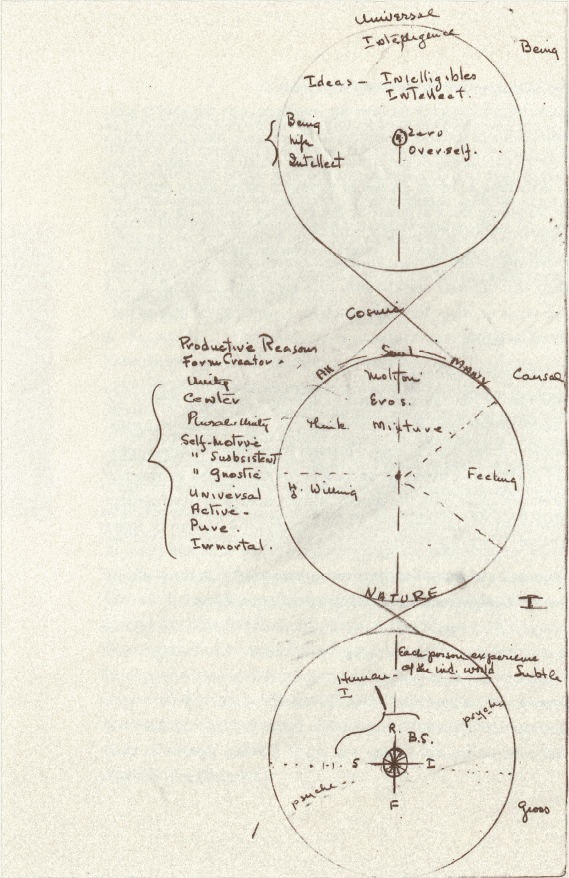
FIGURE AD_G_012. Three Circles Diagram: Divine Intellect, Soul, Psyche.
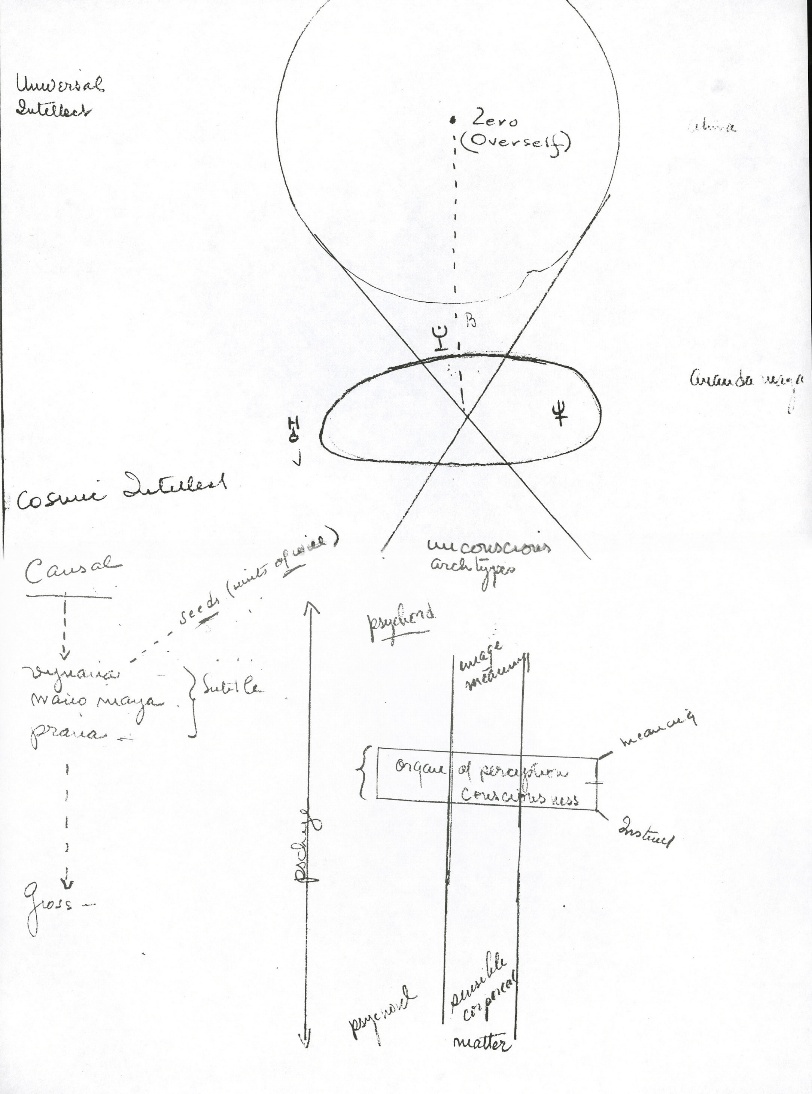
FIGURE AD_G_019 merged. Universal Intellect, Cosmic Intellect, Psyche.
There are also three diagrams from C.G. Jung, CW 16, The Practice of Psychotherapy, "The Psychology of the Transference," within the transcript. Other diagrams also referred to are not with this transcript version. [Transcriber note: [diagram] means the speaker is referencing a diagram as he or she is speaking. If someone is drawing or writing, with audible sounds of chalk on a blackboard, I indicate this by [drawing] or [writing].]
NOTE: For readability's sake, the following substitutions/edits made in Verbatim Transcript: cuz = because; gonna = going to; gotta = got to; yeah = yes.
TRANSCRIBED Verbatim by IT prior to 2017, reformatted by jf 2017. In 2023, IT updates prefatory matter, footer, and audio file name, completes Book List, fixes errors/typos, adds new notes within transcript, adds five diagrams (two appended, three inside transcript) and references within transcript to appended diagrams, reformats to accord with new conventions. In 2025, IT updates audio file markers to match new REP audio. Archival verbatim transcript – V12a.
AUDIO FILES: 1973 0126a, 1973 0126b, 1973 0126c, 1973 0126d. [Note: All audio files originally had very poor sound quality. In 2024-25, REP Studio improved the sound quality (and fixed all other issues associated with these audio files), but the transcript was done before this so a number of words/comments that were marked as partially or completely inaudible may now be audible and other words may have been mistranscribed.]
1973 01/26 at Wisdom's Goldenrod
Jung; Alchemy
[Audio File 1973 0126a Begins]
[AD talking logistics, meditation/upcoming sesshin with the monks for a few minutes]
[class starts at 5 minutes 29 seconds]
AD: We were-- [short pause] last week we were on Mercurius I think, wasn't it, the essay was on Mercurius, yes, and, [student assents, very faint] what we want to do is go from that into the "Psychology of Transference", the Rosarium, first two essays on that. And I think the second essay, the second chapter of the Rosarium is really a revelation, if you can follow through. But, before-- before I go on I-- I thought maybe I'd-- [10 second pause] I thought maybe I might give you just a little bit from-- kind of idea of what the alchemists work with, you know, their mystical philosophy. And I have some quotations here from Paracelsus. Now, I'll read quickly, just hold (off/out) the comments, alright. The alchemy-- the alchemical philosophy, if you trace it back far enough you'll see it takes you right into the-- the whole Neoplatonic tradition and it was the manifestation of many of the ideas which we find in Platonism.
[Transcriber note: I am using The Life of Philippus Theophrastus Bombast of Hohenheim, known by the name Paracelsus by Franz Hartmann, Lovell, Coryell and Company, New York, 1891. The following excerpts are from Chapter III, Cosmology.]
Franz Hartmann [Paracelsus, pp. 57-59, AD reading]: "The power that was active in the formation of the world was God; the Supreme Cause and Essence of all things… This Power is, was, and will be the eternal Constructor of the world… … The cause of the beginning of creation was in the eternal inherent activity of the immaterial Essence, and all things were invisibly or potentially contained in the First Cause, [or God].
"… This Primordial Essence is of a monistic nature, and manifests [AD reads: manifested] itself not only as vital activity, a spiritual force, an invisible, incomprehensible, and indescribable power; but also as vital matter, of which the substance of living beings consists. In the Limbus [or Ideos] of primordial matter, invested with the original power of life, without form, and without any conceivable qualities―in this, the only matrix of all created things, the substance of all things is contained. It is described by the ancients as the Chaos, and has been compared to a receptacle of germs, out of which the Macrocosmos, and afterward by division and evolution in Mysteria [specialia], each separate being came into existence. All things and all elementary substances were contained in it, in potentia, but not in actu [AD reads: in actuality], in the same sense as in a piece of wood a figure is contained, which may be cut out by an artist, or as heat is contained in a pebble, that may manifest its essence…
"The Magnus Limbus [AD: And this is Paracelsus' term, you know.] is the seed, or nursery out of which all creatures have grown, in the same sense as a tree may grow out of a small seed; with the difference, however, that the great Limbus takes its origin from the Word of God, while the Limbus minor [AD reads: minor Limbus] [AD: The smaller Limbus.] [(the terrestrial seed or sperm)] takes it from the earth. The great Limbus is the seed out of which all beings have come, and the little Limbus is each ultimate being that reproduces its form…"
AD: Paracelsus-- here, for instance, is the word 'Mysterium'.
Franz Hartmann [Paracelsus, p. 59, footnote 1, AD reading]: "1 ["Mysterium"] is everything out of which something may be developed, which is only germinally contained in it. A seed is the "mysterium" of a plant, an egg the mysterium of a living bird, [etc]."
AD: Alright. Just like the Brahmananda's egg is the seed of the universe.
Franz Hartmann [Paracelsus, p. 60, AD reading]: ""The Limbus is the prima materia of man [AD: Prime matter of man.] and therefore the physician should know what the limbus is; for that which the limbus is, is also the man…"
"As creation took place and the Yliaster [AD: And that's a Paracelsian term, again referring to that primordial substance."…the Yliaster] dissol…"
AD: Wait a minute.
Franz Hartmann [Paracelsus, p. 60, AD reading]: "As creation took place and the Yliaster dissolved, Ares, the dividing, differentiating, and individualizing power of the Supreme Cause, began to act. All production took place in consequence of [AD adds: this] separation."
AD: Again--
Franz Hartmann [Paracelsus, p. 61, AD reading]: "…all beings were born from the elements, and consist of elementary substances out of which other forms may come into existence, bearing the characteristics of their parents. The elements, as the mothers of all creatures, are of an invisible spiritual nature, and have souls. They all spring from the Mysterium magnum, which is eternal life, and therefore the spiritual elements, and all the beings that have been formed of such elements, must be eternal…"
[short pause]
Franz Hartmann [Paracelsus, p. 64, AD reading]: "Matter is, so to say, [AD adds: congealed] coagulated smoke, [AD: This is Paracelsus' term.] and is connected with spirit by an intermediate principle which it receives from the Spirit. [AD adds: And] This intermediate link between matter and spirit belongs to all three kingdoms of Nature."
AD: So you have the organic, you know, the vegetable, the animal, and there's an intermediate link between the spirit and the matter which is also classified according to the link. In other words, spirit has a connection with organic matter, there's one type of intermediate principle which is different than say-- say the connection of the spirit with the physical man, you know, his body, there you have a different principle. But you have a principle that connects matter and the spirit. I'm not going to go into the details of what Paracelsus is saying but just like an over-- overall view of what the alchemists were working with.
[student assents, very faint]
Franz Hartmann [Paracelsus, p. 65, AD reading]: "The form of the original body may… [AD: I'm sorry.] In the animal kingdom this semi-material body is called Evestrum, [AD: And I don't know if I'm pronouncing it right.] and in human beings it is called the Sidereal Man. Each living being is connected with the Macrocosmos and Microcosmos by means of this intermediate element or Soul, belonging to the Mysterium magnum, from whence it has been received, and whose form and qualities are determined by the quality and quantity of the spiritual and material elements."
AD: We touched on this when we were reading Mead's book on the subtle body. [Note: See G.R.S. Mead, The Doctrine of the Subtle Body in Western Tradition.]
[14¾ second pause]
AD: Again--
Franz Hartmann [Paracelsus, p. 68, AD reading]: "The science which deals with the comparison of the Microcosm and [AD adds: the] Macrocosm for the purpose of elucidating the nature of the two [(which are in reality one)], and to bring to an understanding the rational principle governing their activity, is called by Paracelsus, Astronomia…"
AD: You remember we come across that in Jung.
Franz Hartmann [Paracelsus, p. 68, AD reading]: "…this term is not to be confounded [AD: of course]…"
AD: Don't confuse this with astrology or astronomy. This has a very specific meaning for Paracelsus.
Franz Hartmann [Paracelsus, pp. 68-69, AD reading]: "The Astronomy of Paracelsus means Wisdom, or a direct recognition of the truth, caused by a just appreciation and comprehension of the relationship existing between the Macrocosmos and the Microcosmos…"
AD: So basically it's (the/a) theory of correspondence.
Franz Hartmann [Paracelsus, p. 69, AD reading]: "…"whereby the nature of man becomes known through an understanding of the upper sphere of the great world, as well as by investigating the lower sphere of his little world, as if they were apparently [(what they are essentially)] one Firmament, one Star, one Being, although appearing temporarily in a divided form and shape." The Astronomy [AD reads: Astronomia] of Paracelsus is based upon the observation of what takes place in the universal mind, of which the mind of man is a reflected image…"
AD: And of course you can see that modern astronomy has nothing to do with this, right?
[Audio File 1973 0126a Ends]
[Audio File 1973 0126b Begins]
S (very faint): Yes.
AD: --these concepts into our-- Jung goes through a great deal of trouble and believes that it's worthwhile to bring back this concept into our understanding. In The Secret Doctrine, this is in Volume 1 in any of the volumes, from-- in the Proem, she says something like this.
[Transcriber note: I am using The Secret Doctrine, Volume 1, by H. P. Blavatsky, Facsimile edition, Theosophical University Press, Pasadena, 1999.]
H. P. Blavatsky [The Secret Doctrine, Volume 1, Proem, p. 14, AD reading]: "The Secret Doctrine establishes three fundamental propositions:--
"(a) [AD reads: (1)] An Omnipresent, Eternal, Boundless, [and] Immutable Principle on which all speculation is impossible, [since] it transcends the power of human conception… … [AD: Alright.]
"This"Be-ness" is symbolized in the Secret Doctrine under two aspects. On the one hand, absolute abstract Space, [representing] bare subjectivity, the one thing which no human mind can either exclude from any conception, or conceive of by itself. [AD adds: And] On the other, absolute Abstract Motion representing Unconditioned Consciousness."
AD: Um--
[15¼ second pause]
H. P. Blavatsky [The Secret Doctrine, Volume 1, Proem, p. 15, AD reading]: "Spirit (or Consciousness) and Matter are, however, to be regarded, not as independent realities, but as the two facets [AD reads: symbols] or aspects of the Absolute (Parabrahm) [AD reads: Parabrahman], which constitute the basis of conditioned Being whether subjective or objective.
"Considering this metaphysical triad as the Root from which proceeds all manifestation, the great Breath assumes the character of precosmic Ideation. It is the fons et origo of force and of all individual consciousness, and supplies the guiding intelligence in the vast scheme of cosmic Evolution. On the other hand, pre-cosmic root-substance [AD adds: or] (Mulaprakriti) is that aspect of the Absolute which underlies all the objective planes of Nature.
"Just as pre-Cosmic ideation is the root of all individual consciousness, so pre-Cosmic Substance is the substratum of matter in the various grades of its differentiation.
"… Apart from Cosmic Substance, Cosmic Ideation could not manifest as individual consciousness, since it is only through a vehicle [AD: You know, concept upadhi.] of matter that consciousness wells up as"I am I," a physical basis being necessary to focus a ray of [the] Universal Mind at a certain stage of complexity. Again, apart from Cosmic Ideation, Cosmic Substance would remain an empty abstraction, [and] no emergence of consciousness could ensue."
AD: So it seems that we're-- we're really frozen in this duality as far as our thinking is concerned. As soon as we try to apprehend or approach the Absolute it is always through one or the other that we get caught up.
H. P. Blavatsky [The Secret Doctrine, Volume 1, Proem, p. 16, AD reading]: "This something, at present unknown to Western speculation…"
AD: I'm sorry.
H. P. Blavatsky [The Secret Doctrine, Volume 1, Proem, pp. 15-16, AD reading]: "The"Manifested Universe," therefore, is pervaded by duality, which is, as it were, the very essence of its ex-istence as "manifestation." But just as the opposite poles of subject and object, spirit and matter, are but aspects of this One Unity in which they are synthesized, so, in the manifested Universe there is "that" which links spirit to matter, subject to object.
"[AD adds: And] This something, at present unknown to Western speculation, is called by the occultists Fohat. It is the"bridge" [AD: Fohat, F-o-h-a-t. "It is the bridge] by which the"Ideas" existing in the "Divine Thought" are impressed on Cosmic substance as the "laws of Nature." Fohat is thus the dynamic energy of Cosmic Ideation; or, regarded from the other side, it is the intelligent medium, the [AD reads: and] guiding power of all manifestation, the "Thought Divine" transmitted and made manifest through the Dhyan Chohans, [AD: or Universally Mind] the Architects of the visible World. Thus from Spirit, or Cosmic Ideation, comes our consciousness; from Cosmic Substance the several vehicles in which that consciousness is individualised and attains to self--or reflective--consciousness; while Fohat, [AD: That is, the energy.] in its various manifestations, is the mysterious link between Mind and Matter, the animating principle electrifying every atom into life."
AD: Alright, that's enough of these two. And, I-- I just throw this in because when we start talking about Jung, you know Jung's references are so vast that you may-- you may deviate. But basically this is the alchemical philosophy that I think the alchemists work with, and Paracelsus really went out of his way to make sure that no one understood him. [students assents, very faint] You need a special vocabulary to understand Paracelsus. With the-- I think [student assets, faint] Ruland was one of his students, made such a vocabulary up (and they didn't want to) reprinted it about five years ago, so-- [11¾ second pause] So here we are working with Jung, and Jung in this sense operates this way. If-- if we think of that sentence from PB where he says "the rise, the abiding, the dissolution of karma is the twin function to that of its ideation" [Note: PB, The Wisdom of the Overself, "The Birth of the Universe," p. 31, 1943 edition.] and we see that we're always dealing with one side or the other of the problem, never really handling the two of them simultaneously. And that's something which you have to keep in mind as we go along. In the-- in the Volume 8, The Structure and Dynamics, we'll go back later on and briefly review his theory of psychic energy which will pick on that side of the problem. Right now in "The Psychology of the Transference" we're dealing with the ideation aspect, alright. And-- [10½ second pause] Let me see, I have-- I have a quotation here from Jung about these two selections that we just read.
[student assents, very faint]
[18 second pause]
C.G. Jung [CW 8, The Structure and Dynamics of the Psyche, "Synchronicity: An Acausal Connecting Principle," pp. 510-511, paragraph 957, AD reading]: "[Thus] we are driven to the conclusion that a nervous substrate [AD reads: substrata] like the sympathetic system, which is absolutely different from the cerebrospinal system in point of origin and function, can evidently produce thoughts and perceptions just as easily as the latter [AD: Cerebrospinal system]. What then are we to think of the sympathetic system in vertebrates? Can it also produce or transmit specifically psychic processes? [Von] Frisch's observations prove the existence of transcerebral thought and perception. One must bear this possibility in mind if we want to account for the existence of some form of consciousness during an unconscious coma. During a coma the sympathetic system is not paralyzed and could therefore be considered as a possible carrier of psychic functions. If that is so, then one must ask whether the normal state of unconsciousness in sleep, and the potentially conscious dreams it contains, can be regarded in the same light--whether, in other words, dreams are produced not so much by the activity of the sleeping cortex, as by the unsleeping sympathetic system, and are therefore of a transcerebral nature."
AD: There you see he's again hitting at this alchemical idea that inherent in matter is this conscious activity and I use quotations around "conscious activity" here because it isn't the kind of consciousness we're familiar with. But it's nonetheless some sort of guidance and direction (of/as) the soul is going on and these processes are being worked out. Some of the references he makes, for instance, to the intelligence that's exhibited by animals and by insects and the lowest forms of life begin more and more to reveal the fact that inherent in this very matter is this guiding principle that's within it. And this is an old alchemical idea. Here's another fellow, alright, and still trying to find the secret, but I'll keep reading him as he goes along, and he claims basically the same thing, and he speaks of kundalini as his teacher. I didn't find that one here but I'm still at it. And he-- he-- his claim is that in the biology of man, there's inherent in this very matter, that is, his very body, the secret or the process of unfoldment. In other words, it is possible that if a person arouses his kundalini and the next step of evolution is started, this kundalini directs his next step in evolution. And he claims it's basically inherent in the very physiology of the body we have. Again, this is like a continuation of the old alchemical theory. Now, I don't know if it's archetypal, you know, you could just push it aside right now.
S (very faint): [one word inaudible] Tony, what you just read when you said that, you know, like consciousness is [inaudible] in terms of viewing like [few words inaudible] and I want to understand the (context), you know, and what you mean by this statement (because the--) the alchemical idea (isn't) very clear.
AD: You want to understand the alchemical idea of consciousness? [student assents, very faint] Well, it is the guiding intelligence level inherent in matter and which provides for growth, you know, manifestation, and the continuous activity. Now whe-- when I said it's different than what we assume to be consciousness, it's simply that there's other kinds of consciousness than this discursive dialectical type of consciousness that can operate. What kind of consciousness a plant has or a stone is beyond us.
[student assents, very faint]
S (very faint): Tony, is that-- is that kundalini he's talking about, is that the-- the Fohat or no, on the physical level? The Fohat, the energy that you were talking about earlier.
AD (simultaneously): Well, I would imagine that when the Secret Doctrine speaks about Fohat, they're speaking of this intelligence which pervades and ensouls the entirety of the universe, but that the intelligence that's in one piece of matter or let's say one object completely different from what's in another object. This kundalini that, let's say, is working in a man, certainly we cannot duplicate that in an animal. But there should be something similar to that. In other words, the same thing that develops a man into a genius, alright, and a person later on into some kind of reflective consciousness of the Sage, is-- is this inherent intelligence within the thing itself. The spiritual, what the alchemists call with the spiritual being that's using that form or that body to operate through, but that vehicle and that body is very important because in order for this-- the body to be used as an instrument, it'd have to accommodate the spiritual being that's working through it. Now, if a person has a-- or let's say a-- an "A" kind of intelligence, he would need that kind of a body that that "A" intelligence could work through. But if the entity evolved, then it would need a greater type of body, a-- a body, so to speak, that's more capable of releasing or manifesting this greater intelligence that's coming into operation. And that's why he spends a lot of time talking about the preparatory (need) for certain activities, you know, purification, food, you know, all these things have to be very carefully taken into account when a person starts thinking about practicing kundalini yoga. In other words, what we're-- what we're getting at is again the same alchemical idea, that inherent in matter is this guiding intelligence which will unfold throughout the eons of activity the spiritual being that's behind it.
S: But that guiding intelligence, that still refers to this-- to that-- to that Fohat. Before there was an indication of-- that-- that that power was the mysterious link between-- between that first-- between that first state(s) of the unmanifest to the manifest, alright, and so that seems to imply something that unfolds this-- that intelligence.
S (faint): Uh-hm.
AD: I'm sorry, I still don't follow you [one word inaudible]
S: Ok, you remember in that--
AD (simultaneously): That sounded like (a (comet/comic)), that's fine.
S: Oh. Well no, I'm wondering if that-- if that kundalini is-- is that same-- is that same energy on a lower level, that guiding intelligence that's [one word inaudible] my unfolding.
AD (simultaneously): That's my the-- that's my theory too. At all levels you'll find it.
S: That's the-- yes, that would be the same [one word inaudible]
AD: And, if you remember when we were speaking in terms of astrology we pointed out in the 6th house [diagram] where the six subtle forces are located and one of them is mahakundalini, which is the power, the kundalini power of the universe. And I imagine that every center of consciousness would similarly have participation in that principle. How this would operate in entities other than the human is something I have no idea about.
LS: In the astronomia of Paracelsus, is that based on a si-- a similar principle?
AD: Yes, yes, there would be correspondences. In other words-- in other words like the principle of synchronicity that Jung speaks about would correspond to Paracelsus' notion of astronomia. He calls it synchronicity and Paracelsus would say, "No, it's simply a theory of correspondence." Anything that's in a single individual human is a reflection of what's going on in the world and that a person would have to look within himself to find whatever an-- the answers he wants to whatever problems. [student assents] He was directing his remarks mainly to physicians, and he felt that a physician should be capable of seeing into the sidereal man and finding out what the disease is there, never mind asking him all kinds of questions. I suspect that probably even the (sun--) homeopathy is based on that principle. [students assent] [short pause]
At any rate, we've been going through Gopi Krishna's works. I haven't been able to find out any information on kundalini which I haven't (become) aware of from other texts so I won't go into him right now but-- [short pause] I did-- I did want to mention something here on a-- [short pause] He's very insistent of course that the brain is really the most important and one that has to be used, that Yoga has to be preoccupied developing the kundalini until it reaches up to the brain level, you know, and the energies are functioning up there. But I haven't come across any of his, you know, real detailed information. He-- he complains about all the ancient books not giving any information but neither does he. [21¾ second pause, very faint background student words] Well, you [couple words inaudible] to discuss that passage, (alright).
Alright so, with that kind of a-- sort of a background, a feeling for the similarity of many of these teachings, as we read Jung and he gets into the alchemists maybe we won't feel that we're lost, that they're following out something [couple/few words inaudible] understand the alchemists. [students assent, very faint] I think we read-- I think we were at around section nine in "[The Spirit] Mercurius". Any rate-- There's a little poem that we ought to look into in the seventh section on "Mercurius". It's an alchemical poem and it reads four paragraphs.
C.G. Jung [CW 13, Alchemical Studies, "The Spirit Mercurius," pp. 228-229, paragraph 276, AD reading]: "A weakling babe, a greybeard old, / Surnamed the Dragon: me they hold / In darkest dungeon languishing / That I may be reborn a king. / A fiery sword makes me to smart, / Death gnaws my flesh and bones apart. / My soul and spirit fast are sinking, / And leave a poison, black and stinking. / To a black crow am I akin, / Such be the wages of all sin. / In deepest dust I lie alone, / O that the Three would make the One! / O soul, O spirit with me stay, / That I meet greet the light of day. / Hero of peace, come forth from me, / Whom the whole world would like to see!"
AD: He follows up with a paragraph.
C.G. Jung [CW 13, Alchemical Studies, "The Spirit Mercurius," p. 229, paragraph 277, AD reading]: "In this poem Mercurius is describing his own transformation, which at the same time signifies the mystic transformation of the artifex; for not only Mercurius but also what happens to him is a projection of the collective unconscious. This, as can easily be seen from what has gone [AD adds: on] before, is the projection of the individuation process, which, being a natural psychic occurrence, goes on even without the participation of consciousness. But if consciousness participates with some measure of understanding, then the process is accompanied by all the emotions of a religious experience or revelation. As a result of this, Mercurius was identified with Sapientia and the Holy Ghost. It is therefore very probable that those heresies which began with the [Euchites, Paulicians], Bogomils, and [AD adds: the] Cathars, [AD: All the others in medieval Europe.] and which developed the concept of the Paraclete very much in the spirit of the founder of Christianity, were continued in alchemy, partly unconsciously [AD reads: unconscious] and partly under a deliberate disguise."
AD: If we take this first part of the paragraph, he says--
C.G. Jung [CW 13, Alchemical Studies, "The Spirit Mercurius," p. 229, paragraph 277, AD reading]: "…Mercurius is describing his own transformation, [which] [AD adds: and] at the same time signifies the mystic transformation of [AD adds: the alchemist] the artifex; for not only Mercurius but also what happens to him is a projection of the collective unconscious."
[few very faint inaudible student words, possibly part of background]
AD: Does that make any sense? Yes?
S: Uh-uh.
AD: No?
S (very faint): (Not yet.)
S (very faint): Go over it again.
C.G. Jung [CW 13, Alchemical Studies, "The Spirit Mercurius," p. 229, paragraph 277, AD reading]: "This, as can easily be seen from what has gone before, is the projection of the individuation process, which, being a natural psychic occurrence, goes on even without the participation of consciousness."
AD: Now, we're not going to talk about the energetic aspect, we're talking about the ideational aspect of this individuation process. And, what we have to try to understand is that the alchemists, in following these fantasies, and from these fantasies they're trying to understand the process, the psychological-- the biological-psychological processes that are individuating one person from another, uh-- [9¾ second pause] Is there a copy of Symbols of Transformation over your head, Richard? Alright?
S (very faint): [couple words inaudible]
AD: That's five.
S (very faint): That's five [one/two words inaudible]
[short pause]
AD: Every time I ask him something he jumps. What's interesting here is a series of pictures unrolled or fantasies, you know. And the alchemist is looking at them and they're revealing, let's say, the process of individuation that's going on. It's-- on the one hand, the alchemist is a person, let's say, or the entity going through that process and it's Mercurius. The pictures that are unfolding in front of his consciousness, that's Mercurius too. And the whole thing is taking place in Mercurius to begin with, ok. Let's see if I could help [one/two words inaudible] that passage. [19¼ second pause] Would you like to try to expand on that a little bit while I'm looking something up here? [short pause] Something that at first, you know--
[short pause]
C.G. Jung [CW 13, Alchemical Studies, "The Spirit Mercurius," p. 229, paragraph 277, LS reading]: "In this poem Mercurius is describing his own transformation, which at the same time signifies the mystic transformation of the artifex…"
LS: The artifex is the alchemist?
AD: Yes.
C.G. Jung [CW 13, Alchemical Studies, "The Spirit Mercurius," p. 229, paragraph 277, LS reading]: "…not only Mercurius but also what happens to him is a projection of the collective unconscious."
[short pause]
AD: No?
S: What does he mean by the collective unconscious there?
AD: Wow, we got to explain that now? He's been using that for a long time, long time. Here look at-- (here's a--) here's a-- here's a selection from The Symbols of Transformation and the-- the title of the book is a giveaway, you know, if you're interested in these problems.
C.G. Jung [CW 5, Symbols of Transformation, "The Concept of Libido," p. 137, paragraph 197, AD reading]: "This view [AD: And this is Jung's view.] leads to a conception of libido [AD adds: (dealing--)] which expands into a conception of intentionality in general. [AD: Now try to follow, ok?] As the [above quotation] from Freud [shows], we know far too little about the nature of human instincts and their psychic dynamism to risk giving priority to any one instinct. We would be better advised, therefore, when speaking of libido, to understand it as [an] energy-value which is able to communicate itself to any field of activity whatsoever, be it power, hunger, hatred, sexuality, [or] religion, [AD adds: etc.] without ever being itself a specific instinct. [As] Schopenhauer says:"The Will as a thing-in-itself is quite different from its phenomenal manifestation, and entirely free from all forms of phenomenality, which it assumes only when it becomes manifest, and which therefore affect its objectivity only, and are foreign to the Will itself.""
AD: Now I don't have to remind you that Schopenhauer was quite a student of the Upanishads.
C.G. Jung [CW 5, Symbols of Transformation, "The Concept of Libido," p. 137, paragraph 198, AD reading]: "Numerous mythological and philosophical attempts have been made to formulate and visualize the creative force which man knows only by subjective experience. To give but a few examples, I would remind the reader of the cosmogonic significance of Eros in Hesiod, and also of the Orphic figure of Phanes [(pl. xii)], The Shining One, the First-Created, the"Father of Eros.""
AD: Of course Phanes would correspond to the Indian Kama.
S: [three/few words inaudible]
AD: 197, 198, Symbols of Transformation. Alright, let me-- let me go over this paragraph again.
C.G. Jung [CW 5, Symbols of Transformation, "The Concept of Libido," p. 137, paragraph 197, AD reading]: "This [AD reads: Jung's] view leads to a conception of libido which expands into a conception of intentionality in general. …we know far too little about the nature of human instincts and their psychic dynamism [AD reads: dynamisms] to risk giving priority to any one instinct. We would be better advised, therefore, when speaking of libido, to understand it as an energy-value which is able to communicate itself to any field of activity whatsoever, be it power, hunger, hatred, sexuality, or religion, without ever being itself a specific instinct. [As] Schopenhauer says:"The Will as a thing-in-itself is quite different from its phenomenal manifestation [AD reads: manifestations], and entirely free from all [AD adds: the] forms of phenomenality, which it assumes only when it becomes manifest, and which therefore affect its objectivity only, and are foreign to the Will [AD adds: in] itself.""
AD: Now, if we go back.
S (very faint): Tony? [S: (Hm?)] Is Phanes [few words inaudible]
AD: Yes. [student assents, faint] Yes, that's the psychological interpretation of what we consider metaphysical principles. Representation in terms of psychological--
RP (very faint): [few words inaudible]
[short pause]
AD: I don't think I remember, do you Richard?
S (very faint): No, I don't.
AD: See if he has any more on that. I know he's mentioned a few others. [24 second pause while AD looks for quote, very faint background student words, possibly word from AD] Well--
C.G. Jung [CW 5, Symbols of Transformation, "The Concept of Libido," pp. 137-138, paragraph 198, AD reading]: "Orphically, [too], he has the significance of Priapus; he is bisexual and equated with the Theban Dionysus [Lysius]. The Orphic significance of Phanes is akin to that of the Indian Kama, the god of love, who is likewise a cosmogonic principle. [AD adds: And] To the Neoplatonist Plotinus, the world-soul is the energy of the intellect. He compares the One, the primordial creative principle, with light, the intellect with the sun…"
LS: He knows it.
AD: Yes. You notice the man [few words inaudible] Well we go back to what I was just (doing/saying).
[students assent, very faint]
S (very faint): All these are the same.
[students assent, very faint]
AD: Alright, again--
C.G. Jung [CW 13, Alchemical Studies, "The Spirit Mercurius," p. 229, paragraph 277, AD reading]: "…Mercurius is describing his own transformation, which at the same time signifies the mystic transformation of the artifex; for not only Mercurius but also what happens to him is a projection of the collective unconscious."
AD: Now, if you-- you-- I'll read the poem, alright, and try to follow the fantasy images that are-- that float up into your mind.
C.G. Jung [CW 13, Alchemical Studies, "The Spirit Mercurius," pp. 228-229, paragraph 276, AD reading]: "A weakling babe, a greybeard old, / Surnamed the Dragon: me they hold / In darkest dungeon languishing / That I may be reborn a king. / A fiery sword makes me to smart, / Death gnaws my flash and bones apart. / My soul and spirit fast are sinking, / And leave a poison, black and stinking. / To a black crow am I akin, / Such be the wages of all sin. / In deepest dust I lie alone, / O that the Three would make the One! / O soul, O spirit with me stay, / That I meet greet the light of day. / Hero of peace, come forth from me, / Whom the whole world would like to see!"
AD: And this is really, of course, the alchemical process, you know, in four stanzas of each kind of imagery that's employed in reaching the level of development which they refer to as the stone. Alright so, if we look at this and we say, well this is a projection of the collective unconscious and this could easily be seen as a projection of the individuation process. Well you could see that this is what's going on in the poem, he's describing the individuation process, "which, being a natural psychic occurrence". Just like we were speaking before about the kundalini inherent in a man, alright, and the evolution of this man takes place according to the unfolding of these very archetypal stages which is being released or triggered off by the energy which is contained in the kundalini. It's a natural process, whether you're consciousness-- conscious of it or not, ok.
LS: Right, now this isn't what-- what happens to the alchemist. As far as what's happening to the alchemist on the surface, in the surface life, there's nothing to say. It could be anything. But he's going through some process and this is a kind of fantasy image accompanying this. It might be a series of dreams that were summed up in this way.
AD: Yes, ok.
LS: Or in a kind of twilight state he wrote the poem and then through that understood what he was going through.
AD: Ok. It's a summary in fan-- fantasy images of the process that he lived through or he, let's say, was acquainted with or heard about, ok. And like I said, if you look through any alchemical books where they have these allegorical pictures, you'll see the same process but instead of words with pictures, alright. This is what Jung is going to base his whole notion of, you know, the individuation process and deal with certain people who are on that process. In other words, he claims that he came upon this in a very natural way, it wasn't something he concocted but he noticed that certain people start individuating. They weren't conscious of what was happening. He was drawing upon this experience and making it conscious to himself, alright.
LR (very faint): Could you explain what it means by [few words inaudible]
AD: Well, alright, let's try an analogy. Suppose you have a dream, alright, and in this dream, you appear in this dream as a woman, alright, dream Linda, and dream Linda gives birth to a dream baby. And this dream baby is grown, alright, educated, until she reached maturity and then she's married off, alright. Now dream Linda, so to speak, taking care of her dream baby, watching the dream baby, watching that whole thing, all this is taking place where? [LR, very faint: In (a/the) dream.] In the dream, this dream being a manifestation of her own mind. All this is taking place within the mind. So, ana-- analogously, transport it to the wakeful consciousness, ok. You're going through this process, you're beginning to work on what you call "the Path", everything that you understand about it, so to speak, alright, is Mercurius, individual, like your thoughts about it. But the physical person, the physical body that's going through these things again is Mercurius but now Mercurius in what sense? The cosmo-- cosmological sense. And as you're developing and you get insights into what's going on, again this is Mercurius. It-- he makes a remark somewhere, it's like the unconscious is realizing itself through you.
LR (very faint): Well why does it-- why does it have to be collective unconscious and not-- He-- he's still talking about an individual entity.
AD: This all takes place in the collective unconscious. You want the definition of collective unconscious?
LR (very faint): No.
LS: He sort of doesn't have much to do with-- this part of it doesn't have much to do what goes with this-- what's going on in our personal life.
LR: Right.
LS: That's what I mean, it just sort of--
LR: But why is it different?
RP: Yes because it [couple words inaudible]
LS (simultaneously): It projects into our life.
LR: Oh, oh.
S (very faint): [few words inaudible] [LR simultaneously: Oh I see.] [few words inaudible]
AD: Louder, Steve.
S: [inaudible]
AD: Precisely, yes. You're being separated out from the herd, you know. Yes, Richard--
RG (very faint): Did that-- I mean, the individuation (process) is a very natural process which goes on whether you're conscious of it or not. But you see that still go on-- it still would go on if [few words inaudible] at one point in the process you would become conscious of [couple/three words inaudible] otherwise it's still unconscious [one/two words inaudible]
AD: Well, you may be right, yes. I can't-- I can't say, I don't know. I can conceive of the possibility of a man being brought-- bo-- born on the Fiji Islands, you know, and never knowing anything about this and all of a sudden getting illumination. I can conceive of this. And he won't even know it.
S: (That's true), Tony-- (bit of laughter)
RP: But [inaudible]
AD: Nevertheless, yes.
RP: [inaudible]
AD: You know, it's like-- you remember once we read from somebody's notes, the remark he made was that the intellect had to be satisfied so we called it "the Path". Now it has a name, good, now it goes on. And the things go on just as they went before. But now it feels better, it has a name for these things. [13 second pause] In section nine, Mercurius as the Arcane Substance, he goes on.
C.G. Jung [CW 13, Alchemical Studies, "The Spirit Mercurius," p. 235, paragraph 282, AD reading]: "Mercurius, it is generally affirmed, is the arcanum, the prima materia [AD reads: prime matter], the"father of all metals," [AD: And try to remember what-- the two things we read offhand from Blavatsky and Paracelsus.] the primeval chaos, the earth of paradise, the "material upon which nature worked a little, but nevertheless left it imperfect." He is also the ultima materia, the goal of his own transformation, the stone, [AD: Down at the-- Well, we better read a little. "…the stone] the tincture, the philosophic gold, the carbuncle, the philosophic man, the second Adam, the analogue of Christ, the king, the light of lights…indeed the divinity itself or its perfect counterpart. Since I have already discussed the synonyms and meanings of the stone [elsewhere] there is no need for me to…"
AD: Of course when you get that many synonyms, you got a real problem. [student assents, very faint] The next paragraph, he says--
C.G. Jung [CW 13, Alchemical Studies, "The Spirit Mercurius," p. 235, paragraph 283, AD reading]: "Besides being the prima materia [AD reads: prime matter] of the lowly beginning as well as the lapis as the highest goal, Mercurius is also the process which lies between, and the means by which it is effected. He is the"beginning, middle, and end of the work." Therefore he is called the Mediator, Servator, and Salvator. He is a mediator like Hermes [AD reads: He is a-- he is like Hermes]."
AD: It almost reminds us of something we did in philosophy once where we had three circles. [student assents, very faint] In the middle circle was the (hero).
C.G. Jung [CW 13, Alchemical Studies, "The Spirit Mercurius," p. 236, paragraph 283, AD reading]: "The alchemists did not hold this view of Mercurius; on the contrary, [AD: And here we go back again to some of the things you've read.] they saw him [AD: That is the--] as a divine emanation harmonious with God's own being. The stress they laid on his capacity for self-regeneration, self-transformation, self-reproduction, and self-destruction contradicts the idea that he is a created being. It is therefore only logical when Paracelsus and Dorn state that the prima materia is an"increatum" and a principle coeternal with God. This denial of creatio ex nihilo [AD reads: creation out of nothing] is supported by the fact that in the beginning God found the Tehom already in existence…"
AD: Well you see the point that he's making here? Matter is coeternal or-- with God, and it almost makes us think of almost the Samkhya version of metaphysics.
S: [inaudible]
AD: Would you repeat that?
RP: It's maya, it's the maker of this [one/two words inaudible] for the universe, or [few words inaudible]
AD: Yes, yes. Is that the word he uses [one word inaudible]
[student assents, very faint]
RP (faint): The matrix, mother.
S: Which I almost did [couple/three words inaudible]
AD: Alright, so here's a summary of Mercurius.
C.G. Jung [CW 13, Alchemical Studies, "The Spirit Mercurius," p. 237, paragraph 284, AD reading]: "(1) [Mercurius] consists of all conceivable opposites."
LS (simultaneously): I have a-- wait, one [AD simultaneously: Yes.] question before you go on. Mercurius isn't what we were calling prime matter before though, I mean-- or prime matter isn't the same thing as you were calling matter when you were speaking of mulaprakriti. It's something that's already individuated, [student assents] an intermediary principle.
RP (simultaneously): It already knows, yes-- it already knows prime matter. [student assents] It's really just one end of Mercurius that explains the other end. [S, very faint: I think my question--] You're never outside of Mercurius.
AD: It's just like the-- say, I asked Richard to wait last week when we were speaking of Plotinus and told him to wait over here, just back off for a minute. You know, every time we try to consider the Absolute we're going to fall on one side of the fence or the other.
LS: But that wasn't-- I better repeat my question.
AD: Repeat.
LS: We're talking about Mercurius as prime matter. This isn't the same as we were speaking of prime matter before. This is like an intermediary ensouling principle, the principle between the spirit of cosmic-- or cosmic ideation and the prime matter?
AD: You're referring to this realm [diagram]?
LS: Well you threw out a lot of stuff tonight and I'm trying to hold a thread between them, if there is one, and I assume there is one.
AD: Well, can I give you a summary here? Five sentences.
LS: Go ahead.
AD: And let's see if you can handle that question.
LS: I'm surprised he's [S simultaneously: The first part.] getting unmanageable, Tony.
AD: That's alright.
S (very faint): What was Lenny's question?
S (very faint): Nothing.
S (very faint): [few words inaudible]
RG (simultaneously, very faint): [couple words inaudible] the volcano.
LS: And the volcano's about to erupt (some laughter) so you might as well try the question.
S (very faint): [couple/three words inaudible]
AD: I was living on a volcano all my life.
LS: Alright, alright, cool Tony, so-- (laughter) I can swim in lava as well as anything else.
C.G. Jung [CW 13, Alchemical Studies, "The Spirit Mercurius," p. 237, paragraph 284, AD reading]: "(1) Mercurius consists of all conceivable opposites. He is [thus quite] obviously a duality, but is named a unity in spite of the fact that his innumerable inner contradictions can dramatically fly apart into an equal number of disparate and apparently independent figures.
"(2) He is both material and spiritual.
"(3) He is the process by which the lower and material is transformed into the higher and spiritual, and vice versa.
"(4) He is the devil, a redeeming psychopomp, an evasive trickster, and God's reflection in physical nature.
"(5) He is also the reflection of a mystical experience of the artifex that coincides with the opus alchymicum. [AD: I'll repeat."He is also the [AD emphasis] reflection of a mystical experience of the artifex that coincides with the opus alchymicum."]
"(6) As such, he represents on the one hand the self and on the other the individuation process and, because of the limitless number of his names, also the collective unconscious." (laughter)
[few seconds of inaudible student comments]
S: It's just a [one word inaudible]
S: That sounds like all of manifestation. [couple/few words inaudible]
[student assents, very faint]
AD: Yes, but the point that we have to try to grasp here is that in the stages of the alchemical philosophy, alright, in the various stages of, let's say, unfolding, the Mercurius is pinned down with kind of these-- not precise but adjectives that pin down the process which Mercurius you're talking about. For instance if-- I think last week we had an example, someone said, "Well how could it be both, this chair that I perceive and the thought about the chair?" But that's exactly the point. It could be on an individual level, the thinking that you do as an individual, alright, and another level it could be the chair that you perceive. Now-- one minute-- now as soon as you do this, you have the same problem like in metaphysics, right? As soon as I speak about my own personal thinking about the chair, this is psychological. When I speak about the chair that I perceive and I cannot help but perceive, this is no longer psychological. This is determined by epistemological laws beyond any choice that I may have in the matter. Well that means like the sentence, when I write down the sentence "I see the tree," you're going up and down the gamut, up and down Jacob's ladder, right, from heaven to hell.
LS: Yes, we do that with Mercurius too.
AD: Yes.
LS: Now here's the problem. We're (speaking allusions) from metaphysics, from cosmology, to psychology, and from the ordinary world, and actually we seem to be talking about a cosmological principle which Jung is trying to convince us is psychological. Is that right?
AD: Well, you see I think there Jung is trying to kind of--
LS: Well was that correct though?
AD: No, not really. Well [one/two words inaudible]
LS (simultaneously): Well can you straighten it out? Because I can't keep anything straight anymore.
AD (simultaneously): Yes, in this sense, in this sense--
LS: All I know is Mercurius is in the middle, but I don't know between what.
AD: Well, I don't understand that point but-- He does point out that the only way we can know the unconscious is through its effects, we cannot know the unconscious per se. He is postulating a metaphysical entity, whether he wants to agree or not. Now, he'll say, "Well, that's not my concern." But the fact remains that that's what he's done. [short pause] You see, we have this awful difficulty because, in a sense, you're being called upon now, you know, not to trifle with your thinking processes anymore but to really be kind of precise. If I were to charge you $30 a month for the use of your brain, I bet you'd make better use of it. (laughter) I don't mean you personally Lenny, although I have to pick on you too.
LS: Yes, well the feeling's mutual, you know.
AD (simultaneously): This applies to all of us, doesn't it? I mean this applies to all of us, don't-- doesn't it? We sort of take [S simultaneously: No.] for granted these things and yet soon as we're forced into a situation where we got to deal with a kind of symbolical thinking that the alchemists do, alright, we're-- now we're dealing with a process which is really intricate because there's so much fantasy involved. When we talk in metaphysics we could be more precise and conceptualize with a precision that sometimes is almost equivalent to using calipers. But when you deal with alchemists who are using pictures and fantasy images, you're going to find that you're always on very slippery ground, you never quite know which Mercurius they're referring to.
S (very faint): Tony, it would seem similarity [one/two words inaudible] on all levels when you look at anything, any of the-- well this point of view or sticking with the alchemical point of view(./?)
S (very faint): [couple words inaudible]
S (simultaneously): Uh-hm.
AD (very faint): I'm sorry, I didn't understand your question.
S (very faint): (Uh-hm.)
[Audio File 1973 0126b Ends]
[Audio File 1973 0126c Begins]
AD: --hide behind your back because the analysis of knowledge could only take place in knowledge. So you could never analyze knowledge because you-- if you take it as a presupposition.
S (very faint): Yes, when you talk about something you [couple words inaudible] about what you were talking about [three words inaudible]
LS (simultaneously): It's the same old story Tony, the questions are logical and not philosophical yet.
S (very faint): Tony [few words inaudible] didn't you assume that [couple words inaudible] is dependent on a view-- point of view, and once you-- you're looking at things from that point of view you can't see the thing anymore.
AD (very faint): Yes, suppose we look at or use as a word, a synonym, use the word 'thought'.
S (very faint): [couple/few words inaudible]
AD: (Should it be--) you have the same problem, no matter which way you twist and turn, according to our definition of thought, you know, then you'd be caught up in the same thing. You remember the difficulty you had when you say well, you know, "What's the difference between my thinking and the world that I perceive?" Wasn't [couple words inaudible] confusing? Do you remember [student assents, faint] early reading of the Hidden Teaching, there was this inability to-- to distinguish your personal thinking, the thinking or the-- the think-- the thinking that the World-Mind presumably follows through and substantiates what you think? And didn't you-- didn't you find it necessary to use a scalpel or a surgeon's knife to make this more precise what you're saying, when you say "I think," what's it really mean? Like the example before when Blavatsky said that the ultimate scheme is abstract motion and abstract space. And right away if you go back to something we read some time ago you can see that in a sense the understanding must schematize, alright, it can't help but do so, and symbolize. That's the only way we can function. Now, take you a little time to get a handle on it but I think at fir-- it'll first start off as a feeling as to what they're doing and then more and more you begin to get familiar what they have worked at. [short pause] He says--
C.G. Jung [CW 13, Alchemical Studies, "The Spirit Mercurius," pp. 23-238, paragraph 285, AD reading]: "[Thus] the first knowledge of psychic law and order was [AD adds: first] found in the stars, and was later [AD reads: later was] extended by projections into unknown matter. These two realms of experience branched off into sciences: astrology became astronomy, and alchemy chemistry."
AD: Well I'd like to read something just a little further on because I think it's one of the most significant passages I ever re-- read from Jung. Down at the bottom he says, 286, pa-- around the middle.
C.G. Jung [CW 13, Alchemical Studies, "The Spirit Mercurius," p. 238, paragraph 286, AD reading]: "They show us, as the redemptive goal of our active, desirous life, a symbol of the inorganic--the stone--[AD: Almost like (few words inaudible)] something that does not live but merely exists or"becomes," the passive subject of a limitless and unfathomable play of opposites. "Soul," that bodiless abstraction of the rational intellect, and "spirit," that [AD reads: the] two-dimensional metaphor of dry-as-dust philosophical dialectic, appear in alchemical projection in almost physical, plastic form, like tangible breath-bodies, and refuse to function as component parts of our rational consciousness. The hope for a psychology without the soul is brought to nothing, and the illusion that the unconscious has only just been discovered vanishes: in a somewhat peculiar form, admittedly, it has been known for close on two thousand years. Let us, however, not delude ourselves: no more than we can separate the constituents of character from the astronomical determinants of time are we able to separate that unruly and evasive Mercurius from the autonomy of matter."
AD: Isn't that-- isn't that a-- an admission about what astrology is? That's really-- it's really a-- a whole-- wholesale approval, literally.
C.G. Jung [CW 13, Alchemical Studies, "The Spirit Mercurius," p. 238, paragraph 286, AD reading]: "Let us, however, not [AD reads: Let us not, however] delude ourselves: no more than we can separate the constituents of character from the astronomical determinants of time are we able to separate that unruly and evasive Mercurius from the autonomy of matter."
[short pause]
AD: It does require a little meditation.
[student assents, very faint]
C.G. Jung [CW 13, Alchemical Studies, "The Spirit Mercurius," pp. 238-239, paragraph 286, AD reading]: "Something of the projection-carrier always clings to the projection, and even if we succeed to some degree in integrating into our consciousness the part we recognize as psychic, we shall integrate along with it something of the cosmos and its materiality; or rather, since the cosmos is infinitely greater than we are, we shall have been assimilated by the inorganic."Transform yourselves into living philosophical stones!" cries an alchemist, [AD: Sounds almost like a Zen Master.] but he did know how infinitely slowly the stone "becomes." Anyone who gives serious thought to the "natural light" that emanates from the projections of alchemy will certainly agree with the Master who spoke of the "wearisomeness of the interminable meditation" demanded by the work. In these projections we encounter the phenomenology of an "objective" spirit, a true matrix of psychic experience, the most appropriate symbol for which is matter. [AD: Probably the most difficult problem.] Nowhere and never has man controlled matter without closely observing its behaviour and paying heed to its laws… [AD: Like when you put your chart on the board.] The same is true of that objective spirit which today we call the unconscious: it is refractory like matter, mysterious and elusive, and obeys laws which are so non-human or superhuman that they seem to us like a…"
AD: Where's my Latin translator?
S (very faint): I don't know.
S (very faint): [couple words inaudible]
AD: Do you know what that means?
S (very faint): Uh-uh.
S: What are the words?
AD: Crimen laesae majestatis humanae. Yes, that's--
S (simultaneously): I got to see it.
AD: Yes.
S: [couple/three words inaudible] got to see it.
S (very faint): [couple words inaudible]
AD (simultaneously): No, I've never pronounced it right.
[few seconds of inaudible student talking, laughter]
AD: No, it's a-- it's a colloquialism, I don't know either. And I wasn't able to find it in the dictionary.
C.G. Jung [CW 13, Alchemical Studies, "The Spirit Mercurius," p. 239, paragraph 286, AD reading]: "If a man puts his hand to the opus, he repeats, as the alchemists say, God's work of creation. The struggle with the unformed, with the chaos of Tiamat, is in truth a primordial experience."
S (part of background): Thank you.
AD: Thank you. Can we go over this very slowly and carefully and cautiously because I think it's one of the highlights that I've ever come across in Jung. Yes--
S (very faint): [few words inaudible]
AD: Well, you meditate on that, that's the whole point in this paragraph.
S: [inaudible]
AD: Alright, let's read.
C.G. Jung [CW 13, Alchemical Studies, "The Spirit Mercurius," pp. 238-239, paragraph 286, AD reading]: "Something of the projection carrier always clings to the projection, and even if we succeed to some degree in integrating into our consciousness the part we recognize as psychic, we shall integrate along with it something of the cosmos and its materiality; or rather, since the cosmos is infinitely greater than we are, we shall have been assimilated by the inorganic."
AD: Assimilated by the inorganic.
[few seconds of inaudible student comments, laughter]
LS: Yes, come on Tony, don't treat these questions like Virgo questions, give out some answers, will you? [S: Yes.] (student laughing) What is this bullshit.
AD: Not until you start with the questions.
S: Don't you mean by that that--
RP (simultaneously, faint): [few words inaudible] upadhis dropped off into matter.
AD: Richard, repeat.
RP (faint): [few words inaudible] from the various upadhis (drop/dropped) off into matter and be assimilated to the inorganic.
AD: Well, I think you're too fast. Let's slow down. Let's see if we could take a psychological example, you jump right up with--
S (very faint): (Yes.)
C.G. Jung [CW 13, Alchemical Studies, "The Spirit Mercurius," pp. 238-239, paragraph 286, AD reading]: "Something of the projection-carrier always clings to the projection…"
AD: Now how about that, psychologically?
LS: Means if you project your anima on somebody, you take something of her back into you when you withdraw the projection.
AD: Well, what are you complaining about Shadow?
LS: I'm complaining about the other questions [AD simultaneously: Alright.] you didn't answer!
RP (very faint): And further-- and the very projection is for the purpose of assimilating it into your anima and [three words inaudible]
AD: Pretty good, see? All you have to do is rent that machine out for $30 a month and you use it. (laughter)
S: I got a meter in my ear. (some laughter)
AD: Meter maid, that's another idea.
C.G. Jung [CW 13, Alchemical Studies, "The Spirit Mercurius," p. 239, paragraph 286, AD reading]: "…and even if we succeed to some degree in integrating into our consciousness the part we recognize as psychic, we shall integrate along with it something of the cosmos and its materiality…"
LS: In other words, what we take in of this other person isn't something psychic because that wou-- everything psychic there was our own. But what we take in is something of matter, something of-- I don't know how to express it.
AD: Something of matter. But you're hitting it, aren't you?
LS: We take in a certain groundedness that we couldn't get in our own psyche.
AD: Some-- [student assents, faint] something of the objective psyche. Is that-- is that [couple inaudible student words simultaneous with AD] what you-- I'm sorry I-- Go ahead.
RG (simultaneously, very faint): [one/two words inaudible] yes, matter-- matter there is something that doesn't want to [inaudible] our self.
AD: Our self. Go ahead.
AS: In other words, you project out-- before you manifest these projections and as such this projection is just your own subjectivity but if you can manage to assimilate what-- what that subjectivity is, something objective will cling to it and you get back sort of more than you throw out.
S (very faint): Yes.
AD: Go ahead.
[student(s) assenting, very faint]
AB (faint): I believe that Jung is just saying all along that everything is psychic, but now he's saying there's something else. Or is he-- he's just saying that we only know this something else that comes back still psychically.
RP: [inaudible, with AB assenting]
[9 second pause]
C.G. Jung [CW 13, Alchemical Studies, "The Spirit Mercurius," p. 239, paragraph 286, AD reading]: ""Transform yourselves into living philosophical stones!" [cries an alchemist], but he did not know how infinitely slowly the stone "becomes." Anyone who gives serious thought to the "natural light"…"
LS (simultaneously): What does that mean, "Transform yourself into living philosophical stones"? (bit of laughter)
AD: Go ahead, ask them.
S (simultaneously): Well, [one/two inaudible student words] if you consider-- if you consider the body as-- as gravity, matter-- Take the analogy of a-- of a piano player. He learns to play the piano, but through the training that he goes through, through bringing intelligence, he's actually transforming this matter and bringing the intelligence into it.
LS: Does he become a living philosophical stone?
S: It's an analogy. (laughter)
LS (amidst laughter): I already got one analogy, what do I need another one for!? What's it analogy of?
PD (very faint): Could it be that since his-- he said the cosmos is infinitely greater(,) no matter how many projections a person has, it has these-- this projection or these projections become more and more [one word inaudible] by the nature of that cosmos until it's exterminated.
AD: Until he gets wiped away, huh?
S (very faint): Yes [couple words inaudible]
AD: Until he gets wiped away.
LS: So what does he become when he gets wiped away, the Witness-I?
AD (simultaneously): Stone.
S (faint): Self.
LS: Yes we know that, but how-- is it the Witness-self?
AD: Exactly.
S (very faint): Is that the same as the cosmic matter that they--
S: Yes.
AD: Remember our diagram with three circles [FIGURE AD_G_012], that circle in the middle [diagram], that Witness-I, [student assents, very faint] who was the presupposition [S simultaneously: The ego.] of everything that comes after? Go ahead Richard.
RP (very faint): [few words inaudible] the times where I had to go [few words inaudible] and then something [few words inaudible] and it hadn't shown up what he was leading to, a living philosophical stone. (laughter) There-- this was like-- there's no affect there but what happens is because that happens, it allowed me to project all my expectations in front of me and what I expected to go [few words inaudible]
AD (simultaneously): And it bounced right off.
RP (very faint): Yes, it was right over, because I could see them and in that sense, you know like I was vomiting them up from that time on, you know [one/two words inaudible] but by him being so unreactive, dead--
AD: A stone!
RP (very faint): Stone.
AD: A stone. (bit of laughter) An absolute stone, sure. I called him a corpse.
S (very faint): Yes, exactly. (laughter)
AD: Says "What am I talking to this corpse for? (AD laughs, laughter) He don't listen to me anyway." (bit of laughter) Then I caught on and I didn't talk too.
C.G. Jung [CW 13, Alchemical Studies, "The Spirit Mercurius," p. 239, paragraph 287, AD reading]: "Since the psyche, when directly experienced…"
AD: You know, Plato some time ago says "Philosophy starts in wonder." (bit of laughter)
RP: And ends in wonder.
AD: And ends in wonder. And I think I mentioned to you that you can reach a position where many philosophical problems dissolve and you begin to see that you conceptually see what-- what they're all about. But that's just about the time the wonder begins, the mystery unfolds. Somebody here thought we were going to explain away the mystery, I'm not going to mention names. [short pause] It'll be around for a long time.
C.G. Jung [CW 13, Alchemical Studies, "The Spirit Mercurius," pp. 239-240, paragraph 287, AD reading]: "[Since] the psyche, when directly experienced, confronts us in the"living" substance it has animated and appears to be one with it… Conscious discrimination, or consciousness itself, effects that [AD reads: the] world-shattering intervention which separates body from soul and divides the spirit Mercurius from the [AD: I can't say the word] hydrargyrum, as if drawing off the spirit into the bottle, to speak in terms of our fairytale. But since body and soul, in spite of the artificial separation, are united in the mystery of life, the mercurial spirit, though imprisoned in the bottle, is yet found in the roots of the tree, [AD: Now we're going back to the fairytale. "…[AD adds: it] is [yet] found in the roots of the tree] as its quintessence and living numen. In the language of the Upanishads, he is the personal atman of the tree. Isolated in the bottle, [AD adds: but] he corresponds to the ego and the principle of individuation, which in the Indian view leads to the illusion of individual existence. Freed from his prison, Mercurius assumes the character of the supra-personal atman. He becomes the one animating principle of all created things, the [hiranyagarbha] (golden germ), the supra-personal self, represented by the filius macrocosmi , the one stone of the wise."
AD: Now, on the stone, just a little bit more. Patience.
C.G. Jung [CW 13, Alchemical Studies, "The Spirit Mercurius," p. 240, paragraph 287, AD reading]: "…"This stone [AD: This is a quotation from the alchemists. "This stone] is below thee, as to obedience; above thee, as to dominion; therefore from thee, as to knowledge; about thee, as to equals.""
AD: Now Jung-- Jung translates it this way, he says--
C.G. Jung [CW 13, Alchemical Studies, "The Spirit Mercurius," p. 240, paragraph 287, AD reading]: "Applied to the self, this would mean:"The self is subordinate to you, yet on the other hand rules you. It is dependent on your own efforts and your knowledge, but transcends you and embraces all those who are of like mind.""
AD: And this of course refers to the collective nature of the self.
S (very faint): Can you read it again?
C.G. Jung [CW 13, Alchemical Studies, "The Spirit Mercurius," p. 240, paragraph 287, AD reading]: "…"This stone is below thee, as to obedience; above thee, as to dominion; therefore from thee, as to knowledge; about thee, as to equals.""
AD: And you better keep that in mind. Because if he ever becomes more stronger than you you're going to get inundated, you're going to have a problem. Every now and then you have to turn around and fight yourself back. Better know what you're doing, right? [short pause] Alright--
C.G. Jung [CW 13, Alchemical Studies, "The Spirit Mercurius," p. 240, paragraph 288, AD reading]: "The encounter of the poor student [AD adds: in the fairytale] with the spirit in the bottle portrays the spiritual adventure of a blind and unawakened human being. [AD adds: And] The same motif underlies the tale of the swine-herd who climbed the world-tree, and also forms the leitmotiv of alchemy. For what it signifies is the individuation process as it prepares itself in the unconscious and gradually enters consciousness. The commonest alchemical symbol for this is the [AD adds: philosophic] tree, [AD adds: or] the arbor philosophica, which derives from the paradisal tree of knowledge."
AD: You know, the tree of knowledge in the Garden of Eden, you know, with the apple, and strangely enough the serpent's on the tree too. What's the matter?
LS: I'm waiting. I still got to ask you what this has to do with Fohat and astronomia and that-- and that thing which Nature hasn't quite finished making.
AD: Well, one question at a time please.
LS: Well ok, Fohat.
AD: Fohat. You got a copy of the Wisdom up there? You remember in the Wisdom where PB speaks about the World-Mind [student assents, very faint] as the ground and then there's a kind of light? [to student] You've got it too.
S (very faint): Found it.
AD: I got one, thank you. [short pause] Let's see, where was that quotation? World-Mind.
[short pause while AD looks for quote]
LS: He's not going to tell me in there what that has to do with Mercurius, is he?
AD: One-- one question at a time please.
LS: Well that's what the question is, what does it have to do with Mercurius?
AD: Well, there's all kinds of questions. Can't you start off with a small club, and then bigger and bigger?
LS: That's what I tried to do before, it didn't work. So I have to try with the bigger club and get smaller and smaller, I have to go from the (AD laughs) principle to manifestation.
[9½ second pause]
AD: Do you know where the section is where he speaks about the World-Mind starting out as a dot of light, you know, a point of light? (In) my own copy, couldn't even find it. Alright. Basically Fohat is this energy of the World-Mind. And on the one hand we speak about a center of consciousness and on the other hand we speak about the form that this center of consciousness is going to operate through, alright. There has to be a relationship brought into being between the center of consciousness which is operating through the form, ok? And what they call Fohat, Plotinus calls the energy of the Intellect, alright. PB has a reference to it, he calls it the Light and can't remember precisely but he refers to this radiant light, you know, which is given out.
S (very faint): [couple words inaudible]
AD: The original (light/life)?
S (very faint): Yes.
AD: This is the Fourth Gospel of John. You remember the phrase I'm referring to? In other words, there's this energy that always has to be considered, alright, working out the development, alright, and which we refer to as mahakundalini in astrology in the 6th house. But they're using it here in wor-- they're giving it a different name but it's the same principle that they're speaking about. Next question.
LS: This would be an energy then that's kind of subordinate to the Witness-self, it's kind of a act of the Witness-self? Could you say that?
AD (simultaneously): Well let's say, let's say it's manipulated by this cosmic intelligen-- Intellect, you know, in the formation of a-- of a universe. In other words, if-- if we think of that sentence, "The rise, abiding, and dissolution of karma is the twin function to its-- that of its ideation," on the one hand you have this energy, this power, but you also have to have accompanying it the fantasy or the image or the picture.
LS: Yes, but wait, my scalpel. Could you call it the act of the Witness-self, like in Plotinian terms?
AD: No, I wouldn't-- I wouldn't go that far.
LS: Well what is it you-- that's the way that Plotinus uses the term 'energy', right, as act? Energy [one inaudible RP word simultaneous with LS] is or is translated as act?
AD: Yes. [couple inaudible student words, very faint] That's much higher though.
RP (very faint): [couple words inaudible] circle of generation.
AD: That's much higher. When-- when Plotinus uses the term--
LS (simultaneously): But everything has its act, right?
AD: Yes but--
LS (simultaneously): Everything has its charac-- so the Witness-self has its characteristic act too, right?
AD: Yes, yes, but he uses that word 'act' in a very specific sense, in the sense that--
LS: Alright, so if we go-- go away from him a little, the Witness-self has its characteristic act, it has its energy, it does its thing, right?
AD: Go on.
LS: And this Mercurius is the kind of characteristic energy of the Witness-self which appears in the consciousness as-- in our consciousness as a kind of fantasy existence with the energy attached?
AD: Alright, if you want to think of it that way. Just like any time you get an image in your mind it's also accompanied by a certain emotional impact. [student assents] Now you can think of that emotion as the energy, alright, and the image is the ideational aspect of that. The two of them together drive you into doing something. Any fantasies that come into a person's mind and which activate the behavior of that person is also accompanied by this energy. So there's always these two aspects that we have to work with, and if we're emphasizing one it doesn't mean that the other isn't there playing along with it.
LS: (You see there/then) what-- it seems that we somehow have to train-- have to tie all these different synonyms of Mercurius together, and it seems the only thing that ties them together is that it's not an energy that takes-- that takes its rise in a lower region and goes on forever, but it's an energy that actually embodies the principle of the Witness consciousness. I got to push you on this Tony because I have to have you really come out and say it or else I'm not sure that what I'm thinking is right.
AD: Well there's nothing wrong with thinking what you think is wrong. There's nothing wrong with wrong thinking.
LS (simultaneously): Yes, ok, then I'll keep doing it. It's [couple inaudible student words simultaneous with LS] wrong because Mercurius says it's wrong.
AD (faint): Right.
LS: It's got too much energy.
AD (simultaneously): Yes, alright, maybe Richard--
S (very faint): But isn't this Mercurius [one word inaudible] like this new [inaudible] as well as [couple words inaudible]
AD: Like I say, I don't like to use the word 'act' for Mercurius because when we're speaking about Plotinus-- You know, the collective unconscious of Jung would correspond to the most to the notion of prakriti.
S (very faint): Right [few words inaudible]
AD (simultaneously): You-- you-- if you bring it up to the Plotinian--
S (simultaneously, very faint): Right, that's just-- that was just the idea that Mercurius embodies both (functions), as the function of the Witness-self which-- which manifests (it) as well as its being this substance.
AD: Alright, look at it-- let's look at it this way. If we-- if we have the cosmic "I" here, this middle circle [FIGURE AD_G_012], alright, which is the presupposition of the cosmic manifestation, alright, this cosmic "I" is not only, let's say, en-- enters into the being of the person, let's say me or you, alright, and functions through it, but it is also that object that we saw, isn't it? Now, it's the same thing that we came up with when PB starts saying "Now all this may be psychologically summed up…" [Note: Paul Brunton, The Wisdom of the Overself, "The Unveiling of Reality," p. 194, 1943 edition.] We have the same problem here. When the alchemists are speaking of it as the stone, they're referring to there the principle of its entirety, alright. On the other hand, when they're speaking about different aspects of it, they refer to it or have adjectives to pin down more precisely what they're talking about. But these people were pretty much, you know-- they didn't have a conceptual language to handle with precision what they were thinking. [few seconds of inaudible student talking] Did you find it? I think-- the point I'm trying to get at is you'll find these thoughts expressed over and over again.
[19 second pause]
[Transcriber note: I am using The Wisdom of the Overself by Paul Brunton, Rider and Company, London, 1943.]
PB [The Wisdom of the Overself, "The Unveiling of Reality," p. 195, AD reading]: "The World-Mind as such exists only therefore through all the millions of years that the universe exists. The two indeed rise and set together. [Thus] the whole universe exists originally as a germ inside the World-Mind and the World-Mind in its turn exists as a germ inside the Absolute Mind. This analogy however must…"
AD: [one/two words inaudible]
[short pause]
S: Uh-hm. This is--
[short pause]
PB [The Wisdom of the Overself, "The Unveiling of Reality," p. 196, AD reading]: "According to the present teaching this ever-luminous ultimate energy, this inexhaustible radiation from the ultimate reality of Mind is the World-Mind. It is the Original Light of which our sun is merely a single expression. Everything in the universe without a single exception has proceeded from it. This is why mystics who succeed in attaining…"
AD: Alright? There again we have the same thing coming up into the foreground, but here it's at a metaphysical level. It's not at the cosmological level that the alchemists were working at. That help you?
LS: Oh sure.
PD (very faint): Of course that paragraph you're using from there is I think the one Richard used, is page 230, top paragraph.
AD: That's what I was just reading Paul.
PB [The Wisdom of the Overself, "The Unveiling of Reality," p. 196, AD reading]: "…this ever-luminous ultimate energy, this inexhaustible radiation from the ultimate reality of Mind is the World-Mind."
PD (simultaneously, very faint): Top of the page.
AD: Huh?
PD: Page 230.
AD: 230?
PB [The Wisdom of the Overself, "The Unveiling of Reality," p. 196, AD reading]: "[For] the creative energy of the World-Mind is a force whose grosser manifestation [AD reads: manifestations] we know as the various energies of the physical world. Light is the first of these energies. They are indeed its radiations. The fiery nebulae and the atmospheric electricity, for example, are generated in the end out of this primal Light."
AD: Alright so, little by little I think you're beginning to see that there's a sort of consistent background or metaphysical theory, whether we're speaking of Paracelsus or whether we're speaking about Blavatsky or the Hindus, alright. More and more you'll see that that archetypal background keeps pushing through. And part of your way of understanding, if you understand, is to be able to see it coming through no matter which doctrine you're dealing with. Yes Richard--
RP: Uh--
AD: Go ahead.
RP (faint): In (the) Timaeus it would correspond to the Light as Fire, pure-- pure Fire [couple words inaudible]
AD: That would be Heraclitus too, wouldn't it?
RP (very faint): And maybe that Fire is the-- is the Intellectual image of the Logos, (something like that).
S (very faint): Uh-hm.
AD: Yes, I think he also-- Heraclitus has that same theory although they're only fragments that this Fire is the Logos, the creative principle.
LS: Now it's on a cosmological basis, I don't know.
AD (simultaneously): Cosmological basis. [student assents] [short pause] Alright, I think now we're getting a [student assents] little bit of a feeling of their notion about-- If you get a chance, those of you who have a liking for Jung, try to study that paragraph, 286 to 287, it's really quite great. It's an amazing anglicized version, you know. Again, I'll just repeat it once more. I think if you consider it very carefully, you'll find that (you're/your) transiting-- transiting through the houses, you know, as really something worthwhile; that in spite of those-- even the atheists who don't believe in anything but them-- you know, who believe in nothing, if I could put it that way, even they must benefit by the transiting through the houses. (bit of laughter)
S (very faint): (Really.)
C.G. Jung [CW 13, Alchemical Studies, "The Spirit Mercurius," pp. 238-239, paragraph 286, AD reading]: "Something of the projection-carrier always clings to the projection, and even if we succeed to some degree in integrating into our consciousness the part we recognize as psychic, we shall integrate along with it something of the cosmos and its materiality; or rather, since the cosmos is infinitely greater than we are, we shall have been assimilated by the inorganic. … …we encounter the phenomenology of an"objective" spirit, a true matrix of psychic experience, the most appropriate symbol for which is matter."
[25¾ second pause]
AD: You know, if I might bring in a-- a sort of incidental point of view. In this book here, he makes a remark, he says--
[11½ second pause]
[Transcriber note: I am using The Secret of Yoga by Gopi Krishna, New York: Harper & Row, 1972.]
Gopi Krishna [The Secret of Yoga, p. 148, AD reading]: "Jung's own solution of the problem does not explain the reason for the transformation of consciousness, which he admits. For every manifestation of the phenomenon of religion he ultimately turns to the Unconscious, a self-invented magic key which with a little verbal turning and twisting, can be made to fit into any lock. The transformation of consciousness does not, in the genuine cases, point to a subconscious content of the mind nor to the collective unconscious, from the primeval savage to the modern intellectual, but to a state of awareness which, transcending the limits of time and space, can exercise the faculties of enhanced knowledge, clairvoyance, and prophetic vision for which psychology has no explanations to offer at all."
AD: I think he's totally [three/few words inaudible] you know. And thi-- this is the kind of superficiality that, you know, every time I come across it I begin to wonder, is it us as a group that are off on a tangent or are these people really that naïve when they write books?
RP (very faint): [couple words inaudible] two-fold teaching of, on the one he goes after Jung [inaudible] the collective unconscious. Definitely that would be that type of [inaudible]
AD: Yes. And then I-- I think he's unaware of the implications of Jungian psychology here. Ok? Well, well, I haven't found out the secrets yet. I'll read his next book and keep hoping. (some laughter, student words) If we return now, if we go to the [couple words inaudible] "The Psychology of Transference" and we go to the second part-- Yes--
S (very faint): [inaudible] what Jung is saying is that the-- the assimilation of the [one word inaudible] unconscious or the world out there, I think he's-- that's what we often refer to as the lead, the quality of the world out there. And as we assimilate that, bring it into our self, that a transformation of the (quality/qualities) (to the gold), to-- into the gold, transforms an individual in the process of the world.
AD: I think that's pretty good. You know what he's saying in a sense is something like this, if you look at the-- the circle, you know, of astrology where we have 360 degrees [FIGURE AD_G_012, middle circle, not explicitly marked in this version of the diagram], and we know that we have to experience all those degrees one time or another. And let's say you have a conjunction on a-- on a degree, alright, and this idea is going to come into you, alright. And it comes into you, it's part of the objective psyche, let's say, infiltrating into your consciousness, and you're going to assimilate that content, alright. And that process of assimilating, alright, which it turns into the pure gold of understanding. That would be one way of looking at it. I think that's pretty-- Yes--
S (very faint): [few words inaudible]
AD: That takes us back to that notion that Jung had, you remember, about the organ of perception is not only an instinctual-- an inst-- an instinct, that is, the "I," the archetype "I," but that in the process of experiencing the world it itself is changed. You remember? Basically, that was this art again. Yes, go ahead.
RG (very faint): But in terms (of) what we just read there with Saturn, what (Peter/Stevie) was saying, Saturn is representative of lead or [one word inaudible] It may be the substratum you might say of what-- of what we have to work with, that basic intelligence. The transformation of that into the gold or the Sun where the Sun could come into this manifestation is through the body. [AD: In other words--] This becomes immanent in the life that I live.
AD (simultaneously): If I could try this way Richard, because this seems to have some depth to it. If we consider the ego-complex, Saturn, when it's up in the midheav-- heaven, let's say, assimilating that reflective knowledge which is from the total integrated knowledge, then the ego-complex, basically the Saturn thing, gets transformed in assimilating that idea. Something like that? Steve? In other words, in other words at the top of the chart where you have your point, the mid-- alright, the midheaven, you have a certain degree there, alright, and Saturn, let's say, comes up to that point; and the myth that you're working out or you're trying to get to is revealed and the basis of its revelation is the absorption from the objective spirit. Well, as soon as you absorb from the objective spirit, let's say, some of its wisdom or its knowledge or its know-how, whatever we call it, well then the ego-complex gets transformed into gold. That's exactly what the paragraph was saying, wasn't it? That we assimilate from the cosmos something of the materiality of the cosmos. You see, the conception of matter this man works with is really quite elevated.
S (very faint): It's like it manifests knowledge.
AD: Yes, alright.
S (very faint): And we assimilate our portion of it but we-- (we don't like to), and at the same time we-- we transform bodies. We (can come) back as a stone.
AD: Yes, and it kind of makes every moment of the day pretty important, you know. The only thing is, watch out you don't keep importing cosmic meaning into every event, you know. (bit of laughter) I think that's pretty good, huh? [S: (It's ok.)] It's a nice addition to what we were doing Wednesday.
S (very faint): Yes, but (you don't start with) the order of it [couple words inaudible] What you read-- what you read on Wednesday [couple words inaudible] you have to find a way first. Because you don't start out with it.
AD: No, you don't start out with it, yes. You have to find that first. That means you have [couple inaudible student words simultaneous with AD, very faint] to have some idea of what your ego-complex represents as a structure so that you could start. That's what I meant by reducing yourself to fundamentals. That's the leg, that's the base you're going to start working with.
S (very faint): [couple words inaudible]
AD: If you talk, talk to me. Talk to everyone.
S (very faint): These psychological views which are always operating, is that [one/two words inaudible]
AD: Yes, well what your fantasies and your imaginations are about you, you know, you strip yourself of those things. Work as you really are, what you really are, but that's quite a discovery.
RG(?) (very faint): The way that you're using 'ego-complex' is not the way Jung uses the term 'ego'.
AD: Well-- Let's go back to Jung, ok? I'd like to get the second chapter done. I can see your point. Yes Anna--
AP (very faint): (Is that/That's) what you mean by the world is a form of [one/two words inaudible] and that our-- that process goes on inside and the lead does change him into gold. Obviously the process change [couple words inaudible] the world as it could be, that you're going to (hurt) and the [few words inaudible] more and more [one/two words inaudible] more and more. Is that what you mean by the workings of [one/two words inaudible]
[short pause]
AD: Yes, if I understand you right, and I'll try to restate it. It's like as you journey through the world, you know, you pick up some pretty valuable gold dust on the way. I mean, there seems to be a great deal of significance in our journey through the world is what he's trying to say, which is quite a different attitude, you know, many people believe that the world is an evil place and that we should try to get rid of it as soon as we can, which would of course permit us to commit mass suicide.
S (very faint): Go ahead Richard.
S (very faint): Wait a minute [one word inaudible]
RP (very faint): In the Timaeus, this receptacle which (supplies/applies) some type of [one word inaudible] this prima material. [student assents, very faint] Maybe Aristotle [inaudible] Because Plato's receptacle was pure-- solely was a place, (solely) was a place. Things have to happen in a place. [few words inaudible] that's just what it is, place.
AD: Yes, but in Hinduism place or locus, [RP simultaneously: Yes, I know that.] you know, [RP: Ok.] would be the ground, so to speak, of a being.
RP (very faint): Yes [inaudible] You are Divine but it takes, you know--
AD: Yes. So there again it's like-- We could give a clumsy analogy. If a person goes to a school, like say he's got to go through all the classes. What's the version you people use in college today? Well, you get exposed to it, you got to pick something up on the way!
RP (simultaneously): Could I have one more thing?
AD: Go ahead.
RP (very faint): I-- but in contemporary relativity that's exactly what matter is. Matter has to be the place [couple words inaudible]
AD (very faint): Well, ok.
S (very faint): [few words inaudible]
AD: Well, it certainly (gets us) back into the world. You want to try the king and queen now, the second thing, because I think it's quite important. The first one we'll go over after we get through the second, we go back and review the first. The second chapter in this Rosarium. [17¼ second pause, flipping of pages] Kind of a long chapter so-- [short pause] Those of you who have the book know the picture that's in it, alright, I don't know those of you who could see it. [short pause, very faint background student talking] [few faint words inaudible]
LS: Uh-hm, ok.
AD: [to student] Have you seen that picture? If any one has a book handy, pass it around to him and make a little [one word inaudible] you know, pass it around to a few people.
C.G. Jung [CW 16, The Practice of Psychotherapy, "The Psychology of the Transference," p. 211, paragraph 410, AD reading]: "The incest element appears in the brother-sister relation of Apollo and Diana. The pair of them stand respectively on sun and moon, thus indicating their solar and lunar nature in accordance with the astrological assumption of the importance of the sun's position for man and the moon's for woman."
AD: He goes on and explains something of the picture, the details that the picture works with. And of course with these people every detail was quite important.
C.G. Jung [CW 16, The Practice of Psychotherapy, "The Psychology of the Transference," p. 211, paragraph 410, AD reading]: "The two [AD: the king and queen] give each other their left hands, and this can hardly be unintentional since it is contrary to custom. The gesture points to a closely guarded secret, to the"left-hand path," as the Indian Tantrists call their Shiva and Shakti worship. The left-hand [AD adds: that is, the] (sinister) side is the dark, the unconscious side. The left is inauspicious and awkward; also it is the side of the heart, from which comes not only love but all the evil thoughts connected with it, the moral contradictions in human nature that are expressed most clearly in our affective life."
AD: That's really good, I reread that.
S (very faint): Go ahead.
C.G. Jung [CW 16, The Practice of Psychotherapy, "The Psychology of the Transference," pp. 211-212, paragraphs 410, 411, AD reading]: "…the moral contradictions in human nature that are expressed most clearly in our affective [AD reads: emotional] life. The contact of left hands could therefore be taken as an indication of the affective nature of the relationship, of its dubious character, since this is a mixture of"heavenly and earthly" love further complicated by an incestuous sous-entendu. In this delicate yet altogether human situation the gesture of the right hands strikes us as compensatory. They are holding a device composed of five [AD adds: that is] (4+1) flowers. The branches in the hands each have two flowers [AD reads: There are two flowers on each branch]; these four again refer to the four elements of which two--fire and air--are active and two--water and earth--passive, the former being ascribed to the man and the latter to the woman. The fifth flower comes from above and presumably represents the quinta essentia; it is brought by the dove of the Holy Ghost, an analogy of Noah's dove that carried the olive branch of reconciliation in its beak. The bird descends from the quintessential star.
"[AD adds: But] The real secret lies in the union of right hands, for, as the picture shows, this is mediated by the donum Spiritus Sancti, the royal art. The"sinister" left-handed contact here becomes associated with the union, effected from above, of [AD adds: the] two quaternities (the masculine and feminine manifestation of the four elements) in the form of an ogdoad consisting of five flowers and three branches."
S (very faint, possibly part of background): Oh.
AD: Take a good look at the picture and we can just go on. [35¾ second pause while students look at picture] Do you want to read--
[Audio File 1973 0126c Ends]
[Audio File 1973 0126d Begins]
C.G. Jung [CW 16, The Practice of Psychotherapy, "The Psychology of the Transference," pp. 215-216, paragraphs 415, 416, AD reading]: "…squalor, indeed her truths are [AD reads: truth is] alarming enough. We need only bear in mind one fact: that the desired coniunctio [AD reads: conjunction] was not a legitimate union but was always--one could almost say, on principle--incestuous. The fear that surrounds this complex--the"fear of incest"--is quite typical… It is further exacerbated by [AD adds: the] fear of the compulsive force which emanates from most unconscious contents. [12 second pause, flipping of pages]
"The left-handed contact and crosswise union of the right hands--[sub rosa]--is a startlingly [AD reads: startling] concrete and yet very subtle hint of the delicate situation in which"venerable nature" has placed the adept. Although the Rosicrucian movement cannot be traced further back than the Fama and [AD adds: the] Confessio [fraternitatis] of Andreae at the beginning of the seventeenth century, we are nevertheless confronted with a "rosie cross" in this curious bouquet of three flowering branches, which evidently originated somewhere before 1550… As we have already said, its threefold structure is reminiscent of the Mercurial Fountain, [AD: Back from the first chapter.] while at the same time it points to the important fact that the "rose" is a product of three living things: the king, the queen, and between them the dove of the Holy Ghost. [AD adds: That is] Mercurius triplex [nomine] is thus converted into three figures, and can no longer be thought of as a metal or mineral, but only as "spirit." In this form also he is triple-natured--masculine, feminine, and divine. His coincidence with the Holy Ghost as the third person of [AD reads: in] the Trinity certainly has no foundation in dogma, but "venerable nature" evidently enabled the alchemist to provide the Holy Ghost with a most unorthodox and distinctly earth-bound partner, or rather to complement him with that divine spirit which had been imprisoned in all creatures since the day of Creation. This "lower" spirit is the Primordial Man, hermaphroditic by nature and of Iranian origin, [AD: I don't know if it was Iranian but--] who was imprisoned in Physis [AD reads: matter]. He is the [AD reads: a] spherical, [i.e.], [AD adds: the] perfect, man who appears at the beginning and [AD adds: the] end of time and is man's own beginning and end. He is man's totality, which is beyond the division of the sexes and can only be reached when male and female come together in one. The revelation of this higher meaning solves the problems created by the "sinister" contact and produces from the chaotic darkness the lumen quod superat omnia lumina [AD reads: a light which is above Nature]."
AD: --or something, I don't know what the--
S: Light which is above all light.
AD: All-- yes, ok, that's better. He goes on to says-- say you see this development taking place in modern man.
C.G. Jung [CW 16, The Practice of Psychotherapy, "The Psychology of the Transference," p. 217, paragraph 417, AD reading]: "I am therefore of the opinion, based on my professional work, that the Anthropos idea in medieval alchemy [AD: And we discussed that with, you know, Paracelsus before.] was largely"autochthonous," i.e., the outcome of subjective experience. It is an "eternal" idea, an archetype that can appear spontaneously at any time and in any place."
AD: And then he gives an example from Wei Po-yang about the true man. In Sanskrit, do you remember in Sanskrit that-- is my Sanskrit-- d-e-v-e-d-y-a, deva-- the-- Well we spoke about it once and let me repeat, maybe you remember like, you have three states of consciousness, alright, and in Zen literature and over here the example is, what's the position of the true man, you know, and they speak about this inner being. And they're referring to this inner being, so to speak, who maintains that consistency, just like your personality persists through two states of consciousness or three states of consciousness. Well this inner man persists through all your three states of consciousness. That's the true man according to this conception here and he's linking it up with the-- also the Anthropos idea. (Because) this is the beginning.
S (very faint): This is like a devata [few words inaudible]
AD: No, that's not it, (no it's/that was) not it. [drawing] This is-- this is one, two [diagram]. Did you ever-- why can't you see it? It's-- it's the inner man in Sanskrit, they have the equivalent, and he's also called the Ancient One, you know. Jung sometimes makes the remark, he says, well, you know, you get into a tough situation, if you have a conversation with this old man that's in you, he's about two, three million years old, you know, just talk to him. Alright, that's the inner man that he's-- Again, the same-- he's relating all these various ideas, and in Zen they speak about, you know, the same thing--who's this inner man without position? Alright--
C.G. Jung [CW 16, The Practice of Psychotherapy, "The Psychology of the Transference," p. 217, paragraph 418, AD reading]: "The revelation of the Anthropos is associated with no ordinary religious emotion; it signifies much the same thing as the vision of Christ for the believing Christian."
AD: Let's go down to the next paragraph.
C.G. Jung [CW 16, The Practice of Psychotherapy, "The Psychology of the Transference," p. 217, paragraph 419, AD reading]: "As regards the psychology of this picture, we must stress above all else that it [AD emphasis] depicts a human encounter where love plays the decisive part. The conventional dress of the pair suggests an equally conventional attitude in both of them. Convention still separates them and hides their natural reality, but the crucial contact of left hands [AD reads: of the left hand] points to something"sinister," illegitimate, morganatic…"
AD: Anybody knows what that means? I couldn't find out [one/two words inaudible]
S (simultaneously, very faint): [few words inaudible]
AD: Ok, that's enough.
S (simultaneously, very faint): The two of them express their [AD simultaneously: Yes.] [few words inaudible]
AD: Alright, so--
C.G. Jung [CW 16, The Practice of Psychotherapy, "The Psychology of the Transference," pp. 217-218, paragraph 419, AD reading]: "…the crucial contact of left hands points to something"sinister," illegitimate, morganatic, emotional, and instinctive, [AD reads: emotionally instinctive] [i.e.], the fatal touch of incest and its "perverse" fascination. At the same time the intervention of the Holy Ghost reveals the hidden meaning of the incest, whether of brother and sister or of mother and son, as a repulsive symbol for [AD reads: of] the unio mystica. Although the union of close blood [AD reads: blooded]-relatives is everywhere taboo, it is yet the prerogative of kings [AD paraphrases: and Pharaohs]. Incest symbolizes union with one's one being, it means individuation or becoming a self, and, because this is so vitally important, it exerts an unholy fascination--not, perhaps, as a crude reality, but certainly as a psychic process controlled by the unconscious, a fact well known to anybody who is familiar with psychopathology. It is for this reason, and not because of [AD adds: the] occasional cases of human incest, that the first gods were believed to propagate their kind incestuously."
AD: You remember like, who was it, Prajapati or the-- the mind-- the sons born from the sweat of-- alright, mind-born sweat sons, yes, Blavatsky.
C.G. Jung [CW 16, The Practice of Psychotherapy, "The Psychology of the Transference," p. 218, paragraph 419, AD reading]: "Incest is simply the union of like with like, which is the next stage in the development of the primitive idea of self-fertilization."
AD: Now, let's see if I get down to something really a level, incest, you know, would-- like the feeling of one's own being. Probably the closest example would be any thrilling experience in (art). The experiencing of your own emotions almost incestuous. I hate to sound that way but think about it for a minute.
S (faint): Experiencing your own emotion(s)?
[student assents, very faint]
AD: Like feeling your own being. Many-- those who might have had any kind of kundalini experience would tell you the first time they-- if they're willing to raise their hand and say it's a kind of orgiastic feeling that takes place up here. They feel that they're having coitus with themselves. Alright, there's various ways of-- It sound familiar? But that's our interpretation because anytime an experience comes, the mind will only interpret the vision according to its own background. After a few times you see it's not that at all. Anyway--
C.G. Jung [CW 16, The Practice of Psychotherapy, "The Psychology of the Transference," p. 218, paragraph 420, AD reading]: "This psychological situation sums up what we can all see for ourselves if we analyze a transference carefully. The conventional meeting is followed by an unconscious"familiarization" of one's partner, brought about by the projection of archaic, infantile fantasies which were originally vested in members of the patient's own family and which, because of their positive or negative fascination, attach him to parents, brothers, and sisters. The transference of these fantasies to the doctor draws him into the atmosphere of family intimacy, and although this is the last thing he wants, it nevertheless provides a workable prima materia [AD reads: prime matter]. Once the transference has appeared, the doctor must accept it as [AD adds: a] part of the treatment and try to understand it, otherwise it will be just another piece of neurotic stupidity. This transference itself…"
AD: I'm sorry?
S (very faint): [inaudible] transference and projection?
AD: Well, you notice the intimacy?
S (very faint): [couple/three words inaudible]
AD: No.
S (very faint): [few words inaudible]
AD: The transference that he speaks about in the previous chapter, where he's concerned with any contact with an analyst for instance, a certain transference goes on. In other words, the analyst may become your father, your brother, you know, a member of your family [one word inaudible] and it's based on projection. It cannot be willed into being. In other words, you can't say to the analyst, "Well, I'm going to project my father-complex onto you." It happens, alright. Just like fate, it happens, and you can't do anything about it. Actually, I don't think it's possible to make a-- to have that kind of differentiation between transference and projection. Except that in clinical terms 'transference' is used for a very particular problem whereas 'projection' is an overall category that's almost always being employed. It refers to the original ground of one's conscious being-- unconscious being.
RP (very faint): It's also a two-way street, it flows back and forth.
AD: Louder Richard.
RP: It's also a two-way street, (transference). When the transference takes place it flows back and forth.
AD: Yes, there's also introjection.
RP (very faint): Whereas the projection that may begin [couple/three words inaudible] may have nothing to do with you.
AD: Yes. [short pause] Alright, so he goes on, he says--
C.G. Jung [CW 16, The Practice of Psychotherapy, "The Psychology of the Transference," pp. 218-219, paragraph 420, AD reading]: "The [AD reads: This] transference itself is [a] perfectly natural phenomena which does not by any means happen only in the consulting-room--it can be seen everywhere and may lead to all sorts of nonsense, [AD: And that's the word for it,"nonsense," believe me.] like all unrecognized projections. Medical treatments of the transference give the patient a priceless opportunity to withdraw his projections, to make good his losses, and to integrate his personality. The impulses underlying it certainly show their dark side to begin with, however much one may try to whitewash them; for an integral part of the work is the [umbra solis or] sol niger of the alchemists, the black shadow which everybody carries with him, the inferior and therefore [AD adds: the] hidden aspect of the personality, the weakness that goes with every strength, the night that follows every day, the evil in the good. The realization of this fact is naturally coupled with the danger of falling victim to the shadow, but the danger also brings with it the possibility of consciously deciding not to become its victim."
AD: How about that, you follow that?
[short pause, very faint background student talking]
C.G. Jung [CW 16, The Practice of Psychotherapy, "The Psychology of the Transference," p. 219, paragraph 420, AD reading]: "A visible enemy is always better than an invisible one." (AD laughs, student words)
RC (very faint): Did you just say Sol niger is (black/bright) shadow or [couple words inaudible]
S (very faint): He also doesn't [one word inaudible]
AD: In other words, the point here is that the solar consciousness, you know, always has this darkness inherent in it. They refer to it all the time as the-- the black side of, let's say, brightness, like the dark side.
[10½ second pause]
C.G. Jung [CW 16, The Practice of Psychotherapy, "The Psychology of the Transference," p. 219, paragraph 420, AD reading]: "How many marriages are wrecked for years, and sometimes forever, because he sees his mother in his wife and she her father in her husband, and neither ever recognizes the other's reality! Life has difficulties enough without that; we might at least spare ourselves the stupidest of them. But, without a fundamental discussion of the situation, it is often simply impossible to break these infantile projections. As this is the legitimate aim and real meaning of the transference, it inevitably leads, whatever method of [AD adds: a] rapprochement be used, to discussion and understanding and hence to a heightened consciousness, which is a measure of the personality's integration. During this discussion the conventional disguises are dropped and the true man comes to light. [AD: You know, stripped of all his fantasies.] He is in very truth reborn from this psychological relationship, and his field of consciousness is rounded into a circle."
[short pause, flipping of pages]
AD: Now, over here-- let's start (out/off) with this diagram here where he-- we're deali-- dealing with-- If any of you have read Nicholas Flamel, that would be a good version of this, The Death of [one word inaudible] or any-- Well most of the novels, occult novels, have this too, you know.
[short pause]
C.G. Jung [CW 16, The Practice of Psychotherapy, "The Psychology of the Transference," p. 221, paragraph 422, AD reading]: "The pattern of relationship [AD: he says] is simple enough, but, when it comes to detailed description in any [given] case, it is extremely difficult to make out [AD reads: to see] from which angle the relationship [AD reads: it] is being described and what aspect we are describing. [AD adds: So] The pattern is as follows…"
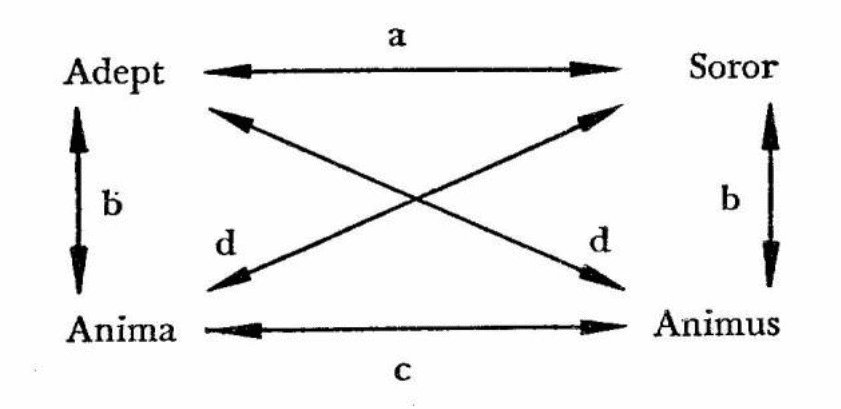
AD: And we put it up on the board here.
C.G. Jung [CW 16, The Practice of Psychotherapy, "The Psychology of the Transference," p. 221, paragraph 423, AD reading]: "The direction of the arrows indicates the pull from masculine to feminine and vice versa, and from the unconscious of one person to the conscious of the other, thus denoting a positive transference relationship. The following relationships have therefore to be distinguished, although in certain cases they can all merge into each other, and this naturally leads to the greatest possible confusion:
(a) [AD: for instance] An uncomplicated personal relationship [AD reads: relation].
(b) A relationship of the man to his anima and of the woman to her animus. [three/few inaudible AD words]
(c) A relationship of anima to animus and vice versa. [AD: And that's wicked.] (some laughter)
(d) A relationship of the woman's [AD reads: feminine] animus to the man…and of the man's [AD reads: masculine] anima to the woman…"
AD: Let me reread that.
S: It's important.
C.G. Jung [CW 16, The Practice of Psychotherapy, "The Psychology of the Transference," p. 221, paragraph 423, AD reading]: "[(d)] A relationship of the woman's [AD reads: feminine] animus to the man (which happens when the woman is identical with her animus)…"
AD: Are you familiar with that, gentlemen?
[students assent, very faint]
S (very faint): (Yes) but the animal is something good.
S: [one/two words inaudible]
AD (simultaneously): Then the a-- (AD laughs, some laughter)
S: Then you do [one/two words inaudible]
AD (simultaneously): Then the animal comes in, huh?
S (very faint): [few words inaudible] (some laughter, student words)
AD (simultaneously, amidst laughter): There's the ammunition. (bit more laughter)
C.G. Jung [CW 16, The Practice of Psychotherapy, "The Psychology of the Transference," p. 221, paragraph 423, AD reading]: "…and of the man's [AD reads: masculine] anima to the woman (which happens when the man is identical with his anima)."
AD: By the way, don't think-- these things can actually be witnessed, those of you that are married or have a relationship. You can see when they, animus or the anima, and I'm not prejudiced here, (bit of laughter) but, you talk to a woman and all of a sudden you see that the animus has taken over completely the four psychological functions. (some laughter)
RG (very faint): [couple words inaudible] between C and D, like what if the anima and animus and then the animus is a [one/two words inaudible]
AD: I'm sorry Richard, try--
RG (very faint): You can see the unconscious aspect of the anima and the animus but the (animus) has a-- has a feminine personality.
AD (very faint): I don't follow your question.
S: He wants--
RG: I want a distinction.
LS (simultaneously): Between C and D [diagram] he wants the distinction.
RP (very faint): Through a relationship in time, you know, you--
RG (very faint): You know, the more the man's anima, let's say, is identified with or projects on to the woman, I don't-- I don't quite see the anima and the animus.
[few seconds of very faint inaudible student talking]
AD: Well I think if you look in the diagram you can see what he's talking about.
S (very faint): Well I'm looking (with you).
LS: Yes, I'm looking at the diagram.
S (simultaneously, very faint): He probably wants a practical example.
AD: He wants a practical example?
RG (simultaneously): Taurus is Taurus.
[few seconds of inaudible student talking, laughter]
AD: Well, if a marri-- a married man just walks in and talks to his wife and the animus is operative, in other words, that faculty of introspection instead of being turned inwards it's turned outwards, and she's often referred to as a nagger, you know, but--
S (simultaneously, very faint): Sometime(s). (laughter, student words)
AD: But let's say she would make her statements or utter an opinion which you can see is purely collective in its origin, you know, or something her father said to her and therefore it's the con-- the absolute truth. Very often a male will react in a very irritable way, alright, that means his anima's being projected. And now the anima takes over the male and the animus, so to speak, has taken over the female and the relationship is between the anima and the animus, and it's a relationship of two not-selves, so to speak, they're two archetypal figures having a royal battle. (laughter) Then when the battle is over, they both say, "But what happened to (you/me)," (more laughter) alright? It's almost like this entity which isn't you comes in and takes over and plays the game out and then withdraws. And then all of a sudden you get the feeling of something leaving you. It's almost-- sometimes it can almost be a vision, you can almost see a person walk in and out of your body. If you look close enough it looks like, you know, the mannequin in the closet. (bit of laughter)
RC (very faint): So the (closet's supposed to be) I get along with a-- with a-- with a woman but I-- I don't really get along with her husband. (laughter, student words)
AD: Yes, very often, sure.
S: [inaudible]
S (very faint): [couple words inaudible]
[student assents, very faint]
AD: No, go right into your room and close the door. (some laughter)
S: No, that's not what you do.
S (very faint): Yes.
LS: Sure it is!
[couple seconds of inaudible student talking; continues as AD speaks]
AD: That's a conflict that could never be resolved. If once the animus and the anima get engaged, no one will come out victor. They'll both lose. There's no-- there's no differences. [few seconds of inaudible student talking; continues as AD speaks] That's what I call the incestuous relationship, the experience of the emotions coming out, not the particular details that you're talking about.
S (faint): Yes.
S (faint): [couple words inaudible] you know, the violence and the--
[few seconds of inaudible student talking; continues as VM speaks]
VM: Well, I'm not saying that that relationship is just totally (valueless).
AD (simultaneously): Wait a minute Vic.
S (very faint): (When it--) [student assents, very faint] (Yes.)
LS (simultaneously): Go on.
S (very faint): I just don't believe that relationship is totally valueless. For example, if a couple is having great difficulties and they never want to relate-- relate on that emotional level of the animus and anima, very often their problems are insoluble until you get down there and see some of the forces that are structuring the whole relation.
RP (very faint): Yes, but that seeing only comes when you drop back [one/two words inaudible] not while you're in it.
S (very faint): Well, ok, maybe in reflections but I'm sure-- but I-- you know, I would think if you do too much reflection that maybe that's what he's talking to here (because) some of that (ugly forms) over there [few words inaudible] (bit of laughter) [student assents, very faint] I mean it's just kind of [couple words inaudible]
LS: I think that's what it means in the next picture they take their clothes off, king and queen. (laughter, student words)
AD (amidst laughter): Well, I can't disagree what Richard said, I can't dis-- can't disagree. [S simultaneously, very faint, possibly part of background: No, I didn't either.] In fact there is-- there is a value in that-- in that--
LS (simultaneously, part of background): It's not sexual, it just means they take (all/off) the conventional disguises.
S (faint): You're trying to [one/two words inaudible]
AD: Yes. But that's the point.
RP: It's a collective, [AD simultaneously: Yes.] it's a battle that's gone on for millennia.
LR (very faint): Yes, like what Vic's saying is that that going into your room and shutting the door can be-- [S simultaneously: Can be (one/two words inaudible) right.] [RP simultaneous with S: It's avoidance.] can be [one inaudible student word] [S simultaneously: Yes.] infantile--
S (very faint): Looking at the animosity, right [few words inaudible]
LR (faint): It can be as infantile as, you know-- it can do--
AD: Well-- [multiple students talking at once, inaudible; continues as AD and VM speak] Each one, each one will have to use his own judgment according to the circumstance and the situation that he finds himself in. I won't-- I won't--
VM: I think we better move on to the next (paragraph) [few words inaudible]
[about 21 seconds of inaudible student talking, laughter]
S: That's right.
RP: Oh yes. I've always found out when teaching a class, as soon as you (park) that into the personal unconscious nobody has (any say). (laughter)
[few seconds of inaudible student talking; continues as AD speaks]
AD: Well of course, that-- that's very reasonable considering that that's the major problem in the Western civilization today, the personal unconscious. That's our major pro-- It's happening on a gigantic scale insofar that men-- the relationship between a man and a woman today, as this generation for instance, is not based on the mother as much as a-- the differentiated anima. It's all the Western society I think is going through now. In other words, when you marry a woman today, it's no longer your mother you marry, you know there's an individual there you're going to have to deal with. Now thirty years ago, you just married your mother. [couple inaudible student words] You know what I'm talking about? It's out in the open today for Western society, alright, so they have to differentiate the anima, ok, that's-- [few seconds of inaudible student talking, laughter] Still (banging)?
RC (very faint): [couple words inaudible] how a woman has to relate closer to man (as) the animus relates. Can you think of the anima as the working [one/two words inaudible] [S and AD assent, very faint] and if you get along with the person (who) (as/is) well. There are equivalent things that are revealing.
S (very faint): No.
LR (very faint): No.
RC (very faint): Like the wo-- [S, very faint: (Stop/No).] (laughter) the woman might [one/two words inaudible] relates to a man, she wants to relate to the person there. Is there anything you can do with the animus [one word inaudible]
AD: Could she do anything with the (animus)?
RC (very faint): No, like what [LR simultaneously: No.] the man has to do would be to deal with his (anima/animus) absolutely.
[few seconds of very faint inaudible student talking]
AD (simultaneously): Well, I think you'll find generally-- Probably the most difficult thing to do is to discipline a woman's animus, for any male to undertake that.
S (very faint): [few words inaudible] [AD simultaneously: (In/And)--] And I don't think that's what Randy was asking. (laughter)
RC (amidst laughter, very faint): I can't really talk to him when I laugh. Now there has to be something (to) relationship to the animus (in some form).
AD: Yes.
RC (very faint): Yes, I mean like sometimes it comes up [few words inaudible] [AD simultaneously: Let me know when you find out.] I just can't get along with but others, you know, I can get along with them ok.
AD: Alright Randy, I'm not going to answer your question, (bit of laughter) I'm just going to move on.
S (very faint): I thought you did, Tony.
AD: I don't want to get personal. (some laughter, student words) There's fifty people around here, and each one is going to interpret it his own way, I'd rather not.
AP (very faint): [couple words inaudible]
AD: Yes Anna--
AP (very faint): But, (could it be) [couple words inaudible] like A and C could be going on at the same time [S, very faint: No.] as my consciously, you know, that you-- A [LS simultaneously: A, B, C, D and maybe a few more.] consciously and-- and unconsciously [one/two words inaudible]
AD: For--
AP (very faint): If I conscious [one/two words inaudible] (A) or, you know, from unconscious [few words inaudible] and conscious, and then in the unconscious [inaudible] that's also both A and C can go on simultaneously.
AD: A and C can go on simultaneously? Well I hope so because eventually you want to differentiate the anima as different from yourself, get rid of it. [AP(?), very faint: Ok.] As long as-- as long as you project a-- one of these archetypes onto a person there's no real relationship. So you get-- let's say you marry the person, alright, and now the personal relationship springs up and little by little you get rid of this archetype. And then you start establishing (healthy) relationship, that's what he's talk about as the big mistake.
S (very faint): And you find out who you married.
AD: Yes, you find out who you married.
LR: And it wasn't who you thought it was at all.
AD: No, it's-- [S simultaneously, very faint: Exactly.] that's-- Sometimes it takes you six months, six years, sixteen, thirty-six, sometimes you never find out. (bit of laughter)
RG: What does it mean to have "an uncomplicated personal relationship"?
AD: Huh?
RG: What does it mean to have an uncomplicated personal relationship?
AD: Well, the archetypes are-- are at a minimum.
S (very faint): That's nice.
RG (very faint): [couple words inaudible] (laughter) In marriage it's like the person-- who's the per-- the person you meet and that's the person [couple/three words inaudible]
AD: Oh, I'm sorry, I was looking at it the other way around, that assuming that you have a relationship with someone, after a while the archetypal projection is dismantled gradually, you know, and the projection reduced to a minimum and you get to the person that's there. But they'll-- like he says--
RG (simultaneously): So in that state, A-- [RP: A is really the last one.] in the diagram A is dependent on B and what you just read. I mean the man would have to project an anima to in a sense be able to do that.
[students assent, very faint]
AD: Yes.
S (very faint): Ok.
AD: Well, you can see how these archetypes force us into relationship with others, alright. And if that wasn't there, most-- well [couple words inaudible]
LS (simultaneously): Why would you?
AD: Huh?
LS: Why would you relate to anybody if the archetypes didn't pull?
AD (simultaneously): Yes, why relate to anyone if these archetypes weren't working through you, you know, you'd go off into your cave and [LS: Yes, why should you--] after the biological instinct is satisfied, you know, you sleep off. Be a kind of messy affair, (AD laughs a bit) you know. [13 second pause, faint background student talking, laughter] Alright, let's pick up 431. The tales you could read for yourself tonight, (sure you could).
C.G. Jung [CW 16, The Practice of Psychotherapy, "The Psychology of the Transference," p. 224, paragraph 431, AD reading]: "In both tales the incest is an evil fate that cannot easily be avoided. Incest, as [AD reads: is] an endogamous relationship, [AD adds: it] is an expression of the libido which serves to hold the family together. One could therefore define it as"kinship libido," a kind of instinct which, like a [AD reads: the] sheep-dog, keeps the family group intact. This form of libido is the diametrical opposite of the exogamous form. The two forms together hold each other in check: the endogamous form tends towards the sister and the exogamous form towards some stranger."
AD: So either there's a marriage relationship within the family, which is one kind, or the libido is directed outwards from the man.
C.G. Jung [CW 16, The Practice of Psychotherapy, "The Psychology of the Transference," pp. 224-225, paragraphs 431, 432, 433, AD reading]: "The best compromise is therefore a first cousin. (laughter) There is no hint of this in our fairy-stories [AD reads: fairytale], but the marriage quaternio [AD reads: quaternity] is clear enough. [AD adds: And] In the Icelandic story we have the schema [AD reads: pattern]:
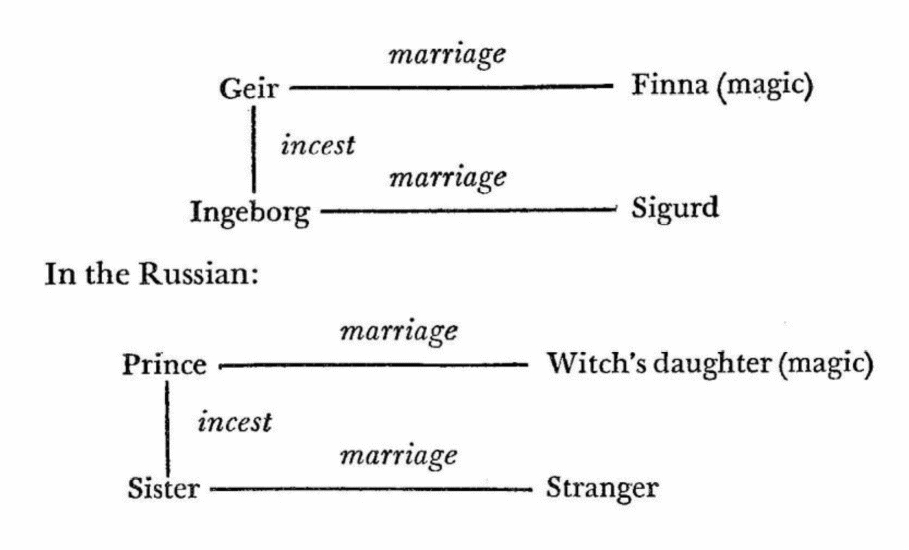
"The two schemata [AD reads: patterns] agree in a remarkable way. In both cases the hero wins a bride who has something to do with magic or the world beyond.
"Assuming that the archetype of the marriage quaternio described above is at the bottom of these folkloristic quaternities, [AD reads: is at the bottom of these quaternities which are authenticated by folklore] the stories are obviously based on the following schema [AD reads: pattern]:
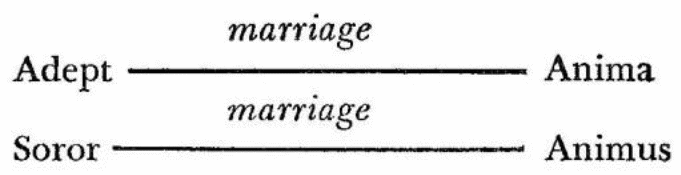
[AD verbalizes diagram: Adept's marriage to the Anima, the Soror marriage to the Animus.]
"[AD adds: Now] Marriage with the anima…"
AD: I don't know if that's obvious to you what he's saying, the two patterns agree.
C.G. Jung [CW 16, The Practice of Psychotherapy, "The Psychology of the Transference," p. 224, paragraph 432, AD reading]: "In both cases the hero wins a bride who has something to do with magic or the world beyond."
AD: Those of you who remember your love affair, it transported you to a magic world for a little while.
[short pause]
C.G. Jung [CW 16, The Practice of Psychotherapy, "The Psychology of the Transference," p. 225, paragraph 433, AD reading]: "[AD adds: Now] Marriage with the anima is the psychological equivalent of absolute identity between conscious and unconscious. But since such a condition is only possible in the complete absence of psychological self-knowledge, it must be more or less primitive, [i.e.], the man's relationship to the woman is essentially an anima projection. The only sign that the whole thing is unconscious is the remarkable fact that the carrier of the anima-image is distinguished by magical characteristics."
AD: And, you remember when we spoke about that magical dimension of consciousness which those of you who projected an anima know it delivered you right into that neverland.
S (very faint): [one/two words inaudible]
[student assents, faint]
C.G. Jung [CW 16, The Practice of Psychotherapy, "The Psychology of the Transference," p. 225, paragraph 433, AD reading]: "These characteristics are missing…"
AD: Well, one of the points here is--
C.G. Jung [CW 16, The Practice of Psychotherapy, "The Psychology of the Transference," p. 225, paragraph 433, AD reading]: "Marriage with the anima…absolute identity between [AD adds: the] conscious and the unconscious. But [since] such a condition is possible only [AD reads: only possible] in the complete absence of psychological [self]-knowledge…"
AD: Very often, and you're probably aware in some of the primitive societies where you'll buy a wife for so many cows, you know, there's no projection there at all. (laughter) Didn't they do that at one time, they'd [student assents] buy-- you'd go over and give the mother so many cows and she'd give you her daughter? [couple/three inaudible student words] There's no anima projection there, "psychological knowledge".
RP (very faint): Pretty much.
AD: It's not done no more?
RP (faint): Still done.
AD: Still done?
S (very faint): I have no idea. (some laughter)
S: That's good. (laughter)
RP: Just noble people. (laughter)
[short pause]
AD: Well listen, I have to break off, the next few pages are so important that I'd really like to give him a lot of time. Because that's where-- In other words, the whole structure of society is based on this intentionality of the libido in terms of the fantasy images that he has to operate with and, he will transfer that to what the alchemists are doing. In other words, the same way that this libido has this intention to seek a partner within the magic circle or outside the magic circle, in the same way the alchemist began to realize that he was seeking for some sort of union with himself and that this incest was really the portrayal in terms of fantasy figures of this kind of self-communion. He has Layard in here. Maybe you might be able to get that Friday and I'd like to look it up, because it seems that that's where he got most of his information from.
LS: Which one is that?
AD: "The Incest Taboo and the Virgin Archetype". [short pause] Because he quotes Layard, and some of these quotes are really kind of important. He says--
C.G. Jung [CW 16, The Practice of Psychotherapy, "The Psychology of the Transference," p. 228, paragraph 438, AD reading]: "[He regards] the [endogamous] (incest) tendency as a genuine instinct which, if denied realization in the flesh, must realize itself in the spirit. Just as the exogamous order made culture possible in the first place, so also it contains a latent spiritual purpose. Layard says:"Its latent or spiritual purpose is to enlarge the spiritual horizon by developing the idea that there is after all a sphere in which the primary desire may be satisfied, namely the divine sphere of the gods together with that of their semi-divine counterparts, the culture heroes." The idea of the incestuous hierosgamos does in fact appear in the civilized religions and blossoms forth in the supreme spirituality of Christian imagery [AD adds: that is] (Christ and the Church…). "Thus the incest taboo," says [Layard], "leads in full circle out of the biological sphere into the spiritual.""
AD: And if you remember, when we were speaking about "On the Nature of the Psyche", the way the meaning of the instinct was up here and the instinct was down there [FIGURE AD_G_019 merged] and gradually as this is denied fleshly realization within the family its meaning is being forced upon you. Because this libido has to go somewhere, and if it doesn't attach itself to a proper fantasy image there could be all kinds of trouble. This is basically where Freud with his incest theories got bogged down.
RP (very faint): [three/few words inaudible]
AD: Well the point is that the incest means something much more, you know, than wanting to cohabitate with your mother.
RP (very faint): But (that's just) more taboo [inaudible]
AD (very faint): Yes.
S (very faint): Hm.
AD: And so he takes his whole theory there, you know, and picks it up from there and shows how it applies to the alchemist and how these fantasy images were portraying these instincts. [student assents, very faint] Sorry I don't have the time. Those of you who have this volume, there's a very beautiful quotation on page 106, 107, and 108, the footnote down at the bottom, which is really-- I read this once before or twice. Pestalozzi. One minute [one word inaudible]
C.G. Jung [CW 16, The Practice of Psychotherapy, "Psychotherapy Today," p. 106, footnote 8, AD reading]: "8 [Pestalozzi said…:]"None of the institutions, measures, and means of education established for the masses and the needs of men in the aggregate, whatever shape or form they may take, serve to advance human culture. In the vast majority of cases they are completely worthless for that purpose and are directly opposed to it. Our race develops its human qualities in essence only from face to face, from heart to heart. Essentially it develops only in little intimate circles which gradually grow in graciousness and love, in confidence and trust. All the means requisite for the education of man, which serve to make him truly humane and to bring him into mankindliness, are in their origin and essence the concern of the individual and of such institutions as are closely and intimately attached to his heart and mind. They never were nor will be the concern of the masses. They never were nor will be the concern of civilization.""
AD: He's thinking of [few words inaudible] He goes on and says--
C.G. Jung [CW 16, The Practice of Psychotherapy, "Psychotherapy Today," p. 107, footnote 9, AD reading]: "9…"The collective existence of our race can only produce civilization, not culture. Is it [AD reads: It is] not true, do we not see every day, that in proportion as the herd-like aggregations of men become more important, and in proportion as officialdom, which represents the legal concentration of the power of the masses, has freer play [AD reads: power] and wields greater authority, the divine breath of tenderness is the more easily extinguished in the hearts of the individuals composing these human aggregations…
""The collectively unified man, if truly he be nothing but that, sinks down in all his relations into the depths of civilized corruption, and sunk in this corruption, ceases to seek more over the whole earth than the wild animals in the forest [seek].""
AD: This note is kind of important because by the time Jung is finished he's going to show the extreme importance of relationship for people and there is just no possible realization without that. You know, like Aurobindo says, we are members of one another whether we like it or not. I'm sorry, I got to break it up.
[Audio File 1973 0126d Ends]
1973 01/26 V12a: CLASS: Jung; Alchemy. Copyright 2023 Wisdom's Goldenrod p. iv