DIAGRAM FOR 1973 0202
Class
Friday, February 2nd, 1973
Verbatim, unedited transcriptClick the series name to view more
CLASS at Wisdom's Goldenrod, Hector, NY
with Anthony Damiani (AD)
February 2, 1973
JUNG; ALCHEMY
TOPIC: Jung
SUBJECT: Alchemy
SUBSUBJECTS: "The Psychology of the Transference," Rosarium, Kinship Libido, Shadow
CONTENTS:
Reading Rudolf Bernoulli, "Spiritual Development as Reflected in Alchemy and Related Disciplines"
Mental example of rotatio
Anima as antahkarana
Reading/discussing Jung, "The Practice of Psychotherapy," Rosarium (section 2)
A real fairytale transports you into the magical dimension of consciousness
Two forms of libido, endogamous (kinship) and exogamous
Fantasy images can overpower sensory stimuli
AD has LS tell his dream to illustrate kinship libido
AD interprets LS dream
Looking at transits can help validate the interpretation of the dream; dreams as commentary on subconscious soul processes
Organization of society suppresses endogamous tendency (incest taboo); has to be brought back into oneself (conjunction)
Ideas/bits of luminosity gradually work their way into your consciousness and build up your personality; individuation goes on whether you're conscious of it or not
Alchemists thought highly of the reason inherent in Nature, all truth to be found in this world
No going anywhere until a man pays his debt to Nature
Inner consolidation of the individual includes our fellow man; we are all members of one another
Kinship libido wants human connection; core of the transference phenomena
Individuation has two aspects, internal integration and objective relationship
Ultimate questions of psychotherapy not a private matter
Logos and Eros
Reading Jung, "The Practice of Psychotherapy," Rosarium (section 3), assimilation of the shadow
Reading/discussing Jung, Aion, on the shadow
Inferiorities constituting the shadow have an emotional nature; emotion not an activity of the individual
Projection creates illusory relationship to environment and isolates the subject
Upon recognition of the shadow as within you, there is a fundamental enlargement of one's consciousness; spiraling process
Individual cannot stand up to archetypal/collective evil, divinity has to be called in
Discussion of figure 2 in Rosarium; first version of anima is archaic, requires virile masculine intellect to deal with it
Archetypes are psychic tendencies, residues of patterns of living, can't be nailed down conceptually
Confronting the shadow; shadow in meditation
Often a spiritual experience will be interpreted in an upside down way by the ego
Tibetan and Native American ways of confronting the shadow; why children are afraid of the dark
Archetypes as samskaras which guide, develop, unfold the personality
BOOKS READ FROM OR REFERENCED:
Rudolf Bernoulli, "Spiritual Development as Reflected in Alchemy and Related Disciplines," in Spiritual Disciplines (Papers from the Eranos Yearbooks, 4)
Pali Cannon
C.G. Jung, CW 1, Psychiatric Studies, "On the Psychology and Pathology of So-called Occult Phenomena"
C.G. Jung, CW 8, The Structure and Dynamics of the Psyche, "On Psychic Energy"; "On the Nature of the Psyche"
C.G. Jung, CW 9, Part I, The Archetypes and the Collective Unconscious
C.G. Jung, CW 9, Part II, Aion, "The Shadow"
C.G. Jung, CW 13, Alchemical Studies, "The Spirit Mercurius"
C.G. Jung, CW 14, Mysterium Coniunctionis
C.G. Jung, CW 16, The Practice of Psychotherapy, "The Psychology of the Transference"; "Psychotherapy Today"
The Secret of the Golden Flower, Richard Wilhelm (translator), C.G. Jung (commentary); also in C.G. Jung, CW 13, "Commentary on "The Secret of the Golden Flower""
John Layard, "The Incest Taboo and the Virgin Archetype," in Eranos Yearbook XII
Paul Brunton, The Hidden Teaching Beyond Yoga
Paul Brunton, The Wisdom of the Overself
Oswald Spengler, The Decline of the West
Plato, Symposium
William Shakespeare, Hamlet
C.G. Jung, Man and His Symbols
Erich Neumann, Depth Psychology and a New Ethic
Mary Anne Atwood, A Suggestive Inquiry into the Hermetic Mystery
Herman Hesse, Magister Ludi
Ruth Benedict, Patterns of Culture
DIAGRAM appended to this transcript:
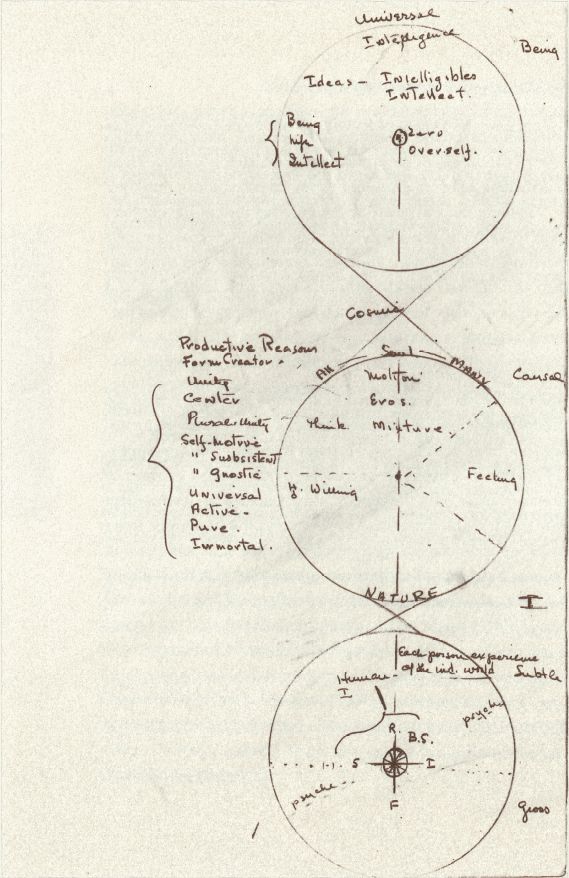
- FIGURE AD_G_012. Three Circles Diagram: Divine Intellect, Soul, Psyche.
[Transcriber note: [diagram] means the speaker is referencing a diagram as he or she is speaking.]
NOTE: For readability's sake, the following substitutions/edits made in Verbatim Transcript: cuz = because; yeah = yes.
TRANSCRIBED Verbatim by IT prior to 2017, reformatted by jf 2017. In 2023, IT updates prefatory matter, footer, and audio file name, completes TOC and Book List, fixes errors/typos, adds new notes within transcript, adds one diagram and reference within transcript to this diagram, reformats to accord with new conventions. Archival verbatim transcript – V12a.
AUDIO FILES: 1973 0202a, 1973 0202b (formerly 1973 0202d), 1973 0202c.
1973 02/02 at Wisdom's Goldenrod
Jung; Alchemy
[Audio File 1973 0202a Begins]
[background student talking, AD begins at 0:00:24.2]
AD: Alright, shall we start?
[24¼ seconds of background student talking, laughter]
AD: If we summarize or itemize--
S: Louder please. (laughter)
AD: We're going to summarize three main aspects of alchemy, you know. As we started last week we spoke about this a little bit and we quoted from Blavatsky and we quoted from Paracelsus. [Note: See WG Class 1973 0126.] And briefly, the three major aspects to keep in mind when we're talking about alchemy, even as conceived by Jung, and the first one was that--
[Transcriber's note: I am using Spiritual Disciplines (Papers from the Eranos Yearbooks, 4), "Spiritual Development as Reflected in Alchemy and Related Disciplines" by Rudolf Bernoulli, Pantheon Books, Bollingen Series 30, New York, 1960.]
Rudolf Bernoulli ["Spiritual Development as Reflected in Alchemy and Related Disciplines," p. 319, AD reading]: "(1) [Alchemy] as [AD adds: a] theory, as [AD reads: it's] a great, comprehensive vision of the world, as [AD adds: an] idea of the cosmos as a whole, as analysis of man, as emanation and creation of God, as an epitome of all analytical knowledge, built on universal correspondences."
AD: And again and again we keep emphasizing, the theory of correspondence here is an absolute necessity, otherwise alchemy's a closed book.
Rudolf Bernoulli ["Spiritual Development as Reflected in Alchemy and Related Disciplines," p. 319, AD reading]: "(2) Alchemy as practice, as [AD reads: The second point in alchemy as a practice was] an attempt to examine these things and deal with them experimentally, not only in the realm of matter, but above all in the province [AD reads: providence] of the soul, which is the true scene of becoming, [AD rereads: The soul is the true scene of becoming.] the only one that is really accessible to our knowledge, since all else can be known only indirectly through psychic experience. Mere alchemy is broadened into a universal creative discipline, embracing all things from the standpoint of the soul. (3) Alchemy as a transcendental endeavor whose supreme aim is to achieve liberation from the world, after knowledge and experience of this world have [AD reads: has] been gained. The first two aspects of alchemy are consequently [AD adds: a] perquisite to the third. Only after mastering them are we prepared for the [AD reads: a] return to the beginning."
Rudolf Bernoulli ["Spiritual Development as Reflected in Alchemy and Related Disciplines," pp. 306-307, AD reading]: "First comes [AD rereads: First comes] the secret of the seed from which they all spring, the seed which might be likened to the grain of mustard in the parable [AD: from the Bible]. From this parched grain, which seems so utterly dead, a full life miraculously develops. Alchemy devotes much attention to the secret of the seed: The earth in which we plant it contributes its solid nutrients, the water with which we sprinkle it bestows its virtue, and even from the air the seed draws subtle nourishment, while from the sun it takes fiery energy. Thus all the elements combine to confer their blessings on it. [AD adds: And] Here we have the wonder [AD adds: in alchemy] of germinatio [AD reads: germination], that plays so prominent a role in all alchemy [AD reads/says: and-- and it's a very prominent role in alchemy].
"[AD: Then of course] The seedling develops, and we look with astonishment upon the formation of its [AD reads: the] organs, its growth according to very definite laws that are innate in every plant.
"[And] then comes the moment when the buds burgeon, when the blossoms burst open, the plant has reached its prime, the hour of its sacred nuptials. The blossoms are fertilized by grains of pollen borne on the wind: [AD adds: and] this is the coniunctio [AD reads: conjunction] of which alchemy speaks. But now we encounter an apparent inconsistency [AD: or what seems to be an inconsistency]. These flowers, which have just opened, these flowers whose creation seemed to be the whole purpose of the plant, now begin to wither and fade. The whole process would seem to have been in vain. This fading of the flowers, this [AD reads: the] seeming failure of the whole process, is also known to alchemy, which calls it the nigredo, [AD adds: or] the blackening. Everything appears to be lost. The lovely petals have shrunken, they are withered, dry, brown. But under the blossom the fruit grows and matures, turning from green to yellow to red. [AD adds: And] This reddening is also known to alchemy; it is the rubedo, the yearned-for stage leading up to the"great work" which alchemy projects. At last the fruit is ripe [AD reads: ripened]. The process seems to be ended, but this is not quite so. The plant is torn up parched seeds and all. Where a moment past we beheld hopeful burgeoning and ripening, we now see a withered brown wilderness. [But] the seed is gathered and sown again in new earth. [AD adds: And] This is the projectio [AD reads: projection] of alchemy.
"And now [AD: of course] the garden reveals one of its greatest mysteries [AD reads: in this garden one of the great mysteries is revealed]: this seed, which is sown again, will begin the cycle anew [AD: all over]. [AD adds: And] Here we have the phenomenon of the rotatio [AD reads: rotation of the elements], the cycle, another typically alchemical concept. This cycle is the seal and the true image of alchemy. There is one figure that is never absent from the old alchemical manuscripts of Egypt…"
AD (paraphrasing): And, no matter how scantily they're illustrated, always you see the Uroboros, the figure of the Uroboros.
Rudolf Bernoulli ["Spiritual Development as Reflected in Alchemy and Related Disciplines," p. 307, AD reading]: "…the serpent with a head like a dragon and a scaly body, biting its tail. [AD adds: And] This whole metamorphosis, this growth and passing, this eternal cycle, is the first [great] lesson we find in our garden [AD reads: we learn in alchemy]."
S: Hm.
AD (very faint): (Uh-hm.)
[short pause]
AD: Is that-- [short pause] We have examples of this. Let's say if we wanted to take a very practical example. If a person, for instance--and this is an example on a mental level--if a person wants to study Buddhism, let's say, and he picks up a good history, a good text, and he gets involved in studying it--let's say you study the Pali Canon, alright, that's the very beginning. You study it very intensely and after a while you move away from it and you move into other schools of Buddhism and you follow the development of the ideas and you're led from one school to another and you recapitulate, so to speak, that is, assuming that you're very sincere and intense in your study, you will see that the problems that are presented in one school and get answered in another school, and that if you're-- if you're very aware of the whole that's being presented to you, these problems will come up in you, alright. They actually will be recapitulated in you. So then you go to the other school to find out the answers. And then assuming that they answer the question for you, other questions come up because these are answered. And so you find yourself going through all the schools, recapitulating the problems and answers and finally coming back to the Pali text to realize what was initially there to begin with. But now you come back with a much deepened understanding, alright. [short pause] So, in a sense, this cyclic process that goes on can be-- you can see it happening in yourself when you study any of these subjects that require the utmost extension of your being, in terms of your mental being. On the other hand, if you study it like you do in many of the educational institutions today, it ends right where the book ends.
LS: That's happening to us with astrology.
AD: That's happening-- you've noticed that in astrology, that you keep going up on a spiral?
LS: Yes.
AD: And every time there's a-- a pivoting, so to speak, a point where we're introducing a higher concept, the squirming and the wriggling and the-- the projections and all that useless (cut--) psychological garbage all is thrown out [one/two words inaudible] It's like, you know, a-- a comedian at the stage the way he has to duck the tomatoes. (some laughter) [short pause] Yes, there's tremendous resistance to those new developments. And, in alchemy we begin-- we'll see this very clearly. If we take up to the practice-- if we go to the practice-- I mean, I could throw a monkey wrench in your whole conception of the anima, for instance, if I call the anima the antahkarana, alright. If I just call it that and you think about it, and you have to think ve-- very carefully what we're talking about because, if the anima is the antahkarana, any change, any modification in the antahkarana, as you know, produced the thought or made you aware, and Jung says the same thing--the anima is the bridge to the unconscious. He didn't-- he didn't mean that you walk over it and go into the unconscious, [S: (Uh-uh.)] but whatever contents were in the unconscious will be reflected in the anima. That's another way of saying that the anima would be modified, there'd be thought processes going on [S simultaneously: (But--)] and you would be subjected to that.
S: Are you talking about anima in a-- in a high--
AD: Any way you want to understand it.
S: Well ok, then that--
AD: Any way you want to understand it, honey.
S: How do I deal then with-- (with--) that was (where you made, but I'm saying) are you talking about personal anima or are you talking about more on a collective level?
AD: Well if I say "my Sun" instead of "the Sun", does that change it?
S: No, it's hard for me to relate to an anima (just--) [couple words inaudible] you speaking of animus for woman?
AD: When you-- when you look at the board and you see the Sun there, alright, [S: Yes.] you say "my Sun" right? [student assents, very faint] You don't really believe that.
S (very faint): No.
AD: Alright. You say, "my animus"--you don't really believe it.
S: Uh-hm.
S: When I'm (in that compulsion) should I-- would I personally introject the word 'animus' for what he's saying, 'animus' for 'antahkarana'?
AD: Yes, you could do that.
S: Ok.
S: (Yes.)
[11¼ second pause, background student talking]
AD: (Can/Do) (you--) It may be worth-- worth your while to see if you can find any Hindu who studied Jung's psychology and see what their idea may be on that matter. Ok, we were in chapter 2 and we were up on section 423, 424, around there somewhere.
[short pause]
S: [couple words inaudible]
AD: [few very faint words inaudible] (Or, we can read from there but--) [short pause] Where was it, 438, is that it? Anybody remember where we left off?
LR: In the Rosarium?
AD: Hm?
LR: In the Rosarium?
AD: Yes, in the Rosarium.
LR: (Yes.)
AD: We were on this second, which I consider one of the really very profound chapters in the whole book.
LR: We were just starting the thing about the first cousins, (I think.)
S: (Oh.)
LR: The best thing to do is marry your first cousin. (some laughter)
AD: I tried that, she was older than me though. Thought I was being [one word inaudible] (some laughter) [short pause] Lenny, you want to read maybe one tale?
LR: Yes.
AD: You want to read one tale?
LR (simultaneously): I've noti-- I noticed [S: Yes.] that you left out the tales and when I read them by myself they seem-- they seem really important.
AD (simultaneously): Well, you have to do something by yourself.
S: [one/two words inaudible]
AD: [AD chuckling] (Yes I do), I-- I hope. We're-- what-- what we get here is hardly an outline and I-- I would like to say this, that I, in a sense, am trying to provide you with a kind of ruler, alright, to realize the depth of the things that you are studying because the most important function as far as I'm concerned is to counteract that tendency that you operate with to read and study things at a surface level. These processes are so painful when they start happening, you're going to be glad that you know the little that you do to hold on. If I-- if I succeed in trying to make you, you know-- in bringing your awareness to the depth of this, then I've do-- I've done something worthwhile. But Jung is a very profound man and in spite of my criticism of his metaphysical position, you know, philosophic stance, I think psychologically he's a very rare phenomenon. If-- if, for instance, we speak over here, I had quoted from 361 the paragraph where Jung speaks--
C.G. Jung [CW 16, The Practice of Psychotherapy, "The Psychology of the Transference," p. 174, paragraph 361, AD reading]: "The most vivid examples of these complications are probably to be found in erotic phenomenology. Four stages [of eroticism] were known even in the late classical period…"
AD: When he speaks of Eve, Helen, the Virgin Mary, and Sophia, and there you can see the cyclic nature, alright, of the alchemical process, the spiraling process which deepens. [short pause] [this next sentence is possibly a quote] This is alchemy in the true sense, alright. And-- when you go through these processes, and everyone to some extent has to go through these processes, that's why I wanted to go and work on the problem in astrology of the ordering of the Zodiac because that's an indication of the process, see, from Aries to Pisces, and around and around, I mean that's the ro-- rotation that they're speaking about. Maybe we'll get to that in astrology someday soon but in the meantime try to keep this as an example in mind, the cyclic nature of the development of the personality. You want to read the-- you want to read one of the tales--
S: Which one?
AD: --for those who don't-- Well, either one.
LR: (Can we) read them both?
LS: Sure, read them both.
AD: Read them both, alright, alright.
LS (simultaneously): Why don't you read.
AD: And you want to get out the rattles too? (some laughter)
LR: Well--
AD: One's enough. (You have serious work to do.)
[file is muffled here; a few seconds of student talking is inaudible; student begins reading but it is still barely audible until indicated place]
C.G. Jung [CW 16, The Practice of Psychotherapy, "The Psychology of the Transference," p. 222, paragraph 426, LR reading]: "Finna was a girl with mysterious powers. One day, when her father was setting out for the Althing, she begged him to refuse any suitor who might ask for her hand. There were many suitors present, but the father refused them all. [file is audible again] On the way home he met a strange man, Geir by name, who forced the father at point of sword to promise his daughter to him. So they were married, and Finna took Sigurd her brother with her to her new home. About Christmas-time, when Finna was busy with the festive preparations, Geir disappeared. Finna and her brother went out to look for him and found him on an island with a beautiful woman. After Christmas, Geir suddenly appeared in Finna's bedroom. In the bed lay a child. Geir asked her whose child it was, and Finna answered that it was her child. And so it happened for three years in succession, and each time Finna accepted the child. But at the third time, Geir was released from the spell. The beautiful woman on the island was Ingeborg, his sister. Geir had disobeyed his stepmother, a witch, and she had laid a curse on him: he was to have three children by his sister, and unless he found a wife who knew everything and held her peace, he would be changed into a snake and his sister into a filly. Geir was saved by the conduct of his wife; and he married his sister Ingeborg to Sigurd."
LR (re-pronounces): Sigurd.
[9½ second pause]
AD: Now of course you notice that's a kind of matter of fact fairy tale.
S: [few words inaudible]
AD: Alright, there's-- there's really no-- no feeling of the marriage of a-- to an anima image. If you remember at one time when we were speaking about the divisions and the-- the projection of the anima has that quality, that magical quality that we spoke about as the magical dimension of consciousness, and in these-- in these tales, it's not there. That magical quality isn't there so, again, like Jung points out, it could either be a very primitive situation where there's a very primitive psychology, or the other, you know, just like when we have interceptions. Or the personality could be so differentiated that there's no projection of an anima. But either extreme, you see, won't suit our purposes. And I don't know why Jung picked on this example but, so he did.
LS: Tony, on his diagram (p. 224) he says that Finna was magic. It sounds pretty magic to me, a wife who knows everything and keeps her peace. (laughter)
S: You know, it (also) says that she has mysterious powers.
AD: No, the point I was making, the point I was making, that it's not actually in the tale, [student assents] see. Now, these are the commentaries on the tale. In other words, she has these magical powers but in a real fairytale or (in a) folklore, you actually have that feeling as you're reading it. You're transported right into that realm. I mean, it doesn't have to be just a-- a tale. This magical quality-- who was it [one/two words inaudible] who said all you need is a little enthusiasm and you'll be happy, right? It transports you right there, you can do a lot of work, but without that enthusiasm you slide back into the same inertia, alright? Do you see what I'm talking about? And that doesn't come across in the tale. I think I could've picked out even a better tale.
LS: [few words inaudible]
S (simultaneously): [one word inaudible]
S: Uh-hm.
AD: Alright.
S: Sounds like Jones translating. (laughter)
AD: Like a Jones translation, yes. (more laughter, AD laughs) Alright, let's--
LS: How about the other tale then, that's [few words inaudible]
AD (simultaneously): Alright, [LR simultaneously: The other one--] go ahead, go on [LR simultaneously: (Here), you read it (couple/few words inaudible)] with the other tale. Go ahead, read it [one word inaudible]
LR: The other one's better for that (too).
C.G. Jung [CW 16, The Practice of Psychotherapy, "The Psychology of the Transference," p. 222, paragraph 427, LS reading]: "Another [LS reads: The other] example is the Russian fairytale"Prince Danila Govorila."" (laughter)
AD: That's-- [LR simultaneously: Is that a (room for rent)?] that's enough. (laughter)
S: Oh, 'govorila' means that "who talks a lot".
LS: 'Govorila' means "who talks a lot"? Oh, ok.
AD: That's what I'm looking (to do).
S: [one word inaudible]
LR/S(?): Anna should have read the other one.
C.G. Jung [CW 16, The Practice of Psychotherapy, "The Psychology of the Transference," pp. 222-223, paragraphs 427-429, LS reading]: "There is a young prince who is given a lucky ring by a witch. But its magic will work only on one condition: he must marry none but the girl whose finger the ring fits. When he grows up he goes in search of a bride, but all in vain, because the ring fits none of them. So he laments his fate to his sister, who asks to try on the ring. It fits perfectly. Thereupon her brother wants to marry her, but she thinks it would be a sin and sits at the door of the house weeping. Some old beggars who are passing comfort her and give her the following advice:"Make four dolls and put them in the four corners of the room. If your brother summons you to the wedding, go, but if he summons you to the bed chamber, do not hurry! Trust in God and follow our advice."
"After the wedding, her brother summons her to bed. Then the four dolls begin to sing:
Cuckoo, Prince Danila,
Cuckoo, Govorila,
Cuckoo, he takes his sister,
Cuckoo, for a wife,
Cuckoo, earth opens wide,
Cuckoo, sister falls inside.
"The earth opens and swallows her up. Her brother calls her three times, but by the third time she has already vanished. She goes along under the earth until she comes to the hut of Baba Yaga (the Russian arch-witch), whose daughter kindly shelters her and hides her from the witch. But before long the witch discovers her and heats up the oven. The two girls then seize the old woman and put her in the oven instead, thus escaping the witch's persecution. They reach the prince's castle, where the sister is recognized by her brother's servant. But her brother cannot tell the two girls apart, they are so alike. So the servant advises him to make a test: the prince is to fill a skin with blood and put it under his arm. The servant will then stab him in the side with a knife and the prince is to fall down as if dead. The sister will then surely betray herself. And so it happens: the sister throws herself upon him with a great cry, whereupon the prince springs up and embraces her. But the magic ring also fits the finger of the witch's daughter, so the prince marries her and gives his sister to a suitable husband."
AD: Read the next paragraph too.
S: (Uh-hm.)
C.G. Jung [CW 16, The Practice of Psychotherapy, "The Psychology of the Transference," pp. 223-224, paragraph 430, LS reading]: "In this tale the incest is on the point of being committed but is prevented by the peculiar ritual with the four dolls. The four dolls in the four corners of the room form the marriage quaternio, the aim being to prevent the incest by putting four in place of two. The four dolls form a magic simulacrum which stops the incest by removing the sister to the underworld, where she discovers her alter ego. Thus we can say that the witch who gave the young prince the fatal ring was his mother-in-law-to-be, for, as a witch, she must certainly have known that the ring would fit not only his sister but also her own daughter."
AD: And this might remind you of the tale of, you know, the bottle that was hidden in the oak tree, that evidently the alchemist or the magician is really getting-- is setting up the stage and getting everything ready, you know, and you fall into the trap, we fall into the trap, and live out--
LS (simultaneously): And we might as well because we set it up.
AD: Well, yes, in a way, it's our setting, of course. He says here--
C.G. Jung [CW 16, The Practice of Psychotherapy, "The Psychology of the Transference," p. 224, paragraph 431, AD reading]: "[In both tales] the incest is an evil fate that cannot easily be avoided. Incest, as an endogamous relationship, is an expression of the libido which serves to hold the family together. [AD: And] One could therefore define it as"kinship libido," a kind of instinct which, like a sheep-dog, keeps the family group intact. [AD: And] This form of libido is the diametrical opposite of the exogamous form. The two forms together hold each other in check: the endogamous form tends towards the sister and the exogamous form towards some stranger."
AD: Now, you know what he means by the sheep-dog instinct? You ever watch a sheep-dog, the way the sheep are all moving and one strays and the dog runs over and brings him back into the fold? [S: Oh.] He keeps running-- he keeps them always together, ok. And it sounds strange to attribute some sort of quality like that to an energy, you know, which demands fulfillment in some way or another. [short pause] Again, over here-- What you have to try to understand is something of the primitivity of this situation. These people are living out this nature. They're not planning these things, alright, and the way Jung tried to point out, you live out nature, you do what's always been done, and it's only upon reflection or differentiation of the personality that one looks back and says, "Well why did I do it?" and then he starts realizing, or let's say he starts postulating archetypes and says, "That's why I did it," ok?
S: [one word inaudible]
AD: He starts off at 433 with--
C.G. Jung [CW 16, The Practice of Psychotherapy, "The Psychology of the Transference," p. 225, paragraph 433, AD reading]: "Marriage with the anima is the psychological equivalent of absolute identity between conscious and unconscious. But since such a condition is possible only in the complete absence of psychological self-knowledge, it must be more or less primitive, i.e., the man's relationship to the woman is essentially an anima projection. The only sign that the whole thing is unconscious is the remarkable fact that the carrier of the anima-image is distinguished by magical characteristics."
AD: Here again, like I say, it didn't come across to me but others say it came across to them.
C.G. Jung [CW 16, The Practice of Psychotherapy, "The Psychology of the Transference," p. 225, paragraph 433, AD reading]: "[AD: And] These characteristics are missing from the soror-animus relationship in the stories; that is, the unconscious does not make itself felt at all as a separate existence. From this we must conclude that the symbolism of the stories rests on a much more primitive mental structure [AD reads: primitive frame of mind] than the alchemical quaternio [AD reads: quaternity] and its psychological equivalent. Therefore we must expect that on a still more primitive level the anima too will lose her magical attributes, the result being an uncomplicated, purely matter-of-fact marriage quaternio [AD reads: quaternity]. [11¾ second pause] [AD skips a few sentences] …[AD: In]"The Incest Taboo and the Virgin Archetype"… [AD: He says that it put him into thi-- into this frame of mind.] …"[It is] upon the division of the whole community into two exogamous intermarrying classes that the whole social structure is built up." [AD: And] These "moieties" show themselves in the lay-out of settlements as well as in many strange customs."
AD: And there again-- Skip over to 434.
C.G. Jung [CW 16, The Practice of Psychotherapy, "The Psychology of the Transference," p. 226, paragraph 434, AD reading]: "The names given to these two sides [AD: These two moieties.] are [particularly] enlightening…[AD: insofar that they are archetypally portrayed as] east and west, high and low, day and night, male and female. It is not difficult to see from these names that the two halves are [felt] to be antithetical and thus the expression of an endopsychic antithesis. The antithesis can be formulated as the masculine ego versus the feminine"other," i.e., conscious versus unconscious personified as anima. The primary splitting of the psyche into conscious and unconscious seems to be the cause of the division within the tribe and the settlement. It is a division founded on fact but not consciously recognized as such."
[few seconds of inaudible whispering in background]
AD/S(?) (very faint): Almost.
AD (whispering): Yes, yes. 438.
C.G. Jung [CW 16, The Practice of Psychotherapy, "The Psychology of the Transference," p. 227, paragraph 438, AD reading]: "The difference between the primitive and the cultural marriage quaternio [AD reads: quaternity] consists in the fact that the former is a sociological and the latter a mystical phenomenon."
AD: I do-- I don't want to get bogged down in sociology.
C.G. Jung [CW 16, The Practice of Psychotherapy, "The Psychology of the Transference," pp. 227-228, paragraph 438, AD reading]: "While marriage classes have all but disappeared among civilized peoples, they nevertheless re-emerge on a higher cultural level as spiritual ideas. [AD: And] In the interest of the welfare and development of the tribe, the exogamous social order thrust the endogamous tendency into the background so as to prevent the [AD paraphrasing] dangerous formation of small and ever smaller groups."
AD: You follow the logic here?
S: [one word inaudible]
S: [one word inaudible]
AD: No? Well if, let's say, marriage is within a small circle, you know, just let's say-- You could see it immediately, if you only could marry people within the family, in a very short time marriage as a custom would be dissolved or extinguished. But if it's endogamous, in other words if you have to marry people outside your family, then you see that it could multiply in the relationships with a community outside the family(,) would tend to extend the basis of a given society, alright. So one would work towards a center, let's say, and the endogamous relationship would work towards the center, and the exo-- exogamous relationship would work out away from the center. So, the one that's working away from the center, so to speak, would multiply the possibility of brining more and more people into relationship. But you can see that if that process is multiplied indefinitely, that we're going to end up as strangers to one another. Anyway, do you follow that now?
[short pause]
C.G. Jung [CW 16, The Practice of Psychotherapy, "The Psychology of the Transference," p. 228, paragraph 438, AD reading]: "It insisted on the introduction of"new blood" both physically and spiritually, and it thus proved to be a powerful instrument in the development of culture. [In the words of Spencer and Gillen:] "This system of what has been called group marriage, serving as it does to bind more or less closely together groups of individuals who are mutually interested in one another's welfare, has been one of the most powerful agents in the early stages of the upward development of the human race.""
AD: I remember in the ghetto that I lived, you know, on the East side, they were all Italians and there-- there was a kind of personal relationship. You know like, if I did something wrong and people who knew me would say, "Oh, well that's the son of so and so. Alright, we'll let him get away with it," you know, they kind of took over and watched out for me, you know. There was a kind of relationship even though I was unknown except through my father. And, even Jung makes the point, that after a hundred people you have no personal relationship no more. All you got is digits, computers figuring out what your number is. And for Jung, personal relationship, as at the end of the chapter he points out, is the sin qua non of personality synthesis.
C.G. Jung [CW 16, The Practice of Psychotherapy, "The Psychology of the Transference," p. 228, paragraph 438, AD reading]: "Layard has amplified this idea… [AD: And] He regards the endogamous (incest) tendency as a genuine instinct which, if denied realization in the flesh, must realize itself in the spirit. [AD: And] Just as the exogamous order made culture possible in the first place, so also it contains a latent spiritual purpose. [Layard says:]"It's latent or spiritual purpose is to enlarge the spiritual horizon by developing the idea that there is after all a sphere in which the primary desire may be satisfied, namely the divine sphere of the gods together with that of their semi-divine counterparts, the culture heroes." The idea of the incestuous hierosgamos does in fact appear in the civilized religions and blossoms forth in the supreme spirituality of Christina imagery [AD: as] (Christ and the Church…)."
S: [one/two words inaudible]
AD: I like you to keep in mind here one of the remarks he-- Jung makes where he pointed out that the fantasy images are stronger and over-- overpower the actual sensory stimuli. [Note: See C.G. Jung, CW 9, Part I, p. 66, paragraph 135.] You remember that uh--
S: [one word inaudible]
AD: Huh? You remember it? That's very important in here because unless you realize the truth of that, you know, you (missed/miss) the whole point. A very easy example would be like for instance an example where-- oh-- the one PB used, alright, where he says you're-- you're full of fear and trepidation and you're walking, ok, and there's a bush but you don't see the bush, you see a brigand or a robber getting ready to attack you. [Note: See PB, The Hidden Teaching Beyond Yoga, Ch. 12.] That's where the fantasy image-- that's where the fantasy image, so to speak, overpowered what you actually saw.
C.G. Jung [CW 16, The Practice of Psychotherapy, "The Psychology of the Transference," p. 228, paragraph 438, AD reading]: ""Thus the incest taboo…leads in full circle out of the biological sphere into the spiritual." On the primitive level the feminine image, the anima, is still completely unconscious and therefore in a state of latent projection."
AD (quietly to LS): Lenny, would you like to tell your dream? I won't explain it, just the first part, show how the kinship libido (got) stuck.
LS: In the part with my mom?
AD/LS(?): [one word inaudible]
LS: Ok.
AD: Alright. With the kind-- very kind consideration, Lenny's going to tell you a dream. I'm only going to interpret part of it because I don't like to get too personal in these matters. And, it's really worthwhile. This is actual, this is real, this is concrete, you're living these things, ok. Your discretion.
LS: The dream started, I'm sitting with my mother in a tree. And we were talking, I don't remember about what, and we were planning to spend the night there. I started just sort of picking around, playing with the branches, and noticing that some of them were rotten and they were breaking off as I touched them. And it occurred to me that the one I was sitting on might be rotten too, so I jumped down to the ground and touched that one and it fell off in my hand. So, we obviously couldn't stay there. So then we were at a party. There was this really beautiful girl there. Oh, before that, before that. There was some interplay, interaction with my mother about she had an errand for me to run early in the morning and that-- that whole dialogue had a feeling of Boston where I went to school; and I refused, I wanted no part of it, and that was the last I saw my mother. Then there was this really beautiful girl there who was very interested in me and she was-- she was really beautiful, really gorgeous. (some laughter) And, first I was more interested in the musicians. I kept shying away from paying attention to her. And then finally as she was leaving, she was carrying a pie with her, a half-eaten pie. (some laughter) [few inaudible student words] And I stopped to talk to her and we kissed very lightly and she got so emotional that she just ran out, leaving her pie. (laughter)
LR: Which is all you wanted (in the first place). (more laughter)
LS: So now I was following her home and I was with my father. And I met another girl, a girl who I'd gone with a long time ago, who was walking with her father and we sort of exchanged [AD(?): pleasantries] just pleasantries, and then we went on, my father and I went to the girl's house. And we were sitting there talking to her in a-- in an obviously sexual atmosphere, my father on one couch and I on another and a girl on a third. And the other girl, a fourth, ran into the house screaming "The cops are firing tear gas into the house!" And then in came a cop. And I was pretty disgusted and I just said, "Alright, come on in [couple/few words inaudible]" So, (um) next thing (you're) walking down the street escorted by the cop and suddenly my father starts beating him up. He was really whaling into him. He had this sort of rubberish-- rubber crow bar, alright, he was whaling him across the face. [9 second pause] And what he said was something like, "That was a sexual union that you interrupted and union isn't over until it's done." And he just kept saying this over and over again and really beating on him, and then he just sort of stalked off disgusted. And then I said to the cop, "You know, there wasn't anything wrong what we were doing up there," and he pulled his gun so fast that it scared me. And I shot my hands up into the air and a cop starts walking me off down the street and we reach the place where my father and the girl were walking and my father turned around and saw the gun and he sort of put his hands up in the air too and it sort of tails off there.
AD: Well we don't want to interpret the whole dream. First of all, it doesn't concern you. But one part there that we might show the relevance of what we've been talking about. You want (two minutes) that you want to speak about it?
LS: No, go ahead Tony. You might say something different.
AD: Well first of all, when Lenny and I were talking, it took him about 2½ hours to finally tell me, "Look, I have a dream I want to mention." This is unlike Lenny, because if he has a good dream, right away we go over to a corner and listen to it. So right away that was a sore point, I knew something was up, something important. And we tried approaching the dream and the analysis always seems to lead, if we follow it through in terms of reduction, to the incest motive. But, I know Lenny and I'm pretty sure that that wasn't on his mind. But we look back and we keep trying to understand what was going on and in the scene where he was sitting on a tree--and the tree here symbolically is archetypal of, you know, the-- the tree of life, ok--but the branches are withered and they're breaking off and his mother is there with him and an intimacy has sprung up between him and his mother, alright. This is the kinship libido, alright, and there's always a tendency to go back into that, alright. But, Freud would interpret that to mean that he wants to go back into the womb. Jung would say, "No, wait a minute. If we go back there, that's where we left off somewhere in our development." In other words, we go back there for the purposes of going forward again. You don't go back there so that you can stay put there. So if you follow at the very beginning very carefully you can see that what-- what it's saying here is something about kinship libido, that he has to learn to transfer that energy from the intimacy of the circle, the family circle, alright, to a greater world outside. Now if that's not done, and Richard you ought to listen, if that's not done, you know, then there will always be a reversion to a sexual type of symbolism. And the man may even get strange ideas about sexuality, (prowess), and it's a misunderstanding of what this libido is trying to do. Now over here he says-- very beautifully, he says--
C.G. Jung [CW 16, The Practice of Psychotherapy, "The Psychology of the Transference," p. 228, paragraph 438, AD reading]: "…the endogamous (incest) tendency as a genuine instinct…"
AD: I'm not going to analyze the rest of the dream so don't wait for it.
C.G. Jung [CW 16, The Practice of Psychotherapy, "The Psychology of the Transference," p. 228, paragraph 438, AD reading]: "…as a genuine instinct which, if denied realization in the flesh, must realize itself in the spirit."
AD: Ok? Well, if he cannot realize this tendency in the flesh, evidently it's meant to be brought to a much higher level. Alright? Perhaps the level of Helen, perhaps the level Virgin Mary, I don't know, I'm not going to say. But you can see the fantasy images have to be picked up and brought up to a higher level. This has to be done very consciously. You follow what I'm saying? The tendency of the instinct, the energy, the libido, is always to go back into that womb-like structure, the participation mystique. And here they-- the-- well the break that-- the collective norms and values that the father operated with, all these things interfered with a sort of consummation of that intimacy so that he could pull away from it. Eventually I think it's brought-- I think you see that now more and more, the psychological difficulty in understanding of metaphysics. You remember the aspects you had that night? See, even more so than Jung, for instance, [LS aside: (one/two words inaudible) 72.] even more so than Jung, I like to find the aspects that were transiting that night because again and again I've seen that the interpretation of the dream can be somewhat validated, as much as a thing can be validated, by the aspects that are being made and especially so with the particular symbol in operation. And I think you had a couple of good aspects the night that you had the dream, and interesting enough you were at your-- one of your relatives, weren't you, at Jenny's?
LS (simultaneously): Yes, (with) Jenny's mother. Anybody got '72 ephemeris?
AD: Is there a '72 ephemeris around?
LS (whispering): Not what I had [one/two words inaudible]
AD: And as you're seeing right here, right now, if we're listening carefully, we're seeing that these processes are the very life processes we're living through, ok. If you're too closely identified, if there isn't somewhat a little bit of detachment, you can't see you're going through this. But if there's a little bit of detachment, just the ability to step back once in a while, it would be like looking in the mirror and seeing objectively, this is what's happening to me. And then of course the gap is closed and you're right back and you're doing-- you're doing it, alright. That interval-- You remember like PB pointed out, he says the study of philosophy is really worthwhile and in this sense, that very often we-- we catch ourselves in a moment of passion and all we need is that one moment of dispassion and we've established, so to speak, a base. From there we can regrasp the situation. But if that one moment doesn't exist, we get swallowed up, away we go.
LS: It's Uranus square the Moon and Pluto on--
AD (simultaneously): Notice, Uranus square the Moon. Remember what I told you, the Moon always represents, to me, basically, the man's unconscious.
LS: Pluto's opposite Mars.
AD: Ok.
LS: And Jupiter coming to the Sun. Transiting node was just-- just passed over the Sun.
S: Oh really. (The Head)(./?)
AD: And then like I get a little confidence that I'm on the right track, not that I can't be misled but I begin to feel more sure of what the-- these-- These dreams are like a commentary on subconscious or soul processes that are going on in the chart, you know, the big-- alright. If Wednesday night you found it difficult, you have to remember I ask you to keep in mind whenever we interpret a chart, you have to always work with two of them simultaneously. You cannot interpret a chart in terms of the ego complex, you always have to keep in mind the big fellow behind that chart. And the development is with the functioning of certain aspects of your being, not with the particular experience, which is incidental. One experience or one means could be substituted for another means but the net result of that-- that experience is to develop a certain faculty. Alright, if we go back to Jung.
C.G. Jung [CW 16, The Practice of Psychotherapy, "The Psychology of the Transference," p. 228, paragraph 438, AD reading]: "Through the…"
[Audio File 1973 0202a Ends]
[Audio File 1973 0202b (formerly 1973 0202d) Begins]
VM: --the exogamous instinct?
AD: Yes.
C.G. Jung [CW 16, The Practice of Psychotherapy, "The Psychology of the Transference," p. 229, paragraph 438, AD reading]: "The eight-class…"
VM (simultaneously): [couple words inaudible] in a nutshell, isn't this-- the exogamous and endogamous instincts, aren't they just sort of another way of talking about the introversion or the extraversion of the anima function? I mean, the instinctual-- I mean, there's incest-- would sound like that is the kind of natural tendency if it-- you know, if you neglect to-- or if you suppress the actual biological material manifestation of it, isn't that-- can't it be raised to an introversion of the anima, isn't that (precisely) what he's saying?
AD: Can it be raised?
VM: If you don't just follow the--
AD: The natural tendency.
VM: --the natural tendency of the incest instinct, then the energy has to go somewhere and [AD simultaneously: It must go up.] essentially it's an introversion of the anima.
AD: It must go towards meaning.
VM: Right but-- I mean, you're-- instead of having incest with your mother or your sister or something like that, you get into some closer relationship with your own anima, with your own feminine counterpart, whether it be Helen or Sophia or whatever level (of--) you're operating on.
AD: Yes.
S: That's why women seduce(./?)
AD: He says that in that next paragraph. In the middle of the paragraph he says--
C.G. Jung [CW 16, The Practice of Psychotherapy, "The Psychology of the Transference," p. 229, paragraph 438, AD reading]: "The eight-class and particularly the twelve-class systems mean a great advance for the [AD misreads: endogamous tendency which is thereby… AD: I'm sorry. AD rereads: …a great advance for the] exogamous order, but an equally severe repression of the endogamous tendency, which is thereby stimulated to a new advance in its turn."
AD: Now, try to keep in mind his principle of complementarism.
C.G. Jung [CW 16, The Practice of Psychotherapy, "The Psychology of the Transference," p. 229, paragraph 438, AD reading]: "Whenever an instinctive force--i.e., a certain sum of psychic energy--is driven into the background through a one-sided (in this case, exogamous [AD reads: the exogamous tendency]) attitude on the part of the conscious mind, it leads to a disassociation of personality. The conscious personality with its one-track [AD reads: single] (exogamous) tendency [AD reads: line of thought] comes up against an invisible (endogamous) opponent, and because this is unconscious it is felt to be a stranger and therefore manifests itself in projected form. At first it makes its appearance in human figures…"
AD: Do we follow this part now (here/yes)? So inherent in the very-- in the very nature, inherent in the very nature are these tendencies within the psyche which is going to structuralize the society itself, alright, just as we see this happen in the animal kingdom. If you notice, when an animal raises its cub, at a certain age it cuts it off and just-- Like a bear will raise a cub and after at a certain age, cub is climbing a tree and the mother walks away and good-bye, never again. Certainly I don't think it's the mother-- the mother bear that knows deliberately, "Well wait a minute now, we got to be careful here, we could have an endogamous and exogamous tendency going on." (laughter) So you can see that nature is lived out and we're-- we're living out this nature. Let's go to-- right to 439 and you'll see why I'm going to go back to this one.
C.G. Jung [CW 16, The Practice of Psychotherapy, "The Psychology of the Transference," pp. 229-230, paragraph 439, AD reading]: "The endogamous tendency finds an outlet in the exalted sphere of the gods and in the higher world of the spirit. Here it shows itself to be an instinctive force of a spiritual nature; and, regarded in this light, the life of the spirit on the highest level is a return to the beginnings, so that man's development becomes a recapitulation of the stages that lead ultimately to the perfection of life in the spirit."
AD: And here again, if I can recall what we started off by saying, the development of the seed, to the plant, to the blossom, and then back to the seed, and this spiraling rotation that goes on, and in terms of the personality. And even PB I think somewhere made the remark that this growth and this development of the personality is a spiral process. You recapitulate, you go back to where you start. But if you think of it as an incline plane on a screw, you go back but you're just a little higher than you were before. And if you-- if you want to, you can add your astrology onto this in terms of thinking of the equinoxes, you know, the precession of the Sun going backward. You know, after all, Jung said it does take a long time.
S: [couple words inaudible]
S: I thought it was [few words inaudible]
AP: [one/two words inaudible] Couldn't you say that the kinship libido is-- was the [few words inaudible] like a--
AD (simultaneously): Was what?
AP: That the kinship libido was the manifest (shadow), exogamous tendency? But, just [few words inaudible]
AD (simultaneously): Well the-- the point to notice here is that this kinship libido, alright, has to be very severely imposed upon by an outside order because [AP assents] it has a tendency always to return to its-- its origin, alright. [AP assents] Now when in a society they divide the society, you can only marry these people, alright, and not any others, and you can see at a primitive level where there isn't the dogma of the anima to deal with, so there's this marriage to, let's say, someone in that part of the tribe, you can see what's happening here. First of all, because there's no dogma of the anima, this relationship can be worked out, that is, (with) any strong emotional tie or projection. And secondly, you can see that the kinship libido is being restricted. In other words, it cannot operate within its home base but it is being spread out over there, [couple/few inaudible AP words simultaneous with AD] alright. But this kinship libido or this exogamous tendency, alright, will bring up its counter idea. And so this gets stronger, the more you relate outwardly the more this comes up inwardly and as he says it's felt as a stranger.
S: [couple/few words inaudible]
AD: Did-- did-- Lenny, would you say that that had that feeling of strangeness in the dream, the whole scene with the tree and you and your mother?
LS: No, not that so much but the other scene did.
AD: Which one?
LS: The second scene, the whole-- the whole episode from following the other girl around, that whole thing. It wasn't so much that she was [AD simultaneously: Oh yes.] a stranger but the fact that there was always these intrusions, you know.
AD: Yes, well that would be, and here again there's a problem, even Jung hasn't handled it because you're dealing here with the trinity converting itself into the quaternity and Jung never really seriously considered the trinity as a mythologem. You have a three and a four coming into play, the three trying to turn into four. Three is always the unmanifest, the four represents the quaternity or the manifestation. And, he kept away from that. Alright.
RC: Tony, which is felt as a stranger, is it--
AD: I'm sorry?
RC: Is it this crystallized kinship libido is felt as a stranger or the other person is felt as a stranger? I'm-- I haven't been able to make that connection.
AD: Are you referring to this-- the sentence in here?
RC: Yes right, speaking of it appears as a stranger.
AD (simultaneously): Again, let's try. If the exogamous tendency [one word inaudible] the upper hand and a person constantly or in a given society the relationship is always with a stranger or outside, then the endogamous tendency becomes a stranger because it's a psychic force within you, alright, which is-- is looking, looking to place its value somewhere. But you don't recognize it for what it is [RC simultaneously: So--] and this was the example we were speaking about.
RC: So in that fable with (the) second--
AD (simultaneously): Wait a minute, wait a minute, wait. This was the example that we gave, that Lenny so kindly gave. This is an accurate portrayal of that kinship libido, alright, which is felt in this dream and which has never been, so to speak-- It's coming up in this dream, it's revealing itself in this dream, and it's revealing the fact that it hasn't been completed. That intimacy has to now be transferred into himself. This is basically what conjunction is all about. I expressed it to you jokingly, like when you experience the emotions in music as a kind of incest, isn't it? And if he can experience that kinship libido which is projected on, so to speak, in the relationship with his own family group, if that can be turned inwardly, alright, then it has to go, so to speak, upwardly in terms of fantasy images for his own development. But for him now, lacking, let's say, a psychological insight into that, it is always felt as something alien. Do you see what I'm talking about? Unless that's understood, you will interpret it the way Freud did or the way Adler did, power over the mother, something like that, or the way like Jung says, to recognize it and see that it's something that has to be brought back into yourself and raised.
RC: Like the whole idea of withdrawing a projection (it seems that) would be like a sin or something? Like-- like you don't want to withdraw it but you-- you hear that there's this projection going on but you want it to keep going on, you don't want to withdraw it. Is it like this--
LS: It's not even that simple.
S: (No, I don't think it's) [one/two words inaudible]
LS: It's more like the projection goes out and lands on a woman and on the one hand there's this fascination with her and on the other hand there's an absolute tongue-tiedness, inability to talk, relate, in any way, positive or negative, alright, which is again, that's not like me.
AD: And that shows its alienness, its otherness, its stranger-like quality. And of course, when the alchemists starts speaking about the conjunction, they're speaking about a conjunction between you and your shadow, for instance, and then between you and your anima. These are all internalized. We'll see this as he goes along.
S: Is-- Can-- can we relate the fact that--
LS (simultaneously): Talk up.
S: Can we-- I'm wondering if we can relate the fact that the-- the anima or the-- I'm sorry, the endogamous tendency being suppressed is projected and takes the form of an anima projection and that-- that would be why the anima would relate the person back to oneself. Because essentially it's this in-- inner or uniting energy.
AD: Try again.
S: Well, if-- see, it just struck me that--
AD: Louder.
S: --since-- since the endogamous tendency as a biological force relates the kinship group together in a primitive level, when that tendency is suppressed on a physical level and then can only come out through being projected in a relationship-- Say a man projects this anima which is essentially grounded in that endogamous tendency which is going to relate the family structure, so it relates him actually through the person back to himself, because it's a uniting energy, it's a (um--)
AD (simultaneously): Alright, ok. That was a comment, right?
S: Yes.
C.G. Jung [CW 16, The Practice of Psychotherapy, "The Psychology of the Transference," p. 230, paragraph 440, AD reading]: "The specifically alchemical projection looks at first sight like a regression: god and goddess are reduced to king and queen, and these in turn look like mere allegories of chemical substances which are about to combine. But the regression is only apparent. In reality it is a highly remarkable development: the conscious mind of the medieval investigator was still under the influence of metaphysical ideas, but because he could not derive them from nature he projected them into nature. He sought for them [AD reads: He tried to find them] in matter, because he supposed that they were most likely to be found there. It was really a question of a transference of numen the converse of that [AD reads: similar to that] from the king to the god. The numen seemed to have migrated in some mysterious way from the world of the spirit to the realm of matter. But the descent of the projection into matter had led some of the old alchemists, for example Morienus Romanus, [AD reads: Romanus, for example] to the clear [AD reads: distinct] realization that this matter was not just the human body (or something in it) but the human personality itself. [AD: And] These [prescient] masters had already got beyond the inevitable stage of obtuse materialism that had yet to be born from the womb of time. But it was not until the discoveries of modern psychology that this human"matter" of the alchemists could be recognized as the psyche."
LS: I have a question.
AD: Yes, that's--
LS: That first sentence, "The specifically alchemical projection looks at first sight like a regression…"
S: Yes.
LS: Like, for example, this-- is this a good example, say, the reappearance of infantile desires but with a suddenly numinous energy?
AD: Yes, (yes). That's exactly it. [S simultaneously: But isn't (what)--] And that's why very often when you're brought back to a childhood scene, alright, the importance of that childhood recall is to bring you back there where you left those germs, you know, those golden germs that assured you your future development. Look, analogously, the same way, like when we were studying "The Nature of the Psyche" (C.G. Jung, CW 8) and he points out, you look at the sky, you remember, and he says all those star-- you look at the starry dark sky and there's all those stars, and they remind you like germs or bits of consciousness in the-- in the unknown, alright. Now, if you transport this into yourself, there are ideas that are coming into your consciousness, little bits and germs of conscious ideas and on the chart we see a new idea coming into manifestation gradually, as soon as you make room for it. Right Andrea? Soon as you make room for it and you begin to live with it, then it starts developing and ex-- expanding.
A good example, those of you who read "The Pathology of the Occult Phenomena" (C.G. Jung, CW 1) where Jung experiments with his cousin who was a medium. And this is-- this is a very good example. And he held regular séances with her and she was doing very well and they went ahead and they got a great deal of information. Then she reached a point where the mandala figure came out and Jung copied it down, wrote it down. Then after that, the séances became fraudulent, she conjured up things she knew so Jung broke the experiments off there. But in all that time what had happened was that this disassociated personality, (it/there) was germs or bits of consciousness coming in, trying to establish themselves in her consciousness, alright, so that a new personality developed, would develop. And this is precisely what happened after he-- they broke off. This young woman who was a cousin to Jung developed a much more stable personality and also found her vocation, that is, she became an artist. And this kind of gives you a feeling, you know, of this unknown mass of stuff that's coming into the personality and developing it, alright, establishing itself in there, making a beachhead so to speak, and then gradually working its way in and becoming part of the personality. And you assimilate, like Jung said, what was unconscious you make it conscious and now you-- you develop a broader base to work with. Again, as you see, these processes are so intimate that they require the microscopic vision of a master psychologist to be noted, alright, otherwise they-- they just escape us.
S: The remarkable thing is that-- that it happens without you knowing anything at all about it.
AD: Yes, and that's why he said, individuation will go on whether you're conscious of it or not.
LR: The objective psyche.
AD: Yes. And again, if we go back to the Alchemical Studies-- This is-- this is a minor thing compared to-- compared to what he does in The Mysterious Conjunction. I think he just prepares-- all this is preparation for the work on the Mysterious Conjunction. But, however, if you understand so far what's going on, you could for instance grasp what Jung means when he says, for instance, if the idea, the Image of God, that you contain within yourself, you know, if that was not to be, if that wasn't there or you lost it, that would be a total annihilation of the personality. And you can see how much sense that makes right away. Even the-- the atheist has an Image of God that he's working with, although he gives it the name of atheism or unbelief. [AD flipping through pages] Well, I don't know if I remember the quotation but-- the passage. [short pause while AD looks for quote] But I spoke about it and I tried to emphasize its-- as I consider it one of the highlights in Jung's writings.
C.G. Jung [CW 13, Alchemical Studies, "The Spirit Mercurius," p. 238, paragraph 286, AD reading]: "Let us, however, not delude ourselves: no more than we can separate the constituents of character from the astronomical determinants of time are we able to separate that unruly and evasive Mercurius from the autonomy of matter."
AD: Now, think of matter as personality, alright.
C.G. Jung [CW 13, Alchemical Studies, "The Spirit Mercurius," pp. 238-239, paragraph 286, AD reading]: "Something of the projection-carrier always clings to the projection, and even if we succeed to some degree in integrating into our consciousness the part we recognize as psychic, we shall integrate along with it something of the cosmos and its materiality; or rather, since the cosmos is infinitely greater than we are, we shall have been assimilated by the inorganic [AD: Or the objective psyche.]."
LR: What paragraph is that Tony?
AD: 286 in "The Spirit Mercurius". [15½ second pause] Alright, so we go back here and through this and then-- And you can see also the reason why the alchemists thought so highly of what they called the natural numena or the reason inherent in nature itself. As a matter of fact, I sometimes suspect-- I've been reading Paracelsus here and there, you know, like hitting and running, hitting and running, because he's got a terminology of his own-- but you-- you sometimes suspect that these people thought much more highly of reason than even revelation, scriptural revelation, because they felt that all the truth was to be found in this world and that's why we're here, we can find it here, in ourselves.
S (simultaneously, very faint): [few words inaudible]
AD: (No.)
LS: [couple words inaudible]
C.G. Jung [CW 16, The Practice of Psychotherapy, "The Psychology of the Transference," p. 230, paragraphs 441, 442, AD reading]: "On the psychological level, the tangle of relationships in the cross-cousin marriage reappears in the transference problem. The dilemma here consists in the fact that anima and animus are projected upon their human counterparts and thus create by suggestion a primitive relationship which evidently goes back to the time of group marriages. But in so far as anima and animus undoubtedly represent the contrasexual components of the personality, their kinship character does not point backward to group marriage but"forwards" to the integration of personality, i.e., to individuation.
"Our present-day civilization with its cult of consciousness…"
AD: Those of you who read here know how worthwhile it is. I don't see that I should go through it. But, let's go right on. [10½ second pause] One of the point he makes in the next paragraph--
C.G. Jung [CW 16, The Practice of Psychotherapy, "The Psychology of the Transference," pp. 232-233, paragraph 443, AD reading]: "As I have already said, it is just conceivable that the endogamous tendency will intervene compensatorily and restore the consanguineous marriage, or the union of the divided components of the personality, on the psychic level--that is to say, within the individual. This would form a counterbalance to the progressive dichotomy and psychic dissociation of collective man."
S: Hm.
AD: Do you follow here? Maybe we can talk a little. You have an idea of what he's saying?
VM: Yes, it's really quite a flip, the old idea of the incest taboo as being one of the most evil sorts of perversions of man, now Jung is taking it and raising it to a spiritual level and saying it is the unifying principle which is going to compensate for all the tremendous extroversion and materiality that our culture and [AD simultaneously: Uh-hm.] way of life get us into. Quite a turnaround.
AD: Yes, but wasn't this in a way indicated when we were speaking about-- when we were speaking, I don't know if you might recall this, and you have to excuse me for just randomly striking at some of the past lectures. You remember, we were speaking about causality at the level of energy as Samkhya speaks of it and this causality is both cognitive and causal. Do you see now the importance of this kind of statement in Samkhya? There's a very interesting footnote somewhere in one of Jung's writings, I forget where, but Jung was in India and he-- he was looking at these huge erotic sculptures, you know, and beautiful pictures, and a Pandit comes to him and he was talking to him, you know, what's going on. And the Pandit says, "Well the sooner these people pay their debt to Nature, you know, ok, the sooner then they can get on the quest or the path or the process of individuation." And, there again, in the other book, The Secret of the Golden Flower, Jung's commentary there is very explicit. The Chinese pointed out that until a man does pay his debt to Nature, there's no going anywhere, alright. So that you get the feeling that this energy first has to be worked out in this very natural biological sphere before it could rise to a more spiritual sphere and then beyond that. Do you see how all-- how all very natural this is? It doesn't depend upon your ideas or your conceptions about it. (laughter, student words) No, I think-- I think there's a wiser-- I think that he's wiser to leave it to our judgment. (AD chuckling)
S (simultaneously): (Yes.)
C.G. Jung [CW 16, The Practice of Psychotherapy, "The Psychology of the Transference," p. 233, paragraph 444, AD reading]: "It is of supreme importance that this process…"
AD: And here is where again I would emphasize and underline in red, because from here on the passages are really extraordinarily beautiful.
C.G. Jung [CW 16, The Practice of Psychotherapy, "The Psychology of the Transference," p. 233, paragraph 444, AD reading]: "It is of supreme importance that this process should take place [AD and Jung emphasis] consciously, otherwise the psychic consequences of mass-mindedness will harden and become permanent. For, if the inner consolidation of the individual is not [a] conscious [achievement], it will occur spontaneously and will then take the well-known form of that incredible hard-heartedness which collective man displays towards his fellow men. He becomes a soulless herd animal governed only by panic and lust: his soul, which can live only in and from human relationships, is irretrievably lost. But the conscious achievement of inner unity clings [AD: desperately] to human relationships as to an indispensable condition, for without the conscious acknowledgement and acceptance of our fellowship [AD reads: kinship] with those around us there can be no synthesis of personality. [S: (Mercurius.)] That mysterious something in which the inner union takes place is nothing personal, has nothing to do with the ego…"
AD: I hope you get this straight.
C.G. Jung [CW 16, The Practice of Psychotherapy, "The Psychology of the Transference," p. 233, paragraph 444, AD reading]: "…[AD: it] is in fact superior to the ego because, as the self, it is the synthesis of the ego and the supra-personal unconscious. The inner consolidation of the individual is not just the hardness of collective man on a higher plane, [AD: You know, like the man in the grey flannel suit.] in the form of spiritual aloofness and inaccessibility: it emphatically includes our fellow man [AD reads: men]."
AD: And perhaps if we consider and go back to PB or Plotinus where he says "the first of our thoughts…" [Note: PB, The Wisdom of the Overself, "The Secret of the I," p. 79, 1943 edition.] Our thought. Remember that? You see the-- [Note: See FIGURE AD_G_012 for the following.] Or when Plotinus pointed out, all souls-- the All-Soul, alright, and this inter-reaction, there can't be no world for you alone, there has to be a world in conjunction with all the other souls and the relationship of soul to soul in terms of the middle circle [diagram] and the relationship of soul to soul through body in terms of the cosmos [bottom circle]. This is what Jung is, so to speak, amplifying. He's like putting a magnifying glass and say-- saying, "Take a look." Or Aurobindo when he says, for instance, we are members of one another, whether we like it or not.
C.G. Jung [CW 16, The Practice of Psychotherapy, "The Psychology of the Transference," p. 233, paragraph 445, AD reading]: "To the extent that the transference is projection and nothing more, it divides quite as much as it connects. But experience teaches that there is one connection in the transference which does not break off with the severance of the projection. That is because there is an extremely important instinctive factor behind it: the kinship libido. This has been pushed so far into the background by the unlimited expansion of the exogamous tendency that it can find an outlet, and a modest one at that, only within the immediate family circle, and sometimes not even there, because of the quite justifiable resistance to incest. While exogamy was limited by endogamy, it resulted in a natural organization of society which has entirely disappeared today. Everyone is now a stranger among strangers. Kinship libido--which could still engender a satisfying feeling of belonging together, as for instance in the early Christian communities--has long been deprived of its object."
AD: Now perhaps maybe you'll understand why there's ashrams and, you know, all that kind of stuff.
S: Yes.
LS: Bookstores.
AD: Bookstores. (some laughter) Bars. Bars too, there's a-- You ever go to a bar Friday night? [S simultaneously: (Yes, soon.)] The warm feeling of libido just permeates. (laughter)
LS: The warm feeling of libido. "Hey kid, when did you get your last haircut?" (laughter)
S: It's not your family, Lenny. (laughter)
LS: Yes, right. [one/two words inaudible] my kinship libido. (some more laughter)
C.G. Jung [CW 16, The Practice of Psychotherapy, "The Psychology of the Transference," pp. 233-234, paragraph 445, AD reading]: "But, being an instinct, [AD: And here again, the amazing insight of this man. AD rereads:"But, being an instinct] it is not to be satisfied by any mere substitute such as creed, party, nation, or state. It wants the human connection. That is the core of the whole transference phenomenon, and it is impossible to argue it away, because relationship to the self is at once relationship to our fellow man, [AD reads: men] and no one can be related to the latter [AD reads: his fellow man] until [AD reads: unless] he is related to himself."
AD: I don't know how truer we can say these things. And maybe many of us will now understand why in a sense we ran from one fanatical cult to another, searching for something that no cult or creed or movement could give us. You know, it was like a substitute for what we real-- really looking for.
LR: You know how a lot of people say when they came to the bookstore, a lot of people use the word "It felt like home"?
AD: Felt like home, yes.
S: Tony?
C.G. Jung [CW 16, The Practice of Psychotherapy, "The Psychology of the Transference," p. 234, paragraph 446, AD reading]: "If the transference remains at the level of projection, the connection it establishes shows a tendency to regressive concretization, i.e., to an atavistic restoration of the primitive social order [AD reads: it reverts to the primitive order of society.] [AD: And] This tendency has no possible foothold in our modern world, so that every step in this direction only leads to a deeper conflict and ultimately to a real transference neurosis. Analysis of the transference is therefore an absolute necessity, because the projected contents must be reintegrated if the patient is to gain the broader view he needs for free decision."
AD: And there I-- I might give myself as a kind of small example. I keep trying to push back your projections and trying to get you to consciously see you're not relating to me but to an image of me and someday you may see that, you know, and a lot of nonsense would stop. But then that would be the end of the world. (laughter)
C.G. Jung [CW 16, The Practice of Psychotherapy, "The Psychology of the Transference," p. 234, paragraph 447, AD reading]: "If, however, the projection is broken, the connection--whether it be [negative] (hate) or [positive] (love)--[may] collapse for the time being so that nothing seems to be left but the politeness of a professional tete-a-tete. One cannot begrudge either doctor or patient…"
AD: And anyone who's gone through that knows well, you know, let him go his way. He'll find someone else to project it on. And sure enough he will. 448, again, very-- very well done.
C.G. Jung [CW 16, The Practice of Psychotherapy, "The Psychology of the Transference," p. 234, paragraph 448, AD reading]: "Individuation has two principal aspects: in the first place it is an internal and subjective process of integration, and in the second it is an equally indispensable process of objective relationship."
AD: And you remember the point he makes, you're in between the objective world and the internal world (AD chuckling) and you can't find where to-- where to stand.
C.G. Jung [CW 16, The Practice of Psychotherapy, "The Psychology of the Transference," p. 234, paragraph 448, AD reading]: "Neither can exist without the other, although sometimes the one and sometimes the other predominates. [AD: And] This double aspect has two corresponding dangers. The first is the danger of the patient's using the opportunities for spiritual development arising out of the analysis of the unconscious…"
AD: Or when he becomes a quester.
S: The danger.
LR: That's not the end of the sentence.
AD: Oh I thought I must have finished it. Oh [few inaudible words to himself]
LR: Using it as a pretext--
C.G. Jung [CW 16, The Practice of Psychotherapy, "The Psychology of the Transference," p. 234, paragraph 448, AD reading]: "…for spiritual development arising out of the analysis of the unconscious as a pretext for evading the deeper human responsibilities, and for [AD emphasized next word] affecting a certain"spirituality" which cannot stand up to the moral criticism…"
AD: That's all of it.
S: [one word inaudible]
C.G. Jung [CW 16, The Practice of Psychotherapy, "The Psychology of the Transference," p. 234, paragraph 448, AD reading]: "…the second is the danger that atavistic tendencies may gain ascendancy and drag the relationship down to a primitive level."
AD: Alright, there you have it.
S: Can you translate that?
S (simultaneously, in background): (What page is it?)
AD: You want to translate it? From French into German or into English?
S: Whatever.
AD: What did you say? Someone say something?
S: I said something to [couple words inaudible]
AD: Alright, let's try. She says let's translate.
LR: Oh that-- the thing--
S (simultaneously): The first one we all ought to know pretty well.
LR: Yes, it's like you come to the bookstore so you think-- and you look around and you say, "I don't have to do that stuff anymore. I go to the bookstore."
S: [couple words inaudible]
LR: You know, I mean, you--
S (simultaneously): You dump on your family and you dump on your friends.
VM/S(?) (simultaneously): (I don't know if I could) [few words inaudible]
LR: Or you see-- (laughter) or you-- or in a group of people and you say, "Oh these are just kids."
S: Holier-than-thou. Right?
LS: "Oh, that's science, that's just crap. I'm beyond that."
LR: Yes.
S: We all know that pretty well I think.
LR: Or "I don't have to vote, I'm not really in this country."
AD: Yes, I'm not responsible for what happens here.
S: Tony, he says here "from atavistic to primitive".
LS: No, that's the opposite one.
S: [few words inaudible]
LS: The atavistic tendency would be to sit around in this ashram and make-believe, you know, that's the inside part, so, the holy-- the holy [couple words inaudible] holier-than-thou.
AD (simultaneously): The holier-than-thou. You remember, even PB speaks of it, you remember, one of the criticism he had about Hindu ashrams was that they meditate for two or three hours and then they sit around the rest of the day with the holier-than-thou attitude and everyone else was looked down upon. And this is a reversion to a primitive and atavistic attitude.
S: Well what does "atavistic" mean?
AD: Going back, you know, going back to a kind of childish and infantile level of operating.
LS: You know, you just wind up in a group marriage of some sort.
S: Yes, he points out in the Wisdom that if you meditate too long because then [couple inaudible student words] (laughter) social-- social--
LS (amidst laughter): He says [few words inaudible]
AD (simultaneously): Don't worry about that, don't mention that.
C.G. Jung [CW 16, The Practice of Psychotherapy, "The Psychology of the Transference," pp. 234-235, paragraph 449, AD reading]: "Looked at in this light, the bond established by the transference--however hard to bear and however incomprehensible [AD reads: unintelligible] it may seem--is vitally important not only for the individual but also for society, [and] indeed for the moral and spiritual progress of mankind. So, when the psychotherapist has to struggle with difficult transference problems, he can at least take comfort in these reflections. He is not just working for this particular patient, who may be quite insignificant, [AD: And we all are.] but for himself as well and his own soul, and in so doing he is perhaps laying an infinitesimal grain in the scales of humanity's soul. Small and invisible as this contribution may be, it is yet an opus magnum, for it is accomplished in a sphere but lately visited by the numen, where the whole weight of mankind's problems has settled. The ultimate questions of psychotherapy are not a private matter--they represent a supreme responsibility."
AD: And you get the feeling that Jung has reverted to the archetypal image of Asclepius, you know, the physician, the healer. [student assents] A really-- a philosophical, dialectical approach to problems of the soul. In a sense he's elevated psychotherapy and psychiatry to a meaningful thing. I-- I remember in a dialogue with a psychiatrist who told me that he considered Jung really worthwhile and great but he says, "Im-- impractical. You can't-- you can't apply it at Willard." [S: Ooh.] [S: Psychologists--] That's true, you can't.
S: Psychologists think he's a philosopher.
AD: Yes, and philosophers think he's a psychologist. [one inaudible student word] And none take the trouble to enquire and find out what he is saying. And I think from what the little that we've been digging into him, we begin to realize that this man has some insights that some of the metaphysicians which-- should respect. If we go back now, just for a moment, if we can return to the-- I got it on page 106 in this book, the Pestalozzi quotations, alright.
S: The what?
AD: The footnote at the bottom of page 106, 107, and 109. For instance, the footnote at 109--
C.G. Jung [CW 16, The Practice of Psychotherapy, "Psychotherapy Today," pp. 108-109, footnote 10, AD reading]: "10 …[Pestalozzi wrote:]"The race of men cannot remain socially united without some ordering power. Culture has the power to unite men as individuals…""
AD: Now you see in what sense he's using culture. It's a very natural order, alright. That is, it springs up from Nature itself.
C.G. Jung [CW 16, The Practice of Psychotherapy, "Psychotherapy Today," pp. 108-109, footnote 10, AD reading]: ""…in independence and freedom, [AD rereads: Culture has the power to unite men as individuals in independence and freedom] through law and art. But a cultureless civilization unites them as masses, without regard to independence, freedom, law, or art, [and] through the power of coercion." […(AD: Later on) where the latter term is employed in a pejorative sense. The idea is that culture, deriving ultimately from tillage and worship (cultus) is a natural organic growth, (AD: And this we should remember from the-- The Structure and Dynamics.) whereas civilization is an affair of the city (civis) and thus something (AD: very) artificial.]""
AD: Those of you who'd like to follow these problems up could look at Spengler's Decline, you know, or Toynbee and-- and you'd come up with pretty much the same results. Yes, Randy.
RC: Is there-- I'm confused [couple words inaudible]
AD: Louder Randy.
RC: Is there a similarity or a distinction between constantly investing this kinship libido in new forms, like people, group, causes, things like that, and what we were talking about as the development of the logos in a person? Is it the same force we're talking about or is it a different force?
AD: Development of the logos would relate to what?
RC: Well, like when PB talks about the progressive images of God men design to worship or what has seized the imagination of men, is this investment in the same kinship libido for intellectual form or is it a [few words inaudible]
AD: Well what archetype would you say that this kinship libido comes close to that you're acquainted with? Wouldn't it be the archetype of eros? Isn't it eros that binds people, relates them to one another, and like he points out, this is fundamentally the woman quality that she's able to relate, and in terms of relationship and feelings she operates(?/.) And so very often a man will go to his wife and get the intuition as to how to relate to someone. A receptionist is usually a woman. She has the tact and the sort of intuition as what's the right thing to do. So that wouldn't be the logos, would it? The logos will be concerned with the differentiation of the thought processes, alright. On the other hand, the eros principle would relate the thought-processes in a meaningful way. [student assents] In other words, like we spoke before about enthusiasm. I mentioned that all you need is a little enthusiasm and life becomes worthwhile. What does that provide? A kind of bond between different parts of your thinking, you know, and bring them into relationship one-- one another. So--
RC: It seems like this kinship libido is a-- is a force seeking-- seeking a form that will contain it, that will be an adequate representation of [few words inaudible] and is it then through its cooperation with the logos that that form is evolved?
AD: Well of course, there's a mutual contamination of all the archetypes and if you study metaphysics and there is no eros or no feeling in it, you can-- you know, you-- you're speaking to what he calls the dry rot philosophic concepts. (some laughter) And it's sometimes very amusing to see a professor of philosophy, you know, dry as dust, you know, talking without any enthusiasm, any feeling for his subject, and you know he hasn't any, and that it's a parrot-like repetition, alright. There you have the logos differentiation but no eros. You look up Symposium and Plato will define eros pretty accurately for you. Maybe Richard might like to tell us what he said about eros.
RP: [couple/few words inaudible]
S (very faint): [one word inaudible]
AD: Again on the footnote in 106 and 107, which we already read--
S (very faint): [few words inaudible]
S: What's the paragraph on that [few words inaudible]
AD (simultaneously): The footnote.
S: But what [half word inaudible] what's the [couple/few words inaudible]
AD (simultaneously): 224 [couple words inaudible]
LS (simultaneously): It's a-- it's a different essay though.
S: Oh.
AD: I'm just going back to this to show you in a sense--
C.G. Jung [CW 16, The Practice of Psychotherapy, "Psychotherapy Today," p. 107, footnote 9, AD reading]: "9…"The collective existence of our race can only produce civilization, not culture. Is it not true, do we not see every day, that in proportion as the herd-like aggregations of men become more important…""
AD: Etc, ok? If you read that footnote and the one before it, and then you go-- You see like, this is a wonderful intuition that Pestalozzi had. But then you go to the master, you go to Jung, and you see him drive in incisively, you know, and explicating, bringing out the full meaning of these intuitions. You know, it's just like when you-- come over and tell me, "Well, everything is one." Good, now let's find out how, alright, and that means an enormous amount of detail and understanding, conceptual differentiation, alright. [16 second pause, flipping of pages, background student talking] Let's turn to the-- By the way, did you notice the footnote in paragraph 3 on "The Nake-- in"The Naked Truth", the footnote number 7, on the meaning of six? It was brought to my-- I-- I thought of it just Wednesday when Richard was talking about the planet being identified with the degree, you know, had to assimilate that function consciously. And yet on the other hand, there has to be a justification in terms of the six opposites which, you know, the 12 houses give you six opposites, and that too has to be included. I-- have you looked at that footnote Richard?
RP (very faint): Which footnote?
AD: He has one in the third chapter. If you get a chance, on the notion of the six.
RP: In this book?
AD: I'm sorry?
RP: This book you're reading (from)?
AD: Yes, "The-- The Practice of Transference". [short pause] Alright, in the third section, 452, we'll read that and then maybe we ought to have a little discussion on it.
S: [one/two words inaudible]
C.G. Jung [CW 16, The Practice of Psychotherapy, "The Psychology of the Transference," p. 239, paragraph 452, AD reading]: "[Psychologically] we can say that the situation has thrown off the conventional husk and developed into a stark encounter with reality, [with] no false veils or adornments of any kind. Man stands forth as he really is and shows what was hidden under the mask of conventional adaptation: the shadow. [AD: And] This is now raised to consciousness and integrated with the ego, which means a move in the direction of wholeness."
AD: Make sure you follow what he's saying here. No conjunction, no integration of the shadow, there's no movement towards wholeness. We can't dodge that issue.
S (in background): (No.)
C.G. Jung [CW 16, The Practice of Psychotherapy, "The Psychology of the Transference," pp. 239-240, paragraph 452, AD reading]: "Wholeness is not so much perfection as completeness. Assimilation of the shadow gives a man body, so to speak; the animal sphere of instinct, as well as the primitive or archaic psyche, emerge into the zone of consciousness and can no longer be repressed by fictions and illusions. In this way man becomes for himself the difficult problem he really is. He must always remain conscious of the fact that he is such a problem if he wants to develop at all. Repression leads to a one-sided development if not to stagnation, and eventually to neurotic dissociation. Today it is no longer a question of"How can I get rid of my shadow?"--[AD: You know, say"He's got it, I don't have it." (some laughter)] for we have seen enough of the curse of one-sidedness. Rather we must ask ourselves: "How can man live with his shadow without its precipitating a succession of disasters?" Recognition of the shadow is reason enough [AD reads: a reason] for humility, for genuine fear of the abysmal depths in man. This caution is most expedient, since the man without a shadow thinks himself harmless precisely because he is ignorant of his shadow. The man who recognizes his shadow knows very well that he is not harmless, for it brings the archaic psyche, the whole world of the archetypes, into direct contact with the conscious mind and saturates it with archaic influences. This naturally adds to the dangers of "affinity," with its deceptive projections and its urge to assimilate the object in terms of the projection, to draw it into the family circle in order to actualize the hidden incest situation, which seems all the more attractive and fascinating the less it is understood. The advantage of the situation, despite all its dangers, is that once the naked truth has been revealed the discussion can get down to essentials; ego and shadow are no longer divided but [are] brought together in an--admittedly precarious--unity. This is a great step forward, but at the same time it shows up the "differentness" of one's partner all the more clearly, and the unconscious usually tries to close the gap by increasing the attraction, so as to bring about the desired union somehow or other. All this is borne out by the alchemical idea that the fire which maintains the process must be temperate to begin with and must then gradually be raised [to the highest intensity]."
[Audio File 1973 0202b (formerly 1973 0202d) Ends]
[Audio File 1973 0202c Begins]
[Transcriber note: I do not know the source of this quote, quote should be checked.]
[AD reading]: "…are doing and now are [one/two words inaudible]"
AD: You remember that quotation that Lenny-- He'd like to make that the motto of the Aquarian Age, I guess. Well, the shadow should arouse some curiosity. We all have one. [short pause, background student talking] Let's see-- [short pause, flipping of pages] He doesn't have it in this book? He got rid of it, huh? [short pause] He says here--
C.G. Jung [CW 9, Part II, Aion, "The Shadow," p. 8, paragraph 13, AD reading]: "The archetypes most clearly characterized from the empirical point of view are those which have the most frequent and disturbing influence on the ego. [AD: And] These are the shadow, the anima, and [the] animus. The most accessible of these, and the easiest to experience, is the shadow, for its nature can in large measure be inferred from the contents of the personal unconscious."
AD: So you all have a shadow, huh? You notice I said, "You all." (laughter)
S: [few words inaudible]
LS: Whew, got rid of him. (laughter)
AD: And this-- this will be very hard to understand but you can see this phenomena, it's very strange.
C.G. Jung [CW 9, Part II, Aion, "The Shadow," p. 8, paragraph 13, AD reading]: "The only exceptions to this rule are those rather rare cases where the positive qualities of the personality are repressed…"
S: Wow.
S: Oh, geez.
S: What?
S: [couple words inaudible] breakdown.
S: [couple words inaudible]
C.G. Jung [CW 9, Part II, Aion, "The Shadow," p. 8, paragraph 13, AD reading]: "…and the ego in consequence plays an essentially negative or unfavourable role."
AD: And believe me, I played that game too. Remember I gave you example when I worked on the docks I really had to express an inferior side of my [S simultaneously: Oh yes.] personality, steal, cheat, and--
S: (Really?) (laughter, student words)
LS: You couldn't buy into the kinship libido otherwise, see.
RP: Right, but-- (why), I mean-- (laughter)
AD: Go ahead, Richard.
RP: (It manifests whether) you have a real thoroughgoing character like that [couple words inaudible] An attack of good chara-- an attack of your shadow's like a sudden act of charity, is that [couple words inaudible]
AD (simultaneously): Yes, yes. (laughter)
RP: (You can't explain where you're coming from.)
AD (simultaneously): Yes, that's right. (AD laughing, laughter)
RP: "(No), that's not me at all, I didn't mean to help." [few words inaudible]
AD (simultaneously): "I didn't mean to do the right thing." (laughter) And believe me, many of them felt like that on the docks, you know. Like they were embarrassed or ashamed if they should do a-- a-- a charitable act even--
RP (simultaneously): (Even if you're--) there's a [half/one word inaudible] complete opposite. Like even if they just hear that (there) was doing good, you know, they [one word inaudible] do good but lest that word should get around (and it) appears they do good [one inaudible student word] they'd have to squash that (thing) [one/two words inaudible]
AD (simultaneously): Yes, immediately, immediately, sure. Their whole-- their whole personality was in jeopardy, you know, their whole reputation. (laughter, possibly few inaudible AD words)
RP: [few words inaudible]
S: [couple words inaudible]
AD: Again 14, he says here--
C.G. Jung [CW 9, Part II, Aion, "The Shadow," p. 8, paragraph 14, AD reading]: "The shadow is a moral problem that challenges the whole ego-personality, [AD: And this is so true.] [for] no one can become conscious of the shadow without considerable moral effort. [AD: Underline this in red.] To become conscious of it involves recognizing the dark aspects of the personality as present and real. This act is the essential condition for any kind of self-knowledge, and it therefore, as a rule, meets with considerable resistance. Indeed, self-knowledge as a psychotherapeutic measure frequently requires much painstaking work extending over a long period."
AD: Well over here we're trying to shorten it by meditation, you know, get it out as quickly as possible. Instead of 16 years, 6 months. 6 weeks. 6 hours if you sit down steadily.
C.G. Jung [CW 9, Part II, Aion, "The Shadow," p. 8, paragraph 15, AD reading]: "Closer examination of the dark characteristics--that is, the inferiorities constituting the shadow--reveals that they have an emotional nature…"
AD (with emphasis): Now this is the clue as to understanding the shadow.
C.G. Jung [CW 9, Part II, Aion, "The Shadow," pp. 8-9, paragraph 15, AD reading]: "…a kind of autonomy, and accordingly an obsessive or, better, possessive quality. Emotion, incidentally, is not an activity of the individual but something that happens to him. Affects occur usually where adaptation is weakest…"
AD: Now you can't say to yourself, can you, "I'm going to be happy," and then be happy, right? You suddenly say, "Gee, I'm happy," or "I'm sad," right. They are compulsive and you will live them out. And they usually drag the ego after it.
RC: I'm coming to see the way [few words inaudible]
AD (chuckling): You recognize some if it?
LR: Well now I think, when [AD simultaneously: It's--] I wake up and I feel good I say, "I sure am going to feel lousy tomorrow." (laughter, student words) And it's always true. (more laughter)
DR: Wait a second, I have a question, when did you ever wake up feeling good? (laughter)
LR: When I wake up with you (across).
S: Uh-hm.
AD: Alright, and he goes on, he says--
C.G. Jung [CW 9, Part II, Aion, "The Shadow," p. 9, paragraph 15, AD reading]: "…at the same time they reveal the reason for its weakness, namely a certain degree of inferiority and the existence of a lower level of personality."
AD: A le-- a level of personality that hasn't been used up or understood or assimilated or integrated, see.
C.G. Jung [CW 9, Part II, Aion, "The Shadow," p. 9, paragraphs 15, 17, AD reading]: "On this lower level with its uncontrolled or scarcely controlled emotions one behaves more or less like a primitive, who is not only the passive victim of his affects but also singularly incapable of moral judgment. …
"Let us suppose [AD: He says, in paragraph 17.] that a certain individual shows no inclination whatever to recognize his projections. [AD: And that's true of all of us.] The projection-making factor [AD repeats with emphasis: the projection-making factor]…"
AD: Which is?
LS: The anima.
AD: The anima.
S: Do you want to comment?
S: (Uh-hm.)
C.G. Jung [CW 9, Part II, Aion, "The Shadow," p. 9, paragraph 17, AD reading]: " …then has a free hand and can realize it object--if it has one--or bring about some other situation characteristic of its power. As we know, it is not the conscious subject but the unconscious which does the projecting. Hence one meets with projections, one does not make them. [AD: Hence] The effect of projection is to isolate [AD: Now follow this. "The effect of projection is to isolate] the subject from his environment, since instead of a real relation to it there is now only an illusory one. Projections change the world into the replica of one's own unknown face. In the last analysis, therefore, they lead to an autoerotic or autistic condition in which one dreams a world whose reality remains forever unattainable. The resultant [AD reads: grand illusion]…"
AD: --that's what I call it, sentiment d'-- Can anyone translate that French?
S: What is it?
S: Is it?
AD: Huh?
S: Spell it.
S: What is it?
S (faint): What is it?
AD: Sentiment d'-- a feeling of incompleteness always accompanying one. I translate it as the grand illusion. Everyone, you know, lives with this grand illusion, someday I'll be completed and perfected.
S: Explain it Tony.
AD: Huh?
S: But illusion--
S: Explain this, what you--
AD: Explain this?
S: Yes.
S: It must be [few words inaudible]
S: [one/two words inaudible]
C.G. Jung [CW 9, Part II, Aion, "The Shadow," p. 9, paragraph 17, AD reading]: "In the last analysis, therefore, they lead to an autoerotic or autistic condition in which [AD reads: and] one dreams a world whose reality remains forever unattainable."
LR (simultaneously): This is when you shut yourself off from environment [one/two words inaudible]
AD (simultaneously): In other words, when I project something, let's say I project onto Chip, alright, my shadow, and I refuse to recognize my projection, then what I relate to again and again incessantly is not Chip but my world, my ideas, my inner being, and I never really get to know the world for what it is. I don't grow into that objective consciousness which, like you remember the quotation from the Alchemical Studies, where he says eventually the projection carrier, you know, you project these things on and eventually you do gain some benefit from the experience. But you can hasten them and incredibly speed the process by recognizing you're projecting, and that what you're relating to is the-- your own unknown being, your unknown face, to use his expression. Now, if you can recognize that projection and start working at it so that you can get it out of the way, I can get it out of the way, and realize that [S simultaneously: Right.] the mote that I see in his eye is in my eye, not his eye. Then eventually I come to know who Chip is, whereas all the time I only know another version of myself.
LR: What's it-- that sentence that's--
AH (simultaneously): You don't want to see him for a (persona) either.
AD: One minute, uh--
LR: The sentence that started about shutting oneself off from environment. Could you just read that sentence [one/two words inaudible]
AD (simultaneously): Yes, sure.
LR: [few words inaudible]
C.G. Jung [CW 9, Part II, Aion, "The Shadow," p. 9, paragraph 17, AD reading]: "The effect of projection is to isolate the subject from his environment…"
LR: Oh, oh, ok.
C.G. Jung [CW 9, Part II, Aion, "The Shadow," p. 9, paragraph 17, AD reading]: "…[AD: and] since instead of a real relation to it there is now only an illusory one."
LR: Ok.
AD: Alright? Now we all know this.
C.G. Jung [CW 9, Part II, Aion, "The Shadow," p. 9, paragraph 17, AD reading]: "[AD: And] The resultant sentiment d'incomplétude [AD reads: sentiment of incompleteness]…"
AD: Or what I call "the grand illusion". And those of you who are my age maybe might remember a picture called the "The Grand Illusion," a French-- You remember it?
RP: Erich von Stroheim.
LR (simultaneously): Well I remember it.
AD: Huh? (bit of laughter)
S: Yes.
AD: I'm sorry, Richard.
RP: Erich von Stroheim.
AD: Yes. (AD chuckles) There was a maker of evil, huh?
C.G. Jung [CW 9, Part II, Aion, "The Shadow," p. 9, paragraph 17, AD reading]: "…and the still worse feeling of sterility are in their turn explained by projection [AD reads: projections] as the malevolence of the environment…"
AD: So naturally you start blaming the environment and you curse the world and like Hamlet you say, "I was born in a time where the"-- what was it, "out of spite" or "out of joint"? [Note: William Shakespeare, Hamlet: "The time is out of joint; O cursed spite!/That ever I was born to set it right!" (I.V.211-2).]
C.G. Jung [CW 9, Part II, Aion, "The Shadow," p. 9, paragraph 17, AD reading]: "…and by means of this vicious circle the isolation is intensified."
AD: This is good, alright, because it's going to bring up a crisis. The more-- the more you project, the more you're isolated, the more you suffer, and then sooner or later you're going to start screaming and climbing walls and then they lock you up.
S: (And they teach you.) (laughter)
C.G. Jung [CW 9, Part II, Aion, "The Shadow," p. 10, paragraph 17, AD reading]: "A forty-five-year-old patient who had suffered from a compulsion neurosis since he was twenty and had become completely cut off from the world once said to me:"But I can never admit to myself that I've [AD reads: I have] wasted the best twenty-five years of my life!""
AD: Because there never was a real relation with the world and with people, alright.
[short pause]
LS: So he went on to waste the next twenty too?
AD: Well, if he got in Jung's hands, I'm sure he didn't get a chance to waste the next twenty.
C.G. Jung [CW 9, Part II, Aion, "The Shadow," p. 10, paragraphs 18, 19, AD reading]: "It is often tragic to see how blatantly a man bungles his own life and the lives of others yet remains totally incapable of seeing how much the whole tragedy originates in himself, and how he continually feeds it and keeps it going. Not consciously, of course--for consciously he is engaged in bewailing and cursing a faithless world that recedes further and further into the [AD reads: a] distance. [Rather], it is an unconscious factor which spins the illusions that veil his world. And what is being spun is a cocoon which in the end will completely envelop him. ...
"The source of projections [AD reads: projection]…"
AD: Well, we could ignore. He also points out that it's much easier to recognize the shadow because sooner or later in your relationships with the world and with others and in school, you-- it's kind of brought to your attention that you're not exactly 99% pure gold, that there's some brass, you know, and it's-- but, you know, after a while, now and then you say, "Hey, maybe he's right, maybe I am like that." [student assents] So, if we go back to this notion of the shadow--
S: Where are you guys reading from, Tony?
S: [one word inaudible]
AD: I don't know where I'm reading anymore from, I mean, they're all one-- it's one volume to me. (laughter)
S (amidst laughter): It's (part of the goal) I guess.
LS: (Just) Aion on the shadow.
S: We're talking about the--
LS: Aion.
AD: Aion? Alright.
LR: Which one's the one-- what are you reading from?
AD: Back to "The Psychology of Transference".
VM: It's all one.
LS (chuckling): It's all one, yes Tony.
S: (Invaluable.)
AD: So, to some extent, of course, one of the interesting things that starts happening, every now and then there dawns upon a person the realization that what he's been projecting is really parts or bits and pieces of his own being, and that if he only could recapture them, you know, or if he could only analyze them or at least come to a standstill, and that means that he has to recognize this part as himself-- And it is-- it is truly actually an experience that once a person realizes this shadow as within him, there is a fundamental enlargement of one's consciousness. It is so noticeable that I think people around you would notice it, mi-- might even comment on it. And also, there's a kind of tolerance, you know, a willingness to be tolerant of every other person more and more, you begin to accept it, and this is a beginning of a breakthrough, an enlargement of consciousness. Now that-- unless that happens, there is no going beyond. There he sits on the door, you know. And some people even-- one in their meditation, some in their dreams, will say "I opened the door and there's this dark-figured ugly looking man looking at me and he says,"You want to get through? You got to go through me."" I think somebody actually had that experience, two people actually had that experience in meditation. And that's very true. You're not going to go past him. You're going to go through him, not past him. And in the book on the Symbols of Man, [Note: C.G. Jung, Man and His Symbols.] the very first page, Jung has a beautiful illustration in this Egyptian scene. There's the very first page, this long dark hallway and you have to go through that and there's no light at the end. (laughter) No light. But you have to go through that. And, remember now, this is a process, like we said, like the alchemists pointed out, it's a spiraling process. You're not going to be asked to meet the full shadow, you know, the one that's completely sculptured, concretized. You're going to meet just bits and pieces of him till you're strong enough to meet him head on.
LS: Thank God for that.
AD: Huh? No, head on you can't meet him, he's kind of a big fellow, (some laughter) you know. And of course, there's what Jung speaks about, the archetypal evil, the evil-- the archetypal evil in terms of your-- the collective, and there the individual as such cannot stand up to that. There we have to call down Buddha or someone, you know, "Get him!" (laughter, student words)
S (amidst laughter): Yes.
LR: Tony, I have a question about something in chapter 2.
AD: Alright, let's go back to that.
LR: Just about the picture. I was looking through all the pictures--
AD: Oh, you like that, huh?
LR: And it seemed to me that-- (laughter, AD laughs) that the picture-- the figure 2--
AD: Yes--
LR: It seemed that the woman was very old and the man was very young. At least that was my-- and then as the pictures go on I didn't see that anymore. But he doesn't talk about that at all, I don't know that that was general-- if that was-- I mean, that's just something I-- I observed from the picture [one/two words inaudible]
AD: Well, do you think-- do you have an idea of what that would mean, even though he doesn't speak about it?
LR: Well do you-- do you agree with that, that it looks very old-- that the woman looks very old?
AD (simultaneously): Oh yes, yes.
LR: And the man very young?
S: In the beginning?
LR: And then as the pictures go on, it doesn't [VM/LS(?) simultaneously: Yes, they get younger.] happen or they get sort of the same age.
S (simultaneously): [few words inaudible] the withered condition in the [few words inaudible]
LR: [flipping through pages] See now she looks young, and then they take a bath [AD simultaneously: And they keep getting younger and younger.] together and she looks younger. (some laughter) They sleep together and she looks (young and--) (some laughter)
LS: She keeps getting better.
LR: But I would-- (yes--) (laughter) But I was thinking that maybe the archetypal image of the animus being an old man, [S: That's (couple words inaudible)] the wise old man or something, would account for her looking [one word inaudible] (old).
AD (simultaneously): Yes, well I think what you're-- what you're getting at is that the first version of the anima that you come across has to be very archaic and very historical, ahistorical almost, and it suggests-- suggests [S: Tony--] immortality.
LR: Well you see, the ma-- the male figure doesn't look that way to me, doesn't look old.
AD: No, he better not, because it's really quite a struggle.
LR: I'm not sure I understand.
[short pause with faint background student talking]
AD: But I-- I'm in-- I'm inclined to agree with your observation for those reasons.
LR: But I don't understand the reason. Could you just repeat?
AD: In the encounter with the anima requires a virile, vigorous masculine intellect.
LR: So that accounts for the man looking young.
AD: Yes. He doesn't have to be a young man.
RG: Say that again Tony, what you just said.
AD (simultaneously): No.
S (faint): (No?)
S (faint): [few words inaudible] (some laughter)
S: [couple words inaudible]
AD: My suspicion is, Richard, that in the second picture the male is generally a very vigorous [S simultaneously, faint: (Male/Man.)] masculine type of intellect in order to handle what the anima's going to present him with, and that is in terms of the archaic contents and the-- a certain ahistoricalness and immortality. Because it has a flavor of immortality when you come anywhere near it, alright, and that's the first thing that'll bowl you over, throw you off to the side. I-- I suspect that those pictures were drawn with a kind of precision that we wouldn't believe in today.
LR: Yes, that's how--
[short pause]
AD: Alright, in 454, section 4, unless we want to stop and talk a little bit about the shadow. By the way, I've gone through the ethic, the book on a new ethic by Neumann [Note: Erich Neumann, Depth Psychology and a New Ethic.] and I found it worthwhile but I still see some shortcomings and I think he has failed to see the-- the other point of view, you know, he hasn't given that an adequate representation. Those of you who have a copy may want to look through it quickly, you know, and-- Alright, let-- in section 4, figure 4--
S (simultaneously): Tony, Tony--
AD: Yes?
S: I'd like to talk about the shadow but I don't really know what my question is.
AD: Well that makes it difficult.
S: Yes. I had a-- she has a question.
AD: Go ahead. (some laughter)
S: [couple words inaudible]
S: [couple/few words inaudible]
AP: Could you talk-- some-- one time you said that the shadow wants to involve you into life, and it wants to draw you into life.
AD: It must do what?
AP: Draw you into life. Could you talk a little more about that?
AD: You-- you want-- you want me to elaborate on the idea of the shadow. I think you should have very precise questions, otherwise I can't answer you. After all, these concepts that Jung is talking about are not things in a box, you know. They're tendencies, psychic tendencies, and they're never clearly defined. Like when he speaks about the anima, he prefers not to speak about it in terms of concepts but he tries to give historical examples and allusions to it. And in almost all philosophical-- I mean in all these psychological concepts that Jung deals with, you know, they are portrayals of certain psychic tendencies, let's say residues of ways of-- styles of living. Probably the best example is, if we go back to what we just read, alright, if we go back to this where he speaks about a primitive order, a primitive society, which gets structuralized because of the way the unconscious lays the foundation for that organization of society. And if you see that certain parts of the being are not lived out-- In other words, there-- there's many aspects to life. As soon as-- as soon as (a lo--) society gets organized, there's parts or expressions, there's ways of being that are no more-- no longer permitted to be expressed so these parts get repressed or shoved down, you know, into us. And if you (consider/considered) through a development and an unfoldment in terms of time, the spiraling process, you know, from seed to fruit and then back, and if you consider this spiraling process accumulating more and more of these tendencies, then after a while they start precipitating or manifesting in very actual patterns. And he's given them certain names, the shadow or-- I prefer the name "renegade." That's the way I got to know him. In other words, every time I sit down the renegade says, "Let's get up and go." (some laughter) I'm sure you know the renegade, don't you?
S (in background): (Yes.)
AD: Well I don't know what woman would call him but that's what I call him.
S: [few words inaudible]
LS (simultaneously): You know in Atwood's book on alchemy?
AD: Yes.
LS: She's got a chapter which I took to be mostly on the shadow that I got some insights from that she called "On the Gross Work". [Note: See Mary Anne Atwood, A Suggestive Inquiry into the Hermetic Mystery, Part IV, Ch. I.] And, what she said that really struck me was that the gross work has to be done by hand (AD laughs) and that seemed to contain the whole secret of it, that she said we begin with things as we first find them and we have to do it manually--in other words, there aren't any formulas--and that we just have to take the-- take the impulses as they come out and work with them. And what she hinted at was that the-- it's the process of operation that emerges in dealing with the gross work that becomes the basis for the later stages of it, which is the reason why it has to be done by hand. And she made it pretty clear that it was not of any spite that they weren't saying how the gross work can be done. You know, they-- there seems to be no general way to speak of the shadow, that's how we-- we react to the same thing. It's the shadow just by it's very nature has to be done manually.
AD: Yes that-- that's one way of looking at it. Another way of looking at it, for instance, we go into a garden, ok, and this garden is old and decrepit. [couple/few words inaudible] (laughter) My shadow just said something. (some laughter) And this-- it's got all kinds of plants and they're rotting away and there's all varieties of plants, you know, eastern and western, there's a mixture there. And, you sit down and you look at these plants and after a while you look at the garden and you say at one time it must have had some kind of order, they were set in some kind of way, and one plant is different from another. And if you follow the development of each plant, after a while you begin to realize this, you know, that (each) plant has its own way of growing.
Just like when we speak about meditation, in the beginning there has to be, you know, like an overall picture that I have to present you or that you try to get for yourself. And then when meditation develops and a person becomes more intimate, you know, a kind of very organic lifestyle develops and one relates to his meditation in a very personal way, alright. But this-- this peculiarity is so personal to him that if he tries to tell someone else, you know, generally it won't work, (see).
So that there's-- there's like this rank growth going on and the alchemists try to impress upon us the fact that this garden is full of all kinds of weeds and flowers and vegetables and trees and everything, and each one has to start off where he is. So that the tendency is to try to get a scientific precision in terms of conceptual thinking when you speak about the shadow and the anima or any of these figures, but it's-- it cannot be done. So you develop a kind of intuition or a feeling, "Ah, this is functioning, that's functioning," ok. And as soon as you nail it down, it'll dissolve. So, don't feel that it's a peculiarity or a lack of understanding. It's just the very nature of the subject you're dealing with. That-- that, I think, should kind of put you on the right track.
AH: Tony, you spoke earlier tonight about the shadow, about having to go through the shadow.
AD: When I say that you go through the shadow, it's basically like he's been speaking about. There is this recognition that eventually dawns on us that all the evil which we thought was out there in your neighbor was never there to begin with, was always in you. Alright, like the Buddhists say, "There is no such thing as righteous indignation." You can't be angry and be right. You can be right, alright. And then you begin to realize, "This is something in me," ok, and you have to start drawing back into yourself, assimilating through a conscious experience and understanding what it is that you're projecting. The more this process gets brought into consciousness, the more the person realizes that all this is himself that he's projecting and he withdraws this. Very often it leads to a kind of conflict, you know, a conflict that's very real. It is in some ways almost harrowing, you know, your hair almost stand up when you actually encounter it. Some people experience it in meditation, like severe anxiety attacks, like the-- the very root, the foundations of their being are shaken, alright, and those anxiety attacks very often are an incorporation of the shadow or those elements in you, you know.
Because you notice, every time you sit down, there'll be resistance, or there'll be mind wandering, there'll be this or that phenomena which disagrees with what you want to do. So you sit down and you say, "But I'm going to do it and I'm going to do it." Now, in Zen of course, or any intensified meditation, you're really taking on the battle broadside, you know, right-- right there. And (you/you'll) sit down and (you/you'll) see there's a certain kind of antagonism. You get up, you wash your face, you sit down again, alright. I've seen sometimes doing this thirty times in one meditation till once and for all I broke the back of that resistance. But then it comes up in another way, alright, and you can't-- you-- you know, you can't keep up with all the tricks. So finally you say, "Well there is no other way," and you sit down and you say, "I don't get up no more." You-- When you get to that position it's pretty close, you know, the shadow's getting-- getting in on you. And some people will experience it as a very clammy icy feeling, you know, like going all over them, a feeling of death sometimes, and even though there is no physical reason for death, all the feeling, the archetypal feeling of death overwhelms a person and he goes through that. Then after that when he comes out there's-- there's never that rejection of the evil that's in him and he doesn't see it in the other person.
S: Tony, you spoke of the evil that-- that is not the shadow but you have to call a Buddha down for.
AD: You have to what?
S: What-- that you have to ask the help of the Gods, well-- not just-- I--
AD (simultaneously): Well that's-- that's collective. That's collective.
S: What do you mean collective?
AD: The evil, for instance, that's in the whole generation. It's a-- uh-- Probably the most colossal example is the Nazis, you know, where they-- they chose the Jews as a scapegoat and there you have an example of a collective evil which is archetypal and no individual could stand up to it. There's nothing any individual can do.
S: But if you feel any evil around personally, and you just have this feeling (of existent) evil, "I've got to get away from this," (is this/this is) the shadow then, right?
AD: You [couple/few words inaudible]
S: Sometimes it's reality [one/two words inaudible]
S: Yes--
AD: Well, it can be, I'm going to assume that you know the difference between them, I mean--
S: Between a projection and reality(./?)
AD: Yes. But very-- very often, very often, for instance, and this is-- this happens constantly, a spiritual experience will be interpreted in an upside down way by the ego and something that's happening to a person in meditation or in a dream which is from one point of view very beneficial, the ego turns it upside down or, let's say, the shadow turns it upside down and then it's presented to you and you think some evil of it. Or many people sit down and feel an evil presence in the room. Very often it's nothing but their own shadow. (AD chuckles) Yes, [S simultaneously: Well very of-- well, I know.] it has-- it has that-- it has that reality.
S: Very often. Is there any chance that at the rest of the time it could be reality?
AD (simultaneously): That the rest of-- What do you mean?
S: Well you say well very often it's their own shadow. That means for not very often it might be real.
AD (simultaneously): Wait-- wait, I'm getting lost.
S (very faint): [couple words inaudible]
LS: Says there sometimes is a real evil there, right?
VM: Sometimes you're given a genuine warning that you should retreat or go away, other times it's just the shadow. To differentiate between those two requires a certain-- (I) wouldn't be able to really give you.
AD (simultaneously): Well, yes, that's a certainty, yes. But for most of us, a good example is like for instance in that novel by, you know, Magister Ludi, where Herman Hesse at the back has the three reincarnations and a witch doctor takes on an-- an apprentice, and this apprentice is taken, or let's say, he's left in the dark and he's afraid of the dark. Why? Because all these projections that are taking place, he's afraid of himself, alright, and he's not qualified to be taught as an apprentice. And they do this, for instance, they used to do this in a great number of the Tibetan initiation ceremonies where they put a person out in the woods and he's left alone to confront his own unconscious. And believe me, that's-- that's awfully frightening.
S (faint): [one/two words inaudible]
AD: You know as a child you get scared of dark rooms. Why? There's nothing there except yourself. That's enough! (laughter) Alright, we'll pick up the archetypes now as we go along, the shadow, the archetypes.
RP (simultaneously): [couple/few words inaudible]
AD: Yes.
RP (simultaneously): [couple words inaudible] about a child. A child doesn't have that fully dev-- that powerful a shadow, yet he's very afraid of the dark.
AD: I'm sorry, Richard?
RP: A child doesn't have that much of a shadow, I mean not as, you know-- hasn't got that much experience under his belt for that (evil), and yet it's terrified of the dark.
S: But not every child, Richard.
RP: Huh?
S: Far from every child.
RP: No, I would say every (child).
AD: There's many, many-- and I've known some boys who you can send into a dark room, it doesn't faze them in the least.
RP: Well let's take the one who does [one/two words inaudible]
LS (simultaneously): His parents' shadow.
RP: Huh? The parents' shadow.
S (simultaneously): Yes, a small child is living in his parents' psyche. [RP: (That's right.)] His parents certainly [S simultaneously: (Yes.)] have shadows.
S (faint): Yes.
RP: Or the parent will insist that you (have) a light on in the room, the kid might get afraid.
S: Yes. (some laughter)
RP: He's frightened. (more laughter)
AD: Yes.
AH: Doesn't-- doesn't even the child bring along with him a lot of remnants from-- from past lives as well?
AD: Yes sir, yes sir.
AH: So there doesn't have to be a real conscious understanding, could be-- could be remnants of the past.
AD: No, as we said the projections are-- a projection is by necessity unconscious, it's not something you do. And, a child would-- will exhibit that fear when he has to confront these projections. A child will see very often things that you and I would simply not believe. I didn't know what fear was as a child in the dark until after a certain incident. A whole great deal was provoked. But I've noticed-- I've known some people who were never afraid of the dark. And they didn't have no shadow problem by the way.
MB: But also it seems like with the child, just the limited amount of life that he's had so far, whatever is held by him to be good and life-bringing and so forth, any-- anything threatening that will be like a shadow to him. Even if he doesn't have great moral concepts or anything, just the-- the slightest threat.
AD: Remember the example that they give in most Hindu philosophy--you take a child who's never been flung up into the air and he would automatically exhibit fear. Where does this come from? It must be a samskara inherent in the very mental constitution, alright. Again and again they'll show many of these samskaras are operative and these would be Jung's archetypes. They're operative regardless. They guide, they develop, they unfold the personality. But, those of you who might want to read about it, that was an interesting thing in-- in Tibet, like I say. In many of the primitive societies, you're thrown-- Indian societies, you know, American Indians, you're put out into the wilderness by yourself and you've got to become a man right there and then. In other words, in many of the American Indian societies where the one virtue that they practiced above all others was courage, and immediately he was thrown right out there to confront the shadow because, their version is, "Get it over with now. Don't put it off," alright. Well, these are things you can enquire into, look up some of the primitive anthropology, and each-- each culture working its own way out. That's why in a way, you know, when you read someone like Ruth Benedict, the Patterns of Culture, and she points out the relativity of all ethics and the meaningless of this and that; I would point out the irrelevancy of her comprehension (laughter) and her inability to understand in these total patterns that mankind has been forced to learn and operate through. Alright, we'll continue next week.
LR: Are we going to go on with the Rosarium?
AD: Yes, we're going to go on with it now and now we'll go through much faster because that was-- that laid the basis. [students getting up to leave, talking] It's like, you know, we're continuing-- remember in the quotation from PB where he says "the rise, the abiding, the dissolution". Alright. [Note: PB, The Wisdom of the Overself, "The Birth of the Universe," p. 31, 1943 edition.] We're-- we're now on the side of fantasy, we're working with the images. Then later on we'll go back and pick up that essay on psychic energy (C.G. Jung, CW 8). That's independent of imagery. But the two of them together have to be brought together in our understanding to see how the-- the whole process operates.
S: Tony? [few words inaudible]
AD (simultaneously): I work Sunday.
[Audio File 1973 0202c Ends]
1973 02/02 V12a: CLASS: Jung; Alchemy. Copyright 2023 Wisdom's Goldenrod p. iv