DIAGRAM FOR 1973 0216
Class
Friday, February 16th, 1973
Verbatim, unedited transcriptClick the series name to view more
CLASS at Wisdom's Goldenrod, Hector, NY
with Anthony Damiani (AD)
February 16, 1973
JUNG; ALCHEMY
TOPIC: Jung
SUBJECT: Alchemy
SUBSUBJECTS: "The Psychology of the Transference," Rosarium, Anima/Animus, Shadow, Soul
CONTENTS:
Jung, "The Psychology of the Transference," section 6: discussion of paragraph 469–relation between man, woman, anima, animus
The other person is needed to constellate the projection but then the most important thing is the relationship to the constellated contents (feelings, etc.)
The goal is the "trans-subjective union of archetypal figures," complete individuation
Discussion of the meaning of the word 'trans-subjective'; in AD's view it means beyond the four psychological functions, in the Human Intellect/Witness-I
Soul as function of relationship; relates subject and object, body and spirit
Differentiating and confronting the shadow
LR experience of Abraham Lincoln as animus
It's the soul that learns
BOOKS READ FROM OR REFERENCED:
C.G. Jung, CW 16, The Practice of Psychotherapy, "The Psychology of the Transference"
Paul Brunton, The Wisdom of the Overself
Plotinus, The Enneads (MacKenna translation, 4th ed.)
C.G. Jung, Man and His Symbols
C.G. Jung, CW 18, The Symbolic Life, "The Tavistock Lectures"
PLOTINUS QUOTES READ OR REFERENCED: IV.3.8
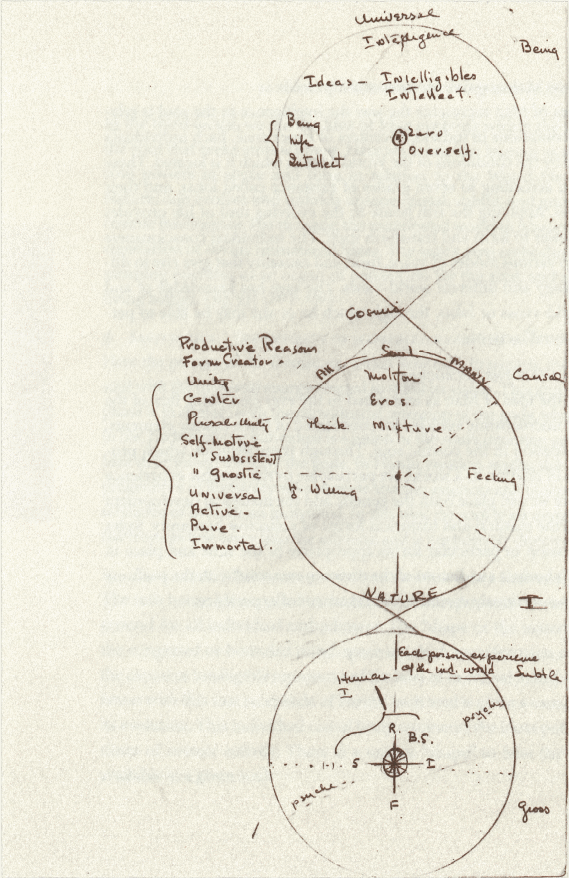
DIAGRAM appended to this transcript:
- FIGURE AD_G_012. Three Circles Diagram: Divine Intellect, Soul, Psyche.
Other diagrams referred to are not with this transcript version. [Transcriber note: [diagram] means the speaker is referencing a diagram as he or she is speaking. If someone is drawing or writing, with audible sounds of chalk on a blackboard, I indicate this by [drawing] or [writing].]
NOTE: For readability's sake, the following substitutions/edits made in Verbatim Transcript: yeah = yes.
TRANSCRIBED Verbatim by IT prior to 2017, reformatted by jf 2017. In 2023, IT uses new more complete Audio File 1973 0216b to finish transcribing second half of class, updates prefatory matter, footer, and audio file name, alters Subject and Subsubjects to make more accurate, completes Booklist, fixes errors/typos, adds new notes within transcript, adds one diagram and references within transcript to this diagram, reformats to accord with new conventions. Archival verbatim transcript – V12a.
AUDIO FILES: 1973 0216a, 1973 0216b. [Note: We only have two audio files for this class. We are missing the rest.]
1973 02/16 at Wisdom's Goldenrod
Jung; Alchemy
[Audio File 1973 0216a Begins]
AD: --the lapis, what the goal of the work is and why it has been undertaken. [S, very faint: Louder.] But it hasn't become alive yet.
PD: Is someone speaking?
S: Yes. (laughter)
[few seconds of laughter, background student talking]
AD: Never said a word. [9 second pause, background student talking] The only thing that buoys me up, you know, and helps me on is that I know that all conceptualization is, you know, really quite illusory. And remember when we defined the reality as containing the potentiality and the possibility to negate itself? That's always encouraging.
[few seconds of background student talking, bit of laughter]
C.G. Jung [CW 16, The Practice of Psychotherapy, "The Psychology of the Transference," p. 258, paragraph 468, AD reading]: "The legend says that the pair who together represent body and spirit are dead, [AD: here, that is, the royal pair, king and queen] and that the soul (evidently only one soul) parts from them"in great distress.""
S: What page you on, Tony?
AD: 258 in this-- in this book. [11¾ second pause] Alright, in-- in 4-- 469, next paragraph, he says--
C.G. Jung [CW 16, The Practice of Psychotherapy, "The Psychology of the Transference," p. 260, paragraph 469, AD reading/paraphrasing]: "As we have seen, there is in the coniunctio [AD reads: conjunction] a union the of the day-light principle, consciousness, and the night-- night-time unconsciousness."
AD: Or the male and the female principle. He says--
C.G. Jung [CW 16, The Practice of Psychotherapy, "The Psychology of the Transference," pp. 260-262, paragraph 469, AD reading]: "An archetype always stands for some typical event. As we have seen, there is in the coniunctio [AD reads: conjunction] a union of two figures, one representing the daytime principle, [i.e.], lucid consciousness, the other a nocturnal light, the unconscious. [AD adds: And] Because the latter cannot be seen directly, it is always projected; for, unlike the shadow, it does not belong to the ego but is collective. [AD adds: And] For this reason it is felt to be something alien to us, and we suspect it of belonging to the particular person with whom we have emotional ties. In addition a man's unconscious has a feminine character; it hides in the feminine side of him which he naturally does not see in himself but in the woman who fascinates him. That is probably why the soul (anima) is feminine. If, therefore, man and woman are merged in some kind of unconscious identity, he will take over the traits of her animus and she the traits of his anima. [Although] neither anima nor [AD reads: or] animus can be constellated without the intervention of the [conscious] personality [AD adds: to whom each corresponds], this does not mean [AD reads: but this is not to say] that the resultant situation is nothing but a personal relationship and a personal entanglement. The personal side of it is a fact, but not the main fact. The main fact is the subjective experience of the situation--in other words, it is a mistake to believe that [AD reads rest of sentence slower and with more emphasis] one's personal dealings with one's partner play the most important part. Quite the reverse: the most important part falls to the man's dealings with the anima and the woman's dealings [AD reads: dealing] with the animus. Nor does the coniunctio [AD reads: conjunction] take place with the personal partner; it is a royal game played out between the active, masculine side of the woman (the animus) and the passive, feminine side of the man (the anima). Although the two figures are always tempting the ego to identify itself with them, a real understanding even on the personal level is possible only if the identification is refused. Non-identification demands considerable moral effort. Moreover it is only legitimate when not used as a pretext for avoiding [AD reads: to avoid] the necessary degree of personal understanding. On the other hand, if we approach this [AD reads: the] task with [AD adds: too] psychological views that are too personalistic, we fail to do justice to the fact that we are dealing with an archetype which is anything but personal. It is, on the contrary, an a priori [AD reads: a postulate] so universal in scope and incidence that it often seems advisable to speak less of my anima or my animus and more of the anima and the animus. As archetypes, these figures are semi-collective and impersonal quantities, so that when we identify ourselves with them and fondly imagine that we are then most truly ourselves, we are in fact most estranged from ourselves and most like the average type of Homo sapiens. The personal protagonists in the royal game should constantly [AD reads: steadfastly] bear in mind that at bottom it represents the"trans-subjective" [AD rereads: "…it represents the"trans-subjective"] union of archetypal figures, and it should never be forgotten that it is a symbolical relationship whose goal is complete individuation. … [10¾ second pause] …it is in either case [AD: he says] an opus contra naturam. It goes against nature to commit incest, and it goes against nature not to yield to an ardent desire. And yet it is nature that prompts such an attitude in us, because of the kinship libido. … Man's instincts are not all harmoniously arranged, [AD: Far from it.] they are perpetually jostling each other out of the way. [AD adds: And] The ancients were optimistic enough to see this struggle not as a chaotic muddle but as [AD adds: an] aspiring to some higher order."
AD: Suppose we discuss this, 469. [19 second pause] I would like to also just read the bottom note on eight, which is the-- eighth note, which is-- Of course in a sense there's a disagreement here with Ernest Neumann, those of you who studied Neumann, and I-- I'll-- I'll stick to Jung's way. I think Neumann didn't go through some of these things except in Jung's books.
C.G. Jung [CW 16, The Practice of Psychotherapy, "The Psychology of the Transference," pp. 258, 260, footnote 8, AD reading]: "8 The nigredo appears here not as the initial state but as the product of a prior process. The time-sequence of phases in the opus is very uncertain. [AD adds: And] We see the same uncertainty in the individuation process, [AD: And those of you who study astrology should see this.] so that a typical sequence of stages can only be constructed in very general terms. The deeper reason for this"disorder" is probably the "timeless" quality of the unconscious, where conscious succession becomes simultaneity, a phenomenon I have called "synchronicity." [Cf. Jung, "Synchronicity: An Acausal Connecting Principle."] From another point of view we would be justified in speaking of the "elasticity of unconscious time" on the analogy of the equally real "elasticity of space.""
AD: Alright, let's discuss this paragraph, this is pretty important (or/well) I think so.
[13¾ second pause, AD drawing]
LS: I was struck by the death at the beginning.
[short pause]
AD: Go on.
LS: And the question that came to my mind is, what does this really mean if it's going on in one person, where we don't have the anima of-- of the man and the animus woman to deal with but two-- two figures in the man or two-- two principles in-- in the one person?
[short pause]
AD: Repeat please?
LS: This question kind of refers to-- all the way back to num-- to number two, of course, but what does this situation mean when the king and queen don't represent the anima of the man and the animus of the woman but rather two principles in the one cosmos, in the one cosmic self?
AD: And you-- you want analogously to transfer it like for instance to Purusha and Prakriti? Like Purusha would represent the king, the archetypal role of the king, Purusha the feminine role, the mother, or the queen?
LS: Is that what you think they would do-- be [AD simultaneously: Well--] or is that just speculating?
AD: Well, speculation.
[short pause]
LS: Well--
AD: Let's see if we can get a clue, if we-- (your question--)
LS (simultaneously): If all-- if all you'd want to do is speculate then let's stick to the psychology then, it's more interesting. (LS laughs a bit)
AD: Well maybe if-- if we understand psychology we'll [LS simultaneously: Alright, cool.] understand the speculation. [short pause] He says--
C.G. Jung [CW 16, The Practice of Psychotherapy, "The Psychology of the Transference," p. 261, paragraph 469, AD reading]: "…the most important part falls to the man's dealings [AD reads: dealing] with the anima and the woman's dealings with the animus."
AD: And it seems like he pushes down the personal relationship that each man and each woman have with each other. What might that mean, any-- any ideas?
LS (simultaneously): Yes, very often conversations bet-- between two people in a couple that-- they don't really say anything that hasn't [AD simultaneously: (True.)] been said billions of times before but there's some background emotion that sometimes might be different. Say if I could just this one time distinguish between Jenny and that archetype just a little bit more than I ever did before, then it didn't matter if it took us an hour of meaningless stuff. And that's all forgotten. What's gained is that little bit more separation.
AD: You're saying something like, you're learning to distinguish between your subjective-- your subjectivity, your feeling, and the person that it's projected on?
LS: Yes, well for example, alright, that--
AD (simultaneously): For example, uh-hm. And would you, therefore, if you go on with that, Jung will be saying that the most important thing is that relationship between you and your subjectivity or your feelings, and that is of-- that's of paramount-- that's the paramount point, and that the-- the relationship with Jenny will be secondary.
VM: On the other hand, until a man really has come to some terms with his own unconscious or anima, then a really kind of wholesome relationship to the wife is extremely difficult if not im-- impossible anyway.
AD: Well he says previous to that--
C.G. Jung [CW 16, The Practice of Psychotherapy, "The Psychology of the Transference," pp. 260-261, paragraph 469, AD reading]: "If, therefore, man and woman are merged in some kind of unconscious identity, he will take over the traits of her animus and she the traits of his anima."
VM: What a mess, huh? (laughter)
AD: Any idea what that might mean? (bit of laughter) He goes on--
C.G. Jung [CW 16, The Practice of Psychotherapy, "The Psychology of the Transference," p. 261, paragraph 469, AD reading]: "[Although] neither anima nor animus can be constellated without the intervention of the [conscious] personality [AD adds: to whom each corresponds], this does not mean [AD reads: but this is not to say] that the resultant situation is nothing but a personal relationship and a personal entanglement."
[student assents, very faint]
AD: So on the one hand he's saying this person is involved, or let's say she constellates or precipitates a projection, and on the other hand, what's important is not the person as person, although this kind of makes us feel a little deprived and underprivileged. (AD laughs a bit, bit of laughter)
VM: It's more important to have a good relationship to your unconscious rather than worry a great deal about your projection is what he's saying, although one involves the other really.
AD: Yes. You-- you see that point that he's making here?
VM: In fact he makes the point in there, I guess back there, you can't go around saying, "Well, I don't care about my wife so much as the feeling I have towards her," and then you kind of neglect that whole thing under the guise of saying "Well I'm really (sort of) relating to my anima inside and this and that." In other words, he's-- he cautions in there using it as an excuse to neglect your-- [AD: Yes.] your kind of moral obligation.
AD (simultaneously): Yes, he's-- he's pretty level-headed, you know, about these relationships. But, you do notice that he points this out, that the relationship that you have with your own unconscious, brought or precipitated by a projection onto a woman, and now what becomes of extreme is-- importance is how you relate to those contents within you. [S: Yes.] This becomes the number one problem.
VM: So in the case of say, Tony, in something like a bunch of monks, like Christian monks living in a community where there's no women, now you say, "Well how do they constellate the anima?" But they have the Virgin Mary, and that perhaps is one of the reasons why they placed her in such a high sort of--
AD: Well, that's why it's [VM simultaneously: (heart/part)--] turned into a dogma.
VM: Sure. So they need this whole thing to constellate their anima and then objectify it and thereby relate to it.
AD: Yes, but look at the anima they're projecting.
VM: Well yes, well I mean these guys are not--
AD: Remember the-- previously [VM simultaneously: --beginners.] he said there's the Eve and then there's Helen of Troy [VM simultaneously: Then there's Virgin.] and then there's the Virgin Mary. And then above that you start all over again. (AD laughs)
S: Tony?
S: Hundred percent.
AD: Yes?
LS (in background): You're going to have to go through the "tell them a story" phase [student assents] [three/few words inaudible] (LS laughing)
[students assent, faint]
AP: The first [LS/S(?) simultaneously: I'm going to (leave).] picture where-- where they have a left-handed contact or they hold by left hands, [AD simultaneously: Uh-hm.] does that mean that-- that the thought, that unconscious union between the woman's animus and a man's anima, that-- and then when it becomes the right hand more are the concepts of it within one personality. Is that so?
AD: Yes, in the beginning the mode of incense-- incest was being pointed out and how we're beginning to see what that is all about.
AP: So could you say in the beginning it-- the queen would represent the man's anima and the king the woman's animus, but then towards, you know, the-- in the end--
AD: No, the king [AP simultaneously: (No?)] does not represent the animus. The ani-- [AP simultaneously: But this-- would you refer to this--] now we're out of that situation, we're out of that situation.
AP: Uh-hm.
[short pause]
AD: What about the next sentence--
C.G. Jung [CW 16, The Practice of Psychotherapy, "The Psychology of the Transference," p. 261, paragraph 469, AD reading]: "[Although] neither anima nor animus can be…"
AD: No, I'm sorry.
C.G. Jung [CW 16, The Practice of Psychotherapy, "The Psychology of the Transference," p. 261, paragraph 469, AD reading]: "Quite the reverse: the most important part falls to the man's dealings with the anima and the woman's dealings with the animus. Nor does the coniunctio [AD reads: conjunction] take place with the personal partner… Although the two figures are always tempting the ego to identify itself with them, [AD: Depending on whether you're male or female.] a real understanding even on the personal level is possible only if the identification is refused. Non-identification demands considerable moral effort."
AD: How about that? In other words, if you identify with the anima when you're having a discussion with your wife, it's all over, right? I mean, males, I'm talking to the males.
S (faint): Pick on me.
AD: I wasn't, I was looking at him. So he says here that it requires quite an effort to resist that identification. (bit of laughter, AD laughs) What are you laughing at Vic? (bit more laughter) [S, faint: (Yes Vic.)] How about the next part?
C.G. Jung [CW 16, The Practice of Psychotherapy, "The Psychology of the Transference," p. 261, paragraph 469, AD reading]: "…we are dealing with an archetype which is anything but personal."
S (faint): No, no, no we don't.
AD: He doesn't say my anima, he says the anima.
[12 second pause]
LR: Before you can do that though you have to recogni-- you have to be able to recognize when the anima-- when you're-- before you can separate or discriminate when you're being possessed by the anima or animus, you have to be able to recognize when it's creeping in there.
AD: Yes but Rick-- I think it was Vic who said we have to have the experiences enough times and then we begin to realize we're getting possessed and you have to [student assents] resist that identification. So soon as you see it operating, the animus comes in and you start telling your husband what your father did, alright, (bit of laughter) and the way things are done in general, you say, "Now wait a minute, wait a minute, where'd this come from, where did this idea come from?" Or, "My mother did better cooking than you can."
VM: Oh, that's my role. (VM laughing, laughter)
AD: And then if you notice, then there's a discussion between the anima and the animus and not between the two people anymore, the two individuals. [short pause] Alright, a little further on, he goes on.
C.G. Jung [CW 16, The Practice of Psychotherapy, "The Psychology of the Transference," p. 261, paragraph 469, AD reading]: "…it represents…"
C.G. Jung [CW 16, The Practice of Psychotherapy, "The Psychology of the Transference," p. 261, paragraph 469, AD reading]: "The personal protagonists in the royal game should constantly [AD reads: steadfastly] bear in mind that at bottom it represents the"trans-subjective" union of archetypal figures, and it should never be forgotten that it is a symbolical relationship whose goal is complete individuation."
[student assents, very faint]
SD: From that-- from that it seems like he's saying the opposite of what he said before about becoming (possessive) by the anima. It seems from there that the process is becoming separated from it, that we already are possessed.
LS: It's both, one then the other.
SD: Yes. But the process is-- is that of individuation, we're trying to get out of that state of possession. And we occasionally get those glimpses.
AD: Start again Steve.
SD: From that last sentence you just read, sounds like the process is one of detaching ourselves from a state of possession rather than become-- rather than being weary of becoming possessed. It's like we already are. The process is one of seeing that we are and detaching ourselves from that, individuating our-- ourselves from the collec-- from that collectivity.
AD: Well you're not always in a state of possession by the anima, I'm quite sure. It comes over you at certain times and then releases you and you see this process going on, and Vic suggested that you have enough arguments with your wi-- your wife so that you begin to see this process. Without the experience you won't be able to recognize it. And then the-- the next step would be to recognize the need not to identify with the anima. Go on.
SD (faint): Yes it's almost a-- we go from the point of like first, in order to be able to really detach yourself from it, it first has to get projected and you can be possessed by it [one/two words inaudible, possibly another student] or else it's like in the unconscious. It's like if you're projecting it, you're possessed by it. It's not your-- it's an unconscious content that you're identified with.
AD: If you're not projected-- if you-- if you haven't projected it, then how could it be operative?
[short pause]
S (very faint): I don't know.
SD: Aren't you project-- when you project it though, aren't you possessed by the animus of the woman?
[student assents, very faint]
AD: Not necessarily.
SD: I mean it can manifest in different ways, it doesn't--
AD: Yes, it manifests in many ways but the point that we have to get clear here is that if there isn't a projection of the anima, you may not even know that you had one. And it's very possible you may not have one yet. You know, like we tried to point out, in primitive societies there's hardly an anima functioning yet. They buy their wives with so many-- so many head of sheep or cow.
S: Cow.
AD: Cow(s). (bit of laughter)
[student assents, very faint]
S: Cow(s).
S: Snowmobile.
S: Snowmobile?
AD: Alright? (laughter, student words) Until that's projected outwardly, you don't know that you have one but assuming that now it's projected, and he points out the need-- a set up-- the need to have a woman or the opposite sex so that this can be projected, alright. Then there has to be a removal of the projection from the person whom it's being projected on or a refusal to identify with the anima so that you get caught up into this web of relationships.
[short pause]
SD: Is my confusion out of-- [AD simultaneously: Well, let's not talk about yours.] there's a distinction between the anima and the collective unconscious?
AD: I'm sorry?
SD: Is my confusion a result of a lack of distinction between the anima and the collective unconscious?
AD: Well I-- I didn't-- I didn't see it that way.
VM (faint, almost to himself): First tell me about the senses you have.
AD: I don't see that you've gotten confused, Stevie. I just don't understand why you feel that there's a contradiction here. [short pause] The next chapter, of course, will-- the next paragraph makes it clear that unless the anima is projected this process will not go on. In 470 he says--
C.G. Jung [CW 16, The Practice of Psychotherapy, "The Psychology of the Transference," p. 262, paragraph 470, AD reading]: "[Thus] the encounter with the anima and [AD adds: the] animus [AD: So they have to be projected.] means conflict and brings [us] up against the hard dilemma in which nature herself has placed us. Whichever course one takes, nature will be mortified and must suffer, even to the death; for the merely natural man must die in part during his own lifetime. [AD: This--] The Christian symbol of the crucifix is therefore a prototype and [AD reads: of] an"eternal" truth. There are medieval pictures showing how Christ is nailed to the Cross by his own virtues. Other people meet the same fate at the hands of their vices. Nobody who finds himself on the road to wholeness can escape that [AD reads: the] characteristic suspension which is the meaning of [AD adds: the] crucifixion. For he will infallibly run into things that thwart and "cross" him: first, the thing he has no wish to be [AD adds: that is] (the shadow); [students assent, faint] second, the thing he is not (the "other," the individual reality of the "You"); and third, his psychic non-ego (the collective unconscious). This being at cross purposes with ourselves is suggested by the crossed branches held by the king and queen, who are themselves man's cross [AD reads: crosses] in the form of the anima and [AD adds: the] woman's cross in the form of the animus. The meeting with the collective unconscious is a fatality of which the natural man has no inkling until it overtakes him. As Faust says: "You are conscious only of the single urge/ O may you never know the other!""
[students assents, faint]
AD: Either way, (AD laughs a bit) there's no backing out.
C.G. Jung [CW 16, The Practice of Psychotherapy, "The Psychology of the Transference," p. 262, paragraph 471, AD reading]: "This process underlies the whole opus [AD reads: work], but to begin with it is so confusing that the alchemist tries to depict the conflict, death, and rebirth figuratively, on a higher plane…"
LR: Tony, what's the "You," what is this-- "the individual reality of the"You""? And the"other", he says the second is the "other."
AD: You remember when he speaks about the necessity to have established relationships with others, [LR: Yes.] otherwise there is no possibility of synthesizing your personality. So the first thing you have to contend with and the first conjunction that takes place is with the anima. And as though that isn't enough, you know, then there's the fact that there are other people around that you have to relate to and [LR: Oh.] that's the second, see.
S: Are they [couple/three inaudible student words simultaneous with S] nece-- are they in that order?
AD: They're generally in that order, generally. But, like he says, don't write them down, one, two, three, four, it doesn't have to happen that way.
[short pause]
S: It would have to happen more or less that way, though, wouldn't it?
AD: The shadow would have to be first but the other--
S (simultaneously): (Otherwise) there wouldn't-- there wouldn't be any possibility of [few words inaudible]
AD (simultaneously): No, the shadow has to be first, the others do not have to follow that order. They don't have to follow that order.
S (possibly part of background): [couple words inaudible]
S: I'm a little bit confused when he talks about the trans-- trans-subjectivity of-- I got the feeling somehow that, you know, it's related to when-- it's related to the autonomy of the-- of the anima or the animus but I don't know if that's-- if that was the point Richard made. I just got that feeling like it's-- the trans-subjectivity is somehow-- it seems to me like he was establishing the trans-subjectivity based on [couple words inaudible] It does seem like another (approach).
AD: Start again Dave, I-- [S: I--] I got confused.
S: Ok. I'm not-- I'm not exactly sure what he means by trans-subjectivity, I guess that's my real question. I have-- [student assents] I have a corollary to the question itself. When I-- when I-- when I got that question in my head, it seemed to me like one possible answer would be that, you know, that the fact that it's-- from the individual point of view it seems-- [AD aside: Thank you.] it can seem like it's trans-subjective in a sense because it-- because it seems to be autonomous, you know, it doesn't-- it's-- it's like a discovery of something that's-- you know, like where is it coming from. And I [one word inaudible]
VM (simultaneously): But, any personal content can be autonomous, can't it? Any personal complex? What I'm trying to say is I don't think you can say something is trans-subjective because it's autonomous, because I have a lot of complexes that act in me as though they're autonomous but they're not universal or they're not the same as yours.
S: Ok, well I guess what I'm asking then on the basis of that is that-- but wanting to go one step further now, what are the--
VM: What is trans-subjective?
S (simultaneously): Yes, like how-- what--
VM (simultaneously): I think you mean like the archetypes, they're really located in the collective unconscious and they belong to an objective reality that's outside of our subjectivity, or that let's say includes our subjectivity.
S: Ok, then wouldn't thinking say then there could be like the total autonomy of some-- of-- of one of these things in some sense?
S: No.
S: I'm--
AD: What do you mean, "total autonomy"?
VM (simultaneously): I'm-- I'm not sure I know what you mean (David).
S: Just-- just say-- just say something that you experience(d) it seems so fluid (you know), you know, just any of us. You know, like maybe a-- maybe a personal complex you would experience different parts of it and you-- you'd know, you know, you'd say well "That's you again," you know, "and I-- and I know you," alright, and it-- it would seem to have a life of its own. I mean he-- it seems like a personal complex in some way you would have-- you would have the means of-- you know, you-- it would-- it would flash back maybe to emotion you experienced in childhood and you could say, "Oh, so that's where," you know, "that's maybe where part of this is coming from." But if something like the anima, like it seems like it would just-- it'd be something you'd have no direct correlation to your-- if you're, you know, if you're having a certain amount of self-awareness, there'd be no correlation of, you know, like there's no time in your past that you could really hang it on the subject. It really seems like a (stranger then/strengthening).
VM (faint): Well--
S: You're saying that we would always remember consciously [one word inaudible] the-- the origin of-- of a complex.
[student assents, faint]
S: Yes, that at least leaves some kind of feeling. Maybe I-- it seems to me like a personal complex you'd be-- you'd have some kind of-- some kind of awareness of it through-- and maybe-- maybe through a very weak feeling at first but when it really came up you-- you'd be able to, you know, (catch spasms) and say, "Oh, you know, well, that's-- I can see-- I can see where that's coming from because that's something that I did and handled before," maybe it's something rather personal.
AD: Yes, I--
S: Ok?
AD: Like for instance suppose you get-- you have a twitch in your eye, alright, there's nothing you can do about it, it's autonomous, it comes up and you start twitching.
S: Right.
AD: Alright. This is a personal autonomous complex. But I don't follow your question, what is it?
S: My ques-- my question is-- my real question is like what-- what is the basis-- basis of his-- I want to get a feeling for what he means by trans-subjective.
AD: Trans-subjective? [S simultaneously, very faint: Yes, right.] I see.
LS: I told you.
S: [couple words inaudible]
AD: Well, how about subjective? Do you have a feeling or clue as to what subjectivity means?
S (very faint): No.
AD: Like this feeling that you are you, ok, and you get into it sometimes and you enjoying it, alright. [students assent] And a-- a pretty girl comes along and all of a sudden you are not you. Something happened to this "you" that you call "you". And like this archetype just inundates you, these feelings just flood you. [student assents] And then you find that you're compelled to behave ways that you never thought were conceivable or possible. (laughter, student words) That's trans-subjective, isn't it Dave, that's beyond your subjectivity. And now this archetypal figure, so to speak, has to relate to another archetypal figure and there has to be a conjunction between these two and this process is trans-subjective. It's not something that's happening in your subjectivity. If this might give you a clue. [drawing]
VM: That certainly includes [S simultaneously: Oh (ok).] your subjectivity though Tony, I mean-- You couldn't operate otherwise.
LR: Well--
S: I mean is it-- that's a-- that's a point (I don't--)
AD (simultaneously): It includes your subjectivity, [student assents] it [VM simultaneously: Alright.] includes, but notice in what way it includes it. It seems that you-- after the process it-- there's more of your subjectivity available.
VM: I see.
AD: Well-- well then how did it include the subjectivity?
VM: By sometimes drawing it out.
[short pause]
AD: Drawing what out?
VM: Drawing my subjectivity out. I mean I would relate to a woman differently than you would.
AD: Yes.
VM: Therefore my subjectivity is revealed in this experience.
AH: Also, and now that you mention it, to the (subjective) as well.
AD: How Vic-- Andy?
AH: Well, what you were saying earlier to Lenny about the recognition, that the glimmer of recognition of those feelings are-- [VM assents] the object of feelings is really your subjectivity.
AD: Well there's someone who feels these feelings, alright. Let's say they are objects or given to a certain subject. Like you say "I feel for you," alright, so this feeling and the subject are not the same really.
AH: That I guess is what I mean by "new dimension".
AD: Well how does it add a new dimension?
AH: It amplifies the whole idea of subjectivity.
AD: That's-- that's kind of mysterious, isn't it? [short pause] Well come on, some of you married people, speak up.
S: We're afraid.
AD: You're afraid?
[students assent, faint]
S: This feeling is what you're calling the archetype and it [student assents] has to do with (personal/impersonal) [one/two words inaudible] (bit of laughter)
LS: Yes.
AD: The anima itself, alright-- Oh, you see, he's speaking up. (bit of laughter) [students assents] After the dogma of the bride, you know, is over, alright, there's a kind of self-awareness that comes back into operation, you know, you stop saying "Hey look, we've got bills to pay." You know the honeymoon's over, ok? (some laughter) What happens then?
S: That's a good example.
LS: Is that what this picture of death means, the honeymoon's over? (laughter, student words)
HE (amidst laughter): Oh Lenny, it's not that bad. (more laughter)
RP: I want my cameras back. (laughter, AD laughs)
S (amidst laughter): You've got pretty good timing.
LR: What was David's question?
S: What was it?
LR: What was David's question?
AD: No, what we're try-- what we're trying to get-- Dave wants to understand what this trans-subjectivity means. And we're trying to trace back-- trying-- we're trying to trace it back and-- and show that the-- the conjunction that takes place is between archetypal images in the-- in the unconscious, alright. But, if he doesn't understand that this is trans-subjective, and Vic says it can't be beyond the subjective, and he says well--
VM: No, no, no, I say it had to include the subjective.
AD: Include--
VM (simultaneously): Otherwise it just can't operate, I don't see how it can operate.
AD: But how does it include the subjective?
BS: Can you say that the sub-- subjectivity is an availability to the trans-subjective content?
AD (simultaneously): The-- the what?
BS: Subjectivity is the availability to receive what's trans- subjective or, (you know--) So in that sense it's included in it.
AD: I'm sorry, try again.
BS: Well-- Normal subjectivity, not the trans-subjective, that subjectivity might be an availability to receive more of the archetype but at the same time it is essentially the very archetypes themselves that (would be) received.
LR (faint): What?
S: (faint): Uh-hm.
BS/S(?): In that sense one would see [one/two words inaudible]
AD: I can follow what you say when you say that it's an availability to receive these archetypes, alright. Subjectivity does include this potentiality for the archetypes to operate through it. But I don't follow the second part.
BS: [one/two words inaudible] right there. [AD drawing] Seems that the very subjectivity itself would have its basis in the collective unconscious or the archetypes themselves. That availability would [one word inaudible]
AD: You bring up a-- you're bringing up a problem that not even Jung wanted to answer and avoids answering.
[student assents]
[AD drawing]
S: Well what we're talking about--
BS (simultaneously, faint): It's like the Overself and the World-Mind.
AD: No, no, let's leave that out, (laughter) let's leave that out, let's leave that out. (AD laughs a bit)
BS: I'm going to leave that out. (bit of laughter)
RC: [one/two words inaudible] it seems like-- like Bert's talking about is the causal and cognitive aspects--
AD: No, no, he's made a-- he's made a statement that's quite accurate, psychologically your subjectivity includes the potentiality to be able to receive archetypal images flowing into you. Ok, that-- yes.
RC (simultaneously): But wouldn't you call the subjectivity the cognitive aspect of the a-- of the archetype and the-- the trans-subjective the causal aspect?
S (very faint): [few words inaudible]
S: Who knows?
AD: No, you won't-- I don't know what you mean.
RG (simultaneously): That takes away intelligibility from the archetype itself. It's the intelligence of the archetype itself, Randy.
S (simultaneously): It's so amazing that no one's making any sense.
VM: Yes, it must be. (bit of laughter)
RC (very faint): Like, it just-- it seems like well--
AD (simultaneously): Oh they're-- they're-- they're picking up. Go ahead Richard, go ahead, go ahead.
RP: Uh, if you're involved in an archetypal relationship, so it's ritualistic, it's structured, and so, in such a thing, you don't have to do much. It's mechanical, it's the psychic energy runs through, takes care of themselves, you-- you're working through a mille-- a millennial old situation. In such a case the psychic energy is briefly turned to itself, it turns back on itself, and that's why in such relations you feel intensely. A bride on her-- on her wedding day, because there's no choice on her to make, you know, is able to a certain depth feels joyful, because the energy involved in living is completely profound. There's no choices have to be made, no decisions. She just has to walk through this path.
AD: Well I can't disa--
RP (simultaneously): [couple words inaudible] to the infantile state of an auto-erotic thing where the-- where the libido is completely on the subject.
[students assent, faint] (bit of laughter)
S (faint): [one/two words inaudible]
AD: Well maybe someone else.
VM: Richard, that [AD simultaneously: That subjectivity is real.] could be true of dying too and that doesn't-- [RP assents] that's not [few inaudible student words simultaneous with VM] always a joyful occasion, maybe for some [RP simultaneously: How do you know?] people, [S: How do you know?] maybe for some people.
S: (Well, if) you all want to voice (it).
RP: But there-- but there [VM simultaneously: Yes, please go ahead.] it's a case of not accepting the archetypal role. If you probably did--
VM: Well then there would be joy, ok.
RP: There's another duality. The body dying, there's not much I have to do about it, I'm free.
VM: Exactly. (laughter) Watch this movie unfold.
S: Yes.
AD: Go ahead Vic, Andrew.
AH: When we talk-- when we talk about something trans-subjective, it seems that de-- that depends pretty much on the point of view like-- let's say the concept of-- of the subject is a very fluid one.
AD (faint): Yes.
AH: Alright? The subject is-- it can get bigger and bigger, assimilate more and more-- more and more qualities, more and more factors.
AD: Uh-hm.
AH: Or like, it's a point of view that we-- that we're looking at, the idea of subject growing.
S: Uh-hm.
AD: That's why I've been asking, what do we mean by subjective.
S (very faint): Yes.
AH: In fact, that whole idea of subject can get [one/two words inaudible]
AD (simultaneously): Yes. This is always what I harp on about, as far as Jung, is my criticisms of Jung are always been consistently that he doesn't know what the subject is. And never-- he never explains it to us.
AH: As long as we're talking about something receiving archetypes, it's still a subject.
SD: He keeps moving it back, doesn't he, I mean in that [few words inaudible]
AD (simultaneously): Well, the only possible meaning here that you can give this term is when he says trans-subjective, his subjectivity is caught up in these four psychological functions [FIGURE AD_G_012, cross in little circle in bottom circle].
LR: The psychic, just the psychic functions.
AD: Just the psychological functions. Subjectivity for him doesn't go beyond that. Ok? So if there is a relationship and a conjunction between archetypal figures, alright, it would have to be outside of the subject or beyond the subject, trans-subjective. But, from the other point of view, you're right. It's included in subjectivity if we stick to our definition of what we mean by subjectivity and not what he means by it.
VM: Uh-hm, uh-hm.
S (faint): That would have [one word inaudible]
AD (simultaneously): But then, what happens?
S: All of a sudden the subject--
AD: Because I think Andrew already hinted, if you go through an experience like that, then the-- the notion of the subjective is expanded. It's forced, it's got to get bigger.
S: But the subject allows for the possibility of that archetype coming through it and that's just a [one word inaudible] of it. But it's at the same level as-- as that archetype.
AD (simultaneously): That's very simple. Do you feel the same way after an experience and before an experience? I mean, we don't have to use forbidden terminology. Just an ordinary big experience, and you can see that you're altered from then on. Your subjectivity now, by assimilating that experience, has expanded its frontiers, its boundaries, its limits.
SD: I don't understand what you meant by the relationship taking place beyond those four-- the four psychological factors, that representing your subjectivity. It would seem like that's where the relationship takes place.
AD: The--
SD: Like it's you or when you become aware of that from-- from the, so to speak--
AD: Let me see if I understand you, you're saying that the-- the conjunction of these archetypal figures takes place within the functioning of the-- the-- within the four functions.
SD: Yes, [AD possibly assents] (fantasy). That then becomes subjected-- when you-- like when the archetype starts receding, so to speak, then that state of consciousness that you're operating with, that subjectivity becomes objective and you're operating from a trans-subjective point of view, something beyond you-- the subjectivity you were operating with.
S (very faint): I don't understand you.
S (very faint): Me neither.
[student assents]
VM: I don't agree.
SD: In that sense also his-- Jung's subject will keep on repeating as it experiences a new archetype or any-- any big experience, and as it separates from that, that subjectivity would be perceived.
AD: Well then that's-- that could be an infinite process, it can go on forever or indefinitely.
SD: Pretty much does with Jung, doesn't it?
[short pause]
[student assents]
AD: Well, yes, basically the Jungian way is the dark and unknown way and for each person the unfoldment of archetypal situations cannot be pre-- predicted beforehand. But--
SD: Also the archetypes can't be exhausted, according to Jung [one word inaudible]
[11½ second pause]
AD: Alright, if this archetypal, let's say, conjunction takes place within the subject, you got any idea how? I mean like he's describing the process now, from what point of view was he describing that process? From the point of view of the thinking function? From the point of view of the feeling function? From the intuitive?
S (very faint): Yes, it could be another function.
S: Whatever it is, I don't know.
S (very faint, possibly part of background): [few words inaudible]
VM: It seems to me that he must be taking this--
AD: It's an important point.
VM: He must be taking this position that we call the light of the-- it-- the human intellect I guess we've called it before, where-- oh dear-- [simultaneously, in background: AD: I shut off just in time. S: Ok] where he says that-- For example, if you say that something is coming from the-- the function of thinking, you can't really say that from that point of view of the thinking function unless you have some point of view outside of it. So it seems to me that he has to at least posit this possibility of evaluating psychological experience from a point outside those psychological functions. And you spoke before, I guess we were doing this Greek terminology, of the human intellect illuminating the four psychological functions.
AD: That would be my answer. You follow what he said Steve?
SD: Yes.
[Note: See FIGURE AD_G_012 for the following.]
AD: You remember when we put the four functions here [cross in little circle in bottom circle] and then we put it inside a bigger circle called the cosmos [bottom circle] and then the four functions were lit up by the human intellect ["Human I" in bottom circle] which is part of a wider intellect, the cosmic intellect [middle circle], and-- I think one of the things we were trying to point out was that thinking itself is not a knowing because thinking is as much the object of the known as feeling, alright. Now of course this is where we disagree with Jung, at least I disagree with Jung, ok. Because otherwise that process becomes infinite, liberation becomes nonsense and meaningless, because this can go on forever.
VM: Uh-hm.
AD: Let's see if--
SD: I still don't see how that [VM simultaneously: Maybe I should it make (up/it) (couple words inaudible)] would take away the archetypal identification being with the subject.
AD: I'm sorry?
SD: Or that-- maybe that wasn't the point you were making. But it-- it still doesn't seem to-- to say anything against the experiencing-- the experience of the archetype being with the subject.
AD: I don't follow your point.
AH: When he--
SD/S(?) (simultaneously): (Right.)
[Audio File 1973 0216a Ends]
[Audio File 1973 0216b Begins]
VM: And you postulated before that this conjunction must take place outside the psyche, if I understand what you said.
SD/S(?): If that was so, how does that [VM simultaneously: Ok.] person affect (all) the subject?
[short pause]
AH: The dream takes places within the psyche, doesn't it. It's the actual conjunction [student assents, faint] [one word inaudible] (working).
VM: I agree, that-- that's Stevie's point. I'm just trying to explain his point, well go ahead.
AH: Well what happens within the psyche is what we talk about, the results of the conjunction but, I think (where I'm simply don't agree).
VM: Let's say the conjunction takes place in the psychoid realm but we experience it in the psychic realm?
AH (faint): Something like that.
VM: Is that--
AD: Let's look at it-- let's take a particular example. If there's let's say a conjunction between the ego and the shadow, Stevie, ok? Where does that take place or what functions?
SD: Well I used all that, I would assume you meant all the forces.
AD: [drawing] If we look at this way, this represents the ego here, the daylight consciousness, and this represents the shadow over here [diagram], ok? And we speak about a conjunction of these two. Alright? Now according to him, the-- the shadow would be identified with the inferior function. Alright? Where does the conjunction take place and what conjunction would we-- would we be talking about? To include the inferior function or to include the shadow into the ego-consciousness brings about what he says an enlargement of consciousness.
VM: Uh-hm.
AD (faint): Alright.
VM (faint): Uh-hm.
SD: That's-- that's the trans-subjective realm we speak about?
AD: Well, that's the whole point that we're trying to get at, what is this trans-subjective that he's talking about? Could it be included in the ego? Certainly not in the ego-complex. In the subjectivity yes but not in the ego-complex. [10¾ second pause] Let's see if he gives a little more-- more information here. [9 second pause, flipping of pages] Alright.
C.G. Jung [CW 16, The Practice of Psychotherapy, "The Psychology of the Transference," p. 265, paragraph 474, AD reading]: "Translated into the language of psychology, the mythologem runs as follows: the union of the conscious mind or ego-personality with the unconscious personified [AD rereads:"the unconscious personified"] as anima produces a new personality compounded of both… Not that the new personality is a third thing midway between [AD adds: the] conscious and [AD adds: the] unconscious, it is both together. Since it transcends consciousness it can no longer be called "ego" but must be given the name of "self." Reference must be made here [AD reads: here made] to the Indian idea of [the] atman [AD reads: atma]…"
AD: And this is where we start disagreeing from here on. Because (his/this) definition of Atma is not my definition of Atma. Or even the Hindu definition of Atma. [student assents, very faint] Let's go on.
C.G. Jung [CW 16, The Practice of Psychotherapy, "The Psychology of the Transference," p. 265, paragraph 474, AD reading]: "…whose personal and cosmic modes of being form an exact parallel to the psychological idea of the self… The self too is both ego and non-ego, subjective and objective, individual and collective. It is the"uniting symbol" which epitomizes the total union of opposites. As such and in accordance with its paradoxical nature, it can only be expressed by means of symbols. These appear in dreams and spontaneous fantasies and find visual expression in the mandalas that occur in the patient's dreams… [Hence], properly understood, the self is not a doctrine or theory but an image born of nature's own workings, a natural symbol [AD adds: too] far removed from all conscious intention. I must stress this obvious fact because certain critics still believe that the manifestations of the unconscious [AD reads: that the unconscious phenomena] can be written off as pure speculation. But they are matters of observed fact, as every doctor knows… The integration of the self is a fundamental problem which arises in the second half of life."
AD: Ok. I'll stop there. [18¾ second pause] Let me continue just into the next paragraph, on 7, "The Ascent of the Soul".
C.G. Jung [CW 16, The Practice of Psychotherapy, "The Psychology of the Transference," p. 267, paragraph 475, AD reading]: "Only one soul departs from the two, for the two have indeed become one."
AD: What two, alright.
C.G. Jung [CW 16, The Practice of Psychotherapy, "The Psychology of the Transference," p. 267, paragraph 475, AD reading]: "This brings out the nature of the soul as a vinculum [or ligamentum]: it is a function of relationship. As in real death, the soul departs from the body and returns to its heavenly source. The One born of the two represents the metamorphosis of [AD adds: the] both, though it is not yet fully developed and is still a"conception" [only]. Yet, contrary to the usual meaning of conception, the soul does not come down to animate the body, but leaves the body and mounts heavenwards. The "soul" evidently represents the idea of unity which has still to become a concrete fact and is at present only a potentiality."
[short pause]
SD: Is that-- could I use the analogy of like H-- say water, H2O. Take hydrogen and oxygen, you get water. And this-- this union or the-- the conjunction with (the/a) product of it is neither oxygen nor hydrogen, it's not something third and different.
AD: (It'll/So) include the both.
SD: It is, it's both but yet it's the difference.
AD: Does this help you any? [10¼ second pause, noises] You remember the way we tried to work it? [drawing] Externally objective given world. Alright? On this irrational axis [horizontal axis in little circle in bottom circle]. And over here the rational axis [vertical axis in little circle in bottom circle]. And these two have to be brought together.
BS (faint): Is that (what you call) the soul, that relationship that brings the two of them together?
AD (simultaneously): Yes. He calls that the soul.
BS (simultaneously, faint): [one/two words inaudible] soul-- I don't know if this is a criticism but it seems that what he's calling relationship in terms of the soul to me would be-- would have to be just a vehicle with an apparent relationship as-- it's a (continued passing) for a-- a vehicle or a receptacle for the unconscious become manifest in what is known as consciousness. I would-- I would rather think the soul would be that which identifies with an aspect that the vehicle throws out.
S (faint): Which one?
AD: It seems like we're getting back to some old ancient Samkhya and Yoga psychology, huh? Does this make any sense [BS/SD(?) simultaneously, faint: Not really.] to you, Stevie? There's the externally objectively given world [diagram], alright. And we can refer to that as the objective psyche, the way the or-- the world-order is presented to us. Over here the subjectively given [diagram]. Alright? This is the sensation at this end [S on left side of cross in little circle in bottom circle] and that's the intuition at that end [I on right side of cross]. Yet something has to bring these two things together. And that could only be a function of relationship, a soul. But what is this soul now? He says it's a sort of paradigm or a model for unity. What the hell does that mean?
S: What thing?
AD: Huh? [couple words inaudible]
VM/AS(?) (simultaneously): [couple words inaudible]
AD: You'd be surprised, maybe-- maybe Jung would step on a few answers too because he wants-- he wants to talk down to the Hindus.
VM: This must be what we were calling before the ahamkara which bifurcates into the objective world and the subjective world or the mental world or mental body and the objective world. It relates the two and it also in some sense creates the two, it's also-- I guess it's equivalent to-- PB says the first of our thoughts is "I" and then immediately identifies with a body and then the world. [Note: Paul Brunton, The Wisdom of the Overself, p. 113, North Atlantic Books, 2015.]
[short pause]
AD: Go on, why you stop?
VM: Well--
AD: We're beginning to put some things together, huh, when we started doing it that way? [drawing]
S (simultaneously): I see.
VM: Yes well, somehow the soul I think that he's talking about here is that level of consciousness which gives birth to-- to your subjectivity and the objectivity at the same time. Like when they talk about projecting the world from the heart center, the first thing you project is the body that's in-- standing in the world and then everything unfolds in front of you in a sense.
AD: [drawing] Is this beginning to make sense to you, this circle, now [diagram]?
S (faint): (Nice.)
AS (faint): Tony? Well--
AD: Yes, go ahead.
AS: So, like, most of the times he talks about this enlarging of consciousness. You go through certain experiences and, when they become assimilated you have, what do you call it, enlargement of consciousness. It seems like that would be, well-- or would it be like just this-- like this vehicle down here through which this light is shining is just the vehicle is expanding, I mean from our point of view. From his point of view he would say consciousness. But from our point of view we would just say like these functions are expanding through which this consciousness operates, not the-- not the consciousness itself because-- but just this thing down in this lower circle [diagram]. Sort of like--
AD (simultaneously): Yes, in other words, [drawing] the psychological functions here [cross in little circle in bottom circle].
AS: 'Cause some-- some place else I-- I don't know if it was PB or somebody said that, the amount of-- like if you think of this divine ray coming down, the amount of light that's present in any en-- in any particular being is-- is sort of proportional to the level of that vehicle's development.
AD (simultaneously): That intelligence that he operates with, the [AS assents] development that is proceeding. Go ahead uh--
S (very faint): Just to--
S (very faint, possibly part of background): I don't have (any more).
S (faint): I don't know what (Dickie) said so, do you want me to--
RG: Go ahead.
AD: Somebody talking? (laughter)
VM: Wait a minute, I got to change it too. (some laughter)
S: Go ahead.
RG (faint): But what-- what it seems to be saying--
VM (simultaneously): [few words inaudible] Richard.
RG: To ta-- to talk about Jung's-- that idea of the Self as the ahamkara is to talk about it from the point of view of willing, the self-willing this manifestation but, from its point of view as like the idea of the person, or that knowledge which orders the life of the person the way Jung talks about it I think there's-- there are aspects of the idea of buddhi there as well.
VM: But Richard haven't we said many times though that you can't will anything that you don't know beforehand and in some sense to single out ahamkara as just willing is really an artificial distinction.
RG: But it's really part of buddhi.
S (simultaneously): That's what it is.
VM: What is part of buddhi?
RG: The ahamkara.
VM: Yes, that's just my point.
RG: Right, right. I would just think you-- you were taking the particular point of view of willing there.
VM: I didn't understand how I was doing that, can you explain that again?
RG: 'Cause if you wanted to talk about it as knowledge also you'd talk about it as buddhi.
[short pause]
VM: Well if I could do that, how would I express it differently than I did in that kind of initial way.
RG: I would only include the idea of buddhi within-- within the idea somehow.
[short pause]
S: Uh-hm.
AD: Alright, let's go back to what you had said then.
S (faint): Talk.
VM: The idea's still very clumsy but I-- It just seems that Jung is always speaking of the soul as being a uniting principle between the-- between the subject and the object, the "I" and the "you", the-- the body and the spirit. And this just calls to mind the-- when we were going through Samkhya, that business of the world and the body, or the world and the subject suddenly appearing at-- at the level of ahamkara. Now, I agree with Richard that somehow the knowing function should come in here, I mean you can't just separate out willing 'cause that's a one-sided approach.
AD: Yes well up here of course [writing] the thinking, the feeling [middle circle].
VM: I guess they're still one up there in a sense.
AD: And the willing. There-- they are still one in (here).
VM: Right.
AD: We can't conceive of this reflective consciousness except as three objective modes of consciousness. And when he says over here--
C.G. Jung [CW 16, The Practice of Psychotherapy, "The Psychology of the Transference," p. 267, paragraph 475, AD reading]: "The"soul" evidently represents the idea of [AD emphasizes following word] unity which has still to become a concrete fact and is at present only a potentiality."
AD: We have to conceive, so to speak, where we said over here the first of our thoughts or the cosmic intellect-- [drawing/writing] Alright. This is the cosmic intellect and we could put over here "many souls", "all souls" [middle circle], alright. Like he's the sort of director telling these many souls what to do. And the first of our thoughts would have to be up here [middle circle] and manifest down here [bottom circle], alright. [student assents faint] And, the relationship-- in other words, something has to tie this body, alright, which is produced in the world-- In other words, we could think of our body, we can think of a consciousness that operates our body, alright. And then when we start to think about all the manifold processes, like, in the body itself there's processes that are beyond any human conscious understanding. So we know there is a greater consciousness presiding over the body, alright, and more or less manipulating the scenario, the world-- You remember that quotation from Scott where-- that we had at one time, the definition of the "I" included from the embryonic stage to the limits of his time and space.
VM (faint): Space-time continuum.
AD: And I put it by saying that, you know, it's your undefinable universe of experience, alright. And that would represent-- that would represent in a sense the body. And we know the spirit is up here somewhere [top circle]. We can call it the spirit. And something has to tie these two things together. [few inaudible VM words simultaneous with AD] Because the body and the spirit, so to speak, don't-- don't seem to get along.
VM: I guess this is the realm that we always have difficulty understanding how the universal somehow gives rise to particular.
S (faint): And--
VM: Guess that's a function of the soul which I don't, you know, understand certainly.
AD: Well, I think the Samkhya they refer to this as a cosmic principle, cosmic asmita. But somehow, there has to be slipped into this whole thing the notion that this is me. And the soul has to infiltrate and get into that "me". So the soul would uni-- let's see, bring these two into some kind of relationship.
VM: I guess what Jung talks about as the Self or as the soul is really what we would say is that-- it's just the point of identification of consciousness with-- with an individuality.
AD: Alright, [VM simultaneously: And that's the--] let's-- let's allow Jung-- [drawing]
VM (simultaneously): You have the same thing as the Atma.
AD: Let's-- let's allow Jung that, alright? This is some kind of Self. And over here we have a body [diagram], alright. And these two have to be brought into relationship with one another. Ok? Alright, maybe that starts giving us a clue as to what's going on.
S: Didn't you speak before of ahamkara being really-- I mean, it's a cosmic principle in a sense that it-- it is prior. You know, it's-- it's something that we all participate in in a sense.
AD: Yes, we spoke of--
S: Yes.
AD: We spoke of the three of them, buddhi, ahamkara, and tanmatra as cosmic principles.
S: So it seems to me like he gets-- I get the idea that he's talking about as the Self, as a higher individuality with-- you know, like-- like I have a particular self that I'm consciously--
AD: Yes, but we also pointed out when we were reading about the various souls and like Plotinus says that what distinguishes one soul from another is its activity or its desire nature. [Note: Possible reference to Plotinus, IV.3.8, third paragraph.] [S: Ok.] And so there's a distinguishing between one soul and another but that soul up here represents your higher individuality [diagram].
[short pause]
S (very faint): (Yes), uh-hm.
S (faint): Go ahead.
S (very faint): I see. (I appreciate it.)
S (faint): I see.
AD: These people are doing in a very confused way what in Hinduism you find with a clarity and a transparency that's astounding. When there's-- when there's doubt and error you go to the Hindu or you go to a tradition that's three, four thousand years old. You don't go to one man or tradition that's a couple hundred years old and operated under very crucial and critical conditions. Let's try 476.
C.G. Jung [CW 16, The Practice of Psychotherapy, "The Psychology of the Transference," p. 267, paragraph 475, AD reading]: "This [AD reads: The] picture corresponds psychologically to a dark state of disorientation. [S: Tony?] [The] de…"
AD: Yes?
LR: I wanted to ask and-- or get into something in this-- in chapter 6 still. And I-- [AD simultaneously, faint: Yes.] I-- am I getting-- It seems that whenever-- That (as/is) a picture in chapter 6 seems to me to-- to really relate to the-- to that conjunction of the person with his animus or anima, ok. It seems that we've talked so little about-- I mean we say oh yes, well we get-- we all get possessed by the animus or the anima and you can't do that, you have to separate yourself from that and-- and then we just leave it. And I'm-- it seems like-- I mean I know how we were saying last week that you can't define it because it's really different for every person and it acts very differently for every person. But-- But I don't know, I mean I don't have-- it's a question, I just sort of wanted to get into that notion a little bit more before we pass on to the next stage.
AD: Well we're not [LR simultaneously: (I don't know./I'm not--)] passing on to the next stage, (we sure--) I think he goes on and tries to talk a little more about that.
LR: Yes, well, change anything. Ok. I-- you know, I don't know if anyone else feels that way, I mean I think--
VM (simultaneously): What's your question again Linda? I didn't really understand it.
LR (simultaneously): I don't have a specific question, I'm just saying that--
VM (simultaneously): Well that's why you get--
AD: I think she's trying to ask, what is really the nature of this conjunction between an archetypal principle like the anima or animus.
LR: You know like-- I use that word in myself so often, the animus, you know, the animus. But I really have so little idea of what I mean when I say it and it just seems that through this alchemical symbol we could derive some-- you know, this is such a beautiful way of deriving meaning from it, which-- I just want to get into that more because I-- I don't want to just keep going on saying--
AD: Alright, let's-- let's try then, alright?
LR (simultaneously): My animus, my animus, you know, I really--
AD: Let's try, 471, ok? Paragraph 471?
C.G. Jung [CW 16, The Practice of Psychotherapy, "The Psychology of the Transference," p. 262, paragraph 471, AD reading]: "[AD adds: And] This process [AD adds: which] underlies the whole opus…"
S (faint): Uh-hm.
LR: I mean you know when we started this class tonight, everyone was real quiet-- you know, everyone says oh yes, I know that comes up in me and they're-- but there's really nothing anyone could say, I mean it's so--
AD (simultaneously): Well because-- because it's not many people that have isolated the anima and confronted it.
LR: Yes.
AD: Ok? And the-- the same thing like the shadow, very few-- most of us are beginning to differentiate the shadow. And I think I pointed this out once before and it's a long-- long long process. [LR simultaneously, faint: Well we can't (couple words inaudible) (of) it.] And through-- through living, you begin to see more and more what that shadow is. And then finally when sufficient differentiation and conceptualization and understanding of the negative aspects of your personality start becoming very clear to you, alright, then the possibility of confronting the shadow exists. But until that time you have bits and pieces.
LR: It's a struggle.
AD: Yes. Now the example I gave and I'll repeat this for whatever it's worth, some haven't heard it. Suppose I give a lecture now on Nyaya-Nyaya logic, [Note: AD possibly means Navya-Nyaya, the "new reason" school.] you know, nobody knows what the hell I'd be talking about. And soon as I open my mouth there'll be thousands of projections. Right? So I give them the lecture, they take it home and they study it. They come back next week, I repeat the same lecture word for word. Let's say now the projections are cut fifty percent. They-- they have some idea of what I'm talking about. So I say go home, study it again. This by the way is also pedagogically true.
LR (faint): [few words inaudible]
AD: Go home and study it again. So you go home and after about eight, nine, ten times, you know, I got a septile so I'm going to be doing it that way, right? Then finally you come one day and every word I say you don't have any projection on it but you understand precisely what it is I'm saying and nothing spills over of your psychology. Alright. Now there is this total understanding of what I have said clear in your mind, like a statue, it's carved out of rock. Now you can confront it. The same way with your shadow, you cannot confront it until that happens. The same with the anima, you cannot confront it until it's all out and clearly defined.
LR: And yet you have to go to try and I mean you-- you have to try to use the--
AD (simultaneously): Well, life guarantees you that. There's no way out of that. Like-- now naturally if you can't-- (laughter) If you cannot sufficiently separate the shadow and differentiate it to the point where you can encounter it, the very most that you can expect is some kind of acquaintance by description of what's going on. And many of-- many people here already have that happen to him when they first started getting into these teachings. Alright, that negativity just comes up and hits you right in the face and that-- and you stop, you're not going anywhere. And, he points out, he makes that remark, that until a person (had/has) some sort of compromise with his shadow or some kind of meeting with it he's not going anywhere in these studies. And so you open the book Man and His Symbols and the very first thing is this huge dark hallway that you got to go through. And the Egy-- and Egyptian initiations that was a well-known fact. And we spoke about for instance the Tibetans, you know where they take an initiate or a novitiate and they put him out in the woods and he's got to live by himself for three, four days all alone. Or you take a little boy and put him in a dark room and he comes out screaming, you know, he's not ready for any big, ok. His unconscious is too burdened and just pushing from inside. So that he goes in a dark room and there's all kinds of monsters. You don't see them because you've repressed them. But boy, give them a chance and they'll come running out, scare the hell out of you. Yes, Richard.
RG (faint): (Well) this notion of confronting (my) [one word inaudible]
AD: I didn't hear you.
RG: This notion of like confronting the shadow after-- after you particularize it and see a lot of its-- a lot of its different aspects. Could you talk a little bit more about that, like the-- the nature of the confrontation? I mean how-- why then, I mean, like it's out there, you see it, and you see what it operates, and you can distinguish it and then-- So then what happens, what do you mean by confronting it?
LR/S(?): It's gonna get personal.
AD: You see the kind of questions they ask? Like let me-- give me the menu. (bit of laughter)
LR: So that I don't have to freak out when it happens to me. (LR laughs)
AD: Well-- Even if you were warned and prepared in every way possible, you'll never-- you'll never get it that way. [RG simultaneously: Yes, well--] When it-- when it hits you it's going to pick its time and place. You won't have any advantage. (laughter)
RG: [one word inaudible] I can't-- Well, [AD simultaneously: Huh?] I mean, I don't--
LS: Suppose it's an honest question, Tony.
AD: Suppose it's an honest question?
LS (simultaneously): Yes.
SD: It's not going to make any difference what you know about it.
RG: Well then why the hell are we talking about it for [couple words inaudible] (some laughter) I mean-- So why did Jung write eighteen volumes [couple/few words inaudible]
AD: I never said a word.
SD/S(?): [couple words inaudible] what you don't know.
AD: It's Jung's writings, not mine. I wouldn't talk about the shadow.
RG: Well we seem to do enough of it anyway that we might as well get-- get that out.
LR: Yes I think it's sort of the same question I have, I mean, we're sick of going around saying the shadow, the dream, the shadow and the dream [couple words inaudible]
AD (simultaneously): Then why don't you sit down and meditate more intensely if you want to-- you want to meet it?
LR: No.
AD: I'm sure he'll introduce himself. (laughter, student words) He won't give you much [one/two words inaudible] (laughter) As a matter of fact he sits down before you do. You sit right in his lap. As soon as you sit down he's right there waiting. (some laughter, student words) You-- actually you're asking me to do what you have to do, you know.
LR: Isn't it the same with the concept of the animus and anima?
AD: No it's a little different.
LR: Ok, ask the question about the anima for that. (laughter)
S: Right.
AD: You know, it's like that saying about the Chi-- going into a Chinese restaurant and you look at the menu and you keep reading the menu. And finally, Richard, you get to the point well, dammit I want to taste the food. That's your problem son, not mine.
S (faint): Right.
RG: [few words inaudible]
BS (simultaneously): Well could I ask it another way?
AD: Ask another way? (AD laughs, laughter) Go ahead.
BS: What do we mean when-- what does he mean when he says that the shadow is the door to the unconscious? I would take it to mean-- (laughter) Or that the shadow in that sense would represent the whole unconscious, anything that is not conscious. And we speak of it as the door. Now once--
AD (simultaneously): The personal unconscious, Bert.
BS: Excuse me?
AD: The personal unconscious. The shadow is part of the personal unconscious. [short pause] [couple words inaudible] see what else, I want to create a problem. [short pause] That's why you can't go anywhere, because you're split in half.
[short pause]
RG/S(?) (faint): Right.
BS (faint): Well, ok.
AD: Look, it's impossible to answer their questions, these are experiences that everyone somewhere along the line you'll meet some of it, don't worry. Don't be anxious. (And Bert), at some time along the way you'll meet these things.
S (faint): (As they say.)
LS: I wouldn't know it when I saw it though. (laughter) I'll see it though.
AD (simultaneously): Not-- you may not know the name, you may not know the name, but believe me you won't forget the encounter. (some laughter)
LS: You could only understand it.
AD: It's like-- it's like when Om asked me, he says but this little boy doesn't know that he's fought his shadow. And I pointed out to Om he knows that he went through that fear. And whether you call it a shadow or xyz doesn't matter in the least. We're making-- we're making a big issue out of a name.
S: I know.
RC (faint): Say I go through a very--
VM (simultaneously): It's very hard though Tony.
AD: Because--
RC (simultaneously, faint): --very sort of-- a really destructive mood, you know, and--
AD: I didn't hear you, Randy.
RC: Or say I go through a really destructive mood and I get to the point that I'm really destroying things. Am I identified with my anima or am I identified with my shadow?
AD: Well, it could be-- it's with both usually.
VM/S(?) (simultaneously): (Yes.)
RC: I mean like-- seems like we're always talking about bringing knowledge and being together, (right)?
AD: Well, no, (clean) that out, keep that out. That's-- that's metaphysical, this is psychological.
RC: But insofar as I'm identified with these different archetypes, isn't that the only way I'm going to get to know them?
AD: Yes you get to know them that way, sure.
LR: Well--
VM: Tony, there is a legitimate sort of concern. You know in a sense we certainly have a beautiful and intellectual structure or our understanding and-- Like Linda's question and I guess Richard's and probably a lot of other people's is that I guess we want concrete examples or you want to feel the feelings or something like that, you know, and--
AD (simultaneously): I promised you, you'll have your share.
VM (simultaneously): Oh I--
LR: Ok, let me-- let me [one word inaudible]
VM (simultaneously): I'm sure.
AD: You'll have your share, don't worry about it.
VM: So I guess the point is that we just better move on 'cause there's nothing you can do.
AD: Yes, you can't-- you can't bring the encounter on.
LR: But, insofar as--
[short pause]
VM: We're looking at a roadmap and we say "I want to know what it looks like when I'm really there".
AD: Well you have to wait till you get there.
VM (laughing): Right.
LR: Well, my [one word inaudible] I'm going to make an example, ok?
AD (simultaneously): Go ahead, make an example.
LR: Ok. When I think of the animus, I'm constantly brought back to experiences that I had when I was very little before I was really projecting any-- before I was in the stage of having relations with men or any of that stuff. And I can remember say having dreams about-- well thinking a lot about Abraham Lincoln. You know, this is just my personal example. And, so then when I got older I kept going out with men that-- that looked like Abraham Lincoln. (laughter) And--
S (faint): [few words inaudible] (laughter)
LR: There was a certain amount-- I mean I wasn't aware of this, you know, this is only in the last year of retrospect. And I've read certain books about this birth of an image, you know, and-- and how you're constantly projecting it and stuff. Well, I don't want to go into the example in more specifics but that's just sort of an overall example of it, you know, the-- My question concerns the meaning of--
AD: Of Lincoln in your imagery?
LR: Well, it sort of switched a little but from Lincoln onto something else. (some laughter) No I mean it got-- when I was a child Lincoln was the most obvi-- you know, he was-- It's changed, it's gone through periods of change but yet, there still is this basic similarity. And the first-- the first real experience I had with a man, the first serious one, he really looked like Lincoln. I mean he looked more like Lincoln than Lincoln did. (laughter) But I wasn't conscious of any of that, you know.
AD: Well, I don't expect you to be conscious of that.
LR: And not only that, like his horoscope looked like Lincoln's horoscope, you know, I mean, there was really a thing, and, I'm really-- I'm asking for the meaning of all of that.
AD: Well, it may very simply be that Lincoln represented symbolically the Logos principle in you which could free you.
LR: So, would you say that the-- this animus image which is born into-- into a female at a very young age, I mean it's not something-- you know, it seems to be there, it seems to be inherent in the character of a person. But, that it is this-- it's-- for a woman it's this Logos principle.
AD: It seems to be quite obvious the symbolism here that the-- the Lincoln image which represent and I imagine part of the collective, you know, tradition that we live in is that he freed the slaves. And maybe you're aware of the fact that you're a slave unconsciously, ok. And that it is only by differentiating the thinking function, alright, that is, the animus principle, the Logos principle, from its entombment, that you can possibly become free. That doesn't mean that you have to know this intellectually. You go through the process anyway.
LR: From when?
AD: There's a relationship here established whether-- it's willy-nilly, granted. But there's a relationship here established with your animus.
LR: Well when this is something then that's-- that's inherent-- I mean it-- that everybody-- What differentiates that image in me from-- from a completely different image of-- of the-- the same-- I mean-- Say every female has this animus to deal with and yet--
AD: Not necessarily, Linda.
LR: Well-- Assuming many do.
AD: Alright.
LR: How-- how is it formed-- Well, I just really don't have any clue.
AD: You don't have the right question yet. Well maybe that's because there isn't clear understanding.
LR (simultaneously): Ok.
S: Abe? (laughter, student words)
S (faint): (And?)
AD: I'm sorry?
VM/S(?): Dave spoke.
S: Abe.
DR: I want to say-- (some laughter)
AD: Go ahead.
DR: My answer probably to your question. Seems that from what we've said already tonight, these specific images or these specific feelings, and the specific experiences that one goes through and calls it the anima or animus. And I was just saying that the anima or animus is impersonal, it's not something personal. And, these names that we put on was part of this problem of saying well doesn't it really take place in a subjective realm. Because everybody relates to this idea of an anima as something personal. And, I thought that's how we got to where we were this (weekend), when Linda broke in of having that diagram that's behind you where we move things up to a threefold scheme of the chart, and saying that when the experience of the animus takes place it's not in a personal realm.
LR: Ok David but-- but, I mean, granted that it isn't personal, yet when it does manifest, it breaks-- it's almost like it breaks into splinters and manifests a bit differently in every individual. I mean it's the same problem of how this general becomes splintered for the individu--
DR (simultaneously): Well that's exactly what we were up to, you know, what is this that use the anima experience. You know, if it's not-- if it's not that image and if it's not a feeling because it doesn't take place on that fourfold, then where exactly is it? And Jung is calling it the Self, and we're not sure what to call it. And I thought that's what we were up to.
AD: You see, you should listen to your animus. Because he caught what I've been telling you a long time, that when you have a chart and you go through those experiences and you say "Look at what I'm going through," you're not going through anything, it's the soul that's experiencing these things fundamentally and finally. But you notice the emphasis that Jung makes? Jung says, for instance, to you he would say well, you had the image of Lincoln. Now this is very particular, this could only be in terms of psychology that we can understand it. The Hindu says, "What are you wasting your time with that for? Everybody's going to have an image of the animus, get right to the principle." [LR simultaneously: This is where I don't understand my animus.] The principle is the archetypal image of the animus, ok. Why waste your time with all these pictorial representations of it? So, Jung says, well the Hindus are metaphysical, but we're psychological.
VM: Hm.
LR: So, for me it seems that I have to get-- that always when any kind of understanding comes through, it has to be (through/to) a clearing away of some of the psychological stuff which leads me to something.
AD: Yes, sure.
LR: So that's why.
[sounds like student assents]
AD: (Sure/Yes) but, there you see he had the answer, he was talking (to you).
LR (simultaneously): But I don't understand my animus.
AD: You don't understand it? Well, I think he answered it very well. [short pause] Let's go back to what Jung said. What did he say that-- that the soul represents?
LR: This unity.
AD: This unity, a-- it's like a prototype, an archetype of a unity. A unity between what? This top circle here [diagram], the first, [drawing] and this body down here [little circle in bottom circle], alright? Now, you have to bring-- you have to have a relationship here, ok? But, there's something that always interferes with this relationship, right? [short pause] That's what you're saying. You don't understand what this is [diagram], consequently you can't understand why I say that the soul is experiencing and not the individual. The individual is not capable of any experience. I mean if you ever sit down and ask yourself who I am, you know, "Who am I?" alright, [LR simultaneously: You don't know?] the tongue can't answer, right? The body is dead, it's a corpse, it's jada. So who's answering the question? [short pause] Isn't that so? But something blocks that. What blocks that? These archetypes coming into you. Right Stevie? And so when these archetypes are lived out, [drawing] ok, and you're finished with identifying with them, then it's easy to go straight up, isn't it?
SD: It's a lot clearer.
AD: Huh?
S: (Ok/Vic)?
AD: It becomes clearer, doesn't it?
SD: Yes.
AD: In other words, when you work your way through one of these archetypal problems, you notice the way the understanding suddenly took a leap? [student assents, very faint] But where's that understanding? Isn't it in the subject? It certainly can't be outside the subject. You see the divergence here between what Jung does and the way we work, or at least the way I think I work?
SD: The subject being the threefold [middle circle].
AD: Yes, yes. He himself says that that's the only true subject, doesn't he? When they asked him to define the Self, he says, "It's cosmic, what are you talking about?" [Note: See C.G. Jung, CW 18, The Symbolic Life, "The Tavistock Lectures," Lecture II, pp. 59-60.] But yet he keeps pointing out, we got to work psychologically. [student assents] That's valid, it's valid. You got to work psychologically because this is where most people are, this is how far the descent into matter has gone, that now we take for real these images of Lincoln. They're given a reality which before--
LR (simultaneously): Well look, what--
AD: What? Don't get upset honey, it's not what you call-- (laughter)
S (amidst laughter): What?
LR: You have to take them for real. I mean, because your life--
AD (simultaneously): It depends-- it dep-- it depends on the attitude that you operate with. You have to take them for real if you think that your psychology is real. [student assents, faint] I should say we, alright? Like that little plane that, you know, flying up above the storm-- stormy Atlantic, and the wind playing up there saying "we".
LR: I don't really understand what you're saying.
[Audio File 1973 0216b Ends. We are missing the rest of the audio files for this class.]
1973 02/16 V12a: CLASS: Jung; Alchemy. Copyright 2023 Wisdom's Goldenrod p. iii