CHART FOR 1973 0413
Class
Friday, April 13th, 1973
Verbatim, unedited transcriptCLASS at Wisdom's Goldenrod, Hector, NY
with Anthony Damiani (AD)
April 13, 1973
JUNG; SHADOW
TOPIC: Jung
SUBJECT: Shadow
SUBSUBJECTS: Astrology, Dreams
CONTENTS:
Interpretation of dream not a science, can be interpreted in many ways
LS recounts dream; Saturn exalted in Cancer or Sagittarius?
AD interprets dream using astrological chart
Reading/discussing Jung, "A Psychological Approach to the Dogma of the Trinity," on religious transformation and the shadow
JL shares personal experience of rebirth, followed by asceticism and build-up of shadow; met PB; asceticism ended, new life began
AD: our first and most urgent problem is the problem of evil
RG shares personal experience of coming to the bookstore and pushing his past into the unconscious
Religious/mystical transformation never total, old personality still has to be confronted
Is the shadow evil or just a compensatory mechanism?
We don't really know what good and evil is; for Jung, evil not a privation of the good
Principle of compensation is a tool in the hands of the understanding, doesn't remove the experience of suffering and evil
Claims of doing good, concern with the faith, etc., can mask shadow motivations and cruelty; Middle Ages, Inquisition
Claims of objectivity can mask power thrust; social workers, analysts, gurus, scientists
Reading/discussing Guggenbühl-Craig, "The Psychotherapist's Shadow"
Dr. Knock; shadow motivations in therapy, healing
Having a classless society will not abolish evil, violence
Priest and hypocrite/false prophet
LS recounts shadow encounter with analyst, dreams; overcame collective values
Analyst is not mentally free, has big shadow
LH recounts shadow encounter at Open House counseling center
Reading Edinger, Ego and Archetype; psychotherapy's shadow is metaphysics/philosophy
Reading Jung, "On the Psychology of the Unconscious," on shadow
Reading/discussing Frey-Rohn, "Evil from the Psychological Point of View"
Coming to terms with personal shadow leads to more objective consciousness
Nietzsche and Wagner; betrayal as a manifestation of shadow projection
Resistance and aggression in analysis; potential for creative breakthrough
Collective shadow in society: loss of moral viewpoint and credibility of God image; its manifestation through leaders or mass phenomena
Goethe's Faust as an illustration of personal and collective shadow; Wagner as personal adversary, Mephistopheles as transpersonal, archetypal shadow figure
Mencius: "A man must be a sage before he can satisfy the design of his bodily organization."
Difficulty in determining criteria for psychological health; relativity of shadow manifestations
Shadow in child development; possibility of early identification of shadow potential
Cognitive rigidity a kind of collective evil; importance of allowing for fluidity in understanding psychological phenomena
Reading/discussing Jung, "On the Psychology of the Unconscious," on the gods, differentiating ego from non-ego
When the gods lose their cult, they take revenge upon man
Reading Jung, "Psychology and Religion," on shadow, body
Carpocrates: whole gamut of human experience must be gone through; not permitted to advance until all debts to Nature are paid
Growth of the entity through multiple lifetimes/stages, each one having its own shadow to integrate, until consciousness includes whole world-image
At advanced stage, confrontation with archetypal evil: Mara, devil
True humility a result of greater comprehension rather than self-abasement
Paradoxical nature of striving for good; have to develop through the opposites
Creative power of fantasy in relationships
No running away from our instinctual nature, only understanding it
BOOKS READ FROM OR REFERENCED:
C.G. Jung, CW 11, Psychology and Religion: West and East
Henry Charles Lea, A History of the Inquisition of Spain (in four volumes)
Henry Charles Lea, A History of the Inquisition of the Middle Ages
Henry Charles Lea, Chapters from the Religious History of Spain Connected with the Inquisition
Henry Charles Lea, The Inquisition in the Spanish Dependencies
Joseph B. Wheelwright (ed.), The Reality of the Psyche: The Proceedings of the Third International Congress for Analytical Psychology
Jules Romains, Doctor Knock, or the Triumph of Medicine
Herbert Marcuse, Eros and Civilization: A Philosophical Inquiry into Freud
Mary McCarthy, The Group
Edward F. Edinger, Ego and Archetype
C.G. Jung, CW 7, Two Essays on Analytical Psychology
Karl Kerenyi (et al.), Evil
C.G. Jung, CW 9, Part II, Aion
Rudolf Otto, The Idea of the Holy
Johann Wolfgang von Goethe, Faust: A Tragedy
James Legge (tr.), The Chinese Classics, Vol. 2: The Works of Mencius
Dante Alighieri, Divine Comedy
Richard Wilhelm, tr., with Comm. by C.G. Jung, The Secret of the Golden Flower
C.G. Jung, CW 6, Psychological Types
D.T. Suzuki, The Field of Zen
C.G. Jung, CW 10, Civilization in Transition
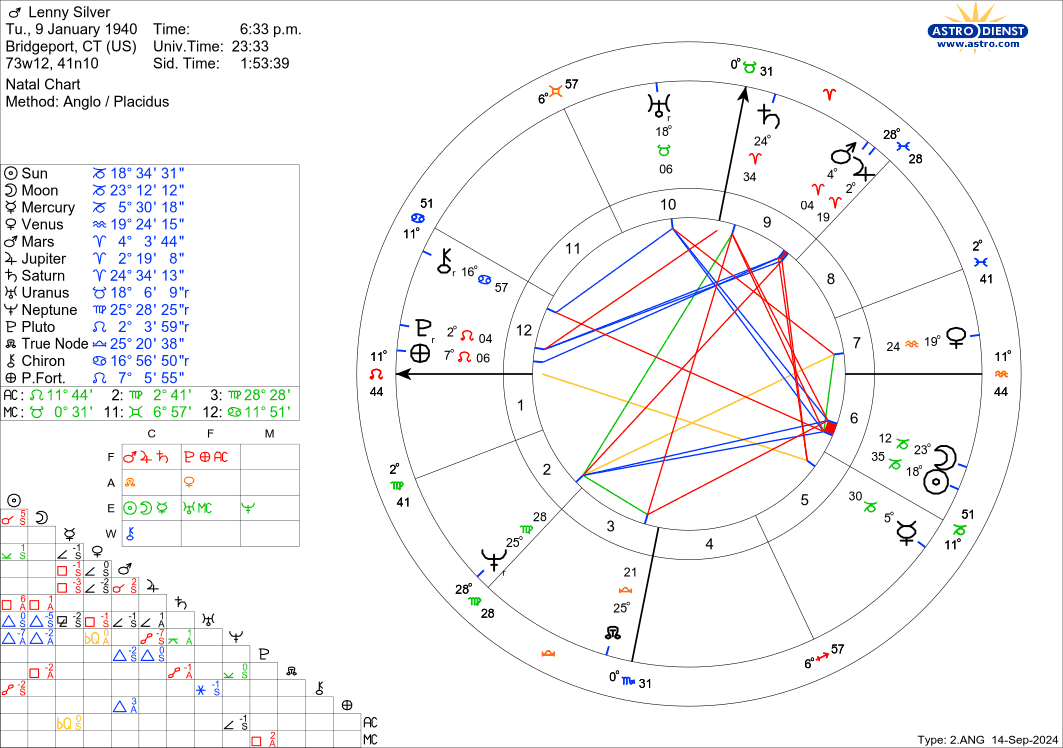
CHART appended to this transcript:
- FIGURE 1973 0413-1. Lenny Silver Natal Chart.
Other diagrams also referred to are not with this transcript version. [Transcriber note: [diagram] means the speaker is referencing a diagram as he or she is speaking. If someone is drawing or writing, with audible sounds of chalk on a blackboard, I indicate this by [drawing] or [writing].]
TRANSCRIBED Verbatim by IT 2021. In 2024, IT completes TOC, one chart and reference to this chart within transcript, corrects errors/typos. In 2025, IT updates prefatory matter and audio file markers to match new REP audio. Archival verbatim transcript – V12a.
AUDIO FILES: 1973 0413a, b, c. [Note: Audio files originally recorded out of order, with multiple other issues. In 2024, REP Studio fixes all issues and consolidates original six audio files into three.]
1973 04/13 at Wisdom's Goldenrod
Jung; Shadow
[Audio File 1973 0413a Begins]
AD: By the way, those of you who subscribe to Mad Magazine, there's a very good article. (laughter, AD laughs) I enjoyed tremendously.
LS (simultaneously): It's a journal.
S: (It's/In) a journal, not--
VM: Whether you take a journal--
AD: What is it, a journal?
LS: It's a journal, a scholarly journal.
AD: Scholarly journal. (bit more laughter)
S (faint): Quite a long-winded--
S (faint): The centerfold.
AD: Centerfold, it's all about the shadow. (bit of laughter) Maybe we could have a little fun tonight at my expense. I've been writing down some observations that clergymen, priests, gurus, psychotherapists, analysts are subject to and I've-- I've caught the shadow red-handed quite a few times though. Tonight you have a few laughs.
S: Yeah.
S: Uh-hm.
LS: Don't speak about it.
[24½ second pause with faint background student talking, laughter]
[Note: See FIGURE 1973 0413-1, Lenny Silver Natal Chart, for the following.]
AD: I don't know, I don't think I remember Lenny's chart. Now I want to put this dream down, Lenny's dream. [short pause while drawing, faint background student talking] I don't-- I don't remember Lenny's chart but I think he had Mars here, Saturn--
S (faint): Mars, Saturn, and Jupiter intercepted ninth, in the ninth.
AD: And intercepted, ok.
S (faint): Yep. In Aries.
AD: In Aries.
S (faint): And Head's in there too.
AD: The Head's in there.
S (very faint): Head or Tail?
S (very faint): Head or Tail.
RP (simultaneously, faint): No, the Tail.
S: The Tail.
S (simultaneously): No, the Tail.
AD: Will you make up your mind?
S: Tail.
AD: Tail.
LS: My Tail.
S (faint): Certainly the Tail.
LS: If I had the Head up there I'd be in trouble.
AD: What do you got in the fifth house, Lenny?
LS: Mercury.
AD: Mercury. [drawing] In Capricorn?
LS: Yeah.
AD: Capricorn's on the cusp?
S: Yeah.
LS: No, Capricorn's on the sixth cusp.
AD: Sixth cusp. What's on the fifth, Sagittarius?
LS: Yeah.
AD: Alright, this is-- this is a kind of interesting dream. Now the reason I'd like to mention this is [S simultaneously, possibly part of background: Well it was Avery, yeah.] because the interpretation of dreams is really not a science. It's something you can acquire gradually little by little. And, it doesn't have to be interpreted in terms of animus, anima, shadow, you know, mana personality, but it can be interpreted that way, alright. Now, we'll try first without-- he says the dream and we'll try without any, you know, name-- name-calling, you know. What do they call it? Pigeon dropping.
S: Pigeonhole? (laughter)
VM: Pigeonholing [S simultaneously, very faint: Dropping (I don't think).] (I would think).
S (simultaneously): Pigeonholing.
AD: Pigeonholing?
LS/S(?) (laughing, faint): Holing, correct. (laughter)
VM (amidst laughter): It's close to pigeon droppings. Like a little Freudian slip, you know, pigeonholing [one/two words inaudible]
AD (simultaneously): That's not a Freudian slip, that's what it is, every time I quote somebody, right, I'm pigeon dropping. (laughter) I'm not talking about classifying him, I'm-- my shadow's getting the best, you know, say "Look how smart I am." Why do you people think I make slips? (laughter) Mispronounce words? Alright--
LS (simultaneously): Alright, this is a-- this is a literary version of the dream 'cause I don't have it with me.
AD: Ok.
LS: There was a class, and I remember driving up to the class, driving a huge truck. Now just imagine, you know, one of these trailer trucks, those big things that pull these twenty-ton vans. And-- but I was pulling was an empty stake bed, uh-- Just imagine something you would've put an iron girder on, [S simultaneously, very faint: Empty what?] alright, an empty stake, stake, an empty bed. Not one of the vans but it's a bed. Imagine you could carry one of these huge girders on it, you know? Alright, that's the kind of-- of course that was empty. Now I drive this up to the class. I don't remember much of the class until the last argument. And the last argument was about astrology and we were arguing about the exaltation of Saturn. And, I was holding forth for Saturn ought to be exalted in Cancer and-- as opposed to the usual exaltation of Saturn in Sagittarius, alright. (some laughter)
S: That was (no dream).
S (very faint): In the dream no less?
LS: Yeah, yeah. (bit of laughter) And I said, "When Saturn's in Cancer, knowledge is differentiated in a descending sequence from principle." And Tony cut right in on me, he was pressing me all the way. And, he said "Yeah, but what happens when you get to the bottom?" And I said in the same spirit, "The guy with Saturn in Cancer never admits he got to the bottom, he just keeps differentiating the thing on forever." Then Ella May gave the meaning of Saturn in Sagittarius. And I just remember it was really beautiful, I don't remember anything the-- the words of it, I just remember it was fantastic. And Tony said, "Whew, I ought to let you make mistakes like that more often." And I said with some irony, "Yeah, if I don't get to make mistakes I never find out anything about them." Or something-- that was one poss-- let me see. "Yeah, I learn much more when I make a mistake than when I'm right."
S (very faint): That's obvious.
S (very faint): That's obvious.
S: That's obvious.
LS: That's the whole dream, that I remember.
S (very faint): Wow.
AD: Alright, why don't you give a poke, why don't you try figuring out what it's saying. Now this I think is really appropriate because you have astrology, you have some idea and understanding of astrology, hopefully. Huh? [student assents, very faint] Saturn is exalted in [drawing/writing] Cancer, right?
LS: Yeah. Or Sagittarius.
AD: Or Sagittarius. [short pause while drawing] Now he comes to the store and he's got this huge empty truck, you know, a big flat truck, alright. Now, just what does it mean ordinarily speaking?
S (faint): Going to say, if you come with a symbol you get a symbol back. (laughter)
S (very faint): Sure it wasn't [one/two words inaudible]
LS (simultaneously): No my friend's in there, I'm figuring out where he's at, yeah. (LS laughs, laughter)
AD: But it's-- it's a big empty truck, you know. Evidently he's coming, he's coming to the store, he's going to load that truck up with something, it's empty. And it's not an ordinary small little station wagon, it's as big a truck as he can find. (AD laughing) Alright, so, he comes to the class. What would the next step be like?
LS: Well the class went on.
AD: The class was going on, yeah.
LS: And, what I remembered was this argument at the end about the exaltation of Saturn.
AD: Now what would Saturn represent ordinarily speaking? We're going to avoid Jungian psychology, ok?
LS: Sure, go ahead.
AD: Let's avoid. What does Saturn usually represent? Because the tendencies of the mind are what they are whether you call it A or call it B, you know. Doesn't care what you call it. Well what does Saturn ordinarily stand for in astrology? Basically the ego complex. I mean his mind is talking to him, alright. Alright, now there's an argument, (AD laughs) it's exalted in Cancer.
S (very faint): Right.
S (very faint): [one word inaudible] in Cancer.
AD: Alright? You don't have to write this dream down. (bit of laughter) It's not your dream anyway. (AD laughs a bit) Now what did we say about Cancer?
S (faint): Where you appropriate experience as your own.
AD: Where you appropriate experience and it's personalized, it's made yours. Now what was the remark you made about Saturn in Cancer?
LS: When Saturn is in Cancer, knowledge is differentiated in a descending hierarchy from principle.
S: Say that again.
S: Yeah. (laughter)
LS/S(?): Is that right?
AD (simultaneously): That's what I said! (AD laughing, bit of laughter)
S (laughing): Good job.
LS: I'm not responsible for the meaning of these sentences, right?
S (laughing): Yeah.
LS: Just the words. (LS laughs)
AD (simultaneously): That's right, that's right.
LS: When Saturn is in Cancer, knowledge is differentiated in a descending hierarchy from principle.
S: From what?
LS: From principle. [short pause] That make sense to anybody?
RG (very faint): Yeah [couple words inaudible]
LS (simultaneously): It does? Well tell me what it means [couple words inaudible]
RG (faint): Well, he just (said) (RG laughing) very subjective intuition about Lenny, that was great. You know, Saturn actually has-- is-- has its detriment in Cancer, not its exaltation.
AD: He knows that, don't-- he knows that.
RG: Oh no, I know you know. 'Cause Lenny-- Lenny has a tendency to differentiate psychology so much that in a way it seems, I'm not saying this is so but it seems that-- that that's where he operates from more than operating from a principle of transcendence or a principle of (emerging).
AD: So, do you have the feeling that some sort of inversion has taken place here? (AD laughing, laughter)
S (very faint): Yeah.
S (very faint): Yeah.
S (faint): Ok.
S: Yeah.
AD: Yeah? (student laughs) Alright. And then Ella May told you something about Saturn in Sagittarius, ok. All you remember it was very beautiful.
S (very faint): Uh-hm.
AD: By the way, you got Saturn in the house of Sagittarius. Well how would you interpret that?
RG (faint): Len-- Lenny intuits-- that would be where you pull yourself to the whole. You know what I mean? Like it would be very different than differ-- differentiating from a principle, it would almost represent a principle itself as a-- as a unity apart from its differentiation.
AD: But if-- if you intuit something as a whole, what happens to the particulars? You don't get tied up, caught up in them. There has to be a certain detachment 'cause it's a vision, like it's out there, alright. And Ella May told him-- told him something about-- Alright. And what was the next part? Oh I cut you in, yeah.
LS: Well no, that was before.
AD: Before?
LS: Yeah, you cut me off after I said that first thing about Saturn in Cancer.
AD: I cut you off.
LS: You said, "What happens when he gets to the bottom?"
AD: What happens when he gets to the bottom. I know who's talking there, alright, the next-- (AD and LS laugh) the next-- the next movement.
LS: "Guy with Saturn in Cancer will never admit he's got to the bottom. He'll go on differentiating the thing forever."
AD: You got a wide (compass). (AD laughs) How about that?
S (faint): I don't even get it, it's a never-ending process of differentiating the psyche, and it never, you know, like it never stops.
AD: Well there can't be no-- no fulfillment or satisfaction in that personal appropriation. There's no possible end to egotism.
S (very faint): That's true.
S (very faint): Uh-hm.
[few seconds of very faint background student talking]
AD: Alright. I-- we're just kicking it around. Ok, so then the next movement, Ella May tells him well, something, and he says "Ah, that's very nice," ok. Now, down here [diagram] was Tony was telling him cut it out and up there [diagram] it's Ella May telling him something, alright. So evidently there's two parts of his psyche coming into operation. What was it she said about Sagitta-- Saturn in Sagittarius, you can't remember at all, huh?
LS (simultaneously): I didn't remember at all, no, it just vanished.
AD: Just vanish. Alright, what was the next thing then?
LS: When you said, "Whew, I ought to let you make mistakes like that more often."
AD: And then you said--
LS: I said, "Yeah, I learn more from making mistakes than from having the right answer."
AD: You want to try it here? Can you see that being expressed here [diagram]?
[9 second pause]
S (faint): What was-- what we said about him before in terms of Saturn in Aries that doesn't, you know, it just-- it just happens when you got this-- go ahead and let it happen.
AD: No good, no good. Stick to the dream. The dream is its own interpretation. You don't have to go outside. [short pause] Alright, let's start off. He drives to the store, he's got this huge empty truck behind him, so evidently he's-- he's going to load up with something, whatever it is, and it should fill up that whole truck. Otherwise why would-- he could bring a smaller one, he brings a big one. And he comes to the astrology class and we're having a discussion and so he-- he talks about Saturn in Cancer, alright. And we got the feeling that there's a sort of inversion of knowledge going on here, alright, and someone appears and cuts him down, cuts him off on that, and then he has someone up here tells him something about Saturn in Sagittarius, alright. And then he finally gets the feeling, well, he has to make mistakes to learn. Now, I think if you just think-- look at the chart you'll see the dream is interpreted right by the chart. You don't have to go to Jung, you can go to Jung if you want. [short pause] It's got a Leo ascendant, (it's/he's) got Mercury in Capricorn, but notice Sagittarius [drawing/writing] is at the cusp of the fifth house [diagram]. How about that, what would Sagittarius in ordinary astrology be at the cusp of the fifth house? I mean, if we think of the fifth house as the expression of life and Sagittarius is-- is the way you gotta get into that fifth house, wouldn't you say that you have to learn to sort of be more detached and get more of a visionary approach to what you're trying to express, which is that Mercury in Capricorn.
LS: Ok.
AD: Ok?
LS (faint): Ok.
AD: Well, what would Ella May represent there then if we wanted to use the Jungian approach? Remember we spoke about four levels of the feminine? [14¼ second pause] Well you're up-- you're up at the front of the class. What's your opinion?
S (simultaneously, faint): It would have to be Sophia.
AD: Huh?
S: Would have to be Sophia.
AD: I don't know, I'm asking.
S (faint): It doesn't fit any of the other three.
AD: Well, the first one was Eve, right, [S simultaneously, faint: Eve.] Mother Earth. [S simultaneously, faint: Right.] The second one was [S simultaneously, faint: Helen.] Helen, the anima. The third one was Sophia or--
S (simultaneously, faint): No, Mary. Mary's the third.
AD (simultaneously): Mary. And the fourth one was wisdom, [S simultaneously, very faint: Sophia.] Sophia, alright. And, you think it was Sophia?
S (faint): Right, from the way he describes the other three of them.
AD: Any-- any ideas on that? What do you think Richard?
RP (faint): I think Helen because what he remembers is how beautiful it was.
AD: Uh-hm.
S (very faint): I don't know [couple words inaudible] and (Helens) will tell us something about--
AD: You get the feeling that with Saturn down here [diagram], you know, the realm of the Mothers, Eve, ok, but up here [diagram] it will be the anima. It's like an-- it's like trying to force him-- take that kinship libido and bring it up to a higher level instead of getting stuck in the Mothers. So that she might represent that higher feeling point of view which says something like, "Look, you gotta get out of this place here because there's no possibility of ever satisfying it." Alright? "You have to elevate those feelings and bring up-- bring them up to that higher level." [someone drawing] So how about that then? If we start off, evidently now what's meaningful is this is really-- this is really a-- a big insight. Because if he follows through he can fill that truck up. To the extent that let's say he can detach himself, you know, that is, this-- the kinship libido, detach it from here [diagram], alright, and look at-- look at Sagittarius, I mean Saturn in Sagittarius is a kind of detached visionary way of approaching, alright, then whenever he has to express this here [diagram], alright, and this [diagram] is cut off from it, alright, then this here [diagram] would be expressed with a much higher level of feeling, an anima feeling. He always considered astrology like an anima, I think if I remember, huh? And evidently this is a way that he can develop. Now if he can see all this here, sure, that truck will be filled up. Does that make any sense, the dream? And they're only psychic tendencies within him which are being played out pictorially out there where he can-- so to speak, he's being given a message, and it's being given to him in a way that I think he understands very deeply, underneath all the mundane stuff.
VM: On the other hand that understanding would've never have come unless he'd spent a lot of time in that fourth house to begin with.
AD: Oh sure.
VM (simultaneously): I think that was the message as well, "I learn a lot when I make mistakes."
AD: Yeah. Ah it's-- you can see, it's not a science, you begin to-- you can add and keep adding to the interpretation of the dream and after a while you find out that you can pull out so many implications and you begin to get a picture, so to speak, of the meaning inherent in the dream and how that meaning, so to speak, exposes itself in the dream. And very often I think, it does influence us, you know, subconsciously. [short pause] Oh, very very quiet. How about Tony in the dream, what do you think he represented? (bit of laughter) [short pause with very faint background student talking]
Well, we were talking about the shadow last week and we-- we started picking up the-- the notion of the shadow from the personal point of view. [Note: See WG Class 1973 0406a.] We didn't touch the notion of the collective. And of course the personal shadow and the collective shadow are really intimately related one with the other, it's pretty hard to separate them. And uh-- um-- [short pause] We had a few examples, you know, I-- everyone spoke about it, everyone begins to feel at home here. Now, I have a few quotations and then I wrote down a few notes but I'd like-- I like this to be a kind of public forum, you know, I don't want to be the only one talking about it 'cause then you'll start thinking I'm an authority on it.
S (very faint): (Uh-hm.)
S (very faint): Yes.
AD: Alright? [13½ second pause] But there are some-- "The Problem of the Fourth" in "A Psychological Approach to the Trinity" of Jung has-- has some interesting-- I'd like to quote one thing he says.
C.G. Jung [CW 11, Psychology and Religion, "A Psychological Approach to the Dogma of the Trinity," p. 166, paragraph 245, AD reading]: "Although there is a tendency, characteristic not only of primitive religions, [AD adds: so] to speak rather exaggeratedly of complete transformation, complete renewal and rebirth, it is, of course, only a relative change, continuity with the earlier state being in large measure preserved. Were it otherwise, every religious transformation would bring about a complete splitting of the personality or a loss of memory, which is obviously not so. The connection with the earlier attitude is maintained because part of the personality remains behind in the previous situation; that is to say it lapses into unconsciousness and starts building up the shadow. The loss makes itself felt in consciousness through the absence of at least one of the four orienting [AD reads: orientating] functions, and the missing function is always the opposite of the superior function. The loss need not necessarily take the form of complete absence; in other words, the inferior function may be either unconscious or conscious, but in both cases it is autonomous and obsessive and not influenceable by the will. It has the"all-or-none" character of an instinct."
AD: Well, how about that? You got any feeling for that? I think what's important here, he says-- after let's say some sort of religious rebirth or transformation, the connection with the earlier attitude, and this has to be kept in mind--
C.G. Jung [CW 11, Psychology and Religion, "A Psychological Approach to the Dogma of the Trinity," p. 166, paragraph 245, AD reading]: "The connection with the earlier attitude is maintained because part of the personality remains behind in the previous situation; that is to say it lapses into unconsciousness and starts building up the [AD reads: a] shadow."
AD: (Alright?) Well what-- what do you think he means there? Go ahead.
S: Well--
AD: Think of your own experiences.
[short pause]
RP (very faint): You might call the shadow [three words inaudible]
AD: That's-- (laughter)
S (amidst laughter, faint): Can't hear.
AD: I--
RP (simultaneously, very faint): Would you read it once more?
AD: Sure. Oh, the shadow will interfere constantly when we start talking about it, sure.
RP (very faint): (Oh/Well) (I got it).
S (faint): I didn't know [one word inaudible]
JL (simultaneously): I think I know about (this).
AD: Well, let me read it to him once more and then talk, ok?
C.G. Jung [CW 11, Psychology and Religion, "A Psychological Approach to the Dogma of the Trinity," p. 166, paragraph 245, AD reading]: "Were it otherwise, every religious transformation would bring about a complete splitting of the personality or a loss of memory, which is obviously not so."
AD: You still continue going on after rebirth.
C.G. Jung [CW 11, Psychology and Religion, "A Psychological Approach to the Dogma of the Trinity," p. 166, paragraph 245, AD reading]: "The connection with the earlier attitude is maintained because part of the personality remains behind in the previous situation; that is to say it lapses into unconsciousness and starts building up the shadow."
AD: Go ahead, go ahead, it's-- it's your class. I'm going to try to stay out of this.
S (faint): Yeah, well I'll try.
S (faint): Go ahead.
S (very faint): (This is--)
JL: I will. Before I met Tony I had a-- I had a bad experience up in Syracuse and-- When I was in high school I was quite intellectual, very much involved in mathematics and-- [S simultaneously, faint: I don't think anybody can hear you.] and intellectual discipline. And, when I got to Syracuse I found that-- that a lot of-- a lot of the life that I had not been able to live or-- being a son of a farmer and, you know, having to go to a relatively isolated country school, I started to live all of this out. And, it took about six months af-- after I-- I got up to Syracuse when I started getting into bohemianism a great deal and-- and for about two years I was living very much a life of-- of a renegade. I dropped out of school twice, I-- I was in the Navy a month, I-- (laughter, AD laughs, student words)
JL: I had-- I had about [AD simultaneously: Short term.] three jobs and then-- and then in-- in 1960-- what was it, '64, I met you and--
AD (simultaneously): I don't-- I don't remember.
JL: Yeah, it was like this-- this-- this [couple words inaudible]
AD (simultaneously): [couple words inaudible]
JL: And-- It was like the last time that I-- I had left Syracuse and I-- I [one word inaudible] moved back home and I met Tony and got into reading and all that. And, this shadow life was still living, you know, living part of my life. And, I got quite involved in Buddhism and-- and reading about a number of-- a number of the different disciplines that we'd get into. And, in-- in '65 I had somewhat of a-- um-- a rebirth experience. And I can remember now that after this happened, I started taking up meditation, I was-- I became very ascetic, I became vegetarian, and I tried to leave aside many things that-- that I had been living by before. And, in doing this I found that-- that I was living constricted kind of partial life. The life of the saint is a very-- (it's/is) a very narrow one. And, I had this-- I had this illusion that I could-- that I could live this way for a good number of years, and it seems that when I-- when I-- when I went to see PB in '69, he shattered a great deal of this. And it seems that-- that-- that up to this time, from '65 to '69, I had been building up a certain amount of-- of negativity should-- should I say. Certain aspect of my life was not being lived out, and as soon as-- as soon as I saw PB, [S, very faint, possibly part of background: Let's see.], I had to start living out some new things, things that I had ignored before. And, he made it rather explicit what-- what things were in store for me. And-- of course, even-- even more recently I've-- I've been really battling the shadow a great deal and really trying to confront it (but--)
S: What kind of things John?
S (very faint): Uh-hm.
JL: You mean recently or before I (saw/see)--
S (faint): Since you saw PB.
JL: Oh, since I saw PB? Well, I dropped asceticism. I stopped trying to be a saint, you know.
AD: It's a tough job.
JL: I stopped-- (laughter)
S (amidst laughter, faint): Yes it is.
JL: I mean, if the s-- if the s-- if the same archetype hits-- if the same archetype hits you, you know, I mean you think-- you think that the only thing that you can do is-- is sit in a corner and meditate and try-- try to be a perfect being and-- I mean no-- no human's going to be a perfect being without encountering some kind of-- without ignoring a lot of this stuff, you know. And, well--
AD: Well, you're tying that in with what we just said then, that this lapses into the unconscious and it starts building up the shadow.
VM (very faint): Uh-hm.
JL: Yeah.
AD: Ok?
JL (faint): Yeah.
AD: Did you see the point he was trying to get-- (get) out?
S (very faint): (Let me see.)
S (very faint): Uh-hm.
AD: You wanted to say something too?
VM (simultaneously): Well, I thought John's explanation was quite, you know, detailed actually. I mean--
AD (simultaneously): Yeah well, it's-- That's what we want, [VM assents] we want to illustrate these [VM, faint: Good.] things very concretely, because it's still my view that it's-- it's our first and most urgent problem, problem of evil. Yeah, Richard.
RG (faint): 'Cause, like, we were talking about where I was-- where I was at when-- when I was a kid and last week that was just-- When I came to the store, you know-- you know, that I envisioned a-- you know, a whole new life for myself. And I (of course evolved and) had a certain realization. And, you know, all-- I didn't-- all the past history of the last, you know, ten years being a gambler, you know, drinking, you know, all that [one/two words inaudible] it just-- I dumped it into a corner in the unconscious and didn't even see it. So it started building up a shadow in the-- and the-- let's say the power that I got from doing those things when you leave it just started accumulating in the-- in the unconscious and it seemed to express itself in other areas.
AD: Yeah, it's like you shine a light in one corner of the room, you know, and the more light you shine there the darker that corner gets.
RG (faint): So, I mean, in my case let's say the-- the whole house that-- that let's say was being fed by-- by certain activities started operating in my-- in my understanding or was screwing up my-- the activity that I was [few words inaudible] before. It just shot itself into my unconscious [couple words inaudible]
AD: Yeah, and if you want you can try now to relate this even more directly like, let's say a certain light flares up in your understanding and now intellectually there's like a big beam, you know, and you keep throwing more light and you keep understanding and now you really, you know, get inflated and get carried away. And in the meantime you pushed your feelings in a corner and you keep sitting on them and, you know, they keep screaming at you, "Let me out, let me out," and then finally they just come over and they say "Well that's enough of this here, you and your intellectual baloney," you know? (some laughter)
S (amidst laughter, very faint): Right.
AD: Alright? (bit of laughter) Well, one thing I'm pretty sure of is that we're not going to be delivered from evil. Well, the other thing I'm sure is we're going to have to learn how to deal with it because there's no getting away from that, not as long as we're here. And--
S (simultaneously, very faint): Well, you say--
S (very faint): (Go ahead.)
AH (faint): What was the context of--
S (faint): Louder.
S (very faint): Yeah it's still early.
S (simultaneously): Talk louder.
S (very faint): (Talk) louder.
AH: What are we talking about when we talk about religious rebirth? I don't understand that.
AD: Well, you have some kind of mystical experience. It doesn't-- we won't go into the details but if there's some kind of authentic awakening in you in some way or other, ok, very often the person starts getting inflated, you know, or something similar to that, and that particular area in his life assumes a kind of proportion, you know, a-- an unbalancedness. And, that would be the rebirth, alright. And anyone who has any kind of a rebirth then all of a sudden finds out that he's got to confront problems that he never even thought existed anymore. He's-- you know, it's like the New Year's resolution. Then the next day the habit faces you again. (bit of laughter)
S (very faint): Ok.
AD: Something like that, you know. Well, yeah. You've seen this very often like roly-polies-- what do they call them, [VM simultaneously: Holy (one word inaudible)] holy-rolls?
S (simultaneously): [one/two words inaudible] (laughter)
S (amidst laughter, faint): Go ahead.
S (amidst laughter): That's ok.
VM (amidst laughter): That was really indecisive.
AD: I wonder-- I wonder what that slip refers to, huh?
VM (simultaneously, faint): Mercury is opposite [S simultaneously: Yeah.] my Sun, I (laughter) pick up on.
AD: Oh I was thinking of the hoi polloi, yeah. (laughter)
S (very faint): We get the (feel of it).
AD: My shadow is off tonight. (AD laughs a bit) Uh-- [few seconds of faint background student talking] After a short while you'll see immediately the old personality comes right back and takes over. Now if they're sincere in their awakening, they got a battle on their hands, if they're not then they just go back and resume what they used to be like. Alright? A religious transformation or creative transformation is never total. It's partial all the time. Yeah Tom.
TM (faint): We seem to be just-- we seem to be relating two things here. One is you said well, you know, we're talking about sort of this imbalance where one side of the personality is just sort of worked out to the extreme and it sort of causes a-- a-- a reaction of the other side and then to somehow saying that this is-- that there's some evil involved somehow. I'd like to see a connection to it if I could, or I'd like to see it connected.
AD: You'd like to see what connected?
TM (faint): Those sort of, well-- the procedure. The examples we've been using are sort of people who have been (sort of) identified with sort of an intellectual and relational function, and that-- and that sort of live(d) that for a long time, you know, like say Dickie like reinforced his and then the other side comes bursting through. Now, now this-- this you're calling the-- this-- we're also calling the same problem the problem of evil and it seems that's very above-- it seems that what we've been talking about is sort of a regulatory function and not any-- [S simultaneously, faint: An instinct.] anything necessarily evil.
VM: Tom, if that shadow reacts strongly enough it can be quite evil, quite malefic, you know--
RG (faint): What do you mean by evil?
VM: Well-- I guess I'll just have to use a personal example. Let's say I-- you know, from a certain point of view I was a very well-behaved graduate student and doing that kind of thing. It came apart rather early in my graduate career but I tried to hold all the pieces together but I just wasn't able. [one/two words inaudible] actually dropped the conscious thing and did a whole (spirit--) different things in California during which time I had a certain little encounter with a-- with the shadow and it came out in many forms. One of the most difficult to handle for me was a-- a violence which took the proportions of well wanting to-- to kill people and myself as well. [JL assents, very faint] To me that was evil, you know what I mean? I don't know-- (I guess/And yet) it's really hard to talk about in a way but, when the feelings are sufficiently archaic if you like or sufficiently undifferentiated they just come welling out in wild passion, I mean, a lot of evil can come along with that.
AD (simultaneously): It doesn't help to say that it's regulatory.
VM: I mean granted, it was regulatory, I was trying to, you know, in my own kind of confused way I suppose, differentiate these feelings which had to a large extent been set aside and, "Well I got more important things to do, you know, I've got to do this collective thing of Ph.D. and all that."
S (faint): Maybe [one/two words inaudible] (necessity) for teaching you the-- you a lesson.
VM: Well I'm sure there's many facets to it, you know, I mean--
S (faint): So all is good.
VM: Well, from a long-range point of view or from a, [S simultaneously: Well--] you know, [S simultaneously: Yeah.] (distance/distant) point of view, everything is good, if you want to look that way I agree, but while you're in it it certainly doesn't seem good, you know, I mean you're just caged in with your own fear. [one/two words inaudible]
AD: You have to be very careful here because we don't know what evil is, we don't know what good is. We sometimes think we do. And I know very often when someone asks me I shudder because I really don't know. How often what I thought was good turned out evil and how often what I did-- what I thought was wrong was right. Well, we might say that behind the so-called personal shadow and the collective, there's some sort of principle that we want to call evil for now. [student assents, faint] Alright, and I think you'll see that in Jung's writing he does postulate the existence of the principle of evil in-- also the so-called principle of the good, but the principle of evil here is for him not a privation of the good. Make sure you understand this because about this Jung is very very firm. The evil in us is not a privation of the good. When a person is blind you can't say he's been deprived of good eyesight. It doesn't help. This man suffers, alright. So, let's try to keep that in mind. Now the other-- the only other remark I wanted to make, Tom, the principle of compensation here, you know, which is a methodical tool in the hands of understanding does not release us from the experience of evil and suffering, (alright/right), it's a methodical principle. It's got nothing to do with what we're talking about. You're on a head trip.
JL: Tony?
AD: Yeah, go ahead.
JL: Tony, I can say that the compensatory function of that shadow conflict before-- before rebirth is somewhat of a necessity, you know. To the [AD/S(?) simultaneously, faint: Uh-hm.] extent that-- that if one doesn't-- if one doesn't recognize the-- the unlived out part of one's life, that-- that you can't become whole. And to place any value on it, negative or otherwise, to say that it is something that one should avoid, is-- is kind of beside the point. In fact-- in fact I feel--
AD (simultaneously): No, I think it's precisely to the point, I think [JL simultaneously: Well, alright, alright.] it's precisely to the point. When I gotta go through pain, it's evil.
JL: Ok.
AD: You can't talk me out of it.
JL: Ok, I'm the one who [possibly one/two words inaudible] (some laughter)
AD: You know, I love my vasanas the way they are.
JL: We love our pain too. I found that-- that like-- like the out--
S (simultaneously): That's right [one word inaudible]
S (simultaneously): I think there's some-- there must be some kind of pain that you really don't love John, there's got-- [JL, faint: Well--] you know-- The thing that--
AD (simultaneously): That's a psychoanalytic inversion, [S simultaneously: Right.] don't pay attention.
S: Yeah the thing that we call pain that we like is not pain, you know, there's really not--
AD (simultaneously): Alright, let's take for instance, let's take in modern day psychology where they have this so-called philosophy of normalcy and enlightenment and we're going to try to bring everyone [few inaudible student words simultaneous with AD] into relationship with our society. [couple inaudible student words simultaneous with AD] And if they can be adjusted to society then everything is fine, ok. But that's for these times. Suppose we go back to the Middle Ages, alright. Now, you have a different set-up there, right? Now what these people are concerned about is the value of the soul. It doesn't matter that you're neurotic or that you don't get along with the family or that you're a drunkard or a bum or any of these things. Do you believe in the faith, do you have faith? "Ah yes, I do," you're alright. Ok? But, if you don't and then they put you at the stake, ok, they're doing it for reasons which they think are totally adequate. For instance, if you read the Inquisition, you know, some of the papers on the Inquisition by Lea [Note: See Henry Charles Lea, A History of the Inquisition of Spain (in four volumes), A History of the Inquisition of the Middle Ages, Chapters from the Religious History of Spain Connected with the Inquisition, The Inquisition in the Spanish Dependencies.] or some of the witch-hunting or the Jew-baiting that went on in the Middle Ages, you sometimes wonder, were these judges really concerned with the faith or somehow was there something dark and suspicious about their motives? (bit of laughter) I mean, was there a cruel streak in them that was expressing itself, and if so, isn't this evil?
JL (faint): Yeah, ok, that's [one word inaudible]
RP (simultaneously, faint): Judgment can only be made contemporarily, I mean at the time a judgment like that was impossible to be made.
AD: At that time it would've been impossible.
RP (simultaneously, faint): Impossible, they wouldn't see the evil at all.
JL: Ok, that's (positing) [S simultaneously: (Judging.) I mean yeah.] the evil from a collective point of view. Could you speak of the same-- the same degree of evil from a personal point of view, when you're dealing with the personal, you know, shadow?
S (very faint): That's right.
AD: That's the only point I'm speaking from. I don't know of any other point.
JL: You mean it wasn't collective for-- for the-- the Inquisition to burn witches?
RP (faint): Yeah but each inquisi-- in-- each inquisitor was a single human being.
JL: Yeah but he participated in the-- in the-- in the collective--
RP: Some took the job and some didn't.
AD: Look, let's look at it this way John. We assume, we assume that the inquisitor was a noble just man who believed in the faith sincerely and thought that the value of your soul was superior to your body and that you had to be burned at the stake so that your soul should be saved. Now let's assume that this man is totally honest as far as he can be honest. From another point of view you could say, "Wait a minute, there's something dark here, there's something that comes from the depths. There's some-- something in this man that's cruel," alright. You could say that from another point of view and you begin doubting whether the collective value is really a value. Ok?
JL: Well it certainly is a negative value.
S (very faint): Right.
VM: Yeah, well I think what it points up John is the-- the necessity for an individual to not necessarily overthrow all the collective values but at least separate himself enough from them to judge which ones he thinks are valid for him and which ones aren't.
AD: Let me give you a contemporary example, a social worker for instance, or an analyst, or a make-shift guru, any one of these people, ok. (laughter) He says, "Let's stick to the objective side of this case," and we start talking about someone's case. And the more objective he claims he is, the more I become suspicious, you know, of the power thrust. Haven't you noticed that with scientists for instance? "Oh let's be very objective," alright. [JL simultaneously, very faint: (That), oh yeah, (that), oh yeah.] Don't you get a suspicion that something's sneaking in through that claim to objectivity?
JL (faint): Yeah, some of the most objective ones that I've met are probably the most arrogant.
AD: I know this for a fact, that the more you want to do good the more evil you constellate as the opposite in your soul. And this social worker's out there, he's going to do good for this man, alright, even-- even despite his, you know, he doesn't want that good. But he's going to do good for him. I think-- wasn't it Noel who was telling me that in Switzerland they wanted to raise the-- one of the penal laws, that a-- a youthful offender can be rehabilitated rather than a-- you know, given a legal punishment. And they want to raise the age of rehabilitation to 25. So now, you know, if you're walking the street and you drop a-- a wrapper from a candy bar, they won't punish you, they'll send you to school and rehabilitate you. Now this is all the good intentions of these social workers. I don't know, uh-- [LS: Yeah.] I think I'd rather take the punishment.
S (very faint): (There's no punishment.) (bit of laughter)
AD: You see, what I'm-- what I'm saying here is I get suspicious of the motives that we're operating with and they always keep coming in. They always come in.
LS: Right. (LS laughs a bit)
AD: Now-- It is a fact that as-- I've found out over and over again, and personally I think all of us have, that the more you enforce the good the more suspicious you should become of that good that you're trying to enforce because you'll begin to see after a while how cruel you can be.
S (very faint): Yeah, so just do a--
AD: Louder please.
S (very faint): It will also take-- you say one's doing (his best) the good, so then [few words inaudible] they don't--
AD: Helen I can't hear you.
S (faint): Because, when you're doing something and then you said you're going to save someone's soul or you're going to save the world, then it's ok that you-- that you hurt this person and that person and you're cruel and you-- because what [three words inaudible] it's that kind of picture in your mind let's say. And, when you're doing something good then you've got to pay attention to what you're doing [couple words inaudible]
AD: Yeah. That's why it's so difficult to understand this whole problem. Well anyway, all we wanted to do was cast some suspicion upon our motives and we can try to keep-- see if we could-- In-- in analysis I've noticed often, very often how important it is for the analyst to depotentiate, you know, his patient. And the only joy that he has is actually in depotentiating and crippling that person. The shadow part of the analyst is doing that.
RP/S(?) (very faint): That's very important.
AD: You don't understand?
RP (simultaneously, faint): (Going to go over that again.)
S (faint): [few words inaudible]
VM (simultaneously): Are you saying, if somebody comes in the store and they're all, "Wait I had this great mystical experience and so on," the only joy you have is knocking the pins out of that idea, knocking--
AD: Yeah, um--
VM (simultaneously): Knocking out. Saying, "Ah, that's baloney, it's psychism," or something like that.
AD (simultaneously): Yeah, that will be-- that-- (laughter) that [VM simultaneously: I won't take it on.] will be the shadow com-- that will be the shadow going to work.
VM: Photism.
AD: Yeah. (laughter) Shadow-- shadow goes--
[Audio File 1973 0413a Ends]
[Audio File 1973 0413b Begins]
[Transcriber note: I am using the essay "The Psychotherapist's Shadow" by Adolf Guggenbühl-Craig in The Reality of the Psyche: The Proceedings of the Third International Congress for Analytical Psychology, edited by Joseph B. Wheelwright, New York: G.P. Putnam's Sons, 1968.]
Guggenbühl-Craig, Wheelwright (ed.) [The Reality of the Psyche, "The Psychotherapist's Shadow," p. 247, AD reading]: "". . . in uprightness and honor. . . . Into whatsoever house I enter, it shall be for the good of the sick to the utmost of my power, holding myself far aloof from wrong, from corruption, from the tempting of others into vice. . . I count my life and art as holy.""
AD: Now, you can see this is the-- the [VM simultaneously, faint: Sounds like big shadow.] archetype of Ascepul, you know, the-- [RC simultaneously, faint: See why doctors don't make house calls anymore.] the healer. Huh? (laughter) I'm sorry? (laughter)
RC (faint): I see why doctors don't make house calls anymore.
AD: They don't what?
RC (faint): They don't make house calls anymore. (laughter)
AD: I suppose that's the dark side of that image, the collective image that we have of doctors. Huh? What about the bright side? If he's got a dark side he's got a bright side too.
LS (simultaneously): Oh, he can cure anything.
VM: A healer, for sure.
AD (simultaneously): He can cure anything, he's a healer.
VM: Yeah. And some people say they're [RP simultaneously, faint: (Doctor Knock-off.)] rip-offs too. (laughter)
AD: From Romains' novel called Doctor Knock.
Guggenbühl-Craig, Wheelwright (ed.) [The Reality of the Psyche, "The Psychotherapist's Shadow," p. 247, AD reading]: "Dr. Knock has no altruistic desire to heal."
AD: This is the charlatan in the analyst.
Guggenbühl-Craig, Wheelwright (ed.) [The Reality of the Psyche, "The Psychotherapist's Shadow," p. 247, AD reading]: "He uses his medical knowledge for his own personal profit. He does not [even] hesitate to make healthy people sick." (laughter)
AD: In other words, if you're not sick he'll tell you are and you need treatment, perhaps a year or two, you know. There are no healthy people, only sick ones who don't know it, if I remember the line from the story.
S: Uh-hm.
S: Yeah.
Guggenbühl-Craig, Wheelwright (ed.) [The Reality of the Psyche, "The Psychotherapist's Shadow," p. 247, AD reading]: "He is a quack." (bit of laughter)
AD: You don't believe me?
S (faint): I believe it. (S laughs)
AD: (No/Oh).
S (faint): Sounds [one/two words inaudible]
Guggenbühl-Craig, Wheelwright (ed.) [The Reality of the Psyche, "The Psychotherapist's Shadow," p. 247, AD reading (simultaneously with S above)]: "He is a quack. By quack I do not mean the medical or non-medical man who tries to help the sick by unorthodox, [AD adds: or] unapproved means, but rather the charlatan, the swindler, who at best deceives himself along with his patients--at worst, deceives only his patients. Quacks help themselves--through gains in prestige as well as financially--far more than they do any patient who comes to them."
AD: So we have the story for instance of an analyst, ok, or a make-shift guru or a healer. Let's lump them all under analyst or therapist.
S: Why?
AD: Therapist? (bit of laughter) [couple seconds of faint background student talking] We'll go into that in a little while. (laughter)
S (amidst laughter, faint): Yeah.
AD: Alright? So the therapist for instance likes to have wealthy influential patients, doesn't he? That kind of shows his power and his prestige.
S (faint): Yes it does.
AD: Well, I mean, who do you think's operating, the analyst or the shadow? What do you think?
S (very faint): I--
S (very faint): Could be.
AH: Hopefully the analyst wants to soften his patient up, you know.
AD: Yeah, he tells the family for instance how serious it is and that it's on the verge of a "latent psychosis", quote unquote Jung. And then of course he flatters and canjoles-- cajoles the patient into thinking that everything is going to be well. Either way he's going to come out on top. If the patient does break out into psychosis he says, tells the family, "See, I told you." And if the patient gets better he tells him, again, "See." Now his renown will be spread. Either way the shadow is going to-- is going to get into this act. Go ahead, Richard.
S (faint): Tony, I think that you're saying the more we try to do good the more evil we do, and if I had to point, and I just remember [couple words inaudible]
AD (simultaneously): I didn't say, I didn't say-- (bit of laughter, AD laughs) I didn't say that. Say it again. (bit of laughter)
S (faint): I always find that people are inclined to more evil because if you-- if you take [one word inaudible] the better our (convictions/restrictions) are, the moment that goes (greater receiving), balance it up from [S simultaneously, faint: Yeah, (the down).] how (evil), more evil.
S (faint): More.
AD: Well not necessarily more evil but certainly we do constellate something in us which is not exactly according to our intentions.
S (faint): Yeah. I-- we talked also Steiner where he said that misguided love is worse than apathy. And, I think I can follow the idea here, it's best if-- we can only go so far and not be good intentioned. However-- however it may be that good intentions pave the road to hell. There's no better deed, let's say. And, I don't even think they got (a form). (laughter)
AD: You have doubts now! (laughter)
S (very faint): That's true.
S (very faint): Any father.
S (faint): (Trouble.)
S (faint): But we don't want to have-- (bit of laughter) (through) good intentions [one/two words inaudible] by bad intentions.
S: Maybe Popeye's got 'em. (laughter)
S (amidst laughter, faint): (That's right.)
AD: You know, I remember a case once, I remember a case once, Richard, where a social welfare worker was very annoyed that the laws which protect the paternal rights, you know, of the adults, interfered with her doing good to the child, for the child. And I remember the remark she made to me. She would-- she hated and was infuriated by the parents. If only the laws were different, she'd show them. Not one word was said about the child. Was this person trying to help someone or was it a power-drive?
S (very faint): I think I heard somewhere that--
AD: Huh?
S (faint): I think it's obvious.
AD: Well, I-- I'm going to pick on a lot of obvious cases. We get subtle as we go along. Go ahead, go ahead.
RP: (And/I mean) it sounds like you're making-- you gotta find something loose-- like just totally bad intentioned where the person's totally unjust. You don't have to worry that much about him. By being so unjust so and he learns how to be unjust. Because it's so fragmented and evil and sort of chaotic principle, the more you embrace it the less power you have. So for example, both people are-- like aim their lives after very evil intentions, they're no threat to anybody, can't get enough together to do anything. Now it's the person who has a sort of more mixed, when he-- when-- when a person sets out to do good, a little bit of good, well that at least gives him now coherency and a certain power (where/and) he's much more capable of doing evil. In that sense a little good intention is definitely to be more feared than totally bad one. [couple words inaudible] that whole thing.
S (simultaneously, faint): He has to be more (polite).
S (faint): Yeah.
S: Yeah.
AD: Go ahead, go ahead Bob.
S (very faint): I-- I can see how it's very-- just as bad, you know, that [couple words inaudible] at Cornell (that works in--) Well, during one of his lectures, he gave a talk on ethics and a lot of things, he said that that--
VM: Could you speak louder Bob please?
S (faint): And he said that if-- if the suffering incurred by animal (kind) is totally wasted-- suffering in animal could lead to relieving of human suffering, something like this, that that would justify the nature of the suffering. Well, what he was doing was he was taking dogs, putting them in a [one word inaudible] and giving them medication and shock. And he would do this repeatedly. From a point of view of the dog he didn't [couple words inaudible] and he showed that you couldn't-- you couldn't even think about a dog [few words inaudible] stay there, and it was all-- And this was the sole reason, he wanted to find out what made an animal (intelligent). And so three months he essentially was saying that he was trying to alleviate human suffering, to find a cure. (He was a doctor.)
AD: Well, the future good, you know, future good. Reminds me of some of the situation we find ourselves today in-- in terms of history, you know. For the sake of the future good, you-- I-- I don't know if any of you read people like Marcuse who takes basically the same standpoint like Freud. [Note: See Herbert Marcuse, Eros and Civilization: A Philosophical Inquiry into Freud.] Freud believes that an interference with the instincts is very detrimental to the creative power of the human. At any rate, we have this situation for various reasons, sociological, economic, political reasons. You see, many-- many thinkers today believe that it's, you know-- that this evil, this violence, is justifiable. They think it's something that's brought about by the actual conditions that prevail in a given milieu. In other words, it's the inevitable result of a class struggle. I think this is a very superficial understanding of the inherent evil that's in us. I don't think you're going to abolish it when you have a classless society, I think you're going to have it even there. But anyway, that's their version of it. And I think you'll see that over and over again the so-called means, you know, not only qualify the ends but are those very ends.
S (faint): They determine them.
AD: Anyway, over here he says, another example of the charla-- the shadow--
Guggenbühl-Craig, Wheelwright (ed.) [The Reality of the Psyche, "The Psychotherapist's Shadow," p. 248, AD reading]: "The image of the"man of God"…"
AD: You know, the man who wears the collar reversed.
Guggenbühl-Craig, Wheelwright (ed.) [The Reality of the Psyche, "The Psychotherapist's Shadow," p. 248, AD reading]: "…has undergone many transformations in the course of history, nor is it the same in all religions. What concerns us here is the priest or pastor of the Judeo-Christian tradition. He is expected, as a member of the priest class, to have at least some intermittent relationship with the Lord. It is not necessary that each individual man-- (laughter) each individual man of God have a direct mission from the Lord like an Old Testament prophet, but he is supposed to try, at least, to stand up honestly to God and His Will, either by virtue of a genuine contact with the godhead or on the basis of his special conversance with Holy Writ and traditional holy wisdom.
"[AD adds: Now] The reverse of this noble image of the man of God is the hypocrite…"
AD: Alright, that would be the shadow of this man.
Guggenbühl-Craig, Wheelwright (ed.) [The Reality of the Psyche, "The Psychotherapist's Shadow," p. 248, AD reading]: "…the man who preaches not because he has faith but because he wants to influence others, [AD adds: and] to wield power over them."
AD: I-- I think you're familiar with that, you must [S simultaneously, faint: Right (one/two words inaudible)] have seen examples of that over and over again. (some laughter)
LS (simultaneously): I do. We've seen that together. (LS laughing)
VM (simultaneously, faint): Oh yeah, we've seen that too.
S (very faint): Well that's true.
S (faint): Me too.
AD: He goes on, he says--
Guggenbühl-Craig, Wheelwright (ed.) [The Reality of the Psyche, "The Psychotherapist's Shadow," p. 248, AD reading]: "The congregation of any preacher exerts great pressure on him to act the [AD reads: a] hypocrite. [VM: That's right.] Faith's inevitable companion is doubt. But no one wants doubt from his [AD reads: the] priest [or pastor]; everyone has enough doubts himself. What can a clergyman do except pretend, now and again, to hide his doubts and seek to gloss over the momentary inner emptiness with highflown words. And if he is weak such occasions will form a habit. We expect the pastor to know the soul's way to salvation. The shadow of this intimate of the deity is the little lord-almighty, the preacher who is [AD reads: who's] never at a loss for words concerning the finalities of life and death. Ideally a man of God must bear witness to the Lord. He cannot prove what he preaches. We expect that his behavior, his testimony, will create the foundation that underlies the rightness of the way of salvation for which he stands. And immediately we see the shadow figure of the hypocritical man of God who wants to represent himself to the world--as well as to himself--as better than he really is."
AD: Well, that's a kind of common thing, I mean most of us could take an oath on the Bible that we're very familiar with this, speaking for myself.
Guggenbühl-Craig, Wheelwright (ed.) [The Reality of the Psyche, "The Psychotherapist's Shadow," p. 248, AD reading]: "The shadow of the false prophet accompanies the pastor or priest all his life. Sometimes it emerges into the outside world as a narrow sectarian or as a hated demagogue within the church's organization. Sometimes it resides within. The noble images of physician and clergyman are forever accompanied by the shadow figures of quack and false prophet."
AD: Now this is-- this is beginning to get sort of close to home, I mean, when we're talking about the shadow we're not talking about a theoretical concept at all. It's becoming obvious that each and every one of us has one, you know, very closely lodged. I carry mine in my pocket, where do you carry yours?
S: [one word inaudible]
LS (simultaneously): I carry it with me.
AD: Huh? He carries you. [students assent, very faint] Now you can see this come out very clearly in the analyst. Now the analyst is a person who strives to make you more and more conscious. Right? He wants to open up your consciousness and you gotta become more and more conscious. And in the meantime, alright, there's a-- a bit of darkness collecting in his own psyche.
LS: I had a personal experience with an analyst that was-- I was going to this guy for about seven or eight months because after my first marriage split up and I was trying to hold things together. He was pretty good at first because what-- what he was doing was sort of poking holes in the stupid things I was saying, you know, self pity and all that kind of stuff. And after a while when things started getting a little heavier I had this dream in which-- I don't want to tell the whole dream-- but in which this guy who was very scary suddenly had a third eye open in the middle of his forehead and-- And I didn't know anything back then at all about dreams or-- but I knew that there was something special about this one. And, what this guy said was, "Did you ever hear of a psychiatrist called the man with the third eye?" That was it, that was the last time I saw him. You see what he was trying to do? He was trying to take over--
VM/S(?) (faint): Give your self.
LS: Yeah, he was trying to take over this-- this thing that was coming up in me.
AD: Yeah, the inferior--
LS (simultaneously): As soon as he said that that was it, that was the last time.
AD (simultaneously): The inferior functions-- symbolically the inferior function, alright, which was coming up was going to open up a new avenue of life for you.
LS: Right.
AD: But he would try to appropriate it and think it's him.
VM/S(?) (faint): Right.
LS: Right.
AD: Yeah, you have to be careful, sure. But you see what drove him to say that. That was his power-drive. That was his shadow. It's a-- it's a very-- it's a classic example. It happens over and over again with the analyst.
S: The patient very often wants this.
AD: Well sure, sometimes a patient actually provokes the analyst into taking the position of an omniscient magician. [student assents, very faint] You go to the analyst and you say, "Boy, I'm going to gain access to very secret and esoteric knowledge," alright, "he's going to cure me of my cold." So let's say (bit of laughter) he finds some reasons to help you understand and you get rid of your cold. Now you say, "Whoa, now I want to, you know, live for a couple of thousand years." Alright. You're provoking him into actually thinking that he is this kind of a person and after a while if he's weak-minded, and many of us are, we start thinking, "Wow, I'm a myth-man", alright? You know, like--
LS (simultaneously): Yeah he thinks he-- he thinks he caused the transference [couple words inaudible] [AD simultaneously: Yeah.] you know.
S (faint): Uh-huh.
AD: Just like something happens in here and we've seen this happen very-- very often, some kind of event synchronously takes event [sic; place], alright, and you people look at me as though I'm guilty.
LS: About two years after I left that guy I had a dream in which I was driving along the road in a car and he was trying to pass me on the left, I was going along this mountain road. (laughter) I kept going faster and faster and I was going about 70 or 80 miles an hour, you know, and going around these curves and stuff and finally he dropped back behind me and I pulled over to the side and he came out of his car shaking and said "Alright, you can go along alone from now."
AD: You can what?
LS: "You can go along alone from here." So it took me that long to get rid of it, couple years.
AD (quietly): What'd that mean for you?
[short pause]
LS: Well, I saw him a little while after that and he didn't have the same kind of bright shiny face that he'd always had when I was going to see him.
AD: Well is the bright shiny first-- face your, [LS: Yeah.] your [LS: Yeah.] projection?
LS: Yeah.
AD: Alright, then what would that mean?
LS: That means that I hadn't glossed-- that the gloss that I put on that kind of power-image had let me alone.
AD: Well I get the feeling, and this is just a feeling, that you then and there chucked collective values over.
S (very faint): I'm surprised you didn't (see/say) that.
LS: Boy. (laughter)
VM: Go look up your transits.
LS: I have too much of a shadow to say something like that, Tony. (LS laughs, bit of laughter)
AD: Well I got a-- I got a very flexible shadow. (bit of laughter)
S (faint): When was that Lenny, that second dream?
LS: About a couple years after I left him.
S (faint): When was that?
LS: Oh it was after I met you, sure. I was-- I left him about six months before I met you.
S (very faint): Yeah.
LS: I remember [few words inaudible]
S (faint): (Yes) exactly.
AD: Alright but, I think this does bring up the problem the [LS simultaneously: Interpretation (few words inaudible) (LS laughs a bit)] psychiatrist or analyst has, you know, because basically, and I'm thinking of a line from one of the novels I think McCarthy, Mary McCarthy wrote, where the psychiatrist decides to take up brain surgery. [Note: See Mary McCarthy, The Group.] You know, he figured that-- (laughter) And [couple/three inaudible student words simultaneous with AD] his reason, his reason is either-- if you're a psychiatrist, you know, or an analyst, you come to the conclusion that you're going to end up either as a cynic or a completely naïve fool. Because actually if you-- if you put yourself in the position of a therapist and you're very honest with yourself, you say "Well, I believe this to be actually so" and so you go according to a certain school of psychology which says that this is what's going on. But, you know from understa-- you understand that there are other schools of psychiatry who would disagree with you, and these men are certainly not dishonest or stupid, they too believe that what they're doing is right. So you begin to wonder now who is right and who is wrong. And you're going to get caught in a double-bind there. So, in a sense, in a sense, they-- they do have a problem to contend with.
After all, the analyst-- the analyst isn't, and here I'm quoting PB, the analyst is not free. He is not free, he is not mentally free. He's caught up as much as everyone else. The point is, in the case of some analysts who have developed symbolic intuition and others who have gone through tremendous training, they've-- they've learned to recognize their own neuroticism so that they make sure they don't draw their patients into their own mechanism. Alright. And they've learned for instance that-- oh, we could take any ordinary example, when an analyst, when you look-- see an analyst, he expects a-- he expects a transference and it's supposed to take place and he's supposed to dissolve that transference and trace it back to its source so that he can get to the neurotic complex. But it could just as easily happen that the transference is followed up by a counter-transference, alright, and then you have, alright-- if he doesn't dissolve that very quick, you're in trouble. In either case, in either case, no matter which way you look at it, he's caught in the middle here. And, very often he thinks he's bringing greater and greater light and yet the darkness that he's getting surrounded with gets greater and greater. So, the analyst has a big shadow and don't-- don't have no illusions about that. You want an example? I want to show you a philosophic shadow.
S: Why?
S: I want to leave. (bit of laughter)
AD: A philosophic shadow, ok? [24½ second pause, flipping of pages] Well--
S (very faint): Uh-hm.
S (very faint): I mean, how do you really know?
S (very faint): Uh-hm.
S (faint): (Is that) the book?
[12¼ second pause, flipping of pages]
AD: You know, I've often made the remark that many Jungians get carried away and, I've tried to prove my point over and over again to kind of convince you it's not a shadow on my part. I am not talking about my shadow now, I'm talking about their shadow. And their shadow is metaphysics or philosophy. They do not want to submit to the laws of logic, yet they want to use the laws of logic. And anyone who thinks has to submit to those laws, I don't care who he is. And that includes the psychoanalyst. Um--
LH: While you're looking could I give an example?
AD: Sure, go ahead.
LH: I was working at a place called Open House which is a sort of counseling center. And, the time I was working there everyone there was sort of into different therapeutic techniques and so on and there was a person who used to come all the time. He was sort of the collective shadow of this place. It was a guy, and he was getting quite irritating for everyone there. And we had a staff meeting where we talked about him. And everyone was talking about calling the police the next time he came. And, I felt, you know, that-- that maybe that wouldn't be necessary, that maybe we could do something to this guy and, you know, I-- I took on a-- the goodie-goodie role. And that night Norman came and beat me up. (laughter) The problem was that-- the trouble with me was that I was too honest.
[10½ second pause with some very faint background student talking, laughter]
AD: The examples are better than (anywhere). (laughter)
S (amidst laughter): Uh-hm.
S (amidst laughter): Yeah.
S (faint): Yeah.
VM/S(?) (faint): You got off easy. I'd have gotten [one/two words inaudible]
AD (simultaneously): Here's a statement made by-- by a-- by an analyst. Now this fellow is the head of the Jung Foundation and the [VM, faint: What's his name?] charge of State Hospital, Orangeburg, blah blah blah, ok listen.
VM/S(?) (simultaneously, faint): What's his name? (bit of laughter)
LS: Go ahead.
[Transcriber note: I am using Ego and Archetype by Edward F. Edinger, G.P. Putnam's Sons, New York, 1972.]
Edward F. Edinger [Ego and Archetype, p. 169, AD reading]: "The world does not exist until there is a consciousness to perceive it."
AD: Let's-- let's hear him out.
Edward F. Edinger [Ego and Archetype, p. 169, AD reading]: "It follows then that there will be as many worlds as there are centers of consciousness, and each is separate, complete, and hermetically sealed from all others."
VM: How can you do therapy? (laughter)
LS: How can he write books? (LS laughs, laughter)
S (very faint): [few words inaudible]
Edward F. Edinger [Ego and Archetype, pp. 169-170, AD reading (simultaneously with S above)]: "This may seem extreme, [AD: he goes on to say (some laughter)] [S, faint: (More extreme.)] but I am convinced that it is a sober fact that becomes self-evident once certain unconscious assumptions and identifications are dissolved."
S (faint): Yeah.
AD: Whose? (AD laughs) Whose I'll ask. Whose unconscious assumptions and identifications?
LS: Seems to like he wants to dissolve yours.
AD: Now-- now this is-- this is really, you know, like the-- what Jung said about Hegel, megalomania with words. Because if he thinks this out, you know, he would see that everything he says has been destroyed. [AD shuts book]
C.G. Jung [CW 7, Two Essays on Analytical Psychology, "On the Psychology of the Unconscious," p. 30, paragraph 35, AD reading]: "[And] indeed it is a frightening thought [AD: says Jung] that man also has a shadow-side to him, consisting not just of little weaknesses and foibles, but of a positively demonic dynamism. The individual seldom knows anything of this; to him, as an individual, it is incredible that he should ever in any circumstances go beyond himself. But let these harmless creatures form a mass, and there emerges a raging monster; and each individual is only one tiny cell in the monster's body, so that for better or worse he must accompany it on its bloody rampages and even assist it to the utmost."
AD: Assist it to the utmost. [S, faint: Yeah, ok.] You don't believe it's evil, right? You think it's just the opposite of good.
[short pause]
C.G. Jung [CW 7, Two Essays on Analytical Psychology, "On the Psychology of the Unconscious," p. 30, paragraph 35, AD reading]: "Yes, he even hesitates to admit the conflict of which he is so painfully aware. It can readily be understood that a school of psychology--even if it be biased and exaggerated in this or that respect--which insists on the seamy side, is unwelcome, not to say frightening…"
AD: You remember what Freud had to go through. And if Freud did anything he tried to bring out the personal unconscious, and-- Well, there's all kinds of heroes.
S (very faint): [couple words inaudible] (LS laughs)
C.G. Jung [CW 7, Two Essays on Analytical Psychology, "On the Psychology of the Unconscious," p. 30, paragraph 35, AD reading]: "…which insists on the seamy side, is unwelcome, not to say frightening, because it forces us to gaze into the bottomless abyss of this problem. A dim premonition tells us that we cannot be whole without this negative side, that we have a body which, like all bodies, casts a shadow, and that if we deny this body we cease to be three-dimensional and become flat and without substance. Yet this body is a beast with a beast's soul…"
AD: And he growls. He left that out.
C.G. Jung [CW 7, Two Essays on Analytical Psychology, "On the Psychology of the Unconscious," pp. 30-31, paragraph 35, AD reading]: "…an organism that gives-- (AD laughs, laughter) an organism that gives unquestioning obedience to instinct. To unite oneself with this [AD reads: the] shadow is to say yes to instinct, to that formidable dynamism lurking in the background. From this the ascetic morality of Christianity wishes to free us, but at the risk of disorganizing man's animal nature at the deepest level."
AD: This is from the Two Essays. [short pause] Now, maybe this example will-- no, better still we'll take the-- we'll take up the writing and the-- the Nietzsche-Wagner thing. She does a much better job. Liliane Frey-Rohn wrote about this argument between Nietzsche and Wagner.
S (very faint): Tony?
AD: Yeah.
S (very faint): I have a question.
AD: Louder.
S (very faint): But it was just a few times. [student assents, very faint] And it happened three times two and a half years ago. No-- no person was there, it just happened to me three times two and a half years ago.
S (very faint): Seven and a half years ago?
S (very faint): (Glad you asked.)
S (faint): Yeah, yeah. (bit of laughter)
S (very faint): [inaudible] The third time I felt (he was) really going to pass out. [few words inaudible] It just happened.
AD: Oh yes, yeah, you can get attacks of these things, sure. But they're necessary, to quote somebody, to produce eventual wholeness. (AD laughs, bit of laughter) In the meantime it's really catching hell broadside. (bit of laughter) Alright, go ahead.
JL: It's kind of interesting. Like I was-- I was very immersed in-- in the shadow around 1964, '65.
S (faint): That was a big year for shadow. (laughter)
S (amidst laughter): What'd he say?
S (amidst laughter, very faint): Big year for shadow.
LS: It was. Uranus Pluto conjunction.
JL: Well-- that-- then what-- then when-- when Saturn hit the Sun, it seemed-- it seemed like before this I realized that this part of myself had to die, you know, I even contemplated suicide and doing strange things to, you know, completely destroy myself. And, it seemed that I reached a certain point where I no longer identified with it, you know, the same way as before, but that I had to go through this identification before it be-- it could become effectual and-- and could, so to speak, substantiate my personality.
VM: You didn't have a choice though, did you John?
JL (faint): No, I didn't have a-- you don't have a choice when you're in the midst of--
S (very faint): (A little.)
AD: Well, you have-- you have to try to remember now, the first encounter is always with the very personal shadow or personal evil, you know. And then of course there's a collective evil and the-- like we said, the individual and the collective are really reflections of one another. But behind that there's the archetypal evil, which I would say like maybe some leaders might typify, you know, like Napoleon, Hitler, things like that. But, let's pick up Frey's description of collective-- the collective, alright?
[Transcriber note: I am using the essay "Evil from the Psychological Point of View" by Liliane Frey-Rohn in Evil, Essays by Karl Kerenyi, Geo Widengren, Victor Maag, Marie-Louise von Franz, Martin Schlappner, Liliane Frey-Rohn, Karl Löwith, Karl Schmid, Northwestern University Press, Evanston, 1967.]
Frey-Rohn [Evil, "Evil from the Psychological Point of View," pp. 176-177, AD reading]: "The contents of the personal unconscious [AD: she says] are transparent, and through them we can see the universally human factors of the psyche. In other words, the personal shadow, or individual evil, conceals universal evil. As Jung describes it, the shadow is
". . . that hidden, repressed, for the most part inferior and guild-laden personality whose ultimate ramifications reach back into the realm of our animal ancestors and so comprise the whole historical aspect of the unconscious. (Aion, p. 266)
"Time and again one can ascertain that, in coming to terms with the personal shadow, the individual arrives inevitably at the point where he is confronted with autonomous powers [AD emphasizes rest of this sentence] which are simply superior to his will."
AD: And, they're really felt as utterly alien, alright, a completely other. And that's-- that's a form of religious experience 'cause-- I don't know, those of you who read The Idea of the Holy, the numinosity of the Holy Other is something that's very frightening. [Note: Rudolf Otto, The Idea of the Holy: An Inquiry into the Non-Rational Factor in the Idea of the Divine and its Relation to the Rational.] The shadow can be one of those figures.
Frey-Rohn [Evil, "Evil from the Psychological Point of View," p. 177, AD reading]: "Such a development is a very normal phenomenon; it accompanies the widening of a purely personal motivation into a more objective attitude [AD reads: condition]."
AD: Now you can see that this is what was happening, those of you who gave (your) examples, gave even more. After the encounter, alright, after this Other, so to speak, had a lot to say and did a lot with you, then there's a kind of releasing from that more primitive subjectivity to a broader wider comprehension. That means it's like a release into a more objective consciousness.
S: Yeah.
S (faint): So basically forms of [couple words inaudible] or (passport).
S (very faint): Louder.
AD: Shadow encounter? In woman it's more likely to do so.
S (faint): What?
S (faint): What?
VM (faint): What?
S: Shhh. (bit of laughter)
S (very faint): [few words inaudible]
S (simultaneously): I asked if it's-- I asked if it could take the form of a severe physical illness.
AD: Very often a woman experiences it as a physiological enervation. Basically a passivity comes into play. With a man it very often comes out as anger, frustration, resentment, all that, all that.
S (faint): Uh-hm.
S (very faint): Uh-hm.
S: Then [one/two words inaudible]
S: Yeah.
AD: Alright, we go on. What, uh--
LS (laughing): I'm sorry.
S (very faint): Yeah.
RC/S(?) (very faint): What?
LS: I'll just share it. I don't know. (LS laughing, bit of laughter)
[short pause, flipping of pages]
Frey-Rohn [Evil, "Evil from the Psychological Point of View," p. 177, AD reading]: "I should [AD reads: I'd] like to remind you [AD: she says] of [AD reads: about] the case of Nietzsche contra [AD reads: against] Wagner…"
AD: And those of you who had some reading in this might--
Frey-Rohn [Evil, "Evil from the Psychological Point of View," pp. 177-178, AD reading]: "…or the bitter battle with Kierkegaard carried on with certain members of the Danish State Church. In Nietzsche's and Kierkegaard's projection, evil appeared [AD reads: appears] as treason--that is, the evil doer was a "traitor." Nietzsche had seen in Wagner's previous work the perfect example of devotion to the Dionysian [AD reads: Dionysus]; therefore the Christian strain in Parsifal was for him not only a great disappointment, but also a betrayal of the god Dionysius. For Kierkegaard, who fought for religious sincerity, the attitude of the church representatives, their dogmatic views, meant betrayal of the individual's relation to God. These are typical experiences of [AD adds: the] shadow projection…
"Similar complexes can be seen in analytical work. The resistance of the analysand [AD reads: analyzed] to the analyst may take the form of defensiveness, of hatred, or [of] open aggression. [AD adds: And] This may be an expression of the analysand's [AD reads: patient's] frustration because…"
AD: Now follow it.
Frey-Rohn [Evil, "Evil from the Psychological Point of View," p. 178, AD reading]: "…because he is unable to break through his concretistic, personal involvement and reach a more objective attitude. Or it may be an attempt--even though a negative one--to find a standpoint of his own. Such situations are extremely subtle, and they can take a turn for good, as well as for evil. The individual may remain stuck in his defense reactions, or be overwhelmed by negative contents, [or, on the other hand], he may come to terms with the superior man in his soul. Whatever the situation, it is essential that the psychologist not overlook the possibility in the shadow of a creative breakthrough, or of a deeper religious viewpoint.
"The image of evil becomes more threatening when the prevailing moral viewpoint loses its convincing strength and the predominant image of God loses its credibility."
AD: Now this is something that you're all familiar with. You grew up in an atmosphere of rationalism and scientism where all-- all faith was destroyed for you, alright, you had no support for your values. No matter how many times your mother tells you be good, kindly advice didn't help. You want to be bad, no?
Frey-Rohn [Evil, "Evil from the Psychological Point of View," pp. 178-179, AD reading]: "The less the individual feels himself supported by the spirit of the times, and the less he is able to orient [AD reads: orientate] himself to a set of absolute values, the more clearly a corresponding insecurity--amounting even to anarchy--arises in the unconscious. In other words: the contradictory opposites of the time are torn asunder [AD reads: apart] so that what was previously good becomes compensated for, or eclipsed, by evil. If the rupture between the conscious morality and the unconscious compensatory values reach a pathological degree of disassociation, then the unconscious can no longer be differentiated from that which the spirit of the times rejects as evil and immoral. The individual's experience of evil then becomes identical with the collective shadow, with what [AD reads: shadow, which] is despised by the collective as evil."
AD: These are our times.
VM (faint): Tony, can you do that again [AD: (Oh.)] and uh--
S (very faint): (Ok.)
S (very faint): Go ahead.
AD: Can I finish this paragraph and-- and it might (string/stream) together.
Frey-Rohn [Evil, "Evil from the Psychological Point of View," p. 179, AD reading]: "The collective shadow manifests itself externally in two ways: either personified in a leader, who represents the momentary collective evil; or as a mass phenomenon."
AD: Now, this should be very familiar.
Frey-Rohn [Evil, "Evil from the Psychological Point of View," p. 179, AD reading]: "Personifications of collective demons are all too fresh in our minds…"
AD: Think of the Borgias, you know, Napoleons, Hitlers and all that.
Frey-Rohn [Evil, "Evil from the Psychological Point of View," p. 179, AD reading]: "Such leaders show all the traits and qualities that have been rejected and repressed by their contemporaries and particularly those branded as bad and immoral by cultural canon. Not only is the collective shadow alive in such leaders; they themselves are representative [AD reads: representatives] of the collective shadow, of the adversary, [and] of evil. Wherever the image of evil is incorporated in an individual, demonic effects are radiated, equal in magical, suggestive power to those radiating from the incarnation of the"light" God-image [AD reads: from the image of the "light" God]. [RC, faint: That-- that word is--] No wonder they always threaten the existent social order with disorder and dissolution!"
AD: Yeah.
RC (faint): That word 'incorporated', whenever there's this "incorporated into the individual", does that mean he consciously accepts it?
AD: Well, it has to, he'll be conscious of it.
RC: (And), I'd like to oppose that to what Richard was saying before about how the person with evil intentions can't get it together enough to do.
VM: Well, I don't think there's any disagreement really, I mean, like I come-- Hitler probably thought he was doing a great thing for the Germans. He's unifying the state, he's giving them the pride and the kind of patriotic fervor and so on that they'd-- they'd lacked (and the downtown), so on so forth, so I mean, ostensibly he was working with a-- with a good principle and he was nourished in a sense by that collective value of patriotism and all that sort of thing. He was sort of feeding off of a collective good but of course, you know, the result was not good at all.
RC (simultaneously): (So this is) where you'd say "Ok, I gotta do some evil in order to have a good end," the conscious [one word inaudible]
VM (simultaneously): Yeah, sure, got to get rid of a few Jews so we could really get this place straightened out, you know.
S (very faint): Ok.
AD: Any of you read Faust, Goethe's Faust? Well here's-- here's a paragraph that might be very helpful and a few-- the elders among us, and now would be appropriate to read (it/him).
S: Uh-huh.
S: Uh-hm.
Frey-Rohn [Evil, "Evil from the Psychological Point of View," p. 180, AD reading]: "Goethe's Faust shows us evil in its universal human aspect. It [also] illustrates most clearly the nature of the personal and [of] the collective shadow. We can interpret the various characters in the play as reflecting the inner drama in the soul of the leading figure. Wagner represents [AD tries a couple different pronunciations: Wagner-- Wagner--"represents] the overdiligent, zealous assistant "who continually sticks to commonplace stuff" and is the personal adversary of Faust, the seeker for the "mirror of eternal Truth."
AD: It's obvious what Faust represents.
Frey-Rohn [Evil, "Evil from the Psychological Point of View," pp. 180-181, AD reading]: "Wagner is the"other" in the personal psyche who is omnipresent--always at the heels of the teacher--and who shows up the absurdity, the grotesqueness even, of trying to learn "what holds the world together." In contrast to Wagner, Mephistopheles is the transpersonal, archetypal shadow figure in Faust's soul. Mephistopheles [AD reads: He] is the devilish counterpart to the "light" figure which illuminates Faust's spirit and, as the prologue in heaven shows, he is actually the adversary of God himself. As the negative spirit [par excellence], he represents the universally human capacity for evil, which is as much a part of man as the universal disposition to good. Just as Faust exemplifies an entire era--the era of humanism with its belief in the dignity of man and reason--Mephisto is the representative of something greater: the collective shadow of the humanistic age. The collective evil of humanism is impulse, unbridled passion, the striving for pleasure, power, and expansion. As an archetypal figure, Mephisto is connected with the transpersonal…"
AD: Goes on and on there. I'm assuming this is the two parts, especially the second part. The first part is not too important, it's laying out these figures. It's the second part. Anyway-- I thought just for a moment I'd bring in one line of philosophy. You don't mind, do you?
S (faint): You shall read.
[short pause]
[Transcriber note: I am using The Chinese Classics, Vol. 2: The Works of Mencius, with a Translation, Critical and Exegetical Notes, Prolegomena, and Copious Indexes by James Legge, D.D., Hong Kong: Legge, London: Trübner & Co., 1861.]
James Legge [The Chinese Classics, Vol. 2: The Works of Mencius, p. 348, AD reading]: "Mencius said,"The bodily organs with their functions belong to our Heaven-conferred nature. But a man must be a sage before he can satisfy the design of his bodily organization.""
AD: I just though that would be interesting.
S (very faint): Maybe it would.
S (laughing): Maybe.
AD: Hm?
VM: Got a big debt to pay, Tony.
[short pause]
JL/S(?): It's obvious what [couple/three words inaudible]
AD (simultaneously): Well, I'll tell you one thing. If you ever want to really get to know your shadow, never mind your friends. Find out your enemies. (bit of laughter)
AH: Tony?
AD: Go ahead.
AH: But why did so many people have to live out their shadow for their whole lifetime?
S: Uh-hm.
S (very faint): Because they're (drunk) maybe. (bit of laughter)
AH: Like that's kind of a naïve question but, I know all these people who are just living out their shadow continually and there's no opportunity ever for them to--
S: Louder.
S: Can't hear you.
AH: Say-- I asked Tony why so many people have to live out the shadow for their entire lifetime without hope of respite, you know, like it's--
AD: Why, I would have to question that remark. I don't know if they're living out the shadow all their life. Maybe that's the level they're functioning at. (bit of laughter)
AH: What--
S (faint): It seems like you might be able--
LS (simultaneously): In whole--
VM: On the other hand, it may be necessary though too Tony, you know, I don't know. Like [one/two inaudible student words simultaneous with VM] one thing that we don't-- don't really discuss is--
AD (simultaneously): I mean, don't you see it's hypothetical, I can't tell, I gotta [VM simultaneously: Yeah of course, of course.] see a person, you know.
VM: But one thing that we don't discuss tonight suppose-- because it's extremely difficult to, and that is what is the role of karma, what is the role of your past lives in-- in this whole business of coming to grips with darker side of the personality and so on.
AH: It's not a shadow until you're aware of it. Or, it's not a shadow until you read the psychologists.
AD (simultaneously): No look, what I'm trying to say is look, I'm trying to say something like this.
VM/S(?) (faint): Go ahead.
AD: What criteria do we have to evaluate whether a person who goes to an analyst gets better or not? When a person is sick, let's say there's something physically wrong with him, he goes to a doctor and he res-- the doctor restores the functioning of that organ and we say he's well. How do you do this in analysis? Can we say, "Well, the man is now socially adjusted, he's returned to society," is that a criteria?
S (very faint): No.
S (very faint): No.
AH: It's the only one (he's--)
AD (simultaneously): But suppose he goes on living in a rage but he's returned to society. Is he cured, is he healthy?
VM: (It's/Between) love and work Tony, he's [AD simultaneously: Well, no, the point--] basically cured. (bit of laughter)
AD: I'm sorry?
VM (simultaneously): Well-- I mean this is just, you know-- I don't agree with this but the traditional sort of thing is, if a man cannot love and, you know, I mean show some warmth to other people and can't hold down a job, that sort of thing, then he's sick, but if you can get him to at least a place where he's able to do that then you could say well, it's at least a partial cure.
S: Or at least you get him in the ego space, he'll work from there.
AD: How would you know for instance whether you made this man better or not? [VM simultaneously: Oh, well--] How would you know-- how would you know what the--
VM (simultaneously): You'd know because you're the therapist.
AD: Huh?
VM (simultaneously): I made him well.
AD: What criteria do you have?
VM: Well I know what you mean, you don't have any criteria.
AD: You don't have any so that the analyst is forced to fall back on his own experiences about these things. That's why I'm saying, what he's telling me may or may not be, but I can't tell. I can't take his word for it, if a person's living out his shadow a whole life.
VM (simultaneously): He may have a shadow projection on that guy.
AD: Yeah, he may very well have a shadow projection.
S: Tony?
AD: And a shadow projection on that fellow, that fellow may be living the fullest life possible that's available to him. I keep trying to-- keep trying to point out, this is not a science, I don't care what Jung says. He can say he's an empiricist all he wants. The fact re-- the fact remains here that you've got to have a very developed intuition to be able to see what's going on and even then you've got to try to check it out. Go ahead.
RG (faint): (Ok) let's say a man is a professional gambler.
AD: I can't hear you.
RG: Say a man is a professional gambler and that's what he doubles-- does all his life, you might not say he's living out the shadow 'cause his shadow might-- but let's say he's an honest professional gambler. (bit of laughter)
AD: Yes, ok.
RG: Like his shadow would be if he-- you know, if he had to cheat to gamble in a way, but yet you wouldn't say gambling for him is-- is necessarily a shadow content.
AD: No.
S (faint): No.
VM: Maybe he's developing intuition and this is the way he's going to--
LS/S(?): Oh yeah, uh-huh. (bit of laughter)
RG (simultaneously) Yeah, extraverted intuition. [S simultaneously: That's (right) (one word inaudible)] The best gamblers I know have a great intuition.
AD: Well, we do have to keep in mind that basically society [student assents] is built like a hierarchy, you know, like a pyramid, and that you have all levels of functioning, and the person that you see is living out an inferior life and you project your shadow onto him, it may be your shadow but it's not a shadow for him, it may be the highest level of being he could function at. So, you know, it's a tricky thing.
S (very faint): Yeah.
RG: Tony, would you say that in the-- let's say-- I mean a lot of people when they're young, you know, go through a certain stage of rebellion. But would you say that-- that you-- you could determine in some way if it was a shadow or not, I mean if there was a real reversal in a personality by the sh-- by-- by where the structural ego-- the ego was structured at very early in life? Like you could tell from-- from the first few years in a-- of a child's life in a way what his shadow might be? You would see the potentials of his development?
[Audio File 1973 0413b Ends]
[Audio File 1973 0413c Begins]
[short pause]
AD: I--
RG (faint): You know what I mean?
AD: I don't know, I don't know.
JL: How could you define the shadow?
AD: In other words, if he has a-- if you-- if you're aware of (as) an inferior function, you feel that that's where the shadow is going to come from and that you will be able to base your understanding of that person in terms of that inferior function and maybe roughly approximate when that'll overthrow the existing personality structure and start-- and the shadow starts getting lived out. I don't know if that's possible, I-- that's why very often I'll ask Lenny to check something for me because I-- I've been curious in-- about that myself.
RG: Or-- or even whether in a certain child like if you-- you would call it the shadow and another child not. Let's say they're living out the same-- you know, they're in a certain group together and they're living out the same contents, for one you would say it's negative and for one it's-- it's not, it's where he's real-- you know, it's where his consciousness is right now.
S (very faint): Yeah.
S (very faint): Uh-hm.
AD: Can you tell?
RG: Yeah.
AD: I think you can.
RG: I mean the ego crystallizes that early where you could-- where you could tell the level of the ego development?
AD: Yeah, I think you can tell.
[short pause]
S (very faint): Tony?
AH: Tony, this is very-- very confusing because we're giving the shadow a very relative kind of position in-- in this scheme, and at the same time we're talking about it as if-- as if we know-- you know, like we're labeling it ver-- quite clearly too like-- like it-- The whole idea just keeps slipping away from me, because if it-- it's-- you know like, it's evidently such a relative concept that it seems contradictory to me to attach such precise kinds of-- well to say anything-- anything really definite about it at all. [short pause] It-- are we saying that for each of us in every instant the shadow is-- is relative to our-- to our own subjective experience? And if we're saying that, I don't know how we make the jump to-- to a kind of objective point of view where-- where we can talk about it, uh--
[short pause]
AD: Go ahead.
LDS: I think whenever you have a concept of something, the very fact it is a concept, it has to have very definite characteristics or qualities or definitions, you know, and when we say that whether a shadow is operating or not for a person is a very relative thing, well the concept isn't relative, it's the person that you're talking about that's-- his situation, his level of development. That-- the concept has got to be defined so that we can determine whether it's operating in him or not.
S (very faint): Yeah.
VM: But you're talking about something that we talked about last night, aren't you really, or isn't that behind your question?
AH: I'm sure it is.
S (very faint): Go ahead, (Vic).
S (very faint): Go ahead.
VM: That doesn't help, well I don't know. Yeah, well maybe Andrew (bit of laughter) doesn't want to talk about it but I sense that sort of thing we were talking about.
AD: Go ahead Richard.
RP (faint): Sure. But isn't it life that's evil? And if we were to really-- if we were to really see what was going on, I mean how would you make a move at all? [couple/three words inaudible]
VM (simultaneously): Well that's just what he's talking about.
RP (faint): It's that portion of it that's being revealed to us as(--) (back in) the way this going back in himself and so on.
S (very faint): Keep going.
RP (faint): That's it.
S (very faint): That's [one word inaudible]
RP: When you walk on the ground you're like-- like the Jains, you know, you walk on the ground and you murder.
S (very faint): Yeah.
S (very faint): (Andrew), what do you think?
AD: What do you think you were bringing out then, Andrew?
AH: With my comment?
JL: I'm beginning to see something there. If you took like the values of the ego in contrast to the unconscious, everything that supposedly is repressed in the unconscious or lives a sort of unconscious life for the ego has a negative value. And for this negative value to come above the-- the level or the horizon [AD simultaneously: Of the ego, yeah.] and emerge into the conscious situation in terms of forces and in terms of impulses and-- and drives and this kind of thing, would be interpreted or-- as positively evil for-- for the-- for the conscious who's operating by a very relative--
AD (simultaneously): Now you-- now you're getting the point of what evil is.
JL: Yeah.
AD: Now again, I want to go back. What do you think you were talking about? Weren't you talking about your evil?
AH: That's the thing.
AD: Can I take you [AH: Sure.] and just-- and just pin you down on this?
AH: Sure.
AD: Isn't this your evil? What is this evil that-- that keeps coming up in your mind?
AH: I can't talk about anything but my evil. And that's my point.
AD: No but-- no, I want to be more specific. How is this your evil?
AH: By confusion?
AD: Exactly. And isn't that also collective? And don't you live out this collective evil? I don't mean you personally but all of us. Hm? Aren't we all caught up in that? In other words, let me see if I could be more specific. He can't grasp the concept of the shadow, alright, in this very fluid manner that we're speaking about. Why? Because he's been trained and educated in a certain way and this way means that you have to ossify every living thing in you. You have to put it into a structure of thought, alright, and soon as you that you freeze it, soon as you do that you freeze it. It's just like here's a beautiful stream murmuring along and you say "Ooh, full of life. Let me go up there" and you pick up a cup wi-- you know, you pick it up with a cup or you say, "Wow, it stopped flowing." (bit of laughter) That's what you want to do, you want to put things in a concept so that you can hold onto them. But life isn't like that. Especially Jungian psychology. (AD laughs a bit) Basically I-- all understanding, all understanding, as soon as you try to fix the concepts, you're in for trouble, alright. There isn't that flow, that spontaneous life flowing out and you flowing with it, alright. There's only these very rigid structures that you have built up all your life, and now when you try to apply them to understanding life they just collapse in your hand(s), alright. So this is the kind of collective evil that many of you, so to speak, have been forced into. Many of you, (ok), 'you' plural.
JL (simultaneously): No, no. Now here's--
AD: One minute, one minute. You follow what I'm saying, Andrew?
AH: Yes, I follow what you're saying.
AD: Doesn't that stop the flow of life? I mean every time you think of something and in the very thinking of it you destroy it, right in the-- in the thinking of it. You don't let it go on. Let's take a blatant example. If you listen to music and there's a beautiful melodic line and you get too attached to it, well then you're not going to hear what's following, you keep going-- keep thinking about that beautiful line like you're attached to it, you cleave to it. So you can't follow the rest of the music that's flowing.
S (very faint): But that's the flow of life [couple words inaudible]
AH (simultaneously): But Tony why--
AD: It's like the flow of life, right. Yeah.
AH: Ok. Why have you asked in the-- in the past two Friday nights for specific examples as if we're trying to-- we're trying to pigeonhole it.
S: Well--
S (faint): No.
AD: No-- no example, no example will ever illustrate the principle.
AH (simultaneously): It's just-- it's just attacking it from--
S (faint): It's more like trying to just--
AD (simultaneously): It's a seeing, it's a kind of seeing that has to-- That's why I've been talking about catching the shadow red-handed. You can only see it in operation, you can't say "Stand still now, I want to take a look at you." And that's what you keep wanting to do. The other example we use is for instance the meaning of a word is only revealed in the structure of the sentence and the sentence. It's-- it doesn't have any meaning by itself. And this is of course emphasized even much more so let's say in ideographic languages where you have pictures. And then the only way you can get to the meaning is when you get the total context or the total meaning, then you know what the individual symbol means. You see, what I'm basically trying to point out is a certain rigidity in the thinking, alright, a stratification of the thinking function, it's reached such a portion now that it's deprived you of that very flow that life itself is. And this becomes a shadow because little by little it's going to dry you up at the roots.
[short pause]
AH: So what-- I-- any-- well any intellectual endeavor is the shadow. That's the next-- I mean [S simultaneously, very faint: No.] that's the next step then.
AD: Alright, let's get a little-- let's go back a little further. Any intellectual endeavor or let's say is it the intellect's functioning in a certain way that's the shadow?
AH: In order for the intellect to function, it has to categorize and conceptualize and--
[short pause]
AD: Go ahead.
AH: In order for the intellect to function as we know the intellect, it has to conceptualize and departmentalize and a lot of other "ize". And from-- from what-- from what we're saying, that's-- that's the shadow.
VM/S(?) (very faint): (Oh no.)
AD (simultaneously): What is the shadow?
AH: That-- that tendency.
AD: The tendency, yeah, the tendency.
S (very faint): I [S simultaneously: But (I don't) follow.] think [couple words inaudible]
VM (simultaneously): No, but a certain amount of it's necessary too though. I mean--
LS/S(?) (simultaneously): For what?
AD (simultaneously with VM and LS/S(?)): Well sure a certain amount.
VM: For what? Well, just--
AD (simultaneously): Again, [LS/VM(?) simultaneously: I didn't even do it.] these are all relative-- these are all relative concepts, we gotta [VM simultaneously: Sure, sure.] keep realizing that, they're always fluid.
VM (simultaneously): The balance has got to be struck [couple inaudible student words simultaneous with VM] between excessive structure, like Tony complains about, don't approach this with a Virgonian kind of analytical idea. Granted you need to have some sort of structural framework and so on but there's also a call for a kind of a feeling intuition kind of approach to things at times too I mean, all one and-- and too much of the other, like let's say you've dispensed with all structure, with all intellectual kind of frameworks. Then you're in chaos too. You can't just go around one vague intuition and feeling after another.
AD: You know, they teach you to conceptualize right away, as soon as you're five, six years old they start in. Go ahead, go ahead Pat.
S (simultaneously): Well would that intellectualizing, that wouldn't be the shadow, would it? It would be the other side of it, when you couldn't intellectualize it, that would-- that would bring the negative out.
AD: Try-- try me again.
S (very faint): [few words inaudible]
S (simultaneously): Well, if-- if we have this overinte-- intellectually-- intellectualization of things, that wouldn't so much be the shadow part but-- but when we couldn't do that like-- like say for example when you like go through a day and you can't-- you can't pigeonhole everything (pro--) then you (would--)
VM (simultaneously): You're talking about something very different there though aren't you really?
S: Well the--
AD (simultaneously): Yeah. Pat, in reference to him it was very-- I was very particular. I was talking about that confusion which resides at the core of--
S (simultaneously): Well that's what I mean, the confusion. The confusion is the shadow part, not-- the fact that he couldn't intellectualize it.
S (very faint): Well I just (missed that).
S (faint): Yeah.
VM: Can I try and see if I understand it?
GA (simultaneously): Well I think-- I think [S simultaneously: No, I think she's right.] she means the confusion that-- confusion that you feel when you can't pigeonhole something, that's the negativity coming up from the overintellectualization all the time.
S (very faint): That's deeper.
VM: What was that?
S (very faint): Is she--
S (faint): Is that what she's saying?
S (faint): Yeah.
S (faint): Yeah.
AD: He's got a-- he's got a beautiful example here, you-- you want to listen to this here, in Jung, The Two-- He says--
C.G. Jung [CW 7, Two Essays on Analytical Psychology, "On the Psychology of the Unconscious," p. 94, paragraph 150, AD reading]: "Simple-minded folk have never, [of course], separated these things from their individual consciousness, because the gods and demons were not regarded as psychic projections and hence as contents of the unconscious, but as self-evident realities. Only in the age of enlightenment did people discover that the gods did not really exist, but were simply projections. Thus the gods were disposed of. But the corresponding psychological function was by no means disposed of; it lapsed into the unconscious, and men were thereupon poisoned by the surplus of libido that had once been laid up in the cult of [AD adds: the] divine images. The devaluation and repression of so powerful a function as the religious function naturally have [AD reads: had] serious consequences for the psychology of the individual. The unconscious is prodigiously strengthened by this reflux of libido, and, through its archaic collective contents, begins to exercise a powerful influence on the conscious mind."
AD: Not getting any feeling, uh--
S (very faint): No.
RC (faint): So like, say [AD simultaneously: Go ahead.] like in a nation like India with all the-- the symbolism and the preoccupation [AD drawing] with all this symbolism--
AD: But don't talk to yourself Randy, there's--
RC: Well like, the first thing that came to mind is like we talk about say India as a very non-materialistic, non-productive type of society and that-- that the libido is all wrapped up with these images and experiences, the feltnesses of those images. And it seems like to-- to create a-- well to manifest a-- a technical world with things like heat and light, I mean, food systems and stuff like that the libido would have to be taken away from that in order to operate-- [S, very faint: Oh.] to operate in-- in say more material terms to make a-- make a planet like livable, if that's desirable.
AD: Why, [S simultaneously, faint: Before (people) lived life.] don't you think people lived before all those inventions? (bit of laughter)
RC: Yeah but not so many of them.
VM: I don't know if that's what he's talking about here.
S: Yeah.
VM: But let's-- as I understand this let's say that--
RC: I mean why do I have to make things, you know? This libido wants to do something and say it's not wrapped up with religious symbolism so I make things, machines and stuff like that.
S: But what if your gods told you to?
RP (simultaneously, faint): You could still be wrapped in religious symbolism and make machine(s).
S (very faint): Yeah.
VM: Sure.
RP (faint): I mean they'll just-- In the age of civilization I mean (there were/there's no) priests that did all these technological work. They built pyramids.
VM: Well it sounds to me like he's talking about something a little different. Like, let's say you're a primitive man and you're really involved in worshipping these various images and then all of a sudden it dawns on you, "Wait a minute, these things are not-- these are not real, these-- these gods and goddesses, they don't really exist," and you kind of reach this level of realization and you try and do away with all your attachments, all your emotional feelings, all your kind of energy that flows towards those things. But you don't go far enough, you don't internalize these things and say really Mercury is in me, you know, Mars is in me, Venus is really something inside me, you just try and do away with it. Then all this energy that's previously been going towards these gods and goddesses and so on really has no kind of directed sort of outflow and no-- no channel and so then just goes into the unconscious and these forces are-- then work in a very archaic sort of blind manner. Is that what he's saying?
AD (simultaneously): Go ahead, go ahead.
RP: When the gods lose their cult, they take revenge upon man.
S (faint): Right. (student laughs)
VM (amidst laughter): Right. Right.
AD: Go ahead John, go ahead.
JL: I'm wondering where the devil really is. (bit of laughter)
VM: In hell John.
JL (simultaneously, faint): Well-- (laughter) That was acceptable [couple words inaudible]
AD (simultaneously): Do you remember how Dante has the devil? Remember in the Divine Comedy? The devil is [RP simultaneously: Is frozen.] at the very center of the Earth and it's frozen. What would that mean?
JL: Well, rigidity of consciousness.
AD: Rigidity, inertia.
JL (simultaneously): Of--
S (very faint): Yeah.
AD: You--
JL (simultaneously): The thing--
S (very faint): Yeah go ahead.
S (simultaneously, very faint): Yeah.
S: Touch.
AD: Well--
JL: The thing that I wanted to bring up is that, how can one see this conflict of the opposites in terms of a higher point of view? That is to say, if we place a-- a higher value on the whole of-- of one's-- one's self, including both the conscious and the unconscious, then-- then is it-- is it the ego which tends to exclude and tends to rigidify and tends to ossify experience in terms of concepts that it (could/can) deal with. Is this the evil or is it the unconscious itself? I-- if we look at-- at what Richard brought up before, this life that flows through us tends to have a certain chaotic aspect to it. It-- it has a certain free flow, it's not-- it's not determined until-- until the ego acts upon it and formulates a very specific and very individual way. I'm wondering whether-- whether the evil is actually in this-- in this chaotic aspect of the life itself or in the ossification by the ego.
AD: Well these are very-- very deep problems. The Buddhists would say in life itself. And [JL simultaneously: You mean--] what the Buddhists are in-- what they promise us is something even more than life.
JL: Well, I'm using life in a-- in a very general sense.
AD (simultaneously): But, in a general-- in a general way for instance we do have the image of Mother Kali the devouring aspect, we do have the image of Loki and Shiva, you know, I mean, it's there. [student assents, very faint] It's there. But, maybe this might help you answer your question.
C.G. Jung [CW 7, Two Essays on Analytical Psychology, "On the Psychology of the Unconscious," p. 73, paragraph 112, AD reading]: "The only person who escapes the grim law of enantiodromia [AD reads: the opposites] is the man who knows how to separate himself from the unconscious, not by repressing it--for then it simply attacks him from the rear--but by putting it clearly before him as that which he is not."
JL: Well then--
AD (simultaneously): That sounds Vedantic, doesn't it?
JL: Well that's not the same point of the ego then.
AD: No, of course not. Jung's point of view is not that of the ego.
C.G. Jung [CW 7, Two Essays on Analytical Psychology, "On the Psychology of the Unconscious," p. 73, paragraph 113, AD reading]: "The patient must learn [AD: he goes on] to differentiate what is ego and what is non-ego, i.e., collective psyche. In this way he finds the material to which he will henceforth have to accommodate himself. His energy, until now laid up in unserviceable and pathological forms, has come into its proper sphere. It is essential, in differentiating the ego from the non-ego, that a man should be firmly rooted in his ego function; that is, he must fulfill his duty to life, so as to be in every respect a viable member of the community. All that he neglects in this respect falls into the unconscious and reinforces its position…"
AD: Now let me follow up, because you need a kind of thread to follow this man up because he doesn't-- he doesn't present you the problem and then the answer. He presents the answer three books later, you know, buried somewhere in one of the footnotes. Um-- [short pause] And we have to go-- we have to go to a very peculiar-- this is peculiar in the sense that he goes to the Gnostics. And if I could find the quotation. You got a moment's patience?
S (faint): Well, sure.
JL: The thing that I see, Tony, is that-- is that the ego assumes a certain kind of action or a certain attitude towards its life. And sooner or later that-- that very fixity of the attitude kind of dries his life up, you know, he reaches a point where-- where it becomes quite meaningless and then at that (point--)
AD (simultaneously): But until he reaches that point. Let's not forget that.
JL (very faint): Yeah.
AD: Not until he reaches that point, and until that experience is gone through it's not meaningless and that experience is absolutely essential.
JL (very faint): Uh-hm.
AH (faint): What experience?
AD: Whatever the experience is that you have to go through. (laughter)
S: Oh, that clears it right up. (laughter)
VM (faint): No like in Lenny's case he had--
AD (simultaneously, intensely): No. See what he just said, you have to follow now and if you don't follow your shadow is very active.
AH: Would you say it again John?
JL (faint): Ok.
S: Broadly. (LS laughs)
JL: Let's say-- let's say that we're pursuing-- or pursuing relationships with others in a very-- very definite way, we have a certain authoritarian attitude towards people, we look down our nose at them, ok. And sooner or later we find that we have no friends, you know, I mean because the other people they don't-- they don't care for this sort of nonsense. (some laughter)
S (very faint): Is that (from/in) your experience?
JL: So, the person realizes when he reaches [S simultaneously, very faint: Yeah.] a certain point [S, faint: Yeah but--] that-- (laughter, student words) [S, faint: (No.)] A person realizes that-- that he is the cause of his own misery, you know, and that-- and that-- and that fixity of his attitude prevents him from actually living in a-- in a very-- in a very continuous way with-- with his-- with, you know, his peers and his environment.
S (very faint, possibly part of background): [few words inaudible]
S (very faint): Yeah.
AD: You see, [S simultaneously: Well--] the-- the problem, the problem is briefly something like this. You operate at a certain-- c-- a certain level. Then a certain meaningless starts entering your life, alright, a meaninglessness which finally forces you, or let's say circumstances force(d) themselves upon you and a sort of transformation takes place. Something new comes in, now the ego starts living out this experience. And, one of the-- one of the things that we try to notice in astrology, how this conversion or this transformation of the personality is always taking place, it never stops, unless you're dead. Ok? Now, in between, like from one point to another point to another point and you see that you reach a certain ego level, you fulfill the functioning at that ego level, then you gotta strive for a higher level and a higher level. And each time the ego, so to speak, is expanding, alright, getting wider in comprehension and understanding. Now, from one point of view the Buddhists would point out and say "Look how evil it is. Seek enlightenment," so you say, "Yeah, sure, that's the right thing," so you plunge in and you go seek enlightenment, you know? And then life throws you back into the world and says, "Wait a minute, you got a few little debts you owe me," right?
AH: Is it to say the same thing that-- can the same idea be expressed this way, that the more subtle become the compensation, the--
AD: No, I don't want you to express it in his way. Because you'll miss the point. Benoit is very close-mouthed, you know. He thinks of things in very short terms, we're thinking something here of a vast canvas. We're thinking in terms of a huge canvas. And you can see one person living out a certain level of his being and stay there all his life, and you could see another person go through various levels in that one life, alright. You see-- you see the point I'm getting at?
AH: I-- I don't-- I don't-- I'm not even--
AD: What I'm trying to get at is very simple, Andrew. That the subtleties are determined by the personality transformations, you just don't become subtle overnight or through living forty, fifty years. It's the result of the transformation process. Listen to this. And he says--
C.G. Jung [CW 11, Psychology and Religion, "Psychology and Religion," p. 77, paragraph 133, AD reading]: "This is a very serious problem for all those who are themselves in such a predicament or have to help sick people back [to normal life]. Mere suppression of the shadow is as little [of a] remedy as beheading would be for a headache. (laughter) To destroy a man's morality does not help either, because it would kill his better self, without which even the shadow makes no sense. The reconciliation of these opposites is a major problem, and even in antiquity it bothered certain minds [AD reads: people]. (some laughter) [Thus] we know [AD adds: for instance] of an otherwise [AD reads: of a] legendary personality of [AD reads: in] the second century, Carpocrates, a Neoplatonist philosopher whose school…taught that good and evil are merely human opinions and that the soul, before its departure from the body, must pass through the whole gamut of human experience to the very end if it is not to fall back into the prison of the body. It is as if the soul could only ransom itself from [AD adds: the] imprisonment in the somatic world of the demiurge [AD emphasizes rest of sentence] by complete fulfillment of all life's demands."
AD: If you think you could do it in one life, you're welcome. We go on.
C.G. Jung [CW 11, Psychology and Religion, "Psychology and Religion," pp. 77-78, paragraph 133, AD reading]: "The bodily existence in which we find ourselves is a kind of hostile brother whose conditions must first be known. It was in this sense that the Carpocratians interpreted [AD reads: that he spoke about interpreting] Matthew [5:25f (also Luke 12:58f.)]:"Agree with thine adversary quickly, while thou art in the way with him; lest at any time the adversary deliver thee to the judge, and the judge deliver thee to the officer, and thou be cast into the prison. [Verily] I say unto three [AD reads: you], Thou shalt by no means come out thence, till thou hast paid the uttermost farthing." Remembering the other Gnostic doctrine that no man can be redeemed [AD emphasizes rest of this phrase] from a sin he has not committed, we are here confronted with a [AD reads: the] problem of the very greatest importance, obscured though it is by the Christian abhorrence of anything Gnostic. Inasmuch as the somatic [AD reads: bodily] man, the "adversary," is none other than "the other in me," it is plain that the Carpocratian [AD reads: that this] mode of thought would lead to the following interpretation of Mathew [5:22f.]: "[But] I say unto you, That whosoever is angry with himself without a cause shall be in danger of the judgment: and whosoever shall say to himself, Raca, shall be in danger of the council: but whosoever shall say, Thou fool, shall be in danger of hell fire. Therefore if thou bring thy gift to the altar, and there rememberest [AD reads: remembers] that thou hast aught against thyself, leave there thy gift before the altar, and go thy way…""
AD: We'll stop here. What is this man saying? You remember a quotation from The Secret of the Golden Flower? Jung makes a remark similar to this, or I don't know if it was the text that made the remark. He says not until you-- not until you pay every debt owed to Nature are you per-- permitted to go any further. You remember that remark or something like it?
S (faint): Yeah.
AD: Let's-- let's get to the point, alright, the point is very simply this. Here's-- here's your brother, right? You remember St. Francis used to call him Brother Ass? (laughter)
S (faint): Brother.
AD: Brother Jackass.
VM (faint): Donkey. (laughter)
AD: The donkey, the donkey, yeah. Evidently there's-- there's some reason why we're in this body, alright, and evidently we have to learn from it. Now I just read to you a quote from Mencius where he says only a Sage really knows how to use that body. Well we're going to have to be around quite a while then to really get to know how to use this body and what it's for. Wouldn't you say so? So if like it's a long journey and there's many stops and, you know, rest areas in between, that shouldn't surprise you. So if over here you're at a certain level and many lives later you're at another level and then at another level, why should that surprise you that the shadow here is not the shadow over here? We just read the first quote where he says that-- remember the quotation where you leave a previous situation behind and this now builds up your shadow, and then when this shadow gets integrated then you go up to the next level and that previous situation is left behind, you see you always have-- you always have a shadow behind. So why should this relativity of different shadows bother you?
AH: But there's a law of-- there's a law of diminishing returns here. (some laughter)
AD: I don't know what you mean.
AH: In paying our debt to Nature we are continually creating a new and bigger one.
AD: Yeah. I don't know if it's bigger and-- but let's go on. I would imagine the longer you live the more you learn. That's the way I would interpret it. [short pause] Otherwise it wouldn't make no sense being here.
AH: Are you saying headlong into the strife and--
AD: Well, that's always been my view, you're here to learn.
AH: And not try to sort out what is our debt to Nature and-- and what our [couple words inaudible]
AD: Yeah, that's why I pointed out before that in a sense this was-- you were giving expression to part of your shadow. When you-- when you were expressing this confusion, you were bringing up to the fore, alright, this part of you that's demanding a fulfillment. But something works against it all the time.
RC (faint): Yeah but it's that certitude trying to manifest at the same time.
AD: It's what?
RC: It's that certitude of the "I" trying to [one/two words inaudible]
AD (simultaneously): Oh come on, come on.
RC: No isn't it really? I mean isn't it a desire--
AD: What certitude?
RC: Isn't it a desire to feel that certainty that wants to destroy this felt confusion?
VM (faint): No, not him.
AD: The certitude about his uncertainty?
RC: No I mean like we talk-- we speak of the certitude of the "I", I mean-- It seems that it's a desire to feel that that we want to annihilate this confusion. Like you want to feel certain, you want to feel that certitude of your own being.
AD: Well if you feel it, it wouldn't be certitude.
RC: Exactly, but confusion is felt [couple words inaudible]
AD (simultaneously): Wait a minute, wait a minute, (wh--) Exactly, so now what? I'm not going to run along with you and your words. I got a shadow too. [intensely] I said if you feel it it's not certitude, now-- now what?
RC: Well it's not intellectual certitude [one word inaudible]
AD (simultaneously, intensely): Well what is it that you're talking about?
RC: I guess it would be reality rather than--
AD: Oh, you're certain of reality, huh?
RC: No.
AD: Well then what's the certitude, what's the remark you just made?
RC: I mean, we speak of the certitude of the "I".
AD (intensely): Tell me what that is!
RC: Well it seems like, uh--
AD (intensely): If you feel it, how could it be certitude!? Because you could feel the opposite the next moment!
RC: That's what I'm feeling is the confusion that seems to be-- (laughter)
AD: Don't bring metaphysics [RC simultaneously: No.] into psychology.
RC: No but I mean, it seems almost like an inversion to call like the-- the feeling of confusion, the feeling of the shadow, which is what wants to manifest, which was-- is what wants to come out, it seems that it's the certitude that wants to come out and that the confusion is in the way.
AD: Well I wouldn't go that far because that's really taking giant steps, I'm satisfied with this one little step right here. There's a kind of confusion that's (prevailing/prevalent). When he wants to come to the bookstore he suddenly gets a stomachache or a headache, right? Who's-- who do you think is working?
AH: Certitude of the "I".
AD: Certitude of the "I", huh? (laughter)
S (faint): Never.
MW: Tony?
AD: Let's hold off for a minute, now, let's take-- you remember we were reading about the world-image and the definition in-- in the psychological definitions? [Note: See C.G. Jung, CW 6, Psychological Types, "Definitions", pp. 442-447.] See if you can help me recall this here. There's-- there's this world-image, this primordial image, the world [drawing] with all kinds of objects in it, ok. The image comes first and our experience after. And I try to show how Jung in some way was sneaking in this whole business. And he (said/says) the primordial image or that image which comes first, is loaded, it's absolutely loaded, it's so loaded that if ever you have a unified experience, in other words, before the bifurcation takes place in your thinking-- You remember the marigold?
S (very faint): Right.
AD: She picked up the marigold and [VM, faint whisper: Pow.] pow, right? And then all of sudden it came back and the world became ugly again. [Note: See D.T. Suzuki, The Field of Zen, pp. 22-23.] Remember that-- alright. Well that's what the-- I imagine the world-image would be like, alright, before it's split up by the dualistic leakage of the mind, you know, always separating things, "That's that and that's-- this is me," alright. Here's that whole image. Then all of a sudden [drawing] Andrew appears in the image and there's the world as opposite him, ok, and then he starts sorting out the meaning that's inherent in this world-image. Now he starts off somewhere down here like an amoeba, and he eventually hopes to become a Sage. And in between he's gotta go through his whole development pull-- pulling out all the reason-meaning, alright, in order to-- to reach that Sagehood. So we have [drawing] these various levels, these various transformations of the personality that takes place. Now we can say here's one person, alright, and he goes through so many transformations in one lifetime. We could also look at it this way, we can think of the Overself or the Witness-self or the cosmic self, alright, presiding over all this and you can say these re-- represent simply different aspects, alright, of the-- of this here, but manifesting itself in time and space. And during that process of manifesting itself in time and space, he goes through a tremendous learning process. [drawing/writing] And while he's learning he's acquiring a shadow and getting rid of one, acquiring and getting rid of-- as he goes along. Do you follow what I'm trying to say?
AH/S(?) (very faint): Yeah.
AD: Yeah. Now you can see the relativity of each life in contradistinction to every other life or the life before or the life after. The Hindus point out, you're born at a certain time, you bring with you a certain karma, and you work out that personal karma. That personal karma gets worked out, let's say there is an elevation or an expansion of the being and he goes [drawing] on to the next one, alright. Now, don't get the idea that you have to go forward, you can go backwards sometimes. [student assents, faint] I mean, to make things interesting, to make the world interesting, sometimes you can go backward too. But essentially the point I'm trying to get at here [AD hits board with chalk] is that the relativity of the growth of the understanding of this man, alright, is dependent on a lot of factors and one of the chief factors that Jung is trying to point out here is the psychological functions, thinking, willing, feeling, alright, and these grow. Ok? And eventually you hope to-- to incl-- to have a consciousness that could include this whole world-image.
LH: Tony?
AD: You're not going to do this overnight. [short pause] Yeah.
LH: I think I'll-- I'm having a problem for the question Andrew just asked about diminishing returns. It seems that if we're going through this learning proc-- if we're going through this learning process and we've already said that the shadow comes about as compensation for this illumination that's taking place in conscious-- by consciousness, then wouldn't the shadow grow progressively as-- as we illuminated more and more of our-- of that world-image?
VM: Don't you think a guy with a lot of personality has a bigger shadow than just someone at a lower level that--
LH (simultaneously): Well sure, but then that-- but, how could that ever be resolved, I mean wouldn't there be a point of diminishing returns?
AD: Well then eventually [LH/S(?) simultaneously, faint: Where it just-- it frees you.] you hope-- you hope eventually like the Buddha to come into contact with Mara, or Christ to come into contact with the devil. And then you pass, you go on to the next place.
VM: No (I'd last) pass.
S (very faint): (Yeah.)
S: (Go ahead.)
JL: But the experience like (with) the Buddha, I think the last question that Mara asked him before his enlightenment, what-- what experience has he-- has he given to, you know, the-- the Earth. And-- and the Buddha asks the Earth to-- to--
AD: To stand witness.
JL: Yeah, to stand witness and show-- to show how much blood and how much pain that he had undergone in many past lives to-- to earn its Grace.
AD (simultaneously): So eventually you do meet up with the archetypal evil itself. But don't rush matters, you want to take your time. (bit of laughter)
LH: Wait, my question wasn't that far out.
AD: It wasn't? (laughter)
AH: But that's not what your question-- that's what your question--
AD (simultaneously): That's what it leads to.
AH: That's what it leads to necessarily.
AD: That's why these-- the so-called, you know, legendary heroes, like the Buddha, if you want to call him legendary, or the Christ, show that the eventual conflict with the archetypal evil has to be encountered. Sooner or later. Here's a quote for instance from--
LS (possibly part of background): Should I put these in there?
C.G. Jung [CW 10, Civilization in Transition, "The Undiscovered Self," p. 278, paragraph 540, AD reading]: "The helpful medieval view that man is a microcosm, a reflection of the great cosmos in miniature, has long since dropped away from him, although the very existence of his world-embracing and world-conditioning psyche might have taught him better."
AD: Now here, here, follow this.
C.G. Jung [CW 10, Civilization in Transition, "The Undiscovered Self," p. 278, paragraph 540, AD reading]: "Not only is the image of the macrocosm imprinted upon his psychic nature, but he also creates this image for himself on an ever-widening scale. He bears this cosmic"correspondence" within him by virtue of his reflecting consciousness on the one hand, and, on the other, thanks to the hereditary, archetypal nature of his instincts, which bind him to his environment."
AD: What is he saying here?
AH: Subject gets bigger and bigger.
AD: Doesn't he? [couple inaudible student words simultaneous with AD] So the bigger you get eventually the bigger the encounters you're going to have. I mean, you don't take a child and give him a test on calculus when he's learning arithmetic. It's enough evil that he takes the test in arithmetic. (laughter) It's only when you're a PhD and you're going to start teaching symbolic logic that you start getting some real test.
JL: But-- but that-- (bit of laughter) that to a certain extent is kind of diminishing though. I mean to the extent that-- that one gains more experience, one encounters situations that humiliate one and tend-- and tend to-- to [AD simultaneously: I don't know what you mean, John.] in a sense make the ego smaller.
AD: I don't know what you mean.
S (very faint): Smaller or more humble?
JL: Well, more humble(d) then.
AD: But I don't s-- I don't follow [JL simultaneously: Well--] your point.
JL: Well, maybe in a principial way, the manif-- the outward manifestation of that bigness or that enlargement of consciousness becomes closer-- comes closer and closer to a point, it's not-- it's not, so to speak, spread out all over the place, but it's a very precise way of operating.
LH/S(?): Yeah but even that humbleness is an enlargement of consciousness.
AD: I-- I-- I got a-- I got a problem understanding what you're saying.
JL: Alright, let me see my--
AD: My shadow must be in the way.
AH (simultaneously, faint): Can I--
S (very faint): Uh-hm.
JL: Yeah [one word inaudible]
AH (simultaneously) Can I try? (LS laughs a bit) (I think) he's saying, on the one hand the ego gets humiliated and that there's tendency to say what the ego gets--
S (very faint): Right.
AP (very faint): We have stages.
AH: How could the ego at once be getting smaller and bigger? Is that the kind of--
AD: I don't know what you mean getting humiliated.
JL: Well you-- (well) you know that--
AD: Well why, I gotta-- I gotta know what you mean by it.
JL: The ego like goes-- it goes through experiences and it-- and it tends in a sense the on high, you know, to conquer all things and to become-- becomes the saintly person or the Sage or something like this. But reality will bring it to its knees.
S: And that's-- that makes the subject bigger.
AD: Reality brings it--
VM: What's reality, [AD simultaneously: Ok, I-- well I--] in PB? How are you using that word, John?
AD: You see, I gotta understand what you mean by humility because that's pivotal to the whole question.
JL: Ok.
BS: When the ego knows it's capable of evil-- evil it becomes humble, that's one way of looking at it.
AD: In other words you're saying that when the ego becomes more comprehensive in its understanding. Alright? Is that what you're saying? Then you're saying to be truly humble you have to be quite full of understanding.
JL (faint): Yeah, alright.
AD: So what you're saying is that eventually humility is understanding. God forgives all because he understands all. I don't know what other kind of humility you're talking about. I don't know any other kind. Ok? We follow one another?
JL: But that understanding for the Sage--
AD (simultaneously): I hope you don't think humility means somebody comes over and knocks me on the floor, [JL simultaneously: Oh no, no.] because my shadow would be twice as big the next time.
JL: No I know that, I know that.
AH: If we (react--)
AD (simultaneously): Well if that's so then--
JL (simultaneously): I'm referring like to the way Benoit uses the-- the term.
AD: I don't care, Benoit is irrelevant here, he's a troublemaker here. You gotta remember, Benoit has based himself on Gurdjieff's school.
JL: Alright, maybe-- maybe the way that the Zenists say that the-- like the first lesson we learn is humility and the last [AD simultaneously: And the last.] is humility. And like [AD simultaneously: That's a big order.] everything in between is humility. But-- (laughter) It just seems that every time, every time the ego attempts to appropriate reality to itself, there's something that comes along and denies this, because it's just an image or it's just a shadow, you know.
VM: John, can-- can I see if I understand you [JL simultaneously: Sure, come on.] by-- by giving a very crude example? You're saying that every time that I go through some kind-- kind of experience and I get a great dose of comeuppance, [JL/S(?): Uh-hm.] that in a sense it's a really false sort of humility because it's only making me-- at least my ego view of this is it's only making me wiser and thereby really expanding the ego [JL simultaneously: Oh yeah.] and not giving me humility.
JL: Right, the shadow gets bigger and bigger.
VM (simultaneously): Ok, fine. But I think I understand what you're talking about. Remember I think it was last week when Jung said, any true conta-- I'm not sure, this is a paraphrase of course, any true contact with the Self is a humiliation for the ego.
JL (very faint): Uh-hm.
VM: So--
AD: A defeat for the ego.
VM: Defeat for the ego.
JL (simultaneously): Yeah, alright.
VM (simultaneously): So I think-- I think that's Tony's point, right.
AD (simultaneously): Now you know what that means. Yeah, you know what that means. If your ego is defeated you know, you-- you [student assents, faint] realize.
VM: But these are like minor little skirmishes in some sense if I understand what you're saying, right, [JL simultaneously: No (one/two words inaudible)] that they can only lead to more ego gratification and a greater affirmation of the personality. But the real contact with let's say a cosmic force, Self [S, very faint: Tony?] (but really is), you know, if I understand it anyway will really be a-- a defeat for the ego in the true sense of the word, not a sneaky kind of affirmation.
AH: Vic? Are you saying if the ego moves in the face of humility, it's affirmation. If it does anything, it says "Wow, you know, I really got humiliated."
VM: Correct.
AD: No. If it [S simultaneously, faint: No.] says it got humiliated it didn't.
VM (simultaneously): It's not (hel--) that's why [S simultaneously, faint: Of course, of course.] (AD laughs) I said it's not-- it's not humiliated.
S (very faint): Uh-hm.
JL: Right.
AD: But see--
Guggenbühl-Craig, Wheelwright (ed.) [The Reality of the Psyche, "The Psychotherapist's Shadow," p. 255, AD reading]: "In a certain sense, the destiny of any man who strives for a goal of some kind--and our patients are usually such men--has a distinctly tragic side. Over and over again the opposite of what one wishes to achieve or wishes to avoid will be constellated." [AD paraphrases as: "In a certain sense, the striving of every person for something, ok, has a distinctly tragic side to it. The very opposite of what he's striving for usually gets constellated."]
AD: I've watched this in-- in myself and in others.
Guggenbühl-Craig, Wheelwright (ed.) [The Reality of the Psyche, "The Psychotherapist's Shadow," p. 255, AD reading]: "The physician becomes a quack just because he wants to heal as many people as possible; the man of God becomes a hypocrite and a false prophet because he is so eager to increase the faith among his fellow men." [AD reads as: "The doctor becomes a charlatan because he wants to cure as many as possible; and the priest for the same reason becomes a phony and a hypocrite because he wants to bring as many people to the faith as possible."]
AD: So there's a power-drive going on, alright, and yet at the same time there's the opposite, he wants to do good, and these two things are working simultaneously. It's hard to conceive of one without the other.
[Transcriber note: I am unable to locate the following quote. AD is most likely reading from his notes and is referring to an essay called "Difficulties in the Therapeutic Encounter" by M. Rhally (pp. 222-234) in The Reality of the Psyche. Quote needs to be checked.]
[AD reading]: "In serious therapy for instance they've learned [short pause] when the analyst and the patient come together that there is an encounter."
AD: Whether we like the idea or not, it's inevitable. Even-- even when two people just meet ordinarily there's an encounter even if no words are spoken. Alright? Now for instance, a mother thinks about a child and she has all kinds of fantasies going on about the child. You've heard it said, "Gee, you look just like an English baron," or "He-- he'll make a good artist," alright? There's fantasies and these fantasies are creative. And very often the mother-- the mother or the bridegroom or some-- would actually have a fantasy that's creative and that person starts, so to speak, being influenced by that fantasy. Now, you have at one and the same time-- yeah, the Jewish story, you know, "My son, the doctor"?
S: Right. (some laughter)
VM: Why do you [S simultaneously: Wow.] think they have so many Jewish doctors? (some laughter)
AD: I don't know, I never (picked the ticket). But there-- (laughter) [S: Never.] there is some truth here going on, isn't there? So, notice the way they're inextricably bound together. On the one hand, on the one hand, if you do-- try to do the good you constellate the bad and if you try to do evil you constellate the good. And you-- you're caught and bound up in this pair of opposites. So you say well let's get rid of evil. How can you? You have to get rid of both. Of course this is what the Hindus are talking about all the time, we have to free ourselves from the opposites. But as long as we're caught here, then-- then the story is quite different. There can only be, so to speak, a development through the opposites. I'm sorry, I gotta close up now but-- close up shop but--
AH: To-- to get rid of evil is to get rid of good simultaneously.
AD: But of course, the very power which-- which you have to operate through is an absolute necessity for your development.
RC/S(?): Tony?
AD: So it's good and bad at the same time, isn't it, if you can use such a phrase, but if you say it's good and bad at the same time you're saying nothing.
S (very faint): Uh-hm.
RC: This business about how the child inherits the sins of the father type of business, is that like a parent trying to live out his own frustrated power drive through a child, constellate that in a child?
AD: No, I was just trying to point out that fantasy-- I didn't get to some of these notes I wrote down, but that in relationship, speaking about relationship, that fantasy has a very creative power and this power can be used, you know, wisely or-- or not. Always the-- always the power is involved and whenever there's a problem, a question of power, there's always the-- the possibility of good or evil. And to think that one could separate himself from the evil is really to want to cut your growth off. That's why I said at the very beginning, we can't be delivered from evil but we're going to have to learn how to deal with it. And that's why I think this is the most serious of all problems, because it's the first real encounter you will have. And you'll keep having this at all different levels.
True, the Sage or let's say he who's about to become a Sage doesn't have an encounter let's say with the evil of a kid who's in the Five 'n Ten trying to decide whether he should steal this or not, you know. He'll have at it-- that's appropriate to his level. But there is always this constant growing up. And my problem seems to be always to keep trying to get you down back into the body and see that this is where our problems are and this is where we have to work from. We're bound to our instinctual nature whether we like it or not. And there's no running away from it, there's only understanding it and that's the only way you can run away from it, by understanding it. That's why I was so critical about that position, what do you mean by humility, we-- our definitions will be different. I don't want Christian humility because that catches me in a double bind. I become so humble that I become proud of it and I'm right back where I started. (bit of laughter)
S (faint): Even worse.
S (faint): Ok.
AD: But certainly a little understanding after a while begins to produce a kind of humility, you begin to see what the situation really is. And that'll produce humility.
RG: Tony why don't you end with your favorite joke.
S (faint): What's that?
AD: I'm sorry?
RG: Why don't you end with your favorite joke.
AD: Which-- which was that?
VM (simultaneously): God's shadow?
RG: About the receptacle.
VM (faint): Oh, I forgot that one.
RG (laughing): Very appropriate.
RP (very faint): Why don't you tell us Richard?
S (very faint): Still [one word inaudible]
RG (faint): [one/two words inaudible] (laughter)
VM: Next week.
RC: Why don't you play the piano, Bert?
S (faint): What is it? (bit of laughter)
JL (faint): Bert's not here.
VM/S(?) (very faint): Receptacle is God's shadow [one/two words inaudible] (bit of laughter)
AD: Yeah he does have problem forcing you. And, it'll always resist.
S (very faint): Uh-hm.
S: Ok. I'll (have to) drive to Valois (marvelously).
[Audio File 1973 0413c Ends]
1973 04/13 V12a: CLASS: Jung; Shadow. Copyright 2025 Wisdom's Goldenrod p. iv