DIAGRAM FOR 1973 0720
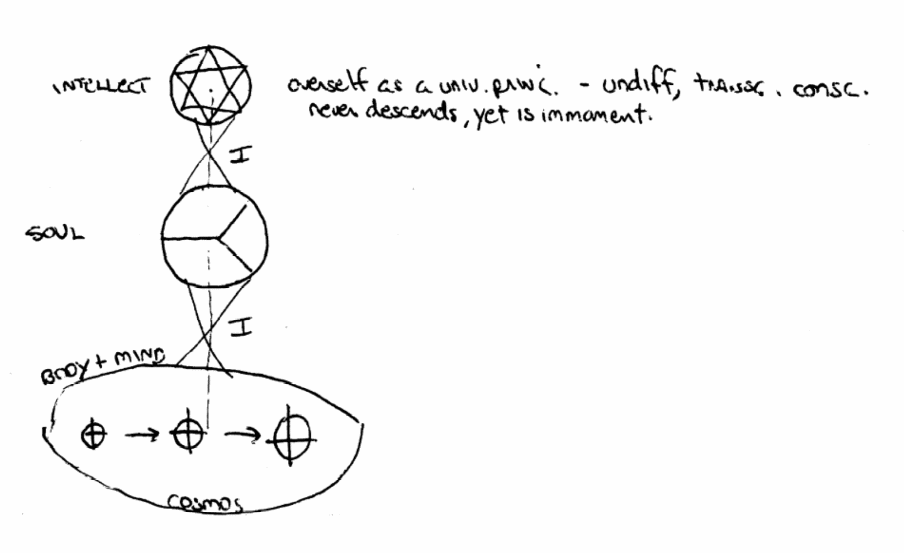
Class
Friday, July 20th, 1973
Verbatim, unedited transcriptClick the series name to view more
CLASS at Wisdom's Goldenrod, Hector, NY
with Anthony Damiani (AD)
July 20, 1973
JUNG; EPISTEMOLOGY
TOPIC: Jung
SUBJECT: Epistemology
SUBSUBJECTS: "Spirit and Life," Psychology, Psyche, Ego, Senses, Self, Sensation, Free Will and Determinism
CONTENTS:
Reading Jung, "Spirit and Life"
Establishing the context – Jung operates in psychology
Jung: consciousness is a state of association with the ego
Jung is establishing knowability of object, not its existence
Differentiating psychology and epistemology
For Jung, critical point is ego, for AD, critical point is consciousness
Common sensorium
Tension between internal world of images and external world of objects eventually produces feeling of self
Ego–what is it?
No clear definition of ego in Jung's writings
Ego as postulate for purposes of empirical psychology
Ego-consciousness as synthesis of various sense-consciousnesses
Senses as entrances and exits of knowledge
Evolution
Self
Self guides dreams, manipulates repressions
Jung was careful about what he offered to the public
Life/Psyche as ordered sequence of images
Studying the vision of a great man will transform you
Samkhya
Living being
Jung: There is nothing that is directly experienced except the mind itself
Sensation undefined until tied to an image
Transcendental truth learned in the empirical world
Jung developing a philosophy of psychology
Discussing esse in re, esse in intellectu solo, esse in anima
Jung's standpoint is esse in anima, being in the soul, the image in your imagination
Jung: it is a matter of fate what principle will rule our attitude
Did you choose to go on the Quest?
Free will vs. determinism, students present different views
Free will vs. determinism might not be answerable by intellect
Both freedom and determinism seem to be somehow present
Vedanta: no origination of perception/cognition, it's all maya, the only problem is ontology or metaphysics
BOOKS READ FROM OR REFERENCED:
C.G. Jung, CW 8, The Structure and Dynamics of the Psyche, "Spirit and Life", "On the Nature of the Psyche"
James Mark Baldwin (ed.), Dictionary of Philosophy and Psychology, Vol. 1
Paul Brunton, The Hidden Teaching Beyond Yoga
Joseph B. Wheelwright (ed.), The Reality of the Psyche: The Proceedings of the Third International Congress for Analytical Psychology
Carl Jung, Aniela Jaffe (ed.), Memories, Dreams, Reflections
Elisabeth Haich, Initiation
Paul Brunton, The Wisdom of the Overself
DIAGRAM appended to this transcript:
- FIGURE 1973 0720-1-AB. Three Circles Diagram: Divine Intellect, Soul, Psyche.
Other diagrams also referred to are not with this transcript version. [Transcriber note: [diagram] means the speaker is referencing a diagram as he or she is speaking. If someone is drawing or writing, with audible sounds of chalk on a blackboard, I indicate this by [drawing] or [writing].]
NOTES:
- This class is part of a series of classes where Jung's essay "Spirit and Life" is discussed. See also WG Classes 1973 0713, 1973 0803.
TRANSCRIBED Verbatim by IT 2023. Archival verbatim transcript – V11a.
AUDIO FILES: 1973 0720a, 1973 0720b, 1973 0720c, 1973 0720d.
1973 07/20 at Wisdom's Goldenrod
Jung; Epistemology
[Audio File 1973 0720a Begins]
AD: Is there a Latin dictionary behind you, Ella May?
EMD (faint): Nobody can hear you.
AD: Is there a Latin dictionary behind you? [12¼ second pause] Tim, would you look up in the Baldwin dictionary? [Note: Dictionary of Philosophy and Psychology, three volumes, edited by James Mark Baldwin.]
[24½ second pause while someone draws]
S: Being in the soul and being in the intellect. [13 second pause while someone draws] Being in the soul.
S (faint): And he (talked) about the [couple words inaudible] of being.
AD: What was that, page 319, 20? Let's pick up at 608. Let's pick up at paragraph 608. [short pause] That's in the "Spirit and Life" essay. [11 second pause] See if you could clarify in your mind tonight something about epistemology, huh?
[short pause]
S: Oh, Tony? What he's got is a little bit different to the middle one, the second one. The--
AD: Solo?
S: Yeah, alone.
AD: Yeah, yeah. Same thing. He just wants to be very accurate and show you that he knows [student assents] his Latin. Scholastics. [student assents, very faint] But-- [short pause] Alright, would you read, somebody, from that paragraph, start that paragraph?
[10 second pause while someone draws]
C.G. Jung [CW 8, The Structure and Dynamics of the Psyche, "Spirit and Life," p. 322, paragraph 608, S reading]: "Let us now take a less simple example. We hear an indistinct sound the initial effect of which is no more than a stimulus to listen in order to find out what it means. In this case the auditory stimulus releases a whole series of images which associate themselves with the stimulus. They will be partly acoustic images, partly visual images, and partly images of feeling. Here I use the word"image" simply in the sense of a representation. A psychic entity can be a conscious content, that is, it can be represented, only if it has the quality of an image and is thus representable. I therefore call all conscious contents images, since they are reflections of processes in the brain."
AD: Alright, what's the first thing we notice about this paragraph? [9 second pause] The first thing of course is when he says let's take a simple example, we hear an indistinct sound the initial effect of which is no more than a stimulus. The very first thing we have to notice, we have to put this up in the diagram, right? In other words, he takes for granted the world-image and the body in that world-image, ok? That's the very first thing you have to understand. In other words, you have to put this example in the context, and that context declares to you immediately from where he's operating. [short pause] Do you follow, huh? Ok? [15 second pause] Then he goes on.
C.G. Jung [CW 8, The Structure and Dynamics of the Psyche, "Spirit and Life," p. 322, paragraph 608, AD reading]: "…the auditory stimulus releases a whole series of images which associate themselves with the stimulus."
AD: Alright, so here's a whole series of images. [drawing] Let's imagine a whole series of images in the psyche of this person. And they get released when this-- if we follow Western psychology, when that stimulus makes contact. And he says they'll be partly acoustic, visual, and images of feeling. And here, he says--
C.G. Jung [CW 8, The Structure and Dynamics of the Psyche, "Spirit and Life," p. 322, paragraph 608, AD reading]: "…I use the word"image" simply in the sense of a representation. A psychic entity can be a conscious content, that is, it can be represented, only if it has the quality of an image [AD: Alright, yes.] and is thus representable. I therefore call all conscious contents images, since they are reflections of [AD adds: the] processes in the brain."
[short pause while AD draws]
AD: In paragraph 610--
C.G. Jung [CW 8, The Structure and Dynamics of the Psyche, "Spirit and Life," p. 323, paragraph 610, AD reading]: "[In this way] we can form an idea of the nature of the psyche. [AD: Period. And] It consists [AD: That is, the psyche consists] of reflected images of simple processes in the brain, and of reproductions [AD reads: reproduction] of these images in an almost infinite series. These images have the quality of consciousness. The nature of consciousness is a riddle whose solution I do not know. It is possible to say, however, that anything psychic will take on the quality of consciousness if it comes into association with the ego."
AD: Now, let's understand that part, ok? We have here all these images. [drawing] And if they come into association with the ego, and the ego is bodily defined, you know, somatic-- If these images come into contact with this ego, they take on the quality of consciousness. Now the images per se, therefore, are not in themselves conscious. In other words, the-- the stills in the slide camera, or the-- the film per se does not have a quality of consciousness, it's just an image. You follow this distinction, huh? Now, again, the psyche is composed of these images. These images in themselves assume the quality of consciousness when they come into association with (an) ego.
S: (That's it.)
RC (very faint): He said they occur with the idea of consciousness. [few words inaudible] to be conscious?
AD: Yes.
S (very faint): [few words inaudible]
AD: You could interpret it that way. Yes Anna.
AP: Well that, when-- when he makes this [few words inaudible] is consciousness that way, that's the ego [AD simultaneously: Uh-hm.] [one word inaudible] and, it sort of protects [one word inaudible] It is in luminosity that carries in through ego. Contact with the ego?
S: Power.
[9½ second pause]
AP: That-- I (already looked/will look) up the part.
AD: You would what?
AP: I looked up the quote or the-- the part. Remember which part that was?
AD: No. Even if I did I wouldn't try to remember it. I want you to concentrate on this here. Don't bring in any-- any other material right now. Just make out that you're walking a straightway, you know, a straight edge, and you're 500 feet up in the air. And if you don't walk this rope you're going to fall down and get killed. Ok, just think like that for a moment, alright? Because we're going through almost like a maze, and if you don't hold onto that thread you're going to get lost. This we call the world-image [diagram], [AD hits board] alright? You're right there, this body is right out in the world. And he says let's take an example. Soon as he says let's take an example you're already in the world. Your body is already in the world. So the example is already starting taking this image for granted. [drawing] Ok? So the whole question of epistemology is thrown out the door.
S (faint): Yeah.
AD: Alright, you follow? Don't be agreeable. Did you understand what I said?
S (faint): (Do that again, it's) too late.
S (very faint): [few words inaudible]
AD (simultaneously): Huh?
S: Too late.
AD: Too late, ok, too late. Sure, we're right in psychology, we're right in the middle of psychology, there's no question of philosophy, epistemology, or anything like that, do you follow? He goes over [couple words inaudible]
S (very faint): Well that was a long time ago.
AD: Long time ago? Ok.
S (very faint): Yeah a long time ago. (bit of laughter)
AD: Now, what we have to be-- what we have to distinguish and understand very clearly, he's saying is that these images only when they come into contact with that ego-consciousness, alright, have this quality of consciousness attached to them. And now these images-- in other words, like when you take the-- when you take the film and you unfold it and let's say it falls on the screen, alright, only when that light is shining does that seem to be lit up. So it gets associated with the light, with the-- with the lens and consequently it has the appearance of consciousness.
C.G. Jung [CW 8, The Structure and Dynamics of the Psyche, "Spirit and Life," p. 323, paragraph 610, AD reading]: "It is possible to say, [however], that anything psychic will take on the quality of consciousness if it comes into association with the ego. If there is no such association, it remains unconscious."
AD: That is, you don't know about it. So you could have a lot of images here [diagram] let's say, ok. But, if they don't come into contact with the ego-consciousness, they just don't appear, they don't manifest. Alright?
C.G. Jung [CW 8, The Structure and Dynamics of the Psyche, "Spirit and Life," p. 323, paragraph 610, AD reading]: "Only those objects upon which the cone of light falls enter [AD reads: enters] the field of perception. An object that happens to lie in the darkness has not ceased to exist, it is merely not seen. So what is unconscious to me exists somewhere, in a state which is probably no different from what it is when seen by the ego."
AD: How about that, I mean, we got that very clear?
S (very faint): Yeah.
RC (very faint): And it's like if the film's on but you're not watching it.
AD: Again, Randy?
RC (faint): It's sort of like if you had a movie and the film's going but you're not watching it. And then it's just automatic [couple words inaudible]
AD: Alright.
S: But you can never say that as a definite statement, from the ego's point of view. You could never say that what the ego doesn't see is the same as it would be if the ego saw it because the ego doesn't see it.
S (very faint): That's not (true).
AD: Well, what is the main point he's trying to establish here? Is he try-- is he-- he's trying to establish here is the knowability of the object, not its existence. In other words, the existence is not something that consciousness makes possible. It's just its knowability.
S: [one/two words inaudible]
AD: Yeah, Herbie?
HS (very faint): Honestly I don't see how you can-- well, because it's in a epistemological-- it seems to be somewhat epistemological, all that--
AD: What is epistemological?
HS (very faint): [one word inaudible] he's talking about, I mean that seems to me how an individual knows (something. And) both-- I think there's a distinction between that and-- and the sort of psychological.
AD: Well now you're talking about the whole paragraph, what we've [HS assents, very faint] been doing. [short pause] If we wanted to speak about epistemology, the ordinary way of epistemology is usually to say-- you try to conceive-- now, this is the way we work, you try to conceive that there's no subject, alright, there's only the object, that is, the world. And then you try to understand how a subject can perceive that world, how-- how it's possible to know it.
HS (faint): Ok, well--
AD: There's no question here that something is known.
HS (very faint): Oh you already know there's a world there.
AD: Well we take for granted. We take it for granted because he starts off by opening it, he says--
C.G. Jung [CW 8, The Structure and Dynamics of the Psyche, "Spirit and Life," p. 322, paragraph 608, AD reading]: "We hear an indistinct sound the initial effect of which is no more than a stimulus…"
AD: And he tries to describe the process of how we get to know that which is out there. But this is already taking for granted that the world-image is there. You're already in the world. To talk about how we could know it, you know, how is it possible for us to know the world, is already too late. You're not discussing epistemology.
HS (very faint): But you're talking to know [couple words inaudible]
AD (simultaneously): Epistemology concerns how it is possible for any experience to arise. Alright? What are the conditions that make it possible for us to have experience. He already assumes it. There's already a world there.
JL (faint): Yeah he starts where epistemology leaves off, yeah. And--
AD: Alright, and that's the distinction I want you to keep in mind. See 'cause he's starting in psychology and he's safe.
JL: Well, doesn't it-- On the one hand he does talk about in a sense knowability of living as determined by-- by the intention of the ego. But on the other hand he's asserting that-- that the image is not a-- an objective existence apart--
AD (simultaneously): Independently of that knowing.
JL (simultaneously, faint): I know that. Yeah.
AD: Yeah. So that-- exactly that's the point. You're saying that, if, let's say, this room here, alright, is the unconscious. And I'm only looking at this here. The cone of light lights this up, makes this known, it's manifested, alright? But that doesn't mean that that ceases to exist, that's still there. As soon as the searchlight goes there then I see that. So it's what the conscious ego operates with is knowability, it gets to know this or that or the other thing. But it says nothing about the existence of this. The fact that I get to know something or discover it doesn't mean that before I discovered it it didn't exist. Ok? So, if you understand that, then we go on to the next point.
S: Well, how could we-- how can we answer someone who would say that-- that Jung is doing epistemology, because he's taking-- he's taking what he thinks is right in that he takes the subject as he knows it, looks at an object, and-- and follows the physiology back to the brain and all that. How could you explain to them that, you know, they haven't taken the presuppositions of-- of the knowing of, you know, the fact that he's presupposed the whole body in the world, and-- and that-- that that--
AD: I just explained how, what the difference is between psychology and epistemology.
S: I understand what the difference is but how-- but how could you explain to someone whose taken that point of view that they've missed the point in (figuring) out his presuppositions?
AD (simultaneously): Well, what do you want me to do?
S: Tell them to read the Hidden Teaching.
AD: Well you could read any textbook on epistemology, that's what epistemology's about--how we know what we do. What are the conditions that make experience possible. If I have to go into a definition of epistemology then, you know, I'd set up a summer course and charge for it. (bit of laughter) This man is quite orientated Kantian-wise, you know, so he's not exactly a fool but-- I'm just trying to make you aware of the way he's working and very deliberately. Now the next sentence of course, 611, I can't-- I can't buy. I cannot understand consciousness, or what the meaning of consciousness is by saying--
C.G. Jung [CW 8, The Structure and Dynamics of the Psyche, "Spirit and Life," p. 323, paragraph 611, AD reading]: "Consciousness can therefore be understood as a state of association with the ego."
AD: That doesn't explain to me what consciousness is. It just tells me one of the conditions that make it possible for me to deal-- to be able to speak about it. But to say that I understand it, that's nonsense. Again we get back to his favorite theme.
C.G. Jung [CW 8, The Structure and Dynamics of the Psyche, "Spirit and Life," p. 323, paragraph 611, AD reading]: "[But] the critical point is the ego."
AD: I would say the critical point is consciousness, but he says it's the ego.
C.G. Jung [CW 8, The Structure and Dynamics of the Psyche, "Spirit and Life," p. 323, paragraph 611, AD reading]: "What do we mean by the ego? For all its appearance of unity, it is obviously a highly composite factor. It is made up of images recorded from the sense-functions that transmit stimuli both from within and from without, and furthermore of an immense accumulation of images of past processes."
AD: So we get this kind of a picture little by little coming up. Here's the world [diagram]. It's not much of a world but this is the world-image. And this is the fellow who lives in this world, has all kinds of experience, [drawing] and he's accumulating a lot of these images, alright. Now, when I draw the psyche like that, I mean don't-- you know, it's not literal. Actually I can't draw the psyche. I mean it's pretty hard to say, you know, what size an image is, where it-- So it's just-- it's just a figurative, literal way of (seeing/speaking). Like if I look at Randy and I say, look at that halo around his head, all his psychic images are in there, you know, you'd laugh. So try to keep that idea that these things [AD hits board] cannot be grasped with the fingers. Alright, he says that this ego here, this entity, seems to record experiences in terms of these images which flow into-- into this vast-- what shall we call it, laundry bag?
S: Garbage bag?
AD: Laundry bag. And we refer to this sometimes as the sensorium, the communal sensorium. And, we perhaps-- [drawing] maybe we all have a role in it, you know, there's a lot of heads sticking in it, you know? Alright, we all seem to share in it. That's-- that's possible and then when, let's say-- [drawing] let's say these five people see an object in common, alright, certain images which are in here will be projected outwardly onto this object. This person may not a-- may not project that image, he may project a different image, but these images will all come from in here [diagram]. Alright? Now notice-- notice the way he's setting up the stage. On the one hand, you have the world out there, the external world, ok? And, [drawing] on the other hand you have the internal world of images, psychic images. And in between you have to try to find out where you stand. [drawing] Because the world-image of which you are, so to speak, more or less aware of, is the external, the-- the world of images within is the internal, and the tug of war between these two, the tension that, you know, builds up eventually forces or enhances let's say this feeling of there being a self somewhere in this whole business.
S (very faint): Yeah. And you're trying to pull that--
AD: Louder Dave.
S (faint): Yes, when you're trying to [one/two word inaudible] in a sense that you [one/two words inaudible] existed in all of like Jung's view? In other words, doesn't Jung say world-image or are you assuming like a self in a world (in/and) (a sense) of like an external world?
AD: I'm assuming the existence of an external world with "physical objects" in it, alright, quote unquote, and I'm assuming the internal world that the individual has to work with. In other words, when you perceive an object, a physical object, at the same time this inner process goes on where you-- you could, so to speak, project onto that object certain inner qualities that are within you, alright.
S (faint): Ok, and you're assuming that the--
AD (simultaneously): And these two worlds almost exist, let's say, together, in a state of togetherness, for most of us.
S (faint): Like this individual internal world and the individual inner world is part of that (living) [one word inaudible] or (what)?
AD: I'm going to leave that question unanswered. For the simple reason, Dave, that if I answer that question then you dissolve the distinctions and before you know it we're right back where we started, whereas by working with the distinctions and the conflict, alright, we can try to put our hands on what's happening. Always be careful when you-- the mistake where you want to abolish distinctions.
S: Tony? Are these images presented to the ego or-- or is the ego made up of these images?
AD: Well, they seem to be both. He says on the one hand, and he-- he's talking-- he talks about this in a little while, it seems that the ego, or the ego-complex, is a totality composed of all these images. On the other hand he speaks of it in a little different way, let's go on, we pick that point up.
C.G. Jung [CW 8, The Structure and Dynamics of the Psyche, "Spirit and Life," p. 323, paragraph 611, AD reading]: "What do we mean by the ego? [AD adds: And] For all its appearance of unity, it is obviously a highly composite factor. [It is] made up of images recorded from the sense-functions that transmit stimuli both from within and from without, and furthermore of an immense accumulation of images of past processes. All these [multifarious] components [AD: All these pieces, all these parts.] need a powerful cohesive force to hold them together, and this we [have] already recognized [AD reads: recognize] as a property of consciousness."
AD: Well, I didn't recognize it. I don't know what that means. I don't know that in consciousness that there is such a cohesive force. You know, like the-- the question mark I put next to this is (annoyance/a noise), because this whole thing becomes very philosophical in a little while. It seems-- it might be my blockage but it seems that every time he uses the word 'consciousness' I have all kinds of difficulty understanding precisely what he's saying. And, I don't know, there's another book missing, Reality of the Psyche, where I was working. I wrote some notes down. But there again the author of that-- of the article in there, "The Subject as the Ego", also runs into this enormous difficulty of trying to understand what it is that Jung means by ego. [Note: The Reality of the Psyche: The Proceedings of the Third International Congress for Analytical Psychology, Joseph B. Wheelwright, editor, Chap. 6, "The Ego as Subject", by K.M. Abenheimer.] There's no clear definition in Jung's writings.
C.G. Jung [CW 8, The Structure and Dynamics of the Psyche, "Spirit and Life," p. 323, paragraph 611, AD reading]: "Consciousness therefore seems to be the necessary precondition for the ego. Yet without the ego, consciousness is unthinkable. This [AD reads: The] apparent contradiction may perhaps be resolved by regarding the ego, too, as a reflection not of one but of very many processes and their interplay…"
AD: Alright, it seems here he seems to be saying something to the effect that the notion of the ego is really a hypothesis, or let's say a postulate for the purposes of empirical psychology. But that if we actually went to look for such a thing we'd have trouble finding it.
[short pause]
C.G. Jung [CW 8, The Structure and Dynamics of the Psyche, "Spirit and Life," pp. 323-324, paragraph 611, AD reading]: "…in fact, of all those processes and contents that make up ego-consciousness. Their diversity does indeed form a unity, because their relation to consciousness acts as a sort of gravitational force drawing the various parts together, towards what might be called a virtual centre. For this reason I do not speak simply of the ego, but of an ego-complex, on the [proven] assumption that the ego, [AD reads: assumption of it] having a fluctuating composition…"
AD: Alright. How about this paragraph now, is it very clear what he's saying here, even the misunderstanding. Yeah.
AB: Could-- could we say according to what he said, that the ego is just another image but it's like a more encompassing image that encompasses the--
EMD/S(?) (simultaneously, faint): Louder please.
AB: Could we say that the ego is just a larger image that encompasses all these smaller images within it?
AD: Well not from what we read so far.
S: Also that the group of images as well as this association with consciousness which has the powerful cohesive force.
AB: But he said it's the reflection of not one but of many processes and I thought before he said that these other images were also reflections of a process. So I'm saying (where) we could define--
AD: Well, where before does-- See as of yet, as of yet, the notion that you're entertaining I don't think is up-- up to this paragraph, I don't see it yet. [short pause] It's the next paragraph where he brings up the question, 612.
C.G. Jung [CW 8, The Structure and Dynamics of the Psyche, "Spirit and Life," p. 324, paragraph 612, AD reading]: "This view of [AD reads: The view as] the ego as a composite of psychic elements logically brings us to the question: Is the ego the central image and thus the exclusive representative of the total human being? Are all the contents and functions related to it and does it express them all?"
AD: Alright, and he says no right off.
AB: But can we say that the ego is an image? That was the nice part above.
[short pause]
AD: Can we say that the ego is an image? Now tell me what you mean by image.
AB: Well, seems that an image is a reflection of some sort of process. [short pause] And, likewise I thought a reflection of these images might also be an image.
AD: The ego is a reflection of these living processes?
[short pause]
S: But isn't that the question that he brings up in 612--is the ego the central image?
[11 second pause]
AD: Try again.
AB: The way I understood the way he was using image is that the image is a reflections of a-- of a-- first of all the physiological process in the brain in the psyche. And-- and that is the unit that we work with psychologically.
AD: These are the units we worked with, yeah.
AB: Psychologically. Now-- or in the psyche. Now he also then says that the ego-complex could be seen as a reflection of all these images that are within the sphere of consciousness. So I thought then maybe we could also say that the ego-complex is itself an image, although it might not be the central image.
AD: Well that's what he do-- that's what he goes on and says but-- I don't know what you would mean by an image, I have an idea what he means by that.
AB: Well I'm not so sure (actually).
AD: If you think of it in terms like a totality, you know, of a lot of other images. In other words, could you say-- when I say that-- when I refer to your ego, you can say that your ego consists of the totality of all the experiences you had? The sum of all the experiences you had, would this be the ego?
S (very faint, possible bleed through from another class): Yeah.
AB: Not just that.
[17 second pause]
AD: Well let's see how he works it out, alright. He says no.
C.G. Jung [CW 8, The Structure and Dynamics of the Psyche, "Spirit and Life," p. 324, paragraph 613, AD reading]: "The ego is a complex that does not [AD reads: complex, it doesn't com-- does not] comprise the total human being…"
AD: And he gives the reasons for it here. [short pause] Points out that it's only a fragmentary complex.
C.G. Jung [CW 8, The Structure and Dynamics of the Psyche, "Spirit and Life," p. 324, paragraph 614, AD reading]: "But is not every cohesion of psychic parts consciousness?"
AD: I don't know what that means again.
[10¾ second pause]
S: He's going around in circles with the ego and consciousness.
AD (simultaneously): I don't-- I-- I (don't know/go on).
S: His first-- in 611 he defined-- he said that the unity of the ego is derived from the gravitational force of consciousness. And now he's suggesting that the inner cohesion of the ego-complex gives rise to consciousness in this 614.
AD: Yeah well, what do you think that means?
C.G. Jung [CW 8, The Structure and Dynamics of the Psyche, "Spirit and Life," p. 324, paragraph 614, AD reading]: "[But] is not every cohesion of psychic parts consciousness?"
BS: Let's assume-- (Figure) that would be a content of consciousness, the inner cohesion. I think it would [one word inaudible] consciousness from the fact that there is an inner co-- inner cohesion.
S: Ok.
S: But (that/then) you--
AD (simultaneously): But what-- what he seems to be saying is something like this, suppose-- suppose I have a certain experience and from that experience I have a certain memory image, then I have another experience, and that too has a certain image behind it. Now they cohere together, alright, and they-- their cohesion, so to speak, or their-- their being put together brings up the notion of consciousness or the way he puts it here, the cohesion of psychic parts--
C.G. Jung [CW 8, The Structure and Dynamics of the Psyche, "Spirit and Life," p. 324, paragraph 614, AD reading]: "[But] is not every cohesion of psychic parts consciousness?"
AD: In other words, if I stitch together these psychic impressions, I will get consciousness? Again I ask you to consider very carefully because on the one hand, he certainly has a very profound understanding, on the other hand, philosophically I could get more and more skeptical the way he uses that whole term. Well we won't get stuck there but I'd like you to think about that and what he might mean by the psychic parts, the cohesion of psychic parts produce consciousness 'cause he's going to give an example of that.
S: Well, Tony, could he mean [S: Is it (one word inaudible)] like the cohesion of psychic parts in the ego-complex is in some sense cause by which it causes gravitat-- gravitational force of consciousness. And he's saying perhaps the-- any time you find a complex, it is a complex because consciousness, this gravitational force of consciousness has drawn it together. [AD simultaneously: Well again--] It's-- it's as if every complex had a mind of its own.
AD (simultaneously): Again it's the same thing-- it's again the same thing. On the one hand it's a precondition and on the other hand it's a post hoc conclusion.
S: I'm just trying to figure out what he means by that. And, you know, just to throw out the opposite alternative from the one I threw out a minute ago.
JL: I don't know that he means something affirmative at all is what I was asking about his approach to (the--/this.) [student assents, faint] Because [couple inaudible student words simultaneous with JL] [one/two words inaudible] in-- in the-- in the paragraph 614 he comes to a different conclusion.
S: But he goes on about this point of other consciousnesses quite a lot in this essay.
S (faint): Yeah.
AD: Well let's try to follow the whole paragraph.
C.G. Jung [CW 8, The Structure and Dynamics of the Psyche, "Spirit and Life," p. 324, paragraph 614, AD reading]: "It is not altogether clear why the cohesion of a certain part of the sense-functions [AD reads: of certain parts of sense-function] and a certain part of our memory-material should be consciousness, while the cohesion of other parts of the psyche should not. The complex of seeing, hearing, etc. has a strong and well-organized inner unity. There is no reason to suppose that this unity could not be a consciousness as well. As the case of [the] deaf and blind [Helen] Keller shows… I therefore think of ego-consciousness as a synthesis of [the] various"sense-consciousnesses," in which the independence of each separate consciousness is submerged in the unity of the overruling ego."
AD: If we try to make an-- if we try to make a diagram of it, let's say you have one consciousness, eye-consciousness, ear-consciousness, nose-consciousness, alright, taste, [drawing] alright. Now let's not imagine-- let's not im-- let's try to imagine it this way. There's an eye-consciousness, alright, there's an ear-consciousness, a nose-consciousness, and each one functions, so to speak, without any notion of an ego. Now if we could imagine these entities operating on their own and then some-- the possibility that the eye-consciousness and the ear-consciousness coagulate together producing some sort of super-unity, and then these two coagulate and produces a third unity, alright, till finally you get something where there's an overriding idea that rules over all these consciousness, I think this is what he's saying.
C.G. Jung [CW 8, The Structure and Dynamics of the Psyche, "Spirit and Life," p. 324, paragraph 614, AD reading]: "I therefore think of ego-consciousness as a synthesis of [the] various"sense-consciousnesses," in which the independence of each separate consciousness is submerged in the unity of the overruling ego."
AD: Boy, that makes you like a ch-- [S: Right.] well, chamber or parliament, right, like [student assents] Congress, [S simultaneously: (Go ahead.)] 164 [AS simultaneously: Well--] members, each one's claiming to be an "I".
S: Uh-hm.
AS: But it seems to bring up a very good problem there because maybe these could possibly function perfectly and then maybe the eye could be conscious of something and the ear could be like a different-- sort of almost like a different entity operating within you and then-- [AD simultaneously: Yeah that's why I--] [couple words inaudible] get together.
AD: Yeah that's why I say, well maybe they never did get together, maybe actually the way the situation is with us is that there's so many I's in us, you know, that it's kind of hard to establish rulership over them. Did you ever notice, you say I'm going to do this and then ten minutes later another "I" comes along and says, "No, I'm going to do this." And then a third "I" comes along and says "We're not going to do any of that, we're going to do this." [chalk on board sounds] [students assent] That's a possibility, I mean--
S (faint): Got (to connect them/a connection).
S (faint): Yeah, it seems-- it seems like in most people he's talking about the thing that is conscious, the cohesive force, and in a way it's almost implying [three words inaudible] and he says it's-- seems like consciousness is the precondition for the ego. Then there's some other times where he's-- where he's showing that something [one word inaudible] will not become conscious if it's not functioning-- if-- in other words it'll project it [three words inaudible] that I've got (something) next time. If it somehow can't relate to the ego contact as it is, oh you describe-- in a sense he isn't compatible with it. Now it just seems like right there he's going to-- you know, you're in a bind in other words-- is talking about the way the partial consciousness on the one hand and they-- there has to be some kind of total consciousness underneath it, presupposing both a partial consciousness and the ego which is-- which is going to accept and reject that (content/consciousness).
AD: Alright, then suppose-- suppose we go on the assumption, give him the benefit of the doubt that he's working empirically and trying to build up the unity of the ego as the result or the synthesis of these various isolated conscious processes that are brought together, so to speak, ok? We'll just try to follow him empirically because certainly we see-- like in astrology we do that. You notice that an idea comes into your mind and gradually takes possession. And, if it has any emotional affect or over, you know, compulsion, it gets integrated, becomes part of your way of functioning. Now in the same way that let's say an ideational component of a personality gets brought into the personality and becomes part of that personality, at a more-- at a-- at a level of thinghood, we can see sort of sense-consciousness or various consciousness resulting from the functioning of certain organs becoming assimilated and part of that ego.
So it's very possible, let's say-- let's look at it this way. [S: Yeah.] Suppose a new sense starts operating in you, sense number eight, ok, just for the sake of talking. And in the beginning you have a difficult time integrating it, you know, making it part of the personality. Right, and it takes (all --) oh, let's say that you're developing clairvoyance, alright. And, you have no idea of what's happening and you keep getting images in the mind and you keep perceiving things that you can't relate, you know, to the world around you. But you begin to notice that they are more and more accurate and they start portraying actual objective situation. Now, this functioning of this power, alright, will take many many years before enough experiences have accrued so that you can integrate it, bring it into yourself and relate to it in a more direct fashion. But in the beginning it seems like you're some sort of monster, you know. There's all of this, and there's this little part of you working all by itself, you know, getting images and seeing things. And you say, "What does that mean?" you know. [student assents] Like it's not like your nose when you smell something, alright, let's say you smell a rose, you see the red color and all that, it's not integrated in that whole configuration but it seems to be outside that whole framework you're operating with.
S: But does that function have consciousness or do you blend it?
AD: Well he says that the functioning of the sense or the functioning, the-- any functioning of any organ is reproduced, alright-- that is, it gets reflected in consciousness, and that reflection is what he's working with. In other words, that reflection is an image and it builds up in, you remember, the top of the head, and those images as they pile up they become the empirical material with which he'll be able to operate, this person, when he, let's say, integrates that new sense-functioning. You see the picture he's building up. In other words, what he's building up is a picture like this here. If this is the world-image [drawing] out here, and you're a little amoeba and you see only part of the world-image, and then you grow up and you get a trunk and you see the green and the yellow, and then you get a brain and you get-- In other words, as this synthesis of various isolated functions of consciousness or reflective consciousness get integrated into some kind of unity, and he calls that ego a mystery too, you know, why does (it relate) like that? Then the-- the discovery of the external world, alright, gets-- becomes more and more obvious but, on the one hand, this world is causing that sense-organ to come into function, and on the other hand, as this sense-organ comes into function, reflects the process or the image of that function and builds up a reservoir of images in the psyche, then these images go out and relate to that object again. So it's a kind of give-- mutual reciprocal relationship in-- in terms of these two. That's what I meant when I said last week, that unless you understand what is meant by the senses as the exists and the entrances of knowledge, you don't understand epistemology, you're caught up in a bag, so to speak.
[short pause]
S (very faint, possibly part of background): Well go get 'em, Andrew.
S (very faint, possibly part of background): Why didn't you say so.
RC (very faint): So in this case of [couple words inaudible]
AD: Go on Randy.
RC (faint): But making the senses as the exists and the entrances of knowledge, I'm trying to put like some kind of value on (these subtle) images, the way they were trying to-- how did it relate to that world (knowledge).
S: Go ahead.
RC: I mean--
S (very faint): What's external?
S (very faint): (Yeah it's confusing.)
AD: (Well/Yeah), sure it's confusing. I told you that you're going to have-- it's like walking a tightrope right now.
S (very faint): Yeah. People have an idea that--
AD: He says it's confusing, I says it is very confusing. There are very few people who can understand and schematize in their mind, combine the whole of this schema that we're putting up. You know they'll-- like one writer will say, well we believe in realistic psychology and they go on-- realistic epistemology and they go on, another one says idealistic. Alright but, if you notice, he goes back to this page in paragraph 624.
C.G. Jung [CW 8, The Structure and Dynamics of the Psyche, "Spirit and Life," pp. 327-328, paragraph 624, AD reading]: "What we know of the world, and what we are immediately aware of in ourselves, are conscious contents that flow from remote, obscure sources. I do not contest the relative validity either of the realistic standpoint, the esse in re, or [of] the idealistic standpoint, the esse in intellectu solo [AD reads: the esse in intellectual]; I would only like to unite these extreme opposites by an esse in anima, which is the psychological standpoint. We live immediately only in the world of images."
AD: Now in case-- in case you think that you're going to read through this man, I warned you you're mistaken. His bibliography, you just look in the back of one of his books and look at his bibliography, and if you don't stagger, you lack humility.
RC (faint): But for him, I guess-- from the perspective that we're talking we can talk about these images as appearing to the inner senses, the same senses which in fact [one word inaudible] the--
AD: The images appearing to the inner senses, now tell me what you mean.
RC (faint): Well we talk about the subtle sense organs (and/then) going through the-- well, through the ear or through the eye, operating through the ear [one/two words inaudible]
AD (simultaneously): Well tell me, when you perceive in the dream an image, do you perceive it in the sense-organ?
RC (faint): Not in the physical senses.
AD: I said in a dream. Where do you perceive it, in a sense-organ?
RC (faint): I think they're either in the sense (that) I perceive essentially in a physical world-- physical world.
AD: Alright, let's stop there. Epistemology is your problem too. [short pause] Paragraph 618 shows you what he's attempting to do. And if you (all) don't see that, you miss the whole point in this essay. And also "The Nature and Psyche"-- "The Nature of the Psyche". [Note: C.G. Jung, CW 8, The Structure and Dynamics of the Psyche, "On the Nature of the Psyche".] Let's go back to where we were.
[15½ second pause]
S (faint): Randy, which is--
AP: Can I [AD simultaneously: Go ahead.] see if I understand what you-- (I still matters) that, you know, besides the world-image, and when we speak of that we can also say the senses are exits of knowledge.
[Audio File 1973 0720a Ends]
[Audio File 1973 0720b Begins]
AP (faint): --according to that.
S (faint): That's right.
AP (faint): Is that what you mean I guess is my question here.
AD: Well, that's part of what I mean Anna, it's much more than that. What's important right now is that you grasp this distinction. The externally given world, the appearance, ok, the internally given world, the world of psychic images. And, the interaction that takes place between these two produces some sort of continuity and unity of these-- of this ego-structure, alright. I'm not trying to resolve that problem now about how to combine those. [short pause] You know, somewhere in one of his letters Jung said, he says "I wrote my books making sure that no fools could read them."
S (very faint): Well then we'll go.
S (very faint): Yeah.
AD: Huh?
S (very faint): Yeah.
AD: Oh. [couple/three inaudible student words simultaneous with AD] PB also says the same thing, PB says "I've buried my truths deeply hidden." You think these people are going to put it on a silver platter for you, you're mistaken. Alright, where were we, paragraph 614, huh?
S: Uh-hm.
AD: Now 615 he goes on. How about 614, wait, did we follow that?
S (very faint): No.
S (very faint): Uh-hm.
S: No.
AD: I heard no, let's go over-- ok then, come on.
S (faint): And I-- I think that-- I was saying how we can think this way, then (conscious will be). I mean--
AD: Well imagine [S simultaneously, faint: (I just see--)] an animal, imagine an animal that has only two sense functions, ok?
S (very faint): Yeah.
AD: Now I would imagine that that would be the absolute minimum required in order to-- for there to be perception. Now this-- an animal that has two sense functions gets duped twice in the world. Then, you can think of an animal that has three sense functions, four and five. Of course we're in the category we're five and maybe ten. Alright, so that's ten different ways we can get deceived. But, for the animal that has two sense functions, let's say that the images that fall into the conscious-- into the psyche of this animal will be dependent upon only those sense functions, right? If he can only see and hear, then he would have no images of taste, no images of touch. Ok? [student assents, very faint] Now this gets, so to speak-- becomes a-- a structuralized energy-complex. That's the way even PB refers to the sense functions. Now if we can imagine that this creature incarnates in another body where now he has three sense functions, the third sense function would be like an entity that's foreign to his personality structure. He hasn't brought that in, alright? Just like for instance on the ideational level, alright, the notion of the Quest is something that you're bringing into yourself, you're beginning to assimilate it. But it's not quite there, you haven't quite made it. And let's say when it does enter fully into you what the Quest is all about, then it becomes the overriding idea and, so to speak, demands obedience from all the other parts of the ego. But take this same analogy and apply it in terms of the sense functions. This creature that has only two senses in another body let's say where there's three senses, that third sense is a new sense. It hasn't learned to manipulate it but it functions. Alright? So let's say he starts getting odors. He doesn't know what it means. Alright? Now this-- these odors that come into his consciousness, or let's say they're reflected images in his consciousness, he has to learn to manipulate and integrate and bring into-- in other words, incorporate it into this mysterious entity that we call the ego. Imagine this process going on, the ego getting wider and wider.
S (very faint): I understand that but why-- he's stressing for the-- the senses [one/two words inaudible] who will try to come through them. You just said (it), he never could see the thing that (he hasn't) [few words inaudible]
AD: Well he certainly seems to imply that, doesn't he?
S (very faint): Yeah he-- but, I don't understand how you can see the senses. Like you're seeing stuff?
AD: Well I don't know if he has experienced it, I'm not that--
S (faint): You mean, the imitation it goes (through). Even if you have [one word inaudible] with that system, like without searching or not searching, they would say (something like) at the lower level for me. (bit of laughter)
S (very faint): [few words inaudible] (more laughter)
S (very faint): [few words inaudible]
AD: Don't you refer to yourself as this body? [short pause] Hm? Come on.
S (very faint): I don't know whether I'm referring to a [one word inaudible]
AD: When you refer to yourself, don't you refer to yourself as this body? Isn't this what's establishing the limits of your consciousness and the way you function?
S (very faint): Yeah.
AD: Well, you can't conceive of an entity, so to speak, referring to itself as the functioning of these two or three senses? What else does a creature think of itself besides it being these sense organs functioning?
S: But you're-- you're speaking consciousness of the senses.
AD: What he's-- In other words, the whole--
S (simultaneously): But not the sense themselves being conscious all by themselves. [short pause] It's like in-- in the examples, like the example of clairvoyance, you become conscious of this new sense operating. But, is that what he's referring to, that-- or is he somehow postulating that the-- this-- the sense of-- of smell is a subject to a form of consciousness.
AD: Well--
S (faint): I would think the point is that-- that there is-- there is a subject in the-- in this kind-- complex that's developing. I think the point that's he's making is that a sense that's developing has a cohesive force around it and that that would be similar to the ego and maybe later gets incorporated but the ego itself is just a particular complex and maybe sense is another kind of complex, I [couple words inaudible]
AD (simultaneously): Alright, let's take this example, 638.
C.G. Jung [CW 8, The Structure and Dynamics of the Psyche, "Spirit and Life," p. 333, paragraph 638, AD reading]: "I would not know how we could ever prove that a consciousness higher or wider than the ego-consciousness exists in us; but, if it does exist, the ego-consciousness must find it acutely disturbing. A simple example will make clear [AD reads: A simplex example of] what I mean. Let us imagine that our optical system had a consciousness of its own and was therefore a kind of personality, which we shall call the"eye-personality." This "eye-personality" has, let us say, discovered a beautiful view and is lost in contemplation of it. All of a sudden the auditory system hears the horn of an automobile. This [AD reads: The] perception remains unconscious to the optical system. From the ego there now follows, again in a way unconscious to the optical system, an order to the muscles to move the body to another position in space. [AD adds: And] Through this movement the object is suddenly taken away from the eye-consciousness. If the eyes could think, they would naturally come to the conclusion that the light-world was subject to all sorts of obscure disturbances."
AD: Now, these are analogies. I don't know if they're going to help us and I don't know if there is such a thing as a creature that has only two senses. I guess those of you that are biology majors should know that. But if you ask yourself what is the purpose of these creatures having only two senses or three senses, why haven't they got five senses, then you don't understand the theory of evolution although you've been touting it for years.
S: Uh-hm.
AD: It's a long process of development. Very long and it takes, you know, considerable length of time. So that, if you can conceive of an entity gradually coming into manifestation, and when he goes from the mineral kingdom to the plant kingdom to the animal kingdom to the human kingdom, you can take Guenon's point of view that the individual as such didn't have to, or you can take the other point of view that says each entity must recapitulate the entirety of the development of the manvantara in order for it to assume that modern consciousness. Now I would-- my guess is that he believes something of this nature, that in our development phylogenetically and ontogenetically we've gone through all this. We've gone through it. And that we've been gradually incorporating more and more of these functions. Now you ask me does an eye-consciousness, is it conceivable to us to imagine what an eye-consciousness would be like, I can't. I just don't know what it means. I can conceive of the possibility of creatures developing one and two sense-organs and then three, alright, or certain characteristics, which by assimilating the functioning of these characteristics, and that assimilation takes place basically through the imagery that, let's say, drops down into their subconscious. And then, that has to be used again. I can see this as a-- what Jung is aiming at and trying to show how the ego develops in this given world. In other words, this world that Jung is speaking about is the uroboros, ok? [drawing] There's the uroboros [diagram] and that eye is in this world. And all-- everything that that eye becomes has to be had from the world. That's why you're in this world, for that eye to develop. [short pause] Come on, Om, sit down. I need my shadow.
OG: I'm not really a shadow.
AD: Well make out you are.
S (faint): Uh-hm. That's true.
OG (very faint): [couple words inaudible] shadow.
S (very faint): [few words inaudible]
S (faint): Well, Tony, isn't-- isn't Jung almost taking a Buddhist point of view to say that-- let's say-- let's say there's a-- a sense-complex developing. Maybe it's not associated with an eye and only later when it comes to be associated with an eye can we say [few words inaudible]
AD (simultaneously): Well, let's say it's similar to the Buddhist point of view. I don't know if he-- if it is the Buddhist point of view.
S (simultaneously): Yeah. I mean--
AD: And which Buddhist?
S: Well, I--
[short pause]
AD: So let's continue.
S: Yeah.
AD: Paragraph?
S (very faint): 615.
S: 615.
C.G. Jung [CW 8, The Structure and Dynamics of the Psyche, "Spirit and Life," pp. 324-325, paragraph 615, AD reading]: "Since ego-consciousness does not embrace all psychic activities and phenomena, that is, since they are not all recorded there as images, the question naturally arises whether there may not be a cohesion of all [AD adds: the] psychic activities similar to that of ego-consciousness. This might be conceived as a higher or wider consciousness in which the ego would be seen as an objective content, just as the act of seeing is an object of my consciousness, and, like it, would be fused with other activities of which I am not conscious. Our ego-consciousness might well be enclosed within a more complete consciousness like a smaller circle within a larger."
AD: Now we're getting a little idea of what he's talking about. You remember-- you remember when we had that example from The Reality of the Psyche about this mold, the way they all come into certain position and there seem to be some entity that was describing or prescribing for that whole mold the en-- the way it was going to develop? And yet it had no center, that is physically, that we were aware of. Remember that example? [Note: The Reality of the Psyche: The Proceedings of the Third International Congress for Analytical Psychology, Joseph B. Wheelwright, editor, Chap. 6, "The Tendency Toward Patterning and Order in Matter and in the Psyche", by Elizabeth K. Osterman.] Well, that was in The Reality of the Psyche, "Patterns and Functions of Matter", which you can look into yourself but, this seems to be what's implied, what's going on here. In other words, insofar that we have an eye-consciousness, a nose-consciousness, and subject to the rule of-- rulership of an ego, and the ego has trouble understanding a lot of its experiences, you know-- Like say, "Dammit, why did it happen to me" just like that eye says, "Dammit, what kind of world is this, this world of light, there's all kinds of changes going on." So the ego the same way says "What's happening to me?" alright and there's this higher personality determining how that ego-consciousness is going to develop. So he's bringing in the notion of a Self little by little. Alright, and he's trying to show basically that it is a necessity of thought, not empirical, you know, but a necessity of thought.
C.G. Jung [CW 8, The Structure and Dynamics of the Psyche, "Spirit and Life," p. 325, paragraph 616, AD reading]: "[Just] as the activities of seeing, [AD adds: and] hearing, [etc.] create images of themselves which, when related to the ego, produce a consciousness of the activity in question, so the ego, as I have said, can be understood as an image or reflection of all the activities comprehended [AD adds: in it or] by it. We would expect that all psychic activities would produce images of themselves and that this would be their essential nature without which they could not be called"psychic." [10½ second pause] It is difficult to see why unconscious psychic activities should not have the same faculty of producing images as those that are represented in consciousness."
AD: And the example here would be like a dead man, alright, there would still be images falling on the retina of his eye. The images would still be formed, although there would be no consciousness of these images.
C.G. Jung [CW 8, The Structure and Dynamics of the Psyche, "Spirit and Life," p. 325, paragraph 616, AD reading]: "And since man appears to be a living unity in himself, the conclusion would follow that the images of all his psychic activities are united in one total image of the whole man, which if known to him would be regarded as an ego."
AD: So, the picture-- the picture is getting bigger and bigger all the time because this little fellow who had a small little psyche, that psyche keeps getting bigger and bigger because if we keep adding on all the processes that he lived through, all the biological functioning-- And even if we said that as a-- even if we wanted to deny reincarnation, ok, and we said-- we could look at it in the-- in the sense that the species of the animal, all that it has gained in terms of experience of the world would naturally be inherited by every individual representative of that species. So there again it would have this bag full of images, you know, this storehouse, this treasure, for all these images.
JL: He makes a statement here that--
[short pause]
C.G. Jung [CW 8, The Structure and Dynamics of the Psyche, "Spirit and Life," p. 325, paragraph 616, JL reading]: "…the images of all his psychic activities are united in one total image of the whole man…"
JL: And then he calls it the ego. I wonder whether, you know, it really is the ego.
S (very faint): That's usually--
S: Well he doesn't say it's the ego.
S (simultaneously): You'd probably have an ego, not the ego.
AS: It's-- it's known to him.
AD: It's known to him let's say he might regard that as an ego. But I think that's just a partial thing, he's just working up something, you know, he's getting-- he's warming up. [11 second pause] He goes on, and he says--
C.G. Jung [CW 8, The Structure and Dynamics of the Psyche, "Spirit and Life," p. 325, paragraph 617, AD reading]: "I could [AD reads: would] advance no conclusive argument against such an assumption, [but] it would remain an idle dream so long as it were not needed as an explanatory hypothesis."
AD: Now this of course is very obvious because in a sense, if you-- if-- if you read, or if you study a series of dreams, let's say a person undertakes to write out his dreams over a period of a year or two, alright. Now you know that you do not create your dreams, you know they just happen to you. And yet if you follow through and take a year, dream, take time off and you dream for a year, and you follow you'll see that there is a continuity and a plot being played out. Now, it's obvious that if you're not creating the ima-- this dream serial, you know, this chap-- you know, every week a new chapter, and then it comes to a conclu-- well if you're not creating it, who is? And whoever it is, he says, wait a minute. This might be a very useful hypothesis. Because if I listen to your dreams, then I have to recognize that there's an authority working above you or super-ordinate to you, and it's telling me something. Now this is going to require an astonishing humility on your part because, that means that when someone tells you a dream, shut up. Yeah. Shut up. Because as soon as you say, "Well…", that big fellow says "Goodbye." He just doesn't listen, he doesn't pay attention to you. You remember he says, there's this man in us, he's about two million years old. Now every now and then get into a conversation with him. You may not like what he says. (laughter) But he can say a mouthful. Alright so he says this could be very useful as an explanatory hypothesis.
S (faint): So would you say that's still a big point?
HS (faint): [one/two words inaudible] just use the argument that he is empirical?
AD: Uh-hm.
HS (faint): Jung would hold to that.
AD: Yeah, and I think if you do any of that-- this work I think you'll see, it's really very valid. As a matter of fact, even in Freud and in Freudian analysis, you know, you sometimes wonder, who the hell is this entity, you know, who's manipulating your repressions so carefully?
S (very faint): Or bringing them up.
AD: Or bringing them up? Alright, in astrology we say well look at Saturn, you know, he's-- he's the chief instigator, any time anything to do with repression there-- look at him. Alright? Well certainly the senex consciousness has a lot to do with that. But basically, I-- in any school of psychology, no matter what method they use in dream interpretation or analysis, you always have this uncanny feeling, someone is manipulating all this material, moving it around. Alright. Because you say to yourself, well why-- why did I repress that, you know, and you try to recall it. You're good-- you-- you know, your good intentions avail you nothing. Go ahead.
S (faint): And I think that the thing you said about reincarnation, it seems almost like he didn't discover [one word inaudible] values but it's like everybody say-- let's say say you stand more (until--) to face (Sam) or-- And it's not (the thousands but) is some kind of-- some kind of like a priori reference to that. Sort of like, the only-- the only thing-- Otherwise your-- otherwise your mind, so to speak, would be like a blank tablet, like (above, you know).
AD: Yeah but basically he's leaving the question open, Dave. You know, by-- by simply saying this entity, the ego, this is the mystery, you know, he's kind of leaving that question open. You remember in his book he does speak about karma. But you have to remember, he's talking to the external world, where official dogmatics sit in the chairs of philosophy and psychology. So he's very careful. If you notice there's nothing available in this-- in any of his writings in the black books, you know, that you can say well he's some kind of a freak, you know, he's interested in occultism or Eastern-- alright. He's very careful about that. As a matter of fact, the Memories, Dreams, and Reflections are not permitted to be part of that series. That's why some people consider him even schizoid, you know. (bit of laughter) Yeah, in his own group, in his own group, some of them consider him schizoid. Because like he says, well that's alright, that's for the official world, give them that eighteen volumes, that's enough. And then he has little side lectures, you know, lectures on tantra, on yoga, on kundalini, on explanation of visions. But he did-- that he doesn't want officially done.
S (faint): Ok not to-- not to press the point but is it-- I mean is there-- you have-- I'm not going to make it, you know-- go through it like a-- but, I mean is there some kind of point is what I'm saying from a-- You know, it seems like for the first-- for the first thing to become conscious it would have-- it would-- in terms of the way that it seems that he does his psychology in terms of like empirical knowledge as being relative knowledge, then it would have to-- the first content of-- even the awareness of the body and to have experience and then develop, so to speak, it seems that it would have to be in reference to something internal.
AD: Well, I know what you're saying [few inaudible student words simultaneous with AD] but I'm trying to-- you have to try to remember that from the Western point of view that's an Indian dogma. It's a dogma. There's no proof of it, as far as the Westerners are concerned. Even if you had proof.
S (very faint): Ok.
AD/S(?) (faint): Ok.
AD: Let's go on a little more. 618.
C.G. Jung [CW 8, The Structure and Dynamics of the Psyche, "Spirit and Life," pp. 325-326, paragraph 618, AD reading]: "I shall return… We will put it aside for the time being and turn back to the original question of mind and body. From what has been said, it should be clear that the psyche consists essentially of images. It is a series of images in the truest sense, not an accidental juxtaposition or sequence, but a structure that is throughout full of meaning and purpose…"
AD: Those of you that read that book Initiation, remember? A book called Initiation by Haich. [Note: Elisabeth Haich, Initiation.] She saw her whole life, series of lives, they were nothing but a series of psychic images? And I told you, take it with a grain of salt.
C.G. Jung [CW 8, The Structure and Dynamics of the Psyche, "Spirit and Life," pp. 325-326, paragraph 618, AD reading]: "…but a structure that is throughout full of meaning and purpose; it is a"picturing" of vital activities. And just as the material of the body that is ready for life has need of the psyche in order to be capable of life, so the psyche presupposes the living body in order that its images may live."
AD: How about that? 618, you follow that through? Yeah.
AB: Wouldn't we also have to presuppose the world or do we include that in the body, what he's calling this very big body here.
AD (simultaneously): Well yeah, sure. You see how he's working with psychology all the time? It's always you. And as soon as you say "you", you say "me", and the images you have of that "me" and the world. You're right in that symbolic activity of the consciousness or imagination. You're caught in it. As soon as you start speaking about what are the a priori conditions of existence or experience he tells you "Go away."
[short pause]
AP: But doesn't that like again describe the--
C.G. Jung [CW 8, The Structure and Dynamics of the Psyche, "Spirit and Life," p. 325, paragraph 618, AD reading]: "From what has been said, it should be clear that the psyche consists essentially of images. It is a series of images in the truest sense, not an accidental juxtaposition or sequence…"
AD: In other words, if you can imagine your whole life as a series of images, and you have slides from one to a million, it isn't that thrown in any old fashion but there is an ordering and a sequence to the way these images are going to be unfolded, alright. It's a very complicated affair because, you know, at one and the same time you could be operating, let's say, with the puer-- the puer-- how do they say that word?
S (very faint, possibly part of background): [few words inaudible]
AD: You know, the child archetype.
S (very faint): (Puer.)
S (simultaneously): Puer.
S (very faint): Yeah.
S (very faint): Yeah.
AD: But at the same time, its inversion [drawing/writing] is simultaneously operating, the senex. Alright? So that very often you see a young boy and you say gee how old he is. He seems so old. You see, the two of them are operating and they're contaminating each other. Ok? So that the way these images are played out, you know, is really very much dependent on what kind of archetypes have to come into manifestation, what particular lessons you have to learn. Jung is one man that'll put your nose right through the mud. I don't know of any other man who can do it this well. And a lot of people who've begun to fall off from Jung fail to realize that they're getting very close to something, they're beginning to smell blood. It is blood you're beginning to smell when you get this close, if you follow what he's doing. There is no really valid vision by any of these great men that will not transform you in the process. As you go through it, you've got to change. You'll never be the same. If you are the same, you never went through it. I don't care how many pages you read.
RC (faint): [one/two words inaudible] thing that he just did here and uh-- He previously called those images reflections of psychological-- physiological processes in the brain, now he separated the two. The psyche on the one hand and then the brain that (isn't active) on the other hand.
AD: The psyche on the one hand [RC simultaneously, faint: And brain--] and the molecular activity that's going on in the brain on the other hand.
RC (faint): It's not going on yet without the psyche.
AD: Huh?
RC: It isn't going on yet without the psyche.
AD: Well it can be going on but nothing will accrue.
RC (faint): It is going on.
AD: Sure, you could have brain processes, in other words, let's-- The example I gave, person dies, he still gets images in the retina. But there's no one there to receive them. And on the other hand those images are not interpreted. And so he says, if you remember previously, he says on the one hand we have this matter, that's the body, organized for living. And then we have these psychic processes that use the body and live through the body. And these two together, he says there seems to be a super-ordinate entity, we'll call it the living being, which presides over their functioning. And that living being would correspond to the Hindu notion of jivatma. But he's very very careful. He's going about it in a very methodical and psychological way.
RC (faint): If you call the psyche a collection of images, that is, separated it-- speak about it and separated it from the body, supposedly those images (from/in) the processes in the-- in the brain of that body (now).
AD: Ok. [chalk on board sounds] So you remember-- if you remember your Samkhya, you have the [drawing] buddhi, right? You have ahamkara, ok? Then over here, you have over here, developing over here the buddha-indriyas [diagram], ok. Remember your analogy?
RC (very faint): Vaguely.
AD: Vaguely?
S (very faint): Uh-hm, (yeah).
AD: Do you know what they refer to? Like, over here you have [drawing/writing] manas and the buddha-indriyas, right, and over here you have the gross world or the bhutas [diagram]. Ok? The gross world or the bhutas, this is what the body would be composed of, the elements that compose the body. This will be the mental or the psychic functioning, these processes, alright. That these two together give you the subject here and the objective world here [diagram]. But when you look at your brain of course that's in the objective world. [9¾ second pause] Go back and study the Samkhya. Go back and study.
RC (simultaneously, very faint): But, I really [few words inaudible] I can see other people's brains as in the objective world [student assents, faint] [few words inaudible]
AD: Yes, and you can. You could get a look at your own brain. And what you would see would still be in your own psyche.
RC (very faint): I would see that (in the other-- in the) psyche?
AD: Well you could look at your brain, sure. Have an operation, you know, they put a mirror there and you could watch them cut-- cut you up. (laughter) But the images that you have would be from your psyche.
RC (very faint): But somehow these two are supposed to coincide.
AD: Somehow they coincide? I hope it's more than somehow.
RC (very faint): Well they-- they continue to be in psyche there, unless it was a conceptual [couple words inaudible] are pre-existing, I mean like there is a psyche as one distinction and the body, molecular processes going on, as another.
[someone hiccups, laughter]
AD (to hiccupping student): You're disagreeing with him? (more laughter)
S (very faint): That's good.
S (very faint): (Yeah), that's good.
S (very faint): Think [few words inaudible] (bit of laughter)
AD: Alright. Alright, let's go on then to 619. Alright, 619, he says--
C.G. Jung [CW 8, The Structure and Dynamics of the Psyche, "Spirit and Life," p. 326, paragraph 619, AD reading]: "Mind and body are presumably a pair of opposites [and], as such, the expression of a single entity whose essential nature is not knowable either from its outward, material manifestation or from inner, direct perception. According to an ancient belief, man arose from the coming together of a soul and a body."
AD: Well--
[short pause]
C.G. Jung [CW 8, The Structure and Dynamics of the Psyche, "Spirit and Life," p. 326, paragraph 619, AD reading]: "This living being appears outwardly as the material body, but inwardly as a series of images of the vital activities taking place within it. They are two sides of the same coin…"
AD: One perhaps representing being and the other knowledge.
C.G. Jung [CW 8, The Structure and Dynamics of the Psyche, "Spirit and Life," p. 326, paragraph 619, AD reading]: "…and we cannot rid ourselves of the doubt that perhaps this whole separation of mind and body may finally prove to be merely a device of reason for the purpose of conscious discrimination--an intellectually necessary separation of one and the same fact into two aspects…"
AD: Next paragraph again shows you the tremendous problems that we're faced with.
C.G. Jung [CW 8, The Structure and Dynamics of the Psyche, "Spirit and Life," p. 326, paragraph 620, AD reading]: "Science has never been able to grasp the riddle of life either in organic matter or in the mysterious trains of mental imagery; [consequently] we are still in search of the"living being" whose existence [AD reads rest of sentence slowly and with emphasis] we must postulate somewhere beyond experience."
AD: Wouldn't you like to get to know it? (some laughter)
S: Sure.
AD: I mean don't you feel that you're getting cheated all the time? [student assents] Remember how PB refers to him? He walks around incognito.
C.G. Jung [CW 8, The Structure and Dynamics of the Psyche, "Spirit and Life," p. 326, paragraphs 620, 621 AD reading]: "Anyone who knows the abysses of physiology will become dizzy at the thought of them, just as anyone who knows the psyche will be staggered by the thought that this amazing mirror-thing should ever attain anything approaching"knowledge."
"From this point [of view] one might easily abandon all hope of discovering anything fundamental about that elusive thing called"spirit."
S (very faint): Yeah.
AD: One of you could read it.
S (faint): I think that equates spirit with this living being now? But, the way it can be used in a quote as spirit?
C.G. Jung [CW 8, The Structure and Dynamics of the Psyche, "Spirit and Life," pp. 326-327, paragraph 621, AD reading]: "One thing alone seems clear: [just] as the"living being" is the quintessence of life in the body, so "spirit" is the quintessence of [the] life of the mind; [AD adds: and] indeed, the concept "spirit" is often used interchangeably with the concept "mind." Viewed thus, "spirit" exists in the same transliminal realm as "living being," that is, in the same misty state of indistinguishableness. And the doubt as to whether mind and body may not ultimately prove to be the same thing also applies to the apparent contrast between "spirit" and "living being." They too are probably the same thing."
AD: Yeah. Go ahead, Avery.
AS: In other words, here we have a living body. We've got two things, mind and body. Now the body is alive and the mind is alive also. So somehow you postulate there's a living being which inhabits the body and there's a living being which is the life-force of the mind. And now we could-- well, when he was talking of are these two really one and the same, maybe the living entity or the spirit is in other words quintessence of the mind, and the living being is somehow the quintessence of the-- like what we-- what we normally call a living body, you know, it moves and [couple words inaudible]
S (simultaneously): Louder, Avery.
AD: They didn't hear you, so you--
AS: Well, it just seems is postulating br-- this distinction mind and body. And there's this-- each-- each of them is-- has somehow a living being inherent in it, there's a living body and the mind also is alive somehow. So you postulate that there's this living being which inhabits the body, makes it alive, makes it move and so on, and there's-- the mind also is alive so that it has some kind of living essence to it, a spirit. And, now we just have both of these concepts which are hazy because we can't ever-- we can't ever understand anything that's beyond the psyche so we can postulate these two-- two sort of essences of mind and body and somehow we can't-- we would want to put them together and say well maybe they're one thing. Ok? If I understand what he's saying.
HS (faint): But is that what he just does in that paragraph, sort of postulate that they are one thing?
S (very faint): That's it.
AD: Yeah. He says-- he ends up by saying--
C.G. Jung [CW 8, The Structure and Dynamics of the Psyche, "Spirit and Life," p. 327, paragraph 621, AD reading]: "They too are [AD reads: are too] probably the same thing."
AD: Alright? But like, there's a big question mark here, this is something that's really beyond possible experience.
S (faint): (Kind of makes) clear in that paragraph (what he means).
AD: So, if we go to 623.
C.G. Jung [CW 8, The Structure and Dynamics of the Psyche, "Spirit and Life," p. 327, paragraph 623, AD reading]: "We can make only [AD reads: only make] the dimmest theoretical guesses about the nature of matter, and these guesses are nothing but images created by our minds. The wave-movements or solar emanations which meet my eye are translated by my perception into light. It is my mind, with its store of images, that gives the world colour and sound; and that supremely real and rational certainty which I call"experience" is, in its most simple form, an exceedingly complicated structure of mental images. Thus there is, in a certain sense, nothing [AD: I say, "Thus there is, in a certain sense, nothing] that is directly experienced except the mind itself. Everything is mediated through the mind, translated, filtered, allegorized, twisted, [even] falsified [by it]. We are so enveloped in a cloud of changing and endlessly shifting images that we might as well exclaim with a well-known sceptic:"Nothing is absolutely true--and even that is not [quite] true." So thick and deceptive is this fog about us that we have had to invent the exact sciences in order to catch at least a glimmer of the so-called "real" nature of things. To a naïve-minded person, of course, this almost too vivid world will not seem in the least foggy."
AD: See, so don't you complain if you're confused and foggy. (bit of laughter)
C.G. Jung [CW 8, The Structure and Dynamics of the Psyche, "Spirit and Life," p. 327, paragraph 623, AD reading]: "[But] let him delve into the mind of a primitive and compare his picture of the world with that of [AD adds: a] civilized man. He will then have an inkling of the profound twilight in which we still live."
AD: Now, how about going over that part here?
[short pause]
C.G. Jung [CW 8, The Structure and Dynamics of the Psyche, "Spirit and Life," p. 327, paragraph 623, AD reading]: "The wave-movements or [AD reads: of] solar emanations which meet my eye are translated by my perception into light. It is [AD emphasizes following word] my mind, with its store of images, that gives [AD reads: give] the world colour and sound; and that supremely real and rational certainty which I call"experience"…"
AD: How about that, now let's talk about that because everybody talks about his experience. Everybody wants to experience the world directly without any intermediary concepts. Go ahead.
AB: I don't understand--
AD: For that you go to the head of the class. Go on. (bit of laughter)
AB: He's telling us that all we experience is images, and that we only have experience of our own minds. And yet he still says that there's really a world. So I don't understand how he could say that and also say that, you know-- Maybe there's--
S (very faint): [few words inaudible]
S: End of question. (laughter)
AD: Well the end is-- the end was very profound. (laughter) End of your question. You mean--
C.G. Jung [CW 8, The Structure and Dynamics of the Psyche, "Spirit and Life," p. 327, paragraph 623, AD reading]: "It is my mind, with its store of images, that gives the world colour and sound…"
AD: Like for instance, there's nothing in the brain that could interpret color. I mean there's no processes that show the color out there that you see is in the brain. So it comes from this-- the storehouse of psychic images. Or maybe there's some sort of spiritual entity busy, you know, creating color. (bit of laughter) Whatever. Whatever. He goes on and says--
C.G. Jung [CW 8, The Structure and Dynamics of the Psyche, "Spirit and Life," p. 327, paragraph 623, AD reading]: "…that gives the world colour and sound; [and] that supremely real…"
AD: Now, of course, now I-- you know, like I go back and have another cup of coffee. (bit of laughter)
C.G. Jung [CW 8, The Structure and Dynamics of the Psyche, "Spirit and Life," p. 327, paragraph 623, AD reading]: "…that supremely real…"
AD: I go back and have another cup. (laughter) But, you know, I can't believe this.
C.G. Jung [CW 8, The Structure and Dynamics of the Psyche, "Spirit and Life," p. 327, paragraph 623, AD reading]: "…and rational certainty which I call"experience" is, in its most simple form, an exceedingly complicated structure of mental images. Thus there is, in a certain sense, nothing that is directly experienced except the mind itself."
AD: You mean-- you mean that this whole beautiful world, I never get a chance to know it.
S (faint): Yeah.
[AD drawing]
S (very faint): But that's (true).
AD: Huh?
S (very faint): [few words inaudible]
AD: Yeah but, let's present this problem. Here's the world-image [diagram]. [drawing] Ok? Here's the world of objects, the world of experience. Alright? [short pause while drawing] You mean that's not real?
S (very faint): (Uh-hm/Don't know).
[14½ second pause]
C.G. Jung [CW 8, The Structure and Dynamics of the Psyche, "Spirit and Life," p. 327, paragraph 623, AD reading]: "It is my mind, with its store of images, that gives [AD reads: that I give] the world colour and sound; and that supremely real and rational certainty which I call"experience" is, in its most simple form, an exceedingly complicated structure of mental images. Thus there is, in a certain sense, nothing that is directly experienced except the mind itself."
[short pause]
S: He's not saying that-- that there isn't a world, he's just saying that you don't directly experience it. Right?
AD: Yeah.
RC (very faint): He's not even saying that.
AS: Well, you--
S (simultaneously): Yeah, you could [couple words inaudible]
AS (simultaneously): And in some sense he's really not saying very much different from what PB says except that he comes to it from quite [S simultaneously, faint: (one word inaudible) its own (view).] a-- quite a long way around and with a lot of hedging. All we ever experience is the mind itself. I mean what-- if you-- if you follow that to its logical conclusion there that he makes. Yeah, even without [one word inaudible] I mean he says it pretty plainly.
C.G. Jung [CW 8, The Structure and Dynamics of the Psyche, "Spirit and Life," p. 327, paragraph 623, AS reading]: "[Thus] there is, in a certain sense, nothing that is directly experienced except the mind itself. Everything is mediated through the mind, translated…"
S (very faint): [few words inaudible]
S: But [few words inaudible] thing?
S (simultaneously): No but there's always an assumption--
AD/BS(?) (faint): What's a mediated thing?
AS: Well [couple inaudible student words simultaneous with AS] all I'm say-- I'm just-- I'm just taking this one-- this sentence as he's write-- you know-- Whatever he's talking about before in terms of like objects or whatever, the real world, whatever he's saying about it, I don't know what he believes about it, if you just take this one sentence here, that--
C.G. Jung [CW 8, The Structure and Dynamics of the Psyche, "Spirit and Life," p. 327, paragraph 623, AS reading]: "…there is…nothing…directly experienced except the mind itself."
AD: But he said that the mind or [AS simultaneously: That's all.] psyche was composed of images.
AS: Images.
AD: Then all I ever experience is-- are images.
AS (faint): Yeah, that's what he's saying.
AD: I don't experience no world.
S: But those images are the [AS simultaneously: Well--] reflections of processes in the brain.
AS (faint): That's right, yeah, all of them.
S: And that's-- that's the objective world again, the brain. (some laughter)
S: But that's like only-- but that's like only knowing in the mind itself.
AD: [one word inaudible] psychic images.
S: Right. More brain process.
S (simultaneously, faint): And then that whole sentence, "The wave-movements or solar emanations which meet my eye," that's a-- that's a--
AD: Well that's an image.
S: Yeah.
AD: Well what about the brain I look at, that's another image.
S (faint): Yeah.
AD: Even if it's my own. It's still an image. [student assents, faint] And that image must come from my own psyche.
S (very faint): Even a description [couple words inaudible]
AS: He's just not going far enough. I think that's-- that one statement that PB made there, you know, it's correct as far as they go but they don't go-- he-- [Note: Paul Brunton, The Wisdom of the Overself, North Atlantic Books, Berkeley, CA, 2015, p. 47: "The materialists who discover that all sensory activities are correlated with certain brain centres…"] He's got-- he's come from this-- this conclusion here but, he-- it seems that everything that's led up to it, he doesn't know-- If he would turn around, you know, he's gotten up to this point now. Now if he turned around and went back to that place that-- and examined everything that he said up to this point, it still sort of be true but what conclusion would he come to about everything that he said up to this point.
S: Well there's-- [AS simultaneously: I don't know I (got/thought)-- I mean--] there's still an objective world though for him.
AS: I-- I know of-- it's-- he's saying that all the way out to this point. Yes there's an objective world, yes and so on, but what is-- but what is he saying here is this objective world that he knows. He's come to this conclusion, it's whatever he-- If he-- if he says there's an objective world he's-- you assume that he has a belief or a knowledge, he-- whatever you want, of an objective world. Well, what is this belief or knowledge or whatever, there's just an image in his psyche, and he doesn't-- the only thing he doesn't do is just apply this sentence that he's come to to all this other stuff that he says he saw.
AD: Well maybe you needed [S simultaneously: No.] all this other stuff to get you to this sentence.
S (faint): Yeah.
AS: Yeah, well--
S (faint): Yeah it seemed like, you know, he needed-- he needed to postulate-- he needed to postulate like the objective world to bring himself to ask the question just in reflective (consciousness).
AD: Alright, let's go back. Let's go back to paragraph 608. [few inaudible student words simultaneous with AD] You don't mind, I like to go back and forth, I-- I'm always--
S (faint): I'm supposed to bring [few words inaudible]
RC (simultaneously, faint): That solar emanation that he talked to [inaudible]
AD: What, what, what?
S: [couple words inaudible]
RC (simultaneously, faint): Well, yeah, when I see this world of light, color and sound and all that sort of like-- it seems like that must be the-- And then he's talking about this solar emanation now transiting into light or-- now is he talking about the phenomenal aspect [couple words inaudible]
AD: That helps you?
S (very faint): Yeah. (bit of laughter)
RC (very faint): Well it helps me to see [few words inaudible]
AD (simultaneously): Alright, go ahead, use it. Go ahead. Go ahead.
RC (simultaneously, very faint): [few words inaudible]
S (simultaneously): Yeah. (bit of laughter)
PD (faint): [couple words inaudible] says I'm not going to get into questions of thought and sensation. Let's-- but the objective world stands (the ground) here too, isn't it the thought, these psychic impressions that he's referring to as the objective world, and why he considers it other than psyche.
AD: Try me again.
PD: The reason why he maintains that objective world--
[Audio File 1973 0720b Ends]
[Audio File 1973 0720c Begins]
C.G. Jung [CW 8, The Structure and Dynamics of the Psyche, "Spirit and Life," p. 322, paragraph 608, AD reading]: "We hear an indistinct sound the initial effect of which is no more than a stimulus to listen in order to find out what it means. In this case the auditory stimulus releases a whole series of images which associate themselves with the stimulus."
AD: Well, when he starts out by saying we hear an indistinct sound, alright, it's almost like he's postulating some sort of sensation but we don't know until that sensation gets tied to an image what it is that we're-- what's in the ken of, let's say, perception.
AS: But-- but one other thing, like that word 'hear', "we hear", I mean, that-- you could really question that whether we really do hear that, whether we really do-- Well what is-- what is-- in other words, what is the meaning of this word 'hear' in this-- in this context. We hear-- or--
C.G. Jung [CW 8, The Structure and Dynamics of the Psyche, "Spirit and Life," p. 322, paragraph 608, AS reading]: "We hear an indistinct sound the initial effect of which is no more than a stimulus…"
AD: I don't see your point, I mean he has to pick up the discussion somewhere. No matter [AS assents] which way you twist and turn, [AS simultaneously: Ok, got it.] in epistemology you gotta pick it up somewhere.
AS: Yeah, ok.
AD: Alright? Now, PB says we have a pen. Alright, we see a pen. He says we hear an indistinct sound. So we're right in the middle of it.
AS: Yeah. As far as (we can) imagine hearing, you know, hear an indistinct-- Well, I [couple words inaudible]
BS: It was actually a very good example. (laughter)
AS: What?
AD: I'm sorry.
BS (faint): It's actually a very good example because it has no shape and that whole image is (below conscious).
S (faint): Yeah.
S: Well that's another thing you know.
BS: Visual or--
S: Well it's not the world-image.
BS: But if you pick sight like a pen you already have something in mind.
S: [few words inaudible] this pen? But is it (immediate)?
S (faint): Just an immediate thing [one/two words inaudible]
AS (faint): Ok, well--
S (faint): Sorry. But it's more-- it's more easy just to associate the images per se.
S: Well, if you didn't-- if you wore glasses and you didn't have your glasses on you would see-- you would see.
S (very faint): I know. (laughter)
AS: Yeah but--
S (simultaneously, very faint): See with your glasses on(./?)
AD: Let's go back to the point then, let's go back to the point here. There's an indistinct sound, the initial effect of which is no more than a stimulus. Now what did he say up to there? It's no more than a stimulus, it just gets you going, alright? Something is in the ken. There's an unknown. And this will remain an unknown until you have an image attached to it.
AS (faint): [few words inaudible]
AD: Why do you say that?
AS: (And) what will you know even with--
S (very faint): Uh-hm.
AD: When the image gets attached and you know it's the rattlesnake, you don't know that it's the rattlesnake?
AS: Yeah you know that the-- you know the rattlesnake, you know-- you know this image of rattlesnake and so on, yeah.
AD (simultaneously): And so you flee.
AS: Yeah, and then you run.
AD: And you preserve your life. And you can go on seeking the truth. (bit of laughter) No, I don't mean this as a joke. You're forgetting the-- the uses of the empirical world. (laughter) I still don't mean it as a joke. (bit more laughter) In other words, it is only in this empirical world where you can approach this transcendental truth. How? You have to start off with the snake that's going to bite you. It's a psychic image. But how did you learn that this snake will bite you? Isn't the-- isn't there this whole revelation of, so to speak, this empirical world being the place of learning? [10½ second pause] Look.
C.G. Jung [CW 8, The Structure and Dynamics of the Psyche, "Spirit and Life," p. 322, paragraph 608, AD reading]: "We hear an indistinct sound the initial effect of which is no more than a stimulus to listen in order to find out what it means. In this case the auditory stimulus releases a whole series of images…"
AD: Where did they come from? Previous experience, even if it's racial?
C.G. Jung [CW 8, The Structure and Dynamics of the Psyche, "Spirit and Life," p. 322, paragraph 608, AD reading]: "…which associate themselves with the stimulus."
AD: Now you can save your life. This man's devotion to life, you know, prakriti, the Mother, is unbelievable. Don't kick Nature in the teeth.
C.G. Jung [CW 8, The Structure and Dynamics of the Psyche, "Spirit and Life," p. 322, paragraph 608, AD reading]: "They [AD reads: There] will be partly acoustic images…"
AD: Etc, etc, alright.
C.G. Jung [CW 8, The Structure and Dynamics of the Psyche, "Spirit and Life," p. 322, paragraph 608, AD reading]: "[Here] I use the word"image" simply in the sense of a representation."
AD: But if the representation wasn't there previously you would never know.
C.G. Jung [CW 8, The Structure and Dynamics of the Psyche, "Spirit and Life," p. 322, paragraph 608, AD reading]: "A psychic entity can be a conscious content, that is, it can be represented, only if it has the quality of an image [and] is thus representable. I therefore call all conscious contents images, since they are reflections of processes in the brain."
AS: Yeah, uh-hm.
AD: So here you are, you're living in the world, and you're learning from this world, accumulating this storehouse of images, which is your treasure-house, where your wisdom's going to come from, images, which attach themselves to the object, the experience from the object or-- He's-- he's talking psychological, not epistemological now.
AS/S(?) (very faint): I know.
AD: The learning is psychological, this is the only kind that he's interested in.
AS: Yeah, so what? But I don't understand what this paras-- I was just reading something into him that-- that I would like to put into what he's saying or why.
AD: Yeah, I know, I know.
AS: And it's very bad to do that.
AD (simultaneously): That's why I wanted to stop that, yeah that's what-- yeah.
AS (simultaneously): Yeah but I--
AD: Let's see now if we-- if we try this idea now. [drawing] You remember we had this defined as the cosmos in terms of the three circles [FIGURE 1973 0720-1-AB, bottom circle]. And we spoke about this entity that traverses-- traverse right across [series of little circles in bottom circle]. And let's consider each dot, so to speak, you know, a lifetime of experiences. And you could imagine this lifetime here, this entity here, then here, ok. And as the storehouse of images get bigger and bigger, you know, you can imagine him getting bigger and bigger, alright. So that stored in here are all these psychic images. Now these psychic images on the one hand can only be because of his experience in the world of objects. This world which we postulated, so to speak, as coming from the Witness-I, the precondition of all experience [middle circle]. So here's this entity that's made up of a body, alright, and a psyche. These two operating together. Here's an object of which he has an experience of which goes back into his psyche, remains in his psyche, and helps him to understand the nature of experience as this experience goes on and flows across. But, if you look at him in a long-range way you begin to see that this man is developing a philosophy in a sense of what the real meaning of psychology is, its validity, its uses. [11¼ second pause] You have to forgive me if I throw you off now and then, and I do that deliberately, the contrast is very good and illuminating for us. But, we left off at where?
S: 23.
S (simultaneously, faint): 624.
AD: 23?
S: 623.
[short pause]
AD: Alright. Now the next paragraph is a lead off. And, if I can get yous to follow this, it would be worthwhile.
C.G. Jung [CW 8, The Structure and Dynamics of the Psyche, "Spirit and Life," pp. 327-328, paragraph 624, AD reading]: "What we [AD reads: I] know of the world, and what we are immediately aware of in ourselves, are conscious contents that flow from remote, obscure sources. I do not contest the relative validity either of the realistic standpoint…or [of] the idealistic standpoint…I would only like to unite these extreme opposites by an esse in anima [AD reads: opposites in the anima], which is the psychological standpoint. We live immediately only in the world of images."
AD: Now, did you look up the definition there? Would you help us with what these fancy Latin words are all about?
TS (very faint): [few words inaudible] Think I found more of those questions.
AD: Alright.
[short pause]
[Transcriber note: I am using Dictionary of Philosophy and Psychology, Vol. 1, edited by James Mark Baldwin, New York: The Macmillan Company, London: Macmillan and Co., Limited, 1901.]
James Mark Baldwin [Dictionary of Philosophy and Psychology, Vol. 1, p. 633, TS reading]: "Esse has its logical use as the copula, and also its ontological use, as expressing the fact, or at least the appearance, of being. But even when taken in an ontological reference, esse may still be viewed as esse in intellectu…i.e. [TS reads: that is to say] as what Thomas calls the esse intentionale…"
AD: Oh, we better cut it. (bit of laughter, student assents) We better cut it. Alright, you gave me your definition, what was the--
S: Esse in re, being in the thing. Esse in intellectu solo, the being in the intellect alone. Esse in anima, being in the soul.
S (very faint): I still think [few words inaudible]
AD: Yeah, being--
S: Sure.
AD (faint): Yeah.
S: The thing itself, yeah.
AD: Alright. Now, does that mean anything to you? I mean, do you have any idea what it means or any feeling for it?
S: Yeah.
AD: Alright, let's hear it.
S: Well, he ties these three with a realistic, the idealistic, and the psychological standpoints. And for the first one, it-- it would sort of mean that the thing is. It is like the bookcase is a material object (thing). It is a material bookcase.
AD: And it exists independent of our perception of it.
S: Yeah.
AD: Ok?
S: Right.
AD: Thinghood. In other words they-- they put the stress on the-- on the thinghood here, on the-- [student assents] the substantial aspect of its being.
S: Right.
AD: Alright, the next one, the esse in intellectual.
S: That would be the-- like the bookcase exists as my idea only. There is no material bookcase out there. It's just my idea of it, your idea of it, Avery's idea of it.
AD: Well that the basic existence of the idea is-- is emphasized here. I don't think that they were subjective, the medievals. I mean that's later on, that's Berkeley, yeah.
S: Oh ok.
AD: See, [S simultaneously: Sure.] in other words, the existence was primary in terms of idea, or the existence of the thing is primary in terms of matter.
S: Ok.
AD: So on the one hand you have the split between form and matter which was raging, you know, nominalism and universalism throughout all of medieval Europe. And, you know, this argument got so heated that they used to fight over it. Would you believe that, they [S simultaneously: Wait.] actually fought over these arguments.
JL: They'd actually burn you.
AD: Yeah. You get burned at the stake. But of course it doesn't mean anything to you now, right?
S: Of course.
JL: Abelard got in the middle. He was-- he's absolutely--
AD: Which way?
JL: Well he-- he was actually the-- the source of Jung's-- Jung's concept of-- of esse and anima. And, he had a hard time extricating himself.
AD: Well, he did get emasculated. [9 second pause] Well what do you think then this is all about, what-- what Jung is saying here. John? What do you think? You said that he picked it up from Abelard. And--
JL: Well, the main nominal-- nominalist argument, which is a thing is in the intellect before it's in the sense. That is to say, the idea of a thing exists before-- before you have the image of a thing.
S (very faint): [few words inaudible]
AD/S(?) (faint): What?
JL: But yeah, this is basically an anomaly [couple words inaudible] That is, you don't really have a knowledge of a thing unless you have the idea of a thing preexisting in the mind.
S (very faint): Yeah.
S (very faint): Yeah.
JL: Whereas the-- the opposite standpoint, the realist, well, it's actually-- the nominalist would say that the thing is in itself, ok, to see it (in themselves), that's how it is. That would be esse in re. We call it today a realist position when in fact Scholastics would refer to it in an opposite way. [student assents, very faint] Esse in re would mean the perceived object is completely itself. The objective world stands as-as-- as-- as it is. And that very intention is that any idea you have is nothing but flatus vocis, it's a-- it's just a-- an illusion. [AD: How they--] It has no-- it has no positive existence outside of the-- the fact that-- that there's an associated image in the external world, or associated object. That all objects and all intellectual concepts are derived from-- from-- from sense-experience.
AD: Alright, so if we take this argument, and Jung tries to explain in the next paragraph in his way.
C.G. Jung [CW 8, The Structure and Dynamics of the Psyche, "Spirit and Life," p. 328, paragraph 625, AD reading]: "If we [AD reads: Let's] take this standpoint seriously…"
AD: Which is very unlikely. (some laughter)
C.G. Jung [CW 8, The Structure and Dynamics of the Psyche, "Spirit and Life," p. 328, paragraph 625, AD reading]: "We find [that] the validity of psychic facts cannot be subjected either to epistemological criticism or to scientific verification. We [can only] put the question: Is a conscious content present or not? If it is present, then it is valid in itself. Science can only be invoked when the content claims to be an assertion about something that can be met with in the external world; we can appeal to epistemological criticism only when an unknowable thing is posited as knowable. Let us [AD reads: Let's] take an example familiar to everyone. Science has never discovered any"God"…"
AD: Including Laplace, you know, he went with the heavens with his telescope. (bit of laughter)
C.G. Jung [CW 8, The Structure and Dynamics of the Psyche, "Spirit and Life," p. 328, paragraph 625, AD reading]: "Science has never discovered any"God," epistemological criticism proves [AD emphasizes the following phrase] the impossibility of knowing God, but the psyche comes forward with the assertion of the experience of God. God is a psychic fact of immediate experience, otherwise there would never have been any talk of God. The fact is valid in itself, requiring no non-psychological proof and inaccessible to any form of non-psychological criticism. It can be the most immediate and hence the most real of experiences, which can be neither ridiculed nor disproved. Only people with a poorly developed sense of fact…could deny this truth. So long as the experience of God does not claim universal validity or assert the absolute existence of God, criticism is impossible; for an irrational fact, such as, for instance, the existence of elephants, cannot be criticized. Nevertheless, the experience of God has general validity inasmuch as almost everyone knows approximately what is meant by the term "experience of God." As a fact occurring with relative frequency it must be recognized by a scientific psychology."
AD: Alright.
C.G. Jung [CW 8, The Structure and Dynamics of the Psyche, "Spirit and Life," pp. 328-329, paragraph 625, AD reading]: "When a person asserts that he has seen ghosts or that he is bewitched, and it means more to him than just talk, then again we are dealing with a fact of experience, and one so general that everyone knows what is meant by"ghost" or by being "bewitched." We can therefore be sure that even in these cases we are confronted with a definite complex of psychic facts which, as such, are just as "real" as the light I see. I do not know how I could prove the existence of the ghost of a dead person in empirical reality, nor can I imagine the logical method whereby I could deduce with certainty the continuance of life after death; but, none the less, I have to reckon with the fact that at all times and in all places the psyche has claimed to experience ghosts. I have to take this into consideration, just as much as the fact that many people flatly deny this subjective experience."
AD: We see what he's saying here? That the image of a psychic fact, its existence, cannot be disputed. There's nothing you could dispute it with. If I say that I see a pink elephant, you can't argue that psychic fact out of existence. It's a psychic fact. If I say that there is pink elephants in the zoo at 59th street, that you can-- (laughter) that you can dispute. Ok?
JL: Well, the a-- the argument from the point of view of let's say an atheist is that, because he doesn't perceive God there is no such thing. I mean he's arguing from a negative assertion (here).
S: (Yeah.)
AD: Yeah.
JL: Um-- It would-- it would seem then that-- that criticism stands and falls on-- on-- on the presence of-- of facts.
AS: Alright.
JL: I mean-- I mean, the fact that-- that an atheist does not see God means essentially that he has no criticism. Not that he can criticize the fact that you don't-- that you do see or know God.
[10¾ second pause, very faint background student talking]
S: Well doesn't it mean according to what Jung's saying that he has no psychical factual experience of God? And that's what he's saying about his statement?
S (faint): Yeah.
S (faint): No.
JL: Look, if a saint says "I see God" you can't dispute it.
S: That's what Jung said.
JL: Yeah, because--
BS: Can't dispute that he has a psychic vision of God.
AD: Or the experience, [AS: Right.] psychic experience of God.
BS: But where is that?
S (simultaneously, very faint): I think you could [three words inaudible]
AD (simultaneously): But we point-- we pointed out that in this-- in this person here, [drawing] you know, in this person who had this psyche full of all kinds of images, ok, one of the images that flowed into his consciousness or into, let's say, manifestness, is, let's say, the Virgin Mary, alright, holding the little bambino. (laughter) And, she says "I-- I seen God." Alright? Now, he says-- what Jung is saying, you can't dispute this fact. You can't say that he didn't have this vision. What are you talking about?
S (very faint): That's true.
AD: Now on the one hand, there would be one side of the fence that says there is no such thing as a God, that is, there is no reality that we can all point to and say that's God, alright? On the other hand--
JL: That's the realist argument.
AD: Yeah, that would be the realist argument.
AS: The realist argument.
AD: And on the other hand--
AS (faint): The idealist argument.
AD: The idealist.
S (very faint): Yeah.
AS/S(?) (faint): I could see--
AD: Yeah, how would the idealist put it?
[short pause]
JL: Well, the idealist would say that it's only through an intellectual perception that we ha-- that we have that-- an image of the Virgin Mary holding a baby and-- and it's not-- it's not an objective fact, just that--
S: Yeah, (we don't like it).
AD: Yeah, in other words, that the idea of God posited in the intellect as such could never-- could never be manifest because all that you can get is a representation of this. In other words, the idea which is a precondition. The same way like the Platonists when they speak about the idea can never be known as such. All that could be known of it is this representation. Alright, now Jung seems to take the position something like this here. This is the image in our consciousness, in the symbolific consciousness that we operate with, in our imagination. Where it comes from at all times and all places, everyone has had some sort of experience that says I have had an experience of God, ok. And he says this is what I work with, what's in your consciousness, what's in your imagination.
JL: Well then it's-- then it's midway between a truly intellectual and-- and the-- the truly real.
AD: That's why he says--
C.G. Jung [CW 8, The Structure and Dynamics of the Psyche, "Spirit and Life," p. 328, paragraph 624, AD reading]: "…I would only like to unite these extreme opposites by an esse in anima, which is the psychological standpoint. We live immediately only in the world of images."
JL: That is-- that is to say that the-- the medium between them then is the image within the soul that is actually perceived.
AD: Ok.
JL: Whether it be of the object or whether it be of the intellection.
S (very faint): Yeah, right.
AD: Alright? Follow that? No?
JL: That is to say, the intellectual cannot be perceived because it is-- it is transcendental. Ok. And the purely objective, sensual, can't be perceived because it's not intellectual, that is, its pure sense-- sensing is not-- is not something that we deal with because until it-- it is-- it is taken in through the-- into the image, or it is interpreted in terms of the image. So looking one way or the other way, we're still-- we're still caught in the-- in the image.
AD: Try this way, alright. For instance, if someone told you he saw God, you would say to him, "Yeah show me," you know, and he'd take you over and take you over, "There he is." Ok. Alright that-- that would be one way. And, that would be like an objective consideration of the presence of God in a factual way. Like many of us imagine God with a big white beard sitting up in a mountain, ok. Now, there's one group that says, you'll never see such a thing, there isn't any such thing, what are you talking about, that's only a projection or an anthropomorphism, alright. The other people say you can't see such a God, alright, because the very seeing of it so-- so to speak, he's presupposed, he's presupposed, otherwise-- And insofar that it's presupposed it can't be seen and all that you'll ever get is a representation of it. So when you think of this God, alright, you put him into some-- you put clothing on him and you pictorialize this idea that's in your mind.
S: Ok so this middle ground is like it can't-- you can't perceive what they call the objectively real because what you perceive of it is your images of the sensation. And you can't perceive this intellectual either because-- because you also have your images of these ideals-- ideas. So that you tend to see the images.
AD: Yeah. It's like if in a dream you have a fear but you can't see the fear in itself you only see a representation of that fear, alright. Well, at any rate you have these two extreme standpoints that Jung says he would like to try to bring together in his psychology. That is, in the world of images. Now this image that you have of God now, you could have a stone for an image of God, or you could have a man on a cross or a man sitting in posture, all these are images and they're in the soul. So he says this we can deal with, this is relatively real, alright. And if a person for instance in mystical experience and even in Jung for instance and PB, you have a vision of the Christ or the Buddha, alright, the vision is psychological material which is valid, alright. And the psychologist could work with that, he could say well because of your conditioning blah blah blah, you know, we can account for the fact that you saw Christ and not the Buddha. He cannot account, and he can't, so to speak, put his hands on the ecstasy that comes with it because that he cannot subject to dissection. So, Jung says, in this ecstasy which-- or in this rapture which is in the soul, this we can deal with. We can handle this. Alright?
[12 second pause]
BS: This intellectual then is something that transcends the psychic field?
AD: Basically yes. If it orders the psychic images, it cannot be included among that which it orders.
S (very faint): Right.
[short pause]
AD: Follow? Can you follow that? Alright. So therefore, so to speak, it's not available to consciousness. As a matter of fact most idealists end up as agnostic too. It's in-- it's unaccessible, it's inaccessible, you can't get to it, whether it's Herbert Spencer or any-- any of the others. It's unknowability. But the whole point that Jung is making here is, we do have in our consciousness the experience of God. Now something's-- something here-- something valid here is going on. A person sits in meditation and has an experience of peace or something, you can't say he didn't have it. He did have it and it does mean something and this is what Jung starts working on--what does it mean?
BS (faint): The meaning transcendent to the psyche?
AD: No, no, no I'm just talking in ordinary terms, alright. You didn't see the picture of God, you didn't go out and see God, and you don't have the idea of God that you can get into contact with. But you had the experience psychologically. Therefore, Jung says, this means something. It's an experience of the soul. It's in the soul, what does it mean. And from here on, as far as he's concerned, it's just as valid as the study of any science. Because how these images arise (he) say are basically due to archetypal formulation. And this is what he's aiming at. [9¼ second pause] Can we go over to-- Yeah.
AP: And is the ego then-- or the ego's like suspended in a similar sort-- this world?
AD: The ego's suspended between those two ideas?
AP: Those two worlds, the inner and the outer that (marry) the ego.
AD: Well yeah, that's-- that's from the very beginning that you're caught up in between both. Because your inner world could say there is a God and your outer world could say there isn't. For some people there's a God out in the outer world but there's nothing inside. You know, I mean, it moves around.
S (very faint): I see them both (there). (bit of laughter)
S (very faint): [few words inaudible]
AD: 634.
C.G. Jung [CW 8, The Structure and Dynamics of the Psyche, "Spirit and Life," p. 332, paragraphs 634, 635, AD reading]: "We must not forget, however, that such maxims and ideals, even the best of them, are not magic spells whose power is absolute, but [that] they gain [AD adds: their] mastery [only] under certain conditions, when there is something in us that responds to them, an affect [AD reads: emotion] that is ready to seize hold of the [proffered] form. Only under the stress of emotion can the idea, or whatever the ruling principle may be, become an autonomous complex; without this the idea remains a concept subservient to the arbitrary opinions of the conscious mind, a mere intellectual counter with no compelling power behind it. An idea that is nothing but an intellectual counter can have no influence on life, because in this state it is little more than an empty word. Conversely, once the idea attains the status of an autonomous complex, it works on the individual through his emotions.
"One should not think of [AD reads: Nor should one think that] these autonomous attitudes as coming about through conscious volition and conscious choice. When I say that the help of emotion is needed, I could just as well have said that besides the conscious will there must be an unconscious readiness to bring about an autonomous attitude. You cannot, so to speak, will to be spiritual. Those principles we can select and strive for always remain within the sphere of our judgment and under our conscious control; hence they can never turn into something that dominates the conscious will. It is far more a matter of fate what principle will rule our attitude."
S (very faint): But--
S (faint): Tony?
AD: I'm sorry?
S: I think-- I think I'm-- PB makes the point that you can direct your attention, and, like he would say well the (dime is) in this energy that's going to attach itself to certain complexes, you know, will determine our fate. But I think in-- it may not be as absolutely, you know, fatalistic as he says to how we make it, that we can use our attention and, you know, try to bring-- bring what we value to, you know, guide-- guide our life processes then.
AD: Well why don't you tell them? You--
S: Try again?
AD: What she's saying is something to the effect that you can, and you do have some control over whether you're going to be spiritual or not, she disagrees with what Jung is saying here.
JL: Actually contained in the-- in the paragraph before, 634, where he says--
C.G. Jung [CW 8, The Structure and Dynamics of the Psyche, "Spirit and Life," p. 332, paragraph 634, JL reading]: "Only under the stress of emotion can the idea, or whatever the ruling principle may be, become an autonomous complex; without this the idea remains a concept subservient to the arbitrary opinions of the conscious mind, a mere intellectual counter with no compelling power behind it."
JL: He seems to say there that-- or he-- he seems to imply that unless-- unless we get out of intellectualizing this whole attitude towards what he terms the spiritual there, that we can't-- we can't really have a-- an understanding of it, and we can't really live in it. It remains merely a kind of intellectual counter that we keep pushing around in our heads. The-- the whole-- the whole problem of spiritual development [student assents] is quite meaningless.
[short pause]
RC (faint): He seems to be saying that an awful many ideas that we-- which of the ones emotion and so on [one words inaudible] [S, faint: Yeah.] seems to be kind of that point. You could expose yourself to a number of different (frameworks), to a number of different concepts and ideas in your mind. And then, it seems that he is saying it's because fate is with one of those-- the emotions coming up (here).
JL: Fate [one/two words inaudible] [AS simultaneously: Fate, (yeah).] or is it in your own sort of (repertoire)? I mean certainly the attitude determined our attachment to report those particular kind of phenomena.
AD: Well ask yourself, all of you ask yourself now, did you choose to go on the Quest? Really, ask yourself.
S: Yeah.
JL (faint): Well, yes and no.
AD: Well, go ahead, explain.
JL: Well, no from the point of view that like my own experience forced me into-- into seeking something beyond myself. But yes from the point of view that I-- I consciously will to seek beyond myself.
HS (faint): Couldn't you say something like [one word inaudible] (to you) outside of like [few words inaudible] And then you would [one/two words inaudible] be consciously aware at that point?
JL: Yeah but don't think yourself just a-- just an automaton, it's a result of the (Quest now). I mean you can certainly say-- I mean there can be a-- a tremendous force that will drive you to-- to some kind of realization. But you can deny it. You can say no, I'm not going to-- I'm not going to believe that.
S: Yeah.
JL: I mean, you can say I'm going to spend my life being a renegade, I'm-- I'm just going to ignore it.
AD: Well I'm sure you tried. (bit of laughter)
RC/S(?) (faint): That's right. (bit of laughter)
BS: But short of understanding I don't see how the ego would give itself up.
AD: Short of--
BS: Short of understanding what is going on. That is, it can, you know, make an attempt to understand. But, short of that it's, you know, the ego will give up its point of view.
JL (faint): (Of course not.)
S: Well but--
HS: Still you call it an ego.
JL (simultaneously): But through-- but it's through the understanding though, isn't it? [few words inaudible]
S: I see.
JL (simultaneously): But the understanding is not something that's conscious.
S: But that's not far enough.
AD: What do you think, David?
DB: Well I just got my--
AS: What was that?
S (very faint): [few words inaudible]
AS: Well they both won't-- If-- if-- I really am-- I can really see what he's saying here really clearly. There's one-- there's one-- I don't know how to say it.
S: I have [one word inaudible]
AS: Yeah. I mean I can see my own life follow-- I don't-- Unless-- unless these things are forced on you, I don't really do them and I-- every-- almost everything I do is forced on me. It's-- it's not my own willing. But I think-- I think more the point of this is that just by-- Like for example you have an idea. You can't just say well I have an idea of God, let's take that example, or I have an idea of something, unless-- unless that idea like for-- that-- or archetype forces itself on you and really takes hold of you.
AD: In which case then that would be an emotional compulsion.
AS: And-- and that's certainly the emotional compulsion.
AD (simultaneously): In which case that means it comes from the unconscious.
AS (simultaneously): An emotional compulsion. You can't--
AD: I mean like you can't say I'm happy, right?
AS (simultaneously): You can't force yourself to be-- to have an emotion. See I-- there's only-- there's only one case I can think of and I-- I can't seem to explain it, like-- The only ones I know are like an act-- actor or something, you know, forces themselves-- [AD simultaneously: To believe.] force themself to cry.
S (simultaneously): You could force it (universal).
AS: Well--
AD (simultaneously): Or invoke it.
S: (It's/There's) two different things.
AS (simultaneously): But where-- but in what-- but-- but what is that invoking? You know, what is-- are you really-- are you really feeling that, like-- Say-- say you're an actor and you make yourself feel this hatred towards this person here is what the feeling [one word inaudible]
AB (simultaneously): There's an affect that's ready to be [few words inaudible] form, so an actor offers up this form in that [S simultaneously: He's (often--)] (he gets) a receptivity of-- a much more of a receptivity of these affects and the affects grab onto him and they cry.
AS: Yeah that seems--
S: But you also have a stimulus.
AS: See that seems [student assents, very faint] to be-- that seems to be the element of will, if-- if there is some element of will in the thing, if you-- (yeah) but that's where it's pointed up [few words inaudible] of a person.
AD (simultaneously): How long do you think this actor can go on with that willing?
AS: Well, not very long. But--
JL: Come on.
AD (simultaneously): What-- whereas a--
JL (simultaneously): (As/That's) a--
AS: Well--
S (faint): [few words inaudible]
JL (simultaneously): Are you really a puppet?
AS: Are you really a puppet?
JL: Yeah, I mean [AS simultaneously: Well what do you mean by puppet?] are you really a puppet to your-- to your-- your unconscious affects? Or do you-- or do you [few words inaudible]
AS (simultaneously): As long-- it-- John, you only use the word-- puppet is a very subjective attitude. You're looking at this as a-- some evil or completely fate, you know, like when Randy says ("fate"). If you look at it as fate then you use the word 'puppet'. [couple inaudible JL words simultaneous with AS] But if you look at it as-- if you look at it it's a higher co--
JL (simultaneously): But then, isn't that what it's implying here?
AS: What?
S: No.
JL (simultaneously): Isn't that what he's implying?
AS (simultaneously): No I-- I don't think-- not-- the word 'fate' is too subjective, it's got too many-- too many meanings for me.
S: That's the word (I want).
JL: But he said-- but he says here--
C.G. Jung [CW 8, The Structure and Dynamics of the Psyche, "Spirit and Life," p. 332, paragraph 635, JL reading]: "It is far more a matter of fate what principle will rule our attitude."
BS: In terms of the--
AS: But what he-- ok but-- but what is he-- what are you meaning by fate?
AB: What the Self wants to shove in the ego's face. Like the ear that made that-- you know, made the whole body turn away and take the o-- the object that was in the field of vision of the eye out of the way.
AD: So then you think that this unconscious just shoved this in front of you and says "Well boy, now you're going to become a Quester." And you say, "Never!" (laughter) And next year you're studying it, you know, you say "What the hell come over me?" But John says no, you have a choice, you can say no to it.
AS: For a little while.
S: Yeah, for a little while.
AS (simultaneously): But the point-- I think the point is though that [couple/three words inaudible]
AD (simultaneously): I know, it's a very difficult problem because actually it's the whole problem of free will and determinism, [student assents] you know. I don't know if the intellect could answer it.
S (faint): Yeah.
AS: Fate sort of implies something arbitrary, whereas these things aren't arbitrary at all. I think if you look-- if you look back at the course of your life--
AD (simultaneously): Well it certainly looks arbitrary when [drawing] we draw your diagram, you were born at a certain time, ok. And all of a sudden you have this here going on [diagram], ok. And you say that's purely arbitrary, that should never-- (laughter)
AS: No but-- but for-- but look at it from the point of view like five or ten years after it's happened and you look back and you can see that it wasn't arbitrary.
AD: No, that it was building up all that time (but/that) [AS simultaneously: Ok.] this was the causality chain of karma.
AS (simultaneously): You can s-- you can see it, so from that point, I mean-- [S simultaneously: Yeah.] I'd even-- when you're right in the middle of it that's the whole point, of course you can't see.
AD (simultaneously): Yeah, well then you can't see it because your consciousness is inhibited with that kind of a conjunction.
AS (simultaneously): It's completely, you know, contained in it. It's like it's the same old problem.
JL (simultaneously, faint): Yeah but if you don't make some-- if you don't make some conscious will to work towards something you're not going to do it. I mean it's not going to happen automatically.
AS: What--
S: Yeah.
JL: If-- if-- if you're not in the condition to-- to help the process, so to speak--
AS: Yeah but like Jung says, they go on unconsciously anyway, you know, whether you--
JL (simultaneously): Oh come on, you turn all of-- all of rational thinking into nothing but an archetype. You turn all of-- all of Plato's philosophy into a-- into an unconscious impulse.
S (faint): No that's what he's not doing.
S (faint): (Yeah.)
S (faint): (It's beyond Saturn.)
JL: Who is it?
S (faint): We.
S: Yeah. (laughter)
AS: Do you think that Plato invented-- he invented his whole scheme?
JL (simultaneously): He didn't-- he didn't invent philosophy but that--
AS (simultaneously): Well where did it come-- where did he get it from?
JL (simultaneously): He was still--
AS: Where did it come from in his-- he willed it into existence? (laughter) You see the point? Do you see the point, John?
JL (simultaneously): It was--
AS: He would-- these things came to him, I mean it-- it just came right through him.
JL: Yeah and he--
AS (simultaneously): He didn't read any of these people who tell you where they get these ideas.
JL (simultaneously): And he had no choice in determining the way that-- that he formulated this?
AS: Oh, he had-- you know, of course his psychology was involved in it.
JL (simultaneously): Come on. Come on.
AS: But that he formulated it--
JL (simultaneously, faint): Come on, anything more?
AS: He didn't have any choice that he formulated it. The thing had to work through the existing structures that were there.
JL (simultaneously): Oh yeah. All unconscious.
AD: Well let's--
AS (simultaneously): Ok. Then-- (bit of laughter) What did you say? (bit of laughter)
JL (very faint): Well that-- that's ok.
S (very faint): (John) really got the eyes on you.
[few seconds of faint background student talking, laughter]
BS: I mean even Shankara, right?
S: [one/two words inaudible] yeah.
BS: He had the discrimination. And again that was what, I believe that as Randy says, no dispassion ever.
S: Yeah.
JL: Yeah but what's the difference between like-- between Ramana Maharshi's explication of Vedanta and PB?
S (very faint): I didn't know (it was read).
S: Read it (and see).
S (simultaneously, faint): That they actually exist.
JL: Well what is the difference?
S: Isn't it?
S: PB's (consciously) and very carefully [one word inaudible]
JL: Look.
S (faint): That would be (awful).
S: For a Western public. (laughter)
BS (faint): I did say the understanding was available and working.
S (very faint): Yeah.
S (very faint): [inaudible]
JL: But what-- what actually did the sermons refer to [one/two words inaudible]
S (very faint): (You have all this--)
S (very faint): That's true.
S (faint): I mean [couple words inaudible]
S (simultaneously): Well--
JL: Oh, come on, he could've-- (laughter) he could've chosen at the beginning of the-- of the Hidden Tea-- the Hidden Teaching to say well I'll accept mysticism, (I'll just debate it). I mean why all these problems about meaning of existence and being in the world and what's the meaning of the world and all this.
S (very faint): Why are--
JL: This [one/two words inaudible]
S (very faint): [couple words inaudible] these psychic tendencies exploding up here? (They're not) spiritual [one word inaudible]
JL (simultaneously): Because-- because our-- because [S simultaneously, very faint: Yeah.] our emotional satisfaction, you know, give us enough. I mean why is there a need for intellectual (world)?
RC/S(?) (very faint): [few words inaudible]
JL: Precisely.
S (simultaneously, very faint): [couple words inaudible]
S: Uh-hm. (bit of laughter)
S (simultaneously, very faint): [inaudible]
AS: Well, John, don't you feel like when you're talking, like there's something in you that's like got control and all of a sudden-- You know, you're sitting here and [few inaudible JL words simultaneous with AS] the class is going nicely, (laughter) and then all of a sudden you know when I say something to you, and come at-- what is he talking of! (laughter) No, you get mad at me for [couple words inaudible] (laughter) That was just for me. Maybe you're beyond that already, I don't know.
JL (simultaneously): (I'm just) saying all the words for--
AS: No. That's-- that's not the choice.
AD: Well, for instance, we read a quotation, I think that--
S: Yeah.
S: (You can say something.)
AS (faint): Yeah, the one--
S (faint): Uh-huh.
[short pause]
AD: He-- [short pause] You seem to be of the opinion then that it's more or less pretty highly determined, right? That our whole attitude is not something that we can choose.
AS: Yeah but I got Sun square Pluto and Venus opposite Uranus and Moon-- (laughter) and Moon square Neptune [one/two words inaudible] so I mean what can I--
AD (simultaneously): You're giving me-- you're giving me excuses, huh? And John seems to disagree with that. And I'm trying to stay out of it. (AD laughs a bit, bit of laughter) But, certainly if you put up your charts it'll probably help. Come from mutual--
BS: Yeah, can have a little of one and a little of the other.
AD: Huh?
BS (faint): You can have a little of one and a little of the other. (bit of laughter)
S: Why?
S (very faint): Little of the other?
S (laughing): [couple/three words inaudible] (bit of laughter)
AD (simultaneously): Well there's-- there's I think a little confusion here, on-- on one hand we do recognize the fact that there seems to be some sort of free willing in us and on the other hand we seem to recognize the fact that our attitude, just like the rest of our psychological structure, is very strongly determined and kind of compulsive, I mean a person just can't change his attitude, I don't know of that to happen. And when I speak about attitude I mean about his a priori assumptions about what the meaning of life is or something of that nature. You can say well I believe Nixon's a good president or I believe he's a bad one. That's not what I'm talking about, that's not an attitude. The attitude is what we find in the chart. Very often the a priori assumptions show up in the ninth house as to what life means. I don't think that you can push that around. But on the other hand, there is some truth in what he's saying, there is a feeling of freedom somehow in consciousness. I think I won't answer that question but let-- let you think about it.
JL (faint): I have Uranus in the ninth house.
AD: And Saturn. And Saturn.
JL/S(?) (faint): (What?)
S (very faint): [few words inaudible] (bit of laughter)
AD: And, generally like, you know, there's the realization that in consciousness there's the value of impersonality per se. So if you got Saturn in the ninth house you will insist on you're the arbiter of your own fate, but the very fact that you got Saturn in the ninth-- ninth house should make you wonder why it's there. Who put it there? (bit of laughter)
[Audio File 1973 0720c Ends]
[Audio File 1973 0720d Begins]
S (faint): Uh-hm.
AD: Now the Vedantist would handle this whole problem quite differently. [20½ second pause] As you know the central conception in the Advaita is that there's no difference between the jiva--
EMD (simultaneously, faint): Louder please.
AD: The central conception in the Advaita is that there is no difference between the jiva and the Brahman. And, we would have the greatest difficulty in trying to explain the origination of perception. In the Vedanta there isn't any. Basically, cognition does not originate in the Vedanta. Just the way like PB points out, he says the image comes first and our experience is derived from that image. Alright? So, the Vedantists would say something like this. You have a world-- well, here's a world, here's the object in the world, ok. [drawing] Here's you looking at it, alright, and this whole image here, alright, they would point out that these are simply three modes that consciousness takes. And consequently all of this is really maya, alright. And what we have to understand is the nature of maya. This is the way they tackle the problem, they go completely differently. In other words, there is no problem in psychology, there is no problem in epistemology, there's only one problem--ontology, or metaphysics. You can't come to a solution by approaching the problem from the point of view of Jung. So suppose I do that next week, show how the Vedanta tackles this very same problem in the terminology they use.
AS (faint): That is [couple words inaudible]
AD: Ok? (Well/So) that's enough for tonight.
AS (very faint): [couple/three words inaudible]
S (faint): Why is that?
AS: Because it's ridiculous to talk about this problem of free will from within psychology. (AS laughs a bit)
[Audio File 1973 0720d Ends]
1973 07/20 V11a: CLASS: Jung; Epistemology. Copyright 2023 Wisdom's Goldenrod p. i