APPENDIX: AB CLASS NOTES FOR 1973 0907
[Alan Notes 1973 0907 Begin] [Note: The following is only the last few lines of Alan Notes to fill in for the last part of class that didn't get tape recorded and transcribed.]
9/7/73
The Tempest -- archetypal characters [Note: The Tempest, play by William Shakespeare.]
The development of mankind, a child, an unconscious content into consciousness recapitulate this sequence.
Life field of analytical psychology = Brahman.
[Alan Notes 1973 0907 End]
DIAGRAMS FOR 1973 0907
Class
Friday, September 7th, 1973
Verbatim, unedited transcriptCLASS at Wisdom's Goldenrod, Hector, NY
with Anthony Damiani (AD)
September 7, 1973
PSYCHOLOGY; IMAGINATION
with Appendix: AB Class Notes 1973 0907.
TOPIC: Psychology
SUBJECT: Imagination
SUBSUBJECTS: Whitmont, Four stages of ego development, Prana (cosmic and individual), Pranamaya kosha, Sheaths, Dreams, Magical Dimension, Life Field, Objective Psyche
CONTENTS:
Reading Whitmont, The Symbolic Quest, on four stages of ego development
Discussing the four stages and the evolution of the psyche
Dream level of consciousness is significant because it's a magical dimension; Whitmont misses this point; can be used as a pivot to get into a higher state of being
Can go backwards in history by going back through earlier states of consciousness; Steiner has exercises in this regard
Correlating the four psychological stages with the four states of consciousness in the Mandukya Upanishad
Reading Woodroffe, The World as Power, Power as Life, on Prana (cosmic and individual)
Cosmic Prana as life-field/objective psyche spoken of by analytic psychology
Katha Upanishad and the triple fire; life must be lived all the way, otherwise dream residue
Samkhya/Vedanta–truth is higher than life, but must go through life
Pranamaya and manomaya koshas
Arjuna's cosmic vision in the Bhagavad Gita
Predetermination and choice
Reading/discussing Corbin, Creative Imagination in the Sufism of Ibn 'Arabi, on Imagination
Felt freedom in dreams
Have to go through intermediate/imaginal level to get to liberation, no skipping
Subtle degree of existence is indeterminable; many people complete their evolution there
Reading Jung, Psychology and Alchemy, on Imagination
Reading Durand, "Exploration of the Imaginal", on Gaston Bachelard
Reading Jung, "General Aspects of Dream Psychology"
Dreams, the magical dimension of consciousness, and pars pro toto
Artists experience magical dimension of consciousness in waking state
Trying to rid ourselves of material conceptions of dream psychology
Painting a dragon
Appendix: AB class notes: life-field of analytic psychology is equivalent to Brahman
BOOKS / ARTICLES READ FROM OR REFERENCED:
Edward C. Whitmont, The Symbolic Quest: Basic Concepts of Analytical Psychology
Michael Fordham, New Developments in Analytical Psychology
Jakob von Üxküll, "A Stroll Through the Worlds of Animals and Men" (in Instinctive Behavior)
Michael Fordham, "On the Origins of the Ego in Childhood"
Mandukya Upanishad
Edward C. Whitmont, Psyche and Substance: Essays on Homeopathy in the Light of Jungian Psychology
Edward C. Whitmont, "Nature, Symbol and Imaginal Reality" in Spring 1971: An Annual of Archetypal Psychology and Jungian Thought, James Hillman (Ed.)
Sir John Woodroffe (Arthur Avalon), The World as Power, Power as Life
Sri Aurobindo, Katha Upanishad in The Complete Works of Sri Aurobindo, Vol. 18
C.G. Jung, CW 8, The Structure and Dynamics of the Psyche
C.G. Jung, CW 12, Psychology and Alchemy
Vyasa, Bhagavad Gita
Henry Corbin, Creative Imagination in the Sufism of Ibn 'Arabi
Paul Brunton, The Quest of the Overself
Gaston Bachelard, The Formation of the Scientific Mind
Gaston Bachelard, The Poetics of Space
Gaston Bachelard, The Poetics of Reverie
Gilbert Durand, "Exploration of the Imaginal" in Spring 1971: An Annual of Archetypal Psychology and Jungian Thought, James Hillman (Ed.)
DIAGRAMS appended to this transcript:
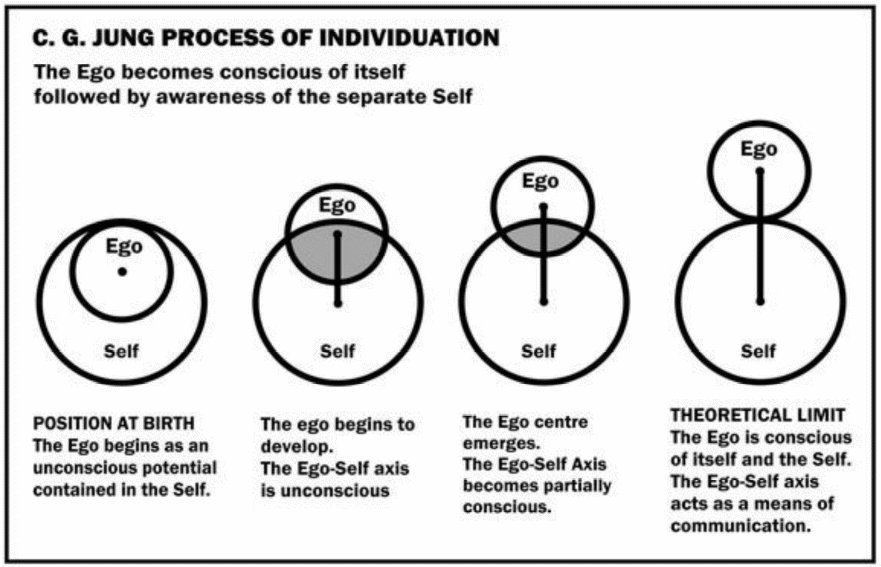
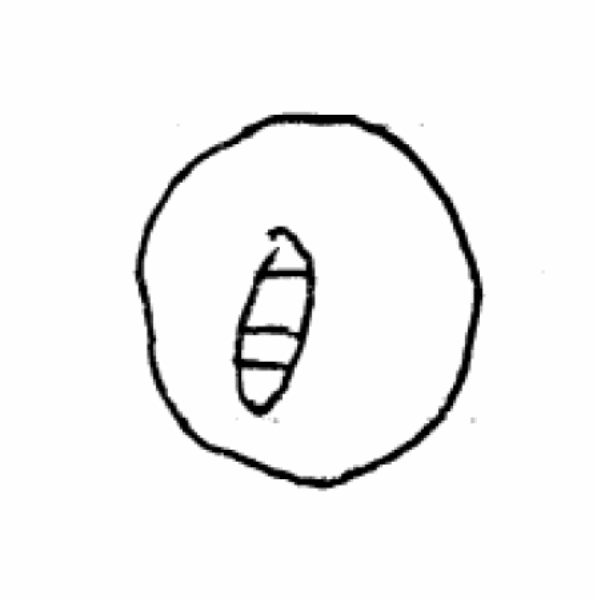
FIGURE 1973 0907-1. C.G. Jung Process of Individuation.
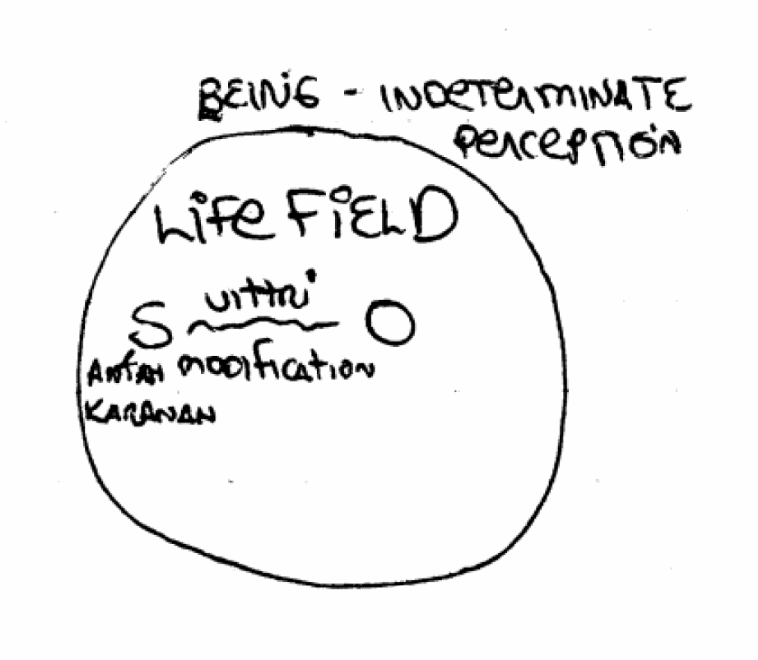
FIGURE 1973 0907-2-AB. Life Field.
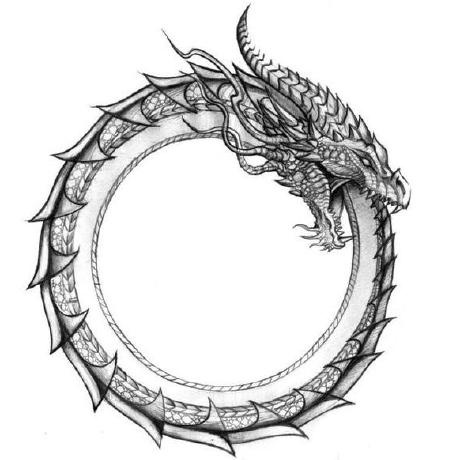
FIGURE 1973 0907-3. Uroboros.
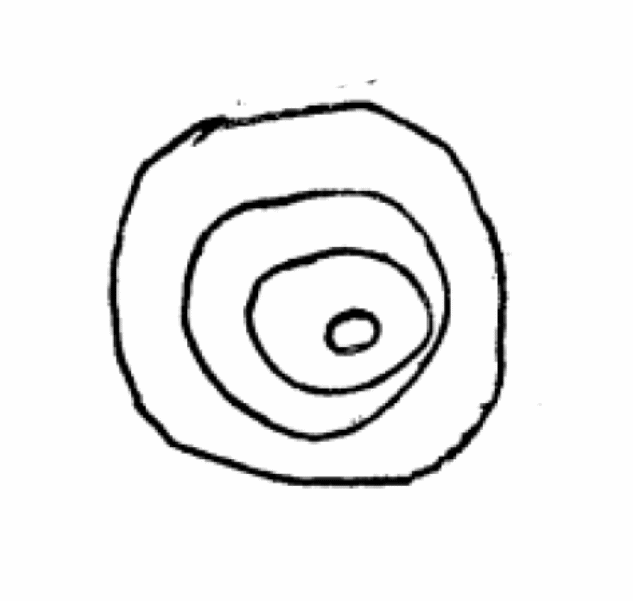
FIGURE 1973 0907-4-AB. Four stages of ego development contained within each other.
FIGURE 1973 0907-5-AB. Four stages of ego development contained within the Self.
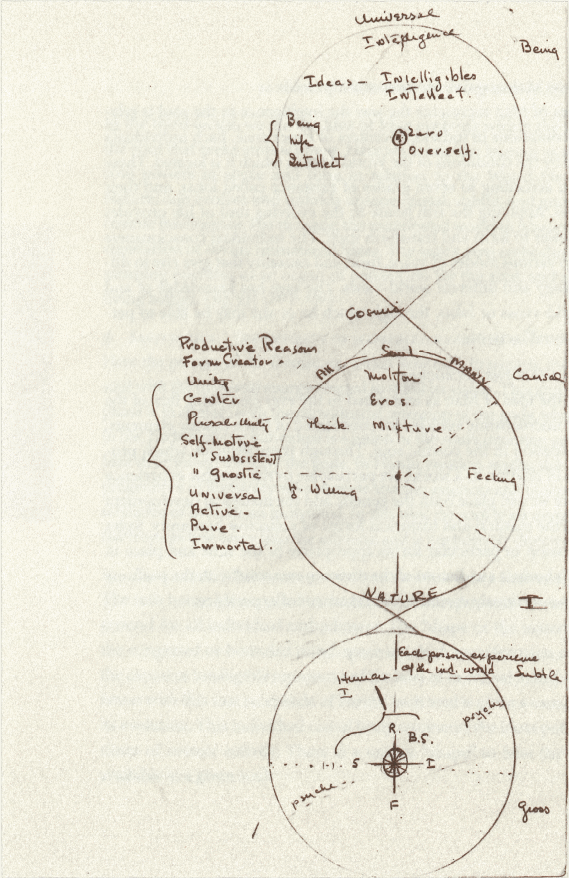
FIGURE AD_G_012. Three Circles Diagram: Divine Intellect, Soul, Psyche.
Other diagrams also referred to are not with this transcript version. [Transcriber note: [diagram] means the speaker is referencing a diagram as he or she is speaking. If someone is drawing or writing, with audible sounds of chalk on a blackboard, I indicate this by [drawing] or [writing].]
NOTES:
- The last few lines of AB class notes have been appended because they contain information that is missing due to the last audio file cutting off prematurely. All capitalization and punctuation corrected, all abbreviations spelled out in AB class notes.
TRANSCRIBED Verbatim by IT 2023. In 2025, IT updates audio file markers to match new REP audio. Archival verbatim transcript – V11a.
AUDIO FILES: 1973 0907a, 1973 0907b. [Note 1: "Tape" and "Side" refer to original audio cassette tapes that were later digitized into .MP3 Audio Files. Note 2: The second audio file cuts off before the class is finished. Note 3: In 2025, REP Studio cuts dead air from both audio files.]
1973 09/07 at Wisdom's Goldenrod
Psychology; Imagination
[Audio File 1973 0907a Begins]
AD: Go back over 17?
S (faint): Uh-hm.
S (very faint): Yeah.
S (very faint): 17?
S (faint): Is that what we were doing?
S (faint): I think so.
[15¼ second pause, flipping of pages]
AD (faint): That was this and summarize right here.
S (very faint): Yeah.
AS: Is it five?
S (very faint): [few words inaudible]
AD: Five would-- you can understand the Greek.
S: Uh-hm.
AS: Call some--
S (very faint): Undoubtedly.
S (faint): Ok.
[9¼ second pause]
AD: Well maybe we'll just go-- what we can try to review this little bit. We come-- come right up-- we'll try a brief review. [14 second pause while drawing] I think some time ago, I don't remember when, we spoke of-- a little bit about the four-- the four stages that Whitmont referred to, remember? The first stage was the unitary stage and then there was the denigration [deintegration] stage. I think the next one was [S, faint: Mythological.] magical consciousness and then the last was mythological. Remember-- remember that?
S (faint): Uh-hm.
AD: I think I brought Whitmont along. [short pause] Yeah, um-- In chapter 17, the Whitmont's book, "Ego Development and the Phases of Life", and also in Michael Fordham's New Developments in Analytical Psychology, they speak about these four stages of consciousness. The first stage they refer to as the unitary reality. And it had-- it had something to do with the fact that the life field was a unitary field of archetypal-- or archetypal field, the psyche for instance there was a relative-- relatively undifferentiated wholeness. He says here it was--
[Transcriber note: I am using The Symbolic Quest: Basic Concepts of Analytical Psychology by Edward C. Whitmont, G.P. Putnam's Sons for the C.G. Jung Foundation for Analytical Psychology, New York, NY, 1969.]
Edward C. Whitmont [The Symbolic Quest, "Ego Development and the Phases of Life," pp. 266-267, AD reading]: "…a pattern of integrated, instinctual responses in [AD reads: within] an encompassing field, where subject-object separation in the adult's sense has as yet no validity. This [AD reads: The] manner of operating can be compared with the way [AD adds: of] a plant or animal functions in a total field."
AD: And then he's got a quotation. I didn't bring the book with me.
S (faint): Which book?
AD: He had a quotation-- it's alright, Barbara.
Edward C. Whitmont [The Symbolic Quest, "Ego Development and the Phases of Life," p. 267, AD reading]: "[AD adds: The] Subject and [AD adds: the] object are dovetailed…"
AD: This was from üxküll's biology.
Edward C. Whitmont [The Symbolic Quest, "Ego Development and the Phases of Life," p. 267, AD reading]: "Subject and object are dovetailed into one another, to constitute a systematic whole. If we consider that a subject is related to the same or to different objects by several functional cycles, we shall gain insight into the first principles of the"Umwelt" theory: all animals, from the simplest to the most complex, are fitted into their unique worlds with equal completeness. A simple world corresponds to a simple animal, a well-articulated world to a complex one." [Jakob von üxküll, "A Stroll Through the Worlds of Animals and Men," in Instinctive Behavior, p. 11]
AD: And then the second stage-- In that first stage, Neumann speaks about a sort of directed power that the transcendent reality exercises. Also, he has a quote here--
Edward C. Whitmont [The Symbolic Quest, "Ego Development and the Phases of Life," p. 268, AD reading]: "…Lévy-Bruhl [AD reads: Bruhl] has [AD reads: had] called [AD adds: this] participation mystique in the psychology of the primitive; the infant or child acts in a state of unity with everything that is going on around it. The child is not so much influenced by what this [AD reads: his] environment does or says as by what it is. Even the reactions of the mother [during pregnancy] may tend to affect…"
AD: Well we know that. Alright, then the second stage, denigration [deintegration], and that was a term that Michael Fordham coined, which is not to be confused with disintegration, disintegration presupposes an ego structure that's, you know, ok and breaks up, you know, like when you get a glass and you hit it with a rock it sprinkles--disintegration. But denigration [deintegration] was a little different. Michael Fordham has this-- this kind of a-- [Note: See FIGURE 1973 0907-1 for the following.] The first stage would be something like this [diagram].
[19¾ pause while AD draws]
Edward C. Whitmont [The Symbolic Quest, "Ego Development and the Phases of Life," p. 269, AD reading]: "Deintegration…is conceived as a spontaneous property of the self behind ego formation. [AD adds: And] Expressing it anthropomorphically one could say that it springs from a desire of the self to become conscious, to form an ego by dividing itself up." [Michael Fordham, "On the Origins of the Ego in Childhood," p. 93]
"Out of the [AD reads: this] aboriginal wholeness and unity there now develops the various emotional and perceptual reactions and archetypal trends, and last but not least the ego capacity for identity, consciousness and willing. It is important to note [again] that this ego development is seemingly initiated and brought about by the Self. …
"[Deintegration means] not only ego formation but also subject-object division. The presence of an [AD reads: the] ego postulates a dimension of [AD adds: the] non-ego, the world of objects"outside" and the world of archetypes, emotions [and] urges "within". It means the beginning [AD adds: of the] differentiation of the archetypes out of the unitary field and the development of perception, emotion and action potential."
AD: And quotation by Fordham runs like this--
Edward C. Whitmont [The Symbolic Quest, "Ego Development and the Phases of Life," pp. 269-270, AD reading]: "We can describe a deintegrate by saying it is a readiness for experience, a readiness to perceive and act, but there is as yet no perception or action. Both come into consciousness together without distinction between subject or object. It will, however, appear from outside as if the infant were object-seeking and as if the infant were trying to express itself in specific ways and selecting its object with the utmost care." [Michael Fordham, "On the Origins of the Ego in Childhood," p. 95]
AD: Alright, so the second-- the second would be something like this [diagram]. Self--
[AD drawing]
S (possibly part of background): Yeah.
S (faint): I think that's why he says both there [couple words inaudible] go in the Self.
AD: I'm sorry?
S (faint): When he said both come into consciousness (and) the ego [one word inaudible]
S: Well, subject and the object.
S (simultaneously): Subject and object.
AD (simultaneously): Subject-object relationship.
S (very faint): (Ok.)
[short pause]
Edward C. Whitmont [The Symbolic Quest, "Ego Development and the Phases of Life," pp. 270-271, AD reading]: "In this [AD adds: second] stage, [it is as if] the ego fragment or [AD adds: the] infant ego, which begins for the first time to perceive itself as a focus of permanence, sees itself surrounded by a vastness of existence on which it is utterly dependent, from which it is only insufficiently separated and which appears as completely overpowering. This phase in the evolution of consciousness, both of the individual as well as of the species, has been symbolically represented in the images of the divine infant [AD adds: or] (infant consciousness) held by the Great Mother, namely the World-Mother, the aboriginal unconscious, the Self which is felt as nothing less than an overwhelming cosmic power. For the infant, the real mother actualizes this containing Self. She is experienced as an overwhelming, awesome, cosmic, lifegiving power. Her behavior, emotions and appearance mediate the ways in which life and the Self are anticipated. Or, to express this concept in another way [AD reads: Or another way of--], the stage of containment by the mother follows that of complete [AD reads: completely] psychological identity of [AD adds: the] infant ego and mother, who in this phase is truly the Great Mother, world and Self in one inseparable unit. When the infant's ego begins to emerge, this archetypal experience of the Great Mother is projected upon the woman who happens to be this infant's actual mother or fills the role of [AD adds: the] mother."
AD: Then in the third stage, The Magical Dimension--
Edward C. Whitmont [The Symbolic Quest, "Ego Development and the Phases of Life," p. 271, AD reading]: "The beginning deintegration of this unitary presymbolic oneness, of what could also be called Umwelt or field-identity, engenders a state that [AD reads: and] I have called [AD adds: that] the magical phase of development. The laws under which beginning consciousness engages in its encounter with the still encompassing unitary reality are not what we call rational. The operation of this magical dimension of the unconscious can be observed also in some aspects of primitive psychology. As the development of consciousness proceeds through the mythological and rational stages this magical dimension will recede but will continue to function as a dimension of the unconscious, always ready to compensate for, complement or disturb the conscious outlook. The dynamics of this dimension strike the rational consciousness as weird and inexplicable. The term magical, [as I use it] here… [It] does not describe such a deliberate manipulation of forces; rather I use it to refer to certain specific energy phenomena--physical and psychological--which correspond to a dimension of functioning that has been recognized in one form or another (and called magical) in every past culture."
AD: And this is the whole point then in quote-- in magical. [short pause] Go ahead.
VM: But isn't he saying, Tony, that that level is not one of willful manipulation but a-- but a certain mystery is involved in the way these things happen? And that's how he wants to use the term?
AD (simultaneously): Well he-- the term-- he says here--
Edward C. Whitmont [The Symbolic Quest, "Ego Development and the Phases of Life," p. 271, AD reading]: "The term magical, as I use it here, is not meant to refer to"the art which claims or is believed to produce effects by the assistance of supernatural forces or by mastery of secret forces of nature." It does not describe such a deliberate manipulation of forces; rather I use it to refer to [AD adds: a] certain specific energy phenomena…"
AD: He misses the whole point. The whole-- the whole dream level of consciousness becomes significant because it's a magical dimension. I'm-- I hope to get into that when we-- in a little while when we go back to the dream consciousness where most of the Sufis use that as a pivot or way to get into a higher state of being. So, here he is complaining about the rationalist and he's just as-- he's just one of them. I'll come back to this criticism in a little while and I think it's important.
S: I'm not sure that I follow what-- what you [couple words inaudible]
AD (simultaneously): I'll come back to this point later.
S: Ok.
Edward C. Whitmont [The Symbolic Quest, "Ego Development and the Phases of Life," p. 271, AD reading]: "This dimension of functioning makes itself felt directly and overwhelmingly without differentiation among or separation of image, emotion and action pattern. Any part of an event evokes the whole [(pars pro toto)] and any part can substitute for any other. Images"are" affects and compel action. This constitutes what we are accustomed to calling [AD reads: call] suggestibility."
AD: I would say [one/two words inaudible] perception of (the Indians), or perceiving thought.
Edward C. Whitmont [The Symbolic Quest, "Ego Development and the Phases of Life," p. 271, AD reading]: "To an extreme degree it characterizes the psychology of the child and the primitive. All of this is a direct expression of archetypal energy which can occur even after the differentiation of the ego is under way."
AD: In the third stage then we'll have something like this [diagram]. [drawing] Um-- [short pause while drawing] And naturally the fourth stage would be something like this. [diagram] [short pause while drawing] So you see that these are like four stages where the ego-Self axis gets gradually separated until you finally reach a point where you're completely alienated from the Self and now you could, so to speak, start speaking about-- start talking about self-identity. You can't talk about identity here or here or here yet [diagram]. It's only after you become an individual you can start talking about identity. We'll have to go into the magical dimension, I think he's-- he says some-- quite a few interesting and important points about that. Anyway, to continue about, from his point of view the magical dimension.
Edward C. Whitmont [The Symbolic Quest, "Ego Development and the Phases of Life," p. 272, AD reading]: "The infant is surrounded by and dependent upon the all-powerful world, focussed in the mother. The beginning ego consciousness establishes a vigorous resistance to this"otherness" [AD: That is, to the mother.] that threatens to absorb and overwhelm it from the outside, just as the inner "otherness" dissolves it in [AD adds: the] unconsciousness and sleep. An enormous exertion, the first power struggle, is required to resist the unconscious within and without. In the aboriginal primitive presymbolic situation, the power effort is consequently directed against the Mother, namely against the force, within as well as without, which would tempt and draw consciousness back into its dark chasm, back into the mother's womb. There is a recognition in primitive rituals that the germ of the ego must be guarded against being devoured by the mother, the nature-world and the forces of the unknown. These apotropaic rites are themselves archetypally determined, not rationally invented. They are spontaneous productions of the deintegrating unconscious directed against its own regressive urge. Such ritual elements may therefore spontaneously arise from the unconscious in the form of weird compulsions…"
AD: Think that's true for the third stage, more or less. And in the fourth stage, the Mythological [AD says: Mythologically] Experiencing--
Edward C. Whitmont [The Symbolic Quest, "Ego Development and the Phases of Life," p. 275, AD reading]: "[AD adds: So] Gradually the preoccupation shifts from the body level to fantasy in more general images and then in concepts, and there develops an awareness that the images or concepts are not necessarily quite identical with the objects they purportedly represent. This development can be regarded as the beginning of the mythological mode of experiencing, which gradually replaces the purely magical one. The developing ego emancipates itself from the magical threats of the devouring, dissolving all-oneness by means of fantasy activity…"
[11 second pause]
AD: So, we begin to get a picture from this here, we'll try rearranging it. We can see over here for instance the-- the axis, the Self-ego axis here [diagram], if there's-- depending upon what kind of conditioning takes place, you know, it could be really crippled. [student assents, faint] So an ego, so to speak, could be, so to speak, because of its identification with a certain pattern that let's say the mother operates with, alright, that will structure the whole relationship in the future. Let's take this-- [drawing] let's take this set here. [drawing] And remember, one, two, three, four [AD indicates on diagram], let's take this and imagine it in a different sense. If we take this-- if we take the first situation, [drawing] and we think of this world-image. Now this is supposition, alright. Just on my part I would suppose that this is what the Jungians are talking about. This world-image which is let's say a field of life-force [FIGURE 1973 0907-2-AB], ok. And, he said here that the-- the basic functioning, so to speak, is dovetailed right into the environment and that there's a wholeness here and no separation between the various, let's say, creatures and the world they live in. And this would be the first condition-- Let's-- let's think of the world-image in this sense, this life-force with the-- with all the possible-- all the possibilities. What I'm trying to get at is, as we go from one through four, there should be a corresponding world-images-- a world-image to-- accompanying that process. So that in the first stage you have a kind of uroboric consciousness or what he calls the unitary field [diagram]. And in the second stage, the-- it's changed somewhat. You have this division taking place in the second. And here again, I don't know, and I don't know if any of us could ever possibly know, what sort-- let's say if this is the subject and this is the object [diagram], what sort of images will accrue, alright, to that subject and in terms of its relationship with the external world, it's-- it's almost impossible to conceive of it. Well how about the second one? When you have the-- this kind of a situation (with/of) ego and the Self.
S: Yeah.
S (very faint): [few words inaudible]
AD (faint): [couple words inaudible] [drawing] No Richard, ok. (Right/Write) on--
S (very faint): Yeah.
AD: Alright. [drawing] What was this-- the name of the second one?
S (faint): Denigration.
AD: Denigration [deintegration], alright. And there's a separation-- I mean, compared to the first field, you see the ego structures all within, ok. This is the uroboric condition, if you want to you can image the head and the tail of a snake [FIGURE 1973 0907-3], ok. But in the second condition there's a breaking out of that and you have this kind of a condition now. [drawing] Here's the uroboric field and the ego's breaking out of it. And you could try, so to speak, to recapitulate this in terms of child psychology or primitive psychology. Now, if you imagine the-- the world-image, ok, with that kind of a situation where there is denigration [deintegration] taking place, the Self and the ego are being separated, there must be some sort of reaction that takes place. There must be some sort of experience going on, alright. What kind of images will accrue or what will be the residue of those-- those experiences in this kind of consciousness again is something that would only be pure speculation, alright.
S: Would it be [one/two words inaudible] development, like the very same memories you have (are kind of) myths, you know. [one/two words inaudible] has memories of at two and that was around that age, two or three of-- [S: Uh-hm.] Would that be a beginning of the ego-consciousness breaking out of the uroboric state [couple words inaudible]
AD (simultaneously): Yeah like when you have, let's say, islands, you know, in an ocean.
S (simultaneously): I could feel (one of those things).
AD: And every [S simultaneously: Uh-hm.] now and then, like if you look back into your early childhood you remember an incident here, an incident there, and these various instances that you remember are like islands jutting out of the ocean, you know?
S (faint): Right.
AD: And there's enough islands you start stringing them together and hope-- hopefully [S, faint: Right.] come across land.
S: And in that-- in that say, Tony, for me I-- one of the things about the (field/feel) of that experience was that I was separate from the world.
AD: Yeah. In other words, you were coming out of that unitary field [S: Right, yeah.] and becoming distinguished. Alright, the third one was-- he calls the magical phase (or) dimension, call magic-- magical. And here again, that's-- Over here I think that there's more available to us in trying to understand it.
LR: Tony? Also I was just going to say what-- what amazed me, it seems like it's that period of time too when a child almost suddenly becomes aware of darkness.
S (faint): Yeah.
AD: Aware of darkness?
VM: Yeah, (that's afraid) of the light switch [few words inaudible]
LR (simultaneously): Well, that [S simultaneously: Right. (few words inaudible)] and also it seems like [S: Yeah.] a very very abru-- one-- one night all of a sudden a child will be afraid of the dark. And it just happens that abruptly it seems. [students assent] You know? And suddenly every time they wake up in the dark they get-- they get very very upset. But it seems to be like night and day, there seems to be a real point where that begins to happen.
S (faint): Yeah.
AD: Yeah, and there again we'd have a tremendous difficulty trying to understand, you know, what it actually means in terms of that consciousness. Because what we're trying to get at is the situation in the fourth stage where we had this-- [drawing] where we had this person here, you know. And, you remember the way we made the diagram, and he's got a psyche, and this psyche is full of all kinds of images, you know. And it has to be the result of previous experiences and even if you don't want to say or believe in reincarnation then the previous experiencing would be in terms of the race, you know, humanity. And since the collective unconscious is embedded in the actual brain structure of the individual, there would be, so to speak, all this past experience according to Jung embedded in the brain structure and he would phylogenetically and ontogenetically recapitulate the experience of mankind in himself, supposedly, I-- alright. But we have to-- we have to, so to speak, see that these other states of consciousness do exist, so to speak, and if we go back through them, it's very possible that we could go backwards in history, you know, and, so to speak, get an idea of what the world might've been when consciousness was in that stage and when-- what-- what sort of cosmic history was around in that stage and the stage before. As a matter of fact, some of Steiner's exercises seem to be of that nature.
Well anyway, we have to develop this notion here, we-- you remember we had a snake over here, [drawing] and-- no, it was a rope. On the one side over here we got the snake, and on the other side over here we had the rope, you know. That's another way of speaking about-- Over here we had this person here who projects onto this certain images and then finally (one) relates or compares what is justifiable, the image coincides with the object or at least becomes capable of being useful as efficient knowledge, [AD taps on board] ok. But we have to build up this psyche with all kinds of images [drawing] that could be projected out into that world, so this is like a sort of, you know, very brief sketch of the history of consciousness.
The third stage, the magical stage, is very interesting. I'd like to get into that in a little while but-- The fourth stage is where there is a complete separation of the subject and the object. Now, I don't know, I think this stage here, the mythological stage, I think that's experienced, and we're more or less familiar with it from dream consciousness. The fourth stage of course is--
S: Yeah the third stage.
AD (simultaneously): I'm sorry, the third stage, magical consciousness. The fourth stage, the mythological consciousness starts operating, the rational intellect gets developed, concept come-- come into being.
[short pause]
JL (faint): But it seems-- it seems like in the third stage there's a-- an identification with a plurality like of psychic contents or archetypes all at once.
S (very faint): Uh-hm.
AD (faint): Once more, John.
JL (faint): That the archetypes are not differentiated in terms of [couple words inaudible] [10¼ second pause] But they still appear as images of-- of that mother and father and [couple/three words inaudible]
[short pause]
RC (faint): (What did he) say for the images start getting projected onto the object, then the object follows the subject?
AD: Third-- the magical? Yeah.
S (very faint): Uh-hm, that's right.
RC (very faint): Then it starts really (getting sort of) separated (by it).
AD: I don't know if we could speak of this first, it's very hard for me to understand [few very faint inaudible RC words simultaneous with AD] how we could speak of it. Huh?
RC (very faint): That deintegration stage is like the images would be [one/two words inaudible] like with this ego object.
AD: And there again we have a difficult problem because like that stage would correspond to-- um-- [short pause] The example I can give there, if you can think for instance of the Liebestod in Tristan. In the act of expiring, the person enjoys that and experiences that being--that being himself.
S (very faint): And where do you put that?
S (very faint): Right.
AD: In the second stage where there's this breaking away, where a subject-object division is coming into operation. I'm using this example but in a reverse way. You know in a reverse way what I mean, like when a person experiences his own dying, alright, there's this-- a cancellation of the subject-object differentiation. But this would be reversed, this would be an experiencing of the division that's coming up into being, the subject-object relationship. The other starts appearing.
S (very faint): You'd have to experience it. (bit of laughter)
JL: Are you saying, you (get away from experience) [few words inaudible] second level.
AD: Yes.
S (faint): But that's-- that's what happens, that--
AD: Yes you can.
JL: And probably also to the four stages in the Vedanta.
AD: To the what?
JL (faint): Four stages of Vedanta.
AD: To the ashrama?
JL: No, in-- like in the Mandukya. Only in terms of a fullness rather than in terms of (what--)
S (very faint): (Yes he did.)
S (very faint): Go on.
S (very faint): Go right on.
S (faint): What do you mean?
JL (faint): Well I mean, like a mythological consciousness tell-- they tell [few words inaudible] The development of the hero, he's-- he's breaking away from this-- from that mythological realm, I mean in-- the realm of the Mothers and the archetypes, and living out some kind of an archetypal way, and then undergoing a sacrificial death and returning to, you know, this kind of a completion [student assents, very faint] in terms of an integration [couple words inaudible]
RC (very faint): Yeah but, I think that the (rhythm is itself) ego is not [inaudible]
AD: Well we can get into that problem later. I think what John is trying to say, the four stages that we're speaking about here psychologically have an equation with the four stages in the Mandukya, you know, where in the first stage, which would be the last, the fourth, there would be no possibility of talking about any relationship, any subject-object, any experience or anything like that. And then the third or the prajna state, that is, the deep sleep, would correspond to the second one here, ok, where everything is still in a germinal condition, and the subject-object relationship, so to speak, is very dim and obscure. In other words, only the seeds of that is there, alright, and then the third stage or the dream consciousness, taijasa in the Mandukya would correspond to the third stage in the psychological, and that--
(Side 1 of original cassette tape digitized as 1973 0907a Ends; Side 2 Begins)
AD: --right here. If we go back to the first situation and we spoke about-- we spoke about some experiments, for instance--
[Transcriber note: I am using Psyche and Substance: Essays on Homeopathy in the Light of Jungian Psychology by Edward C. Whitmont, North Atlantic Books, Berkeley, CA, 1980. The chapter titled "Nature, Symbol and Imaginal Reality" was also an article published in Spring Journal in 1971 (pp. 64-83) under the same name.]
Edward C. Whitmont [Psyche and Substance: Essays on Homeopathy in the Light of Jungian Psychology, "Nature, Symbol and Imaginal Reality," p. 55, AD reading]: "Kolisko describes experiments with various metal solutions which were made to rise in filter papers…"
AD: Remember this quote we read?
S (simultaneously, very faint): Uh-hm.
S (very faint): Right.
AD: And, the conclusion-- the conclusion I think-- Oh this article is by Whitmont too and in Spring magazine. [12 second pause] I'd like you to notice too that in the first stage, the very first stage in the unitary field, the Self and the ego form a totality and there is no distinction that we could speak of between. In other words, the knowledge that's encom-- that's encompassing, you know, the Self, and the ego's knowledge form a unit of which later on, so to speak, we're going to see that there's a (presentment) of that knowledge in the ego, that-- that is the knowledge of the higher Self. Yes Richard?
RP (faint): Yeah but, you're talking [one word inaudible] that's totally present in-- you put them in anandamaya. But the example of the first one is, the [couple words inaudible] the way you relate to your body isn't at that unitary stage.
S: Uh-hm.
S: Uh-hm.
RP (faint): [few words inaudible] very very clear thing(s) that the ego [few words inaudible] there.
S: Yeah.
S: (Oh right on.)
AD: I'm sorry, Richard, try again, I [RP simultaneously: They--] did--
S (faint): Uh-hm.
RP: [couple words inaudible] of consciousness is not obliterated but they're still-- they're still ours in or-- even in the fourth stage of operating.
AD: Yes I-- yeah.
RP (simultaneously, faint): They will-- they will-- our relationship with our body is primarily a first stage (journey). [student assents, very faint] I mean, the ego is one of identity.
AD: Yes I would have to agree with you and also maintain it because it's possible to recapitulate the stages of consciousness in meditation. That would have to be so.
VM: Tony couldn't you [one word inaudible] (draw) step farther slightly?
AD: Go ahead.
VM: And that is, that every time that a new unconscious content is separated from-- from the unconscious, one goes through those four stages. Initially you would totally identify with this content, there's no separation. Then there's just the beginning sense that there is some difference between you and this content, then it goes into a sort of magical realm where there's still a lot of interaction between you and the contents that are separated [one/two words inaudible]
AD (simultaneously): We are back to this, aren't we. [drawing]
VM: Yeah there's a separation where you really start to objectify that whole content.
AD: [drawing] We are back to that, huh?
S (simultaneously, faint): [one/two words inaudible]
S (very faint): Yeah.
JL: Uh-hm.
AD: Alright, and this article here you remember by Whitmont, he tried to point out that eventually what was coming up or seems to be coming up, that he will be able to speak about a life-field where these events are taking place in, instead of, you know, speaking of electro-galvanic or dynamic field you've got a life-field. Now this life-field, I thought maybe-- I thought maybe I'd get some quotations from Woodroffe who wrote on the Sakta-Vedanta about the way they look at life, you know, alright, and from a Vedantic point of view, it might be interesting. I'll try to restrict myself. I find it hard because it's very interesting, their version of it. [19 second pause, flipping of pages] If possible try to think this matter over because we're-- you're going to keep coming across it so many times. From the point of view-- let's say, from the point of view of Samkhya--
[Transcriber note: I am using The World as Power, Power as Life by Sir John Woodroffe (Arthur Avalon), Ganesh & Co., Madras, 1922.]
Sir John Woodroffe [The World as Power, Power as Life, pp. 24-26, AD reading]: "Life according to [the] Sangkhya is not a Vayu or [AD adds: a] bio-mechanical force nor any mere mechanical impulsion resulting from the impulsion of Vayu. [AD: Or what (we call) the element air.] Life is a reflex activity, a resultant of the various concurrent activities of the mind and [AD adds: the] senses. This, it is said, explains the disturbing effect on the vitality of pleasurable and painful emotions. The Sangkhyas accept the substantive [AD reads: substantial] existence of Mind but resolve Life into a mere resultant activity of the mind and [AD adds: the] senses. Whilst [AD reads: While] therefore for them Life was not a bio-mechanical force nor evolved from inorganic matter it was only a complex reflex activity resulting from the operations of the psycho-physical principles [or forces] in the organism. [AD adds: Now] The Vedantists whilst [AD reads: while] agreeing with the Sangkhyas that Life is neither a bio-mechanical force, nor the result of its operation, deny that it is merely the result of the concurrent sensori-motor, emotional, and apperceptive reactions of the organism. Life is prior to the senses, [AD: According to the Vedantist.] for it [AD: that is, for Life] regulates the development of the fertilised living ovum from which the senses subsequently develop. The sensations do not explain life. Moreover the deprivation of any one or more of the senses does not mean a deprivation of life. The Vedantists therefore hold Life, which is [AD adds: of course] called Prana, as a separate, substantive [AD reads: substantial], quasi-material Principle, pervasive of the organism, which is not a gross natural force or material energy but a form of regulative activity or motion guiding such energy phenomenally and…immersed in Matter."
AD: You see the different between the Vedantist and the Samkhya point of view?
VM (faint): Uh-hm.
LR: Is that a-- is that a correct description of the Samkhya?
AD: Yeah.
S (faint): (Yes it is.)
LR: Yeah.
AD: (He'll relate) to the Samkhya point of view. I'm sorry. If you remember the Samkhya point of view they have this archetypal portrait of man, you know. They have the buddhi, and then they have the ahamkara and tanmatra. Then you got the listing of the manas and the indriyas, alright. Now as you can see these are all functions. They're-- there's no life principle here being mentioned. And what they claim is that the operation or the activity of all these reflex functions-- like if you tie the so screw-- you tie a screw around all these functions, alright, then their activity, so to speak, produces life by reflex. Ok. That's the Samkhya, that's why, remember, even Lenny made the remark, like he finds it like a corpse when he speaks about Samkhya. He can't find life in it anywhere. Right they're-- they're basically interested in enumerating the principles, the constituent principles that go into the making of a man, in other words, essence in a kind of a narrow sense, what is man.
RC (faint): Well, the Vedanta says that that-- that life principle guides the material energy phenomenally? What does the word 'phenomenally' mean there? Like is there any causal connection between them or--
AD: Causing a connection between what, Randy?
RC (faint): Well, he says there's-- that the life energy guides the material energy phenomenally and a certain-- certain guided-- or it's guiding it phenomenally.
S: Uh-hm.
AD: Like the power that's moving your tongue now.
S (very faint): Right. (bit of laughter)
RC: Well, I guess what I'm asking--
AD: I'm not joking, I've very serious.
RC (faint): Right. Like, that word 'phenomenally' in that context, question arose in my mind whether according to Vedanta there would be a different teleological connection between the two or if--
AD: Well of course. For them all life is teleological. But, if you permit me I think this'll answer your question, even a--
Sir John Woodroffe [The World as Power, Power as Life, p. 26, AD reading]: "The Vedantists therefore hold Life…as a separate…"
AD: Life, alright, as a separate-- And by the way-- I didn't-- I didn't ask (you to) [couple words inaudible] to review but-- Yes, from the Upanishad they got a quotation.
Sir John Woodroffe [The World as Power, Power as Life, p. 1, AD reading]: ""He said 'I am Life'"… "The Life of all lives"… "Adore Me who am Life."" [Kaushitaki Upanishad, 3-2, Kena Upanishad, 2]
AD: And that's from one of the Upanishads. He goes into that in a minute.
Sir John Woodroffe [The World as Power, Power as Life, p. 26, AD reading]: "The Vedantists therefore hold Life, which is called Prana, as a separate, substantive, quasi-material Principle, pervasive of the organism, which is not a gross natural force or material energy but a form of regulative activity or motion guiding such energy phenomenally…"
AD: And of course you can see this can correspond to the Platonist conception of what the soul is. The soul is motion, always. Self-- self-moving.
Sir John Woodroffe [The World as Power, Power as Life, pp. 26-27, AD reading]: "In the Shakta system, everything which exists is a form of [AD adds: the] Supreme Power [or Shakti] which is in Itself Consciousness and manifests as Consciousness-unconsciousness. That Power is either [of] Will, Knowledge or Action."
AD: The way we represented (kundalini), yeah.
Sir John Woodroffe [The World as Power, Power as Life, p. 27, AD reading]: "The Life Principle is a form of active power [(Kriya-shakti)]. But the powers are never entirely separated the one from the other [AD reads: from one another]."
AD: You-- in--
Sir John Woodroffe [The World as Power, Power as Life, p. 27, AD reading]: "Wherever there is [the] one, there is the other. In particular manifestations, one or [AD adds: the] other may be predominant. Therefore there is present both Will and Knowledge and all these are manifestations of the [AD reads: this] one Consciousness. The Vital Principle is ultimately as all else Consciousness, in this case active to produce and sustain living substance and all its functions. [AD adds: In other words] Living substance is a form of God as Power."
VM: They're not limiting consciousness to prana.
AD: Oh no. That would be its first manifestation.
S (very faint): Uh-hm.
Sir John Woodroffe [The World as Power, Power as Life, pp. 27-28, AD reading]: "Prana in its general sense as the"Life Principle" is not breath, nor is it breathing except in a secondary sense. Breathing is only one of the manifestations of Life, an attribute of living substance. It is a manifestation of the Life-Principle. … The form of the Life-Principle or Prana, as manifested function, is breathing. Life, as the vital principle, bears the same name as its chief characteristic--the breathing which, in various forms, is the mark of vegetable, animal, and human nature. And thus the word "Spirit" literally means breath. Man must speak in terms of material existence, and he here selected what seemed to him the least material, the most unsubstantial. A breath may be felt. The physical action of breathing may be seen and known. When [AD adds: the] breathing ceases Life ceases: and so the [Kaushitaki] Upanishad calls Prana "the Life-duration of all". But That which is unseen, of which its functioning is seen, is Spirit or Brahman [AD reads: Brahma] as the Life and [AD adds: the] source of all lives, the Prana of all Pranas."
S (very faint): Yeah.
AD: Now, in one of Jung's essays he does, so to speak, come to the same conclusion, I don't know if you come across it, where the closest word, the word that we use that comes closest to spiritual is breath. I don't know if you remember reading the essay. [Note: See C.G. Jung, CW 8, The Structure and Dynamics of the Psyche, "Basic Postulates of Analytical Psychology".]
VM: What about when he's talking about living being in that-- I don't know which-- was that the one with the [S simultaneously, faint: "Spirit and Life".] (snake there), "Spirit and Life"? [Note: C.G. Jung, CW 8, The Structure and Dynamics of the Psyche, "Spirit and Life".]
AD: Uh-huh.
S (very faint): "Spirit and Life".
VM: And he talks about, there's sort of a physical body and then there's a living being which he doesn't really grapple with but somehow one gets the hint that it might be very close to prana. [Note: See WG Classes 1973 0713, 0720, and 0803 where this essay is discussed.]
[short pause]
AD: Yeah, I remember what you're speaking about but I think the question, the-- what was relevant from that essay was the fact that he speaks about matter which is organized for life and processes or living processes [few inaudible VM words simultaneous with AD] that are going to use that matter. Let me finish this quotation, it's a little extended but it's worth our effort. Because this gives us a kind of Vedantic notion of what life is.
Sir John Woodroffe [The World as Power, Power as Life, pp. 28-29, AD reading]: "Prana is either individual or cosmic. The latter [AD reads: Cosmic] is [the] Brahman as Prana. [AD: Brahman as Life.] The special relation…constitutes the individual Prana in the individual body. The individual Prana [AD: or Life] is limited to the particular body which it vitalises, and is a manifestation in all breathing creatures called Prani of the life-giving activity of [the] Brahman. The cosmic Prana [AD: That is, the cosmic Life.] which pervades and vitalises all breathing creatures [(Prani)] is the Brahman as the collectivity of all [AD adds: the] individual Pranas, and the source of the individual and collective life."
AD: Now we're getting close to this unitary-- this conception of the unitary field of life.
S (faint): I thought it was a distinction there.
S (very faint): Just repeat.
S (faint): No.
AD: Well, let me finish the paragraph and then we'll-- you can discuss this.
Sir John Woodroffe [The World as Power, Power as Life, p. 29, AD reading]: "Breathing is a microcosmic manifestation of the macrocosmic Rhythm to which the whole universe moves and according to which it appears and disappears."
AD: When there's a manifested universe they call it the Great Breath. And when it inhales you take that all back.
S (very faint): [few words inaudible]
Sir John Woodroffe [The World as Power, Power as Life, p. 29, AD reading]: "And so it is said that the life of Brahma, the Creative-consciousness in any universe, is of the duration of the outgoing breath, of the Lord as Time. …
"The body is divided by the Vedanta [AD reads: The body in the Vedanta is divided] into five sheaths…"
AD: And you're familiar with this here. He says there's a sheath--
Sir John Woodroffe [The World as Power, Power as Life, pp. 29-31, AD reading]: "…of food or matter, life, lower and higher mind and of bliss. The Pranamaya or life-body differs from the gross outer body or [AD adds: the] body of food which it vitalises. The latter is heterogeneous, or made up of distinct or well defined parts. But the vital-self [AD: Or the vital life body.] which lies within the gross physical self is an [AD reads: a] homogeneous undivided whole, permeating the whole physical body. It is not cut off into distinct regions, as is the microcosmic [cosmic] physical body known as the Pinda. Unlike the latter [AD: or the Pinda] it has no specialised organs each discharging a special function. It is an [AD reads: a] homogenous unity, present in every part of the body which it ensouls as its inner vital self. A new life appears with the germination of the seed in breathing creatures. Into this seed Prana enters. When the Prana goes, that is when the organism ceases to breathe, the organism which the Vital Principle holds together disintegrates…"
S: [one word inaudible]
[9½ second pause]
AD: Now--
Sir John Woodroffe [The World as Power, Power as Life, pp. 31-32, AD reading]: "Prana [or Ayuh] (Life) like all other constitutive principles of the Universe has two aspects namely as cause and as effect. In the first Prana is a [AD reads: the] name for the Supreme Brahman as the Cause of, that is the Power (Shakti) which produces, the life of [AD adds: the] individual being."
AD: And see now we're right into this concept that the analytical psychologists have been speaking about and which they've been bringing up, that there's this life-field, alright, within which creatures are born. And, like he has it here--
Sir John Woodroffe [The World as Power, Power as Life, p. 33, AD reading]: "…all beings issue, enjoy their individual lives, and then re-enter into it."
AD: Ok? And this is a quote from the Upanishads, which by the way is rich in all these suggestions. Alright, so we said--
Sir John Woodroffe [The World as Power, Power as Life, pp. 31-32, AD reading]: "In the first Prana is a name for the Supreme Brahman as the Cause of, that is the Power (Shakti) which produces, the life of individual being."
AD: Would you believe this, Randy? That this life is not yours?
RC (very faint): (The whole) [few words inaudible]
AD: That it's only the effect, yeah.
Sir John Woodroffe [The World as Power, Power as Life, p. 32, AD reading]: ""He said 'I am Prana…"Though art Ayuh [AD reads: Prana]… "Prana is Brahman"… Here Prana means Parabrahman beyond Mind and Speech. Hence God is enjoined to be worshipped as Life. "Adore Me who am Life [(Ayuh)] and Eternal.""
RC/S(?) (very faint): But is that the--
AD: This is all from the Upanishads. Look how ancient these teachings are. And they-- they say Jung discovered them.
S (faint): Which?
RC (faint): I would think that at that level really you couldn't call it life [few words inaudible] saw it with your eyes [couple words inaudible]
AD: Well, also more or less what I was speaking about in the experiencing of one's life as an effect. You'll see this in critical situations where you got nothing to say about it.
S (very faint): Uh-hm.
RC (very faint): [few words inaudible]
AD: That must be my-- my shadow. (laughter)
RC (faint): [few words inaudible] (laughter)
AD: Yeah, yours will be a form, the effect. But the-- the life itself, the life-principle itself is formless.
RC (faint): [few words inaudible] constituted by--
Sir John Woodroffe [The World as Power, Power as Life, p. 31, AD reading]: "Prana…like all other constitutive principles of the Universe has two aspects…"
AD: Would you-- why don't you go in through the back and you could--
S (very faint): Through the back?
[couple seconds of faint background student talking]
AD: I have a specimen here but we're not (going through pre-trial). (laughter) No Oedipus complex, no Electra complex, no complexes.
VM (simultaneously): Right. No.
AD: Just six planets in the seventh house. (laughter)
Sir John Woodroffe [The World as Power, Power as Life, p. 31, AD reading]: "…like all other constitutive principles of the Universe [AD adds: it] has two aspects namely as cause [AD: Brahman as cause, the life-principle.] and as effect. In the first Prana is a name for the Supreme Brahman…"
AD: The life of the universe is Brahman. Poetically speaking, so to speak, the life of the universe or the soul of the universe is Brahman, (ok). And we spoke about this in-- and if you want to you can get into the Katha Upanishad where they speak about the triple fire that Nachiketas evokes when he goes to Yama. [Note: See Katha Upanishad in The Complete Works of Sri Aurobindo, Vol. 18.] Remember he goes to the god of death? No? You haven't read the Upanishads? What do you do in your spare time? (laughter) If you have any.
S (very faint): Yeah we do, at my house.
S (faint): If you have anything.
AD (simultaneously): Alright. No, if you get an opportunity, in the Katha Upanishad there's a very beautiful description about this triple fire that we have to-- you know, we have to go through life to get beyond life, and the lessons that we learn are in life. And he speaks about that in the Katha Upanishad and how important it is. And Jung speaks about this devotion to life, living it out all the way, you know. Don't try to keep yourself about it. Like one of the remarks he makes about the dream-- the dream function. I didn't-- I didn't read it last week and I underlined it because I-- I thought if I would read it you'd probably, you know, send me on a vacation. (bit of laughter)
S: Yeah.
S (very faint): Yeah.
LR: As a matter of fact--
S: Didn't ask you.
S (simultaneously): Uh-hm.
S (very faint): (You'd) be happy.
S (very faint): He's really (insecure).
LR: Who'd have thought any-- (bit of laughter)
AD: He tries to-- he says somewhere here, he says that life that's incompletely lived or not sincerely and devotedly will always have as one of its repercussions a certain amount of dream material that's constellated. In other words, it's like we pointed out, that when you have an experience, it's not completely digested, it's going to give you indigestion. (bit of laughter) Do you know what I mean? Alright.
S (laughing): Yeah.
S (simultaneously): Yeah [one word inaudible]
AD: Ok. "On the Nature of Dreams" wasn't in that--
[11 second pause]
C.G. Jung [CW 8, The Structure and Dynamics of the Psyche, "On the Nature of Dreams," p. 296, paragraph 568, AD reading]: "The unconscious functions satisfactorily only when the conscious mind fulfils its tasks to the very limit. A dream may perhaps supply what is then lacking, or it may help us forward where our best efforts have failed."
AD: Alright well we'll get to more of that. I want to kind of establish something here.
S (faint): Tony?
AD: Huh?
S (faint): Where was that from?
AD: The next one on dreams.
S (faint): "The Nature of Dreams".
S (very faint): "The Nature--"
AD: "On the Nature of Dreams," the-- the last paragraph. [10½ second pause] Alright then, summing up--
Sir John Woodroffe [The World as Power, Power as Life, pp. 35-37, AD reading]: "Life then, in its causal sense, is a name for the Supreme Power [(Shakti)] in its aspect as the originator of individual lives. [AD adds: And] That Power is in itself Consciousness [AD adds: or] (Chit). … [AD: Now--]
"If it be remembered that all is in essence Consciousness, veiled in varying degree by its Power as Mind and Matter, the nature of Life will be clearly understood. In the higher mind functioning as Reason, Judgment and so forth, Consciousness is least veiled and most aware of itself. The lower mind which attends directs and synthetises [AD reads: synthesizes] the functioning of the senses is more veiled. Animal instinct again is a veiled form of consciousness. Another form of the mental principle is Prana or Life. Though not specifically called mind, it is nevertheless that aspect of mind which is wholly immersed in matter as the directing consciousness of the material energies of the body. For to limit, regulate, control in whatsoever way is the function of the mental principle, and that which is the patient of such operation is Matter. Consciousness is present and at work in all matter, whether we call it living or not living; but when it directs the material energies in such a way as to build up and sustain breathing creatures [(Prani)] it is called Prana or the Vital Principle [or Force]."
AD: Is that the objective psyche or isn't it?
VM: Just (the point--) I just don't see if you say exists on two levels of prana. There's this one sort of like cosmic prana where we identify it with Brahman, the life of the whole manifested universe, and then there's the prana (which seems to work--) [AD drawing] you talk about infusing the body and so on.
AD: Ok. There's cosmic prana [diagram], ok?
S (very faint): Yeah.
VM: Ok.
AD: Now there's Vic over here, alright, Tony's over here, [drawing] and x is over here [diagram]. They're in this life field. Now for the purposes of our understanding this life which will unfold here would represent this power of Brahman, alright. This thing could go on as we said, on and on, alright. That life as it unfolds we-- which we call its karma, alright, that unfolding of its-- Remember we spoke about every entity is a law unto itself and manifests? In other words, this entity has a continuity, and it unfolds through that continuity the entirety of what's inherent in it. If you speak of an atom, for instance, it has a certain kind of property, these properties are the samskaras of the atom, alright. So each entity here, so to speak, is enveloped in this cosmic prana, [drawing] alright. And each individual within that also has prana that's inherent in itself. So if a creature suddenly appears here, it can't appear, so to speak, in a vacuum but is in that life field. The form will disappear [AD hitting board] and does disappear. But the life gets reabsorbed, if we can use such words, into the cosmic prana.
S (very faint): You could say it never left it either.
AD: Huh?
S (very faint): And it never left it either.
AD: It never left it to begin with, yeah right. But of course once it becomes individualized, each one thinks that its life is its life, his own life. Yeah go ahead, Richard.
RP (very faint): [few words inaudible]
AD: I'm sorry?
RP (very faint): [few words inaudible]
AD: The World as Power, Power as Life. The section on Power as Life.
RP (faint): [inaudible] maybe there is some connection. That they do, or call life a-- life is a vehicle. [few words inaudible]
AD: Yes, that's true, yeah.
RP (very faint): [few words inaudible]
AD: Sure, for them ahamkara is a cosmic-- (VM laughs) For them ahamkara is a cosmic principle that one has to get, you know, detached from. Their whole purpose is to get out of life.
RP (faint): They say nothing to worry about, life as life [couple words inaudible]
AD: Yeah, yeah. But-- (bit of laughter)
S (very faint): But you-- but you [few words inaudible]
AD: It is true, you know, like, the-- that remark would be made when Jung speaks about, you know, devotion to life, you know, like these people would say what are you talking about? You know, we want to get out of it.
RP (simultaneously, faint): But-- but they (claim/say) it was maya.
AD: Yeah, (a certain) maya. So Samkhya and the Vedantists both, you know, would from that point of view say that there's something higher than life, that's truth. But still we have to go through it. And some of us think we've already (gone) through it when we haven't even started.
RC (very faint): [few words inaudible] the life we're speaking of here, is that what we call our life or life as a-- as [one word inaudible]
AD: Life for them-- again?
RC: Is his life that's kind of (parallel), trying to get out of, is that--
AD: Even cosmic life, sure. They want to get out of that too. [student assents, very faint] Sure. Because for them life is suffering. No matter which way you look at it. You know, they give the example about, to a Sage, life, no matter in what shape, what form, what kind, it is full of pain and they compare it to like when you have something in the eye. You gotta get rid of it.
S (very faint): [few words inaudible]
S (simultaneously): Is that the imagery?
S (very faint): Yeah it is.
AD: Yeah. That's what (the) [one word inaudible] (to the) karika is all about, getting out of it. (laughter)
S (laughing): Yeah, yeah.
AD: Go ahead, Richard.
RP (faint): What I'm saying, you know, life is there and [few words inaudible] of consciousness [couple words inaudible] doctrine of life is the same thing like really psychological projection almost or really positive [one word inaudible] And (to/the) Samkhya essentially that's a primordial based willing. They would you put (a depth on you) or a doctrine of willing [few words inaudible] (dark).
AD: Well-- (bit of laughter) Alright so, already we begin to see that this-- these things have been spoken of quite adequately in the Vedanta and Samkhya. They have various subdivisions of prana, you know, they speak-- they refer to it differently as it functions differently, and each of the-- each of the pranas, so to speak, operate through chakras, certain centers, and have to do with the quality of the experience, what is earth, air, water. [9 second pause] I think that's about [LR simultaneously: Do they speak of the--] an introduction to the way the Vedantists-- I mean the Samkhya and the Vedantists views of life. Yeah.
LR: Is this identical with or do they speak of the life center in the body as the heart center?
AD: The what?
LR: Is the life center in the body the same as--
AD: I don't know what you mean the life center.
LR: Well, where supposedly the power comes into the (organism).
AD: Well they say that the life or-- is homogeneous throughout the body, it's not cut up into distinct parts, like you don't have a life for the liver and a life for--
[Audio File 1973 0907a Ends]
[Audio File 1973 0907b Begins]
LR: It's just an entity. I mean it's inside--
AD (simultaneously): It pervades in its entirety the entity. And usually they picture it as-- like if this is the individual, the life-force is around him, all around him. And it's of one homogeneous type, [drawing] you know?
LR: I just asked that because it's-- when PB talks about it it seems like it-- he-- now--
S (faint): There isn't-- The life-current, the individuality (in/and) the consciousness are also stored up in the heart.
[short pause]
LR: PB talks about it it seems like as [couple words inaudible] of the heart stopping with-- when the heart stops beating as a symbol of the life or the-- or the prana leaving the bodily entity.
AD: Yeah, so?
LR: So I was just wondering if they hint at that as being in the heart at all.
AD: No.
LR: Uh-hm.
VM: Tony I'm still confused around these two levels of prana. We talk about the five sheaths, the second sheath from the-- the one just above or slightly more refined than the gross physical body is this vegetative life. Yet if I understand this cosmic principle of prana, it's energizing all the four sheaths or three sheaths above it-- above that as well then isn't it?
AD: Let's see. We have the gross body, right, the gross [VM simultaneously: Ok.] physical body.
VM: Right.
AD: And then we have these principles.
VM (simultaneously): Pranamaya kosha, ok?
AD: We have the pranomaya. [VM: And then--] You have the manomaya and vijnanamaya, [AD hits board] right?
VM (simultaneously): Vijnanamaya and-- and then the manomaya.
AD (simultaneously): And then the manomaya.
VM: But I think-- but I-- if I understand this cosmic principle of prana, it energizes or activates or is the power behind all these three sheaths above like M V and A [manas, vijnanamaya, anandamaya] [diagram], above the pranomaya kosha, isn't that true? So there really are two levels or two manifestations [S simultaneously: Yeah.] of prana?
S (very faint): Absolutely.
AD: Well, one of the easiest ways to work with Hinduism is that when you apply a principle you apply it to everything, and at the same time.
VM: Well then how would I apply the principle of the gross physical manifestation to anandamaya kosha?
AD: Look, if we speak about manomaya, we spoke about this-- it has two divisions, the higher and the lower mind, alright. The lower mind, so to speak, is the instinctual knowledge that animals operate with. It's embedded-- it's-- let's say it's embedded in the gross physical body.
VM: Right.
AD: Ok?
VM (faint): I could see that, yeah.
AD: Alright, and the pranamaya too is part of that, alright? Now, you can see that if there is breathing, so to speak, there is thinking. The separation of these two can't be. Alright. Now this lower-- these lower instincts, alright, are guiding in a sense the pranamaya principle. Because these desires, so to speak, that we have in the lower mind, alright, are regulating the activity of this-- this body here. In other words, he goes out and seeks food this animal. Alright, he has a desire for food. And you can see that in terms of the instincts in the lower manas principle have to be combined with the prana or the activity that-- that activity that is necessary in order for these desires to get fulfilled.
VM: Would Jung say that prana there [S simultaneously, part of background: Who?] is analogous to his idea of libido and the manomaya is-- are the instincts then?
S (part of background): Is [one word inaudible] here?
S (part of background): No.
AD: Ok.
VM: Would this pranomaya kosha be what Jung would call libido in its sort of subtlest form and the manomaya would be the instincts and obviously you have to combine instinctual drives with a certain libido for there-- for anything to happen.
AD: Yeah. Yeah he speaks about these in-- in a-- in a sort of combined way, he points out that-- if you remember, you could speak of a gross physiology, you know. We don't understand, for instance, in the sympathetic nervous system, he gives an example where even when the brain or the cerebrospinal nervous system is put out of order, dreams go on and he suspects that this is taking place in the sympathetic nervous system, alright, where, so to speak, the manas has embedded itself in the substrata of the physiology. So that there-- there-- you could even possibly speak of perception taking place even when the brain is knocked out of order and not functioning.
VM (faint): Yeah.
AD: So you can see that these principles are all involved in one another. And that's what I meant when I says when you speak in Hinduism, you apply all the principles to all things and at once. You cannot, so to speak, conceive of a creature without these five principles simultaneously. This [diagram] only may be manifested. In another creature [drawing] this one [diagram], that one [diagram], alright, like in a human being up to the-- let's say the lower mind is now available to-- to their-- to that self-reflective activity, and to a higher spiritual being, you know, this part here [diagram]. But the point I'm trying to get at, whether you're speaking about an amoeba or you're speaking about a man, these principles [AD hits board with chalk] are going to apply simultaneous to it. So I could speak of samskaras of an atom which a scientist would say what the hell are you talking about.
S (faint): Yeah, it's a lot.
[short pause]
AD: Is-- is this beginning to make a little sense about the way the Vedantists handle the concept-- well, the life concept? Yeah.
S (faint): Every time-- For instance, you know how they talk about the soul as like the unmoved Mover or--
AD: No, that's Aristotle, the unmoved Mover-- Mover is the Being, uncreated Being.
S (very faint): Ok.
AD: In other words, the unmoved Mover would correspond [drawing] in Aristotle-- here's the unmoved Mover [diagram]. He would have over here, so to speak, (created/creative) being, you know, divided up into two notions of essence and down here in manifestation or what they call existence [diagram]. [student assents, very faint] But in Neo-- in Platonism generally the soul is regarded as a self-regulating, self-moving principle. And that I think would correspond to the-- these functions here [diagram]. But basically to life. [AD hits board with chalk]
S: What I-- I don't know, before I-- in my mind I was trying to like draw an analogy between like things in the [one word inaudible] or in the power, sort of, manifestation.
AD: I'm sorry, I lost--
S (faint): [one word inaudible] projecting your power. That-- (and especially) like you want to use your body, but seems like-- I don't know if you would do personality but it seemed like they would be the (active) part. In one sense if you got [one/two words inaudible] are the same as subtle. [AD: Yeah.] And the Power (as) an effect would be that (subtle).
AD: The power, yeah, would be--
S (faint): Ok, then, yeah. [few words inaudible]
S (very faint): Uh-hm.
AD (faint): Ok. (Let's see.) Well we'll get to it.
S: Ok.
AD: Dynamics gets-- So now if we go back to the Dynamics I think it'll pick up. Uh-- [short pause] Let's see now.
S: But, Tony, back to this essay. To consider Brahman as this prana--
S (faint): Louder.
S: To consider Brahman as this power, is that faith as-- or being a power for all five sheaths and also in the specific sense of, you know, the second level where it actually is this homogeneous life through the-- the [one word inaudible]
AD: Well can you think of anything in the universe that's not in motion? And if it isn't, therefore you have defied the notion of the soul, Brahma as life. And this would be applicable to the physical level, alright, and the so-called mental level, and even the level of the [one word inaudible] In other words, in all-- in all these-- in all these cases there's never a deprivation of life under any conditions. Remember the cosmic vision of Arjuna when he was looking at-- he was looking at the cosmic form of Krishna? And, you know, he hesitated, he didn't want to go into war because it meant killing all his relatives and all that. Remember? And Krishna tells him, take a look, and he looks and he looks at this cosmic vision that Krishna showed him. And he saw that already the battle was decided, that all his relatives were killed. And then Krishna tells him, he says "Do what I've already done. It's already been decided." [Note: See Bhagavad Gita.] Alright? And you get that feeling that there's this overall controlling principle which we call Life. And that's from the cosmic point of view. But the individual has a problem here.
LR: Yeah, I was really-- (laughter) [one/two words inaudible]
AD (simultaneously): Well it's-- it's a very high state, you know, like I gave you the example of the Sepoy Mutiny where one of these Brahmins was stabbed and they asked him who did it and he says "He did."
S (faint): Yeah.
AD: And when you're at that level then you can see that your life-- It isn't a question of a theoretical or verbal seeing, it's an actual. It's not my life anymore, it's His Life.
LR: Yeah but again the trouble (with the chart), you do that soon, (he wants you) to be.
AD: Yeah. Yeah, it can't be a verbal formulation, you can't say well it's not really my life, it's His Life, and then you go ahead and do what you want to do anyway.
LR/S(?): Yeah.
AD: Although it may be so, that's-- that's the contradiction inherent all the time, you know. The Infinite already decided what's going to be, and it makes it appear to you as you have a choice. And you even struggle through that choice, you say "Gee, am I going to do it or not?" And after tremendous anxiety and everything you decide you're going to do it, it was-- is already decided. But you have to go through that anxiety, that pain, and that decision-making, otherwise that experience, so to speak, could not be included as-- under the category of asmita, abhimana. [student assents, very faint] [short pause] I don't want to get into this right away but I just want to-- want to introduce this way. Um-- [short pause] Because that magical dimension is really-- [LR: Yeah.] and that dream consciousness is really quite interesting. And not because you have dreams there. [short pause, flipping of pages] This is from--
S (faint): What did I say? (bit of laughter)
S (very faint): (I don't know.)
AD: I'm sorry.
S (simultaneously): Vic, what time is it? (bit more laughter)
VM (simultaneously): I don't know.
S (faint): [few words inaudible]
AD (simultaneously): What time is it, is it 10 o'clock, I can dismiss? Yeah?
S: Ten of 9.
AD: Oh. In Arabi-- you know, Arabi's of course is quite different than Jung.
[Transcriber note: I am using Creative Imagination in the Sufism of Ibn 'Arabi by Henry Corbin, Bollingen Series XCI, Princeton University Press, Princeton, New Jersey, 1969.]
Henry Corbin [Creative Imagination in the Sufism of Ibn 'Arabi, p. 179, AD reading]: ""The notion of the imagination, [AD adds: or a] magical intermediary between thought and being, incarnation of thought in image and presence of the image in being, is a conception of [the utmost] importance, which plays a leading role in the philosophy of the Renaissance…"" [Alexandre Koyré, Mystiques, Spirituels, Alchimistes du XV lème siècle allemande, p. 60, n. 2.]
AD: And the Sufis of course. He gives examples from Boehme and Paracelsus and etc. He says--
Henry Corbin [Creative Imagination in the Sufism of Ibn 'Arabi, p. 179, AD reading]: "We wish to stress on the one hand the notion of the Imagination as the magical production of an image, the very type and model of magical action, or of all action as such, but especially of creative action; and, on the other hand, the notion of the image as a body [AD adds: that is] (a magical body, a mental body)…"
AD: Excuse (me) [one word inaudible]
Henry Corbin [Creative Imagination in the Sufism of Ibn 'Arabi, p. 179, AD reading]: "…in which are incarnated the thought and [AD adds: the] will of the soul."
AD: Now, he's speaking about the same thing that this cosmic principle prana does, alright, this life, the soul of the universe. He speaks about it microcosmically as you're capable of doing it.
RC (very faint): That's like the two levels of it, my imagination and (my--) imagination [couple words inaudible]
AD: I didn't hear a word.
RC: So that's like the two levels then of the prana, like my imagination as some-- in-- in the lower level(s), such that I would [one word inaudible] (on projecting/my projection) the name(s).
AD: Well whoa, whoa, whoa, whoa, hang on here. Let me-- let me finish the paragraph, wow.
S (very faint): [few words inaudible]
AD: Alright.
Henry Corbin [Creative Imagination in the Sufism of Ibn 'Arabi, p. 179, AD reading]: ""The notion of the imagination, [AD adds: or the] magical intermediary between thought and being, [AD adds: the] incarnation of thought in image and presence of the image in being, is a conception of the utmost importance [AD reads: is an important conception]…"" [Alexandre Koyré, Mystiques, Spirituels, Alchimistes du XV lème siècle allemande, p. 60, n. 2.]
AD: You see it quite a bit in Renaissance, in Boehme and Paracelsus and in the Sufis and all that. In other words, this intermediary degree where this magical consciousness, the dream consciousness operates. And if you remember, if you remember PB speaks about this in the Quest. Remember the chapter on the heart where you try to drop into that magical dimension, that dream consciousness, and yet remain alert and aware, don't go to sleep. Remember that? No? [Note: See Paul Brunton, The Quest of the Overself, Ch. 13, "The Mystery of the Heart".]
S: Uh-hm.
VM: Chapter on the heart?
AD: Yeah, chapter on the heart.
S: No, (in sleep).
AD: Well alright.
S: Yeah.
AD: Yeah. I thought maybe you'd have time you'd read the Quest too.
VM: I could do that.
S (faint): (I could read.)
S (possibly part of background): That's (mine).
S (possibly part of background, faint): Well, let me see.
Henry Corbin [Creative Imagination in the Sufism of Ibn 'Arabi, p. 179, AD reading]: "We wish to stress on the one hand the notion of the Imagination as the magical production of an image, the very type and model of magical action, or of all action as such, but especially of creative action; and, on the other hand, the notion of the image as a body [AD adds: that is] (a magical body, a mental body), in which are incarnated the thought and will of the soul. The Imagination as a creative magical potency which, giving birth to the sensible world, produces the Spirit in forms and colors; [AD adds: as] the world as Magia divina [AD reads: Divine magic]"imagined" by the Godhead, that is the ancient doctrine, typified in the juxtaposition of the words Image and Magia [AD reads: Magic]…"
AD: Let me pick out just a few things here. Don't confuse this by the way with fantasy. Ok? It's quite a different thing. Like if you read Sufi-- if you read Bin Arabi the way he would call his teacher's presence to himself. He would actually evoke his teacher. No? You ever read anything like that? Well we got a Center and you'll probably start using it soon. [11 second pause] I don't know, I'll give this a try, ok.
S (faint): Ok.
Henry Corbin [Creative Imagination in the Sufism of Ibn 'Arabi, p. 180, AD reading]: "[No doubt] a preliminary question is in order: What, essentially, is the creativity we attribute to man? But is an answer possible unless we presuppose the meaning and [AD adds: the] validity of [his] creations? How can we accept and begin to elucidate the idea that man feels a need not only to surpass [AD adds: a] given reality but also to surmount the solitude of the self left to its own resources in this imposed world…unless we have first, deep within ourselves, experienced this need to go beyond, and arrived at a decision in that [AD reads: this] direction? True, the terms"creative" and "creative activity" are part of our everyday language. But regardless of whether the purpose of this activity is a work of art or an institution, such objects, which are merely its expressions and symptoms, do not supply an answer to the question: What is the meaning of man's creative need? These objects themselves have their places in the outside world, but their genesis and meaning flow primarily from the inner world where they were conceived; it is this world alone, or rather the creation of this inner world, [AD rereads: or rather the creation of this inner world] that can share in the dimension of man's creative activity and thus throw some light on the meaning of his creativity and on the creative organ that is the Imagination."
AD: When you-- when you s-- when you have a dream, alright, and let's say it's a really great dream, you know, and you experience a kind of freedom, don't you?
LR: When, in the--
AD: In a dream?
LR: In the dream?
AD: Yeah, like if you're flying, you know. You're not tied to the cosmic occasions (that'll) tell you to feel your body glued to the Earth.
S (faint): Yeah, right.
AD: Do you-- you don't remember experiences in dreams like that at all, where [LR: Mine are (one word inaudible)] this felt freedom that you are, so to speak, an immortal being inwardly? I mean, do you think I'm really interested in dream psychology and what the hell your neuroses are all about? That goes on forever, you'll always be neurotic as long as you're living in this world. There's no final adjustment, I don't listen to Jung. How could you ever get adjusted with psychosis? [student assents] That's why you're picking up meditation. [student assents] Anyway he goes on, Arabi, says something--
Henry Corbin [Creative Imagination in the Sufism of Ibn 'Arabi, pp. 180-181, AD reading]: "Accordingly, everything will depend on the degree of reality that we impute to this imagined universe and by the same token on the real power we impute to the Imagination that imagines it; but both questions depend in turn on the idea that we form of creation and the creative act.
"As to the imagined universe, the reply will perhaps take the form of a wish or challenge, because there has ceased to be a schema of reality admitting of an intermediate universe between, on the one hand, [AD adds: that is] the universe of sensory data and the concepts that express their empirically verifiable laws, and, on the other hand, a spiritual universe, a kingdom of Spirits, to which only faith still has access."
AD: Any of you every read-- good example will be Blake. Huh? Blake lives in this universe. Here, well we got this fast and hard division, we got the sensible corporeal world here, and then we got a deep state of unconsciousness or sleep. And in between we don't-- we want to ignore it. And so in the twentieth century, which is very appropriate, the nineteen-- remember the nineteen, the age of darkness, your dreams start assuming significance because of the validity they have for pathological characters. You see what an inversion? The whole thing here is this in-- indeterminate degree, this degree of where subtle existence could take place, where a person could in meditation go there and create his own inner world. Nobody wants to know about that, they want to know about meditation so that they could do something like this, sidetrack that [diagram], sidetrack the sleep and go right [drawing] to instant liberation. When you tell them that they have to go through this murk over here, you know, get annoyed.
JL: Tony, you say that the realm of the imagination that is in-- you know, is imaginal.
AD: Yes. And the whole point that Whitmont misses is exactly that. He speaks so forcibly against the rational conceptual consciousness. And, in all his writings I haven't found anything, you know, this-- about the subtle degree of existence, which by the way is indeterminable. And which, for many people, that's where they can-- their evolution is completed.
JL: Well, Jung definitely wrote about it.
AD: No, Jung does, no Jung is the master, the others are the children who learn from him. No Jung is a master.
S (faint): Except that we [couple words inaudible] what we talk about in astrology as the Moon in that one?
AD: No, no. No, but when we speak about the five degrees, Beyond Being and Being, you know, [AD hitting board with chalk] causal realm, subtle, and the gross, there is that level of dream-- dreaming consciousness. Remember like for instance PB says, it isn't that we get rid of our ideas of time and space but we get different ideas of time and space. Didn't that strike you, I mean, doesn't that come over and club you over the head? "Wow, it's possible, I don't have to live in this stupid one. I could make my own." Yeah.
JL: I was wondering, when you speak about this-- like hang on-- imagination in alchemy.
AD: I'm sorry, John?
JL: I say there's a lengthy quotation in (like) Psychology and Alchemy on the imagination.
AD: Do you know where it is, we could quote him.
JL (simultaneously, very faint): I have it. After class maybe.
AD: Alright. I'm done. I'm done.
S: Yeah.
S: But, yeah.
[short pause]
AD: I'm going through some of this because I think you people have a very stereotyped idea of what dream consciousness is, what dream symbolizes, what a dream represents, you know. As a matter of fact, I get the feeling, you know, that I should wear rubber gloves when I talk to you because it's always pathological, you know? You actually have a pathological version of what dream-- dream is. You come over and you talk to me about your dreams, I've got to bite my fingers or I'll-- (you better) have a psychotic interval, you know. (some laughter)
S (faint): [couple words inaudible]
AD: I never hear beautiful dreams anymore.
S (very faint): [few words inaudible]
LR: Tony, you said that about feeling freedom in my dreams, my-- I feel much more bounded in my dreams than I do in-- Most of the time my dreams-- (laughter)
AD: Well I think you're right then.
LR (simultaneously): Really. I'm so glad to wake up most of the time. (more laughter)
S (faint): I have the exact same dream.
AD: Well how about the great novelists? You take the great novelists that are, let's say, in a birth, giving birth to a novel, a painting or something. They're in a state of exaltation, you know, ecstatic, you know. When they come back to this world they look around and they go out and get drunk! (laughter) They gotta get out! (AD laughs a bit)
LR: Oh yeah.
AD: Yeah. Oh well then maybe it stuck, you and I, yeah. Go ahead John, read that.
S (very faint): Uh-hm.
S (very faint): I was sitting in front. (bit of laughter)
JL: I'll just run a couple (pages). He says--
C.G. Jung [CW 12, Psychology and Alchemy, p. 274, paragraph 390, JL reading]: ""The word meditatio…"" [Ruland's Lexicon alchemiae]
JL (faint): Which he equates with imaginatio, meditation or imagination.
C.G. Jung [CW 12, Psychology and Alchemy, p. 274, paragraph 390, JL reading]: ""The word meditatio is used when a man has an inner dialogue with someone unseen. It may be with God, when He is invoked, or with himself, or with his good angel"… The psychologist is familiar with this "inner dialogue"; it is an essential part of the technique for coming to terms with the unconscious."
JL: He has a reference to someone else here but--
C.G. Jung [CW 12, Psychology and Alchemy, p. 274, paragraph 390, JL reading]: "Ruland's definition proves beyond all doubt that when the alchemists speaks of meditari [JL: That is, to meditate.] they do not mean mere cogitation, but explicitly an inner dialogue and hence a living relationship to the answering voice of the"other" in ourselves…"
JL: Jung's going to (tell you of) the unconscious.
C.G. Jung [CW 12, Psychology and Alchemy, p. 274, paragraph 390, JL reading]: "The use of the term"meditation" in the Hermetic dictum "And as all things proceed from the One through the meditation of the One" must therefore be understood in this alchemical sense as a creative dialogue, by means of which things pass from an unconscious potential state to a manifest one."
JL: He has something on the next page.
C.G. Jung [CW 12, Psychology and Alchemy, p. 276, paragraph 393, JL reading]: "…the term imaginatio, like meditatio, is of particular importance in the alchemical opus [JL reads: process]."
JL: Of--
C.G. Jung [CW 12, Psychology and Alchemy, p. 277, paragraph 394, JL reading]: "[Ruland says],"Imagination is the star in man, the celestial or supercelestial body." This astounding definition throws a quite special light on the fantasy processes connected with the opus [JL reads: the work]. We have to conceive of these processes not as the immaterial phantoms we readily take fantasy-pictures to be, but as something corporeal, a "subtle" body" [(fig. 139)], semi-spiritual in nature. In an age when there was [as] yet no empirical psychology such a concretization was bound to be made…"
JL (faint): On the next page (he's got something else).
C.G. Jung [CW 12, Psychology and Alchemy, p. 278, paragraph 394, JL reading]: "The imaginatio, or the act of imagining, was thus a physical activity…"
JL: This is in relationship to the-- of what-- of what Jung conceives as-- of as the subjective character of the alchemist in his work.
C.G. Jung [CW 12, Psychology and Alchemy, p. 278, paragraph 394, JL reading]: "…physical activity that could be fitted into the cycle of material changes, that brought these about and was brought about by them in turn. In this way the alchemist related himself not only to the unconscious but directly to the very substance which he hoped to transform through the power of imagination. The singular expression"astrum" [JL adds: or] (star) is a Paracelsan term, which in this context means something like "quintessence." Imagination is therefore a concentrated extract of the life forces, both physical and psychic. So the demand that the artifex must have a sound physical constitution is quite intelligible, since he works with and through his own quintessence and is himself the indispensable condition of [JL reads: for] his own experiment. But, just because of this intermingling of the physical and the psychic, it always remains an obscure point whether the ultimate transformations in the alchemical process are to be sought more in the material or more in the spiritual realm."
[short pause]
JL: [one/two words inaudible] or subtle body. And he talks about an intermediate realm between the spiritual and the-- and the material in which-- in which the imagination takes place. It's like the-- the formulation of the spiritual in terms of-- you know, in terms of a psychic being that seems to be in the psyche.
C.G. Jung [CW 12, Psychology and Alchemy, p. 279, paragraph 394, JL reading]: "[Obviously], the existence of this intermediate realm comes to a sudden stop the moment we try to investigate matter in and for itself…"
JL: That is to say one-- one side of the pole which is given beyond the psychic image that gets cancelled.
C.G. Jung [CW 12, Psychology and Alchemy, p. 279, paragraphs 394, 396, JL reading]: "…and it remains non-existent so long as we believe we know anything conclusive about matter or the psyche. But the moment when physics touches on the"untrodden, untreadable regions," and when psychology has at the same time to admit that there are other forms of psychic life besides the acquisitions of personal consciousness--in other words, when psychology too touches on an impenetrable darkness--then the intermediate realm of subtle bodies comes to life again, and the physical and the psychic are once more blended in an indissoluble unity. …
"The concept of imaginatio is perhaps the most important key to the understanding of the opus [JL reads: work]."
AD: The work meaning here the opus.
[short pause]
JL (faint): He did-- he (did) [few words inaudible]
AD: Alright, to make those quotations a little easier to understand, from-- from the magazine here is another article. It's a short one. Bachelard-- I don't know if you've heard of him, he wrote Poetics of Space, Reverie of Space, things like that, he-- [Note: The Poetics of Space, The Poetics of Reverie, by Gaston Bachelard (French philosopher).] Anyway, his first book was The Development of the Scientific Mind. [Note: Gaston Bachelard, The Formation of the Scientific Mind, published in 1938.] He was a professor of-- at the Sorbonne, ok. Some of you might be interested.
S (faint): Of what?
AD: Probably in symbolic logic or epistemology or theoretical physics, I don't know. But, he got interested in--
[Transcriber note: I am using "Exploration of the Imaginal" by Gilbert Durand, James Hillman (Ed.), Spring: An Annual of Archetypal Psychology and Jungian Thought, New York: Spring Publications, 1971.]
Gilbert Durand [Spring, "Exploration of the Imaginal," p. 92, AD reading]: "…reverie and the dreamer, placing [AD reads: and placed] them on a level equal to that of the [AD reads: a] scientific approach. He demonstrated that the philosophers of our day should show the same devotion to the two polar concerns of the intellect: [AD adds: that is] science and poetry. The vague form of intuition, which Bergson used as an antithesis to"science" (i.e., [AD reads: you know] rational thought), was defined by Bachelard as "poetics" and studied as such. The half-converted epistemologist [AD: I guess that's what he was.] then devoted an important part of his exploration to literary reverie."
AD: He started out by trying to disprove these things and ended up becoming a (physicis--) [one word inaudible] (bit of laughter)
Gilbert Durand [Spring, "Exploration of the Imaginal," p. 92, AD reading]: "Using the matrix of the four"elements", [AD: Fire, earth, air, and water.] Bachelard came to discover that, unlike the sterile functioning of scientific methodology, images are dynamic matter derived from our active participation in the world and constitute the spiritual "flesh"…"
AD: Ok? Can we do that now? Bachelard is interesting, [drawing or erasing] if you ever read any--
(Side 1 of original cassette tape digitized as 1973 0907b Ends; Side 2 Begins)
Gilbert Durand [Spring, "Exploration of the Imaginal," p. 92, AD reading]: "…[scientific] methodology, images are dynamic matter derived from our active participation in the world and constitute the spiritual"flesh"…"
AD: This is Bachelard, this is not a Vedantist so--
Gilbert Durand [Spring, "Exploration of the Imaginal," p. 92, AD reading]: "…the efflorescence of what is most profoundly felt and expressed by man in his innermost self. And finally, in his last, more [AD reads: and most] syncretic writings…[AD adds: the] (Poetics of Reverie) and…(Poetics of Space), where he took up the results of his research…Bachelard [AD reads: he] was to make the major discovery, which constituted the basis for my own investigations…"
AD: And this is Durand who's writing, there's another Jungian, he's got a school in southern France.
Gilbert Durand [Spring, "Exploration of the Imaginal," p. 92, AD reading]: "…that imagination is the product of imagining forces, [AD rereads: that imagination is the product of imagining forces] that the common denominator of all imaginal construction is ["verbal"] (dynamic) rather than "substantive" [AD adds: or] (static) or even "qualifying" [(descriptive)]."
AD: He, as a professor of the-- a profe-- philosophy science professor at the Sorbonne you can see how he must have got involved into these studies. At any rate--
Gilbert Durand [Spring, "Exploration of the Imaginal," p. 92, AD reading]: "…to raise poetic imagination to a level equal in importance with scientific knowledge. In recent times philosophical thought has tended to waver between existentialism, [AD adds: and] with its negative attitude toward science as well as its alienation from poetics…"
AD: Of course, I'm bringing this up because Jung's major work was in this sphere. Why not put on the air conditioning? [19¾ second pause] Well, that's enough for (a) side material to get us back into the dream consciousness which I, you know, felt that you may experience some freedom there and especially those of you who are working on meditation and hope to get some kind of inner light going.
[short pause with background student talking]
JL: Yeah but, doesn't it seem that the dream is like-- is like an excess of-- of that life energy, and that it has to manifest its own energy? (It) certainly qualifies as-- as you said before, somewhere (beneath his) life [one word inaudible] (as a dream).
[short pause]
AD: But it also needs you.
S: Tony, is that-- is that life or karma sort of like a flowing feeling or a visual perception of a still, that is, an image? It's almost like-- like [one/two words inaudible] or still [couple words inaudible]
S (very faint): Always.
S (faint): [few words inaudible]
AD: Keep talk-- talk to him.
S: Sometimes-- some-- or sometimes there's almost like a flowing feeling, [S: Louder.] but that-- but that happening [JL simultaneously: Louder.] in a [one word inaudible]
S (faint): Louder.
[short pause]
AD: I don't know what you mean.
S: Well, I know that-- well, I tend-- like I experience like a kind of growing feeling that feels--
S (very faint): What do you feel?
AD: Just-- no one can hear you.
S: Little louder.
[short pause]
S: I was wondering if the-- the flowing feeling, it can be a feeling on those-- you know, maybe this prana or life or where it's-- it's very different from a conscious mental functioning of other-- either of static image of visual perception or even, you know, the-- the kind of flowing of each and so on.
AD: She thinks life flows.
S: Uh-hm.
S: Say more.
S: [couple words inaudible]
S (simultaneously): What do you mean by feeling [AD simultaneously: Huh?] flowing?
S (simultaneously): Well, it sounds--
S: Drea--
S: It sounds that way if you say that this prana is life (functioning).
AD (simultaneously): I hope you don't think that that was meant as an explanation what I read. You're not going to explain life.
S: Well--
AD: And the last thing you're going to do is, so to speak, ride on it, you know, and be conscious in your reflection that it is life that you're riding on.
S: Well every time-- every time-- time I see it it stops.
AD: Oh yes.
S: Goes away.
AD: Of course, sure. Tell me what it is you see.
S: Well seeing-- seeing is the stopping it too.
S (very faint): It's part of [one word inaudible]
AD: I wish I knew what you were talking about.
S: It's-- that at times it seems like that there's some-- like I can almost feel something that, you know--
AD: Well you have to either feel, will, or think.
S: Well, those things don't really apply.
AD: They don't--
S (simultaneously): See, it's like-- it's like-- I have a situation of noticing in reflection. Because once-- once I either see or say "Oh there's that thing again," it stops, it's gone. But, I think-- I mean, it feels like, you know-- you know, just a moment of freedom or some--
LR (simultaneously): Andy, no one can hear you back there.
S: Ok. Thanks Linda. (bit of laughter)
S (very faint): Very nice.
S: Thank you.
S (very faint): Soon as they find out.
S: Well, just a time to feel a feeling of freedom which, I know they say-- I say "Oh, there it is again." And yet, I mean, that stops it. Because, you know, any (sign) of thinking or fee-- you know, any -- would-- and I was wondering if something--
LR (simultaneously): [one word inaudible] no one can hear you back there. (bit of laughter, student words)
S: She's something.
S: Well--
[short pause]
AD: Alright, now if we go back to this chapter that we were talking about in the dreams, you know. And, if we try to understand in terms of what we've been doing, this-- these paragraphs that have to do with projection. I think they started at 518 for instance. 521, 522, 523? Maybe-- It's page 269, 270, 271. Remember, what we were doing last week.
[11¼ second pause]
C.G. Jung [CW 8, The Structure and Dynamics of the Psyche, "General Aspects of Dream Psychology," p. 274, paragraph 521, AD reading]: "When the projection corresponds to a quality actually present in the object, the projected content is nevertheless present in the subject too, where it forms a part of the object-imago [AD reads: object-image]."
AD: Now, well we follow this sentence now? Let's--
S (simultaneously, very faint): What are you doing now?
S: 521.
AD (simultaneously): Paragraph 521. You see this man doesn't tell you his theoretical suppositions. He just goes ahead and does what he's doing and leaves it to you to work them out.
C.G. Jung [CW 8, The Structure and Dynamics of the Psyche, "General Aspects of Dream Psychology," p. 274, paragraph 521, AD reading]: "When the projection corresponds to a quality actually present in the object, the projected content is nevertheless present in the subject too, where it forms a part of the object-imago [AD reads: object-image, or the image of the object]. The object-imago itself is a psychological entity that is distinct from the actual perception of the object; it is an image existing independently of, and yet based on, all perception…"
AD: Yeah, you get a feeling now of what he's talking about?
S (very faint): [few words inaudible]
AD: Well here's the first stage, remember there was this unitary field consciousness. Ok? There was an identification between the ego and the Self. And of course that's when a child thinks that he-- he feels God. That's when the possibility of inflation takes place. Because you know you're-- here you are this little child and the whole world bows down and, you know, suffers you with all kinds-- anything you want is given over to you. The second stage there was a differentiation, so to speak, the ego started getting split from this, alright. And the third stage, even if we don't want to think historically, if we think let's say in terms of one lifetime and in terms of your childhood, go back from the beginning of time you're born, alright, till the time you acquired some sort of ego-consciousness. And the third stage we spoke of is the magical consciousness. And if you remember your childhood, you probably didn't (you/use)-- But if-- (some laughter)
S: What were you gonna say, Tony?
AD: Repeat.
S (simultaneously): Who gets it?
AD: Never mind.
S: [few words inaudible]
AD: And now you're in the fourth stage, hopefully, the mythological consciousness, and some of you even gone beyond a little bit and have a rational logical consciousness. Ok? (bit of laughter)
LR: But what are we going to say about the magical?
AD: Well, now, what I'm trying to say is something like this here. If you take these three-- three previous stages, alright, and you're operating in the fourth, the rational and-- a rational and logical consciousness, you can see as a background to all that would be these three previous stages with their store of images and experiences in these various different layers of consciousness. It isn't that they're--
LR (simultaneously): And which they all go through the (being).
AD: Huh?
LR: And which they all go through the (being).
AD: Well--
S: Uh-huh.
S (faint): Yeah.
S: I thought you were missing something.
LR/S(?) (faint): No but-- [short pause] [couple words inaudible]
AD: Alright, if you take that as a presupposition, alright, and now he starts speaking about an image in your consciousness or an image in your psyche which gets projected out onto the world, alright, the object out in the world, and that what you relate to is basically the images in your consciousness or your experience of that total perceptual world, alright, you-- you see what he's talking about now.
VM: The images are actually coming from that third level of consciousness, or the magical level.
S (very faint): Right.
AD: Yeah well, they would certainly come from there, sure.
S (very faint): Uh-hm.
RC (very faint): Right, so maybe [couple words inaudible] in which the thought rules [couple words inaudible] higher realm in consciousness.
AD: No, uh-- Randy, what I'm trying to get there is that feeling of that magical dimension of consciousness in which your dreaming takes place.
RC (faint): Yeah, in-- in what you were reading from before was speaking of the imagination of that subject in which he thought in a way was the individual reincarnated.
AD: Yeah.
RC (faint): So on the one hand you-- this material of which the projection images and structures, the structures of that image is the same thing that we've spoken of [couple words inaudible] Like there wouldn't be something in which the [couple words inaudible] individual incarnate.
AD: Well in either case, what-- what would that avail you?
RC (very faint): I'm saying I [few words inaudible]
AD: Well suppose I said yes.
RC (faint): Ok so that would confine me to a-- that would confine me to an individual world, it would-- limited by my previous [one word inaudible] It wasn't the autonomy of the object [one/two words inaudible]
AD: Yeah but, one more step further now. What would be the value of that?
RC (very faint): [inaudible]
AD: No, no, in a very practical way, in terms of dreams. You remember, he gives the example here where a person for instance stole pears or something. In one of the first dreams I think he analyzes.
LR (very faint): Ok.
S: Was an apple.
S: Oh ok.
AD: Was as an apple? Associat--
S (simultaneously): Uh-hm, the whole Garden of Eden theme there that--
S (faint): Right.
AD: Yeah.
C.G. Jung [CW 8, The Structure and Dynamics of the Psyche, "General Aspects of Dream Psychology," pp. 241-242, paragraphs 457, 458, AD reading]: "…"I was standing in a strange garden and picked an apple from a tree. I looked about cautiously, to make sure that no one saw me."
"The associated dream-material is a memory of having once, when a boy, plucked a couple of pears surreptitiously from a neighbor's garden. The feeling of bad conscience, [AD reads: conscious-- conscious-- never mind."…which is…" (laughter) The feeling of a bad super ego (laughter)] which is a prominent feature of the dream, reminds him of a situation experienced on the previous day. He met a young lady in the street--a casual acquaintance--[and] exchanged a few words with her. At that moment a gentleman passed whom he knew, whereupon he was suddenly seized with a curious feeling of embarrassment, as if he were doing something wrong."
AD: Now, I'm trying to get you to see a little bit different. I'm not-- I don't want a logical construct. I'm trying to get you to see if you can see that that dream consciousness functioning, so to speak, in terms of what we spoke as a mythological consciousness, when it brings up something, any kind of material, the pear that was stolen, alright, it has that felt quality of mythological functioning which is utterly different than rational consciousness. If you remember one of the attributes of magical consciousness was this-- what they call pars pro toto, one-- like if you cut the fingernail off and the native makes sure you burn it because if you grab it you can work havoc on his soul, alright. And in the same way, in the dream, in this association that may have occurred to him, the feeling of guilt, alright, comes from that kind of mythological functioning. Because the rational consciousness insofar that it eats an apple will not say "I am guilty of my father's sin." It has to be a different kind of consciousness that is reproduced when the fellow gets-- when you awaken from the dream.
S (faint): Well at the same time you say any time you touch a feeling anywhere in that [one word inaudible] thinking you're touching all your experiences of touching a feeling.
AD: Well not all the experiences [S simultaneously, faint: Well you--] but those that are constellated by that particular material that's associated with that ex-- [S: Right.] Ok?
S: Yeah.
AD: Now I-- this is what I'm trying to get you to feel, that-- the quality of that dream consciousness. Jung points out for instance you can have an experience and go through a dream and you wake up and you say, "Well, if I was supposed to learn something, I don't, I didn't, because I don't know what the dream meant," alright. (laughter) And then he goes on in the next paragraph, says-- he says "But wait a minute. You're making a mistake, you think that understanding only takes place through the intellect. There are many other ways of understanding," alright. So that if you don't understand the dream lev-- the dream meaning at a conscious level, you are probably absorbing the material, the lesson of that dream, in terms of a mythological consciousness which is in my opinion much more efficacious than your rational consciousness when it says, "Oh yeah, I understand you." [student assents] That mythological consciousness apprehends the material, experiences it, and that's part of your being. You have to learn that lesson whether you're conscious of it or not.
LR: Ok now, how do you separate the mythological consciousness of the [one word inaudible] (of) the dream and the mythological consciousness which learns the-- it is-- which learn-- (something) like meditating. You know, there's a mythological consciousness--
[Note: See FIGURE 1973 0907-1 for the following.]
AD (simultaneously): Yeah because-- because you made this distinction, right, when I said, you know, put this in here [diagram] and then this here and then, you know, put it out altogether, now you feel that your consciousness has these four stages, right?
LR: Yeah.
AD: In other words, you feel that you have a consciousness [drawing] where the ego was within it, then the ego got separated, right, and finally after the-- the fourth stage the ego is completely separated. And this is exactly the modern attitude, this is your ego [diagram], ok, separated from the Self. [short pause] What I'm trying to say is, try imagining it this way. [drawing]
LR: Oh yeah. That wasn't my question. I'm wondering if-- which--
AD: That was your question. How are you consciously experiencing a mythological consciousness. But isn't it part of your being? Don't you-- don't shake your head at me.
S (very faint): Ok. (some laughter)
AD: I don't know what it means! (AD laughs)
LR/S(?): Ok.
S (very faint): Yeah.
S (faint): But there is [few words inaudible] no?
LR: I-- That wasn't exactly what I consciously meant by the question. [AD simultaneously: Well tell me what-- yeah.] You might think that was my question. You might be right but that's not what I thought my question was.
AD (simultaneously): Alright, tell me what you want. Now I'm-- I'm very tolerant. I'm very tolerant. I don't believe you but-- (some laughter)
LR: Alright. (Our consciousnesses) that we're going through, you know [one word inaudible] you know, idea [couple words inaudible] up there.
S: You must've--
LR: Um--
S (faint): Uh-hm. (laughter)
LR: Sometimes. But, it-- but, the me that I know right now is not the me that-- that's putting forth this thing, I'm not in contact with the images [one/two words inaudible] (psychic) images, ok? Now, when Jung says I don't-- this me awake does not have to consciously or logically go through the concept of that dream to understand it because it's important, and that's the point of it, ok. I'm asking, is it also in that magical realm that-- that it's so narrow that it's also absorbed and penetrated. I mean is it all part of (one as the--)
AD: Well isn't that all part of your being? When you sit down and read a novel, ok, and he's just about ready to get stabbed and you go through these excruciating, you know, cover-up and you look at it, right? (laughter) Isn't it all taking place in that mythological consciousness?
LR: [couple words inaudible]
S (faint): Mythological or magical?
AD (simultaneously): I mean, as you're going through an experience.
LR (simultaneously): The magical or the mythological?
AD: I'm sorry, magical.
LR (simultaneously): The magical. Yeah, yeah.
AD: Yeah.
S: (You're/Yeah) right.
AD: All I'm trying to say is that you shouldn't make these separations, you know, with Virgo-like precision.
LR: Well, I know that when-- that--
AD: One consciousness is, so to speak, within the other [FIGURE 1973 0907-4-AB].
LR (simultaneously): Everything [one/two words inaudible] through the other. But--
AD (simultaneously): And we might be more correct in saying maybe it isn't one consciousness as different [drawing] from another but maybe it's like one consciousness variously graded.
LR: Ok. However, there's a part of me which is able when I go to sleep to constellate certain ideas into this dream. Ok? And there's also a part of me which I'm not (in greater) contact with until later, say, when the dream's really absorbed through and through, which draws meaning from this dream [one word inaudible]
AD (faint): Ok.
LR: Is this-- is this all on the same plane that you're speaking of now? I mean, not-- excluding this filtering process which happens all the time.
AD: Well, analogically can I present it this way. Very often you know from your chart studies, alright, astrology, the first conjunction, there's no meaning.
LR: Right.
AD: Alright? But something is sneaking through but you can't tell and the only thing that you're really aware of is a kind of inhibited consciousness. You really can't function. It goes away, the second time it starts percolating, comes up to the surface a little bit, alright. Then the third time there may be gradually an acceptance in your being. Would you say that the same thing was happening there? That it had to go through these various layers before it finally became available to your conscious mind.
LR: Right, but this is all-- but-- so the question is is this all happening of-- are we-- well-- [S, faint: Uh-hm.] to this-- is this all happening on the magical plane, the plane that-- that we think is separate from our conscious--
AD: Is what all happening?
LR: The place where it hits, ok, when you have the first conjunction, and you know you're going to have it three times, and you say, "Well, I don't know if anything happened." And yet things start feeling a little bit different very gradually. And so by the third one you know something's happening. But it seems almost like there's a place which many times is unaccessible-- unaccessible 'cause this ground is part of our ego, where the experience is felt and we-- at first, and then it-- it almost starts pushing its threads to all parts of your being. But you're-- are you speaking of this place as this magical-- as what he's referring to as the magical--
AD: Well I don't know what you mean by place but I'd say yes.
LR: Oh, that's the only word I can see. So all I'm working on is, the same time-- it's almost the same member in the ego, the same force, the same place that's putting out these images and also assimilating these images.
AD: Well, like that being the Self and this being the ego within it [diagram]?
VM: Exactly, isn't it possible, if I understand it correctly, that third level or the magical level, the dream is being-- the dream emanates from that level and the meaning is absorbed in that level as well and this all may go on completely, let's say, autonomously from the fourth mythological level which you usually feel that you're operating at.
AD: Well I didn't-- I didn't--
LR (simultaneously): Well, not auto-- no. I don't-- I don't think it's autonomous, but it's not originally noticed, it's not consciously looked at through.
AD: Well-- well maybe-- maybe I'm-- I've made the waters too muddy. I don't mean that the dreams come from the magical consciousness.
LR: But they percolate into there the--
AD: Yeah but-- but my point here was a little different, I was trying to show that the dream consciousness has this peculiar quality that the magical dimension of our being has. [student assents, faint] Like for instance we speak of, you know, pars pro toto, one fingernail represents the whole human being. This is only applicable in a dream consciousness or a magical kind of consciousness that's functioning. It's where, so to speak, if there was an intrusion from, you know, the Self which is outside of that ego. Because that ego-- here, if you want, we'll do it this way, let's say it has these four levels within it [FIGURE 1973 0907-5-AB], alright. Don't think of the Self as having those levels.
S (faint): No.
AD: Alright? So that, whatever dream material comes into this being, so to speak, and let's say it had to come in through the-- the foundations of the being, it has to go through these various layers, alright. You can call this the substratum of the physiology where there's no perception at all because of the state of identity that exists. But over here in the third level at the magical level where he starts getting separated out, or the-- in other words the dream takes place at this time in this kind of consciousness-- Try to-- try to get the point I'm making here is, is that the peculiar quality of a magical consciousness, alright, is experienced in the dream as per se as dream. The-- the way we just quoted, that there in the dream you experiencing-- you experience the imagining, alright, but not the imaginative, the structuring, the process. The process is outside of it.
LR (faint): Well that's the part I'm speaking of, yeah. I was speaking of a structuring process as--
AD: Yeah. Of--
LR (simultaneously): Of--
AD: No, go on, let me see if I follow now.
[short pause]
LR: It seems there's a place where certain images are [one word inaudible] that's-- that's essentially what I was trying to say before, but also is just-- that is the same kind of place where the images are then broken down and absorbed. And that--
AD: Where the images are received and-- and what?
LR: And absorbed and begin to filter out through us. I've read many exercises where they tell you to-- to start getting to this place by concentrating on doing something conscious in the dream, in other words, deciding that you're going to see yourself as a dream character when you wake up into that dream.
AD: Yeah.
LR: And I always assumed that it was for the purpose of getting into contact with that structuring process of oneself, trying to integrate oneself or get to that place where-- where the dream process actually is structured.
AD: Alright let-- let me try a different way then, Linda. We know that, so to speak, the ego exists in wakeful consciousness. And this existence of the ego is not in a dream consciousness. [S: Ok.] And of course in sleep there is no ego-consciousness to speak of. So in that indeterminate realm in the dream consciousness where there is no ego, let's say, the-- the notion of ahamkara or the notion of I-ness would be adapted to the ideas or the complexes that are ruling the personality. Ok. Now, what I'm trying to get at is this here. That felt quality, alright, of the dream consciousness, that magical dimension within our being which is only experienced by most people in dream consciousness, in the case of artists of course it's experienced-- that dream consciousness is experienced in a conscious wakeful state. [LR: Right.] The ego experiences that dream consciousness, alright. And this is the point that I'm trying to get in regard to the-- what Bachelard was to make, this major discovery, if you remember the quotation.
S (faint): Right.
Gilbert Durand [Spring, "Exploration of the Imaginal," p. 92, AD reading]: "…that imagination is the product of imagining forces, that the common denominator of all imaginal construction is"verbal" [AD adds: or] (dynamic) rather than "substantive" (static) [AD reads: static or substantial]…"
LR/S(?) (faint): Ok.
AD: Do you-- do you get a feeling of this here?
LR: Yeah, so it seems-- it seems beneficial to one's evolution or progress to try to get consciously in touch with these same forces which are structuring your imagination.
AD: Well, I'll agree with you, you see, but that's like a secondary point.
LR: Ok.
AD: The point I'm trying to get at is this-- this qualification of that consciousness, an apprehension of it, and it may occur, you know, while you're actually functioning with your ego. There could be this intrusion right into your ego-consciousness, alright.
LR: (Alright.) But it's also a normal occurrence before you get to this-- this fourth state, the mythological consciousness, as you pointed out, right? I mean, it seems to me that I spent a whole year of my life once in that kind of state when (I was) [couple words inaudible]
S: You mean the magical consciousness.
LR: Ma-- yeah. Thinking back on it it seems like that.
AD: Well basically as you can see what we've been trying to do therefore is to rid ourselves of material conceptions of dream psychology, and not to impose these rigid concepts that we've acquired in psychology and then apply them indiscriminately to all dream interpretation because then you will miss the value of dreaming and the whole imaginal field of what it really represents. It's-- it's a way of-- it's-- and the time for me to drive you away from the pathological aspect of dream consciousness and towards that causal realm that I'm trying to investigate, you know, that middle circle [FIGURE AD_G_012]. Yeah, go ahead.
JL: How would you interpret this, Tony? Oh about eight years ago I was painting a mural up in Corning.
AD: You were what?
JL: I was painting a mural up there. And when I really got into painting, and when I was really painting, something happened in my consciousness. And, it was as if I stepped outside of the actual production, the actual working, and the thing was painting itself. I mean, I was (really--)
AD (simultaneously): Well isn't that-- isn't that--
JL (simultaneously): I was really drawn up in very [couple words inaudible]
AD (simultaneously): Isn't that exactly what we're talking about? You can refer to it as an aesthetic consciousness.
JL: Yeah, it was like the thing was painting itself.
AD: You remember, you remember the story about the man who they hired, they told him "Now we want you to paint a dragon up on the ceiling," he says "But I never saw a dragon." Says "Well you sit here and you keep thinking about a dragon, alright, and you don't leave until you paint that dragon." And that poor painter, you know, Japanese and he figured he'd sit down and keep looking but he never saw a dragon. And this went on for weeks and they, you know, started withholding food and things like that. [S, very faint: They wanted it right away.] They're trying to hurry him up. And then all of a sudden he saw a dragon on the ceiling, he climbed up on the side of the scaffold and start painting this dragon, alright. Now he was part of that imaginal or imaging process. He was not other than that imaging process that let's say these forces were op--
[Audio File 1973 0907b Ends. We have no more audio files for this class.]
1973 09/07 V11a: CLASS: Psychology; Imagination. Copyright 2023 Wisdom's Goldenrod p. i